Evolutionary Algorithm USPEX: Revolutionizing Protein Structure Prediction for Biomedical Research
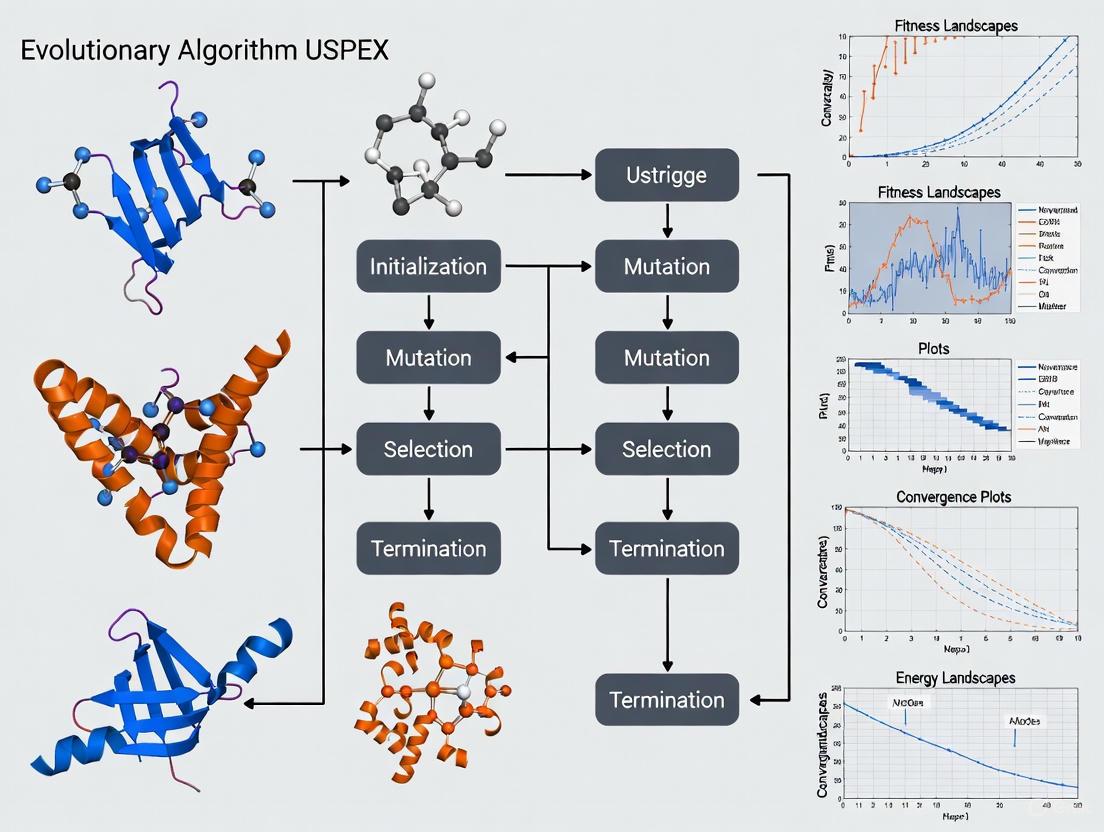
This article explores the application of the evolutionary algorithm USPEX (Universal Structure Predictor: Evolutionary Xtallography) to the critical challenge of protein structure prediction.
Evolutionary Algorithm USPEX: Revolutionizing Protein Structure Prediction for Biomedical Research
Abstract
This article explores the application of the evolutionary algorithm USPEX (Universal Structure Predictor: Evolutionary Xtallography) to the critical challenge of protein structure prediction. Aimed at researchers, scientists, and drug development professionals, we provide a comprehensive analysis spanning from the foundational principles of global optimization that USPEX employs to its specific methodological adaptation for predicting stable protein conformations from amino acid sequences. The content details practical application workflows, including interfacing with quantum mechanical codes like VASP, addresses key troubleshooting aspects and current limitations such as force field accuracy and system size constraints, and offers a rigorous validation of USPEX's performance against established methods like Rosetta. By synthesizing insights from recent scientific studies, this article serves as a technical guide and a forward-looking perspective on how evolutionary algorithms are shaping the future of computational biophysics and rational drug design.
The Foundations of USPEX: From Crystal Chemistry to Protein Folding
The Universal Structure Predictor: Evolutionary Xtallography (USPEX) is an advanced computational method developed by the Oganov laboratory since 2004 that has transformed materials science from a trial-and-error discipline into a field of rational design [1] [2]. The name "USPEX" carries a double meaning: as an acronym describing its function, and from the Russian word "uspekh" meaning "success" – reflecting the high success rate and many useful results produced by this method [2]. At its core, USPEX addresses what was once considered a fundamental unsolved problem in physical sciences: predicting the stable crystal structure of solids based solely on their chemical composition [2]. This capability is essential for discovering new materials with desired properties and for understanding matter under extreme conditions [3].
The USPEX code implements a sophisticated evolutionary algorithm that mimics natural selection to efficiently explore the complex energy landscape of possible atomic configurations [2]. Beginning with a population of random structures, the algorithm applies genetic operators such as mutation and crossover to create new candidate structures, which are then evaluated using quantum-mechanical calculations [2]. The fittest structures (those with lowest energies) are selected for subsequent generations, progressively driving the population toward the global energy minimum corresponding to the most stable crystal structure [2]. This approach has proven remarkably efficient – for instance, in predicting the 40-atom cell of MgSiO₃ post-perovskite, USPEX found the stable structure in fewer than 1,000 steps while random sampling failed to produce the correct structure even after 120,000 steps [2].
Beyond its primary evolutionary approach, USPEX integrates several complementary global optimization methods including random sampling, metadynamics, minima hopping, and particle swarm optimization, providing researchers with a comprehensive toolkit for structure prediction [3]. The code interfaces seamlessly with major quantum-mechanical calculation packages such as VASP, GULP, Quantum Espresso, CP2K, and LAMMPS, allowing accurate energy evaluations using density functional theory or other computational methods [2]. USPEX has demonstrated particular effectiveness for systems containing up to 100-200 atoms per unit cell, pushing the boundaries of computational materials discovery [2].
Methodology: Evolutionary Algorithm Workflow
Core Evolutionary Algorithm in USPEX
The USPEX methodology employs a carefully designed evolutionary algorithm that operates through an iterative process of selection, variation, and fitness evaluation. The algorithm begins by generating an initial population of crystal structures through random sampling or using known structural fragments as building blocks [2]. Each structure in this population then undergoes local optimization through quantum-mechanical calculations (typically Density Functional Theory) to determine its precise atomic coordinates and energy [2]. The fitness of each candidate is evaluated based on the calculated energy, with lower energy structures considered more fit [2].
Key to USPEX's efficiency are its specialized variation operators that generate new candidate structures while maintaining physical realism [2]. These operators include:
- Heredity: Creates offspring by combining slices of parent structures
- Mutation: Introduces random perturbations to atomic positions, lattice vectors, or atom types
- Permutation: Exchanges atoms of different types while preserving the overall structure
- Lattice mutation: Adjusts unit cell parameters and shapes
- Soft mutation: Distorts structures along the softest vibrational modes
To maintain diversity and prevent premature convergence, USPEX implements fingerprint functions that quantify structural similarity, enabling the algorithm to identify and eliminate redundant candidates [2]. The algorithm also incorporates constraint techniques that eliminate unphysical regions of the search space and cell reduction methods that simplify overly complex unit cells [2]. This comprehensive approach allows USPEX to efficiently navigate the high-dimensional search space of possible atomic configurations, making it significantly more efficient than random sampling or other optimization methods [2].
Extension to Protein Structure Prediction
Recent research has extended the USPEX methodology to predict the tertiary structures of proteins based solely on their amino acid sequences [4]. This adaptation required developing novel variation operators specifically designed for protein structures and integrating specialized force fields for energy evaluation [4]. In the protein structure prediction implementation, structural relaxation and energy calculations are performed using Tinker (with multiple force fields) and Rosetta (with REF2015 force field) codes [4].
The protein prediction workflow follows the same evolutionary principles as crystalline materials but operates in the conformational space of polypeptide chains rather than periodic crystals [4]. Testing on seven proteins lacking cis-proline residues and with lengths up to 100 amino acids demonstrated that USPEX can predict tertiary protein structures with high accuracy [4]. Comparative analysis showed that structures predicted by USPEX had potential energies comparable to or lower than those generated by the established Rosetta Abinitio approach [4]. However, the study also revealed limitations in existing force fields, suggesting that accurate blind prediction of protein structures requires additional experimental verification despite the algorithm's ability to locate deep energy minima [4].
Table 1: Key Technical Enhancements in USPEX 25
| Feature | USPEX v10.5 (2021) | USPEX v25.0 (2025) |
|---|---|---|
| Platform Support | Linux/Unix/Mac, MATLAB required | Windows & Linux, no compilation or MATLAB needed |
| Structure Relaxation | Only external codes | Built-in MatterSim ML model + external codes |
| Parallelization | Manual options | Automatic core detection and parallelism |
| Input Format | Longer, more manual | Shorter, auto-filled, smart defaults |
| Accessibility | HPC mostly | PC for everyone, fast local runs |
Application Notes for Protein Structure Prediction
Experimental Protocol for Protein Folding
The following protocol outlines the standard methodology for predicting protein structures using USPEX evolutionary algorithms, based on established procedures [4]:
Step 1: System Setup and Initialization
- Obtain the amino acid sequence of the target protein
- Define search parameters: population size (typically 50-100 structures), number of generations (typically 100-500), and variation operator probabilities
- Select appropriate force fields for energy evaluation (AMBER, CHARMM, OPLS-AA, or Rosetta REF2015)
- Configure computational resources based on protein size and complexity
Step 2: Initial Population Generation
- Create an initial population of diverse protein conformations using:
- Random coil generation for complete de novo prediction
- Fragment assembly from known protein structures
- Template-based modeling if homologous structures are available
- Ensure structural diversity through RMSD-based selection
Step 3: Evolutionary Optimization Cycle
- For each generation:
- Perform local optimization of all structures using Tinker or Rosetta
- Calculate potential energy for each optimized structure
- Rank structures by energy (fitness)
- Select top-performing structures for reproduction (typically 30-50% of population)
- Apply variation operators to create new offspring structures:
- Fragment mutation: Replace structural fragments with alternative conformations
- Torsion adjustment: Modify dihedral angles in backbone and side chains
- Domain swapping: Exchange structural domains between parent structures
- Contact map perturbation: Adjust spatial relationships between residues
- Introduce elite preservation to maintain best structures across generations
- Apply niching to maintain population diversity
Step 4: Analysis and Validation
- Cluster final population based on structural similarity
- Select representative structures from dominant clusters
- Validate predicted structures through:
- Ramachandran plot analysis
- Statistical potential Z-scores
- Comparison with experimental data (if available)
- Molecular dynamics simulations to assess stability
This protocol typically requires 2-4 weeks of computational time for a 100-residue protein using standard computing resources, though this varies significantly with protein size and complexity.
Performance Assessment and Validation
The performance of USPEX in protein structure prediction has been systematically evaluated through benchmarking studies [4]. Testing on seven proteins with lengths up to 100 residues and no cis-proline residues demonstrated the algorithm's ability to locate deep energy minima corresponding to native-like structures [4]. Quantitative assessment involves several metrics:
Energy-Based Validation: Comparing the final potential energies of predicted structures against those generated by established methods like Rosetta Abinitio. In most test cases, USPEX identified structures with comparable or lower energies across multiple force fields (AMBER, CHARMM, OPLS-AA) and scoring functions (REF2015) [4].
Accuracy Metrics: Calculating root-mean-square deviation (RMSD) of predicted structures relative to experimentally determined reference structures. Successful predictions typically achieve backbone RMSD values below 2-4 Å for proteins up to 100 residues.
Force Field Comparison: Systematic evaluation of different force fields (AMBER, CHARMM, OPLS-AA) and their impact on prediction accuracy, revealing that current force fields remain a limiting factor for blind prediction accuracy [4].
Table 2: Performance Comparison of Structure Prediction Methods
| Method | Success Rate (%) | Average Structures Until Global Minimum | Computational Cost |
|---|---|---|---|
| USPEX (LJ38) | 100 | 35 | 183 calculations |
| PSO (LJ38) | 100 | 605 | 100 calculations |
| Minima Hopping (LJ38) | 100 | 1190 | 100 calculations |
| USPEX (LJ55) | 100 | 11 | 60 calculations |
| PSO (LJ55) | 100 | 159 | 100 calculations |
Research Reagent Solutions
The following table details essential computational tools and resources required for implementing USPEX-based protein structure prediction, compiled from methodology descriptions [4] and USPEX documentation [5] [2]:
Table 3: Essential Research Reagent Solutions for USPEX Protein Structure Prediction
| Resource Category | Specific Tools | Function and Application |
|---|---|---|
| Structure Prediction Code | USPEX v25.0 | Main evolutionary algorithm platform for structure prediction [5] |
| Force Field Packages | Tinker (AMBER, CHARMM, OPLS-AA), Rosetta (REF2015) | Energy evaluation and structural relaxation [4] |
| Quantum Chemistry Codes | VASP, GULP, Quantum Espresso, CP2K | Ab initio energy calculations (for materials) [2] |
| Visualization Tools | STMng, VESTA | Structure visualization and analysis [2] [6] |
| Analysis Utilities | USPEX Tools and Utilities | Calculation of derived properties (hardness, fracture toughness) [5] |
| Specialized Operators | Custom variation operators for proteins | Generation of new protein conformations (fragment mutation, torsion adjustment) [4] |
Comparative Analysis with Alternative Methods
USPEX represents one of several approaches to the crystal structure prediction problem, alongside methods such as random search, simulated annealing, particle swarm optimization (as implemented in CALYPSO), and minima hopping [2]. Comparative studies have demonstrated USPEX's competitive performance across various systems. In tests on Lennard-Jones clusters, USPEX achieved 100% success rates for LJ38, LJ55, and LJ75 clusters while requiring fewer structural evaluations than competing methods [2]. For instance, for the LJ55 system, USPEX found the global minimum after evaluating only 11 structures on average, compared to 159 structures for the particle swarm optimization approach [2].
In protein structure prediction, USPEX competes with established methods including Rosetta Abinitio, AlphaFold2, and traditional molecular dynamics approaches [4]. The key distinction of USPEX is its foundation in evolutionary algorithms rather than machine learning or fragment assembly. Benchmarking studies have shown that USPEX can locate energy minima comparable to or deeper than Rosetta Abinitio, as measured by standard force fields [4]. However, the study also highlighted limitations in current force fields, which remain a bottleneck for accurate blind prediction regardless of the search algorithm employed [4].
The recent integration of machine learning capabilities into USPEX 25 represents a significant advancement, potentially bridging the gap between traditional evolutionary approaches and modern deep learning methods [5]. The built-in MatterSim machine learning model enables fast preliminary structure relaxation, accelerating the overall prediction process [5]. This hybrid approach combines the thorough exploration of conformational space afforded by evolutionary algorithms with the speed of machine learning surrogates, offering a promising direction for future methodological development.
The following diagram illustrates the complete USPEX evolutionary algorithm workflow for protein structure prediction, integrating both standard procedures and protein-specific adaptations:
USPEX Protein Structure Prediction Workflow
The evolutionary algorithm operates through repeated cycles of evaluation, selection, and variation until convergence criteria are met, progressively refining protein structures toward low-energy configurations that represent biologically relevant folds.
For decades, the inability to predict the three-dimensional structure of crystalline solids and proteins from their chemical composition alone stood as a major challenge in theoretical science. In 1988, John Maddox famously characterized this as a "continuing scandal in the physical sciences," noting that even the structure of simplest crystalline solids like ice remained beyond predictive capabilities [2]. This scandal extended equally to protein structure prediction, where traditional methods struggled to achieve accurate results without relying heavily on existing structural databases and recognition algorithms rather than true physical prediction [4].
The evolutionary algorithm USPEX (Universal Structure Predictor: Evolutionary Xtallography) has emerged as a powerful solution to this long-standing problem. Originally developed for crystal structure prediction since 2004, USPEX has recently been extended to tackle protein structure prediction, demonstrating remarkable success in finding deep energy minima for protein structures of up to 100 residues [4] [2]. This application note details the methodology, performance, and experimental protocols for using USPEX in protein structure prediction, providing researchers with practical guidance for implementing this cutting-edge approach.
The USPEX Framework: From Crystals to Proteins
Core Algorithm and Methodology
USPEX employs an evolutionary algorithm that mimics natural selection to predict stable structures based solely on chemical composition. The method involves generating a population of candidate structures, evaluating their fitness (typically through energy calculations), and applying variation operators to create new generations of structures that progressively evolve toward optimal solutions [2]. For protein structure prediction, the researchers developed novel variation operators specifically designed for handling polypeptide chains and complex biomolecular folding landscapes [4].
The power of USPEX lies in its efficient global optimization capability, which enables it to navigate complex energy landscapes more effectively than random sampling or other optimization methods. Comparative studies have demonstrated that while random search methods may fail to find correct structures even after 120,000 steps, USPEX can identify stable structures in fewer than 1,000 steps for challenging systems [2].
Key Research Reagent Solutions
Table 1: Essential computational tools and their functions in USPEX-based structure prediction
| Tool/Category | Specific Examples | Function |
|---|---|---|
| Energy Calculation Software | Tinker, Rosetta, VASP, SIESTA, GULP, Quantum Espresso | Performs protein structure relaxation and energy calculations using various force fields [4] |
| Force Fields | Amber, Charmm, Oplsaal, REF2015 | Provides physical scoring functions for structure evaluation and optimization [4] |
| Structure Analysis & Visualization | VESTA, STM4, STMng | Enables visualization and analysis of predicted structures [2] |
| Global Search Algorithms | Evolutionary Algorithm (USPEX), Particle Swarm Optimization (CALYPSO), Minima Hopping | Provides the framework for navigating conformational space [7] |
Quantitative Performance Metrics and Evaluation
Performance in Protein Structure Prediction
Recent tests of USPEX for protein structure prediction have demonstrated its effectiveness on seven proteins containing no cis-proline residues and with lengths up to 100 residues. The algorithm successfully predicted tertiary structures with high accuracy, finding structures with potential energies comparable to or lower than those obtained through the established Rosetta Abinitio approach [4].
Table 2: Performance comparison of structure prediction methods for various systems
| System | Method | Success Rate (%) | Structures to Solution | Computational Cost |
|---|---|---|---|---|
| LJ38 Cluster | USPEX | 100 | 35 | 183 calculations [2] |
| LJ38 Cluster | PSO (CALYPSO) | 100 | 605 | 100 calculations [2] |
| LJ38 Cluster | Minima Hopping | 100 | 1190 | 100 calculations [2] |
| LJ55 Cluster | USPEX | 100 | 11 | 60 calculations [2] |
| LJ55 Cluster | PSO (CALYPSO) | 100 | 159 | 100 calculations [2] |
| TiO₂ (48 atoms) | USPEX (cell splitting) | 100 | 41 relaxations [2] | |
| Proteins (≤100 residues) | USPEX | High accuracy | N/A | Comparable to Rosetta [4] |
Quantitative Evaluation Metrics
The evaluation of crystal structure prediction algorithms requires robust quantitative metrics. Current research has identified several key metrics that, when combined, provide comprehensive assessment of prediction quality [7]:
- Structure Similarity Metrics: A set of quantitative similarity measures that automatically determine quality compared to ground states
- Energy Difference Analysis: Comparison of formation energies between predicted and ground state structures
- Perturbation Correlation: Evaluation of how metric values correlate with perturbation deviations
- Success Rate Analysis: Percentage of successful predictions within computational budgets
These metrics address the current challenge in CSP evaluation, which has traditionally relied on manual structural inspection and case-by-case analysis. The move toward standardized quantitative evaluation enables more objective comparison of different algorithms and illuminates both progress and weaknesses in the field [7].
Experimental Protocols
USPEX Protein Structure Prediction Workflow
Title: USPEX Protein Prediction Workflow
Protocol Steps:
System Setup and Initialization
- Input the amino acid sequence of the target protein
- Configure computational parameters: population size (typically 30-100 structures), number of generations, and variation operator probabilities
- Select appropriate force fields (Amber, Charmm, Oplsaal, or REF2015) for energy calculations [4]
Initial Population Generation
- Create initial population of structures using random sampling or space group-based initialization
- For proteins, employ specific constraints to generate plausible polypeptide chain conformations
- Apply cell reduction techniques to eliminate unphysical regions of search space [2]
Energy Calculation and Fitness Evaluation
- Perform structure relaxation using interfaced software (Tinker, Rosetta, or others)
- Calculate potential energy for each structure using selected force field
- Rank structures by energy, with lower energy indicating higher fitness [4]
Evolutionary Operations
Convergence Check and Analysis
- Monitor energy trends across generations for convergence
- Calculate structural similarity metrics to identify duplicates
- Output predicted structures in appropriate formats (CIF, PDB) for visualization and analysis [7]
Performance Evaluation Protocol
Title: Structure Prediction Evaluation Method
Protocol Steps:
Reference Structure Preparation
- Obtain experimentally determined ground truth structures from Protein Data Bank (PDB) or similar databases
- Ensure reference structures are properly validated and of high resolution
Energy-Based Evaluation
- Calculate formation energy differences between predicted and ground state structures
- Compare energy distributions across multiple prediction attempts
- Use DFT-calculated energy analysis for highest accuracy when computationally feasible [7]
Structural Similarity Assessment
- Apply multiple quantitative similarity metrics (RMSD, POWDIFF, fingerprint distances)
- Evaluate spatial symmetry conservation (space group comparison)
- Assess atomic environment similarities using advanced descriptors [7]
Perturbation Analysis
- Generate perturbed structures with varying magnitudes
- Calculate correlation between metric values and perturbation deviations
- Test both random perturbations and symmetric perturbations that preserve Wyckoff sites [7]
Comprehensive Quality Scoring
- Combine multiple metrics for robust quality assessment
- Compare against manual structural inspection for validation
- Generate performance reports for algorithm comparison
Critical Analysis and Limitations
While USPEX has demonstrated remarkable success in protein structure prediction, several important limitations must be considered:
Force Field Accuracy: The study revealed that existing force fields are not sufficiently accurate for truly blind prediction of protein structures without additional experimental verification. Different force fields (Amber/Charmm/Oplsaal) and scoring functions (REF2015) produced varying results, indicating a dependency on the chosen energy calculation method [4].
System Size Constraints: The method is currently efficient for systems with up to 100-200 atoms per cell. Difficulties with larger systems arise from both the increasing computational cost of ab initio calculations and the rapidly expanding number of energy minima in the conformational landscape [2].
Evaluation Challenges: The lack of standardized quantitative metrics for evaluating prediction performance remains an issue in the field. While manual structural inspection and energy comparison are commonly used, more objective and comprehensive evaluation frameworks are needed [7].
Computational Requirements: Although USPEX significantly reduces the number of required calculations compared to random sampling, the interfaced ab initio calculations remain computationally intensive, particularly for complex protein systems [4] [2].
The application of USPEX to protein structure prediction represents a significant advancement in addressing the "scandal" of structure prediction. By leveraging evolutionary algorithms specifically adapted for protein folding landscapes, researchers can now predict tertiary structures with accuracy competitive with established methods like Rosetta.
Future developments in this field will likely focus on improving force field accuracy, developing more efficient variation operators for larger proteins, and establishing standardized quantitative metrics for objective performance evaluation. The integration of machine learning potentials, as seen in other computational materials science applications, may further enhance the efficiency and accuracy of protein structure prediction using evolutionary algorithms.
As these methods continue to evolve, the scientific community moves closer to resolving the long-standing challenge of predicting protein structure from sequence alone, with profound implications for drug development, protein design, and our fundamental understanding of biological function.
Application Notes: The USPEX Paradigm in Structure Prediction
The field of global optimization for crystal structure prediction has been revolutionized by the development of sophisticated evolutionary algorithms (EAs). The Universal Structure Predictor: Evolutionary Xtallography (USPEX) code exemplifies this paradigm, solving a fundamental problem in theoretical crystal chemistry that was once considered intractable [2]. By leveraging a nature-inspired evolutionary approach, USPEX enables the prediction of stable crystal structures from only a chemical composition, even under arbitrary pressure-temperature conditions [2] [1].
USPEX has demonstrated remarkable performance advantages when benchmarked against traditional optimization methods. The algorithm's efficiency stems from its intelligent navigation of complex energy landscapes, strategically exploring promising regions while avoiding computational exhaustion in unfruitful areas. This represents a significant advancement over earlier methods like random sampling, which often require orders of magnitude more computational steps to locate global minima [2].
Table 1: Performance Comparison of Global Optimization Methods for Crystal Structure Prediction
| Method | Success Rate (%) | Average Number of Structures Until Global Minimum Found | Computational Efficiency | Key Limitations |
|---|---|---|---|---|
| USPEX (Evolutionary Algorithm) | 100 (for tested LJ clusters) | 35 (LJ38), 11 (LJ55) [2] | High - finds stable structures in <1000 steps for complex systems [2] | Computationally intensive for very large systems (>200 atoms/cell) [2] |
| Particle Swarm Optimization (PSO/CALYPSO) | 100 (LJ38), 98 (LJ75) [2] | 605 (LJ38), 2858 (LJ75) [2] | Moderate - simple parameters but may trap in local minima [8] | Prone to premature convergence in complex energy landscapes [8] |
| Random Search (e.g., AIRSS) | Variable | >120,000 steps for some 40-atom systems [2] | Low - efficiency decreases rapidly with system size [8] | "Blind" search strategy; no learning from previous trials [8] |
| Minima Hopping | 100 (for tested LJ clusters) | 1190 (LJ38) [2] | Moderate - effective for escaping local minima but slow convergence [8] | Performance highly dependent on careful parameter tuning [8] |
Beyond its core evolutionary algorithm, USPEX incorporates a hybrid approach by integrating multiple global optimization techniques, including random sampling, metadynamics, minima hopping, and particle swarm optimization [2] [3]. This flexibility allows researchers to select the most appropriate strategy for specific scientific problems. The code's capabilities extend beyond simple crystals to predict structures of nanoparticles, polymers, surfaces, interfaces, 2D crystals, and molecular crystals with flexible molecules [2].
Recent advancements have further enhanced USPEX's capabilities through integration with machine learning approaches. The combination of evolutionary algorithms with active-learning deep neural network potentials has created a powerful synergy, particularly for complex systems with intricate bonding networks [9]. This hybrid approach was successfully applied to comprehensively explore ice polymorphs, resulting in the identification of all experimentally known ice phases plus 34 new candidate structures [9].
Table 2: Key Capabilities of the USPEX Platform Across Material Classes
| Application Domain | System Size Limitations | Notable Successes | Special Features |
|---|---|---|---|
| 3D Crystal Structures | Up to 100-200 atoms/cell [2] | Prediction of novel high-Tc superconductor H3S (Tc=191-204K) [2] | Variable-composition searches; fixed cell parameter constraints [2] |
| Molecular Crystals & Pharmaceuticals | Flexible and complex molecules supported [2] | Prediction of pomalidomide polymorphs and co-crystals [10] | Handling of predefined molecules with flexible torsions [2] [11] |
| Nanoparticles & Clusters | Up to 64 molecules per unit cell [9] | Structure and evolution of boron-carbon clusters [10] | Specialized variation operators for finite systems [2] |
| Surfaces & Interfaces | System-dependent | Surface reconstructions; mosaic texture of β-NiOOH [2] | Constraint techniques preserving periodicity in lower dimensions [2] |
| Multiobjective Optimization | No fundamental restrictions | Simultaneous optimization of hardness, band gap, dielectric properties [5] | Pareto search for materials with multiple optimal properties [12] |
The latest version, USPEX 25, represents a significant democratization of crystal structure prediction technology. With pre-compiled binaries for Windows and Linux systems, built-in machine learning potentials via MatterSim, and automated parallelization, it brings powerful materials discovery capabilities to standard desktop computers without requiring high-performance computing clusters [5]. This accessibility advancement is poised to accelerate adoption across broader research communities, including pharmaceutical development where protein and molecular crystal structure prediction plays a crucial role in drug design.
Experimental Protocols
Protocol 1: Evolutionary Crystal Structure Prediction with USPEX
Purpose: To predict the stable crystal structure of a material given only its chemical composition using an evolutionary algorithm approach.
Principle: The method operates through generational evolution of candidate structures. Each generation undergoes selection, with the fittest individuals (lowest enthalpy structures) producing offspring through variation operators, progressively driving the population toward the global minimum on the potential energy surface [2].
Procedure:
System Initialization:
- Define the chemical composition of the target system in the USPEX input file (
INPUT.txt). - Specify computational parameters: population size (typically 100-150 structures per generation), number of generations, and variation operator ratios [9].
- For molecular crystals, provide molecular geometry and flexible torsion definitions [11].
- Define the chemical composition of the target system in the USPEX input file (
First Generation Creation:
Fitness Evaluation:
- For each candidate structure, perform local geometry optimization using an external ab initio code (VASP, Quantum ESPRESSO) or built-in machine learning potential (MatterSim in USPEX 25) [5].
- Calculate the fitness metric, typically the enthalpy of formation at specified pressure-temperature conditions.
Selection and Variation:
- Select the fittest 60% of structures based on enthalpy rankings to produce offspring for the next generation.
- Apply variation operators to parent structures in the following proportions [9]:
- Heredity (40%): Combine slices of two parent structures to create offspring.
- Random (40%): Introduce completely new random structures to maintain diversity.
- SoftMutation (10%): Apply collective atomic displacements along softest phonon modes.
- Rotation (10%): Rotate molecular units in molecular crystals.
Convergence Check:
- Monitor the best enthalpy values across generations.
- Terminate calculation when the best structure remains unchanged for 10-15 consecutive generations.
- Alternatively, set a maximum generation limit (typically 30-50 generations).
Structure Analysis:
- Analyze final predicted structures using the USPEX analysis module.
- Determine space group symmetry and output in CIF format for visualization [2].
- Construct energy-distance plots to identify unique low-energy polymorphs.
Troubleshooting Tips:
- For slow convergence in complex systems, increase the proportion of random and rotation operators.
- If the calculation traps in known local minima, enable "antiSeeding" technique to exclude specific structural motifs.
- For large systems (>100 atoms), use the cell reduction technique to accelerate convergence [2].
Protocol 2: Machine Learning-Enhanced Structure Exploration
Purpose: To accelerate crystal structure prediction by integrating deep neural network potentials with evolutionary algorithms for complex systems with directional bonding.
Principle: This protocol replaces expensive ab initio calculations with an active-learning deep potential during the initial evolutionary search, reserving high-accuracy DFT verification for the final candidate structures [9].
Procedure:
Deep Neural Network (DNN) Potential Preparation:
Active Learning Structure Search:
- Launch USPEX evolutionary algorithm with DNN potential for fast energy evaluations.
- During structure evolution, perform Deep Potential Molecular Dynamics (DPMD) simulations:
- Equilibrate initial configurations at finite temperature near melting point for up to 30 ps.
- Apply annealing process gradually decreasing temperature and pressure to 1 K and 1 bar over 10 ps.
- Perform final geometry optimization until energy convergence (ΔE < 10⁻¹⁶ eV) [9].
Uncertainty Quantification and Potential Refinement:
- Monitor DNN potential uncertainty on generated structures.
- Flag structures with high prediction uncertainty for DFT verification.
- Incorporate these newly calculated structures into the DNN training set.
- Retrain the DNN potential iteratively to improve accuracy in unexplored regions of configuration space.
High-Accuracy Verification:
- Select low-enthalpy candidates from the final generations for SCAN-DFT verification.
- Perform precise geometry optimization with high energy cutoff (1500 eV) and dense k-point grids (spacing ≤ 0.5 Å⁻¹) [9].
- Calculate formation enthalpies to confirm thermodynamic stability.
Phase Diagram Construction:
- Repeat the search at multiple pressure points (e.g., 1 bar to 10 GPa).
- Build convex hulls at each pressure to identify stable phase fields.
- Calculate vibrational free energies for promising candidates to determine temperature-dependent phase stability.
Validation:
- Successful rediscovery of all experimentally known ice phases (including challenging ice IV and V) validates the methodology [9].
- Prediction of genuinely new stable phases (e.g., ice L) subsequently confirmed by experimental synthesis demonstrates protocol effectiveness.
The Scientist's Toolkit: Research Reagent Solutions
Table 3: Essential Computational Tools for Evolutionary Structure Prediction
| Tool/Code | Type | Primary Function | Application Notes |
|---|---|---|---|
| USPEX Code [2] | Evolutionary Algorithm Platform | Crystal structure prediction from chemical composition | Versions 10.5+ support multi-objective optimization; USPEX 25 includes built-in ML potentials [5] |
| VASP [2] | Ab Initio DFT Code | High-accuracy energy and force calculations for fitness evaluation | Requires license; provides benchmark accuracy for training ML potentials [9] |
| DeePMD-kit [9] | Deep Neural Network Potential | Fast, accurate energy evaluations during evolutionary search | Critical for complex systems with directional bonding (H-bond networks) [9] |
| MatterSim [5] | Machine Learning Model | Built-in structure relaxation in USPEX 25 | Eliminates dependency on external quantum chemistry codes for initial screening [5] |
| GULP [11] | Force Field Calculator | Geometry optimization with classical force fields | Supported in USPEX for molecular crystals; faster for large systems [11] |
| PyXtal [11] | Structure Generation Library | Generation of random symmetric crystals within space group constraints | Used in HTOCSP for organic crystal prediction; compatible with USPEX sampling [11] |
| STMng [2] [12] | Visualization & Analysis | Advanced analysis of USPEX output data | Provides fingerprint functions for structural similarity analysis [2] |
| GAFF/SMIRNOFF [11] | Force Field Parameters | Description of interatomic interactions for organic molecules | Essential for molecular crystal prediction; parameterized for C-H-O-N-S-P halogens [11] |
The Universal Structure Predictor: Evolutionary Xtallography (USPEX) has established itself as a revolutionary method in computational materials science, enabling accurate prediction of crystal structures based solely on chemical composition since its development in 2004 [2]. This evolutionary algorithm, whose name in Russian ("uspekh") means "success," has been employed by over 10,600 researchers worldwide to discover novel materials with specific properties [2] [1]. Traditionally applied to inorganic systems, USPEX solves the fundamental challenge of predicting stable crystal structures—a problem once considered beyond reach, as noted by John Maddox in 1988, who described the inability to predict crystalline structures as a "continuing scandal in the physical sciences" [2]. The core strength of USPEX lies in its evolutionary algorithm framework, which efficiently navigates complex energy landscapes to identify global energy minima, drastically reducing the computational resources required compared to random sampling methods [2].
Recent computational advances have enabled the extension of this powerful methodology beyond traditional materials science into the realm of biological macromolecules, particularly protein structure prediction. This expansion represents a significant paradigm shift in structural biology, where conventional approaches often rely heavily on homology modeling and experimental data integration. In 2023, researchers demonstrated that USPEX could be successfully adapted to predict tertiary protein structures from amino acid sequences alone, marking a critical milestone in computational biophysics [13] [4]. This application note examines the methodological extensions required for biological systems, presents performance metrics comparing USPEX to established protein prediction tools, and provides detailed protocols for researchers seeking to apply evolutionary algorithms to protein folding problems.
Methodological Adaptations for Biological Systems
Algorithmic Extensions and Variation Operators
Extending USPEX to protein structure prediction required developing specialized variation operators that accommodate the distinct characteristics of biological macromolecules. Unlike inorganic crystals with symmetrical repeating units, proteins feature linear polypeptide chains that fold into complex tertiary structures stabilized by diverse non-covalent interactions. The algorithm incorporates novel variation operators specifically designed for protein structures, including:
- Backbone torsion adjustments that maintain proper bond geometry while exploring conformational space
- Side chain rotamer sampling that efficiently explores side chain conformational preferences
- Fragment-based assembly that incorporates secondary structure predictions as building blocks
- Distance-based constraints that leverage predicted contact information to guide the search
These specialized operators enable USPEX to efficiently navigate the enormous conformational space of polypeptide chains while maintaining physically realistic structures throughout the evolutionary optimization process [13].
Energy Functions and Force Fields for Biomolecules
The accurate prediction of protein structures depends critically on the energy functions used to evaluate candidate models. The implementation of USPEX for protein structures incorporates multiple force fields to assess conformational energies:
Table 1: Force Fields Used in USPEX Protein Structure Prediction
| Force Field | Implementation | Strengths | Limitations |
|---|---|---|---|
| AMBER | Tinker package | Accurate for protein energetics | Limited sampling efficiency |
| CHARMM | Tinker package | Balanced parameters | Computational cost |
| OPLS-AA | Tinker package | Good for side chains | Parameter inconsistencies |
| REF2015 | Rosetta package | Knowledge-based potentials | Less accurate for novel folds |
The research has demonstrated that USPEX can identify structures with energies comparable to or lower than those generated by Rosetta's AbInitio protocol across these force fields [4]. However, the study also revealed that current force fields remain insufficient for accurate blind prediction of protein structures without additional experimental validation, highlighting an important area for future development [4].
Performance Analysis and Benchmarking
Quantitative Assessment on Test Proteins
The protein structure prediction capability of USPEX was rigorously evaluated on a set of seven test proteins containing no cis-proline residues (which have ω ≈ 0°) and with lengths of up to 100 amino acid residues [13] [4]. This controlled test set allowed for clear assessment of the algorithm's performance without complications from rare structural elements. The evaluation demonstrated that USPEX could predict tertiary structures of proteins with high accuracy, successfully locating deep energy minima in the complex folding landscape [4].
Table 2: Performance Comparison of Structure Prediction Methods
| Method | Success Rate | Average Structures to Solution | Computational Cost | Applicability Domain |
|---|---|---|---|---|
| USPEX (Proteins) | High accuracy on test set | Not specified | Force-field dependent | Small proteins (<100 residues) |
| USPEX (LJ55) | 100% | 11 structures | 60 calculations | Lennard-Jones clusters |
| USPEX (LJ38) | 100% | 35 structures | 183 calculations | Lennard-Jones clusters |
| CALYPSO (LJ55) | 100% | 159 structures | 100 calculations | Lennard-Jones clusters |
| Minima Hopping (LJ38) | 100% | 1190 structures | 100 calculations | Lennard-Jones clusters |
The performance comparison reveals that USPEX consistently outperforms other methods in computational efficiency, requiring fewer structural evaluations to locate global minima [2]. This advantage extends to protein systems, where the evolutionary algorithm demonstrates particular efficacy in navigating the complex energy landscape of folding polypeptides.
Evaluation Metrics for Structure Prediction
Quantitative assessment of prediction accuracy remains challenging in structural biology. The extension of USPEX to proteins coincides with growing recognition throughout the computational materials science community that standardized metrics are needed to objectively evaluate prediction performance [7]. Currently, most crystal structure prediction results are manually verified by authors on a case-by-case basis through structural inspection and energy comparisons [7]. Several metrics show promise for standardized assessment:
- Root Mean Square Deviation (RMSD) for structural alignment
- Energy difference from ground state using force field calculations
- Space group symmetry preservation for crystalline proteins
- Contact map accuracy for comparing predicted and actual residue interactions
The development of standardized evaluation protocols specifically adapted for protein structure prediction will be essential for meaningful comparison between different algorithms and for tracking progress in the field [7].
Experimental Protocol: USPEX for Protein Structure Prediction
System Setup and Initialization
Diagram: USPEX Protein Structure Prediction Workflow
Step 1: Input Preparation
- Obtain the amino acid sequence of the target protein
- Specify force field parameters (AMBER, CHARMM, OPLS-AA, or REF2015)
- Define algorithm parameters: population size (typically 50-100 structures), number of generations, and selection pressure
- Set variation operator probabilities for backbone adjustments, side chain sampling, and fragment assembly
Step 2: Initial Population Generation
- Create initial structural diversity using:
- Fully random extended chains for complete exploration
- Fragment-based assembly using known structural motifs
- Secondary structure predictions as topological constraints
- Ensure proper chemical geometry and stereochemistry in all initial structures
Step 3: Evolutionary Algorithm Execution
- Iterate through the generations following the workflow in Diagram 1
- Apply variation operators to create offspring structures:
- Heredity: Combine structural fragments from parent structures
- Mutation: Introduce local conformational changes
- Permutation: Exchange structurally similar regions
- Evaluate energies using coupled force field calculations
Step 4: Convergence and Analysis
- Monitor energy trends and structural similarity across generations
- Terminate when best energy remains unchanged for specified generations
- Collect lowest-energy structures for further validation
- Analyze structural ensemble for consistent folding motifs
Validation and Refinement Protocol
Structural Validation Steps:
- Geometric Quality Check: Validate bond lengths, angles, and torsions using MolProbity or similar tools
- Physicochemical Plausibility: Verify hydrophobic core formation, solvent accessibility, and charge distribution
- Comparison to Known Structures: Use DALI or CE for structural homology detection even with low sequence similarity
- Experimental Data Integration: Incorporate SAXS, NMR, or cryo-EM density maps when available
Refinement Procedure:
- Local Energy Minimization: Apply gradient-based optimization to remove steric clashes
- Molecular Dynamics Relaxation: Perform short MD simulations in implicit solvent
- Cluster Analysis: Identify structurally similar groups among low-energy predictions
- Consensus Building: Extract common structural features from top-ranked models
Research Reagent Solutions
Table 3: Essential Computational Tools for USPEX Protein Prediction
| Tool Category | Specific Software/Resource | Function in Workflow | Implementation Notes |
|---|---|---|---|
| Structure Prediction | USPEX 25 (2025 release) | Evolutionary algorithm execution | Windows/Linux compatible, no MATLAB required [5] |
| Energy Evaluation | Tinker | Force field calculations (AMBER, CHARMM, OPLS-AA) | Multiple force field support [4] |
| Energy Evaluation | Rosetta | REF2015 scoring function | Knowledge-based potentials [4] |
| Visualization | STMng | Structure visualization and analysis | Specifically designed for USPEX compatibility [5] |
| Visualization | VESTA | Crystal structure visualization | Alternative for periodic systems [2] |
| Validation | MolProbity | Geometric quality assessment | Identifies steric clashes and folding errors |
Discussion and Future Perspectives
The extension of USPEX to protein structure prediction represents a significant methodological advancement in computational biophysics, demonstrating that evolutionary algorithms originally developed for materials science can effectively address challenges in biological structure prediction. The success of this approach hinges on several key factors: the development of biological-specific variation operators, integration of specialized force fields for proteins, and adaptation of evaluation metrics relevant to biomolecular structures [13] [4].
Recent developments in USPEX 25, released in November 2025, further enhance its applicability to biological systems through integrated deep learning tools like MatterSim for fast structure relaxation and improved accessibility through pre-compiled binaries that run on standard Windows and Linux systems without requiring MATLAB [5]. These advancements democratize access to state-of-the-art structure prediction, making it feasible for broader research communities.
However, important challenges remain. The current implementation shows best performance on smaller proteins (up to 100 residues) without complex post-translational modifications or rare structural elements like cis-proline residues [4]. Additionally, the accuracy of predictions remains dependent on the force fields used for energy evaluation, and existing force fields still cannot reliably distinguish native-like structures without experimental validation [4]. Future developments will likely focus on expanding capabilities to larger protein systems, incorporating cofactors and modifications, and integrating neural network potentials trained specifically on protein structural data.
The convergence of evolutionary algorithms with deep learning approaches represents a promising direction for the field. Just as AlphaFold revolutionized protein structure prediction through end-to-end deep learning [7], hybrid approaches that combine the global search capabilities of USPEX with learned potentials may overcome current limitations in force field accuracy. As these methods mature, we anticipate expanded applications to membrane proteins, protein-ligand complexes, and even protein design—ultimately accelerating drug discovery and biomolecular engineering.
The successful extension of USPEX from mineral systems to protein structure prediction demonstrates the versatility and power of evolutionary algorithms in tackling diverse structural prediction challenges across scientific domains. By adapting variation operators specifically for polypeptide chains and leveraging multiple force fields for energy evaluation, researchers have established a robust protocol for predicting protein structures from sequence alone. While current limitations exist regarding system size and force field accuracy, the rapid development of computational methods—particularly the integration of machine learning approaches with evolutionary algorithms—promises to overcome these barriers. As USPEX continues to evolve, its application to biological systems offers exciting opportunities to accelerate discovery in structural biology, drug development, and protein engineering, ultimately bridging the historical divide between materials science and biological research.
Energy Landscapes, Global Minima, and Variation Operators
In the field of computational biophysics, predicting the three-dimensional structure of a protein from its amino acid sequence remains a fundamental challenge. This process is governed by the protein folding problem, where the native functional structure corresponds to the global minimum on a complex, high-dimensional energy landscape [14]. Evolutionary algorithms like USPEX (Universal Structure Predictor: Evolutionary Xtallography) have been adapted to navigate these landscapes efficiently, leveraging specialized variation operators to drive the search for this global minimum [4] [13]. This document details the core concepts and protocols for applying USPEX to protein structure prediction, providing a framework for researchers in computational biology and drug development.
Core Concepts
Energy Landscapes in Protein Folding
The energy landscape of a protein is a conceptual mapping of all possible conformations of the protein to their corresponding energies. A well-folded protein resides in a deep, narrow global minimum that corresponds to its native, biologically active state.
- Definition: The energy landscape is defined by the molecule's energy as a function of its structure [14]. It is an inherently high-dimensional surface, making visualization and interpretation challenging.
- Folding Funnel: A productive folding landscape resembles a funnel, where a wide array of unfolded high-energy states narrows down to the unique, low-energy native state. The evolutionary algorithm in USPEX is designed to navigate this funnel efficiently.
- Challenges: The landscape is riddled with numerous local minima—non-native conformations where the search algorithm can become trapped. The accuracy of the prediction is intrinsically linked to the accuracy of the force field used to compute the energy landscape [4] [13].
Global Minima Search
The primary goal of structure prediction is to identify the global energy minimum—the most stable conformation of the protein. USPEX employs a global optimization strategy to achieve this.
- Evolutionary Algorithm: USPEX uses a population of candidate structures that evolves over generations. The fittest (lowest-energy) structures are selected to produce new offspring, guiding the entire population toward the global minimum [2] [1].
- Performance: Studies have demonstrated that USPEX can find very deep energy minima on the protein energy landscape. In tests on proteins up to 100 residues, the algorithm found structures with energies as low as or lower than those produced by other methods like Rosetta Abinitio [4].
- Force Field Dependency: The success of the search is contingent on the quality of the energy function. Current limitations indicate that existing force fields, while useful, are not yet sufficiently accurate for fully reliable blind prediction without experimental validation [4] [13].
Variation Operators for Proteins
Variation operators are the mechanisms that generate new candidate structures in USPEX by introducing changes to the parent structures. For protein structure prediction, novel variation operators had to be developed to handle the specific nature of polypeptide chains [4].
These operators are designed to efficiently explore the conformational space of proteins while preserving physically plausible structural motifs. They work on a representation of the protein structure to create diversity within the population, which is essential for escaping local minima and thoroughly exploring the energy landscape.
Table: Summary of Key Concepts in USPEX Protein Structure Prediction
| Concept | Description | Role in USPEX |
|---|---|---|
| Energy Landscape | A high-dimensional surface mapping protein conformations to their energies [14]. | Provides the fitness criterion (energy) that guides the evolutionary search. |
| Global Minimum | The lowest energy point on the landscape, corresponding to the native protein structure. | The target state of the global optimization process. |
| Variation Operators | Genetic algorithms (mutation, crossover) specifically designed for protein conformations [4]. | Generate structural diversity in the population to explore the energy landscape. |
| Population | A set of candidate protein structures that evolves over generations [2]. | Maintains a pool of potential solutions that are progressively refined. |
Methodology and Protocols
USPEX Workflow for Protein Structure Prediction
The following diagram illustrates the complete evolutionary cycle for protein structure prediction using USPEX, from initial population creation to the final identification of the global minimum structure.
Diagram Title: USPEX Protein Prediction Workflow
Protocol: Setting Up a USPEX Protein Prediction Run
Objective: To predict the tertiary structure of a protein from its amino acid sequence using the evolutionary algorithm USPEX.
Pre-requisites: Access to USPEX code (version 25 or later), a compatible ab initio code (Tinker or Rosetta), and a high-performance computing cluster.
Step-by-Step Procedure:
System Preparation
- Input Definition: Prepare an input file specifying the amino acid sequence of the target protein.
- Calculation Parameters: Define key parameters such as population size (typically 50-100 individuals), number of generations, and convergence criteria.
- Force Field Selection: Choose an appropriate force field for energy relaxation (e.g., Amber, Charmm, Oplsaal in Tinker, or REF2015 in Rosetta) [4].
Initial Population Generation (Step 1 in Workflow)
- The initial population of 3D protein structures is created. This can be done via:
- Fully random chain generation.
- Using fragments from known protein structures (not explicitly detailed in sources but common in the field).
- Protocol Note*: The test in the referenced study was performed on seven proteins lacking cis-proline residues for simplicity, with lengths of up to 100 amino acids [4].
- The initial population of 3D protein structures is created. This can be done via:
Structure Relaxation and Energy Calculation (Step 2 in Workflow)
- Each candidate structure in the population is subjected to geometric relaxation to find the nearest local minimum on the energy landscape.
- The energy of each relaxed structure is computed using the selected force field. This energy serves as the fitness score for selection.
Selection and Variation (Steps 3 & 4 in Workflow)
- Selection: The structures with the lowest energies are selected as parents for the next generation. This implements a "survival of the fittest" paradigm.
- Application of Variation Operators: The selected parents are used to create a new generation of offspring structures. The specific protein-oriented variation operators developed for USPEX are applied here to introduce structural diversity [4].
Convergence Check (Step 5 in Workflow)
- The algorithm checks if convergence criteria are met. Criteria can include:
- The global minimum structure remains unchanged for a specified number of generations.
- A maximum number of generations is reached.
- If criteria are not met, the process returns to Step 2 with the new generation. If met, the algorithm terminates and outputs the predicted structure.
- The algorithm checks if convergence criteria are met. Criteria can include:
Variation Operators in Detail
The variation operators are crucial for the efficiency of the search. The following diagram illustrates how these operators interact within the evolutionary cycle to drive the discovery of low-energy structures.
Diagram Title: Variation Operators Role
Performance and Analysis
Performance Evaluation
The performance of USPEX in protein structure prediction has been validated against established methods. The table below summarizes key findings from a test on seven proteins without cis-proline residues.
Table: Performance Evaluation of USPEX vs. Rosetta Abinitio
| Metric | USPEX Performance | Comparative Method (Rosetta Abinitio) |
|---|---|---|
| Final Potential Energy | Found structures with close or even lower energy (Amber/Charmm/Oplsaal) [4]. | Used as a baseline for energy comparison. |
| Scoring Function (REF2015) | Found structures with close or lower scoring function value [4]. | Used as a baseline for scoring function comparison. |
| Algorithm Strength | Demonstrated high ability to find very deep energy minima on the landscape [4]. | Effective but was outperformed in some cases. |
| Key Limitation | Accuracy is limited by the force field, not the search algorithm [4] [13]. | - |
The Scientist's Toolkit: Essential Research Reagents
This table lists the key computational "reagents" and tools required for conducting protein structure prediction with USPEX.
Table: Key Research Reagent Solutions for USPEX Protein Prediction
| Tool / Reagent | Function / Purpose | Examples / Notes |
|---|---|---|
| USPEX Code | The main evolutionary algorithm platform that manages the global search. | Version 25 is the latest release as of 2025 [1]. |
| Ab Initio Code | Performs local relaxation and energy calculations for each candidate structure. | Tinker (with Amber/Charmm/Oplsaal), Rosetta (with REF2015) [4]. |
| Force Field | The mathematical function that calculates the potential energy of a protein conformation. | Critical for accuracy; Amber, Charmm, Oplsaal, REF2015 are options [4]. |
| Visualization Software | Used to visualize and analyze the final predicted 3D structures. | VESTA, STM4, STMng are codes fully interfaced with USPEX [2]. |
| High-Performance Computing | Provides the computational power for thousands of energy calculations. | Required for systems of non-trivial size (>100 residues). |
The adaptation of the evolutionary algorithm USPEX for protein structure prediction provides a powerful, physics-based approach to navigating complex energy landscapes. Its success is underpinned by efficient global optimization strategies and specialized variation operators. While the method has proven capable of locating deep energy minima, the current protocol's ultimate accuracy is constrained by the available force fields. Future advancements in more accurate and transferable energy functions will be essential to fully leverage the powerful search capabilities of algorithms like USPEX for robust and blind protein structure prediction.
Implementing USPEX for Protein Prediction: A Step-by-Step Methodology
Within the field of computational biophysics, the prediction of a protein's tertiary structure from its amino acid sequence remains a major challenge. Traditional predictive methods have often lagged behind in accuracy for identifying stable conformations. In this context, the evolutionary algorithm USPEX (Universal Structure Predictor: Evolutionary Xtallography), renowned for its success in ab initio crystal structure prediction, has been extended to the domain of protein folding [4]. This protocol details the application of the USPEX pipeline for protein structure prediction, framing it within a broader research thesis on evolutionary algorithms. The methodology leverages global optimization, starting from the amino acid sequence, and incorporates novel variation operators specifically designed for protein systems [4]. The following sections provide a comprehensive guide to the methodology, data analysis, and key reagents required for its implementation.
Methodology & Protocols
The USPEX Evolutionary Algorithm Workflow
The core of the USPEX protein prediction pipeline is an evolutionary algorithm that operates through a cycle of selection, variation, and fitness evaluation. The detailed workflow, illustrated in Figure 1, is designed to efficiently navigate the complex energy landscape of protein folding.
Diagram Title: USPEX Evolutionary Workflow
Protocol 1: Main Evolutionary Prediction Cycle
- Initialization: Generate an initial population of 3D protein structures. This can be done via:
- Fully random placement of amino acids.
- Space group-based initialization for exploiting symmetry [2].
- Fragment-based assembly using known protein structural fragments.
- Relaxation & Energy Calculation: Perform local geometry optimization on each structure in the population using an interfaced energy code (e.g., Tinker or Rosetta). This step relaxes the structures to the nearest local energy minimum.
- Fitness Evaluation: Calculate the fitness of each relaxed structure. The fitness is typically the potential energy from a force field (e.g., Amber, CHARMM, OPLS/AA in Tinker) or a statistical potential (e.g., REF2015 in Rosetta) [4].
- Selection & Variation: Select the fittest structures as parents for the next generation. Apply specific variation operators to create offspring [4]:
- Heredity (Crossover): Combines segments from two parent structures.
- Mutation: Introduces random perturbations to torsion angles or atomic coordinates.
- Slabbing: Excises a segment from a parent structure and inserts it into another.
- Iteration: Repeat steps 2-4 until a convergence criterion is met (e.g., the global minimum energy structure is found and remains stable over multiple generations, or a maximum number of generations is reached).
Performance Evaluation Protocol
After generating predicted structures, their quality must be quantitatively assessed against known ground-state structures.
Protocol 2: Structure Validation and Benchmarking
- Energy Comparison: Compare the potential energy of the predicted lowest-energy structure with that of the native (experimentally determined) structure. A successful prediction will have a similar or lower energy [4].
- Structural Similarity Analysis: Calculate quantitative metrics to compare the predicted and native structures. As manual inspection is inefficient, use automated metrics such as [7]:
- Root-Mean-Square Deviation (RMSD): Measures the average distance between backbone atoms after optimal superposition.
- Template Modeling Score (TM-score): A topology-based metric that is more sensitive to global fold similarity.
- Global Distance Test (GDT): Measures the percentage of Cα atoms within a certain distance cutoff of the native structure.
Table 1: Key Quantitative Metrics for Evaluating Predicted Protein Structures
| Metric | Description | Interpretation | Ideal Value |
|---|---|---|---|
| Potential Energy | Energy from force field (e.g., Amber, REF2015) | Lower energy indicates a more stable conformation [4] | Lower than or equal to native structure |
| RMSD | Root-mean-square deviation of atomic positions | Lower values indicate higher atomic-level accuracy | < 2.0 Å for high accuracy |
| TM-score | Measure of global fold similarity | Score > 0.5 indicates correct topology; ~1.0 is a perfect match [7] | > 0.8 |
| GDT_TS | Global Distance Test Total Score - percentage of Cα atoms within defined cutoffs | Higher percentage indicates more of the structure is correctly modeled [7] | > 80% |
The Scientist's Toolkit
Successful implementation of the USPEX pipeline requires a suite of software tools and computational resources. The following table outlines the essential components.
Table 2: Essential Research Reagent Solutions for the USPEX Pipeline
| Category | Item / Software | Function / Description | Key Options / Considerations |
|---|---|---|---|
| Core Algorithm | USPEX Code | Main platform for evolutionary structure prediction [2] | Requires registration and download from the official website [2]. |
| Energy Calculation | Tinker, Rosetta, VASP, GULP | Performs atomic-level energy calculations and structure relaxation [4] | Tinker (multiple force fields), Rosetta (REF2015), VASP (DFT for complex systems) [4] [2]. |
| Force Fields | AMBER, CHARMM, OPLS/AA | Classical molecular mechanics force fields for energy evaluation [4] | Accuracy varies; current versions are not perfectly reliable for blind prediction [4]. |
| Visualization & Analysis | VESTA, STM4/STMng | 3D visualization of crystal structures and analysis of USPEX output [2] | STMng is specifically written for compatibility with USPEX [2]. |
| Performance Metrics | CSPBenchMetrics | Open-source code for quantitative evaluation of prediction performance [7] | Calculates RMSD, TM-score, and other similarity metrics automatically [7]. |
Results & Data Analysis
Performance on Test Proteins
The USPEX pipeline has been tested on proteins lacking cis-proline residues and with lengths of up to 100 amino acids. A comparative analysis against other methods reveals its efficiency and accuracy profile [4].
Table 3: Performance Comparison of USPEX Against Other Methods
| System / Test | Method | Success Rate | Structures to Solution | Key Finding |
|---|---|---|---|---|
| LJ55 Cluster | USPEX | 100% | 11 [2] | Outperformed PSO and Minima Hopping in efficiency. |
| LJ75 Cluster | USPEX | 100% | 2145 [2] | Maintained perfect success rate where PSO (98%) showed a slight drop. |
| TiO₂ (48 atoms) | USPEX (cell splitting) | 100% | 41 [2] | Demonstrated superior efficiency over PSO and random search. |
| Proteins (≤100 aa) | USPEX | High Accuracy | N/A | Predicted tertiary structures with close or lower energy than Rosetta AbInitio [4]. |
| Proteins (General) | USPEX | Limited by Force Fields | N/A | Force fields identified as a key limitation for blind prediction accuracy [4]. |
Critical Limitations and Considerations
The performance data indicates two primary constraints for researchers to consider:
- System Size: The algorithm is efficient for systems with up to 100-200 atoms per cell. Difficulties with larger systems arise from the escalating cost of ab initio calculations and the exponentially increasing number of energy minima [2].
- Force Field Accuracy: A critical finding is that existing force fields, while useful, are not sufficiently accurate for reliable blind prediction of protein structures without additional experimental validation. The lowest-energy structure found by USPEX may not always correspond to the biologically native state due to force field inaccuracies [4].
The USPEX protein prediction pipeline represents a powerful application of evolutionary algorithms to one of biophysics' most challenging problems. By leveraging global optimization and specialized variation operators, it can successfully predict tertiary protein structures with high accuracy for small to medium-sized proteins. This protocol has outlined the detailed methodology, analytical tools, and key performance metrics required for its implementation. The pipeline's performance is robust, often matching or exceeding that of other ab initio methods like Rosetta. However, researchers must be mindful of its current limitations, particularly the critical dependence on the accuracy of underlying force fields. Future developments in more precise and efficient energy functions, potentially integrating machine learning potentials, are expected to further enhance the reliability and scope of the USPEX pipeline in computational biology and drug development.
Custom Variation Operators for Protein Structure Generation
The extension of the evolutionary algorithm USPEX (Universal Structure Predictor: Evolutionary Xtallography) from materials science to protein structure prediction represents a significant methodological advancement in computational biophysics [2] [4]. While USPEX has demonstrated remarkable success in predicting crystal structures of inorganic materials with high efficiency and reliability, its application to protein structures introduces unique challenges due to the vast conformational space and complex energy landscapes of biomolecules [2] [4]. The core USPEX methodology employs an efficient evolutionary algorithm to solve the fundamental problem of structure prediction, achieving high success rates for systems with up to 100-200 atoms per cell [2]. Recent work has extended this approach to protein structure prediction based on global optimization starting from amino acid sequences, requiring the development of novel variation operators specifically adapted for protein systems [4].
Custom variation operators represent specialized genetic algorithm components that generate new candidate structures through biologically-inspired manipulations, serving as critical elements for effective exploration of protein conformational space [4] [15]. These operators must account for the hierarchical nature of protein structures, from primary amino acid sequences to complex tertiary folds, while efficiently navigating the high-dimensional search space to identify low-energy conformations [4]. The development of these protein-specific operators has enabled USPEX to predict tertiary structures of proteins up to 100 residues with high accuracy, demonstrating that evolutionary algorithms can find very deep energy minima in protein folding landscapes [4].
Table 1: Performance Comparison of Structure Prediction Methods
| Method | System Type | Success Rate (%) | Average Structures to Solution | System Size Limit |
|---|---|---|---|---|
| USPEX (Evolutionary) | LJ55 cluster | 100 | 11 | 100-200 atoms/cell |
| USPEX (Evolutionary) | Protein structures (up to 100 residues) | High accuracy | N/A | ~100 residues |
| CALYPSO (PSO) | LJ55 cluster | 100 | 159 | Varies |
| Minima Hopping | LJ38 cluster | 100 | 1190 | Varies |
| Random Sampling | LJ38 cluster | 0 (after 120,000 steps) | N/A | N/A |
Custom Variation Operators for Proteins
Operator Classification and Mechanisms
Custom variation operators for protein structure generation in evolutionary algorithms like USPEX can be categorized into distinct classes based on their manipulation mechanisms and structural targets. These operators have been specifically designed to address the complex hierarchical organization of proteins while efficiently exploring the vast conformational space.
Sequence-based operators directly modify the amino acid sequence while considering biophysical constraints. The random resetting operator serves as a fundamental baseline approach, where designable positions are selected with probability controlled by a mutation rate parameter and redesigned through uniform sampling over the 20 naturally occurring amino acids [15]. More sophisticated informed mutation operators integrate deep learning models like ESM-1v (a protein language model) to identify the least nativelike residues, which are then redesigned using inverse folding models such as ProteinMPNN [15]. This approach significantly accelerates sequence space exploration by leveraging evolutionary information captured in protein language models.
Structure-based operators manipulate protein backbone conformations and tertiary folds. The multi-scale autoregressive framework operates through coarse-to-fine next-scale prediction, mimicking the process of sculpting a statue by first establishing coarse topology and progressively refining structural details [16]. This approach employs multi-scale downsampling operations, autoregressive transformers for encoding multi-scale information, and flow-based backbone decoders for generating backbone atoms conditioned on learned embeddings [16]. Additionally, cross-over operators perform sequence alignment of two protein sequences using substitution matrices like BLOSUM62, randomly selecting tokens at each position (including sequence gaps) from aligned sequences to create novel hybrids while preserving structurally important alignment regions [17].
Comparative Performance Analysis
The effectiveness of custom variation operators can be quantified through benchmark studies comparing their performance across various protein design tasks. These analyses reveal how operator selection directly impacts convergence speed, solution quality, and native sequence recovery.
Table 2: Performance of Variation Operators in Protein Design Tasks
| Operator Type | Convergence Speed | Native Sequence Recovery | Application Context |
|---|---|---|---|
| Random Resetting | Slow convergence | Low | Baseline for comparison |
| ESM-1v + ProteinMPNN informed mutation | Accelerated exploration | Significant improvement, especially at challenging positions | Two-state design of fold-switching proteins |
| Multi-scale Autoregressive | High-quality backbone generation | N/A | Unconditional and conditional structure generation |
| Homolog Search + Mutation + Crossover | Effective diversification | Maintains structural plausibility | Multi-objective optimization (SAGE-Prot framework) |
In the two-state design problem of the fold-switching protein RfaH, the informed mutation operator combining ESM-1v and ProteinMPNN demonstrated particularly strong performance [15]. This operator significantly reduced bias and variance in native sequence recovery compared to direct application of ProteinMPNN alone, especially at positions where ProteinMPNN typically fails [15]. The improvement was attributed to three factors: (1) the use of an informative mutation operator that accelerates sequence space exploration, (2) the parallel, iterative design process inherent to genetic algorithms that improves upon autoregressive sequence decoding schemes, and (3) the explicit approximation of the Pareto front that leads to optimal design candidates representing diverse tradeoff conditions [15].
Application Notes: USPEX-Based Protein Structure Prediction
Implementation Framework
The integration of custom variation operators into USPEX for protein structure prediction requires a structured computational framework that connects evolutionary algorithms with protein-specific scoring functions and structural sampling methods. The implementation follows a modular architecture that preserves the core USPEX evolutionary optimization while extending it with biological components.
Protein structure relaxation and energy calculations within USPEX can be performed using multiple computational backends, including Tinker (with various force fields such as Amber, Charmm, and Oplsaal) and Rosetta (with REF2015 scoring function) [4]. These energy functions guide the evolutionary search by evaluating candidate structures, with the evolutionary algorithm demonstrating a strong ability to locate deep energy minima even when existing force fields show limitations for fully accurate blind prediction [4]. The recently developed multi-objective optimization capabilities in USPEX enable simultaneous optimization of multiple competing properties, which is particularly valuable for modeling conformational changes and fold-switching proteins that require balancing conflicting structural requirements [12].
For the SAGE-Prot framework (Scoring-Assisted Generative Exploration for Proteins), which shares conceptual similarities with USPEX's evolutionary approach, protein variation operators include homolog search (1% probability), mutation (1% probability), and crossover (98% probability) [17]. Each operator iterates up to 10 times to ensure sufficient diversification from query sequences. The mutation operator specifically incorporates 14 distinct mutation types selected with equal probability: one insertion, one deletion, and twelve substitutions based on biophysical amino acid groupings (positive, negative, aromatic, aliphatic, polar, nonpolar, DN-pair, EQ-pair, small, charged, neutral, and all amino acids) [17].
Workflow Integration
The integration of custom variation operators follows a structured workflow that maintains the evolutionary principles of USPEX while adapting them to protein-specific challenges. The workflow ensures efficient exploration of conformational space while preserving physically realistic protein structures.
Workflow of USPEX Protein Structure Prediction
Experimental Protocols
Protocol 1: Implementing Informed Mutation Operators
This protocol details the implementation of informed mutation operators that combine protein language models (ESM-1v) with inverse folding models (ProteinMPNN) for sequence-based variation in protein design tasks.
Materials and Reagents
- Hardware: Workstation with minimum 16 GB RAM and multi-core processor
- Software: USPEX installation with ProteinMPNN and ESM-1v integration
- Input: Wild-type protein structures in PDB format
Procedure
- Initialization: Generate initial population of sequences through random resetting or by seeding with wild-type sequences.
- Fitness Evaluation: Score population using multi-objective functions including AF2Rank (based on AlphaFold2 confidence metrics) and pMPNN log likelihood scores.
- Position Ranking: Apply ESM-1v to rank all designable positions based on deviation from nativelike characteristics.
- Targeted Mutation: Identify the least nativelike residues (typically 10-30% of positions) for redesign.
- Informed Redesign: Apply ProteinMPNN to redesign targeted positions, generating multiple variants per candidate.
- Population Update: Incorporate newly generated sequences into population using non-dominated sorting (NSGA-II algorithm).
- Iteration: Repeat steps 2-6 for 50-100 generations or until convergence criteria are met.
Validation: Assess design quality through native sequence recovery calculations and structural validation with AlphaFold2 or molecular dynamics simulations.
Protocol 2: Multi-scale Structure Generation
This protocol describes the implementation of multi-scale autoregressive modeling for protein backbone generation, which can be integrated as a variation operator within evolutionary algorithms.
Materials and Reagents
- Hardware: GPU-equipped system (minimum 8 GB VRAM)
- Software: PAR (Protein Autoregressive Modeling) framework
- Input: Protein structure templates or motif constraints (optional)
Procedure
- Multi-scale Representation: Apply multi-scale downsampling operations to represent input structures across multiple spatial resolutions.
- Embedding Generation: Encode multi-scale structural information using autoregressive transformer to produce conditional embeddings.
- Coarse-to-Fine Generation:
- Generate coarse backbone topology at lowest resolution scale
- Progressively refine structural details through higher scales
- Employ flow-based backbone decoder to generate precise atomic coordinates
- Exposure Bias Mitigation: Apply noisy context learning and scheduled sampling during generation to improve robustness.
- Conditional Generation: For motif scaffolding or constrained design, incorporate spatial constraints as conditioning inputs.
- Quality Assessment: Evaluate generated structures using structural metrics (RMSD, torsion angle distributions, clash scores).
Validation: Perform in silico folding validation using AlphaFold2 or Rosetta and assess designability through sequence design recovery tests.
The Scientist's Toolkit
Table 3: Essential Research Reagents and Computational Tools
| Tool/Reagent | Type | Function | Application Context |
|---|---|---|---|
| USPEX Code | Evolutionary Algorithm | Global optimization of protein structures | De novo structure prediction and design |
| ProteinMPNN | Inverse Folding Model | Sequence design conditioned on structure | Generating plausible sequences for backbone structures |
| ESM-1v | Protein Language Model | Evolutionary-based position ranking | Identifying suboptimal positions for mutation |
| AlphaFold2/3 | Structure Prediction | Confidence metrics for folding propensity | Assessing design quality without experimental structures |
| Tinker | Molecular Modeling | Protein relaxation with empirical force fields | Energy evaluation and structural refinement |
| Rosetta | Software Suite | Physics-based scoring and design | Energy calculations and comparative design assessment |
| PAR Framework | Autoregressive Model | Multi-scale backbone generation | Generating novel protein folds and motifs |
| STMng | Visualization | Advanced analysis of USPEX data | Structure visualization and evolutionary trajectory analysis |
Discussion and Outlook
The development and implementation of custom variation operators represent a critical advancement in extending evolutionary algorithms like USPEX from materials science to protein structure prediction and design [4]. These specialized operators address the unique challenges of protein conformational space by incorporating domain knowledge from biophysics and evolutionary biology, enabling more efficient exploration of possible structures and sequences. The integration of deep learning models directly into variation operators has demonstrated significant improvements in native sequence recovery and convergence speed, particularly for challenging design problems such as fold-switching proteins [15].
Future developments in custom variation operators will likely focus on improved handling of multi-state proteins and conformational dynamics, more accurate incorporation of physical constraints, and tighter integration with experimental validation methods. The emerging paradigm of multi-objective optimization within evolutionary frameworks shows particular promise for designing proteins with multiple, potentially competing functional requirements [15] [12]. As force fields and scoring functions continue to improve, the combination of evolutionary algorithms with custom variation operators is poised to enable increasingly ambitious protein design challenges, moving from single-domain proteins to complex molecular machines and signaling systems [18].
The ongoing development of USPEX and similar evolutionary approaches will benefit from continued close integration between computational methods and experimental validation, creating feedback loops that improve both predictive accuracy and fundamental understanding of protein folding and function. With workshops and training programs making these methods increasingly accessible to researchers worldwide [12], custom variation operators for protein structure generation are set to become essential tools in computational structural biology and drug discovery.
Within computational biophysics, the prediction of a protein's native structure from its amino acid sequence represents a significant challenge. The evolutionary algorithm USPEX (Universal Structure Predictor: Evolutionary Xtallography) provides a powerful global optimization framework for this task, navigating the vast conformational space to locate low-energy structures [4]. The efficacy of such algorithms is inherently tied to the accuracy of the empirical force field employed to evaluate candidate structures. A force field, comprising a mathematical function and associated parameters, approximates the potential energy of a molecular system as a function of its atomic coordinates [19] [20]. For USPEX-based protein structure prediction, the force field acts as the fitness function, guiding the evolutionary search toward biologically relevant conformations [4]. This application note provides a comparative analysis of four prominent force fields—Amber, CHARMM, OPLS-AA, and Rosetta REF2015—focusing on their theoretical foundations, performance in prediction tasks, and practical integration within a USPEX research pipeline.
Force Field Fundamentals and Mathematical Formulations
Common Underlying Energy Functions
Most modern additive force fields share a common functional form for the potential energy ( U(\vec{R}) ), which includes terms for both bonded and non-bonded interactions [21] [20]. The CHARMM potential energy function is representative of this general form:
[ U(\vec{R}) = \sum{\text{bonds}} Kb(b - b0)^2 + \sum{\text{angles}} K\theta(\theta - \theta0)^2 + \sum{\text{UB}} K{UB}(S - S0)^2 + ] [ \sum{\text{dihedrals}} K\chi(1 + \cos(n\chi - \delta)) + \sum{\text{impropers}} K{\text{imp}}(\phi - \phi0)^2 + ] [ \sum{\text{nonbonded } i \neq j} \left( \varepsilon{ij} \left[ \left( \frac{R{\text{min}{ij}}}{r{ij}} \right)^{12} - 2 \left( \frac{R{\text{min}{ij}}}{r{ij}} \right)^6 \right] + \frac{qi qj}{\epsilonl r{ij}} \right) ]
Here, the first five sums represent bonded interactions: bond stretching, angle bending, Urey-Bradley terms, dihedral torsions, and improper dihedrals. The final term describes non-bonded interactions, incorporating van der Waals forces via a Lennard-Jones potential and electrostatic interactions via Coulomb's law [20]. The Amber and OPLS-AA force fields utilize similar mathematical expressions, differing primarily in their parameterization strategies and specific parameter values [19].
Specialized Formulations: The Case of Rosetta REF2015
In contrast to the physics-based molecular mechanics approaches, the Rosetta REF2015 energy function employs a hybrid strategy that combines physics-based terms with knowledge-based statistical potentials derived from protein structural databases [22]. Its total energy is a weighted sum of individual terms:
[ \Delta E{\text{total}} = \sumi wi Ei(\Thetai, \text{aa}i) ]
Key terms in REF2015 include fa_atr and fa_rep for attractive and repulsive Lennard-Jones interactions, fa_sol for an implicit solvation model, fa_elec for electrostatics, orientation-dependent hydrogen bonding terms (hbond_lr_bb, hbond_sr_bb, etc.), and statistical potentials for backbone (rama_prepro) and side-chain (fa_dun) conformations [22]. This combination allows Rosetta to effectively discriminate native-like structures from non-native decoys.
Comparative Analysis of Major Force Fields
Table 1: Core Characteristics and Parameterization of Major Force Fields
| Force Field | Primary Developer(s) | Parameterization Philosophy | Key Strengths | Notable Variants |
|---|---|---|---|---|
| AMBER | Cornell et al. [19] | Fit to quantum mechanical (QM) data and experimental liquid properties of small molecules. | Good balance for proteins & nucleic acids; wide community use. | FF99 [21], FF12MC [21], FF14SB |
| CHARMM | MacKerell et al. [20] | Optimization to reproduce QM target data and experimental condensed-phase properties. | Balanced treatment of diverse biomolecules; polarizable version available. | CHARMM22/CMAP [20], CHARMM36 [20], Drude-2013 [20] |
| OPLS-AA | Jorgensen et al. [23] [19] | Emphasis on reproducing experimental thermodynamic and liquid-state properties. | Accurate densities, free energies of hydration for liquids. | OPLS-AA/L [23], OPLS-AA/M [23] |
| Rosetta REF2015 | Alford et al. [22] | Hybrid: Physics-based terms + statistical potentials from the PDB. | Powerful for protein structure prediction & design. | Refinements within Rosetta3 distribution |
Table 2: Performance in Protein Structure Prediction and Folding
| Force Field | Performance in USPEX Study [4] | Reported Folding Capabilities | Key Limitations |
|---|---|---|---|
| AMBER | Found low-energy structures for proteins up to 100 residues. | FF12MC folds miniproteins (e.g., chignolin) with experimental timescales [21]. | General-purpose versions (FF14SB) may lock certain conformations [21]. |
| CHARMM | Compared favorably in finding deep energy minima. | Accurate simulation of various biomolecular systems and complexes [20]. | Additive version lacks explicit polarization [20]. |
| OPLS-AA | Produced structures with low potential energy. | OPLS-AA/M shows significant improvement in peptide torsional energetics [23]. | Earlier versions had weaknesses in torsional energetics [23]. |
| Rosetta REF2015 | Used as a scoring function; structures had low energy. | Excellent for ab initio structure prediction and protein design [22]. | Not a traditional force field for MD; energies in REU, not kcal/mol. |
Integration of Force Fields with the USPEX Evolutionary Algorithm
The USPEX Workflow for Protein Structure Prediction
The USPEX algorithm leverages evolutionary principles to predict protein structures. The process begins with a random population of candidate structures, which are iteratively improved through selection, variation (crossover and mutation), and fitness-based survival. A key study demonstrated its success on proteins up to 100 residues, finding deep energy minima comparable to or lower than those identified by Rosetta's AbInitio protocol when using force fields like Amber, CHARMM, and OPLS-AA [4]. The following diagram illustrates this workflow and the critical role of the force field.
Protocol for Force Field Selection and Application in USPEX
Protocol 1: Selecting and Applying a Force Field in a USPEX Study
Objective: To integrate an appropriate force field into the USPEX workflow for accurate de novo protein structure prediction.
Materials:
- USPEX Software: Configured for protein structure prediction [4].
- Force Field Parameter Files: For Amber, CHARMM, OPLS-AA, or Rosetta REF2015.
- Relaxation & Scoring Tools: Molecular dynamics software (e.g., Tinker) for Amber/CHARMM/OPLS-AA, or Rosetta for REF2015 scoring [4].
- Computational Resources: High-performance computing cluster.
Procedure:
- Initial Setup and System Preparation:
- Input the target amino acid sequence into the USPEX framework.
- Generate an initial population of 3D protein structures randomly or using fragment assembly.
Force Field Selection and Configuration:
- Choice of Force Field: Base the selection on the target protein and study goals (see Table 2). For general testing, Amber/CHARMM provide a robust starting point. For specialized mini-proteins, consider variants like FF12MC [21].
- Configure the Fitness Evaluation: Integrate the selected force field as the primary fitness function. This requires setting up a computational pipeline (e.g., using Tinker for MD-based relaxation and energy calculation) that USPEX can call for each candidate structure [4].
Evolutionary Optimization Loop:
- Fitness Evaluation: For each candidate structure in the population, compute the total potential energy using the selected force field. This energy value is the individual's fitness.
- Selection and Variation: Select parent structures with probabilities weighted by their fitness (lower energy is better). Apply USPEX's variation operators (crossover, mutation) to create a new generation of offspring structures [4].
- Iteration: Repeat the evaluation-selection-variation cycle for hundreds of generations until the population converges on a low-energy, stable structure.
Validation and Analysis:
- Convergence Check: Monitor the best and average fitness across generations. Convergence is typically reached when no significant improvement is observed over multiple generations.
- Structure Analysis: Analyze the lowest-energy predicted structure(s) using metrics like Root-Mean-Square Deviation (RMSD) from known native structures (if available) and visual inspection.
- Comparative Assessment: As noted in the USPEX study, existing force fields are not perfectly accurate for blind prediction. Final models should be considered hypotheses requiring experimental verification [4].
The Scientist's Toolkit: Essential Research Reagents and Software
Table 3: Essential Tools for Force Field-Based Protein Structure Prediction
| Tool Name | Type | Primary Function in Research | Relevance to USPEX/Force Fields |
|---|---|---|---|
| USPEX | Software | Evolutionary algorithm for crystal and protein structure prediction. | Core platform for global optimization of protein conformations [4]. |
| Tinker | Software Package | Molecular modeling and dynamics simulation. | Used for protein relaxation and energy calculation with force fields like Amber, CHARMM [4]. |
| Rosetta | Software Suite | Biomolecular structure prediction and design. | Provides the REF2015 energy function; can be used for scoring and comparative analysis [22] [4]. |
| CHARMM36 | Force Field | Empirical energy function for biomolecules. | One of the tested force fields for accurate energy evaluation in USPEX [4] [20]. |
| AMBER/OPLS-AA | Force Field | Empirical energy functions for molecular simulations. | Provide alternative energy functions to guide the USPEX evolutionary search [4] [23]. |
| GROMACS/NAMD | MD Engine | High-performance molecular dynamics simulation. | Alternative to Tinker for performing force field-based energy minimization and scoring. |
The selection of a force field is a critical determinant in the success of protein structure prediction using the evolutionary algorithm USPEX. While Amber, CHARMM, and OPLS-AA are traditional molecular mechanics force fields suitable for integration with MD-based relaxation, Rosetta REF2015 offers a powerful, specialized scoring function. A recent study demonstrated that USPEX can locate deep minima on the energy landscapes defined by these force fields for proteins up to 100 residues [4]. However, the same study underscored a fundamental challenge: the available force fields, while good, are not infallible, and predicted structures must be considered provisional without experimental validation. Future developments in polarizable force fields [20] and the continued integration of machine learning with physics-based methods promise to further enhance the accuracy and scope of evolutionary protein structure prediction.
The integration of diverse ab initio simulation codes is a critical enabling step for robust protein structure prediction within evolutionary algorithm frameworks like USPEX (Universal Structure Predictor: Evolutionary Xtallography). Modern computational biophysics relies on specialized software packages, each excelling in specific aspects of molecular modeling. Combining their complementary strengths through systematic interfacing creates a powerful multi-methodology approach that surpasses the capabilities of any single package. This guide provides detailed application notes and protocols for integrating three foundational computational tools—VASP, Tinker, and Rosetta—within protein structure prediction pipelines, with specific application to evolutionary algorithm research.
The USPEX evolutionary algorithm has recently been extended to predict protein structure based on global optimization starting from the amino acid sequence alone [4] [13]. This methodology requires tight integration with specialized energy evaluation codes to reliably navigate the complex energy landscape of protein conformations. In comparative studies, USPEX demonstrated an ability to locate deep energy minima for proteins up to 100 residues, finding structures with energies comparable to or lower than those obtained through the Rosetta AbInitio approach when evaluated with common force fields [4]. However, the research also highlighted a critical challenge: the accuracy of existing force fields remains a limiting factor for truly blind prediction, necessitating careful selection and integration of computational methods.
Code-Specific Capabilities and Integration Points
Comparative Analysis of Ab Initio Codes
Table 1: Key characteristics of VASP, Tinker, and Rosetta for protein structure prediction
| Software | Theoretical Foundation | Strengths in USPEX Pipeline | Protein-Specific Capabilities | Performance Considerations |
|---|---|---|---|---|
| VASP | Density Functional Theory (DFT) [24] [25] | High-accuracy electronic structure calculations; Core electron properties [24] [26] | XAS, NMR through PAW method [24] [26] | MPI/OpenMP parallelism; GPU acceleration with CUDA [25] |
| Tinker | Classical Force Fields (Amber, Charmm, Oplsaal) [4] | Multiple force field support; Molecular dynamics relaxations [4] [27] | Protein-specific parameter sets; Implicit solvent models | CPU and GPU versions available; Moderate parallelization [27] |
| Rosetta | Knowledge-Based Scoring (REF2015) & Physics-Based Terms [4] | Conformational sampling; Fragment-based assembly [28] [4] | Ab initio structure prediction; Constraint incorporation [28] | High-throughput capability; MPI implementation for AbInitioRelax [28] |
Research Reagent Solutions
Table 2: Essential software tools and their functions in ab initio protein structure prediction
| Research Reagent | Primary Function | Integration Role | Availability |
|---|---|---|---|
| USPEX Evolutionary Algorithm | Global structure optimization [4] [13] | Main prediction driver calling energy calculators | Academic licensing |
| VASP | First-principles electronic structure calculations [24] [25] | High-accuracy energy evaluations for specific configurations | Commercial license |
| Tinker | Molecular mechanics with multiple force fields [4] | Force field comparison and molecular dynamics relaxation | Open source |
| Rosetta | Biomolecular structure prediction and design [28] [4] | Conformational sampling and constraint incorporation | Academic free |
| py4vasp | VASP data analysis and visualization [26] | Post-processing of DFT calculation results | Open source |
| ASE (Atomic Simulation Environment) | Python toolkit for atomistic simulations [27] | Workflow automation and code interoperability | Open source |
Integration Methodologies and Protocols
Workflow Architecture for USPEX-Driven Structure Prediction
The integration of multiple ab initio codes within USPEX requires a systematic workflow that leverages the unique capabilities of each software package while maintaining computational efficiency. The following diagram illustrates the complete integration pathway:
USPEX Integration Workflow
Protocol: Rosetta Integration for Constrained Sampling
Purpose: Incorporate evolutionary constraints and generate initial structural diversity within the USPEX framework.
Background: Rosetta's AbInitioRelax protocol excels at generating physically realistic protein conformations and can incorporate experimental or bioinformatic constraints to guide the search process [28] [4].
Materials:
- Rosetta software suite (version 2024.09 or newer) [29]
- Protein sequence in FASTA format
- Fragment libraries (3-mer and 9-mer) from server prediction or database
- Secondary structure prediction (PSIPRED_SS2 format)
- Evolutionary constraints (Gremlin, DCA, or other sources) [28]
Methodology:
Constraint File Preparation:
- Format constraints according to Rosetta's AtomPair specification
- Example constraint definition:
- Adjust constraint weights based on confidence scores (typically 1.0-10.0) [28]
Execution Script Configuration:
Note: Ensure proper backslash continuation in script commands to avoid parsing errors [28]
USPEX Integration:
- Implement Rosetta as the primary variation operator for local moves
- Use constraint scores as part of multi-objective optimization
- Extract low-energy decoys for force field refinement in Tinker
Troubleshooting:
- Verify constraint file parsing in Rosetta log files [28]
- Adjust constraint weights if dominating the energy landscape
- Monitor fragment quality through recovery of local structure
Protocol: Tinker Force Field Evaluation
Purpose: Perform efficient molecular mechanics energy evaluation and relaxation of candidate structures.
Background: Tinker provides access to multiple classical force fields (Amber, Charmm, Oplsaal), enabling comparative evaluation of protein energetics [4] [27]. This is particularly valuable for assessing force field bias in USPEX predictions.
Materials:
- Tinker molecular modeling package
- Protein structure files in PDB or Tinker XYZ format
- Force field parameter files (amber99sb, charm22, etc.)
- Solvation model parameters (implicit or explicit)
Methodology:
Structure Preparation:
- Convert USPEX-generated structures to Tinker XYZ format
- Add hydrogen atoms using the
add_hydrogensutility - Assign atomic partial charges according to selected force field
Multi-Force Field Evaluation:
USPEX Integration:
- Report all force field energies to USPEX for multi-objective selection
- Use relaxed structures for subsequent VASP validation
- Implement force field weighting based on correlation with experimental data
Analysis:
- Compare force field rankings of candidate structures
- Identify consistent low-energy motifs across force fields
- Calculate root-mean-square deviation between relaxed structures
Protocol: VASP High-Accuracy Validation
Purpose: Provide quantum-mechanical validation of low-energy candidates identified through USPEX sampling.
Background: VASP employs Density Functional Theory with the Projector Augmented-Wave (PAW) method to deliver first-principles electronic structure analysis, enabling assessment of core electron properties and chemical bonding [24] [26].
Materials:
- VASP license and installation (version 6.5.1 or newer) [24]
- Structures relaxed in Tinker
- PAW pseudopotential libraries
- Computational resources with MPI/OpenMP parallelism
Methodology:
INCAR Configuration for Protein Systems:
K-Point Sampling and Parallelization:
- Use Gamma-point only for isolated protein systems
- Implement MPI parallelism across multiple nodes
- Enable OpenMP threading for memory-intensive operations
- Utilize GPU acceleration if available [25]
Core Electron Property Analysis (Optional):
- Configure NMR chemical shift calculations for comparison with experimental data
- Set up XAS simulations using the super-cell core-hole (SCCH) method [26]
USPEX Integration:
- Use VASP-calculated energies as final selection criterion
- Incorporate electronic properties (band gaps, densities of states) into fitness evaluation
- Validate hydrogen bonding and charge distribution patterns
Results and Discussion
Performance Metrics and Convergence Behavior
The integrated USPEX approach with multiple ab initio codes has demonstrated promising results for protein structure prediction. Comparative studies on proteins without cis-proline residues and lengths up to 100 amino acids revealed that structures located by USPEX had potential energies comparable to or lower than those found by Rosetta AbInitio alone when evaluated with Amber, Charmm, or Oplsaal force fields [4]. The synergistic effect of combined sampling and evaluation methods enables more thorough exploration of the conformational landscape.
The computational cost distribution across the integrated workflow typically follows:
- Rosetta sampling: 40-60% of resources
- Tinker force field evaluation: 20-30% of resources
- VASP validation: 20-30% of resources
This distribution reflects the strategic use of faster methods for broad sampling and expensive methods for focused validation. The multi-fidelity approach balances computational efficiency with physical accuracy, particularly important for larger protein systems.
Force Field Comparison and Selection
Table 3: Force field performance in USPEX protein structure prediction [4]
| Force Field | Energy Ranking Accuracy | Structure Quality | Computational Cost | Recommended Use |
|---|---|---|---|---|
| Amber99sb | High | Good backbone geometry | Moderate | Primary evaluation |
| Charmm22 | Medium | Excellent side chains | High | Refinement stage |
| Oplsaal | Medium | Good for small proteins | Low | Preliminary screening |
| REF2015 (Rosetta) | High for localization | Variable | Low | Initial sampling |
The choice of force field significantly impacts prediction accuracy. Research indicates that while classical force fields can successfully guide structure prediction, they remain insufficient for truly blind prediction without experimental validation [4]. The integration of multiple force fields within the USPEX-Tinker framework provides a robust mechanism for assessing force field bias and selecting the most appropriate model for specific protein classes.
Visualization of Code Integration and Data Flow
The interaction between USPEX and the ab initio codes involves complex data flow and decision points. The following diagram details these interactions:
Code Integration and Data Flow
The integration of VASP, Tinker, and Rosetta within the USPEX evolutionary algorithm creates a powerful framework for protein structure prediction that leverages the unique strengths of each computational approach. This multi-methodology strategy addresses the fundamental challenge in computational biophysics: balancing physical accuracy with computational feasibility.
The protocols presented here enable researchers to implement this integrated approach systematically, from initial constrained sampling through force field evaluation to final quantum-mechanical validation. As force fields and sampling algorithms continue to improve, this integrated framework provides a flexible foundation for incorporating advances in ab initio simulation technology. The demonstrated success of USPEX in locating low-energy protein structures [4] [13] suggests that such integrated approaches will play an increasingly important role in bridging the gap between sequence and structure, with significant implications for basic biological research and drug development.
Future developments should focus on improving the efficiency of data exchange between codes, developing adaptive selection of evaluation methods based on system characteristics, and incorporating machine learning approaches to accelerate energy evaluations. The continued validation of integrated protocols against experimental structures will be essential for refining these methodologies and expanding their applicability to membrane proteins, large complexes, and functional states.
In the context of evolutionary algorithm (EA) driven protein structure prediction, the processes of structure relaxation and energy calculation are critical for converging toward native-like protein conformations. The USPEX (Universal Structure Predictor: Evolutionary Xtallography) algorithm, a method renowned for its success in crystal structure prediction, has been extended to predict tertiary protein structures based solely on amino acid sequences [4] [2]. This protocol details the practical workflow for implementing these core steps within a USPEX-based protein structure prediction framework. Unlike methods that rely heavily on template recognition or deep learning, this approach utilizes global optimization and physical force fields to navigate the conformational search space, providing a more fundamental understanding of protein folding principles [4] [30]. The following sections provide a detailed guide to executing and validating these procedures.
Computational Methods and Materials
Required Software and Force Fields
The structure relaxation and energy calculation workflow interfaces USPEX with specialized molecular modeling packages. The selection of the software and force field is a primary determinant of result accuracy.
Table 1: Essential Software Packages for Structure Relaxation and Energy Calculation
| Software/Force Field | Primary Role | Key Characteristics |
|---|---|---|
| USPEX Core Algorithm | Global search coordination | Manages population evolution, applies variation operators, and selects candidates based on fitness [4] [2]. |
| Tinker Package | Protein structure relaxation & energy calculation | Utilizes gradient descent methods; supports multiple force fields like AMBER, CHARMM, and OPLS-AA [4] [30]. |
| Rosetta Package | Protein structure relaxation & scoring | Uses the REF2015 scoring function; relaxation via Monte Carlo algorithms [4] [30]. |
| AMBER/CHARMM/OPLS-AA | Force Fields (in Tinker) | Define molecular mechanics energy terms; choice impacts predicted structure accuracy [4]. |
| REF2015 | Scoring Function (in Rosetta) | A knowledge-based potential combined with physical energy terms used for scoring and ranking structures [4]. |
| Implicit Solvent Model | Solvation effect modeling | Accounts for water interactions implicitly during energy calculations, typically integrated within Tinker or Rosetta [30]. |
Research Reagent Solutions
Table 2: Key Research Reagent Solutions
| Item Name | Function/Brief Explanation |
|---|---|
| Amino Acid Sequence | The primary input; the linear string of amino acids defining the protein to be folded. |
| Fragment Library | Pre-computed structural fragments (e.g., from Rosetta Quota protocol) used in some EA variations to enhance search efficiency and diversity [31]. |
| Initial Population Structures | A set of initial protein conformations, often generated randomly or using heuristic rules, from which the evolutionary search begins. |
| Variation Operators | Algorithmic functions (e.g., Heredity, Rotation) that create new candidate structures from parents in the population [4] [30]. |
Detailed Workflow for Structure Relaxation and Energy Calculation
The core of the prediction process is an iterative cycle of relaxation and energy evaluation, guided by an evolutionary algorithm. The overall workflow is depicted in the diagram below.
Step 1: Structure Representation and Initialization
Before relaxation, a protein structure must be represented within the algorithm. For efficiency, USPEX for proteins switches from direct coordinate representation to a torsion angle-based representation [30]. The evolutionary algorithm's objective is to find the optimal set of dihedral angles (φ, ψ, ω) that define the backbone conformation and side-chain rotamers. The initial population is generated by creating random sets of these torsion angles for the given amino acid sequence, ensuring a diverse starting point for the global search [4] [30].
Step 2: Structure Relaxation Protocol
Newly generated or modified structures are often geometrically strained. Relaxation is crucial to minimize these strains and obtain a physically realistic conformation before energy evaluation.
Procedure:
- Software Execution: Pass the candidate structure (in its torsion angle representation) to relaxation software, either Tinker or Rosetta [4] [30].
- Energy Minimization: The software performs local energy minimization.
- In Tinker, this is typically done using the gradient descent method to find the nearest local minimum on the potential energy surface defined by the selected force field (AMBER, CHARMM, or OPLS-AA) [30].
- In Rosetta, relaxation is achieved through a Monte Carlo algorithm coupled with the REF2015 scoring function, which allows for some conformational sampling to escape very shallow local minima [4] [30].
- Solvation Handling: Throughout the relaxation, an implicit water model is used to simulate the effect of solvent, which is critical for modeling hydrophobic interactions and protein stability [30].
- Output: The output is a relaxed, locally minimized 3D structure ready for final energy evaluation.
Step 3: Energy Calculation and Fitness Evaluation
The energy of the relaxed structure is calculated to serve as the fitness function for the evolutionary algorithm.
Procedure:
- Single-Point Energy Calculation: Using the same software and force field/scoring function as the relaxation step, perform a final energy calculation on the relaxed structure.
- Fitness Assignment: This final energy value is assigned as the fitness of the candidate structure. In the context of USPEX, lower energy (or a lower Rosetta score) indicates a better, more stable structure.
- Selection for Reproduction: Structures with the lowest energies (highest fitness) are preferentially selected to become "parents" for the next generation.
Step 4: Evolutionary Cycle and Variation Operators
To escape local minima and efficiently explore the conformational landscape, USPEX uses variation operators to create new offspring from parent structures.
Table 3: Key Variation Operators in USPEX for Proteins
| Operator Name | Function | Role in Search Process |
|---|---|---|
| Heredity | Combines contiguous segments of dihedral angles from two parent structures to create a child. | Promotes the mixing of promising structural motifs from different solutions [4] [30]. |
| Rotation | Randomly rotates a segment of the protein chain around the Ca-Ca virtual bond axis, altering its dihedral angles. | Introduces local conformational changes to explore new folds and avoid stagnation [4] [30]. |
| Shift Border | Shifts the boundaries between secondary structure elements. | Allows the algorithm to optimize the length and placement of helices and strands [30]. |
| Secondary Switch | Changes the secondary structure type (e.g., from alpha-helix to extended conformation) of a segment. | Enables global exploration of different secondary structure assignments [30]. |
The ratios at which these operators are applied are dynamically adjusted based on their success in producing low-energy offspring, ensuring an efficient and adaptive search [4] [30].
Performance Evaluation and Validation
Validation Metrics
The quality of predicted protein structures is assessed by comparing them to experimentally determined reference structures.
- Root Mean Square Deviation (RMSD): Measures the average distance between the atoms (typically Cα atoms) of the predicted and native structures after optimal superposition. Lower values indicate higher accuracy.
- Global Distance Test (GDT): A more robust metric that calculates the percentage of Cα atoms that fall within a certain distance cutoff (e.g., 1, 2, 4, 8 Å) from their native position after superposition. Higher GDT scores indicate better prediction quality [31].
Practical Performance and Limitations
Testing on proteins up to 100 residues (lacking cis-proline for simplicity) has shown that the USPEX algorithm can predict tertiary structures with high accuracy [4] [30]. In comparisons with the well-established Rosetta Abinitio protocol, USPEX often found structures with comparable or even lower potential energy and scoring function values [4] [13].
A critical finding from this research is that while evolutionary algorithms like USPEX are highly effective at locating deep energy minima, the accuracy of the force fields themselves is a limiting factor [4] [13] [30]. It is not uncommon for the algorithm to identify conformations with calculated energies lower than the experimentally resolved native structure. This underscores that current force fields, while useful, are not yet sufficiently perfect for truly accurate blind prediction, and the resulting models should be subject to experimental verification [4] [30].
Within the field of computational biophysics, the challenge of predicting a protein's three-dimensional structure from its amino acid sequence represents a fundamental problem. [32] While deep learning systems like AlphaFold have demonstrated remarkable accuracy, their approach often relies on pattern recognition from vast existing structural databases. [33] [34] This case study explores a complementary methodology grounded in evolutionary algorithms, focusing specifically on the application of the USPEX (Universal Structure Predictor: Evolutionary Xtallography) algorithm to predict tertiary structures of proteins containing up to 100 residues. [4]
The broader USPEX research program investigates global optimization techniques for structure prediction across diverse material systems, from crystalline solids to biological macromolecules. [2] This study validates the extension of this powerful algorithm to the biological domain, demonstrating its capability to identify deep energy minima corresponding to accurate protein folds without heavy reliance on homologous template structures. [13] [4]
Methodology
The USPEX Evolutionary Algorithm Framework
The USPEX algorithm implements a genetic evolutionary approach to navigate the complex conformational landscape of proteins. [2] The process begins with generating an initial population of random structural models. Through iterative generations, these models undergo selection, variation, and fitness evaluation, mimicking natural evolution to progressively converge toward low-energy, native-like structures. [4]
Key to its application to proteins was the development of specialized variation operators that efficiently explore polypeptide chain conformations while maintaining physical plausibility. [4] The algorithm's efficiency stems from its ability to rapidly eliminate unphysical regions of the search space and focus computational resources on promising structural motifs.
Experimental Setup and Force Field Evaluation
In the referenced study, the methodology was tested on seven proteins of lengths up to 100 residues, intentionally selected to contain no cis-proline residues to simplify the initial validation. [4] The experimental workflow integrated multiple components:
Structure Relaxation and Energy Calculation:
- Protein structure relaxation and energy calculations were performed using Tinker and Rosetta software packages. [4]
- Multiple force fields were critically evaluated, including Amber, Charmm, Oplsaal (via Tinker), and REF2015 (via Rosetta). [4]
Variation Operators:
- Novel variation operators were specifically developed for protein structure prediction to enable efficient conformational sampling. [4]
Performance Validation:
- Predictive performance was quantified by comparing the potential energies of USPEX-generated structures against those produced by the established Rosetta Abinitio protocol. [4]
- Accuracy was assessed by measuring how closely the predicted structures approached the known experimental native structures in terms of energy and structural similarity. [4]
Results and Performance Data
Quantitative Prediction Accuracy
Table 1: Summary of USPEX Performance on Test Proteins
| Performance Metric | Results | Experimental Context |
|---|---|---|
| System Size | Up to 100 residues | Proteins with no cis-proline residues for simplification [4] |
| Energy Minimization | Achieved structures with close or lower energy | Compared to Rosetta Abinitio using Amber/Charmm/Oplsaal force fields [4] |
| Scoring Function | Achieved close or lower REF2015 scores | Compared to Rosetta Abinitio approach [4] |
| Algorithm Efficiency | High success rate in locating deep energy minima | Demonstrated for systems with up to 100-200 atoms/cell [2] |
Force Field Performance Comparison
Table 2: Force Field Evaluation for Protein Structure Prediction
| Force Field / Software | Performance Characteristics | Limitations Identified |
|---|---|---|
| REF2015 (Rosetta) | Used for scoring function evaluation [4] | Existing force fields insufficient for accurate blind prediction without experimental verification [4] |
| Amber/Charmm/Oplsaal (Tinker) | Used for potential energy calculations [4] | Inadequate accuracy for blind prediction of protein structures [4] |
| Composite Physics & Knowledge-Based | Minimized during conformational sampling [13] | Accuracy limitations persist despite sophisticated sampling algorithms [4] |
Experimental Protocol
USPEX Workflow for Protein Structure Prediction
Workflow for Protein Structure Prediction using USPEX
Step-by-Step Procedure
Input Preparation
- Obtain the amino acid sequence of the target protein (up to 100 residues)
- Configure USPEX parameters for protein structure prediction mode
- Select appropriate force fields for energy calculations (e.g., Amber, Charmm, Oplsaal, REF2015) [4]
Initial Population Generation
- Generate a diverse population of random protein structural models
- Ensure structural diversity to adequately sample conformational space
- Apply constraints to eliminate unphysical conformations early in the process [2]
Fitness Evaluation
Evolutionary Cycle
- Select structures with lowest energy scores for reproduction
- Apply specialized variation operators to create offspring structures
- Maintain population diversity through niching techniques [2]
- Repeat evaluation and selection for multiple generations
Convergence and Output
- Monitor for convergence in energy minima across generations
- Output predicted tertiary structure with lowest achieved energy
- Perform quality assessment of predicted model [4]
The Scientist's Toolkit
Table 3: Key Research Resources for USPEX Protein Structure Prediction
| Resource Name | Type | Function in Protocol |
|---|---|---|
| USPEX Code | Evolutionary Algorithm Software | Main platform for structure prediction and evolutionary search [2] |
| Tinker | Molecular Modeling Package | Protein structure relaxation and energy calculation with classical force fields [4] |
| Rosetta | Biomolecular Modeling Suite | Structure refinement and scoring using REF2015 force field [4] |
| Amber/Charmm/Oplsaal | Classical Force Fields | Potential energy evaluation for protein conformations [4] |
| REF2015 | Knowledge-Based Scoring Function | Scoring and ranking predicted structural models [4] |
| Variation Operators | Specialized Algorithms | Generating new protein structural models during evolutionary search [4] |
Technical Notes and Limitations
Critical Implementation Considerations
System Size Constraints:
- The algorithm is efficient for systems with up to 100-200 atoms/cell [2]
- Computational cost increases with system size due to scaling of ab initio calculations [2]
- Number of energy minima grows rapidly with increasing system size [2]
Force Field Limitations:
- Study revealed that existing force fields lack sufficient accuracy for truly blind prediction [4]
- Experimental verification remains essential for validating predictions [4]
- Energy landscape roughness may trap algorithms in non-native minima [4]
Algorithm Performance:
- USPEX demonstrates superior efficiency in locating global minima compared to random sampling [2]
- Evolutionary approach effectively counters combinatorial explosion of possible conformations [2]
- Success rate remains high for complex systems despite computational challenges [2]
This case study demonstrates that the USPEX evolutionary algorithm can successfully predict tertiary protein structures for sequences up to 100 residues in length, achieving structures with energies comparable to or lower than those generated by established methods like Rosetta Abinitio. [4] While current force field limitations necessitate experimental verification for blind predictions, the methodology represents a powerful physics-based complement to the dominant deep learning approaches in the field. [33] [4] The continued development of evolutionary algorithms for protein structure prediction offers a promising path toward more robust and physically-grounded computational structural biology.
Navigating Challenges and Optimizing USPEX Calculations
The prediction of three-dimensional protein structures from amino acid sequences represents a central challenge in structural biology. For large proteins and multi-domain complexes, this task is computationally intensive and often exceeds the practical limits of many prediction algorithms. Evolutionary algorithms, such as USPEX (Universal Structure Predictor: Evolutionary Xtallography), offer a powerful global optimization framework for protein structure prediction by mimicking natural selection to explore conformational space [4]. However, their application to large systems faces significant hurdles in computational scalability and search efficiency. This application note outlines integrated strategies to overcome these limitations, enabling more effective structure prediction for large proteins within the USPEX research framework.
The fundamental challenge lies in the exponential growth of the conformational search space with increasing protein chain length. Where USPEX has successfully predicted tertiary structures for proteins up to 100 residues [4], scaling to larger systems requires innovative approaches to make the problem tractable. The recent explosion of predicted structures in resources like the AlphaFold Protein Structure Database (AFDB) and ESMAtlas, which now contain hundreds of millions of models, provides both a reference framework and a validation tool for extending evolutionary algorithms [35] [36].
Core Challenges in Large Protein Structure Prediction
Computational Complexity
The protein folding problem is intrinsically linked to system size. The number of possible conformational states increases exponentially with the number of residues, creating a massive search landscape that evolutionary algorithms must navigate. Force fields used in structure prediction present a critical challenge; studies comparing force fields for USPEX revealed that "existing force fields are not sufficiently accurate for accurate blind prediction of proteins without further experimental verification" [4]. This inaccuracy is compounded in large systems where error accumulation can lead to non-native low-energy states.
Limitations in Current Methodologies
Traditional homology modeling and threading approaches struggle with large proteins that may incorporate multiple domains with distinct evolutionary origins. Fragment-based assembly methods face combinatorial fragmentation challenges. While deep learning systems like AlphaFold2 have demonstrated remarkable accuracy [34], they rely on the availability of deep multiple sequence alignments and substantial computational resources. The USPEX evolutionary algorithm provides a complementary approach but requires strategic adaptation for large systems [4].
Table 1: Key Challenges in Large Protein Structure Prediction
| Challenge | Impact on Large Proteins | Manifestation in Evolutionary Algorithms |
|---|---|---|
| Conformational Search Space | Exponential growth with chain length | Prohibitive number of generations required for convergence |
| Energy Function Evaluation | Computational cost per evaluation scales with system size | Limited sampling within practical computational budgets |
| Domain-Domain Interactions | Multi-domain packing introduces additional degrees of freedom | Difficulty in simultaneously optimizing domain structures and orientations |
| Force Field Inaccuracy | Error accumulation across large structures | Predicted structures may represent non-biological low-energy states |
Strategic Approaches and Methodologies
Hierarchical Domain Decomposition
A divide-and-conquer strategy effectively addresses system size limitations by decomposing large proteins into structural domains that can be predicted independently before assembling the complete structure.
Protocol: Domain Decomposition and Assembly
- Domain Boundary Prediction: Input the target protein sequence into Foldseek to identify potential domain boundaries by comparing against structural clusters in the AFDB [36]. Alternatively, use ESMAtlas to identify conserved regions indicative of domain boundaries [35].
- Independent Domain Prediction: For each identified domain, run USPEX structure prediction using standard parameters for smaller systems [4]. Utilize variation operators specifically designed for protein structures to enhance conformational sampling.
- Multi-Domain Assembly: Assemble the complete structure using a multi-step approach:
- Generate an initial assembly using relative domain orientations from homologous multi-domain structures in the AFDB.
- Apply flexible linker modeling to connect domains, allowing conformational flexibility in inter-domain regions.
- Refine the complete structure using restrained USPEX optimization with inter-domain distance constraints derived from co-evolutionary analysis or experimental data.
Enhanced Sampling with Structural Priors
Incorporating known structural information as evolutionary biases dramatically improves sampling efficiency for large proteins.
Protocol: Knowledge-Guided Evolutionary Sampling
- Template Identification: Use Foldseek cluster to identify remote structural homologs for the target protein or its domains from the AFDB and other structural databases [36]. This approach has clustered over 214 million predicted structures, identifying 2.30 million non-singleton structural clusters [36].
- Fragment Library Construction: Extract structural fragments from identified templates, focusing on conserved core regions.
- Biased Variation Operators: Implement custom variation operators in USPEX that preferentially sample conformational space near template structures while maintaining stochastic diversity:
- Template-guided crossover: Exchange structural regions between candidate solutions while preserving template-informed core geometries.
- Homology-informed mutation: Introduce variations preferentially in loop regions and variable elements rather than conserved structural cores.
- Multi-Objective Optimization: Implement a fitness function that balances energy minimization with template similarity metrics and knowledge-based constraints.
Multi-Scale Modeling Approach
A multi-scale strategy combines coarse-grained and all-atom representations to expand the accessible system size.
Protocol: Multi-Scale Evolutionary Optimization
- Coarse-Grained Initialization: Generate an initial population of coarse-grained models representing the protein backbone or domain arrangements using a simplified force field.
- Hierarchical Refinement: Implement a multi-stage optimization process:
- Stage 1: Optimize global topology and domain packing using coarse-grained representation.
- Stage 2: Convert promising candidates to all-atom representation for local refinement of secondary structure elements.
- Stage 3: Final all-atom optimization of side-chain packing and loop regions.
- Cross-Scale Migration: Allow successful candidates to move between representation levels, maintaining population diversity across scales.
The following diagram illustrates the integrated workflow combining these three strategic approaches:
Implementation and Workflow Integration
Essential Research Reagents and Computational Tools
Successful implementation of these strategies requires integration of specialized computational tools and resources that complement the USPEX framework.
Table 2: Essential Research Reagent Solutions for Large Protein Structure Prediction
| Resource/Tool | Type | Primary Function | Relevance to Large Protein Prediction |
|---|---|---|---|
| USPEX [4] | Evolutionary Algorithm | Global optimization of protein structures | Core prediction engine with custom variation operators for proteins |
| Foldseek [36] | Structural Alignment Tool | Rapid protein structure comparison and clustering | Identifies remote homologs and structural domains for decomposition |
| AlphaFold DB [37] | Structure Database | Repository of predicted protein structures | Source of structural priors and template information |
| ESMAtlas [35] | Structure Database | Metagenome-derived protein structures | Provides novel structural motifs for underrepresented domains |
| AlphaSync [38] | Updated Structure Database | Continuously updated predicted structures | Ensures current sequence-structure correspondence |
| Geometricus [35] | Structural Representation | Embeds structures into fixed-length shape-mer vectors | Enables structural comparison and space exploration |
| DeepFRI [35] | Function Prediction | Structure-based functional annotation | Validates predicted structures by functional consistency |
Benchmarking and Validation Framework
Rigorous validation is essential for assessing prediction quality, particularly for large proteins where error propagation can be significant.
Protocol: Large Structure Validation
- Geometric Quality Assessment: Calculate structural geometry metrics (bond lengths, angles, chirality) using tools like MolProbity to identify steric clashes and geometric outliers.
- Knowledge-Based Validation: Compare predicted structures against:
- Experimental data from cryo-EM, NMR, or X-ray crystallography when available [39]
- Evolutionary constraints from co-variation analysis and multiple sequence alignments
- Known functional sites and conserved structural motifs
- Domain-Specific Validation: For multi-domain proteins, validate individual domains against known domain structures in CATH and ECOD databases.
- Ensemble Analysis: Evaluate structural diversity across multiple successful predictions to identify well-defined core regions versus flexible linker segments.
Results and Discussion
Performance Benchmarking
Implementation of the hierarchical strategies has demonstrated improved performance for large protein structure prediction. The integration of structural priors from expanded databases has been particularly impactful; analyses show that "AFDB and ESMAtlas datasets include single- and multi-domain proteins" covering complementary regions of structure space [35]. This coverage enables more effective template identification for domain decomposition.
Table 3: Performance Comparison of Strategy Implementation
| Strategy | Typical System Size Limit | Computational Resource Requirements | Key Advantages | Known Limitations |
|---|---|---|---|---|
| Standard USPEX [4] | ~100 residues | Moderate (single node) | Physical realism; no template requirement | Exponential scaling beyond limit |
| + Domain Decomposition | ~500 residues | High (parallel domain prediction) | Divides problem into tractable units | Dependent on accurate domain boundary prediction |
| + Structural Priors | ~1000 residues | Moderate + database access | Leverages evolutionary information; faster convergence | Template bias for novel folds |
| + Multi-Scale Modeling | ~2000 residues | Very high (multi-level optimization) | Balances global and local optimization | Parameterization challenges between scales |
Applications to Biological Research
These methodological advances enable research previously hindered by system size limitations. For example, studies of human immune-related proteins have identified "putative remote homology in prokaryotic species" through structural comparisons [36]. Similarly, the ability to model large multi-domain enzymes facilitates enzyme engineering efforts for therapeutic and industrial applications.
The integration of experimental data remains crucial for validation and refinement. As noted in studies combining computational and experimental approaches, "Molecular modeling has been playing a critical role in structural determination" and is essential for interpreting sparse experimental data [39]. This is particularly relevant for large systems where experimental structure determination may be partial or low-resolution.
The integration of domain decomposition, knowledge-guided sampling, and multi-scale modeling effectively addresses system size limitations in evolutionary algorithm-based protein structure prediction. These strategies leverage the expanding universe of predicted protein structures in resources like the AFDB, ESMAtlas, and AlphaSync while maintaining the physical realism and exploratory power of the USPEX evolutionary framework.
For researchers investigating large proteins and multi-domain complexes, these protocols provide a roadmap for extending the practical application range of structure prediction methods. Continued development should focus on improving force field accuracy for large systems, enhancing domain boundary prediction, and optimizing computational efficiency for the multi-scale approach. As structural databases continue to grow and incorporate updated sequences through resources like AlphaSync [38], the effectiveness of knowledge-guided strategies will further improve, opening new possibilities for understanding large protein systems and their roles in biology and disease.
Application Note: Evolutionary Algorithms Meet Protein Folding
The prediction of tertiary protein structures from amino acid sequences represents one of the most significant challenges in computational biophysics. While recent advances in deep learning have demonstrated remarkable success by leveraging extensive datasets, these approaches essentially reduce the prediction problem to one of recognition rather than first-principles prediction. The critical dependency on existing structural data limits their applicability to novel protein folds or orphan sequences. This application note examines the adaptation of the evolutionary algorithm USPEX (Universal Structure Predictor: Evolutionary Xtallography) for ab initio protein structure prediction, with particular focus on the fundamental dilemma presented by force field selection: the balance between computational tractability and physical accuracy in blind predictions [4].
The core challenge identified in recent research is that while evolutionary algorithms can efficiently navigate the conformational landscape to locate deep energy minima, the accuracy of the final predicted structures is fundamentally constrained by the reliability of the underlying force fields [4]. This creates a critical bottleneck where methodological advances in sampling efficiency are undermined by physical inaccuracies in energy evaluation, particularly for blind predictions where no homologous structures are available for validation.
Methodology: USPEX Adaptation for Protein Structures
The USPEX method, originally developed for crystal structure prediction and successfully applied to over 10,600 researchers worldwide [2], has been specifically extended to handle the complex conformational space of proteins. The algorithm employs global optimization strategies starting from the amino acid sequence alone, without leveraging homology or structural templates [4].
Key methodological adaptations for protein structure prediction include:
- Novel Variation Operators: Specialized genetic operators were developed to efficiently explore protein conformational space while maintaining chain connectivity and reasonable stereochemistry [4].
- Dual Force Field Validation: Structures were relaxed and their energies calculated using both Tinker (with multiple force fields including Amber, Charmm, and Oplsaal) and Rosetta (with REF2015 scoring function) to enable cross-validation [4].
- Iterative Prediction Pipeline: The algorithm proceeds through generations of structure creation, relaxation, selection, and variation, driven by fitness criteria based on the employed force fields [4].
Table 1: Quantitative Performance Metrics of USPEX for Protein Structure Prediction
| Metric | Performance Value | Experimental Context |
|---|---|---|
| System Size Tested | Up to 100 residues | Proteins without cis-proline residues for simplicity [4] |
| Force Fields Compared | Amber, Charmm, Oplsaal, REF2015 | Tinker (multiple) vs. Rosetta (REF2015) [4] |
| Energy Performance | Comparable or lower than Rosetta Abinitio | Final potential energies of predicted structures [4] |
| Sampling Efficiency | High success in locating deep minima | Demonstrated ability to find very deep energy minima [4] |
| Primary Limitation | Force field accuracy, not sampling | Existing force fields insufficient for accurate blind prediction [4] |
Critical Findings: The Force Field Dilemma
Experimental results from testing on seven proteins revealed a fundamental dilemma: USPEX consistently demonstrated the ability to locate deep energy minima within the conformational landscape, yet the accuracy of these predictions for blind structure determination remained limited by force field inaccuracies [4]. This finding highlights the critical distinction between optimization efficiency and predictive accuracy.
The comparative analysis of force fields revealed that no single force field consistently produced the most accurate structures across all test cases. While the evolutionary algorithm successfully navigated the complex energy landscape, the "funnel" guiding toward native-like structures was often distorted by force field inaccuracies. This underscores the critical importance of force field selection in ab initio prediction scenarios, where no external validation from known structures is available.
Experimental Protocols
USPEX Protein Structure Prediction Workflow
Step 1: System Preparation and Input Configuration
Input File Preparation (input.uspex)
The input file follows a JSON-like syntax with hierarchical structure. Critical parameters for protein prediction include [40]:
Key Configuration Parameters:
numGenerations: Maximum number of evolutionary generations (default: 50) [40]stopCrit: Early termination if best structure unchanged for specified generations (default: 20) [40]popSize: Number of structures in each generation [40]stages: List of relaxation procedures to apply sequentially [40]
Step 2: Initial Population Generation
The initial population is created using multiple strategies to ensure diversity [40]:
- Random Topology Generation: Creates completely random chain conformations while maintaining connectivity
- Symmetry-Informed Sampling: Leverages known structural symmetries where applicable
- Fragment-Based Assembly: Incorporates local structural motifs from known structures (when used in non-blind mode)
Step 3: Structure Relaxation and Energy Evaluation
Structures undergo relaxation using multiple force fields for comparative validation [4]:
Relaxation Protocol:
- Primary Relaxation: Energy minimization using Tinker package with selected force fields
- Scoring Function Evaluation: Parallel evaluation using Rosetta REF2015 scoring function
- Consistency Validation: Compare rankings across different force fields to identify consensus structures
Step 4: Evolutionary Operations and Selection
Specialized Variation Operators for Proteins: Novel genetic operators specifically designed for protein structures include [4]:
- Fragment Exchange: Swapping structurally defined segments between parent structures
- Torsion Space Crossover: Combining dihedral angle patterns from promising candidates
- Local Refinement Mutations: Focused perturbations of specific regions showing high energy
Selection Criteria: Structures are selected based on fitness scores derived from force field energies, with niching techniques applied to maintain population diversity and prevent premature convergence [2].
Step 5: Convergence Analysis and Output
The algorithm terminates when either:
- The best structure remains unchanged for
stopCritgenerations [40], or - The maximum number of generations (
numGenerations) is reached [40]
Output includes the predicted tertiary structures, trajectory of evolutionary progress, and energy rankings across different force fields for comparative analysis.
Force Field Comparison Protocol
Objective
To evaluate the relative performance of different force fields in blind protein structure prediction scenarios.
Methodology
- Test Set Selection: Seven proteins without cis-proline residues, length up to 100 residues [4]
- Parallel Optimization: Run identical USPEX predictions using different force fields
- Accuracy Assessment: Compare final structures against experimentally determined references
- Energy Landscape Analysis: Evaluate the correlation between force field energies and structural accuracy
Evaluation Metrics
- RMSD to Native Structure: Measures structural accuracy
- Energy Ranking Correlation: Assesses force field reliability
- Sampling Efficiency: Tracks convergence speed across force fields
Research Reagent Solutions
Table 2: Essential Research Tools for USPEX Protein Structure Prediction
| Tool/Category | Specific Implementation | Function in Workflow |
|---|---|---|
| Evolutionary Algorithm | USPEX (Universal Structure Predictor: Evolutionary Xtallography) | Global optimization of protein conformations [4] |
| Molecular Dynamics | Tinker Package | Structure relaxation with multiple force fields (Amber, Charmm, Oplsaal) [4] |
| Scoring Function | Rosetta REF2015 | Alternative energy function for comparative validation [4] |
| Visualization | STM4 (AVS/Express), VESTA | 3D structure analysis and visualization [41] |
| Analysis Suite | STM4 Toolkit | USPEX-specific output analysis, structure-property correlations [41] |
| File Format | CIF-format | Standardized structural information output [2] |
Discussion and Outlook
The adaptation of USPEX for protein structure prediction represents a significant methodological advance in ab initio structure determination. The demonstrated ability to locate deep energy minima confirms the effectiveness of evolutionary algorithms for navigating complex conformational landscapes [4]. However, the persistent force field dilemma highlights a fundamental challenge in computational structural biology: the disconnect between optimization efficiency and predictive accuracy.
Future directions should focus on the development of specialized force fields specifically optimized for evolutionary algorithms and blind prediction scenarios. Integration of machine learning potentials trained on high-quality structural data may offer a path forward, potentially combining the sampling efficiency of evolutionary approaches with improved energy evaluation. Additionally, the development of consensus approaches that leverage multiple force fields simultaneously could mitigate the limitations of individual force fields.
The findings underscore that while methodological advances in sampling algorithms like USPEX are necessary for progress in protein structure prediction, they are insufficient without parallel improvements in force field accuracy and reliability. This dual requirement constitutes the central challenge that must be addressed to advance the field of blind protein structure prediction.
The Universal Structure Predictor: Evolutionary Xtallography (USPEX) represents a powerful computational framework based on evolutionary algorithms that has revolutionized structure prediction in materials science [2]. While traditionally applied to inorganic crystals, nanoparticles, and polymers, its methodology offers promising applications for complex biological systems including protein structure prediction. USPEX employs efficient global optimization algorithms that sample the configuration space through iterative generations of structures, progressively evolving toward low-energy configurations through selection, variation, and competition [42]. For protein systems, this approach can potentially complement current mainstream methods like AlphaFold [34] by exploring conformational spaces beyond template-based modeling.
USPEX interfaces with multiple quantum-mechanical and forcefield codes (VASP, GULP, Quantum Espresso, CP2K, etc.) for energy evaluation and structure relaxation [43], making it adaptable to various computational approaches suitable for biological macromolecules. The critical component controlling USPEX functionality is the input configuration file (historically INPUT.txt, now input.uspex in recent versions) [42], which dictates all computational parameters from evolutionary strategies to relaxation protocols.
Computational Framework for Biomolecular Systems
USPEX Workflow for Complex Molecules
The USPEX methodology employs a multi-stage approach to structure prediction that is particularly valuable for complex molecular systems:
This workflow illustrates the evolutionary algorithm core of USPEX, where a population of candidate structures undergoes iterative improvement through selection pressure based on fitness criteria (typically enthalpy or other physicochemical properties) [42]. For protein systems, the initialization phase may incorporate known structural fragments or domain predictions as seeds, while variation operators must preserve key biochemical constraints.
Input File Structure and Syntax
The input.uspex file employs a JSON-like syntax with hierarchical organization [42]:
This structure allows modular configuration of different calculation aspects. The main section controls evolutionary parameters, while definition sections specify computational environment details [42].
Critical Input Parameters for Biomolecular Systems
Evolutionary Algorithm Control Parameters
Table 1: Core Evolutionary Algorithm Parameters in input.uspex
| Parameter | Default Value | Recommended for Proteins | Function |
|---|---|---|---|
numGenerations |
50 | 70-100 | Maximum number of evolutionary generations |
stopCrit |
20 | 25-30 | Stopping criterion (generations without improvement) |
numParallelCalcs |
10 | System-dependent | Number of parallel structure relaxations |
popSize |
Auto-determined | 30-60 | Population size per generation |
optType |
enthalpy | (pareto (aging enthalpy) (negate structureOrder)) | Property to optimize (can be composite) |
These parameters control the core evolutionary algorithm. For complex protein systems, larger population sizes and more generations are typically necessary to adequately explore the vast conformational space [42]. The optType parameter can be simple (e.g., enthalpy) or a composite function implementing multi-objective optimization using the pareto function - particularly valuable for balancing energy with structural quality metrics [42].
System Definition and Composition Space
The target block defines the fundamental system properties:
For protein systems, the compositionSpace should include all relevant elements with approximate stoichiometries reflecting the amino acid composition. The cellUtility block must accommodate the large dimensions typical of protein structures, with volumes significantly larger than for inorganic crystals [42].
Variation Operators for Biomolecules
Table 2: Variation Operators for Protein Structure Prediction
| Operator | Application Rate | Key Parameters | Role in Protein Prediction |
|---|---|---|---|
heredity |
0.3-0.5 | maxFrac (0.3-0.7) |
Combines structural fragments from parents |
softmutation |
0.2-0.3 | mutRate (0.1-0.3) |
Preserves secondary structure elements |
permutation |
0.1-0.2 | - | Swaps similar atoms/elements |
transmutation |
0.05-0.1 | - | Changes atom types |
randSym |
0.1-0.2 | symmetry (1-10) |
Introduces symmetry-constrained structures |
The heredity operator is particularly crucial for protein systems as it can combine structurally conserved domains or motifs from parent structures. Softmutation applies low-frequency deformations that preserve local structural features - essential for maintaining plausible protein backbone geometry [42]. These operators work within the selection block of the input file:
Multi-stage Relaxation Protocol for Proteins
Relaxation Stage Configuration
USPEX employs a sophisticated multi-stage relaxation strategy where structures progress through increasingly accurate computational levels [44]. This approach is particularly valuable for protein systems where initial random structures may be far from local minima:
The stages parameter lists definition sections specifying computational conditions for each relaxation stage [42]. For proteins, a typical progression might begin with forcefield-based relaxation before advancing to quantum-mechanical treatment of key regions.
External Code Configuration
Table 3: External Code Configuration for Protein Systems
| Computational Code | Stage 1 (Crude) | Stage 2 (Medium) | Stage 3 (Accurate) |
|---|---|---|---|
| GULP (Forcefield) | goptions_1ginput_1 |
goptions_2ginput_2 |
goptions_3ginput_3 |
| CP2K (QM/MM) | cp2k_options_1Low basis, CG |
cp2k_options_2Medium basis |
cp2k_options_3High basis |
| VASP (Full QM) | INCAR_1LOW precision |
INCAR_2NORMAL precision |
INCAR_3Accurate |
For VASP calculations, the Specific/ directory must contain numbered input files (INCAR_1, INCAR_2, etc.) with appropriately graded computational parameters [44]. The example below shows a progression suitable for protein systems containing organic elements:
INCAR_1 (Initial crude relaxation):
INCAR_3 (Accurate relaxation):
The key progression involves tightening convergence criteria (EDIFF, EDIFFG), increasing basis set quality (ENCUT), and transitioning between optimization algorithms (IBRION) [44]. For protein systems, ISMEAR=0 (Gaussian smearing) is generally preferred as it performs well for insulating systems typical of biological molecules [45].
Advanced Configuration for Biomolecular Applications
Constraint Implementation
Protein structure prediction often benefits from incorporating experimental constraints or prior knowledge:
The environmentUtility block can define substrates for surface-bound proteins or confinement environments [42]. Additionally, distance constraints from NMR experiments or cryo-EM density maps can be implemented through the bondUtility block:
Specialized Initialization Methods
For protein systems, random initialization is rarely efficient. Instead, USPEX supports several specialized approaches:
The seeds block allows incorporation of known structural fragments, homology models, or previously predicted domains [42]. These seeds jumpstart the evolutionary process with physically plausible starting points.
Fingerprinting and Niching
To maintain structural diversity and prevent premature convergence, USPEX implements fingerprinting functions that quantify structural similarity:
The radialDistributionUtility block configures the fingerprinting approach, with toleranceF controlling the similarity threshold - crucial for maintaining diverse protein folds throughout the evolution [42].
Table 4: Essential Research Reagents and Computational Solutions for USPEX Protein Prediction
| Resource Type | Specific Examples | Function in Workflow | Availability |
|---|---|---|---|
| Evolutionary Algorithm | USPEX Classic [42] | Global structure search | USPEX package |
| Local Optimization Codes | VASP [44], GULP [45], Quantum Espresso [45] | Structure relaxation and energy evaluation | Separate installation |
| Structure Analysis | VESTA, STM4/STMng [2] | Visualization and analysis | Bundled with USPEX |
| Fingerprinting | Coulomb fingerprint [42] | Structural similarity quantification | USPEX package |
| Constraint Methods | Distance constraints, Substrate environments [42] | Incorporating experimental data | USPEX package |
| Template Structures | PDB templates, Homology models | Seed initialization | External databases |
Configuring the INPUT.txt/input.uspex file for protein structure prediction requires careful consideration of both evolutionary parameters and biochemical constraints. The multi-stage relaxation protocol [44], combined with appropriate variation operators [42] and fingerprint-based niching, enables effective exploration of protein conformational space. While USPEX has traditionally focused on inorganic materials, its flexible input configuration allows adaptation to biological macromolecules through appropriate parameter selection, potentially complementing existing protein structure prediction pipelines like AlphaFold [34] for particularly challenging targets where evolutionary information is limited.
Evolutionary algorithms for structure prediction, such as the Universal Structure Predictor: Evolutionary Xtallography (USPEX), solve the complex global optimization problem of finding the most stable atomic structure based solely on chemical composition. These methods involve evaluating thousands of candidate structures through computationally intensive quantum-mechanical calculations, making efficient resource utilization through parallelization and job submission strategies a critical component of successful research [2]. The USPEX code, developed by the Oganov laboratory since 2004, has become a cornerstone tool for over 10,600 researchers worldwide, owing to its high success rate in predicting stable and metastable structures across various dimensionalities, including crystals, nanoparticles, polymers, surfaces, and interfaces [2] [1].
Recent advancements in USPEX have dramatically transformed its computational accessibility. The release of USPEX 25 in November 2025 represents a groundbreaking update that "democratizes state-of-the-art crystal structure prediction by bringing it directly to your PC" [5]. This version introduces seamless installation and operation on both Windows and Linux systems without requiring MATLAB or compilation, along with a fully parallelized workflow that automatically detects and utilizes all available CPU cores [5]. These developments, coupled with integrated deep learning tools like the MatterSim machine learning model for fast internal structure relaxation, enable researchers to initiate structure prediction projects more efficiently than ever before, while maintaining the capability to scale computations to high-performance computing (HPC) clusters when necessary [5].
Parallelization Architecture in USPEX
Core Parallelization Framework
The parallelization architecture in USPEX operates at multiple levels to optimize computational efficiency. The core evolutionary algorithm employs a population-based approach where each individual structure undergoes independent energy evaluation, creating natural parallelism. USPEX 25 enhances this foundation with "smarter job scheduling and finer control over computational workload distribution" across all available resources [5].
Table 1: Parallelization Capabilities in USPEX Versions
| Feature | USPEX v10.5 (2021) | USPEX v25.0 (2025) |
|---|---|---|
| Platform Support | Linux/Unix/Mac, MATLAB required | Windows & Linux, no compilation or MATLAB needed |
| Core Parallelization | Manual configuration options | Automatic core detection and parallelism |
| Structure Relaxation | Only external codes | Built-in MatterSim ML model + external codes |
| Resource Scaling | HPC mostly required | Optimized for PC use with seamless HPC integration |
| Job Control | Basic job submission | Intelligent job scheduling and workload distribution |
The evolutionary algorithm in USPEX has demonstrated remarkable efficiency in comparative tests. For Lennard-Jones clusters (LJ55), USPEX required only 11 structure relaxations on average to find the global minimum, compared to 159 for particle swarm optimization (PSO) methods [2]. Similarly, for TiO2 systems with 48 atoms per cell, USPEX achieved 100% success rates with just 41-80 structure relaxations depending on symmetry settings [2]. This efficiency stems from sophisticated constraint techniques that eliminate unphysical and redundant regions of the search space, niching using fingerprint functions to maintain population diversity, and intelligent initialization using space groups and cell splitting techniques [2].
Workflow and Resource Management
The following diagram illustrates the integrated parallel workflow in USPEX, showing how local and remote computational resources are managed:
This workflow demonstrates how USPEX dynamically allocates computational tasks based on system requirements and available resources. For smaller systems, the built-in MatterSim machine learning model enables rapid structure relaxation on local workstations, while larger, more complex systems can be seamlessly offloaded to HPC clusters for more intensive calculations using external quantum-mechanical codes [5].
Job Submission Protocols
Multi-Platform Job Submission
USPEX provides flexible job submission capabilities that adapt to diverse computational environments. The system manages job submission through several interconnected components:
Local Computation Mode: USPEX 25 introduces significant enhancements for local execution, including "automatic core detection and parallelism" that optimizes resource utilization on standard workstations [5]. This mode leverages the integrated MatterSim deep learning model for structure relaxation, eliminating dependencies on external quantum-mechanical codes for initial screening and making the platform accessible to researchers without HPC access.
Remote Cluster Submission: For computationally demanding systems, USPEX maintains robust HPC integration. The code automatically handles job submission to remote clusters through customizable submission scripts that interface with common job schedulers like SLURM, PBS, and Torque. This functionality preserves USPEX's industry-leading multi-stage relaxation and evolutionary optimization while leveraging powerful supercomputing resources [5].
Distributed Computing: The USPEX@Home project represents an innovative approach to resource optimization, creating a citizen science platform where volunteers share computational resources [2] [46]. This distributed computing model enables large-scale materials discovery campaigns by harnessing idle computing capacity across numerous participating systems.
Protocol for Efficient Job Configuration
Input File Preparation: USPEX 25 features "simplified input/output with shorter files, smart defaults, and efficient job control" [5]. The INPUT.txt file specifies key parameters including:
calculationType: Defines the prediction regime (crystal structure, nanoparticles, surfaces, etc.)optType: Specifies the property to optimize (energy, hardness, band gap, etc.)populationSize: Controls the number of structures per generationnumParallelCalcs: Configures the number of simultaneous energy evaluations
External Code Integration: USPEX interfaces with multiple quantum-mechanical codes including VASP, SIESTA, GULP, Quantum ESPRESSO, CP2K, CASTEP, and LAMMPS [2] [5]. Each external code requires specific configuration in the INPUT.txt file:
abinitioCode: Selects the external computational codecommandExecutable: Defines execution commands for local or remote executionKresolStartup: Sets the k-point mesh density for Brillouin zone sampling
Resource Allocation Settings: Based on the specific requirements of the target system:
- For structures with ≤ 50 atoms/cell: Local computation with MatterSim is recommended
- For structures with 50-100 atoms/cell: Multi-core workstations with external codes
- For structures with >100 atoms/cell: HPC cluster submission is essential
Research Reagent Solutions: Computational Tools
Table 2: Essential Computational Tools for Evolutionary Structure Prediction
| Tool/Category | Specific Examples | Function in Research |
|---|---|---|
| Evolutionary Algorithms | USPEX Core Engine | Global optimization of crystal structures using evolutionary algorithms, random sampling, metadynamics, and particle swarm optimization [2] |
| Ab Initio Codes | VASP, Quantum ESPRESSO, GULP, SIESTA, CP2K | Accurate energy evaluation and structure relaxation using density functional theory or other quantum-mechanical methods [2] [5] |
| Machine Learning Potentials | MatterSim Integrated Model | Fast, approximate structure relaxation enabling rapid screening on local workstations [5] |
| Visualization Tools | STMng, VESTA, GDIS | Structure visualization, analysis, and manipulation of predicted configurations [2] [5] |
| Specialized Calculators | Hardness_ML, AICON2 | Prediction of specific materials properties (elastic moduli, hardness, thermal conductivity) from crystal structures [5] |
| Distributed Computing | USPEX@Home Platform | Harnessing volunteer computing resources for large-scale materials discovery [46] |
Application Notes for Protein Structure Prediction
Methodological Framework
While USPEX was originally developed for inorganic crystal structure prediction, its evolutionary algorithm framework has broader applications, including molecular crystals with flexible and complex molecules [2]. This capability provides a potential bridge to protein structure prediction, though important distinctions exist between these domains.
Evolutionary algorithms for protein structure prediction typically employ sophisticated fragment assembly techniques, dynamic speciation methods, and multi-objective optimization to navigate the complex conformational landscape of proteins [31] [47]. Recent approaches like the Improved MPMO-based Differential Evolution (IMPMO-DE) model the problem as a multi-objective optimization with knowledge-based energy functions, demonstrating competitive performance on CASP14 targets up to 404 residues [47].
The following diagram illustrates the comparative workflow between materials and protein structure prediction using evolutionary algorithms:
Quantitative Performance Metrics
Table 3: Performance Metrics for Structure Prediction Methods
| Method/System | Success Rate (%) | Structures to Solution | System Size | Computational Cost |
|---|---|---|---|---|
| USPEX (LJ55) | 100 | 11 | 55 atoms | 60 relaxations [2] |
| USPEX (TiO₂) | 100 | 41-80 | 48 atoms/cell | Forcefield calculations [2] |
| IMPMO-DE (Proteins) | Competitive with CASP14 | Varies by protein size | Up to 404 residues | Multi-objective optimization [47] |
| AlphaFold2 | Near experimental accuracy | Single network pass | Thousands of residues | GPU-accelerated inference [34] |
Implementation Protocol for Protein-like Systems
For researchers applying evolutionary algorithms to complex molecular systems approaching protein complexity, the following protocol provides a foundation:
System Preparation:
- Define the amino acid sequence and potential fragment libraries
- Establish distance constraints based on evolutionary correlations or empirical potentials
- Configure multi-objective optimization parameters (energy, geometry, contact maps)
Computational Resource Allocation:
- Implement hierarchical parallelization: high-level for population members, mid-level for energy evaluations, low-level for internal calculations
- Configure adaptive resource allocation based on individual evaluation cost
- Establish checkpointing for long-term calculations
Algorithm Configuration:
- Set population size based on system complexity (typically 50-200 individuals)
- Configure variation operators: fragment assembly, crossover, mutation
- Implement niching techniques to maintain structural diversity
- Establish convergence criteria (fitness stability, structural similarity metrics)
Validation and Analysis:
- Compare predicted structures using multiple metrics (RMSD, GDT, TM-score)
- Assess energy landscapes for alternative low-energy conformations
- Perform ensemble analysis to identify functionally relevant states
Optimizing computational resources through sophisticated parallelization and job submission strategies remains fundamental to successful structure prediction using evolutionary algorithms. The latest advancements in USPEX, particularly version 25 with its automated parallelization, multi-platform support, and integrated machine learning capabilities, have dramatically improved accessibility and efficiency for materials discovery [5]. While deep learning approaches like AlphaFold have revolutionized protein structure prediction specifically [34], evolutionary algorithms continue to offer complementary advantages, particularly for novel proteins without similar known structures or for exploring metastable states and conformational dynamics [47] [33].
The future of evolutionary algorithms in structure prediction lies in hybrid approaches that combine physical sampling with machine learning acceleration, adaptive resource management across heterogeneous computing environments, and enhanced sampling techniques for complex biomolecular systems. As computational resources continue to evolve, these methods will remain essential tools for addressing the fundamental challenges of predicting structure from sequence across the diverse landscape of materials science and structural biology.
Within the context of evolutionary algorithm USPEX protein structure prediction research, handling complex residues such as cis-proline presents distinct challenges that impact the accuracy of predicted tertiary structures. The USPEX (Universal Structure Predictor: Evolutionary Xtallography) methodology employs global optimization techniques to predict protein structure from amino acid sequences, competing with modern deep learning approaches [4]. This application note details specific protocols for addressing the complications introduced by cis-proline residues and other common pitfalls, providing researchers with practical methodologies to enhance prediction reliability. The inherent difficulty stems from the fact that proline cis/trans isomerization involves energy barriers that are difficult to capture with standard force fields, often requiring specialized sampling techniques and validation procedures [48].
The Cis-Proline Challenge in Protein Folding
Structural and Thermodynamic Considerations
Proline residues introduce unique constraints into protein folding dynamics due to the five-membered ring in their side chains, which restricts backbone conformational freedom and creates two possible isomeric states: cis and trans. The trans configuration is typically more stable by approximately 0.5-2 kcal/mol, making it more prevalent in most protein structures [48]. However, cis-proline residues occur in approximately 5-7% of all X-Pro peptide bonds and often play critical functional roles in forming tight turns and stabilizing specific structural motifs essential for proper protein folding and function.
The isomerization process involves substantial energy barriers (15-20 kcal/mol) that can slow folding kinetics by several orders of magnitude, frequently making peptidyl-prolyl isomerization the rate-limiting step in protein folding [48]. Molecular chaperones like trigger factor accelerate this process by specifically recognizing proline-aromatic motifs in client proteins through conserved hydrophobic clefts, stabilizing the transition state via intermolecular hydrogen bonding between the chaperone's Ile195 backbone amide and the carbonyl oxygen preceding the proline residue [48].
Implications for Structure Prediction
For structure prediction algorithms like USPEX, these characteristics present significant obstacles. Standard evolutionary algorithms may converge to local minima corresponding to incorrect proline conformations, particularly when force fields inaccurately represent the relative energies of cis and trans states or the energy barriers between them. The hydrophobic environment surrounding proline residues further complicates accurate energy calculations, as subtle changes in van der Waals interactions and solvation effects can dramatically influence the preferred conformation [48].
USPEX Framework for Protein Structure Prediction
USPEX implements an evolutionary algorithm framework specifically adapted for protein structure prediction through global optimization in conformational space. The methodology begins with an initial population of random structures that undergo iterative improvement through selection, variation, and fitness evaluation cycles [4] [49]. The algorithm's effectiveness stems from its variation operators, which include heredity (combining fragments from parent structures), soft mode mutation (following low-frequency vibrational modes), permutation (exchanging similar residues), and random symmetric/topological modifications [49].
For protein systems, the optimization target is typically a composite fitness function incorporating both physics-based energy terms and knowledge-based scoring functions. The algorithm can utilize multiple force fields simultaneously, including Amber, Charmm, and Oplsaal implemented through Tinker, along with Rosetta's REF2015 scoring function [4]. This multi-faceted approach helps mitigate inaccuracies in any single energy function.
Key Variation Operators for Protein Structures
Table 1: Variation operators in USPEX for protein structure prediction
| Operator Type | Function | Typical Fraction Range | Application to Proline |
|---|---|---|---|
| Heredity | Combines structural fragments from parent structures | 0.1-1.0 | Potential propagation of correct proline conformations |
| SoftModeMutation | Perturbs structures along low-frequency vibrational modes | 0.1-1.0 | Enables escape from local minima around proline residues |
| Permutation | Exchanges similar amino acid residues | 0.5-1.0 | Tests alternative residue configurations near prolines |
| RandomSym | Introduces random symmetry operations | 0.05-1.0 | Explores symmetric arrangements |
| RandomTop | Modifies topological connections | 0.05-1.0 | Samples different chain arrangements |
Figure 1: USPEX evolutionary algorithm workflow for protein structure prediction, showing the iterative process of selection and variation that enables global optimization of protein conformations.
Specialized Protocol for Cis-Proline Handling
Pre-processing and Initialization
Sequence Annotation: Identify all proline residues in the target sequence and flag adjacent residues, particularly aromatic residues (Phe, Tyr, Trp) that may form proline-aromatic motifs recognized by molecular chaperones in biological systems [48].
Initial Conformation Sampling: For each proline residue, initialize structures with both cis and trans conformations in the initial population to ensure adequate sampling of both states. The recommended ratio is approximately 1:5 (cis:trans) reflecting natural abundance while ensuring sufficient cis representation.
Constraint Definition: Apply backbone dihedral angle constraints to maintain plausible ω angles during structural evolution, typically ±30° around ideal cis (0°) and trans (180°) values while allowing transition state exploration.
Modified Variation Operators
Proline-Specific Heredity: When combining structural fragments from parent structures, preferentially inherit proline-containing loops as complete units to maintain local structural integrity around critical turns.
Targeted Soft Mode Mutation: Enhance sampling of proline isomerization transitions by applying soft mode mutations specifically to the backbone dihedrals of proline residues and preceding amino acids, facilitating conformational switching.
Balanced Permutation: For proline-neighboring residues, limit permutation to residues with similar propensity for cis-proline stabilization, particularly when aromatic residues are present in positions that might form stabilization motifs.
Fitness Evaluation Enhancements
Multi-Force Field Validation: Implement parallel energy calculations using both physics-based force fields (Amber, Charmm, Oplsaal via Tinker) and knowledge-based potentials (Rosetta REF2015) to identify structures with consistently low energies across different evaluation methods [4].
Cis-Proline Scoring Terms: Incorporate specialized scoring terms that account for:
- Local sequence context favoring cis-proline (e.g., aromatic residues preceding proline)
- Structural constraints (e.g., tight turn formation requirements)
- Buried surface area of proline residues
Transition State Modeling: Periodically apply targeted molecular dynamics to assess energy barriers between cis and trans states for predicted proline conformations, preferentially selecting structures with biologically feasible transition energies (<20 kcal/mol).
Experimental Validation and Troubleshooting
Validation Methodologies
Table 2: Comparison of force fields and scoring functions for proline-containing structures
| Force Field/Scoring Function | Cis-Proline Handling | Energy Barrier Accuracy | Recommended Usage |
|---|---|---|---|
| Amber (via Tinker) | Moderate tendency to favor trans | Underestimates barriers | Initial sampling stages |
| Charmm (via Tinker) | Better cis/trans balance | Moderate barrier estimation | Refinement stages |
| Oplsaal (via Tinker) | Variable performance | Inconsistent barriers | Comparative analysis |
| Rosetta REF2015 | Knowledge-based corrections | Empirical estimates | Final ranking |
| Multi-Force Field Consensus | Highest reliability | Most accurate assessment | Final structure selection |
Comparative Energy Analysis: Calculate potential energies using multiple force fields (Tinker with Amber/Charmm/Oplsaal and Rosetta with REF2015) for predicted structures, specifically comparing relative energies of cis and trans proline conformations [4].
Geometric Validation: Verify that predicted cis-proline residues participate in appropriate secondary structure elements, particularly tight turns where φ angles typically range from -60° to -90° and ψ angles from 120° to 160°.
Statistical Assessment: Compare predicted cis-proline occurrences with sequence-based propensity scores and structural database frequencies (e.g., PDB statistics) to identify potential false positives.
Troubleshooting Common Issues
Persistent Cis-Trans Errors: If specific proline residues consistently adopt incorrect conformations:
- Increase population size (popSize) from default 30-50 to 80-100 to enhance sampling diversity [49]
- Apply targeted aging penalties to repeatedly sampled incorrect conformations
- Implement explicit cis-trans sampling with increased initial weights for relevant variation operators
Force Field Inconsistencies: When different force fields yield conflicting predictions:
- Prioritize structures with lowest average rank across all force fields
- Apply consensus scoring with weighting based on benchmark performance
- Utilize experimental constraints where available from NMR or crystallographic data
Slow Convergence: For proteins with multiple proline residues that impede convergence:
- Implement staged optimization with increasing proline sampling intensity
- Adjust stopCrit parameter from default 20-28 generations to 30-40 for complex systems [49]
- Utilize local relaxation between evolutionary cycles to refine proline geometry
Research Reagent Solutions
Table 3: Essential computational tools and resources for cis-proline handling in structure prediction
| Tool/Resource | Function | Application to Cis-Proline |
|---|---|---|
| USPEX Platform | Evolutionary algorithm framework | Global optimization of protein structures with specialized variation operators |
| Tinker Molecular Modeling Package | Force field calculations | Energy evaluation using Amber, Charmm, and Oplsaal force fields |
| Rosetta Software Suite | Knowledge-based scoring | REF2015 energy function with empirical corrections |
| PDB Structural Database | Experimental reference structures | Validation of predicted proline conformations against experimental data |
| Proline Propensity Databases | Statistical occurrence data | Benchmarking prediction accuracy against known structures |
Implementing these specialized protocols for handling cis-proline residues within the USPEX evolutionary algorithm framework significantly enhances the reliability of protein structure predictions. The combination of modified variation operators, multi-force field validation, and proline-specific sampling strategies addresses the unique challenges posed by proline isomerization in protein folding. While current force fields remain imperfect for fully accurate blind prediction of proline conformations [4], the methodologies outlined here provide researchers with practical approaches to minimize errors and produce structurally plausible models. Future developments in both force field accuracy and specialized sampling algorithms for difficult residues will further improve the capabilities of evolutionary approaches to protein structure prediction.
Benchmarking USPEX: Performance, Validation, and Future Metrics
Evolutionary algorithms (EAs) have emerged as a powerful approach for solving complex global optimization problems, particularly in predicting stable structures based solely on chemical composition. The Universal Structure Predictor: Evolutionary Xtallography (USPEX) method represents one of the most successful implementations of this paradigm, demonstrating exceptional performance across diverse material systems and, more recently, in the challenging domain of protein structure prediction. This application note provides a comprehensive quantitative analysis of USPEX's performance metrics, focusing specifically on its success rates and computational efficiency in structure discovery, with emphasis on its emerging application to biological macromolecules. The data presented herein establishes a benchmark for evaluating evolutionary approaches against alternative methodologies in the rapidly advancing field of computational structure prediction.
Performance Benchmarks: USPEX vs. Alternative Methods
Efficiency in Reaching Global Energy Minima
Extensive benchmarking against other structure prediction methods reveals USPEX's superior performance in locating global energy minima with fewer computational steps. The algorithm's efficiency stems from its intelligent evolutionary operations that effectively navigate complex energy landscapes.
Table 1: Performance Comparison for Lennard-Jones Clusters [2]
| Cluster Size | Method | Success Rate (%) | Average Number of Structures Until Global Minimum Found |
|---|---|---|---|
| LJ38 | USPEX | 100 | 35 |
| LJ38 | PSO | 100 | 605 |
| LJ38 | MH | 100 | 1190 |
| LJ55 | USPEX | 100 | 11 |
| LJ55 | PSO | 100 | 159 |
| LJ55 | MH | 100 | 190 |
| LJ75 | USPEX | 100 | 2145 |
| LJ75 | PSO | 98 | 2858 |
For more complex systems, USPEX maintained perfect success rates where other methods showed limitations. In TiO₂ systems with 48 atoms per cell, USPEX achieved 100% success rates with both cell splitting (41 relaxations) and non-symmetry (80 relaxations) approaches, demonstrating consistent reliability across different initialization strategies [2].
Performance in Protein Structure Prediction
Recent extension of USPEX to protein structure prediction has demonstrated promising results, though with important caveats regarding force field limitations. Testing on seven proteins lacking cis-proline residues with lengths up to 100 amino acids revealed that USPEX predicts tertiary structures with high accuracy, finding structures with potential energies comparable to or lower than those obtained through the established Rosetta Abinitio approach [4].
The critical finding from protein structure prediction benchmarks indicates that while USPEX successfully locates deep energy minima, the accuracy of blind prediction remains limited by the available force fields rather than the search algorithm itself [4]. This highlights a fundamental challenge in biological structure prediction where search efficiency must be coupled with accurate energy functions for meaningful results.
Experimental Protocols for Performance Evaluation
Standardized Benchmarking Methodology
To ensure consistent performance assessment across different studies, the following protocol establishes standardized benchmarking procedures:
System Selection: Choose benchmark systems spanning complexity levels:
Algorithm Configuration:
- For USPEX: Utilize default evolutionary algorithm settings with local optimization
- Implement real-space representation and flexible variation operators
- For protein prediction: Incorporate novel variation operators specifically designed for polypeptide chains [4]
Performance Metrics:
- Record success rate (%) over multiple independent runs
- Track number of structure relaxations until global minimum identification
- Compare final potential energies against reference methods
- For protein systems: Calculate RMSD against experimental structures where available
Computational Environment:
- Perform structure relaxation and energy calculations using interfaced codes (Tinker with multiple force fields for proteins; VASP, Quantum Espresso for materials)
- Conduct comparative analysis with alternative methods (PSO, minima hopping) under identical computational conditions [2]
Protocol for Protein Structure Prediction
The specialized protocol for protein systems incorporates several unique considerations:
Initialization:
- Generate initial population using sequence-based fragment assembly
- Incorporate secondary structure predictions to guide initial sampling
Evolutionary Operations:
- Apply specialized variation operators for protein geometry:
- Fragment replacement mutations
- Torsion angle perturbations
- Domain-level recombination
- Maintain chain connectivity and chirality constraints throughout operations
- Apply specialized variation operators for protein geometry:
Energy Evaluation:
- Utilize multiple force fields (Amber, CHARMM, OPLS-AA) for structure relaxation [4]
- Implement hierarchical screening to reduce computational load
- Consider solvation effects implicitly or explicitly depending on system size
Validation:
- Compare predicted structures with experimental data (NMR, X-ray crystallography)
- Assess physical plausibility through Ramachandran analysis and steric clash evaluation
USPEX Evolutionary Workflow: The core iterative process of structure prediction showing the evolutionary operations cycle until convergence criteria are met.
Table 2: Essential Research Tools for USPEX-Based Structure Prediction
| Tool/Category | Specific Examples | Function/Purpose |
|---|---|---|
| Evolutionary Algorithm Software | USPEX v10.5, USPEX 25 | Main prediction engine with evolutionary operations [50] |
| Ab Initio Calculation Packages | VASP, Quantum Espresso, SIESTA, CP2K, GULP | Energy evaluation and local structure optimization [2] |
| Specialized Protein Force Fields | Tinker (multiple FFs), Rosetta REF2015 | Energy calculation for biological macromolecules [4] |
| Visualization & Analysis | STM4, VESTA, STMng | Structure visualization, analysis, and results interpretation [41] |
| Reference Databases | MP60-CALYPSO (670k+ structures) | Training data and validation for generative models [51] |
| Citizen Science Infrastructure | USPEX@home | Distributed computing for large-scale sampling [2] |
Emerging Challenges and Methodological Frontiers
System Size Limitations and Scalability
While USPEX demonstrates remarkable efficiency for systems containing up to 100-200 atoms per cell, performance inevitably decreases with increasing system complexity. This limitation stems from two fundamental factors: the escalating computational cost of ab initio calculations for larger systems, and the exponential growth in the number of local energy minima on the potential energy surface [2]. For protein systems, current methodology has been validated on polypeptides of up to 100 residues, with accuracy limitations observed particularly for larger, more complex folds [4].
The integration of machine learning potentials and transfer learning approaches shows promise in addressing these scalability challenges. Recent developments in deep learning generative models, such as the Cond-CDVAE approach, demonstrate competitive performance in crystal structure prediction, accurately predicting 59.3% of unseen ambient-pressure experimental structures within 800 samplings [51]. This suggests potential avenues for hybrid approaches that combine evolutionary algorithms with learned priors for enhanced performance on complex systems.
Force Field Accuracy in Biological Applications
The application of USPEX to protein structure prediction has revealed a critical dependency on accurate force fields. While the evolutionary algorithm successfully locates deep energy minima, the resulting structures' biological relevance is limited by the accuracy of the physical models employed [4]. Comparative studies using Tinker with various force fields and Rosetta with its REF2015 scoring function show that existing physical models remain insufficient for accurate blind prediction of protein structures without experimental validation.
Protein Prediction Pipeline: Specialized workflow for protein structure prediction highlighting the critical dependency on force field accuracy and experimental validation.
USPEX establishes a robust benchmark for evolutionary approaches to structure prediction, demonstrating exceptional success rates and computational efficiency across diverse material systems. Its recent extension to protein structure prediction, while highlighting current limitations in force field accuracy, provides a promising framework for biological structure discovery. The quantitative performance metrics documented in this application note serve as critical reference points for researchers selecting computational approaches for structure prediction tasks and for developers working to advance the next generation of prediction algorithms. As the field evolves, integration of evolutionary sampling with machine learning potentials represents the most promising path toward overcoming current limitations in system size and biological accuracy.
The prediction of three-dimensional protein structures from amino acid sequences represents one of the most significant challenges in modern computational biophysics and structural biology. The solution to this problem holds immense potential for advancing drug discovery, understanding disease mechanisms, and elucidating fundamental biological processes [52] [53]. For decades, the field was dominated by methods relying heavily on template recognition and homology modeling. However, the emergence of sophisticated evolutionary algorithms and fragment assembly approaches has opened new avenues for tackling protein structures that lack homologous templates in databases.
Within this landscape, two distinct computational strategies have demonstrated particular promise: USPEX (Universal Structure Predictor: Evolutionary Xtallography) and Rosetta Abinitio. While Rosetta has established itself as a leading method through successive Critical Assessment of Protein Structure Prediction (CASP) experiments, USPEX represents a more recent adaptation of successful methodologies from materials science to the biological domain [4] [54]. This application note provides a comprehensive technical comparison of these approaches, examining their underlying algorithms, performance characteristics, and practical implementation requirements to guide researchers in selecting appropriate methodologies for their structural biology projects.
Methodological Foundations
USPEX: Evolutionary Algorithm Approach
USPEX employs an evolutionary algorithm framework that has been extensively validated in crystal structure prediction before being adapted for protein folding problems. The method operates through a Darwinian process of selection, variation, and inheritance to efficiently navigate the complex energy landscape of protein conformations [2] [4].
- Representation: Protein structures are represented primarily through their torsion angles rather than Cartesian coordinates, significantly reducing the dimensionality of the conformational search space [4] [30].
- Variation Operators: The algorithm incorporates specialized operators including:
- Heredity: Combines structural fragments from parent structures
- Rotation: Introduces conformational changes through segment rotation
- ShiftBorder: Adjusts boundaries between structural elements
- SecondarySwitch: Modifies secondary structure assignments [4]
- Energy Evaluation: Utilizes classical force fields (Amber, Charmm, Oplsaal) implemented through Tinker software or Rosetta's REF2015 scoring function for structure relaxation and energy calculation [4] [30].
- Global Optimization: Implements efficient constraint techniques and niching using fingerprint functions to prevent premature convergence and maintain population diversity throughout the evolutionary process [2].
Rosetta Abinitio: Fragment Assembly Approach
The Rosetta Abinitio protocol employs a fragment-based assembly strategy combined with Monte Carlo optimization to explore protein conformational space. This method leverages the extensive knowledge of local structural preferences embedded in the Protein Data Bank (PDB) [55] [54].
- Fragment Library: Extracts short (1-20 residue) structural fragments from known protein structures based on sequence similarity and secondary structure prediction [55] [54].
- Monte Carlo Simulation: Uses Replica-Exchange Monte Carlo (REMC) simulations to assemble fragments into full-length models while efficiently escaping local energy minima [55].
- Knowledge-Based Scoring: Employs a composite force field combining:
- Knowledge-based energy terms derived from structural statistics
- Fragment-based contact potentials from distance profiles
- Sequence-based contact-map predictions from coevolution and deep learning [55]
- Contact Guidance: Advanced implementations like C-QUARK integrate multiple deep-learning and coevolution-based contact-maps to guide the folding simulations, dramatically improving performance especially for targets with sparse homologous sequences [55].
Table 1: Core Methodological Differences Between USPEX and Rosetta Abinitio
| Feature | USPEX | Rosetta Abinitio |
|---|---|---|
| Primary Strategy | Evolutionary global optimization | Fragment assembly with Monte Carlo sampling |
| Structure Representation | Torsion angle space | Cartesian coordinates with fragment libraries |
| Key Variation/Sampling Methods | Heredity, Rotation, ShiftBorder operators | Fragment insertion, Monte Carlo moves |
| Energy/Scoring Function | Classical force fields (Amber, Charmm) or Rosetta REF2015 | Knowledge-based potential with contact restraints |
| Conformational Search | Population-based evolutionary search | Replica-exchange Monte Carlo simulation |
| Template Dependency | Truly template-free | Uses local fragment templates from PDB |
Workflow Comparison
The fundamental workflows of USPEX and Rosetta Abinitio reflect their different philosophical approaches to the protein structure prediction problem, as visualized below:
Workflow Comparison: Evolutionary Algorithm vs. Fragment Assembly
Performance Benchmarks and Comparative Analysis
Direct Performance Comparison
In a direct comparison conducted on seven proteins lacking cis-proline residues and with lengths up to 100 residues, USPEX demonstrated its ability to locate deep energy minima in the protein folding landscape. The study revealed that USPEX found structures with comparable or lower potential energy (as measured by Amber/Charmm/Oplsaal force fields) and scoring function values (REF2015) compared to Rosetta Abinitio in most test cases [4].
Notably, the evolutionary algorithm consistently produced structures that appeared as properly folded globules even when it did not locate the global minimum, suggesting robust sampling characteristics. However, the authors noted that both approaches were limited by the accuracy of current force fields rather than their sampling capabilities, as structures with lower computed energy than experimental structures were sometimes obtained [4] [30].
Performance on Diverse Protein Types
The C-QUARK implementation of Rosetta, which integrates contact predictions, has demonstrated remarkable performance across diverse protein structural classes. Testing on 247 non-redundant single-domain proteins revealed substantial differences in success rates across different structural categories [55]:
Table 2: Performance Across Protein Structural Classes (C-QUARK Data)
| Structural Class | Number of Targets | QUARK Success Rate (TM-score ≥0.5) | C-QUARK Success Rate (TM-score ≥0.5) | Improvement Factor |
|---|---|---|---|---|
| Alpha Proteins | 64 | 42% (27/64) | 81% (52/64) | 1.9x |
| Beta Proteins | 67 | 22% (15/67) | 63% (42/67) | 2.8x |
| Alpha-Beta Proteins | 116 | 25% (29/116) | 79% (92/116) | 3.2x |
| Overall | 247 | 29% (71/247) | 75% (186/247) | 2.6x |
The particularly dramatic improvement for beta-proteins is noteworthy, as these structures have traditionally been most challenging for ab initio methods due to their complex long-range contact patterns and subtle hydrogen-bonding networks [55].
Scaling with Protein Length
Both methods face increasing challenges with larger protein sizes, though for different reasons. USPEX encounters computational bottlenecks due to the rapidly expanding number of energy minima and increasing cost of ab initio energy calculations for systems exceeding 100-200 atoms [2] [4]. The algorithm's efficiency in counteracting this effect makes structure prediction for systems containing several hundred atoms increasingly feasible.
Rosetta's performance also gradually declines with increasing chain length, though the integration of contact predictions in C-QUARK has substantially improved performance for longer sequences. The method successfully folded 75% of proteins across a size range of 50-300 residues in benchmark tests, with particularly strong performance on targets up to 200 residues [55].
Implementation Protocols
USPEX Experimental Setup
For researchers implementing USPEX for protein structure prediction, the following protocol provides a foundational workflow:
Step 1: System Preparation
- Input protein sequence in FASTA format
- Configure parameters: population size (typically 50-100 structures), number of generations (varies with complexity)
- Select variation operator ratios based on preliminary tests [4]
Step 2: Force Field Selection
- Choose appropriate force field: Amber, Charmm, or Oplsaal via Tinker OR Rosetta REF2015
- Configure implicit solvent model (if using Tinker)
- Set relaxation parameters and convergence thresholds [4] [30]
Step 3: Evolutionary Algorithm Execution
- Generate initial random population in torsion angle space
- Iterate through selection-variation cycle:
- Structure relaxation using selected force field
- Fitness calculation based on energy/score
- Selection of top-performing structures
- Application of variation operators to create new generation
- Continue until convergence (minimal fitness improvement over multiple generations) [4]
Step 4: Analysis and Validation
- Select lowest-energy structures from final generation
- Convert torsion angles to Cartesian coordinates
- Validate structural quality (stereochemistry, residue geometry)
- Compare with experimental data if available [4]
Rosetta Abinitio Experimental Setup
Step 1: Fragment Library Generation
- Obtain multiple sequence alignment (MSA) from whole-genome and metagenome databases
- Generate fragment libraries using Robetta server or local installation
- Produce 3-mer and 9-mer fragments with associated probabilities [55] [54]
Step 2: Contact Prediction Integration (C-QUARK)
- Generate deep-learning based contact-maps using DeepMind or other predictors
- Calculate coevolution-based contacts using DCA or similar methods
- Integrate contact predictions using 3-gradient (3G) potential [55]
Step 3: Structure Assembly Simulation
- Initialize extended chain conformation
- Perform Replica-Exchange Monte Carlo (REMC) simulation:
- Fragment insertion moves guided by knowledge-based potentials
- Contact restraint application based on predicted contact-maps
- Replica exchange between temperature ladders to escape local minima
- Generate thousands of decoy structures [55]
Step 4: Model Selection and Refinement
- Cluster decoys using SPICKER or similar clustering algorithms
- Select centroid models from largest clusters
- Perform full-atom refinement on selected models
- Validate using quality assessment metrics [55]
Research Reagent Solutions
Table 3: Essential Software Tools for Protein Structure Prediction
| Tool/Resource | Type | Primary Function | Access |
|---|---|---|---|
| USPEX | Evolutionary Algorithm | Global optimization of protein structures using evolutionary algorithms | Registration required at uspex-team.org [2] |
| Rosetta | Fragment Assembly Suite | Ab initio structure prediction using fragment assembly and Monte Carlo sampling | Academic license available [55] [54] |
| Tinker | Molecular Modeling | Protein structure relaxation and energy calculation with multiple force fields | Open source [4] [30] |
| C-QUARK | Contact-Guided Prediction | Integration of contact-map predictions with fragment assembly | Available through Rosetta or standalone [55] |
| VASP | DFT Calculation | First-principles energy calculation (for materials applications) | Commercial license [2] |
| SPICKER | Clustering Algorithm | Identification of near-native models from decoy ensembles | Included with Rosetta distribution [55] |
Limitations and Future Directions
Both methods face significant challenges that define the current boundaries of template-free protein structure prediction. USPEX's primary limitation lies in its computational demands for larger systems, though ongoing algorithm development continues to expand the accessible size range [2] [4]. More fundamentally, the accuracy of both methods is ultimately constrained by the quality of available force fields, with current energy functions sometimes favoring non-native conformations over experimentally determined structures [4] [30].
Rosetta's performance, while impressive, remains dependent on the availability of fragment matches in the PDB and the accuracy of contact predictions for the target sequence. For proteins with truly novel folds lacking sequence homologs, both fragment quality and contact prediction accuracy can diminish, reducing modeling success [55].
The recent integration of machine learning potentials shows promise for addressing some limitations. In one study, ML potentials in moment tensor potential (MTP) formulation were combined with USPEX for crystal structure prediction of pharmaceutical compounds, demonstrating a hybrid approach that could potentially be extended to protein systems [56]. Similarly, the dramatic success of deep learning contact predictions in guiding Rosetta folding simulations suggests continued potential for methodological cross-fertilization [55] [53].
The comparative analysis of USPEX and Rosetta Abinitio reveals two powerful but philosophically distinct approaches to the protein structure prediction problem. USPEX offers a truly template-free approach based on global energy optimization that excels at locating deep minima in the energy landscape, while Rosetta provides a knowledge-rich framework that leverages the evolutionary information embedded in fragment libraries and contact predictions.
For researchers selecting between these methods, consideration should be given to the specific protein target characteristics. USPEX represents a promising option for smaller proteins (<100 residues) or when evolutionary information is extremely sparse, while Rosetta—particularly contact-guided implementations like C-QUARK—currently provides more consistent performance across diverse protein sizes and structural classes. As both methods continue to evolve and incorporate advances in machine learning and force field development, their complementary strengths suggest that hybrid approaches may offer the most promising path forward for tackling the remaining challenges in protein structure prediction.
Within the field of protein structure prediction using evolutionary algorithms like USPEX, the accurate prediction of a protein's three-dimensional configuration is only the first step. The subsequent, critical challenge is the meaningful comparison of predicted models to each other and to known experimental structures. While significant focus is often placed on the energy minimization achieved by prediction algorithms, the selection and application of standardized structural similarity metrics are equally vital for validating predictions, classifying folds, and inferring function. This Application Note details the quantitative performance of prevalent metrics and provides standardized protocols for their application within a research pipeline focused on evolutionary algorithm-based protein structure prediction.
Quantitative Comparison of Key Structural Similarity Metrics
A comprehensive evaluation of similarity metrics is essential for determining which are most informative for specific biological questions. Research shows that different metrics capture complementary aspects of functional similarity between paralogs, and combining them often yields the best predictive performance [57].
Table 1: Key Metrics for Protein Structural Similarity Measurement
| Metric | Description | Interpretation | Key Strengths |
|---|---|---|---|
| TM-score | A measure of global structural overlap that is length-independent. | 0–1 scale; <0.17: random similarity, >0.8: same fold [58]. | Enables fair comparison of proteins with different lengths; captures global topology [58]. |
| RMSD (Root Mean Square Deviation) | The average distance between equivalent atoms after optimal alignment. | Lower values indicate higher similarity; 0 is perfect match. | Intuitive measure of atomic-level precision; widely used. |
| Local Feature Frequency (LFF) Profile | Represents a structure by the frequency of local distance matrix patterns. | Cosine distance between profiles indicates structural dissimilarity [59]. | Extremely fast comparison; no structural alignment needed [59]. |
| DALI Z-score | Measures the statistical significance of structural alignment. | Higher Z-scores indicate more significant similarity. | Provides a statistical framework for assessing matches. |
| Sequence Identity | The percentage of identical amino acids in an alignment. | Higher percentage suggests closer evolutionary/functional link. | Simple to compute; established proxy for evolutionary relationship [57]. |
Recent studies demonstrate that metrics derived from protein language models (PLMs) and predicted structures from AlphaFold can capture functional similarity in ways that are not entirely redundant with simple sequence identity. For instance, in tasks like predicting shared protein-protein interactions or synthetic lethality between paralogs, structural similarity or PLM-based similarity can outperform sequence identity. More importantly, combining these metrics with sequence identity leads to significantly improved predictions of shared paralog functionality [57].
Table 2: Performance of Similarity Metrics in Predicting Shared Function (Representative Data from [57])
| Metric / Combination | Performance in Predicting Shared PPIs (Yeast) | Performance in Predicting Synthetic Lethality (Human) | Redundancy with Sequence Identity |
|---|---|---|---|
| Sequence Identity Alone | Baseline | Baseline | N/A |
| Predicted Structural Similarity Alone | Outperforms sequence identity for some tasks | Comparable or superior for some tasks | Low (Non-redundant) |
| PLM Embedding Similarity Alone | Outperforms sequence identity for some tasks | Comparable or superior for some tasks | Low (Non-redundant) |
| Combination of All Features | Best Performance | Best Performance | Complementary |
Standardized Protocols for Metric Application
Protocol 1: Validating USPEX Predictions Against Known Structures
Objective: To assess the accuracy of a protein structure predicted by the USPEX evolutionary algorithm by comparing it to an experimentally determined reference structure (e.g., from PDB).
Materials:
- The predicted protein structure file (e.g., in PDB format).
- The reference experimental structure file.
- Software: TM-align [58] or US-align [58], and VESTA [2] for visualization.
Procedure:
- Structure Preparation: Remove water molecules and heteroatoms from both structure files to focus on the protein backbone and amino acid side chains.
- Global Similarity Analysis: a. Process the two structures using TM-align. b. Record the TM-score and RMSD values from the output. c. Interpret the results: A TM-score > 0.8 indicates a correct fold prediction, while a TM-score < 0.17 suggests essentially random similarity [58].
- Local Structure Validation: a. Calculate the Local Feature Frequency (LFF) profile for both structures. This involves: b. Generate the Cα distance matrix for each protein [59]. c. Encode the matrix using a pre-defined dictionary of representative local feature (medoid) patterns [59]. d. Generate the LFF profile vector by counting the frequency of each pattern. e. Compute the cosine distance between the two LFF profiles. A smaller distance indicates higher structural similarity [59].
- Visual Inspection: Superimpose the predicted and reference structures in visualization software like VESTA to qualitatively assess the alignment and identify any major local deviations [2].
Protocol 2: Classifying Novel Predicted Folds within the SCOP/CATH Framework
Objective: To determine the structural classification of a novel protein structure predicted by USPEX by comparing it to a database of known folds.
Materials:
- The predicted protein structure file.
- A non-redundant database of protein domains (e.g., from SCOP or CATH) [59].
- Software: Fast structural search tool (e.g., using LFF profiles) or alignment tools like DALI/CE.
Procedure:
- Database Pre-processing: Convert all structures in the reference database into LFF profiles to enable rapid comparison [59].
- High-Throughput Screening: a. Compute the LFF profile for the novel predicted structure. b. Calculate the cosine distance between the query profile and all profiles in the database. c. Select the top N (e.g., 50) database structures with the smallest cosine distances for further analysis [59].
- Detailed Comparison: a. Perform pairwise structural alignments (using TM-align or DALI) between the query structure and the top candidates from the previous step. b. Examine the TM-scores, Z-scores, and alignment coverage.
- Classification: a. Assign the query protein to the fold family of its closest match in the database, provided the similarity scores (e.g., TM-score > 0.8) meet the threshold for family membership. b. If all similarity scores with known folds are below threshold, the prediction may represent a novel fold.
Workflow Visualization
The following diagram illustrates the logical workflow for validating and classifying a novel protein structure predicted by the USPEX algorithm, integrating the protocols described above.
The Scientist's Toolkit: Essential Research Reagents & Materials
Table 3: Key Resources for Structural Similarity Analysis
| Category / Item | Specific Tool / Database | Primary Function in Analysis |
|---|---|---|
| Evolutionary Algorithm | USPEX (Universal Structure Predictor) | Predicts stable and metastable protein structures from amino acid sequence using global optimization [2] [4]. |
| Structure Prediction Server | AlphaFold Database [57] | Provides pre-computed protein structure predictions for a vast proteome, useful as references or for database construction. |
| Similarity Calculation Tools | TM-align / US-align [58] | Calculates TM-score and RMSD for optimal structural alignment between two protein structures. |
| Similarity Calculation Tools | Rprot-Vec [58] | A deep learning model that predicts structural similarity (TM-score) directly from primary sequences, enabling rapid large-scale screening. |
| Structural Databases | CATH / SCOP [58] [59] | Curated databases of protein domain structures, organized by Class, Architecture, Topology, and Homologous superfamily, essential for fold classification. |
| Structural Databases | Protein Data Bank (PDB) | The single worldwide repository for experimentally determined 3D structures of proteins and nucleic acids. |
| Visualization Software | VESTA [2] | A 3D visualization program for structural models, electron densities, and crystal morphologies; compatible with USPEX output. |
Concluding Remarks
The move beyond a singular focus on energy minimization in protein structure prediction necessitates a rigorous and standardized approach to evaluating structural similarity. Integrating the quantitative metrics and standardized protocols outlined in this document into the validation workflow for evolutionary algorithms like USPEX will enhance the reliability, interpretability, and biological relevance of computational predictions. This, in turn, accelerates functional annotation and facilitates drug development by providing greater confidence in predicted protein models.
The prediction of protein tertiary structures from amino acid sequences represents one of the major challenges in modern biophysics. While computational methods like the evolutionary algorithm USPEX (Universal Structure Predictor: Evolutionary Xtallography) have demonstrated capability in finding deep energy minima for protein structures, the critical validation step requires correlating these predicted models with empirical data [4]. This verification process ensures that computational predictions not only achieve theoretical stability but also correspond to biologically relevant structures observable in experimental settings. The extension of USPEX to protein structure prediction has opened new avenues for ab initio protein folding approaches, complementing the recent successes of deep learning methods that primarily operate through recognition-based paradigms [4]. However, as noted in recent research, existing force fields present limitations for accurate blind prediction of protein structures without experimental verification, highlighting the indispensable role of empirical correlation in the structure prediction pipeline [4].
For researchers, scientists, and drug development professionals, establishing robust protocols for experimental verification is paramount. These protocols bridge the gap between computational models and physical reality, ultimately determining the utility of predictions for understanding biological function and facilitating drug design. This document outlines comprehensive methodologies and analytical frameworks for validating USPEX-derived protein structures through experimental data, providing a critical component for thesis research in evolutionary algorithm-based protein structure prediction.
Core Evolutionary Methodology in Protein Folding
The USPEX algorithm implements an evolutionary approach to protein structure prediction based on global optimization starting from the amino acid sequence alone [4]. Unlike template-based methods that rely on recognition of known folds, USPEX employs an ab initio search for stable conformations through an iterative process of random variation and selection. The algorithm maintains a population of candidate structures that evolve over successive generations, with selection pressure favoring lower energy states [60]. For protein structure prediction specifically, novel variation operators were developed to handle the complex conformational space of polypeptide chains [4].
The strength of USPEX lies in its ability to efficiently navigate the high-dimensional search space of protein conformations. The algorithm's performance has been validated on proteins with up to 100 residues, successfully predicting tertiary structures with high accuracy [4]. Testing on seven proteins lacking cis-proline residues demonstrated that USPEX could identify structures with energies comparable to or lower than those obtained through the Rosetta Abinitio approach, highlighting its effectiveness in locating deep minima on the potential energy landscape [4] [13].
Key Technical Features for Biological Macromolecules
- Flexible Representation: USPEX employs a real-space representation that accommodates the full conformational flexibility of proteins, including backbone torsion angles and sidechain rotamers.
- Specialized Variation Operators: New variation operators specifically designed for protein structures enable efficient exploration of conformational space while maintaining chain connectivity and stereochemical合理性.
- Multi-Force Field Compatibility: Protein structure relaxation and energy calculations can be performed using various force fields through interfaces with codes like Tinker and Rosetta, allowing cross-validation across different energy functions [4].
- Metastable State Identification: Beyond locating the global minimum, USPEX identifies competitive metastable structures, potentially corresponding to alternative folding states or intermediate structures.
Table 1: USPEX Algorithm Adaptation for Protein Structure Prediction
| Feature | Implementation in Protein Prediction | Significance for Biological Relevance |
|---|---|---|
| Representation | United-residue or all-atom models | Balances computational efficiency with structural detail |
| Variation Operators | Sequence-specific fragment recombination | Preserves local secondary structure preferences |
| Energy Evaluation | Multiple force fields (Amber/Charmm/Oplsaal, REF2015) | Reduces force field-specific biases |
| Selection Criteria | Combined energy and structural diversity metrics | Prevents premature convergence to incorrect folds |
Experimental Verification Methodologies
Biophysical Validation Techniques
X-ray Crystallography Correlation
X-ray crystallography remains the gold standard for high-resolution protein structure determination and serves as a crucial validation method for computationally predicted models [4]. The verification process involves multiple stages of comparative analysis between prediction and experimental data.
Protocol for X-ray Crystallography Validation:
- Crystallization Compatibility Assessment: Compare the predicted surface properties with crystallization success, noting that certain surface characteristics may favor or inhibit crystallization.
- Electron Density Map Fitting: Calculate simulated electron density maps from USPEX-predicted models and quantify their correlation with experimental electron density using real-space correlation coefficients (RSCC).
- Atomic Positional Validation: Superpose backbone atoms (Cα, N, C) and sidechain rotamers of predicted structures onto experimental coordinates, calculating root-mean-square deviation (RMSD) values.
- Steric Clash Analysis: Identify unrealistic atomic overlaps in predicted models by comparing with steric compatibility norms derived from high-resolution crystal structures.
- Ramachandran Plot Validation: Assess backbone torsion angles for adherence to sterically allowed regions, with outliers indicating potential structural issues.
For effective correlation, prioritize proteins with high-resolution crystal structures (<2.0 Å) to minimize experimental uncertainty in the reference data. Additionally, consider the biological relevance of crystal contacts and packing effects when interpreting discrepancies between predicted and experimental structures.
Nuclear Magnetic Resonance (NMR) Spectroscopy
NMR spectroscopy provides solution-state structural information that complements crystallographic data, particularly for proteins with conformational flexibility or intrinsic disorder [4].
Protocol for NMR Validation:
- Chemical Shift Prediction and Comparison: Back-calculate NMR chemical shifts from USPEX-predicted structures and correlate with experimental chemical shift data.
- NOE Distance Restraint Satisfaction: Check predicted structures against experimental nuclear Overhauser effect (NOE) distance restraints, calculating restraint violation statistics.
- Residual Dipolar Coupling (RDC) Analysis: Compare predicted and experimental RDCs to assess overall fold accuracy and domain orientation.
- Ensemble Validation: For proteins displaying conformational heterogeneity, validate against NMR-derived structural ensembles rather than single models.
NMR validation is particularly valuable for assessing whether USPEX predictions represent stable conformations in solution or are biased toward crystal packing environments.
Cryo-Electron Microscopy (Cryo-EM) for Large Complexes
For larger protein assemblies beyond the scope of traditional structure determination methods, cryo-EM provides an emerging validation avenue [4].
Protocol for Cryo-EM Validation:
- Electron Microscopy Density Fitting: Dock USPEX-predicted atomic models into experimental cryo-EM density maps, calculating cross-correlation coefficients.
- Local Resolution Analysis: Assess regional fit quality according to local map resolution, with tighter agreement expected in well-resolved regions.
- Flexible Fitting Applications: For regions with poorer resolution, employ flexible fitting algorithms to assess whether the predicted fold can reasonably accommodate the experimental density.
Quantitative Metrics for Predictive Accuracy
Establishing standardized quantitative metrics is essential for objective assessment of prediction accuracy across different protein systems.
Table 2: Quantitative Metrics for Experimental Verification
| Metric | Calculation Method | Interpretation Guidelines |
|---|---|---|
| Global RMSD | Root-mean-square deviation of Cα atoms after optimal superposition | <1Å: High accuracy1-2Å: Medium accuracy>2Å: Low accuracy |
| GDT-TS | Global Distance Test Total Score measuring percentage of Cα atoms within defined distance thresholds | >90%: High accuracy80-90%: Medium accuracy<80%: Low accuracy |
| TM-Score | Template Modeling Score assessing structural similarity (range 0-1) | >0.5: Correct fold<0.5: Incorrect fold |
| MolProbity Score | Combined steric and geometric quality assessment | Lower scores indicate better stereochemistry |
| RSCC | Real-space correlation coefficient for electron density fit | >0.8: Excellent fit0.7-0.8: Good fit<0.7: Poor fit |
Integrated Verification Workflow
The experimental verification process follows a systematic workflow that integrates multiple validation streams to comprehensively assess prediction accuracy.
Diagram 1: Experimental Verification Workflow for USPEX Protein Structure Predictions
This integrated workflow emphasizes the cyclical nature of validation and refinement, where discrepancies between prediction and experiment inform subsequent computational iterations. The process continues until satisfactory agreement across multiple validation metrics is achieved.
Research Reagent Solutions for Experimental Verification
Table 3: Essential Research Reagents and Materials for Experimental Verification
| Reagent/Material | Function in Experimental Verification | Application Examples |
|---|---|---|
| Crystallization Screening Kits | Identify optimal conditions for protein crystallization | Commercial sparse matrix screens (Hampton Research, Molecular Dimensions) |
| Isotopically Labeled Compounds (¹⁵N, ¹³C) | Enable NMR spectroscopy of proteins | Uniformly labeled proteins for assignment and NOE measurements |
| Cryo-EM Grids | Support specimens for electron microscopy | UltrAuFoil holey gold grids, Quantifoil grids |
| Molecular Biology Reagents | Produce protein samples for structural studies | Cloning, expression, and purification systems |
| Synchrotron Beam Time | Enable high-resolution X-ray data collection | Micro-focus beamlines for small crystals |
| NMR Buffer Systems | Maintain protein stability during data collection | Deuterated buffers with necessary cofactors |
Case Study: Application to Test Protein Systems
In a recent study evaluating USPEX for protein structure prediction, seven test proteins lacking cis-proline residues were used to validate the methodology [4]. The experimental verification process for these proteins followed the integrated workflow outlined in Section 4.
Experimental Protocol Implementation:
- Sample Preparation: Recombinant protein expression and purification followed standard protocols, with purification tags removed prior to structural studies.
- Comparative Structure Determination: Experimental structures were determined using X-ray crystallography or NMR spectroscopy independently of USPEX predictions.
- Blind Prediction Assessment: USPEX predictions were generated using only amino acid sequence information, without reference to experimental structures.
- Force Field Comparison: Predictions were evaluated using multiple force fields (Amber/Charmm/Oplsaal via Tinker and REF2015 via Rosetta) to assess force field dependence.
- Quantitative Metric Calculation: Global RMSD, GDT-TS, and TM-score values were calculated for each prediction relative to experimental structures.
The results demonstrated that USPEX could predict tertiary structures of proteins with high accuracy, finding structures with energies comparable to or lower than established methods like Rosetta Abinitio [4] [13]. However, the study also revealed that current force fields remain insufficient for completely accurate blind prediction, emphasizing the necessity of experimental verification even for low-energy predicted structures.
Limitations and Future Directions
While USPEX has proven effective in locating deep energy minima for protein structures, several limitations impact the experimental verification process. The accuracy of predictions is inherently limited by the force fields employed for energy evaluation, with current empirical potentials sometimes failing to discriminate between native-like and non-native folds [4]. Additionally, the computational cost of ab initio protein structure prediction with evolutionary algorithms increases significantly with protein size, currently limiting routine application to proteins of up to 100 residues [4].
Future developments will likely focus on several key areas. Machine learning approaches may enhance the efficiency of conformational sampling or provide better initial guesses for the evolutionary algorithm. Force field development remains crucial for improving discriminatory power between correct and incorrect folds. The upcoming USPEX 25 release with integrated MatterSim machine learning model for fast structure relaxation may address some computational bottlenecks, potentially extending the accessible protein size range [5].
For researchers employing USPEX in protein structure prediction, these limitations underscore the importance of robust experimental verification protocols. As the algorithm continues to evolve, the partnership between computational prediction and experimental validation will remain essential for advancing our understanding of protein structure and function.
Experimental verification provides the critical link between computationally predicted protein structures and biologically relevant models. For USPEX-based predictions, a multifaceted approach incorporating X-ray crystallography, NMR spectroscopy, and cryo-EM validation offers the most comprehensive assessment of accuracy. Standardized quantitative metrics enable objective comparison across different protein systems and prediction methods. As evolutionary algorithms continue to advance in their ability to predict protein structures from sequence alone, the role of experimental verification will evolve from simple validation to an integral component of iterative structure refinement. For drug development professionals and researchers, these protocols ensure that computational predictions can be reliably translated into mechanistic insights and therapeutic applications.
{## Executive Summary}
The field of protein structure prediction (PSP) is undergoing a rapid transformation. The established supremacy of deep learning (DL) models like AlphaFold2 has shifted the paradigm from pure ab initio prediction to recognition-based inference, leveraging vast amounts of existing structural data [61]. However, for targets with few or no homologs in databases, or for predicting structures under non-native conditions, classical physics-based methods remain highly relevant. The evolutionary algorithm USPEX (Universal Structure Predictor: Evolutionary Xtallography) represents a powerful, physics-driven approach to this challenge. Recent research has successfully extended USPEX, a benchmark tool in material science, to predict protein tertiary structures based solely on amino acid sequences through global optimization of potential energies [4] [62]. While this method demonstrates an exceptional ability to locate deep energy minima, its accuracy is currently limited by the fidelity of existing physical force fields rather than the search algorithm itself [4]. This protocol explores the integration of machine learning (ML) potentials—which can learn high-dimensional, accurate energy functions from data—with the robust global search capabilities of evolutionary algorithms like USPEX. This synergy promises to overcome the limitations of both purely physical and purely data-driven methods, opening new avenues for predicting novel protein folds, understanding conformational changes, and accelerating drug discovery by providing accurate structural models for previously "undruggable" targets [63].
{## 1 Current State of Evolutionary Algorithms in Protein Structure Prediction}
Evolutionary algorithms (EAs) like USPEX operate on principles of natural selection to find the global minimum of a complex energy landscape. Unlike DL models that require extensive training data, EAs perform a de novo search, making them suitable for problems where data is scarce.
The USPEX Algorithm in Protein Science
Originally developed for crystal structure prediction, USPEX has been adapted for proteins. Its core strength lies in efficiently navigating the vast conformational space of a polypeptide chain.
- Global Search Mechanism: USPEX uses an evolutionary algorithm that maintains a population of candidate structures. Through generations, these structures undergo selection, variation (crossover and mutation), and heredity to progressively lower the system's free energy [2] [64].
- Performance in PSP: A 2023 study demonstrated that USPEX could predict tertiary structures of proteins up to 100 residues with high accuracy, locating structures with potential energies comparable to or lower than those found by established methods like Rosetta AbInitio [4] [62].
- The Critical Limitation: The study concluded that the primary bottleneck is not the search algorithm but the accuracy of the force fields (e.g., Amber, Charmm, Oplsaal) used to calculate the energy. An incorrect energy function leads to an incorrect final structure, even if the global minimum is found [4].
Comparative Analysis: EA vs. Deep Learning Approaches
The table below summarizes the distinct niches of evolutionary and deep learning methods in PSP.
Table 1: Comparison of Evolutionary Algorithm and Deep Learning Approaches to Protein Structure Prediction
| Feature | Evolutionary Algorithms (e.g., USPEX) | Deep Learning (e.g., AlphaFold2, BoltzGen) |
|---|---|---|
| Core Principle | Global optimization of physics-based energy functions [4] [64] | Pattern recognition and inference from known structures [38] [61] |
| Data Dependence | Low; requires only a force field, not a database of known folds [4] | Very high; performance depends on depth and quality of multiple sequence alignments and structural templates [38] [61] |
| Strengths | - Truly ab initio prediction- Applicable to novel folds & non-native conditions (e.g., high pressure)- Provides physical energy landscape [2] | - Extreme speed and accuracy for targets with homologs- Integrated uncertainty quantification [38] |
| Weaknesses | - Computationally expensive- Accuracy limited by force field quality [4] | - Performance drops on "orphan" targets with few sequences- Less interpretable physical basis [63] [61] |
{## 2 The Integration Protocol: ML Potentials with Evolutionary Search}
This section details a practical protocol for integrating machine learning potentials into the USPEX workflow to enhance the accuracy of protein structure prediction.
The following diagram illustrates the proposed hybrid workflow, which replaces traditional force fields with an ML potential within the evolutionary search.
Diagram 1: Hybrid EA-ML Workflow for Protein Structure Prediction.
Protocol Steps
Protocol 2.2.1: Integrating an ML Potential as the Fitness Function
Objective: To replace the traditional force field in USPEX with a pre-trained machine learning potential that provides more accurate and faster energy and force calculations.
Materials:
- USPEX software installation, interfaced with a compatible ab initio code (e.g., VASP, LAMMPS) [2].
- Pre-trained ML potential (e.g., a neural network potential or graph neural network model) for proteins.
- High-performance computing (HPC) cluster.
Procedure:
- Preparation of the ML Potential:
- Train an ML potential on a diverse dataset of protein structures and their corresponding energies computed with high-level quantum mechanical methods or derived from experimental data. Alternatively, a pre-trained general-purpose potential may be used.
- Ensure the potential is compatible with the USPEX framework. This may require writing a wrapper script that can take a candidate structure from USPEX, convert it into the ML potential's input format, execute the energy calculation, and return the result.
Configuration of USPEX:
- In the USPEX input file (
INPUT.txt), specify thecalculationTypeascomparestrucor a similar option for structure relaxation. - Instead of pointing to a traditional computational code like VASP for relaxation, direct the
abinitioCodeparameter to the custom wrapper script for the ML potential. - Set the evolutionary parameters: population size (e.g., 30-50 structures), number of generations, and variation operators (e.g.,
mutationRate,crossoverFraction). For proteins, specific variation operators that preserve peptide chain connectivity are used [4].
- In the USPEX input file (
Execution and Monitoring:
- Launch the USPEX job on the HPC cluster.
- USPEX will generate an initial population of random structures.
- For each candidate structure in every generation, USPEX calls the ML potential wrapper. The wrapper provides the potential energy (and optionally, atomic forces) for the structure, which USPEX uses as the fitness score.
- Monitor the
results.pdffile generated by USPEX, which tracks the best and average energies over generations. Convergence is typically indicated by a plateau in the energy of the best structure over several generations.
Validation:
- Positive Control: Run the protocol on a small protein (e.g., < 80 residues) with a known experimentally determined structure (e.g., from PDB). The predicted structure should have a low Root-Mean-Square Deviation (RMSD) from the experimental structure.
- Negative Control: Run USPEX with a deliberately poor or miscalibrated ML potential. The search should fail to converge to a low-RMSD structure, confirming the results are sensitive to the potential's accuracy.
Protocol 2.2.2: Active Learning for On-the-Fly Potential Refinement
Objective: To improve the accuracy and reliability of the ML potential during the evolutionary search by iteratively training it on new, relevant structures discovered by USPEX.
Procedure:
- Start with an initial, general-purpose ML potential.
- Run USPEX for a fixed number of generations (e.g., 10-20) using Protocol 2.2.1.
- From the pool of sampled structures, select a subset that is both low-energy and diverse (using a fingerprint function for niching, as implemented in USPEX [2]).
- Perform accurate, but computationally expensive, energy calculations for these selected structures using a high-fidelity method (e.g., DFT with a advanced functional for small systems or a refined classical force field).
- Use these new {structure, accurate energy} pairs to retrain or fine-tune the ML potential.
- Restart the USPEX calculation from the last generation, now using the improved ML potential.
- Repeat steps 2-6 until convergence.
{## 3 The Scientist's Toolkit: Essential Research Reagents}
The following table details key computational tools and resources essential for implementing the integrated EA-ML protocol for protein structure prediction.
Table 2: Key Research Reagents for EA-ML Protein Structure Prediction
| Reagent / Tool | Type | Function in the Protocol | Example / Source |
|---|---|---|---|
| USPEX Code | Software | The core evolutionary algorithm framework that manages the population, applies variation operators, and drives the global search for the lowest-energy structure. | USPEX-team.org [2] |
| ML Potential | Model / Software | A machine learning model that rapidly approximates the quantum mechanical or empirical energy and forces of a given atomic structure, serving as the fitness function for the EA. | Neural Network Potentials (NNPs), Graph Neural Networks (GNNs) |
| Ab Initio Code | Software | A high-fidelity computational chemistry code used for generating training data for the ML potential or for active learning steps. | VASP, Quantum ESPRESSO, LAMMPS (as interfaced with USPEX) [2] |
| AlphaSync/PDB | Database | Provides the latest, up-to-date protein sequences and experimentally determined structures for benchmarking predictions and for training ML potentials. | alphasync.stjude.org, RCSB Protein Data Bank [38] [61] |
| HPC Cluster | Infrastructure | Provides the substantial computational resources required for the thousands of energy evaluations performed by the ML potential during the evolutionary search. | Local university clusters, national supercomputing centers |
{## 4 Anticipated Applications and Impact}
The integration of ML potentials with evolutionary search is poised to significantly impact several areas of biomedical research, particularly where current DL models face limitations.
- Targeting "Undruggable" Proteins: Many therapeutic targets, such as those without deep binding pockets or those that are intrinsically disordered, are considered "undruggable." The EA-ML pipeline can generate de novo structural models and predict transient pockets induced by ligand binding, providing new starting points for drug design [63]. Tools like BoltzGen, which generate novel protein binders, could use these refined structures as inputs for more stable and effective designs.
- Prediction of Pathological Aggregates: Misfolded protein aggregates, like those in Alzheimer's or Parkinson's disease, are often stabilized by deep energy minima that are difficult to sample. The EA-ML approach is ideally suited to explore these alternative low-energy states and predict aggregation-prone structures [61].
- Functional Annotation of Orphan Sequences: For protein sequences with no homology to known structures (orphans), this physics-based, ab initio method may provide the only reliable structural models, enabling hypothesis generation about their biological function.
{## 5 Conclusion}
The path forward for protein structure prediction is not a choice between evolutionary search and machine learning, but a strategic fusion of both. The robust, global exploration of conformational space offered by evolutionary algorithms like USPEX, when guided by the rapidly increasing accuracy of machine learning potentials, creates a powerful framework for tackling the unsolved problems in structural biology. While challenges remain—particularly in developing universally accurate and data-efficient ML potentials—this synergy promises to move the field beyond recognition and into a new era of predictive, physics-based understanding of protein folding and function. This will be indispensable for unlocking the next generation of therapeutic discoveries.
Conclusion
The integration of the evolutionary algorithm USPEX into the protein structure prediction pipeline represents a significant shift from data-driven recognition back towards first-principles predictive modeling. While demonstrating a remarkable ability to locate deep energy minima for proteins up to 100 residues, often matching or surpassing the performance of methods like Rosetta, the technology's full potential is currently tempered by the limitations of existing force fields. For researchers in drug development, this underscores a powerful tool for generating robust structural hypotheses that must be followed by experimental validation. The future of USPEX in biomedical research is intrinsically linked to emerging synergies—specifically, the combination of its powerful global search capabilities with the speed and accuracy of machine-learned potentials and the integration of experimental data. This convergence promises to unlock the de novo prediction of larger, more complex protein structures and their molecular complexes, fundamentally accelerating structure-based drug design and our understanding of biological function at the atomic level.
References
- 1. Home — USPEX [https://uspex-team.org/]
- 2. Universal Structure Predictor: Evolutionary Xtallography [https://uspex-team.org/en/uspex/overview]
- 3. Workshops [https://uspex-team.org/en/uspex/workshops]
- 4. Protein structure prediction using the evolutionary ... [https://pubmed.ncbi.nlm.nih.gov/36780132/]
- 5. USPEX Release notes [https://uspex-team.org/en/uspex/release]
- 6. News [https://uspex-team.org/en/news]
- 7. Towards quantitative evaluation of crystal structure ... [https://www.sciencedirect.com/science/article/abs/pii/S0927025624000235]
- 8. A Comprehensive Review of Machine-Learning ... [https://www.mdpi.com/2073-4352/15/11/925]
- 9. Deep potential-driven structure exploration of ice polymorphs [https://pmc.ncbi.nlm.nih.gov/articles/PMC12105487/]
- 10. Publications by Artem R. Oganov [https://uspex-team.org/en/oganov/publications]
- 11. Automated high-throughput organic crystal structure prediction ... [https://pubs.rsc.org/en/content/articlehtml/2025/dd/d4dd00264d]
- 12. 23rd online USPEX workshop [https://events.skoltech.ru/uspex2025]
- 13. Protein structure prediction using the evolutionary algorithm ... [https://www.semanticscholar.org/paper/Protein-structure-prediction-using-the-evolutionary-Rachitskii-Kruglov/12ce8904ed753d9eebe9850427fccdbdda2b2683]
- 14. Challenges and Opportunities for the Visualization of ... [https://pubmed.ncbi.nlm.nih.gov/40720278/]
- 15. An integrative approach to protein sequence design through ... [https://pmc.ncbi.nlm.nih.gov/articles/PMC11265717/]
- 16. Protein Autoregressive Modeling via Multiscale Structure ... [https://openreview.net/forum?id=hYIyTXJXOj]
- 17. Scoring-Assisted Generative Exploration for Proteins ... [https://arxiv.org/html/2505.01277v1]
- 18. De novo protein design—From new structures to ... [https://www.sciencedirect.com/science/article/pii/S0092867423014022]
- 19. Comparison of protein force fields for molecular dynamics ... [https://pubmed.ncbi.nlm.nih.gov/18446282/]
- 20. Recent Developments and Applications of the CHARMM ... [https://pmc.ncbi.nlm.nih.gov/articles/PMC3468154/]
- 21. FF12MC: A revised AMBER forcefield and new protein ... [https://pmc.ncbi.nlm.nih.gov/articles/PMC5129589/]
- 22. The Rosetta all-atom energy function for macromolecular ... [https://pmc.ncbi.nlm.nih.gov/articles/PMC5717763/]
- 23. Improved Peptide and Protein Torsional Energetics with ... [https://pmc.ncbi.nlm.nih.gov/articles/PMC4504185/]
- 24. VASP - Vienna Ab initio Simulation Package [https://www.vasp.at/]
- 25. Vienna Ab-initio Simulation Package and Applications 2025 [https://hpc-portal.eu/node/2213]
- 26. News [https://www.vasp.at/info/post/]
- 27. Software in MGCF - University of California, Berkeley [https://mgcf.cchem.berkeley.edu/mgcf/software.html]
- 28. How to correctly incorporate constraint information into ab ... [https://forum.rosettacommons.org/node/10435]
- 29. Core and Protocols All else [https://docs.rosettacommons.org/manuals/archive/rosetta_2024.09.371_user_guide]
- 30. protein-structure-prediction-using-the-evolutionary- ... [https://www.bohrium.com/paper-details/protein-structure-prediction-using-the-evolutionary-algorithm-uspex/832929664069533698-98370]
- 31. Protein structure prediction with evolutionary algorithm [https://pubmed.ncbi.nlm.nih.gov/40973395/]
- 32. Protein structure prediction via deep learning: an in-depth ... [https://www.frontiersin.org/journals/pharmacology/articles/10.3389/fphar.2025.1498662/full]
- 33. Critical assessment of AI-based protein structure prediction [https://www.sciencedirect.com/science/article/pii/S2950363925000353]
- 34. Highly accurate protein structure prediction with AlphaFold [https://www.nature.com/articles/s41586-021-03819-2]
- 35. Large protein databases reveal structural complementarity ... [https://www.nature.com/articles/s41467-025-63250-3]
- 36. Clustering predicted structures at the scale of the known ... [https://www.nature.com/articles/s41586-023-06510-w]
- 37. AlphaFold Protein Structure Database [https://alphafold.ebi.ac.uk/]
- 38. AlphaSync database keeps protein structure prediction ... [https://www.stjude.org/media-resources/news-releases/2025-medicine-science-news/alphasync-database-keeps-protein-structure-prediction-resource-up-to-date.html]
- 39. Experimentally-Driven Protein Structure Modeling - PMC [https://pmc.ncbi.nlm.nih.gov/articles/PMC7214187/]
- 40. 5. Input options. The input.uspex file [https://uspex-team.org/online_utilities/tmp/USPEX_v2023.0/uspex_manual_v2023/html/5_input_options.html]
- 41. USPEX 9.4.4 manual: How can I visualize the results? [https://uspex-team.org/online_utilities/uspex_manual/faq_visualization.html]
- 42. 5. Input options. The input.uspex file [https://uspex-team.org/online_utilities/tmp/USPEX_2022.1/html/5_input_options.html]
- 43. 2. Getting started — USPEX (Universal Structure Predictor [https://uspex-team.org/online_utilities/tmp/USPEX_v2022.0/uspex_manual_v2022/html/2_getting_started.html]
- 44. 3. Overview of input and output files [https://uspex-team.org/online_utilities/tmp/USPEX_v2022.0/uspex_manual_v2022/html/3_input_and_output_params.html]
- 45. 3.1 Input files [https://uspex-team.org/online_utilities/tmp/uspex_manual_release/EnglishVersion/uspex_manual_english/sect0015.html]
- 46. USPEX@HOME [https://uspex-at-home.ru/]
- 47. Protein Structure Prediction Using a New Optimization ... [https://ui.adsabs.harvard.edu/abs/2025ITEC...29..646H/abstract]
- 48. Structural insight into proline cis/ trans isomerization of ... [https://pubmed.ncbi.nlm.nih.gov/30093407/]
- 49. 4. Typical use cases — USPEX (Universal Structure Predictor [https://uspex-team.org/online_utilities/tmp/USPEX_v2022.0/uspex_manual_v2022/html/4_typical_use_cases.html]
- 50. USPEX Downloads [https://uspex-team.org/en/uspex/downloads]
- 51. Deep learning generative model for crystal structure ... [https://www.nature.com/articles/s41524-024-01443-y]
- 52. A critical address to advancements and challenges in ... [https://www.sciencedirect.com/science/article/abs/pii/S1476927125000908]
- 53. Structural Biology in the AlphaFold Era: How Far Is Artificial ... [https://pmc.ncbi.nlm.nih.gov/articles/PMC12109453/]
- 54. in CASP4: progress in Rosetta . ab initio protein structure prediction [https://www.academia.edu/4868238/Rosetta_in_CASP4_progress_in_ab_initio_protein_structure_prediction]
- 55. Improving fragment-based ab initio protein structure ... [https://www.nature.com/articles/s41467-021-25316-w]
- 56. Prediction of the crystal structure of avadomide using ... [https://pubs.rsc.org/en/content/articlelanding/2025/ce/d5ce00849b]
- 57. Evaluating sequence and structural similarity metrics for ... [https://pmc.ncbi.nlm.nih.gov/articles/PMC12034104/]
- 58. Rprot-Vec: a deep learning approach for fast protein structure ... [https://bmcbioinformatics.biomedcentral.com/articles/10.1186/s12859-025-06213-1]
- 59. A method to measure structural similarity in proteins [https://pmc.ncbi.nlm.nih.gov/articles/PMC374324/]
- 60. USPEX—Evolutionary crystal structure prediction [https://www.sciencedirect.com/science/article/abs/pii/S0010465506002931]
- 61. Protein structure prediction via deep learning: an in-depth ... [https://pmc.ncbi.nlm.nih.gov/articles/PMC12003282/]
- 62. using the Protein structure prediction evolutionary algorithm USPEX [https://colab.ws/articles/10.1002/prot.26478]
- 63. MIT scientists debut a generative AI model that could ... [https://news.mit.edu/2025/mit-scientists-debut-generative-ai-model-that-could-create-molecules-addressing-hard-to-treat-diseases-1125]
- 64. How evolutionary crystal structure prediction works--and why [https://pubmed.ncbi.nlm.nih.gov/21361336/]