Molecular Dynamics for Protein-Ligand Complex Analysis: A Comprehensive Guide from Fundamentals to Advanced Applications in Drug Discovery
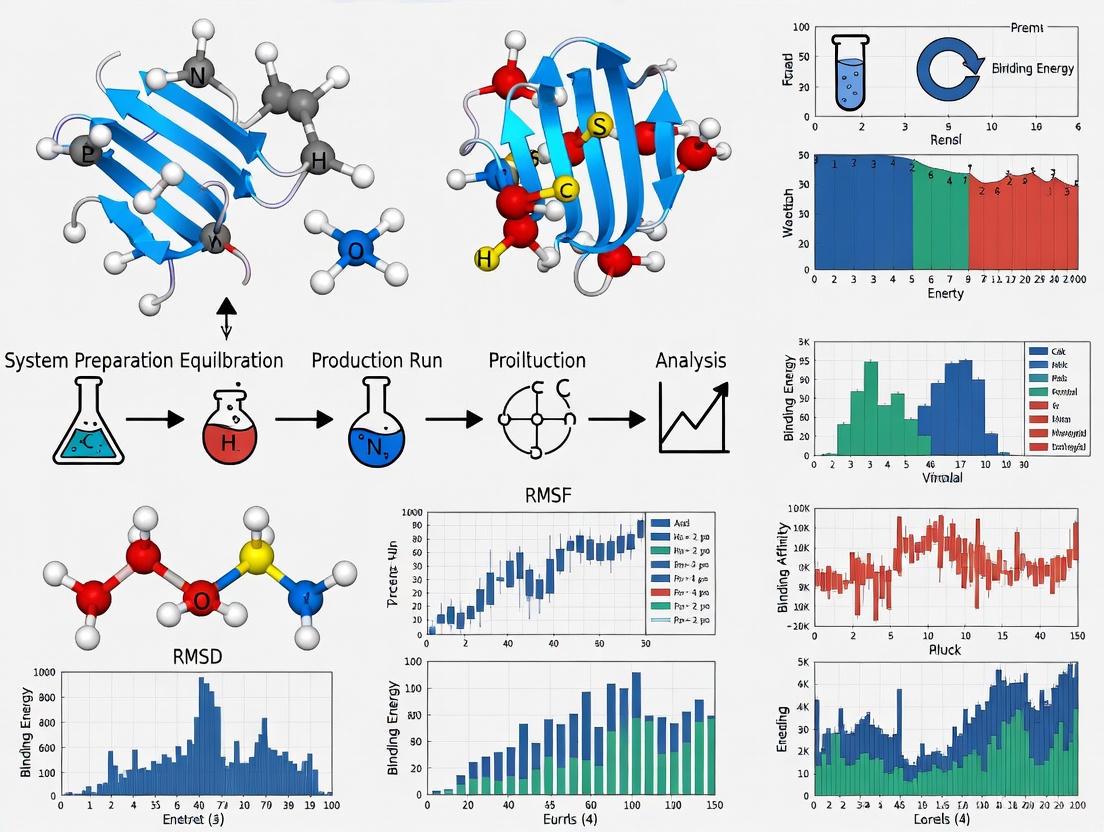
This article provides a comprehensive overview of Molecular Dynamics (MD) simulations for analyzing protein-ligand complexes, a critical methodology in structural biology and rational drug design.
Molecular Dynamics for Protein-Ligand Complex Analysis: A Comprehensive Guide from Fundamentals to Advanced Applications in Drug Discovery
Abstract
This article provides a comprehensive overview of Molecular Dynamics (MD) simulations for analyzing protein-ligand complexes, a critical methodology in structural biology and rational drug design. It covers foundational principles, including the physical basis of binding and the role of MD in complementing docking studies. The guide explores methodological workflows, from system setup to trajectory analysis, and addresses key challenges such as sampling efficiency and force field selection. Furthermore, it examines validation protocols and comparative analyses with other computational techniques, incorporating recent advances like machine learning integration and AlphaFold2 models. Designed for researchers, scientists, and drug development professionals, this resource synthesizes current best practices and emerging trends to enhance the application of MD in biomedical research.
Understanding the Basics: How Molecular Dynamics Reveals Protein-Ligand Interactions
Molecular Dynamics (MD) simulation has become an indispensable tool in structural biology, providing atomic-level insight into the dynamic behavior of biomolecules. By numerically solving classical equations of motion, MD allows researchers to simulate the physical movements of atoms over time, revealing processes that are often difficult to capture experimentally [1]. This capability is particularly valuable for studying protein-ligand complexes, where understanding binding mechanisms, conformational changes, and interaction energies is crucial for applications in drug discovery and design.
Fundamental Principles and Applications
MD simulations compute the time-dependent behavior of a molecular system based on a potential energy function, or force field. These force fields contain terms for both bonded interactions (bond lengths, angles, dihedral angles) and non-bonded interactions (van der Waals and electrostatics) [1]. With integration time steps typically in the femtosecond range, MD can capture biologically relevant events ranging from local side-chain motions to large-scale conformational changes.
The applications of MD in structural biology are diverse and impactful:
- Protein Folding and Structure Prediction: All-atom MD can predict structures of peptides and small proteins (<80 amino acids) with accuracy comparable to experiments, particularly when template-based modeling methods fail [1].
- Protein-Ligand Interactions: MD simulations help characterize binding sites, identify key residues, and quantify interaction energies, providing crucial information for rational drug design [2].
- Model Refinement: MD-based approaches can refine protein structure models by sampling near-native conformations and integrating limited experimental or bioinformatics data [1].
- Binding Affinity Prediction: By capturing the dynamic nature of molecular recognition, MD simulations contribute to both physics-based and machine-learning approaches for predicting binding free energies [3] [4].
Key Methodologies and Performance Benchmarking
Enhanced Sampling Techniques
Conventional MD simulations are often limited to timescales shorter than those required for biologically relevant events like protein folding or ligand unbinding. Enhanced sampling methods address this limitation:
- Replica-Exchange MD (REMD): Multiple copies of the system are simulated at different temperatures, allowing efficient barrier crossing and more thorough conformational sampling [1].
- Metadynamics: Uses a biased potential on pre-defined collective variables to accelerate rare events while still providing thermodynamic information [5].
- Accelerated MD: Modifies the potential energy surface to reduce energy barriers, enhancing sampling of conformational states [1].
Binding Affinity Prediction Protocols
Accurately predicting protein-ligand binding affinity remains a central challenge. Various MD-based approaches have been developed, each with different trade-offs between accuracy and computational cost:
Table 1: Performance Comparison of Binding Affinity Prediction Methods
| Method | Accuracy (MAE/R-value) | Computational Cost | Key Principles |
|---|---|---|---|
| Docking | ~2-4 kcal/mol RMSE [6] | Low (<1 minute on CPU) [6] | Fast conformational sampling with empirical scoring functions |
| MM/GBSA & MM/PBSA | R-value: 0.1-0.6 [3] | Medium | Molecular Mechanics with Generalized Born/Poisson-Boltzmann Surface Area solvation |
| Free Energy Perturbation | MAE: 0.8-1.2 kcal/mol [3] | Very High (>12 hours GPU) [6] | Alchemical transformations between ligands |
| QM/MM-M2 Protocols | MAE: 0.60 kcal/mol, R: 0.81 [3] | Medium-Low | Quantum mechanics-derived charges with mining minima conformational sampling |
The QM/MM-M2 approach represents a recent advancement that combines quantum mechanical accuracy with manageable computational cost. This method applies quantum mechanics/molecular mechanics (QM/MM) to generate electrostatic potential (ESP) charges for ligands in selected conformers obtained from classical mining minima calculations [3]. The incorporation of polarization effects through QM/MM-derived charges significantly improves accuracy over purely forcefield-based approaches.
Trajectory Analysis and Affinity Prediction
Novel methods continue to emerge that leverage MD simulations for affinity prediction. One approach compares the dynamic behavior of proteins upon ligand binding using MD trajectories [4]. This method quantifies differences in binding site dynamics between ligand systems using similarity metrics like Jensen-Shannon divergence, then correlates these differences with experimental binding affinities. This strategy has demonstrated strong correlations (R-value up to 0.88) for targets like BRD4 and PTP1B [4].
Experimental Protocols
Standard MD Simulation Workflow for Protein-Ligand Complexes
The following workflow describes a typical MD simulation protocol for studying protein-ligand interactions:
Table 2: Essential Research Reagents and Tools for MD Simulations
| Tool/Reagent | Function/Purpose | Examples/Options |
|---|---|---|
| Force Fields | Defines potential energy terms for molecular interactions | AMBER [1], CHARMM [1], OPLS-AA [1] |
| Water Models | Represents solvent effects explicitly or implicitly | TIP3P, TIP4P (explicit) [1], GB/SA models (implicit) [1] |
| Software Packages | Performs MD simulations and analysis | OpenMM [5], Amber22 [4], GROMACS [1] |
| Enhanced Sampling | Accelerates rare events and improves sampling efficiency | REMD [1], Metadynamics [5], aMD [1] |
| System Preparation | Adds missing atoms, assigns protonation states | H++ [4], PDBFixer, CHARMM-GUI |
Diagram 1: Standard MD simulation workflow
Step 1: System Preparation
- Start with an experimental or predicted protein-ligand structure (e.g., from PDBbind [2])
- Add hydrogen atoms using tools like H++ at physiological pH [4]
- Assign protonation states of ionizable residues appropriate for the simulation conditions
- For ligands, obtain topology parameters using tools like GAFF (Generalized Amber Force Field) [4]
Step 2: Solvation and Ion Addition
- Place the complex in a cubic water box with a buffer region (typically ≥10.0 Å) using explicit water models like TIP3P [4]
- Add ions (e.g., Na+, Cl-) to neutralize system charge and achieve physiological concentration
Step 3: Energy Minimization
- Perform 5,000 steps of steepest descent minimization to remove steric clashes [4]
- Gradually reduce position restraints on heavy atoms if needed
Step 4: System Equilibration
- Run 100 ps NVT simulation at 300 K with restraints on heavy atoms (10 kcal/mol·Å²) [4]
- Follow with 100 ps NPT simulation at 300 K and 1 bar with same restraints [4]
- Use Berendsen or Langevin thermostat and Monte Carlo barostat
Step 5: Production Simulation
- Run unrestrained MD simulation in NPT ensemble (400 ns recommended for convergence) [4]
- Save trajectories every 2-100 ps depending on analysis requirements
- Perform multiple independent trials (≥3) to assess reproducibility [4]
Step 6: Trajectory Analysis
- Remove rotational and translational motions by fitting to reference structure
- Calculate RMSD, RMSF, interaction energies, and other relevant metrics
- For binding affinity prediction, employ specific analysis methods (see Section 3.2)
Binding Affinity Prediction Using Trajectory Similarity
This protocol describes an approach for predicting binding affinities by comparing protein dynamics across different ligand complexes:
Diagram 2: Binding affinity prediction from trajectory similarity
Step 1: Simulation Setup and Execution
- Perform MD simulations for each protein-ligand complex following the protocol in Section 3.1
- Include the apo protein (without ligand) in the simulation set
- Run three independent trials for each system with different random seeds [4]
Step 2: Binding Site Residue Identification
- For each frame, calculate the minimum distance between any heavy atom of a residue and any heavy atom of the ligand
- Define the activity ratio as n/N, where n is the number of frames where the minimum distance <5Å, and N is the total number of frames
- Identify binding site residues as those with activity ratio >0.5 during the simulation [4]
Step 3: Trajectory Similarity Calculation
- Extract trajectories of binding site residues for analysis
- Remove rotation and translation by fitting to backbone atoms of binding site residues
- Estimate probability density functions for each system using Gaussian kernel density estimation with Silverman's rule-of-thumb bandwidth [4]
- Calculate pairwise Jensen-Shannon (JS) divergence between all systems:
Where KL denotes Kullback-Leibler divergence [4]
Step 4: Data Reduction and Correlation
- Build a distance matrix from all pairwise JS divergences
- Perform multidimensional scaling to embed the distance matrix in 3D space
- Apply Principal Component Analysis (PCA) to the embedded points
- Correlate the first principal component (PC1) with experimental binding free energies (ΔG) [4]
Step 5: Sign Determination of Correlation
- Use coarse ΔG estimations from docking programs like AutoDock Vina to determine the sign of the PC1-ΔG correlation when experimental data is limited [4]
Implementation Tools and Best Practices
Accessible MD Implementation
For researchers new to MD simulations, user-friendly tools like drMD provide automated pipelines that lower the barrier to entry. drMD uses OpenMM as its simulation engine and requires only a single configuration file, making it particularly suitable for experimentalists seeking to incorporate MD into their research [5]. Key features include:
- Automated handling of routine simulation procedures
- Real-time progress updates and simulation "vitals" checks
- Enhanced sampling options including metadynamics
- Error handling and recovery functions to rescue failed simulations [5]
Data Quality Considerations
The accuracy of MD simulations depends critically on the quality of initial structures. Databases like MISATO address common issues in structural datasets by providing:
- Quantum mechanical refinement of ligand geometries
- Correction of protonation states and hydrogen atom placement
- Extensive molecular dynamics trajectories (over 170 μs total) of protein-ligand complexes [2]
- Validation against experimental data to ensure reliability
Such curated datasets help address limitations in experimental structures from the PDB, including distorted bonds and angles, incorrect atom assignments, and missing hydrogen atoms [2].
Molecular dynamics simulations have evolved from a specialized computational technique to an essential component of structural biology research. The continued development of more accurate force fields, enhanced sampling algorithms, and integration with experimental data ensures that MD will play an increasingly important role in understanding protein-ligand interactions and accelerating drug discovery. As methods like QM/MM-M2 and trajectory similarity analysis demonstrate, combining physical principles with efficient computational strategies enables researchers to achieve experimental-level accuracy in predicting structures and binding affinities while managing computational costs. For practicing researchers, the growing availability of automated tools and curated datasets makes this powerful methodology increasingly accessible for probing the dynamic nature of biological macromolecules.
Protein-ligand interactions are fundamental to virtually all biological processes, including enzyme catalysis, signal transduction, and gene regulation [7] [8]. The precise molecular recognition between a protein and its ligand—characterized by high specificity and affinity—forms the basis of cellular function and communication [7]. A detailed understanding of these interactions is therefore central to molecular biology and is particularly crucial for rational drug design, where the aim is to develop therapeutic compounds that modulate protein function with high precision [7] [8].
The study of these interactions has evolved from early conceptual models like the "lock-and-key" principle to our current understanding, which incorporates protein dynamics and complex energy landscapes [8]. This application note, framed within a broader thesis on molecular dynamics for protein-ligand complex analysis, aims to provide researchers and drug development professionals with a comprehensive overview of the physical basis, key interactions, and energetics governing protein-ligand binding. We will summarize fundamental principles, detail experimental and computational protocols for probing these interactions, and present a practical toolkit for their analysis.
Fundamental Principles of Protein-Ligand Interactions
Binding Kinetics and Thermodynamics
The formation of a protein-ligand complex is a reversible process described by the simple reaction: P + L ⇌ PL where P is the protein, L is the ligand, and PL is the resulting complex [7]. The kinetics of this association are defined by the association rate constant ((k{on})) and the dissociation rate constant ((k{off})). At equilibrium, these constants define the binding affinity through the binding constant ((Kb)) or its inverse, the dissociation constant ((Kd)) [7]:
[Kb = \frac{k{on}}{k{off}} = \frac{[PL]}{[P][L]} = \frac{1}{Kd}]
From a thermodynamic perspective, the spontaneity of the binding event is determined by the change in Gibbs free energy (ΔG), which must be negative for favorable binding. The standard binding free energy (ΔG°) is related to (K_b) by:
ΔG° = −RTlnKb
where R is the universal gas constant and T is the temperature in Kelvin [7]. This free energy change can be decomposed into its enthalpic (ΔH) and entropic (ΔS) components through the fundamental equation:
ΔG = ΔH − TΔS
The enthalpic term (ΔH) primarily reflects the specificity and strength of non-covalent interactions between the protein and ligand, while the entropic term (-TΔS) is a measure of changes in the system's dynamics and order, including the loss of translational and rotational degrees of freedom upon binding, and solvation effects [7] [9].
Key Intermolecular Interactions
The binding affinity and specificity are governed by a combination of several non-covalent interactions between the protein and ligand, often acting in concert [7] [9].
Table 1: Key Non-Covalent Interactions in Protein-Ligand Complexes
| Interaction Type | Energy Range (kJ/mol) | Characteristics | Role in Binding |
|---|---|---|---|
| Van der Waals | 0.1 – 4 | Attractive/repulsive forces from induced dipoles; weak but numerous. | Major contributor to binding affinity through cumulative effect. |
| Hydrogen Bonding | 4 – 40 | Interaction between donor (H-bond) and acceptor (lone pair). | Enhances specificity and directionality of binding. |
| Electrostatic (Ionic) | 20 – 40 | Interaction between permanently charged groups (e.g., NH₃⁺...COO⁻). | Provides strong, long-range attraction in the binding site. |
| Cation-π / π-π | Variable | Interaction between cation and aromatic system, or between aromatic rings. | Can contribute significantly to binding energy in specific contexts. |
| Hydrophobic Effect | Entropy-driven | Release of ordered water molecules from non-polar surfaces into the bulk solvent. | Often a major driving force, primarily through entropic gain. |
Binding Models and Conformational Dynamics
Our understanding of how proteins and ligands recognize each other has moved beyond the static "lock-and-key" model. The "induced fit" model proposes that the binding site can adjust its conformation upon ligand binding to achieve optimal complementarity [8]. More recently, the "conformational selection" model has gained support, suggesting that the unbound protein exists as an ensemble of conformations in equilibrium, from which the ligand selectively binds to and stabilizes a pre-existing complementary conformation [8]. In practice, both induced fit and conformational selection mechanisms can be engaged in the same binding process [8].
Quantitative Analysis of Binding Energetics
Accurately measuring and predicting the strength of protein-ligand interactions is a central challenge in biophysics and drug discovery. The following table summarizes the key experimental and computational methods used.
Table 2: Methods for Investigating Protein-Ligand Binding Affinity
| Method | Measured Parameters | Advantages | Disadvantages/Challenges |
|---|---|---|---|
| Isothermal Titration Calorimetry (ITC) | ΔG, ΔH, TΔS, Kₐ, stoichiometry (n). | Directly measures all thermodynamic parameters in a single experiment. | Requires relatively large amounts of protein; limited sensitivity for very tight binding. |
| Surface Plasmon Resonance (SPR) | kₒₙ, kₒff, Kₐ (from kinetics). | Provides real-time kinetic data; high-throughput versions available. | Requires immobilization of one binding partner; potential for artifacts. |
| Fluorescence Polarization (FP) | Kₐ (from equilibrium binding). | Homogeneous assay; suitable for high-throughput screening. | Requires a fluorescent ligand; potential for interference from compound fluorescence. |
| Molecular Docking | Predicted binding pose and affinity score. | Fast, cheap virtual screening of large compound libraries. | Scoring functions are often approximate; limited conformational sampling. |
| Molecular Dynamics (MD) Simulations | Binding pathways, conformational dynamics, detailed interaction maps. | Provides atomic-level detail and time-resolved data on binding. | Extremely computationally expensive; limited by force field accuracy. |
| Free Energy Calculations | Absolute or relative binding free energies (ΔG). | High theoretical accuracy for affinity prediction. | Even more time-consuming than standard MD; requires significant expertise. |
The following workflow illustrates a typical integrated computational approach for analyzing protein-ligand interactions, combining docking and molecular dynamics simulations:
Diagram 1: A Computational Workflow for Binding Analysis.
Protocols for Molecular Dynamics Simulation of Protein-Ligand Complexes
This protocol outlines the steps for setting up, running, and analyzing molecular dynamics (MD) simulations to study protein-ligand interactions, providing insights that are often inaccessible by experimental means alone [10] [11].
System Preparation and Minimization
Initial Structure Retrieval and Preparation: Obtain the 3D structure of the protein-ligand complex from the Protein Data Bank (PDB) or from molecular docking results (e.g., using AutoDock) [11]. Using visualization and preparation software (e.g., Chimera, VMD):
- Remove crystallographic water molecules and irrelevant co-factors, unless they are part of the binding site.
- Add missing hydrogen atoms according to physiological pH (considering standard protonation states of residues like His, Asp, Glu).
- Ensure the ligand structure has correct bond orders and reasonable protonation states. Parameterize the ligand using tools like CGenFF or ACPYPE to generate topology and parameter files compatible with the chosen simulation force field (e.g., CHARMM, AMBER) [11].
Solvation and Ionization: Place the protein-ligand complex in a simulation box (e.g., cubic, rectangular) with a buffer distance of at least 10 Å between the solute and the box edges. Solvate the system with explicit water molecules (e.g., TIP3P model) [11]. Add ions (e.g., Na⁺, Cl⁻) to neutralize the system's net charge and to achieve a physiologically relevant salt concentration (e.g., 0.15 M NaCl).
Energy Minimization: Perform an energy minimization of the solvated system to remove any bad atomic contacts and steric clashes introduced during the setup. This is typically done in two steps: first restraining the heavy atoms of the protein and ligand while minimizing the solvent and ions, followed by a full minimization of the entire system.
Equilibration and Production Run
System Equilibration: Gradually heat the minimized system from 0 K to the target temperature (e.g., 300 K) over 50-100 ps in the NVT ensemble (constant Number of particles, Volume, and Temperature), applying restraints to the protein and ligand heavy atoms. Subsequently, run a short simulation (100-200 ps) in the NPT ensemble (constant Number of particles, Pressure, and Temperature) to equilibrate the density of the system, again with restraints. Finally, release the restraints and continue the NPT equilibration until the system properties (e.g., temperature, pressure, energy) stabilize.
Production MD Simulation: Run an unrestrained MD simulation in the NPT ensemble for a duration sufficient to sample the relevant motions and stability of the complex. For many binding interactions, this may range from tens of nanoseconds to microseconds, depending on the system and research question. Maintain a constant temperature (using, e.g., a Langevin thermostat) and pressure (using, e.g., a Nosé-Hoover Langevin barostat). Use a timestep of 2 fs, constraining bonds involving hydrogen atoms with algorithms like SHAKE or LINCS [11].
Trajectory Analysis
Stability Assessment: Calculate the root-mean-square deviation (RMSD) of the protein backbone and the ligand heavy atoms relative to the starting structure to verify the simulation has reached equilibrium and to assess the overall stability of the complex.
Interaction Analysis: Use tools like ProLIF (Protein-Ligand Interaction Fingerprints) to analyze the MD trajectory and identify specific interactions (hydrophobic, hydrogen bonds, ionic, etc.) between the ligand and individual protein residues over time [12]. This generates a fingerprint that can be visualized as a dataframe or a bar plot to show interaction frequencies.
Diagram 2: MD Trajectory Interaction Analysis with ProLIF.
Energetic Analysis: Employ more advanced methods like the Molecular Mechanics Poisson-Boltzmann Surface Area (MM/PBSA) or Molecular Mechanics Generalized Born Surface Area (MM/GBSA) approaches to estimate the binding free energy from simulation snapshots. While less accurate than rigorous free energy methods, they offer a reasonable compromise between computational cost and accuracy for ranking ligands.
Table 3: Key Research Reagent Solutions for Studying Protein-Ligand Interactions
| Category / Item | Function / Description | Example Use Cases |
|---|---|---|
| High-Quality Structural Datasets | Provides 3D structures and binding data for training/scoring functions and benchmarking. | PDBbind, BioLiP, Binding MOAD, HiQBind [13]. |
| Structure Preparation Workflows | Algorithms to correct common structural artifacts (bonds, protonation, clashes) in PDB files. | HiQBind-WF; crucial for ensuring data quality before simulation [13]. |
| Molecular Docking Software | Predicts the binding pose and affinity of a ligand to a protein receptor. | AutoDock 4.2/5, AutoDock Vina; used for virtual screening and pose generation for MD [11]. |
| Force Fields | Defines potential energy functions and parameters for MD simulations. | CHARMM27/36, AMBER ff14SB/ff19SB; determines the accuracy of simulated dynamics [11]. |
| MD Simulation Engines | Software to perform the numerical integration of Newton's equations of motion for all atoms. | NAMD, GROMACS, AMBER; the core engine for running production simulations [11]. |
| Trajectory Analysis Tools | Programs and libraries to process and analyze the output of MD simulations. | MDAnalysis (for general analysis), ProLIF (for interaction fingerprints) [12]. |
| Binding Affinity Assays | Experimental methods to measure the strength of protein-ligand interactions. | ITC (thermodynamics), SPR (kinetics); used for validation of computational predictions [7] [8]. |
The intricate dance between a protein and its ligand, governed by the fundamental physics of intermolecular forces and energetics, is a cornerstone of biological function and pharmaceutical intervention. This application note has detailed the core principles—from kinetics and thermodynamics to the specific interactions that drive binding—and has provided a practical protocol for using molecular dynamics simulations to probe these interactions at an atomic level. The integration of robust computational methods, like MD and docking, with high-quality structural data and experimental validation, represents a powerful strategy for advancing our understanding of molecular recognition. As methods for predicting complex structures with deep learning mature [8] and computational power grows, the ability to accurately simulate and characterize protein-ligand binding will continue to refine, accelerating the discovery and optimization of new therapeutic agents.
Molecular docking serves as a fundamental tool in structural molecular biology and computer-aided drug design for predicting the binding orientation of small molecule ligands within their target proteins. However, the static nature of docking, which often treats proteins as rigid bodies, fails to capture the dynamic nature of biomolecular recognition. This application note examines the critical limitations of docking approaches and demonstrates how Molecular Dynamics (MD) simulations provide an essential framework for achieving accurate binding mode prediction. By accounting for full atomistic flexibility, solvation effects, and true thermodynamic stability, MD simulations bridge the gap between static structural predictions and biologically relevant binding characterization, ultimately enhancing the reliability of structure-based drug design.
The Limitations of Static Docking
Molecular docking has become a ubiquitous computational method for predicting protein-ligand interactions, yet it suffers from fundamental limitations that restrict its predictive accuracy. The primary constraint lies in the limited sampling of conformational space and the use of approximated scoring functions that often yield poor correlation with experimental binding affinities [14]. Docking calculations typically treat proteins as largely rigid entities, allowing only minimal side-chain flexibility despite overwhelming evidence that protein flexibility significantly impacts ligand recognition [15]. This rigid-receptor approximation becomes particularly problematic for protein-protein interactions (PPIs) and systems involving large-scale conformational changes.
The scoring function problem represents another critical weakness. As noted in benchmarking studies, "the empirical score is calculated for a single predicted structure, although any dynamic effects can be essential" [16]. These scoring functions frequently fail to account for entropic contributions, solvation effects, and the true dynamics of binding interactions. Research has shown that docking scores often correlate poorly with experimental binding affinities, especially for diverse ligand sets [14]. This limitation persists despite advances in docking algorithms, suggesting inherent constraints in the static docking paradigm.
MD Simulations: Capturing Dynamic Recognition
Fundamental Advantages
Molecular Dynamics simulations address key limitations of docking by modeling system flexibility and temporal evolution. Unlike docking, MD simulations:
- Account for full protein and ligand flexibility, enabling side-chain rearrangements and backbone motions
- Explicitly include solvent effects through water models and ions, critical for modeling true biological conditions
- Provide temporal resolution of binding events and complex stability
- Capture entropic contributions through conformational sampling
- Reveal cryptic binding sites invisible in static crystal structures [15]
MD simulations have demonstrated particular value for studying membrane proteins like GPCRs and flexible systems such as PR-Set7, where accurate prediction requires accounting for substantial protein motion [16]. The ability to observe structural relaxation over time allows researchers to distinguish stable binding poses from metastable configurations that might score well in docking but rapidly dissociate under dynamic conditions.
Quantitative Evidence for Improved Accuracy
Recent large-scale studies provide compelling quantitative evidence for the superiority of MD-based approaches. The PLAS-20k dataset, comprising 19,500 protein-ligand complexes with MD-calculated binding affinities, demonstrates significantly better correlation with experimental values compared to docking scores [14]. This extensive dataset highlights how MD-derived binding affinities, computed using the Molecular Mechanics Poisson-Boltzmann Surface Area (MMPBSA) method, more reliably predict experimental results across diverse protein families and ligand types.
Table 1: Performance Comparison of Docking vs. MD-Based Binding Affinity Prediction
| Method | Approach | Correlation with Experiment | System Flexibility | Solvent Treatment |
|---|---|---|---|---|
| Molecular Docking | Static scoring function | Limited/poor correlation [14] | Restricted | Implicit/approximated |
| MD/MMPBSA | Ensemble averaging from dynamics | Good correlation [14] | Full atomistic | Explicit |
| IFD-MD | Hybrid docking/MD approach | High accuracy (90% success) [17] | Limited backbone, full side-chain | Explicit |
Furthermore, the integration of MD with docking protocols has demonstrated remarkable success rates. Schrödinger's IFD-MD method achieves approximately 90% accuracy in reproducing key features of crystal structures, significantly outperforming both standard docking and earlier induced fit approaches [17]. This hybrid methodology successfully combines the sampling efficiency of docking with the physical fidelity of MD, representing a practical balance between computational expense and predictive accuracy.
Practical Protocols: From Docking to MD Refinement
MD Simulation Workflow for Binding Mode Validation
The following protocol describes a complete workflow for validating and refining docking poses through MD simulation, based on established methods from the OpenFE toolkit and recent literature [18] [14]:
System Preparation
- Input Structures: Start with docked protein-ligand complexes in PDB format
- Parameterization: Generate ligand parameters using appropriate force fields (GAFF2 for small molecules, AMBER ff14SB for proteins) [14]
- Solvation: Solvate the system in an explicit water model (TIP3P) with ion concentrations matching physiological conditions (e.g., 0.15 M NaCl) [18]
- Minimization: Perform energy minimization to remove steric clashes using the L-BFGS algorithm
Equilibration Protocol
- Minimization: 5,000 steps of minimization with protein heavy atom restraints [18]
- NVT Equilibration: 10 ps simulation with positional restraints on protein backbone atoms while heating system to target temperature (typically 298K) [18] [14]
- NPT Equilibration: 10 ps simulation with semi-isotropic pressure coupling to achieve proper density [18]
Production Simulation
- Duration: 20 ps to nanoseconds-scale simulation depending on system size and research question [18]
- Parameters: Maintain constant temperature (298K) and pressure (1 atm) using Langevin thermostat and Monte Carlo barostat
- Integration: Use 2-4 fs timestep with constraints on bonds involving hydrogen atoms [18] [14]
- Output: Save trajectories every 20 ps for subsequent analysis [18]
The following diagram illustrates this comprehensive workflow:
Binding Pose Stability Assessment
To evaluate binding mode stability during MD simulations:
- Root Mean Square Deviation (RMSD): Calculate ligand and binding site RMSD relative to initial docked structure
- Interaction Persistence: Monitor key protein-ligand interactions (hydrogen bonds, hydrophobic contacts) over simulation time using tools like PLIP [19]
- Ligand Residence: Assess whether the ligand remains bound or dissociates from the binding site
- Cluster Analysis: Identify predominant binding modes from the trajectory
Studies demonstrate that unstable docking poses often lead to rapid ligand dissociation or significant pose rearrangement during MD simulations, whereas correct binding modes maintain stability [16]. For example, in studies of β2 adrenergic receptor complexes, correct poses maintained stable interactions throughout 150 ns simulations, while incorrect poses showed substantial ligand movement within the binding pocket [16].
Advanced Applications & Integration
Machine Learning and Large-Scale MD Datasets
The emergence of large-scale MD datasets represents a transformative development for binding mode prediction. The PLAS-20k dataset provides binding affinities from MD simulations of 19,500 protein-ligand complexes, creating opportunities for machine learning approaches that leverage dynamic features rather than static structures [14]. These datasets enable:
- Training ML models on ensemble conformations rather than single structures
- Incorporating temporal interaction patterns into affinity prediction
- Developing improved scoring functions informed by MD-derived thermodynamics
Retraining the OnionNet model on PLAS-20k demonstrated enhanced binding affinity prediction compared to models trained solely on static structural data [14]. This integration of MD with ML creates a powerful synergy for future drug discovery applications.
Specialized MD Approaches for Challenging Targets
Advanced MD protocols address specific challenges in binding mode prediction:
Induced Fit Docking MD (IFD-MD) Schrödinger's IFD-MD protocol combines pharmacophore docking, Prime refinement, and metadynamics to predict binding poses for novel scaffolds, achieving 90% success rates while being computationally efficient compared to brute-force MD [17].
Mixed-Solvent MD (MixMD) This cosolvent simulation technique identifies cryptic binding hotspots by observing organic probe molecule localization during simulations, revealing potential allosteric sites invisible in crystal structures [15].
Enhanced Sampling Methods Techniques like Gaussian-accelerated MD (GaMD) and metadynamics reduce the time required to observe binding and unbinding events, making MD practical for drug discovery timelines.
The Scientist's Toolkit: Essential Research Reagents & Software
Table 2: Key Computational Tools for MD-Based Binding Mode Prediction
| Tool/Resource | Type | Function | Application Context |
|---|---|---|---|
| OpenMM [18] [14] | MD Engine | High-performance MD simulation | Running production MD trajectories with GPU acceleration |
| PLIP [19] | Analysis Tool | Protein-ligand interaction profiling | Detecting and classifying non-covalent interactions in MD trajectories |
| AMBER Tools [14] | Parameterization | Force field assignment | Generating parameters for proteins (ff14SB) and small molecules (GAFF2) |
| IFD-MD [17] | Workflow | Induced fit docking with MD | Predicting binding poses for novel scaffolds with high accuracy |
| PLAS-20k [14] | Dataset | MD-derived binding affinities | Training ML models on dynamic interaction data |
| g-xTB [20] | Semiempirical QM | Interaction energy calculation | Accurate protein-ligand interaction energy benchmarking |
Molecular Dynamics simulations have evolved from a specialized biophysical technique to an essential component of accurate binding mode prediction. By addressing the critical limitations of static docking—particularly protein flexibility, solvation, and proper thermodynamic sampling—MD provides a physical framework for distinguishing correct from incorrect binding modes. The integration of MD with docking protocols, machine learning, and advanced sampling methods creates a powerful pipeline for structure-based drug design. As demonstrated by large-scale validation studies and practical applications across diverse target classes, MD simulations provide the necessary bridge between static structural predictions and biologically relevant binding characterization, ultimately increasing the success rate of drug discovery efforts.
The accurate prediction of how a small molecule (ligand) binds to its protein target is a cornerstone of computational drug discovery. This process revolves around solving two fundamental challenges: sampling the correct binding pose and scoring the interaction accurately to estimate the binding affinity. While these tasks are interrelated, they present distinct methodological hurdles. Sampling involves efficiently exploring the vast conformational space of the ligand and protein, while scoring requires precisely calculating the subtle energy differences that dictate binding strength. The delicate balance of enthalpic and entropic contributions to the overall binding free energy further complicates this process, as large opposing energy terms must be calculated with extreme precision to yield accurate net binding affinities, which typically fall within a narrow range of -4 to -15 kcal/mol [6]. This application note examines the latest advances in computational protocols designed to address these challenges, providing detailed methodologies for researchers in the field.
The Sampling Challenge: Exploring Conformational Space
Current Methodologies and Gaps
Sampling the correct binding pose is the first critical step in protein-ligand interaction prediction. Traditional docking methods rely on algorithms like Monte Carlo or genetic algorithms to explore the rotational, translational, and conformational degrees of freedom of the ligand within the binding site [21]. However, these methods often struggle with computational efficiency, particularly for large and flexible systems, and can fail to overcome energy barriers to sample the correct pose effectively [21]. The challenge is further compounded when considering protein flexibility, as rigid receptor approximations may miss crucial induced-fit effects.
Advanced Sampling Protocols
Multi-Scale Brownian Dynamics and Molecular Dynamics Workflow:
For calculating association rate constants (kₒₙ), a multiscale approach combining Brownian Dynamics (BD) and Molecular Dynamics (MD) simulations has shown promise [22]. This protocol efficiently captures both long-range diffusional encounters and short-range molecular interactions.
- Step 1 – Brownian Dynamics Simulations: Run BD simulations to model the long-range diffusion of the ligand and generate an ensemble of diffusional encounter complexes. The objective is to produce structures where the ligand comes in close proximity to the active site.
- Step 2 – Structure Selection: Select the generated encounter complexes where the ligand is positioned near the binding site for further analysis.
- Step 3 – Molecular Dynamics Simulations: Use the selected BD structures as starting points for MD simulations. This step captures the subsequent formation of the bound complex with atomic detail, accounting for short-range interactions, solvation effects, and molecular flexibility.
- Step 4 – Analysis: Calculate the association rate constant from the simulation trajectories and validate against experimental data [22].
Synthetic Complex Generation with Rigorous Validation:
To address the scarcity of training data for deep learning models, a novel workflow for the procedural generation of synthetic protein-ligand complexes has been developed [21]. This method enhances the diversity and quality of available data for training docking models.
- Step 1 – Diverse Generation Strategies: Employ an ensemble of generation techniques to create synthetic complexes. This includes:
- PDB Fragmentation: Breaking down existing structures in the Protein Data Bank.
- De Novo Ligand Design: Creating novel ligands conditioned on a specific protein pocket.
- De Novo Protein Design: Designing proteins capable of binding a specific molecule.
- Step 2 – Rigorous Quality Control: Implement a multi-stage validation procedure to filter the generated complexes:
- Physics-Based Filtering: Assess complexes using knowledge of molecular interactions and physical principles.
- ML-Based Filtering: Use machine learning models to identify structures that are indistinguishable from experimental complexes.
- Step 3 – Model Training: Utilize the validated synthetic dataset to retrain established docking models (e.g., Smina, Gnina) or deep learning-based docking tools [21].
The Scoring Challenge: Accurate Binding Affinity Prediction
The Accuracy-Speed Trade-Off
A significant challenge in scoring is the inherent trade-off between computational speed and accuracy. The following table summarizes the performance characteristics of current popular methods:
Table 1: Performance Comparison of Binding Affinity Prediction Methods
| Method | Typical RMSE (kcal/mol) | Typical Pearson's R | Computational Cost | Primary Use Case |
|---|---|---|---|---|
| Docking | 2.0 - 4.0 | ~0.3 | Low (minutes on CPU) | High-throughput virtual screening |
| MM/GBSA & MM/PBSA | Varies widely | 0.1 - 0.7 [3] | Medium | Post-processing of docking poses |
| Free Energy Perturbation (FEP) | 0.8 - 1.2 | 0.5 - 0.9 [3] | Very High (12+ GPU hours) | Lead optimization |
| QM/MM-Multi-Conformer (This Note) | 0.60 - 0.78 | 0.81 [3] | Medium-High | High-accuracy affinity estimation |
As evidenced in Table 1, docking is fast but lacks accuracy, while FEP is accurate but computationally prohibitive for large libraries. This creates a "methods gap" for approaches that are definitively more accurate than docking but faster than FEP [6].
AI-Enhanced Scoring Functions
AI-driven methodologies are revolutionizing scoring functions by moving beyond traditional empirical scoring. Geometric deep learning, graph neural networks, and transformers now integrate physical constraints to improve binding affinity estimation [23]. These models have demonstrated enhanced performance in virtual screening, surpassing the accuracy of traditional docking scoring functions [23]. A key advantage of deep learning models is their ability to serve as superior scoring functions for re-ranking poses generated by classical sampling algorithms [21].
Quantum Mechanics/Molecular Mechanics (QM/MM) Protocol
To achieve high accuracy without the extreme cost of FEP, a protocol combining QM/MM with the mining minima method (VM2) has been developed. This approach addresses the critical limitation of classical force fields—the inaccurate representation of electrostatic interactions via fixed atomic charges [3]. Four specific protocols (Qcharge-VM2, Qcharge-FEPr, Qcharge-MC-VM2, and Qcharge-MC-FEPr) were tested, with the multi-conformer free energy processing (Qcharge-MC-FEPr) protocol delivering the best performance [3].
- Step 1 – Initial Conformer Sampling: Perform a classical VM2 (MM-VM2) calculation to obtain an ensemble of probable ligand conformers and poses within the binding site.
- Step 2 – Quantum Mechanical Charge Derivation: For selected conformers from Step 1, replace the force field atomic charges of the ligand with Electrostatic Potential (ESP) charges derived from a QM/MM calculation. In this calculation, the ligand is treated with quantum mechanics, while the protein environment is handled with molecular mechanics.
- Step 3 – Conformer Selection and Processing (Protocol-Dependent):
- Qcharge-VM2: Use only the most probable conformer for a new conformational search and free energy processing (FEPr).
- Qcharge-MC-FEPr: Select up to four conformers that collectively represent >80% of the probability and proceed directly to FEPr without a new conformational search. This protocol achieved the highest correlation (R=0.81) with experimental data [3].
- Step 4 – Free Energy Calculation: Perform free energy processing (FEPr) on the selected conformer(s) with the new QM/MM-derived charges to compute the final binding free energy.
- Step 5 – Universal Scaling: Apply a universal scaling factor (USF) of 0.2 to the calculated free energy values to correct for systematic overestimation and minimize the error relative to experimental measurements [3].
The workflow for the top-performing Qcharge-MC-FEPr protocol is summarized in the diagram below:
Integrated Workflow: Combining Sampling and Scoring
For a comprehensive protein-ligand interaction analysis, sampling and scoring must be integrated. A robust protocol begins with broad sampling using either traditional docking or a generative DL model like a diffusion-based network to produce multiple candidate poses [21]. These poses are then subjected to a multi-stage scoring process, starting with a fast AI-based scoring function to filter out clearly incorrect poses, followed by a more rigorous method like the QM/MM-MC-FEPr protocol for a final, high-accuracy affinity estimate on the top-ranked poses. This tiered approach balances computational efficiency with the need for accuracy in critical predictions.
The Scientist's Toolkit: Essential Research Reagents and Solutions
Table 2: Key Software and Computational Tools for Protein-Ligand Analysis
| Tool Name | Type/Category | Primary Function in Workflow |
|---|---|---|
| VM2 (VeraChem) [3] | Software Suite | Implements the Mining Minima method for conformational search and free energy calculations. |
| GROMACS [24] | Molecular Dynamics Engine | Performs high-performance MD simulations for sampling and equilibration. |
| MDAnalysis [25] | Analysis Library | A Python library for analyzing MD trajectories and structural data. |
| VMD/Chimera [24] | Visualization Software | Visualizes molecular structures, trajectories, and binding poses. |
| DiffDock [21] | Deep Learning Model | A diffusion-based generative model for blind molecular docking. |
| Smina/Gnina [21] | Docking Software | Established molecular docking programs with customizable scoring. |
| Python & NumPy | Programming Environment | Core scripting and data analysis for custom workflow implementation. |
The fields of sampling and scoring are being transformed by AI-driven methods and sophisticated multi-scale physical approaches. While challenges in generalization and computational cost remain, protocols that intelligently combine these advances—such as using generative models for sampling followed by QM/MM-informed or AI-powered scoring—are pushing the boundaries of accuracy in binding free energy estimation. As these protocols continue to mature and become more integrated into commercial and open-source software platforms, they promise to significantly accelerate the efficiency and success rate of structure-based drug design.
Practical Implementation: Setting Up, Running, and Analyzing MD Simulations for Drug Discovery
Molecular Dynamics (MD) simulation is an indispensable computational method for studying the dynamics of biomolecular systems with atomic-level detail, providing critical insights that are often difficult to obtain through experimental approaches alone [26]. For protein-ligand systems, MD simulations enable researchers to investigate binding mechanisms, conformational changes, and interaction patterns that underlie molecular recognition and function. This application note provides a comprehensive protocol for conducting MD simulations of protein-ligand complexes, with specific application to the N-terminal domain of heat shock protein 90 (Hsp90) in complex with a resorcinol-based ligand, though the workflow is broadly applicable to other protein-ligand systems [27]. The protocol is presented within the context of a broader thesis on molecular dynamics for protein-ligand complex analysis research, addressing the needs of researchers, scientists, and drug development professionals who require robust methodologies for studying molecular interactions.
The Scientist's Toolkit: Essential Research Reagents and Software
Table 1: Essential Research Reagents and Software Solutions
| Category | Item/Software | Function/Purpose |
|---|---|---|
| Structure Preparation | Protein Data Bank (PDB) | Source for initial protein-ligand crystal structures [27] |
| OpenBabel/Compound Conversion | File format conversion and hydrogen addition [27] | |
| Force Fields | AMBER99SB | Force field for protein parameterization [27] |
| GAFF (General AMBER Force Field) | Force field for small molecule parameterization [27] | |
| Solvation & Ions | TIP3P Water Model | Three-site water model for solvation [27] |
| Sodium Chloride (NaCl) | Ion concentration adjustment (e.g., 0.15 M) [18] | |
| Simulation Engine | OpenMM | Simulation engine for MD calculations [18] |
| Analysis Tools | mdciao | Analysis and visualization of contact frequencies [26] |
| MDtraj | Trajectory analysis and processing [26] |
Workflow Methodology
Initial Structure Preparation
The initial step involves obtaining and preparing the molecular system for simulation. For the Hsp90-resorcinol complex, the structure is obtained from the Protein Data Bank (accession code: 6HHR) [27]. The structure file must be separated into protein and ligand components, as they require different parameterization approaches. Proteins consist of standardized amino acid building blocks, whereas small molecules exhibit diverse chemical structures requiring individual parameterization [27].
Protocol 1.1: Structure Separation
- Input: PDB file containing protein-ligand complex
- Tools: Text processing tools (e.g., grep) or molecular visualization software
- Method:
- Extract protein coordinates by selecting lines that do not match "HETATM"
- Extract ligand coordinates by selecting lines that match the specific ligand residue code (e.g., "AG5E")
- Save as separate PDB files for protein and ligand
- Output: "Protein (PDB)" and "Ligand (PDB)" files [27]
Protocol 1.2: Ligand Hydrogen Addition
- Input: Ligand PDB file
- Tools: Compound Conversion (OpenBabel-based)
- Method:
- Load ligand PDB file
- Add hydrogens appropriate for physiological pH (7.0)
- Output hydrated ligand structure
- Output: "Hydrated ligand (PDB)" file [27]
Topology Generation and System Parameterization
Topology generation defines the constant attributes of atoms, including charges, bonds, and other molecular mechanics parameters. This process must be performed separately for the protein and ligand components using appropriate force fields.
Protocol 2.1: Protein Topology Generation
- Input: Protein PDB file
- Tools: GROMACS initial setup tool
- Method:
- Specify force field: AMBER99SB
- Select water model: TIP3P
- Generate topology with position restraints file
- Output: Protein topology (TOP), structure (GRO), and restraint (ITP) files [27]
Protocol 2.2: Ligand Topology Generation
- Input: Hydrated ligand PDB file
- Tools: acpype tool (AmberTools interface)
- Method:
- Set molecular charge (e.g., 0)
- Specify force field: GAFF
- Select charge method: BCC (bond charge correction)
- Output: Ligand topology files in GROMACS format [27]
Simulation Box Setup and Solvation
The parameterized molecular system must be placed in a biologically relevant environment, typically an aqueous solution with physiological ion concentrations.
Protocol 3: System Solvation
- Input: Protein-ligand complex topology and coordinates
- Tools: OpenMM Modeller or GROMACS solvation tools
- Method:
- Define box shape (e.g., cubic)
- Set solvent padding (e.g., 1.2 nm)
- Add water molecules using specified water model (TIP3P)
- Add ions to achieve physiological concentration (e.g., 0.15 M NaCl)
- Output: Solvated system coordinates and updated topology [18]
Energy Minimization and Equilibration
Before production simulation, the system must be relaxed to remove steric clashes and equilibrated to the target temperature and pressure.
Table 2: Simulation Stages and Parameters
| Simulation Stage | Key Parameters | Duration | Objective |
|---|---|---|---|
| Energy Minimization | 5,000 steps of steepest descent [18] | - | Remove steric clashes and high-energy contacts |
| NVT Equilibration | Langevin integrator, 298.15 K [18] | 10 ps [18] | Stabilize system temperature |
| NPT Equilibration | Monte Carlo barostat, 1 atm [18] | 10 ps [18] | Stabilize system density and pressure |
| Production MD | 4 fs timestep, PME electrostatics [18] | Varies (20 ps example [18]) | Generate trajectory for analysis |
Protocol 4.1: Energy Minimization
- Integrator: Steepest descent
- Steps: 5,000
- Constraints: Hydrogen bonds
- Output: Minimized system structure [18]
Protocol 4.2: NVT Equilibration
- Integrator: Langevin with collision rate of 1/ps
- Temperature: 298.15 K
- Duration: 10 ps
- Constraints: Hydrogen bonds
- Output: NVT-equilibrated structure [18]
Protocol 4.3: NPT Equilibration
- Integrator: Langevin with collision rate of 1/ps
- Temperature: 298.15 K
- Pressure: 1 atm with Monte Carlo barostat
- Duration: 10 ps
- Constraints: Hydrogen bonds
- Output: NPT-equilibrated structure [18]
Production Simulation and Analysis
The production phase generates the trajectory data used for analysis of dynamic properties and molecular interactions.
Protocol 5: Production MD Simulation
- Input: Equilibrated system from NPT stage
- Integrator: Langevin with 4 fs timestep
- Duration: Varies by project (e.g., 20 ps to microseconds)
- Nonbonded method: PME with 1 nm cutoff
- Output: Trajectory files (e.g., XTC, TRR), checkpoint files, and log files [18]
Protocol 6: Trajectory Analysis - Contact Frequency Calculation
- Input: Production trajectory
- Tools: mdciao Python API
- Method:
- Compute residue-residue distances using closest heavy-atoms
- Apply distance cutoff (default: 4.5 Å)
- Calculate contact frequencies using formula:
- Output: Contact frequency maps and residue-residue interaction data
Workflow Visualization
Diagram 1: MD Simulation Workflow from Structure to Analysis
Analysis and Visualization Methods
Analysis of MD trajectories provides insights into protein-ligand interactions, conformational dynamics, and binding stability. Contact frequency analysis is particularly valuable for identifying persistent interactions between protein residues and ligands.
Protocol 7: Visualization and Contact Analysis with mdciao
- Tools: mdciao command-line tool or Python API
- Input: Production trajectory and topology files
- Key Parameters:
- Distance scheme: Closest heavy-atoms
- Cutoff distance (δ): 4.5 Å (default, adjustable)
- Output format: Production-ready figures and tables
- Advanced Features:
- Domain-specific annotations (GPCRs, G-proteins, kinases)
- Per-trajectory frequency comparisons
- Consensus nomenclature support for cross-system comparison [26]
Diagram 2: Trajectory Analysis and Contact Mapping Process
This comprehensive workflow provides researchers with a robust methodology for conducting molecular dynamics simulations of protein-ligand complexes, from initial structure preparation through production simulation and analysis. The protocol leverages widely adopted tools and force fields while maintaining flexibility for system-specific adaptations. The integration of contact frequency analysis through tools like mdciao enables efficient extraction of biologically meaningful insights from trajectory data, particularly for drug development applications where understanding protein-ligand interaction dynamics is crucial. This standardized approach ensures reproducibility while providing multiple customization points for researchers investigating diverse molecular systems.
Molecular dynamics (MD) simulations have become an indispensable tool in structural biology and computational drug discovery, providing atomic-level insights into the behavior of proteins and their interactions with ligands. The reliability of these simulations, however, is critically dependent on appropriate system setup. This protocol details best practices for three foundational aspects of MD system preparation: force field selection, solvation, and ionization. Proper configuration of these components ensures physical accuracy and stability in simulations of protein-ligand complexes, which is essential for meaningful research outcomes in areas such as binding mechanism analysis and free energy calculations. The guidelines presented here are framed within a comprehensive research thesis on molecular dynamics for protein-ligand complex analysis, addressing the needs of researchers, scientists, and drug development professionals engaged in computational studies.
Force Field Selection Protocol
Benchmarking Force Field Combinations
The selection of appropriate force fields (FFs) for proteins, ligands, and solvent is paramount for achieving accurate ligand binding free energies in alchemical free energy calculations. A systematic evaluation of 12 different AMBER force field combinations was conducted using the JACS benchmark set, comprising 80 alchemical transformations across eight protein systems (BACE1, TYK2, CDK2, MCL1, JNK1, p38, Thrombin, and PTP1B) [28]. The study compared protein FFs (ff14SB and ff19SB), ligand FFs (GAFF2.2 and OpenFF), and water models (TIP3P, TIP4PEW, and OPC) to identify optimal combinations for binding free energy calculations.
Table 1: Performance of Different AMBER Force Field Combinations for ΔΔGbind Prediction [28]
| Protein FF | Ligand FF | Water Model | Mean Unsigned Error (MUE, kcal/mol) | Root-Mean-Square Error (RMSE, kcal/mol) | Pearson's Correlation |
|---|---|---|---|---|---|
| ff14SB | GAFF2.2 | TIP3P | 0.87 [0.69, 1.07] | 1.22 [0.94, 1.50] | 0.64 [0.52, 0.76] |
| ff19SB | GAFF2.2 | OPC | 1.00 [0.80, 1.23] | 1.38 [1.10, 1.70] | 0.62 [0.49, 0.75] |
| ff19SB | OpenFF | TIP3P | 1.02 [0.81, 1.26] | 1.40 [1.11, 1.72] | 0.62 [0.49, 0.75] |
| ff14SB | OpenFF | TIP4PEW | 1.04 [0.83, 1.28] | 1.43 [1.13, 1.75] | 0.61 [0.48, 0.74] |
| ff14SB | GAFF2.2 | OPC | 1.05 [0.84, 1.29] | 1.44 [1.14, 1.76] | 0.61 [0.48, 0.74] |
| ff19SB | GAFF2.2 | TIP4PEW | 1.06 [0.85, 1.30] | 1.45 [1.15, 1.77] | 0.61 [0.48, 0.74] |
The results demonstrated that no single combination performed statistically better than all others, but the combination of ff14SB for proteins, GAFF2.2 for ligands, and TIP3P for water consistently delivered excellent performance with a mean unsigned error of 0.87 kcal/mol and a Pearson's correlation of 0.64 against experimental data [28]. This combination is therefore recommended as a reliable starting point for AMBER-TI calculations.
Advanced Force Field and Method Comparisons
Beyond traditional force fields, emerging methods like neural network potentials (NNPs) and tight-binding semiempirical methods offer promising alternatives. Benchmarking against the PLA15 dataset, which provides reference interaction energies at the DLPNO-CCSD(T) level of theory, reveals the comparative performance of these approaches [20].
Table 2: Performance of Low-Cost Methods for Protein-Ligand Interaction Energy Prediction [20]
| Method | Type | Mean Absolute Percent Error (%) | Coefficient of Determination (R²) | Spearman ρ |
|---|---|---|---|---|
| g-xTB | Semiempirical | 6.1 | 0.994 ± 0.002 | 0.981 ± 0.023 |
| GFN2-xTB | Semiempirical | 8.2 | 0.985 ± 0.007 | 0.963 ± 0.036 |
| UMA-m | NNP (OMol25) | 9.6 | 0.991 ± 0.007 | 0.981 ± 0.023 |
| eSEN-OMol25-s | NNP (OMol25) | 10.9 | 0.992 ± 0.003 | 0.949 ± 0.046 |
| AIMNet2 (DSF) | NNP | 22.1 | 0.633 ± 0.137 | 0.768 ± 0.155 |
| GFN-FF | Polarizable FF | 21.7 | 0.446 ± 0.225 | 0.532 ± 0.241 |
The semiempirical method g-xTB demonstrated superior accuracy with a mean absolute percent error of 6.1%, outperforming all tested NNPs [20]. Notably, NNPs trained on the OMol25 dataset (UMA-m, UMA-s, eSEN) showed promising results with errors around 10-13%, while other NNPs and the polarizable force field GFN-FF exhibited larger errors. These findings suggest that g-xTB is currently the most accurate method for predicting protein-ligand interaction energies, though the best-performing NNPs show potential for future development.
Figure 1: Force Field Selection Workflow for MD Simulations
Explicit Solvation and System Preparation Protocol
Ten-Step Simulation Preparation Protocol
Proper system solvation and equilibration are critical for stable production simulations, particularly for explicitly solvated biomolecules. A well-defined ten-step protocol has been developed to prepare systems for stable dynamics, comprising a series of energy minimizations and molecular dynamics relaxations designed to allow gradual system relaxation [29].
Table 3: Ten-Step Protocol for Preparing Explicitly Solvated Systems [29]
| Step | Description | Key Parameters | Purpose |
|---|---|---|---|
| 1 | Initial minimization of mobile molecules | 1000 steps Steepest Descent; Positional restraints (5.0 kcal/mol/Ų) on heavy atoms | Relieve atomic clashes in solvent/ions |
| 2 | Initial relaxation of mobile molecules | 15 ps NVT MD; Positional restraints (5.0 kcal/mol/Ų) on heavy atoms | Relax solvent and ions around fixed solute |
| 3 | Initial minimization of large molecules | 1000 steps SD; Medium positional restraints (2.0 kcal/mol/Ų) | Partially relax solute while preventing large movements |
| 4 | Continued minimization of large molecules | 1000 steps SD; Weak positional restraints (0.1 kcal/mol/Ų) | Further relax solute with minimal restraints |
| 5 | Solvent and large molecule relaxation | 10 ps NPT MD; Weak positional restraints (0.1 kcal/mol/Ų) | Equilibrate system density with gentle restraints |
| 6 | Final minimization | 1000 steps SD; No restraints | Remove any remaining strains |
| 7 | Heating phase | 10 ps NVT MD; Temperature increase to target | Gradually reach target simulation temperature |
| 8 | Solvent equilibration | 10 ps NPT MD; No restraints | Equilibrate solvent density at target temperature |
| 9 | Final equilibration | Variable length NPT MD | Prepare for production simulation |
| 10 | Density stabilization check | Run until density plateau criteria satisfied | Ensure system density has stabilized |
This protocol employs a strategic approach where mobile molecules (solvent and ions) are allowed to relax before large molecules (proteins, nucleic acids), with positional restraints gradually weakened throughout the process [29]. For proteins and nucleic acids, the protocol recommends allowing substituents (side chains, nucleobases) to relax prior to the backbone to minimize disruption to secondary structural elements.
Absolute Solvation Free Energy Protocol
For calculating absolute solvation free energies, a specialized protocol implements thermodynamic cycle calculations through partial annihilation schemes. This protocol transfers a molecule from vacuum to solvent by decoupling interactions along an alchemical path [30].
Key Steps in Absolute Solvation Protocol [30]:
- System Parameterization: Parameterize the system using OpenMMForceFields and Open Force Field
- Equilibration: Equilibrate the fully interacting system using short MD simulation (NVT and NPT equilibration in solvent leg)
- Alchemical System Creation: Create an alchemical system for free energy calculations
- Minimization: Minimize the alchemical system
- Production Simulation: Equilibrate and production simulate the alchemical system using multistate sampling (HREX, SAMS, or independent) under NPT conditions
- Analysis: Analyze results using MBAR estimator to obtain free energy differences
The protocol uses a lambda schedule that turns off electrostatic interactions first, followed by decoupling of Lennard-Jones interactions with a soft-core potential to avoid instabilities in intermediate lambda windows [30]. Both complex and ligand systems are prepared for transformations, with the overall absolute solvation free energy obtained through summation of free energy differences along the thermodynamic cycle.
Figure 2: Explicit Solvation Protocol Workflow with Restraint Strategy
Ionization Protocols for Electrospray Simulations
Modeling Grotthuss-Diffuse H₃O⁺ for Native ESI
Traditional MD simulations of electrospray ionization have utilized metal ions as charge carriers, despite proteins being primarily detected as protonated ions in experimental mass spectra. A novel protocol now enables simulation of discrete Grotthuss-diffuse H₃O⁺ that dynamically alters amino acid protonation states to model electrospray charging and gaseous ion formation more accurately [31].
Protocol for Simulating Proton Exchange in ESI Droplets [31]:
System Preparation:
- Use protein structures with initial protonation states set to pH 7 values
- Generate protonation state-specific topologies using GROMACS commands
- Create droplets by solvating and centering protein in water box, removing solvent beyond droplet radius
- Charge droplets by replacing water molecules with H₃O⁺ ions (90% of Rayleigh limit)
Simulation Parameters:
- Force Field: CHARMM36 with TIP4P/2005 water
- Temperature: 370 K with ramp of 2.5 K/ns to 450 K to facilitate evaporation
- Integrator: Leapfrog with 1 fs timesteps
- Constraints: LINCS algorithm for hydrogen-bond constraints
Proton Exchange Reactions:
- Implement proton transfer between H₃O⁺ and water for Grotthuss diffusion
- Enable charge neutralization of negatively charged residues (Glu, Asp, C-terminus)
- Facilitate positive charging of His residues
- Exclude Arg, Lys, and N-terminus from deprotonation due to high pKa values
This protocol successfully recreates experimentally observed charge-state distributions and supports the charge residue model as the dominant mechanism of native protein ionization during ESI [31]. The simulations reveal that protonation is highly specific to individual residues and correlates with the formation of localized hydrated regions on the protein surface as droplets desolvate.
Mobile Proton Techniques for Gaseous Proteins
For simulating gaseous protein ions, standard fixed-charge force fields are inadequate because they cannot capture proton mobility within biomolecules. A mobile proton MD approach addresses this limitation by allowing protons to migrate between basic sites based on energy criteria [32].
Key Considerations for ESI Droplet Simulations [32]:
- Temperature Control: Evaporative cooling must be countered by simulated heating (2.5 K/ns ramp)
- Droplet Size: Appropriate radius selection (e.g., 2.5 nm for ubiquitin) to completely solvate proteins while managing computational expense
- Electrostatics: Particle Mesh Ewald (PME) for solution simulations; non-Ewald approaches without cutoffs for gas phase
- Trajectory Stitching: Combining multiple short simulations to model extended timescales of droplet evaporation
These protocols confirm that "native" ESI culminates in protein ion release via the charged residue model, with MD-generated charge states and collision cross sections matching experimental data [32]. The mobile proton simulations demonstrate the high propensity of gaseous proteins to form salt bridges and undergo charge migration during collision-induced unfolding and dissociation.
Figure 3: Ionization Protocol for ESI Simulations with Proton Exchange
The Scientist's Toolkit: Research Reagent Solutions
Table 4: Essential Research Reagents and Computational Tools for MD Simulations
| Category | Item | Specific Examples | Function and Application |
|---|---|---|---|
| Force Fields | Protein FFs | ff14SB [28], ff19SB [28], CHARMM36 [31] | Define potential energy functions for proteins |
| Ligand FFs | GAFF2.2 [28], OpenFF [28] | Parameterize small molecule ligands | |
| Water Models | TIP3P [28], TIP4P/2005 [31], OPC [28] | Represent solvent water molecules | |
| Software Tools | MD Engines | GROMACS [31], AMBER [28] | Perform molecular dynamics simulations |
| Free Energy | CHARMM-GUI Free Energy Calculator [28] | Setup and analysis of binding free energy calculations | |
| Analysis | PLIP [19], PyMBAR [30] | Analyze interactions and estimate free energies | |
| Specialized Methods | Semiempirical | g-xTB [20], GFN2-xTB [20] | Rapid calculation of interaction energies |
| NNPs | UMA-m, UMA-s [20], AIMNet2 [20] | Machine learning potentials for increased accuracy | |
| System Preparation | Model Building | CHARMM-GUI [28], RDKit [33] | Prepare molecular structures and system topologies |
| Protonation | Constant pH MD [31], Mobile Proton MD [32] | Manage protonation states in simulations |
This protocol has detailed comprehensive guidelines for setting up molecular dynamics simulations focusing on three critical aspects: force field selection, solvation methods, and ionization protocols. For force field selection, the combination of ff14SB for proteins, GAFF2.2 for ligands, and TIP3P for water provides a robust choice for binding affinity calculations, while emerging methods like g-xTB show superior performance for interaction energy predictions. The ten-step explicit solvation protocol offers a systematic approach for stabilizing biomolecular systems before production simulations, gradually relaxing positional restraints to prepare physically realistic systems. Finally, the incorporation of Grotthuss-diffuse H₃O⁺ and mobile proton techniques enables more accurate modeling of electrospray ionization processes, aligning simulations more closely with experimental observations. Together, these protocols provide researchers with a solid foundation for conducting reliable molecular dynamics simulations of protein-ligand complexes, facilitating advances in computational drug discovery and structural biology.
Molecular dynamics (MD) simulations of protein-ligand complexes are indispensable in modern drug discovery, providing insights into conformational dynamics, binding mechanisms, and allosteric regulation that static structures cannot reveal. These simulations enable researchers to understand the thermodynamic and kinetic properties of drug-target interactions, which are crucial for rational drug design [34] [35]. The reliability of these simulations, however, depends critically on proper system preparation, particularly through carefully designed equilibration phases and production run parameters. Without appropriate equilibration, simulations may yield artifactual results that misrepresent the true behavior of the biological system, potentially leading to incorrect conclusions in drug development projects.
This protocol outlines a comprehensive framework for running MD simulations of protein-ligand complexes, with particular emphasis on the crucial equilibration steps that precede production data collection. The methodology presented here follows established best practices in the field [36] and can be implemented using common MD software packages such as GROMACS [37] [38] and OpenMM [18].
Theoretical Foundations of Equilibration
The Necessity of Equilibration
Equilibration serves to gradually relax the simulated system from its initial coordinates toward a stable state that represents the desired thermodynamic ensemble (NVT or NPT). This gradual relaxation is essential because the initial molecular configuration, often derived from crystal structures, may contain steric clashes, unrealistic bond geometries, or improper solvation shell arrangements that would introduce significant artifacts if immediately subjected to production dynamics [36] [38]. The equilibration process typically employs position restraints on the solute atoms (protein and ligand), which are gradually released to allow the solvent and ions to adjust around the macromolecule before granting full flexibility to the entire system.
Thermodynamic Ensembles
MD simulations utilize different thermodynamic ensembles during the equilibration and production phases:
NVT Ensemble (Constant Number of particles, Volume, and Temperature): This ensemble is used in the first equilibration stage to stabilize the system temperature without allowing volume fluctuations. It establishes correct kinetic energy distribution but may result in improper density [39] [18].
NPT Ensemble (Constant Number of particles, Pressure, and Temperature): This ensemble follows NVT equilibration and allows the system to reach the correct density by permitting volume changes under constant pressure conditions. The NPT ensemble matches experimental conditions more closely and is typically used for production simulations [39] [18].
Equilibration Protocol
The equilibration process consists of a series of methodical steps designed to gradually relax the system. The workflow proceeds sequentially from initial structure preparation through minimization and equilibration in different ensembles, culminating in the production simulation.
Energy Minimization
Energy minimization resolves any steric clashes or unrealistic geometries in the initial structure that would create excessively large forces and destabilize the simulation. The steepest descent algorithm is typically employed for initial minimization steps due to its robustness with poorly conditioned systems, often followed by conjugate gradient or L-BFGS methods for finer convergence [37] [39].
Typical Parameters:
- Algorithm: Steepest descent initially (50,000 steps), then conjugate gradient if needed
- Force Tolerance: 10-1000 kJ/mol/nm (10 kJ/mol/nm is common) [39]
- Constraints: None applied during minimization
NVT Equilibration (Temperature Stabilization)
The NVT ensemble equilibration stabilizes the system temperature while keeping volume fixed. Position restraints are typically applied to protein and ligand heavy atoms to allow solvent and ions to equilibrate around the macromolecule without the solute undergoing large conformational changes [39] [18].
Typical Parameters:
- Duration: 100-250 ps (longer for larger systems) [39] [18]
- Temperature: 300 K (adjust based on system requirements)
- Thermostat: Velocity rescale (modified Berendsen thermostat) or Nosé-Hoover
- Position Restraints: Applied to protein and ligand heavy atoms with force constants of 1000 kJ/mol/nm²
- Time Step: 1-2 fs (when bonds involving hydrogen are constrained)
NPT Equilibration (Density Stabilization)
The NPT ensemble equilibration allows the system to reach the correct density by permitting volume changes under constant pressure. Position restraints are typically maintained but may be gradually reduced in multiple stages for sensitive systems [38] [18].
Typical Parameters:
- Duration: 100-500 ps (monitor density stabilization) [39] [18]
- Temperature: Same as NVT phase
- Pressure: 1 bar (1.01325 atm)
- Barostat: Berendsen (for equilibration) or Parrinello-Rahman (for production)
- Position Restraints: Maintained or reduced relative to NVT phase
- Time Step: 1-2 fs
Table 1: Equilibration Protocol Parameters
| Parameter | Energy Minimization | NVT Equilibration | NPT Equilibration |
|---|---|---|---|
| Duration | 50,000 steps [39] | 100 ps [39] [18] | 100 ps [39] [18] |
| Algorithm | Steepest descent [39] | Leap-frog/Velocity Verlet [37] | Leap-frog/Velocity Verlet [37] |
| Temperature | N/A | 300 K [39] | 300 K [39] |
| Pressure | N/A | N/A | 1 bar [18] |
| Restraints | None | Position restraints on protein-ligand [39] [18] | Position restraints (reduced) [38] |
| Constraints | None | LINCS for bonds [37] | LINCS for bonds [37] |
Production Simulation Parameters
After successful equilibration, the system proceeds to production simulation, where position restraints are removed and trajectory data is collected for analysis. The production phase should be sufficiently long to sample the relevant conformational space for the biological process under investigation [36] [35].
Table 2: Production Run Parameters
| Parameter | Typical Settings | Considerations |
|---|---|---|
| Integration Algorithm | Leap-frog [37] or Velocity Verlet [37] | Velocity Verlet provides better energy conservation |
| Time Step | 2 fs (with constraints) [37] [18] | 4 fs possible with hydrogen mass repartitioning [37] |
| Simulation Length | 50 ns - 1 μs [35] [39] | Dependent on system size and scientific question |
| Temperature Coupling | Nosé-Hoover [37] or V-rescale [39] | Nosé-Hoover provides better canonical ensemble |
| Pressure Coupling | Parrinello-Rahman [37] | More accurate than Berendsen for production |
| Constraint Algorithm | LINCS [37] | For bonds involving hydrogen |
| Non-bonded Method | PME [37] [18] | For long-range electrostatics |
| Cut-off Scheme | Verlet [37] | For van der Waals interactions |
| Trajectory Saving | Every 10-100 ps [38] [18] | Balance between storage and temporal resolution |
Integration Algorithms and Time Steps
The choice of integrator and time step represents a critical trade-off between computational efficiency and numerical accuracy. The leap-frog integrator is widely used due to its computational efficiency and reasonable conservation properties [37]. For systems requiring higher accuracy, velocity Verlet implementations may be preferred. The time step is typically limited to 2 fs when constraining bonds involving hydrogen atoms, but can be increased to 4 fs when using hydrogen mass repartitioning techniques [37].
Temperature and Pressure Control
Production simulations require robust thermostats and barostats that generate correct thermodynamic ensembles. The Nosé-Hoover thermostat and Parrinello-Rahman barostat are generally preferred for production runs as they generate the correct canonical and isothermal-isobaric ensembles respectively [37]. Coupling parameters should be chosen to provide gentle control without suppressing important fluctuations - typical values are 1 ps⁻¹ for temperature coupling and 2-5 ps for pressure coupling.
Force Field Considerations
The choice of force field significantly impacts the accuracy of protein-ligand simulations. For proteins, AMBER force fields (ff14SB, ff19SB) and CHARMM36 are widely used and well-validated [39] [18]. For small molecules, the Open Force Field initiative provides systematically improved parameters [18]. Water models should be compatible with the chosen force field (TIP3P for CHARMM, OPC/TIP4P variants for AMBER).
Monitoring Equilibration Progress
Determining when a system has reached equilibrium is crucial before beginning production data collection. Several metrics should be monitored to assess equilibration status:
- Temperature and Pressure Stability: These should fluctuate around their target values without drift.
- Potential Energy Stability: The total potential energy should reach a stable plateau.
- Root Mean Square Deviation (RMSD): Protein and ligand RMSD should stabilize, indicating convergence to a stable conformational basin [38].
- Density: For NPT simulations, the system density should converge to the experimental value.
- Radius of Gyration: For proteins, this measures compactness and should stabilize [38].
The following diagram illustrates the parameter relationships and monitoring requirements throughout the simulation workflow:
The Scientist's Toolkit: Essential Research Reagents and Software
Table 3: Essential Tools for MD Simulations of Protein-Ligand Complexes
| Tool Category | Specific Tools | Function |
|---|---|---|
| Simulation Software | GROMACS [37] [38] [39], OpenMM [18], AMBER, NAMD | MD engines that perform the numerical integration of equations of motion |
| Force Fields | CHARMM36 [39], AMBER ff14SB/ff19SB [18], OpenFF [18] | Parameter sets defining molecular interactions |
| Topology Preparation | pdb2gmx [39], CGenFF [39], OpenMM ForceFields [18] | Tools for generating molecular topologies from structures |
| Visualization & Analysis | MDAnalysis [34] [40], VMD [39], PyMOL, NGLView [34] | Software for trajectory visualization and analysis |
| Specialized Analysis | PyContact [39], g_mmpbsa [39] | Tools for specific analyses like interaction counting and binding free energy |
| Water Models | TIP3P [18], SPC/E [39], TIP4P | Solvent models with different thermodynamic properties |
Application to GPCR-Ligand Systems
The equilibration protocol described here is particularly relevant for simulating membrane proteins like G-protein coupled receptors (GPCRs), which constitute important drug targets. Recent large-scale MD studies on GPCRs have revealed that these receptors exhibit significant "breathing motions" on nanosecond to microsecond timescales, with conformational sampling strongly modulated by ligand binding [35]. Proper equilibration is essential for capturing these biologically relevant dynamics.
In GPCR simulations, particular attention should be paid to:
- Membrane composition: Use realistic membrane bilayers appropriate for the specific GPCR
- Equilibration of membrane-protein interactions: Extended equilibration may be needed for lipid reorganization
- Monitoring activation-related metrics: Such as the TM3-TM6 distance at the intracellular side [35]
Advanced Considerations
Enhanced Sampling Techniques
For systems with high energy barriers or slow conformational transitions, enhanced sampling methods may be necessary. These include:
- Metadynamics: Builds bias potential to escape local minima
- Accelerated MD: Modifies potential energy surface to enhance transitions
- Replica Exchange MD: Runs multiple simulations at different temperatures to enhance sampling
Deep Learning Approaches
Recent advances in deep learning have produced methods like Distributional Graphormer (DiG), which can predict equilibrium distributions of molecular systems without extensive MD simulations [41]. While these approaches show promise for rapid conformational sampling, traditional MD remains essential for validating these predictions and studying dynamic processes with high temporal resolution.
Carefully designed equilibration protocols and appropriate production run parameters are fundamental to obtaining reliable, reproducible results from MD simulations of protein-ligand complexes. The multi-stage equilibration approach - progressing from energy minimization through NVT and NPT equilibration - ensures that the system reaches a stable thermodynamic state before production data collection. By adhering to these protocols and rigorously monitoring equilibration metrics, researchers can generate high-quality simulation data that provides valuable insights into protein-ligand interactions for drug discovery applications.
The parameters and protocols outlined here serve as a robust foundation that can be adapted to specific research needs, whether studying GPCR activation mechanisms [35], protein-ligand binding interactions [39], or conformational changes in enzymatic systems [34]. As MD simulations continue to play an increasingly important role in drug development, standardized protocols for equilibration and production runs will ensure the reliability and reproducibility of computational findings.
Molecular dynamics (MD) simulations provide an atomic-resolution view of the behavior of protein-ligand complexes over time, serving as a crucial bridge between static structural models and dynamic biological function. For researchers in drug development, the analysis of MD trajectories yields essential insights into complex stability, interaction patterns, and binding affinity—key determinants of drug efficacy. This application note establishes a structured framework for trajectory analysis, detailing core metrics, computational methodologies, and practical protocols to guide research in protein-ligand complex analysis. The protocols presented leverage current best practices and tools to ensure robust, reproducible results that can inform rational drug design decisions.
Core Analytical Metrics for Trajectory Analysis
A comprehensive analysis of MD trajectories rests on three pillars of investigation: structural stability, molecular interactions, and binding affinity. The metrics summarized in Table 1 provide a quantitative foundation for characterizing protein-ligand complexes.
Table 1: Key Metrics for Analyzing MD Trajectories of Protein-Ligand Complexes
| Analytical Category | Key Metric | Interpretation | Typical Calculation Tools |
|---|---|---|---|
| Structural Stability | Root Mean Square Deviation (RMSD) | Measures overall structural convergence and stability; lower values indicate stable simulations. [42] | MDTraj, GROMACS analysis tools |
| Root Mean Square Fluctuation (RMSF) | Quantifies per-residue flexibility; identifies mobile regions and key stabilizing residues. [42] [43] | MDTraj, GROMACS analysis tools |
|
| Secondary Structure Evolution | Tracks changes in protein secondary elements (e.g., alpha-helices, beta-sheets) during simulation. [42] | DSSP, STRIDE, VMD |
|
| Molecular Interactions | Hydrogen Bonds | Counts and frequency of H-bonds between protein and ligand; critical for binding specificity. [43] | MDTraj, VMD hydrogen bond plugin |
| Contact Frequency | Measures persistence of non-bonded contacts (hydrophobic, ionic) at the binding interface. [42] | MDTraj, PyContact |
|
| Interaction Fingerprints | A binary representation of specific interactions over time, useful for clustering and comparison. [43] | PLIP, Schrödinger's IFP |
|
| Binding Affinity | MM/GBSA & MM/PBSA | End-state methods to estimate binding free energy from trajectory snapshots. [6] [43] | g_mmpbsa, AMBER's MMPBSA.py |
| Binding Free Energy (BFEE) | Alchemical methods for calculating standard binding free energy with high accuracy. [44] | BFEE2, OpenMM, GROMACS |
|
| Residence Time (τ) | Estimates ligand dissociation rates and kinetic properties. [45] | τRAMD |
Stability and Flexibility Metrics
Root Mean Square Deviation (RMSD) analysis reveals whether the protein-ligand system has reached equilibrium. A plateau in the RMSD plot indicates a stable simulation, whereas significant drift may suggest inadequate equilibration or inherent flexibility. For meaningful analysis, the protein backbone is typically aligned to a reference structure (often the initial frame) before calculating the RMSD.
Root Mean Square Fluctuation (RMSF) measures the deviation of individual residues from their average positions, highlighting flexible loops, terminal regions, and functionally important mobile domains. Comparing RMSF profiles between apo (unbound) and holo (bound) protein simulations can identify regions whose flexibility is modulated by ligand binding, potentially revealing allosteric mechanisms.
Molecular Interaction Analysis
Hydrogen bond analysis should evaluate both the occupancy (percentage of simulation time the bond exists) and the geometry (donor-acceptor distance and angle). High-occupancy hydrogen bonds often indicate key interactions contributing to binding specificity.
Contact frequency analysis identifies persistent non-covalent interactions at the binding interface. A contact map visually represents which protein residues interact with the ligand over the simulation trajectory. Hydrophobic contact clusters and salt bridges with high frequency are indicative of stable binding modes.
Experimental Protocols
The following protocols provide detailed methodologies for setting up, running, and analyzing molecular dynamics simulations of protein-ligand complexes.
Comprehensive Workflow for MD Simulation and Analysis
The diagram below outlines the end-to-end workflow from initial system preparation to final binding affinity calculation.
System Preparation and Equilibration Protocol
Materials and Software:
- Input Structure: Protein-ligand complex PDB file from crystallography, NMR, or docking [46]
- Force Fields: AMBER99SB-ILDN for proteins [43], GAFF/GAFF2 for small molecules [42]
- Solvent Model: TIP3P water model [46]
- Software: GROMACS [43] [46] or OpenMM [42]
Procedure:
Structure Preparation
- Obtain protein coordinates from RCSB PDB and prepare using
pdb2gmxcommand:pdb2gmx -f protein.pdb -p protein.top -o protein.gro[46] - Process ligand parameters with tools like
acpypeorantechamberto generate topology files compatible with the chosen force field.
- Obtain protein coordinates from RCSB PDB and prepare using
System Setup and Solvation
- Define a simulation box using
editconf:editconf -f protein.gro -o protein_editconf.gro -bt dodecahedron -d 1.0 -c[46] - Solvate the system with water molecules using
solvate:gmx solvate -cp protein_editconf.gro -p protein.top -o protein_water.gro[46] - Add ions to neutralize system charge using
genion.
- Define a simulation box using
Energy Minimization
- Run steepest descent or conjugate gradient minimization to remove steric clashes:
gmx mdrun -deffnm em
- Run steepest descent or conjugate gradient minimization to remove steric clashes:
System Equilibration
- Perform NVT equilibration (constant Number of particles, Volume, and Temperature) for 100-500 ps to stabilize temperature.
- Perform NPT equilibration (constant Number of particles, Pressure, and Temperature) for 100-500 ps to stabilize density.
Production MD
- Run production simulation for timescales appropriate to the biological process (typically 50 ns to 1 μs).
- Save trajectory frames at regular intervals (every 10-100 ps) for analysis.
Binding Affinity Calculation Using BFEE2 Protocol
Materials and Software:
Procedure:
Install BFEE2 through conda:
conda install -c conda-forge bfee2or pip:pip install BFEE2[44]System Preparation
- Prepare the protein-ligand complex structure in PDB format.
- Use the BFEE2 GUI to set up the binding free energy calculation:
BFEE2_gui complex.pdb
Define Collective Variables
- Identify the binding site and reaction pathway.
- BFEE2 will automatically define the necessary collective variables describing the binding process. [44]
Run the Calculation
- Execute the free energy calculation using adaptive biasing forces:
BFEE2_run -f complex.pdb -p parameters.json - The protocol typically requires several days of computation on GPU hardware. [44]
- Execute the free energy calculation using adaptive biasing forces:
Analyze Results
- Extract the standard binding free energy estimate from the output files.
- Validate convergence by examining the free energy landscape and evolution of the free energy estimate.
Advanced Binding Affinity Methods
For researchers requiring different trade-offs between computational expense and accuracy, Table 2 compares the most widely-used binding affinity calculation methods.
Table 2: Comparison of Binding Affinity Calculation Methods
| Method | Theoretical Basis | Accuracy (Typical RMSE) | Compute Time | Best Use Cases |
|---|---|---|---|---|
| MM/GBSA | Molecular Mechanics/Generalized Born Surface Area | ~2-4 kcal/mol RMSE [6] | Minutes to hours (per snapshot) | High-throughput ranking of congeneric series [43] |
| MM/PBSA | Molecular Mechanics/Poisson-Boltzmann Surface Area | Slightly higher accuracy than MM/GBSA | Hours (per snapshot) | Systems where explicit solvent effects are critical |
| BFEE2/ABF | Adaptive Biasing Force on predefined path | Chemical accuracy (<1 kcal/mol) [44] | Days on GPU [44] | Accurate absolute binding free energies for key candidates |
| FEP/TI | Free Energy Perturbation/Thermodynamic Integration | ~1 kcal/mol [6] | 12+ hours GPU per transformation [6] | Relative binding affinities for similar ligands |
Method Selection Guidance
MM/GBSA/MMPBSA methods offer a favorable balance of speed and reasonable accuracy for post-processing MD trajectories. These end-state methods calculate binding free energy using snapshots from MD simulations of the bound and unstated states, avoiding the need for specialized sampling. However, they often neglect full conformational entropy and can be sensitive to the dielectric constant used in solvation calculations. [6] [43]
Alchemical methods (BFEE2, FEP) provide higher accuracy by gradually transforming the system between states. BFEE2 uses an adaptive biasing force along a physical path of ligand association/dissociation, making it suitable for absolute binding free energy calculations. [44] FEP calculations are particularly valuable for lead optimization when comparing relative binding affinities of similar compounds. [6]
The Scientist's Toolkit
Table 3: Essential Research Reagents and Computational Tools
| Tool/Resource | Type | Primary Function | Access |
|---|---|---|---|
| GROMACS [43] [46] | MD Software | High-performance MD simulation engine | Open source |
| OpenMM [42] | MD Software | GPU-accelerated MD simulations with customizability | Open source |
| BFEE2 [44] | Specialized Tool | Automated absolute binding free energy calculations | Python package |
| StreaMD [43] | Automation Tool | High-throughput MD setup and execution across distributed systems | Open source |
| Flare [42] | GUI Platform | Intuitive interface for MD setup, playback, and analysis | Commercial |
| VMD [44] | Visualization | Trajectory visualization, analysis, and rendering | Open source |
| MISATO [2] | Dataset | Curated MD trajectories and QM properties for ML training | Public database |
| PLA15 Benchmark [20] | Benchmark Set | Reference data for validating protein-ligand interaction energies | Public dataset |
The structured approach to MD trajectory analysis presented in this application note equips researchers with a standardized framework for extracting meaningful insights from simulations of protein-ligand complexes. By implementing the detailed protocols for stability assessment, interaction analysis, and binding affinity calculation, drug development teams can generate robust, reproducible data to guide compound optimization. The integration of emerging tools for automation and benchmarking, coupled with the growing availability of curated datasets like MISATO, [2] promises to further enhance the reliability and throughput of MD-based drug discovery pipelines. As these methodologies continue to mature, they establish an increasingly vital foundation for rational structure-based drug design.
Molecular dynamics (MD) simulations have become an indispensable tool in structural biology and computational drug discovery, providing atomic-level insights into the behavior of biological macromolecules over time. This application note details how advanced MD methodologies and generative AI models are applied to study molecular recognition across three critical target classes: kinase inhibitors, protein-protein interaction (PPI) modulators, and nucleic acid binders. Within the broader thesis of molecular dynamics for protein-ligand complex analysis, these case studies demonstrate how computational approaches capture dynamic conformational changes and quantitatively predict binding affinities, thereby accelerating therapeutic development for challenging targets. We present structured protocols, quantitative benchmarks, and practical toolkits to equip researchers with methodologies for studying complex molecular systems.
Case Study 1: Kinase Inhibitors and Conformational Switching
Background and Biological Significance
Protein kinases represent one of the most successful drug target families, yet their inherent flexibility presents substantial challenges for accurate binding mode prediction. Kinases undergo large-scale conformational changes, such as the well-characterized DFG-loop transition between "DFG-in" (active) and "DFG-out" (inactive) states, which are critical for inhibitor binding and selectivity [33]. Traditional docking methods that treat proteins as rigid entities often fail to predict ligand poses for kinases because the AlphaFold-predicted apo structures frequently present side-chain rotamer configurations and backbone arrangements that differ substantially from ligand-bound holo states [33]. Molecular dynamics approaches bridge this gap by simulating the dynamic process of conformational adaptation upon ligand binding.
Experimental Protocol: Dynamic Docking for Kinase Conformational Changes
Protocol Title: DynamicBind-Based Prediction of Ligand-Specific Kinase Conformations
Principle: This protocol uses an equivariant geometric diffusion network to construct a smooth energy landscape that promotes efficient transitions between kinase conformational states (e.g., DFG-in to DFG-out), enabling recovery of holo-like structures from apo starting points without extensive sampling [33].
Step-by-Step Workflow:
Input Preparation:
- Obtain the kinase protein structure in PDB format (preferably AlphaFold-predicted apo conformation).
- Prepare the small-molecule ligand in SMILES or SDF format; generate initial 3D conformation using RDKit [33].
Ligand Placement:
- Randomly place the ligand around the kinase protein structure to initialize the simulation.
Iterative Structure Optimization:
- Steps 1-5: Translate, rotate, and adjust internal torsional angles of the ligand only.
- Steps 6-20: Simultaneously translate and rotate protein residues while modifying side-chain chi angles alongside continued ligand adjustment [33].
- At each step, feed coordinates into an SE(3)-equivariant interaction module to generate updates for translations, rotations, and dihedrals.
Structure Selection:
- Generate multiple complex conformations.
- Apply the contact-LDDT (cLDDT) scoring module to select the final complex structure with the highest predicted quality [33].
Troubleshooting Note: For kinases exhibiting particularly large DFG-loop movements (>5 Å Cα RMSD), ensure sufficient sampling by increasing iteration steps to 30-40 and verifying convergence through replicate runs.
Key Findings and Quantitative Performance
DynamicBind demonstrates remarkable capability in handling large conformational changes in kinases. Benchmarking on the Major Drug Target (MDT) test set, which includes kinases, shows the method achieves a ligand RMSD below 2 Å in 39% of cases and below 5 Å in 68% of cases, significantly outperforming traditional rigid docking and other deep learning baselines [33]. Furthermore, the method reduces the pocket RMSD relative to the initial AlphaFold structure, even in cases with large original conformational discrepancies, confirming its ability to recover biologically relevant holo-states.
Table 1: Performance Benchmarking on Kinase Targets (MDT Test Set)
| Method | Success Rate (RMSD < 2 Å, Clash < 0.35) | Success Rate (RMSD < 5 Å, Clash < 0.5) | Handles DFG Flip |
|---|---|---|---|
| DynamicBind | 33% | 65% | Yes |
| DiffDock | 19% | 52% | Limited |
| GNINA | 15% | 48% | No |
| GLIDE | 14% | 47% | No |
Case Study 2: Protein-Protein Interaction Modulators
Background and Biological Significance
Protein-protein interactions (PPIs) represent a vast and challenging class of therapeutic targets due to their typically large, flat, and often featureless interfaces, which lack deep pockets for conventional small-molecule binding [47]. Despite these challenges, successful PPI modulators have been approved, such as venetoclax (BCL-2 inhibitor), marking a significant breakthrough [47]. PPIs are often stabilized by key residues known as "hot spots," defined as residues whose alanine substitution causes a substantial decrease in binding free energy (ΔΔG ≥ 2 kcal/mol) [47]. Targeting these discrete regions within the broader interface provides a viable strategy for modulator development.
Experimental Protocol: Binding Free Energy Calculation for PPI Inhibitors
Protocol Title: BFEE2-Based Binding Affinity Determination for PPI-Targeting Compounds
Principle: This protocol uses the Binding Free-Energy Estimator 2 (BFEE2) software, which employs a rigorous statistical mechanical framework combining MD and advanced-sampling techniques to calculate standard binding free energies [48]. It circumvents sampling limitations by introducing configurational restraints to control ligand motion during geometric separation or alchemical decoupling.
Step-by-Step Workflow:
System Setup:
- Obtain the 3D structure of the PPI complex with a bound modulator (from crystallography, NMR, or modeling).
- Prepare the protein and ligand topology files using a compatible force field.
BFEE2 Simulation (Geometrical Route):
- Step 1 - Conformational Restraint: Apply a restraint on the Root Mean Square Deviation (RMSD) of ligand heavy atoms relative to its bound-state conformation.
- Step 2 - Orientational Restraints: Apply restraints on the roll (Θ), pitch (Φ), and yaw (Ψ) angles defining the ligand's orientation.
- Step 3 - Positional Restraints: Apply restraints on the spherical coordinates (r, θ, φ) of the ligand's center of mass relative to the protein [48].
- Calculate the free energy cost of applying each restraint via Potential of Mean Force (PMF) calculations using the WTM-eABF algorithm.
Free Energy Calculation:
- The standard binding free energy (ΔG°) is derived from the cumulative free energy changes associated with applying these restraints and separating the protein and ligand [48].
Alternative Approach: The Alchemical Route can be used within BFEE2, where the ligand is decoupled from its environment (protein or bulk) while under restraint, and the binding free energy is computed via thermodynamic cycle analysis [48].
Diagram: Geometrical Route Workflow in BFEE2. The pathway shows the sequential application of restraints leading to the binding free energy calculation.
Key Findings and Quantitative Performance
The BFEE2 methodology has been successfully validated on numerous complexes, including those with flexible peptides binding to protein domains like the Abl kinase SH3 domain, achieving errors often below 0.5 kcal/mol [48]. This demonstrates chemical accuracy in binding free energy estimation, which is critical for lead optimization in PPI modulator development. For instance, accurate determination of the binding affinity for decapeptides to the SH3 domain of Abl kinase highlights the protocol's applicability to flexible ligands that are common in PPI contexts [48].
Table 2: BFEE2 Application Success Stories for Complex Assemblies
| Complex | PDB ID | Ligand Type | Reported Error (kcal/mol) |
|---|---|---|---|
| Abl kinase-SH3 : p41 | 1BBZ | Large, flexible peptide | 0.5 |
| DIAP1-BIR1 : Grim peptide | 1SE0 | Large, flexible peptide | 0.8 |
| Trypsin : Benzamidine | 3ATL | Small, semi-buried ligand | ~1.1 |
| FKBP12 : Ligand9 | 1FKH | Small molecule | 0.5 |
Case Study 3: Nucleic Acid Binders Targeting RNA-Binding Proteins
Background and Biological Significance
RNA-binding proteins (RBPs) are crucial regulators of post-transcriptional gene expression, with approximately 2,000 RBPs identified in humans [49]. Their dysfunction is linked to diseases including cancer, neurodegenerative disorders, and spinal muscular atrophy (SMA). RBPs contain specialized RNA-binding domains (RBDs), such as the RNA recognition motif (RRM), which interact with specific RNA sequences or structures [49]. Targeting the interface between RBPs and RNA with small molecules is challenging due to the absence of classic binding pockets, but notable successes like the RBP-targeting drug Nusinersen (Spinraza) for SMA demonstrate the therapeutic potential [49].
Experimental Protocol: MD Simulations for RBP-Ligand Binding
Protocol Title: Molecular Dynamics and Free Energy Perturbation for RBP Inhibitor Optimization
Principle: This protocol uses alchemical free energy calculations, a highly accurate method for predicting relative binding free energies. It is particularly useful for optimizing lead compounds targeting RBP pockets or interfaces, by predicting how chemical modifications affect binding affinity.
Step-by-Step Workflow:
System Preparation:
- Obtain a structure of the RBP (e.g., from X-ray crystallography or NMR). Key RBP targets include eIF4F, FTO, and SF3B1 [49].
- Dock a lead compound into the proposed binding site.
- Solvate the complex in a water box and add ions to neutralize the system.
Equilibration:
- Energy minimize the system to remove steric clashes.
- Perform gradual heating to the target temperature (e.g., 310 K) under NVT and NPT ensembles with positional restraints on protein and ligand heavy atoms.
- Run an unrestrained NPT equilibration until system density and potential energy stabilize.
Alchemical Transformation:
- Define the "legs" of the thermodynamic cycle for a pair of ligands. One leg involves decoupling ligand A from the protein binding site, while the other involves decoupling ligand B.
- Use a coupling parameter (λ) to gradually transform ligand A into ligand B in the binding site and in solution. Run multiple independent windows at different λ values.
- Employ a soft-core potential to avoid end-point singularities.
Free Energy Analysis:
- Use the Multistate Bennett Acceptance Ratio (MBAR) or the Bennett Acceptance Ratio (BAR) method to compute the free energy difference (ΔΔG) between the two ligands from the simulation data.
Diagram: Alchemical Free Energy Calculation Workflow. The relative binding affinity is calculated by comparing the transformation of one ligand into another in the binding site versus in solution.
Key Findings and Quantitative Performance
Small molecule modulators of RBPs are emerging as promising therapeutics, with several candidates in clinical trials. For example, inhibitors targeting PRMT5, such as GSK3326595 and JNJ-64619178, are in Phase I/II trials for various cancers [49]. Computational approaches, including deep learning models for predicting RNA-RBP interactions and MD-based free energy calculations, are proving vital for characterizing these interactions and guiding the optimization of small-molecule inhibitors, molecular glues, and bifunctional degraders like PROTACs [49].
The Scientist's Toolkit: Essential Research Reagents and Software
This section details key computational tools and resources essential for implementing the protocols described in this application note.
Table 3: Research Reagent Solutions for Protein-Ligand Complex Analysis
| Tool/Resource | Type | Primary Function | Application Context |
|---|---|---|---|
| DynamicBind | Deep Learning Model | Dynamic docking with protein flexibility | Predicting ligand-specific conformations for kinases and other flexible targets [33]. |
| BFEE2 | Software Plugin | Binding free energy calculation | Accurately determining standard binding free energies for PPI modulators and other complexes [48]. |
| GROMACS | MD Software Suite | Molecular dynamics simulation | Performing equilibration, production MD, and free energy calculations (e.g., for RBPs) [50]. |
| PDBbind | Database | Curated protein-ligand complexes | Providing a benchmark dataset for training and validating docking and scoring methods [33]. |
| RDKit | Cheminformatics Library | Ligand conformation generation | Preparing small-molecule inputs from SMILES strings for docking simulations [33]. |
| VMD | Visualization Platform | System setup and trajectory analysis | Visualizing structures, preparing simulation inputs, and analyzing results [48]. |
This application note has demonstrated the critical role of advanced molecular dynamics and generative AI methods in addressing the unique challenges presented by three major target classes in drug discovery. Through specific case studies, we have shown how tools like DynamicBind enable the prediction of large conformational changes in kinases, how BFEE2 provides rigorous binding free energies for PPI modulators, and how alchemical free energy calculations aid in optimizing ligands for nucleic acid-binding proteins. The provided detailed protocols, performance benchmarks, and curated research toolkit offer a practical guide for researchers. The integration of these computational methodologies into the drug discovery pipeline significantly enhances the ability to probe complex molecular interactions, ultimately accelerating the development of therapeutics for challenging diseases.
Overcoming Common Pitfalls: Strategies for Optimizing MD Simulation Accuracy and Efficiency
Molecular dynamics (MD) simulations provide unparalleled atomic-level insights into protein-ligand interactions, yet their effectiveness is often limited by sampling constraints. Biological processes like ligand binding, conformational changes, and allosteric regulation occur on time scales (milliseconds to hours) far exceeding what conventional MD can routinely achieve (microseconds) [51]. Enhanced sampling techniques have emerged as essential computational tools that overcome these limitations by accelerating rare events and improving conformational exploration without sacrificing physical accuracy. These methods are particularly crucial for studying protein-ligand complexes where accurate characterization of binding pathways, affinities, and residence times directly impacts drug discovery outcomes [52].
The fundamental challenge stems from the rugged free-energy landscapes of biomolecular systems, where transitions between functionally important states are separated by high energy barriers [51]. Enhanced sampling addresses this by focusing computational resources on these critical transitions, enabling researchers to observe biologically relevant events that would otherwise remain inaccessible. This application note provides current methodologies and protocols for implementing enhanced sampling techniques specifically for protein-ligand systems, with emphasis on practical implementation for drug development researchers.
Key Enhanced Sampling Methodologies
True Reaction Coordinates for Protein Conformational Changes
The identification of true reaction coordinates represents a groundbreaking advancement in enhanced sampling. True reaction coordinates are the few essential protein coordinates that fully determine the committor probability (pB), which precisely tracks the progression of conformational changes [51]. Recent research demonstrates that true reaction coordinates control both conformational changes and energy relaxation, enabling their computation from energy relaxation simulations alone.
Biasing these true reaction coordinates has shown remarkable acceleration of protein conformational changes and ligand dissociation processes. In studies on PDZ2 domain and HIV-1 protease, this approach accelerated flap opening and ligand unbinding by factors ranging from 10^5 to 10^15, reducing processes with experimental lifetimes of 8.9×10^5 seconds to just 200 picoseconds in simulation [51]. Crucially, trajectories generated by biasing true reaction coordinates follow natural transition pathways and pass through genuine transition state conformations, enabling efficient generation of unbiased reactive trajectories for analysis.
The generalized work functional method identifies these coordinates by generating an orthonormal coordinate system that disentangles true reaction coordinates from non-essential coordinates by maximizing potential energy flows through individual coordinates [51]. This physics-based approach contrasts with traditional empirical collective variables that often result in non-physical transition pathways when biased.
Metadynamics and Variants
Metadynamics enhances sampling by applying a history-dependent bias potential that discourages the system from revisiting previously explored configurations [53]. This method is particularly effective for exploring ligand binding pathways and protein conformational changes when combined with appropriate collective variables. The extended adaptive biasing force algorithm combined with metadynamics, guided by collective variables like radius of gyration, efficiently samples conformational landscapes of both proteins and small molecules [53].
In the Moltiverse protocol for molecular conformer generation, this combination demonstrates comparable or superior accuracy to established software like RDKit, CONFORGE, Balloon, iCon, and Conformator, particularly for challenging systems with high conformational flexibility such as macrocycles [53]. The physics-based approach effectively handles a wide range of molecular complexities, making it valuable for computational drug discovery workflows requiring accurate representation of molecular flexibility.
Advanced Analysis of Binding Affinities
Recent methodologies have integrated enhanced sampling with advanced analysis techniques for predicting protein-ligand binding affinities. An approach inspired by Yasuda et al. replaces computationally intensive deep learning-based similarity estimation with Jensen-Shannon divergence, significantly reducing computation time while maintaining accuracy [4]. This method compares the dynamic behavior of proteins upon ligand binding using MD simulations of both apo forms and ligand-bound complexes.
The protocol involves performing MD simulations for apo proteins and ligand-bound complexes, identifying binding site residues, estimating probability density functions from trajectories, and calculating similarity between systems using Jensen-Shannon divergence [4]. This approach successfully correlates with experimental ΔG values for targets like Bromodomain 4 and protein phosphatase 1B, with production run simulation times potentially halved while maintaining comparable accuracy.
Quantitative Performance Comparison of Enhanced Sampling Methods
Table 1: Performance Metrics of Enhanced Sampling Techniques
| Method | Acceleration Factor | Systems Validated | Key Advantages |
|---|---|---|---|
| True Reaction Coordinates [51] | 10^5 to 10^15 | HIV-1 protease, PDZ2 domain | Follows natural transition pathways; single structure input |
| Metadynamics with eABF [53] | Comparable to established conformer generators | Drug-like small molecules, macrocycles | Effective for high flexibility systems; physics-based approach |
| Jensen-Shannon Divergence Analysis [4] | 50% reduction in simulation time | BRD4, PTP1B, JNK1 | No deep learning required; maintains accuracy with less data |
| Conventional MD | 1 (baseline) | N/A | No bias; physically accurate but limited by timescale barriers |
Table 2: Technical Requirements and Recommendations
| Method | Recommended Simulation Length | Collective Variables | Software Availability |
|---|---|---|---|
| True Reaction Coordinates [51] | 200 ps for ligand unbinding | True reaction coordinates from energy flow | Custom implementation |
| Metadynamics with eABF [53] | System-dependent | Radius of gyration, distances, angles | GROMACS, NAMD, Amber |
| Binding Affinity Analysis [4] | 400 ns production runs | Binding site residue fluctuations | Amber22 with custom analysis |
| Ligand Diffusion Studies [52] | System-dependent | Ligand-protein distances, channel radii | NAMD, GROMACS, Amber |
Integrated Protocol for Protein-Ligand Binding Analysis
Workflow for Comprehensive Binding Characterization
Workflow for enhanced sampling of protein-ligand complexes
Detailed Experimental Procedures
Stage 1: System Preparation
Begin with structure preparation and validation using the following steps:
- Initial Structure Sourcing: Obtain protein structures from PDB or generate with AlphaFold2 for targets without experimental structures [54]. For ligand-bound complexes, use holo crystal structures when available.
- Structure Optimization: Process proteins using the Protein Preparation Workflow to add missing residues, optimize hydrogen bonding, and assign proper protonation states at physiological pH [55].
- Force Field Selection: Employ ff14SB for proteins and GAFF for ligands, ensuring compatibility with enhanced sampling methods [4].
- Solvation and Ionization: Solvate systems in TIP3P water models using a cubic box with minimum 10.0 Å buffer region. Add sodium or chloride ions to neutralize system charge [4].
Stage 2: Enhanced Sampling Production Simulation
Implement enhanced sampling based on specific research objectives:
- Accelerated Conformational Changes: For protein conformational changes or ligand unbinding, employ true reaction coordinates calculated using the generalized work functional method. Apply bias potentials to these coordinates to achieve 10^5-10^15 acceleration [51].
- Ligand Binding Pathway Mapping: Use metadynamics with eABF and collective variables such as ligand-protein distances or radius of gyration to explore binding pathways [53].
- Binding Affinity Prediction: Perform multiple 400 ns production runs under NPT ensemble at 300 K and 1 bar, saving trajectories every 2 ps for subsequent analysis [4].
Stage 3: Analysis and Validation
Extract biologically relevant information from enhanced sampling trajectories:
- Trajectory Processing: Remove rotational and translational motions by fitting trajectories to reference structures using backbone atoms of binding site residues [4].
- Binding Site Characterization: Identify binding site residues based on activity ratio (n/N), where n is frames with minimum heavy atom distance to ligand <5Å, and N is total frames. Include residues with ratio >0.5 [4].
- Similarity Quantification: Calculate Jensen-Shannon divergence between probability density functions of different ligand systems using kernel density estimation with Gaussian kernels [4].
- Free Energy Reconstruction: Compute potential of mean force along identified reaction coordinates using weighted histogram analysis method or similar approaches [52].
The Scientist's Toolkit: Research Reagent Solutions
Table 3: Essential Computational Tools for Enhanced Sampling Studies
| Tool Category | Specific Software/Package | Function | Application Context |
|---|---|---|---|
| MD Engines | Amber22 [4], GROMACS [56], Desmond [55] | Running production simulations | Core simulation execution with enhanced sampling capabilities |
| Enhanced Sampling | PLUMED, Custom GWF implementation [51] | Implementing bias potentials | Accelerating rare events and calculating reaction coordinates |
| Analysis Tools | VMD [56], PyMOL [56], MDTraj | Trajectory visualization and analysis | Processing simulation outputs and generating publication-quality figures |
| Binding Analysis | AutoDock Vina [4], Jensen-Shannon divergence code [4] | Binding pose prediction and affinity estimation | Complementary binding affinity assessment and validation |
| System Preparation | CHARMM-GUI [56], Protein Preparation Workflow [55] | Building simulation systems | Initial structure preparation and parameterization |
Concluding Remarks and Future Perspectives
Enhanced sampling techniques have transformed molecular dynamics from a descriptive tool to a predictive platform for studying protein-ligand interactions. The development of methods like true reaction coordinate identification has successfully addressed fundamental sampling limitations, enabling access to biologically relevant timescales and processes previously inaccessible to computational study [51]. These advancements are particularly valuable in drug discovery, where accurate characterization of binding pathways and conformational changes directly informs therapeutic design.
Future developments will likely focus on increasing automation and accessibility of these methods, as seen in emerging tools like drMD that simplify molecular dynamics setup and execution [5]. Additionally, integration with machine learning approaches and adaptive sampling algorithms will further enhance the efficiency of conformational exploration. As these methodologies continue to mature, they will play an increasingly central role in rational drug design, potentially reducing reliance on expensive experimental screening approaches.
The protocols and applications detailed in this document provide researchers with practical frameworks for implementing these cutting-edge techniques, bridging the gap between theoretical methodology and applied drug discovery research.
In the context of molecular dynamics (MD) for protein-ligand complex analysis, force fields (FFs) serve as the foundational computational model that defines the potential energy of a system at the atomistic level. These mathematical functions and their parameter sets describe the forces between atoms within molecules and between molecules, directly determining the accuracy of simulations in predicting structure, dynamics, and binding energetics [57]. The fidelity of force field parameters is particularly crucial in drug development, where errors of even 1 kcal/mol in binding affinity predictions can lead to erroneous conclusions about relative binding affinities [58]. Despite significant advances in force field development, researchers face persistent challenges in selecting and evaluating parameters that reliably reproduce accurate energetics for protein-ligand systems, especially given the diverse range of non-covalent interactions (NCIs) that govern molecular recognition in biological systems.
The development of accurate force fields represents a delicate balance between computational efficiency and physical accuracy. Traditional force fields employ a functional form that decomposes the total potential energy into bonded terms (bond stretching, angle bending, dihedral torsions) and non-bonded terms (electrostatic and van der Waals interactions) [57]. While this general framework has proven remarkably successful for many biological systems, the transferability of parameters across different chemical environments and the adequate representation of quantum mechanical effects such as polarization and charge transfer remain significant challenges, particularly for flexible protein-ligand complexes where multiple binding modes and conformational states coexist.
Key Challenges in Force Field Development and Application
Representation of Non-Covalent Interactions
Non-covalent interactions (NCIs) are the dominant forces determining structural configuration and ligand-pocket binding mechanisms [58]. Accurate description of these interactions—including hydrogen bonding, π-π stacking, van der Waals forces, and hydrophobic effects—is indispensable for reliable binding affinity simulations. Despite progress, most traditional molecular mechanics force fields treat ubiquitous non-covalent polarization and dispersion interactions using effective pairwise approximations, often resulting in inaccuracies or lack of transferability between different chemical subspaces [58]. This limitation is particularly problematic for drug discovery applications where reliable predictions for novel compounds are essential.
The QUID (QUantum Interacting Dimer) benchmark study revealed that while several dispersion-inclusive density functional approximations provide accurate energy predictions, their atomic van der Waals forces differ significantly in magnitude and orientation [58]. Furthermore, semiempirical methods and empirical force fields require substantial improvements in capturing NCIs for out-of-equilibrium geometries, highlighting the critical need for better parameterization strategies that faithfully represent the complex energy landscape of molecular interactions.
Transferability and System-Specific Parameterization
Force field parameterization strategies face a fundamental tension between system-specific accuracy and general transferability. Component-specific parametrization develops force fields solely for describing a single given substance, while transferable force fields design parameters as building blocks applicable to different substances [57]. The "adoption-plus-tweaking" approach, where flexibility parameters for organic linkers are adopted from prior forcefields then combined with new parameters for specific interactions, has been used for complex systems like metal-organic frameworks (MOFs) but represents only partial re-optimization rather than full parameter optimization [59].
This challenge is particularly evident in biomolecular simulations, where force fields originally developed for globular proteins often fail to accurately characterize intrinsically disordered proteins (IDPs) [60]. A benchmarking study on the R2-FUS-LC region, an IDP implicated in ALS, revealed that most force fields struggle to reproduce experimental data, with performance varying significantly across different evaluation metrics [60]. This underscores the critical importance of evaluating force fields against multiple measures that assess both local and global conformations.
Limitations in Physical Plausibility and Electrostatic Treatment
Recent evaluations of deep learning-based molecular docking methods have exposed concerning limitations in physical plausibility, despite favorable pose prediction accuracy [61]. Regression-based models frequently fail to produce physically valid poses, and most deep learning methods exhibit high steric tolerance, generating structures with implausible bond lengths, angles, and steric clashes [61]. This highlights a fundamental challenge in balancing data-driven approaches with physical constraints.
The treatment of electrostatic interactions represents another significant challenge, as atomic charges can make dominant contributions to the potential energy, especially for polar molecules and ionic compounds [57]. The assignment of charges often uses heuristic approaches with different possible solutions, potentially leading to significant deviations in representing specific properties [57]. Polarization effects, which are particularly important in binding pockets where the electrostatic environment differs substantially from the gas phase, are often inadequately captured by fixed-charge force fields.
Table 1: Key Challenges in Force Field Development for Protein-Ligand Complexes
| Challenge Category | Specific Limitations | Impact on Protein-Ligand Simulations |
|---|---|---|
| Non-Covalent Interactions | Inadequate polarization treatment; Pairwise approximation limitations | Inaccurate binding free energies; Poor prediction of specificity |
| Transferability | Poor performance for IDPs; Chemical space limitations | Limited applicability across diverse protein families |
| Electrostatics | Fixed charge models; Heuristic charge assignment | Inadequate description of polarization in binding sites |
| Physical Plausibility | Steric clashes; Improper geometry in AI-generated structures | Computationally efficient but physically unrealistic models |
Benchmarking Studies and Performance Evaluation
Evaluation of Force Fields for Intrinsically Disordered Proteins
Comprehensive benchmarking of force fields for the intrinsically disordered R2-FUS-LC region provides valuable insights into force field performance for challenging biological systems [60]. This study evaluated 13 force fields, including AMBER and CHARMM variants, using multiple measures that assess both local and global conformations. The evaluation employed three primary metrics: radius of gyration (Rg) for global compactness, secondary structure propensity (SSP), and intra-peptide contact maps for local interactions [60].
The results demonstrated significant variation in force field performance, with CHARMM36m2021 with the mTIP3P water model emerging as the most balanced force field, capable of generating various conformations compatible with known structures [60]. Interestingly, the study revealed systematic differences between force field families: AMBER force fields tended to generate more compact conformations compared to CHARMM force fields but also produced more non-native contacts [60]. This highlights the importance of considering multiple metrics when evaluating force field performance, as excellence in one measure may come at the expense of another.
Table 2: Force Field Performance Ranking for R2-FUS-LC Region (Adapted from [60])
| Force Field | Water Model | Rg Score | SSP Score | Contact Map Score | Final Score | Ranking Group |
|---|---|---|---|---|---|---|
| c36m2021s3p | mTIP3P | 0.82 | 0.73 | 0.69 | 0.75 | Top |
| a99sb4pew | TIP4P-EW | 0.83 | 0.61 | 0.69 | 0.68 | Top |
| a19sbopc | OPC | 0.78 | 0.58 | 0.69 | 0.68 | Top |
| c36ms3p | mTIP3P | 0.76 | 0.63 | 0.65 | 0.67 | Top |
| a99sbdisp | TIP4P-D | 0.63 | 0.61 | 0.67 | 0.64 | Middle |
| a99sbnm | TIP3P | 0.61 | 0.57 | 0.69 | 0.62 | Middle |
| a03ws | TIP3P | 0.35 | 0.40 | 0.36 | 0.37 | Bottom |
Quantum Mechanical Benchmarks for Ligand-Pocket Interactions
The QUID benchmark framework establishes a "platinum standard" for ligand-pocket interaction energies by achieving tight agreement between two completely different "gold standard" quantum mechanical methods: LNO-CCSD(T) and FN-DMC [58]. This approach significantly reduces the uncertainty in highest-level quantum mechanical calculations for systems modeling chemically and structurally diverse ligand-pocket motifs.
Analysis of approximate methods against this benchmark revealed that while several dispersion-inclusive density functional approximations provide accurate energy predictions, their atomic van der Waals forces differ in magnitude and orientation [58]. More concerning, semiempirical methods and empirical force fields require substantial improvements in capturing non-covalent interactions for out-of-equilibrium geometries [58]. This has critical implications for molecular dynamics simulations of binding processes, which necessarily sample non-equilibrium states along the binding pathway.
Protocols for Force Field Evaluation and Parameterization
Automated Protocol for Flexibility Parameters
An automated protocol for constructing flexibility parameters for classical force fields, specifically applied to metal-organic frameworks, demonstrates a robust approach to force field parameterization [59]. This protocol employs a comprehensive strategy that incorporates multiple types of reference data to ensure parameter reliability across different conformational states:
Atom Typing and Interaction Identification: The protocol begins with atom typing to identify bond types, angle types, and dihedral types associated with flexibility interactions [59].
Reference Data Generation: The training dataset combines quantum-mechanically computed data including:
- Finite-displacement calculations along every independent atom translation mode
- Geometries randomly sampled via ab initio molecular dynamics (AIMD)
- The optimized ground-state geometry using experimental lattice parameters
- Rigid torsion scans for each rotatable dihedral type [59]
Parameter Optimization: Force constants for all flexibility interactions are computed together via LASSO regression (regularized linear least-squares fitting), which automatically identifies and removes unimportant force field interactions [59].
Validation: The flexibility model is validated across geometries that were not part of the training dataset, with goodness of fit (R-squared value) and root-mean-squared error (RMSE) computed separately for training and validation datasets [59].
This protocol addresses critical limitations of sequential parameter optimization methods, which are generally ill-advised due to coupling between flexibility terms when internal coordinates are redundant [59]. Furthermore, it overcomes the limitations of strategies that only fit the full Hessian, which sample only geometries differentially close to the optimized ground-state geometry [59].
Diagram 1: Automated force field parameterization workflow illustrating the sequence from initial atom typing through quantum mechanical reference calculations to final validation. The protocol ensures parameters are optimized against comprehensive reference data.
Force Field Evaluation Protocol for Protein-Ligand Systems
Based on benchmarking studies, a robust protocol for evaluating force fields for protein-ligand systems should incorporate multiple metrics and reference data sources:
Multi-Metric Assessment: Evaluate force fields using complementary metrics including:
- Global structural properties (radius of gyration, end-to-end distance)
- Local structural features (secondary structure propensity, contact maps)
- Energetic properties (binding free energies, conformational energies)
- Dynamic properties (relaxation times, fluctuation amplitudes)
Diverse Reference Data: Validate against multiple experimental and quantum mechanical reference points:
- Crystallographic and NMR structures
- Spectroscopy data (IR, Raman, CD)
- Scattering data (SAXS, SANS)
- Thermodynamic measurements (binding affinities, heat capacities)
- Quantum mechanical benchmarks for interaction energies
Transferability Testing: Assess performance across diverse systems:
- Different protein structural classes (globular, membrane, disordered)
- Varied ligand chemotypes (drug-like fragments, metabolites, cofactors)
- Multiple thermodynamic states (temperature, pressure, pH conditions)
Sampling Adequacy Verification: Ensure sufficient conformational sampling through:
- Extended simulation timescales
- Enhanced sampling techniques when necessary
- Multiple independent replicas to assess convergence
Research Reagent Solutions: Computational Tools and Datasets
The growing recognition of force field challenges has spurred the development of specialized computational tools, benchmarks, and datasets to support more rigorous evaluation and development of force field parameters.
Table 3: Essential Research Resources for Force Field Development and Evaluation
| Resource Name | Type | Primary Function | Key Features | Application Context |
|---|---|---|---|---|
| QUID Framework [58] | Benchmark Dataset | Platinum-standard interaction energies | 170 dimers; CCSD(T)/QMC agreement; Diverse NCIs | Ligand-pocket interaction validation |
| MISATO [2] | ML Dataset | Protein-ligand complex database | QM-refined structures; MD trajectories; ~20k complexes | Training/validation for drug discovery |
| sGDML [62] | ML Force Field | Constructing FFs from ab initio data | Incorporates physical symmetries; CCSD(T) accuracy | High-accuracy small molecule MD |
| SAVESTEPS Protocol [59] | Parameterization Method | Automated flexibility parameter construction | LASSO regression; Redundancy reduction; AIMD training | Systematic parameter optimization |
| PDBBind [2] | Structural Database | Experimental protein-ligand structures | Curated complexes with binding data | Force field validation |
The evaluation and selection of force field parameters for accurate energetics in protein-ligand complex analysis remains a multifaceted challenge requiring careful consideration of the specific system under investigation, the properties of interest, and the available computational resources. The benchmarking studies and protocols outlined in this application note provide a framework for making informed decisions in force field selection and application.
Future directions in force field development will likely focus on addressing current limitations through several promising approaches. Machine-learned force fields, such as the sGDML approach that incorporates spatial and temporal physical symmetries, offer a path to quantum-chemical accuracy while maintaining computational efficiency for molecular dynamics simulations [62]. The development of comprehensive datasets like MISATO, which combines quantum mechanical properties with molecular dynamics simulations of protein-ligand complexes, provides essential resources for training and validating next-generation force fields [2]. Additionally, the establishment of rigorous benchmarks like the QUID framework enables systematic improvement of methods by providing reliable reference data for diverse non-covalent interactions [58].
As force field methodologies continue to evolve, researchers must maintain a critical perspective on their limitations and applicability domains. The integration of physical principles with data-driven approaches, coupled with rigorous validation against experimental and high-level theoretical benchmarks, will be essential for advancing the accuracy and reliability of molecular simulations in drug discovery applications.
Accurate prediction of protein-ligand binding affinity is a cornerstone of structure-based drug design, yet researchers constantly face the challenge of balancing computational cost with the required accuracy for their specific application [4] [63]. Molecular dynamics (MD) simulations provide a powerful framework for studying these interactions at atomic resolution, capturing crucial dynamic information that static methods miss [33] [64]. However, the computational expense of traditional MD approaches can be prohibitive, especially for virtual screening or lead optimization where numerous compounds must be evaluated [3]. This application note outlines structured protocols and quantitative comparisons to help researchers select appropriate computational strategies that maintain scientific rigor while respecting practical constraints.
Quantitative Comparison of Computational Methods
The table below summarizes the performance characteristics and resource requirements of various binding affinity prediction methods documented in recent literature:
Table 1: Performance and computational characteristics of protein-ligand binding affinity methods
| Method | Accuracy (MAE/R-value) | Computational Cost | Key Applications | Limitations |
|---|---|---|---|---|
| FEP/MD [3] | 0.8-1.2 kcal/mol [R=0.5-0.9] | Very High (ensemble simulations) | Lead optimization, congeneric series | High technical expertise, force field approximations |
| QM/MM-M2 [3] | 0.60 kcal/mol [R=0.81] | High (multi-conformer QM) | High-accuracy affinity prediction | Requires conformational sampling, QM expertise |
| JS Divergence-MD [4] | Comparable to reference (R=0.70-0.88) | Medium (400 ns MD + analysis) | Diverse ligand scaffolds, no structural similarity required | MD simulation time, binding site identification |
| DynamicBind [33] | 33-39% success (<2Å RMSD) | Medium (geometric deep learning) | Docking to apo structures, large conformational changes | Neural network training, clash tolerance |
| AutoDock Vina [4] | Coarse estimation for correlation sign | Low (seconds to minutes) | Initial screening, pose prediction, correlation sign estimation | Limited accuracy, rigid protein approximation |
Detailed Experimental Protocols
Cost-Effective MD Protocol Using JS Divergence
This protocol adapts the method from PMC 12399510 to reduce computational overhead while maintaining correlation with experimental binding free energies [4].
Materials and Software Requirements:
- MD Simulation: Amber22 with ff14SB/GAFF force fields
- Trajectory Analysis: Custom scripts for Jensen-Shannon divergence
- System Preparation: H++ for adding hydrogen atoms at pH 7.0
- Docking: AutoDock Vina for coarse ΔG estimations
Step-by-Step Procedure:
System Preparation
- Obtain initial protein-ligand complex structures from holo crystal structures (PDB IDs) or docking
- Add hydrogen atoms using H++ at pH 7.0 to complete missing atoms
- Solvate system in a cubic box with 10.0 Å buffer region using TIP3P water model
- Neutralize system charge by adding sodium or chloride ions
MD Simulation Setup
- Energy minimization: 5,000 steps of steepest descent
- Restrained NVT simulation: 100 ps at 300 K with 10 kcal/mol·Å² restraint on heavy atoms
- Restrained NPT simulation: 100 ps at 300 K and 1 bar with same restraints
- Production run: 400 ns under NPT ensemble with random initial velocities
- Save trajectories every 2 ps
- Perform three independent trials for each system
Binding Site Identification
- Calculate activity ratio for each residue: n/N, where n = frames with minimum heavy atom distance to ligand < 5Å, N = total frames
- Select residues with activity ratio > 0.5 during first 100 ns of simulation
- Use union of identified binding site residues across all ligand complexes for subsequent analysis
Trajectory Similarity Analysis
- Remove rotation and translation by fitting trajectories to backbone atoms of binding site residues
- Estimate probability density functions for binding site residue trajectories using Gaussian kernel density estimation with Silverman's rule-of-thumb bandwidth
- Calculate Jensen-Shannon divergence between systems i and j:
Table 2: JS divergence calculation components
Component Formula Description JS Divergence ( JS(i|j) = \frac{1}{2}(KL(i|M) + KL(j|M)) ) Symmetrized similarity measure Reference M ( M(x) = \frac{1}{2}(i(x) + j(x)) ) Average probability distribution KL Divergence ( KL(i|j) = \sum_{x \in \mathcal{G}} i(x) \log \frac{i(x)}{j(x)} ) Information-theoretic distance Distance Matrix ( W{ij} = \frac{1}{Na} \sum{a=1}^{Na} JS_a(i|j) ) Final similarity matrix for PCA Affinity Correlation
- Perform principal component analysis (PCA) on the JS divergence distance matrix
- Use PC1 values to predict ΔG values
- Determine correlation sign using coarse ΔG estimations from AutoDock Vina
Integrated Docking-MD Refinement Protocol
This protocol combines the speed of docking with the accuracy of MD simulations, following approaches described in PubMed 31452096 [65].
Workflow Integration:
Protocol Steps:
Initial Docking Phase
- Prepare protein structure using AlphaFold-predicted conformations or apo structures
- Generate ligand conformations using RDKit from SMILES or SDF inputs
- Perform docking with multiple poses using AutoDock Vina or similar tools
- Select top-ranked poses based on docking scores and interaction analysis
MD Refinement Phase
- Set up explicit solvent system for selected complexes
- Perform energy minimization and equilibrium as in Section 3.1
- Run production MD simulation (50-100 ns typically sufficient for refinement)
- Analyze trajectory stability using RMSD and RMSF metrics
Binding Affinity Estimation
- Use Linear Interaction Energy (LIE) method or MM/PBSA on MD trajectories
- Calculate ensemble averages of interaction energies:
Table 3: LIE method parameters and components
Parameter Typical Value Description α coefficient System-dependent Van der Waals interaction scaling β coefficient 0.5 (theoretical) or fitted Electrostatic interaction scaling Van der Waals ( \langle V{lig-surr}^{VdW} \rangle{protein} - \langle V{lig-surr}^{VdW} \rangle{free} ) Difference in VdW interactions Electrostatic ( \langle V{lig-surr}^{EL} \rangle{protein} - \langle V{lig-surr}^{EL} \rangle{free} ) Difference in electrostatic interactions
Advanced Cost-Saving Strategies
Multi-Conformer QM/MM Approach
The QM/MM mining minima protocol achieves FEP-level accuracy at reduced computational cost by combining classical conformational sampling with quantum mechanical refinements [3].
Key Implementation Details:
Initial Conformer Generation
- Use MM-VM2 to identify multiple energy minima for ligand-protein complexes
- Select conformers representing ≥80% of probability distribution
QM/MM Charge Refinement
- Perform QM/MM calculations with ligand in QM region and protein in MM region
- Extract electrostatic potential (ESP) charges for ligands in selected conformers
- Replace classical force field charges with QM-derived ESP charges
Protocol Variants for Different Accuracy/Cost Balance
- Qcharge-FEPr: Single-point free energy processing on most probable pose
- Qcharge-MC-FEPr: Free energy processing on multiple conformers (up to 4)
- Apply universal scaling factor of 0.2 to calculated ΔG values to minimize error
Enhanced Sampling and Machine Learning Approaches
Modern MD implementations incorporate advanced sampling and machine learning to access biologically relevant timescales without exhaustive simulation [64].
Efficient Sampling Techniques:
- Rare-event sampling: Metadynamics, umbrella sampling, or weighted ensemble path sampling to overcome energy barriers
- Parallel tempering: Multiple replicas at different temperatures to enhance conformational exploration
- Machine-learning enhanced: Autoencoders or neural networks to identify low-dimensional progress coordinates
Specialized Hardware Utilization:
- GPU acceleration: 10-100x speedup compared to CPU-only implementations
- Specialized processors: Anton supercomputers provide 460x speedup for specific system sizes
- Cloud computing: Flexible allocation of computational resources based on project needs
Research Reagent Solutions
Table 4: Essential computational tools for protein-ligand binding studies
| Tool Category | Specific Software/Package | Primary Function | Computational Requirements |
|---|---|---|---|
| MD Simulation | Amber22 [4], GROMACS | Molecular dynamics engine | High (GPU/CPU clusters) |
| Docking | AutoDock Vina [4], GNINA | Ligand pose prediction and scoring | Low to Medium (single workstation) |
| Quantum Chemistry | g-xTB [20], ANI-2x [20] | Semiempirical QM and neural network potentials | Medium (GPU beneficial) |
| Trajectory Analysis | MDTraj, PyTraj | Processing MD trajectories and calculating properties | Medium (workstation) |
| System Preparation | H++ [4], RDKit [33] | Adding hydrogen atoms, parameterizing ligands | Low (workstation) |
| Enhanced Sampling | PLUMED, WEKA | Implementing metadynamics and weighted ensemble | Medium to High |
Strategic management of computational resources requires careful matching of method selection to research objectives. For virtual screening of large compound libraries, faster methods like docking with post-processing provide practical efficiency. For lead optimization where accuracy is paramount, more resource-intensive approaches like QM/MM-M2 or FEP deliver superior predictive performance. The integrated protocols presented here enable researchers to navigate the accuracy-cost tradeoff systematically, leveraging advances in both algorithmic efficiency and hardware capabilities to accelerate drug discovery pipelines.
Molecular docking is a cornerstone of structure-based drug design, enabling the prediction of how small molecules interact with protein targets. However, a significant limitation of most docking algorithms is their treatment of the protein receptor as a rigid body, which fails to capture the dynamic induced-fit adjustments that often occur upon ligand binding [66]. This simplification can lead to inaccurate binding pose predictions, particularly when the initial protein model is an apo structure or a computational prediction that differs from the ligand-bound conformation.
Molecular Dynamics (MD) simulation provides a powerful solution to this problem by modeling the full flexibility of the protein-ligand complex in a realistic, solvated environment. This application note details how MD-based refinement protocols can significantly improve docking pose accuracy, serving as an essential component within a broader thesis on molecular dynamics for protein-ligand complex analysis. We present quantitative performance data, structured protocols for implementation, and expert insights to guide researchers in leveraging MD simulations to overcome the limitations of rigid docking.
Quantitative Assessment of MD-Enhanced Pose Refinement
The integration of MD simulations into the docking workflow has consistently demonstrated improved performance in recovering native-like ligand binding poses. The table below summarizes key quantitative evidence from recent studies.
Table 1: Quantitative Performance of MD-Based Docking Refinement
| Method / Study | Key Metric | Performance Outcome | Context & Implications |
|---|---|---|---|
| Binding Site Refinement [67] | Average Cα RMSD Improvement | 0.90 Å improvement in binding site structure | Benchmark on 40 Astex diverse set proteins; led to an average docking pose improvement of 1.97 Å. |
| Ligand-Specific Conformation Prediction [33] | Success Rate (RMSD < 2 Å, low clash) | 33% success on PDBbind, 39% on Major Drug Target set | DynamicBind method refines AlphaFold-predicted apo structures to holo-like states for docking. |
| MM-PBSA with Machine Learning [68] | Computational Cost Reduction | 1.76 to 6.67-fold reduction in MM-PBSA runs | Best Arm Identification algorithm efficiently identifies correct poses without sacrificing accuracy. |
| Ensemble Docking with Enhanced Sampling [69] | Binding Site RMSD | 2.8 Å RMSD between unbound and bound states | Metadynamics generates conformations for ensemble docking, overcoming large-scale conformational changes. |
These data underscore the dual benefit of MD refinement: significantly improving structural accuracy of the binding site and the final ligand pose, while advanced sampling and machine learning strategies are making these computationally intensive processes more efficient and tractable for drug discovery pipelines.
Core Experimental Protocols for MD-Based Pose Refinement
This section outlines detailed methodologies for implementing MD simulations to refine docking poses.
Standard MD Refinement and Analysis Protocol
This protocol, based on the MDAnalysis Floe for analyzing protein-ligand MD trajectories, focuses on assessing pose stability [70].
System Preparation
- Input: Use an output dataset from a previous protein-ligand MD simulation floe (e.g., "Bound Protein-Ligand MD").
- Trajectory Handling: Combine trajectories from different starting poses of the same ligand for collective analysis.
Trajectory Processing and Alignment
- Alignment: Fit the entire trajectory to a reference structure using the Cα atoms of the protein's active site to remove global rotational and translational motions [70].
- Clustering: Perform clustering analysis on the ligand positions within the aligned active site to identify the most representative binding modes.
Energetic and Interaction Analysis
- MM/PBSA/GBSA Calculations: Run ensemble Molecular Mechanics/Poisson-Boltzmann Surface Area or Generalized Born Surface Area calculations on the trajectory frames to estimate binding free energies. These calculations are often localized to the identified ligand clusters [70] [68].
- Interaction Analysis: Analyze persistent interactions (e.g., hydrogen bonds, hydrophobic contacts, salt bridges) between the ligand and the active site residues across the simulation.
Output and Validation
- Representative Structures: Generate molecular structure files for the cluster medians and averages of the protein-ligand complex.
- Reporting: Generate an analysis report including CSV files of results and an HTML floe report, typically truncated at the top 100 ligands by ensemble MMPBSA score for manageability [70].
Advanced Protocol: Binding Site Refinement with External Restraints
This protocol, derived from the work on ligand-binding site structure refinement, uses information from predicted binding site templates to guide the MD simulation for more effective refinement [67].
Template Identification
- Use a local structure alignment tool like G-LoSA to search a library of experimental ligand-binding sites against your initial protein model.
- Filter templates for those with a statistically significant GA-score (e.g., >0.6) and a appropriate size (e.g., 11-34 residues) [67].
Restraint Potential Setup
- From the top template, identify the equivalent Cα atoms in your target protein.
- Calculate the distance matrix between these Cα atoms in the template structure.
- Apply a harmonic distance restraint potential during MD simulation, as defined by the formula: E({r_ij}) = Σ k (r_ij − r₀, _ij )² where k is the force constant, r_ij is the distance in the target, and r₀, _ij is the distance in the template [67].
Execution of Restrained MD Simulation
- System Setup: Solvate the protein in a periodic box (e.g., TIP3P water) with ions to neutralize the system, using tools like CHARMM-GUI [67].
- Equilibration: Minimize the structure and equilibrate the system with restraints on heavy atoms.
- Production Run: Run multiple replicas (e.g., 3 × 50 ns) of production simulation with the defined Cα distance restraints applied.
Generation of Refined Structure
- The final refined model is obtained by averaging the coordinates of the final conformations from the independent restraint simulations [67].
- A final short MD simulation with weak restraints can be used to regularize the geometry of the averaged structure.
Workflow Visualization
The following diagram illustrates the logical workflow of the advanced refinement protocol using external restraints.
The Scientist's Toolkit: Essential Research Reagents and Software
Successful implementation of MD-based pose refinement relies on a suite of specialized software tools and resources.
Table 2: Key Research Reagent Solutions for MD-Based Refinement
| Tool Name | Type/Category | Primary Function in Protocol |
|---|---|---|
| GROMACS [69] | MD Simulation Engine | High-performance software for running MD simulations, including minimization, equilibration, and production runs. |
| CHARMM-GUI [67] | System Setup Tool | Web-based platform for building simulation systems, generating input files for solvation, ionization, and force field assignment. |
| MDAnalysis [70] | Trajectory Analysis | Python library for analyzing MD trajectories, used for processing, aligning, and clustering simulation data. |
| PLUMED [69] | Enhanced Sampling | Plugin for MD engines that enables advanced sampling techniques like metadynamics to accelerate rare events. |
| G-LoSA [67] | Binding Site Alignment | Tool for predicting ligand-binding sites and obtaining structural templates from PDB for deriving MD restraints. |
| OpenMM [67] | MD Simulation Engine | A versatile, high-performance toolkit for MD simulations, useful for running GPU-accelerable simulations. |
| AutoDock Vina | Molecular Docking | Standard docking program used to generate initial poses and for re-docking validation after refinement [67]. |
| PDBbind [33] | Benchmarking Dataset | Curated database of protein-ligand complexes with binding affinity data, used for training and testing models. |
Advanced Applications and Future Directions
Addressing Cryptic Pockets and Large Conformational Changes
Traditional MD simulations can struggle to sample large-scale conformational changes, such as the opening of cryptic pockets, within practical timescales due to high energy barriers. Enhanced sampling methods like metadynamics address this by adding a bias potential that discourages the system from revisiting already sampled states [69]. This allows for efficient exploration of the protein's free energy landscape, generating an ensemble of diverse receptor conformations. These conformations can then be used in ensemble-docking strategies, increasing the probability of identifying a bound-like conformation suitable for correct ligand placement, as demonstrated for targets like T4 phage beta-glucosyltransferase [69].
The Rise of Deep Learning and Generative Models
A transformative shift is underway with the integration of deep learning, offering a radical reduction in computational cost. Methods like DynamicBind use equivariant geometric diffusion networks to learn a funneled energy landscape [33]. These models can directly generate ligand-bound (holo) conformations from unbound (apo) starting structures by learning biologically relevant transitions, efficiently handling large conformational changes like DFG-flip in kinases that are challenging for traditional MD. These approaches demonstrate state-of-the-art performance in docking and virtual screening benchmarks, accurately refining AlphaFold-predicted structures toward their holo forms without requiring extensive sampling [33] [66].
Integrated Refinement Workflow
The synergy between traditional simulation, enhanced sampling, and modern machine learning can be visualized in an integrated workflow for handling difficult docking scenarios.
Integration with Machine Learning and AI for Accelerated Workflows
The integration of Machine Learning (ML) and Artificial Intelligence (AI) with molecular dynamics (MD) simulations is revolutionizing the field of protein-ligand complex analysis. This synergy addresses critical bottlenecks in traditional computational approaches, enabling unprecedented acceleration and accuracy in drug discovery workflows. By leveraging ML's pattern recognition capabilities and AI's predictive power, researchers can now navigate complex biochemical spaces more efficiently, from initial target identification to lead optimization. This paradigm shift is particularly impactful in structure-based drug design, where accurately predicting binding affinities and understanding dynamic interaction profiles are paramount for developing novel therapeutics. The following sections detail the specific methodologies, validated protocols, and essential tools that form the cornerstone of these advanced, accelerated research workflows.
Key Machine Learning Applications and Quantitative Performance
The application of ML and AI within protein-ligand research spans several critical tasks. The quantitative performance of various ML models across these applications is summarized in the table below, demonstrating their significant contributions to predictive accuracy and efficiency.
Table 1: Performance Metrics of Machine Learning Models in Key Drug Discovery Applications
| Application Area | Specific Task | ML Model/Algorithm Used | Reported Performance & Dataset | Key Advantage |
|---|---|---|---|---|
| Target Identification & Toxicity Prediction | Predicting dioxin-related liposarcoma development [71] | 117 combinations of 10 ML algorithms (via Mime package) | Model built using phenotypic and clinical data; Identified 5 key proteins (CDH3, ADORA2B, MMP14, IP6K2, HTR2A) | Identifies complex toxicological mechanisms and key prognostic proteins from diverse data. |
| Virtual Screening & Activity Prediction | FLT3 inhibitor classification [72] | LightGBM, Random Forest, KNN, MLP | Accuracy: 0.958Dataset: 2,601 inhibitors (1,189 active, 1,412 inactive from ChEMBL1974) | Rapidly filters large compound libraries with high accuracy. |
| MV4-11 cell activity prediction (Regression) [72] | LightGBM, Random Forest, XGBoost | R²: 0.846, MAE: 0.368, RMSE: 0.492Dataset: 844 FLT3 inhibitors from literature | Predicts cellular-level activity, bridging in silico and in vitro results. | |
| Binding Affinity Prediction (Scoring) | Protein-ligand binding affinity prediction [73] | RF-Score (Random Forest) | Outperformed state-of-the-art scoring functions on the PDBbind benchmark. | Non-parametric; avoids rigid functional forms, performance improves with more data. |
| Data Curation & Enhancement | Protein-ligand structure refinement [2] | Quantum mechanical (QM) curation for ML datasets (MISATO) | Refined 3,930 (~20%) of 19,443 PDBbind structures; corrected protonation states, heteroatom geometry. | Provides high-quality, physically accurate training data for structure-based AI models. |
Detailed Experimental Protocols
Protocol 1: Developing an ML-Powered Virtual Screening Workflow for a Novel Target
This protocol details the process of building and applying a machine learning model to identify novel inhibitors for a specific protein target, based on a validated study for FLT3 inhibitors [72].
I. Dataset Curation and Preparation
- Data Source Identification: Extract known active and inactive inhibitors for your target from public databases such as ChEMBL. For a classification model, a substantial dataset (e.g., ~2,600 compounds) is ideal [72].
- Activity Thresholding: Define activity criteria based on IC50 values. A common approach is to classify compounds with IC50 < 100 nM as "active" and those with IC50 > 1000 nM as "inactive," excluding the intermediate range to reduce boundary effects [72].
- Data Diversification Check: Analyze the plain ring systems and Murcko scaffolds (e.g., using DataWarrior software) to ensure chemical diversity, which is crucial for building a robust model [72].
II. Molecular Featurization (Descriptor Calculation)
- Fingerprint Generation: Use software like PaDEL to calculate molecular fingerprints for all compounds in the dataset [72]. Essential fingerprint types include:
- CDK fingerprint
- CDK extended fingerprint
- Substructure fingerprint
- Substructure fingerprint count
- Data Splitting: Split the featurized dataset into training and test sets, typically using an 80/20 ratio. Implement a 10-fold cross-validation strategy on the training set to minimize the impact of random splitting during model training [72].
III. Machine Learning Model Training and Validation
- Algorithm Selection: Train multiple algorithms to identify the best performer. For classification, use LightGBM, Random Forest, k-Nearest Neighbors (KNN), Multi-layer Perceptron (MLP), Decision Tree, and Logistic Regression. For regression, use LightGBM, Random Forest, KNN, Partial Least Squares (PLS), LASSO, and XGBoost [72].
- Hyperparameter Tuning: Employ a grid search approach to systematically explore and identify the optimal parameters for the top-performing model[s] [72].
- Model Evaluation: Assess the final model on the held-out test set. For a classification model, report accuracy. For a regression model, report R², Mean Absolute Error (MAE), and Root Mean Squared Error (RMSE) [72].
IV. Virtual Screening and Experimental Validation
- Library Screening: Apply the trained model to screen a large, diverse virtual compound library (e.g., 7,000+ compounds) [72].
- Prioritization and Docking: Select top-ranked compounds for molecular docking to validate binding poses and refine the selection based on docking scores [72].
- Stability and Activity Confirmation: Perform molecular dynamics simulations on selected complexes to confirm binding stability. Finally, validate the top candidates through in vitro cellular assays (e.g., MV4-11 cell assay for leukemia targets) [72].
Protocol 2: Integrating ML-Driven MD Analysis for Binding Mechanism Elucidation
This protocol leverages machine learning to enhance the setup and analysis of Molecular Dynamics simulations, providing deeper insights into binding mechanisms and stability [71] [74].
I. System Setup and Simulation Parameters
- Force Field and Topology: Parameterize the protein using the CHARMM36 force field. Generate ligand topologies using the General AMBER Force Field (GAFF2) [71].
- Solvation and Minimization: Place the protein-ligand complex in a cubic box with periodic boundary conditions. Solvate the system with explicit water models (e.g., TIP3P). Perform energy minimization using the steepest descent algorithm (up to 50,000 steps) until the maximum force is below 1000 kJ/mol/nm [71].
- System Equilibration:
- Production Run: Execute the production MD simulation for a duration of 50-100 ns at a constant 310 K and 1 bar, using a 2 fs time step. Save trajectory frames every 10 ps for subsequent analysis [71].
II. ML-Enhanced Trajectory Analysis
- Feature Identification: Use ML-driven data analytics, particularly graph-based approaches, to featurize the MD simulation data. This helps in identifying relevant molecular interactions and dynamics [74].
- Reaction Coordinate Discovery: Apply ML-enhanced sampling methods to deduce reliable low-dimensional reaction coordinates from the high-dimensional MD data. This is crucial for interpreting complex binding/unbinding pathways and understanding the key motions governing the interaction [74].
III. Binding Stability and Affinity Assessment
- Interaction Analysis: Quantify key protein-ligand interactions (hydrogen bonds, hydrophobic contacts, salt bridges) across the simulation trajectory using tools like GROMACS analysis suites.
- Free Energy Calculations: If applicable, combine ML force fields (MLFFs) with enhanced sampling techniques to calculate high-dimensional free energy surfaces, providing a more rigorous estimate of binding affinity [74].
The Scientist's Toolkit: Essential Research Reagents and Software
A successful AI-accelerated MD workflow relies on a suite of specialized software tools and computational resources. The table below catalogs key solutions relevant to researchers in this field.
Table 2: Essential Software Solutions for AI-Accelerated Protein-Ligand Research
| Tool Name | Type/Category | Primary Function in Workflow | Key AI/ML Features | Licensing Model |
|---|---|---|---|---|
| MOE (Molecular Operating Environment) [75] | Comprehensive Suite | Integrated molecular modeling, cheminformatics, and bioinformatics. | Machine learning integration for QSAR modeling and ADMET prediction. | Flexible Licensing |
| Schrödinger Suite [75] | Physics & ML Platform | Advanced molecular modeling, free energy calculations, and virtual screening. | DeepAutoQSAR for property prediction; GlideScore for docking. | Modular Subscription |
| DeepMirror [75] | AI-Driven Platform | Hit-to-lead and lead optimization. | Generative AI for molecule generation & property prediction. | All-in-one Package |
| Cresset Flare V8 [75] | Protein-Ligand Modeling | Free Energy Perturbation (FEP) and binding free energy calculations (MM/GBSA). | Enhanced FEP for projects with challenging ligand charges. | Not Specified |
| GROMACS [71] | Molecular Dynamics Engine | Performing production MD simulations and trajectory analysis. | Open-source; often integrated with ML analysis pipelines. | Open Source |
| DataWarrior [72] | Cheminformatics & Analysis | Compound data analysis, visualization, and preliminary QSAR model development. | Supervised ML for predicting missing values and classifying compounds. | Open Source |
| MISATO [2] | ML Dataset | Provides curated, quantum-mechanically refined protein-ligand structures for training AI models. | Combines QM properties and MD traces for ~20,000 complexes. | Database Access |
| DynaMate [76] | AI-Agent Framework | Automating the setup, execution, and analysis of molecular simulations via LLM agents. | Multi-agent framework that uses custom Python functions as tools. | Template-Based |
| RF-Score [73] | ML-Based Scoring Function | Predicting protein-ligand binding affinity from structural data. | Random Forest-based; non-parametric, learns directly from data. | Algorithm / Method |
| CB-Dock2 [71] | Docking Server | Performing blind molecular docking for protein-ligand interaction studies. | Uses AutoDock Vina and template-based docking with BioLiP2 database. | Web Server |
Integrated Workflow Visualization
The synergy between machine learning, molecular dynamics, and experimental validation creates a powerful, iterative cycle for accelerated discovery. The following diagram synthesizes the key protocols and tools into a comprehensive, end-to-end workflow, illustrating how these components interconnect to form a robust research pipeline.
Benchmarking and Validation: Ensuring Reliability and Comparing MD with Other Computational Methods
Molecular dynamics (MD) simulations have become an indispensable tool for studying protein-ligand complexes, providing atomic-level insights into binding mechanisms, conformational changes, and interaction dynamics that are often inaccessible through experimental methods alone [77]. However, the predictive power and reliability of these simulations hinge on rigorous validation against experimental data and robust internal metrics. As MD applications expand into critical areas like drug discovery—where inaccuracies can mislead entire research campaigns—establishing standardized validation protocols has never been more crucial [78] [14]. This document provides a comprehensive framework for assessing MD simulation quality, focusing specifically on protein-ligand systems within drug development contexts. We present key validation metrics, detailed experimental protocols, and practical implementation guidelines to help researchers ensure their computational findings are both physically meaningful and scientifically defensible.
Foundational Concepts of MD Validation
The Validation Hierarchy
Effective validation of MD simulations for protein-ligand complexes operates across multiple dimensions, each addressing different aspects of reliability:
Structural fidelity ensures the simulated system maintains physically realistic geometries and interactions throughout the trajectory. Key metrics include bond lengths, angles, dihedral distributions, and radial distribution functions, which should align with known chemical constraints and experimental structural data [78] [79].
Energetic accuracy validates that the force field and sampling method correctly reproduce thermodynamic properties, particularly binding free energies, which can be compared against experimental measurements like dissociation constants [77] [44].
Kinetic reliability assesses whether dynamic processes occur with appropriate timescales and pathways, though this is often more challenging to validate directly against experimental data [80].
Sampling adequacy ensures sufficient exploration of conformational space, particularly relevant for enhanced sampling methods, and can be evaluated through metrics like state populations and convergence analyses [78].
Relationship to Experimental Observables
A robust validation strategy establishes clear connections between simulation outputs and experimental measurements. Nuclear Magnetic Resonance (NMR) relaxation parameters, particularly order parameters (S²), provide excellent validation targets as they directly probe bond vector motions on fast timescales accessible to MD simulations [81]. For protein-ligand complexes, binding free energies measured through isothermal titration calorimetry or surface plasmon resonance serve as critical benchmarks for assessing the accuracy of force fields and sampling methods [77] [14].
Key Validation Metrics and Their Interpretation
Quantitative Metrics Table
Table 1: Essential Validation Metrics for Protein-Ligand MD Simulations
| Metric Category | Specific Metrics | Acceptable Range | Experimental Correlation | Computational Method |
|---|---|---|---|---|
| Structural Quality | Ligand RMSD (bound state) | <2-3 Å (high precision), <5 Å (acceptable) [33] | X-ray crystallography | DynamicBind, Traditional docking [33] |
| Pocket RMSD (holo vs. apo) | <2 Å (excellent), 2-4 Å (good) [33] | X-ray crystallography | DynamicBind [33] | |
| Clash score | <0.35 (stringent), <0.5 (relaxed) [33] | Steric complementarity | DynamicBind [33] | |
| Radial Distribution Function (RDF) | MAE <0.02 (stable) [79] | Neutron/X-ray scattering | MLFF-MD [79] | |
| Energetic Accuracy | Binding free energy (ΔG) | ±1 kcal/mol from experimental [77] [44] | ITC, SPR | dPaCS-MD/MSM, MMPBSA, BFEE2 [77] [14] [44] |
| Force prediction error | R² >0.96 [79] | Quantum mechanical calculations | Machine Learning Force Fields [79] | |
| Dynamic Properties | Order parameters (S²) | Agreement with NMR [81] | NMR relaxation | Conventional MD [81] |
| Residence time | Qualitative ranking [80] | Surface plasmon resonance | TTMD [80] | |
| Sampling Quality | State populations | Convergence across replicates [78] | N/A | Weighted ensemble, PaCS-MD [77] [78] |
Metric Interpretation Guidelines
Proper interpretation of these metrics requires understanding their limitations and contextual factors:
RMSD Considerations: While ligand RMSD <2Å typically indicates successful pose prediction, this metric should be interpreted alongside clash scores, as significant atomic overlaps can produce artificially low RMSD values while representing physically unrealistic binding modes [33].
Binding Free Energy Context: The ±1 kcal/mol accuracy threshold represents "chemical accuracy" sufficient for most drug discovery applications, as this uncertainty corresponds to approximately factor of 5-10 in binding affinity [44]. However, systematic errors may affect certain protein-ligand systems differently, necessitating method-specific validation [77].
RDF Stability Assessment: For radial distribution functions, visual inspection remains crucial alongside quantitative MAE values, as certain failure modes (like lattice mismatch or complete structural collapse) produce distinct patterns not fully captured by a single numerical metric [79].
Experimental Protocols for Key Validation Methods
Protocol 1: Binding Free Energy Validation Using dPaCS-MD/MSM
This protocol validates binding free energy calculations through enhanced sampling and Markov state modeling, having demonstrated agreement with experimental values for systems like trypsin/benzamidine and FKBP/FK506 [77].
System Preparation
- Initial Structures: Obtain protein-ligand complex structures from Protein Data Bank (PDB). For the trypsin/benzamidine complex, use PDB ID: 3atl [77].
- Solvation: Immerse the complex in a cubic water box with edge length of 111Å, adding KCl to 150 mM concentration (approximately 140,000 atoms) [77].
- Protonation: Assign protonation states at pH 7.0 using PDB2PQR or similar tools [77].
- Force Field Selection: Use Amber ff14SB for proteins, General Amber Force Field (GAFF) for ligands with AM1-BCC charges, and SPC/Eb water model [77].
Simulation Procedure
dPaCS-MD Setup:
- Perform cycles of multiple parallel short MD simulations (typically 0.1 ns each)
- Select initial structures for each cycle based on promising conformations with longer protein-ligand distances
- Regenerate initial atom velocities between cycles [77]
MSM Construction:
- Cluster trajectories into discrete states based on protein-ligand geometry
- Build transition probability matrix between states
- Calculate equilibrium probabilities and free energy profiles [77]
Analysis and Validation
- Free Energy Calculation: Extract standard binding free energy from the MSM-weighted probability distribution along the dissociation coordinate [77].
- Experimental Comparison: Compare calculated binding free energies with experimentally determined values (e.g., -6.4 to -7.3 kcal/mol for trypsin/benzamidine) [77].
Diagram: dPaCS-MD/MSM Workflow for Binding Free Energy Validation
Protocol 2: MMPBSA Binding Affinity Validation
The Molecular Mechanics/Poisson-Boltzmann Surface Area method provides a efficient approach for validating binding affinities across multiple complexes, as implemented in the PLAS-20k dataset [14].
System Preparation and Equilibration
- Complex Preparation: Retrieve protein-ligand complexes from PDB and preprocess using UCSF Chimera to model missing residues and loops [14].
- Protonation: Assign physiological pH 7.4 protonation states using H++ server or similar tools [14].
- Force Field Selection: Use Amber ff14SB for proteins, GAFF2 for ligands, and TIP3P water model [14].
- Solvation: Solvate in orthorhombic TIP3P water box with 10Å padding from protein surface, adding counter ions for neutrality [14].
Production Simulation and Analysis
Simulation Protocol:
- Minimization: 1000 steps with backbone restraints (10 kcal/mol/Ų) gradually reduced, followed by 1000 steps without restraints
- Heating: Gradually heat from 50K to 300K (1K/100 steps) with backbone restraints
- Equilibration: 1ns NVT ensemble at 300K, followed by 4000-step minimization [14]
Multiple Trajectories: Generate five independent minimized conformations for production runs to ensure statistical robustness [14].
MMPBSA Calculation:
- Use single trajectory approach: ΔGbind = ΔEMM + ΔG_solv
- Molecular mechanics term: ΔEMM = ΔEele + ΔE_vdw
- Solvation term: ΔGsolv = ΔGpolar + ΔG_nonpolar [14]
Protocol 3: Structural Integrity Assessment via Radial Distribution Functions
This protocol validates the structural fidelity of MD simulations, particularly when using machine learning force fields, by comparing radial distribution functions against reference data [79].
Reference Data Generation
- AIMD Simulations: Perform ab initio MD simulations for target systems at multiple temperatures (e.g., 800-1200K) with multiple replicates [79].
- Snapshot Collection: Extract snapshots from trajectories to create reference dataset (e.g., 1.125 million snapshots for ionic conductors) [79].
MLFF Validation Procedure
- Model Training: Train graph neural network models (SchNet, DimeNet++, etc.) on reference dataset with limited computational budget (e.g., 10 hours on consumer-grade GPU) [79].
RDF Calculation:
- Run MLFF-MD simulations under identical conditions as reference AIMD
- Compute RDF, g(r), for key atomic pairs
- Calculate mean absolute error between MLFF and reference RDFs [79]
Stability Assessment: Classify RDFs as stable (MAE <0.02) or unstable based on visual inspection and quantitative metrics [79].
Implementation and Best Practices
The Scientist's Toolkit
Table 2: Essential Research Reagents and Computational Tools for MD Validation
| Tool Category | Specific Tools | Key Function | Application Context |
|---|---|---|---|
| Simulation Software | AMBER | MD engine with enhanced sampling | Binding free energy calculations [77] [14] |
| GROMACS | High-performance MD engine | Membrane protein simulations [77] | |
| OpenMM | GPU-accelerated MD | High-throughput screening [78] [14] | |
| Analysis Packages | BFEE2 | Binding free energy estimation | Automated absolute binding free energies [44] |
| WESTPA | Weighted ensemble sampling | Enhanced conformational sampling [78] | |
| VMD | Trajectory visualization and analysis | Structural analysis and rendering [80] | |
| Validation Datasets | PLAS-20k | MD-based binding affinities | Method benchmarking [14] |
| PDBbind | Curated protein-ligand structures | Docking and scoring validation [33] | |
| Specialized Methods | DynamicBind | Flexible protein-ligand docking | Handling large conformational changes [33] |
| TTMD | Thermal stability assessment | Qualitative binding stability ranking [80] |
Integrated Validation Workflow
A robust validation strategy integrates multiple metrics across different simulation stages:
Diagram: Comprehensive MD Validation Framework
Troubleshooting Common Validation Failures
Poor Energetic Agreement: If calculated binding free energies deviate significantly from experimental values (>2 kcal/mol), systematically check force field parameters (particularly for novel ligands), solvent model appropriateness, and sampling completeness [77] [44]. Consider using enhanced sampling methods like dPaCS-MD or weighted ensemble for challenging systems with high energy barriers [77] [78].
Structural Instability: For simulations showing unrealistic RDFs or excessive RMSD fluctuations, verify the integrity of the machine learning force field (if used) by checking its performance on direct energy/force prediction tasks before MD propagation [79]. With traditional force fields, ensure proper equilibration and consider increasing simulation time or implementing restraints on non-essential regions.
Insufficient Sampling: When convergence metrics indicate poor phase space exploration, implement enhanced sampling strategies. Weighted ensemble methods using progress coordinates derived from time-lagged independent component analysis (TICA) can efficiently explore conformational space [78]. For protein-ligand dissociation, PaCS-MD has proven effective for generating multiple unbinding pathways within reasonable computational time [77].
Robust validation is the cornerstone of reliable molecular dynamics simulations, particularly in protein-ligand research where computational predictions directly influence experimental directions and resource allocation. By implementing the metrics, protocols, and frameworks outlined in this document, researchers can significantly enhance the credibility and utility of their simulation studies. The field continues to evolve with new validation datasets like PLAS-20k [14] and innovative methods like DynamicBind [33] providing increasingly sophisticated tools for assessment. As MD simulations play an expanding role in drug discovery, maintaining rigorous validation standards ensures computational approaches deliver on their promise to accelerate and improve the development of novel therapeutics.
Within the broader thesis on molecular dynamics (MD) for protein-ligand complex analysis, the imperative to rigorously benchmark computational predictions against robust experimental data is paramount. The accuracy of binding free energies, binding site predictions, and interaction poses determined by MD simulations directly informs their utility in rational drug discovery. This protocol details the methodologies for validating computational models against three cornerstone experimental techniques: X-ray crystallography, which provides high-resolution structural snapshots; Nuclear Magnetic Resonance (NMR), which offers dynamic insights in solution; and binding assays, which quantify interaction strength. The integration of these experimental benchmarks ensures that computational approaches, such as those employing machine learning on atomic graphs [82] or enhanced sampling MD methods [77], yield predictions that are not only computationally sound but also experimentally relevant.
Experimental Protocols for Benchmarking Data Generation
Protocol A: Determining Binding Affinity via Isothermal Titration Calorimetry (ITC)
ITC directly measures the heat change associated with ligand binding, providing the stoichiometry (n), enthalpy change (ΔH), and the association constant (Ka), from which the standard binding free energy (ΔG°) is derived.
Detailed Procedure:
- Sample Preparation: Precisely prepare the protein and ligand solutions in identical buffers to avoid heat effects from buffer mismatches. The ligand solution is typically at a concentration 10-20 times higher than the protein solution. Centrifuge samples to remove any particulate matter.
- Instrument Setup: Degas both protein and ligand solutions to prevent bubble formation. Load the protein solution into the sample cell (e.g., 200 µL) and the ligand solution into the syringe.
- Titration Experiment:
- Set the reference power and target cell temperature (typically 25°C or 37°C).
- Program the titration schedule: an initial dummy injection (0.5 µL) followed by a series of injections (e.g., 2-3 µL each) with sufficient spacing (e.g., 180-240 seconds) between injections for the signal to return to baseline.
- Start the experiment. The instrument automatically injects ligand and measures the heat flow required to maintain a constant temperature difference with a reference cell.
- Data Analysis:
- Integrate the raw heat peaks to obtain the heat per injection.
- Fit the normalized heat data to a suitable binding model (e.g., a single-site binding model) using the instrument's software.
- The fit yields n, Ka, and ΔH. Calculate the binding free energy using ΔG° = -RT ln(Ka), where R is the gas constant and T is the temperature in Kelvin. The entropy change (ΔS) is derived from ΔG° = ΔH - TΔS.
Protocol B: Resolving Binding Poses via X-ray Crystallography
X-ray crystallography provides an atomic-resolution 3D structure of the protein-ligand complex, which serves as the definitive benchmark for predicted binding poses and intermolecular interactions.
Detailed Procedure:
- Crystallization: Grow high-quality, diffraction-quality crystals of the protein-ligand complex. This can be achieved by co-crystallizing the protein with the ligand or by soaking the ligand into pre-formed apo-protein crystals.
- Data Collection: Flash-cool the crystal in liquid nitrogen. Collect X-ray diffraction data at a synchrotron source or home-lab X-ray generator by rotating the crystal and recording diffraction images.
- Data Processing:
- Index the diffraction spots and integrate intensities to produce a list of structure factor amplitudes (|Fobs|).
- Scale and merge the data to produce a unique dataset, characterized by resolution limits and completeness.
- Structure Solution and Refinement:
- Solve the phase problem, often by molecular replacement using a known related protein structure as a search model.
- Build the atomic model of the protein and ligand into the electron density map using programs like Coot.
- Refine the model iteratively against the |Fobs| data to optimize atomic coordinates and atomic displacement parameters. The ligand geometry can be validated and refined using quantum mechanical methods, as implemented in databases like MISATO, to correct for common errors in heteroatom geometry and protonation states [2].
- Validation: Validate the final model using geometric and stereochemical checks (e.g., MolProbity) and ensure the ligand fits the electron density convincingly. The final structure is deposited in the Protein Data Bank (PDB).
Protocol C: Calculating Binding Free Energy using dPaCS-MD/MSM
This computational protocol, benchmarked against experimental binding free energies, uses enhanced sampling molecular dynamics to simulate ligand dissociation and computes the binding free energy.
Detailed Procedure [77]:
- System Setup:
- Obtain the initial protein-ligand coordinates from the PDB.
- Solvate the complex in an explicit water box, add ions to neutralize the system and achieve physiological concentration.
- For membrane proteins, embed the complex in a lipid bilayer using tools like CHARMM-GUI.
- Parameterize the ligand using a tool like Antechamber with the GAFF force field and assign protein parameters with a force field like ff14SB.
- Dissociation Simulation (dPaCS-MD):
- Perform energy minimization and equilibration of the system.
- Run dPaCS-MD: In each cycle, run multiple short, parallel MD simulations from different initial velocities. Select snapshots with increased protein-ligand distances as starting structures for the next cycle. Repeat for tens to hundreds of cycles to generate multiple dissociation pathways.
- Markov State Model (MSM) Analysis:
- Pool all dPaCS-MD trajectories.
- Discretize the conformational space by projecting trajectories onto key collective variables (e.g., protein-ligand distance).
- Construct a transition matrix between the discrete states and calculate its eigenvectors and eigenvalues.
- Compute the free energy profile along the dissociation coordinate from the stationary distribution of the MSM.
- Free Energy Calculation: The standard binding free energy (ΔG°) is calculated from the free energy profile by considering the relevant standard state concentration [77]. The entire dPaCS-MD/MSM procedure has been validated on systems like trypsin/benzamidine and FKBP/FK506, showing good agreement with experimental values [77].
Benchmarking Data and Computational Performance
Quantitative Benchmarking of Binding Free Energy Methods
Computational methods for estimating binding affinity must be rigorously validated against experimental data. The table below summarizes the performance of various methods benchmarked against experimental binding free energies and the PLA15 interaction energy dataset.
Table 1: Benchmarking of Binding Free Energy and Interaction Energy Calculation Methods
| Method | Type | Benchmark Set | Reported Performance vs. Experiment | Key Application Notes |
|---|---|---|---|---|
| dPaCS-MD/MSM [77] | Enhanced Sampling MD | Trypsin/Benzamidine, FKBP/FK506, A2AR/T4E | ΔG° = -6.1 ± 0.1 kcal/mol (exp: -6.4 to -7.3) for Trypsin/Benzamidine | Good agreement for diverse systems; accounts for full dissociation pathway. |
| BFEE2 [44] | Alchemical Free Energy | Various Protein:Ligand Complexes | Can achieve chemical accuracy (≈ ±1 kcal/mol) | Protocol streamlines setup and post-processing; relies on knowledge of the bound pose. |
| g-xTB [20] | Semi-empirical QM | PLA15 (Interaction Energy) | Mean Absolute Percent Error: 6.1% | Fast and accurate for interaction energies; useful for large systems. |
| UMA-medium (NNP) [20] | Neural Network Potential | PLA15 (Interaction Energy) | Mean Absolute Percent Error: 9.57% | Shows promise but may systematically overbind; requires charge as input. |
| AIMNet2 (NNP) [20] | Neural Network Potential | PLA15 (Interaction Energy) | Mean Absolute Percent Error: 27.42% | Performance hampered by incorrect electrostatics for protein-ligand systems. |
The quality of benchmarking is contingent on the quality of the underlying datasets. Several curated resources are available to the community.
Table 2: Key Experimental Benchmarking Datasets and Resources
| Resource Name | Type | Description | Utility in Benchmarking |
|---|---|---|---|
| Directory of Useful Decoys (DUD) [83] | Docking Decoy Set | Contains 2,950 ligands for 40 targets, each matched with 36 property-similar but topologically distinct decoys. | Provides a bias-corrected benchmark for evaluating virtual screening enrichment. |
| MISATO [2] | Quantum-Chemical & MD Dataset | Combines ~20,000 experimental protein-ligand complexes with QM-refined structures, MD trajectories (>170 μs), and curated affinity data. | Provides a benchmark set with improved structural correctness and dynamic information for training and testing AI/ML models. |
| PLA15 [20] | Interaction Energy Benchmark | 15 protein-ligand complexes with interaction energies estimated at the high-level DLPNO-CCSD(T) quantum chemistry level. | Serves as a gold-standard reference for benchmarking fast QM and NNP methods on interaction energies. |
The Scientist's Toolkit: Research Reagent Solutions
Table 3: Essential Research Reagents, Software, and Datasets
| Item / Resource | Function / Application | Specific Examples / Notes |
|---|---|---|
| BFEE2 Software [44] | Automated setup and execution of absolute binding free energy calculations. | A Python package available via pip and conda; limits human intervention and assists with input file preparation and simulation post-treatment. |
| MISATO Dataset [2] | A comprehensive ML dataset for structure-based drug discovery. | Provides QM-refined structures, molecular dynamics traces, and quantum chemical properties for ~20,000 complexes to train and validate models. |
| LABind Model [84] | Predicts protein binding sites for small molecules and ions in a ligand-aware manner. | Utilizes a graph transformer and cross-attention mechanism; can generalize to unseen ligands and integrate information from predicted structures (e.g., from ESMFold). |
| Directory of Useful Decoys (DUD) [83] | A public benchmarking set for molecular docking. | Provides targets, ligands, and carefully matched decoys to avoid enrichment bias, enabling fair comparison of docking programs. |
| dPaCS-MD/MSM Protocol [77] | Simulates ligand dissociation and calculates binding free energy and kinetics. | An enhanced sampling method that does not apply a bias force; well-suited for generating dissociation pathways and free energy profiles. |
Workflow and Data Integration Diagrams
Computational-Experimental Validation Workflow
This diagram illustrates the integrative framework for benchmarking computational models against experimental data. The process begins with experimental data sources, which are used to train AI models and benchmark MD and docking simulations. Predictions from these computational methods are then rigorously validated against key experimental metrics. Successful validation across all metrics leads to a reliable model, which can also feed back into the cycle to improve future computational methods.
dPaCS-MD/MSM Binding Free Energy Protocol
Within structural biology and computer-aided drug design, predicting the binding affinity between a protein and a small molecule (ligand) is a fundamental challenge. Accurate predictions can significantly accelerate the drug discovery pipeline by prioritizing the most promising candidate compounds. Multiple computational methods have been developed for this purpose, each occupying a different point on the spectrum of computational cost and predictive accuracy. This application note provides a detailed comparative analysis of four prominent techniques—Molecular Docking, Molecular Dynamics (MD), MM/PBSA/GBSA, and QM/MM—framed within the broader thesis that MD simulations are a pivotal tool for achieving a balance between atomic-level insight and practical predictive power in the analysis of protein-ligand complexes.
The table below summarizes the core characteristics, performance, and applications of the four methods central to this analysis.
Table 1: Comparative overview of key computational methods for protein-ligand binding analysis.
| Method | Computational Cost | Typical Accuracy (vs. Experiment) | Key Advantages | Key Limitations |
|---|---|---|---|---|
| Molecular Docking | Low (minutes on CPU) | RMSE: 2–4 kcal/mol [6]Correlation (R): ~0.3 [6] | High speed, suitable for virtual screening of large libraries. | Limited sampling; simplified scoring functions; poor handling of metal ions & solvation. |
| Molecular Dynamics (MD) | Very High (Hours to days on GPU) | Varies with system and setup. Provides crucial dynamic information for other methods. | Explicit sampling of flexibility & solvent; provides time-resolved data. | Extremely computationally demanding; sampling limitations for large systems. |
| MM/PBSA & MM/GBSA | Medium (Post-processing of MD trajectories) | Correlation (R): -0.513 to 0.6 [85] [6]Performance is system-dependent. | More rigorous than docking; faster than FEP; provides energy decomposition. | Sensitive to input trajectories & parameters; neglects configurational entropy or estimates it poorly. |
| QM/MM | High to Very High | Correlation (R): 0.81 [3]MAE: 0.60 kcal/mol [3] | High accuracy for electronic interactions (e.g., metal coordination); more rigorous treatment of polarization. | Computationally intensive; limited conformational sampling. |
| Hybrid (MD + QM/MM) | Highest | Explained 90% of variance in inhibition constants for a metalloprotein system [86] | Combines dynamic sampling of MD with electronic accuracy of QM/MM; powerful for complex interactions. | Maximum computational cost; methodologically complex to set up and run. |
Detailed Experimental Protocols
Protocol 1: A Four-Tiered Approach for Metalloprotein Ligands
This protocol, designed to overcome force field limitations in describing coordination bonds in metalloproteins, combines docking, QM/MM, and MD [86].
Table 2: Key research reagents and computational solutions for the four-tiered metalloprotein protocol.
| Research Reagent / Solution | Function / Explanation |
|---|---|
| Docking Software | Generates initial poses of the ligand within the protein's binding site. |
| Combined QM/MM Software | Optimizes the geometry of the ligand-metalloprotein complex, providing an accurate description of coordination bonds. |
| MD Simulation Package | Samples the conformational space of the complex under force field constraints. |
| Continuum Solvation Model | Calculates the change in solvation-free energy upon binding, often estimated via changes in Solvent-Accessible Surface Area (SASA). |
Step-by-Step Procedure:
- Docking with Metal-Binding Guidance: Perform molecular docking of the ligand into the metalloprotein active site. Select poses based on correct geometry for coordination to the metal ion [86].
- QM/MM Geometry Optimization: Take the best docked geometries and optimize them using a combined Quantum Mechanics/Molecular Mechanics (QM/MM) method. The QM region (metal ion and ligand binding group) is treated quantum mechanically, while the protein environment is treated with a molecular mechanics force field [86].
- Constrained MD Sampling: Conduct a force-field-based molecular dynamics simulation of the complex. The bonds involving the metal ion are constrained to maintain the coordination geometry identified in Step 2, allowing for conformational sampling of the rest of the system [86].
- Single-Point QM/MM Energy Calculation: Perform a single-point QM/MM energy calculation on the time-averaged structure obtained from the MD simulation. The interaction energy is calculated as: Δ⟨E(QM/MM)⟩ = ⟨E(complex)⟩ - ⟨E(ligand)⟩ - ⟨E(receptor)⟩ [86].
- Correlation with Experimental Data: Correlate the final binding affinity using a linear combination of the QM/MM interaction energy (Δ⟨E(QM/MM)⟩) and a descriptor for desolvation (e.g., the change in SASA) [86].
Figure 1: Workflow for the four-tiered QM/MM-MD approach for metalloproteins.
Protocol 2: Binding Affinity Estimation with QM/MM on Multi-Conformers
This protocol leverages classical energy minima and refines them with QM/MM to achieve high accuracy at a lower computational cost than free energy perturbation (FEP) [3].
Step-by-Step Procedure:
- Classical Mining Minima (MM-VM2): Perform a conformational search using the MM-VM2 method to identify multiple low-energy conformers (minima) of the protein-ligand complex and calculate their probabilities using a classical force field [3].
- Conformer Selection: Select either the single most probable conformer or multiple top conformers (e.g., those covering 80% of the probability) for charge refinement [3].
- QM/MM Charge Fitting: For each selected conformer, perform a QM/MM calculation where the ligand is treated quantum mechanically (QM) and the protein with molecular mechanics (MM). Derive new electrostatic potential (ESP) atomic charges for the ligand in the context of the polarized protein environment [3].
- Free Energy Processing (FEPr): Substitute the classical force field charges with the newly fitted QM/MM ESP charges. Conduct free energy processing (FEPr) calculations on the selected conformer(s) to compute the final binding free energy. A universal scaling factor (e.g., 0.2) may be applied to the calculated free energy to align it with experimental values [3].
Figure 2: Workflow for QM/MM binding free energy estimation on multi-conformers.
Protocol 3: MM/GBSA for Binding Affinity and Pose Prediction
This protocol uses MD simulations followed by MM/GBSA post-processing to calculate binding free energies and, in some cases, to identify correct binding poses.
Step-by-Step Procedure:
- System Preparation: Obtain the 3D structure of the protein-ligand complex from docking or experimental data. Prune the protein to a fixed radius around the binding site to reduce computational cost. Add solvent molecules and ions to neutralize the system's charge [6].
- Energy Minimization and Equilibration: Energy minimization is performed (e.g., 5,000 steps of steepest descent) to remove steric clashes. The system is then gradually heated to 300 K in a short NVT simulation with positional restraints on heavy atoms, followed by a short NPT simulation to adjust density [4].
- Production MD Simulation: Run an unrestrained MD simulation in the NPT ensemble (e.g., 4-400 ns). Allow an initial equilibration period (e.g., 10-100 ns) before collecting snapshots for analysis (e.g., every 10 ps) [4] [6].
- MM/GBSA Calculation: Post-process the collected snapshots from the production trajectory. For each snapshot, the binding free energy is estimated as: ΔG ≈ ΔH(gas) + ΔG(solvent) - TΔS. The gas-phase enthalpy (ΔH(gas)) is computed using a molecular mechanics force field. The solvation free energy (ΔG(solvent)) is decomposed into polar and non-polar components, with the polar term calculated using the Generalized Born (GB) model and the non-polar term often estimated from the SASA [85] [6].
- Averaging and Analysis: Average the MM/GBSA energies over all snapshots to obtain a single binding free energy estimate. For pose prediction, the near-native pose is identified as the one with the most favorable (most negative) MM/GBSA score [85].
Critical Data and Performance Comparison
The quantitative performance of these methods, as reported in recent literature, highlights their respective strengths and weaknesses.
Table 3: Quantitative performance comparison of various binding affinity prediction methods across different biological targets.
| Method | Biological System | Performance Metric | Result | Reference |
|---|---|---|---|---|
| Four-Tier QM/MM-MD | 28 Hydroxamate inhibitors of MMP-9 (metalloprotein) | Variance explained (R²) in inhibition constants | 90% | [86] |
| QM/MM (QCharge-MC-FEPr) | 9 Targets, 203 diverse ligands | Pearson Correlation (R) with experiment | 0.81 | [3] |
| QM/MM (QCharge-MC-FEPr) | 9 Targets, 203 diverse ligands | Mean Absolute Error (MAE) | 0.60 kcal/mol | [3] |
| MM/GBSA | 29 RNA-ligand complexes | Pearson Correlation (R) with experiment | -0.513 | [85] |
| Molecular Docking (rDock) | 29 RNA-ligand complexes | Pearson Correlation (R) with experiment | -0.317 | [85] |
| Free Energy Perturbation (FEP+) | 8 Proteins, 199 ligands | Mean Absolute Error (MAE) | 0.8 - 1.2 kcal/mol | [3] |
| MD with JS Divergence | BRD4, PTP1B, JNK1 | Pearson Correlation (R) with experiment | 0.70 - 0.88 | [4] |
The choice of a computational method for analyzing protein-ligand complexes is a strategic decision that balances computational cost, desired accuracy, and the specific biological question. Molecular docking serves as an indispensable tool for initial, high-throughput screening. MM/PBSA and MM/GBSA offer a middle ground, providing more robust energy estimates than docking by incorporating solvation and limited dynamics, but their accuracy can be inconsistent. For the highest accuracy, particularly when metal ions or complex electronic interactions are involved, QM/MM-based protocols are superior. The integrative power of Molecular Dynamics is evident; it not only serves as a standalone tool for assessing complex stability but also forms the essential sampling backbone for more advanced methods like MM/GBSA and hybrid QM/MM approaches, solidifying its central role in the modern computational toolkit for drug development.
AlphaFold2 (AF2) has revolutionized structural biology by providing highly accurate protein structure predictions from amino acid sequences [87] [88]. These models have created significant opportunities for molecular dynamics (MD) simulations, particularly for systems where experimental structures are unavailable. However, the integration of AF2 models into MD workflows requires careful consideration of their unique strengths and limitations, especially for protein-ligand complex analysis in drug discovery research.
This application note details protocols for the effective utilization of AF2 models in MD simulation pipelines, quantitatively assesses their performance characteristics, and provides a structured toolkit for researchers pursuing protein-ligand interaction studies.
AlphaFold2 Model Characteristics for MD Simulations
Structural Accuracy and Confidence Metrics
AF2 generates structures with associated confidence metrics that are crucial for assessing their suitability for MD simulations:
- pLDDT (predicted Local Distance Difference Test): Residue-level confidence score ranging from 0-100, where values >90 indicate high confidence, 70-90 indicate confident, 50-70 indicate low confidence, and <50 indicate very low confidence [88] [89]. Regions with pLDDT <70 should be interpreted with caution in MD studies.
- PAE (Predicted Aligned Error): Estimates positional uncertainty between residues, helping identify domains with uncertain relative orientations [88]. High PAE values (>5 Å) suggest flexible regions that may require special treatment in simulations.
AF2 models typically excel at predicting static, ground-state conformations but struggle with multiple biologically relevant states [88] [89]. The algorithm is not trained on ligand-bound complexes and lacks awareness of small molecules, ions, or post-translational modifications [89].
Comparative Performance of AF2 Models
Table 1: Quantitative Assessment of AF2 Model Performance for Drug Discovery Applications
| Performance Metric | AF2 Models | Traditional Homology Models | Experimental Structures |
|---|---|---|---|
| Global RMSD (median) | 2.9 Å [90] | 4.3 Å [90] | Reference |
| Binding Pocket RMSD | Near native variation [90] | Higher than AF2 [90] | Reference |
| Ligand Pose Prediction | Not significantly better than homology models [90] | Low accuracy [90] | High accuracy |
| Type II Kinase Inhibitor Docking | Limited success [91] [92] | Variable | Successful |
Protocols for MD Simulations with AlphaFold2 Models
Protocol 1: Pre-simulation Model Assessment and Preparation
Principle: Systematically evaluate AF2 model quality and prepare for simulation through sequential filtering and refinement steps.
Procedure:
Confidence Metric Analysis
- Extract per-residue pLDDT scores from AF2 model files
- Identify and flag regions with pLDDT <70 for potential refinement
- Analyze PAE plots to identify domains with high relative uncertainty
Model Validation
- Compare with experimental data if available (NMR chemical shifts, SAXS profiles, cryo-EM maps) [88]
- Cross-validate with evolutionary coupling information
- Assess structural plausibility (bond lengths, angles, steric clashes)
Model Refinement
- For low pLDDT regions: Apply loop modeling or fragment-based refinement
- For high PAE regions: Consider multi-domain proteins as separate units
- Apply gentle energy minimization to relieve steric clashes
Protocol 2: Integration with Experimental Data
Principle: Enhance AF2 model accuracy for specific conformations by integrating experimental data.
DEERFold Integration [87]:
- Input experimental distance distributions from Double Electron-Electron Resonance (DEER) spectroscopy
- Fine-tune AF2 architecture to incorporate spin-label distance constraints
- Generate conformational ensembles consistent with experimental data
- Required: 5-10 distance distributions sufficient to drive conformational selection
- Combine reduced MSA (rMSA) sampling with enhanced sampling MD
- Use Reweighted Autoencoded Variational Bayes (RAVE) to estimate state probabilities
- Generate Boltzmann-weighted ensembles for metastable states
- Particularly effective for kinase DFG-out states (50% success rate for type II inhibitor docking)
Protocol 3: Ligand Binding Site Preparation
Principle: Overcome AF2 limitations in predicting ligand-bound conformations through targeted refinement.
Procedure:
Binding Site Identification
- Use computational pocket detection algorithms (e.g., FPOCKET, SiteMap)
- Compare with homologous structures with bound ligands
- Analyze conservation patterns and known functional residues
Binding Site Refinement
- For minor side-chain adjustments: Use induced fit docking protocols
- For backbone rearrangements: Employ enhanced sampling MD (e.g., metadynamics, AF2RAVE)
- For large-scale conformational changes: Apply template-based modeling with holo-structures
Validation
- Cross-validate with mutagenesis data if available
- Compare pocket volumes with known ligand-bound structures
- Assess conservation of key interactions
The Scientist's Toolkit
Table 2: Essential Research Reagents and Computational Tools
| Tool/Resource | Type | Function | Application Context |
|---|---|---|---|
| AlphaFold Database | Database | Pre-computed AF2 models for proteomes | Initial model acquisition [88] |
| OpenFold | Software | Trainable AF2 implementation for customization | Protocol development [87] |
| DEERFold | Software | AF2 modified for DEER distance constraints | Conformational ensemble generation [87] |
| AF2RAVE | Workflow | Enhanced sampling with AF2 and MD | Metastable state sampling [91] [92] |
| BFEE2 | Software | Binding free energy estimation | Protein-ligand affinity calculation [44] |
| Glide/IFD | Software | Induced fit docking | Ligand binding pose prediction [91] |
| GPCRdb | Database | Specialized GPCR structures and models | Membrane protein studies [90] |
Performance Analysis and Limitations
Quantitative Assessment of AF2 Model Utility
Table 3: Success Rates for Various Applications with AF2 Models
| Application | Success Rate/Limitation | Required Enhancements |
|---|---|---|
| Rigid Receptor Docking | Significant enrichment drop vs. experimental structures [91] | Induced fit docking essential |
| Type I Kinase Inhibitors | Moderate success (DFG-in state) [92] | Minor side-chain adjustments |
| Type II Kinase Inhibitors | Limited success (requires DFG-out state) [91] | AF2RAVE or enhanced sampling |
| GPCR Drug Binding | Poor pose prediction despite accurate pockets [90] | Experimental structure preferred |
| Free Energy Calculations | Comparable to crystal structures after refinement [91] | Structure optimization needed |
| Conformational Ensembles | Limited with standard AF2 [87] | DEERFold or MSA subsampling |
Key Limitations and Strategic Solutions
Static Conformation Bias
Ligand Blindness
Membrane Protein Orientation
- Limitation: No membrane plane awareness for transmembrane proteins [89]
- Solution: Use specialized membrane protein modeling tools
Dynamic Region Prediction
- Limitation: Low pLDDT regions often indicate genuine disorder [89]
- Solution: Interpret as flexible regions rather than refining to ordered states
AF2 models provide unprecedented opportunities for MD simulations of protein-ligand complexes, particularly for systems lacking experimental structures. However, their effective application requires acknowledging fundamental limitations and implementing appropriate refinement protocols. The integration of AF2 models with experimental data and enhanced sampling methods significantly expands their utility for drug discovery applications. Researchers should strategically select augmentation methods based on their specific protein systems and research objectives, using the confidence metrics provided by AF2 as guides for appropriate usage contexts.
Accurately predicting the interaction energy between a protein and a ligand is a cornerstone of computational chemistry and structure-based drug design. These energies quantify the strength of non-covalent binding, which is central to understanding biological processes and for accelerating the discovery of new therapeutic compounds [93] [94]. While quantum mechanical (QM) methods are considered the gold standard for accuracy, their prohibitive computational cost renders them unsuitable for screening large libraries of compounds or simulating biologically relevant timescales [20] [95].
Consequently, the development of "low-cost" computational methods that offer a favorable balance between speed and accuracy is an area of intense research. These methods, including neural network potentials (NNPs) and tight-binding semiempirical quantum mechanics, aim to provide near-QM accuracy for systems comprising thousands of atoms at a fraction of the computational cost [20]. This application note presents a structured case study for the evaluation of these low-cost methods, providing a standardized protocol and dataset for benchmarking their performance in predicting protein-ligand interaction energies. The insights gained are critical for selecting the appropriate tool in a drug discovery pipeline, ultimately aiding in the identification and optimization of lead compounds with desired binding properties.
Background and Significance
Protein-ligand interactions are fundamental to virtually all biological processes. The binding sites, often located in pockets or cavities on the protein surface, involve specific key amino acid residues that form non-covalent interactions with the ligand [93]. Accurately modelling these interactions is core to structure-based drug design, as the predicted interaction energy is a key determinant of binding affinity [20] [96].
The primary challenge lies in the computational cost. Conventional forcefields used in molecular dynamics (MD) can be inaccurate for non-covalent interactions, while more reliable QM methods like density-functional theory (DFT) cannot routinely handle the hundreds to thousands of atoms in a typical protein-ligand complex [20]. Molecular mechanics/Poisson-Boltzmann surface area (MMPBSA) methods, which calculate binding free energies from MD trajectories, offer a compromise but still require substantial resources, making them impractical for ultra-large-scale virtual screening [14] [96].
This landscape has driven the development of fast semiempirical methods and NNPs. The critical question is how these methods perform when scaled to protein-sized systems. Benchmarking them is challenging because the systems are too large for direct reference quantum-chemical calculations [20]. The PLA15 benchmark set, introduced by Kříž and Řezáč in 2020, addresses this problem by using a fragment-based decomposition to estimate interaction energies for 15 protein-ligand complexes at the highly accurate DLPNO-CCSD(T) level of theory, providing a robust ground truth for evaluation [20].
Quantitative Benchmarking of Low-Cost Methods
A recent independent benchmark evaluated a variety of low-cost computational methods against the PLA15 dataset, providing a clear quantitative comparison of their performance [20]. The benchmark included two semiempirical methods (GFN2-xTB and g-xTB), a polarizable forcefield (GFN-FF), and numerous NNPs trained on different data types.
Table 1: Performance of Low-Cost Methods on the PLA15 Benchmark
| Method | Type | Mean Absolute Percent Error (%) | Coefficient of Determination (R²) | Spearman ρ | Systematic Bias |
|---|---|---|---|---|---|
| g-xTB | Semiempirical | 6.1 | 0.994 ± 0.002 | 0.981 ± 0.023 | Slight Underbinding |
| GFN2-xTB | Semiempirical | 8.2 | 0.985 ± 0.007 | 0.963 ± 0.036 | Slight Underbinding |
| UMA-m | NNP (OMol25) | 9.6 | 0.991 ± 0.007 | 0.981 ± 0.023 | Consistent Overbinding |
| eSEN-s | NNP (OMol25) | 10.9 | 0.992 ± 0.003 | 0.949 ± 0.046 | Consistent Overbinding |
| UMA-s | NNP (OMol25) | 12.7 | 0.983 ± 0.009 | 0.950 ± 0.051 | Consistent Overbinding |
| AIMNet2 (DSF) | NNP (Molecular) | 22.1 | 0.633 ± 0.137 | 0.768 ± 0.155 | Mixed |
| Egret-1 | NNP (Molecular) | 24.3 | 0.731 ± 0.107 | 0.876 ± 0.110 | Underbinding |
| GFN-FF | Forcefield | 21.7 | 0.446 ± 0.225 | 0.532 ± 0.241 | Underbinding |
| ANI-2x | NNP (Molecular) | 38.8 | 0.543 ± 0.251 | 0.613 ± 0.232 | Underbinding |
| Orb-v3 | NNP (Materials) | 46.6 | 0.565 ± 0.137 | 0.776 ± 0.141 | Underbinding |
| MACE-MP-0b2-L | NNP (Materials) | 67.3 | 0.611 ± 0.171 | 0.750 ± 0.159 | Underbinding |
The data reveals a clear performance gap. The semiempirical method g-xTB is the current standout, with the lowest mean absolute percent error (6.1%) and excellent correlation statistics [20]. Among NNPs, those trained on the large-scale OMol25 dataset (UMA-m, eSEN-s, UMA-s) show promise with errors around 10-13%, but they exhibit a systematic overbinding tendency, which may stem from the use of the VV10 correction in their training data [20]. Other NNPs and the forcefield method showed significantly higher errors, often exceeding 20%. The benchmark also highlighted that proper handling of electrostatics and explicit charge is a critical differentiator; models that do not account for charge effectively performed poorly on PLA15, where every complex contained a charged ligand or protein [20].
Experimental Protocols
Protocol 1: Benchmarking with the PLA15 Dataset
This protocol details the steps for evaluating a new low-cost method against the established PLA15 benchmark.
Objective: To assess the accuracy and systematic bias of a computational method in predicting protein-ligand interaction energies. Primary Software: Python environment with necessary computational chemistry packages (e.g., ASE, Rowan API for tight-binding methods). Input Files: PDB files and reference energies from the PLA15 dataset.
System Preparation:
- Obtain the 15 PDB files and the text file containing reference interaction energies from the PLA15 benchmark set.
- For each complex, prepare three separate structures: the full protein-ligand complex, the protein alone, and the ligand alone. The protein-alone system should be the complex with the ligand removed, and the ligand-alone system should be the isolated ligand.
Energy Calculation:
- Using the method under evaluation (e.g., g-xTB, an NNP), calculate the single-point energy for each of the three structures (complex, protein, ligand).
- Ensure that the calculation parameters (charge, spin multiplicity) are correctly set for each system, as specified in the PLA15 documentation.
- The interaction energy (ΔE) is calculated as: ΔE = E(complex) - E(protein) - E(ligand).
Data Analysis:
- For each of the 15 complexes, compare the predicted interaction energy (ΔEpred) to the reference value (ΔEref).
- Calculate the error metrics for the method across the entire set:
- Mean Absolute Percent Error: ( \frac{100}{N} \sum \frac{ | \Delta E{pred} - \Delta E{ref} | }{ | \Delta E_{ref} | } )
- Coefficient of Determination (R²) and Spearman's rank correlation coefficient (ρ) between the predicted and reference values.
- Plot the predicted vs. reference energies to visually identify any systematic bias (e.g., consistent overbinding or underbinding).
Protocol 2: MD-Based Binding Affinity Calculation with MMPBSA
For contexts where binding free energy is the endpoint, MMPBSA provides a more rigorous, though more costly, approach than single-point interaction energy calculation.
Objective: To compute the binding free energy of a protein-ligand complex from an MD simulation trajectory.
Primary Software: MD engine (e.g., AMBER, GROMACS, OpenMM) and an MMPBSA tool (e.g., gmx_MMPBSA, AMBER's MMPBSA.py).
Input Files: Protein-ligand complex structure, topology files, and force field parameters.
System Preparation and Simulation:
- Prepare the solvated system. This involves placing the protein-ligand complex in a solvent box (e.g., TIP3P water), adding ions to neutralize the system's charge, and generating the necessary topology files for the protein (e.g., ff14SB), ligand (e.g., GAFF2), and solvent.
- Perform an energy minimization to remove bad contacts.
- Carry out equilibration in stages: first with positional restraints on the solute atoms (NVT and NPT ensembles), then without restraints.
- Run a production MD simulation (typically tens to hundreds of nanoseconds) in the NPT ensemble, saving the trajectory at regular intervals (e.g., every 100 ps).
Trajectory Post-Processing and MMPBSA:
- The binding free energy (ΔGbind) is calculated using the MM-PBSA methodology as: ΔGbind = Gcomplex - Gprotein - G_ligand.
- Where the free energy for each species (G) is estimated from the molecular mechanics energy (EMM), the polar solvation energy (Gpol), and the non-polar solvation energy (Gnp): G = EMM + Gsol = (Eint + Eele + Evdw) + (Gpol + Gnp).
- Use the MMPBSA tool to extract these energy components for each frame in the trajectory. The analysis can be done using a single trajectory (most common) or separate trajectories for the complex, protein, and ligand.
- The final binding free energy is reported as the average over the analyzed trajectory frames, along with standard error estimates.
Workflow and Method Classification
The following diagram illustrates the logical workflow for benchmarking computational methods and the classification of the major types of low-cost methods evaluated in this field.
The Scientist's Toolkit
This section details the key software, datasets, and computational resources essential for conducting research in low-cost interaction energy prediction.
Table 2: Essential Research Reagents and Resources
| Item Name | Type | Function/Brief Description | Access/Reference |
|---|---|---|---|
| PLA15 Benchmark Set | Dataset | Provides 15 protein-ligand complexes with reference DLPNO-CCSD(T) interaction energies for method validation. | Kříž & Řezáč, 2020 [20] |
| Splinter Dataset | Dataset | A large QM dataset of >1.6 million configurations of protein/ligand fragment dimers with SAPT0 energies for ML training/validation. | Scientific Data, 2023 [95] |
| PLAS-20k Dataset | Dataset | An MD-based dataset of 19,500 protein-ligand complexes with MMPBSA binding affinities and trajectories for ML applications. | Scientific Data, 2024 [14] |
| g-xTB | Software | A highly accurate semiempirical quantum method; current top performer for interaction energy on PLA15. | Grimme et al. [20] |
| UMA-m / UMA-s | Software | Neural network potentials trained on the OMol25 dataset, representing the state-of-the-art in NNPs for this task. | Meta FAIR-chem team [20] |
| ProLIF / IFPAggVis | Software | Python libraries for calculating, aggregating, and visualizing interaction fingerprints from MD simulations. | J. Cheminform., 2024 [97] |
| OpenMM | Software | A high-performance MD simulation toolkit used for running dynamics and often for energy calculations. | OpenMM.org [14] |
| High-Performance Computing (HPC) Cluster | Hardware | Essential for running MD simulations, quantum calculations, and training large ML models. | N/A |
This case study establishes a framework for the rigorous evaluation of low-cost computational methods for protein-ligand interaction energy prediction. Current benchmarking data indicates that semiempirical methods, particularly g-xTB, offer an exceptional balance of high accuracy and low computational cost, making them a robust choice for rapid energy evaluation in drug discovery pipelines [20]. While modern NNPs trained on large, diverse datasets (e.g., UMA models) show significant promise, their tendency toward systematic overbinding must be addressed, potentially through Δ-learning or improved electrostatic treatment [20].
The future of the field lies in the intelligent integration of these approaches. Combining the physical rigor of semiempirical methods and forcefields with the pattern recognition power of machine learning, as seen in emerging models like AK-Score2, represents a promising path forward [96]. Furthermore, the availability of large, high-quality datasets like PLA15, Splinter, and PLAS-20k will be the bedrock upon which more accurate, generalizable, and reliable models are built, ultimately accelerating computational drug discovery [14] [95].
Conclusion
Molecular Dynamics simulations have become an indispensable tool for protein-ligand complex analysis, providing unparalleled insights into binding mechanisms, conformational dynamics, and the thermodynamic principles governing molecular recognition. This synthesis of foundational principles, methodological advances, troubleshooting strategies, and validation protocols demonstrates MD's critical role in bridging the gap between static structural models and the dynamic reality of biological systems. The integration of MD with AlphaFold2 models, machine learning, and advanced sampling techniques is poised to further transform structural-based drug design. Future directions will likely focus on improving scoring functions, enhancing conformational sampling efficiency, and developing more accurate force fields, ultimately enabling more reliable prediction of binding affinities and accelerating the discovery of novel therapeutics for complex diseases. The continued evolution of MD methodologies promises to deepen our understanding of biological processes at atomic resolution and refine rational drug design paradigms.
References
- 1. Applications of Molecular Dynamics Simulation in Structure ... [https://pmc.ncbi.nlm.nih.gov/articles/PMC6709365/]
- 2. MISATO: machine learning dataset of protein–ligand ... [https://www.nature.com/articles/s43588-024-00627-2]
- 3. Accurate protein-ligand binding free energy estimation ... [https://www.nature.com/articles/s42004-024-01328-7]
- 4. Protein–ligand affinity prediction via Jensen-Shannon ... [https://pmc.ncbi.nlm.nih.gov/articles/PMC12399510/]
- 5. drMD: Molecular Dynamics for Experimentalists [https://www.sciencedirect.com/science/article/pii/S0022283624005485]
- 6. Exploring Protein–Ligand Binding-Affinity Prediction | Rowan [https://rowansci.com/blog/exploring-protein-ligand-binding-affinity-prediction]
- 7. Insights into Protein–Ligand Interactions: Mechanisms, Models, and Methods - PMC [https://pmc.ncbi.nlm.nih.gov/articles/PMC4783878/]
- 8. Protein–Ligand Interactions: Recent Advances in ... [https://pmc.ncbi.nlm.nih.gov/articles/PMC12525376/]
- 9. Thermodynamics of Ligand-Protein Interactions: Implications for Molecular Design | IntechOpen [https://www.intechopen.com/chapters/21844]
- 10. Molecular Dynamics Simulations for Understanding Protein ... [https://www.protocols.io/view/molecular-dynamics-simulations-for-understanding-p-hgejb3tcp.html]
- 11. Insights into the Molecular Mechanisms of Protein-Ligand Interactions by Molecular Docking and Molecular Dynamics Simulation: A Case of Oligopeptide Binding Protein - PMC [https://pmc.ncbi.nlm.nih.gov/articles/PMC6305025/]
- 12. Ligand-protein MD - ProLIF documentation - Read the Docs [https://prolif.readthedocs.io/en/stable/notebooks/md-ligand-protein.html]
- 13. A workflow to create a high-quality protein–ligand binding ... [https://pmc.ncbi.nlm.nih.gov/articles/PMC11967698/]
- 14. PLAS-20k: Extended Dataset of Protein-Ligand Affinities ... [https://www.nature.com/articles/s41597-023-02872-y]
- 15. 4.1.2. Molecular dynamics simulations (MD) [https://bio-protocol.org/exchange/minidetail?id=10824680&type=30]
- 16. Molecular dynamics analysis to evaluate docking pose ... [https://pmc.ncbi.nlm.nih.gov/articles/PMC5042163/]
- 17. The new solution to the induced fit docking problem: How IFD ... [https://www.schrodinger.com/life-science/learn/white-papers/ifd-md-rapidly-reliably-predicts-accurate-ligand-binding/]
- 18. Running a Molecular Dynamics (MD) simulation of ... [https://docs.openfree.energy/en/stable/tutorials/md_tutorial.html]
- 19. PLIP 2025: introducing protein–protein interactions to the ... [https://pmc.ncbi.nlm.nih.gov/articles/PMC12230730/]
- 20. Benchmarking Protein–Ligand Interaction Energy | Rowan [https://www.rowansci.com/blog/benchmarking-protein-ligand-interaction-energy]
- 21. Synthetic Protein-Ligand Complex Generation for Deep ... [https://arxiv.org/html/2509.12915v1]
- 22. A multiscale simulation approach to compute protein ... [https://chemrxiv.org/engage/chemrxiv/article-details/685a5ad83ba0887c3347dc85]
- 23. Recent advances in AI-driven protein-ligand interaction ... [https://www.sciencedirect.com/science/article/pii/S0959440X25000387]
- 24. Visualization Software - GROMACS 2025.3 documentation [https://manual.gromacs.org/current/how-to/visualize.html]
- 25. MDAnalysis · MDAnalysis [https://www.mdanalysis.org/]
- 26. mdciao: Accessible Analysis and Visualization of Molecular ... [https://journals.plos.org/ploscompbiol/article?id=10.1371/journal.pcbi.1012837]
- 27. High Throughput Molecular Dynamics and Analysis [https://training.galaxyproject.org/training-material/topics/computational-chemistry/tutorials/htmd-analysis/tutorial.html]
- 28. Practical Guidance for Consensus Scoring and Force Field ... [https://pmc.ncbi.nlm.nih.gov/articles/PMC9772090/]
- 29. A protocol for preparing explicitly solvated systems for stable ... [https://pmc.ncbi.nlm.nih.gov/articles/PMC7413747/]
- 30. Absolute Solvation Protocol [https://docs.openfree.energy/en/latest/guide/protocols/absolutesolvation.html]
- 31. Molecular Dynamics Simulations of Native Protein ... [https://pmc.ncbi.nlm.nih.gov/articles/PMC11337394/]
- 32. How to run molecular dynamics simulations on ... [https://www.sciencedirect.com/science/article/abs/pii/S1046202317304644]
- 33. DynamicBind: predicting ligand-specific protein ... [https://www.nature.com/articles/s41467-024-45461-2]
- 34. T020 · Analyzing molecular dynamics simulations [https://projects.volkamerlab.org/teachopencadd/talktorials/T020_md_analysis.html]
- 35. Large scale investigation of GPCR molecular dynamics ... [https://www.nature.com/articles/s41467-025-57034-y]
- 36. Best Practices for Foundations in Molecular Simulations ... [https://pmc.ncbi.nlm.nih.gov/articles/PMC6884151/]
- 37. Molecular dynamics parameters (.mdp options) [https://manual.gromacs.org/current/user-guide/mdp-options.html]
- 38. Step 5: Production Molecular Dynamics Simulation [https://documentation.samson-connect.net/tutorials/gromacs-wizard/production-md/]
- 39. Data analysis of molecular dynamics simulation trajectories ... [https://pmc.ncbi.nlm.nih.gov/articles/PMC7554031/]
- 40. Brief introduction to Molecular Dynamics analysis with ... [https://chem-workflows.com/content/MolecularDynamics.html]
- 41. Predicting equilibrium distributions for molecular systems ... [https://www.nature.com/articles/s42256-024-00837-3]
- 42. Flare Molecular Dynamics - Cresset Group [https://cresset-group.com/software/molecular-dynamics/]
- 43. StreaMD: the toolkit for high-throughput molecular ... [https://pmc.ncbi.nlm.nih.gov/articles/PMC11539841/]
- 44. Accurate determination of protein:ligand standard binding ... [https://www.nature.com/articles/s41596-021-00676-1]
- 45. Tools [https://www.ebrains.eu/tools?filter=subcellular-simulation]
- 46. Protocol for Molecular Dynamics Simulations of Proteins [https://en.bio-protocol.org/en/bpdetail?id=2051&type=0]
- 47. New insights into protein–protein interaction modulators in ... [https://www.nature.com/articles/s41392-024-02036-3]
- 48. Accurate determination of protein:ligand standard binding free ... [https://pmc.ncbi.nlm.nih.gov/articles/PMC10082674/]
- 49. Targeting RNA-binding proteins with small molecules [https://pmc.ncbi.nlm.nih.gov/articles/PMC12528168/]
- 50. Protein-Ligand Complex - GROMACS Tutorial [http://www.mdtutorials.com/gmx/complex/index.html]
- 51. Enhanced sampling of protein conformational changes via ... [https://www.nature.com/articles/s41467-025-55983-y]
- 52. Ligand diffusion in proteins via enhanced sampling ... [https://www.sciencedirect.com/science/article/abs/pii/S1571064517300544]
- 53. Moltiverse: Molecular Conformer Generation Using ... [https://pubmed.ncbi.nlm.nih.gov/40421608/]
- 54. Evaluating ligand docking methods for drugging protein ... [https://jcheminf.biomedcentral.com/articles/10.1186/s13321-025-01067-4]
- 55. Schrödinger Release Notes - Release 2025-1 [https://www.schrodinger.com/life-science/download/release-notes/release-2025-1/]
- 56. A Computational Workflow for Membrane Protein–Ligand ... [https://pmc.ncbi.nlm.nih.gov/articles/PMC12645288/]
- 57. Force field (chemistry) [https://en.wikipedia.org/wiki/Force_field_(chemistry)]
- 58. Extending quantum-mechanical benchmark accuracy to ... [https://www.nature.com/articles/s41467-025-63587-9]
- 59. An automated protocol to construct flexibility parameters for classical... [https://pubs.rsc.org/en/content/articlehtml/2024/ra/d4ra01859a]
- 60. Benchmarking of force fields to characterize the intrinsically ... [https://www.nature.com/articles/s41598-023-40801-6]
- 61. Decoding the limits of deep learning in molecular docking for ... [https://pubs.rsc.org/en/content/articlehtml/2025/sc/d5sc05395a]
- 62. Towards exact molecular dynamics simulations with ... [https://www.nature.com/articles/s41467-018-06169-2]
- 63. Improved Ligand-Protein Binding Affinity Predictions Using ... [https://pmc.ncbi.nlm.nih.gov/articles/PMC2877349/]
- 64. Molecular Dynamics Simulations and Drug Discovery [https://pmc.ncbi.nlm.nih.gov/articles/PMC10705576/]
- 65. Integrating Molecular Docking and Molecular Dynamics ... [https://pubmed.ncbi.nlm.nih.gov/31452096/]
- 66. Beyond rigid docking: deep learning approaches for fully ... [https://pmc.ncbi.nlm.nih.gov/articles/PMC12406700/]
- 67. Ligand-Binding Site Structure Refinement Using Molecular ... [https://pmc.ncbi.nlm.nih.gov/articles/PMC6884403/]
- 68. Machine learning accelerates MD-based binding pose ... [https://pmc.ncbi.nlm.nih.gov/articles/PMC6030886/]
- 69. Tutorial EDES / HADDOCK for ligand-protein docking [https://www.bonvinlab.org/education/biomolecular-simulations-2019/Metadynamics_tutorial/]
- 70. Analyze Protein-Ligand MD [MDAnalysis] [https://docs.eyesopen.com/floe/modules/oemdaffinity/docs/source/floes/protein-ligand_md/Analyze_Protein-Ligand_MD_%5BMDAnalysis%5D.html]
- 71. Integrating machine learning and molecular dynamics ... [https://www.nature.com/articles/s41598-025-25116-y]
- 72. Integrating machine learning, docking analysis, molecular ... [https://arabjchem.org/integrating-machine-learning-docking-analysis-molecular-dynamics-and-experimental-validation-for-accelerated-discovery-of-novel-flt3-inhibitors-against-aml/]
- 73. A machine learning approach to predicting protein-ligand ... [https://pmc.ncbi.nlm.nih.gov/articles/PMC3524828/]
- 74. Machine learning driven advances in molecular dynamics ... [https://chemrxiv.org/engage/chemrxiv/article-details/67c941a3fa469535b9277f64]
- 75. Top Drug Discovery Software Solutions to Watch in 2025 [https://www.deepmirror.ai/post/top-drug-discovery-software-solutions-to-watch-in-2025]
- 76. leveraging AI-agents for customized research workflows [https://pubs.rsc.org/en/content/articlehtml/2025/me/d5me00062a]
- 77. Binding free energy of protein/ligand complexes calculated ... [https://pmc.ncbi.nlm.nih.gov/articles/PMC8694779/]
- 78. A Standardized Benchmark for Machine-Learned ... [https://arxiv.org/html/2510.17187v1]
- 79. Stability and transferability of machine learning force fields for... [https://pubs.rsc.org/en/content/articlehtml/2024/dd/d4dd00140k]
- 80. Qualitative Estimation of Protein–Ligand Complex Stability ... [https://pmc.ncbi.nlm.nih.gov/articles/PMC9709921/]
- 81. and precision of NMR relaxation experiments and Accuracy ... MD [https://pubmed.ncbi.nlm.nih.gov/9261865/]
- 82. Scoring protein-ligand binding structures through learning ... [https://pmc.ncbi.nlm.nih.gov/articles/PMC12091896/]
- 83. Benchmarking Sets for Molecular Docking - PMC [https://pmc.ncbi.nlm.nih.gov/articles/PMC3383317/]
- 84. LABind: identifying protein binding ligand-aware sites via ... [https://www.nature.com/articles/s41467-025-62899-0]
- 85. Assessing the performance of MM/PBSA and MM/GBSA ... [https://pubs.rsc.org/en/content/articlelanding/2024/cp/d3cp04366e]
- 86. A Combination of Docking, QM/MM Methods, and MD ... [https://pmc.ncbi.nlm.nih.gov/articles/PMC2896055/]
- 87. Modeling protein conformational ensembles by guiding ... [https://www.nature.com/articles/s41467-025-62582-4]
- 88. The power and pitfalls of AlphaFold2 for structure ... [https://pmc.ncbi.nlm.nih.gov/articles/PMC11956457/]
- 89. Strengths and limitations of AlphaFold 2 [https://www.ebi.ac.uk/training/online/courses/alphafold/an-introductory-guide-to-its-strengths-and-limitations/strengths-and-limitations-of-alphafold/]
- 90. How accurately can one predict drug binding modes using ... [https://elifesciences.org/reviewed-preprints/89386]
- 91. Empowering AlphaFold2 for protein conformation selective ... [https://pmc.ncbi.nlm.nih.gov/articles/PMC11379456/]
- 92. Empowering AlphaFold2 for protein conformation selective ... [https://elifesciences.org/reviewed-preprints/99702]
- 93. Exploring the computational methods for protein-ligand ... [https://pmc.ncbi.nlm.nih.gov/articles/PMC7049599/]
- 94. Experimental and computational models to understand ... [https://www.sciencedirect.com/science/article/pii/S2772417424000050]
- 95. A quantum chemical interaction energy dataset for ... [https://www.nature.com/articles/s41597-023-02443-1]
- 96. Accurate prediction of protein–ligand interactions by ... [https://jcheminf.biomedcentral.com/articles/10.1186/s13321-024-00912-2]
- 97. Systematic analysis, aggregation and visualisation of ... [https://jcheminf.biomedcentral.com/articles/10.1186/s13321-024-00822-3]