Root Mean Square Fluctuation (RMSF) in Molecular Dynamics: A Comprehensive Guide for Validation and Biomolecular Analysis
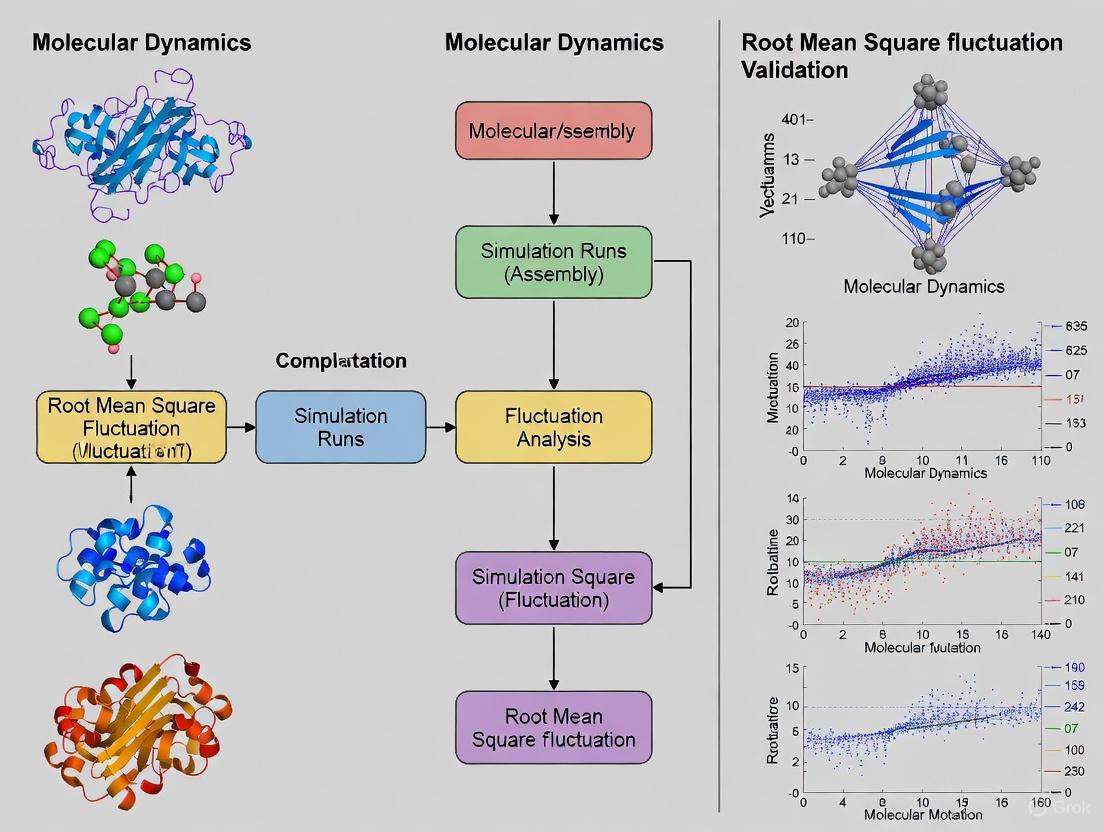
Root Mean Square Fluctuation (RMSF) is a critical metric in Molecular Dynamics (MD) simulations for quantifying local protein flexibility and validating simulation stability.
Root Mean Square Fluctuation (RMSF) in Molecular Dynamics: A Comprehensive Guide for Validation and Biomolecular Analysis
Abstract
Root Mean Square Fluctuation (RMSF) is a critical metric in Molecular Dynamics (MD) simulations for quantifying local protein flexibility and validating simulation stability. This article provides a comprehensive resource for researchers and drug development professionals, covering the foundational theory of RMSF, its calculation and application in drug discovery projects, strategies for troubleshooting and optimizing analyses, and robust methods for validating results against experimental data. By integrating practical guidance with insights from recent studies on targets like SARS-CoV-2 proteases and HPSE, we demonstrate how rigorous RMSF analysis can elucidate mechanisms of ligand binding, allosteric regulation, and ultimately accelerate the development of novel therapeutics.
Understanding RMSF: The Cornerstone of Analyzing Protein Flexibility in MD Simulations
Root Mean Square Fluctuation (RMSF) serves as a fundamental metric in molecular dynamics (MD) simulations, providing crucial insights into protein flexibility and structural stability at the atomic level. Unlike its counterpart Root Mean Square Deviation (RMSD), which measures global structural changes over time, RMSF quantifies the local flexibility of individual residues or atoms around their average positions [1] [2]. This distinction positions RMSF as an indispensable tool for researchers investigating the relationship between protein dynamics and biological function, particularly in pharmaceutical development where understanding molecular flexibility informs drug design strategies.
In structural biology, RMSF calculations enable scientists to identify rigid and flexible regions within protein structures, mapping functional domains responsible for catalytic activity, ligand binding, and allosteric regulation [3]. The conservation of dynamic patterns across enzyme superfamilies suggests an evolutionary pressure to maintain specific flexibility profiles essential for biological function [3]. This guide examines RMSF from computational, experimental, and applied perspectives, providing researchers with a comprehensive framework for implementing RMSF validation within molecular dynamics research.
Theoretical Foundations: RMSF Mathematical Definition and Interpretation
Mathematical Formulation
The RMSF calculation for a biomolecular system follows a standardized mathematical approach. For N atoms over M simulation frames, the RMSF for atom i is calculated as [2]:
RMSF(i) = √(1/M × Σₜ[τᵢ(t) - τ̅ᵢ]²)
Where:
- τᵢ(t) = position vector of atom i at time t
- τ̅ᵢ = time-averaged position of atom i
- M = total number of frames in the trajectory
- The summation runs over all time points in the simulation
This formula computes the standard deviation of atomic positions from their mean location, providing a quantitative measure of positional variability [1] [2]. Typically measured in Ångströms (Å, 10⁻¹⁰ m), RMSF values enable direct comparison of flexibility across different molecular systems [2].
Comparative Analysis: RMSF vs. RMSD
Understanding the distinction between RMSF and RMSD is crucial for proper data interpretation. The table below outlines key differences:
Table 1: Comparative Analysis of RMSF and RMSD in Molecular Dynamics
| Feature | RMSF (Root Mean Square Fluctuation) | RMSD (Root Mean Square Deviation) |
|---|---|---|
| Primary Function | Measures local flexibility of individual residues/atoms | Measures global structural change from reference |
| Typical Output | Per-residue/atom value plot vs. residue number | Single value plot over simulation time |
| Biological Insight | Identifies flexible/rigid regions, functional domains | Tracks overall conformational stability, equilibration |
| Reference Structure | Average position over trajectory | Fixed initial or crystal structure |
| Application Example | Identifying flexible binding loops, hinge regions | Monitoring protein folding/unfolding transitions |
Computational Methodologies: RMSF Calculation and Workflow
Standardized Calculation Protocols
RMSF analysis employs specialized software tools implementing the mathematical principles described in Section 2.1. The AMBER molecular dynamics package, particularly its cpptraj module, provides a widely-used implementation requiring careful preparation of input scripts [1]:
This script specifies trajectory input, initial RMSD-based alignment to remove global rotation/translation, and RMSF calculation for protein backbone atoms (Cα, C, N) grouped by residue [1]. The alignment step is critical as it eliminates artifacts from whole-molecule diffusion, ensuring calculated fluctuations reflect internal flexibility rather than global movement.
Alternative computational environments like MDTraj in Python provide complementary approaches:
Experimental Workflow Integration
The following diagram illustrates the integrated computational-experimental workflow for RMSF validation in drug discovery research:
Experimental Validation: Correlating Computational and Empirical Data
Biophysical Validation Techniques
While RMSF originates from computational simulations, its biological relevance requires experimental validation through biophysical techniques that probe atomic-level flexibility:
Nuclear Magnetic Resonance (NMR) serves as the gold standard for experimental RMSF validation, directly measuring atomic positional fluctuations through relaxation parameters (R₁, R₂, and NOE) [3]. These parameters report on ps-ns timescale motions corresponding closely to MD simulation timeframes. For example, studies on pancreatic RNase superfamily members demonstrated conserved dynamic patterns within functional subfamilies, with NMR-derived order parameters validating MD-predicted flexibility profiles [3].
Hydrogen-Deuterium Exchange Mass Spectrometry (HDX-MS) provides complementary validation by measuring backbone amide hydrogen exchange rates, reflecting flexibility in secondary structural elements. More flexible regions exhibit higher exchange rates due to increased solvent accessibility from transient structural openings.
Integrated Validation Protocols
Successful RMSF validation employs a hierarchical approach:
- Backbone Atom Validation: Focus initial validation on protein backbone atoms (Cα, N, C) which exhibit more predictable dynamics and have direct NMR observables [1]
- Timescale Correlation: Ensure experimental methods probe similar timescales as MD simulations (typically ps-ns for RMSF)
- Comparative Analysis: Validate relative rather than absolute fluctuation magnitudes between protein regions or related systems
- Mutational Support: Confirm functional significance of flexible regions through targeted mutagenesis of high-RMSF residues
Table 2: Experimental Techniques for RMSF Validation
| Technique | Structural Information | Timescale | Sample Requirements | Complementarity to MD |
|---|---|---|---|---|
| NMR Relaxation | Atomic-resolution dynamics | ps-ns | 0.1-1 mM, ¹⁵N/¹³C-labeled | Direct measurement of atomic fluctuations |
| HDX-MS | Backbone flexibility & solvent accessibility | ms-min | < 1 nmol, unlabeled | Identifies flexible regions with structural context |
| X-ray B-factors | Static disorder in crystal lattice | N/A | Crystallizable protein | Correlates with RMSF but includes crystal packing effects |
| SAXS | Global flexibility & ensemble characteristics | ns-ms | 0.1-1 mg/mL | Validates overall flexibility profiles |
Biological Significance: From Fluctuations to Function
Functional Dynamics in Enzyme Superfamilies
RMSF analysis transcends structural measurement to provide insights into biological function. Studies on pancreatic-type RNase superfamily members revealed that enzymes sharing common chemical and biological functions maintain conserved dynamic patterns despite structural similarities [3]. This conservation of dynamics suggests evolutionary pressure to preserve flexibility profiles essential for function.
In this superfamily, phylogenetic classification grouped sequences into functionally distinct subfamilies with characteristic RMSF profiles. Loop swapping experiments demonstrated that transferring flexible elements could transplant dynamical behavior between homologs, confirming the causal relationship between local flexibility and functional specialization [3].
Allosteric Regulation and Signal Transduction
RMSF effectively maps allosteric networks and signal transduction pathways by identifying residues with correlated fluctuations. In transcriptional complexes like the RNA Polymerase II pre-initiation complex, integrative structural biology approaches combining MD simulations with experimental data revealed dynamic linkages between protein modules [4]. These analyses showed that flexible hinge regions enable the structural transitions necessary for transcription initiation, with RMSF peaks identifying key regulatory sites.
Pharmaceutical Applications: RMSF in Drug Discovery
Binding Stability and Drug-Target Interactions
In pharmaceutical development, RMSF analysis provides critical insights into drug-target interactions and binding stability. Molecular dynamics simulations with RMSF calculations routinely complement docking studies to evaluate how ligand binding affects protein flexibility [5] [6] [7].
A study on emodin derivatives for hepatocellular carcinoma treatment demonstrated that the most potent compound (TAEM) not only showed the strongest binding affinity to EGFR and KIT targets but also induced the most stable binding complex with reduced RMSF values in key binding residues [7]. Similarly, investigations into naringenin's anti-breast cancer activity combined molecular docking with 100ns MD simulations, using RMSF to confirm stable protein-ligand interactions with key targets including SRC, PIK3CA, BCL2, and ESR1 [5].
Mechanism of Action Elucidation
RMSF further contributes to elucidating therapeutic mechanisms of action. Research on dapagliflozin's protective effects against diabetic liver injury employed MD simulations to validate interactions between the drug and key signaling proteins (ERK1/2, IKKβ, NF-κB) [6]. RMSF analysis confirmed that dapagliflozin stabilized specific conformational states in these targets, providing mechanistic insights into its anti-inflammatory effects observed in vitro and in vivo [6].
Research Reagent Solutions: Essential Tools for RMSF Analysis
Table 3: Essential Research Reagents and Tools for RMSF Studies
| Reagent/Software | Specific Function | Research Application |
|---|---|---|
| AMBER cpptraj | RMSF trajectory analysis | Calculates residue-specific fluctuations from MD trajectories [1] |
| MDTraj Python Library | RMSF computation & visualization | Enables programmatic RMSF analysis and integration with data science workflows [1] |
| NMR Isotope Labels (¹⁵N, ¹³C) | Experimental dynamics measurement | Validates computational RMSF predictions through relaxation measurements [3] |
| HDX-MS Buffers | Solvent accessibility mapping | Correlates flexible regions with hydrogen exchange rates [3] |
| GPU Computing Clusters | Accelerated MD simulations | Enables µs-timescale simulations for comprehensive sampling [5] [6] [7] |
| Force Fields (AMBER 14SB, GAFF) | Molecular mechanics parameters | Determines accuracy of simulated atomic fluctuations [7] |
RMSF analysis represents a powerful bridge between computational predictions and experimental validation in structural biology and drug discovery. As demonstrated across multiple applications—from enzyme evolution studies to cancer drug development—RMSF provides unique insights into protein flexibility that complement static structural information. The most robust research approaches integrate computational RMSF calculations with experimental validation through NMR, HDX-MS, or functional assays, creating a consensus view of protein dynamics relevant to biological function.
For pharmaceutical researchers, RMSF has become an indispensable tool in the mechanistic toolkit, providing atomic-level explanations for drug efficacy and enabling rational design of compounds that modulate protein flexibility. As MD simulations continue increasing in temporal and spatial scope, RMSF analysis will likely grow correspondingly more sophisticated, potentially revealing dynamical networks underlying complex biological processes and opening new avenues for therapeutic intervention.
The Mathematical Relationship Between RMSF, RMSD, and Experimental B-Factors
In the fields of structural biology and molecular dynamics (MD) simulations, accurately describing and validating protein dynamics is fundamental to understanding function, guiding drug design, and interpreting experimental data. Three pivotal metrics used in this endeavor are Root Mean Square Fluctuation (RMSF), Root Mean Square Deviation (RMSD), and experimental B-factors (also known as temperature or Debye-Waller factors). While these parameters are often discussed in isolation, a deep understanding of their mathematical and practical interrelationships is crucial for robust molecular dynamics root mean square fluctuation validation research. This guide provides a objective comparison of these metrics, detailing their theoretical connections, the experimental and computational protocols for their determination, and their respective strengths and limitations as revealed by scientific studies.
Defining the Core Metrics
Root Mean Square Fluctuation (RMSF)
RMSF measures the local flexibility of a protein structure over time. It quantifies the average deviation of each atom from its mean position throughout a simulation or an ensemble of structures. It is calculated using the formula: $$ \text{RMSF}i = \sqrt{\frac{1}{T} \sum{t=1}^{T} \lVert \mathbf{r}i(t) - \bar{\mathbf{r}}i \rVert^2 } $$ where ( \mathbf{r}i(t) ) is the position of atom ( i ) at time ( t ), ( \bar{\mathbf{r}}i ) is the time-averaged position of atom ( i ), and ( T ) is the total number of time frames. RMSF is therefore a per-atom measure of local stability and flexibility.
Root Mean Square Deviation (RMSD)
RMSD is a measure of global structural similarity. It calculates the average distance between the atoms of two or more superimposed structures after optimal roto-translation. The pairwise RMSD between two structures is given by: $$ \text{RMSD} = \sqrt{\frac{1}{N} \sum{i=1}^{N} \lVert \mathbf{r}i^{(A)} - \mathbf{r}i^{(B)} \rVert^2 } $$ where ( N ) is the number of atoms, and ( \mathbf{r}i^{(A)} ) and ( \mathbf{r}_i^{(B)} ) are the coordinates of atom ( i ) in structures A and B after alignment. The ensemble-average pairwise RMSD, ( \langle \text{RMSD}^2 \rangle^{1/2} ), provides a single metric for the global structural heterogeneity of an entire ensemble [8].
Experimental B-Factors
In X-ray crystallography, the B-factor describes the smearing of electron density around an atom's center. It is formally defined as ( B = 8\pi^2 \langle u^2 \rangle ), where ( \langle u^2 \rangle ) is the mean-square displacement of the atom from its average position. Assuming isotropic motion, B-factors can be directly related to RMSF through the equation: $$ \text{RMSF}i^2 = \frac{3Bi}{8\pi^2} $$ This equation allows for a direct comparison between atomic fluctuations observed in MD simulations (RMSF) and experimental X-ray data [8].
Mathematical Relationship and Theoretical Framework
The foundational link between these three metrics was rigorously derived by demonstrating that the ensemble-average pairwise RMSD is directly proportional to the average B-factors and thus to the RMSF for a single molecular species [8].
This relationship is elegantly analogous to the two definitions of the radius of gyration (( R_g )) in polymer physics:
- The first definition uses the pairwise distances between all monomers (Eq. 2, analogous to pairwise RMSD).
- The second uses the distance of each monomer from the center of mass (Eq. 3, analogous to RMSF) [8].
The study established that, under a set of conservative assumptions, the root mean-square ensemble-average of an all-against-all distribution of pairwise RMSD, ( \langle \text{RMSD}^2 \rangle^{1/2} ), is mathematically equivalent to the root mean-square average deviation between each structure and the average structure of the ensemble, ( \langle \text{RMSF}^2 \rangle^{1/2} ) [8]. This provides a basis for quantifying the global structural diversity of macromolecules in crystals directly from experimental B-factors. The study estimated that the ensemble-average pairwise backbone RMSD for a typical protein X-ray structure is approximately 1.1 Å, assuming conformational variability is the principal contributor to B-factors [8].
The following diagram illustrates the logical and mathematical relationships between these core metrics and the computational workflows used in their analysis.
Comparative Analysis of Metrics and Their Validation
A direct comparison of the properties, applications, and limitations of RMSF, RMSD, and B-factors is essential for selecting the right metric for a given research question.
Table 1: Objective Comparison of RMSF, RMSD, and B-Factors
| Feature | RMSF (from MD) | RMSD (from MD) | Experimental B-Factors |
|---|---|---|---|
| Primary Information | Local, per-atom flexibility | Global, whole-structure deviation | Apparent atomic displacement from electron density |
| Typical Experimental Use | Analyzing MD simulation trajectories | Monitoring simulation convergence, clustering structures | Assessing local flexibility & disorder in crystal structures |
| Key Strengths | Identifies flexible/rigid regions (e.g., loops vs. cores) | Simple, intuitive measure of overall structural change | Direct experimental observable |
| Key Limitations | Sensitive to force field inaccuracies & sampling | Can be dominated by large motions in flexible regions, masking smaller changes | Contain contributions from conformational disorder, crystal defects, and refinement errors [9] |
| Quantitative Accuracy (from studies) | Varies with force field and MD package [10] | N/A (comparative metric) | Estimated error: ~9 Ų (ambient T), ~6 Ų (cryo T) [9] |
| Reproducibility | High within same simulation setup; varies between force fields/MD packages [10] | High for a given ensemble | Modest; differs between structures of the same protein [9] |
The accuracy of B-factors derived from crystallographic experiments is a critical consideration when using them for validation. A 2022 study that analyzed over 400 structures of Gallus gallus lysozyme estimated the accuracy of B-factors to be approximately 9 Ų for ambient-temperature structures and 6 Ų for low-temperature structures [9]. This level of error, which has shown little improvement over the past two decades, must be considered when comparing simulation-derived RMSF to experimental B-factors, as it sets a fundamental limit on the agreement one can expect [9].
Furthermore, MD simulations themselves are subject to variations that affect the computed RMSF and RMSD. A comparative study using four different MD packages (AMBER, GROMACS, NAMD, and ilmm) revealed that while overall agreement with experiment at room temperature was good, there were "subtle differences in the underlying conformational distributions and the extent of conformational sampling" [10]. This indicates that the choice of simulation software and force field can influence the results, leading to ambiguity about which results are most correct.
Table 2: Analysis of B-Factor Limitations and Contributing Factors
| Factor | Impact on B-Factor / RMSF Comparison |
|---|---|
| Static & Dynamic Disorder | B-factors conflate true atomic motion with static conformational variability in the crystal, while RMSF from a single MD simulation typically captures only dynamics [8]. |
| Crystal Packing Contacts | Can restrict motion in crystal, making B-factors lower than RMSF from a solution-state simulation [8]. |
| Refinement Errors & Lattice Defects | Introduce non-physical noise into B-factor values, complicating direct comparison [9]. |
| Overall B-Factor Accuracy | The ~6-9 Ų error implies that differences between simulated and experimental values within this range may not be significant [9]. |
Experimental and Computational Protocols
Protocol: Relating Ensemble RMSD to B-Factors
This methodology outlines the procedure for validating the mathematical relationship between ensemble-average RMSD and experimental B-factors, as described in the foundational study [8].
- Generate a Structural Ensemble: Perform molecular dynamics simulations to generate a large ensemble of protein structures. The study used thousands of independent trajectories of the villin headpiece domain generated via the Folding@Home distributed computing project [8].
- Calculate Pairwise RMSD: For a cluster of structures from the ensemble, perform an all-against-all comparison. For each pair of structures, optimally align their backbone atoms (C, N, Cα) and calculate the non-weighted pairwise RMSD [8].
- Compute Ensemble-Average Pairwise RMSD: Calculate the quadratic mean (root mean square) of the entire distribution of pairwise RMSD values to obtain ( \langle \text{RMSD}^2 \rangle^{1/2} ) [8].
- Calculate RMSF from B-Factors: Obtain the experimental B-factors from a high-resolution protein crystal structure (e.g., from the PDB). Convert the B-factors to RMSF values using the equation ( \text{RMSF}i = \sqrt{3Bi / 8\pi^2} ) [8].
- Compare Global Metrics: Calculate the average B-factor, ( \langle B \rangle ), and the quadratic mean of the RMSF, ( \langle \text{RMSF}^2 \rangle^{1/2} ), across the protein backbone atoms. Compare this value to the ensemble-average pairwise RMSD computed in Step 3 to test the theoretical relationship [8].
Protocol: Validating MD Simulations with Experimental B-Factors
This is a common workflow for assessing the accuracy of a molecular dynamics force field by comparing simulation-derived dynamics to experimental data.
- System Setup:
- Obtain initial coordinates from a protein crystal structure (e.g., from the PDB).
- Solvate the protein in an explicit water box (e.g., using TIP4P-EW water models) with ions to neutralize the system [10].
- Simulation Execution:
- Use an MD package (e.g., AMBER, GROMACS, NAMD) with a modern force field (e.g., AMBER ff99SB-ILDN, CHARMM36).
- Perform energy minimization, followed by equilibration (e.g., in the NVT and NPT ensembles).
- Run production simulations (e.g., multiple independent replicates of 200 ns or longer) under conditions matching the experiment (temperature, pH) [10].
- Trajectory Analysis - RMSF Calculation:
- After aligning the trajectory to a reference structure to remove global rotation and translation, calculate the RMSF for each protein backbone atom.
- Conversion and Comparison:
- Convert the simulated RMSF values to "predicted" B-factors using the inverse relationship: ( Bi^{\text{pred}} = (8\pi^2 / 3) \times \text{RMSF}i^2 ) [8].
- Compare the profile of predicted B-factors directly to the experimental B-factor profile from the crystal structure, typically by calculating a Pearson correlation coefficient or by visual inspection of the per-residue plots.
Protocol: Assessing B-Factor Accuracy from Crystallographic Data
This protocol, derived from a 2022 study, describes how to estimate the intrinsic accuracy of B-factors in the PDB [9].
- Data Curation:
- Select a large set of independent crystal structures of the same wild-type protein (e.g., Gallus gallus lysozyme) determined in the same space group.
- Filter structures to include only those with similar, high-resolution data and without excessive heteroatoms. Separate structures by data collection temperature (ambient vs. cryo) [9].
- Calculation of Differences:
- For each pair of structures (X, Y), compute the absolute difference in B-factors for the same atom A: ( \Delta BA = | B{A,X} - B_{A,Y} | ) [9].
- Statistical Analysis:
- Analyze the distribution of these absolute difference values across all comparable atoms and structures.
- Use normal probability plots (NPPs) to compare the two sets of B-factor data and estimate the typical error [9].
The Scientist's Toolkit: Research Reagent Solutions
Table 3: Essential Software and Data Resources for Dynamics Validation
| Tool / Resource Name | Type | Primary Function in Validation |
|---|---|---|
| GROMACS [10] | MD Software Package | High-performance MD engine for running simulations and calculating RMSD/RMSF. |
| AMBER [10] | MD Software Package & Force Field | Suite for MD simulation and force fields like ff99SB-ILDN used in dynamics studies. |
| NAMD [10] | MD Software Package | Parallel MD software designed for large biomolecular systems. |
| CHARMM36 [10] | Force Field | Empirical energy function for MD simulations, used in packages like NAMD. |
| Protein Data Bank (PDB) [8] | Database | Repository for experimental protein structures and their associated B-factors. |
| Folding@Home [8] | Distributed Computing Project | Generates massive simulation ensembles for robust statistical analysis of RMSD/RMSF. |
| PMC | Literature Database | Provides open access to critical scientific literature for methodology details. |
The mathematical relationship between RMSF, RMSD, and experimental B-factors provides a powerful framework for bridging computational simulations and experimental data. The derivation showing that ensemble-average pairwise RMSD is proportional to average B-factors establishes a quantitative link between global structural heterogeneity and local atomic fluctuations [8]. However, practitioners must be aware of the significant limitations and errors inherent in both computational and experimental approaches. The accuracy of experimental B-factors is modest, with errors of 6-9 Ų, and has not substantially improved in decades [9]. Meanwhile, MD-derived metrics like RMSF are sensitive to the choice of force field and simulation package [10]. Therefore, successful validation requires not just a theoretical understanding of these relationships but also a critical appreciation of the practical uncertainties in both domains. Future efforts integrating larger simulation ensembles, improved force fields, and more sophisticated crystallographic refinement methods hold the promise of deepening our understanding of protein dynamics.
Root Mean Square Fluctuation (RMSF) is a fundamental metric in molecular dynamics (MD) simulations that quantifies the deviation of a particle, typically an atom, from its average position over time. It provides crucial insights into protein flexibility by measuring the average magnitude of atomic movements during a simulation, effectively capturing the local deformability of protein regions [11]. In structural biology, RMSF serves as a powerful tool for characterizing regional stability, identifying flexible loops, recognizing rigid domains, and detecting potential allosteric sites—regions where ligand binding can remotely influence protein function [2] [12].
The mathematical foundation of RMSF calculation involves computing the square root of the average squared deviation of atomic positions from their reference structure. For a simulation with T frames and N atoms, the RMSF for atom i is calculated as:
RMSF(i) = √(1/T ∑(t=1 to T) ||ri(t) - ri,ref||²)
where ri(t) is the position of atom i at time t, and ri,ref is its reference position, typically the average structure or the initial coordinates [2]. This calculation produces a profile where peaks indicate high-flexibility regions and troughs correspond to structurally stable areas, providing a quantitative map of protein dynamics essential for understanding function and facilitating drug discovery efforts.
Methodologies for RMSF Analysis and Interpretation
Standard RMSF Calculation Protocols
The standard protocol for RMSF analysis begins with a thoroughly equilibrated MD system. Researchers typically simulate the solvated protein in a physiological buffer (e.g., 150mM NaCl) using periodic boundary conditions at 310K for 50-100 nanoseconds, though longer simulations may be required for complex conformational changes [13] [14]. The simulation box size should provide at least 1.0 nm clearance between the protein and box edges, with energy minimization performed using steepest descent algorithms (approximately 50,000 steps) until the maximum force is <1000 kJ/mol/nm [13]. Following minimization, systems undergo equilibration in two phases: NVT ensemble for 100ps at 310K using the V-rescale thermostat, followed by NPT ensemble for 100ps at 310K and 1 bar using the Parrinello-Rahman barostat, with position restraints applied to protein heavy atoms [13].
For production simulations, the LINCS algorithm constrains bonds involving hydrogen atoms, allowing a 2fs time step, while Particle Mesh Ewald handles long-range electrostatics [13]. Trajectories are typically saved every 10ps for subsequent analysis. RMSF values are calculated after aligning each trajectory frame to a reference structure (usually the initial protein coordinates or an average structure) using backbone atoms to remove global rotation and translation [12]. This alignment is crucial for distinguishing internal protein fluctuations from whole-molecule movement. Specialized software packages like GROMACS, AMBER, or CHARMM implement these calculations, with MDLovoFit offering advanced robust alignment capabilities that automatically identify and align the least mobile substructures for improved interpretation [12].
Advanced Robust Alignment Techniques
Traditional RMSF analysis suffers from a significant limitation: highly mobile regions can dominate the structural alignment, obscuring the accurate quantification of fluctuations in more rigid areas. The MDLovoFit algorithm addresses this through a Low-Order-Value-Optimization (LOVO) strategy that iteratively identifies and aligns the most rigid substructures [12]. The algorithm proceeds through six key steps: (1) compute per-atom deviations after initial alignment; (2) sort these deviations in increasing order; (3) select the fraction φ (φ < 1) of atoms with smallest deviations; (4) perform rigid-body alignment using only this subset; (5) apply the resulting translation/rotation to the entire structure; (6) iterate until convergence of the mean square displacement of the selected subset [12]. This approach automatically identifies rigid cores without prior knowledge, providing a clearer picture of structural fluctuations and enabling more accurate quantification of flexibility patterns relevant to biological function.
Table 1: Comparison of RMSF Analysis Methods
| Method | Key Features | Advantages | Limitations |
|---|---|---|---|
| Standard RMSF | Alignment to reference structure using all atoms | Simple implementation; Intuitive interpretation | Mobile regions dominate alignment; May obscure local flexibility |
| MDLovoFit | Iterative alignment of least-mobile substructures | Automatic rigid core identification; Robust to high-flexibility regions | Computationally more intensive; Requires parameter tuning (φ) |
| Principal Component Analysis | Projection of motions onto collective coordinates | Identifies correlated motions; Separates global from local dynamics | Complex interpretation; Requires significant structural sampling |
| Time-dependent RMSF | Calculation over different trajectory segments | Captures temporal flexibility changes; Identifies conformational transitions | Requires long simulations; Sensitive to sampling quality |
Experimental Validation Correlations
Validating computational RMSF predictions requires integration with experimental data. X-ray crystallography B-factors (temperature factors) provide the most direct experimental correlate to RMSF, as both parameters quantify atomic displacement [11]. High correlation between predicted RMSF and experimental B-factors strengthens the validity of MD simulations. Nuclear Magnetic Resonance (NMR) spectroscopy offers additional validation through residual dipolar couplings and order parameters that reflect bond vector mobility [15]. Cryo-electron microscopy (cryo-EM) increasingly contributes to flexibility analysis through variability in reconstructed densities across multiple particles [15]. For allosteric proteins, biochemical assays measuring functional changes upon mutagenesis of predicted flexible or rigid regions can confirm computational predictions [16] [17]. This multi-technique validation framework ensures RMSF interpretations reflect biological reality rather than computational artifacts.
Interpreting RMSF Profiles for Protein Structural Elements
Identifying Rigid Domains
Rigid domains in RMSF profiles appear as troughs or flat regions with low fluctuation values (typically <1.0 Å), indicating structural regions that maintain their conformation throughout simulations [12]. These regions frequently correspond to secondary structure elements like α-helices and β-sheets that form the stable core of protein domains. In enzymatic proteins, catalytic domains often display coordinated rigidity that maintains precise atomic positioning for substrate binding and chemical transformation [11]. Rigid domains identified through RMSF analysis frequently serve as structural anchors that facilitate allosteric communication by transmitting rather than absorbing conformational changes [17].
The functional significance of rigid domains extends beyond mere structural stability. In allosteric proteins like beta-lactamases, rigid domains form conserved architectural elements that enable long-range communication between distinct binding sites [17]. Similarly, in kinases, rigid domains provide the structural framework upon which functional motions occur, with specific rigid elements crucial for coordinating conformational changes during catalytic cycles [17]. When analyzing RMSF profiles, consistently low fluctuations across multiple parallel simulations strongly suggest genuine structural rigidity rather than sampling limitations. MDLovoFit significantly enhances rigid domain identification by specifically aligning structures based on their most rigid components, preventing highly flexible regions from obscuring genuine stability patterns [12].
Characterizing Flexible Loops
Flexible loops manifest as distinct peaks in RMSF profiles, with fluctuation values often exceeding 2.0 Å and sometimes reaching 4-5 Å for highly mobile regions [11]. These regions typically correspond to solvent-exposed loops connecting secondary structure elements, where reduced structural constraints permit greater mobility. Beyond their obvious role in linkers connecting structured domains, flexible loops frequently participate in critical biological functions, including substrate access to active sites, ligand binding and release, and conformational switches that regulate protein activity [11] [14].
In the SARS-CoV-2 papain-like protease (PLpro), MD simulations revealed significant flexibility in loops surrounding the substrate-binding sites S3, S4, and SUb2, enabling conformational adaptations necessary for substrate recognition and catalysis [14]. Similarly, in allosteric studies of beta-lactamases, flexible loops function as dynamic gates that control access to active sites, with their motions directly influencing antibiotic resistance profiles [17]. When interpreting loop flexibility, it's essential to distinguish between intrinsic flexibility relevant to biological function and simulation artifacts resulting from insufficient sampling. Complementary analyses, such as examination of hydrogen bonding patterns, solvation, and contact maps, can help validate the biological significance of predicted flexible loops.
Detecting Allosteric Sites
Allosteric sites represent particularly valuable targets in drug discovery due to their potential for precise functional modulation. In RMSF profiles, allosteric regions often exhibit intermediate flexibility—more rigid than surface loops but more flexible than core structural domains—with values typically ranging from 1.0-2.0 Å [16] [17]. These regions may display distinctive dynamic patterns when comparing apo and holo simulations, with allosteric binding sites frequently showing reduced flexibility upon ligand binding while simultaneously inducing flexibility changes at distant active sites [16].
Molecular dynamics simulations have proven exceptionally valuable for identifying cryptic allosteric sites—transient pockets not visible in static crystal structures. In studies of branched-chain α-ketoacid dehydrogenase kinase (BCKDK), conventional crystallography failed to reveal certain allosteric sites, while MD simulations captured conformational transitions that exposed these cryptic pockets [16]. Enhanced sampling techniques like metadynamics, umbrella sampling, and accelerated MD further facilitate allosteric site discovery by promoting transitions between conformational states [16]. For example, metadynamics applies bias potentials to collective variables to accelerate exploration of conformational space, while replica exchange MD simulates multiple copies at different temperatures to enhance sampling efficiency [16].
Table 2: Characteristic RMSF Values for Protein Structural Elements
| Structural Element | Typical RMSF Range | Functional Significance | Drug Targeting Implications |
|---|---|---|---|
| Rigid Domains | 0.5 - 1.0 Å | Structural stability; Catalytic precision | Orthosteric site targeting; Stability enhancement |
| Allosteric Sites | 1.0 - 2.0 Å | Signal transmission; Regulatory control | Allosteric modulators; Specific regulation |
| Flexible Loops | 2.0 - 5.0 Å | Substrate access; Conformational switching | Difficult to target directly; Stabilization strategies |
| Termini | 1.5 - 4.0 Å | Often inherently flexible | Limited direct targeting; Engineering opportunities |
Integrated Workflow for RMSF-Based Analysis
The following workflow diagram illustrates the integrated process for interpreting RMSF profiles to identify structural elements and allosteric sites:
Figure 1: Integrated workflow for RMSF-based analysis of protein dynamics, from trajectory processing to functional interpretation.
Research Reagent Solutions for RMSF Analysis
Table 3: Essential Computational Tools for RMSF Analysis
| Tool/Software | Primary Function | Application Context | Key Features |
|---|---|---|---|
| GROMACS | MD Simulation Engine | Production MD simulations | High performance; Free software; Extensive analysis tools |
| AMBER | MD Simulation Suite | Production MD simulations | Force field development; Enhanced sampling; Quantum mechanics/molecular mechanics |
| MDLovoFit | Robust Trajectory Alignment | RMSF calculation | Automatic rigid substructure identification; Improved flexibility quantification |
| drMD | Automated MD Pipeline | Accessibility for non-experts | User-friendly interface; Automated protocols; Open source |
| AutoDock Vina | Molecular Docking | Allosteric ligand screening | Template-independent blind docking; Binding pose prediction |
| PASSer | Allosteric Site Prediction | Allosteric drug discovery | Machine learning approach; High prediction accuracy |
| PyMOL | Molecular Visualization | Structural interpretation | Publication-quality graphics; Plugin architecture |
| CHARMM-GUI | System Preparation | Simulation setup | Web-based interface; Membrane system building |
RMSF analysis represents a powerful approach for deciphering protein dynamics and linking structural flexibility to biological function. Through rigorous application of the methodologies outlined in this guide—including robust alignment strategies, multi-technique validation, and integrated workflow implementation—researchers can reliably identify rigid domains, characterize flexible loops, and detect allosteric sites from MD simulations. The continuing integration of machine learning approaches with traditional RMSF analysis promises further advances in predictive accuracy and biological insight [18] [15]. As these computational methodologies mature alongside experimental validation techniques, RMSF profiling will undoubtedly remain a cornerstone technique in structural biology and rational drug design, enabling researchers to bridge the crucial gap between static structures and dynamic function.
In molecular dynamics (MD) simulations, analyzing protein dynamics and conformational heterogeneity is crucial for understanding biological function. Root mean square fluctuation (RMSF), root mean square deviation (RMSD), and principal component analysis (PCA) represent three foundational analytical techniques that operate across complementary spatiotemporal scales. This guide objectively compares their performance, demonstrating that RMSF does not merely duplicate but critically integrates information from both global trajectory (RMSD) and collective motion (PCA) analyses. Experimental data and case studies reveal that RMSF provides unique, residue-level insights into flexibility that are essential for interpreting RMSD convergence and PCA subspace dimensions, effectively bridging local fluctuations with global conformational changes.
MD simulations generate vast amounts of data on protein motion, necessitating robust analytical methods to extract meaningful biological insights. RMSD, RMSF, and PCA form a core triad of approaches, each with distinct strengths and limitations.
- RMSD quantifies global structural drift over time, typically relative to an initial reference structure, helping researchers identify when a simulation has stabilized (reached equilibrium) and characterize large-scale conformational transitions [2] [1].
- RMSF measures local flexibility of individual residues, calculating the average deviation of each atom from its mean position. This residue-level analysis identifies flexible loops, hinge regions, and rigid structural elements crucial for function and ligand binding [2] [1].
- PCA identifies collective motions by projecting trajectory data into a low-dimensional space defined by the largest variances. It separates large-scale, correlated motions that often underlie biological function from uncorrelated background noise [19] [20].
The thesis of this work is that RMSF provides an indispensable bridge that connects the global stability information from RMSD with the correlated motion patterns revealed by PCA, creating a more complete picture of protein dynamics than any single metric can provide.
Theoretical Foundations and Mathematical Definitions
Fundamental Equations and Their Physical Interpretations
Root Mean Square Deviation (RMSD) measures the average distance between atoms of superimposed structures [2]:
- Equation: ( \text{RMSD}(t) = \sqrt{\frac{1}{N} \sum{i=1}^{N} \| \mathbf{x}i(t) - \mathbf{x}_i^{\text{ref}} \|^2 } )
- Parameters: ( N ) atoms, position ( \mathbf{x}i(t) ) of atom ( i ) at time ( t ), reference position ( \mathbf{x}i^{\text{ref}} )
- Application: Typically calculated after optimal rigid-body alignment to remove rotational and translational motion [2] [21].
Root Mean Square Fluctuation (RMSF) quantifies the average fluctuation of each atom around its mean position [22] [2]:
- Equation: ( \text{RMSF}(i) = \sqrt{ \frac{1}{T} \sum{t=1}^{T} \| \mathbf{x}i(t) - \bar{\mathbf{x}}_i \|^2 } )
- Parameters: ( \bar{\mathbf{x}}_i ) is the time-averaged position of atom ( i ) over trajectory frames
- Application: Usually calculated for Cα atoms to analyze residue-level flexibility [19] [1].
Principal Component Analysis (PCA) identifies dominant conformational changes through eigenvalue decomposition of the covariance matrix built from atomic coordinates [19] [20].
Analytical Complementarity Visualized
The following diagram illustrates how these three analyses connect to provide a comprehensive view of protein dynamics:
Experimental Comparisons and Performance Benchmarks
Case Study: Shikimate Kinase Conformational Sampling
A comparative study of autoencoder models trained on MD data of Shikimate Kinase demonstrated the complementary nature of these analyses [19]. The enzyme's three flexible domains (SB, β, and LID) showed characteristic patterns across methods:
Table 1: Comparative Analysis of Shikimate Kinase Dynamics from MD and Machine Learning Models
| Method | RMSD Peak (Å) | Domain Flexibility Pattern | PCA Sampling | Key Finding |
|---|---|---|---|---|
| MD (Reference) | 2.4 | All three domains show high flexibility | Broad coverage | Ground truth ensemble |
| Variational Autoencoder | 2.25 | Similar pattern to MD | Learns structural patterns from dynamics | Good correlation (SpCC ~0.99) |
| Wasserstein Autoencoder | 2.25 | Reduced fluctuations | Limited exploration | Captures trends but underestimates flexibility |
| Denoising Autoencoder | ~2.25 | Significantly reduced fluctuations | Highly restricted | Oversmoothing of flexible regions |
The study found that while generated structures showed excellent Spearman correlation coefficients (~0.99) with original MD data, RMSF analysis revealed that machine learning models systematically underestimated flexibility, particularly in the LID domain [19]. This critical insight would be missed by examining only RMSD or PCA projections.
Performance Metrics Across Biological Systems
Table 2: Quantitative Performance Metrics Across Different Protein Systems
| Protein System | RMSD Convergence Time (ns) | High RMSF Regions | PCA Dominant Motions | Integrated Insight |
|---|---|---|---|---|
| GB3 Domain | 2-4 (by lagged RMSD) [21] | Border regions of secondary structures [23] | First 2-3 PCs explain ~70% variance [23] | RMSF peaks correspond to essential subspace dimensions |
| TCR-pMHC Complexes | 20-50 (dependent on system) [21] | Complementary determining regions, peptide interface | Binding groove deformation modes | Combined analysis reveals allosteric communication |
| SARS-CoV-2 Mpro | Varies with inhibitors | Catalytic dyad (His41, Cys145), flexible loops [24] | Domain motions correlated with substrate binding | RMSF validates PCA-clustered conformational states [24] |
| Short Antimicrobial Peptides | Highly variable (unstable) [25] | Terminal residues, hydrophobic cores [25] | Limited collective motions (small systems) | RMSF guides algorithm selection (AlphaFold vs PEP-FOLD) [25] |
Methodological Protocols for Integrated Analysis
Standardized Workflow for Correlation Analysis
Trajectory Preparation and Alignment
- Load trajectory and topology files using MD analysis frameworks (MDTraj, cpptraj) [1]
- Superimpose all frames to a reference structure (usually the first frame or average structure) using backbone atoms (C, CA, N) to remove global rotation/translation [1]
- Specific command (cpptraj):
rmsd @C,CA,N first[1]
RMSD Convergence Analysis
- Calculate time-lagged RMSD using block averaging approaches to identify equilibrium phases [21]
- Apply Hill equation fitting: ( \text{RMSD}(\Delta t) = \frac{a \cdot \Delta t^\gamma}{\tau + \Delta t^\gamma} ) to quantify saturation behavior [21]
- Exclude initial non-equilibrium phase (typically 10-20% of trajectory) from subsequent analyses [21]
RMSF Calculation and Mapping
- Compute per-residue fluctuations using backbone atoms:
atomicfluct out rmsf.dat @C,CA,N byres[1] - Map high-RMSF regions onto protein structure to identify flexible loops, hinges, and binding interfaces
- Correlate with secondary structure – typically, loops show 2-3× higher RMSF than structured elements [23]
PCA and Dimensionality Reduction
- Build covariance matrix of atomic positions after alignment
- Perform eigenvalue decomposition to obtain principal components (PCs)
- Project trajectory onto first 2-3 PCs to visualize conformational clustering [19] [20]
- Identify functional motions by analyzing atomic displacements in dominant PCs
Cross-Analysis Validation
- Color structures by RMSF and visualize along PC projections
- Check consistency – high-RMSF regions should contribute significantly to dominant PCs
- Relate RMSD jumps to transitions between PCA-clustered states
Table 3: Essential Software Tools for Integrated MD Analysis
| Tool/Resource | Function | Application Context |
|---|---|---|
| GROMACS [21] | MD simulation engine with built-in analysis | RMSD/RMSF calculation during production simulations |
| AMBER/cpptraj [22] [1] | Trajectory analysis toolkit | Professional RMSF calculation with extensive atom selection options |
| MDTraj (Python) [1] | Lightweight trajectory analysis | Rapid prototyping and custom analysis scripts |
| EnsembleFlex [20] | Ensemble analysis suite | Integrated RMSD/RMSF/PCA with clustering and visualization |
| BioEmu [26] | Neural emulator for conformation sampling | Generating structural ensembles beyond MD sampling limitations |
| RMSF-net [22] | Deep learning for flexibility prediction | Predicting RMSF from cryo-EM maps in seconds instead of MD simulations |
| VMD [19] | Molecular visualization and analysis | Visualization of RMSF-mapped structures and dynamic properties |
Discussion: Bridging the Scales of Protein Motion
The experimental evidence consistently demonstrates that RMSF serves as the critical connection between global and local analyses. In the GB3 domain study, MD simulations using modern force fields (OPLS-AA, AMBER ff99SB, ff03) overestimated backbone flexibility at secondary structure borders compared to NMR experiments – a discrepancy clearly visible in RMSF profiles but obscured in overall RMSD [23]. This highlights RMSF's precision in identifying force field limitations.
For drug discovery applications, particularly against SARS-CoV-2 main protease, RMSF analysis revealed that despite stable global RMSD (<2Å), specific flexible loops surrounding the catalytic site showed elevated fluctuations (>3Å) that directly impacted inhibitor binding [24]. These local flexibility patterns correlated with essential motions identified by PCA, enabling researchers to distinguish true allosteric mechanisms from random fluctuations.
In studies of short antimicrobial peptides, where traditional RMSD analysis often fails due to inherent instability, RMSF emerged as the decisive metric for evaluating computational models [25]. The finding that "PEP-FOLD gives both compact structure and stable dynamics for most of the peptides" was derived primarily from RMSF comparisons, guiding algorithm selection based on peptide physicochemical properties [25].
Emerging machine learning approaches like BioEmu [26] and RMSF-net [22] further validate this integrative framework. RMSF-net specifically demonstrates that RMSF patterns can be predicted from cryo-EM density maps, achieving correlation coefficients of 0.765±0.109 with actual MD simulations [22] – providing a rapid bridge between experimental data and dynamic insights that previously required massive computational resources.
Through rigorous comparative analysis across diverse protein systems, RMSF establishes itself not as a redundant metric but as an essential bridging analysis that connects the global perspective of RMSD with the collective motion description of PCA. For researchers and drug development professionals, this integrated analytical approach provides a more complete, multiscale understanding of protein dynamics. The experimental protocols and toolkit resources outlined here offer a practical roadmap for implementing this powerful trifecta of analyses, ensuring that critical insights into protein flexibility and function are no longer obscured by the limitations of any single analytical method.
The Critical Role of RMSF in Validating the Equilibration and Convergence of MD Simulations
Molecular Dynamics (MD) simulation is a powerful computational technique that provides atomic-level insights into the structural and dynamic behavior of biomolecules, complementing experimental approaches [27]. A fundamental, yet often overlooked, assumption in most MD studies is that the simulated system has reached thermodynamic equilibrium, ensuring that the measured properties are converged and reliable [27]. The failure to verify this assumption can profoundly invalidate simulation results, raising a critical question for the field: are the conclusions drawn from many MD studies even valid? [27]
The process typically begins with an experimentally derived structure, which exists under non-physiological conditions (e.g., a crystal lattice) and is therefore not in equilibrium for a solution-state simulation [27]. The system undergoes energy minimization and equilibration steps to relax. However, determining when true equilibrium is attained is challenging. While properties like potential energy and the Root Mean Square Deviation (RMSD) relative to the starting structure are commonly used to check for equilibration, their limitations are severe [28]. Visual inspection of RMSD plots has been shown to be highly subjective and unreliable, with scientists showing no mutual consensus on the point of equilibrium, their decisions biased by factors such as plot scaling and color [28].
This context underscores the necessity for robust, quantitative metrics to assess equilibration and convergence. Among these, Root Mean Square Fluctuation (RMSF) serves as a critical tool. RMSF measures the standard deviation of atomic positions over time, typically after fitting the structures to a reference frame to remove global translational and rotational motion [29]. It provides a residue-by-residue or atom-by-atom picture of structural flexibility and local stability, offering a more granular and informative view of system behavior than global RMSD alone.
RMSF and B-Factors: A Bridge Between Simulation and Experiment
RMSF is intrinsically linked to experimental observables, most notably the B-factor (or temperature factor) found in crystal structures of proteins and other biomolecules. The B-factor quantifies the smearing of electron density around an atom, which arises from both static disorder and dynamic atomic motion [30].
A key mathematical derivation shows that, under a set of conservative assumptions, the ensemble-average pairwise RMSD for a molecular species is directly related to the average B-factors [30]. This relationship provides a formal basis for quantifying global structural diversity from experimental data. In practice, MD suites like GROMACS include functionalities to directly convert calculated RMSF values into B-factors, which can then be written to a PDB file for straightforward comparison with experimental structures [29]. This direct comparability makes RMSF an indispensable metric for validating the realism of a simulation against experimental data. If the pattern of flexibility from the simulation (RMSF) matches the pattern of disorder from the crystal structure (B-factors), it increases confidence that the simulation is accurately capturing the molecule's native dynamics.
Table 1: Key Metrics for Assessing MD Convergence and Their Characteristics
| Metric | Description | Primary Application | Key Strengths | Key Limitations |
|---|---|---|---|---|
| RMSF | Standard deviation of atomic positions after fitting [29]. | Measuring local flexibility and stability; validating against experimental B-factors [30] [29]. | Direct link to experiment; per-residue insight. | Requires a stable reference; sensitive to fitting procedures. |
| RMSD | Global measure of structural drift from a reference structure [21]. | Initial, coarse assessment of structural stability. | Intuitive measure of global change. | Unreliable for determining equilibrium; insensitive to local changes [28]. |
| "Lagged RMSD" | RMSD between configurations separated by a specific time lag, Δt [21]. | Assessing the convergence of structural sampling over time. | Probes structural memory decay; more specific than standard RMSD. | Computationally intensive; requires long trajectories. |
| Energy | Total potential or kinetic energy of the system. | Monitoring the stability of fundamental thermodynamic quantities. | Essential for establishing thermal equilibrium. | Can plateau before structural equilibrium is achieved [31]. |
Comparative Analysis of Convergence Metrics: Why RMSF is Indispensable
While several metrics are available, a comparative analysis reveals the unique value of RMSF while also highlighting the importance of a multi-metric approach.
The Pitfalls of Relying Solely on RMSD
The RMSD of a biomolecule with respect to its starting structure is one of the most ubiquitous plots in MD literature. A plateau in the RMSD time series is often intuitively taken as a sign that the system has equilibrated. However, this method is fraught with subjectivity. A formal survey of scientists demonstrated that there is no consistent agreement on where equilibrium begins based on RMSD plots, with decisions being influenced by non-scientific factors like graph scaling and color [28]. Furthermore, a system can become trapped in a local energy minimum, leading to a stable RMSD that gives a false impression of global equilibrium, while significant conformational degrees of freedom remain unexplored [27].
The "Lagged RMSD" Analysis
This advanced RMSD-based method offers a more robust check for non-convergence. Instead of measuring deviation from time zero, it calculates the average RMSD between all pairs of configurations in the trajectory separated by a specific time interval, Δt [21]. The resulting curve, RMSD(Δt), is then modeled, for instance, with a Hill equation. Unless the RMSD(Δt) function reaches a stationary shape (a plateau), the simulation has not converged, as the structures continue to "drift" further apart over increasing time lags [21]. This method is a powerful tool to judge if a simulation has not run long enough.
The Critical Role of RMSF
RMSF provides a critical layer of analysis that complements global metrics. Its utility in convergence validation is multi-faceted:
- Detection of Localized Instability: Global RMSD or energy can appear stable while individual regions of the molecule, such as flexible loops or terminal, remain unstable. RMSF readily identifies these localized dynamics, preventing premature conclusions about the system's overall equilibrium [31].
- Indicator of "Partial Equilibrium": A system can be in partial equilibrium where some properties have converged while others have not [27]. The stabilization of RMSF profiles for specific domains or the entire backbone, especially when it aligns with experimental B-factor trends, is strong evidence that at least the structural sampling of local fluctuations has converged, even if rare, large-scale transitions have not.
- Revealing Underlying Heterogeneity: Studies on complex systems like hydrated amorphous xylan have shown that standard indicators (density, energy) can remain constant while the system undergoes slow processes like phase separation [31]. Parameters coupled to structural and dynamical heterogeneity, like RMSF, are essential to detect such phenomena and confirm true equilibration, which in some cases may require microsecond-long simulations [31].
The following diagram illustrates a comprehensive workflow for validating MD equilibration that integrates RMSF with other key metrics:
A workflow for validating MD equilibration integrating RMSF with other metrics.
Experimental Protocols for RMSF Validation in Practice
Standard Protocol for RMSF Calculation and Analysis
A typical protocol for using RMSF in convergence validation, as implemented in tools like GROMACS's gmx rmsf, involves several key steps [29]:
- Trajectory Preparation: A production trajectory is generated after initial minimization and equilibration. To ensure analysis of equilibrated data, an initial portion of the trajectory (e.g., the first 10-100 ns) is often discarded as "additional equilibration."
- Least-Squares Fitting: Each frame of the trajectory is fit to a reference structure (e.g., the initial or an average structure) on a selected set of atoms (e.g., protein backbone atoms) to remove global rotation and translation. This step is crucial for isolating internal fluctuations [29].
- RMSF Calculation: The RMSF for each atom i is calculated as the square root of the time-average of the squared deviation from its mean position: RMSFᵢ = √⟨(rᵢ(t) - ⟨rᵢ⟩)²⟩, where rᵢ(t) is the position of atom i at time t and ⟨rᵢ⟩ is its time-averaged position [29].
- Time-Blocked Analysis: To test for stability, the trajectory is split into consecutive blocks (e.g., two or three blocks). The RMSF is calculated independently for each block. A converged simulation will show similar RMSF profiles across all blocks, indicating that the pattern of flexibility is no longer changing with time.
- Comparison with Experiment: The calculated RMSF values are converted to B-factors using the formula Bᵢ = 8π² * (RMSFᵢ)² / 3 and written to a PDB file [29]. The correlation between the simulated and experimental B-factor profiles provides a strong, objective validation of the simulation's realism.
Case Study: Ligand Binding Validation
In a study targeting Triple-Negative Breast Cancer (TNBC), RMSF played a pivotal role in validating the stability of a phytochemical lead molecule (2-hydroxynaringenin) bound to the Androgen Receptor (AR). After performing molecular docking, researchers subjected the complex to a multi-nanosecond MD simulation. The stability of the complex and the convergence of the simulation were evaluated by analyzing the RMSF of the protein backbone and the ligand. The low and stable RMSF values observed for both provided critical evidence that the protein-ligand complex had reached a stable equilibrium, thereby validating the binding pose identified by docking and supporting the conclusion of a high-binding affinity interaction [32].
The Scientist's Toolkit: Essential Reagents and Software
Table 2: Key Research Reagent Solutions for MD Simulation and RMSF Analysis
| Tool/Reagent Name | Type | Primary Function in RMSF/MD Analysis |
|---|---|---|
| GROMACS | Software Suite | A high-performance MD simulation package; its gmx rmsf module is used specifically for calculating RMSF and converting it to B-factors [29]. |
| AMBER | Software Suite | A suite of biomolecular simulation programs that includes tools for trajectory analysis, including RMSF calculation. |
| CHARMM | Software Suite | A versatile program for atomic-level simulation, including energy minimization, dynamics, and trajectory analysis (RMSD, RMSF). |
| GROMOS Force Field | Parameter Set | A family of force fields integrated with GROMACS; used to define energy functions and parameters for MD simulations [21]. |
| AlphaFold | Modeling Algorithm | A deep learning-based system for highly accurate protein structure prediction; often used to generate initial structures for simulation when experimental structures are unavailable [25]. |
| PEP-FOLD | Modeling Algorithm | A de novo approach for predicting peptide structures from amino acid sequences; useful for simulating short peptides [25]. |
| RaptorX | Web Server | A tool for predicting secondary structure, solvent accessibility, and disordered regions of proteins, which can inform RMSF expectations [25]. |
| UCSF Chimera | Visualization & Analysis | A highly extensible program for interactive visualization and analysis of molecular structures and trajectories, including RMSF and B-factor analysis. |
| VADAR | Web Server | A volume, area, dihedral angle, and RMSF analyzer used for comprehensive assessment of protein structures from PDG files. |
In the critical task of validating the equilibration and convergence of MD simulations, RMSF emerges as an indispensable metric that transcends the capabilities of global measures like RMSD. Its strength lies in its granularity, providing a residue-specific view of stability, its direct link to experimental observables through B-factors, and its sensitivity to localized dynamics that can persist even when a system appears globally stable. While no single metric can definitively prove that a simulation has achieved full thermodynamic equilibrium and sampled all relevant conformational space, the consistent stabilization of the RMSF profile, especially when validated against experimental data and supported by other convergence checks like lagged RMSD analysis, provides a robust and multi-faceted argument for partial equilibrium at a minimum. For researchers in drug development and structural biology, incorporating this rigorous, RMSF-informed protocol is essential for ensuring that the insights derived from MD simulations are built upon a reliable and validated foundation.
Calculating and Applying RMSF in Drug Discovery: From Theory to Practice
A Step-by-Step Workflow for RMSF Calculation in GROMACS and AMBER
Root Mean Square Fluctuation (RMSF) is a fundamental metric in molecular dynamics (MD) simulations that quantifies the deviation of individual atoms or residues from their average positions over time. Unlike Root Mean Square Deviation (RMSD), which measures global structural changes, RMSF provides insights into local flexibility, identifying rigid and mobile regions within a protein structure [33] [1]. This measurement is crucial for validating simulation stability and understanding biological function, particularly in drug development where flexibility influences binding site accessibility and allosteric regulation.
Within the broader context of molecular dynamics validation research, RMSF analysis serves as a critical bridge between computational predictions and experimental observations. The RMSF (ρ) for a given atom i is calculated as the square root of the variance of its positional fluctuations: ρ~i~ = √⟨(r~i~ - ⟨r~i~⟩)²⟩, where r~i~ represents the atomic coordinates and ⟨r~i~⟩ denotes the average position [34] [33]. This quantitative approach allows researchers to identify regions of structural stability and flexibility, providing invaluable insights for interpreting simulation data within pharmacological and structural biology applications.
Theoretical Foundations and Computational Significance
RMSF Mathematical Formalism and Interpretation
The RMSF calculation provides a time-averaged measure of atomic positional variability around the mean structure. A region characterized by high RMSF values indicates significant divergence from the average position and therefore high structural mobility, whereas low RMSF values suggest more rigid regions that maintain their structural integrity throughout the simulation [33]. This distinction is particularly valuable for identifying flexible loops, terminal regions, and dynamic domains that may play crucial roles in molecular recognition and function.
For meaningful RMSF analysis, the system must first reach equilibrium, typically confirmed through RMSD plateauing [33] [1]. The calculation requires structural alignment (fitting) to a reference frame to remove overall translational and rotational motion that would otherwise dominate the fluctuation measurements [29] [34]. In protein studies, RMSF is commonly calculated for Cα atoms, which represent backbone flexibility, though it can be extended to side chains for investigating specific interactions [33].
Relationship to Experimental Observables
RMSF values can be directly converted to crystallographic B-factors using the relationship B = 8π²⟨ρ²⟩/3, allowing direct comparison with experimental X-ray diffraction data [29] [34] [33]. This conversion enables researchers to validate their simulation parameters and force field choices against empirical structural data. The gmx rmsf module includes functionality to output PDB files with B-factors derived from RMSF values, facilitating visualization in molecular graphics software like PyMOL or VMD [29] [33].
Table: Key Differences Between RMSD and RMSF in MD Analysis
| Feature | RMSD (Root Mean Square Deviation) | RMSF (Root Mean Square Fluctuation) |
|---|---|---|
| Purpose | Measures global structural change | Measures local flexibility |
| Reference | Typically uses initial frame | Uses average structure over trajectory |
| Plotting | Versus time | Versus residue or atom number |
| Application | System equilibration assessment | Identification of flexible/rigid regions |
| Biological Insight | Overall structural stability | Domain mobility, binding sites, allosteric regions |
RMSF Calculation in GROMACS: A Step-by-Step Protocol
Preparation and Basic Command Implementation
The GROMACS gmx rmsf module provides a comprehensive toolkit for calculating atomic fluctuations from MD trajectories. A fundamental workflow begins with these essential steps:
Trajectory Preparation: Ensure your trajectory (
traj.xtc) and run input file (topol.tpr) are properly prepared. For accurate results, use the equilibrated portion of your trajectory by specifying time ranges with the-b(begin time) and-e(end time) flags [29] [33].Basic RMSF Calculation: Execute the core command to compute fluctuations:
This command generates an output file (
rmsf.xvg) containing RMSF values. The-resflag instructs GROMACS to compute the average fluctuation per residue rather than per atom [29] [33].Atom Selection: When prompted, select
C-alphato analyze backbone fluctuations, which provides the most biophysically relevant information about protein flexibility [33].
Advanced Applications and Output Options
Beyond basic fluctuation analysis, GROMACS offers several specialized outputs for enhanced structural interpretation:
B-factor Conversion: To convert RMSF values to B-factors and write them to a PDB file for visualization:
The resulting
bfac.pdbfile can be opened in molecular visualization software, where B-factor values are typically represented by color gradients, allowing immediate identification of flexible regions [29] [33].Anisotropic Displacement Parameters: For more sophisticated analyses of directional fluctuations, use the
-anisoflag to compute anisotropic temperature factors, which output ANISOU records in the PDB format [29].Trajectory Frame Selection: To analyze specific temporal segments of your simulation, incorporate the
-band-eflags. For example, to analyze only the production phase from 1000 ps to 10000 ps:This excludes equilibration phases where the structure hasn't stabilized [33].
The following diagram illustrates the complete GROMACS RMSF analysis workflow:
RMSF Calculation in AMBER/CPPTRAJ: A Step-by-Step Protocol
Input Preparation and CPPTRAJ Execution
The AMBER software suite employs CPPTRAJ for trajectory analysis, including RMSF calculations. The implementation differs from GROMACS but produces equivalent physical insights:
Input File Creation: Create a text file (e.g.,
rmsf.in) containing the analysis commands:The
rmsdcommand aligns each frame to the first frame using the protein backbone (C, CA, N atoms) to remove overall rotation and translation. Theatomicfluctcommand with thebyresflag calculates the average fluctuation per residue [34] [1].Script Execution: Run CPPTRAJ using your topology file and the input script:
This generates
rmsf.datcontaining residue indices and their corresponding RMSF values [1].
Advanced Features and Mass-Weighting Options
CPPTRAJ offers specialized functionality for specific research applications:
B-factor Calculation: The
atomicfluctcommand can directly compute B-factors using thebfactorkeyword, which squares the RMSF values and applies the appropriate conversion factor [34].Mass-Weighted Fluctuations: By default, CPPTRAJ calculates mass-weighted fluctuations, which account for atomic mass differences, providing more physically accurate representations of molecular motions [34].
Anisotropic Displacement Parameters: Similar to GROMACS, CPPTRAJ can compute anisotropic parameters using the
calcadpkeyword, which automatically implies B-factor calculation [34].
A comprehensive CPPTRAJ workflow for coordinate averaging, fitting, and fluctuation calculation can be implemented in a single execution sequence [34]:
Comparative Analysis of GROMACS and AMBER Methodologies
Command Structure and Implementation Differences
While both packages compute equivalent physical properties, their command structures and theoretical approaches reveal significant philosophical differences in MD analysis:
Table: Command Comparison for RMSF Analysis Tasks
| Analysis Task | GROMACS Command | AMBER/CPPTRAJ Command |
|---|---|---|
| Basic RMSF | gmx rmsf -f traj.xtc -s topol.tpr -o rmsf.xvg |
atomicfluct out rmsf.dat @C,CA,N |
| Per-residue | -res flag |
byres keyword |
| B-factor | -oq bfac.pdb |
bfactor keyword |
| Anisotropic | -aniso flag |
calcadp keyword |
| Reference | Structure file (-s) |
rmsd first (before atomicfluct) |
| Fitting | -fit (enabled by default) |
Separate rmsd command |
GROMACS employs an integrated command approach where fitting and fluctuation calculation occur within a single command, while CPPTRAJ utilizes a modular strategy where each operation is specified sequentially [29] [34] [1]. This distinction reflects GROMACS's design as an integrated toolkit versus AMBER's ecosystem of specialized tools.
Performance Considerations and Output Management
In terms of computational efficiency, both packages are highly optimized for performance, though specific advantages emerge in different scenarios. GROMACS is renowned for its exceptional simulation speed through advanced GPU acceleration [35], while CPPTRAJ offers unparalleled flexibility in analyzing trajectories from various MD engines, including GROMACS itself [34].
Output management also differs substantially between the ecosystems. GROMACS primarily utilizes XVG files for numerical data and PDB files for structural outputs with B-factors, while CPPTRAJ generates plain text data files that can be easily parsed for custom plotting routines [29] [34] [33]. For researchers requiring highly customized analysis, CPPTRAJ's scripting capabilities provide finer control, whereas GROMACS offers greater simplicity for standard workflows.
Experimental Validation and Research Applications
Case Studies in Drug Discovery and Protein Engineering
Recent literature demonstrates the critical importance of RMSF validation in diverse research contexts, particularly in pharmaceutical development:
SARS-CoV-2 NSP6 Inhibition: In a 2025 study investigating potential inhibitors for SARS-CoV-2 NSP6 protein, RMSF analysis validated that lead compounds ZINC-089639800, ZINC-157610683, ZINC-075484852, ZINC-016611776, and ZINC-141457420 caused "no significant deviation from the NSP6-apo protein" in flexibility patterns, confirming compound binding without disruptive structural consequences [36].
Aptamer-Capsid Protein Interactions: Research on Macrobrachium rosenbergii nodavirus utilized 1000-ns simulations with RMSF analysis to reveal how truncated DNA aptamers induced "significant conformational changes and structural rearrangements in the capsid protein," demonstrating the antiviral potential of interfering with capsid self-assembly processes [37].
mTOR Inhibitor Screening: A 2025 virtual screening study for ATP-competitive mTOR inhibitors employed RMSF alongside RMSD to quantitatively analyze structural stability, identifying three compounds (Top1, top2, and top6) that formed stable interactions with key residues including VAL-2240 and TRP-2239 [38].
Experimental Parameters and Protocol Specifications
These studies share common methodological frameworks for RMSF validation:
Table: Experimental Parameters from Recent RMSF Studies
| Study Focus | Simulation Length | Force Field | Key RMSF Findings |
|---|---|---|---|
| SARS-CoV-2 NSP6 [36] | 100 ns | Not specified | Selected compounds showed similar flexibility to apo protein |
| Viral Capsid Proteins [37] | 1000 ns | CHARMM36 | Aptamer binding induced structural rearrangements |
| mTOR Inhibitors [38] | Not specified | AMBER99SB-ILDN/GAFF | Stable binding with key residue interactions |
| Colorectal Cancer Biomarkers [39] | Not specified | Not specified | Identified valproic acid, cyclosporine, genistein as potential therapeutics |
The consistent application of RMSF across these diverse research areas highlights its role as a validation cornerstone in structural bioinformatics. The typical simulation length ranges from 100 ns for initial screening to 1000 ns for detailed mechanistic studies, with CHARMM36 and AMBER force fields being predominant choices [36] [37] [38].
Essential Research Reagents and Computational Tools
Successful RMSF analysis requires both specialized software and carefully prepared input data. The following table catalogues essential components for conducting these experiments:
Table: Research Reagent Solutions for RMSF Analysis
| Reagent/Software | Function in RMSF Analysis | Example Sources/Formats |
|---|---|---|
| GROMACS [29] [33] | MD simulation and trajectory analysis | gmx rmsf module with trajectory (.xtc) and topology (.tpr) inputs |
| AMBER/CPPTRAJ [34] [1] | Trajectory analysis and fluctuation calculation | atomicfluct command with topology (.prmtop) and trajectory (.nc) inputs |
| Molecular Visualization [33] | B-factor visualization and structural interpretation | PyMOL, VMD for coloring structures by B-factor values |
| Force Fields [40] [37] [38] | Molecular interaction parameters | CHARMM36, AMBER99SB-ILDN, OPLS-AA for energy calculations |
| Plotting Libraries [33] [1] | Data visualization and presentation | Matplotlib (Python), Grace (xmgrace) for RMSF versus residue plots |
These research reagents form an integrated ecosystem for MD validation, with each component playing a specific role in the workflow from simulation to interpretation. The choice between GROMACS and AMBER often depends on research group expertise and specific project requirements, though both provide robust, validated methodologies for RMSF calculation.
The mathematical relationships between the key concepts in RMSF analysis can be visualized as follows:
This comparative analysis demonstrates that both GROMACS and AMBER provide robust, validated methodologies for RMSF calculation, albeit with different philosophical approaches to trajectory analysis. GROMACS offers an integrated, efficient workflow particularly suitable for high-throughput applications and researchers preferring a unified toolset. In contrast, AMBER's CPPTRAJ provides modular flexibility advantageous for complex, customized analysis pipelines. Both packages continue to evolve with advances in force field accuracy [40] and computational performance [35], ensuring their ongoing relevance in molecular dynamics validation research.
The consistent application of RMSF analysis across recent groundbreaking studies in virology [36] [37] and oncology [39] [38] underscores its critical role in bridging computational simulations with biological insight. As MD simulations extend into the microsecond timescale and beyond [35], RMSF validation will remain an essential component of rigorous molecular dynamics research, providing crucial insights into protein flexibility that directly inform drug discovery and protein engineering efforts.
Using RMSF to Map Ligand-Binding Sites and Assess Binding Stability
Root Mean Square Fluctuation (RMSF) is a pivotal metric in molecular dynamics (MD) simulations for quantifying the average deviation of a particle (atom or residue) from its reference position over time. It is calculated using the formula RMSF = √[1/T * ∑(x(t) - x̃)²], where x(t) is the position at time t, x̃ is the mean position, and T is the total simulation time [41] [22]. In structural biology and drug design, RMSF provides crucial insights into protein flexibility, revealing regions that are inherently dynamic or those whose motions are altered upon ligand binding.
The analysis of binding stability and the identification of ligand-binding sites are fundamental challenges in structure-based drug design. RMSF addresses these challenges by serving as a sensitive indicator of ligand-induced stabilization or destabilization. When a ligand binds stably to a protein, it typically reduces the flexibility of the binding site residues, resulting in a lower RMSF for those regions compared to the apo (unbound) protein. Conversely, unstable binding may cause no significant change or even an increase in local fluctuations. Furthermore, by mapping the RMSF profile across the protein structure, researchers can identify rigid and flexible regions. The less fluctuating, stable regions often correspond to potential binding pockets, as they provide a pre-organized platform for ligand recognition, while highly flexible regions may be less favorable for high-affinity binding [42] [43]. This review objectively compares the performance of different computational methods that leverage RMSF for these purposes, supported by experimental data and protocols.
Computational Methods and Workflows for RMSF Analysis
Traditional Molecular Dynamics Simulations
Traditional MD simulations are a well-established method for calculating RMSF, providing a physics-based approach to sampling protein conformations. A typical MD workflow for binding stability assessment involves several key stages. First, the system—comprising the protein, ligand, solvation water molecules, and ions—is prepared and subjected to energy minimization to remove steric clashes. This is followed by a heating phase to bring the system to the desired physiological temperature (e.g., 310 K) and an equilibration phase to stabilize parameters like density and pressure. Finally, a production run is performed, during which the atomic coordinates are saved at regular intervals for subsequent trajectory analysis [41] [44]. RMSF is calculated by aligning the trajectory frames to a reference structure (usually the initial or average structure) to remove global rotation and translation, and then computing the standard deviation of atomic positions for each residue [45].
The primary advantage of traditional MD is its high accuracy and the detailed atomic insight it provides, as it is based on empirical force fields. For instance, a 2021 study on BRD9 inhibitors demonstrated that MD-derived parameters, including per-residue interaction energy, were key indicators of good binding, outperforming molecular docking alone [42]. However, this method is computationally expensive, often requiring hundreds of nanoseconds of simulation time and significant hardware resources, which can limit its use for high-throughput screening [41].
Deep Learning-Based Approaches
Deep learning represents a modern, efficient alternative for predicting RMSF. RMSF-net is a state-of-the-art neural network model designed to infer protein dynamic information from cryo-electron microscopy (cryo-EM) maps in mere seconds, a task that traditionally requires lengthy MD simulations [41] [22].
The RMSF-net workflow involves several key steps. The input to the model is a dual feature pair: an experimental cryo-EM map and its corresponding PDB model. The PDB model is converted into a voxelized density map to integrate seamlessly with the cryo-EM data. These maps are divided into small, uniform 3D boxes. RMSF-net, which features a 3D convolutional neural network with a U-net++ backbone, processes these boxes to predict the RMSF of atoms within the central region. The predicted RMSF sub-boxes are then merged to generate a complete RMSF map for the entire protein [41]. Rigorous 5-fold cross-validation on a large dataset of 335 proteins showed that RMSF-net achieves a high correlation coefficient (0.765 at the residue level) with results from MD simulations, representing a 15% improvement over the previous deep learning method, DEFMap [41] [22]. This approach offers a powerful tool for rapid flexibility screening.
Ensemble Analysis Tools
For researchers working with sets of experimental structures, tools like EnsembleFlex provide a user-friendly suite for analyzing conformational heterogeneity, including via RMSF [20]. It accepts heterogeneous PDB sets from X-ray crystallography, NMR, or cryo-EM. The software performs dual-scale flexibility analysis on both backbone and side-chain atoms. It also incorporates dimension reduction techniques like Principal Component Analysis (PCA) to identify major collective motions and clustering to group similar conformational states [20]. Its ability to automatically map binding-site variability across an ensemble makes it particularly valuable for understanding ligand interactions in drug design. Accessible through a no-code graphical interface, it greatly lowers the barrier for comprehensive flexibility analysis [20].
Table 1: Comparison of Key RMSF Analysis Methods
| Method | Key Principle | Computational Cost | Typical Use Case | Key Performance Metric |
|---|---|---|---|---|
| Traditional MD [42] [41] | Physics-based force fields simulating atomic motions over time. | Very High (Hours to days on HPC clusters) | Detailed investigation of binding mechanisms and stability for a few complexes. | Provides atomistically detailed, high-accuracy RMSF; considered a "gold standard". |
| RMSF-net (Deep Learning) [41] [22] | Neural network prediction from Cryo-EM maps and PDB models. | Very Low (Seconds on a GPU) | High-throughput screening of protein flexibility and initial binding site assessment. | Correlation with MD: ~0.77 at residue level; 15% improvement over DEFMap. |
| EnsembleFlex (Ensemble Analysis) [20] | Statistical analysis of conformational variance across multiple experimental structures. | Low (Minutes on a workstation) | Identifying conserved flexible regions and binding-site plasticity from existing PDB ensembles. | Provides automated RMSF/RMSD analysis, PCA, and binding-site frequency mapping. |
The following diagram illustrates the core workflow for using RMSF to assess ligand-binding stability, integrating both traditional and modern computational approaches.
Experimental Protocols and Data Interpretation
Standard Protocol for MD-Based RMSF Analysis
A typical protocol for assessing ligand-binding stability using RMSF from MD simulations involves specific, reproducible steps, as exemplified by several recent studies [42] [43] [44].
- System Setup: The protein-ligand complex is solvated in an explicit solvent box (e.g., TIP3P water) with ions added to neutralize the system's charge and mimic physiological salt concentration (e.g., 150 mM NaCl) [41] [44].
- Simulation Parameters: Simulations are conducted using software like AMBER or GROMACS. A common production run time is 100 ns to 1 µs, with a time step of 2 femtoseconds. Temperature is maintained at 300-310 K using algorithms like Nosé-Hoover, and pressure is controlled at 1 bar using Parrinello-Rahman barostat [42] [41].
- Trajectory Analysis: The simulation trajectory is processed by first fitting all frames to a reference structure (e.g., the protein backbone of the initial frame) to remove global translation and rotation. The RMSF is then calculated for each Cα atom or protein residue using tools like
gmx rmsfin GROMACS [45]. - Comparative Analysis: To assess binding stability, the RMSF profile of the protein in its ligand-bound state is directly compared to the RMSF profile of the apo (unliganded) protein. A stable binding event is characterized by a significant reduction in RMSF in the binding site region and potentially in allosteric sites.
Case Study: Assessing Mucoadhesive Nanoparticle Stability
A 2024 study on curcumin-coated iron oxide nanoparticles (cur-IONPs) provides a clear example of RMSF application. Researchers investigated the stability of complexes between cur-IONPs and mucin proteins (Muc5AC and Muc2) to predict gastrointestinal retention. After docking the ligands, they performed MD simulations and analyzed RMSF. The results showed that the cur-IONPs/Muc2 complex was more stable than the cur-IONPs/Muc5AC complex, which was corroborated by a lower RMSF profile and a stronger binding affinity score from docking. This RMSF analysis provided a dynamic validation of the docking results, strengthening the conclusion about which mucin protein would provide better mucoadhesion [43].
Case Study: Identifying Stable Inhibitors for MTHFD2
In a structure-based drug design campaign targeting the MTHFD2 enzyme, researchers screened natural products and shortlisted 20 candidates. These were subjected to 300 ns MD simulations. RMSF analysis of the resulting trajectories was part of a multi-parameter assessment (alongside Rg, H-bonds, and MM/PBSA) used to predict system stability and binding mode. Compounds C3, C5, and C6 demonstrated stable trajectories and low RMSF in the binding site, indicating a stable protein-ligand complex. This, combined with strong MM/PBSA binding energies (e.g., -33.26 kcal/mol for C3), identified them as promising leads, showcasing how RMSF is integrated into a broader analytical workflow for drug discovery [44].
Table 2: Key Metrics for Binding Stability Assessment from MD Trajectories
| Metric | Description | Interpretation for Stable Binding |
|---|---|---|
| RMSF of Binding Site [42] [43] | Average fluctuation of residues in the binding pocket. | Significant reduction in bound state vs. apo state. |
| Global Protein RMSD [46] [44] | Overall deviation of the protein backbone from the starting structure. | Reaches a stable plateau, typically below 2-3 Å. |
| Ligand RMSD [44] | Deviation of the ligand's heavy atoms from its initial pose. | Remains low (< 2 Å), indicating a stable binding pose. |
| Radius of Gyration (Rg) [44] | Measure of the protein's overall compactness. | Remains stable, suggesting no major unfolding. |
| Intermolecular H-bonds [46] [44] | Number of hydrogen bonds between protein and ligand. | Consistent or high count throughout the simulation. |
| MM/GB(PB)SA [42] [44] | End-point method to estimate binding free energy. | A large, negative value (e.g., < -30 kcal/mol). |
Table 3: Key Software Tools for RMSF Analysis in Drug Discovery
| Tool Name | Type/Category | Primary Function in RMSF Analysis | Accessibility |
|---|---|---|---|
| GROMACS [47] [45] | MD Simulation Software | A versatile package for running MD simulations; includes the gmx rmsf command for direct RMSF calculation from trajectories. |
Free, open-source. |
| AMBER [41] [44] | MD Simulation Software | A suite of programs for simulating biomolecules; used for running production MD and performing trajectory analysis. | Commercial & free versions. |
| RMSF-net [41] [22] | Deep Learning Model | Predicts RMSF from cryo-EM maps and PDB models in seconds, offering a rapid alternative to MD. | Freely available Python package. |
| EnsembleFlex [20] | Ensemble Analysis Suite | Calculates RMSF and RMSD from ensembles of PDB structures; provides PCA, clustering, and binding-site mapping. | Accessible via no-code GUI or scripts. |
| CABS-FLEX [43] | Web Server / Tool | A tool for fast protein flexibility simulation; can generate RMSF profiles for protein-ligand complexes. | Freely accessible web server. |
RMSF analysis stands as a critical bridge between static structural data and the dynamic reality of protein-ligand interactions. While traditional MD simulations provide a high-accuracy, gold-standard approach, their computational cost can be prohibitive. The emergence of deep learning tools like RMSF-net offers a transformative, high-throughput alternative for flexibility prediction, achieving remarkable correlation with MD results. For analyzing existing structural ensembles, software like EnsembleFlex delivers robust, user-friendly insights. The integration of RMSF with other metrics—such as RMSD, Rg, and binding free energies—within a cohesive MD workflow provides a powerful, data-driven framework for validating binding stability and guiding the rational design of more effective therapeutics. The choice of method ultimately depends on the balance between required accuracy, available computational resources, and the scale of the research question.
Integrating RMSF with Machine Learning to Predict Key Solubility Properties
The accurate prediction of solubility represents a critical challenge in pharmaceutical development, with approximately 70% of newly developed drugs suffering from poor aqueous solubility, which directly impacts bioavailability and therapeutic outcomes [48]. Traditional methods for solubility prediction have relied on either fragment-based semi-empirical approaches or molecular dynamics simulations, each with distinct limitations. While molecular dynamics provides valuable atomic-level insights into molecular behavior, it remains computationally expensive and time-consuming for high-throughput screening [48] [49]. Conversely, machine learning models offer rapid predictions but have historically functioned as "black boxes" with limited interpretability [48].
This comparative guide examines the emerging paradigm of integrating Root Mean Square Fluctuation (RMSF) analysis from molecular dynamics simulations with machine learning algorithms to create more accurate, interpretable models for solubility prediction. RMSF, which quantifies the flexibility of specific atomic positions throughout a simulation, provides crucial structural dynamics information that can significantly enhance feature selection for ML models. This integration represents a powerful approach to understanding and predicting one of pharmaceutical science's most persistent challenges by bridging the gap between computational efficiency and physicochemical insight.
Comparative Analysis of Computational Approaches for Solubility Prediction
Traditional versus ML-Enhanced Methods
Table 1: Comparison of Solubility Prediction Methodologies
| Method Type | Key Features | Advantages | Limitations | Representative Models/Approaches |
|---|---|---|---|---|
| Traditional Solubility Parameters | Uses empirical parameters based on cohesive energy density | Physically intuitive; requires minimal computational resources | Limited accuracy for complex molecules; struggles with hydrogen bonding | Hildebrand Parameter, Hansen Solubility Parameters (HSP) [50] |
| Molecular Dynamics Simulations | Analyzes time-dependent molecular behavior through physics-based simulations | Provides atomic-level insight into dynamics and interactions | Computationally intensive; not suitable for high-throughput screening | AMBER, CHARMM, GROMACS [49] |
| Pure Machine Learning | Learns patterns directly from molecular structure data | High throughput; excellent for large-scale screening | Limited physicochemical insight; "black box" nature | FastSolv, ChemProp, Random Forest, XGBoost [51] [52] [48] |
| RMSF-ML Integrated Approach | Combines MD-derived flexibility metrics with ML algorithms | Enhanced interpretability; incorporates dynamic structural information | Requires both MD and ML expertise; moderately computationally demanding | MD-informed feature selection with ensemble ML [53] [54] |
Performance Metrics of Current ML Models for Solubility Prediction
Table 2: Quantitative Performance Comparison of Machine Learning Models for Solubility Prediction
| Model Name | Molecular Representation | Dataset | Test R² | Test RMSE | Key Advantages |
|---|---|---|---|---|---|
| FastSolv | Static molecular embeddings (FastProp) | BigSolDB (54,273 measurements) | 0.88* | 0.64* | Fast predictions; temperature effects; open access [51] |
| Descriptor-Based RF | 177 physicochemical descriptors | Curated dataset (8,438 compounds) | 0.88 | 0.64 | High interpretability; feature importance analysis [52] |
| Fingerprint-Based RF | Morgan fingerprint (ECFP4) | Curated dataset (8,438 compounds) | 0.81 | 0.80 | Captures substructure patterns; no pre-defined descriptors [52] |
| XGBoost with Tabular Features | Combined ESP maps and Mordred descriptors | Multi-dataset (3,942 compounds) | 0.918 | 0.613 | Superior performance; ensemble approach [48] |
| Ensemble Model | Multiple representations (ESP, graph, tabular) | Multi-dataset (3,942 compounds) | 0.918* | 0.865† | Best generalization; won Solubility Challenge 2019 [48] |
*Estimated from comparable metrics reported in the source †Value from Solubility Challenge 2019 benchmark
Experimental Protocols: Methodologies for RMSF-ML Integration
Molecular Dynamics Protocol for RMSF Analysis
The extraction of meaningful RMSF values for ML integration requires a standardized MD protocol to ensure consistency and reproducibility across simulations:
System Preparation: Begin with the energy-minimized 3D structure of the target molecule. For solubility prediction, this typically involves small organic molecules or pharmaceutical compounds. Use software like Gaussian 16 with the B3LYP/6-311++g(d,p) level of theory for geometry optimization, incorporating solvent effects using the SMD model for water [48].
Solvation and Neutralization: Place the optimized molecule in a cubic water box (e.g., TIP3P water model) with a minimum 10Å padding from the box edges. Add counterions as needed to neutralize system charge.
Energy Minimization: Perform steepest descent minimization (5,000 steps) followed by conjugate gradient minimization (5,000 steps) to remove steric clashes and unfavorable interactions.
Equilibration:
- NVT ensemble: Gradually heat the system from 0K to 300K over 100ps using a Langevin thermostat.
- NPT ensemble: Achieve pressure equilibration at 1 bar for 100ps using a Berendsen barostat.
Production Run: Conduct an unrestrained MD simulation for 100ns-500ns at 300K and 1 bar pressure using a Nosé-Hoover thermostat and Parrinello-Rahman barostat. Save trajectories at 10ps intervals for analysis.
RMSF Calculation: After removing rotational and translational motions, calculate RMSF values for each heavy atom using the formula:
RMSF₍ᵢ₎ = √(⟨(rᵢ - ⟨rᵢ⟩)²⟩)
where rᵢ is the position of atom i, and ⟨rᵢ⟩ is the time-averaged position [25].
This protocol was successfully implemented in recent studies investigating polymer-drug combinations for amorphous solid dispersions, where RMSF analysis helped identify molecular mobility factors critical to physical stability [49].
Machine Learning Model Training with RMSF Features
Integrating RMSF-derived features into ML models requires careful feature engineering and model selection:
Feature Compilation:
- RMSF-derived features: Average RMSF per residue/region, RMSF variance, maximum RMSF peaks, and flexibility indices for specific functional groups.
- Traditional molecular descriptors: Include 2D and 3D descriptors such as molecular weight, logP, topological polar surface area, hydrogen bond donors/acceptors, and rotatable bonds calculated using tools like Mordred [52] [48].
- Fingerprint representations: Generate Extended Connectivity Fingerprints (ECFP4) or other structural fingerprints to capture substructure patterns [52].
Dataset Splitting: Implement a rigorous train-validation-test split, typically 80-10-10, with stratification based on solubility ranges to ensure representative distributions. For smaller datasets, apply nested cross-validation.
Feature Selection: Use Random Forest-based feature importance or SHAP (SHapley Additive exPlanations) analysis to identify the most predictive features, including RMSF-derived metrics [52] [48]. This step is crucial for model interpretability.
Model Training and Optimization:
- Employ algorithms including Random Forest, XGBoost, or deep learning architectures like Graph Convolutional Networks (GCN) [48].
- Perform hyperparameter tuning via grid or Bayesian optimization with cross-validation.
- For ensemble approaches, combine predictions from multiple models and representations [48].
Model Interpretation: Utilize SHAP analysis to quantify the contribution of RMSF features and other molecular descriptors to the final solubility prediction, providing physicochemical insights into the model's decision-making process [52] [48].
This methodology was validated in a recent study integrating MD simulations with machine learning for identifying natural inhibitors, where RMSF analysis helped validate the stability of ligand-bound complexes and informed feature selection for predictive models [53].
Workflow Visualization: RMSF-ML Integration for Solubility Prediction
Diagram 1: RMSF-ML Integration Workflow illustrating the comprehensive pipeline from molecular dynamics simulations to machine learning-based solubility prediction, highlighting the role of RMSF-derived features alongside traditional molecular descriptors.
Research Reagent Solutions: Essential Tools for RMSF-ML Integration
Table 3: Essential Research Tools and Platforms for RMSF-ML Integration in Solubility Prediction
| Tool Category | Specific Solutions | Primary Function | Application in Solubility Research |
|---|---|---|---|
| MD Simulation Software | GROMACS, AMBER, CHARMM, NAMD | Molecular dynamics trajectory generation | Simulate molecular behavior in solvent environments; calculate RMSF metrics [49] |
| Quantum Chemistry | Gaussian 16, ORCA | Electronic structure calculations | Generate optimized 3D geometries; calculate electrostatic potential maps [48] |
| Descriptor Calculation | Mordred, PaDEL-Descriptor, RDKit | Molecular feature extraction | Generate 2D/3D molecular descriptors for ML models [52] [48] |
| ML Frameworks | Scikit-learn, XGBoost, PyTorch | Model development and training | Implement regression models for solubility prediction [54] [48] |
| Specialized Solubility Models | FastSolv, ChemProp | Pre-trained solubility prediction | Benchmark against state-of-the-art models; transfer learning [51] |
| Visualization & Analysis | VMD, PyMOL, MDTraj | Trajectory analysis and visualization | Calculate RMSF; analyze molecular interactions [25] |
| Solubility Databases | BigSolDB, ESOL, AQUA-SOL | Experimental solubility data | Training and validation datasets for ML models [51] [48] |
The integration of RMSF analysis from molecular dynamics with machine learning represents a paradigm shift in solubility prediction methodology. This hybrid approach leverages the strengths of both techniques: the physicochemical insights from molecular simulations and the predictive power of machine learning. Current evidence demonstrates that models incorporating dynamic molecular features achieve superior performance compared to traditional approaches, with R² values exceeding 0.90 in benchmark studies [48].
For researchers and pharmaceutical developers, this integration offers a more reliable framework for predicting solubility during early-stage drug development, potentially reducing the need for extensive experimental screening. The ability to interpret model predictions through RMSF-derived features and SHAP analysis addresses the critical "black box" limitation of pure ML approaches, providing valuable insights into the structural determinants of solubility.
As the field advances, the increasing availability of large, curated solubility datasets [51] [48] combined with more efficient MD simulation protocols will further enhance the accuracy and accessibility of these integrated models. This convergence of molecular simulation and machine learning heralds a new era in rational pharmaceutical design, where solubility prediction becomes increasingly precise, interpretable, and impactful for drug development pipelines.
Heparanase (HPSE) is an endo-β-D-glucuronidase and the only mammalian enzyme capable of cleaving heparan sulfate (HS) side chains from proteoglycans [55] [56]. This activity plays a crucial role in cancer progression by remodeling the extracellular matrix (ECM) and basement membranes, thereby facilitating tumor invasion, angiogenesis, and metastasis [55] [57]. HPSE overexpression is clinically associated with advanced disease stage, increased metastatic potential, and poorer patient prognosis across various cancers [55] [58]. Consequently, the development of potent HPSE inhibitors represents a promising strategic approach for novel cancer therapeutics.
The catalytic site of HPSE is located within a TIM barrel (β/α)8 domain and features two essential residues: Glu343 acts as the catalytic nucleophile, while Glu225 serves as the proton donor [55] [57]. This active site is characterized by a pronounced cleft, approximately 10 Å in length and lined with basic residues (lysine and arginine) that are critical for substrate recognition [55] [59]. Recent research has highlighted the significance of hydrophobic regions proximal to this catalytic pocket, which facilitate improved substrate binding and offer untapped potential for inhibitor design [55] [60].
Molecular dynamics (MD) simulations have emerged as a powerful tool for validating and optimizing HPSE inhibitors, providing atomic-level insights into ligand-protein interactions that are difficult to obtain experimentally. Specifically, the analysis of residue fluctuations and root-mean-square fluctuation (RMSF) enables researchers to quantify conformational flexibility and identify key structural elements governing inhibitor binding stability [55]. This review synthesizes current findings on HPSE inhibitor interactions, with a particular focus on how computational analyses of residue fluctuations are guiding the development of increasingly potent therapeutic compounds.
Computational Methodologies for Analyzing HPSE-Inhibitor Interactions
Molecular Docking and Dynamics Protocols
The standard computational workflow for evaluating HPSE-inhibitor interactions integrates both molecular docking and dynamics simulations to overcome the limitations of static structural analysis.
Protein and Ligand Preparation: Studies typically begin with the crystal structure of HPSE complexed with a heparin tetrasaccharide (PDB: 5E9C), determined at 1.73 Å resolution [55] [59]. The structure is optimized by removing crystallographic water molecules, adjusting protonation states, and eliminating cocrystallized ligands. Potential inhibitor structures are generated using chemical modeling software and optimized with appropriate force fields (GLYCAM-06 and GAFF/Am1BCC for ligands, AMBER14 for the protein) [55].
Docking Procedures: Flexible docking simulations are performed using algorithms such as AutoDock Vina, with key active site residues (including Glu343, Glu225, Arg35, Lys159, Lys161, Lys231, Arg272, Arg273, Arg303, Asn224, and Asp62) typically kept flexible to accommodate induced-fit binding [55]. Multiple docking runs from different initial conformations are performed to comprehensively sample the binding landscape.
Molecular Dynamics Simulations: Following docking, MD simulations are conducted under explicit solvent conditions (0.9% NaCl, 298 K, density of 0.997 g/mL, NPT ensemble) with periodic boundary conditions [55]. Electrostatic interactions are calculated using the Particle Mesh Ewald (PME) method to improve long-range force calculations. Simulations are typically run for 100 ns or longer, with trajectories analyzed for stability and interaction patterns.
Analysis of Residue Fluctuations and Binding Stability
The stability of inhibitor binding is quantitatively assessed through several analytical approaches:
- Root-Mean-Square Deviation (RMSD): Monitors the structural drift of the protein-ligand complex throughout the simulation trajectory, with lower values indicating more stable binding [55].
- Root-Mean-Square Fluctuation (RMSF): Measures per-residue flexibility, helping identify regions of structural stability or flexibility upon inhibitor binding [55].
- Ligand Binding Energy Calculations: Estimated using scoring functions that consider hydrogen bonding, electrostatics, torsional freedom, and solvation effects [55].
Table 1: Key Parameters for Molecular Dynamics Simulations of HPSE-Inhibitor Complexes
| Parameter | Typical Setting | Purpose |
|---|---|---|
| Force Field | AMBER14/GLYCAM-06 | Describes interatomic forces |
| Water Model | TIP3P | Solvation effects |
| Ensemble | NPT | Constant particle number, pressure, temperature |
| Temperature | 298 K | Physiological relevance |
| Simulation Time | ≥100 ns | Sufficient sampling of conformational space |
| Non-bonded Cutoff | 8 Å | Computational efficiency |
| Electrostatics Method | Particle Mesh Ewald | Accurate long-range forces |
Figure 1: Computational workflow for analyzing HPSE-inhibitor interactions through molecular dynamics simulations
Comparative Analysis of HPSE Inhibitor Classes and Their Interaction Patterns
Carbohydrate-Based Inhibitors
Carbohydrate-based HPSE inhibitors represent the most extensively studied class, designed to mimic the natural HS substrate. Recent advances have focused on optimizing sulfation patterns and incorporating hydrophobic elements to enhance potency and selectivity.
Aminoglycoside Derivatives: Recent structure-based design approaches have utilized aminoglycosides like paromomycin, neomycin, and tobramycin as scaffolds for developing HPSE inhibitors [55] [60]. These compounds are particularly attractive because they can be synthesized in just 7-12 steps from readily available starting materials, significantly streamlining production compared to traditional HS oligosaccharide synthesis requiring 30-40 steps [60].
Key findings from MD simulations of these compounds reveal that hydrophobic-capped ligands adopt a folded conformation with the saccharide moiety anchored in the enzyme's active site while the hydrophobic aromatic groups stabilize the interaction [55]. This conformation exposes hydrophobic groups to the solvent, potentially enhancing inhibitory potency by increasing ligand retention within the active site. Computational analyses consistently show that hydrophobic-capped ligands exhibit higher binding stability, demonstrated by lower RMSD values during MD simulations [55].
Sulfated Oligosaccharides: Synthetic heparan sulfate oligosaccharides of varying lengths (di- to octasaccharides) have been systematically evaluated for HPSE inhibition [61]. MD simulations and experimental validation demonstrate that increasing chain length correlates with enhanced inhibitory potency, with hexa- and octasaccharides showing particularly strong activity [61]. These compounds effectively occupy the extended substrate-binding cleft of HPSE, approximately 30 Å in length, forming multiple contacts with basic residues in the heparin-binding domains.
Table 2: Performance Comparison of Major HPSE Inhibitor Classes
| Inhibitor Class | Representative Compounds | Potency (IC50) | Key Interactions | MD Validation |
|---|---|---|---|---|
| Aminoglycoside Derivatives | Paromomycin/Neomycin analogs, Tobramycin derivatives | Low nanomolar range [55] | Charged sulfates with basic residues; hydrophobic groups with aromatic residues [55] [60] | Lower RMSD, folded conformation, enhanced binding stability [55] |
| Sulfated Oligosaccharides | HS hexa-/octasaccharides | Potent inhibition [61] | Multiple ionic interactions with HBD-1 and HBD-2 domains [61] | Occupies full 30Å binding cleft, reduced residue fluctuations |
| Small Molecule Inhibitors | ChEMBL2349245, ChEMBL495255 | Micromolar range [59] | H-bond with catalytic Glu225/Glu343; interactions with glycine loop [59] | Extended conformation contacting HBD domains |
| Clinical Stage Inhibitors | PG545, SST0001, M402, PI-88 | Varied clinical outcomes [57] | Competitive inhibition at HS-binding sites [57] | Limited public MD data |
Small Molecule and Non-Carbohydrate Inhibitors
Non-carbohydrate inhibitors offer potential advantages in oral bioavailability and synthetic accessibility. Virtual screening of chemical databases has identified several promising small-molecule chemotypes with HPSE inhibitory activity [59].
Diverse Binding Modes: Small molecule inhibitors exhibit varied interaction patterns with the HPSE active site. Compound ChEMBL2349245, for instance, positions itself in the middle of the binding site, forming hydrogen bonds with both catalytic residues (Glu225 and Glu343) and interacting with the glycine loop (Gly349 and Gly350) [59]. In contrast, larger compounds like ChEMBL495255 adopt extended conformations that simultaneously contact residues in both HBD-1 and HBD-2 domains [59].
Challenges and Opportunities: While small molecules generally show higher IC50 values (micromolar range) compared to optimized carbohydrate-based inhibitors (nanomolar range), their simpler chemical structures and better drug-like properties make them attractive starting points for medicinal chemistry optimization. MD simulations of these compounds reveal how they exploit different subsites within the extensive HPSE binding cleft, providing guidance for structure-based design of improved analogs [59].
Experimental Validation of Computationally Predicted Interactions
Biochemical and Cellular Assays
Computational predictions from MD simulations require rigorous experimental validation to confirm their biological relevance. Standard experimental protocols include:
HPSE Enzymatic Activity Assays: A common colorimetric method involves incubating HPSE with its substrate (heparan sulfate) in sodium acetate buffer (pH 5.0) at 37°C for specific time periods [61]. The reaction is terminated by heating, and the resulting cleavage products are quantified using the dimethylmethylene blue (DMMB) dye method, which detects exposed glycosaminoglycan chains. Alternatively, homogeneous time-resolved fluorescence (HTRF) assays provide higher throughput screening capabilities [61].
Cellular Viability and Invasion Assays: The anti-cancer effects of HPSE inhibitors are typically evaluated using MTT or methylene blue staining assays in cancer cell lines with high HPSE expression (e.g., MCF7 breast cancer cells) [58]. These assays measure cell viability following inhibitor treatment, either alone or in combination with standard chemotherapeutic agents. Additional experiments examine inhibitory effects on cell invasion using Boyden chamber assays with Matrigel-coated membranes [58].
Experimental Correlation with Computational Predictions: Recent studies demonstrate excellent correlation between computational predictions and experimental results. For instance, the introduction of hydrophobic aromatic groups to aminoglycoside-based inhibitors led to a >100-fold increase in inhibitory potency, with IC50 values reaching the low nanomolar range, precisely as predicted by MD simulations [55]. Similarly, hexa- and octasaccharides showed enhanced inhibitory effects compared to shorter oligosaccharides, consistent with their ability to more fully occupy the HPSE binding cleft as observed in MD trajectories [61].
Structural Biology and Binding Mode Validation
X-ray crystallography of HPSE-inhibitor complexes provides the most direct validation of computationally predicted binding modes. The crystal structure of HPSE complexed with a heparin tetrasaccharide (PDB: 5E9C) reveals key interactions with active site residues and confirms the overall architecture of the substrate-binding cleft [55] [59]. This structural information serves as a critical benchmark for evaluating the accuracy of docking poses and MD simulations.
Structural analyses confirm that effective HPSE inhibitors simultaneously target both the charged pockets (through sulfated groups interacting with basic residues) and hydrophobic regions (through aromatic moieties interacting with hydrophobic residues) [55] [60]. This dual-targeting strategy emerges as a key principle for designing next-generation HPSE inhibitors with enhanced potency and selectivity.
The Scientist's Toolkit: Essential Research Reagents and Methodologies
Table 3: Essential Research Reagents and Computational Tools for HPSE Inhibitor Development
| Reagent/Tool | Specifications | Research Application |
|---|---|---|
| HPSE Protein | Recombinant human, active heterodimer (8+50 kDa) | Enzymatic assays, binding studies, crystallography |
| HPSE Substrate | Heparan sulfate, biotinylated or fluorescently labeled | Activity inhibition assays |
| Reference Inhibitors | PG545, SST0001 (Roneparstat) | Benchmark compounds for validation |
| Cell Lines | HPSE-high MCF7, MDA-MB-231, SKBR3 | Cellular activity, invasion, viability assays |
| Molecular Dynamics Software | YASARA, AMBER, GROMACS | Simulation of HPSE-inhibitor interactions |
| Docking Tools | AutoDock Vina, Glide (Schrödinger) | Initial binding pose prediction |
| Structural Data | PDB: 5E9C (HPSE-heparin complex) | Structure-based design, validation |
Figure 2: Rational design strategy for HPSE inhibitors combining charged and hydrophobic targeting approaches
The integration of molecular dynamics simulations, particularly the analysis of residue fluctuations, has dramatically advanced our understanding of HPSE-inhibitor interactions. Key insights emerging from these computational approaches include:
- The critical importance of hydrophobic interactions in stabilizing inhibitor binding, complementing the well-established ionic interactions with basic residues in the active site.
- The value of longer oligosaccharide chains (hexa- and octasaccharides) that more completely occupy the extended substrate-binding cleft of HPSE.
- The critical balance between sulfation patterns and hydrophobic character in achieving optimal inhibitor potency and selectivity.
These computational insights are directly guiding the rational design of next-generation HPSE inhibitors with improved therapeutic potential. The most promising candidates emerging from recent studies include naphthalene-based N-sulfated tobramycin derivatives and hydrophobic-capped paromomycin/neomycin analogs that demonstrate low nanomolar inhibition and significantly reduced off-target effects against other heparin-binding proteins [55] [60].
Future directions in HPSE inhibitor development will likely focus on further optimizing the balance between hydrophobicity and charge, improving metabolic stability, and enhancing tissue-specific delivery. As MD simulation methodologies continue to advance, they will play an increasingly central role in accelerating the discovery and optimization of HPSE-targeted therapeutics for cancer treatment.
Troubleshooting RMSF Analysis: Overcoming Common Pitfalls and Optimization Strategies
Root-mean-square deviation (RMSD) serves as a fundamental metric for quantifying structural similarity in computational biology, with applications ranging from assessing protein structure prediction accuracy to evaluating conformational stability in molecular dynamics (MD) simulations [62]. Despite its widespread adoption, RMSD calculation faces substantial challenges when applied to flexible systems, where inherent structural dynamics can artificially inflate RMSD values and obscure meaningful biological interpretations. Global RMSD values below 2 Å typically indicate high structural similarity, while values exceeding 3-4 Å suggest notable structural differences, potentially reaching domain-level inaccuracies [62]. The core challenge lies in distinguishing genuine structural variation from artifacts introduced by suboptimal alignment methodologies, particularly for complex systems like chimeric proteins, flexible ligands, and molecular clusters with symmetric configurations [63] [64].
This guide systematically compares contemporary strategies for addressing high global RMSD, providing experimental protocols and quantitative performance data to help researchers select appropriate alignment methods for their specific flexible systems. By examining MSA optimization techniques, advanced mathematical frameworks, and MD-enhanced validation approaches, we aim to equip computational researchers with practical solutions for obtaining robust structural alignments that accurately reflect biological reality rather than computational artifacts.
Understanding RMSD and Its Limitations in Flexible Systems
Key Structural Similarity Metrics
While RMSD remains the most widely used structural comparison metric, several complementary scores provide additional insights for evaluating flexible systems [62]:
Table 1: Key Metrics for Structural Comparison
| Metric | Type | Interpretation | Optimal Range |
|---|---|---|---|
| RMSD (Root Mean Square Deviation) | Global | Measures average distance between corresponding atoms after alignment | <2 Å (high accuracy) |
| TM-score (Template Modeling Score) | Global | Normalized measure fold similarity, less sensitive to local variations | 0-1; >0.5 indicates same fold |
| GDT (Global Distance Test) | Global | Percentage of residues within defined distance cutoffs | >90% (high accuracy) |
| LDDT (Local Distance Difference Test) | Local | Assesses local quality regardless of domain movements | 0-100; >80 (high confidence) |
Fundamental Limitations of Standard RMSD
Traditional RMSD calculations face several critical limitations when applied to flexible biological systems. The requirement for consistent atom ordering presents a significant obstacle, as structures generated by different software tools or experimental pipelines often employ divergent atom labeling schemes [64]. This issue becomes particularly acute for molecular clusters featuring symmetric or indistinguishable configurations, such as water networks or noble gas assemblies, where multiple equivalent atom mappings exist [64]. Furthermore, some alignment algorithms permit chirality-inverting reflections, generating chemically implausible alignments that maintain mathematical optimization while violating biochemical principles [64]. Perhaps most fundamentally, global RMSD proves highly sensitive to domain movements and flexible regions, potentially overemphasizing the contribution of disordered segments while obscuring well-conserved structural cores [62].
Comparative Analysis of RMSD Improvement Strategies
MSA Optimization for Chimera and Fusion Proteins
Windowed Multiple Sequence Alignment (Windowed MSA) represents a specialized approach for chimeric proteins, where standard MSA construction frequently fails to preserve evolutionary co-evolution signals [63]. This method addresses the critical observation that contemporary protein structure prediction tools, including AlphaFold-2/3 and ESMFold, consistently mispredict the experimentally determined structure of small, folded peptide targets when presented as N- or C-terminal fusions with scaffold proteins [63].
Table 2: Performance Comparison of Windowed MSA vs Standard MSA
| Method | Application Scope | RMSD Improvement | Key Advantage |
|---|---|---|---|
| Windowed MSA | Chimeric/fused proteins | 65% of cases showed strictly lower RMSD [63] | Preserves evolutionary signals for individual domains |
| Standard MSA | Natural single-chain proteins | N/A (baseline) | Default parameters for non-engineered systems |
| ArbAlign | Small molecules & symmetric systems | Varies by system [64] | Handles reflections and coordinate swaps |
| OTMol | Molecular clusters & flexible ligands | Consistently low RMSD across diverse systems [64] | Chemistry-aware constraints |
The experimental protocol for Windowed MSA involves generating independent MSAs for scaffold and target regions, then merging them with gap characters inserted at non-homologous positions [63]. Specifically, researchers should (1) generate scaffold and peptide sub-alignments using MMseqs2 against UniRef30, (2) incorporate a "GLY-SER" linker in the scaffold sub-alignment, (3) build peptide sub-alignments exclusively from peptide homologs, and (4) merge by concatenating with gap characters (-) filling non-homologous positions [63]. This approach restores prediction accuracy without compromising scaffold structural integrity, with any marginal RMSD increases in remaining cases not resulting in visibly worse structural models [63].
Figure 1: Windowed MSA workflow for chimeric proteins
Optimal Transport-Based Molecular Alignment
OTMol introduces a fundamentally different mathematical framework by formulating molecular alignment as a fused supervised Gromov-Wasserstein (fsGW) optimal transport problem [64]. This approach addresses core limitations of traditional methods by leveraging intrinsic geometric and topological relationships within each molecule, eliminating the need for manually defined cost functions [64]. The mathematical foundation solves the optimization problem:
[ \min{\mathbf{P}}\min{\mathbf{T}}\left(\frac{1}{n}\sum{i,j}\mathbf{P}{ij}\|\mathbf{x}^{\mathrm{A}}{i}-\mathbf{T}(\mathbf{x}^{\mathrm{B}}{j})\|_{2}^{2}\right)^{\frac{1}{2}} ]
where (\mathbf{P}) represents the permutation matrix and (\mathbf{T}) the rigid body transformation [64]. Crucially, OTMol preserves key chemical features including molecular chirality and bond connectivity consistency through supervised constraints [64]. For molecular clusters, OTMol performs hierarchical alignment by first assigning molecule pairs and then matching atoms within each pair, ensuring atomic correspondences remain restricted to designated molecular matches [64].
Experimental validation across diverse systems (ATP, Imatinib, lipids, small peptides, and water clusters) demonstrates OTMol's consistent achievement of low RMSD values while maintaining computational efficiency [64]. Performance advantages are particularly pronounced for systems with indistinguishable atom configurations and inconsistent atom ordering from different computational or experimental sources [64].
MD-Enhanced Validation and Stability Assessment
Molecular dynamics simulations provide a powerful complementary approach for addressing RMSD challenges by evaluating structural stability over time rather than relying solely on static alignment [65]. This methodology proves particularly valuable for discriminating between true binders and decoys in virtual screening applications, where classical scoring functions often fail [65]. The experimental protocol involves:
- System Preparation: Solvate protein-ligand complexes in a cubic box with TIP3P water models extending 10Å from the protein, neutralize with K+/Cl- ions [65]
- Equilibration: Minimize for 5,000 steps using steepest descent followed by 1-ns equilibration with NVT ensemble [65]
- Production Run: Conduct all-atom MD simulations in explicit solvent using CHARMM36m force field [65]
- Trajectory Analysis: Process trajectories by evaluating ligand binding stability using RMSD relative to initial docking structure [65]
This approach demonstrates robust performance across diverse protein classes, improving ROC AUC from 0.68 (AutoDock Vina) to 0.83 in benchmark evaluations on DUD-E dataset [65]. The critical insight recognizes that correctly predicted binding modes maintain stability during MD simulations, while incorrect poses exhibit significant fluctuations [65].
Figure 2: MD-enhanced validation workflow for binding stability
The Scientist's Toolkit: Essential Research Reagents and Computational Solutions
Table 3: Essential Research Tools for Advanced Structural Alignment
| Tool/Resource | Primary Function | Application in RMSD Improvement |
|---|---|---|
| AlphaFold-2/3 | Protein structure prediction | Benchmarking alignment methods against state-of-the-art predictions [63] |
| GROMACS | Molecular dynamics simulations | Assessing structural stability and flexibility [66] |
| CHARMM-GUI | MD system preparation | High-throughput preparation of protein-ligand complexes [65] |
| AutoDock Vina | Molecular docking | Initial pose generation for subsequent refinement [65] |
| OTMol | Optimal transport alignment | Robust alignment for flexible and symmetric systems [64] |
| GPCRmd | Specialized MD database | Access to conformational ensembles for flexible receptors [67] |
| FoldSeek | Structural similarity search | Identifying analogous folds for alignment optimization [62] |
Integrated Workflow for Addressing High Global RMSD
Successful management of high global RMSD requires a systematic approach that integrates multiple strategies based on specific system characteristics. For chimeric and fused proteins, the Windowed MSA approach provides dramatic improvements, with empirical validation demonstrating strictly lower RMSD values in 65% of test cases without compromising scaffold structural integrity [63]. For small molecules and molecular clusters with symmetric configurations or inconsistent atom ordering, OTMol delivers chemically consistent alignments through optimal transport principles [64]. For virtual screening applications, MD-enhanced validation significantly improves binder/decoy discrimination by evaluating stability over time rather than relying solely on static docking scores [65].
A robust integrated workflow begins with system characterization to identify flexibility patterns and symmetric elements, proceeds with method selection based on system type, implements appropriate alignment strategies, and concludes with MD-based validation for critical applications. This comprehensive approach ensures that RMSD values accurately reflect biological reality rather than computational artifacts, enabling more reliable interpretation of structural data in drug discovery and structural biology research.
In molecular dynamics (MD) simulations, accurately quantifying structural mobility is fundamental to interpreting biomolecular function and dynamics. Traditional measures, such as Root Mean Square Deviation (RMSD) and Root Mean Square Fluctuation (RMSF), are calculated after aligning all atomic coordinates of a simulation trajectory to a reference structure using a least-squares fitting procedure. However, this conventional approach possesses a critical flaw: it is highly sensitive to the presence of highly mobile substructures within the biomolecule. The existence of such mobile regions can disproportionately influence the alignment, leading to inflated RMSD and RMSF values for the entire structure, including its rigid cores. This lack of robustness can obscure genuine local fluctuations, potentially causing researchers to overlook functionally important motions.
The MDLovoFit software, implementing the Low-Order-Value-Optimization (LOVO) strategy, addresses this fundamental limitation. By automatically identifying and aligning the most rigid substructures within a simulation, MDLovoFit provides a more robust and insightful analysis of structural mobility, leading to a clearer interpretation of RMSF and a more accurate picture of biomolecular flexibility [68].
Methodological Comparison: MDLovoFit vs. Standard Alignment
To understand the practical advantages of the LOVO strategy, it is essential to compare its methodology and outcomes directly with those of standard alignment techniques. The core difference lies in the selection of atoms used for the superposition.
The following table summarizes the key methodological differences between the two approaches:
Table 1: Core Methodological Differences between Standard and LOVO-based Alignment
| Feature | Standard Alignment | MDLovoFit (LOVO Strategy) |
|---|---|---|
| Alignment Principle | Least-squares fit using all atoms | Iterative fit using the fraction of atoms with smallest displacements |
| Substructure Handling | Treats the entire structure as a single unit | Automatically identifies rigid and mobile substructures |
| Robustness to Mobility | Low; highly sensitive to mobile regions | High; robust against the influence of mobile regions |
| Primary Output | Global RMSD/RMSF | Fractional RMSD (RMSDL/RMSDH) and identified rigid core |
| Interpretational Clarity | Can obscure local fluctuations due to global misalignment | Provides clearer separation of mobile and rigid regions [68] |
A real-world example illustrates the impact of this methodological distinction. In an analysis of a Burkholderia cepacia lipase simulation, the standard RMSD was significantly higher in one simulation (Simulation 2) compared to another (Simulation 1). The LOVO strategy revealed that this was due to a highly mobile subset comprising only 25-30% of the atoms. By aligning the 70% most rigid atoms, both simulations showed a low RMSD (less than 1 Å) for this rigid core, while the remaining 30% of atoms displayed distinctly different mobility patterns. This automatically identified rigid core allows for a direct and unbiased comparison of the genuine flexibility in the mobile regions, which would be confounded by the global alignment [69].
Experimental Protocols and Workflow
Implementing the LOVO strategy with MDLovoFit involves a defined workflow that integrates seamlessly with standard MD simulation analysis pipelines. The following diagram illustrates the key steps, from data input to final interpretation:
Detailed Protocol for MDLovoFit Analysis
Input Preparation: The required inputs are a molecular dynamics trajectory file (e.g., in DCD, XTC, or TRR format) and a reference structure file (e.g., in PDB format). Ensure the trajectory and reference structure contain the same atoms in the same order.
Software Execution: MDLovoFit is executed via the command line. A typical command includes specifying the input trajectory, reference structure, and output file names. Key parameters can be adjusted, most importantly the fraction of atoms to be considered for the rigid alignment (e.g.,
--fraction 0.7to use the 70% least mobile atoms).Algorithm Execution:
- Initial Displacement Calculation: The algorithm calculates the initial displacements of all atoms relative to the reference.
- Iterative Alignment: It performs an iterative superposition. In each iteration, it selects the subset of atoms with the smallest displacements, aligns the structure based on this subset, and recalculates the displacements. This process repeats until convergence, identifying the most rigid substructure [68].
- Output Calculation: The final output includes the robust RMSD time series for the aligned rigid core (often denoted RMSDL) and the more mobile remainder (RMSDH), along with a list of atoms belonging to the identified rigid core.
Data Interpretation: The fractional RMSD plots (as seen in [69]) are analyzed to understand the contribution of different structural parts to overall mobility. The list of rigid core atoms is used to color the structure for visualization, providing an immediate, intuitive understanding of the mobility landscape that is decoupled from alignment artifacts.
Performance and Validation in Research
The LOVO strategy has proven its utility in diverse research contexts, particularly where understanding conformational dynamics is key to explaining biological function or engineering outcomes.
Case Study: Elucidating Allosteric Regulation in Enzyme Engineering
A landmark study on the enzyme LovD, evolved for the industrial synthesis of simvastatin, showcases the power of advanced MD analysis. Directed evolution introduced 29 mutations scattered throughout LovD, resulting in a 1000-fold increase in efficiency for an unnatural substrate and a complete loss of dependence on its native protein partner, LovF. While crystal structures of the wild-type and evolved enzymes showed minimal active site changes, microsecond-long MD simulations were required to uncover the mechanism [70].
These simulations revealed that the distant mutations dramatically altered the conformational dynamics of the catalytic residues. The evolved variant (LovD9) exhibited a rigidified active site that no longer required allosteric modulation by the LovF protein for efficient catalysis [70]. This case highlights that functional changes, especially in engineered systems, are often encoded in dynamics rather than static structures. While this study used extensive MD to probe dynamics, the LOVO strategy provides a direct method to quantify such rigidification effects from simulations, making it an invaluable tool for validating and interpreting the outcomes of directed evolution.
Case Study: Quantifying Rigidification in Antibody Affinity Maturation
The LOVO strategy is directly applicable to studying biological processes known to involve changes in flexibility. A prime example is antibody affinity maturation, where the immune system produces antibodies with higher specificity through somatic mutations.
Research on 10 pairs of naïve and affinity-matured antibodies using MD simulations and Markov-state models demonstrated a substantial rigidification upon maturation. This rigidification was observed both in the flexibility of the key antigen-binding loop (CDR-H3) and as a global reduction in the overall plasticity of the antibody [71].
Table 2: Summary of Rigidification Observations in Selected Affinity Maturation Pairs
| Antibody Pair (Naïve → Matured) | Key Observation | Implication |
|---|---|---|
| D44.1 → F10.6.6 (Anti-lysozyme) | Stabilized VH-VL interface; increased non-covalent bonds with antigen. | Enhanced affinity and specificity due to structural rigidification [71]. |
| 28B4 Germline → Matured (Catalytic antibody) | Decreased flexibility; changes in binding geometry. | Increased complementarity and affinity for the hapten [71]. |
| 48G7 Germline → Matured (Esterolytic antibody) | Mutations led to a pre-organized, rigidified binding site. | Conformational selection favoring the antigen-binding competent state [71]. |
For such studies, MDLovoFit offers a straightforward and robust way to quantify this rigidification. By comparing the size of the rigid core and the magnitude of RMSDH between naïve and matured antibody simulations, researchers can objectively measure the reduction in conformational diversity, a task that is less reliable with standard RMSF analysis.
The Scientist's Toolkit: Essential Research Reagents and Solutions
The following table details key computational tools and resources essential for conducting robust analysis of molecular dynamics simulations, including the implementation of the LOVO strategy.
Table 3: Key Research Reagent Solutions for MD Trajectory Analysis
| Tool/Resource | Type | Primary Function in Analysis |
|---|---|---|
| MDLovoFit | Software Package | Performs robust alignment of MD trajectories by automatically identifying and aligning the most rigid substructures [68]. |
| NAMD / GROMACS | MD Simulation Engine | Generates the molecular dynamics trajectories that serve as the primary input data for mobility analysis [68]. |
| VMD | Molecular Visualization | Visualizes trajectories, structures, and colors atoms based on analysis results (e.g., rigid vs. mobile substructures) [68]. |
| Markov State Models (MSMs) | Analytical Framework | A powerful tool for building predictive models from MD data, synthesizing large datasets to estimate experimental properties and kinetics, as demonstrated in ion channel studies [72]. |
| Python/MATLAB | Scripting Environment | Used for custom data analysis, plotting results (e.g., fractional RMSD graphs), and automating workflows. |
Integrated Analysis Ecosystem
Modern molecular dynamics analysis often requires a combination of tools to move from raw trajectory data to a biological insight. The diagram below illustrates how MDLovoFit fits into a broader, integrated ecosystem with other computational approaches, forming a comprehensive workflow for dynamics-driven discovery.
The LOVO strategy, as implemented in the MDLovoFit software, represents a significant advancement over traditional methods for analyzing structural fluctuations in MD simulations. By providing a robust alignment that focuses on automatically identified rigid substructures, it overcomes a critical interpretative limitation of standard RMSD and RMSF analysis. The method delivers a clearer, more accurate picture of molecular mobility, which is crucial for investigating fundamental biological processes such as allosteric regulation, antibody maturation, and enzyme engineering. Its ability to decouple local mobility from global misalignment artifacts makes it an essential component in the modern computational biophysicist's toolkit, enabling deeper insights into the dynamic nature of biomolecules.
Differentiating Biological Signal from Simulation Artifact in RMSF Profiles
Molecular dynamics (MD) simulations serve as a "virtual molecular microscope," providing atomistic details of protein dynamics that are often obscured from traditional biophysical techniques [10]. Among the various metrics derived from MD trajectories, the root mean square fluctuation (RMSF) is a crucial parameter that measures the average deviation of a protein residue from its reference position over time, quantifying protein flexibility and highlighting regions with high conformational dynamics [22]. However, distinguishing biologically relevant signals in RMSF profiles from simulation artifacts remains a significant challenge in computational structural biology. This challenge stems from the inherent limitations of force field accuracy, sampling constraints, and methodological dependencies that can produce results at odds with experimental observations [10]. For researchers and drug development professionals, accurately interpreting RMSF profiles is essential for understanding functional mechanisms, allosteric regulation, and conformational changes relevant to drug binding. This guide provides a comprehensive comparison of approaches for RMSF validation, offering experimental protocols and analytical frameworks to enhance the reliability of molecular dynamics analyses.
Comparative Analysis of RMSF Validation Approaches
Methodologies for RMSF Validation
Multiple computational and experimental approaches have been developed to validate the biological relevance of RMSF profiles derived from molecular dynamics simulations. These methods range from direct experimental comparisons to computational cross-validation techniques, each with distinct strengths and limitations for differentiating genuine biological signals from simulation artifacts.
Table 1: Comparison of RMSF Validation Methods
| Validation Method | Key Principle | Biological Relevance | Computational Cost | Key Limitations |
|---|---|---|---|---|
| Experimental Cryo-EM Map Comparison [22] | Deep learning prediction of RMSF from cryo-EM density maps | High (direct experimental correlation) | Low (seconds for prediction) | Limited to proteins with cryo-EM structures |
| Molecular Dynamics Force Field Comparison [10] | Multiple simulations with different force fields/software | Moderate (consistency across methods) | Very High (weeks of simulation) | Force field-specific artifacts may persist |
| Normal Mode Analysis (NMA) [73] | Elastic network model for large-scale flexibility patterns | Moderate (captures global dynamics) | Low (minutes to hours) | Limited to small oscillations near equilibrium |
| Composite Quality Metrics (GLM-RMSD) [74] | Statistical model combining multiple validation scores | Moderate (empirical correlation with accuracy) | Low (quick calculations) | Indirect RMSF validation |
| Enhanced Sampling (Metadynamics) [75] | Accelerated exploration of conformational space | High (captures rare events) | High (days to weeks) | Dependent on collective variables chosen |
Research Reagent Solutions for RMSF Studies
Table 2: Essential Research Reagents and Tools for RMSF Validation
| Research Tool | Type/Category | Primary Function in RMSF Validation | Example Applications |
|---|---|---|---|
| AMBER [10] [22] | MD Simulation Software | Production MD simulations for RMSF calculation | Protein dynamics, folding/unfolding studies |
| CHARMM36/36m [10] [76] | Molecular Force Field | Physics-based parameterization for MD simulations | Membrane protein simulations, ion channel permeation |
| RMSF-net [22] | Deep Learning Tool | Rapid RMSF prediction from cryo-EM maps | Experimental validation of MD-derived RMSF |
| ProFlex [73] | Analytical Framework | Normal mode analysis and flexibility alphabet definition | Large-scale flexibility comparisons across proteins |
| TIP3P/TIP4P-EW [10] [22] | Water Models | Solvation environment for MD simulations | Solvent effects on protein dynamics |
| Bio3D [73] | R Package | Normal mode analysis with C-alpha forcefield | Comparative protein dynamics and ensemble analysis |
Experimental Protocols for RMSF Validation
Standardized MD Simulation Protocol for RMSF Calculation
The following protocol, adapted from large-scale validation studies [10] [22], provides a standardized approach for generating reliable RMSF profiles:
System Preparation: Obtain initial coordinates from experimental structures (PDB). Remove crystallographic solvent molecules and add explicit hydrogen atoms using tools such as the
leapmodule in AMBER [10]. Select an appropriate water model (TIP3P, TIP4P-EW) and solvate the protein in a periodic box extending at least 10-12 Å beyond any protein atom [10] [22].Energy Minimization: Perform staged minimization to remove steric clashes:
- First, minimize solvent atoms with protein restraints (500 steps steepest descent, 500 steps conjugate gradient) [10]
- Second, minimize solvent atoms and protein side chains
- Final minimization of the entire system without restraints
System Equilibration:
- Gradually heat the system to the target temperature (typically 298K) over 50-100 ps while applying positional restraints to protein heavy atoms
- Maintain constant temperature using thermostats (Berendsen, Nosé-Hoover) and constant pressure using barostats
- Conduct equilibration without restraints for 1-5 ns until system properties stabilize
Production MD: Run unrestrained simulations for timescales appropriate to the biological process (typically 30-200 ns for local fluctuations). Use a 2-fs integration time step with bonds involving hydrogen atoms constrained using algorithms such as LINCS or SHAKE [10].
Trajectory Analysis: After discarding equilibration periods, calculate RMSF values using the formula: ( \text{RMSF} = \sqrt{\frac{1}{T} \sum_{t=1}^{T} (x(t) - \bar{x})^2} ) where ( x ) represents atomic positions, ( t ) is time, and ( \bar{x} ) is the mean position over the simulation period ( T ) [22].
Workflow for Differentiating Biological Signals from Artifacts
The following diagram illustrates a systematic workflow for validating RMSF profiles and distinguishing genuine biological signals from methodological artifacts:
Critical Factors Influencing RMSF Reliability
Force Field and Simulation Parameter Selection
The choice of force field significantly impacts RMSF profile accuracy. Comparative studies reveal that although different MD packages (AMBER, GROMACS, NAMD, ilmm) may reproduce general experimental observables equally well at room temperature, they can yield subtle differences in underlying conformational distributions [10]. These differences become more pronounced when simulating larger amplitude motions, such as thermal unfolding processes, with some packages failing to allow proper unfolding at high temperature or providing results contradictory to experimental evidence [10].
Critical simulation parameters that influence RMSF profiles include:
- Water models (TIP3P, TIP4P-EW) affecting solvation dynamics [10]
- Algorithms for constraining bond motions (LINCS, SHAKE) influencing high-frequency vibrations [10]
- Treatment of long-range electrostatic interactions (PME, Ewald sums) [10]
- Simulation ensemble (NPT, NVT) affecting volume fluctuations [10]
Integration of Experimental Data for Validation
Recent advances in deep learning have enabled direct prediction of RMSF profiles from experimental cryo-EM density maps, providing a powerful validation method. The RMSF-net approach demonstrates that neural networks can accurately infer protein dynamic information within seconds by effectively learning from experimental protein structure data and cryo-EM data integration [22]. This method achieves test correlation coefficients of 0.746 ± 0.127 at the voxel level and 0.765 ± 0.109 at the residue level when compared to MD simulations, providing a rapid experimental validation pathway [22].
Statistical validation approaches, such as the Generalized Linear Model (GLM) method, combine multiple quality scores into a single predicted RMSD value (GLM-RMSD) with intuitive meaning [74]. These composite scores demonstrate higher correlation with actual accuracy (correlation coefficients of 0.69-0.76) compared to individual quality measures, offering a robust framework for assessing structural models that underlie RMSF calculations [74].
Differentiating biological signals from simulation artifacts in RMSF profiles requires a multifaceted approach combining computational cross-validation and experimental comparison. This guide has outlined standardized protocols, comparative methodologies, and analytical frameworks to enhance the reliability of RMSF interpretations. For researchers in drug development and structural biology, adopting these validation practices is essential for drawing meaningful biological insights from molecular dynamics simulations. The integration of emerging deep learning tools with traditional simulation approaches represents a promising direction for future method development, potentially offering more efficient pathways to validate protein dynamics and distinguish genuine biological flexibility from methodological artifacts.
Optimizing Simulation Parameters (Force Field, Water Model, Duration) for Reliable Fluctuation Data
Molecular dynamics (MD) simulation serves as a computational microscope, enabling researchers to observe the atomic-level fluctuations and motions of biological molecules that are critical for function [77]. The accuracy and reliability of this tool, particularly for deriving biologically meaningful fluctuation data such as root mean square fluctuations (RMSF), are highly dependent on the chosen simulation parameters. The selection of force field and water model is not merely a technical step but a foundational decision that determines the physical fidelity of the simulation. An inappropriate choice can lead to artifactual collapse of intrinsically disordered regions (IDRs) or incorrect stiffness in globular domains, thereby invalidating any subsequent analysis [78]. This guide provides a objective comparison of current force fields and water models, grounded in experimental validation data, to assist researchers in making informed decisions that ensure the reliability of their fluctuation data for both structured proteins and IDPs.
Force Field and Water Model Comparison
The performance of a force field is intrinsically linked to its associated water model. Recent benchmarking studies highlight significant differences in the ability of various parameter sets to accurately reproduce the conformational dynamics and fluctuations of proteins, especially those containing intrinsically disordered regions (IDRs).
Comparative Performance of Biomolecular Force Fields
Table 1: Comparison of Force Field and Water Model Performance for Protein Simulations
| Force Field | Water Model | Best For | Key Strengths | Known Limitations |
|---|---|---|---|---|
| CHARMM36m [78] | TIP4P-D | Hybrid proteins (with structured & disordered regions) | Retains transient helical motifs; accurate NMR relaxation properties. | --- |
| CHARMM22* [78] | TIP4P-D | Intrinsically Disordered Proteins (IDPs) | Good performance for disordered regions. | May not retain transient helical motifs as well as CHARMM36m. |
| Amber99SB-ILDN [78] | TIP4P-D | Structured domains | Good for globular proteins. | Poorer performance for IDRs; can cause artificial structural collapse. |
| CHARMM36 [79] | mTIP3P | Liquid membranes & small molecules | Accurate density and viscosity for ethers; good for interfacial systems. | Parameterized for specific organic molecules. |
| OPLS-AA/CM1A [79] | --- | General organic molecules | Common choice for organic systems. | Can overestimate density (3-5%) and viscosity (60-130%) for ethers. |
| GAFF [79] | --- | General organic molecules | Wide applicability for small molecules. | Can overestimate density (3-5%) and viscosity (60-130%) for ethers. |
The TIP3P water model, a historical standard in many simulations, has been shown to produce an artificial structural collapse in disordered protein regions, leading to underestimated fluctuations and inaccurate, overly compact conformations [78]. This collapse results in unrealistic NMR relaxation properties, underscoring that the choice of water model is not neutral but actively shapes the simulated energy landscape [78]. In contrast, the TIP4P-D water model, when combined with modern force fields like CHARMM36m, significantly improved reliability in simulations of proteins containing IDRs. This combination was the only one tested capable of retaining a transient helical motif observed in NMR experiments, a key indicator of accurate fluctuation sampling [78].
For non-aqueous systems, such as liquid membranes, a separate study comparing force fields for simulating diisopropyl ether (DIPE) found that CHARMM36 provided more accurate density and viscosity values compared to GAFF and OPLS-AA/CM1A, which overestimated these properties [79]. This highlights the importance of force-field selection tailored to the specific chemical environment being studied.
Emergence of Machine Learning Force Fields
A transformative advance is the development of artificial intelligence-based ab initio biomolecular dynamics systems (AI2BMD). This approach uses a machine learning force field (MLFF) trained on quantum chemical data to achieve ab initio accuracy in energy and force calculations for proteins exceeding 10,000 atoms, while reducing computational time by several orders of magnitude compared to density functional theory (DFT) [77]. In benchmark tests, AI2BMD demonstrated a substantially lower mean absolute error (MAE) for both potential energy and atomic forces compared to a classical molecular mechanics (MM) force field, offering a promising path to more accurate and efficient simulation of molecular fluctuations [77].
Experimental Protocols for Validation
Validating the fluctuation data generated by MD simulations against experimental observables is crucial for establishing credibility. The following protocols outline standard methodologies for key experiments used in force field benchmarking.
Nuclear Magnetic Resonance (NMR) Spectroscopy
NMR is a powerful method for validating simulations, as it provides site-specific and ensemble-averaged data on protein dynamics.
- Backbone Assignment: Sequence-specific resonance assignments for backbone atoms (1H, 15N, 13C) are obtained using triple-resonance experiments [78].
- 15N Relaxation Measurements: Longitudinal (R1) and transverse (R2) relaxation rates, along with steady-state heteronuclear Overhauser effects (ssNOE), are measured to probe picosecond-to-nanosecond dynamics [78]. The interscan delays are typically set to 1.5-2 s for R1/R2 and 6-25 s for ssNOE measurements.
- Residual Dipolar Couplings (RDCs): RDCs are measured by acquiring in-phase/anti-phase (IPAP) spectra for proteins weakly aligned in stretched polyacrylamide gel and in isotropic medium. The RDC is calculated as the difference in splitting between the two conditions [78].
- Paramagnetic Relaxation Enhancement (PRE): A paramagnetic label (e.g., MTSL) is introduced at a specific cysteine residue. The PRE rate is derived from the ratio of signal intensities in paramagnetic and diamagnetic states of the sample [78].
Small-Angle X-ray Scattering (SAXS)
SAXS provides low-resolution structural information about the overall conformation and dimensions of a protein in solution.
- Data Collection: Scattering images are collected for both the protein sample and the matched solvent buffer. Data sets are typically truncated to a maximal scattering vector (q) of 0.3 Å⁻¹ for analysis [78].
- Radius of Gyration (Rg) Analysis: The Rg, a key metric for overall protein compactness, is determined from the scattering data using Guinier analysis in the low-q region (e.g., q*Rg < ~1.3) [78].
- Molecular Form Factor Analysis: Advanced analysis can be performed to compare the scattering profile against ensemble models, providing a direct link to MD-generated conformations [78].
The following workflow diagram illustrates the integrative process of using experimental data to benchmark and validate molecular dynamics simulations.
Table 2: Key Software, Tools, and Data for Simulation and Validation
| Tool/Resource | Type | Primary Function | Relevance to Fluctuation Studies |
|---|---|---|---|
| CHARMM36m [78] | Force Field | Defines potential energy for proteins. | Optimized for both structured and disordered proteins; critical for accurate RMSF. |
| TIP4P-D [78] | Water Model | Defines water molecule interactions. | Mitigates artificial collapse of IDRs; essential for realistic solvent-driven fluctuations. |
| AMOEBA [77] | Force Field | Polarizable force field for solvents. | Provides a more accurate description of electrostatic interactions for explicit solvent. |
| AI2BMD [77] | ML Simulation System | Machine learning-based MD with ab initio accuracy. | Offers high-accuracy alternative to classical force fields for large biomolecules. |
| NMR Relaxation Data [78] | Experimental Data | Probes backbone dynamics on ps-ns timescales. | Key validation metric for local atomic fluctuations (e.g., S² order parameters). |
| SAXS Data [label="SAXS Data", citation:3] | Experimental Data | Probes global size and shape in solution. | Validates global conformational sampling and ensemble-averaged Rg from simulation. |
| Kirkwood-Buff Integrals [80] | Theoretical Framework | Characterizes solution thermodynamics. | Used as a target for force field optimization, influencing solute-solvent fluctuations. |
The pursuit of reliable molecular fluctuation data from MD simulations demands careful optimization of key parameters. Based on current benchmarking studies, the CHARMM36m force field combined with the TIP4P-D water model represents a robust choice for simulating proteins that contain both structured domains and disordered regions, as it effectively avoids artificial collapse and reproduces key experimental observables like NMR relaxation parameters. For researchers pushing the boundaries of accuracy, emerging machine learning force fields like AI2BMD present a powerful new paradigm, offering near-quantum chemistry accuracy at a fraction of the computational cost. Ultimately, rigorous validation against experimental data—particularly NMR relaxation and SAXS—remains the non-negotiable standard for confirming that simulated fluctuations are physically meaningful and biologically relevant.
In molecular dynamics (MD) simulations, the Root Mean Square Fluctuation (RMSF) is a fundamental metric quantifying the deviation of a particle, typically an atom, from its average position. While high RMSF values unequivocally indicate regions of flexibility, their biological interpretation is ambiguous. Elevated fluctuations can signify functionally essential motion, such as conformational changes enabling substrate binding or allosteric regulation. Conversely, they may also indicate structural instability, potentially leading to loss of function or misfolding. For researchers in structural biology and drug development, accurately distinguishing between these scenarios is critical for validating simulation data, interpreting the effects of mutations, and selecting viable drug targets. This guide compares the analytical approaches and experimental protocols used to resolve this ambiguity, providing a framework for robust RMSF validation.
Analytical Approaches for Interpreting High Fluctuations
Different analytical methods probe unique aspects of protein dynamics. The table below summarizes the core techniques used to distinguish functional motion from instability.
Table 1: Key Analytical Methods for Interpreting High Fluctuations
| Method | Computational Measure | Indicates Functional Motion When... | Suggests Instability When... |
|---|---|---|---|
| Spatial Neighborhood Analysis [81] | Frame-by-frame RMSD of atoms within a sphere around a residue. | High-fluctuation 3D motifs are evolutionarily conserved and correlate with known functional mechanisms (e.g., catalytic activity) [81] [82]. | Fluctuations are random, non-conserved, and localized to regions critical for structural integrity [81]. |
| Cross-Correlation & Principal Component Analysis (PCA) [82] | Analysis of collective, correlated motions from MD trajectories. | Residues move in a correlated (or anti-correlated) manner with other functional domains (e.g., flap and flap elbow motions in HIV-1 protease) [82]. | Motions are localized, non-collective, and decoupled from the protein's global dynamics [83]. |
| Evolutionary Conservation Analysis [82] | Conservation scores derived from multiple sequence alignments (e.g., ConSurf). | Flexible regions are highly conserved across homologs, implying evolutionary pressure to maintain dynamics for function [82]. | Flexible regions are variable and not conserved, suggesting a lack of functional constraint [83]. |
| Dynamic Structural Region Identification [82] | Identification of "dynamozones" - regions where dynamics are a clear sign of functional evolution. | Fluctuations are localized to known dynamozones (e.g., flap regions in HIV-1 protease) critical for function like gating ligand access [82]. | Fluctuations occur outside characterized dynamozones and disrupt the native fold's stability. |
Experimental Protocols for Validation
To ensure MD-derived observations reflect biological reality, specific experimental workflows are employed. The following protocols detail key methodologies cited in comparative studies.
Protocol 1: Identifying High-Fluctuation 3D Motifs with ProProtein
This heuristic algorithm identifies flexible fragments by analyzing spatial neighborhoods throughout an MD trajectory [81].
- Trajectory Input: A full MD simulation trajectory is generated using a package like Gromacs, with each frame stored in PDB format [81].
- Define Spatial Neighborhoods: For a target residue (typically based on its Cα atom) in a reference frame, a sphere is constructed. All atoms within a user-defined radius (typically 2–8 Å) are considered part of the same 3D motif [81].
- Calculate Motif Fluctuation: For each subsequent frame pair in the trajectory, the same set of atoms (defined by the sphere in the reference frame) is identified. The Root Mean Square Deviation (RMSD) of these atoms is calculated between the two frames [81].
- Identify High-Fluctuation Motifs (hfm): The RMSD scores for all motifs across all frame comparisons are compiled. A user-defined percentage of motifs with the highest RMSD scores (e.g., the top 10%) are selected as the high-fluctuation motifs of interest [81].
- Visualization & Output: These hfms are visualized on the trajectory using a molecular viewer like Mol*, colored to indicate their fluctuation level. The RMSD score matrix is available for further external analysis [81].
Protocol 2: Multi-Scale Dynamics Analysis for Mutant Comparison
This protocol leverages multiple analysis techniques to compare wild-type and mutant proteins, pinpointing fine-detail and big-picture differences [83].
- System Preparation: Run MD simulations for both wild-type and mutant (e.g., R282W p53) protein systems under identical conditions [83].
- Traditional Equilibrium Analysis:
- Calculate the RMSD of the protein backbone to assess overall conformational stability.
- Calculate the RMSF of Cα atoms to identify residues with altered flexibility in the mutant.
- Perform DSSP analysis to track changes in secondary structure elements over time [83].
- Correlation and Collective Motion Analysis:
- Perform Principal Component Analysis (PCA) to extract the essential large-scale motions from the trajectory.
- Generate a dynamic cross-correlation matrix (DCCM) to map correlated and anti-correlated motions between residue pairs [83].
- Non-Traditional Analysis:
- Conduct flexibility analysis, which applies PCA to each atom individually, summarizing major modes while filtering out fast vibrations. This is visualized as displacement vectors on a median protein structure [83].
- Apply wavelet analysis (e.g., using the Paul wavelet function) to identify specific times and locations of non-random, sigmoidal, or oscillatory motions in the trajectory [83].
- Data Integration: Leverage the techniques together. For instance, a flexibility change identified in step 4 might be contextualized by a loss of correlated motion found in step 3, helping to classify it as a functional disruption or pure destabilization [83].
Visualizing the Analytical Workflow
The following diagram illustrates the logical decision process for resolving the ambiguity of high fluctuations using the methods described above.
The Scientist's Toolkit: Essential Research Reagents and Solutions
The following table details key software tools and computational resources essential for conducting the analyses described in this guide.
Table 2: Key Research Reagent Solutions for Dynamics Validation
| Tool / Resource | Type | Primary Function in Analysis | Relevance to Ambiguity Resolution |
|---|---|---|---|
| GROMACS [81] | MD Simulation Software | Performs high-performance MD simulations to generate trajectories. | Provides the fundamental data (atomic coordinates over time) for all subsequent fluctuation analysis. |
| ProProtein [81] | Web Server & Algorithm | Identifies and visualizes high-fluctuation 3D fragments using a spatial neighborhood heuristic. | Directly implements a method to find flexible motifs, the first step in classifying their role. |
| NAMD / AMBER [81] | MD Simulation Software | Alternative MD engines for trajectory generation. | Allows for method cross-validation and force-field comparison to ensure observed dynamics are robust. |
| Mol* Viewer [81] | Visualization Software | Visualizes MD trajectories and highlights analysis results like fluctuation maps. | Critical for intuitively understanding the spatial context of fluctuations in the 3D structure. |
| ConSurf [82] | Bioinformatics Tool | Calculates evolutionary conservation scores from multiple sequence alignments. | Provides the key data to assess if a flexible region is under evolutionary pressure, hinting at function. |
| MD Analysis Databases (e.g., MoDEL) [83] | Data Repository | Provides access to pre-computed simulations for many proteins. | Offers a benchmark for "normal" flexibility in protein families and enables comparative studies. |
Distinguishing between functional motion and instability in MD simulations is a multifaceted challenge that requires moving beyond a simple inspection of RMSF plots. As demonstrated through comparative case studies, a robust validation strategy integrates multiple lines of evidence. This includes analyzing the collective nature of motions via PCA, assessing the evolutionary conservation of flexible regions, and determining if high fluctuations localize to known functional domains or dynamozones. By employing the integrated experimental protocols and analytical toolkit outlined in this guide, researchers can transform ambiguous RMSF data into biologically meaningful insights, thereby strengthening the conclusions drawn from molecular dynamics simulations in basic research and drug development.
Validating and Cross-Referencing RMSF: Ensuring Biological Relevance and Accuracy
Quantitatively comparing Root Mean Square Fluctuation (RMSF) from molecular dynamics (MD) simulations with experimental X-ray B-factors is a fundamental practice for validating the accuracy of simulated protein dynamics [10]. This direct comparison allows researchers to assess whether the flexibility and conformational sampling observed in simulations reflect the structural heterogeneity captured by crystallographic experiments [84]. Such validation is particularly crucial for researchers and drug development professionals who rely on MD simulations to study dynamic processes that underlie protein function, such as ligand binding, allostery, and conformational changes [85]. While B-factors from X-ray crystallography have long served as experimental proxies for atomic mobility, understanding their relationship to MD-derived RMSF requires careful consideration of both theoretical foundations and practical limitations [9] [84].
The relationship between these two metrics is not always straightforward. B-factors in crystal structures represent a complex convolution of true atomic dynamics, static disorder, crystal packing effects, and limitations in data processing and refinement [9]. Recent studies have demonstrated that X-ray refinement can significantly underestimate the level of microscopic heterogeneity in biomolecular crystals, with refined B-factors sometimes deviating sixfold from their actual values even at high resolution [84]. This validation guide provides a comprehensive framework for comparing these complementary measures of protein flexibility, including theoretical background, practical methodologies, and current best practices for rigorous quantitative validation.
Theoretical Foundation: Relationship Between RMSF and B-Factors
Mathematical Formalism
The fundamental relationship between RMSF and B-factors is governed by a well-established mathematical formalism. RMSF (ρRMSF) measures the deviation of a particle from a reference position, typically calculated for the Cα atom of each residue as the square root of the variance of the fluctuation around the average position [86]:
[ \rho^{\mathrm{RMSF}}i = \sqrt{\left\langle \left(\mathbf{r}i - \langle \mathbf{r}_i \rangle \right)^2 \right\rangle} ]
This MD-derived fluctuation metric can be directly related to experimental isotropic atomic crystallographic B-factors through the equation [86]:
[ B{i} = \frac{8\pi^2}{3} (\rho^{\mathrm{RMSF}}{i})^2 ]
This relationship enables direct conversion between simulation-derived fluctuations and experimental B-factors, facilitating quantitative comparison. Additionally, a mathematical derivation shows that under a set of conservative assumptions, a root mean-square ensemble-average of an all-against-all distribution of pairwise RMSD for a single molecular species is directly related to average B-factors and RMSF [30]. This provides a basis for quantifying global structural diversity of macromolecules in crystals directly from x-ray experiments.
Key Conceptual Differences
Despite this mathematical relationship, RMSF and B-factors originate from fundamentally different sources and capture distinct aspects of protein dynamics. The table below summarizes their key characteristics:
Table 1: Fundamental Characteristics of RMSF and B-Factors
| Characteristic | MD-Derived RMSF | Experimental B-Factors |
|---|---|---|
| Origin | Calculated from atomic coordinates in MD trajectories | Derived from X-ray scattering attenuation |
| What it represents | Thermal fluctuations around an average structure | Total disorder (dynamic and static) |
| Timescale | Limited by simulation duration (ns-μs) | Time-average over data collection |
| Spatial resolution | Atomistic (can analyze specific atoms) | Atomistic, but affected by resolution limits |
| Influencing factors | Force field accuracy, sampling completeness | Crystal packing, lattice defects, refinement artifacts |
B-factors do not depend solely on atomic oscillations but also on additional factors including conformational disorder (static or dynamic), crystal defects, rigid-body motions, occupancy levels, and refinement artifacts [87]. Consequently, they represent the total disorder in the crystal, which may not exclusively reflect internal protein dynamics [9]. In contrast, RMSF values from MD simulations specifically measure thermal fluctuations around an average structure, provided that proper sampling has been achieved [10].
Experimental and Computational Protocols
MD Simulation Protocol for RMSF Calculation
Calculating reliable RMSF values requires careful attention to simulation setup, system preparation, and trajectory analysis. The following protocol outlines key steps:
System Setup: Begin with an initial structure, typically from the Protein Data Bank. Add explicit hydrogen atoms and solvate the protein in a water model (e.g., TIP4P-EW) using a periodic boundary condition box that extends sufficiently beyond the protein atoms [10]. Proper energy minimization is crucial, typically performed in stages: first minimizing solvent atoms with protein restraints, then minimizing the entire system [10].
Equilibration and Production: After minimization, gradually heat the system to the target temperature (e.g., 298 K) while applying position restraints to protein heavy atoms. Remove restraints for production simulations, which should be sufficiently long to achieve convergence. For RMSF calculations, multiple shorter simulations (e.g., 200 ns replicas) often provide better sampling than a single long simulation [10].
RMSF Calculation: Once simulations are complete, align trajectories to a reference structure to remove global translation and rotation. Calculate RMSF for Cα atoms using the standard formula:
[ \rho^{\mathrm{RMSF}}i = \sqrt{\frac{1}{T} \sum{t=1}^{T} \left(\mathbf{r}i(t) - \langle \mathbf{r}i \rangle \right)^2} ]
where T is the number of frames, (\mathbf{r}i(t)) is the position of atom i at time t, and (\langle \mathbf{r}i \rangle) is the average position [86]. For comparison with experimental B-factors, it's advisable to calculate RMSF for all heavy atoms, similar to experimental practice [86].
B-Factor Extraction and Processing
Data Source: B-factors are typically extracted from the PDB file, where they are stored in columns 61-66 of the ATOM record [86]. For comparative analyses, it's essential to select high-quality structures with reasonable resolution (better than 2.5 Å) and validation metrics.
Normalization: B-factors from different crystal structures must be normalized before comparison due to their dependence on crystallographic resolution and refinement protocols [9]. Common normalization approaches include z-score normalization within each structure or scaling based on overall B-factor distributions.
Validation: Check B-factors for anomalies using validation tools. Be cautious of structures with average B-factors exceeding theoretical maximums (Bmax), which can be estimated based on resolution and solvent content [87]. At low resolution (worse than 3.3 Å), Bmax can reach 80 Ų, while at high resolution (better than 1.5 Å), it should be close to 25 Ų [87].
Comparative Workflow
The following diagram illustrates the integrated workflow for comparing MD-derived RMSF with experimental B-factors:
Quantitative Comparison and Validation Metrics
Correlation Analysis
The most straightforward approach to validate RMSF against B-factors is through correlation analysis. Calculate Pearson or Spearman correlation coefficients between the converted B-factors from MD simulations ((B{i} = \frac{8\pi^2}{3} (\rho^{\mathrm{RMSF}}{i})^2)) and experimental B-factors across all residues [85]. Strong positive correlations (typically >0.5-0.6) suggest that the simulation captures realistic flexibility patterns [85]. However, region-specific discrepancies are common and often informative.
The following table presents typical correlation ranges and their interpretations:
Table 2: Interpretation of Correlation Between MD RMSF and Experimental B-Factors
| Correlation Range | Interpretation | Potential Causes |
|---|---|---|
| > 0.7 | Excellent agreement | Well-behaved system, adequate sampling, high-quality experimental data |
| 0.5 - 0.7 | Good agreement | Typical for well-validated systems, minor force field inaccuracies |
| 0.3 - 0.5 | Moderate agreement | Limited sampling, crystal packing effects, force field limitations |
| < 0.3 | Poor agreement | Inadequate sampling, major force field issues, problematic experimental data |
Region-Specific Analysis
Global correlation coefficients provide an overall measure of agreement but can mask important region-specific variations. A more insightful approach involves analyzing specific protein regions:
Secondary Structure Elements: RMSF in α-helices and β-sheets typically shows lower values, corresponding to lower B-factors. Significant discrepancies may indicate force field inaccuracies in modeling structural rigidity [10].
Loop Regions and Termini: These regions generally display higher flexibility in both simulations and experiments. However, crystal contacts can artificially suppress B-factors in these regions, creating apparent discrepancies with MD simulations [84].
Active Sites and Binding Pockets: Dynamics in functionally important regions are particularly valuable for validation. Agreement in these regions increases confidence in using simulations for functional studies [85].
Case Study: Villin Headpiece
A landmark study on villin headpiece provides insightful validation benchmarks [84]. In this work, researchers employed MD simulations of a crystal containing 216 explicitly modeled protein copies to generate extensive conformational sampling. The RMSF values derived from these simulations were then compared to B-factors obtained through refinement of simulated structure factors.
The results demonstrated that refined B-factors often significantly underestimated actual atomic fluctuations known from the simulation - sometimes by as much as sixfold, even at high 1.0 Å resolution [84]. This case highlights how conformational averaging and inadequate treatment of correlated motion in crystallographic refinement can considerably influence estimation of microscopic heterogeneity via B-factors.
Experimental Limitations of B-Factors
The accuracy of B-factors in protein crystal structures is rather modest, with estimated errors close to 9 Ų in ambient-temperature structures and 6 Ų in low-temperature structures [9]. These values have shown little improvement over the past two decades, indicating persistent challenges in accurate B-factor determination.
B-factors represent a composite signal influenced by multiple factors beyond atomic mobility [9]:
- Crystal lattice defects and disorder
- Rigid-body motions of entire molecules
- Limitations in data quality and resolution
- Refinement artifacts and methodologies
- Inaccurate modeling of occupancy for alternative conformations
These factors complicate the interpretation of B-factors as pure measures of atomic dynamics and should be considered when comparing with MD simulations [84].
MD Simulation Limitations
Force field inaccuracies represent a major source of potential discrepancies [10]. Different force fields (AMBER, CHARMM, GROMOS) may produce varying flexibility profiles for the same protein, even when using best-practice parameters [10].
Sampling limitations can significantly affect RMSF calculations, particularly for slow conformational transitions that exceed simulation timescales. While 100-200 ns simulations may suffice for well-folded proteins with fast dynamics, longer timescales may be necessary for complex conformational changes [86] [10].
The absence of crystal environment in most simulations represents another key difference. While some studies have implemented explicit crystal simulations [84], most MD simulations are performed in solution, where environmental constraints differ substantially from the crystalline state.
Advanced Approaches and Future Directions
Ensemble-Based Refinement and Validation
Traditional comparisons assume that a single MD-derived ensemble can be directly matched to a single-crystal structure. However, emerging approaches leverage ensemble-based refinement methods that simultaneously fit multiple conformers to experimental data [88]. Methods like cascade MDFF (cMDFF) and resolution exchange MDFF (ReMDFF) sequentially refine models against progressively higher-resolution maps, enabling more accurate modeling of flexible regions [88].
These approaches provide ensemble-based validation through local root mean square fluctuations, which can serve as indicators of local resolution in EM maps and provide physical basis for determining optimal sharpening B-factors [88].
Machine Learning and Predictive Tools
Recent advances in machine learning offer promising alternatives for protein flexibility prediction. Tools like PEGASUS (ProtEin lanGuAge models for prediction of SimUlated dynamicS) use protein language models to predict MD-derived flexibility metrics directly from sequence, achieving Pearson correlations above 0.8 for certain proteins [85].
These approaches demonstrate that information-rich protein language model embeddings can capture flexibility patterns that correlate well with MD simulations, potentially bridging the gap between sequence-based predictions and detailed dynamical information [85].
Integrated Validation Frameworks
Given the limitations of both experimental and computational approaches, future validation efforts should adopt integrated frameworks that combine multiple data sources. These may include:
- NMR-derived order parameters for solution-state dynamics
- Hydrogen-deuterium exchange mass spectrometry data
- Single-molecule fluorescence resonance energy transfer (smFRET) measurements
- Computational predictions from multiple force fields and sampling methods
Such multi-modal validation provides a more comprehensive assessment of protein dynamics and helps resolve discrepancies arising from methodological limitations.
Research Reagent Solutions
Table 3: Essential Tools and Resources for RMSF-B-Factor Comparison Studies
| Category | Tool/Resource | Specific Function | Key Features |
|---|---|---|---|
| MD Simulation Software | GROMACS [86] [10] | MD trajectory generation and analysis | High performance, extensive analysis tools |
| AMBER [10] | MD simulation with specialized force fields | Well-validated force fields, particularly for proteins | |
| NAMD [10] | Scalable MD simulations for large systems | Efficient parallelization, versatile force fields | |
| Analysis Tools | GMX RMSF [86] | Calculation of residue fluctuations from trajectories | Integrated with GROMACS, Cα-specific analysis |
| MD-based refinement (MDFF) [88] | Flexible fitting of structures into experimental densities | Cascade and resolution exchange protocols | |
| Validation Databases | Protein Data Bank [9] [89] | Source of experimental structures and B-factors | Validation reports, quality metrics |
| ATLAS database [85] | MD simulations for protein flexibility reference | Representative protein folds, standardized protocols | |
| Prediction Servers | PEGASUS [85] | Sequence-based flexibility prediction | pLM embeddings, MD-metric prediction |
| RaptorX [25] | Protein property prediction without templates | Deep learning model for disorder regions |
Direct comparison of MD-derived RMSF with experimental X-ray B-factors remains an essential validation practice for computational biophysicists and structural biologists. While the theoretical relationship between these metrics is well-established, successful comparison requires careful consideration of their respective limitations and appropriate methodological choices.
The most reliable validation approaches acknowledge that both methods provide complementary views of protein dynamics rather than identical measurements. Crystal environments inevitably influence observed B-factors, while MD force fields and sampling limitations affect calculated RMSF values. Despite these challenges, quantitative agreement between simulation and experiment continues to improve with advances in both methodologies.
Future directions point toward ensemble-based validation frameworks, machine-learning-assisted predictions, and multi-modal approaches that integrate diverse experimental and computational data. These developments will further strengthen the role of MD simulations in elucidating protein dynamics and their functional implications for drug development and biotechnology applications.
Understanding the conformational stability of protein-ligand complexes is fundamental to numerous biological applications, particularly in structure-based drug design. Protein dynamics play an indispensable role in biological function and ligand recognition, where the stability of specific conformational states directly influences binding affinity and specificity [90]. This guide provides a systematic comparison of contemporary methodologies for assessing conformational stability, detailing their experimental protocols, data outputs, and applicability to different research scenarios. By objectively evaluating biophysical, simulation-based, and machine learning approaches, we aim to equip researchers with the knowledge to select appropriate techniques for their specific protein-ligand systems, particularly within the context of molecular dynamics root mean square fluctuation validation research.
The assessment of conformational stability in protein-ligand complexes spans multiple methodological domains, each with distinct strengths and applications. Biophysical techniques provide experimental measurements of global and local stability under varying conditions. Molecular dynamics (MD) simulations offer atomic-resolution insights into temporal fluctuations and conformational changes. Advanced computational approaches, including machine learning and deep learning, extract nuanced features from simulation data to predict stability and binding affinities.
The following workflow illustrates the integrated application of these methods in a comprehensive stability assessment protocol:
Comparative Analysis of Key Methodologies
Biophysical Characterization Techniques
Biophysical methods provide direct experimental measurements of protein stability through structural and thermodynamic readouts.
Circular Dichroism (CD) Spectroscopy measures secondary and tertiary structural changes by detecting differential absorption of left and right circularly polarized light. Far-UV CD spectra (190-250 nm) indicate secondary structure elements like α-helices and β-sheets, while near-UV CD spectra (250-350 nm) reflect tertiary structure environments around aromatic residues. Thermal denaturation experiments monitored by CD at 222 nm (for α-helical content) or 280 nm (for tyrosine environments) provide melting temperatures (Tₘ) as stability indicators [91].
Differential Scanning Calorimetry (DSC) directly measures the heat capacity change during thermal denaturation, providing thermodynamic parameters including Tₘ, enthalpy change (ΔH), and free energy of unfolding (ΔG) [91]. This technique is particularly valuable for quantifying stabilization or destabilization effects induced by ligand binding.
Table 1: Biophysical Techniques for Conformational Stability Assessment
| Method | Key Measurements | Stability Information | Sample Requirements | Applications |
|---|---|---|---|---|
| Circular Dichroism (CD) | Spectral ellipticity; Thermal melting curves (Tₘ) | Secondary/tertiary structure stability; Thermal stability | 5-210 μM protein in low-absorbance buffers | Comparative stability analysis; Ligand-induced folding/unfolding [91] |
| Differential Scanning Calorimetry (DSC) | Heat capacity (Cₚ); Melting temperature (Tₘ); Enthalpy (ΔH) | Thermodynamic stability; Ligand binding effects | Higher protein concentrations than CD | Quantitative stability comparisons; Energetics of binding [91] |
| Differential Scanning Fluorimetry (DSF) | Fluorescence thermal shift; Melting temperature (Tₘ) | Thermal stability; Ligand binding | Low volume (5-20 μL); Dye-containing | High-throughput screening; Optimal buffer conditions [91] |
Molecular Dynamics Simulations
Molecular dynamics simulations provide atomic-level temporal resolution of conformational changes, fluctuations, and stability determinants.
Equilibrium MD Simulations typically involve:
- System Preparation: Placing the solvated protein-ligand complex in a periodic box with ions to neutralize charge
- Energy Minimization: Removing steric clashes and bad contacts
- Equilibration: Gradual heating and density equilibration under positional restraints
- Production Run: Unrestrained simulation collecting trajectories for analysis [92] [93]
Stability Metrics from MD:
- Root Mean Square Deviation (RMSD): Measures conformational drift from initial structure, with lower values indicating greater stability [92] [93]
- Root Mean Square Fluctuation (RMSF): Quantifies per-residue flexibility, identifying stable and dynamic regions [92]
- Principal Component Analysis (PCA): Identifies collective motions and essential dynamics from covariance matrices of atomic positions [92]
- Free Energy Landscape (FEL): Maps conformational states and their relative stabilities using collective variables [92]
Deep Learning Approaches for Dynamics Analysis
Unsupervised deep learning methods can extract subtle, ligand-induced dynamic signatures that correlate with binding affinities. The Local Dynamics Ensemble (LDE) approach represents protein dynamics as an ensemble of short-term trajectories from binding site residues [90]. Wasserstein distance quantifies differences in LDE distributions between ligand-bound and ligand-free systems:
$${W}{ij}={{\mathbb{E}}}{{{{{{{{\boldsymbol{x}}}}}}}} \sim {{{{{{{{\boldsymbol{y}}}}}}}}}{i}}\left[{f}{ij}^{* }({{{{{{{\boldsymbol{x}}}}}}}})\right]-{{\mathbb{E}}}{{{{{{{{\boldsymbol{x}}}}}}}} \sim {{{{{{{{\boldsymbol{y}}}}}}}}}{j}}\left[{f}_{ij}^{* }({{{{{{{\boldsymbol{x}}}}}}}})\right]$$
where the optimal function ${f}_{ij}^{* }$ is approximated by deep neural networks [90]. This method has demonstrated strong correlation between extracted dynamic features and binding energies for systems like BRD4 and PTP1B [90].
The following diagram illustrates this deep learning workflow for extracting dynamics features from MD simulations:
Experimental Protocols for Conformational Stability Assessment
Protein Expression, Purification, and Characterization
Recombinant Protein Expression and Purification:
- Express target protein in E. coli system with appropriate vector (e.g., pET-3d for Pf CaM) [91]
- Purify using affinity chromatography (e.g., phenyl-sepharose for CaM proteins with Ca²⁺-dependent elution) [91]
- Verify purity by SDS-PAGE and correct mass by mass spectrometry [91]
- Determine concentration spectrophotometrically using calculated extinction coefficients [91]
Buffer Considerations: Use standard assay buffers (e.g., 10 mmol/L HEPES, 100 mmol/L KCl, pH 7.2) with either 1 mmol/L EGTA (Ca²⁺-free) or 1 mmol/L CaCl₂ (Ca²⁺-saturated) for proteins with metal dependence [91].
Molecular Dynamics Simulation Protocol
System Setup:
- Obtain initial structure from PDB or homology modeling (e.g., Modeller for missing loops/domains) [92]
- Prepare protein structure: add missing atoms/residues, assign protonation states [94]
- Parameterize ligands using appropriate force fields
- Solvate in explicit water (e.g., TIP3P) in periodic box with ≥10 Å padding
- Add ions to neutralize system and achieve physiological concentration (e.g., 150 mM NaCl)
Simulation Parameters:
- Software: GROMACS, AMBER, Desmond, or NAMD
- Force Fields: CHARMM, AMBER, or OPLS for proteins and small molecules
- Temperature: 300-310 K using Langevin thermostat or Nosé-Hoover
- Pressure: 1 bar using Parrinello-Rahman barostat
- Electrostatics: Particle Mesh Ewald (PME) with 10-12 Å cutoff
- Integration: 2-fs time step with bonds to hydrogen constrained
Production Simulation:
- Equilibrate until system properties (density, temperature, energy) stabilize
- Run production simulations for sufficient duration to capture relevant dynamics (typically 50 ns to 1 μs) [92] [90]
- Perform multiple independent replicates with different initial velocities
- For BRD4 systems, three 400 ns independent production runs per system were used [90]
Deep Learning Workflow for Dynamics Analysis
Feature Extraction:
- Generate LDEs from MD trajectories by extracting overlapping short-term trajectories (e.g., 400 ps) of binding site residues [90]
- Calculate Wasserstein distances between all pairs of systems (apo and holo with different ligands) using deep neural networks [90]
- Apply non-linear dimension reduction to the distance matrix to extract low-dimensional features representing system differences [90]
Analysis:
- Correlate extracted dynamic features with experimental binding affinities
- Identify residues contributing most to dynamics differences using the function g~ij~(x~i~) to classify short-term trajectories as system-characteristic or system-similar [90]
- Calculate short-term RMSD for residues in characteristic vs. similar groups to quantify their contribution to observed dynamic differences
Research Reagent Solutions
Table 2: Essential Research Reagents and Computational Tools
| Category | Item | Function/Application | Examples/Specifications |
|---|---|---|---|
| Expression Systems | pET Vectors | High-yield recombinant protein expression | pET-3d for Pf CaM expression [91] |
| Chromatography Media | Phenyl-Sepharose | Ca²⁺-dependent CaM purification | Elution with EGTA for CaM proteins [91] |
| Buffers & Reagents | HEPES; EGTA; CaCl₂ | Maintain physiological pH; Ca²⁺ chelation; Ca²⁺ saturation | 10 mmol/L HEPES, pH 7.2; 1 mmol/L EGTA or CaCl₂ [91] |
| Simulation Software | GROMACS; AMBER; Desmond | Molecular dynamics simulations | All-atom MD with explicit solvent [92] [90] |
| Analysis Tools | MDTraj; Bio3D; CPPTRAJ | Trajectory analysis (RMSD, RMSF, PCA) | Open-source tools for dynamics analysis [92] |
| Deep Learning Frameworks | TensorFlow; PyTorch | Implementing neural networks for dynamics analysis | DNNs for Wasserstein distance calculation [90] |
Comparative Performance Assessment
Method Capabilities and Limitations
Table 3: Performance Comparison of Conformational Stability Assessment Methods
| Method | Resolution | Timescale | Key Strengths | Key Limitations |
|---|---|---|---|---|
| CD Spectroscopy | Secondary/tertiary structure | Minutes-hours | Experimental measurement; Detects global changes; Low sample consumption | Limited atomic detail; Indirect stability measurement [91] |
| DSC | Global protein stability | Hours | Direct thermodynamic parameters; Model-free analysis | High protein concentration; Limited to reversible unfolding [91] |
| Equilibrium MD | Atomic (Å) | Nanoseconds-microseconds | Atomic detail; Temporal resolution; No structural averaging | Computational cost; Force field limitations; Sampling challenges [92] [90] |
| Deep Learning Dynamics | Residue-specific dynamics | Microseconds (via MD) | Correlates dynamics with affinity; Identifies key residues | Requires extensive MD data; Complex implementation [90] |
Case Study Applications
EZH2 Wild-type vs. Mutant Stability: MD simulations (50 ns) revealed mutation-induced stability changes in EZH2, with wild-type RMSD equilibrating at ~4.2 Å after 10 ns, while mutant (Y641F, A677G) exhibited higher stability at ~4.3 Å after 8 ns [92]. Free energy landscape analysis showed mutant lowest energy at 0.5 kcal/mol vs. 0.08 kcal/mol for wild-type, indicating mutation effects on conformational stability [92].
BRD4-Ligand Dynamics-Affinity Correlation: Unsupervised deep learning analysis of BRD4 MD trajectories extracted dynamic features that strongly correlated with binding affinities across 10 different ligands, demonstrating the relationship between ligand-induced dynamics and binding energy [90].
INSR Wild-type vs. Variant Stability: MD simulations showed wild-type insulin receptor stability (RMSD 9.28 Å) compared to R1191Q variant (RMSD 10.35 Å), indicating mutation-induced destabilization, with compound CheBI_88339 reducing variant RMSD to 8.65 Å, suggesting stabilization potential [93].
This comparative analysis demonstrates that comprehensive assessment of conformational stability in protein-ligand complexes requires integration of multiple methodologies. Biophysical techniques provide essential experimental validation of stability, molecular dynamics simulations offer atomic-resolution temporal data, and emerging deep learning approaches extract subtle dynamics features predictive of binding affinity. The choice of method depends on research goals, protein system characteristics, and available resources. For most applications, a combined approach leveraging the complementary strengths of these methodologies provides the most robust understanding of conformational stability, ultimately accelerating drug discovery and protein engineering efforts.
Molecular dynamics (MD) simulations provide atomistic insights into biomolecular motion and flexibility, with root mean square fluctuation (RMSF) being a fundamental metric for quantifying residue-specific mobility. However, the reliability of RMSF data and subsequent biological interpretations depend entirely on achieving adequate sampling and statistical convergence. Without proper validation, simulation results may represent statistical artifacts rather than true biological properties, potentially leading to erroneous conclusions in drug development research.
The core challenge lies in the stochastic nature of MD sampling algorithms, where biomolecular trajectories essentially represent multidimensional random walks particularly prone to sampling deficiencies [95]. Recent studies have demonstrated how apparently significant findings—such as simulation box size effects on thermodynamics—disappear when sufficient statistical sampling is incorporated, highlighting how inadequate sampling can produce misleading trends [95]. This comparison guide objectively examines current methodologies for validating fluctuation data across major MD software and sampling approaches, providing researchers with practical frameworks for ensuring statistical reliability in their dynamics research.
Critical Assessment of Convergence Methodologies
The Limitations of Visual Convergence Inspection
A widespread but problematic practice in MD simulations involves visually inspecting root mean square deviation (RMSD) plots to determine equilibrium establishment. Research has systematically demonstrated that this approach suffers from significant subjectivity and poor reproducibility [28]. When scientists at different qualification levels were presented with identical RMSD plots, their assessments of when equilibrium was reached showed substantial variation, influenced by extraneous factors like plot coloring and axis scaling [28]. This indicates that visual inspection alone provides an unreliable foundation for claiming statistical convergence of fluctuation data.
Defining Practical Convergence Criteria
For meaningful fluctuation validation, researchers should adopt the working definition: "Given a system's trajectory of length T, and a property Aᵢ (e.g., RMSF) extracted from it, with 〈Aᵢ〉(t) representing the average calculated between times 0 and t, the property is considered 'equilibrated' if fluctuations of 〈Aᵢ〉(t) relative to 〈Aᵢ〉(T) remain small for a significant portion of the trajectory after some convergence time t꜀ (0 < t꜀ < T)" [27]. This definition acknowledges that systems can reach partial equilibrium where some properties converge while others, particularly those dependent on low-probability regions of conformational space, may require significantly longer sampling [27].
Table 1: Comparison of Convergence Assessment Methods
| Method | Applications | Strengths | Limitations |
|---|---|---|---|
| RMSD Plateau Visualization | Initial equilibration assessment | Intuitive; computationally simple | Highly subjective; poor reproducibility [28] |
| Multiple Independent Replicas | Statistical uncertainty quantification | Provides confidence intervals; detects trapping | 3x+ computational resource requirement [96] |
| Time-decomposition Analysis | Convergence validation | Detects sampling adequacy; identifies drift | Requires substantial trajectory data [27] |
| Statistical Inefficiency Tests | Decorrelation analysis | Quantifies independent data points; informs sampling | Complex implementation; system-dependent [97] |
Multi-Replica Statistical Framework
The current gold standard for convergence validation involves running multiple independent simulations starting from different structural configurations [96]. This approach enables proper uncertainty quantification through calculation of confidence intervals for computed observables like RMSF values. Studies demonstrate that at least three independent replicas with statistical analysis are necessary to determine whether measured properties have genuinely converged [96]. When presenting representative structural snapshots, corresponding quantitative analysis must accompany them to demonstrate they accurately represent the ensemble average rather than rare fluctuations.
Comparative Performance of MD Software and Sampling Methods
MD Package Implementation Differences
Benchmark studies comparing four major MD simulation packages (AMBER, GROMACS, NAMD, and ilmm) revealed subtle but significant differences in conformational sampling and fluctuation patterns, even when using similar force fields and simulation conditions [10]. These discrepancies emerged particularly for larger amplitude motions and conformational transitions, with some packages failing to allow proper unfolding at high temperatures or producing results inconsistent with experimental evidence [10]. This highlights that sampling differences extend beyond force field accuracy to include implementation-specific integration algorithms, constraint handling methods, and nonbonded interaction treatments.
Table 2: Software Performance in Reproducing Experimental Fluctuation Data
| Software Package | Force Fields Tested | Convergence Time (Relative) | Experimental Agreement | Best Application Context |
|---|---|---|---|---|
| AMBER | ff99SB-ILDN | 1.0x (reference) | High for native state | Canonical protein dynamics |
| GROMACS | ff99SB-ILDN | 0.9x | High for native state | Large-scale systems |
| NAMD | CHARMM36 | 1.2x | Moderate for larger motions | Membrane systems |
| ilmm | Levitt et al. | 1.1x | Variable | Specialized applications |
Enhanced Sampling and Coarse-Grained Approaches
When simulating functional relevant states separated by rugged free energy landscapes, convergence analysis of unbiased trajectories may fail to detect slow transitions between kinetically trapped metastable states [96]. In such cases, enhanced sampling methods become necessary, though they introduce their own convergence validation requirements. Meanwhile, coarse-grained approaches like CABS-flex offer computational efficiency gains of 3-4 orders of magnitude over all-atom MD while maintaining competitive accuracy for fluctuation prediction [98]. The CABS-flex 3.0 server provides multiple flexibility modes (Flexible, Rigid, Rigid-pLDDT, and Unleashed) that have been systematically benchmarked against MD simulations and experimental data [98].
Experimental Protocols for Fluctuation Validation
Standard Protocol for RMSF Convergence Assessment
Objective: To determine whether RMSF values have reached statistical convergence in an MD simulation trajectory.
Materials Needed:
- Fully equilibrated MD trajectory (minimum 3 independent replicas)
- MD analysis software (ProDy [99], GROMACS analysis tools, etc.)
- Statistical analysis environment (Python/R, spreadsheet software)
Procedure:
- Trajectory Processing: Superpose all trajectory frames to a reference structure to remove global rotational and translational motion [99].
- RMSF Calculation: Compute residue-specific RMSF values using Cα atoms for the entire trajectory:
rmsf = ensemble.getRMSFs()[99]. - Time-Decomposition Analysis: Divide the trajectory into sequential segments (e.g., 0-100ns, 0-200ns, 0-300ns, etc.) and calculate RMSF values for each segment.
- Convergence Metric: Compute the pairwise difference between RMSF vectors of consecutive segments: ΔRMSF = ‖RMSFᵢ - RMSFᵢ₋₁‖.
- Threshold Application: Consider RMSF converged when ΔRMSF < 0.1 Å for three consecutive segment comparisons.
- Statistical Uncertainty: Calculate standard deviations of RMSF values across independent replicas [96]. Accept convergence when uncertainty < 15% of mean RMSF value.
Interpretation: The simulation has sufficiently sampled fluctuations when the convergence metric and statistical uncertainty criteria are simultaneously satisfied. If convergence is not achieved within the available trajectory length, extend simulation time or employ enhanced sampling techniques.
Protocol for Multi-Replica Statistical Validation
Objective: To quantify statistical uncertainty and confirm reproducibility of fluctuation profiles across independent simulations.
Procedure:
- System Preparation: Create identical simulation systems differing only in initial atomic velocities.
- Parallel Execution: Run ≥3 independent simulations using different random number seeds [96].
- RMSF Calculation: Compute residue-specific RMSF values for each replica independently.
- Statistical Analysis: Calculate mean RMSF and standard deviation across replicas for each residue.
- Convergence Assessment: Apply the following criteria:
- Coefficient of variation (CV = σ/μ) < 0.15 for all residue fluctuations
- No systematic increasing/decreasing trends in cumulative RMSF plots
- Pairwise RMSF correlation between replicas > 0.85
Validation: If these criteria are unmet, the aggregate simulation time requires extension until statistical significance is achieved.
Visualization of Validation Workflows
Essential Research Reagent Solutions
Table 3: Research Reagent Solutions for Fluctuation Validation
| Tool/Category | Specific Examples | Function in Validation | Implementation Considerations |
|---|---|---|---|
| MD Software Packages | GROMACS, AMBER, NAMD [10] | Production MD trajectories | Best practices vary by package; choice affects results [10] |
| Analysis Toolkits | ProDy [99], MDTraj, GROMACS tools | RMSF/RMSD calculation, trajectory analysis | ProDy supports DCD formats and ensemble analysis [99] |
| Coarse-Grained Methods | CABS-flex 3.0 [98] | Rapid flexibility screening | 10³-10⁴ speed gain over all-atom MD [98] |
| Enhanced Sampling | Replica Exchange, Metadynamics | Accelerate slow transitions | Convergence assessment methods differ from standard MD [96] |
| Validation Suites | Communications Biology Checklist [96] | Reliability and reproducibility assessment | Provides minimum reporting standards |
Statistical validation of fluctuation data in molecular dynamics simulations requires moving beyond qualitative RMSD inspections to rigorous quantitative frameworks. The comparative analysis presented here demonstrates that multi-replica approaches with statistical uncertainty quantification currently provide the most reliable foundation for claiming convergence of RMSF data. As MD simulations continue to grow in complexity and scope, adopting standardized validation checklists [96] and leveraging complementary approaches from coarse-grained to enhanced sampling methods will be essential for producing biologically meaningful, reproducible results in drug development research. Future methodological developments will likely focus on more efficient convergence detection algorithms and improved statistical frameworks for quantifying uncertainty in complex biomolecular dynamics.
Molecular dynamics (MD) simulations have emerged as a cornerstone technique in structural biology and computer-aided drug design, providing atomic-level insights into protein dynamics and function. For SARS-CoV-2 Papain-like protease (PLpro), a crucial viral enzyme with dual roles in viral replication and host immune evasion, understanding its conformational landscape is paramount for effective therapeutic development [100] [101]. This case study examines the validation of conformational ensembles for SARS-CoV-2 PLpro derived from MD simulations, focusing specifically on root mean square fluctuation (RMSF) as a key validation metric within a broader thesis on molecular dynamics validation research. We present a comparative analysis of methodologies, experimental protocols, and computational tools employed across recent studies to establish benchmarks for assessing the reliability of generated conformational states.
Comparative Analysis of PLpro MD Simulation Studies
Table 1: Key Parameters from SARS-CoV-2 PLpro MD Simulation Studies
| Study Focus | Simulation Duration (per replica) | Total Sampling | Key Regions Analyzed | Principal Validation Methods |
|---|---|---|---|---|
| Inhibitor-induced changes [100] | ≥10 μs | ~60 μs | BL2-loop, BL2-groove, Ubl domain | PCA, Markov State Models (MSM) |
| Statine-based inhibitors [102] | Not specified | Not specified | Catalytic triad, Ubl domain | PCA, Free Energy Landscape (FEL) |
| Drug repositioning [103] | 1 μs | 1 μs | Binding site loop | Structural clustering, ensemble docking |
| Flexible binding site [104] | Not specified | Not specified | S3/S4 subsites, BL2 loop | Cross-docking, LigRMSD |
Conformational Sampling and Flexibility Analysis
The analysis of PLpro conformational ensembles reveals several consistently flexible regions across independent studies. The blocking loop 2 (BL2-loop, residues 259-277) emerges as a critically flexible element that governs substrate and inhibitor accessibility [100] [104]. Principal Component Analysis (PCA) in multiple studies demonstrates that the first two principal components typically capture 30-50% of the total motion variability, with PC1 (30.8%) primarily describing large-scale mobility of the Ubl domain coupled with opening-closing movements of the BL2 loop [100]. One study reported PC1 and PC2 values of 24.9% and 10.5% respectively for the most stable complex (compound 432), indicating significant variations in conformational stability across different ligand-bound states [102].
The ubiquitin-like (Ubl) domain exhibits substantial torsional mobility relative to the catalytic core, with this motion being coordinated through the ridge helix (residues 76-90) [100] [105]. Recent investigations utilizing microsecond-scale simulations have demonstrated that interactions between Tyr56-Tyr83 and Lys91-Asp37, which appear stable in crystal structures, become intermittent during simulations, with interaction frequencies ranging from 21-37% for the salt bridge [100]. This dynamic behavior facilitates large-scale domain movements that subsequently affect the S2 binding pocket conformation.
Table 2: Residue-Specific Fluctuation Patterns in PLpro Conformational Ensembles
| Protein Region | Residue Range | Functional Significance | Observed Flexibility |
|---|---|---|---|
| Ubl domain | 1-60 | Regulatory function, potential allosteric modulation | High torsional mobility |
| Ridge helix | 76-90 | Connects Ubl to catalytic core | Moderate flexibility |
| BL2-loop | 259-277 | Gates substrate access to active site | High flexibility, multiple states |
| Catalytic triad | C111, H272, D286 | Enzymatic function | Low flexibility, structurally conserved |
| Zinc-binding region | C189, C192, C224, C226 | Structural integrity | Low flexibility |
Experimental Protocols and Methodologies
MD Simulation Workflows
System Preparation and Force Field Selection: Multiple studies employed the CHARMM36 force field for MD simulations of PLpro [102] [106]. System preparation typically involved placing the protein in a solvated box with explicit water molecules, with ionization states assigned at physiological pH (7.4) using tools like the APBS server [102]. Simulations were predominantly conducted under isothermal-isobaric (NPT) ensemble conditions using GROMACS software packages [102] [66].
Trajectory Analysis and Validation: A multi-pronged approach to trajectory validation is evident across studies. RMSF calculations were complemented by principal component analysis to identify essential collective motions [100] [102]. Free energy landscape (FEL) construction from PCA data enabled identification of metastable states and transition pathways [102]. For the BL2 loop region, which displays pronounced flexibility, distance measurements between key residues (e.g., Gly266-Gly271) provided quantitative metrics for conformational clustering [102] [103].
Conformational Clustering and Ensemble Generation: Studies employed diverse clustering algorithms to extract representative structures from MD trajectories. One protocol involved clustering a 1 μs trajectory into 10 representative structures that captured the conformational space of the key binding site loop [103]. Another study used structural clustering of binding site conformations followed by cross-docking to account for protein flexibility in inhibitor binding mode prediction [104].
Workflow Diagram: PLpro Conformational Ensemble Validation
Diagram Title: PLpro Conformational Ensemble Workflow
Research Reagent Solutions
Table 3: Essential Research Tools for PLpro Conformational Studies
| Reagent/Software | Type | Primary Function | Application Examples |
|---|---|---|---|
| GROMACS | MD Software Package | Molecular dynamics simulations | Simulation of PLpro-inhibitor complexes [102] [66] |
| CHARMM36 | Force Field | Molecular mechanics parameters | Energy calculations for PLpro systems [102] |
| GOLD | Docking Software | Genetic algorithm-based docking | Binding pose prediction for PLpro inhibitors [102] [101] |
| PLpro (6WX4, 7LBR) | Protein Structure | Experimental starting structures | MD simulation initialization [102] [104] |
| Z-RLRGG-AMC | Fluorogenic Substrate | Enzymatic activity assay | Experimental validation of catalytic function [105] |
| GRL-0617 | Reference Inhibitor | Non-covalent PLpro inhibitor | Benchmark compound for inhibition studies [100] [102] |
The validation of SARS-CoV-2 PLpro conformational ensembles from MD simulations represents a critical advancement in our understanding of this pharmaceutically relevant viral target. Cross-comparison of multiple studies reveals consistent patterns of flexibility in key regulatory regions, particularly the BL2-loop and Ubl domain, while demonstrating the importance of multi-scale sampling and orthogonal validation methods. The integration of computational predictions with experimental validation through enzymatic assays and inhibitor binding studies establishes a robust framework for evaluating conformational ensemble quality. As MD simulations continue to evolve with enhanced sampling techniques and machine learning integration, the standards for conformational ensemble validation outlined in this case study will prove essential for leveraging dynamic structural information in future antiviral drug development campaigns.
Benchmarking RMSF Profiles Against Known Biological Data and Mutational Studies
Root Mean Square Fluctuation (RMSF) is a fundamental metric in molecular dynamics (MD) simulations, quantifying the average deviation of a particle (atom or residue) from a reference position over time. It provides crucial insights into the flexibility and dynamics of biomolecular structures, which are essential for understanding their function [107]. In structural biology and drug discovery, RMSF analysis helps identify flexible regions, hinge points, and stable domains within proteins and nucleic acids, informing mechanisms of action, allosteric regulation, and ligand binding [108] [109].
The validation of RMSF profiles against known biological data represents a critical step in establishing the reliability of molecular dynamics simulations. This benchmarking process ensures that computational predictions accurately reflect experimental observations and can be trusted to guide scientific conclusions in basic research and therapeutic development [110]. This guide systematically compares contemporary methods for RMSF validation, providing researchers with objective performance data and detailed protocols for implementation.
Established Methods for RMSF Validation
Comparative Analysis of Validation Approaches
Multiple computational and experimental approaches exist for validating RMSF profiles, each with distinct methodologies, applications, and performance characteristics. The table below summarizes the primary methods currently employed in structural biology research.
Table 1: Comparison of RMSF Validation Methods and Applications
| Method | Validation Basis | Typical System Size | Key Performance Metrics | Computational Demand | Primary Applications |
|---|---|---|---|---|---|
| MD Simulations with Experimental B-factors | Crystallographic B-factors | Medium-Large proteins | Correlation coefficient: 0.4-0.7 [110] | High (ns-μs timescales) | Protein flexibility mapping, Allosteric regulation studies |
| RMSF-net with Cryo-EM | Cryo-EM density maps | Large complexes | Correlation: 0.746±0.127 (voxel), 0.765±0.109 (residue) [41] | Low (seconds) | Cryo-EM map interpretation, Large complex dynamics |
| MD with Mutational Studies | Known mutation effects | Small-Medium proteins | RMSF difference maps, Rg changes [108] | Medium-High | Mutation impact assessment, Disease mechanism studies |
| MD with Binding Affinity | Experimental binding data | Small-Medium proteins | RMSF profiles of bound vs. unbound [111] [46] | Medium-High | Drug binding characterization, Allosteric inhibitor development |
Performance Benchmarking of Contemporary Methods
Recent advances have introduced machine learning approaches that complement traditional MD-based RMSF validation. The RMSF-net method demonstrates particularly strong performance in predicting protein flexibility directly from cryo-EM maps, achieving correlation coefficients of 0.746±0.127 at the voxel level and 0.765±0.109 at the residue level when benchmarked against MD simulations [41]. This represents approximately a 15% improvement over previous methods like DEFMap and a 10% improvement over baseline approaches [41].
For mutation studies, RMSF profiling reliably identifies structural deviations in mutant proteins. In profiling-1 (PFN-1) mutations associated with amyotrophic lateral sclerosis, RMSF analysis revealed significant structural alterations near mutation sites (C70G, M113T, E116G, G117V), with the G117V mutant showing the highest reduction in radius of gyration (Rg) and the M113T mutant showing the largest increase [108]. These computational findings align with experimental observations of protein dysfunction, validating the RMSF approach for mutational impact assessment.
In drug binding studies, RMSF analysis effectively characterizes compound-induced stabilization. Studies on Monkeypox virus VP39 protein inhibitors demonstrated that stable compounds (1 and 2) maintained protein RMSD values around 2Å with low RMSF fluctuations, while less stable compounds showed higher flexibility [46]. Similarly, studies on 1,2,4-triazoles against bacterial enzymes revealed that compound 1 maintained consistent binding modes with low RMSF values compared to vancomycin, which exhibited higher fluctuations suggesting potential instability [111].
Experimental Protocols for RMSF Validation
Molecular Dynamics Simulation Workflow
MD simulations provide the foundational framework for RMSF analysis, with standardized protocols ensuring reproducible results:
Table 2: Standard MD Simulation Protocol for RMSF Analysis
| Stage | Duration | Key Parameters | Purpose | Software Options |
|---|---|---|---|---|
| System Preparation | N/A | Protonation at pH 7.0, Solvation with TIP3P water, Neutralization with ions | Create physiological environment | GROMACS [108], AMBER [41], CHARMM |
| Energy Minimization | 50,000 steps | Steepest descent algorithm | Remove steric clashes, optimize geometry | GROMACS [108], AMBER [41] |
| Equilibration (NVT) | 50-100 ps | Constant Number, Volume, Temperature | Stabilize temperature | GROMACS [108], AMBER [41] |
| Equilibration (NPT) | 50-100 ps | Constant Number, Pressure, Temperature | Stabilize pressure and density | GROMACS [108], AMBER [41] |
| Production Run | 30 ns [41] - 200 ns [108] | 2 fs time step, Particle Mesh Ewald for electrostatics | Generate trajectories for analysis | GROMACS [108], AMBER [41], NAMD |
The simulation protocol begins with obtaining the initial structure from databases like RCSB PDB [108], followed by system preparation where the structure is solvated in a water model (e.g., TIP3P) within a periodic boundary box, with ions added to neutralize the system [41] [108]. Energy minimization using algorithms like steepest descent eliminates steric clashes, followed by equilibration in NVT (constant Number of particles, Volume, and Temperature) and NPT (constant Number of particles, Pressure, and Temperature) ensembles to stabilize temperature and pressure [108]. The production run then generates trajectories for analysis, typically ranging from 30 nanoseconds [41] to 200 nanoseconds [108], depending on system size and research question.
Figure 1: Molecular Dynamics Workflow for RMSF Analysis. This diagram illustrates the standardized protocol for MD simulations to generate RMSF profiles, from initial structure preparation through trajectory analysis.
RMSF-net Protocol for Cryo-EM Validation
The RMSF-net approach provides an efficient alternative to traditional MD for cryo-EM map analysis:
Dataset Preparation: Collect cryo-EM maps and corresponding PDB models from EMDB and PDB databases. Apply filtering criteria including map-model fit >0.7 and presence of secondary structure elements [41].
Map Processing: Resample all cryo-EM maps to uniform 1.5Å voxel size using SciPy "ndimage.zoom" module. Convert PDB models to voxelized density maps using UCSF Chimera "MOLMAP" tool [41].
Input Generation: Divide density maps into 40×40×40 boxes with stride 10. Concatenate corresponding cryo-EM and simulated density boxes as two-channel input. Normalize voxel densities to [0,1] range [41].
Network Architecture: Utilize 3D convolutional neural network with U-net++ backbone for feature encoding/decoding and 1-kernel convolutions for regression [41].
Training and Validation: Implement 5-fold cross-validation on dataset of 335 protein entries. Use MD-generated RMSF values as ground truth labels [41].
Prediction and Analysis: Generate RMSF predictions for central subboxes (10×10×10) and merge into complete RMSF map using merging algorithm [41].
Experimental Correlation Methods
Several approaches exist for correlating computational RMSF profiles with experimental data:
B-factor Correlation: Compare RMSF values with crystallographic B-factors using correlation coefficients, with values >0.5 indicating good agreement [110].
Mutational Validation: Benchmark RMSF peaks against known functional sites and mutation hotspots, such as TP53 mutations in lung cancer [112] or PFN-1 mutations in ALS [108].
Ensemble Validation: Use methods like MDFF (Molecular Dynamics Flexible Fitting) to refine structures against cryo-EM maps, with RMSF indicating local resolution and flexibility [110].
Binding Site Analysis: Correlate RMSF changes upon ligand binding with experimental binding affinities and stability measurements [111] [46].
Research Reagent Solutions Toolkit
Table 3: Essential Research Tools for RMSF Validation Studies
| Category | Specific Tools | Primary Function | Application Context |
|---|---|---|---|
| Simulation Software | GROMACS [108], AMBER [41], NAMD | Molecular dynamics engines | Generating MD trajectories for RMSF calculation |
| Analysis Packages | UCSF Chimera [41] [108], Qt Grace [108], Curves+ [112] | Trajectory analysis and visualization | RMSF calculation, visualization, and DNA parameter analysis |
| Specialized Tools | RMSF-net [41], MDFF [110], DEFMap [41] | Cryo-EM map flexibility analysis | Predicting dynamics directly from experimental maps |
| Validation Databases | RCSB PDB [108], EMDB [41], PubChem [108] | Structural and chemical references | Source of initial structures and compound information |
| Force Fields | AMBER force fields [41], OPLS-AA [108] | Molecular mechanics parameters | Defining energy terms during MD simulations |
This toolkit provides researchers with essential resources for implementing RMSF validation protocols. The combination of simulation software, analysis packages, specialized tools, and reference databases enables comprehensive benchmarking of molecular flexibility against experimental data.
Figure 2: RMSF Validation Framework. This diagram illustrates the integrated approach of combining experimental and computational methods for rigorous RMSF validation, leading to biological insights.
Benchmarking RMSF profiles against known biological data remains essential for validating molecular dynamics simulations in structural biology and drug discovery. Contemporary methods offer complementary approaches, with traditional MD simulations providing physical rigor and newer machine learning methods like RMSF-net offering computational efficiency. The choice of validation method should align with research goals, available resources, and the nature of experimental data. As the field advances, integrated approaches that combine multiple validation strategies will provide the most robust assessment of molecular flexibility, ultimately enhancing our understanding of biomolecular function and facilitating therapeutic development.
Conclusion
Root Mean Square Fluctuation is far more than a simple output of molecular dynamics simulations; it is an indispensable tool for validating simulation quality and extracting profound biological insights into protein dynamics. A robust RMSF analysis, when properly executed and validated, can reveal the mechanistic underpinnings of ligand binding, allosteric regulation, and enzyme function, as demonstrated in recent studies on therapeutic targets like SARS-CoV-2 proteases and HPSE. The integration of RMSF with machine learning and advanced alignment algorithms represents the future of dynamic biomarker analysis, promising to enhance the predictive power of in silico drug discovery. As MD simulations continue to grow in scale and complexity, the development of more automated, robust, and interpretable RMSF methodologies will be crucial for translating computational observations into tangible clinical breakthroughs, ultimately accelerating the design of next-generation therapeutics.
References
- 1. RMSD/RMSF Analysis | BioChemCoRe 2018 [https://ctlee.github.io/BioChemCoRe-2018/rmsd-rmsf/]
- 2. Root mean square deviation of atomic positions [https://en.wikipedia.org/wiki/Root_mean_square_deviation_of_atomic_positions]
- 3. Conservation of Dynamics Associated with Biological ... [https://www.sciencedirect.com/science/article/pii/S0969212618300157]
- 4. Role of integrative structural biology in understanding ... [https://pmc.ncbi.nlm.nih.gov/articles/PMC6617507/]
- 5. Integrating in-silico and experimental validation ... [https://www.nature.com/articles/s41598-025-19931-6]
- 6. Bioinformatics analysis combined with experimental ... [https://www.frontiersin.org/journals/endocrinology/articles/10.3389/fendo.2025.1519153/full]
- 7. Integrative network pharmacology and experimental validation ... [https://jenci.springeropen.com/articles/10.1186/s43046-025-00306-x]
- 8. Determination of Ensemble-Average Pairwise Root Mean- ... [https://pmc.ncbi.nlm.nih.gov/articles/PMC2830444/]
- 9. B-factor accuracy in protein crystal structures - PMC [https://pmc.ncbi.nlm.nih.gov/articles/PMC8725162/]
- 10. Validating Molecular Dynamics Simulations Against ... [https://pmc.ncbi.nlm.nih.gov/articles/PMC6420231/]
- 11. Predicting protein flexibility through the prediction of local ... [https://pmc.ncbi.nlm.nih.gov/articles/PMC3317885/]
- 12. Automatic Identification of Mobile and Rigid Substructures ... [https://pmc.ncbi.nlm.nih.gov/articles/PMC4376797/]
- 13. Integrating machine learning and molecular dynamics ... [https://www.nature.com/articles/s41598-025-25116-y]
- 14. Integrating Molecular Dynamics, Molecular Docking, and ... [https://www.mdpi.com/1420-3049/30/14/2985]
- 15. The Evolving Landscape of Protein Allostery - PubMed - NIH [https://pubmed.ncbi.nlm.nih.gov/40043838/]
- 16. Decoding allosteric landscapes: computational methodologies ... [https://pmc.ncbi.nlm.nih.gov/articles/PMC11836628/]
- 17. Protein dynamics underlying allosteric regulation [https://www.sciencedirect.com/science/article/pii/S0959440X23002427]
- 18. "Computational Study of Protein Dynamics and Allostery ... [https://scholar.smu.edu/hum_sci_chemistry_etds/46/]
- 19. Comparison of Three Autoencoder-Based Models Using ... [https://www.preprints.org/manuscript/202501.1712]
- 20. EnsembleFlex: Protein structure ensemble analysis made ... [https://www.sciencedirect.com/science/article/pii/S0969212625002497]
- 21. Relaxation Estimation of RMSD in Molecular Dynamics ... [https://pmc.ncbi.nlm.nih.gov/articles/PMC3457668/]
- 22. Accurate Prediction of Protein Structural Flexibility by Deep ... [https://www.nature.com/articles/s41467-024-49858-x]
- 23. Structural analysis of protein dynamics by MD simulations ... [https://pmc.ncbi.nlm.nih.gov/articles/PMC2750878/]
- 24. Molecular dynamics simulation approach for discovering ... [https://pmc.ncbi.nlm.nih.gov/articles/PMC8916543/]
- 25. A comparative study of computational modeling ... [https://www.nature.com/articles/s41598-025-16866-w]
- 26. BioEmu is a biomolecular emulator for sampling protein ... [https://www.nature.com/articles/s41592-025-02874-1]
- 27. Convergence and equilibrium in molecular dynamics ... [https://www.nature.com/articles/s42004-024-01114-5]
- 28. Is an Intuitive Convergence Definition of Molecular ... [https://pmc.ncbi.nlm.nih.gov/articles/PMC3145956/]
- 29. gmx rmsf - GROMACS 2025.3 documentation [https://manual.gromacs.org/current/onlinehelp/gmx-rmsf.html]
- 30. Determination of Ensemble-Average Pairwise Root Mean- ... [https://www.sciencedirect.com/science/article/pii/S000634950901738X]
- 31. Timescales for convergence in all-atom molecular ... [https://www.sciencedirect.com/science/article/pii/S0144861722001679]
- 32. Molecular docking and MD simulation approach to identify ... [https://pmc.ncbi.nlm.nih.gov/articles/PMC12375911/]
- 33. How to compute the RMSF using GROMACS [https://www.compchems.com/how-to-compute-the-rmsf-using-gromacs/]
- 34. atomicfluct | rmsf [https://amberhub.chpc.utah.edu/atomicfluct-rmsf/]
- 35. Routine Microsecond Molecular Dynamics Simulations ... [https://pmc.ncbi.nlm.nih.gov/articles/PMC3348677/]
- 36. Bioinformatics approach for discovery of potential lead ... [https://www.nature.com/articles/s41598-025-22409-0]
- 37. Molecular dynamics simulations reveal mechanistic ... [https://link.springer.com/article/10.1007/s10822-025-00633-0]
- 38. Virtual screening and molecular dynamics simulation study of ... [https://journals.plos.org/plosone/article?id=10.1371/journal.pone.0319608]
- 39. Molecular dynamics simulation and single-cell and spatial ... [https://pmc.ncbi.nlm.nih.gov/articles/PMC12605414/]
- 40. Force field - GROMACS 2025.3 documentation [https://manual.gromacs.org/documentation/2025.3/reference-manual/functions/force-field.html]
- 41. Accurate Prediction of Protein Structural Flexibility by Deep ... [https://pmc.ncbi.nlm.nih.gov/articles/PMC11219796/]
- 42. Insights into the Ligand Binding to Bromodomain ... [https://pmc.ncbi.nlm.nih.gov/articles/PMC8659208/]
- 43. Investigating the binding affinity, molecular dynamics, and ... [https://www.nature.com/articles/s41598-024-72577-8]
- 44. Identification of natural compound inhibitors for substrate ... [https://www.sciencedirect.com/science/article/pii/S2667022424003530]
- 45. gmx rmsf - GROMACS 2025.1 documentation [https://manual.gromacs.org/documentation/2025.1/onlinehelp/gmx-rmsf.html]
- 46. Evaluating the Binding Potential and Stability of Drug-like ... [https://www.mdpi.com/1424-8247/17/12/1617]
- 47. Molecular modeling, molecular dynamics simulation, and ... [https://www.sciencedirect.com/science/article/pii/S2405844022025208]
- 48. A machine learning approach for the prediction of aqueous ... [https://pubs.rsc.org/en/content/articlehtml/2024/dd/d4dd00065j]
- 49. Relative Contributions of Solubility and Mobility to the ... [https://www.mdpi.com/1999-4923/10/3/101]
- 50. The Evolution of Solubility Prediction Methods - Rowan Scientific [https://rowansci.com/blog/solubility-prediction-methods]
- 51. A new model predicts how molecules will dissolve in ... [https://news.mit.edu/2025/new-model-predicts-how-molecules-will-dissolve-in-different-solvents-0819]
- 52. Prediction of organic compound aqueous solubility using ... [https://jcheminf.biomedcentral.com/articles/10.1186/s13321-023-00752-6]
- 53. Structure based drug design and machine learning ... [https://www.nature.com/articles/s41598-025-17708-5]
- 54. Machine Learning and Integrative Structural Dynamics Identify ... [https://pmc.ncbi.nlm.nih.gov/articles/PMC12389032/]
- 55. From Docking and Molecular Dynamics to Experimental ... [https://pmc.ncbi.nlm.nih.gov/articles/PMC12379015/]
- 56. Heparanase as a therapeutic target for mitigating cancer ... [https://www.sciencedirect.com/science/article/abs/pii/S0304419X25001830]
- 57. Antitumor activity and structure-activity relationship of ... [https://www.sciencedirect.com/science/article/abs/pii/S0223523420301884]
- 58. Heparanase: a potential marker of worse prognosis in ... [https://www.nature.com/articles/s41523-021-00277-x]
- 59. Identification of Novel Potential Heparanase Inhibitors ... [https://www.mdpi.com/2073-4344/12/5/503]
- 60. Could Hydrophobicity of Sulfated Pseudo-Trisaccharides ... [https://pmc.ncbi.nlm.nih.gov/articles/PMC12276975/]
- 61. Synthetic Heparanase Inhibitors Can Prevent Herpes ... [https://pmc.ncbi.nlm.nih.gov/articles/PMC12529942/]
- 62. I have several protein structures – what to do and where ... [https://310.ai/blog/several-protein-structures]
- 63. Improving prediction accuracy in chimeric proteins with ... [https://pmc.ncbi.nlm.nih.gov/articles/PMC12328686/]
- 64. OTMol: Robust Molecular Structure Comparison via ... [https://arxiv.org/html/2509.01550v1]
- 65. Improving Protein-Ligand Docking Results with High- ... [https://pmc.ncbi.nlm.nih.gov/articles/PMC7534544/]
- 66. Machine learning analysis of molecular dynamics ... [https://www.nature.com/articles/s41598-025-11392-1]
- 67. Large scale investigation of GPCR molecular dynamics ... [https://www.nature.com/articles/s41467-025-57034-y]
- 68. Automatic identification of mobile and rigid substructures in ... [https://pubmed.ncbi.nlm.nih.gov/25816325/]
- 69. Automatic Identification of Mobile and Rigid Substructures ... [https://journals.plos.org/plosone/article/figures?id=10.1371/journal.pone.0119264]
- 70. The Role of Distant Mutations and Allosteric Regulation on ... [https://pmc.ncbi.nlm.nih.gov/articles/PMC4028369/]
- 71. Local and Global Rigidification Upon Antibody Affinity ... [https://pmc.ncbi.nlm.nih.gov/articles/PMC7426445/]
- 72. Building predictive Markov models of ion channel ... [https://www.sciencedirect.com/science/article/pii/S000634952400657X]
- 73. ProFlex as a linguistic bridge for decoding protein ... [https://www.nature.com/articles/s41467-025-64103-9]
- 74. Protein structure validation by generalized linear model ... [https://pmc.ncbi.nlm.nih.gov/articles/PMC3324767/]
- 75. Structural and conformational changes in models of β- ... [https://www.sciencedirect.com/science/article/pii/S0268005X25005442]
- 76. Atomistic mechanism of non-selective cation permeation in ... [https://pmc.ncbi.nlm.nih.gov/articles/PMC12375067/]
- 77. Ab initio characterization of protein molecular dynamics ... [https://www.nature.com/articles/s41586-024-08127-z]
- 78. Choice of Force Field for Proteins Containing Structured and ... [https://pmc.ncbi.nlm.nih.gov/articles/PMC7136338/]
- 79. Force field comparison for molecular dynamics simulations ... [https://www.sciencedirect.com/science/article/abs/pii/S0167732224024061]
- 80. Optimizing Potentials for a Liquid Mixture: A New Force Field ... [https://pmc.ncbi.nlm.nih.gov/articles/PMC4306501/]
- 81. ProProtein: A platform for fully automated identification of ... [https://pmc.ncbi.nlm.nih.gov/articles/PMC12327591/]
- 82. Dynamozones are the most obvious sign of the evolution ... [https://www.nature.com/articles/s41598-023-40818-x]
- 83. A Comparison of Multiscale Methods for the Analysis ... [https://pmc.ncbi.nlm.nih.gov/articles/PMC3406285/]
- 84. - X refinement significantly underestimates... | Nature Communications ray [https://www.nature.com/articles/ncomms4220?error=cookies_not_supported&code=943dc3b5-6dbd-4d57-acac-2ea8ccd8aad9]
- 85. Prediction of MD‐derived protein flexibility from sequence [https://pmc.ncbi.nlm.nih.gov/articles/PMC12267886/]
- 86. 7.1.2. RMSF — AdKGromacsTutorial 2.0.2 documentation [https://adkgromacstutorial.readthedocs.io/en/latest/analysis/rmsf.html]
- 87. How large B - factors can be in protein crystal structures [https://bmcbioinformatics.biomedcentral.com/articles/10.1186/s12859-018-2083-8]
- 88. Molecular dynamics-based refinement and validation for... [https://pmc.ncbi.nlm.nih.gov/articles/PMC4990421/]
- 89. and Quality Assessment of X-ray Validation Protein Structures [https://www.proteinstructures.com/protein-structure-validation/]
- 90. Differences in ligand-induced protein dynamics extracted ... [https://www.nature.com/articles/s42003-022-03416-7]
- 91. Comparison of ligand binding and conformational stability of ... [https://pmc.ncbi.nlm.nih.gov/articles/PMC7429351/]
- 92. Structural insights into conformational stability of both wild ... [https://www.nature.com/articles/srep34984]
- 93. Structural insights into conformational stability of both wild- ... [https://www.sciencedirect.com/science/article/pii/S3050475924000411]
- 94. A workflow to create a high-quality protein–ligand binding ... [https://pubs.rsc.org/en/content/articlehtml/2025/dd/d4dd00357h]
- 95. On the importance of statistics in molecular simulations for ... [https://elifesciences.org/articles/57589]
- 96. Reliability and reproducibility checklist for molecular ... [https://www.nature.com/articles/s42003-023-04653-0]
- 97. Statistical Prediction and Molecular Dynamics Simulation [https://www.sciencedirect.com/science/article/pii/S0006349508785916]
- 98. CABS-flex 3.0: an online tool for simulating protein ... [https://pmc.ncbi.nlm.nih.gov/articles/PMC12230700/]
- 99. Trajectory Analysis — ProDy [http://www.bahargroup.org/prody/tutorials/trajectory_analysis/trajectory.html]
- 100. Inhibitor induced conformational changes in SARS-COV-2 ... [https://www.nature.com/articles/s41598-022-15181-y]
- 101. SARS-CoV-2 proteases Mpro and PLpro - PubMed Central - NIH [https://pmc.ncbi.nlm.nih.gov/articles/PMC9788855/]
- 102. Statine-based peptidomimetics as SARS-CoV-2 Papain ... [https://www.nature.com/articles/s41598-025-11599-2]
- 103. Targeting multiple conformations of SARS-CoV2 Papain ... [https://www.sciencedirect.com/science/article/abs/pii/S0010482521000895]
- 104. Modeling of noncovalent inhibitors of the papain-like ... [https://www.frontiersin.org/journals/molecular-biosciences/articles/10.3389/fmolb.2024.1374364/full]
- 105. Structural and functional insights into Ubl domain-mediated ... [https://pmc.ncbi.nlm.nih.gov/articles/PMC12495856/]
- 106. Integrating Molecular Dynamics, Molecular Docking, and ... [https://pmc.ncbi.nlm.nih.gov/articles/PMC12300542/]
- 107. RMSD, RMSF Analysis Service [https://www.computabio.com/rmsd-rmsf-analysis-service.html]
- 108. In silico studies reveal structural deviations of mutant ... [https://www.nature.com/articles/s41598-021-86211-4]
- 109. Beyond structural bioinformatics for genomics with ... [https://www.sciencedirect.com/science/article/pii/S2001037023003598]
- 110. Molecular dynamics-based refinement and validation for... [https://elifesciences.org/articles/16105]
- 111. Comparing fluorine-containing 1,2,4-triazoles to antibiotics ... [https://www.sciencedirect.com/science/article/pii/S2405844024135694]
- 112. Utilizing biological experimental data and molecular ... [https://pmc.ncbi.nlm.nih.gov/articles/PMC11377099/]