Adaptive Introgression: The Evolutionary Force Accelerating Species Adaptation and Its Biomedical Implications
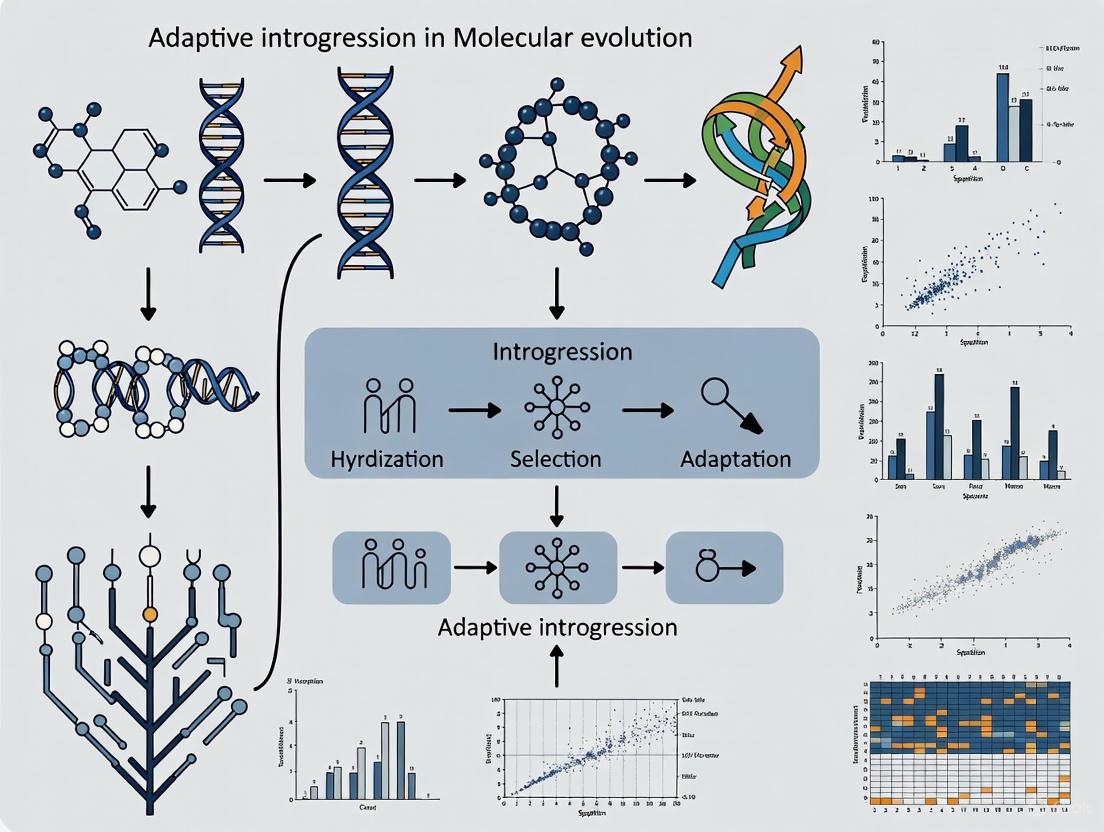
This comprehensive review explores adaptive introgression as a significant evolutionary mechanism, synthesizing recent genomic evidence across diverse taxa.
Adaptive Introgression: The Evolutionary Force Accelerating Species Adaptation and Its Biomedical Implications
Abstract
This comprehensive review explores adaptive introgression as a significant evolutionary mechanism, synthesizing recent genomic evidence across diverse taxa. We examine the paradigm shift from viewing introgression as a maladaptive process to recognizing its role in rapid adaptation, highlighting advanced detection methodologies like convolutional neural networks and comparative performance evaluations. The article addresses key challenges in distinguishing adaptive introgression from neutral processes and presents compelling case studies from human evolution, plants, and other organisms. For biomedical researchers and drug development professionals, we elucidate how archaic adaptive introgression in modern humans influences reproductive genes, disease susceptibility, and developmental pathways, offering novel insights for therapeutic target identification and evolutionary medicine.
From Genetic Swamping to Evolutionary Rescue: Redefining Adaptive Introgression
Introgression, the permanent incorporation of alleles from one population or species into another through hybridization and repeated backcrossing, has undergone a profound conceptual transformation in evolutionary biology [1]. Historically regarded as a primarily deleterious or homogenizing force that counteracted adaptation and divergence, introgression is now recognized as a potent evolutionary mechanism that can accelerate adaptation, introduce novel genetic variation, and rescue populations from environmental challenges [2]. This paradigm shift has been driven largely by the genomic revolution, which has provided researchers with unprecedented tools to detect and characterize introgressed fragments across diverse taxa [3]. The understanding of adaptive introgression—the process by which introgressed alleles confer a fitness advantage and spread under positive selection—has fundamentally altered our perspective on how organisms evolve in response to selective pressures [4] [2].
This whitepaper examines the historical context, methodological advances, and modern understanding of introgression within the framework of its evolutionary significance, with particular relevance for biomedical and pharmacological research. The growing evidence that adaptive introgression has contributed to functional adaptations in immunity, reproduction, and environmental adaptation in humans and other organisms underscores its importance as a source of evolutionarily relevant genetic variation [5] [4].
Historical Trajectory: From Maladaptive to Adaptive
The Traditional View of Introgression as Evolutionary Noise
The historical perspective in evolutionary biology largely viewed introgression as a maladaptive process or an "evolutionary misfortune" that potentially hindered divergence through several mechanisms:
- Genetic Homogenization: Introgression was thought to counteract local adaptation by introducing foreign alleles outside the local adaptive range [2].
- Genetic Swamping: Concerns existed that gene flow from abundant species could lead to outbreeding depression and replacement of local genotypes in species with smaller population sizes [2].
- Reproductive Interference: Introgression was viewed as potentially disrupting co-adapted gene complexes and well-adapted genomes [2].
This perspective was largely shaped by the biological species concept, which emphasized reproductive isolation as a cornerstone of species integrity, and by limited analytical tools that struggled to distinguish introgressed alleles from other forms of shared genetic variation [4].
The Genomic Revolution and Paradigm Shift
The advent of accessible whole-genome sequencing and sophisticated computational methods catalyzed a fundamental reassessment of introgression's evolutionary role [2] [3]. Several key realizations emerged:
- Widespread Occurrence: Genomic studies revealed that introgression is pervasive across diverse taxa, from bacteria to mammals, with varying levels of introgression detected across lineages [6] [2].
- Adaptive Potential: Evidence accumulated showing that introgression could provide beneficial alleles that spread rapidly through populations, sometimes enabling adaptation more quickly than de novo mutation [2].
- Functional Significance: Researchers identified specific introgressed alleles contributing to adaptive traits in various organisms, from herbivore resistance in sunflowers to high-altitude adaptation in humans [7] [4].
This paradigm shift represents a more nuanced understanding where introgression is recognized as one of several evolutionary forces—including divergence, genetic drift, and selection—that interact in complex ways to shape genomes [2].
Table 1: Key Milestones in the Understanding of Introgression
| Time Period | Predominant View | Methodological Focus | Key Limitations |
|---|---|---|---|
| Pre-1990s | Largely detrimental process | Morphological analysis, limited genetic markers | Inability to distinguish introgression from shared ancestry |
| 1990s-2000s | Debate over prevalence and impact | Multi-locus sequence typing, early phylogenetic methods | Limited genomic coverage, challenging statistical inference |
| 2010s-Present | Recognition as adaptive evolutionary force | Whole-genome sequencing, sophisticated statistical models | Integration of complex demographic histories, functional validation |
Methodological Evolution: Detecting and Analyzing Introgression
Statistical Approaches for Introgression Detection
The accurate identification of introgressed regions presents significant challenges, primarily because introgressed sequences must be distinguished from ancestral genetic variation shared due to incomplete lineage sorting (ILS) [4]. Several statistical frameworks have been developed to address this challenge:
Summary Statistics-Based Methods leverage patterns of genetic variation to identify introgression:
- Patterson's D Statistic (ABBA-BABA Test): Measures excess sharing of derived alleles between an outgroup and two ingroup populations, identifying asymmetrical gene flow that violates a strict branching phylogeny [4].
- f4-ratio and fD Statistics: Extensions of Patterson's D that provide additional power to quantify introgression proportions and test specific phylogenetic relationships [4].
- S* and Related Methods: Leverage patterns of linkage disequilibrium (LD) and haplotype structure to identify introgressed tracts, exploiting the expectation that introgressed segments will exhibit longer haplotypes and distinct LD patterns than background regions [4].
Phylogenetic Incongruence Methods identify introgression through discordance between gene trees and species trees:
- Gene Tree-Species Tree Discordance: Systematic inconsistencies between individual gene genealogies and the expected species phylogeny can indicate introgression, particularly when coupled with tests of sequence similarity [6].
- Ancestral Recombination Graph (ARG) Methods: Models the joint effects of recombination, ILS, and introgression on genealogical history, providing a powerful framework for detecting introgressed segments while accounting for other sources of genealogical discordance [5].
Advanced Modeling and Machine Learning Approaches
Recent methodological innovations have substantially improved the detection and characterization of introgression:
Probabilistic Modeling Frameworks explicitly incorporate evolutionary processes to infer introgression:
- Multispecies Coalescent with Introgression: Extends the multispecies coalescent to include migration/introgression events, allowing joint modeling of ILS and gene flow [7].
- Branching Process Models: Quantify stochastic introgression processes, particularly useful for modeling rare hybridization events and demographic stochasticity in small hybrid populations [1].
- Brownian Motion on Phylogenetic Networks: Models quantitative trait evolution on networks with introgression, predicting how introgression affects trait covariances among species [7].
Supervised Learning Approaches represent an emerging frontier in introgression detection:
- Semantic Segmentation Frameworks: Frame introgression detection as a classification task where genomic regions are labeled as introgressed or not based on patterns of genetic variation [3].
- Feature-Based Classification: Utilize summary statistics and population genetic parameters as input features for machine learning classifiers to identify introgressed loci [3].
Table 2: Comparison of Major Methodological Approaches for Introgression Detection
| Method Category | Key Example Methods | Primary Applications | Key Assumptions/Limitations |
|---|---|---|---|
| Summary Statistics | Patterson's D, f4-statistics, S* | Genome-wide scans, testing for introgression | Requires reference populations, sensitive to demographic history |
| Phylogenetic Methods | Gene tree discordance, ARG inference | Deep evolutionary introgression, non-model organisms | Computationally intensive, requires multiple genomes per species |
| Probabilistic Models | MSci, D-statistics, Bayesian methods | Parameter estimation, model comparison | Model misspecification risk, computational complexity |
| Machine Learning | Semantic segmentation, feature-based classification | High-throughput screening, complex genomes | Training data requirements, interpretability challenges |
Experimental and Analytical Workflows
The modern detection and validation of adaptive introgression typically follows a multi-stage workflow that integrates population genetic inference with functional validation.
Genomic Data Collection and Quality Control
The foundation of any introgression analysis is high-quality genomic data from relevant populations and, when available, archaic or ancestral reference genomes:
- Modern Population Sequencing: Whole-genome sequencing of diverse populations from relevant geographic regions, with particular attention to populations with known or suspected historical admixture [5].
- Archaic Genome Sequencing: High-coverage sequencing of archaic hominins (Neanderthal, Denisovan) or other ancestral reference populations for identifying introgressed fragments [5] [4].
- Variant Calling and Phasing: Accurate identification of genetic variants and reconstruction of haplotypes, which is crucial for detecting introgressed segments through linkage disequilibrium patterns [5].
Statistical Detection of Introgressed Fragments
Multiple complementary methods are typically applied to identify putative introgressed regions:
- Population Differentiation Analysis: Identification of regions with unusual patterns of differentiation between populations that may indicate introgression [5].
- Haplotype-Based Methods: Detection of long, distinct haplotypes in recipient populations that closely match donor populations, using methods such as SPrime [5].
- Divergence-Based Approaches: Calculation of sequence divergence between test haplotypes and putative archaic sources, with introgressed haplotypes showing unexpectedly low divergence to archaic genomes compared to other modern human haplotypes [4].
Tests for Adaptive Selection
Once introgressed regions are identified, multiple selection tests are applied to detect signatures of adaptive introgression:
- Extended Haplotype Homozygosity (EHH): Identifies long haplotypes at unexpectedly high frequency, indicating rapid increase in allele frequency due to positive selection [5].
- Population Differentiation (FST): Measures differences in allele frequencies between populations, with unusually high FST values potentially indicating local adaptation [5].
- Relate Selection Scans: Uses ancestral recombination graphs to infer time-resolved selection signals, identifying variants under recent positive selection [5].
- Frequency-Based Tests: Unusually high allele frequencies of introgressed alleles in specific populations may suggest adaptive benefits [5].
Biological Significance and Functional Impacts
Case Studies of Adaptive Introgression in Humans
Research over the past decade has identified numerous examples of adaptive introgression in modern human populations, providing concrete examples of its functional significance:
Reproductive Gene Adaptations: A 2025 study identified 118 reproductive genes in modern humans showing evidence of archaic adaptive introgression, with 327 archaic alleles genome-wide significant for various traits [5]. Key findings include:
- Three Positively Selected Core Haplotypes: The PNO1-ENSG00000273275-PPP3R1 region in East Asian populations, the AHRR segment in Finnish populations, and the FLT1 region in Peruvian populations showed strong signatures of positive selection [5].
- Regulatory Impact: Over 300 archaic variants were identified as expression quantitative trait loci (eQTLs) regulating 176 genes, with 81% of archaic eQTLs overlapping core haplotype regions and affecting genes expressed in reproductive tissues [5].
- Clinical Associations: Several adaptively introgressed genes were enriched in developmental and cancer pathways, with associations to endometriosis, preeclampsia, and embryo development [5].
- Protective Alleles: Archaic alleles overlapping an introgressed segment on chromosome 2 were found to be protective against prostate cancer [5].
Immunity and Environmental Adaptations: Multiple studies have documented adaptive introgression in genes related to immune function and environmental adaptation:
- Pathogen Defense: Introgressed Neanderthal alleles have been identified in human immune genes, potentially providing enhanced defense against Eurasian pathogens encountered by modern humans after leaving Africa [4].
- High-Altitude Adaptation: Tibetan populations carry an introgressed Denisovan haplotype in the EPAS1 gene, which confers adaptation to high-altitude hypoxia [4].
- Skin and Hair Phenotypes: Keratin genes related to skin and hair morphology show evidence of archaic introgression, possibly adaptations to non-African environments [5].
Beyond Humans: Introgression Across the Tree of Life
Adaptive introgression has been documented across diverse taxonomic groups, demonstrating its broad evolutionary significance:
In Bacteria: Despite being asexual organisms, bacteria engage in homologous recombination that can facilitate introgression between distinct species [6]:
- Variable Introgression Levels: Bacterial genera show an average of 2% introgressed core genes, with up to 14% in Escherichia-Shigella [6].
- Species Border Maintenance: Contrary to expectations, introgression does not necessarily blur species borders in bacteria, with most species remaining clearly delineated based on core genome phylogenies [6].
In Plants and Other Eukaryotes: Studies in wild tomatoes (Solanum) and other plants have demonstrated how introgression can shape quantitative trait variation [7]:
- Gene Expression Impact: Whole-transcriptome analyses in Solanum ovules revealed patterns of expression similarity consistent with historical introgression, particularly in sub-clades with higher introgression rates [7].
- Trait Convergence: Introgression can generate apparently convergent patterns of evolution when averaged across thousands of quantitative traits [7].
Table 3: Functional Categories of Adaptively Introgressed Genes in Humans
| Functional Category | Example Genes/Regions | Putative Adaptive Function | Source Population |
|---|---|---|---|
| Reproduction | PGR, AHRR, FLT1 | Pregnancy maintenance, fertility enhancement, embryo development | Neanderthal, Denisovan |
| Immunity | Multiple immune genes | Defense against novel pathogens | Neanderthal |
| High-Altitude Adaptation | EPAS1 | Hypoxia response, oxygen metabolism | Denisovan |
| Skin and Hair Morphology | Keratin genes | Adaptation to non-African environments | Neanderthal |
| Cancer-Related | Chromosome 2 region | Protection against prostate cancer | Archaic |
Modern introgression research relies on a sophisticated suite of computational tools, datasets, and analytical resources.
Table 4: Essential Research Resources for Introgression Studies
| Resource Category | Specific Tools/Datasets | Primary Function | Application Notes |
|---|---|---|---|
| Genomic Datasets | 1000 Genomes Project, gnomAD, UK Biobank | Reference population data | Provides allele frequency data across diverse populations |
| Archaic Genomes | Altai Neanderthal, Vindija Neanderthal, Denisova | Reference archaic sequences | Essential for identifying archaic-derived fragments |
| Detection Software | SPrime, AdmixTools, ARCHIE | Statistical detection of introgression | Each has strengths for specific introgression scenarios |
| Selection Tests | RELATE, CLUES, SWIF(r) | Identifying selection signatures | Can detect both recent and ancient selection |
| Functional Annotation | ANNOVAR, Ensembl VEP, GTEx | Functional consequence prediction | Determines potential impact of introgressed variants |
| Visualization Tools | UCSC Genome Browser, IGV | Genomic data visualization | Critical for manual inspection of candidate regions |
Implications for Biomedical Research and Drug Development
The growing understanding of adaptive introgression has significant implications for biomedical research and therapeutic development:
Evolutionary-Informed Disease Gene Discovery
- Variant Prioritization: Introgression maps can help prioritize functionally relevant variants in disease-associated regions, particularly when archaic alleles show signatures of positive selection [5].
- Population-Specific Risk Variants: Adaptively introgressed alleles may contribute to population-specific disease risk or protection, as demonstrated by the prostate cancer-protective haplotype on chromosome 2 [5].
- Pleiotropy Assessment: Recognizing that adaptively introgressed alleles may have conferred historical advantages while contributing to modern disease risk (antagonistic pleiotropy) [5].
Therapeutic Target Identification and Validation
- Pathway Insights: Introgressed regions enriched for developmental and cancer pathways highlight biologically significant networks that may represent promising therapeutic targets [5].
- Functional Validation: eQTL effects of introgressed variants provide direct evidence of regulatory function, supporting the biological importance of associated genomic regions [5].
- Comparative Genomics: Introgressed regions with evidence of positive selection in humans may inform animal model development and preclinical studies.
The paradigm shift in understanding introgression—from evolutionary noise to significant adaptive mechanism—has fundamentally transformed evolutionary biology and increasingly informs biomedical research. The integration of sophisticated statistical methods, large-scale genomic datasets, and functional validation approaches has revealed the profound impact of historical introgression events on modern human biology and disease. For biomedical researchers and drug development professionals, acknowledging and investigating the contributions of adaptively introgressed sequences provides valuable insights for understanding population-specific disease risks, identifying therapeutic targets, and interpreting the functional significance of genetic variation. As methodological advances continue to refine our ability to detect and characterize introgression events, particularly through probabilistic modeling and machine learning approaches, our understanding of this important evolutionary process will continue to deepen, offering new opportunities for translating evolutionary insights into clinical applications.
Introgression, the permanent incorporation of genetic material from one population or species into another through hybridization and repeated backcrossing, represents a fundamental evolutionary process with significant consequences for adaptation and biodiversity [8] [9]. Historically regarded primarily as a homogenizing force that could swamp local adaptations, introgression is now recognized as a complex phenomenon with outcomes spanning from highly beneficial to decidedly deleterious [2]. This paradigm shift has been largely driven by genomic studies revealing that introgression can serve as a critical source of evolutionary innovation, allowing populations to rapidly acquire adaptive traits without waiting for de novo mutations [2]. Understanding the spectrum of introgression outcomes—adaptive, neutral, and maladaptive—is therefore essential for comprehending how species evolve and adapt to changing environments, with particular relevance for fields ranging from conservation biology to agricultural science and biomedical research [8] [5].
Core Definitions and Evolutionary Implications
Adaptive Introgression
Adaptive introgression refers to the natural transfer of genetic material through interspecific breeding and backcrossing of hybrids with parental species, followed by selection on introgressed alleles that increases the fitness of the recipient population [2]. This process allows for the direct acquisition of beneficial alleles that have already been tested by selection in the donor population, potentially enabling more rapid adaptation than waiting for new mutations to arise [8] [2]. The "adaptive" qualification specifically requires that the introgressed variant confers a selective advantage, leading to its increase in frequency and eventual potential fixation in the recipient population [9]. For example, modern humans acquired immune-related genes and high-altitude adaptations through archaic introgression from Neanderthals and Denisovans, while crop plants frequently introgress disease resistance genes from their wild relatives [8] [5].
Neutral Introgression
Neutral introgression occurs when introgressed alleles have no discernible phenotypic or physiological consequences that affect the fitness of the recipient lineage [2]. These alleles are not subject to selection—either positive or negative—and their population dynamics are governed primarily by genetic drift [2]. The frequency of neutral introgressed alleles may fluctuate randomly across generations, and they may eventually be lost from the population or, less commonly, reach fixation through random sampling processes [2]. Most introgressed sequences are expected to be neutral, as they occur in genomic regions not involved in fitness-related traits [10].
Maladaptive Introgression
Maladaptive introgression describes the incorporation of genetic material that reduces the fitness or survival of the recipient evolutionary lineage in its environment [2]. This can occur through several mechanisms, including the introduction of alleles that are intrinsically deleterious, the disruption of coadapted gene complexes, or the dilution of locally adapted genotypes [8] [2]. In severe cases, maladaptive introgression can lead to genetic swamping, where gene flow from abundant populations replaces local genotypes, potentially causing outbreeding depression or even extinction [8] [2]. The presence of introgression deserts—genomic regions largely devoid of introgressed material—in many species provides evidence for widespread purifying selection against maladaptive introgressed alleles [5].
Table 1: Comparative Analysis of Introgression Types
| Feature | Adaptive Introgression | Neutral Introgression | Maladaptive Introgression |
|---|---|---|---|
| Fitness Effect | Increases fitness | No effect on fitness | Decreases fitness |
| Population Dynamics | Maintained by positive selection | Governed by genetic drift | Removed by purifying selection |
| Frequency Pattern | Increases to high frequency, potentially to fixation | Fluctuates randomly | Usually maintained at low frequency or eliminated |
| Genomic Signature | Selective sweeps, high-frequency archaic segments [5] | Distribution follows neutral expectations | Introgression deserts [5] |
| Evolutionary Impact | Rapid adaptation, evolutionary rescue [2] | Increases genetic diversity without adaptive consequence | Genetic load, outbreeding depression, potential extinction [8] |
| Detection Methods | Selection tests (XP-CLR, Relate), EHH, FST [5] [11] | Ancestry inference, demographic modeling | Reduction in ancestry proportions, association with fitness defects |
The Genomic Landscape of Introgression Outcomes
Genomic studies reveal that introgression outcomes are not uniformly distributed across the genome but instead form a distinctive landscape shaped by the interaction between selection and gene flow [10]. While adaptive introgression appears to be common, most introgressed variation is actually selected against throughout much of the genome [10]. This creates a mosaic pattern where islands of adaptive introgression are separated by regions dominated by neutral or maladaptive introgression. The distribution of these outcomes is influenced by factors such as recombination rate, local genomic architecture, and the strength and form of selection [10].
The following diagram illustrates the conceptual relationship between different introgression types and their fitness consequences:
Methodological Framework for Detection and Analysis
Genomic Detection Workflows
Identifying and classifying introgression types requires integrated genomic approaches that combine population genetic statistics, demographic modeling, and functional validation. The following workflow outlines the primary steps in detecting and distinguishing different forms of introgression:
Performance of Detection Methods
Different statistical methods show varying performance in detecting adaptive introgression depending on evolutionary scenarios. Recent evaluations of three prominent methods (VolcanoFinder, Genomatnn, and MaLAdapt) and the Q95(w, y) summary statistic reveal important considerations for researchers [11].
Table 2: Method Performance for Adaptive Introgression Detection
| Method | Optimal Scenario | Strengths | Limitations |
|---|---|---|---|
| VolcanoFinder | Human evolutionary history | Well-documented for archaic introgression | Performance varies across divergence times |
| Genomatnn | Various demographic histories | Flexible modeling approach | Computational intensity |
| MaLAdapt | Selection detection | Specifically designed for adaptive introgression | Requires careful parameterization |
| Q95(w, y) | Exploratory studies | High efficiency, good performance in benchmarks [11] | May require follow-up with other methods |
Critical to accurate detection is accounting for the hitchhiking effect of adaptively introgressed mutations on flanking regions. Studies highlight the importance of including adjacent windows in training data to correctly identify the specific window containing the mutation under selection [11]. Methods based on Q95 statistics appear most efficient for initial exploratory studies of adaptive introgression [11].
Experimental and Research Applications
Research Reagent Solutions for Introgression Studies
Table 3: Essential Research Tools for Introgression Analysis
| Research Tool | Function/Application | Example Use Cases |
|---|---|---|
| High-coverage reference genomes | Baseline for variant calling and ancestry inference | Altai Neanderthal, Denisova, Chagyrskaya Neanderthal genomes as archaic references [5] |
| Population genomic datasets | Empirical data for introgression detection | 1000 Genomes Project, gnomAD, population-specific sequencing cohorts [5] |
| Selection test statistics | Identifying signatures of positive selection | XP-CLR, Relate, Extended Haplotype Homozygosity (EHH), FST [5] [11] |
| Ancestry inference software | Local ancestry deconvolution | SPrime, map_arch, specific ancestry estimation tools [5] |
| Simulation frameworks | Generating expected patterns under different scenarios | msprime for ancestry and mutation simulation [11] |
Evolutionary and Functional Validation
Beyond genomic detection, understanding the functional consequences of introgression requires experimental validation. For example, in the study of archaic introgression in modern human reproductive genes, researchers identified 47 archaic segments overlapping reproduction-associated genes that reached frequencies over 40% in specific populations—approximately 20 times higher than typical introgressed archaic DNA [5]. Functional validation included:
- Expression Quantitative Trait Locus (eQTL) analysis to identify archaic alleles regulating gene expression in reproductive tissues [5]
- Phenome-wide association studies linking archaic variants to clinical traits including endometriosis, preeclampsia, and prostate cancer risk [5]
- Selection signature analyses using multiple complementary tests (EHH, FST, Relate) to confirm positive selection on core haplotypes [5]
In agricultural contexts, similar approaches have identified adaptive introgression of disease resistance and stress tolerance genes from wild crop relatives into domesticated varieties, providing valuable genetic resources for crop improvement [8].
The classification of introgression into adaptive, neutral, and maladaptive categories provides a crucial framework for understanding how gene flow contributes to evolutionary processes. Rather than being mutually exclusive, these outcomes frequently coexist within genomes, creating complex landscapes shaped by the balance between selective forces [2] [10]. Adaptive introgression represents a powerful mechanism for evolutionary leaps, allowing species to rapidly acquire complex adaptations that would be difficult to evolve through de novo mutation alone [8] [2]. Conversely, maladaptive introgression can impose genetic loads and contribute to extinction risk, particularly in small populations or under changing environmental conditions [8] [2].
Future research directions include developing more sophisticated methods for detecting introgression across diverse taxonomic groups and evolutionary scenarios, moving beyond correlative evidence to explicit models that account for how selection and genetic drift interact to shape introgressed variation [10] [3] [11]. Integrating genomic data with functional validation across different biological levels—from molecular mechanisms to organismal fitness and ecological consequences—will be essential for fully understanding the evolutionary significance of introgression and harnessing its potential for applications in conservation, agriculture, and medicine [2].
Adaptive introgression, the natural transfer of beneficial genetic material between species via hybridization and backcrossing, serves as a potent evolutionary mechanism that enables rapid adaptation. This process allows recipient species to acquire complex, functionally optimized alleles directly from donor populations, effectively bypassing the slow, stepwise accumulation of mutations through traditional evolutionary pathways. By harnessing pre-evolved, adaptive genetic variation, adaptive introgression facilitates evolutionary leaps that would be inaccessible through de novo mutation alone. This technical guide synthesizes current research to delineate the genomic architectures, functional consequences, and experimental methodologies for characterizing this bypass mechanism, with particular emphasis on its implications for biomedical and agricultural innovation.
The modern synthesis of evolution has historically emphasized gradual change through the accumulation of de novo mutations followed by natural selection. However, accumulating genomic evidence reveals that this model inadequately explains numerous instances of rapid adaptation to novel environmental pressures. Adaptive introgression represents a paradigm shift in our understanding of evolutionary mechanisms, functioning as a natural engine of genomic innovation that operates by transferring pre-adapted genetic variants across species boundaries [2].
This process is characterized by three fundamental stages: initial hybridization between a donor and recipient species, backcrossing of hybrid individuals with the recipient population, and the selective sweep of introgressed alleles that confer a fitness advantage. Unlike neutral or deleterious introgressed variants, which are typically purged by selection or genetic drift, adaptively introgressed alleles rapidly increase in frequency due to their positive effects on fitness [2] [5]. The evolutionary significance of this mechanism lies in its capacity to introduce complex, multi-genic adaptations in a single transfer event, effectively compressing evolutionary timelines that would otherwise require innumerable generations through sequential mutation and selection.
Core Mechanistic Principles of Evolutionary Bypass
Genetic Architecture of Introgressed Adaptations
The evolutionary bypass capacity of adaptive introgression stems from specific genetic and population characteristics that distinguish it from standard models of adaptation:
Standing Genetic Variation Source: Adaptive introgression draws from a reservoir of pre-tested, functionally relevant genetic variation that has evolved in the donor species under specific selective pressures. This provides a "toolkit" of potentially adaptive alleles that are immediately available for selection in the recipient genome [2] [9].
Elevated Initial Allele Frequency: Unlike de novo mutations that begin at extremely low frequencies (typically 1/2N), introgressed alleles enter the recipient population at substantially higher frequencies, determined by hybridization rates. This higher starting frequency dramatically reduces the time to fixation under positive selection [2].
Multi-locus Adaptive Complexes: Introgression can transfer co-adapted gene complexes or tightly linked sets of alleles that work synergistically, enabling the immediate acquisition of polygenic traits that would be virtually impossible to assemble through independent mutations [9].
Comparative Evolutionary Trajectories
Table 1: Comparison of Evolutionary Mechanisms
| Feature | De Novo Mutation | Standing Variation | Adaptive Introgression |
|---|---|---|---|
| Source of Variation | New mutations | Pre-existing polymorphisms in population | Cross-species transfer |
| Initial Allele Frequency | Very low (1/2N) | Low to moderate | Moderate to high |
| Time to Fixation | Slow (many generations) | Moderate | Rapid (fewer generations) |
| Genetic Complexity | Typically single locus | Single or few loci | Often multi-locus complexes |
| Evolutionary Pathway | Stepwise through intermediates | Direct selection on existing variants | Direct acquisition of optimized alleles |
| Bypass Potential | Low | Moderate | High |
The bypass mechanism becomes particularly evident when comparing the acquisition of complex adaptations. For instance, developing altitude adaptation through de novo mutation would require multiple coordinated changes in oxygen sensing, hemoglobin affinity, and vascular development across numerous generations. In contrast, adaptive introgression of the EPAS1 gene from Denisovans to Tibetan populations provided a pre-adapted, optimized haplotype that conferred immediate high-altitude tolerance [12].
Quantitative Evidence Across Biological Systems
Empirical studies across diverse taxa provide compelling evidence for the role of adaptive introgression in bypassing evolutionary intermediate stages. The following table synthesizes key findings from multiple systems:
Table 2: Documented Cases of Adaptive Introgression Bypassing Intermediate Stages
| System | Introgressed Locus/Region | Functional Consequence | Bypassed Intermediate Stages | Reference |
|---|---|---|---|---|
| Modern Humans | EPAS1 (Denisovan origin) | High-altitude adaptation in Tibetans | Incremental physiological acclimatization and genetic adaptation to hypoxia | [5] [12] |
| Modern Humans | AHRR, PGR (Neanderthal origin) | Altered reproductive timing and pregnancy outcomes | Gradual accumulation of fertility-enhancing variants | [5] |
| Poplar Trees (Populus) | RFLP-1286 marker from P. fremontii to P. angustifolia | Enhanced survival under warmer, drier conditions | Stepwise adaptation to climate change through sequential mutation | [13] |
| Spruce Trees (Picea) | Multiple stress-resilience and flowering time genes | Rapid adaptation to environmental gradients and historical climate changes | Gradual local adaptation through selection on standing variation | [14] |
| Newts (Triturus) | Major Histocompatibility Complex (MHC) classes I and II | Expanded immune repertoire and pathogen recognition | Sequential accumulation of diverse antigen recognition alleles | [15] |
| Crop Plants | Various disease resistance and stress tolerance loci from wild relatives | Immediate adaptation to novel pathogens and climatic conditions | Traditional breeding cycles to introgress traits from wild relatives | [9] |
The quantitative impact of this bypass mechanism is evident in the survival differentials observed in long-term studies. In Populus, for instance, the presence of the introgressed RFLP-1286 marker was associated with approximately 75% greater survival after 31 years in a warm common garden, with all backcross individuals carrying this marker surviving through the study period [13]. This demonstrates how a single introgression event can dramatically alter adaptive trajectories under strong selective pressure.
Methodological Framework for Detection and Validation
Genomic Detection Protocols
Identifying genuine adaptive introgression requires distinguishing it from other evolutionary processes such as incomplete lineage sorting or selective sweeps on standing variation. The following experimental workflows represent state-of-the-art approaches:
Population Genomic Screening Protocol
- Dataset Preparation: Sequence or genotype individuals from putative donor and recipient populations, plus an outgroup population
- Introgression Scan: Apply statistical methods (e.g., D-statistics, f₄-ratio) to identify genomic regions with excess allele sharing between donor and recipient populations
- Selection Tests: Conduct selection scans (e.g., iHS, nSL, XP-EHH) on identified introgressed regions in the recipient population
- Frequency Analysis: Verify elevated frequency of introgressed haplotypes in the recipient population relative to neutral expectations
- Functional Annotation: Annotate candidate regions for genes and regulatory elements to identify potential adaptive targets
Convolutional Neural Network (CNN) Approach for AI Detection Recent advances implement deep learning for enhanced detection sensitivity [12]:
- Input Matrix Construction: Create genotype matrices from donor, recipient, and unadmixed outgroup populations for 100 kbp genomic windows
- CNN Architecture: Implement a series of convolution layers with 2×2 step size (avoiding pooling layers) to extract features informative of introgression and selection
- Model Training: Train networks using simulated data incorporating admixture and selection parameters
- Saliency Mapping: Visualize input regions that most strongly influence CNN predictions to identify key genomic features
- Empirical Application: Apply trained CNNs to empirical genomic datasets to identify candidate AI regions with >95% accuracy on simulated data
Functional Validation Workflows
Common Garden Experiments [13]
- Experimental Design: Establish common garden(s) with environmental conditions representing selective pressure(s) of interest
- Genotype Planting: Plant individuals representing parental species, hybrids, and backcrosses with known genomic composition
- Phenotypic Monitoring: Track survival, growth, reproduction, and relevant physiological traits over multiple years/seasons
- Association Analysis: Correspond fitness-related traits with introgressed markers using generalized linear models
- Ecosystem Impact Assessment: Measure extended effects on associated communities (e.g., soil microbes, herbivores) where relevant
Molecular Functional Validation
- Gene Expression Profiling: Compare expression patterns of introgressed alleles between donor, recipient, and hybrid backgrounds using RNA-seq
- CRISPR-Cas9 Editing: Precisely introduce or remove introgressed haplotypes in model systems to validate functional effects
- Protein Function Assays: Test biochemical properties of proteins encoded by introgressed alleles versus native versions
- Physiological Phenotyping: Measure organismal-level consequences of introgressed alleles under controlled environmental challenges
Diagram 1: Integrated workflow for detecting and validating adaptive introgression, combining population genomic screens with deep learning approaches and functional validation.
Table 3: Essential Research Resources for Studying Adaptive Introgression
| Resource Category | Specific Examples | Function/Application | Technical Considerations |
|---|---|---|---|
| Reference Genomes | High-coverage assemblies of donor, recipient, and outgroup species | Essential for read mapping, variant calling, and phylogenetic inference | Ensure chromosomal-level scaffolding; annotate with functional elements |
| Population Genomic Datasets | Whole-genome sequences from multiple individuals per population | Identify introgressed regions and estimate allele frequencies | Sample size >20 individuals per population; minimum 10X coverage recommended |
| Genotyping Arrays | Custom SNP chips targeting candidate introgressed regions | High-throughput screening of large sample collections | Design should include ancestry-informative markers and neutral controls |
| Selection Scan Tools | SweepFinder, OmegaPlus, RELATE | Detect signatures of positive selection in genomic data | Account for demographic history to reduce false positives |
| Introgression Detection Software | Dsuite, SPrime, f-statistics, map_arch | Quantify allele sharing and identify introgressed haplotypes | Requires appropriate outgroup selection; sensitive to sample configuration |
| Deep Learning Frameworks | genomatnn (CNN implementation), TensorFlow, PyTorch | Identify complex patterns of AI from genotype matrices | Requires substantial training data; computational resource intensive |
| Common Garden Facilities | Controlled environment gardens, reciprocal transplant sites | Validate fitness consequences under naturalistic conditions | Long-term commitment required; monitor environmental variables |
| Gene Editing Systems | CRISPR-Cas9, base editors | Functionally validate causal introgressed alleles | Requires species-specific transformation protocols; potential pleiotropic effects |
Implications and Future Directions
The mechanistic framework of adaptive introgression as an evolutionary bypass mechanism has profound implications across biological disciplines. In conservation biology, it suggests that managed gene flow between threatened populations and their adapted relatives could facilitate rapid climate adaptation [13]. In agriculture, harnessing wild relative gene pools through natural or facilitated introgression offers a pathway for rapid crop improvement without lengthy breeding cycles [9]. For biomedical research, understanding archaic introgression in human evolution provides insights into genetic underpinnings of adaptation, with potential applications in personalized medicine and therapeutic development [5] [12].
Future research directions should focus on:
- Multi-omics Integration: Combining genomic, transcriptomic, proteomic, and metabolomic data to understand the full functional consequences of adaptive introgression
- Temporal Sampling: Applying ancient DNA approaches to track the dynamics of introgression events through time
- Experimental Evolution: Establishing hybrid populations to observe real-time adaptive introgression under controlled selective pressures
- Ecosystem-Level Impacts: Quantifying how adaptive introgression in foundation species cascades through ecological communities
Diagram 2: Bypass mechanism of adaptive introgression showing the direct acquisition of beneficial alleles versus the traditional gradualist path of evolution.
The evidence across diverse biological systems consistently demonstrates that adaptive introgression provides a powerful evolutionary shortcut, enabling species to leapfrog intermediate stages that would be necessary through traditional evolutionary pathways. By leveraging this natural mechanism of genetic exchange, researchers can develop novel strategies for addressing pressing challenges in climate change adaptation, food security, and understanding human evolutionary history.
Adaptive introgression, the natural incorporation of genetic material from one species into the gene pool of another through hybridization and backcrossing, followed by selection, represents a powerful evolutionary mechanism [2]. Historically regarded as a maladaptive process that homogenizes species, this phenomenon has been reevaluated through the lens of genomic studies, which have established its significant role in promoting species adaptation [2] [9]. This technical guide synthesizes evidence demonstrating that adaptive introgression operates across an extensive taxonomic spectrum, from bacteria to mammals, following a complexity gradient with consequences manifesting at multiple levels of biological organization.
The genomic revolution since approximately 2012 has fundamentally shaped our understanding of adaptive introgression, enabling researchers to identify introgressed alleles and document their adaptive benefits across diverse life forms [2]. This whitepaper examines the taxonomic distribution of adaptive introgression, presents structured quantitative data, details methodological approaches for its detection, and provides visualization frameworks and research tools to facilitate further investigation within this evolving field.
Taxonomic Distribution Across Complexity Gradients
Patterns of Adaptive Introgression Across Organisms
Adaptive introgression has been documented across a broad spectrum of taxonomic groups, with evidence indicating its occurrence increases along a gradient of biological complexity. The process was initially considered counterproductive to adaptation but is now recognized as a mechanism that can enhance adaptive capacity and drive evolutionary leaps, potentially bypassing intermediate evolutionary stages [2]. This shift in understanding has emerged from genomic studies that have established clearer insights into how introgressed alleles become incorporated into recipient genomes under selective pressures.
The amount and variety of published studies on adaptive introgression increases from simpler to more complex organisms, with research focusing progressively on consequences across multiple levels of biological organization—from physiological and demographic to behavioral and ecological [2]. This pattern suggests that the adaptive potential of introgression may be more readily realized or more easily detected in organisms with greater structural complexity, though methodological biases in research focus cannot be excluded as a contributing factor to this observed distribution.
Quantitative Evidence of Taxonomic Distribution
Table 1: Documented Evidence of Adaptive Introgression Across Major Taxonomic Groups
| Taxonomic Group | Key Evidence | Biological Levels Affected | Complexity Gradient Position |
|---|---|---|---|
| Bacteria | Adaptive gene transfer through mechanisms including hybridization [2] | Genomic, physiological | Lower complexity |
| Protists | Evidence of adaptive introgression in multiple species [2] | Genomic, functional | Lower complexity |
| Fungi | Documented cases of adaptive introgression [2] | Genomic, physiological | Intermediate complexity |
| Plants (Bryophytes to Angiosperms) | Extensive evidence from bryophytes to angiosperms; crop wild relative introgression [2] [9] | Genomic, physiological, demographic, ecological | Intermediate to high complexity |
| Invertebrates | Demonstrated adaptive introgression in various species [2] | Genomic, physiological, behavioral/ecological | Intermediate complexity |
| Vertebrates | Widespread evidence of adaptive introgression across multiple classes [2] | Genomic, physiological, demographic, behavioral/ecological | Highest complexity |
Table 2: Evolutionary Mechanisms Co-occurring with Adaptive Introgression
| Evolutionary Mechanism | Relationship with Adaptive Introgression | Documented Evidence |
|---|---|---|
| Autosomal introgression | Co-occurs with islands of differentiation in sex-linked chromosomes [2] | Demonstrated across multiple taxa |
| Balancing selection | Maintains beneficial introgressed alleles against genetic drift [2] | Documented in diverse organisms |
| Sexual selection | Operates alongside assortative mating pressures [2] | Observed in various animal species |
| Selective sweeps | Rapid fixation of beneficial introgressed alleles [2] | Identified through genomic scans |
| Transgressive segregation | Production of extreme phenotypes leading to hybrid speciation [2] | Particularly documented in plants |
Methodological Framework for Detecting Adaptive Introgression
Genomic Approaches and Experimental Protocols
Population Genomic Screening Protocol:
- Sample Collection: Obtain genomic data from potential hybridizing species and their populations, ensuring geographical context is documented [9]
- Sequence Alignment and Variant Calling: Use high-throughput sequencing approaches (whole-genome or reduced-representation) followed by alignment to reference genomes and SNP identification [2]
- Introgression Detection: Apply statistical methods (e.g., ABBA-BABA tests, fd statistics) to identify regions with significant evidence of interspecific gene flow [9]
- Selection Scanning: Implement composite likelihood ratio tests (CLR) or cross-population extended haplotype homozygosity (XP-EHH) to detect signatures of positive selection on introgressed regions [9]
- Functional Annotation: Annotate putative adaptive regions using genomic databases to identify genes and regulatory elements under selection [9]
- Phenotypic Association: Correlate introgressed haplotypes with phenotypic traits through genome-wide association studies (GWAS) or functional validation [9]
Functional Validation Protocol:
- Gene Expression Analysis: Compare expression patterns of introgressed alleles versus native alleles using RNA sequencing [9]
- Gene Editing: Implement CRISPR-Cas9 to introduce introgressed alleles into recipient genetic background and evaluate phenotypic effects [9]
- Reciprocal Transplants: Conduct field experiments comparing fitness of genotypes with and without introgressed alleles across relevant environmental gradients [9]
Visualization of Adaptive Introgression Detection Workflow
Biological Network Analysis for Introgression Studies
Network-Based Detection Protocol:
- Gene Network Construction: Build co-expression or protein-protein interaction networks using tools like Cytoscape [16]
- Module Identification: Apply community detection algorithms to identify functionally related gene modules [16]
- Introgression Mapping: Overlay introgressed regions onto network modules to identify functionally coherent units [16]
- Hub Gene Analysis: Identify central genes within introgressed modules that may drive adaptive phenotypes [16]
- Comparative Network Analysis: Contrast network properties between populations with and without introgression [16]
The Scientist's Toolkit: Research Reagent Solutions
Table 3: Essential Research Resources for Adaptive Introgression Studies
| Research Tool Category | Specific Solutions | Primary Function | Application Context |
|---|---|---|---|
| Sequencing Technologies | Whole-genome sequencing, Reduced-representation sequencing (RAD-seq) | Genomic variant identification | Detection of introgressed regions across taxa [2] |
| Population Genetic Software | ABBA-BABA tests, fd statistics, CLR tests, XP-EHH analysis | Statistical detection of introgression and selection | Identifying and dating introgression events [9] |
| Network Analysis Tools | Cytoscape, STRING, custom scripts in R/Python | Biological network construction and analysis | Mapping introgression to functional modules [16] |
| Gene Editing Systems | CRISPR-Cas9, TALENs | Functional validation of introgressed alleles | Experimental verification of adaptive function [9] |
| Visualization Platforms | Graph visualization libraries, Circos, custom DOT scripts | Data representation and interpretation | Creating publication-quality figures [16] |
Evolutionary Significance and Research Implications
Co-occurrence of Evolutionary Forces
Adaptive introgression frequently operates alongside counteracting evolutionary mechanisms, demonstrating that convergent and divergent processes are not mutually exclusive [2]. This balance is mediated by environmental conditions that shape the evolutionary trajectory of introgressing species. Key examples of these co-occurring forces include:
- Autosomal introgression alongside genomic islands of differentiation in sex-linked chromosomes [2]
- Balancing selection maintaining introgressed variation against the effects of genetic drift [2]
- Sexual selection operating simultaneously with assortative mating, creating complex evolutionary dynamics [2]
Environmental pressures, including both natural and anthropogenic factors, drive adaptive introgression at the genomic level, leading to consequences across multiple biological organization levels [2]. This interplay between gene flow and selection enables rapid adaptation, potentially faster than through de novo mutations, as introgressed alleles may begin with higher initial prevalence in populations [2].
Implications for Conservation and Climate Adaptation
The study of adaptive introgression patterns has important implications for understanding species adaptation in rapidly changing environments [2]. In crop species, adaptive introgression from wild relatives represents a promising mechanism for developing climate-resilient varieties [9]. Harnessing this evolutionary process may enable more rapid crop adaptation to emerging biotic and abiotic stresses than traditional breeding approaches permit.
For wild species, recognizing the adaptive potential of introgression challenges conservation paradigms that exclusively view hybridization as a threat. In some circumstances, adaptive introgression can paradoxically lead to species divergence through mechanisms such as transgressive segregation and hybrid speciation [2]. This nuanced understanding necessitates context-dependent conservation strategies that recognize the potential benefits of managed gene flow for population persistence under environmental change.
The evidence synthesized in this technical guide demonstrates that adaptive introgression represents a significant evolutionary mechanism operating across the taxonomic spectrum, from bacteria to mammals, with increasing prevalence along complexity gradients. The genomic revolution has been instrumental in revealing the taxonomic distribution and evolutionary significance of this process, which frequently co-occurs with divergent evolutionary mechanisms. The methodological frameworks, visualization approaches, and research tools detailed herein provide investigators with robust protocols for investigating adaptive introgression in diverse biological systems. As environmental changes accelerate, understanding and potentially harnessing this evolutionary process may prove crucial for species persistence and agricultural sustainability.
The study of adaptive introgression has fundamentally reshaped our understanding of evolutionary mechanisms, revealing how gene flow between species can serve as a potent evolutionary force. Rather than solely acting as a homogenizing process that hinders divergence, introgressive hybridization is now recognized as a mechanism that can promote rapid adaptation and drive significant evolutionary innovation [2]. This paradigm shift, largely propelled by advances in genomic technologies since approximately 2012, has established that the transfer of genetic material between species can enable evolutionary leaps that bypass intermediate evolutionary stages [2]. This in-depth technical guide examines the principal outcomes of this process—transgressive segregation, hybrid speciation, and evolutionary leaps—situating them within the broader context of adaptive introgression research.
The historical perspective viewed introgression primarily as a conservation concern due to risks of genetic swamping and outbreeding depression [2]. However, contemporary meta-analyses demonstrate that adaptive introgression functions across all taxonomic groups and biological levels, from bacteria to mammals [2]. The evolutionary significance of these processes lies in their capacity to generate novel genetic combinations and phenotypes at a pace that may exceed what is possible through de novo mutation alone, providing a critical mechanism for rapid adaptation in response to environmental pressures, including contemporary climate change [2] [17] [9].
Quantitative Evidence of Evolutionary Patterns
Prevalence of Transgressive Segregation Across Taxa
Table 1: Documented Frequency of Transgressive Segregation in Hybrid Populations
| Taxonomic Group | Studies Reporting Transgression | Traits Exhibiting Transgression | Primary Genetic Basis | Notes |
|---|---|---|---|---|
| Plants (Overall) | 110 of 113 studies (97%) [18] | 336 of 579 traits (58%) [18] | Complementary gene action [18] | Most frequent in inbred, domesticated crosses [18] |
| Wild Outcrossing Plants | 86% of studies [18] | 14% of traits [18] | Complementary gene action, epistasis [18] | Lower frequency than domesticated inbreeders [18] |
| Animals (Overall) | 45 of 58 studies (78%) [18] | 200 of 650 traits (31%) [18] | Varies by genetic architecture [19] | More common in wild outcrossers; less frequent than plants [18] |
| Fungi (Cryptococcus) | Widespread in lab and natural hybrids [20] | Melanin production, capsule size, drug resistance [20] | Novel allelic combinations, heterozygosity [20] | Associated with hybrid vigor and transgressive segregation [20] |
The quantitative evidence demonstrates that transgressive segregation is not an exceptional occurrence but rather a common outcome in hybrid populations. The meta-analysis by Rieseberg et al. (1999) revealed that an overwhelming majority of plant hybrid studies (97%) and a substantial majority of animal hybrid studies (78%) documented transgressive phenotypes for at least one trait [18]. The frequency of transgressive traits varies significantly, affecting 58% of examined plant traits and 31% of animal traits, with the disparity partially explained by differences in breeding systems and the prevalence of domesticated versus wild populations in studied samples [18].
The genetic architecture of parental species strongly influences the potential for transgressive segregation. Research on cichlid fishes demonstrated that while the genetic basis of jaw morphology limits transgressive variation, skull shape is highly permissive, indicating that natural selection can constrain transgression for some traits but not others [19]. This contingency underscores that hybridization outcomes depend on both genomic and environmental contexts [19].
Documented Cases of Adaptive Introgression
Table 2: Documented Cases of Adaptive Introgression Across Species
| System/Species | Introgressed Trait/Adaptation | Functional Consequence | Evidence Level | Reference |
|---|---|---|---|---|
| Modern Humans | Reproductive genes (e.g., AHRR, PGR) [5] | Regulation of developmental pathways; fertility enhancement [5] | Genomic scans, selection tests, eQTL mapping [5] | [5] |
| Populus fremontii × P. angustifolia | Climate resilience alleles [17] | Enhanced survival in warmer, drier conditions [17] | Long-term common garden, marker-trait association [17] | [17] |
| Crop Plants | Stress resistance from wild relatives [9] | Improved adaptation to biotic/abiotic stresses [9] | Genomic studies, phenotypic selection [9] | [9] |
| Aspidoscelis lizards | Gut/skin microbiota restructuring [21] | Niche divergence from progenitor species [21] | Microbiota sequencing, ecological analysis [21] | [21] |
Adaptive introgression has been documented across diverse taxonomic groups, with compelling evidence emerging from human evolutionary history, plant systems, and wildlife. In humans, archaic introgression of reproductive genes has been identified, with three core haplotypes (PNO1-ENSG00000273275-PPP3R1, AHRR, and FLT1) showing signatures of positive selection [5]. The AHRR region exhibited the strongest evidence, with ten variants in the top 1% of the genome-wide distribution for Relate's selection statistic [5]. Furthermore, an archaic haplotype in the PGR gene is associated with reduced miscarriages and decreased bleeding during pregnancy, suggesting a fertility enhancement effect [5].
Foundation species like Populus trees demonstrate how adaptive introgression can confer climate resilience. A 31-year common garden experiment revealed that while pure P. angustifolia and backcross genotypes suffered approximately 70-75% mortality in a warm, low-elevation site, individuals carrying introgressed P. fremontii markers (particularly RFLP-1286) showed up to 75% greater survival [17]. This provides direct experimental evidence that introgression can enhance resistance to selection pressures in warmer, drier climates [17].
Methodological Approaches for Detection and Analysis
Genomic Detection Methods for Adaptive Introgression
Table 3: Performance Comparison of Adaptive Introgression Classification Methods
| Method | Underlying Principle | Optimal Use Case | Performance Notes | Reference |
|---|---|---|---|---|
| VolcanoFinder | Population allele frequency spectrum | Well-suited for human evolutionary scenarios [11] | Performance varies with divergence/migration times [11] | [11] |
| Genomatnn | Deep learning approach | Trained on specific evolutionary histories [11] | Context-dependent performance [11] | [11] |
| MaLAdapt | Machine learning framework | Flexible to different datasets [11] | Impacted by evolutionary parameters [11] | [11] |
| Q95(w, y) | Summary statistic | Exploratory studies [11] | Most efficient for initial screening [11] | [11] |
The detection of adaptive introgression requires sophisticated genomic tools and careful experimental design. Recent evaluations of classification methods highlight that performance varies significantly depending on evolutionary parameters such as divergence time, migration history, population size, and selection coefficients [11]. Methods based on the Q95 summary statistic appear most efficient for exploratory studies, while more complex approaches like VolcanoFinder, Genomatnn, and MaLAdapt show context-dependent performance [11].
A critical methodological consideration is the hitchhiking effect of adaptively introgressed mutations, which strongly impacts flanking regions and can complicate discrimination between AI and non-AI genomic windows [11]. Studies demonstrate the importance of including adjacent windows in training data to correctly identify the specific window containing the mutation under selection [11]. This approach controls for the extended linkage disequilibrium generated by selective sweeps.
Figure 1: Experimental workflow for detecting adaptive introgression, integrating genomic and phenotypic data.
Experimental Designs for Validating Adaptive Introgression
Controlled crossing designs and common garden experiments remain foundational for establishing causal relationships between introgressed alleles and phenotypic outcomes. The seminal study on transgressive segregation analyzed 171 studies of phenotypic variation in segregating hybrid populations, with most plant studies employing experimental crosses and greenhouse measurements, while animal studies more frequently examined natural hybrid zones [18]. This difference in methodology may contribute to the observed variation in reported transgression frequencies between plants and animals.
Long-term common garden experiments, though rare for long-lived species, provide particularly compelling evidence. The 31-year Populus study exemplifies this approach, where genotypes from different elevations and hybrid categories were planted in a common warm environment to directly assess climate change impacts [17]. Such designs allow researchers to quantify survival, growth, and fitness differences while controlling for environmental variation, enabling rigorous tests of adaptive introgression hypotheses.
For transgressive segregation analysis, quantitative trait locus (QTL) mapping in segregating hybrid populations has proven highly effective. Studies consistently identify complementary gene action as the primary genetic mechanism, where parental lines are fixed for alleles with opposing effects that recombine in hybrids to generate extreme phenotypes [18]. Overdominance and epistasis also contribute, though to a lesser extent [18].
The Scientist's Toolkit: Essential Research Reagents and Materials
Table 4: Essential Research Reagents and Materials for Studying Adaptive Introgression
| Reagent/Material | Function/Application | Example Use Cases | Technical Considerations |
|---|---|---|---|
| High-Coverage Genomic DNA | Reference genomes; population sequencing | Archaic hominin genomes [5]; parental species references [17] | Quality critical for variant calling; ≥30x coverage recommended |
| Archaic Reference Genomes | Introgression detection in modern populations | Neanderthal (Altai, Vindija, Chagyrskaya); Denisova [5] | Multiple references improve detection accuracy |
| SPrime Algorithm | Archaic segment identification in modern genomes | Scanning for high-frequency archaic variants [5] | Validates against multiple archaic references |
| RFLP Markers | Tracking specific introgressed regions in crosses | Marker-trait association in Populus [17] | PCR-based; useful for non-model organisms |
| Common Garden Facilities | Controlled assessment of genotype performance | Climate change resilience testing [17] | Long-term sites valuable for perennial species |
| Relate Selection Test | Detection of positive selection signatures | Identifying selected haplotypes (e.g., AHRR) [5] | Genome-wide distribution comparison |
| 16S rRNA Sequencing | Microbiome composition analysis | Holobiont studies in hybrid lizards [21] | Reveals transgressive segregation in microbiota |
The experimental toolkit for studying adaptive introgression and related evolutionary outcomes spans genomic, computational, and ecological resources. High-quality reference genomes for both parental and archaic populations form the foundation for detecting introgressed segments [5] [17]. Computational tools like SPrime enable systematic scanning for archaic variants in modern genomes, while selection tests like those implemented in Relate help identify signatures of positive selection [5].
For non-model organisms and experimental crosses, PCR-based markers such as RFLPs provide a cost-effective method for tracking specific introgressed regions and establishing marker-trait associations, as demonstrated in the Populus system [17]. Common garden facilities represent critical infrastructure for disentangling genetic and environmental effects on phenotype, with long-term gardens providing particularly valuable insights for climate adaptation research [17].
Emerging approaches include microbiome sequencing (e.g., 16S rRNA) to assess how hybridization affects host-associated microbial communities, expanding the concept of the holobiont in evolutionary studies [21]. This integrated perspective recognizes that hybrid fitness and ecological success may involve complex interactions between host genetics and microbiota.
Evolutionary Implications and Research Frontiers
The accumulating evidence for transgressive segregation, hybrid speciation, and evolutionary leaps through adaptive introgression has profound implications for evolutionary theory, conservation biology, and agricultural science. These mechanisms demonstrate that evolutionary innovation can arise not only gradually through mutation but also rapidly through the recombination of existing genetic variation across species boundaries [2] [9].
Figure 2: Logical relationships between hybridization processes and major evolutionary outcomes, highlighting key concepts.
In conservation biology, the recognition that adaptive introgression can enhance climate resilience suggests that hybrid zones may represent important evolutionary laboratories rather than merely conservation concerns [17]. The documentation that introgressed alleles can increase survival in foundation tree species by up to 75% under warming conditions indicates that managed gene flow may represent a valuable strategy for enhancing ecosystem resilience to climate change [17].
In agricultural systems, wild-to-crop introgression represents an untapped resource for crop improvement, particularly for enhancing stress resistance [9]. Screening wild introgression already present in cultivated gene pools may efficiently identify valuable alleles adapted to emerging environmental conditions, potentially offering a more rapid approach than de novo domestication or traditional breeding [9].
Future research directions include refining genomic detection methods to perform reliably across diverse evolutionary scenarios [11], understanding the genomic constraints on transgressive segregation [19], and exploring how hybridization shapes holobiont evolution through restructuring of host-associated microbiota [21]. The emerging concept of "hopeful holobionts" suggests that successful hybrids may leverage transgressive segregation of microbial communities to expand their ecological niches, potentially driving evolutionary diversification [21].
As research in this field progresses, it continues to reveal the creative role of hybridization in adaptive evolution, demonstrating that introgression from divergent lineages can provide the raw material for rapid adaptation, ecological divergence, and evolutionary innovation across the tree of life.
Advanced Genomic Tools and Computational Methods for Detecting Adaptive Introgression
Adaptive introgression (AI), the process by which beneficial genetic material is transferred between species or populations through hybridization and then spreads via natural selection, is increasingly recognized as a crucial mechanism for rapid adaptation [8]. Detecting these genomic regions is computationally complex, as it requires distinguishing the faint signatures of selection on introgressed haplotypes from other evolutionary forces such as neutral introgression, background selection, or independent selective sweeps [12]. Convolutional Neural Networks (CNNs) have emerged as powerful tools for this task, capable of learning complex spatial patterns from genomic data without relying on predefined summary statistics that may discard biologically relevant information [22] [12]. The genomatnn framework represents a specialized implementation of CNNs specifically designed to identify genomic regions evolving under adaptive introgression by directly processing genotype matrices from multiple populations [12].
genomatnn Architecture: Core Components and Design Principles
Input Representation and Data Preprocessing
The genomatnn architecture begins with a sophisticated input representation that encodes population genetic data into a format amenable to convolutional processing:
- Input Data Structure: The network processes an
n × mmatrix wherenrepresents the number of haplotypes (or diploid genotypes for unphased data) andmcorresponds to bins along a genomic window, typically 100 kbp in size. Each matrix entry contains the count of minor alleles for an individual in a specific bin [12]. - Population Concatenation: Data from three key populations are processed and concatenated: the donor population (source of introgressed material), the recipient population (where adaptive introgression may occur), and an unadmixed sister population serving as an outgroup. Within each population, pseudo-haplotypes are sorted by similarity to the donor population before concatenation [12].
- Image Resizing Scheme: genomatnn incorporates an innovative resizing approach that preserves inter-allele distances and local density of segregating sites, maintaining critical spatial information while enabling faster training times compared to methods that discard positional information [12].
CNN Layer Architecture and Specialized Components
The genomatnn implementation features a CNN architecture optimized for population genetic data:
Table 1: Core Architectural Components of genomatnn
| Component | Implementation in genomatnn | Function |
|---|---|---|
| Convolutional Layers | Series with successively smaller outputs | Extract increasingly higher-level features from genotype matrices [12] |
| Downsampling Method | 2×2 stride in convolutions instead of pooling layers | Reduces computational burden while maintaining accuracy comparable to traditional CNNs [12] |
| Activation Functions | Not explicitly stated, but ReLU common in similar genomic CNNs [23] | Introduces non-linearity to learn complex patterns |
| Output Layer | Single probability score | Probability that input matrix comes from a genomic region undergoing adaptive introgression [12] |
Innovative Computational Optimizations
genomatnn incorporates several technical innovations that enhance its efficiency for genomic analyses:
- Stride-Based Dimensionality Reduction: By replacing traditional pooling layers with a 2×2 step size during convolutions, genomatnn achieves comparable accuracy to conventional implementations while significantly reducing computational burden [12]. This approach maintains spatial relationships while efficiently compressing representations.
- Shift Invariance Exploitation: Similar to optimized genomic CNNs like FASTER-NN, genomatnn leverages the shift invariance property of CNNs to perform inference over overlapping genomic windows without redundant computations, maximizing data reuse [22].
- Sample Size Invariance: The data representation and model complexity are designed to be largely invariant to sample size, a crucial feature for processing large-scale genomic datasets with varying numbers of individuals [22].
Implementation Framework: From Simulation to Detection
Training Protocol and Simulation Framework
genomatnn employs a comprehensive training approach based on simulated data:
- Simulation Infrastructure: The framework interfaces with a selection module integrated into the stdpopsim framework, utilizing the forwards-in-time simulator SLiM (Haller and Messer, 2019) to generate training data [12].
- Training Scenarios: The CNN is trained using simulations encompassing a wide range of selection coefficients and times of selection onset, enabling the network to detect both complete and incomplete sweeps occurring at any time after gene flow without assuming prior knowledge of these parameters [12].
- Multi-Fidelity Optimization: While not explicitly mentioned for genomatnn, similar genomic CNN frameworks like GenomeNet-Architect use multi-fidelity optimization that initially evaluates configurations with shorter runtimes for more efficient search space exploration [24].
Interpretation and Visualization Features
genomatnn incorporates specialized functionality for interpreting results:
- Saliency Mapping: The framework includes visualization tools that plot saliency maps, highlighting regions of the genotype matrix that contribute most significantly to the CNN prediction score. This feature helps researchers understand which aspects of the input data drive classification decisions [12].
- Pre-Trained Models: The developers provide downloadable pre-trained CNNs alongside pipelines for training new networks on custom datasets, facilitating adoption by the research community [12].
Experimental Validation and Performance Metrics
Accuracy and Performance Benchmarks
The genomatnn framework has undergone rigorous validation:
- Simulation-Based Testing: On simulated data, the architecture demonstrates 95% accuracy in distinguishing regions under adaptive introgression from those evolving neutrally or experiencing selective sweeps [12].
- Robustness to Data Challenges: Accuracy remains high even with unphased genomic data and decreases only moderately in the presence of heterosis (hybrid vigor) [12].
- Comparison to Alternatives: While explicit comparisons to other AI detection methods are not provided in the available literature, the reported accuracy exceeds typical performance of summary statistic-based approaches, which often struggle to jointly model introgression and selection [12].
Table 2: Performance Characteristics of genomatnn
| Metric | Performance | Conditions |
|---|---|---|
| Overall Accuracy | 95% | Simulated data [12] |
| Data Type Handling | High accuracy with both phased and unphased data | Unphased genomes [12] |
| Selection Timing | Effective for both ancient and recent selection | Various selection onset times [12] |
| Heterosis Robustness | Moderate accuracy decrease | Presence of heterosis [12] |
Application to Human Evolutionary Studies
As a proof of concept, genomatnn has been applied to human genomic datasets:
- Neanderthal Introgression: When applied to European populations with Neanderthal donors and Yoruba as an outgroup, the method successfully recovered previously identified adaptive introgression regions while unveiling new candidates [12].
- Denisovan Introgression: Similarly, analysis of Melanesian populations with Denisovan donors identified compelling candidates for adaptive introgression that shaped human evolutionary history [12].
Table 3: Research Reagent Solutions for genomatnn Implementation
| Resource Category | Specific Tools/Formats | Function in genomatnn Context |
|---|---|---|
| Genomic Simulators | stdpopsim, SLiM | Generate training data with realistic demographic histories and selection scenarios [12] |
| Data Formats | VCF, BCF | Standard formats for storing genotype data input for analysis |
| Population References | Donor, Recipient, Outgroup populations | Essential sample composition for constructing input matrices [12] |
| Visualization Tools | Saliency map generators | Interpret model predictions and identify driving features [12] |
| Pre-trained Models | Downloadable CNNs from genomatnn | Accelerate application to new datasets without retraining [12] |
Workflow Visualization: From Genomic Data to AI Detection
The following diagram illustrates the complete genomatnn workflow, from data preparation through to the detection of adaptively introgressed regions:
Discussion: Advantages and Implementation Considerations
Comparative Advantages in AI Detection
genomatnn offers several distinct advantages over traditional methods for detecting adaptive introgression:
- Joint Modeling Capability: Unlike approaches that treat introgression and selection as separate processes, genomatnn jointly models archaic admixture and positive selection within a unified framework, more accurately capturing the complex interplay of these evolutionary forces [12].
- Feature Learning Automation: The CNN automatically learns relevant features from raw genotype data, eliminating the need for manual feature engineering and summary statistic selection, which may overlook subtle but biologically important patterns [12].
- Flexibility to Selection Parameters: By training across diverse selection coefficients and timing parameters, the network develops robustness to the specific selective contexts, enhancing its applicability to real-world scenarios where these parameters are unknown [12].
Implementation Requirements and Limitations
Researchers considering genomatnn implementation should note several practical considerations:
- Computational Resources: As with most deep learning approaches, genomatnn requires substantial computational resources for training, though pre-trained models reduce this burden for specific applications [12].
- Data Requirements: The method depends on availability of genomic data from three population types (donor, recipient, and outgroup), which may be limited for non-model organisms or specific population comparisons [12].
- Interpretation Challenges: While saliency maps enhance interpretability, the "black box" nature of deep learning models still presents challenges for fully understanding the specific genetic features driving predictions, an area requiring ongoing methodological development.
The genomatnn framework represents a significant advancement in computational methods for detecting adaptive introgression, demonstrating how specialized CNN architectures can overcome limitations of traditional population genetic approaches. By directly processing genotype matrices from multiple populations and automatically learning features indicative of selection on introgressed material, genomatnn achieves high accuracy even with challenging real-world data conditions. The architecture's innovative design choices—including its stride-based downsampling, population-sorted input concatenation, and simulation-based training protocol—provide a robust foundation for identifying the evolutionary signatures of adaptive introgression. As genomic datasets continue to expand in size and complexity, approaches like genomatnn will play an increasingly crucial role in unraveling the evolutionary history of species and identifying functionally important genetic exchanges that have shaped adaptation across diverse organisms.
Selection signature analyses represent a cornerstone of modern evolutionary genomics, allowing researchers to decipher the historical footprints of natural and artificial selection imprinted on genomes. These analyses detect characteristic patterns left in the genome when selective pressures cause beneficial genetic variants to increase in frequency, dragging along linked neutral variants—a process known as a "selective sweep" [25]. In the broader context of adaptive introgression research, these methods are indispensable for identifying foreign genetic material that has conferred a selective advantage to recipient populations. The genomic signatures of selection manifest in several characteristic patterns: shifts in allele frequency spectra, extended haplotype homozygosity, reduced nucleotide diversity, and increased genetic differentiation between populations [26] [25] [27]. This technical guide provides an in-depth examination of three fundamental statistical approaches—EHH-based methods, FST, and related statistics—for detecting these signatures, with particular emphasis on their application in evolutionary studies of adaptive introgression.
Core Statistical Frameworks and Their Evolutionary Implications
Haplotype-Based Methods: Extended Haplotype Homozygosity (EHH)
Integrated Haplotype Score (iHS) measures the decay of haplotype homozygosity for a core allele relative to the alternative allele within a single population. It is particularly sensitive to ongoing selection where the beneficial allele has not yet reached fixation [25]. The standardized iHS follows approximately a standard normal distribution, allowing for the identification of genomic regions with unusually long haplotypes. Cross-Population Extended Haplotype Homozygosity (XP-EHH) compares haplotype lengths between two populations, making it powerful for detecting selection that has completed or nearly fixed in one population but not the other [28] [25]. XP-EHH can distinguish whether selection occurred in the target or reference population based on the sign of the score [25].
Population Differentiation Methods
Fixation Index (FST) quantifies genetic differentiation between populations based on allele frequency variances, with values ranging from 0 (no differentiation) to 1 (complete differentiation) [25] [29]. Wright's FST and Weir & Cockerham's weighted FST are commonly used implementations that identify genomic regions with extreme differentiation indicative of local adaptation [30] [29]. Cross-Population Composite Likelihood Ratio (XP-CLR) simultaneously models allele frequency differences at multiple linked loci while accounting for neutral evolutionary processes such as genetic drift and population demography [28] [25]. This multivariate approach increases power to detect selection signatures, especially for soft sweeps or selection on standing variation.
Diversity-Based and Frequency Spectrum Methods
Nucleotide Diversity (θπ) measures genetic variation within a population by calculating the average number of nucleotide differences per site between sequences [28] [27]. Selective sweeps reduce diversity in flanking regions, creating characteristic troughs in θπ plots. The θπ ratio compares diversity between populations to identify regions that have experienced selection in one lineage but not another [28]. Tajima's D, Fu and Li's D, and Fu and Li's F detect deviations from the standard neutral model by comparing different estimates of genetic diversity based on the allele frequency spectrum [25]. Significantly negative values indicate an excess of rare alleles consistent with positive selection.
Table 1: Key Selection Signature Statistics and Their Properties
| Statistic | Population Scope | Selection Phase | Key Pattern | Primary Reference |
|---|---|---|---|---|
| iHS | Within-population | Ongoing/incomplete | Long haplotypes for selected allele | [25] |
| XP-EHH | Between-population | Nearly fixed | Differential haplotype extension | [28] [25] |
| FST | Between-population | Any phase | High allele frequency differentiation | [25] [29] |
| XP-CLR | Between-population | Any phase | Multilocus allele frequency differentiation | [28] [25] |
| θπ | Within-population | Post-fixation | Reduced nucleotide diversity | [28] [27] |
| Tajima's D | Within-population | Various | Excess of rare/common alleles | [25] |
Integrated Analysis Frameworks and Workflows
Method Integration Strategies
Given the complementary strengths of different selection signature statistics, integrated approaches significantly enhance detection power and reliability. The De-correlated Composite of Multiple Signals (DCMS) framework combines multiple statistics while accounting for their covariance structure, consistently outperforming individual statistics in detection power [25]. Alternative combination strategies include Composite Selection Signals (CSS) and meta-SS, which merge rank distributions or P-values from different tests [25]. A robust consensus approach identifies genomic regions detected by multiple independent methods—for instance, requiring signatures to appear in at least four out of five methods—to minimize false positives [28].
Standardized Analytical Workflow
The following diagram illustrates a comprehensive workflow for selection signature analysis that integrates multiple complementary methods:
Experimental Design Considerations
Study design critically impacts the power and resolution of selection signature analyses. Sample size as small as 15 diploid individuals per population can provide sufficient power when using high-density sequencing data [25]. Marker density should exceed 1 SNP/kb for optimal resolution, making whole-genome sequencing preferable to SNP arrays [25] [29]. Population selection should consider evolutionary history, with closely related populations ideal for detecting recent selection and divergent populations better for ancient selection events.
Table 2: Recommended Parameters for Selection Signature Analyses
| Method | Window Size | Step Size | Software Tools | Key Parameters |
|---|---|---|---|---|
| FST | 20-50 kb | 10-20 kb | VCFtools, PLINK | Weir & Cockerham's estimator |
| XP-EHH | 50 kb | Default | Selscan, rehh | Normalization applied |
| iHS | 50 kb | Default | Selscan, rehh | Standardization to N(0,1) |
| XP-CLR | 50 kb | 20 kb | XP-CLR | Grid size: 2 kb, max SNPs: 200 |
| θπ | 20-50 kb | 10-20 kb | VCFtools | Comparison between populations |
Application in Adaptive Introgression Research
Detecting Introgressed Adaptive Variation
Selection signature analyses provide powerful tools for identifying adaptively introgressed regions—foreign genetic material that has conferred selective advantages to recipient populations. In agricultural systems, these methods have revealed how crop wild relatives contribute adaptive alleles for stress resilience, flowering time, and environmental adaptation [14] [9]. Comparative analyses between populations with and without introgression histories can pinpoint candidate regions, while functional annotation connects these regions to phenotypic traits [28] [14].
The following diagram illustrates the genomic signature of adaptive introgression and how it is detected through selection scans:
Case Study: Holstein Cattle Selection Analysis
A comprehensive analysis of Holstein cattle demonstrated the power of integrated selection signature approaches. Researchers compared 30 unselected and 54 selected cattle using five detection methods (XP-EHH, iHS, XP-CLR, θπ ratio, and FST) applied to whole-genome sequences [28]. The consensus signatures revealed 14,533 SNPs and 155 protein-coding genes under selection, predominantly associated with milk production, reproductive efficiency, and health traits [28]. This study highlighted the polygenic nature of complex traits, showing that long-term artificial selection affects the entire genome rather than a few major genes [28].
Case Study: Plumage Color in Korean Native Ducks
Selection signature analysis illuminated the genetic basis of white plumage in Korean native ducks. Comparing colored and white populations using FST, θπ, and XP-EHH identified a strong selection signal around the MITF gene, with a 6,641 bp transposable element insertion in intron 2 responsible for the white plumage phenotype [27]. Additional analyses revealed selection signatures in DCT, KIT, TYR, and ADCY9 genes, all involved in pigmentation pathways [27]. This study demonstrates how selection scans can identify causal variants underlying economically important traits.
Table 3: Essential Computational Tools for Selection Signature Analysis
| Tool | Primary Function | Key Statistics | Implementation |
|---|---|---|---|
| VCFtools | Variant processing | FST, θπ | Perl/C++ |
| Selscan | Selection scans | iHS, XP-EHH | C++ |
| rehh | Haplotype analysis | iHS, XP-EHH | R package |
| XP-CLR | Composite likelihood | XP-CLR | Python |
| SweepFinder | Frequency spectrum | CLR | C++ |
| PLINK | Data management | FST, PCA | C++ |
| GALLO | QTL annotation | Overlap analysis | R package |
| PopLDdecay | LD analysis | LD decay | C++ |
Selection signature analyses using EHH, FST, and related statistics provide powerful frameworks for detecting the genomic footprints of selection, with particular relevance for understanding adaptive introgression. The complementary nature of these methods necessitates integrated approaches such as DCMS that leverage multiple statistical signals while accounting for their covariance. When applied to whole-genome sequence data with appropriate experimental design, these methods can identify adaptively introgressed regions and connect them to phenotypic variation. As genomic resources expand, selection signature analyses will play an increasingly important role in unraveling the genetic basis of adaptation across diverse species and ecological contexts.
In evolutionary genetics, understanding the mechanisms that enable species to adapt to rapidly changing environments is a fundamental pursuit. Adaptive introgression—the natural transfer of beneficial genetic material between species through hybridization and backcrossing—has emerged as a critical evolutionary force, promoting species adaptation by introducing pre-evolved genetic variation across species boundaries [2]. This process can drive evolutionary leaps, allowing recipient species to bypass intermediate evolutionary stages and achieve faster adaptation than is possible through de novo mutations alone [2]. The study of adaptive introgression requires sophisticated population genetic frameworks, particularly donor-recipient-outgroup sampling designs that enable researchers to distinguish true adaptive introgression from other evolutionary signals. These frameworks are essential for accurately identifying introgressed alleles under selection and understanding their functional significance in organismal adaptation.
The genomic revolution has transformed our ability to detect and interpret introgression events across diverse taxonomic groups. Historically considered a homogenizing process that counteracted local adaptation, introgression is now recognized as a significant contributor to adaptive evolution when beneficial alleles are transferred between species [2]. This paradigm shift underscores the importance of robust sampling methodologies and analytical frameworks that can accurately reconstruct historical introgression events and their adaptive consequences. Proper sampling designs—incorporating donor populations, recipient populations, and appropriate outgroups—form the foundation for distinguishing adaptive introgression from neutral gene flow or shared ancestral polymorphism.
Theoretical Framework of Donor-Recipient-Outgroup Designs
Core Components and Their Evolutionary Context
The donor-recipient-outgroup sampling framework employs phylogenetic relationships to distinguish between different sources of shared genetic variation. Each component serves a distinct purpose in evolutionary inference:
Donor Population: Represents the source population or species that contributed genetic material to the recipient through historical gene flow. In ideal cases, the donor is the actual population that hybridized with the recipient. When the actual donor is unsampled or extinct ("ghost" ancestry), the sampled donor represents its closest available relative [31].
Recipient Population: The population or species that incorporated foreign genetic material through introgression and subsequent backcrossing. The recipient typically shows evidence of admixture in its genome, with specific genomic regions deriving from the donor population [2].
Outgroup Population: A phylogenetically informative population that diverged before the donor-recipient interaction. The outgroup provides a reference for determining ancestral versus derived alleles, helping to distinguish shared ancestral polymorphism from recent introgression [31].
This tripartite sampling design enables researchers to test specific evolutionary hypotheses about the direction, timing, and adaptive significance of gene flow events. The framework is particularly powerful for identifying adaptive introgression, as it allows comparison of allele frequency patterns and haplotype structure across populations with different evolutionary histories.
Evolutionary Scenarios and Their Genomic Signatures
Different evolutionary scenarios produce distinct genomic patterns in donor-recipient-outgroup analyses:
Table 1: Evolutionary Scenarios and Their Genomic Signatures in Donor-Recipient-Outgroup Designs
| Evolutionary Scenario | Expected Genomic Pattern | Interpretation Considerations |
|---|---|---|
| True Adaptive Introgression | Specific genomic regions in recipients show: (1) significantly higher similarity to donor than genome-wide average; (2) reduced diversity; (3) high-frequency derived alleles shared with donor | Beneficial introgressed alleles rapidly increase in frequency, creating characteristic selective sweep signatures [2] |
| Neutral Introgression | Similarity to donor randomly distributed across genome, no consistent elevation in frequency of shared alleles | Reflects historical gene flow without selective advantage; can be distinguished from adaptive introgression through frequency-based and haplotype-based tests |
| Ghost Population Admixture | Recipient shows admixture components not fully explained by sampled donor populations; similar to recent admixture in STRUCTURE/ADMIXTURE plots [31] | May be misinterpreted as admixture between sampled populations; requires additional methods like f-statistics for proper identification |
| Incomplete Lineage Sorting | Shared ancestral polymorphism distributed evenly across genome; no directional signal toward specific donor | Can be distinguished from introgression using coalescent-based modeling and phylogenetic approaches |
| Recent Bottleneck | Reduced genetic diversity genome-wide; similar patterns to admixture in clustering algorithms [31] | Demographic history can mimic admixture signals; requires demographic modeling for accurate interpretation |
The power to distinguish between these scenarios depends critically on appropriate selection of donor and outgroup populations, sample sizes within populations, and genome coverage. Inadequate sampling design can lead to misinterpretation of evolutionary history, such as misattributing patterns of shared genetic variation to recent adrogression when they actually reflect more complex demographic histories [31].
Methodological Approaches for Detecting Adaptive Introgression
Population Genomic Tests and Their Applications
Multiple population genomic approaches have been developed to detect introgression and test its adaptive significance. These methods leverage different aspects of genomic variation and provide complementary insights:
Table 2: Methodological Approaches for Detecting Adaptive Introgression
| Method Category | Specific Tests/Approaches | Key Outputs | Strengths | Limitations |
|---|---|---|---|---|
| Allele Frequency-Based | FST outliers [32], XP-CLR [32], allele frequency comparisons | Genomic regions with exceptional differentiation; loci with unusual frequency patterns | High sensitivity to completed selective sweeps; well-established statistical frameworks | Cannot distinguish introgression from de novo selection; confounded by demographic history |
| Haplotype-Based | Extended haplotype homozygosity (EHH), iHS, nSL | Long, high-frequency haplotypes with low diversity; identifies recent or ongoing selection | Can detect incomplete selective sweeps; provides temporal information | Requires phased data; sensitive to recombination rate variation |
| Phylogenetic | D-statistics (ABBA-BABA) [31], f4-ratio | Measures of gene tree discordance; tests for excess allele sharing | Robust test for introgression; controls for incomplete lineage sorting | Does not identify specific adaptive regions; detects genome-wide introgression |
| Population Structure | STRUCTURE [31], ADMIXTURE [31], fineSTRUCTURE [31] | Ancestry proportions; patterns of shared ancestry | Visualizes admixed ancestry; identifies potential donor populations | Model-based with simplifying assumptions; can be misleading if over-interpreted [31] |
| Chromosome Painting | CHROMOPAINTER [31], badMIXTURE [31] | "Painting" profiles showing genomic segments shared between populations | Fine-scale reconstruction of haplotype sharing; model validation | Computationally intensive; requires high-quality phased data |
Integrated Frameworks for Robust Inference
No single method can reliably distinguish adaptive introgression from other evolutionary forces. Therefore, contemporary research employs integrated frameworks that combine multiple approaches:
The badMIXTURE Framework: This approach, designed to address over-interpretation of STRUCTURE and ADMIXTURE results, uses chromosome painting profiles generated by CHROMOPAINTER to evaluate the goodness-of-fit of simple admixture models [31]. The method compares observed "painting palettes" (which measure the proportion of an individual's genome that is most closely related to individuals from other populations) with those predicted under a simple admixture scenario. Systematic deviations from expected patterns indicate violations of the admixture model and can reveal more complex demographic histories, such as ghost admixture or recent bottlenecks [31].
Complementary f-statistics and Tree-based Methods: D-statistics (ABBA-BABA tests) provide a robust test for introgression by measuring asymmetries in allele sharing patterns between populations [31]. When combined with phylogenetic approaches like TreeMix [31], these methods can reconstruct the direction and magnitude of historical gene flow, providing essential context for identifying potentially adaptive introgressed regions.
Selection Scans in Putatively Introgressed Regions: After identifying introgressed regions, researchers apply traditional selection scans (e.g., FST, XP-CLR) specifically within these regions to detect signatures of positive selection [14]. This targeted approach increases power to identify adaptive introgression by reducing multiple testing burdens and focusing on regions with a priori evidence of introgression.
Experimental Protocols and Implementation
Sampling Design and Data Collection
Proper implementation of donor-recipient-outgroup designs requires careful consideration of sampling strategies and data quality:
Population and Sample Selection:
- Sample multiple individuals (typically 5-20) from each donor, recipient, and outgroup population to adequately capture population genetic variation [32]
- Select donor populations based on phylogenetic proximity and evidence of historical contact with recipient populations
- Choose outgroups based on well-established phylogenetic relationships; optimal outgroups diverged before the donor-recipient split but not so distant that alignment becomes problematic
- Include multiple potential donor populations to test alternative introgression scenarios
- Consider ecological and geographical context when selecting populations, as adaptive introgression often occurs between populations in similar environments [2]
Genomic Data Generation:
- Whole-genome sequencing at moderate coverage (10-30X) provides the most comprehensive data for detecting introgression [32]
- Reduced-representation approaches (e.g., sequence capture, RADseq) can be cost-effective alternatives but may miss important regions [33]
- Ensure sufficient marker density for haplotype-based methods; typically hundreds of thousands to millions of SNPs required
- Generate high-quality phased haplotypes using appropriate statistical or pedigree-based methods for analyses requiring haplotype resolution
Computational Analysis Workflow
A standardized workflow for analyzing donor-recipient-outgroup genomic data includes these key steps, implemented in sequentially dependent phases:
Phase 1: Data Preprocessing and Quality Control
- Perform standard quality control on raw sequencing data (FastQC, MultiQC)
- Align sequences to reference genome using appropriate aligners (BWA, Bowtie2)
- Process alignments (mark duplicates, base quality recalibration) following GATK best practices
- Call variants using population-aware callers (GATK, SAMtools/bcftools)
- Apply stringent variant quality filters while preserving true genetic variation
- Phase genotypes using statistical (SHAPEIT, Eagle) or pedigree-based methods
Phase 2: Basic Population Genetic Analyses
- Calculate standard diversity statistics (π, θW) within populations [32]
- Assess population structure using PCA [32] and model-based clustering (ADMIXTURE, STRUCTURE) [31]
- Construct phylogenetic trees to visualize relationships among populations
- Analyze linkage disequilibrium decay patterns to understand population history [32]
- Identify runs of homozygosity to assess inbreeding and demographic history [32]
Phase 3: Introgression Detection
- Perform D-statistics (ABBA-BABA tests) to test for significant introgression [31]
- Implement f4-ratio estimation to quantify admixture proportions
- Use chromosome painting approaches (CHROMOPAINTER) [31] to visualize haplotype sharing
- Apply badMIXTURE [31] to evaluate fit of admixture models
- Reconstruct admixture graphs (TreeMix [31], ADMIXTUREGRAPH) to model population history
Phase 4: Identification of Adaptive Introgression
- Perform genome scans for selection (FST, XP-CLR, iHS) [32] within introgressed regions
- Identify regions with extreme values in multiple tests to reduce false positives
- Annotate candidate regions for gene content and functional elements
- Test for associations between introgressed alleles and environmental variables or phenotypic traits
- Validate functional significance through additional experiments or functional annotations
Interpretation and Validation
Robust interpretation of donor-recipient-outgroup analyses requires careful consideration of alternative explanations:
Model Checking and Validation:
- Use badMIXTURE to check whether observed haplotype sharing patterns fit simple admixture models [31]
- Compare results across multiple statistical methods to identify consistent signals
- Perform simulations to assess false positive rates under realistic demographic scenarios
- Validate identified regions using independent datasets or functional approaches
Distinguishing Adaptive Introgression:
- Adaptive introgression is supported when introgressed regions show strong signatures of positive selection [14]
- Functional annotations should indicate biologically plausible adaptive mechanisms (e.g., genes involved in stress response, development, or local adaptation) [14]
- Allele frequency patterns should be consistent with selective sweeps acting on introgressed haplotypes
- Ecological context should support adaptive significance of introgressed variation
Research Reagent Solutions and Essential Materials
Successful implementation of donor-recipient-outgroup studies requires specific research reagents and computational tools:
Table 3: Essential Research Reagents and Computational Tools for Donor-Recipient-Outgroup Studies
| Category | Specific Tools/Reagents | Function/Application | Key Considerations |
|---|---|---|---|
| Laboratory Reagents | Whole-genome sequencing kits | Generate comprehensive genomic data | Balance between coverage and cost; consider library preparation methods |
| Target capture panels | Cost-effective alternative to WGS | Ensure sufficient genomic coverage for planned analyses | |
| DNA extraction kits | High-quality DNA from diverse sample types | Optimize for sample preservation conditions (e.g., ancient DNA, non-invasive samples) | |
| Bioinformatics Tools | BWA, Bowtie2 | Sequence alignment to reference genomes | Choose based on reference genome quality and completeness |
| GATK, bcftools | Variant calling and filtering | Implement population-aware calling for better accuracy | |
| SHAPEIT, Eagle | Statistical phasing of genotypes | Accuracy critical for haplotype-based methods | |
| Population Genetic Software | PLINK, VCFtools | Basic population genetic analyses | Handle large dataset efficiently |
| ADMIXTURE, STRUCTURE | Model-based ancestry estimation | Interpret results cautiously; can be misleading [31] | |
| fineSTRUCTURE, CHROMOPAINTER [31] | Fine-scale population structure and haplotype sharing | Computationally intensive but highly informative | |
| Treemix [31] | Modeling population splits and migration | Visualize historical gene flow events | |
| Statistical Analysis | R/Bioconductor | Population genetic statistics and visualization | Extensive packages for specialized analyses |
| Python (scikit-allel, pandas) | Custom population genetic analyses | Flexibility for implementing novel methods | |
| Functional Annotation | ANNOVAR, SnpEff | Functional annotation of genetic variants | Critical for interpreting potential adaptive significance |
Case Studies and Applications
Spruce Species Adaptive Introgression
Research on three closely related spruce species (Picea asperata, P. crassifolia, and P. meyeri) demonstrates the power of donor-recipient-outgroup designs for uncovering adaptive introgression. Population genetic analyses revealed distinct genetic differentiation among these species despite substantial gene flow [14]. Crucially, researchers identified bidirectional adaptive introgression between allopatrically distributed species pairs and discovered dozens of genes linked to stress resilience and flowering time that likely promoted historical adaptation to environmental changes [14]. This case study highlights how adaptive introgression can be prevalent and bidirectional in topographically complex regions, contributing to rich genetic variation and diverse habitat usage by tree species.
African American Ancestry and Beyond
The genetic history of African Americans represents a classic example where donor-recipient-outgroup frameworks have been successfully applied. In this case, West Africans and Europeans serve as donor populations, African Americans as the recipient, and other human populations as outgroups. STRUCTURE analysis cleanly identifies African and European ancestry components in African Americans, with individuals showing approximately 18% European ancestry on average [31]. This straightforward interpretation works because Europeans and Africans diverged over tens of thousands of years, creating substantial genetic differentiation before recent admixture. However, the same analytical approach produces nearly identical ADMIXTURE plots for dramatically different demographic scenarios, including recent admixture, ghost admixture, and recent bottlenecks [31], highlighting the critical importance of model checking and complementary analyses.
Conservation Genomics of Arkansas Darter
In conservation contexts, donor-recipient frameworks inform translocation strategies for threatened species. Genomic analysis of the Arkansas Darter (Etheostoma cragini) combined reduced-representation and whole-genome sequencing to characterize diversity across its range [33]. Researchers identified strong population structure and large differences in genetic diversity and effective population sizes across drainages [33]. This genomic information enabled identification of potential recipient populations that would benefit from translocations and suitable donor populations throughout the species' range [33]. This application demonstrates how donor-recipient frameworks can guide conservation decisions while balancing risks of inbreeding depression and outbreeding depression.
Donor-recipient-outgroup sampling designs represent a powerful framework for investigating adaptive introgression and other evolutionary processes involving gene flow. These designs, when implemented with careful attention to sampling strategy and complemented by multiple analytical approaches, can distinguish between different sources of shared genetic variation and identify cases where introgression has contributed to adaptation. The increasing recognition of adaptive introgression as an important evolutionary force underscores the value of these frameworks for understanding how species adapt to changing environments.
Future developments in this field will likely include more sophisticated statistical methods for detecting introgression, improved integration of ecological and genomic data, and broader application across diverse taxonomic groups. As these frameworks continue to evolve, they will further illuminate the role of gene flow in adaptation and diversification, with important implications for evolutionary theory, conservation biology, and understanding responses to environmental change.
In the field of evolutionary genomics, the study of adaptive introgression (AI)—the process by which beneficial genetic material is transferred between species through hybridization—has been revolutionized by the development of sophisticated statistical detection methods [11] [2]. For researchers and drug development professionals, validating these computational tools is paramount, as the accurate identification of introgressed alleles can illuminate evolutionary mechanisms underlying disease resistance, environmental adaptation, and functional trait variation [2]. The performance evaluation of these methods hinges on a rigorous assessment of three core metrics: precision, accuracy, and computational efficiency. These metrics collectively determine the reliability and practical applicability of analytical tools in both exploratory research and high-throughput biomedical contexts, such as identifying introgressed variants with potential therapeutic significance [11].
Performance benchmarking requires specialized experimental design, where methods are tested against simulated genomic datasets of known composition. This allows for the precise quantification of classification errors and resource consumption [11]. As the volume of genomic data expands, particularly with the rise of large-scale biobanks, the computational efficiency of these methods becomes as critical as their statistical power for practical drug discovery and development pipelines.
Core Performance Metrics: Definitions and Computational Frameworks
Precision and Recall in Classification
In the context of adaptive introgression detection, precision and recall (also known as sensitivity) are fundamental metrics for evaluating classification performance [11]. These metrics are derived from a 2x2 confusion matrix that cross-tabulates true classes (AI vs. non-AI) with predicted classes.
- Precision is the proportion of correctly identified AI loci among all loci predicted as AI. It is calculated as True Positives / (True Positives + False Positives). High precision indicates a low false positive rate, which is crucial when the cost of validating putative AI signals is high.
- Recall (Sensitivity) is the proportion of true AI loci that are correctly identified by the method. It is calculated as True Positives / (True Positives + False Negatives). High recall indicates a low false negative rate, which is important for discovering the full set of candidate loci.
The F-score, specifically the F1-score, is the harmonic mean of precision and recall, providing a single metric to balance the trade-off between the two.
Accuracy
Accuracy measures the overall correctness of the classifier across all categories. It is calculated as the proportion of true results (both true positives and true negatives) in the total population: (True Positives + True Negatives) / (True Positives + False Positives + True Negatives + False Negatives). While useful, accuracy can be misleading for imbalanced datasets where non-AI windows vastly outnumber true AI windows.
Computational Efficiency
Computational efficiency assesses the resource consumption of a method, typically measured as:
- Wall-clock time: The total execution time from start to finish.
- CPU time: The amount of time the central processing unit was actively processing the method's instructions.
- Memory (RAM) usage: The maximum working memory required during program execution.
This metric is vital for scaling analyses to genome-wide datasets or large population samples, as inefficient tools can become prohibitive bottlenecks in research pipelines [11].
Quantitative Performance Comparison of AI Detection Methods
Recent benchmarking studies, such as the one by Romieu et al. (2025), have evaluated the performance of several AI detection methods under diverse evolutionary scenarios [11]. The table below summarizes the quantitative performance of three prominent methods and one summary statistic based on simulated data inspired by the evolutionary history of human, wall lizard (Podarcis), and bear (Ursus) lineages. These scenarios represent different combinations of divergence and migration times, providing a robust test of generalizability [11].
Table 1: Performance Metrics of Adaptive Introgression Detection Methods
| Method Name | Reported Precision | Reported Recall/Sensitivity | Computational Efficiency | Recommended Use Case |
|---|---|---|---|---|
| VolcanoFinder | Variable; decreases with smaller selection coefficients | High power for strong selective sweeps | Moderate | Detecting strong, recent selective sweeps from archaic introgression [11] |
| Genomatnn | High under human lineage scenarios | High under human lineage scenarios | Lower due to neural network training | Scenarios with known demographic history, like human-archaic introgression [11] |
| MaLAdapt | High with well-specified demographic model | High with well-specified demographic model | Highly variable; depends on model complexity | When a robust demographic model is available for the population [11] |
| Q95(w, y) statistic | Good for exploratory analysis | Good for exploratory analysis | Very High (simple calculation) | Initial exploratory scans for AI signals prior to in-depth analysis [11] |
Key Factors Influencing Performance
The performance metrics of these methods are not static and are influenced by several evolutionary and genomic parameters [11]:
- Divergence and Migration Times: Methods like
Genomatnn, trained on specific demographic histories (e.g., human-Neanderthal), show high performance in those contexts but can suffer elsewhere. - Selection Coefficient: The strength of selection on the introgressed allele directly impacts power. Weaker selection (smaller coefficients) is more challenging to detect and leads to lower precision and recall for all methods.
- Recombination Hotspots: The presence of recombination can break down the genomic signature of AI, reducing the power of methods that rely on linked variation.
- Training Data Composition: Performance is critically dependent on the choice of non-AI windows in the training data. Including windows adjacent to the true AI window in the "non-AI" class is essential for training classifiers to pinpoint the exact locus under selection and avoid misclassification of hitchhiking regions [11].
Experimental Protocol for Benchmarking AI Detection Methods
A standardized protocol for benchmarking AI detection methods ensures that reported performance metrics are comparable and reproducible.
Data Simulation Workflow
The foundation of a robust benchmark is the generation of genomic datasets with a known ground truth through coalescent simulation [11].
- Define Evolutionary Scenarios: Specify parameters for multiple evolutionary scenarios, including effective population size (Ne), divergence time, migration rate (and timing), and selection coefficient[s].
- Simulate Genomic Sequences: Use a coalescent simulator like
msprime[11] to generate genome sequences for the donor and recipient populations, including a history of hybridization and backcrossing. - Introduce Adaptive Introgression: Designate a specific locus in the recipient population to have an introgressed allele. Simulate its trajectory under a specified selection model.
- Generate Neutral and Adjacent Windows: For a balanced dataset, simulate:
- Neutral introgression windows on the same chromosome.
- Genomic windows adjacent to the AI locus to capture the hitchhiking effect.
- Neutral windows from unlinked chromosomes.
Method Execution and Metric Calculation
Once simulated data is prepared, the following steps are taken to evaluate each method:
- Format Data: Convert simulated genomes to the required input format for each method (e.g., VCF, frequency spectra).
- Run Methods: Execute each AI detection tool on the simulated dataset, recording the wall-clock time and memory usage.
- Classify Windows: Each method will output a set of candidate AI windows or a statistic for each window. Apply a threshold to generate binary classifications (AI vs. non-AI).
- Compute Performance Metrics: Compare the predicted classifications to the ground truth to populate the confusion matrix and calculate Precision, Recall, F-score, and Accuracy.
The diagram below illustrates this comprehensive benchmarking workflow.
AI Method Benchmarking Workflow
The Scientist's Toolkit: Essential Research Reagents and Computational Solutions
Successful performance evaluation and application of AI detection methods rely on a suite of computational tools and curated datasets. The following table details key resources for researchers in this field.
Table 2: Essential Research Reagents and Computational Solutions
| Tool/Resource Name | Type | Primary Function in AI Research |
|---|---|---|
| msprime | Software Library | A core coalescent simulator for generating synthetic genome sequences with specified demographic histories and introgression events for method benchmarking [11]. |
| VolcanoFinder | Software Package | A detection method that identifies loci under adaptive introgression by analyzing the site frequency spectrum for signatures of a selective sweep from introgression [11]. |
| Genomatnn | Software Package | A deep learning-based method that uses a convolutional neural network to classify genomic windows as adaptively introgressed or neutral, often requiring training on known scenarios [11]. |
| MaLAdapt | Software Package | A likelihood-based method that leverages machine learning to infer adaptive introgression, often dependent on a specified demographic model [11]. |
| ColorBrewer | Online Tool | Provides accessible, colorblind-safe palettes for creating clear and inclusive data visualizations of performance results and genomic landscapes [34] [35] [36]. |
| Curated Reference Genomes | Dataset | High-quality, assembled genomes for the target and donor species are essential for accurate alignment, variant calling, and phylogenetic context in empirical studies. |
The rigorous assessment of precision, accuracy, and computational efficiency is not merely a technical exercise but a prerequisite for producing reliable, biologically meaningful findings in adaptive introgression research. Benchmarking studies reveal that no single method universally outperforms others; instead, the choice of tool must be guided by the specific biological context, data quality, and research objectives [11]. For instance, while methods like Genomatnn excel in well-characterized systems such as human-archaic introgression, simpler summary statistics like Q95 offer a computationally efficient starting point for exploratory scans in non-model organisms [11].
For the drug development community, these performance metrics underpin the credibility of putative AI loci linked to disease resistance or therapeutic targets. Future advancements will likely stem from more realistic simulations that incorporate complex genomic architectures and from methods that seamlessly integrate multi-omics data, further bridging the gap between statistical inference and functional validation. As the field progresses, a steadfast commitment to rigorous performance evaluation will ensure that the detection of adaptive introgression continues to provide profound insights into evolutionary processes and their biomedical applications.
The Ancestral Recombination Graph (ARG) serves as a fundamental structure in population genetics, extensively encoding the ancestry of genomes and representing the transmission of genetic material from ancestors to descendants in the presence of coalescence and recombination [37]. ARGs have been described as "the holy grail of statistical population genetics" due to their potential utility in estimating population parameters, genetic mapping, and understanding evolutionary processes [38]. Despite their theoretical importance, ARGs have faced practical limitations in reconstruction and application until recent methodological breakthroughs [37].
The emerging integration of machine learning (ML), particularly reinforcement learning (RL), with ARG construction represents a paradigm shift in evolutionary genomics. This synergy offers novel approaches to overcome long-standing computational challenges while providing new frameworks for investigating complex evolutionary phenomena. Within this context, ARG-based analyses provide powerful tools for detecting and characterizing adaptive introgression - the process by which introgressive hybridization facilitates the transfer of adaptive traits between species [39] [40]. This capability makes ARGs particularly valuable for understanding how species adapt to rapidly changing environments through genetic exchange rather than solely through de novo mutation [39].
Machine Learning Paradigms in Computational Biology
Fundamental Machine Learning Approaches
Machine learning encompasses multiple paradigms for building computational systems that learn from data, with three primary categories dominating biological applications [41]. Supervised learning relies on labeled training data to develop predictive models, while unsupervised learning identifies underlying structures in unlabeled data. Reinforcement learning represents a distinct approach where models make sequential decisions through trial-and-error interactions with an environment, receiving reward signals to guide learning [41].
In population genetics, ML methods have been increasingly applied to diverse inference tasks including demographic history reconstruction, detection of natural selection, recombination rate estimation, and introgression detection [42]. These applications typically utilize either summary statistics or raw genomic data (e.g., haplotype matrices) as input features, with each approach presenting distinct advantages for capturing complex evolutionary signatures [42].
Interpretability Challenges in ML for Genomics
A significant challenge in applying ML to evolutionary genomics lies in model interpretability. Unlike classical statistical approaches that utilize theoretically grounded summary statistics, ML methods like convolutional neural networks (CNNs) perform automatic feature extraction, making it difficult to determine which population genetic features drive predictions [42]. This "black box" problem poses particular difficulties for biological interpretation and method development.
Recent approaches address this limitation through systematic permutation frameworks that progressively disrupt specific population genetic features within input data. By measuring performance degradation after each permutation, researchers can determine the relative importance of features including linkage disequilibrium, haplotype structure, and allele frequency distributions [42]. This methodology provides biologically meaningful interpretation of ML model behavior, bridging the gap between classical population genetics and modern machine learning.
Reinforcement Learning for ARG Construction
Foundations of the RL-ARG Framework
Raymond et al. (2025) pioneered a novel approach to ARG construction using reinforcement learning, drawing inspiration from classic RL problems [38]. Their methodology exploits structural similarities between finding the shortest path connecting genetic sequences to their most recent common ancestor and solving maze escape problems - both represent sequential decision-making processes aimed toward optimal path finding [38].
In this RL framework, an artificial agent learns to construct ARGs by choosing among three fundamental evolutionary operations at each step: coalescence events (merging two sequences to their common ancestor), mutation events (altering alleles at specific markers), and recombination events (breaking and recombining genetic material) [38]. The agent receives rewards based on how efficiently it reaches the complete ARG structure, with the ultimate goal of minimizing the number of recombination events while correctly representing the genetic relationships [38].
Algorithmic Implementation and Workflow
The RL-based ARG construction method operates under the infinite sites model, which assumes non-recurrent mutations with derived alleles represented as "1" and ancestral alleles as "0" [38]. The system state corresponds to the set of genetic sequences present at each generational level, with transitions between states occurring through evolutionary operations [38].
Table 1: Core Operations in RL-ARG Construction
| Operation Type | Biological Process | Effect on Graph Structure | State Transition |
|---|---|---|---|
| Coalescence | Merging of lineages to common ancestor | Reduces number of sequences by 1 | Sample size decreases |
| Mutation | Alteration of allele at marker | Introduces new genetic variant | Sequence pattern changes |
| Recombination | Breakage and rejoining of genetic material | Creates new recombinant sequences | Increases sequence diversity |
The training process employs a trial-and-error exploration strategy where the agent begins with present-day genetic sequences and progressively applies operations to build ancestral connections. Through repeated episodes, the agent learns an optimal policy that maximizes cumulative rewards - typically corresponding to finding minimal recombination solutions [38]. This approach generates not just a single ARG but a distribution of plausible graphs, providing valuable insights into uncertainty and alternative evolutionary scenarios [38].
Technical Workflow of RL-ARG Construction
The following diagram illustrates the core reinforcement learning loop for ARG construction:
ARG Applications in Adaptive Introgression Research
Detecting Introgression Through ARG Analysis
Ancestral Recombination Graphs provide a powerful framework for detecting and characterizing adaptive introgression by enabling researchers to identify foreign genomic segments that have infiltrated a population through hybridization then spread due to selective advantages [40]. The genomic mosaicism resulting from introgression creates distinctive patterns in ARG structures, as different genomic regions exhibit conflicting phylogenetic relationships due to differential introgression across the genome [40].
ARG-based methods excel at identifying these mosaic patterns by reconstructing the complete ancestral history of genetic sequences, including coalescence and recombination events. This comprehensive perspective allows researchers to distinguish between neutral introgression (resulting from random genetic drift) and adaptive introgression (driven by natural selection) through statistical tests for deviations from neutral expectations across genomic regions [40]. Studies of hybridizing salamanders (Ambystoma) have demonstrated this approach, identifying specific loci with elevated frequencies of introgressed alleles across multiple populations - a signature of selective advantage [40].
Comparative Analysis of Introgression Detection Methods
Table 2: Methodological Comparison for Introgression Detection
| Method Type | Theoretical Basis | Strengths | Limitations | Suitable for Adaptive Introgression Studies |
|---|---|---|---|---|
| RL-ARG (Raymond et al.) | Reinforcement learning, maximum parsimony | Builds distribution of ARGs, generalizes to unseen samples | Computational intensity, primarily proof-of-concept | Limited direct application, potential for future development |
| Summary Statistics (D, D', Fst) | Classical population genetics | Computationally efficient, well-understood | Limited power for complex scenarios, single-dimensional | Moderate - can detect outliers but limited mechanistic insight |
| CNN-Based Approaches (ImaGene, disc-pg-gan) | Deep learning on haplotype matrices | Automatic feature extraction, high accuracy | Black box interpretation, requires extensive training data | High - with proper interpretation frameworks |
| Likelihood Methods (ARGweaver, Relate) | Coalescent theory, probabilistic modeling | Rigorous uncertainty quantification, well-grounded in theory | Computationally intensive, limited scalability | High - provides detailed historical reconstruction |
Experimental Framework for ML-ARG Research
Research Reagent Solutions for ML-ARG Studies
Table 3: Essential Research Tools for ML-ARG Implementation
| Resource Category | Specific Tools | Primary Function | Application Context |
|---|---|---|---|
| Simulation Platforms | msprime [37], SLiM [37] | Generate synthetic genomic data under evolutionary models | Training data generation, method validation, power analysis |
| ML Frameworks | TensorFlow, PyTorch | Implement neural network architectures | Developing and training custom RL agents, CNNs |
| ARG Reconstruction | tsinfer+tsdate [37], ARGweaver [37], RENT+ [38] | Infer ARGs from empirical genetic data | Benchmarking, empirical application, comparative analysis |
| Visualization & Analysis | Matplotlib, Graphviz | Result interpretation and presentation | Creating publication-quality diagrams, exploratory analysis |
| Genomic Databases | PaxDb [43], Uniprot [43], Alphafold2 [43] | Source protein structures and abundance data | Feature calculation, biological validation |
Integrated Workflow for Adaptive Introgression Analysis
The following diagram outlines a comprehensive experimental workflow for studying adaptive introgression using machine learning and ARGs:
Performance Validation and Interpretation Protocols
Validating ML-ARG approaches requires rigorous benchmarking against established methods and empirical datasets. The RL-ARG method demonstrates particular strength in achieving parsimonious solutions comparable to heuristic algorithms specifically optimized for minimal recombination events, sometimes achieving even fewer events [38]. This performance is quantified through metrics including recombination count, likelihood scores, and topological accuracy when applied to simulated datasets with known genealogies.
For biological interpretation, researchers should implement systematic permutation schemes to determine which population genetic features drive ML predictions [42]. This involves progressively disrupting specific features in test data - including linkage disequilibrium patterns, haplotype structure, and allele frequency distributions - then measuring performance degradation to quantify feature importance [42]. This approach transforms black-box predictions into biologically interpretable insights about the genomic signatures of adaptive introgression.
Future Directions and Research Opportunities
The integration of machine learning with ARG analysis represents a rapidly evolving frontier with numerous promising research directions. Transfer learning approaches, where models pre-trained on simulated data are fine-tuned with empirical datasets, offer potential for improving real-world performance while reducing computational costs. Similarly, multi-task learning frameworks that simultaneously infer ARGs and detect selection signatures could provide more efficient and integrated analytical pipelines.
Future methodological development should prioritize scalability to accommodate increasingly large genomic datasets while maintaining interpretability through advanced visualization techniques and feature importance analysis. The application of these integrated ML-ARG approaches to non-model organisms and complex introgression scenarios will further test their robustness while potentially revealing novel evolutionary mechanisms underlying adaptation through hybridization.
As these methodologies mature, they will increasingly enable researchers to reconstruct the evolutionary history of genetic sequences while identifying the specific mechanisms through which introgressed genetic material facilitates adaptation to changing environments - ultimately providing deeper insights into the evolutionary significance of adaptive introgression across diverse taxonomic groups.
Challenges, Limitations, and Best Practices in Adaptive Introgression Research
Distinguishing Adaptive Introgression from Selective Sweeps and Neutral Introgression
The identification of genetic material transferred between species (introgression) and its evolutionary impact represents a major focus in modern genomics. While introgression can be neutral or maladaptive, adaptive introgression describes the process by which beneficial alleles are retained in a recipient species, enhancing fitness and potentially enabling rapid adaptation [2]. Distinguishing these beneficial alleles from neutral introgressed regions and from selective sweeps originating from de novo mutations within a population presents a significant analytical challenge. This guide details the conceptual frameworks and experimental methodologies required to robustly identify adaptive introgression, addressing a critical need in evolutionary genetics and its applications in biomedical and agricultural research [3] [2].
Conceptual Framework and Key Challenges
Defining the Genomic Signatures
The accurate discrimination of adaptive introgression relies on recognizing its unique genomic signature, which is a composite of signals from introgression, selection, and functionality.
- Neutral Introgression is characterized by patterns of gene flow without a consistent signal of positive selection. These regions are often small, fragmented, and found in genomic areas of high recombination. Their frequency tends to follow neutral expectations or patterns of genetic drift [2] [44].
- Selective Sweeps from de novo mutations produce a classic signature of reduced genetic diversity and specific skews in the site frequency spectrum around the selected variant. Critically, however, they lack a phylogenetic signal of foreign ancestry; the haplotype on which the sweep occurs is derived from the ancestral population of the species in question, not from a divergent lineage [2].
- Adaptive Introgression presents a hybrid signature: it possesses the phylogenetic incongruence and ancestry patterns indicative of foreign origin, combined with the signals of a selective sweep, including extended haplotype homozygosity and a high population frequency that is inconsistent with neutral introgression [2].
Major Analytical Challenges
Several confounding factors can obscure these signatures:
- Incomplete Lineage Sorting (ILS): This occurs when ancestral genetic variation is randomly sorted into descendant lineages, creating phylogenetic incongruence that can mimic the signal of introgression. Coalescent-based modeling is often required to differentiate ILS from introgression [45].
- Biased Hybridization: The initial gene flow between species is often non-random. Mating may be influenced by specific habitats, behaviors, or phenotypes, meaning the introgressed genetic variants are not a representative sample of the donor genome. This bias can influence which adaptive alleles are initially available for introgression [44].
- Mito-Nuclear Discordance: A common phenomenon where the evolutionary history inferred from mitochondrial DNA conflicts with that of the nuclear genome. This can be a key indicator of past introgressive hybridization but is often misinterpreted if only a single marker is considered [45].
Methodological Approaches
Recent methodological advances have created three powerful, complementary categories of tools for detecting adaptive introgression.
This category uses calculations of genetic differentiation, diversity, and haplotype structure to identify outlier regions potentially under selection.
Key Methods and Tools:
f-statistics (e.g., D-statistics,fd): Used to test for gene flow between a pair of populations/species relative to an outgroup. A significant deviation from zero indicates introgression [46].- Population Differentiation (FST): High FST between parental populations at a locus, coupled with a reduced FST between the hybrid and one parent, can pinpoint introgressed regions [47].
- Hybrid Index and Genomic Clines: The hybrid index estimates the proportion of an individual's genome derived from each parental species. Deviations from expected genomic clines can identify loci under selection [46].
Table 1: Key Summary Statistics for Introgression Analysis
| Method | Key Metric | Primary Function | Limitations |
|---|---|---|---|
f-statistics |
D-statistic, fd |
Test for presence/absence of introgression | Does not identify specific introgressed haplotypes |
| FST Outlier Analysis | FST | Identify loci with unusually high differentiation | Can be confounded by variation in recombination rate |
| Genomic Cline Analysis | Heterogeneity in ancestry | Detect loci deviating from neutral admixture expectations | Requires well-defined parental populations |
Probabilistic and Phylogenetic Modeling
This approach provides a powerful framework for explicitly modeling the evolutionary processes of divergence, gene flow, and selection.
Key Methods and Tools:
- Phylogenetic Incongruence: A cornerstone of introgression detection. The standard approach involves inferring a species tree from many genomic windows (e.g., from a whole-genome alignment) and then identifying specific genes or regions whose genealogical history (gene tree) is statistically inconsistent with the species tree [47] [6]. This pervasive inconsistent gene trees signal is a hallmark of introgression.
- Multispecies Coalescent Models: Tools such as IMa3 and BPP can jointly estimate population sizes, divergence times, and migration rates, formally testing for gene flow [3].
- Machine Learning for Gene Trees: Supervised learning models can be trained to classify gene trees as resulting from introgression or ILS, framing the detection problem as a semantic segmentation task [3].
The following diagram illustrates a generalized workflow for phylogenetic detection of introgression.
Genomic Scans for Selection
Once introgressed regions are identified, tests for selection determine if they confer a fitness advantage.
- Extended Haplotype Homozygosity (EHH): Measures the decay of linkage disequilibrium from a core allele. Long, high-frequency haplotypes are indicative of a recent selective sweep. Cross-population EHH (XP-EHH) is particularly useful for detecting sweeps in one population relative to another [2].
- Site Frequency Spectrum (SFS) Tests: An excess of high-frequency derived alleles (e.g., measured by Tajima's D) can signal positive selection. This can be combined with ancestry information to see if the skewed SFS is specific to the introgressed haplotype [2].
Table 2: Methods for Integrating Introgression and Selection Signals
| Method | Target Signature | Strength in Detecting Adaptive Introgression |
|---|---|---|
| XP-EHH / nSL | Long, high-frequency haplotypes | Finds sweeps that have nearly fixed in one population; can be applied to haplotypes of a specific ancestry. |
| Tajima's D / Fay & Wu's H | Skew in the Site Frequency Spectrum | Identifies an excess of high-frequency derived alleles, a signal of positive selection. |
| PBS (Population Branch Statistic) | Extreme allele frequency change on a branch | Pinpoints loci with high differentiation in the recipient population post-introgression. |
Integrated Experimental and Analytical Workflow
A robust analysis requires a multi-stage workflow that integrates the methods above to move from raw genomic data to validated cases of adaptive introgression.
Stage 1: Genomic Data Acquisition and Population Genetics
The foundation of any analysis is high-quality genomic data from the hybrid/potentially introgressed population and its putative parental species.
Essential Materials and Reagents:
- High-Molecular-Weight DNA: Extracted from tissue or blood samples using standard kits (e.g., Qiagen DNeasy Blood & Tissue Kit) for long-read sequencing or high-coverage short-read sequencing [47] [45].
- Sequencing Platforms: Illumina for cost-effective short-read data; PacBio or Oxford Nanopore for long-read haplotype-resolved assembly.
- PCR Reagents: For amplifying specific nuclear and mitochondrial loci (e.g., 18S, ITS, COI) for initial phylogenetic screening [45].
Key Initial Analyses:
- Variant Calling: Map sequences to a reference genome and call SNPs/indels (e.g., using GATK).
- Population Structure: Use PCA (e.g., in PLINK) and clustering (e.g., ADMIXTURE) to visualize genetic relationships and identify admixed individuals [47].
- Phylogenetic Reconstruction: Build neighbor-joining or maximum-likelihood trees to establish species relationships and identify outliers [47].
Stage 2: Introgression Detection and Localization
This stage identifies the specific genomic regions that have been introgressed.
Key Workflow Steps:
- Perform D-statistic Tests: Conduct genome-wide scans to confirm and quantify the amount of admixture.
- Ancestry Deconvolution: Use tools like
ADMIXTUREorRFmixto infer local ancestry across the genomes of admixed individuals. Introgressed tracts will show an ancestry assignment to the donor species. - Identify Introgressed Haplotypes: Use a combination of phylogenetic incongruence (e.g., constructing a coalescent-based species tree and comparing it to pervasive inconsistent gene trees) and local ancestry calls to define the precise boundaries of introgressed blocks [47] [6].
Stage 3: Testing for Selection
With a set of introgressed regions defined, the next step is to test which, if any, show signatures of positive selection.
Key Analyses:
- Calculate Selection Statistics: Compute statistics like XP-EHH and iHS within the introgressed regions and compare them to the genomic background.
- Identify Outliers: Look for introgressed regions that are extreme outliers for these statistics, indicating they have risen to high frequency too quickly to be explained by drift alone [2].
- Functional Annotation: Annotate genes within candidate regions and perform Gene Ontology (GO) enrichment analysis to identify potential adaptive functions (e.g., pathways linked to immunity, reproduction, or environmental adaptation) [47].
Stage 4: Functional Validation
Computational predictions must be confirmed with functional experiments.
Key Experimental Approaches:
- Genome-Wide Association Studies (GWAS): In a large population, test for a statistical association between the introgressed haplotype and a specific phenotypic trait (e.g., disease resistance, meat quality) [47].
- Gene Editing: Use CRISPR-Cas9 to knock out or knock in the candidate introgressed allele in a model system and assay for changes in the predicted adaptive phenotype.
- Gene Expression Analysis: Use RNA-seq to test if the introgressed allele alters the expression of genes in relevant pathways.
The entire multi-stage process, from data generation to validation, is summarized below.
Table 3: Key Research Reagents and Computational Tools for Adaptive Introgression Studies
| Category | Item/Reagent/Software | Critical Function |
|---|---|---|
| Wet Lab & Sequencing | Qiagen DNeasy Blood & Tissue Kit | High-quality DNA extraction for WGS. |
| Illumina NovaSeq / PacBio Sequel | Platform for short-read / long-read genome sequencing. | |
| Standard PCR Primers (e.g., for 18S, COI) | Amplifying specific loci for initial phylogenetic screening [45]. | |
| Computational Tools | PLINK/vcftools | Basic data management, filtering, PCA. |
| ADMIXTURE/RFmix | Inferring global and local ancestry proportions. | |
| Dsuite | Suite for calculating D-statistics and related tests. | |
| HYDE | Detecting introgressed loci using a site pattern approach. | |
| selscan | Implementing XP-EHH, iHS for selection scans. | |
| GATK | Standard variant calling from sequencing data. | |
| Databases | Gene Ontology (GO) | Functional annotation and enrichment analysis of candidate regions. |
| NCBI/ENA | Archiving raw sequencing data and accessing public genomes. |
The field of adaptive introgression research is rapidly evolving. Future directions include the development of methods that better integrate data across spatial and temporal scales, improved probabilistic models that jointly infer demography and selection, and the application of machine learning to identify complex, multi-locus adaptive introgression events [3]. Furthermore, there is a push for more accessible software implementation, transparent analysis workflows, and systematic benchmarking of methods [3].
In conclusion, distinguishing adaptive introgression is a multi-faceted process that requires synthesizing evidence from population genetics, phylogenetics, and functional genomics. By employing the integrated workflow outlined in this guide—which moves from genomic scans for introgression and selection to functional validation—researchers can confidently identify and characterize these important evolutionary events. As genomic datasets expand across the tree of life, the principles and methods detailed here will be fundamental for uncovering the role of adaptive introgression in shaping biodiversity, with significant implications for understanding adaptation in a rapidly changing world [2] [44].
The hitchhiking effect, a phenomenon where neutral variants linked to a beneficially selected mutation are swept along to high frequency, presents a significant challenge in the accurate detection of adaptive introgression (AI) [2]. This process creates extended genomic regions with distinctive signatures of selection, making it difficult to distinguish the precise location of the adaptively introgressed allele from the neutral variants merely hitchhiking with it [11]. In the context of AI—the natural incorporation of beneficial genetic material from one species into the gene pool of another through hybridization and backcrossing—accounting for this effect is particularly crucial for correctly identifying the true targets of selection [2] [9].
The analysis of adjacent regions has emerged as a fundamental strategy to address this challenge. Recent methodological evaluations highlight that failure to properly account for hitchhiking effects in flanking regions can severely compromise detection accuracy [11]. This technical guide outlines advanced strategies for adjacent region analysis, providing researchers with robust methodologies to enhance the precision of AI detection in evolutionary genomics and biomedical research.
Computational Methods and Performance Evaluation
Method Classification and Implementation
Table 1: Computational Methods for Adaptive Introgression Detection
| Method | Underlying Principle | Data Requirements | Adjacent Region Handling |
|---|---|---|---|
| VolcanoFinder | Models site frequency spectra under balancing selection | Genotype data, ancestral information | Limited built-in adjacent region correction |
| genomatnn | Deep learning using convolutional neural networks | Genotype matrices, population labels | Requires explicit training with adjacent windows |
| MaLAdapt | Machine learning with feature-based classification | Multiple population genetic statistics | Dependent on training set composition |
| Q95(w, y) statistic | Measures haplotype divergence in sliding windows | Phased haplotype data | Can be applied to adjacent regions separately |
Performance Metrics and Strategic Implementation
Recent comprehensive evaluations reveal critical performance variations among AI detection methods when confronted with hitchhiking effects [11]. The standalone Q95(w, y) statistic demonstrates particular utility as an exploratory tool due to its robust performance across diverse evolutionary scenarios, including those with varying divergence times, migration histories, and selection coefficients [11].
Key performance findings indicate that including adjacent windows in training datasets substantially improves method accuracy. When methods were trained exclusively on clearly neutral regions distant from selected loci, they frequently misclassified hitchhiking regions as adaptively introgressed, yielding false positive rates exceeding 30% in some tested scenarios [11]. This misclassification decreases dramatically when classifiers incorporate examples of hitchhiking regions during training.
Experimental Protocols for Adjacent Region Analysis
Reference-Based Filtering Protocol
This protocol leverages reference genomes and population genomic data to control for hitchhiking effects:
Genome Scanning: Perform initial genome-wide scanning using selected AI detection methods (e.g., VolcanoFinder, genomatnn) with standard parameters [11].
Candidate Region Identification: Identify putative AI regions based on method-specific significance thresholds.
Adjacent Window Sampling: Extract genomic data for the candidate region plus flanking regions (typically 50-100kb on each side, adjusted for local recombination rate).
Background Characterization: Calculate population genetic statistics (e.g., diversity, divergence, LD) for both the candidate region and adjacent windows.
Comparative Analysis: Implement statistical tests (e.g., likelihood ratio tests) comparing patterns in candidate versus adjacent regions.
False Positive Estimation: Use the distribution of statistics in adjacent regions to establish empirical null distributions.
This approach directly addresses the recommendation that "adjacent windows should be taken into account in the training data" to improve detection accuracy [11].
Simulation-Based Calibration Framework
Simulation strategies provide critical validation for empirical findings:
Figure 1: Simulation workflow for method calibration
This simulation framework, adapted from contemporary population genetic practices [48] [11], allows researchers to:
- Generate truth-known datasets with predefined AI regions and adjacent hitchhiking regions
- Quantify false discovery rates specifically attributable to hitchhiking effects
- Optimize detection thresholds for particular study systems and genomic architectures
- Account for species-specific factors such as recombination rate variation and demographic history
Integrated Analysis Workflow
Figure 2: Integrated workflow with adjacent region analysis
Contextual Interpretation Framework
Proper biological interpretation of adjacent region patterns requires considering multiple evolutionary contexts:
Low-Recombination Regions: In pericentromeric regions or inversion polymorphisms, hitchhiking effects extend over considerably larger distances, sometimes spanning megabases [49]. In pearl millet, large low-recombining (LLR) regions up to 88 Mb exhibit heterozygote excess patterns that complicate selection inference [49].
Demographic History: Populations with complex histories of bottlenecks, expansion, or migration require special consideration. As noted in human population genomic studies, "failure to account for these processes is likely to lead to misinference" when distinguishing selection from demographic effects [48].
Polygenic Adaptation: In cases where multiple linked adaptive variants are introgressed as a block, the entire region may be under selection, blurring the distinction between target and hitchhiking variants [2] [9].
Research Reagent Solutions
Table 2: Essential Research Reagents and Resources
| Reagent/Resource | Specification | Application in Hitchhiking Analysis |
|---|---|---|
| Reference Genomes | Chromosome-level assembly with annotation | Provides genomic coordinate framework for defining adjacent regions |
| Recombination Maps | Population-based or pedigree-based | Delineates expected linkage distances for adjacent region definition |
| Variant Call Format Files | Phased, imputed, quality-filtered | Primary data for AI detection methods and adjacent region analysis |
| Selection Scans | Pre-computed statistics (e.g., iHS, XP-EHH) | Provides complementary evidence for selection signals |
| Simulation Software | SLiM, msprime, stdpopsim | Generates truth-known datasets for method validation |
| AI Detection Packages | VolcanoFinder, genomatnn, MaLAdapt | Implements core detection algorithms with adjacent region options |
Discussion and Future Directions
The strategic analysis of adjacent regions represents a critical refinement in the detection of adaptive introgression, directly addressing the confounding effects of genetic hitchhiking. The integration of explicit adjacent region analysis into AI detection workflows, as empirically validated by recent performance assessments [11], significantly enhances detection specificity without substantial loss of sensitivity.
Future methodological developments should focus on explicit modeling of hitchhiking effects within core detection algorithms, rather than treating them as a post-hoc correction. Additionally, species-specific calibration remains essential, as optimal adjacent region strategies vary across different genomic architectures and demographic histories [11]. The emerging evidence that adaptive introgression serves as a "untapped evolutionary mechanism for crop adaptation" [9] and plays important roles in species including spruce trees [14] and pearl millet [49] highlights the broad applicability of these refined detection strategies across biological domains.
For research applications in drug development and biomedical science, particularly where introgressed Neanderthal or Denisovan haplotypes influence disease risk or treatment response [11], precise identification of the actual selected variant amidst hitchhiking neighbors provides crucial information for functional validation and mechanism elucidation.
IMPACT OF DEMOGRAPHIC HISTORY AND RECOMBINATION HOTSPOTS ON DETECTION ACCURACY
Impact of Demographic History and Recombination Hotspots on Detection Accuracy
The genomic landscape of meiotic recombination is characterized by fine-scale heterogeneity, with crossovers concentrated in short genomic regions known as recombination hotspots [50]. These hotspots leave distinctive signatures in patterns of linkage disequilibrium (LD), enabling researchers to infer their locations and intensities indirectly from population genetic data. This LD-based approach has become fundamental to characterizing recombination heterogeneity across species, revealing striking evolutionary patterns from rapid hotspot turnover in primates to remarkable conservation in birds and canids [50]. However, these inferences are predicated on assumptions of neutral evolution and population equilibrium that are frequently violated in natural populations. Demographic history—including bottlenecks, expansions, and population structure—profoundly shapes genome-wide patterns of linkage disequilibrium, potentially confounding the detection of recombination hotspots and leading to biased estimates of their evolutionary dynamics [50]. Understanding these demographic impacts is particularly crucial within the broader context of adaptive introgression research, where accurate recombination mapping is essential for identifying the genomic foundations of evolutionary adaptation.
Table 1: Glossary of Key Terms
| Term | Definition |
|---|---|
| Recombination Hotspot | A short genomic region (1-2 kb) with a highly elevated rate of meiotic recombination [50]. |
| Linkage Disequilibrium (LD) | The non-random association of alleles at different loci in a population [50]. |
| Adaptive Introgression | The natural transfer of beneficial genetic material between species through hybridization and backcrossing, followed by selection [2]. |
| Demographic History | The record of past changes in population size, structure, and migration events [51]. |
| Gene Conversion | The non-reciprocal transfer of genetic information from one DNA helix to another, often associated with non-crossover recombination [52]. |
The Interplay Between Demography and Recombination Inference
Fundamental Principles of LD-Based Hotspot Detection
The primary population genetic method for detecting recombination hotspots relies on analyzing fine-scale patterns of linkage disequilibrium. Historical recombination events in hotspots erode associations between nearby polymorphisms, creating localized decays in LD that can be statistically detected [50]. Computational methods such as LDhat and related approaches build on the composite likelihood framework to estimate population recombination rates (ρ) and identify local peaks that signify hotspots [50]. These methods have successfully scaled to whole-genome analyses, enabling comparative genomics studies of hotspot evolution. However, a core assumption of these approaches is that observed patterns of variation primarily reflect neutral processes under population equilibrium. Violations of this assumption, particularly those introduced by demographic history, can systematically distort LD patterns and compromise inference accuracy [50].
Demographic Violations and Their Impacts
Demographic events alter the genome-wide distribution of linkage disequilibrium in predictable ways that can mimic or obscure the signatures of recombination hotspots. Population bottlenecks reduce genetic diversity and increase LD throughout the genome, while population expansions generate complex LD patterns with both recent and ancient haplotypes [50]. Similarly, population structure and admixture create localized LD patterns that may be misinterpreted as evidence for recombination hotspots. These demographic effects violate the modeling assumptions of LD-based methods, potentially reducing statistical power while simultaneously increasing false positive rates [50]. Critically, neither power nor false positive rates can be accurately predicted without knowledge of a population's demographic history, making it difficult to assess the reliability of inferred hotspot maps [50].
Table 2: Impact of Demographic Events on Hotspot Detection
| Demographic Event | Effect on Linkage Disequilibrium | Impact on Hotspot Detection |
|---|---|---|
| Population Bottleneck | Increases LD genome-wide due to reduced diversity [50]. | Can increase false positives; may reduce power depending on severity [50]. |
| Population Expansion | Creates complex LD patterns with both short and long-range associations [50]. | Reduces power to detect true hotspots; may cause overestimation of hotspot intensity [50]. |
| Population Structure/Subdivision | Creates localized LD patterns that vary across subpopulations [50]. | Can generate false positive hotspots at population-specific loci [50]. |
| Admixture | Creates long-range LD blocks that decay over generations [50]. | May obscure genuine hotspots or create apparent hotspots at admixture breakpoints [50]. |
Diagram 1: Relationship between demography, LD patterns, and hotspot inference accuracy. Demographic history directly shapes LD patterns and also directly impacts the final detection accuracy, creating a confounding pathway.
Methodological Approaches and Experimental Protocols
Advanced Demographic Inference Methods
Accurate characterization of recombination hotspots requires proper accounting for demographic history through sophisticated inference methods. The newly developed PHLASH (Population History Learning by Averaging Sampled Histories) algorithm represents a significant advancement in this area, providing Bayesian inference of population size history from whole-genome sequence data [51]. This method draws random, low-dimensional projections of the coalescent intensity function from the posterior distribution and averages them to form an accurate, adaptive estimator [51]. Compared to established methods like PSMC, SMC++, and MSMC2, PHLASH offers improved computational efficiency, automatic uncertainty quantification, and greater accuracy across diverse demographic scenarios [51]. The method works by relating local variation in ancestry between pairs of chromosomes to historical fluctuations in population size, leveraging both linkage and frequency spectrum information without requiring phased genotypes [51].
Protocol 1: Demographic History Inference Using PHLASH
- Data Preparation: Collect whole-genome sequencing data from multiple individuals (recommended ≥10 diploid individuals). Data can be unphased, as PHLASH does not require accurately phased genotypes [51].
- Software Execution: Run PHLASH algorithm (available as a Python package) on the genomic data. The method utilizes GPU acceleration when available for significantly reduced computation time [51].
- Posterior Sampling: The algorithm draws multiple random projections of the coalescent intensity function from the posterior distribution, forming an adaptive estimator of population size history [51].
- Uncertainty Quantification: Examine the posterior distribution of size histories to identify time periods with high uncertainty (typically very recent or ancient history where coalescent events are scarce) [51].
- Model Validation: Compare the inferred demographic history with known historical events and consider cross-validation with alternative methods when possible [51].
Complete Recombination Mapping Including Non-Crossovers
Traditional recombination maps have been based solely on crossover (CO) events, omitting the more common non-crossovers (NCOs) due to detection challenges. A groundbreaking 2024 study has established a methodology for complete human recombination maps incorporating both COs and NCOs using whole-genome sequence data from 2,132 Icelandic families [52]. This approach enables a more comprehensive understanding of the recombination landscape and its relationship to mutagenesis.
Protocol 2: Complete Recombination Mapping via Family-Based Sequencing
- Sample Collection: Sequence trios (both parents and at least two offspring) to enable phasing and identification of transmission events. The Icelandic study utilized 5,420 trios from 2,132 families [52].
- Variant Filtering: Restrict analysis to autosomal variants with sufficient frequency (>0.5% in the studied population) to ensure reliable phasing. The Icelandic analysis included 8.9 million sequence variants [52].
- Haplotype Phasing: Determine grandparental origin of haplotype segments in offspring by comparing parent and offspring genotypes [52].
- Gene Conversion Identification: Identify short haplotype segments (<100 kb) flanked by background haplotypes of the same grandparental origin as observed non-crossover events [52].
- NCO Length Estimation: Model the length distribution of NCOs as mixtures of several components, including short (<1 kb) and extended components, to account for both observable and unobservable events [52].
Integrated Analysis Framework for Robust Hotspot Detection
Protocol 3: Demographic-Aware Hotspot Detection Workflow
- Demographic History Reconstruction: Infer population size history using PHLASH or similar methods from whole-genome sequence data [51].
- Background Recombination Rate Estimation: Calculate genome-wide recombination rates using family-based data when available or LD-based methods with demographic correction [50] [52].
- Hotspot Identification: Apply LD-based hotspot detection algorithms (e.g., LDhat) with incorporation of the inferred demographic model to account for non-equilibrium conditions [50].
- Statistical Validation: Compare identified hotspots against appropriate null models that incorporate the demographic history to reduce false positives [50].
- Experimental Verification: When possible, validate putative hotspots through alternative methods such as pedigree analysis or direct sperm typing for critical regions [50].
Diagram 2: Integrated workflow for demographic-aware recombination hotspot detection, combining multiple data types and methodological approaches.
Table 3: Essential Research Reagents and Computational Tools
| Resource | Type | Function/Application |
|---|---|---|
| Whole-Genome Sequencing Data | Data Resource | Enables comprehensive variant calling, phasing, and identification of recombination events [52]. |
| Family Trios (Parent-Offspring) | Biological Samples | Allows phasing of haplotypes and identification of transmitted recombination events [52]. |
| PHLASH | Software Tool | Bayesian inference of population size history from recombining sequence data [51]. |
| LDhat | Software Tool | Implements LD-based composite likelihood approach for recombination rate estimation and hotspot detection [50]. |
| PRDM9 Genotyping | Molecular Assay | Determines alleles of key zinc finger protein that defines most recombination hotspots in humans [52]. |
| stdpopsim | Software Resource | Standardized population genetic simulations for method validation and benchmarking [51]. |
Implications for Adaptive Introgression Research
The accurate detection of recombination hotspots has profound implications for understanding adaptive introgression—the process by which beneficial genetic material transfers between species through hybridization and backcrossing [2]. Recombination plays a dual role in this process: it can break down large introgressed blocks to eliminate linked deleterious variants, while also facilitating the transfer of advantageous alleles into a new genomic background [2] [9]. In agricultural systems, adaptive introgression from wild relatives has provided crops with crucial adaptations to environmental stresses, with recombination enabling the incorporation of these beneficial segments into cultivated genomes [9]. Similarly, in natural systems such as spruce trees (Picea species), bidirectional adaptive introgression has been documented for genes involved in stress resilience and flowering time, potentially enhancing adaptability to climate change [14].
Demographic history critically influences these processes by modifying the genomic landscape of recombination and the effectiveness of selection. Population bottlenecks during species divergences can reduce the efficacy of selection on introgressed segments, while expansions may increase the opportunity for beneficial introgressions to establish [50] [2]. Furthermore, the interaction between demography and recombination affects the detection of adaptively introgressed loci, as demographic events can create signals resembling selection on introgressed segments [50] [14]. Therefore, properly accounting for both demographic history and recombination heterogeneity is essential for accurately identifying genuine cases of adaptive introgression and understanding their evolutionary significance across diverse taxonomic groups.
Demographic history presents a formidable challenge to accurate recombination hotspot detection, with events such as population bottlenecks, expansions, and structure significantly impacting linkage disequilibrium patterns and confounding statistical inferences. The integration of sophisticated demographic inference methods like PHLASH with comprehensive recombination mapping approaches that include both crossovers and non-crossovers provides a pathway to more robust characterization of recombination landscapes. For researchers investigating adaptive introgression, proper accounting of these factors is essential for distinguishing genuine adaptive events from demographic artifacts and for understanding the genomic mechanisms that facilitate evolutionary adaptation across species boundaries. As genomic technologies advance and datasets expand, continued refinement of these methodological approaches will further illuminate the complex interplay between demography, recombination, and adaptation that shapes genomic diversity.
The modern evolutionary synthesis increasingly recognizes that adaptive evolution proceeds through a complex interplay of multiple, often divergent, evolutionary forces. While natural selection is a primary driver, its trajectory and efficacy are fundamentally shaped by stochastic processes like genetic drift and non-random mating patterns such as assortative mating. This technical review examines the theoretical frameworks and empirical evidence governing how these forces interact, with particular emphasis on their role in modulating adaptive introgression. We synthesize quantitative models demonstrating how population size, selection strength, and mating systems interact to determine evolutionary outcomes. The analysis reveals that genetic drift can both hinder and facilitate adaptation depending on the 2Nes product, while assortative mating can significantly accelerate divergence even without selection. These dynamics have profound implications for predicting evolutionary responses to rapid environmental change and designing effective conservation strategies.
Evolutionary biology has progressively moved beyond examining forces in isolation toward understanding their complex interactions. The co-occurrence of genetic drift, assortative mating, and selection creates evolutionary dynamics that cannot be predicted by studying any single force independently [53]. Genetic drift, the random fluctuation of allele frequencies in finite populations, introduces stochasticity that can override selective pressures in small populations [53]. Assortative mating, the non-random pairing of individuals with similar phenotypes, restructures genetic variation within and between populations [54] [55]. When these forces interact with selection, they create a complex evolutionary landscape that determines the fate of adaptive variants, including those introduced through introgression.
Understanding these interactions is particularly crucial within the context of adaptive introgression research, which examines how gene flow between species can introduce beneficial genetic variation [2] [9]. The evolutionary significance of adaptive introgression lies in its potential to rapidly introduce beneficial alleles that enable recipient populations to adapt to changing environments more quickly than through de novo mutation alone [9] [14]. However, the success of introgressed alleles depends critically on the population genetic context in which they occur, including effective population size (governing drift) and mating systems (governing assortment). This review provides a comprehensive framework for quantifying these interactions and their impact on evolutionary trajectories.
Genetic Drift: The Stochastic Force
Theoretical Foundations and Population Size Effects
Genetic drift represents the random sampling error that occurs during gamete formation in finite populations. The strength of genetic drift is inversely proportional to population size, with particularly pronounced effects in small populations where sampling error is magnified [53]. The probability of fixation for a new neutral mutation is equal to its initial frequency, which for a novel mutation in a diploid population of size N is 1/2N [53]. This establishes the fundamental relationship between population size and the strength of drift.
A critical distinction must be made between census population size (N) and effective population size (Ne), with the latter representing the size of the breeding population and almost always being smaller than the census count [53]. Effective population size is particularly sensitive to deviations from 1:1 sex ratios, and can be estimated as:
[Ne = \frac{4NmNf}{Nm + N_f}]
where (Nm) is the number of males and (Nf) is the number of females [53]. This distinction has profound implications for conservation biology, as populations with highly skewed sex ratios may experience much stronger genetic drift than their census sizes would suggest.
Interaction Between Drift and Selection
The interaction between genetic drift and selection is governed by the product of effective population size and the selection coefficient (Nes) [53]. This relationship determines whether an allele's fate is primarily determined by selection or drift:
Table 1: Fate of alleles under different Nes values
| Nes Value Range | Evolutionary Regime | Probability of Fixation | Practical Implications | ||
|---|---|---|---|---|---|
| Nes | < 1 | Drift-dominated | Approximately neutral | Small populations cannot eliminate weakly deleterious mutations or fix weakly beneficial ones | |
| Nes > 1 | Selection-dominated | Enhanced for beneficial alleles | Selection overcomes stochastic effects in larger populations | ||
| Nes > 5 | Strong selection | ~5x higher than neutral for beneficial alleles | Adaptive evolution proceeds efficiently |
For deleterious mutations, the probability of fixation decreases as |Nes| increases, approaching zero for strongly deleterious mutations [53]. This creates a critical population size threshold below which selection cannot efficiently remove deleterious mutations, leading to mutational accumulation.
Assortative Mating: The Structuring Force
Mechanisms and Population Genetic Consequences
Assortative mating occurs when individuals with similar phenotypes mate more frequently than expected by random chance [54]. This non-random mating pattern can be based on various traits including size, coloration, or reproductive timing [56]. Unlike inbreeding, which increases homozygosity across the entire genome, assortative mating specifically increases homozygosity at loci contributing to the traits underlying assortment [55].
The population genetic consequences of assortative mating are profound and include:
- Increased additive genetic variance within populations [55]
- Build-up of genetic covariation among loci [55]
- Generation of gametic disequilibrium without physical linkage [57]
- Potential to drive population differentiation even without selection [55]
Assortative mating based on ecological traits ("magic traits") can be particularly effective at promoting divergence and potentially speciation, as the same traits under ecological selection also mediate reproductive isolation [54].
Quantitative Genetic Framework
The effects of assortative mating on population differentiation can be quantified using the QST metric, which measures the proportion of total genetic variance that occurs between populations:
[Q{ST} = \frac{VB}{VB + 2VW}]
where (VW) is the within-population genetic variance and (VB) is the between-population genetic variance [55]. Under random mating and neutral evolution, QST is expected to equal FST at neutral loci. However, assortative mating can substantially increase QST above neutral expectations even without divergent selection [55].
The total genetic variance (V) in a trait under assortative mating includes both genic variance and covariances between loci:
[V = \sumi \sigmai^2 + \sumi \sum{j \neq i} Cov_{ij}]
where (\sigmai^2) is the genic variance at locus i and (Cov{ij}) is the covariance between loci i and j [55]. These covariances build up due to gametic disequilibrium generated by assortative mating.
Interplay of Evolutionary Forces
Drift-Selection Balance in Finite Populations
The balance between selection and drift creates a fundamental constraint on adaptive evolution, particularly for traits with small to moderate selective advantages. The probability (Q) that a new mutation with selection coefficient s becomes fixed in a population of effective size Ne is approximately:
[Q \approx \frac{1 - e^{-2s}}{1 - e^{-4N_es}}]
for a diploid population [53]. This equation illustrates the complex interaction between selection strength and population size.
Table 2: Interaction outcomes between genetic drift and selection
| Evolutionary Context | Small Populations (Strong Drift) | Large Populations (Weak Drift) |
|---|---|---|
| Fate of beneficial mutations | Often lost by drift regardless of benefit | Efficiently fixed by selection |
| Deleterious mutation load | High due to ineffective purging | Lower due to efficient selection |
| Adaptive potential | Limited, especially for polygenic traits | High, can respond to subtle selection |
| Response to environmental change | Slow, potentially maladaptive | Rapid, typically adaptive |
In conservation contexts, this drift-selection balance explains why small populations often accumulate genetic load and struggle to adapt to changing environments, creating an extinction vortex [53].
Assortative Mating as an Effect Modifier
Assortative mating fundamentally alters how other evolutionary forces operate by restructuring genetic variation. When assortative mating is present:
- Selection can act more efficiently on correlated trait complexes [56]
- Gene flow between populations is effectively reduced, enhancing local adaptation [55]
- Genetic drift operates within phenotypic clusters rather than across the entire population [56]
Simulation studies have demonstrated that assortative mating can generate clinal variation even in the absence of divergent selection, by filtering immigrant alleles according to their phenotypic effects [55] [57]. This has been particularly well-documented in trees, where assortative mating by flowering time creates genetic differentiation in bud burst timing along environmental gradients [55].
The following diagram illustrates the complex interactions between these evolutionary forces:
Methodological Approaches and Experimental Protocols
Detecting and Quantifying Adaptive Introgression
The detection of adaptive introgression requires demonstrating both introgression (the transfer of genetic material between species) and selection on the introgressed regions [2] [11]. Current methods include:
Genome Scans for Introgression:
- ABBA-BABA tests and related D-statistics to detect excess allele sharing between species
- Fd and related metrics to identify regions with elevated divergence
- Ancestry deconvolution approaches to identify foreign genomic segments
Selection Tests:
- XP-CLR and related methods detecting elevated differentiation in introgressed regions
- Tajima's D and other site frequency spectrum-based tests
- Reduction of diversity around beneficial introgressed alleles (selective sweeps)
Recent benchmarking studies have evaluated the performance of various methods (VolcanoFinder, Genomatnn, MaLAdapt) under different evolutionary scenarios [11]. These studies highlight the importance of considering genomic context, including adjacent regions affected by hitchhiking, when identifying adaptively introgressed loci.
Quantitative Genetic Models for Force Interactions
The interplay of evolutionary forces can be modeled using individual-based simulations that track genotype and phenotype evolution across generations [54] [55]. A standard protocol includes:
Population Initialization:
- Define number of populations, their spatial arrangement, and connectivity
- Initialize genetic architecture for ecological and modifier loci
- Set initial allele frequencies and linkage disequilibrium patterns
Evolutionary Processes:
- Selection: Implement viability selection based on ecological traits
- Mating: Apply assortative mating rules based on phenotypic similarity
- Reproduction: Include recombination and segregation
- Gene Flow: Specify migration rates between populations
- Drift: Implement through finite population sampling
Parameterization:
- Selection strength (s) and dominance coefficients (h)
- Assortment strength (a) and threshold parameters
- Migration rates (m) between populations
- Population sizes (N) and carrying capacities (K)
These models typically run for thousands of generations, with data output at regular intervals for analysis of genetic variances, differentiation measures, and allele frequency trajectories [55].
Research Applications and Tools
The Evolutionary Biologist's Toolkit
Table 3: Essential research reagents and computational tools for studying evolutionary force interactions
| Tool Category | Specific Examples | Primary Function | Key Applications |
|---|---|---|---|
| Population Genomic Software | PLINK, ADMIXTURE, ANGSD | Genotype processing, population structure analysis | Detecting introgression, estimating FST |
| Selection Scans | SweepFinder2, OmegaPlus, XP-CLR | Identifying signatures of selection | Finding adaptively introgressed regions |
| Forward Simulators | SLiM, msprime, Metapop | Individual-based forward simulations | Modeling complex evolutionary scenarios |
| Quantitative Genetics | ASReml, MCMCglmm, GEMMA | Variance component analysis | Estimating heritability, genetic correlations |
| Hybridization Tests | Dsuite, ABBABABBA, f4-ratio | Testing for introgression | Quantifying gene flow between species |
Experimental Design Considerations
When designing studies to investigate the balance of evolutionary forces, several key considerations emerge from the literature:
Sampling Design:
- Sample sizes must be sufficient to detect effects against background variation
- Spatial sampling should cover environmental gradients and potential hybrid zones
- Temporal sampling (when possible) enhances power to detect evolutionary change
Genomic Resources:
- Reference genomes for target species and potential donors
- Annotation of functional elements to interpret candidate regions
- Linkage maps for understanding genomic architecture
Phenotypic Assessment:
- Common garden experiments to separate genetic and environmental effects
- Reciprocal transplants to measure local adaptation
- Fitness measurements in natural or semi-natural settings
The following workflow diagram illustrates a comprehensive approach to studying these evolutionary interactions:
Implications for Evolutionary Theory and Applications
Evolutionary Significance in a Changing World
The interplay between genetic drift, assortative mating, and selection has profound implications for understanding evolutionary dynamics in rapidly changing environments. Climate change, habitat fragmentation, and species introductions are altering selective pressures and population structures simultaneously [58] [14]. The theoretical framework presented here suggests that:
- Small, isolated populations may struggle to adapt due to drift overpowering weak selection
- Assortative mating could accelerate adaptation in some contexts by enhancing the response to selection
- Adaptive introgression may provide a crucial source of variation for rapid adaptation [9] [14]
These dynamics are particularly relevant for conservation biology, where managers must account for evolutionary potential when designing reserves and assisted migration programs [53] [56].
Future Research Directions
Several key gaps in our understanding merit further investigation:
- The interaction between assortative mating and genetic drift in polygenic trait evolution
- How the genomic architecture of traits influences their response to multiple evolutionary forces
- The role of epigenetic variation in modulating these interactions
- Application of these principles to predict evolutionary responses to anthropogenic change
Addressing these questions will require integrating theoretical models, genomic tools, and experimental approaches across biological systems.
The co-occurrence of genetic drift, assortative mating, and selection creates complex evolutionary dynamics that cannot be predicted from any single force in isolation. Genetic drift imposes a fundamental constraint on adaptation in small populations, while assortative mating can reshape genetic variation to either facilitate or impede evolutionary responses. The emerging synthesis from both theoretical and empirical studies is that the balance of these forces determines population resilience and adaptive potential in the face of environmental change. Understanding these interactions is not merely an academic exercise but a crucial foundation for predicting evolutionary trajectories and managing biodiversity in an increasingly altered world.
This technical guide provides a comprehensive framework for optimizing three critical computational parameters in genomic studies of adaptive introgression (AI): genomic window sizing, haplotype phasing, and multiple testing correction. Adaptive introgression, the process by which species acquire beneficial genetic material through hybridization, represents a powerful evolutionary mechanism for rapid adaptation to environmental pressures, including climate change and novel pathogens [2] [17]. The accurate detection of AI signatures depends heavily on appropriate methodological configurations, which remain challenging despite advances in genomic technologies. This whitepaper synthesizes current best practices and emerging methodologies to establish robust, reproducible analysis pipelines for evolutionary genomics research and its applications in identifying functionally significant genetic elements for therapeutic development.
Adaptive introgression research investigates how genetic material transferred between species through hybridization provides evolutionary advantages, such as enhanced climate resilience in foundation tree species [17] or improved high-altitude adaptation in human populations [59]. The field has been revolutionized by advances in long-read sequencing technologies [60] and sophisticated statistical methods [11], yet significant technical challenges persist in genomic analysis workflows.
The accurate identification of introgressed genomic regions requires careful configuration of three interdependent analytical parameters: genomic window sizes for scanning chromosomal segments, phasing requirements for resolving haplotype-resolved variation, and multiple testing corrections for controlling false discoveries in genome-scale hypothesis testing. Inappropriately configured parameters can obscure true biological signals or generate spurious associations, ultimately compromising the validity of evolutionary inferences and downstream applications in drug target identification.
This guide addresses these interconnected challenges by providing experimentally validated guidelines grounded in recent methodological advances and empirical studies across diverse taxonomic groups, from plants [14] and animals [2] to humans [59].
Window Size Selection Strategies
Genomic window size selection fundamentally influences the resolution and statistical power for detecting introgressed regions. Inappropriately sized windows can either obscure true signals by excessive averaging or inflate false positives through insufficient data aggregation.
Current Approaches and Limitations
Most current genomic analyses utilize fixed window sizes, often selected arbitrarily based on convention rather than empirical optimization [61]. This static approach fails to accommodate the heterogeneous nature of genomic architecture, where linkage disequilibrium blocks, recombination rates, and selective sweeps vary substantially across the genome and between populations.
Table 1: Comparative Performance of Window Sizing Strategies
| Strategy Type | Key Features | Advantages | Limitations | Representative Applications |
|---|---|---|---|---|
| Static Fixed Windows | Uniform size across genome (e.g., 50kb, 100kb) | Computational simplicity, standardized implementation | Fails to accommodate genomic heterogeneity; suboptimal for diverse architectures | Standard population genomics scans [11] |
| Dynamic Volatility-Based | Window size adjusts to local volatility patterns | Enhanced responsiveness to rapid evolutionary changes; improved pattern capture in volatile regions | Requires continuous parameter recalibration; complex implementation | Cryptocurrency forecasting (concept applicable to genomics) [61] |
| Sliding Window Optimization | Systematic evaluation of all possible linear regression windows | Eliminates subjective region selection; automated optimal scaling region identification | Computationally intensive for whole-genome applications | Fractal dimension analysis (mathematical foundation) [62] |
Dynamic Optimization Framework
Emerging methodologies advocate for dynamic window sizing strategies that adjust genomic segment lengths based on underlying data characteristics. In time-series forecasting, dynamic window sizing guided by volatility changes has demonstrated superior performance over static approaches, reducing mean squared error by approximately 9.5% and improving directional accuracy by 15.6% [61]. While developed for financial forecasting, these principles directly translate to genomic applications where recombination rate variation creates natural "volatility" in linkage patterns.
The dynamic optimization framework implements a three-phase approach:
- Local Characteristic Assessment: Quantify region-specific features including recombination rate, GC content, and gene density
- Volatility-Based Sizing: Apply larger windows in stable regions (high linkage disequilibrium) and smaller windows in volatile regions (recombination hotspots)
- Validation: Ensure window sizes capture sufficient informative sites while maintaining architectural resolution
Empirical Guidelines for AI Studies
Recent benchmarks in AI method performance provide specific recommendations for window sizing:
- For exploratory scans, apply multiple window sizes (e.g., 10kb, 50kb, 100kb) with comparison of concordant signals [11]
- For targeted analysis of candidate regions, implement dynamic sizing based on local recombination rates and gene density
- For phylogenomic applications, ensure windows contain sufficient informative sites (typically 50-100 variable positions) for robust statistical inference
Phasing Requirements and Methodologies
Haplotype phasing—the computational resolution of alleles onto parental chromosomes—represents a critical prerequisite for accurate AI detection, as introgressed segments are inherited as contiguous chromosomal blocks.
Phasing Essentials in AI Research
Phasing enables researchers to:
- Distinguish true introgressed haplotypes from spurious associations caused by allelic combinations
- Track the ancestral origin of chromosomal segments
- Identify haplotypes with archaic ancestry that have risen to high frequency through positive selection
Long-range phasing is particularly crucial for detecting ancient introgression events, where haplotypes have been progressively fragmented by recombination over generations. In human genomics, the definitive demonstration of Denisovan introgression in the EPAS1 gene depended on high-quality phased haplotypes that could be precisely aligned with archaic genomes [59].
Advanced Phasing Techniques
Current state-of-the-art phasing methodologies leverage multiple approaches:
Table 2: Haplotype Phasing Methodologies for AI Research
| Method Category | Key Principle | Data Requirements | Accuracy Metrics | AI Application Suitability |
|---|---|---|---|---|
| Population-Based Phasing | Leverages shared haplotypes across populations through hidden Markov models | Multiple individuals from related populations; reference panels | Switch error rate: 1.32% (unrelated samples); 0.69% (trios) [60] | High for large sample sizes with shared ancestry |
| Family-Based Phasing | Uses Mendelian inheritance patterns to resolve haplotypes | Parent-offspring trios or larger pedigrees | Virtually error-free when pedigree information complete | Limited by sample availability but highest precision |
| Long-Read Phasing | Leverages long sequencing reads (>20kb) that span multiple heterozygous sites | Long-read sequencing data (ONT, PacBio) with >20kb read lengths | Phasing accuracy >98% for variants within read spans | Excellent for de novo assembly without reference bias |
| Graph-Based Pan-Genome Phasing | Aligns reads to population-aware graph genomes incorporating structural variation | Long-read sequencing; pangenome reference graphs | Improved alignment metrics; 152.5Mb additional aligned bases [60] | Emerging approach with superior structural variant resolution |
The recent integration of long-read sequencing with graph-based pangenome references represents a transformative advancement. The SAGA (SV analysis by graph augmentation) framework demonstrates that combining linear and graph-aware alignment enables phasing of 98.4% of structural variants, including 65,075 deletions, 74,125 insertions, and 25,371 complex variants [60].
Experimental Protocol: Comprehensive Haplotype Phasing
For researchers establishing AI detection pipelines, the following protocol provides a robust foundation:
Sample Requirements:
- Minimum 30x coverage with long-read technologies (ONT/PacBio)
- Population samples with known evolutionary relationships preferred
- Include reference samples from putative source populations
Computational Workflow:
- Data Preprocessing: Quality filtering and format conversion (FastQ to BAM)
- Variant Calling: Joint calling across all samples to ensure consistent sites
- Initial Phasing:
- Apply long-read phaser (e.g., WhatsHap) to resolve within-read heterozygotes
- Implement population-based algorithm (SHAPEIT5) for genome-wide phasing
- Integration & Refinement:
- Combine long-read and population-based phases
- Validate with known pedigree information where available
- Quality Control:
- Calculate switch error rates (target <2% for unrelated samples)
- Verify haplotype block lengths (N50 > 500kb desirable)
This approach achieves median switch error rates of 0.69% in parent-offspring trios and 1.32% in unrelated samples, providing the accuracy required for robust AI detection [60].
Multiple Testing Correction Frameworks
Genome-wide scans for AI involve testing millions of hypotheses simultaneously, creating profound multiple testing challenges that, if unaddressed, generate excessive false positives.
The Multiple Testing Problem in Genomics
In AI research, the multiple testing problem manifests at three levels:
- Variant-level: Testing individual SNPs/indels for signatures of introgression
- Window-level: Assessing genomic windows for unusual patterns of divergence/diversity
- Gene-level: Evaluating gene ontology enrichment among candidate introgressed loci
Traditional correction methods like Bonferroni are overly conservative for genomic data due to extensive linkage disequilibrium, potentially obscuring true biological signals. Conversely, permissive thresholds inflate false discovery rates, compromising reproducibility.
Advanced Correction Methodologies
Table 3: Multiple Testing Correction Methods for AI Research
| Method | Statistical Basis | Key Features | Implementation Considerations | Best-Suited Applications |
|---|---|---|---|---|
| Maximal Statistic Bootstrap | Bootstrapping the maximum of all test statistics across windows | Most common in time series; controls family-wise error rate | Computationally intensive; requires specialized implementation | Rolling window analyses; established gold standard [63] [64] |
| P-value Combination with Correlation Adjustment | Adapts p-value combination techniques from GWAS | Simpler, faster alternative to bootstrapping; accounts for correlation structure | Requires estimation of correlation between tests; autoregressive sieve approach for time series | Genome-wide association studies; large-scale genomic scans [63] [64] |
| False Discovery Rate (FDR) Control | Controls the expected proportion of false positives among rejected hypotheses | Less conservative than family-wise error rate methods; better power | Requires independence or specific dependence structures | Exploratory genome scans; candidate gene prioritization |
| Sliding Window Optimization | Systematic evaluation of all possible linear regression windows | Eliminates subjective scaling region selection; fully automated | Computationally intensive for genome-wide data | Fractal dimension analysis (mathematical foundation) [62] |
Implementation Protocol: P-value Combination Method
For AI researchers, p-value combination methods adapted from genome-wide association studies (GWAS) offer a balanced approach between computational efficiency and statistical rigor:
Algorithm Overview:
- Correlation Structure Estimation:
- P-value Combination:
- Apply combination methods (e.g., Fisher, Stouffer) that incorporate correlation structure
- Generate adjusted p-values that account for dependence between tests
- Significance Thresholding:
- Establish genome-wide significance thresholds through parametric or permutation approaches
- Implement FDR control for candidate prioritization
Validation Framework:
- Conduct finite sample simulations to evaluate method performance under realistic evolutionary scenarios
- Compare results with traditional maximal statistic bootstrap approaches
- Verify calibration through quantile-quantile plots and inflation factor calculation
This approach provides a computationally efficient alternative to bootstrapping while maintaining appropriate error control in genome-scale analyses [63] [64].
Integrated Workflow for Adaptive Introgression Detection
Combining the optimized parameters for window sizing, phasing, and multiple testing creates a robust pipeline for AI detection. The following workflow diagram illustrates the integrated process:
Figure 1: Integrated AI Detection Workflow with Optimized Parameters
Successful implementation of AI detection pipelines requires both biological and computational resources. The following table catalogs essential components for establishing robust research capabilities:
Table 4: Essential Research Resources for Adaptive Introgression Studies
| Resource Category | Specific Tools/Reagents | Function/Purpose | Key Features | Performance Metrics |
|---|---|---|---|---|
| Sequencing Technologies | Oxford Nanopore Technologies (ONT) long-read sequencing | Generate long sequencing reads for comprehensive variant detection and phasing | Read N50: 20.3kb; Median coverage: 16.9× [60] | Phasing accuracy >98% within read spans |
| Bioinformatics Tools | SHAPEIT5 | Statistical phasing of genomic variants | Leverages reference panels; handles large sample sizes | Switch error rate: 0.69-1.32% [60] |
| SAGA (SV Analysis by Graph Augmentation) | Graph-based structural variant discovery and genotyping | Integrates linear and graph references; population-scale | 167,291 genotyped SV sites; 98.4% phased [60] | |
| VolcanoFinder, Genomatnn, MaLAdapt | AI classification and detection | Specialized for different evolutionary scenarios; varied performance across systems | Method-dependent; Q95-based methods most efficient for exploratory studies [11] | |
| Reference Datasets | HPRCmg44+966 pangenome | Graph-based reference incorporating structural variation from 1,010 individuals | 220,168 bubbles; represents diverse SV alleles | 33,208 additional aligned reads vs. standard graphs [60] |
| 1000 Genomes Project long-read resource | Population-scale long-read sequencing dataset | 1,019 humans; 26 diverse populations; open access | 6.91-8.12% FDR for SVs ≥250bp [60] | |
| Statistical Frameworks | Autoregressive sieve correlation estimation | Estimates correlation structure for multiple testing correction | Adapts GWAS p-value combination methods to time series | Simpler, faster alternative to bootstrapping [63] [64] |
| Sliding window optimization | Automated scaling region selection for fractal dimension analysis | Eliminates subjective parameter tuning; three-phase optimization | R² ≥ 0.9988 for mathematical fractals [62] |
The optimization guidelines presented in this technical review establish a robust foundation for detecting adaptive introgression across diverse genomic contexts. The integrated approach—combining dynamic window sizing, advanced phasing methodologies, and correlated multiple testing corrections—addresses the most significant technical challenges in evolutionary genomics.
As the field advances, several emerging trends will further refine these parameter optimization strategies. The ongoing development of more sophisticated pangenome references will enhance phasing accuracy, particularly for structurally complex regions. Machine learning approaches show promise for automating parameter selection based on genomic features, potentially replacing static configurations with self-optimizing pipelines. Additionally, the integration of functional genomic annotations will enable more biologically informed window sizing strategies that respect gene boundaries and regulatory architectures.
For drug development professionals, these optimized genomic pipelines offer enhanced capability to identify functionally significant introgressed elements that have undergone natural selection in human populations. Such variants provide exceptional starting points for therapeutic development, having been "field-tested" through evolutionary processes. The rigorous statistical frameworks ensure that candidate variants identified through these methods have high probability of biological relevance, potentially accelerating the translation of evolutionary insights into clinical applications.
Ultimately, the continued refinement of these technical parameters will expand our understanding of how adaptive introgression has shaped species' responses to selective pressures throughout evolutionary history—knowledge with profound implications for predicting adaptive capacity in the face of contemporary environmental challenges.
Evidence-Based Case Studies and Method Performance Across Evolutionary Scenarios
Archaic Introgression in Reproductive Genes and EPAS1 High-Altitude Adaptation
Adaptive introgression, the process by which beneficial genetic material is transferred between species through hybridization, has played a crucial role in human evolution. This technical review examines two paradigmatic examples: the introgression of archaic alleles into modern human reproductive genes and the EPAS1-mediated high-altitude adaptation in Himalayan populations. Emerging evidence indicates that adaptive introgression has contributed to complex phenotypic traits beyond single-locus adaptations, influencing reproductive biology, cardiovascular function, and hypoxia response pathways. This whitepaper synthesizes current genomic research, methodological frameworks, and functional validation approaches to elucidate the evolutionary significance of archaic introgression in shaping human adaptation.
The genomic legacy of admixture between modern humans and archaic hominins (Neanderthals and Denisovans) has provided a source of beneficial genetic variation that facilitated rapid adaptation to new environmental challenges. Adaptive introgression enables the transfer of advantageous alleles that have already been tested by selection in archaic populations, providing a faster adaptation mechanism than de novo mutation [2]. Current research demonstrates that approximately 1.5-2.1% of non-African human genomes derive from Neanderthals, while Melanesian populations contain 3-6% Denisovan ancestry, with lower amounts (0.2%) in East Asian populations [4]. The distribution of these archaic segments is non-random, with significant enrichment in genes involved in immunity, skin and hair phenotypes, and environmental adaptation [5] [4].
The identification of adaptively introgressed loci requires sophisticated statistical methods to distinguish true introgression from shared ancestral variation (incomplete lineage sorting). Key approaches include Patterson's D statistic, which measures the excess sharing of derived alleles between populations; phylogenetic methods based on sequence divergence; and analyses of tract length and linkage disequilibrium [4]. Recent methodological advances have enabled the detection of adaptive introgression events mediated by soft selective sweeps and polygenic adaptations, which are particularly relevant for complex phenotypic traits [59].
Archaic Introgression in Reproductive Genes
Evidence for Adaptive Introgression
Recent genome-wide analyses have identified significant archaic introgression in genes associated with reproductive functions. A 2025 study examining 1,692 autosomal reproduction-associated genes identified 47 archaic segments across 76 worldwide modern human populations that show frequencies up to 20 times higher than typical introgressed archaic DNA [5]. These segments span 37.88 megabases and show distinct geographic distributions: 26 segments in American populations, 17 in East Asian, 6 in European, 1 in Middle Eastern, and 6 in Oceanic populations [5].
Within these broadly introgressed regions, researchers identified 11 core haplotypes overlapping 15 genes that represent the strongest candidates for adaptive introgression. Three of these haplotypes (in the PNO1-ENSG00000273275-PPP3R1, AHRR, and FLT1 regions) show strong signatures of positive selection based on extended haplotype homozygosity (EHH), FST, and Relate selection tests [5]. The AHRR region exhibited the strongest selection signature, with 10 variants in the top 1% of the genome-wide distribution for Relate's statistic [5].
Table 1: Key Adaptively Introgressed Reproductive Genes with Evidence of Positive Selection
| Gene | Archaic Source | Population | Function | Selection Evidence |
|---|---|---|---|---|
| AHRR | Likely Neanderthal | Finnish (FIN) | Aryl hydrocarbon receptor repressor; fertility regulation | 10 variants in top 1% genome-wide for Relate statistic [5] |
| PGR | Neanderthal | European | Progesterone receptor; associated with reduced miscarriages and decreased bleeding during pregnancy [5] | High-frequency archaic haplotype (up to 18% in Europeans) [5] |
| FLT1 | Undetermined | Peruvian (PEL) | Fms-related tyrosine kinase 1; preeclampsia risk | EHH, FST, and Relate selection tests [5] |
| PNO1-ENSG00000273275-PPP3R1 | Undetermined | Chinese Dai (CDX) | Embryo development and fertility | EHH, FST, and Relate selection tests [5] |
Functional Consequences and Phenotypic Associations
The adaptively introgressed reproductive genes identified have diverse functional roles in fertility, embryo development, and pregnancy maintenance. The Neanderthal haplotype in the PGR (progesterone receptor) gene has been associated with reduced miscarriage rates and decreased bleeding during pregnancy, potentially conferring a fertility advantage in modern human populations [5]. This haplotype, containing the missense variant rs1042838, reaches frequencies as high as 18% in some European populations [5].
Beyond individual gene effects, researchers have identified 327 archaic alleles that are genome-wide significant for various reproductive traits. Over 300 of these variants function as expression quantitative trait loci (eQTLs) regulating 176 genes, with 81% of archaic eQTLs overlapping core haplotype regions and influencing genes expressed in reproductive tissues [5]. These introgressed alleles show enrichment in developmental and cancer pathways, with some specifically associated with endometriosis, preeclampsia, and other reproductive conditions [5]. Notably, archaic alleles within an introgressed segment on chromosome 2 appear to confer protection against prostate cancer [5].
EPAS1 and High-Altitude Adaptation
Denisovan Introgression and Hypoxia Response
The EPAS1 (Endothelial PAS Domain Protein 1) gene represents a paradigmatic example of adaptive introgression in human evolution. This gene encodes the hypoxia-inducible factor 2α (HIF-2α), a transcription factor that serves as a master regulator of the physiological response to low oxygen conditions (hypoxia) [59]. In Tibetan and Sherpa populations from the Himalayan region, the predominant EPAS1 haplotype reduces susceptibility to chronic mountain sickness and was introduced into the modern human gene pool through admixture with Denisovans [59].
The adaptively introgressed EPAS1 haplotype modulates the HIF signaling pathway to enhance oxygen transport efficiency and energy metabolism while suppressing excessive erythropoiesis and oxidative stress damage [65] [59]. This balanced response prevents the polycythemia (excess red blood cell production) typically observed in lowland populations exposed to high-altitude conditions, providing a significant fitness advantage in hypoxic environments.
Beyond EPAS1: Polygenic Adaptation to High Altitude
While the EPAS1 adaptation represents a classic example of a hard selective sweep, recent evidence indicates that high-altitude adaptation in Himalayan populations involves a complex polygenic architecture with contributions from multiple introgressed loci. Network-based analyses of Tibetan whole-genome sequences have identified several additional genes with signatures of archaic introgression that contribute to the adaptive modulation of angiogenesis and cardiovascular traits [59].
Key complementarity genes include:
- TBC1D1: Involved in glucose transporter 4 (GLUT4) translocation and insulin-stimulated glucose transport in muscle
- RASGRF2: Functions in Ras protein signal transduction and regulation of neuronal synaptic plasticity
- PRKAG2: Encodes a regulatory subunit of AMP-activated protein kinase (AMPK), an energy sensor regulating cellular metabolism
- KRAS: A crucial signaling node in multiple pathways controlling cell growth, differentiation, and survival [59]
These genes collectively fine-tune physiological responses to hypobaric hypoxia, demonstrating how adaptive introgression has shaped complex phenotypic traits through modifications of interconnected functional pathways rather than through single-gene effects.
Table 2: Key Adaptively Introgressed Genes in High-Altitude Adaptation
| Gene | Archaic Source | Biological Function | Role in High-Altitude Adaptation |
|---|---|---|---|
| EPAS1 | Denisovan | Master regulator of hypoxia response | Modulates HIF pathway to prevent polycythemia and optimize oxygen utilization [59] |
| TBC1D1 | Denisovan | Glucose transport regulation | Enhances energy metabolism efficiency under hypoxic conditions [59] |
| RASGRF2 | Denisovan | Signal transduction in neuronal function | Contributes to cardiovascular regulation and possibly cognitive function at altitude [59] |
| PRKAG2 | Denisovan | AMPK subunit, cellular energy sensing | Optimizes metabolic efficiency under limited oxygen availability [59] |
| KRAS | Denisovan | Cell growth and differentiation signaling | Modulates angiogenesis and cardiovascular development [59] |
| EGLN1 | Neanderthal/Denisovan | HIF degradation, oxygen sensing | Co-adapted with EPAS1 to fine-tune hypoxia response [65] |
Convergent Evolution in Hypoxia Adaptation
Fascinatingly, the genetic strategies employed by high-altitude populations have emerged independently in cancer biology through convergent evolution. Research led by the Vall d'Hebron Institute of Oncology has revealed that oxygen-starved cancer cells develop survival strategies remarkably similar to those of Himalayan populations [66].
In patients with cyanotic congenital heart disease (CCHD) who develop pheochromocytoma and paraganglioma (PPGL), the EPAS1 gene is mutated with a frequency of up to 90% in hypoxic cancer cells [66]. These tumors proliferate under chronic hypoxia by exploiting the same genetic adaptation mechanism that enables Sherpas to thrive at high altitudes. This parallel evolution highlights how fundamental physiological constraints can channel adaptation toward similar genetic solutions across vastly different contexts.
The convergence extends beyond EPAS1 to encompass broader patterns of genetic adaptation. Analysis of cancer genomic datasets has revealed that different tumor types frequently share mutations in specific gene sets (TP53, KRAS, BRAF) that drive growth advantages, mirroring the shared genetic solutions observed in natural populations facing similar environmental stresses [66].
Experimental and Analytical Methodologies
Detection of Adaptive Introgression
The reliable identification of adaptive introgression events requires specialized statistical methods that can distinguish true introgression from shared ancestral variation and detect the signature of positive selection. Current methodologies include:
Population Genetic Approaches:
- Patterson's D statistic: Measures excess sharing of derived alleles between populations to detect introgression [4]
- SPrime and map_arch algorithms: Identify archaic segments in modern human genomes based on haplotype patterns and divergence [5]
- Tract length analysis: Exploits the exponential distribution of introgressed fragment lengths to distinguish recent introgression from ancient population structure [4]
Selection Tests:
- Extended Haplotype Homozygosity (EHH): Detects haplotypes with unusually long regions of linkage disequilibrium indicative of recent positive selection [5]
- FST analysis: Measures population differentiation to identify loci with divergent allele frequencies suggesting local adaptation [5]
- Relate method: Uses ancestral recombination graphs to infer selection coefficients along genomes [5]
Composite-Likelihood Methods: Recent advances include composite-likelihood approaches that simultaneously test for introgression and selection, reducing confounding variables and improving detection of polygenic adaptation and soft selective sweeps [59]. These methods are particularly valuable for identifying the subtle selection signatures characteristic of complex adaptive traits.
Figure 1: Workflow for Identifying Adaptive Introgression
Performance Evaluation of Classification Methods
A 2025 systematic evaluation of adaptive introgression classification methods tested three primary approaches (VolcanoFinder, Genomatnn, and MaLAdapt) and a standalone summary statistic (Q95(w, y)) across diverse evolutionary scenarios [11]. The study revealed that methods based on Q95 statistics demonstrate the highest efficiency for exploratory studies of adaptive introgression, particularly when accounting for adjacent genomic windows in training data to correctly identify windows containing mutations under selection [11].
Critical factors influencing method performance include:
- Divergence and migration times between populations
- Migration rate and population size
- Selection coefficient of the introgressed allele
- Presence of recombination hotspots
- Hitchhiking effects that impact flanking regions [11]
This evaluation highlights the importance of selecting appropriate methods based on the specific evolutionary context and demographic history of the populations under study.
The Scientist's Toolkit: Research Reagent Solutions
Table 3: Essential Research Reagents for Studying Adaptive Introgression
| Reagent/Resource | Function/Application | Examples/Specifications |
|---|---|---|
| High-Coverage Archaic Genomes | Reference sequences for introgression detection | Altai, Chagyrskaya, Vindija Neanderthals; Denisova specimens [5] |
| Whole-Genome Sequence Data | Population genetic analyses | 1000 Genomes Project; Tibetan WGS datasets (n=27) [59] |
| SNP Genotyping Arrays | Population structure analysis | Custom arrays including archaic-informative SNPs [59] |
| ANIm Species Classification | Bacterial species delimitation | 94-96% sequence identity cutoff for core genomes [6] |
| Admixture Graph Software | Modeling population relationships | TreeMix; qpGraph implementation [5] |
| Selection Scan Algorithms | Detecting positive selection | Relate; EHH-based methods (iHS, XP-EHH); FST analysis [5] |
| Gene Network Databases | Pathway enrichment analysis | KEGG; Reactome; Gene Ontology resources [59] |
Signaling Pathways and Biological Mechanisms
The biological impact of adaptively introgressed alleles converges on several key signaling pathways that mediate environmental adaptation and reproductive fitness.
HIF Signaling Pathway in Hypoxia Adaptation
The HIF pathway represents the central regulatory system for oxygen homeostasis, with adaptively introgressed genes acting at multiple levels of this pathway to fine-tune the response to hypobaric hypoxia.
Figure 2: HIF Signaling Pathway in High-Altitude Adaptation
Reproductive Gene Networks
Adaptively introgressed reproductive genes participate in interconnected networks regulating fertility, embryo development, and pregnancy maintenance. The AHRR gene, which shows one of the strongest signatures of adaptive introgression, functions as a repressor of the aryl hydrocarbon receptor (AhR) pathway, which plays crucial roles in reproductive physiology and toxicity response [5]. Similarly, the introgressed PGR haplotype influences progesterone signaling, which is essential for endometrial receptivity, embryo implantation, and pregnancy maintenance [5].
Network analyses reveal that multiple introgressed alleles function as eQTLs that coordinately regulate gene expression in reproductive tissues, suggesting that the adaptive benefit may derive from coordinated changes to transcriptional networks rather than from individual gene effects [5].
The study of archaic introgression in reproductive genes and high-altitude adaptation provides powerful insights into the mechanisms of human evolution and adaptation. The examples of EPAS1 in Himalayan populations and various reproductive genes across human populations demonstrate how adaptive introgression has provided genetic variation that enabled rapid adaptation to environmental challenges and optimization of reproductive fitness.
Future research directions include:
- Expanding functional validation of putative adaptively introgressed alleles using genome editing and model systems
- Investigating the interactions between introgressed alleles and modern human genetic backgrounds
- Exploring the role of epigenetic mechanisms such as DNA methylation in mediating the effects of introgressed alleles [65]
- Developing improved statistical methods that better distinguish adaptive introgression from other evolutionary forces
- Applying insights from natural adaptation to understand disease mechanisms and identify therapeutic targets [66]
The integration of ancient DNA data, functional genomics, and evolutionary modeling continues to reveal the profound impact of archaic introgression on human biology, providing a more complete understanding of our evolutionary history and its implications for human health and disease.
Adaptive introgression, the natural transfer of beneficial genetic material between species through hybridization and backcrossing, represents a critical evolutionary mechanism for enhancing species adaptability to environmental challenges [2]. Historically regarded as a maladaptive process that could lead to genetic swamping, introgression is now recognized as a potent evolutionary force that can introduce valuable genetic variation more rapidly than de novo mutation [2] [9]. This process is particularly significant in the context of rapid climate change, where the ability to acquire pre-adapted genetic variants from closely related species may determine a population's capacity for evolutionary rescue [2] [58].
Bidirectional adaptive introgression, wherein beneficial alleles flow in both directions between hybridizing species, demonstrates the reciprocal nature of this evolutionary process. While adaptive introgression has been documented across diverse taxonomic groups, from bacteria to mammals [2] [6], plant systems provide particularly compelling models for investigating these dynamics due to their frequent hybridization and well-characterized hybrid zones [67]. In contrast to historically negative perceptions, contemporary research reveals that introgression can promote evolutionary leaps rather than acting solely as a homogenizing force [2]. This whitepaper examines the mechanisms, detection methodologies, and practical applications of bidirectional adaptive introgression, focusing on spruce species and crop wild relatives as model systems with significant implications for evolutionary biology, conservation, and agricultural sustainability.
Empirical Evidence: Case Studies in Spruce and Related Systems
Bidirectional Introgression in Picea Species Complex
Recent research on three closely related spruce species (P. asperata, P. crassifolia, and P. meyeri) provides compelling evidence for bidirectional adaptive introgression. Population genetic analyses of high-throughput sequencing data revealed distinct genetic differentiation among these species despite substantial gene flow [14]. Crucially, researchers documented bidirectional adaptive introgression between allopatrically distributed species pairs, uncovering dozens of adaptive introgressed genes linked to stress resilience and flowering time [14]. These findings suggest that historical introgression has promoted adaptability to environmental changes in these spruce species and may enhance their resilience to future climate perturbations.
The spruce system demonstrates how adaptive introgression can generate rich genetic variation and enable diverse habitat usage in topographically complex areas [14]. The identification of candidate genes associated with stress response pathways highlights the potential for introgression to facilitate adaptation to abiotic stressors, a phenomenon with significant implications for forest conservation under changing climatic conditions. These findings align with a broader meta-analysis indicating that adaptive introgression operates across biological organizational levels, from genomic to physiological and ecological levels [2].
Introgression Dynamics in Pine Hybrid Zones
Complementary evidence comes from extensive genomic studies of hybrid zones in Pinus species, particularly contact zones between Pinus sylvestris and P. mugo. Research across multiple contact zones employing thousands of nuclear SNP markers demonstrated that hybridization generates distinct genetic ancestry patterns, including putative pure species, first-generation hybrids, and advanced backcrosses [67]. The majority of hybrid genotypes showed a shift toward P. mugo ancestry, suggesting asymmetric introgression, yet evidence of bidirectional exchange was also present.
Notably, signatures of local adaptation varied across different genetic classes within these contact zones, with the strongest signals detected in pure P. sylvestris and hybrids with predominantly P. sylvestris ancestry [67]. This pattern indicates that introgression may facilitate adaptation to marginal habitats outside a species' core ecological niche. The identification of outlier loci associated with regulatory processes such as phosphorylation, proteolysis, and transmembrane transport provides mechanistic insights into how introgressed alleles might influence adaptive phenotypes [67].
Table 1: Documented Cases of Adaptive Introgression in Plant Systems
| System | Introgression Type | Adaptive Traits | Functional Categories |
|---|---|---|---|
| Picea species (P. asperata, P. crassifolia, P. meyeri) [14] | Bidirectional between allopatric species | Stress resilience, flowering time | Environmental adaptation, phenological regulation |
| Pinus sylvestris × P. mugo [67] | Asymmetric with bidirectional elements | Bog habitat adaptation, stress tolerance | Phosphorylation, proteolysis, transmembrane transport |
| Wheat × Leymus racemosus [68] | Unidirectional from wild relative | Nitrogen use efficiency | Nitrification inhibition, root exudate chemistry |
| Perennial fruit crops × wild relatives [69] [70] | Primarily unidirectional | Disease resistance, fruit quality, rootstock characteristics | Disease resistance genes, quality trait loci |
Bacterial Introgression: Parallels in Prokaryotic Systems
Interestingly, patterns analogous to adaptive introgression occur in bacterial systems, despite their asexual reproduction. A comprehensive analysis of 50 major bacterial lineages revealed that introgression—defined here as gene flow between core genomes of distinct species—substantially shapes bacterial evolution [6]. Bacterial lineages exhibited varying introgression levels, averaging 2% of introgressed core genes and reaching up to 14% in Escherichia–Shigella [6]. This parallel suggests that genetic exchange between divergent lineages represents a fundamental evolutionary mechanism across the tree of life, though the mechanistic bases differ between prokaryotic and eukaryotic systems.
Methodological Framework: Detection and Analysis
Experimental Approaches and Workflow
The detection of adaptive introgression requires integrating evidence from multiple complementary approaches, from initial sampling design to functional validation. The following workflow outlines a generalized protocol for identifying and validating cases of adaptive introgression:
Performance Evaluation of Detection Methods
A critical consideration in introgression studies involves selecting appropriate statistical methods for detection. Recent evaluations of adaptive introgression classification methods revealed that performance varies significantly across evolutionary scenarios [11]. Methods tested included VolcanoFinder, Genomatnn, and MaLAdapt, alongside the standalone summary statistic Q95(w, y). The study, which used test datasets simulated under various evolutionary scenarios inspired by human, wall lizard (Podarcis), and bear (Ursus) lineages, found that methods based on Q95 appear most efficient for exploratory studies of adaptive introgression [11].
The hitchhiking effect of adaptively introgressed mutations strongly impacts flanking regions, complicating discrimination between genomic windows containing adaptive introgression versus those without. Performance evaluations emphasized the importance of including adjacent windows in training data to correctly identify windows containing mutations under selection [11]. These methodological insights are crucial for designing robust analyses in both spruce systems and crop wild relatives.
Table 2: Methodological Approaches for Detecting Adaptive Introgression
| Method Category | Specific Techniques | Applications | Considerations |
|---|---|---|---|
| Population Genomic Structure [14] [67] | PCA, ADMIXTURE, STRUCTURE | Inferring ancestry proportions and identifying admixed individuals | Requires reference populations, sensitive to sampling design |
| Phylogenetic Incongruence [14] [6] | Gene tree-species tree discordance, ABBA-BABA tests | Detecting interspecific gene flow, estimating introgression timing | Confounded by incomplete lineage sorting |
| Selection Scans [67] | Fst outliers, XP-CLR, iHS | Identifying genomic regions under selection | Requires differentiation between selection and demography |
| Coalescent-based Methods [11] | VolcanoFinder, Genomatnn, MaLAdapt | Jointly modeling introgression and selection | Performance varies across divergence times/migration rates |
| Functional Validation [68] | Gene expression, phenotyping, transgenic approaches | Establishing phenotypic effects of introgressed alleles | Resource-intensive, required for causal inference |
Research Reagent Solutions for Introgression Studies
Table 3: Essential Research Reagents and Resources for Introgression Studies
| Reagent/Resource | Application | Specific Examples from Literature |
|---|---|---|
| High-throughput sequencing platforms | Genome-wide SNP discovery, population genomics | Illumina sequencing in Picea [14] and Pinus [67] studies |
| Reference genomes | Read mapping, variant calling, phylogenetic inference | Picea and Pinus reference genomes [14] [67] |
| Genotyping arrays | Standardized SNP genotyping in large populations | Custom SNP arrays in pine hybrid zones [67] |
| Bioclimatic data layers | Environmental association analyses | Climate data for testing adaptive value of introgressed loci [58] |
| Gene expression assays | Functional characterization of candidate genes | RNA-seq for introgressed genes in spruce [14] |
| Soil microbiome profiling | Plant-microbe interaction studies | 16S/ITS sequencing in CWR microbiome studies [68] |
Applied Dimensions: Introgression in Crop Wild Relatives
Harnessing Wild Genetic Diversity for Crop Improvement
Crop wild relatives (CWRs) represent invaluable reservoirs of genetic diversity for crop improvement, particularly for perennial species with lengthy breeding cycles [69] [70]. Domesticated species typically exhibit reduced genetic diversity compared to wild progenitors due to population bottlenecks during domestication and intensive breeding. For example, wheat has lost more than 70% of the diversity present in its wild progenitor, wild emmer [9]. This genetic erosion has significant implications for crop adaptability to environmental challenges, including climate change and emerging pathogens.
Wild relatives provide not only direct sources of adaptive alleles but also associated microbiomes that enhance plant resilience [68]. The concept of CWRs as "guardians" of adaptive microbial diversity highlights their potential to enhance agricultural sustainability through preserved plant-microbe partnerships [68]. Emerging evidence indicates that domesticated plants often host distinct microbial communities compared to wild progenitors, potentially losing beneficial symbioses during domestication [68].
Genomic Technologies for Introgression Breeding
Genomics-assisted breeding approaches leverage genetic markers to accelerate the introgression of beneficial traits from wild relatives into cultivated backgrounds. For perennial crops with extended juvenile phases, marker-assisted selection (MAS) enables identification of desirable genotypes at seedling stages, potentially reducing breeding cycles by years and lowering operational costs by up to 43% [69]. These approaches are particularly valuable for traits that are difficult or expensive to measure phenotypically, such as disease resistance or complex abiotic stress tolerance.
Pangenomic approaches that incorporate multiple reference sequences are increasingly necessary for capturing the genetic diversity present in wild relatives [70]. These resources facilitate the identification of genomic regions controlling beneficial traits while minimizing linkage drag—the co-introgression of deleterious alleles linked to target loci. A compelling example involves the transfer of a chromosomal region from Leymus racemosus (a wheat wild relative) to elite wheat varieties, resulting in reduced abundance of ammonia-oxidizing bacteria and decreased nitrogen loss [68].
The following diagram illustrates the genomic architecture and functional relationships in adaptive introgression:
Conservation Implications and Future Directions
Conservation Strategies for Evolutionary Potential
The conservation of crop wild relatives and their associated microbiomes represents a critical priority for maintaining evolutionary potential in cultivated species. In situ conservation approaches that preserve species in their natural habitats are particularly valuable for maintaining co-adaptive relationships between plants and their associated microbial communities [68]. The proposed "CWR Biodiversity Sanctuaries" would protect these dynamically evolving systems while enabling continued adaptation to environmental changes [68].
Complementary ex situ conservation efforts, including seed banks and living collections, provide insurance against habitat loss and enable characterization of genetic resources [70]. However, these approaches may fail to preserve the ecological context and microbial partnerships that contribute to wild plant resilience. Integrated conservation strategies that combine in situ and ex situ approaches offer the most comprehensive framework for safeguarding the evolutionary potential encoded in wild relatives [68] [70].
Research Priorities for Leveraging Adaptive Introgression
Future research should prioritize several key areas to fully leverage adaptive introgression for both natural conservation and crop improvement. First, standardized methodologies for detecting and validating adaptive introgression across diverse systems would enhance comparability across studies [11] [58]. Second, increased attention to the functional mechanisms underlying adaptive benefits of introgressed alleles would bridge the gap between correlation and causation [14] [67]. Third, exploration of the genomic architecture of reproductive isolation would clarify constraints on gene flow between species [6] [67].
Finally, interdisciplinary approaches integrating genomics, ecology, microbiology, and computational biology hold particular promise for unraveling the complex interactions between introgressed alleles, microbial communities, and environmental factors [68]. Such integrative frameworks will be essential for predicting and enhancing adaptive responses to rapid environmental change in both natural and agricultural systems.
Adaptive introgression (AI), the process by which beneficial genetic variants are introduced into a population through hybridization with a closely related species or population, represents a crucial mechanism in evolutionary adaptation [71] [72]. Detecting these genomic regions is fundamental to understanding how species adapt to new environments, pathogens, and climatic conditions. The significance of AI research extends beyond evolutionary biology into medical genomics and drug development, as introgressed regions may contain variants influencing disease susceptibility and treatment response [73].
In recent years, computational methods for detecting AI have evolved from simple outlier approaches to sophisticated machine learning frameworks. This technical evaluation examines three prominent methods—VolcanoFinder, Genomatnn, and MaLAdapt—comparing their underlying algorithms, performance characteristics, and suitability for different research scenarios. Understanding the strengths and limitations of these tools is essential for researchers investigating the evolutionary significance of adaptive introgression across diverse species and demographic histories.
Methodological Frameworks
Core Computational Approaches
VolcanoFinder employs an analytically tractable, composite-likelihood framework based on coalescent theory to detect the characteristic volcano-shaped pattern of excess intermediate-frequency polymorphism surrounding adaptively introgressed loci [72]. This approach requires only polymorphism data from the recipient species, making it suitable for scenarios where donor genomes are unavailable or unknown.
Genomatnn utilizes a convolutional neural network (CNN) architecture trained on simulated genotype matrices containing data from donor, recipient, and unadmixed outgroup populations [74] [75]. The CNN learns spatial patterns in the genotype data to distinguish regions under adaptive introgression from those evolving neutrally or experiencing other selective sweep types.
MaLAdapt implements an Extra-Trees Classifier (ETC) algorithm that combines information from numerous biologically meaningful summary statistics to create a powerful composite signature of AI across the genome [71]. This machine learning approach captures complex interactions between statistics that might individually provide only weak signals of introgression.
Key Methodological Differences
Table 1: Core Methodological Characteristics
| Feature | VolcanoFinder | Genomatnn | MaLAdapt |
|---|---|---|---|
| Core Algorithm | Composite-likelihood based on coalescent theory | Convolutional Neural Network (CNN) | Extra-Trees Classifier (ETC) |
| Required Data | Recipient population only | Donor, recipient, and outgroup populations | Donor and recipient populations |
| Selection Model | Soft sweeps from adaptive introgression | Complete and incomplete sweeps post-introgression | Mild to strong selection, including on standing variation |
| Key Innovation | Volcano-shaped diversity pattern detection | Haplotype pattern recognition via image analysis | Composite summary statistic optimization |
| Computational Demand | Moderate | High (especially for training) | Moderate to High |
Performance Benchmarking
Recent Comparative Evaluation
A comprehensive 2025 benchmarking study evaluated these methods across simulated scenarios inspired by different biological systems (humans, Iberian wall lizards, and bears) with varying divergence times, selection strengths, migration timing, effective population sizes, and recombination rates [76]. The study tested performance on different genomic regions, including those near selected sites and on separate chromosomes, to assess how background signals interfere with AI detection.
Table 2: Performance Characteristics Across Evolutionary Scenarios
| Method | Human Models | Non-Human Models | Strength | Limitations |
|---|---|---|---|---|
| VolcanoFinder | Moderate performance | Variable performance | Works without donor genome; detects older sweeps | Power decreases for recent introgression |
| Genomatnn | High accuracy (95% on simulated data) | Reduced accuracy without retraining | Excellent haplotype recognition; >88% precision | Computationally expensive; requires specific training |
| MaLAdapt | High power for mild selection | Good performance with retraining | Robust to demographic misspecification; low false-positive rate | Complex feature interpretation |
| Q95 (Reference) | Good performance | Surprisingly strong performance | Simplicity; robust across scenarios | Less power for complex introgression events |
Notably, the benchmarking revealed that Q95, a straightforward summary statistic, often performed remarkably well across most scenarios, sometimes outperforming more complex machine learning methods—particularly when applied to species or demographic histories different from those used in training data [76].
Specific Performance Metrics
Genomatnn demonstrates approximately 95% accuracy on simulated data, with only moderate decreases when genomes are unphased or in the presence of heterosis [75]. The method maintains >88% precision for detecting AI and effectively identifies both ancient and recently selected introgressed haplotypes.
MaLAdapt shows particular strength in detecting AI with mild beneficial effects, including selection on standing archaic variation, and maintains robustness against non-AI selective sweeps, heterosis from deleterious mutations, and demographic misspecification [71]. It outperforms existing methods for detecting AI based on simulated data analysis and empirical signal validation through haplotype pattern inspection.
VolcanoFinder has high statistical power to detect adaptive introgression signatures, even for older sweeps and soft sweeps initiated by multiple migrant haplotypes [72]. Its performance is strongest when the donor population is highly diverged or unknown.
Technical Implementation
Workflow Diagrams
Method Selection Framework
Experimental Protocols & Research Reagents
Essential Research Reagent Solutions
Table 3: Key Computational Tools and Resources
| Resource | Type | Function | Implementation |
|---|---|---|---|
| stdpopsim | Simulation Framework | Standardized population genetic simulations | Used by Genomatnn for training data |
| SLiM | Forward Simulation Engine | Individual-based forward simulations | Genomatnn training pipeline |
| 1000 Genomes Project Data | Empirical Dataset | Reference human population genomes | Validation and empirical application |
| TensorFlow | Deep Learning Framework | CNN implementation and training | Core component of Genomatnn |
| Pre-trained Models | Analysis Resource | Ready-to-use trained classifiers | Available for Genomatnn and MaLAdapt |
Detailed Methodological Protocols
Genomatnn Implementation Protocol
Installation: Create a conda virtual environment using provided environment.yml files, with separate configurations for CPU and GPU-based training [74].
Data Preparation: Format input data as VCF/BCF files with specified population assignments. The configuration file must describe how individuals in the VCF relate to populations in the demographic model.
Simulation Training Data: Generate training data using the
genomatnn simsubcommand with appropriate model specifications matching the empirical data's demographic history.CNN Training: Execute
genomatnn trainwith configuration files specifying CNN architecture parameters, training epochs, and validation splits.Application: Apply trained CNNs to empirical data using
genomatnn applyto generate AI probability scores across genomic windows.
MaLAdapt Analysis Protocol
Input Data Preparation: Process genome-wide sequencing data from donor and recipient populations into the required format for summary statistic calculation.
Summary Statistic Calculation: Compute the comprehensive set of biologically meaningful summary statistics across genomic windows (typically 50kb resolution).
Model Application: Apply the pre-trained Extra-Trees Classifier to generate composite AI scores across the genome.
Threshold Determination: Establish significance thresholds through simulation-based false discovery rate control, considering the highly imbalanced nature of genome-wide scans.
VolcanoFinder Execution Protocol
Data Input: Prepare polarized SNP data from the recipient population, optionally with outgroup sequence for allele polarization.
Parameter Estimation: Estimate background demographic parameters from genome-wide data to inform the composite-likelihood framework.
Genome Scanning: Execute the composite-likelihood test across genomic windows to detect signatures of excess intermediate-frequency polymorphism.
Significance Assessment: Determine significant regions using genome-wide false discovery rate correction, accounting for multiple testing.
Biological Applications and Case Studies
Empirical Applications in Human Evolution
Applications of these methods to the 1000 Genomes Project data have revealed novel AI candidate regions in non-African populations, with genes enriched in functionally important biological pathways regulating metabolism and immune responses [71]. Genomatnn has been successfully applied to detect candidates for adaptive introgression from Neanderthals into Europeans and from Denisovans into Melanesians, recovering previously identified AI regions while unveiling new candidates [75].
VolcanoFinder implementations have detected archaic introgression in both European and sub-Saharan African human populations, identifying candidates such as TSHR in Europeans and TCHH-RPTN in Africans [72]. These findings highlight the method's capability to detect AI without prior knowledge of donor populations.
Insights from Hui Population Genomic Research
Recent large-scale genomic analysis of Chinese Hui populations (2,280 individuals from 30 regions) demonstrates the real-world application of AI detection methods in understanding post-admixture adaptation [73]. This research identified east-west highly differentiated variants and pre- and post-admixture adaptations, including signals in SLC24A5 and ECHDC1 (post-admixture) and the HLA region, BCL2A1, and KCNH8 (pre-admixture) in East Asian sources. These adaptive signatures influence susceptibility to cardiovascular diseases and immune- and diet-related traits, highlighting the medical relevance of adaptive introgression research.
The comparative evaluation of VolcanoFinder, Genomatnn, and MaLAdapt reveals distinct strengths and optimal application domains for each method. No single approach universally outperforms others across all evolutionary scenarios, emphasizing the importance of selecting methods appropriate for specific research contexts [76].
For researchers studying non-human species or demographic histories differing significantly from human models, Q95 or VolcanoFinder often provide robust performance without requiring extensive retraining. For systems with known donor populations and sufficient computational resources, Genomatnn and MaLAdapt offer enhanced power to detect complex introgression scenarios, particularly for mild selective effects or incomplete sweeps.
Future methodological development should focus on improving transferability across diverse biological systems, reducing computational demands, and enhancing interpretability of machine learning approaches. The integration of these detection methods with functional validation frameworks will further advance our understanding of adaptive introgression's evolutionary significance and its implications for disease research and therapeutic development.
A growing body of evidence demonstrates that archaic admixture has introduced functional genetic variants that continue to influence human health and disease susceptibility. This whitepaper synthesizes recent findings on the role of Neanderthal and Denisovan alleles in modulating risk for endometriosis, preeclampsia, and prostate cancer. Through adaptive introgression, these archaic variants have been maintained in modern human populations at frequencies suggesting significant impacts on reproductive health and cancer biology. We present quantitative analyses of introgressed haplotypes, detailed experimental methodologies for identifying archaic variants, and pathway visualizations that elucidate the biological mechanisms through which these ancient alleles exert their effects. This research provides a framework for understanding how archaic genetic contributions continue to shape human biomedical traits, offering potential targets for therapeutic intervention and personalized medicine approaches.
The integration of Neanderthal and Denisovan genetic material into the modern human genome represents a significant evolutionary event that has contributed to phenotypic diversity and adaptation. Adaptive introgression, the process by which beneficial archaic alleles increase in frequency in modern human populations, has been documented in genes involved in immunity, high-altitude adaptation, and now, reproductive health [5] [59]. This whitepaper examines the emerging evidence linking archaic alleles to three clinically significant conditions: endometriosis, preeclampsia, and prostate cancer protection, framing these findings within the broader context of evolutionary medicine.
Current research indicates that approximately 2% of non-African modern human DNA derives from Neanderthal ancestry, while Denisovan contributions approach 5% in some Oceanic populations [5]. Recent studies have identified 47 archaic segments overlapping reproduction-associated genes, representing 37.88 Mb of sequence with archaic variants reaching frequencies 20 times higher than typical introgressed DNA [5]. This enrichment suggests strong selective pressures on these genomic regions, potentially related to their roles in reproductive success and survival.
The investigation of archaic introgression in biomedical contexts employs sophisticated computational and molecular techniques. Whole-genome sequencing data from large-scale genomic projects, combined with archaic reference genomes, enables researchers to identify introgressed haplotypes and assess their functional consequences. This whitepaper details these methodologies and presents a comprehensive analysis of how archaic genetic contributions continue to influence human health centuries after the last interbreeding events between modern humans and their archaic relatives.
Key Findings and Data Synthesis
Archaic Alleles in Endometriosis Pathogenesis
Endometriosis, a chronic inflammatory condition affecting approximately 10% of reproductive-aged women, demonstrates significant genetic components that include archaic introgression. Recent research has identified specific regulatory variants of Neanderthal and Denisovan origin that modulate immune and inflammatory pathways central to endometriosis pathophysiology.
Table 1: Archaic Variants Associated with Endometriosis Risk
| Gene | Variant | Archaic Source | Function/Pathway | Population Frequency Enrichment |
|---|---|---|---|---|
| IL-6 | rs2069840 | Neanderthal | Immune dysregulation, inflammatory response | Significantly enriched in endometriosis cohort [77] |
| IL-6 | rs34880821 | Neanderthal | Methylation site, immune regulation | Co-localized with rs2069840, strong LD [77] |
| CNR1 | rs806372 | Denisovan | Endocannabinoid signaling, pain perception | Population branch statistic indicates selection [77] |
| CNR1 | rs76129761 | Denisovan | Endocannabinoid system regulation | Rare variant with functional impact [77] |
| IDO1 | Multiple | Denisovan | Tryptophan metabolism, immune tolerance | Associated with EDC-responsive regions [77] |
A study analyzing whole-genome sequencing data from the Genomics England 100,000 Genomes Project identified six regulatory variants significantly enriched in an endometriosis cohort compared to matched controls [77]. Notably, co-localized IL-6 variants rs2069840 and rs34880821 are located at a Neanderthal-derived methylation site and demonstrate strong linkage disequilibrium, suggesting potential immune dysregulation mechanisms [77]. The IL-6 gene encodes interleukin-6, a pro-inflammatory cytokine implicated in the establishment and maintenance of endometrial lesions.
The research approach prioritized genes based on endocrine-disrupting chemical (EDC) responsiveness, pathway centrality, and expression at common endometriosis implant sites. Variants in CNR1 and IDO1, some of Denisovan origin, also showed significant associations, with several overlapping EDC-responsive regulatory regions, suggesting gene-environment interactions may exacerbate disease risk [77]. This integrative perspective proposes that ancient regulatory variants and contemporary environmental exposures converge to modulate immune and inflammatory responses in endometriosis susceptibility.
Preeclampsia and Archaic Introgression in FLT1
Preeclampsia, a hypertensive disorder of pregnancy, has been linked to archaic introgression in genes regulating placental development and vascular function. Research has identified the FLT1 gene as a key locus with evidence of adaptive introgression and positive selection in specific human populations.
Table 2: Archaic Reproductive Gene Variants with Clinical Associations
| Gene | Phenotypic Association | Archaic Source | Population | Protective/ Risk Effect |
|---|---|---|---|---|
| FLT1 | Preeclampsia | Not specified | Peruvian in Lima, Peru (PEL) | Risk association [5] |
| PGR | Preterm birth, miscarriage | Neanderthal | European | Protective: reduces miscarriages, decreases bleeding [5] |
| Multiple genes on chromosome 2 | Prostate cancer | Not specified | Multiple | Protective: archaic alleles protective against prostate cancer [5] |
| AHRR | Multiple reproductive traits | Not specified | Finnish in Finland (FIN) | Strongest candidate for adaptive introgression [5] |
The FLT1 gene encodes fms-related tyrosine kinase 1, a vascular endothelial growth factor receptor involved in placental angiogenesis. Core haplotype analysis of the FLT1 region (chr13:28962942-28997886) in Peruvian populations from Lima (PEL) showed signatures of positive selection based on extended haplotype homozygosity (EHH), FST, and Relate selection tests [5]. This finding suggests that archaic alleles in FLT1 may influence preeclampsia risk through effects on placental development and vascular function.
Additionally, previous research has documented a Neanderthal missense variant (rs1042838) within the PGR (progesterone receptor) gene that is associated with preterm birth in European populations at frequencies up to 18% [5]. Further analysis revealed that a Neanderthal haplotype in the PGR gene was linked with reduced miscarriages and decreased bleeding during pregnancy, potentially enhancing fertility in modern human populations [5]. These findings illustrate how archaic introgression has contributed to the evolution of modern reproductive traits, with complex relationships to pregnancy-related pathologies.
Prostate Cancer Protection from Archaic Alleles
Analysis of archaic introgression has revealed protective effects against prostate cancer in segments overlapping chromosome 2. This finding represents a significant example of how archaic genetic contributions can confer health benefits in modern human populations.
Researchers identified 118 genes with evidence of adaptive introgression that have been previously associated with reproduction in mice or humans [5]. Within these genes, 327 archaic alleles reached genome-wide significance for various traits, with over 300 discovered to be expression quantitative trait loci (eQTLs) regulating 176 genes [5]. Notably, 81% of the archaic eQTLs overlapped core haplotype regions regulating genes expressed in reproductive tissues.
Specific investigation of an introgressed segment on chromosome 2 revealed that archaic alleles in this region are protective against prostate cancer [5]. While the exact mechanisms remain under investigation, this finding demonstrates the potential medical relevance of archaic introgression in oncological contexts. The enrichment of introgressed genes in developmental and cancer pathways suggests broad implications for understanding cancer susceptibility and protection across human populations.
Experimental Methodologies
Archaic Segment Identification Pipeline
The identification of archaic haplotypes in modern human genomes requires a multi-step computational approach that leverages whole-genome sequencing data and comparative genomics with archaic references.
Figure 1: Workflow for Identifying Archaic Introgressed Haplotypes
The experimental pipeline begins with whole-genome sequencing (WGS) data from modern human populations and high-coverage archaic reference genomes, including Altai Neanderthal, Chagyrskaya Neanderthal, Vindija Neanderthal, and Denisova specimens [5]. Quality control filtering is applied to ensure variant calling accuracy, typically resulting in datasets of 6-7 million single-nucleotide variants for analysis [59].
Introgression detection employs specialized algorithms such as SPrime and map_arch to identify segments of archaic origin [5]. These tools identify haplotypes that closely match archaic references while being divergent from the modern human ancestral state. Segments are validated by requiring intersection with multiple previously published datasets describing archaic segments to ensure authenticity [5].
For segments overlapping genes of interest, researchers identify core haplotypes - regions where the maximum archaic allele frequency variant overlaps the target genes. This refinement ensures that selective signatures are linked to biologically relevant regions rather than neighboring genes in large introgressed segments [5].
Selection Scan Methodologies
Once introgressed segments are identified, multiple statistical approaches are employed to detect signatures of natural selection:
Extended Haplotype Homozygosity (EHH) tests identify haplotypes with unusually long stretches of linkage disequilibrium, indicating rapid increases in frequency due to positive selection [5]. Population differentiation (FST) analysis detects variants with greater frequency differences between populations than expected under neutrality, suggesting local adaptation [5]. The Relate method uses ancestral recombination graphs to infer selection coefficients across the genome, providing temporal information about selective events [5]. Population Branch Statistic (PBS) quantifies allele frequency changes along population branches, identifying variants with accelerated frequency changes in specific lineages [77].
In the study of reproductive genes, researchers applied these selection tests to 11 core haplotypes overlapping 15 genes. Three regions - PNO1-ENSG00000273275-PPP3R1 on chromosome 2 in East Asian populations, AHRR in Finnish populations, and FLT1 in Peruvian populations - showed signatures of positive selection across multiple tests [5]. The AHRR region demonstrated the strongest evidence, with 10 variants in the top 1% of Relate's genome-wide distribution [5].
Functional Validation Approaches
Understanding the mechanistic consequences of introgressed alleles requires functional validation:
Expression Quantitative Trait Locus (eQTL) analysis determines whether archaic variants influence gene expression levels. Research has identified over 300 archaic eQTLs regulating 176 genes, with 81% overlapping core haplotype regions and affecting genes expressed in reproductive tissues [5]. Regulatory annotation examines whether introgressed variants fall within regulatory elements such as promoters, enhancers, or methylation sites. The IL-6 variants associated with endometriosis, for instance, are located at a Neanderthal-derived methylation site [77]. Pathway enrichment analysis identifies biological processes disproportionately affected by introgressed alleles. Adaptively introgressed genes are enriched in developmental and cancer pathways [5].
Pathway Diagrams
Archaic Allele Regulation in Endometriosis
Figure 2: Archaic Introgression in Endometriosis Pathways
The pathway diagram illustrates how introgressed archaic alleles influence endometriosis susceptibility through multiple biological mechanisms. Neanderthal-derived variants in the IL-6 gene modulate inflammatory responses, creating a pro-inflammatory environment conducive to endometrial lesion establishment and growth [77]. Denisovan-origin variants in CNR1 affect endocannabinoid signaling, potentially influencing pain perception pathways that contribute to endometriosis-related pain symptoms [77]. Denisovan alleles in IDO1 impact tryptophan metabolism and immune tolerance mechanisms, potentially affecting the immune system's ability to clear ectopic endometrial tissue [77].
Notably, these archaic regulatory variants frequently overlap with endocrine-disrupting chemical (EDC) responsive regions, suggesting gene-environment interactions that may exacerbate disease risk in modern contexts [77]. This integrative mechanism demonstrates how ancient genetic variants and contemporary environmental exposures converge to modulate disease susceptibility.
Adaptive Introgression in Reproductive Traits
Figure 3: Archaic Alleles in Reproductive Adaptation
This diagram outlines the diverse reproductive phenotypes influenced by archaic introgression. The Neanderthal-derived PGR haplotype is associated with improved fertility outcomes, including reduced miscarriage rates and decreased bleeding during pregnancy [5]. The adaptively introgressed FLT1 region influences placental development and function, contributing to preeclampsia risk in specific populations [5]. Archaic alleles on chromosome 2 demonstrate protective effects against prostate cancer, illustrating how introgression has impacted non-reproductive but hormonally-regulated conditions [5].
These findings highlight the multifaceted impact of archaic introgression on human reproductive biology and related disorders. The concentration of adaptive signals in these pathways suggests that reproductive traits experienced strong selective pressures during modern human dispersal and adaptation to new environments.
Research Reagent Solutions
Table 3: Essential Research Reagents for Archaic Introgression Studies
| Reagent/Resource | Function | Example Use |
|---|---|---|
| High-coverage archaic genomes (Altai, Vindija, Chagyrskaya Neanderthal; Denisova) | Reference sequences for introgression detection | Identifying archaic-derived segments in modern human populations [5] |
| 1000 Genomes Project data | Population genomic variation reference | Determining allele frequencies across diverse populations [5] [78] |
| Whole-genome sequencing data | Variant calling and haplotype reconstruction | Identifying introgressed haplotypes and their distribution [5] [77] |
| SPrime algorithm | Archaic segment identification | Detecting segments of archaic origin in modern human genomes [5] |
| Relate software | Selection inference from ancestral recombination graphs | Estimating selection coefficients and timing of selective events [5] |
| Genomics England 100,000 Genomes Project | Clinical-genomic dataset | Linking archaic variants to health conditions [77] |
| LDlink tools | Linkage disequilibrium and population genetics analysis | Calculating LD metrics and population-specific allele frequencies [77] |
| GTEx/eQTL catalog | Expression quantitative trait loci database | Determining regulatory effects of introgressed variants [5] |
The reagents and resources listed in Table 3 represent essential components for investigating archaic introgression in biomedical contexts. High-coverage archaic genomes serve as reference points for identifying introgressed segments, while large-scale modern genomic datasets like the 1000 Genomes Project provide population context for allele frequency distributions [5] [78]. Specialized computational tools such as SPrime and Relate enable the detection of archaic segments and inference of selection, respectively [5].
Clinically-integrated resources like the Genomics England 100,000 Genomes Project facilitate the connection between archaic variants and health outcomes, as demonstrated in endometriosis research [77]. Functional genomic resources including eQTL databases and regulatory annotations help bridge the gap between genetic association and biological mechanism, essential for understanding how archaic variants influence disease risk and protection.
Discussion and Future Directions
The investigation of archaic introgression in human disease represents a promising frontier in evolutionary medicine. The evidence summarized in this whitepaper demonstrates that Neanderthal and Denisovan genetic contributions have significantly modulated risk for endometriosis, preeclampsia, and prostate cancer, with implications for both understanding disease mechanisms and developing targeted interventions.
Several key patterns emerge from these findings. First, archaic alleles frequently influence regulatory regions rather than protein-coding sequences, suggesting their primary impact occurs through modulation of gene expression rather than alteration of protein structure [77]. Second, introgressed variants often show strong population-specificity, reflecting local adaptation events during human migration and settlement [5]. Third, the pleiotropic nature of many introgressed alleles means they can influence multiple traits, creating complex patterns of both risk and protection across different physiological systems.
Future research directions should include expanded functional characterization of introgressed variants using CRISPR-based approaches in relevant cell models, broader population sampling to capture the full diversity of archaic introgression across human groups, and longitudinal studies to understand how archaic alleles interact with modern environmental factors. Additionally, integration of archaic variant information into drug development pipelines may help identify novel therapeutic targets and explain population-specific responses to existing treatments.
The study of archaic introgression not only illuminates our evolutionary history but also provides practical insights for precision medicine. By understanding the archaic contributions to modern disease risk, researchers and clinicians can better account for population-specific genetic predispositions and develop more targeted intervention strategies for conditions ranging from reproductive disorders to cancer.
Cross-taxa validation represents a cornerstone of robust evolutionary genetics research, providing a critical framework for testing hypotheses and methodologies across diverse biological systems. This approach is particularly vital in the study of adaptive introgression—the process by which beneficial genetic material is transferred between species through hybridization and backcrossing. The evolutionary significance of adaptive introgression has transitioned from being considered a mere evolutionary curiosity to being recognized as a fundamental mechanism enabling rapid adaptation to environmental challenges [2]. Historically viewed as a homogenizing force that counteracts divergence, introgression is now understood to serve as a potent source of genetic variation that can facilitate evolutionary leaps, allowing species to bypass intermediate evolutionary stages and rapidly adapt to novel conditions [2].
The validation of evolutionary patterns and processes across multiple taxonomic groups is essential for distinguishing universally applicable principles from system-specific peculiarities. Research has demonstrated that adaptive introgression functions across a remarkable spectrum of biological complexity, from bacteria and protists to mammals, with consequences manifesting across various levels of biological organization—from physiological and demographic to behavioral and ecological [2]. However, the specific mechanisms and outcomes of adaptive introgression are highly context-dependent, influenced by factors such as population size, mating systems, recombination rates, and environmental pressures [2]. Cross-taxa comparisons therefore provide the necessary replication to separate general evolutionary principles from lineage-specific effects, offering insights crucial for understanding adaptation in rapidly changing environments.
Model Systems for Studying Adaptive Introgression
Key Model Systems and Their Distinct Research Applications
The empirical foundation of adaptive introgression research rests on several well-established model systems, each offering unique advantages for addressing specific evolutionary questions. The following table summarizes the primary model systems and their research applications:
Table 1: Key Model Systems for Studying Adaptive Introgression
| Model System | Key Features | Research Applications | References |
|---|---|---|---|
| Mediterranean Wall Lizards (Podarcis spp.) | Mosaic genomes from pervasive historical introgression; striking diversity in morphology/color; Mediterranean biodiversity hotspot | Reticulate evolution; hybrid speciation; island endemism; morphological adaptation | [79] |
| Bear Species (Ursus spp.) | Complex demographic history; varying divergence and migration times | Method validation; comparative genomics; demographic inference | [11] |
| Butterfly Systems (Heliconius etc.) | Rapid diversification; wing pattern evolution; Müllerian mimicry | Adaptive radiation; phenotypic convergence; ecological genetics | [79] |
| Modern Humans (Homo sapiens) | Archaic introgression from Neanderthals/Denisovans; extensive genomic resources | Medical genomics; functional validation; phenotypic impact of archaic alleles | [5] |
| Spruce Trees (Picea spp.) | Bidirectional introgression; local adaptation; ecological gradients | Plant adaptation; stress resilience; climate change responses | [14] |
Genomic and Methodological Insights from Model Systems
Research on Mediterranean wall lizards (Podarcis spp.) has revealed remarkably entangled evolutionary histories, with genomic analyses demonstrating that genetic exchange has been a persistent feature throughout the group's diversification [79]. Phylogenomic analyses of 34 major lineages uncovered extensive discordance among local trees, with the consensus topology representing only 8.58% of trees inferred from 200 kb windows—a clear signature of pervasive introgression [79]. This reticulate evolution has generated lineages with highly mosaic genomes, contributing significantly to the group's exceptional phenotypic diversity and adaptability.
The bear system (Ursus spp.) has proven particularly valuable for methodological development, representing one of the three primary lineages used to evaluate the performance of adaptive introgression classification methods [11]. Bears provide evolutionary scenarios characterized by specific combinations of divergence and migration times that differ from those found in humans and wall lizards, enabling robust testing of whether detection methods perform consistently across varying demographic histories [11].
Human archaic introgression research offers unparalleled opportunities for functional validation, with studies identifying adaptively introgressed haplotypes in genes like AHRR that show strong signatures of positive selection and are associated with phenotypic variation in modern populations [5]. Similarly, studies on spruce trees (Picea spp.) have revealed bidirectional adaptive introgression between allopatrically distributed species pairs, with introgressed genes linked to stress resilience and flowering time—key adaptations for responding to environmental change [14].
Methodological Framework for Cross-Taxa Validation
Experimental Design and Genomic Approaches
Cross-taxa validation requires carefully designed methodologies that can be applied across divergent biological systems. The foundational step involves genome-wide sequencing to identify introgressed regions and characterize genomic patterns. The workflow for a comprehensive cross-taxa study typically includes the following key steps:
Genome Sequencing and Variant Calling: Whole-genome sequencing of multiple individuals from closely related species, followed by alignment to a reference genome and variant calling. For wall lizards, this approach generated 28.4 million single-nucleotide variants across 34 lineages [79].
Phylogenomic Reconstruction: Construction of phylogenetic frameworks using both concatenation and multispecies coalescent approaches to account for gene tree heterogeneity. Local trees are inferred from non-overlapping genomic windows (e.g., 200 kb, 100 kb, down to 5 kb) to assess topological discordance [79].
Introgression Tests: Application of multiple statistical methods to detect introgression, including Patterson's D-statistics (ABBA-BABA tests) for all possible triplets of lineages, with significance thresholds (e.g., |Z-score| > 3.3) to distinguish introgression from incomplete lineage sorting [79].
Network-Based Analyses: Reconstruction of reticulate phylogenetic networks using tools like phyloNet to identify specific hybridization events and quantify the proportion of introgressed alleles from parental nodes [79].
Selection Testing: Application of multiple selection tests, including extended haplotype homozygosity (EHH), FST, and Relate to identify regions under positive selection within introgressed segments [5].
The following diagram illustrates the core workflow for cross-taxa validation of adaptive introgression:
Performance Evaluation of Classification Methods
Recent evaluations of adaptive introgression classification methods have revealed critical considerations for cross-taxa applications. A comprehensive assessment of three methods (VolcanoFinder, Genomatnn, and MaLAdapt) and the standalone statistic Q95(w, y) demonstrated that performance varies significantly across different evolutionary scenarios [11]. Key findings include:
- Method performance is influenced by divergence and migration times, with different methods showing optimal performance under different demographic conditions [11].
- The hitchhiking effect of adaptively introgressed mutations strongly impacts flanking regions, necessitating careful consideration of window-based analyses [11].
- Training data composition critically affects classification accuracy, with adjacent windows to those containing adaptive introgression requiring inclusion in training datasets to properly distinguish true signals from background patterns [11].
- Methods based on the Q95 statistic appear most efficient for exploratory studies of adaptive introgression across diverse taxonomic groups [11].
These findings underscore the importance of method selection and validation when conducting cross-taxa comparisons, as biases in detection capabilities could generate spurious patterns of taxonomic variation in adaptive introgression prevalence or characteristics.
Detailed Experimental Protocols
Genomic Sequencing and Phylogenomic Analysis
Sample Collection and DNA Sequencing:
- Collect tissue samples from multiple individuals across closely related species, ensuring representation of geographic variation. For wall lizards, this included 34 lineages representing 26 species [79].
- Extract high-molecular-weight DNA using standardized protocols (e.g., phenol-chloroform extraction or commercial kits).
- Sequence genomes on Illumina platforms to achieve sufficient coverage (typically 20-30X), with library preparation following manufacturer protocols.
- Align sequence reads to a reference genome using BWA-MEM or similar aligners, followed by variant calling with GATK best practices to generate a comprehensive set of single-nucleotide variants [79].
Phylogenomic Reconstruction:
- Create two concatenated datasets by combining SNVs from whole-genome sequence and protein-coding sequence data.
- Infer maximum likelihood phylogenies for both datasets using RAxML or IQ-TREE with appropriate model selection.
- Implement multispecies coalescent approach by dividing genome into non-overlapping windows (200 kb, 100 kb, 50 kb, 25 kb, 10 kb, and 5 kb) and inferring local phylogenies for each window.
- Reconstruct consensus trees from local trees and assess topological discordance as a proxy for historical introgression [79].
Introgression Detection and Network Analysis
D-Statistics and f4-Analysis:
- Perform Patterson's D-statistics (ABBA-BABA tests) for all possible triplets of lineages using an outgroup species (e.g., Archaeolacerta bedriagae for wall lizards) [79].
- Calculate D-statistics as D = (ABBA - BABA) / (ABBA + BABA) with significance determined by block jackknifing and Z-scores.
- Implement f4-statistics in ADMIXTOOLS to test for admixture and quantify shared genetic drift between populations.
- Apply strict significance thresholds (|Z-score| > 3.3) to minimize false positives, acknowledging that the majority of triplets may show significant deviation from neutrality in systems with pervasive introgestion [79].
Reticulate Network Reconstruction:
- Use phyloNet to infer phylogenetic networks with reticulations, running analyses with varying numbers of hybridization events.
- Validate reticulation events by comparing introgression models with minimal errors from D-statistics.
- Quantify the proportion of introgressed alleles from parental nodes using qpGraph, with typical values ranging from 3% to 49% of alleles from minority ancestry in hybrid lineages [79].
- Estimate divergence times using relaxed clock approaches on genomic regions concordant with the consensus phylogeny to reduce the influence of introgression on dating analyses.
Functional Validation and Phenotypic Association
Selection Signature Analysis:
- Identify core haplotypes within introgressed regions by focusing on regions where maximum archaic allele frequency variants overlap genes of interest.
- Apply multiple selection tests including:
- Extended Haplotype Homozygosity (EHH) to detect long haplotypes with high frequency
- FST calculations to identify highly differentiated regions
- Relate selection tests to identify variants in the top 1% of genome-wide distributions [5]
- Construct haplotype networks for top candidate regions using programs like Pegas or PopArt.
- Generate Ancestral Recombination Graphs (ARGs) for regions with strongest selection signals to visualize genealogical relationships and recombination history [5].
Expression and Phenotypic Analysis:
- Identify expression quantitative trait loci (eQTLs) within introgressed regions using databases like GTEx or organism-specific resources.
- Determine tissue specificity of regulated genes, with particular attention to reproductive tissues for developmental genes or other relevant tissues based on the adaptive hypothesis.
- Perform phenotypic association studies using genome-wide association data (GWAS) to link introgressed alleles with specific traits.
- Test for enrichment in functional pathways using Gene Ontology, KEGG, or Reactome databases, with common enrichments including developmental processes, stress response, and metabolic pathways [5].
The Scientist's Toolkit: Research Reagent Solutions
Table 2: Essential Research Reagents and Resources for Adaptive Introgression Studies
| Category | Specific Resources | Application/Function | Examples from Literature |
|---|---|---|---|
| Sequencing Platforms | Illumina NovaSeq, PacBio HiFi, Oxford Nanopore | Whole-genome sequencing; structural variant detection; haplotype phasing | Podarcis genome sequencing on Illumina platform [79] |
| Bioinformatic Tools | BWA, GATK, ADMIXTOOLS, phyloNet, fineSTRUCTURE | Variant calling; admixture detection; network analysis; ancestry decomposition | D-statistics with ADMIXTOOLS; fineSTRUCTURE for co-ancestry matrices [79] |
| Selection Tests | VolcanoFinder, Genomatnn, MaLAdapt, Relate | Detection of adaptive introgression; selection signature identification | Performance evaluation across multiple methods [11] |
| Functional Databases | GTEx, GWAS catalog, species-specific eQTL databases | Functional annotation; phenotypic association; regulatory element mapping | eQTL analysis of archaic haplotypes [5] |
| Reference Genomes | Species-specific reference assemblies; annotated gene sets | Read alignment; variant calling; gene annotation | P. muralis reference genome for wall lizard studies [79] |
Biological Significance and Functional Implications
Adaptive Consequences of Introgressed Variation
The biological significance of adaptively introgressed genetic material spans multiple levels of organization, from molecular and physiological functions to ecological interactions. In wall lizards, mosaic genomes resulting from pervasive introgression have contributed to extraordinary adaptability and striking diversity in body size, shape, and coloration [79]. This diversity, which has puzzled biologists for centuries, appears to be a direct consequence of hybrid lineages that gave rise to several extant species endemic to Mediterranean islands.
In spruce trees, bidirectional adaptive introgression has facilitated the transfer of dozens of genes linked to stress resilience and flowering time, enhancing the ability of these species to respond to historical environmental changes and potentially improving their capacity to withstand future climate perturbations [14]. Similarly, in humans, archaic adaptive introgression in reproductive genes has been associated with important developmental pathways throughout the lifespan, with specific archaic alleles providing protection against conditions like prostate cancer while others are associated with reproductive-inhibiting phenotypes such as endometriosis and preeclampsia [5].
The following diagram illustrates the biological process and functional outcomes of adaptive introgression across different taxonomic systems:
Evolutionary Dynamics and Reticulate Evolution
Cross-taxa analyses have fundamentally challenged the traditional bifurcating tree model of evolution, revealing instead complex networks of genetic exchange that shape biodiversity. Studies of the Ameivula ocellifera complex of whiptail lizards exemplify this paradigm shift, demonstrating how mitonuclear discordances arise from ancient reticulation events and mitochondrial capture [80]. Such patterns of reticulate evolution complicate species delimitation and phylogenetic inference while providing insights into the dynamic nature of evolutionary processes.
The prevalence of adaptive introgression across diverse taxa suggests it may represent a universal evolutionary mechanism that complements de novo mutation as a source of genetic innovation. Unlike new mutations, which begin with a prevalence of 1/2N, introgressed alleles may enter a population at higher frequencies, potentially facilitating more rapid adaptation to changing environments [2]. This mechanism may be particularly significant in the context of contemporary anthropogenic environmental change, where the pace of adaptation required may exceed what can be supported by traditional mutation-selection dynamics alone.
Cross-taxa validation has transformed our understanding of adaptive introgression from a series of isolated curiosities to recognition of its fundamental role in evolution. The consistent detection of adaptive introgression across diverse biological systems—from wall lizards and bears to butterflies, spruces, and humans—underscores its importance as a general evolutionary mechanism that transcends taxonomic boundaries. Despite methodological challenges in detection and validation, convergent insights from these disparate systems reveal that genetic exchange between species has been a persistent, creative force throughout the history of life, facilitating adaptation to environmental challenges and generating novel biological diversity.
Future research in this field will benefit from continued method development, particularly approaches that perform consistently across diverse demographic scenarios, as well as increased integration of functional validation to bridge the gap between statistical signatures of introgression and demonstrated phenotypic outcomes. The expanding availability of genomic resources across the tree of life, coupled with sophisticated analytical frameworks, promises to further illuminate the prevalence and significance of adaptive introgression, ultimately enriching our understanding of evolutionary processes and their relevance to conservation, medicine, and fundamental biology.
Conclusion
Adaptive introgression represents a fundamental evolutionary mechanism that enables rapid adaptation to environmental challenges, operating alongside rather than in opposition to divergent evolutionary forces. The integration of advanced computational methods, particularly deep learning approaches, has revolutionized our capacity to detect and validate adaptive introgression events across diverse taxa. For biomedical research, the identification of adaptively introgressed archaic variants in modern humans provides unprecedented opportunities for understanding disease mechanisms, reproductive biology, and potential therapeutic targets. Future research should focus on expanding genomic datasets across broader taxonomic ranges, refining computational methods to address polygenic adaptation, and exploring the clinical implications of introgressed alleles in personalized medicine and drug development. The systematic harnessing of adaptive introgression patterns may ultimately inform strategies for crop improvement, species conservation, and understanding human evolutionary medicine in the face of rapid environmental change.
References
- 1. Quantifying stochastic introgression processes with hazard ... [https://www.sciencedirect.com/science/article/abs/pii/S0040580910000031]
- 2. Adaptive Introgression as an Evolutionary Force: A Meta ... [https://pmc.ncbi.nlm.nih.gov/articles/PMC12181397/]
- 3. Review Decoding genomic landscapes of introgression [https://www.sciencedirect.com/science/article/pii/S0168952525001660]
- 4. Evidence for archaic adaptive introgression in humans - PMC [https://pmc.ncbi.nlm.nih.gov/articles/PMC4478293/]
- 5. Archaic adaptive introgression in modern human ... [https://www.nature.com/articles/s42003-025-08682-9]
- 6. Introgression impacts the evolution of bacteria, but species ... [https://www.nature.com/articles/s41467-025-64947-1]
- 7. The effects of introgression across thousands ... [https://pmc.ncbi.nlm.nih.gov/articles/PMC8601620/]
- 8. Adaptive Introgression: An Untapped Evolutionary Mechanism ... [https://pmc.ncbi.nlm.nih.gov/articles/PMC6367218/]
- 9. Adaptive Introgression: An Untapped Evolutionary ... [https://www.frontiersin.org/journals/plant-science/articles/10.3389/fpls.2019.00004/full]
- 10. Interpreting the genomic landscape of introgression [https://www.sciencedirect.com/science/article/pii/S0959437X17300357]
- 11. Performance evaluation of adaptive introgression ... [https://peercommunityjournal.org/articles/10.24072/pcjournal.617/]
- 12. Detecting adaptive introgression in human evolution using ... [https://elifesciences.org/articles/64669]
- 13. Hybrid introgression as a mechanism of rapid evolution ... [https://www.nature.com/articles/s42003-025-08410-3]
- 14. A complex interplay of genetic introgression and local ... [https://www.sciencedirect.com/science/article/pii/S2468265925000848]
- 15. Interspecific introgression of MHC genes in Triturus newts [https://pmc.ncbi.nlm.nih.gov/articles/PMC10108261/]
- 16. Ten simple rules to create biological network figures for ... [https://pmc.ncbi.nlm.nih.gov/articles/PMC6762067/]
- 17. Hybrid introgression as a mechanism of rapid evolution ... [https://pmc.ncbi.nlm.nih.gov/articles/PMC12331986/]
- 18. Transgressive segregation, adaptation and speciation [https://www.nature.com/articles/6886170]
- 19. [PDF] Transgressive segregation, adaptation and speciation [https://www.semanticscholar.org/paper/Transgressive-segregation%2C-adaptation-and-Rieseberg-Archer/605a6133bf51f82ea2fad0c31df1c01e8b65cb27]
- 20. Transgressive Segregation - an overview [https://www.sciencedirect.com/topics/agricultural-and-biological-sciences/transgressive-segregation]
- 21. Transgressive hybrids as hopeful holobionts [https://pubmed.ncbi.nlm.nih.gov/39844274/]
- 22. Fast and accurate deep learning scans for signatures of ... [https://www.nature.com/articles/s42003-025-07480-7]
- 23. Convolutional neural networks (CNNs): concepts and ... [https://pmc.ncbi.nlm.nih.gov/articles/PMC8342355/]
- 24. Optimized model architectures for deep learning on ... [https://www.nature.com/articles/s42003-024-06161-1]
- 25. Properties of different selection signature statistics and a ... [https://pmc.ncbi.nlm.nih.gov/articles/PMC4611237/]
- 26. The study of selection signature and its applications on ... [https://www.sciencedirect.com/science/article/pii/S0032579123001803]
- 27. Selection signature analysis using whole genome ... [https://www.animbiosci.org/m/journal/view.php?doi=10.5713/ab.24.0718]
- 28. Selection Signature Analysis of Whole-Genome Sequences to ... [https://pmc.ncbi.nlm.nih.gov/articles/PMC12345450/]
- 29. Identification of selection signatures involved in performance ... [https://bmcgenomics.biomedcentral.com/articles/10.1186/s12864-019-5811-1]
- 30. Analysis of selection signatures [https://bio-protocol.org/exchange/minidetail?id=721051&type=30]
- 31. A tutorial on how not to over-interpret STRUCTURE and ... [https://www.nature.com/articles/s41467-018-05257-7]
- 32. Comparative population genomic analysis uncovers novel ... [https://bmcgenomics.biomedcentral.com/articles/10.1186/s12864-020-06887-2]
- 33. Balancing Inbreeding and Outbreeding Risks to Inform ... [https://pmc.ncbi.nlm.nih.gov/articles/PMC11930765/]
- 34. 10 Essential Data Visualization Best Practices for 2025 [https://www.timetackle.com/data-visualization-best-practices/]
- 35. 8 Data Visualization Best Practices for 2025 [https://www.flowgenius.ai/post/8-data-visualization-best-practices-for-2025]
- 36. 10 Data Visualization Best Practices for 2025 [https://frozencrow.com/data-visualization-best-practices/]
- 37. The era of the ARG: An introduction to ancestral ... [https://pmc.ncbi.nlm.nih.gov/articles/PMC10796009/]
- 38. Constructing ancestral recombination graphs through ... [https://www.frontiersin.org/journals/genetics/articles/10.3389/fgene.2025.1569358/full]
- 39. as an Adaptive Force: A Meta-Analysis of... Introgression Evolutionary [https://pubmed.ncbi.nlm.nih.gov/40548230/]
- 40. Adaptation by introgression | Journal of Biology | Full Text [https://jbiol.biomedcentral.com/articles/10.1186/jbiol176]
- 41. Machine learning in biological research: key algorithms ... [https://pmc.ncbi.nlm.nih.gov/articles/PMC12574268/]
- 42. Interpreting Supervised Machine Learning Inferences in ... [https://pmc.ncbi.nlm.nih.gov/articles/PMC12548731/]
- 43. Application of Machine Learning in the Quantitative ... [https://www.mdpi.com/2313-7673/9/3/162]
- 44. Biased Hybridization and Its Impact on Adaptive Introgression [https://www.sciencedirect.com/science/article/abs/pii/S0169534721000616]
- 45. Mito-nuclear discordance reveals introgressive hybridization ... [https://bmcecolevol.biomedcentral.com/articles/10.1186/s12862-025-02445-0]
- 46. Next-generation hybridization and introgression | Heredity [https://www.nature.com/articles/hdy201168]
- 47. Genomic evidence for human-mediated introgressive ... [https://pmc.ncbi.nlm.nih.gov/articles/PMC10986048/]
- 48. Inferring demographic and selective histories ... [https://pmc.ncbi.nlm.nih.gov/articles/PMC12005166/]
- 49. Interplay between large low-recombining regions and pseudo ... [https://pmc.ncbi.nlm.nih.gov/articles/PMC12255695/]
- 50. Effects of Demographic History on the Detection of ... [https://pmc.ncbi.nlm.nih.gov/articles/PMC5850621/]
- 51. Accelerated Bayesian inference of population size history ... [https://www.nature.com/articles/s41588-025-02323-x]
- 52. Complete human recombination maps [https://www.nature.com/articles/s41586-024-08450-5]
- 53. Chapter 6 Evolutionary Mechanisms II: Mutation, Genetic Drift ... [https://michitobler.github.io/primer-of-evolution/evolutionary-mechanisms-ii-mutation-genetic-drift-migration-and-non-random-mating.html]
- 54. Evolution of Assortative Mating in a Population Expressing ... [https://pmc.ncbi.nlm.nih.gov/articles/PMC3069974/]
- 55. Assortative mating and gene flow generate clinal phenological ... [https://bmcecolevol.biomedcentral.com/articles/10.1186/1471-2148-12-79]
- 56. Assortative mating for reproductive timing affects population ... [https://pmc.ncbi.nlm.nih.gov/articles/PMC10033844/]
- 57. Assortative mating and gene flow generate clinal phenological ... [https://pmc.ncbi.nlm.nih.gov/articles/PMC3541993/]
- 58. Adaptive introgression in the context of climate adaptation [https://ecoevorxiv.org/repository/view/10953/]
- 59. Archaic introgression contributed to shape the adaptive ... [https://elifesciences.org/articles/89815]
- 60. Structural variation in 1019 diverse humans based on long- ... [https://www.nature.com/articles/s41586-025-09290-7]
- 61. Dynamic Optimisation of Window Sizes for Enhanced Time ... [https://www.preprints.org/manuscript/202501.1424]
- 62. Automated Box-Counting Fractal Dimension Analysis [https://www.mdpi.com/2504-3110/9/10/633]
- 63. "Multiple testing correction for mean tests in time series rolling ... [https://digitalcommons.mtu.edu/michigantech-p2/1800/]
- 64. Multiple testing correction for mean tests in time series ... [https://ideas.repec.org/a/spr/stmapp/v34y2025i4d10.1007_s10260-025-00789-x.html]
- 65. DNA methylation in adaptation to high-altitude ... [https://pubmed.ncbi.nlm.nih.gov/40886024/]
- 66. Similar survival strategies to hipoxia [https://vhio.net/2025/04/09/oxygen-starved-cancer-cells-develop-similar-survival-strategies-as-the-sherpa-population-of-the-himalayan-region/]
- 67. Molecular signatures of adaptive introgression and selection ... [https://bmcplantbiol.biomedcentral.com/articles/10.1186/s12870-025-07490-x]
- 68. Blueprints for sustainable plant production through the ... [https://www.nature.com/articles/s41467-025-61779-x]
- 69. Exploiting Wild Relatives for Genomics-assisted Breeding ... [https://www.frontiersin.org/journals/plant-science/articles/10.3389/fpls.2017.00460/full]
- 70. Genomic resources for crop wild relatives are critical ... [https://pubmed.ncbi.nlm.nih.gov/40631900/]
- 71. MaLAdapt Reveals Novel Targets of Adaptive Introgression ... [https://pmc.ncbi.nlm.nih.gov/articles/PMC9887621/]
- 72. VolcanoFinder: Genomic scans for adaptive introgression - PMC [https://pmc.ncbi.nlm.nih.gov/articles/PMC7326285/]
- 73. Largest-Scale Genomic Resource Reconstructing the Genetic ... [https://pmc.ncbi.nlm.nih.gov/articles/PMC12497895/]
- 74. grahamgower/genomatnn: Predicts adaptive introgression ... [https://github.com/grahamgower/genomatnn]
- 75. Detecting adaptive introgression in human evolution using ... [https://pmc.ncbi.nlm.nih.gov/articles/PMC8192126/]
- 76. Benchmarking the detection of adaptive introgression from ... [https://evolbiol.peercommunityin.org/articles/rec?articleId=835]
- 77. Endometriosis - on the intersection of modern ... [https://www.nature.com/articles/s41431-025-01977-9]
- 78. Archaic gene variant may have aided adaptation to Americas [https://newsroom.uw.edu/news-releases/archaic-gene-variant-may-have-aided-adaptation-to-americas]
- 79. Extensive introgression and mosaic genomes of ... [https://pmc.ncbi.nlm.nih.gov/articles/PMC8114931/]
- 80. Genomic data support reticulate evolution in whiptail ... [https://www.sciencedirect.com/science/article/pii/S1055790324002720]