Bridging Deep Time and Modern Data: A Framework for Validating Molecular Ecology Predictions with Fossil Evidence
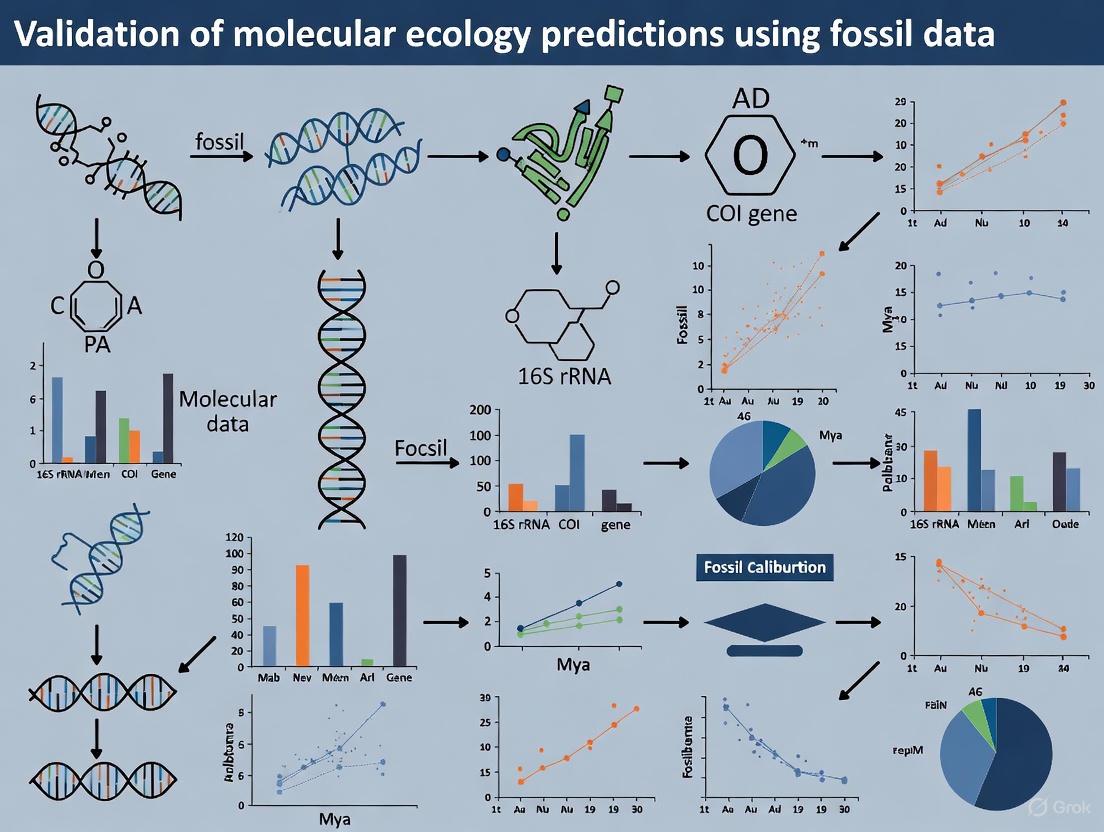
This article provides a comprehensive guide for researchers and scientists on integrating molecular data with the fossil record to test and validate evolutionary hypotheses.
Bridging Deep Time and Modern Data: A Framework for Validating Molecular Ecology Predictions with Fossil Evidence
Abstract
This article provides a comprehensive guide for researchers and scientists on integrating molecular data with the fossil record to test and validate evolutionary hypotheses. It explores the foundational necessity of this synergy, detailing methodological frameworks like the fossilized birth-death model and novel deep learning approaches for analyzing biodiversity. The piece critically examines common pitfalls, such as inappropriate calibration, and offers strategies for optimization. Finally, it provides a comparative analysis of validation techniques, demonstrating how fossil data can ground-truth molecular predictions in studies of speciation, extinction, and demographic history, with significant implications for understanding evolutionary processes in biomedical research.
Why Fossils are Non-Negotiable for Molecular Ecology
In molecular ecology, accurately estimating the timing of evolutionary events is paramount for drawing correlations between speciation, demographic history, and palaeoclimatic events [1]. Calibration—the process of converting genetic divergence into units of geological time—serves as the foundation for these estimates. When researchers employ inappropriate calibration points, particularly by applying deep phylogenetic scales to recent genealogical events, they risk generating significantly misleading evolutionary timeframes [1]. This distortion directly impacts subsequent inferences about how species respond to environmental changes, ultimately affecting conservation planning and policy decisions.
The core of the problem lies in the fundamental difference between long-term substitution rates and short-term mutation rates. Studies focusing on intraspecific data (within species) primarily observe segregating sites or polymorphisms, many of which are transient and will be removed by genetic drift or selection [1]. In contrast, interspecific comparisons (between species) reflect past fixations (substitutions). Using deep fossil calibrations or canonical substitution rates (e.g., the traditional 1% per million years for birds and mammals) for recent evolutionary events can thus lead to a substantial underestimation of substitution rates and a corresponding overestimation of divergence times [1]. This article explores the consequences of such inappropriate calibration through concrete case studies and highlights methodologies for robust, validated estimates.
Comparative Analysis: The Impact of Calibration Choices on Divergence Time Estimates
The following case studies illustrate how the choice of calibration point dramatically alters biological interpretation. The table below summarizes the divergence time estimates obtained using external versus internal calibration points across different biological systems.
Table 1: Comparison of Divergence Time Estimates Using External vs. Internal Calibration Points
| Study System | External Calibration Method | Estimate with External Calibration | Internal Calibration Method | Estimate with Internal Calibration | Impact on Biological Interpretation |
|---|---|---|---|---|---|
| Avian Speciation [1] | Traditional mitochondrial rate (0.01 subs/site/Myr) | Majority of 22 species had pre-Pleistocene divergences (>2.4 Mya) | Revised rate from amakihi subspecies (0.075 subs/site/Myr) | Most phylogroup divergences occurred within the last 250,000 years | Supports Late Pleistocene speciation, rejecting the "Late Pleistocene Origins" hypothesis |
| Bowhead Whales (Demographic History) [1] | Deep fossil calibrations or canonical rates | Overestimated times to divergence and underestimated past population sizes | Heterochronous ancient DNA sequences from radiocarbon-dated samples | Revised, more recent timeline for population expansions and contractions | Alters understanding of population responses to historical climate cycles and hunting pressure |
| Brown Bears (Pleistocene Biogeography) [1] | Deep fossil calibrations or canonical rates | Overestimated divergence times for biogeographic events | Internally-calibrated substitution rates from within-species data | Significantly more recent timing for colonization and population isolation events | Changes correlation of dispersal events with specific Pleistocene glaciations or sea-level changes |
Experimental Protocols: Methodologies for Robust Molecular Dating
Protocol: Calibration Using Heterochronous Ancient DNA
The analysis of DNA from radiocarbon-dated subfossils, such as bones or teeth, provides a powerful internal calibration method for studying demographic history on genealogical scales [1].
- Sample Collection & Dating: Collect biological remains (e.g., bones, teeth, feathers) from stratified deposits or with secure archaeological context. Submit a subset for rigorous radiocarbon dating to establish a precise geological timeline for each sample.
- Ancient DNA (aDNA) Extraction: Perform DNA extraction in a dedicated, clean-room facility to prevent contamination with modern DNA. Use extraction protocols designed to recover short, degraded DNA fragments typical of ancient material.
- Library Preparation and Sequencing: Build DNA libraries, including dual-indexing with unique barcodes for each sample to track it through pooled sequencing. Use high-throughput sequencing platforms to generate millions of sequences.
- Bioinformatic Processing: Map sequence reads to a reference genome of the study species. Apply strict filters to retain only high-quality, authentic ancient DNA, checking for characteristic damage patterns.
- Molecular Dating Analysis: Compile the radiocarbon ages and genetic sequences into a single dataset. Use Bayesian phylogenetic frameworks (e.g., BEAST2) that can directly incorporate sample ages as calibration points to estimate substitution rates and divergence times.
Protocol: Fossil-Informed Ecological Niche Modeling (ENM)
While not a direct molecular dating method, integrating fossil data with Ecological Niche Models (ENMs) provides an independent means of validating hypotheses about species' past distributions and range changes, which are often inferred from molecular data [2].
- Data Compilation:
- Modern Occurrences: Compile georeferenced locality data for the target species from databases like GBIF.
- Fossil Occurrences: Gather fossil occurrence data from paleontological databases and literature, ensuring they are taxonomically validated and reliably dated.
- Paleoclimatic Data: Obtain simulated paleoclimatic layers (e.g., temperature, precipitation) for the relevant time periods from databases like PaleoClim.
- Model Calibration:
- For a Modern-Only ENM, calibrate the model using only the modern occurrence data and corresponding modern climate layers.
- For a Fossil-Informed ENM, combine both modern and fossil occurrence data. Use the fossil data with the paleoclimatic layers from their specific time periods to calibrate the model, thereby capturing a broader fraction of the species' fundamental climatic niche [2].
- Model Projection and Validation: Project both models onto past climatic scenarios to predict potential species' ranges at different times in the past. Compare the predictions against the known fossil record or independent phylogeographic patterns to assess which model is more accurate.
Table 2: Key Research Reagents and Computational Tools for Molecular Dating and Validation
| Item/Tool Name | Category | Primary Function | Application Context |
|---|---|---|---|
| Radiocarbon Dating | Dating Method | Provides absolute age for organic samples | Calibrating heterochronous ancient DNA datasets [1] |
| High-Throughput Sequencer | Laboratory Instrument | Generates millions of DNA sequences in parallel | Sequencing modern and ancient DNA for population genetic analyses [3] |
| BEAST2 (Bayesian Evolutionary Analysis) | Software Package | Bayesian inference of phylogenies and divergence times | Molecular dating with various calibration types (fossils, heterochronous sequences) [1] |
| gridCoal | Software Package | Spatially explicit coalescent simulations | Assessing expected genetic patterns under demographic models with spatio-temporal variation [4] |
| Paleoclimatic Layers | Data | Simulated historical climate data | Informing Ecological Niche Models (ENMs) and species distribution models in deep time [2] |
| Environmental DNA (eDNA) | Molecular Data | Trace DNA from environmental samples | Highly sensitive detection for presence/absence to validate model predictions [5] |
Visualizing Calibration Workflows and Their Outcomes
The diagram below illustrates the logical workflow and contrasting outcomes of using inappropriate external calibration versus validated internal calibration.
The case studies presented here underscore a critical methodological principle in molecular ecology: calibration must be temporally and biologically appropriate for the evolutionary question at hand. The persistent use of deep fossil calibrations or standardized "canonical" rates for analyzing recent intraspecific divergence events has likely led to a widespread overestimation of divergence times across numerous studies [1]. This, in turn, has skewed our understanding of how biodiversity responds to climatic oscillations and other recent environmental pressures.
The path forward requires a disciplined and integrative approach. Researchers must leverage internal calibration points, such as those provided by heterochronous ancient DNA, whenever possible [1]. Furthermore, molecular inferences should be cross-validated with independent evidence, such as fossil-informed ecological niche models [2] or patterns from spatially explicit simulations [6] [4]. By adopting these rigorous practices, the field can generate more reliable estimates of evolutionary time scales, thereby strengthening the foundation upon which we build our understanding of past, present, and future biodiversity.
The Late Pleistocene, spanning from approximately 129,000 to 11,700 years ago, was a period of significant climatic fluctuations that profoundly influenced the evolutionary trajectories of species. Within molecular ecology, hypotheses about speciation events from this era are often generated through the analysis of genetic data from modern populations. However, these molecular predictions require rigorous validation against the physical evidence of the fossil record. This guide objectively compares the insights gained from molecular data against those from paleontological data, using the divergence of three closely related tree peony species (Paeonia qiui, P. jishanensis, and P. rockii) as a central case study [7]. The debate centers on whether molecular clocks, which estimate divergence times, align with the morphological and distributional evidence from fossils, and how the integration of both provides a more robust understanding of speciation dynamics.
The following tables consolidate key quantitative findings from the tree peony study, illustrating the genetic and ecological dimensions of the speciation debate.
Table 1: Summary of Genetic Data and Analysis from the Tree Peony Study
| Analysis Type | Key Findings | Interpretation & Support for Speciation |
|---|---|---|
| Nuclear Microsatellites (nSSRs) | Clear genetic differentiation among the three species [7]. | Supports reproductive isolation and distinct evolutionary pathways. |
| Chloroplast DNA Sequences | Phylogenetic placement suggests historical introgression between P. qiui/P. jishanensis and P. rockii [7]. | Indicates a complex evolutionary history with potential gene flow after initial divergence. |
| Coalescent Analysis (DIYABC) | Estimated divergence in the late Pleistocene [7]. | Provides a temporal hypothesis for speciation, coinciding with Pleistocene climatic oscillations. |
Table 2: Ecological Niche Modeling (ENM) and Morphological Data
| Data Type | Key Findings | Interpretation & Role in Speciation |
|---|---|---|
| Ecological Niche Modeling (ENM) | Larger species ranges during the Last Glacial Maximum (LGM) compared to the present [7]. | Suggests range shifts and fragmentation due to climate change, creating conditions for allopatric speciation. |
| Morphological Characterization | Consistent, clear morphological differences between the species [7]. | Provides phenotypic evidence for speciation, correlating with genetic differentiation. |
Experimental Protocols for Key Methodologies
To ensure reproducibility and critical evaluation, this section details the core experimental protocols used in the cited research.
Phylogeographic Sampling and Genetic Data Collection
- Population Sampling: The study collected leaf samples from 587 individuals across 40 natural populations of P. qiui, P. jishanensis, and P. rockii in the Qinling-Daba Mountains, covering the majority of their known ranges [7].
- Nuclear Microsatellite Genotyping: Genomic DNA was extracted from dried leaf tissue. Twenty-two nuclear simple sequence repeat (nSSR) markers were amplified via PCR and analyzed to assess genetic diversity, population structure, and differentiation [7].
- Chloroplast DNA Sequencing: Three non-coding regions of chloroplast DNA were sequenced for multiple individuals. These sequences were used to construct phylogenetic trees and assess evolutionary relationships that might differ from nuclear DNA due to their distinct inheritance patterns [7].
Coalescent Analysis for Divergence Time Estimation
- Modeling Framework: The study employed DIYABC (Approximate Bayesian Computation), a software package designed for inferring population history using genetic data [7].
- Scenario Testing: Multiple demographic scenarios (e.g., different sequences of population divergence and admixture) were simulated and compared. The scenario with the highest posterior probability was selected as the most likely evolutionary history.
- Parameter Estimation: Based on the best-supported model, key parameters including the timing of divergence between species pairs were estimated, pointing to the late Pleistocene [7].
Ecological Niche Modeling (ENM) Protocol
- Occurrence Data: Georeferenced locations of the three tree peony species were compiled from field surveys and herbarium records [7].
- Environmental Data: Bioclimatic variables representing temperature and precipitation patterns for both the present day and the Last Glacial Maximum (LGM, ~21,000 years ago) were obtained from WorldClim.
- Model Simulation: A Maximum Entropy algorithm (MaxEnt) was used to predict the potential geographic distribution of each species under current and past climatic conditions. The model correlates known occurrence points with environmental layers to identify suitable habitat [7].
- Niche Overlap/Divergence Test: The resulting models were compared statistically to quantify the degree of niche similarity or divergence between the species, providing insight into the ecological context of their separation.
Visualizing the Speciation Workflow
The following diagram illustrates the integrated methodological workflow used to test speciation hypotheses, from data collection to synthesis.
The Scientist's Toolkit: Key Research Reagent Solutions
This table details essential reagents, materials, and tools required for conducting similar research in molecular ecology and phylogeography.
Table 3: Essential Research Reagents and Tools for Phylogeographic Studies
| Item Name | Function/Brief Explanation |
|---|---|
| DNeasy Plant Kit | Standardized kit for high-quality genomic DNA extraction from silica gel-dried leaf tissue, crucial for downstream genetic analyses [7]. |
| Nuclear Simple Sequence Repeat (nSSR) Primers | Species-specific fluorescently labelled primers to amplify highly variable microsatellite regions for assessing contemporary genetic structure and diversity [7]. |
| Chloroplast DNA Primers | Universal primers designed to amplify non-coding regions of chloroplast DNA for reconstructing deep evolutionary relationships and maternal lineages [7]. |
| DIYABC Software | A user-friendly computational tool for Approximate Bayesian Computation, used to infer population history (divergence times, admixture) from genetic data [7]. |
| MaxEnt Software | A powerful algorithm for species distribution modeling, predicting potential geographic ranges based on occurrence records and environmental data [7]. |
| WorldClim Paleoclimatic Data | A publicly available database of interpolated global climate surfaces for past (e.g., LGM), current, and future conditions, essential for ecological niche modeling [7]. |
The case of the tree peonies demonstrates that the Late Pleistocene speciation debate is not a binary argument but a call for integrative analysis. Molecular hypotheses provide powerful, quantifiable estimates of divergence times and reveal genetic structure, while fossil and ecological data offer a vital reality check, confirming the geographical and ecological feasibility of these events [7]. The debate is advanced by acknowledging that speciation is rarely a simple, clean split; it often involves periods of isolation, secondary contact, and introgression, as suggested by the genetic signals in the peonies [8].
Future research will be shaped by frameworks like Bayesian Hypothesis Generation, which provides a structured, probabilistic approach for evaluating novel hypotheses before extensive data collection, balancing skepticism with openness to high-impact ideas [9]. Furthermore, the rise of agentic AI systems and large language models holds promise for revolutionizing hypothesis generation in fields like molecular ecology. These systems can systematically map connections across disparate domains—such as genetics, paleoclimatology, and morphology—to uncover testable, interdisciplinary insights that might elude human researchers due to cognitive constraints or disciplinary silos [10]. The continued challenge and validation of molecular hypotheses with fossil data, aided by these new computational tools, will undoubtedly lead to a richer and more complex understanding of life's history.
The pursuit of evolutionary history often navigates a apparent conflict between the deep divergences predicted by molecular clock analyses and the relatively recent appearance of organisms in the fossil record. This dichotomy has historically fueled perceptions of the fossil record as hopelessly incomplete. However, methodological advances across paleontological and geochemical disciplines are transforming this perspective, enabling researchers to embrace fossil evidence as a critical archive for directly testing and validating molecular ecology predictions. This guide compares the experimental approaches and data types that power this scientific synthesis, providing a framework for researchers to evaluate the strengths and appropriate applications of complementary evolutionary dating methods.
Contemporary research demonstrates that the fossil record's value extends far beyond providing individual calibration points. It serves as an independent source of hypothesis testing through:
- Exceptional Preservation Detection: Geochemical signatures that identify environments conducive to preserving early, soft-bodied organisms [11].
- Morphological Trajectories: Continuous fossil sequences that document the pace and sequence of phenotypic diversification [12].
- Biomolecular Preservation: Direct chemical evidence of original biomolecules that provides insights into evolutionary relationships [13].
- Bias-Quantifying Algorithms: Deep learning approaches that correct for spatial, temporal, and taxonomic sampling heterogeneity [6].
The following sections compare specific technologies and experimental approaches that enable this research paradigm, providing methodological details and performance metrics essential for designing studies that integrate molecular and fossil evidence.
Comparative Analysis of Fossil-Based Research Methodologies
Quantitative Comparison of Experimental Approaches in Fossil Analysis
Table 1: Comparison of key methodological approaches for extracting evolutionary data from fossils
| Methodology | Primary Application | Spatial/Temporal Resolution | Key Measurable Parameters | Technical Limitations |
|---|---|---|---|---|
| Fossilized Biomolecule Analysis [13] | Detecting preserved original biomolecules (e.g., collagen I) | Microscopic (tissue-level); works on specimens up to 80 million years old | Presence of proteins via immunofluorescence, ELISA absorbance values, electrophoretic bands | Requires exceptional preservation; potential for contamination; humic substance interference |
| Rare Earth Element (REE) Profiling [13] | Screening fossils for likely biomolecular preservation | Microscopic (cortical bone depth profiling); applicable across Phanerozoic | REE concentration gradients, diffusion patterns, overall concentration levels | Indirect proxy; requires validation; destructive sampling |
| Geochemical Preservation Mapping [11] | Identifying rocks with exceptional preservation potential | Macroscopic (rock composition); focused on Neoproterozoic to Cambrian | Berthierine/kaolinite clay content (>20% predictive of preservation) | Regional lithological constraints; not all environments represented |
| Geometric Morphometrics of Continuous Traits [12] | Tracking phenotypic diversification through time | Population-level; millennial-scale resolution over 17,000-year sequences | Landmark-based shape coordinates, morphospace occupation, disparity metrics | Requires abundant specimens; trait-dependent |
| Deep Learning Biodiversity Estimation (DeepDive) [6] | Correcting biodiversity estimates for sampling bias | Global/regional scales; bin-level resolution across geologic eras | Re-scaled MSE (0.114-0.132 validation), R² values, confidence interval coverage | Requires extensive training data; computational intensity |
Performance Metrics in Bias Correction and Temporal Reconstruction
Table 2: Performance characteristics of biodiversity estimation methods across preservation scenarios
| Method | Optimal Preservation Context | Completeness Threshold | Error Metrics | Advantages Over Alternatives |
|---|---|---|---|---|
| DeepDive [6] | Variable preservation, strong spatial/taxonomic biases | Effective even at <20% completeness (fraction of species with fossils) | rMSE <0.01 at >0.2 completeness; test MSE 0.197-0.229 | Accounts for spatial, temporal, AND taxonomic biases simultaneously |
| Shareholder Quorum Subsampling (SQS) [6] | Consistent preservation, moderate sampling | Requires reasonable occurrence data density | Not quantified in direct comparison | Widely adopted; computationally efficient |
| Fossil Geochemical Screening [11] | Mudstone deposits with specific clay compositions | Identifies rocks with >90% probability of preserving soft tissues | 100%准确识别具有伯瑟琳/高岭石保存条件的Cambrian页岩 | Directly identifies preservation potential rather than correcting estimates |
| REE Biomolecular Proxy [13] | Vertebrate bone with minimal diagenetic alteration | Low REE concentrations with steep cortical gradients | 500% higher ELISA absorbance vs. controls in positive specimens | Enables targeted sampling for destructive biomolecular analyses |
Experimental Protocols for Key Methodologies
Detecting Fossilized Biomolecules with REE Screening
Principle: The Rare Earth Element (REE) composition of fossil bone reflects its diagenetic alteration, with low concentrations and steeply declining profiles indicating minimal pore fluid interaction and thus higher potential for biomolecular preservation [13].
Protocol:
- Sample Preparation: Cut cortical bone fragments, sequentially abrade outer surfaces, and powder samples at multiple cortical depths.
- REE Quantification: Analyze powders via ICP-MS to determine REE concentrations and distribution patterns.
- Biomolecular Extraction:
- Demineralize bone fragments in 0.5M EDTA, pH 8.0
- Extract proteins in ammonium bicarbonate (ABC) and guanidine hydrochloride (GuHCl)
- Centrifuge and collect supernatant
- Immunological Assays:
- ELISA: Coat plates with extracts, incubate with anti-collagen I primary antibodies, detect with HRP-conjugated secondary antibodies
- Immunofluorescence: Apply primary antibodies to demineralized bone sections, visualize with FITC-conjugated secondaries
- Specificity Controls: Include collagenase digestion, antibody inhibition, and secondary-only controls
Validation Criteria: Positive ELISA signal ≥2 times background levels; specific fluorescence localization in tissue sections; reduced signal in digestion controls [13].
Geometric Morphometrics for Tracking Adaptive Radiation
Principle: Morphological diversification in continuous fossil sequences can document the pace and sequence of adaptive radiation, testing predictions about evolutionary tempo [12].
Protocol:
- Stratigraphic Sampling: Collect fossils from precisely dated sediment cores with continuous deposition (e.g., Lake Victoria cores spanning 17,000 years).
- Trait Selection and Digitization: Focus on ecologically informative traits (e.g., cichlid oral jaw teeth); capture 2D or 3D landmark coordinates.
- Morphospace Construction:
- Perform Generalized Procrustes Analysis to remove non-shape variation
- Calculate principal components of shape variation
- Project fossil specimens into morphospace
- Temporal Analysis:
- Calculate disparity metrics (e.g., sum of variances) through time bins
- Compare morphospace occupation across intervals
- Test for early burst patterns vs. constant diversification
Analytical Framework: Use PERMANOVA to test shape differences between trophic groups; dispRity package in R for disparity-through-time analyses [12].
Deep Learning Biodiversity Estimation (DeepDive)
Principle: Recurrent neural networks trained on simulated biodiversity data can learn to correct for sampling biases in fossil occurrence data [6].
Protocol:
- Training Data Generation:
- Simulate diversification trajectories with varying speciation/extinction rates
- Generate fossil records with known spatial, temporal, and taxonomic biases
- Create features from occurrence data (singletons, localities per region)
- Model Architecture:
- Implement recurrent neural network (RNN) with LSTM layers
- Include Monte Carlo dropout for uncertainty estimation
- Train multiple models with different initializations
- Application to Empirical Data:
- Customize training simulations with clade-specific constraints
- Input empirical occurrence data with spatial/temporal information
- Generate diversity trajectories with confidence intervals
- Validation: Compare predictions to simulated true diversity; calculate rMSE and R² values [6].
Visualization Frameworks for Fossil Data Interpretation
Integrated Workflow for Molecular-Fossil Synthesis
Experimental Pipeline for Biomolecular Fossil Analysis
The Scientist's Toolkit: Essential Research Reagents and Materials
Table 3: Key research reagents and materials for fossil-based evolutionary studies
| Reagent/Material | Application | Function | Experimental Context |
|---|---|---|---|
| Berthierine/Kaolinite Clays [11] | Preservation potential assessment | Antibacterial barrier preventing organic decay | Identifying rocks with exceptional fossil preservation |
| Rare Earth Element Standards [13] | Diagenetic history reconstruction | Proxies for pore fluid interactions and preservation quality | Screening fossils for biomolecular preservation potential |
| Anti-Collagen I Antibodies [13] | Biomolecular detection | Specific recognition of preserved collagen epitopes | Immunological verification of original biomolecules |
| Collagenase Enzymes [13] | Specificity controls | Enzymatic digestion of collagen substrates | Verifying antibody specificity in immunoassays |
| Ammonium Bicarbonate Buffer [13] | Protein extraction | Mild buffer for solubilizing fossil proteins | Extracting non-denatured proteins for immunological assays |
| Guanidine Hydrochloride [13] | Protein extraction | Denaturing agent for refractory proteins | Extracting tightly bound or cross-linked fossil proteins |
| EDTA Solution [13] | Demineralization | Chelates calcium ions to dissolve mineral matrix | Releasing organic components from fossil bone |
| Geometric Morphometrics Software [12] | Shape analysis | Quantifying morphological evolution from fossils | Tracking phenotypic diversification through time |
The methodologies compared in this guide demonstrate that the fossil record, when interrogated with appropriate tools and statistical corrections, provides a robust historical archive for testing evolutionary hypotheses. Rather than treating molecular clocks and fossil evidence as conflicting datasets, researchers can now leverage their complementary strengths: molecular data provide a broad phylogenetic framework, while fossil evidence offers direct temporal calibration and independent tests of diversification scenarios. The experimental approaches detailed here—from REE screening for biomolecular preservation to deep learning bias correction—enable precisely this integration, moving beyond perceptions of incompleteness to embrace the fossil record as an essential resource for reconstructing evolutionary history.
In molecular ecology and evolution, estimating the timing of species divergence is a fundamental challenge. The molecular clock hypothesis, proposed in the 1960s, serves as a crucial tool for this purpose, suggesting that DNA and protein sequences evolve at a rate that is relatively constant over time and among different organisms [14]. A direct consequence of this hypothesis is that the genetic difference between any two species is proportional to the time since they last shared a common ancestor. This principle allows researchers to estimate evolutionary timescales, especially for organisms with poor fossil records such as flatworms and viruses [14]. However, the practical application of molecular clocks reveals a significant complication: a pronounced discrepancy between genealogical mutation rates (measured from individuals with known relationships) and phylogenetic mutation rates (calculated from fixed differences between species divided by their estimated time since divergence) [15]. This guide provides a comparative analysis of the key concepts, methods, and tools for estimating divergence times, focusing on how fossil data validates molecular ecology predictions.
Core Concepts: Mutation Rates and Scales
The Genealogical vs. Phylogenetic Rate Discrepancy
The conflict between genealogical and phylogenetic mutation rates represents a significant challenge in evolutionary studies. Genealogical mutation rates, derived from comparing closely related individuals, are typically several orders of magnitude faster than phylogenetic rates [15]. This discrepancy creates substantial implications for evolutionary modeling. For instance, using the genealogical rate would place estimates for "Y Chromosome Adam" and "Mitochondrial Eve" well within a biblical timeframe, creating tension with evolutionary models that rely on much slower phylogenetic rates [15]. The evolutionary community often attempts to resolve this conflict by appealing to processes like natural selection or genetic drift, though population modeling suggests these explanations may be insufficient [15].
The Molecular Clock: From Strict to Relaxed Models
The original molecular clock hypothesis, backed by Motoo Kimura's neutral theory of molecular evolution, assumed a strictly constant substitution rate across lineages [14]. However, subsequent research revealed that rates of molecular evolution can vary significantly among organisms, rendering the strict molecular clock too simplistic [14]. This recognition led to the development of "relaxed" molecular clock models that accommodate rate variation among lineages in a limited manner:
- Type 1 Relaxed Clocks: Allow rate variation over time and among organisms, but this variation occurs around an average value [14].
- Type 2 Relaxed Clocks: Permit the evolutionary rate to "evolve" over time, based on the assumption that molecular evolution rates are tied to other evolving biological characteristics (e.g., metabolic rate) [14].
Table 1: Comparison of Molecular Clock Models
| Clock Type | Rate Variation | Theoretical Basis | Best Application Context |
|---|---|---|---|
| Strict Clock | Constant across lineages | Neutral Theory | Closely related species with similar generation times |
| Relaxed Type 1 | Varies around an average | Empirical observations | Datasets with moderate taxonomic diversity |
| Relaxed Type 2 | Evolves over time | Correlation with biological traits | Evolutionarily distant groups |
Comparative Analysis of Divergence Time Estimation Methods
Computational Approaches and Their Performance
Modern molecular dating techniques must accommodate extensive heterogeneity of evolutionary rates among lineages, especially with today's large genomic datasets [16]. Several computational approaches have been developed to address this challenge:
The RelTime method estimates relative divergence times for all branching points in large phylogenetic trees without assuming a specific model for lineage rate variation or requiring clock calibrations [16]. In comparative studies, RelTime demonstrated a linear relationship with true divergence times in simulations, accurately capturing node times and time elapsed on branches even when evolutionary rates varied extensively under autocorrelated, uncorrelated, constant rate, and random rate models [16]. Computationally, RelTime completed calculations approximately 1,000 times faster than the fastest Bayesian method (MCMCTree), with this speed advantage increasing for larger datasets [16].
DeepDive represents a more recent innovation that uses deep learning to estimate biodiversity patterns through time while incorporating spatial, temporal, and taxonomic sampling variation [6]. This approach couples a simulation module that generates synthetic biodiversity and fossil datasets with a recurrent neural network that uses fossil data to predict diversity trajectories [6]. In validation tests, DeepDive outperformed alternative methods like Shareholder Quorum Subsampling (SQS), especially at large spatial scales, providing robust paleodiversity estimates under various preservation scenarios [6]. DeepDive predictions were most accurate in datasets with completeness exceeding 0.2 (where up to 80% of species were not sampled) and with higher preservation rates [6].
Table 2: Performance Comparison of Divergence Time Estimation Methods
| Method | Theoretical Approach | Calibration Requirements | Computational Speed | Key Strengths |
|---|---|---|---|---|
| RelTime | Maximum likelihood relative dating | No specific calibrations needed | ~1000x faster than Bayesian methods | Accuracy across diverse rate variation models |
| DeepDive | Deep learning/simulations | Incorporates fossil data directly | Varies with model architecture | Handles spatial, temporal, taxonomic biases |
| Bayesian (MCMCTree) | Bayesian inference with priors | Requires multiple clock calibrations | Computationally intensive | Sophisticated modeling of rate heterogeneity |
| SQS | Subsampling approach | Sampling standardisation | Fast but less accurate | Widely applied for fossil data standardization |
Mutation-Selection Models for Site-Specific Rate Estimation
Beyond species divergence times, estimating substitution rates at specific protein sites provides invaluable information about biophysical and functional constraints [17]. Traditional phylogenetic models account for variation by introducing factors that scale the relative substitution rate at sites to the overall mean substitution rate of a multiple sequence alignment (MSA) [17]. However, mutation-selection models offer a more sophisticated approach by modeling evolutionary processes at the codon level, providing greater realism than protein-level models [17]. These models describe the relative instantaneous rate between codons as the product of the mutation rate and the site-specific fixation probability [17]. When applied to natural sequences, site rates from the mutation-selection model show strong correlation with rates calculated with empirical Bayes methods [17]. This approach can be rapidly calculated on large sequence alignments and performs particularly well on shallow multiple sequence alignments [17].
Experimental Protocols and Validation Frameworks
Calibrating the Molecular Clock with Fossil Data
Calibration represents the most critical consideration when using either strict- or relaxed-clock molecular clock methods [14]. Without calibration, a 5% difference in DNA sequences could have accumulated over 5 million years at 1% per million years, or over 1 million years at a fivefold higher rate - with no statistical way to distinguish between these possibilities from the genetic data alone [14]. The standard calibration protocol involves:
- Identifying Divergence Events: Determine absolute ages of evolutionary divergence events (e.g., mammal-bird split) from the fossil record or geological events of known antiquity (e.g., mountain range formation that initiated speciation) [14].
- Calculating Evolutionary Rates: Use these known divergence times to calculate substitution rates for specific genetic markers.
- Applying Calibrations: Extrapolate the calibrated rates to estimate timing of evolutionary events in other organisms.
A study by Weir and Schluter (2008) demonstrates advanced calibration using 90 different calibrations derived from dated fossils, land bridge formations, oceanic islands, and mountain ranges [14]. After statistical consistency checks eliminated 16 inconsistent calibrations, the remaining 74 calibrations yielded an average cytochrome b gene evolution rate in birds of approximately 1% per 1 million years (the "2% rule" for pairwise species comparisons) [14]. Notably, they found rate variation exceeding fourfold among different bird lineages, uncorrelated with biological characteristics like body mass [14].
Integrating Fossil Data to Validate Ecological Niche Models
Beyond divergence time estimation, fossil data plays a crucial role in validating ecological predictions under climate change scenarios. Ecological niche models (ENMs) typically learn species' climatic preferences from their current geographic distributions, leaving them vulnerable to niche truncation from non-climatic limits like anthropogenic activities and competition [2]. Supplementing current species observations with fossil data explores a larger fraction of the species' fundamental niche, as fossil occurrences represent periods when these non-climatic limits were absent or differently distributed [2].
Experimental protocols for integrating fossil data include:
- Data Combination: Combining current and fossil occurrence data for species of conservation concern [2].
- Niche Width Assessment: Comparing climatic niche width estimates from current data alone versus current + fossil data [2].
- Range Change Prediction: Evaluating predictions of range change under future climate scenarios using both data approaches [2].
This approach reveals that while adding fossil data invariably increases estimated niche width, it improves range change predictions for only about half of species, suggesting many species may currently be in non-equilibrium with their environment [2].
Figure 1: Experimental workflow for validating ecological niche models with fossil data
Phylogenetic Scale in Biodiversity Studies
The phylogenetic scale (representing different evolutionary depths) significantly influences relationships between biodiversity patterns and environmental conditions [18]. Research on angiosperms across latitudinal and longitudinal gradients in China demonstrates that the relationship between β-diversity and climatic distance decreases conspicuously from shallow to deep evolutionary time slices [18]. This effect differs between gradients:
- Latitudinal Gradients: Show steeper decreases in climate-β-diversity relationship strength from shallow to deep evolutionary time [18].
- Longitudinal Gradients: Exhibit less steep decreases, likely reflecting historical processes like the collision of the Indian plate with the Eurasian plate [18].
This protocol involves slicing the phylogenetic tree at multiple evolutionary depths (e.g., 0, 15, 30, 45, 60, and 75 million years ago) and quantifying taxonomic and phylogenetic β-diversity at each depth [18]. The decreasing relationship strength at deeper evolutionary depths suggests deeper clades are more likely to overlap in geographic or environmental space, and present-day environmental conditions may not reflect deep-time climate change [18].
Visualization and Analysis Tools
Phylogenetic Tree Visualization Platforms
Effective visualization is essential for interpreting divergence time estimates and phylogenetic relationships:
- iTOL (Interactive Tree Of Life): Supports trees with 50,000+ leaves, offers 19 dataset types for annotation, and provides advanced display of unrooted, circular, and regular cladograms or phylograms [19].
- OneZoom: A fractal-based tree of life explorer showing relationships between 2.2+ million species with zoomable interface, particularly valuable for public engagement and education [20].
- ggtree: An R package that extends ggplot2 for visualizing phylogenetic trees with associated data, supporting multiple layouts (rectangular, circular, slanted, etc.) and high levels of customization [21].
Table 3: Essential Research Tools for Divergence Time Estimation
| Tool/Resource | Function | Application Context |
|---|---|---|
| RelTime Software | Estimates relative divergence times | Large phylogenetic datasets with rate heterogeneity |
| DeepDive Framework | Estimates biodiversity through time using deep learning | Datasets with strong spatial, temporal, taxonomic biases |
| ggtree R Package | Visualizes and annotates phylogenetic trees | All stages of phylogenetic analysis and publication |
| Mutation-Selection Models | Predicts site-specific substitution rates | Protein evolution studies and functional constraint analysis |
| Fossil Calibration Databases | Provides absolute timepoints for molecular clock calibration | Establishing temporal frameworks for evolutionary studies |
| Ecological Niche Modeling Software | Predicts species distributions under climate change | Conservation planning and climate vulnerability assessment |
Figure 2: Logical workflow for molecular dating analysis
The integration of molecular data with fossil evidence remains essential for robust estimates of divergence times and substitution rates. While relaxed molecular clock methods and new computational approaches like RelTime and DeepDive have significantly improved our ability to estimate evolutionary timescales, the fundamental discrepancy between genealogical and phylogenetic mutation rates persists as a challenging problem in evolutionary biology [16] [15] [6]. The use of fossil data for calibrating molecular clocks and validating ecological niche models provides critical temporal frameworks that would be impossible from genetic data alone [14] [2]. As molecular datasets continue to grow in size and taxonomic breadth, developing increasingly sophisticated methods that account for rate heterogeneity while incorporating robust fossil calibrations will remain essential for understanding the tempo and mode of evolution across the tree of life.
Integrating Fossils and Molecules: From Bayesian Frameworks to Deep Learning
The Fossilized Birth-Death (FBD) Model represents a significant advancement in Bayesian phylogenetic inference by providing a unified framework for integrating data from both extant and fossil species. For researchers and drug development professionals investigating evolutionary timelines, this model addresses a critical limitation of methods that use only contemporary molecular data: the difficulty in accurately estimating extinction rates and the consequent potential for biased divergence time estimates [22]. The FBD process treats fossil observations as an integral part of the tree-generating process, explicitly modeling speciation, extinction, and fossil sampling rates to infer phylogenetic relationships and divergence times simultaneously [23]. This approach is particularly valuable for validating molecular ecology predictions, as it allows for the direct incorporation of paleontological data—the only direct record of past biodiversity—into phylogenetic analyses, creating a more robust framework for testing evolutionary hypotheses [24].
Model Foundations: The Statistical Framework of the FBD Process
The FBD model is an extension of the birth-death process, a fundamental stochastic model in phylogenetics that describes how lineages accumulate through speciation (birth) and are removed through extinction (death). The key innovation of the FBD model is the incorporation of a fossil recovery rate (ψ), which quantifies the rate at which fossils are sampled along lineages of the complete tree [23]. This allows fossils to be treated as direct observations of the diversification process, rather than as supplemental or external data points.
In the FBD framework, the probability of the tree and fossils is conditional on the birth-death parameters: f[𝒯 | λ, μ, ρ, ψ, φ], where:
- 𝒯 denotes the tree topology, divergence times, fossil occurrence times, and fossil attachment points
- λ and μ represent the speciation and extinction rates, respectively
- ρ represents the probability that an extant species is sampled
- ψ represents the fossil recovery rate
- φ represents the origin time of the process [23]
The model distinguishes between the "complete tree" (containing all extant and extinct lineages) and the "reconstructed tree" (representing only the lineages sampled as extant taxa or fossils) [23]. An important characteristic is its ability to account for the probability of sampled ancestor-descendant relationships, which is correlated with turnover rate (r = μ/λ), fossil recovery rate (ψ), and the probability of sampling an extant taxon (ρ) [23].
For analyses dealing with stratigraphic range data rather than individual fossil specimens, the FBD Range Process (FBDRP) incorporates a model of asymmetric or "budding" speciation. This allows fossil specimens sampled along a lineage to be mapped to unique species, with the tips in the sampled tree representing the age of the youngest sample for each species [23].
Model Comparison: FBD Versus Alternative Phylogenetic Approaches
The following table compares the FBD model against other major phylogenetic approaches, highlighting key differences in methodology, data requirements, and analytical outputs.
Table 1: Comparison of the FBD Model with Alternative Phylogenetic Approaches
| Model/Approach | Data Requirements | Key Parameters Estimated | Treatment of Fossils | Strengths | Limitations |
|---|---|---|---|---|---|
| Fossilized Birth-Death (FBD) | Molecular data from extant species, morphological data, fossil occurrence ages [23] [24] | Speciation rate (λ), extinction rate (μ), fossil recovery rate (ψ), divergence times [22] [23] | Directly integrated as observations in the tree-generating process [23] | Provides unified framework for extant and fossil data; improved accuracy of extinction rate estimates [22] [24] | Complex implementation; computationally intensive; requires working knowledge of Bayesian phylogenetics [24] |
| Birth-Death (BD) with Extant Taxa Only | Molecular data from extant species only [22] | Speciation rate (λ), extinction rate (μ), divergence times | Not applicable | Simpler implementation; less computationally demanding | Limited power to estimate extinction rates; potential for biased parameter estimates [22] |
| State-Dependent Speciation and Extinction (SSE) Models | Molecular data from extant species, trait information [22] | Trait-dependent speciation and extinction rates, transition rates between traits | Not typically incorporated; some recent extensions | Can test hypotheses about trait-dependent diversification [22] | High rate of spurious correlations with neutral traits; limited power for extinction rate estimation [22] |
| Node Dating with Fossil Calibrations | Molecular data from extant species, fossil-based minimum age constraints for nodes | Divergence times, substitution rates | Used as external calibration points for constraining node ages | More straightforward interpretation; well-established software support | Does not fully utilize phylogenetic information from fossils; potential for subjective prior specification |
Performance Advantages of the FBD Model
Simulation studies have demonstrated that the inclusion of fossils in FBD analyses significantly improves the accuracy of extinction-rate (μ) estimates compared to analyses using only extant taxa, with no negative impact on speciation-rate (λ) and state transition-rate estimates [22]. This improvement is particularly valuable because extinction rates are notoriously difficult to estimate from molecular phylogenies of extant species alone. The FBD model also provides a more natural statistical framework for incorporating fossil age uncertainties, as it can accommodate probability distributions for fossil occurrence times rather than requiring fixed point estimates [24].
However, it is important to note that even with fossil data, state-dependent extensions of the FBD model (like BiSSE) may still incorrectly identify correlations between diversification rates and neutral traits if the true associated trait is not observed [22]. This highlights the importance of careful model selection and hypothesis testing when investigating trait-dependent diversification.
Experimental Protocols: Implementing FBD Analyses
Combined-Evidence Analysis Workflow
A standard "combined-evidence" phylogenetic analysis under the FBD model integrates three separate likelihood components or data partitions: one for molecular data, one for morphological data, and one for fossil stratigraphic range data [23]. The FBD process then serves as a joint prior distribution on tree topologies and divergence times, modeling all observed data (both extant and fossil) as part of the same generating process.
The following diagram illustrates the workflow and logical relationships of a combined-evidence analysis:
Diagram 1: Combined-Evidence Analysis Workflow
Software Implementation Protocols
The FBD model has been implemented in several Bayesian phylogenetic software packages, each with specific capabilities:
RevBayes provides a flexible platform for FBD analyses, implementing both the specimen-level FBD process (FBDP) and the FBD Range Process (FBDRP) for stratigraphic range data [23]. The software allows for complex model specification and can accommodate various clock models and substitution models for different data types.
BEAST2 offers user-friendly implementation of the FBD model through its graphical interface BEAUti, with available packages for skyline and stratigraphic range implementations [24]. This makes it particularly accessible for researchers new to Bayesian phylogenetics.
MrBayes also includes implementations of the FBD model, providing another option for Bayesian phylogenetic inference with fossil data [24].
A typical analysis involves specifying the FBD process as a tree prior, then combining it with appropriate substitution models for molecular data (e.g., GTR+Γ) and morphological data (e.g., the Mk model) [23]. The analysis is typically conducted using Markov chain Monte Carlo (MCMC) sampling to approximate the joint posterior distribution of parameters and trees.
Research Reagent Solutions: Essential Tools for FBD Analyses
Table 2: Essential Research Reagents and Software for FBD Analyses
| Tool/Resource | Type | Primary Function | Implementation Considerations |
|---|---|---|---|
| RevBayes | Software Platform | Flexible environment for specifying FBD models and extensions [23] | Steeper learning curve but maximum model flexibility; command-line interface |
| BEAST2 | Software Platform | User-friendly FBD implementation with graphical interface (BEAUti) [24] | More accessible for beginners; limited morphological model options |
| FBD Model (Tree Prior) | Statistical Model | Provides joint prior distribution for tree topology and divergence times incorporating fossils [23] | Requires specification of priors for λ, μ, ρ, ψ parameters |
| Mk Model | Morphological Model | Models discrete morphological character evolution for fossil and extant taxa [23] | Should account for data collection bias (parsimony-informative characters only) |
| Uncorrelated Relaxed Clock Models | Molecular Clock Model | Accommodates rate variation across lineages for molecular data [23] | Important for accommodating rate heterogeneity in molecular data |
| Stratigraphic Range Data | Data Type | First and last occurrence dates for fossil species [23] | Requires careful assessment of fossil identification and dating uncertainties |
Applications in Evolutionary Biology: Validating Molecular Predictions
The FBD model has been applied in over 170 empirical studies across diverse taxonomic groups [24], demonstrating its broad utility in evolutionary biology. These applications typically fall into several key research domains:
Divergence Time Estimation: The FBD model provides a more biologically realistic approach to dating evolutionary events by directly incorporating the fossil record, leading to more reliable estimates of clade ages and diversification patterns.
Diversification Rate Analysis: By improving the accuracy of extinction rate estimates, the FBD model enables more robust tests of hypotheses about how speciation and extinction rates have varied over time and across clades [22].
Trait-Dependent Diversification: Extensions of the FBD model that incorporate trait evolution allow researchers to test hypotheses about how specific morphological, ecological, or behavioral traits influence diversification rates, though caution is needed to avoid spurious correlations [22].
Historical Biogeography: The FBD framework can be combined with biogeographic models to reconstruct how species' ranges have shifted over geological timescales, providing insight into the role of geography in diversification.
In the context of validating molecular ecology predictions, the FBD model serves as a critical bridge between neontological and paleontological data. By integrating these complementary sources of evidence, researchers can test molecular-based hypotheses about evolutionary timescales and diversification patterns against the direct historical evidence provided by the fossil record. This integrative approach is particularly valuable for calibrating molecular clocks and testing hypotheses about how environmental changes have influenced biodiversity through deep time.
Future Directions and Methodological Challenges
Despite its significant advantages, applying the FBD model in practice presents several challenges. The method requires a working knowledge of paleontological data and their complex properties, Bayesian phylogenetics, and the mechanics of evolutionary models [24]. Important considerations include:
Fossil Identification and Dating: Uncertainties in fossil taxonomic assignment and geochronological dating must be properly accounted for in analyses.
Model Misspecification: As with any model-based approach, violations of FBD model assumptions can lead to biased parameter estimates. Developing model adequacy tests for FBD analyses remains an active research area.
Computational Demands: FBD analyses, particularly those combining molecular and morphological data for large datasets, can be computationally intensive.
Future methodological developments are likely to focus on extending the FBD framework to better accommodate features of the fossil record, such as variation in preservation potential across environments and taxonomic groups, and integrating additional data sources such as geochemical or environmental information [24]. As these models continue to develop, they will further enhance our ability to synthesize paleontological and neontological data to reconstruct evolutionary history.
Integrating fossil data into phylogenetic analyses represents a significant advancement in testing and validating molecular evolutionary hypotheses. The Fossilized Birth-Death (FBD) model provides a coherent statistical framework for combining molecular data from extant species with morphological and temporal data from fossils, enabling joint inference of divergence times and phylogenetic relationships [25] [24]. For researchers in molecular ecology and drug development who utilize evolutionary patterns, FBD models offer a powerful approach to ground-truth molecular clock predictions against the tangible evidence of the fossil record. This guide objectively compares the implementation, capabilities, and application of FBD models across three major Bayesian software toolkits: BEAST2, MrBayes, and RevBayes, providing a foundation for selecting appropriate tools for fossil-calibrated evolutionary analyses.
The Fossilized Birth-Death Model: Core Concepts
The FBD model is a generating process that describes the joint distribution of phylogenetic trees, divergence times, and fossil observations under a single statistical framework [25] [23]. It combines two fundamental processes:
- Birth-Death Process: Models lineage diversification through time with speciation (λ) and extinction (μ) rate parameters, generating tree topology and divergence times [25].
- Fossilization Process: Accounts for the sampling of fossil specimens along lineages via a Poisson process with fossil recovery rate (ψ) [25].
A key advantage of the FBD process is its treatment of fossils as tips in the phylogeny or as sampled ancestors, naturally incorporating them into the tree without requiring arbitrary node calibrations [26] [24]. When combined with the Mk model for morphological character evolution [25] [23], it enables true "total-evidence" dating, simultaneously inferring relationships and divergence times from molecular, morphological, and fossil occurrence data.
Comparative Analysis of Software Implementations
Table 1: Platform Overview and Implementation Characteristics
| Feature | BEAST2 | MrBayes | RevBayes |
|---|---|---|---|
| FBD Model Implementation | FBDP and FBDRP via packages | Integrated FBDP implementation | FBDP and FBDRP with range data |
| Graphical Interface | BEAUti for model setup | Limited GUI options | Command-line only |
| Learning Resources | Taming the BEAST tutorials [24] | Extensive manual | Comprehensive tutorial series [25] [23] |
| Morphological Models | Lewis Mk via morph-models package [27] | Extended Mk models | Customizable Mk models [25] |
Model Specification and Flexibility
Table 2: Model Specification Capabilities and Data Integration
| Model Component | BEAST2 | MrBayes | RevBayes |
|---|---|---|---|
| Molecular Clock Models | Relaxed clocks (lognormal) [27] | Strict and relaxed clocks | Strict, relaxed, and uncorrelated exponential [23] |
| Morphological Clock | Strict clock | Strict clock | Strict and relaxed clocks [28] |
| FBD Parameter Handling | Estimated with uniform priors [27] | Estimated with specified priors | Highly customizable priors |
| Fossil Age Uncertainty | Through age ranges [27] | Through age distributions | Uniform and other distributions [25] |
Performance Considerations and Experimental Data
While direct performance comparisons are limited in the literature, practical considerations emerge from implementation differences:
- BEAST2 benefits from its mature architecture and efficient MCMC sampling, particularly for large molecular datasets, though morphological model options are more limited [27] [24].
- RevBayes offers superior model flexibility but may require more tuning for convergence due to its highly customizable nature [25] [23].
- MrBayes provides a balance between usability and capability, with integrated FBD implementation but fewer extensions for fossil data [24].
A critical methodological consideration is the impact of model violations on FBD analysis accuracy. Studies demonstrate that selective sampling of fossils (e.g., using only the oldest fossils per clade) can produce dramatically overestimated divergence times in FBD analyses due to underestimation of net diversification rates and fossil-sampling proportions [26]. This highlights the importance of appropriate sampling strategies or alternative approaches like CladeAge when complete sampling is impractical [26].
Experimental Protocols and Methodologies
Standardized FBD Analysis Workflow
The following diagram illustrates the core workflow for implementing FBD models across the three toolkits:
Protocol for Combined-Evidence Analysis
A robust combined-evidence FBD analysis follows these key methodological steps, with variations depending on the software platform:
Data Preparation and Alignment
- Compile molecular sequences (DNA/RNA) for extant taxa, with "empty" sequences (gaps or question marks) for fossil taxa [27].
- Prepare morphological character matrix for fossil and extant taxa using NEXUS format.
- Document fossil occurrence dates, ideally with minimum and maximum age bounds to account for uncertainty [25].
Model Specification
- Define the FBD tree prior with parameters for speciation (λ), extinction (μ), fossil recovery (ψ), and extant sampling (ρ) [23].
- Specify clock models: typically relaxed lognormal for molecular data [27] and strict clock for morphological data [23].
- Configure site models: GTR+Γ for molecular data [23] and Mk model for morphological data [25].
Prior Selection
MCMC Execution and Diagnostics
- Run extended MCMC chains (often millions of generations) to ensure adequate parameter sampling.
- Assess convergence through effective sample sizes (ESS > 200) and trace plot inspection.
- Compare marginal likelihoods for model selection when testing alternatives.
Case Study: Bear Family (Ursidae) Phylogeny
The ursid phylogeny provides an exemplary application of FBD methodology, implemented across multiple platforms [25] [23] [24]. This analysis demonstrates:
- Data Integration: Combination of molecular data from living bear species with morphological character matrices for fossil and extant taxa.
- Fossil Handling: Treatment of fossil specimens as tips in the phylogeny with accurate age representations.
- Parameter Estimation: Joint inference of divergence times and macroevolutionary parameters (speciation, extinction, and fossilization rates).
- Model Validation: Assessment of molecular clock predictions against the fossil record of well-documented bear lineages.
Research Reagent Solutions
Table 3: Essential Resources for FBD Model Implementation
| Resource Category | Specific Tools/Functions | Application in FBD Analysis |
|---|---|---|
| Data Formats | NEXUS files with CHARSTATELABELS blocks | Standardized encoding of morphological character matrices [27] |
| Morphological Models | Lewis Mk model [27] | Modeling discrete morphological character evolution with coding bias correction |
| Tree Priors | FBD Range Process (FBDRP) | Handling stratigraphic range data for fossil species [23] |
| Clock Models | Uncorrelated lognormal relaxed clock [27] | Accounting for rate variation across molecular lineages |
| MCMC Diagnostics | Effective Sample Size (ESS) & trace plots | Assessing convergence of parameter estimates |
| Sampling Methods | Sampled ancestors [22] | Modeling direct ancestor-descendant relationships in fossil record |
Discussion and Recommendations
Platform Selection Guidelines
Choosing among BEAST2, MrBayes, and RevBayes depends on several factors:
BEAST2 is recommended for analysts prioritizing user-friendliness, particularly those with molecular phylogenetics experience who are expanding to include fossil data. Its BEAUti interface provides guided model specification, though morphological model options are limited [27] [24].
RevBayes is ideal for methodologically-focused researchers requiring custom model development or complex FBD extensions. Its modular design supports sophisticated analyses like state-dependent speciation-extinction models with fossils [22], but requires proficiency with the Rev language [25] [23].
MrBayes offers a middle ground with its integrated FBD implementation and familiar Bayesian framework, suitable for analysts already experienced with the platform who want to incorporate fossil tips without extensive retooling [24].
Methodological Considerations for Molecular Ecology
For researchers validating molecular ecology predictions with fossil data, several critical factors emerge:
Fossil Sampling Strategies: Selective sampling of only the oldest fossils per clade can bias divergence time estimates [26]. Whenever possible, include comprehensive fossil occurrence data rather than just first appearances.
Model Adequacy: The FBD model assumes homogeneous diversification and fossilization rates [25], which may not hold for many clades. Consider model extensions with time-heterogeneous parameters when analyzing groups with known radiations or mass extinctions [28].
Morphological Clock Implementation: Unlike molecular clocks, morphological clocks typically assume a strict clock [23]. Evaluate whether this assumption is biologically justified for your dataset, as violation can impact divergence time estimates [28].
The integration of FBD models across multiple software platforms significantly enhances our ability to test molecular ecological predictions against the fossil record, providing a more empirical framework for understanding evolutionary timelines and processes. As these implementations continue to mature, they offer increasingly robust tools for connecting neontological and paleontological data in unified statistical frameworks.
In molecular ecology, the estimation of divergence times is fundamental for understanding the tempo of evolutionary processes, such as speciation, adaptation, and responses to historical climate changes. The molecular clock hypothesis provides the theoretical foundation for translating genetic distances into absolute time. However, this clock requires calibration with independent temporal evidence to move from relative to absolute timescales. The choice of calibration strategy—using primary evidence like fossils or secondary estimates from previous molecular dating studies—profoundly influences the accuracy and precision of resulting evolutionary timelines. This guide objectively compares these two approaches within the critical context of validating molecular ecology predictions with fossil data. We summarize experimental data on their performance, detail key methodologies, and provide resources to inform calibration decisions in evolutionary research.
Defining Primary and Secondary Calibrations
Primary Calibrations are temporal constraints derived directly from independent, non-molecular evidence. The most common source is the fossil record, where the first appearance of a taxon in the geological strata provides a minimum age for the node representing its divergence from its closest relative [29] [30]. Other sources include dated biogeographic events, such as the formation of a mountain range or the isolation of a landmass, which can constrain the maximum age of a lineage.
Secondary Calibrations are temporal constraints derived from the results of previous molecular dating analyses. In this approach, a node age and its associated uncertainty (e.g., a 95% credible interval), estimated in a "primary" study that used fossil evidence, are applied as a calibration prior in a new, "secondary" study on a different dataset or taxonomic group [29] [31]. This practice is often employed in groups that lack a robust fossil record of their own.
Comparative Analysis: Accuracy, Precision, and Error
Experimental simulations have quantified the distinct error profiles associated with primary and secondary calibration strategies. The table below summarizes key performance differences.
Table 1: Performance comparison of primary versus secondary calibrations based on simulation studies
| Aspect | Primary Calibrations | Secondary Calibrations |
|---|---|---|
| Overall Accuracy | More accurate, especially with multiple, deep-node calibrations [30]. | Estimates can shift significantly from true times; often overestimated by ~10% or younger than primary estimates [29] [31]. |
| Precision (CI Width) | Confidence/credible intervals (CIs) are wider, reflecting more appropriate uncertainty [31]. | CIs are artificially narrow, giving a false impression of precision [29] [31]. |
| Impact of Calibration Position | Deeper node calibrations yield more accurate and precise timescale estimates [30]. | Error increases with the age of the calibrated node and the number of tips in the tree [31]. |
| Error Propagation | Errors are contained within the analysis. | Compounds errors from the primary study (e.g., in fossil placement, model choice) [29]. |
| Best Practice Use Case | The preferred and recommended method whenever possible [31] [30]. | May be useful for exploring plausible evolutionary scenarios when primary calibrations are utterly unavailable [29]. |
The quantitative consequences of using secondary calibrations are significant. One study found that secondary calibrations produced age estimates that were significantly different from primary estimates in 97% of replicates, with the 95% credible intervals being significantly narrower [31]. Furthermore, the total error in the secondary analysis was positively correlated with the number of tips and the age of the secondary tree [31].
Key Experimental Protocols and Methodologies
To ensure the reliability and comparability of data on calibration performance, researchers typically employ controlled simulation studies. The following workflow outlines a standard methodology for quantifying calibration error.
Workflow for Quantifying Calibration Error
Detailed Methodology
The standard protocol, as used in studies like Schenk (2016) and others, involves several key stages [29] [31]:
Simulate a "True" Phylogeny: A large, known phylogeny (e.g., 1500 tips) is generated under a defined model of diversification, such as a pure-birth process. The tree is scaled to a known timescale (e.g., 70 million years), establishing the "true" divergence times for all nodes [31].
Simulate DNA Sequence Evolution: A DNA sequence alignment (e.g., 2000 base pairs) is simulated along the branches of the true tree using a specific nucleotide substitution model (e.g., HKY). This creates a realistic genetic dataset with a known evolutionary history [31].
Primary Divergence Time Estimation (Primary Calibration):
- The simulated DNA data is analyzed using a relaxed-clock molecular dating method (e.g., an uncorrelated lognormal model in a Bayesian framework like BEAST).
- A set of nodes on the tree is calibrated using the known true node ages from the simulation, mimicking the use of perfect fossil information. Prior distributions (e.g., lognormal) are placed on these node ages to incorporate uncertainty [31] [30].
- The output is a set of estimated node ages with confidence/credible intervals for the primary analysis.
Secondary Divergence Time Estimation (Secondary Calibration):
- A subset of the tree (a "secondary tree") is selected, or a new dataset is simulated based on a part of the original tree.
- The posterior estimates (e.g., mean and 95% CI) for one or more nodes from the primary analysis are used as the calibration priors for the secondary analysis [31].
- The secondary analysis is run on its dataset, producing a new set of divergence time estimates.
Error Quantification: The accuracy and precision of both the primary and secondary analyses are assessed by comparing their estimated node ages to the known true ages from the simulation. Metrics include:
- Bias: The direction and magnitude of the shift in estimated ages (e.g., consistent overestimation or underestimation).
- Precision: The width of the confidence/credible intervals.
- Coverage: Whether the true age falls within the stated confidence/credible interval the expected proportion of the time [29] [31].
The Scientist's Toolkit: Essential Research Reagents and Materials
Table 2: Key computational tools and resources for molecular dating and calibration analysis
| Tool/Resource | Function |
|---|---|
| BEAST (Bayesian Evolutionary Analysis Sampling Trees) | A powerful software platform for Bayesian phylogenetic analysis, widely used for divergence time estimation with relaxed molecular clocks [31] [30]. |
| MEGA X | An integrated software tool that includes the RelTime method for rapid estimation of divergence times with minimal assumptions, used in simulation studies [29]. |
R with specialized packages (e.g., ape, geiger) |
A statistical programming environment used for simulating phylogenetic trees and sequence data, and for analyzing the results of dating analyses [31]. |
| Seq-Gen | A program for simulating the evolution of DNA or protein sequences along a phylogenetic tree, crucial for generating test datasets [29]. |
| Fossil Occurrence Data (e.g., from PBDB) | Empirical fossil data from public databases like the Paleobiology Database (PBDB) are used to establish primary calibration priors and validate models [2] [6]. |
| DeepDive | A deep learning framework designed to estimate biodiversity trajectories from fossil data, accounting for spatial, temporal, and taxonomic sampling biases [6]. |
The choice between primary and secondary calibrations is not merely a technicality but a fundamental decision that shapes the reliability of evolutionary timelines. Experimental data consistently demonstrates that primary calibrations, particularly multiple constraints placed on deep nodes, provide the most accurate and robust estimates of divergence times [30]. While secondary calibrations offer a tempting solution for data-poor groups, they introduce predictable inaccuracies and an illusion of precision that can mislead downstream interpretations [29] [31]. The most effective strategy for validating molecular ecology predictions is to ground them firmly in the fossil record, using careful fossil selection and appropriate priors. When secondary calibrations must be used, their inherent limitations and compounded uncertainties should be explicitly acknowledged and reported.
Understanding how biodiversity has changed through time is a central goal of evolutionary biology, creating a critical intersection where molecular ecology predictions require validation from fossil evidence. However, the fossil record presents substantial challenges for robust analysis due to inherent incompleteness and pervasive sampling biases that distort our perception of past diversity. These biases reflect variation in sampling effort, fossil site accessibility, preservation potential across organisms and habitats, and geological history, resulting in temporal, spatial, and taxonomic heterogeneities that create a significant mismatch between true and sampled diversity patterns [6].
Traditional methods for estimating past biodiversity, including rarefaction techniques, maximum likelihood models, and richness extrapolators, have primarily focused on correcting temporal variation in preservation rates. These approaches often fail to adequately account for geographic scope, temporal duration, or environmental representation of sampling. A recent analysis highlighted that spatial sampling heterogeneity alone accounts for 50-60% of changes in standardized richness estimates, underscoring the critical need for spatially explicit methods in deep-time biodiversity research [6].
Artificial intelligence is now reshaping palaeontology and biodiversity research, offering transformative tools to analyze complex fossil data and evolutionary patterns across deep time [32]. Within this context, DeepDive represents a significant methodological advance—a deep learning framework specifically designed to estimate global biodiversity patterns through time while explicitly incorporating spatial, temporal, and taxonomic sampling variation. This approach enables researchers to test molecular ecology predictions against fossil evidence with greater accuracy, particularly for large spatial scales and across wide temporal spans where traditional methods struggle most [6].
What is DeepDive? A Framework for Estimating Past Biodiversity
DeepDive is a novel approach for estimating biodiversity trajectories from fossil data that couples mechanistic simulations with deep learning inference. The methodology was specifically developed to infer richness at global or regional scales through time while addressing the limitations of previous methods that ignore geographic and taxonomic sampling biases [6].
The framework consists of two integrated modules working in tandem:
A simulation module that generates synthetic biodiversity and fossil datasets reflecting realistic processes of speciation, extinction, fossilization, and sampling. This module produces diversity trajectories encompassing broad regional heterogeneities and fossil occurrence distributions across discrete geographic regions through time, incorporating a wide spectrum of spatial, temporal, and taxonomic sampling biases.
A deep learning framework based on a Recurrent Neural Network (RNN) that uses features extracted from fossil records—such as singletons or localities per region through time—to predict global diversity trajectories. By training the model on numerous simulated datasets, the RNN parameters learn the general properties of the fossil record and optimize predictions across diverse evolutionary scenarios and sampling biases [6].
A key innovation of DeepDive is its flexibility to incorporate empirical constraints. Researchers can tailor training simulations to specific clades by incorporating temporal and biogeographic constraints informed by geological records or previously inferred extinction events. For example, custom simulations for Proboscidea evolution can incorporate known expansion times into different continents, while marine datasets can be structured around known mass extinction events [6].
Table: Core Components of the DeepDive Framework
| Module | Key Function | Output |
|---|---|---|
| Simulation Module | Generates synthetic biodiversity data reflecting evolutionary processes and sampling biases | Simulated diversity trajectories and fossil occurrences across regions |
| Deep Learning Framework | Uses RNN to extract features from fossil data and predict diversity | Estimated biodiversity trajectories with confidence intervals |
| Customization Interface | Allows incorporation of empirical constraints (temporal, biogeographic) | Tailored models for specific clades and time periods |
How DeepDive Works: Experimental Protocol and Workflow
The DeepDive methodology follows a structured workflow that moves from simulation to prediction, with robust validation at each stage. The experimental protocol can be broken down into several key phases:
Simulation and Training Phase
The process begins with generating synthetic datasets that mirror our understanding of speciation, extinction, fossilization, and sampling processes. The simulator produces realistic diversity trajectories encompassing regional heterogeneities and fossil occurrences distributed across geographic regions and through time, explicitly incorporating spatial, temporal, and taxonomic sampling biases [6].
These simulated data train a Recurrent Neural Network (RNN) to recognize complex relationships between fossil record features and true diversity patterns. The RNN architecture is optimized to handle sequential time series data, making it particularly suited for analyzing diversity trajectories across geological timescales. During development, researchers tested various model architectures, finding consistent performance across different parameterizations with test Mean Squared Error (MSE) ranging between 0.197-0.229 [6].
Feature Extraction and Model Inference
The trained DeepDive model extracts specific features from fossil occurrence data, including:
- Number of singleton taxa (species recorded only once)
- Number of fossil localities per region through time
- Taxonomic composition of samples across regions
- Temporal distribution of fossil findings
These features, informed by the biogeographic information embedded in the simulation module, enable the RNN to predict global diversity trajectories while accounting for sampling heterogeneity. The model outputs quantitative assessments of absolute diversity through time, unlike many alternative methods that only estimate relative diversity [6].
Uncertainty Quantification
DeepDive incorporates a Monte Carlo dropout layer to quantify prediction uncertainty. By making multiple predictions for each model and combining results across different trained models, the framework generates 95% confidence intervals around diversity estimates. However, validation tests revealed that simulated values fell outside these confidence intervals in a non-negligible fraction of time bins, with median coverage of 66% across test simulations, indicating a tendency for Monte Carlo dropout to underestimate true uncertainty intervals in this application [6].
Diagram: DeepDive Experimental Workflow showing the integration between simulation and deep learning modules.
Performance Comparison: DeepDive vs. Alternative Methods
Comparative Performance Assessment
DeepDive's performance has been rigorously evaluated against established methods through extensive simulations covering diverse diversification scenarios. The framework was specifically tested against Shareholder Quorum Subsampling (SQS), one of the most widely-applied methods for estimating diversity trajectories from fossil data [6].
When validated across independently generated test sets, DeepDive demonstrated several key advantages:
Table: Performance Metrics for DeepDive Across Different Data Conditions
| Data Quality Metric | DeepDive Performance | Key Pattern |
|---|---|---|
| Completeness (fraction of species with fossils) | Low error (rMSE < 0.01) with completeness > 0.2 | Accurate even with 80% of species unsampled |
| Preservation Rate (records per lineage) | Lowest error variation with high preservation rates | Robust across varying preservation quality |
| Sampled Species Count | Error increases substantially below ~200 species | Performs better with larger datasets |
| Species Duration | More error-prone with short-lived species | Better with evolutionarily stable taxa |
| Clade Duration | No clear relationship with accuracy | Works for both extinct and extant clades |
The model achieved strong performance across most trajectory scenarios, with predictions closely matching simulated diversity patterns. DeepDive's architecture proved particularly effective at estimating relative diversity patterns, which enables fair comparison with subsampling approaches like SQS, while also providing absolute diversity quantification [6].
Advantages Over Traditional Methods
DeepDive addresses several critical limitations of traditional biodiversity estimation methods:
Spatial Explicitness: Unlike methods focusing primarily on temporal sampling biases, DeepDive explicitly incorporates geographic sampling variation, which accounts for 50-60% of changes in standardized richness estimates [6].
Taxonomic Bias Correction: The framework accounts for differential preservation and sampling across taxonomic groups, addressing problems that remain unaccounted for in most current methods [6].
Performance at Large Scales: The method outperforms alternative approaches particularly at large spatial scales, providing robust paleodiversity estimates under a wide range of preservation scenarios [6].
In broader context, AI methods like DeepDive are transforming how researchers tackle complex tasks in paleontology, from automating fossil data processing to extracting morphological traits and modeling evolutionary dynamics [32].
Essential Research Toolkit for Deep Learning in Paleontology
Implementing DeepDive and similar approaches requires specific computational tools and resources. The following research reagents represent essential components for conducting deep learning-based biodiversity estimation:
Table: Research Reagent Solutions for AI-Driven Paleontology
| Tool Category | Specific Examples | Research Application |
|---|---|---|
| Deep Learning Frameworks | TensorFlow, PyTorch, Keras | Implementing RNN architectures for time series analysis |
| Simulation Platforms | Custom biodiversity simulators | Generating training data with evolutionary processes |
| Fossil Databases | Paleobiology Database, NOW Database | Source of empirical occurrence data for analysis |
| Uncertainty Quantification | Monte Carlo dropout methods | Estimating confidence intervals for diversity trajectories |
| High Performance Computing | GPU clusters, cloud computing | Handling computational demands of RNN training |
A critical consideration in this rapidly evolving field is the ethical imperative of equitable access to AI technologies. As AI becomes increasingly central to scientific progress, disparities in computing infrastructure and expertise risk widening the gap between well-resourced institutions and the broader research community. Ensuring inclusive access to these tools will be essential for global participation in paleontological innovation [32].
DeepDive represents a significant methodological advancement in the effort to reconcile molecular ecology predictions with fossil evidence. By leveraging deep learning to explicitly address spatial, temporal, and taxonomic biases in the fossil record, this framework provides more robust estimates of past biodiversity dynamics, enabling more rigorous testing of evolutionary hypotheses derived from molecular data.
The application of DeepDive to empirical datasets—including Permian-Triassic marine animals and Cenozoic proboscideans—has demonstrated its practical utility, revealing revised quantitative assessments of mass extinctions and detailed patterns of diversification and decline [6]. As AI continues to transform deep-time biodiversity research, approaches like DeepDive will play an increasingly important role in bridging the gap between molecular phylogenetics and paleontological evidence.
While challenges remain in data quality, model limitations, and the complexity of biological processes, the integration of mechanistic simulations with deep learning inference offers a promising path forward. This approach enables researchers to account for the pervasive biases that have long complicated interpretations of the fossil record, ultimately strengthening our understanding of biodiversity dynamics across deep time.
Molecular ecology seeks to understand evolutionary patterns and processes, and its predictions gain profound validity when integrated with the historical record provided by fossil data. This comparative guide objectively evaluates the performance of mainstream phylogenetic tree construction methods within a workflow that extends from biological sample collection to final model checking, with a specific focus on validating findings against fossil evidence. The integration of paleontological data provides an independent test for molecular evolutionary models, grounding predictions in empirical historical observations. This guide provides a detailed, actionable framework for researchers and drug development professionals to execute and critically assess phylogenetic analyses.
The Phylogenetic Workflow: From Sample to Tree
Constructing a robust phylogenetic tree involves a multi-stage process, each with critical decision points that influence the final outcome and its biological interpretation. The workflow below outlines the key stages, highlighting steps where fossil data can be integrated for validation.
Figure 1: The complete phylogenetic workflow from sample collection to validated hypothesis.
Sample Collection and Sequence Acquisition
The initial phase involves gathering biological specimens from which molecular data will be derived. For contemporary organisms, this entails proper tissue preservation (e.g., in RNAlater or at -80°C) to prevent degradation. For fossil specimens, specialized ancient DNA (aDNA) laboratory protocols are mandatory to prevent contamination. Homologous sequences—genes or proteins sharing a common ancestor—are then identified from these samples. Public databases such as GenBank, EMBL, and DDBJ are invaluable resources for obtaining additional homologous sequences to augment datasets [33].
Sequence Alignment and Curation
Accurate multiple sequence alignment (MSA) is the foundation of a reliable phylogenetic tree. The aligned sequences must be meticulously trimmed to remove unreliably aligned regions (e.g., gappy or hypervariable sections). It is critical to balance this trimming; insufficient trimming introduces noise, while excessive trimming can remove genuine phylogenetic signal [33]. This step is often iterative, with alignment and tree inference informing each other.
Evolutionary Model Selection and Tree Inference
Before tree inference, an appropriate model of sequence evolution must be selected (e.g., JC69, K80, HKY85) using statistical criteria like AIC or BIC [33]. This model describes how sequences change over time. The choice of tree inference algorithm then depends on the research question, dataset size, and computational resources. The following section provides a detailed comparison of these methods.
Comparative Analysis of Phylogenetic Tree Construction Methods
The core of phylogenetic analysis is the tree inference itself. Different algorithms operate on distinct principles and have varying performance characteristics, computational demands, and optimal use cases. The table below provides a structured, objective comparison of the most common methods.
Table 1: Performance and Application Comparison of Major Phylogenetic Tree Construction Methods
| Method | Algorithmic Principle | Key Advantages | Key Limitations | Ideal Use Case | Computational Load |
|---|---|---|---|---|---|
| Neighbor-Joining (NJ) | Distance-based, agglomerative clustering using a minimum evolution criterion [33]. | High speed, low computational demand, statistically consistent, suitable for large datasets [33]. | Converts sequence data to distances, losing character-specific information; stepwise construction may not find the globally optimal tree [33]. | Initial tree estimation, large-scale phylogenomics, quick data exploration. | Low |
| Maximum Parsimony (MP) | Character-based; minimizes the total number of evolutionary steps (mutations) required [33]. | Intuitive principle (Occam's razor), no explicit evolutionary model required [33]. | Prone to long-branch attraction; can be statistically inconsistent; computationally intensive with many taxa, often yielding multiple equally optimal trees [33]. | Data with high sequence similarity, morphological data, or when evolutionary models are difficult to define. | High |
| Maximum Likelihood (ML) | Character-based; finds the tree topology and branch lengths that maximize the probability of observing the aligned sequences under a given evolutionary model [33]. | Highly accurate and statistically powerful; incorporates explicit evolutionary models; less sensitive to long-branch attraction than MP. | Computationally intensive, especially for large datasets; accuracy is dependent on the correctness of the selected evolutionary model. | Most standard analyses, especially with distantly related sequences and moderate dataset sizes [33]. | Very High |
| Bayesian Inference (BI) | Character-based; uses Markov Chain Monte Carlo (MCMC) sampling to approximate the posterior probability of tree topologies and parameters given the sequence data and a model [33]. | Provides direct probabilistic support for branches (posterior probabilities); naturally incorporates prior knowledge and model uncertainty. | Extremely computationally intensive; results sensitive to prior choice and MCMC convergence must be carefully assessed. | Complex evolutionary models, divergence time estimation with fossil calibrations, and when robust branch support measures are critical. | Extremely High |
Experimental Protocols for Key Methods
To ensure reproducibility and provide a clear framework for performance comparison, below are standardized protocols for implementing two of the most widely used methods: Maximum Likelihood and Bayesian Inference.
Maximum Likelihood (ML) Protocol with RAxML/iq-tree
- Input Preparation: Provide a trimmed multiple sequence alignment in FASTA or PHYLIP format.
- Model Selection: Use built-in model-testing routines (e.g.,
ModelTest-NGoriq-tree -m TEST) to select the best-fit nucleotide or amino acid substitution model according to AIC/BIC. - Tree Search: Execute a thorough ML search. This typically involves:
- Generating multiple starting trees (e.g., using parsimony or random stepwise addition).
- Performing topological rearrangements (e.g., Subtree Pruning and Regrafting - SPR) to find the tree with the highest log-likelihood.
- Branch Support: Assess statistical support for branches using non-parametric bootstrapping (typically with 100-1000 replicates). The bootstrap consensus tree provides a measure of branch reliability.
Bayesian Inference (BI) Protocol with MrBayes/BEAST2
- Input and Model Specification: Prepare the alignment and specify the evolutionary model and priors (e.g., a relaxed molecular clock and fossil-based calibration points for divergence times).
- MCMC Simulation: Run two or more independent MCMC chains for a sufficient number of generations (often millions), sampling trees and parameters at regular intervals.
- Convergence Diagnostics: Monitor convergence by ensuring the average standard deviation of split frequencies between runs approaches zero (<0.01) and using tools like Tracer to check that Effective Sample Sizes (ESS) for all parameters exceed 200.
- Summarize Output: Discard the initial samples as "burn-in" (e.g., 10-25%) and summarize the remaining trees to produce a maximum clade credibility tree, with posterior probabilities annotated on each node.
Model Checking and Integration with Fossil Data
The final, crucial phase involves validating the phylogenetic model and integrating it with the broader thesis context of validating molecular predictions with fossil data. This process, known as Phylogenetic Comparative Methods (PCMs), uses estimates of species relatedness and contemporary trait values to study evolutionary history [34].
Figure 2: Workflow for validating molecular divergence times against fossil evidence.
Checking Model Adequacy and Fit
A critical step is to test whether the chosen evolutionary model adequately explains the patterns in the sequence data. This can be done using posterior predictive simulations in a Bayesian framework, where data is simulated under the inferred model and compared to the empirical data. Significant discrepancies indicate model inadequacy. Additionally, tests for heterotachy (site-specific rate variation over time) and conflicting signals among different gene loci can reveal violations of model assumptions that might bias the phylogenetic inference.
Validating with Fossil Data
Fossil data provides the primary empirical benchmark for testing molecular evolutionary hypotheses. Key validation approaches include:
- Divergence Time Calibration and Testing: Fossil occurrences provide minimum age constraints (calibrations) for nodes in a phylogenetic tree. The molecular clock analysis, using programs like BEAST2, yields a posterior distribution of divergence times. A robust prediction is validated if the molecularly-derived divergence time for a clade is older than its first fossil appearance [34]. A younger estimate would signal a need for re-evaluation.
- Trait Evolution Reconciliation: PCMs can be used to reconstruct the evolution of morphological characters onto the molecular phylogeny. The resulting ancestral state reconstructions can be compared to actual fossil morphologies. Congruence between predicted ancestral traits and fossil evidence supports the model, while conflict may suggest the need for a revised tree or evolutionary model.
- Testing Macroevolutionary Hypotheses: The validated time-calibrated phylogeny serves as a framework for testing hypotheses about diversification rates (speciation and extinction), again using fossil data to cross-validate the patterns inferred from molecular trees of extant species.
The Scientist's Toolkit: Essential Research Reagents and Materials
Successful execution of the phylogenetic workflow relies on a suite of specialized reagents, software, and data resources.
Table 2: Essential Research Reagents and Computational Tools for Phylogenetics
| Category / Item Name | Function / Purpose | Specific Examples |
|---|---|---|
| Wet Lab Reagents | Preserve biological integrity and enable sequencing. | RNAlater, DNA/RNA extraction kits (e.g., Qiagen DNeasy), ancient DNA clean-room reagents, PCR reagents, next-generation sequencing library prep kits. |
| Sequence Databases | Repositories for acquiring and depositing homologous sequence data. | GenBank, EMBL, DDBJ [33]. |
| Alignment Software | Generate multiple sequence alignments from raw sequences. | MAFFT, Clustal-Omega, MUSCLE. |
| Evolutionary Models | Describe the process of nucleotide/amino acid substitution. | JC69, K80, HKY85 [33]. |
| Phylogenetic Software | Implement algorithms for tree inference and analysis. | Distance/NJ: MEGA, PHYLIP. ML: RAxML, IQ-TREE. BI: MrBayes, BEAST2. Comparative Methods: R packages (ape, phytools, geiger). |
| Fossil Calibration Databases | Provide vetted fossil data for divergence time estimation. | Paleobiology Database (PaleoBioDB), Fossil Calibration Database. |
Navigating Pitfalls: A Guide to Robust Calibration and Uncertainty Management
In molecular clock analyses, calibrations are probability distributions derived from fossil evidence or other independent temporal information, used to convert molecular sequence differences into absolute geological times [35] [36]. These calibrations, also known as fossil priors, serve as the essential anchors that tether evolutionary trees to a geological timeframe. The strategic placement of these anchors—whether on internal nodes within the clade of interest or exclusively on external nodes outside it—profoundly influences the accuracy and precision of divergence time estimates. This guide examines the critical distinction between internal and external calibration strategies through comparative analysis of empirical studies across diverse taxonomic groups, providing researchers with evidence-based recommendations for experimental design.
The fundamental principle underlying effective calibration placement stems from the hierarchical relationship of nodes in phylogenetic trees. Deeper nodes provide age constraints for their descendants, but without internal calibrations, age estimates for specific clades can become biased and unrealistic [35]. As we will demonstrate through multiple case studies, the strategic inclusion of internal fossil constraints consistently produces more reliable and consistent time estimates than approaches relying solely on external calibrations, regardless of the genomic data type employed.
Comparative Evidence: Case Studies Across Taxa
Avian Evolution: Palaeognathae Divergence
A compelling illustration of the internal versus external calibration dichotomy comes from studies of Palaeognathae, an ancient bird lineage including tinamous, ostriches, rheas, and kiwis [35] [36]. Multiple phylogenomic studies had consistently dated the crown Palaeognathae origin to the K-Pg boundary (approximately 66 million years ago), but one prominent study by Prum et al. (2015) deviated markedly, suggesting a much younger Early Eocene age (approximately 51 Ma).
Table 1: Impact of Calibration Strategy on Palaeognathae Age Estimates
| Study | Calibration for Neornithes Root | Number of Internal Calibrations | Mean Crown Age (Ma) | 95% HPD (Ma) |
|---|---|---|---|---|
| Mitchell et al. (2014) | Yes | 1 | 72.8 | 62.6-84.2 |
| Jarvis et al. (2014) | Yes | 1 | 84.0 | 62.0-95.0 |
| Prum et al. (2015) | No | 0 | 50.5 | 35.8-65.8 |
| Claramunt & Cracraft (2015) | Yes | 2 | 65.3 | 59.0-74.0 |
| Yonezawa et al. (2017) | Yes | 1 | 79.6 | 76.5-82.6 |
Subsequent investigation revealed this discrepancy stemmed primarily from calibration strategy rather than data type [35]. The study proposing the Eocene age employed all fossil-based priors restricted to the Neognathae clade, with no calibrations within Palaeognathae itself or at the deep neornithine root nodes [36]. In contrast, studies recovering K-Pg ages consistently included at least one fossil-based calibration at the neornithine root, and most incorporated at least one internal Palaeognathae calibration [35].
Experimental reanalysis demonstrated that when the original Prum et al. dataset was reanalyzed with internal fossil constraints, the estimated age consistently shifted to approximately 62-68 Ma, aligning with the K-Pg boundary hypothesis [35]. This confirms that the common ancestor of Palaeognathae represents a deep node whose age is substantially underestimated when internal and root calibrations are omitted.
Figure 1: Influence of calibration strategy versus data type on divergence time estimates. Experimental evidence from Palaeognathae dating demonstrates that the presence of internal calibrations has a stronger effect on age estimates than the type of genomic data analyzed.
Salamander Phylogeny: Resolving Dating Conflicts
Similar calibration effects appear in amphibian systematics. Recent salamander phylogenies exhibited substantial divergence time disagreements, with estimates for major clades differing by 22-45 million years [37]. A phylogenomic study based on 220 nuclear loci with limited taxon sampling (41 species) estimated relatively young divergence dates, while a supermatrix study with 15 genes and 481 species estimated significantly older dates [37].
To resolve this conflict, researchers constructed a new phylogeny combining 503 genes for 765 salamander species while incorporating more than twice as many fossil calibration points within salamanders as previous studies [37]. The resulting age estimates for major clades were generally intermediate between the previous disparate estimates, demonstrating how increased internal calibration sampling can reconcile conflicting molecular dating results.
This salamander case study highlights that the number and placement of internal calibration points may be more important than the number of genes sampled in determining robust age estimates [37]. The expanded internal calibration set provided sufficient temporal constraints to produce stable estimates despite the challenging computational scale of the analysis.
Beyond the animal kingdom, the critical importance of internal calibrations is similarly evident. In dating the fungal tree of life, researchers have confronted the challenge of scarce fossils, particularly for unicellular groups that diverged before Dikarya [38]. Previous studies relied heavily on a narrow set of calibration points, but recent work has expanded the calibration set by incorporating additional fossils and relative time-order constraints derived from horizontal gene transfer events [38].
In angiosperm dating, studies have demonstrated that the effective prior (the combined effect of all calibration priors, tree prior, and clock model) at the crown angiosperm node is strongly constrained by the maximum age constraint [39]. Analyses comparing Bayesian node dating with skyline fossilized birth-death approaches reveal that calibration strategy significantly impacts estimated divergence times, with the placement of internal calibrations playing a decisive role in resolving the "Jurassic gap" between molecular and fossil evidence for flowering plant origins [39].
Experimental Protocols and Methodologies
Molecular Dating Workflow with Internal Calibrations
The standard protocol for implementing internal calibrations in molecular dating studies involves sequential stages of data collection, fossil assessment, and Bayesian analysis [35] [38].
Table 2: Key Research Reagents and Materials for Molecular Dating Studies
| Reagent/Material | Function in Experimental Protocol | Example Specifications |
|---|---|---|
| Genomic DNA Samples | Source material for sequence data generation | Nuclear, mitochondrial, or UCE loci; varying lengths (e.g., 10 kbp to 400 Mbp) |
| PCR Reagents & Primers | Amplification of target genomic regions | Species-specific or universal primers; proofreading polymerases |
| Sequencing Platforms | Generation of molecular data for analysis | Illumina, PacBio, or Oxford Nanopore technologies |
| Fossil Specimens | Primary source for calibration priors | Anatomically diagnostic elements with clear phylogenetic placement |
| Geological Time Scale | Reference framework for absolute dating | International Chronostratigraphic Chart calibration |
| Molecular Dating Software | Bayesian implementation of clock models | BEAST2, MCMCTree, PhyloBayes with relaxed clock options |
Data Collection and Assembly: Researchers first assemble molecular datasets from various genomic regions, which may include nuclear coding sequences, noncoding elements, ultraconserved elements, and mitochondrial genomes [35]. For Palaeognathae, one study used 14 species with nuclear data (13 extant + extinct moa) and 31 species with mitogenomic data (covering all extant and extinct lineages) [35].
Fossil Selection and Evaluation: Potential fossil calibrations are identified through literature review and evaluated using rigorous morphological and stratigraphic criteria [35] [38]. For internal calibrations, fossils must be definitively assigned to specific internal nodes based on shared derived characteristics.
Prior Implementation: Selected fossils are incorporated as calibration priors using statistical distributions (lognormal, exponential, uniform) that reflect the uncertainty in the relationship between the fossil age and the node age [35] [39]. Internal calibrations are placed on nodes within the clade of interest, not just on external or deep ancestral nodes.
Bayesian Molecular Dating: Researchers analyze the combined molecular and calibration data using Bayesian relaxed clock methods in programs such as BEAST2 or MCMCTree [35] [39]. Multiple analyses are run with different calibration combinations to test sensitivity to calibration placement.
Figure 2: Experimental workflow comparing outcomes with internal versus external-only calibration strategies. The pathway incorporating internal fossils produces more accurate node age estimates.
Controls and Validation Methods
Proper experimental design in molecular dating requires several control measures to validate calibration strategies. Sensitivity analyses test how different calibration placements affect the resulting age estimates [35] [39]. Cross-validation approaches assess whether the estimated ages for calibrated nodes are consistent with the fossil priors assigned to them [38]. Prior-posterior comparisons determine whether the data contain sufficient information to overcome potentially inappropriate priors [39].
For the Palaeognathae studies, crucial validation involved reanalyzing the dataset that originally produced the Eocene age with internal calibrations added [35]. When this modified analysis consistently recovered K-Pg ages, it demonstrated that the younger estimate was an artifact of calibration strategy rather than a property of the molecular data itself.
Discussion: Best Practices for Calibration Selection
Strategic Implementation of Internal Calibrations
The cumulative evidence from multiple taxonomic groups indicates that effective molecular dating requires multiple internal calibrations strategically distributed across the phylogenetic tree [35] [37]. These should include calibrations at deep nodes near the root of the clade of interest, not just on recently derived tip nodes [35]. Studies incorporating multiple internal constraints yield consistent results across different sequence types and taxon sampling schemes, providing robust age estimates resistant to variations in molecular data [35].
The optimal number of internal calibrations depends on the group's fossil record, but generally, more internal constraints improve precision and accuracy without introducing the biases that can occur when relying solely on external or deep calibrations [37]. However, very young nodes may lack fossil evidence, necessitating careful extrapolation from deeper calibrated nodes.
Beyond traditional body fossils, researchers are developing innovative sources of internal temporal constraints. The fungal timetree study incorporated relative constraints from horizontal gene transfer events, which provide internal temporal benchmarks independent of the fossil record [38]. Similarly, the angiosperm study explored skyline fossilized birth-death models that incorporate multiple fossils across the tree rather than just the oldest representative for each node [39].
These approaches demonstrate that the principle of internal calibration extends beyond simple fossil placements to include any temporal information that constrains the ages of internal nodes. As molecular dating methodologies advance, the strategic selection and placement of calibrations remains paramount for reconstructing evolutionary timescales across the tree of life.
The critical comparison between internal and external calibration strategies reveals a consistent pattern across diverse taxonomic groups: internal fossil constraints exert greater influence on age estimates than the type of molecular data analyzed. The empirical evidence from birds, salamanders, fungi, and plants demonstrates that studies incorporating multiple, carefully chosen internal calibrations produce more consistent and biologically plausible evolutionary timescales. Researchers should prioritize the identification and inclusion of internal calibrations distributed across the phylogenetic tree, as this strategy provides the most robust foundation for molecular dating analyses and subsequent interpretations of evolutionary history.
In molecular clock dating, the estimation of absolute divergence times fundamentally relies on the use of calibrations. While primary calibrations derived directly from the fossil record are generally preferred, their limited availability in many taxonomic groups has led researchers to explore alternatives. Among these, secondary calibrations—molecular time estimates obtained from previous, independently calibrated studies—offer a seemingly infinite source of calibration points. However, their use has been historically contentious due to concerns about error propagation and inflated precision. This guide objectively compares the performance of secondary calibrations against distant primary calibrations, providing a structured analysis of experimental data to inform researchers in molecular ecology and related fields about the strengths, limitations, and appropriate contexts for each calibration type.
Experimental Data and Performance Comparison
The following tables summarize key quantitative findings from simulation studies that directly compared the performance of secondary and distant primary calibrations.
Table 1: Summary of Calibration Performance from Simulation Studies
| Performance Metric | Secondary Calibrations | Distant Primary Calibrations | References |
|---|---|---|---|
| Overall Accuracy (Error Rate) | Comparable to distant primary calibrations | Comparable to secondary calibrations | [40] |
| Precision (Width of CIs) | Approximately twice as wide (lower precision) | Roughly twice as good (higher precision) | [40] [41] |
| Bias in Age Estimates | Generally overestimated by ~10% (in simulated scenarios) | Varies with calibration placement and error | [40] |
| Tendency of Estimates | Significantly younger and narrower than primary estimates (in other studies) | Benchmark for comparison; can be inaccurate if poorly placed | [31] |
| Impact of Node Depth | Greater absolute error for deeper nodes | Not specifically quantified in search results | [31] |
Table 2: Factors Influencing Calibration Error
| Factor | Impact on Secondary Calibrations | Impact on Distant Primary Calibrations |
|---|---|---|
| Phylogenetic Distance | Error increases with the number of nodes from the primary study | Error increases as the calibrated node is farther from the node of interest |
| Calibration Uncertainty | Inaccuracies are predictable and mirror primary calibration confidence intervals | Directly influences the precision and accuracy of downstream time estimates |
| Tree Size & Shape | Positive relationship between number of tips/age of secondary trees and total error | Not specifically highlighted in search results |
| Prior Distribution | Using a normal, rather than uniform, prior can result in greater error | Critical to model appropriately; truncation can greatly alter effective priors |
Detailed Experimental Protocols
To ensure the reproducibility of the findings summarized above, this section outlines the core methodologies employed in the key studies cited.
Protocol for Simulating Calibration Performance
The primary simulation study aimed to create a controlled environment for quantifying and comparing errors between calibration types [40] [41].
- Phylogenetic Framework: Researchers began with a main tree of 248 species. This was split into two nested subtrees (Tree A: 173 species; Tree B: 71 species) that shared two lineages and an outgroup, creating an overlapping node.
- Sequence Simulation:
- A set of 446 empirical parameters (e.g., sequence length, GC content, initial evolutionary rate) was used to alter the main timetree under an autocorrelated model of rate evolution.
- This generated 446 phylogenies with identical topology but varying branch lengths.
- The program SeqGen was used to simulate DNA sequence data under an Hasegawa-Kishino-Yano (HKY) model for these trees.
- Genes were randomly concatenated to create datasets of varying lengths (~30,000 sites, ~300,000 sites, and a full ~604,000 sites) for downstream analysis.
- Calibration Scheme:
- Primary Calibrations: Three nodes within Tree A were selected as primary calibrations, spanning shallow (63.9 mya) and deep (209.4 and 220.2 mya) time depths.
- Secondary Calibration: The overlapping node between Tree A and Tree B (167 mya) was used as a secondary calibration for analyses in Tree B. Its age was derived from a previous molecular dating analysis of Tree A.
- Time Estimation: Divergence times were estimated using the RelTime method in MEGA X, under a HKY model, uniform rates among sites, and a local clocks model.
- Error Quantification: The accuracy and precision of estimated node ages in Tree B were assessed by comparing them against the known, simulated "true" times.
Protocol for Testing Secondary Calibration Consequences
Another study employed a different simulation approach to test the specific consequences of applying secondary calibrations in a Bayesian relaxed-clock framework [31].
- Tree and Data Simulation: A 1500-tip phylogeny was simulated using a pure-birth model, scaled to a root age of 70 million years. A 2000 bp DNA matrix was then simulated in Mesquite under an HKY model.
- Primary Divergence Time Analysis: The simulated DNA data and fixed tree topology were analyzed in BEAST v1.8.2 using an uncorrelated lognormal (UCLN) relaxed-clock model. Thirty nodes, plus the root, were randomly selected and calibrated with lognormal priors to serve as the "primary" analysis.
- Generation of Secondary Calibrations: From the primary BEAST analysis, the posterior age estimates (and their 95% credible intervals) for specific nodes were extracted.
- Secondary Divergence Time Analysis:
- Smaller subtrees (100 tips) were randomly extracted from the full 1500-tip phylogeny.
- Divergence times for these subtrees were re-estimated in BEAST, but this time using the posterior estimates from the primary analysis as calibration priors (i.e., as secondary calibrations).
- Comparison: The age estimates and their credible intervals from the secondary analyses were compared directly to those from the primary analysis for the same nodes.
Visualizing Experimental Workflows
The diagram below illustrates the logical flow and core components of the simulation studies that quantified calibration error.
Simulation Workflow for Calibration Comparison
The Scientist's Toolkit: Essential Research Reagents and Software
The following table details key computational tools and methodological concepts essential for conducting research in molecular clock calibration.
Table 3: Key Reagents and Solutions for Molecular Dating Experiments
| Tool / Concept | Type | Primary Function | Relevance to Calibration Research |
|---|---|---|---|
| BEAST | Software Package | Bayesian evolutionary analysis by sampling trees; implements relaxed-clock models. | Industry-standard software for Bayesian molecular dating; used to test consequences of calibration priors [31] [42]. |
| MEGA X | Software Package | Integrated toolkit for sequence analysis, phylogenetics, and divergence dating. | Contains the RelTime method, used for fast dating with minimal assumptions in simulation studies [40]. |
| SeqGen | Software Tool | Program for simulating the evolution of DNA sequences along a phylogeny. | Used to generate synthetic sequence data with known evolutionary histories for method testing [40] [41]. |
| RelTime | Method/Algorithm | A relative dating method that estimates divergence times without assuming a specific clock model. | Valued for its speed in large-scale simulations; used to quantify calibration error [40]. |
| Primary Calibration | Methodological Concept | A calibration point applied directly based on independent evidence (e.g., a fossil). | The preferred source of calibration; serves as the benchmark for evaluating secondary calibrations [40] [1]. |
| Lognormal Prior | Statistical Concept | A probability distribution used to model the uncertainty of a node's age in Bayesian analysis. | A common choice for modeling fossil calibration densities; its shape and parameters impact time estimates [31] [42]. |
The empirical data from simulation studies reveal a nuanced trade-off between calibration types. Secondary calibrations produce time estimates with accuracy comparable to distant primary calibrations, but with approximately half the precision [40]. While they provide a valuable, plentiful source of calibration points, their use introduces a predictable and compounding error structure. Conversely, distant primary calibrations offer superior precision but are not inherently more accurate and can be similarly misleading if their own errors are large or placement is incorrect [40] [1]. The choice between them is contextual. When primary calibrations are absent or exceedingly remote, secondary calibrations serve as a pragmatic tool for exploring plausible evolutionary scenarios, provided their estimates are interpreted with caution and their broad confidence intervals are acknowledged. The ultimate guidance from these findings is that increasing dataset size to include more, and phylogenetically closer, primary calibrations remains the most robust path to obtaining accurate and precise divergence times [40].
Molecular ecology increasingly relies on the integration of fossil data to ground-truth its predictions about diversification, migration, and species responses to environmental change. However, the fossil and genomic records are permeated by sampling heterogeneity—systematic biases in where, when, and from which taxa data are collected. These biases, if unaccounted for, distort our perception of evolutionary patterns and processes, leading to inaccurate inferences about rates of dispersal, divergence times, and responses to past climatic events [43] [44] [45]. This guide objectively compares the performance of modern analytical frameworks designed to correct for temporal, spatial, and taxonomic sampling biases. We focus on strategies that enable researchers to validate molecular ecology predictions against the fossil record, providing a clear comparison of their methodologies, data requirements, and outputs to inform robust interdisciplinary research.
Comparative Analysis of Bias-Correction Frameworks
The following table summarizes the core characteristics, strengths, and applications of five prominent strategies for accounting for sampling heterogeneity.
Table 1: Comparison of Frameworks for Accounting for Sampling Heterogeneity
| Framework Name | Primary Bias Addressed | Core Methodology | Key Input Data | Primary Output |
|---|---|---|---|---|
| Detection vs. Survey Sampling in Bayesian Phylogeography [43] | Spatial Sampling Bias | Bayesian inference with explicit spatial sampling schemes (Detection vs. Survey); uses exchange algorithm for doubly intractable distributions. | Georeferenced genetic sequences, spatial coordinates, sampling strategy metadata. | Estimates of dispersal rates, spatial origin, and population dynamics, corrected for sampling bias. |
| DeepDive [6] | Temporal, Spatial, & Taxonomic Sampling Bias | Deep learning (Recurrent Neural Network) trained on simulated biodiversity data incorporating known biases. | Fossil occurrence data (taxa, locations, times), spatial/temporal/taxonomic scope. | Estimated global biodiversity trajectories through time, corrected for multiple sampling biases. |
| Fossilized Birth-Death (FBD) with Taxonomic Constraints [46] | Temporal & Taxonomic Sampling Bias | Bayesian phylogenetic inference combining morphological data for some taxa and taxonomic constraints for others ("semi-resolved" analysis). | Morphological character matrix, stratigraphic ages, taxonomic occurrence data (e.g., from PBDB). | Dated phylogenies with divergence times, incorporating a more representative sample of the fossil record. |
| Mechanistic Neutral Models [45] | Spatial & Temporal Sampling Bias | Spatially explicit simulations of diversity and dispersal under neutral theory, sampled using empirical fossil record patterns. | Empirical fossil locality data, palaeogeographic maps, hypotheses of habitat change. | Hypothesis tests for diversity change (alpha, beta, gamma diversity) independent of sampling bias. |
| Ignorance Scores [47] | Spatial Sampling Bias (Effort) | Spatially explicit indices calculated from presence-only observation data of reference taxa. | Citizen science or museum records for reference taxa, geographic variables (e.g., road density). | Maps of sampling effort/uncertainty (0-1) to weight analyses or target future fieldwork. |
Detailed Experimental Protocols and Workflows
Protocol: Bayesian Phylogeography with Explicit Sampling Schemes
This protocol, derived from the analysis of West Nile virus, corrects for spatial sampling bias that can systematically inflate or deflate dispersal rate estimates [43].
- Hypothesis Formulation: Define the spatial sampling scheme.
- Detection Scheme: Assumes sampling is proportional to population density. Use when sampling is complete or representative.
- Survey Scheme: Assumes sampling is independent of the evolutionary process (e.g., driven by researcher accessibility). Use for common ad-hoc sampling.
- Data Preparation: Compile a dataset of genetic sequences with precise geospatial coordinates and collection dates.
- Model Specification: In a Bayesian phylogenetic software (e.g., BEAST2), set up a relaxed random walk (RRW) model.
- Implement the chosen sampling scheme (Detection or Survey) as a prior on the location data.
- For the Survey scheme, the exchange algorithm may be employed to handle computationally complex posterior distributions [43].
- Parameter Estimation: Run a Markov Chain Monte Carlo (MCMC) analysis to estimate the posterior distributions of key parameters, including:
- Dispersal rate (σ²)
- Location of the epidemic origin
- Effective population size and growth rate
- Phylogenetic tree and node ages
- Validation: Compare parameter estimates, particularly dispersal rate and origin location, under both sampling schemes. The survey scheme often reveals higher dispersal rates and different demographic histories compared to the detection scheme when sampling is biased [43].
Protocol: DeepDive for Global Biodiversity Estimation
DeepDive uses deep learning to infer past biodiversity from biased fossil data, outperforming traditional methods like SQS, especially at large spatial scales [6].
- Simulation Module:
- Parameterization: Define a set of parameters for a mechanistic simulator to generate synthetic fossil records. Parameters include speciation/extinction rates, preservation rates, and geographic ranges.
- Bias Injection: The simulator incorporates realistic spatial, temporal, and taxonomic sampling biases into the synthetic datasets, mimicking the incompleteness of the real fossil record.
- Training Set Generation: Produce thousands of simulated datasets, each with a known "true" diversity trajectory and a "biased" fossil sampling record.
- Deep Learning Module:
- Feature Extraction: For each simulated fossil dataset, calculate features such as the number of singleton taxa, the number of fossil localities per region per time bin, and taxonomic composition.
- Model Training: Train a Recurrent Neural Network (RNN) to predict the known "true" diversity trajectory from the features of the biased fossil record. The RNN learns to recognize the signatures of sampling bias.
- Empirical Application:
- Input Empirical Data: Process an empirical fossil dataset (e.g., Permian-Triassic marine animals) to extract the same features used in training.
- Diversity Prediction: Feed the empirical features into the trained DeepDive model to generate a bias-corrected estimate of global biodiversity through time, with confidence intervals.
The workflow for the DeepDive framework is summarized in the diagram below.
DeepDive Workflow for Bias Correction
Protocol: Semi-Resolved Fossilized Birth-Death (FBD) Analysis
This approach increases the precision of divergence time estimates by incorporating fossil occurrences, even when morphological data is unavailable [46].
- Core Dataset Assembly: Build a morphological character matrix for a clade of interest (e.g., 56 trilobite species) and gather high-resolution stratigraphic age data for these taxa.
- Occurrence Data Expansion: Download additional occurrence data for related taxa (e.g., congeneric species) from databases like the Paleobiology Database (PBDB). Clean data by removing records with imprecise ages.
- Taxonomic Constraint Definition: Define monophyletic clade constraints (e.g., at the genus level) to guide the placement of fossils without morphological data in the phylogenetic tree.
- Bayesian Phylogenetic Analysis: Conduct a tip-dated analysis in software such as BEAST2 or RevBayes using the FBD model.
- Resolved Analysis (Baseline): Analyze only the taxa with morphological data.
- Semi-Resolved Analysis: Combine the morphological matrix with the expanded occurrence data, using taxonomic constraints to place the PBDB taxa.
- Comparison and Validation:
- Precision: Compare the posterior distributions of divergence times and other parameters. The semi-resolved analysis should yield substantially more precise (tighter) estimates [46].
- Stratigraphic Congruence: Calculate metrics like the Stratigraphic Consistency Index (SCI) and Gap Excess Ratio (GER). The semi-resolved analysis typically produces trees with significantly higher stratigraphic congruence [46].
Table 2: Key Research Reagents and Computational Tools for Bias-Aware Research
| Tool/Resource | Function | Relevance to Bias Correction |
|---|---|---|
| BEAST2 / RevBayes [43] [48] [46] | Software for Bayesian evolutionary analysis. | Platform for implementing FBD models, relaxed clocks, and spatial phylogeographic models (e.g., RRW) with explicit sampling schemes. |
| Paleobiology Database (PBDB) [46] | Public database of fossil occurrences. | Primary source for expanding taxonomic and stratigraphic coverage in analyses like the semi-resolved FBD. |
| RNNs (e.g., LSTMs) [6] [49] | A class of deep learning models. | The core of DeepDive; learns to map features of the biased fossil record to true diversity patterns. |
| Ignorance Score Algorithm [47] | A specific formula for quantifying spatial sampling effort. | Calculates a grid-based score (O₀.₅/(Nᵢ + O₀.₅)) to create bias layers for SDMs or to identify under-sampled areas. |
| Spatially Explicit Neutral Simulator [45] | A mechanistic model simulating diversity under neutral dynamics. | Generates expected diversity patterns under controlled conditions and sampling biases, allowing hypothesis testing against empirical data. |
Molecular dating methods provide powerful tools for estimating evolutionary timescales, but the confidence intervals surrounding these date estimates are frequently misinterpreted. This guide examines the critical distinction between precision and accuracy in molecular dating, focusing on how overly precise interpretations of confidence intervals can lead to misleading biological conclusions. Within the broader context of validating molecular ecology predictions with fossil data, we compare the performance of different dating methods, analyze the impact of fossil calibration strategies, and provide a framework for the rigorous interpretation of statistical uncertainty in evolutionary studies. By synthesizing evidence from recent methodological research and empirical validations, we offer best practices to help researchers navigate the complexities of molecular confidence intervals.
Molecular dating represents a cornerstone of modern evolutionary biology, enabling researchers to estimate divergence times from genetic sequences when calibrated against known temporal references. These calibrations often derive from the fossil record or geological events, creating a bridge between molecular evolution and absolute time. However, a fundamental challenge persists: confidence intervals surrounding molecular date estimates are frequently misinterpreted, potentially leading to overly precise biological conclusions that outstrip the statistical support [50] [51]. This misinterpretation is particularly problematic when molecular dates are contrasted with fossil evidence, as the apparent conflict may stem from statistical overinterpretation rather than genuine biological discrepancy.
The statistical foundation of molecular dating rests on converting molecular distances into time estimates using models of sequence evolution and rate variation. When researchers report a 95% confidence interval for a divergence date, this represents a range of plausible values for the true divergence time based on the model and data—not a definitive boundary that contains the true date with absolute certainty [51] [52]. The precision of these intervals (their narrowness) is influenced by multiple factors including genetic sequence length, sample size, evolutionary rate variation, and the accuracy of fossil calibrations [50]. This guide examines why proper interpretation of confidence intervals is crucial for robust inference in molecular ecology, compares methodological approaches for temporal estimation, and provides frameworks for validating molecular dates against fossil evidence.
Statistical Foundations: Understanding Confidence Intervals
Defining Confidence Intervals in Molecular Dating
In molecular dating, a confidence interval provides a range of plausible values for an unknown population parameter (such as a divergence time) based on sample data. The correct interpretation of a frequentist 95% confidence interval is that, were the same experiment repeated numerous times, approximately 95% of the calculated intervals would be expected to contain the true parameter value [52]. This differs fundamentally from the incorrect interpretation that there is a 95% probability that a specific calculated interval contains the true value—a distinction with profound implications for molecular dating [51].
The precision of estimation in molecular dating is inversely related to confidence interval width, with narrower intervals indicating greater precision. However, precision should not be conflated with accuracy—an interval can be precisely wrong if based on inappropriate models or miscalibrated clocks [50]. Several factors influence confidence interval width in molecular dating:
- Sample size: Larger sequence datasets generally yield more precise estimates
- Genetic variability: Greater evolutionary information narrows intervals
- Rate variation: Clock-like evolution reduces uncertainty
- Calibration quality: Well-constrained fossil dates improve precision
Common Misinterpretations and Their Consequences
Misinterpretation of confidence intervals represents a widespread challenge in molecular dating studies. Research demonstrates that even experienced researchers often mistakenly believe that a 95% confidence interval has a 95% probability of containing the true parameter value [51] [52]. This misinterpretation can lead to overconfidence in molecular dates and potentially erroneous comparisons with fossil evidence.
The reference class problem explains why confidence intervals cannot be directly interpreted as probabilities for specific intervals. As discussed in the statistical literature, multiple reference classes exist for any given confidence interval, and the choice of reference class affects the long-run frequency interpretation [51]. In molecular dating, this manifests when different methodological approaches (e.g., various clock models or calibration strategies) applied to the same dataset yield different interval widths for the same divergence event, highlighting how the "confidence" depends on the analytical choices rather than solely on the data.
Table 1: Common Confidence Interval Misinterpretations in Molecular Dating
| Misinterpretation | Correct Interpretation | Consequence in Molecular Dating |
|---|---|---|
| "There is a 95% probability that the true divergence date falls between X and Y." | "We are 95% confident that the interval [X, Y] contains the true date, meaning 95% of such intervals would contain the true date in repeated sampling." | Overly precise biological conclusions; underestimation of uncertainty in evolutionary timelines. |
| "A narrower confidence interval indicates greater accuracy." | "A narrower interval indicates greater precision, but not necessarily accuracy." | Potential confidence in biased estimates due to model misspecification or incorrect calibrations. |
| "Non-overlapping confidence intervals indicate statistically significant differences in dates." | "Non-overlapping intervals suggest but do not guarantee significant differences; formal tests should be used." | Potentially erroneous conclusions about evolutionary sequences or rate differences. |
Molecular Dating Methods and Their Uncertainty
Comparing Molecular Dating Approaches
Molecular dating employs diverse methodological approaches, each with distinct assumptions and uncertainty properties. The ρ (rho) statistic provides a simple estimator of clade age by averaging mutations from each sample to its root, then dividing by a mutation rate [53]. Despite criticisms, formal mathematical analysis demonstrates that ρ estimates are unbiased and do not differ systematically from maximum likelihood estimates, making them a useful tool alongside more complex approaches [53].
Bayesian molecular dating methods incorporate prior knowledge (typically from fossils) with molecular data to generate posterior distributions of divergence times. These methods explicitly account for multiple sources of uncertainty, including phylogenetic relationships, substitution rates, and calibration imprecision [50] [42]. The fossilized birth-death process represents a recent advancement that jointly models speciation, extinction, and fossilization, potentially providing more coherent estimates of divergence times [50].
Table 2: Comparison of Molecular Dating Methods and Their Uncertainty Properties
| Dating Method | Statistical Basis | Uncertainty Handling | Strengths | Limitations |
|---|---|---|---|---|
| ρ statistic | Average genetic distance to root | Simple standard error calculation; established expression largely unproblematic [53] | Computational simplicity; unbiased estimates [53] | Does not use full tree topology; may have larger confidence intervals |
| Maximum Likelihood | Probability of data given parameters | Likelihood profiles; bootstrapping | Statistical efficiency; uses full phylogenetic information | Computationally intensive; complex models may be prone to overparameterization |
| Bayesian Inference | Posterior probability of parameters given data | Credible intervals from posterior distributions [52] | Incorporates prior knowledge; natural uncertainty quantification [42] | Sensitive to prior specifications; computationally demanding |
| Strict Clock | Constant substitution rate across lineages | Simple confidence interval calculation | Computational simplicity; minimal assumptions | Biased if rate variation present; overly precise intervals when assumptions violated |
| Relaxed Clock | Allows rate variation among lineages | Accounts for rate variation in uncertainty [50] | Biologically realistic; accommodates rate heterogeneity | Complex implementation; requires careful model selection |
The Impact of Fossil Calibrations on Precision
Fossil calibrations represent the primary source of temporal information in molecular dating, yet their application introduces significant challenges for interval estimation. The quality of calibrations profoundly impacts divergence time estimates, sometimes more than the molecular data itself, particularly as dataset size increases [42]. In Bayesian dating, fossil information incorporates through priors on divergence times, and the strategy for constructing these priors significantly influences the resulting confidence intervals [42].
Best practices for fossil calibrations emphasize explicit justification of both phylogenetic placement and geochronological age [54]. A specimen-based protocol ensures auditable chains of evidence, with recommended steps including museum specimen identification, apomorphy-based diagnosis, locality and stratigraphic documentation, and reference to published geochronological data [54]. Inadequately justified calibrations represent a major source of inaccuracy in molecular dating, potentially creating misleadingly precise confidence intervals that do not reflect true uncertainty.
Figure 1: Fossil Calibration Workflow for Molecular Dating - This diagram illustrates the process of incorporating fossil data into molecular dating analyses, with each stage contributing to the final confidence interval estimation.
Case Studies: Molecular Dates Versus Fossil Evidence
Experimental Validation of Predictive Frameworks
Experimental validation provides critical insights into the relationship between confidence intervals and predictive accuracy in evolutionary biology. A highly replicated Drosophila mesocosm experiment directly tested the capacity of modern coexistence theory to predict time-to-extirpation under rising temperatures [55]. Although the theoretical point of coexistence breakdown overlapped with mean observations, predictive precision was low even in this simplified system, highlighting how even well-supported models generate substantial uncertainty in specific predictions [55].
In molecular dating, the ρ statistic has been systematically evaluated against maximum likelihood approaches using real mitochondrial DNA datasets. Comparisons across multiple published studies reveal that ρ and maximum likelihood estimates do not differ in any systematic fashion, providing empirical support for its continued use alongside more computationally intensive methods [53]. This validation is particularly important given persistent criticisms of the approach in the literature.
Cross-Species Methodological Comparisons
Cross-species extrapolation represents another domain where confidence interval interpretation proves critical. Innovative cross-species molecular docking methods have been developed to predict species susceptibility to chemical effects across taxonomic groups [56]. These approaches integrate protein structure prediction with molecular docking simulations, generating uncertainty estimates that must be carefully interpreted when making predictions for untested species [56].
The Sequence Alignment to Predict Across Species Susceptibility (SeqAPASS) tool exemplifies how computational methods can estimate conservation of molecular targets across species, providing a basis for extrapolation [56]. However, the confidence in such predictions depends heavily on the evolutionary distance between species and the conservation of relevant molecular interfaces—uncertainties that should be reflected in appropriately wide confidence intervals when making temporal predictions about evolutionary responses.
The Scientist's Toolkit: Essential Research Reagents and Methods
Table 3: Essential Research Reagents and Computational Tools for Molecular Dating
| Tool/Reagent | Function | Application in Molecular Dating |
|---|---|---|
| Molecular Sequences | Primary data for divergence estimation | Mitochondrial, chloroplast, or nuclear sequences used to calculate genetic distances |
| Fossil Specimens | Temporal calibration sources | Provide minimum age constraints for node dating; require museum documentation [54] |
| Bayesian Dating Software | Implements molecular clock models | Programs like MCMCTree, MrBayes, and BEAST2 combine molecular data with temporal priors [42] |
| Sequence Alignment Tools | Homology assessment and alignment | Prepare molecular data for phylogenetic analysis; impact substitution rate estimates |
| Clock Models | Describe rate evolution across lineages | Strict clock, relaxed clock, and autocorrelated models address different evolutionary patterns [50] |
| Fossil Calibration Databases | Curated fossil information resources | Provide vetted fossil dates for calibration; reduce error from ad-hoc fossil selection |
Best Practices for Interpreting and Reporting Confidence Intervals
Guidelines for Accurate Interpretation
Proper interpretation of confidence intervals in molecular dating requires both statistical understanding and biological insight. Researchers should:
- Distinguish precision from accuracy: Narrow intervals indicate precise estimates but not necessarily accurate ones, particularly with inadequate models or biased calibrations [50].
- Consider multiple sources of uncertainty: Recognize that confidence intervals typically reflect only sampling uncertainty, not systematic errors from model misspecification or incorrect fossil placements [42].
- Avoid dichotomous interpretations: Base biological conclusions on the full interval rather than whether it includes or excludes a specific value [52].
- Report calibration uncertainties explicitly: Document and incorporate uncertainties in fossil ages and phylogenetic placements when constructing time priors [54].
- Use appropriate language: Describe intervals as ranges within which we can be "95% confident" the true parameter lies, avoiding probabilistic statements about specific intervals [57] [52].
Methodological Recommendations for Molecular Dating
To avoid overly precise and potentially misleading molecular dates, researchers should adopt robust methodological practices:
- Implement model comparison: Use statistical criteria to select appropriate clock models and substitution models that balance fit and complexity [50].
- Apply multiple calibration strategies: Compare results across different justified fossil placements to assess calibration sensitivity [42].
- Utilize appropriate soft bounds: Consider using exponential or gamma distributions for minimum-bound calibrations rather than hard bounds, which can create artificial precision [42].
- Conduct prior-posterior comparisons: Examine how priors influence posteriors, particularly for divergence time estimation [42].
- Report comprehensive uncertainty: Include confidence intervals for all major divergence estimates and ensure they reflect the major sources of uncertainty in the analysis.
Figure 2: Molecular Dating Workflow with Common Pitfalls and Solutions - This diagram outlines the molecular dating process while highlighting frequent misinterpretations of confidence intervals and evidence-based solutions.
Proper interpretation of confidence intervals represents a critical component of robust molecular dating research. Overly precise molecular dates often stem from statistical misinterpretation, inadequate modeling of rate variation, or insufficient accounting of fossil calibration uncertainty—not necessarily from biological reality. By recognizing that confidence intervals reflect long-run frequency properties rather than specific interval probabilities, researchers can avoid misleading conclusions about evolutionary timelines. The integration of multiple dating approaches, careful fossil calibration following best practices, and appropriate statistical interpretation will continue to strengthen the validation of molecular ecology predictions against fossil evidence. As methodological advancements improve our ability to quantify uncertainty, the field moves toward more reliable temporal estimates that genuinely reflect our knowledge about evolutionary history.
Reproducibility is the cornerstone of cumulative scientific progress, serving as a fundamental mechanism for verifying claims and building upon existing knowledge [58]. In the specific context of validating molecular ecology predictions with fossil data, reproducibility faces unique challenges due to the heterogeneous nature of the data being integrated. Molecular data, often generated through high-throughput sequencing, and fossil data, inherently incomplete and biased, must be combined in a manner that allows for independent verification and extension of findings [6] [48]. The movement toward more transparent and replicable research is driven by the recognition that scientific progress is fundamentally facilitated by accessible data and analytical procedures [59]. This guide outlines the minimum information guidelines essential for ensuring that research integrating molecular ecology and paleontological data meets the highest standards of reproducibility, thereby enabling robust validation of ecological and evolutionary predictions across deep time.
Core Principles and Foundational Standards
The FAIR Principles
A foundational framework for modern reproducible research is the FAIR Guiding Principles, which state that data and code should be Findable, Accessible, Interoperable, and Reusable [59]. Adherence to these principles ensures that research outputs can be effectively located, understood, and utilized by both humans and machines. For research that bridges molecular ecology and fossil data, this means depositing data in permanent, open-access repositories that assign persistent digital object identifiers (DOIs) for citability [59]. The BioSamples database at EMBL-EBI exemplifies a FAIR-compliant resource, providing a centralized hub for sample metadata that connects diverse data archives and supports complex data integration, as demonstrated in COVID-19 research [60].
Minimum Information Checklists
Community-developed "minimum information" checklists provide specific guidelines on the metadata that must be reported to ensure data can be understood and reused. These standards are critical for bridging disciplinary gaps. Key checklists include:
- MIxS (Minimum Information about any (x) Sequence): Developed by the Genomics Standards Consortium (GSC), MIxS provides standardized descriptors for genomic and metagenomic sequences, including details about the sample's environmental context [61].
- MIAPPE (Minimum Information About a Plant Phenotyping Experiment): This standard is crucial for ensuring the quality of plant phenotypic metadata and enabling the linkage of genotypic to phenotypic information, a common goal in molecular ecology [60].
- Metadata for Fossil Data: While a single universal standard is still emerging, best practices mandate comprehensive spatiotemporal and taxonomic metadata for fossil specimens. This includes, at a minimum, geographic coordinates (with uncertainty), precise stratigraphic context, taxonomic identification with authority, and a detailed description of the repository housing the physical specimen [59] [62].
Table 1: Essential Metadata for Reproducible Integrative Research
| Metadata Category | Molecular Ecology Focus | Fossil Data Focus | Common Standards |
|---|---|---|---|
| Spatiotemporal | Collection date (min. year); geographic coordinates (decimal degrees) [63]. | Geologic epoch/age; stratigraphic formation; coordinates of fossil locality [59]. | INSDC vocabulary; EML (Ecological Metadata Language) [59] [63]. |
| Taxonomic | Binomial name and taxonomy used; sample type (e.g., tissue, soil) [59]. | Species name (binomial); repository and catalog number for voucher specimen [62]. | Taxonomic Databases (e.g., NCBI Taxonomy). |
| Sequencing & Bioinformatic | Sequencing platform; read length; assembly method; software versions [58]. | Not applicable. | MIxS; INSDC submission standards [61] [63]. |
| Methodological | DNA extraction protocol; PCR primers and conditions; laboratory spaces used [64]. | Fossil preparation methods; dating techniques (e.g., radiometric); analytical methods [48]. | Custom README files; journal reporting standards [59] [62]. |
Experimental Protocols for Validation Studies
Protocol: Total-Evidence Dating with the Fossilized Birth-Death (FBD) Model
This Bayesian phylogenetic method integrates molecular sequence data from extant taxa and morphological data from both extant and fossil taxa to simultaneously infer phylogenetic relationships, divergence times, and fossil ages, even with uncertain fossil dates [48].
Detailed Methodology:
- Data Compilation:
- Molecular Data: Compile DNA or protein sequence alignments for extant species. Record all GenBank accession numbers.
- Morphological Data: Assemble a numerical matrix of discrete morphological characters for all extant and fossil taxa. The Mk model or its variants is typically used to model character evolution [48].
- Fossil Age Priors: For each fossil specimen, define a prior probability distribution for its age based on stratigraphic evidence. This can range from a precise date to a uniform distribution across a wide geological interval [48].
Model Specification:
- Tree Prior: Use the Fossilized Birth-Death (FBD) process. This model requires setting priors for the speciation rate (λ), extinction rate (μ), and fossil recovery rate (ψ) [48].
- Clock Model: Apply a relaxed molecular clock model (e.g., an uncorrelated lognormal clock) to account for rate variation across branches.
- Morphological Model: Apply the Mk model for the morphological character matrix.
Phylogenetic Analysis:
- Perform a Bayesian Markov Chain Monte Carlo (MCMC) analysis in software such as RevBayes, BEAST2, or MrBayes.
- The analysis will output a posterior distribution of time-calibrated phylogenetic trees that include the fossil taxa. The ages of poorly dated fossils are estimated as parameters within the model [48].
Validation and Diagnostics:
- Assess MCMC convergence using effective sample size (ESS) statistics for all key parameters (ESS > 200 is standard).
- Compare the estimated ages of fossils with known age ranges to validate model accuracy. Simulation studies have shown this method can provide accurate age estimates, particularly when the proportion of poorly dated fossils is low [48].
Protocol: Deep Learning for Estimating Biodiversity from Fossil Data
This approach uses deep learning to correct for spatial, temporal, and taxonomic sampling biases in the fossil record to estimate true biodiversity trajectories through time [6].
Detailed Methodology:
- Simulation Training Set:
- Develop a mechanistic simulator that generates synthetic biodiversity and fossil datasets under a wide range of parameters for speciation, extinction, fossilization, and sampling biases (spatial, temporal, taxonomic) [6].
- The simulator produces the "true" diversity trajectory and the corresponding "observed" fossil occurrence data.
Feature Extraction:
- From the simulated fossil occurrence data, calculate summary features for each time bin. These can include the number of fossil localities per region, the number of singleton taxa, the number of fossil occurrences, and geographic spread [6].
Model Training:
- Train a Recurrent Neural Network (RNN), which is well-suited for time-series data, using the extracted features as input and the simulated "true" diversity as the target output [6].
- The model, named DeepDive in one implementation, learns to map the biased fossil record signals to the underlying diversity pattern [6].
Application to Empirical Data:
- Apply the trained model to an empirical fossil occurrence dataset (e.g., the Permian-Triassic marine record) after processing it to extract the same features used in training.
- The model outputs a predicted diversity trajectory through time, with confidence intervals derived from techniques like Monte Carlo dropout [6].
The workflow for this integrative approach is summarized in the diagram below.
Workflow for Validating Molecular Predictions with Fossil Data
Comparative Performance of Methodologies
Different methodological approaches offer distinct advantages and limitations for estimating evolutionary parameters from integrated datasets. The table below provides a comparative summary of a traditional approach (SQS) and two more modern computational methods.
Table 2: Comparison of Methods for Analyzing Fossil and Molecular Data
| Method | Key Principle | Data Requirements | Performance & Best Use-Case | Reproducibility Considerations |
|---|---|---|---|---|
| Shareholder Quorum Subsampling (SQS) [6] | Standardizes diversity by rarefying to a fixed level of sample coverage. | Fossil occurrence data (species lists per time bin). | Less accurate at large spatial scales; sensitive to heterogeneity [6]. Best for initial, simple standardization. | Provide the quorum level chosen and all scripts for subsampling. |
| Fossilized Birth-Death (FBD) Model [48] | Bayesian model integrating molecular, morphological, and fossil occurrence data. | Molecular sequences, morphological matrix, fossil ages (with uncertainty). | Accurate for estimating phylogenetic relationships and fossil ages, especially with mixed precise/poor dates [48]. Best for detailed tree inference. | Archive all model specification files (e.g., RevBayes scripts), priors, and MCMC diagnostics. |
| Deep Learning (e.g., DeepDive) [6] | Deep learning model trained on simulations to correct for multiple sampling biases. | Fossil occurrence data with spatial/temporal information. | Outperforms SQS, robust to spatial/temporal/taxonomic biases [6]. Best for estimating global biodiversity trajectories. | Deposit trained model and simulation code; use version-controlled libraries (e.g., TensorFlow, PyTorch). |
A reproducible workflow depends not only on data and code but also on the precise documentation of key resources and where to access them.
Table 3: Essential Resources for Reproducible Integrative Research
| Resource Name | Type | Primary Function | Access Information |
|---|---|---|---|
| BioSamples [60] | Database | Centralized repository for sample metadata, providing a cross-archive reference for linking diverse datasets (e.g., genotype to phenotype). | https://www.ebi.ac.uk/biosamples |
| Dryad / Figshare / Zenodo [59] [62] | Data Repository | General-purpose repositories for publishing and archiving research data, including code, and assigning citable DOIs. | Dryad, Figshare, and Zenodo websites |
| GenBank / ENA / DDBJ [63] [62] | Data Repository | Mandatory repositories for DNA and RNA sequence data, with strict spatiotemporal metadata requirements [63]. | INSDC member databases |
| MIxS Checklists [61] | Reporting Standard | Defines the minimum information required for reporting genomic and metagenomic sequences. | GSC Website |
| Cellosaurus [60] | Knowledge Base | A resource of cell line information, used to standardize and enrich metadata for cell line samples. | https://web.expasy.org/cellosaurus/ |
| RevBayes & BEAST2 [48] | Software Platform | Bayesian phylogenetic software implementing the FBD model for total-evidence dating. | Project websites (e.g., revbayes.github.io) |
| Git / GitHub / GitLab [58] | Version Control System | Tracks changes in custom scripts and code, enabling collaboration and exact recovery of code states used for analysis. | Git; GitHub.com; GitLab.com |
Achieving reproducibility in research that validates molecular ecology predictions with fossil data is a multifaceted challenge that requires diligent adherence to community standards and the thoughtful application of sophisticated computational methods. By implementing the FAIR principles, utilizing minimum information checklists like MIxS and MIAPPE, following detailed experimental protocols for integrative analysis, and transparently documenting all resources and reagents, researchers can significantly enhance the reliability and impact of their work. The consistent application of these guidelines will not only solidify the foundation of our understanding of evolutionary history but also accelerate scientific progress by enabling robust validation, reanalysis, and synthesis of complex interdisciplinary data.
Case Studies in Validation: From Mass Extinctions to Recent Speciation
Revisiting Marine Biodiversity Estimates with DeepDive
Understanding the history of life on Earth requires accurate reconstruction of past biodiversity patterns, yet the fossil record presents significant challenges for paleobiologists. The fossil record is inherently incomplete, plagued by temporal, spatial, and taxonomic heterogeneities that create a mismatch between true and sampled diversity patterns [6]. These preservation and sampling biases reflect variations in sampling efforts, accessibility of fossil sites, intrinsic preservation potential of different organisms, and geological history [6]. In marine environments, these challenges are particularly pronounced due to the dynamic nature of oceanic systems and the relatively poor preservation potential of many marine taxa.
Traditional methods for estimating diversity trajectories, including rarefaction techniques and maximum likelihood models, have primarily focused on accounting for variation in preservation rates through time but have struggled to address variation in geographic scope, temporal duration, and environmental representation of sampling [6]. Consequently, spatial and temporal heterogeneity continues to hamper global biodiversity estimates even after sampling standardization, with spatial sampling heterogeneity alone accounting for 50-60% of changes in standardized richness estimates in the shallow marine fossil record [6]. This scientific challenge forms the critical context for evaluating new approaches like DeepDive that aim to overcome these limitations through innovative computational methods.
DeepDive: A Novel Framework for Biodiversity Estimation
DeepDive represents a paradigm shift in estimating biodiversity through time by coupling mechanistic simulations with deep learning-based inference. The framework consists of two integrated modules: a simulation component that generates synthetic biodiversity and fossil datasets, and a deep learning framework that uses fossil data to predict diversity trajectories [6].
The simulation module generates realistic diversity trajectories that encompass a broad spectrum of regional heterogeneities by reflecting processes of speciation, extinction, fossilization, and sampling. It produces fossil occurrences distributed across discrete geographic regions through time, incorporating a wide range of spatial, temporal, and taxonomic sampling biases [6]. These simulated data train a recurrent neural network (RNN) that uses features extracted from the fossil record—such as the number of singletons or localities per region through time—to predict global diversity trajectories [6].
A particularly innovative aspect of DeepDive is its flexibility to incorporate empirical knowledge through custom training simulations. For marine applications, this includes specifying temporal and biogeographic constraints such as changes in ocean basin connectivity or known mass extinction events [6]. The model's architecture includes a Monte Carlo dropout layer to quantify prediction uncertainty, generating 95% confidence intervals around diversity estimates through multiple predictions [6].
Experimental Protocol and Implementation
The DeepDive methodology involves a carefully structured workflow:
- Parameterized Simulation: The simulation module generates synthetic fossil records using parameters covering speciation, extinction, dispersal, and preservation processes. The notation includes variables for regional carrying capacity (K), intrinsic speciation rate (λ), extinction rate (μ), and dispersal rate (δ), among others [6].
- Feature Extraction: From the simulated fossil records, features such as singleton counts, fossil site distributions, and taxonomic ratios are calculated per time bin.
- Model Training: A recurrent neural network (RNN) is trained on these features to predict the known, simulated diversity trajectories.
- Validation: The trained model's performance is evaluated on independent test simulations using metrics including re-scaled Mean Squared Error (rMSE) and the coefficient of determination (R²).
- Application to Empirical Data: For real-world datasets, custom simulations incorporating empirical constraints (e.g., mass extinction timing, biogeographic dispersal routes) are used to fine-tune the model.
The following diagram illustrates this integrated workflow:
Performance Comparison: DeepDive Versus Traditional Methods
Quantitative Performance Assessment
DeepDive's performance has been systematically evaluated against established methods, particularly Shareholder Quorum Subsampling (SQS), across multiple performance dimensions. The following table summarizes key quantitative comparisons based on simulation studies:
Table 1: Performance Metrics of DeepDive vs. SQS Across Simulated Datasets
| Performance Metric | DeepDive | Shareholder Quorum Subsampling (SQS) | Performance Advantage |
|---|---|---|---|
| Overall Accuracy (Test MSE) | 0.197-0.229 [6] | Not reported in search results | DeepDive provides absolute diversity estimates |
| Spatial Scale Performance | Superior at large spatial scales [6] | Performance decreases at larger scales | More robust to spatial heterogeneity |
| Effect of Completeness | Accurate with completeness >0.2 (up to 80% unsampled) [6] | Performance declines sharply with completeness | More tolerant of incomplete sampling |
| Preservation Rate Dependency | Low error with higher preservation rates [6] | Highly dependent on preservation rates | More stable across preservation scenarios |
| Uncertainty Estimation | 95% confidence intervals via Monte Carlo dropout [6] | Limited uncertainty quantification | Provides probabilistic estimates |
DeepDive demonstrates particular strength in handling datasets with low completeness, maintaining accurate predictions even when up to 80% of species lack fossil representation [6]. The model's accuracy is highest in datasets with completeness exceeding 0.2, with preservation rate being another critical factor—DeepDive shows lowest error variation in datasets with higher preservation rates and more than approximately 200 sampled species [6].
Bias Resistance and Taxonomic Coverage
A critical advantage of DeepDive emerges in its resistance to spatial and taxonomic sampling biases that have plagued traditional methods. The following table compares how each method handles specific bias types:
Table 2: Bias Resistance Comparison in Marine Biodiversity Estimation
| Bias Type | DeepDive Performance | SQS Limitations | Impact on Marine Records |
|---|---|---|---|
| Spatial Heterogeneity | Explicitly incorporates spatial sampling variation [6] | Limited ability to correct for spatial gaps | Critical for oceans with sampling focused on Northern Hemisphere [65] |
| Taxonomic Selectivity | Accounts for taxonomic variation in preservation [6] | Assumes uniform preservation potential | Essential as marine invertebrates are poorly represented [65] |
| Temporal Gaps | Robust to uneven temporal sampling [6] | Highly sensitive to sampling intervals | Important for fragmented marine fossil records |
| Deep-Sea Sampling | Can be customized for specific environments | Limited application in deep-time | Crucial as deep ocean remains severely under-sampled [65] |
The resistance to spatial sampling biases is particularly valuable for marine applications, given that current ocean biodiversity data is heavily skewed toward shallow waters (50% of benthic records come from the shallowest 1% of the seafloor) and the Northern Hemisphere (over 75% of records) [65]. DeepDive's ability to incorporate these heterogeneities directly into its training simulations allows it to generate more reliable estimates for under-sampled marine environments like the deep sea and southern hemisphere [66].
Case Study: Application to Marine Mass Extinctions
The Permian-Triassic Marine Extinction
DeepDive has been applied to reassess diversity patterns around the Permian-Triassic boundary, the most severe mass extinction event in Earth's history that eliminated approximately 81% of marine species [67]. The end-Permian extinction was driven by climate warming and oxygen depletion from the oceans—a pattern particularly relevant to current anthropogenic climate change [67].
Traditional methods have struggled to quantify the precise magnitude and pattern of this event due to heterogeneous preservation of marine sediments from this period. DeepDive's analysis incorporated spatial, temporal, and taxonomic sampling variations to provide revised quantitative assessments of these extinction dynamics [6]. The model confirmed the physiological mechanism linking temperature-dependent increases in metabolic oxygen demand with decreases in oxygen availability as the primary driver of extinction patterns [67].
This application demonstrates DeepDive's capacity to illuminate past extinction mechanisms that inform our understanding of current ocean threats. The model's ability to incorporate physiological data on marine species with climate models creates a powerful framework for connecting past and future biodiversity loss [67].
Deep-Time Biodiversity Trajectories
Beyond mass extinction events, DeepDive offers new insights into long-term marine biodiversity patterns. The framework has been used to reconstruct the diversification of various marine groups across evolutionary timescales, revealing how climate change, habitat modification, and biotic interactions have shaped marine biodiversity [6].
The method is particularly valuable for testing hypotheses about diversity dependence and ecosystem carrying capacity in marine environments. By providing more accurate estimates of absolute diversity through time, DeepDive enables researchers to determine whether marine diversity has reached saturation points or possesses unlimited growth potential—a fundamental question in evolutionary biology [6].
Implementing and applying frameworks like DeepDive requires specific computational resources and data infrastructure. The following table outlines key components of the research toolkit for marine biodiversity estimation:
Table 3: Essential Research Toolkit for Marine Biodiversity Estimation with DeepDive
| Tool/Resource | Function | Application in DeepDive |
|---|---|---|
| OBIS Database | Global ocean biodiversity database with ~19 million records [65] | Source of empirical marine occurrence data for model training and validation |
| RNN Architecture | Deep learning framework for sequence prediction | Core inference engine for predicting diversity trajectories from fossil features |
| Monte Carlo Dropout | Bayesian approximation for uncertainty quantification [6] | Generates confidence intervals around diversity estimates |
| Stochastic Simulator | Generates synthetic biodiversity datasets with known parameters [6] | Creates training data with realistic preservation biases and diversity dynamics |
| Micro-CT Scanning | Non-invasive imaging for morphological analysis [68] | Detailed anatomical data for functional diversity and trait-based extinction risk |
| Molecular Barcoding | Genetic identification and phylogenetic placement [68] | Taxonomic resolution of modern and subfossil specimens |
| IUCN Red List | Conservation status assessments and threat classification [69] | Baseline data on current extinction risk for model validation |
This toolkit enables researchers to implement the complete DeepDive workflow, from data acquisition and simulation through to model training and validation. The integration of computational infrastructure with empirical data resources is essential for producing robust biodiversity estimates that can inform both basic evolutionary research and conservation prioritization.
Implications for Understanding Current Marine Biodiversity Crisis
The enhanced capacity to reconstruct historical marine biodiversity patterns comes at a critical time, as anthropogenic pressures threaten to precipitate a sixth mass extinction event in the oceans [69]. While documented marine extinctions remain relatively low (20-24 species over the past 500 years) compared to terrestrial systems, there is increasing evidence of widespread marine population declines that may foreshadow a wave of future extinctions [69].
Climate change projections indicate that unchecked emissions could cause marine biodiversity losses comparable to the end-Permian mass extinction by 2100, with polar species at highest risk due to lack of suitable habitats and tropical waters experiencing the greatest biodiversity loss [67]. However, aggressive emissions reductions could lower extinction risk by more than 70% [67].
DeepDive's ability to provide more accurate baselines of historical marine biodiversity strengthens our capacity to contextualize current changes and project future trajectories. By revealing how marine ecosystems have responded to past environmental perturbations, the method offers insights into how modern communities might reorganize under continued anthropogenic pressure.
The following diagram illustrates how DeepDive connects past and future marine biodiversity understanding:
DeepDive represents a significant methodological advancement in marine biodiversity estimation, addressing long-standing limitations of traditional approaches by explicitly incorporating spatial, temporal, and taxonomic sampling biases into a unified analytical framework. The method's superior performance relative to subsampling approaches like SQS, particularly in handling low-completeness datasets and spatial heterogeneity, provides paleobiologists with a more powerful tool for reconstructing historical diversity patterns.
The application of DeepDive to marine mass extinctions has already yielded revised quantitative assessments of these catastrophic events, while its flexibility for custom training simulations enables tailored analyses of specific clades and time intervals. As marine systems face increasing anthropogenic pressures, accurate reconstruction of historical baselines becomes increasingly crucial for contextualizing current changes and projecting future trajectories.
The integration of DeepDive with growing ocean biodiversity databases and emerging technologies like micro-CT scanning and molecular barcoding promises to further enhance our understanding of marine biodiversity dynamics across evolutionary timescales. This improved understanding is essential for developing effective conservation strategies that can safeguard marine ecosystems and the crucial services they provide to humanity.
Testing the Late Pleistocene Origins Hypothesis with Revised Calibration Rates
The Late Pleistocene Origins (LPO) hypothesis, which posits that climatic fluctuations of the late Pleistocene (the past 250,000 years) were a key driver of avian speciation, presents a prime opportunity to validate molecular ecology predictions with fossil data. For decades, tests of this hypothesis have relied on a "traditional" mitochondrial substitution rate, leading to a long-standing debate about the timing of diversification. This analysis compares the divergent conclusions reached when using traditional external calibrations versus revised, internal calibration points, demonstrating that the choice of calibration rate is the critical factor determining support for or against the hypothesis. The findings underscore that robust, internally-calibrated molecular clocks are essential for accurately reconstructing recent evolutionary events and for generating testable predictions about the links between climate change and biodiversity.
Evolutionary time-scales estimated from molecular data form the foundation for a diverse range of studies in molecular ecology, including biogeography, speciation, and conservation genetics [70]. These molecular chronologies allow researchers to examine correlations between evolutionary events and palaeoclimatic phenomena, such as glacial cycles [70]. However, a significant methodological obstacle lies in the selection of an appropriate calibration—the reference point used to convert genetic distances into units of geological time [70].
A critical, yet often overlooked, distinction exists between the time-scales appropriate for different evolutionary questions. Deep-time phylogenetic studies typically focus on substitutions (fixed genetic differences between species), while intraspecific ecological studies operate on genealogical scales dominated by transient polymorphisms [70]. Using slow, deep-time "substitution rates" to calibrate recent, population-level "mutation rates" can lead to systematic overestimation of divergence times [70]. This review directly compares the outcomes of applying external versus internal calibration strategies to test the LPO hypothesis, providing a framework for validating molecular predictions with palaeontological and palaeoclimatic data.
Core Concepts: External vs. Internal Calibration
Defining the Calibration Approaches
- External Calibration (Traditional Approach): This method relies on rates or dates derived from outside the study system. A common example is the use of a canonical, deep-time substitution rate (e.g., 1% per million years for birds and mammals) or a fossil calibration from a distantly related node in the tree [70] [71]. While logistically simple, this approach assumes rate constancy across different temporal scales and evolutionary contexts, an assumption that is often violated.
- Internal Calibration (Revised Approach): This method utilizes calibration points derived from within the study system and temporal scale of interest. Prime examples include radiocarbon-dated ancient DNA sequences [70], well-dated geological events for island endemics [71], or rates calculated from recently diverged sister taxa with a known biogeographic history [70]. This approach aims to match the calibration rate to the genealogical process being observed.
The Theoretical Basis for Disparate Rates
The disparity between long-term substitution rates and short-term mutation rates arises from population genetic processes. In intraspecific data, many observed genetic differences are transient polymorphisms that will be removed from the population over time by genetic drift or selection [70]. In contrast, differences between species represent past fixations (substitutions) that have survived these processes. Deeper calibration points, which are dominated by substitutions, will therefore yield slower observed rates, and applying these to population-level data leads to overestimates of divergence times [70].
Comparative Analysis: Testing the LPO Hypothesis
The Late Pleistocene Origins hypothesis for Northern Hemisphere avian speciation is an ideal case study for comparing calibration methods. Nearly all early tests of this hypothesis employed the traditional mitochondrial rate of 0.01 substitutions per site per million years (subs/site/Myr) [70]. A re-analysis of published genetic distances from 22 bird species demonstrates how the conclusions are radically altered by applying a revised, internally-calibrated rate.
Table 1: Impact of Calibration Rate on Estimated Divergence Times for Avian Phylogroups
| Family | Species | Genetic Distance (%) | Divergence Time (Million Years) - Traditional Rate (0.01 subs/site/Myr) | Divergence Time (Million Years) - Revised Rate (0.075 subs/site/Myr) |
|---|---|---|---|---|
| Paridae | Poecile gambeli | 5.442 | 2.721 | 0.363 |
| Parulinae | Wilsonia pusilla | 5.188 | 2.594 | 0.346 |
| Certhiidae | Polioptila caerulea | 4.008 | 2.004 | 0.267 |
| Turdidae | Catharus guttatus | 3.397 | 1.698 | 0.226 |
| Vireonidae | Vireo gilvus | 3.228 | 1.614 | 0.215 |
| Paridae | Poecile carolinensis | 2.900 | 1.450 | 0.193 |
| Emberizinae | Passerella iliaca | 2.858 | 1.429 | 0.191 |
| Parulinae | Dendroica petechia | 2.377 | 1.189 | 0.158 |
| Turdidae | Catharus ustulatus | 1.420 | 0.710 | 0.095 |
| Parulinae | Geothlypis trichas | 1.033 | 0.517 | 0.069 |
Results of the Comparison
- Using the Traditional Rate: With the 0.01 subs/site/Myr rate, only 3 of the 22 species had phylogroup divergences occurring within the late Pleistocene (past 250,000 years). Three species even yielded Pliocene ages (>1.8 million years), leading to a rejection of the LPO hypothesis [70].
- Using the Revised Internal Rate: When a revised rate of 0.075 subs/site/Myr (obtained from an internally-calibrated analysis of amakihi subspecies) was applied, the evidence shifted dramatically. Only three species now had divergence estimates exceeding 250,000 years, with the vast majority supporting speciation during the late Pleistocene, consistent with the LPO hypothesis [70]. Applying the upper confidence limit of this rate (0.111 subs/site/Myr) placed all divergence events within the past 250,000 years [70].
This comparison provides a clear and quantitative demonstration of how calibration choice alone can determine the outcome of a major evolutionary hypothesis.
Experimental Protocols for Modern Calibration
To ensure robust molecular dating, researchers should adopt the following methodologies, which align with the principles of internal calibration.
Protocol 1: Establishing an Internal Calibration with Ancient DNA
Objective: To calculate a lineage-specific substitution rate using temporally spaced genetic samples. Workflow:
- Sample Collection: Obtain genetic material from modern specimens and radiocarbon-dated ancient/subfossil specimens (e.g., from bones, feathers, or museum skins) belonging to the same evolving lineage [70].
- Rigorous Dating: For ancient samples, use accelerator mass spectrometry (AMS) radiocarbon dating with ultrafiltration protocols to minimize contamination and ensure chronological accuracy [72].
- DNA Sequencing: Sequence the same mitochondrial and/or nuclear loci from all samples. For degraded ancient DNA, use a targeted capture approach for maximum data recovery.
- Tip-dating Analysis: In a Bayesian phylogenetic framework (e.g., BEAST2), input the radiocarbon ages as tip calibrations. The molecular clock model will then estimate the substitution rate directly from the amount of genetic change accumulated over the known time interval.
Protocol 2: Cross-Validation with Multiple Calibration Points
Objective: To produce a robust, well-constrained time tree by integrating multiple internal and external priors. Workflow:
- Fossil Selection: Identify multiple well-dated fossils that can be reliably assigned to specific nodes within the phylogeny based on morphological apomorphies. Adhere to principles of chronometric hygiene to exclude poorly dated or taxonomically ambiguous fossils [73] [35].
- Prior Implementation: Define calibration priors using statistical distributions (e.g., log-normal, exponential) that accurately reflect the uncertainty in the fossil's age [35].
- Bayesian Analysis: Use a relaxed molecular clock model in software such as MCMCTree or MrBayes. The analysis will integrate the genetic data with all calibration priors.
- Sensitivity Analysis: Run the dating analysis multiple times, systematically adding or removing individual calibration points. A robust result will show consistent age estimates for key nodes across different calibration combinations [35]. Studies have shown that internal fossil constraints have a greater effect on age estimates than the type of phylogenomic data used, highlighting their importance [35].
The logical relationship and workflow for selecting and applying these calibration strategies are summarized in the diagram below.
The Scientist's Toolkit: Essential Research Reagents & Materials
Table 2: Key Reagents and Materials for Molecular Dating and Palaeoecological Validation
| Item Name | Function/Application | Critical Parameters & Notes |
|---|---|---|
| Ultrafiltration Kit (for radiocarbon dating) | Purifies amino acids from bone collagen to remove environmental contaminants and exogenous carbon. | Essential for obtaining reliable dates on bone material; reduces error and avoids anomalously young ages [72]. |
| Targeted DNA Capture Probes | Enriches sequencing libraries for specific genomic loci from degraded ancient DNA samples. | Maximizes data yield from low-concentration, fragmented extracts; crucial for working with historical or subfossil material. |
| Stable Isotope Reference Materials (e.g., VPDB, VSMOW) | Calibrates mass spectrometers for measuring δ13C and δ18O in palaeoenvironmental proxies. | Allows for quantitative palaeoclimatic reconstructions (e.g., temperature, precipitation) to correlate with genetic events [74] [72]. |
| Bayesian Evolutionary Analysis Software (e.g., BEAST2, MrBayes) | Integrates genetic sequence data, fossil priors, and clock models to estimate divergence times and rates. | Requires careful specification of priors and clock models; sensitivity analysis is mandatory. |
| IntCal20 Calibration Curve | Converts radiocarbon ages (14C years BP) into calibrated calendar years. | The international standard for terrestrial calibration; must be used for all 14C dates to ensure chronological accuracy and comparability [72]. |
The comparison between traditional and revised calibration methods provides an unequivocal conclusion: the choice of calibration rate is not merely a technical detail but a fundamental determinant of ecological and evolutionary inference. The debate surrounding the Late Pleistocene Origins hypothesis was, in large part, a calibration artifact. The shift from external, deep-time rates to internally-calibrated, genealogical rates transformed the interpretation of the genetic data, bringing molecular estimates into alignment with a climate-driven speciation model.
For future research, particularly in molecular ecology and phylogeography, the use of internally-derived calibration points must become standard practice. This involves leveraging ancient DNA, precisely dated geological events, and rigorously vetted fossils within the target clade. By adopting these robust calibration strategies, researchers can generate reliable molecular chronologies that can be confidently tested against and validated by the palaeontological and palaeoclimatic record, ultimately leading to a more accurate understanding of the tempo and mode of evolution.
Inferences about past population dynamics are fundamental to evolutionary biology, providing critical context for understanding how species respond to environmental change, anthropogenic pressure, and climatic shifts. Molecular ecology often relies on genetic data from contemporary individuals to reconstruct these demographic histories. However, these genetic-based inferences represent hypotheses that require validation through independent lines of evidence. Without such "ground-truthing," conclusions about past population expansions, bottlenecks, and stable periods remain provisional. This comparison guide examines the validation of demographic inferences for two prominent species in molecular ecology studies: the bowhead whale (Balaena mysticetus) and the brown bear (Ursus arctos). These species present contrasting case studies due to their different ecological contexts, life history strategies, and the nature of independent data available for corroboration. We objectively compare the performance of molecular inference methods against fossil, historical, and observational data, providing researchers with a framework for assessing the robustness of demographic reconstructions.
Comparative Demographic Inferences: Bowhead Whale vs. Brown Bear
Table 1: Summary of Key Demographic Inferences and Supporting Evidence
| Aspect | Bowhead Whale | Brown Bear |
|---|---|---|
| Primary Molecular Signal | Population expansion ~70,000 years ago; decline ~15,000 years ago [75] | Complex demographic history with multiple migrations, bottlenecks, and hybridization events [76] |
| Anthropogenic Bottleneck | Documented 93% census reduction (1848-1915); no genetic signature detected [75] | Strong genetic evidence of bottlenecks correlating with human persecution and habitat loss [77] |
| Climate Correlation | Expansion/decline correlates with glacial/interglacial transitions [75] | Population dynamics linked to glacial cycles and habitat availability [76] |
| Key Validation Data | Historical whaling records, ice-core based census [75] [78] | Fossil record, historical bounty records, direct monitoring [77] |
| Genetic vs. Empirical Consistency | Discordant for recent history; concordant for ancient dynamics [75] | Largely concordant across multiple temporal scales [76] [77] |
| Plausible Explanations for Discrepancies | Long generation time, short bottleneck duration, magnitude of depletion [75] | More direct human persecution, shorter generation time, better fossil preservation [77] |
Table 2: Quantitative Population Trends from Non-Genetic Sources
| Species / Population | Historical Baseline | Bottleneck Low | Current Estimate | Key Evidence |
|---|---|---|---|---|
| Bowhead Whale (BCB stock) | Pre-whaling: ~10,400-23,000 [79] | ~1,000 (post-whaling) [75] | ~12,505 (2019) [79] | Census, acoustic monitoring [78] [79] |
| Scandinavian Brown Bear | ~4,700 (mid-1800s) [77] | ~130 (1930s) [77] | ~2,587-3,080 (Sweden, 2022) [77] | Bounty records, hunter observations, genetic monitoring [77] |
| Hokkaido Brown Bear | Not specified in search results | Not specified in search results | Higher diversity than endangered European populations, but lower than continental populations [76] | Whole-genome sequencing [76] |
Experimental Protocols for Demographic Inference
Genomic Analysis Protocols
Protocol 1: Whole-Genome Demographic Reconstruction (as applied to Brown Bears) This protocol, derived from methods used to study Hokkaido brown bears, involves comprehensive sequencing and analysis [76].
- Sample Collection and Sequencing: Collect tissue samples from geographically distinct subpopulations. For the Hokkaido study, six bears from central, eastern, and southern regions were sequenced. Extract DNA and perform whole-genome sequencing using next-generation platforms to achieve high coverage (e.g., 8.61x to 54.87x) [76].
- Variant Calling: Map sequences to a reference genome and identify single nucleotide polymorphisms (SNPs). The Hokkaido study identified 3.7 to 4.7 million SNPs per individual [76].
- Diversity and Structure Analysis:
- Calculate heterozygosity and nucleotide diversity in sliding windows (e.g., 50-kb) to assess genetic variation [76].
- Perform Principal Component Analysis (PCA) to visualize genetic clustering and separation between populations [76].
- Use software like ADMIXTURE to infer population structure and estimate ancestry proportions (e.g., K=3 clusters for Hokkaido, Europe, and North America) [76].
- Calculate fixation index (Fst) values to quantify population differentiation [76].
- Historical Demography Reconstruction: Utilize coalescent-based models and phylogenetic analyses (e.g., neighbor-joining trees) to infer historical population size changes and divergence times [76].
Protocol 2: Multi-Marker Approximate Bayesian Computation (ABC) (as applied to Bowhead Whales) This approach was used to investigate bowhead whale demography without detecting the recent anthropogenic bottleneck [75].
- Multi-Marker Data Compilation: Gather extensive datasets including mitochondrial DNA and microsatellite loci developed specifically for the species [75].
- Summary Statistics Calculation: Compute statistics like Tajima's D, Fu's Fs, and the raggedness index from sequence data to detect signals of demographic change [75].
- Scenario Simulation: Use coalescent-based simulations to generate genetic data under multiple alternative demographic scenarios (e.g., stable population, bottleneck, expansion) [75].
- Model Selection and Parameter Estimation: Compare summary statistics from observed data to simulated datasets using ABC. Select the demographic scenario that produces simulated data most similar to the observed data, and estimate parameters like timing of events and effective population sizes [75].
Fossil and Historical Data Integration Protocols
Protocol 3: Fossil Data Integration into Ecological Niche Models This protocol assesses climate change vulnerability by incorporating fossil data to alleviate niche truncation issues [2].
- Data Collection: Compile current species occurrence data and fossil occurrences from different time periods from paleontological databases [2].
- Climatic Variable Selection: Select bioclimatic variables relevant to the species' ecology for both current and past climatic conditions [2].
- Model Training: Train Ecological Niche Models (ENMs), such as MaxEnt, using both current-only and combined current-fossil occurrence datasets [2].
- Model Comparison: Project models onto future climate scenarios and compare the predicted range changes between the two approaches. The inclusion of fossil data increases the realized climatic niche width and can improve predictions for some species [2].
Protocol 4: DeepDive Framework for Estimating Biodiversity from Fossil Data This protocol uses deep learning on simulated fossil data to estimate past diversity [6].
- Simulation Module: Generate synthetic biodiversity and fossil datasets that reflect processes of speciation, extinction, fossilization, and sampling biases (temporal, spatial, taxonomic) [6].
- Deep Learning Framework: Train a Recurrent Neural Network (RNN) on the simulated data. The model uses features extracted from the fossil record (e.g., singletons, localities per region) to predict the true diversity trajectory [6].
- Model Application and Customization: Apply the trained model to empirical fossil data, such as Proboscidean records. Models can be tailored to specific clades by adding temporal and biogeographic constraints informed by geological records [6].
Visualization of Research Workflows
Demographic History Inference Workflow
Fossil Data Integration Workflow
The Scientist's Toolkit: Key Research Reagents and Solutions
Table 3: Essential Materials and Analytical Tools for Demographic Studies
| Category | Item / Solution | Specific Example / Function |
|---|---|---|
| Genetic Markers | Species-specific microsatellite panels | 22 loci developed for bowhead whales to resolve fine-scale population structure [75] |
| Mitochondrial DNA sequences | Used for phylogenetic analysis to identify maternal lineages (e.g., Hokkaido bear clades 3a2, 3b, 4) [76] | |
| Whole-genome sequencing | Provides comprehensive data for estimating heterozygosity, nucleotide diversity, and complex demography [76] | |
| Analytical Software | Approximate Bayesian Computation (ABC) | Compares simulated genetic data under different models to infer most likely demographic history [75] |
| Bayesian Skyline Plot (BSP) | Reconstructs changes in effective population size over time from sequence data [75] | |
| ADMIXTURE | Software tool for estimating population structure and ancestry proportions from genetic data [76] | |
| Validation Data Sources | Fossil Occurrence Databases | Provide paleodiversity data for integration into models (e.g., via DeepDive framework) [2] [6] |
| Historical Records | Bounty records, whaling logs, and harvest data provide independent census information [75] [77] | |
| Long-term Monitoring Data | Aerial surveys, acoustic censuses, and community science provide contemporary population trends [80] [78] |
The comparative analysis between bowhead whales and brown bears reveals critical insights into the performance and limitations of molecular ecological methods for inferring demographic histories. For brown bears, genetic inferences demonstrate strong concordance with independent data sources across multiple temporal scales, successfully identifying both ancient climatic influences and recent anthropogenic bottlenecks. This validates the robustness of genomic approaches for terrestrial species with available fossil records and documented historical persecution. In contrast, the bowhead whale case highlights a significant limitation: even a severe, documented 93% population reduction failed to leave a detectable genetic signature using current methods. This discrepancy underscores that genetic inferences are not infallible and can be influenced by species-specific life history traits, particularly long generation times. Consequently, ground-truthing against fossil, historical, and ecological data is not merely beneficial but essential for producing accurate demographic reconstructions. Researchers should prioritize integrative approaches that combine cutting-edge genomic tools with paleontological and historical data to validate and refine their inferences about the past.
In scientific computing, researchers increasingly leverage cloud infrastructure for data processing and machine learning workflows. This guide objectively compares two distinct classes of technologies: deep learning frameworks for scientific prediction and traditional cloud messaging services like Amazon Simple Queue Service (SQS) for building resilient, distributed systems. While they serve different primary functions—scientific inference versus operational orchestration—both are critical components in modern molecular ecology and drug development research platforms. This article frames their performance within the context of validating predictions against fossil data, a process essential for ensuring ecological models are accurate and evolutionarily grounded.
Core Concepts and Performance Metrics
Deep Learning for Ecological Prediction
Deep learning applies neural networks with multiple layers to learn complex patterns from data. In molecular ecology, it is increasingly used for tasks like species identification from environmental DNA (eDNA). Performance is typically measured by accuracy, speed, and interpretability against traditional bioinformatics software.
- Convolutional Neural Networks (CNNs) process data with grid-like topology, such as genetic sequences, by using layers that convolve filters across the input. A non-interpretable CNN demonstrated a 150-fold speed increase over traditional ObiTools while achieving similar accuracy for classifying fish species from eDNA sequences [81].
- Interpretable Deep Learning Models, such as prototype-based networks (ProtoPNet), enhance CNN transparency. They learn distinctive subsequences (prototypes) and provide visualizations of the DNA bases most relevant to a species classification decision, improving both interpretability and accuracy [81].
Traditional Messaging Services (Amazon SQS)
Amazon Simple Queue Service (SQS) is a fully managed message queuing service that decouples and scales microservices, distributed systems, and serverless applications. Its performance is gauged by throughput, reliability, and resilience in handling message traffic.
- SQS Standard Queues provide high throughput and at-least-once delivery. During peak events like Amazon Prime Day 2025, SQS set a new peak traffic record of 166 million messages per second [82].
- SQS Fair Queues, a newer feature, mitigate the "noisy neighbor" problem in multi-tenant systems. They automatically prioritize messages from "quiet" tenants when a "noisy" tenant causes a backlog, maintaining low dwell times for most users without sacrificing throughput [83].
Table 1: Key Performance Metrics from Real-World Deployment
| Technology | Metric | Performance Data | Context |
|---|---|---|---|
| Deep Learning (CNN) | Processing Speed | 150x faster than ObiTools [81] | eDNA sequence classification |
| Deep Learning (CNN) | Inference Requests | 626 billion processed [82] | During Prime Day 2025 (Amazon Rufus) |
| Amazon SQS | Peak Throughput | 166 million messages/second [82] | During Prime Day 2025 |
| AWS Lambda (Serverless) | Daily Invocations | 1.7 trillion per day [82] | During Prime Day 2025 |
Experimental Protocols and Workflows
Experimental Protocol for Interpretable Deep Learning on eDNA
This protocol details the methodology for creating an interpretable deep learning model to identify species from eDNA sequences [81].
1. Data Acquisition and Preprocessing:
- Dataset: Use 12S ribosomal fish DNA samples from freshwater environments (e.g., 245 genera from 100 stations).
- Sequence Filtering: Remove sequences from species with fewer than two representatives in the dataset.
- Data Splitting: Reserve 70% of data for training and 30% for testing, stratified by species.
- Data Augmentation: During training, apply online augmentation including random insertion (0-2 bases), random deletion (0-2 bases), and a 5% mutation rate per base.
2. Model Architecture and Training:
- Base CNN Construction: Build a CNN that takes a DNA sequence as input and outputs a species prediction.
- ProtoPNet Integration: Remove the final classification layer and add a prototype layer. This layer learns short, discriminative DNA subsequences for each species.
- Skip Connection: Implement a novel skip connection that allows the model to compare prototypes directly with the raw input sequence, enhancing interpretability.
- Training: Train the model using the augmented training set to minimize classification error.
3. Validation and Interpretation:
- Performance Testing: Evaluate the model on the held-out test set, reporting accuracy.
- Interpretation Analysis: Visualize the learned prototypes to understand which DNA subsequences the model uses for distinguishing species, allowing researchers to "fact-check" predictions.
The following workflow diagram illustrates this experimental pipeline:
Experimental Protocol for SQS Fair Queue Performance
This protocol describes how to test the performance of SQS Fair Queues in mitigating noisy neighbor impacts [83].
1. System Setup and Configuration:
- Queue Creation: Create a standard SQS queue.
- Tenant Identification: Configure message producers to add a
MessageGroupIdto each outgoing message, using this as the tenant identifier. - Consumer Setup: Deploy message consumer applications (e.g., AWS Lambda functions or EC2 instances) to process messages from the queue. No changes to consumer logic are required.
2. Load Generation and Monitoring:
- Traffic Simulation: Use a load generator to simulate multi-tenant traffic. Design the experiment to include one or more "noisy" tenants that generate high message volumes or require longer processing times.
- Metric Monitoring: Configure Amazon CloudWatch to monitor key metrics, including:
ApproximateNumberOfMessagesVisible: Total messages waiting in the queue.ApproximateNumberOfMessagesVisibleInQuietGroups: Messages waiting for non-noisy tenants.ApproximateNumberOfNoisyGroups: Number of tenants identified as noisy.
3. Performance Analysis:
- Dwell Time Comparison: Under a simulated noisy neighbor scenario, compare the dwell time (age of oldest message) for quiet tenants against the overall queue dwell time.
- Fairness Validation: Verify that the dwell time for quiet tenants remains low even as the overall queue backlog increases due to a noisy tenant.
The following workflow diagram illustrates this experimental pipeline:
The Scientist's Toolkit: Key Research Reagents & Solutions
Table 2: Essential Research Reagents and Computing Solutions
| Item/Solution | Function/Role | Relevance to Experimental Workflow |
|---|---|---|
| Environmental DNA (eDNA) [81] | Genetic material collected from environmental samples (water, soil) used for non-invasive species monitoring. | The foundational biological material for building and testing deep learning models for species identification. |
| Reference Database [81] | A curated list of DNA sequences from known species, used for traditional sequence comparison. | Serves as the ground truth for training deep learning models and validating their predictions. |
| ProtoPNet Framework [81] | An interpretable deep learning architecture that learns prototypical parts of the input for decision-making. | Critical for creating models that are not just accurate but also interpretable, allowing visualization of discriminative DNA subsequences. |
| Amazon SQS Fair Queues [83] | A managed message queue service that automatically mitigates noisy neighbor impacts in multi-tenant systems. | Ensures resilient and fair task distribution in distributed research computing platforms, preventing one user's job from blocking others. |
| Amazon CloudWatch [83] | A monitoring and observability service that collects operational data and provides insights. | Essential for tracking the performance and health of both SQS queues and AWS Lambda functions in a distributed architecture. |
| AWS Lambda [82] [84] | A serverless compute service that runs code in response to events without requiring infrastructure management. | Acts as a scalable consumer for SQS messages, enabling efficient, event-driven processing of research jobs and data pipelines. |
Discussion: Performance in Context of Fossil Data Validation
The performance of deep learning models gains true scientific value when their predictions can be validated against independent data. Fossil records provide a crucial source for such validation, offering a glimpse into historical species distributions.
- Addressing Niche Truncation: Ecological Niche Models (ENMs) built only on current species observations can suffer from niche truncation, where non-climatic limits (e.g., human activity) prevent a species from occupying its full fundamental niche. Incorporating fossil occurrence data, which reflects different historical conditions, can help capture a larger portion of this fundamental niche and lead to more robust predictions of species' responses to climate change [2].
- Phylogenetically Informed Predictions: For trait prediction, methods that explicitly incorporate evolutionary relationships (phylogenies) significantly outperform predictive equations that ignore shared ancestry. Simulations show that phylogenetically informed predictions can be 2 to 3 times more accurate than traditional methods, meaning that predictions for extinct species (e.g., from fossil data) are far more reliable when phylogeny is integrated into the model [85].
Therefore, a robust validation pipeline for molecular ecology predictions involves using deep learning for high-throughput, accurate identification of modern species, and leveraging fossil data within a phylogenetic framework to test the temporal and evolutionary generalizability of these models. The underlying computational infrastructure, potentially orchestrated using services like SQS for reliability, must support the complex, data-heavy workflows required for these integrative analyses.
In the face of rapid climate change, predicting which populations will survive and which will face extinction remains a critical challenge in conservation biology. Genomic offset predictions have emerged as a powerful molecular ecology tool to quantify the genetic changes required for populations to remain adapted to their environments under future climate scenarios [86]. These approaches, including gradient forest and redundancy analysis (RDA) methods, aim to forecast climate maladaptation by characterizing the discrepancy between current genotypic-environmental relationships and those projected under future climates [86]. However, a significant validation gap persists: how can we credibly assess whether these genomic forecasts accurately predict real-world population survival versus extinction?
The integration of fossil data offers a promising solution to this validation challenge by providing empirical evidence of how species responded to past environmental changes. The fossil record serves as a natural laboratory, documenting historical distribution shifts, population declines, and extinctions in response to climate transitions over geological timescales [2] [87]. While fossil data comes with inherent preservation biases and incompleteness, recent methodological advances are increasingly enabling researchers to extract robust signals of past biodiversity dynamics from these imperfect records [6]. This article examines the emerging synergy between genomic offset predictions and fossil data, exploring how paleontological evidence can strengthen the validation of molecular forecasts of maladaptation.
Genomic Offset Methodologies: Principles and Applications
Genomic offset approaches operate on the fundamental premise that populations are locally adapted to their current environmental conditions, and that climate change will create a mismatch between these adapted genotypes and future selective pressures [86]. The core methodology involves identifying genotype-environment associations (GEAs) across current populations, then projecting these relationships onto future climate scenarios to calculate the genetic "load" or change required to maintain adaptation.
Primary Computational Approaches
Table 1: Comparison of Major Genomic Offset Methods
| Method | Statistical Foundation | Key Applications | Notable Strengths |
|---|---|---|---|
| Gradient Forest (GF) | Machine learning ensemble of regression trees | Landscape genomics, climate vulnerability assessment | Handles complex nonlinear relationships; provides variable importance metrics |
| Redundancy Analysis (RDA) | Multivariate constrained ordination | Identifying climate-adapted alleles, genomic offset estimation | Effectively controls for population structure; identifies candidate loci under selection |
| Latent Factor Mixed Models (LFMM) | Mixed models with latent factors | Genotype-environment associations, polygenic adaptation | Accounts for confounding population structure; efficient for large genomic datasets |
The genomic offset framework has been successfully applied across diverse taxonomic groups, including trees [86], crops, invertebrates, amphibians, birds, and mammals [86]. For example, in English yew (Taxus baccata), researchers analyzed 8,616 SNPs across 475 trees from 29 European populations and found that climate explained 18.1% of genetic variance, with 100 unlinked climate-associated loci identified through genotype-environment association analysis [86]. The genomic offsets predicted from these analyses were subsequently validated using phenotypic traits measured in a common garden experiment [86].
Fossil Data as a Validation Framework: Methodological Innovations
The fossil record provides the only direct evidence of past species' responses to environmental change, offering critical insights for validating predictive models of maladaptation. Recent methodological advances have significantly improved our ability to extract meaningful biodiversity signals from fossil data.
DeepDive: A Deep Learning Approach to Fossil Analysis
The DeepDive framework represents a groundbreaking approach for estimating biodiversity patterns through time by coupling mechanistic simulations with deep learning models [6]. This method addresses fundamental challenges in paleobiological analysis, including temporal, spatial, and taxonomic sampling biases that have traditionally hampered accurate diversity estimation.
The DeepDive workflow involves two integrated modules:
- Simulation Module: Generates synthetic biodiversity and fossil datasets reflecting processes of speciation, extinction, fossilization, and sampling across a broad spectrum of regional heterogeneities.
- Deep Learning Framework: Uses a recurrent neural network (RNN) architecture that takes features extracted from fossil records (e.g., singletons, localities per region) to predict global diversity trajectories through time [6].
When applied to empirical datasets, DeepDive has demonstrated remarkable performance. In validation tests, the framework accurately estimated diversity trajectories even with completeness levels as low as 20% (where up to 80% of species were not sampled in the fossil record) [6]. This capability to provide robust estimates from highly incomplete records makes it particularly valuable for assessing past responses to environmental change.
Integrating Fossil and Modern Occurrence Data in Ecological Niche Models
Another innovative approach combines current and fossil occurrence data in ecological niche models (ENMs) to better understand species' climatic requirements and potential responses to climate change. A study of 38 medium-large mammal species found that while adding fossil data invariably increased estimated niche width, it improved range change predictions for nearly half of the species studied [2]. This suggests that for many species, current distributions may represent non-equilibrium states with their environment, and that fossil data can provide crucial insights into fundamental niches that are not fully expressed in contemporary ranges.
Table 2: Fossil Data Applications for Validating Genomic Offset Predictions
| Validation Approach | Data Requirements | Key Metrics | Implementation Challenges |
|---|---|---|---|
| DeepDive Framework | Fossil occurrences with spatial, temporal, and taxonomic metadata | Re-scaled mean squared error (rMSE), coefficient of determination (R²) | Customizing training simulations to specific clades; accounting for heterogeneous preservation |
| Integrated ENMs | Modern and fossil occurrence data; paleoclimatic reconstructions | Niche breadth expansion; range shift predictions | Temporal autocorrelation; paleoclimate model uncertainty |
| Comparative Trajectory Analysis | Time-series fossil data; genomic offset projections | Correlation between predicted maladaptation and observed declines | Divergent temporal scales; lineage extinction complicating direct validation |
Experimental Protocols: Integrating Genomic and Paleontological Data
Workflow for Combined Genomic Offset and Fossil Data Validation
The following diagram illustrates an integrated experimental framework for validating genomic offset predictions using fossil data:
Detailed Methodological Protocols
Genomic Offset Estimation Protocol
Sample Collection and Genotyping:
- Collect tissue samples from multiple populations across environmental gradients (minimum 20 populations recommended)
- Generate genome-wide SNP data using sequencing (whole-genome, reduced-representation) or SNP array technologies
- Ensure adequate sample size (minimum 15 individuals per population) to robustly estimate allele frequencies
Genotype-Environment Association Analysis:
- Extract contemporary climate data for sampling locations (19 Bioclim variables at 30-second resolution)
- Perform quality control on genetic data (filter for missing data, minor allele frequency, Hardy-Weinberg equilibrium)
- Conduct GEA using one or more of the following methods:
- Redundancy Analysis (RDA): Perform multivariate constrained ordination with climate variables as predictors and genetic loci as response variables
- Gradient Forest (GF): Implement machine learning approach to model allele frequencies as a function of environmental predictors
- Latent Factor Mixed Models (LFMM): Account for population structure while testing for locus-environment associations
Genomic Offset Calculation:
- Project current genotype-environment relationships onto future climate scenarios (e.g., CMIP6 models)
- Calculate the genomic offset as the genetic change required to maintain adaptation
- Validate predictions using spatial transferability tests or common garden experiments where feasible
Fossil Data Analysis Protocol
Fossil Occurrence Data Compilation:
- Compile fossil occurrences from databases (e.g., Paleobiology Database, Neotoma) and literature sources
- Apply rigorous taxonomic harmonization to ensure consistent species identification
- Include temporal and spatial metadata for all occurrences
DeepDive Implementation:
- Configure training simulations with parameters appropriate to the study system (speciation, extinction, preservation rates)
- Customize simulations with temporal and biogeographic constraints informed by geological evidence
- Train RNN models on simulated data to learn relationships between fossil sampling patterns and true diversity
- Apply trained models to empirical fossil data to estimate past diversity trajectories
- Generate confidence intervals using Monte Carlo dropout approaches
Integrated Analysis:
- Correlate genomic offset predictions with fossil-based estimates of population decline during past climate events
- Assess whether populations with high genomic offsets experienced more severe historical contractions
- Evaluate the predictive performance of genomic offset metrics against the fossil record of survival/extinction
Comparative Analysis: Validation Across Taxonomic Groups
Case Studies in Marine and Terrestrial Systems
Table 3: Comparative Performance of Genomic Offset Predictions Across Systems
| Study System | Genomic Offset Method | Fossil Validation Approach | Key Findings | Reference |
|---|---|---|---|---|
| English Yew (Taxus baccata) | RDA with 8,616 SNPs | Common garden phenotypic traits | Genomic offsets predicted trait variation; Mediterranean populations most vulnerable | [86] |
| Marine Animals (Permian-Triassic) | Not applicable | DeepDive framework | Revised quantitative assessment of two mass extinctions; improved diversity estimates | [6] |
| Proboscideans (Cenozoic) | Not applicable | DeepDive framework | Revealed >70% diversity drop in Pleistocene; rapid diversification after expansion from Africa | [6] |
| 38 Mammal Species | Not applicable | Integrated ENMs (modern + fossil data) | Fossil data increased niche width; improved range change predictions for nearly half of species | [2] |
The English yew case study exemplifies a successful validation of genomic offset predictions, where populations identified as having high genomic vulnerability were also those showing reduced performance in common garden experiments [86]. Specifically, Mediterranean and high-elevation populations showed the highest genomic offsets and phenotypic maladaptation, highlighting their heightened climate change vulnerability [86].
For marine systems, the DeepDive framework applied to the Permian-Triassic record provided revised estimates of mass extinction impacts, demonstrating how advanced analytical approaches can extract more reliable signals from fossil data [6]. Similarly, the proboscidean analysis revealed previously unrecognized diversity dynamics, including a dramatic Pleistocene decline that exceeded 70% [6].
Table 4: Key Research Reagents and Computational Tools
| Tool/Resource | Primary Function | Application Context | Key Features |
|---|---|---|---|
| GradientForest R Package | Genotype-environment association modeling | Genomic offset estimation | Machine learning approach; handles complex nonlinear responses |
| LEA R Package | Landscape and ecological associations | LFMM analysis for GEAs | Accounts for population structure; efficient for large datasets |
| DeepDive Framework | Biodiversity estimation from fossil data | Fossil-based validation | Recurrent neural network architecture; accommodates sampling biases |
| Paleobiology Database | Fossil occurrence data repository | Fossil data compilation | Global collaborative resource; standardized taxonomic framework |
| RDA Multivariate Analysis | Constrained ordination | Identifying climate-associated loci | Controls for confounding factors; visualizes genotype-environment relationships |
Discussion and Future Directions
The integration of genomic offset predictions with fossil data validation represents a promising frontier in climate change vulnerability assessment. While both approaches have inherent limitations—genomic offsets make simplifying assumptions about local adaptation, and fossil data suffer from preservation biases—their combination offers a more robust framework for forecasting maladaptation.
Key challenges remain in reconciling the different temporal scales at which these approaches operate. Genomic offset typically projects decades to centuries into the future, while fossil data provides insights over millennial to geological timescales. Furthermore, direct validation is complicated by lineage extinction, which severs the connection between past responses and contemporary genomic data.
Future research should prioritize:
- Developing integrated models that simultaneously incorporate genomic and fossil data
- Expanding validation case studies across diverse taxonomic groups and ecosystem types
- Refining methods to account for evolutionary potential and adaptive capacity in genomic offset predictions
- Improving paleoclimatic reconstructions to better align past climate changes with future projections
As these methodologies continue to mature, the synergy between molecular ecology and paleobiology will strengthen our ability to identify populations at greatest risk from climate change, ultimately informing more targeted conservation strategies.
Conclusion
The integration of molecular ecology predictions with fossil data is not merely a best practice but a fundamental requirement for producing accurate and reliable evolutionary timelines. As demonstrated, methodological advances like the Fossilized Birth-Death model and deep learning frameworks such as DeepDive are revolutionizing our capacity to leverage the fossil record, transforming it from a fragmentary archive into a powerful quantitative dataset. The critical lesson is that careful, informed calibration is paramount; the use of inappropriate or distant calibrations can systematically skew results and lead to incorrect ecological and evolutionary inferences. Future progress hinges on continued collaboration between molecular biologists and paleontologists, the development of even more realistic models of fossil preservation and sampling, and the application of these integrated frameworks to pressing questions in biomedical research, such as understanding the deep-time evolution of pathogens and the historical dynamics of cancer genes. By consistently grounding molecular predictions in the tangible evidence of deep time, researchers can build a more robust and testable understanding of life's history.
References
- 1. The Effect of Inappropriate Calibration: Three Case Studies in ... [https://journals.plos.org/plosone/article?id=10.1371/journal.pone.0001615]
- 2. Too much of a good thing? Supplementing current species ... [https://www.sciencedirect.com/science/article/pii/S0006320724000569]
- 3. Molecular detection of trophic interactions: emerging trends ... [https://pmc.ncbi.nlm.nih.gov/articles/PMC4231602/]
- 4. Using gridCoal to assess whether standard population genetic ... [https://pmc.ncbi.nlm.nih.gov/articles/PMC9796524/]
- 5. Understanding environmental DNA detection probabilities [https://www.sciencedirect.com/science/article/pii/S0006320715302020]
- 6. DeepDive: estimating global biodiversity patterns through ... [https://www.nature.com/articles/s41467-024-48434-7]
- 7. Late Pleistocene speciation of three closely related tree ... [https://pmc.ncbi.nlm.nih.gov/articles/PMC6635923/]
- 8. Genetic study reveals hidden chapter in human evolution [https://www.cam.ac.uk/research/news/genetic-study-reveals-hidden-chapter-in-human-evolution]
- 9. Bayesian hypothesis generation: a probabilistic framework ... [https://www.sciencedirect.com/science/article/abs/pii/S0306987725002804]
- 10. Scientific Hypothesis Generation and Validation [https://arxiv.org/html/2505.04651v1]
- 11. New study brings us closer to cracking the mystery of when ... [https://www.ox.ac.uk/news/2023-06-27-new-study-brings-us-closer-cracking-mystery-when-animals-first-evolved]
- 12. Fossil evidence for trait diversification in an adaptive ... [https://www.nature.com/articles/s41598-025-23186-6]
- 13. Molecular tests support the viability of rare earth elements ... [https://www.nature.com/articles/s41598-020-72648-6]
- 14. The Molecular Clock and Estimating Species Divergence [https://www.nature.com/scitable/topicpage/the-molecular-clock-and-estimating-species-divergence-41971/]
- 15. "Genealogical vs Phylogenetic Mutation Rates" by Robert Carter [https://digitalcommons.cedarville.edu/icc_proceedings/vol9/iss1/15/]
- 16. Estimating divergence times in large molecular phylogenies [https://pmc.ncbi.nlm.nih.gov/articles/PMC3511068/]
- 17. Accurate prediction of substitution rates at protein sites with ... [https://www.nature.com/articles/s41598-025-22516-y]
- 18. Influence of phylogenetic scale on the relationships ... [https://pmc.ncbi.nlm.nih.gov/articles/PMC8821769/]
- 19. iTOL: Interactive Tree Of Life [https://itol.embl.de/]
- 20. OneZoom Tree of Life Explorer [https://www.onezoom.org/]
- 21. Chapter 4 Phylogenetic Tree Visualization [https://yulab-smu.top/treedata-book/chapter4.html]
- 22. Fossils improve extinction-rate estimates under state ... [https://pmc.ncbi.nlm.nih.gov/articles/PMC11867151/]
- 23. Combined-Evidence Analysis and the Fossilized Birth-Death ... [https://revbayes.github.io/tutorials/fbd/]
- 24. From fossils to phylogenies: exploring the integration of ... [https://www.cambridge.org/core/journals/paleobiology/article/from-fossils-to-phylogenies-exploring-the-integration-of-paleontological-data-into-bayesian-phylogenetic-inference/BF7DB160A01BDD5183252BFB89A9699F]
- 25. Estimating a Time-Calibrated Phylogeny of Fossil and Extant ... [https://revbayes.github.io/tutorials/fbd_simple/]
- 26. Selective Sampling of Species and Fossils Influences Age ... [https://www.frontiersin.org/journals/genetics/articles/10.3389/fgene.2019.01064/full]
- 27. Total-evidence with FBD dating [https://www.beast2.org/total-evidence-with-fbd-dating/]
- 28. Sphenodontian phylogeny and the impact of model choice in ... [https://pmc.ncbi.nlm.nih.gov/articles/PMC7720557/]
- 29. Quantifying the Error of Secondary vs. Distant Primary ... [https://www.frontiersin.org/journals/genetics/articles/10.3389/fgene.2020.00252/full]
- 30. The impact of calibration and clock-model choice on ... [https://www.sciencedirect.com/science/article/abs/pii/S1055790314002085]
- 31. Consequences of Secondary Calibrations on Divergence ... [https://journals.plos.org/plosone/article?id=10.1371/journal.pone.0148228]
- 32. Artificial intelligence opens new frontiers in deep time ... [https://bsse.ethz.ch/news-and-events/d-bsse-news/2025/08/artificial-intelligence-opens-new-frontiers-in-deep-time-biodiversity-research.html]
- 33. Common Methods for Phylogenetic Tree Construction and ... [https://pmc.ncbi.nlm.nih.gov/articles/PMC11117635/]
- 34. Primer Phylogenetic comparative methods [https://www.sciencedirect.com/science/article/pii/S0960982217303482]
- 35. Internal fossil constraints have more effect on the age ... [https://www.frontiersin.org/journals/bioinformatics/articles/10.3389/fbinf.2025.1563786/full]
- 36. Internal fossil constraints have more effect on the age ... [https://pmc.ncbi.nlm.nih.gov/articles/PMC12368558/]
- 37. A time-calibrated salamander phylogeny including 765 ... [https://www.sciencedirect.com/science/article/abs/pii/S1055790324002641]
- 38. A timetree of Fungi dated with fossils and horizontal gene ... [https://www.nature.com/articles/s41559-025-02851-z]
- 39. New insights on angiosperm crown age based ... [https://www.nature.com/articles/s41467-025-57687-9]
- 40. Quantifying the Error of Secondary vs. Distant Primary ... - PMC [https://pmc.ncbi.nlm.nih.gov/articles/PMC7099002/]
- 41. Dryad | Data -- Quantifying the error of secondary . vs ... distant primary [https://datadryad.org/stash/dataset/doi:10.5061/dryad.1zcrjdfp5]
- 42. sciencedirect.com/science/article/pii/S1055790317303044 [https://www.sciencedirect.com/science/article/pii/S1055790317303044]
- 43. Accounting for spatial sampling patterns in Bayesian ... [https://pmc.ncbi.nlm.nih.gov/articles/PMC8719894/]
- 44. Collections biases [https://palaeo-electronica.org/content/2020/3238-collections-biases]
- 45. Mechanistic neutral models show that sampling biases ... [https://pmc.ncbi.nlm.nih.gov/articles/PMC10482683/]
- 46. Combining fossil taxa with and without morphological data ... [https://pmc.ncbi.nlm.nih.gov/articles/PMC12343125/]
- 47. Explaining Spatial Variation in the Recording Effort of... | PLOS One [https://journals.plos.org/plosone/article?id=10.1371/journal.pone.0147796]
- 48. Estimating the Age of Poorly Dated Fossil Specimens and ... [https://pmc.ncbi.nlm.nih.gov/articles/PMC10275547/]
- 49. A Survey of Generative Techniques for Spatial - Temporal Data Mining [https://arxiv.org/html/2405.09592v1]
- 50. Rates and Rocks: Strengths and Weaknesses of Molecular ... [https://www.frontiersin.org/journals/genetics/articles/10.3389/fgene.2020.00526/full]
- 51. Continued misinterpretation of confidence intervals [https://pmc.ncbi.nlm.nih.gov/articles/PMC4742490/]
- 52. Understanding and interpreting confidence and credible ... [https://pmc.ncbi.nlm.nih.gov/articles/PMC6630113/]
- 53. Rectifying long-standing misconceptions about the ρ statistic ... [https://journals.plos.org/plosone/article?id=10.1371/journal.pone.0212311]
- 54. Best Practices for Justifying Fossil Calibrations - PMC [https://pmc.ncbi.nlm.nih.gov/articles/PMC3280042/]
- 55. An Experimental Validation Test of Ecological Coexistence ... [https://pmc.ncbi.nlm.nih.gov/articles/PMC11687354/]
- 56. Cross-species molecular docking method to support ... [https://www.sciencedirect.com/science/article/abs/pii/S2468111324000215]
- 57. 4.2.1 - Interpreting Confidence Intervals | STAT 200 [https://online.stat.psu.edu/stat200/lesson/4/4.2/4.2.1]
- 58. Ten Simple Rules for Reproducible Computational Research [https://journals.plos.org/ploscompbiol/article?id=10.1371/journal.pcbi.1003285]
- 59. Reproducibility in ecology and evolution: Minimum standards ... [https://pmc.ncbi.nlm.nih.gov/articles/PMC10170304/]
- 60. BioSamples database: FAIRer samples metadata to ... [https://pmc.ncbi.nlm.nih.gov/articles/PMC8728232/]
- 61. Overview of the NMDC Metadata Standards [https://microbiomedata.org/metadata__trashed/overview/]
- 62. Reporting standards and availability of data, materials ... [https://www.nature.com/npjbiomedinnov/editorial-policies/reporting-standards]
- 63. INSDC spatiotemporal metadata – minimum standards ... [https://www.insdc.org/news/insdc-spatiotemporal-metadata-minimum-standards-update-03-03-2023/]
- 64. The MIEM guidelines: Minimum information for reporting of ... [https://mbmg.pensoft.net/article/128689/]
- 65. New Global Assessment Reveals Stark Biases in Ocean ... [https://pml.ac.uk/news/mapping-the-gaps-new-global-assessment-reveals-stark-biases-in-ocean-biodiversity-data/]
- 66. Mapping the gaps: New global assessment reveals stark ... [https://www.eurekalert.org/news-releases/1088296]
- 67. Unchecked global emissions on track to initiate mass ... [https://www.princeton.edu/news/2022/04/28/unchecked-global-emissions-track-initiate-mass-extinction-marine-life]
- 68. Ocean species discovered! 14 new marine animals described [https://blog.pensoft.net/2025/10/16/ocean-species-discovered-researchers-team-up-to-describe-14-new-marine-animals/]
- 69. A review of recent and future marine extinctions - PMC [https://pmc.ncbi.nlm.nih.gov/articles/PMC11895723/]
- 70. The Effect of Inappropriate Calibration: Three Case Studies ... [https://pmc.ncbi.nlm.nih.gov/articles/PMC2229648/]
- 71. A review of molecular-clock calibrations and substitution ... [https://www.sciencedirect.com/science/article/abs/pii/S1055790314001420]
- 72. Summer warmth between 15,500 and 15,000 years ago ... [https://pmc.ncbi.nlm.nih.gov/articles/PMC12240825/]
- 73. A critique of the chronometric evidence for hominid fossils [https://www.sciencedirect.com/science/article/abs/pii/S0047248407002527]
- 74. Low CO 2 levels of the entire Pleistocene epoch [https://www.nature.com/articles/s41467-019-12357-5]
- 75. Molecular insights into the historic demography of bowhead ... [https://pmc.ncbi.nlm.nih.gov/articles/PMC3568839/]
- 76. Demographic History of the Brown Bear (Ursus arctos) on ... [https://pmc.ncbi.nlm.nih.gov/articles/PMC8449831/]
- 77. History of the Scandinavian brown bear population [https://www.brownbearproject.com/copy-of-history]
- 78. Bowhead Whale Census - Cornell Lab of Ornithology [https://www.birds.cornell.edu/ccb/bowhead-whale-census/]
- 79. Bowhead Whale [https://www.fisheries.noaa.gov/species/bowhead-whale]
- 80. Bears on Baranof? Researchers count 'em up in first-ever ... [https://www.kcaw.org/2025/09/12/bears-on-baranof-researchers-count-em-up-in-first-ever-state-study/]
- 81. Creating interpretable deep learning models to identify ... [https://www.nature.com/articles/s41598-025-09846-7]
- 82. AWS services scale to new heights for Prime Day 2025 [https://aws.amazon.com/blogs/aws/aws-services-scale-to-new-heights-for-prime-day-2025-key-metrics-and-milestones/]
- 83. Building resilient multi-tenant systems with Amazon SQS ... [https://aws.amazon.com/blogs/compute/building-resilient-multi-tenant-systems-with-amazon-sqs-fair-queues/]
- 84. SQS Monitoring Deep Dive [https://newrelic.com/blog/how-to-relic/sqs-monitoring-deep-dive]
- 85. Phylogenetically informed predictions outperform ... [https://www.nature.com/articles/s41467-025-61036-1]
- 86. Genomic Signatures of Climate‐Driven (Mal)Adaptation in an ... [https://pmc.ncbi.nlm.nih.gov/articles/PMC12495136/]
- 87. Exploring macroevolution using modern and fossil data [https://pmc.ncbi.nlm.nih.gov/articles/PMC4590474/]