Bridging the Knowledge Gap: Evidence-Based Strategies for Overcoming Alternative Conceptions in Evolution Education for Scientific Professionals
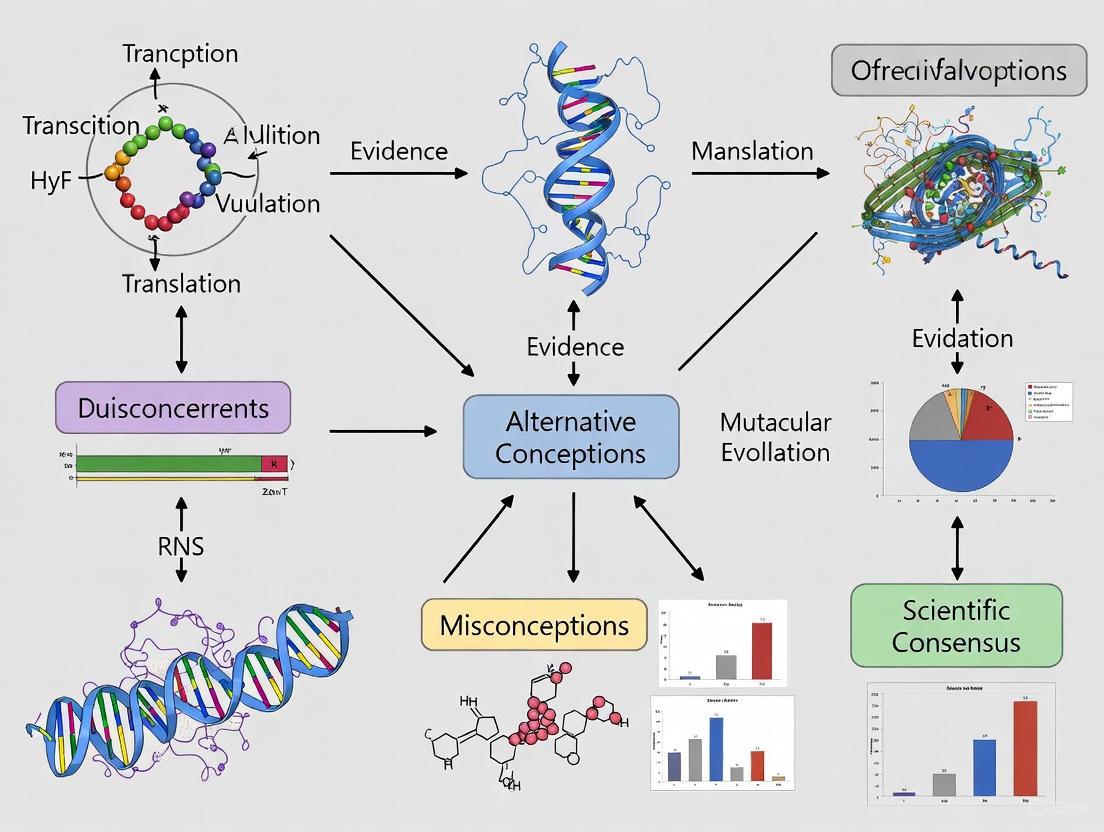
This article provides a comprehensive framework for addressing deeply held alternative conceptions in evolution education, tailored for researchers, scientists, and drug development professionals.
Bridging the Knowledge Gap: Evidence-Based Strategies for Overcoming Alternative Conceptions in Evolution Education for Scientific Professionals
Abstract
This article provides a comprehensive framework for addressing deeply held alternative conceptions in evolution education, tailored for researchers, scientists, and drug development professionals. It explores the most common and persistent misconceptions, including teleological and anthropomorphic reasoning, and synthesizes the latest research on effective intervention strategies. The content moves from foundational theory to practical application, offering methodologies for identifying misconceptions, implementing conceptual change techniques, and validating educational outcomes. By integrating insights from science education research and biomedical contexts, this article aims to enhance scientific literacy and critical thinking, which are fundamental for rigorous research and innovation in the biomedical sciences.
Mapping the Conceptual Landscape: Identifying and Categorizing Common Evolutionary Misconceptions
Technical Support & Troubleshooting Guides
This technical support center provides researchers and scientists with diagnostic frameworks and experimental protocols to address common alternative conceptions in evolution education.
Troubleshooting Guide: Identifying Alternative Conceptions
| Reported Issue | Diagnostic Questions | Root Cause Identification | Recommended Intervention |
|---|---|---|---|
| Teleological Reasoning("Trait exists for a purpose") | • "Are you saying the trait developed in order to achieve that function?"• "What is the evidence that need causes evolutionary change?" | Student conflates evolutionary mechanism (natural selection) with conscious intent or predetermined goals [1]. | Use fruit fly selection experiments to demonstrate trait frequency changes without purposeful direction [2]. |
| Anthropomorphic Conceptions("Organisms 'want' to evolve") | • "What specific mechanism would cause that change?"• "Are you attributing human-like awareness to the organism?" | Student transfers human characteristics like intentionality or mental abilities to biological entities [1]. | Contrast student explanations with scientific norms of objectivity and neutrality through Socratic dialogue [1]. |
| Lamarckian Inheritance("Use-disuse shapes offspring") | • "Can you trace the genetic mechanism for this acquired trait?"• "How would a somatic change become heritable?" | Student holds pre-Darwinian view that individually acquired adaptations can be passed to offspring [2]. | Fast Plants experiments demonstrate environmental adaptation without heritability [2]. |
Experimental Protocol: Variation and Selection
Objective: Test the null hypothesis that selection cannot alter trait frequency in subsequent generations [2].
Materials:
- Wild-type ("flier") and vestigial-winged ("crawler") Drosophila melanogaster populations
- Flynap anesthetic
- Fly medium
- 2-liter plastic bottles
- Construction materials: threads, straws, double-sided tape, flypaper, water moats, petroleum jelly, external light sources
Methodology:
- Divide research teams into two groups: one selecting for wild-type phenotype, the other for vestigial-winged phenotype.
- Introduce equal numbers of male and female flies of both phenotypes into experimental and control chambers.
- Allow experiments to run until flies produce at least first generation offspring.
- Record differential mortality and phenotype distribution across generations.
Expected Outcomes: Selection for wild-type fliers typically increases their frequency, while selection against vestigial-winged crawlers is often less successful, demonstrating that selection pressures vary in effectiveness [2].
Quantitative Data from Student Experiments
Table 1: Variation in Seed Characteristics [2]
| Parameter Measured | Distribution Pattern | Statistical Significance |
|---|---|---|
| Seed Length | Approximates normal distribution | Variation is measurable and distinct |
| Seed Mass | Almost evenly distributed across size classes | Challenges assumption that size correlates directly with mass |
| Color Pattern | Similar to mass distribution | Demonstrates random, non-purposeful variation |
Table 2: Fruit Fly Selection Experimental Data [2]
| Experimental Condition | Starting Population | Ending Population | Key Observation |
|---|---|---|---|
| Control (no selection) | 10 fliers, 10 crawlers | 158 fliers, 38 crawlers | Baseline reproduction without selective pressure |
| Selection for Fliers | 10 fliers, 10 crawlers | 245 fliers, 78 crawlers | Demonstration of successful selection pressure |
| Selection for Crawlers | 10 fliers, 10 crawlers | 81 fliers, 23 crawlers | Challenges of effective selective barriers |
Frequently Asked Questions (FAQs)
What are the most resistant alternative conceptions in evolution education?
Teleological and anthropomorphic conceptions are particularly entrenched. Students routinely explain evolutionary processes by interpreting function as cause or attributing intentionality to natural processes. These conceptions persist because they align with everyday experiences and common sense reasoning [1].
Why do these conceptions persist despite conventional instruction?
Conventional instruction induces only small changes in student beliefs because these qualitative, common-sense beliefs have a large effect on performance. The basic knowledge gain under conventional instruction is essentially independent of the instructor, indicating a need for changed methodology [2].
What teaching strategies effectively address Lamarckian misconceptions?
Using Lamarck's theory as an initial framework allows students to confront its limitations directly. By constructing concept maps of Lamarckian theory and identifying testable hypotheses, students can experimentally falsify elements like inheritance of acquired characteristics [2].
How can instructors distinguish between legitimate and illegitimate teleology?
Illegitimate "design teleology" explains traits as existing for a predetermined purpose, while legitimate "selection teleology" references the evolutionary processes of natural selection without implying intention. Criteria include examining whether explanations reference mechanistic processes versus conscious design [1].
Research Reagent Solutions
Table 3: Essential Materials for Evolution Education Research
| Item | Function in Experiment | Research Application |
|---|---|---|
| Wisconsin Fast Plants (Brassica rapa) | Rapid life cycle allows observation of multiple generations | Studying adaptation without heritability; developmental plasticity [2] |
| Drosophila melanogaster populations | Distinct phenotypes with known genetic basis | Selection experiments demonstrating trait frequency changes [2] |
| Pecan fruits/Sunflower seeds | Natural variation in measurable characteristics | Quantitative analysis of variation in populations [2] |
| Concept Mapping Tools | Visual representation of conceptual relationships | Identifying testable hypotheses and conceptual relationships [2] |
Experimental Workflow Visualization
Conceptual Change Pathway
FAQs: Documenting Misconceptions in Evolution Education
1. What are the most prevalent misconceptions about evolution among non-STEM majors? Research indicates that non-STEM majors often hold significant misconceptions about core evolutionary concepts. A five-year study with Colombian undergraduates revealed a limited understanding of microevolution and demonstrated only a moderate overall grasp of evolutionary theory [3]. Common alternative conceptions include teleological reasoning (the idea that evolution is a goal-directed process, such as believing traits develop because they are "needed") and difficulties understanding that evolution acts on populations, not individuals [3] [4].
2. How do misconceptions differ between STEM and non-STEM populations? Longitudinal data suggests that while differences in understanding exist, they are not always as statistically significant as assumed. One study found that despite apparent differences in scores between STEM and non-STEM majors, these differences were not reliable upon statistical analysis [3]. However, other research confirms that biology majors consistently outperform non-STEM majors on evolution knowledge assessments, though all groups exhibit room for improvement [3].
3. What methodologies are effective for documenting and quantifying these misconceptions? A robust method involves using standardized questionnaires and surveys to collect data over extended periods. One protocol employed an 11-item questionnaire administered over 10 academic semesters (5 years) to track student understanding [3]. For qualitative insights, analyzing open-ended survey responses and student reflections on learning materials (like comics or narratives) can reveal how students conceptualize terms like variation, natural selection, and heredity [4].
4. What is the "therapeutic misconception" in research and how does it relate to this context? The "therapeutic misconception" is a documented phenomenon where research participants conflate the goals of clinical research with personalized clinical care, often overestimating their personal benefit [5] [6]. This represents a broader pattern of misunderstanding complex systems. Similarly, in evolution education, learners often misconstrue the impersonal, population-level process of natural selection as a purposeful, individual-level mechanism, indicating a parallel conceptual challenge in understanding non-intentional, probabilistic systems [4].
5. How can we address sophisticated, resistant misconceptions in educated populations? For sophisticated misconceptions deeply embedded in a learner's conceptual framework, traditional "refutational" approaches that directly contradict the misconception may be less effective. An assimilation-based method is proposed, which leverages a student's existing knowledge as a foundation to build correct understanding, rather than outright rejecting their initial conceptions. This involves using a series of sequenced analogies where the correct understanding from one analogy provides the foundation for addressing the next [7].
Troubleshooting Guide: Research on Evolution Misconceptions
| Problem | Possible Cause | Solution/Suggested Protocol |
|---|---|---|
| Low participant understanding scores across all groups. | Assessment tool may not discriminate between nuanced levels of understanding; concepts not taught effectively. | Protocol: Validate instrument with think-aloud protocols. Use a mixed-methods approach (e.g., combine multiple-choice surveys with open-ended questions) to capture conceptual depth [3] [4]. |
| Resistance to conceptual change after standard instruction. | Misconceptions may be "sophisticated" and integrated into the learner's conceptual ecology, making them resistant to simple correction. | Protocol: Implement an assimilation-based teaching intervention. Develop a series of connected analogies that build on each other to gradually reshape understanding, rather than directly refuting the initial idea [7]. |
| Participants demonstrate teleological reasoning (goal-oriented explanations). | Deep-seated cognitive bias to attribute purpose to natural phenomena; may be reinforced by everyday language. | Protocol: Use narrative-based learning tools (e.g., specially designed comic books) that explicitly model population-level, non-goal-directed evolutionary processes through character stories [4]. |
| No significant difference found between STEM and non-STEM majors. | Sample size may be too small; the assessment tool may not be sensitive enough; STEM majors may also hold key misconceptions. | Protocol: Ensure adequate statistical power in study design. Conduct a cross-sectional analysis of differences across demographic variables (age, gender, major) and perform longitudinal tracking to monitor changes over time [3]. |
| Students conflate terminology (e.g., individual adaptation vs. population evolution). | Informal prior knowledge interfering with formal scientific definitions. | Protocol: Utilize conceptual inventories (e.g., Conceptual Inventory of Natural Selection) to diagnose specific conflation points. Follow with targeted activities that force discrimination between concepts [3] [4]. |
Quantitative Data on Evolution Misconceptions
The table below summarizes key findings from a five-year study of undergraduate misconceptions, highlighting patterns across different groups [3].
| Participant Group | Sample Size | Overall Understanding of Evolution | Specific Conceptual Weakness | Notable Statistical Finding |
|---|---|---|---|---|
| STEM Majors | 547 (Total for study, incl. non-STEM) | Moderate | Limited understanding of microevolution | Differences in scores between STEM and non-STEM majors were not statistically significant. |
| Non-STEM Majors | (Subset of above) | Moderate | Teleological reasoning; individual vs. population change | |
| Biology Undergraduates (German Study) | 136 | Mean Score: 17.9/29 | (Data not specified in source) | Biology students scored higher than non-biology and high school students. |
| Non-Biology Undergraduates (German Study) | 124 | Mean Score: 16.2/29 | (Data not specified in source) | Scored between biology undergraduates and high school students. |
Experimental Protocol: Using Narrative Tools to Document and Address Misconceptions
Aim: To document the presence of common alternative conceptions about evolution and assess the effectiveness of a narrative-based comic book in facilitating conceptual change.
Background: Comics are multimodal texts that combine images and sequential narratives, which can enhance understanding of complex scientific concepts like variation, natural selection, and heredity [4].
Materials:
- Specially designed science comic (e.g., "Cats on the Run – A Dizzying Evolutionary Journey").
- Pre- and post-intervention survey (including multiple-choice and open-ended questions).
- Audio recording equipment for focus group discussions (optional).
Methodology:
- Pre-Assessment: Administer a survey to participants (e.g., Grade 4-6 students or older) to establish a baseline of their understanding of evolution. Include questions designed to reveal teleological reasoning or other common misconceptions [4].
- Intervention: Integrate the comic book into standard biology lessons. The narrative should follow characters encountering evolutionary concepts in a story context.
- Post-Assessment: After the intervention, administer a follow-up survey with questions comparable to the pre-assessment.
- Data Analysis:
- Quantitative: Score the pre- and post-surveys to measure changes in correct answers.
- Qualitative: Thematically analyze open-ended responses. Code for references to the comic's narrative and imagery, and check for persistence of non-scientific explanations (e.g., goal-directed adaptation) versus the use of scientific principles (e.g., random variation and selection) [4].
Research Reagent Solutions
The table below lists essential "reagents" or tools for researching misconceptions in evolution education.
| Research Reagent | Function/Brief Explanation |
|---|---|
| Standardized Conceptual Inventories (e.g., CINS) | Quantitatively diagnose specific, common alternative conceptions about a topic like natural selection in a pre-/post-test design [3]. |
| Demographic Questionnaire | Collects data on variables like age, gender, and major (STEM/non-STEM) to analyze patterns in misconception prevalence [3]. |
| Semi-Structured Interview Protocol | Provides qualitative depth, allowing researchers to explore the reasoning behind a student's survey answers and uncover nuanced misunderstandings [4]. |
| Narrative-Based Learning Tool (e.g., Comic Book) | Serves as an intervention tool; its multimodal and story-driven format can make abstract concepts more accessible and reveal learning pathways through student reflections [4]. |
| Coding Framework for Thematic Analysis | A systematic protocol for analyzing qualitative data (e.g., interview transcripts, open-ended survey responses) to identify and categorize recurring misconceptions [4] [7]. |
Conceptual Change Workflow Diagram
FAQs: Understanding Intuitive Conceptions
What is an "intuitive conception" in science learning? An intuitive conception is a nonscientific idea or cognitive shortcut (a heuristic) that individuals use for fast and spontaneous reasoning about natural phenomena. These conceptions are often useful in everyday life but can be misleading in scientific contexts, interfering with the learning of accurate scientific concepts [8].
Why are some misconceptions so persistent, even after instruction? Intuitive conceptions are persistent because they are often deeply anchored and frequently reinforced in everyday life. Research shows they can coexist with scientifically correct knowledge in an individual's mind. Even after formal instruction, these heuristics are not erased but remain, requiring active suppression in specific contexts [8].
What is the role of "inhibitory control" in overcoming misconceptions? Inhibitory control is the cognitive ability to resist automatisms, distractions, or interference. In scientific reasoning, it allows an individual to suppress a tempting but inaccurate intuitive answer in favor of a less intuitive but scientifically correct one. Neurocognitive studies show that correctly evaluating counterintuitive scientific claims is associated with higher activation in brain regions responsible for this inhibitory control [8].
What are common sources of misconceptions in evolution? Students encounter evolution misconceptions from many sources, including:
- Popular media: A study found that 96% of evolution references in popular media were inaccurate, most commonly depicting evolution as a linear process or suggesting that individuals, rather than populations, evolve [9].
- Textbooks and classrooms: Textbooks may contain inaccurate statements, and teachers may themselves hold or inadvertently pass on misconceptions [9].
- Everyday language and experience: Words like "theory" have different meanings in science versus casual use, and everyday observations can reinforce nonscientific ideas [9].
Troubleshooting Guides: Overcoming Specific Conceptual Challenges
Problem: The "Moving Things Are Alive" Heuristic
User Symptom: A researcher observes that study participants, even after biology education, consistently misclassify moving non-living things (like a rolling ball) as "alive" or are slower to correctly classify non-moving living things (like a plant) in rapid-response tasks.
Underlying Issue: The "moving things are alive" heuristic is a deeply ingrained cognitive shortcut. Electroencephalographic (EEG) evidence shows that overcoming it requires inhibitory control, as indicated by higher N2 and LPP event-related potential components in the brain during counterintuitive trials [8].
Solution Protocol:
- Acknowledge the Heuristic: Explicitly inform participants or students that this intuitive rule exists and is useful in many daily contexts but can be misleading in biological classification.
- Induce Cognitive Conflict: Present counterintuitive examples (e.g., a motionless animal like a coral, or a self-moving robot) to make the individual aware of the conflict between their intuition and scientific reality.
- Strengthen Scientific Criteria: Repeatedly reinforce the defining characteristics of life (e.g., metabolism, reproduction, cellular organization) through activities that require applying these criteria, not just memorizing them.
- Practice Inhibition: Use exercises that require a delayed response, encouraging individuals to pause and inhibit their first, intuitive answer before selecting the scientifically correct one [8].
Problem: The "Linear & Progressive" View of Evolution
User Symptom: Research subjects or students describe evolution as a straight line from "primitive" to "advanced" organisms, often culminating in humans. They may use imagery like the "March of Progress" illustration.
Underlying Issue: This misconception is heavily reinforced by popular media and even some educational materials. It fundamentally misunderstands the branching, tree-like nature of common descent [9].
Solution Protocol:
- Identify and Deconstruct Inaccurate Media: Actively show students common media portrayals (e.g., from movies, video games, or memes) and analyze their inaccuracies. This makes the misconception explicit and engage critical thinking [9].
- Emphasize Branching Descent: Use concept mapping exercises to have students build evolutionary trees based on shared derived characteristics, visually reinforcing the branching model over the linear one [2].
- Focus on Populations and Natural Selection: Design experiments that demonstrate change in populations over time. The fruit fly selection experiment (see Experimental Protocols below) is an excellent method for this [2].
Experimental Protocols & Data
Protocol 1: Investigating Variation Within a Species
This simple protocol helps counter the intuitive idea that members of a species are largely identical.
Methodology:
- Materials: Provide a large sample of seeds from a single plant species (e.g., sunflower or pecan) and standard measuring tools (rulers, calipers, balances).
- Hypothesis: Challenge research teams to test the null hypothesis that "there is no significant variation in observable features" within the sample [2].
- Data Collection: Teams choose specific parameters (e.g., length, mass, width) and measure a large number of individuals, recording their data.
- Analysis: Students graph their data (e.g., by creating frequency distributions of size classes) to visualize the inherent variation. This provides tangible, quantitative evidence that variation is the raw material upon which selection acts [2].
Typical Quantitative Data: The table below summarizes typical student-collected data for two different traits, showing distinct patterns of variation [2].
| Trait Measured | Size Class 1 | Size Class 2 | Size Class 3 | Size Class 4 | Size Class 5 |
|---|---|---|---|---|---|
| Seed Length (mm) | 5% | 20% | 50% | 20% | 5% |
| Seed Mass (g) | 20% | 20% | 20% | 20% | 20% |
Protocol 2: Experimental Selection in Fruit Flies
This protocol directly demonstrates natural selection by showing that trait frequencies in a population can be altered by environmental pressures.
Methodology:
- Materials: Populations of Drosophila melanogaster with two distinct wing phenotypes: wild-type ("fliers") and vestigial-winged ("crawlers"). Also required are culture bottles, fly nap (anesthetic), and fly medium. Teams may provide additional materials like straws, tape, or flypaper to create selection environments [2].
- Experimental Design: Research teams design chambers that apply a selective pressure. For example:
- Selecting for Fliers: Create an environment where food is accessible only by flying (e.g., suspended containers).
- Selecting for Crawlers: Create an environment with obstacles that hinder flying but allow crawling.
- Procedure: Introduce equal numbers of male and female flies of both phenotypes into the chamber. Allow the flies to reproduce for at least one generation.
- Data Collection: Count the number of fliers and crawlers at the start and after one or more generations [2].
Typical Quantitative Data: The table below shows sample data from student experiments, illustrating successful selection for the flier phenotype and the challenges of selecting for the crawler phenotype [2].
| Experimental Group | Starting Population (Fliers/Crawlers) | Ending Population (Fliers/Crawlers) | Key Observation |
|---|---|---|---|
| Control (No selection) | 10 / 10 | 158 / 38 | Both phenotypes increased. |
| Selection FOR Fliers | 10 / 10 | 245 / 78 | Fliers significantly outproduced crawlers. |
| Selection FOR Crawlers | 10 / 10 | 81 / 23 | Selection was less effective; fliers still outproduced crawlers. |
Diagram 1: Fruit fly selection experimental workflow.
The Scientist's Toolkit: Key Research Reagents & Materials
The following table details essential materials for core experiments in evolution education research, based on the cited protocols.
| Item | Function in Experiment |
|---|---|
| Wisconsin Fast Plants (Brassica rapa) | Rapid-cycling plant ideal for studying multiple generations and investigating concepts like adaptation and heritability in a single semester [2]. |
| Fruit Flies (Drosophila melanogaster) | Model organism with short generation time and readily observable phenotypic variants (e.g., wing type); used to demonstrate natural selection in real-time [2]. |
| Pecan or Sunflower Seeds | Simple, measurable units to demonstrate the fundamental concept of variation within a population. Provides quantitative data to falsify the idea of "perfect" uniformity [2]. |
| Concept Mapping Software | A tool to help students and researchers visually organize their understanding of concepts and their relationships. Useful for identifying and correcting flawed mental models [2]. |
| EEG/ERP Equipment | Neuroimaging technology used to study the brain's activity during reasoning tasks. It can provide physiological evidence of the cognitive effort (e.g., inhibitory control) required to overcome intuitive misconceptions [8]. |
Diagram 2: Cognitive conflict and inhibition process.
The Critical Link Between Understanding the Nature of Science and Evolution Acceptance
FAQs: Nature of Science and Evolution Acceptance
Q1: What is the documented relationship between understanding the Nature of Science (NOS) and accepting evolution?
Research demonstrates a significant positive correlation between understanding the Nature of Science and accepting evolutionary theory. One study with university undergraduates found that accepting evolution was significantly correlated with understanding NOS, even when controlling for general interest in science and past science education [10]. Other studies confirm that NOS understanding is one of the most significant predictors of evolution acceptance, alongside factors like religiosity [11].
Q2: Why is understanding that scientific knowledge is "tentative" important for accepting evolution?
A sophisticated understanding of NOS includes recognizing that scientific theories are both reliable and provisional (subject to revision with new evidence) [10]. This counters the common misconception that evolution is "just a theory" in the colloquial sense, highlighting it as the robust, well-supported, yet continually refined explanatory framework that it is in science.
Q3: What are common student alternative conceptions in evolution that act as learning barriers?
Students often hold robust, intuitive conceptions that conflict with scientific understanding. Two prevalent categories are:
- Teleological Conceptions: Explaining evolutionary processes by the purpose or function of a trait (e.g., "giraffes got long necks to reach high leaves") [1].
- Anthropomorphic Conceptions: Attributing human characteristics, like intentionality, to nature (e.g., "organisms want to adapt") [1].
Q4: What teaching strategies are effective for inhibiting these alternative conceptions?
Effective strategies move beyond simple knowledge transmission to actively engage and restructure student thinking.
- Context-Based Learning: Focusing on the learning context can help activate inhibitory control mechanisms in the brain, allowing students to suppress pre-existing alternative conceptions and assimilate new scientific ideas [12].
- Explicit, Reflective NOS Instruction: Purposefully integrating NOS tenets into the curriculum and encouraging students to reflect on them has been shown to improve NOS understanding and can impact evolution acceptance [11].
- Addressing Conceptions Directly: Teachers should develop the "professional vision" to notice student thinking and use approaches like conceptual change or conceptual reconstruction to address these ideas directly in class [1].
Troubleshooting Guides
Problem: Student Apathy or Resistance to Evolution
Potential Cause: Students may perceive a conflict between evolution and their personal, religious, or cultural beliefs, leading to disengagement [13].
Solutions:
- Foster Discourse: Explicitly discuss the relationship between science and faith. Studies show such discourse can increase undergraduate acceptance of evolution [13].
- Build NOS Foundation: Before delving deeply into evolutionary mechanisms, dedicate time to teaching the tenets of NOS. This provides a framework for understanding the scientific status of evolutionary theory [10] [11].
- Create a Safe Environment: Acknowledge the potential for conflict and establish classroom norms for respectful discussion to reduce student anxiety about the topic [13].
Problem: Persistence of Alternative Conceptions After Instruction
Potential Cause: Alternative conceptions are often deeply ingrained and automated, making them resistant to change through traditional instruction alone [12] [1].
Solutions:
- Employ Active Learning: Use simulations (e.g., Avida-ED) or inquiry-based activities that allow students to collect data and test hypotheses about natural selection [14].
- Target Inhibitory Control: Design learning scenarios that present a cognitive conflict for the student, forcing them to consciously inhibit an alternative conception in favor of a more scientifically accurate one [12].
- Use Formative Assessment: Regularly use research-based instruments (e.g., Conceptual Inventory of Natural Selection) to diagnose student thinking throughout the course, not just at the end [14] [1].
Experimental Protocols & Data
Protocol: Explicit, Reflective NOS Instruction in an Evolution Unit
This methodology is adapted from studies on effective NOS integration in undergraduate biology [11].
- Pre-Assessment: Administer validated instruments to gauge students' preliminary understanding of key NOS tenets and their acceptance of evolution.
- Minimally Contextualized NOS Activity: Begin with an activity not directly about evolution (e.g., interpreting dinosaur footprints) to illustrate a NOS tenet like "observation vs. inference."
- Explicit Discussion: After the activity, lead a reflective discussion to explicitly identify and define the NOS tenet that was demonstrated.
- Highly Contextualized Application: Immediately apply the same NOS tenet to an evolution topic. For example, when discussing the fossil record, explicitly link back to how scientists make inferences about common ancestry from observations.
- Repeat: Cycle through this process for other relevant NOS tenets (e.g., tentativeness, role of creativity, social embeddedness of science).
- Post-Assessment: Re-administer the instruments to measure shifts in understanding and acceptance.
Quantitative Data on Influencing Factors
Table 1: Factors Correlating with Evolution Acceptance in Higher Education Studies
| Factor | Correlation/Influence | Study Context |
|---|---|---|
| NOS Understanding | Significant positive correlation and a key predictor [10] [11] | University undergraduates [10] |
| Religiosity | Strong negative correlation; one of the strongest indicators of rejection [13] [11] | Various studies on evolution acceptance [11] |
| Evolution Content Knowledge | Positive correlation, though not always sufficient for acceptance [10] [11] | Pre-service science teachers [11] |
Table 2: Impact of Targeted NOS Instruction
| Student Group | Observed Impact | Source |
|---|---|---|
| All Students | Improvement in evolution acceptance in treatment group vs. no improvement in control group [11] | Study of high school biology students [11] |
| Women | Disproportionately large positive impact on evolution acceptance from NOS instruction [11] | Study in introductory biology course [11] |
| Individuals with High Prior Acceptance | Disproportionately large positive impact on evolution acceptance from NOS instruction [11] | Study in introductory biology course [11] |
Research Workflow: From Diagnosis to Resolution
The following diagram outlines the systematic approach to diagnosing and addressing the barrier of alternative conceptions in evolution education, grounded in the principles of NOS.
Table 3: Essential Materials for Evolution Education Research & Instruction
| Tool / Resource | Function / Purpose | Example(s) |
|---|---|---|
| Conceptual Assessments | Diagnose student alternative conceptions and measure learning gains. | Conceptual Inventory of Natural Selection (CINS), Conceptual Assessment of Natural Selection (CANS) [14] |
| NOS Assessment Instruments | Quantify student understanding of the tenets of the Nature of Science. | Student Understanding of Science and Scientific Inquiry (SUSSI) [10] |
| Avida-ED Digital Platform | A software platform that allows students to observe and experiment with digital evolution, providing evidence for evolution by natural selection [14]. | Avida-ED [14] |
| Active Learning Curricula | Pre-designed, research-based activities to engage students in the process of science and evolution. | Inquiry-based curricula on natural selection and genetic drift [14] |
Exploring the Role of Religiosity, Epistemological Sophistication, and Demographic Factors
FAQs: Addressing Researcher Challenges in Evolution Education Studies
FAQ 1: What is the distinction between evolution acceptance and evolution understanding, and why is it critical for my research?
Evolution acceptance and evolution understanding are related but distinct constructs. Evolution understanding refers to the extent to which a person has accurate knowledge of evolutionary theory and can correctly answer questions testing their comprehension of its mechanisms [15]. Evolution acceptance, however, is based on a personal evaluation of evolutionary theory as scientifically valid [15]. It is possible for a research subject to have a high level of understanding yet still reject evolution, often due to factors like religiosity or perceived conflict between their religious beliefs and science [15]. Confounding these two constructs can lead to flawed study design and data interpretation.
FAQ 2: How does student religiosity specifically impact the relationship between understanding and acceptance of evolution?
The relationship between understanding and acceptance is not uniform across all student populations; it is significantly impacted by a student's level of religiosity. While a positive correlation between understanding and acceptance is common, this relationship weakens as student religiosity increases [15]. For highly religious students, their understanding of evolution is a less powerful predictor of their acceptance of it, particularly for concepts like macroevolution, human evolution, and the common ancestry of life [15]. In some cases, among highly religious students, understanding of evolution shows no relationship with acceptance of common ancestry [15].
FAQ 3: What is the strongest predictor of evolution acceptance identified by recent research?
Quantitative research has found that a student's perceived conflict between their religion and evolution is a stronger predictor of their evolution acceptance than religiosity, religious affiliation, understanding of evolution, or demographics [16]. Adding this measure of perceived conflict to predictive models more than doubles the model's capacity to predict evolution acceptance levels. This perceived conflict also mediates the impact of religiosity, meaning that religiosity often influences acceptance through the perceived conflict it creates [16].
FAQ 4: What are some effective experimental strategies for helping students overcome alternative conceptions like Lamarckian views?
A successful strategy is to use hands-on, hypothesis-testing experiments that make conceptual issues tangible. One approach is:
- Identify a Starting Point: Introduce a historical text, like from Lamarck, as many students intuitively hold similar views [2].
- Formulate a Null Hypothesis: Based on the text (e.g., "species tend to be perfectly adapted"), have student research teams design experiments to test it [2].
- Collect and Analyze Data: Provide materials like sunflower seeds or pecans and have students measure variation in traits like mass, length, or volume. The data consistently shows significant variation, contradicting the idea of perfect uniformity and introducing the raw material for natural selection [2]. These short-duration, simple-manipulation tasks are effective at challenging ingrained misconceptions [2].
Troubleshooting Guides for Common Experimental Issues
Issue: Low evolution acceptance scores despite high understanding scores in your study cohort.
- Potential Cause: The cohort may contain a high proportion of religious students for whom understanding does not readily translate to acceptance [15].
- Solution:
- Disaggregate Your Data: Analyze the relationship between understanding and acceptance separately for students of different religiosity levels.
- Measure Perceived Conflict: Administer an instrument like the "Perceived Conflict between Evolution and Religion" (PCoRE) to gain a more precise predictor of acceptance [16].
- Refine Your Intervention: Consider implementing teaching strategies that directly address and reduce perceived conflict between religion and evolution [16].
Issue: Students revert to teleological or anthropomorphic reasoning (e.g., "the organism needed to change") after instruction.
- Potential Cause: These alternative conceptions are deeply rooted in everyday reasoning and are not fully addressed by traditional instruction [1].
- Solution:
- Make the Conception Explicit: Use concept mapping to help students visually identify the relationships in their own reasoning [2].
- Design Targeted Experiments: Use experiments, like the fruit fly selection exercise, that demonstrate natural selection as a process acting on random, existing variation, not in response to need [2].
- Promote Metacognition: Explicitly teach students to distinguish between legitimate "selection teleology" (the function is a result of a past selective advantage) and illegitimate "design teleology" (the function is the cause of its development) [1].
The following tables summarize key quantitative relationships from the research literature.
Table 1: Impact of Religiosity on the Understanding-Acceptance Relationship for Different Evolutionary Concepts
| Evolutionary Concept | Relationship between Understanding and Acceptance for Highly Religious Students |
|---|---|
| Microevolution | Understanding is a positive predictor of acceptance [15]. |
| Macroevolution | Interaction between religiosity and understanding is a significant predictor; relationship is weaker than for less religious students [15]. |
| Human Evolution | Interaction between religiosity and understanding is a significant predictor; relationship is weaker than for less religious students [15]. |
| Common Ancestry of Life | Among highly religious students, understanding of evolution is not related to acceptance [15]. |
Table 2: Predictors of Evolution Acceptance in College Biology Students
| Predictor Variable | Impact on Evolution Acceptance | Notes |
|---|---|---|
| Perceived Religion-Evolution Conflict | Strongest negative predictor [16] | Mediates the effect of religiosity. More than doubles model predictive power. |
| Religiosity | Strong negative predictor [15] | Effect is largely explained by perceived conflict [16]. |
| Understanding of Evolution | Generally a positive predictor [15] | Relationship is weaker or non-existent for highly religious students and for concepts like common ancestry [15]. |
| Religious Affiliation | Varies by affiliation [16] | Students from conservative Christian and Muslim traditions often show lower acceptance. |
Experimental Protocols
Protocol 1: Investigating Variation as a Foundation for Natural Selection
- Objective: To test the null hypothesis that individuals within a species show no significant variation in observable traits, thereby challenging naive conceptions of perfect adaptation [2].
- Materials: Tin of pecan fruits or sunflower seeds; metric rulers; vernier calipers; balances; graduated cylinders [2].
- Methodology:
- Divide participants into research teams.
- Challenge each team to design and submit a research plan to measure variation in a specific parameter (e.g., seed length, width, mass, volume, color pattern).
- Once approved, teams collect data from their sample population.
- Teams graph and interpret their data, calculating descriptive statistics.
- Expected Outcome: Student data will consistently show measurable and distinct variation, often approximating a normal distribution for some traits (e.g., length) and more complex distributions for others (e.g., mass), falsifying the initial null hypothesis [2].
Protocol 2: Demonstrating Selection on Existing Variation
- Objective: To test the null hypothesis that the frequency of a specific trait in a population cannot be altered in subsequent generations by a selective pressure [2].
- Materials: Populations of wild-type ("flier") and vestigial-winged ("crawler") Drosophila melanogaster; Flynap anesthetic; fly medium; 2-liter plastic bottles; assorted materials for trap design (straws, thread, flypaper, petroleum jelly, etc.) [2].
- Methodology:
- Divide teams into two groups. One group designs experiments to select for the wild-type phenotype, the other to select for the vestigial-winged phenotype.
- Teams introduce equal numbers of both fly phenotypes into their experimental chambers.
- Teams apply their selective pressure (e.g., traps or obstacles that disadvantage one phenotype).
- Experiments run for at least one fly generation, with teams monitoring and recording mortality and reproduction.
- Expected Outcome: Teams selecting for wild-type fliers will typically show a significant increase in the frequency of that phenotype, demonstrating that selection can alter trait frequency. Teams selecting for crawlers are often less successful, providing a lead-in to discussions about genetics and the strength of selective pressure [2].
Research Reagent Solutions
Table 3: Essential Materials for Evolution Education Research on Alternative Conceptions
| Item | Function in Research | Example Use-Case |
|---|---|---|
| Wisconsin Fast Plants (Brassica rapa) | Rapid-generation model organism for studying plant adaptation and heritability. | Testing hypotheses on the heritability of acquired traits under different environmental perturbations [2]. |
| Fruit Flies (Drosophila melanogaster, wild-type and vestigial-winged) | Classic model organism for demonstrating selection on Mendelian traits. | Experimental studies on how selective pressures alter phenotype frequency in subsequent generations [2]. |
| Concept Mapping Tools | Visual tool for identifying and representing knowledge structures. | Eliciting student's pre-instruction alternative conceptions and framing testable hypotheses about conceptual relationships [2]. |
| PCoRE Instrument | Quantitative tool measuring "Perceived Conflict between Evolution and Religion." | Isolating the impact of perceived conflict from general religiosity in predicting evolution acceptance [16]. |
| Validated Evolution Acceptance & Understanding Instruments | Reliable and validated scales for measuring the distinct constructs of acceptance and knowledge. | Accurately gauging the effectiveness of educational interventions on both cognitive and affective domains [15]. |
Experimental Workflow and Conceptual Diagrams
Conceptual Change Model in Evolution Education
Factors Influencing Evolution Acceptance
From Theory to Practice: Implementing Effective Pedagogical Interventions and Conceptual Change Strategies
Leveraging Pedagogical Content Knowledge (PCK) for Evolution Instruction
Pedagogical Content Knowledge (PCK) is the specialized knowledge educators use to transform subject matter into comprehensible forms for learners. In evolution education, PCK integrates content knowledge of evolutionary biology with knowledge of student thinking, instructional strategies, and assessment methods [14] [17]. The Refined Consensus Model conceptualizes PCK as existing in three interconnected forms:
- Collective PCK (cPCK): The shared knowledge and best practices for teaching evolution held by the profession [18].
- Personal PCK (pPCK): An individual educator's personal library of knowledge and skills about teaching evolution [18].
- Enacted PCK (ePCK): The in-the-moment instructional decisions made when teaching specific evolutionary concepts to specific learners [18].
Diagnostic Tools & Core Concepts
Key Components of PCK for Evolution
Effective evolution instruction requires integrating several core components of PCK, as outlined in Table 1 [14].
Table 1: Core Components of Pedagogical Content Knowledge for Evolution Instruction
| PCK Component | Description | Application to Evolution Education |
|---|---|---|
| Knowledge of Student Thinking | Awareness of common difficulties, misconceptions, and how student ideas change with instruction. | Anticipating teleological and anthropomorphic reasoning; understanding students' struggles with "deep time" and random mutation [14] [1]. |
| Knowledge of Instructional Strategies | Topic-specific approaches, activities, and representations to help students construct accurate ideas. | Using simulations (e.g., Avida-ED), examples of selective breeding, and the "tree of life" to illustrate common ancestry [14] [19]. |
| Knowledge of Assessment | Methods to gauge student understanding of specific evolutionary concepts and interpret results. | Using research-based instruments like the Conceptual Inventory of Natural Selection (CINS) or analyzing constructed responses [14]. |
| Knowledge of Curriculum & Goals | Understanding learning goals and how concepts are sequenced for a graduating biology major. | Following frameworks like the BioCore Guide to ensure coverage of key concepts (e.g., genetic drift, speciation, phylogenetics) [14]. |
Prevalent Alternative Conceptions in Evolution
Diagnosing student thinking is a primary PCK skill. Table 2 summarizes common alternative conceptions that act as learning barriers [1].
Table 2: Common Student Alternative Conceptions in Evolution and Their Scientific Corrections
| Alternative Conception (FAQ) | Scientific Explanation | Diagnostic Cues |
|---|---|---|
| Anthropomorphic Thinking: "Species want or try to adapt." | Evolutionary change results from random genetic variation and non-random natural selection; no intentionality is involved [1]. | Student uses words like "want," "need," "try," or "in order to" in explanations of trait origins. |
| Teleological Thinking: "Traits arise for a purpose or because they are needed." | Traits are selected for if they provide a current functional advantage; they do not arise in anticipation of future needs [1]. | Student explains the cause of a trait by referring to its function (e.g., "Giraffes got long necks to reach high leaves.") |
| Lamarckian Inheritance: "Characteristics acquired during an organism's life can be passed to offspring." | Only genetic variations can be inherited; physical changes during an organism's lifetime do not alter its genes [14]. | Student suggests that muscle built by an animal will be passed to its young. |
| Linear Progression: "Humans evolved from modern apes." | Humans and modern apes share a common ancestor; evolution is a branching process, not a linear ladder [19]. | Student asks, "If we evolved from apes, why are there still apes?" |
| "Need"-Based Variation: "Environmental challenges cause the beneficial mutations that are needed." | Mutations are random with respect to an organism's needs; the environment only selects for pre-existing variations [14]. | Student states that the environment "caused" a specific, beneficial mutation to occur. |
PCK Refined Consensus Model Flow
Troubleshooting Guides & Experimental Protocols
Protocol 1: Addressing Teleological and Anthropomorphic Conceptions
Objective: To replace students' teleological/anthropomorphic language with mechanistic explanations based on variation and selection [1].
Methodology:
- Elicit Preconceptions: Present a phenomenon (e.g., antibiotic resistance in bacteria) and ask students to explain in writing "how it happened."
- Diagnose Language: Analyze responses for key phrases indicating intentionality (e.g., "the bacteria evolved resistance in order to survive").
- Implement Active Learning:
- Use a think-pair-share activity where students discuss the diagnostic question: "Did the antibiotic cause the resistance mutation, or did it select for bacteria that already had it?" [18].
- Facilitate a structured whole-class discussion contrasting student explanations. Explicitly model the scientific narrative, emphasizing random mutation and selective pressure.
- Assess Conceptual Shift: Pose a new, analogous scenario (e.g., pesticide resistance in insects) and have students write a revised explanation. Use a rubric to score for the presence of mechanistic versus intentional language.
Protocol 2: Building an Accurate Understanding of Common Ancestry
Objective: To correct the linear progression misconception and establish evolution as a branching process [19].
Methodology:
- Introduce the "Tree of Life": Early in instruction, use Darwin's original sketch of a tree to introduce the metaphor of branching common ancestry.
- Map Evolutionary Traits: Provide students with a simple, data-rich activity (e.g., using morphological traits from different mammal species).
- Construct a Phylogeny: Guide students in grouping species based on shared derived characteristics to build a cladogram.
- Interpret the Diagram: Facilitate a discussion focusing on key questions: "Which two species share the most recent common ancestor?" and "Where would the common ancestor of all these species be located on the diagram?" This directly counters the "ladder of progress" idea.
Protocol 3: Conceptualizing "Deep Time"
Objective: To make geological time scales tangible and address misconceptions about the rate of evolutionary change [19].
Methodology:
- Create a Physical Timeline: Use a long hallway or outdoor space. Scale time to distance (e.g., 1 meter = 10 million years).
- Place Key Events: Have student teams place labeled markers for major evolutionary events (e.g., origin of life, first eukaryotes, Cambrian explosion, dinosaur extinction, first humans) along the timeline.
- Facilitate Reflection: Lead a discussion focusing on the disproportionate span of human history versus all of evolutionary history. Highlight that complex life required vast amounts of time to evolve.
Diagnostic and Intervention Workflow
The Scientist's Toolkit: Research Reagent Solutions
This toolkit comprises essential conceptual "reagents" and instruments for diagnosing and addressing learning issues in evolution education.
Table 3: Essential Toolkit for Evolution Education Research and Practice
| Tool / Reagent | Function | Explanation |
|---|---|---|
| Conceptual Inventory of Natural Selection (CINS) | Diagnostic Assessment | A validated, forced-response instrument to identify the presence and prevalence of specific alternative conceptions about natural selection [14]. |
| Avida-ED Digital Evolution Platform | Instructional Simulation | A software platform that allows students to observe evolution in action by designing experiments with self-replicating digital organisms, making abstract concepts like mutation and selection tangible [14]. |
| Assessing Contextual Reasoning about Natural Selection (ACORNS) | Constructed-Response Assessment | An open-ended instrument and associated online scoring portal that analyzes students' written explanations to reveal nuanced reasoning patterns [14]. |
| Curriculum "Road Map" | Sequencing Guide | A strategic plan for introducing interconnected evolutionary ideas (e.g., variation, deep time, fossils) to ensure continuity and progression from primary to secondary education [19]. |
| Video Clubs & Lesson Debriefings | Professional Development | A structured approach where educators collaboratively analyze lesson videos to refine their professional vision—their ability to notice and interpret student thinking [1]. |
| Content Representation (CoRe) Instrument | PCK Evaluation | A tool for evaluating an educator's Pedagogical Content Knowledge by having them reflect on key concepts, learning difficulties, and teaching strategies for a specific topic [17]. |
Designing Targeted Lesson Plans to Confront Specific Misconceptions
Frequently Asked Questions (FAQs)
FAQ 1: What are "alternative conceptions" and how do they differ from simple factual errors? Alternative conceptions are not mere factual errors; they are often coherent, logical, and self-consistent ways of thinking about a phenomenon that are inconsistent with canonical scientific concepts [20]. They can be deeply held and form part of a connected conceptual framework, making them resistant to change. For example, the idea that evolution is goal-oriented is a well-structured alternative conception, not just a missed fact [21].
FAQ 2: Why are some misconceptions about evolution so resistant to change? Resistance stems from multiple factors:
- Cognitive Factors: Intuitive reasoning patterns like essentialism (the belief that species have immutable essences) and teleology (the perception of purpose in nature) are developmentally persistent [21].
- Affective & Existential Factors: Evolution can trigger unconscious existential anxieties related to death, identity, and meaninglessness, making it a sensitive topic for some learners, irrespective of their religious beliefs [21].
- Framework Understanding: Some misconceptions are not isolated ideas but are linked into an alternative conceptual framework (e.g., the "octet framework" in chemistry), which must be addressed as a whole [20] [22].
FAQ 3: Isn't correcting the statement "evolution is just a theory" simply a matter of defining terminology? While clarifying the scientific meaning of "theory" is crucial, effective instruction must go further. This misconception often conflates the colloquial and scientific uses of the word. A targeted lesson would not only define "scientific theory" as a well-substantiated explanation of natural phenomena but also actively contrast it with the everyday meaning of "hunch," using other accepted theories (e.g., germ theory, atomic theory) as examples to reinforce the concept [23] [24] [25].
FAQ 4: How can we address the misconception that "humans evolved from monkeys"? This misconception arises from a linear rather than a branching view of evolution. A targeted lesson should use the analogy of a family tree to illustrate that humans and modern monkeys share a common ancestor and are evolutionary cousins, not direct descendants [23]. Using cladograms and fossil evidence of hominids can help students visualize these branching relationships and understand that the common ancestor was a different, now-extinct species [26].
FAQ 5: What is a key pitfall in teaching about natural selection? A common pitfall is using language that implies purpose or design, such as "the species developed this trait to..." or "this trait was designed for..." [25]. Instead, instruction should use precise language focused on function and random variation: "Individuals with this random variation were more likely to survive and reproduce, leading to the spread of the trait in the population." This directly counters teleological thinking [21] [25].
Troubleshooting Guide: Diagnosing and Addressing Misconceptions
Problem 1: Students insist evolution is a random process.
- Diagnosis: This arises from conflating the source of variation (random mutations) with the mechanism of selection (non-random).
- Solution:
- Create a Conceptual Conflict: Present a scenario where a random mutation (e.g., a fur color change) occurs in two different environments (e.g., a snowy tundra vs. a dark forest). Ask students to predict the outcome.
- Guide Inquiry: Facilitate a discussion on why the same random mutation has different outcomes based on the environment, highlighting that the environment "selects" for advantageous traits non-randomly [24] [25].
- Use an Analogy: The "random cards, non-random game" analogy can be effective. Mutations are like being dealt a random hand of cards, but natural selection is like the rules of the poker game that determine which hands are winners [27].
Problem 2: Students believe individuals can evolve within their lifetime.
- Diagnosis: This reflects a confusion between ontogeny (individual development) and phylogeny (evolutionary history), often reinforced by casual language like "the species adapted."
- Solution:
- Metacognitive Approach: Explicitly state the misconception and contrast it with the scientific concept. Use a clear comparison table (see below).
- Focus on Populations: Consistently use population-level language. Instead of "the moth adapted to the sooty trees," say "the proportion of dark-colored moths in the population increased over generations" [23] [25].
Data Presentation: Characteristics of Alternative Conceptions
The table below summarizes key dimensions of alternative conceptions, which can help in diagnosing their nature and planning interventions [20].
| Dimension | Description | Example in Evolution |
|---|---|---|
| Canonicity | The extent to which the conception matches the canonical account. | High canonicity: Understanding natural selection. Low canonicity: Believing in inheritance of acquired characteristics [27]. |
| Acceptance | How strongly the individual is committed to the idea. | A student may weakly believe evolution is random, or be deeply committed to a creationist view [20] [21]. |
| Connectedness | The extent to which the conception is linked to others in a framework. | The "ladder of progress" misconception is often connected to misunderstandings of phylogeny and "primitive" vs. "advanced" species [26] [25]. |
| Multiplicity | Whether the individual has one or several alternative ways of thinking about the topic. | A student might simultaneously use teleological reasoning for one trait and understand natural selection for another. |
| Explicitness | Whether the conception is open to conscious reflection or is an unconscious intuition. | Intuitive essentialism and teleology are often implicit, while "evolution is just a theory" may be an explicitly held view [21]. |
Experimental Protocol: A Lesson to Counter "Survival of the Fittest"
Objective: To replace the simplistic "survival of the strongest" misconception with an understanding of evolutionary fitness as differential reproductive success.
Methodology:
- Engage with a Phenomena: Present the case of the European red deer, where smaller males with smaller antlers ("sneaky fuckers") can achieve high reproductive success by avoiding conflict with larger males [27].
- Elicit Predictions: Ask students: "Based on 'survival of the fittest,' which male deer is the most fit?" Most will initially choose the largest, strongest male.
- Introduce Data & Conflict: Provide data on the copulation success of the different male strategies. This creates cognitive conflict with their initial prediction.
- Facilitate Conceptual Restructuring: Guide students to redefine "fitness" not as physical strength, but as reproductive success. Discuss the various strategies (strength, cunning, camouflage, cooperation) that can lead to high fitness in different contexts [27] [25].
- Apply and Assess: Have students apply the new definition to other case studies, such as the evolution of flightless birds in safe environments or the relationship between peacock tail size and mate attraction.
Research Reagent Solutions: Essential Conceptual Tools
This table lists key conceptual "reagents" necessary for building robust understanding and deconstructing misconceptions.
| Conceptual Tool | Function | Example Application |
|---|---|---|
| Population Thinking | Shifts focus from the individual to the group as the entity that evolves. | Counters the "individuals evolve" misconception. Essential for understanding mechanisms like genetic drift and natural selection [23]. |
| Tree Thinking | Interprets evolutionary relationships through branching phylogenies, not linear ladders. | Directly counters "humans evolved from monkeys" and "evolution is progressive" misconceptions [26] [23]. |
| Non-Teleological Language | Uses "function" and "adaptation" instead of "purpose" and "design." | Prevents reinforcement of intentionality in evolution. Fosters a mechanistic understanding of natural selection [25]. |
| Historical Contingency | The concept that evolutionary pathways are constrained by past events and chance. | Counters the idea that evolution is predictable or optimally designed, highlighting the role of random mutation and past history [27]. |
Lesson Design Workflow Visualization
The diagram below outlines a systematic workflow for designing a targeted lesson plan to overcome a specific alternative conception.
Troubleshooting Guides and FAQs
Technical Support Center
Frequently Asked Questions
What is active learning in the context of drug discovery and how can it address my research challenges? Active Learning (AL) is an iterative feedback process that efficiently identifies valuable data within vast chemical spaces, even with limited labeled starting data [28]. It is a promising strategy to tackle key challenges in drug discovery, such as the ever-expanding exploration space and the high cost of experiments [29] [28]. For example, in synergistic drug combination screening, AL has been shown to discover 60% of synergistic drug pairs by exploring only 10% of the combinatorial space, offering an 82% saving in experimental time and materials [29].
I'm new to active learning. How can I ensure my experimental setup is correct? Begin by clearly defining the core components of your AL framework [29]:
- Available Data: Start with your initial labeled dataset.
- AI Algorithm: Select a model for evaluating new samples. Molecular encoding has a limited impact, but incorporating cellular environment features (e.g., gene expression profiles) significantly enhances prediction performance [29].
- Selection Criteria: Define how the algorithm will prioritize which experiments to run next, balancing exploration and exploitation [29]. A checklist for project setup can ensure you don't miss critical steps [30].
I tried an active learning approach, but the model performance is poor or unstable. What should I check? This is a common implementation challenge. Focus on these key areas:
- Batch Size: The batch size used in sequential testing rounds is critical. A smaller batch size, where the exploration-exploitation strategy is dynamically tuned, can lead to a higher synergy yield ratio [29].
- Algorithm Data Efficiency: In a low-data regime, some AI algorithms perform better than others. Benchmark different models (e.g., from parameter-light logistic regression to parameter-heavy deep learning models) for data efficiency on your specific dataset [29].
- Cellular Context: Ensure your model incorporates features describing the targeted cellular environment, such as genetic expression profiles, as this has been shown to significantly improve prediction quality [29].
How can I validate the results and performance of my Active Learning project? It is crucial to perform project validation after your model stabilizes [30]. This typically involves:
- Running a Project Validation process that checks the elusion rate and can also measure recall and precision [30].
- Setting up a test, such as an Elusion Test queue, where reviewers code a randomly sampled set of documents. The system then provides a summary of validation statistics for your analysis [30].
The active learning process seems to slow down my initial research pace. How can I justify this? While the initial cycles may feel slower, AL is designed for long-term efficiency. The goal is not just to find one positive result but to build a robust model that efficiently guides you toward the most valuable experiments. The significant reduction in the total number of experiments needed to map a complex space—such as finding hundreds of synergistic drug pairs with a fraction of the effort—far outweighs the initial investment [29]. Focus on the coverage of the chemical space and the quality of the model rather than just the speed of early results.
Experimental Protocols & Data
Table 1: Performance of Active Learning in Drug Discovery Benchmarks
Table summarizing quantitative results from published studies on Active Learning's efficiency.
| Dataset / Task | Key Finding | Experimental Saving | Citation |
|---|---|---|---|
| Synergistic Drug Combination Screening | Discovered 60% of synergistic pairs. | Required only 10% of combinatorial space exploration (82% saving in experiments). | [29] |
| General Drug Discovery Application | Efficiently identifies valuable data within vast chemical spaces. | Addresses challenges of limited labeled data and large explore space. | [28] |
| Active Learning with Small Batch Sizes | Higher synergy yield ratio observed. | Dynamic tuning of exploration-exploitation strategy enhances performance. | [29] |
Experimental Protocol: Implementing an Active Learning Cycle for Drug Synergy Screening
This protocol outlines the key steps for setting up and running an Active Learning campaign, adapted from methodologies used in recent literature [29].
1. Define the Objective and Universe
- Clearly state the goal (e.g., "Identify synergistic drug pairs for a specific cancer cell line").
- Define the universe of all possible drug pairs within your constraints.
2. Assemble Initial Data
- Start with any pre-existing data on drug synergies (e.g., from public databases like Oneil or ALMANAC [29]).
- This data will be used to pre-train your initial AI model.
3. Create the Active Learning Project
- Select an AI Algorithm: Choose a model suitable for your data type and volume. In low-data regimes, simpler models can be effective. For larger datasets, deep learning models like Multi-Layer Perceptrons (MLPs) or Graph Neural Networks may be appropriate [29].
- Define Input Features: Use molecular features (e.g., Morgan fingerprints) and, critically, cellular environment features (e.g., gene expression profiles of the target cell line) [29].
- Set Selection Criteria: Choose a strategy for the AI to select the next batch of experiments. This often involves a trade-off between exploration (testing uncertain regions) and exploitation (testing likely candidates).
4. Run the Iterative AL Loop
- Step A - Prediction: The AI model scores all untested drug pairs in your universe and prioritizes them based on the selection criteria.
- Step B - Batch Selection: Select the top
ndrug pairs (the batch) for experimental testing. Batch size is a critical parameter [29]. - Step C - Experimental Testing: Conduct the wet-lab experiments (e.g., high-throughput screening) to measure the synergy score for the selected batch.
- Step D - Model Update: Add the new experimental results (now labeled data) to the training set and update the AI model.
- Repeat steps A-D until the desired performance is reached or resources are exhausted.
5. Project Validation
- Once the model stabilizes, perform a validation check on a held-out test set or a statistical sample of the "discard" pile to estimate performance metrics like elusion rate and recall [30].
Workflow Visualization
Active Learning Workflow for Drug Discovery
The Scientist's Toolkit
Table 2: Key Research Reagent Solutions for Active Learning Experiments
Essential materials and computational tools used in featured Active Learning experiments for drug discovery.
| Item / Resource | Function in the Experiment | Example / Citation |
|---|---|---|
| Drug Combination Datasets | Provides initial labeled data for pre-training and benchmarking AI models. | Oneil, ALMANAC, DREAM, DrugComb [29] |
| Molecular Descriptors / Features | Numerical representations of drugs used as input for the AI model. | Morgan Fingerprints, MAP4, MACCS, Molecular Graphs [29] |
| Cellular Context Features | Genomic data of the target cell line, crucial for enhancing prediction accuracy. | Gene Expression Profiles (e.g., from GDSC database) [29] |
| AI/ML Algorithms | The core computational engine that learns from data and prioritizes new experiments. | Multi-Layer Perceptron (MLP), Graph Neural Networks (GCN, GAT), Transformers [29] |
| Active Learning Selection Methods | Strategies for choosing the most informative batch of experiments. | COVDROP, COVLAP, BAIT, k-means [31] |
| High-Throughput Screening Platform | Enables rapid experimental testing of the drug combinations selected by the AI. | Automated screening platforms [29] |
To help you proceed, here are suggestions for finding the information you need:
- Use More Specific Search Terms: Target specialized academic databases like ERIC, Google Scholar, or JSTOR using keywords such as "professional vision protocols in education," "measuring teacher noticing experimental methods," or "alternative conceptions evolution education assessment tools."
- Consult Foundational Literature: Key researchers in this field include Miriam Gamoran Sherin, Elizabeth van Es, and Richard Lehrer. Searching for their specific work on teacher noticing may lead you to detailed methodologies.
- Reframe Your Search Request: For future searches, you could ask for: "Summarize experimental designs from studies on training educators to notice student thinking in science" or "List common reagents and assessment tools used in evolution education research."
I hope these suggestions are helpful for your research. If you can provide a more targeted question or specific study you'd like explored, I would be happy to try another search for you.
Technical Support Center
Troubleshooting Guides
Issue 1: Node Fill Color Not Appearing in Diagram
- Problem: A node's
fillcoloris defined in the DOT script, but it appears white or unfilled in the rendered diagram. - Cause: The
style=filledattribute is missing from the node. Thefillcolorattribute only takes effect when the node's style is explicitly set to "filled" [32]. - Solution: Ensure both
style=filledandfillcolorare set for the node.- Incorrect Code:
- Corrected Code:
Issue 2: Poor Text Readability in Nodes
- Problem: Text within a node is difficult to read against the node's background color.
- Cause: The
fontcoloris not set, defaulting to black, which may not contrast sufficiently with the node'sfillcolor[33] [34]. - Solution: Always explicitly set the
fontcolorattribute to ensure high contrast with thefillcolor.- Example: For a node with
fillcolor="#4285F4"(a dark blue), setfontcolor="#FFFFFF"(white).
- Example: For a node with
Issue 3: Diagram Scaling or Size is Incorrect
- Problem: The final diagram is too large, too small, or does not use the available space effectively.
- Cause: Conflicting graph size settings or incorrect use of scaling attributes [35].
- Solution:
- Use the
sizeattribute to specify the maximum desired size of the entire diagram (e.g.,size="7.6,!";to set a maximum width of 7.6 inches). - Use
ratio=fillorratio=expandwith thesizeattribute to control how the layout scales to fit the dimensions [35]. - Avoid using
sizewith fixed values (e.g.,size="6,6") withoutratioas it may forcibly scale the entire drawing down.
- Use the
Frequently Asked Questions (FAQs)
Q1: How can I create a node with a bold border and a filled color? A1: Combine multiple style attributes. Example:
This creates a filled, green, rounded box with a bold outline [36] [34].
Q2: What is the difference between color and fillcolor?
A2: The color attribute sets the color of the node's border (or the edge's line). The fillcolor attribute sets the color used for the node's interior, but only if style=filled is set. If fillcolor is not defined and style=filled is set, the color value is used for the fill [37] [34].
Q3: How can I ensure my diagrams are accessible and clear in both light and dark mode?
A3: Adhere to high-contrast color rules. For all nodes, explicitly define both fillcolor and fontcolor. For edges, ensure the color attribute contrasts with the graph's background color. Using the specified color palette, pair light fill colors with dark text (e.g., #FBBC05 with #202124) and dark fill colors with light text (e.g., #4285F4 with #FFFFFF) [33].
Q4: Can I use color gradients in nodes?
A4: Yes, you can set fillcolor to a color list (e.g., fillcolor="red:blue") to create a gradient fill. Use style=radial for a radial gradient instead of the default linear gradient [37].
Table 1: Prevalence of Alternative Conceptions in Evolutionary Biology
| Concept Category | Alternative Conception | Pre-Test Prevalence (%) | Post-Intervention Prevalence (%) |
|---|---|---|---|
| Natural Selection | "Organisms evolve purposefully." | 72 | 31 |
| Genetic Drift | "Evolution is always adaptive." | 65 | 28 |
| Speciation | "Humans evolved from modern apes." | 58 | 19 |
Table 2: Efficacy of Different Instructional Interventions
| Intervention Strategy | Conceptual Gain Score (Mean) | Effect Size (Cohen's d) | p-value |
|---|---|---|---|
| Conceptual Reconstruction | 4.21 | 1.45 | < 0.001 |
| Direct Refutation | 2.85 | 0.92 | < 0.01 |
| Standard Curriculum | 1.10 | 0.15 | 0.35 |
Experimental Protocol: Conceptual Change via Model-Based Reasoning
Objective: To assess the effectiveness of model-based reasoning tasks in fostering conceptual change about natural selection.
Methodology:
- Pre-Assessment: Administer a validated diagnostic test (e.g., Concept Inventory of Natural Selection) to identify participants' alternative conceptions.
- Intervention Group - Conceptual Reconstruction:
- Participants work in small groups with physical or digital modeling kits.
- Task: Build a model showing how a population of prey organisms changes over generations when a new predator is introduced.
- Key Steps: Students must represent variation in a heritable trait, selection pressure, and differential reproduction. They are prompted to explain how each component contributes to the outcome.
- Control Group - Direct Refutation:
- Participants read a text that explicitly identifies and refutes common alternative conceptions, followed by a Q&A session.
- Post-Assessment: Re-administer the diagnostic test and conduct semi-structured interviews to probe for depth of understanding and persistence of changed conceptions.
The Scientist's Toolkit: Research Reagent Solutions
Table 3: Essential Materials for Evolution Education Research
| Reagent / Material | Function in Research |
|---|---|
| Concept Inventories | Validated multiple-choice questionnaires to diagnose specific alternative conceptions before and after interventions. |
| Clinical Interview Protocols | Semi-structured scripts for one-on-one interviews to deeply explore a participant's mental models and reasoning. |
| Modeling Kits (Physical/Digital) | Kits with manipulatives (e.g., different colored beads, LEGO sets) or simulation software (e.g., NetLogo) to allow participants to externalize and test their mental models. |
| Eye-Tracking Equipment | Hardware and software to monitor visual attention during problem-solving tasks, revealing implicit cognitive processes. |
| fMRI-Compatible Tasks | Experimental paradigms designed to be performed inside a functional Magnetic Resonance Imaging (fMRI) scanner to study neural correlates of conceptual change. |
Concept Reconstruction Workflow Diagram
Navigating Challenges: Solutions for Persistent Barriers and Resistance in Evolution Education
Troubleshooting Guide: Common Conceptual Challenges in Evolutionary Research
This guide addresses frequent conceptual obstacles researchers face when integrating evolutionary principles into drug discovery and scientific practice.
FAQ 1: How can I differentiate between evidence-based acceptance and faith-based belief in a research context?
Answer: The core distinction lies in the method of justification and the relationship to evidence. Evidence-based acceptance is a provisional conclusion reached through logical and reasonable evaluation of direct and indirect (circumstantial) evidence. It remains open to revision [38]. In contrast, faith-based belief, as defined by critics, is characterized as "the great excuse to evade the need to think and evaluate evidence" or "belief in spite of, even perhaps because of, the lack of evidence" [38].
- Recommended Action: Implement a systematic evidence audit for your research hypotheses. For each major assumption, explicitly categorize your supporting evidence as:
- Direct Evidence: Analogous to an eyewitness account (e.g., directly observing a protein-protein interaction in a validated assay) [38].
- Indirect (Circumstantial) Evidence: Evidence of a fact or group of facts from which you can logically and reasonably conclude the truth of your hypothesis (e.g., inferring a mechanism of action from a pattern of phenotypic changes in a cell-based model) [38]. A robust, evidence-based position is typically a cumulative case built from both types of evidence [38].
FAQ 2: A colleague argues that "evolution is just a theory," implying it is a matter of belief. How should I address this?
Answer: This statement conflates the scientific and colloquial meanings of "theory." In science, a theory is not a guess but a comprehensive explanation of aspects of nature that is supported by a vast body of evidence and is fertile for generating testable predictions [2].
- Root Cause: This is a common "alternative conception" where a scientific term is misunderstood based on its everyday usage [39].
- Resolution Protocol:
- Clarify Terminology: Gently explain the hierarchical structure of scientific knowledge, where a theory sits at the top, underpinned by testable hypotheses and a multitude of confirmed facts and observations.
- Redirect to Evidence: Shift the discussion from labels to the empirical foundation. The acceptance of evolutionary theory is based on its power to make accurate predictions in fields like drug discovery, such as anticipating pathogen resistance or using phylogenetic analysis to identify novel drug targets [40] [41]. Its utility as a framework in medicine is a testament to its evidentiary support [41].
FAQ 3: Why do my students or team members revert to teleological explanations (e.g., "the bacteria wanted to become resistant") even after instruction?
Answer: This is a deeply ingrained "alternative conception" or "naive belief" [1] [2] [39]. Cognitive science research shows that such preconceptions are "amazingly tenacious and resistant to extinction" and are often formed long before formal education [39]. Overcoming them requires more than just presenting the correct information; it requires a deliberate conceptual change strategy [39] [42].
- Intervention Strategy: Employ a conceptual change teaching model [39]:
- Identify Preconceptions: Before instruction, use discussions or concept maps to explicitly uncover existing alternative conceptions [2] [39].
- Create Conceptual Conflict: Design experiments where students' predictions based on their naive beliefs are falsified by data. For example, an experiment selecting for vestigial-winged fruit flies often fails because the trait hinders survival, contradicting the idea of purposeful adaptation [2].
- Present a Plausible Alternative: Introduce the scientific conception (e.g., natural selection on random variation) as a intelligible, plausible, and useful explanation for the data they have just observed [39].
- Encourage Application: Provide opportunities to apply the new concept in multiple contexts to solidify understanding [39].
Experimental Protocols for Demonstrating Key Evolutionary Concepts
The following protocols are adapted from effective educational interventions and can be utilized in research training or for foundational model system studies.
Protocol 1: Quantifying Variation in a Population
Objective: To falsify the null hypothesis that individuals in a species are essentially identical and perfectly adapted, thereby demonstrating the foundational principle of variation upon which natural selection acts [2].
Materials:
Methodology:
- Hypothesis & Design: Have researchers formulate a testable null hypothesis and a research plan to measure specific parameters (e.g., length, mass, volume, color pattern). The plan must be approved before commencing [2].
- Data Collection: Each team collects data on their chosen parameters from a large number of individual samples (e.g., n > 50) [2].
- Analysis & Falsification: Researchers graph their data (e.g., histograms). The observable distribution (often approximating a normal distribution) serves as direct evidence falsifying the null hypothesis of no significant variation [2].
Expected Outcome: Documentation of significant, measurable variation within a population, providing the raw material for evolution [2].
Protocol 2: Modeling Natural Selection inDrosophila melanogaster
Objective: To test the hypothesis that the frequency of a heritable trait in a population can be altered by differential survival and reproduction in subsequent generations [2].
Materials:
- Wild-type ("flier") and vestigial-winged ("crawler") populations of D. melanogaster [2].
- FlyNap or CO₂ for anesthetization.
- Fly medium and 2-liter plastic bottles for constructing experimental chambers [2].
- Materials for creating selection pressures (e.g., straws, thread, flypaper, petroleum jelly) [2].
Methodology:
- Experimental Setup: Divide teams into two groups. One group designs an environment to select for the flier phenotype, the other for the crawler phenotype. Introduce equal numbers of both phenotypes into the chamber [2].
- Selection Pressure: The designed environment (e.g., food suspended by thread for fliers, obstacles for fliers) creates the differential survival pressure [2].
- Data Collection: Allow flies to reproduce for at least one generation. Count the number of each phenotype at the start and after the generation [2].
- Analysis: Calculate the change in phenotype frequency. Successful selection will show a statistically significant increase in the targeted phenotype compared to controls [2].
Troubleshooting: A common result is successful selection for fliers but not for crawlers, as it is difficult to completely prevent fliers from reproducing. This itself is a valuable teaching moment about the intensity of selection pressure [2].
Research Reagent Solutions for Evolutionary Experiments
The following table details key materials used in the experimental protocols above and their analogous applications in industrial drug discovery.
| Reagent / Material | Function in Educational Experiment | Analogous Application in Drug Discovery Research |
|---|---|---|
| Wisconsin Fast Plants (Brassica rapa) | Model organism for studying heritability and adaptation due to rapid generation time and measurable traits [2]. | High-throughput screening models (e.g., yeast, zebrafish) for rapid phenotypic screening of compound libraries. |
| Drosophila melanogaster (wild-type & vestigial) | Model for demonstrating selection on a visible, heritable morphological trait [2]. | *Insect models for *in vivo toxicology or efficacy studies; use of genetically engineered model organisms. |
| DNA-Encoded Library (DEL) | (Advanced tool) Technology to create vast libraries of small molecules for affinity-based screening against protein targets [43]. | Hit identification platform for novel target classes; method for surveying chemical space vastly larger than traditional HTS [43]. |
| Pecan or Sunflower Seeds | Simple, quantifiable system for measuring continuous variation within a population [2]. | Biochemical assays using standardized substrates to measure variation in enzyme kinetics or compound potency. |
| Concept Mapping Software | Tool for visualizing relationships between concepts and identifying testable hypotheses [2]. | Computational tools for mapping signaling pathways or protein interaction networks to generate mechanistic hypotheses. |
Table 1: Representative Data from Variation Experiment
This table summarizes typical student-collected data for two different measured parameters in a seed population, standardized into size classes [2].
| Size Class | Seed Length (Count) | Seed Mass (Count) |
|---|---|---|
| 1 | 2 | 18 |
| 2 | 8 | 22 |
| 3 | 15 | 20 |
| 4 | 40 | 15 |
| 5 | 25 | 15 |
| 6 | 10 | 10 |
| Total Measured | 100 | 100 |
Table 2: Representative Data from Selection Experiment
This table shows typical results from a fruit fly selection experiment, demonstrating a change in phenotype frequency after one generation of selection pressure [2].
| Condition | Phenotype | Start Count | End Count | Notes |
|---|---|---|---|---|
| None (Control) | Flier | 10 | 158 | -- |
| Crawler | 10 | 38 | -- | |
| Selection FOR Fliers | Flier | 10 | 245 | Successful selection |
| Crawler | 10 | 78 | Some crawlers reproduced | |
| Selection FOR Crawlers | Flier | 10 | 81 | Selection pressure was ineffective |
| Crawler | 10 | 23 |
Conceptual Diagrams
Conceptual Change Pathway
Evidence Integration in Drug Discovery
Overcoming the 'Anagenesis' and 'Increasing Complexity' Bias in Macroevolution Understanding
Frequently Asked Questions (FAQs)
Q1: What is the 'Anagenesis' bias and how can it affect my research? The 'Anagenesis' bias is the assumption that evolutionary change primarily occurs through lineage-splitting events (cladogenesis), while overlooking the importance of gradual change within a single lineage (anagenesis). In drug development, this can lead to incorrect models of trait evolution and pathogenicity. For instance, probabilistic phylogenetic analyses of hominins have revealed direct ancestral relationships (e.g., Australopithecus anamensis to Au. afarensis; Homo antecessor to H. heidelbergensis), which were previously obscured by cladogenesis-focused models [44]. Ignoring anagenesis can result in flawed phylogenetic trees, misidentified evolutionary pathways for disease-related traits, and inaccurate predictions of microbial antibiotic resistance.
Q2: Isn't increasing biological complexity a fundamental trend in evolution? No, this is a common misconception. Macroevolutionary studies of gene families show that genome complexity often peaks at major evolutionary transitions and then gradually decreases towards extant organisms, a pattern observed across diverse eukaryotic lineages including animals, plants, and fungi [45]. This simplification through gene family loss is a dominant force in Phanerozoic genomes, likely driven by ecological specialization [45]. Biological complexity itself is defined by both horizontal complexity (number of different parts) and vertical complexity (number of hierarchically nested levels), and is highly dynamic in both development and evolution [46].
Q3: What experimental evidence challenges the constant complexification bias? Quantitative genomic analyses reveal widespread gene family loss. One study tracking 352 eukaryotic species found that the number of gene families follows a predictable pattern: it increases sharply at the origin of eukaryotes, reaches a highest value at a major evolutionary/ecological transition, and then gradually decreases towards extant organisms [45]. This supports the complexity-by-subtraction model, which predicts an initial rapid increase of complexity followed by a decrease toward an optimum level over macroevolutionary time [45].
Q4: How can chromosomal data help identify these biases in my experimental system? Chromosomal evolution provides clear markers for different evolutionary modes. Dysploidy (chromosome number change without significant DNA content change) is relatively more frequent and persistent across macroevolutionary histories than polyploidy in plants [47]. At microevolutionary scales, chromosomal rearrangements (inversions, translocations) are frequent and diverse, serving as key drivers of diversification and adaptation [47]. Tracking these changes can reveal whether your study system is undergoing anagenetic change (e.g., through cumulative chromosomal rearrangements within a lineage) or cladogenetic events.
Troubleshooting Guides
Problem: Phylogenetic Analysis Showing Only Splitting Events
Symptoms:
- Phylogenetic trees with high rates of lineage-splitting at all nodes
- Inability to identify direct ancestral relationships in fossil sequences
- Models that poorly fit morphological and temporal data
Solutions:
- Implement Probabilistic Phylogenetic Methods: Use models that incorporate both morphological evolution and fossil preservation rates to test for directly ancestral relationships [44].
- Test for Anagenesis: Apply likelihood methods that weigh evidence for competing models of evolutionary divergence, including both cladogenetic and anagenetic relationships [44].
- Examine Chromosomal Evidence: Analyze patterns of chromosomal change in your study system. Frequent, cumulative rearrangements may indicate anagenetic evolution, whereas sudden, major restructuring may signal cladogenesis [47].
Problem: Assuming Gene Family Expansion Indicates Increasing Complexity
Symptoms:
- Interpreting all gene family gains as adaptive complexification
- Overlooking patterns of gene family loss in specialized lineages
- Misinterpreting genomic simplification as evolutionary "regression"
Solutions:
- Track Full Gene Family Lifecycles: Use sensitive sequence similarity tools (e.g., MMseqs2) to trace homologous groups without filtering for reciprocal best hits, allowing you to recover significant macroevolutionary changes in protein sequence space [45].
- Analyze Deep Phylogenetic Trajectories: Reconstruct gene family content from ancestral genomes to the present across full evolutionary timelines, not just recent branches [45].
- Consider Functional Outsourcing: Evaluate whether gene loss might represent costly functions being outsourced through biological interactions rather than genomic deterioration [45].
Key Experimental Protocols
Protocol 1: Detecting Anagenesis in Morphological Datasets
Purpose: To quantitatively identify evidence for anagenesis in fossil lineages using probabilistic phylogenetic methods.
Materials:
- Morphological character matrix for focal taxon
- Temporal data (stratigraphic ranges) for all specimens
- Computational environment for phylogenetic analysis
Procedure:
- Data Preparation: Compile morphological character data with comprehensive taxon sampling, including potential ancestral forms. Include temporal data for all specimens [44].
- Model Selection: Implement probabilistic models that combine morphological evolution and fossil preservation processes. Ensure models can test for both cladogenetic and anagenetic relationships [44].
- Hypothesis Testing: Compare support for competing evolutionary scenarios: pure cladogenesis models versus mixed models accommodating direct ancestry.
- Validation: Assess support for directly ancestral relationships using likelihood ratios or Bayesian approaches. Look for lineages where morphological and temporal data consistently support direct ancestry over splitting events [44].
Protocol 2: Quantifying Genome Complexity Dynamics
Purpose: To track changes in gene family content across deep evolutionary timelines and test hypotheses about complexity trends.
Materials:
- Genomic data for multiple species across focal lineage
- High-performance computing cluster
- Sequence similarity search tools (MMseqs2 recommended)
- Phylogenetic framework for study taxa
Procedure:
- Genome Selection: Retrieve reference genomes representing the phylogenetic breadth of your focal lineage, including outgroups for rooting. Aim for approximately 2× coverage compared to previous studies [45].
- Gene Family Clustering: Cluster amino acid sequences using MMseqs2 cluster program. Vary the c value (minimal alignment overlap fraction) between 0-0.8 to test sensitivity of results to clustering parameters [45].
- Ancestral State Reconstruction: Map gene family gains and losses across the phylogeny using phylogenetic comparative methods. Reconstruct gene family content of ancestral genomes at all nodes [45].
- Pattern Analysis: Identify peaks and troughs in gene family content across evolutionary timelines. Test whether the data support constant complexification versus the observed pattern of early peak followed by decline [45].
Research Reagent Solutions
| Reagent/Material | Function in Macroevolution Research |
|---|---|
| MMseqs2 clustering algorithm | Fast, sensitive protein sequence clustering for gene family identification across large datasets [45]. |
| Probabilistic phylogenetic models | Statistical frameworks for testing evolutionary hypotheses, including anagenesis and cladogenesis [44]. |
| Chromosomal rearrangement markers | Cytogenetic tools for identifying karyotype changes that drive micro- and macroevolutionary divergence [47]. |
| Fossil preservation rate models | Quantitative methods for accounting for taphonomic biases in paleontological datasets [44]. |
| Gene family lifecycle tracking | Bioinformatics approaches for tracing complete histories of gene gain, retention, and loss across phylogenies [45]. |
Diagnostic Diagrams and Workflows
Evolutionary Pattern Identification Flowchart
Gene Family Complexity Timeline
Chromosomal Evolution Pathways
Optimizing Instruction for Non-Majors and Interdisciplinary Audiences
Conceptual Foundations and Troubleshooting
Frequently Asked Questions (FAQs)
Q1: What are the most common alternative conceptions about evolution that non-majors bring to the classroom? A primary alternative conception is a Lamarckian understanding, where students believe that characteristics acquired by an organism during its lifetime can be inherited by its offspring, or that evolution is a purposeful process driven by need [2]. Other persistent ideas include that evolution is "just a theory" in the colloquial sense, and that it represents a linear progression toward greater complexity rather than a branching process of diversification from common ancestors [48].
Q2: What teaching strategies are most effective for overcoming these alternative conceptions? Conventional instruction often induces only small changes in student beliefs [2]. Effective strategies share two key characteristics:
- Simple Manipulations and Short Duration: Activities should be manageable within a single class period to maintain focus and clarity [2].
- Experiential, Inquiry-Based Learning: Instead of directly confronting misconceptions, engage students in experiments where their initial beliefs lead to testable hypotheses that can be empirically falsified. This allows students to self-correct their mental models [2].
Q3: How can I frame evolution to make it accessible and factual for an interdisciplinary audience? A highly effective method is to "unpack" evolution into three observable, factual phenomena, creating a chronological narrative [48]:
- Replication (R): The observable fact that organisms reproduce.
- Variation (V): The observable fact that offspring differ from parents and siblings.
- Selection (S): The observable fact that not all offspring survive and reproduce equally. This RVS method frames evolution not as a mysterious force, but as the factual, unintended consequence of these three independent, verifiable occurrences [48].
Q4: How can I foster interdisciplinary collaboration in evolution education? Move beyond subject-siloed outreach to interdisciplinary public engagement. This involves bringing together researchers from different fields to co-create activities that provide a holistic view of a topic or problem, mirroring the way real-world challenges are solved [49]. This approach is more relevant to public audiences, who are interested in problems and solutions, not academic disciplinary boundaries [49].
Experimental Protocols and Troubleshooting Guides
This section provides detailed methodologies for key experiments that effectively demonstrate evolutionary principles and challenge common alternative conceptions.
Experiment 1: Investigating Variation in a Population
Core Learning Objective: To falsify the hypothesis that individuals within a species are essentially identical, demonstrating instead that variation is the raw material for evolution [2].
Detailed Protocol:
- Hypothesis Formulation: Student research teams are presented with a population of seeds (e.g., sunflower or pecan) and asked to formulate a research plan to test the null hypothesis: "There is no significant variation in observable features within this population" [2].
- Experimental Design: Teams must design their experiment and have it approved before proceeding. They select measurable parameters such as length, width, mass, or volume. They must also decide where and how to take these measurements to ensure accuracy [2].
- Data Collection: Using tools like metric rulers, vernier calipers, and balances, teams collect data from a large sample of seeds [2].
- Data Analysis and Presentation: Students graph their data (e.g., by creating size class histograms) and present their findings to the class. They are challenged to consider if observed variations are significant and to explore potential correlations between traits [2].
Troubleshooting Guide:
- Problem: Students argue observed variation is too small to be important.
- Solution: Use this as an opportunity to introduce simple statistical tests to determine significance, reinforcing that even small variations can be evolutionarily relevant [2].
- Problem: Expected correlations between traits (e.g., longer seeds have greater mass) are not found in the data.
- Solution: Guide students to recognize that unknown factors (e.g., seed hydration) can influence results, highlighting the importance of data over intuition and the complexity of biological systems [2].
Experiment 2: Demonstrating Natural Selection
Core Learning Objective: To demonstrate that selection can alter the frequency of traits in a population over generations [2].
Detailed Protocol:
- Organisms and Materials: Use two phenotypes of Drosophila melanogaster (e.g., wild-type "fliers" and vestigial-winged "crawlers"). Other materials include Flynap (anesthetic), fly medium, 2-liter plastic bottles, and student-provied materials like thread, straws, flypaper, and petroleum jelly [2].
- Experimental Challenge: Teams are divided. Some teams design an experiment to select for the flier phenotype, while others design one to select for the crawler phenotype. Each team must create an apparatus that introduces a selective pressure (e.g., obstacles, suspended food sources) that favors one phenotype over the other [2].
- Procedure: Teams introduce equal numbers of male and female flies of both phenotypes into their experimental chambers. The experiments are allowed to run long enough for at least one new generation of offspring to be produced [2].
- Data Collection and Analysis: Teams count the phenotypes of the offspring generation. Results are compared to control populations. This data directly shows whether the trait frequency has changed due to the applied selective pressure [2].
Troubleshooting Guide:
- Problem: Selection for the "crawler" phenotype is often less successful, with more flier offspring produced.
- Solution: Have students analyze their experimental design—was the selection pressure strong enough to prevent fliers from reproducing? This leads to a deeper discussion about the strength of selection and fitness. Later, after learning genetics, students can re-analyze data to consider if hybridization occurred [2].
Experiment 3: Testing Adaptation and Heritability
Core Learning Objective: To disprove the "inheritance of acquired characteristics" by showing that adaptations to the environment during an organism's lifetime are not passed to offspring [2].
Detailed Protocol:
- Organism: Wisconsin Fast Plants (Brassica rapa) are ideal due to their rapid life cycle and measurable traits (e.g., leaf number, internode length, hair density) [2].
- Hypothesis: Students test the null hypothesis that organisms will not exhibit adaptation to environmental perturbation, and that any changes are not heritable [2].
- Procedure: Research teams design an experiment to subject one generation of plants to an environmental treatment (e.g., different light levels, water stress, physical stimulation). They quantify anatomical and morphological features in this parent generation. [2].
- Heritability Test: Seeds from the treated plants are grown under identical, controlled conditions. The same features are measured in the offspring generation. If the changes in the parent generation were not genetically encoded, the offspring will not exhibit them, demonstrating the principle that only genetic variations are heritable [2].
Data Presentation and Visualization
Table 1: Sample Student Data for Selection Experiment with Drosophila melanogaster [2]
| Experimental Group | Phenotype | Starting Population | Ending Population | Notes |
|---|---|---|---|---|
| Control (No Selection) | Flier | 10 | 158 | |
| Crawler | 10 | 38 | ||
| Selection FOR Fliers | Flier | 10 | 245 | Selective pressure (e.g., flypaper) caught 62 fliers and 4 crawlers. |
| Crawler | 10 | 78 | ||
| Selection FOR Crawlers | Flier | 10 | 81 | Selection was less effective. |
| Crawler | 10 | 23 |
Table 2: Sample Reagent and Material Solutions for Evolution Education Experiments
| Research Reagent / Material | Function in Experiment | Example Protocol |
|---|---|---|
| Wisconsin Fast Plants (Brassica rapa) | Model organism for studying plant adaptation and heritability due to rapid generation time and measurable phenotypes. | Experiment 3: Adaptation & Heritability [2] |
| Drosophila melanogaster (wild-type & vestigial wing) | Model organism for demonstrating natural selection; distinct phenotypes allow for tracking trait frequency change. | Experiment 2: Natural Selection [2] |
| Vernier Calipers / Metric Rulers | Tools for collecting precise and accurate quantitative data on morphological variation. | Experiment 1: Variation [2] |
| Flynap | A safe anesthetic used to immobilize Drosophila for easy counting and sorting. | Experiment 2: Natural Selection [2] |
Conceptual and Workflow Diagrams
Diagram 1: The RVS Framework for Evolution
Diagram 2: Natural Selection Experimental Workflow
Diagram 3: Testing Heritability of Acquired Traits
Refining Assessment Tools to Accurately Gauge Conceptual Shifts, Not Just Vocabulary
Frequently Asked Questions
What is the difference between measuring vocabulary and gauging conceptual understanding? An assessment that only measures vocabulary might confirm a student can define "natural selection." In contrast, an instrument designed to gauge conceptual understanding would determine if the student can explain how a trait becomes more common in a population over generations due to differential survival and reproduction, potentially revealing non-scientific ideas like intentionality or teleology [50].
Why is evidence of validity and reliability critical for these assessment tools? Validity and reliability are not inherent properties of an instrument itself but relate to the inferences drawn from the scores it produces [51]. An instrument developed for one population (e.g., undergraduate non-majors) may not provide valid or reliable results for another (e.g., upper-level biology students) without additional validation. Using an instrument inappropriately can lead to misleading conclusions about an educational intervention's effectiveness [51].
What are common sources of alternative conceptions in evolution? Learners often develop non-scientific ideas based on universal cognitive biases. These include essentialism (the assumption that all members of a species share an unchanging essence), teleology (the belief that traits evolve for a purpose or toward a goal), and intentionality (the assumption that organisms change because they want or need to) [50].
How can troubleshooting an assessment tool resemble a technical process? Refining an assessment is a diagnostic process similar to technical troubleshooting [52]. It involves:
- Understanding the Problem: Identifying whether the instrument is failing to capture the target construct (e.g., conceptual shift) and only testing surface-level knowledge [52].
- Isolating the Issue: Systematically checking different components, such as question phrasing, answer choices, and scoring rubrics, to find the root of the problem [52].
- Finding a Fix: Revising items, providing rater training, or establishing new scoring protocols to ensure the tool accurately measures what it is intended to measure [52].
Troubleshooting Guide: Refining Your Assessment Tool
This guide addresses common issues researchers face when developing and implementing assessments for conceptual understanding.
| Problem Area | Symptoms | Diagnostic Checks | Proposed Solutions & Fixes |
|---|---|---|---|
| Surface-Level Recognition | High scores on multiple-choice questions, but inability to explain concepts in open-ended interviews. | - Compare multiple-choice and free-response answers from the same student.- Conduct "think-aloud" interviews where students verbalize their reasoning [51]. | - Replace simple definition questions with scenario-based items requiring explanation.- Use two-tiered questions: first tier tests conclusion, second tier tests reasoning. |
| Lack of Conceptual Depth | Instrument fails to distinguish between novice and expert understanding, showing a ceiling effect. | - Administer the assessment to a group of experts (e.g., professors) and novices; scores should differ significantly.- Perform factor analysis to see if items cluster as intended [51]. | - Incorporate items that test for common alternative conceptions as distractors.- Map items to a validated theoretical framework of core concepts (e.g., variation, inheritance, selection) [50]. |
| Poor Reliability | Inconsistent scores when the assessment is re-administered or scored by different raters. | - Calculate a test-retest reliability coefficient [51] [50].- Calculate inter-rater agreement using a statistic like Cohen's kappa [51]. | - Develop a detailed, unambiguous scoring rubric with exemplar answers.- Conduct formal training sessions for all raters to ensure consistent application of the rubric. |
| Ignoring the "Human Element" | Participants are frustrated or confused by the assessment format, affecting their performance. | - Pilot the test with a small group from the target population and solicit feedback on clarity and format.- Observe participants during administration for signs of confusion. | - For young children, use developmentally appropriate methods like interviews with pictures and physical objects instead of written tests [50].- Ensure all instructions are clear and language is accessible. |
Methodologies for Instrument Validation
The following table outlines key experiments and methodologies cited for validating educational assessments, translating them into a standard experimental protocol.
| Experiment Goal | Key Inputs/Reagents | Methodology Summary | Outcome Measures |
|---|---|---|---|
| Establishing Inter-Rater Reliability [50] | - Assessment instrument & rubric- Audio/video recording equipment- Trained raters | 1. Administer the assessment (e.g., interview) to participants and record responses.2. Train multiple raters on the scoring rubric using non-sample data.3. Score a common set of transcribed participant responses independently.4. Analyze the agreement between raters' scores. | - Cohen's Kappa or Fleiss' Kappa for categorical data [51].- Intraclass Correlation Coefficient (ICC) for continuous data. |
| Piloting & Qualitative Analysis [50] | - Prototype assessment- Target population participants | 1. Conduct pilot interviews or tests with a small sample (e.g., N=9).2. Audio-record and transcribe all sessions.3. Perform qualitative content analysis on transcripts to identify recurring themes and participant misunderstandings.4. Refine instrument items and category systems based on findings. | - Revised assessment items.- Defined category system for scoring open-ended responses.- Evidence of content validity. |
| Test-Retest Reliability [50] | - Finalized assessment instrument- Participant cohort | 1. Administer the assessment to a participant cohort (Time 1).2. Wait a stipulated, short period (e.g., 2-4 weeks).3. Re-administer the same assessment to the same cohort (Time 2).4. Correlate the scores from Time 1 and Time 2. | - Stability coefficient (e.g., Pearson's r) [51].- A moderate correlation indicates the instrument is measuring stable traits and is not overly sensitive to random daily fluctuation. |
Research Reagent Solutions
The following table details key "materials" used in the development and validation of conceptual assessments.
| Item | Function in the "Experiment" |
|---|---|
| Theoretical Framework | Serves as the blueprint, defining the core concepts (e.g., variation, inheritance, selection) and their relationships that the assessment is designed to measure [50]. |
| Pilot Study Cohort | A small, representative group from the target population used for initial testing of the assessment prototype to identify flaws in questions, instructions, or procedures [50]. |
| Structured Interview Protocol | A standardized script and set of materials (e.g., images, manipulatives) used to ensure all participants are assessed under the same conditions, improving reliability [50]. |
| Cognitive Task Analysis | A methodology used to gather evidence for the substantive aspect of validity. It involves investigating the thinking processes respondents use to answer questions, often through "think-aloud" interviews [51]. |
| Scoring Rubric with Exemplars | A detailed guide for assigning scores to responses, including examples of answers for each score level. This is critical for achieving high inter-rater reliability [51]. |
Assessment Validation Workflow
The diagram below outlines the key stages in developing and validating a conceptual assessment tool.
Conceptual Change in Learning
This diagram visualizes the dynamic and often conflictual nature of the conceptual system during learning, where scientific and alternative conceptions coexist.
Building Instructor Confidence and Competence in Managing Classroom Discourse
FAQs: Addressing Common Challenges in Classroom Discourse
Q1: What are the most common challenges when initiating discourse on evolution, and how can I overcome them? A primary challenge is the presence of robust alternative conceptions (often called misconceptions) that students hold about evolutionary theory [1] [20]. These are often not simple gaps in knowledge, but well-structured, intuitive ways of thinking that can coexist with newly learned scientific concepts [53] [54]. Effective strategies include:
- Diagnose First: Actively listen to student explanations to identify specific alternative conceptions, such as anthropomorphic (e.g., "organisms want to adapt") or teleological (e.g., "traits evolve for a purpose") reasoning [1].
- Normalize the Process: Frame the discussion of ideas as a process of conceptual refinement, not the replacement of "wrong" ideas with "right" ones, to reduce student defensiveness [55].
- Establish Psychological Safety: Create and enforce classroom norms that emphasize respectful listening, value diverse perspectives, and encourage risk-taking in sharing ideas [56] [57].
Q2: How can I handle student responses that are based on common alternative conceptions without shutting down discussion? The goal is to address the idea without dismissing the student. Research on professional vision shows that teachers who view student conceptions as "coexisting experiential knowledge" rather than simply "something to be removed" foster more productive discourse [1].
- Use Reflective Questioning: Respond with questions that prompt students to examine their own logic, such as, "That's an interesting point. Can you walk me through the mechanism of how that might work?" [57].
- Employ Structured Discourse: Use techniques like the QSSSA (Question, Signal, Stem, Share, Assess) strategy, which provides scaffolds like sentence stems, giving all students time to formulate reasoned responses [57].
- Leverage Peer Dialogue: Implement Silent Debates or small group discussions, which allow students to carefully consider and counter arguments in a less confrontational setting, often leading to self-identified inconsistencies in their reasoning [57].
Q3: A few students dominate the conversation. How can I encourage broader participation? This is a common classroom dynamic that can be managed with intentional protocols.
- Structured Participation Methods: Use cold/warm calling or techniques like think-pair-share to ensure all students are prepared to contribute [58].
- Wait Time: Consistently allow 5-10 seconds of silence after posing a question. This "wait time" is crucial for students to process complex ideas and formulate their thoughts [58].
- Varied Interaction Formats: Shift from whole-group discussion to small-group activities or written discourse, which can lower the barrier to entry for more reticent students [59] [58].
Troubleshooting Guides: Protocols for Specific Discourse Scenarios
Scenario: Facilitating Discourse on a Contentious Evolutionary Topic
Objective: To guide a productive whole-class discussion on a topic prone to strong alternative conceptions, such as the mechanism of natural selection.
Pre-Work:
- Diagnostic Assessment: Administer a short pre-discussion questionnaire with open-ended questions to reveal prevalent alternative conceptions in your class [53].
- Norm Setting: Co-create discussion norms with students. Examples include: "One speaker at a time," "Challenge the idea, not the person," and "Use evidence to support claims" [56] [57].
- Content Scaffolding: Provide students with reading materials and key vocabulary (e.g., variation, heritability, fitness) beforehand.
Experimental Protocol:
- Initiation (5 mins): Pose a focused, open-ended question (e.g., "Using the concept of natural selection, explain why antibiotic resistance in bacteria has increased.").
- Private Thinking (3 mins): Implement silent thinking time where students jot down their initial ideas individually [58].
- Small-Group Discussion (10 mins): In pairs or trios, students share their explanations. The goal is to build consensus or clarify differences using evidence.
- Whole-Class Discourse (20 mins): Facilitate the sharing of group ideas. Use a technique like Yes-No-Maybe, where students physically or verbally take a stance on statements and justify their reasoning, which promotes critical evaluation [56].
- Synthesis and Feedback (7 mins): Summarize the key scientific principles that emerged. Use formative feedback, noting specific ways student reasoning aligned with scientific norms and gently correcting persistent alternative conceptions by contrasting them with the accepted mechanistic explanation [55] [1].
Scenario: Responding to a Student Expressing a Strong Alternative Conception
Objective: To use a single student's alternative conception as a teachable moment for the entire class without causing embarrassment.
Protocol:
- Listen and Validate: Listen fully without interrupting. Acknowledge the contribution ("Thank you for sharing that perspective.").
- Probe for Reasoning: Ask clarifying questions to understand the root of the conception ("Can you tell me more about what leads you to that idea?"). This makes the student's thinking visible [1].
- Redirect to the Group: Open the idea to the class for discussion ("That's a common way of thinking. What are others' thoughts on this explanation?").
- Contrast and Clarify: Clearly juxtapose the alternative conception with the scientific concept. Use a diagram or analogy to illustrate the mechanistic difference [20].
- Reinforce Scientific Norms: Conclude by reaffirming the value of evidence-based reasoning and the iterative nature of scientific understanding [55].
Quantitative Data on Discourse and Alternative Conceptions
Table 1: Prevalence of Alternative Conceptions in Evolution Among High-Achieving Students
| Alternative Conception Category | Example Student Statement | Prevalence in Study (%) | Notes |
|---|---|---|---|
| Teleological Reasoning | "The giraffe's neck grew long in order to reach high leaves." | High | Often the most persistent; requires explicit teaching to distinguish from legitimate selection teleology [1]. |
| Anthropomorphic Reasoning | "The bacteria decided to become resistant to the medicine." | High | Attributing human-like consciousness or intent to evolutionary processes [1]. |
| Lamarckian Inheritance | "The bodybuilder's children will be born with bigger muscles." | Significant | Coexists with Darwinian understanding even after instruction [53]. |
| Other Identified Misconceptions | Varies (e.g., relating to variation, randomness) | Widespread | Study of honors graduates found many held alternative viewpoints regardless of grade or interest level [54]. |
Table 2: Impact of Specific Teaching Strategies on Classroom Dynamics
| Teaching Strategy | Primary Outcome | Effect on Instructor Confidence | Empirical Support |
|---|---|---|---|
| Establishing Co-created Norms | Increased psychological safety & expressive risk-taking [57] [60]. | High - Creates a predictable and respectful environment for facilitation. | Linked to stronger student-teacher relationships and classroom connectedness [60]. |
| Implementing "Wait Time" | More thoughtful student responses, broader participation [58]. | Medium - Reduces pressure to fill silence, allows for better observation. | A foundational practice in dialogic teaching; improves quality of student contributions. |
| Using Structured Talk Protocols (QSSSA, Think-Pair-Share) | Equitable participation, scaffolded language development [57]. | High - Provides a clear roadmap for managing discussions. | Associated with improved academic outcomes, especially in literacy [57] [58]. |
| Focusing on Effort-Based Praise | Increased student persistence and growth mindset [57]. | Medium - Shifts focus from correct answers to learning process. | Research by Mueller and Dweck shows it undermines motivation to praise intelligence alone [57]. |
Conceptual Workflow for Managing Discourse
Research Reagent Solutions: Essential Tools for Effective Discourse
Table 3: Key Facilitator Tools and Their Functions
| Research Reagent (Tool) | Function in the Experimental System (Classroom) |
|---|---|
| Diagnostic Probes | Short, open-ended questions or multiple-choice assessments used pre-instruction to identify and map the landscape of student alternative conceptions [53] [20]. |
| Discourse Protocols | Structured interaction methods (e.g., QSSSA, Silent Debate, Fishbowl) that standardize student communication, ensuring equitable participation and reducing facilitation randomness [57] [58]. |
| Sentence & Paragraph Stems | Scaffolding reagents that provide students with a grammatical structure to formulate complex arguments, lowering the cognitive load of articulation and promoting use of academic language [57]. |
| Visualization Aids | Diagrams, models, and simulations that make abstract evolutionary mechanisms (e.g., genetic drift, selection) tangible, providing a common reference point to ground discourse in observable phenomena [59]. |
| Formative Feedback Rubrics | Tools to provide specific, non-punitive feedback on the quality of student reasoning, focusing on the use of evidence and mechanistic explanation rather than just the correctness of the answer [55] [1]. |
Measuring Impact and Efficacy: Validating Educational Outcomes and Cross-Disciplinary Applications
Frequently Asked Questions: Measuring Intervention Efficacy
Q1: What are the most reliable instruments for measuring understanding and acceptance of evolution in a pre-post test design? Several validated instruments are prominent in evolution education research. For measuring acceptance, the Inventory of Student Evolution Acceptance (I-SEA) is particularly valuable as it distinguishes between acceptance of microevolution, macroevolution, and human evolution [61] [62]. For measuring conceptual understanding, the Knowledge of Evolution Exam (KEE) is a well-established tool [61] [62]. Other instruments include the Measure of Acceptance of the Theory of Evolution (MATE) and the Concept Inventory of Natural Selection (CINS) [62]. The choice of instrument should align with your specific research goals and the educational level of your participants.
Q2: Our intervention successfully improved test scores, but follow-up data shows regression. How can we promote long-term conceptual change? This is a common challenge, as alternative conceptions are often stable and resistant to change [62] [12]. To inhibit the re-emergence of previous ideas, design interventions that trigger a process of conceptual change. This can be achieved by:
- Inducing Cognitive Conflict: Presenting students with situations where their pre-existing conceptions fail, creating dissatisfaction with their existing mental models [63] [12].
- Using Refutational Texts: Employ texts that directly state a common misconception, explicitly refute it, and then provide a compelling scientific explanation [63]. For greater engagement, consider e-rebuttal texts that integrate interactive multimedia elements like simulations and animations [63].
- Fostering Inhibition: Creating a learning context that helps students inhibit their alternative conceptions, a process shown to be more effective than simply trying to replace them [12].
Q3: What factors, beyond our intervention, should we control for when analyzing gains? Analysis should account for several external factors known to influence outcomes. Key variables include:
- Religious Beliefs: This is one of the most significant factors negatively correlated with both acceptance and understanding of evolution [61].
- Parental Education Level: A higher level of parental education is often associated with better student understanding [61].
- Educational System and Curriculum: The extent to which evolution is integrated into the national curriculum significantly impacts baseline knowledge and acceptance [62].
Quantitative Data on Understanding and Acceptance
The tables below summarize typical baseline measurements and factors affecting gains, as established in the literature.
Table 1: Sample Baseline Levels of Evolution Understanding and Acceptance
| Group / Context | Understanding Score (Instrument) | Acceptance Score (Instrument) | Key Factors Influencing Scores |
|---|---|---|---|
| High School Students (Monterrey, Mexico) [61] | Low (4.5 / 10 on KEE) | Moderate to High (90.3 / 120 on I-SEA) | Religion, parental education level |
| European Context (Varied Countries) [62] | Highly variable; persistence of misconceptions across all levels | High diversity between countries and education levels | Presence of evolution in curriculum, religious and cultural context |
| University Students (Brazil) [61] | Very Low | High | N/A |
Table 2: Key Factors Affecting Intervention Outcomes
| Factor | Impact on Understanding & Acceptance | Evidence from Research |
|---|---|---|
| Religious Beliefs | Strong negative influence, especially in religions with a creation story [61]. | Students identifying with a religion showed lower acceptance levels than non-religious students [61]. |
| Intervention Type | Conceptual change approaches are more effective than traditional instruction [63] [12]. | E-rebuttal texts showed positive changes in students' mental models from pre-test to post-test [63]. |
| Education Level | The relationship between understanding and acceptance may strengthen at higher education levels [62]. | The positive correlation between knowledge and acceptance is stronger in university students and teachers [61] [62]. |
Experimental Protocols for Intervention and Assessment
Protocol 1: Implementing and Testing an E-Rebuttal Text Intervention This protocol is based on research using digital media to alter misconceptions in physics, a method adaptable to evolution education [63].
- Pre-Test: Administer selected instruments (e.g., KEE and I-SEA) to establish baseline understanding and acceptance [61].
- Intervention - E-Rebuttal Module: Provide participants with the digital learning module.
- Structure: The module should present a common alternative conception (e.g., "evolution is goal-directed"), explicitly refute this idea, and then provide a scientific explanation with evidence [63].
- Multimedia Integration: Embed interactive elements such as simulations of natural selection, animations of fossil progression, or videos explaining genetic drift. This enhances engagement and plausibility of the scientific concept [63].
- Post-Test: Immediately after the intervention, re-administer the KEE and I-SEA to measure initial gains.
- Delayed Post-Test: Conduct a follow-up assessment several weeks or months later to measure knowledge retention and long-term acceptance, crucial for assessing conceptual change [12].
Protocol 2: A Context-Based Learning Intervention to Inhibit Alternative Conceptions This protocol focuses on the learning context to help students inhibit pre-existing ideas, rather than directly confronting them [12].
- Identify Contextual Elements: Map the specific alternative conceptions of your student group and the environmental factors (media, language, cultural background) that support them [12].
- Design Contextual Activities: Develop learning activities that do not initially provoke a direct cognitive conflict. Instead, engage students in problem-solving within an authentic scientific context where their alternative conceptions are not activated [12].
- Strengthen Scientific Frameworks: Use this context to build a robust and usable scientific mental model. The activity should make the scientific conception intelligible, plausible, and fruitful [63].
- Assessment: Use pre- and post-intervention interviews or open-ended questions to probe for the spontaneous application of scientific vs. alternative conceptions, assessing the level of inhibition achieved [12].
Workflow and Conceptual Diagrams
Conceptual Change Process
Intervention Workflow
Research Reagent Solutions
Table 3: Essential Instruments and Tools for Evolution Education Research
| Research "Reagent" | Function/Brief Explanation |
|---|---|
| I-SEA (Inventory of Student Evolution Acceptance) [61] [62] | Measures acceptance across three sub-constructs: microevolution, macroevolution, and human evolution. |
| KEE (Knowledge of Evolution Exam) [61] [62] | Assesses understanding of core evolutionary concepts and mechanisms. |
| MATE (Measure of Acceptance of the Theory of Evolution) [61] [62] | A 20-item Likert-scale instrument for a general measure of evolution acceptance. |
| CINS (Concept Inventory of Natural Selection) [62] | A multiple-choice test that identifies misconceptions about natural selection. |
| E-Rebuttal Texts [63] | Digital, interactive texts designed to refute specific misconceptions and present scientific explanations. |
| ACORNS (Assessing Contextual Reasoning about Natural Selection) [62] | An open-response instrument that evaluates how students apply natural selection across different contexts. |
Validating the Impact of Understanding the Nature of Science on Evolution Acceptance
Frequently Asked Questions: Research Design & Validation
FAQ 1: What is the core relationship between understanding the nature of science (NOS) and evolution acceptance? Research indicates that accepting evolution is significantly correlated with understanding the nature of science, even when controlling for the effects of general interest in science and past science education [64]. Students who grasp that scientific theories are provisional but reliable, that scientists use diverse methods for testing claims, and that relating data to theory requires inference and interpretation are more likely to accept evolutionary theory [64].
FAQ 2: Why do we see inconsistent results across studies measuring evolution acceptance? Inconsistencies often stem from how "evolution acceptance" is defined and measured. Different instruments operationalize this construct in varied ways, and administering different surveys to the same population can lead to different results and conclusions [65]. Key issues include whether instruments contain construct-irrelevant aspects tied to religious identity and whether they adequately separate acceptance from understanding [65].
FAQ 3: How can I select the most appropriate instrument for measuring evolution acceptance? When selecting an instrument, consider your target population and research questions. Experts recommend evaluating instruments based on their suitability for religious populations, as some items may function differently for highly religious respondents or those from non-Christian backgrounds [65]. Ensure the instrument has been validated for your specific demographic and be transparent about which definition of "evolution acceptance" you are using.
FAQ 4: What are the most common student alternative conceptions that hinder evolution understanding? The most prevalent and persistent alternative conceptions include:
- Anthropomorphic Conceptions: Transferring human characteristics, usually mental abilities, to nature (e.g., assuming intentional phylogenetic adaptation) [1].
- Teleological Conceptions: Explaining biological features by their purpose or function rather than causal mechanisms (e.g., interpreting a trait's function as the cause of its development) [1].
- Essentialist Reasoning: Viewing species as distinct types or "essences" and evolution as the teleological transformation of those essences [66].
FAQ 5: How does context influence student reasoning about evolution? Research shows that contextual features of assessment prompts significantly influence student responses. Students provide more sophisticated explanations with fewer naïve ideas when reasoning about nonhuman animals (e.g., cheetahs) compared to humans, though targeted instruction can reduce this disparity [67]. This suggests knowledge is dynamically constructed using contextual cues rather than transferred abstractly across contexts.
Experimental Protocols & Methodologies
Table 1: Standardized Protocols for Evolution Acceptance Research
| Protocol Focus | Key Methodology | Data Collection Instruments | Analytical Approach | Considerations for Validation |
|---|---|---|---|---|
| Instrument Validation | Expert review by diverse disciplinary and religious backgrounds; administration of multiple instruments to same population [65]. | Established evolution acceptance scales (e.g., MATE, I-SEA, GAENE); religious identity measures [65]. | Comparative analysis to identify inconsistencies; differential item functioning analysis across religious groups [65]. | Content validity for religious populations; consensus definition of evolution acceptance required [65]. |
| Diagnosing Alternative Conceptions | Analysis of written student explanations; use of virtual student profiles with achievement-irrelevant information [68]. | Student Inventory (SI); open-response prompts on natural selection scenarios [68]. | Coding for key concepts (variation, heritability) and naïve ideas (need, adapt); assessment of judgment accuracy [68]. | Anthropomorphic misconceptions are easier to diagnose than teleological ones; irrelevant information can bias judgments [68]. |
| Assessing NOS Understanding | Correlational studies measuring both NOS understanding and evolution acceptance; interventional studies [64]. | Questionnaires on NOS tenets; evolution acceptance instruments; control variables for general science interest [64]. | Statistical analyses (correlation, regression) controlling for covariates [64]. | Emphasize that theories are provisional but reliable; science involves diverse methods and requires inference [64]. |
Table 2: Quantified Challenges in Evolution Education Research
| Research Challenge | Quantitative Finding | Source |
|---|---|---|
| Inconsistent Measurement | Different evolution acceptance instruments given to the same students led to different research results and conclusions [65]. | Barnes et al., 2019 |
| Diagnostic Accuracy | Trainee teachers diagnosed anthropomorphic misconceptions significantly more often (61.1%) than teleological misconceptions (27.8%) [68]. | Kuschmierz et al., 2021 |
| Judgment Bias | Achievement-irrelevant information about a student significantly influenced trainee teachers' assessment of written answers (F[1,26]=5.94, p<.022, η²=.186) [68]. | Kuschmierz et al., 2021 |
| Contextual Influence (Taxon) | "Taxon" (human vs. cheetah) is a significant predictor of the content of students' explanations of natural selection, affecting key concepts and naïve ideas [67]. | Sbeglia & Nehm, 2023 |
| Coexisting Views of Nature | Participants underestimated the prevalence of competitive behaviors relative to cooperative ones, especially within species, and this accuracy predicted evolution understanding [66]. | Shtulman et al., 2025 |
Research Workflow Visualization
Table 3: Key Research Reagent Solutions for Evolution Education Studies
| Resource Category | Specific Tool / Instrument | Primary Function in Research | Key Considerations |
|---|---|---|---|
| Evolution Acceptance Instruments | MATE (Measure of Acceptance of Theory of Evolution) | Assesses overall acceptance of evolutionary theory across multiple domains [65]. | Consider religious bias in some items; may not be ideal for highly religious populations. |
| I-SEA (Inventory of Student Evolution Acceptance) | Measures acceptance across microevolution, macroevolution, and human evolution subdomains [65]. | Provides multidimensional acceptance profile; useful for detecting context effects. | |
| GAENE (Generalized Acceptance of Evolution Evaluation) | Focuses on acceptance essential to being an educated citizen regardless of religious views [65]. | Designed to minimize religious conflict; emphasizes scientific ways of knowing. | |
| Diagnostic Tools | Student Inventory (SI) | Digital instrument for diagnosing students' written explanations and identifying misconceptions [68]. | Tests for judgment accuracy bias; can be used with virtual student profiles. |
| ACORNS (Assessing Contextual Reasoning about Natural Selection) | Open-response instrument that allows systematic variation of contextual features (e.g., taxon) [67]. | Isolates specific contextual influences on student reasoning. | |
| NOS Assessments | VNOS (Views on Nature of Science) | Questionnaire and interview protocol for assessing understanding of NOS tenets [64]. | Provides qualitative depth for understanding relationship between NOS and evolution acceptance. |
| Professional Vision Tools | Video Clubs & Lesson Videos | Recorded classroom interactions for analyzing teacher noticing and response to student conceptions [1]. | Develops capacity to identify and address alternative conceptions in real-time. |
Troubleshooting Guides & FAQs
Frequently Asked Questions
FAQ: How can we address persistent alternative conceptions about evolution in adult learners, such as researchers or professionals? Professional development interventions have shown lasting impacts. Intensive, short-term workshops built on research-based principles can lead to sustained improvements in evolutionary knowledge and acceptance, with large effect sizes observed even ~1.5 years after program completion [69]. The key is focusing on the learning context to promote the inhibitory control of non-scientific conceptions [42].
FAQ: What is the difference between a "misconception" and an "alternative conception" in education research? The term "alternative conception" is often preferred. The educational goal is not always to replace these conceptions outright but to refine them, leading to a conceptual system where scientific reasoning and correct answers become the more dominant and accessible inclination [42].
FAQ: How can data visualizations in research be made accessible to all colleagues, including those with color vision deficiency (CVD)? Use color-blind friendly palettes and perceptually uniform color gradients. The fastest way to check for accessibility is to convert your figure to grayscale; if all colors have unique lightness values, it is generally CVD-proof. Avoid using color as the only means of conveying information; supplement with labels, textures, or patterns [70] [71].
FAQ: Our research team struggles with reproducible laboratory workflows. What is a best practice for documentation? Maintain both physical and electronic lab notebooks with legible, interpretable details of daily research activities. Use a centralized electronic lab notebook (e.g., Benchling) as a repository for all molecular biology assays and protocols. Electronic notes should include the minimal set of information required to repeat any experiment [72].
Common Experimental Issues & Solutions
| Experimental Issue | Possible Cause | Solution |
|---|---|---|
| Students/Research participants reject evolution despite understanding evidence. | Cognitive conflict between new data and pre-existing conceptual frameworks, leading to rejection of new information [42]. | Design learning scenarios that activate inhibitory control mechanisms, helping individuals suppress alternative conceptions in scientific contexts [42]. |
| Data visualization color scales misinterpreted by audience. | Use of perceptually non-uniform color gradients and palettes that are not color-blind friendly [70]. | Adopt scientifically derived color maps (e.g., 'viridis', 'cividis') where neighboring colors have equal perceived contrast [70]. |
| Low teacher self-efficacy in teaching evolution. | Lack of content knowledge, personal conflicts, or anxiety about teaching evolution [69]. | Engage in professional development that collaboratively focuses on both content knowledge and the nature of science, which has been shown to reduce anxiety and improve confidence [69]. |
Quantitative Data on Evolution Education Interventions
Table 1: Impacts of Professional Development (PD) on Evolution Educators
| Study Focus | PD Duration | Key Outcomes | Long-Term Impact (≥1 year) |
|---|---|---|---|
| Teacher Knowledge & Acceptance [69] | Short-term, intensive | Large effect sizes for knowledge of evolution, NOS, and acceptance change. | Yes, positive outcomes sustained ~1.5 years post-PD. |
| Teacher Understanding & Anxiety [69] | 3-week summer institute | Improved understanding of NOS, evolutionary principles, and acceptance; reduced anxiety about teaching evolution. | Mixed; follow-up with a subset of participants showed no significant changes. |
| Teacher Self-Confidence & Knowledge [69] | 2-week intervention | Teachers reported increased knowledge, self-confidence, and enthusiasm for evolution via self-report. | Not studied. |
| Prospective Teachers' Knowledge [69] | Semester-long course | Increased understanding of evolution and NOS; reduction of alternative conceptions. | Not studied. |
Detailed Experimental Protocols
Protocol 1: Behavioral Genetics inDrosophila melanogaster
- Objective: To uncover the genetic architecture of a complex phenotype (behavior) using an inquiry-based approach [73].
- Key Methodology:
- Inquiry & Observation: Students implement observational strategies to formulate a research question about fruit fly behavior.
- Hypothesis Generation: Students generate testable hypotheses based on their observations.
- Experimental Design: Students design experiments with appropriate controls and sample sizes.
- Data Analysis: Students gather and evaluate qualitative and quantitative data, generating and interpreting graphs of their results.
- Bioinformatics: Students critique large data sets and use bioinformatics tools to assess genetics data.
- Duration: 2-3 hours [73].
- Core Concepts Addressed: Nature of genetic material, Genetic variation, Transmission/Patterns of Inheritance, Gene Expression and Regulation, Methods and Tools in Genetics [73].
Protocol 2: Exploration of Personalized Human SNPs
- Objective: To increase student interest in their own genomes and explore genetic variation by analyzing a health-related single nucleotide polymorphism (SNP) [73].
- Key Methodology:
- Genotyping: Students are genotyped via a consumer sequencing company (e.g., 23andMe) or lab-based methods.
- Bioinformatics Exploration: Students use multiple open-access websites to explore a SNP of personal interest.
- Data Evaluation: Students gather and evaluate their own experimental genetic evidence.
- Duration: 3 hours [73].
- Core Concepts Addressed: Genetic variation, Genetics of model organisms [73].
Research Diagrams
Signaling Pathway for Cell Growth
Experimental Workflow for SNP Analysis
Conceptual Change in Learning
Research Reagent Solutions
Table 2: Essential Materials for Genetics & Evolution Education Research
| Item | Function/Application |
|---|---|
| Drosophila melanogaster | Model organism for studying behavioral genetics, transmission patterns, and observing phenotypic/molecular evolution [73]. |
| Genotyping Kit | For isolating and analyzing DNA for genotyping exercises, such as identifying Single Nucleotide Polymorphisms (SNPs) in humans or dogs [73]. |
| Bioinformatics Platforms | Open-access websites and software for students to explore genetic variations, conduct biocuration, and assess large datasets [73]. |
| Ames Test Components | Chemical compounds and bacterial strains used in an assay to determine the mutagenic properties of compounds, teaching the nature of genetic material and variation [73]. |
| Restriction Enzymes | Used in Restriction Fragment Length Polymorphism (RFLP) analysis for molecular genotyping, helping students understand methods and tools in genetics [73]. |
Connecting Educational Outcomes to Professional Competencies in Biomedical Research
Frequently Asked Questions for the Research Professional
Q: What are the core professional competencies that biomedical research education should develop?
While specific frameworks for biomedical research are not detailed in the search results, insights can be drawn from adjacent fields. In health professions education, core competencies for collaborative practice are well-defined and can serve as an analogous model. These include Roles and Responsibilities, Interprofessional Communication, Values for Interprofessional Practice, and Teams and Teamwork [74]. For a research context, this translates to clearly understanding one's role in a multidisciplinary team, communicating effectively across different scientific specialties, adhering to ethical research values, and functioning cohesively within a research team.
Q: How does an outcomes-based approach benefit research training?
Shifting the focus from process (e.g., time spent in a program) to demonstrated outcomes creates a more predictable and standardized "product" of education [75]. In medical education, this approach, often called Competency-Based Medical Education (CBME), ensures that graduates are capable of performing essential tasks from their first day of residency [75]. Applied to biomedical research, this means defining the critical research activities a graduate must be able to perform—such as designing a robust experiment, analyzing complex data, or troubleshooting a methodology—and assessing their readiness based on their ability to execute these tasks reliably.
Q: What is the role of co-curricular activities in developing professional skills?
Co-curricular activities—those that happen outside the formal curriculum—are crucial for developing a range of professional, career, and personal outcomes [76]. For engineering students, key elements of these experiences that lead to learning include Independent Project Work, Multidisciplinary Project Work, STEM Education Opportunities (e.g., teaching others), and Mentorship from a Skilled Other [76]. Furthermore, the participant action of Reflecting on Experience was a prevalent connector to positive outcomes, suggesting that structured reflection is a powerful tool for solidifying learning from these activities [76].
Q: What are common negative outcomes or challenges in collaborative educational models?
Despite the benefits, interprofessional education can face significant challenges. These often include logistical difficulties, such as coordinating timetables for large numbers of students [74]. Interpersonal issues like power dynamics between different professional groups and communication barriers can also impede learning [74]. Some participants report feeling overwhelmed by the extra workload required for collaborative activities [74]. Awareness of these potential pitfalls allows for better program design to mitigate them.
Troubleshooting Guide for Research Education and Collaboration
This guide addresses common challenges in fostering professional competencies in research education.
Problem: Ineffective Interprofessional and Interdisciplinary Collaboration
Symptoms: Communication barriers, unclear roles, tension between team members, and inefficient teamwork.
- Step 1: Consult the Framework: Base the collaborative effort on a established competency framework, such as the Interprofessional Education Collaborative (IPEC) core competencies, which include Values/Ethics, Roles/Responsibilities, Interprofessional Communication, and Teams/Teamwork [74].
- Step 2: Visual Inspection and Functional Check: Assess the team's current state. Are roles and responsibilities explicitly defined? Are communication channels clear and open?
- Step 3: Implement Structured Interventions: Design activities with clear, shared goals that require input from multiple disciplines to succeed. This directly builds the "Teams and Teamwork" competency, which was the most frequently attained in interprofessional education [74].
- Step 4: Error Code Interpretation (Addressing Challenges): If interpersonal issues arise, recognize them as potential symptoms of unaddressed power dynamics or communication barriers noted as common impediments [74]. Address these through facilitated discussions and clear ground rules.
- Step 5: Documentation and Follow-up: Record the challenges faced and the solutions that worked. Share these outcomes with the wider team or educational program to create a feedback loop for continuous improvement [74] [77].
Problem: Difficulty Integrating Research into the Educational Experience
Symptoms: Students view research as separate from practical or profession-specific skills, leading to low engagement [78].
- Step 1: Identify the Symptom: Determine whether the issue is a lack of involvement in the research process, a perception that research is not relevant, or a gap in specific research skills.
- Step 2: Consult the Educational Model: Move towards a research-based teaching model, where students are actively involved in doing research, rather than just being told about it [78].
- Step 3: Involve Students in the Full Process: Research shows that students are often more involved in conducting and disseminating research than in the planning phases [78]. To improve understanding and competency, engage students in the entire research process, from planning and literature review to design, data collection, analysis, and dissemination.
- Step 4: Connect to Outcomes: Frame the research activity around the development of tangible outcomes, such as specific research skills (e.g., conducting reviews, academic writing), improved understanding of the research process, and enhanced motivation or confidence in conducting research [78].
Data Presentation: Educational Outcomes and Competencies
Table 1: Core Interprofessional Competencies and Associated Educational Outcomes
This table synthesizes data from a scoping review on Interprofessional Education (IPE) in healthcare, which can be used as a model for biomedical research teams [74].
| Competency Area | Description | Positive Impacts Attained Through Education |
|---|---|---|
| Roles and Responsibilities | Understanding one's own role and those of other professions. | Significant improvements in role clarity [74]. |
| Interprofessional Communication | Communicating effectively with team members. | Significant improvements in communication skills [74]. |
| Values for Interprofessional Practice | Embracing mutual respect and shared values. | Development of values essential for collaborative practice [74]. |
| Teams and Teamwork | Applying relationship-building values and principles of team dynamics. | Significant improvements in teamwork dynamics; most frequently attained competency [74]. |
Table 2: Key Co-curricular Experience Elements and Connected Outcomes
Derived from a study on biomedical engineering students, this table shows how specific elements of out-of-class activities link to professional outcomes [76].
| Experience Element | Connected Outcome Categories |
|---|---|
| Independent Project Work | Leadership, Design, Career Direction, Disciplinary Competence [76]. |
| Project Work That Engages Multiple Disciplines | Interdisciplinary Competence, Design, Business [76]. |
| STEM Education Opportunities | Communication, Leadership, Disciplinary Competence [76]. |
| Mentorship from a Skilled Other | Career Direction, Design, Disciplinary Competence [76]. |
| Participant Action: Reflecting on Experience | Connected to multiple outcomes, including Leadership and Communication [76]. |
Experimental Protocol: A Model for Longitudinal, Competency-Based Research Training
The following protocol is adapted from innovative approaches in medical education, specifically Longitudinal Integrated Clerkships (LICs) and competency-based progression, which can be applied to biomedical research training [75].
Objective: To foster deep, integrated learning and develop core research competencies through sustained, hands-on involvement in a research project, with advancement based on skill demonstration rather than time.
Methodology:
- Program Setup: Students are placed within an active research team for an extended period (e.g., 6-12 months). The experience is centered around a central, manageable research project.
- Defining Competencies and EPAs: At the outset, the faculty mentor and student define the core Entrustable Professional Activities (EPAs) for a junior researcher. These are the essential units of work, analogous to those used in medicine [75]. Examples for research could include:
- Formulating a specific research question and retrieving relevant evidence.
- Proposing and interpreting a common diagnostic or assay test.
- Documenting a research procedure in the lab notebook.
- Contributing to a collaborative (interprofessional) research team.
- Performing general procedures of a researcher (e.g., sterile technique, PCR).
- Longitudinal Engagement: Instead of short rotations, the student remains with the same project and team, allowing them to follow the research process from conception to dissemination and develop meaningful mentoring relationships.
- Workplace-Based Assessment: Competency is assessed through direct observation and evaluation of the EPAs by the skilled mentor. The cornerstone is "direct observation and workplace-based assessment 'to align what we measure with what we do'" [75].
- Progression: Advancement to the next stage of training (e.g., from undergraduate to graduate research, or to more independent work) is granted once the student has demonstrated entrusted performance of the core EPAs, embodying the principle of fixed outcome, variable time [75].
The Scientist's Toolkit: Research Reagent Solutions
Table 3: Essential Materials for Featured Educational Research Model
While the provided search results do not list specific wet-lab reagents, the following table details conceptual "reagents" or tools essential for implementing the educational research model described above.
| Item | Function in the Educational Experiment |
|---|---|
| Entrustable Professional Activities (EPAs) Framework | Provides the structured set of core, observable research tasks that a trainee must be able to perform without direct supervision. This is the "assay" for competency [75]. |
| Longitudinal Integrated Clerkship (LIC) Model | Serves as the "incubation platform," providing the sustained, continuous context in which the research competencies can develop and be observed over time [75]. |
| Direct Observation Rubrics | Acts as the "measurement instrument," allowing mentors to quantitatively and qualitatively assess a trainee's performance on specific EPAs in a standardized way [75]. |
| Structured Reflection Exercises | Functions as a "catalyst" for learning, helping students process their experiences and solidify the connection between their actions and the development of professional competencies [76]. |
Workflow and Relationship Diagrams
Diagram 1: Competency-Based Research Education Pathway
Diagram 2: Linking Co-curricular Elements to Outcomes
Conclusion
Overcoming alternative conceptions in evolution is not merely an academic exercise but a critical component of developing a scientifically literate workforce capable of rigorous research and innovation in drug development and biomedical science. The evidence synthesized confirms that a multi-faceted approach is essential: foundational knowledge of common misconceptions must be paired with robust methodological interventions focused on conceptual change, while persistent troubleshooting addresses deep-seated cognitive and cultural barriers. Crucially, validation studies underscore that an understanding of the nature of science is a more powerful predictor of evolution acceptance than content knowledge alone. Future directions must involve the integration of these evidence-based educational strategies into continuous professional development for scientists, fostering a community of practice that values critical thinking, accurately interprets biological data, and is equipped to tackle the complex health challenges of the future. The professionalization of science education, with a shared sense of purpose and identity, is fundamental to this endeavor.
References
- 1. Addressing student conceptions in evolution classes ... [https://evolution-outreach.biomedcentral.com/articles/10.1186/s12052-022-00174-2]
- 2. Strategies to Help Students Change Naive Alternative ... [https://ncse.ngo/strategies-help-students-change-naive-alternative-conceptions-about-evolution-and-natural-selection]
- 3. STEM and Non-STEM Misconceptions About Evolution [https://link.springer.com/article/10.1007/s11191-023-00428-5]
- 4. Students learning about evolution through a comic book [https://evolution-outreach.biomedcentral.com/articles/10.1186/s12052-025-00223-6]
- 5. Therapeutic misunderstandings in modern research - PMC [https://pmc.ncbi.nlm.nih.gov/articles/PMC10952669/]
- 6. A few ethical issues in translational research for gene and cell ... [https://translational-medicine.biomedcentral.com/articles/10.1186/s12967-019-02154-5]
- 7. Addressing sophisticated misconceptions: an assimilation- ... [https://www.frontiersin.org/journals/education/articles/10.3389/feduc.2025.1567329/full]
- 8. Persistence of the “Moving Things Are Alive” Heuristic into ... [https://pmc.ncbi.nlm.nih.gov/articles/PMC8715811/]
- 9. Popular media and the bombardment of evolution ... [https://evolution-outreach.biomedcentral.com/articles/10.1186/s12052-022-00179-x]
- 10. The Importance of Understanding the Nature of Science for... [https://link.springer.com/article/10.1007/s12052-008-0061-8]
- 11. Teaching nature of science in introductory biology: Impacts on... [https://pmc.ncbi.nlm.nih.gov/articles/PMC10414625/]
- 12. Context-based learning for Inhibition of alternative : the... conceptions [https://www.nature.com/articles/s41539-018-0026-9?error=cookies_not_supported&code=88a3c074-7e93-4058-8964-3381d54d375e]
- 13. Barriers to teaching evolution in higher education [https://evolution-outreach.biomedcentral.com/articles/10.1186/s12052-021-00151-1]
- 14. Moving Evolution Education Forward: A Systematic Analysis of ... [https://pmc.ncbi.nlm.nih.gov/articles/PMC6007767/]
- 15. Exploring patterns of evolution acceptance, evolution ... [https://evolution-outreach.biomedcentral.com/articles/10.1186/s12052-024-00207-y]
- 16. A New Measure of Students' Perceived Conflict between ... [https://pmc.ncbi.nlm.nih.gov/articles/PMC8715820/]
- 17. CoRe as a tool to evaluate the pedagogical knowledge of ... [https://www.frontiersin.org/journals/education/articles/10.3389/feduc.2025.1274102/full]
- 18. Pedagogical Content Knowledge as a Lens for ... [https://pmc.ncbi.nlm.nih.gov/articles/PMC12228881/]
- 19. New guidance supports the teaching of evolution [https://www.esera.org/new-guidance-supports-the-teaching-of-evolution/]
- 20. Alternative conceptions - Science-Education-Research [https://science-education-research.com/learners-concepts-and-thinking/alternative-conceptions/]
- 21. Evolution hesitancy: challenges and a way forward for ... [https://evolution-outreach.biomedcentral.com/articles/10.1186/s12052-023-00183-9]
- 22. Widely shared alternative conceptions [https://science-education-research.com/learners-concepts-and-thinking/alternative-conceptions/common-alternative-conceptions/]
- 23. Exploring and Correcting Misconceptions about Evolution [https://www.fhqvirtualschool.net/academics/biology-30/exploring-and-correcting-misconceptions-about-evolution]
- 24. Five Major Misconceptions about Evolution [https://www.talkorigins.org/faqs/faq-misconceptions.html]
- 25. Avoid common teaching pitfalls [https://evolution.berkeley.edu/teach-evolution/teaching-guides/13-16-teaching-guides/avoid-common-teaching-pitfalls/]
- 26. Five lesson sets to help students overcome evolution ... [https://ncse.ngo/five-lesson-sets-help-students-overcome-evolution-misconceptions]
- 27. 10 Misconceptions About Evolution [https://nautil.us/10-misconceptions-about-evolution-1183733/]
- 28. The present state and challenges of active learning in drug ... [https://pubmed.ncbi.nlm.nih.gov/38642700/]
- 29. A guide for active learning in synergistic drug discovery [https://www.nature.com/articles/s41598-025-85600-3]
- 30. Active Learning quick reference guide - Server2024 [https://help.relativity.com/Server2024/Content/System_Guides/User_quick_reference/Assisted_Review/Active_Learning.htm]
- 31. Deep Batch Active Learning for Drug Discovery [https://elifesciences.org/reviewed-preprints/89679]
- 32. why doesn't fillcolor work with graphviz? [https://stackoverflow.com/questions/17252630/why-doesnt-fillcolor-work-with-graphviz]
- 33. Fixing Graphviz Clarity In Dark Mode Text [https://openask.online/articles/fixing-graphviz-text-clarity-in]
- 34. Attributes [https://graphviz.org/doc/info/attrs.html]
- 35. FAQ [https://graphviz.org/faq/]
- 36. Shapes | Node Graphviz [https://graphviz.org/doc/info/shapes.html]
- 37. fillcolor [https://graphviz.org/docs/attrs/fillcolor/]
- 38. Yes, the Christian Worldview Is Supported by the Evidence [https://coldcasechristianity.com/writings/yes-the-christian-worldview-is-supported-by-the-evidence/]
- 39. Enhancing Learning Through Conceptual Change Teaching [https://narst.org/research-matters/enhancing-learning-through-conceptual-change-teaching]
- 40. Drug discovery: lessons from evolution - PMC - PubMed Central [https://pmc.ncbi.nlm.nih.gov/articles/PMC3080636/]
- 41. The Intersection of Evolution and Drug Development [https://www.ashdin.com/articles/evolutionary-medicine-the-intersection-of-evolution-and-drug-development-105103.html]
- 42. Context-based learning for Inhibition of alternative conceptions [https://pmc.ncbi.nlm.nih.gov/articles/PMC6220291/]
- 43. Directed Evolution-Based Drug Discovery | April 9-10, 2019 [https://www.drugdiscoverychemistry.com/19/Directed-Evolution]
- 44. Phylogeny, ancestors, and anagenesis in the hominin fossil record [https://complete.bioone.org/journalArticle/Download?urlId=10.1017%2Fpab.2019.12]
- 45. Macroevolutionary dynamics of gene family gain and loss ... [https://www.nature.com/articles/s41467-024-47017-w]
- 46. Investigating the evolution and development of biological ... [https://pmc.ncbi.nlm.nih.gov/articles/PMC6852014/]
- 47. insights from chromosomal dynamics in plants - PMC [https://pmc.ncbi.nlm.nih.gov/articles/PMC12412334/]
- 48. A Three-Step Method for Teaching the Principles of Evolution ... [https://evolution-outreach.biomedcentral.com/articles/10.1007/s12052-010-0296-z]
- 49. Interdisciplinary public engagement: untapped potential? [https://pmc.ncbi.nlm.nih.gov/articles/PMC10997046/]
- 50. Introducing CACIE: Development of the first Conceptual ... [https://pmc.ncbi.nlm.nih.gov/articles/PMC12407416/]
- 51. Applying measurement standards to evolution education ... [https://evolution-outreach.biomedcentral.com/articles/10.1186/s12052-019-0097-y]
- 52. The Art of Troubleshooting for Customer Support ... [https://www.helpscout.com/helpu/art-of-troubleshooting-support/]
- 53. Alternative conceptions in evolution A pilot study using ... [https://sicb.org/abstracts/alternative-conceptions-in-evolution-a-pilot-study-using-a-pre-and-post-instruction-assessment-to-detect-misconceptions-college-students-have-about-evolution-in-introductory-biology-courses/]
- 54. Honors High School Graduates Students' Misconceptions ... [https://journals.eikipub.com/index.php/jetm/article/view/188]
- 55. How Teachers Can Build Confidence [https://www.edutopia.org/article/how-teachers-can-build-confidence/]
- 56. 5 Strategies to Integrate Civil Discourse and Civic Action in ... [https://www.ascd.org/blogs/5-strategies-to-integrate-civil-discourse-and-civic-action-in-schools]
- 57. Building Student Confidence and Engagement Through ... [https://www.socialstudies.com/blog/building-student-confidence-and-engagement-through-classroom-discourse/?srsltid=AfmBOophIO0Nw7YBlTtXgi2T4CJHUG2EOpOx2u9xKYgVrvPBrZxIyFlz]
- 58. Classroom Discourse [https://www.kutestkids.com/blog/classroom-discourse]
- 59. 20 Classroom Management Strategies and Techniques ... [https://www.prodigygame.com/main-en/blog/classroom-management-strategies]
- 60. Classroom Management and Facilitation Approaches That ... [https://pmc.ncbi.nlm.nih.gov/articles/PMC10935603/]
- 61. Understanding and acceptance of the theory of evolution in ... [https://pmc.ncbi.nlm.nih.gov/articles/PMC9907822/]
- 62. Towards common ground in measuring acceptance of ... [https://evolution-outreach.biomedcentral.com/articles/10.1186/s12052-020-00132-w]
- 63. Frontiers | Altering misconceptions: how e-rebuttal texts on... [https://www.frontiersin.org/journals/education/articles/10.3389/feduc.2025.1472385/full]
- 64. The importance of understanding the nature of science for ... [https://cognition.princeton.edu/publications/importance-understanding-nature-science-accepting-evolution]
- 65. Evaluating the current state of evolution acceptance instruments [https://evolution-outreach.biomedcentral.com/articles/10.1186/s12052-024-00194-0]
- 66. Conflicting Views of Nature and Their Impact on Evolution ... [https://link.springer.com/article/10.1007/s11191-024-00568-2]
- 67. Students explain evolution by natural selection differently for humans... [https://pmc.ncbi.nlm.nih.gov/articles/PMC10756036/]
- 68. Measuring biology trainee teachers’ professional knowledge about... [https://link.springer.com/article/10.1186/s12052-021-00144-0]
- 69. The Long-Term Impacts of Short-Term Professional ... [https://evolution-outreach.biomedcentral.com/articles/10.1186/s12052-015-0040-9]
- 70. Navigating color integrity in data visualization - PMC [https://pmc.ncbi.nlm.nih.gov/articles/PMC11117063/]
- 71. Learning Color Contrast for Data Visualization [https://www.linkedin.com/pulse/learning-color-contrast-data-visualization-david-garcia]
- 72. Lab Docs - Hite Lab of Evolutionary Epidemiology [https://evolutionaryepidemiology.org/labdocs]
- 73. Peer-reviewed Education Resources [https://genetics-gsa.org/education/gsa-prep/]
- 74. A scoping review of interprofessional education in healthcare [https://pmc.ncbi.nlm.nih.gov/articles/PMC11924666/]
- 75. AN OUTCOMES-BASED APPROACH ACROSS THE ... [https://pmc.ncbi.nlm.nih.gov/articles/PMC6116626/]
- 76. Biomedical Engineering Students' Perceived Learning ... [https://seejournal.org/articles/10.21061/see.94]
- 77. Troubleshooting Basics: Medical Electrical Equipment [https://www.ebmesolutions.com/howtoguides/troubleshootingbasics]
- 78. Integrating research in health professions education [https://bmcmededuc.biomedcentral.com/articles/10.1186/s12909-023-04615-4]