Coevolution of the Genetic Code and Biosynthetic Pathways: From Primordial Origins to Synthetic Biology Applications
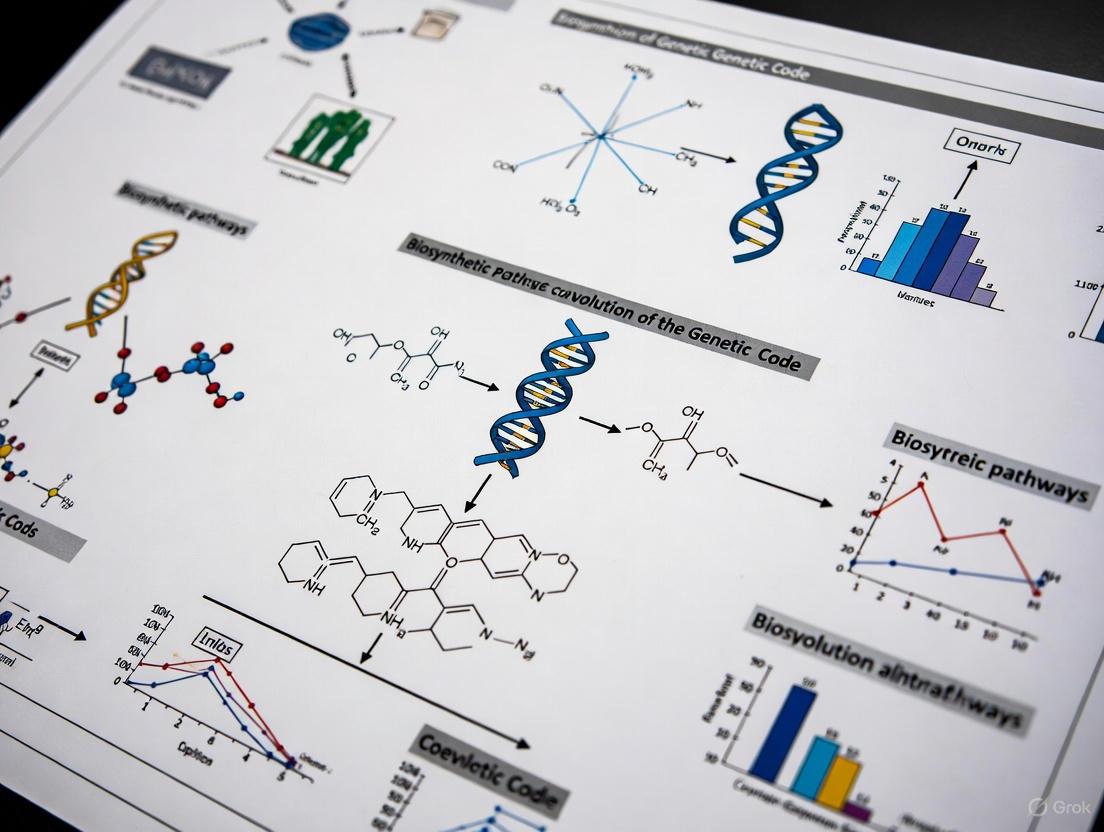
This article explores the coevolution theory of the genetic code, which posits that the code's structure is an evolutionary imprint of biosynthetic relationships between amino acids.
Coevolution of the Genetic Code and Biosynthetic Pathways: From Primordial Origins to Synthetic Biology Applications
Abstract
This article explores the coevolution theory of the genetic code, which posits that the code's structure is an evolutionary imprint of biosynthetic relationships between amino acids. We examine foundational evidence from metabolic pathway analysis, including the proposed evolution from a GNC primeval code through SNS intermediate stages to the universal genetic code. For researchers and drug development professionals, we detail modern methodological approaches—including chemoproteomics, synthetic biology, and orthogonal translation systems—that leverage this relationship for natural product discovery and genetic code expansion. The review addresses challenges in pathway elucidation and optimization, presents validating evidence from comparative genomics and experimental evolution, and discusses implications for engineering novel biosynthetic pathways and developing therapeutic agents.
The Primordial Link: Tracing the Coevolution of Amino Acid Biosynthesis and the Genetic Code
The coevolution theory posits that the standard genetic code (SGC) is a historical record of the biosynthetic relationships between amino acids. This framework suggests that the code evolved by incorporating new amino acids as they were synthesized in primordial metabolic pathways, with these product amino acids inheriting codons from their biosynthetic precursors. This in-depth review synthesizes the core tenets of the theory, examines quantitative evidence supporting its claims, details modern experimental and computational protocols for its study, and discusses its profound implications for understanding the origin of life and engineering synthetic biological systems.
The origin of the universal genetic code is a fundamental problem in evolutionary biology. Among the various hypotheses proposed, the coevolution theory offers a compelling historical narrative. First comprehensively articulated by Wong [1], this theory postulates that the genetic code is not a frozen accident but rather an imprint of biosynthetic pathways [2] [3]. Its central premise is that the early code encoded only a small set of precursor amino acids, likely those available via prebiotic synthesis. As metabolic pathways evolved, new, biosynthetically derived amino acids were incorporated into the code's vocabulary. Critically, these product amino acids inherited their codons from their metabolic precursors, thereby creating the observed patterns in the modern codon table [2] [1] [3].
This review delineates the core principles of the coevolution theory, contrasting it with other major hypotheses. It then presents a detailed analysis of the supporting empirical and quantitative evidence, with a focus on statistically significant patterns within the genetic code. Furthermore, we provide a technical guide to the experimental and computational methodologies used to investigate coevolutionary dynamics. Finally, we explore the theory's application in modern synthetic biology, where its principles are being used to expand the genetic code and create novel organisms.
Core Tenets and Mechanistic Basis
The coevolution theory rests on several foundational pillars that distinguish it from stereochemical and adaptive error-minimization theories.
The Primordial Code and Code Expansion
The theory posits that the earliest genetic code was limited and incomplete. It likely encoded a small subset of the modern twenty amino acids, predominantly those simpler ones that could be formed by prebiotic chemistry or early metabolic pathways [4]. The theory identifies amino acids with GNN codons (where N is any nucleotide)—namely glycine, alanine, valine, aspartate, and glutamate—as strong candidates for this initial set, a observation noted to be statistically significant [2]. The code then expanded its coding capacity through a process of codon capture, whereby new amino acids were assigned codons that were previously used by their biosynthetic precursors [3].
The Biosynthetic Imprint and Precursor-Product Relationships
The defining tenet of the theory is that the structure of the standard genetic code preserves a record of amino acid biosynthetic relationships. When a new amino acid was biosynthesized from an existing one, the coding system coevolved, allowing the product amino acid to "take over" part of the codon domain of its precursor [2] [1]. For instance, the theory points to the close biosynthetic relationships between sibling amino acids like Ala-Ser, Ser-Gly, and Asp-Glu and notes that their collocation in the code table is not random [2]. This created the familiar block structure of the genetic code, where biosynthetically related amino acids often have codons that differ only in the first nucleotide [2].
The "Extended" Coevolution Theory
To address criticisms regarding unclear precursor-product relationships for certain amino acid pairs, an extended coevolution theory has been proposed [2]. This generalization maintains that the code is an imprint of biosynthetic relationships "even when defined by the non-amino acid molecules that are the precursors of some amino acids" [2]. This broader view incorporates the role of early metabolic pathways, such as glycolysis and the citric acid cycle, in defining biosynthetic proximity. It suggests that ancestral biosynthetic pathways occurred on tRNA-like molecules, facilitating the transfer of codons between biosynthetically linked amino acids as the mRNA template evolved [2].
Contrast with Other Major Theories
The coevolution theory offers a distinct narrative compared to other major hypotheses for the genetic code's origin. The stereochemical theory proposes that codon assignments are dictated by direct physicochemical affinities between amino acids and their codons or anticodons. The adaptive theory (or error-minimization theory) argues that the code evolved to be robust, minimizing the phenotypic impact of point mutations or translation errors [3]. In contrast, the coevolution theory is inherently historical, emphasizing a stepwise expansion driven by the evolving metabolism of the cell. It is important to note that these theories are not mutually exclusive; the standard genetic code is likely a product of multiple evolutionary forces, including aspects of coevolution, adaptive optimization, and potentially weak stereochemical interactions [3].
Quantitative Evidence and Data Analysis
The coevolution theory is supported by statistically significant patterns within the genetic code that correlate strongly with known biosynthetic pathways. The following tables summarize key evidence, including the early GNN codons and specific precursor-product pairs with their codon block assignments.
Table 1: Amino Acids Encoded by GNN Codons as Potential Early Additions
| Amino Acid | Codon(s) | Biosynthetic Family/Precursor | Statistical Significance |
|---|---|---|---|
| Glycine | GGN | Serine family; 3-phosphoglycerate | Considered one of the earliest amino acids [2] |
| Alanine | GCN | Pyruvate family | Found at head of biosynthetic pathways [2] |
| Valine | GUN | Pyruvate family | Found at head of biosynthetic pathways [2] |
| Aspartic Acid | GAY | Oxaloacetate family | Early member of aspartate family [2] |
| Glutamic Acid | GAR | α-Ketoglutarate family | Early member of glutamate family [2] |
Table 2: Exemplar Precursor-Product Amino Acid Pairs in the Genetic Code
| Precursor Amino Acid | Product Amino Acid(s) | Biosynthetic Relationship | Codon Block Relationship |
|---|---|---|---|
| Serine | Tryptophan | Serine is a precursor to tryptophan [2] | UCN (Ser) -> UGG (Trp) |
| Aspartic Acid | Asparagine, Threonine, Methionine, Isoleucine | Aspartate is a common precursor [1] [3] | GAY (Asp) -> AAY (Asn); ACN (Thr, Met, Ile) |
| Glutamic Acid | Glutamine, Proline, Arginine | Glutamate is a common precursor [1] [3] | GAR (Glu) -> CAR (Gln); CCN (Pro); CGN, AGR (Arg) |
| Alanine | Valine | Shared pyruvate precursor; Ala -> Val biosynthesis [2] | GCN (Ala) and GUN (Val) are adjacent |
The organization of the genetic code into distinct biosynthetic families is not random. Statistical analysis has shown that the probability of observing the five major amino acid families (defined by a single amino acid precursor or a non-amino acid precursor) randomly organized in the code as they are is extremely low, on the order of 6 × 10⁻⁵ [2]. This provides strong quantitative support for the core tenet of the coevolution theory. Furthermore, the theory has been used to make successful predictions about the evolutionary root of the tree of life, suggesting the Last Universal Common Ancestor (LUCA) was close to modern Methanopyrus, based on tRNA paralog analysis [5] [6].
Experimental and Computational Protocols
Research in this field relies on a combination of computational analysis of evolutionary patterns and experimental synthetic biology to test the theory's principles.
Computational Analysis of Coevolution
A primary method for investigating molecular coevolution involves identifying pairs of positions in proteins that evolve in a correlated fashion. The following workflow outlines a state-of-the-art phylogeny-based approach for detecting such coevolving residues, which can be applied to study enzymes in amino acid biosynthetic pathways.
Diagram 1: Computational workflow for identifying coevolving protein positions.
Protocol 1: Phylogeny-Based Detection of Coevolving Residues [7]
Input Data Preparation:
- Multiple Sequence Alignment (MSA): Curate a high-quality MSA of homologous protein sequences (e.g., enzymes from amino acid biosynthesis pathways).
- Phylogenetic Tree: Reconstruct a phylogenetic tree from the MSA using maximum likelihood or Bayesian methods.
Ancestral State Reconstruction:
- Use maximum parsimony to infer the amino acid states at all ancestral nodes of the phylogenetic tree for each position in the MSA.
- From this reconstruction, identify all branches in the tree where amino acid changes occurred.
Counting Changes:
- For each pair of positions (i, j) in the protein, count two values:
- Concurrent Changes (Dij): The number of branches in the tree where both positions i and j changed.
- Separate Changes (Sij): The number of branches where only one of the two positions changed.
- For each pair of positions (i, j) in the protein, count two values:
Statistical Modeling and Outlier Detection:
- Model the expected relationship between S~i~ (separate changes for position i with all others) and D~i~ (concurrent changes for position i with all others) under the null hypothesis of no coevolution.
- A recent study found that applying a Box-Cox transformation to S~i~ before linear modeling resulted in "almost perfect precision and specificity" for identifying true coevolution [7].
- Statistically significant coevolving pairs are identified as outliers from this model, showing a significant depletion in separate changes (or enrichment in concurrent changes) [7].
Validation:
- Coevolving residues identified by this method tend to be close in the protein sequence and 3D structure, and are often slightly less solvent-exposed [7]. Validation against a known protein structure is a strong confirmation.
Simulating Genetic Code Evolution
Computational simulations provide a platform to test the factors influencing the emergence of a stable, robust genetic code.
Protocol 2: Evolutionary Simulation of Primitive Coding Systems [4]
Initialize Population:
- Generate a population of "primitive" genetic codes. These codes start by ambiguously encoding a limited set of amino acids (e.g., 3-7 labels, including stop signals), with codons assigned probabilistically to labels [4].
Define Evolutionary Operators:
- Mutation (m~c~): Randomly reassign codons to different labels within a code.
- Addition of New Amino Acids (m~l~): Allow codes to gradually incorporate new amino acids into their coding repertoire, increasing the number of labels from the initial set towards 21.
- Information Exchange (m~e~): Permit the horizontal transfer of genetic information (e.g., codon-to-label assignments) between different coding systems in the population [4].
Fitness Function and Selection:
- Define a fitness function (F) that measures the quality of a genetic code. This function typically evaluates:
- Coding Capacity: The ability to encode all 21 labels.
- Unambiguity: The clarity of the mapping from codons to labels, minimizing translational ambiguity.
- Error Robustness: The code's resilience to point mutations and translation errors [4].
- Select codes for the next generation with a probability proportional to their fitness.
- Define a fitness function (F) that measures the quality of a genetic code. This function typically evaluates:
Analysis:
- Run simulations over many generations and observe if the population converges on stable, unambiguous coding systems that resemble the standard genetic code in structure (e.g., block organization of synonymous codons). Studies have shown that information exchange (horizontal gene transfer) is a crucial factor that significantly accelerates the emergence of such optimal, universal codes [4].
Research at the intersection of coevolution theory, genomics, and synthetic biology relies on a specific set of conceptual and material tools.
Table 3: Essential Research Tools for Genetic Code Coevolution Studies
| Tool / Resource | Category | Primary Function in Research |
|---|---|---|
| tRNA Paralog Analysis | Bioinformatic Method | To identify ancient tRNA gene duplications and trace the evolutionary history of codon assignments, informing on LUCA [5] [6]. |
| Ancestral Sequence Reconstruction | Bioinformatic Method | To infer the sequences of ancient proteins and tRNAs, testing hypotheses about early code usage and enzyme evolution. |
| Maximum Parsimony/Likelihood | Computational Algorithm | For phylogenetic tree building and ancestral state reconstruction, fundamental to coevolution analysis [7]. |
| Orthogonal Aminoacyl-tRNA Synthetase/tRNA Pairs | Synthetic Biology Reagent | Engineered enzymes and tRNAs that do not cross-react with the host's native machinery, essential for incorporating unnatural amino acids [3]. |
| Unnatural Amino Acids (uAAs) | Chemical Reagent | Novel amino acids used to test code expansibility and create novel protein functions; over 30 have been incorporated in E. coli [3]. |
| Genome-Scale Synthesis & Recoding | Experimental Platform | The systematic replacement of all instances of a particular codon in an organism's genome, allowing its reassignment to a new amino acid [1]. |
Implications and Future Directions
The coevolution theory frames the genetic code as a mutable and evolvable system, a prediction powerfully validated by the creation of synthetic life forms with altered protein alphabets [5] [6] [1]. The theory provides a rational framework for these engineering efforts; by understanding which amino acids are biosynthetically related, researchers can make informed decisions about recruiting new codons for novel amino acids that are structurally or metabolically similar to natural ones.
Future research will continue to leverage integrative multi-omics approaches—genomics, transcriptomics, and microbiomics—to trace the deep evolutionary history of metabolic pathways and their relationship to the code's structure [8]. A major challenge and opportunity lie in moving from formal models to a credible scenario for the evolution of the coding principle itself, which will require a deeper integration of the coevolution theory with models for the origin of the ribosome and the translation system [3]. As we continue to dissect the biosynthetic imprint on the genetic code, we not only unravel the history of life's origin but also gain the tools to direct its future evolution.
Metabolic Pathway Analysis and the Vestiges of Early Code Evolution
The structure of the standard genetic code (SGC) is not arbitrary but represents a frozen accident, bearing the imprints of its evolutionary history. A central thesis in modern molecular evolution posits that the genetic code and metabolic pathways coevolved, with the code expanding as new amino acids became available through the stepwise development of biosynthesis. This coevolutionary process has left vestiges that can be traced through contemporary metabolic pathway analysis, offering a powerful lens to investigate life's deepest history. By integrating phylogenomic analyses with advanced computational tools for metabolic network reconstruction, researchers are now uncovering how early operational RNA codes, predating the modern SGC, facilitated the emergence of protein synthesis and folding. These investigations reveal that protein thermostability was a late evolutionary development, bolstering the hypothesis that proteins originated in the mild environments of the Archaean eon [9]. This technical guide examines the core methodologies, analytical frameworks, and reagent solutions enabling researchers to decode these ancient evolutionary signals through state-of-the-art metabolic pathway analysis.
Evolutionary Chronology of Code Formation
Reconstructing the Peptide-Based Fossil Record
The evolutionary timeline of genetic code emergence can be reconstructed through phylogenomic analysis of dipeptide sequences across diverse proteomes. A groundbreaking study analyzing 4.3 billion dipeptide sequences across 1,561 proteomes revealed a distinct chronology for the incorporation of amino acids into the evolving genetic code, supporting the early emergence of an operational RNA code in the acceptor arm of tRNA prior to the implementation of the standard genetic code in the anticodon loop [9].
Table 1: Evolutionary Chronology of Amino Acid Incorporation Based on Dipeptide Analysis
| Evolutionary Phase | Amino Acids | Supporting Evidence |
|---|---|---|
| Early Emergence | Leu, Ser, Tyr | Overlapping temporal emergence in dipeptide sequences |
| Subsequent Incorporation | Val, Ile, Met, Lys, Pro, Ala | Supported operational RNA code |
| Late Development | Protein thermostability determinants | Associated with mild Archaean environments |
This chronology aligns with the coevolution theory of genetic code development, which suggests that the code expanded alongside biosynthetic pathways, with newer amino acids inheriting codons from their metabolic precursors [4]. The synchronous appearance of dipeptide–antidipeptide sequences along this chronology further supports an ancestral duality of bidirectional coding operating at the proteome level [9].
Simulation Models of Primitive Coding Systems
Computational simulations based on evolutionary algorithms provide critical insights into the emergence of stable coding systems. These models typically begin with populations of primitive genetic codes that ambiguously encode only a limited set of amino acids (labels), which then undergo mutation, gradual incorporation of new amino acids, and information exchange [4].
The simulation process incorporates three fundamental processes:
- Mutation (
mc): Dynamic reassignment of labels to codons - Label incorporation (
ml): Gradual addition of new amino acids to the code - Information exchange (
me): Transfer of genetic information between evolving coding systems
These simulations demonstrate that evolution converges toward stable and unambiguous coding systems with higher coding capacity, facilitated by exchange of encoded information among evolving codes. A crucial finding is that this exchange significantly accelerates the emergence of genetic systems capable of encoding 21 labels (20 amino acids plus stop signal) [4].
Computational Frameworks for Metabolic Pathway Analysis
Advanced Tools for Metabolic Network Reconstruction
The reconstruction and analysis of metabolic networks require specialized bioinformatics tools that can handle the complexity of modern omics data. Several powerful platforms have been developed to address these challenges.
Table 2: Computational Tools for Metabolic Pathway Analysis
| Tool/Platform | Primary Function | Data Sources | Key Applications |
|---|---|---|---|
| MetaDAG | Constructs reaction graphs and metabolic directed acyclic graphs (m-DAG) | KEGG | Taxonomy classification, diet analysis, comparative metabolism |
| KEGG | Reference database for pathway mapping | Curated pathway data | Pathway annotation, enzyme function prediction |
| Reactome | Signaling and metabolic pathway analysis | Curated pathway data | Pathway visualization, functional enrichment |
| MetaCyc | Metabolic pathway database | Curated experimental data | Metabolic engineering, enzyme function prediction |
| ORENZA | Orphan enzyme database | Experimental characterization | Identification of unassociated enzyme sequences |
MetaDAG represents a particularly innovative approach, implementing a metabolic directed acyclic graph (m-DAG) methodology that collapses strongly connected components of reaction graphs into single nodes called metabolic building blocks (MBBs). This representation significantly reduces network complexity while maintaining connectivity, enabling more efficient analysis of large-scale metabolic networks [10]. The tool can generate metabolic networks from various inputs, including specific organisms, groups of organisms, reactions, enzymes, or KEGG Orthology (KO) identifiers, making it suitable for everything from individual microbial samples to complex metagenomic datasets.
Identifying and Plugging Metabolic Pathway Holes
A significant challenge in metabolic pathway analysis involves addressing "pathway holes" - enzymatic reactions without associated gene sequences. Recent research has developed sophisticated bioinformatics pipelines to identify candidate genes for these orphan enzyme activities through coevolutionary analysis [11].
The identification pipeline for pathway holes involves:
- Coevolution scoring: Calculating coevolution scores between human metabolic enzymes using orthologous protein families from OrthoDB
- Pathway analysis: Applying these scores to KEGG pathway charts to identify reactions with reliable connections but missing sequence associations
- Candidate selection: Focusing on reactions sandwiched between two known reactions in human pathways
- Validation: Experimental verification of predicted enzyme functions
This approach successfully identified C11orf54 (PTD012) as 3-dehydro-L-gulonate (BKG) decarboxylase, an enzyme that had remained uncharacterized for 65 years despite being assigned the EC number 4.1.1.34 in 1961 [11]. The protein belongs to the Domain of Unidentified Function family DUF1907 (PF08925) and features a high-resolution 3D structure with a bound Zn²⁺ ion coordinated by three conserved His residues.
Experimental Protocols and Methodologies
Phylogenomic Reconstruction of Dipeptide Evolution
Objective: To reconstruct the evolutionary chronology of genetic code emergence through analysis of dipeptide sequences across diverse proteomes.
Methodology:
- Proteome Selection: Curate 1,561 representative proteomes spanning diverse phylogenetic lineages
- Dipeptide Enumeration: Extract and enumerate 4.3 billion dipeptide sequences from the proteomic datasets
- Phylogenetic Analysis: Reconstruct the evolutionary repertoire of 400 canonical dipeptides using phylogenomic methods
- Temporal Mapping: Map the emergence chronology of dipeptides containing specific amino acids
- Duality Assessment: Identify synchronous appearance of dipeptide–antidipeptide sequences
Key Parameters:
- Alignment algorithms for sequence comparison
- Molecular clock models for dating divergence events
- Statistical tests for assessing synchronous appearance
This protocol successfully revealed the overlapping emergence of dipeptides containing Leu, Ser, and Tyr, followed by those containing Val, Ile, Met, Lys, Pro, and Ala, providing empirical support for the operational RNA code hypothesis [9].
Machine Learning-Based Diagnostic Model Construction
Objective: To identify key metabolic and signaling pathways associated with complex traits through integrative bioinformatics analysis.
Methodology (as applied to Major Depressive Disorder [12]):
- Data Curation: Obtain gene expression datasets from public repositories (e.g., GEO) applying strict inclusion criteria
- Pathway Analysis: Perform Gene Set Variation Analysis (GSVA) using Gene Ontology Biological Process (GOBP) and KEGG gene sets
- Immune Infiltration: Apply multiple immune infiltration algorithms (CIBERSORT, EPIC, ESTIMATE, MCPcounter, quanTIseq, TIMER, xCell)
- Differential Expression: Identify differentially expressed genes (DEGs) using linear models (limma package)
- Machine Learning: Employ 113 machine learning algorithms to construct diagnostic models, selecting optimal algorithms based on AUC values
- Risk Stratification: Divide patients into high-risk and low-risk groups based on model scores for subgroup analysis
Validation:
- Receiver operating characteristic (ROC) curve analysis across multiple datasets
- Calculation of area under the curve (AUC) values
- Residual analysis and goodness-of-fit testing
This approach identified the random forest algorithm (AUC = 0.788) as optimal for MDD diagnosis and revealed the cell-killing signaling pathway as consistently enriched across datasets [12].
The Scientist's Toolkit: Essential Research Reagents and Solutions
Table 3: Essential Research Reagents and Computational Tools
| Category | Specific Tool/Reagent | Function/Application |
|---|---|---|
| Database Resources | KEGG Pathway Database | Reference metabolic pathways for annotation and analysis |
| OrthoDB | Orthologous protein families for coevolutionary analysis | |
| UniProt | Protein sequence and functional information | |
| Protein Data Bank | 3D protein structures for functional inference | |
| Bioinformatics Tools | MetaDAG | Metabolic network reconstruction and m-DAG generation |
| AlphaFold2 | Protein structure prediction for functional annotation | |
| Limma R Package | Differential expression analysis for omics data | |
| ClusterProfiler | Functional enrichment analysis of gene sets | |
| Analytical Platforms | Structural Prediction (pLDDT) | Assessment of protein structure prediction quality |
| Coevolution Scoring | Identification of functionally related genes | |
| Machine Learning Algorithms | Diagnostic model construction and biomarker identification | |
| Experimental Resources | Gene Expression Omnibus (GEO) | Public repository of functional genomics data |
| L1000 FWD Database | Drug perturbation signatures for drug discovery | |
| Cancer Therapeutics Response Portal | Drug sensitivity data for therapeutic prediction |
Integration of Structural Biology with Evolutionary Genomics
Recent advances in protein structure prediction, particularly through AlphaFold2, have enabled large-scale analysis of enzyme evolution across deep evolutionary timescales. A comprehensive study of 11,269 predicted and experimentally determined enzyme structures across 424 orthologue groups associated with 361 metabolic reactions revealed how metabolism shapes structural evolution across multiple scales [13].
Key findings from this structural-evolutionary analysis include:
- Metabolic Specialization: Enzymes from metabolically specialized species (e.g., fermenting vs. non-fermenting yeasts) show distinct patterns of structural conservation and divergence
- Pathway Constraints: Enzyme evolution is constrained by reaction mechanisms, interactions with metal ions and inhibitors, metabolic flux variability, and biosynthetic cost
- Hierarchical Patterns: Structural context dictates amino acid substitution rates, with surface residues evolving most rapidly and small-molecule-binding sites under selective constraints
- Cost Optimization: Metabolic cost optimization operates at both species and molecular levels, with high-abundance enzymes incorporating less energetically costly amino acids
This integration of structural biology with evolutionary genomics establishes a model in which enzyme evolution is intrinsically governed by catalytic function and shaped by metabolic niche, network architecture, cost, and molecular interactions [13].
The integration of metabolic pathway analysis with genetic code evolution research provides powerful insights for drug discovery and development. Computational metabolomics combines multiscale analysis with in silico approaches and molecular docking methods to enhance the detection of metabolic biomarkers and prediction of molecular interactions [14]. This approach is particularly valuable for identifying drug modes of action, from pharmacokinetics to toxicity forecasting, thereby streamlining drug development pipelines.
Applications in anticancer, antimicrobial, and antiviral drug discovery demonstrate how these computational models can accelerate target validation and enhance the accuracy of therapeutic strategies. Furthermore, the identification of evolutionary constraints on enzyme evolution informs the selection of drug targets with appropriate conservation characteristics—highly conserved targets for broad-spectrum therapies versus divergent targets for specialized treatments [13].
The continuing evolution of bioinformatics tools and multi-omics integration approaches promises to further illuminate the deep evolutionary history encoded in metabolic pathways while providing increasingly sophisticated platforms for therapeutic development across diverse disease contexts.
The GNC Primeval Code Hypothesis and SNS Intermediate Evolutionary Stages
The origin of the genetic code remains a central mystery in understanding the emergence of life. The coevolution theory posits that the genetic code is an evolutionary imprint of biosynthetic relationships between amino acids, where the code expanded as new amino acids were synthesized through evolving metabolic pathways [2]. Within this theoretical framework, the GNC-SNS hypothesis provides a specific, stepwise model for how the genetic code originated from a simple four-codon system and evolved into the universal triplet code through definable intermediate stages [15]. This hypothesis addresses critical limitations of the RNA world hypothesis, which struggles to explain the spontaneous emergence of complex nucleotides and the codon-based organization of genetic information [16] [17]. The GNC-SNS model suggests that life originated from a [GADV]-protein world, where proteins composed of glycine (G), alanine (A), aspartic acid (D), and valine (V) could undergo pseudo-replication and establish the first peptide-based biochemical systems prior to the evolution of sophisticated nucleic acid replication [17].
Theoretical Foundation of the GNC-SNS Hypothesis
Core Postulates of the GNC-SNS Hypothesis
The GNC-SNS primitive genetic code hypothesis proposes that the universal genetic code evolved through two major evolutionary stages from a simpler precursor code [18] [15]:
- GNC Primeval Genetic Code: The first genetic code consisted of only four codons (GGC, GCC, GAC, GUC) encoding four amino acids (Gly, Ala, Asp, Val) - the [GADV] amino acids. This code was formally represented by triplets but functioned substantially as singlets.
- SNS Intermediate Genetic Code: The GNC code expanded to an SNS code, where S represents G or C, and N represents any nucleotide. This intermediate code contained 16 codons encoding 10 amino acids before finally expanding to the universal 64-codon table [15].
This evolutionary pathway is supported by the observation that proteins composed of [GADV]-amino acids can form the four fundamental structural elements found in modern proteins: hydrophobic and hydrophilic structures, α-helices, β-sheets, and turns/coils [15]. Furthermore, imaginary proteins encoded by the SNS code satisfy six conditions necessary for water-soluble globular protein formation [18].
Critical Weaknesses of the RNA World Hypothesis
The GNC-SNS hypothesis emerged from identified limitations in the prevailing RNA world hypothesis, which faces several fundamental challenges [16] [17]:
- Nucleotide Synthesis: Nucleotides have not been produced through prebiotic means and have not been detected in meteorites, despite the detection of nucleobases [16].
- RNA Synthesis Difficulty: The prebiotic synthesis of RNA is considered "quite difficult or most likely impossible" due to the complex chemical structure of nucleotides and the stability issues of ribose [16] [17].
- Self-Replication Paradox: RNA would need to maintain an unfolded state to function as a genetic template while simultaneously folding into stable tertiary structures to exhibit catalytic function - creating a fundamental contradiction [17].
- Information Formation: Genetic information composed of triplet codon sequences would never form stochastically by joining mononucleotides one by one [16].
These limitations prompted the development of alternative models, including the [GADV]-protein world hypothesis, which serves as the foundation for the GNC-SNS genetic code model [16].
Experimental Validation and Methodological Approaches
Computational Analysis of Protein Folding Potentials
Objective: To determine the minimum set of amino acids capable of forming proteins with structural properties similar to modern proteins.
Methodology: Researchers analyzed whether imaginary proteins composed of limited amino acid sets could satisfy the structural requirements for water-soluble globular protein formation [18] [17]. The analysis evaluated six key physicochemical properties:
- Hydropathy (hydrophobicity/hydrophilicity)
- α-helix formation capability
- β-sheet formation capability
- Turn/coil formation capability
- Acidic amino acid composition
- Basic amino acid composition
Implementation: The computational analysis involved generating virtual polypeptides using selected amino acid sets and calculating their physicochemical properties based on known amino acid structural indexes. The results were compared against the average values of extant proteins to determine if they fell within viable ranges for functional protein folding [17].
Key Finding: Proteins composed of [GADV]-amino acids encoded by the GNC codons satisfied four fundamental structural conditions (hydropathy, α-helix, β-sheet, and turn/coil formation capabilities) when approximately equal amounts of each amino acid were contained in the proteins [18] [17]. No other four-amino acid combination from the standard genetic code table could satisfy all these structural requirements, with the exception of the closely related GNG code [18].
Metabolic Pathway Analysis and Coevolution Theory
Objective: To trace the evolutionary pathway of the genetic code through analysis of modern amino acid biosynthetic pathways.
Methodology: The KEGG PATHWAY Database was used to extract and analyze metabolic pathways for amino acid biosynthesis [19]. Researchers examined:
- Precursor-product relationships between amino acids
- Chemical structures of amino acids and intermediate metabolites
- The order of amino acid incorporation into the genetic code based on biosynthetic complexity
Analytical Framework: The coevolution theory suggests that the genetic code expanded as new amino acid synthetic pathways evolved. When a new amino acid was synthesized through a newly formed metabolic pathway and accumulated in sufficient quantities, it could be incorporated into the expanding genetic code [19] [2]. This process required two conditions:
- Significant accumulation of the new amino acid in cells
- Functional enhancement of proteins synthesized using the expanded amino acid repertoire [19]
Key Insight: Analysis of biosynthetic relationships revealed that the first amino acids to evolve along these pathways are predominantly those codified by codons of the type GNN, supporting the primacy of the GNC code in early genetic code evolution [2].
Genomic Analysis of GC-Rich Non-Stop Frames
Objective: To identify potential evolutionary relics of primitive genetic codes in modern genomes.
Methodology: Researchers analyzed microbial genes from the GenomeNet Database, focusing on:
- Base compositions at three codon positions in GC-rich genes
- Non-stop frames on antisense strands of GC-rich genes (GC-NSF(a))
- The protein-folding potential of hypothetical proteins encoded by these sequences
Finding: The base composition format of highly GC-rich genes (65-75%) and hypothetical sequences of GC-NSF(a) approximate repetitions of SNS (where S means G or C), suggesting that SNS repetition sequences possess strong potential to function as genes [17]. This supports the hypothesis that the SNS code served as an intermediate in genetic code evolution.
Quantitative Data and Structural Evidence
Structural Properties of [GADV]-Proteins
Table 1: Protein Structural Formation Capabilities of Primitive Amino Acid Sets
| Amino Acid Set | Genetic Code | Number of Amino Acids | Hydropathy | α-helix | β-sheet | Turn/Coil | Acidic/ Basic |
|---|---|---|---|---|---|---|---|
| [GADV] | GNC | 4 | ✓ | ✓ | ✓ | ✓ | ✗ |
| SNS-encoded | SNS | 10 | ✓ | ✓ | ✓ | ✓ | ✓ |
| Modern proteins | Universal | 20 | ✓ | ✓ | ✓ | ✓ | ✓ |
Data derived from computational analyses of imaginary proteins indicates that [GADV]-proteins encoded by the GNC code can satisfy four fundamental structural requirements for protein folding, while SNS-encoded proteins containing 10 amino acids can satisfy all six conditions necessary for water-soluble globular protein formation [18] [17].
Amino Acid Biosynthetic Relationships
Table 2: Biosynthetic Families and Codon Domains in Genetic Code Evolution
| Biosynthetic Family | Precursor Amino Acid | Product Amino Acids | Codon Domain |
|---|---|---|---|
| Aspartate | Aspartate (Asp) | Asparagine (Asn), Threonine (Thr), Methionine (Met), Lysine (Lys), Isoleucine (Ile) | GAY, AAY, ACY, AUY |
| Glutamate | Glutamate (Glu) | Glutamine (Gln), Proline (Pro), Arginine (Arg) | GAR, CAR, CCR, CGR |
| Pyruvate | Alanine (Ala) | Valine (Val), Leucine (Leu) | GCN, GUN, CUN, UUR |
| Serine | Serine (Ser) | Glycine (Gly), Cysteine (Cys) | UCN, GGN, UGY |
| Aromatic | Phenylalanine (Phe) | Tyrosine (Tyr), Tryptophan (Trp) | UUY, UAY, UGG |
The organization of the genetic code table reflects these biosynthetic relationships, with product amino acids typically located within the codon domain of their precursor amino acids [2]. This pattern provides strong support for the coevolution theory and the progressive expansion of the genetic code.
Evolutionary Pathway and Mechanism
From GNC to SNS to Universal Code
The GNC-SNS hypothesis proposes a clear evolutionary pathway for the genetic code [18] [15]:
- GNC Primeval Code: The first genetic code established correspondence relationships between four GNC codons and four [GADV]-amino acids.
- SNS Intermediate Code: The code expanded to include 16 SNS codons encoding 10 amino acids ([GADV] plus Glu, Leu, Pro, His, Gln, Arg).
- Universal Genetic Code: Further expansion led to the complete 64-codon table encoding 20 standard amino acids.
This evolutionary progression is supported by the observation that the GNC code represents the most simplified code that can generate proteins with structural diversity comparable to modern proteins, while the SNS code provides additional functional groups necessary for enhanced catalytic capabilities [18].
The Role of the Peptidated RNA World
The Peptidated RNA World concept bridges the transition between the RNA world and the modern protein-dominated world [5]. In this model:
- Early functional RNAs (fRNAs) covalently attached peptide prosthetic groups to enhance their catalytic capabilities
- These polypeptide prosthetic groups evolved to cooperate with host fRNAs
- Templates on fRNAs guided the binding of aminoacyl-RNA synthetase ribozymes (rARS) to synthesize specific peptide sequences
- Eventually, these polypeptide prosthetic groups detached from their host fRNAs to function as independent enzymes [5]
This model resolves the "information-need paradox" - that information-rich biopolymers are too long to arise spontaneously - by providing a mechanism for peptide sequences to evolve under the nurturing environment of host fRNAs [5].
Figure 1: Evolutionary Pathway from Prebiotic Chemistry to Modern Genetic Code
Research Tools and Experimental Applications
Table 3: Key Research Reagents and Computational Tools for Genetic Code Evolution Studies
| Resource/Reagent | Type | Function/Application | Example Source |
|---|---|---|---|
| KEGG PATHWAY Database | Database | Analysis of amino acid biosynthetic pathways and metabolic relationships | Kanehisa Laboratories [19] |
| GenomeNet Database | Database | Genomic data for analysis of GC-rich genes and non-stop frames | Kyoto University [17] |
| Amino Acid Structural Indexes | Computational Parameters | Calculation of hydropathy, secondary structure formation potentials | Experimental literature [17] |
| Virtual Polypeptide Generation | Computational Algorithm | Testing protein-folding potential of limited amino acid sets | Custom implementation [18] |
| Metabolic Pathway Analysis | Analytical Framework | Tracing biosynthetic relationships between amino acids | KEGG-based analysis [19] |
Methodological Framework for Hypothesis Testing
The experimental validation of the GNC-SNS hypothesis relies on a multidisciplinary approach combining computational, biochemical, and evolutionary analyses:
- Computational Protein Modeling: Using structural indexes to evaluate the folding potential of polypeptides composed of limited amino acid sets.
- Comparative Genomics: Analyzing sequence patterns in modern genomes to identify potential evolutionary relics of primitive genetic codes.
- Metabolic Pathway Analysis: Tracing biosynthetic relationships between amino acids to reconstruct the expansion history of the genetic code.
- Phylogenetic Analysis: Studying tRNA and rRNA evolution to understand the development of the translation apparatus.
Figure 2: Methodological Framework for Hypothesis Testing
The GNC-SNS hypothesis, framed within the broader context of the coevolution theory, provides a compelling model for the stepwise evolution of the genetic code from a simple four-codon system to the universal triplet code. This model successfully addresses several critical limitations of the RNA world hypothesis while providing testable predictions about the early evolution of biological information systems.
Key strengths of the GNC-SNS model include its ability to explain:
- The emergence of structurally diverse proteins from a limited amino acid repertoire
- The biosynthetic relationships evident in the organization of the modern genetic code table
- The transition from a peptide-based early world to the nucleic acid-dominated systems of modern biology
Future research directions should focus on experimental validation of the pseudo-replication concept for [GADV]-proteins, further elucidation of biosynthetic pathways for early amino acids, and exploration of the biochemical mechanisms that facilitated the transition from the SNS code to the universal genetic code. The integration of this model with understanding of early metabolic pathways continues to provide insights into one of biology's most fundamental questions: the origin of the genetic code and the emergence of life itself.
Biosynthetic Families and Their Representation in Codon Domains
The universal genetic code is not a random assignment of codons to amino acids but rather a historical record of the biosynthetic relationships between amino acids and their coevolution with the emerging translation machinery [20] [2]. The coevolution theory posits that the genetic code structure is an imprint of biosynthetic pathways, where precursor amino acids donated parts of their codon domains to their biosynthetic products as the code evolved and expanded [2]. This extended coevolution theory further suggests that the genetic code reflects biosynthetic relationships "even when defined by the non-amino acid molecules that are the precursors of some amino acids" [2]. This framework provides profound implications for understanding the fundamental organization of life, as the very structure of the genetic code preserves a molecular fossil record of early metabolic evolution.
The representation of biosynthetic families within codon domains demonstrates remarkable organizational principles. Analysis of proteome-wide dipeptide sequences has provided a evolutionary chronology supporting the early emergence of an operational RNA code in the acceptor arm of tRNA prior to the implementation of the standard genetic code in the anticodon loop [9]. This timeline reveals that specific amino acids with particular biosynthetic relationships, including those containing Leu, Ser, Tyr, Val, Ile, Met, Lys, Pro, and Ala, were recruited in overlapping temporal patterns that reinforced the operational code [9]. The synchronous appearance of dipeptide-antidipeptide sequences along this evolutionary chronology further supports an ancestral duality of bidirectional coding operating at the proteome level [9].
Theoretical Foundations: Genetic Code Structure and Biosynthetic Relationships
Organizational Principles of the Genetic Code
The genetic code exhibits a sophisticated architecture where the second codon position (P2) plays a determinative role in specifying amino acid properties [20]. When U occupies position 2, all encoded amino acids are strongly hydrophobic without exception, while with A in position 2, all amino acids are strongly hydrophilic, also without exception [20]. With C or G in position 2, most codons code for semipolar amino acids [20]. This organization suggests the primordial code likely specified three fundamental types of amino acids: hydrophobic, hydrophilic, and semipolar.
The three codon positions exhibit dramatically different variation constraints across genomes. Position 2 varies only 12% in GC content across organisms with different genomic GC compositions, compared to 31% variation for position 1 and 80% variation for position 3 [20]. These differential constraints reflect the principle of negative selection, where functionally more important sites evolve more slowly [20]. Thus, P2 in codons is most important for specifying the nature of the amino acid, P1 is of intermediate importance for specifying the specific amino acid, and P3 is least important and highly redundant [20].
Biosynthetic Families and Their Codon Domain Relationships
Amino acids with similar biosynthetic origins tend to occupy contiguous codon domains in the genetic code table [2]. Statistical analysis indicates that the five families of amino acids defined by a single amino acid precursor or a non-amino acid precursor would be randomly observed in the genetic code with a probability of just 6×10⁻⁵, strongly supporting non-random organization based on biosynthetic relationships [2].
Table 1: Biosynthetic Families and Their Codon Representations
| Biosynthetic Family | Precursor Molecule | Amino Acid Members | Codon Domain Pattern |
|---|---|---|---|
| Pyruvate Family | Pyruvate | Ala, Val, Leu, Ser* | GCN (Ala), GUN (Val), UUR (Leu) |
| Aspartate Family | Aspartate | Asp, Asn, Lys, Thr, Met, Ile | GAY (Asp), AAY (Asn), AAR (Lys) |
| Glutamate Family | Glutamate | Glu, Gln, Pro, Arg | GAR (Glu), CAR (Gln), CCN (Pro) |
| Serine Family | Serine | Ser, Gly, Cys, Trp | UCN (Ser), GGN (Gly), UGY (Cys) |
| Aromatic Family | Phosphoenolpyruvate + Erythrose-4-P | Phe, Tyr, Trp, His | UUY (Phe), UAY (Tyr), CAY (His) |
*Serine has multiple biosynthetic origins including glycolysis intermediate 3-phosphoglycerate [2]
The close biosynthetic relationships between sibling amino acids Ala-Ser, Ser-Gly, Asp-Glu, and Ala-Val are not randomly distributed in the genetic code table and reinforce the hypothesis that biosynthetic relationships between these six amino acids played a crucial role in defining the earliest phases of genetic code origin [2]. This finding led to the hypothesis of an early GNS code reflecting these fundamental biosynthetic relationships that preceded the modern genetic code [2].
Analytical Methods for Studying Codon Domain-Biosynthetic Relationships
Codon Usage Bias Analysis
Codon usage bias (CUB), the non-uniform usage of synonymous codons, occurs across all domains of life and provides insights into evolutionary forces shaping genomes [21]. Analyzing CUB patterns can reveal signatures of natural selection, mutation pressure, and genetic drift acting on coding sequences. The Relative Synonymous Codon Usage (RSCU) value is calculated as:
RSCU = gᵢⱼ / (Σⱼ gᵢⱼ / nᵢ)
where gᵢⱼ represents the observed count of the i-th codon for the j-th amino acid, and nᵢ denotes the number of synonymous codons for the j-th amino acid [22]. An RSCU value of 1.0 indicates no codon usage bias, while values greater than 1.0 and less than 1.0 represent positive and negative bias, respectively [22]. Codons with RSCU values exceeding 1.6 are considered "over-represented," while those with values below 0.6 are "under-represented" [22].
The Effective Number of Codons (ENC) analysis measures the degree of codon usage bias independent of sequence length and amino acid composition, ranging from 20 (extremely biased) to 61 (no bias) [22]. ENC plots comparing observed ENC values against expected values under GC3 content can reveal whether mutation pressure or natural selection is the dominant force shaping codon usage patterns.
Diagram 1: Codon usage bias analysis workflow
Phylogenomic Reconstruction of Code Evolution
Phylogenomic approaches can reconstruct the evolutionary chronology of genetic code expansion by analyzing dipeptide sequences across diverse proteomes. One recent study analyzed 4.3 billion dipeptide sequences across 1,561 proteomes to reconstruct the evolutionary repertoire of 400 canonical dipeptides [9]. This approach revealed the temporal emergence of dipeptides containing specific amino acids that supported the operational RNA code hypothesis.
The methodology involves:
- Proteome Data Collection: Compiling complete proteomes from diverse taxonomic lineages
- Dipeptide Frequency Analysis: Calculating occurrence frequencies of all 400 possible dipeptide pairs
- Phylogenetic Reconstruction: Building evolutionary trees based on dipeptide usage patterns
- Chronology Mapping: Inferring the temporal sequence of amino acid recruitment into the genetic code
This phylogenomic approach has revealed that protein thermostability was a late evolutionary development, bolstering the hypothesis of a mild-environment origin of proteins during the Archaean eon [9].
Biosynthetic Gene Cluster Identification and Analysis
Bioinformatic analysis of biosynthetic gene clusters (BGCs) enables the connection between genetic code organization and natural product biosynthesis. The antiSMASH (antibiotics and secondary metabolite analysis shell) tool is widely used for identifying and comparing BGCs in bacterial genomes [23]. Advanced versions like antiSMASH 7.0 employ detection settings that enable KnownClusterBlast, ClusterBlast, SubClusterBlast, and Pfam domain annotation to comprehensively characterize BGCs [23].
Table 2: Bioinformatics Tools for Biosynthetic Gene Cluster Analysis
| Tool Name | Primary Function | Application in Biosynthetic Family Research |
|---|---|---|
| antiSMASH | BGC identification and comparison | Predicts BGC types and their structural diversity |
| BiG-SCAPE | Gene Cluster Family analysis | Groups BGCs into families based on domain sequence similarity |
| PRISM | Natural product structure prediction | Predicts natural product structures from BGC sequences |
| RODEO | RiPP precursor peptide identification | Identifies ribosomally synthesized and post-translationally modified peptides |
| Deep-BGC | BGC detection with machine learning | Uses classifier to identify BGCs and predict their products |
| ARTS | Antibiotic Resistance Target Seeker | Identifies resistance genes within BGCs |
BGC clustering analysis using tools like BiG-SCAPE (Biosynthetic Gene Similarity Clustering and Prospecting Engine) groups BGCs into Gene Cluster Families (GCFs) based on domain sequence similarity [23]. This analysis can be performed at multiple similarity cutoffs (e.g., 10% and 30%) to resolve both fine-scale and broad gene cluster families [23]. For example, analysis of vibrioferrin-producing BGCs showed that at 10% similarity they formed 12 families, while at 30% similarity they merged into a single gene cluster family [23].
Experimental Protocols for Key Analyses
Protocol: Comprehensive Codon Usage Analysis
This protocol outlines the steps for analyzing codon usage patterns in relation to biosynthetic families, adapted from methodologies used in viral and bacterial genome studies [22] [24].
Materials and Reagents:
- Genomic sequences in FASTA format
- Computing environment with R or Python installed
- Bioinformatics packages: seqinr (R), BioPython, CodonW
- Multiple sequence alignment software (e.g., ClustalW, MAFFT)
Procedure:
- Sequence Retrieval and Curation
- Retrieve coding sequences from databases (e.g., GenBank, RefSeq)
- Filter sequences by length and completeness
- Verify annotation accuracy and correct reading frames
Compositional Analysis
- Calculate mononucleotide (A, C, U/T, G) frequencies
- Determine GC content at first (GC1s), second (GC2s), and third (GC3s) codon positions
- Compute mean GC content of first and second positions (GC12s)
Codon Usage Bias Metrics
- Calculate Relative Synonymous Codon Usage (RSCU) values
- Compute Effective Number of Codons (ENC)
- Perform neutrality plot analysis (GC12 vs GC3)
- Conduct parity rule 2 (PR2) bias analysis
Evolutionary Force Discrimination
- Compare observed vs expected ENC values under mutational equilibrium
- Analyze correlation between codon positions
- Perform multivariate statistical analysis (e.g., correspondence analysis)
Biosynthetic Family Grouping
- Group amino acids by biosynthetic pathways
- Compare CUB patterns within and between biosynthetic families
- Statistical testing of CUB differences (t-tests, ANOVA)
This protocol typically requires 2-3 days for a medium-sized dataset (50-100 genes) and can be scaled for larger genomic analyses.
Protocol: Phylogenomic Reconstruction of Code Evolution
This protocol describes the methodology for reconstructing genetic code evolution through dipeptide sequence analysis across proteomes [9].
Materials and Reagents:
- Proteome datasets from diverse organisms
- High-performance computing cluster
- Phylogenetic analysis software (e.g., MEGA11, IQ-TREE, RAxML)
- Multiple sequence alignment tools (e.g., Clustal Omega, MUSCLE)
Procedure:
- Proteome Data Collection
- Compile complete proteomes from public databases (UniProt, NCBI)
- Ensure taxonomic representation across evolutionary lineages
- Quality control for sequence completeness and annotation
Dipeptide Frequency Analysis
- Extract all dipeptide sequences from each proteome
- Calculate normalized frequencies for all 400 possible dipeptides
- Compute enrichment/depletion relative to random expectations
Phylogenetic Tree Construction
- Select appropriate marker genes or use whole-proteome approaches
- Determine best-fit substitution model (e.g., GTR+G+I)
- Construct maximum likelihood phylogeny with bootstrap support
Ancestral State Reconstruction
- Map dipeptide usage patterns onto phylogenetic tree
- Reconstruct ancestral dipeptide repertoires
- Infer chronological sequence of amino acid recruitment
Statistical Validation
- Apply statistical tests for chronological patterns
- Compare with alternative evolutionary scenarios
- Validate with independent molecular dating approaches
This advanced protocol requires significant computational resources and typically takes 1-2 weeks for a dataset of 100-200 proteomes, depending on sequence length and complexity.
Diagram 2: Phylogenomic reconstruction workflow
Research Reagent Solutions for Biosynthetic Code Studies
Table 3: Essential Research Reagents and Computational Tools
| Reagent/Tool | Specific Function | Application Context |
|---|---|---|
| antiSMASH 7.0 | BGC identification and annotation | Predicts biosynthetic gene clusters in genomic data |
| BiG-SCAPE 2.0 | BGC similarity network analysis | Groups BGCs into gene cluster families based on sequence similarity |
| seqinr R Package | Codon usage analysis | Computes RSCU, ENC, and other codon usage statistics |
| RDP4 | Recombination detection | Identifies potential recombination events in coding sequences |
| MEGA11 | Molecular evolutionary genetics analysis | Constructs phylogenetic trees and performs evolutionary analyses |
| Modelfinder | Best-fit substitution model selection | Identifies optimal nucleotide/amino acid substitution models |
| IQ-TREE | Maximum likelihood phylogenetic inference | Reconstructs evolutionary relationships with model selection |
| Cytoscape 3.10.3 | Biological network visualization | Visualizes BGC similarity networks and functional relationships |
| DIVEIN Software | Evolutionary distance analysis | Estimates pairwise genetic distances between sequences |
| Geneious Prime | Sequence alignment and annotation | Aligns and annotates BGC regions and core genes |
Case Studies and Research Applications
Case Study: Duck Hepatitis Virus 1 Codon Usage Patterns
Analysis of Duck Hepatitis Virus 1 (DHV-1) genomes revealed distinct codon usage patterns across three phylogenetic groups (Ia, Ib, and II) with different evolutionary dynamics [22]. The DHV-1 genome showed a strong preference for A/U-ended codons and underrepresentation of CG dinucleotides, with low overall codon usage bias suggesting host adaptation [22]. The three phylogroups exhibited distinct evolutionary trends: phylogroups Ia and Ib showed evidence of neutral evolution with selective pressure, while phylogroup II evolution was primarily driven by random genetic drift [22].
This case study demonstrates how codon usage analysis can reveal evolutionary dynamics and host adaptation strategies in viral pathogens, with implications for understanding pathogen evolution and developing control measures.
Case Study: Marine Bacterial Biosynthetic Diversity
Analysis of 199 marine bacterial genomes from 21 species identified 29 distinct BGC types, with non-ribosomal peptide synthetases (NRPS), betalactone, and NRPS-independent siderophores (NI-siderophores) being most predominant [23]. The study focused on vibrioferrin-producing BGCs across Vibrio harveyi, Vibrio alginolyticus, and Photobacterium damselae, revealing high genetic variability in accessory genes while core biosynthetic genes remained conserved [23].
This research highlights the biosynthetic diversity of marine bacteria and the structural plasticity of BGCs, which may influence functional properties like iron-chelation and microbial interactions [23]. Such studies contribute to natural product bioprospecting and underscore the potential for discovering novel bioactive compounds from marine microbes.
The representation of biosynthetic families in codon domains provides a compelling window into the early evolution of the genetic code and its coevolution with metabolic pathways. The evidence supporting the extended coevolution theory continues to accumulate, with phylogenomic analyses revealing detailed chronologies of amino acid recruitment and code expansion [9] [2]. The organizational principles of the genetic code, particularly the determinative role of the second codon position in specifying amino acid properties, reflect deep evolutionary constraints that likely originated in the operational RNA code of the acceptor arm of tRNA [20] [9].
Future research directions in this field should include:
- Expanded Phylogenomic Analyses: Applying dipeptide chronology methods to larger and more diverse proteome datasets
- Experimental Validation: Developing experimental systems to test predictions of the coevolution theory
- Integration with Origin of Life Studies: Connecting genetic code evolution with broader scenarios for life's emergence
- Applied Applications: Leveraging biosynthetic family relationships for drug discovery and natural product engineering
- Machine Learning Approaches: Implementing advanced computational methods to predict biosynthetic pathways from genomic data
The study of biosynthetic families and their representation in codon domains remains a vibrant research area with profound implications for understanding life's fundamental organization and evolutionary history.
The extended coevolution theory represents a significant refinement of the classic coevolution theory of the genetic code's origin. While maintaining the core premise that the genetic code structure reflects biosynthetic relationships between amino acids, the extended theory specifically incorporates the crucial role of non-amino acid precursors and the earliest amino acids emerging from central metabolic pathways. This framework resolves long-standing difficulties in defining the initial phases of code evolution and provides a more comprehensive mechanistic explanation for the observed patterns in the modern genetic code. The theory posits that the first amino acids to be incorporated were predominantly those synthesized from intermediates of energy metabolism and codified by GNN codons, with their biosynthetic relationships directly imprinting on the code's structure through interactions on tRNA-like molecules.
Foundations of the Classic Coevolution Theory
The classic coevolution theory, first formally proposed by Wong, posits that the genetic code originated and evolved in parallel with the development of amino acid biosynthetic pathways [25]. The theory contends that the code's structure represents an evolutionary map of biosynthetic relationships, wherein a small set of precursor amino acids were initially encoded. As new product amino acids were biosynthetically derived from these precursors, they inherited part or all of the codon domain of their metabolic precursors [25]. This process resulted in the non-random organization of the genetic code table, where biosynthetically related amino acids tend to possess contiguous or similar codons.
Limitations and the Need for an Extension
Despite its explanatory power, the classic coevolution theory faced significant challenges. It struggled to clearly define the very earliest phases of genetic code origin and did not fully attribute a role to the biosynthetic relationships between the first amino acids that evolved along pathways of energetic metabolism [26]. Furthermore, criticisms highlighted that certain amino acid pairs cited by the theory appeared to have unclear biosynthetic relationships [26]. These difficulties necessitated a refinement of the theory, leading to the development of the extended coevolution theory.
Core Principles of the Extended Coevolution Theory
The extended coevolution theory generalizes the classic framework by stating that "the genetic code is simply an imprint of the biosynthetic relationships between amino acids, even when defined by the non-amino acid molecules that are the precursors of some amino acids" [26]. This extension incorporates two crucial conceptual advances:
- Role of Non-Amino Acid Precursors: The theory explicitly recognizes that the biosynthetic proximity between amino acids, including relationships defined by their common non-amino acid precursors (e.g., intermediates of glycolysis and the citric acid cycle), played a fundamental role in organizing the code.
- Mechanistic Framework: The structuring occurred because ancestral biosynthetic pathways operated on tRNA-like molecules, enabling a direct coevolution between these pathways and the genetic code's organization. This involved the transfer of tRNA-like molecules between biosynthetically related amino acids, facilitating the reassignment of codons from precursor to product amino acids as the mRNA template evolved [26].
Key Evidence and Quantitative Data
The Primacy of GNN Codons and Early Amino Acids
A critical prediction of the extended theory is that the first amino acids to be incorporated into the code were those synthesized from and closely linked to central metabolic pathways. Statistical analysis strongly supports this, revealing that amino acids encoded by GNN codons are predominantly found at the beginning of these pathways.
Table 1: Early Amino Acids and Their Codon Assignments
| Amino Acid | Codon Type | Biosynthetic Family | Metabolic Precursor (Non-Amino Acid) |
|---|---|---|---|
| Glycine | GGN | Serine Family | 3-Phosphoglycerate |
| Alanine | GCN | Pyruvate Family | Pyruvate |
| Valine | GUN | Pyruvate Family | Pyruvate |
| Serine | UCN, AGY | Serine Family | 3-Phosphoglycerate |
| Aspartate | GAY | Aspartate Family | Oxaloacetate |
| Glutamate | GAR | Glutamate Family | 2-Oxoglutarate |
The observation that five amino acids codified by GNN codons (Gly, Ala, Val, Asp, Glu) are found at the head of four major biosynthetic pathways is statistically significant and unlikely to be a random occurrence [26]. This points to a GNN-based primordial code.
Biosynthetic Sibling Relationships
The extended theory identifies specific, statistically non-random biosynthetic relationships between pairs of "sibling" amino acids that were crucial in the code's earliest phases. These include Ala-Ser, Ser-Gly, Asp-Glu, and Ala-Val [26]. Their close placement in the genetic code table is a direct imprint of their biosynthetic linkage, either through shared non-amino acid precursors or direct interconversion.
Table 2: Key Sibling Amino Acid Relationships in Code Organization
| Sibling Pair | Biosynthetic Relationship | Codon Relationship |
|---|---|---|
| Ala-Ser | Both derive from 3-phosphoglycerate/pyruvate pathways | GCN (Ala) and UCN/AGY (Ser) are adjacent |
| Ser-Gly | Serine is a direct precursor to Glycine | UCN/AGY (Ser) and GGN (Gly) share the second base |
| Asp-Glu | Direct structural analogs from similar TCA cycle precursors (oxaloacetate, 2-oxoglutarate) | GAY (Asp) and GAR (Glu) share the first base |
| Ala-Val | Both derive from pyruvate | GCN (Ala) and GUN (Val) share the first base |
The GNS Code: A Hypothetical Framework for the Earliest Code
The evidence for the primacy of GNN codons and the specific sibling relationships leads to the hypothesis of a very early GNS code, where N is any nucleotide and S signifies G or C [26] [27]. This hypothetical code would have primarily encoded the six critical early amino acids (Gly, Ala, Val, Asp, Glu, Ser) whose biosynthetic relationships are foundational. The GNS framework elegantly resolves the classic theory's difficulty in defining the initial phases by providing a plausible, simple precursor state from which the modern code could evolve through the coevolution mechanism.
Proposed Evolutionary Pathway from the GNS Code
The following diagram illustrates the proposed evolutionary pathway from the initial GNS code to the modern standard genetic code, driven by the coevolution mechanism.
Evolutionary Pathway of the Genetic Code
Experimental Corroboration and Molecular Fossils
Key Experimental Protocols
A strong line of evidence supporting the theory comes from the existence of molecular fossils—modern biochemical pathways that reflect the ancient mechanisms proposed by the theory.
Protocol 1: Identifying tRNA-Dependent Amino Acid Biosynthesis
- Objective: To demonstrate that the biosynthesis of certain amino acids directly on tRNA molecules is a widespread phenomenon.
- Methodology:
- Isolate tRNA molecules for specific amino acids (e.g., tRNA^Gln, tRNA^Asn, tRNA^Sec) from various archaea and bacteria.
- Perform in vitro aminoacylation assays using non-cognate amino acids (e.g., Glu onto tRNA^Gln, Asp onto tRNA^Asn).
- Identify and purify the corresponding amidotransferase enzymes that convert the mischarged amino acid to the correct one (e.g., Glu-tRNA^Gln → Gln-tRNA^Gln).
- Interpretation: The persistence of these indirect pathways, which directly link the biosynthesis of an amino acid to its cognate tRNA, is interpreted as a molecular fossil of a time when such tRNA-dependent transformations were the norm, precisely as predicted by the coevolution theory [25].
Protocol 2: Metabolic Pathway Analysis with KEGG Database
- Objective: To trace the precursor-product relationships between amino acids and their correlation with codon assignments.
- Methodology:
- Extract amino acid metabolic pathways from the KEGG PATHWAY database [28].
- Map the biosynthetic families, noting the specific non-amino acid precursors (e.g., pyruvate, oxaloacetate).
- Correlate the position of an amino acid in its biosynthetic pathway with the first base of its codons and its physical proximity to related amino acids in the genetic code table.
- Interpretation: A strong correlation, where amino acids from the same biosynthetic family share the first base of their codons and are clustered in the code table, provides statistical support for the theory [26] [28].
The Scientist's Toolkit: Essential Research Reagents
Table 3: Key Reagents for Investigating Genetic Code Origins
| Research Reagent / Method | Function in Experimental Protocol |
|---|---|
| KEGG PATHWAY Database | A knowledge base for systematic analysis of metabolic pathways and networks, essential for tracing amino acid biosynthetic relationships [28]. |
| In vitro Aminoacylation Assays | Used to study the specificity of tRNA charging by aminoacyl-tRNA synthetases and to identify non-canonical charging pathways. |
| Amidotransferase Enzymes (e.g., GatCAB, GatDE) | Key reagents to demonstrate the conversion of a mischarged amino acid on a tRNA to the correct one (e.g., Glu-tRNA^Gln to Gln-tRNA^Gln) [25]. |
| Evolutionary Algorithms / Computational Simulations | Used to model the evolution of genetic codes from ambiguous, primitive systems to stable, unambiguous codes under constraints like mutation and biosynthetic expansion [4]. |
| Phylogenetic Analysis of tRNA Sequences | Allows for the reconstruction of evolutionary relationships between tRNAs, testing predictions about their common ancestry within biosynthetic families. |
Implications and Synthesis with Other Theories
The extended coevolution theory has profound implications. It suggests that ancestral metabolism, at least for amino acids, took place on tRNA-like molecules [25]. This provides a direct mechanistic link between the world of RNA catalysis and the emergence of encoded protein synthesis.
The theory is not necessarily mutually exclusive with other hypotheses. For instance, the adaptive theory, which posits that the code was optimized to minimize the phenotypic impact of mutations or translation errors, can operate in concert with coevolution. A recent synthesis suggests that while the biosynthetic relationships (coevolution) primarily organized the rows of the genetic code table, natural selection acting on physicochemical properties (like partition energy) optimized the allocation of amino acids to its columns [29] [4]. In this view, the code's structure is a palimpsest, recording both its biosynthetic history and subsequent adaptive refinement.
The extended coevolution theory represents the most complete and empirically supported framework for understanding the origin of the genetic code's structure. By incorporating the role of non-amino acid precursors from central metabolism and the pivotal biosynthetic relationships between the earliest amino acids (most notably those encoded by GNN codons), it overcomes the limitations of the classic theory. The hypothesis of an initial GNS code, the corroborating evidence from tRNA-dependent biosynthesis, and the theory's ability to be tested via bioinformatic and biochemical protocols solidify its status as a cornerstone of research into the origin of life. Future work will continue to elucidate how this coevolutionary interplay between metabolism and information storage drove the transition from a primitive RNA world to the central dogma of biology. ```
The "RNA World" hypothesis represents a fundamental pillar of origins of life theory, proposing that self-replicating RNA molecules served as both genetic information carriers and catalytic entities before the evolution of DNA and proteins [30] [31]. This concept emerged from the discovery that RNA possesses dual capabilities: information storage through complementary base pairing and catalytic functions through ribozymes [32] [30]. The hypothesis gained significant support with the recognition that the ribosome's active site for peptide bond formation is composed primarily of RNA, making it essentially a ribozyme [32] [33].
However, a growing body of evidence challenges the notion of an RNA world existing independently of peptides and amino acids. This whitepaper synthesizes recent research supporting an alternative framework: the "Peptidated RNA World," where RNA and peptides co-evolved from life's earliest stages. This perspective addresses critical limitations of the pure RNA world scenario, including the chemical instability of RNA, the catalytic limitations of ribozymes compared to proteins, and the enigmatic emergence of the genetic code [34] [35]. We argue that life originated through a reciprocal partnership between peptides and nucleotides, where both contributed to early catalysis and information coding, eventually leading to the sophisticated biological systems observed today.
Theoretical Foundation: The Case for Molecular Cooperation
Limitations of a Pure RNA World
The traditional RNA world hypothesis faces several substantial challenges that undermine its plausibility as a standalone framework:
- Prebiotic Synthesis Challenges: Laboratory simulations of prebiotic conditions typically produce intractable mixtures of organic compounds rather than specific RNA precursors. The formation of β-D-nucleoside 5′-phosphates and their subsequent activation for polymerization remains chemically problematic under plausible early Earth conditions [32].
- Regioselectivity Issues: Non-enzymatic polymerization of nucleotides predominantly yields 2',5'-phosphodiester linkages rather than the biologically relevant 3',5'- linkages, resulting in structurally compromised oligonucleotides [32].
- Catalytic Limitations: While ribozymes demonstrate diverse catalytic capabilities, their reaction rates and versatility generally fall short of protein-based enzymes, creating a catalytic efficiency gap [30].
- The Coding Paradox: The RNA world hypothesis provides no clear transitional pathway for the emergence of the genetic code, which represents a fundamental chicken-and-egg conundrum: how could RNA-based life evolve the complex system of translation without pre-existing specific catalysts? [36] [35]
The Coevolutionary Framework
The Peptidated RNA World perspective addresses these limitations through several key principles:
- Reciprocal Catalysis: Early peptides and RNA molecules likely engaged in mutually beneficial interactions where each enhanced the stability and functionality of the other. Short peptides could protect RNA from degradation by Mg²⁺ ions or help stabilize specific RNA conformations [34].
- Structural Complementarity: Early oligopeptides and oligonucleotides may have interacted through specific stereochemical complementarity. The repeating hydrogen bonds between ribose 2'-OH groups and peptide carbonyl oxygen atoms suggest a possible basis for reciprocal autocatalysis [35].
- Gradual Specialization: Rather than appearing fully formed, the distinct advantages of RNA (information storage) and proteins (catalytic power) emerged gradually from simpler peptide-RNA complexes [35].
- Operational Code Precedence: Evidence suggests that an early "operational RNA code" existed in the acceptor arm of tRNA before the implementation of the standard genetic code in the anticodon loop, providing a transitional state in coding evolution [9] [37].
Table 1: Comparative Analysis of RNA World vs. Peptidated RNA World Models
| Aspect | Pure RNA World | Peptidated RNA World |
|---|---|---|
| Initial Catalysts | Ribozymes exclusively | Ribozymes and simple peptides |
| Information Storage | RNA primarily | RNA with peptide contributions |
| Key Strength | Self-replication potential | Integrated functionality |
| Main Limitation | Prebiotic plausibility | Complexity of interactions |
| Genetic Code Origin | Late development | Early operational code |
| Experimental Support | Ribozyme catalysis | Peptide-RNA co-catalysis |
Key Experimental Evidence
Direct Peptide Synthesis on RNA
A groundbreaking 2022 study demonstrated that non-canonical nucleosides found in contemporary tRNA and rRNA can directly facilitate peptide synthesis on RNA scaffolds without requiring the full ribosomal machinery [36]. This research provides experimental validation for a plausible transitional system between pure RNA worlds and RNA-peptide partnerships.
The experimental system utilized two complementary RNA strands:
- Donor strands containing various m⁶aa⁶A nucleotides at the 5' end
- Acceptor strands with (m)nm⁵U nucleotides at the 3' terminus
When hybridized and activated with coupling reagents, these RNA strands facilitated peptide bond formation with yields up to 77%, demonstrating that RNA alone can template peptide synthesis when equipped with appropriate vestige nucleosides [36]. The reaction showed pronounced amino acid selectivity, with phenylalanine coupling most rapidly (kₐₚₑ > 1 h⁻¹), suggesting early specificity mechanisms. Remarkably, productive coupling occurred even with trimer RNA donor strands, mirroring the triplet coding size of modern translation [36].
Table 2: Key Experimental Findings from Direct Peptide Synthesis on RNA
| Parameter | Finding | Significance |
|---|---|---|
| Maximum Yield | Up to 77% | Demonstrates efficiency comparable to early biological systems |
| Amino Acid Selectivity | Rate variations (kₐₚₑ 0.1->1 h⁻¹) | Indicates early specificity mechanisms |
| Minimum Donor Length | Trimer RNA | Correlates with modern codon size |
| Temperature Stability | Tₘ ≈ 87°C for products | Advantage for prebiotic conditions |
| Peptide Length | Up to hexapeptides demonstrated | Shows capacity for functional peptides |
Phylogenomic Evidence for Coevolution
Recent phylogenomic analyses of dipeptide sequences across 1,561 proteomes provide compelling evidence for the coevolution of peptides and the genetic code. Examination of 4.3 billion dipeptide sequences revealed a congruent chronology between the evolutionary appearance of specific dipeptides and the expansion of the genetic code [9] [37].
The research identified:
- The earliest dipeptides contained tyrosine, serine, and leucine, corresponding to Group 1 amino acids in the operational RNA code
- Subsequent dipeptides incorporated valine, isoleucine, methionine, lysine, proline, and alanine (Group 2 amino acids)
- Synchronous appearance of dipeptide-antidipeptide pairs (e.g., AL and LA) along the evolutionary timeline, suggesting complementary coding in ancestral systems
This temporal progression supports a model where dipeptides served as critical structural elements that shaped protein folding and function alongside the developing genetic code [37]. The remarkable synchronicity in dipeptide-antidipeptide appearance further suggests an ancestral duality of bidirectional coding operating at the proteome level [9].
Urzymes and Sense-Antisense Coding
Experimental work on Urzymes (catalytic primordial enzyme fragments) from aminoacyl-tRNA synthetases (aaRS) provides direct evidence for the early peptide-RNA partnership. Urzymes from both Class I and Class II aaRS retain significant catalytic proficiency (approximately 60% of Gibbs energies of catalysis) and amino acid specificity (approximately 20% of modern enzymes) despite their small size (approximately 130 amino acids) [35].
Crucially, coding sequence analysis reveals that synthetase Urzymes display high middle-codon base-pairing, consistent with their origin from opposite strands of the same ancestral gene as predicted by the Rodin-Ohno hypothesis [35]. This sense-antisense coding provides a plausible mechanism for the early evolution of distinct aaRS classes from a single genetic element, bridging the peptide and RNA worlds through shared genetic information.
Methodologies and Experimental Approaches
Investigating Direct Peptide-RNA Interactions
Phylogenomic Reconstruction of Dipeptide Evolution
Key Research Reagents and Solutions
Table 3: Essential Research Reagents for Peptidated RNA World Investigations
| Reagent Category | Specific Examples | Research Function | Prebiotic Plausibility |
|---|---|---|---|
| Activated Nucleotides | Nucleoside 5'-phosphorimidazolides | Non-enzymatic oligomerization studies | Marginal [32] |
| Catalytic Minerals | Montmorillonite clay | Surface-mediated oligomerization | High [32] |
| Non-canonical Nucleosides | m⁶aa⁶A, nm⁵U, mnm⁵U | Direct peptide synthesis on RNA | High (found in extant tRNA) [36] |
| Condensing Agents | EDC, DMTMM·Cl, methyl isonitrile | Carboxylic acid activation for peptide bond formation | Variable [36] |
| Urzyme Constructs | Class I TrpRS (130 aa), Class II HisRS (124 aa) | Study of ancestral enzyme function | NA (biological constructs) [35] |
| Model Oligonucleotides | PNA, TNA, GNA | Investigation of pre-RNA genetic systems | Under investigation [30] |
Biosynthetic Pathways and Coevolutionary Dynamics
Evolutionary Timeline of the Genetic Code
The integration of peptide and RNA evolution follows a discernible chronological pattern based on phylogenomic evidence:
Earliest Stage (Pre-Operational Code): Simple peptides and short RNA molecules interact through stereochemical complementarity, providing mutual stability and rudimentary catalytic functions [34] [35]. Glycine-rich peptides may have played crucial roles in facilitating early polymerization reactions [34].
Operational RNA Code Development: An early code based on interactions between the acceptor stem of tRNA and specific amino acids emerges, dominated by tyrosine, serine, and leucine [9] [37]. This stage establishes the first rules of specificity through aminoacyl-tRNA synthetase-like activities.
Code Expansion: The amino acid repertoire expands to include valine, isoleucine, methionine, lysine, proline, and alanine, accompanied by increased coding complexity and the development of editing mechanisms to ensure fidelity [37].
Modern Genetic Code Implementation: The final group of amino acids incorporates into the code, coinciding with the stabilization of the anticodon-codon pairing system and the full development of the ribosomal machinery [9].
Metabolic Coevolution
The Peptidated RNA World perspective extends to the simultaneous development of metabolic pathways:
- Cofactor Evolution: Many essential metabolic cofactors (acetyl-CoA, NADH, FADH) display striking structural similarity to nucleotides, suggesting they may represent molecular fossils of covalently bound coenzymes from an RNA-dominated world [31].
- Biosynthetic Pathways: The gradual expansion of the genetic code parallels the development of biosynthetic pathways for increasingly complex amino acids, following the coevolution theory where code and metabolism evolve together [34].
- Thermal Adaptation: Protein thermostability appears as a late evolutionary development, supporting an origin of proteins in the mild environments typical of the Archaean eon rather than extreme conditions [9].
Implications for Biomedical Research and Applications
Insights for Synthetic Biology
Understanding the evolutionary principles of the Peptidated RNA World provides valuable guidance for synthetic biology efforts:
- Genetic Engineering: The natural resilience and resistance to change of ancient biological components highlight constraints that should inform engineering strategies [37].
- System Design: The principle of gradual complexity increase through molecular partnerships offers a template for designing synthetic biological systems that bypass the need for overly complex initial configurations.
- Tool Development: Phylogenetic analyses like EvoWeaver, which detects functional associations through coevolutionary signals, enable more accurate prediction of gene functions and interactions [38].
Therapeutic Applications
The fundamental principles of peptide-RNA interactions have direct relevance for drug development:
- Antibiotic Design: Understanding the ancient RNA core of the ribosome informs the development of antibiotics targeting this universal machinery [32] [33].
- RNA-Targeted Therapies: Insights into natural RNA-peptide interactions guide the design of synthetic peptides and small molecules that modulate RNA function in disease contexts.
- Nucleic Acid Therapeutics: Knowledge of primitive RNA stabilization by peptides could improve delivery and stability of RNA-based therapeutics.
The Peptidated RNA World model represents a comprehensive framework that addresses key limitations of the pure RNA world hypothesis while incorporating its valid insights. Through reciprocal molecular partnerships, early biological systems achieved complexity levels that would have been inaccessible to either polymer type alone. This perspective is supported by experimental evidence of direct peptide synthesis on RNA, phylogenomic analyses of dipeptide evolution, and biochemical studies of ancestral enzyme fragments.
Future research should focus on experimentally validating proposed peptide-RNA interaction mechanisms, particularly the stereochemical complementarity hypothesis, and developing more sophisticated models of early coding evolution. The Peptidated RNA World framework not only illuminates life's origins but provides valuable principles for manipulating biological systems in therapeutic contexts, connecting ancient molecular partnerships to modern biomedical applications.
Harnessing Coevolution Principles: Modern Tools for Pathway Engineering and Drug Discovery
Chemoproteomics for Elucidating Plant Natural Product Biosynthesis
Chemoproteomics has emerged as a transformative approach for deconvoluting the biosynthetic pathways of plant natural products (PNPs), overcoming significant limitations of traditional methods. By using activity-based chemical probes, this technology enables the direct capture and identification of biosynthetic enzymes within complex native proteomes, accelerating the discovery of pathways for compounds like steviol glycosides and anti-cancer alkaloids. This guide details the core principles, experimental workflows, and key applications of chemoproteomics, providing a technical framework for researchers aiming to elucidate complex plant metabolic pathways for drug development and synthetic biology.
Plant natural products are specialized metabolites with extensive biological activities, playing a crucial role in the development of pharmaceuticals, food supplements, and cosmetics [39] [40]. However, the market demand for these compounds often exerts immense pressure on the environment when relying on traditional harvesting and extraction methods [39]. Furthermore, the large-scale biomanufacturing of these compounds via synthetic biology has been significantly impeded by a lack of knowledge about their complete biosynthetic pathways. Unlike microorganisms, where biosynthetic genes are clustered, the genes for PNPs are typically dispersed across plant chromosomes, and medicinal plants often lack efficient genetic manipulation systems [39].
Traditional methods for pathway elucidation, including gene knockout, RNA interference (RNAi), and multi-omics approaches like transcriptomics, have played foundational roles but often fall short in dissecting complex pathways directly within plants [39]. These methods can be time-intensive, require large amounts of purified protein for biochemical assays, and may not directly identify enzyme activities [39]. Chemoproteomics, particularly when based on activity-based probes, circumvents these issues by directly targeting enzyme activity through small molecule probes, allowing for rapid functional annotation of enzymes even in non-model plants [39] [41]. This approach is especially powerful for studying secondary metabolism in plants, where gene clustering is rare.
Core Principles and Workflows
At its core, chemoproteomics integrates synthetic chemistry, cellular biology, and mass spectrometry to comprehensively identify protein targets of active small molecules [41]. The approach can be broadly divided into two categories: Activity-Based Protein Profiling (ABPP) and Compound-Centric Chemical Proteomics (CCCP), also known as affinity-based proteomics [41].
Activity-Based Protein Profiling (ABPP) vs. Compound-Centric Chemical Proteomics (CCCP)
ABPP uses probes that covalently bind to the active sites of enzymes based on their catalytic activity. These probes typically consist of a reactive group that targets a specific enzyme family, a linker, and a reporter tag for detection or enrichment [41]. ABPP is particularly useful for profiling the functional state of enzyme families and can identify enzymes that are active in a given proteome.
In contrast, CCCP originates from classic drug affinity chromatography. In this method, the parent drug molecule is immobilized on a solid matrix (e.g., magnetic or agarose beads) and used as bait to fish for protein targets from cell or tissue lysates [41]. Unlike ABPP, CCCP is a more unbiased approach that can identify target proteins regardless of their enzymatic function, facilitating the discovery of novel binding partners and receptors [41].
Table: Comparison of ABPP and CCCP Approaches
| Feature | Activity-Based Protein Profiling (ABPP) | Compound-Centric Chemical Proteomics (CCCP) |
|---|---|---|
| Probe Basis | Enzyme activity and reactivity | Binding affinity of the parent molecule |
| Probe Structure | Reactive group + linker + reporter tag | Parent molecule + linker + solid support (e.g., beads) |
| Types of Targets | Primarily active enzymes | Any interacting protein (enzymes, receptors, structural proteins) |
| Key Advantage | Profiles functional state of enzymes; identifies catalytic activity | Unbiased; can discover non-enzymatic targets |
| Key Limitation | Limited to enzymes with susceptible active-site nucleophiles | Immobilization may affect drug's pharmacological activity |
The Anatomy of a Chemical Probe
The design of the chemical probe is the initial and pivotal step in any chemoproteomics experiment. An effective probe typically consists of three key components [41]:
- Reactive Group: This portion is derived from the parent natural product and is responsible for binding or covalently modifying the target protein. Its design is guided by structure-activity relationship (SAR) studies to ensure it retains the pharmacological activity of the parent molecule.
- Linker: A spacer that connects the reactive group to the reporter tag. The linker must be long enough to minimize steric hindrance during target binding and enrichment. It can sometimes be designed to be cleavable to facilitate gentle elution of captured proteins.
- Reporter Tag: This tag enables the detection or enrichment of the probe-bound proteins. Common tags include biotin (for affinity purification using streptavidin beads), a fluorescent dye (for in-gel visualization), or an alkyne (for subsequent bioorthogonal ligation, such as Click chemistry, to a detection tag) [39] [41].
The following diagram illustrates the generalized workflow of a chemoproteomics experiment, from probe design to target identification.
Key Applications in Plant Natural Product Biosynthesis
Chemoproteomics has successfully elucidated critical steps in the biosynthesis of several high-value plant natural products. The following case studies highlight its power and versatility.
Table: Key Biosynthetic Pathways Elucidated via Chemoproteomics
| Natural Product | Plant Source | Key Enzyme(s) Identified | Biosynthetic Role | Probe Type | Citation |
|---|---|---|---|---|---|
| Steviol Glycosides | Stevia rebaudiana | SrUGT73E1, AtUGT73C1, AtUGT73C5 (UGTs) | Glycosylation of steviol | Steviol-based photoaffinity probe | [39] |
| Chalcomoracin | Morus alba (Mulberry) | Morus alba Diels–Alderase (MaDA) | FAD-dependent [4+2] cycloaddition | Biosynthetic intermediate probe (BIP) | [39] |
| Camptothecin | Ophiorrhiza pumila | OpCYP716E111 (Cytochrome P450) | Epoxidation of strictosamide | Diazirine-based strictosamide probe | [39] |
Case Study: UDP-glycosyltransferases in Steviol Glycosides Biosynthesis
Steviol glycosides are zero-calorie sweeteners from Stevia rebaudiana. A critical gap existed in understanding the final glycosylation steps that convert steviol into its sweet-tasting derivatives. Researchers employed a chemoproteomics strategy using a photoaffinity probe specifically designed to mimic steviol [39]. This probe was incubated with the plant proteome, allowing it to bind its native enzyme targets. Subsequent capture and mass spectrometry analysis successfully identified specific UDP-glycosyltransferases (UGTs), namely SrUGT73E1, AtUGT73C1, and AtUGT73C5, which are pivotal in catalyzing the glycosylation process [39]. This discovery provides a platform for engineering these UGTs in microbial hosts for the scalable production of steviol sweeteners.
Case Study: Chalcomoracin Biosynthesis through FAD-dependent Cycloaddition
Chalcomoracin, a bioactive flavonoid from mulberry, features a complex cyclohexene ring formed through a unique flavin adenine dinucleotide (FAD)-dependent intermolecular Diels-Alder reaction. For years, the enzyme catalyzing this cycloaddition was unknown. Using a biosynthetic intermediate probe (BIP)-based chemoproteomics strategy, researchers identified a novel enzyme, Morus alba Diels–Alderase (MaDA) [39]. MaDA catalyzes the [4+2] cycloaddition with high specificity and enantioselectivity, marking the first discovery of a stand-alone intermolecular Diels-Alderase in plants [39]. This finding was particularly reliant on chemoproteomics, as the corresponding gene showed no clustering with other biosynthetic genes, making it elusive to traditional genomics-based approaches.
Case Study: Camptothecin Biosynthesis and the Role of OpCYP716E111
Camptothecin is a potent anti-cancer alkaloid. A significant gap existed in its pathway regarding the steps following the intermediate strictosamide. A chemoproteomic approach filled this gap using a diazirine-based probe specific to strictosamide [39]. The probe selectively identified and bound the cytochrome P450 enzyme OpCYP716E111 from the proteome of Ophiorrhiza pumila. Functional characterization confirmed that OpCYP716E111 acts as an epoxidase, catalyzing the conversion of strictosamide to strictosamide epoxide, a critical step in the camptothecin pathway [39].
Detailed Experimental Protocol
This section provides a generalized, detailed methodology for an affinity-based chemoproteomics experiment (CCCP), which can be adapted for specific projects.
Probe Design and Synthesis
- SAR Analysis: Begin with a thorough structure-activity relationship (SAR) analysis of the parent natural product to identify regions that can be chemically modified without compromising its bioactivity.
- Linker Attachment: Chemically synthesize a derivative of the natural product featuring a terminal alkyne or an amino group for linker attachment. A poly(ethylene glycol) (PEG) linker is often used to improve solubility and reduce steric hindrance.
- Biotin Conjugation: Conjugate the linker-functionalized molecule to a solid support, such as agarose or magnetic beads, pre-activated with NHS ester or other suitable chemistry [41]. Alternatively, for a "tag-free" approach, conjugate the molecule to a cleavable linker followed by a biotin tag, or simply incorporate a terminal alkyne for later bioorthogonal ligation.
Preparation of Plant Proteome
- Harvesting: Harvest plant tissue from the relevant organ (e.g., root, leaf) at the developmental stage known to produce the target natural product.
- Homogenization: Flash-freeze the tissue in liquid nitrogen and grind it to a fine powder. Homogenize the powder in a suitable lysis buffer (e.g., 50 mM Tris-HCl, pH 7.5, 150 mM NaCl, 0.5% NP-40) supplemented with protease inhibitors.
- Clarification: Centrifuge the homogenate at high speed (e.g., 15,000 × g for 20 min at 4°C) to remove cellular debris. Recover the soluble protein supernatant (proteome).
- Quantification: Determine the protein concentration using a standard assay (e.g., BCA assay).
Affinity Enrichment and Target Fishing
- Pre-clearing: Incubate the proteome with bare beads (or streptavidin beads if using a biotinylated probe) for 1 hour at 4°C to pre-clear non-specific binders.
- Affinity Pull-down: Incubate the pre-cleared proteome with the probe-immobilized beads. A negative control using beads immobilized with a structurally similar but inactive molecule is essential. Perform the incubation with gentle rotation for 2-4 hours at 4°C.
- Washing: Pellet the beads and wash them extensively with lysis buffer (3-5 times) to remove non-specifically bound proteins.
- Elution: Elute the specifically bound proteins. This can be achieved by:
- Competitive Elution: Incubating beads with a high concentration (e.g., 1-10 mM) of the free parent natural product.
- Denaturing Elution: Boiling the beads in SDS-PAGE loading buffer.
- Specific Cleavage: If a cleavable linker was used, apply the specific cleavage conditions (e.g., TEV protease, acid, or reducing agent).
Protein Identification and Validation
- Sample Preparation: Digest the eluted proteins into peptides using trypsin. For quantitative comparisons, use stable isotope labeling (e.g., SILAC) or isobaric tags (e.g., TMT) to label the experimental (probe) and control (inactive analog) samples [42].
- Liquid Chromatography-Tandem Mass Spectrometry (LC-MS/MS): Analyze the digested peptides by LC-MS/MS. For labeled samples, mix them in a 1:1 ratio before analysis.
- Data Analysis: Identify proteins from MS/MS spectra by searching against a plant-specific protein database. For quantitative data, calculate protein enrichment ratios (probe/control). Proteins significantly enriched in the probe sample are considered high-confidence candidates.
- Functional Validation: Validate candidate proteins through independent biochemical assays:
- Heterologous Expression: Express the candidate gene in E. coli or yeast.
- In vitro Enzyme Assay: Incubate the purified recombinant protein with the proposed substrate and analyze the products using LC-MS or NMR.
- Genetic Validation: Use techniques like CRISPR-Cas9 knockout or Virus-Induced Gene Silencing (VIGS) in the native plant to observe the effect on metabolite production [40].
The Scientist's Toolkit: Essential Research Reagents
Table: Key Reagents for Chemoproteomics Studies
| Reagent / Tool | Function / Description | Example Use Case |
|---|---|---|
| Activity-Based Probes | Small molecules with reactive groups (e.g., epoxy, diazirine) that covalently bind active enzyme sites. | Profiling specific enzyme families like hydrolases or P450s. |
| Photoaffinity Probes | Probes containing a photoactivatable group (e.g., diazirine) that forms covalent bonds upon UV irradiation. | Capturing transient or weak protein-ligand interactions, as in steviol glycoside biosynthesis [39]. |
| Biotin-Azide / Alkyne | Reagents for bioorthogonal Click chemistry; used to append a biotin affinity tag to alkyne/azide-containing probes. | Detecting and enriching probe-labeled proteins from complex mixtures. |
| Streptavidin Magnetic Beads | Solid support for affinity purification of biotinylated proteins or probe-small molecule complexes. | Pulling down target proteins after probe incubation and biotin tagging. |
| Stable Isotope Labeling (SILAC) | Metabolic labeling with heavy amino acids (e.g., 13C6-lysine) for quantitative proteomic comparison [42]. | Accurately quantifying protein enrichment in probe vs. control samples. |
| Diazirine-based Crosslinkers | Chemical crosslinkers containing a diazirine group that generates reactive carbenes upon UV light exposure. | Used in probe design to covalently capture protein-ligand interactions, as in the camptothecin study [39]. |
The following diagram deconstructs the structural components of a typical chemical probe, illustrating how each part contributes to its overall function.
Chemoproteomics represents a paradigm shift in the elucidation of plant natural product biosynthetic pathways. By directly profiling enzyme activities using specially designed chemical probes, this approach bypasses the limitations of gene dispersion and the lack of genetic tools in medicinal plants. As demonstrated by its success in revealing key steps in the biosynthesis of steviol glycosides, chalcomoracin, and camptothecin, chemoproteomics is an indispensable tool for the modern natural products researcher. The continued development of more selective probes, coupled with integration with other omics technologies and computational biology, will further unlock the potential of plant-derived natural products for pharmaceutical and industrial applications, ultimately enabling their sustainable production through synthetic biology.
Synthetic Biology and Combinatorial Biosynthesis for Novel Metabolites
Synthetic biology and combinatorial biosynthesis have emerged as transformative disciplines for the discovery and optimized production of novel secondary metabolites. By leveraging advanced genetic engineering tools, these approaches enable the activation of silent biosynthetic gene clusters (BGCs), the rational redesign of metabolic pathways, and the generation of "unnatural" natural products with enhanced pharmaceutical properties. This technical guide explores the integration of these fields with biosynthetic pathway engineering, framed within the fundamental context of genetic code coevolution, which underpins the deep relationship between metabolism and biological information processing. We provide researchers with structured data, detailed experimental protocols, and visualization tools to advance the development of next-generation therapeutic compounds.
The coevolution theory of the genetic code posits that the code's structure is an evolutionary imprint of biosynthetic relationships between amino acids [29]. This theory suggests that the genetic code and metabolic pathways developed in tandem, with precursor-product relationships between amino acids directly influencing codon assignments [2]. This fundamental connection provides a critical conceptual framework for synthetic biology, which seeks to rationally redesign and rewire these very biosynthetic pathways.
In modern practice, synthetic biology and combinatorial biosynthesis manipulate the genetic code's outputs to engineer microbial cell factories for producing novel bioactive compounds. These approaches are particularly valuable for accessing the vast trove of "silent" or "cryptic" secondary metabolite BGCs encoded in microbial genomes that are not expressed under standard laboratory conditions [43]. By understanding and exploiting the principles of pathway evolution and regulation, researchers can activate these clusters and generate structural analogues with potentially superior bioactivity, stability, and pharmacological properties.
Core Concepts and Strategic Approaches
Foundational Principles
Combinatorial biosynthesis involves the rearrangement of microbial secondary metabolite pathways through genetic manipulation. This includes altering the order of catalytic domains in mega-enzymes, swapping subunits, and integrating tailoring enzymes from different systems to create new chemical entities. The core premise is that BGCs are modular and can be rationally engineered as sets of interchangeable biological parts.
The challenge of silent BGCs is particularly pronounced in Streptomyces, where only a fraction of the encoded secondary metabolites are produced under standard fermentation conditions [44]. Synthetic biology provides a suite of tools to overcome this limitation, including heterologous expression, refactoring of BGCs, and manipulation of global and pathway-specific regulators.
Engineering Strategies for Novel Metabolites
Gene Knock-Outs and Pathway Interruption: Targeted inactivation of specific genes within a BGC can block the biosynthetic pathway, leading to the accumulation of intermediate compounds or the diversion of flux into alternative shunt pathways. This approach has been successfully applied to the mupirocin pathway in Pseudomonas fluorescens, where knocking out the oxidase gene mmpE prevented epoxidation and shifted production to the more stable pseudomonic acid C (PA-C) as the main product [45].
Domain Swapping and Hybrid Systems: Exchanging catalytic domains between homologous BGCs can generate hybrid enzymes with altered substrate specificity or novel function. In fungal systems, domain swapping between the tenellin and bassianin PKS-NRPS hybrids in Beauvaria species, followed by heterologous expression in Aspergillus oryzae, yielded numerous new metabolites and revealed key elements controlling polyketide chain length and methylation patterns [45].
Heterologous Expression and Cluster Refactoring: The entire BGC is cloned and transplanted into a well-characterized host organism (chassis) that provides optimal expression conditions and simplifies metabolite purification. This often involves "refactoring" the cluster—replacing native promoters and regulatory elements with standardized, well-characterized parts to ensure reliable expression. Streptomyces species are particularly popular chassis for this purpose [43] [46].
Table 1: Key Synthetic Biology Host Organisms and Their Applications
| Host Organism | Class | Key Features | Exemplary Products |
|---|---|---|---|
| Streptomyces coelicolor | Bacterium (Actinobacterium) | High genetic tractability, efficient BGC expression, natural producer of many antibiotics | Heterologous expression of actinorhodin and other type II PKS compounds [44] |
| Pseudomonas fluorescens | Bacterium (Proteobacterium) | Engineered for high-titer production of specific metabolites | Optimized pseudomonic acid C [45] |
| Aspergillus oryzae | Fungus (Ascomycete) | Efficient protein secretion, well-established fermentation | Novel tenellin/bassianin hybrids [45] |
Experimental Protocols and Workflows
Protocol: CRISPR-Cas9 Mediated Gene Knock-Out in Streptomyces
This protocol enables precise, markerless gene deletion for functional gene analysis or pathway engineering.
I. Materials and Reagents
- Bacterial Strains: E. coli ET12567/pUZ8002 (for conjugation), Streptomyces sp. wild-type strain.
- Plasmids: pCRISPR-Cas9 or similar Streptomyces-specific CRISPR plasmid containing a temperature-sensitive origin of replication and an apramycin resistance marker.
- Culture Media: TSB (Tryptic Soy Broth), MS (Mannitol Soya) agar with appropriate antibiotics (apramycin, kanamycin, thiostrepton).
- Reagents: Apramycin, kanamycin, thiostrepton, nalidixic acid, polyethylene glycol (PEG)-assisted transformation or conjugation reagents, DNA isolation kits.
II. Procedure
- sgRNA Design and Plasmid Construction: Design a 20-nt guide RNA sequence targeting the gene of interest. Synthesize oligonucleotides, anneal them, and clone into the BsaI site of the pCRISPR-Cas9 plasmid. Transform into the E. coli conjugation donor strain.
- Conjugation: Grow the E. coli donor strain (containing the CRISPR plasmid) and the Streptomyces recipient strain to mid-log phase. Mix the cells, pellet, and resuspend in a small volume. Plate the mixture on MS agar and incubate at 30°C for 16-20 hours. Overlay the plates with a solution containing nalidixic acid (to counter-select against E. coli) and apramycin (to select for the plasmid). Incubate until exconjugants appear.
- Mutant Screening: Patch exconjugants onto plates and incubate at the permissive temperature (e.g., 28°C) to allow for a single crossover event, then shift to the non-permissive temperature (e.g., 37°C) to induce a second crossover and plasmid curing. Screen for apramycin-sensitive colonies, which have lost the plasmid and potentially carry the desired deletion.
- Verification: Validate the gene knock-out by colony PCR and DNA sequencing across the targeted genomic locus.
Protocol: Heterologous Expression of a Refactored BGC
This workflow describes the process of activating a silent BGC by refactoring and expressing it in a heterologous host.
I. Materials and Reagents
- DNA Synthesis: Chemically synthesized, refactored BGC with standardized promoters, RBSs, and terminators.
- Cloning System: Gibson Assembly or Golden Gate Assembly reagents, E. coli Stellar cells, BAC (Bacterial Artificial Chromosome) or YAC (Yeast Artificial Chromosome) vector.
- Host Strain: Engineered heterologous host (e.g., S. coelicolor M1152 or S. albus J1074), optimized for secondary metabolite production.
II. Procedure
- Cluster Identification and In Silico Refactoring: Identify a target silent BGC from genomic data using antiSMASH analysis [45]. Design a refactored cluster, replacing all native regulatory elements with synthetic, orthogonal counterparts.
- DNA Assembly and Cloning: Synthesize the refactored BGC in fragments. Assemble the full cluster into a suitable shuttle vector (e.g., a BAC) using a high-efficiency in vitro assembly method. Transform the assembled construct into an E. coli host for propagation.
- Introduction into Heterologous Host: Isolate the BAC DNA from E. coli and introduce it into the heterologous Streptomyces host via PEG-mediated protoplast transformation or intergeneric conjugation.
- Metabolite Production and Analysis: Cultivate the recombinant strain in appropriate production media. Monitor metabolite production using LC-MS (Liquid Chromatography-Mass Spectrometry) and compare chromatograms to controls (host with empty vector). Isulate novel compounds using preparative HPLC and elucidate structures using NMR spectroscopy.
The following workflow diagram visualizes the key steps and decision points in the heterologous expression of a refactored BGC.
Case Studies in Pathway Engineering
Engineering the Mupirocin/Thiomarinol Pathways
Mupirocin (pseudomonic acid A), a clinically used antibiotic from Pseudomonas fluorescens, is inherently unstable due to an intramolecular reaction involving its 10,11-epoxide group [45]. Biosynthetic engineering was employed to produce a more stable analogue.
- Objective: Generate a high-titer strain producing the more stable, non-epoxidized pseudomonic acid C (PA-C).
- Methods: The mupirocin BGC (mup) was analyzed, and the gene mmpE, encoding the oxidase responsible for the 10,11-epoxidation, was identified. A knockout mutant (ΔmmpE) of P. fluorescens was constructed.
- Results and Optimization: The initial ΔmmpE mutant produced PA-C in low titers. Subsequent optimization of fermentation conditions yielded a high-producing strain where PA-C was the sole main product. This engineered metabolite lacks the destabilizing epoxide and serves as an improved antibiotic candidate [45].
Table 2: Engineered Metabolites from the Mupirocin/Thiomarinol Systems
| Engineered Strain / Approach | Parent Metabolite | Resulting Metabolite(s) | Key Property Change |
|---|---|---|---|
| P. fluorescens ΔmmpE | Pseudomonic Acid A (PA-A) | Pseudomonic Acid C (PA-C) | Improved chemical stability [45] |
| Pseudoalteromonas sp. ΔNRPS | Thiomarinol A | Marinolic acid (lacks pyrrothine moiety) | Altered biological activity [45] |
| Pseudoalteromonas sp. ΔtmlU | Thiomarinol A | Marinolic acid and its amide | Simplified structure, activity retained [45] |
Activating Silent Clusters in Streptomyces
Streptomyces species possess a large number of silent BGCs. Synthetic biology tools are crucial to unlock this potential.
- Tools for Activation: CRISPR-Cas9 for precise genome editing, multiplexed automation of genome engineering (MAGE) for iterative optimization, and synthetic promoters for strong, constitutive expression of pathway genes [43] [46].
- Host Engineering: Chassis strains like S. coelicolor M1152 and S. albus J1074 have been rationally engineered by deleting endogenous BGCs to reduce background and by introducing mutations to enhance precursor supply and antibiotic production [44].
- Application: These approaches have led to the discovery of novel antibiotics and other bioactive compounds by expressing silent or cryptic BGCs from various Streptomyces species in these optimized heterologous hosts.
The Scientist's Toolkit: Essential Research Reagents
Successful implementation of combinatorial biosynthesis requires a suite of specialized reagents and genetic tools.
Table 3: Key Research Reagent Solutions for Combinatorial Biosynthesis
| Reagent / Tool | Category | Function & Application |
|---|---|---|
| CRISPR-Cas9 Systems | Genome Editing | Enables precise gene knock-outs, knock-ins, and point mutations in a wide range of bacterial and fungal hosts [43]. |
| BAC/YAC Vectors | Cloning | Facilitates the stable cloning and maintenance of large DNA inserts (>100 kb), such as entire BGCs, in a heterologous host [44]. |
| Synthetic Promoters/RBS | Genetic Parts | Standardized, well-characterized genetic elements (e.g., constitutive, inducible promoters) used to refactor BGCs for reliable, high-level expression [43]. |
| aapptec Vantage Synthesizer | Parallel Synthesis | Automated platform for the parallel synthesis of 96 to 384 peptides or other organic compounds, useful for generating pathway precursor libraries [47]. |
| DNA-Encoding Oligomers | Library Screening | Short DNA sequences attached to library members during combinatorial synthesis, enabling the identification of bioactive hits via sequencing [47]. |
Integration with Coevolution Theory
The principles of synthetic biology find a deep conceptual foundation in the coevolution theory of the genetic code. This theory posits that the genetic code is an evolutionary imprint of the biosynthetic relationships between amino acids, where the codon domain of a precursor amino acid was partially ceded to its biosynthetic products [2] [29]. This created a fundamental link between metabolism and information storage.
Synthetic biology directly manipulates this link. The following diagram conceptualizes how synthetic biology interventions interact with the framework established by coevolution.
The "metabolic expansion law" and the concept of a "Peptidated RNA World" suggest that the earliest biocatalysts were functional RNAs (fRNAs) with covalently attached peptide prosthetic groups, whose sequences were determined by templates on the fRNA itself [5]. This can be viewed as a primordial form of combinatorial biosynthesis, where RNA templates dictated the assembly of peptide modules. Modern combinatorial biosynthesis operates on a similar principle, rationally recombining genetic modules (domains, genes, clusters) to program the production of novel chemical structures, effectively guiding the evolution of new metabolic pathways.
Synthetic biology and combinatorial biosynthesis provide a powerful, rational framework for accessing the vast structural diversity of natural products. By integrating advanced genetic tools with a fundamental understanding of biosynthetic pathway logic and regulation, researchers can overcome the limitations of traditional natural product discovery. The ability to activate silent BGCs, generate novel analogues, and optimize production titers in engineered chassis strains is revolutionizing drug discovery pipelines.
Future advancements will rely on the continued development of more robust and standardized genetic tools, the application of AI and machine learning to predict the outcomes of pathway engineering, and the creation of increasingly sophisticated chassis cells. As these tools mature, the deep interconnection between the genetic code, metabolic pathways, and natural product structure—as foreshadowed by coevolution theory—will continue to guide the engineered biosynthesis of novel metabolites to address emerging challenges in medicine and biotechnology.
Orthogonal Translation Systems for Genetic Code Expansion
Orthogonal Translation systems (OTSs) represent a groundbreaking synthetic biology toolset for expanding the genetic code. These systems enable the site-specific incorporation of non-standard amino acids (nsAAs) into proteins, thereby diversifying their structure and function. This technical guide explores the core components, engineering strategies, and experimental methodologies of OTSs, framing their development within the broader context of biosynthetic pathway evolution and genetic code coevolution. By providing detailed protocols, analytical frameworks, and practical toolkits, this review serves as a comprehensive resource for researchers and drug development professionals advancing this transformative technology.
The universal genetic code, comprising 64 codons that specify 20 canonical amino acids, defines the fundamental building blocks of proteins across all domains of life. Genetic code expansion (GCE) challenges this paradigm by reprogramming translational machinery to incorporate non-standard amino acids (nsAAs) with novel chemical properties. The central challenge in GCE is achieving orthogonality—engineering systems that function independently of native translation without cross-reactivity or pleiotropic effects [48].
Orthogonal translation systems (OTSs) typically consist of three core components: (1) an engineered aminoacyl-tRNA synthetase (aaRS) that charges (2) a non-standard amino acid onto (3) its cognate orthogonal tRNA (o-tRNA) [48]. These components must operate without being recognized by endogenous cellular machinery while efficiently delivering nsAAs to the ribosome during protein synthesis. The concept of orthogonality manifests at multiple levels—codons, ribosomes, aaRSs, tRNAs, and elongation factors—requiring sophisticated engineering approaches to minimize cellular toxicity while maintaining functionality [49] [48].
From an evolutionary perspective, OTS development mirrors natural processes of genetic code expansion. The existence of naturally occurring exceptions to the universal code, such as selenocysteine and pyrrolysine, demonstrates nature's capacity for code flexibility and provides valuable templates for synthetic systems [48]. This coevolutionary framework informs current engineering strategies, positioning OTSs as both practical tools and models for understanding the fundamental principles governing genetic code evolution.
Core Components of Orthogonal Translation Systems
Orthogonal tRNA/Aminoacyl-tRNA Synthetase Pairs
The orthogonal aaRS/tRNA pair forms the foundation of any OTS, responsible for specific recognition, activation, and charging of the nsAA onto its cognate tRNA. These pairs are typically sourced from phylogenetically distant organisms to minimize cross-reactivity with host translational machinery [48]. For bacterial OTSs, archaeal and eukaryotic systems provide sufficient evolutionary divergence—the commonly used Methanocaldococcus jannaschii tyrosyl-tRNA synthetase pair exploits structural differences in tRNA identity elements compared to E. coli counterparts [48].
Amino acid binding pocket engineering represents a critical step in establishing orthogonality. Through rational design and directed evolution, aaRS substrate specificity is altered to recognize nsAAs over standard amino acids. Positive and negative selection strategies isolate aaRS variants that selectively charge the desired nsAA while rejecting canonical substrates [48]. The complexity increases exponentially when engineering multiple mutually orthogonal pairs for incorporating several distinct nsAAs simultaneously, requiring careful optimization to prevent cross-reactivity [48] [50].
Table 1: Characterized Orthogonal aaRS/tRNA Pairs for Genetic Code Expansion
| Source Organism | Amino Acid Specificity | Host Systems | Key Identity Elements | Representative nsAAs Incorporated |
|---|---|---|---|---|
| Methanocaldococcus jannaschii | Tyrosine | Bacteria, Eukaryotes | C1-G72 base pair | p-azidophenylalanine, p-benzoylphenylalanine |
| Methanosarcina spp. | Pyrrolysine | Bacteria, Eukaryotes | D-loop and variable pocket | Lysine derivatives, carbamate-linked moieties |
| Saccharomyces cerevisiae | Tryptophan | Bacteria | Divergent acceptor stem | 5-hydroxytryptophan, fluorotryptophans |
| E. coli | Tyrosine | Eukaryotes | G1-C72, anticodon recognition | Various tyrosine analogs |
Codon Reassignment Strategies
Effective nsAA incorporation requires dedicated coding channels that minimize competition with endogenous translation. Multiple codon reassignment strategies have been developed, each with distinct advantages and limitations:
Amber suppression: The UAG stop codon is most frequently repurposed for nsAA incorporation due to its relatively low genomic frequency and termination redundancy. This approach competes with release factor 1 (RF1), potentially reducing incorporation efficiency and causing truncated proteins [48]. Genomically recoded organisms (GROs) address this limitation by replacing all 321 UAG stop codons in E. coli with UAA counterparts and deleting RF1, creating a dedicated orthogonal coding channel [49] [48].
Sense codon reassignment: Rare sense codons (e.g., AGG arginine codon) can be reassigned to nsAAs, though this requires engineering orthogonal tRNAs that avoid mischarging by endogenous aaRSs [50]. Successful implementation often involves deleting competing endogenous tRNAs and engineering aaRS anticodon binding domains to recognize new codon contexts [50].
Extended genetic codes: Four-base and five-base codons substantially increase available coding channels but face challenges with ribosomal frameshifting and decoding efficiency. The AGGA quadruplet codon has shown promise due to minimal off-target effects in E. coli [48]. Non-standard nucleobase pairs introduce entirely new orthogonal coding dimensions through expanded genetic alphabets [48].
Table 2: Comparison of Codon Reassignment Strategies for Genetic Code Expansion
| Strategy | Codon Type | Efficiency Range | Cellular Toxicity | Key Engineering Requirements |
|---|---|---|---|---|
| Amber Suppression | Stop (UAG) | 10-30% (single site) | Moderate (without GRO) | RF1 deletion, o-tRNA engineering |
| Sense Codon Reassignment | Rare sense (e.g., AGG) | 29-98% (reported cases) | Low with proper engineering | Endogenous tRNA deletion, aaRS anticodon domain engineering |
| Quadruplet Codons | Four-base (e.g., AGGA) | Variable, typically lower | Frameshifting concerns | Ribosome engineering, specialized o-tRNAs |
| Genome Recoding | Complete codon reassignment | High in GRO strains | Minimal in optimized systems | Whole-genome synthesis, multiple genomic modifications |
Systems-Level Optimization of OTS
Mitigating OTS-Mediated Cellular Toxicity
Despite engineering advances, OTS implementation often imposes significant metabolic burden and activates cellular stress responses, limiting efficiency and stability. Systems-level analyses reveal that OTS component expression decreases host cell fitness through multiple mechanisms: extended growth lag times, reduced specific growth rates, decreased growth efficiency, and altered cell size distributions [49]. These effects stem from both general heterologous expression burden and specific OTS:host interactions.
Plasmid copy number optimization represents a primary intervention point for reducing metabolic load. Most OTS expression vectors utilize ColE1-family replication origins, which can be modulated through accessory repressor proteins (Rops) to reduce steady-state plasmid copy number 3 to 5-fold [49]. Comparative studies demonstrate that medium-copy (ColE1 + Rop) and low-copy (p15a) systems significantly improve OTS stability and host viability compared to high-copy alternatives [49].
At the molecular level, o-aaRS expression causes specific perturbations in energy metabolism, while o-tRNA expression reduces fidelity of host protein biosynthesis through competition with endogenous translation factors [49]. These findings highlight the importance of constitutive, low-level expression systems (e.g., glnS promoter) for OTS components rather than strong inducible promoters that maximize protein yield at the expense of cellular homeostasis [49].
Engineering Translation Machinery Compatibility
Beyond the core aaRS/tRNA pair, efficient OTS function requires compatibility with downstream translation components, particularly elongation factor Tu (EF-Tu) and the ribosome. EF-Tu binds and transports all aminoacyl-tRNAs to the ribosome, and its interaction with orthogonal tRNAs is often suboptimal due to their heterologous origins [51]. Engineering EF-Tu variants with broadened substrate specificity improves nsAA incorporation efficiency for multiple OTSs [51].
Ribosome engineering represents a more ambitious approach to enhancing OTS performance. Orthogonal ribosomes with mutated anti-Shine-Dalgarno sequences specifically translate mRNAs containing complementary modified Shine-Dalgarno elements, creating parallel translation systems that minimize competition with endogenous protein synthesis [51]. Combined with genomically recoded organisms, orthogonal ribosomes enable dedicated synthesis of proteins containing multiple nsAAs with reduced cellular toxicity [48] [51].
Experimental Protocols and Methodologies
Directed Evolution Pipeline for OTS Improvement
Directed evolution provides a powerful methodology for enhancing OTS efficiency and orthogonality. The following protocol outlines a generalized pipeline for improving sense codon reassignment efficiency:
Library Construction: Introduce diversity into both the orthogonal tRNA anticodon loop and the cognate aaRS anticodon binding domain using degenerate primers or error-prone PCR. For M. jannaschii tyrosyl-tRNA systems, focus mutagenesis on positions interacting with the tRNA acceptor stem and anticodon [50].
Fluorescence-Based Screening: Employ a reporter system with absolute nsAA requirement for function. For tyrosine-derived nsAAs, use GFP variants where the essential Tyr66 in the chromophore is replaced by an amber (TAG) or sense (e.g., AGG) codon [50]. Fluorescence intensity directly correlates with incorporation efficiency.
Selection Cycles: Perform iterative rounds of positive selection (growth in minimal media requiring nsAA incorporation) and negative selection (counter-selection against incorporation of standard amino acids) to enrich efficient, specific variants [50].
Characterization and Validation: Isolate individual clones and quantify incorporation efficiency via mass spectrometry and functional assays. Compare protein yields and fidelity between evolved and parental OTS variants [50].
Host Strain Optimization: Evaluate improved OTS variants in genomically engineered hosts with reduced competition for target codons (e.g., tRNA deletion strains) [50].
This pipeline successfully improved AGG sense codon reassignment efficiency from 56.9% to 98.6% for tyrosine and from 29.5% to 50.1% for p-azidophenylalanine in model systems [50].
Metabolic Engineering for Autonomous nsAA Biosynthesis
A significant limitation in large-scale OTS applications is the high cost and poor membrane permeability of many nsAAs. Coupling OTS with in situ nsAA biosynthesis provides an elegant solution:
Diagram Title: Aromatic ncAA Biosynthesis Pathway
This three-enzyme pathway converts inexpensive aryl aldehyde precursors into aromatic ncAAs through the following optimized protocol:
Pathway Construction: Clone genes encoding L-threonine aldolase (from Pseudomonas putida), L-threonine deaminase (from Rahnella pickettii), and aromatic aminotransferase (TyrB from E. coli) into compatible expression vectors [52]. Use medium-copy plasmids with constitutive promoters for balanced expression.
Strain Development: Transform pathway plasmids into appropriate E. coli host strains (e.g., BL21(DE3) for protein production). For integrated systems, incorporate pathway genes into the genome using transposon or CRISPR-mediated integration [52].
Precursor Feeding: Supplement growth media with 1-5 mM aryl aldehyde precursors dissolved in DMSO or ethanol. Optimize concentration to balance yield with precursor toxicity [52].
Fermentation Optimization: Cultivate strains in minimal media with 5 mM L-glutamate as amino donor for transamination. Monitor ncAA production via HPLC or LC-MS throughout growth [52].
OTS Coupling: Co-express appropriate orthogonal aaRS/tRNA pairs with target proteins containing amber or reassigned sense codons. Assess incorporation efficiency via western blot, mass spectrometry, or functional assays [52].
This platform successfully produces 40 different aromatic amino acids in vivo, with 19 incorporated into target proteins using classic OTSs [52].
Research Reagents and Toolkits
Table 3: Essential Research Reagents for Orthogonal Translation System Development
| Reagent Category | Specific Examples | Function/Application | Key Characteristics |
|---|---|---|---|
| Orthogonal aaRS/tRNA Pairs | M. jannaschii TyrRS/tRNA, M. barkeri PylRS/tRNA | nsAA charging and delivery | Phylogenetic distance from host, engineering tractability |
| Specialized Host Strains | C321.ΔA (rEcoli), RF1 knockout strains | Reduced competition with termination | Genomically recoded stop codons, improved incorporation efficiency |
| Reporter Systems | GFP(TAG) variants, β-lactamase(TAG) | Rapid assessment of incorporation efficiency | Fluorescence, antibiotic resistance as functional readouts |
| ncAA Precursors | Aryl aldehydes, α-keto acids | In situ nsAA biosynthesis | Cost-effectiveness, membrane permeability, enzyme compatibility |
| Expression Vectors | pEVOL, pULTRA, pDULE | Controlled OTS component expression | Tunable promoters, compatible replication origins |
| Selection Markers | Chloramphenicol acetyltransferase, toxic counter-selection markers | Library screening and evolution | Positive/negative selection schemes for orthogonality |
Future Perspectives and Applications
The continued evolution of OTS technology promises to transform both basic research and biotechnological applications. Current frontiers include developing mutually orthogonal systems for incorporating multiple distinct nsAAs, engineering enhanced permeability for diverse nsAA substrates, and creating fully autonomous organisms that synthesize and utilize expanded genetic codes [53] [51]. These advances align with the coevolution theory of genetic code expansion, which posits that early genetic code evolution occurred through precursor recruitment from developing biosynthetic pathways [53].
In pharmaceutical development, OTS platforms enable creation of therapeutic proteins with enhanced properties—including prolonged half-life, altered immunogenicity, and site-specific conjugation sites for payload delivery [52] [53]. The integration of nsAA biosynthesis pathways with OTSs addresses key scalability challenges, potentially enabling industrial-scale production of novel biopharmaceuticals [52] [53]. As these technologies mature, they will increasingly illuminate fundamental questions about genetic code evolution while providing powerful tools for manipulating biological systems with unprecedented precision.
Activity-Based Probes for Targeted Enzyme Discovery and Characterization
The study of enzyme activity has transcended traditional genomic and structural analyses, entering a dynamic era where function is profiled in real-time within living systems. Activity-based probes (ABPs) represent a cornerstone of this revolution, enabling the selective detection and characterization of active enzymes within complex biological mixtures [54]. These sophisticated chemical tools are particularly vital for interrogating carbohydrate-active enzymes, which play essential roles in polysaccharide degradation yet present significant challenges for biochemical characterization [54]. The development of ABPs mirrors the evolutionary principles observed in the genetic code itself, where functional optimization emerges through the precise molecular recognition events that govern biological complexity.
The coevolution of enzymes and the genetic code presents a fundamental framework for understanding enzyme discovery. Just as the standard genetic code evolved to balance error minimization with functional diversity [55], modern probe design optimizes specificity alongside broad reactivity profiles. This parallel extends to the operational RNA code hypothesis, which suggests that early genetic coding systems co-evolved with their corresponding aminoacyl-tRNA synthetases and protein domains [9]. Within this context, ABPs provide a powerful methodological bridge connecting ancient enzymatic functions with contemporary discovery platforms, allowing researchers to trace functional lineages while identifying novel biocatalytic activities with industrial and biomedical relevance.
Fundamental Principles of Activity-Based Probes
Structural Components and Design Logic
Activity-based probes are rationally engineered reagents comprising three core structural elements that together enable specific detection of enzymatic activity. The foundational architecture consists of: (1) a reactive group (or "warhead") that covalently targets active site residues; (2) a recognition element that confers specificity for enzyme classes or individual enzymes; and (3) a reporter tag for detection, enrichment, or visualization [54] [56]. This modular design creates a functional unit that transitions from broad reactivity to precise targeting, mirroring the evolutionary refinement observed in genetic coding systems.
The reactive group is typically an electrophile designed to form a covalent bond with nucleophilic residues (e.g., serine, cysteine, threonine) in enzyme active sites. Early ABPs featured fluorophosphonates for serine hydrolases and epoxides for cysteine hydrolases, establishing a paradigm that would later be adapted for diverse enzyme classes [54]. The warhead's reactivity must be carefully balanced – sufficiently potent for efficient labeling yet selective enough to minimize off-target interactions. The recognition element, often a substrate-like moiety, provides contextual specificity by exploiting the enzyme's natural binding preferences. Finally, the reporter tag – typically a fluorophore (e.g., fluorescein, TAMRA) for detection, biotin for enrichment, or an azide/alkyne for subsequent "click" chemistry conjugation – enables visualization and quantification of probe-bound enzymes [54] [57].
Comparative Probe Strategies in Chemical Proteomics
ABPs belong to a broader ecosystem of chemical proteomic tools, with distinct advantages and applications compared to alternative strategies. Activity-based probes (AcBPs) covalently modify active site nucleophiles, providing a direct readout of catalytic function, while affinity-based probes (AfBPs) utilize reversible, non-covalent interactions that minimize disruption of natural biological functions [56]. This distinction proves crucial when considering the evolutionary context of enzyme discovery, as AfBPs may better represent physiological enzyme-ligand interactions that co-evolved with metabolic pathways.
Table 1: Comparison of Activity-Based and Affinity-Based Probe Strategies
| Feature | Activity-Based Probes (AcBPs) | Affinity-Based Probes (AfBPs) |
|---|---|---|
| Binding Mechanism | Irreversible covalent modification | Reversible non-covalent interactions |
| Impact on Function | May disrupt natural biological functions | Minimal impact on native function |
| Target Scope | Limited to enzymes with reactive nucleophiles | Broad applicability across protein classes |
| Typical Applications | Enzyme activity profiling, inhibitor development | Target identification, drug optimization |
| Evolutionary Context | Traces catalytic mechanism conservation | Maps functional binding interfaces |
The selection between these complementary strategies depends on the biological questions being addressed. For profiling catalytic activity within retaining glycosidases – enzymes that employ a double-displacement mechanism via covalent glycosyl-enzyme intermediates – AcBPs provide unparalleled insights [54]. Conversely, for mapping functional interactions within multi-enzyme complexes that may have co-evolved with biosynthetic pathways, AfBPs offer distinct advantages by preserving native protein conformations and interactions [56].
Probe Design and Synthesis Strategies
Evolution of Targeting Scaffolds
The development of ABP scaffolds has progressed through iterative design cycles informed by mechanistic enzymology and structural biology. For retaining glycosidases, early probes like conduritol β-epoxide (CBE) demonstrated promise but suffered from specificity issues due to molecular symmetry that enabled interactions with both α- and β-glycosidases [54]. This limitation spurred the development of cyclophellitol-based probes, which better mimic natural glucoside substrates through incorporation of a C6 hydroxymethyl group [54]. The synthetic versatility of cyclophellitol allowed incorporation of functional handles such as azides, fluorophores, and biotin, establishing a robust platform for activity-based proteomics of glycoside hydrolases.
Contemporary probe libraries now encompass diverse electrophilic scaffolds including fluorosugars, epoxides, aziridines, and cyclic sulphates, each offering distinct selectivity profiles and applications [54]. Sugar aziridines permit functionalization at the aziridine nitrogen, while cyclic sulphates often demonstrate enhanced reactivity – particularly for α-glycosidases [54]. This structural diversification enables researchers to target specific enzyme subfamilies within the context of evolving metabolic pathways, much as the genetic code expanded its amino acid repertoire through biosynthetic innovation.
Reporter Tag Integration and Detection Modalities
The integration of reporter tags has evolved significantly, with modern approaches emphasizing multimodal compatibility and enhanced sensitivity. Traditional fluorophores like fluorescein and tetramethylrhodamine (TMR) remain widely used for in-gel fluorescence detection, while near-infrared (NIR) and NIR-II fluorophores offer improved tissue penetration and reduced background for in vivo imaging [57]. For mass spectrometry-based applications, biotin tags enable streptavidin-based enrichment prior to LC-MS/MS analysis, while lanthanide-tagged probes facilitate highly multiplexed analysis via mass cytometry (CyTOF) and imaging mass cytometry (IMC) [57].
Table 2: Reporter Tag Options for Activity-Based Probes
| Tag Type | Detection Method | Key Applications | Advantages | Limitations |
|---|---|---|---|---|
| Fluorescein | Fluorescence scanning, microscopy | In-gel detection, cellular imaging | High sensitivity, well-characterized | Background autofluorescence |
| Biotin | Streptavidin enrichment, Western blot | Target identification, pull-down assays | Signal amplification, compatibility with MS | Endogenous biotin interference |
| Azide/Alkyne | Click chemistry conjugation | Multi-modal tagging, in vivo labeling | Versatility, small size | Two-step labeling process |
| NIR Fluorophores | In vivo optical imaging | Animal studies, intraoperative guidance | Deep tissue penetration, low background | Specialized equipment needed |
| Lanthanide Tags | Mass cytometry (CyTOF) | Highly multiplexed single-cell analysis | No spectral overlap, high parameter | Limited to fixed samples |
A critical innovation in reporter strategy involves "clickable" probes containing azide or alkyne functional groups that enable bioorthogonal conjugation via Cu-catalyzed or strain-promoted azide-alkyne cycloadditions [54]. This two-step labeling approach separates the targeting event from reporter attachment, improving pharmacokinetics for in vivo applications and enabling flexible detection modality switching based on experimental needs. The strategic deployment of these reporter systems facilitates enzyme discovery within complex biological matrices, echoing the modular evolution observed in the recruitment of amino acids into the expanding genetic code [4] [9].
Experimental Workflows and Methodologies
Comprehensive ABPP Experimental Pipeline
Activity-based protein profiling (ABPP) experiments follow a structured workflow that integrates probe design, biological sample preparation, enrichment/detection, and data analysis. The following diagram illustrates the key decision points and methodological flow in a typical ABPP experiment:
Detailed Protocols for Key Applications
Competitive ABPP for Inhibitor Screening
Competitive ABPP represents a powerful approach for screening and characterizing enzyme inhibitors in complex biological systems [58]. The protocol begins with preparation of proteomes from relevant cell lines or tissues, maintaining physiological conditions to preserve native enzyme states. Test compounds are pre-incubated with proteomes (typically 1-2 hours at physiological temperature), followed by addition of ABP at concentrations determined by prior titration experiments. After probe labeling (30 minutes to 2 hours), samples are processed for either fluorescence analysis (SDS-PAGE separation and in-gel fluorescence scanning) or quantitative MS-based proteomics.
For MS-based competitive ABPP, probe-labeled proteins are enriched using streptavidin beads (for biotinylated probes) or click-coupled to solid supports, followed by on-bead tryptic digestion. Liquid chromatography-tandem mass spectrometry (LC-MS/MS) analysis with isobaric tagging (e.g., TMT) enables multiplexed quantification across experimental conditions [59]. Significant reductions in probe labeling in compound-treated samples versus DMSO controls identify molecular targets, with dose-response experiments yielding IC₅₀ values for inhibitor potency. This approach has successfully identified inhibitors for diverse enzyme classes, including serine hydrolases, cysteine proteases, and glycosidases [58].
ABPP for Enzyme Discovery in Metagenomic Samples
ABPP enables functional mining of enzyme activities from complex microbial communities, bypassing the need for culturing or heterologous expression [54]. Metagenomic samples are processed to extract proteins while maintaining activity, with careful attention to buffer conditions that preserve diverse enzyme functions. Broad-spectrum ABPs (e.g., fluorescent FP-rhodamine for serine hydrolases or cyclophellitol-based probes for glycosidases) are incubated with metagenomic proteomes, followed by separation via SDS-PAGE and fluorescence scanning. Distinctly labeled protein bands are excised, trypsin-digested, and identified by LC-MS/MS.
The resulting peptide sequences are searched against metagenomic sequence databases to identify corresponding genes, which can be synthesized and expressed for further characterization. This approach has successfully identified novel bacterial β-exoglucuronidases from gut microbiomes [54], highlighting ABPP's power to connect protein function directly to genetic information – a modern analog of tracing enzyme evolution within the expanding genetic code.
Applications in Enzyme Discovery and Characterization
Targeting Retaining Glycosidases in Biomass Conversion
ABPs have proven particularly valuable for characterizing carbohydrate-active enzymes with industrial relevance to biomass conversion [54]. The challenge in biomass degradation lies not merely in identifying enzyme genes, but in determining which enzymes are functionally active under industrial conditions, how they tolerate substrate variations, and how their expression is regulated in complex microbial communities. Cyclophellitol-derived ABPs enable specific targeting of retaining glycosidases by mimicking the carbohydrate substrate geometry and covalently trapping the catalytic nucleophile [54].
This approach has revealed unexpected functional relationships within glycosidase families that transcend simple sequence-based classifications. For instance, ABP profiling can distinguish between enzymes capable of handling branched or substituted polysaccharides versus those with narrow substrate specificity, providing critical information for designing optimized enzyme cocktails for industrial processes. Furthermore, ABP-based screening of environmental samples has identified novel glycosidases from uncultured microorganisms, expanding the toolbox for lignocellulosic biomass degradation in biofuel production [54].
Integration with Deep Learning for Enzyme Engineering
The combination of ABPP with artificial intelligence represents a cutting-edge approach for enzyme discovery and optimization. Deep learning models like CataPro leverage pretrained language models and molecular fingerprints to predict enzyme kinetic parameters (kcat, Km, kcat/Km) with enhanced accuracy and generalization [60]. These predictions guide the selection of enzyme targets for experimental validation using ABPP.
In a representative application, researchers combined CataPro with traditional methods to identify an enzyme (SsCSO) with 19.53-times increased activity compared to an initial candidate, then further engineered it to improve activity by 3.34-times [60]. ABPP provided experimental validation of the computational predictions, creating a virtuous cycle of probe design, activity assessment, and model refinement. This integration of computational and experimental approaches accelerates the discovery and optimization of enzymes for industrial and therapeutic applications, creating a feedback loop that mirrors the coevolution of enzymes and their genetic blueprints.
The Scientist's Toolkit: Essential Research Reagents
Successful implementation of ABPP methodologies requires carefully selected reagents and materials. The following table compiles essential research tools for activity-based probe development and application:
Table 3: Essential Research Reagents for Activity-Based Protein Profiling
| Reagent Category | Specific Examples | Function/Application | Key Considerations |
|---|---|---|---|
| Reactive Warheads | Fluorophosphonates, epoxides, aziridines, cyclic sulphates | Covalent modification of active site nucleophiles | Match warhead reactivity to target enzyme class |
| Recognition Elements | Cyclophellitol (glycosidases), peptide sequences (proteases) | Confer target specificity | Optimize based on natural substrate preferences |
| Reporter Tags | Fluorescein, TAMRA, biotin, azide | Enable detection and enrichment | Consider detection modality and application context |
| "Click" Chemistry Reagents | Cu(I)-TBTA, BTTAA, strained alkynes | Bioorthogonal conjugation for tag switching | Minimize cellular toxicity for in vivo applications |
| Enrichment Materials | Streptavidin beads, anti-fluorophore antibodies | Pull-down of probe-labeled targets | Optimize wash stringency to reduce background |
| Mass Spectrometry Tags | TMT, iTRAQ isobaric tags | Multiplexed quantitative proteomics | Ensure compatibility with fragmentation method |
| Positive Control Inhibitors | Hymeglusin (HMGCS1), FP-biotin (serine hydrolases) | Assay validation and optimization | Verify potency and selectivity for target enzymes |
| Proteomic Sample Prep | RIPA buffer, protease inhibitors, detergent-compatible kits | Maintain protein activity and integrity | Preserve native enzyme states during extraction |
Future Perspectives and Concluding Remarks
The field of activity-based probing stands at an inflection point, driven by advances in chemical biology, computational prediction, and analytical technology. Current ABPs remain limited in their ability to target inverting glycosidases and other enzyme classes lacking conventional nucleophilic residues – a gap that may be bridged through computational modeling and AI-guided probe development [54]. The integration of deep learning platforms like CataPro with experimental ABPP creates exciting opportunities for predictive enzyme discovery and design [60].
Looking forward, the integration of ABPs with enzyme engineering and design holds promise for unlocking new classes of biocatalysts tailored for industrial and biomedical use [54] [60]. This progression echoes the evolutionary optimization of the genetic code, which balanced error minimization with functional diversity to create robust biological systems [55]. Just as the genetic code evolved through iterative refinement and expansion, activity-based probe technology continues to evolve through strategic innovation, enhancing our ability to discover and characterize the enzymatic machinery that underpins biological systems.
The continuing development of ABP technology promises to illuminate not only contemporary enzyme function but also the evolutionary pathways through which modern enzymatic activities emerged. By providing a direct window into catalytic function within native biological contexts, ABPs serve as both practical tools for enzyme discovery and conceptual bridges connecting the ancient origins of biochemical catalysis with future biotechnological innovation.
Retooling Polyketide Synthases and Nonribosomal Peptide Synthetases
The evolutionary trajectory of life is profoundly encoded in the structure and logic of its biochemical machinery. The standard genetic code, with its non-random assignment of amino acids to codons, is a cornerstone of this history [3]. Theories explaining its origin—including the stereochemical theory (physical affinity between amino acids and codons), the coevolution theory (linkage to amino acid biosynthesis pathways), and error minimization theory (selection for translational robustness)—are not mutually exclusive [3]. Critically, the code is not a "frozen accident" but exhibits evolvability, evidenced by variant codes in mitochondria and the successful incorporation of non-canonical amino acids in engineered systems [3].
This evolutionary flexibility finds a parallel in the world of complex natural product biosynthesis. Polyketide synthases (PKSs) and nonribosomal peptide synthetases (NRPSs) are enzymatic assembly lines that operate on a logic distinct from, yet complementary to, the ribosome. They are direct products of genetic evolution, and their manipulation represents a focused exploration of the coevolution of genotype and chemical phenotype. Retooling these mega-enzymes allows scientists to bypass the constraints of the standard genetic code, incorporating diverse non-proteinogenic building blocks to generate novel chemical entities [61]. This engineering endeavor is not merely a technical pursuit but a means to probe the fundamental principles of biosynthetic pathway evolution, expand the chemical lexicon of biology, and address urgent challenges in drug discovery, particularly against antimicrobial-resistant pathogens [62] [63].
Foundational Architecture and Biosynthetic Logic
PKSs and NRPSs are multimodular molecular assembly lines where the sequence and specificity of modules directly determine the structure of the final product [63].
Polyketide Synthase (PKS) Organization
Type I modular PKSs, the primary engineering targets, are organized hierarchically. Each elongation module minimally contains core domains for one cycle of chain extension [63]:
- Acyltransferase (AT): Selects and loads an extender unit (e.g., malonyl-CoA, methylmalonyl-CoA) onto the ACP.
- Acyl Carrier Protein (ACP): Tethers the growing polyketide chain via a phosphopantetheine arm.
- Ketosynthase (KS): Catalyzes a decarboxylative Claisen condensation to extend the chain. Additional reductive domains (Ketoreductase-KR, Dehydratase-DH, Enoylreductase-ER) within a module control the oxidation state of the β-carbon. Loading modules (LM) initiate biosynthesis with diverse starter units, while termination modules release the full-length chain via thioesterase (TE) domains [63].
Nonribosomal Peptide Synthetase (NRPS) Organization
NRPS modules follow a analogous but distinct logic, with each module incorporating one amino acid [64]:
- Adenylation (A) Domain: Recognizes and activates a specific amino acid (or carboxylic acid) using ATP.
- Thiolation (T) or Peptidyl Carrier Protein (PCP) Domain: Carries the activated substrate and nascent peptide.
- Condensation (C) Domain: Forms the peptide bond between the upstream and downstream intermediates. Specialized domains include Epimerization (E) domains (for D-amino acids) and Cyclization (Cy) domains. Initiation often involves a starter condensation (Cs) domain for lipopeptides, and termination is frequently catalyzed by a TE domain [64]. Recent discoveries reveal more complex termination, such as modules that incorporate diamines like putrescine at the C-terminus [64].
Modular Organization and Information Flow in PKS and NRPS Assembly Lines
Core Engineering Strategies and Methodologies
Retooling PKSs and NRPSs involves strategic alterations at the genetic level to reprogram the chemical output. Success hinges on understanding specificity determinants and inter-modular communication [61] [63].
Substrate Specificity Engineering
The goal is to alter the building block incorporated by a specific module.
- A Domain Swapping (NRPS) and AT Domain Swapping (PKS): Replacing an entire domain with one of different specificity is a classical approach. For example, swapping the A domain in a daptomycin NRPS module can alter the incorporated amino acid [65].
- Site-Directed Mutagenesis of Specificity Pockets: Key residues in the A domain's Stachelhaus code (NRPS) or the AT domain's active site (PKS) control selectivity. Mutating these residues can reprogram specificity without large domain swaps [61].
- Exploiting Natural Promiscuity and Directed Evolution: Some domains exhibit inherent substrate flexibility. Directed evolution using random mutagenesis and high-throughput screening (e.g., using reporter systems linked to product formation) can enhance this promiscuity or evolve new specificities [61]. For instance, directed evolution of the type III PKS 2-pyrone synthase led to an 18-fold improvement in product yield [61].
Module and Pathway Reprogramming
Beyond single domains, larger architectural changes can be made.
- Module Swapping: Exchanging whole modules between synthetases can add, remove, or rearrange chemical subunits in the final product [63].
- Altering the Reductive Landscape (PKS): Introducing, deleting, or inactivating KR, DH, or ER domains changes the degree of β-carbon reduction, creating ketones, alcohols, or alkenes at specific positions [63].
- Engineering Termination and Macrocyclization: Modifying TE domains or substituting them with alternative releasing domains (e.g., reductase domains) can yield linear, macrocyclic, or terminally functionalized products [63]. The discovery of a termination module that directly incorporates putrescine via a specialized C domain offers a new tool for C-terminal functionalization [64].
Discovery-Driven Retooling via Genome Mining
Bioinformatics-guided discovery is a prerequisite for finding new engineering templates. Genome mining identifies silent or novel biosynthetic gene clusters (BGCs) for characterization and engineering [62] [66].
- Protocol: Genome Mining for Novel NRPS/PKS Clusters [62]:
- Genome Acquisition: Retrieve complete microbial genomes from databases (e.g., NCBI).
- BGC Prediction: Use specialized software (e.g., antiSMASH 7.0) to scan genomes for conserved PKS/NRPS domains and predict cluster boundaries.
- In Silico Analysis: Analyze domain architecture, predict substrate specificity of A/AT domains, and compare to databases (e.g., Norine).
- Cluster Prioritization: Identify clusters with novel architecture or predicted specificity.
- Activation & Characterization: Heterologously express the BGC in a model host (e.g., Streptomyces coelicolor, E. coli) or activate it in the native host via promoter engineering [64]. Purify and elucidate the structure of the novel metabolite.
Genome Mining and Engineering Workflow for Novel Natural Product Discovery
Quantitative Data and Experimental Outcomes
Recent studies provide concrete data on the potential and success rates of these strategies.
Table 1: Genome Mining Reveals High Potential for Novel NRPS Discovery in Bacillus [62] Analysis of 123 complete *Bacillus genomes from soil and fermented food sources.*
| Lipopeptide Family | Prevalence in Analyzed Genomes | Key Bioactivity/Note |
|---|---|---|
| Siderophore (Bacillibactin) | 83% | Iron scavenging |
| Surfactin | 61% | Surfactant, antimicrobial |
| Fengycin | 37% | Antifungal |
| Iturin | 23% | Antifungal |
| Kurstakin | 15% | Antimicrobial |
| Bacitracin | 3% | Antibiotic (commercial) |
| Novel NRPS Clusters | 7 identified | Found in B. velezensis, B. amyloliquefaciens, B. cereus, B. subtilis, B. anthracis |
Table 2: Representative Engineering Strategies and Documented Outcomes [61] [63] [64]
| Engineering Target | Strategy | System | Key Outcome |
|---|---|---|---|
| Extender Unit Specificity | Point mutation (Val295Ala) in AT domain | DEBS Module 6 (PKS) | Production of propargyl-erythromycin analogue (mixed product) [61] |
| Starter Unit Diversity | Exploiting loading module promiscuity | Various Type I & III PKSs | Incorporation of >30 non-native carboxylic acid starters [61] |
| Peptide C-Terminus | Swapping specialized termination module | Glidonin NRPS [64] | Successful addition of putrescine to C-terminus of heterologous peptides, improving hydrophilicity |
| Overall Pathway Yield | Directed evolution of core synthase | 2-Pyrone Synthase (Type III PKS) | 18-fold increase in triacetic acid lactone production [61] |
| Novel Molecule Discovery | Genome mining & cluster activation | Schlegelella brevitalea DSM 7029 | Discovery of Glidonins A-L (12 new dodecapeptides with putrescine) [64] |
The Scientist's Toolkit: Essential Research Reagents & Materials
Table 3: Key Reagents and Materials for PKS/NRPS Retooling Experiments
| Reagent/Material | Function/Purpose | Example/Note |
|---|---|---|
| antiSMASH Software Suite [62] | In silico identification & analysis of biosynthetic gene clusters (BGCs). Essential for genome mining. | Latest version (e.g., antiSMASH 7.0) provides detailed module/domain predictions. |
| Heterologous Expression Hosts | Chassis for expressing cloned BGCs or engineered synthases. | Escherichia coli (with tailored PKS/NRPS plasmids) [61], Streptomyces spp., Schlegelella brevitalea DSM 7029 (for Burkholderiales BGCs) [64]. |
| Redαβ Recombineering System [64] | Efficient, seamless genetic manipulation tool for targeted gene knockouts, promoter insertions, and module swaps in native or heterologous hosts. | Used for precise inactivation of genes and activation of silent BGCs via promoter insertion (e.g., PApra) [64]. |
| Phosphopantetheinyl Transferase (PPTase) | Essential post-translational modification enzyme. Activates carrier (ACP/PCP) domains by attaching the phosphopantetheine arm. | Must be co-expressed in heterologous hosts (e.g., E. coli) for functional PKS/NRPS assembly lines. |
| Non-Canonical/Analog Substrates | Building blocks fed to engineered systems for precursor-directed biosynthesis. | e.g., Synthetic malonyl-CoA extender unit analogs for PKS [61]; non-proteinogenic amino acids or diamines (e.g., putrescine) for NRPS [64]. |
| Mass Spectrometry (MS) Platforms | Critical for analyzing enzyme-bound intermediates (Fourier-transform MS) and characterizing final natural product structures (LC-MS, HR-MS) [67]. | Used in protocol steps for intermediate tracking and compound elucidation. |
Retooling PKSs and NRPSs has evolved from speculative domain swapping to a sophisticated discipline integrating structural biology, computational prediction, and synthetic biology. The field is moving towards a more predictable, "plug-and-play" paradigm [63]. Key to this future is solving high-resolution structures of intact modules and understanding the precise determinants of inter-modular communication and protein-protein docking [68].
Continued development of computational tools for retro-biosynthetic analysis (e.g., GRAPE) and global gene cluster matching (e.g., GARLIC) will accelerate the discovery and de-orphaning of novel BGCs [66]. Furthermore, integrating cell-free biosynthesis systems with automated robotic platforms promises to vastly accelerate the design-build-test-learn cycle for engineering these complex assembly lines.
Ultimately, the endeavor to retool these megasynthases is a direct interrogation of the evolutionary principles that shaped the genetic code and secondary metabolism. By expanding nature's biosynthetic logic, this work not only generates molecules with urgently needed biological activities but also deepens our fundamental understanding of life's chemical innovation potential.
Heterologous Expression and Pathway Reconstitution in Microbial Hosts
Theoretical Foundation: Heterologous Expression within the Framework of Code Coevolution
The pursuit of biosynthetic pathway reconstitution in microbial hosts is not merely a technical endeavor but a direct continuation of the fundamental evolutionary principles encapsulated in the coevolution theory of the genetic code. This theory posits that the organization of the canonical genetic code is an evolutionary imprint of the biosynthetic relationships between amino acids, where product amino acids inherited codons from their metabolic precursors [26]. The extended coevolution theory further argues that this imprint includes relationships defined by non-amino acid precursors from core metabolic pathways, with amino acids coded by GNN codons (e.g., Gly, Ala, Val, Asp, Glu) representing primordial biosynthetic families [26].
In modern synthetic biology, heterologous expression—the transplantation and activation of biosynthetic gene clusters (BGCs) from a native organism into a genetically tractable microbial host—operates on a parallel logic. It involves the transfer of genetic "codons" for entire pathways from a donor to a surrogate host, effectively testing and exploiting the modularity and interoperability of biological parts. This process directly interrogates the autonomy of biosynthetic pathways from their native genomic and cellular context, a concept prefigured by the code's own evolution from simpler metabolic interrelationships. Successful reconstitution demonstrates that the evolved compatibility between an enzyme, its substrates (which may be intermediates from another organism's metabolism), and the host's physicochemical environment can be engineered, mirroring the ancient co-adaptation of metabolic pathways and coding assignments. Therefore, contemporary pathway engineering serves as both a validation of the code's biosynthetic origins and a powerful tool for expanding nature's biosynthetic logic to produce novel chemical entities.
Host Systems and Genetic Elements for Pathway Reconstitution
Microbial Host Platforms
The choice of microbial host is critical and is dictated by the source and complexity of the target pathway. Analysis of over 450 peer-reviewed studies (2004-2024) reveals distinct preferences and success rates [69].
Table 1: Quantitative Analysis of Heterologous BGC Expression Trends (2004-2024) [69]
| Category | Subcategory | Frequency/Preference | Key Findings |
|---|---|---|---|
| Host Organisms | Streptomyces spp. | ~68% of studies | Preferred for actinobacterial BGCs due to GC compatibility, native metabolic machinery, and regulatory systems [69]. |
| Escherichia coli | ~18% of studies | Used for expressed, refactored pathways; limited with large, GC-rich, or complex BGCs [69]. | |
| Saccharomyces cerevisiae | ~8% of studies | Suitable for plant or fungal pathways requiring eukaryotic processing [69]. | |
| BGC Type | Non-Ribosomal Peptide Synthetase (NRPS) | Most frequently expressed (32%) | High success in Streptomyces [69]. |
| Type I/II Polyketide Synthase (PKS) | 28% of studies | Requires careful handling of large, multi-module genes [69]. | |
| Hybrid (NRPS/PKS) | 15% of studies | Most challenging; benefits from advanced Streptomyces engineering [69]. | |
| Integration Strategy | Site-specific (ΦC31, VWB) | ~55% of studies | Provides stable, single-copy integration; most common in Streptomyces [69]. |
| Autonomous Replication | ~30% of studies | Allows variable copy number; can cause genetic instability [69]. | |
| CRISPR/Cas-mediated | Increasing trend post-2020 | Enables precise, multiplexed genome integration [70]. |
- Streptomyces species are the dominant workhorses, particularly for expressing BGCs from other high-GC % actinobacteria. Their inherent advantages include a native capacity to produce complex secondary metabolites, a tolerant physiology for compound handling, and advanced genetic tools for engineering [69].
- Prokaryotic Model Hosts like E. coli and Bacillus subtilis offer rapid growth and unparalleled genetic tractability but often lack the necessary precursors, cofactors (e.g., for cytochrome P450 reactions), or tolerance for complex natural products [69] [71].
- Eukaryotic Hosts like S. cerevisiae provide a compartmentalized eukaryotic environment essential for expressing functional plant or fungal enzymes, addressing a key limitation of prokaryotic systems [71].
Engineering Genetic Control Elements
Predictable expression in heterologous hosts requires the engineering of a suite of genetic parts. Advances in artificial intelligence (AI)-assisted design and high-throughput screening are accelerating the optimization of these elements [70].
- Promoters: Constitutive (e.g., ermEp, kasOp) and inducible (tetracycline, cumate-responsive) promoters provide transcriptional control. Synthetic promoters with tuned strengths are critical for balancing flux in multi-gene pathways [69] [70].
- Ribosome Binding Sites (RBS) and UTRs: Engineered RBS libraries allow for the fine-tuning of translation initiation rates, enabling optimal stoichiometry of pathway enzymes [70].
- Signal Peptides: For secreted compounds, engineered signal peptides are essential for efficient translocation and can dramatically affect titers [70].
Experimental Workflow for Pathway Reconstitution
The following protocol outlines a generalized, high-efficiency workflow for BGC capture, assembly, expression, and analysis, incorporating modern synthetic biology tools.
Diagram 1: Heterologous Pathway Reconstitution Workflow
Protocol: BGC Capture, Assembly, and Expression inStreptomyces
A. Bioinformatic Identification and Refactoring
- Identify the target BGC using genome mining tools (e.g., antiSMASH). Define cluster boundaries.
- Design a refactored gene cluster: Replace native promoters and RBSs with well-characterized, orthogonal parts from the host chassis (e.g., Streptomyces synthetic biology toolkit) [69]. Perform codon optimization for the host if the GC content differs significantly.
B. Physical DNA Capture and Assembly
- For large BGCs (>40 kb): Use direct capture methods like Transformation-Associated Recombination (TAR) cloning in yeast or Cas9-Assisted Targeting of Chromosome segments (CATCH) [69]. This bypasses the need for constructing genomic libraries.
- TAR Protocol: Design homology arms (~60 bp) flanking the BGC. Co-transform yeast with linearized TAR vector containing the arms and genomic DNA from the donor strain. Select for yeast clones where homologous recombination has captured the intact BGC.
- For refactored or synthesized clusters: Use modular DNA assembly (e.g., Golden Gate Assembly, Gibson Assembly) to assemble synthesized pathway segments into an appropriate expression vector (e.g., a site-specific integrating vector for Streptomyces like pSET152 or a CRISPR delivery vector) [70].
C. Host Transformation and Genomic Integration
- Prepare protoplasts or electrocompetent cells of an optimized Streptomyces host strain (e.g., S. coelicolor M1152 or S. albus J1074) [69].
- For plasmid-based expression: Transform the assembled construct via PEG-mediated protoplast transformation or electroporation.
- For CRISPR/Cas9-mediated integration (preferred for stability): Co-deliver a plasmid expressing Cas9 and a sgRNA targeting a designated "landing pad" genomic locus (e.g., attB site), along with a donor DNA template containing the BGC flanked by homology arms [70]. Select for double-crossover integrants.
D. Fermentation and Metabolite Analysis
- Inoculate integrated exconjugants into suitable production media (e.g., R5, SFM, or TSB for Streptomyces). Induce pathway expression if using inducible promoters.
- Culture for 3-7 days, monitoring growth and potentially extracting samples at intervals.
- Quench metabolism and extract metabolites from cell pellet and supernatant using organic solvents (e.g., ethyl acetate, methanol).
- Analyze extracts by Liquid Chromatography-High Resolution Mass Spectrometry (LC-HRMS/MS). Compare metabolic profiles to the wild-type host and, if available, the native producer.
- Scale up fermentation for bioactive compounds, followed by preparative chromatography for compound isolation and nuclear magnetic resonance (NMR)-based structure elucidation.
The reconstruction of pathways, especially novel or engineered ones, is heavily supported by computational tools and biological databases that form the infrastructure for modern synthetic biology [72].
Table 2: Key Computational Databases for Biosynthetic Pathway Design [72]
| Data Category | Example Databases | Primary Utility in Pathway Reconstitution |
|---|---|---|
| Compound Information | PubChem, ChEBI, NPAtlas, LOTUS | Provides chemical structures, properties, and bioactivity data for target molecules and potential intermediates. Essential for dereplication [72]. |
| Reaction/Pathway Knowledge | KEGG, MetaCyc, Rhea, BKMS-react | Curated repositories of known biochemical reactions and pathways. Used to predict potential biosynthetic routes and enzyme functions [72]. |
| Enzyme Information | BRENDA, UniProt, PDB, AlphaFold DB | Provides detailed enzyme data: kinetic parameters, substrate specificity, sequence, and 3D structure (experimental or predicted). Critical for selecting or engineering enzymes [72]. |
Computational Workflow Integration: A typical in silico pathway design employs retrosynthetic analysis algorithms (e.g., as implemented in tools like RetroPath or GRASP) that deconstruct a target molecule into potential biochemical precursors using known reaction rules from the databases above [72]. Predicted pathways are then ranked based on metrics like enzyme availability, estimated thermodynamic feasibility, and expected host compatibility. Enzyme engineering platforms, leveraging AI models trained on databases like UniProt and PDB, can subsequently be used to design variants with improved activity or altered substrate specificity for non-natural steps [72] [70].
The Scientist's Toolkit: Essential Reagents and Materials
Table 3: Research Reagent Solutions for Heterologous Expression
| Item | Function & Description | Key Consideration |
|---|---|---|
| Site-Specific Integrating Vectors (e.g., pSET152 (ΦC31), pSAM2 (VWB)) | Enables stable, single-copy integration of the BGC into the host genome at a specific attachment (attB) site, minimizing plasmid loss issues [69]. | Choose vector/host pair with compatible integration machinery and selection marker. |
| CRISPR/Cas9 System for Actinomycetes | Enables precise, markerless genomic integration of large DNA constructs and targeted gene knockouts to eliminate competing pathways or regulatory hurdles [69] [70]. | Requires careful sgRNA design and efficient delivery (often via a plasmid that is subsequently cured). |
| Engineered Streptomyces Host Strains (e.g., S. coelicolor M1152, S. albus J1074) | Deletion hosts with minimized native secondary metabolite background and/or enhanced precursor supply. Simplify metabolite detection and increase yield [69]. | Select based on compatibility with the target BGC's requirements (e.g., specific tailoring enzymes, cofactors). |
| Linear-Linear Homologous Recombination (LLHR) or TAR Cloning Kits | Facilitates the direct capture of large, native BGCs from genomic DNA into a shuttle vector, preserving original organization and regulatory elements if desired [69]. | More efficient than traditional cosmid library construction for very large or complex clusters. |
| Modular Genetic Part Libraries (Promoters, RBSs, Terminators) | Well-characterized, orthogonal genetic elements for predictable transcriptional and translational control in the host organism. Essential for pathway refactoring [69] [70]. | Parts must be validated in the specific host chassis. Strength should be matched to enzyme kinetics. |
| LC-HRMS/MS System with Metabolomics Software | The primary analytical tool for detecting and characterizing newly produced metabolites. Compares expression profiles to controls and enables dereplication against natural product databases [72]. | High mass accuracy and resolution are critical for identifying novel compounds. |
Advanced Applications and Future Trajectories
The field is moving beyond simple pathway expression towards comprehensive pathway creation and optimization. This involves the integration of heterologous expression with Design-Build-Test-Learn (DBTL) cycles, powered by machine learning. AI models trained on omics data (transcriptomics, proteomics, metabolomics) and pathway performance outcomes can predict optimal host backgrounds, gene expression levels, and fermentation parameters [72] [71]. Furthermore, the exploration of non-traditional hosts—including other actinobacteria, optimized Pseudomonas putida, or even plant chassis like Nicotiana benthamiana for complex plant pathways—is expanding the chemical space accessible through heterologous reconstitution [71].
The ultimate application lies in combinatorial biosynthesis, where genes from different pathways are mixed and matched in a heterologous host to create "new-to-nature" compounds. This requires a deep understanding of enzyme substrate promiscuity and pathway logic, principles that find a deep echo in the biosynthetic flexibility implied by the coevolution of the genetic code itself [69] [26].
Diagram 2: Conceptual Framework: From Code Coevolution to Pathway Engineering
Navigating Complexity: Challenges and Adaptive Strategies in Pathway Engineering
Overcoming Fitness Deficits in Organisms with Expanded Genetic Codes
The canonical genetic code, once considered a "frozen accident," is now understood to be a dynamic system shaped by coevolution with biosynthetic pathways and subject to ongoing natural and synthetic modification [26] [73]. The expansion of this code to incorporate noncanonical amino acids (ncAAs) represents a frontier in synthetic biology, offering unparalleled opportunities for creating novel proteins with tailored chemical functions for therapeutic and industrial applications [74]. However, imposing a 21st (or greater) amino acid code on organisms that have evolved for billions of years with a standard code inevitably incurs fitness costs [75]. These deficits manifest as reduced growth rates, metabolic burdens, and toxicity, posing a significant barrier to practical application.
This whitepaper frames the challenge of overcoming these fitness deficits within the broader thesis of genetic code coevolution. The historical expansion of the code was not random but followed biosynthetic relationships, with new amino acids inheriting codons from their metabolic precursors [26] [4]. Modern synthetic expansion must therefore navigate a complex, evolved landscape where the genetic code is deeply integrated into every cellular process, from tRNA abundance to mRNA stability [73]. Success requires a multi-faceted strategy combining directed evolution, rational genome engineering, and computational modeling to guide organisms toward a new fitness peak while maintaining the essential functions of a cellular information system.
Theoretical Framework: Code Evolution and Biosynthetic Constraints
The coevolution theory posits that the structure of the standard genetic code is an imprint of the biosynthetic relationships between amino acids [26]. This theory provides a critical lens for understanding the challenges of code expansion. Early amino acids, often those derived from central metabolic pathways (e.g., those coded by GNN codons), were likely the first to be encoded, with more complex amino acids added later via precursor-product relationships [26]. This historical process suggests that the cellular machinery—tRNAs, synthetases, and regulatory networks—evolved around this hierarchical, biosynthetically-linked architecture.
Expanding the code with ncAAs disrupts this evolved system. The introduced orthogonal translation system (OTS), comprising an aminoacyl-tRNA synthetase (aaRS) and its cognate tRNA, must compete with native machinery, avoid mischarging canonical tRNAs, and function with high fidelity [74]. Furthermore, the ncAA itself may be metabolically toxic or require new biosynthetic pathways that strain cellular resources [75]. The fitness deficit is not merely due to the new codon assignment but arises from pervasive secondary effects: disrupted mRNA secondary structures, imbalanced tRNA pools, and inadvertent interactions with native metabolic networks [73]. Overcoming deficits thus means guiding the host organism through an adaptive landscape where the rules are defined by both the novel chemistry of the ncAA and the deep, coevolved constraints of the existing code.
Experimental Approaches for Fitness Recovery
Directed Evolution of Code-Expanded Organisms
Directed evolution is a powerful empirical method for repairing fitness deficits without requiring complete a priori knowledge of the underlying causes. A seminal study demonstrated this by evolving E. coli with an expanded code (amber stop codon reassigned to 3-nitro-L-tyrosine) for 2000 generations [75]. The initial strain, whose viability was enforced by an addicted essential gene (β-lactamase dependent on the ncAA), had a severe growth disadvantage. Evolution largely repaired this deficit through mutations that limited the toxicity of the noncanonical amino acid [75]. Critically, the adaptive mutations did not resolve the fundamental ambiguity of the amber codon (still encoding both ncAA and stop) but improved fitness sufficiently to allow new amber codons to populate genomic protein-coding sequences [75]. This underscores that fitness recovery can occur through global physiological adaptation rather than precise optimization of the translation machinery itself.
Table 1: Key Experimental Models for Studying Fitness in Expanded-Code Organisms
| Organism/System | Genetic Code Expansion | Primary Fitness Metric | Key Adaptive Findings | Source |
|---|---|---|---|---|
| E. coli (Directed Evolution) | Amber codon encodes 3-nitro-L-tyrosine | Growth rate, colony formation | Mutations reducing ncAA toxicity; amber codon retained for dual function. | [75] |
| S. cerevisiae (Yeast Display) | Amber suppression for various ncAAs | Flow cytometry signal (full-length display) | Reporter quantifies OTS efficiency; identifies high-performance aaRS/tRNA pairs. | [74] |
| In Silico (ForSim Simulation) | Variable codon-label assignments | Simulated fitness function (F) | Maps effects of mutation, label addition, and information exchange on code stability. | [76] [4] |
Quantitative Reporter Systems for OTS Optimization
Optimization of the OTS is critical for minimizing the initial fitness burden. A robust, quantitative reporter system in Saccharomyces cerevisiae enables high-precision measurement of ncAA incorporation efficiency and fidelity [74]. This yeast-display system uses an antibody fragment with an internal amber codon; successful suppression and ncAA incorporation result in display of a full-length protein detectable by flow cytometry via C-terminal and N-terminal epitope tags.
The protocol involves:
- Strain and Plasmid Construction: The reporter plasmid (e.g., derived from pCTCON2) contains the reporter gene with an amber codon at a permissive site (e.g., the first position of the antibody light chain). A separate suppression plasmid constitutively expresses the orthogonal aaRS/tRNA pair [74].
- Transformation and Cultivation: The yeast display strain (e.g., RJY100) is co-transformed with both plasmids and grown in selective media with and without the target ncAA.
- Flow Cytometry Analysis: Cells are stained with fluorescently-labeled antibodies against the N-terminal (e.g., HA) and C-terminal (e.g., c-Myc) tags. The ratio of double-positive (full-length) to single-positive (truncated) populations provides a precise measure of amber suppression efficiency [74].
- Variation of Parameters: This system allows systematic testing of variables such as amber codon position, aaRS/tRNA pair identity, ncAA structure, and plasmid copy number to identify configurations that maximize incorporation while minimizing cellular burden [74].
Workflow for a Yeast-Display Reporter Quantifying OTS Efficiency
Computational Modeling of Fitness Landscapes
Forward evolutionary simulation tools like ForSim allow researchers to model the complex genetic architecture underlying fitness in code-expanded organisms [76]. ForSim can simulate populations over thousands of generations, incorporating user-defined parameters for mutation, selection, recombination, and complex genetic interactions. In the context of code expansion, it can model:
- The fitness effect of introducing a novel amino acid and its cognate codon.
- The population dynamics of mutations that improve tolerance (e.g., in transporters or metabolic regulators).
- The interaction between the orthogonal OTS and native genes.
A sample simulation protocol would involve:
- Defining the Genetic Architecture: Specifying a "trait" representing organismal fitness that is a function of both native genes and the activity of the heterologous OTS components.
- Setting Selection Pressure: Applying a strong selective penalty in the initial generations to simulate the fitness deficit, which can then be relaxed as adaptive mutations arise.
- Running Replicates: Conducting multiple simulation runs to identify the most probable evolutionary pathways to fitness recovery, such as mutations that globally downregulate ncAA uptake or activate detoxification pathways [76].
Table 2: Parameters for Simulating Genetic Code Expansion with ForSim
| Parameter Category | Specific Variable | Example Setting for Code Expansion Study |
|---|---|---|
| Population Structure | Number of populations, size, generations | 1 population, N=10,000, 2,000 generations |
| Genetic Architecture | Number of genes, trait definition | Add a "OTS Efficiency" gene and a "ncAA Toxicity" gene to fitness function. |
| Mutation & Selection | Mutation rate, selection type, fitness function | Point mutation rate = 2.5e-8; Truncation selection against low fitness. |
| Phenotype Specification | Gene contribution to fitness, environmental noise | Fitness = (Native Gene Network) - (Toxicity Gene) + (OTS Efficiency Gene). |
| Output | Data saved, analysis format | Save full allele history; output for linkage and association analysis. |
Based on the capabilities described for the ForSim tool [76].
Table 3: Key Research Reagent Solutions for Genetic Code Expansion Experiments
| Reagent/Material | Function/Description | Example Use Case |
|---|---|---|
| Orthogonal aaRS/tRNA Pairs | Enzyme-tRNA pairs that function independently of host machinery to charge ncAAs. | Incorporation of 3-nitro-L-tyrosine in E. coli [75]; evaluation of LeuRS/TyrRS variants in yeast [74]. |
| Addicted Essential Gene | A gene essential for survival that requires ncAA incorporation for function. | Enforces genetic code expansion by creating selective pressure to maintain the OTS, as with the β-lactamase variant [75]. |
| Quantitative Reporter Plasmid | A construct with in-frame stop codons and detectable tags (fluorescent or epitope). | Yeast-display scFv reporter for flow cytometry [74]; dual-fluorescence reporters in bacteria. |
| Noncanonical Amino Acids | Chemically synthesized amino acids with novel side chains (e.g., O-methyl-L-tyrosine, 3-nitro-L-tyrosine). | The chemical substrate for code expansion; provides novel functional groups [75] [74]. |
| Specialized Software Tools | Computational tools for analyzing genetic code structure and sequencing data. | GCAT for code property analysis [77]; Uncalled4 for detecting epigenetic modifications in nanopore data [78]. |
| Forward Simulation Software | Programs like ForSim to model evolutionary trajectories. | Predicting adaptive pathways and fitness landscape for expanded-code organisms [76]. |
Adaptive Pathways and Compensatory Mutations
Research indicates that organisms recover from the fitness cost of code expansion not by perfecting the novel coding event, but through global compensatory adaptations. The directed evolution experiment by Tack et al. found that evolution did not clarify the ambiguous amber codon assignment but instead selected for mutations that mitigated the toxicity of 3-nitro-L-tyrosine [75]. This suggests adaptive pathways may often involve:
- Modulation of Membrane Transport: Downregulating importers or upregulating exporters to control intracellular ncAA concentration.
- Metabolic Reprogramming: Shunting the ncAA or its metabolites into less harmful pathways.
- Stress Response Activation: General adaptive responses to proteostatic or oxidative stress induced by the ncAA or mistranslation.
Potential Evolutionary Pathways for Fitness Recovery in Expanded-Code Organisms
This evolutionary reality aligns with the extended coevolution theory, which posits that the genetic code is an imprint of biosynthetic relationships, "even when defined by the non-amino acid molecules that are the precursors" [26]. Introducing a foreign ncAA creates a biosynthetic "disconnect," and fitness recovery may involve the host evolving to treat the ncAA as a new metabolic node, integrating it or its effects into the cellular network.
Overcoming fitness deficits in organisms with expanded genetic codes is a solvable but complex challenge rooted in the deeply coevolved nature of the biological information system. Successful strategies, as demonstrated, combine rigorous OTS optimization using quantitative reporters, empirical adaptation via directed evolution, and computational modeling to understand the fitness landscape.
Future progress hinges on several key developments:
- Integration with Biosynthetic Pathways: Moving beyond externally supplied ncAAs to engineer complete de novo biosynthetic pathways for ncAAs within the host. This would align the expansion more closely with natural code evolution, where new amino acids arose from existing metabolites [26] [4].
- Whole-Genome Recoding and Simplification: Following the precedent of Syn61, creating fully recoded genomes with multiple eliminated codons provides "blank" codons for reassignment without competition from native translation signals, potentially reducing the initial fitness burden [73].
- Advanced Computational Tools: Leveraging next-generation software like Uncalled4 for precise detection of RNA modifications and sequencing artifacts [78], and tools like GCAT for analyzing the coding properties of recoded genomes [77], will be essential for designing and diagnosing expanded-code organisms.
The genetic code's paradox—extreme conservation despite demonstrated flexibility—suggests that while change is possible, it is constrained by network-level integration [73]. The future of genetic code expansion lies not in simply adding components, but in the guided, holistic re-adaptation of the host organism, mirroring the ancient coevolutionary processes that built the code in the first place.
Addressing Underground Metabolism and Enzyme Promiscuity
Underground metabolism refers to the network of metabolic reactions within a cell that are catalyzed by the promiscuous activities of enzymes—their ability to act on substrates or catalyze transformations beyond their primary, evolved function [79]. This phenomenon is not a biological error but a fundamental feature of enzyme biochemistry, arising from the inherent flexibility of active sites [80]. While promiscuity can lead to the production of non-canonical metabolites, potentially disrupting cellular homeostasis, it is also a critical reservoir for evolutionary innovation and a pivotal consideration for applied bioscience [79] [80].
This technical guide frames enzyme promiscuity within the broader thesis of biosynthetic pathway evolution and the coevolution of the genetic code. The coevolution theory posits that the genetic code expanded in parallel with the invention of biosynthetic pathways for new amino acids [5] [28]. In this context, enzyme promiscuity provided the essential biochemical versatility necessary to explore new metabolic territories. A promiscuous enzyme capable of utilizing a novel amino acid precursor, for instance, would have been a prerequisite for that amino acid’s incorporation into the proteome and its eventual codon assignment [28]. Therefore, understanding modern enzyme promiscuity offers a window into the ancient evolutionary processes that shaped core metabolism and the genetic code itself. For contemporary researchers and drug development professionals, harnessing this promiscuity—through computational prediction, pathway engineering, and synthetic biology—is key to accessing novel chemical space for next-generation therapeutics and biocatalysts [81] [82].
Conceptual Framework: Promiscuity in Evolution and Metabolism
Coevolution of the Genetic Code and Metabolic Pathways
The organization of the standard genetic code is deeply intertwined with the biosynthetic relationships between amino acids. The coevolution theory provides a framework for understanding this link, suggesting that new amino acids were incorporated into the genetic code following the emergence of their biosynthetic pathways and their subsequent accumulation in the primordial cellular pool [28]. This process created selective pressure for the recruitment or evolution of enzymatic activities to utilize these new molecules.
Enzyme promiscuity was likely the primary mechanistic driver of this recruitment phase. Before the existence of specialized enzymes, existing enzymes with broad substrate specificity could have performed novel chemical reactions on emerging metabolites. This is evidenced by the nested nature of many modern amino acid pathways; for example, the pathway for leucine synthesis branches from an intermediate (2-oxoisovalerate) in the valine biosynthesis pathway [28]. The enzyme catalyzing the first committed step in leucine synthesis likely evolved from a promiscuous ancestor in the valine pathway. Thus, the evolutionary trajectory from a simple GNC primeval code to the universal code was paved by the stepwise expansion of metabolism, facilitated at each turn by enzymatic promiscuity [5] [28].
Classification and Evolution of Enzyme Function
Enzymes are systematically classified by the Enzyme Commission (EC) number, which defines their primary catalytic activity based on the overall chemical transformation [79]. However, this classification often fails to capture the full scope of an enzyme's promiscuous potential. Studies on enzyme evolution reveal that new functions frequently emerge through promiscuous intermediates. The prevailing model is innovation-amplification-divergence (IAD): a gene encoding a promiscuous enzyme duplicates; one copy maintains the original function while the other accumulates mutations that refine and optimize the novel, promiscuous activity [79].
This evolutionary process leaves distinct signatures. Phylogenetic analyses show that while most enzymes evolve new functions within the same EC class (e.g., one hydrolase evolving into another), a significant portion (~40%) transition between different EC classes, such as a transferase acquiring lyase activity [79]. This demonstrates that the chemical logic of enzymes is more flexible than rigid EC categories imply. The structural basis for this flexibility is rooted in the conservation of active site architecture and mechanistic steps within enzyme superfamilies, even as overall reactions change [79].
Detection and Prediction of Promiscuous Activity
Computational Prediction Tools and Workflows
Advanced computational tools are essential for predicting promiscuous activities, which are otherwise difficult to discover experimentally. These tools leverage machine learning (ML), graph neural networks, and rule-based systems to model enzyme-substrate interactions beyond known data.
Table 1: Key Computational Tools for Predicting Enzyme Promiscuity and Metabolic Pathways
| Tool Name | Core Function | Key Methodology | Reported Performance/Output |
|---|---|---|---|
| DORA-XGB [83] | Classifies enzymatic reaction feasibility | XGBoost classifier trained on reactions with "alternate reaction centers" | Filters false-positive promiscuous reactions in retrobiosynthesis pathways |
| PROXIMAL2 [84] [80] | Predicts products of promiscuous enzymes | Applies biotransformation rules from RetroRules to query molecules | Used to predict gut microbiota drug metabolites; part of the MDM workflow [84] |
| BioNavi-NP [85] | Plans biosynthetic pathways for natural products | Transformer neural network for single-step retrosynthesis & AND-OR tree search | Identified pathways for 90.2% of test compounds; 1.7x more accurate than prior rule-based models |
| ELP (Enzymatic Link Prediction) [80] | Predicts enzymatic links between compounds | Deep learning model | Part of a suite of models (EPP, Boost-RS, CSI) for promiscuity prediction |
| MDM Workflow [84] | Predicts gut microbiota-mediated drug metabolism | Integrates PROXIMAL2, UHGG, KEGG, and RetroRules | Recalled 74% of experimental data; ~65% of predicted metabolites were gut-microbial relevant |
A critical challenge in training these models is the lack of confirmed negative data (infeasible reactions). A novel approach addresses this by using the "alternate reaction center" assumption [83]. If an enzyme is known to transform a specific moiety on a substrate but leaves an identical moiety on the same substrate untouched, the transformation of that second, alternate center is strategically inferred to be infeasible. This generates high-confidence negative data for model training, significantly improving prediction reliability for realistic promiscuity.
Computational Prediction of Promiscuous Activity
Experimental Protocols for Validation
Protocol 1: Computational Prediction of Promiscuous Gut Microbiota Drug Metabolism [84]
- Objective: To predict and validate potential metabolites formed from a drug compound via promiscuous enzymes in gut bacterial genomes.
- Reagents & Tools: Drug molecule of interest, MDM computational workflow [84], UHGG (gut genome database), RetroRules (biotransformation rules database), KEGG, experimental database for validation (e.g., MagMD).
- Procedure:
- Input: The drug molecule is submitted to the PROXIMAL2 tool within the MDM workflow.
- Rule Application: PROXIMAL2 iteratively applies all relevant biotransformation rules from RetroRules to the drug, generating a set of possible metabolite structures and their associated Enzyme Commission (EC) numbers.
- Microbial Filtering: Potential metabolites are cross-referenced with the UHGG database to filter and retain only those whose responsible enzymes are encoded in human gut microbial genomes.
- Validation & Analysis: The list of predicted gut microbial drug metabolites (GMDMs) is compared against curated experimental databases to calculate recall. The list can be ranked based on genomic evidence or structural likelihood for further investigation.
Protocol 2: Heterologous Pathway Reconstitution via Transient Plant Expression [82]
- Objective: To rapidly test the function and potential promiscuity of candidate biosynthetic enzymes in a plant host.
- Reagents & Tools: Agrobacterium tumefaciens strains harboring expression constructs for enzyme genes, leaves of Nicotiana benthamiana plants, syringe or vacuum infiltration equipment, LC-MS/NMR for metabolite analysis.
- Procedure:
- Strain Preparation: Engineer A. tumefaciens to carry plasmids with the gene(s) of interest under a strong plant promoter.
- Agro-infiltration: Resuspend bacterial cultures and infiltrate them into the extracellular space of N. benthamiana leaves, either via syringe (small scale) or vacuum infiltration (large scale).
- Incubation: Allow the plants to incubate for 3-5 days. During this time, the transferred DNA (T-DNA) is integrated into plant cell nuclei and the enzymes are expressed.
- Metabolite Extraction & Analysis: Harvest leaf tissue, extract metabolites, and analyze using LC-MS or NMR to detect novel products resulting from the activity—or promiscuous activity—of the expressed enzymes.
- Scaling: For lead compounds, the process can be linearly scaled by increasing the number of plants to produce gram-scale quantities for bioassay.
Table 2: Experimental Methods for Studying Promiscuity and Underground Metabolism
| Method Category | Specific Technique | Key Application | Considerations |
|---|---|---|---|
| In silico Prediction | Retrobiosynthesis with Feasibility Filtering [83] [85] | De novo design of biosynthetic pathways leveraging promiscuity | Reduces false positives; requires validation |
| In vitro Assay | Enzyme Specificity Testing with Analog Libraries [81] | Profiling substrate range of purified enzymes | High-throughput; direct kinetic data |
| Microbial Host | Precursor-Directed Biosynthesis in Engineered Strains [81] | Producing unnatural natural product analogs | Leverages cellular metabolism and cofactors |
| Plant Host | Transient Expression in N. benthamiana [82] | Reconstituting multi-step pathways, testing enzyme combos | Rapid (3-5 days), accommodates plant enzymes |
| Metagenomic Analysis | Computational Mining of Gut Microbiota Genomes (MDM) [84] | Predicting host-microbiome drug metabolism interactions | Systems-level view, highly relevant to pharmacology |
Engineering and Application in Biosynthesis & Drug Discovery
Strategies for Combinatorial Biosynthesis
Combinatorial biosynthesis exploits enzyme promiscuity to generate novel "unnatural" natural products with potentially improved pharmaceutical properties [81]. Three primary strategies are employed:
- Precursor-Directed Biosynthesis: Feeding non-native substrate analogs to a producing organism or engineered host. The relaxed specificity of biosynthetic enzymes incorporates these analogs into novel compounds. For example, feeding propargyl-malonyl-N-acetyl-cysteamine to Streptomyces cinnamonensis yielded propargyl-premonensin, a potential anticancer agent [81].
- Enzyme-Level Engineering: Modifying enzymes through domain swapping, site-directed mutagenesis, or directed evolution to alter their substrate specificity or catalytic outcome. Swapping acyltransferase (AT) domains in modular polyketide synthases (PKSs) is a classic method to produce polyketide analogs [81].
- Pathway-Level Recombination: Mixing and matching genes from different biosynthetic pathways in a heterologous host (e.g., E. coli, yeast, or N. benthamiana) to create new metabolic pathways [82]. This approach is powerful for exploring the chemical space of complex plant natural products.
Plant-Based Pathway Reconstitution Workflow
Expanding Chemical Space for Therapeutics
The structural complexity and bioactivity of natural products (NPs) make them indispensable in drug discovery, with over 60% of small-molecule drugs originating from NPs or their derivatives [85]. However, traditional chemical synthesis often cannot efficiently access this chemical space. Harnessing enzyme promiscuity through combinatorial biosynthesis and heterologous pathway expression offers a sustainable and innovative solution [81] [82]. A prime example is the reconstitution of the 20-step biosynthetic pathway for QS-21, a potent vaccine adjuvant, in N. benthamiana [82]. This achievement, enabled by transient expression technology, provides a scalable, plant-based production platform independent of extraction from the native tree bark. Furthermore, the ability to rapidly mix-and-match enzymes from different plant species in N. benthamiana allows for the systematic generation of analog libraries to optimize pharmacological properties while avoiding costly total synthesis [82].
Table 3: Research Reagent Solutions Toolkit
| Reagent/Material | Primary Function | Example Application in Research |
|---|---|---|
| Agrobacterium tumefaciens | Plant transformation vector; delivers target genes into plant cells. | Transient expression in N. benthamiana for pathway reconstitution [82]. |
| Nicotiana benthamiana | Model plant host for transient expression; highly amenable to agro-infiltration. | Heterologous production of complex plant natural products like QS-21 [82]. |
| Synthetic Substrate Analogs (e.g., propargyl-malonyl-NAC) | Non-native precursors fed to biosynthetic pathways. | Precursor-directed biosynthesis to generate "unnatural" natural product analogs [81]. |
| RetroRules Database | A curated set of enzymatic reaction rules describing biochemical transformations. | Used by tools like PROXIMAL2 to predict products of promiscuous enzyme activity [84]. |
| KEGG / MetaCyc Databases | Comprehensive databases of metabolic pathways, enzymes, and reactions. | Source of known metabolic knowledge for training AI models and validating predictions [84] [28] [85]. |
Future Directions and Integrative Outlook
The field is advancing toward an integrative paradigm that combines deep evolutionary insight with high-precision engineering. A key direction is the integration of AI-driven protein structure prediction (e.g., AlphaFold) with models of metabolic network evolution. Research on yeast enzymes over 400 million years shows that structural evolution is constrained by reaction mechanisms, metabolic flux, and biosynthetic cost [13]. Future models will predict promiscuity by analyzing structural flexibility and conserved active-site geometries in evolutionary contexts.
Furthermore, the concept of a mutable genetic code, a prediction of the coevolution theory, is now a synthetic biology reality [5]. Engineering orthogonal translation systems to incorporate non-canonical amino acids creates new demand for promiscuous enzymes that can process these novel building blocks. The next frontier lies in coupling expanded genetic codes with engineered underground metabolisms to produce entirely new classes of biopolymers and small molecules. Closing the design-build-test-learn cycle through integrated computational and robotic platforms will accelerate the transformation of underground metabolism from a biological curiosity into a foundational tool for sustainable chemistry and medicine.
Optimizing Precursor Supply for Specialized Metabolite Production
The quest to optimize the microbial production of high-value specialized metabolites—including pharmaceuticals, nutraceuticals, and agrochemicals—invariably converges on a single, fundamental challenge: ensuring an adequate and balanced supply of biosynthetic precursors. This challenge is not merely a technical obstacle but is deeply rooted in the evolutionary history of life itself. The coevolution theory of the genetic code provides a critical and insightful framework for understanding this problem. This theory posits that the structure of the standard genetic code evolved in tandem with the invention of biosynthetic pathways for amino acids [25]. Early in evolution, a small set of precursor amino acids were encoded. As new amino acids were synthesized from these precursors through novel metabolic pathways, they inherited segments of the precursor's codon domain within the genetic code table [28] [25].
This historical process has direct implications for modern metabolic engineering. It reveals that biosynthetic networks are not arbitrary assemblies but are structured by deep evolutionary principles, where precursor-product relationships are fundamental. Optimizing the supply of a precursor, such as malonyl-CoA for polyketides or erythrose-4-phosphate for aromatic amino acids, therefore requires more than simply overexpressing a single upstream gene. It demands a systems-level understanding that respects and exploits the interconnected, coevolved nature of metabolism. Just as the genetic code evolved to accommodate new metabolites without disrupting core function, engineered microbial chassis must be rewired to supply heterologous pathways without crippling host fitness. This guide details the computational, genetic, and regulatory strategies to achieve this balance, drawing on the latest advances in systems and synthetic biology to translate an ancient evolutionary principle into a practical engineering paradigm.
Theoretical Foundation: Genetic Code Coevolution and Metabolic Heritage
The coevolution theory offers a compelling explanation for the non-random organization of the standard genetic code. It argues that the pattern of codon assignments reflects the biosynthetic relationships between amino acids [25]. According to this view, the earliest genetic codes incorporated a limited set of amino acids likely available through prebiotic synthesis (e.g., Gly, Ala, Asp, Glu, Val). As biological pathways evolved to synthesize new amino acids from these primordial precursors, the new product amino acids were assigned codons adjacent or near to those of their metabolic precursors [28] [4]. This is evidenced by biochemical "molecular fossils," such as the transformation of glutamyl-tRNAGln to glutaminyl-tRNAGln by an amidotransferase, bypassing the need for a dedicated glutaminyl-tRNA synthetase [25].
This evolutionary mechanism imposed a lasting structure on metabolism with two key principles relevant to metabolic engineering:
- Pathway Dependency: Biosynthetic pathways are hierarchical. The synthesis of a later, more complex metabolite is contingent upon the sufficient production and availability of its precursor. For example, leucine synthesis utilizes 2-oxoisovalerate, an intermediate from the valine pathway, indicating its later evolutionary origin [28].
- Resource Allocation: The incorporation of a new amino acid into the code required its sufficient accumulation in the cellular pool, a condition that was only met once its biosynthetic pathway became efficient [28]. This mirrors the modern engineering challenge where a heterologous pathway must effectively compete for central metabolic intermediates to achieve high titers.
The theory underscores that metabolism is a palimpsest of evolutionary history. Therefore, rationally engineering precursor supply requires more than static pathway diagrams; it requires an understanding of the flux distribution, regulatory checkpoints, and evolutionary constraints that have shaped the host's metabolic network. This foundational perspective informs all subsequent optimization strategies, from computational design to dynamic regulation.
Computational Design of Optimized Precursor Supply Pathways
The first step in optimizing precursor supply is in silico identification and evaluation of potential biosynthetic routes. This relies on comprehensive biological databases and sophisticated algorithms that can navigate the vast combinatorial space of possible pathways.
Table 1: Key Biological Databases for Pathway Design and Analysis [72]
| Data Category | Database Name | Primary Function and Utility |
|---|---|---|
| Compounds | PubChem, ChEBI, NPAtlas | Provides chemical structures, properties, and biological activities of small molecules and natural products. |
| Reactions/Pathways | KEGG, MetaCyc, Rhea | Curates known enzyme-catalyzed biochemical reactions and metabolic pathways across organisms. |
| Enzymes | BRENDA, UniProt, PDB, AlphaFold DB | Offers detailed functional data, protein sequences, and 3D structural information (experimental or predicted) for enzymes. |
Advanced computational tools leverage these databases to design pathways. Traditional retrobiosynthesis tools often propose linear pathways from a single host precursor, which can lead to stoichiometric imbalances if cofactor or cosubstrate demands are not met [86]. Newer approaches, like the SubNetX algorithm, address this by extracting balanced, genome-scale subnetworks. SubNetX identifies routes from multiple native precursors to a target compound while ensuring all cofactors (e.g., ATP, NADPH) are sustainably regenerated by connecting them back to the host's core metabolism. This results in branched, stoichiometrically feasible pathways that are more likely to support high yields when implemented in vivo [86].
Furthermore, tools like EvoWeaver utilize coevolutionary signals from genomic sequences to predict functional associations between proteins [87]. By analyzing patterns of phylogenetic profiling, gene neighborhood, and phylogeny, it can infer which enzymes work together in a pathway or complex. This is particularly powerful for elucidating orphan or poorly characterized pathways for specialized metabolites, where sequence data may exist but functional annotation is lacking. Predicting these associations helps complete pathway maps and identify key regulatory or enzymatic steps that influence precursor flux [87].
Metabolic Engineering Strategies for Precursor Pool Enhancement
Once a pathway is designed, the precursor pools in the host organism must be engineered to meet its demands. This involves targeted modifications to Central Carbon Metabolism (CCM)—the core network of glycolysis, pentose phosphate pathway (PPP), and tricarboxylic acid (TCA) cycle that generates universal precursors like acetyl-CoA, phosphoenolpyruvate (PEP), and erythrose-4-phosphate (E4P).
Table 2: Key Metabolic Engineering Strategies for CCM Optimization [88]
| Strategy | Target/Approach | Effect on Precursor Supply | Example Application |
|---|---|---|---|
| Introduce Heterologous Pathways | Phosphoketolase (PHK) pathway in yeast. | Diverts F6P/X5P directly to acetyl-CoA; increases flux through PPP to boost E4P. | Increased supply of acetyl-CoA for lipids and E4P for aromatics [88]. |
| Modulate Key Enzyme Expression | Overexpression of ACL (ATP-citrate lyase). | Converts citrate in TCA cycle directly to cytosolic acetyl-CoA. | Enhanced acetyl-CoA supply for polyketides and terpenoids [88]. |
| Delete Competing Pathways | Knockout of pyruvate kinase (pykAF). | Blocks conversion of PEP to pyruvate, conserving PEP for aromatic pathways. | Increased shikimate pathway precursors [89]. |
| Engineer Cofactor Supply | Overexpression of NADPH-generating enzymes (e.g., G6PD). | Increases NADPH pool, a crucial cofactor for many redox reactions in biosynthesis. | Supports pathways like fatty acid and isoprenoid biosynthesis [88]. |
A critical consideration is that simply increasing the flux to one precursor can starve another or disrupt energy/redox balance. For instance, in E. coli, both salicylate (derived from PEP via the shikimate pathway) and malonyl-CoA (derived from acetyl-CoA) are required to produce 4-hydroxycoumarin. They compete for carbon flow from glycolysis. A successful strategy involved rewiring the PEP node: deleting genes for pyruvate kinase (pykAF) and glycerol dehydrogenase (gldA) to make the cell dependent on the salicylate pathway to generate essential pyruvate. This coupled product synthesis to growth and optimized the partitioned flow to both salicylate and malonyl-CoA precursors [89].
Advanced Regulation: Biosensors and Dynamic Control for Precursor Balancing
Static overexpression of pathways often fails due to metabolic burden, toxicity, and imbalance. Dynamic regulation, which uses biological sensors to adjust pathway activity in real-time, is a superior strategy for maintaining optimal precursor levels.
Biosensor Selection and Engineering: A biosensor typically consists of a transcription factor or riboswitch that binds a target metabolite (ligand) and regulates the expression of a reporter or selector gene (e.g., for antibiotic resistance) [90]. For precursor optimization, sensors for intermediates like acetyl-CoA, malonyl-CoA, or key pathway intermediates are invaluable. Their operational range (the concentration window over which they produce a graded response) must be tuned to match physiological levels. This can be done by modifying the ribosome binding site, adding degradation tags to the output protein, or expressing exporter proteins to modulate intracellular ligand concentration [90].
Evolution-Guided Optimization: Biosensors enable high-throughput selection. By linking sensor activation to cell survival or fluorescence, millions of pathway variants can be screened. In one platform, a toggled selection scheme was used to evolve E. coli for naringenin and glucaric acid production. Cells with improved precursor flux activated a biosensor to express an antibiotic resistance gene. Negative selection cycles between rounds eliminated "cheater" mutants that survived without producing the target, ensuring enrichment of genuine high-producers [90]. This method increased titers by 22- to 36-fold.
Self-Regulated Networks for Multi-Precursor Pathways: For pathways requiring multiple precursors, more sophisticated circuits are needed. In the 4-hydroxycoumarin case, researchers built a self-regulated network where the concentration of one precursor (salicylate) acted as the trigger. A salicylate-responsive biosensor was coupled to a CRISPR interference (CRISPRi) system to dynamically repress a competing enzyme (pyruvate kinase, pykF) when salicylate was low, diverting flux to its synthesis. When salicylate accumulated, repression eased, allowing more carbon to flow to pyruvate and onward to the second precursor, malonyl-CoA. This created a feedback loop that automatically balanced the supply of both precursors [89].
Experimental Protocols and the Scientist's Toolkit
This section outlines a core methodology for implementing a biosensor-driven evolution campaign to optimize precursor supply, synthesizing approaches from key research [90] [89].
Protocol: Evolution-Guided Strain Optimization with Metabolite Biosensors
Biosensor-Selector Integration:
- Clone a biosensor specific to your target pathway's key intermediate or final product into your production host. The biosensor should control the expression of a selector gene (e.g., cat for chloramphenicol resistance or tolC for SDS resistance).
- Critically, minimize sensor leakiness to reduce false positives. Fuse a strong degradation tag (e.g., ssrA) to the selector protein and fine-tune its translation by mutating the ribosome binding site (RBS) [90].
Library Generation via Targeted Mutagenesis:
- Perform multiplexed genome engineering (e.g., using MAGE or CRISPR-based editing) to create diversity in 15-20 genomic loci predicted to influence precursor supply. Target genes include those in CCM (e.g., pck, ppsA, aceEF), precursor synthesis pathways, and global regulators [90].
Toggled Selection Evolution Cycles:
- Positive Selection: Grow the mutant library under selection pressure (e.g., antibiotic). Only cells producing enough target metabolite to activate the biosensor will express the resistance gene and survive.
- Negative Selection: After outgrowth, subject the enriched population to a condition where the selector gene product is cytotoxic in the absence of the metabolite. For a tolC-based system, this could involve adding colicin E1. This step kills "cheater" cells that survived via sensor or selector mutations, not via production [90].
- Repeat this positive/negative toggling for 3-4 rounds, allowing the population to evolve progressively higher precursor flux and product titers.
Validation and Characterization:
- Isolate single clones from the final evolved population.
- Quantify product titer using HPLC or LC-MS and measure key intracellular precursor pools via metabolomics.
- Sequence the genomes of high-performing clones to identify causative mutations, revealing novel targets for further engineering.
The Scientist's Toolkit: Essential Reagents and Tools
Table 3: Key Research Reagent Solutions for Precursor Optimization
| Reagent/Tool Category | Specific Example | Function in Precursor Optimization |
|---|---|---|
| Metabolite Biosensors | TetR (responsive to tetracycline), TtgR (responsive to naringenin), custom salicylate sensors. | Enables high-throughput screening and dynamic, feedback-regulated control of pathway expression based on metabolite levels [90] [89]. |
| Genome Engineering Tools | CRISPR-Cas9 systems, Multiplex Automated Genome Engineering (MAGE). | Allows precise, multiplexed editing of chromosomal genes to modulate expression of CCM enzymes, delete competing pathways, or integrate heterologous genes [90]. |
| Analytical Standards & Kits | Authentic chemical standards for target metabolites and key precursors (e.g., malonyl-CoA, acetyl-CoA, shikimate). | Essential for accurate quantification of extracellular titers and intracellular precursor pools via LC-MS/MS, critical for evaluating engineering success. |
| Specialized Databases | KEGG, MetaCyc, BRENDA. | Provides curated metabolic pathway maps and enzyme kinetic parameters necessary for in silico modeling and rational design of interventions [72]. |
| Flux Analysis Software | (^{13})C-Metabolic Flux Analysis (MFA) software (e.g., INCA, OpenFlux). | Quantifies in vivo metabolic flux distributions, the definitive method for confirming that engineering strategies have successfully redirected carbon to desired precursors. |
Applications and Future Outlook
Applying these integrated strategies has led to notable successes. The SubNetX algorithm has been used to design feasible pathways for over 70 pharmaceutical compounds, including complex plant natural products like scopolamine [86]. In the lab, dynamic regulation balancing two precursors increased production of the anticoagulant precursor 4-hydroxycoumarin [89], while evolution guided by biosensors dramatically improved titers of naringenin and glucaric acid [90].
The future of the field lies in deeper integration of these approaches. The application of artificial intelligence and machine learning to predict enzyme function, optimize biosensor properties, and design entire genetic circuits is accelerating [91]. Furthermore, the coevolution principle is being extended beyond single pathways. Tools like EvoWeaver use genomic coevolution signals to map entire biosynthetic gene clusters and predict novel pathway interactions, providing a systems-level view for engineering [87]. As we continue to decipher the evolutionary logic embedded within metabolism, our ability to rationally rewire cells for efficient and sustainable bioproduction will become increasingly sophisticated, turning the ancient partnership between genetic code and metabolism into a powerful tool for modern biotechnology.
Resolving Non-Specific Binding and Probe Design Challenges in Chemoproteomics
The quest to understand the origins and evolution of the genetic code presents a fundamental chicken-and-egg paradox: complex proteins are needed to establish and maintain the genetic code, yet the code itself is required to synthesize those proteins [92]. This paradox extends to metabolism, where enzymes (proteins) catalyze the biosynthetic pathways that produce metabolites, including amino acids. The coevolution theory posits a solution, suggesting that the genetic code and amino acid biosynthetic pathways evolved in tandem [28]. According to this theory, the code expanded sequentially as new amino acids became available through the invention of new metabolic pathways [93]. The initial, primitive genetic code likely encoded a small set of amino acids available through prebiotic chemistry or simple biosynthesis, such as glycine, alanine, aspartic acid, and valine [28] [92]. As pathways evolved to produce new amino acids (e.g., leucine synthesized from a valine precursor), these novel building blocks were incorporated into the expanding code, with their codons often related to those of their metabolic precursors [28] [93].
Modern chemoproteomics, which aims to comprehensively map interactions between small molecules (like metabolites) and the proteome, directly interrogates the functional interface implied by this coevolution. It investigates the very protein-metabolite interactions (PMIs) that would have been subject to evolutionary selection pressure [94]. However, the field faces significant technical hurdles that mirror ancient biological challenges: achieving specificity in binding and designing effective molecular probes. Non-specific binding generates noise that obscures true biological signals, while poor probe design can fail to capture transient or weak interactions—precisely the types of interactions that likely governed early metabolic regulation. This guide details contemporary strategies to overcome these challenges, thereby enabling a clearer, systems-level view of the molecular interactions that underpin biology, from its origins to modern disease states.
Core Challenges and Strategic Frameworks
The Dual Problem: Non-Specific Binding and Probe Design
The central challenges in chemoproteomics are interdependent. Non-specific binding refers to the unintended adsorption of proteins or probes to surfaces (e.g., affinity matrices) or to off-target sites on proteins due to hydrophobic, ionic, or other generic interactions [41]. This creates high background noise, masking genuine, functionally relevant interactions and leading to false positives in target identification.
Probe design challenges involve creating molecular tools that accurately report on these interactions without perturbing the native biological system. An ideal probe must possess high affinity and selectivity for its target, incorporate a handle for detection or enrichment without steric interference, and maintain the biological activity of the parent molecule [41] [95]. Poorly designed probes lack selectivity, react promiscuously, or fail to engage targets in live cells, rendering data uninterpretable [96]. Compounds prone to pan-assay interference (PAINS), such as certain quinones, can generate deceptive biological readouts through non-specific redox cycling or covalent modification, corrupting large-scale screens [95].
Classification of Chemoproteomic Approaches
Strategies to tackle these challenges fall into two broad categories, differentiated by whether the small molecule of interest is chemically modified.
Table 1: Core Chemoproteomics Strategies
| Strategy | Key Principle | Advantages | Disadvantages | Primary Use Case |
|---|---|---|---|---|
| Derivatization-Based (Probe-Dependent) | A chemical probe derived from the molecule of interest is used to covalently capture and enrich binding targets [94] [41]. | High sensitivity; enables study of transient interactions; allows spatial/temporal control (e.g., with photoaffinity). | Chemical modification may alter bioactivity/selectivity; requires complex synthetic chemistry [94]. | Mapping targets of metabolites, drugs, or natural products; activity-based profiling. |
| Derivatization-Free (Probe-Independent) | Detects binding-induced changes in protein properties (e.g., stability, protease susceptibility) without modifying the ligand [94] [95]. | Uses native compound; avoids synthetic modification bias; can detect weak/transient interactions. | Generally lower throughput; may require high ligand concentration; indirect evidence of binding. | Profiling ligandable proteome; validating direct targets; studying unmodifiable ligands. |
Experimental Protocols for Mitigating Non-Specific Binding
Optimized Workflow for Affinity-Based Pull-Down Experiments
This protocol is central to probe-dependent methods and requires meticulous optimization to minimize background [41].
- Probe Immobilization: Couple the bait molecule (e.g., a natural product derivative) to a solid support (e.g., NHS-activated agarose or magnetic beads) via a chemically inert, sufficiently long linker (e.g., PEG-based). A control matrix with the linker alone must be prepared in parallel [41].
- Lysate Preparation and Pre-Clearing: Prepare cell or tissue lysate in a non-denaturing, physiological buffer (e.g., 50 mM Tris-HCl, pH 7.5, 150 mM NaCl, 0.1% NP-40) containing protease inhibitors. Pre-clear the lysate by incubating with control beads for 1 hour at 4°C to remove proteins that bind non-specifically to the matrix.
- Competitive Binding and Pull-Down: Divide the pre-cleared lysate into two aliquots. Pre-incubate one aliquot with a high concentration (e.g., 100 µM) of the free, non-tagged parent compound for 1 hour; the other serves as the non-competed sample. Incubate both aliquots with the probe-immobilized beads for 2-3 hours at 4°C with gentle rotation.
- Stringent Washing: Pellet beads and wash sequentially with increasing stringency:
- 5x with lysis buffer.
- 3x with high-salt buffer (e.g., lysis buffer with 500 mM NaCl).
- 3x with a wash buffer containing 0.1% SDS or 1 M urea.
- Elution and Protein Identification: Elute specifically bound proteins by boiling beads in SDS-PAGE loading buffer or by competitive elution with excess free ligand. Identify proteins by in-gel digestion followed by liquid chromatography-tandem mass spectrometry (LC-MS/MS) [41]. Candidates are proteins enriched in the non-competed sample versus the competed and control bead samples.
Thermal Proteome Profiling (TPP) - A Derivatization-Free Protocol
TPP exploits the principle that ligand binding often stabilizes a protein, increasing its thermal denaturation temperature [96].
- Sample Treatment: Divide a cell lysate or intact cell suspension into two portions. Treat one with the ligand of interest (e.g., a metabolite), the other with vehicle (DMSO or buffer).
- Heat Denaturation: Aliquot each sample into 10 equal parts. Subject each aliquot to a different precise temperature (e.g., from 37°C to 67°C in 3°C increments) for 3 minutes, followed by cooling.
- Soluble Protein Isolation: Centrifuge samples at high speed (e.g., 100,000 x g) to pellet denatured, aggregated proteins. The remaining soluble protein in the supernatant represents the stable proteome at that temperature.
- Proteomic Analysis: Digest the soluble fractions with trypsin and analyze via multiplexed, quantitative LC-MS/MS (e.g., using TMT or LFQ).
- Data Analysis: For each protein, plot the soluble fraction remaining against temperature to generate a melting curve. A rightward shift in the melting curve of the ligand-treated sample versus the vehicle control indicates thermal stabilization and direct ligand binding [96].
Limited Proteolysis-Mass Spectrometry (LiP-MS) Protocol
LiP-MS detects ligand-induced changes in protein conformation by monitoring altered protease accessibility [94].
- Ligand Binding: Incubate cell lysate with the native ligand or vehicle control.
- Limited Proteolysis: Add a broad-specificity protease (e.g., proteinase K) at a low enzyme-to-substrate ratio for a short time (e.g., 2 minutes) to generate semi-specific peptides. Quench the reaction with protease inhibitors.
- Complete Digestion: Denature the sample and digest to completion with trypsin.
- LC-MS/MS and Analysis: Analyze peptides. Ligand binding causes protection or increased exposure of specific cleavage sites, leading to decreased or increased abundance of specific semi-tryptic peptides. Software like LiP-MS is used to identify these protected protein regions [94].
Table 2: Quantitative Comparison of Derivatization-Free Methods
| Method | Readout | Typical Ligand Concentration | Key Strength | Key Limitation |
|---|---|---|---|---|
| Thermal Proteome Profiling (TPP) | Ligand-induced thermal stabilization (∆Tm) [96]. | High (µM to mM) | Works in live cells and lysates; proteome-wide. | Requires high-precision thermocycling; data analysis is complex. |
| Limited Proteolysis-MS (LiP-MS) | Altered protease susceptibility at binding site [94]. | Medium to High (µM) | Provides binding site information. | Optimizing protease concentration/time is critical; lower throughput. |
| Drug Affinity Responsive Target Stability (DARTS) | Ligand-induced resistance to proteolysis [94]. | Medium to High (µM) | Technically simple; no special equipment. | Semi-quantitative; lower proteome coverage. |
| Cellular Thermal Shift Assay (CETSA) | Thermal stabilization in intact cells [96]. | Medium (nM to µM) | Native cellular environment; can inform on target engagement. | Typically focuses on pre-selected targets, not fully proteome-wide. |
Advanced Probe Design to Overcome Selectivity and Reactivity Issues
Architectural Principles of Effective Probes
A well-designed chemical probe integrates three key elements [97] [41]:
- Reactive Group/Warhead: Determines mechanism of target engagement. This can be an electrophile (e.g., an acrylamide for covalent cysteine targeting), a photoaffinity group (e.g., diazirine for UV-induced crosslinking), or the pharmacophore of a non-covalent ligand [98].
- Linker: Spacer that separates the warhead from the tag. It must be sufficiently long to prevent steric hindrance, chemically stable, and can be designed as cleavable (e.g., using an acid-labile or photocleavable bond) to facilitate gentle elution of captured proteins or peptides [98].
- Reporter/Enrichment Tag: Enables detection and isolation. Common tags include biotin (for streptavidin enrichment), a fluorophore (for visualization), or a bio-orthogonal handle like an alkyne/azide (for subsequent "click" conjugation to a tag after cellular labeling) [97].
Diagram 1: Modular Architecture of a Chemoproteomics Probe.
Design Strategies for Specific Challenges
- Capturing Transient, Non-Covalent Interactions: Incorporate photoaffinity labeling (PAL) groups such as diazirines, aryl azides, or benzophenones. The probe is allowed to equilibrate with its targets, then UV irradiation (e.g., 365 nm) generates a highly reactive carbene or radical that forms a covalent crosslink with proximal amino acids, "trapping" the interaction [98]. A notable application is the use of a lithocholic acid-diazirine probe to identify the transcription factor BapR in C. difficile, revealing gut microbiome-host interactions [94].
- Competitive Activity-Based Protein Profiling (ABPP): To map sites of metabolite engagement without modifying the metabolite, a two-step strategy is used. First, cells or lysates are treated with the native metabolite. Second, a broad activity-based probe (ABP) targeting a specific residue (e.g., iodoacetamide-alkyne for cysteines) is applied. Metabolite binding blocks modification of specific cysteines by the ABP. Quantitative MS identifies these "protected" sites as metabolite-reactive hotspots [94]. This method revealed cysteine sites modified by the oncometabolite fumarate in cancer models [94].
- Minimizing Probe Perturbation: Use "minimalist" or "tag-free" probes containing only a small bio-orthogonal handle (e.g., alkyne). The bulky reporter (e.g., biotin-azide or fluorescent dye-azide) is attached via click chemistry (CuAAC or SPAAC) after cellular labeling and fixation, minimizing the probe's impact on cellular uptake and target engagement [97].
Table 3: Key Research Reagent Solutions
| Reagent/Tool | Category | Primary Function | Key Consideration |
|---|---|---|---|
| Alkyne/Azide Handle (e.g., Propargylamine, Azidohomoalanine) | Bio-orthogonal Chemistry | Provides a small, inert chemical handle for post-labeling conjugation via click chemistry [97]. | Minimizes steric interference during live-cell labeling compared to bulky tags. |
| Cleavable Linker Biotin Tags (e.g., Desthiobiotin, Photocleavable Biotin) | Affinity Enrichment | Enables gentle, efficient elution of captured proteins or peptides under mild conditions (e.g., with biotin competitors or UV light), improving MS recovery [98]. | Critical for binding site mapping where peptide elution is necessary. |
| Diazirine-Based Photoaffinity Crosslinker (e.g., Succinimidyl Ester of Diazirine) | Probe Synthesis | Incorporated into probes to capture transient, non-covalent protein-ligand interactions upon UV activation [98]. | Diazirines are generally more efficient and stable than aryl azides. |
| Pan-Reactive Activity-Based Probes (e.g., Iodoacetamide-Alkyne for Cysteines) | Activity Profiling | Reacts broadly with a specific nucleophilic amino acid side chain across the proteome to map reactivity/ligandability [94]. | Used in competitive experiments to identify sites blocked by metabolite binding. |
| Silane-Based Polymeric Passivation Reagents | Surface Chemistry | Used to coat beads and plates to reduce non-specific protein adsorption during pull-down assays. | Essential for lowering background in affinity-based proteomics. |
Integrating Evolutionary Concepts with Modern Workflows
The theoretical framework of genetic code coevolution provides a unique lens for designing and interpreting chemoproteomics experiments. For instance, one can hypothesize that ancient, early-recruited amino acids might be involved in fundamental PMIs related to core central metabolism [28] [93]. Chemoproteomic profiling of related metabolites (e.g., intermediates in the tricarboxylic acid (TCA) cycle) could reveal conserved interaction networks.
Diagram 2: Integrating Coevolution Theory and Modern Chemoproteomics.
A practical, integrative workflow might involve:
- Phylogenetic Selection: Choose model organisms representing different evolutionary branches or those with simplified/expanded metabolic networks.
- Metabolite Probe Design: Create probes for metabolites that are nodes in ancient biosynthetic pathways (e.g., α-ketoglutarate, succinate, acetyl-CoA).
- Comparative Chemoproteomics: Perform identical chemoproteomic experiments (using ABPP or PAL probes) across the chosen models.
- Data Integration & Analysis: Identify PMIs that are conserved across evolutionary time, suggesting functionally essential interactions. Interactions unique to specific lineages may reveal adaptations or alternative regulatory wiring.
This approach moves beyond simple target identification, seeking to reconstruct the evolutionary history of metabolic regulation.
Diagram 3: Decision Workflow for Chemoproteomics Experiment Design.
Resolving non-specific binding and probe design challenges is not merely a technical exercise but a prerequisite for generating reliable, biologically insightful data. The synergistic application of derivatization-based methods (like PAL and competitive ABPP) and derivatization-free methods (like TPP and LiP-MS) provides a powerful, orthogonal framework for confident target identification and binding site mapping.
Looking forward, the convergence of several technologies will further empower the field:
- Artificial Intelligence in Probe Design: AI and machine learning models will accelerate the prediction of optimal linker lengths, warhead placement, and the metabolic fate of probes, reducing iterative synthetic cycles [99].
- Increased Throughput and Sensitivity: Advances in mass spectrometry (e.g., trapped ion mobility, new fragmentation techniques) and sample multiplexing will enhance coverage of low-abundance proteins and enable large-scale comparative studies across species—directly feeding into evolutionary analyses [97].
- Functional Integration: The ultimate goal is to move from static interaction maps to dynamic, mechanistic understanding. This requires tightly coupling chemoproteomic discovery with functional genomics (CRISPR screens), structural biology (cryo-EM), and cell physiology assays.
By grounding these advanced techniques in the profound context of genetic code and metabolic pathway coevolution, chemoproteomics transitions from a cataloging tool to a dynamic discipline for testing fundamental hypotheses about life's molecular design principles. It allows researchers to not only find the "needle in the haystack" of a drug target [95] but also to understand why that needle and haystack evolved together in the first place.
Adaptive Evolution Strategies for Improving Host Strain Performance
This technical guide examines Adaptive Laboratory Evolution (ALE) as a foundational, non-rational strategy for optimizing microbial host strains, placing it within the broader context of biosynthetic pathway engineering and the coevolution of the genetic code. ALE harnesses natural selection under controlled laboratory conditions to generate phenotypes with enhanced traits, such as improved growth, stress tolerance, and product yield, without requiring prior knowledge of the underlying genetics [100]. The core challenge of traditional ALE is its significant time investment, often requiring months to years of cultivation [100]. This guide details accelerated ALE (aALE) methodologies that integrate mutagenesis and diversity-generating tools to drastically shorten evolutionary timelines. It further explores the deep theoretical parallel between modern strain engineering and the primordial coevolution of metabolic pathways and the genetic code, where the invention of new amino acid biosynthetic pathways enabled the code's expansion [28]. For researchers and drug development professionals, mastering these evolutionary strategies is critical for developing robust microbial cell factories for therapeutic molecule production and for understanding fundamental adaptive principles.
The pursuit of efficient microbial cell factories for synthesizing biofuels, chemicals, and pharmaceuticals often clashes with the complexity of native metabolism. Rational metabolic engineering, while powerful, is constrained by incomplete systems-level knowledge and can lead to unforeseen burdens, such as energy imbalances or toxic intermediate accumulation [100] [101]. Engineered pathways compete with host metabolism, potentially impairing growth and stability, while industrial-scale bioreactors introduce dynamic stressors that challenge strain robustness [100].
Adaptive Laboratory Evolution (ALE) circumvents these limitations by employing a forward-engineering approach. It subjects microbial populations to defined selective pressures over serial generations, enriching cultures with spontaneous beneficial mutations that enhance fitness under the applied conditions [100] [101]. This process mirrors natural evolution but in a controlled, directed manner. The technique is particularly valuable for optimizing complex, multigenic traits like stress tolerance, substrate utilization, and metabolic flux balancing, where rational design falters [101].
This guide frames ALE within a profound biological context: the coevolution of biosynthesis and encoding. The coevolution theory of the genetic code posits that the code's structure reflects the historical development of amino acid biosynthetic pathways [28] [4]. New amino acids, once their biosynthesis was established and they accumulated in cells, were incorporated into the expanding genetic code, often inheriting codons from their metabolic precursors [28] [4]. Modern ALE can be viewed as a targeted recapitulation of this ancient process, where selective pressure for a new function (e.g., consuming a non-native carbon source) drives the optimization of underlying networks, potentially through mutations in regulatory or enzyme-encoding genes.
Core Principles and Mechanisms of Adaptive Laboratory Evolution
The molecular efficacy of ALE rests on two pillars: the generation of genetic diversity and the selective enrichment of beneficial variants.
- Mutation Generation: In model organisms like Escherichia coli, diversity arises primarily from spontaneous DNA replication errors, with a baseline rate of approximately 1 × 10⁻³ mutations per gene per generation [101]. Environmental stresses applied during ALE (e.g., ethanol, acidic pH) can induce the SOS response, upregulating error-prone DNA polymerases (Pol IV, V) and increasing the mutation rate [101]. This stress-induced mutagenesis accelerates the exploration of the genetic landscape.
- Selection and Enrichment: As populations are serially passaged, variants with mutations that confer higher fitness under the selection regime outcompete their peers. Beneficial mutations are categorized as:
- Recurrent: Identical mutations in independent lineages under identical selection (e.g., mutations in arcA and cafA during ethanol tolerance evolution) [101].
- Compensatory: Mutations that alleviate a fitness defect caused by another mutation or genetic modification, often by activating a bypass pathway [101].
- Reverse: Mutations that restore an ancestral gene function lost in a engineered strain [101].
The table below summarizes key quantitative parameters and outcomes from foundational ALE studies.
Table 1: Quantitative Parameters and Outcomes in Model ALE Experiments
| Host Organism | Selection Pressure | Experiment Duration | Generations | Key Phenotypic Improvement | Citation Source |
|---|---|---|---|---|---|
| E. coli | Glucose-limited minimal medium | ~25 days | Not specified | Improved growth on glycerol, glucose, lactate [100] | Conrad et al., 2010 |
| Corynebacterium glutamicum | General growth improvement | Not specified | Not specified | 20% increase in growth rate [100] | Pfeifer et al., 2017 |
| E. coli (MDS42, reduced genome) | Isopropanol tolerance | Not specified | Not specified | Enhanced tolerance via relA mutation [101] | Not specified |
| Saccharomyces pastorianus | Beer fermentation conditions | Not specified | Not specified | Reduced α-acetolactate, improved flavor [100] | Gibson et al., 2018 |
| E. coli (Long-Term Evolution Experiment, LTEE) | Glucose-limited minimal medium | 30+ years (ongoing) | 70,000+ | Sustained increases in fitness, novel traits [101] | Lenski et al. |
Methodologies: From Traditional to Accelerated ALE
Traditional ALE Workflow
The classic ALE protocol involves serial batch transfer in flasks or multi-well plates. A population is inoculated into fresh medium, allowed to grow (typically into late logarithmic or early stationary phase), and then a sample is transferred to initiate the next cycle [101]. Key optimized parameters include:
- Transfer Inoculum Size: A small transfer volume (1%-5%) accelerates the fixation of dominant genotypes but may purge low-frequency beneficial mutants. A larger volume (10%-20%) preserves diversity [101].
- Transfer Timing: Transfers during mid-log phase maintain strong selection for fast growth. Transfers during stationary phase enrich for stress tolerance adaptations [101].
- Experiment Duration: Significant phenotypic improvements often require 200-400 generations, with complex trait optimization potentially needing over 1000 generations [101].
Accelerated ALE (aALE) Strategies
To overcome the time bottleneck, aALE integrates tools that increase genetic diversity at the experiment's outset or throughout its course. The choice of method depends on the desired balance between portability, genomic targetability, and mutational reliability [100].
Table 2: Comparison of Accelerated ALE (aALE) Methodologies
| Method Category | Example Techniques | Mechanism of Action | Key Advantages | Key Limitations |
|---|---|---|---|---|
| Physical/Chemical Mutagenesis | UV irradiation, EMS (ethyl methanesulfonate), NTG (N-methyl-N'-nitro-N-nitrosoguanidine) | Induces random point mutations and DNA lesions across the genome. | Simple, low-cost, highly portable across species. | High rate of deleterious mutations; genetic instability; requires extensive screening [100]. |
| Genome-Wide Targeted Mutagenesis | CRISPR-Cas9 with mutant library sgRNAs, MAGE (Multiplex Automated Genome Engineering) | Enables targeted, saturating mutagenesis of specific genes or genomic regions. | Generates focused, deep diversity in pathways of interest; high targetability. | Complexity of library design; potential for off-target effects (CRISPR); less portable [100]. |
| In Vivo Continuous Diversification | Orthogonal error-prone DNA polymerases, in vivo mutagenesis plasmids (e.g., mutagenic strains of E. coli) | Provides a constant, elevated mutation rate throughout the evolution experiment. | Sustained generation of novel variation; captures adaptive mutations that arise sequentially. | Can burden host fitness; may increase genetic load [100]. |
| Automated & High-Throughput Evolution | Turbidostats, chemostats, robotic liquid handling for parallel evolution in microplates | Enables precise, continuous control of growth conditions and highly parallelized experiments. | Superior control and reproducibility; enables real-time fitness monitoring; high scalability. | Higher initial equipment cost; technical complexity [101]. |
Diagram 1: ALE vs. aALE Experimental Workflow. The accelerated ALE (aALE) path incorporates a deliberate diversification step prior to selection, creating a genetically varied starting library to speed up the discovery of beneficial phenotypes.
Detailed aALE Protocol: Continuous Cultivation in a Chemostat
This protocol is effective for selecting traits under constant nutrient limitation or metabolic stress.
- Strain Preparation & Diversification: Generate a diversified starting population. For example, transform the host strain with a CRISPR-Cas9 sgRNA library targeting a specific metabolic regulon or treat with a sub-lethal dose of a chemical mutagen like EMS (0.1-1% v/v) for 1 hour, followed by thorough washing [100].
- Chemostat Setup: Inoculate the mutagenized population into a bioreactor (chemostat vessel) containing the selective medium (e.g., minimal medium with a limiting carbon source). Set the dilution rate (D) to a value slightly below the maximum growth rate (μmax) of the wild-type strain to maintain steady-state growth and avoid washout.
- Evolution Experiment: Allow the culture to reach steady state (typically 5-7 volume changes). Maintain continuous culture for hundreds of generations. Periodically sample the effluent to monitor fitness (e.g., by measuring biomass yield or substrate consumption rate).
- Isolation and Validation: Plate samples on solid selective medium at regular intervals (e.g., every 50-100 generations). Isolate single colonies and re-test the evolved phenotype in batch culture against the ancestral strain. Confirm genetic changes via whole-genome sequencing.
Integration with Coevolution Theory and Biosynthetic Pathway Engineering
The practice of ALE finds a deep conceptual anchor in the coevolution theory of the genetic code. This theory posits that the sequential addition of amino acids to the genetic code was directly coupled to the emergence of their biosynthetic pathways [28] [4]. An amino acid could only be encoded after its cellular abundance was secured through metabolism. For instance, valine biosynthesis likely preceded that of leucine, which uses a valine pathway intermediate (2-oxoisovalerate) as a substrate [28].
In modern strain engineering, ALE is used to overcome host rejection of heterologous biosynthetic pathways. When a non-native pathway is introduced (e.g., for plant flavonoid production), it often creates metabolic imbalance [100]. ALE under selection for product formation or precursor tolerance can drive "retro-adaptive" evolution, where host metabolism coevolves to accommodate the new pathway. This mirrors the ancient process: a new metabolic capability (the heterologous pathway) creates selective pressure for genetic changes that optimize its integration, effectively updating the host's "operating system."
A landmark example is the evolution of autotrophic E. coli. Researchers introduced the foreign Calvin-Benson-Bassham (CBB) cycle for CO2 fixation. ALE under a chemoautotrophic selection regime (limiting organic carbon) led to mutations that optimized the expression balance of CBB enzymes and rewired central metabolism, enabling growth on CO2 as the sole carbon source [101]. This demonstrates ALE's power to forge new, stable metabolic partnerships between host and pathway.
Diagram 2: Parallel Between Genetic Code Coevolution and Modern ALE. The diagram illustrates the conceptual parallel: just as the emergence of new biosynthetic pathways historically drove the expansion of the genetic code, the introduction of heterologous pathways in synthetic biology creates selective pressure that drives host genome evolution via ALE.
The Scientist's Toolkit: Essential Reagents & Materials
Table 3: Key Research Reagent Solutions for ALE Experiments
| Reagent/Material | Function in ALE | Technical Notes |
|---|---|---|
| Chemical Mutagens (EMS, NTG) | Induce random genomic mutations to create starting diversity for aALE. | EMS alkylates guanine, causing mispairing. NTG is a potent super-mutagen. Requires strict safety protocols (hood, inactivation, proper disposal) [100]. |
| CRISPR-Cas9 System & sgRNA Libraries | Enables targeted, genome-wide mutagenesis for focused diversification. | A library of sgRNAs targets multiple genomic loci. Co-delivery with repair templates can introduce specific variants. Ideal for interrogating specific pathways [100]. |
| Error-Prone PCR Kits | Amplifies genes of interest with a high mutation rate for constructing variant libraries. | Uses Taq polymerase with biased dNTP ratios or Mn²⁺ to reduce fidelity. Used to create diversified versions of a key pathway gene prior to ALE. |
| Specialized Growth Media | Provides the selective pressure that drives evolution (e.g., limiting nutrient, toxic compound, non-native substrate). | Formulation is critical. May involve gradual increase of stressor concentration (e.g., ethanol, antibiotic) in serial transfer ALE [101]. |
| Antibiotics & Selection Markers | Maintains plasmid-borne elements (e.g., mutagenesis plasmids, heterologous pathways) during evolution. | Concentration may need adjustment if evolution leads to decreased antibiotic susceptibility. Consider using essential gene complementation as a marker instead. |
| DNA Sequencing Kits (WGS) | For identifying mutations in evolved clones. Essential for linking genotype to phenotype. | Whole-genome sequencing is standard. Time-series sequencing of population samples can track mutation dynamics [101]. |
| Automated Cultivation System (Turbidostat) | Maintains constant cell density via optical feedback, allowing evolution under exponential growth. | Excellent for selecting fast growth phenotypes. Provides high-resolution growth data and enables very long-term experiments with minimal manual effort [101]. |
Adaptive Laboratory Evolution has matured from a basic microbiological tool into a sophisticated integrated platform for host strain optimization. Its synergy with the principles of genetic code coevolution underscores its power as a method for integrating novel biosynthetic functions into living systems. The future of the field lies in further integration and refinement:
- Predictive In Silico Evolution: Coupling ALE with genome-scale metabolic models and machine learning to predict adaptive trajectories and design optimal selection regimes [100].
- Ultra-High-Throughput Platforms: Utilizing microfluidic droplet-based evolution to screen millions of variants in parallel, vastly increasing the searchable sequence space.
- Directed Evolution of Multi-Cellular Systems: Applying ALE principles to organoids or consortia of microbes. Patient-derived organoids, for instance, can be used to evolve therapeutic microbes in a realistic tumor microenvironment model, bridging strain engineering and drug development [102].
- Deciphering Evolutionary Landscapes: Using aALE to empirically map fitness landscapes of target proteins or pathways, informing both enzyme engineering and our understanding of evolutionary constraints [101].
For researchers, the strategic application of accelerated ALE methods offers a powerful, knowledge-generating alternative to purely rational design. By embracing evolution as an engineering partner, we can develop more robust strains for industrial applications while gaining fundamental insights into the adaptive logic of living systems.
Balancing Metabolic Flux in Engineered Biosynthetic Pathways
Thesis Context: Coevolution of Pathways and the Genetic Code The organization of the universal genetic code is not random; it is an evolutionary imprint of biosynthetic relationships between amino acids [19]. The coevolution theory posits that the genetic code expanded as new amino acid synthetic pathways evolved, with precursor amino acids ceding part of their codon domain to their biosynthetic products [2]. This deep historical link between metabolism and encoding provides the fundamental framework for modern metabolic engineering. The core challenge—redirecting cellular resources from growth toward the synthesis of a desired compound—mirrors the ancient evolutionary problem of allocating metabolic flux. Contemporary strategies to balance flux in engineered pathways are, in essence, the applied science of this coevolutionary principle, requiring precise control over metabolic networks that have been billions of years in the making [19].
Core Principles and Quantitative Framework of Flux Balancing
Balancing metabolic flux requires shifting the steady-state flow of metabolites from native pathways toward a heterologous product pathway. This is quantified by key metrics, and successful engineering is demonstrated by achievements across various host organisms and target compounds.
1.1 Foundational Metrics for Flux Analysis The efficiency of a balanced pathway is measured by specific quantitative metrics:
- Titer: The concentration of the target compound in the fermentation broth (e.g., mg/L or g/L). High titer is critical for economic viability.
- Yield: The amount of product formed per unit of substrate consumed (e.g., g product/g substrate). This measures carbon conversion efficiency.
- Productivity: The titer produced per unit of time (e.g., g/L/h). This determines bioreactor throughput and capital costs.
- Specific Productivity: The productivity normalized to cell mass (e.g., mg product/g Dry Cell Weight (DCW)/h).
1.2 Quantitative Benchmarks in Metabolic Engineering Recent applications demonstrate the significant improvements achievable through systematic flux balancing.
Table 1: Representative Achievements in Metabolic Flux Balancing
| Target Compound | Host Organism | Key Flux Balancing Strategy | Reported Outcome | Source |
|---|---|---|---|---|
| Butanol | Clostridium spp. (engineered) | Pathway gene overexpression; redox cofactor balancing | 3-fold increase in yield | [103] |
| Biodiesel | Microalgae | Lipid pathway engineering; biomass composition modification | 91% conversion efficiency from lipids | [103] |
| Ethanol (from Xylose) | S. cerevisiae (engineered) | Introduction and optimization of xylose utilization pathway | ~85% xylose-to-ethanol conversion | [103] |
| Glutathione (GSH) | S. cerevisiae (chromosomally engineered) | Enzyme fusion (Gsh1-Gsh2); promoter tuning; fed-batch fermentation | 997.46 mg/L titer (5-L bioreactor) | [104] |
Methodological Workflow for Pathway Balancing
A systematic, iterative workflow is essential for successfully balancing metabolic flux. This process integrates computational design, genetic implementation, and analytical validation.
2.1 In Silico Design and Model-Driven Prediction The process begins with computational modeling. Genome-scale metabolic models (GEMs), constrained by stoichiometry and thermodynamics, are used to perform Flux Balance Analysis (FBA). This predicts theoretical maximum yields and identifies potential bottlenecks (e.g., ATP or NADPH limitations) and competing reactions [105]. Software platforms like Pathway Tools with its MetaFlux component enable the development, visualization, and simulation of organism-specific metabolic models [106]. The prediction of enzyme expression levels needed to achieve a target flux is critical for guiding genetic design.
2.2 Genetic Implementation and Strain Construction Based on model predictions, a combinatorial genetic strategy is executed in the chosen host (e.g., S. cerevisiae, E. coli):
- Pathway Assembly: Heterologous genes are integrated into the genome or expressed from plasmids. Strong, tunable promoters are used to control expression levels.
- Enzyme Engineering: To overcome kinetic bottlenecks, enzymes can be fused (e.g., Gsh1-Gsh2 fusion to resolve a γ-glutamylcysteine bottleneck in glutathione synthesis) [104], or subjected to directed evolution for improved activity/specificity.
- Competitive Flux Knockdown: CRISPR-Cas9 is used to knockout or repress (via CRISPRi) genes in competing native pathways, redirecting substrates toward the product [103] [104].
- Cofactor Balancing: Genes involved in cofactor regeneration (e.g., transhydrogenase for NADPH) are overexpressed to match the redox demands of the synthetic pathway.
2.3 Analytical Validation via 13C-Metabolic Flux Analysis (13C-MFA) Engineered strains must be validated experimentally. 13C-MFA is the gold standard for measuring in vivo metabolic fluxes [105].
- Protocol: Cells are fed with a 13C-labeled substrate (e.g., [1-13C]glucose). After reaching metabolic steady-state, cells are quenched, and metabolites are extracted.
- Analysis: Intracellular metabolites are analyzed via GC-MS or LC-MS. The resulting mass isotopomer distributions are used to compute precise metabolic flux maps.
- Tools: Platforms like MetaboAnalyst are used for the statistical analysis and interpretation of the resulting metabolomics data, comparing flux distributions between wild-type and engineered strains [107].
The Scientist's Toolkit: Essential Reagents and Solutions
Successful flux balancing relies on a suite of specialized reagents, software, and analytical tools.
Table 2: Research Reagent Solutions for Metabolic Flux Balancing
| Category | Item/Tool Name | Primary Function in Flux Balancing | Key Feature / Example |
|---|---|---|---|
| Genetic Tools | CRISPR-Cas9 Systems | Enables precise gene knockout, knockdown (CRISPRi), or integration of pathway genes. | Used for deleting competing pathways and constructing chromosomal integrations [103] [104]. |
| Software & Databases | Pathway Tools / BioCyc | Metabolic reconstruction, pathway visualization, and flux modeling (via MetaFlux). | Creates organism-specific PGDBs for in silico design and analysis [106]. |
| Software & Databases | MetaboAnalyst 6.0 | Statistical and functional analysis of metabolomics data from 13C-MFA and other experiments. | Performs pathway enrichment and topological analysis for over 120 species [107]. |
| Analytical Standards | 13C-Labeled Substrates (e.g., [1-13C]Glucose) | Essential tracer for 13C-MFA experiments to determine in vivo metabolic fluxes. | Creates measurable mass isotopomer patterns in intracellular metabolites [105]. |
| Enzyme Reagents | Thermostable / Engineered Enzymes | Replaces rate-limiting steps in pathways with higher-activity variants; enzyme fusion proteins. | Gsh1-Gsh2 fusion protein to channel intermediate in glutathione synthesis [104]. |
| Fermentation | DO-Coupled Fed-Batch Bioreactor Systems | Provides controlled, scalable cultivation for optimal product titer and yield validation. | Enabled 2.9x increase in GSH titer compared to flask cultures [104]. |
Advanced and Emerging Concepts
4.1 Dynamic and Multi-Layer Regulation Static overexpression is often insufficient. Advanced strategies employ:
- Metabolic Sensors & Circuits: Using metabolite-responsive promoters to dynamically regulate pathway genes, downregulating them if intermediate toxicity or metabolic burden is detected.
- Spatial Organization: Scaffolding enzymes using protein-protein interaction domains to create synthetic metabolons, which channel intermediates and improve pathway kinetics.
4.2 Integration with AI and Multi-Omics The field is moving toward data-driven, predictive engineering [108].
- AI-Driven Optimization: Machine learning models trained on multi-omics data (genomics, transcriptomics, fluxomics) can predict optimal gene expression combinations and identify non-intuitive knockout targets.
- Systems Biology Integration: Tools like MetaboAnalyst facilitate the joint analysis of metabolite and gene expression data, enabling a holistic view of the engineered system and the identification of regulatory bottlenecks beyond the metabolic network itself [109] [107].
Balancing metabolic flux is the central engineering challenge in realizing the economic potential of synthetic biology. The process, from in silico modeling to 13C-MFA validation, has become a standardized yet highly sophisticated discipline. The field's trajectory is guided by the ancient principle of coevolution—where genetic capability and metabolic function advance in tandem [2] [19]. Future progress hinges on moving from static to dynamic control, harnessing AI to navigate the high-dimensional design space, and integrating multi-omics feedback at every cycle. These advancements will accelerate the development of efficient microbial cell factories for sustainable chemical, fuel, and pharmaceutical production [103] [110].
Evidence and Evaluation: Validating Coevolution Through Comparative Analysis and Experimental Data
Statistical Significance of Biosynthetic Relationships in the Genetic Code Table
The standard genetic code (SGC) is a universal cipher for translating nucleotide triplets into amino acids, a cornerstone of biological information flow. A central and enduring question in evolutionary biology concerns the origin of its non-random structure. Among competing hypotheses, the coevolution theory proposes that the genetic code's organization is a historical imprint of amino acid biosynthetic pathways [28] [111]. This theory posits that the code evolved from a simpler form encoding a few prebiotically available amino acids. As novel biosynthetic pathways emerged, their newly synthesized "product" amino acids were incorporated into the expanding genetic code, inheriting codons adjacent or closely related to those of their metabolic "precursor" amino acids [112] [93]. Consequently, a statistical signal of these biosynthetic relationships should be embedded within the modern codon table.
Framed within a broader thesis on biosynthetic pathways and code evolution, this whitepaper examines the statistical significance of these relationships. We synthesize evidence from foundational statistical critiques, contemporary computational simulations, and modern pathway analysis technologies. The analysis demonstrates that while the coevolutionary signal is detectable, its strength and interpretation are subjects of ongoing debate, heavily influenced by the definitions of precursor-product pairs and the statistical models employed. This investigation is critical for researchers and drug development professionals seeking to understand the deep evolutionary constraints on molecular biology, which can inform the engineering of novel biosynthetic pathways and non-canonical amino acid incorporation.
Statistical Evidence For and Against the Coevolution Theory
The debate over the coevolution theory hinges on quantitative assessments of whether the observed clustering of biosynthetically related amino acids in the codon table exceeds chance expectations.
Core Statistical Methodology: The foundational test involves calculating the probability that a product amino acid's codons are found within a single nucleotide mutation of its precursor's codons more often than expected by random assignment [112]. This is typically evaluated using the hypergeometric distribution. The individual probabilities for multiple precursor-product pairs are combined using Fisher's method to produce an overall significance test (chi-square statistic) [112].
Supporting Statistical Analyses: Proponents of the theory have employed random code simulations to demonstrate its non-random structure. One method involves generating a large ensemble of "amino acid permutation codes," which maintain the block structure of synonymous codons but randomly shuffle the amino acid assignments. The Codon Correlation Score (CCS), which quantifies the adjacency of biosynthetically related amino acids, is then calculated for these random codes. Studies using this approach find that the biosynthetic families of amino acids are distributed in the real genetic code in a way that is highly unlikely to occur by chance, providing strong statistical corroboration of the coevolution theory [113].
Key Critiques and Counterarguments: A seminal critique argued that the theory's statistical significance is an artifact of questionable biochemical and methodological assumptions [112]. First, it challenged the definition of several precursor-product pairs, arguing that they required energetically unfavorable reversals of known metabolic pathways. Using a biochemically revised pair list, the significance weakened. Second, it argued that the statistical model neglected inherent constraints in the code's structure. When recalculated with more conservative assumptions, the probability that the observed pattern arose by chance increased dramatically—from 0.015% under the original model to 23% (or even 62% without post hoc adjustments) [112]. This critique underscores that the perceived signal is highly sensitive to the initial parameters of the statistical test.
The table below summarizes key precursor-product pairs and the impact of different assumptions on statistical significance.
Table 1: Statistical Evaluation of Key Precursor-Product Amino Acid Pairs
| Precursor → Product Pair | Original P-value (Supportive) [112] | Revised P-value (Critical) [112] | Notes on Biosynthetic Pathway |
|---|---|---|---|
| Serine → Tryptophan | 0.564 | Not significantly changed | Trp synthesis involves Ser-derived moiety. |
| Valine → Leucine | 0.00371 | Not significantly changed | Classic example; Leu synthesized from Val precursor 2-oxoisovalerate [28]. |
| Aspartate → Threonine | 0.053 | Significance reduced | Direct pathway, but statistical impact depends on codon neighbor calculation. |
| Glutamate → Proline | Included in original model | Questioned | Pathway is direct, but statistical inclusion affects overall significance. |
| Glutamate → Arginine | Included in original model | Questioned | Multi-step pathway; definition as a direct pair is debated. |
| Overall Significance (All Pairs) | P = 0.00015 (Highly Significant) | P = 0.23 to 0.62 (Not Significant) | Result varies drastically based on pair definition and model constraints. |
A contemporary evolutionary simulation study offers a different perspective [93]. It modeled the emergence of stable codes from ambiguous beginnings through processes of mutation, amino acid addition, and information exchange. The study found that while the code structure can evolve towards optimality, the final configuration is significantly shaped by contingent historical factors, such as the order of amino acid addition—a finding consistent with a coevolutionary process where biosynthetic order provides the historical trajectory.
Modern Experimental and Computational Protocols
Testing coevolution theory and exploiting biosynthetic relationships now leverages high-throughput omics and advanced computational design.
- Experimental Protocol for Pathway Elucidation: Modern gene discovery for biosynthetic pathways, a prerequisite for understanding evolutionary relationships, follows an integrated omics workflow [114].
- Sample Preparation & Sequencing: Tissue samples from an organism of interest (e.g., a medicinal plant) are collected. A combination of Single-Molecule Real-Time (SMRT) long-read sequencing and Next-Generation Sequencing (NGS) short-read sequencing is used to generate a full-length, high-quality transcriptome [114].
- Metabolite Profiling: In parallel, target metabolites (e.g., specific natural products) are quantified across tissues using analytical techniques like HPLC-UV or LC-MS [114].
- Co-expression Analysis: Weighted Gene Co-expression Network Analysis (WGCNA) is performed to identify clusters of genes (modules) whose expression patterns correlate strongly with the accumulation profile of the target metabolites across different tissues [91] [114].
- Candidate Gene Identification: Genes within the relevant co-expression modules, especially those belonging to enzyme families known to catalyze key reaction types (e.g., Cytochrome P450s (CYPs), UDP-glycosyltransferases (UGTs)), are prioritized as candidate pathway genes [114].
- In vitro or in vivo Functional Characterization: The enzymatic activity of candidate genes is validated through heterologous expression in systems like E. coli or yeast and subsequent biochemical assays of the resulting protein or engineered strain [114].
- Computational Protocol for Pathway Design: Beyond elucidation, computational tools now design novel biosynthetic pathways, conceptually mirroring the evolutionary expansion of metabolism.
- Retrobiosynthesis Planning: Tools like BioNavi-NP use deep learning transformer models trained on biochemical reaction databases to perform single-step retrobiosynthesis predictions. Given a target molecule, the model proposes probable precursor molecules [85].
- Multi-Step Pathway Search: An AND-OR tree-based search algorithm iteratively applies the single-step model to plan multi-step pathways from simple building blocks to the complex target, evaluating routes based on computational cost and length [85].
- Enzyme Prediction: For each predicted biochemical step, tools like Selenzyme or E-zyme2 are used to suggest plausible natural enzymes or guide protein engineering [85].
- Quantitative Yield Evaluation: Algorithms like QHEPath integrate with large-scale, quality-controlled metabolic network models (e.g., BiGG) to calculate the stoichiometric yield limit of a pathway in a host organism and quantitatively design heterologous reactions to overcome this limit, identifying strategies such as carbon-conserving or energy-conserving routes [115].
The Scientist's Toolkit: Research Reagent Solutions
Table 2: Key Resources for Biosynthetic Pathway and Genetic Code Research
| Resource Category | Specific Tool / Database | Primary Function in Research | Key Application in Context |
|---|---|---|---|
| Pathway Databases | KEGG PATHWAY [28] [72] | Repository of curated metabolic pathways and networks. | Extracting known amino acid biosynthetic pathways to define precursor-product relationships [28]. |
| MetaCyc [72] [85] | Database of experimentally elucidated metabolic pathways and enzymes. | Training data for retrobiosynthesis prediction models [85]. | |
| Enzyme & Protein Databases | BRENDA [72] | Comprehensive enzyme information including function, kinetics, and substrates. | Identifying and characterizing enzymes for candidate pathway steps. |
| UniProt [72] / PDB [72] | Central repository for protein sequence and 3D structural data. | Functional annotation of candidate genes and structural biology studies. | |
| Chemical Compound Databases | PubChem [72] | Database of chemical molecules, their structures, and biological activities. | Reference for metabolite structures in pathway elucidation and design. |
| Computational Tool Suites | BioNavi-NP [85] | Deep learning-based retrobiosynthesis pathway predictor. | Proposing novel biosynthetic routes to target natural products or amino acid analogs. |
| QHEPath Web Server [115] | Algorithm and platform for quantitative heterologous pathway design. | Calculating maximum theoretical yields and designing efficient production pathways in engineered hosts. | |
| Experimental Sequencing Platforms | PacBio SMRT Sequencing [114] | Long-read sequencing technology. | Generating high-quality full-length transcripts for gene discovery in non-model organisms [114]. |
| Illumina NGS [114] | Short-read, high-throughput sequencing technology. | Providing accurate read depth for transcript quantification and co-expression analysis [114]. | |
| Analytical Chemistry | HPLC-UV / LC-MS Systems | Metabolite separation, detection, and quantification. | Profiling amino acid or natural product abundance for correlation with gene expression [114]. |
The investigation into the statistical significance of biosynthetic relationships in the genetic code table reveals a complex landscape. The coevolution theory is supported by identifiable patterns in the code's structure and evolutionary simulations that highlight the importance of historical contingency [113] [93]. However, rigorous statistical critique demonstrates that the perceived signal is fragile and highly dependent on specific assumptions, challenging the theory's capacity to serve as a sole or definitive explanation [112].
Future research reconciling these perspectives lies at the intersection of computational systems biology and synthetic experimental validation. The integration of large-scale metabolic models [115] with deep learning retrobiosynthesis tools [85] allows for the systematic generation and testing of hypotheses about code evolution. For instance, one could computationally design and then synthetically construct alternative, optimized genetic codes in engineered organisms to test their evolutionary robustness and stability against the natural code. Furthermore, applying advanced pathway elucidation protocols [114] to primitive organisms or designed minimal cells could uncover deeper evolutionary constraints. The synthesis of these approaches—statistical analysis, computational design, and synthetic biology experimentation—will be crucial for moving beyond correlation to establish causative understanding of the genetic code's origins and its fundamental link to the architecture of metabolism.
Experimental Evolution of Bacterial Fitness with Expanded Genetic Codes
The standard genetic code (SGC), a near-universal map between nucleotide triplets and amino acids, represents a cornerstone of biological information transfer. Its structure is not arbitrary; substantial evidence suggests it coevolved with the biosynthetic pathways of amino acids, where precursor-product relationships are imprinted in codon assignments [26] [4]. The "ambiguous intermediate" hypothesis posits that changes in codon meaning evolved through stages of ambiguous translation before achieving new specificity, a process that can be modeled experimentally [116].
Expanding the SGC beyond its canonical 20 amino acids using orthogonal translation systems (OTSs) presents a profound challenge. Cells have spent billions of years optimizing their genomes and proteostasis networks for the standard set, meaning the introduction of noncanonical amino acids (ncAAs) often incurs significant fitness costs [116]. This article details a directed evolution framework to study and overcome these costs, situating experimental progress within the broader theoretical context of code evolution. We explore how experimental evolution serves as a tool to probe the plasticity of the genetic code and cellular machinery, forcing bacteria to adapt to an enforced 21-amino-acid system, thereby offering a modern test bed for classical coevolution theory [4].
Core Conceptual and Theoretical Framework
The experimental manipulation of the genetic code is grounded in several key theories of its origin and evolution.
- Coevolution Theory: This theory posits that the structure of the genetic code reflects the biosynthetic relationships between amino acids. As new amino acids were synthesized from pre-existing ones in primordial metabolism, they inherited part of the codon domain of their metabolic precursors [26]. The experimental expansion of the code parallels this historical process in reverse, testing the cellular capacity to integrate a new, biosynthetically unrelated amino acid.
- Ambiguous Intermediate Hypothesis: A crucial mechanism for code change involves a period of ambiguous translation, where a single codon is decoded as more than one amino acid. This ambiguity is inherently toxic but provides a transitional state from an old to a new coding assignment [116]. The described experimental system is explicitly designed to maintain such ambiguity (UAG encoding both stop and 3-nitro-L-tyrosine) and study long-term adaptation to it.
- Adaptive Code Optimization: Beyond biosynthetic history, the code is also thought to be optimized to minimize the phenotypic impact of translation errors and mutations. Amino acids with similar physicochemical properties often share similar codons, a feature known as error minimization [4]. Introducing a novel ncAA with unique properties disrupts this optimized arrangement, creating a selective pressure for cellular compensation.
Detailed Experimental Methodology
The foundational study employed a rigorous, long-term evolution experiment using Escherichia coli to investigate adaptation to an expanded genetic code [116].
Experimental Setup and Genetic Construction
The core system relies on two synthetic biological components to enforce dependence on a ncAA.
- Orthogonal Translation System (OTS): A Methanocaldococcus jannaschii-derived tyrosyl-tRNA synthetase/tRNACUA pair was used. The synthetase was engineered to specifically charge the suppressor tRNA with the ncAA 3-nitro-L-tyrosine (3nY). This OTS is "orthogonal" because it minimally interacts with the host's native translation machinery.
- Addicted Essential Gene: A modified β-lactamase (blaAddicted), whose enzymatic function is strictly dependent on the incorporation of 3nY at a specific amber (UAG) codon, was constructed. This gene confers resistance to the antibiotic ceftazidime (CAZ) only when 3nY is present, creating a potent selection pressure to maintain the OTS and 3nY incorporation.
These components were placed on a single plasmid (pADDICTED) and transformed into E. coli MG1655, a well-characterized, prototrophic strain.
Evolution Protocol and Growth Conditions
The evolution experiment was designed to apply steady pressure for adaptation over 2,000 generations.
- Strains and Lines: Six independent clones (three with pADDICTED, three with a control plasmid) were propagated.
- Media Conditions: Lines were passaged daily in three different defined media to vary selective pressure:
- RDM-20: Contained all 20 canonical amino acids.
- RDM-19: Lacked tyrosine (to potentially increase reliance on 3nY).
- RDM-13: Lacked seven amino acids (Ser, Leu, Trp, Gln, Tyr, Lys, Glu), representing all those accessible via single-nucleotide mutations from UAG. This created a stringent environment to suppress escape via tRNA mutation.
- Selection Pressure: All media were supplemented with 10 mM 3nY. The concentration of CAZ was increased by 1 µg/mL per 100 generations, from 0 to a final 22 µg/mL, to continuously challenge the addicted system.
- Passaging: Cultures were passaged daily (approx. 12.5 generations/day) for 160 days. Growth rates (doubling times) were monitored as the key fitness metric.
Table 1: Key Quantitative Parameters from the Directed Evolution Experiment [116].
| Parameter | Progenitor Strain (pADDICTED) | Evolved Lines (After ~2000 gens) | Notes |
|---|---|---|---|
| Ceftazidime MIC | 3-10 µg/mL | >22 µg/mL | MIC measured in presence of 3nY. |
| Doubling Time in RDM-20 | ~100 min | Reduced significantly | Approaching control strain fitness. |
| Doubling Time in RDM-13 | Severely impaired | Restored to viable growth | Required initial adaptation period. |
| Generations Passaged | 0 | ~2000 | 160 daily passages. |
| Key Mutations Identified | N/A | Mutations in rpoB, rpoC, tufA, etc. | Identified via whole-genome sequencing. |
Analysis and Characterization
- Genomic Analysis: At 2000 generations, single clones from each population were isolated, and their genomes were sequenced using Illumina platforms to identify adaptive mutations.
- Phenotypic Analysis: Fitness was quantified by measuring growth rates (doubling times) under various conditions (with/without 3nY, with/without CAZ, in different media).
Key Findings and Quantitative Outcomes
The evolution experiment yielded clear evidence of adaptation to the expanded genetic code.
- Fitness Recovery: The significant fitness deficit of the progenitor strains was largely repaired over 2000 generations. Doubling times in evolved lines improved dramatically, approaching those of control strains without the OTS burden, particularly in the more permissive RDM-20 medium [116].
- Genomic Adaptations: Whole-genome sequencing revealed convergent mutations in key global regulators. Notable mutations were found in:
- rpoB and rpoC: Genes encoding the RNA polymerase β and β' subunits. Mutations here likely alter global transcription, potentially downregulating problematic pathways or the expression of toxic extended proteins.
- tufA: Encodes elongation factor EF-Tu, which delivers aminoacyl-tRNAs to the ribosome. Mutations may affect the efficiency or fidelity of translation, particularly involving the suppressor tRNA.
- Other targets: Additional mutations pointed to adaptations in cell envelope stress response and metabolism.
- Persistence of Ambiguity: Despite fitness recovery, the evolved lines did not resolve the fundamental ambiguity of the amber codon. It continued to encode both 3nY and stop, indicating adaptation occurred through global cellular rewiring rather than a fix to the translational ambiguity itself. This allowed new amber codons to be tolerated in genomic coding sequences.
Table 2: Common Adaptive Mutations Identified in Evolved Bacterial Lines [116].
| Gene Mutated | Gene Product / Function | Hypothesized Adaptive Role | Frequency in Evolved Lines |
|---|---|---|---|
| rpoB | RNA polymerase β subunit | Modulates global transcription; may reduce expression of genes with amber codons. | High |
| rpoC | RNA polymerase β' subunit | Similar to rpoB, alters transcriptional program to mitigate burden. | High |
| tufA | Elongation factor Tu (EF-Tu) | Modifies translation dynamics, potentially affecting suppressor tRNA efficiency or fidelity. | Moderate |
| lpxC | UDP-3-O-acyl-GlcNAc deacetylase | Involved in lipid A (LPS) biosynthesis; may alter cell envelope properties under stress. | Moderate |
The Scientist's Toolkit: Essential Research Reagents
Conducting experimental evolution with expanded genetic codes requires a specific set of molecular and chemical tools.
Table 3: Key Research Reagent Solutions for Genetic Code Expansion Experiments.
| Reagent / Material | Function in Experiment | Specific Example / Notes |
|---|---|---|
| Orthogonal aaRS/tRNA Pair | Enables codon-specific incorporation of the ncAA without cross-talk with host machinery. | Methanocaldococcus jannaschii TyrRS variant specific for 3nY or other ncAAs, paired with its cognate tRNACUA [116]. |
| Addicted Selectable Marker | Provides a powerful, conditional selection pressure to maintain the OTS and ncAA incorporation. | β-lactamase (bla) variant whose activity is strictly dependent on a specific ncAA incorporated at an amber codon; confers resistance to ceftazidime only with ncAA [116]. |
| Noncanonical Amino Acid (ncAA) | The novel chemical building block to be added to the proteome. | 3-nitro-L-tyrosine (3nY). Must be cell-permeable and supplied in growth media. |
| Selection Antibiotic | Applies evolutionary pressure on the addicted gene system. | Ceftazidime (CAZ), a third-generation cephalosporin. Concentration is titrated upward during evolution [116]. |
| Auxotrophic or Prototrophic Chassis | Host organism for evolution. A defined genetic background is crucial. | E. coli MG1655: A well-sequenced, prototrophic (amino acid self-sufficient) strain ideal for controlled evolution in defined media [116]. |
| Defined Growth Media | Allows precise control over nutrient availability and selective conditions. | MOPS-EZ Rich Defined Medium (RDM), formulated with specific subsets of the 20 canonical amino acids (e.g., RDM-13, RDM-19) [116]. |
Biosynthetic Pathway Integration and Code Coevolution Context
This experimental work provides a modern lens through which to view historical theories of code evolution. The "ambiguous intermediate" state enforced in the lab directly tests a hypothesized mechanism for how codon reassignment could have occurred naturally [116] [4]. The fact that bacteria adapted not by eliminating ambiguity but by tolerating it through global regulatory changes (rpoB, rpoC) suggests that primitive ambiguous codes could have been stable enough to serve as evolutionary stepping stones.
Furthermore, the study intersects with the coevolution theory by examining the integration of a biosynthetically "foreign" amino acid. 3nY is not part of any natural biosynthetic family. The cell's struggle and subsequent adaptation highlight the deep interconnection between the genetic code and the metabolic network that sustains it. Successful long-term incorporation of a truly novel amino acid may eventually require not just translational adaptation, but the eventual recruitment of the ncAA into central metabolism, closing the loop with coevolutionary principles where code and metabolism evolve in tandem [26].
Discussion and Future Research Directions
The experimental evolution approach demonstrates that bacteria possess a remarkable capacity to adapt to a synthetically expanded genetic code, primarily through global regulatory mutations that mitigate the toxicity of translational ambiguity rather than eliminating it. This supports the feasibility of the ambiguous intermediate hypothesis in code evolution.
Future research should focus on:
- Pushing for unambiguity: Designing stronger selection schemes to force the complete reassignment of the amber codon from stop to ncAA.
- Proteome-wide incorporation: Scaling the system to allow the widespread replacement of canonical amino acids with ncAAs in the proteome, testing the limits of cellular adaptability and the potential for creating synthetic auxotrophies.
- Integrating ncAAs into metabolism: Engineering pathways for the biosynthesis of ncAAs within the host cell, moving from exogenous supply to endogenous production, which would represent a major step towards a truly orthogonal, co-evolved biological system.
- Applying evolved chassis: Utilizing adapted strains with enhanced ncAA incorporation efficiency as platforms for biocontainment and the biosynthesis of novel therapeutics with drug-like modifications, a key interest for drug development professionals.
Comparative Analysis of Biosynthetic Pathways Across Organisms
This whitepaper presents a technical analysis of biosynthetic pathways across diverse organisms, framed within the broader thesis of the coevolution of the genetic code. The coevolution theory posits that the structure of the standard genetic code is an imprint of biosynthetic relationships between amino acids, where precursor amino acids ceded parts of their codon domains to product amino acids as metabolic pathways evolved [26] [25]. We synthesize evidence from molecular evolution, computational pathway design, and experimental synthetic biology to demonstrate how comparative pathway analysis reveals fundamental principles of biological organization. The integration of large-scale biological databases with deep learning-driven retrobiosynthesis tools and constraint-based network modeling has transformed our ability to decipher, compare, and engineer these pathways across the tree of life. This guide details the methodologies underpinning this field, provides standardized visualization frameworks, and outlines essential research tools, offering a resource for advancing research in evolution, metabolic engineering, and drug development.
The origin and structure of the standard genetic code (SGC) remain central questions in evolutionary biology. Among competing hypotheses, the coevolution theory provides a compelling framework by directly linking the genetic code's architecture to the evolution of amino acid biosynthesis. This theory asserts that the genetic code evolved in tandem with the invention of metabolic pathways for new amino acids; as a product amino acid was biosynthesized from a precursor, it inherited part of the precursor's codon domain [26] [25]. Consequently, the genetic code table preserves a record of metabolic history.
This whitepaper embeds a comparative analysis of biosynthetic pathways within this coevolutionary thesis. We examine how comparative pathway analysis serves as a tool to test coevolutionary predictions, reconstruct evolutionary timelines, and drive modern engineering endeavors. By leveraging computational tools to compare pathways across bacteria, archaea, and eukaryotes, researchers can identify conserved core pathways (potential evolutionary relics) and derived, specialized branches. This analysis is not merely descriptive but foundational for rational metabolic engineering and the discovery of novel bioactive compounds, as the logic of pathway evolution informs strategies for pathway reconstruction and optimization in heterologous hosts.
Theoretical Foundations: Biosynthetic Pathways and Code Structure
The core premise of coevolution is that the sequential addition of amino acids to the genetic code followed their biosynthetic invention. Empirical evidence supports this through several key observations.
Early and Late Amino Acids: Analyses suggest the first genetic code was small and simple. One model proposes it originated from ambiguous translation on a poly(A) strand, rooted in four N-fixing amino acids (Asp, Glu, Asn, Gln) and 16 triplets of the NAN set [117]. Amino acids with shorter, simpler biosynthetic pathways from central metabolites (e.g., Ala, Gly, Ser, Asp, Glu) are generally encoded by codons of the GNN type, suggesting early incorporation [26]. In contrast, complex amino acids with lengthy pathways (e.g., Trp, Arg, Phe) were incorporated later [117].
Biosynthetic Families and Codon Blocks: Amino acids belonging to the same biosynthetic family tend to share codons with the same first nucleotide. For example, the aspartate family (Asp, Asn, Lys, Thr, Met, Ile) is predominantly encoded by codons starting with A (AAN) [26] [28]. This is consistent with the product amino acids capturing codons from the precursor Asp.
Molecular Fossils: "Fossil" pathways that transform one aminoacyl-tRNA into another provide direct evidence for coevolution. A canonical example is the transformation of Glu-tRNA^Gln into Gln-tRNA^Gln by an amidotransferase, indicating Gln was originally encoded via Glu codons before acquiring its own [25].
Table 1: Key Biosynthetic Families and Codon Associations
| Biosynthetic Family (Precursor) | Product Amino Acids | Dominant Codon First Base | Evolutionary Stage |
|---|---|---|---|
| Aspartate (Asp) | Asp, Asn, Lys, Thr, Met, Ile | A | Early to Mid |
| Glutamate (Glu) | Glu, Gln, Pro, Arg | G, C | Early |
| Pyruvate (Ala) | Ala, Val, Leu | G | Early |
| Serine (Ser) | Ser, Gly, Cys | G, U | Early |
| Aromatic (Chorismate) | Phe, Tyr, Trp | U | Late |
| Histidine (His) | His | C | Mid |
Comparative Analysis of Pathways Across Kingdoms
A comparative approach reveals both universal conservation and lineage-specific innovation in biosynthetic pathways, reflecting evolutionary pressures and ecological niches.
Central Anabolism: The pathways for synthesizing the "early" amino acids (e.g., Ala, Ser, Asp, Glu) are nearly universal across all three domains of life. This conservation supports their ancient origin and essential role. The glycolysis and citric acid cycle serve as the primary metabolic hubs from which these pathways branch [26].
Lineage-Specific Variations:
- Bacteria & Archaea: Many bacteria possess streamlined pathways and utilize unique enzyme cofactors. Some archaea lack standard asparaginyl- or glutaminyl-tRNA synthetases, instead using the "molecular fossil" transamidation pathways (e.g., Glu-tRNA^Gln → Gln-tRNA^Gln), a direct living relic of coevolution [4] [25].
- Plants: Plants have evolved extensive secondary metabolite biosynthetic pathways (e.g., for alkaloids, flavonoids, terpenoids). These often derive from standard amino acid pathways, demonstrating how core metabolism is co-opted for specialized functions [118].
- Animals: Essential amino acid pathways have been lost, requiring dietary acquisition. Research focuses on their degradation pathways and roles in signaling.
Methodology for Comparison:
- Pathway Retrieval: Extract target pathways from curated databases (KEGG, MetaCyc) for multiple model organisms [72].
- Enzyme Orthology Mapping: Use tools like OrthoMCL or eggNOG to identify conserved (orthologous) and divergent (paralogous) enzymes.
- Network Topology Analysis: Compare pathway structure—length, branching points, and connection to central metabolism.
- Flux Analysis Integration: Incorporate organism-specific metabolic models (e.g., from the BIGG database) to contextualize pathway usage under different conditions [72].
Computational Methods for Pathway Discovery and Design
Modern comparative analysis is powered by computational tools that mine biological big data to predict, compare, and design pathways.
Table 2: Core Computational Tools for Biosynthetic Pathway Analysis
| Tool Category | Example Tools | Primary Function | Key Application |
|---|---|---|---|
| Biological Databases | KEGG [72], MetaCyc [72], BRENDA [72], PubChem [72] | Curated repositories of pathways, reactions, enzymes, and compounds. | Data retrieval for comparative analysis and hypothesis generation. |
| Retrobiosynthesis | BioNavi-NP [85], RetroPathRL [85], BNICE.ch [118] | Predicts plausible biosynthetic routes to a target compound from simple building blocks. | Elucidating unknown pathways for natural products. |
| Pathway Planning & Ranking | SubNetX [86], Retro* [85] | Finds stoichiometrically balanced, thermodynamically feasible pathways and ranks them by yield, length, or enzyme cost. | Designing optimal heterologous production pathways. |
| Enzyme Prediction | Selenzyme [85], BridgIT [118], EC-BLAST [118] | Proposes candidate enzymes to catalyze a predicted biochemical transformation. | Identifying parts for pathway construction. |
Deep Learning-Driven Workflow: A leading approach is exemplified by BioNavi-NP, which uses a transformer neural network trained on biochemical and organic reactions for single-step retrobiosynthesis prediction. Its AND-OR tree-based planning algorithm then iteratively constructs multi-step pathways [85]. This tool identified pathways for 90.2% of test compounds, significantly outperforming conventional rule-based methods [85].
Stoichiometric Network Design: Tools like SubNetX address a key limitation of linear pathway predictions by extracting balanced subnetworks that connect a target compound to host metabolism via multiple precursors and cofactor cycles, ensuring thermodynamic feasibility [86]. This method is crucial for producing complex molecules like scopolamine, where pathways require balanced inputs from several central metabolic branches [86].
Diagram 1: Integrated Computational Workflow for Pathway Design. This workflow combines deep learning-based retrobiosynthesis (BioNavi-NP) [85] with stoichiometric network balancing (SubNetX) [86] to predict feasible biosynthetic pathways.
Experimental Protocols for Validation and Engineering
Computational predictions require rigorous experimental validation and implementation. The Design-Build-Test-Learn (DBTL) cycle is the standard framework.
Protocol 1: Heterologous Pathway Reconstruction in Yeast/Bacteria
- Design: Use a tool like BioNavi-NP or SubNetX to generate a pathway from a desired target (e.g., a plant natural product derivative) to host-compatible precursors [85] [86].
- Build:
- Gene Identification: Use enzyme prediction tools (Selenzyme, BridgIT) to identify candidate genes for each step from genomic databases [85] [118].
- DNA Assembly: Synthesize and clone genes into expression vectors (e.g., yeast episomal plasmids, bacterial operons). Codon-optimize for the host.
- Strain Engineering: Transform plasmids into the host chassis (e.g., Saccharomyces cerevisiae, Escherichia coli). This may involve multiple rounds of assembly for long pathways.
- Test:
- Cultivation: Grow engineered strains in controlled bioreactors.
- Metabolite Profiling: Use LC-MS/MS to detect and quantify target compounds and potential intermediates.
- Enzyme Assays: Perform in vitro assays on purified enzymes to confirm predicted activity.
- Learn: Analyze bottlenecks (e.g., toxic intermediates, low enzyme activity). Use the data to refine the computational model and initiate the next DBTL cycle.
Protocol 2: Pathway Expansion for Novel Derivatives As demonstrated for the noscapine pathway, computational expansion tools like BNICE.ch can generate a network of all plausible derivatives from pathway intermediates [118]. After filtering for desirable properties (e.g., drug-likeness), a one-step transformation from a native intermediate to the target is identified. Enzyme candidates for this novel step are predicted and tested in a host strain already producing the required intermediate [118].
Table 3: Research Reagent Solutions for Biosynthetic Pathway Research
| Category | Item / Resource | Function / Description |
|---|---|---|
| Computational Databases | KEGG [72], MetaCyc [72], BRENDA [72], PubChem [72], UniProt [72], AlphaFold DB [72] | Foundational databases for retrieving pathways, enzyme kinetics, chemical structures, protein sequences, and predicted 3D structures to inform hypothesis and design. |
| Software Tools | BioNavi-NP [85], SubNetX [86], BNICE.ch [118], RetroPath2.0 [85] | Core software platforms for predicting biosynthetic pathways, ensuring stoichiometric balance, and exploring biochemical reaction spaces. |
| Host Chassis | Escherichia coli K-12 MG1655, Saccharomyces cerevisiae CEN.PK2 | Genetically tractable, well-characterized microbial hosts for heterologous pathway expression and metabolic engineering. |
| Molecular Cloning | Gibson Assembly Master Mix, Golden Gate Assembly System, Yeast Integration Toolkit | Enzymatic systems for seamless, scarless assembly of multiple DNA fragments into expression vectors or directly onto the host chromosome. |
| Analytical Standards | Mass Spectrometry Metabolite Libraries (e.g., IROA, ReSOLVE) | Certified reference compounds for the unambiguous identification and quantification of metabolites via LC-MS/MS, essential for pathway validation and flux analysis. |
| Specialized Enzymes | Thermophilic Polymerases (for GC-rich codon-optimized genes), Site-Directed Mutagenesis Kits | Enzymes for robust PCR amplification of synthetic genes and for engineering point mutations in enzymes to improve activity or substrate specificity based on computational designs. |
Visualization of Evolutionary and Experimental Pathways
Standardized visual representation is key for interpreting complex evolutionary and engineering data.
Diagram 2: Proposed Evolutionary Pathway of the Genetic Code. This schematic visualizes the stepwise expansion of the genetic code alongside the development of core and secondary biosynthetic pathways from central metabolism, as inferred from the coevolution theory [117] [28].
Diagram 3: The Design-Build-Test-Learn (DBTL) Cycle for Pathway Engineering. This iterative framework is central to the experimental validation and optimization of computationally designed biosynthetic pathways [72].
The comparative analysis of biosynthetic pathways, guided by the coevolution thesis, provides a powerful lens through which to interpret biological complexity—from the origin of the genetic code to the diversity of modern metabolism. The integration of evolutionary principles with cutting-edge computational tools like deep learning retrobiosynthesis and balanced subnetwork extraction has created a powerful pipeline for decoding nature's logic and repurposing it for synthetic biology.
Future progress hinges on several frontiers:
- Integrating Time-Series Omics Data: Incorporating transcriptomic and proteomic data into comparative models to understand dynamic pathway regulation across organisms.
- Enhancing Enzyme Prediction Accuracy: Leveraging AlphaFold3 and advanced molecular dynamics simulations to better predict enzyme-substrate interactions for novel biochemical steps [72].
- Automating High-Throughput Validation: Coupling pathway design platforms with fully automated robotic strain engineering and screening platforms to accelerate the DBTL cycle.
- Exploring the "Undiscovered" Metabolism: Applying these comparative and computational tools to environmental metagenomic data to uncover entirely new biosynthetic logic and enzyme families.
By continuing to refine the dialogue between evolutionary theory, computational prediction, and experimental validation, researchers will not only deepen our understanding of life's history but also expand our capacity to engineer biology for the sustainable production of medicines, materials, and chemicals.
The evolution of secondary metabolic pathways represents a sophisticated biological arms race, where plants develop chemical defenses and, in parallel, self-resistance mechanisms to avoid self-toxicity. This dynamic process offers a compelling lens through which to study the coevolution of biosynthetic capacity and the genetic code itself. The three pathways examined here—coumarin, camptothecin, and steviol glycoside biosynthesis—serve as exemplary models. Each demonstrates a unique evolutionary strategy: the convergent assembly of enzyme families in coumarin production, the recruitment and neofunctionalization of primary metabolic genes coupled with target-site mutation in camptothecin synthesis, and the elaborate glycosylation of a core diterpenoid in stevia. Studying these pathways reveals how genetic innovations, including gene duplication, positive selection, and the establishment of new regulatory networks, are directly shaped by ecological pressures and the fundamental constraint of avoiding autotoxicity. This guide provides an in-depth technical analysis of these pathways, their experimental investigation, and their significance for drug discovery and biotechnology.
Coumarin Biosynthesis: A Model for Pathway Assembly and Structural Diversification
Pathway Architecture and Enzymology
Coumarins are phenolic compounds derived from the phenylpropanoid pathway, characterized by a benzopyrone core. Over 574 structures have been identified across nearly 150 plant species [119]. The biosynthesis proceeds through a conserved upstream pathway and a diverse downstream branch specific to complex coumarins (CCs) [120].
- Core Phenylpropanoid Pathway: This universal pathway provides the precursor p-coumaroyl-CoA.
- Coumarin-Specific Branch: The committed step is catalyzed by p-coumaroyl CoA 2'-hydroxylase (C2'H), a 2-oxoglutarate-dependent dioxygenase (2-OGD) that produces umbelliferone [120].
- Diversification Steps: Umbelliferone is a substrate for prenylation by C-prenyltransferases (C-PTs). A key amino acid variation (Ala161/Thr161) in C-PTs determines prenylation at the C-6 or C-8 position, directing biosynthesis toward linear or angular coumarin scaffolds, respectively [120]. Final cyclization by specific cytochrome P450s (e.g., CYP736A in Apiaceae) forms the furan or pyran rings of complex coumarins [120].
Diagram 1: Coumarin Biosynthetic and Evolutionary Pathway
Coevolutionary Origin in Apiaceae
The complete CC pathway is primarily restricted to the Apiaceae family, where it was assembled gradually. Phylogenomic studies on 34 Apiaceae species reveal its stepwise evolution [120]:
- C2'H Origin: Arose via ectopic duplication of a 2-OGD gene early in Apioideae evolution.
- C-PT Origin: Emerged later via tandem duplication, with subsequent neofunctionalization granting prenylation activity.
- Cyclase Origin: CYP736A enzymes were recruited last to complete the pathway. This evolutionary trajectory explains why only a subset of Apiaceae plants produce CCs and how structural diversity (linear vs. angular) is genetically determined [120].
Quantitative Analysis of Coumarin Diversity and Production
Table 1: Coumarin Structural Classes and Key Bioactivities
| Class | Core Structure | Representative Compounds | Key Documented Bioactivities | Primary Source Families |
|---|---|---|---|---|
| Simple Coumarins | Benzopyrone, no fused rings | Umbelliferone, Scopoletin, Esculetin | Antioxidant, Antimicrobial, Anti-inflammatory [119] | Widespread in angiosperms |
| Linear Furanocoumarins | Benzopyrone fused with linear furan | Psoralen, Bergapten | Photochemotherapy, Antiviral, Insecticidal [119] | Apiaceae, Rutaceae |
| Angular Furanocoumarins | Benzopyrone fused with angular furan | Angelicin, Isopsoralen | Antimicrobial, Cytotoxic [119] | Apiaceae, Fabaceae |
| Pyranocoumarins | Benzopyrone fused with pyran | Xanthyletin, Seselin | Anticancer, Anti-HIV (e.g., Calanolide A) [119] | Apiaceae, Rutaceae |
Table 2: Key Enzymes in Complex Coumarin Biosynthesis in Apiaceae
| Enzyme | Gene Family | Evolutionary Origin in Apiaceae | Critical Function | Impact on Final Product |
|---|---|---|---|---|
| p-Coumaroyl CoA 2'-Hydroxylase (C2'H) | 2-Oxoglutarate-Dependent Dioxygenase (2-OGD) | Ectopic duplication & neofunctionalization [120] | Committed step; forms umbelliferone | Enables entry into CC pathway |
| C-Prenyltransferase (C-PT) | Membrane-bound PT | Tandem duplication & neofunctionalization [120] | Prenylates umbelliferone at C-6 or C-8 | Determines linear (C-6) vs. angular (C-8) scaffold |
| Cyclase (e.g., CYP736A) | Cytochrome P450 Monooxygenase | Gene recruitment [120] | Catalyzes furan/pyran ring closure | Completes CC biosynthesis; defines furan/pyran class |
Key Experimental Protocol: Reconstructing Evolutionary Enzymology
- Objective: To validate the function and evolutionary origin of a putative C-prenyltransferase (C-PT) gene.
- Methodology:
- Gene Cloning: Amplify the candidate C-PT gene from genomic DNA or cDNA of a CC-producing Apiaceae plant (e.g., Peucedanum praeruptorum).
- Heterologous Expression: Clone the gene into an expression vector (e.g., pET28a) and transform into E. coli BL21(DE3) or a yeast system optimized for membrane protein expression.
- Microsome Preparation: Isolate microsomal fractions from induced cells to obtain the membrane-bound C-PT enzyme.
- In Vitro Enzyme Assay: Incubate microsomes with substrate (umbelliferone) and prenyl donor (dimethylallyl diphosphate, DMAPP) in a suitable buffer (e.g., Tris-HCl pH 7.5, MgCl₂).
- Product Analysis: Extract reaction products and analyze via High-Performance Liquid Chromatography (HPLC) or Liquid Chromatography-Mass Spectrometry (LC-MS). Compare retention times and mass spectra to authentic standards (demethylsuberosin for C-8 activity, osthenol for C-6 activity).
- Site-Directed Mutagenesis: To test the role of the Ala161/Thr161 residue, create mutants (A161T or T161A), express, and assay to observe switches in prenylation regioselectivity [120].
Camptothecin Biosynthesis: Coevolution of Toxin Production and Self-Resistance
Pathway Architecture and Divergence
Camptothecin (CPT) is a potent monoterpene indole alkaloid (MIA) that inhibits DNA topoisomerase I. Its biosynthesis shares the early steps of the MIA pathway with vinblastine but diverges critically at the intermediate loganic acid [121] [122].
- Early Iridoid Pathway: Shared steps from geraniol to loganic acid.
- Critical Divergence Point: In Catharanthus roseus (vinblastine producer), loganic acid is methylated by loganic acid O-methyltransferase (LAMT) to form loganin, which is then converted to secologanin. In Camptotheca acuminata (CPT producer), the LAMT enzyme lost this methylation function. Instead, loganic acid is directly oxidized by secologanic acid synthases (SLASs) to form secologanic acid [121].
- Late Pathway: Secologanic acid condenses with tryptamine to form strictosidinic acid (in C. acuminata) or strictosidine (in Ophiorrhiza pumila), which then undergoes multiple unknown steps to form CPT [122]. Notably, O. pumila possesses both methyl ester (loganin, strictosidine) and carboxylic acid (loganic acid, strictosidinic acid) pathways, but feeding studies indicate strictosidine is the exclusive intermediate for CPT in this species [122].
Diagram 2: Divergent Camptothecin Biosynthesis and Self-Resistance
The Coevolution of Biosynthesis and Self-Resistance
Producing a toxin that targets the fundamental process of DNA replication necessitates a co-evolved self-resistance mechanism. In CPT-producing plants, positive selection has acted on the target enzyme, topoisomerase I, resulting in mutations that reduce CPT binding affinity while preserving enzymatic function [123]. This allows the plant to safely sequester the toxin, often in specialized cells or compartments. This evolutionary dynamic—where the biosynthetic pathway and the self-resistance mechanism are under simultaneous selective pressure—is a hallmark of potent secondary metabolite production [123].
Key Experimental Protocol: Tracing Pathway Divergence with Labeled Precursors
- Objective: To determine whether strictosidine or strictosidinic acid is the true biosynthetic intermediate in a CPT-producing plant (e.g., Ophiorrhiza pumila).
- Methodology:
- Preparation of Labeled Compounds: Synthesize or acquire deuterium- or ¹³C-labeled precursors (e.g., [²H₅]-tryptophan, [²H₆]-loganic acid).
- Plant Feeding: Administer labeled compounds to aseptic plant cultures (e.g., hairy root cultures of O. pumila) via the culture medium.
- Time-Course Sampling: Harvest tissue samples at intervals (e.g., 0, 6, 12, 24, 48 hours).
- Metabolite Extraction: Grind tissue in liquid nitrogen and extract metabolites with methanol or methanol/water mixtures.
- LC-MS/MS Analysis: Analyze extracts using UHPLC coupled to high-resolution tandem mass spectrometry.
- Data Interpretation: Track the incorporation of the heavy isotope label from the precursor into downstream intermediates (strictosidine, strictosidinic acid) and the final product (CPT). The intermediate that shows rapid and direct labeling preceding CPT accumulation is identified as the primary pathway intermediate. This method confirmed strictosidine as the exclusive intermediate in O. pumila [122].
Steviol Glycoside Biosynthesis: Engineering a Non-Caloric Sweetener
Pathway Architecture and Glycosylation Diversity
Steviol glycosides (SvGls) are ent-kaurene diterpenoids produced in the leaves of Stevia rebaudiana. Their intense sweetness (50-300 times sweeter than sucrose) is derived from a steviol core glycosylated at the C-13 and C-19 positions [124] [125].
- Early Diterpenoid Pathway: SvGls are derived from the methylerythritol phosphate (MEP) pathway in plastids. The core steps involve geranylgeranyl diphosphate (GGPP) synthase, copalyl diphosphate synthase (CPS), and kaurene synthase (KS) to produce ent-kaurene.
- Oxidation to Steviol: ent-Kaurene is oxidized by cytochrome P450s (KAO enzymes) to form steviol.
- Glycosylation Cascade: UDP-glucosyltransferases (UGTs) sequentially add glucose moieties to steviol, creating diversity.
- UGT85C2 glucosylates the C-13 carboxyl to form steviolmonoside.
- UGT76G1 primarily adds a glucose to the C-13 chain to form stevioside or rebaudioside A (Reb A). Its specificity is a major determinant of final product ratios.
- UGT91D2 and other UGTs further glycosylate the C-19 or C-13 chains to produce more complex, sweeter glycosides like Reb D and Reb M [124] [125].
Diagram 3: Steviol Glycoside Biosynthesis and Metabolic Engineering
Metabolic Engineering for Enhanced Production
Sustainable commercial production of SvGls, particularly the sweeter, less-bitter variants like Reb M, is a major biotechnological goal. Key approaches include [124] [125]:
- Pathway Gene Overexpression: Engineering microbes (yeast, E. coli) or plants to overexpress rate-limiting enzymes (e.g., KS, KAO, UGT76G1, UGT91D2).
- Transcription Factor Engineering: Manipulating master regulators (e.g., SrWRKY71) that upregulate multiple pathway genes simultaneously.
- Precursor Pool Amplification: Enhancing the flux through the MEP pathway in the host organism.
- Elicitation in Cultured Tissues: Applying biotic/abiotic stress (e.g., methyl jasmonate, salicylic acid, NaCl, UV light) to stimulate defense-related SvGl accumulation.
- Nanoparticle Application: Using engineered nanoparticles (e.g., chitosan, carbon nanotubes) as novel elicitors or delivery vehicles for genetic material.
The Scientist's Toolkit: Research Reagent Solutions
Table 4: Essential Reagents and Tools for Pathway Research
| Category | Item | Function/Application | Example Use Case |
|---|---|---|---|
| Molecular Cloning & Expression | pET28a/pCAMBIA vectors | Heterologous protein expression (prokaryotic/plant) | Expressing C-PT or UGT enzymes for functional assays [120]. |
| E. coli BL21(DE3), S. cerevisiae | Recombinant protein expression hosts | Producing milligram quantities of pathway enzymes. | |
| Gateway Cloning System | Rapid transfer of genes between vectors | Building multigene constructs for metabolic engineering. | |
| Enzyme Assays | Dimethylallyl diphosphate (DMAPP) | Prenyl donor for PT assays | Testing activity of coumarin C-prenyltransferases [120]. |
| UDP-glucose | Glucose donor for UGT assays | Characterizing steviol glycosyltransferase activity [124]. | |
| Nicotinamide cofactors (NADPH) | Cofactor for P450s and reductases | Supporting activity of hydroxylases and cyclases. | |
| Metabolite Analysis | Deuterium-labeled tryptophan ([²H₅]-Trp) | Stable isotope tracer | Elucidating camptothecin biosynthetic flux in feeding studies [122]. |
| Authentic standards (stevioside, umbelliferone, CPT) | Chromatography calibration and identification | Quantifying metabolites in plant extracts via HPLC/LC-MS. | |
| Plant Cultivation & Transformation | Methyl jasmonate, Salicylic acid | Chemical elicitors | Inducing secondary metabolite production in plant cell cultures [125]. |
| Agrobacterium rhizogenes | Hairy root induction | Generating transformed root cultures for pathway studies (e.g., CPT in O. pumila) [122]. | |
| Chitosan nanoparticles | Nano-elicitors | Enhancing steviol glycoside production in Stevia cell suspensions [125]. |
The comparative analysis of these three pathways reveals unifying evolutionary principles and distinct biotechnological challenges.
Evolutionary Synthesis:
- Modular Assembly: Complex pathways are built stepwise via gene duplication and neofunctionalization of enzymes from core metabolism (e.g., 2-OGDs, P450s, UGTs), as seen in coumarin and steviol glycoside pathways [120] [125].
- Critical Divergence Points: Small genetic changes can redirect entire metabolic flows. The loss of LAMT function in C. acuminata and the Ala/Thr switch in Apiaceae C-PTs are pivotal mutations that created new chemotypes [120] [121].
- Coevolution of Defense and Resistance: The production of highly bioactive compounds like CPT is inseparable from the evolution of self-resistance mechanisms, illustrating a tight genetic linkage between offense and defense [123].
Biotechnological Outlook:
- Coumarins: Understanding the regioselectivity of C-PTs and cyclases enables synthetic biology approaches to produce specific, high-value pharmaceutical coumarins (e.g., anti-HIV calanolides) in microbial or plant hosts [119] [120].
- Camptothecin: Resolving the complete pathway and its regulation, especially the late steps, is critical for sustainable production through metabolic engineering of yeast or plants, reducing reliance on slow-growing source plants [121] [122].
- Steviol Glycosides: Engineering the glycosylation network to favor the production of the sweetest, least-bitter glycosides (Reb M) is the primary goal for the food industry, achievable through precision breeding and microbial fermentation [124] [125].
These case studies underscore that the evolution of biosynthetic pathways is a dynamic narrative written in the genetic code, driven by ecological interaction and constrained by physiological necessity. Deciphering this narrative not only answers fundamental questions in plant biology but also provides the blueprint for the next generation of green pharmaceutical and agricultural biotechnology.
Genomic and Metabolomic Correlations Supporting Coevolution
The integration of genomics and metabolomics has emerged as a transformative approach for deciphering the molecular dialogues that underpin coevolutionary relationships. Coevolution, the process of reciprocal evolutionary change between interacting species or between genotypes and their metabolic phenotypes, is fundamentally encoded within genomes and manifested through metabolomes. This synthesis provides a direct mechanistic link between genetic variation and the biochemical adaptations that drive mutualistic, antagonistic, and symbiotic partnerships. Within the broader thesis on biosynthetic pathways and the origins of the genetic code, these correlations offer empirical validation for the Coevolution Theory, which posits that the genetic code itself evolved in tandem with the biosynthesis pathways for its encoded amino acids [5]. Modern multi-omics analyses now allow researchers to trace how contemporary genomic diversification—shaped by horizontal gene transfer, gene family expansion, and selection—directly informs the production of specialized metabolites that mediate organismal interactions [126] [127] [128]. For researchers and drug development professionals, understanding these correlations is not merely academic; it provides a rational blueprint for discovering novel bioactive compounds, engineering metabolic pathways, and predicting ecological outcomes in both natural and engineered systems.
Methodological Framework for Integrative Analysis
Unraveling genomic and metabolomic correlations requires a systematic, multi-stage workflow that ensures data robustness and biological relevance. The process integrates discrete analytical phases, each with standardized protocols.
Table 1: Core Stages in an Integrated Genomics-Metabolomics Workflow
| Stage | Key Objectives | Primary Techniques & Tools |
|---|---|---|
| 1. Pre-analytical & Sample Design | Minimize biological and technical variance; define contrasting groups (e.g., resistant vs. susceptible, different ecotypes). | Standardized SOPs for collection, quenching, and storage; randomized block designs [129]. |
| 2. Genomic Characterization | Assemble genomes, identify genetic variants, annotate functional genes, and perform comparative analysis. | Long-read sequencing (e.g., Oxford Nanopore) [128]; pan-genome analysis (e.g., EDGAR platform) [126]; phylogenetic reconstruction. |
| 3. Metabolomic Profiling | Achieve broad, unbiased identification and quantification of small-molecule metabolites. | LC-MS/MS or GC-MS for discovery; targeted HPLC for validation [130] [128]; NMR for structural elucidation [129]. |
| 4. Data Integration & Correlation | Link genetic loci to metabolic traits and identify key biosynthetic pathways. | Genome-Wide Association Study (GWAS) [127]; multivariate statistics (OPLS-DA); joint pathway analysis (KEGG) [130]. |
| 5. Functional Validation | Confirm the role of candidate genes in metabolite production and phenotypic outcome. | Heterologous expression; gene knockout/complementation; enzyme activity assays [128]. |
Experimental Protocol: Conducting a Pan-Genome and Exometabolome Correlation Study
This protocol, adapted from studies on Pantoea agglomerans, outlines steps for linking genomic diversity to metabolic output [126].
- Strain Selection & Genome Sequencing: Select a phylogenetically diverse set of microbial strains or plant accessions. For bacteria, cultivate in appropriate medium (e.g., LB at 30°C). Extract high-quality genomic DNA. Utilize a hybrid sequencing strategy (e.g., Illumina for accuracy, Oxford Nanopore for scaffolding) to generate draft genomes [128].
- Pan-Genome Analysis: Annotate all genomes using a consistent pipeline (e.g., RAST). Use a comparative genomics platform like EDGAR to calculate the core genome (genes present in all strains), the dispensable genome (genes present in a subset), and singleton genes. Perform functional annotation of gene clusters via COG or KEGG databases [126].
- Exometabolome Profiling: Culture each strain in a chemically defined medium relevant to the interaction (e.g., with/without a host-derived precursor). During late-log phase, separate cells from supernatant via centrifugation. Quench metabolism instantly using cold methanol. Analyze the supernatant (exometabolome) using untargeted LC-MS. Use internal standards for quality control.
- Data Integration: Correlate the presence or absence of specific gene clusters (e.g., for biosynthesis of phytohormones, siderophores, or antibiotics) with the abundance of corresponding metabolites in the exometabolome profile. Statistical tools like sparse Partial Least Squares Discriminant Analysis (sPLS-DA) can be used to identify key metabolite-geneset correlations [126].
- Phylogenetic Reconciliation: Construct a phylogenetic tree based on core genome SNPs. Map the distribution of key biosynthetic gene clusters (BGCs) and metabolic phenotypes onto the tree to infer evolutionary gains, losses, or horizontal transfer events.
Integrated Multi-Omics Workflow for Coevolution Studies
Case Studies in Plant-Microbe and Plant-Insect Coevolution
Genomic Plasticity and Metabolic Specialization inPantoea agglomerans
The plant growth-promoting bacterium Pantoea agglomerans exemplifies how genomic flexibility underpins metabolic adaptation to diverse niches. A pan-genome analysis of 20 strains revealed a core genome of only 2,856 genes (32% of the total pan-genome), with 6,043 genes constituting the accessory or singleton genome [126]. This high diversity indicates open pan-genome dynamics, where horizontal gene transfer continually contributes new genetic material. Crucially, genes for specialized metabolic functions—such as nitrogen and sulfur metabolism, heavy metal resistance, and the biosynthesis of the phytohormone indole-3-acetic acid (IAA)—were predominantly located in the accessory genome. Exometabolome profiling of a plant-associated strain (C1) versus a human-associated type strain (DSM3493T) showed distinct metabolic outputs correlated with these genetic differences. This gene-metabolite alignment demonstrates niche-specific adaptation, a core process in coevolution where symbionts tailor their biochemical toolkit to their host environment [126].
Defense Metabolite Production in Quinoa-Colored Variants
The coevolutionary arms race between plants and herbivores is vividly captured in the defense strategies of differently colored quinoa (Chenopodium quinoa) cultivars against the pest Spodoptera exigua. Metabolomic and transcriptomic analysis of red, white, yellow, and black quinoa cultivars revealed that color-associated metabolites are directly tied to insect resistance. Red quinoa, exhibiting the highest resistance, accumulated significantly higher levels of specific defensive metabolites, including ferulic acid, caffeic acid, and anthranilic acid [131]. Transcriptomics showed coordinated upregulation of the phenylpropanoid and flavonoid biosynthesis pathways, key routes for producing these compounds. Furthermore, MYB and MYB-related transcription factors were identified as central regulators linking color phenotype to defense metabolite production. This study provides a clear correlation: genetic variants underlying seed color have pleiotropic effects on regulating defense pathways, demonstrating a coevolutionary outcome where a visible trait (color) is linked to an invisible chemical defense [131].
Table 2: Key Genomic-Metabolomic Correlations from Case Studies
| Study System | Evolutionary Context | Key Genomic Finding | Correlated Metabolomic Finding | Implied Coevolutionary Mechanism |
|---|---|---|---|---|
| Pantoea agglomerans strains [126] | Adaptation to plant vs. human hosts | Accessory genome encodes niche-specific functions (e.g., IAA biosynthesis). | Strain-specific exometabolome profiles; plant-associated strain secretes IAA and related auxins. | Metabolic specialization via horizontal gene transfer allows bacterial adaptation to specific host ecologies. |
| Colored Quinoa vs. Spodoptera exigua [131] | Plant-herbivore arms race | Differential regulation of MYB transcription factors and phenylpropanoid pathway genes in colored varieties. | Red varieties accumulate higher levels of defensive phenolic acids (ferulic, caffeic) and flavonoids. | Pleiotropic genetic regulation links visible phenotypic trait (seed color) to invisible chemical defense, deterring herbivores. |
| Acer truncatum Leaf Coloration [130] | Seasonal adaptation & abiotic stress | Differential expression of CHS, DFR, ANS genes in flavonoid pathway. | Red leaves accumulate cyanidin and pelargonidin glycosides (anthocyanins). | Coordinated gene expression drives temporal metabolic reprogramming, providing photoprotection and stress tolerance. |
| Ficus hirta Root Metabolism [128] | Divergence and medicinal compound biosynthesis | Identification of a clustered genomic region containing 11 key biosynthetic genes. | Roots highly enrich for psoralen, a medicinally active furanocoumarin. | Gene clustering enhances biosynthetic efficiency and evolutionary stability of a defensive/secondary metabolic pathway. |
Evolutionary Divergence and Biosynthetic Gene Clustering inFicus
Comparative genomic analysis of Ficus altissima and Ficus hirta, which diverged approximately 41 million years ago, reveals how long-term evolutionary divergence shapes metabolic capacity [128]. While both species share an ancient whole-genome triplication event, they have undergone species-specific gene family expansions and contractions. In F. hirta, renowned for its medicinal roots, metabolomic profiling identified 1,238 metabolites, with the compound psoralen highly enriched in coarse roots. Crucially, genomic analysis identified 11 key biosynthetic genes involved in psoralen synthesis, and these genes were found to be physically clustered in the genome [128]. This biosynthetic gene cluster (BGC) organization, akin to bacterial operons, is a key genomic correlation for efficient and co-regulated production of ecologically and medically important metabolites, suggesting strong selective pressure over evolutionary time to maintain this adaptive trait.
The Biosynthetic Pathway Nexus: From Genetic Code to Specialized Metabolism
The core thesis connecting biosynthetic pathways to the coevolution of the genetic code finds modern resonance in the regulation of pathways like flavonoid and phenylpropanoid biosynthesis. These pathways produce a vast array of pigments, antioxidants, and defense compounds (e.g., anthocyanins, coumarins, psoralens) central to plant-environment interactions [130] [127] [128]. Multi-omics studies consistently show that variation in the production of these compounds is governed by coordinated expression of enzyme-encoding genes (e.g., CHS, FNS, CYP450s, UGTs) and transcription factors (e.g., MYB, bHLH, WRKY) [130] [132]. For instance, in Acer truncatum, the red coloration of autumn leaves is strongly correlated with the upregulation of ANS and DFR genes and the accumulation of cyanidin-based anthocyanins [130]. Similarly, in citrus, Genome-Wide Association Studies (GWAS) linked genetic variants to the differential accumulation of beneficial flavonoids and potentially risky coumarins, providing a direct map from genomic polymorphism to metabolic phenotype [127].
Flavonoid and Coumarin Biosynthetic Pathway Network
Applications in Drug Discovery and Development
For drug development professionals, genomic and metabolomic correlations offer a powerful discovery engine. The guiding principle is that genetically encoded metabolic traits, especially those under evolutionary selection (e.g., for defense), are a rich source of bioactive compound leads and novel drug targets [129] [133].
- Target Identification and Validation: Integrative omics can pinpoint enzymes or regulatory genes in a biosynthetic pathway that are essential for producing a bioactive metabolite. For example, identifying the psoralen synthase gene cluster in Ficus hirta not only elucidates the pathway but also presents the enzymes within it as targets for engineering or inhibition [128].
- Mechanism of Action (MoA) Studies: Metabolomics can reveal the biochemical changes induced by a drug candidate. When combined with transcriptomics, it can distinguish between primary (on-target) and secondary (off-target) effects, helping to deconvolute a compound's MoA and identify potential toxicity pathways [129] [133].
- Biomarker Discovery for Precision Medicine: Correlating patient genotypes with their metabolomic profiles can identify metabotypes that predict disease susceptibility, progression, or response to therapy. This is crucial for patient stratification in clinical trials and for developing companion diagnostics [129].
- Natural Product Engineering: Understanding the genetic basis of metabolite production allows for the engineering of biosynthetic pathways in heterologous hosts (e.g., yeast, plants) for sustainable production of high-value compounds, a process known as synthetic biology [127].
Coevolutionary Feedback Loop Between Genome and Metabolome
The Scientist's Toolkit: Essential Reagents and Materials
Table 3: Key Research Reagent Solutions for Genomic and Metabolomic Correlation Studies
| Category | Item | Function in Research | Example Use Case |
|---|---|---|---|
| Nucleic Acid Analysis | Oxford Nanopore/Illumina sequencing reagents | Generate long-read and high-accuracy short-read genomic and transcriptomic data. | De novo genome assembly of non-model organisms (e.g., Ficus spp.) [128]. |
| DNase/RNase-free water and magnetic bead-based purification kits | Ensure high-integrity, contaminant-free nucleic acid extraction for sequencing. | RNA extraction from plant tissue for transcriptomics of leaf color [130]. | |
| Metabolite Profiling | LC-MS grade solvents (methanol, acetonitrile, water) | Serve as the mobile phase for high-resolution chromatographic separation prior to mass spectrometry. | Untargeted metabolomic profiling of plant root exudates or bacterial supernatants [126] [128]. |
| Stable isotope-labeled internal standards (e.g., 13C, 15N) | Enable precise absolute quantification of metabolites and correct for instrument variability. | Targeted quantification of specific amino acids, hormones (e.g., IAA), or lipids [129]. | |
| Solid Phase Extraction (SPE) cartridges | Clean-up and concentrate complex biological samples, removing salts and proteins to enhance MS sensitivity. | Preparation of plasma/serum samples for clinical metabolomics in drug studies [129]. | |
| Cell Culture & Processing | Quenching solution (e.g., cold 60% methanol) | Rapidly halt enzymatic activity at the time of sampling to "snapshot" the intracellular metabolome. | Microbial metabolomics to capture true physiological state [129]. |
| Luria-Bertani (LB) and specialized defined media | Support cultivation of microbial strains under controlled conditions for exometabolome analysis. | Comparing metabolic output of Pantoea strains from different hosts [126]. | |
| Data Analysis | Commercial or open-source software suites (e.g., XCMS, MS-DIAL, EDGAR) | Process raw mass spectrometry data (peak picking, alignment, annotation) and perform comparative genomics. | Integrating metabolomic features with genomic presence/absence matrices for correlation analysis [126] [129]. |
The field is advancing beyond correlation to causal inference and prediction. Future research will leverage machine learning algorithms to integrate multi-omic layers and predict metabolic outcomes from genomic data alone. The concept of the "evo-metabolome"—the metabolome as a product of evolutionary forces—will become central, with studies tracing the conservation and diversification of BGCs across phylogenetic trees [127] [128]. Furthermore, applying these principles to microbiome research will elucidate how host genotype shapes the community metabolome, impacting health and disease. In conclusion, genomic and metabolomic correlations provide the empirical evidence that bridges the coevolution of the genetic code with the dynamic complexity of biosynthetic pathways. This integrative framework not only decodes the historical dialogue between genes and chemistry but also provides an unmatched toolkit for driving innovation in synthetic biology, agriculture, and precision medicine.
Evaluating the Relative Contributions of Coevolution versus Error Minimization
The genetic code's structure, a near-universal mapping of 64 codons to 20 canonical amino acids, is conspicuously non-random [3]. Its organization, where related codons typically specify physicochemically similar amino acids, has spurred decades of research into its origin. The debate centers on whether this structure emerged primarily through selection for error minimization or through coevolution with amino acid biosynthetic pathways, two theories that are not mutually exclusive [3]. Framed within broader research on biosynthetic pathways, this evaluation examines the mechanistic bases and empirical evidence for each theory to assess their relative contributions. The standard genetic code (SGC) is highly robust to translational misreading, yet analysis shows more robust codes are possible, suggesting its evolution could have involved a combination of frozen accident, selection, and coevolution [3].
The Error Minimization (Physicochemical) Theory posits that the code evolved to reduce the phenotypic impact of point mutations and translational errors. In this view, natural selection directly optimized the codon arrangement so that a single-nucleotide substitution is likely to result in a similar amino acid, thereby buffering proteins against dysfunction [3] [134]. Computational analyses show the SGC is statistically superior in this regard compared to random codes, with some studies suggesting it is "one in a million" [55] [135].
In contrast, the Coevolution Theory proposes that the code's structure reflects the historical development of metabolism. It argues that new amino acids were incorporated into the code as their biosynthetic pathways evolved from prebiotic precursor amino acids. Consequently, biosynthetically related amino acids were assigned to codons that are adjacent or related [3] [5]. This theory is tightly linked to the concept of a Peptidated RNA World, where peptide prosthetic groups attached to functional RNAs preceded the emergence of independent proteins and the modern coding system [5].
A third influential concept, the Frozen Accident Theory, asserts that the code's universality stems from the catastrophic consequences of changing codon assignments after the establishment of a complex proteome. While this explains universality, it does not account for the code's non-random structure [3] [55]. Furthermore, the discovery of variant codes and the successful experimental incorporation of unnatural amino acids demonstrate that the code possesses a degree of evolvability, challenging a strictly "frozen" state [3].
Recent integrative models, such as the fidelity-diversity trade-off, propose that the SGC represents a near-optimal solution balancing error minimization against the need for a diverse amino acid repertoire to build complex proteins. This framework suggests the code was shaped by conflicting pressures: minimizing error load while aligning codon assignments with the naturally occurring amino acid composition required for functional molecular machines [55].
Table 1: Core Theories on the Origin and Evolution of the Genetic Code
| Theory | Core Principle | Predicted Code Feature | Key Strengths | Key Criticisms |
|---|---|---|---|---|
| Error Minimization | Direct selection to buffer against mutations/translation errors [3] [134]. | Physicochemically similar amino acids share related codons. | Strong quantitative support; clear selective advantage [55] [136]. | Requires plausible evolutionary mechanism to search code space [137] [135]. |
| Coevolution | Code structure mirrors the evolution of amino acid biosynthesis [3] [5]. | Biosynthetically related amino acids have related codons. | Explains patterns of late amino acid assignments; linked to metabolic history. | Less predictive for early amino acids; contingent on specific biosynthetic pathways. |
| Frozen Accident | Code is universal because any change is lethal after complexity arises [3] [55]. | Code structure is a historical contingency. | Explains near-universality. | Does not explain code's non-random, optimized structure. |
| Stereochemical | Direct physicochemical affinity between amino acids and codons/anticodons [3]. | Affinities dictate initial assignments. | Provides a possible starting mechanism. | Lack of strong, specific experimental evidence for most pairs [3] [55]. |
| Neutral Emergence | Error minimization arises as a byproduct of code expansion via gene duplication [137] [135]. | Code is robust but not necessarily optimal. | Provides a mechanistic pathway without direct selection. | Debated whether it can achieve the high optimization observed [134]. |
Diagram 1: Theoretical Pathways to the Modern Genetic Code. This diagram illustrates the three primary theories explaining the non-random structure and universality of the Standard Genetic Code (SGC). While often presented as competing, they are not mutually exclusive and likely contributed jointly to the code's evolution [3].
Empirical Evidence and Quantitative Analysis
Evidence for Error Minimization
Quantitative analyses robustly demonstrate that the SGC is highly optimized for error tolerance compared to random alternatives. The core metric is the error minimization (EM) value, calculated by assessing the physicochemical similarity of amino acids assigned to codons related by a single-point mutation [137]. Studies repeatedly find the SGC performs better than the vast majority of random codes, with one landmark study suggesting it is "one in a million" [55] [135].
This optimization is particularly effective for transition mutations (purine-purine or pyrimidine-pyrimidine changes), which occur more frequently than transversions. The code's structure, especially redundancy at the third codon position, makes it remarkably robust to these common errors [55]. For example, simulations of putative primordial 2-letter codes (where only the first two bases of a codon are meaningful) show they can achieve exceptional, near-optimal error minimization when populated with a subset of early amino acids [136].
The critical debate is whether this optimization required direct natural selection. The neutral emergence hypothesis argues that error minimization can arise as a byproduct of code expansion through gene duplication of tRNAs and aminoacyl-tRNA synthetases (aaRS). In this model, a duplicated aaRS charging a similar amino acid to a related codon naturally creates error-buffering patterns. Simulations show this process can generate codes with EM superior to the SGC without direct selection for this property [137] [135]. Critics, however, argue that the degree of optimization in the SGC is so high that it necessitates the direct action of natural selection [134].
Evidence for Coevolution
The coevolution theory finds support in the correlation between amino acid biosynthetic pathways and codon blocks. The theory divides amino acids into two phases: Phase 1 (prebiotic) amino acids were available on early Earth, while Phase 2 (biogenic) amino acids were incorporated into the code later as their biosynthetic pathways evolved from Phase 1 precursors [5] [136].
Strong evidence comes from the alignment of the set of ten amino acids produced in Miller-Urey type prebiotic synthesis experiments with those considered "early" by the coevolution theory [136]. Furthermore, biosynthetic precursor-product pairs often occupy related codons:
- Aspartate (GAU/C) → Asparagine (AAU/C), Methionine (AUG), Threonine (ACN)
- Glutamate (GAR) → Glutamine (CAR), Arginine (CGN, AGR, though complex)
This theory also provides a framework for understanding the origin of mRNA and tRNA, suggesting they evolved from templates for binding aminoacyl-RNA synthetase ribozymes in a Peptidated RNA World, used to synthesize peptide prosthetic groups on RNAs [5].
Table 2: Comparative Analysis of Code Optimality and Robustness
| Analysis Dimension | Error Minimization Perspective | Coevolution Perspective | Integrative View (Fidelity-Diversity Trade-off) |
|---|---|---|---|
| Primary Objective | Minimize phenotypic cost of translation errors and mutations [3] [134]. | Map codons to reflect biosynthetic relationships [5]. | Balance error cost against functional diversity of proteome [55]. |
| Key Quantitative Metric | Error Minimization (EM) value: Σ similarity(AA~c~, AA~ci~) for all point mutants [137]. | Statistical congruence between precursor-product pairs and codon adjacency. | Combined objective function: EM + λ * (Diversity Alignment) [55]. |
| Performance of SGC | Highly optimized; better than >99.99% of random codes [55] [135]. | Explains specific blocks (e.g., the "4-column" structure for Asp/Asn, Glu/Gln) [5]. | Lies near a local optimum in multidimensional parameter space [55]. |
| Prediction for Primordial Codes | Early 2-letter codes could be nearly optimal for EM with a limited amino acid set [136]. | Early code contained ~10 prebiotic amino acids; expansion followed biosynthesis [136]. | Early codes balanced error tolerance for available aa with limited diversity. |
| Role of Code Expansion | Can neutrally generate EM via duplication of charging systems for similar aa [137] [135]. | The primary driver: new aa assigned to codons related to their biosynthetic precursor [5]. | Expansion increases diversity; mechanism of assignment determines fidelity. |
The Fidelity-Diversity Trade-off and Integrated Models
A significant advancement is modeling the code's evolution as a trade-off between fidelity (error minimization) and diversity (amino acid composition) [55]. A code optimized purely for error tolerance would encode a single, robust amino acid, which is useless for building complex proteins. Conversely, a maximally diverse code with no regard for error would be highly susceptible to mutations.
In this framework, the SGC's structure is evaluated against the empirical amino acid frequencies in modern proteomes. Research indicates the SGC is nearly optimal for balancing these conflicting pressures: it minimizes error load while efficiently allocating codon real estate to match the natural abundance of amino acids needed for molecular machinery. For instance, abundant amino acids like leucine and serine have multiple codons, supporting high-throughput protein synthesis [55].
This integrative view accommodates both major theories: coevolution may have structured the initial assignment and expansion, while selection for error minimization fine-tuned the mapping. The result is a code that is both historically constrained and locally optimized for robustness [3] [55].
Diagram 2: Biosynthetic Pathway Coevolution and Code Expansion. This diagram outlines the coevolution theory's proposed trajectory: early prebiotic amino acids are encoded first, and as biosynthetic pathways evolve, new amino acids are assigned to codons related to their metabolic precursors [5] [136]. Error minimization pressures may act during this expansion process.
Experimental Methodologies and Protocols
Computational Simulation of Code Evolution and Optimality
Objective: To quantitatively evaluate the error minimization level of the SGC and test whether similar or superior codes can arise via neutral or selective evolutionary pathways.
Protocol (Simulation of Neutral Emergence via Code Expansion):
- Define an Amino Acid Similarity Matrix: Use a physicochemical property-based matrix (e.g., based on polarity, volume, charge) rather than a substitution matrix to avoid circularity [135]. The Grantham matrix is a common choice.
- Initialize a Primordial Code: Start with a small subset of amino acids (e.g., 4-10) randomly assigned to a small set of codons or "supercodons" [136] [137].
- Define Expansion Rules:
- Coevolution-like Rule: Select an amino acid (A) already in the code. From the pool of unassigned amino acids, select the one most biosynthetically or physicochemically similar to A. Assign it to a codon related to A's codon (e.g., sharing the first two bases) [137].
- Duplication-based Rule: Simulate the duplication of a tRNA/aaRS gene. The daughter gene may mutate to recognize a related codon and charge a similar amino acid.
- Iterate Expansion: Repeat step 3 until all 20 amino acids are assigned.
- Calculate Error Minimization (EM): For the final code, calculate the EM value using the formula:
EM = ( Σ (for all codons c) Σ (for 9 point-mutant neighbors i) V(c, i) ) / 61, where V(c, i) is the similarity value between the amino acids assigned to codon c and its neighbor i [137]. - Statistical Comparison: Generate a large number of random codes (e.g., 1,000,000) and calculate their EM values. Determine the percentile rank of the simulated code and the SGC. Alternatively, run the expansion simulation thousands of times from different starting points to generate a distribution of EM outcomes [137] [135].
Protocol (Testing the Fidelity-Diversity Trade-off):
- Define Objective Functions:
- Fidelity (F): The standard EM function, weighted by transition/transversion mutation rates (γ) [55].
- Diversity Alignment (D): A measure of how well the code's allocation of codons matches natural amino acid frequencies in proteomes (e.g., Kullback-Leibler divergence).
- Construct Combined Objective:
Performance = F - λ * D, where λ is a parameter controlling the trade-off [55]. - Search Code Space: Use optimization algorithms (e.g., simulated annealing, genetic algorithms) to find codes that maximize performance for a given λ.
- Evaluate SGC: Calculate the performance of the SGC across a range of λ values. Determine if the SGC lies on or near the Pareto front (the set of non-dominated optimal solutions) [55].
Experimental Analysis of Code Malleability and Variant Codes
Objective: To understand the mechanisms and constraints of genetic code change, informing its evolutionary plasticity.
Protocol (Studying Natural Codon Reassignment):
- Identification: Mine genomic and transcriptomic data from organelles (mitochondria, plastids) and bacteria with reduced genomes (e.g., Mycoplasma) for variant codes [3] [135].
- Mechanistic Dissection:
- tRNA Analysis: Sequence and determine the anticodons of tRNAs. Identify mutations in the anticodon or recognition elements that enable decoding of a non-standard codon [3].
- Release Factor Analysis: For stop codon reassignments (e.g., UGA → Trp), investigate the structure and function of the release factor machinery.
- Proteome Size Correlation: Quantify the total number of codons (P) in the genome. Test the hypothesis that codon reassignment is correlated with a reduced proteome size, which lessens the deleterious impact of a global change [135].
- Functional Validation: Use in vitro translation assays with purified components from the organism to confirm the novel codon assignment.
Protocol (Directed Evolution of Code Expansion in the Lab):
- System Setup: Use an engineered strain of E. coli with a deleted release factor gene and a suppressed amber (UAG) stop codon.
- Orthogonal System Introduction: Introduce an engineered aaRS/tRNA pair from another domain of life that is specific for an unnatural amino acid (e.g., p-azido-L-phenylalanine) and does not cross-react with endogenous systems.
- Selection: Grow cells in the presence of the unnatural amino acid under conditions where survival or growth depends on the incorporation of that amino acid in response to the reassigned codon in an essential gene.
- Characterization: Sequence selected clones, verify the specificity of incorporation via mass spectrometry, and assess the fitness cost/benefit of the code alteration [3].
Diagram 3: Integrative Research Workflow for Genetic Code Studies. This flowchart depicts a cyclical research methodology combining computational modeling and wet-lab experiments to test hypotheses about code evolution and malleability [137] [135].
The Scientist's Toolkit: Key Reagents and Methodologies
Table 3: Essential Research Tools for Genetic Code Evolution Studies
| Tool/Reagent Category | Specific Examples | Primary Function in Research | Relevant Theory/Application |
|---|---|---|---|
| Computational Models | Error Minimization (EM) calculators; Code space search algorithms (simulated annealing, genetic algorithms); Phylogenetic inference software [55] [137]. | Quantify code optimality; simulate evolutionary pathways; analyze biosynthetic and sequence data. | Core to testing error minimization and trade-off models [55] [137]. |
| Amino Acid Similarity Matrices | Grantham's matrix; Miyata's matrix; PHAT matrix [135]. | Provide a quantitative measure of physicochemical similarity between amino acids for calculating EM. | Critical input for all error minimization analyses; choice influences results [137] [135]. |
| Orthogonal Translation Systems | Engineered aaRS/tRNA pairs from archaea/eukaryotes; Unnatural amino acids (e.g., p-azido-L-phenylalanine) [3]. | Enable site-specific incorporation of novel amino acids in vivo, allowing experimental code expansion. | Used to test code malleability and create synthetic organisms with altered codes [3] [5]. |
| Model Organisms with Variant Codes | Candida species (CUG reassignment); Mycoplasmas (UGA → Trp); Mitochondria of various species [3]. | Provide natural case studies of codon reassignment for mechanistic and evolutionary analysis. | Inform the "ambiguous intermediate" and "codon capture" theories [3] [135]. |
| Prebiotic Chemistry Simulators | Miller-Urey type reaction apparatus; Hydrothermal vent simulation reactors [136]. | Generate plausible prebiotic amino acid mixtures to infer the composition of the early coding set. | Provides empirical foundation for the early amino acids in coevolution and primordial code models [136]. |
| High-Throughput Sequencing & Mass Spectrometry | Next-generation sequencers; High-resolution LC-MS/MS. | Identify codon reassignments in genomes and confirm incorporation of amino acids in proteomes. | Essential for discovering variant codes and validating experimental incorporations [3]. |
Synthesis and Implications for Modern Research
The evaluation of coevolution versus error minimization reveals a complex evolutionary narrative where both forces, alongside historical contingency, played significant and intertwined roles. The evidence suggests a multi-stage process:
- Primordial Stage: A limited set of prebiotic amino acids was encoded by an initial, likely error-prone, translation system. Even simple 2-letter codes for these amino acids could exhibit considerable error minimization, possibly providing an early selective advantage or emerging neutrally [136].
- Expansion and Coevolution Stage: As metabolic networks complexified, new biosynthetic amino acids were incorporated. The coevolution mechanism likely dominated this phase, assigning new amino acids to codons related to their metabolic precursors. This process itself, driven by gene duplication and the functional similarity of related amino acids, naturally builds error-buffering properties into the code's growing structure [5] [137].
- Optimization and Freezing Stage: As the code approached its modern form and proteomes grew more complex, the cost of changing codon assignments increased dramatically (Frozen Accident) [3]. Within this constrained framework, selection for error minimization could have fine-tuned existing assignments—for example, through codon usage bias or subtle tRNA modifications—further optimizing the code for robustness [55] [134]. The result is the SGC, a local optimum balancing historical baggage (coevolution) with functional performance (error minimization and diversity).
This synthesis has profound implications:
- For Basic Research: It underscores the importance of studying variant genetic codes and conducting laboratory evolution experiments to understand the constraints and drivers of code evolution [3] [135]. The fidelity-diversity framework provides a quantitative lens for future studies [55].
- For Synthetic Biology and Drug Development: The code's inherent malleability, demonstrated by both natural variants and engineered orthogonal systems, is a powerful tool. It allows for the site-specific incorporation of unnatural amino acids to create novel protein therapeutics, drug-conjugated antibodies, and proteins with enhanced stability or new catalytic functions [3]. Understanding the evolutionary principles minimizes the fitness cost of these engineered alterations.
- For Understanding Evolutionary Dynamics: The genetic code serves as a paradigm for studying the interplay between neutral processes, historical contingency, and selective optimization in shaping a fundamental biological system. Concepts like "neutral emergence" and "pseudaptation" challenge the assumption that all optimized traits are direct products of selection and have broader applicability in evolutionary biology [137] [135].
In conclusion, the structure of the standard genetic code is not the product of a single cause. It is best explained as a palimpsest shaped initially by the historical coevolution of metabolism and coding, subsequently refined by selection for error minimization within the constraints of a nearly frozen system, and ultimately optimized to balance the competing demands of fidelity and diversity in the proteome.
Diagram 4: The Fidelity-Diversity Trade-off Framework. This diagram conceptualizes the SGC as an evolutionary compromise between the need to minimize errors during translation (fidelity) and the need to employ a wide range of physicochemically diverse amino acids to build functional proteins. The SGC occupies a local optimum on this fitness landscape [55].
Conclusion
The coevolution theory provides a powerful framework for understanding the genetic code's structure as a historical record of biosynthetic innovation. The integration of foundational principles with modern methodologies like chemoproteomics and synthetic biology creates unprecedented opportunities for drug discovery and natural product engineering. Future research should focus on elucidating complete biosynthetic networks for medically important compounds, refining genetic code expansion for incorporating novel amino acids, and developing computational models that predict biosynthetic outcomes based on coevolutionary principles. These advances will accelerate the development of new therapeutic agents and sustainable bioproduction platforms, ultimately bridging fundamental insights into life's origins with cutting-edge biomedical applications.
References
- 1. Coevolution theory of the genetic code at age thirty [https://pubmed.ncbi.nlm.nih.gov/15770677/]
- 2. An extension of the coevolution theory of the origin of the ... [https://biologydirect.biomedcentral.com/articles/10.1186/1745-6150-3-37]
- 3. Origin and evolution of the genetic code: the universal enigma [https://pmc.ncbi.nlm.nih.gov/articles/PMC3293468/]
- 4. The Role of Mutations, Addition of Amino Acids, and ... [https://www.mdpi.com/1422-0067/26/15/7176]
- 5. Coevolution Theory of the Genetic Code at Age Forty [https://pmc.ncbi.nlm.nih.gov/articles/PMC4810243/]
- 6. Coevolution Theory of the Genetic Code at Age Forty [https://www.mdpi.com/2075-1729/6/1/12]
- 7. Identification of coevolving positions by ancestral ... [https://www.nature.com/articles/s42003-025-07676-x]
- 8. Tracing the evolutionary and genetic footprints of ... [https://www.nature.com/articles/s41467-024-53756-7]
- 9. Tracing the Origin of the Genetic Code and Thermostability ... [https://www.sciencedirect.com/science/article/pii/S0022283625004620]
- 10. Metadag: a web tool to generate and analyse metabolic ... [https://pmc.ncbi.nlm.nih.gov/articles/PMC11776228/]
- 11. Using bioinformatics for identifying and plugging metabolic ... [https://pmc.ncbi.nlm.nih.gov/articles/PMC12435205/]
- 12. Integrative analysis of signaling and metabolic pathways ... [https://www.nature.com/articles/s41598-025-97623-x]
- 13. The role of metabolism in shaping enzyme structures over ... [https://www.nature.com/articles/s41586-025-09205-6]
- 14. A comprehensive review on computational metabolomics [https://www.sciencedirect.com/science/article/pii/S2001037025002806]
- 15. hypothesis - Wikipedia GNC [https://en.wikipedia.org/wiki/GNC_hypothesis]
- 16. Evolutionary Steps in the Emergence of Life Deduced from ... [https://pmc.ncbi.nlm.nih.gov/articles/PMC4810237/]
- 17. Pseudo-Replication of [GADV]-Proteins and Origin of Life [https://www.mdpi.com/1422-0067/10/4/1525]
- 18. Why Were [GADV]-amino Acids and GNC Codons Selected ... [https://pmc.ncbi.nlm.nih.gov/articles/PMC9957433/]
- 19. Evolutionary Pathway of the Genetic Code Deduced... | Preprints.org [https://www.preprints.org/manuscript/202502.1594/v1]
- 20. Understanding the Genetic Code - PMC - PubMed Central [https://pmc.ncbi.nlm.nih.gov/articles/PMC6620406/]
- 21. Quantifying shifts in natural selection on codon usage ... [https://bmcgenomics.biomedcentral.com/articles/10.1186/s12864-022-08635-0]
- 22. Codon Usage Analysis Reveals Distinct Evolutionary ... [https://pmc.ncbi.nlm.nih.gov/articles/PMC11437458/]
- 23. Genomic insights into biosynthetic gene cluster diversity ... [https://www.nature.com/articles/s41598-025-21523-3]
- 24. Evaluation of codon usage patterns and molecular ... [https://www.sciencedirect.com/science/article/pii/S1567134823000084]
- 25. The coevolution theory of the origin of the genetic code [https://www.sciencedirect.com/science/article/abs/pii/S1571064504000168]
- 26. An extension of the coevolution theory of the origin of the ... [https://pmc.ncbi.nlm.nih.gov/articles/PMC2538516/]
- 27. An Extension of the Coevolution Theory of the Origin ... [https://pubmed.ncbi.nlm.nih.gov/18775066/]
- 28. Evolutionary Pathway of the Genetic Code Deduced based ... [https://www.preprints.org/manuscript/202502.1594]
- 29. Theories of the origin of the genetic code [https://www.sciencedirect.com/science/article/abs/pii/S0303264724001023]
- 30. The RNA World and the Origins of Life - NCBI - NIH [https://www.ncbi.nlm.nih.gov/books/NBK26876/]
- 31. RNA world [https://en.wikipedia.org/wiki/RNA_world]
- 32. The Origins of the RNA World - PMC - PubMed Central [https://pmc.ncbi.nlm.nih.gov/articles/PMC3331698/]
- 33. Ribozymes [https://www.sciencedirect.com/science/article/abs/pii/S0959440X07000681]
- 34. How Amino Acids and Peptides Shaped the RNA World - PMC [https://pmc.ncbi.nlm.nih.gov/articles/PMC4390850/]
- 35. What RNA World? Why a Peptide/RNA Partnership Merits ... [https://www.mdpi.com/2075-1729/5/1/294]
- 36. A prebiotically plausible scenario of an RNA–peptide world [https://www.nature.com/articles/s41586-022-04676-3]
- 37. Researchers trace genetic code's origins to early protein ... [https://www.igb.illinois.edu/article/researchers-trace-genetic-code%E2%80%99s-origins-early-protein-structures]
- 38. EvoWeaver: large-scale prediction of gene functional ... [https://www.nature.com/articles/s41467-025-59175-6]
- 39. Chemoproteomics approach to elucidating biosynthetic ... [https://www.frontiersin.org/journals/plant-science/articles/10.3389/fpls.2024.1506569/full]
- 40. Plant natural products: biosynthesis, regulation, and function [https://pmc.ncbi.nlm.nih.gov/articles/PMC12350324/]
- 41. probe synthesis, target fishing and protein identification [https://www.nature.com/articles/s41392-020-0186-y]
- 42. Metabolic Labeling and Chemoselective Ligation [https://www.thermofisher.com/us/en/home/life-science/protein-biology/protein-biology-learning-center/protein-biology-resource-library/pierce-protein-methods/metabolic-labeling-chemoselective-ligation.html]
- 43. Synthetic Biology Tools for Novel Secondary Metabolite ... [https://pubmed.ncbi.nlm.nih.gov/31091862/]
- 44. Synthetic Biology Tools for Novel Secondary Metabolite ... [https://www.semanticscholar.org/paper/Synthetic-Biology-Tools-for-Novel-Secondary-in-Lee-Hwang/dc329a8cf77efebe6723dadef6ea2c6ff9668934]
- 45. Synthetic biology routes to new and extinct natural products [https://pubs.rsc.org/en/content/articlehtml/2025/cb/d5cb00047e]
- 46. Synthetic biology tools for novel secondary metabolite ... [https://orbit.dtu.dk/en/publications/synthetic-biology-tools-for-novel-secondary-metabolite-discovery-/]
- 47. The parallel and combinatorial synthesis and screening in ... [https://link.springer.com/article/10.1007/s11224-025-02595-3]
- 48. The Role of Orthogonality in Genetic Code Expansion - PMC [https://pmc.ncbi.nlm.nih.gov/articles/PMC6789853/]
- 49. System‐wide optimization of an orthogonal translation system ... [https://pmc.ncbi.nlm.nih.gov/articles/PMC10407733/]
- 50. Directed Evolution Pipeline for the Improvement of Orthogonal ... [https://pmc.ncbi.nlm.nih.gov/articles/PMC8891652/]
- 51. Engineering Translation Components for Genetic Code ... [https://www.sciencedirect.com/science/article/abs/pii/S0022283621005398]
- 52. A robust platform streamlining aromatic noncanonical ... [https://www.nature.com/articles/s41467-025-63679-6]
- 53. Coupling genetic code expansion and metabolic ... [https://www.sciencedirect.com/science/article/abs/pii/S0958166916302944]
- 54. Activity-based probes for dynamic characterisation of ... [https://pmc.ncbi.nlm.nih.gov/articles/PMC12312396/]
- 55. Interplay of Fidelity and Diversity in the Evolution ... [https://arxiv.org/html/2510.10871v1]
- 56. Insights of affinity-based probes for target identification in ... [https://www.sciencedirect.com/science/article/abs/pii/S0223523425004763]
- 57. Chemical probes for enzyme imaging: challenges in design ... [https://pubs.rsc.org/en/content/articlehtml/2025/sc/d5sc05683g]
- 58. Ligand Discovery by Activity-Based Protein Profiling - PMC [https://pmc.ncbi.nlm.nih.gov/articles/PMC11662599/]
- 59. Activity-based probes and chemical proteomics uncover ... [https://www.sciencedirect.com/science/article/pii/S0021925825025128]
- 60. Robust enzyme discovery and engineering with deep ... [https://www.nature.com/articles/s41467-025-58038-4]
- 61. Engineering polyketide synthases and nonribosomal ... [https://pmc.ncbi.nlm.nih.gov/articles/PMC4271453/]
- 62. Prospection for potential new non-ribosomal peptide gene ... [https://www.frontiersin.org/journals/microbiology/articles/10.3389/fmicb.2025.1515483/full]
- 63. Repurposing Modular Polyketide Synthases and Non ... [https://www.frontiersin.org/journals/molecular-biosciences/articles/10.3389/fmolb.2020.00087/full]
- 64. Biosynthesis and engineering of the nonribosomal ... [https://www.nature.com/articles/s41467-023-42387-z]
- 65. Biosynthetic engineering of nonribosomal peptide ... [https://pubmed.ncbi.nlm.nih.gov/27465074/]
- 66. Polyketide and nonribosomal peptide retro-biosynthesis ... [https://www.nature.com/articles/nchembio.2188]
- 67. Surveys of Non-Ribosomal Peptide and Polyketide ... [https://pmc.ncbi.nlm.nih.gov/articles/PMC2965788/]
- 68. : Polyketide and Models | SpringerLink Synthases Mechanisms [https://link.springer.com/chapter/10.1007/3-540-27055-8_3]
- 69. Streptomyces as a versatile host platform for heterologous ... [https://pubs.rsc.org/en/content/articlehtml/2025/np/d5np00036j]
- 70. Engineering Genetic Elements for Microbial Protein ... [https://www.sciencedirect.com/science/article/pii/S2405805X2500170X]
- 71. Plant synthetic biology: from knowledge to biomolecules - PMC [https://pmc.ncbi.nlm.nih.gov/articles/PMC12602438/]
- 72. computational methods for biosynthetic pathway design [https://pmc.ncbi.nlm.nih.gov/articles/PMC12159830/]
- 73. The Genetic Code Paradox: Extreme Conservation Despite ... [https://arxiv.org/html/2507.01139v1]
- 74. A robust and quantitative reporter system to evaluate ... [https://pmc.ncbi.nlm.nih.gov/articles/PMC6214617/]
- 75. Evolving Bacterial Fitness with an Expanded Genetic Code [https://pubmed.ncbi.nlm.nih.gov/29459649/]
- 76. ForSim: a tool for exploring the genetic architecture of ... [https://pmc.ncbi.nlm.nih.gov/articles/PMC2732213/]
- 77. Genetic Code Analysis Toolkit: A novel tool to explore the ... [https://www.sciencedirect.com/science/article/pii/S2352711017300572]
- 78. Researchers Build a Smarter Tool for Reading Genetic Code [https://engineering.jhu.edu/news/researchers-build-a-smarter-tool-for-reading-genetic-code/]
- 79. The Classification and Evolution of Enzyme Function - PMC [https://pmc.ncbi.nlm.nih.gov/articles/PMC4576142/]
- 80. FET: Small: Tools and Experimental Validation for ... [https://ui.adsabs.harvard.edu/abs/2019nsf....1909536H/abstract]
- 81. Recent advances in combinatorial biosynthesis for drug ... [https://pmc.ncbi.nlm.nih.gov/articles/PMC4334309/]
- 82. Harnessing plant biosynthesis for the development of next ... [https://journals.plos.org/plosbiology/article?id=10.1371/journal.pbio.3002886]
- 83. an improved enzymatic reaction feasibility classifier trained ... [https://pubs.rsc.org/en/content/articlehtml/2025/me/d4me00118d]
- 84. Computational analysis of the gut microbiota-mediated ... [https://www.sciencedirect.com/science/article/pii/S2001037025000868]
- 85. Deep learning driven biosynthetic pathways navigation for ... [https://www.nature.com/articles/s41467-022-30970-9]
- 86. Designing pathways for bioproducing complex chemicals ... [https://www.nature.com/articles/s41467-025-59827-7]
- 87. EvoWeaver: large-scale prediction of gene functional ... [https://pmc.ncbi.nlm.nih.gov/articles/PMC12022180/]
- 88. Advances in the optimization of central carbon metabolism in ... [https://microbialcellfactories.biomedcentral.com/articles/10.1186/s12934-023-02090-6]
- 89. A Self-Regulated Network for Dynamically Balancing Multiple ... [https://pmc.ncbi.nlm.nih.gov/articles/PMC10947840/]
- 90. Evolution-guided optimization of biosynthetic pathways - PMC [https://pmc.ncbi.nlm.nih.gov/articles/PMC4273373/]
- 91. Systems and synthetic biology for plant natural product ... [https://www.sciencedirect.com/science/article/pii/S2211124725004863]
- 92. Circular Reasoning in Origin of Life Research [https://scienceandculture.com/2025/01/circular-reasoning-in-origin-of-life-research-insights-from-a-recent-study-on-the-genetic-code/]
- 93. The Role of Mutations, Addition of Amino Acids, and ... [https://pmc.ncbi.nlm.nih.gov/articles/PMC12346241/]
- 94. Mapping the landscape of protein–metabolite interactions [https://www.sciencedirect.com/science/article/abs/pii/S1367593125000638]
- 95. Chemoproteomics, A Broad Avenue to Target Deconvolution [https://pmc.ncbi.nlm.nih.gov/articles/PMC10885659/]
- 96. Chemoproteomics and Chemical Probes for Target Discovery [https://www.sciencedirect.com/science/article/abs/pii/S0167779918301720]
- 97. Chemical proteomics for a comprehensive understanding of ... [https://pubs.rsc.org/en/content/articlehtml/2025/cs/d5cs00381d]
- 98. Chemical Proteomic Mapping of Reversible Small Molecule ... [https://pmc.ncbi.nlm.nih.gov/articles/PMC12101088/]
- 99. Chemical probes for enzyme imaging: challenges in design ... [https://pmc.ncbi.nlm.nih.gov/articles/PMC12598623/]
- 100. Accelerated adaptive laboratory evolution: A tool for ... [https://www.sciencedirect.com/science/article/abs/pii/S0734975025002277]
- 101. Advances in adaptive laboratory evolution applications for ... [https://pmc.ncbi.nlm.nih.gov/articles/PMC12391446/]
- 102. From Animal Testing to Organoids: The New Era of Human ... [https://www.parsebiosciences.com/blog/from-animal-testing-to-organoids-the-new-era-of-human-based-drug-development/]
- 103. Synthetic biology and metabolic engineering paving the way ... [https://pubs.rsc.org/en/content/articlehtml/2025/ya/d5ya00118h]
- 104. Systems metabolic engineering of glutathione biosynthesis ... [https://www.sciencedirect.com/science/article/pii/S2667370325000578]
- 105. Metabolic Flux Analysis: Methods and Protocols [https://link.springer.com/book/10.1007/978-1-4939-1170-7]
- 106. Pathway Tools Bioinformatics Software [http://bioinformatics.ai.sri.com/ptools/]
- 107. MetaboAnalyst [https://www.metaboanalyst.ca/]
- 108. AI-Driven Optimization of Drug Synthesis Pathways - Sciety [https://sciety.org/articles/activity/10.20944/preprints202502.0911.v1]
- 109. Review Multi-Omics Roadmap to Plant-Derived Medicines [https://www.sciencedirect.com/science/article/pii/S2095809925006526]
- 110. New strategies to enhance the efficiency and precision of ... [https://pubmed.ncbi.nlm.nih.gov/40008135/]
- 111. The Biosynthetic Relationships Between Amino Acids and ... [https://pubmed.ncbi.nlm.nih.gov/9608043/]
- 112. Testing a biosynthetic theory of the genetic code: Fact or artifact? [https://pmc.ncbi.nlm.nih.gov/articles/PMC17637/]
- 113. The close relationship between the biosynthetic families of ... [https://www.sciencedirect.com/science/article/abs/pii/S0378111909000092]
- 114. Illuminating the biosynthesis pathway genes involved in ... [https://bmcgenomics.biomedcentral.com/articles/10.1186/s12864-023-09138-2]
- 115. Unveiling Metabolic Engineering Strategies by Quantitative ... [https://pmc.ncbi.nlm.nih.gov/articles/PMC11615770/]
- 116. Evolving Bacterial Fitness with an Expanded Genetic Code [https://www.nature.com/articles/s41598-018-21549-w]
- 117. Evolution of the genetic code [https://www.sciencedirect.com/science/article/pii/S0079610799000061]
- 118. A computational workflow for the expansion of ... [https://www.nature.com/articles/s41467-021-22022-5]
- 119. The biosynthetic pathway of coumarin and its genetic ... [https://www.frontiersin.org/journals/plant-science/articles/10.3389/fpls.2025.1599591/full]
- 120. The gradual establishment of complex coumarin ... [https://www.nature.com/articles/s41467-024-51285-x]
- 121. A chromosome-level Camptotheca acuminata genome ... [https://www.nature.com/articles/s41467-021-23872-9]
- 122. Divergent camptothecin biosynthetic pathway in Ophiorrhiza ... [https://bmcbiol.biomedcentral.com/articles/10.1186/s12915-021-01051-y]
- 123. A survival strategy: the coevolution of the camptothecin ... [https://pubmed.ncbi.nlm.nih.gov/19709698/]
- 124. Critical Review on Key Approaches to Enhance Synthesis ... [https://www.mdpi.com/2076-3417/12/17/8640]
- 125. Improvement and regulation of steviol glycoside ... [https://www.sciencedirect.com/science/article/abs/pii/S0378111923006509]
- 126. Integrative Genomics and Metabolomics Analyses Provide ... [https://www.mdpi.com/2076-2607/13/9/2138]
- 127. Genomic and metabolomic insights into the selection and ... [https://www.sciencedirect.com/science/article/abs/pii/S1674205224003319]
- 128. Genomic and metabolomic analysis of Ficus altissima ... [https://www.maxapress.com/article/id/6861fdd0fa6c5854b3e9a687]
- 129. Metabolomics and lipidomics strategies in modern drug ... [https://pmc.ncbi.nlm.nih.gov/articles/PMC10543515/]
- 130. Metabolomics Combined with Transcriptomics Analysis ... [https://pmc.ncbi.nlm.nih.gov/articles/PMC11678339/]
- 131. Color-dependent defense mechanisms of Quinoa ... [https://bmcplantbiol.biomedcentral.com/articles/10.1186/s12870-025-06825-y]
- 132. Unraveling genotype-dependent metabolic and ... [https://www.sciencedirect.com/science/article/pii/S009884722500108X]
- 133. Recent advances in metabolomics analysis for early drug ... [https://www.sciencedirect.com/science/article/pii/S1359644622000769]
- 134. The error minimization of the genetic code would have ... [https://www.sciencedirect.com/science/article/abs/pii/S0303264723000138]
- 135. Genetic Code Evolution Reveals the Neutral Emergence of ... [https://pmc.ncbi.nlm.nih.gov/articles/PMC4500140/]
- 136. Exceptional error minimization in putative primordial genetic ... [https://biologydirect.biomedcentral.com/articles/10.1186/1745-6150-4-44]
- 137. The neutral emergence of error minimized genetic codes ... [https://www.sciencedirect.com/science/article/abs/pii/S0022519316302569]