Directed Evolution: Key Terms, Methodologies, and Applications in Drug Development
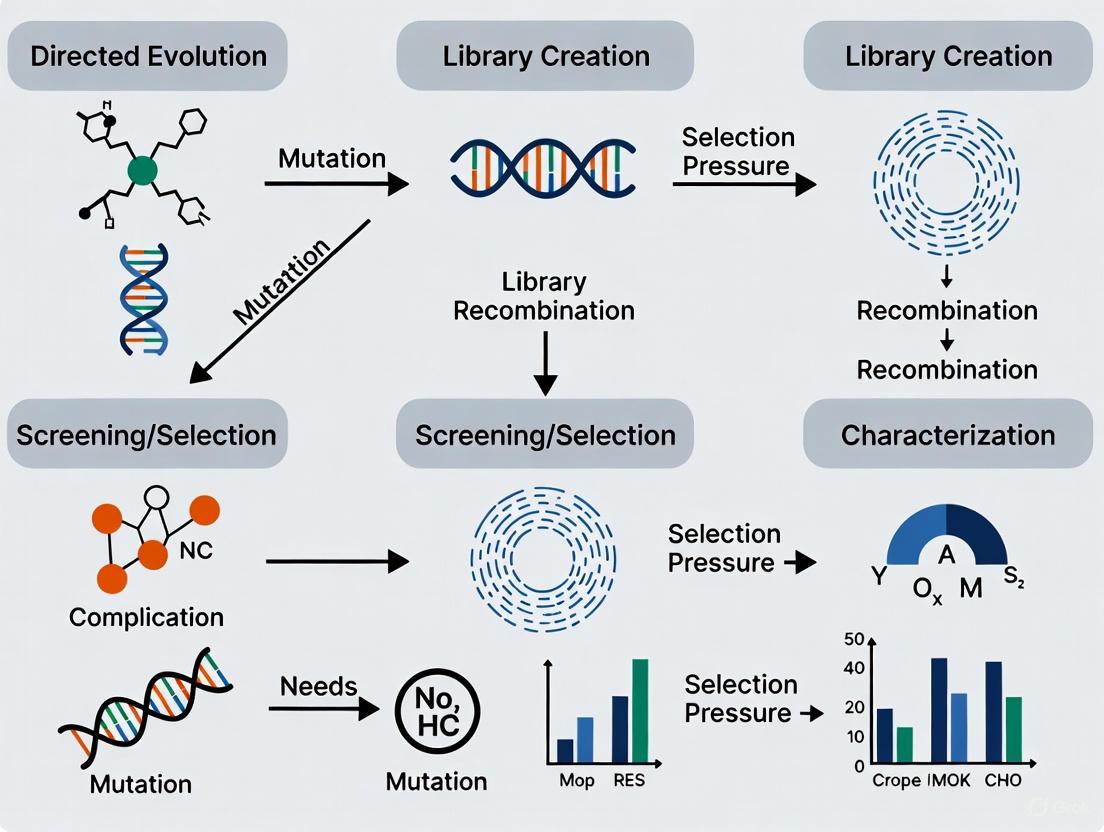
This article provides a comprehensive resource for researchers, scientists, and drug development professionals on the field of directed evolution.
Directed Evolution: Key Terms, Methodologies, and Applications in Drug Development
Abstract
This article provides a comprehensive resource for researchers, scientists, and drug development professionals on the field of directed evolution. It covers foundational principles and key terminology, explores modern methodologies for library generation and screening, and addresses common challenges and optimization strategies. Further, it examines real-world applications and validation through comparative case studies, highlighting the impact of this powerful protein engineering tool on the development of new therapeutics, including antibodies, enzymes, and gene therapies.
The Principles and Language of Directed Evolution
Directed evolution stands as a foundational methodology in modern biotechnology, operating through an iterative process of mutagenesis and selection to steer proteins or nucleic acids toward a user-defined goal [1]. This approach systematically mimics the principles of natural selection—genetic variation, selective pressure, and heredity—within a controlled laboratory environment to optimize biological molecules for specific applications [2] [3]. Since its early in vitro demonstrations in the 1960s, directed evolution has matured into a sophisticated engineering tool, enabling researchers to enhance enzyme stability, alter substrate specificity, and even develop entirely novel functionalities not found in nature [3] [4]. The profound impact of this technology was recognized with the awarding of the 201 Nobel Prize in Chemistry to Frances H. Arnold for her pioneering work in this domain [2]. This technical guide examines the core principles, methodologies, and applications of directed evolution, providing a comprehensive resource for researchers and drug development professionals.
Core Principles and Key Terminology
At its essence, directed evolution functions as a laboratory-accelerated evolutionary engine that drives a population of biomolecules toward a desired functional objective [2]. The process compresses geological timescales into manageable experimental timelines by intentionally introducing mutations and applying unambiguous, user-defined selection pressures [2]. Unlike rational design approaches that require detailed structural knowledge, directed evolution bypasses the need for complete a priori understanding of sequence-structure-function relationships, often uncovering non-intuitive and highly effective solutions through iterative exploration [2] [5].
The directed evolution workflow operates through a cyclic process of two fundamental steps, as illustrated in Figure 1. First, genetic diversity is introduced to create a library of protein or gene variants. Second, a high-throughput screening or selection method identifies rare variants exhibiting improvement in the desired trait [2]. The genes encoding these improved variants are then isolated and serve as templates for subsequent evolutionary rounds, allowing beneficial mutations to accumulate over successive generations [1] [2]. A critical distinction from natural evolution is that the selection pressure is decoupled from organismal fitness, with the sole objective being optimization of a specific protein property defined by the experimenter [2].
Table 1: Key Terminology in Directed Evolution
| Term | Definition | Application Context |
|---|---|---|
| Directed Evolution | Laboratory process mimicking natural selection to steer proteins/nucleic acids toward user-defined goals [1] [6] | Protein engineering, enzyme optimization, metabolic pathway engineering |
| Genetic Diversity | Introduction of variation in gene sequences through mutagenesis or recombination [2] | Creation of mutant libraries for functional screening |
| Selection Pressure | Experimental conditions that favor survival or identification of variants with desired properties [6] | Screening for improved enzyme activity, stability, or specificity |
| High-Throughput Screening | Individual evaluation of library members for desired properties using automated assays [1] [2] | Microtiter plate-based enzymatic assays, colorimetric/fluorimetric analysis |
| Library | A collection of gene or protein variants created through diversification methods [4] | Mutant populations subjected to screening or selection |
| Epistasis | Non-additive interactions between mutations in a protein sequence [7] | Understanding synergistic mutation effects in evolved variants |
| Genotype-Phenotype Link | Covalent or physical connection between a genetic sequence and its functional expression [1] [4] | Phage display, mRNA display, in vitro compartmentalization |
| Error-Prone PCR (epPCR) | Modified PCR that reduces polymerase fidelity to introduce random point mutations [2] [5] | Whole-gene random mutagenesis without structural information |
| DNA Shuffling | In vitro recombination method that fragments and reassembles genes to create chimeras [3] | Combining beneficial mutations from multiple parent genes |
Methodological Framework
Generating Genetic Diversity
The creation of a diverse library of gene variants constitutes the foundational step that defines the explorable sequence space in a directed evolution campaign [2]. The quality, size, and nature of this diversity directly constrain potential outcomes, with several established methods available, each possessing distinct advantages and limitations [2].
Random Mutagenesis Techniques
Error-Prone Polymerase Chain Reaction (epPCR) represents the most established method for introducing random mutations across an entire gene sequence [2] [5]. This technique utilizes a modified PCR protocol that intentionally reduces the fidelity of DNA polymerase, thereby introducing errors during gene amplification [2]. This is typically achieved by employing a polymerase lacking 3' to 5' proofreading exonuclease activity, creating dNTP concentration imbalances, and adding manganese ions (Mn²⁺) to the reaction [2]. The Mn²⁺ concentration can be precisely tuned to achieve mutation rates typically targeted at 1–5 base mutations per kilobase, resulting in approximately one or two amino acid substitutions per protein variant [2]. A significant limitation of epPCR is its inherent bias toward transition mutations over transversion mutations, constraining the accessible sequence space [2].
Recombination-Based Methods
To more closely mimic natural sexual recombination, methods such as DNA Shuffling were developed to combine beneficial mutations from multiple parent genes into single, improved offspring [2] [3]. In this method, one or more related parent genes are randomly fragmented using DNaseI, and the resulting small fragments are reassembled in a primer-free PCR reaction [3]. During annealing, homologous fragments from different parental templates can overlap and prime each other, resulting in crossovers that create novel chimeric genes [3]. Family Shuffling extends this concept by applying the DNA shuffling protocol to a set of homologous genes from different species, accessing nature's standing variation to explore functionally relevant sequence regions [2]. These methods typically require at least 70-75% sequence identity between parental genes for efficient reassembly [2].
Focused and Semi-Rational Approaches
When structural or functional information is available, focused mutagenesis enables more efficient exploration of sequence space by targeting specific regions or residues [2]. Site-Saturation Mutagenesis represents a powerful example, comprehensively exploring the functional importance of specific "hotspot" residues by creating libraries that encode all 19 possible alternative amino acids at targeted positions [2]. This semi-rational approach, combining knowledge-based targeting with random diversification, dramatically increases evolutionary efficiency by reducing library size and increasing the frequency of beneficial variants [2].
Table 2: Comparison of Library Generation Methods in Directed Evolution
| Method | Mechanism | Advantages | Disadvantages | Typical Library Size |
|---|---|---|---|---|
| Error-Prone PCR [2] [5] | Reduced polymerase fidelity introduces random point mutations | Easy to perform; requires no prior knowledge of key positions | Biased mutagenesis spectrum; limited amino acid sampling | 10³ - 10⁶ |
| DNA Shuffling [3] | Fragmentation and recombination of homologous genes | Combines beneficial mutations; mimics natural recombination | Requires high sequence homology (>70%) | 10⁴ - 10⁸ |
| Site-Saturation Mutagenesis [2] | Systematic randomization of targeted codons to all amino acids | Comprehensive exploration of key positions; high frequency of beneficial variants | Limited to a few positions; libraries become large with multiple sites | 20ⁿ (n = number of residues) |
| Mutator Strains [4] | In vivo mutagenesis using bacterial strains with defective DNA repair | Simple system; continuous mutagenesis possible | Uncontrolled mutagenesis spectrum; mutations not restricted to target | Varies |
| Orthogonal Replication Systems [4] | Engineered DNA polymerases with reduced fidelity in vivo | Mutagenesis restricted to target sequence | Technically challenging; limited target size | 10³ - 10⁵ |
Screening and Selection Methodologies
The identification of improved variants from mutant libraries represents the critical bottleneck in directed evolution, with success dictated by the principle that "you get what you screen for" [2]. The power and throughput of the screening platform must align with the library size generated in the diversification step [2]. A fundamental distinction exists between screening and selection approaches [1] [2].
Screening involves individual evaluation of each library member for the desired property [2]. Plate-based and colony screening platforms represent the most traditional formats, where host cells expressing enzyme libraries are grown on solid medium or in multi-well plates containing substrates that produce visible products [2]. For example, in the landmark evolution of subtilisin, colonies expressing active variants formed clear halos on milk-agar plates due to casein degradation [2]. Microtiter plate formats allow individual clone culturing with subsequent assay of cell lysates using colorimetric or fluorometric substrates readable by plate readers [2]. While providing quantitative data on variant performance, screening throughput is typically limited to 10³-10⁴ variants [2].
Selection establishes conditions where desired function directly couples to host survival or replication, automatically eliminating non-functional variants [1] [2]. Phage display represents a powerful selection technique where exogenous peptides are fused to phage coat proteins, enabling affinity-based selection of binding variants [4]. Selection methods can handle significantly larger libraries (up to 10¹⁵ variants) but are often difficult to design, prone to artifacts, and provide limited information about activity distribution within the library [1] [2].
Figure 1: The Directed Evolution Workflow. This iterative cycle involves diversification of a parent gene, creation of variant libraries, screening or selection for improved function, isolation of successful variants, and evaluation against target criteria. The process repeats until desired properties are achieved.
Advanced Applications and Case Studies
Engineering Novel Enzyme Functions
Directed evolution has demonstrated remarkable success in creating enzymes with novel catalytic activities not observed in nature. The Arnold laboratory pioneered this approach by evolving cytochrome P450 monooxygenases to catalyze non-natural carbene transfer reactions for cyclopropanation, a transformation previously unknown in biological systems [7]. In a recent application of Active Learning-assisted Directed Evolution (ALDE), researchers optimized five epistatic residues in the active site of a Pyrobaculum arsenaticum protoglobin (ParPgb) for enhanced cyclopropanation activity [7]. Through three rounds of wet-lab experimentation combining machine learning with functional screening, the product yield increased from 12% to 93%, demonstrating the power of iterative evolution to navigate complex fitness landscapes with significant epistasis [7].
Development of Molecular Sensors
Directed evolution has enabled the creation of novel protein-based sensors for molecular imaging applications. In a landmark study, researchers evolved the heme domain of bacterial cytochrome P450-BM3 (BM3h) to develop magnetic resonance imaging (MRI) contrast agents sensitive to the neurotransmitter dopamine [8]. Starting from a protein with natural affinity for arachidonic acid, five rounds of evolution employing error-prone PCR and absorbance-based screening produced BM3h variants with dramatically altered specificity [8]. The optimized dopamine sensor exhibited a dissociation constant (Kd) of 3.3 μM for dopamine—a 300-fold improvement over the wild-type protein—while simultaneously reducing affinity for the natural substrate [8]. These evolved sensors enabled imaging of dopamine release in live animal brains, demonstrating the potential for molecular-level functional MRI [8].
Table 3: Representative Experimental Outcomes from Directed Evolution Campaigns
| Evolved Protein | Engineering Goal | Methodology | Key Improvement | Reference |
|---|---|---|---|---|
| ParPgb Protoglobin [7] | Optimize cyclopropanation activity | Active learning-assisted directed evolution (ALDE) | Product yield increased from 12% to 93% | [7] |
| P450-BM3 Heme Domain [8] | Develop dopamine MRI sensor | Error-prone PCR with absorbance screening | 300-fold improved dopamine affinity (Kd = 3.3 μM) | [8] |
| Phosphite Dehydrogenase [5] | Enhance thermostability | Combination of multiple mutagenesis methods | 23,000-fold improved half-life at 45°C | [5] |
| Subtilisin E [3] | Increase activity in organic solvent | Error-prone PCR | 256-fold higher activity in 60% DMF | [3] |
| β-Lactamase [3] | Improve antibiotic resistance | DNA shuffling | 32,000-fold increase in cefotaxime MIC | [3] |
| Pseudomonas aeruginosa Lipase [5] | Enhance enantioselectivity | Iterative saturation mutagenesis | 594-fold improved E-value for chiral ester | [5] |
Experimental Protocol: Evolution of a Dopamine-Sensitive MRI Sensor
The development of dopamine-sensitive MRI sensors from P450-BM3 exemplifies a well-executed directed evolution campaign [8]. The following protocol details the key methodological steps:
Step 1: Library Generation
- Perform error-prone PCR on the BM3h gene using Mutazyme polymerase or similar low-fidelity polymerase to achieve 1-2 amino acid substitutions per variant [8].
- Include Mn²⁺ ions and dNTP concentration imbalances to enhance mutation rate [8] [2].
- Clone the mutated genes into an appropriate expression vector and transform into E. coli host cells [8].
Step 2: Primary Screening
- Grow approximately 900 randomly selected clones in deep-well microtiter plates and induce protein expression [8].
- Prepare cleared lysates and transfer to assay plates for optical titration [8].
- Measure absorbance spectra (350-500 nm) before and after addition of dopamine and arachidonic acid [8].
- Calculate dissociation constants (Kd) for both ligands by monitoring spectral shifts as a function of ligand concentration [8].
Step 3: Secondary Validation
- Select 8-10 clones based on improved dopamine affinity and reduced arachidonic acid affinity [8].
- Purify selected variants in bulk and characterize using more precise spectrophotometric titrations [8].
- Validate functional MRI response by measuring T1 relaxivity changes in the presence and absence of saturating dopamine concentrations [8].
Step 4: Iterative Rounds
- Use the best-performing variant from each round as the template for subsequent evolution [8].
- Continue for multiple rounds (typically 3-5) until target affinity and specificity parameters are achieved [8].
Figure 2: Screening Workflow for Directed Evolution of MRI Sensor. The process involves high-throughput absorbance-based screening of mutant libraries, hit selection based on dissociation constants, and subsequent validation of promising variants using MRI relaxivity measurements.
The Scientist's Toolkit: Essential Research Reagents
Successful implementation of directed evolution requires specific reagents and methodologies to generate diversity, express variants, and screen for desired functions. The following table details essential research solutions commonly employed in directed evolution campaigns.
Table 4: Essential Research Reagents and Methodologies for Directed Evolution
| Reagent/Methodology | Function | Application Example |
|---|---|---|
| Error-Prone PCR Kits [2] [5] | Introduce random point mutations across gene of interest | Whole-gene mutagenesis of P450-BM3 heme domain [8] |
| Site-Saturation Mutagenesis Kits [2] | Systematically randomize specific codons to all amino acids | Focused exploration of enzyme active site residues [2] |
| Expression Vectors & Host Strains [1] | Enable protein expression and genotype-phenotype linkage | E. coli expression of subtilisin E variants [3] |
| Phage Display Systems [1] [4] | Selection-based platform for binding protein evolution | Antibody affinity maturation [4] |
| Fluorescence-Activated Cell Sorting (FACS) [4] | Ultra-high-throughput screening using fluorescent reporters | Evolution of fluorescent proteins with novel properties [4] |
| Microtiter Plate Readers [2] | Absorbance/fluorescence measurement for plate-based screens | Dopamine binding assays for P450-BM3 variants [8] |
| DNA Shuffling Protocols [3] | Recombine homologous genes to create chimeric libraries | Generation of improved β-lactamase variants [3] |
Directed evolution has established itself as an indispensable protein engineering methodology that harnesses nature's evolutionary principles to solve complex biotechnology challenges. By iteratively cycling through diversification and selection, researchers can optimize enzyme properties, develop novel catalytic activities, and create valuable biological tools without requiring complete structural knowledge. Recent advances, including machine learning integration [7] and ultra-high-throughput screening methods [4], continue to expand the capabilities and applications of this powerful technology. As directed evolution methodologies mature, they promise to deliver increasingly sophisticated solutions across pharmaceutical development, industrial biocatalysis, and basic scientific research, solidifying their role as essential tools in the modern biotechnology arsenal.
In the field of molecular evolution and protein engineering, a precise understanding of core terminology is fundamental for both research and application. This guide provides an in-depth technical examination of four pivotal concepts—genotype, phenotype, mutation, and selection pressure—framed within the context of directed evolution. Directed evolution is a powerful laboratory method that mimics natural selection to steer proteins, pathways, or entire organisms toward user-defined goals, with immense implications for therapeutic development, industrial biocatalysis, and basic evolutionary science [1] [3]. For researchers and drug development professionals, grasping the intricate interplay between these core terms is essential for designing robust experiments to evolve novel biologics, antibodies, and enzymes. This whitepaper details these concepts, their interrelationships, quantitative frameworks, and practical experimental protocols.
Defining the Core Terms
Genotype
The genotype constitutes the genetic makeup of a cell or organism. It is the entire set of genes, including all alleles, that an individual possesses [6]. In directed evolution experiments, the target is typically a single gene that codes for a protein of interest. This gene is the unit that is subjected to iterative rounds of diversification and selection [1] [3]. The genotype is the fundamental template that is manipulated and inherited.
Phenotype
The phenotype encompasses the observable characteristics and appearance of an organism, resulting from the expression of its genotype in a given environment [6]. At the molecular level in directed evolution, the phenotype is often a specific, measurable function of a protein, such as its catalytic activity, stability under harsh conditions, or binding affinity to a therapeutic target [1] [3]. It is the phenotypic expression that is directly screened or selected for in the laboratory.
Mutation
A mutation is defined as a change in the genetic material of an organism [6]. Mutations can range from a single nucleotide change (a point mutation) to larger insertions, deletions, or rearrangements [6]. In directed evolution, mutations are deliberately introduced into the gene of interest to create a library of gene variants. This library is the source of genetic diversity from which improved phenotypes can be selected [1]. These variants may produce slightly different proteins that affect function, such as the efficiency with which an enzyme catalyzes a reaction [6].
Selection Pressure
Selection pressure refers to environmental influences or constraints that influence which genes are transmitted from one generation to the next [6]. It is the driving force of adaptive evolution. In a natural context, this could be the presence of predators or limited resources. In directed evolution, scientists artificially apply a selection pressure to a library of variants. This pressure ensures that only individuals whose genes (genotypes) confer a desired function (phenotype) will survive and/or reproduce (be amplified) [6] [1]. For example, selection pressure could be the presence of a toxin that only cells expressing an evolved detoxifying enzyme can survive, or a substrate that yields a colored product only when acted upon by an active enzyme [1].
Table 1: Core Terminology in Genetics and Directed Evolution
| Term | Definition | Role in Directed Evolution |
|---|---|---|
| Genotype | The genetic makeup of a cell or organism [6]. | The DNA sequence of the gene being evolved; the template for diversification. |
| Phenotype | The observable characteristics of an organism [6]. | The function of the protein of interest (e.g., catalytic activity, binding). |
| Mutation | A change in the genetic material of an organism [6]. | The source of diversity; creates a library of gene variants for screening. |
| Selection Pressure | Environmental constraints that influence gene transmission [6]. | The artificial constraint applied to select for improved variants. |
The Genotype-Phenotype Relationship
The relationship between genotype and phenotype is not a simple one-to-one mapping but a complex, often non-linear interaction that is central to evolution.
The Differential View
A powerful framework for understanding this relationship is the differential view. This perspective holds that the link between genotype and phenotype is best viewed as a connection between a difference at the genetic level and a difference at the phenotypic level [9]. In genetics, the focus is often not on the absolute character of a single organism but on the phenotypic variation between individuals that can be attributed to genetic variation [9]. For instance, stating that a gene "causes" brown hair is a simplification; more accurately, a variation in that gene can cause a variation in hair color from, for example, blonde to brown [9]. This view is particularly relevant in the context of pervasive pleiotropy (where one gene affects multiple traits) and epistasis (where the effect of one gene depends on the presence of other genes) [9].
The Link in Directed Evolution
Directed evolution critically depends on establishing a strong genotype-phenotype link. This is a physical or conceptual connection that allows researchers to identify the gene sequence (genotype) responsible for a desired function (phenotype) after a selection or screening step [1]. Several methods ensure this link:
- In vivo compartmentalization: Each variant gene is expressed inside a single cell (e.g., bacteria or yeast). The cell itself acts as the compartment that links the genotype to the phenotype it produces [1].
- In vitro compartmentalization: Genes are expressed in artificial microdroplets using in vitro transcription-translation systems. Each droplet contains a single gene and the protein it encodes, maintaining the link [1] [3].
- Covalent linkage: Methods like mRNA display use puromycin to create a covalent bond between an mRNA molecule (genotype) and the protein (phenotype) it encodes [1].
The following diagram illustrates the core conceptual relationship between these terms and the process of directed evolution.
Quantitative Frameworks and Selection Classifications
Classifying Selection Pressures
Selection pressures in evolution can be categorized based on how they affect the distribution of phenotypes in a population. The table below summarizes the main types of selective pressures.
Table 2: Types of Selective Pressures and Their Population Effects [10]
| Type of Selection | Description | Effect on Population Variance | Example |
|---|---|---|---|
| Stabilizing Selection | Favors the average phenotype and selects against extreme variants. | Decreases genetic variance. | Mouse fur color that closely matches a consistent brown forest floor, selected by predators [10]. |
| Directional Selection | Favors phenotypes at one end of the spectrum of existing variation. | Shifts variance toward a new, fitter phenotype. | The shift to darker peppered moths in soot-polluted environments [10]. |
| Diversifying Selection | Favors two or more distinct phenotypes over intermediate forms. | Increases genetic variance, making the population more diverse. | In a beach habitat, both light-colored mice (on sand) and dark-colored mice (in grass) are favored over medium-colored mice [10]. |
| Frequency-Dependent Selection | Favors a phenotype because it is either common (positive) or rare (negative). | Positive: decreases variance. Negative: increases variance. | In side-blotched lizards, throat color patterns cycle in frequency based on which is rare or common in the population [10]. |
| Sexual Selection | Selection based on the ability to obtain mates, leading to secondary sexual characteristics. | Can decrease or increase variance, often leading to sexual dimorphism. | The evolution of the peacock's large, colorful tail, which impairs survival but increases mating success [10]. |
Fitness Landscapes and Evolutionary Theory
The quantitative relationship between genotype and fitness (a measure of reproductive success) is often conceptualized as a fitness landscape [11]. In this metaphor, genotypes are mapped to a landscape where height corresponds to fitness. Populations evolve by moving toward fitness peaks. However, the landscape itself can be complex and multi-dimensional.
Advanced theoretical work, such as the double-replica theory, uses statistical physics to model the co-evolution of genotypes and phenotypes. This theory introduces separate "replicas" for genotypes (the interaction couplings) and phenotypes (the spin configurations) to describe how their relationship evolves under selection pressure and noise (e.g., mutation) [11]. A key insight from such models is the existence of a "robust fitted phase" under an intermediate level of noise, where phenotypes achieve high fitness and robustness to both environmental noise and genetic mutation are correlated [11]. This phase is highly relevant to biological evolution and successful directed evolution campaigns.
Experimental Protocols in Directed Evolution
Directed evolution is an iterative process designed to mimic natural selection in the laboratory. The following workflow details a generalized protocol for evolving a protein with improved function.
The Directed Evolution Workflow
The core directed evolution cycle involves three core steps: Diversification, Selection or Screening, and Amplification [1] [3]. This cycle is repeated until a variant with the desired level of performance is obtained.
Step 1: Diversification (Creating Variation)
The first step is to create a diverse library of mutant genes from the parent template.
- Method: Error-Prone PCR (epPCR)
- Principle: Standard PCR is performed under conditions that reduce the fidelity of the DNA polymerase, introducing random point mutations throughout the gene [1] [3].
- Protocol:
- Reaction Setup: Set up a standard PCR reaction mixture containing the plasmid DNA template (~10-100 ng), primers that flank the gene of interest, dNTPs, and a suitable buffer.
- Introduce Errors: Use a DNA polymerase known for low fidelity (e.g., Taq polymerase) and alter the reaction conditions to promote misincorporation. This can be achieved by adding manganese ions (Mn²⁺), using unbalanced dNTP concentrations, and increasing the magnesium ion (Mg²⁺) concentration [3].
- Amplification: Run the PCR for 25-30 cycles.
- Purification: Purify the resulting mutagenized PCR product.
- Cloning: Clone the purified product back into an expression vector to create the mutant library. The library size can range from 10⁴ to 10⁸ variants, depending on the method and screening capacity [1].
Step 2: Selection or Screening (Detecting Fitness Differences)
The library of variant genes must be interrogated to find the rare clones with improved function. This is achieved through selection or screening.
- Method: High-Throughput Microtiter Plate Screening
- Principle: Each variant is expressed and cultured individually, and its activity is measured using a quantitative assay, often based on color or fluorescence [1].
- Protocol:
- Transformation and Expression: Transform the library of plasmid variants into a suitable host cell (e.g., E. coli). Plate the cells onto agar plates to form individual colonies.
- Culturing in Plates: Pick individual colonies into the wells of a 96- or 384-well microtiter plate containing growth medium. Induce protein expression.
- Lysate Preparation: Lyse the cells, often chemically or enzymatically, to release the expressed protein.
- Activity Assay: Add a substrate to each well. The substrate should be converted into a colored or fluorescent product by the desired enzyme activity.
- Quantitative Measurement: Use a plate reader to measure the absorbance or fluorescence in each well.
- Data Analysis: Rank the variants based on their signal intensity relative to controls (e.g., the parent sequence). The top performers are chosen for the next round.
Step 3: Amplification (Ensuring Heredity)
The genes encoding the best-performing variants are isolated and prepared for the next round of evolution.
- Method: Gene Amplification and Vector Preparation
- Principle: The genetic material from the top hits is amplified to serve as the template for the next round of diversification [1].
- Protocol:
- Plasmid Isolation: Isolate the plasmid DNA from the host cells of the top-performing variants.
- PCR Amplification: Use standard high-fidelity PCR to amplify the variant gene from the isolated plasmid. Alternatively, the plasmid itself can be used directly.
- Template for Next Round: The amplified gene (or pool of genes from the best performers) is used as the starting template for the next round of directed evolution, beginning again with the Diversification step.
This cycle continues iteratively until the evolved protein exhibits the target level of improvement in the desired property.
Advanced Modern Methods
Recent technological advances have dramatically accelerated the pace of directed evolution.
- T7-ORACLE System: This system uses an engineered E. coli bacterium that hosts a second, artificial DNA replication system operating separately from the cell's own genome. This allows scientists to introduce mutations every time the cell divides (roughly every 20 minutes), effectively condensing 100,000 years of evolution into a much shorter timeframe and enabling continuous evolution without repeated manual intervention [12].
- PROTEUS Platform: This is a platform designed to evolve proteins directly within mammalian cells, which is particularly relevant for evolving therapeutic proteins that must function in a human-cell-like environment [12].
The Scientist's Toolkit: Key Research Reagents
The following table details essential materials and reagents used in a standard directed evolution experiment.
Table 3: Essential Research Reagents for Directed Evolution
| Reagent / Tool | Function in Directed Evolution |
|---|---|
| DNA Polymerase | Enzyme that amplifies the gene of interest. Error-prone PCR uses low-fidelity versions to introduce random mutations [1] [3]. |
| Restriction Enzymes | Proteins that cut DNA at specific sequences. Used for moving genes in and out of expression vectors (cloning) [6]. |
| DNA Ligase | Enzyme that joins DNA fragments together by forming phosphodiester bonds. Essential for sealing genes into plasmid vectors to create recombinant DNA [6]. |
| Plasmids | Small, circular DNA molecules that replicate independently of the chromosome. Used as vectors to carry the gene of interest into a host cell for expression [6] [1]. |
| Host Cells | Living systems (e.g., E. coli, yeast) used to express the library of variant genes. Each cell produces a single protein variant, linking genotype to phenotype [1]. |
| Reporter Gene / Assay | A marker system (e.g., producing a colored or fluorescent product) used to detect and quantify the desired protein activity during screening [6]. |
| Selection Agent | An environmental pressure (e.g., an antibiotic, a toxin, or a required nutrient) applied to select for cells expressing a protein with the desired function [1]. |
The concepts of genotype, phenotype, mutation, and selection pressure form the foundational pillars of evolutionary theory and its practical application in directed evolution. The precise, differential relationship between genetic variation and phenotypic variation is the engine that drives adaptation, whether in nature or the laboratory. For scientists in drug development and biotechnology, mastering these terms and the associated methodologies—from creating diverse mutant libraries to applying sophisticated high-throughput screens—is indispensable. As directed evolution technologies, such as ultra-rapid continuous evolution systems, continue to advance, the ability to design and interpret these experiments with a deep understanding of core terminology will remain critical for innovating new therapies, diagnostics, and sustainable biocatalysts.
Directed evolution represents a cornerstone technique in modern biotechnology, enabling researchers to engineer biomolecules with enhanced or entirely novel functions by mimicking the principles of natural selection in a laboratory setting [6]. This iterative, two-step process involves the generation of genetic diversity within a population of biological entities, followed by the screening or selection of variants exhibiting desirable traits [3]. The selected individuals then serve as templates for subsequent rounds of diversification and selection, progressively optimizing the function of interest. The historical arc of this field stretches from foundational in vitro experiments demonstrating molecular evolution to its recognition as a powerful tool for protein engineering, culminating in the 2018 Nobel Prize in Chemistry awarded to Frances H. Arnold for the directed evolution of enzymes [13]. This article traces this scientific journey, detailing the key experiments, methodological advances, and technical reagents that have shaped the field of directed evolution, providing a resource for researchers and drug development professionals engaged in this transformative area of study.
Spiegelman's Monster: The Foundational Experiment
In the 1960s, Sol Spiegelman and his colleagues at the University of Illinois conducted a landmark study that laid the experimental groundwork for directed evolution [14] [15]. Their work demonstrated that Darwinian principles of evolution—variation and selection—could operate on simple molecular systems outside of a living cell.
Experimental Protocol and Methodology
Spiegelman's team established a cell-free system to study the replication of RNA from the bacteriophage Qβ [14] [15]. The core methodology can be broken down into the following steps:
- System Setup: A solution containing the Qβ RNA replicase (the enzyme that replicates the viral RNA), free nucleotide building blocks (ATP, GTP, CTP, UTP), and necessary salts was prepared.
- Initial Incubation: The natural Qβ phage RNA, approximately 4,500 nucleotides in length, was introduced into this solution. The Qβ replicase, which is highly specific for its own RNA, began copying the template.
- Serial Transfer: After a period of replication, a sample of the synthesized RNA was transferred to a fresh tube containing new solution with replicase and nucleotides. This process of transfer and replication was repeated multiple times—a serial passage experiment at the molecular level.
- Application of Selective Pressure: In this artificial environment, the only selective pressure was the speed of replication. The researchers observed that the RNA population changed dramatically over generations. RNA molecules that could replicate faster were favored. Since shorter RNA molecules required less time to be synthesized, deletion mutants that had shed parts of the genome not essential for replication in this simplified system emerged and came to dominate the population.
- Outcome: After 74 serial transfers, the original RNA genome had evolved into a highly truncated "monster" of only 218 nucleotides [14]. This minimal RNA, dubbed "Spiegelman's Monster," replicated rapidly but had lost the genetic information needed to produce infectious viral particles, as those genes were superfluous in an environment where the replicase was provided externally.
This experiment provided a powerful demonstration of Darwinian evolution in a test tube, proving that natural selection can act on non-cellular molecular systems.
Research Reagent Solutions for Spiegelman's Experiment
Table 1: Key research reagents used in Spiegelman's foundational experiment.
| Reagent | Function in the Experiment |
|---|---|
| Qβ Bacteriophage RNA | Initial template for replication; the "genotype" and "phenotype" under selection. |
| Qβ RNA Replicase | Enzyme catalyst responsible for recognizing the RNA template and synthesizing new complementary strands. |
| Ribonucleotides (ATP, GTP, CTP, UTP) | Building blocks for the synthesis of new RNA strands by the replicase. |
| Inorganic Salts Buffer | Provided the optimal ionic and pH conditions for replicase activity and stability. |
The Rise of Modern Directed Evolution
The principles demonstrated by Spiegelman were later formalized into a robust methodology for protein engineering. Modern directed evolution, as pioneered in the 1990s, applies these concepts to create enzymes with improved stability, activity, or novel functions [3]. A landmark example was the evolution of subtilisin E, a serine protease, for increased activity in the organic solvent dimethylformamide (DMF) [3]. This involved sequential rounds of error-prone PCR to introduce random mutations, followed by screening for improved activity.
Core Methodologies and Workflows
The general workflow for the directed evolution of a protein involves an iterative cycle, as illustrated below. Two primary strategies for creating genetic diversity are random mutagenesis (e.g., error-prone PCR) and recombination-based methods (e.g., DNA shuffling), which mimics sexual recombination by shuffling fragments from multiple parent genes [3].
Key Techniques and Their Applications
Table 2: Quantitative outcomes from landmark directed evolution experiments.
| Evolved Protein / System | Technique Used | Selection Pressure | Key Outcome |
|---|---|---|---|
| Subtilisin E [3] | Error-prone PCR | Activity in 60% DMF | 256-fold increase in activity after 3 rounds |
| β-lactamase [3] | DNA Shuffling | Antibiotic (Cefotaxime) resistance | 32,000-fold increase in MIC vs. 16-fold without recombination |
| Qβ RNA (Spiegelman's Monster) [14] | Serial Passage | Replication speed | Genome reduced from 4,500 to 218 nucleotides |
| Novel ATP-binding proteins [3] | mRNA display | Binding to ATP | Isolated from a library of 6x10^12 random sequences |
The 2018 Nobel Prize in Chemistry and Current Frontiers
The practical power of directed evolution was unequivocally recognized when the Royal Swedish Academy of Sciences awarded one half of the 2018 Nobel Prize in Chemistry to Frances H. Arnold "for the directed evolution of enzymes" [13]. The other half was jointly awarded to George P. Smith and Sir Gregory P. Winter for the phage display of peptides and antibodies. The Academy noted that the Laureates had "harnessed the power of evolution" to develop proteins that solve humankind's chemical problems. Frances Arnold's enzymes, for instance, are used in the more environmentally friendly manufacturing of pharmaceuticals and the production of renewable biofuels [13].
The Scientist's Toolkit: Essential Reagents for Directed Evolution
Table 3: Key research reagents and their functions in a standard directed evolution pipeline.
| Research Reagent / Tool | Function in Directed Evolution |
|---|---|
| Polymerase Chain Reaction (PCR) Reagents | Gene amplification; error-prone PCR introduces random mutations for diversity generation [6]. |
| DNA Ligase | Joins DNA fragments together; essential for cloning variants into expression vectors [6]. |
| Restriction Enzymes | Cuts DNA at specific sites, enabling the movement of genes into plasmids or other vectors for expression and screening [6]. |
| Expression Plasmids | Vectors used to transfer the gene library into a host organism (e.g., E. coli) for protein expression [6]. |
| Host Cells (e.g., E. coli) | Cellular factories for producing the protein variants from the gene library. |
| Selection Media / Assays | Provides the selective pressure (e.g., antibiotic, substrate, fluorescence) to identify improved variants. |
Contemporary Advances and Future Outlook
The field of directed evolution continues to advance rapidly. Current research focuses on overcoming bottlenecks such as host genome interference, small library sizes, and uncontrolled mutagenesis in complex systems [16]. A recent breakthrough, termed RNA replicase-assisted continuous evolution (REPLACE), engineers an orthogonal RNA replication system within mammalian cells [16]. This allows for the continuous evolution of RNA-based devices and proteins directly in a mammalian environment, opening new avenues for synthetic biology and cell engineering. Furthermore, directed evolution principles are now being applied beyond individual proteins to entire metabolic pathways and genomes, creating whole-cell biocatalysts for the synthesis of valuable chemicals and pharmaceuticals [3]. The integration of these methods with artificial intelligence for predicting productive mutations promises to further accelerate the design of biomolecules, solidifying directed evolution's role as an indispensable tool in the molecular life sciences [17].
Protein engineering is a cornerstone of modern biotechnology, enabling the creation of novel enzymes, therapeutic antibodies, and biosensors with tailored properties. Within this field, two primary methodologies have emerged: directed evolution and rational protein design. While both aim to optimize protein function, they approach this goal from fundamentally different perspectives. Directed evolution mimics natural selection in a laboratory setting, employing iterative rounds of mutation and selection to improve protein function without requiring detailed structural knowledge. In contrast, rational design employs computational and structure-based approaches to make precise, targeted mutations aimed at achieving predefined functional outcomes. This review provides a comprehensive technical comparison of these methodologies, detailing their underlying principles, experimental protocols, applications, and relative advantages for research and drug development professionals.
Fundamental Principles and Comparative Framework
Conceptual Foundations
Directed evolution simulates natural evolution through iterative cycles of diversification, selection, and amplification to steer proteins toward user-defined goals [18] [1]. This approach operates on the principle that random mutagenesis coupled with high-throughput screening can identify beneficial mutations without requiring prior knowledge of protein structure or mechanism [4]. The success of directed evolution was recognized with the 2018 Nobel Prize in Chemistry awarded for the directed evolution of enzymes and phage display techniques [18].
Rational protein design relies on precise, knowledge-driven modifications to protein sequences based on detailed understanding of structure-function relationships [19] [20]. This approach requires comprehensive structural information, often obtained through X-ray crystallography, NMR spectroscopy, or computational prediction, to identify specific residues for mutation that will confer desired properties [21] [22]. Rational design operates under the "sequence-structure-function" paradigm, where amino acid sequence determines three-dimensional structure, which in turn dictates protein function [18].
Key Characteristics Comparison
Table 1: Fundamental Characteristics of Directed Evolution and Rational Design
| Characteristic | Directed Evolution | Rational Design |
|---|---|---|
| Knowledge Requirements | Minimal structural knowledge needed | Detailed structural and mechanistic understanding essential |
| Mutagenesis Approach | Random or semi-random throughout gene | Targeted to specific residues |
| Throughput Requirements | Very high (10³-10¹⁵ variants) | Low to moderate (tens to hundreds of variants) |
| Handles Complexity | Excellent for complex or unknown mechanisms | Limited to well-understood structure-function relationships |
| Primary Advantage | Explores vast sequence space; no structural bias | Precise, targeted changes; minimal wasted screening effort |
| Major Limitation | Requires robust high-throughput screening | Difficult to predict distal effects of mutations |
Methodologies and Experimental Protocols
Directed Evolution Workflow
Directed evolution follows an iterative cycle of diversification, selection, and amplification [18] [4] [1]. The process begins with the generation of genetic diversity through random mutagenesis of the target gene. Common methods include error-prone PCR, which introduces random point mutations throughout the sequence [4], and DNA shuffling, which recombines fragments from related genes to explore sequence space between parent sequences [1]. More recent techniques include RAISE (random insertion/deletion mutagenesis) for introducing indels and TRINS for generating random tandem repeats [4].
Following diversification, the mutant library undergoes selection or screening to identify variants with improved properties. Selection methods directly couple desired function to survival or replication, such as through phage display for binding proteins or growth complementation for enzyme activity [1]. When selection isn't feasible, screening methods individually assay variants using colorimetric, fluorogenic, or other detectable signals [4]. High-throughput approaches like fluorescence-activated cell sorting (FACS) enable screening of libraries exceeding 10⁸ variants [4]. The best-performing variants are then amplified and serve as templates for subsequent rounds of evolution.
Table 2: Common Mutagenesis Methods in Directed Evolution
| Method | Mechanism | Advantages | Library Size |
|---|---|---|---|
| Error-prone PCR | Random point mutations via low-fidelity amplification | Easy to perform; no prior knowledge needed | 10⁶-10¹⁰ |
| DNA Shuffling | Fragmentation and recombination of homologous genes | Explores combinatorial benefits; recombines beneficial mutations | 10⁶-10¹² |
| Site-Saturation Mutagenesis | Targeted randomization of specific codons | Focused exploration of key positions; reduced library size | 10²-10⁵ per position |
| Orthogonal Replication Systems | In vivo mutagenesis using engineered polymerases | Targeted in vivo evolution; continuous evolution possible | 10⁸-10¹¹ |
Rational Design Workflow
Rational design begins with comprehensive analysis of the target protein's structure and mechanism [19] [20]. Researchers identify specific residues influencing target properties through structural visualization, molecular dynamics simulations, or computational docking studies [20]. Tools like CAVER analyze tunnels and channels in protein structures to identify "hot spot" residues affecting activity, stability, or specificity [20]. Molecular dynamics simulations generate conformational ensembles that reveal dynamic features crucial for function [20].
Once target residues are identified, computational design predicts optimal amino acid substitutions. The Rosetta software suite is widely used for designing novel proteins and optimizing existing ones [20] [22]. For enzyme design, RosettaMatch identifies protein scaffolds that can accommodate theorized catalytic sites (theozymes), while RosettaDesign optimizes the surrounding active site pocket [20]. Designed variants are then experimentally validated, with iterative refinement based on performance data.
Semi-Rational Approaches
Semirational design represents a hybrid approach that combines elements of both methods [21] [20]. This strategy uses computational or bioinformatic analysis to identify promising regions for randomization, creating focused libraries with higher probabilities of containing beneficial mutations [20]. Techniques like iterative saturation mutagenesis (ISM) systematically explore combinations of mutations at identified hot spots [20]. This approach maintains the exploratory power of directed evolution while significantly reducing library size and screening burden.
Applications in Research and Drug Development
Therapeutic Applications
Both directed evolution and rational design have proven valuable for therapeutic development. Directed evolution has been particularly successful for antibody engineering through phage display technology, enabling development of high-affinity therapeutic antibodies [18] [1]. Rational design has advanced protein-based therapeutics such as engineered insulin analogs with optimized pharmacokinetics and enzyme replacements with enhanced stability [21].
Enzyme Engineering for Industrial Catalysis
Industrial applications often require enzymes with enhanced stability, altered substrate specificity, or novel catalytic activities. Directed evolution has successfully engineered enzymes for operation under harsh industrial conditions (extreme temperatures, organic solvents) [18] [1]. Notable examples include cytochrome P450 enzymes engineered through directed evolution to catalyze non-natural transformations, expanding their synthetic utility [18]. Rational design has been employed to modify fatty acid selectivity in lipases by strategically introducing bulky residues to block binding pockets [19].
Novel Protein Design
Rational design enables creation of entirely novel proteins not found in nature. The de novo design of protein folds like Top7 demonstrates the power of computational methods to create stable proteins with unprecedented structures [22]. Similarly, rational design has created novel protein-protein interfaces, metalloproteins, and enzymes for non-biological reactions [20] [22].
Essential Research Reagents and Tools
Table 3: Key Research Reagent Solutions for Protein Engineering
| Category | Specific Tools/Reagents | Function in Protein Engineering |
|---|---|---|
| Mutagenesis | Error-prone PCR kits, DNA shuffling kits, Site-directed mutagenesis kits | Introduce genetic diversity for library generation |
| Expression Systems | Bacterial (E. coli), yeast, or in vitro transcription/translation systems | Produce protein variants for screening |
| Screening Tools | Phage display systems, FACS, Microtiter plate assays, HPLC/GC-MS | Identify variants with desired properties from libraries |
| Computational Software | Rosetta, YASARA, CAVER, PyMol, Molecular dynamics packages | Predict protein structures, identify mutation sites, design variants |
| Specialized Reagents | Kapa Biosystems polymerases, Modified nucleotides, Unnatural amino acids | Enable specialized mutagenesis and expression approaches |
Workflow Visualization
Emerging Trends and Future Perspectives
The distinction between directed evolution and rational design is increasingly blurred by hybrid approaches and new technologies. Machine learning algorithms now analyze sequence-function relationships from directed evolution data to guide rational design decisions [23]. Deep learning models like DeepDE enable more efficient exploration of sequence space by predicting promising mutation combinations [23]. Autonomous protein engineering systems such as SAMPLE (Self-driving Autonomous Machines for Protein Landscape Exploration) combine robotic experimentation with AI-driven design to accelerate both approaches [21].
Advances in structural biology, particularly in cryo-electron microscopy and artificial intelligence-based structure prediction (exemplified by AlphaFold2 and RoseTTAFold), are expanding the scope of rational design to previously intractable targets [21] [22]. Simultaneously, improvements in high-throughput screening technologies continue to enhance the efficiency of directed evolution. The integration of non-canonical amino acids and artificial cofactors further expands the functional repertoire of engineered proteins beyond natural capabilities [20].
For drug development professionals, the strategic selection between directed evolution, rational design, or hybrid approaches depends on multiple factors: the availability of structural information, the complexity of the target function, the availability of high-throughput assays, and project timelines. As both methodologies continue to advance and converge, they promise to accelerate the development of novel biologics, enzymes for sustainable chemistry, and research tools that deepen our understanding of protein function.
In the field of protein engineering, directed evolution (DE) stands as a powerful methodology for tailoring enzymes and other biomolecules to meet specific industrial and therapeutic needs. It mimics the principles of natural selection—variation, selection, and heredity—in a controlled laboratory environment to steer proteins toward a user-defined goal [1]. Unlike rational design approaches that require extensive knowledge of protein structure and mechanism, directed evolution can generate improved proteins without this prerequisite, making it a highly versatile tool [1]. The efficacy of this process hinges on a core set of molecular components: genes, which provide the blueprint; enzymes, the functional workhorses; catalysts that drive reactions; and reporter systems, which enable the detection of successful variants [6] [24]. This guide provides an in-depth technical examination of these essential components, framed within the context of directed evolution for a scientific audience.
Core Conceptual Framework
Directed evolution is an iterative process that consists of three fundamental steps, as illustrated in the workflow below. The cycle begins with the introduction of genetic variation, which serves as the raw material for evolution. This is followed by a selection or screening step, where variants with desired traits are identified, often using reporter systems. Finally, the genes of the selected variants are amplified to serve as the template for the next round of evolution, progressively enhancing the protein's properties [24] [1].
The success of a directed evolution campaign is directly linked to the total library size screened, as evaluating more mutants increases the probability of finding one with significantly improved properties [1]. The components and processes involved in this cycle are detailed in the following sections.
Genes: The Blueprint for Variation
In directed evolution, the gene encoding the target protein is the fundamental starting point. The process involves creating a diverse library of gene variants to explore a vast sequence space and identify mutants with enhanced functions [1].
Methods for Genetic Diversification
Several laboratory techniques are employed to introduce genetic diversity, each with its own advantages and applications. These methods can be broadly categorized as random or semi-rational.
Table 1: Key Methods for Generating Genetic Diversity in Directed Evolution
| Method | Principle | Key Advantage | Typical Library Size |
|---|---|---|---|
| Error-Prone PCR [24] [1] | Uses reaction conditions that reduce polymerase fidelity, introducing random point mutations. | Simple; requires no prior structural knowledge. | Large (>106) |
| DNA Shuffling [1] | Fragments of homologous genes are reassembled randomly, mimicking genetic recombination. | Recombines beneficial mutations from multiple parents. | Large |
| Site-Saturation Mutagenesis [1] | All possible amino acid substitutions are systematically introduced at a specific residue or region. | Focuses diversity on "hotspot" regions, reducing library size. | Focused (20n per region) |
The choice of mutagenesis method is critical. While random mutagenesis methods like error-prone PCR allow for a blind exploration of sequence space, semi-rational approaches that focus on specific regions (e.g., the active site or regions identified from phylogenetic analysis) create focused libraries with a higher probability of containing beneficial mutants, thus streamlining the screening process [25] [1].
Enzymes and Catalysts: The Functional Targets
Enzymes as Biological Catalysts
Enzymes are proteins that act as biological catalysts, meaning they significantly speed up the rate of specific biochemical reactions without being consumed in the process [6]. In directed evolution, enzymes are the primary targets for optimization. The goal is to alter their properties, such as activity, thermostability, solubility, and substrate specificity, to make them more suitable for industrial applications like biocatalysis in drug development [24]. A classic example is the engineering of cytochrome P450 enzymes. Through directed evolution, their functionality was transformed from fatty acid hydroxylation to alkane degradation, showcasing the power of DE to create new biocatalytic activities [24].
The Role of Catalysts in Reporter Systems
Beyond being the target of evolution, the catalytic activity of enzymes is also harnessed in reporter genes, which are a cornerstone of the screening step. A reporter gene produces a detectable signal (e.g., color, fluorescence) when expressed, allowing researchers to track gene expression or enzyme activity [6]. In a typical setup, the activity of an evolved enzyme on a specific substrate leads to the production of a colored or fluorescent product from a proxy molecule, enabling high-throughput screening [1]. This creates a direct, quantifiable link between the desired enzymatic function and a easily detectable output.
Reporter Systems and Selection: Detecting Success
The ability to accurately and efficiently identify improved variants from a vast library is the bottleneck of directed evolution. This is achieved through selection or screening methodologies, which often rely on reporter systems.
High-Throughput Screening Methodologies
Screening involves individually assaying each variant for the desired activity, typically using a quantitative measure. The table below summarizes key tools used in high-throughput screening (HTS) platforms.
Table 2: High-Throughput Screening and Selection Methods for Directed Evolution
| Method / Tool | Principle | Measured Output | Throughput |
|---|---|---|---|
| Microtiter Plates [24] | Cell cultures or reactions are isolated in wells, and activity is measured via spectroscopy. | Color or fluorescence intensity. | Medium (103-104) |
| Fluorescence-Activated Cell Sorting (FACS) [24] | Cells displaying enzymes or containing fluorescent products are automatically sorted. | Fluorescence per cell. | Very High (>108 cells) |
| Phage Display [1] | Variant proteins are expressed on the surface of phage particles, which are selected by binding to an immobilized target. | Binding affinity; enriched phage clones. | High (109-1011) |
| Growth Complementation [1] | Enzyme activity is coupled to the synthesis of a metabolite essential for survival. | Cell growth. | Extremely High (Limited by transformation) |
The Critical Role of Reporter Genes
The reporter gene is a pivotal component in many screening systems. It serves as a marker to detect a cellular response, such as the activation of a specific pathway or the success of a genetic modification, by producing a colored, fluorescent, or otherwise measurable product [6]. For instance, in a screen for improved enzymes, the reaction catalyzed by a successful variant might trigger the expression of a reporter gene like GFP, or the enzyme might directly process a substrate into a colored molecule. This allows for the rapid isolation of high-performing variants from a massive pool.
The Scientist's Toolkit: Research Reagent Solutions
The practical application of directed evolution relies on a suite of specialized reagents and materials. The following table details essential items and their functions in a typical DE workflow.
Table 3: Essential Research Reagents and Materials for Directed Evolution
| Reagent / Material | Function in Directed Evolution |
|---|---|
| DNA Polymerase for Error-Prone PCR [24] | Introduces random mutations during gene amplification under controlled, low-fidelity conditions. |
| Restriction Enzymes & DNA Ligase [6] | Restriction enzymes cut DNA at specific sites, and DNA ligase seals DNA fragments together; used for cloning variant genes into expression vectors. |
| Expression Vectors (Plasmids) [6] | Small, circular DNA molecules that carry the variant gene into a host cell (e.g., E. coli or yeast) for protein expression. |
| Host Cells [24] | Bacterial or yeast cells that act as factories to express the library of variant proteins. |
| Kapa Biosystems PCR Reagents [24] | Example of commercially available enzymes (e.g., novel polymerases) engineered via directed evolution for enhanced performance in PCR, qPCR, and NGS applications. |
| Fluorogenic/Chromogenic Substrates [1] | Proxy molecules that produce a fluorescent or colored signal when acted upon by the target enzyme, enabling high-throughput screening. |
Directed evolution is a cornerstone of modern protein engineering, enabling the development of novel enzymes for therapeutics, biocatalysis, and green chemistry. Its success is fundamentally built upon the precise interplay of its core components: the genes that are diversified, the enzymes and catalysts that are optimized for new functions, and the reporter systems that make it possible to find these rare variants in a vast pool of possibilities. As high-throughput screening technologies advance and computational tools like AlphaFold provide deeper structural insights, the integration of semi-rational design with directed evolution will further accelerate the engineering of bespoke proteins, pushing the boundaries of what is achievable in scientific research and industrial application [25].
Executing Directed Evolution: From Library Creation to Real-World Applications
Within the structured framework of directed evolution, the generation of diverse genetic libraries constitutes the foundational first step, mimicking the role of genetic variation in natural selection. This in-depth technical guide examines three cornerstone techniques for creating these mutant libraries: error-prone PCR (epPCR), DNA shuffling, and saturation mutagenesis. The strategic application of these methods enables researchers and drug development professionals to steer proteins and nucleic acids toward user-defined goals, such as enhanced catalytic activity, altered substrate specificity, or improved stability. The success of any directed evolution campaign is intrinsically linked to the quality and diversity of the initial library, making the choice and optimization of library generation technique a critical determinant of experimental success [1].
Core Principles and Comparative Analysis
Directed evolution operates through iterative cycles of diversification, selection, and amplification [1]. Library generation encompasses the diversification phase, where a single gene is transformed into a vast collection of variants. The principles of these techniques are grounded in molecular biology and harnessed for protein engineering:
- Error-Prone PCR (epPCR): This method introduces random point mutations throughout the gene by exploiting the reduced fidelity of DNA polymerase under non-ideal reaction conditions, such as the presence of manganese ions (Mn²⁺) or unequal dNTP concentrations [26] [1]. It requires no prior structural knowledge but predominantly yields single base substitutions.
- DNA Shuffling: A technique for in vitro recombination that mimics natural homologous recombination. Parental genes are randomly fragmented, and then reassembled in a primerless PCR process, creating chimeric sequences containing crossovers between the different parent sequences [27]. This method is particularly valuable for recombining beneficial mutations from different variants.
- Saturation Mutagenesis: A targeted approach where one or more specific codons in a gene are systematically replaced with all or many possible amino acid alternatives [28] [29]. This allows for a comprehensive exploration of the sequence-function relationship at defined positions and is ideal for probing active sites or other critical regions.
Table 1: Comparative Analysis of Library Generation Techniques
| Feature | Error-Prone PCR | DNA Shuffling | Saturation Mutagenesis |
|---|---|---|---|
| Principle | Low-fidelity PCR introduces random point mutations [26] | DNase I fragmentation & recombination of homologous genes [27] | Targeted replacement of codons with degenerate oligonucleotides [28] |
| Mutation Type | Primarily point mutations (substitutions) [30] | Crossovers, insertions, deletions, and point mutations [27] | Single or multiple amino acid substitutions [28] |
| Control | Low control; mutations are stochastic | Moderate control; depends on sequence homology | High control; precise targeting of specific residues |
| Library Diversity | Broad but shallow (limited to point mutations) | High; combines existing variation | Deep but narrow (focused on specific sites) |
| Key Advantage | Simple; requires no structural information | Recombines beneficial mutations; accesses larger sequence space [27] | Systematically explores all possible substitutions at a given site [28] |
| Primary Limitation | Limited mutation types; high proportion of deleterious mutations [30] | Requires high sequence homology between parents; complex optimization [27] | Restricted to predefined sites; can suffer from codon bias [30] |
| Best Suited For | Initial exploration, when no structural data is available | Recombining beneficial mutations from diverse parents, functional domain swapping [27] | Probing active sites, functional epitopes, and structure-function relationships [28] |
Experimental Protocols and Methodologies
Error-Prone PCR (epPCR)
The following protocol for random mutagenesis of a defined gene region is adapted from a study on viral haemagglutinin [26].
1. Primer and Template Design:
- Design primers flanking the gene or region of interest (RBD, 549 bp in the source study).
- Include appropriate restriction enzyme sites and promoter sequences (e.g., T7 promoter) in the primers for downstream cloning.
- Use a high-fidelity polymerase to generate the initial "faithful" wild-type (WT) template.
2. Error-Prone PCR Reaction Setup:
- Template: 10-100 ng of purified WT plasmid or PCR product.
- Primers: 0.2-1.0 µM each forward and reverse primer.
- Polymerase: Use a low-fidelity polymerase (e.g., Taq DNA polymerase).
- Buffer Conditions: Introduce mutagenesis by adding Mn²⁺ (0.1-0.5 mM MnCl₂) and/or using unbalanced dNTP concentrations (e.g., higher dCTP and dTTP) [26] [31].
- Cycling Conditions:
- Initial Denaturation: 95°C for 2-5 minutes.
- 25-35 cycles of:
- Denaturation: 95°C for 20-30 seconds.
- Annealing: 50-60°C for 20-30 seconds.
- Extension: 72°C for 1-2 minutes per kb.
- Final Extension: 72°C for 5-10 minutes.
3. Product Analysis and Cloning:
- Analyze the epPCR product by agarose gel electrophoresis.
- Purify the product and clone it into an expression vector using the designed restriction sites.
- Transform the ligated product into a competent host (e.g., E. coli) to create the mutant library.
DNA Shuffling
This protocol is based on a computational and experimental analysis of the DNA shuffling process [27].
1. DNA Fragmentation:
- Pool the parent genes (e.g., GFP gene sequences).
- Digest 8 µg of pooled DNA with 0.05 units of DNase I in a 60 µL reaction containing 10 mM MnCl₂ and 25 mM Tris-HCl (pH 7.4) for 1-5 minutes at room temperature.
- Terminate the reaction by adding EDTA to 50 mM and heat-inactivating at 95°C for 10 minutes.
- Purify the fragments using gel filtration (e.g., Centri-Sep column) to remove very small fragments (<25 bp). The goal is an average fragment size of 50-200 bp.
2. Primerless Reassembly PCR:
- Assemble a 50 µL reassembly reaction containing:
- Purified DNA fragments (10-100 ng/µL).
- Standard PCR buffer (e.g., NEB ThermoPol Buffer).
- 0.2 mM dNTPs.
- 1 unit of a non-proofreading DNA polymerase (e.g., Vent (exo-) or Taq polymerase).
- Perform PCR with the following cycling profile:
- Initial Denaturation: 95°C for 1-2 minutes.
- 30-45 cycles of:
- Denaturation: 95°C for 30-60 seconds.
- Annealing: 50-60°C for 30-60 seconds.
- Extension: 72°C for 1-2 minutes (with a 1-2 second increment per cycle).
- Final Extension: 72°C for 5-10 minutes.
3. Amplification of Full-Length Products:
- Use the reassembled product as a template in a standard PCR with outer primers that bind the ends of the target gene.
- Clone the resulting full-length chimeric genes into an expression vector for library creation.
Saturation Mutagenesis
This protocol outlines the oligonucleotide-based method for creating a single-site saturation mutagenesis library [30] [28].
1. Oligonucleotide Design:
- Design a mutagenic primer that is complementary to the target region but contains a degenerate codon (e.g., NNK or NNN, where N is A/C/G/T and K is G/T) at the specific amino acid position to be randomized. The NNK set reduces redundancy to 32 codons and excludes two stop codons [30].
- The primer should be phosphorylated at the 5' end if it will be used in a ligation step.
- For multiple sites, oligonucleotides can be synthesized in parallel on a high-throughput chip [30].
2. PCR Amplification:
- Perform PCR using a high-fidelity DNA polymerase (e.g., KAPA HiFi HotStart or Q5) to minimize secondary mutations.
- Method A: Overlap Extension PCR
- Perform two separate PCRs to generate overlapping fragments containing the mutation.
- Mix the fragments and use them as templates in a second PCR with outer primers to assemble the full-length mutated gene [28].
- Method B: Whole-Plasmid PCR
- Amplify the entire plasmid using primers that contain the degenerate codon and face outward.
- Digest the PCR product with DpnI (a methylation-specific restriction enzyme) to eliminate the original methylated template plasmid.
- Circulate the resulting linear, mutated DNA using a ligase.
3. Library Transformation and Validation:
- Transform the ligated or assembled product into competent E. coli.
- Sequence a subset of colonies to assess library quality, mutation coverage, and randomness.
Recent Advancements and Novel Techniques
The field of library generation is continuously evolving, with new technologies emerging to overcome the limitations of traditional methods.
- Chip-Based Oligonucleotide Synthesis: Advanced high-throughput methods now use chip-based oligonucleotide synthesis to construct highly complex and precisely controlled mutagenesis libraries. For example, a full-length amber codon scanning library for the PSMD10 gene achieved 93.75% mutation coverage using this technology. The choice of high-fidelity DNA polymerase (e.g., KAPA HiFi HotStart, Platinum SuperFi II) was critical for minimizing synthesis errors and chimeric sequences [30].
- Deaminase-Driven Random Mutation (DRM): This novel strategy addresses the low mutation efficiency of epPCR. DRM uses engineered cytidine (A3A-RL) and adenosine (ABE8e) deaminases to introduce a broad spectrum of C-to-T, G-to-A, A-to-G, and T-to-C mutations in a single round. It boasts a 14.6-fold higher mutation frequency and a 27.7-fold greater diversity of mutation types compared to conventional epPCR, enabling more comprehensive exploration of the genetic landscape [31].
- CRISPR-Assisted Directed Evolution: CRISPR-Cas systems have been repurposed to create powerful in vivo mutagenesis tools. Systems like "EvolvR" use a Cas9 nickase fused to an error-prone polymerase to introduce mutations continuously and locally in a user-defined window. This allows for the simulation of natural evolutionary processes directly in the host genome without the need for iterative in vitro library construction [32].
- SMuRF Framework: The Saturation Mutagenesis-Reinforced Functional (SMuRF) assay combines a simplified saturation mutagenesis method (Programmed Allelic Series with Common procedures, PALS-C) with streamlined functional assays. This framework lowers the barrier for high-throughput functional characterization of variants, making it accessible for standard research laboratories to generate functional scores for all possible coding single-nucleotide variants in disease-related genes [33] [29].
The Scientist's Toolkit: Essential Research Reagents
Successful execution of library generation techniques requires a suite of reliable reagents and materials. The following table details key solutions used in the featured protocols.
Table 2: Key Research Reagent Solutions for Library Generation
| Reagent / Material | Function / Application | Example Products / Notes |
|---|---|---|
| High-Fidelity DNA Polymerase | Accurate amplification for template prep and saturation mutagenesis; minimizes spurious mutations [30]. | KAPA HiFi HotStart, Q5 High-Fidelity, Platinum SuperFi II |
| Low-Fidelity DNA Polymerase | Introduces random mutations during error-prone PCR [26]. | Standard Taq Polymerase |
| DNase I | Randomly fragments DNA for shuffling protocols [27]. | - |
| Restriction Endonucleases | Cloning of mutant libraries into expression vectors [26]. | BsaI-HFv2, BamHI-HF, etc. |
| DNA Ligase | Joins DNA fragments during cloning and plasmid reassembly. | T4 DNA Ligase |
| Deaminases (Engineered) | Drives comprehensive random mutagenesis in novel strategies like DRM [31]. | A3A-RL (cytidine), ABE8e (adenosine) |
| Electrocompetent Cells | High-efficiency transformation for large library construction. | Endura Electrocompetent E. coli [33] |
| Next-Generation Sequencing (NGS) | Quality control of libraries; deep mutational scanning to assess variant distribution and coverage [30]. | - |
| Degenerate Codons | Encodes all possible amino acids at a target site during saturation mutagenesis [30]. | NNK, NNN codons in primers |
Workflow and Logical Relationships
The following diagram illustrates the standard iterative cycle of directed evolution and how the three library generation techniques integrate into this framework.
Directed Evolution Workflow
Error-prone PCR, DNA shuffling, and saturation mutagenesis each offer distinct and powerful pathways for generating genetic diversity in directed evolution experiments. The choice of technique is strategic, hinging on the specific goals of the project, the availability of structural information, and the desired type of genetic variation. While epPCR provides a straightforward entry into random mutagenesis, DNA shuffling excels at recombining existing traits, and saturation mutagenesis offers unparalleled precision for probing specific sites. The ongoing innovation in this field, exemplified by chip-based synthesis, deaminase-driven mutagenesis, and CRISPR-based tools, continues to expand the frontiers of protein engineering. These advancements empower researchers and drug developers to explore sequence space more efficiently than ever, accelerating the discovery of novel biologics, enzymes, and therapeutic agents.
In the field of directed evolution, the processes of selection and screening represent two fundamental strategies for identifying biomolecules with desired properties from vast libraries of variants. While both approaches aim to explore sequence-function relationships, they operate on distinct principles with different technical requirements and experimental outcomes. Selection directly couples desired molecular function to survival or replication, creating a physical link between genotype and phenotype that allows for the automatic enrichment of functional clones [1]. In contrast, screening involves the individual assessment of each library member using quantitative or qualitative assays to identify variants that meet specific criteria [34] [1]. This technical guide examines three powerful methodologies—phage display, fluorescence-activated cell sorting (FACS), and high-throughput assays—within the selection-screening paradigm, providing researchers with a comprehensive framework for their implementation in protein engineering and drug discovery campaigns.
The distinction between these approaches has profound practical implications. Selection methods, such as phage display, excel when searching extremely large libraries (up to 10^15 variants) because they leverage autonomous enrichment without requiring individual clone handling [1]. Screening methods, while typically lower in throughput, provide rich quantitative data on each variant, enabling researchers to characterize fitness landscapes and make nuanced decisions about which clones to advance [1]. Understanding these fundamental differences is critical for designing efficient directed evolution experiments that successfully navigate the vast sequence space of biological libraries.
Conceptual Framework: Selection vs. Screening
Defining Selection and Screening
In directed evolution, selection describes a process where a desired molecular function is made essential for the propagation or survival of the host organism or replicating system. This creates a direct connection between protein function and gene amplification, mimicking natural evolutionary processes in a laboratory setting [1]. Successful selection requires that: (1) the gene of interest is linked to its encoded protein (genotype-phenotype linkage), (2) functional proteins enable replication or survival of their encoding genes, and (3) non-functional variants are efficiently eliminated from the population [1].
Screening, conversely, involves the development of assays that measure specific biochemical properties of individual variants, allowing researchers to identify clones that meet predefined criteria [1]. While screening typically offers lower throughput compared to selection, it provides multidimensional data on each variant and enables the isolation of clones with subtle functional improvements that might not confer a survival advantage in selection systems [34].
The table below summarizes the key distinguishing characteristics of these two approaches:
Table 1: Fundamental Characteristics of Selection and Screening Methods
| Characteristic | Selection | Screening |
|---|---|---|
| Functional Coupling | Direct coupling to survival/replication | No direct survival coupling |
| Throughput | Very high (up to 10^15 variants) [1] | Lower (typically 10^3-10^6 variants) [1] |
| Data Output | Binary (functional/non-functional) | Quantitative/continuous data |
| Automation Requirement | Lower | Higher |
| Assay Development | Complex but performed once | Must be scalable and robust |
| Library Size | Extremely large libraries accessible | Limited by assay capacity |
Theoretical Foundations in Directed Evolution
Both selection and screening operate within the iterative directed evolution cycle, which consists of three fundamental steps: (1) library creation through mutagenesis and recombination, (2) interrogation via selection or screening, and (3) amplification of improved variants [34] [1]. This cycle repeats until the desired functional threshold is achieved. The theoretical foundation of directed evolution rests on exploring the fitness landscape of protein function, where selection pressures guide the exploration toward functional peaks [1].
The effectiveness of both approaches depends heavily on the initial library quality and diversity. As most random mutations are deleterious, libraries must be designed to maximize the ratio of beneficial to non-functional variants [34] [1]. In selection systems, this is particularly critical as even weak functionality must confer a replicative advantage. In screening systems, library design affects the signal-to-noise ratio in assays and the probability of identifying improved variants within the screening capacity.
Phage Display: A Selection-Based Platform
Phage display is a powerful selection technology that physically links proteins or peptides to the genetic material of the bacteriophage that encodes them. In this system, foreign DNA sequences are inserted into genes encoding phage coat proteins (typically pIII or pVIII), resulting in the display of the encoded proteins on the phage surface while containing the corresponding DNA inside [35] [1]. This creates the essential genotype-phenotype linkage required for selection-based evolution.
The fundamental selection process in phage display involves: (1) incubating the phage library with an immobilized target, (2) washing away non-binding or weak-binding phage, and (3) eluting and amplifying specifically-bound phage [35] [36]. Repeated rounds of this process lead to significant enrichment of high-affinity binders, typically achieving 100 to 1000-fold enrichment per round [35]. The technology was originally developed for antibody fragments but has since been expanded to various protein classes, with key developers George Smith and Gregory Winter receiving the 2018 Nobel Prize in Chemistry for their contributions to the field [1].
Experimental Protocol and Workflow
A comprehensive phage display selection workflow involves multiple stages from library preparation to hit validation:
Library Preparation and Panning
- Library construction: Clone diverse antibody genes (scFv or Fab fragments) into phage display vectors containing coat protein genes [35].
- Phage production: Introduce library into E. coli for phage propagation and display of protein variants on surface [35].
- Panning selection:
- Incubate phage library with immobilized target antigen (96-well plates, magnetic beads)
- Wash with buffered solutions to remove non-specific binders
- Elute specifically-bound phage using acidic buffer (glycine-HCl, pH 2.2) or competitive elution
- Neutralize eluate and amplify in E. coli for next round [35] [36]
Hit Isolation and Characterization
- Periplasmic preparation (Periprep): Produce individual clones from selected pools as periplasmic extracts for primary binding assays [36].
- Primary screening: Assess binding characteristics using ELISA, multiplexed flow cytometry, or homogenous time-resolved fluorescence (HTRF) [36].
- Reformatting and validation: Convert selected Fabs to full-length IgGs for comprehensive functional validation in relevant immunoassays [35].
Quantitative Outcomes and Applications
Phage display selections consistently generate specific, high-affinity binders across diverse target classes. The technology has been successfully applied to single-pass membrane receptors, secreted protein hormones, and multi-domain intracellular proteins [35]. Using high-throughput methodologies, a single researcher can process hundreds of antigens in parallel and obtain validated antibody binders within 6-8 weeks [35].
Table 2: Quantitative Performance Metrics of Phage Display Selections
| Parameter | Typical Range | Application Context |
|---|---|---|
| Library Diversity | 10^9 - 10^11 clones [35] | Synthetic antibody libraries |
| Enrichment per Round | 100-1000x [35] | Affinity maturation |
| Timeline | 6-8 weeks [35] | 100s of antigens in parallel |
| Affinity Range | nM - pM [36] | Mature antibodies |
| Throughput | 1000s clones/day [36] | Periprep screening |
The applications of phage display extend across both basic research and therapeutic development. Selected antibody fragments are readily converted to full-length antibodies and have been validated for use in Western blotting, ELISA, cellular immunofluorescence, immunoprecipitation, and related assays [35]. The renewable nature of these reagents addresses critical limitations of traditional monoclonal antibody technologies.
FACS: A Screening-Based Platform
Fluorescence-Activated Cell Sorting (FACS) is a sophisticated screening platform that combines flow cytometric analysis with physical cell sorting based on fluorescent characteristics [37] [38]. Unlike selection methods where function is coupled to survival, FACS employs high-throughput measurement to individually assess and sort library members based on quantitative fluorescence signals [38]. This approach provides detailed multiparameter data on each cell, enabling researchers to set precise sorting gates to isolate variants with desired properties.
The FACS instrumentation consists of three core systems: (1) a fluidics system that hydrodynamically focuses cells into a single-file stream, (2) an optical system with lasers to excite fluorescent labels and detectors to measure emitted light, and (3) an electronics system that processes signals and triggers the sorting mechanism [38] [39]. The sorting mechanism uses electrostatic deflection of charged droplets containing single cells, allowing precise isolation of specific populations into collection tubes [38]. Critical to its application in directed evolution is that FACS maintains the genotype-phenotype linkage by sorting whole cells that contain the genetic material encoding the displayed proteins [34].
Experimental Protocol and Workflow
Implementing FACS-based screening for directed evolution involves a multi-step process:
Sample Preparation and Staining
- Library expression: Transform variant library into appropriate host cells (yeast or bacterial) ensuring surface display of protein variants [34].
- Fluorescent labeling: Incubate cells with fluorescently-labeled reagents that report on desired function:
- Labeled target proteins for binding affinity
- Fluorogenic substrates for enzymatic activity
- Viability dyes to exclude dead cells [38]
- Wash and resuspend: Remove unbound label and resuspend in sorting buffer containing EDTA to prevent clumping [38].
Instrument Setup and Sorting
- Compensation controls: Prepare single-color controls to correct for spectral overlap between fluorophores [38].
- Gating strategy: Define hierarchical gates based on:
- Forward scatter (FSC) for size selection
- Side scatter (SSC) for granularity/complexity
- Fluorescence parameters for desired function [38]
- Sort validation: Confirm sort purity by reanalyzing sorted fraction and expand cells for recovery of genetic material.
Quantitative Outcomes and Applications
FACS screening offers unique advantages for directed evolution projects requiring quantitative analysis and isolation of rare variants. The technology enables multiparameter analysis at exceptional speeds—modern instruments can process 10,000-100,000 events per second while measuring dozens of parameters simultaneously [38]. This throughput, combined with precise sorting capabilities, makes FACS indispensable for projects requiring isolation of specific cell populations based on complex phenotypic signatures.
Table 3: Performance Characteristics of FACS in Directed Evolution Applications
| Parameter | FACS Capability | Impact on Directed Evolution |
|---|---|---|
| Analysis Rate | 10,000-100,000 events/second [38] | Enables screening of large libraries |
| Sort Purity | >98% for distinct populations [38] | Reduces false positives in sorting |
| Multiparameter Capacity | Up to 30+ fluorescence parameters [38] | Enables complex selection criteria |
| Rare Population Detection | As low as 1 in 10^6 cells [37] | Identifies rare variants in large libraries |
| Cell Viability Post-Sort | 80-95% [38] | Maintains viability for downstream culture |
FACS finds particular utility in antibody engineering, stem cell research, and isolation of rare cell populations for therapeutic development [37] [38]. In immunology, FACS enables isolation of specific immune cell types (T-cells, B-cells) from mixed populations based on unique surface markers [38]. For enzyme evolution, FACS can screen for catalytic activity using fluorogenic substrates compartmentalized in water-in-oil emulsions [34] [1].
High-Throughput Assays: Screening Methodologies
High-throughput screening (HTS) assays encompass diverse methodologies for rapidly testing thousands to millions of variants in parallel using automated systems. Unlike FACS, which measures properties of individual cells in suspension, HTS assays often employ microtiter plates (96 to 1536-well formats) or microarray formats to spatially separate reactions [34] [36]. These assays provide quantitative data on enzyme activity, binding affinity, protein-protein interactions, and cellular responses at scales that enable comprehensive exploration of sequence-function relationships.
The fundamental principle of HTS in directed evolution involves creating a direct correlation between a detectable signal and the molecular function of interest. This requires careful assay design to minimize false positives and negatives while maintaining compatibility with automation and high-density formats [34]. Successful implementation depends on the availability of sensitive detection methods (fluorescence, luminescence, absorbance) and robotics for liquid handling and plate processing [34].
Key Assay Formats and Protocols
Homogeneous Time-Resolved Fluorescence (HTRF) HTRF is a highly sensitive, proximity-based assay that measures energy transfer between donor and acceptor molecules when in close proximity [36]. For antibody screening, HTRF can assess the ability of scFv peripreps to block protein-protein interactions:
- Incubate antibody variants with labeled target and receptor pairs
- Measure energy transfer after excitation at appropriate wavelength
- Calculate inhibition ratio to identify functional blocking antibodies [36]
Microtiter Plate-Based Activity Screens Direct activity measurements in microtiter plates represent a workhorse methodology for enzyme evolution:
- Express variant libraries in bacterial or yeast hosts in 96- or 384-well format
- Lyse cells or use periplasmic preparations for enzyme extraction
- Add fluorogenic or chromogenic substrates and measure product formation
- Use automated liquid handlers for reagent addition and plate processing [34]
Developability Assessment Assays Early-stage developability screening is critical for therapeutic antibody candidates:
- Differential Scanning Fluorimetry (DSF): Measure thermal stability in RT-PCR machines by monitoring fluorescence of environment-sensitive dyes [36]
- Affinity Capture Self-Interaction Nanoparticle Spectroscopy (AC-SINS): Assess antibody self-interaction using gold nanoparticles coated with capture antibodies [36]
- Size-Exclusion Chromatography (SEC): Evaluate aggregation potential at high concentration formulations [36]
Quantitative Outcomes and Applications
High-throughput screening assays provide rich datasets that enable detailed characterization of variant libraries. Unlike selection methods that yield primarily binary outcomes, HTS generates continuous data across multiple parameters, allowing for sophisticated analysis of fitness landscapes and structure-function relationships [34] [1].
Table 4: Throughput and Applications of Key Screening Methodologies
| Screening Method | Throughput (Variants/Day) | Primary Applications |
|---|---|---|
| Microtiter Plate Assays | 10^3 - 10^4 [34] | Enzyme activity, binding affinity |
| HTRF | 10^3 - 10^4 [36] | Protein-protein interaction inhibition |
| Biosensor Platforms (Octet, Carterra) | 384 antibodies simultaneously [36] | Epitope binning, affinity measurement |
| NMR Screening | 10^2 - 10^3 [34] | Structural integrity, binding |
| Chromatography/Mass Spectrometry | 10^2 - 10^3 [34] | Enantioselectivity, product formation |
The applications of HTS in directed evolution span enzyme engineering, antibody development, and metabolic pathway optimization. For industrial enzymes, HTS has been instrumental in improving properties such as thermostability, solvent tolerance, substrate specificity, and enantioselectivity [34] [1]. In antibody discovery, HTS enables comprehensive characterization of candidates early in the development pipeline, assessing not just binding but also developability properties like stability, solubility, and self-interaction potential [36].
Integrated Applications in Directed Evolution
Case Study: Antibody Discovery Pipeline
The integration of selection and screening methods creates a powerful pipeline for antibody discovery. A typical workflow begins with phage display selection to enrich binders from large libraries (>10^9 clones), followed by medium-throughput screening of hundreds to thousands of clones for binding specificity, and culminates in high-throughput developability assessment of lead candidates [35] [36]. This sequential approach leverages the complementary strengths of each methodology—the immense library coverage of selection with the quantitative multiparameter data from screening.
Critical to this integrated approach is the strategic handoff between platforms. After 3-4 rounds of phage display panning, typically 100-1000 clones are selected for screening as periplasmic preparations (peripreps) in binding assays including ELISA and multiplexed flow cytometry [36]. Prominent hits are then reformatted to full-length IgGs for more comprehensive characterization using biosensor platforms like Octet or Carterra LSA, which enable simultaneous epitope binning of 384 antibodies from supernatant [36]. This integrated pipeline successfully balances throughput with information content throughout the discovery process.
Case Study: Enzyme Engineering by Directed Evolution
Directed evolution has revolutionized enzyme engineering, with numerous commercial successes stemming from the iterative application of diversification and screening. The process typically begins with the creation of variant libraries through methods such as error-prone PCR or DNA shuffling, followed by high-throughput screening for desired enzymatic properties [34] [1].
A notable success story involves the engineering of cytochrome P450 enzymes. Through directed evolution, researchers transformed the function of cytochrome P450 from Bacillus megaterium from its native fatty acid hydroxylation activity to alkane degradation capability [34] [40]. This remarkable functional switch was achieved by screening for activity against non-native substrates using high-throughput assays, demonstrating how directed evolution can unlock new catalytic functions that expand the reaction space of enzymes into new biosynthetic pathways [34].
The Kapa Biosystems portfolio exemplifies the commercial application of directed evolution. Their reagents employ polymerases synthesized using directed evolution technology, resulting in enzymes with enhanced specific activity, higher fidelity, increased processivity, and improved resistance to PCR inhibitors compared to wild-type counterparts [34]. These enhanced properties directly translate to improved performance in PCR, qPCR, and next-generation sequencing applications.
The Scientist's Toolkit: Essential Research Reagents
Successful implementation of selection and screening methodologies requires carefully selected reagents and materials optimized for each platform. The following table details essential research reagent solutions for directed evolution workflows:
Table 5: Essential Research Reagents for Selection and Screening Platforms
| Reagent Category | Specific Examples | Function and Application |
|---|---|---|
| Library Construction | Error-prone PCR kits, DNA shuffling reagents [34] | Introduce diversity into target genes |
| Display Systems | Phage display vectors, yeast display systems [35] [34] | Genotype-phenotype linkage |
| Fluorescent Labels | FITC, PE, APC, tandem dyes (PE-Cy7) [38] | Cell labeling for FACS analysis |
| Binding Reporters | HTRF reagents, fluorogenic substrates [36] | Detect molecular interactions |
| Cell Viability Reagents | DAPI, PI, 7-AAD, zombie dyes [38] | Distinguish live/dead cells |
| Buffers | Staining buffer (PBS+BSA), sorting buffer (PBS+EDTA) [38] | Maintain cell stability, prevent clumping |
| Blocking Agents | Fc receptor blockers, BSA, FBS [38] | Reduce non-specific binding |
| Detection Systems | Compensation beads, isotype controls [38] | Standardize assays, set baselines |
Specialized reagents have been developed to address specific challenges in high-throughput screening. For example, KAPA2G Fast Multiplex PCR Kits contain engineered polymerases with significantly faster extension times than wild-type Taq, enabling rapid analysis of multiple targets in parallel [34]. Similarly, KAPA PROBE FORCE qPCR Kits are formulated to resist inhibitors from blood, tissue, and plant samples, allowing analysis of crude samples without DNA purification [34]. These specialized reagents demonstrate how directed evolution of the tools themselves enables more effective screening methodologies.
The strategic integration of selection and screening methodologies provides a powerful framework for advancing directed evolution campaigns. Selection-based methods like phage display offer unparalleled access to vast sequence diversity, while screening approaches including FACS and high-throughput assays yield rich quantitative data to guide engineering decisions. The continued refinement of these platforms—coupled with emerging technologies in microfluidics, single-cell analysis, and machine learning—promises to further accelerate the engineering of biomolecules with novel functions. As these methodologies evolve, their strategic application will remain essential for addressing complex challenges in therapeutic development, industrial enzymology, and basic research.
Directed evolution (DE) is a powerful protein engineering method that mimics the process of natural selection in a laboratory setting to steer proteins or nucleic acids toward a user-defined goal [1]. This approach harnesses the principles of Darwinian evolution—iterative cycles of genetic diversification and selection—to tailor proteins for specific applications, such as enhanced stability, novel catalytic activity, or altered substrate specificity, without requiring detailed a priori knowledge of the protein's three-dimensional structure or catalytic mechanism [2]. The profound impact of this technology was recognized with the 2018 Nobel Prize in Chemistry awarded to Frances H. Arnold for her pioneering work in establishing directed evolution as a cornerstone of modern biotechnology and industrial biocatalysis [2]. The method functions as a two-part iterative engine, relentlessly driving a protein population toward a desired functional goal by compressing geological timescales of natural evolution into weeks or months through intentionally accelerated mutation rates and user-defined selection pressures [2].
The core directed evolution workflow consists of three fundamental steps: mutagenesis (creating a library of gene variants), selection or screening (identifying variants with improved desired properties), and amplification (generating a template for the next round) [1]. These rounds are typically repeated, using the best variant from one round as the template for the next, allowing beneficial mutations to accumulate over successive generations [1]. A critical distinction from natural evolution is that the selection pressure is decoupled from organismal fitness; the sole objective is the optimization of a single, specific protein property defined by the experimenter [2].
The Core Directed Evolution Cycle
The directed evolution cycle is an iterative process that mimics natural evolution's algorithm for navigating the immense and complex fitness landscapes that map protein sequence to function [2]. The following diagram illustrates the core workflow and its iterative nature.
Step 1: Mutagenesis – Generating Genetic Diversity
The creation of a diverse library of gene variants is the foundational step that defines the boundaries of the explorable sequence space [2]. The quality, size, and nature of this diversity directly constrain the potential outcomes of the entire evolutionary campaign [2]. Several methods have been developed to introduce genetic variation, each with distinct advantages, limitations, and inherent biases that shape the evolutionary trajectories available to the protein [2].
Table 1: Key Mutagenesis Methods in Directed Evolution
| Method | Principle | Advantages | Disadvantages | Typical Library Size |
|---|---|---|---|---|
| Error-Prone PCR (epPCR) [4] | Modified PCR with reduced fidelity to introduce random point mutations | Easy to perform; does not require prior knowledge of key positions | Reduced sampling of mutagenesis space; mutagenesis bias; limited to 5-6 alternative amino acids per position | 10^4 - 10^6 variants |
| DNA Shuffling [2] | Random fragmentation of homologous genes followed by recombination | Recombines beneficial mutations; mimics natural recombination | Requires high sequence homology (>70-75%); crossovers biased to high-identity regions | 10^6 - 10^8 variants |
| Site-Saturation Mutagenesis [4] | Targeted randomization of specific codons to all possible amino acids | Comprehensive exploration of chosen positions; enables semi-rational design | Limited to a few positions; libraries can become very large with multiple sites | 20 (single site) to 20^n (n sites) variants |
Experimental Protocol: Error-Prone PCR
Error-prone PCR (epPCR) remains one of the most established and widely used methods for random mutagenesis [2]. The following protocol outlines the key steps for implementing this method:
Reaction Setup: Prepare a standard PCR mixture with modifications to reduce fidelity:
- Template DNA: 1-10 ng of the target gene
- Polymerase: Use a non-proofreading polymerase (e.g., Taq polymerase)
- dNTPs: Create an imbalanced dNTP mixture (e.g., 0.2 mM dATP/dGTP, 1 mM dCTP/dTTP)
- Mn2+ ions: Add 0.1-0.5 mM MnCl₂ to further reduce fidelity
- Primers: Forward and reverse primers flanking the gene of interest
- MgCl₂: 1.5-7 mM (higher than standard PCR) [2]
PCR Cycling: Run standard PCR cycles (denaturation, annealing, extension) for 25-30 cycles. The mutation rate can be tuned by adjusting Mn²⁺ concentration and cycle number, typically targeting 1-5 base mutations per kilobase [2].
Library Purification: Purify the PCR product using standard methods (e.g., column-based purification) and clone into an appropriate expression vector.
Transformation: Transform the ligated vector into a competent host cell (e.g., E. coli) to create the variant library for screening.
Step 2: Selection and Screening – Identifying Improved Variants
Once a diverse library is created, the central challenge is identifying the rare variants with improved properties from a population dominated by neutral or non-functional mutants [2]. This step, which links the genetic code (genotype) to functional performance (phenotype), is widely recognized as the primary bottleneck in the process [2]. The power and throughput of the screening platform must match the size and complexity of the library generated in the first step [2]. A key distinction exists between screening and selection: screening involves individual evaluation of each library member, while selection establishes conditions where the desired function is directly coupled to the survival or replication of the host organism [1].
Table 2: Key Screening and Selection Methods
| Method | Principle | Throughput | Advantages | Disadvantages |
|---|---|---|---|---|
| Microtiter Plate Screening [4] | Individual variants cultured in plates and assayed with colorimetric/fluorogenic substrates | 10^3 - 10^4 variants | Quantitative data; robust and established | Low throughput; labor-intensive |
| FACS-Based Methods [4] | Fluorescence-activated cell sorting of cells based on fluorescent signals linked to activity | >10^8 variants | Extremely high throughput; enables isolation of rare variants | Requires activity to be linked to fluorescence |
| Phage Display / Yeast Surface Display [41] [1] | Proteins displayed on cell/virus surface; binding to immobilized target enables enrichment | 10^9 - 10^10 variants | Very high throughput; excellent for binding affinity optimization | Limited to binding properties; not directly suitable for catalytic activity |
| In Vitro Compartmentalization [1] | Genes compartmentalized in water-in-oil emulsion droplets with necessary transcription/translation machinery | Up to 10^10 variants per hour | Massive throughput; suitable for enzymatic activities | Technically challenging; requires specialized equipment |
Experimental Protocol: Yeast Surface Display for Binder Selection
Yeast surface display is a powerful selection technique for identifying peptides or proteins with enhanced binding properties [41]. The workflow for discovering peptide ligands for a chimeric antigen receptor (CAR) exemplifies this method:
Library Transformation: Transform a yeast surface display library (e.g., presenting ~5 × 10^8 randomized linear peptides) into competent yeast cells [41].
Expression Induction: Induce expression of the peptide library on the yeast surface through culturing in appropriate induction media.
Magnetic Enrichment: Incubate the yeast library with a biotinylated target protein (e.g., FMC63 IgG for CD19 CAR mimotope discovery) attached to streptavidin magnetic beads. Wash away unbound yeast cells to enrich for binders [41].
Flow Cytometry Analysis and Sorting: Label the enriched population with fluorescently-labeled secondary reagents and analyze by flow cytometry. Sort yeast populations (e.g., P1 and P2 as identified in the mimotope study) that show binding to the target [41].
Plasmid Recovery and Sequencing: Isolate plasmids from sorted yeast cells, transform into bacteria for amplification, and sequence to identify the encoded peptide sequences of the binders.
Step 3: Amplification and Iteration
When functional proteins have been isolated, their genes are recovered, establishing a crucial genotype-phenotype link [1]. The gene sequences isolated are then amplified by PCR or by transforming host bacteria [1]. Either the single best sequence or a pool of sequences can be used as the template for the next round of mutagenesis [1]. The repeated cycles of diversification-selection-amplification generate protein variants adapted to the applied selection pressures [1]. This iterative process continues until the desired performance target is met or no further improvements can be found [2].
Advanced Methodologies and Recent Innovations
Machine Learning-Guided Directed Evolution
Traditional directed evolution can be inefficient when mutations exhibit non-additive, or epistatic, behavior [7]. To address this limitation, machine learning (ML)-assisted approaches have emerged that enable more efficient navigation of complex protein fitness landscapes [7].
Active Learning-assisted Directed Evolution (ALDE) is an iterative ML-assisted workflow that leverages uncertainty quantification to explore the search space of proteins more efficiently than current DE methods [7]. As demonstrated in the optimization of five epistatic residues in the active site of a Pyrobaculum arsenaticum protoglobin (ParPgb), ALDE improved the yield of a desired product of a non-native cyclopropanation reaction from 12% to 93% in just three rounds of experimentation, exploring only ~0.01% of the design space [7]. The following diagram illustrates this advanced workflow.
DeepDE is another robust iterative deep learning-guided algorithm that leverages triple mutants as building blocks and a compact library of ~1,000 mutants for training [23]. When applied to GFP from Aequorea victoria, DeepDE achieved a remarkable 74.3-fold increase in activity over four rounds of evolution, far surpassing the benchmark superfolder GFP [23]. This approach demonstrates that limited screening involving experimentally affordable ~1,000 variants significantly enhances evolutionary performance by mitigating the constraints imposed by the intractable data sparsity problem in protein engineering [23].
The Scientist's Toolkit: Essential Research Reagents
Table 3: Key Research Reagent Solutions for Directed Evolution
| Reagent / Tool | Function / Application | Examples / Specifications |
|---|---|---|
| DNA Polymerases | Enzymatic amplification and mutagenesis of DNA | Taq polymerase (for epPCR); high-fidelity polymerases (for amplification) |
| Restriction Enzymes [6] | Cut DNA at specific sites for cloning and recombinant DNA construction | Type II endonucleases (e.g., EcoRI, BamHI) for specific cutting |
| DNA Ligase [6] | Joins DNA fragments by forming phosphodiester bonds | T4 DNA Ligase for cloning and library construction |
| Vectors & Plasmids [6] | Carrier DNA molecules for gene insertion and expression | Bacterial plasmids (e.g., pET, pBAD); yeast display vectors; phage display vectors |
| Host Cells | Organisms for expressing variant libraries | E. coli (common); yeast (e.g., S. cerevisiae for eukaryotic expression) |
| Reporter Genes [6] | Markers to detect gene expression or protein function | GFP; β-galactosidase; luciferase; enzymes producing colorimetric products |
| Selection Markers | Enable selection of cells containing the vector | Antibiotic resistance genes (e.g., ampR, kanR); auxotrophic markers |
| Chromatographic Substrates | Enable detection of enzymatic activity | Colorimetric or fluorogenic substrates for high-throughput screening |
Directed evolution has matured from a novel academic concept into a transformative protein engineering technology that represents a paradigm shift in how new biological functions are created and optimized [2]. The core cycle of mutagenesis, selection, and amplification provides a robust framework for navigating vast sequence landscapes to uncover proteins with enhanced properties [1] [2]. While the fundamental principles remain constant, the field continues to evolve with innovations such as machine learning guidance dramatically accelerating the optimization process [7] [23]. As these methodologies become more sophisticated and accessible, directed evolution is poised to expand its impact across therapeutic development, industrial biocatalysis, and basic scientific research, enabling researchers to solve increasingly complex protein engineering challenges.
Directed evolution (DE) is a powerful protein engineering method that mimics the process of natural selection to steer proteins or nucleic acids toward a user-defined goal [1]. This iterative process of mutagenesis, selection, and amplification has revolutionized drug development by enabling the creation of optimized therapeutic proteins with enhanced properties. Unlike rational design approaches that require comprehensive knowledge of protein structure and function, directed evolution allows researchers to improve protein functions without needing to fully understand the underlying mechanism [1]. The significance of this technology was recognized with the 2018 Nobel Prize in Chemistry, awarded for the evolution of enzymes and phage display techniques [1].
In pharmaceutical applications, directed evolution addresses two critical classes of proteins: enzymes and antibodies. For enzymes, DE can enhance catalytic activity, stability, and substrate specificity for industrial and therapeutic applications. For antibodies, DE enables the development of highly specific therapeutic agents with improved binding affinity and reduced immunogenicity [42]. The process has become indispensable in modern drug development, with therapeutic antibodies alone generating global sales exceeding $267 billion in 2024 [42].
Core Principles of Directed Evolution
The Directed Evolution Cycle
Directed evolution mimics natural evolution through iterative laboratory cycles consisting of three fundamental steps: diversification, selection, and amplification [1]. This process begins with a parent gene encoding a protein with some level of the desired function.
The first step involves generating molecular diversity through various mutagenesis techniques. Researchers create libraries of gene variants by introducing random point mutations using error-prone PCR or chemical mutagens [1]. For more targeted diversity, they may use DNA shuffling to recombine sequences from several parent genes or systematically randomize specific protein regions based on structural knowledge [1]. The choice of mutagenesis strategy depends on the specific engineering goals and available structural information.
The second step involves selection or screening to identify improved variants. Selection systems directly couple protein function to survival of the host organism or gene, while screening systems individually assay each variant against a quantitative threshold [1]. The majority of mutations are deleterious, making high-throughput assays essential for finding rare beneficial variants [1]. This step can be performed in living cells (in vivo) or in cell-free systems (in vitro), each offering distinct advantages depending on the application.
The third step involves amplification of successful variants. When functional proteins are isolated, their genes must be recovered through genotype-phenotype linkage strategies such as mRNA display or compartmentalization in emulsion droplets [1]. The isolated gene sequences are then amplified by PCR or through transformed host bacteria to generate templates for subsequent evolution rounds.
Key Methodological Considerations
The success of directed evolution experiments depends on several critical factors. Library size significantly impacts outcomes, as evaluating more mutants increases the chances of finding variants with desired properties [1]. However, the selection pressure must be carefully designed to drive evolution toward the targeted function without imposing unnecessary constraints that might lead to evolutionary dead ends [43].
A common challenge in directed evolution is navigating activity-stability trade-offs. Mutations that enhance activity often destabilize the protein scaffold, as active site modifications frequently disrupt the network of intramolecular interactions that govern stability [43]. Studies on enzymes like β-lactamase have demonstrated that residues critical for catalytic activity are generally destabilizing, and reverting them to less active forms can significantly increase stability [43]. Successful evolution campaigns must therefore balance these competing constraints through careful screening strategy design.
Table 1: Key Steps in a Directed Evolution Cycle
| Step | Description | Common Methods | Key Considerations |
|---|---|---|---|
| Diversification | Creating genetic variation | Error-prone PCR, DNA shuffling, site-saturation mutagenesis | Library diversity vs. functional fraction balance |
| Selection/Screening | Identifying improved variants | Phage display, cell survival assays, FACS, colony screening | Throughput, relevance to desired function, quantitative output |
| Amplification | Propagating successful variants | PCR, bacterial transformation, in vitro transcription/translation | Maintaining genotype-phenotype linkage, template quality |
Engineering Therapeutic Antibodies
Antibody Engineering Platforms
Therapeutic antibody development has been transformed by directed evolution approaches, with 144 FDA-approved antibody drugs on the market as of 2025 and over 1,500 candidates in clinical development worldwide [42]. Several platform technologies have enabled this progress, each with distinct advantages for antibody optimization.
Phage display, pioneered by George P. Smith and refined by Gregory P. Winter, enables the selection of high-affinity antibodies from large libraries displayed on bacteriophage surfaces [42]. This technology facilitated the development of adalimumab (Humira), the first fully human antibody derived from phage display to receive FDA approval in 2002 [42]. Phage display allows in vitro selection under diverse conditions and has yielded 16 FDA-approved antibody drugs to date.
Transgenic mouse platforms, including the HuMab Mouse and XenoMouse systems, incorporate human immunoglobulin genes into mice, enabling the generation of fully human antibodies following immunization [42]. The first transgenic mouse-derived human antibody drug, panitumumab (targeting EGFR), was approved in 2006 for cancer treatment [42]. These platforms have since yielded 30 human antibodies and three bispecific antibodies with FDA approval.
Single B cell screening platforms represent a powerful method for rapidly generating fully human monoclonal antibodies, particularly for infectious diseases [42]. Advanced technologies such as droplet-based microfluidics allow high-throughput pairing of variable heavy and light chain transcripts from individual B cells, followed by next-generation sequencing for antibody reconstruction [42]. This approach has proven particularly valuable for isolating neutralizing antibodies against pathogens like SARS-CoV-2, HIV, and severe malaria [42].
Advanced Antibody Formats
Directed evolution has enabled the development of sophisticated antibody-based therapeutics beyond conventional monoclonal antibodies. Antibody-drug conjugates (ADCs) combine the targeting specificity of monoclonal antibodies with the cytotoxic potency of small-molecule drugs [42] [44]. Early ADC designs relied on stochastic conjugation at lysine or cysteine residues, resulting in heterogeneous drug-to-antibody ratios (DARs) with variable efficacy and safety profiles [44]. Modern site-specific conjugation methods using engineered cysteines, glycan-directed chemistries, or enzymatic systems enable homogeneous DARs with improved pharmacokinetics [44]. The ADC market has demonstrated significant growth, with analysts projecting it could surpass $140 billion within a decade [44].
Bispecific antibodies (bsAbs) represent another advanced format engineered through directed evolution approaches. These molecules can bind two distinct antigens simultaneously, enabling novel mechanisms of action such as redirecting immune cells to tumor sites [42]. Clinical success stories include blinatumomab for acute lymphoblastic leukemia and emicizumab for hemophilia A [42].
CAR-T therapies represent a revolutionary application of antibody engineering, leveraging engineered T cells expressing antibody-derived receptors to recognize and destroy malignant cells [42]. Since the first FDA approval of CAR-T therapy (tisagenlecleucel) in 2017, applications have expanded toward treating solid tumors and autoimmune diseases [42].
Table 2: Antibody Formats Engineered Through Directed Evolution
| Format | Key Features | Engineering Challenges | Therapeutic Examples |
|---|---|---|---|
| Monoclonal Antibodies | High specificity, minimal off-target effects | Reducing immunogenicity, enhancing affinity | Adalimumab, Pembrolizumab |
| Antibody-Drug Conjugates (ADCs) | Targeted delivery of cytotoxic payloads | Linker stability, homogeneous conjugation, DAR optimization | Trastuzumab deruxtecan, Enhertu |
| Bispecific Antibodies (bsAbs) | Dual target engagement, immune cell redirection | Structural stability, correct chain pairing | Blinatumomab, Emicizumab |
| CAR-T Therapies | Cellular therapy with antibody-derived targeting | ScFv stability, signaling domain optimization | Tisagenlecleucel, Axicabtagene ciloleucel |
Engineering Therapeutic Enzymes
Strategies for Enzyme Optimization
Directed evolution of enzymes presents unique challenges compared to antibody engineering, particularly regarding the assessment of catalytic function rather than simple binding. Enzyme engineering campaigns typically focus on enhancing catalytic activity, altering substrate specificity, or improving stability under specific application conditions.
A key consideration in enzyme engineering is the development of effective high-throughput screening assays. The most efficient screens link enzyme function to host organism survival, such as evolving β-lactamase for antibiotic resistance where improved activity directly confers bacterial survival [43]. However, most enzyme functions cannot be easily connected to cellular survival, necessitating the development of functional screens that directly measure catalytic activity [43].
Emerging technologies have significantly improved screening throughput for enzyme engineering. Traditional microtiter plate screens typically evaluate only 10^2–10^4 variants, while modern approaches using nanoliter droplets or compartments enable screening of several orders of magnitude more enzyme variants [43]. These miniaturized platforms maintain critical linkages between enzyme function and DNA sequence while dramatically increasing throughput.
Addressing Activity-Stability Trade-offs
A fundamental challenge in enzyme engineering involves navigating the inevitable trade-offs between catalytic activity and structural stability. Studies on β-lactamase have revealed that mutations in and near the active site—required for altering ligand binding and catalysis—frequently destabilize enzymes by disrupting intramolecular interaction networks [43]. In some cases, reverting key active site residues to less active forms can increase stability by satisfying otherwise unfulfilled intramolecular interactions or reducing steric/electrostatic strain [43].
Strategies to overcome these trade-offs include:
- Thermophilic screening systems: Using thermophilic bacteria (e.g., B. stearothermophilus) to identify enzyme variants that function at elevated temperatures, ensuring enhanced stability [43].
- Compensatory mutations: Introducing secondary mutations that counterbalance destabilizing effects of active-site modifications, as observed in clinical isolates of β-lactamase variants [43].
- Focused library design: Targeting mutagenesis to specific regions based on structural knowledge to increase the probability of retaining stable scaffolds while enhancing activity [1].
Advanced Methodologies and Emerging Technologies
Machine Learning-Enhanced Directed Evolution
Traditional directed evolution approaches can be inefficient when mutations exhibit non-additive (epistatic) behavior, causing experiments to become stuck at local optima [7]. Active Learning-assisted Directed Evolution (ALDE) represents an innovative solution that combines machine learning with traditional directed evolution workflows [7].
ALDE operates through iterative cycles that alternate between collecting sequence-fitness data via wet-lab experiments and training machine learning models to prioritize new sequences for screening [7]. This approach leverages uncertainty quantification to balance exploration of new sequence regions with exploitation of variants predicted to have high fitness [7]. In practical applications, ALDE has demonstrated remarkable efficiency, optimizing five epistatic residues in a protoglobin active site to improve the yield of a non-native cyclopropanation reaction from 12% to 93% after just three rounds of experimentation while exploring only approximately 0.01% of the design space [7].
Diagram 1: Active Learning-assisted Directed Evolution (ALDE) Workflow. This iterative process combines wet-lab experimentation with machine learning to efficiently navigate protein fitness landscapes.
Additional AI and machine learning approaches are transforming antibody engineering. Structure-prediction tools like AlphaFold-Multimer and AlphaFold 3 enable accurate modeling of antibody-antigen complexes, while generative models such as RoseTTAFold and RFdiffusion allow de novo design of antibody scaffolds and binding interfaces [42]. These computational advances are significantly accelerating the discovery and optimization of therapeutic proteins.
Specialized Directed Evolution Platforms
VEGAS (Viral Evolution of Genetically Actuating Sequences) is a platform for facile directed evolution in mammalian cells, addressing the challenge of functional incompatibility when transferring evolved proteins from microbial to mammalian systems [45]. This system uses the RNA alphavirus Sindbis as a vector for parallel mutagenesis, selection, and heredity, achieving 24-hour selection cycles with mutation rates surpassing 10^-3 mutations per base [45].
The VEGAS platform is particularly valuable for engineering classes of proteins that are incompatible with non-mammalian systems, such as G-protein coupled receptors (GPCRs) [45]. As one of the largest protein families in the human genome and major drug targets, GPCRs have been largely omitted from traditional directed evolution studies due to their complex signaling mechanisms and dependence on mammalian cellular environments [45]. VEGAS enables evolution of these targets in their native context, providing more relevant functional outcomes.
mRNA-LNP Delivery Systems
Recent advances in delivery technology, particularly mRNA-lipid nanoparticles (LNPs), are creating new opportunities for therapeutic enzyme and antibody applications. During the COVID-19 pandemic, mRNA-LNP vaccines demonstrated the ability to elicit robust neutralizing antibody responses [42]. This technology has since been adapted to deliver mRNA encoding therapeutic antibodies or bispecific antibodies in vivo, resulting in in situ production of functional proteins [42].
This in situ expression strategy offers several advantages, including extended antibody half-life and the ability to bypass traditional manufacturing pipelines, thus accelerating development timelines and reducing production costs [42]. The approach has shown promise for generating functional antibodies targeting TNF-α, SARS-CoV-2 RBD, and bispecific antibodies targeting B7-H3 × CD3 and claudin 6 × CD3 [42].
Experimental Protocols
Basic Directed Evolution Workflow for Enzyme Engineering
A standard directed evolution protocol for enzyme optimization typically includes the following steps:
Library Construction:
- For random mutagenesis: Use error-prone PCR with adjusted Mn2+ concentrations or nucleotide bias to achieve 1-5 mutations per gene [1].
- For site-saturation mutagenesis: Design primers containing NNK codons (N = A/T/G/C, K = G/T) to cover all 20 amino acids at targeted positions [7].
- Clone mutated genes into appropriate expression vectors using restriction enzymes (e.g., EcoRI, HindIII) or recombination-based cloning [6].
Transformation and Expression:
Screening and Selection:
- For survival-based selection: Plate transformed bacteria on selective media (e.g., containing antibiotics for β-lactamase evolution) and incubate until resistant colonies appear [43].
- For functional screening: Assay individual clones in microtiter plates using colorimetric, fluorogenic, or coupled enzyme assays relevant to the desired activity [1] [43].
- For high-throughput screening: Employ fluorescence-activated cell sorting (FACS) for surface-displayed enzymes or microfluidic droplet compartmentalization for secreted enzymes [43].
Hit Validation and Amplification:
- Isolate plasmid DNA from improved variants and sequence to identify mutations.
- Use these improved variants as templates for subsequent evolution rounds, often combining beneficial mutations through DNA shuffling [1].
Phage Display Protocol for Antibody Affinity Maturation
Library Construction:
Panning Selections:
- Incubate phage library with immobilized antigen (coated on plates or magnetic beads) for 1-2 hours.
- Wash with buffers of increasing stringency (containing detergents or competitors) to remove weak binders.
- Elute bound phages using low-pH glycine buffer, trypsin digestion, or competitive elution with soluble antigen.
- Infect eluted phages into E. coli for amplification and proceed to subsequent selection rounds (typically 3-5 rounds) [42].
Characterization of Binders:
- After final selection round, isolate single clones and express soluble antibody fragments.
- Screen for binding affinity using ELISA, surface plasmon resonance (SPR), or bio-layer interferometry (BLI).
- Sequence clones to identify CDR mutations responsible for improved binding [42].
Diagram 2: General Directed Evolution Workflow. The iterative cycle of diversification, selection, and amplification enables stepwise improvement of protein functions.
The Scientist's Toolkit
Table 3: Essential Research Reagents and Platforms for Directed Evolution
| Category | Specific Tools/Reagents | Function/Application | Key Features |
|---|---|---|---|
| Mutagenesis Methods | Error-prone PCR, DNA shuffling, Site-saturation mutagenesis | Generating genetic diversity | Control over mutation rate and location |
| Expression Systems | E. coli, Yeast, Mammalian cells, Cell-free systems | Protein expression and screening | Compatibility with protein type and folding requirements |
| Selection Platforms | Phage display, Yeast display, Ribosome display, mRNA display | Linking genotype to phenotype | Throughput, selection stringency, library size capacity |
| Screening Assays | FACS, Microfluidic droplets, Colony-based assays, HTS in microtiter plates | Identifying improved variants | Throughput, sensitivity, relevance to desired function |
| Vector Systems | Plasmid vectors, Viral vectors (Sindbis for VEGAS) | Gene delivery and maintenance | Copy number control, compatibility with host system |
| Analysis Tools | NGS, LC-MS, SPR/BLI, HPLC | Characterizing variants and interactions | Quantitative data on sequence, structure, and function |
Directed evolution has established itself as an indispensable methodology in drug development, enabling the engineering of therapeutic antibodies and enzymes with tailored properties. The continuing evolution of this field—through integration with machine learning, development of specialized platforms like VEGAS, and advancement of delivery technologies like mRNA-LNPs—promises to further accelerate the creation of novel biotherapeutics. As these technologies mature, directed evolution will play an increasingly central role in addressing unmet clinical needs and developing precision medicines for diverse diseases.
Directed evolution stands as a cornerstone technique in protein engineering, mimicking the principles of natural selection—variation, selection, and heredity— to steer proteins toward user-defined goals. This method involves iterative rounds of mutagenesis to create variant libraries, selection or screening to isolate improved performers, and amplification of those beneficial variants. Its major advantage lies in its ability to improve protein functions without requiring prior structural knowledge or mechanistic understanding of the protein. This makes it particularly valuable for optimizing complex protein traits such as catalytic efficiency, stability, and solubility. In the context of this research, directed evolution provides the methodological foundation for engineering two critical classes of proteins: cytochrome P450 monooxygenases (P450s), versatile biocatalysts for pharmaceutical synthesis, and therapeutic proteins, where mitigating aggregation is crucial for development and manufacturing.
This technical guide delves into specific case studies, demonstrating how directed evolution and related protein engineering strategies are applied to overcome the inherent limitations of P450 enzymes and to develop aggregation-resistant biopharmaceuticals. The content is structured to provide an in-depth analysis of the engineering challenges, the experimental protocols employed, and the key outcomes, supported by quantitative data and visual workflows.
Directed Evolution of Cytochrome P450 Enzymes
Engineering Challenges and Strategies
Cytochrome P450 enzymes are heme-containing monooxygenases that catalyze regio- and stereoselective oxidation reactions, including C–H functionalization, which is invaluable for the biosynthesis of Active Pharmaceutical Ingredients (APIs). However, their practical application is often hampered by low catalytic efficiency, limited expression in heterologous hosts like E. coli, narrow substrate specificity, and instability under industrial conditions. A critical bottleneck is the electron transfer process from NAD(P)H via redox partners, which often limits catalytic efficiency and can lead to uncoupling reactions and the formation of reactive oxygen species (ROS) [46] [47].
Protein engineering strategies to address these challenges encompass rational design, semi-rational design, and directed evolution [48]. Directed evolution, as a primary focus, involves random mutagenesis and high-throughput screening to identify variants with enhanced properties. More recently, semi-rational approaches, which utilize structural and computational insights to create focused libraries, have gained prominence for their efficiency [1] [48].
Table 1: Key Protein Engineering Strategies for P450 Optimization
| Engineering Strategy | Description | Key Outcome(s) |
|---|---|---|
| Directed Evolution | Iterative rounds of random mutagenesis and screening without requiring structural data. | Altered substrate specificity; enhanced stability in harsh solvents [1]. |
| Rational Design | Targeted mutations based on structural and mechanistic insights. | Repurposing for non-native reactions (e.g., C–H amination); improved substrate binding and catalytic efficiency [48]. |
| Redox-Partner Engineering | Creating fusion constructs or modifying the P450-redox partner interface. | Enhanced electron transfer efficiency; reduced ROS formation; improved coupling efficiency [47]. |
| N-Terminal Engineering | Modifying the N-terminal sequence to improve functional expression in E. coli. | Dramatically increased in vivo activity (2- to 170-fold higher product titres) [49]. |
| Computational-Aided Design | Using molecular docking, dynamics, and algorithms like Rosetta to predict beneficial mutations. | Enhanced stereoselectivity (e.g., >99% for pravastatin); increased catalytic efficiency [48]. |
Case Study: Enhancing Electron Transfer Efficiency
A significant limitation of P450s is their dependence on inefficient electron transfer from redox partners (RPs). Inefficient transfer slows down catalysis and promotes uncoupling.
- Experimental Protocol:
- Gene Library Construction: A library of P450 variants is created using error-prone PCR or site-saturation mutagenesis focused on residues at the P450-RP interaction interface.
- Fusion Construct Design: As an alternative to library construction, genetic fusion of the P450 to its redox partner (e.g., a reductase) is performed to optimize spatial proximity and electron transfer.
- High-Throughput Screening: The library is expressed in a suitable host (e.g., E. coli). High-throughput activity screening is performed using a colorimetric or fluorogenic assay that detects the desired oxidized product.
- Selection & Amplification: Active clones are selected, and their genes are sequenced and amplified for subsequent rounds of evolution.
- Biophysical Characterization: Improved variants are expressed and purified for detailed kinetic analysis ((k{cat}), (KM), coupling efficiency) and structural studies [47].
The following workflow visualizes the directed evolution process for enhancing P450 electron transfer:
Case Study: N-Terminal Engineering for Functional Expression inE. coli
Functional expression of plant-derived P450s in E. coli is notoriously difficult due to their N-terminal transmembrane domains, which cause aggregation and inclusion body formation.
- Experimental Protocol:
- Construct Design: A series of N-terminal modifications are systematically tested on the target P450(s). Key modifications include:
- ΔTM: Truncation of the transmembrane domain.
- ΔTM+: Truncation of the transmembrane domain and adjacent hydrophilic region.
- Barnes Sequence: Insertion of the MALLLAVF peptide.
- SohB: Exchange of the native transmembrane domain with that from an E. coli membrane protein.
- OmpA: Introduction of the E. coli outer membrane protein A leader sequence.
- Operon Assembly: The engineered P450 variants are cloned into an operon with their cognate reductase (e.g., ATR1 from A. thaliana).
- Fermentation & Metabolite Analysis: Strains are fermented in auto-induction media. After 72 hours, the production of the target metabolite is quantified, for example, via HPLC-MS.
- Targeted Proteomics: The protein titre of P450 variants is measured to correlate expression levels with in vivo activity [49].
- Construct Design: A series of N-terminal modifications are systematically tested on the target P450(s). Key modifications include:
A systematic study on CYP79A2 and CYP83 family enzymes demonstrated that transmembrane domain truncation (ΔTM) was the most universally beneficial modification, increasing product titres by 2- to 170-fold across seven tested P450s. Crucially, this study highlighted that increased protein expression does not directly translate to higher in vivo activity, emphasizing the importance of screening for functional performance rather than mere expression [49].
Table 2: Quantitative Impact of N-Terminal Engineering on CYP79A2
| N-Terminal Modification | Relative Protein Titre | Phenylacetaldoxime Production (mM) | Fold Improvement in Activity |
|---|---|---|---|
| Native (Full-length) | 1x | 0.52 | 1.0x |
| ΔTM | 28x | 0.89 | 1.8x |
| Barnes (insertion) | Data Not Specified | ~0.70 | ~1.3x |
| SohB (exchange) | Data Not Specified | ~0.85 | ~1.6x |
| 28aa tag | 7x | ~0.31 | ~0.6x |
Engineering of Aggregation-Resistant Proteins
The Aggregation Problem in Biopharmaceuticals
Protein aggregation is a major hurdle in the development of biopharmaceuticals, as it can compromise activity, stability, and safety. Aggregation can be triggered by various mechanisms, including the exposure of aggregation-prone regions (APRs) in non-native states or through native-state interactions. Predicting aggregation is difficult because it is not always correlated with thermodynamic stability [50] [51]. For therapeutic antibodies and antibody fragments like single-chain variable fragments (scFvs), aggregation during manufacture and storage is a common problem that limits their developability [50].
Case Study: Directed Evolution of an scFv using an In Vivo Aggregation Sensor
A powerful directed evolution platform was developed to select and evolve aggregation-resistant proteins directly in the periplasm of E. coli.
- Experimental Protocol:
- Tripartite β-Lactamase Assay (TPBLA) Construction: The gene of the test protein (e.g., an scFv) is fused in-frame between the two domains of the E. coli β-lactamase enzyme. This fusion directly links the innate aggregation propensity of the test protein to the enzyme's activity.
- Selection Principle: If the test protein aggregates, it disrupts the proper folding and function of β-lactamase, rendering the bacterium susceptible to ampicillin. A soluble, non-aggregating test protein allows for a functional β-lactamase, conferring antibiotic resistance.
- Library Creation & Selection: A library of scFv mutants is created and expressed in E. coli using the TPBLA construct. Cells are plated on agar containing a gradient of ampicillin concentrations.
- Survival Scoring: Bacterial survival is quantified by the area under the antibiotic survival curve. Variants with lower aggregation propensity confer higher resistance and thus yield higher survival scores.
- Reformatting and Validation: Selected aggregation-resistant scFv variants are reformatted as full-length IgG1 antibodies and their aggregation propensity is validated using High-Performance Size Exclusion Chromatography (HP-SEC) [50].
This method successfully differentiated between aggregation-prone (scFvWFL) and aggregation-resistant (scFvSTT) variants. By analyzing individual mutations, it was found that a single mutation (W35S) was primarily responsible for conferring aggregation resistance, a finding that was confirmed upon reformatting to full IgG1 [50].
The logical relationship of the TPBLA selection system is outlined below:
Case Study: Challenges in Rational Design of Aggregation-Resistant G-CSF
While directed evolution is highly effective, rational design approaches based on replacing predicted APRs can be challenging. A study on recombinant human Granulocyte-Colony Stimulating Factor (rhG-CSF) highlights these difficulties.
- Experimental Protocol:
- APR Prediction: Computational tools are used to identify aggregation-prone regions (APRs) in the wild-type protein sequence.
- Variant Design: Single amino acid substitutions are designed to disrupt the predicted APRs and lower the intrinsic aggregation propensity (IAP).
- Stability and Aggregation Assessment:
- Conformational Stability: The thermodynamic stability of variants is assessed using chemical denaturation.
- Aggregation Propensity: Aggregation resistance is measured under both native and partially denaturing conditions using static light scattering.
- Data Correlation: The results of the biophysical analyses are correlated with the in silico predictions [51].
The study found that none of the rationally designed variants exhibited improved aggregation resistance. A key finding was that the apparent conformational stability of each variant was lower than that of the wild-type, and this destabilizing effect dominated over any potential reduction in IAP. This underscores the complex balance between conformational stability and intrinsic sequence aggregation propensity, and why high-throughput empirical methods like directed evolution are often more successful [51].
The Scientist's Toolkit: Essential Research Reagents and Materials
Table 3: Key Research Reagent Solutions for Directed Evolution and Aggregation Studies
| Reagent / Material | Function in Research |
|---|---|
| Error-Prone PCR Kit | Introduces random mutations throughout the gene of interest to create genetic diversity for directed evolution [1]. |
| Tripartite β-Lactamase Assay (TPBLA) | Serves as an in vivo biosensor that links protein aggregation to antibiotic resistance (ampicillin), enabling high-throughput selection of aggregation-resistant variants [50]. |
| β-Lactam Antibiotics (e.g., Ampicillin) | Acts as a selection pressure in the TPBLA; survival of bacteria correlates with the solubility of the test protein [50]. |
| High-Performance Size Exclusion Chromatography (HP-SEC) | Analyzes the aggregation state and monomeric purity of proteins (e.g., IgGs) by separating species based on their hydrodynamic radius [50]. |
| Plasmid Vectors for Bacterial Expression | Carries the gene of interest for expression in a host like E. coli. Common vectors include pET and pBAD series with inducible promoters (e.g., T7, araBAD) [49] [6]. |
| Cytochrome P450 Redox Partners (e.g., ATR1) | Provides the necessary electrons for P450 catalysis when co-expressed in a heterologous host [49]. |
| Site-Directed Mutagenesis Kit | Enables rational design by introducing specific, targeted point mutations into a gene sequence [48]. |
| Static Light Scattering Instrument | Quantifies protein aggregation, often under stress conditions like temperature ramps, by measuring the intensity of scattered light [51]. |
Navigating Challenges and Enhancing Efficiency in Directed Evolution Campaigns
Directed evolution stands as a cornerstone technique in modern protein engineering, enabling the development of biomolecules with novel functions. However, its success is critically dependent on navigating two fundamental experimental limitations: library size constraints and selection bias. Library size is inherently limited by the transformation efficiency of host cells and the throughput of screening assays, creating a bottleneck in sequence space exploration. Simultaneously, various forms of bias—introduced during library construction, amplification, and selection—can skew experimental outcomes and lead to the recovery of suboptimal variants or false positives. This technical guide examines the sources and impacts of these limitations, provides methodologies for their quantification and mitigation, and discusses advanced strategies to optimize directed evolution campaigns for researchers and drug development professionals.
Directed evolution mimics the principles of natural selection in a laboratory setting to steer proteins or nucleic acids toward user-defined goals [1]. The process involves iterative rounds of (1) diversification to create a library of gene variants, (2) selection or screening to isolate variants with desired properties, and (3) amplification of those hits to serve as templates for subsequent rounds [4] [1]. Despite its powerful applications in engineering enzymes, antibodies, and other biocatalysts, the efficacy of directed evolution is often constrained by practical considerations. The theoretical sequence space for even a small protein is astronomically large (10^130 possible sequences for a 100-amino-acid protein), far exceeding any practical experimental capacity [1]. Consequently, researchers must operate within the confines of manageable library sizes while contending with systematic biases that can distort the representation of variants and the outcome of selection experiments. Understanding these limitations is paramount for designing robust and successful directed evolution experiments.
Library Size Constraints
Fundamental Limits and Theoretical Sequence Space
The quality of a directed evolution experiment is intrinsically linked to the size and diversity of its initial library [1]. The primary challenge lies in the vastness of protein sequence space. For example, a modest library targeting 8 amino acid positions with all 20 possible amino acids already contains 25.6 billion (20^8) protein variants. When considering the genetic code's redundancy, the corresponding DNA library using an NNK degeneracy scheme (where N=A/T/C/G, K=G/T) would contain over 1.1 trillion (32^8) DNA variants [52]. This explosion in sequence space means that even the largest conceivable experiments can only sample an infinitesimal fraction of possibilities. The "library quality" is therefore not just about sheer numbers but also about the efficient sampling of functional diversity while minimizing redundant or non-functional variants [52].
Practical Bottlenecks in Experimental Systems
The theoretical capacity of a library is often drastically reduced by practical experimental hurdles, as summarized in Table 1.
- In Vivo Systems: The most common limitation is the transformation efficiency of the host organism (e.g., E. coli). Even with high-efficiency electroporation, practical library sizes typically cap at 10^9 to 10^10 variants [1]. This creates a direct bottleneck, as the DNA library must be introduced into cells for expression and screening.
- In Vitro Systems: Methods like ribosome display or mRNA display that do not require cellular transformation can generate significantly larger libraries, up to 10^15 variants [1]. However, these are then limited by the efficiency of the in vitro transcription-translation system and the throughput of the selection method.
- Screening Throughput: Perhaps the most pervasive constraint is the throughput of the screening or selection assay [1]. A library containing 10^10 variants is useless if the assay can only screen 10^5 variants. High-throughput methods like FACS (Fluorescence-Activated Cell Sorting) can screen up to 10^8 cells per hour, while lower-throughput plate-based assays may be limited to only a few thousand variants [4]. This mismatch often forces researchers to make a trade-off between library diversity and the practicality of screening.
Table 1: Practical Bottlenecks Limiting Effective Library Size in Directed Evolution
| Bottleneck Type | Typical Maximum Size | Underlying Reason |
|---|---|---|
| Theoretical Diversity | Virtually Unlimited | Combinatorial explosion of amino acid or nucleotide sequences. |
| Cloning/Transformation | ~10^9 - 10^10 variants | Limited efficiency of plasmid insertion into host cells (e.g., E. coli). |
| In Vitro Display | ~10^15 variants | No cellular transformation required, but limited by other factors. |
| Screening Throughput | ~10^3 - 10^8 variants | Throughput of assays (e.g., plate readers, FACS). |
| Selection Platforms | ~10^5 - 10^14 variants | Capacity of the selection system (e.g., phage display, CSR). |
Impact on Evolution Outcomes
Inadequate library size or poor sampling directly impacts the success of a directed evolution campaign. A library that is too small may fail to contain any improved variants, halting progress. Furthermore, a library whose size exceeds the screening capacity leads to incomplete sampling, meaning that beneficial variants might be present but are statistically unlikely to be discovered [52]. This is often described as the "needle in a haystack" problem. Consequently, the adaptive walk on the fitness landscape becomes inefficient, potentially trapping the evolution in local optima because combinations of mutations that are individually neutral or deleterious but collectively beneficial are never sampled [53].
Selection and Library Construction Biases
Beyond size constraints, biases introduced during library creation and selection can severely skew experimental outcomes, leading to the enrichment of variants that do not genuinely possess the desired function.
Library Construction Biases
The method used to generate diversity is a primary source of bias.
- Error-Prone PCR (epPCR) Biases:
- Error Bias: Different DNA polymerases have inherent misincorporation preferences. For example, Taq polymerase and the Mutazyme II enzyme in the Stratagene GeneMorph kit produce different spectra of mutations [54]. This means certain nucleotide substitutions occur more frequently than others, leading to a non-random and biased representation of amino acid changes.
- Codon Bias: Because epPCR introduces single nucleotide changes, the genetic code itself introduces a bias. Amino acids that require two or three simultaneous nucleotide changes (e.g., Tryptophan, Lysine) are much less likely to be accessed than those accessible via a single mutation (e.g., Valine to Alanine) [54].
- Amplification Bias: The PCR amplification process itself can preferentially amplify certain sequences over others based on GC content or secondary structure, further distorting library representation [54].
- Degenerate Oligonucleotide Biases: When using partially randomized synthetic DNA cassettes (e.g., NNK degeneracy), the library is biased by the genetic code. An NNK codon covers all 20 amino acids and one stop codon, but it results in an overrepresentation of certain amino acids. For instance, Leucine is encoded by 6 codons in NNK, while Methionine is encoded by only one [52]. This means a "random" library is not truly uniform at the protein level. Furthermore, if a design requires only two specific amino acids (e.g., Cys or Met) at a position, using a degenerate codon that also encodes other, undesired amino acids drastically reduces library quality. For an 8-position library, the desired variants can constitute less than 0.3% of the total library, wasting screening effort on irrelevant sequences [52].
Selection Biases and Parasites
The selection process is equally prone to biases that can compromise results.
- Selection "Parasites": These are variants enriched for reasons other than the desired activity. In compartmentalized self-replication (CSR), for example, a parasite variant might utilize low levels of endogenous host dNTPs instead of the provided unnatural substrates, giving it a growth advantage without possessing the desired function [53].
- Assay Proxy Limitations: When the desired activity cannot be directly selected for, a "proxy" substrate is often used. Evolution can then lead to specialization on the proxy without improving activity on the actual target substrate [1].
- Expression and Fitness Biases: In vivo selections can be biased by variations in host cell fitness, protein expression levels, or solubility. A variant might be enriched because it is expressed at higher levels or improves host cell growth, rather than because it has superior catalytic activity for the desired reaction.
Methodologies for Quantification and Analysis
Experimental Protocol: Optimizing Selection Parameters using Design of Experiments (DoE)
To systematically address selection bias and optimize conditions, a DoE approach can be employed as detailed in [53].
Objective: To screen and benchmark selection parameters (e.g., cofactor concentration, substrate chemistry, time) for a directed evolution campaign to maximize the efficiency of selection and minimize the recovery of parasites.
Materials:
- A focused, saturating mutagenesis library (e.g., targeting a polymerase's active site).
- Selection platform (e.g., emulsion-based compartmentalization).
- Next-Generation Sequencing (NGS) capability.
Procedure:
- Library Design: Create a small, focused library (e.g., a 2-5 point saturation mutagenesis library) targeting a functionally relevant region of the protein. This keeps initial diversity manageable.
- Factor Selection: Identify key selection parameters ("factors") to test (e.g., Mg²⁺/Mn²⁺ concentration, nucleotide analogue concentration, selection time).
- DoE Screening: Subject an aliquot of the same library to different selection conditions, varying the parameters according to a pre-defined experimental design (e.g., a factorial design).
- Output Analysis: For each condition ("response"), analyze:
- Recovery Yield: The total number of variants recovered.
- Variant Enrichment: The identity and frequency of enriched variants via NGS.
- Variant Fidelity: For polymerases, this can be a measure of desired vs. parasitic activity.
- Condition Optimization: Identify the selection condition that maximizes the enrichment of genuinely active variants and minimizes background or parasite recovery.
- Validation: Apply the optimized condition to a larger, more complex library for the full-scale evolution experiment.
This pipeline allows for the rational optimization of selection stringency and efficiency before committing to a large, costly evolution experiment [53].
Quantitative Analysis of Library Quality and Bias
Table 2: Quantitative Metrics for Assessing Library Size, Diversity, and Bias
| Metric | Description | Calculation / Example | Interpretation |
|---|---|---|---|
| Theoretical Diversity | Total number of possible DNA or protein variants in the library. | Protein: 20^n (n=targeted residues). DNA: 32^n for NNK [52]. | Defines the potential search space. |
| Practical Library Size | Actual number of unique variants physically created and screened. | Determined by transformation count or NGS sequencing depth. | Must be compared to screening throughput. |
| Coverage | The average number of times each variant in the library is represented. | Practical Library Size / Theoretical Diversity. | A coverage of >10-100x is often desired for confidence in sampling. |
| Codon Bias | Over-/under-representation of specific amino acids due to genetic code. | NNK encodes Leu with 6 codons, Met with 1 [52]. | Leads to non-uniform exploration of protein sequence space. |
| Error Bias | Non-uniform frequency of nucleotide substitutions in epPCR. | Taq vs. Mutazyme II yield different mutation spectra [54]. | Skews the types of amino acid changes introduced. |
| Enrichment Score | Fold-change in frequency of a variant after selection. | NGS read count (post-selection) / read count (pre-selection). | Identifies genuinely beneficial mutations. |
Mitigation Strategies and Advanced Solutions
Several strategies have been developed to overcome the limitations of library size and bias.
Strategies for Smarter Library Design
- Semi-Rational and Focused Libraries: Instead of random mutagenesis of the entire gene, use structural or phylogenetic data to create "focused libraries" that target specific regions (e.g., active site, substrate-access channels). This reduces library size while increasing the fraction of functional variants [1].
- Optimized Degeneracy Codons: To reduce codon bias and create more uniform amino acid representation, customized mixtures of oligonucleotides can be synthesized. This avoids the inherent overrepresentation in NNK and can drastically improve library quality for a given size [52].
- Additive Synthesis Platforms: Novel synthesis methods (e.g., InDel assembly) allow for the additive, stepwise construction of libraries from defined building blocks. This provides superior control over library composition, minimizes unwanted side variants, and is particularly advantageous for complex designs involving variable lengths or specific amino acid sampling biases [52].
- Recombination Techniques: Methods like DNA shuffling or StEP (Staggered Extension Process) can recombine beneficial mutations from different parents, effectively exploring sequence space between known functional variants and purging deleterious mutations [54] [4].
Advanced Selection and Screening Methods
- Ultra-High-Throughput Screening: Employing FACS for fluorescence-based assays or microfluidic droplet sorting can screen up to 10^7-10^8 variants per hour, helping to bridge the gap between library size and screening capacity [4].
- Counter-Selection Strategies: Designing selection schemes that actively penalize parasite activity (e.g., by including a toxin that is activated by the undesired pathway) can help suppress their enrichment [53].
- Deep Sequencing for Coverage and Analysis: Utilizing NGS to analyze pre- and post-selection libraries is crucial. It allows for the identification of significantly enriched mutants even at low sequencing coverage (as low as 50-100x per variant may be sufficient for identification), and provides insight into the distribution of activities and the presence of biases within the library [53].
The Scientist's Toolkit: Essential Reagents and Methods
Table 3: Key Research Reagent Solutions for Directed Evolution
| Reagent / Method | Function in Directed Evolution | Key Considerations |
|---|---|---|
| Error-Prone PCR Kits | Introduces random point mutations throughout the gene. | Choose polymerases with different error biases (e.g., Taq, Mutazyme II) to create more diverse libraries [54]. |
| NNK Degenerate Codons | Allows for saturation mutagenesis at specific sites, covering all 20 amino acids. | Inherently biased; Leucine is 6x more represented than Tryptophan [52]. |
| Orthogonal DNA Polymerases | For high-fidelity amplification of library construction products to avoid introducing additional, unwanted mutations. | Enzymes like Q5 (NEB) are essential for the assembly of high-quality focused libraries. |
| High-Efficiency Competent Cells | Essential for achieving large library sizes in in vivo systems. | Electrocompetent E. coli (e.g., 10-beta) are preferred over chemical competent cells for maximum transformation efficiency (>10^9 cfu/μg) [53]. |
| Emulsion Reagents | For compartmentalization in methods like CSR, creating a strong genotype-phenotype link. | Typically involves water-in-oil emulsions using surfactants and oil blends to create stable, monodisperse droplets [53]. |
| Fluorogenic/Chromogenic Substrates | Enable high-throughput screening by generating a detectable signal upon enzyme activity. | Surrogate substrates must be carefully chosen to ensure activity correlates with the desired function on the native substrate [1]. |
Workflow and Bias Mechanisms
The following diagrams summarize the standard directed evolution workflow and the key points where bias is introduced.
Directed Evolution Workflow
Sources of Experimental Bias
Directed evolution is a powerful protein engineering methodology that mimics natural selection in laboratory settings to generate biomolecules with enhanced or novel properties [4]. While this field holds immense promise for therapeutic development and industrial applications, working with genetically diverse libraries and evolving biological systems introduces unique biosafety challenges that require meticulous management [55]. Modern directed evolution experiments often involve high-throughput methodologies that generate millions of genetic variants, creating potential pathways for unintended biological consequences if not properly contained [56]. The core of effective biosafety in this context lies in anticipating risks associated with genetic diversification and selection processes, then implementing appropriate containment strategies throughout the experimental workflow [57].
The concept of biosafety has evolved significantly from its origins in basic pathogen containment to address complex modern biotechnology applications [57]. Historically, biosafety focused primarily on protecting laboratory personnel from infection through measures like biological safety cabinets and personal protective equipment [58] [59]. However, with advancements in genetic engineering and synthetic biology, the scope has expanded to include environmental protection, ethical considerations, and governance of novel biological systems that have no natural counterparts [55] [60]. This evolution in biosafety thinking is particularly relevant to directed evolution, where the end products may include proteins or organisms with unpredictable behaviors and characteristics [4].
Risk Assessment in Directed Evolution Experiments
Identifying Potential Hazards
A comprehensive risk assessment for directed evolution experiments must consider multiple potential hazards throughout the experimental workflow. Off-target effects represent a primary concern, particularly when using CRISPR-Cas systems or other gene-editing tools in cellular evolution experiments [55]. These unintended genetic modifications can lead to genomic instability or unpredictable cellular behaviors that compromise experimental safety and reproducibility. The functional unpredictability of evolved biomolecules presents another significant hazard, as newly evolved enzymes might catalyze unexpected reactions or generate toxic metabolites not anticipated in the initial experimental design [4]. Additionally, horizontal gene transfer potential must be evaluated, especially when working with mobile genetic elements or vectors that could facilitate unintended genetic exchange between laboratory-generated variants and environmental microorganisms [57].
The complexity of risk assessment increases substantially with the implementation of high-throughput measurement technologies in modern directed evolution [56]. These approaches enable the screening of millions of variants but simultaneously increase the scale of potential biosafety concerns. Furthermore, novel approaches incorporating de novo designed protein elements introduce additional layers of uncertainty, as these artificial biological components lack evolutionary history and their cellular interactions are not fully predictable [60]. Each of these hazards requires specific assessment protocols tailored to the particular directed evolution methodology being employed.
Risk Assessment Framework
Table 1: Risk Assessment Framework for Directed Evolution Experiments
| Assessment Phase | Key Considerations | Documentation Requirements |
|---|---|---|
| Pre-experimental | Library diversity, selection pressure, host organism pathogenicity, environmental persistence | Risk assessment protocol, containment level justification |
| During Experiment | Culture density, aerosol generation, genetic stability, unintended phenotypes | Incident log, regular review findings, protocol adjustments |
| Post-experimental | Final product characterization, disposal methods, long-term stability data | Final risk report, disposal certification, storage inventory |
Effective risk management in directed evolution laboratories follows structured models such as the Assessment, Mitigation, and Performance (AMP) model endorsed by the CDC for biorisk management [61]. The assessment phase begins with identifying hazards specific to the experimental system, including the host organisms, genetic elements, and selection pressures being applied. This initial assessment must evaluate both the known risks associated with parental strains and the potential unknown risks that might emerge through the evolutionary process. Risk assessments should be conducted by a team comprising principal investigators, biosafety professionals, and research scientists, and must be regularly reviewed – at minimum annually – or whenever significant experimental changes occur [61].
The Plan-Do-Check-Act (PDCA) cycle provides another systematic approach to biorisk management, emphasizing continuous improvement through iterative evaluation [61]. In the planning phase, laboratories establish objectives and processes for risk mitigation aligned with institutional biosafety policies. The implementation phase puts these plans into action through engineered controls, administrative procedures, and personal protective equipment. The checking phase involves monitoring and measuring processes against established policies and objectives, while the acting phase implements necessary corrective actions and improvements. This cyclical process ensures that biosafety practices in directed evolution laboratories evolve to address new challenges and incorporate lessons learned from previous experiments.
Biosafety Implementation Strategies
Containment Approaches
Implementation of appropriate containment strategies is essential for managing risks in directed evolution experiments. Physical containment begins with properly designed laboratory facilities matched to the anticipated risk level of the experiment [58]. For most directed evolution work involving non-pathogenic laboratory strains, Biosafety Level 1 or 2 facilities are sufficient, but experiments incorporating pathogenic elements or toxins may require higher containment levels [59]. Biological safety cabinets remain fundamental to biosafety implementation, with Class II cabinets providing both personnel and product protection for most routine procedures involving library generation and screening [58] [59]. The proper use and regular certification of this equipment is critical, as airflow disruptions or improper technique can compromise containment effectiveness.
Biological containment strategies provide an additional layer of safety by using host organisms with reduced environmental fitness or dependency on specific laboratory conditions [57]. The development of "fail-safe" mechanisms, such as auxotrophic strains that require specific supplements not found in natural environments, can prevent persistence of evolved variants outside laboratory settings. For experiments involving pathogenic components or toxins, expression systems that require induction for gene expression add another containment layer, reducing risk during routine culture maintenance. These biological constraints should be considered during experimental design rather than as afterthoughts, as they can significantly reduce overall risk while maintaining experimental flexibility.
Operational Protocols
Table 2: Essential Biosafety Protocols for Directed Evolution Laboratories
| Protocol Category | Specific Procedures | Training Requirements |
|---|---|---|
| Library Handling | Aerosol minimization, surface decontamination, volume limits | Technique demonstration, competency assessment |
| Waste Management | Segregation, inactivation validation, disposal documentation | Procedure review, compliance monitoring |
| Equipment Use | BSC operation, centrifuge safety, shared equipment decontamination | Hands-on training, annual competency verification |
| Emergency Response | Spill management, exposure incident reporting, evacuation procedures | Regular drills, protocol updates |
Robust operational protocols form the backbone of effective biosafety in directed evolution laboratories. Personal protective equipment (PPE) selection should be based on risk assessment rather than predetermined standards, with consideration given to the specific hazards of each procedure [58]. Donning and doffing procedures must be strictly followed, with particular attention to glove changes after handling contaminated materials and prohibition of glove reuse. Laboratory workflow should be designed to clearly separate "dirty" areas for specimen receipt and sample preparation from "clean" areas for instrumentation and data recording, with restricted access to authorized personnel only [58].
Waste management protocols must address the unique challenges of directed evolution, where genetic diversity in waste streams presents potential environmental release risks. Effective waste segregation, inactivation validation, and final disposal documentation are essential components of a comprehensive biosafety program [58]. Additionally, equipment maintenance and certification schedules must be strictly maintained, with particular attention to biological safety cabinets, which require annual recertification and regular airflow testing [58]. These administrative controls complement physical containment measures to create a multi-layered defense against accidental exposure or release.
Technical Protocols for Safe Directed Evolution
Library Generation with Safety Considerations
Library generation represents the first critical point for biosafety intervention in directed evolution workflows. Error-prone PCR protocols should include considerations for controlling mutation rates to minimize the generation of undesirable variants with unpredictable safety profiles [4]. Implementing stop codons or purification tags during library design can facilitate removal of problematic variants later in the process. For DNA shuffling and other recombination-based methods, careful selection of parent sequences should include assessment of any pathogenic elements or regulatory sequences that might introduce unintended functionalities [4].
More advanced techniques such as RAISE (Random Insertion/Deletion Strand Exchange) and TRINS (Tandom Repeats Insertion) enable generation of diverse libraries but require additional biosafety considerations due to their potential to introduce frameshifts and significantly alter protein function [4]. These methods should initially be implemented with strict containment until the functional range of generated variants can be characterized. Similarly, orthogonal replication systems that confine mutagenesis to target sequences represent a valuable biosafety tool by limiting unintended genetic changes in host organisms [4].
Screening and Selection Under Containment
High-throughput screening methodologies in directed evolution present distinct biosafety challenges due to the large number of variants handled simultaneously. Fluorescence-activated cell sorting (FACS) and other flow cytometry-based methods require careful aerosol management and containment of sorted populations [56] [4]. These procedures should be conducted in biological safety cabinets whenever possible, with particular attention to sealing sample lines and maintaining negative pressure in instrument compartments. Liquid handling automation can reduce personnel exposure but introduces additional validation requirements to ensure containment is maintained throughout automated processes.
Display technologies including phage display, yeast display, and bacterial surface display offer powerful selection tools but raise concerns about environmental release of engineered microorganisms [4]. Implementing biological containment in host strains used for display technologies is essential, with additional physical containment during panning and amplification steps. For in vitro compartmentalization methods that use water-in-oil emulsions, proper disposal of emulsion waste is critical, as these compartments can protect genetic material from degradation. Each screening methodology requires tailored biosafety protocols that address its specific risk profile while maintaining experimental utility.
Emerging Challenges and Future Directions
Advanced Technologies and Novel Risks
The integration of machine learning with directed evolution introduces computational biosafety considerations alongside biological ones [56]. Large datasets generated through high-throughput measurements can potentially reveal sensitive information about pathogen evolution or vulnerability, requiring data security measures as part of comprehensive biorisk management [56]. Additionally, AI-driven de novo protein design represents a paradigm shift from evolving existing proteins to creating entirely novel folds and functions [60]. These de novo proteins lack evolutionary history, making their biological interactions, immunogenicity, and environmental persistence difficult to predict using existing risk assessment frameworks.
Automated continuous evolution platforms present another emerging challenge, as these systems can operate for extended periods with minimal human intervention [56] [4]. While reducing personnel exposure, these systems require robust fail-safe mechanisms to contain unexpected evolutionary outcomes, including engineered shutdown protocols and remote monitoring capabilities. The trend toward multiparameter optimization in directed evolution, where multiple enzyme properties are simultaneously selected, increases complexity in risk prediction, as trade-offs between different optimized traits may introduce unforeseen biological behaviors [56].
Regulatory and Ethical Considerations
The global regulatory landscape for engineered biological systems remains fragmented, with significant regional disparities in governance approaches [55]. Directed evolution researchers must navigate this complex regulatory environment while anticipating how emerging technologies might trigger additional oversight. Ethical considerations are particularly important when directed evolution approaches are applied to systems with human therapeutic implications or environmental application potential [55]. Establishing clear ethical boundaries at the research design phase, rather than as a retrospective consideration, represents a critical component of responsible innovation in this field.
Public engagement mechanisms are increasingly recognized as essential elements of ethical governance for biotechnology, including directed evolution [55]. Researchers should consider how to communicate the purpose, methods, and containment strategies of their work to relevant stakeholders, including institutional biosafety committees, regulatory bodies, and potentially affected communities. This transparency builds trust while helping identify societal concerns that might not be apparent through purely technical risk assessment. The development of international standards for directed evolution biosafety, potentially adapted from existing biorisk management frameworks like ISO 35001, could help harmonize practices across research institutions and commercial entities [61].
Table 3: Essential Research Reagents for Directed Evolution with Biosafety Functions
| Reagent Category | Specific Examples | Biosafety Function | Application Context |
|---|---|---|---|
| Conditional Host Strains | Auxotrophic E. coli, temperature-sensitive mutants | Biological containment | In vivo evolution, protein expression |
| Kill Switch Systems | Inducible toxin genes, nutrient-dependent viability | Emergency termination | Continuous evolution cultures |
| Restricted Genetic Elements | Non-mobile vectors, suicide genes | Horizontal transfer prevention | DNA library construction |
| Reporter Systems | Fluorescent proteins, chromogenic substrates | Early hazard detection | High-throughput screening |
| Inactivation Reagents | DNA degradation solutions, sporicidal disinfectants | Waste treatment | Laboratory decontamination |
Effective biosafety management in directed evolution requires a proactive, integrated approach that anticipates risks throughout the experimental workflow – from library design to variant characterization. The unique challenge of managing risks associated with evolving biological systems demands both technical containment solutions and thoughtful consideration of ethical and regulatory frameworks. As directed evolution methodologies continue to advance, incorporating increasingly sophisticated high-throughput measurement and machine learning approaches, biosafety practices must similarly evolve to address emerging risks while supporting scientific innovation. By implementing comprehensive biorisk management systems that include thorough assessment, appropriate mitigation strategies, and continuous performance evaluation, researchers can harness the full potential of directed evolution while maintaining safety for personnel, the public, and the environment.
Protein engineering aims to create novel or enhanced biomolecules tailored for specific applications in biotechnology, medicine, and industrial processes. For decades, two dominant philosophies have guided this field: rational design and directed evolution. Rational design relies on detailed structural knowledge and precise computational modeling to make informed mutations, yet it often suffers from our incomplete understanding of protein structure-function relationships. Conversely, directed evolution mimics natural selection in laboratory settings through iterative rounds of random mutagenesis and screening, requiring no prior structural knowledge but often necessitating the screening of impractically large libraries to find improved variants [1]. Semi-rational approaches have emerged as a powerful hybrid methodology that strategically combines elements from both paradigms, leveraging available structural insights to create focused, "smart" libraries that significantly increase the probability of discovering beneficial mutations while reducing screening efforts [62] [63].
This methodology represents a significant advancement in protein engineering because it addresses fundamental limitations of both parent approaches. While rational design struggles with predicting the effects of distant mutations and directed evolution often requires high-throughput screening of massive libraries, semi-rational techniques efficiently explore sequence space by concentrating mutagenesis on regions likely to yield functional improvements [1]. The core principle involves using structural, evolutionary, or mechanistic data to identify target residues for mutagenesis, then creating focused libraries that comprehensively explore variations at these positions through random mutagenesis techniques [62]. This review comprehensively examines the methodologies, applications, and implementation protocols of semi-rational protein engineering, with particular emphasis on its integration with modern deep mutational scanning techniques that enable unprecedented analysis of sequence-function relationships.
Conceptual Foundation and Key Principles
Defining Semi-Rational Protein Engineering
Semi-rational protein engineering represents a methodological bridge between purely computational rational design and entirely random directed evolution approaches. This hybrid strategy employs available structural and functional information to identify key residues or protein regions that are subsequently randomized to create focused mutant libraries [62]. By concentrating diversity at positions likely to influence function, these "smart libraries" achieve a favorable balance between library size and functional diversity, dramatically improving the probability of discovering variants with enhanced properties [1].
The conceptual framework of semi-rational design acknowledges that while complete prediction of protein function from sequence remains challenging, researchers can leverage accumulating structural data to make informed decisions about which regions to target for randomization [63]. This approach recognizes that some protein properties, such as thermostability or catalytic efficiency, often depend on complex interactions throughout the protein structure that are difficult to predict ab initio but can be efficiently explored through targeted randomization [64]. The semi-rational paradigm continues to evolve with advancements in structural biology and bioinformatics, increasingly enabling researchers to make more sophisticated decisions about library design [62].
Comparative Analysis of Protein Engineering Approaches
Table 1: Comparison of Major Protein Engineering Strategies
| Feature | Rational Design | Directed Evolution | Semi-Rational Approaches |
|---|---|---|---|
| Required Prior Knowledge | Detailed 3D structure and mechanism | No structural information needed | Partial structural/functional information |
| Mutagenesis Strategy | Site-specific mutations | Whole-gene random mutagenesis | Focused randomization of specific regions |
| Library Size | Small (individual variants) | Very large (10⁴-10¹⁵ variants) | Intermediate (10²-10⁶ variants) |
| Screening Throughput | Low | Very high | Moderate to high |
| Success Probability | Low when prediction fails | High but labor-intensive | Optimized through intelligent design |
| Key Limitations | Limited by prediction accuracy | Requires high-throughput screening | Requires some structural knowledge |
| Best Applications | Well-characterized systems | When no structural data available | Systems with partial structural data |
Theoretical Basis for Targeted Mutagenesis
The effectiveness of semi-rational approaches stems from the fundamental organization of protein sequence space. While the total possible sequence space is astronomically large (approximately 10¹³⁰ possibilities for a 100-amino acid protein), functional proteins cluster in specific regions of this space [1]. Semi-rational strategies leverage this principle by starting from a functional protein and exploring adjacent sequence space, focusing on residues that structural or evolutionary analyses suggest are important for function [63].
Target residues for semi-rational engineering typically fall into several categories: active site residues directly involved in catalysis or substrate binding; substrate access channels that control molecular transport to active sites; flexible regions that may influence protein dynamics and function; and evolutionarily variable positions identified through multiple sequence alignments of homologous proteins [1]. By concentrating mutations at these functionally relevant positions, semi-rational libraries dramatically increase the proportion of functional variants compared to fully random libraries, making the screening process more efficient and productive [62].
Methodological Implementation
Target Identification and Library Design Strategies
The initial phase of semi-rational engineering involves identifying specific residues or protein regions to target for mutagenesis. Several complementary strategies have proven effective for this purpose:
Structure-Based Analysis utilizes available high-resolution structures from X-ray crystallography, NMR, or cryo-EM to identify residues in the active site, substrate-binding pocket, or allosteric regulation sites [62]. Computational tools can further analyze these structures to predict residues that influence flexibility, stability, or interaction networks. Evolutionary Analysis through multiple sequence alignments of homologous proteins identifies positions that are hypervariable in nature, suggesting these residues have been naturally selected for functional diversification [1]. Conversely, highly conserved residues may indicate critical functional or structural roles that should be preserved. Deep Mutational Scanning represents a more recent approach that systematically measures the functional effects of thousands of individual mutations, generating empirical data on which residues tolerate variation and which mutations enhance function [63].
Once target regions are identified, library design strategies determine the scope and diversity of the mutagenesis approach:
Site-Saturation Mutagenesis (SSM) allows all possible amino acid substitutions at predetermined positions using "NNK" or "NNS" codons (where N represents any nucleotide, K represents G or T, and S represents G or C) [63]. This approach theoretically covers all 20 amino acid possibilities at each targeted position. Combinatorial Active-Site Saturation Testing (CAST) targets multiple residues surrounding the active site to explore epistatic effects between positions [62]. Iterative Saturation Mutagenesis applies sequential rounds of saturation mutagenesis at different sites, allowing systematic exploration of larger sequence spaces while maintaining manageable library sizes [1].
Library Construction Methodologies
Table 2: Mutagenesis Methods for Semi-Rational Library Construction
| Method | Mechanism | Library Diversity | Key Advantages | Common Applications |
|---|---|---|---|---|
| Site-Saturation Mutagenesis | Using degenerate primers (NNK/NNS) to randomize specific codons | All 20 amino acids at targeted positions | Comprehensive coverage of selected positions | Active site engineering, stability enhancement |
| Oligonucleotide-Directed Mutagenesis | Library of degenerate oligonucleotides covering target regions | All possible combinations of targeted residues | Efficient for multiple dispersed residues | Multi-site randomization, domain engineering |
| PCR-Based Random Mutagenesis | Error-prone PCR with biased nucleotide concentrations | Biased toward 12 of 19 possible amino acid changes | Cost-effective for long protein sequences | Initial diversification, stability engineering |
| DNA Shuffling | Recombination of homologous genes | Recombinations of existing mutations | Explores combinatorial benefits | Family shuffling, pathway engineering |
Screening and Selection Platforms
The effectiveness of any semi-rational approach depends on robust screening or selection methods to identify improved variants from the generated libraries:
Selection Systems directly couple desired protein function to host survival or replication, enabling efficient screening of extremely large libraries (up to 10¹⁵ variants) [1]. Examples include phage display for binding proteins, antibiotic resistance coupling for enzyme activity, and biosensor-based selection for metabolic enzymes [64]. These systems are particularly powerful when the desired function can be linked to cellular survival or proliferation.
Screening Approaches involve individually assaying library variants using high-throughput methods. Common platforms include microtiter plate-based assays with colorimetric or fluorescent readouts, fluorescence-activated cell sorting (FACS) for surface-displayed proteins, mass spectrometry for detailed functional characterization, and chromatographic methods for enantioselectivity or substrate specificity [64]. While typically lower in throughput than selection methods, screening approaches provide quantitative data on each variant, enabling more nuanced analysis of sequence-function relationships [1].
Recent advances in deep mutational scanning have revolutionized semi-rational engineering by coupling functional screening with high-throughput sequencing [63]. This approach involves subjecting comprehensive mutant libraries to functional selection, then using next-generation sequencing to quantify the enrichment or depletion of each mutation in the selected population. The resulting data provides unprecedented insight into the contribution of individual residues to protein function, informing subsequent rounds of engineering.
Experimental Protocols and Workflows
Core Workflow for Semi-Rational Engineering
The following diagram illustrates the iterative process of semi-rational protein engineering:
Detailed Protocol: Site-Saturation Mutagenesis
Objective: To create a comprehensive library of variants with all possible amino acid substitutions at predetermined positions.
Materials and Reagents:
- Template DNA containing the gene of interest
- Degenerate oligonucleotides (NNK or NNS codons) targeting selected residues
- High-fidelity DNA polymerase for PCR
- Restriction enzymes and DNA ligase for cloning
- Competent E. coli cells for transformation
- Agar plates with appropriate selection antibiotics
Procedure:
- Primer Design: Design forward and reverse primers containing degenerate NNK codons at the target positions, flanked by 15-20 base pairs of homologous sequence on each side.
- PCR Amplification: Set up PCR reactions using high-fidelity polymerase with the following cycling conditions:
- Initial denaturation: 95°C for 2 minutes
- 25 cycles of: 95°C for 30 seconds, 55-65°C (primer-specific) for 30 seconds, 72°C for 1 minute per kb
- Final extension: 72°C for 10 minutes
- Template Digestion: Treat PCR products with DpnI restriction enzyme (if using methylated template DNA) to digest the parental template.
- Purification: Purify the mutated PCR products using commercial cleanup kits.
- Ligation and Transformation: Ligate the purified products into an appropriate expression vector and transform into competent E. coli cells.
- Library Quality Control: Sequence 10-20 random clones to verify mutation rate and diversity.
Critical Considerations:
- The NNK codon degeneracy encodes all 20 amino acids plus one stop codon, while NNS reduces stop codon frequency.
- Library size should exceed the theoretical diversity by at least 3-fold to ensure adequate coverage.
- Transformation efficiency must be sufficient to capture the full library diversity.
Detailed Protocol: Deep Mutational Scanning
Objective: To comprehensively assess the functional effects of thousands of protein variants in a single experiment.
Materials and Reagents:
- Comprehensive mutant library (e.g., through saturation mutagenesis)
- Selection system specific to desired function (e.g., binding target, enzyme substrate)
- Next-generation sequencing platform
- reagents for RNA/DNA extraction and library preparation
- Computational resources for sequence data analysis
Procedure:
- Library Construction: Create a mutant library covering target residues using methods described in section 4.2.
- Functional Selection: Subject the library to selection pressure specific to the desired function (e.g., binding to immobilized target, growth on specific substrate).
- Recovery of Selected Variants: Recover variants that pass the selection criteria.
- DNA Preparation: Extract plasmid DNA from both the pre-selection (input) and post-selection (output) populations.
- Sequencing Library Preparation: Amplify target gene regions from both populations with barcoded primers compatible with your sequencing platform.
- High-Throughput Sequencing: Sequence both input and output libraries to sufficient depth (typically 100-1000x library size).
- Data Analysis:
- Map sequences to reference gene
- Calculate enrichment ratios for each mutation (output frequency/input frequency)
- Identify statistically significant functional mutations
Critical Considerations:
- Selection stringency must be carefully calibrated to avoid either too stringent or too permissive conditions.
- Sequencing depth must be sufficient to reliably quantify variant frequencies.
- Normalization against input library accounts for amplification biases.
Research Reagents and Tools
Essential Research Reagents for Semi-Rational Engineering
Table 3: Key Research Reagents for Semi-Rational Protein Engineering
| Reagent/Tool | Function | Application Notes |
|---|---|---|
| Kapa Biosystems PCR Reagents | Enhanced polymerases developed through directed evolution | Higher fidelity, processivity, and inhibitor resistance compared to wild-type Taq [64] |
| Phage Display Vectors | Surface display of protein variants for selection | Enables in vitro selection of binding proteins without cellular constraints [1] |
| Restriction Enzymes & DNA Ligases | DNA manipulation and vector construction | Essential for library construction and cloning steps [6] |
| Fluorescent Activated Cell Sorter (FACS) | High-throughput screening of cell-surface displayed libraries | Can screen >10⁸ variants per hour with quantitative measurement [64] |
| Deep Sequencing Kits | Analysis of variant distribution pre- and post-selection | Critical for deep mutational scanning experiments [63] |
| Microtiter Plate Readers | Medium-throughput screening of enzyme activity | Compatible with colorimetric, fluorescent, or luminescent assays [64] |
Applications and Case Studies
Successful Implementations in Enzyme Engineering
Semi-rational approaches have yielded remarkable successes across various enzyme engineering applications:
Cytochrome P450 Engineering exemplifies the power of semi-rational approaches. Starting from a fatty acid hydroxylase, researchers used structure-guided mutagenesis combined with screening to transform the enzyme function toward alkane degradation [64]. This remarkable functional transition required mutations both in the active site and in substrate access channels, highlighting how semi-rational approaches can identify functionally important residues distant from the catalytic center.
Thermostability Enhancement has been successfully achieved by targeting residues identified through structural analysis and consensus sequences. By focusing mutagenesis on residues predicted to influence stability—such as surface charges, flexible regions, and packing defects—researchers have dramatically improved enzyme stability without compromising catalytic function [1]. These engineered enzymes find applications in industrial processes requiring high temperatures or harsh conditions.
Substrate Specificity Redesign represents another major application. For instance, semi-rational approaches have successfully altered the substrate range of various hydrolases, transferases, and oxidoreductases for industrial and therapeutic applications [62] [1]. By targeting substrate-binding residues identified through structural analysis, researchers have created enzymes with customized specificity profiles that do not exist in nature.
Integration with Computational Design
The growing power of computational protein design has created new opportunities for semi-rational engineering. RosettaDesign and similar algorithms can predict mutations that stabilize desired conformations or create new functions [63]. These computational predictions provide excellent starting points for focused library design, combining the strengths of both approaches. The experimental data generated from semi-rational libraries further refines computational models, creating a virtuous cycle of improvement.
Recent advances in machine learning have begun to transform semi-rational engineering. By training models on large datasets generated from deep mutational scanning experiments, researchers can increasingly predict functional outcomes of mutations, guiding more intelligent library design [63]. This integration of experimental and computational approaches represents the cutting edge of protein engineering methodology.
Semi-rational protein engineering has established itself as a versatile and powerful methodology that successfully bridges the gap between purely computational and entirely random approaches. By leveraging available structural and functional information to guide targeted randomization, these methods achieve an optimal balance between library comprehensiveness and screening feasibility. The continued development of structural biology, bioinformatics, and high-throughput screening technologies will further enhance the capabilities of semi-rational approaches.
The integration of deep mutational scanning with semi-rational design represents a particularly promising direction [63]. This combination enables comprehensive analysis of sequence-function relationships across targeted regions, providing rich datasets that inform both fundamental understanding of protein mechanics and practical engineering efforts. As sequencing costs continue to decrease and analytical methods improve, this integrated approach will likely become standard practice in protein engineering.
Additionally, the growing application of artificial intelligence and machine learning to protein engineering promises to further enhance semi-rational strategies [62]. By identifying complex patterns in protein sequence-structure-function relationships that escape human observation, these computational approaches can guide more effective library design and reduce experimental effort. The future of semi-rational engineering lies in increasingly sophisticated integration of computational prediction and experimental validation, accelerating the creation of novel enzymes and proteins tailored to specific industrial, therapeutic, and research applications.
In conclusion, semi-rational approaches represent a mature methodology that successfully addresses many limitations of both rational design and directed evolution. By strategically combining structural insights with targeted randomization, these methods enable efficient exploration of protein sequence space while maintaining manageable experimental scale. As protein engineering continues to grow in importance across biotechnology sectors, semi-rational approaches will undoubtedly play an increasingly central role in creating the next generation of engineered biocatalysts and therapeutic proteins.
Overcoming Expression and Stability Issues in Protein Variants
The pursuit of engineered proteins with enhanced properties, such as improved catalytic activity, novel functions, or therapeutic potential, is a central pillar of modern biotechnology and drug development. However, this pursuit is frequently hampered by two interconnected challenges: low protein stability and poor expression yields. Instability can lead to protein aggregation, misfolding, and rapid degradation, while poor expression limits the quantity of protein available for characterization and application. These issues are particularly pronounced in engineered variants, where mutations introduced to enhance one property can destabilize the protein's native fold or impair its synthesis in host organisms [2] [65].
For decades, directed evolution has served as a powerful, iterative methodology to overcome these challenges. By mimicking the principles of natural selection—diversifying gene sequences and screening for desired traits—directed evolution has successfully optimized proteins for industrial biocatalysis, therapeutic antibodies, and diagnostic tools without requiring exhaustive prior knowledge of protein structure [2]. Its profound impact was recognized with the award of the 2018 Nobel Prize in Chemistry. Today, the field is undergoing a transformative shift. The integration of machine learning (ML) and artificial intelligence (AI) is augmenting traditional directed evolution, enabling a more rational and dramatically accelerated exploration of protein fitness landscapes. These advanced approaches are revealing that proteins are far more robust and tunable than previously assumed, moving the field beyond the analogy of a fragile "Jenga" tower to a more predictable and engineerable "Lego" system [65] [66] [7].
This technical guide provides R&D leaders and protein scientists with a comprehensive framework for addressing protein expression and stability issues. It details core directed evolution methodologies, highlights cutting-edge AI-driven tools, and presents experimental data and protocols to inform strategic decision-making in the pursuit of next-generation biological products.
Core Directed Evolution Methodologies
The classical directed evolution workflow functions as a two-part iterative engine, driving a population of protein variants toward a desired functional goal through repeated cycles of diversity generation and selection.
The Directed Evolution Cycle
At its core, the process consists of four stages: Design, Build, Test, and Learn.
- Design: A parent gene is subjected to mutagenesis to create a vast and diverse library of variants.
- Build: The library of gene variants is inserted into a host organism for expression.
- Test: The expressed protein variants are screened or selected for the desired property (e.g., stability, activity).
- Learn: The genes encoding the best-performing variants are isolated and used as the template for the next round of evolution, allowing beneficial mutations to accumulate [2] [66].
This cycle compresses geological timescales of natural evolution into weeks or months by intentionally accelerating the mutation rate and applying a user-defined selection pressure. A critical principle is that the selection pressure is decoupled from organismal fitness; the sole objective is the optimization of a specific protein property defined by the experimenter [2]. The following diagram illustrates this iterative cycle.
Generating Diversity: Library Creation Strategies
The creation of a diverse gene variant library is the foundational step that defines the explorable sequence space. The method of diversification is a strategic choice that shapes the entire evolutionary search [2].
- Random Mutagenesis: Techniques like Error-Prone PCR (epPCR) introduce mutations across the entire gene. This is achieved by using low-fidelity polymerases, creating dNTP imbalances, and adding manganese ions (Mn²⁺) to the reaction. The mutation rate is typically tuned to 1–5 base mutations per kilobase [2].
- Recombination-Based Methods: DNA Shuffling (or "sexual PCR") involves fragmenting one or more parent genes with DNaseI and then reassembling them in a primer-free PCR. This allows for template switching and crossovers, effectively recombining beneficial mutations from different parents into novel chimeric genes [2].
- Focused/Semi-Rational Mutagenesis: When structural or functional information is available, Site-Saturation Mutagenesis can be used to exhaustively explore all 19 possible amino acid substitutions at a specific, targeted residue. This creates smaller, higher-quality libraries and is highly effective for optimizing "hotspot" residues identified from prior rounds of evolution [2].
A robust R&D strategy often involves using these methods sequentially—for example, an initial round of epPCR to identify beneficial mutations, followed by DNA shuffling to recombine them, and finally saturation mutagenesis to fine-tune key positions [2].
Screening and Selection: Identifying Improved Variants
Linking a variant's genetic code (genotype) to its functional performance (phenotype) is often the major bottleneck in directed evolution. The axiom "you get what you screen for" underscores the critical importance of this step [2].
- Screening vs. Selection: Screening involves the individual evaluation of each library member, providing quantitative data on performance but typically limiting throughput to 10³–10⁴ variants. Selection establishes a condition where the desired function is directly coupled to host organism survival or replication, enabling the evaluation of much larger libraries (e.g., >10⁶) but often providing less granular data and being more prone to artifacts [2].
- High-Throughput Screening Platforms: Common methods include colony-based screens on agar plates containing chromogenic substrates (e.g., forming clear halos on milk-agar for proteases) or assays in multi-well microtiter plates using colorimetric or fluorometric substrates read by a plate reader [2].
Advanced AI-Enhanced Directed Evolution
The integration of machine learning is revolutionizing directed evolution by providing predictive models to navigate the vast and complex sequence space more intelligently, overcoming the local optimum trap of traditional methods.
Machine Learning and Active Learning
Novel algorithms are demonstrating remarkable efficiency in optimizing protein fitness.
- Active Learning-assisted Directed Evolution (ALDE): ALDE is an iterative ML workflow that uses uncertainty quantification to decide which variants to test in each cycle. It alternates between wet-lab experimentation and model training, balancing the exploration of new sequence regions with the exploitation of variants predicted to have high fitness. In one application, ALDE optimized five epistatic residues in an enzyme's active site, improving the yield of a desired product from 12% to 93% in just three rounds, exploring only ~0.01% of the total design space [7].
- Deep Learning-Guided Algorithms: The DeepDE algorithm uses supervised learning on a compact library of about 1,000 mutants, leveraging triple mutants as building blocks to explore a greater sequence space per iteration. When applied to green fluorescent protein (GFP), DeepDE achieved a 74.3-fold increase in activity over four rounds of evolution, far surpassing the benchmark superfolder GFP [23].
Protein Language Models (PLMs)
Trained on millions of natural protein sequences, PLMs have learned the fundamental principles of protein structure and function, enabling powerful "zero-shot" prediction of beneficial mutations without any experimental data.
- PRIME Model: This temperature-guided PLM was pre-trained on 96 million protein sequences annotated with their host bacteria's optimal growth temperatures (OGTs). It can predict mutations that enhance both stability and activity. In experimental validations, PRIME guided the engineering of T7 RNA polymerase, resulting in a 12-site mutant with a melting temperature 12.8°C higher than the wild type. Notably, it could also combine individually negative single-site mutations into positive multi-site mutants, capturing complex epistatic effects [67].
- Automated Evolution Platforms: Systems like the Protein Language Model-enabled Automatic Evolution (PLMeAE) platform create a closed-loop DBTL cycle. A PLM (like ESM-2) makes zero-shot predictions to initiate the cycle, an automated biofoundry builds and tests the variants, and the results are fed back to a supervised ML model to refine predictions for the next round. One such platform improved tRNA synthetase activity by up to 2.4-fold in just four rounds over 10 days [66].
Table 1: Summary of AI-Enhanced Directed Evolution Tools and Performance
| Tool/Acronym | Core Approach | Key Achievement | Experimental Validation |
|---|---|---|---|
| ALDE [7] | Active learning with Bayesian optimization | Increased product yield from 12% to 93% | Optimization of 5 epistatic active-site residues in 3 rounds |
| DeepDE [23] | Supervised learning on ~1,000 triple mutants | 74.3-fold increase in GFP activity | Four rounds of evolution on GFP from Aequorea victoria |
| PRIME [67] | Temperature-guided protein language model | Increased Tm of T7 RNA polymerase by 12.8°C | Multi-site mutagenesis across 5 distinct proteins |
| PLMeAE [66] | Closed-loop DBTL with PLMs & biofoundry | 2.4-fold increase in enzyme activity | Four evolution rounds in 10 days on tRNA synthetase |
| Seq2Fitness & BADASS [68] | Semi-supervised fitness prediction & sequence sampling | 100% of top 10,000 designed sequences exceeded wild-type fitness | Computational validation on alpha-amylase and endonuclease datasets |
Experimental Data and Industrial Application
Directed evolution's success is not confined to academic research; it delivers tangible, high-performance outcomes for industrial biocatalysis, particularly in the synthesis of complex molecules like cardiac drugs.
Quantitative Data from Enzyme Engineering
A study focused on evolving enzymes for sustainable cardiac drug synthesis demonstrated significant improvements in key performance metrics through directed evolution [69].
- Catalytic Efficiency: Evolved enzyme variants showed up to a 7-fold increase in catalytic turnover (kcat) and a 12-fold improvement in catalytic proficiency (kcat/K_m) compared to their wild-type counterparts.
- Selectivity and Stability: The cytochrome P450 variant CYP450-F87A achieved 97% substrate conversion, while the ketoreductase variant KRED-M181T reached 99% enantioselectivity. The evolved enzymes also exhibited markedly improved stability, with melting temperatures (T_m) increasing by 10–15°C and maintaining 85% activity in 30% ethanol solutions [69].
- Sustainability Metrics: The enzymatic synthesis process generated significantly less waste, with an E-factor of 3.7 compared to 15.2 for conventional chemical synthesis. It also reduced CO₂ emissions by 50% and energy usage by 45%, while maintaining an atom economy of 85–92% [69].
Table 2: Experimental Performance Metrics of Evolved Enzymes for Cardiac Drug Synthesis [69]
| Performance Metric | Wild-Type Enzyme | Evolved Variant | Fold Improvement |
|---|---|---|---|
| Catalytic Turnover (k_cat) | Baseline | 7x higher | 7-fold |
| Catalytic Proficiency (kcat/Km) | Baseline | 12x higher | 12-fold |
| Substrate Conversion (CYP450-F87A) | Not specified | 97% | Not Applicable |
| Enantioselectivity (KRED-M181T) | Not specified | 99% | Not Applicable |
| Melting Temperature (T_m) | Baseline | +10 to +15 °C | Not Applicable |
| E-factor (Environmental Impact) | 15.2 (Conventional) | 3.7 (Biocatalysis) | ~75% Reduction |
Detailed Experimental Protocol: High-Throughput Screening for Thermostability
The following protocol is adapted from common practices in the field for identifying thermostable variants [2] [69].
- Objective: To identify protein variants with enhanced thermal stability from a diverse mutant library.
- Principle: The library of variants is expressed in a host system (e.g., E. coli). The expressed proteins are subjected to a heat challenge that denatures the less stable parent protein. Remaining catalytic activity is then assayed to identify variants that retain function post-challenge.
Materials:
- Mutant gene library cloned into an expression vector
- Appropriate host cells (e.g., E. coli BL21)
- LB agar plates with selective antibiotic
- Deep-well plates (96-well or 384-well)
- Liquid handling robotic system (or manual multichannel pipettes)
- Thermostatic shaker/incubator
- Heat block or water bath (set to challenge temperature, e.g., 60°C)
- Lysis buffer (e.g., containing lysozyme or BugBuster)
- Assay reagents for specific enzyme activity (e.g., colorimetric substrate)
- Microplate reader
Procedure:
- Library Transformation and Expression: Transform the mutant library into the expression host and plate on selective agar to form distinct colonies. Incubate overnight.
- Inoculation and Culture: Pick individual colonies into deep-well plates containing growth medium. Grow cultures to mid-log phase.
- Protein Induction: Add an inducer (e.g., IPTG) to each well to initiate protein expression. Continue incubation for a defined period (e.g., 4-16 hours).
- Cell Harvest and Lysis: Centrifuge the deep-well plates to pellet cells. Resuspend the pellets in lysis buffer and incubate to release the soluble protein.
- Heat Challenge: Divide the lysate from each well into two aliquots in a new microtiter plate.
- Test Aliquot: Place in a heat block at the predetermined challenge temperature (e.g., 60°C) for a fixed time (e.g., 10 minutes).
- Control Aliquot: Keep at a permissive temperature (e.g., 4°C) for the same duration.
- Activity Assay: Centrifuge both plates to pellet any precipitated protein. Transfer supernatant to a fresh assay plate. Add the activity assay reagents to both the heat-challenged and control samples.
- Data Acquisition and Analysis: Measure the signal (e.g., absorbance, fluorescence) in the plate reader. Calculate the residual activity for each variant as: (Activity of Test Aliquot / Activity of Control Aliquot) × 100%.
- Variant Selection: Isolate the genes from variants showing the highest residual activity post-challenge for use as templates in the next evolutionary round, potentially at an even higher challenge temperature [2].
The Scientist's Toolkit: Key Research Reagents and Solutions
Successful directed evolution relies on a suite of specialized reagents and computational tools. The following table details essential components for a modern, AI-enhanced campaign.
Table 3: Essential Research Reagents and Tools for Directed Evolution
| Tool/Reagent | Type | Function in Workflow |
|---|---|---|
| Taq Polymerase | Enzyme | Low-fidelity polymerase used in error-prone PCR to introduce random mutations across the gene [2]. |
| DNaseI | Enzyme | Fragments parent genes for DNA shuffling, enabling recombination of beneficial mutations [2]. |
| NNK Degenerate Codon | Molecular Biology Tool | Creates saturation mutagenesis libraries by allowing all 20 amino acids (and a stop codon) at a targeted residue [7]. |
| Microtiter Plates (384-well) | Laboratory Consumable | Platform for high-throughput cell culture, protein expression, and enzymatic assays during screening [2]. |
| Chromogenic/Fluorogenic Substrate | Chemical Reagent | Produces a detectable signal (color/fluorescence) upon enzyme action, enabling rapid activity screening [2]. |
| Protein Language Model (e.g., ESM-2) | Computational Tool | Provides zero-shot prediction of beneficial mutations and encodes sequences for fitness prediction models [66] [68]. |
| Automated Biofoundry | Integrated System | Robotic platform that automates the Build (DNA assembly, transformation) and Test (assay, analytics) phases of the DBTL cycle [66]. |
Overcoming expression and stability issues in protein variants is a complex but surmountable challenge. The synergistic combination of classical directed evolution—with its robust cycles of diversification and selection—and modern AI-driven approaches represents a paradigm shift in protein engineering. As machine learning models and automated platforms continue to mature, they promise to dramatically accelerate the design of stable, highly expressed, and highly active proteins, paving the way for more efficient drug development, sustainable industrial processes, and novel biotechnological applications.
Leveraging Automation and Advanced Screening for Higher Throughput
The pursuit of higher throughput in biological research and drug discovery has become synonymous with the integration of advanced automation and sophisticated screening technologies. Within the field of directed evolution—a powerful method for optimizing biomolecules—these technologies are revolutionizing the pace and quality of scientific discovery. This technical guide explores the core principles of high-throughput screening (HTS) and laboratory automation, detailing how their synergy enables researchers to navigate vast experimental landscapes. By providing structured data, detailed protocols, and visual workflows, this whitepaper serves as a resource for scientists aiming to accelerate and enhance their directed evolution campaigns and other complex research endeavors.
Directed evolution is an iterative protein engineering process that mimics natural selection at the molecular level. Scientists introduce genetic variation into a target gene and then screen or select the resulting protein variants for a desired trait, such as enhanced enzymatic activity or stability [6]. The best variants serve as templates for subsequent rounds of mutagenesis and screening, gradually optimizing the protein's function [3].
High-throughput screening (HTS) is a methodology that allows researchers to rapidly conduct hundreds of thousands to millions of chemical, genetic, or pharmacological tests in parallel [70]. By leveraging robotics, data processing software, liquid handling devices, and sensitive detectors, HTS can quickly identify "hits"—active compounds, antibodies, or genes that modulate a specific biomolecular pathway [70]. The primary goal of HTS is to generate leads for further development, making it an indispensable partner to directed evolution.
The drive for automation in these fields is fueled by the need for speed, reproducibility, and data quality in the drug discovery process, which traditionally takes over a decade and costs more than $2 billion to bring a single drug to market [71]. Automation addresses these challenges by enabling rapid, precise, and consistent experimentation, thereby reducing human error and freeing scientists to focus on high-level analysis and innovation [71] [72].
The High-Throughput Screening Workflow
A standardized HTS workflow is a cascade of automated processes, each critical to the validity and efficiency of the entire operation. The core components are summarized in the diagram below.
Assay Plate Preparation
The foundation of any HTS campaign is the microtiter plate, a disposable plastic plate containing a grid of wells—typically 96, 384, 1536, or 3456 [70]. These plates are the vessels in which millions of biochemical experiments are miniaturized and parallelized. A screening facility maintains a library of stock plates, the contents of which are carefully cataloged. For each experiment, an assay plate is created by transferring a small, nanoliter-volume amount of liquid from the stock plate to a new, empty plate using automated pipetting [70].
Automated Liquid Handling
Automated liquid handling is the workhorse of HTS, replacing manual pipetting to provide exceptional precision, speed, and consistency [71]. These systems ensure the correct concentrations of test compounds are prepared, well-mixed, and added to test plates at the proper volume, which would be impossible to achieve manually for large libraries [71]. Technologies like acoustic dispensing enable non-contact, nanoliter-volume transfers, which are not only incredibly fast but also minimize cross-contamination and the risk of damaging sensitive samples [73].
Reaction Observation and Data Acquisition
After the assay plates are prepared and incubated, measurements are taken from all wells. Specialized automated analysis machines can run numerous experiments, such as shining polarized light on the wells to measure reflectivity as an indication of protein binding [70]. Modern detection technologies have expanded far beyond simple absorbance readouts to include high-content imaging (HCI), fluorescence resonance energy transfer (FRET), and label-free biosensing [73]. These advanced methods can capture vast, multi-parametric data on cell morphology, signaling, and other phenotypic changes in a single assay.
Data Analysis and Hit Selection
HTS generates terabytes of data, the analysis of which is a fundamental challenge. Automated data processing is crucial for rapidly generating insights and identifying promising hits [71] [70]. The process of selecting "hits"—compounds with a desired effect size—relies on robust statistical measures. In screens without replicates, methods like the z-score or the more robust z*-score are often used. For confirmatory screens with replicates, the Strictly Standardized Mean Difference (SSMD) is a powerful measure as it directly assesses the size of effects and is comparable across experiments [70]. Quality control (QC) metrics like the Z-factor are also essential for measuring the degree of differentiation between positive and negative controls, thereby identifying assays with superior data quality [70].
The Role of Automation in Directed Evolution
Automation is the linchpin that makes modern, large-scale directed evolution feasible. The traditional directed evolution cycle of Diversify → Express → Screen → Identify is dramatically accelerated by automated systems.
A key example is Active Learning-assisted Directed Evolution (ALDE), a cutting-edge approach that combines machine learning with automated screening to navigate complex protein fitness landscapes more efficiently [7]. In a recent application, ALDE was used to optimize five epistatic residues in the active site of a protoglobin for a non-native cyclopropanation reaction. The process, outlined below, improved the product yield from 12% to 93% in just three rounds of experimentation, exploring a mere ~0.01% of the possible design space [7].
This workflow demonstrates how automation and machine learning create a tight feedback loop. Automated systems rapidly generate and screen the initial library of variants to produce the training data. The machine learning model then guides the next cycle of experimentation, with automation again enabling the rapid synthesis and testing of the computationally selected variants [7]. This iterative process efficiently uncovers synergistic mutations that would be difficult to find using simple greedy hill-climbing approaches.
Experimental Protocols for High-Throughput Screening
Quantitative High-Throughput Screening (qHTS) Protocol
Objective: To pharmacologically profile large chemical libraries by generating full concentration-response curves for each compound, enabling the estimation of EC50, maximal response, and Hill coefficient [70].
- Plate Design: Prepare assay plates using a concentration gradient of each test compound across multiple columns.
- Liquid Handling: Use an automated liquid handler to transfer nanoliter volumes of compounds from stock plates to assay plates.
- Reaction Initiation: Dispense a consistent volume of the biological target (e.g., cells, enzymes) into all wells of the assay plate.
- Incubation: Incubate the plates under controlled conditions (e.g., 37°C, 5% CO2) for a predetermined time.
- Signal Detection: Read the plates using an appropriate detector (e.g., plate reader, imager) to capture the assay signal.
- Data Processing: Automatically process the raw data with curve-fitting software to generate dose-response parameters for every compound.
High-Throughput Microscopy Screening of Yeast Libraries
Objective: To screen genetically modified yeast libraries for changes in cellular structures or processes using automated microscopy [74].
- Library Arraying: Use an automated colony picker to array yeast cells from a transformation library into 384-well microtiter plates containing growth medium.
- Cell Culture: Incubate the plates until the cells reach the desired growth phase.
- Staining (if required): Automatically dispense fluorescent dyes or probes to stain cellular components.
- High-Throughput Imaging: Use an automated microscopy platform to capture images from every well of the plate.
- Image Analysis: Employ automated image analysis software to extract quantitative features (e.g., cell count, morphology, fluorescence intensity) from the acquired images.
Quantitative Data and Reagent Solutions
The effectiveness of HTS is quantifiable through specific metrics that assess the quality and robustness of the assay itself.
Table 1: Key Quality Control Metrics for HTS Assay Validation
| Metric | Formula | Interpretation | Application | ||
|---|---|---|---|---|---|
| Z'-Factor | `1 - [ (3σc+ + 3σc-) / | μc+ - μc- | ]` | Excellent: >0.5, Marginal: 0.5-0, Low: <0 [70] | Assesses assay quality and separation between positive (c+) and negative (c-) controls. |
| Signal-to-Noise Ratio (S/N) | `|μc+ - μc- | / (σc+ + σc-)` | A higher ratio indicates a stronger, more detectable signal. | Measures the strength of the assay signal relative to background noise. | |
| Strictly Standardized Mean Difference (SSMD) | (μc+ - μc-) / √(σ²c+ + σ²c-) |
Values >3 indicate a very strong positive control effect, < -3 a strong negative effect [70]. | A robust measure of effect size for hit selection in screens with replicates. |
Table 2: Essential Research Reagent Solutions for HTS and Directed Evolution
| Reagent / Material | Function in Experimental Workflow |
|---|---|
| Microtiter Plates | The foundational labware for HTS; plates with 384, 1536, or more wells enable massive miniaturization and parallelization of experiments [70]. |
| Restriction Enzymes | Molecular scissors that cut DNA at specific sequences; used in cloning to move genes from one vector to another, creating recombinant DNA for library generation [6]. |
| DNA Ligase | An enzyme that joins DNA fragments by forming phosphodiester bonds; essential for sealing genes into vectors during the cloning step of library construction [6]. |
| Plasmids | Small, circular DNA molecules found in bacteria; used as vectors to carry and replicate foreign DNA (e.g., mutant gene libraries) in a host cell [6]. |
| Viral Vectors | Viruses engineered to deliver genetic material into cells; used in gene therapy and to efficiently introduce gene libraries into mammalian cells for functional screening [6]. |
| Reporter Genes | Genes that encode easily detectable products (e.g., fluorescent proteins); used as markers to screen for successful gene expression or the activity of a biological pathway [6]. |
The future of high-throughput screening and automated directed evolution is being shaped by several converging technological trends. The adoption of 3D cell models, such as spheroids and organoids, provides a more physiologically relevant environment for screening, yielding data that is more predictive of clinical outcomes, particularly in complex disease areas like cancer and neurodegeneration [73]. Furthermore, artificial intelligence and machine learning are moving beyond data analysis to actively guide experimental design. As seen in ALDE, AI can prioritize which variants to synthesize and test next, creating more efficient and adaptive discovery cycles [7]. Finally, the ongoing digitalization and integration of lab platforms are creating seamless workflows. Consolidated software interfaces provide researchers with real-time insights into system status and experimental data, further lowering the barrier to automation adoption and maximizing operational efficiency [72].
In conclusion, the strategic leverage of automation and advanced screening technologies is no longer a luxury but a necessity for achieving higher throughput in modern biology. From optimizing enzymes via directed evolution to de-risking drug discovery, these integrated systems enhance every aspect of the research process: they accelerate timelines, improve data quality and reproducibility, reduce costs, and enable the exploration of broader scientific questions. As these technologies continue to evolve, they promise to further compress discovery timelines and unlock new frontiers in biomolecular engineering.
Assessing Success and Comparative Analysis of Directed Evolution Outcomes
Directed evolution mimics natural selection to steer proteins toward user-defined goals, such as enhanced catalytic activity, novel binding specificity, or improved stability. This process involves iterative rounds of mutagenesis, selection, and amplification [1]. However, the success of any directed evolution campaign hinges on robust validation. Without rigorous, application-specific assays to confirm that evolved proteins function as intended, improvements remain speculative. This technical guide provides researchers and drug development professionals with a comprehensive framework for validating the activity, specificity, and stability of evolved proteins, which is a critical component of the broader directed evolution workflow [1] [75].
Core Principles of Protein Validation
Validation ensures that an evolved protein not only performs in a simple screen but also meets the complex requirements of its intended final application. The core principles include:
- Application-Specificity: An antibody may recognize a denatured protein in a Western blot but fail to detect it in its native conformation for immunoprecipitation. Therefore, validation must closely mirror the conditions of the protein's ultimate application [75].
- Quantitative Rigor: Assays should yield quantitative data (e.g., dissociation constants, melting temperatures, turnover numbers) to enable objective comparison between variants and against the parent protein.
- Control Experiments: Proper controls, such as using cell lysate with a GST-tag only in pull-down assays, are essential for identifying false positives and confirming that observed effects are specific [76] [75].
Activity and Binding Assays
Confirming that an evolved protein retains or enhances its target function is the first step in validation. The choice of assay depends on the nature of the function, whether it is catalytic activity or binding affinity.
Catalytic Activity Assays
For enzymes, activity is typically measured by quantifying the conversion of a substrate to a product. Assays can be based on spectrophotometry, fluorometry, or chromatography, depending on the reaction.
- Example: For a cytochrome P450 BM3 variant evolved to hydroxylate the anti-inflammatory drug naproxen, activity was validated by measuring the formation of the hydroxylated product [77].
Binding Affinity Assays
For binding proteins like antibodies, affinity and kinetics are key metrics.
- Biolayer Interferometry (BLI): This label-free technique is widely used to measure binding affinity (KD), association (kon), and dissociation (koff) rates. For instance, in the affinity maturation of the mAb114 antibody, BLI was used to measure the dissociation constant (KD) of Fab fragments, demonstrating a 3.4-fold improvement in affinity [78].
- Enzyme-linked Immunosorbent Assay (ELISA): This assay provides a sensitive, quantitative method to detect the presence and strength of a specific protein-binding interaction [79] [75].
Table 1: Key Assays for Validating Protein Activity and Binding
| Assay Type | Measured Parameters | Typical Applications | Key Advantages |
|---|---|---|---|
| Catalytic Activity | Turnover number (kcat), Michaelis constant (Km), total turnovers | Enzyme engineering | Directly measures functional output; can be high-throughput |
| Biolayer Interferometry (BLI) | Binding affinity (KD), association/dissociation rates (kon, koff) | Antibody affinity maturation, protein-protein interaction specificity | Label-free; provides kinetic data; relatively fast |
| ELISA | Presence, concentration, or affinity of a binding interaction | Diagnostic assays, antibody validation | High sensitivity and specificity; amenable to high throughput |
| Pull-down Assay | Identification of direct protein-protein interaction partners | Mapping interaction networks, complex isolation | Isolates complexes for downstream identification (e.g., mass spectrometry) |
Experimental Protocol: GST Pull-down Assay
This protocol is used to isolate and validate specific protein-protein interactions [76].
Materials:
- GST SpinTrap Purification Module (contains glutathione Sepharose beads, buffers)
- Lysate containing the GST-tagged bait protein
- Lysate containing untagged or control protein (e.g., GST-only) for control column
- Test lysate containing potential prey protein(s)
Procedure:
- Equilibrate Beads: Resuspend Glutathione Sepharose 4B in the SpinTrap column. Centrifuge briefly to remove storage buffer.
- Incubate with Lysate: Apply up to 600 µL of lysate containing the GST-fusion bait protein to the test column. Apply the same volume of control lysate to a separate control column. Recap and mix by inversion. Incubate at 4°C for 2 hours.
- Wash: Centrifuge columns to collect flow-through. Wash the beads with 600 µL of 1X PBS buffer. Repeat centrifugation. Multiple washes may be performed to reduce non-specific binding.
- Elute: Add 100-200 µL of elution buffer (10 mM reduced glutathione, 50 mM Tris-HCl, pH 8.0) to the columns. Incubate at room temperature for 5-10 minutes. Centrifuge to collect the eluate, which contains the bound protein complex.
- Analysis: Analyze the eluate by SDS-PAGE to identify co-purified proteins. The control column helps identify proteins that bind non-specifically to GST or the beads.
Specificity and Interaction Profiling
A critical goal of directed evolution is often to sharpen or re-direct a protein's specificity—for example, to ensure a toxin neutralizes only its cognate antitoxin or an antibody binds only to its target antigen without cross-reactivity [80] [75].
Protein-Protein Interaction Specificity
- Comprehensive Cross-Testing: Systematically testing all possible non-cognate pairs within a protein family is a robust method for defining specificity. Research on ParD-ParE toxin-antitoxin systems demonstrated high specificity, where antitoxins neutralized only their cognate toxins and not those from other operons, a finding confirmed through growth rescue assays [80].
- Coevolutionary Residues: Specificity is often determined by a small set of coevolving residues at the protein-protein interface. Mutations in these residues can reprogram interaction partners, sometimes through promiscuous intermediates that allow evolutionary paths without non-functional steps [80].
Antibody Specificity Validation
For antibodies, demonstrating specificity requires multiple techniques [75]:
- Western Blotting: Primary validation to show the antibody recognizes the denatured target protein at the expected molecular weight.
- Immunofluorescence/Immunohistochemistry (IHC): Confirms the antibody binds the target in its native cellular context and shows the correct subcellular localization.
- Peptide Inhibition/Competition Assays: Using the antigen peptide to block antibody binding confirms signal specificity, which is crucial for validating antibodies against post-translationally modified targets.
Figure 1: A multi-technique workflow for rigorously validating antibody specificity, adapted from application-specific requirements [75].
Stability and Evolvability Assays
Protein stability is not only a desirable trait for industrial and therapeutic applications but also a key factor that enhances a protein's evolvability—its capacity to acquire new functions through mutation [77].
Thermostability Assays
- Thermal Denaturation (T₅₀): The temperature at which 50% of the protein is irreversibly denatured after a 10-minute incubation is a common metric. For example, a stabilized cytochrome P450 BM3 variant (5H6) had a T₅₀ of 62°C compared to 47°C for its parent (21B3) [77].
- Differential Scanning Fluorimetry (DSF): Also known as the thermal shift assay, this method monitors the unfolding of a protein as temperature increases, using a fluorescent dye that binds to hydrophobic patches exposed in the denatured state.
The Stability-Evolvability Link
Increased stability confers mutational robustness, allowing a protein to accept a wider range of beneficial, yet often destabilizing, mutations while still folding and functioning. This principle was demonstrated using both lattice protein simulations and cytochrome P450 experiments [77].
- Experimental Evidence: A mutant library of a stabilized P450 parent (5H6) yielded a higher fraction of properly folded and functional variants (61%) compared to the less stable parent (33%). This larger reservoir of functional variants provided more opportunities to discover novel activities, such as hydroxylating naproxen [77].
Table 2: Key Metrics and Methods for Assessing Protein Stability
| Stability Metric | Definition | Common Measurement Techniques | Significance in Validation |
|---|---|---|---|
| Thermostability (T₅₀, Tm) | Temperature at which 50% of the protein is denatured. | Thermal shift assay (DSF), circular dichroism (CD) | Predicts shelf-life and performance under stress; correlates with evolvability. |
| Free Energy of Folding (ΔGf) | Thermodynamic stability of the native folded state. | Isothermal denaturation (e.g., using urea or GdmCl) | Fundamental measure of structural stability. |
| Fraction of Folded Mutants | Percentage of random mutants that retain the native fold. | Carbon monoxide-binding assay (for P450s), functional screening [77] | Directly measures mutational robustness and evolvability potential. |
The Scientist's Toolkit: Essential Reagents and Materials
Successful validation relies on high-quality, specific reagents. The following table details key materials used in the assays described in this guide.
Table 3: Research Reagent Solutions for Protein Validation
| Reagent / Material | Function in Validation | Example Use Case |
|---|---|---|
| GST SpinTrap Columns | Affinity purification of GST-tagged bait proteins and their binding partners. | Isolating protein complexes in a pull-down assay to validate interaction specificity [76]. |
| nProtein A / Protein G Sepharose | Immunoprecipitation of antigens using specific antibodies. | Capturing antibody-protein complexes for analysis via co-immunoprecipitation [76]. |
| Post-translationally Modified Antigen Peptides | Serve as positive controls and for competition assays to confirm antibody specificity. | Validating that an antibody is specific for a phosphorylated or acetylated protein epitope [75]. |
| Stabilized Parent Protein | A thermostable variant of the protein of interest used as a starting template for evolution. | Engineering a P450 BM3 heme domain with a T₅₀ of 62°C, enabling the discovery of destabilizing, gain-of-function mutations [77]. |
| Language-Model-Guided Mutant Libraries | A curated set of evolutionarily plausible mutant sequences generated by protein language models. | Efficiently affinity-maturing antibodies by screening only ~20 variants per round to achieve up to 160-fold affinity improvement [78]. |
Validating evolved proteins through comprehensive activity, specificity, and stability assays is a non-negotiable step in directed evolution. As the field advances with new technologies like AI-guided protein design [81] [78], the demand for equally sophisticated and application-specific validation will only grow. By adhering to the principles and methodologies outlined in this guide—employing quantitative binding assays, cross-reactivity profiling, and rigorous stability measurements—researchers can ensure their engineered proteins are not only evolved but also proven.
Comparative Analysis of Directed Evolution Tools and Platforms
Directed evolution stands as a cornerstone methodology in modern protein engineering, enabling researchers to mimic natural evolutionary processes in laboratory settings to optimize biomolecules for specific applications. This iterative process of diversity generation and functional selection has revolutionized enzyme engineering, therapeutic antibody development, and metabolic pathway optimization [82] [1]. The 2018 Nobel Prize in Chemistry awarded to pioneers in the field underscores its transformative impact on science and industry [82]. As the methodology has matured, a diverse ecosystem of tools and platforms has emerged, each with distinct capabilities, limitations, and optimal application domains. This review provides a comprehensive comparative analysis of these directed evolution technologies, framing the discussion within the context of a broader thesis on key terms and definitions in the field. For researchers, scientists, and drug development professionals, understanding the nuanced landscape of available tools is paramount for designing efficient protein engineering campaigns that deliver optimized biomolecules within practical timelines and resource constraints.
Fundamental Principles and Key Terminology
Directed evolution operates through iterative cycles of genetic diversification, selection or screening, and amplification of improved variants [82] [1]. This process fundamentally requires maintaining a genotype-phenotype link, ensuring that the genetic code responsible for an improved function can be identified and recovered [1]. Unlike rational design, which requires detailed structural and mechanistic knowledge to make specific mutations, directed evolution explores sequence-function relationships empirically, making it particularly valuable when protein structure-function relationships are poorly understood [82] [1].
The conceptual framework of directed evolution is built upon several key terms. The genotype refers to the genetic makeup of an organism or variant, while the phenotype describes the observable characteristics or functionality [6]. Selection pressure constitutes the environmental constraints or applied conditions that favor the survival or propagation of variants with desired traits [6]. Mutagenesis encompasses the techniques used to introduce genetic variation, which can be random or targeted [4]. Epistasis, the phenomenon where the effect of one mutation depends on the presence of other mutations, presents both challenges and opportunities in directed evolution campaigns [7].
Traditional Directed Evolution Methodologies
Library Creation Methods
The initial phase of any directed evolution experiment involves creating genetic diversity in the target gene. Traditional methods can be broadly categorized into random mutagenesis and recombination-based approaches.
Table 1: Comparison of Traditional Library Creation Methods
| Method | Principle | Advantages | Disadvantages | Typical Library Size |
|---|---|---|---|---|
| Error-Prone PCR (epPCR) | Uses reaction conditions to introduce random point mutations during PCR amplification [82] [3] | Easy to perform; requires no structural information; good for initial diversity [4] | Biased mutation spectrum; limited sequence space sampling [4] | 10^4 - 10^6 variants [82] |
| DNA Shuffling | Fragments homologous genes and reassembles them via recombination [3] | Recombines beneficial mutations from multiple parents; explores larger sequence jumps [3] | Requires high sequence homology (>70%) between parents [4] | 10^6 - 10^8 variants [3] |
| Site-Saturation Mutagenesis | Targets specific residues for randomization to all possible amino acids [4] | Focuses diversity on functionally important regions; reduces library size [4] [1] | Requires prior knowledge of key positions; limited to localized regions [4] | 10^2 - 10^4 variants per position [4] |
| Staggered Extension Process (StEP) | Template switching during abbreviated PCR extension cycles [3] | Simple recombination without fragment purification; efficient chimeric library creation [3] | Still requires sequence homology between templates [4] | 10^5 - 10^7 variants [3] |
Selection and Screening Platforms
Following library generation, the critical step involves identifying improved variants through selection or screening methodologies.
Table 2: Comparison of Selection and Screening Platforms
| Platform | Principle | Throughput | Key Applications | Limitations |
|---|---|---|---|---|
| Phage Display | Library proteins displayed on phage surface; affinity selection against targets [4] [1] | Very high (10^9 - 10^11 variants) [1] | Antibody engineering; peptide binders [4] [1] | Limited to binding interactions; not directly applicable to enzymatic activity [1] |
| Fluorescence-Activated Cell Sorting (FACS) | Microdroplet compartmentalization with fluorescent reporters [82] [4] | High (10^7 - 10^9 variants per hour) [82] | Enzyme engineering with fluorogenic substrates; cell surface displays [4] | Requires fluorescent signal linkage; specialized equipment needed [4] |
| Microtiter Plate Screening | Individual variant expression and assay in multi-well plates [82] | Medium (10^2 - 10^4 variants) [82] | General enzyme optimization; any colorimetric/fluorimetric assay [82] | Labor-intensive; lower throughput than selection methods [82] |
| In Vivo Selection | Coupling desired function to host organism survival [1] | Extremely high (limited only by transformation efficiency) [1] | Metabolic pathway engineering; antibiotic resistance evolution [1] | Difficult to engineer; may produce false positives through bypass mutations [1] |
Figure 1: Core workflow of traditional directed evolution, showing the iterative cycle of diversity generation and functional selection.
Advanced Directed Evolution Platforms
CRISPR-Enabled Directed Evolution
The advent of CRISPR-Cas systems has revolutionized directed evolution by enabling precise, targeted genetic diversification. CRISPR-based platforms can be categorized into double-strand break (DSB)-dependent and DSB-independent systems [32].
DSB-dependent strategies utilize Cas nucleases to create targeted DNA breaks, harnessing the host cell's non-homologous end joining (NHEJ) or homology-directed repair (HDR) pathways to introduce mutations [32]. These systems enable focused evolution of specific genomic loci or pathway components. DSB-independent systems employ base editing or prime editing technologies to directly convert one nucleotide to another without creating double-strand breaks, enabling more controlled and efficient exploration of sequence space [32].
CRISPR-directed evolution offers several advantages: precise targeting of mutagenesis to specific genes of interest, flexibility to edit genomes across diverse species, and integration with high-throughput screening methodologies [32]. Applications span enzyme engineering, antibody optimization, metabolic pathway engineering, and plant breeding [32].
Machine Learning-Integrated Platforms
The integration of machine learning (ML) with directed evolution represents a paradigm shift in protein engineering methodology. ML approaches address the fundamental challenge of epistasis—non-additive interactions between mutations—that complicates traditional stepwise evolution [7].
Active Learning-assisted Directed Evolution (ALDE) exemplifies this advanced approach. ALDE employs iterative cycles of wet-lab experimentation and computational modeling to navigate protein fitness landscapes more efficiently than traditional directed evolution [7]. The process involves: (1) defining a combinatorial sequence space, (2) collecting initial sequence-fitness data, (3) training ML models to predict fitness from sequence, (4) using acquisition functions to prioritize promising variants, and (5) experimental testing of selected variants to expand the training dataset [7].
In a recent demonstration, ALDE optimized five epistatic residues in the active site of a Pyrobaculum arsenaticum protoglobin for a non-native cyclopropanation reaction [7]. Within three rounds—exploring only ~0.01% of the theoretical sequence space—the platform identified variants that improved the yield of the desired product from 12% to 93%, outperforming traditional directed evolution approaches that struggled with the rugged fitness landscape [7].
Figure 2: Active Learning-assisted Directed Evolution (ALDE) workflow, showing the integration of machine learning with experimental screening.
In Vivo Continuous Evolution Platforms
Recent advancements have enabled continuous directed evolution within living cells, eliminating the need for iterative in vitro manipulation. Systems such as MutaT7, EvolvR, T7-DIVA, and OrthoRep utilize orthogonal DNA polymerases or mutagenesis plasmids to target diversity generation specifically to genes of interest while keeping the rest of the host genome stable [4] [32].
For example, the EvolvR system employs a nickase Cas9 fused to error-prone DNA polymerases to introduce mutations within a defined window of the genome [32]. This enables continuous diversification and selection in a single experimental system, dramatically accelerating evolutionary trajectories.
Comparative Analysis of Platform Capabilities
Technical Specifications and Performance Metrics
Table 3: Comprehensive Comparison of Directed Evolution Platforms
| Platform Category | Maximum Library Size | Mutational Control | Throughput Capacity | Epistasis Handling | Resource Requirements |
|---|---|---|---|---|---|
| Traditional (epPCR/Shuffling) | 10^6 - 10^8 variants [82] [3] | Low (random) [82] | Medium-High [82] | Limited (stepwise) [7] | Moderate (standard molecular biology) [82] |
| CRISPR-Enabled | 10^7 - 10^10 variants [32] | Medium (targeted loci) [32] | Very High [32] | Moderate (targeted regions) [32] | High (specialized CRISPR systems) [32] |
| ML-Integrated (ALDE) | Limited by computational prediction (~10^3-10^4 screened) [7] | High (model-guided) [7] | Lower throughput but smarter sampling [7] | Excellent (explicitly modeled) [7] | High (computation + experimental) [7] |
| In Vivo Continuous | 10^8 - 10^11 variants [4] [32] | Medium (targeted mutagenesis) [32] | Continuous (long-term evolution) [32] | Moderate (within targeted genes) [32] | Moderate-High (specialized strains) [32] |
Application-Specific Platform Selection
Different directed evolution platforms show distinct advantages for specific application domains:
Enzyme Activity and Stability Optimization: Traditional epPCR and DNA shuffling remain highly effective for improving enzyme characteristics such as thermostability, solvent tolerance, and specific activity [82] [3]. The Kapa Biosystems reagents exemplify commercial application, where directed evolution generated DNA polymerases with enhanced fidelity, processivity, and inhibitor resistance compared to wild-type enzymes [82].
Therapeutic Antibody Development: Phage display continues to be a dominant platform for antibody affinity maturation, complemented by emerging CRISPR-enabled mammalian display systems that better replicate native protein processing [4] [32].
Metabolic Pathway Engineering: In vivo continuous evolution platforms excel at optimizing complex multigene pathways where multiple enzyme activities must be balanced [32] [3]. CRISPR-enabled multiplexed genome editing facilitates simultaneous diversification of multiple pathway components [32].
Novel Function Creation: ML-integrated platforms like ALDE demonstrate exceptional performance for engineering challenging functions involving strong epistatic interactions, such as creating non-natural enzymatic activities [7].
The Scientist's Toolkit: Essential Research Reagents and Materials
Table 4: Key Research Reagent Solutions for Directed Evolution
| Reagent/Material | Function | Example Applications | Commercial Examples |
|---|---|---|---|
| Error-Prone PCR Kits | Introduces random mutations during amplification [82] | Initial diversification of single genes [82] | Commercial kits with optimized mutation rates [82] |
| NNK Degenerate Codons | Allows saturation mutagenesis at specific positions [7] | Site-saturation mutagenesis; focused library creation [4] [7] | Standard oligonucleotide synthesis [7] |
| Orthogonal DNA Polymerases | Targeted in vivo mutagenesis [4] [32] | Continuous evolution systems (e.g., EvolvR) [32] | Engineered polymerases with reduced fidelity [32] |
| Cas Protein Variants | CRISPR-mediated diversification [32] | Targeted library generation; genomic integration [32] | Cas9, Cas12a, base editors [32] |
| Microfluidic Emulsion Systems | Ultra-high-throughput screening compartmentalization [83] | Single-cell analysis; enzyme evolution [83] | Droplet generators; barcoding systems [83] |
| Fluorescence-Activated Cell Sorters | High-speed screening of variant libraries [82] [4] | Cell surface display; intracellular biosensor screening [4] | Commercial FACS instruments [4] |
The landscape of directed evolution tools and platforms has expanded dramatically from its origins in simple random mutagenesis to encompass CRISPR-enabled systems and machine learning-integrated approaches. Each platform offers distinct advantages: traditional methods provide proven reliability for many applications, CRISPR systems enable unprecedented targeting specificity, ML-assisted platforms efficiently navigate complex epistatic landscapes, and continuous in vivo evolution systems enable unprecedented library sizes and experimental timelines.
Selection of an appropriate directed evolution platform requires careful consideration of the specific protein engineering challenge, available resources, and throughput requirements. For most applications, a hybrid approach that combines multiple methodologies—such as initial broad diversification with traditional methods followed by focused optimization with ML guidance—may yield optimal results. As the field continues to advance, the integration of computational and experimental approaches will likely become increasingly seamless, further accelerating the engineering of novel biocatalysts, therapeutic proteins, and engineered biological systems for diverse industrial and biomedical applications.
The functional characterization of essential genes and dynamic biological processes requires molecular tools capable of precise temporal control. Traditional genetic perturbations, such as siRNA or CRISPR-Cas9 knockout, operate on timescales of days to weeks, rendering them unsuitable for studying rapid biological processes or essential genes whose chronic depletion leads to cell death [84] [85]. Furthermore, extended perturbations can trigger compensatory mechanisms that obscure primary phenotypes [84]. Inducible protein degradation systems address these limitations by enabling rapid, tunable, and reversible depletion of target proteins.
The auxin-inducible degron (AID) system, adapted from plant signaling pathways, has emerged as a powerful technology for targeted protein degradation in non-plant systems [86] [87]. Despite its widespread adoption, the system has faced significant challenges, including substantial basal degradation in the uninduced state and slow recovery kinetics after ligand washout [84] [86]. This case study examines how directed evolution—a protein engineering method that mimics natural selection in laboratory conditions—was systematically applied to overcome these limitations, resulting in the development of the advanced AID 3.0 system [84].
Background: The Auxin-Inducible Degron System and Its Limitations
Core Principles of the AID System
The AID system harnesses a plant-specific degradation pathway controlled by the hormone auxin. Its core components include:
- Degron tag: A short sequence derived from Aux/IAA proteins fused to the protein of interest (POI).
- OsTIR1: An F-box protein from Oryza sativa that acts as an auxin-dependent E3 ubiquitin ligase adapter.
- Auxin: The plant hormone indole-3-acetic acid (IAA) or synthetic analogs like 5-Ph-IAA that acts as a molecular glue.
In the presence of auxin, OsTIR1 recruits the AID-tagged protein to the Skp1-Cullin-F-box (SCF) ubiquitin ligase complex, leading to its polyubiquitination and subsequent degradation by the proteasome [86] [88]. The system provides precise temporal control, as degradation initiation is contingent upon auxin addition, and reversal occurs upon its removal.
Limitations of Previous AID Versions
While the AID system represented a significant advancement, particularly with the improved OsTIR1(F74G) mutant (AID 2.0), critical limitations persisted:
Basal Degradation: When endogenously tagged, many proteins exhibited significant depletion even in the absence of auxin. For essential proteins like ZNF143, TEAD4, and p53, basal protein levels could drop to 3-15% of endogenous levels upon AID tagging, complicpreting phenotypic interpretation and potentially selecting for adaptive cells [86].
Slow Recovery Kinetics: After auxin washout, target protein recovery often required multiple cell generations to reach equilibrium between new protein synthesis and dilution through cell division [84] [89]. This slow reversibility hindered rescue experiments and the study of cyclic biological processes.
Off-target Effects: Auxin treatment alone could activate non-specific pathways, such as the aryl hydrocarbon receptor (AHR) transcription factor in human cells, potentially confounding transcriptional analyses [86].
Comparative Analysis of Degron Technologies
Systematic Evaluation Framework
To establish a baseline for improvement, researchers conducted a comprehensive comparison of five major inducible degradation technologies in human induced pluripotent stem cells (hiPSCs) [84] [85]:
- dTAG: Utilizes FKBP12F36V-degron and synthetic ligands (dTAG13) to recruit endogenous CRBN E3 ligase.
- HaloPROTAC: Employs HaloTag7 fusion proteins and bifunctional ligands targeting VHL E3 ligase.
- IKZF3: Leverages an IMiD-responsive degron from IKZF3 that engages CRBN.
- AID Systems: Both OsTIR1(F74G)- and AtAFB2-based auxin-inducible systems.
All systems were established in the same KOLF2.2J hiPSC line to minimize cell line-specific effects. Critical genes (RAD21 and CTCF) were endogenously tagged via CRISPR-Cas9 with homozygous degron insertions, and degradation was assessed through quantitative western blotting [84].
Performance Comparison
Table 1: Comparative performance of major inducible degron systems
| System | Basal Degradation | Induction Kinetics | Recovery after Washout | Ligand Impact on Viability |
|---|---|---|---|---|
| dTAG | Moderate | Intermediate | Poor (incomplete) | Significant reduction at 1μM |
| HaloPROTAC | Low | Slow | Complete by 48h | Significant reduction at 1μM |
| IKZF3 | Variable | Fast | Intermediate | Significant reduction at 1μM |
| AID 2.0 (OsTIR1-F74G) | High | Very Fast | Slow | Minimal at 1μM 5-Ph-IAA |
| AtAFB2 | Moderate | Fast | Intermediate | Minimal at 500μM IAA |
Table 2: Quantitative degradation kinetics for CTCF across degron systems
| System | 1h Post-Induction | 6h Post-Induction | 24h Post-Induction | Recovery 24h Post-Washout |
|---|---|---|---|---|
| dTAG | 25% reduction | 70% reduction | >95% reduction | <30% recovery |
| HaloPROTAC | <10% reduction | 40% reduction | 85% reduction | ~80% recovery |
| IKZF3 | 45% reduction | 85% reduction | >95% reduction | ~60% recovery |
| AID 2.0 | 65% reduction | >95% reduction | >95% reduction | ~40% recovery |
| AtAFB2 | 50% reduction | 90% reduction | >95% reduction | ~70% recovery |
This systematic analysis identified OsTIR1-based AID 2.0 as the most efficient system for rapid protein depletion but highlighted its shortcomings in basal degradation and recovery kinetics [84] [85]. These limitations nominated it as the prime candidate for engineering through directed evolution.
Directed Evolution: Methodology and Workflow
Principles of Directed Evolution
Directed evolution mimics natural selection in laboratory settings to steer biomolecules toward user-defined goals [90] [1]. The process involves iterative rounds of:
- Diversification: Creating genetic diversity through random or targeted mutagenesis.
- Selection/Screening: Applying functional pressure to identify improved variants.
- Amplification: Propagating beneficial mutations for subsequent cycles [90] [1].
Unlike rational protein design, directed evolution requires no prior structural knowledge and can explore vast sequence spaces to discover unexpected solutions [1].
Experimental Design for OsTIR1 Optimization
The directed evolution campaign for OsTIR1 employed a sophisticated strategy combining modern genome editing tools with functional screening:
Directed Evolution Workflow for AID 3.0 Development
Diversification Strategy
Researchers employed base-editing-mediated mutagenesis to create comprehensive OsTIR1 variant libraries [84] [85]. This approach involved:
- Library Design: A custom sgRNA library targeting all possible mutagenesis regions in OsTIR1 for comprehensive coverage.
- Base Editors: Both cytosine base editors (BE4max) and adenine base editors (ABEmax) were used to introduce C•G to T•A and A•T to G•C transitions, respectively, enabling saturating mutagenesis without double-strand breaks [85].
- Delivery: Base editor plasmids and sgRNA libraries were delivered to hiPSCs expressing AID-tagged reporter proteins via electroporation.
This method generated a diverse mutant library with minimal technical artifacts, as base editors create defined mutation types without the need for DNA cleavage.
Screening and Selection Protocol
A multi-parameter fluorescence-activated cell sorting (FACS) strategy was implemented to isolate improved OsTIR1 variants:
- Reporter System: Cells expressed AID-tagged fluorescent proteins (e.g., GFP-AID) enabling quantitative tracking of degradation dynamics.
- Primary Screen: Cells were sorted based on high fluorescent signal in the uninduced state, selecting variants with reduced basal degradation.
- Secondary Screen: After auxin induction, cells showing rapid loss of fluorescence were isolated, ensuring maintained inducible degradation efficiency.
- Tertiary Screen: Following auxin washout, cells with rapid fluorescence recovery were selected to identify variants with improved reversibility.
This iterative screening approach enabled the isolation of variants that simultaneously improved multiple performance parameters.
Gene Amplification and Iteration
Selected variants were recovered through PCR amplification of integrated OsTIR1 sequences from genomic DNA. The resulting sequences served as templates for subsequent rounds of diversification and screening, with 3-4 cycles typically performed to accumulate beneficial mutations [84].
AID 3.0: Characterization and Validation
Identified OsTIR1 Variants
The directed evolution campaign yielded several gain-of-function OsTIR1 mutations, with S210A emerging as the lead variant. Additional mutations were identified that contributed synergistically to improved performance when combined [84].
Performance Assessment of AID 3.0
Table 3: Quantitative comparison of AID system performance characteristics
| Parameter | AID 1.0 (OsTIR1) | AID 2.0 (OsTIR1-F74G) | AID 3.0 (OsTIR1-S210A) |
|---|---|---|---|
| Basal Degradation | >50% for most targets | 30-70% depending on target | <10% for most targets |
| Time to 50% Degradation | 45-60 minutes | 15-30 minutes | 20-40 minutes |
| Time to 95% Degradation | >4 hours | 1-2 hours | 1-2 hours |
| Recovery 24h Post-Washout | 20-40% | 30-50% | 70-90% |
| Auxin Concentration Required | 500μM IAA | 1μM 5-Ph-IAA or 500μM IAA | 1μM 5-Ph-IAA or 500μM IAA |
Enhanced Performance Characteristics:
- Minimal Basal Degradation: AID 3.0 reduced uninduced degradation to <10% of endogenous levels for most target proteins, addressing a critical limitation of previous versions [84].
- Maintained Rapid Degradation Kinetics: The system preserved the fast inducible degradation characteristic of AID 2.0, achieving >95% target depletion within 1-2 hours of auxin addition [84] [85].
- Accelerated Recovery: Protein levels recovered to 70-90% of original levels within 24 hours of auxin washout, significantly improving over previous versions and enabling more robust rescue experiments [84].
Functional Rescue of Essential Gene Phenotypes
A critical validation involved applying AID 3.0 to essential genes whose chronic depletion causes lethality. For RAD21—a core cohesin component essential for chromosome segregation—AID 3.0 enabled:
- Rapid auxin-induced degradation leading to mitotic defects.
- Near-complete phenotypic reversal upon auxin washout within 24-48 hours.
- Significant improvement in cell viability recovery compared to AID 2.0 after transient depletion [84].
This demonstrated AID 3.0's capability to study essential gene function while minimizing adaptive compensation and maintaining viability for rescue experiments.
Research Reagent Solutions
Table 4: Essential research reagents for implementing AID 3.0 system
| Reagent | Type | Function | Application Notes |
|---|---|---|---|
| OsTIR1-S210A | DNA construct | Engineered F-box protein | Integrate into safe harbor locus (e.g., AAVS1) with strong promoter (CAG) |
| AID degron tag | DNA sequence | Derived from Aux/IAA proteins (e.g., residues 71-114) | Fuse to N- or C-terminus of target protein via CRISPR-HDR |
| 5-Ph-IAA | Synthetic auxin analog | Induction ligand | Use at 0.5-1μM; higher specificity than IAA |
| IAA (Auxin) | Natural plant hormone | Induction ligand | Use at 250-500μM; more economical than 5-Ph-IAA |
| Cytosine Base Editor | Protein/RNA complex | Introduces C•G to T•A mutations | BE4max system with high editing efficiency |
| Adenine Base Editor | Protein/RNA complex | Introduces A•T to G•C mutations | ABEmax system for complementary mutation spectrum |
| sgRNA library | Oligonucleotide pool | Targets OsTIR1 for mutagenesis | Design for comprehensive coverage of coding sequence |
The evolution of AID 3.0 through directed protein evolution represents a significant advancement in precision genetic tools. By addressing the critical limitations of basal degradation and slow recovery, AID 3.0 enables more rigorous experimental designs, particularly for studying essential genes and dynamic biological processes.
The successful application of base-editing-mediated directed evolution demonstrates a powerful generalizable framework for optimizing complex protein functions. This approach could be extended to improve other degron systems, signaling components, or therapeutic proteins where multiple parameters must be simultaneously optimized.
For the drug development community, AID 3.0 provides a valuable platform for target validation and mechanistic studies of essential disease genes, particularly where rapid and reversible perturbation can model therapeutic intervention more accurately than chronic depletion methods. The improved kinetics and specificity further enhance its potential for high-content screening and phenotypic drug discovery.
Benchmarking Performance Against Wild-Type and Rationally Designed Proteins
In the field of protein engineering, benchmarking engineered variants against wild-type proteins and rationally designed counterparts is a critical practice for quantifying progress and validating methodologies. This process is particularly essential within the framework of directed evolution, a method that mimics natural selection to steer proteins toward user-defined goals through iterative rounds of genetic diversification and screening [1]. For researchers and drug development professionals, rigorous benchmarking provides the objective evidence needed to assess whether newly evolved proteins meet the stringent requirements for therapeutic, diagnostic, or industrial applications.
This whitepaper provides a technical guide to the key performance metrics, experimental methodologies, and computational tools required for robust benchmarking in protein engineering. Directed evolution has matured from a novel concept into a transformative technology, recognized by the 2018 Nobel Prize in Chemistry, precisely because it can deliver robust solutions—such as enhanced stability or novel catalytic activity—without requiring complete a priori knowledge of protein structure [2]. By framing this guide within the context of directed evolution, we aim to equip scientists with the protocols and analytical frameworks necessary to demonstrate meaningful functional enhancements over natural and computationally designed starting points.
Key Performance Metrics for Benchmarking
The performance of an engineered protein is multi-faceted. Effective benchmarking requires quantifying improvements across several key biophysical and functional properties, then comparing these data directly to the wild-type protein and any relevant rational designs.
Table 1: Key Performance Metrics for Protein Benchmarking
| Metric Category | Specific Parameter | Measurement Technique | Significance in Benchmarking |
|---|---|---|---|
| Catalytic Efficiency | Specific Activity | Spectrophotometric assays, HPLC | Quantifies improvement in the primary function [91] |
| kcat/KM | Enzyme kinetics | Measures catalytic proficiency and specificity | |
| Stability | Thermostability (Tm) | Differential Scanning Fluorimetry (DSF), CD spectroscopy | Indicates robustness to thermal denaturation [91] |
| Melting Point (Tm) | DSF | Directly comparable thermal stability metric [91] | |
| Expression & Folding | Soluble Expression Yield | SDS-PAGE, chromatography | Critical for practical application and cost-effectiveness [91] |
| Developability | Aggregation assays, solubility screens | Assesses potential for development as a biologic [92] | |
| Binding Affinity | KD | Surface Plasmon Resonance (SPR), Bio-Layer Interferometry (BLI) | Key for therapeutic antibodies and biosensors [92] |
The selection of metrics must be aligned with the intended application. The adage "you get what you screen for" is a fundamental principle in directed evolution [1] [2]. Therefore, the benchmarking process must employ the same rigorous, quantitative assays used during the screening stages of the engineering process to ensure that improvements are genuine and substantial.
Benchmarking Case Studies in Directed Evolution
Case Study 1: Deep Learning-Guided Evolution of GFP
A landmark study demonstrating the power of integrating directed evolution with machine learning is the development of the DeepDE algorithm. When applied to GFP from Aequorea victoria, this iterative deep learning-guided approach achieved a remarkable 74.3-fold increase in activity over just four rounds of evolution, far surpassing the benchmark "superfolder" GFP [23].
Key Experimental Protocol:
- Library Design: Each iteration used a compact training library of approximately 1,000 triple mutants. Using triple mutants, rather than single or double mutants, allowed for more efficient exploration of a vast sequence space in each cycle [23].
- Learning and Prediction: A supervised deep learning model was trained on the screened library data to predict the performance of unseen sequences.
- Iterative Rounds: The top-performing predicted variants were synthesized and screened, and their data were fed back into the model to refine predictions for the subsequent round. This DBTL (Design-Build-Test-Learn) cycle was repeated four times.
This case highlights how a targeted, learning-guided approach can achieve extraordinary gains that would be difficult to anticipate through rational design alone, and it provides a clear benchmark for what is possible in modern enzyme engineering.
Case Study 2: Machine-Learning Guided Engineering of an Amide Synthetase
In another study, a machine-learning guided platform integrated cell-free DNA assembly and gene expression to rapidly map fitness landscapes. Researchers engineered the amide synthetase McbA to improve its activity in synthesizing nine different pharmaceutical compounds [93].
Key Experimental Protocol:
- Initial Hot Spot Screen: Saturation mutagenesis was performed on 64 residues enclosing the enzyme's active site and substrate tunnels (generating 1,216 single mutants) [93].
- High-Throughput Screening: All 1,216 variants were expressed using a cell-free system and functionally assayed for substrate preference in 10,953 unique reactions.
- Model Training and Prediction: The resulting sequence-function data were used to train augmented ridge regression machine learning models. These models were then used to predict higher-order mutants with improved activity.
- Benchmarking Result: The final ML-predicted enzyme variants demonstrated a 1.6- to 42-fold improvement in activity relative to the wild-type parent enzyme across the nine target compounds [93].
Table 2: Comparative Performance of Directed Evolution Methodologies
| Methodology | Target Protein | Key Outcome | Fold Improvement Over Wild-Type | Rounds of Evolution |
|---|---|---|---|---|
| Deep Learning (DeepDE) [23] | GFP | 74.3x increase in activity | 74.3-fold | 4 |
| ML + Cell-Free Screening [93] | Amide Synthetase (McbA) | Activity improvement for 9 pharmaceuticals | 1.6 to 42-fold | N/A (One-shot design) |
| Classical Directed Evolution [3] | Subtilisin E | Activity in 60% dimethylformamide | 256-fold | 3 |
This case underscores the advantage of using high-throughput, cell-free methods to generate large datasets, which in turn power machine learning models for highly effective protein design.
Experimental Workflow for Benchmarking
A standardized workflow is crucial for ensuring that benchmarking data is reproducible, comparable, and meaningful. The following diagram illustrates the integrated experimental and computational pipeline for benchmarking directed evolution campaigns.
Detailed Experimental Protocols
Protocol 1: Creating Diversity through Site-Saturation Mutagenesis
This semi-rational technique is used to comprehensively explore the functional contribution of specific amino acid positions [2].
- Primer Design: Design forward and reverse primers that contain the NNK degenerate codon at the target residue position. The NNK codon (where N is A/T/G/C and K is G/T) encodes all 20 amino acids.
- PCR Amplification: Perform a PCR reaction using the wild-type or parent gene as a template and the degenerate primers. A high-fidelity polymerase is often used to minimize off-target mutations.
- Template Digestion: Treat the PCR product with DpnI restriction enzyme, which specifically cleaves methylated DNA. This digests the original template plasmid, leaving only the newly synthesized, mutated DNA.
- Transformation: Transform the digested product into competent E. coli cells. The cells repair the nicks in the plasmid, and the library size should be large enough (>> 95 clones) to ensure coverage of all 20 amino acids with >95% probability.
- Library Validation: Sequence a random subset of clones (typically 20-50) to confirm that the library contains a diverse representation of mutations at the target site.
Protocol 2: High-Throughput Screening for Thermostability
This microtiter plate-based protocol is used to identify protein variants with enhanced thermal stability [2].
- Expression and Lysate Preparation: Culture individual library variants in 96-well or 384-well deep-well plates. Induce protein expression, then lyse the cells and clarify the lysates by centrifugation.
- Heat Challenge: Aliquot the clarified lysates into two identical plates. Incubate one plate (the "heated" plate) at a predefined challenge temperature (e.g., 60°C) for a set time (e.g., 30 minutes). Keep the second plate ("unheated") on ice.
- Activity Assay: Transfer lysates from both plates to a fresh assay plate containing the enzyme's substrate in a colorimetric or fluorometric buffer.
- Measurement and Analysis: Measure the initial rate of the reaction using a plate reader. The residual activity in the heated plate is calculated as a percentage of the activity in the unheated control plate.
- Benchmarking: Variants exhibiting >80% residual activity after heat challenge are selected for further characterization. Their melting temperature (Tm) should be subsequently determined using differential scanning fluorimetry (DSF) and compared directly to the wild-type protein's Tm [91].
The Scientist's Toolkit: Essential Research Reagents
The following reagents and platforms are fundamental for executing the directed evolution workflows and benchmarking assays described in this guide.
Table 3: Essential Research Reagents and Platforms for Directed Evolution
| Reagent / Platform | Function in Directed Evolution | Application in Benchmarking |
|---|---|---|
| Error-Prone PCR (epPCR) Kits | Introduces random mutations across the entire gene during amplification [2]. | Creates initial diversity from a wild-type template. |
| Cell-Free Expression Systems | Enables rapid in vitro synthesis of protein variants without cloning [93]. | High-throughput screening of sequence-defined libraries. |
| Fluorescent Reporters (e.g., GFP) | Serves as a model protein for engineering and a marker for expression and folding [23]. | Quantifying expression, stability, and functional improvements. |
| Phage or Yeast Display Vectors | Links a protein's genotype to its phenotype by displaying the protein on the surface of a particle containing its gene [1]. | Selection for binding affinity and characterization of kinetics. |
| Surface Plasmon Resonance (SPR) Chips | Immobilizes a binding partner to measure real-time binding kinetics of evolved proteins [92]. | Benchmarking binding affinity (KD, kon, koff). |
| Stable Chromogenic/Fluorogenic Substrates | Produces a detectable signal upon enzymatic conversion [2]. | High-throughput activity and stability screening in plates. |
Computational and Data Analysis Methods
The synergy between computational design and high-throughput experimental characterization has become a cornerstone of modern protein engineering [92]. The relationship between these components is foundational to effective benchmarking.
The core of this synergy is quantitative sequence-performance mapping [92]. This goes beyond identifying the best variant and involves building a model that elucidates the complex relationships between protein sequence and function. The quantitative data generated from benchmarking experiments is what makes this mapping possible. These models are critical for benchmarking as they provide a predictive understanding of why one variant outperforms another, guiding future engineering efforts.
Community-wide benchmarking efforts, such as the Protein Engineering Tournament, are emerging to provide standardized datasets and transparent evaluation of computational methods [91]. These tournaments provide "never-before-seen datasets" for predictive modeling and offer experimental validation for generative designs, establishing community-wide benchmarks for the field.
The Role of Computational Analysis and AI in Interpreting Evolutionary Outcomes
Directed evolution (DE) stands as a fundamental protein engineering method that mimics natural selection to steer proteins toward user-defined goals, involving iterative rounds of mutagenesis, selection, and amplification [1]. While this approach has proven successful for engineering therapeutics, biocatalysts, and research tools, traditional DE faces significant limitations in navigating the complex, high-dimensional fitness landscapes of proteins, particularly those rich in epistatic interactions where mutations exhibit non-additive effects [94]. The integration of computational analysis and artificial intelligence (AI) has begun to transform this field, enabling researchers to interpret evolutionary outcomes with unprecedented sophistication and efficiency.
This technical guide examines the transformative role of machine learning (ML) and computational methods in advancing directed evolution, with particular focus on their application within protein engineering for drug development and basic research. We provide researchers with a comprehensive framework for implementing these technologies, including quantitative performance comparisons, detailed experimental protocols, visualization of key workflows, and essential research toolkits for practical application.
Machine Learning-Assisted Directed Evolution (MLDE) Frameworks
Core Principles and Definitions
Machine learning-assisted directed evolution (MLDE) represents a paradigm shift from traditional directed evolution approaches. While conventional DE relies on empirical, greedy hill-climbing on fitness landscapes, MLDE utilizes supervised machine learning models trained on sequence-fitness data to capture non-additive epistatic effects [94]. The trained models can then predict high-fitness variants across the entire landscape, dramatically reducing experimental screening requirements.
Key MLDE frameworks include:
- Single-round MLDE: Models trained on initial sequence-fitness data predict high-fitness variants for a single evaluation round
- Active Learning DE (ALDE): Iterative prediction and experimental validation cycles refine models through multiple rounds
- Focused Training MLDE (ftMLDE): Training sets enriched with informative variants using zero-shot predictors [94]
Comparative Performance Across Fitness Landscapes
Recent systematic evaluation of MLDE strategies across 16 diverse combinatorial protein fitness landscapes demonstrates the consistent advantage of machine learning approaches. The study encompassed landscapes for both binding interactions and enzyme activities, with mutations targeted at binding interfaces, active sites, or positions known to modulate fitness [94].
Table 1: Performance Advantages of MLDE Strategies Across Diverse Protein Landscapes
| MLDE Strategy | Average Fitness Improvement Over DE | Optimal Application Context | Key Limitations |
|---|---|---|---|
| Standard MLDE | 1.3-2.1x | Landscapes with moderate epistasis | Requires substantial initial training data |
| Active Learning DE (ALDE) | 1.7-2.8x | Complex landscapes with multiple optima | Increased experimental rounds |
| Focused Training MLDE (ftMLDE) | 2.2-3.5x | Landscapes challenging for traditional DE | Dependent on zero-shot predictor quality |
| ftMLDE + ALDE Combination | 3.1-4.7x | Highly epistatic binding sites | Maximum computational complexity |
The research revealed that MLDE provides greater advantages on landscapes that are more challenging for traditional directed evolution, particularly those with fewer active variants and more local optima [94]. This performance advantage stems from ML models' ability to capture higher-order epistatic interactions that confound traditional hill-climbing approaches.
Computational Methodologies and Implementation
Zero-Shot Predictors for Focused Training
Zero-shot (ZS) predictors estimate protein fitness without experimental data by leveraging auxiliary information sources, serving as powerful tools for enriching training sets in focused MLDE approaches [94]. These predictors incorporate distinct biological knowledge:
- Evolutionary-based predictors: Leverage sequence conservation and co-evolution patterns from multiple sequence alignments
- Structure-based predictors: Utilize protein folding stability and physico-chemical constraints
- Knowledge-informed predictors: Incorporate specific domain knowledge about molecular functions
The systematic evaluation demonstrated that focused training with zero-shot predictors consistently outperforms random sampling for both binding interactions and enzyme activities, regardless of the specific knowledge source leveraged [94].
Model Architectures and Training Protocols
Successful MLDE implementation requires careful selection of model architectures tailored to specific protein engineering challenges:
- Supervised learning models: Gaussian process regression, random forests, and deep neural networks trained on sequence-fitness data
- Feature representation: Amino acid sequence encoding using one-hot encoding, physicochemical embeddings, or evolutionary representations
- Training protocols: K-fold cross-validation, early stopping, and regularization to prevent overfitting on limited experimental data
Implementation of these models requires partitioning variants into training, validation, and test sets, with the model trained to minimize the difference between predicted and experimentally measured fitness values.
Experimental Protocols and Workflows
Standard MLDE Implementation Protocol
The following protocol outlines a complete MLDE workflow for a single protein target:
Phase 1: Initial Library Design and Screening
- Define target region: Identify 3-4 residues for simultaneous mutagenesis based on structural knowledge or evolutionary variability
- Generate combinatorial library: Create variant library covering defined sequence space
- Initial functional screening: Measure fitness (binding affinity, enzymatic activity) for library variants
- Data curation: Assemble sequence-fitness pairs for training set (minimum 200-500 variants recommended)
Phase 2: Model Training and Validation
- Feature engineering: Encode protein variants using appropriate representation (one-hot, embedding, etc.)
- Model selection: Train multiple model architectures using 5-fold cross-validation
- Performance validation: Select best-performing model based on validation set performance
- Fitness prediction: Use trained model to predict fitness for all possible variants in sequence space
Phase 3: Experimental Validation
- Variant selection: Choose top 50-100 predicted high-fitness variants for synthesis
- Functional characterization: Experimentally measure fitness of selected variants
- Model refinement: Incorporate new data to refine predictions if necessary
This protocol typically identifies variants in the top fitness quantile with significantly reduced screening burden compared to traditional DE [94].
Advanced Active Learning DE Protocol
For challenging landscapes with complex epistasis, the following ALDE protocol is recommended:
Phase 1: Initialization
- Diverse starting set: Select 100-200 variants spanning sequence space using maximum diversity sampling
- Initial screening: Measure fitness for starting set
- Base model training: Train initial model on starting data
Phase 2: Iterative Active Learning Cycles
- Prediction and uncertainty estimation: Use model to predict fitness with uncertainty estimates for all unsampled variants
- Batch selection: Choose next variants balancing exploitation (high predicted fitness) and exploration (high uncertainty)
- Experimental screening: Measure fitness for selected batch
- Model retraining: Update model with new data
- Convergence check: Repeat steps 4-7 until fitness plateaus or resources exhausted
Table 2: Key Reagent Solutions for MLDE Implementation
| Research Reagent | Function in MLDE | Implementation Considerations |
|---|---|---|
| Site-Saturation Mutagenesis Library | Generates protein variant diversity | Focus on 3-4 residues simultaneously; balance diversity and library size |
| High-Throughput Screening Assay | Measures variant fitness | Must correlate with desired function; optimize for throughput and dynamic range |
| Zero-Shot Predictor | Prioritizes variants for initial training | Choose based on available knowledge (evolutionary, structural, functional) |
| Machine Learning Model | Maps sequence to fitness | Select architecture based on dataset size and epistasis complexity |
| Sequence-Fitness Dataset | Model training and validation | Curate carefully; minimize experimental noise and systematic errors |
Workflow Visualization
MLDE Implementation Workflow
Zero-Shot Predictor Integration in Focused Training
Applications in Drug Development and Protein Therapeutics
The integration of computational analysis and AI in directed evolution has particularly transformative implications for drug development, where it accelerates the engineering of therapeutic proteins with enhanced properties.
Antibody Affinity Maturation
MLDE approaches have demonstrated remarkable success in antibody engineering, significantly reducing the time and resources required for affinity maturation. By predicting the fitness landscape of antibody-antigen interactions, ML models can identify combinations of mutations that cooperatively enhance binding affinity while avoiding deleterious epistatic effects. This approach has been successfully applied to therapeutic antibodies, improving binding affinities by orders of magnitude with minimal experimental screening.
Enzyme Engineering for Biocatalysis
In pharmaceutical synthesis, MLDE enables rapid optimization of enzymes for synthesizing drug intermediates and active pharmaceutical ingredients. The technology has been used to engineer enzymes with enhanced activity, altered substrate specificity, and improved stability under process conditions. The systematic study across 16 landscapes confirmed that MLDE consistently outperforms traditional DE for enzyme activities, particularly for challenging transformations where active site mutations exhibit strong epistasis [94].
De Novo Protein Design
Beyond optimizing existing proteins, ML-guided approaches are increasingly used to design novel protein sequences with desired functions. By learning the sequence-function relationships from natural and engineered proteins, models can generate entirely new sequences predicted to possess target properties, opening possibilities for creating therapeutic proteins not found in nature.
Implementation Guidelines and Best Practices
Strategy Selection Framework
Choosing the appropriate MLDE strategy depends on landscape characteristics and available resources:
- For well-behaved landscapes (smooth, minimal epistasis): Standard MLDE provides good improvements with minimal complexity
- For complex landscapes (rugged, strong epistasis): Focused training with zero-shot predictors combined with active learning delivers maximum advantage
- When prior knowledge is available: Leverage appropriate zero-shot predictors to initialize training sets
- With limited experimental capacity: Prioritize active learning to maximize information gain per experiment
Critical Implementation Considerations
Successful MLDE implementation requires attention to several critical factors:
- Training set composition: Ensure adequate coverage of sequence space and fitness range
- Experimental noise reduction: Minimize measurement error that can mislead model training
- Model interpretation: Combine predictive power with interpretability to gain biological insights
- Validation rigor: Include appropriate controls and baseline comparisons to accurately quantify improvement
Future Directions and Emerging Capabilities
The field of computational analysis for evolutionary outcomes continues to evolve rapidly, with several emerging trends poised to further transform capabilities:
- Integration with protein language models: Leveraging unsupervised learning on natural sequence databases to enhance zero-shot prediction
- Multiparameter optimization: Simultaneously engineering multiple protein properties (activity, stability, expression)
- Generative design: Creating novel protein sequences beyond the constraints of natural diversity
- Automated experimental integration: Closing the loop between prediction and experimentation through laboratory automation
These advances promise to further accelerate the engineering of proteins for therapeutic applications, expanding the toolbox available to researchers and drug developers addressing increasingly complex biomedical challenges.
Conclusion
Directed evolution has firmly established itself as a cornerstone technique in protein engineering and drug development, enabling the rapid optimization of biomolecules for therapeutic applications. By understanding its foundational principles, mastering its methodologies, and strategically navigating its challenges, researchers can effectively harness this technology to create novel antibodies, enzymes, and gene therapies. Future directions point toward deeper integration with machine learning for predictive design, the expansion of semi-rational strategies to reduce library sizes, and ongoing innovation in high-throughput screening technologies. These advances promise to accelerate the delivery of next-generation biologics, solidifying directed evolution's critical role in advancing biomedical research and clinical treatment.
References
- 1. Directed evolution [https://en.wikipedia.org/wiki/Directed_evolution]
- 2. A Technical Guide to Directed Evolution for Enhancing ... [https://www.ranomics.com/a-technical-guide-to-directed-evolution-for-enhancing-protein-stability-and-function]
- 3. Directed Evolution: Past, Present and Future - PMC [https://pmc.ncbi.nlm.nih.gov/articles/PMC4344831/]
- 4. A primer to directed evolution: current methodologies and ... [https://pmc.ncbi.nlm.nih.gov/articles/PMC10074555/]
- 5. Assessing directed evolution methods for the generation of ... [https://pmc.ncbi.nlm.nih.gov/articles/PMC3155183/]
- 6. Directed evolution – key terms [https://www.sciencelearn.org.nz/resources/2465-directed-evolution-key-terms]
- 7. Active learning-assisted directed evolution [https://www.nature.com/articles/s41467-025-55987-8]
- 8. Directed evolution of a magnetic resonance imaging ... [https://pmc.ncbi.nlm.nih.gov/articles/PMC3073400/]
- 9. The differential view of genotype–phenotype relationships [https://pmc.ncbi.nlm.nih.gov/articles/PMC4437230/]
- 10. Selective and Environmental Pressures | Biology for Majors I [https://courses.lumenlearning.com/wm-biology1/chapter/reading-selective-and-environmental-pressures/]
- 11. Double-replica theory for evolution of genotype-phenotype ... [https://arxiv.org/abs/2211.15283]
- 12. Scientists are speeding up evolution [https://theweek.com/health/scientists-speed-up-evolution-proteins]
- 13. Press release: The Nobel Prize in Chemistry 2018 [https://www.nobelprize.org/prizes/chemistry/2018/press-release/]
- 14. Spiegelman's Monster [https://en.wikipedia.org/wiki/Spiegelman%27s_Monster]
- 15. Sol Spiegelman [https://www.lindahall.org/about/news/scientist-of-the-day/sol-spiegelman/]
- 16. Orthogonal RNA replication enables directed evolution and ... [https://pubmed.ncbi.nlm.nih.gov/39753704/]
- 17. Advances in RNA-based therapeutics: current ... [https://www.frontiersin.org/journals/genetics/articles/10.3389/fgene.2025.1675209/full]
- 18. Directed Evolution [https://www.sigmaaldrich.com/US/en/technical-documents/technical-article/protein-biology/protein-expression/directed-evolution?srsltid=AfmBOopBAV1aVjP1_U-TICH2CZq1Jkb9S16_uUhn5fB9vUxrndNYGavR]
- 19. Rational Design - an overview [https://www.sciencedirect.com/topics/agricultural-and-biological-sciences/rational-design]
- 20. Rational and Semirational Protein Design - PMC [https://pmc.ncbi.nlm.nih.gov/articles/PMC5912912/]
- 21. Insights Into Protein Engineering: Methods and Applications [https://www.the-scientist.com/insights-into-protein-engineering-methods-and-applications-72286]
- 22. Protein design [https://en.wikipedia.org/wiki/Protein_design]
- 23. An iterative deep learning-guided algorithm for directed ... [https://www.sciencedirect.com/science/article/pii/S2589004225015858]
- 24. Directed Evolution [https://www.sigmaaldrich.com/US/en/technical-documents/technical-article/protein-biology/protein-expression/directed-evolution?srsltid=AfmBOorTFC-fGznLWcXzcAKHu6fjHkC_8mFlDbkPNBX7tG-3AwOIxTgO]
- 25. Directed evolution of hydrocarbon-producing enzymes [https://biotechnologyforbiofuels.biomedcentral.com/articles/10.1186/s13068-025-02689-4]
- 26. Application of error-prone PCR to functionally probe the ... [https://pmc.ncbi.nlm.nih.gov/articles/PMC8290269/]
- 27. Computational and experimental analysis of DNA shuffling [https://pmc.ncbi.nlm.nih.gov/articles/PMC152248/]
- 28. Site Saturation Mutagenesis Resources [https://bioinnovatise.com/articles/site-saturation-mutagenesis/]
- 29. Saturation mutagenesis-reinforced functional assays for ... [https://www.sciencedirect.com/science/article/abs/pii/S0092867424009760]
- 30. A Rapid, High-Throughput Method for the Construction of ... [https://pmc.ncbi.nlm.nih.gov/articles/PMC12649946/]
- 31. Deaminase-driven random mutation enables efficient DNA ... [https://pubs.rsc.org/en/content/articlehtml/2025/sc/d5sc00861a]
- 32. Advanced research and exploration of CRISPR technology ... [https://www.sciencedirect.com/science/article/abs/pii/S0734975025001193]
- 33. Protocol to implement saturation mutagenesis-reinforced ... [https://pmc.ncbi.nlm.nih.gov/articles/PMC12221425/]
- 34. Directed Evolution [https://www.sigmaaldrich.com/US/en/technical-documents/technical-article/protein-biology/protein-expression/directed-evolution?srsltid=AfmBOopsPf4v62utjWJ1h-i-Sz5Uz9lWzD2t4lo85OYDAy-nMs9yugC2]
- 35. Scalable high throughput selection from phage ... - PubMed [https://pubmed.ncbi.nlm.nih.gov/25651360/]
- 36. Antibody library screening: high throughput strategies [https://www.drugtargetreview.com/article/31652/antibody-screening-high-throughput/]
- 37. Flow Cytometry vs FACS: Understanding the Differences in ... [https://contractlaboratory.com/flow-cytometry-vs-facs-understanding-the-differences-in-cell-sorting/]
- 38. Fluorescence-activated cell sorting: An overview [https://www.abcam.com/en-us/knowledge-center/flow-cytometry/fluorescence-activated-cell-sorting-overview]
- 39. Guidelines for the use of flow cytometry and cell sorting in ... [https://pmc.ncbi.nlm.nih.gov/articles/PMC9165548/]
- 40. Quantitative Images – Browse 22001 Stock Photos, Vectors ... [https://stock.adobe.com/search?k=quantitative]
- 41. Directed evolution-based discovery of ligands for in vivo ... [https://www.nature.com/articles/s41551-025-01470-0]
- 42. Technological advancements in antibody-based therapeutics ... [https://jbiomedsci.biomedcentral.com/articles/10.1186/s12929-025-01190-2]
- 43. Directed evolution methods for overcoming trade-offs ... [https://pmc.ncbi.nlm.nih.gov/articles/PMC7384606/]
- 44. Globalising ADC development in the US and beyond [https://www.ddw-online.com/globalising-adc-development-in-the-us-and-beyond-38109-202510/]
- 45. VEGAS as a Platform for Facile Directed Evolution in ... [https://pmc.ncbi.nlm.nih.gov/articles/PMC6660416/]
- 46. Engineering cytochrome P450 enzyme systems for ... [https://www.sciencedirect.com/science/article/pii/S002192581749939X]
- 47. Protein Engineering for Enhancing Electron Transfer in ... [https://pubmed.ncbi.nlm.nih.gov/40344219/]
- 48. Recent Advances in the Engineering of Cytochrome P450 ... [https://www.mdpi.com/2073-4344/15/4/374]
- 49. Systematic engineering pinpoints a versatile strategy for ... [https://pmc.ncbi.nlm.nih.gov/articles/PMC10601251/]
- 50. An in vivo platform to select and evolve aggregation- ... [https://www.nature.com/articles/s41467-020-15667-1]
- 51. Challenges for design of aggregation-resistant variants ... [https://www.sciencedirect.com/science/article/pii/S0301462221001125]
- 52. DNA Library Synthesis for Directed Evolution [https://pinheirolab.com/2020/04/28/dna-library-synthesis-for-directed-evolution/]
- 53. Navigating directed evolution efficiently: optimizing selection ... [https://pmc.ncbi.nlm.nih.gov/articles/PMC11493728/]
- 54. library construction methods for directed evolution [https://pmc.ncbi.nlm.nih.gov/articles/PMC390300/]
- 55. Biosafety considerations triggered by genome-editing ... [https://www.sciencedirect.com/science/article/pii/S2590053625000709]
- 56. Measurements drive progress in directed evolution for ... [https://pmc.ncbi.nlm.nih.gov/articles/PMC8489032/]
- 57. Biosafety concept: Origins, Evolution, and Prospects - PMC [https://pmc.ncbi.nlm.nih.gov/articles/PMC12412398/]
- 58. Biosafety Guidelines - StatPearls - NCBI Bookshelf [https://www.ncbi.nlm.nih.gov/books/NBK537210/]
- 59. The Evolution and Challenges of Biosafety Laboratories [https://www.mdpi.com/2813-8856/1/3/13]
- 60. Beyond evolution: De novo designed protein toolkit ... [https://www.sciencedirect.com/science/article/pii/S2590053625001314]
- 61. Biorisk Management | Safe Labs Portal [https://www.cdc.gov/safe-labs/php/biorisk-management/index.html]
- 62. Semi-rational approaches to engineering enzyme activity [https://pubmed.ncbi.nlm.nih.gov/15994074/]
- 63. Rational Protein Engineering Guided by Deep Mutational ... [https://www.mdpi.com/1422-0067/16/9/23094]
- 64. Directed Evolution [https://www.sigmaaldrich.com/US/en/technical-documents/technical-article/protein-biology/protein-expression/directed-evolution?srsltid=AfmBOor2ila8PQhY24tPMedrQ8ZQ8A4LZ70pUPxjCeYMgXmfcWUfnCj-]
- 65. New insights reveal proteins are more stable than we thought [https://www.drugdiscoverynews.com/new-insights-reveal-proteins-are-more-stable-than-we-thought-16524]
- 66. Integrating protein language models and automatic ... [https://www.nature.com/articles/s41467-025-56751-8]
- 67. PRIME, a temperature-guided language model ... [https://pmc.ncbi.nlm.nih.gov/articles/PMC12254772/]
- 68. Designing diverse and high-performance proteins with a ... [https://pmc.ncbi.nlm.nih.gov/articles/PMC12169546/]
- 69. Directed evolution of enzymes for sustainable biocatalysis ... [https://www.sciencedirect.com/science/article/abs/pii/S0141813025058854]
- 70. High-throughput screening [https://en.wikipedia.org/wiki/High-throughput_screening]
- 71. The Benefits of Automation in High Throughput Screening [https://dispendix.com/blog/benefits-of-automation-in-high-throughput-screening]
- 72. Lab automation to optimise data processing and maximise ... [https://www.ddw-online.com/lab-automation-to-optimise-data-processing-and-maximise-throughput-33286-202501/]
- 73. High-Throughput Screening Meets AI and 3D Models [https://www.technologynetworks.com/drug-discovery/articles/how-high-throughput-screening-is-transforming-modern-drug-discovery-405922]
- 74. Advanced methods for high-throughput microscopy ... [https://pubmed.ncbi.nlm.nih.gov/21877281/]
- 75. Evolving strategies for application-specific validation of ... [https://www.ddw-online.com/evolving-strategies-for-application-specific-validation-of-research-use-antibodies-1169-201310/]
- 76. Pull-down assays [https://www.sigmaaldrich.com/US/en/technical-documents/protocol/protein-biology/enzyme-activity-assays/pull-down-assays]
- 77. Protein stability promotes evolvability - PMC [https://pmc.ncbi.nlm.nih.gov/articles/PMC1458665/]
- 78. Efficient evolution of human antibodies from general ... [https://www.nature.com/articles/s41587-023-01763-2]
- 79. Protein Assays in the Real World: 5 Uses You'll Actually ... [https://www.linkedin.com/pulse/protein-assays-real-world-5-uses-youll-actually-see-2025-ncs5f/]
- 80. Evolving new protein-protein interaction specificity through ... [https://pmc.ncbi.nlm.nih.gov/articles/PMC4623991/]
- 81. Rapid protein evolution by few-shot learning with a protein language... [https://pmc.ncbi.nlm.nih.gov/articles/PMC11275896/]
- 82. Directed Evolution [https://www.sigmaaldrich.com/US/en/technical-documents/technical-article/protein-biology/protein-expression/directed-evolution?srsltid=AfmBOoqurnifjEMmpcL1ZNiD3dfmXMszpBPZsm48_4E5d2RFQG2zJHUb]
- 83. Directed Evolution Technology for Engineering Enzymes ... [https://sequencing.roche.com/global/en/article-listing/directed-evolution.html]
- 84. Comparative analysis and directed protein evolution yield an ... [https://pmc.ncbi.nlm.nih.gov/articles/PMC11601833/]
- 85. Systematic comparison and base-editing-mediated ... [https://www.nature.com/articles/s41467-025-61848-1]
- 86. An improved auxin-inducible degron system preserves ... [https://pmc.ncbi.nlm.nih.gov/articles/PMC6771385/]
- 87. Rapid Protein Depletion in Human Cells by Auxin ... [https://www.sciencedirect.com/science/article/pii/S221112471630225X]
- 88. Applying the auxin-based degron system for the inducible, ... [https://www.sciencedirect.com/science/article/pii/S2589004222011609]
- 89. Quantitative characterization of the auxin-inducible degron [https://www.nature.com/articles/s41598-017-04791-6]
- 90. Directed Evolution [https://www.sigmaaldrich.com/US/en/technical-documents/technical-article/protein-biology/protein-expression/directed-evolution?srsltid=AfmBOooMasGmiqE-0zS4yktQuDITVkPq3dBTPPiVDPZAL2Qr2nsRTcET]
- 91. Results of the Protein Engineering Tournament: An Open ... [https://pmc.ncbi.nlm.nih.gov/articles/PMC12517241/]
- 92. Protein engineering via sequence-performance mapping [https://pmc.ncbi.nlm.nih.gov/articles/PMC10527434/]
- 93. Accelerated enzyme engineering by machine-learning ... [https://www.nature.com/articles/s41467-024-55399-0]
- 94. Evaluation of machine learning-assisted directed evolution ... [https://www.sciencedirect.com/science/article/abs/pii/S2405471225002200]