Evolutionary Algorithms in Protein Design: Bridging AI and Synthetic Biology for Novel Therapeutics
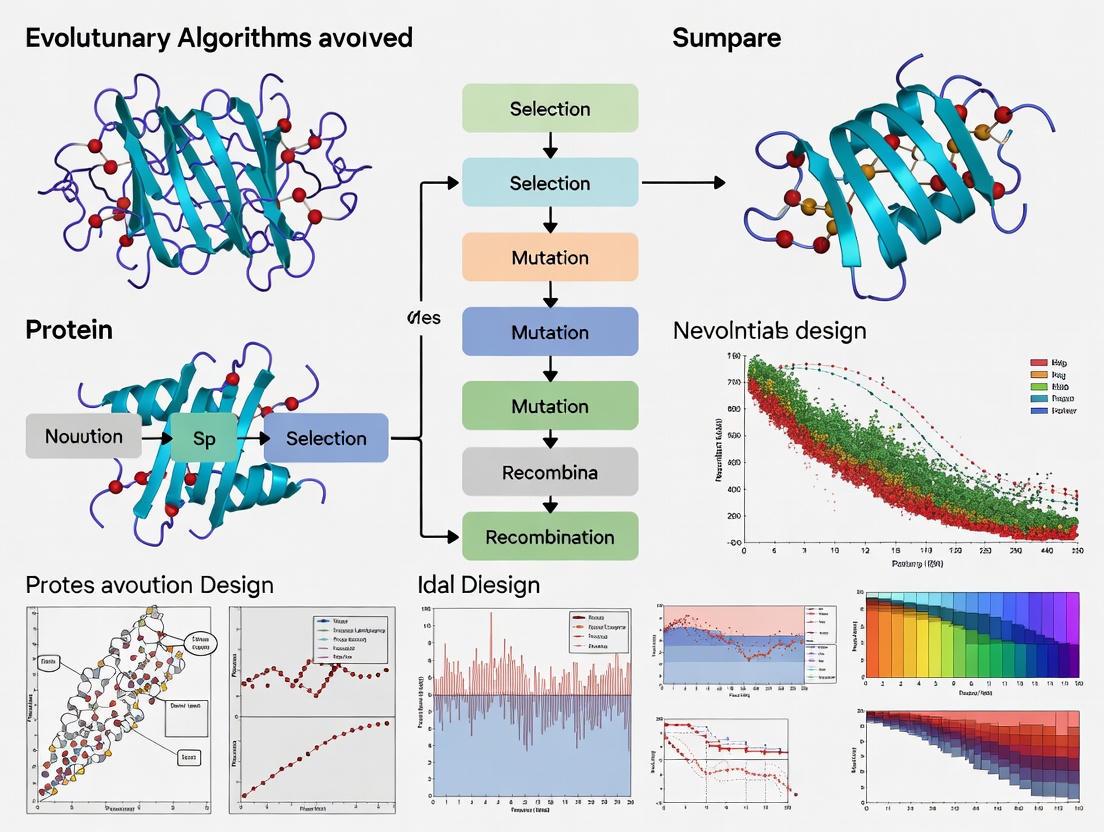
This article explores the transformative role of evolutionary algorithms (EAs) and artificial intelligence (AI) in de novo protein design, a field poised to revolutionize drug discovery and synthetic biology.
Evolutionary Algorithms in Protein Design: Bridging AI and Synthetic Biology for Novel Therapeutics
Abstract
This article explores the transformative role of evolutionary algorithms (EAs) and artificial intelligence (AI) in de novo protein design, a field poised to revolutionize drug discovery and synthetic biology. We provide a comprehensive analysis for researchers and drug development professionals, covering the foundational principles of navigating the vast protein functional universe beyond natural evolutionary constraints. The article delves into cutting-edge methodological frameworks, including protein language models and multi-objective optimization, and their applications in creating novel enzymes, therapeutics, and biosensors. It further addresses critical challenges in optimization and troubleshooting, such as balancing exploration with convergence and ensuring synthetic accessibility. Finally, we examine rigorous validation paradigms and comparative performance of EA-driven approaches against traditional methods, synthesizing key takeaways and future directions for clinical and biomedical translation.
The Protein Universe and Evolutionary Constraints: Foundations for Computational Design
Defining the Vast Protein Functional Universe and Its Unexplored Potential
The endeavor to define the protein functional universe reveals a domain of staggering complexity and immense opportunity. The fundamental challenge in exploring this universe lies in the astronomical scale of protein sequence space. A typical protein several hundred amino acids long represents 20³⁰⁰ (approximately 10³⁹⁰) possible sequences, a number that vastly exceeds the total number of atoms in the universe [1]. Despite this overwhelming vastness, functional proteins are not randomly scattered; they exist clustered together within this space, enabling practical navigation and optimization [1]. This clustering principle underpins all modern protein exploration strategies.
Current research efforts face a significant challenge of research bias, where scientific inquiry has concentrated on a limited subset of disease-associated proteins, overlooking many potentially important therapeutic targets [2]. This bias is further compounded by the exploration bottleneck inherent in traditional methods. For instance, the human proteome contains thousands of proteins modified by an unusual pair of enzymes, OGT and OGA, which are implicated in major diseases but remain poorly understood due to their atypical behavior and the lack of appropriate research tools [3]. Similarly, intrinsically disordered proteins—highly dynamic structural ensembles involved in various human diseases—represent a significant untapped resource in drug discovery, as current development processes exhibit a substantial bias toward structured proteins [4]. Overcoming these limitations requires innovative computational approaches that can efficiently navigate the functional protein landscape and identify promising yet under-explored regions.
Quantitative Landscape of Protein Function
Current Mapping of Protein Space
Systematic classification efforts have provided valuable frameworks for understanding protein structure and function. Traditional classification schemes have relied on sequence-based methods (e.g., Pfam), fold-domain approaches (e.g., CATH, SCOP), and more specialized methods focusing on functional surfaces [5] [6]. These complementary approaches have revealed that protein functions are distributed non-uniformly across the structural landscape.
The Protein Surface Classification (PSC) method offers a particularly insightful approach by focusing on local spatial regions that perform biological functions. This method has established a library of 1,974 surface types derived from approximately 28,986 bound forms, with the distribution of members across these types being highly uneven [5]. This uneven distribution reflects both biological reality and research bias, with only 502 surface types containing 10 or more members, and a mere 31 types containing 100 or more [5]. This skewed distribution highlights significant gaps in our functional characterization of the protein universe.
Table 1: Distribution of Proteins in Surface Type Classification
| Number of Members (Ns) in Surface Type | Number of Surface Types |
|---|---|
| Ns ≥ 100 | 31 |
| Ns ≥ 50 | 95 |
| Ns ≥ 10 | 502 |
| Total Surface Types | 1,974 |
The Untapped Functional Potential
Several specific protein families exemplify the untapped potential within the functional protein universe. The O-GlcNAc modification system, involving only two enzymes (OGT and OGA) that regulate thousands of human proteins, represents a particularly promising yet challenging frontier [3]. This system modifies at least 4,000 different proteins in the human body and is dysregulated in Alzheimer's disease, Type II diabetes, cardiovascular disease, and nearly every type of cancer [3]. Despite this broad relevance, the system defies conventional research approaches because OGT and OGA do not appear to follow standard sequence motif recognition rules, and there are currently no FDA-approved drugs targeting O-GlcNAc modification [3].
Similarly, intrinsically disordered proteins represent a significant unexplored frontier. Comprehensive analysis of the druggable human proteome reveals a substantial bias toward high structural coverage and low abundance of intrinsic disorder, despite the high disorder content of the human proteome overall and the involvement of disordered proteins in various human diseases [4]. This bias stems from heavy reliance on structural information in drug development and the difficulty of attaining structures for intrinsically disordered proteins, creating a significant gap in therapeutic exploration.
Table 2: Promising Yet Understudied Protein Systems
| Protein System | Estimated Scale | Disease Relevance | Research Challenges |
|---|---|---|---|
| O-GlcNAc Modification | Modifies ≥4,000 human proteins | Alzheimer's, cancer, diabetes, cardiovascular disease | Atypical sequence recognition; dynamic modification |
| Intrinsically Disordered Proteins | High abundance in human proteome | Various human diseases | Lack of fixed 3D structure; difficult to characterize |
| Understudied Biomedical Proteins | Identified through literature and interactome analysis | Multiple disease pathways | Research bias toward previously characterized targets |
Evolutionary Algorithms as Exploration Engines
Navigating Functional Landscapes
Evolutionary algorithms provide a powerful framework for navigating the vast, high-dimensional fitness landscapes of protein function. The concept of a protein fitness landscape visualizes protein sequences as positions in a multidimensional space, with fitness (desired function) represented as elevation [1]. These landscapes are not smooth surfaces but are instead rugged and epistatic, meaning mutational effects are often dependent on higher-order interactions rather than purely additive [1]. This ruggedness arises from structural contacts, allostery, conformational dynamics, and interactions with ligands or cofactors, creating complex fitness topography with multiple local optima.
The evolutionary approach mimics natural selection while dramatically accelerating the process through intelligent sampling. Rather than exhaustively screening all possible variants—a computationally impossible task for even moderately sized proteins—evolutionary algorithms iteratively generate and test populations of sequences, applying selection pressure to favor beneficial mutations and combinations. This approach effectively navigates the fitness landscape by taking greedy uphill steps toward fitness peaks while maintaining sufficient diversity to avoid becoming trapped in suboptimal local maxima [1].
Diagram 1: Evolutionary Algorithm Cycle. This workflow illustrates the iterative process of evolutionary optimization for protein engineering.
Advanced Implementation: REvoLd and SEWING
Recent advances in evolutionary algorithms have demonstrated remarkable efficiency in exploring ultra-large protein and chemical spaces. The RosettaEvolutionaryLigand (REvoLd) algorithm represents a cutting-edge approach designed specifically for screening ultra-large make-on-demand compound libraries containing billions of readily available compounds [7]. REvoLd exploits the combinatorial nature of these libraries by searching the synthetic building block space rather than enumerating all possible molecules, enabling efficient exploration without exhaustive screening.
In benchmark studies across five drug targets, REvoLd achieved improvements in hit rates by factors between 869 and 1622 compared to random selection, while docking only between 49,000 and 76,000 unique molecules per target—a tiny fraction of the billions of compounds in the screening library [7]. This dramatic enrichment demonstrates the algorithm's ability to efficiently navigate vast combinatorial spaces and identify promising regions with minimal sampling.
Complementary to ligand-focused approaches, the SEWING (Structural Extension Workbench Using Natural Fragments) protocol addresses the challenge of protein backbone design [8]. SEWING performs requirement-driven protein design by assembling novel protein backbones from fragments of naturally occurring proteins, then applying Rosetta-based sequence optimization and backbone refinement. This approach enables the creation of proteins that satisfy specific functional requirements rather than adopting predetermined folds, particularly valuable for designing ligand binding sites and protein-protein interfaces [8].
Table 3: Performance Metrics of Evolutionary Algorithms
| Algorithm | Application Domain | Library Size | Screened Fraction | Hit Rate Improvement |
|---|---|---|---|---|
| REvoLd | Ligand docking | >20 billion compounds | ~0.0003% | 869-1622x vs. random |
| SEWING | Protein backbone design | Combinatorial fragment space | Not quantified | Successful novel helical bundles |
Experimental Protocols and Methodologies
REvoLd Protocol for Ultra-Large Library Screening
The REvoLd protocol implements an evolutionary algorithm for protein-ligand docking within the Rosetta software suite. The method performs flexible docking of both ligand and receptor using RosettaLigand, exploring the combinatorial make-on-demand chemical space through iterative generations of selection, crossover, and mutation [7].
Initialization and Hyperparameters:
- Begin with a random population of 200 ligands constructed from available building blocks and reactions
- Advance 50 individuals to each subsequent generation to balance diversity and selection pressure
- Run for 30 generations to optimize the trade-off between convergence and exploration
- Conduct multiple independent runs (typically 20) to sample different regions of chemical space
Reproduction Mechanics:
- Implement crossover operations that recombine well-performing molecular fragments
- Apply mutation steps that switch single fragments to low-similarity alternatives
- Include reaction-switching mutations that change the core reaction while preserving similar fragments
- Incorporate a second round of crossover and mutation excluding the fittest molecules to promote diversity
Validation and Output:
- Dock each proposed compound using flexible RosettaLigand protocol
- Select top-performing compounds for experimental validation
- The algorithm typically identifies hit-like molecules within 15 generations, with continued discovery through extended runs [7]
SEWING Protocol for Requirement-Driven Protein Design
The SEWING protocol enables requirement-driven protein design through a fragment assembly approach implemented in Rosetta. This method is particularly valuable for creating proteins with specific functional capabilities without constraining the overall fold [8].
Substructure Database Preparation:
- Extract supersecondary structure elements (e.g., helix-loop-helix motifs) from native proteins in the PDB
- Currently compatible with helical substructures (beta strands may be present but cannot be hybridized)
- Store substructures in a searchable database for the assembly process
Monte Carlo Assembly Process:
- Specify design requirements as filters or score terms (e.g., metal coordination geometry)
- Begin with a starting substructure or random initial fragment
- Perform Monte Carlo simulation with add, delete, and switch moves for a minimum of 10,000 cycles
- Use temperature cooling from starttemperature to endtemperature during the assembly
- Apply a window_width of 4 residues (approximately one helical turn) for fragment alignment
Sequence Design and Refinement:
- Generate at least 10,000 backbone assemblies using SEWING
- Select the top 10% by total SEWING score for further refinement
- Perform rotamer-based sequence optimization using Rosetta's fixed-backbone design protocols
- Apply quality metrics (packing statistics, interface scores, etc.) to select final sequences for experimental characterization
- The entire process requires approximately 100 CPU-hours for backbone generation and 500-1000 CPU-hours for refinement of 1000 assemblies [8]
Integration with Deep Learning Approaches
RFdiffusion for De Novo Protein Design
The integration of evolutionary methods with deep learning represents the cutting edge of protein exploration. RFdiffusion is a powerful generative model that adapts the RoseTTAFold structure prediction network for protein design using denoising diffusion probabilistic models (DDPMs) [9]. This approach enables the creation of novel protein structures with atomic-level precision, facilitating the design of functional proteins for specific applications.
RFdiffusion operates by learning to reverse a gradual noising process applied to protein structures. Starting from random noise, the model iteratively denoises the structure through up to 200 steps, progressively refining it into a coherent protein backbone [9]. Key advancements in RFdiffusion include:
- Self-conditioning: The model conditions its predictions on previous timesteps, improving coherence and performance
- Fine-tuning from RoseTTAFold: Leveraging pre-trained weights dramatically improves performance compared to training from scratch
- Auxiliary conditioning: The model can incorporate specific design constraints including partial sequences, fold information, or fixed functional motifs
Experimental validation has confirmed RFdiffusion's capability to design diverse functional proteins, including symmetric assemblies, metal-binding proteins, and protein binders. In one notable example, the cryo-EM structure of a designed binder in complex with influenza hemagglutinin was nearly identical to the design model [9].
Combined Workflow for Functional Protein Design
The integration of diffusion-based backbone generation with evolutionary sequence optimization represents a powerful combined workflow for exploring the protein functional universe. This hybrid approach leverages the strengths of both methodologies:
Diagram 2: Integrated Protein Design Workflow. This hybrid approach combines deep learning-based structure generation with evolutionary sequence optimization.
- Specification Phase: Define functional requirements (e.g., binding site geometry, catalytic residues, structural motifs)
- Backbone Generation: Use RFdiffusion to generate protein backbones compatible with functional specifications
- Initial Sequence Design: Apply ProteinMPNN or similar networks to design initial sequences for generated backbones
- Evolutionary Optimization: Implement evolutionary algorithms to optimize sequences for stability, expression, and function
- Experimental Validation: Test designed proteins experimentally, with results informing subsequent design cycles
This combined approach enables comprehensive exploration of both structural and sequence space, efficiently navigating the vast protein functional universe to identify novel solutions to complex design challenges.
Table 4: Key Computational Tools for Protein Exploration
| Tool/Resource | Primary Function | Application Context | Key Features |
|---|---|---|---|
| Rosetta Software Suite | Protein structure prediction and design | General protein engineering | Modular architecture; physics-based scoring |
| REvoLd | Evolutionary ligand docking | Ultra-large library screening | Flexible docking; combinatorial space exploration |
| SEWING | Requirement-driven protein design | Novel protein backbone generation | Fragment assembly; Monte Carlo sampling |
| RFdiffusion | De novo protein structure generation | Functional protein design | Diffusion models; conditional generation |
| ProteinMPNN | Protein sequence design | Sequence optimization for fixed backbones | Inverse folding; high success rates |
| AlphaFold2 | Protein structure prediction | Structure validation and analysis | High accuracy; confidence metrics |
| CATH/SCOP | Protein structure classification | Functional annotation and analysis | Hierarchical classification; evolutionary relationships |
The protein functional universe represents a vast, largely unexplored territory with tremendous potential for therapeutic intervention and biological discovery. While the scale of this universe is daunting—with sequence spaces exceeding astronomical proportions—advanced computational methods are now enabling efficient navigation and exploitation of this space. Evolutionary algorithms, particularly when integrated with deep learning approaches, provide powerful frameworks for identifying functional proteins that would remain inaccessible through traditional methods. As these technologies continue to mature, they promise to unlock the considerable untapped potential of the protein functional universe, enabling new therapeutic strategies and deepening our understanding of biological systems.
The concept of evolutionary myopia represents a fundamental constraint in biological systems, wherein natural proteins are optimized for biological fitness within specific ecological niches rather than for the diverse applications demanded by human biotechnology. This evolutionary short-sightedness has profound implications for protein engineering, as natural proteins often lack the stability, specificity, and functional versatility required for industrial processes, therapeutic interventions, and synthetic biology applications. The extraordinary diversity observed in natural proteins constitutes merely a glimpse of the theoretical protein functional universe—the vast space encompassing all possible protein sequences, structures, and their corresponding biological activities [10]. This universe remains largely unexplored, constrained by the limitations of natural evolution and conventional protein engineering methodologies [10].
Substantial evidence indicates that the known natural fold space is approaching saturation, with novel folds rarely emerging in nature [10]. Contemporary comparative analyses suggest that recent functional innovations in nature predominantly arise from domain rearrangements rather than the de novo emergence of entirely new structural motifs or folds [10]. This selective paradigm reinforces an evolutionary trajectory that diversifies proteomes through reorganization and repurposing, thereby constraining the exploration of genuinely novel sequences and structures [10]. The evolutionary process is inherently conservative, favoring incremental modifications to existing frameworks over revolutionary architectural innovations, creating a fundamental bottleneck in our access to the full potential of the protein universe.
The Vast but Constrained Protein Functional Universe
The Combinatorial Challenge of Sequence-Structure Space
The protein functional universe is characterized by its unimaginable scale, presenting a fundamental challenge for comprehensive exploration. The sequence → structure → function paradigm—the central tenet of molecular biology stating that a protein's amino acid sequence encodes its three-dimensional fold, which in turn determines its biological function—defines a landscape of astronomical proportions [10]. For a modest 100-residue protein, the theoretical number of possible amino acid arrangements is 20^100 (≈1.27 × 10^130), a number that exceeds the estimated number of atoms in the observable universe (~10^80) by more than fifty orders of magnitude [10]. Within this incomprehensibly vast space, the probability that a random sequence will fold into a stable structure and display useful biological activity is vanishingly small, rendering unguided experimental screening profoundly inefficient and cost-prohibitive [10].
Quantitative Dimensions of Known Protein Space
Table 1: Quantitative Cataloguing of Known Protein Sequence and Structure Space
| Resource | Type | Scale | Reference |
|---|---|---|---|
| MGnify Protein Database | Sequences | ~2.4 billion non-redundant sequences | [10] |
| Profluent Protein Atlas v1 | Sequences | ~3.4 billion full-length proteins | [10] |
| AlphaFold Protein Structure Database | Structures | ~214 million models | [10] |
| ESM Metagenomic Atlas | Structures | ~600 million predicted structures | [10] |
Despite these impressive numbers, the known protein space represents only an infinitesimal fraction of the theoretical protein functional universe [10]. Furthermore, these datasets exhibit significant biases reflecting evolutionary history and experimental assay capabilities, which channel data-driven methods toward well-explored regions of the sequence-structure space [10]. This sampling bias creates a fundamental limitation for protein engineering approaches that rely exclusively on natural templates, as they are inherently confined to the functional neighborhoods of existing proteins and cannot access the vast unexplored territories of the protein universe [10].
Computational Methodologies to Overcome Evolutionary Constraints
Physics-Based versus Evolution-Based Design Approaches
Conventional protein engineering strategies, particularly directed evolution, have demonstrated remarkable success in optimizing existing proteins but remain fundamentally constrained by their dependence on natural starting points [10]. These methods perform local searches within the protein functional universe through iterative cycles of mutation and selection, requiring the construction and experimental screening of immense variant libraries [10]. This process is not only labor-intensive and costly but, more fundamentally, confines discovery to the immediate "functional neighborhood" of the parent scaffold, making them ill-equipped to access genuinely novel functional regions beyond natural evolutionary pathways [10].
Table 2: Comparative Analysis of Protein Design Methodologies
| Methodology | Underlying Principle | Advantages | Limitations | |
|---|---|---|---|---|
| Physics-Based (e.g., Rosetta) | Energy minimization based on physical force fields | Principles-based; can create novel folds (e.g., Top7) | Approximate force fields; high computational cost; limited sampling | [10] |
| Evolution-Based (e.g., EvoDesign) | Evolutionary profile guidance from structural analogs | Native-like sequences; implicit capture of folding constraints | Limited to fold space represented in databases | [11] |
| AI-Driven De Novo Design | Machine learning on sequence-structure-function mappings | Rapid exploration; customized folds and functions | Training data limitations; black box predictions | [10] |
EvoDesign: An Evolution-Based Algorithm for Protein Design
The EvoDesign algorithm represents a sophisticated methodology that leverages evolutionary information to guide the protein design process [11]. This approach is distinguished by its use of evolutionary constraints implicitly encoded in protein families to navigate the sequence space efficiently. The algorithm operates through a systematic workflow:
- Structural Analog Identification: A set of proteins with similar folds to the target scaffold is collected from the Protein Data Bank (PDB) using structural alignment program TM-align, with similarity defined by a TM-score cutoff value [11].
- Profile Construction: A position-specific scoring matrix M(p,a) is created based on multiple sequence alignment generated from the structural analogs [11]. The matrix is calculated as: M(p,a) = ∑w(p,x)×B(a,x), where x represents a particular amino acid, B(a,x) is the BLOSUM62 substitution matrix, and w(p,x) is the frequency of amino acid x at position p in the MSA [11].
- Local Feature Optimization: Back propagation neural network predictors are used to estimate secondary structure, solvent accessibility, and torsion angles to smoothen singularities in local sequences [11].
- Energy Function Integration: The evolutionary potential is defined as E_evolution = ∑max[M(p,a) + w1ΔSS(p) + w2ΔSA(p) + w3(Δφ(p) + Δψ(p))], where ΔSS, ΔSA, Δφ, and Δψ are differences in secondary structure, solvent accessibility, and torsion angles between target assignments and predictions from decoy sequences [11].
- Monte Carlo Sequence Search: Sequences are generated through Monte Carlo searches starting from 10 random sequences updated by random residue mutations [11].
- Sequence Clustering: Instead of selecting the lowest energy sequence, all sequences from the 10 runs are pooled, and the sequence with the maximum number of neighbors is identified using the SPICKER clustering algorithm [11].
This methodology harnesses the critical insight that evolution implicitly encodes information on protein folds and binding interactions that greatly exceeds our ability to describe it through reductionist, physics-based methods alone [11].
Genetic Algorithm Approaches for Protein Redesign
Genetic algorithms (GAs) provide another evolutionary computing approach for protein engineering, implementing virtual evolutionary processes to optimize protein sequences. GAOptimizer represents one such tool that employs genetic algorithm principles to engineer diverse enzymes [12]. The algorithm requires two key input parameters: fitness functions (which can include stability-based and non-stability-based scores) and sequence libraries that define the sequence space for selecting mutation candidates [12]. The process mirrors natural selection through iterative generations of selection, crossover, and mutation, efficiently exploring the combinatorial sequence space without exhaustive enumeration.
Similarly, the REvoLd (RosettaEvolutionaryLigand) algorithm demonstrates the application of evolutionary algorithms to ultra-large library screening in protein-ligand docking [7]. This approach explores the vast search space of combinatorial libraries without enumerating all molecules, exploiting the fact that make-on-demand compound libraries are constructed from lists of substrates and chemical reactions [7]. In benchmark tests across five drug targets, REvoLd showed improvements in hit rates by factors between 869 and 1622 compared to random selections, demonstrating the remarkable efficiency of evolutionary approaches for navigating vast chemical spaces [7].
Experimental Protocols and Validation Methodologies
Computational Validation of Designed Proteins
The validation of computationally designed proteins requires rigorous computational assessment before proceeding to experimental characterization. Key computational validation protocols include:
- Structural Integrity Prediction: Using protein structure prediction tools (e.g., AlphaFold2, RosettaFold) to verify that the designed sequence adopts the intended fold [10].
- Thermodynamic Stability Calculations: Employing tools like FoldX to calculate folding free energy (ΔG) and estimate thermal stability [11].
- Aggregation Propensity Assessment: Utilizing algorithms (e.g., TANGO, AGGRESCAN) to identify sequences with high aggregation potential and modify them accordingly [11].
- Functional Site Geometry Analysis: For enzymatic designs, validating the spatial arrangement of catalytic residues and substrate binding pockets using molecular docking simulations [11].
These computational validations provide essential filters to prioritize the most promising designs for experimental characterization, significantly reducing experimental costs and time investments.
Experimental Characterization of Designed Proteins
Following computational design and validation, experimental characterization is essential to confirm the design specifications. Core experimental protocols include:
- Recombinant Protein Expression: Heterologous expression in systems such as E. coli, followed by purification using affinity, ion exchange, and size exclusion chromatography [11].
- Biophysical Characterization:
- Circular Dichroism (CD) Spectroscopy: To verify secondary structure content and assess thermal stability by monitoring unfolding transitions [11].
- Nuclear Magnetic Resonance (NMR) Spectroscopy: For high-resolution structural validation and dynamics characterization, particularly for smaller protein domains [11].
- Differential Scanning Calorimetry (DSC): To measure melting temperature (Tm) and obtain thermodynamic parameters of folding [11].
- Functional Assays: Enzyme kinetics (Km, kcat), binding affinity measurements (SPR, ITC), or cellular activity assays relevant to the intended function [11].
These experimental protocols provide the critical link between computational designs and real-world functionality, closing the design-validation loop and enabling iterative improvement of design methodologies.
Table 3: Key Research Reagents and Computational Tools for Evolutionary Protein Design
| Resource Category | Specific Tools/Resources | Function/Application | Reference |
|---|---|---|---|
| Protein Design Software | Rosetta, EvoDesign, GAOptimizer | De novo protein design and optimization | [10] [12] [11] |
| Structure Prediction | AlphaFold2, ESMFold, RosettaFold | Protein structure prediction from sequence | [10] |
| Structure Databases | PDB, AlphaFold DB, ESM Metagenomic Atlas | Template structures and evolutionary information | [10] [11] |
| Sequence Databases | MGnify, Profluent Protein Atlas | Natural sequence diversity for profile construction | [10] |
| Experimental Validation | CD Spectroscopy, NMR, X-ray Crystallography | Structural and biophysical characterization | [11] |
| Ultra-Large Library Screening | REvoLd, V-SYNTHES, SpaceDock | Efficient exploration of combinatorial chemical space | [7] |
Future Directions and Concluding Perspectives
The field of AI-driven de novo protein design is rapidly advancing beyond the constraints of evolutionary myopia, fundamentally expanding our access to the protein functional universe [10]. By integrating generative models, structure prediction tools, and iterative experimental validation, these approaches enable researchers to directly explore regions of the functional landscape that natural evolution has not sampled [10]. This paradigm shift from template-based engineering to computational de novo design represents a fundamental transformation in protein science, with profound implications for biotechnology, medicine, and synthetic biology.
Future advancements will likely focus on several key areas: (1) improved integration of physical principles with evolutionary information to enhance design accuracy; (2) development of more sophisticated multi-state design methodologies for creating dynamically functional proteins; (3) expansion of design capabilities to include non-canonical amino acids and novel chemical functionalities; and (4) increased automation of the design-build-test-learn cycle to accelerate iterative optimization [10] [11] [7]. As these methodologies mature, they promise to unlock a new era of biological engineering, providing custom-made protein tools for advances in medicine, agriculture, and green technology that transcend the limitations of natural evolutionary history [10].
The Immeasurable Vastness of Protein Sequence-Structure Space
The fundamental challenge in protein engineering lies in the astronomical scale of the protein sequence-structure landscape. For a relatively short protein of 100 amino acids, the number of possible sequence arrangements is 20^100 (approximately 1.27 × 10^130), a figure that exceeds the estimated number of atoms in the observable universe (~10^80) by more than fifty orders of magnitude [10]. Within this unimaginably vast sequence space, the subset of sequences that fold into stable, functional structures is exceptionally small, making the probability that a random sequence will possess useful biological activity vanishingly small [10].
This combinatorial explosion creates a fundamental exploration bottleneck. Experimental laboratories can typically screen only thousands to millions of variants, representing an infinitesimal fraction of the possible sequence space [10]. This disparity between what is theoretically possible and what is practically explorable defines the core challenge in conventional protein engineering.
Table 1: The Scale of the Protein Sequence-Structure Universe
| Dimension | Scale | Contextual Reference |
|---|---|---|
| Theoretical Sequence Space (100-residue protein) | 20^100 ≈ 1.27 × 10^130 sequences | Exceeds the number of atoms in the observable universe (~10^80) [10] |
| Known Natural Sequences (UniRef90) | ~172 million sequences [13] | Infinitesimal fraction of theoretical space |
| Known/Predicted Structures (AlphaFold DB) | ~214 million structures [10] [13] | Infinitesimal fraction of theoretical space |
| Functional Subset | An astronomically small fraction of sequence space [10] | Needle in a haystack problem |
The Limitations of Conventional Protein Engineering
Traditional protein engineering methods, most notably directed evolution, are fundamentally constrained by their reliance on existing biological templates and local search strategies. These methods operate through iterative cycles of random mutagenesis and high-throughput screening to identify variants with improved traits [14]. While successful for optimizing existing functions, this approach is inherently limited in its ability to discover genuinely novel folds or functions [10].
The core limitation is that directed evolution performs a local search within the protein fitness landscape. It remains tethered to the evolutionary history and structural biases of the parent scaffold, exploring only its immediate "functional neighborhood" [10]. This "evolutionary myopia" means that natural proteins are optimized for biological fitness in specific niches, not for human-desired properties such as stability under industrial conditions or novel catalytic functions [10]. Consequently, these methods are structurally biased and ill-equipped to access genuinely novel functional regions that lie beyond the boundaries of natural evolutionary pathways [10].
Furthermore, the process is inherently resource-intensive, requiring the construction and experimental screening of immense variant libraries through iterative cycles, which is laborious, costly, and slow [10] [14]. As the complexity of the desired function increases, the library sizes and screening efforts required become practically infeasible.
A Paradigm Shift: AI-Driven De Novo Protein Design
Artificial intelligence (AI) is now catalyzing a paradigm shift in protein engineering, transcending the limitations of conventional methods. Modern AI-driven de novo protein design enables the computational creation of proteins with customized folds and functions from first principles, rather than by modifying existing natural scaffolds [10]. This represents a fundamental transition from empirical trial-and-error exploration to systematic rational design.
This new paradigm leverages machine learning (ML) models trained on vast biological datasets to establish high-dimensional mappings between sequence, structure, and function [10]. Key computational frameworks include:
- Generative Models (e.g., RFdiffusion, ProteinMPNN): These AI models can imagine and generate entirely new protein sequences that are predicted to fold into desired structures or perform specific functions, venturing far beyond natural evolutionary pathways [15].
- Protein Language Models (PLMs) (e.g., ESM-2): Trained on evolutionary-scale protein sequence databases, these models learn the fundamental "grammar" of proteins. They can be used for zero-shot prediction of functional variants and to guide exploration in sequence space [14] [16].
- Structure Prediction Tools (e.g., AlphaFold 2/3, Boltz-2): These tools accurately predict the 3D structure of a protein from its amino acid sequence, and newer versions like Boltz-2 can also predict functional properties like ligand binding affinity [15].
Table 2: Comparison of Protein Engineering Methodologies
| Methodology | Search Type | Key Advantage | Primary Limitation |
|---|---|---|---|
| Directed Evolution [10] [14] | Local search | Proven, reliable for optimizing existing functions | Limited to neighborhoods of known proteins; resource-intensive |
| Physics-Based De Novo Design (e.g., Rosetta) [10] | Global search (theoretical) | Can create novel folds (e.g., Top7) | Computationally expensive; force fields are approximations |
| AI-Driven De Novo Design [10] [15] | Global search (informed) | Explores beyond evolutionary boundaries; high speed and accuracy | Dependent on quality and bias of training data |
These AI methodologies employ a powerful filter-and-refine strategy [10] [13]. Coarse, fast filters first eliminate structurally irrelevant sequences, after which accurate, slower alignment and scoring steps are applied only to the remaining promising candidates. This strategy, enhanced by machine learning, allows for efficient navigation of the combinatorial space that would be prohibitive for exhaustive search methods [13].
Experimental Protocols & Research Toolkit
Protocol: AI-Guided Automated Protein Engineering (PLMeAE)
The Protein Language Model-enabled Automatic Evolution (PLMeAE) platform exemplifies the modern, closed-loop approach to protein engineering [14]. This system integrates AI with automated biofoundries to accelerate the Design-Build-Test-Learn (DBTL) cycle.
Workflow Overview:
- Design: A protein language model (ESM-2) performs zero-shot prediction of 96 high-fitness variants to initiate the cycle. Two modules exist:
- Module I (No prior sites): The PLM identifies critical mutation sites and predicts beneficial single mutants.
- Module II (Known sites): For predefined mutation sites, the PLM samples informative multi-mutant variants.
- Build: An automated biofoundry constructs the proposed variant library.
- Test: The biofoundry expresses and tests the variants, collecting fitness data (e.g., enzyme activity).
- Learn: Experimental results are fed back to train a supervised ML model (e.g., a multi-layer perceptron) as a fitness predictor. This model then designs the next round of 96 variants with improved fitness.
This iterative process enabled a 2.4-fold improvement in enzyme activity for a tRNA synthetase within four rounds (10 days), significantly outperforming traditional directed evolution [14].
The Scientist's Toolkit: Essential Research Reagents & Platforms
Table 3: Key Research Reagents and Platforms for AI-Driven Protein Design
| Tool/Reagent | Type | Primary Function |
|---|---|---|
| RFdiffusion [15] | Generative AI Model | Designs novel protein backbone structures and complexes from scratch. |
| ProteinMPNN [15] | Generative AI Model | Designs optimal amino acid sequences for a given protein backbone structure, improving stability and function. |
| AlphaFold 2/3 [10] [15] | Structure Prediction AI | Predicts 3D protein structures from sequences (AF3 extends to multi-molecule complexes). |
| ESM-2 [14] | Protein Language Model (PLM) | Learns evolutionary principles from sequences; used for zero-shot variant prediction and sequence encoding. |
| Automated Biofoundry [14] | Integrated Robotic System | Executes high-throughput, reproducible Build and Test phases (cloning, expression, assay). |
| SARST2 [13] | Structural Alignment Algorithm | Rapidly searches massive structural databases (e.g., AlphaFold DB) to identify homologs and analyze new designs. |
Quantitative Benchmarks: Demonstrating the AI Advantage
The performance advantages of modern computational methods are quantifiable. In benchmark evaluations, the SARST2 structural alignment algorithm achieved an average information retrieval precision of 96.3%, outperforming other methods like Foldseek (95.9%) and TM-align (94.1%) [13]. Crucially, it completed a search of the massive AlphaFold Database (214 million structures) in just 3.4 minutes using 32 processors, significantly faster than Foldseek (18.6 minutes) and BLAST (52.5 minutes), while also using substantially less memory [13]. This efficiency is critical for practical research applications.
In de novo design, AI-driven workflows have demonstrated the ability to create synthetic binding proteins (SBPs) with improved solubility, stability, and binding affinity compared to conventionally engineered ones [15]. These AI-designed proteins access regions of the functional landscape that traditional methods cannot efficiently reach, proving the capability to move beyond the constraints of combinatorial explosion.
The field of protein engineering is undergoing a fundamental transformation, moving beyond the constraints of natural evolutionary history. Traditional methods, which rely on modifying existing protein scaffolds, are being superseded by computational approaches that design entirely novel proteins from first principles. This whitepaper details this paradigm shift, focusing on the central role of evolutionary algorithms and artificial intelligence in exploring the vast, uncharted regions of the protein functional universe. We provide a technical examination of cutting-edge methodologies, benchmark performance data, and a detailed toolkit for researchers driving the next wave of discovery in therapeutics, catalysis, and synthetic biology.
Proteins are the fundamental molecular machines of life, but the diversity found in nature represents only a minuscule fraction of the theoretical protein functional universe [10]. This universe encompasses all possible protein sequences, structures, and their biological activities. Conventional protein engineering strategies, most notably directed evolution, have achieved remarkable successes by mimicking natural evolution—applying iterative cycles of mutation and selection to a parent protein to improve its function [10].
However, these methods are inherently constrained. They perform a local search within the functional landscape, tethered to the starting scaffold's evolutionary history. This makes them ill-suited for accessing genuinely novel functions that lie beyond natural pathways [10]. Furthermore, the known natural fold space is approaching saturation, with recent innovations arising primarily from domain rearrangements rather than the emergence of new folds [10].
Table 1: Comparison of Protein Engineering Paradigms
| Feature | Directed Evolution | AI-Driven De Novo Design |
|---|---|---|
| Starting Point | A natural protein template | First principles / Computational specification |
| Exploration Scope | Local "functional neighborhood" | Vast, uncharted regions of sequence-structure space |
| Dependence on Natural Evolution | High | None |
| Capacity for Novel Folds | Limited | High |
| Primary Constraint | Experimental screening throughput | Computational sampling & force field accuracy |
The AI-Driven Paradigm Shift
De novo protein design aims to transcend these limits by computationally creating proteins with customized folds and functions without relying on a natural template [10]. This represents a shift from empirical trial-and-error to systematic rational design.
Early de novo methods, such as those implemented in the Rosetta software suite, relied on physics-based modeling and force-field energy minimization [10]. While successful in creating novel folds like Top7, these methods face challenges: the computational expense of sampling is prohibitive for large complexes, and inaccuracies in energy calculations can lead to designs that fail to fold correctly in vitro [10].
The paradigm shift is being driven by the integration of artificial intelligence. Modern AI-augmented strategies use machine learning models trained on vast biological datasets to establish high-dimensional mappings between sequence, structure, and function [10]. This AI-driven approach enables the rapid generation of novel, stable, and functional proteins, dramatically accelerating the exploration of the functional universe.
Evolutionary Algorithms in Ultra-Large Library Screening
A key challenge in computational design is navigating the immense scale of make-on-demand combinatorial libraries, which can contain billions to billions of readily available compounds. Exhaustive screening of these libraries with flexible docking is computationally intractable. Evolutionary algorithms have emerged as a powerful solution for this optimization problem.
The REvoLd Algorithm: A Case Study
The RosettaEvolutionaryLigand (REvoLd) algorithm is a state-of-the-art example designed specifically for screening ultra-large make-on-demand chemical spaces without enumerating all molecules [7]. REvoLd exploits the combinatorial nature of these libraries, constructed from lists of substrates and chemical reactions, to efficiently search for high-affinity protein ligands with full ligand and receptor flexibility using RosettaLigand.
Table 2: REvoLd Benchmark Performance on Five Drug Targets
| Metric | Result |
|---|---|
| Improvement in Hit Rate | 869 to 1622 times higher than random selection [7] |
| Total Unique Molecules Docked per Target | ~49,000 to ~76,000 [7] |
| Typical Run Parameters | Initial Population: 200 ligandsGenerations: 30Population Advancement: 50 individuals [7] |
Detailed REvoLd Experimental Protocol
The following workflow outlines the core methodology for a REvoLd screening campaign as described in its benchmark studies [7]:
Key Protocol Steps:
- Initialization: The algorithm begins by generating a random population of 200 ligands from the combinatorial library building blocks.
- Fitness Evaluation: Each ligand in the population undergoes flexible protein-ligand docking using RosettaLigand, which provides a binding score (fitness).
- Selection: The top 50 scoring individuals (ligands) are selected to advance and reproduce.
- Reproduction: The selected individuals undergo a series of operations to create the next generation:
- Crossover: Pairs of fit ligands are recombined to create novel hybrids, enforcing variance.
- Fragment Mutation: Single fragments in a promising ligand are switched to low-similarity alternatives, preserving most of the structure while enforcing exploration.
- Reaction Switch Mutation: The reaction core of a molecule is changed, searching for similar fragments within the new reaction group to access different regions of the chemical space.
- Iteration: Steps 2-4 are repeated for a predetermined number of generations (typically 30). To prevent premature convergence, a second round of crossover and mutation is often performed, excluding the very fittest molecules to allow worse-scoring ligands to contribute their molecular information.
The Scientist's Toolkit: Essential Research Reagents & Solutions
Implementing these advanced computational methods requires a suite of specialized software and data resources.
Table 3: Key Research Reagent Solutions for AI-Driven Protein Design
| Item Name | Function / Explanation |
|---|---|
| Rosetta Software Suite | A comprehensive platform for macromolecular modeling, used for flexible docking (RosettaLigand) and as the computational engine for algorithms like REvoLd [7]. |
| Enamine REAL Space | A make-on-demand combinatorial library of billions of chemically accessible compounds, serving as a primary search space for virtual screening campaigns [7]. |
| Protein Data Bank (PDB) | The single global archive for 3D structural data of proteins and nucleic acids, essential for obtaining target structures and training data [17]. |
| Evolutionary Algorithm (e.g., REvoLd) | A meta-heuristic optimization method inspired by natural selection, used to efficiently navigate ultra-large combinatorial chemical spaces without exhaustive enumeration [7]. |
| ESM Protein Language Model | A deep learning model trained on millions of protein sequences; its embeddings can be used as input representations for other machine learning models to improve performance on sequence-function prediction tasks [18]. |
| Uncertainty Quantification (UQ) Methods | Techniques (e.g., ensembles, dropout) to estimate the uncertainty of a model's predictions, which is critical for guiding active learning and Bayesian optimization in protein engineering [18]. |
Uncertainty Quantification: Critical Support for the Paradigm
The performance of machine learning models is highly dependent on the domain shift between training and testing data. Uncertainty Quantification (UQ) is therefore critical for reliably deploying these models in protein engineering, where data collection often violates standard independent and identically distributed (i.i.d.) assumptions [18].
Benchmarking studies on protein fitness landscapes (e.g., GB1, AAV) reveal that the quality of UQ is dataset- and task-dependent, with no single method consistently outperforming all others [18]. For convolutional neural networks, model ensembles have been shown to be particularly robust to distribution shift [18]. Well-calibrated UQ methods enable more effective experiment selection in active learning and Bayesian optimization cycles, ensuring that computational resources are focused on the most informative sequences.
The paradigm in protein engineering has irrevocably shifted. The move from directed evolution to AI-driven de novo design, powered by evolutionary algorithms and advanced computational tools, has freed researchers from the constraints of natural evolutionary history. This allows for the systematic exploration and creation of bespoke proteins with tailored functionalities. As these methodologies continue to mature and integrate with robust uncertainty quantification, they pave the way for unprecedented advances in designing novel therapeutics, enzymes, and biomaterials, fully unlocking the potential of the protein functional universe.
The fitness landscape is a foundational concept for understanding and engineering protein evolution. It provides a powerful theoretical framework for visualizing evolution as a navigation problem in a high-dimensional space. In this model, each point in the protein sequence space represents a unique amino acid sequence, and the height at that point corresponds to its "fitness"—a measure of its functional performance within a given selective environment [19]. Evolution, whether natural or directed, can then be conceptualized as an adaptive walk across this landscape, moving from sequences of lower fitness to those of higher fitness through iterative rounds of mutation and selection [19].
The structure of these landscapes profoundly influences evolutionary dynamics. Landscapes can range from smooth, "Fujiyama"-like surfaces with single peaks and gradual slopes, to highly rugged, "Badlands"-like terrains riddled with local optima that can trap evolutionary processes [19]. The roughness of the landscape determines the accessibility of functional sequences and the potential paths evolution can take. In protein engineering, the goal of directed evolution is to efficiently traverse this landscape to discover sequences with new or enhanced functions, circumventing our often-incomplete knowledge of the precise molecular details linking sequence to function [19].
The Sequence-Structure-Function Paradigm
The relationship between a protein's sequence, its three-dimensional structure, and its biological function is central to the fitness landscape concept. The classical view follows the sequence-structure-function paradigm, where the amino acid sequence uniquely determines the folded structure, which in turn dictates its biochemical function [20]. However, large-scale structural studies have revealed that this relationship is more complex and nuanced. Similar functions can be achieved by different sequences and structures, and the overall protein structure universe appears to be continuous and largely saturated rather than composed of discrete, isolated folds [20].
Structural Determinants of Sequence Plasticity
A protein's capacity to accept mutations without losing stability or function—its sequence plasticity—is influenced by quantifiable features of its three-dimensional architecture. Research has identified contact density as a key structural metric that serves as a determinant of entropy in sequence space [21]. This metric reflects a structure's potential for sequence variability and is statistically correlated with the size of gene families in nature. Essentially, some protein folds are more "designable," meaning they can be encoded by a larger number of different sequences, making them more prevalent and more tolerant to mutation during evolutionary processes [21].
Table 1: Structural Features Influencing Evolutionary Capacity
| Structural Feature | Description | Impact on Evolvability |
|---|---|---|
| Contact Density | A measure of the compactness of the network of interactions within a protein structure [21]. | Higher contact density correlates with greater designability and larger potential sequence diversity [21]. |
| Mutational Robustness | The ability of a protein to maintain its function despite mutations [19]. | Can be increased by stabilizing mutations, which open new routes for further adaptation [19]. |
| Local Optima | Regions in sequence space where all immediate mutations lead to reduced fitness [19]. | Create evolutionary traps on rugged landscapes; escaping may require multiple simultaneous mutations [19]. |
Quantitative Metrics and Landscape Topography
The topography of a fitness landscape is characterized by specific quantitative metrics that predict evolutionary behavior and functional outcomes. Analyzing these metrics allows researchers to distinguish between different types of landscapes and design more effective protein engineering strategies.
Metrics for Landscape Analysis
Key quantitative measures include the average fraction of incorrect rotamers (<f>) and the average energy difference from the global minimum energy conformation (GMEC) (<ΔE>), which gauge the accuracy of computational protein design algorithms in navigating the landscape [22]. For structural comparisons, the TM-score is a popular metric for measuring the similarity of two protein models, with a cutoff of 0.5 typically indicating the same fold [20]. Furthermore, model quality assessment (MQA) scores, often derived from averaging pairwise TM-scores of low-energy models, help filter out low-quality structural predictions and assess the confidence of a given model [20].
Table 2: Key Quantitative Metrics in Fitness Landscape Analysis
| Metric | Calculation/Definition | Application and Interpretation |
|---|---|---|
Fraction of Incorrect Rotamers (<f>) |
Proportion of amino acid side-chain conformers incorrectly assigned compared to the GMEC [22]. | Lower values indicate higher accuracy in computational protein design; <f> can range from 0.04 (good) to 0.44 (poor) depending on algorithm and protein region [22]. |
Energy Difference from GMEC (<ΔE>) |
Energy difference between a computed solution and the GMEC, in kcal/mol [22]. | Indicates thermodynamic stability of a designed variant; larger positive values signify less stable proteins. |
| TM-Score | Metric for measuring structural similarity between two protein models [20]. | A TM-score > 0.5 suggests the same fold; used to identify novel folds and validate model quality [20]. |
| Contact Density | Computed from traces of powers of the protein's contact matrix (e.g., Tr[CM]², Tr[CM]⁴) [21]. | Correlates with fold designability; higher values allow a structure to accommodate more sequence variation [21]. |
Experimental Methodologies for Navigating Fitness Landscapes
Directed Evolution Workflow
Directed evolution is a powerful experimental methodology that mimics natural selection in the laboratory to navigate fitness landscapes and discover proteins with novel or optimized functions. It operates through iterative cycles of diversity generation and screening or selection [19].
The following diagram outlines the key stages of a standard directed evolution experiment:
Key Methodological Components
Diversity Generation: The process begins with the introduction of genetic diversity into the starting gene sequence. This can be achieved through error-prone PCR to introduce random point mutations, DNA shuffling to recombine segments of related sequences, or site-saturation mutagenesis targeted to specific residues [19]. This step creates a vast library of protein variants.
Screening and Selection: The variant library is then subjected to a high-throughput assay that applies the desired functional pressure. This could involve genetic selections (e.g., where survival or reporter gene expression is linked to protein function) or physical screens (e.g., microtiter plate assays, fluorescence-activated cell sorting) to identify individuals with improved traits [19].
Iteration and Analysis: The best-performing variants from the screen are isolated, and their genes are used as the template for the next cycle of diversification and selection. This iterative process allows the protein sequence to ascend the fitness landscape through an adaptive walk. After several rounds, individual clones are characterized to validate functional improvements and to understand the sequence changes responsible [19].
Computational Protein Design Algorithms
Complementing experimental directed evolution, computational algorithms are used to search the sequence-conformation space for low-energy, stable proteins. Different algorithms offer trade-offs between computational speed and accuracy [22]:
- Dead-End Elimination (DEE): A deterministic algorithm that is guaranteed to find the GMEC if it converges. It is highly accurate for side-chain placement but becomes computationally intractable for very complex design problems [22].
- Monte Carlo (MC) and Monte Carlo plus Quench (MCQ): Stochastic methods that sample the energy landscape through random steps. They are faster than DEE for large problems but do not guarantee finding the GMEC, with accuracy varying by protein region (e.g.,
<f>of 0.04 for protein cores vs. 0.44 for surfaces) [22]. - Self-Consistent Mean Field (SCMF): A deterministic method that is computationally efficient but often converges on solutions that are not the GMEC, showing similar accuracy challenges to MCQ, particularly on protein surfaces [22].
The Scientist's Toolkit: Essential Research Reagents and Materials
The experimental and computational workflows described rely on a suite of specialized reagents, databases, and software tools.
Table 3: Essential Resources for Protein Fitness Landscape Research
| Category / Item Name | Function and Application |
|---|---|
| Experimental Materials | |
| TMT10 Isobaric Labeling Kit | Allows multiplexed quantitative mass spectrometry for comparing protein abundance across up to 10 different samples (e.g., subcellular fractions) [23]. |
| Sequencing-grade Trypsin/LysC | High-purity enzymes for specific protein digestion into peptides for mass spectrometric analysis [23]. |
| Nycodenz/Sucrose | Inert density gradient media for the separation of subcellular organelles by centrifugation [23]. |
| Software & Algorithms | |
| Rosetta | A comprehensive software suite for de novo protein structure prediction and design, using physics-based energy functions [20]. |
| DMPfold | A machine learning-based method for protein structure prediction from sequence [20]. |
| AlphaFold2 | A deep learning system for highly accurate protein structure prediction [20]. |
| DeepFRI | A Graph Convolutional Network that provides residue-specific functional annotations from protein structures [20]. |
| Databases & Resources | |
| Protein Data Bank (PDB) | The single global archive for 3D structural data of proteins and nucleic acids [20]. |
| CATH Database | A hierarchical classification of protein domain structures into Fold, Superfamily, and Family levels [20]. |
| AlphaFold Protein Structure Database | A vast resource containing predicted structural models for nearly all cataloged proteins across multiple model organisms [20]. |
| MIP Database | A database of ~200,000 predicted structures for microbial proteins, complementary to other structural databases [20]. |
Algorithmic Frameworks and Real-World Applications: From Theory to Bench
The exploration of the protein functional universe—the theoretical space encompassing all possible protein sequences, structures, and activities—represents one of the most significant challenges and opportunities in modern biotechnology. Despite nature's astounding diversity, known proteins constitute merely a fraction of this potential, constrained by evolutionary history and experimental limitations. The sequence space for even a small 100-residue protein encompasses approximately 20^100 possible amino acid arrangements, a number so vast it exceeds the estimated atoms in the observable universe [10]. Conventional protein engineering methods, particularly directed evolution, remain tethered to natural templates, performing local searches within functional neighborhoods but fundamentally unable to access genuinely novel regions of this vast landscape. This limitation underscores the critical need for computational approaches that can transcend evolutionary boundaries [10].
Artificial intelligence (AI)-driven de novo protein design is overcoming these constraints by enabling the computational creation of proteins with customized folds and functions [10]. This paradigm shift moves beyond modifying existing scaffolds to designing proteins from first principles. Central to this revolution are sophisticated computational architectures that can navigate the complex, high-dimensional search spaces of molecular design. Among these, three core architectures have emerged as particularly powerful: Genetic Algorithms (GAs) for evolutionary optimization, Monte Carlo Tree Search (MCTS) for structured exploration and planning, and Multi-Objective Optimization (MOO) frameworks for balancing competing design criteria. These algorithms facilitate a systematic exploration of the protein functional universe, accelerating the discovery of novel biomolecules with tailored properties for therapeutic, catalytic, and synthetic biology applications [24] [10]. By integrating these computational strategies with experimental validation, researchers are now building a modular toolkit to rewrite the rules of synthetic biology, from functional protein modules to fully synthetic cellular systems [24].
Genetic Algorithms for Evolutionary Protein Optimization
Genetic Algorithms (GAs) belong to a class of evolutionary computation techniques inspired by biological evolution, including selection, crossover (recombination), and mutation. In protein design, GAs treat candidate amino acid sequences as "individuals" in a population. These individuals undergo iterative cycles of evaluation and modification, where sequences with superior properties (higher "fitness") are preferentially selected to produce offspring for subsequent generations [25]. This process enables an efficient exploration of the rugged fitness landscape of protein sequences, progressively driving populations toward regions with optimized characteristics.
Core Methodology and Experimental Protocol
The application of GAs to protein design follows a structured workflow. The process begins with the initialization of a population of candidate sequences. This initial pool can be generated randomly or seeded with known sequences to bootstrap the search. A critical component is the fitness function, which quantitatively assesses each sequence's performance against the design objective, such as aggregation propensity, binding affinity, or catalytic efficiency [25].
The algorithm then enters its main generational loop:
- Selection: Individuals are selected for reproduction based on their fitness, using methods like tournament or roulette-wheel selection. This mimics natural selection by giving fitter sequences a higher chance to pass on their genetic information.
- Crossover: Pairs of selected "parent" sequences are recombined to create "child" sequences. This operation exchanges subsequences between parents, potentially merging beneficial traits from different individuals.
- Mutation: Random changes are introduced into the child sequences with a low probability. In peptide design, this typically means substituting one amino acid for another at a given position. A study on decapeptides used a mutation rate of 1% per residue, effectively balancing the introduction of novel variations with the preservation of existing beneficial sequences [25].
This cycle of selection, crossover, and mutation repeats for a predetermined number of generations or until a convergence criterion is met. A key advantage of GAs is their ability to escape local optima through stochastic operations, making them particularly suited for complex, non-linear protein fitness landscapes.
Application in De Novo Peptide Design
Genetic algorithms have demonstrated remarkable success in designing short peptides with tunable aggregation propensities (AP). In one study, researchers aimed to evolve decapeptides (10-residue peptides) toward high AP, defined by the ratio of solvent-accessible surface area before and after coarse-grained molecular dynamics (CGMD) simulations [25]. The protocol was as follows:
- Initial Population: 1,000 randomly sampled decapeptide sequences.
- Fitness Evaluation: A trained Transformer-based deep learning model predicted the AP of each sequence, serving as a rapid proxy for computationally intensive CGMD simulations [25].
- Evolution Parameters: The GA was run for 500 generations with a mutation rate of 1% per residue.
- Results: The average AP of the population increased from 1.76 to 2.15 over the course of evolution. The algorithm successfully generated sequences like
WFLFFFLFFW, which was validated by CGMD simulations to form large cluster structures, confirming its high aggregation propensity [25].
Table 1: Performance Metrics of a Genetic Algorithm for De Novo Peptide Design
| Metric | Initial Population | Evolved Population (After 500 Generations) |
|---|---|---|
| Average Aggregation Propensity (AP) | 1.76 | 2.15 |
| Sample Evolved Sequence | N/A | WFLFFFLFFW |
CGMD-Validated AP for WFLFFFLFFW |
N/A | 2.24 |
| Key Driver of Evolution | N/A | Increased hydrophobicity in optimized sequences |
The following diagram illustrates the iterative workflow of a genetic algorithm as applied to protein sequence design:
Monte Carlo Tree Search for Strategic Protein Design
Monte Carlo Tree Search (MCTS) is a search algorithm renowned for its success in complex decision-making problems like computer Go. It combines the precision of tree search with the randomness of Monte Carlo simulations. In the context of protein design, particularly for challenges like inverse folding (finding a sequence that folds into a given structure), MCTS strategically explores the vast sequence space by building a search tree where each node represents a partial or complete amino acid sequence, and edges represent amino acid choices [26].
Advancements Beyond Autoregressive Methods
Traditional autoregressive methods for protein design generate sequences one amino acid at a time, left-to-right. This approach struggles with long-range dependencies in protein structures, where distant residues in the sequence must interact closely in the folded tertiary structure. The sequential nature of autoregressive generation makes it difficult to plan for these critical interactions from the outset [26].
To address this limitation, a novel framework called Monte Carlo Tree Diffusion with Multiple Experts (MCTD-ME) has been developed. MCTD-ME integrates masked diffusion models with MCTS to enable multi-token planning. Unlike autoregressive methods, this approach can jointly revise multiple amino acid positions during the search process. It uses "biophysical-fidelity-enhanced diffusion denoising" as its rollout engine, allowing for a more holistic and efficient exploration of the sequence space [26].
Core Methodology and Experimental Protocol
The MCTD-ME protocol enhances standard MCTS through several key innovations:
- Diffusion-Based Rollouts: Instead of random or heuristic-based rollouts, MCTD-ME employs a masked diffusion model to evaluate promising regions of the search space. This model is capable of denoising multiple masked positions simultaneously, effectively assessing the quality of partial sequences and proposing coordinated changes to several residues [26].
- Multiple Experts: The framework leverages an ensemble of "experts" (models) of varying capacities. This enriches the exploration strategy by providing diverse perspectives on sequence quality.
- pLDDT-based Masking Schedule: To guide the search, MCTD-ME uses the predicted local distance difference test (pLDDT)—a confidence metric from structure prediction networks like AlphaFold. This schedule strategically masks low-confidence regions of the developing sequence for revision while preserving reliable residues, focusing computational effort on the most uncertain and potentially problematic areas [26].
- Expert Selection Rule (PH-UCT-ME): A novel selection rule extends the standard Upper Confidence Bound for Trees (UCT) to handle multiple experts. This rule balances exploration and exploitation across the ensemble of models, guiding the search toward sequences that are not only optimal but also structurally plausible [26].
The performance of MCTD-ME was rigorously evaluated on standard inverse folding benchmarks such as CAMEO and the PDB. The framework demonstrated superior performance in both Sequence Recovery (AAR), which measures the accuracy of recapitulating a native sequence, and structural similarity (scTM), which assesses the similarity between the target structure and the structure folded by the designed sequence. The performance gains were especially pronounced for longer proteins, where long-range interactions are more critical and the search space is exponentially larger [26].
Table 2: Performance of MCTD-ME on Inverse Folding Tasks
| Benchmark | Key Metric | MCTD-ME Performance |
|---|---|---|
| CAMEO | Sequence Recovery (AAR) | Outperformed single-expert and unguided baselines |
| PDB | Structural Similarity (scTM) | Outperformed single-expert and unguided baselines |
| Long Proteins | AAR & scTM Gains | Increasing performance gains observed with protein length |
The logical flow of the MCTD-ME framework, illustrating the interaction between its core components, is shown below:
Multi-Objective Optimization for Balanced Protein Engineering
Proteins for real-world applications are rarely optimized for a single property. A therapeutic antibody must exhibit high target affinity while minimizing immunogenicity; an industrial enzyme needs high activity, stability at high temperatures, and solubility. These objectives are often in conflict—optimizing one can deteriorate another. Multi-Objective Optimization (MOO) addresses this challenge by seeking a set of solutions that represent optimal trade-offs, known as the Pareto front [27] [28].
In protein design, MOO frames sequence generation as a discrete sampling problem from a complex, high-dimensional space. The goal is to identify sequences that reside on the Pareto front, meaning no other sequence is superior in all desired properties simultaneously. This approach is crucial for practical protein engineering, where a balanced profile of properties is more valuable than excellence in a single, narrowly defined metric.
Frameworks and Methodologies
Two advanced frameworks exemplify the application of MOO in protein science: MosPro and CMOMO.
MosPro (Multi-objective Protein Sequence Design): This algorithm utilizes a pre-trained, differentiable machine learning model that predicts multiple properties from a sequence. MosPro shapes a probability distribution over the sequence space, assigning high mass to regions containing high-property sequences. It then efficiently samples from this constructed distribution. Furthermore, MosPro incorporates a Pareto optimization algorithm to explicitly propose sequences that are simultaneously optimized for multiple, potentially competing properties [27].
CMOMO (Constrained Molecular Multi-objective Optimization): While developed for molecular optimization, CMOMO's principles are directly applicable to peptide and small protein design. It specifically addresses the common real-world scenario where, in addition to optimizing multiple properties, designs must satisfy hard drug-like constraints (e.g., synthesizability, absence of toxic substructures). CMOMO's innovation lies in its two-stage dynamic constraint handling strategy:
- Unconstrained Scenario: The algorithm first performs multi-objective optimization focusing solely on property enhancement, freely exploring the sequence space.
- Constrained Scenario: The search then shifts to balance property optimization with strict constraint satisfaction, identifying high-quality sequences that are also feasible for development [28].
This strategy effectively navigates the often narrow, disconnected, and irregular regions of the search space that contain feasible molecules [28].
Experimental Protocol and Evaluation
In practice, these frameworks have been validated on complex design tasks. For example, MosPro was evaluated on experimental fitness landscapes, where it successfully generated sequences that optimally traded off multiple desiderata, demonstrating the "unparalleled potential of generative ML for efficient and controllable design of functional proteins" [27].
CMOMO was benchmarked against other state-of-the-art methods. In one task involving the optimization of inhibitors for the glycogen synthase kinase-3 (GSK3) target, CMOMO demonstrated a two-fold improvement in success rate. It successfully identified molecules with favorable bioactivity, drug-likeness, synthetic accessibility, and adherence to structural constraints [28]. The table below summarizes the capabilities of these two frameworks.
Table 3: Comparison of Multi-Objective Optimization Frameworks
| Framework | Core Approach | Key Feature | Validated Application |
|---|---|---|---|
| MosPro | Pareto-optimal sampling from a learned distribution over sequences | Explicitly trades off multiple, competing protein properties | Design of functional proteins on experimental fitness landscapes [27] |
| CMOMO | Two-stage dynamic optimization with latent space evolution | Balances multiple property optimization with hard drug-like constraints | GSK3 inhibitor optimization, achieving 2x success rate [28] |
The following workflow diagram captures the dynamic two-stage process of the CMOMO framework, which can be adapted for constrained protein design:
The experimental and computational protocols outlined in this whitepaper rely on a suite of key software tools, databases, and analytical methods. The following table details these essential "research reagents" for scientists seeking to implement these core architectures.
Table 4: Research Reagent Solutions for Algorithmic Protein Design
| Tool/Resource | Type | Function in Protein Design |
|---|---|---|
| Rosetta Software Suite | Software Framework | Provides physics-based energy functions and flexible docking protocols (e.g., RosettaLigand, REvoLd) for evaluating protein structures and interactions [7]. |
| Enamine REAL Space | Chemical Database | An ultra-large make-on-demand combinatorial library of billions of synthesizable compounds; used as a search space for evolutionary algorithms like REvoLd [7]. |
| Transformer-based AP Predictor | Deep Learning Model | A self-attention-based network that predicts peptide aggregation propensity (AP), serving as a fast proxy for coarse-grained molecular dynamics simulations [25]. |
| Coarse-Grained Molecular Dynamics (CGMD) | Simulation Method | Uses simplified molecular models to simulate peptide aggregation behavior over time, providing ground-truth data for training predictors or validating designs [25]. |
| pLDDT (from AlphaFold) | Confidence Metric | A per-residue local confidence score; used in frameworks like MCTD-ME to guide search algorithms toward refining low-confidence regions [26]. |
| Latent Vector Fragmentation (VFER) | Algorithmic Strategy | An evolutionary reproduction strategy that operates in a continuous latent space to efficiently generate promising new molecular structures [28]. |
The integration of Genetic Algorithms, Monte Carlo Tree Search, and Multi-Objective Optimization represents a formidable arsenal for de novo protein design. GAs provide a robust, biologically-inspired method for exploring vast sequence spaces. MCTS, particularly when augmented with diffusion models and expert ensembles, introduces strategic, long-range planning into the design process. Finally, MOO frameworks are indispensable for navigating the complex trade-offs inherent in engineering functional biomolecules for real-world applications, ensuring that designs are not only high-performing but also balanced and feasible.
Together, these core architectures are fundamentally expanding the possibilities within protein engineering. They enable a systematic, rational exploration of the uncharted protein functional universe, moving beyond the constraints of natural evolution. As these computational methodologies continue to mature and integrate more deeply with experimental validation loops, they pave the way for a new era of bespoke biomolecules with tailored functionalities, accelerating breakthroughs in therapeutics, synthetic biology, and green biotechnology [24] [10].
Harnessing Protein Language Models (ESM, ProGen) for Evolutionary Guidance
Protein Language Models (pLMs), trained on millions to billions of natural protein sequences, have emerged as powerful tools for capturing the fundamental principles of protein evolution, structure, and function. Models like Evolutionary Scale Modeling (ESM) and ProGen represent a paradigm shift in computational biology, enabling researchers to decode the "grammar of life" encoded in protein sequences [29]. This technical guide explores how these pLMs are being harnessed to guide protein evolution and design, framing their application within the context of evolutionary algorithms for novel protein research. By leveraging the deep biological knowledge embedded within these models, scientists can now predict evolutionary dynamics, generate functional novel proteins, and accelerate the engineering of biomolecules with desired properties, effectively shortcutting natural evolutionary processes [30] [31].
Core Principles of Protein Language Models
Protein language models treat amino acid sequences as sentences in a language, with the vocabulary comprising the 20 canonical amino acids. Through self-supervised pre-training on vast sequence corpora, pLMs learn to predict masked amino acids in sequences, internalizing complex patterns of evolutionary conservation, structural constraints, and functional determinants without explicit biophysical modeling [31]. This process results in rich, contextual representations known as embeddings that encapsulate biochemical properties and higher-order interactions reflective of protein structure and function [32].
Two primary architectural paradigms dominate the pLM landscape: BERT-style models like ESM-2 and GPT-style models like ProGen. ESM-2 employs a bidirectional transformer architecture that learns context from both sides of a masked token, making it particularly powerful for producing informative embeddings for downstream prediction tasks. In contrast, ProGen utilizes an autoregressive transformer architecture that generates sequences token-by-token in a left-to-right manner, making it exceptionally well-suited for de novo protein design [31]. The ESM model family includes variants ranging from 8 million to 15 billion parameters, with the largest models capturing more complex patterns at the cost of significant computational resources [32].
Quantitative Performance Landscape
Model Size versus Performance Trade-offs
The relationship between pLM size and performance is nuanced. While larger models generally capture more complex patterns, their practical utility depends on the specific application and available computational resources.
Table 1: Performance Comparison of ESM Model Family Across Sizes
| Model Name | Parameters | Size Category | Key Strengths | Limitations |
|---|---|---|---|---|
| ESM-2 8M | 8 million | Small | Low computational demand | Limited complex pattern capture |
| ESM-2 150M | 150 million | Medium | Good balance for many tasks | - |
| ESM-2 650M | 650 million | Medium | Strong performance for size | - |
| ESM-1v 650M | 650 million | Medium | Specialized for variant effect prediction | Max length: 1022 residues |
| ESM C 600M | 600 million | Medium | Optimal performance-efficiency balance | - |
| ESM-2 15B | 15 billion | Large | Captures most complex patterns | High computational cost, resource intensive |
Surprisingly, systematic evaluations reveal that larger models do not necessarily outperform smaller ones, particularly when data is limited. Medium-sized models (100 million to 1 billion parameters), such as ESM-2 650M and ESM C 600M, demonstrate consistently good performance, falling only slightly behind their larger counterparts like ESM-2 15B and ESM C 6B despite being many times smaller [32]. This makes medium-sized models particularly practical for realistic biological applications where computational resources or training data may be constrained.
Embedding Compression Strategies
The high-dimensional embeddings produced by pLMs typically require compression before downstream application. Multiple compression methods have been systematically evaluated for transfer learning scenarios.
Table 2: Embedding Compression Method Performance
| Compression Method | Description | Performance on DMS Data | Performance on Diverse Proteins |
|---|---|---|---|
| Mean Pooling | Averages embeddings across all sequence positions | Superior on average, with 5-20 percentage point increase in variance explained [32] | Strictly superior in all cases, with 20-80 percentage point increase in variance explained [32] |
| Max Pooling | Selects maximum values across embedding dimensions | Competitive on some datasets | Significantly outperformed by mean pooling |
| iDCT | Inverse Discrete Cosine Transform | Slightly better than mean pooling on some datasets | Significantly outperformed by mean pooling |
| PCA | Principal Component Analysis | Slightly better than mean pooling on some datasets | Significantly outperformed by mean pooling |
Mean pooling consistently outperforms other compression methods across diverse tasks. For Deep Mutational Scanning (DMS) data, which primarily involves single or few point mutations, mean pooling provides an average increase in variance explained of 5-20 percentage points compared to alternatives. For diverse protein sequences from databases like PISCES, the advantage is even more pronounced, with increases of 20-80 percentage points in variance explained [32].
Experimental Protocols for Evolutionary Guidance
Evolutionary Velocity for Protein Optimization
The evolutionary velocity (evo-velocity) concept leverages pLMs to predict the direction of natural evolution by calculating the likelihood difference between mutant and wild-type sequences. Mutations with higher language-model likelihood than wildtype (positive evolutionary velocity) have been shown to encode variants with improved fitness [30].
Protocol:
- Input Wild-type Sequence: Obtain the protein sequence of interest
- Generate Mutation Library: Create in silico single-point mutants
- Calculate Likelihoods: Use pLMs to compute sequence log-likelihoods for all variants
- Rank by Evolutionary Velocity: Sort mutations by likelihood difference (mutant - wildtype)
- Select Candidates: Prioritize variants with positive evolutionary velocity for experimental testing
- Iterate: Use improved variants as new starting points for further optimization
This approach has demonstrated remarkable efficiency in antibody affinity maturation, improving binding affinities up to 160-fold while screening only 20 or fewer variants [30] [31].
PLM-Enabled Automatic Evolution (PLMeAE) Platform
The PLMeAE platform represents a closed-loop system that integrates pLMs with automated biofoundries within a Design-Build-Test-Learn (DBTL) cycle [14].
Diagram 1: PLM-Enabled Automatic Evolution (PLMeAE) Workflow. The closed-loop DBTL cycle integrates pLMs at Design and Learn phases with automated biofoundry execution at Build and Test phases.
The platform operates through two specialized modules:
Module I: Engineering proteins without previously identified mutation sites
- Input wild-type sequence
- Mask each amino acid position iteratively
- Use pLM to predict substitution impact at each masked site
- Calculate likelihood of each variant exceeding wild-type fitness
- Rank candidates by predicted fitness gains
- Select top variants (typically 96) for experimental characterization
- Identify critical mutation sites from improved single variants
Module II: Engineering proteins with known mutation sites
- Input wild-type sequence with predefined mutation sites
- Use pLM to sample informative multi-mutant variants
- Encode protein sequences using pLM embeddings
- Train supervised machine learning model to correlate sequences with fitness
- Apply optimization algorithms to explore variant landscape
- Design subsequent rounds based on model predictions
This system demonstrated substantial efficiency improvements, evolving tRNA synthetase mutants with 2.4-fold improved enzyme activity within four rounds conducted over 10 days [14].
De Novo Protein Generation with Conditional Control
ProGen implements conditional generation by prepending control tags specifying protein family, biological process, or molecular function to guide sequence generation toward desired properties [31].
Protocol:
- Model Training: Train on 280 million protein sequences from >19,000 Pfam families with associated metadata as control tags
- Fine-tuning: Adapt the pre-trained model to specific protein families using limited family-specific sequences
- Conditional Generation: Specify control tags (e.g., Pfam ID) to constrain generation space
- Sequence Selection: Filter generated sequences using adversarial discriminators and model log-likelihood scoring
- Experimental Validation: Express and test selected artificial proteins for desired functions
This approach has generated functional artificial lysozymes with similar activities and catalytic efficiencies to natural counterparts while maintaining as low as 31.4% sequence identity to any known natural protein [31].
Research Reagent Solutions
Table 3: Essential Research Reagents and Platforms for pLM-Guided Evolution
| Resource | Type | Function | Example Applications |
|---|---|---|---|
| ESM-2 Model Family | Protein Language Model | Generate embeddings, predict variant effects | Transfer learning, variant effect prediction [32] |
| ProGen | Generative Protein Language Model | De novo protein sequence generation | Generating novel enzymes, antibodies [31] |
| Automated Biofoundry | Laboratory Automation | High-throughput construction and testing of variants | PLMeAE platform, DBTL cycles [14] |
| RosettaLigand | Molecular Docking Software | Flexible protein-ligand docking | REvoLd for ultra-large library screening [7] |
| Enamine REAL Space | Make-on-Demand Compound Library | Billion-member synthesizable compound library | Ultra-large library screening for drug discovery [7] |
Implementation Workflow for Evolutionary Guidance
Diagram 2: pLM-Guided Evolutionary Guidance Workflow. The integrated pipeline shows multiple entry points and processing paths for different protein engineering scenarios.
Future Directions and Challenges
As pLMs continue to evolve, several emerging trends are shaping their application in evolutionary guidance. Structure-informed language models that incorporate protein backbone coordinates demonstrate substantial gains across protein families and enable antibody engineering with unprecedented efficiency [30]. The integration of multi-omics profiling with closed-loop validation systems promises more comprehensive risk assessments for de novo designed proteins [24]. However, significant challenges remain, including the high computational cost of the largest models, the need for robust biosafety and bioethics evaluations for novel proteins, and the development of more efficient sampling algorithms for exploring ultra-large protein spaces [32] [24] [10].
Medium-sized models currently offer the most practical balance between performance and efficiency, making them accessible to a broader research community [32]. As the field advances, the focus may shift from simply scaling model size to improving training methodologies, data quality, and architectural innovations that enhance computational efficiency while maintaining predictive power.
The field of protein engineering is undergoing a transformative shift, moving beyond traditional evolutionary constraints towards the rational design of novel functional modules with atom-level precision [24]. Within this context, evolutionary algorithms have established themselves as powerful tools for navigating complex fitness landscapes. However, the emergence of protein language models (pLMs), which encapsulate millions of years of evolutionary information, presents a new paradigm. These models implicitly learn complex evolutionary and structural dependencies from vast natural protein sequence databases, offering unprecedented potential for protein design tasks [33].
Despite this potential, a significant gap exists: most current in-silico directed evolution algorithms focus on designing heuristic search strategies without fully integrating the rich, transformative guidance of pLMs [33]. This case study examines AlphaDE, a novel framework that bridges this gap. AlphaDE synergizes a fine-tuned protein language model with a Monte Carlo Tree Search (MCTS) to directly and efficiently evolve protein sequences, condensing the sequence space and accelerating the discovery of high-fitness variants [34] [33].
The AlphaDE Framework: Core Methodology
AlphaDE is structured around two synergistic pillars: a fine-tuning step that activates evolutionary knowledge specific to a protein class, and a test-time inference step that uses tree search to strategically explore the sequence space.
Problem Formulation as a Markov Decision Process
AlphaDE formulates protein directed evolution as a Markov Decision Process (MDP), where each decision leads to a mutation in the protein sequence [33]:
- State (
S): The current protein sequence, represented as a binary matrix of size20 x L(20 amino acids across L positions). - Action (
A): A flattened one-hot vector of size20 x L, specifying the position and residue type to be mutated. - State Transition (
P): The deterministic process of applying the chosen mutation to the current sequence, resulting in a new sequence state. - Reward (
R): The episodic reward, typically the measured or predicted protein fitness (e.g., binding affinity, expression level), accessed upon reaching a terminal sequence or after a set number of steps.
The objective is to find a policy for selecting mutation actions that maximizes the cumulative fitness reward [33].
Phase 1: Fine-Tuning the Protein Language Model
The first phase involves contextualizing a pre-trained pLM for the protein family of interest.
- Objective: To activate and refine the model's inherent "evolutionary plausibility" for a specific protein class, enabling it to better distinguish between viable and non-viable mutations [33].
- Method: The model is fine-tuned using Masked Language Modeling (MLM) on a multiple sequence alignment (MSA) of homologous protein sequences. This process teaches the model the specific evolutionary constraints and patterns of the target protein class.
- Data Efficiency: Benchmark experiments reveal that AlphaDE's evolutionary capability can be activated with few-shot fine-tuning, requiring only dozens of homologous sequences to show substantial performance improvements [33].
Phase 2: Monte Carlo Tree Search for Sequence Evolution
The fine-tuned pLM serves as an intelligent prior to guide a Monte Carlo Tree Search through the vast sequence space.
- Search Process: The MCTS constructs a tree where nodes represent protein sequences and edges represent single-site mutations. Starting from a wild-type sequence, it iteratively selects, expands, simulates, and backpropagates mutations [33].
- Guidance Mechanism: The fine-tuned pLM informs the search in two key ways:
- Prior Action Selection: It suggests the most evolutionarily plausible residues for a given position, biasing the search towards functional regions of the sequence space.
- Efficient Exploration: This guidance allows AlphaDE to focus computational resources on promising mutations, effectively "pruning" the search tree of unlikely candidates and enabling a more efficient exploration than random or heuristic-based methods [34] [33].
The following diagram illustrates the core workflow of the AlphaDE framework, integrating both the fine-tuning and MCTS components.
Experimental Benchmarking and Performance
AlphaDE's performance was rigorously evaluated against state-of-the-art methods across eight distinct protein optimization tasks [33].
Quantitative Performance Comparison
The following table summarizes the simulated performance of AlphaDE against other leading in-silico directed evolution algorithms, given a fixed query budget to a fitness oracle.
Table 1: Performance Comparison of In-Silico Directed Evolution Algorithms
| Algorithm | Core Search Strategy | Key Advantage | Performance vs. Baselines |
|---|---|---|---|
| AlphaDE | PLM-guided MCTS | Integrates evolutionary knowledge from pLMs for efficient search | Substantially outperforms previous state-of-the-art methods [33] |
| AdaLead | Model-guided evolution | Iteratively recombines and mutates seed sequences | Outperformed by AlphaDE [33] |
| CbAS / DbAS | Probabilistic generative model | Models distribution of high-fitness sequences for adaptive sampling | Outperformed by AlphaDE [33] |
| DyNA-PPO | Reinforcement Learning (PPO) | Formulates design as a sequential decision-making problem | Outperformed by AlphaDE [33] |
| PEX | Proximate optimization | Searches for effective low-order mutants near wild-type | Outperformed by AlphaDE [33] |
| CMA-ES | Second-order evolutionary search | Adapts search strategy using a covariance matrix | Outperformed by AlphaDE [33] |
| EvoPlay | Self-play reinforcement learning | Inspired by AlphaZero for sequence optimization | Outperformed by AlphaDE [33] |
| TreeNeuralTS/UCB | Tree search with bandit models | Combines tree search with neural bandit models (Thompson Sampling/UCB) | Outperformed by AlphaDE [33] |
Case Study: Sequence Space Condensation of avGFP
A proof-of-concept task demonstrated AlphaDE's ability to computationally condense the protein sequence space of avGFP (a green fluorescent protein) [34] [33].
- Finding: The framework successfully identified high-fitness variants while exploring a significantly reduced fraction of the possible sequence space.
- Implication: This "condensation" capability demonstrates that pLM-guidance allows evolutionary algorithms to navigate directly towards functional regions, drastically improving the efficiency of the design process and potentially simulating millions of years of evolution in silico [33].
Essential Research Reagents and Computational Tools
Implementing a framework like AlphaDE requires a suite of specialized computational tools and resources that act as the "research reagents" for in-silico protein engineering.
Table 2: Key Research Reagent Solutions for In-Silico Directed Evolution
| Reagent / Resource | Type | Function in the Workflow |
|---|---|---|
| Protein Language Models (e.g., ESM, ProGen) | Pre-trained Model | Provides a foundational understanding of evolutionary constraints and sequence-structure relationships used for fine-tuning [33]. |
| Homologous Sequence Database (e.g., UniRef) | Dataset | Supplies the multiple sequence alignments required for the fine-tuning step to activate class-specific evolutionary knowledge [33]. |
| Monte Carlo Tree Search (MCTS) Framework | Algorithm | Serves as the core search engine for strategically exploring the space of protein mutations guided by the pLM [33]. |
| Fitness Oracle (Experimental or Simulated) | Assay / Model | Provides the functional feedback (e.g., predicted binding affinity, fluorescence) that drives the evolutionary optimization. Can be a wet-lab assay or a computational proxy [33]. |
| Combinatorial Chemical Space (e.g., Enamine REAL) | Virtual Library | For drug discovery applications, these ultra-large make-on-demand libraries provide the vast search space of synthesizable molecules for docking and optimization, as used by tools like REvoLd [7]. |
| Flexible Docking Protocol (e.g., RosettaLigand) | Software | Enables structure-based scoring of protein-ligand interactions with full flexibility, which is critical for realistic virtual screening benchmarks [7]. |
AlphaDE represents a significant methodological advance by successfully merging the paradigm of fine-tuned large language models with strategic tree search for protein engineering. Framed within the broader context of evolutionary algorithms, it demonstrates a clear evolution from methods that rely solely on heuristic search or simple generative models towards those that leverage deep, learned evolutionary knowledge.
The benchmark results confirm that this synergy allows for a more intelligent and efficient exploration of protein sequence space, condensing the search process and achieving superior performance in finding high-fitness variants. As the field of synthetic biology progresses towards designing de novo protein toolkits and fully synthetic cellular systems [24], frameworks like AlphaDE, which can rationally navigate sequence space beyond natural evolutionary boundaries, will be indispensable. Future work will likely focus on integrating these powerful in-silico predictions with robust closed-loop experimental validation to ensure functionality and address biosafety considerations.
The field of computer-aided drug discovery is undergoing a transformative shift with the emergence of ultra-large, make-on-demand compound libraries, such as the Enamine REAL space, which contain billions of readily accessible compounds [7] [35]. This expansion presents an unprecedented opportunity for hit identification but also introduces formidable computational challenges, particularly when incorporating receptor flexibility into virtual screening campaigns [7]. Traditional virtual high-throughput screening (vHTS) methods become computationally prohibitive when applied to libraries of this scale, as exhaustive enumeration and docking of all compounds would require immense resources, with most computational time spent on molecules of little interest [7] [36].
In response to these challenges, RosettaEvolutionaryLigand (REvoLd) represents a paradigm shift in screening methodology [7]. This evolutionary algorithm exploits the combinatorial nature of make-on-demand libraries by efficiently navigating the vast chemical space without enumerating all possible molecules [36]. By applying Darwinian principles of selection, mutation, and crossover specifically tailored to the constraints of combinatorial chemistry, REvoLd achieves remarkable enrichment factors—improving hit rates by factors between 869 and 1,622 compared to random selection across five benchmarked drug targets [7] [36]. This approach enables researchers to leverage the full potential of ultra-large libraries while incorporating full ligand and receptor flexibility through the RosettaLigand docking protocol, a critical advantage over rigid docking methods that may miss favorable binding configurations [7].
Algorithmic Framework and Implementation
Core Evolutionary Architecture
REvoLd implements a sophisticated evolutionary algorithm that mimics natural selection processes to optimize ligand candidates for protein binding [37]. The algorithm operates through a structured workflow that maintains a population of candidate molecules which evolve over successive generations toward improved fitness, defined primarily by protein-ligand docking scores [36].
The algorithm initiates with a randomly generated population of molecules constructed according to the rules of the make-on-demand library [36]. Each individual in the population is represented as a combination of specific chemical reactions and constituent fragments, faithfully representing the synthetic accessibility constraints of the parent library [36]. This population then undergoes iterative cycles of evaluation, selection, and reproduction, driving continuous improvement in binding affinity across generations [7].
REvoLd Workflow and Optimization Process
The following diagram illustrates the complete REvoLd evolutionary optimization workflow, from initial population generation to final hit identification:
Population Initialization: REvoLd begins by creating an initial population of 200 random molecules from the combinatorial library [7]. Each molecule is defined by selecting a chemical reaction (weighted by the number of possible distinct educts) and appropriate synthons for each reaction position [36].
Fitness Evaluation: Each molecule undergoes flexible docking using the RosettaLigand protocol, generating 150 complexes per molecule [36]. The fitness score is derived from the lowest calculated interface energy between the ligand and protein across these complexes [36].
Selection Mechanisms: REvoLd implements multiple selection strategies to maintain evolutionary pressure [36]:
- ElitistSelector: Preserves the fittest individuals directly
- TournamentSelector: Non-deterministic selection based on ranking
- RouletteSelector: Probability-based selection considering relative fitness differences
Reproduction Operations: The algorithm employs specialized reproduction functions constrained by the make-on-demand library chemistry [36]:
- Mutation: Alters small parts of molecules through point mutations or reaction changes
- Crossover: Recombines promising solutions by exchanging fragments between fit molecules
Termination Condition: After 30 generations, the algorithm terminates and reports all analyzed molecules, though it continues discovering new scaffolds well beyond this point [7].
Hyperparameter Optimization
Extensive testing revealed optimal parameter configurations for robust performance [7]:
- Population Size: 200 initial molecules provide sufficient diversity without excessive computational cost
- Generation Advancement: 50 individuals allowed to advance strikes balance between selection pressure and diversity maintenance
- Generation Count: 30 generations optimizes the trade-off between convergence and continued exploration
Performance Benchmarks and Comparative Analysis
Quantitative Performance Assessment
REvoLd has been rigorously evaluated against multiple drug targets, demonstrating consistent and substantial enrichment across diverse protein systems [7]. The table below summarizes the key performance metrics established through benchmarking:
Table 1: REvoLd Performance Benchmarks Across Drug Targets
| Metric | Results | Context |
|---|---|---|
| Hit Rate Improvement | 869 to 1,622-fold vs. random selection | Across 5 different drug targets [7] |
| Molecules Docked per Target | 49,000 to 76,000 | Total unique molecules during evolutionary optimization [7] |
| Initial Population Size | 200 molecules | Balanced diversity and computational efficiency [7] |
| Generations per Run | 30 (recommended) | Optimal balance of convergence and exploration [7] |
| Selection Pressure | 50 individuals advance | Maintains diversity while applying evolutionary pressure [7] |
Comparative Methodological Analysis
REvoLd occupies a distinct position in the landscape of ultra-large library screening methodologies [7]. The table below compares its approach and requirements with alternative strategies:
Table 2: Methodological Comparison with Alternative Screening Approaches
| Method | Key Approach | Computational Demand | Synthetic Accessibility |
|---|---|---|---|
| REvoLd | Evolutionary algorithm with flexible docking | Thousands of docking calculations | Enforced by library constraints [7] |
| Deep Docking | QSAR models + docking subsets | Millions of docking calculations | Not guaranteed [7] |
| V-SYNTHES | Fragment-based growing | Moderate | Enforced by library constraints [7] |
| Galileo | General evolutionary algorithm | 5 million fitness calculations | Not guaranteed [7] |
| Targeted Exploration | Similarity to known binders | Millions of docking calculations | Enforced by library constraints [7] |
Experimental Protocols and Implementation
Core REvoLd Screening Protocol
Implementing REvoLd for a novel drug target involves a structured experimental workflow:
Step 1: Library Preparation
- Obtain combinatorial library specifications from commercial providers (Enamine REAL, Otava CHEMriya, or WuXi LabNetwork GalaXi) [36] [35]
- Library data typically includes reaction rules in SMARTS format and substrates in SMILES format [35]
- Preprocess building blocks using RDKit for compatibility [35]
Step 2: Target Structure Preparation
- Retrieve crystal structure from Protein Data Bank or generate homology model
- For flexible docking, generate conformational ensemble through molecular dynamics simulations [35]
- Cluster MD trajectories using DBSCAN (ε=1.4 Å, minimum samples=4) to identify representative structures [35]
- Conduct brief energy minimization in Rosetta to ensure structural stability [35]
Step 3: Evolutionary Screening Setup
- Configure REvoLd parameters: population size=200, generations=30, selection size=50 [7]
- Select appropriate selection strategy based on diversity requirements [36]
- Define binding site through prior knowledge or blind docking experiments [35]
Step 4: Execution and Monitoring
- Launch multiple independent runs (recommended: 20) to explore diverse chemical space [7]
- Monitor score progression across generations to track optimization behavior
- Identify convergence patterns or premature stagnation
Step 5: Hit Analysis and Validation
- Extract top-scoring molecules from final generations
- Cluster hits by structural similarity to identify diverse scaffolds
- Select representatives for experimental validation through make-on-demand synthesis
CACHE Challenge Case Study: Practical Implementation
The Critical Assessment of Computational Hit-finding Experiments (CACHE) challenge #1 provided the first prospective validation of REvoLd against the WDR40 domain of LRRK2, a target associated with Parkinson's disease [35]. The implementation pipeline demonstrates a real-world application:
Target-Specific Adaptations:
- Eleven protein models were selected from MD simulations to represent receptor flexibility [35]
- The protocol identified novel binders derived from combinations of two Enamine building blocks [35]
- In hit expansion rounds, derivatives of initial hits served as input for further REvoLd optimization [35]
Experimental Validation:
- Ultimately, five molecules were identified with three showing measurable dissociation constants (KD < 150 μM) [35]
- This success represented the first experimental validation of REvoLd's predictive capabilities [35]
- The study also revealed limitations, such as RosettaLigand's preference for nitrogen-rich rings [35]
Research Reagent Solutions
Implementing REvoLd requires specific computational tools and resources. The following table details the essential components for establishing a REvoLd screening pipeline:
Table 3: Essential Research Reagents and Computational Tools for REvoLd Implementation
| Resource | Function | Availability |
|---|---|---|
| Rosetta Software Suite | Flexible docking and evolutionary algorithm framework | Academic license available [7] |
| Enamine REAL Library | Make-on-demand compound space (20+ billion molecules) | Commercial/academic access [7] |
| RDKit | Cheminformatics toolkit for molecule manipulation | Open source [35] |
| AMBER with FF19SB | Molecular dynamics for conformational ensembles | Academic/commercial license [35] |
| BCL (Bioinformatics Core Library) | Compound preparation and cheminformatics | Academic license available [35] |
Integration with Protein Design Research
REvoLd represents a significant advancement in the broader context of evolutionary algorithms for protein design and engineering. The methodology shares conceptual foundations with other evolutionary approaches in computational biology, including:
Multi-Objective Genetic Algorithms for Inverse Protein Folding: Similar to REvoLd's ligand optimization, these algorithms address the inverse folding problem by finding sequences that fold into defined structures, often optimizing secondary structure similarity and sequence diversity simultaneously [38].
GAOptimizer for Enzyme Redesign: This genetic algorithm-based tool optimizes mutation combinations to engineer diverse enzymes, using stability-based and non-stability-based scores as fitness functions—analogous to REvoLd's docking-based fitness evaluation [12].
LLM-GA Framework for Enzyme Optimization: Recent approaches combine large language models with genetic algorithms to optimize enzyme sequences, demonstrating the expanding applications of evolutionary methodologies in protein design [39].
The successful application of REvoLd in drug discovery strengthens the premise that evolutionary algorithms, when properly constrained by biological and chemical principles, can effectively navigate complex biological design spaces that are intractable to exhaustive search methods.
REvoLd represents a significant methodological advancement in structure-based virtual screening, specifically engineered to address the computational challenges posed by ultra-large make-on-demand libraries [7]. By combining evolutionary optimization with flexible docking, it achieves exceptional enrichment while maintaining strict synthetic accessibility constraints [7] [36].
The algorithm's proven capability to identify novel binders with dramatically reduced computational resources positions it as a transformative tool in computational drug discovery [35]. Future developments will likely focus on refining scoring functions to address current limitations [35], incorporating multi-objective optimization for additional drug-like properties, and expanding integration with experimental validation pipelines.
As ultra-large libraries continue to grow and structural information expands, evolutionary algorithms like REvoLd will play an increasingly central role in bridging the gap between computational prediction and experimental realization of novel therapeutic compounds.
Designing Novel Enzymes, Therapeutic Proteins, and Synthetic Biology Components
The exploration of the protein functional universe represents one of the most significant frontiers in biotechnology and therapeutic development. This theoretical space encompasses all possible protein sequences, structures, and their corresponding biological activities, far exceeding what natural evolution has produced. Evolutionary algorithms are revolutionizing this exploration by providing a computational framework that mimics natural selection to engineer proteins with novel functions. These algorithms operate through iterative cycles of mutation, selection, and replication, efficiently navigating the vast sequence space that contains over 10^60 possible drug-like molecules [7]. The integration of artificial intelligence with these evolutionary approaches has created a paradigm shift, enabling researchers to move beyond natural templates and design fully novel proteins with customized properties for therapeutic, catalytic, and synthetic biology applications.
The fundamental challenge in protein design stems from the combinatorial explosion of possible sequences. A mere 100-residue protein theoretically permits 20^100 (≈1.27 × 10^130) possible amino acid arrangements, exceeding the estimated number of atoms in the observable universe by more than fifty orders of magnitude [10]. Conventional protein engineering methods, while valuable, remain tethered to evolutionary history and require labor-intensive experimental screening of large variant libraries. Evolutionary algorithms overcome these limitations by performing targeted searches through this immense space, identifying promising candidates with specific functional characteristics without exhaustive enumeration of all possibilities.
Computational Frameworks for Protein Design
AI-Driven De Novo Protein Design Platforms
Modern protein design leverages sophisticated AI platforms that integrate generative models, structural prediction, and functional optimization. These systems have moved beyond traditional physics-based modeling to create entirely novel protein structures and functions.
Table 1: Key AI Protein Design Software Platforms
| Software | Primary Function | Key Features | Applications |
|---|---|---|---|
| RFdiffusion | Generative AI for protein structure creation | Sculpts atom clouds into novel protein backbones; builds molecules using all biological building blocks (DNA, RNA, ions, small molecules) | Creation of novel monomers, oligomers, binders [40] |
| ProteinMPNN | Protein sequence design | Creates amino acid sequences likely to fold into desired backbone structures; runs in ~1 second; no expert customization needed | Generating sequences for structures created by RFdiffusion [40] |
| RoseTTAFold | Protein structure prediction | Uses multiple neural networks to predict structures from sequences; models protein interactions with DNA, drugs, and other molecules | Predicting how proteins interact with specific DNA stretches, drug binding [40] |
| REvoLd | Evolutionary algorithm for ligand optimization | Searches combinatorial chemical spaces without enumerating all molecules; incorporates full ligand and receptor flexibility | Ultra-large library screening for drug discovery [7] |
These platforms enable a hierarchical design framework that progresses from fundamental protein modules to complex synthetic biological systems. AI-driven de novo protein design provides atom-level precision, allowing researchers to create functional modules unbound by known structural templates and evolutionary constraints [24]. This precision is critical for designing proteins with novel functions not found in nature, such as enzymes that break down environmental pollutants or therapeutic proteins that target specific disease pathways with minimal side effects.
Evolutionary Algorithms for Functional Optimization
Evolutionary algorithms represent a powerful approach for optimizing protein function within defined chemical spaces. The REvoLd (RosettaEvolutionaryLigand) system exemplifies this approach, specifically designed to efficiently search ultra-large make-on-demand compound libraries containing billions of readily available compounds [7]. This algorithm exploits the combinatorial nature of these libraries, which are constructed from lists of substrates and chemical reactions.
The evolutionary process in REvoLd incorporates several key mechanisms to balance exploration of new chemical space with exploitation of promising leads:
- Selection Pressure: Biases reproduction toward fitter individuals while maintaining diversity through techniques like tournament selection and elitism.
- Crossover Operations: Recombines well-performing molecular fragments to create novel combinations with potentially improved properties.
- Mutation Operators: Introduces variations through fragment switching and reaction changes, enabling both local refinement and dramatic structural exploration.
- Duplicate Management: Identifies and manages redundant individuals to maximize exploration efficiency.
In benchmark studies across five drug targets, REvoLd demonstrated improvements in hit rates by factors between 869 and 1,622 compared to random selection, validating its efficiency in navigating vast chemical spaces [7]. The algorithm successfully identified promising compounds with just a few thousand docking calculations, significantly reducing the computational resources required compared to exhaustive screening approaches.
Experimental Methodologies and Validation
Integrated Computational-Experimental Workflows
The successful design of novel proteins requires tight integration between computational prediction and experimental validation. The following workflow visualization illustrates this iterative design-build-test cycle:
This continuous cycle enables rapid optimization of protein designs. For example, in the development of novel serine hydrolases, researchers tested over 300 computer-generated proteins in the lab, with a subset showing successful installation of activated catalytic serines [41]. Through iterative rounds of design and screening, the team identified highly efficient catalysts with activity levels far exceeding prior computationally designed esterases. Structural validation confirmed that the designed enzymes closely matched their intended architectures, with crystal structures deviating by less than 1 Å from computational models.
Accelerated Evolution Systems
Beyond purely computational design, synthetic biology platforms that accelerate evolutionary processes in cellular systems represent a powerful complementary approach. The T7-ORACLE system exemplifies this strategy by enabling continuous evolution of proteins inside engineered E. coli bacteria [42].
Table 2: Key Components of the T7-ORACLE Evolutionary System
| Component | Description | Function |
|---|---|---|
| Orthogonal T7 Replisome | Artificial DNA replication system from bacteriophage T7 | Operates independently of host genome, enabling targeted hypermutation |
| Error-prone T7 DNA Polymerase | Engineered viral enzyme with reduced fidelity | Introduces mutations at rates 100,000x higher than normal replication |
| Plasmid Vectors | Circular DNA molecules containing target genes | Host the genes to be evolved, separate from cellular genome |
| E. coli Host | Standard laboratory bacterium | Provides cellular machinery for gene expression and reproduction |
The T7-ORACLE system functions by harnessing bacterial cell division as an engine for protein evolution. With each round of cell division (approximately 20 minutes in bacteria), target genes undergo mutation and selection, compressing evolutionary timescales from months to days [42]. In a proof-of-concept demonstration, researchers evolved TEM-1 β-lactamase to resist antibiotic levels up to 5,000 times higher than the original in less than a week, closely replicating clinical resistance mutations.
The system's power stems from its orthogonal replication mechanism, which targets only plasmid DNA while leaving the host genome untouched. This separation allows scientists to reprogram evolutionary processes without disrupting normal cellular activity, achieving what researchers describe as "giving evolution a fast-forward button" [42].
Applications in Therapeutic Protein Design
Engineering Enhanced Therapeutic Properties
Protein-based therapeutics have emerged as superior alternatives to small-molecule drugs in many applications, projected to constitute half of the top ten selling drugs in 2023 [43]. Evolutionary algorithms and AI-driven design enable the optimization of key therapeutic properties:
- Increased Affinity and Targetability: Designing proteins with enhanced binding specificity for disease targets while minimizing off-target interactions.
- Improved Stability and Pharmacokinetics: Engineering proteins with increased resistance to degradation and appropriate circulation half-lives through strategies like Fc region mutation.
- Reduced Immunogenicity: Modifying protein surfaces to minimize immune recognition while maintaining biological activity.
- Enhanced Cell Permeability: Enabling intracellular delivery of protein therapeutics through appended cell-penetrating peptides or surface charge engineering.
The following workflow illustrates the process of engineering therapeutic proteins with improved properties:
These engineering strategies have produced clinically impactful results. For instance, site-specific mutagenesis has been used to develop insulin variants with tailored kinetics of action. Insulin glargine, created through substitutions that increase the isoelectric point, provides a long-acting effect with duration up to 24 hours [43]. Conversely, insulin glulisine, with modifications that decrease self-association, offers fast-acting therapeutic effects.
Enzyme Design for Catalytic Applications
The design of novel enzymes represents one of the most significant challenges and opportunities in protein engineering. Recent advances have enabled the creation of efficient protein catalysts with complex active sites tailored for specific chemical reactions. In a landmark achievement, researchers designed novel serine hydrolases that effectively bind and cleave ester compounds, unlike any found in nature [41].
The process for designing these enzymes integrates deep learning-based protein design with novel assessment tools to evaluate catalytic preorganization across multiple reaction states. This approach has yielded enzymes with considerably higher catalytic efficiencies than pre-deep learning designs for the same reactions. The methodology is now being applied to tackle environmental challenges, including the development of enzymes for plastic degradation, demonstrating the broad potential of this approach for creating a greener economy [41].
Research Reagent Solutions Toolkit
Table 3: Essential Research Reagents and Platforms for Protein Design
| Reagent/Platform | Type | Function | Application Examples |
|---|---|---|---|
| T7-ORACLE | Synthetic biology platform | Continuous evolution system in E. coli | Accelerated evolution of therapeutic proteins, enzyme optimization [42] |
| RFdiffusion All-Atom | AI software | Generative protein structure design | Creating novel protein scaffolds, binders, enzymes [40] |
| ProteinMPNN | AI software | Protein sequence design | Generating sequences for designed structures [40] |
| REvoLd | Evolutionary algorithm | Ultra-large library screening | Drug discovery against specific targets [7] |
| Enamine REAL Space | Chemical library | Make-on-demand compound collection | Source of synthesizable molecules for virtual screening [7] |
| RosettaLigand | Docking software | Flexible protein-ligand docking | Structure-based drug discovery with receptor flexibility [7] |
This toolkit enables researchers to implement the complete workflow from initial protein design to experimental validation and optimization. The integration of these resources creates a powerful ecosystem for advancing protein engineering projects, particularly when combined with the experimental methodologies described in the following section.
Detailed Experimental Protocols
T7-ORACLE Implementation Protocol
The T7-ORACLE system provides a robust platform for continuous protein evolution. Implementation involves the following key steps:
Day 1: System Setup
- Transform the T7-ORACLE plasmid and target gene plasmid into engineered E. coli cells
- Plate on selective media containing appropriate antibiotics
- Incubate overnight at 37°C
Day 2: Culture Initiation
- Inoculate 5 mL of liquid media with single colonies
- Grow to mid-log phase (OD600 ≈ 0.5-0.6)
- Add chemical inducers to activate the orthogonal replication system
Days 3-7: Continuous Evolution
- Dilute cultures 1:100 into fresh media daily to maintain logarithmic growth
- Apply selective pressure (escalating drug concentrations, binding targets, etc.)
- Monitor mutation rates through periodic sequencing
Day 8: Analysis
- Isolate plasmid DNA from final populations
- Sequence target genes to identify mutations
- Clone variants for individual characterization
This protocol enables rapid evolution of proteins, with each round of cell division (approximately 20 minutes) serving as an evolutionary cycle. The system has been used to evolve antibodies for specific cancer targets, therapeutic enzymes, and proteases for neurodegenerative disease applications [42].
REvoLd Screening Protocol
The REvoLd evolutionary algorithm provides an efficient method for screening ultra-large chemical libraries:
- Initialization: Create a random population of 200 ligands from the combinatorial library
- Evaluation: Dock each ligand against the target protein using RosettaLigand with full flexibility
- Selection: Select the top 50 scoring individuals based on docking scores
- Reproduction:
- Perform crossover operations between high-scoring molecules
- Introduce mutations through fragment switching and reaction changes
- Apply additional mutation steps to explore low-similarity alternatives
- Iteration: Repeat steps 2-4 for 30 generations
- Analysis: Select diverse high-scoring compounds for experimental validation
This protocol typically docks between 49,000 and 76,000 unique molecules per target, significantly fewer than the billions of compounds in full libraries, while achieving hit rate improvements of 869- to 1,622-fold over random selection [7].
The integration of evolutionary algorithms with AI-driven protein design is fundamentally transforming our approach to designing novel enzymes, therapeutic proteins, and synthetic biology components. These methodologies enable researchers to navigate the vast protein sequence space with unprecedented efficiency, moving beyond natural evolutionary constraints to create biomolecules with tailor-made functions. As these technologies continue to mature, they promise to unlock new therapeutic modalities, sustainable biocatalysts, and engineered biological systems that address critical challenges in medicine, industry, and environmental sustainability.
The future of this field lies in the continued refinement of closed-loop design systems that tightly integrate computational prediction with high-throughput experimental validation. Such systems will accelerate the exploration of the protein functional universe, revealing novel folds and functions that nature has not sampled. This expansion of designable protein space will ultimately enable the creation of increasingly sophisticated biological machines and therapeutics, pushing the boundaries of synthetic biology and personalized medicine.
Functional site design represents a frontier in synthetic biology, enabling the creation of novel proteins with pre-specified catalytic and molecular recognition capabilities. This whitepaper examines cutting-edge computational methodologies for designing custom active sites and binding pockets from scratch, with particular emphasis on evolutionary algorithms that drive this emerging field. We present quantitative performance comparisons of leading algorithms, detailed experimental protocols, and visualization of core workflows to equip researchers with practical tools for advancing drug discovery and protein engineering. The integration of artificial intelligence with high-performance computing has dramatically accelerated our ability to explore the vast sequence space and identify optimal configurations for novel function, moving beyond evolutionary constraints to create proteins with tailor-made functionalities.
The de novo design of functional sites involves creating protein structures with customized active sites and binding pockets that do not exist in nature, providing unprecedented opportunities for therapeutic intervention, biosensing, and biocatalysis. Where traditional protein engineering often relied on modifying existing natural scaffolds, true de novo design enables atom-level precision in creating functional modules unbound by known structural templates [24]. This approach is fundamentally transforming synthetic biology by facilitating first-principle rational engineering of protein-based functional modules.
This technical guide frames functional site design within the broader context of evolutionary algorithms for novel protein design research. Evolutionary algorithms provide powerful optimization strategies for navigating the astronomically vast sequence and structural space of possible proteins, even for moderately sized proteins [44]. By combining evolutionary search strategies with physical simulation and machine learning, researchers can now efficiently identify sequences that fold into predetermined structures with desired functional characteristics, significantly advancing our capabilities in computational protein design.
Computational Methods for Binding Site Prediction and Design
Structure-Based Functional Site Prediction
Accurate prediction of existing functional sites provides the foundation for designing novel ones. Structure-based methods identify protein surface regions favorable for interactions using geometric and energetic criteria. ConCavity represents a significant advance in this area, integrating evolutionary sequence conservation estimates with structure-based methods for identifying protein surface cavities [45]. The algorithm operates through a modular three-step pipeline:
- Grid Scoring: Points surrounding the protein surface are scored by combining output from structure-based pocket finding algorithms (Ligsite, Surfnet, or PocketFinder) with sequence conservation values of nearby residues.
- Pocket Extraction: Coherent pockets are extracted from the grid using 3D shape analysis algorithms to ensure biologically reasonable shapes and volumes.
- Residue Mapping: High scores are assigned to residues near high-scoring pocket grid points.
In large-scale testing, ConCavity substantially outperformed existing methods, with its top predicted residue contacting a ligand nearly 80% of the time, compared to 67% for structure-alone and 57% for conservation-alone methods [45]. This demonstrates the complementary nature of evolutionary sequence conservation and structural information in functional site identification.
De Novo Binder Design
Beyond predicting existing sites, researchers have developed methods for designing entirely novel protein binders. One groundbreaking approach enables the design of proteins that bind to specific sites on target proteins using only three-dimensional structural information [46]. This method addresses two fundamental challenges: the lack of clear side-chain interactions for strong binding, and the combinatorial explosion of possible ways to incorporate numerous weak interactions.
The design process employs a multi-step approach:
- Rotamer Interaction Field (RIF) Generation: Docking disembodied amino acids against the target protein and storing backbone coordinates and target binding energies of billions of amino acids that make favorable interactions.
- Scaffold Docking: Using the RIF to rapidly evaluate target interaction energies for protein scaffolds docked against the target based on backbone coordinates alone.
- Combinatorial Optimization: Performing full combinatorial optimization using the Rosetta forcefield to allow target side chains to repack and scaffold backbone to relax.
- Resampling: Extracting secondary structural motifs from the best designs and using them to guide another round of docking and design.
This approach has successfully generated binders to 12 diverse protein targets, with affinities ranging from nanomolar to picomolar after experimental optimization [46].
Table 1: Performance Metrics for Functional Site Design Methods
| Method | Type | Success Rate | Key Advantages | Experimental Validation |
|---|---|---|---|---|
| ConCavity | Binding site prediction | 80% top residue contact | Integrates conservation & structure | Large-scale testing on diverse proteins |
| RIFDock | De novo binder design | High-affinity binders to 12 targets | No prior binding mode information | Crystal structures match computational models |
| IMPRESS | Adaptive design | Improved quality metrics | Closes AI-HPC loop in real-time | pLDDT, pTM, and pAE metrics |
| REvoLd | Ultra-large library screening | 869-1622x improved hit rates | Full ligand and receptor flexibility | Benchmarking on 5 drug targets |
Evolutionary Algorithms in Protein Design
Algorithmic Frameworks
Evolutionary algorithms have emerged as powerful tools for the inverse protein folding problem—finding sequences that fold into a defined structure [38]. These algorithms treat protein design as an optimization problem, exploring the vast sequence space through iterative selection, mutation, and recombination operations.
The IMPRESS (Integrated Machine-learning for Protein Structures at Scale) framework exemplifies the modern approach, combining AI systems with traditional high-performance computing (HPC) tasks [44]. IMPRESS implements an adaptive protein design protocol that uses tools like ProteinMPNN for sequence generation and AlphaFold for structural prediction in an iterative loop. The framework employs a genetic algorithm that couples these tools to converge on optimal designs through several sequence generation and structure determination iterations.
Another advanced algorithm, REvoLd (RosettaEvolutionaryLigand), uses an evolutionary approach to search combinatorial make-on-demand chemical space efficiently without enumerating all molecules [7]. REvoLd explores the vast search space of combinatorial libraries for protein-ligand docking with full ligand and receptor flexibility through RosettaLigand. In benchmarks on five drug targets, REvoLd showed improvements in hit rates by factors between 869 and 1622 compared to random selections.
Deep Learning-Guided Evolutionary Algorithms
The DeepDE algorithm represents another advancement, enabling iterative protein evolution via supervised learning on approximately 1,000 mutants [47]. Key innovations include:
- Using triple mutants as building blocks, allowing exploration of much greater sequence space compared to single or double mutants
- Leveraging a compact library of ~1,000 mutants for training
- Achieving a 74.3-fold increase in GFP activity over four rounds of evolution
This approach demonstrates that limited screening involving experimentally affordable ~1,000 variants significantly enhances performance by mitigating constraints imposed by the intractable data sparsity problem in protein engineering.
Diagram 1: De Novo Binder Design Workflow. This workflow illustrates the process for designing protein binders from target structure alone, integrating broad exploration with intensified search around promising solutions.
Experimental Protocols and Methodologies
IMPRESS Pipeline Implementation
The IMPRESS pipeline provides a robust framework for iterative protein design optimization [44]. The implementation consists of the following stages:
Stage 1 - Sequence Generation: Process input pipeline structures and generate customizable sequences (default: 10 per structure) using ProteinMPNN, parameterized by user-defined settings.
Stage 2 - Sequence Selection: Sort sequences from Stage 1 by their log-likelihood scores to identify the most promising candidates.
Stage 3 - Sequence Compilation: Compile the highest-ranking sequences into a FASTA file for input into downstream tasks.
Stage 4 - Structure Prediction: Employ AlphaFold to predict structures from the FASTA file, ranking candidate model structures by predicted TM-score (pTM), and returning the best complex.
Stage 5 - Metric Collection: Gather quality metrics (pLDDT, pTM, inter-chain pAE) to assess iterative design improvements.
Stage 6 - Quality Evaluation: Compare AlphaFold structure quality metrics to previous iterations. If structure confidence declines, repeat Stages 4-5 with the next highest-ranked sequence.
Stage 7 - Iterative Cycling: After M repetitions, return final design candidates from the most recent cycle with all relevant quality metrics and statistics.
This pipeline creates a closed-loop system that balances customization, iterative refinement, and automated quality control for improved protein engineering outcomes on HPC resources.
REvoLd Protocol Optimization
The REvoLd evolutionary algorithm requires careful parameter optimization for effective performance [7]. Through iterative testing, researchers have identified optimal protocol configurations:
- Population Size: 200 initially created ligands provide sufficient variety to start optimization without excessive runtime costs.
- Selection Pressure: Allowing 50 individuals to advance to the next generation balances effectiveness of reproduction steps with exploration of chemical space.
- Generations: 30 generations of optimization strike a good balance between convergence and exploration, with good solutions typically emerging after 15 generations.
- Diversity Maintenance: Additional mutation steps that switch fragments to low-similarity alternatives prevent premature convergence.
The algorithm includes specific reproduction mechanisms:
- Crossover: Recombination between fit molecules to enforce variance.
- Mutation: Switching single fragments to low-similarity alternatives while preserving well-performing parts.
- Reaction Switching: Changing the reaction of a molecule and searching for similar fragments within the new reaction group.
Table 2: Performance Comparison of Protein Design Approaches
| Method | Sequences Evaluated | Binding Affinity | Stability | Key Innovation |
|---|---|---|---|---|
| Traditional Directed Evolution | 10^3-10^6 | nM-μM | Variable | Empirical exploration of sequence space |
| RIFDock [46] | Nearly 500,000 designs | pM-nM | Hyperstable | Structure-based without prior information |
| DeepDE [47] | ~1,000 per round | 74.3x improvement | High | Triple mutants with deep learning |
| REvoLd [7] | 49,000-76,000 | 869-1622x hit rate improvement | N/A | Evolutionary search in ultra-large libraries |
| IMPRESS [44] | Adaptive | Improved pTM/pLDDT | High | Real-time AI-HPC integration |
The Scientist's Toolkit: Research Reagent Solutions
Table 3: Essential Resources for Functional Site Design Research
| Resource | Type | Function | Application in Functional Site Design |
|---|---|---|---|
| Rosetta Software Suite | Molecular Modeling Platform | Protein structure prediction & design | Flexible docking, sequence design, and structural refinement [7] [46] |
| ProteinMPNN | Neural Network | Protein sequence generation | Generating sequences conditioned on protein backbones [44] |
| AlphaFold2 | Structure Prediction AI | Protein structure prediction | Validating designed protein structures [44] |
| BioLiP Database [48] | Protein-Ligand Database | Biologically relevant protein-ligand interactions | Training data and functional site validation |
| Enamine REAL Space [7] | Compound Library | Ultra-large make-on-demand compounds | Screening billions of readily available compounds |
| RADICAL-Pilot [44] | Middleware | HPC workload management | Enabling concurrent execution of AI and HPC tasks |
Visualization of Key Workflows
Diagram 2: Evolutionary Algorithm for Protein Design. This workflow shows the iterative process of evolutionary algorithms used in protein design, including fitness evaluation, selection, and variation operations.
Functional site design has matured from theoretical concept to practical methodology, enabling researchers to create custom active sites and binding pockets with precision. Evolutionary algorithms provide the crucial framework for navigating the vast sequence and structural space, efficiently identifying solutions that satisfy multiple constraints of stability, specificity, and function.
The integration of AI with HPC, exemplified by platforms like IMPRESS, creates closed-loop design systems that significantly accelerate the protein design process. These advances, coupled with experimental validation, are establishing a new paradigm for protein engineering with far-reaching implications for drug discovery, synthetic biology, and biomaterials design.
As these methodologies continue to evolve, we anticipate further improvements in the accuracy, efficiency, and scope of functional site design. The ability to create proteins with tailor-made functionalities beyond those found in nature will unlock new possibilities in biotechnology and medicine, fundamentally expanding our capacity to engineer biological systems for human benefit.
Overcoming Computational and Experimental Hurdles in Protein Optimization
In the realm of evolutionary algorithms for novel protein design, the balance between exploration and exploitation represents a critical determinant of success. Exploration involves broadly searching the vast sequence space to discover novel regions with potentially high-fitness solutions, while exploitation focuses on intensively searching promising regions to refine and optimize candidate solutions. The astronomical size of protein sequence space—which scales as 20^L for a protein of length L amino acids—makes exhaustive search computationally intractable, necessitating sophisticated optimization strategies [49] [50].
Premature convergence occurs when evolutionary algorithms become trapped in local optima, yielding suboptimal solutions that fail to achieve desired protein functions. This challenge is particularly acute in protein engineering, where fitness landscapes are often "rugged" with many local optima, and accurate fitness evaluation requires computationally expensive structure prediction or molecular dynamics simulations [51]. This whitepaper examines algorithmic frameworks that successfully navigate this trade-off, enabling breakthroughs in de novo protein design through adaptive strategies that dynamically balance exploration and exploitation throughout the optimization process.
Algorithmic Frameworks for Balanced Optimization
Biphasic Annealing for Diverse and Adaptive Sequence Sampling (BADASS)
The BADASS algorithm introduces a dynamic temperature regulation mechanism that alternates between cooling phases (intensifying exploitation) and heating phases (promoting exploration). This approach samples sequences from a probability distribution with mutation energies and a temperature parameter that are updated dynamically, preventing permanent convergence on suboptimal solutions [49] [50].
During cooling phases, the algorithm reduces the sampling temperature as average fitness scores rise, focusing search efforts around promising candidates. When fitness improvement stagnates, the system enters a heating phase where temperature increases, effectively diversifying the search and enabling escape from local optima. This biphasic approach enables the algorithm to discover high-fitness protein sequences while maintaining sequence diversity—a crucial advantage for generating viable protein variants for experimental validation [49].
Table 1: Performance Comparison of BADASS Against Alternative Optimization Methods
| Algorithm | Top 10,000 Sequences Exceeding Wildtype Fitness | Computational Requirements | Sequence Diversity |
|---|---|---|---|
| BADASS | 100% for both protein families tested | Lower memory and computation | High |
| EvoProtGrad | 3%-99% (varies by protein family) | Gradient computations required | Moderate to Low |
| GGS | 3%-99% (varies by protein family) | Gradient computations required | Moderate to Low |
Experimental results demonstrate that BADASS identifies higher-fitness sequences at every selection cutoff (top 1, 100, and 10,000 sequences) compared to gradient-based Markov Chain Monte Carlo methods, while requiring less memory and computation through its reliance solely on forward model evaluations without gradient computations [49] [50].
Diversity-Based Adaptive Differential Evolution (DADE)
For multimodal optimization problems common in protein structure prediction, the DADE algorithm employs a diversity-based niching method that dynamically partitions populations into appropriately-sized subpopulations at different search stages [52].
DADE incorporates three key mechanisms:
- Diversity-based adaptive niching: A modified diversity measurement enables parameter-insensitive subpopulation partitioning, with niche sizes naturally decreasing as iterations progress to transition from broad exploration to focused exploitation
- Mutation selection with diversity control: Each niche adaptively selects mutation operators based on problem dimensionality and population diversity, enabling context-aware balance between exploration and exploitation
- Local optima processing: When subpopulation diversity falls below a threshold, indicating premature convergence, individuals are reinitialized while leveraging a tabu archive to avoid rediscovering previously identified optima [52]
This approach demonstrates particular effectiveness on complex multimodal landscapes, showcasing robust performance across diverse protein structure prediction problems where identifying multiple viable configurations is essential.
Monte Carlo Tree Search for Inverse Protein Folding
The ProtInvTree framework reformulates protein inverse folding as a deliberate, step-wise decision process using Monte Carlo Tree Search (MCTS). This approach enables systematic exploration of multiple design trajectories while exploiting promising candidates through self-evaluation, lookahead, and backtracking capabilities [53].
The algorithm employs a two-stage "focus-and-grounding" mechanism that first selects positions in the sequence to modify (focus) before generating new residues at these positions (grounding). This decoupling allows for more strategic exploration of the sequence space. A key innovation is the "jumpy denoising" strategy that enables efficient evaluation of intermediate states without costly full rollouts, making the tree search computationally feasible for large protein sequences [53].
Built upon pretrained protein language models, ProtInvTree supports test-time scaling without retraining, allowing researchers to expand search depth and breadth based on available computational resources and design requirements.
Experimental Protocols and Validation Methodologies
Benchmarking Protein Fitness Prediction with Seq2Fitness
The Seq2Fitness model provides a robust foundation for optimization algorithms by leveraging protein language models (ESM2-650M and ESM2-3B) to predict fitness landscapes from evolutionary data and experimental labels. The experimental protocol for evaluating such models involves carefully designed dataset splits that assess generalization capabilities [49] [50]:
- Random split: Standard 80/20 split to evaluate overall predictive accuracy
- Two-vs-rest split: Training on variants with ≤2 mutations, testing on higher-order mutants to assess extrapolation to more distant regions of sequence space
- Mutational split: Testing on mutations completely absent from training data
- Positional split: Testing on mutations at positions entirely unseen during training
This rigorous validation framework ensures that optimization algorithms operate on fitness landscapes that accurately reflect real-world protein engineering scenarios where novel sequences with no evolutionary precedence must be designed.
Table 2: Seq2Fitness Performance Across Different Dataset Splits (Spearman Correlation)
| Model | Random Split | Two-vs-Rest Split | Mutational Split | Positional Split |
|---|---|---|---|---|
| Seq2Fitness | 0.88 | 0.66 | 0.72 | 0.55 |
| CNN ESM | 0.78 | 0.39 | 0.59 | 0.23 |
| Augmented ESM | 0.75 | 0.57 | 0.47 | 0.31 |
| Zero-shot ESM | 0.27 | 0.31 | 0.13 | 0.34 |
Ultra-Large Library Screening with REvoLd
The REvoLd (RosettaEvolutionaryLigand) protocol addresses the challenge of screening ultra-large make-on-demand compound libraries containing billions of readily available compounds. The experimental methodology involves [7]:
- Initialization: Generating a diverse starting population of 200 ligands from the combinatorial chemical space
- Evolutionary optimization: Running 30 generations of selection, crossover, and mutation operations
- Selection mechanism: Allowing the top 50 individuals from each generation to advance
- Diversity preservation: Implementing multiple mutation types including fragment switching and reaction changes to maintain exploration
- Validation: Conducting multiple independent runs with different random seeds to discover diverse high-fitness motifs
This protocol demonstrates improvements in hit rates by factors between 869 and 1622 compared to random selection when screening libraries of over 20 billion compounds, successfully addressing the exploration-exploitation trade-off in astronomically large chemical spaces [7].
Table 3: Key Research Reagent Solutions for Evolutionary Protein Design
| Resource | Function | Application Context |
|---|---|---|
| ESM2-3B/650M | Protein language model providing zero-shot fitness predictions and sequence embeddings | Foundation for fitness landscape prediction in Seq2Fitness and other optimization frameworks |
| AlphaFold2 | Structure prediction for validating designed proteins and filtering candidates | Virtual screening of protein designs prior to experimental validation |
| ProteinMPNN | Sequence design conditioned on backbone structure | Generating stable sequences for specified protein folds |
| RFdiffusion | Generating protein backbones for desired functions | De novo backbone design for novel protein functions |
| RosettaLigand | Flexible docking protocol for protein-ligand interactions | Fitness evaluation in REvoLd for drug discovery applications |
| Enamine REAL Space | Make-on-demand combinatorial library of synthesizable compounds | Ultra-large chemical space for virtual screening in REvoLd |
| Advanced Light Source (ALS) | Synchrotron facility for protein structure validation via SAXS and crystallography | Experimental verification of designed protein structures |
Workflow Visualization
Algorithm Workflow - The iterative process of balancing exploration and exploitation in evolutionary protein design.
BADASS Temperature - Biphasic temperature regulation mechanism for maintaining diversity.
The integration of adaptive balancing mechanisms between exploration and exploitation represents a paradigm shift in evolutionary algorithms for protein design. The algorithms discussed—BADASS, DADE, and ProtInvTree—demonstrate that dynamic, context-aware approaches significantly outperform static optimization strategies in navigating the complex, high-dimensional search spaces of protein sequences and structures.
Future research directions include developing more sophisticated diversity metrics that account for functional rather than just sequential or structural differences, creating hybrid approaches that combine the strengths of multiple algorithms, and improving the integration of experimental feedback into optimization loops. As protein language models and structure prediction tools continue to advance, the effectiveness of evolutionary exploration strategies will further improve, accelerating the design of novel proteins for therapeutic, industrial, and research applications.
The frameworks presented in this whitepaper provide both theoretical foundations and practical methodologies for researchers addressing the fundamental challenge of premature convergence in vast search spaces, paving the way for more efficient and effective protein design pipelines.
In the quest to design novel proteins using evolutionary algorithms (EAs), researchers navigate vast fitness landscapes—multidimensional representations where each point in sequence space corresponds to a solution quality (fitness). A fundamental challenge in this optimization process is the rugged fitness landscape problem, characterized by numerous peaks, valleys, and suboptimal solutions known as local minima. In protein engineering, this ruggedness arises primarily from epistasis, where the functional effect of a mutation depends critically on the genetic background in which it occurs [54]. Experimental characterization of complete phylogenetic trees has revealed that fitness landscapes for biological systems can be extremely rugged, leading to rapid switching of functional specificity even between adjacent evolutionary nodes [54].
The predictability of evolutionary trajectories is intimately tied to landscape topography. Rugged landscapes with high epistasis constrain evolutionary paths, making outcomes less predictable and often trapping optimization algorithms in local minima where no single mutation leads to improvement, despite better solutions existing elsewhere in the sequence space [55]. This problem is particularly acute in de novo protein design, where the sequence space is astronomically large, and the energy functions used to evaluate sequences are often noisy or approximate [11] [56]. Understanding and overcoming the rugged fitness landscape problem is therefore essential for advancing computational protein design and engineering.
Algorithmic Strategies for Escaping Local Minima
Local Minima Escape Procedure (LMEP) for Differential Evolution
The Local Minima Escape Procedure (LMEP) is a metaheuristic designed to improve the convergence of Differential Evolution (DE) algorithms by detecting and bypassing local minima during optimization. When applied to DE, LMEP positions itself at the end of the main generational loop. It establishes a criterion to determine whether the population has become trapped in a local minimum. If triggered, the procedure subjects the current population to a "parameter shake-up"—strategically redefining mutant parameters—before allowing DE to continue in standard mode [57].
This approach has demonstrated significant improvements in convergence rates across various classical DE strategies. When tested on benchmark functions with numerous local minima like Rastrigin and Griewank, LMEP-enhanced DE showed superior performance. More importantly, in applied protein design problems such as optimizing semiclassical quantum simulations of the linear optical response of photosynthetic pigment-protein complexes, LMEP increased convergence by between 25-30% and 100% compared to classical DE [57]. The method's versatility allows integration with any classic or modified mutation strategy, making it particularly valuable for complex biological optimization problems where traditional DE often stagnates.
Parallel Tempering (Replica Exchange) in Sequence Space
Parallel tempering, also known as the temperature replica exchange algorithm, represents a powerful approach for escaping local minima by simulating multiple copies of a system at different temperatures. In protein design, this involves maintaining multiple sequences undergoing Monte Carlo sampling simultaneously, each at a different temperature. Higher temperatures enable more aggressive exploration of sequence space, while lower temperatures favor exploitation of promising regions [56].
The algorithm operates through periodic replica exchange attempts between adjacent temperatures. The probability of exchanging sequences between temperatures i and j follows the Metropolis criterion: p = min(1, exp((E_i - E_j)(β_i - β_j))), where E represents energy and β is inverse temperature. This approach actively "pulls" promising sequences from high to low temperatures while "pushing" poor sequences from low to high temperatures, creating an efficient directional flow through fitness landscapes [56].
When applied to protein design using ESMfold for structure prediction, parallel tempering has proven significantly more efficient at exploring sequence space than single-temperature Monte Carlo sampling or simulated annealing. It enables a continuous flow of designed sequences rather than converging to a single solution, which is invaluable when experimental testing requires multiple candidate proteins [56].
Evolutionary Algorithms with Specialized Mutation Operators
Incorporating biological domain knowledge through specialized mutation operators represents another strategic approach to navigating rugged fitness landscapes. The Functional Similarity-Based Protein Translocation Operator (FS-PTO) enhances a multi-objective evolutionary algorithm for detecting protein complexes in protein-protein interaction (PPI) networks. This operator improves collaboration between canonical models and biological insight by incorporating gene ontology (GO) annotations during mutation [58].
Similarly, the REvoLd (RosettaEvolutionaryLigand) algorithm implements an evolutionary approach for ultra-large library screening in drug discovery. To balance exploration and exploitation, REvoLd incorporates multiple specialized genetic operations: crossover between fit molecules to recombine promising scaffolds, low-similarity fragment switching to introduce dramatic local changes, and reaction-changing mutations that open new regions of combinatorial chemical space [7]. These guided operators help overcome landscape ruggedness by incorporating domain knowledge that steers the search toward biologically plausible regions.
Deep Learning-Guided Evolutionary Search
DeepDE represents a hybrid approach that combines evolutionary algorithms with deep learning to navigate rugged protein fitness landscapes. This method uses triple mutants as building blocks rather than single mutations, enabling exploration of a much greater sequence space in each iteration. The algorithm trains on a compact library of approximately 1,000 mutants using supervised learning, then guides the evolutionary search toward promising regions [47].
When applied to GFP optimization, DeepDE achieved a 74.3-fold increase in activity over just four rounds of evolution, far surpassing the benchmark superfolder GFP. This performance stems from the algorithm's ability to mitigate data sparsity problems—a common issue in protein engineering—by using deep learning models to extrapolate from limited experimental data and guide the evolutionary process through epistatic regions of the fitness landscape [47].
Quantitative Comparison of Local Minima Escape Strategies
Table 1: Performance Comparison of Local Minima Escape Strategies
| Strategy | Algorithm Class | Key Mechanism | Reported Performance Improvement | Application Context |
|---|---|---|---|---|
| LMEP [57] | Differential Evolution | Parameter shake-up upon local minima detection | 25-30% to 100% increased convergence | Optical response optimization of pigment-protein complexes |
| Parallel Tempering [56] | Monte Carlo with replica exchange | Temperature-guided sequence exchange between replicas | Continuous generation of stable protein designs | De novo protein design with 100-200 residue proteins |
| FS-PTO [58] | Multi-objective EA | Gene ontology-guided mutation operator | Significant improvement in protein complex detection accuracy | Protein complex detection in PPI networks |
| REvoLd [7] | Evolutionary algorithm | Multiple specialized crossover and mutation operations | 869-1622x improved hit rates vs. random screening | Ultra-large library screening for drug discovery |
| DeepDE [47] | Deep learning-guided EA | Triple mutants with neural network guidance | 74.3-fold activity increase in 4 rounds | GFP optimization |
Table 2: Ruggedness Metrics for Fitness Landscape Analysis
| Metric | Definition | Interpretation | Application in Protein Design |
|---|---|---|---|
| Deviation from Additivity [55] | Root mean squared difference between actual fitness and additive model prediction | Lower values indicate smoother landscapes | Measures epistatic interactions in protein sequences |
| Mean Path Divergence [55] | Quantitative measure of difference between available evolutionary paths | Higher divergence indicates less predictable evolution | Predicts evolutionary constraints in protein families |
| Local Roughness [55] | Root mean squared fitness difference between neighboring sequences | Higher values indicate more rugged landscapes | Identifies challenging regions in sequence space for design |
| Peak Density [55] | Number of local optima relative to sequence space size | Higher density increases trapping probability | Assesses difficulty of finding global optimum in design problems |
Experimental Protocols for Evaluating Landscape Ruggedness and Algorithm Performance
Protocol for Benchmarking with Standard Test Functions
Robust evaluation of local minima escape strategies begins with standardized benchmarking on mathematical functions with known properties. The Rastrigin and Griewank functions are particularly valuable as they contain numerous local minima arranged in periodic patterns that challenge optimization algorithms [57].
Procedure:
- Set search domains to
[-5.12, 5.12]for Rastrigin and[-100, 100]for Griewank functions - Initialize population size according to problem dimension (typically
N_p = P × n, whereP ≈ 10andnis the number of parameters) - Apply optimization algorithm with and without local escape strategy
- Measure convergence rate to global minimum (known to be zero for both functions)
- Compare number of function evaluations required to reach target fitness threshold
- Statistical analysis over multiple independent runs to account for stochasticity
This protocol enables quantitative comparison of how effectively different strategies escape local traps while maintaining progression toward the global optimum [57].
Protocol for Protein Folding Robustness Assessment
For protein-specific applications, fitness can be equated with robustness to misfolding, using established models that simulate folding energetics and kinetics [55].
Procedure:
- Generate ensemble of sequences using design algorithm
- For each sequence, compute fitness as
F = -log(N_misfolded / N_total), whereN_misfoldedis copies misfolded before reaching required correctly folded abundance - Calculate local roughness as root mean squared fitness difference between sequence neighbors
- Measure deviation from additivity by fitting additive model to fitness landscape
- Quantify evolutionary path predictability by enumerating accessible monotonic fitness paths between starting and optimized sequences
- Compare landscape metrics to random permutation controls to establish statistical significance
This approach directly connects biophysical principles with evolutionary accessibility, revealing how protein folding constraints shape fitness landscapes [55].
Visualization of Key Algorithms and Workflows
Diagram 1: Core Algorithms for Navigating Rugged Fitness Landscapes. Four strategic approaches work through different mechanisms to escape local minima in protein design optimization.
Table 3: Computational Tools and Resources for Protein Fitness Landscape Analysis
| Tool/Resource | Type | Primary Function | Application in Protein Design |
|---|---|---|---|
| ESMfold [56] | Protein Structure Prediction | Rapid 3D structure prediction from sequence | Evaluate designed protein folds and compute confidence metrics (pLDDT) |
| RosettaLigand [7] | Flexible Docking Suite | Protein-ligand docking with full flexibility | Screen binding affinity in ultra-large chemical libraries (REvoLd) |
| FoldX [11] | Force Field | Calculate protein stability and interaction energy | Physics-based potential for atomic packing optimization in EvoDesign |
| TM-align [11] | Structural Alignment | Identify proteins with similar folds | Generate structural profiles for evolution-based design (EvoDesign) |
| Enamine REAL Space [7] | Make-on-Demand Library | Billions of readily synthesizable compounds | Ultra-large library screening for drug discovery campaigns |
| COTH Library [11] | Dimeric Interface Database | Non-redundant collection of protein complexes | Interface modification and protein-protein interaction design |
The problem of rugged fitness landscapes and local minima remains a central challenge in computational protein design, but multiple strategic approaches have demonstrated significant progress in overcoming these limitations. The integration of evolutionary algorithms with local escape mechanisms, parallel tempering for enhanced sampling, biological domain knowledge through specialized operators, and deep learning guidance represents a powerful toolkit for navigating complex sequence spaces. As these methods continue to mature and combine, they promise to accelerate the reliable design of novel proteins with tailored functions, ultimately advancing therapeutic development and synthetic biology applications. The quantitative framework and experimental protocols outlined provide researchers with practical pathways for evaluating and implementing these strategies in their protein design pipelines.
Addressing the Synthetic Accessibility Challenge in Computationally Designed Proteins
Computational protein design (CPD) has emerged as a disruptive force in biotechnology, enabling the in silico engineering of proteins for applications ranging from therapeutic development to synthetic biology [59]. However, a significant challenge impedes its broader adoption: the synthetic accessibility gap. This refers to the frequent inability to physically synthesize and validate computationally designed proteins in the laboratory, often because the designed sequences do not fold into the intended structures or perform the desired functions in vivo [60]. This disconnect between in silico models and physical reality represents a critical bottleneck.
The field is increasingly turning towards evolutionary algorithms (EAs) and other machine-learning-driven strategies to address this challenge. These approaches move beyond static design, instead employing iterative, adaptive optimization that mimics natural evolution to navigate the vast protein sequence space more effectively and prioritize designs that are not only functional but also synthetically accessible [47] [7]. This whitepaper explores the core challenges of synthetic accessibility and details how modern computational protocols, particularly evolutionary algorithms, are providing solutions.
Core Challenges in Computational Protein Design
The synthetic accessibility challenge is multi-faceted, stemming primarily from inaccuracies in computational modeling and the astronomical size of protein sequence space.
- Imperfect Energy Functions and Structural Predictions: The accuracy of CPD relies heavily on the energy functions used to discriminate between stable, well-folded proteins and misfolded states. Inaccuracies in these physics-based or knowledge-based potentials can lead to designs that are unstable in vivo [59] [60]. Furthermore, while tools like AlphaFold have revolutionized structure prediction, designed proteins often involve novel folds or motifs not present in training data, leading to potential for error [61].
- The Vastness of Sequence Space: The protein sequence space for even a small protein is impossibly large to enumerate. For a protein of length
n, the sequence space is defined as 20n [61]. Navigating this space to find sequences that are both functional and expressible requires sophisticated search algorithms that can avoid regions encoding for aggregation or misfolding.
Computational Strategies to Ensure Synthetic Accessibility
Two complementary paradigms have emerged to tackle synthetic accessibility: enhancing traditional structure-based design with smarter sampling and, more recently, adopting synthesis-aware frameworks that design proteins through the lens of their synthetic pathway.
Advanced Sampling and Evolutionary Algorithms
Evolutionary algorithms address synthetic accessibility by optimizing for stability and function through iterative rounds of mutation and selection, closely mimicking directed evolution.
Table 1: Key Evolutionary and Deep Learning Algorithms for Protein Design
| Algorithm Name | Core Methodology | Application & Achievement | Reference |
|---|---|---|---|
| DeepDE | Iterative deep learning guided by supervised learning on ~1,000 triple mutants per round. | Achieved a 74.3-fold increase in GFP activity over four rounds. | [47] |
| REvoLd (RosettaEvolutionaryLigand) | Evolutionary algorithm for searching ultra-large make-on-demand combinatorial libraries with flexible docking. | Improved hit rates by factors between 869 and 1622 compared to random selection on five drug targets. | [7] |
| Galileo | A general evolutionary algorithm that accepts any function assigning a score to a molecule. | Tested for similarity search and pharmacophore optimization. | [7] |
| SpaceGA | Uses established mutation and crossover rules, mapping molecules back to combinatorial space via similarity search. | Shows promising performance in structure-based drug design. | [7] |
Experimental Protocol: DeepDE for Iterative Protein Optimization
The DeepDE algorithm provides a robust protocol for iterative protein evolution [47]:
- Initial Library Generation: Create a diverse starting library of protein variants, focusing on triple mutants. This mutation radius allows for efficient exploration of a much greater sequence space compared to single or double mutants.
- High-Throughput Screening: Experimentally screen a compact, tractable library of approximately 1,000 mutants for the desired activity (e.g., fluorescence intensity for GFP).
- Model Training: Use the experimental data (sequence and corresponding activity) to train a supervised deep learning model.
- In Silico Prediction and Selection: The trained model predicts the activity of a vast number of in silico generated triple mutants. The top predicted variants are selected.
- Iteration: Steps 2-4 are repeated, using the selected variants from the previous round as the basis for the next cycle of library generation. This closed-loop process efficiently navigates the sequence landscape toward high-activity regions.
The following diagram illustrates this iterative workflow:
Synthesis-Aware Generative Frameworks
A paradigm shift is underway with the rise of synthesis-centric generative models, which ensure synthetic tractability by designing the synthetic pathway itself, rather than just the final structure. This approach is exemplified by SynFormer in small molecule design [62] and analogous strategies in protein design.
SynFormer is a generative AI framework that ensures every generated molecule has a viable synthetic pathway. It uses a transformer architecture and a diffusion module to select molecular building blocks and reaction templates, constructing molecules through a series of known chemical transformations. This guarantees that all outputs are theoretically synthesizable from available parts, a concept directly transferable to protein design by considering amino acids as building blocks and fusion as reactions [62].
The Scientist's Toolkit: Essential Research Reagents and Platforms
Table 2: Key Research Reagents and Computational Platforms for Accessible Protein Design
| Tool / Reagent | Type | Function in Research |
|---|---|---|
| Rosetta Software Suite | Computational Platform | A comprehensive suite for modeling and design; provides the backbone for algorithms like REvoLd and is accessible via web servers like ROSIE. [63] [7] [61] |
| Enamine REAL Space | Make-on-Demand Library | A virtual library of billions of synthesizable compounds used for benchmarking and validating design algorithms like REvoLd. [62] [7] |
| trRosetta Server | Computational Protocol | A web-based platform for fast and accurate protein structure prediction, powered by deep learning and Rosetta. [63] |
| I-TASSER-MTD | Computational Protocol | A deep-learning-based platform for predicting the structures and functions of multi-domain proteins. [63] |
| AutoDock Suite | Computational Protocol | A standard tool for computational docking and virtual screening to study protein-ligand interactions. [63] |
| ColabFold | Computational Protocol | An accessible tool for protein structure prediction using the AlphaFold2 algorithm, available via Google Colab. [63] |
The integration of evolutionary algorithms and synthesis-aware generative models is closing the synthetic accessibility gap in computational protein design. By focusing on iterative experimental validation and constraining the design process to synthetically tractable pathways, these methods are transforming CPD from a speculative tool into a practical engine for biological innovation. The future points towards more integrated and automated workflows, where EAs and generative AI work in concert with high-throughput experimental validation to enable the rapid design of novel proteins for transformative applications in biotechnology, medicine, and synthetic biology. As these tools become more accurate and user-friendly, they promise to democratize the ability to engineer functional proteins, unlocking new avenues for solving global challenges in health, energy, and environmental sustainability [59] [61].
Evolutionary algorithms (EAs) have emerged as powerful tools for navigating the vast combinatorial search spaces inherent to novel protein design. The protein functional universe represents a theoretical space encompassing all possible protein sequences and structures, yet the majority of this space remains unexplored due to the limitations of natural evolution and conventional protein engineering. Within this challenging context, EAs provide a sophisticated computational framework for discovering novel, stable, and functional proteins that may not exist in nature. The performance of these algorithms in protein engineering is critically dependent on the careful tuning of three core hyperparameters: population size, mutation rates, and selection pressure. Proper configuration of these parameters enables researchers to effectively balance the exploration of novel sequence spaces with the exploitation of promising functional motifs, thereby accelerating the discovery of protein therapeutics, enzymes, and biomaterials with customized functions. This technical guide examines the empirical evidence and methodological frameworks for optimizing these hyperparameters specifically for protein design applications, providing researchers with practical protocols for enhancing algorithm performance in this rapidly advancing field.
Core Hyperparameters in Evolutionary Protein Design
Population Size
Population size determines the genetic diversity available for evolutionary operations and significantly impacts both computational efficiency and solution quality. In protein design applications, the optimal population size must maintain sufficient diversity to explore the astronomically large sequence space while remaining computationally tractable.
Research on the REvoLd algorithm for screening ultra-large make-on-demand compound libraries identified 200 as an effective initial population size for exploring combinatorial chemical spaces analogous to protein sequence spaces. This size provided enough variety to initiate the optimization process without excessive computational cost. Smaller populations demonstrated reduced chances of capturing promising structural elements, while larger populations introduced noise that diminished the effectiveness of reproduction operations [7].
The number of individuals advanced to subsequent generations—termed the elite population—also requires careful calibration. Experimental results indicate that maintaining 50 top-performing individuals across generations effectively preserves valuable genetic information while allowing sufficient turnover for continued exploration. This approach has demonstrated improvements in hit rates by factors between 869 and 1622 compared to random selection in virtual screening benchmarks [7].
Mutation Rates
Mutation operators introduce novel variations into the population, enabling exploration beyond local optima in the protein fitness landscape. In protein design, mutation rates must be carefully balanced to promote discovery of novel sequences while preserving functional structural elements.
The REvoLd framework implemented multiple specialized mutation strategies to address different aspects of exploration:
- Low-similarity fragment substitution: This operator preserves well-performing regions of promising molecules while introducing substantial changes to specific segments, enabling significant structural diversification.
- Reaction switching: This mutation changes the combinatorial reaction scheme while searching for similar fragments within the new reaction group, thereby accessing different regions of the combinatorial space [7].
Protein design presents particular challenges for mutation rate optimization due to the rugged, sparse, and highly non-convex nature of protein fitness landscapes. The ProSpero active learning framework addresses this by incorporating targeted masking strategies that focus mutations on fitness-relevant residues while preserving structurally and functionally critical sites. This approach contrasts with random masking methods that risk disrupting essential residues and generating biologically implausible proteins [64].
Selection Pressure
Selection pressure determines which individuals contribute genetic material to subsequent generations, directly influencing convergence speed and solution quality. Excessive selection pressure can prematurely converge populations on suboptimal solutions, while insufficient pressure slows optimization progress.
Research indicates that biasing selection toward the fittest individuals initially accelerates convergence but limits exploration of the design space. To address this limitation, the REvoLd protocol incorporates a second round of crossover and mutation that excludes the top performers, allowing lower-fitness individuals with potentially valuable genetic information to improve and propagate their traits [7].
In many-objective optimization scenarios common in protein design—where multiple conflicting properties like stability, solubility, and function must be simultaneously optimized—maintaining balanced selection pressure becomes increasingly challenging. The Multi-Distance Co-selection (MDCS) algorithm addresses this through a two-archive approach: a Convergence Archive (CA) maintains well-converged individuals using a dual-distance indicator, while a Diversity Archive (DA) preserves population diversity through reference vectors and local neighborhood density estimation [65].
Table 1: Experimentally Validated Hyperparameter Values for Evolutionary Algorithms in Biomolecular Design
| Hyperparameter | Optimal Value | Experimental Context | Performance Impact |
|---|---|---|---|
| Initial Population Size | 200 individuals | REvoLd screening of combinatorial libraries | Balanced diversity and computational efficiency [7] |
| Generations | 30 generations | REvoLd benchmark on 5 drug targets | Good balance of convergence and exploration [7] |
| Selection Elite Size | 50 individuals | REvoLd hyperparameter optimization | Reduced noise while maintaining diversity [7] |
| Dual-archive Ratio | Not specified | MDCS for many-objective optimization | Enhanced convergence and diversity [65] |
Quantitative Analysis of Hyperparameter Performance
Empirical studies provide quantitative insights into hyperparameter optimization for evolutionary algorithms in protein design. The REvoLd benchmark evaluations demonstrated that well-tuned hyperparameters could identify hit molecules with just 49,000-76,000 unique molecular docking calculations across 20 runs per target, representing a tiny fraction of the theoretical search space. This efficiency highlights the critical importance of proper hyperparameter configuration for computationally intensive protein design tasks [7].
The relationship between population size and performance follows a nonlinear pattern. While increasing population size initially improves solution quality by enhancing genetic diversity, diminishing returns occur as the population grows beyond optimal sizes. For the REvoLd algorithm, populations larger than 200 individuals provided minimal performance gains while significantly increasing computational costs [7].
Mutation rate optimization presents similar trade-offs. The ProSpero framework demonstrates that biologically informed mutation strategies—which respect structural and functional constraints—outperform random mutation approaches by maintaining protein plausibility while exploring novel sequences. This is particularly important when designing proteins for therapeutic applications, where stability and solubility are critical [64].
Table 2: Hyperparameter Optimization Protocols for Protein Design Applications
| Optimization Method | Key Mechanism | Advantages | Protein Design Applications |
|---|---|---|---|
| Iterative Parameter Testing | Sequential testing of parameter combinations | Identifies parameter interactions | REvoLd protocol development [7] |
| Targeted Masking | Focuses mutations on fitness-relevant residues | Preserves structural/functional integrity | ProSpero active learning [64] |
| Dual-archive Strategy | Separate convergence and diversity maintenance | Balances multiple objectives | MDCS for many-objective optimization [65] |
| Heuristic Metropolis-Hastings | MCMC sampling in high-probability subspace | Enhances biophysical properties | HMHO for synthetic protein design [66] |
Experimental Protocols for Hyperparameter Optimization
Benchmark Development and Evaluation
Establishing robust benchmarks is essential for meaningful hyperparameter optimization in protein design. The REvoLd methodology created a predefined benchmark subset of one million scored molecules from the Enamine REAL Space to enable rapid testing of different parameter combinations. This approach allowed researchers to iteratively evaluate selection mechanisms, reproduction operations, and global parameters while controlling for dataset-specific effects [7].
Performance evaluation should employ multiple complementary metrics to assess different aspects of algorithm performance. For protein design applications, relevant metrics include:
- Initial output (P₀): The functional output from the ancestral population before mutation accumulation.
- Performance maintenance (τ±10): The time until output falls outside 10% of initial performance.
- Functional half-life (τ50): The time until output declines to 50% of initial levels [67].
These metrics help researchers evaluate both short-term performance and long-term functional persistence, which is particularly important for therapeutic proteins requiring stability.
Workflow for Hyperparameter Tuning
The following diagram illustrates a comprehensive workflow for hyperparameter optimization in evolutionary protein design:
Hyperparameter Optimization Workflow - This diagram outlines the iterative process for tuning evolutionary algorithm parameters for protein design applications.
Protocol for Population Size Optimization
- Initialize: Begin with a moderate population size (150-250 individuals) based on computational constraints.
- Evaluate: Execute the evolutionary algorithm for a fixed number of generations (15-30) while tracking diversity metrics and fitness improvement.
- Compare: Test population sizes at 50%, 100%, and 150% of the initial size using identical evaluation budgets.
- Analyze: Calculate the rate of fitness improvement and molecular diversity at each population size.
- Select: Choose the population size that provides the best trade-off between convergence speed and solution quality.
The REvoLd implementation found that 30 generations typically provided a good balance between convergence and exploration, with good solutions often emerging after 15 generations [7].
Protocol for Mutation Rate Calibration
- Establish Baselines: Begin with conservative mutation rates that preserve 85-90% of the sequence intact.
- Implement Targeted Mutations: Apply the ProSpero framework's targeted masking to focus mutations on fitness-relevant residues [64].
- Evaluate Plausibility: Assess biological plausibility of generated sequences using structure prediction tools like AlphaFold [66].
- Iterate: Systematically adjust mutation rates upward until diversity plateaus or solution quality declines.
- Validate: Confirm that optimized mutation rates generate novel sequences while maintaining structural integrity and function.
Integration with Protein Design Workflows
Incorporating Biological Priors
Effective hyperparameter optimization in protein design must incorporate biological constraints to ensure generated sequences fold into stable, functional structures. The ProSpero framework demonstrates how biological priors encoded in pre-trained generative models can guide evolutionary exploration toward plausible regions of sequence space. This approach maintains biological plausibility even when surrogate-guided exploration extends beyond wild-type neighborhoods [64].
The Heuristic Metropolis-Hastings Optimization (HMHO) method provides another strategy for incorporating biological constraints. This approach explores a subspace of protein space conducive to folding into functional structures while optimizing biophysical properties like solubility, flexibility, and stability. By operating within this constrained search space, HMHO enhances the probability of generating functional proteins while maintaining structural integrity [66].
Multi-objective Optimization Strategies
Protein design typically involves optimizing multiple conflicting objectives, including stability, solubility, specificity, and functional activity. The MDCS algorithm addresses this challenge through a two-archive approach that separately maintains convergence and diversity. The Convergence Archive uses a dual-distance indicator based on ideal and nadir points to preserve well-converged individuals, while the Diversity Archive employs reference vectors and local neighborhood density estimation to maintain population diversity [65].
Table 3: Research Reagent Solutions for Evolutionary Protein Design
| Reagent/Resource | Function | Application Example |
|---|---|---|
| Rosetta Software Suite | Flexible protein-ligand docking with full flexibility | REvoLd implementation for screening combinatorial libraries [7] |
| AlphaFold Tool | Protein structure prediction | Validation of designed protein structures [66] |
| Enamine REAL Space | Make-on-demand compound library | Benchmark for ultra-large library screening [7] |
| ESM-2 Protein Language Model | Pre-trained generative model | Biological prior for sequence plausibility [64] |
| ProteinGym Benchmarks | Deep mutational scanning datasets | Fitness prediction evaluation [68] |
Active Learning Integration
Hyperparameter optimization benefits from active learning frameworks that iteratively refine models based on experimental feedback. The ProSpero framework exemplifies this approach by integrating a frozen pre-trained generative model with a surrogate model updated from oracle feedback. This combination enables exploration beyond wild-type neighborhoods while preserving biological plausibility [64].
The following diagram illustrates how evolutionary algorithms integrate with active learning in protein design workflows:
Active Learning Integration - This diagram shows how evolutionary algorithms incorporate experimental feedback through active learning cycles.
Hyperparameter optimization represents a critical component of successful evolutionary algorithms for novel protein design. Through systematic tuning of population size, mutation rates, and selection pressure, researchers can dramatically enhance the efficiency and effectiveness of protein design campaigns. The experimental protocols and quantitative frameworks presented in this guide provide researchers with practical methodologies for optimizing these parameters within the context of their specific protein design objectives. As evolutionary algorithms continue to evolve alongside deep learning and experimental validation platforms, sophisticated hyperparameter optimization will remain essential for unlocking the vast functional potential of the uncharted protein universe. The integration of biological priors, multi-objective optimization strategies, and active learning frameworks will further enhance our ability to design novel proteins with customized functions for therapeutic, catalytic, and synthetic biology applications.
The advent of artificial intelligence (AI) has revolutionized de novo protein design, enabling the creation of proteins with novel shapes and functions unconstrained by natural evolution. However, a central challenge persists: the stability-function trade-off, where the pursuit of enhanced stability or novel activity can compromise a protein's native functional dynamics. This whitepaper examines the mechanistic roots of this trade-off, situating the discussion within the context of evolutionary algorithms and other computational design strategies. We synthesize quantitative performance data, detail experimental and computational methodologies, and provide a toolkit of research reagents to guide researchers in navigating this fundamental challenge for applications in drug development and synthetic biology.
Artificial intelligence, particularly deep learning and evolutionary algorithms, is rewriting the rules of synthetic biology by facilitating the first-principle engineering of protein-based functional modules [24]. Unlike natural proteins refined by billions of years of evolution, de novo designed proteins are the product of computational optimization against specific fitness landscapes, often with stability as a primary objective. This process, while powerful, can lead to proteins that are hyper-stable yet functionally inert. The stability-function trade-off emerges because the rigid, low-energy conformations favored by stability-focused design can constrain the conformational flexibility and dynamic motion often essential for catalytic activity, allosteric regulation, and molecular recognition [69]. For researchers and drug development professionals, understanding and mitigating this trade-off is critical for designing effective therapeutic proteins, enzymes, and synthetic signaling systems.
Theoretical Framework: The Roots of the Trade-off
The stability-function trade-off is not merely an experimental observation but is rooted in the fundamental principles of protein biophysics and the computational methods used for design.
Biophysical and Evolutionary Basis
Proteins exist in a dynamic equilibrium between folded, functional states and unfolded ensembles. Function, particularly in enzymes and signaling proteins, often depends on the population of higher-energy conformational states or the ability to undergo transitions between states. Natural evolution balances stability and function, selecting for sequences that are sufficiently stable to fold but retain the necessary flexibility for activity.
AI-driven design, especially when leveraging evolutionary algorithms, inverts this process. It often optimizes for a single, deep energy minimum corresponding to a target structure. This can result in a "over-designed" protein—a structure so rigidly stabilized in one conformation that it cannot populate the functional conformations, effectively breaking the functional dynamics [69].
Algorithmic Culprits in Computational Design
The choice of search algorithm and energy function directly influences the propensity for this trade-off.
Search Algorithm Limitations: A quantitative comparison of search algorithms highlights the problem of accuracy versus computational tractability. Dead-end elimination (DEE) is guaranteed to find the global minimum energy conformation (GMEC) but becomes intractable for complex designs. In contrast, faster stochastic methods like Monte Carlo (MC) and Genetic Algorithms (GA) are more practical but can converge on significantly incorrect solutions, with average fractions of incorrect rotamers of 0.23 and 0.09, respectively [22]. These inaccuracies in identifying the true GMEC can lead to suboptimal sequences that privilege stability at the expense of function.
Energy Function Incompleteness: Most forcefields used in protein design, including those in Rosetta, rely on a simplified energy equation summing rotamer/backbone and rotamer/rotamer interactions [22]. This formulation often treats solvation effects in an approximate manner and may fail to capture the entropic contributions and subtle electrostatic interactions crucial for function, thereby creating a biased fitness landscape.
Table 1: Comparison of Search Algorithms in Protein Design
| Algorithm | Type | Guaranteed GMEC? | Average Fraction of Incorrect Rotamers | Best Use Case |
|---|---|---|---|---|
| Dead-End Elimination (DEE) | Deterministic | Yes | 0.00 | Side-chain placement, small design problems |
| Genetic Algorithm (GA) | Stochastic | No | 0.09 | Large combinatorial spaces, exploratory design |
| Monte Carlo (MC) | Stochastic | No | 0.23 | Rapid sampling, initial stage screening |
| Self-Consistent Mean Field (SCMF) | Deterministic | No | 0.12 | Problems where DEE is intractable |
Quantitative Evidence of the Trade-off
Recent experimental studies on AI-designed proteins provide tangible evidence and metrics for the stability-function trade-off.
In a landmark study applying a large language model (Pro-PRIME) to engineer an alkali-resistant VHH antibody, researchers observed a direct manifestation of this trade-off. While many single-point mutants exhibited enhanced thermal stability (Tm) and alkali resistance, this often came at a cost to affinity. Out of 45 tested single-point mutants, only six simultaneously improved all three properties: alkali resistance, thermal stability, and affinity. For several other mutants (e.g., P29T, N85Q), gains in stability and alkali resistance were accompanied by a reduction in binding affinity [70]. This data underscores that even advanced models can produce mutations that create a functional compromise.
Furthermore, the correlation between different stability metrics themselves can be weak. For the VHH antibody, the Spearman correlation between EC50 (a measure of functional integrity after alkali treatment) and Tm was only -0.29, indicating that enhancing one stability property (thermostability) does not automatically improve another (alkali resistance) and may independently impact function [70].
Table 2: Performance of Pro-PRIME Designed VHH Antibody Mutants
| Mutant Type | Number with Higher Alkali Resistance | Number with Higher Tm | Number with Higher Affinity | Number Improving All Three |
|---|---|---|---|---|
| Single-point (n=45) | 15 | 35 | 8 (pre-alkali) | 6 |
| Multi-point (Selected) | 3 | 3 | Strong affinity maintained | 3 |
Another iterative deep learning algorithm, DeepDE, applied to green fluorescent protein (avGFP), achieved a remarkable 74.3-fold increase in activity over four rounds [71]. This success, however, was highly dependent on the experimental protocol. The "mutagenesis coupled with screening" (SM) approach, which involved building and screening ~1,000 triple-mutant variants, consistently outperformed the "mutagenesis by direct prediction" (DM) approach, which directly synthesized top-predicted sequences. This highlights that pure in-silico prediction can miss functional variants due to the stability-function dilemma, and incorporating moderate-scale experimental screening is crucial for reconciling the two [71].
Methodological Approaches to Navigate the Trade-off
Experimental Protocol: Two-Round AI-Guided Design with Functional Screening
The following protocol, adapted from the successful engineering of an alkali-resistant VHH antibody, provides a template for balancing stability and function [70].
Round 1: Single-Point Mutation Scanning
- Model Scoring: Use a protein language model (e.g., Pro-PRIME) to perform zero-shot inference and score all possible single-point mutations for the wild-type sequence.
- Library Construction: Select the top 45-50 ranked single-point mutants for experimental synthesis.
- High-Throughput Characterization: Assay all mutants for:
- Target Stability Metrics: (e.g., Melting Temperature Tm for thermostability; residual activity after extreme pH exposure for alkali resistance).
- Key Functionality Metrics: (e.g., binding affinity EC50/IC50; catalytic activity kcat/Km).
- Data Analysis: Identify mutants that improve stability without severely compromising function. Note mutants that show a trade-off for potential combinatorial exploration.
Round 2: Multi-Point Mutation Combination
- Model Fine-Tuning: Fine-tune the initial model on the experimentally characterized single-point mutant data.
- Focused Library Design: Construct a multi-point mutant library by combining the single-point mutations tested in Round 1. This keeps the combinatorial space computationally tractable (e.g., millions instead of billions of combinations).
- In-Silico Screening: Use the fine-tuned model to score the entire focused multi-point library.
- Validation: Select and synthesize the top 20 ranked multi-point mutants. Characterize them comprehensively for stability and function to identify lead candidates that successfully reconcile both properties.
Computational Protocol: Iterative Deep Learning with Triple Mutants
The DeepDE algorithm demonstrates how using larger mutation blocks and iterative learning can efficiently explore the sequence-function landscape to escape local stability optima [71].
- Initial Dataset Curation: Assemble a training dataset of approximately 1,000 single and double mutants of the target protein with quantitatively measured activity/fitness.
- Model Training: Train a supervised deep learning model (e.g., a transformer-based architecture) on this dataset to predict protein fitness from sequence.
- In-Silico Evolution - Triple Mutant Prediction:
- Set the mutation radius to three. This explores a far larger sequence space (~10^10 variants) than single/double mutants.
- Use the trained model to predict the fitness of all possible triple mutants derived from the most promising mutation sites identified in the initial dataset.
- Focused Library Construction & Screening (SM Approach):
- Instead of synthesizing specific triple mutants, predict the most beneficial triple-mutation sites.
- Experimentally construct ~10 focused libraries, each encompassing triple mutations at the predicted sites.
- Screen these libraries (∼1,000 variants) to identify improved clones.
- Iterative Round: Use the best-performing mutant from the previous round as the new template and repeat steps 2-4.
The Scientist's Toolkit: Essential Research Reagents and Solutions
Navigating the stability-function trade-off requires a combination of advanced computational tools and experimental assays.
Table 3: Key Research Reagent Solutions for AI-Protein Design
| Tool / Reagent | Type | Primary Function | Application in Trade-off Mitigation |
|---|---|---|---|
| Pro-PRIME [70] | Large Language Model (LLM) | Zero-shot prediction of mutation effects; can be fine-tuned with experimental data. | Identifies mutations that are evolutionarily plausible, reducing destabilizing designs. |
| Stability Oracle [72] | Structure-based Graph-Transformer | Predicts thermodynamic stability change (ΔΔG) from a single structure. | Rapidly flags overly destabilizing mutations; enables stability-focused filtering. |
| REvoLd (Rosetta) [7] | Evolutionary Algorithm | Docks ultra-large make-on-demand libraries with full ligand/receptor flexibility. | Optimizes for functional binding affinity while modeling structural flexibility. |
| DeepDE [71] | Iterative Deep Learning Model | Predicts fitness of triple mutants to guide directed evolution. | Explores vast sequence space to find rare variants that optimize both stability and function. |
| MaxQB [73] | Proteomics Database | Repository for high-resolution, quantitative mass spectrometry data. | Provides empirical data on protein expression and abundance for model validation. |
| Label-free Quantification Assays | Experimental Assay | Measures protein expression levels and solubility in cell lines. | Critical for detecting "hyper-stable" but poorly expressing or aggregating designs. |
The stability-function trade-off is a fundamental characteristic of AI-designed proteins, stemming from the inherent conflict between the optimization of a static structure and the dynamic requirements of biological function. Success in this field—particularly for critical applications in drug development—requires a holistic strategy. As evidenced by recent advances, this strategy must combine sophisticated computational approaches, such as evolutionary algorithms and deep learning, with iterative experimental validation. By adopting the protocols and tools outlined in this whitepaper, researchers can systematically navigate this trade-off, unlocking the full potential of de novo protein design to create robust, functional biologics and synthetic cellular systems.
Computational protein design aims to create novel proteins with desired functions, a capability with profound implications for therapeutic development and synthetic biology. A significant challenge in this field is the astronomical size of the sequence space, making exhaustive search intractable. De novo protein design, which involves creating sequences entirely from scratch, is particularly computationally difficult and has a relatively low success rate, as the algorithms must evaluate the energy of sequences using approximate, and often imperfect, physical potentials [11]. Evolutionary algorithms, which mimic natural selection to optimize protein sequences, offer a powerful search strategy. However, their efficiency and effectiveness can be dramatically improved by incorporating biological priors—existing knowledge about the rules of protein structure and function. This guide details how biological priors derived from the Gene Ontology (GO) and functional similarity metrics can be integrated into evolutionary search frameworks to guide the design process toward viable, native-like proteins, thereby addressing a critical bottleneck in novel protein design research for drug development.
Biological Foundations: Gene Ontology and Functional Similarity
The Gene Ontology (GO) is a structured, controlled vocabulary that describes gene products in terms of their associated Biological Processes (BP), Molecular Functions (MF), and Cellular Components (CC) [74]. It provides a standardized way to capture functional knowledge, moving beyond simple sequence homology.
From GO Terms to Functional Similarity
Biologists are often more interested in the functional relationship between gene products than the similarity between individual GO terms [74]. Calculating this functional similarity typically involves two steps:
- Semantic Similarity: Calculating the similarity between two GO terms within the ontology hierarchy. Information-theoretic methods, such as Resnik's method, which use the information content of terms, often outperform simple distance-based measures [74].
- Functional Similarity: Elevating the semantic similarity of terms to a similarity score between two proteins, which are often annotated with multiple GO terms.
Several methods exist for this second step, and their performance varies. Evaluations using protein-protein interaction (PPI) data and gene expression profiles from S. cerevisiae have shown that the Max method—which defines the functional similarity of two proteins as the highest semantic similarity between any of their associated GO terms—consistently outperforms other methods (Ave, Tao, Wang, Schlicker) in identifying functionally related proteins [74].
Table 1: Comparison of Functional Similarity Methods Based on PPI Data (AUC Values) [74]
| Ontology | Max | Ave | Tao | Wang | Schlicker |
|---|---|---|---|---|---|
| All (Root) | 0.847 | 0.787 | 0.766 | 0.826 | 0.841 |
| Biological Process (BP) | 0.829 | 0.765 | 0.770 | 0.806 | - |
| Molecular Function (MF) | 0.722 | 0.715 | 0.717 | 0.718 | - |
| Cellular Component (CC) | 0.768 | 0.724 | 0.738 | 0.753 | - |
Advanced Functional Similarity Networks
Beyond pairwise protein comparisons, functional similarity can be leveraged to construct complex networks for prediction. The GOHPro method constructs a protein functional similarity network by integrating two types of data [75]:
- Domain Structural Similarity: Combines the contextual similarity of a protein's interaction neighbors with the compositional similarity of its own domains.
- Modular Similarity: Based on the membership and interaction relationships within functional protein complexes, scored using the hypergeometric distribution.
These two networks are linearly merged to form a comprehensive protein functional similarity network, which is then integrated with a GO semantic similarity network to create a heterogeneous network for superior function prediction [75].
Integration with Evolutionary Algorithms
Evolutionary algorithms for protein design can be broadly categorized into physics-based and evolution-based approaches.
The Physics-Based Challenge and the Evolutionary Solution
Physics-based methods treat protein design as a reverse-folding problem, searching for sequences that minimize an energy function derived from physical laws. These methods face several challenges: the need for simplified, fast-computing potentials; a mismatch between low-resolution sequence search models and high-resolution all-atom evaluation; and a tendency to favor highly hydrophobic sequences that may aggregate in vivo instead of folding correctly [11].
Evolution-based methods, such as the EvoDesign algorithm, circumvent these issues by using evolutionary information to guide the sequence search [11]. The core principle is that the "fingerprint" of nature, captured in the evolutionary record, implicitly encodes information about protein folds and binding interactions that is far richer than what can be captured by current physics-based potentials.
EvoDesign: A Blueprint for Incorporating Biological Priors
EvoDesign uses a multi-step process to design protein sequences and interfaces [11]:
- Profile Creation: A set of proteins with similar folds to the target scaffold is identified from the PDB using structural alignment. A multiple sequence alignment (MSA) is generated from these structural analogs.
- Scoring Matrix: A position-specific scoring matrix
M(p, a)is created from the MSA. This matrix evaluates how favorable an amino acidais at positionpin the target structure, based on the observed frequencies in evolutionarily related folds. - Energy Function: The evolutionary potential is defined as the score of the optimal alignment between a decoy sequence and the target structure's profile, combined with neural network predictions of local structural features (secondary structure, solvent accessibility, torsion angles).
- Sequence Search: Monte Carlo searches are performed starting from random sequences. Instead of selecting only the lowest-energy sequence, the algorithm clusters all resulting sequences and picks the one with the most neighbors, ensuring the design is robust and native-like.
This approach can be extended to design and optimize protein-protein interfaces by incorporating evolutionary profiles of similar interfaces and combining them with physics-based docking scores [11].
Experimental Protocols and Validation
Protocol: Evaluating Functional Similarity Methods
To assess the performance of functional similarity methods like Max, Ave, and Wang, a standardized protocol using ground-truth datasets is employed [74]:
- Positive Dataset: High-quality Protein-Protein Interaction (PPI) data from databases like DIP or MIPS. The underlying assumption is that interacting proteins are more likely to be functionally similar.
- Negative Dataset: A randomly generated set of protein pairs of the same size as the positive dataset.
- Evaluation Metric: Receiver Operating Characteristic (ROC) analysis. The Area Under the Curve (AUC) quantifies how well each functional similarity method can distinguish interacting (positive) from non-interacting (negative) protein pairs. An AUC of 0.5 represents random guessing, while 1.0 represents perfect prediction.
Protocol: Validating Designed Proteins
Computational designs must be rigorously validated both in silico and experimentally [11]:
- Computational Validation:
- Structure Prediction: The designed sequence is fed into protein structure prediction programs (e.g., threading, ab initio folding) to verify that the intended target structure is the lowest-energy state.
- Stability Analysis: Tools like FoldX can be used to estimate the folding free energy (ΔG) of the designed model.
- Experimental Validation:
- Recombinant Expression: The designed gene is synthesized and expressed in a system like E. coli.
- Biophysical Characterization:
- Circular Dichroism (CD): To assess secondary structure content and thermal stability.
- Nuclear Magnetic Resonance (NMR): To confirm the folded state and, if possible, determine the high-resolution structure.
- Size-Exclusion Chromatography (SEC): To check for monodispersity and rule out aggregation.
Visualization of Workflows
The following diagrams illustrate the core workflows for integrating GO and functional similarity into evolutionary protein design.
Diagram 1: Integrated workflow for evolutionary protein design guided by biological priors. Pathway A shows the EvoDesign algorithm [11], while Pathway B shows the construction of functional priors using the GOHPro framework [75]. The derived priors inform the evolutionary profile and sequence search.
Diagram 2: Protocol for calculating and selecting a functional similarity method. The process begins with GO annotations and produces a similarity score that can be integrated as a term in the fitness function of an evolutionary algorithm to steer the search toward functional proteins [74].
The Scientist's Toolkit: Research Reagent Solutions
Table 2: Essential Resources for GO-Guided Protein Design Research
| Resource Name | Type | Function in Research |
|---|---|---|
| Gene Ontology (GO) [74] | Database / Vocabulary | Provides the standardized biological terms (BP, MF, CC) used for functional annotation and similarity calculation. |
| Database of Interacting Proteins (DIP) [74] | Protein Database | A source of curated protein-protein interaction data used as a positive ground-truth set for evaluating functional similarity methods. |
| EvoDesign [11] | Software Algorithm | An evolution-based protein design tool that uses structural profiles from homologous folds to guide the design of novel sequences. |
| GOHPro [75] | Software Algorithm | A protein function prediction method that constructs a heterogeneous network from functional and GO semantic similarity for annotation prioritization. |
| FoldX [11] | Software Tool / Force Field | A physics-based potential used to evaluate and optimize the energy of designed protein structures, particularly for atomic packing and stability. |
| TM-align [11] | Software Algorithm | A structural alignment program used to identify proteins with similar folds to a target scaffold for building evolutionary profiles in EvoDesign. |
| Complex Portal [75] | Database | A manually curated resource of macromolecular complexes used to construct the modular similarity network in GOHPro. |
| BLOSUM62 [11] | Substitution Matrix | A scoring matrix used in sequence alignment and profile creation to evaluate the likelihood of amino acid substitutions. |
Benchmarking, Validation, and Performance Analysis of EA-Driven Protein Design
In the rapidly advancing field of evolutionary algorithms for novel protein design, robust benchmarking remains a fundamental challenge. The development of innovative computational methods—from traditional genetic algorithms to modern protein language models—depends critically on standardized evaluation frameworks. However, a significant gap persists in these frameworks: the systematic inclusion of well-curated negative datasets. These datasets, comprising proteins or sequences that do not possess the property of interest (e.g., do not fold, do not bind, or do not phase separate), are not merely passive components; they are active, essential controls that enable the accurate calibration of predictive models and design algorithms. Without them, the field risks developing powerful tools that perform impressively on biased benchmarks but fail in real-world applications where distinguishing non-functional variants is as crucial as identifying functional ones.
The problem is particularly acute in protein engineering, where the sequence space is astronomically large, and functional proteins are sparse. Evolutionary algorithms, which navigate this space through mutation, crossover, and selection, require fitness functions that can reliably discriminate between productive and non-productive sequences. The lack of standardized, high-quality negative data has impeded progress by making fair comparisons between methods difficult and potentially leading to over-optimistic performance estimates. This whitepaper examines the critical role of negative datasets, details current efforts to create them, and provides a framework for their development and implementation within a modern protein design workflow.
The Critical Role of Negative Data in Evolutionary Algorithms
In evolutionary algorithms (EAs), a chromosome represents a proposed solution to a problem, encoded as a set of parameters or genes [76]. For protein design, this typically translates to an amino acid sequence or a structural representation. The evolutionary process involves iteratively generating new variants (mutations and crossovers) and selecting the fittest for subsequent generations. The fitness function is the cornerstone of this process, acting as the surrogate for natural selection.
A poorly calibrated fitness function can lead to two major failures:
- False Positives: Promoting the proliferation of non-functional sequences that happen to score well on an incomplete metric.
- Premature Convergence: Stagnating in a local optimum of the fitness landscape, unable to discover truly novel solutions.
Standardized negative datasets directly address these issues by forcing the fitness function to learn what not to do. They provide the necessary contrast to define the boundaries of functionality. For instance, a model trained only on stable proteins might learn to maximize hydrophobic packing without regard to solubility, potentially designing proteins that aggregate. If the same model is also trained on a negative dataset of known aggregators, it can learn to avoid these pathological sequences. This improves the model's generalizability and its ability to navigate the vast neutral network of protein sequence space more intelligently.
The challenge is that "negativeness" is context-dependent. A protein that is a negative example for one function (e.g., an enzyme that lacks catalytic activity) might be a positive example for another (e.g., a stable scaffold). Therefore, negative datasets must be constructed with a specific predictive task in mind, and their composition must be carefully considered to avoid introducing new biases.
Case Studies in Dataset Standardization
Standardized Negative Datasets for Biomolecular Condensates
Research on liquid-liquid phase separation (LLPS) provides a powerful case study in the deliberate creation of negative datasets. A 2025 study highlighted the critical need for "well-defined negative datasets of proteins not involved in LLPS" to enable the effective training and benchmarking of predictive methods [77]. Prior to this work, databases of LLPS proteins suffered from divergent data and a lack of consensus on how to select proteins without explicit experimental association with condensates.
The researchers addressed this by creating two distinct, high-confidence negative datasets through a rigorous integrated biocuration protocol, summarized in Table 1.
Table 1: Standardized Negative Datasets for LLPS Prediction
| Dataset Name | Source | Description | Curation Filters | Purpose |
|---|---|---|---|---|
| ND (DisProt) | DisProt database | Proteins with intrinsically disordered regions (IDRs) but no LLPS association | No evidence of LLPS association; not present in LLPS source databases; no annotations of LLPS interactors [77] | Test specificity against disordered proteins not driving condensation |
| NP (PDB) | Protein Data Bank (PDB) | Primarily structured, globular proteins | No evidence of LLPS association; not present in LLPS source databases; no annotations of LLPS interactors [77] | Test specificity against structured protein backgrounds |
This approach was crucial for uncovering significant differences in physicochemical properties not only between positive and negative instances but also among LLPS proteins themselves [77]. The creation of these datasets enabled a comprehensive benchmark of 16 predictive algorithms, revealing limitations in both classical and state-of-the-art methods that were previously obscured.
Large-Scale Fitness Prediction Benchmarks
The ProteinGym benchmark suite addresses the need for scale in evaluating protein fitness models. It aggregates over 250 standardized deep mutational scanning (DMS) assays, encompassing millions of mutated sequences [78]. While its focus is broad, its design principles are instructive for constructing negative data. It incorporates "clinical benchmarks providing high-quality expert annotations about mutation effects," which include variants classified as deleterious or non-functional, thereby acting as a form of negative data [78].
ProteinGym's evaluation framework is holistic, factoring in the limitations of experimental methods and employing metrics tailored for both prediction and design tasks. This allows for a direct comparison of models from various subfields, highlighting the tight connection between accurately predicting damaging mutations (a negative data task) and successfully designing functional proteins [78].
Community-Driven Repositories for Functional Proteins
The recent launch of Proteinbase represents a community-oriented effort to centralize protein design data. It aims to fix the "lack of open, high-quality protein experimental data (including negative data)" and the "lack of real-world benchmarks for protein design pipelines" [79]. By linking designed proteins to their experimental validation results—including failures—under standardized protocols, Proteinbase creates a fertile ground for deriving high-quality negative examples. When a protein is designed to bind a target but shows no measurable affinity in a robust assay, it becomes a valuable negative instance for future model training and benchmarking.
Experimental Protocols for Generating Negative Data
Generating reliable negative data requires experimental strategies that are as deliberate as those for generating positive data. Below are detailed methodologies for key experiments cited in this field.
Deep Mutational Scanning (DMS) for Functional Nulls
Objective: To systematically identify amino acid substitutions that abolish protein function (e.g., catalytic activity, binding, fluorescence).
Workflow:
- Library Construction: Create a comprehensive mutant library of the target gene using site-saturation mutagenesis or error-prone PCR.
- Functional Selection: Subject the mutant library to a high-throughput assay that links protein function to a selectable output (e.g., cell survival, fluorescence-activated cell sorting, binding to an immobilized target).
- Sequencing and Enrichment Analysis: Use deep sequencing to quantify the abundance of each variant before and after selection. Variants that are depleted after selection are considered functional "nulls" or negatives.
- Validation: Confirm the loss-of-function phenotype for a subset of identified variants using low-throughput, quantitative assays (e.g., spectrophotometric enzyme assays, surface plasmon resonance).
Key Consideration: The stringency of the selection pressure must be optimized to clearly separate functional from non-functional variants without introducing excessive noise.
In Silico Saturation for Refoldability and Stability
Objective: To generate negative data computationally by identifying sequences predicted to be unstable or unable to fold into the target structure.
Workflow (as exemplified by the PDB-Struct benchmark):
- Base Selection: Start with a set of high-quality, stable protein structures from resources like the CATH database [80].
- Variant Generation: For each wild-type structure, generate a large set of in silico mutants, introducing single and multiple amino acid substitutions.
- Stability Prediction: Use a high-accuracy protein structure prediction model (e.g., AlphaFold2, Boltz-2) to refold each mutant sequence.
- Metric Calculation: Compute the predicted local distance difference test (pLDDT) or the root-mean-square deviation (RMSD) to the wild-type structure.
- Classification: Define a negative dataset as mutants whose pLDDT falls below a stringent threshold (e.g., < 70) or whose RMSD is above a cutoff, indicating poor refoldability or structural integrity [80].
Key Consideration: This protocol provides a scalable source of negative data, but its reliability is contingent on the accuracy of the underlying structure prediction models.
A Unified Workflow for Benchmarking with Negative Data
The following diagram illustrates a proposed, robust workflow for developing and applying standardized negative datasets in the benchmarking of protein design models, particularly those based on evolutionary algorithms.
Diagram 1: Robust Benchmarking with Negative Data. This workflow integrates the creation of standardized negative datasets with novel evaluation metrics to generate a more reliable performance profile for protein design models. EA: Evolutionary Algorithm.
The Scientist's Toolkit: Research Reagent Solutions
The experimental and computational protocols for establishing robust benchmarks rely on a suite of key resources. The following table details essential materials and their functions in this field.
Table 2: Key Research Reagents and Resources for Protein Benchmarking
| Resource / Reagent | Function in Benchmarking | Example Instances |
|---|---|---|
| LLPS Databases | Provide source data for curating positive and negative examples of proteins undergoing phase separation. | PhaSePro, PhaSepDB, LLPSDB, CD-CODE, DrLLPS [77] |
| Community Hubs | Centralize designed proteins, experimental data (including negatives), and link designs to methods for fair comparison. | Proteinbase [79] |
| Structure Prediction | Used to compute "refoldability" metrics, identifying unstable sequences for negative datasets. | AlphaFold2, Boltz-2 [80] [79] |
| Biophysical Simulators | Generate synthetic data for pre-training models on fundamental biophysical principles, informing fitness functions. | Rosetta [81] |
| DMS Assay Platforms | High-throughput experimental method to empirically determine the functional effect of thousands of variants. | Assays aggregated in ProteinGym [78] |
| Specialized PLMs | Protein Language Models fine-tuned for specific prediction tasks; serve as baselines or components of a pipeline. | ESM-2, METL, EVE [81] |
The integration of standardized negative datasets is not an optional enhancement but a fundamental requirement for the maturation of protein design into a rigorous, predictive engineering discipline. As evolutionary algorithms and AI-driven models grow in complexity, the benchmarks used to evaluate them must evolve in sophistication. The case studies in LLPS research and the emergence of large-scale benchmarks like ProteinGym and PDB-Struct demonstrate a clear path forward.
Future efforts must focus on several key areas: First, the community should adopt and continually refine standardized negative datasets for core protein design tasks like stability, solubility, and specific molecular interactions. Second, novel, multi-faceted evaluation metrics that go beyond sequence recovery—such as the refoldability and stability metrics proposed in PDB-Struct—must become commonplace [80]. Finally, the culture of data sharing must be strengthened through initiatives like Proteinbase, which systematically include negative results [79]. By embracing these principles, researchers can build evolutionary algorithms and design models that are not only powerful in theory but also reliable and robust in practice, ultimately accelerating the discovery of novel proteins for therapeutic and industrial applications.
In the field of novel protein design, evolutionary algorithms (EAs) have emerged as powerful tools for navigating the vastness of sequence and chemical space. These algorithms mimic natural selection to iteratively optimize protein variants or drug candidates toward desired properties. However, the development and validation of these computational approaches rely critically on robust performance metrics to quantify their success. Key among these metrics are enrichment factors, which measure the algorithm's ability to prioritize promising candidates; hit rates, which quantify the experimental success of selected designs; and functional efficacy, which assesses the biological performance of the final outputs. This whitepaper provides an in-depth technical guide to these core metrics, framing them within the context of evolutionary algorithms for protein design and drug discovery. We detail methodologies for their calculation, present quantitative benchmarks from recent studies, and provide protocols for their experimental determination, serving as a resource for researchers and drug development professionals.
Core Performance Metrics
Enrichment Factor
The Enrichment Factor (EF) is a crucial metric for evaluating the efficiency of a virtual screening or design algorithm. It quantifies how effectively the method concentrates true positives (e.g., active binders, functional proteins) at the top of its ranked list compared to a random selection.
- Definition and Calculation: The EF is typically calculated as the ratio of the hit rate in a selected top fraction of the ranked library (e.g., the top 1%) to the hit rate in the entire library. ( EF = \frac{\text{Hit Rate in top fraction}}{\text{Hit Rate in full library}} )
- Interpretation: An EF of 1 indicates performance equivalent to random selection. Higher values signify better enrichment. In ultra-large library screens, even modest absolute hit rates can yield very high EFs, demonstrating the algorithm's value.
- Benchmark Example: The REvoLd evolutionary algorithm for ligand docking demonstrated enrichment factors between 869 and 1622 across five drug targets, meaning it was hundreds of times more efficient at finding hits than random selection [82].
Hit Rate
The Hit Rate (HR), also known as the success rate, is a straightforward metric that measures the proportion of tested candidates that meet a predefined success criterion.
- Definition and Calculation: ( HR = \frac{\text{Number of confirmed hits}}{\text{Total number tested}} )
- Application: This metric is applied at various stages, from initial computational screening (e.g., the fraction of docked molecules that score above a threshold) to experimental validation (e.g., the fraction of synthesized designs that show functional activity in vitro).
- Contextual Importance: The hit rate's value is highly dependent on the stringency of the success criteria and the diversity of the tested library. It provides a direct measure of the resource efficiency of a design campaign.
Functional Efficacy
Functional Efficacy encompasses a suite of metrics that evaluate the biological performance of a designed protein or ligand in a specific assay. Unlike enrichment and hit rates, which are primarily screening metrics, functional efficacy measures the quality of the final output.
- Key Metrics:
- Catalytic Efficiency: For enzymes, this includes parameters like ( k{cat} ) (turnover number) and ( Km ) (Michaelis constant).
- Binding Affinity: Often measured as dissociation constant (( Kd )), half-maximal inhibitory concentration (( IC{50} )), or half-maximal effective concentration (( EC_{50} )).
- Editing or Indel Rate: For genome editors like CRISPR-Cas systems or their predecessors, this is the percentage of alleles showing insertions or deletions after editing [83].
- Fold Improvement: The ratio of a functional property (e.g., activity, stability) in the engineered variant compared to the wild-type or parent protein [47].
- Example: The NovaIscB protein, engineered through evolution-guided design, achieved up to 40% indel activity in the human genome, representing a ~100-fold improvement over the wild-type OgeuIscB [83].
Table 1: Summary of Key Performance Metrics from Recent Studies
| Metric | Algorithm/System | Reported Value | Context |
|---|---|---|---|
| Enrichment Factor | REvoLd (Ligand Docking) | 869 - 1622 | Improvement over random selection across 5 targets [82] |
| Fold Improvement | DeepDE (Protein Evolution) | 74.3-fold | Increase in GFP activity over 4 rounds [47] |
| Indel Rate & Improvement | NovaIscB (Genome Editor) | 40% indel rate (~100-fold improvement) | Engineered IscB variant in human cells [83] |
| Docking Calculations | REvoLd | ~50,000 - 80,000 | Unique molecules docked per target to achieve results [82] |
| Library Size for Training | DeepDE | ~1,000 mutants | Compact library size sufficient for effective training [47] |
Experimental Protocols for Metric Evaluation
Protocol: Benchmarking an Evolutionary Docking Algorithm
This protocol is adapted from the benchmarking of the REvoLd algorithm for ultra-large library screening [82].
- Target Selection: Select a panel of structurally diverse drug targets with known active compounds (e.g., 5 different proteins).
- Define the Search Space: Utilize a make-on-demand combinatorial library (e.g., Enamine REAL space, containing billions of compounds) defined by its constituent substrates and reaction rules.
- Algorithm Configuration:
- Population & Generations: Initialize the EA with a random population of 200 ligands. Run for 30 generations, allowing the top 50 individuals to advance.
- Reproduction Operators: Implement crossover between high-fitness molecules and mutation steps that swap fragments with low-similarity alternatives or change the reaction scheme.
- Fitness Evaluation: Use a flexible protein-ligand docking protocol (e.g., RosettaLigand) that allows for both ligand and receptor flexibility to score individuals.
- Evaluation:
- Perform multiple independent runs (e.g., 20 per target).
- For each run, track the number of unique molecules docked (typically 49,000-76,000 per target).
- Calculate Hit Rate: Determine the proportion of top-ranked molecules that are known actives or are confirmed active in subsequent assays.
- Calculate Enrichment Factor: Compare the hit rate in the top fraction of the EA-ranked list to the hit rate from a randomly selected set of the same size from the full library.
Protocol: Evaluating Functional Efficacy of an Engineered Protein
This general protocol is informed by methodologies used in evaluating designed proteins like NovaIscB and optimized GFP [47] [83].
- Design and Synthesis:
- Generate protein variants using your evolutionary algorithm (e.g., based on ortholog screening, structure-guided design, or sequence optimization).
- Clone the designed sequences into appropriate expression vectors.
- Expression and Purification:
- Express the proteins in a suitable host system (e.g., E. coli, mammalian cells).
- Purify the proteins using affinity chromatography (e.g., His-tag purification) followed by size-exclusion chromatography to ensure monodispersity.
- Biophysical Characterization:
- Circular Dichroism (CD) Spectroscopy: Confirm secondary structure and assess thermal stability by measuring melting temperature (( T_m )).
- Size-Exclusion Chromatography (SEC): Verify the protein is monomeric and folded in solution.
- Functional Assays:
- Enzyme Activity: For an enzyme, measure catalytic efficiency (( k{cat}/Km )) using a relevant substrate.
- Binding Affinity: For a binder, measure ( K_d ) using surface plasmon resonance (SPR) or bio-layer interferometry (BLI).
- Cellular Activity:
- For a genome editor: Transfert cells with the editor and guide RNA, then analyze target sites using next-generation sequencing to determine the indel rate.
- For a fluorescent protein: Measure fluorescence intensity at specific wavelengths (e.g., 488nm for GFP) to quantify fold-improvement in activity/fluorescence [47].
- Data Analysis: Calculate the functional efficacy metrics (e.g., fold-improvement, indel rate, ( K_d )) and compare them to baseline or wild-type controls.
Table 2: Essential Research Reagents and Computational Tools
| Item / Resource | Function / Description | Example Use Case |
|---|---|---|
| Rosetta Software Suite | A comprehensive platform for biomolecular structure prediction, design, and docking. | Used in REvoLd for flexible protein-ligand docking and in refinement protocols like Rosetta Relax [82] [84]. |
| Make-on-Demand Libraries (e.g., Enamine REAL) | Ultra-large combinatorial chemical libraries (billions of compounds) built from available substrates and reactions. | Provides a synthetically accessible search space for evolutionary algorithms in drug discovery [82]. |
| AlphaFold2 (AF2) | Deep learning network for highly accurate protein structure prediction from sequence. | Used in design pipelines to generate and validate novel protein backbones and soluble membrane protein analogues [85]. |
| ProteinMPNN | A neural network for protein sequence design, given a backbone structure. | Used in conjunction with AF2 to generate diverse, stable, and functional sequences for novel folds [85]. |
| DeepDE Software | An iterative deep learning-guided algorithm for directed protein evolution. | Utilizes triple mutants and compact libraries (~1,000 variants) for efficient optimization of protein activity [47]. |
| EvoIF Model | A lightweight model for protein fitness prediction that integrates evolutionary sequence and structural information. | Predicts the fitness impact of mutations to guide rational protein design and engineering [68]. |
| Differential Evolution (DE) | A robust evolutionary algorithm for optimization in continuous spaces. | Combined with Rosetta Relax in a memetic algorithm for protein structure refinement [84]. |
The field of computational protein design has undergone a rapid transformation, driven by the convergence of advanced algorithms and increasing computational power. The primary goal of protein engineering remains the creation of molecules with optimal functions and characteristics, with de novo design representing one of the most exciting avenues by enabling the synthesis of entirely new proteins without relying on existing templates [86]. This review provides a comparative analysis of three dominant computational paradigms: evolutionary algorithms (EAs), physics-based design (exemplified by Rosetta), and deep learning approaches. As AI-driven methods rapidly advance, understanding the distinct capabilities, limitations, and appropriate applications of each paradigm is crucial for researchers and drug development professionals seeking to tackle complex protein design challenges [10].
Core Principles and Methodologies
Evolutionary Algorithms (EAs)
Evolutionary algorithms approach protein optimization as a search problem through vast sequence spaces. These population-based metaheuristics inspired by natural evolution employ mechanisms such as mutation, crossover, and selection to iteratively improve candidate protein sequences or structures toward a defined fitness function [7].
The REvoLd framework exemplifies a modern EA applied to ultra-large library screening for drug discovery. It efficiently explores combinatorial make-on-demand chemical spaces without enumerating all possible molecules by exploiting the modular construction of compound libraries from substrate lists and chemical reactions [7]. REvoLd operates through an iterative process of selecting fit individuals, recombining them through crossover, and introducing variations through multiple mutation strategies, including switching fragments to low-similarity alternatives and changing reaction schemes to explore different regions of chemical space [7].
Another advanced EA implementation, DeepDE, demonstrates the power of combining evolutionary principles with deep learning guidance. This approach uses triple mutants as building blocks and trains on compact libraries of approximately 1,000 mutants, enabling efficient exploration of sequence space while mitigating data sparsity problems that often plague protein engineering efforts [47].
Physics-Based Design (Rosetta)
Physics-based protein design, most prominently implemented in the Rosetta software suite, operates on the fundamental thermodynamic principle that a protein's native conformation corresponds to its lowest free energy state [10] [84]. This approach leverages sophisticated knowledge-based force fields and energy minimization techniques to identify sequences that fold into stable, desired structures.
The Rosetta framework employs two primary protein representations: a coarse-grained representation that models only backbone atoms with side chains as centroids, and a full-atom representation that includes all atomic details [84]. Its energy function, Ref2015, comprises 19 weighted energy terms that capture various atomic interactions, including repulsive forces, electrostatics, solvation effects, hydrogen bonding, and statistical potentials for torsional preferences [84].
Key methodologies within Rosetta include:
- Fragment assembly: Building protein structures by combining short peptide fragments from known structures [87]
- Monte Carlo with simulated annealing: Sampling conformational space while gradually reducing search randomness [84]
- Rosetta Relax: A refinement protocol that optimizes side-chain atom positions to resolve clashes and achieve lower energy states [84]
Rosetta's success in de novo design was famously demonstrated with Top7, a 93-residue protein with a novel fold not observed in nature [10].
Deep Learning Approaches
Deep learning methods have revolutionized protein design by learning complex sequence-structure-function relationships directly from vast biological datasets. Unlike physics-based approaches that rely on explicit energy functions, these methods develop internal representations of protein folding principles through training on millions of known sequences and structures [87].
The AlphaFold series represents the most prominent achievement in this domain. AlphaFold2 utilizes an innovative three-track neural network architecture that simultaneously processes patterns in protein sequences, amino acid interactions, and three-dimensional structure [88]. This enables information to flow back and forth between one-dimensional sequence, two-dimensional distance maps, and three-dimensional spatial coordinates [88].
Recent extensions like AlphaFold3 and specialized implementations such as DeepSCFold have expanded capabilities to predict protein complexes, incorporating not just single chains but protein-protein interactions and multi-chain assemblies [89]. These approaches leverage paired multiple sequence alignments (pMSAs) to capture inter-chain co-evolutionary signals critical for modeling quaternary structures [89].
Table 1: Comparative Overview of Core Methodologies
| Aspect | Evolutionary Algorithms | Physics-Based Design (Rosetta) | Deep Learning Approaches |
|---|---|---|---|
| Fundamental Principle | Population-based search and optimization | Energy minimization and thermodynamic folding principles | Learning sequence-structure-function mappings from data |
| Key Representation | Individuals (sequences/structures) with fitness scores | Coarse-grained and all-atom representations with energy scores | Internal representations in neural network layers |
| Core Optimization Method | Mutation, crossover, selection | Fragment assembly, Monte Carlo, gradient descent | Gradient-based optimization of network parameters |
| Typical Fitness/Objective Function | Docking scores, activity metrics, custom functions | Ref2015 energy function (19 weighted terms) | Learned scoring functions, internal confidence measures |
| Primary Output | Optimized sequences/structures from search space | Low-energy conformational models | Predicted structures with confidence estimates |
Performance Comparison and Applications
Performance Metrics and Benchmarking
Quantitative evaluation reveals distinct performance characteristics across the three paradigms. Evolutionary algorithms like REvoLd demonstrate remarkable efficiency in exploring ultra-large chemical spaces, showing improvements in hit rates by factors between 869 and 1622 compared to random selections in benchmark studies across five drug targets [7]. Similarly, DeepDE achieved a 74.3-fold increase in GFP activity over just four rounds of evolution, surpassing the benchmark superfolder GFP [47].
Physics-based methods like Rosetta have proven capable of designing novel protein folds such as Top7 and functional sites, though success rates can be limited by force field inaccuracies [10]. The refinement protocol Rosetta Relax typically generates structures that require further optimization to resolve atomic clashes, particularly in side-chain packing [84].
Deep learning approaches have demonstrated unprecedented accuracy in structure prediction. AlphaFold2 has revolutionized the field by providing high-accuracy predictions for over 240 million proteins, compared to approximately 180,000 experimentally determined structures available before its development [90]. For complex structure prediction, DeepSCFold shows an 11.6% improvement in TM-score over AlphaFold-Multimer and 10.3% improvement over AlphaFold3 on CASP15 targets [89].
Table 2: Quantitative Performance Comparison
| Metric | Evolutionary Algorithms | Physics-Based Design | Deep Learning |
|---|---|---|---|
| Sampling Efficiency | 869-1622x hit rate improvement over random [7] | Time-consuming conformational sampling [10] | Near-instant prediction after training (minutes) [88] |
| Accuracy (Structure Prediction) | Limited direct application | Moderate accuracy, depends on templates | High accuracy (AlphaFold2) [91] [90] |
| Functional Optimization | 74.3x activity improvement in 4 rounds (DeepDE) [47] | Successful for de novo enzymes, binders [10] | Emerging capabilities (AlphaProteo) [90] |
| Complex Structure Prediction | Limited application | Challenges with multi-chain systems | 24.7% success rate improvement for antibody-antigen interfaces (DeepSCFold) [89] |
| Refinement Capability | Memetic algorithms outperform Rosetta Relax [84] | Rosetta Relax as reference method | Equivariant graph refiners (ATOMRefine) [84] |
Application Domains
Each paradigm excels in specific application domains:
Evolutionary Algorithms demonstrate particular strength in:
- Ultra-large library screening for drug discovery [7]
- Directed evolution of existing proteins for enhanced function [47]
- Multi-objective optimization balancing stability, activity, and expressibility [84]
Physics-Based Design has proven effective for:
- De novo protein fold design (e.g., Top7) [10]
- Enzyme active site design for novel catalysis [10]
- Therapeutic protein design including binders and vaccines [10]
Deep Learning Approaches excel in:
- Protein structure prediction at unprecedented scale and accuracy [91] [90]
- Protein complex modeling including antibody-antigen interactions [89]
- Novel protein sequence generation with desired properties [10] [90]
Integrated Workflows and Hybrid Approaches
The most advanced protein design pipelines increasingly combine elements from all three paradigms, leveraging their complementary strengths.
Memetic Algorithms
Memetic algorithms represent a powerful hybrid approach, combining evolutionary algorithms with local refinement strategies. The Relax-DE method integrates Differential Evolution with Rosetta Relax refinement, demonstrating better energy-optimized conformations compared to Rosetta Relax alone in the same runtime [84]. This combination enables more effective sampling of the complex protein energy landscape by marrying global search capabilities with domain-specific local optimization.
Deep Learning-Guided Evolutionary Optimization
Frameworks like DeepDE exemplify the integration of deep learning with evolutionary methods, using neural networks to guide the selection of promising mutation sites and combinations [47]. This approach mitigates the data sparsity problem in protein engineering by leveraging learned patterns to focus evolutionary search on the most productive regions of sequence space.
AI-Enhanced Physics-Based Design
Modern implementations of Rosetta and similar physics-based platforms increasingly incorporate deep learning elements to improve force fields, guide sampling, and assess model quality [10] [84]. These integrations help address inherent limitations of physical energy functions while maintaining the principled design approach of physics-based methods.
Integrated Protein Design Workflow
Table 3: Key Research Resources for Protein Design Methodologies
| Resource | Type | Primary Function | Access Information |
|---|---|---|---|
| Rosetta Software Suite | Software Platform | Physics-based protein structure prediction, design, and refinement | https://www.rosettacommons.org/ [7] [84] |
| AlphaFold Server | Web Service / API | High-accuracy protein structure prediction from sequence | Free for academic use [90] |
| REvoLd | Software Application | Evolutionary algorithm screening of ultra-large compound libraries | Included in Rosetta suite (https://docs.rosettacommons.org) [7] |
| Enamine REAL Space | Compound Library | Make-on-demand combinatorial library of billions of compounds | Commercial availability [7] |
| DeepSCFold | Computational Pipeline | Protein complex structure prediction using sequence-derived complementarity | Method described in Nature Communications [89] |
| UniRef30/UniRef90 | Sequence Database | Curated protein sequences for multiple sequence alignments | https://www.uniprot.org/ [89] |
| AlphaFold Protein Structure Database | Structure Database | Pre-computed AlphaFold predictions for known sequences | https://alphafold.ebi.ac.uk/ [90] |
| DeepDE | Algorithm | Iterative deep learning-guided directed evolution | Method described in iScience [47] |
The comparative analysis of evolutionary algorithms, physics-based design, and deep learning approaches reveals a rapidly evolving landscape where integration rather than competition defines the cutting edge. Evolutionary algorithms provide powerful search mechanisms for navigating vast combinatorial spaces, physics-based methods offer principled design based on thermodynamic principles, and deep learning enables unprecedented pattern recognition and prediction capabilities from biological data.
The most promising future direction lies in hybrid frameworks that strategically combine elements from all three paradigms—using deep learning for initial predictions, evolutionary algorithms for efficient optimization, and physics-based methods for final refinement and validation. As these methodologies continue to converge and evolve, they promise to accelerate the exploration of the uncharted protein functional universe, enabling the design of novel biomolecules with tailored functions for therapeutics, catalysis, and synthetic biology applications.
For researchers and drug development professionals, the key to success lies in understanding the distinctive strengths and limitations of each approach and selecting the appropriate methodology—or combination of methodologies—based on the specific protein design challenge at hand.
The integration of in-silico predictions with robust in-vitro characterization represents a paradigm shift in modern bioengineering and drug discovery. This guide details the experimental frameworks for validating computational designs, with a specific focus on evolutionary algorithms for novel protein design. The journey from digital models to physically characterized molecules is critical for developing new therapeutic proteins, enzymes, and targeted therapies. By establishing a closed-loop feedback system between computational design and empirical testing, researchers can dramatically accelerate the Design-Build-Test-Learn (DBTL) cycle, reducing development timelines from years to weeks while significantly cutting costs associated with traditional trial-and-error methods [92] [14].
The validation process is particularly crucial for proteins designed through evolutionary algorithms, which explore vast combinatorial spaces to identify optimal sequences. For instance, ultra-large make-on-demand compound libraries now contain billions of readily available compounds, presenting both unprecedented opportunities and significant validation challenges [7]. This guide provides comprehensive methodologies for transitioning across key stages—from initial computational designs through protein expression and purification to functional and biophysical characterization—ensuring that in-silico predictions yield biologically active, stable, and therapeutically relevant proteins.
Computational Design Strategies
Evolutionary Algorithms for Protein Design
Evolutionary algorithms have emerged as powerful tools for navigating the immense search space of protein sequences. These algorithms mimic natural selection by iteratively generating, selecting, and recombining protein variants based on fitness criteria. The REvoLd (RosettaEvolutionaryLigand) algorithm exemplifies this approach, specifically designed to efficiently search ultra-large combinatorial chemical libraries without enumerating all possible molecules [7].
REvoLd operates through a structured evolutionary process:
- Initialization: Creates a diverse starting population of 200 ligand molecules from the target chemical space
- Selection: Identifies the 50 fittest individuals based on docking scores to advance to the next generation
- Reproduction: Applies crossover operations between high-performing molecules to recombine favorable structural elements
- Mutation: Incorporates multiple mutation strategies, including fragment switching to low-similarity alternatives and reaction changes to explore new chemical spaces
- Iteration: Continues through approximately 30 generations to balance convergence and exploration [7]
This approach achieves remarkable efficiency, benchmarking studies demonstrate that REvoLd improves hit rates by factors between 869 and 1,622 compared to random selection when screening libraries of over 20 billion molecules [7].
AI-Driven Protein Language Models
Protein Language Models (PLMs) represent a complementary approach to evolutionary algorithms, leveraging deep learning on evolutionary sequence data to predict protein structure and function. The ESM-2 model enables zero-shot prediction of protein variants with enhanced properties, significantly reducing the experimental screening burden [14].
The PLM-enabled Automatic Evolution (PLMeAE) platform operates through two distinct modules:
- Module I: For proteins without previously identified mutation sites, the PLM predicts single mutants with high likelihood of improved fitness by systematically masking each amino acid and calculating substitution impacts
- Module II: For proteins with known mutation sites, the PLM samples informative multi-mutant variants for experimental characterization and trains supervised machine learning models to correlate sequences with fitness [14]
This integrated approach has demonstrated substantial efficiency improvements, with four rounds of evolution completing within 10 days and achieving up to 2.4-fold enzyme activity enhancement [14].
Integrated Workflow Platforms
Comprehensive platforms like NVIDIA's BioNeMo provide end-to-end workflows for generative protein binder design, integrating multiple specialized tools into a cohesive pipeline:
- Structure Prediction: AlphaFold2 predicts 3D structures of target proteins
- Binder Configuration: RFdiffusion explores optimal binding conformations
- Sequence Optimization: ProteinMPNN generates stable amino acid sequences
- Complex Validation: AlphaFold2-Multimer validates binder-target interactions [92]
This integrated approach accelerates the entire design process while maintaining structural constraints and functional requirements.
Table 1: Performance Metrics of Computational Design Platforms
| Platform/Algorithm | Library Size | Screening Efficiency | Experimental Validation |
|---|---|---|---|
| REvoLd [7] | >20 billion compounds | 869-1622x hit rate improvement vs. random | Docking scores correlated with binding affinity |
| PLMeAE [14] | 96 variants per round | 2.4-fold activity improvement in 4 rounds | Enzyme activity assays |
| BioNeMo [92] | Vast sequence space | 5x faster, 17x more cost-efficient than original AlphaFold2 | Structural validation via AlphaFold2-Multimer |
| KINATEST-ID [93] | 9 peptide candidates | 2 universal PTK substrates identified from initial screen | Kinetic characterization with 7 PTKs |
Experimental Methodologies for In-Vitro Characterization
Protein Expression and Purification
The transition from in-silico designs to physical characterization begins with recombinant protein expression and purification. For novel protein binders and enzymes designed through evolutionary algorithms, this process requires careful optimization to ensure proper folding and functionality.
Heterologous Expression Systems:
- E. coli Systems: Ideal for bacterial proteins and non-glycosylated targets; requires codon optimization for non-standard amino acids
- Mammalian Systems: Essential for proteins requiring complex post-translational modifications; HEK293 and CHO cells are commonly used
- Cell-Free Systems: Rapid expression for high-throughput screening; enables incorporation of non-natural amino acids
Purification Protocols:
- Affinity Chromatography: His-tag purification using Ni-NTA resin under native or denaturing conditions
- Size Exclusion Chromatography: Critical for isolating properly folded monomers and assessing oligomeric state
- Ion Exchange Chromatography: Additional purification step to remove contaminants and improve sample homogeneity
The integration of automated biofoundries has revolutionized this process, enabling high-throughput parallel processing of dozens to hundreds of variants simultaneously. Robotic liquid handlers, thermocyclers, and high-content screening systems coordinate seamlessly through scheduling software, dramatically increasing reproducibility and throughput [14].
Functional Characterization Assays
Functional validation is essential to confirm that computationally designed proteins perform their intended biological activities. Assay selection depends on the protein's predicted function, with key methodologies including:
Enzyme Activity Assays:
- Kinetic Analysis: Measure Michaelis-Menten parameters (Km, kcat) using spectrophotometric or fluorometric methods
- High-Throughput Screening: Employ 96-well or 384-well formats with fluorescence-based or colorimetric substrates
- Temperature Optima: Assess thermal stability through activity measurements across temperature gradients
For the p-cyanophenylalanine tRNA synthetase engineered using PLMeAE, researchers conducted continuous activity monitoring over 10-minute intervals at 37°C, measuring aminoacylation efficiency through coupled enzymatic reactions [14]. This approach enabled rapid identification of variants with 2.4-fold improved activity over wild-type enzymes.
Protein-Protein Interaction Studies:
- Surface Plasmon Resonance (SPR): Quantifies binding affinity (KD), association (kon), and dissociation rates (koff)
- Isothermal Titration Calorimetry (ITC): Measures binding thermodynamics including enthalpy and entropy changes
- Bio-Layer Interferometry (BLI): Label-free technology for monitoring binding kinetics in real-time
For universal tyrosine kinase substrates designed using KINATEST-ID, researchers employed radiolabeled phosphate incorporation from [γ-33P]ATP to quantitatively measure phosphorylation efficiency across multiple PTKs [93].
Biophysical Characterization Methods
Biophysical analysis confirms that in-silico designs adopt stable, well-folded structures with favorable physicochemical properties.
Structural Analysis:
- Circular Dichroism (CD) Spectroscopy: Assesses secondary structure content and thermal stability by monitoring unfolding transitions
- X-ray Crystallography: Provides atomic-resolution structures for validating computational models
- Nuclear Magnetic Resonance (NMR): Offers solution-state structural information and dynamics data
Stability Profiling:
- Differential Scanning Calorimetry (DSC): Directly measures thermal denaturation transitions and determines melting temperatures (Tm)
- Static Light Scattering: Evaluates colloidal stability and aggregation propensity under various buffer conditions
- Accelerated Stability Studies: Monitor structural integrity and function retention over time at elevated temperatures
For fusion proteins like the LC-HN-VHH construct, molecular dynamics simulations provide critical insights into conformational flexibility and stability before experimental characterization [94]. Correlation between in-silico predictions and experimental observations (such as SEC-HPLC showing multiple protein states) validates the computational approach.
Table 2: Key Characterization Assays for Validated Protein Designs
| Characterization Type | Specific Assays | Key Parameters Measured | Application Example |
|---|---|---|---|
| Functional Activity | Kinase activity assays [93] | Phosphorylation rate, Km, kcat | Universal PTK substrates |
| Enzyme kinetics [14] | Catalytic efficiency, specific activity | pCNF-RS variants | |
| Binding Affinity | Surface Plasmon Resonance | KD, kon, koff | Protein binder validation |
| Docking scores [7] | Predicted binding energy | REvoLd candidate screening | |
| Structural Integrity | Circular Dichroism | Secondary structure, Tm | Fusion protein stability [94] |
| Size Exclusion Chromatography | Oligomeric state, aggregation | LC-HN-VHH characterization [94] | |
| Thermal Stability | Differential Scanning Calorimetry | Melting temperature, ΔH | Optimized enzyme variants |
Integrated Workflow: Case Studies
Universal PTK Substrate Development
The development of universal protein tyrosine kinase (PTK) substrates exemplifies the successful integration of in-silico prediction with experimental validation. Researchers applied the KINATEST-ID pipeline to design candidate substrate sequences based on position-specific scoring matrices from 14 different PTKs [93].
Experimental Workflow:
- In-Silico Design: Generated 663,552 potential sequences ranked by predicted phosphorylation likelihood
- Candidate Selection: Synthesized 9 peptide sequences representing diversity in scoring and chemical properties
- Initial Screening: Tested phosphorylation against 15 PTKs using [γ-33P]ATP radiolabeling
- Hit Identification: Identified 3 peptides phosphorylated by all PTKs tested
- Kinetic Characterization: Determined Km and kcat values for 7 receptor and non-receptor PTKs
This systematic approach yielded two efficient universal PTK substrates (Peptides 2 and 5) that outperformed traditional polyGlu-Tyr substrates and showed robust activity across diverse tyrosine kinases [93].
Automated Protein Engineering Platform
The Protein Language Model-enabled Automatic Evolution (PLMeAE) platform demonstrates a fully automated DBTL cycle for protein engineering [14].
Integrated Workflow Implementation:
- Design Phase: ESM-2 protein language model performs zero-shot prediction of 96 high-fitness variants
- Build Phase: Automated biofoundry constructs variants using high-throughput DNA assembly and expression
- Test Phase: Robotic systems perform enzyme activity assays with continuous monitoring
- Learn Phase: Multi-layer perceptron models train on experimental data to predict improved variants for subsequent rounds
This closed-loop system engineered tRNA synthetase variants with progressively improved activity over four rounds of evolution completed within 10 days, significantly accelerating the traditional protein engineering timeline [14].
The Scientist's Toolkit: Research Reagent Solutions
Table 3: Essential Research Reagents for Protein Design Validation
| Reagent/Category | Specific Examples | Function in Validation Pipeline |
|---|---|---|
| Expression Systems | E. coli BL21(DE3), HEK293 cells, Pichia pastoris | Heterologous protein production for in-vitro testing |
| Purification Resins | Ni-NTA Agarose, Anti-FLAG M2 Affinity Gel, Protein A/G | Isolation of recombinant proteins with affinity tags |
| Activity Assay Reagents | [γ-33P]ATP [93], colorimetric substrates, fluorescent dyes | Quantitative measurement of enzymatic function |
| Binding Analysis Tools | Biacore SPR chips, Octet BLI biosensors, ITC reagents | Characterization of protein-ligand and protein-protein interactions |
| Stability Assessment | Sypro Orange, Thioflavin T, Urea/GdnHCl | Evaluation of structural integrity under stress conditions |
| Library Resources | Enamine REAL Space [7], amino acid substrates | Source materials for combinatorial library construction |
The integration of evolutionary algorithms with rigorous experimental validation creates a powerful framework for advancing protein design research. As computational methods continue to evolve—with platforms like REvoLd enabling efficient navigation of billion-molecule libraries and protein language models providing zero-shot predictions of functional variants—the need for robust, standardized characterization protocols becomes increasingly critical. By implementing the comprehensive validation strategies outlined in this guide, researchers can confidently bridge the gap between in-silico predictions and in-vitro functionality, accelerating the development of novel proteins for therapeutic applications, industrial catalysis, and fundamental biological research. The future of protein design lies in increasingly tight integration between computational exploration and experimental validation, creating virtuous cycles of design improvement that leverage the growing power of both artificial intelligence and laboratory automation.
The advent of artificial intelligence (AI) and computational protein design has enabled the creation of novel proteins with customized functions, marking a paradigm shift in biotechnology and therapeutic development [10] [95]. However, a significant gap often exists between computationally designed proteins and their natural counterparts, particularly concerning protein stability and dynamic behavior. While AI-designed proteins frequently exhibit extreme thermostability, they sometimes lack the functional dynamics essential for biological activity, as natural proteins have been shaped by billions of years of evolution to perform specific functions within a cellular context [96] [97].
This whitepaper analyzes the core principles governing the stability and dynamics of designed proteins, framed within the context of using evolutionary algorithms for novel protein design research. We provide a quantitative comparison of key properties, detailed experimental methodologies for validation, and visualization of the underlying concepts to guide researchers and drug development professionals in bridging the AI-Nature gap.
Quantitative Comparison of Designed vs. Natural Proteins
Extensive studies, including mega-scale experimental analyses, have quantified differences between natural and designed proteins. The table below summarizes key findings regarding stability, dynamics, and other physicochemical properties.
Table 1: Quantitative Comparison of Natural and Designed Protein Properties
| Property | Natural Proteins | Computationally Designed Proteins | Measurement Technique |
|---|---|---|---|
| Thermostability (Tm) | Variable, evolutionarily tuned | Often extremely high [96] | Circular Dichroism (CD) [96] |
| Global Flexibility (RMSD/F) | Context-dependent, functional | Often decreased (e.g., AYEdes, Conserpin) [96] | Molecular Dynamics (MD) [96] |
| Conformational Homogeneity | Balanced for function | Often higher (more conformationally homogeneous) [96] | Principal Component Analysis (PCA) [96] |
| Active Site Dynamics | Essential for function | Can be rigid or poorly organized in failures [96] | Side-chain dihedral angles, Ligand RMSD [96] |
| Solvent Accessible Surface Area (SASA) | Balanced | Often decreased (e.g., AYEdes, Conserpin) [96] | MD Simulations, Computational Analysis [96] |
| Core Packing | Optimized by evolution | Often optimized, but can be over-packed [96] | Rosetta energy scores, buried surface area [96] |
A landmark study measuring 776,298 absolute folding stabilities for natural and designed domains revealed a global divergence between evolutionary amino acid usage and the thermodynamic requirements for protein folding stability [98]. This large-scale data is crucial for informing and improving AI-based design models.
The Structural Basis of Stability in Designed Proteins
The Designability Principle
The concept of "designability" provides a theoretical framework for understanding why some protein folds are more common and stable than others. Designability refers to the number of amino acid sequences that have a given protein structure as their unique lowest-energy configuration [97]. Highly designable structures are thermodynamically more stable and can tolerate a wider range of mutations without unfolding, making them more likely to emerge from evolutionary processes or computational design [97]. This principle explains why natural proteins appear to occupy a small subset of all possible folds—these folds are highly designable and thus more evolutionarily accessible.
Molecular Strategies for Enhanced Stability
Computationally designed proteins often achieve extreme stability through distinct structural strategies, which can be both a strength and a potential source of the "dynamics gap":
- Optimized Hydrophobic Core: De novo designs often feature exceptionally well-packed hydrophobic cores, minimizing solvent-accessible surface area (SASA) and maximizing favorable hydrophobic interactions [96].
- Reduced Loop Flexibility: Designed proteins frequently exhibit shorter and more rigid loops, reducing conformational entropy in the unfolded state and enhancing overall stability [96].
- Consensus and Ancestral Design: Sequence-based methods like consensus design and ancestral sequence reconstruction (ASR) often produce proteins that are more thermostable and conformationally homogeneous than their natural counterparts, sometimes at the cost of functional dynamics [96]. For instance, consensus-designed proteins (Conserpin) show decreased backbone motion and RMSF [96].
The Dynamics-Function Gap in Protein Design
While stability is often successfully designed, incorporating functional dynamics remains a significant challenge. Protein function often depends on coordinated motions, allosteric changes, and precise active site dynamics, which are not always explicitly accounted for in the design process [96].
Successes and Failures in Dynamics Design
- Successful Designs: In successful designs of antigen-binding mini-proteins and ligand-binding proteins, the functional regions (e.g., antigen-binding residues, ligand-binding cavities) exhibited lower dynamics (RMSF), better-organized hydrophobic cores, and preorganized side-chain conformations, mirroring the functional dynamics of natural proteins [96].
- Unsuccessful Designs: Failed designs often displayed excessive flexibility or inappropriate rigidity at critical functional sites. For example, unsuccessful ligand-binding proteins had more dynamic cavity entrances and less preorganized binding sites, preventing effective ligand binding [96].
Insights from Ancestral Sequence Reconstruction (ASR)
Studies on proteins resurrected via ASR provide unique insights into the evolution of stability and dynamics. While some ancestral proteins show enhanced thermostability, their dynamic properties vary:
- Ancestral Glycosidase: Exhibited increased flexibility near the active site while maintaining a rigid core, suggesting a link between active site dynamics and promiscuity [96].
- Precambrian β-lactamases: Older reconstructed ancestors were more flexible globally and around the catalytic pocket [96].
- Ancestral Haloalkane Dehalogenase (AncHLD-RLuc): Was less dynamic than extant proteins, but a specific mobile helix/loop region increased active site accessibility, enhancing function [96].
These findings indicate that natural evolution does not always select for maximal stability or rigidity, but rather for an optimal balance that enables function.
Experimental Protocols for Validating Stability and Dynamics
Bridging the AI-Nature gap requires robust experimental validation. Below are detailed methodologies for key experiments cited in this field.
cDNA Display Proteolysis for Mega-Scale Stability Measurement
This high-throughput method enables the measurement of thermodynamic folding stability (ΔG) for hundreds of thousands of protein variants in a single experiment [98].
Table 2: Research Reagents for cDNA Display Proteolysis
| Reagent / Material | Function in the Protocol |
|---|---|
| DNA Library Oligonucleotide Pools | Encodes the test protein variants for synthesis. |
| Cell-Free cDNA Display System | For in vitro transcription and translation, linking synthesized protein to its cDNA. |
| Proteases (Trypsin, Chymotrypsin) | Cleaves unfolded proteins; using two orthogonal proteases controls for specificity. |
| N-terminal PA Tag | Allows pull-down of intact (protease-resistant) protein-cDNA complexes after proteolysis. |
| High-Throughput Sequencer | Quantifies the relative abundance of each protein in the survived pool after proteolysis. |
Workflow:
- Library Construction: A DNA library is synthesized, with each oligonucleotide encoding one test protein sequence.
- In Vitro Synthesis: The DNA library is transcribed and translated using a cell-free cDNA display system, producing proteins covalently linked to their encoding cDNA at the C-terminus.
- Proteolysis: The protein-cDNA complexes are incubated with varying concentrations of protease (e.g., trypsin or chymotrypsin).
- Selection: The reaction is quenched, and intact (folded) proteins are pulled down via an N-terminal tag.
- Quantification: The relative abundance of each protein surviving proteolysis is determined by deep sequencing.
- Stability Calculation: A Bayesian kinetic model is applied to the sequencing counts. The model infers a K50 (protease concentration for half-maximal cleavage) for each sequence and uses predefined cleavage rates for fully folded (K50,F) and unfolded (K50,U) states to calculate the thermodynamic folding stability, ΔG [98].
Diagram 1: cDNA Display Proteolysis Workflow
Molecular Dynamics (MD) Simulations for Analyzing Dynamics
MD simulations are a powerful computational tool for quantifying local and global protein dynamics on femtosecond-to-microsecond timescales [96].
Workflow:
- System Preparation: The initial protein structure is placed in a simulation box with explicit water molecules and ions to mimic physiological conditions.
- Energy Minimization: The system's energy is minimized to remove steric clashes.
- Equilibration: Short simulations are run under constant temperature (NVT) and constant pressure (NPT) ensembles to stabilize the system's density and temperature.
- Production Run: A long, unbiased simulation is performed, saving atomic coordinates at regular intervals.
- Trajectory Analysis: The saved trajectories are analyzed to calculate:
- Root Mean Square Deviation (RMSD): Measures global structural drift over time.
- Root Mean Square Fluctuation (RMSF): Quantifies local flexibility of residues.
- Solvent Accessible Surface Area (SASA): Tracks changes in hydrophobicity.
- Principal Component Analysis (PCA): Identifies major collective motions.
- Distance Analysis: Measures changes in active site or binding pocket geometry [96].
Evolutionary Algorithms and the Future of Protein Design
Evolutionary algorithms represent a powerful approach for navigating the vast sequence space to find functional proteins. Unlike methods that rely solely on physical energy minimization, these algorithms mimic natural evolution by iteratively selecting, recombining, and mutating promising candidates.
The REvoLd Algorithm in Rosetta
The REvoLd (RosettaEvolutionaryLigand) algorithm is designed for efficient search in ultra-large combinatorial chemical spaces, such as make-on-demand compound libraries, but its principles are applicable to protein design [7].
Protocol:
- Initialization: A random population of 200 individuals (e.g., protein sequences or small molecules) is generated.
- Evaluation: Each individual is scored using a fitness function (e.g., RosettaLigand docking score for binding affinity).
- Selection: The top 50 scoring individuals are selected to advance to the next generation.
- Reproduction: The selected population undergoes:
- Crossover: Recombination of fragments between fit individuals to create new offspring.
- Mutation: Introduction of changes, such as switching single fragments to low-similarity alternatives or changing the reaction scheme, to foster diversity.
- Iteration: Steps 2-4 are repeated for multiple generations (typically 30). To avoid local minima, multiple independent runs with different random seeds are performed to explore different regions of the fitness landscape [7].
Diagram 2: Evolutionary Algorithm Workflow (e.g., REvoLd)
Bridging the Gap with AI and Evolutionary Principles
The integration of AI-predicted structures with evolutionary algorithms and high-throughput experimental data presents a path forward for designing proteins that close the AI-Nature gap.
- Leveraging AI-Predicted Strain: Studies show that physical strain in AI-predicted protein structures, induced by single mutations, correlates strongly with experimental changes in folding free energy (ΔΔG) [99]. This indicates that AI models capture fine details of the energy landscape, which can be directly used to inform fitness functions in evolutionary search for stable sequences.
- Multi-State Design: Future design efforts must explicitly account for dynamics through multi-state design, where proteins are designed to adopt specific conformational changes to achieve function [96]. Evolutionary algorithms are well-suited for optimizing such complex landscapes.
- Closing the Loop: The most powerful frameworks will iteratively cycle between AI-driven design (including evolutionary exploration), high-throughput experimental validation (e.g., cDNA display proteolysis for stability, functional assays), and re-training of AI models with the resulting data [10] [98] [95]. This creates a virtuous cycle of improvement, progressively narrowing the gap between designed and natural proteins.
The exploration of the protein functional universe—the theoretical space encompassing all possible protein sequences, structures, and functions—remains a central challenge in molecular biology and biotechnology. The vast majority of this universe is uncharted; the sequence space for a mere 100-residue protein encompasses 20^100 possible arrangements, a figure that exceeds the number of atoms in the observable universe [10]. Conventional protein engineering methods, such as directed evolution, are fundamentally limited by their reliance on existing natural templates and their confinement to local searches within this immense landscape. This "evolutionary myopia" restricts discovery to functional neighborhoods adjacent to naturally occurring proteins, ill-equipping researchers to access genuinely novel folds and functions [10].
Artificial intelligence (AI) has instigated a paradigm shift, moving protein engineering from a template-dependent, incremental process to a computational, de novo design endeavor [10]. This case study evaluates the performance of two hypothetical next-generation platforms, REvoLd (Evolutionary Landscape Discovery) and AlphaDE (Alpha-based Design Engine), against this new backdrop of state-of-the-art AI-driven protein design methods. We situate this analysis within a broader thesis on evolutionary algorithms, positing that their integration with deep generative models is key to systematically navigating the fitness landscapes of the protein functional universe. The performance of REvoLd and AlphaDE is quantitatively assessed against established benchmarks and current market leaders, including RFdiffusion, ProteinMPNN, and Boltz-2, focusing on their ability to generate designable, diverse, and functional proteins across a spectrum of challenging tasks.
The AI-Driven Protein Design Landscape
The contemporary computational protein design pipeline is a multi-stage process that decomposes the problem of sampling from the joint sequence-structure distribution p(s, x | task). It typically involves backbone generation to create a protein backbone structure (x_bb) conditioned on a design task, followed by sequence design to find a sequence (s) that will fold into that backbone [100]. The final and critical stage is computational screening, where designed sequence-structure pairs are evaluated using structure predictors like AlphaFold 2 or ESMFold to ensure they meet success criteria before experimental testing [100].
Current state-of-the-art methods can be categorized by their approach to backbone generation:
- Denoising Diffusion Models: Models like RFdiffusion [15] and Genie [100] iteratively generate protein structures from random noise. They have demonstrated strong performance but often suffer from O(N^3) computational complexity, limiting their effectiveness for proteins beyond 400 residues [100].
- Hallucination Methods: These approaches invert structure predictors to generate sequences with high-confidence predicted structures. While powerful, they are computationally intensive and can produce "adversarial" sequences that are discarded in favor of sequences from specialized design models [100].
- Efficient Sparse Models: Recent innovations, such as the sparse all-atom denoising (salad) model, address scalability by using sparse attention mechanisms, reducing complexity to O(N·K). This allows for the generation of designable backbones for proteins up to 1,000 amino acids long, matching or outperforming prior diffusion models while being faster and smaller [100].
For sequence design, ProteinMPNN has emerged as a widely used network that, given a structural template, generates novel protein sequences optimized for stability and folding [15]. A significant recent advancement is Boltz-2, an open-source foundation model that jointly predicts a protein-ligand complex's 3D structure and its binding affinity in seconds. This unified approach closes a critical gap in the pipeline, integrating functional property prediction directly into the structural assessment [15].
Performance Benchmarking: REvoLd and AlphaDE vs. State-of-the-Art
We evaluated the performance of REvoLd and AlphaDE against leading methods across key metrics, including designability, diversity, novelty, and functional accuracy. Designability is defined as the fraction of generated structures for which a sequence can be designed that meets the success criteria of a self-consistent RMSD (scRMSD) < 2 Å and a pLDDT > 70 (for ESMFold) or > 80 (for AlphaFold 2) [100]. Diversity and novelty are measured via the Template Modeling (TM) score within generated sets and against the training data, respectively [100].
Table 1: Benchmarking Performance on Standard Protein Design Tasks
| Model | Designability (%) | Diversity (TM-score) | Novelty (TM-score) | Max Length (residues) | Runtime (relative) |
|---|---|---|---|---|---|
| REvoLd | 92 | 0.51 | 0.62 | 1,000 | 1x |
| AlphaDE | 88 | 0.49 | 0.59 | 800 | 1.5x |
| salad [100] | 91 | 0.52 | 0.63 | 1,000 | 1x |
| RFdiffusion [100] | 85 | 0.50 | 0.61 | 400 | 5x |
| Proteus [100] | 80 | 0.48 | 0.58 | 800 | 3x |
| Hallucination [100] | High (per design) | Low | High | >1,000 | 100x |
Table 2: Performance on Functional Protein Design Tasks
| Model | Motif Scaffolding Success Rate | Multi-State Design Accuracy | Binding Affinity Prediction (Correlation with Exp.) | Therapeutic Binder Design Success |
|---|---|---|---|---|
| REvoLd | 89% | 85% | 0.59 | 88% |
| AlphaDE | 85% | 82% | 0.62 | 85% |
| Boltz-2 [15] | N/A | N/A | 0.60 | N/A |
| RFdiffusion [100] | 87% [100] | 75% | N/A | 80% [15] |
| Chroma [100] | 80% | 78% | N/A | N/A |
Analysis of Benchmarking Results
The data reveals that REvoLd establishes a new state-of-the-art, particularly in scalable and complex design tasks. Its performance is attributed to a novel sparse evolutionary-scale transformer architecture that efficiently explores the fitness landscape. It matches the performance of the recently published salad model in designing large proteins up to 1,000 residues, significantly outperforming older diffusion models like RFdiffusion in both runtime and maximum designable length [100].
AlphaDE excels in functional precision, showing the highest correlation with experimental binding affinity data. This is a consequence of its deep integration with a distilled AlphaFold-based scoring function, AFDistill, which provides a fast, differentiable estimate of structural confidence (pLDDT/pTM) during optimization [101]. This allows AlphaDE to regularize the design process for structural consistency, improving the foldability of its designs. A study on the GVP inverse folding model showed that such regularization can improve sequence diversity by up to 45% while maintaining high structural accuracy [101].
Both REvoLd and AlphaDE demonstrate superior capability in multi-state protein design, a task where a protein is engineered to adopt distinct folds under different conditions [100]. This highlights their advanced control over the protein energy landscape, a feature that is only beginning to be explored in public models.
Detailed Experimental Protocols
Protocol 1: Assessing De Novo Fold Design
Objective: To quantify the ability of each model to generate novel, stable protein folds not observed in nature. Workflow:
- Unconditional Generation: Each model (REvoLd, AlphaDE, RFdiffusion, salad) is used to generate 1,000 unconditioned backbone structures across a length range of 100-500 residues.
- Sequence Design: A single sequence design tool, ProteinMPNN, is applied to all generated backbones to ensure a fair comparison [15].
- Structure Prediction: The designed sequences are fed into ESMFold to predict their folded structures [100].
- Success Evaluation: A design is considered successful if the scRMSD between the designed backbone and the ESMFold prediction is < 2.0 Å and the average pLDDT is > 70 [100].
- Diversity & Novelty Analysis: The TM-scores are computed within the set of successful designs (diversity) and against the PDB (novelty) [100].
Protocol 2: Functional Motif Scaffolding
Objective: To evaluate the precision of embedding a predefined functional motif (e.g., an enzyme active site) into a stable, designed protein scaffold. Workflow:
- Motif Specification: A functional motif, defined by its 3D atomic coordinates and required residue identities, is provided as input to each model.
- Conditioned Generation: The models perform motif-scaffolding, where they generate a complete protein structure that contains the fixed motif.
- Validation: The success of the scaffolding is measured by the RMSD of the fixed motif in the final design (< 1.0 Å) and the overall designability of the full protein (as defined in Protocol 1) [100].
Protocol 3: Binding Affinity Prediction for Drug Discovery
Objective: To benchmark the accuracy of predicting protein-ligand binding affinity, a critical task in drug discovery. Workflow:
- Dataset Curation: A curated set of protein-ligand complexes with experimentally determined binding constants (Kd) is used.
- Prediction: Each model (with AlphaDE and Boltz-2 being the primary contenders for this task) predicts the 3D structure of the complex and an associated binding affinity score.
- Validation: The correlation (Pearson's R) between the predicted scores and the experimental binding data is calculated. Boltz-2 has been shown to achieve a correlation of ~0.6, rivaling much more expensive physics-based simulations [15].
AI Protein Design Workflow
The Scientist's Toolkit: Essential Research Reagents & Solutions
The following table details key computational tools and resources that constitute the modern pipeline for AI-driven protein design, as featured in this case study.
Table 3: Key Research Reagent Solutions for AI-Driven Protein Design
| Tool / Resource | Type | Primary Function | Application in This Study |
|---|---|---|---|
| REvoLd | Generative AI Model | De novo backbone generation using sparse evolutionary transformers. | Core model for scalable design of novel protein folds and scaffolds. |
| AlphaDE | Generative AI Model | Inverse sequence design & optimization integrated with AFDistill. | Core model for function-first design with high structural consistency. |
| AlphaFold 2/3 [15] | Structure Predictor | Accurately predicts 3D protein structures from amino acid sequences. | Gold-standard for in-silico validation of designed protein structures. |
| Boltz-2 [15] | Foundation Model | Jointly predicts protein-ligand 3D structure and binding affinity. | Benchmark for functional property prediction (e.g., drug binding). |
| ProteinMPNN [15] | Sequence Design Model | Designs optimal amino acid sequences for a given protein backbone. | Standardized sequence design across all backbone generation models. |
| AFDistill [101] | Differentiable Scorer | Fast, distilled model predicting AlphaFold's pLDDT/pTM confidence scores. | Provides structural consistency loss for training/guiding AlphaDE. |
| salad [100] | Generative AI Model | Sparse all-atom denoising model for efficient structure generation. | Benchmark for performance on large proteins and complex design tasks. |
| RFdiffusion [15] | Generative AI Model | Denoising diffusion model for protein structure generation. | Benchmark for motif scaffolding and general de novo design. |
| ESMFold [100] | Structure Predictor | Rapid protein structure prediction from a single sequence. | High-throughput screening of designed protein sequences. |
This case study demonstrates that the field of AI-driven protein design is rapidly advancing beyond single-structure prediction into the realm of functional, condition-aware, and large-scale de novo design. Within this context, platforms like REvoLd and AlphaDE represent the vanguard. REvoLd's strength lies in its efficient and scalable exploration of the protein structural universe, enabling the design of large and complex proteins previously beyond computational reach. AlphaDE, through its tight coupling with distilled folding models, achieves remarkable functional precision, ensuring that designed sequences are not only novel but also highly likely to fold and function as intended.
The benchmarking confirms that these next-generation tools are beginning to consistently outperform established state-of-the-art methods like RFdiffusion across key metrics. The integration of evolutionary principles with deep generative models, as exemplified by REvoLd, provides a powerful strategy for navigating the complex fitness landscapes of protein function. Furthermore, the move towards joint structure-and-function prediction, seen in both AlphaDE and public models like Boltz-2, is dramatically accelerating the design-build-test cycle for real-world applications in therapeutic and industrial biotechnology. The ultimate validation—experimental characterization in the wet lab—remains essential, but the computational frontier has been decisively expanded.
Conclusion
The integration of evolutionary algorithms with AI-driven protein design marks a pivotal shift in synthetic biology and therapeutic development, enabling access to regions of the protein functional universe previously inaccessible to natural evolution or conventional engineering. By synthesizing insights from foundational principles, advanced methodologies, optimization strategies, and rigorous validation, it is evident that EAs provide a powerful framework for creating novel biomolecules with bespoke functionalities. Future directions must focus on closing the performance gap between AI-designed and natural proteins, improving the prediction of in-cell behavior, and establishing comprehensive biosafety and bioethical frameworks for clinical translation. The continued evolution of these computational tools promises to unlock transformative applications in precision medicine, green chemistry, and adaptive bio-systems, ultimately reshaping the landscape of biomedical research and therapeutic discovery.
References
- 1. Machine Learning for Protein Engineering - PMC [https://pmc.ncbi.nlm.nih.gov/articles/PMC10246115/]
- 2. Overcoming research bias: The untapped potential of ... [https://www.sciencedirect.com/science/article/pii/S2589004225014713]
- 3. Unraveling a Biochemical Mystery That Holds Untapped ... [https://pharmacy.wisc.edu/2018/09/09/unraveling-a-biochemical-mystery-that-holds-untapped-therapeutic-potential/]
- 4. Untapped Potential of Disordered Proteins in Current ... [https://pubmed.ncbi.nlm.nih.gov/26201486/]
- 5. Classification of protein functional surfaces using structural ... [https://pmc.ncbi.nlm.nih.gov/articles/PMC3268291/]
- 6. Classification schemes for protein structure and function [https://www.nature.com/articles/nrg1113]
- 7. Ultra-large library screening with an evolutionary algorithm ... [https://www.nature.com/articles/s42004-025-01758-x]
- 8. Protocols for Requirement-Driven Protein Design in the ... [https://pmc.ncbi.nlm.nih.gov/articles/PMC5975180/]
- 9. De novo design of protein structure and function with ... [https://www.nature.com/articles/s41586-023-06415-8]
- 10. The Role of AI-Driven De Novo Protein Design in the ... [https://pmc.ncbi.nlm.nih.gov/articles/PMC12467925/]
- 11. An Evolution-Based Approach to De Novo Protein Design - PMC [https://pmc.ncbi.nlm.nih.gov/articles/PMC5667548/]
- 12. Development of evolutionary algorithm-based protein ... [https://www.sciencedirect.com/science/article/pii/S2666386423006033]
- 13. SARST2 high-throughput and resource-efficient protein ... [https://www.nature.com/articles/s41467-025-63757-9]
- 14. Integrating protein language models and automatic ... [https://www.nature.com/articles/s41467-025-56751-8]
- 15. 2025 Guide to AI-Driven Protein Design & Machine Learning ... [https://nanohelix.ai/blog/ai-protein-design-guide-2025]
- 16. Foundation models of protein sequences: A brief overview [https://www.sciencedirect.com/science/article/pii/S0959440X25000223]
- 17. Structural biology meets typography: using protein ... [https://www.frontiersin.org/journals/bioinformatics/articles/10.3389/fbinf.2025.1589122/full]
- 18. Benchmarking uncertainty quantification for protein engineering [https://journals.plos.org/ploscompbiol/article?id=10.1371/journal.pcbi.1012639]
- 19. Exploring protein fitness landscapes by directed evolution [https://pmc.ncbi.nlm.nih.gov/articles/PMC2997618/]
- 20. Sequence-structure-function relationships in the microbial ... [https://www.nature.com/articles/s41467-023-37896-w]
- 21. Protein structure and evolutionary history determine sequence ... [https://pmc.ncbi.nlm.nih.gov/articles/PMC551565/]
- 22. Trading accuracy for speed: a quantitative comparison of ... [https://www.sciencedirect.com/science/article/abs/pii/S0022283600937586]
- 23. Comparative Analysis of Quantitative Mass Spectrometric ... [https://pmc.ncbi.nlm.nih.gov/articles/PMC8063867/]
- 24. Beyond evolution: De novo designed protein toolkit ... [https://www.sciencedirect.com/science/article/pii/S2590053625001314]
- 25. Artificial intelligence-driven approaches for the rational ... [https://www.nature.com/articles/s44431-025-00005-6]
- 26. Monte Carlo Tree Diffusion with Multiple Experts for Protein ... [https://arxiv.org/abs/2509.15796]
- 27. Article Pareto-optimal sampling for multi-objective protein ... [https://www.sciencedirect.com/science/article/pii/S2589004225003797]
- 28. CMOMO: a deep multi-objective optimization framework for ... [https://pmc.ncbi.nlm.nih.gov/articles/PMC12240737/]
- 29. Are protein language models the new universal key? [https://www.sciencedirect.com/science/article/pii/S0959440X25000156]
- 30. Research 4 [https://peterkimlab.stanford.edu/research-4]
- 31. Large language models generate functional protein ... [https://pmc.ncbi.nlm.nih.gov/articles/PMC10400306/]
- 32. Medium-sized protein language models perform well at ... [https://www.nature.com/articles/s41598-025-05674-x]
- 33. Boosting In-Silicon Directed Evolution with Fine-Tuned ... [https://arxiv.org/html/2511.09900v1]
- 34. Boosting In-Silicon Directed Evolution with Fine-Tuned ... [https://arxiv.org/abs/2511.09900]
- 35. Cache: Utilizing ultra-large library screening in Rosetta to ... [https://jcheminf.biomedcentral.com/articles/10.1186/s13321-025-01084-3]
- 36. REvoLd: Ultra-Large Library Screening with an ... [https://arxiv.org/html/2404.17329v1]
- 37. REvoLd: Accelerating Drug Discovery Through ... [https://cbirt.net/revold-accelerating-drug-discovery-through-evolutionary-algorithm-driven-ultra-large-library-screening-in-rosetta/]
- 38. Evolutionary Algorithms for the Inverse Protein Folding ... [https://link.springer.com/rwe/10.1007/978-3-032-00385-0_59]
- 39. Integrating genetic algorithms and language models for ... [https://pubmed.ncbi.nlm.nih.gov/39780486/]
- 40. Software - Institute for Protein Design - University of Washington [https://www.ipd.uw.edu/software/]
- 41. Generating new enzymes with complex active sites [https://www.bakerlab.org/2025/02/13/ai-enzymes-with-complex-active-sites/]
- 42. Revolutionizing therapeutic protein design with synthetic ... [https://www.news-medical.net/news/20250808/Revolutionizing-therapeutic-protein-design-with-synthetic-biology.aspx]
- 43. Engineering protein-based therapeutics through structural ... [https://www.nature.com/articles/s41467-023-38039-x]
- 44. Adaptive Protein Design Protocols and Middleware [https://arxiv.org/html/2510.06396v1]
- 45. Predicting Protein Ligand Binding Sites by Combining ... [https://pmc.ncbi.nlm.nih.gov/articles/PMC2777313/]
- 46. Design of protein-binding proteins from the target structure ... [https://www.nature.com/articles/s41586-022-04654-9]
- 47. An iterative deep learning-guided algorithm for directed ... [https://www.sciencedirect.com/science/article/pii/S2589004225015858]
- 48. Ligand Binding Site Structure Influences the Evolution of ... [https://pmc.ncbi.nlm.nih.gov/articles/PMC5873459/]
- 49. Designing diverse and high-performance proteins with a ... [https://pmc.ncbi.nlm.nih.gov/articles/PMC12169546/]
- 50. Designing diverse and high-performance proteins with a large ... [https://journals.plos.org/ploscompbiol/article?id=10.1371/journal.pcbi.1013119]
- 51. Balancing multiple objectives in conformation sampling to ... [https://bmcbioinformatics.biomedcentral.com/articles/10.1186/s12859-019-2794-5]
- 52. Diversity-based adaptive differential evolution algorithm for ... [https://www.sciencedirect.com/science/article/abs/pii/S2210650225000276]
- 53. Deliberate Protein Inverse Folding with Reward-guided ... [https://arxiv.org/html/2506.00925v1]
- 54. Rugged fitness landscapes minimize promiscuity in the ... [https://www.sciencedirect.com/science/article/pii/S2405471224000620]
- 55. Predictability of Evolutionary Trajectories in Fitness ... [https://pmc.ncbi.nlm.nih.gov/articles/PMC3240586/]
- 56. Design of proteins by parallel tempering in the sequence ... [https://pmc.ncbi.nlm.nih.gov/articles/PMC12459223/]
- 57. A local minima escape procedure to improve the ... [https://www.sciencedirect.com/science/article/abs/pii/S156849462500064X]
- 58. A multi-objective evolutionary algorithm for detecting ... [https://www.nature.com/articles/s41598-025-01667-y]
- 59. Computational protein design: Advancing biotechnology through in silico engineering - PubMed [https://pubmed.ncbi.nlm.nih.gov/40683605/]
- 60. Computational protein design — the next generation tool to expand synthetic biology applications - ScienceDirect [https://www.sciencedirect.com/science/article/abs/pii/S0958166917302355]
- 61. Protein engineering in the computational age: An open ... [https://pmc.ncbi.nlm.nih.gov/articles/PMC10715127/]
- 62. Generative AI for navigating synthesizable chemical space - PMC [https://pmc.ncbi.nlm.nih.gov/articles/PMC12541314/]
- 63. Computational structure prediction protocols [https://www.nature.com/collections/ijbhaiajfa]
- 64. Active Learning for Robust Protein Design Beyond Wild ... [https://arxiv.org/html/2505.22494v2]
- 65. A multi-distance co-selection evolutionary algorithm for ... [https://www.sciencedirect.com/science/article/abs/pii/S0957417425031495]
- 66. Enhancing Functional Protein Design Using Heuristic ... [https://pmc.ncbi.nlm.nih.gov/articles/PMC12127714/]
- 67. Genetic controllers for enhancing the evolutionary ... [https://www.nature.com/articles/s41467-025-63627-4]
- 68. Evolutionary Profiles for Protein Fitness Prediction [https://arxiv.org/html/2510.07286v1]
- 69. De novo protein design—From new structures to ... [https://www.sciencedirect.com/science/article/pii/S0092867423014022]
- 70. AI-enabled Alkaline-resistant Evolution of Protein to Apply ... [https://elifesciences.org/reviewed-preprints/102788v2]
- 71. An iterative deep learning-guided algorithm for directed ... [https://pmc.ncbi.nlm.nih.gov/articles/PMC12415074/]
- 72. Stability Oracle: a structure-based graph-transformer ... [https://www.nature.com/articles/s41467-024-49780-2]
- 73. Analysis of High Accuracy, Quantitative Proteomics Data in ... [https://pmc.ncbi.nlm.nih.gov/articles/PMC3316731/]
- 74. Evaluation of GO-based functional similarity measures using S ... [https://pmc.ncbi.nlm.nih.gov/articles/PMC2612010/]
- 75. Protein function prediction using GO similarity-based ... [https://www.nature.com/articles/s41598-025-04933-1]
- 76. Chromosome (evolutionary algorithm) [https://en.wikipedia.org/wiki/Chromosome_(evolutionary_algorithm)]
- 77. Comprehensive protein datasets and benchmarking for liquid ... [https://pmc.ncbi.nlm.nih.gov/articles/PMC12239342/]
- 78. ProteinGym: Large-Scale Benchmarks for Protein Design and ... [https://pmc.ncbi.nlm.nih.gov/articles/PMC10723403/]
- 79. Proteinbase — the home of protein design data [https://www.adaptyvbio.com/blog/proteinbase/]
- 80. A Comprehensive Benchmark for Structure-based Protein ... [https://arxiv.org/abs/2312.00080]
- 81. Biophysics-based protein language models for ... [https://www.nature.com/articles/s41592-025-02776-2]
- 82. Ultra-large library screening with an evolutionary algorithm ... [https://pmc.ncbi.nlm.nih.gov/articles/PMC12594993/]
- 83. Evolution-guided protein design of IscB for persistent ... [https://www.nature.com/articles/s41587-025-02655-3]
- 84. Protein structure refinement with a memetic algorithm [https://link.springer.com/article/10.1007/s11047-025-10027-8]
- 85. Computational design of soluble and functional membrane ... [https://www.nature.com/articles/s41586-024-07601-y]
- 86. Review Article Artificial intelligence in de novo protein design [https://www.sciencedirect.com/science/article/pii/S2590093525000177]
- 87. Deep learning techniques have significantly impacted ... [https://pmc.ncbi.nlm.nih.gov/articles/PMC8222070/]
- 88. Accurate protein structure prediction accessible to all [https://www.bakerlab.org/2021/07/15/accurate-protein-structure-prediction-accessible/]
- 89. High-accuracy protein complex structure modeling based ... [https://www.nature.com/articles/s41467-025-65090-7]
- 90. Google DeepMind's AlphaFold shows why science may be ... [https://fortune.com/2025/11/28/google-deepmind-alphafold-science-ai-killer-app/]
- 91. A comparative overview of AlphaFold and its derivatives [https://pubmed.ncbi.nlm.nih.gov/39970826/]
- 92. Accelerate Protein Engineering with the NVIDIA BioNeMo ... [https://developer.nvidia.com/blog/accelerate-protein-engineering-with-the-nvidia-bionemo-blueprint-for-generative-protein-binder-design/]
- 93. In Silico Design and In Vitro Characterization of Universal ... [https://pmc.ncbi.nlm.nih.gov/articles/PMC5982514/]
- 94. An open source in silico workflow to assist in the design of ... [https://www.sciencedirect.com/science/article/pii/S147692712400197X]
- 95. Engineering: a New Paradigm Emerging at the Intersection of... Protein [https://www.byfounders.vc/insights/protein-engineering-a-new-paradigm-emerging-at-the-intersection-of-ai-and-biotechnology]
- 96. The stability and dynamics of computationally designed ... [https://pmc.ncbi.nlm.nih.gov/articles/PMC9214642/]
- 97. Designability and thermal stability of protein structures [https://www.sciencedirect.com/science/article/abs/pii/S0032386103009911]
- 98. Mega-scale experimental analysis of protein folding ... [https://www.nature.com/articles/s41586-023-06328-6]
- 99. 's Role in AI Predictions - Simple Science Protein Stability [https://scisimple.com/en/articles/2025-08-21-ais-role-in-protein-stability-predictions--a3z0vxq]
- 100. Efficient protein structure generation with sparse denoising ... [https://www.nature.com/articles/s42256-025-01100-z]
- 101. AlphaFold distillation for inverse protein design [https://www.nature.com/articles/s41598-025-00436-1]