Lethal Mutagenesis: From Viral Error Catastrophe to Antiviral Therapeutics
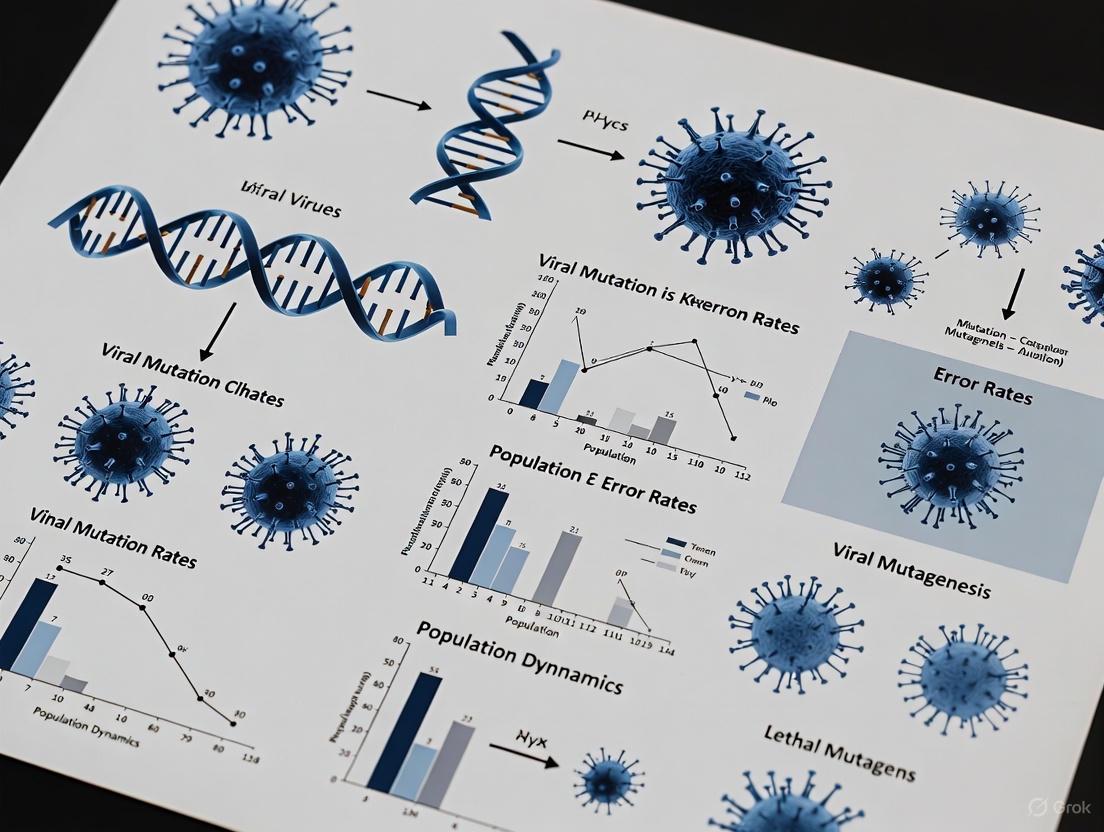
This article provides a comprehensive analysis of lethal mutagenesis, an antiviral strategy that exploits high mutation rates to drive viral populations to extinction.
Lethal Mutagenesis: From Viral Error Catastrophe to Antiviral Therapeutics
Abstract
This article provides a comprehensive analysis of lethal mutagenesis, an antiviral strategy that exploits high mutation rates to drive viral populations to extinction. Aimed at researchers, scientists, and drug development professionals, it synthesizes foundational theory, methodological applications, and current challenges. The content explores the conceptual distinction between lethal mutagenesis and error catastrophe, details the mechanisms of approved mutagenic drugs like ribavirin, favipiravir, and molnupiravir, and examines complexities such as mutation rate variability and the risk of accelerated adaptation under sub-lethal treatment. It further validates the approach through empirical studies across diverse virus models, offering a critical perspective on the future of mutagen-based therapeutics in biomedical and clinical research.
Theoretical Foundations of Lethal Mutagenesis and Error Catastrophe
Lethal mutagenesis is an antiviral strategy that aims to drive viral populations to extinction by elevating their mutation rate beyond a sustainable threshold [1]. This approach leverages the fundamental ambivalence of mutations in viral evolution: while most mutations are deleterious or lethal, a minority can be beneficial and drive adaptation [1]. The conceptual foundation of lethal mutagenesis rests on population genetics theory, which predicts that every replicating system has a critical mutation rate (Uc) beyond which the accumulation of deleterious mutations causes irreversible declines in population mean fitness and eventual extinction [1]. Within-host viral dynamics are characterized by complex interactions between selection, mutation, genetic drift, and the availability of susceptible host cells [1]. Understanding the demographic path to extinction requires examining how increased mutation rates affect these population dynamics, ultimately leading to a mutation meltdown where population size and mean fitness enter a downward spiral toward eradication.
Theoretical Framework: The Population Genetics of Error Catastrophe
Mutation Load and Viral Fitness Landscapes
The theoretical basis for lethal mutagenesis originates from the quasispecies model and population genetics principles describing mutation-selection balance in finite populations. Viral populations experience a constant influx of mutations during replication, with most having deleterious effects on fitness [1]. The mutation load represents the difference between the fitness of the fittest strain and the mean fitness of the population [1]. According to Fisher's Geometric Model (FGM), which provides a realistic distribution of fitness effects, viral infectivity (β) can be modeled as a function of distance from a phenotypic optimum across multiple traits [1]. As mutation rates increase, the mutation load increases, reducing the mean fitness of the viral population and hampering its ability to replicate and infect susceptible cells.
Critical Mutation Rate (Uc) and Deterministic Extinction
The critical mutation rate (Uc) represents the threshold above which viral populations cannot sustain replication and face deterministic extinction [1]. This threshold depends on several factors:
- Distribution of fitness effects: The proportion of lethal, deleterious, and beneficial mutations
- Population size dynamics: The availability of susceptible host cells and infected cell lifespans
- Epistatic interactions: How mutations interact to affect fitness
Deterministic models show that when U > Uc, the mutation load becomes sufficiently high to reduce the basic reproductive number (R0) below 1, preventing sustained infection [1].
Table 1: Key Parameters in Lethal Mutagenesis Models
| Parameter | Symbol | Definition | Impact on Uc |
|---|---|---|---|
| Genomic mutation rate | U | Average number of mutations per genome per replication | Critical variable being manipulated |
| Critical mutation rate | Uc | Threshold mutation rate leading to extinction | N/A - this is the threshold value |
| Lethal mutation fraction | fL | Proportion of mutations that prevent replication | Inverse relationship with Uc |
| Deleterious mutation effect | sd | Average fitness cost of non-lethal deleterious mutations | Inverse relationship with Uc |
| Beneficial mutation rate | Ub | Rate of fitness-enhancing mutations | Direct relationship with Uc |
| Infected cell burst size | B | Number of viral particles released per infected cell | Inverse relationship with Uc |
Demographic Feedback and Mutation Meltdown
An essential aspect of the demographic path to extinction involves feedback loops between population size and mutation accumulation. As mutation rates increase, the decline in mean fitness reduces the number of infected cells, triggering a rebound in susceptible cells [1]. This demographic feedback potentially intensifies selection for infectivity but also amplifies the effects of genetic drift through Muller's ratchet - the irreversible accumulation of deleterious mutations in finite populations [1]. This creates a mutation meltdown scenario where each "click" of Muller's ratchet further reduces population size and mean fitness, accelerating the extinction process [1]. Stochastic models incorporating these dynamics show that extinction probability increases dramatically when populations experience transient bottlenecks during mutagenic treatment.
Quantitative Analysis of Lethal Mutagenesis Thresholds
Estimating Critical Mutation Rates for Different Viruses
The feasibility of lethal mutagenesis depends on achieving mutation rates that exceed the viral-specific Uc. Analysis of experimental data on viral growth rates, genomic mutation rates, and fitness effects allows estimation of these critical thresholds [1].
Table 2: Experimentally-Derived Parameters for Critical Mutation Rate Estimation
| Virus | Baseline Mutation Rate (per genome) | Estimated Fold Increase to Reach Uc | Key Fitness Parameters |
|---|---|---|---|
| Bacteriophage T7 | Literature values | 2-3× | Moderate deleterious mutation effects |
| SARS-CoV-2 | Literature values | >5× | High baseline fitness, moderate deleterious effects |
| HIV-1 | Literature values | 3-4× | High recombination rate, strong selection |
| Vesicular Stomatitis Virus | Literature values | 2-3× | Well-characterized fitness landscape |
The Challenge of Current Mutagenic Drugs
A critical finding from theoretical models is that available mutagenic drugs may not achieve sufficient fold increases in mutation rates to reach Uc for many viruses [1]. For instance, drugs like ribavirin typically increase mutation rates by 2-5 fold, which often remains below the predicted Uc for well-adapted viruses [1]. This limitation questions the feasibility of lethal mutagenesis as a standalone therapy and suggests combination approaches may be necessary.
Experimental Validation and Methodologies
In Vitro Protocols for Lethal Mutagenesis Testing
Experimental validation of lethal mutagenesis involves measuring viral extinction under controlled mutagenic conditions:
Protocol 1: Determining Critical Mutation Rate Threshold
- Culture susceptible host cells (e.g., Vero, Huh-7, or primary cells depending on virus)
- Infect with virus at low MOI (0.01-0.1) in presence of increasing mutagen concentrations
- Quantify viral titers (TCID50 or plaque assay) over multiple passages
- Sequence viral populations to directly measure mutation rates
- Fit data to mathematical models to estimate Uc
Protocol 2: Measuring Mutation Load and Fitness Effects
- Use plaque purification to isolate viral clones from mutagen-treated populations
- Perform fitness competition assays against reference strain
- Calculate mutation load from fitness differences
- Sequence entire genomes to quantify mutation accumulation
- Correlate mutation number with fitness loss
Assessing Demographic Trajectories Toward Extinction
Monitoring the demographic path to extinction requires tracking both population size and genetic diversity:
- Time-series sampling of viral population size using quantitative PCR and infectivity assays
- Deep sequencing at multiple time points to monitor mutation accumulation
- Measurement of Muller's ratchet clicks by tracking loss of least-loaded genotypes
- Tracking susceptible cell dynamics to monitor demographic feedback
Visualization of Lethal Mutagenesis Pathways
Lethal Mutagenesis Demographic Pathway
Experimental Workflow for Validation
Research Reagent Solutions for Lethal Mutagenesis Studies
Table 3: Essential Research Reagents and Their Applications
| Reagent/Category | Specific Examples | Research Function | Key Considerations |
|---|---|---|---|
| Mutagenic Compounds | Ribavirin, Favipiravir, 5-Fluorouracil, 5-Azacytidine | Increase viral mutation rates | Select based on virus type; assess cytotoxicity controls |
| Cell Culture Systems | Primary cells, Continuous cell lines (Vero, Huh-7, MDCK) | Provide susceptible host cells | Ensure relevance to natural infection; monitor cell viability |
| Viral Quantification Assays | Plaque assay, TCID50, qRT-PCR, Immunofluorescence | Measure viral population size and infectivity | Combine methods for comprehensive assessment |
| Sequencing Technologies | Next-generation sequencing, PacBio SMRT, Nanopore | Quantify mutation rates and genetic diversity | Ensure adequate coverage for rare variant detection |
| Fitness Assay Components | Reference strains, Competition culture protocols | Measure relative fitness of viral populations | Use genetically marked reference viruses |
| Mathematical Modeling Tools | Custom scripts (R, Python), Population genetics packages | Estimate parameters and predict extinction thresholds | Validate models with experimental data |
Clinical Implications and Therapeutic Considerations
The translation of lethal mutagenesis from theoretical concept to clinical application faces several challenges. First, the fold increase of viral mutation rates induced by available mutagenic drugs is often insufficient to reach the predicted critical mutation rate [1]. Second, there is legitimate concern about "sublethal mutagenesis" where increased mutation rates might potentially promote adaptation by generating beneficial mutations that facilitate immune escape or increase infectivity [1]. This risk necessitates careful dosing strategies and consideration of combination therapies that simultaneously increase mutation pressure while directly suppressing viral replication. Future research directions should focus on identifying more potent mutagens, developing combination approaches that lower the effective Uc, and establishing biomarkers to predict which viral populations are most vulnerable to lethal mutagenesis.
Eigen's error catastrophe represents a foundational theoretical framework in evolutionary biology, describing the critical mutation rate beyond which a population of self-replicating entities loses its genetic information. This concept, pioneered by Manfred Eigen in 1971, has profoundly influenced virology and therapeutic development, particularly inspiring research into lethal mutagenesis as an antiviral strategy. This technical guide examines the mathematical foundations of error catastrophe, its relationship to quasispecies theory, and its experimental validation in virology. We present quantitative frameworks distinguishing error catastrophe from lethal mutagenesis, detailed methodologies for experimental investigation, and visualization of core concepts. For researchers and drug development professionals, this work provides both theoretical depth and practical tools for applying these principles in antiviral research and development.
The quasispecies theory was developed by Manfred Eigen and Peter Schuster in the 1970s as a chemical kinetics model to describe the evolution of populations of self-replicating entities under high mutation rates [2]. At its core, the theory posits that viral populations exist not as single genotypes but as dynamic, heterogeneous distributions of mutant sequences termed mutant swarms or quasispecies [2]. This population structure fundamentally differs from classical evolutionary models by emphasizing the collective behavior of genetically related variants rather than individual competitors in selection processes.
The theory emerged from Eigen's work on chemical reaction kinetics and was initially applied to prebiotic evolution scenarios, later finding profound applications in virology [3] [2]. The quasispecies framework mathematically describes how populations of replicators organize around master sequences (those with highest replication capacity) surrounded by clouds of mutants generated through erroneous replication. This model has proven particularly relevant for RNA viruses due to their high mutation rates resulting from the limited fidelity of their RNA-dependent RNA polymerases (RdRp) and RNA-dependent DNA polymerases (RdDp) [2].
Central to quasispecies theory is the concept of error catastrophe, which Eigen defined as the critical error rate threshold beyond which genetic information cannot be maintained in a population [4] [5]. When mutation rates exceed this threshold, the master sequence effectively disappears from the population, becoming no more frequent than any single variant sequence [4]. This transition represents a fundamental limit on the amount of genetic information that can be stably maintained at a given mutation rate, creating what is known as Eigen's paradox—the observation that the maximum genome size permitted at prebiotic error rates is too small to encode the error-correcting enzymes necessary for accurate replication [6].
Mathematical Foundations of the Error Threshold
Basic Quasispecies Equations
The original quasispecies model is described by a system of differential equations that track the concentration of each variant over time. For a population with n variant sequences, the rate of change for each sequence i is given by:
Where:
- x_i represents the concentration of sequence i
- f_j is the replication rate of sequence j
- Q_ji is the probability that sequence j mutates to sequence i during replication
- Φ(x) is the average fitness of the population (Φ(x) = Σj fj · x_j), which maintains constant population size [2]
This system describes the competitive dynamics between replicating sequences, where each sequence produces copies of itself and other sequences through mutation, while being diluted by the overall replication success of the population.
The Error Threshold in a Single-Peak Fitness Landscape
To derive the error threshold, Eigen and Schuster simplified the model using a single-peak fitness landscape, where one master sequence has high fitness and all mutants have equal, lower fitness [4] [2]. In this simplified two-class model:
- The wild-type (master) sequence, x0, has replication rate f0
- All mutant sequences, x1, have equal replication rate f1 < f_0
- μ is the mutation rate per replication
- Back mutations are considered negligible due to the vast sequence space
The equations simplify to:
The error threshold occurs when the mutation rate μ exceeds a critical value μ_c:
Beyond this threshold, the population loses the master sequence and experiences error catastrophe [2]. The master sequence becomes extinct because the rate at which it produces erroneous copies exceeds the rate at which accurate copies are maintained.
Alternative Mathematical Representations
The error threshold can also be understood through information theory, which posits that for a genome to persist, the information lost through mutation must be less than the information gained through natural selection [5]. This relationship is expressed as:
Where L is genome length, q is the error rate per base, and S is the probability of survival. This formulation highlights the fundamental tradeoff between genome size and replication fidelity that constrains all replicating systems [5].
Table 1: Key Parameters in Error Catastrophe Models
| Parameter | Symbol | Definition | Biological Significance |
|---|---|---|---|
| Genome length | L | Number of nucleotides in genome | Determines maximum information capacity |
| Quality factor | q | Probability of correct base replication | Measure of replication fidelity |
| Error rate | μ = 1-q | Probability of erroneous base replication | Determines mutation pressure |
| Superiority | σ = f0/f1 | Ratio of master to mutant fitness | Measure of selection strength |
| Error threshold | μ_c = 1 - 1/σ | Critical mutation rate | Boundary for information maintenance |
Relationship Between Error Catastrophe and Lethal Mutagenesis
Conceptual Distinctions
While often conflated in virological literature, error catastrophe and lethal mutagenesis represent distinct concepts with important theoretical differences [7] [8]. Error catastrophe is primarily an evolutionary phenomenon—a shift in genotype space where the master sequence is lost and the population delocalizes across sequence space without necessarily causing immediate extinction [7] [3]. In contrast, lethal mutagenesis is a demographic process that leads to population extinction through mutation accumulation [7].
The key distinction lies in their different theoretical bases and outcomes. During error catastrophe, the viral population continues to replicate but loses its genetic identity, while lethal mutagenesis directly reduces the number of viable progeny below replacement levels [7] [8]. This distinction has profound implications for antiviral strategies, as error catastrophe might not immediately eliminate a viral infection but could potentially facilitate escape from immune recognition or drug targeting.
Threshold Conditions
The threshold condition for lethal mutagenesis incorporates both evolutionary and ecological components [7]. For a virus to go extinct through lethal mutagenesis, the average number of new infected cells produced per infected cell must fall below 1. This can be expressed as:
Where U is the genomic mutation rate and R is the basic reproductive number (number of progeny per infected cell that go on to infect new cells) [7]. This demonstrates that the extinction threshold depends not only on the mutation rate but also on the viral ecology—specifically, the excess reproductive capacity that must be overcome by mutagenesis [7].
Table 2: Comparative Analysis of Error Catastrophe vs. Lethal Mutagenesis
| Characteristic | Error Catastrophe | Lethal Mutagenesis |
|---|---|---|
| Nature of Process | Evolutionary shift in genotype space | Demographic extinction |
| Key Parameters | Mutation rate, selection coefficient | Mutation rate, fitness, reproductive number |
| Population Size | Stable (in theoretical models) | Declining to zero |
| Fate of Wild Type | Lost while other variants survive | Entire population goes extinct |
| Dependence on Mutation Rate | Threshold phenomenon with possible plateau beyond threshold | Continuous increase in extinction probability |
| Therapeutic Implications | Potential loss of consensus sequence but continued replication | Population elimination |
Experimental Validation and Protocols
Laboratory Demonstration of Error Catastrophe
Experimental validation of error catastrophe principles has been achieved through controlled studies with various RNA viruses. These experiments typically involve serial passage of viruses in the presence of mutagenic agents while monitoring viral titers and genetic diversity [4] [7]. The fundamental protocol involves:
Virus Selection: RNA viruses with known mutation rates are ideal candidates, with poliovirus, vesicular stomatitis virus (VSV), and foot-and-mouth disease virus (FMDV) being commonly used [7] [8]
Mutagen Application: Base analogs like ribavirin, 5-fluorouracil, or 5-hydroxydeoxycytidine are administered at varying concentrations to increase error rates during replication [7] [8]
Serial Passage: Viruses are repeatedly passaged in cell culture to allow mutation accumulation across generations
Monitoring: Plaque assays quantify infectious particles, while sequencing tracks mutation accumulation and master sequence loss
Control Experiments: Parallel passages without mutagens establish baseline mutation rates and extinction probabilities
In a pivotal study with poliovirus, researchers demonstrated that the virus exists near the edge of error catastrophe, with modest increases in mutation rates causing significant reductions in viral infectivity [8]. The LI50 (50% loss of infectivity) was defined as the mutation frequency where half of viral genomes contain lethal mutations [8].
Measuring the Error Threshold
Determining the precise error threshold for a specific virus requires accurate measurement of several parameters:
Diagram 1: Error threshold measurement workflow (Title: Error Threshold Measurement)
Fitness assays typically involve direct competition experiments between marked variants, measuring their relative growth rates over multiple replication cycles [7]. Mutation rate quantification employs sequencing techniques to identify mutations accumulated during single replication cycles, often using neutral reporter genes to minimize selection effects [7].
Advanced approaches include measuring the complete mutational robustness of viral populations—the ability to maintain fitness despite mutations—which can reveal how close a natural virus population is to its error threshold [3]. This is particularly relevant for understanding potential resistance mechanisms to mutagenic therapies.
Research Applications and Toolkit
Mutagenic Agents in Research
Several mutagenic compounds have been essential tools for studying error catastrophe and developing lethal mutagenesis approaches:
Table 3: Key Research Reagents for Error Catastrophe Studies
| Reagent | Type | Mechanism of Action | Research Applications |
|---|---|---|---|
| Ribavirin | Nucleoside analog | Increases transition mutations; IMP dehydrogenase inhibition | Broad-spectrum antiviral; error catastrophe induction in multiple RNA viruses |
| 5-Fluorouracil | Pyrimidine analog | Incorporates into RNA causing erroneous base pairing | Mutagenesis studies in picornaviruses and other RNA viruses |
| 5-Hydroxydeoxycytidine | Cytidine analog | Base pairing ambiguities during replication | HIV-1 mutagenesis studies demonstrating infectivity loss |
| Molnupiravir | Nucleoside analog | Induces lethal mutagenesis through error accumulation | SARS-CoV-2 treatment; clinical application of lethal mutagenesis |
Technical Approaches for Quasispecies Analysis
Modern research into error catastrophe employs sophisticated methodological approaches:
Ultradeep Sequencing: Enables characterization of mutant spectra within quasispecies, revealing population diversity and identification of master sequences [2]
Fitness Landscape Mapping: Experimental determination of fitness values for multiple variants to understand the topology of sequence space [2]
In vitro Evolution Systems: "Evolution reactors" that drive viral evolution under controlled conditions to investigate error threshold dynamics [6] [2]
Digital PCR and Single-Cell Sequencing: Techniques to quantify rare variants and assess mutation distribution across populations
Bioinformatic Modeling: Computational approaches to simulate quasispecies dynamics and predict error thresholds in complex fitness landscapes [3] [2]
Diagram 2: Technical approaches for quasispecies analysis (Title: Quasispecies Analysis Methods)
Eigen's error catastrophe remains a foundational concept with enduring relevance to virology and antiviral development. The original theoretical framework has evolved substantially, with important clarifications distinguishing the evolutionary phenomenon of error catastrophe from the demographic process of lethal mutagenesis. Current research continues to refine our understanding of how mutation rates, population dynamics, and fitness landscapes interact to determine the fate of viral populations.
For drug development professionals, the principles of error catastrophe provide a strategic roadmap for designing mutagenic therapies that push viral populations beyond their error thresholds. However, challenges remain, including the potential for viruses to develop increased mutational robustness through "survival of the flattest" mechanisms [3], where variants with lower replication rates but greater tolerance to mutations may be selected under mutagenic pressure.
Future research directions include mapping empirical fitness landscapes for clinically important viruses, developing combination therapies that simultaneously exploit multiple viral vulnerabilities, and understanding how host factors influence error threshold dynamics. As sequencing technologies continue to advance, enabling more comprehensive analysis of viral quasispecies diversity, the original theoretical inspiration provided by Eigen's error catastrophe continues to illuminate new pathways for combating viral infections.
In the pursuit of effective antiviral therapies, the fundamental biology of viral replication offers a paradoxical vulnerability: the reliance on error-prone replication machinery. This whitepaper examines two central concepts—lethal mutagenesis and error catastrophe—that form the cornerstone of a promising antiviral strategy. While often used interchangeably in literature, they represent distinct phenomena, a distinction critical for researchers and drug development professionals. Lethal mutagenesis describes the empirical phenomenon of driving a viral population to extinction by artificially increasing its mutation rate [9] [10]. In contrast, error catastrophe is a specific theoretical prediction from quasispecies theory, positing a critical mutation rate threshold beyond which the genetic information of the master sequence cannot be maintained, leading to a loss of the consensus sequence and population delocalization in sequence space [3] [5] [8]. Framed within a broader thesis on the fundamentals of lethal mutagenesis, this guide delineates their conceptual foundations, mechanistic bases, and experimental validations, providing a technical resource for advancing antiviral research.
Theoretical Foundations and Definitions
The conceptual origins of error catastrophe and lethal mutagenesis lie in the quasispecies theory, formulated by Eigen and Schuster in the 1970s to explain the evolution of early self-replicating molecules [5] [10]. This theory models viral populations not as a single dominant genotype but as a cloud of mutant variants, or a quasispecies, held in a mutation-selection balance [3] [8].
Error Catastrophe: The Original Theoretical Threshold
Error catastrophe was first predicted by this model as a phase transition. It defines an error threshold, a critical mutation rate per genome per replication cycle, beyond which the population can no longer maintain its genetic information [5] [8]. When this threshold is exceeded, the master sequence—the fittest genotype—is lost and the population becomes delocalized, meaning it drifts randomly through genetic sequence space without a stable consensus sequence [3] [5]. Importantly, in its original theoretical formulation, the error catastrophe does not necessarily imply immediate extinction; the total population size can remain stable even as the information content collapses [8].
Lethal Mutagenesis: The Empirically-Observed Extinction
Lethal mutagenesis, a term coined later by Loeb and colleagues, refers to the observable process of extinguishing a viral population by using mutagenic agents to elevate the mutation rate [11] [10]. The focus here is on the extinction threshold, the mutation rate at which the average fitness of the population falls below 1, causing a deterministic decline in population size to zero [9] [8]. This phenomenon is explained by the accumulation of a mutational load—primarily through lethal mutations—that reduces the average replication rate of the population until it can no longer sustain itself [4] [9].
Table 1: Core Conceptual Distinctions Between Error Catastrophe and Lethal Mutagenesis
| Feature | Error Catastrophe | Lethal Mutagenesis |
|---|---|---|
| Fundamental Nature | Theoretical phase transition in a population model | Empirical antiviral strategy and observed outcome |
| Key Threshold | Error threshold (loss of information) | Extinction threshold (loss of population) |
| Primary Driver | Delocalization of the quasispecies | Accumulation of deleterious/lethal mutations |
| Population Fate | Population may persist with randomized sequences | Population deterministically declines to extinction |
| Dependence on Mutational Load | Not directly dependent; assumes many mutants remain viable | Directly caused by mutational load reducing mean fitness |
| Typical Assumptions in Models | All mutant sequences have reduced but finite fitness | A spectrum of fitness effects, including lethal mutations |
Mechanistic Distinctions and Population Dynamics
The theoretical divergence between these concepts is reflected in their underlying mechanisms, which have direct implications for antiviral design and experimental outcomes.
The Role of Mutational Robustness and "Survival of the Flattest"
A critical insight from quasispecies theory is that populations can evolve mutational robustness. The phenomenon of "survival of the flattest" describes how, at high mutation rates, a viral strain with a lower replication rate but higher robustness (i.e., a "flatter" fitness landscape where more mutations are neutral) can outcompete a faster-replicating but less robust strain [3]. Intriguingly, the transition to error catastrophe in a population can itself be viewed as a form of natural selection, where the mutant spectrum (which is flatter) is selected over the master sequence (which is a sharp peak) [3]. This complicates antiviral strategies, as viruses might theoretically develop resistance to lethal mutagenesis by evolving greater robustness, a phenomenon known as sublethal mutagenesis [9].
The Critical Role of Lethal Mutations
A fundamental mechanistic difference lies in the assumed fitness of mutant variants. Classic error catastrophe models often simplify the fitness landscape into two classes: a high-fitness master sequence and low-fitness-but-viable mutants [4] [8]. In reality, a significant proportion of random mutations are lethal. For example, in vesicular stomatitis virus, approximately 40% of single nucleotide substitutions are lethal [4]. Lethal mutagenesis accounts for this spectrum of fitness effects, where the incorporation of a single lethal mutation can inactivate a viral genome. The cumulative effect of these lethal events, alongside numerous deleterious mutations, directly creates the mutational load that drives the population to extinction [4] [9].
The following diagram illustrates the distinct pathways through which increased mutagenic pressure leads to either error catastrophe or lethal mutagenesis, highlighting the key mechanistic differences.
Experimental Evidence and Protocols
The translation of theory into practical application is demonstrated through key experimental protocols that differentiate between these two concepts.
Establishing a Lethal Mutagenesis Protocol
A foundational protocol for inducing lethal mutagenesis, as demonstrated with HIV-1, involves serial passage of the virus in the presence of a mutagen [11] [10]. The following workflow details a standard approach for validating extinction via lethal mutagenesis in cell culture.
Key Experimental Measurements:
- Viral Titer: A sustained drop in infectious titer over passages, culminating in no detectable infectivity, confirms extinction [11] [10].
- Mutation Frequency: Quantification via sequencing (e.g., of a target region like the polymerase gene) should show a significant increase (e.g., 2 to 5-fold) in mutations per genome between pre-extinction and control passages [10]. This demonstrates the mechanism is mutagenic rather than merely inhibitory.
- Control: A parallel lineage must be passaged without the mutagen to control for any nonspecific effects of serial passage.
Quantifying the Error Threshold Experimentally
Experimental work has shown that RNA viruses naturally replicate near their error threshold. A key experiment involved treating poliovirus with ribavirin, which demonstrated that a modest increase in mutation frequency from approximately 1.5 mutations/genome (wild-type) to 6.9 mutations/genome caused a rapid decline in specific infectivity of genomic RNA, pushing the virus to the edge of error catastrophe [8]. The quantitative relationship between mutation rate and genomic integrity is a hallmark of this concept.
Table 2: Key Parameters and Reagents for Experimental Lethal Mutagenesis
| Parameter/Reagent | Function/Explanation | Example Agents & Values |
|---|---|---|
| Mutagenic Nucleoside Analogs | Incorporated by viral polymerase, causes mispairing during replication. | Ribavirin, 5-hydroxydeoxycytidine, Favipiravir, Molnupiravir [12] [10] |
| Mutation Frequency | Measured mutations per nucleotide or per genome. Critical for confirming mechanism. | Poliovirus: ~1.5 (wt) vs. ~6.9 (with mutagen) mutations/genome [8] |
| Viral Titer (Infectivity) | Measures viable virus (e.g., PFU/mL). Extinction is confirmed when titer reaches zero. | Plaque assay or TCID₅₀ [10] |
| Specific Infectivity | Ratio of infectious units to total viral particles/genomes. Indicator of genetic integrity. | Rapid decline near error threshold [8] |
| Serial Passage Multiplicity of Infection (MOI) | Controls viral population size and bottleneck effects during passage. | Typically low MOI (e.g., 0.1) to avoid complementation [10] |
Application in Antiviral Drug Development
The theoretical concepts have materialized in approved antiviral drugs whose primary mechanism of action is lethal mutagenesis.
Case Study: Molnupiravir
Molnupiravir, an oral prodrug of β-D-N4-hydroxycytidine (NHC), is approved for the treatment of SARS-CoV-2. Its active form, NHC-triphosphate, is incorporated into viral RNA by the RNA-dependent RNA polymerase (RdRp) [12]. The key to its mutagenic action is NHC's tautomeric nature: it can mimic both cytosine (pairing with G) and uracil (pairing with A). This ambiguous base-pairing leads to an accumulation of transition mutations (G→A and C→U) in the viral genome during subsequent replication cycles [12]. When the mutation burden surpasses the viability threshold, the virus population collapses through lethal mutagenesis.
Broader Applications and Considerations
- Favipiravir: A broad-spectrum antiviral that also acts as a mutagen, incorporating into viral RNA and increasing transition mutation rates [10].
- Ribavirin: While having multiple proposed mechanisms, its activity against viruses like poliovirus includes a significant mutagenic component [10].
A major consideration in developing such drugs is the risk of sublethal mutagenesis, where an increased mutation rate below the extinction threshold could potentially enhance viral adaptation and the emergence of drug resistance [9]. Furthermore, the genotoxic risk of mutagenic agents to the host must be carefully evaluated [10].
Understanding the distinction between error catastrophe and lethal mutagenesis is more than an academic exercise; it is fundamental for designing and interpreting antiviral strategies. Error catastrophe describes a theoretical critical point for the loss of genetic information, while lethal mutagenesis is an observable process of population extinction driven by mutational load. For the researcher, this translates to different experimental readouts: the former focuses on the collapse of the consensus sequence and quasispecies structure, while the latter prioritizes the irreversible decline in viral infectivity. As the field advances, the challenge lies in designing mutagenic therapies that efficiently push viral populations beyond the extinction threshold while avoiding the pitfalls of enhanced evolution and host genotoxicity. The continued refinement of these concepts will undoubtedly underpin the next generation of antiviral agents.
Lethal mutagenesis is an antiviral strategy that aims to push a viral population within a host to extinction by artificially elevating its mutation rate [7]. This guide synthesizes the core theoretical models that underpin this approach, focusing on the interplay between fitness landscapes—which map viral genotypes to their reproductive success—and the demographic and genetic thresholds that determine extinction. Crucially, lethal mutagenesis is distinct from the concept of "error catastrophe," which describes an evolutionary shift in genotype space; instead, lethal mutagenesis is a demographic process that results in a definitive drop in population abundance [7]. The following sections provide an in-depth technical overview of the fitness landscape models and quantitative frameworks essential for designing and interpreting lethal mutagenesis experiments, with data and methodologies structured for immediate application by researchers and drug development professionals.
Theoretical Foundations of Fitness Landscapes
Defining Fitness Landscapes
A fitness landscape is a mapping from the vast space of possible genotypes to their corresponding fitness values, where fitness is defined as the average number of progeny a specific viral genome produces that are capable of infecting new cells [13]. The structure of this landscape dictates the potential for viral adaptation and its susceptibility to mutational pressure. Exploring these landscapes empirically is challenging due to the high dimensionality of genotype space; exhaustive measurement is only feasible for very short sequences, forcing researchers to rely on sparse sampling or statistical models to approximate the landscape [13].
Key Mathematical Models of Fitness Landscapes
The following models formalize assumptions about how mutations combine to determine a virus's fitness. These models are foundational for predicting the impact of increased mutagenesis.
Table 1: Core Mathematical Models of Fitness Landscapes
| Model Name | Mathematical Formulation | Biological Interpretation | Key Assumptions |
|---|---|---|---|
| Multiplicative | ( w_j = (1 - s)^j ) | Each additional deleterious mutation reduces fitness by a constant fraction, independent of existing mutations [7]. | Effects of mutations are independent (no epistasis). |
| Eigen (Two-Class) | ( w0 = 1 ), ( w{j\ge1} = 1 - s ) | The wild-type genotype has a fitness of 1; all genotypes with one or more mutations share a single, lower fitness [7]. | Mutations are conditionally neutral; multiple mutations have the same effect as one. |
| Truncation | ( wj = 1 ) for ( j \le k );( wj = 0 ) for ( j > k ) | Genotypes with a number of mutations below a threshold ( k ) are fully viable; those exceeding ( k ) are inviable [7]. | Tolerates a limited mutational load before complete loss of function. |
These models make several simplifying assumptions: the viral population is very large, mutations occur randomly across the genome following a Poisson distribution with a mean of ( U ) mutations per genome per replication, and all mutations are either deleterious or neutral, excluding beneficial or compensatory mutations for simplicity [7].
The Theory of Lethal Mutagenesis and Extinction Thresholds
The Demographic-Genetic Extinction Threshold
The foundational theory of lethal mutagenesis posits that extinction occurs when the average viral genotype produces less than one progeny virus that successfully infects a new cell [7]. This threshold condition integrates both genetic and ecological factors:
[ \underbrace{R{eff} \times \overline{w}(U)}{\text{Average infected cells per cell}} < 1 ]
- ( R_{eff} ): The effective reproductive number in the absence of mutagen, representing the average number of new cells infected by one infected cell (the ecological component) [7].
- ( \overline{w}(U) ): The average fitness of the viral population at genetic equilibrium under a genomic mutation rate ( U ) (the evolutionary component) [7].
The critical mutation rate ( U{crit} ) required for extinction is therefore not universal; it depends on the initial fitness (( R{eff} )) of the virus in its specific environment. A virus with a high ( R_{eff} ) requires a much higher mutation rate to drive it to extinction than one already struggling to maintain itself [7].
Distinction from Other Evolutionary Processes
Lethal mutagenesis is a deterministic process that can operate in large populations, distinguishing it from stochastic mechanisms like Muller's ratchet, which describes the irreversible accumulation of deleterious mutations in small, finite asexual populations [7]. Similarly, it is conceptually different from the error catastrophe, which involves the loss of a dominant "master sequence" within a quasispecies. A population can experience an error catastrophe—a shift in the dominant genotype—without going demographically extinct, particularly if the mutant cloud contains robust phenotypes [14].
Quantitative Data and Experimental Protocols
Key Parameters for Quantifying Lethal Mutagenesis
Accurately measuring the following parameters is critical for testing lethal mutagenesis in experimental models.
Table 2: Essential Quantitative Parameters for Lethal Mutagenesis Research
| Parameter | Symbol | Measurement Method | Technical Considerations |
|---|---|---|---|
| Genomic Mutation Rate | ( U ) | Fluctuation assay / Luria-Delbrück experiment; sequencing of viral plaques [7]. | Distinguish between neutral (( Un )) and deleterious (( Ud )) mutation rates. |
| Viral Fitness | ( w ) | Growth competition assays against a reference virus; direct measurement of progeny in single-cycle infections [7]. | Fitness is context-dependent; measure under relevant conditions. |
| Average Fitness at Equilibrium | ( \overline{w}(U) ) | Calculated from the mutation rate and the distribution of mutational effects using fitness landscape models [7]. | Depends on the assumed fitness model (see Table 1). |
| Basic Reproductive Number | ( R_{eff} ) | Estimated from viral growth kinetics or mathematical models of viral dynamics within a host [7]. | Challenging to measure directly; often inferred from population decline rates. |
Protocol: In Vitro Lethal Mutagenesis Assay
This protocol outlines a method to test the efficacy of a mutagenic antiviral agent in a cell culture system.
Cell Culture and Viral Infection:
- Seed susceptible host cells (e.g., Vero E6, Huh-7) in multi-well plates.
- Infect cells at a low multiplicity of infection (MOI ~0.1) to ensure multiple infection cycles in the presence of the mutagen.
Mutagen Application:
- Prepare serial dilutions of the mutagenic compound (e.g., Ribavirin, Favipiravir) in the cell culture medium.
- Include a negative control (no drug) and a positive control (a known viral replication inhibitor).
- Add the drug-containing medium to the cells, and incubate with the virus for the duration of the experiment (e.g., 72-96 hours), with periodic sampling.
Viral Titer Quantification:
- Collect culture supernatants at regular time intervals (e.g., every 12-24 hours).
- Determine the viral titer via plaque assay or TCID(_{50}) on fresh, drug-free cell monolayers.
- Plot the viral titer over time to establish population growth or decline dynamics.
Mutation Rate and Fitness Measurement:
- From the endpoint samples, isolate viral RNA/DNA from the supernatant or infected cells.
- Perform reverse transcription and PCR amplification of target genomic regions.
- Use next-generation sequencing (NGS) of cloned viral genomes or plaque isolates to determine the mutation frequency and spectrum.
- Calculate the in-class mutation rate ( U_d ) based on the frequency of deleterious mutations observed.
Data Analysis and Extinction Threshold Calculation:
- Use the measured ( U_d ) and the assumed fitness landscape (e.g., multiplicative) to calculate the average fitness ( \overline{w}(U) ).
- From the control growth curve, estimate the intrinsic ( R_{eff} ).
- Apply the extinction threshold condition: If ( R_{eff} \times \overline{w}(U) < 1 ) in the mutagen-treated population, and viral titres decline to zero, this provides strong evidence for lethal mutagenesis.
Visualizing Concepts and Workflows
Fitness Landscape Models and Mutational Effects
Lethal Mutagenesis Experimental Workflow
The Scientist's Toolkit: Research Reagent Solutions
Table 3: Essential Reagents and Materials for Lethal Mutagenesis Research
| Reagent/Material | Function/Application | Key Characteristics & Considerations |
|---|---|---|
| Mutagenic Compounds | Artificially elevate viral mutation rates during replication. Examples: Ribavirin, Favipiravir, 5-Fluorouracil [7]. | Specificity for viral RNA-dependent RNA polymerase (RdRp) versus host polymerases is critical to reduce host cell toxicity. |
| Susceptible Cell Lines | Provide a permissive host environment for in vitro viral replication and mutagenesis studies. | Must be derived from the relevant host tissue (e.g., Vero E6, Huh-7, MDCK) and support high-titer viral growth. |
| Next-Generation Sequencing (NGS) | Precisely quantify mutation frequency and spectrum in viral populations post-mutagenesis [7]. | High sequencing depth is required to accurately detect low-frequency mutations and estimate genomic mutation rate (U). |
| Plaque Assay Reagents | Quantify infectious viral titer through plaque formation in cell monolayers. | Includes agarose/avicel overlay, crystal violet or neutral red stain. The gold standard for measuring infectious units. |
| Viral Genomic Isolation Kits | Extract high-quality viral RNA/DNA for downstream sequencing and analysis. | Must efficiently purify nucleic acids from culture supernatants or infected cells, free of contaminants. |
The Role of Viral Quasispecies in Susceptibility to Mutagenesis
Viral quasispecies refers to the population structure of viruses, characterized by complex, dynamic distributions of closely related variant genomes, termed mutant spectra, mutant swarms, or mutant clouds [15]. This concept, adopted from a theory on the origin of life developed by Manfred Eigen and Peter Schuster, provides a framework for understanding the adaptive potential of RNA viruses and some DNA viruses, which contrasts with classical studies based on consensus sequences [15] [16] [17]. A viral quasispecies is not a mere aggregate of independent mutants but a network of variants connected through continuous mutation, subjected to genetic variation, competition, and selection, which can act as a unit of selection [15] [16] [18].
The quasispecies structure is most evident in systems with limited genome size and high mutation rates, conditions that perfectly describe RNA viruses and reverse-transcribing viruses like hepatitis B virus (HBV) [15] [16] [17]. Their high mutation rates, typically in the range of (10^{-3}) to (10^{-5}) mutations per nucleotide copied, result from the limited template-copying fidelity of viral RNA-dependent RNA polymerases (RdRps) and RNA-dependent DNA polymerases (reverse transcriptases), which generally lack proofreading-repair activities [16] [19] [17]. This error-prone replication means that it is unlikely to produce a progeny viral RNA molecule identical to its immediate parental template within an infected cell, making mutant spectra the source of viral adaptability [16]. These mutant clouds serve as dynamic repositories of genotypic and phenotypic variants, enabling viruses to rapidly adapt to selective pressures such as host immune responses or antiviral agents [16].
Table 1: Key Terminology in Viral Quasispecies Biology
| Term | Definition | Biological Implication |
|---|---|---|
| Mutation Rate | The frequency of mutations occurring during genome replication (substitutions per nucleotide copied) [16]. | A biochemical event, independent of fitness; sets the potential for diversity. |
| Mutation Frequency | The proportion of mutations in a population of genomes [16]. | A population-level measurement, dependent on the relative fitness of mutated genomes. |
| Mutant Spectrum/Cloud | The ensemble of closely related viral genomes that constitute a quasispecies [15] [16]. | Its complexity is a key determinant of viral adaptability and pathogenesis. |
| Error Threshold | The maximum mutation rate compatible with stable maintenance of genetic information [15] [16] [19]. | A fundamental limitation that can be exploited for antiviral therapy. |
| Lethal Mutagenesis | An antiviral strategy that aims to extinguish viruses by elevating mutation rates beyond the error threshold [15] [16]. | Drives the viral population to a loss of viability and extinction. |
The Error Threshold and the Principles of Lethal Mutagenesis
A central corollary of quasispecies theory is the error threshold relationship, which defines the maximum mutation rate compatible with the stable maintenance of genetic information in a replicating system [16] [19] [17]. This relationship establishes that for a given level of genetic complexity (genome size and amount of non-redundant information), there is a maximum error rate during replication that can be tolerated. If the mutation rate surpasses this critical threshold, the genetic information of the dominant or master sequence dissipates, leading to a collapse of the mutant distribution into sequences that lack information content—a phenomenon termed error catastrophe [16] [19] [17].
The error threshold can be visualized in a simplified model with a dominant master sequence ((x0)) replicating at a high fitness ((f0)) and producing an average mutant ((x1)) with lower fitness ((f1)). The critical mutation rate ((\muc)) is given by (\muc = 1 - f1/f0) [2]. When the mutation rate ((\mu)) exceeds (\mu_c), the master sequence can no longer stabilize the population, and the consensus sequence drifts randomly through sequence space, resulting in a lethal accumulation of mutations [16] [2].
Lethal mutagenesis is an antiviral strategy predicated on pushing a viral population across this error threshold [15] [16] [1]. The objective is not to inhibit a specific viral function but to amplify the intrinsic error rate of viral replication to a level where the inheritance of viable genetic information becomes impossible, driving the population to extinction [15] [16]. This approach leverages the fact that many viruses already operate near the maximum permissible mutation rate for their genome size. A relatively small increase in the mutation rate, induced by mutagenic agents, can therefore be sufficient to trigger an error catastrophe [19].
Figure 1: The Path to Lethal Mutagenesis. Increasing the viral mutation rate beyond a critical error threshold leads to a loss of genetic information and eventual population extinction.
It is crucial to distinguish lethal mutagenesis from mutational load, which refers to a general fitness reduction due to the accumulation of deleterious mutations. Lethal mutagenesis represents a more abrupt transition where the population's mean fitness plummets, and the ability to sustain inheritable information is irreversibly lost [16] [1]. Natural analogs of this process exist, such as the action of the APOBEC3 family of cytidine deaminases, which induce hypermutation in retroviral DNA as a form of innate immunity [19].
Quasispecies Properties Governing Susceptibility to Mutagenesis
The susceptibility of a virus to lethal mutagenesis is not uniform but is influenced by specific properties of its quasispecies. Key factors include the inherent mutation rate, genomic robustness, fitness landscape, and the complexity of the mutant spectrum itself.
Mutation Rate and Genomic Robustness: Viruses with naturally high mutation rates, like RNA viruses, exist in a precarious state close to their error threshold. This makes them inherently vulnerable to further increases in mutation rate [19]. Genomic robustness—the ability of a virus to tolerate mutations without a fitness loss—also modulates susceptibility. A virus with a high robustness (a "flatter" fitness landscape) may withstand a higher mutational load, a phenomenon sometimes called "survival of the flattest" [17]. However, even robust populations can be driven to extinction if the mutation rate is sufficiently increased [16].
Role of the Mutant Spectrum: The mutant spectrum is not a passive byproduct of replication but plays an active role in viral fitness and evolution. Internal interactions, such as complementation (where one variant provides a gene product that benefits others) and interference (where less fit variants hinder the replication of fitter ones), can occur within the cloud [16] [18]. During lethal mutagenesis, an enrichment of the mutant spectrum with interfering genomes can amplify the deleterious effects of mutagenic drugs, accelerating the transition to error catastrophe [19]. Furthermore, a more complex and diverse mutant spectrum provides a broader phenotypic reservoir, which could theoretically aid in adapting to mutagenic pressure. However, beyond the error threshold, this diversity collapses as no viable genomes can be maintained [16] [17].
Fitness Landscape and Selection Pressure: The topology of the fitness landscape significantly impacts the dynamics of lethal mutagenesis. In a rugged landscape with high peaks and deep valleys, a population might be trapped on a narrow fitness peak, making it more susceptible to falling off when mutation rates increase. In contrast, a flatter landscape might allow the population to drift for longer before extinction [2]. Furthermore, the presence of strong selection pressures, such as a potent immune response or other antiviral drugs, can interact with mutagenic treatment. While these pressures can help eliminate fit variants, they may also create opportunities for the selection of beneficial escape mutants even under mutagenic conditions, a potential risk known as sublethal mutagenesis [1].
Quantitative Framework and Experimental Evidence
The theoretical foundation of lethal mutagenesis is supported by mathematical models and experimental evidence from multiple virus systems. Recent models incorporate viral population dynamics within the host, providing a more realistic prediction of the critical mutation rate ((U_c)) required for extinction [1] [20].
These models account for the fact that mutagenesis is a "double-edged sword": while most mutations are deleterious or lethal, a small fraction may be beneficial and enhance adaptation [1]. Furthermore, as mutagenesis reduces the mean fitness of the virus population, the within-host dynamics change—e.g., the number of infected cells drops, potentially triggering a rebound in susceptible cells, which in turn can feedback to alter the intensity of selection [1]. Stochastic effects (genetic drift) in finite populations, such as Muller's ratchet (the irreversible accumulation of deleterious mutations in an asexual population), can also amplify the effects of mutagenesis and lead to a mutational meltdown [1].
Table 2: Experimentally Determined Parameters for Lethal Mutagenesis
| Virus | Genome Type | Estimated Genomic Mutation Rate | Key Mutagenic Agent(s) Studied | Experimental System |
|---|---|---|---|---|
| Bacteriophage Qβ [17] | RNA | ~10⁻⁴ per nt copied [17] | Nucleoside analogs (e.g., Ribavirin, 5-Fluorouracil) [16] | Cell-free replication [18] |
| Vesicular Stomatitis Virus (VSV) [17] | RNA | ~10⁻⁴ to 10⁻⁵ per nt copied [16] | 5-Fluorouracil [16] | Cell culture [16] |
| Human Immunodeficiency Virus (HIV-1) [16] | Reverse-transcribing RNA | High (error-prone RT) [16] | Ribavirin, 5-Hydroxydeoxycytidine [16] | Cell culture [16] |
| Hepatitis C Virus (HCV) [16] | RNA | High [16] | Ribavirin [16] | Cell culture, replicons [16] |
| SARS-CoV-2 [1] [21] | RNA (with proofreading) | Lower than other RNA viruses due to ExoN proofreading [17] | Ribavirin, Molnupiravir [1] | Cell culture, animal models [1] |
However, a 2025 modeling study by Guillemet et al. raises questions about the clinical feasibility of lethal mutagenesis. Using a Fisher's Geometric Model (FGM) to generate realistic distributions of mutation effects, the study concluded that the fold-increase in mutation rate induced by currently available mutagenic drugs may not be sufficient to reach the predicted critical mutation rate ((U_c)) required to drive viral extinction in a within-host context [1] [20]. This highlights the significant challenge of achieving a mutagenic potency in patients that is high enough to reliably trigger error catastrophe without causing undue toxicity.
Methodologies for Studying Quasispecies and Mutagenesis
Analyzing the composition and dynamics of viral quasispecies in response to mutagenic pressure requires sophisticated experimental and computational methodologies.
Key Experimental Protocols
A foundational protocol for demonstrating lethal mutagenesis involves serial passaging of viruses in cell culture in the presence of sub-lethal to lethal concentrations of a mutagenic agent [16] [18]. The workflow typically includes:
- Infection and Treatment: Infect susceptible cell lines with a well-characterized viral stock at a low multiplicity of infection (MOI) to allow multiple rounds of replication. Include experimental groups with varying concentrations of the mutagen (e.g., Ribavirin, 5-Fluorouracil) and appropriate controls (e.g., no drug, non-mutagenic antiviral) [16].
- Serial Passage: Harvest virus from the supernatant at regular intervals (e.g., 24-72 hours post-infection) and use a small aliquot to infect fresh cells, maintaining the same drug concentrations. This is repeated for numerous passages [18].
- Monitoring Viral Fitness:
- Genetic Analysis: Extract viral RNA/DNA from population samples at different passages. Use the following methods to quantify genetic diversity and mutation frequency:
- Molecular Cloning and Sanger Sequencing: This classic method involves biological or molecular cloning of individual genomes, followed by sequencing of multiple clones (e.g., 10-100 per sample). It allows for the calculation of average genetic distances and mutation frequencies, providing direct evidence of mutagen-induced increases in diversity [15] [16] [22].
- Ultra-Deep Sequencing (UDS): This high-throughput method involves amplifying short genomic regions from the viral population, generating a vast number of sequence reads (e.g., 10⁵ to 10⁶ per region). UDS provides a highly detailed view of the mutant spectrum's complexity, allowing for the detection of low-frequency variants and calculation of metrics like Shannon entropy [16] [21] [18]. It is critical for tracking the real-time dynamics of the quasispecies under mutagenic pressure.
Figure 2: Experimental Workflow for Lethal Mutagenesis. A standard protocol involves serial passaging under mutagenic pressure, followed by phenotypic and genetic analysis.
The Scientist's Toolkit: Essential Research Reagents
Table 3: Key Reagents for Quasispecies and Lethal Mutagenesis Research
| Research Reagent / Tool | Primary Function | Application in Quasispecies Studies |
|---|---|---|
| Mutagenic Nucleoside Analogs (e.g., Ribavirin, 5-Fluorouracil, Molnupiravir) [16] [1] | Incorporate into viral RNA during replication, causing mismatches and increasing mutation rate. | The primary agents used to experimentally induce error catastrophe and study viral population collapse [16] [1]. |
| Susceptible Cell Lines | Provide a permissive environment for viral replication. | Essential for in vitro serial passage experiments and for producing virus for fitness assays [16]. |
| Reverse Transcription and PCR Reagents | Amplify viral genetic material from infected cells or culture supernatant. | Critical first step for all downstream genetic analyses, including cloning and sequencing [22]. |
| Ultra-Deep Sequencing (UDS) Platforms (e.g., Illumina, PacBio) [16] [21] | Generate millions of sequence reads from a viral population sample. | Enables high-resolution characterization of mutant spectrum complexity, diversity, and dynamics in response to mutagenesis [16] [21] [18]. |
| Single Genome Sequencing (SGS) Protocol [22] | Amplifies and sequences individual viral genomes without the artifacts of bulk PCR. | Provides an accurate, unbiased characterization of viral quasispecies, free from resampling and Taq polymerase errors [22]. |
| Bioinformatics Software (for sequence alignment, diversity, and phylogenetic analysis) | Processes and analyzes large volumes of genetic data. | Used to calculate mutation frequencies, genetic distances, construct phylogenetic trees, and model population dynamics from UDS and SGS data [21] [22]. |
The quasispecies nature of viruses presents a fundamental challenge for antiviral therapy, as the pre-existence of drug-resistant mutants within the mutant cloud can lead to treatment failure [16] [21]. In this context, lethal mutagenesis offers a conceptually distinct strategy: instead of selecting against a specific viral function, it aims to collapse the entire quasispecies structure [15] [16].
Drugs like Ribavirin, which has demonstrated mutagenic activity against several viruses, and Molnupiravir, developed for SARS-CoV-2, exemplify the translational pursuit of this strategy [16] [1]. The clinical application of lethal mutagenesis must be carefully considered. A primary concern is sublethal mutagenesis, where an increased mutation rate, while not eradicating the virus, could potentially accelerate the emergence of novel variants with undesirable traits, such as enhanced immune evasion or pathogenesis [1]. Furthermore, the mutagenic effect on host cells must be rigorously evaluated to avoid oncogenic or toxic side effects.
In conclusion, the viral quasispecies is a critical determinant of susceptibility to mutagenesis. Its structure, defined by a dynamic mutant spectrum, is both the engine of viral adaptability and its Achilles' heel when confronted with mutagenic agents. While recent models suggest that achieving extinction with current drugs is challenging [1] [20], the principles of quasispecies dynamics and the error threshold remain fundamental. Future research should focus on designing combination therapies that pair mutagenic agents with other antivirals or immune modulators to synergistically increase the selective pressure, potentially lowering the practical threshold for viral extinction and mitigating the risks of escape. A deep understanding of quasispecies behavior is therefore indispensable for advancing the next generation of antiviral strategies.
Mechanisms and Methodologies in Mutagenic Antiviral Therapy
Lethal mutagenesis is an innovative antiviral strategy that exploits the high mutation rates inherent to RNA viruses, pushing their mutation rates beyond a viable threshold to drive viral populations to extinction [23]. This approach aims to induce an "error catastrophe" or "mutational meltdown," where the accumulation of deleterious mutations in the viral genome leads to a progressive loss of genetic information and a fatal decline in population fitness [23] [24]. For RNA viruses, which typically replicate near their error threshold, even a modest increase in mutation frequency can be sufficient to exceed this viability limit [23]. This review provides a comprehensive technical examination of three approved antiviral drugs—ribavirin, favipiravir, and molnupiravir—that employ lethal mutagenesis as their primary or significant mechanism of action, focusing on their molecular mechanisms, experimental assessment, and research applications for drug development professionals.
Drug Profiles and Mechanisms of Action
Comparative Drug Properties
Table 1: Pharmacological and chemical properties of approved mutagenic drugs
| Property | Ribavirin | Favipiravir | Molnupiravir |
|---|---|---|---|
| Chemical Formula | C₈H₁₂N₄O₅ [25] | C₅H₄FN₃O₂ [26] | Information missing from sources |
| Molecular Weight | 244.20 g/mol [25] | 157.10 g/mol [26] | Information missing from sources |
| Approval Status | US: Yes; Other: Yes [25] | US: No; Other: Yes (Japan) [26] | Approved for SARS-CoV-2 [23] |
| Primary Indications | Chronic Hepatitis C (in combination), RSV, viral hemorrhagic fevers [25] [27] | Treatment-resistant influenza [26] [28] | SARS-CoV-2 infection [23] [29] |
| Mechanism Class | Nucleoside analog [25] | Pyrazine analog [26] [28] | Cytidine nucleoside analog [23] |
| Key Molecular Targets | IMP dehydrogenase, viral RNA polymerase [25] | RNA-dependent RNA polymerase (RdRp) [26] [28] | RNA-dependent RNA polymerase (RdRp) [23] [29] |
| Bioavailability | 64% [25] | 97.6% [26] | Information missing from sources |
| Elimination Half-life | 120-170 hours (multiple dose) [25] | 2-5.5 hours [26] | Information missing from sources |
Detailed Mechanistic Pathways
Ribavirin demonstrates a complex multi-mechanistic approach to antiviral activity. As a guanosine nucleoside analog, it undergoes intracellular phosphorylation to mono-, di-, and triphosphate metabolites (RMP, RDP, RTP) [25]. Ribavirin triphosphate (RTP) directly inhibits viral RNA-dependent RNA polymerase by competing with natural nucleotides for incorporation into viral RNA [25] [27]. Upon incorporation, RTP can base-pair equally well with cytidine triphosphate or uridine triphosphate, leading to transition mutations and potentially lethal mutagenesis [23] [27]. Additionally, ribavirin monophosphate (RMP) inhibits host inosine monophosphate dehydrogenase (IMPDH), depleting intracellular GTP pools and further impairing viral replication [25]. Ribavirin also demonstrates immunomodulatory effects by shifting immune responses toward a Th1 phenotype [25].
Favipiravir, a pyrazine carboxamide derivative, functions as a prodrug that undergoes intracellular phosphoribosylation to become the active form favipiravir-ribofuranosyl-5'-triphosphate (favipiravir-RTP) [26] [28]. This active metabolite selectively inhibits the RNA-dependent RNA polymerase of influenza and other RNA viruses [26] [28]. Favipiravir-RTP is incorporated into nascent viral RNA strands where it acts as a mutagen, primarily causing G→A and C→U transition mutations [23]. Some studies suggest that incorporation of favipiravir-RTP prevents further RNA strand elongation, while others indicate competition with purine nucleosides for RdRp binding sites [26].
Molnupiravir is a prodrug of β-d-N4-hydroxycytidine (NHC) that is metabolized to its active triphosphate form intracellularly [23] [29]. The active metabolite incorporates into viral RNA during replication and pairs with both adenosine and guanosine with approximately equal efficiency, leading to an accumulation of transition mutations in subsequent replication cycles [23]. This progressive accumulation of mutations throughout the viral genome eventually exceeds the viral error threshold, triggering lethal mutagenesis and viral population collapse [23] [29]. Mathematical modeling of clinical trials suggests molnupiravir has particularly high potency against Omicron variants of SARS-CoV-2 [29].
Diagram 1: Generalized mechanism of lethal mutagenesis by antiviral drugs. Drugs are metabolically activated intracellularly, then incorporated into viral RNA during replication, leading to accumulated mutations and eventual viral extinction.
Experimental Assessment and Protocols
In Vitro Mutagenesis and Viral Passage Assays
Viral Passage and Mutation Rate Quantification: This fundamental protocol assesses the mutagenic potential of antiviral compounds through serial viral passage in permissive cell lines. Begin by infecting cell monolayers (e.g., Vero E6 for SARS-CoV-2, MDCK for influenza) at low multiplicity of infection (MOI=0.1) in the presence of sublethal concentrations of the test compound [23]. After 48-72 hours, collect culture supernatants and use them to infect fresh cell monolayers, repeating this process for 10-20 passages. Include parallel untreated control passages. To quantify mutation rates, employ plaque assays with and without the drug to determine resistance frequency, or utilize molecular approaches such as fluctuation tests [23]. Next-generation sequencing of viral populations at designated passage points enables direct quantification of mutation frequency and identification of mutational signatures [23] [24]. For ribavirin, this approach demonstrated a two-fold increase in viral mutation frequency preceding infectivity loss in poliovirus [23].
Error Catastrophe Threshold Determination: This specialized protocol aims to identify the specific mutation rate that triggers viral extinction. Prepare a range of drug concentrations in cell culture media, ensuring coverage of both sublethal and potentially lethal mutagenic concentrations. Infect cell monolayers in triplicate for each concentration and include no-drug controls. Monitor viral replication kinetics through plaque assays, TCID₅₀, or RT-qPCR over multiple replication cycles [23]. The error catastrophe threshold is identified as the minimum drug concentration that produces sustained reduction in viral titer exceeding 2-log₁₀ without rebound over at least three sequential passages [23]. Supplementary approaches may include quantification of intracellular nucleotide triphosphate pools to correlate with mutagenic effects, particularly for drugs like ribavirin that affect cellular nucleotide biosynthesis [25].
Polymerase Incorporation Fidelity Assays
Steady-State Kinetic Analysis of Nucleotide Incorporation: This biochemical protocol characterizes the efficiency with viral polymerases incorporate natural versus mutagenic nucleotides. Purify recombinant RNA-dependent RNA polymerase (e.g., SARS-CoV-2 nsp12) and utilize synthetic RNA templates corresponding to conserved viral genomic regions [23]. Perform single-nucleotide incorporation assays with varying concentrations of natural NTPs and mutagenic NTP analogs (e.g., ribavirin-TP, favipiravir-RTP) [23]. Calculate incorporation efficiency (Vₘₐₓ/Kₘ) and misincorporation frequency by quantifying extended products via gel electrophoresis or capillary electrophoresis. For molnupiravir's active metabolite, studies demonstrate that the polymerase incorporates the triphosphate form with similar efficiency to natural cytidine triphosphate but with ambiguous base-pairing properties [23].
Next-Generation Sequencing of Viral Quasispecies: This comprehensive approach analyzes the diversity and evolution of viral populations under mutagenic pressure. Extract viral RNA from culture supernatants or clinical samples, reverse transcribe to cDNA, and prepare sequencing libraries using amplicon-based approaches targeting multiple genomic regions [30] [29]. Sequence to high coverage (>1000x) using Illumina or PacBio platforms to detect low-frequency variants. Bioinformatic analysis should include variant calling with stringent thresholds, haplotype reconstruction, and calculation of population diversity metrics (nucleotide diversity, Shannon entropy) [29]. Application of this protocol to molnupiravir-treated SARS-CoV-2 patients revealed characteristic mutation signatures with increased G→A and C→U transitions [29].
Diagram 2: Comprehensive experimental workflow for evaluating mutagenic antiviral drugs, progressing from initial screening to clinical validation.
Research Toolkit: Essential Reagents and Methodologies
Table 2: Key research reagents and methodologies for studying mutagenic antivirals
| Category | Specific Reagents/Methods | Research Application | Technical Notes |
|---|---|---|---|
| Cell Culture Systems | Vero E6, MDCK, Huh-7, primary human airway epithelial cells [23] [30] | Viral propagation, drug susceptibility testing, cytopathic effect assays | Select cell lines based on viral tropism; primary cells better mimic in vivo conditions |
| Molecular Assays | RT-qPCR, plaque assay, TCID₅₀, next-generation sequencing [23] [30] [29] | Viral load quantification, infectivity titration, mutation spectrum analysis | Use standardized protocols for cross-study comparisons; NGS requires high coverage for rare variants |
| Enzyme Assays | Recombinant RdRp proteins, fluorescence-based polymerase activity assays, IMP dehydrogenase activity kits [23] | Mechanism of action studies, inhibition kinetics, nucleotide incorporation fidelity | Purify polymerases from target viruses; include appropriate positive and negative controls |
| Animal Models | Ferret influenza models, Syrian golden hamsters for SARS-CoV-2, mouse-adapted viral strains [29] [24] | In vivo efficacy evaluation, transmission studies, pharmacokinetic modeling | Consider species-specific metabolic differences that may affect drug activation |
| Analytical Standards | Drug reference standards, metabolite analogs (e.g., ribavirin mono/di/triphosphate) [25] [26] | HPLC/LC-MS method development, pharmacokinetic studies, metabolite quantification | Validate methods against certified reference materials when available |
| Clinical Assessment | Randomized controlled trial protocols, viral shedding kinetics, variant monitoring [30] [29] [24] | Human efficacy and safety evaluation, evolutionary safety assessment | Adhere to CONSORT guidelines; include virologic and clinical endpoints |
Evolutionary Safety Considerations
The use of mutagenic drugs raises important evolutionary safety concerns that must be addressed during drug development and clinical application [24]. Subtherapeutic dosing or incomplete treatment courses may promote the emergence of resistant or potentially more dangerous viral variants by increasing mutation rates without achieving lethal mutagenesis [24]. A four-step framework has been proposed for evaluating evolutionary safety: (1) measurement of natural mutation rates and infection dynamics; (2) assessment of drug mutagenic potential across concentration gradients; (3) preclinical and clinical evaluation of mutant viral load; and (4) post-approval surveillance for drug-specific mutational signatures [24].
For molnupiravir, characteristic mutational signatures have been detected in SARS-CoV-2 sequences from databases, particularly in countries where the drug was widely used [24]. However, the detection of mutational signatures alone does not necessarily indicate compromised evolutionary safety, which should be evaluated based on whether the treatment reduces the total burden of viable viral mutants in the population [24]. Mathematical modeling suggests that evolutionary safety depends on multiple factors including drug concentration, treatment timing, and host immune status [24].
Ribavirin, favipiravir, and molnupiravir represent significant milestones in the clinical application of lethal mutagenesis as an antiviral strategy. While they share the common principle of increasing viral mutation rates beyond viable thresholds, each drug employs distinct molecular mechanisms and displays characteristic virological properties. The continued development of mutagenic antivirals requires rigorous experimental assessment including viral passage assays, polymerase fidelity studies, and comprehensive evolutionary safety evaluation. As the field advances, the integration of computational modeling, high-throughput sequencing, and structured frameworks for evolutionary risk assessment will be essential for maximizing therapeutic efficacy while minimizing potential risks associated with enhanced viral evolution.
Lethal mutagenesis is an antiviral strategy that exploits the inherently high mutation rates of RNA viruses by pushing their error rates beyond a viable threshold, leading to population extinction [31] [32] [33]. This approach utilizes nucleoside analogues (NAs), molecules that mimic the structures of natural nucleosides but are misincorporated by viral polymerases, thereby increasing the mutational load [34]. The ensuing mutational spectra—the patterns and types of mutations introduced—are critical determinants for achieving lethal mutagenesis and for understanding potential viral resistance pathways [35]. This guide details the biochemical mechanisms of NA incorporation and the resulting mutational outcomes, providing a technical foundation for research and drug development aimed at viral eradication.
Mechanisms of Nucleoside Analog Action and Mutational Spectra
Nucleoside analogues incorporated into nascent viral RNA or DNA chains exert their effects primarily through two mechanisms: non-terminating mutagenesis and chain termination. The specific mutations induced depend on the analogue's structure and its base-pairing properties within the polymerase active site [31] [32].
The following table summarizes the mechanisms and mutational spectra of key nucleoside analogues studied in lethal mutagenesis.
Table 1: Mechanisms and Mutational Spectra of Select Nucleoside Analogues
| Nucleoside Analogue | Mechanism of Action | Primary Mutational Signature | Documented Antiviral Activity Against |
|---|---|---|---|
| Ribavirin [31] | Non-terminating mutagenesis (guanosine analog); also inhibits IMPDH, altering cellular GTP pools [31]. | Increased G-to-A and C-to-U transitions [31]. | Influenza virus, Poliovirus, Hantaan virus, Foot-and-mouth disease virus (FMDV) [31] [35]. |
| 5-Azacytidine [31] | Non-terminating mutagenesis (cytidine analog); pyrimidine ring-opening allows base-pairing with multiple bases [31]. | C-to-G and G-to-C transversions [31]. | Influenza virus, HIV-1, Foot-and-mouth disease virus (FMDV) [31] [32]. |
| 5-Fluorouracil [31] | Processed intracellularly into a nucleoside analog; non-terminating mutagenesis (mimics uracil) [31]. | A-to-G and U-to-C transitions [31]. | Influenza virus, Lymphocytic choriomeningitis virus (LCMV), exonuclease-deficient coronaviruses [31]. |
| Molnupiravir [33] | Non-terminating mutagenesis; tautomerizes between cytosine-like and uracil-like forms, base-pairing with both G and A [33]. | A->G, G->A, C->U, and U->C transitions across both strands of viral RNA [33]. | SARS-CoV-2 [33]. |
| KP1212 [32] | Non-terminating mutagenesis (cytidine analog); tautomerization enables pairing with both A and G [32]. | Increased G-to-A and A-to-G transitions [32]. | HIV-1 (underwent clinical trials) [32]. |
The following diagram illustrates the general biochemical pathway of how nucleoside analogues are incorporated into viral RNA to drive lethal mutagenesis.
Figure 1: Biochemical Pathway of Nucleoside Analog-Mediated Lethal Mutagenesis. NAs are phosphorylated inside host cells and incorporated by viral polymerases, leading to mutations that accumulate and drive viral populations to extinction.
Experimental Protocols for Characterizing Mutagenesis
Validating lethal mutagenesis and characterizing mutational spectra require a combination of cell-based and biochemical assays. The following protocols provide a framework for this analysis.
Cell-Based Assays for Demonstrating Lethal Mutagenesis
To systematically demonstrate lethal mutagenesis of a virus, a set of four key criteria should be evaluated in cell culture, as applied in influenza virus studies [31].
Table 2: Key Assays for Demonstrating Lethal Mutagenesis in Cell Culture
| Assay Objective | Experimental Workflow | Key Outcome for Lethal Mutagenesis |
|---|---|---|
| Antiviral Activity [31] | Infect cells (e.g., MDCK) with virus in a range of NA concentrations. Measure infectious titer (e.g., by plaque assay) after a single replication cycle. | Concentration-dependent decrease in infectious viral titer. |
| Mutation Frequency [31] | Sequence viral populations (e.g., via next-generation sequencing) replicated in the presence/absence of NA. Calculate mutation frequency per nucleotide. | Statistically significant increase in the overall mutation frequency of the viral population. |
| Specific Infectivity [31] | Quantify total viral particles (by RT-qPCR of viral RNA) and infectious particles (by plaque assay) from the same sample. Calculate the ratio of infectious-to-total particles. | Concentration-dependent decrease in specific infectivity, indicating a rise in defective particles. |
| Population Extinction [31] | Serially passage the virus in sublethal to lethal NA concentrations. Measure infectious titer at each passage. | Drive the viral population to extinction after multiple passages in the presence of the mutagen. |
The workflow for a comprehensive lethal mutagenesis study is outlined below.
Figure 2: Experimental Workflow for Lethal Mutagenesis Studies. This integrated approach assesses multiple criteria to conclusively demonstrate virus extinction via mutagenesis.
In Vitro Biophysical and Biochemical Assays
For early-stage screening of NA mutagenic potential, in vitro assays offer a rapid and cost-effective alternative to cell-based tests. These assays predict whether an NA-triphosphate is likely to be incorporated and cause mutations during replication [32].
Protocol: Base Pair Stability Assay This assay evaluates the potential of an NA to form stable base pairs, including mismatches.
- Oligonucleotide Design: Synthesize short DNA duplexes (e.g., 11-mers) where one strand contains the nucleoside analogue at a specific central position (X) [32].
- Thermal Denaturation: Measure the melting temperature (Tm) of duplexes where X is paired against each of the four natural nucleotides [32].
- Data Analysis: A promising mutagenic candidate typically shows:
- A small destabilization of the matched base pair compared to the natural nucleoside.
- The smallest possible gap between the stabilities of the matched and mismatched base pairs [32].
Protocol: In Vitro Reverse Transcription Assay This assay directly tests the behavior of the viral polymerase (Reverse Transcriptase for retroviruses, RdRp for RNA viruses) when encountering an NA in the template.
- Template Preparation: Construct a template strand with the NA incorporated at a defined site [32].
- Polymerization Reaction: Incubate the template with the viral polymerase, a primer, and natural dNTPs. Allow DNA synthesis to proceed.
- Analysis:
- Assess the efficiency of DNA synthesis opposite the NA.
- Determine which nucleotides are incorporated opposite the NA.
- Evaluate the extension efficiency of the newly synthesized base pairs [32].
- Interpretation: Mutagenic NAs will support efficient incorporation of incorrect nucleotides and allow subsequent extension of the resulting mismatch.
The Scientist's Toolkit: Key Research Reagents
Successful research into NA-driven mutagenesis relies on a set of core reagents and model systems.
Table 3: Essential Research Reagents and Models for Lethal Mutagenesis Studies
| Reagent / Model System | Specification / Common Examples | Function in Research |
|---|---|---|
| Nucleoside Analogues | Ribavirin, 5-Azacytidine, 5-Fluorouracil, Molnupiravir, KP1212 [31] [32] [33]. | The investigational mutagenic compounds whose mechanism and efficacy are being tested. |
| Cell Lines | Madin-Darby Canine Kidney (MDCK) for influenza; Human U2OS for plasmid transfection assays [31] [36]. | Provide the cellular environment for viral replication or plasmid amplification. |
| Viral Systems | Influenza Virus (H1N1/H3N2), FMDV, HIV-1, Poliovirus, SARS-CoV-2 [31] [32] [35]. | Model pathogens used to study the effects of NAs in a replicating system. |
| Polymerases | Viral RNA-dependent RNA polymerase (RdRp) or Reverse Transcriptase (RT), often purified or expressed recombinantly [32] [35]. | Target of NAs; used in biochemical assays to study incorporation kinetics and fidelity. |
| Shuttle Vectors | Plasmids like pZ189 containing a reporter gene (e.g., supF) [36]. | Used to study mutation spectra and frequencies of specific DNA lesions in human cells. |
Viral Resistance to Mutagenic Nucleoside Analogues
Despite the theoretical high barrier to resistance, viruses can evolve mechanisms to escape lethal mutagenesis. A key strategy involves mutations in the viral polymerase that alter the spectrum of induced mutations rather than merely reducing their quantity.
A study on Foot-and-mouth disease virus (FMDV) demonstrated that serial passage in ribavirin selected for polymerase mutants (e.g., M296I, P44S, P169S) [35]. The main biological effect of these substitutions is to alter the pairing behavior of ribavirin-triphosphate, thereby attenuating the biased repertoire of transition mutations it produces. This modulation helps maintain a more balanced mutation repertoire, allowing the virus to survive mutagenic pressure and escape extinction [35]. This underscores that the mutational spectrum, not just the mutation rate, is a critical factor in the success of lethal mutagenesis.
Viral polymerases represent one of the most critical targets for antiviral therapeutic intervention due to their indispensable roles in viral replication. Among these, RNA-dependent RNA polymerases (RdRps) and reverse transcriptases (RTs) have garnered significant scientific attention as prime targets for controlling viral infections. These enzymes are essential for the replication cycles of diverse viral families, and their inhibition forms the cornerstone of treatment for major human pathogens including HIV, hepatitis B, SARS-CoV-2, and many others.
The strategic importance of targeting these polymerases extends beyond simple inhibition of viral replication. Within the context of lethal mutagenesis, these enzymes become gateways for a sophisticated antiviral approach that exploits their natural error-prone characteristics. By further increasing their mutation rates through specific mutagenic nucleoside analogs, this strategy pushes viral populations beyond their error threshold, leading to irreversible loss of genetic integrity and eventual population collapse. This whitepaper provides a comprehensive technical examination of viral polymerase structure, function, and inhibition, with particular emphasis on mechanistic insights relevant to lethal mutagenesis research.
Structural and Functional Characteristics
RNA-Dependent RNA Polymerases (RdRps)
RdRps are the central enzymes responsible for RNA genome replication and transcription in RNA viruses, performing template-directed synthesis of RNA strands [37] [38]. These enzymes are multi-domain proteins belonging to SCOP class 2.7.7.48 and catalyze RNA-template dependent formation of phosphodiester bonds between ribonucleotides in the presence of divalent metal ions [37].
The core structural architecture of RdRps resembles a cupped right hand with three characteristic subdomains: fingers, palm, and thumb [37] [39] [38]. The palm subdomain houses the catalytic core, containing structurally conserved motifs (A-G) with aspartate residues that coordinate divalent metal ions (typically Mg²⁺ or Mn²⁺) essential for the phosphoryl transfer reaction [37] [39] [38]. The fingers subdomain participates in nucleotide recognition and binding, while the thumb subdomain stabilizes the RNA template and nascent RNA product [37]. Beyond this core, many viral RdRps contain additional domains and interact with accessory proteins; for instance, SARS-CoV-2 nsp12 (RdRp) contains an N-terminal NiRAN domain and requires nsp7 and nsp8 cofactors for optimal activity [39].
RdRps employ two primary initiation mechanisms: de novo (primer-independent) synthesis, where the first nucleotide serves as its own primer, and primer-dependent initiation that may utilize a viral protein genome-linked (VPg) primer [38]. The replication process occurs through a defined sequence of steps: NTP binding, active site closure, phosphodiester bond formation mediated by two metal ions, and translocation [38]. A significant biochemical characteristic of RdRps is their relatively high error rate (approximately 10⁻⁴), which stems from the general lack of proofreading exonuclease activity [37]. This intrinsic infidelity, while potentially detrimental to individual viral genomes, provides the mutational diversity that facilitates viral adaptation and evolution.
Reverse Transcriptases (RTs)
Reverse transcriptases are RNA-dependent DNA polymerases that catalyze the reverse transcription of RNA into DNA, a process that fundamentally challenges the classical central dogma of molecular biology [40] [41]. These enzymes are encoded by retroviruses (e.g., HIV), retrotransposons, and are utilized in certain cellular processes like telomere maintenance [40] [41].
Retroviral RTs exhibit three distinct enzymatic activities: RNA-dependent DNA polymerase, ribonuclease H (RNase H), and DNA-dependent DNA polymerase [41]. The RNase H activity degrades the RNA strand in RNA-DNA hybrids, while the DNA polymerase activity synthesizes both the complementary DNA strand and subsequent double-stranded DNA [41]. Structurally, RTs also adopt a right-hand configuration with fingers, palm, and thumb subdomains, but additionally contain the RNase H domain critical for their replication cycle [41].
The reverse transcription process involves a complex series of steps including template switching or "strand jumping," which contributes to the genetic variability of retroviruses [41]. Like RdRps, RTs are notoriously error-prone, with error rates estimated at approximately 1 in 17,000 bases for AMV RT and 1 in 30,000 bases for M-MLV RT [41]. This low fidelity, combined with the template switching capability and high replication rate, enables rapid viral evolution and presents significant challenges for therapeutic control.
Table 1: Comparative Features of Viral RdRps and Reverse Transcriptases
| Feature | RNA-Dependent RNA Polymerase (RdRp) | Reverse Transcriptase (RT) |
|---|---|---|
| Primary Function | RNA template-directed RNA synthesis | RNA template-directed DNA synthesis |
| Genetic Origin | RNA viruses (Groups III, IV, V) | Retroviruses, retrotransposons |
| Key Structural Domains | Fingers, palm, thumb, often with additional N- and C-terminal domains | Fingers, palm, thumb, RNase H domain |
| Catalytic Motifs | Conserved motifs A-G in palm domain | Similar polymerase motifs plus RNase H domain |
| Metal Cofactors | Mg²⁺ or Mn²⁺ | Mg²⁺ |
| Additional Activities | Some with capping activities | RNase H, DNA-dependent DNA polymerase |
| Initiation Mechanisms | De novo or primer-dependent | Primer-dependent (tRNA typically) |
| Representative Viruses | SARS-CoV-2, Poliovirus, HCV, Influenza | HIV, HTLV, Hepatitis B |
| Error Rate | ~10⁻⁴ (no proofreading) | 1/17,000 - 1/30,000 bases |
Inhibition Mechanisms and Lethal Mutagenesis
RdRp Inhibitors
RdRp inhibitors are broadly categorized into nucleoside analog inhibitors (NAIs) and non-nucleoside inhibitors (NNIs), each with distinct mechanisms of action [39].
NAIs resemble natural nucleosides and undergo intracellular phosphorylation to active triphosphate forms. These compounds compete with natural nucleotides for incorporation into the growing RNA chain. Once incorporated, they exert their effects through several mechanisms:
- Chain termination: Some NAIs, like remdesivir, lack a 3'-hydroxyl group or cause delayed chain termination after incorporation of several additional nucleotides, effectively halting RNA synthesis [39] [42].
- Lethal mutagenesis: Other NAIs, such as molnupiravir, do not immediately terminate RNA synthesis but are misread during subsequent replication cycles, leading to an accumulation of mutations that ultimately destroys viral genetic information [39] [42].
NNIs bind to allosteric sites on the RdRp, inducing conformational changes that impair enzymatic activity without competing directly with nucleotide substrates [39] [42]. These allosteric sites can be located in the palm, thumb, or finger subdomains. For instance, MDL-001 is a novel broad-spectrum antiviral that targets the Thumb-1 domain of viral RdRps, representing a new mechanism of action [43].
The SARS-CoV-2 pandemic has accelerated RdRp inhibitor development, with compounds like VV116 (an oral remdesivir derivative) demonstrating broad-spectrum anti-coronavirus activity and synergistic effects when combined with protease inhibitors like nirmatrelvir [44].
Reverse Transcriptase Inhibitors
RT inhibitors are classified similarly into nucleoside/nucleotide RT inhibitors (NRTIs) and non-nucleoside RT inhibitors (NNRTIs) [45].
NRTIs are prodrugs that require intracellular phosphorylation to active forms. Once incorporated into the growing DNA chain, they act as chain terminators due to their lack of a 3'-hydroxyl group, preventing the formation of phosphodiester bonds with subsequent nucleotides [45]. Examples include zidovudine, lamivudine, and tenofovir.
NNRTIs bind to a hydrophobic pocket proximal to the RT active site, inducing conformational changes that reduce polymerase activity without competing with nucleotide substrates [45]. Unlike NRTIs, NNRTIs are non-competitive inhibitors. Notably, NNRTIs are generally specific for HIV-1 RT and not effective against HIV-2 [45].
Table 2: Representative Viral Polymerase Inhibitors and Their Mechanisms
| Inhibitor | Target Polymerase | Virus Target | Chemical Class | Mechanism of Action |
|---|---|---|---|---|
| Remdesivir | RdRp | SARS-CoV-2, Ebola | Nucleoside analog | Delayed chain termination |
| Molnupiravir | RdRp | SARS-CoV-2 | Nucleoside analog (NHC) | Lethal mutagenesis |
| VV116 | RdRp | SARS-CoV-2, HCoV-OC43, HCoV-229E | Nucleoside analog | Chain termination |
| MDL-001 | RdRp (Thumb-1) | SARS-CoV-2, Influenza, RSV, HCV | Non-nucleoside | Allosteric inhibition |
| Sofosbuvir | RdRp | Hepatitis C | Nucleotide analog | Chain termination |
| Zidovudine | RT | HIV-1 | Nucleoside analog | Chain termination |
| Lamivudine | RT | HIV-1, Hepatitis B | Nucleoside analog | Chain termination |
| Efavirenz | RT | HIV-1 | Non-nucleoside | Allosteric inhibition |
| Rilpivirine | RT | HIV-1 | Non-nucleoside | Allosteric inhibition |
Lethal Mutagenesis Fundamentals
Lethal mutagenesis represents a paradigm-shifting approach in antiviral therapy that exploits the inherently error-prone nature of viral replication. The conceptual foundation rests on the error threshold theory, which posits that every replicating system has a maximum tolerable mutation rate beyond which genetic information cannot be maintained [39] [42] [44].
RNA viruses naturally exist near their error thresholds due to their high mutation rates (approximately 10⁻³ to 10⁻⁵ substitutions per nucleotide per replication cycle) [37]. This precarious position makes them particularly vulnerable to mutagenic agents that further increase error rates. When mutation rates exceed the error threshold, viral populations experience progressive fitness loss and eventual extinction through accumulation of deleterious mutations across their genomes.
The implementation of lethal mutagenesis involves specific mutagenic nucleoside analogs that are incorporated by viral polymerases but exhibit ambiguous base-pairing properties. For example, molnupiravir (β-D-N4-hydroxycytidine) can pair with both guanine and adenine during replication, leading to transition mutations that accumulate across viral populations [39] [42]. Similarly, ribavirin has demonstrated mutagenic properties against multiple viruses through similar mechanisms.
The successful application of lethal mutagenesis requires careful balancing of mutation induction. Sublethal mutagenesis may potentially generate fitter viral variants, underscoring the importance of achieving mutation rates sufficiently high to drive population collapse. Combination therapies pairing mutagenic agents with other antiviral compounds may enhance efficacy while reducing resistance development, as demonstrated by the synergistic interaction between VV116 and nirmatrelvir [44].
Diagram 1: Lethal Mutagenesis Mechanism - This workflow illustrates how mutagenic nucleoside analogs push viral populations beyond their error threshold, leading to population collapse.
Experimental Approaches and Methodologies
Biochemical Assays for Polymerase Activity
Biochemical characterization of viral polymerases provides fundamental insights into enzymatic mechanisms and inhibition. Standard assays monitor RNA or DNA synthesis using purified recombinant polymerases.
Primer-extension assays measure the ability of polymerases to elongate defined RNA or DNA templates. A typical protocol involves:
- Template-primer design: A synthetic RNA template (28mer) annealed to a complementary Cy5-labeled RNA primer (20mer) [42]
- Reaction conditions: 45 minutes at 37°C in optimized buffer (pH, NaCl, and MgCl₂ concentrations) [42]
- Product separation: Denaturing polyacrylamide gel electrophoresis (PAGE)
- Quantification: Fluorescence imaging and densitometric analysis of extended products
Steady-state kinetic analysis determines fundamental enzymatic parameters (Kₘ, kcat) for natural NTPs and inhibitor efficiency (IC₅₀). For SARS-CoV-2 RdRp, reported Kₘ values are approximately 79.3 nM for RNA and 60.4 nM for GTP [42]. High-throughput screening adaptations enable evaluation of large compound libraries against viral polymerases [42].
Filter-binding assays quantitatively measure polymerase activity through incorporation of radiolabeled nucleotides, allowing precise kinetic characterization of nucleotide incorporation efficiency and fidelity.
Cell-Based Antiviral Assays
Cell-based systems evaluate compound efficacy in biologically relevant contexts accounting for intracellular metabolism and distribution.
Plaque reduction assays quantify the concentration-dependent reduction in viral plaque formation following antiviral treatment. These assays determine EC₅₀ values (concentration achieving 50% efficacy) and selectivity indices (SI = CC₅₀/EC₅₀), where CC₅₀ represents the 50% cytotoxic concentration [44]. For VV116, reported EC₅₀ values range from 0.17-2.0 μM across various coronaviruses with selectivity indices of 43-566 [44].
Virus yield reduction assays measure antiviral effects by quantifying viral titers in culture supernatants using TCID₅₀ or plaque assays.
Combination synergy studies employ mathematical models (Chou-Talalay, Bliss independence) to quantify drug interactions. The instantaneous inhibitory potential (IIP) metric combines drug concentration, dose-response curve slope, and IC₅₀ to evaluate combination effects [44].
Structural Biology Techniques
X-ray crystallography and cryo-electron microscopy provide atomic-resolution structures of polymerases in complex with substrates, inhibitors, and accessory proteins. These techniques reveal:
- Inhibitor binding modes and interactions with active site residues
- Conformational changes associated with catalysis and inhibition
- Molecular basis for resistance mutations
- Allosteric regulatory mechanisms
For SARS-CoV-2 RdRp, structural analyses have elucidated remdesivir incorporation mechanisms and the organization of the replication-transcription complex (nsp12-nsp7-nsp8) [39].
Diagram 2: Drug Discovery Pipeline - This workflow outlines the key stages in developing viral polymerase inhibitors, from target identification to clinical development.
Research Reagent Solutions
Table 3: Essential Research Reagents for Viral Polymerase Studies
| Reagent/Category | Specific Examples | Research Application | Technical Considerations |
|---|---|---|---|
| Recombinant Polymerases | SARS-CoV-2 nsp12/nsp7/nsp8 complex, HIV-1 RT, HCV NS5B | Biochemical assays, inhibitor screening, mechanistic studies | Requires co-expression with accessory proteins for full activity; purity critical for reliable kinetics |
| Natural NTP/dNTP Substrates | ATP, GTP, CTP, UTP; dATP, dGTP, dCTP, dTTP | Polymerase activity assays, kinetic characterization | Quality affects incorporation rates; radiolabeled (α-³²P or γ-³²P) versions for sensitive detection |
| Nucleoside Analog Inhibitors | Remdesivir-TP, Molnupiravir-TP, GS-441524-TP | Mechanism of action studies, chain termination assays | Active triphosphate forms bypass cellular metabolism; evaluate against natural NTP competitors |
| Non-Nucleoside Inhibitors | MDL-001, NNRTIs (efavirenz, rilpivirine) | Allosteric inhibition studies, resistance profiling | Solubility limitations may require DMSO stocks; binding affinity measurements via SPR/ITC |
| Template-Primer Systems | Synthetic RNA templates (28mer) with Cy5-labeled primers (20mer) | Primer-extension assays, fidelity assessment | Defined sequences enable standardized comparison; fluorescent labeling for non-radioactive detection |
| Cell-Based Assay Systems | Vero E6, Huh-7, RD, HEK293T-ACE2-TMPRSS2 cells | Antiviral efficacy (EC₅₀), cytotoxicity (CC₅₀) | Cell type influences metabolic activation of prodrugs; BSL-2/3 facilities required for pathogenic viruses |
Emerging Trends and Future Perspectives
The field of viral polymerase targeting continues to evolve with several promising research directions:
Broad-spectrum antivirals represent a paradigm shift from pathogen-specific to family-wide therapeutic approaches. The identification of highly conserved structural motifs across viral polymerases enables rational design of compounds with extended activity spectra. MDL-001 exemplifies this approach, targeting the Thumb-1 domain across multiple viral families including SARS-CoV-2, Influenza, RSV, and hepatitis viruses [43].
Combination therapies targeting multiple viral enzymes demonstrate enhanced efficacy and higher barriers to resistance. The synergistic interaction between RdRp inhibitor VV116 and 3CLpro inhibitor nirmatrelvir illustrates the potential of such approaches [44]. Dual targeting of polymerase orthosteric and allosteric sites represents another promising combination strategy [42].
Artificial intelligence-driven drug discovery has dramatically accelerated antiviral development. The discovery of MDL-001 and its novel target site was achieved in under 100 days using AI-first platforms [43]. These computational approaches enable rapid screening of extensive compound libraries against multiple polymerase target sites simultaneously.
Resistance management remains a critical challenge. Structural characterization of resistant variants (e.g., HCV NS5B P495S mutation against Thumb-1 inhibitors) informs next-generation inhibitor design [43]. Innovative strategies including conformational locking, dual-site inhibitors, and protease-polymerase combinations aim to overcome resistance emergence.
The ongoing exploration of lethal mutagenesis continues to refine this antiviral approach. Optimal mutagenesis strategies must balance mutation induction intensity with potential for generating escape variants. Combination of mutagenic agents with non-mutagenic inhibitors may provide enhanced antiviral effects while minimizing resistance risks.
As structural biology techniques advance and our understanding of polymerase mechanisms deepens, the continued development of viral polymerase inhibitors promises powerful tools for combating current and emerging viral threats.
Lethal mutagenesis is an innovative antiviral strategy that aims to extinguish viral populations by elevating their mutation rates during replication, thereby pushing them beyond their viability threshold into error catastrophe [10]. This approach leverages the inherent fragility of RNA virus genomes, which typically replicate with high mutation rates, forming dynamic populations of mutant swarms known as viral quasispecies [10]. When these mutation rates are experimentally increased—often through the application of mutagenic nucleoside analogs—the genetic information essential for viral replication is progressively degraded, ultimately leading to population collapse [10] [46]. This technical guide provides a comprehensive framework for designing and implementing experimental protocols for inducing viral extinction through lethal mutagenesis, with specific applications for both in vitro and in vivo systems relevant to drug development.
Theoretical Foundations
Quasispecies Dynamics and Error Threshold
RNA viruses exist as quasispecies—clouds of genetically related mutants—that provide evolutionary flexibility but also create vulnerability to increased mutagenesis [10]. The error threshold represents the maximum mutation rate beyond which genetic information cannot be maintained. Experimental evidence indicates that even a modest 1.1 to 2.8-fold increase in mutation frequency can suffice to drive viruses like vesicular stomatitis virus and poliovirus into error catastrophe [10].
Mathematical Modeling of Replication-Mutation Dynamics
Mathematical models provide critical insights for designing extinction protocols. Contemporary models for coronaviruses incorporate the unique proofreading activity of exoribonuclease (ExoN), which corrects errors induced by the error-prone RNA-dependent RNA polymerase (RdRP) [46]. These models identify key parameters controlling transitions between extinction, mutant-only, and quasispecies steady states, allowing researchers to predict the efficacy of mutagenic treatments [46].
Table 1: Key Parameters in Replication-Mutation Models
| Parameter | Biological Significance | Impact on Extinction Protocol |
|---|---|---|
| Viral Mutation Rate | Baseline error rate of viral polymerase | Determines initial distance to error threshold |
| ExoN Activity | Proofreading capacity (coronaviruses) | Influences required mutagen potency |
| Replication Rate | Speed of viral population expansion | Affects treatment duration and timing |
| Deleterious Mutation Rate | Frequency of fitness-reducing mutations | Impacts efficiency of extinction |
In Vitro Extinction Protocols
Cell Culture Models and Mutagenic Compounds
In vitro lethal mutagenesis protocols typically employ cell culture systems infected with target viruses and treated with mutagenic nucleoside analogs. Key approved drugs with demonstrated mutagenic activity include:
Table 2: Mutagenic Nucleoside Analogs for Lethal Mutagenesis
| Compound | Viral Targets | Mutational Signature | Key Considerations |
|---|---|---|---|
| Favipiravir | Broad-spectrum RNA viruses | G→A and C→U transitions | Broad-spectrum activity |
| Molnupiravir | SARS-CoV-2, other RNA viruses | G→A and C→U transitions | Recently approved for clinical use |
| Ribavirin | Polioviruses, other RNA viruses | Multiple mechanisms | Controversial mutagenic mechanism |
| 5-hydroxydeoxycytidine | HIV-1 | A→G transitions | Early demonstration compound |
Protocol: Serial Passage Extinction Experiment
This foundational protocol is adapted from the pioneering HIV-1 extinction study that first demonstrated lethal mutagenesis [10].
Materials and Reagents
- Viral stock: High-titer preparation of target virus
- Cell culture: Permissive cell line for viral replication
- Mutagen solution: Sterile filtered mutagen (e.g., 100 mM 5-hydroxydeoxycytidine)
- Control solution: Vehicle-only treatment
- Culture media: Appropriate complete media for cell line
- Plaque assay or TCID₅₀ materials: For viral titer quantification
- RNA extraction kit: For mutation frequency analysis
- Sequencing reagents: For viral genome analysis
Experimental Procedure
- Inoculation: Infect cell cultures with viral stock at low MOI (0.1-0.01)
- Treatment: Add mutagen at predetermined concentration (e.g., 1 mM 5-hydroxydeoxycytidine)
- Incubation: Maintain cultures under optimal growth conditions
- Harvest: Collect culture supernatant at peak infection (typically 24-72 hours post-infection)
- Titration: Quantify viral titer by plaque assay or TCID₅₀
- Passage: Use clarified supernatant to inoculate fresh, treated cultures
- Repetition: Repeat process for 10-30 serial passages
- Monitoring: Sequence viral genomes at regular intervals to track mutation accumulation
Endpoint Analysis
- Extinction confirmation: Two consecutive passages with undetectable viral titer
- Mutation frequency calculation: Compare mutation rates in treated versus control populations
- Genome integrity assessment: Evaluate proportion of deleterious versus neutral mutations
Coronavirus-Specific Considerations
Coronaviruses present unique challenges due to their proofreading ExoN activity [46]. Effective extinction protocols may require:
- Higher mutagen concentrations to overcome proofreading capability
- Combination therapies pairing mutagens with ExoN inhibitors
- Extended treatment duration to achieve error catastrophe
In Vivo Extinction Protocols
Animal Model Selection and Considerations
In vivo extinction protocols require careful selection of animal models that faithfully recapitulate human viral infection and treatment response. Key considerations include:
- Species susceptibility to target virus
- Immune competence and its impact on viral dynamics
- Pharmacokinetic profiles of mutagenic compounds
- Ethical considerations for lethal mutagenesis experiments
Protocol: Murine Model for Antiviral Mutagenesis
This protocol outlines an approach for evaluating lethal mutagenesis in mouse models, adapted from principles used in retrovirus research [10].
Materials and Reagents
- Animal model: Immunocompetent or immunodeficient mice per experimental needs
- Viral inoculum: Species-adapted viral stock
- Mutagen preparation: Sterile solution for administration (e.g., favipiravir, molnupiravir)
- Dosing equipment: Appropriate for route of administration (oral gavage, injection)
- Biosafety facilities: Appropriate containment for infected animals
- Sample collection materials: For blood, tissue harvesting
- Viral load assay: qRT-PCR reagents or plaque assay materials
- Sequencing platform: For viral genome analysis
Experimental Procedure
- Ethics approval: Secure appropriate institutional animal care committee approval
- Infection: Administer viral inoculum via appropriate route (e.g., intranasal, intravenous)
- Treatment initiation: Begin mutagen administration at predetermined time post-infection
- Dosing regimen: Administer mutagen according to optimized schedule (e.g., twice daily)
- Monitoring: Track clinical signs, weight loss, and other morbidity indicators
- Sample collection: Collect blood and tissues at regular intervals for viral load quantification
- Genome analysis: Sequence viral populations from treated and control animals
- Termination: Humanely euthanize at experimental endpoints or predetermined morbidity thresholds
Endpoint Analysis
- Viral kinetics: Compare viral load dynamics between treatment and control groups
- Mutation accumulation: Quantify mutation frequencies in circulating viral populations
- Pathology assessment: Evaluate tissue damage and inflammation
- Clinical outcome: Compare survival rates and disease severity
Analytical Methods for Extinction Verification
Mutation Rate Quantification
Accurate measurement of mutation rates is essential for verifying lethal mutagenesis. Recommended approaches include:
Table 3: Methods for Mutation Rate Analysis
| Method | Principle | Sensitivity | Throughput |
|---|---|---|---|
| Plaque Sequencing | Sanger sequencing of individual viral plaques | Low | Low |
| Next-Generation Sequencing | Deep sequencing of viral populations | High | High |
| LacZα Complementation | Restoration of β-galactosidase activity | Medium | Medium |
| Fluorescence-Based Reporter | Mutational restoration of fluorescent protein | High | High |
Error Catastrophe Signatures
Key indicators of approaching error catastrophe include:
- Non-linear accumulation of mutations over time
- Increasing proportion of deleterious versus neutral mutations
- Rising mutation-to-infection ratio in progeny virions
- Progressive decline in viral fitness despite ongoing replication
The Scientist's Toolkit
Table 4: Research Reagent Solutions for Lethal Mutagenesis
| Reagent/Category | Specific Examples | Function/Application |
|---|---|---|
| Mutagenic Nucleosides | Favipiravir, Molnupiravir, Ribavirin, 5-hydroxydeoxycytidine | Incorporated into viral RNA during replication, increasing mutation rates [10] |
| Cell Culture Systems | Permissive cell lines (Vero E6, Huh-7, etc.) | Provide cellular environment for in vitro viral replication and mutagen testing |
| Animal Models | Mice, ferrets, non-human primates | Evaluate mutagen efficacy and toxicity in vivo |
| Sequencing Technologies | Illumina, Nanopore, PacBio platforms | Quantify mutation frequencies and track viral evolution |
| Viral Load Assays | qRT-PCR, plaque assays, TCID₅₀ | Monitor viral population dynamics during mutagen treatment |
| Viral Polymerases | RdRP, Reverse Transcriptase | Biochemical studies of mutagen incorporation mechanisms |
Experimental induction of viral extinction through lethal mutagenesis represents a promising antiviral strategy with unique resilience to drug resistance. The protocols outlined in this technical guide provide a framework for conducting rigorous in vitro and in vivo studies of lethal mutagenesis. As mutagenic drugs like molnupiravir enter clinical use, continued refinement of these experimental approaches will be essential for expanding this therapeutic strategy to diverse viral pathogens. Future directions include optimizing combination therapies that pair mutagens with other antiviral agents and developing mutagens with improved specificity for viral polymerases to minimize potential genotoxic risks.
Lethal mutagenesis is an innovative antiviral strategy predicated on driving a virus to extinction by elevating its mutation rate during replication beyond a sustainable threshold, an event known as error catastrophe. For RNA viruses, which inherently replicate with high mutation rates, even a modest increase can be sufficient to compromise genetic integrity and viral viability [10]. While the administration of a single mutagenic agent can achieve this, the combination of mutagenic and non-mutagenic inhibitors has been demonstrated to be more effective. However, emerging evidence challenges the conventional wisdom of simultaneous drug administration. This guide details a paradigm shift in antiviral strategy: the sequential application of a non-mutagenic inhibitor followed by a mutagen, a protocol that can demonstrate superior efficacy compared to traditional combination therapy in extinguishing viral populations [47]. This approach is framed within the broader thesis that viral extinction is not solely a function of mutation rate but is critically influenced by viral load and the dynamics of defective viral genomes within the mutant spectrum.
Theoretical Foundations: From Quasispecies to Lethal Defection
The theoretical underpinning of lethal mutagenesis is rooted in the quasispecies theory, which describes viral populations as dynamic clouds of closely related mutant genomes [10]. This population structure is key to viral adaptability and resilience.
The Error Threshold and Viral Extinction
The error threshold is a central concept in quasispecies theory, defining the maximum mutation rate beyond which genetic information cannot be stably maintained. RNA viruses operate near this threshold, making them particularly vulnerable to mutagenic agents. A 1.1 to 2.8-fold increase in mutation frequency has been shown to be sufficient to drive viruses like vesicular stomatitis virus and poliovirus into error catastrophe [10].
The Lethal Defection Model
Beyond the error threshold, the lethal defection model provides a mechanistic explanation for viral extinction. It posits that mutagenesis increases the proportion of defective, yet replication-competent, genomes. These "defector" genomes compete for and sequire essential cellular resources, such as host factors and susceptible cells, thereby interfering with the replication of the remaining infectious virus. This interference accelerates the loss of infectivity [47]. The presence of a non-mutagenic inhibitor further augments this process by reducing the overall viral load, thereby tilting the balance within the population towards a dominance of defective particles.
The following diagram illustrates the logical progression from drug action to viral extinction, incorporating these key concepts:
Experimental Evidence: Sequential vs. Combination Therapy
Groundbreaking research using foot-and-mouth disease virus (FMDV) as a model system has provided direct evidence for the advantage of sequential therapy. The study compared the efficacy of a sequential regimen (inhibitor followed by mutagen) against a simultaneous combination regimen, as well as each drug alone [47].
Key Experimental Findings
In the pivotal FMDV study, the sequential administration of guanidine (GU, a non-mutagenic replication inhibitor) followed by ribavirin (R, a mutagenic nucleoside analogue) proved more effective at driving viral extinction than the simultaneous administration of GU and R [47]. The proposed mechanism is that the initial GU phase reduces the viral population size. Upon withdrawal of GU and introduction of R, the replication of defector mutants generated by R is not inhibited, allowing them to fully exert their interfering effect on the already diminished population of infectious virus. In contrast, during combination therapy, GU simultaneously suppresses the replication of these critical defector genomes, blunting their interfering potential and allowing the virus to persist [47].
Table 1: Comparative Efficacy of Treatment Modalities in FMDV Extinction
| Treatment Modality | Protocol | Key Findings | Proposed Mechanism |
|---|---|---|---|
| Sequential (GU→R) | 1 passage in GU (16-20 mM) followed by 3 passages in R (5 mM) | More effective at driving viral extinction than combination therapy [47] | GU reduces viral load; subsequent R generates defectors that interfere without inhibition |
| Combination (GU+R) | 4 passages with GU (16-20 mM) and R (5 mM) simultaneously | Less effective than sequential treatment [47] | GU inhibits replication of defector genomes, reducing their interfering activity |
| Mutagen Alone (R) | 4 passages in R (5 mM) | Less effective than combinations [47] | High viral load allows for selection of mutagen-resistant variants [47] |
| Inhibitor Alone (GU) | 4 passages in GU (16-20 mM) | Initial suppression, but recovery due to GU-resistant mutants [47] | Selection of pre-existing or de novo resistant mutants in the quasispecies |
Approved Drugs with Mutagenic Activity
Several approved antiviral drugs have been shown to act, at least partially, through lethal mutagenesis, making them candidates for such sequential protocols [10].
Table 2: Approved Antiviral Drugs with Mutagenic Activity
| Drug | Status | Primary Mutagenic Mechanism | Viral Transition Bias |
|---|---|---|---|
| Ribavirin | Approved for various viruses | Incorporated into viral RNA; mechanism is multifaceted and not fully clear [10] | Not specified in search results |
| Favipiravir | Approved (e.g., in Japan) | Incorporated into viral RNA as a purine analogue [10] | Increases G→A and C→U transitions [10] |
| Molnupiravir | Approved for SARS-CoV-2 | Prodrug of β-d-N4-hydroxycytidine; incorporated into viral RNA, causing replication errors [10] | Increases G→A and C→U transitions [10] |
Detailed Experimental Protocol: Sequential Treatment Workflow
The following workflow details the methodology used in the foundational FMDV study, which can be adapted for research on other virus models [47].
Protocol Steps and Methodologies
- Cell Culture Preparation: Utilize susceptible cell lines (e.g., BHK-21 cells for FMDV) maintained in appropriate culture medium. Cells should be grown to a defined confluence prior to infection [47].
- Virus Infection: Infect cell monolayers with the virus of interest at a low multiplicity of infection (MOI) to ensure a high level of replication and represent the diversity of the quasispecies. The FMDV study used a clone, pMT28, derived from an infectious transcript [47].
- Phase 1 - Inhibitor Treatment:
- Administration: Following viral adsorption, replace the medium with fresh medium containing a predetermined concentration of the non-mutagenic inhibitor. For GU in FMDV, this was 16-20 mM [47].
- Duration and Passage: Incubate for a standard virus replication cycle (e.g., 24-48 hours). Harvest the virus progeny and use a small aliquot to infect fresh cells for a subsequent passage in the presence of the same GU concentration. The FMDV protocol involved one or two passages in GU to achieve a significant reduction in viral titer before resistance emerged [47].
- Phase 2 - Mutagen Treatment:
- Administration: After the inhibitor phase, passage the viral population into fresh medium containing the mutagenic agent, such as 5 mM ribavirin [47].
- Monitoring: Continue this treatment for multiple serial passages (e.g., three passages). At each passage, harvest the virus and quantify infectious virus titers using plaque assays or TCID₅₀. Monitor for a steady decline in titer leading to extinction.
- Control Experiments: It is critical to run parallel controls:
- Virus treated with the inhibitor (GU) alone.
- Virus treated with the mutagen (R) alone.
- Virus treated with the combination (GU+R) from the first passage.
- Untreated virus passaged in parallel.
- Interference Assay (Co-electroporation): To directly test the lethal defection hypothesis, an interference assay can be performed. This involves co-electroporating cells with in vitro transcripts from a standard infectious clone and known interfering mutant clones (e.g., with specific capsid or polymerase mutations). The replication of the standard virus is then quantified in the presence and absence of these defectors, and under different drug conditions (e.g., with R but without GU) [47].
The Scientist's Toolkit: Essential Research Reagents
This section catalogs the key reagents, biological models, and analytical tools required to conduct research in sequential mutagen-inhibitor therapies.
Table 3: Essential Research Reagents and Resources
| Category | Item / Model | Specifications / Function |
|---|---|---|
| Viral Models | Foot-and-Mouth Disease Virus (FMDV) | Picornavirus model; used in foundational sequential therapy studies [47] |
| Lymphocytic Choriomeningitis Virus (LCMV) | Arenavirus model; used in studies of lethal defection [47] | |
| Poliovirus (PV) | Picornavirus model; used in mutagenesis and resistance studies [47] | |
| Non-Mutagenic Inhibitors | Guanidine (GU) | Inhibits FMDV replication; selects for resistance in 2C protein [47] |
| Mutagenic Agents | Ribavirin (R) | Broad-spectrum nucleoside analogue; mutagenic for many RNA viruses [47] [10] |
| Favipiravir | Broad-spectrum; incorporated into viral RNA; causes G→A and C→U transitions [10] | |
| Molnupiravir | Prodrug of NHC; approved for SARS-CoV-2; causes G→A and C→U transitions [10] | |
| 5-Fluorouracil (5-FU) | Mutagenic pyrimidine analogue; can extinguish ribavirin-resistant FMDV [47] | |
| Cell Culture Systems | BHK-21 (Baby Hamster Kidney) | Standard cell line for FMDV propagation and plaque assays [47] |
| Analytical Methods | Plaque Assay / TCID₅₀ | Quantifies infectious virus titer [47] |
| Viral RNA Extraction & Sequencing | Determines mutation frequency and identifies resistance mutations [47] | |
| Co-electroporation | Directly tests interference activity of defector genomes [47] |
The sequential administration of a non-mutagenic inhibitor followed by a mutagen represents a sophisticated and often more potent application of lethal mutagenesis. This strategy leverages the interconnected roles of viral load reduction, mutagenesis, and lethal defection to efficiently drive viruses toward extinction. For drug development professionals, this approach offers a promising avenue to enhance antiviral efficacy and potentially overcome the challenge of drug resistance. Future work should focus on translating these in vitro findings into in vivo models, identifying optimal drug pairs for specific viral pathogens, and rigorously assessing the potential long-term risks associated with mutagenic agents. The sequential inhibitor-mutagen protocol stands as a compelling refinement to the broader thesis of lethal mutagenesis, underscoring that the timing of drug administration can be as critical as the drugs themselves.
Challenges, Complexities, and Optimizing Mutagenic Strategies
Lethal mutagenesis is an antiviral strategy that aims to extinguish viral populations by artificially increasing their mutation rates, pushing them beyond a sustainable error threshold [48] [23]. This approach leverages the fact that RNA viruses already replicate near the edge of their error threshold; a modest increase in their mutation frequency can be sufficient to trigger an error catastrophe, a cumulative loss of genetic information leading to population extinction [23]. However, the mutation process is a double-edged sword. While most mutations are deleterious, some may be beneficial. Sub-lethal mutagenesis—an increase in mutation rate that is insufficient to cause immediate extinction—carries the significant risk of accelerating viral adaptation. This can potentially result in immune escape, enhanced infectivity, or broader transmission capabilities, posing a substantial risk to antiviral therapy [1]. This article examines the mechanisms and perils of sub-lethal mutagenesis within the broader context of lethal mutagenesis research, providing a technical guide for scientists and drug development professionals.
Theoretical Foundations of Lethal and Sub-Lethal Mutagenesis
The Error Threshold and Viral Quasispecies
The conceptual foundation of lethal mutagenesis is deeply rooted in the quasispecies theory, which describes viral populations as dynamic swarms of closely related mutant genomes [23]. RNA viruses exhibit high mutation rates, typically between 10⁻⁶ to 10⁻⁴ substitutions per nucleotide per cell infection, allowing them to rapidly explore genetic space and adapt [23]. The error threshold defines the maximum mutation rate beyond which the genetic information of the master sequence cannot be maintained, leading to a loss of replicative fidelity and population collapse [48] [23]. Experimental studies indicate that a relatively modest 1.1 to 2.8-fold increase in mutation frequency can push viruses like vesicular stomatitis virus and poliovirus into error catastrophe [23].
The Demographic and Evolutionary Dynamics of Mutagenesis
The critical mutation rate (Uc) leading to viral extinction is not a fixed value but is influenced by a combination of genetic and demographic processes [1] [48]. Theoretical models incorporating within-host dynamics show that a drop in mean viral fitness due to mutagenesis reduces the number of infected cells, triggering a rebound in susceptible host cells. This demographic feedback can, in turn, intensify selection for infectivity, potentially allowing beneficial mutations to spread [1]. Furthermore, in finite populations, genetic drift can amplify the effects of increased mutation rates through processes like Muller's ratchet, the irreversible accumulation of deleterious mutations, potentially leading to a mutational meltdown [1]. However, even a small influx of compensatory mutations can halt this process, underscoring the complex interplay between mutation, selection, and drift that determines the outcome of mutagenic treatment [1].
Quantitative Thresholds and the Risk Zone of Sub-Lethal Dosing
A critical challenge in developing mutagenic therapies is defining the precise critical mutation rate (Uc) required for extinction and recognizing the hazardous zone of sub-lethal application. Theoretical models indicate that extinction arises from a combination of genetic and demographic processes, and there is no single mutation threshold guaranteeing extinction, nor a definitive genetic signature distinguishing lethal from sub-lethal mutagenesis [48].
Table 1: Experimentally Determined Mutagenic Thresholds for Select Viruses
| Virus | Basal Mutation Rate (per bp per replication) | Fold Increase to Reach Error Catastrophe | Key Experimental Mutagen |
|---|---|---|---|
| Vesicular Stomatitis Virus | ~10⁻⁶ - 10⁻⁴ [23] | 1.1 - 2.8 [23] | 5-Fluorouracil |
| Poliovirus | ~10⁻⁶ - 10⁻⁴ [23] | 1.1 - 2.8 [23] | Ribavirin |
| Human Immunodeficiency Virus (HIV-1) | 8.5 × 10⁻⁵ [23] | >2-fold increase in mutation frequency observed prior to extinction [23] | 5-Hydroxydeoxycytidine |
The fold increase in mutation rate required for extinction is often small, but achieving this pharmacologically is challenging. For instance, current mutagenic drugs may not provide a sufficient fold-increase to reach Uc for many viruses, potentially trapping populations in the risky sub-lethal zone [1]. The decline in population fitness following a mutagenic insult may also be slow, meaning that extinction is not immediate and there is a prolonged window for adaptive mutations to emerge [48].
Molecular Mechanisms of Mutagenic Drugs and Viral Defense
Approved and Experimental Mutagenic Agents
Several nucleoside analogs act as mutagens by incorporating into viral RNA and causing mispairing during replication.
Table 2: Research Reagent Solutions: Key Mutagenic Nucleoside Analogs
| Research Reagent | Primary Viral Target(s) | Molecular Function and Mechanism |
|---|---|---|
| Molnupiravir (β-d-N⁴-hydroxycytidine prodrug) | SARS-CoV-2, other RNA viruses [23] | Incorporated into viral RNA; base tautomerization leads to G→A and C→U transition mutations during replication [23]. |
| Favipiravir | Broad-spectrum RNA viruses [23] | Incorporated into viral RNA; induces G→A and C→U transition mutations, biasing the viral genome composition [23]. |
| Ribavirin | Poliovirus, Hepatitis C virus, and others [23] | Mechanism is multifaceted and not entirely clear; can act as an RNA mutagen and also inhibit viral polymerases and deplete GTP pools [23]. |
| 5-Hydroxydeoxycytidine | HIV-1 [23] | Promutagenic nucleoside; incorporation leads to increased A→G transition frequencies, driving HIV-1 to extinction after serial passages [23]. |
Viral Polymerase Fidelity and Host Defense Mechanisms
The intrinsic fidelity of viral polymerases is a key determinant of a virus's susceptibility to lethal mutagenesis. Most RNA-dependent RNA polymerases (RdRps) and reverse transcriptases (RTs) lack 3′→5′ exonuclease proofreading activity, making them more prone to incorporation errors [23]. For example, the HIV-1 RT is error-prone, and specific residues like Lys65 and Tyr115 significantly influence its fidelity [23]. Conversely, some large RNA viruses, like coronaviruses, encode a proofreading exonuclease (nsp14), which may lower their basal mutation rate and potentially increase the threshold for lethal mutagenesis [23]. Host factors also play a role; APOBEC3 cytidine deaminases can hypermutate retroviral genomes, while some viruses encode proteins like dUTPase or Vif to counter host mutagenic defenses [23].
Experimental Protocols for Evaluating Mutagenesis
Serial Passage and Extinction Assay Protocol
This protocol is used to determine whether a mutagen can drive a viral population to extinction and to identify sub-lethal concentrations.
- Cell Culture Preparation: Prepare susceptible cell lines (e.g., MT-4 for HIV-1, Vero E6 for SARS-CoV-2) in growth medium in multi-well plates.
- Viral Inoculation and Mutagen Treatment: Infect cells with a standardized viral inoculum (e.g., Multiplicity of Infection of 0.1) in the presence of a concentration gradient of the mutagen (e.g., Molnupiravir from 0 μM to 100 μM). Include a no-mutagen control.
- Serial Passage:
- Incubate for a defined period (e.g., 48-72 hours) to allow for viral replication.
- Harvest the viral supernatant.
- Use a small, standardized aliquot of this supernatant to infect fresh cells containing the same concentration of mutagen. This constitutes one passage.
- Repeat for multiple passages (e.g., 10-20 passages).
- Endpoint Measurement:
- At each passage, collect samples for viral titer quantification (e.g., by plaque assay or TCID₅₀).
- Extract viral RNA for sequencing to monitor mutation frequency.
Interpretation: Extinction is confirmed when viral titer becomes undetectable for consecutive passages. A stable or rebounding titer in the presence of a mutagen indicates potential adaptation or sub-lethal conditions.
Mutation Frequency Measurement via Sequencing
This methodology quantifies the increase in mutation frequency induced by a mutagen, a key indicator of its activity.
- Sample Collection: Collect viral RNA from passages in the serial passage assay (both treated and control).
- RT-PCR and Cloning: Reverse transcribe and amplify a specific viral genomic region (e.g., a segment of the polymerase gene) via PCR. Clone the PCR products into a plasmid vector for bacterial transformation.
- Sanger Sequencing: Pick multiple individual bacterial colonies (e.g., 50-100 clones per condition) and Sanger sequence the inserted viral DNA fragment.
- Data Analysis:
- Align sequences to the reference viral genome.
- Identify point mutations in each clone.
- Calculate mutation frequency using the formula: Mutation Frequency = (Total Number of Mutations) / (Total Number of Nucleotides Sequenced).
A two-fold or greater increase in mutation frequency is often associated with the onset of lethal mutagenesis, as seen in HIV-1 studies [23].
The pursuit of lethal mutagenesis as an antiviral strategy is fraught with the inherent risk of sub-lethal application, which may inadvertently accelerate viral adaptation and compromise therapeutic efforts. The absence of a guaranteed extinction threshold and the potential for slow demographic decline necessitate a highly cautious approach. Future research must focus on precisely quantifying the critical mutation rate Uc for specific virus-drug combinations, understanding the role of viral genetic architecture and epistasis in the emergence of adaptive mutations, and developing combination therapies that mitigate the risks of escape. For drug development professionals, this underscores the critical importance of rigorous, long-term passage experiments and deep sequencing surveillance to uncover any signs of adaptation before mutagenic agents are deployed widely in the clinic.
Lethal mutagenesis is an antiviral strategy predicated on elevating viral mutation rates beyond a sustainable threshold, forcing viral populations to accumulate deleterious mutations that ultimately lead to extinction. [49] This approach finds its theoretical roots in quasispecies theory and the concept of an error threshold—the maximum mutation rate beyond which genetic information cannot be maintained. [7] [49] Traditional models establish that viral extinction occurs when the average number of viable progeny per infected cell drops below one, a threshold determined by both the genomic mutation rate (U) and viral fecundity (the number of offspring per individual). [7] These models typically assume that mutations follow a Poisson distribution, where each mutation occurs independently with a fixed probability, and that most mutations are deleterious. [7] [50]
The appeal of lethal mutagenesis is particularly strong for RNA viruses, which naturally exhibit high mutation rates, suggesting that only a modest increase might suffice to trigger extinction. [51] However, despite robust theoretical support and demonstrated efficacy in cell culture models for various viruses including poliovirus, vesicular stomatitis virus, and HIV-1, the translation of this theory into clinical practice has revealed significant empirical anomalies. [7] [49] These anomalies highlight critical disparities between theoretical predictions and experimental outcomes, challenging the completeness of existing models and necessitating a re-examination of their fundamental assumptions.
Key Theoretical Assumptions and Their Empirical Challenges
Traditional models of lethal mutagenesis rely on several simplifying assumptions to make predictions tractable. The table below summarizes these core assumptions and the empirical evidence that challenges them.
Table 1: Core Theoretical Assumptions and Their Empirical Challenges
| Theoretical Assumption | Description | Empirical Anomaly | Implication |
|---|---|---|---|
| Fixed Mutation Rate | Mutation rate (U) is constant across all individuals in a viral population. [50] | Mutation counts in Influenza A virus are overdispersed (variance > mean), better fit by a gamma-Poisson distribution. [50] | The population exhibits mutation rate variability, violating the Poisson requirement of a fixed rate. |
| Uniform Mutational Effects | Fitness landscapes, such as multiplicative or truncation models, predict how fitness declines with mutation number. [7] | Viruses can evolve tolerance via modifiers of the distribution of fitness effects (DFE), making mutations less deleterious. [51] | The actual effect of mutations is not fixed but can evolve, altering the extinction trajectory. |
| Absence of Adaptation | Populations cannot adapt significantly during mutagenic treatment. [7] | Evolution of resistance (mutation rate modifiers) and beneficial mutations can rescue populations from extinction. [51] | Evolutionary escape routes exist that are not accounted for in basic extinction threshold models. |
The Anomaly of Mutation Rate Variability
A fundamental assumption of traditional lethal mutagenesis models is that the number of mutations per genome per replication follows a Poisson distribution. This requires that mutations occur independently with a small, fixed probability for every individual. [50] However, empirical data from Influenza A Virus (IAV) mutation accumulation experiments demonstrate that mutation counts are overdispersed, meaning the variance is greater than the mean. [50] The index of dispersion (variance/mean) for IAV clones after a single replication cycle was measured at 1.16, a signature of mutation rate variability across the population. [50]
This variability can arise from genetic heterogeneity in the viral polymerase complex, environmental factors, or stochastic cellular conditions. [50] When this occurs, the gamma-Poisson distribution, which models Poisson processes with variable rates, provides a superior fit to the empirical data than the standard Poisson distribution. [50] This anomaly has profound consequences for predicting the extinction threshold. Modeling with the gamma-Poisson distribution reveals that the extinction threshold is higher than predicted by Poisson-based models, meaning more mutagenic pressure is required to achieve extinction. Furthermore, the time to extinction is significantly longer. [50] Consequently, treatments calibrated using Poisson models may inadvertently apply sub-lethal mutagenesis, increasing the risk of generating antiviral resistance or vaccine escape variants. [50]
The Anomaly of Evolutionary Escape from Extinction
Traditional models of lethal mutagenesis often neglect the capacity for viral populations to adapt under mutagenic pressure. [7] However, computational simulations and experimental evidence confirm that viruses can escape mutational meltdown through several distinct evolutionary mechanisms: [51]
- Beneficial Mutations: Traditional mutations that directly increase the viral growth rate can arise and invade. However, to rescue a population from extinction, these mutations must appear early to override the accumulating deleterious mutational load. [51]
- Mutation Rate Modifiers (Resistance): A mutation can alter the viral polymerase to reduce the genome-wide mutation rate, effectively conferring resistance to the mutagenic drug. This mechanism must also invade early to be effective. [51]
- DFE Modifiers (Tolerance): A mutation can modify the distribution of fitness effects (DFE), making any subsequent deleterious mutations less harmful (dampening). This is an evolution of tolerance, as the mutation rate remains high, but the fitness consequences of mutations are reduced. This mechanism can rescue populations even when it appears later. [51]
The distinction between resistance and tolerance is critical. Resistance (a mutation rate modifier) reduces the mutational load, while tolerance (a DFE modifier) reduces the harm caused by that load without reducing its amount. [51] Both pathways represent significant empirical anomalies that basic theories of lethal mutagenesis fail to predict, explaining why some mutagenic treatments fail to achieve extinction in experimental and clinical settings.
Quantitative Data and Experimental Analysis
Empirical Evidence of Mutation Rate Overdispersion
Data from a single-replication mutation accumulation experiment with Influenza A/Netherlands/499/2017 (H3N2) provides quantitative evidence for overdispersion. The following table shows the distribution of mutation counts observed in viable viral clones compared to the expectations under Poisson and gamma-Poisson distributions.
Table 2: Observed vs. Expected Mutation Counts in IAV Clones (Control)
| Mutations per Genome | Observed Clone Count | Poisson Expected Count | Gamma-Poisson Expected Count |
|---|---|---|---|
| 0 | 18 | 15.7 | 17.8 |
| 1 | 9 | 11.8 | 9.2 |
| 2 | 5 | 4.4 | 4.4 |
| 3 | 1 | 1.1 | 1.9 |
| 4+ | 0 | 0.2 | 0.2 |
The empirical data clearly aligns more closely with the gamma-Poisson expectation, with an index of dispersion of 1.16 for the observed sample. [50] After accounting for non-viable genomes (approximately 30% of random mutations in H3N2 are lethal), the inferred overdispersion for the entire population is even higher. [50]
Impact of Overdispersion on the Lethal Mutagenesis Threshold
The extinction threshold in lethal mutagenesis is defined as the point where the average number of surviving offspring per individual falls below one. In a simple model, this is given by:
F * e^(-Ud) < 1
where F is the fecundity (offspring number) and Ud is the deleterious mutation rate. [7] [50]
When mutation rates are variable within the population (overdispersed), this threshold shifts. The following table compares the implications of the two modeling approaches.
Table 3: Poisson vs. Gamma-Poisson Model Implications
| Factor | Poisson Model | Gamma-Poisson Model |
|---|---|---|
| Distribution Assumption | Fixed mutation rate for all individuals. [50] | Variable mutation rate across individuals. [50] |
| Key Feature | Mean = Variance | Variance > Mean (Overdispersed) |
| Extinction Threshold | Lower, single value. [50] | Higher and dependent on the degree of overdispersion. [50] |
| Therapeutic Risk | Underestimates the drug dose needed for extinction, increasing escape risk. [50] | Provides a more accurate, conservative estimate of the required mutagenic pressure. [50] |
Experimental Protocols and Methodologies
Protocol for Measuring Mutation Rate Distribution
To empirically test the assumption of Poisson-distributed mutations, researchers can perform a mutation accumulation experiment followed by clonal sequencing.
Objective: To quantify the distribution of mutations per genome after a single round of viral replication and calculate the index of dispersion. [50]
Materials:
- Viral stock (e.g., Influenza A/Netherlands/499/2017(H3N2)).
- Permissive cell line (e.g., MDCK cells).
- Infection medium.
- Equipment for endpoint dilution and next-generation sequencing.
Procedure:
- Single-Round Replication: Infect a monolayer of cells at a low multiplicity of infection (MOI) to ensure a single replication cycle. Allow for viral entry.
- Inoculum Removal: Remove the inoculum and wash the cell monolayer to eliminate unbound virus.
- Progeny Collection: Harvest the progeny virus after a defined period corresponding to one replication cycle but before reinfection can occur.
- Endpoint Dilution and Plaque Isolation: Perform endpoint dilution of the progeny virus to isolate individual infectious clones. This ensures that each plaque originates from a single viral genome.
- Sequencing and Mutation Calling: Amplify the genome of isolated clones and perform next-generation sequencing. Align sequences to a reference genome and identify fixed mutations (>95% frequency) in each clone.
- Data Analysis: For the cohort of cloned genomes, count the number of mutations in each. Calculate the mean and variance of the mutation counts. Compute the index of dispersion (variance/mean). A value significantly greater than 1.0 indicates overdispersion and rejects the simple Poisson model. [50]
Protocol for Testing Evolutionary Escape
Objective: To investigate the emergence of resistance or tolerance in a viral population under sub-lethal mutagenic treatment.
Materials:
- Viral stock.
- Permissive cell line.
- Mutagenic drug (e.g., ribavirin, favipiravir).
- Cell culture flasks/plates.
Procedure:
- Passaging: Serially passage the virus in the presence of a concentration of mutagenic drug that is expected to be sub-lethal based on simple threshold models.
- Monitoring: At each passage, monitor viral titer (e.g., by plaque assay) and population size.
- Population Recovery: If the viral titer recovers or stabilizes after an initial decline, suspect the emergence of an adaptive genotype.
- Genomic Analysis: Sequence the viral population at different time points or isolate individual clones from the recovered population.
- Validation: Identify candidate mutations in genes like the viral polymerase. Use reverse genetics to introduce these mutations into a naive viral background and confirm they confer a fitness advantage in the presence of the mutagen. [51]
Visualization of Concepts and Workflows
Theoretical vs. Empirical Models of Lethal Mutagenesis
The following diagram contrasts the traditional Poisson-based model with the revised model that incorporates mutation rate variability and evolutionary escape.
Experimental Workflow for Mutation Accumulation
This diagram outlines the key steps in the experimental protocol for measuring mutation rate distribution.
The Scientist's Toolkit: Essential Research Reagents
Table 4: Key Research Reagents for Lethal Mutagenesis Studies
| Reagent / Material | Function in Research |
|---|---|
| Mutagenic Nucleoside Analogues (e.g., Ribavirin, Favipiravir, Molnupiravir) | Incorporated by viral polymerases during replication, causing mispairing and increasing the mutation rate. They are the primary agents used to induce lethal mutagenesis. [51] [49] |
| Permissive Cell Lines (e.g., MDCK for influenza, Vero E6 for other viruses) | Provide a cellular host system for in vitro viral propagation and experimentation under controlled conditions. [50] |
| Plaque Assay or Endpoint Dilution Kit | Methods for quantifying infectious viral titer and, crucially, for isolating individual viral clones from a population to assess mutational distribution. [50] |
| Next-Generation Sequencing (NGS) Platform | Essential for whole-genome sequencing of viral populations or clones to identify and count mutations, enabling the calculation of mutation rates and distributions. [50] |
| Reverse Genetics System | Allows researchers to engineer specific mutations into a viral genome. Critical for validating whether a candidate mutation (e.g., in the polymerase) confers resistance or tolerance to mutagenic drugs. [51] |
| Cryo-Electron Tomography (CryoET) | Advanced structural biology technique used to characterize pleomorphic viruses like influenza in situ, which can aid in understanding structure-function relationships relevant to viral fitness. [52] [53] |
Lethal mutagenesis represents a promising antiviral strategy that aims to drive viral populations to extinction by artificially elevating their mutation rates beyond a sustainable threshold [50] [54]. This approach exploits the inherent fragility of viral genomes, particularly in RNA viruses, where increased mutational loads lead to accumulation of deleterious mutations and eventual population collapse. Traditional theoretical models of this process have relied heavily on the Poisson distribution, which assumes a uniform, fixed mutation rate across all individuals in a viral population [50]. This fundamental assumption has persisted since Luria and Delbrück's pioneering work in 1943, despite emerging evidence that mutation rates in real viral populations may exhibit significant variability.
The critical limitation of Poisson-based models lies in their potential underestimation of the extinction threshold - the precise mutation rate that must be achieved to guarantee viral extinction. When mutagenic drug treatments elevate mutation rates near but not beyond this threshold, the consequences are dire: viral populations continue to evolve with an increased mutational load, potentially leading to accelerated evolution of drug resistance, vaccine escape variants, or enhanced pathogenesis [50]. Recent evidence from sub-lethal treatment of SARS-CoV-2 with molnupiravir has demonstrated the real-world risks, with transmission of persistent mutagenic signatures observed in human patients [50].
This whitepaper examines how recognizing and incorporating mutation rate variability through more sophisticated statistical distributions fundamentally alters our understanding of lethal mutagenesis thresholds. By synthesizing recent experimental evidence and modeling advances, we provide researchers and drug development professionals with a updated framework for designing effective mutagenic antiviral strategies.
Theoretical Foundation: From Poisson to Gamma-Poisson in Viral Dynamics
The Traditional Poisson Model and Its Limitations
The Poisson distribution has served as the cornerstone of mutation rate estimation for decades, based on two fundamental assumptions:
- Mutations occur randomly and independently of one another
- Mutations occur according to a small, fixed chance per replication event [50]
In the context of lethal mutagenesis, this model predicts a relatively straightforward extinction threshold determined by viral mutation rate and fecundity (the number of viable offspring per individual). When the average number of surviving offspring per individual drops below 1, population extinction occurs [50]. This relationship is captured in classical models where viral density decreases linearly with increasing genomic mutation rate [54].
Gamma-Poisson Model: Accounting for Mutation Rate Variability
The gamma-Poisson distribution (also known as the negative binomial distribution) provides a more flexible framework that accommodates mutation rate variability across individuals in a viral population [50]. This model represents a mixture of Poisson distributions with gamma-distributed rates, effectively capturing the biological reality that not all viruses in a population share identical mutation probabilities.
The key distinction between these statistical approaches is evident in their dispersion characteristics:
Table 1: Statistical Comparison of Mutation Distribution Models
| Characteristic | Poisson Distribution | Gamma-Poisson Distribution |
|---|---|---|
| Rate assumption | Fixed, uniform across population | Variable, follows gamma distribution |
| Variance-to-mean relationship | Equal (variance = mean) | Overdispersed (variance > mean) |
| Biological interpretation | Homogeneous mutation rates | Heterogeneous mutation rates |
| Extinction threshold prediction | Lower estimate | Higher, more conservative estimate |
This distributional shift has profound implications for predicting viral extinction. Populations with overdispersed mutation counts (where variance exceeds the mean) require higher mutation rates to achieve extinction than predicted by Poisson-based models [50]. The degree of overdispersion becomes a critical parameter in determining the true extinction threshold.
Figure 1: Conceptual shift from Poisson to Gamma-Poisson modeling in lethal mutagenesis
Experimental Evidence: Demonstrating Overdispersion in Influenza A Virus
Mutation Accumulation Experimental Protocol
To empirically test the hypothesis that viral mutations exhibit overdispersion, researchers conducted meticulous mutation accumulation experiments using Influenza A/Netherlands/499/2017(H3N2) [50]. The experimental workflow was designed to isolate and quantify mutations arising during a single replication cycle under controlled conditions:
Virus Propagation: Influenza A virus was propagated for exactly one round of replication in cell culture to minimize selective pressures and allow mutation accumulation.
Infectious Clone Isolation: Endpoint dilution was performed to isolate individual infectious viral clones, ensuring that each clone represented an independent lineage for mutation counting.
Genome Sequencing: Complete genome sequencing of isolated clones was conducted to identify and enumerate fixed mutations (defined as those present at >95% frequency in the viral population).
Mutation Distribution Analysis: Mutation counts across multiple clones were analyzed for dispersion patterns, comparing observed distributions to both Poisson and gamma-Poisson expectations.
This experimental design specifically targeted the genetic component of mutation rate variability by controlling for environmental factors through standardized cell culture conditions. The single-replication-cycle approach prevented selection from substantially altering the initial mutation distribution.
Figure 2: Experimental workflow for mutation accumulation studies in influenza A virus
Key Findings and Quantitative Results
The experimental results provided compelling evidence for overdispersion in viral mutation distributions:
Table 2: Empirical Dispersion Measurements in Influenza A Virus
| Experimental Condition | Sample Size | Index of Dispersion | Inferred Population Dispersion |
|---|---|---|---|
| Control (no drug) | Multiple clones | 1.16 | Higher than observed |
| Ribavirin (5μM) | Multiple clones | Minimal change from control | Moderately increased |
| Ribavirin (10μM) | Limited clones | Decreased dispersion | Potentially underestimated |
The index of dispersion (ratio of variance to mean) of 1.16 in the control condition provided direct evidence of overdispersion, as a value of 1.0 would be expected under a perfect Poisson distribution [50]. This observed overdispersion likely represents an underestimate of the true population variability, as the experimental approach only captured mutations in viable viral clones. Using Bayesian methods to account for the approximately 30% of random mutations that are lethal in H3N2, researchers inferred that the actual overdispersion in the complete viral population is substantially higher [50].
When mutation count data were compared to theoretical distributions, the gamma-Poisson distribution provided a significantly better fit to the empirical observations than the traditional Poisson distribution [50]. This finding held across multiple experimental replicates and was consistent with earlier observations in vesicular stomatitis virus, where individual progeny isolated from single cells showed variable spontaneous mutation rates [50].
Implications for Antiviral Drug Development and Treatment Strategies
Revised Extinction Thresholds and Treatment Efficacy
The incorporation of mutation rate variability into lethal mutagenesis models fundamentally changes predictions of treatment efficacy:
Table 3: Comparison of Extinction Threshold Predictions
| Model Characteristic | Poisson-Based Model | Gamma-Poisson-Based Model |
|---|---|---|
| Estimated mutation rate required for extinction | Lower estimate | Higher estimate (increases with overdispersion) |
| Predicted time to extinction | Shorter timeline | Significantly prolonged |
| Risk of viral escape | Underestimated | Appropriately accounts for elevated risk |
| Treatment failure consequences | Not fully quantified | Explicitly models accelerated evolution |
The gamma-Poisson framework reveals that as overdispersion increases, the extinction threshold shifts to higher mutation rates [50]. This means that Poisson-based models have systematically underestimated the mutation rate required to achieve viral extinction and avoid viral escape or accelerated evolution. Furthermore, stochastic simulations demonstrate that the time to extinction in viral populations is significantly longer in gamma-Poisson-based models compared to Poisson-based projections [50].
Consequences of Sub-Lethal Mutagenic Treatment
The revised thresholds carry profound implications for clinical application of mutagenic drugs:
Accelerated Evolution: Sub-lethal mutagenesis (treatment that increases mutation rates but remains below the extinction threshold) provides the worst possible scenario - elevated mutation rates without population extinction, creating ideal conditions for rapid viral adaptation.
Drug Resistance Development: With higher extinction thresholds than previously recognized, current dosing regimens of mutagenic antivirals may inadvertently fall into this sub-lethal zone, promoting resistance development.
Pathogenesis Enhancement: The potential for expanded host range, tissue tropism changes, or increased virulence under sub-lethal mutagenic pressure represents a significant safety concern.
These concerns are not merely theoretical - recent work has documented that sub-lethal treatment of SARS-CoV-2 in human patients with the antiviral drug molnupiravir led to transmission of persistent mutagenic signatures [50].
Research Reagent Solutions for Lethal Mutagenesis Studies
Table 4: Essential Research Tools for Investigating Mutation Rate Variability
| Reagent/Resource | Specification | Research Application |
|---|---|---|
| Influenza A Virus Strain | A/Netherlands/499/2017(H3N2) | Model system for mutation accumulation studies |
| Mutagenic Compounds | Ribavirin (5μM, 10μM concentrations) | Artificial elevation of mutation rates |
| Cell Culture System | Standardized host cells (e.g., MDCK) | Controlled viral replication environment |
| Sequencing Technology | Whole genome sequencing platform | Comprehensive mutation identification |
| Statistical Software | Gamma-Poisson distribution modeling tools | Analysis of overdispersion in mutation counts |
The recognition that mutation rates in viral populations are variable rather than fixed represents a paradigm shift in lethal mutagenesis research. The experimental demonstration of overdispersed mutation distributions in Influenza A virus provides compelling evidence that gamma-Poisson models more accurately reflect viral population dynamics than traditional Poisson-based approaches.
This revised understanding has direct consequences for antiviral drug design and treatment strategies. By acknowledging the critical impact of overdispersion on extinction thresholds, researchers can develop more accurate predictions of mutagenic drug efficacy and avoid the dangerous middle ground of sub-lethal mutagenesis. The integration of mutation rate variability into therapeutic planning will be essential for advancing effective, safe mutagenic strategies to combat current and future viral threats.
As the field progresses, future research should focus on quantifying overdispersion parameters across diverse viral families, examining how mutagenic drugs specifically affect mutation rate distributions, and developing optimized treatment protocols that account for this fundamental aspect of viral population genetics.
Lethal mutagenesis represents a compelling antiviral strategy that aims to push viral mutation rates beyond an error threshold, driving viral populations to extinction through the accumulation of an unsustainable mutational load [1]. A critical challenge in this field is the confounding effect of non-heritable physiological impacts, which can mimic or mask the outcomes of true mutagenesis. These transient effects, including host cell stress responses, direct inhibition of viral proteins, and altered intracellular environments, do not involve permanent genetic changes but can profoundly influence viral replication fitness. Accurately partitioning these mutagenic from non-mutagenic effects is therefore fundamental to validating the mechanism of action of candidate drugs, assessing the risk of viral escape, and designing effective therapeutic protocols that genuinely exploit viral genetic fragility [1] [55]. This guide provides a technical framework for researchers to dissect these confounding factors.
Theoretical Foundations and Quantitative Frameworks
- The Error Catastrophe and Critical Mutation Rate: The core premise of lethal mutagenesis is the existence of a critical genomic mutation rate (Uc). When the mutation rate per replication (U) exceeds Uc, the viral population experiences an error catastrophe, where the mutational load overwhelms the capacity of natural selection to maintain the master sequence. Theoretical models, particularly those incorporating Fisher's Geometric Model (FGM), link a virus's phenotypic traits to its infectivity and predict Uc by accounting for the balance between beneficial and deleterious mutations, as well as demographic feedback within the host [1].
- The Double-Edged Sword of Mutagenesis: Elevated mutation rates are ambivalent. While most mutations are deleterious or lethal, a subset may be beneficial. Sublethal mutagenesis poses a significant risk, as it could potentially accelerate viral adaptation, leading to immune escape or increased infectivity. This underscores the necessity of distinguishing true mutagenesis leading to population collapse from transient suppression that might foster resistance [1].
- Quantitative Parameters: The table below summarizes key quantitative parameters used to model and evaluate lethal mutagenesis.
Table 1: Key Quantitative Parameters in Lethal Mutagenesis Research
| Parameter | Symbol | Description | Interpretation |
|---|---|---|---|
| Genomic Mutation Rate | U | The average number of mutations introduced per genome per replication cycle. | A direct measure of mutagenic pressure. |
| Critical Mutation Rate | Uc | The theoretical mutation rate threshold beyond which viral populations cannot sustain replication. | Population extinction is predicted when U > Uc [1]. |
| Mutation Load | L | The reduction in population mean fitness relative to the fittest possible genotype. | Increases with U; a high load is indicative of mutagenic drive toward extinction. |
| Selective Coefficient | s | The fitness effect of a mutation relative to the wild-type. | Can be beneficial (s>0), neutral (s=0), or deleterious (s<0). The distribution of s values is critical. |
| Selectivity Index (SI) | SI | Ratio of cytotoxic concentration (TC₅₀) to effective antiviral concentration (IC₅₀). | SI = TC₅₀ / IC₅₀; a high SI indicates a large window between antiviral effect and host cell toxicity [56]. |
Experimental Protocols for Partitioning Confounding Effects
A multi-pronged experimental approach is required to conclusively attribute viral extinction to lethal mutagenesis.
3.1 Protocol 1: Quantifying Mutational Burden and Spectrum
- Objective: To directly measure the increase in mutation frequency and characterize the mutational spectrum induced by a candidate drug.
- Methodology:
- Treatment and Passaging: Incubate the virus (e.g., a model RNA virus) in permissive cells with sub-cytotoxic concentrations of the test compound. Include a negative control (vehicle) and a positive control (known mutagen, e.g., Ribavirin). Perform serial passaging at a low multiplicity of infection (MOI) to prevent the accumulation of adaptive mutations.
- Viral Genome Sequencing: After several passages (e.g., 5-10), extract viral RNA from the supernatant. Use reverse transcription and high-fidelity PCR to generate amplicons covering critical genomic regions (e.g., polymerase gene). Perform next-generation sequencing (NGS) on the resulting DNA libraries.
- Bioinformatic Analysis:
- Map sequencing reads to a reference genome and call variants with high confidence.
- Calculate the mutation frequency (mutations per kb per replication cycle).
- Analyze the mutational spectrum (the frequency of specific base substitutions, e.g., G→A, C→U). A significant shift in the spectrum (e.g., an increase in transition mutations) towards that induced by a known mutagen is strong evidence of a true mutagenic effect [55].
3.2 Protocol 2: Measuring Viral Fitness and Mutation-Selection Balance
- Objective: To determine if the observed reduction in viral titer is due to a loss of replicative fitness consistent with a high mutational load.
- Methodology:
- Growth Kinetics Assay: Infect cells with viruses harvested from treated and control passages. Measure the viral titer (e.g., by plaque assay or TCID₅₀) at multiple time points to generate a growth curve. A mutagen-treated population will typically show slowed replication kinetics and a lower peak titer.
- Complementation/Cloning Assay: Plate-limiting dilution of the mutagen-treated viral population to isolate individual clones. Sequence these clones to confirm a high mutation burden. Then, measure the fitness of these individual clones relative to the wild-type. If the average fitness of the population is low but the individual clones show a wide range of fitness values (including some with near-wild-type fitness), it indicates the presence of a high deleterious mutation load, a hallmark of mutagenesis. In contrast, a non-heritable physiological inhibitor would suppress all clones equally [1].
3.3 Protocol 3: Time-of-Addition Studies
- Objective: To pinpoint the stage of the viral life cycle affected by the compound and distinguish between direct inhibition and mutagenesis.
- Methodology:
- Synchronize a viral infection.
- Add the test compound at different time points post-infection (e.g., during adsorption, immediately after penetration, or during genome replication).
- Measure the resulting viral yield.
- Interpretation: Compounds that act as direct inhibitors (e.g., polymerase or protease inhibitors) will typically only be effective when added during or shortly after the stage they target. True mutagens, which act during genome replication, will exert their strongest effect when present during the replication phase, and their effect (reduced yield) may be more pronounced in subsequent generations, which can be assessed by measuring the infectivity of the progeny virus [56].
Diagram 1: Partitioning Mutagenic from Non-Heritable Effects
The Scientist's Toolkit: Essential Research Reagents and Solutions
Successful research in this field relies on a suite of specialized reagents and tools.
Table 2: Key Research Reagent Solutions for Lethal Mutagenesis Studies
| Reagent / Solution | Function / Description | Application in Partitioning Studies |
|---|---|---|
| Nucleoside Analogues (e.g., Ribavirin, Favipiravir) | Compounds that mimic natural nucleosides and are incorporated by viral polymerases, often causing mispairing and increased mutation rates [55]. | Used as positive control mutagens in sequencing and fitness experiments. |
| Direct-Acting Antivirals (DAAs) (e.g., Protease Inhibitors, Polymerase Active-site Inhibitors) | Compounds that specifically bind and inhibit viral protein function without altering the mutation rate [55]. | Used as controls for non-heritable, non-mutagenic physiological inhibition. |
| High-Fidelity RT-PCR / PCR Kits | Enzymatic systems designed to minimize errors during nucleic acid amplification. | Essential for generating accurate amplicons for NGS to ensure measured mutations are from the virus, not the assay. |
| Cell Viability Assay Kits (e.g., MTT, MTS, CellTiter-Glo) | Colorimetric or luminescent assays to quantify metabolic activity as a proxy for cell health. | Used to determine TC₅₀ and calculate the Selectivity Index (SI) of compounds [56]. |
| Plaque Assay / TCID₅₀ Reagents (e.g., Agarose, Neutral Red stain) | Standard virological methods for quantifying infectious viral particles in a sample. | Core to measuring viral titer and replicative fitness in the presence and absence of compounds. |
Diagram 2: Mutagenesis vs. Direct Inhibition
Rigorous experimental design is paramount for advancing lethal mutagenesis from a compelling theoretical concept to a viable therapeutic strategy. The protocols and frameworks outlined herein provide a roadmap for deconvoluting the confounding effects of non-heritable physiological impacts. As the field progresses, the integration of deep sequencing with single-cell analytics and advanced population genetics models will further enhance our ability to predict and validate the critical threshold for viral extinction, guiding the development of next-generation mutagenic drugs with minimized risks of sublethal outcomes.
Lethal mutagenesis is an antiviral strategy that aims to eradicate viral infections by elevating the viral mutation rate beyond a sustainable threshold, leading to a loss of genetic information and population collapse [57] [7]. Within this framework, the lethal defection model proposes a specific molecular mechanism for extinction. Unlike classical theories that attribute extinction solely to the cumulative burden of deleterious mutations across the entire population, the lethal defection model posits that extinction can be driven by the rise of a particular class of mutant genomes termed "defectors" [58] [59].
Defectors are replication-competent viral genomes that are themselves non-infectious, often because they encode defective viral proteins. However, when they co-infect a cell with viable viral genomes, they can hijack functional proteins produced by the viable viruses for their own replication. This trans-acting interference creates a scenario where defectors act as parasites within the viral population, ultimately overwhelming and driving the functional, "altruistic" class of viruses to extinction [58]. This model explains the paradoxical observations where mutagen-treated viral populations show a steep decline in infectivity without a corresponding decrease in the total quantity of viral RNA, as the replicative capacity of the quasispecies is maintained while the infective class is suppressed [57] [58].
Theoretical Foundations and Key Concepts
From Quasispecies Theory to Lethal Defection
The lethal defection model is grounded in quasispecies theory, which describes viral populations as dynamic clouds of genetically related mutants [2]. The theory originated from the work of Manfred Eigen and Peter Schuster, who modeled the behavior of replicating molecules under high mutation rates [57] [2]. A core concept is the error threshold, which represents the maximum mutation rate beyond which genetic information cannot be stably maintained, leading to a loss of the master (fittest) sequence and a collapse of the quasispecies structure [57] [7] [2].
The lethal defection model extends this concept by incorporating population dynamics and interference competition. It identifies two distinct pathways to extinction:
- High mutagen pathway: Massive mutagenicity simultaneously destroys replication capacity and infectivity.
- Low mutagen pathway (Lethal Defection): Replication continues, but the infective class is driven extinct by the accumulating defectors that interfere with it [58].
A key mathematical representation for the error threshold in a simplified two-class model (wild-type and average mutant) is:
[ \muc = 1 - \frac{f1}{f_0} ]
Where (\muc) is the critical mutation rate, and (f0) and (f_1) are the fitness values of the wild-type and mutant sequences, respectively [2]. This illustrates that the extinction threshold depends not only on the mutation rate but also on the fitness difference between the master sequence and its mutants.
The Core Mechanism of Lethal Defection
The following diagram illustrates the dynamic interplay between viable genomes and defectors that leads to viral extinction under mutagenic pressure.
Figure 1: The Lethal Defection Cycle. Mutagenic treatment increases the generation of defector genomes from viable viruses. Defectors consume functional proteins produced by viable genomes, replicating themselves and further interfering with the viable population, ultimately driving it to extinction.
As shown in Figure 1, the process involves a positive feedback loop. Mutagenic agents increase the rate at which defector genomes are generated from viable viruses. These defectors, while unable to complete an infectious cycle on their own, co-opt the functional proteins (e.g., RNA-dependent RNA polymerase, structural proteins) produced by the remaining viable genomes. This competition for limited trans-acting resources suppresses the replication of viable viruses, allowing the defector population to expand relative to the functional one. Eventually, the defector load becomes unsustainable, and the entire viral population, including the defectors themselves, collapses [58] [59].
Experimental Evidence and Validation
Key Model Systems and Protocols
The lethal defection model is supported by experimental data from several virus-model systems treated with mutagenic nucleoside or base analogues. Key experiments and their methodologies are summarized below.
Table 1: Key Experimental Systems Supporting the Lethal Defection Model
| Virus | Virus Type | Experimental Model | Mutagen Used | Key Observation | Primary Citation |
|---|---|---|---|---|---|
| Lymphocytic Choriomeningitis Virus (LCMV) | Negative-sense RNA Arenavirus | Persistent infection in BHK-21 cells | 5-Fluorouracil (5-FU) | Infectivity declined to extinction while viral RNA levels remained high. | [58] |
| Tobacco Mosaic Virus (TMV) | Positive-sense RNA Plant Virus | Systemic infection in N. tabacum plants | 5-Fluorouracil (5-FU) | Decreased infectivity without affecting viral load; perturbation of mutation-selection balance in RdRp region. | [57] |
| Vesicular Stomatitis Virus (VSV) | Negative-sense RNA Rhabdovirus | Infection in cell culture | 5-Fluorouracil (5-FU) | Extinction favored at low multiplicity of infection (MOI), linked to increased mutant spectrum complexity. | [59] |
Detailed Protocol: LCMV Persistence and Extinction with 5-FU [58]
- Virus and Cells: Lymphocytic choriomeningitis virus (LCMV) ARM 53b is used to establish a persistent infection in Baby Hamster Kidney (BHK-21) cells. Infectivity of supernatants and intracellular samples is determined by plaque assay on Vero cell monolayers.
- Mutagen Treatment: The base analogue 5-fluorouracil (5-FU) is added to the culture medium at a concentration of 100 µg/mL.
- Monitoring Infection: Infectivity (measured as Plaque-Forming Units, PFU) and the amount of viral genomic RNA (specifically the L segment, quantified by RT-PCR) are tracked separately in the cell culture supernatant and the cellular monolayers over time (up to 72-100 hours).
- Molecular Cloning and Sequencing: RNA is extracted, reverse-transcribed, and a region of the L genomic segment (nucleotides 3654–4252) is amplified by PCR. The PCR products are cloned, and multiple molecular clones are sequenced to calculate mutation frequencies and analyze the mutant spectrum.
Detailed Protocol: TMV Infectivity and Viral Load in Plants with 5-FU [57]
- Virus and Plants: Tobacco Mosaic Virus (TMV) is used to infect Nicotiana tabacum plants at the four-leaf-stage, grown in sterile Magenta flasks.
- Toxicity and Treatment: Plant toxicity of 5-FU is first assessed (no toxicity found at 25-100 µg/mL). Plants are treated with 25, 50, or 100 µg/mL of 5-FU 24 hours before infection.
- Infectivity Assay: TMV infectivity is assayed at 5 and 10 days post-infection (dpi). After 10 days of treatment, some plants are moved to analogue-free medium for 21 days (31 dpi total) to test for virus recovery.
- Genomic Analysis: Molecular clones spanning two genomic regions are sequenced to determine mutation frequency, mutant spectrum complexity, and the types of base transitions (e.g., A→G and U→C, characteristic of 5-FU).
Quantitative Data from Experimental Studies
The experimental data provides clear quantitative support for the phenomena predicted by the lethal defection model.
Table 2: Quantitative Outcomes from Lethal Mutagenesis Experiments
| Experimental Parameter | LCMV in Cell Culture [58] | TMV in Plants [57] | Virus-Specific Dependence [59] |
|---|---|---|---|
| Infectivity (PFU) | Declined below detection levels by ~48-72 hours. | Significantly reduced at 100 µg/mL 5-FU by 10 dpi (72% of control). | Low MOI favored extinction for negative-strand viruses (LCMV, VSV). |
| Viral RNA Load | Remained high or increased even as infectivity vanished. | No significant decrease relative to untreated controls. | RNA load decreased less than infectivity. |
| Mutation Frequency | Increased in mutagenized populations. | No overall increase, but altered distribution and complexity. | Increase more accentuated at low MOI for LCMV/VSV. |
| Mutant Spectrum Complexity | Greater genetic complexity observed. | Complexity altered, with perturbation in RdRp region. | Shannon entropy increased at low MOI for LCMV/VSV. |
A critical finding that reinforces the lethal defection model is the virus-dependent effect of the initial viral load on the success of mutagen-mediated extinction. Research has shown that for negative-strand RNA viruses like LCMV and VSV, low multiplicity of infection (MOI) makes the virus more susceptible to extinction by mutagens like 5-FU. In contrast, positive-strand picornaviruses like Foot-and-Mouth Disease Virus (FMDV) and Encephalomyocarditis Virus (EMCV) show minimal or opposite MOI dependence [59]. This is interpreted as negative-strand viruses being more prone to generating and being suppressed by defector genomes, a process amplified when infections start from a low number of founding genomes.
The Scientist's Toolkit: Research Reagent Solutions
Table 3: Essential Reagents for Research on Lethal Defection
| Reagent / Material | Function in Research | Example Use Case |
|---|---|---|
| 5-Fluorouracil (5-FU) | Base analogue mutagen; incorporates into RNA, causing mispairing and increasing mutation rate. | Used to induce lethal mutagenesis in LCMV, TMV, and VSV studies [57] [58] [59]. |
| Ribavirin | Synthetic purine nucleoside analogue with broad-spectrum mutagenic activity. | Studied for mutagenic activity against HCV and other viruses; mode of action may include lethal mutagenesis [57]. |
| Favipiravir (T-705) | Purine analogue that acts as a mutagen after being converted to its ribofuranosyltriphosphate form. | Shown to increase mutations and reduce norovirus load in mice [57]. |
| Molnupiravir | Nucleoside analogue that introduces errors into the viral RNA sequence during replication. | FDA-approved for COVID-19; acts primarily through lethal mutagenesis of SARS-CoV-2 [33]. |
| Baby Hamster Kidney (BHK-21) Cells | A standard mammalian cell line for propagating many viruses and establishing persistent infections. | Used for in vitro studies with LCMV and VSV [58] [59]. |
| Vero Cells | A cell line derived from African green monkey kidneys, often used for viral plaque assays. | Used for LCMV infectivity titrations by plaque assay [58]. |
| Plaque Assay | A standard virology technique to quantify infectious virus particles (Plaque-Forming Units, PFU). | Essential for measuring the decay of infectivity under mutagen treatment in LCMV, VSV, and FMDV studies [58] [59]. |
| RT-PCR / Quantitative RT-PCR | To amplify, detect, and quantify viral RNA from infected cells or supernatants. | Used to quantify LCMV L segment RNA to show discordance between RNA load and infectivity [58]. |
Research Workflow and Data Analysis
A typical experimental workflow for investigating lethal defection integrates cell culture, molecular biology, and sequencing, followed by bioinformatic analysis, as illustrated below.
Figure 2: Experimental Workflow for Lethal Defection Studies. The process involves establishing an infection, applying the mutagen, and then simultaneously tracking infectivity (a functional measure) and viral RNA/genomes (a physical measure) over time. Discrepancies between these measures are a key signature of lethal defection.
Key Analysis Steps:
- Infectivity to RNA Ratio: A crucial metric is the specific infectivity, calculated as PFUs per gram of tissue or per milliliter of supernatant divided by the viral RNA copies per gram or milliliter. A decline in this ratio indicates the production of non-infectious viral particles, consistent with defector accumulation [57] [58].
- Mutant Spectrum Analysis: Sequencing of molecular clones allows researchers to calculate the mutation frequency (average number of mutations per genome) and assess the complexity of the mutant spectrum. An increase in complexity, even without a change in the consensus sequence, is a hallmark of the pre-extinction state in lethal defection [57] [59].
- Shannon Entropy Calculation: This metric quantifies the diversity within the mutant spectrum. Increasing Shannon entropy indicates a more heterogeneous viral population, which is often observed in viruses driven to extinction by mutagenesis [59].
Implications for Antiviral Drug Development and Future Directions
The lethal defection model provides a robust theoretical and experimental framework for developing a class of antiviral drugs known as mutagenic antiviral agents. Drugs like Molnupiravir, approved for the treatment of COVID-19, explicitly function through this mechanism by increasing the mutation rate of SARS-CoV-2 to a lethal level [33]. However, this approach also raises important considerations.
A primary concern is the evolutionary safety of mutagenic treatments. There is a theoretical risk that sublethal mutagenesis could, instead of causing extinction, accelerate viral evolution by increasing genetic diversity, potentially leading to the emergence of variants with enhanced transmissibility, immune evasion, or drug resistance [1] [33]. Mathematical models are being employed to weigh the benefits of reducing viral load against the risks of generating potentially dangerous mutants [33].
Future research and therapeutic strategies are likely to focus on:
- Combination Therapies: Using a mutagenic agent alongside a conventional viral inhibitor (e.g., polymerase inhibitor) has been shown to be more effective than either treatment alone. Sequential treatment (inhibitor first, then mutagen) has also proven successful for viruses like FMDV and LCMV [57].
- Virus-Specific Protocols: The finding that viral load (MOI) affects extinction efficiency differently across virus types (negative-strand vs. positive-strand) implies that antiviral protocols based on lethal mutagenesis may need to be tailored to the specific virus [59].
- Overcoming Proofreading: Coronaviruses encode an exoribonuclease (ExoN) with proofreading activity, making them more resistant to mutagenesis. Designing mutagens that can evade or inhibit this proofreading function is an active area of research [46].
In conclusion, the lethal defection model has evolved from a theoretical concept to a well-supported mechanism that explains the population dynamics of virus extinction under mutagenic pressure. It provides a foundational pillar for understanding and advancing lethal mutagenesis as a viable and promising antiviral strategy.
Empirical Validation and Comparative Efficacy Across Viral Systems
The pursuit of viral eradication strategies has positioned lethal mutagenesis as a promising frontier in antiviral therapy. This approach aims to exploit the error-prone nature of viral replication by artificially increasing mutation rates beyond a sustainable threshold, driving viral populations to extinction. Research in this field relies heavily on well-characterized model virus systems that provide reproducible experimental platforms for dissecting the fundamental principles of viral dynamics, host-pathogen interactions, and mutagen-induced extinction. Among these, Human Immunodeficiency Virus (HIV), Poliovirus (PV), and Vesicular Stomatitis Virus (VSV) have emerged as paradigmatic systems that have uniquely advanced our understanding of lethal mutagenesis mechanisms.
These model viruses encompass distinct biological characteristics that make them particularly suitable for specific research applications. HIV provides insights into persistent infections and latency, poliovirus serves as an exemplary model for positive-strand RNA virus replication dynamics, and VSV offers advantages for studying viral assembly and host-interference mechanisms. Together, they form a complementary toolkit for investigating how increased mutational load disrupts viral fitness across different viral families and replication strategies. This review synthesizes how these model systems have contributed to the foundational knowledge of lethal mutagenesis while detailing the experimental methodologies that have generated these insights.
Theoretical Foundation of Lethal Mutagenesis
Lethal mutagenesis operates on the principle that all viruses exist at a precarious balance between genetic variability and informational integrity. RNA viruses typically exhibit higher mutation rates (10⁻³ to 10⁻⁵ errors per base per replication cycle) compared to DNA viruses, making them particularly vulnerable to mutagenic agents. The conceptual framework was formally established through mathematical models suggesting that viral populations undergo extinction when the mutation rate exceeds approximately 6-7 mutations per genome per replication cycle for typical RNA viruses [11].
The underlying mechanism posits that as mutation rates increase, the proportion of viable genomes in the viral quasispecies declines precipitously. This occurs because most mutations are deleterious, and the reduced fitness of mutant genomes diminishes the overall reproductive capacity of the population. Computational models have been instrumental in quantifying this relationship, incorporating factors such as genome size, mutation distribution, and stability of viral proteins [11]. These models describe a fitness landscape where replication rate depends on the functionality of viral proteins, which in turn is determined by their structural stability against misfolding induced by amino acid substitutions.
Table 1: Key Parameters in Lethal Mutagenesis Thresholds
| Parameter | Impact on Lethal Threshold | Experimental Support |
|---|---|---|
| Genome Size | Inverse correlation; larger genomes have lower extinction thresholds | Comparisons across viral families |
| Mutation Type | Non-synonymous mutations have greater impact than synonymous | Site-directed mutagenesis studies |
| Replication Rate | Faster replication increases tolerance to mutations | Polymerase fidelity mutants |
| Genetic Robustness | RNA secondary structure increases mutational tolerance | Computer virus models |
HIV: Modeling Persistence and Eradication Strategies
HIV Latency and Persistence Models
HIV persistence despite antiretroviral therapy (ART) represents a formidable barrier to cure efforts and a unique challenge for lethal mutagenesis approaches. Mathematical modeling has been instrumental in elucidating the dynamic equilibrium that maintains the HIV reservoir through mechanisms including cellular proliferation, reactivation from latency, and potentially low-level replication [60]. These models distinguish between two primary mechanisms of persistence: ongoing viral replication in sanctuary sites with suboptimal drug concentrations versus long-term stability of latently infected cells.
Quantitative approaches have revealed that the latent reservoir is predominantly maintained through clonal expansion of infected cells rather than new infection events. Statistical models extrapolating from integration site analysis indicate that at least 99.9% of reservoir cells are maintained through proliferation, suggesting that antiproliferative therapies could substantially reduce reservoir size [60]. The reactivation rate of latent cells represents a critical parameter in these models, recently refined through innovative barcoded virus systems that enable precise tracking of rebounding viral lineages after ART interruption [60].
Modeling Cure Strategies and Their Population Impact
Recent modeling extends beyond within-host dynamics to evaluate the population-level impact of potential cure strategies. These approaches differentiate between HIV remission (sustained viral suppression without ART) and HIV eradication (complete viral elimination) scenarios [61]. Models calibrated to men who have sex with men (MSM) populations in the Netherlands demonstrate that while sustained remission or eradication reduces incidence, transient remission with viral rebound could increase infections if not coupled with frequent monitoring.
Table 2: HIV Cure Scenarios and Modeled Impact
| Cure Scenario | Reservoir Status | Re-infection Risk | Modeled Impact on Incidence |
|---|---|---|---|
| Sustained Remission | Intact but suppressed | Protected | Reduction (25-40%) |
| Transient Remission | Intact, may rebound | Protected | Variable (increase if poor monitoring) |
| Eradication | Eliminated | Susceptible | Reduction (30-50%) |
| Current ART | Suppressed | N/A | Baseline |
These models incorporate cure efficacy (20-90% success rate), annual uptake (10-90% of eligible individuals), and monitoring frequency (standard to bi-weekly) as critical parameters determining long-term outcomes [61]. The findings emphasize that the public health benefit of cure interventions depends heavily on these implementation characteristics rather than biological efficacy alone.
Poliovirus: A Model for Single-Cell Replication Dynamics
Engineered Neural Tissue Models for Neurotropic Infections
Poliovirus research has been revolutionized by the development of sophisticated engineered neural tissue (ENT) models that recapitulate key aspects of human neurotropism. These systems utilize human embryonic stem cells (hESCs) differentiated toward a motor neuron fate through a precisely timed protocol incorporating dual-Smad inhibition (days 1-5), retinoic acid (days 5-12), and sonic hedgehog (days 12-18) to direct differentiation [62]. The resulting ENT cultures express motor neuron markers including CHAT and Hb-9, providing a physiologically relevant model for studying PV neuropathogenesis.
This model has demonstrated that motor neurons are primarily responsible for PV permissiveness within ENT cultures, enabling investigation of cell-type-specific tropism mechanisms [62]. Transcriptomic analyses of infected ENT have identified modulation of genes within the EGR-EP300 complex, providing insights into the molecular events underlying PV-induced neuropathology. This system represents a significant advancement over traditional animal models, which require PV receptor transgenesis and do not fully recapitulate human-specific aspects of infection.
Single-Cell Replication Dynamics and Stochastic Modeling
High-throughput live-cell imaging of poliovirus infection has enabled unprecedented quantification of single-cell replication dynamics. Using microfluidic devices capturing ~5700 single-cell infections simultaneously, researchers have measured parameters including replication slope, maximum intensity, midpoint timing, and lysis time for individual infection events [63]. These data reveal substantial cell-to-cell heterogeneity in viral replication dynamics, necessitating stochastic modeling approaches.
A mechanistic stochastic model of PV intracellular replication has been developed, incorporating eight distinct steps: (1) virion binding, (2) uncoating, (3) translation, (4) replication complex formation, (5) genome circularization, (6) negative-strand synthesis, (7) positive-strand synthesis, and (8) packaging [63]. This model estimates key kinetic parameters including translation rate ((c{trans})), complex formation rate ((c{com})), circularization rate ((c{circ})), and strand synthesis rates ((c{rep-}), (c_{rep+})) by fitting to empirical distributions of single-cell growth parameters.
Diagram 1: Poliovirus replication pathway.
Parameter estimation from drug perturbation experiments (e.g., with protease inhibitor rupintrivir, polymerase inhibitor 2'-C-meA, or Hsp90 inhibitor ganetespib) reveals that translation and early replication processes predominantly determine variability in replication dynamics [63]. This modeling framework provides a powerful approach for quantifying how mutagenic agents alter specific steps in the viral lifecycle, informing targeted lethal mutagenesis strategies.
Vesicular Stomatitis Virus: Structural Insights and Assembly Mechanisms
Atomic-Level Architecture and Assembly Principles
Recent cryo-electron microscopy breakthroughs have elucidated the in situ atomic structure of VSV at 3.47 Å resolution, revealing novel insights into its assembly mechanism [64]. This structural data demonstrates a 1:2 stoichiometry between nucleocapsid (N) and matrix (M) protein sites, contrary to previous models suggesting a 1:1 ratio. The virion organization consists of three distinct layers: an inner ribonucleocapsid core composed of N protein and genomic RNA, surrounded by a double layer of M protein (inner and outer M), and an outer lipid envelope studded with glycoprotein (G) trimers.
Notably, the in situ structures of both N and M proteins differ significantly from their crystal structures, particularly in their N-terminal segments and oligomerization loops [64]. These conformational adaptations enable the structural plasticity necessary for viral assembly. The N protein forms an extended helix that accommodates nine nucleotides per monomer, with the N-terminal arm and C-loop undergoing conformational changes to adjust to different helical curvatures.
Application in Vaccine Design and Oncolytic Virotherapy
VSV's simple structure and rapid replication cycle have made it a valuable platform for vaccine vectors and oncolytic virotherapy. The glycoprotein G mediates host cell entry through interaction with the low-density lipoprotein receptor (LDL-R), providing broad tropism [65]. Engineered VSV vectors expressing foreign viral glycoproteins have been developed as vaccine candidates for Ebola, HIV, SARS-CoV-2, and other pathogens [64].
In oncolytic applications, VSV selectively replicates in cancer cells with impaired type I interferon responses while sparing normal tissues [65]. Further engineering has produced variants expressing immunostimulatory cytokines (e.g., VSV-IL-4) or suicide genes (e.g., VSV-CD/UPRT) to enhance antitumor efficacy. These applications leverage the fundamental understanding of VSV assembly and host interactions derived from structural and mechanistic studies.
Table 3: Vesicular Stomatitis Virus Applications
| Application | Engineering Strategy | Key Features | Examples |
|---|---|---|---|
| Vaccine Vector | G protein replacement or addition | Broad tropism, rapid replication | Ebola vaccine (Ervebo), SARS-CoV-2 candidates |
| Oncolytic Therapy | IFN-sensitivity enhancement | Selective replication in cancer cells | VSV-ΔM51, VSV-IL-4 |
| Gene Therapy | Transgene insertion | Cytoplasmic replication, non-integrating | VSV-CD/UPRT |
| Pseudotyping | Surface protein exchange | Altered tropism, neutralization evasion | HIV pseudotypes |
The Scientist's Toolkit: Essential Research Reagents and Models
Table 4: Essential Research Reagents and Model Systems
| Reagent/Model | Application | Key Features | References |
|---|---|---|---|
| hESC-derived MN ENTs | Poliovirus neuropathogenesis | Human-specific motor neuron model, 3D architecture | [62] |
| Barcoded HIV Libraries | Latent reservoir dynamics | High-resolution tracking of reactivation events | [60] |
| Microfluidic Single-Cell Imaging | Viral replication kinetics | High-throughput single-cell infection data | [63] |
| CryoEM/Sub-particle Reconstruction | Viral structure determination | Near-atomic resolution of viral architecture | [64] |
| Stochastic Mechanistic Models | Intracellular viral dynamics | Parameter estimation from single-cell data | [63] |
Diagram 2: Experimental workflow for model virus research.
The coordinated application of HIV, poliovirus, and VSV model systems has dramatically advanced our understanding of viral biology and lethal mutagenesis principles. Each system offers complementary strengths: HIV provides insights into persistent infection dynamics, poliovirus enables single-cell replication analysis, and VSV reveals structural assembly mechanisms. Together, they form a foundational toolkit for investigating how increased mutational load disrupts viral fitness across diverse viral families.
Future research directions will likely focus on integrating data across these model systems to develop unified models of viral vulnerability to mutagenic agents. Additionally, the development of more physi relevant human organoid models [66] and advanced mathematical frameworks for predicting mutation thresholds will further refine lethal mutagenesis strategies. As these model viruses continue to illuminate fundamental aspects of viral replication, they pave the way for novel antiviral approaches that exploit the inherent fragility of viral genetic information.
In vivo validation represents a critical phase in virology research, bridging the gap between computational predictions and biological reality. This whitepaper examines contemporary validation methodologies across plant and animal virus systems, with particular emphasis on implications for lethal mutagenesis research. Through detailed analysis of current studies, we present standardized protocols, data comparison frameworks, and essential research tools that enable robust validation of viral behavior, host-pathogen interactions, and mutagenesis outcomes in living systems. The integration of advanced computational tools with traditional virological approaches has significantly enhanced the precision and scope of in vivo validation, offering new pathways for therapeutic development.
In vivo validation serves as the cornerstone of empirical virology, providing the critical experimental evidence that confirms or refutes hypotheses generated through in silico analyses or in vitro assays. Within the specific context of lethal mutagenesis research—a therapeutic approach that aims to drive viral populations to extinction by elevating mutation rates—in vivo validation presents unique challenges and opportunities. The fundamental principle of lethal mutagenesis hinges on pushing viral replication past the error threshold, a concept theoretically established decades ago but requiring sophisticated validation in complex biological systems [11].
Recent advances in high-throughput sequencing (HTS) technologies and computational biology have revolutionized validation approaches, enabling researchers to track viral populations with unprecedented resolution. Simultaneously, traditional model systems continue to provide invaluable insights into viral dynamics. This technical guide synthesizes current methodologies across diverse viral systems, with particular attention to their application in quantifying mutagenesis effects, validating putative host-virus interactions, and establishing causal relationships between increased mutation loads and viral extinction.
Core Principles of In Vivo Validation
In vivo validation in virology operates on several foundational principles that distinguish it from other experimental approaches. First, it acknowledges the immense complexity of whole-organism responses to viral infection, including integrated immune responses, tissue-specific factors, and systemic effects that cannot be fully recapitulated in cell culture. Second, it requires careful consideration of ethical constraints and practical limitations when working with animal models or economically important plant species.
For lethal mutagenesis research specifically, key validation principles include:
- Mutation Rate Quantification: Precisely measuring changes in viral mutation frequency across generations under mutagenic pressure
- Fitness Assessment: Evaluating replicative capacity and pathogenicity of viral populations throughout mutagen treatment
- Extinction Threshold Determination: Identifying the specific mutation rate at which viral populations cannot maintain infectivity
- Host Factor Integration: Accounting for host mechanisms that may influence mutagen efficacy or viral adaptation
The theoretical framework for lethal mutagenesis suggests that RNA viruses, with their inherently higher mutation rates, become particularly vulnerable to extinction when these rates are artificially elevated. Computational models indicate that lethal mutagenesis occurs at approximately seven mutations per genome replication for RNA viruses and about half that rate for DNA-based organisms [11]. However, these predictions require rigorous in vivo validation, as host environment factors can significantly modulate these thresholds.
Methodological Approaches
Computational Detection and Validation
Modern virology increasingly relies on computational tools to identify viral sequences within complex metatranscriptomic data, with subsequent requirement for in vivo validation. The E-probe Diagnostic for Nucleic Acid Analysis (EDNA) platform, integrated within the Microbe Finder (MiFi) online system, represents a cutting-edge approach for specific pathogen detection [67] [68]. This methodology employs carefully curated e-probes—short nucleotide sequences (40-80 nt) designed to be specific to target viruses—which are computationally validated against public databases to ensure specificity before in vivo application.
The validation workflow for dichorhavirus detection exemplifies this integrated approach:
- E-probe Design: Download target virus genomes from public databases and design multiple e-probe sizes (40, 60, and 80 nucleotides) based on whole-genome comparisons with near-neighbor genomes
- Computational Curation: BLASTn analysis against NCBI nucleotide database to remove e-probes with ≥90% identity to non-target species
- In Vivo Validation: Apply curated e-probes to HTS meta-transcriptomic libraries generated from virus-suspected hosts
- Biological Confirmation: Correlate computational detection with observable pathology and traditional diagnostic methods
This approach successfully validated the presence of orchid fleck virus (OFV) in known hosts while simultaneously discovering a novel host (leopard plant, Farfugium japonicum) and a potential new ornamental strain of OFV [67]. For lethal mutagenesis studies, similar computational pipelines can be adapted to track mutation accumulation across viral generations in vivo.
Traditional Virological Methods
Despite computational advances, traditional virological methods remain essential for in vivo validation. Virus purification protocols typically involve clarification via low-speed centrifugation (5,000 rpm for 15 minutes) followed by ultracentrifugation through sucrose cushions (100,000×g for 3 hours) and sucrose gradient density ultracentrifugation (10%-40% sucrose gradient at 140,000×g for 75 minutes) [69].
For host range validation, mechanical inoculation techniques remain valuable. The carborundum abrasion method involves lightly sprinkling carborundum over plant leaves followed by gentle application of virus-containing solution with a gloved finger. After 30 minutes, leaves are thoroughly rinsed to remove abrasive material, and plants are maintained under controlled environmental conditions with regular watering to remove residual virus particles from leaf surfaces [69].
Molecular detection via reverse transcription-PCR provides crucial validation of viral presence. RNA extraction followed by reverse transcription with random primers or strand-specific primers enables amplification of viral sequences. Standard PCR (30 cycles) or highly sensitive PCR (53 cycles) can be employed depending on expected viral load [69]. Western blot analysis using virus-specific antisera (e.g., rabbit anti-capsid protein serum at 1:10,000 dilution) provides protein-level validation [69].
Table 1: In Vivo Validation Methods Across Virus Systems
| Method Category | Specific Techniques | Key Applications in Lethal Mutagenesis | System Examples |
|---|---|---|---|
| Computational Detection | EDNA/e-probes, MiFi platform, HTS data analysis | Tracking mutation accumulation, detecting novel variants | Dichorhavirus detection in plants [67] |
| Molecular Assays | RT-qPCR, Western blot, strand-specific RT-PCR | Quantifying viral load, confirming gene expression | Providence virus host range validation [69] |
| Traditional Virology | Sucrose gradient purification, mechanical inoculation, infectivity assays | Determining infectious titer, host range expansion | Plant virus host shift experiments [69] |
| Imaging Approaches | Transmission electron microscopy, confocal microscopy | Visualizing viral particles, intracellular localization | Providence virus replication complexes [69] |
Case Studies in Model Systems
Plant Virus Systems: Dichorhavirus Detection
The genus Dichorhavirus represents an excellent model for studying virus-host interactions due to its bipartite negative-sense RNA genome and transmission by Brevipalpus mite vectors [67] [68]. Recent in vivo validation studies have employed e-probe technology to detect these viruses in multiple plant species, with emphasis on strain differentiation of orchid fleck virus (OFV).
The validation process confirmed known OFV hosts while simultaneously discovering a previously unknown host (leopard plant, Farfugium japonicum) and a potential new ornamental strain [67]. This demonstrates how in vivo validation can both confirm computational predictions and reveal novel biological relationships. For lethal mutagenesis research, such precise strain differentiation is essential for tracking how mutation loads affect different viral subpopulations.
Plant systems offer particular advantages for lethal mutagenesis studies, including the ability to conduct large-scale infectivity assays, precise control of environmental conditions, and fewer ethical constraints than animal models. However, they also present challenges in quantifying mutation rates across entire plants and accounting for tissue-specific differences in viral replication.
Animal Virus Systems: Providence Virus Cross-Kingdom Replication
Providence virus (PrV) provides a fascinating model for cross-kingdom replication, originally identified in insect cell lines but subsequently shown to replicate in human cervical cancer (HeLa) cells and plant cell-free extracts [69]. This unusual host range offers unique opportunities for studying fundamental viral replication mechanisms across biological kingdoms.
In vivo validation of PrV host expansion employed multiple techniques:
- Fluorescence microscopy using anti-dsRNA antibodies and virus-specific antisera to visualize replication complexes
- Strand-specific RT-PCR to confirm active replication rather than passive presence
- Infectivity assays in multiple cell types and whole organisms
- Western blot analysis to detect viral protein expression
These validation approaches confirmed that cDNA-derived PrV transcripts could launch replication in insect, mammalian, and plant cell-free extracts [69]. For lethal mutagenesis research, such cross-kingdom systems enable comparative studies of how mutation thresholds vary across host environments and whether adaptation to one host trade-offs susceptibility to mutagenesis in another.
Diagram: Providence Virus Cross-Kingdom Validation Workflow. This workflow demonstrates the multi-technique approach required to validate unusual host range expansion, particularly relevant for studying mutation rate variations across host environments.
Lethal Mutagenesis Threshold Determination
The fundamental principle of lethal mutagenesis—that elevated mutation rates can drive viral populations to extinction—requires careful in vivo validation. Computational models based on protein stability suggest that lethal mutagenesis occurs at approximately seven mutations per genome replication for RNA viruses and roughly half that rate for DNA-based organisms [11]. These models map viral evolution to a diffusion process in a multidimensional space where each dimension represents stability of essential proteins.
Experimental validation of these thresholds involves:
- Mutagen Administration: Applying gradually increasing concentrations of mutagens to infected systems
- Mutation Rate Quantification: Deep sequencing to measure actual mutation rates across generations
- Fitness Tracking: Measuring replicative capacity through plaque assays or growth curves
- Extinction Point Determination: Identifying the mutation rate at which viral populations cannot maintain infectivity
These studies reveal that species with high mutation rates tend to have less stable proteins compared to species with low mutation rates [11], suggesting evolutionary adaptation to inherent mutational loads. For therapeutic development, this implies that mutagen-based treatments may need to be tailored to specific viral families based on their natural mutation rates and protein stability profiles.
Quantitative Data Analysis in Validation Studies
Rigorous quantitative analysis forms the foundation of credible in vivo validation. For lethal mutagenesis research, several key parameters require precise measurement and statistical analysis. The integration of high-throughput sequencing with traditional virological methods enables comprehensive quantification of mutation accumulation, population dynamics, and extinction thresholds.
Table 2: Quantitative Parameters in Lethal Mutagenesis Validation
| Parameter Category | Specific Metrics | Measurement Approaches | Theoretical Values |
|---|---|---|---|
| Mutation Rates | Mutations per genome replication, mutation frequency per site | Deep sequencing, Luria-Delbrück fluctuation tests | ~7/genome for RNA viruses [11] |
| Population Dynamics | Effective population size, genetic diversity, selection coefficients | Variant frequency analysis, phylogenetic inference | Varies by virus and host |
| Fitness Effects | Replication rate, infectivity, pathogenicity | Growth curves, plaque assays, animal disease models | Decreases with mutation accumulation |
| Extinction Thresholds | Critical mutation rate, minimum viable fitness | Dose-response curves with mutagens | Virus- and host-dependent |
Statistical analysis of these parameters typically involves:
- Regression Analysis to correlate mutation rates with fitness loss
- Time-Series Modeling to track mutation accumulation across generations
- Dose-Response Curves to establish mutagen efficacy
- Population Genetics Statistics to quantify diversity changes
For computational detection methods like e-probe analysis, quantitative validation includes calculation of sensitivity, specificity, and accuracy compared to established detection methods. In the dichorhavirus study, e-probes demonstrated high specificity through BLASTn curation (removing probes with ≥90% identity to non-target species) and sensitivity validation across multiple host species [67].
The Scientist's Toolkit: Essential Research Reagents
Successful in vivo validation requires carefully selected research reagents and materials. The following table summarizes essential components for virology validation studies, with particular emphasis on lethal mutagenesis research.
Table 3: Essential Research Reagents for In Vivo Virus Validation
| Reagent Category | Specific Examples | Function in Validation | Application Notes |
|---|---|---|---|
| Computational Tools | MiFi platform, EDNA pipeline, BLAST | E-probe design and specificity validation | Critical for targeted detection; requires curation [67] |
| Sequencing Reagents | RNA extraction kits, reverse transcription enzymes, HTS library prep kits | Meta-transcriptomic analysis, mutation rate quantification | Enable genome-wide mutation tracking |
| Molecular Detection | Virus-specific primers, RT-PCR reagents, Western blot antibodies | Target confirmation, load quantification, protein detection | Strand-specific primers distinguish active replication [69] |
| Cell Culture Systems | Insect, mammalian, plant cell lines | Virus propagation, infectivity assays, replication studies | Providence virus validated in multiple systems [69] |
| Purification Materials | Sucrose gradients, ultracentrifugation equipment | Virus particle concentration and purification | Essential for biochemical characterization [69] |
| Imaging Reagents | Anti-dsRNA antibodies, virus-specific antisera, fluorescent conjugates | Localization of replication complexes, particle visualization | Confocal microscopy reveals intracellular distribution [69] |
Experimental Protocols
E-probe Validation for Virus Detection
The e-probe validation protocol represents a modern approach to pathogen detection that integrates computational design with biological confirmation [67]:
- Genome Acquisition: Download complete genomes of target viruses from public databases (e.g., NCBI)
- E-probe Design: Using MiProbe tool in MiFi platform, design three different e-probe sizes (40, 60, and 80 nt) based on whole-genome comparisons with near-neighbor genomes
- Specificity Curation: BLASTn analysis of each e-probe against NCBI nucleotide database; remove e-probes with ≥90% identity to non-target species
- Biological Sample Preparation: Generate HTS meta-transcriptomic libraries from virus-suspected host tissues
- Computational Detection: Apply curated e-probes to HTS data using MiDetect tool
- Biological Correlation: Compare computational detection with observed pathology and orthogonal detection methods (e.g., RT-qPCR)
- Strain Differentiation: Apply variant-specific e-probes for fine-scale discrimination
This protocol successfully validated dichorhavirus detection while discovering a novel host and potential new strain [67], demonstrating its utility for comprehensive virus characterization.
Cross-Kingdom Host Range Validation
The validation of unusual host ranges, as demonstrated with Providence virus, requires multi-faceted experimental approaches [69]:
Virus Purification:
- Treat source material with 0.1% Triton X-100 for 15 minutes
- Clarify supernatant at 5,000 rpm for 15 minutes at 4°C
- Ultracentrifuge through 30% sucrose cushion at 100,000×g for 3 hours
- Further purify by sucrose gradient density ultracentrifugation (10%-40% gradient at 140,000×g for 75 minutes)
- Pellet virus from selected fractions and resuspend in appropriate buffer
Host Infection:
- For plants: Apply carborundum abrasion method with purified virus
- For cell cultures: Use standard infection protocols appropriate to cell type
- Include appropriate negative controls
Replication Validation:
- Conduct strand-specific RT-PCR to distinguish active replication from passive presence
- Perform time-course experiments to track viral accumulation
- Use Western blot with virus-specific antisera to detect protein expression
- Employ fluorescence microscopy with anti-dsRNA antibodies to visualize replication complexes
Infectivity Assessment:
- Determine tissue culture infectious dose (TCID50) or plaque-forming units (PFU)
- Assess cytopathic effects in cell culture
- Document pathology in whole organisms
Diagram: Lethal Mutagenesis Experimental Workflow. This protocol outlines the key steps in validating mutagen-induced viral extinction, combining sequencing approaches with traditional fitness assessments across multiple time points.
Biosafety Considerations for In Vivo Validation
Working with viruses in vivo necessitates strict adherence to biosafety guidelines [70]:
- Risk Assessment: Perform site-specific and activity-specific risk assessments in collaboration with biosafety professionals
- Containment Level: Implement at least BSL-2 facilities for most virus work, with higher containment for dangerous pathogens
- Aerosol Control: Conduct procedures with high aerosol generation (e.g., pipetting, centrifuging) in biological safety cabinets
- Decontamination: Use EPA-registered disinfectants effective against target viruses
- Waste Management: Comply with all regulations for disposal of infectious materials
These precautions are particularly important when working with mutagen-treated viruses that may have unpredictable properties, or when exploring novel host ranges that might alter pathogenicity.
In vivo validation remains an indispensable component of virology research, particularly for lethal mutagenesis studies where theoretical predictions must be tested in biologically complex systems. The integration of modern computational tools like e-probe technology with traditional virological methods creates a powerful framework for rigorous validation of viral behavior, host interactions, and mutagenesis effects.
Plant virus systems offer valuable models for large-scale studies with fewer ethical constraints, while animal viruses provide critical insights into therapeutic applications. The emerging recognition of viruses with cross-kingdom capabilities, such as Providence virus, opens new avenues for understanding fundamental principles of viral replication and adaptation across diverse biological environments.
As lethal mutagenesis approaches advance toward clinical application, robust in vivo validation will be essential for establishing therapeutic windows, identifying potential resistance mechanisms, and ensuring safety. The methodologies and frameworks presented in this technical guide provide a foundation for such validation, emphasizing quantitative rigor, multiple orthogonal approaches, and careful consideration of biological context.
Lethal mutagenesis is an antiviral strategy that aims to extinguish viral populations by elevating their mutation rates beyond a sustainable threshold, driving them to error catastrophe and eventual extinction [10]. This approach exploits the fact that many RNA viruses naturally replicate near their error threshold, where even a modest increase in mutation frequency can trigger irreversible population decline [7] [10]. The conceptual foundation lies in the quasispecies theory, which describes viral populations as dynamic clouds of genetically related mutants [10]. When mutation rates exceed a critical level, the genetic information necessary for viral replication and infectivity cannot be maintained, leading to population collapse [7].
Comparative genomics provides powerful tools to analyze the mutational spectra—the patterns and contexts of mutations—that accumulate in viral populations approaching this extinction threshold. Understanding these pre-extinction signatures offers crucial insights for developing broad-spectrum antiviral therapies and forecasting viral evolutionary trajectories [71] [10].
Theoretical Foundations of Lethal Mutagenesis
Distinguishing Lethal Mutagenesis from Error Catastrophe
While often conflated, lethal mutagenesis and error catastrophe represent distinct concepts. Error catastrophe refers to an evolutionary shift in genotype space where the master sequence (the most fit genotype) is lost, while lethal mutagenesis is a demographic process leading to population extinction [7]. A viral population can experience an error catastrophe without immediate extinction if it shifts to mutationally robust genotypes, whereas lethal mutagenesis directly reduces population size to zero [7].
The extinction threshold incorporates both evolutionary and ecological components. A sufficient condition for lethal mutagenesis is that each viral genotype produces, on average, less than one progeny virus that successfully infects a new cell [7]. This threshold depends not only on the mutation rate but also on the viral reproductive rate, meaning there is no universal mutation rate that guarantees extinction for all viruses [7].
Mathematical Models of Mutational Load
Three primary models describe how fitness declines with increasing mutations, each with implications for extinction dynamics:
- Multiplicative Fitness Landscape: Each additional deleterious mutation reduces fitness by a constant fraction. Fitness with j mutations is wj = (1 - s)^j, where s is the selection coefficient against each mutation [7].
- Eigen Two-Class Model: The wild-type genotype has fitness 1, while all genotypes with one or more mutations share the same reduced fitness (1 - s) [7].
- Truncation Selection: A limited number of mutations are tolerated without effect, but beyond a threshold, genotypes become inviable [7].
These models predict different relationships between mutation rate and mean population fitness at equilibrium, affecting the mutagenic intensity required for extinction.
Analytical Frameworks for Mutational Spectra
Genomic Signatures in Viral Evolution
Viral genomes exhibit species-specific genomic signatures—conserved patterns in oligonucleotide composition, including k-mer frequencies, GC content, and codon usage biases [72] [73]. Analysis of 2,768 eukaryotic viral species revealed that most viruses maintain highly specific genomic signatures, particularly those with large dsDNA genomes [72]. These signatures often differ significantly from their hosts, suggesting viral-specific evolutionary pressures rather than host adaptation [72] [73].
Genomic signature analysis employs variable-length Markov chains (VLMCs) to model oligonucleotide frequencies, balancing statistical power and robustness by adapting model depth to genome-specific patterns [72]. The specificity of these signatures increases with genome size, with 78% of viruses with genomes ≥50,000 nucleotides displaying species-specific signatures distinguishable from other viruses [72].
Mutational Signature Extraction and Decomposition
Mutational spectra represent the collection of somatic mutations observed in a genome, while mutational signatures are specific patterns caused by distinct mutational processes [74] [75]. Computational tools like SigProfilerTopography enable comprehensive analysis of how genomic features influence mutational signatures [75].
Table 1: Classification of Mutational Signature Types
| Signature Category | Characteristics | Representative Examples |
|---|---|---|
| Endogenous Processes | Spontaneous DNA damage, replication errors | APOBEC-mediated hypermutation, polymerase errors |
| Exogenous Exposures | Environmental mutagen exposure | UV light, tobacco smoke signatures |
| DNA Repair Defects | Deficient mismatch or excision repair | MMR deficiency signatures [74] |
| Therapeutic Mutagens | Nucleoside analog incorporation | Favipiravir, molnupiravir-induced signatures [10] |
Decomposition analysis using non-negative matrix factorization (NMF) can separate complex mutational spectra into constituent signatures [74]. This approach has identified niche-associated mutational signatures in bacteria [74], with potential applications to viral systems.
Experimental Methodologies for Signature Analysis
High-Fidelity Mutation Rate Determination
Accurately measuring viral mutation rates requires ultra-sensitive sequencing methods. Circular RNA Consensus Sequencing (CirSeq) provides exceptional accuracy by circularizing RNA fragments to generate tandem cDNA repeats, enabling error correction through consensus building [71].
Protocol: CirSeq for Viral Mutation Detection
- Viral Culture: Propagate virus in permissive cell lines (e.g., VeroE6 for SARS-CoV-2) at low multiplicity of infection (MOI=0.1) to minimize complementation effects [71].
- RNA Extraction and Fragmentation: Isolate viral RNA and fragment to 200-400 nucleotide segments.
- Circularization: Ligate RNA fragments using T4 RNA ligase to form circular molecules [71].
- Reverse Transcription: Generate cDNA containing tandem repeats of the original template.
- Sequencing and Analysis: Perform high-throughput sequencing and identify mutations supported by multiple consecutive repeats [71].
For SARS-CoV-2, this approach revealed a mutation rate of approximately 1.5×10^-6 mutations per base per viral passage, dominated by C→U transitions [71].
Tracking Mutational Landscapes Pre-Extinction
Experimental Design for Lethal Mutagenesis Studies
- Baseline Establishment: Sequence viral populations before mutagen treatment to establish baseline mutation frequencies [10].
- Mutagen Exposure: Apply sublethal concentrations of mutagenic agents (e.g., ribavirin, favipiravir) over multiple passages [10].
- Longitudinal Sampling: Collect viral samples at each passage for whole-genome sequencing.
- Fitness Assessment: Parallelly measure viral titers and infectivity to correlate mutational load with fitness decline [7] [10].
- Signature Analysis: Compute mutational spectra and decompose signatures at each passage point.
Critical to this design is maintaining low MOI to limit complementation of defective genomes and ensure selection acts on individual variants [71].
Computational and Visualization Approaches
Workflow for Mutational Signature Analysis
The following diagram illustrates the integrated computational workflow for analyzing mutational spectra pre-extinction:
Workflow for Mutational Signature Analysis
Relationship Between Mutation Rate and Extinction
The theoretical relationship between mutation rate and viral extinction probability is visualized below:
Mutation Rate and Extinction Threshold
Quantitative Profiles of Mutagenic Agents
Approved Drugs with Mutagenic Antiviral Activity
Table 2: Mutagenic Antiviral Agents and Their Properties
| Drug | Viral Targets | Primary Mutagenic Effect | Mutation Rate Increase | Key Genetic Signatures |
|---|---|---|---|---|
| Ribavirin | Multiple RNA viruses | Transition mutations | Variable, context-dependent | Increased transition frequencies [10] |
| Favipiravir | Broad-spectrum RNA viruses | G→A and C→U transitions | 1.1-2.8 fold (extinction range) | Transition-dominated spectrum [10] |
| Molnupiravir | SARS-CoV-2 | G→A and C→U transitions | Quantifiable per passage | Transition accumulation [10] |
| 5-hydroxydeoxycytidine | HIV-1 | A→G transitions | 2.6-5.0 fold observed | Specific transition enrichment [10] |
Research Reagent Solutions for Experimental Analysis
Table 3: Essential Research Reagents for Mutational Signature Studies
| Reagent/Category | Specific Examples | Function in Analysis |
|---|---|---|
| Ultra-Sensitive Sequencing Kits | CirSeq protocols | High-accuracy mutation detection [71] |
| Mutagenic Compounds | Favipiravir, Molnupiravir, Ribavirin | Induce lethal mutagenesis [10] |
| Bioinformatics Tools | SigProfilerTopography, MutTui | Mutational signature extraction [74] [75] |
| Cell Culture Systems | VeroE6, Calu-3, primary HNEC | Viral propagation under controlled conditions [71] |
| DNA Repair-Deficient Controls | MMR-knockout strains | Signature validation [74] |
Applications and Research Implications
The analysis of mutational spectra pre-extinction provides critical insights for both basic virology and therapeutic development. Identification of conserved genomic signatures [72] [73] enables tracking of viral evolution and adaptation patterns. The recognition of niche-associated mutational patterns [74] informs understanding of host-virus coevolution. From a therapeutic perspective, quantifying mutation rate thresholds for extinction [7] [10] guides dosage optimization for mutagenic agents. The detection of resistance-associated signatures allows for anticipating viral escape mechanisms.
Furthermore, this approach has significant implications for viral vector design in gene therapy and vaccine development, where controlling mutation accumulation is essential for maintaining long-term efficacy and safety [72].
Comparative genomic analysis of mutational spectra preceding viral extinction provides a powerful framework for understanding fundamental virological processes and developing novel therapeutic strategies. The integration of advanced sequencing technologies, computational decomposition methods, and evolutionary models enables researchers to quantify the mutational trajectories leading to viral extinction through lethal mutagenesis. As mutagenic antiviral agents continue to be developed and refined, these analytical approaches will play an increasingly crucial role in optimizing therapeutic efficacy while anticipating potential resistance mechanisms. The ongoing characterization of pre-extinction genetic signatures represents a critical frontier in the intersection of viral genomics and therapeutic development.
This technical guide explores the central role of biophysical models in quantifying how protein stability and folding govern viral population survival. Framed within the broader context of lethal mutagenesis research, we detail how models connecting mutational effects on protein thermodynamics to fitness landscapes enable the prediction of evolutionary outcomes. The document provides a foundational overview of core models, summarizes key quantitative data in structured tables, outlines essential experimental methodologies, and introduces a computational toolkit for researchers and drug development professionals aiming to exploit viral vulnerability to mutagenic extinction.
The evolutionary dynamics of viral populations are intrinsically linked to the biophysical properties of their constituent proteins. A virus's survival—its fitness—is a function of its ability to replicate, which in turn depends on the functional integrity of its proteins, particularly those essential for host cell entry and replication. A powerful conceptual framework posits that the fitness of a viral genotype can be quantitatively predicted from the folding stability of its proteins [76]. Most non-lethal mutations exert their fitness effects by subtly altering a protein's folding free energy (ΔΔG), which reduces the fraction of properly folded, functional protein. This creates a direct, quantifiable link from a physical molecular property to an evolutionary outcome. Understanding this link is fundamental to the thesis of lethal mutagenesis, an antiviral strategy that aims to push viral mutation rates beyond a sustainable threshold, collapsing population fitness through the cumulative burden of destabilizing mutations [1] [23].
Core Biophysical Models and Quantitative Data
Stability-Fitness Relationship Models
The bridge between protein biophysics and population genetics is built on models that map thermodynamic stability to evolutionary fitness. A foundational model derives viral fitness, F(s), from the biochemical kinetics of host cell entry, which is dependent on the binding probability of viral surface proteins [77]. This probability is governed by the binding free energies to host receptors and competitive antibodies.
A simplified yet powerful model focuses on the fraction of folded and functional protein. It assumes that mutations affecting protein stability cause a fitness penalty proportional to the reduction in the concentration of the natively folded protein. This relationship is often modeled as:
Fitness, f ∝ [Folded Protein]
The fraction of folded protein for a sequence s is given by the thermodynamic relationship: Pfolded(s) = 1 / (1 + e^(ΔG(s)/RT))
Where ΔG(s) is the folding free energy, R is the gas constant, and T is the absolute temperature. Mutations with ΔΔG > 0 (destabilizing) decrease Pfolded and thus reduce fitness, while mutations that push ΔG to positive values (making folding unfavorable) are typically lethal [76].
Table 1: Quantifying the Relationship Between Protein Stability and Mutational Fitness Effects
| Biophysical Parameter | Impact on Viral Fitness | Quantitative Measure | Experimental/Computational Support |
|---|---|---|---|
| Folding Free Energy (ΔG) | Determines the fraction of functional, folded protein; a less negative ΔG reduces fitness. | Average fitness reduction of ~2% for non-lethal mutations [76]. | EvoEF force field calculations; Potts models trained on binding free energies [77]. |
| Fraction of Lethal Mutations | Directly abolishes protein activity or prevents folding. | ~10-35% of random mutations, depending on population size (N) and mutation rate (m) [76]. | Population genetics simulations combined with protein folding models [76]. |
| Distribution of Fitness Effects (DFE) | Characterizes population robustness; shaped by stability constraints. | Bimodal DFE with peaks at neutrality and lethality [76]. | Analysis of mutational effects across five viral species [76]. |
The Fitness Landscape Design (FLD) Model
A recent extension of these principles is Fitness Landscape Design (FLD), which inverts the traditional "forward" problem of mapping genotype to fitness. FLD algorithms computationally discover optimal antibody ensembles that reshape the viral fitness landscape into a user-specified shape, thereby controlling long-term evolutionary outcomes [77]. The model derives absolute fitness as:
F(s) ≈ krep * Nₒ⁻¹ * Nₑₙₜ * pᵦ(s)
Where pᵦ(s), the probability of host-receptor binding, is a function of the host-antigen and antibody-antigen binding free energies (ΔGH(s) and ΔGAb(s,aₙ)) [77]. This biophysical model allows for the precise calculation of how an antibody repertoire can suppress the fitness of viral escape variants.
Table 2: Key Parameters in the Biophysical Fitness Model for Viral Escape [77]
| Parameter | Symbol | Role in Fitness Model | Typical Source/Measurement |
|---|---|---|---|
| Replication Rate Constant | krep | A single virion's microscopic rate constant for cell entry and replication. | Kinetic rate equations from microscopic chemical reactions. |
| Average Offspring Number | Nₒ | Average number of new virions produced from a single replication event. | Derived from viral growth curves. |
| Number of Entry Proteins | Nₑₙₜ | Number of viral surface proteins (e.g., spike proteins) used for host cell entry. | Structural biology (cryo-EM, X-ray crystallography). |
| Host-Antigen Binding Free Energy | ΔG_H(s) | Determines the equilibrium binding strength between viral variant s and the host receptor. | EvoEF force field calculations, calibrated with experimental data (e.g., SPR) [77]. |
| Antibody-Antigen Binding Free Energy | ΔG_Ab(s,aₙ) | Determines the competitive inhibition of host-binding by antibody aₙ. | Potts models trained on force field calculations, calibrated experimentally [77]. |
Experimental Protocols and Methodologies
Protocol 1: Quantifying Membrane Protein Interactions via Surface Plasmon Resonance (SPR)
Application: This methodology is critical for determining key parameters in biophysical fitness models, such as the binding free energies of viral proteins (e.g., SARS-CoV-2 spike) with host receptors or therapeutic antibodies [78].
- Liposome Preparation: Create synthetic membranes (liposomes or giant unilamellar vesicles) that mimic the host cell's plasma membrane lipid composition. Standard compositions include negatively charged lipids like phosphatidylserine (PS) and phosphatidylinositol (PIP₂) to emulate electrostatic interactions [78].
- SPR Sensorgram Acquisition: Immobilize the prepared liposomes on an L1 biosensor chip. Flow the protein of interest (e.g., KRAS, used as a model for membrane interaction studies, or viral envelope proteins) at varying concentrations over the chip surface [78].
- Data Analysis and Parameter Extraction:
- Partition Coefficient (KP): Calculate using the response unit (RU) data at steady state: RUS/RUL = γL * KP * (MS/ML) * [S]w. Here, *R_US and R_UL are the solute and lipid response units, γL is the lipid molar volume, and [S]w is the solute concentration in the aqueous phase [78].
- Free Energy of Partitioning (ΔG°): Derive from the partition coefficient using the equation: ΔG° = -RT ln K_P [78].
- Residence Time: Analyze the dissociation phase of the sensorgram. Fit the data to a model (e.g., S_L(t) = αe^(-k_off,αt) + βe^(-koff,βt) + SL,r*) to obtain the weighted-average dissociation rate constant, ⟨k_off⟩, which informs on the half-life of the protein on the membrane [78].
Protocol 2: In Silico Fitness Landscape Design and Validation
Application: To proactively design interventions (e.g., antibody ensembles) that reshape the viral fitness landscape to suppress escape variants [77].
- System Definition: Select the target viral protein (e.g., SARS-CoV-2 Spike RBD) and define mutable antigen sites and antibody paratope sites.
- Free Energy Calculation: For a vast ensemble of potential antigen-antibody sequence pairs, compute the binding free energies (ΔG). This can be done using structure-based force fields like EvoEF, calibrated with experimental binding data [77].
- FLD Algorithm Execution: Use stochastic optimization to discover the optimal antibody repertoire that minimizes the difference between the resulting fitness landscape (calculated via the biophysical model in Section 2.2) and a target fitness landscape designed to trap viral evolution.
- In Silico Evolution Validation: Perform serial passage simulations using microscopic chemical reaction dynamics. Evolve the viral population in the presence of the designed antibody ensemble to validate that evolutionary trajectories are constrained as intended [77].
The Scientist's Toolkit: Research Reagent Solutions
Table 3: Essential Research Reagents and Computational Tools
| Reagent / Tool | Function in Biophysical Modeling | Specific Example / Application |
|---|---|---|
| Structure Prediction Force Fields | Computes changes in protein folding stability (ΔΔG) or binding free energy (ΔG) due to mutations. | EvoEF software for predicting host-antigen ΔG values [77]. |
| Statistical Pairwise Potts Models | Models epistatic interactions in proteins to predict the fitness of novel sequences and antigen-antibody binding. | Trained on force field calculations to predict antibody-antigen ΔG values [77]. |
| Synthetic Liposomes | Provides a controlled, reductionist system to study protein-lipid interactions relevant to viral entry and signaling. | DOPC liposomes with incorporated negatively charged lipids (PS, PIP₂) for SPR studies [78]. |
| Mutagenic Nucleoside Analogs | Experimental tools to increase viral mutation rates, testing predictions of lethal mutagenesis. | 5-Fluorouracil (5-FU), Favipiravir, Molnupiravir [23] [57] [33]. |
| Computational Frameworks | Simulates forward-in-time evolutionary trajectories integrating biophysical constraints. | ProteinEvolver2, which combines birth-death population models with structurally constrained substitution models [79]. |
Visualizing Concepts and Workflows
Biophysical Fitness Landscape Logic
The following diagram illustrates the logical pathway from a viral genotype to its population fitness, as formalized by biophysical models.
Lethal Mutagenesis Workflow
This diagram outlines the experimental and conceptual workflow for conducting and analyzing a lethal mutagenesis study.
Lethal mutagenesis is an antiviral strategy that aims to eradicate viral infections by elevating the mutation rate of the viral genome through the application of mutagenic nucleoside or base analogues. This approach is grounded in the quasispecies theory, which posits that there is an upper limit to the error rate a viral population can sustain before losing its genetic information and going extinct [7] [57]. Unlike conventional antiviral agents that select for resistant mutants, lethal mutagenesis aims to push the entire viral quasispecies beyond this error threshold, a point often referred to as the error catastrophe [7]. The theoretical foundation distinguishes lethal mutagenesis, a demographic process leading to population extinction, from the error catastrophe, which is an evolutionary shift in genotype space [7]. This whitepaper explores the mechanistic basis, experimental evidence, and broad-spectrum potential of this approach for researchers and drug development professionals.
Theoretical Framework and Mechanisms of Action
The theory of lethal mutagenesis integrates both ecological and evolutionary components. The fundamental threshold for viral extinction is defined by the average number of progeny produced by an infected cell that go on to successfully infect new cells; this value must drop below one for eradication within a host [7]. This threshold is not dependent on mutation rate alone but is also determined by the viral fitness landscape and the intrinsic replication rate of the virus [7].
Several models describe how fitness declines with an increasing mutational load:
- Multiplicative Fitness Landscape: Each additional deleterious mutation reduces fitness by a fraction, independently of other mutations [7].
- Eigen Two-Class Fitness Landscape: All genotypes carrying one or more mutations share the same, lower fitness compared to the wild-type [7].
- Truncation Fitness Landscape: Genotypes can tolerate a limited number of mutations without effect, but exceeding a specific threshold renders them inviable [7].
A leading model for the mechanism of lethal mutagenesis is lethal defection [57]. This model proposes that mutagenic enrichment of the viral quasispecies leads to the dominance of "defector" genomes. These defectors are replication-competent but non-infectious, and through trans-acting interactions, they interfere with the replication of fitter, infectious genomes, ultimately driving the entire population to extinction [57]. An alternative pathway involves the simultaneous loss of infectivity and replication due to massive mutagenesis without the specific involvement of defectors [57].
The following diagram illustrates the conceptual process of lethal mutagenesis leading to viral extinction, based on the theoretical framework.
Quantitative Assessment of Broad-Spectrum Antiviral Efficacy
Recent investigations into host-directed antiviral strategies have identified cyclin-dependent kinase 8 (CDK8) as a promising host target. Inhibitors of CDK8 demonstrate broad-spectrum antiviral activity, though their efficacy varies significantly across different virus families and host cell types [80]. The table below summarizes the sensitivity of a range of viruses to CDK8 inhibitors, such as CCT-251921, MSC-2530818, and BI-1347, based on recently established assay systems [80].
Table 1: Broad-Spectrum Antiviral Efficacy of CDK8 Inhibitors
| Virus Classification | Virus Strain/Reporter | Host Cells Used in Assay | Incubation Time | Assay Readout | Sensitivity to CDK8 Inhibitors |
|---|---|---|---|---|---|
| α-Herpesvirus (Animal) | Equine Herpesvirus 1 (EHV-1)-GFP | Vero, COS-7 | 3-5 days | GFP fluorometry | Strong [80] |
| β-Herpesvirus (Human) | Human Herpesvirus 6A (HHV-6A)-GFP | HFF, J-Jhan | 10-14 days | Plaque reduction, GFP fluorometry | Strong [80] |
| γ-Herpesvirus (Human) | Epstein-Barr Virus (EBV) P3HR-1 | P3HR-1 | 10 days | qPCR | Intermediate [80] |
| γ-Herpesvirus (Animal) | Murine Herpesvirus 68 (MHV-68)-Luc | Vero, COS-7, MEF, HFF | 4-7 days | Luciferase reporter assay | Strong/Variable [80] |
| Poxviridae (DNA) | Vaccinia Virus (VV) IHD-5 | 293T | 2 days | Luciferase reporter assay | Low [80] |
| Coronaviridae (RNA) | SARS-CoV-2 d6-YFP | Caco-2 | 30 hours | YFP fluorometry | Low [80] |
The data reveals that the antiviral efficacy of CDK8 inhibitors is particularly pronounced against herpesviruses, with nanomolar concentrations showing strong activity against cytomegaloviruses [80]. The variation in sensitivity underscores the virus-specific and cell-type-dependent roles of CDK8 in viral replication.
Alongside direct mutagens, other host-directed agents like CDK8 inhibitors exhibit broad-spectrum potential. The following workflow diagram outlines a generalized experimental approach for assessing the broad-spectrum efficacy of such antiviral agents, from assay establishment to data analysis.
Detailed Experimental Protocols for Key Methodologies
In Vivo Lethal Mutagenesis in a Plant Virus Model
The following protocol, adapted from the study of Tobacco Mosaic Virus (TMV) in N. tabacum using 5-fluorouracil (5-FU), provides a detailed methodology for assessing lethal mutagenesis in vivo [57].
Experimental System and Toxicity Assessment:
- Virus and Host: Tobacco Mosaic Virus (TMV) in Nicotiana tabacum plants at the four-leaf-stage.
- Mutagen: 5-fluorouracil (5-FU). A critical preliminary step is to determine the non-toxic concentration range of the mutagen for the host. This involves growing plants in vitro in tissue culture medium containing varying concentrations of 5-FU (e.g., 25, 50, 100 µg/mL) for at least 10 days and comparing fresh and dry weights against untreated controls to rule out phytotoxicity [57].
Infection and Treatment Protocol:
- Pre-treatment: Add the non-toxic concentration of 5-FU to the plant growth medium 24 hours before viral infection [57].
- Infection: Infect plants with TMV via standard mechanical inoculation methods [57].
- Post-infection Monitoring: Maintain plants in the presence of 5-FU. Infectivity and viral load are assayed at multiple time points (e.g., 5 and 10 days post-infection). To test for viral rebound, a subset of plants can be transferred to medium without 5-FU after a set treatment period (e.g., 10 days) and monitored for an extended duration (e.g., 21 additional days) [57].
Sample Analysis and Molecular Cloning:
- Infectivity Assay: Quantify infectious viral particles using local lesion assays on appropriate indicator plants [57].
- Viral Load Quantification: Determine the total viral RNA load using techniques like RT-qPCR. A key indicator of mutagenesis is a decrease in infectivity (infectious titer) without a concomitant reduction in total viral RNA [57].
- Molecular Cloning and Sequencing: Design primers to amplify specific genomic regions (e.g., the RNA-dependent RNA polymerase, RdRp). Clone the RT-PCR products and sequence multiple individual molecular clones (e.g., spanning two genomic regions) [57].
- Mutant Spectrum Analysis: Analyze the sequences to calculate mutation frequencies, identify the types of base transitions (e.g., 5-FU induces A→G and U→C transitions), and assess the complexity and distribution of mutations within the viral population [57].
Cell-Based Assays for Broad-Spectrum Antiviral Drug Screening
The establishment of robust, quantitative cell-based assays is fundamental for screening the broad-spectrum potential of antiviral compounds, as demonstrated for CDK8 inhibitors [80].
Core Assay Components:
- Virus Panel Selection: Include viruses from different families (e.g., α-, β-, γ-herpesviruses, poxviruses, coronaviruses) and utilize both human and animal pathogenic strains to thoroughly assess the breadth of antiviral activity [80].
- Reporter Virus Engineering: Engineer recombinant viruses to express reporter genes like Green Fluorescent Protein (GFP), Yellow Fluorescent Protein (YFP), or luciferase (Luc). This allows for rapid, quantitative assessment of viral replication [80].
- Host Cell Diversity: Utilize a range of cell types pertinent to the viruses under study (e.g., Vero, HFF, J-Jhan, Caco-2, 293T) to evaluate cell-type-dependent drug effects [80].
Standardized Experimental Procedure:
- Cell Seeding: Seed appropriate host cells in multi-well plates and allow them to adhere and reach the desired confluence.
- Infection and Compound Addition: Infect cells with the reporter virus at a predetermined multiplicity of infection (MOI). Simultaneously, add the compound of interest (e.g., CDK8 inhibitor) in a dose-response manner (e.g., serial dilutions). Include reference antiviral drugs (e.g., Ganciclovir, Cidofovir) as controls [80].
- Incubation: Incubate the infected and treated cells for virus-specific time periods (e.g., 30 hours for SARS-CoV-2, up to 14 days for slow-growing viruses like HHV-6A) [80].
- Readout and Data Acquisition:
- Data Analysis: Calculate the percentage inhibition of viral replication compared to untreated infected controls. Determine IC₅₀ values from dose-response curves.
The Scientist's Toolkit: Key Research Reagent Solutions
Table 2: Essential Reagents and Materials for Lethal Mutagenesis and Antiviral Research
| Reagent/Material | Function and Application in Research |
|---|---|
| Mutagenic Nucleoside/Base Analogues (e.g., Ribavirin, 5-Fluorouracil, Favipiravir) | Compounds used to artificially increase the viral mutation rate (U) to test the error catastrophe hypothesis and induce lethal defection [57]. |
| Selective CDK Inhibitors (e.g., CCT-251921, MSC-2530818, BI-1347) | Pharmacological tools to inhibit host cyclin-dependent kinases (e.g., CDK8) and study their virus-supportive functions, assessing host-directed antiviral strategies [80]. |
| Reference Antiviral Drugs (e.g., Ganciclovir, Cidofovir, Brincidofovir, Foscarnet) | Well-characterized direct-acting antiviral compounds used as positive controls in antiviral assays to validate experimental systems and benchmark new drug efficacy [80]. |
| Engineered Reporter Viruses (e.g., GFP-, YFP-, or Luciferase-expressing viruses) | Recombinant viruses that enable rapid, quantitative, and high-throughput measurement of viral replication in the presence of antiviral compounds [80]. |
| Specialized Cell Culture Lines (e.g., Vero, HFF, Caco-2, J-Jhan, 293T) | Diverse mammalian cell lines used to propagate viruses and conduct antiviral assays, allowing for the assessment of virus-host and drug-host cell interactions [80]. |
| Molecular Cloning and Sequencing Kits | Essential reagents for amplifying, cloning, and sequencing viral genomic regions to analyze mutation frequency, mutant spectrum complexity, and genetic evolution after mutagenic treatment [57]. |
The pursuit of broad-spectrum antiviral agents through mechanisms like lethal mutagenesis and host-directed targeting represents a paradigm shift in antiviral drug development. Evidence supports that CDK8 inhibitors possess a promising, though variable, broad-spectrum activity, particularly against herpesviruses [80]. Concurrently, the lethal defection model provides a plausible mechanistic framework for how mutagenic agents like 5-FU can drive viral extinction in vivo [57]. The future of this field lies in combining these strategies—potentially using sequential treatment with a conventional inhibitor followed by a mutagen—and in refining our understanding of virus-host interactions to identify new host targets. The experimental frameworks and tools detailed in this whitepaper provide a foundation for advancing these efforts, moving the concept of lethal mutagenesis closer to a practical and broad-spectrum antiviral therapy.
Conclusion
Lethal mutagenesis represents a paradigm-shifting antiviral strategy grounded in evolutionary principles, yet its translation into reliable therapy is fraught with complexity. The foundational theory establishes that extinction is not governed by a universal mutation rate but is a function of both viral genetics and ecology. While approved drugs demonstrate the clinical feasibility of this approach, significant challenges remain. The variability of mutation rates within populations suggests that traditional Poisson-based models may underestimate the extinction threshold, increasing the risk of treatment failure and viral escape. Future directions must focus on refining these models to account for mutation rate distributions, identifying optimal combination and sequential therapies to mitigate resistance, and rigorously assessing long-term genotoxic risks. For biomedical research, the path forward involves a nuanced application of lethal mutagenesis that respects the evolutionary forces it seeks to exploit, ensuring that this powerful tool drives extinction rather than accelerated evolution.
References
- 1. Lethal mutagenesis and the transient within-host dynamics of ... [https://pmc.ncbi.nlm.nih.gov/articles/PMC12640550/]
- 2. Quasispecies theory and emerging viruses: challenges ... [https://www.nature.com/articles/s44298-024-00066-w]
- 3. The relationship between the error catastrophe, survival of the ... [https://bmcecolevol.biomedcentral.com/articles/10.1186/1471-2148-11-2]
- 4. Examining The Theory of Error Catastrophe - PMC [https://pmc.ncbi.nlm.nih.gov/articles/PMC1317512/]
- 5. Error catastrophe [https://en.wikipedia.org/wiki/Error_catastrophe]
- 6. Error Catastrophe: Manfred Eigen's Show-Stopper Is Still ... [https://scienceandculture.com/2019/03/error-catastrophe-manfred-eigens-show-stopper-is-still-stopping-the-origin-of-life-show/]
- 7. Theory of Lethal Mutagenesis for Viruses - PubMed Central [https://pmc.ncbi.nlm.nih.gov/articles/PMC1865999/]
- 8. Error Catastrophe - an overview [https://www.sciencedirect.com/topics/medicine-and-dentistry/error-catastrophe]
- 9. Theories of Lethal : From Mutagenesis to Error ... Catastrophe Lethal [https://pubmed.ncbi.nlm.nih.gov/26210988/]
- 10. Lethal Mutagenesis of RNA Viruses and Approved Drugs ... [https://www.mdpi.com/1999-4915/14/4/841]
- 11. Lethal Mutagenesis in Viruses and Bacteria - PMC [https://pmc.ncbi.nlm.nih.gov/articles/PMC2766323/]
- 12. Molnupiravir's mechanism of action drives “error ... [https://pmc.ncbi.nlm.nih.gov/articles/PMC10300273/]
- 13. How Good Are Statistical Models at Approximating ... [https://pmc.ncbi.nlm.nih.gov/articles/PMC4989103/]
- 14. Pathways to extinction: beyond the error threshold - PMC [https://pmc.ncbi.nlm.nih.gov/articles/PMC2880120/]
- 15. Viral quasispecies [https://pubmed.ncbi.nlm.nih.gov/31622336/]
- 16. Viral Quasispecies Evolution - PMC - PubMed Central - NIH [https://pmc.ncbi.nlm.nih.gov/articles/PMC3372249/]
- 17. Viral quasispecies [https://en.wikipedia.org/wiki/Viral_quasispecies]
- 18. Viral Quasispecies - an overview [https://www.sciencedirect.com/topics/immunology-and-microbiology/viral-quasispecies]
- 19. Viral Quasispecies: Dynamics, Interactions, and Pathogenesis [https://pmc.ncbi.nlm.nih.gov/articles/PMC7149507/]
- 20. Lethal mutagenesis and the transient within-host dynamics ... [https://pubmed.ncbi.nlm.nih.gov/41287635/]
- 21. Drivers of quasispecies development in SARS-CoV-2 and ... [https://www.sciencedirect.com/science/article/pii/S0042682225001977]
- 22. Near extinction of the HBV quasispecies driven by the hard ... [https://pmc.ncbi.nlm.nih.gov/articles/PMC12345218/]
- 23. Lethal Mutagenesis of RNA Viruses and Approved Drugs ... [https://pmc.ncbi.nlm.nih.gov/articles/PMC9024455/]
- 24. The evolutionary safety of mutagenic drugs should be ... [https://journals.plos.org/plosbiology/article?id=10.1371/journal.pbio.3002570]
- 25. Ribavirin: Uses, Interactions, Mechanism of Action | DrugBank Online [https://go.drugbank.com/drugs/DB00811]
- 26. Favipiravir: Uses, Interactions, Mechanism of Action [https://go.drugbank.com/drugs/DB12466]
- 27. Ribavirin - Wikipedia [https://en.wikipedia.org/wiki/Ribavirin]
- 28. Favipiravir - an overview [https://www.sciencedirect.com/topics/pharmacology-toxicology-and-pharmaceutical-science/favipiravir]
- 29. Molnupiravir clinical trial simulation suggests that polymerase ... [https://pmc.ncbi.nlm.nih.gov/articles/PMC12578382/]
- 30. Favipiravir in the treatment of patients with SARS-CoV-2 RNA ... [https://pmc.ncbi.nlm.nih.gov/articles/PMC8059985/]
- 31. Effective Lethal Mutagenesis of Influenza Virus by Three ... [https://pmc.ncbi.nlm.nih.gov/articles/PMC4403394/]
- 32. Evaluation of Anti-HIV-1 Mutagenic Nucleoside Analogues [https://pmc.ncbi.nlm.nih.gov/articles/PMC4281740/]
- 33. Evolutionary safety of lethal mutagenesis driven by antiviral ... [https://journals.plos.org/plosbiology/article?id=10.1371/journal.pbio.3002214]
- 34. Preparation of nucleoside analogues - RSC Publishing [https://pubs.rsc.org/en/content/articlehtml/2025/sc/d5sc03026a]
- 35. A Multi-Step Process of Viral Adaptation to a Mutagenic ... [https://journals.plos.org/plospathogens/article?id=10.1371/journal.ppat.1001072]
- 36. Analysis of large deletion mutations induced by abasic site ... [https://genesenvironment.biomedcentral.com/articles/10.1186/s41021-018-0110-7]
- 37. RNA Dependent RNA Polymerases: Insights from Structure ... [https://pmc.ncbi.nlm.nih.gov/articles/PMC5850383/]
- 38. RNA-dependent RNA polymerase [https://en.wikipedia.org/wiki/RNA-dependent_RNA_polymerase]
- 39. An update on inhibitors targeting RNA-dependent RNA ... [https://pmc.ncbi.nlm.nih.gov/articles/PMC9535928/]
- 40. Reverse Transcription Basics | Thermo Fisher Scientific - ES [https://www.thermofisher.com/us/en/home/life-science/cloning/cloning-learning-center/invitrogen-school-of-molecular-biology/rt-education/reverse-transcription-basics.html]
- 41. Reverse transcriptase [https://en.wikipedia.org/wiki/Reverse_transcriptase]
- 42. Dual-Site Inhibition of SARS-CoV‑2 RNA-Dependent RNA ... [https://pmc.ncbi.nlm.nih.gov/articles/PMC12519464/]
- 43. Model Medicines To Present Preclinical Data Readout for ... [https://www.biospace.com/press-releases/model-medicines-to-present-preclinical-data-readout-for-mdl-001-a-direct-acting-broad-spectrum-antiviral-targeting-a-novel-viral-mechanism-at-idweek-2025]
- 44. A viral RNA-dependent RNA polymerase inhibitor VV116 ... [https://www.nature.com/articles/s41392-023-01587-1]
- 45. Reverse Transcriptase Inhibitors - StatPearls - NCBI Bookshelf [https://www.ncbi.nlm.nih.gov/books/NBK551504/]
- 46. Mathematical model of replication-mutation dynamics in ... [https://www.sciencedirect.com/science/article/pii/S0025556425001440]
- 47. Potential Benefits of Sequential Inhibitor-Mutagen ... [https://pmc.ncbi.nlm.nih.gov/articles/PMC2771356/]
- 48. Lethal Mutagenesis [https://www.sciencedirect.com/science/article/abs/pii/B9780123741530000096]
- 49. Lethal mutagenesis of viruses [https://www.sciencedirect.com/science/article/abs/pii/S1879625711001052]
- 50. Mutation rate variability in viral populations [https://pmc.ncbi.nlm.nih.gov/articles/PMC12139918/]
- 51. Evolutionary models predict potential mechanisms of ... [https://www.frontiersin.org/journals/virology/articles/10.3389/fviro.2022.886655/full]
- 52. Quantitative Structural Analysis of Influenza Virus by Cryo ... [https://pmc.ncbi.nlm.nih.gov/articles/PMC9610019/]
- 53. Quantitative structural analysis of influenza virus by cryo ... [https://www.sciencedirect.com/science/article/pii/S0969212622000508]
- 54. Lethal mutagenesis and evolutionary epidemiology - PMC [https://pmc.ncbi.nlm.nih.gov/articles/PMC2880112/]
- 55. Advancements in Antiviral Drug Development [https://pmc.ncbi.nlm.nih.gov/articles/PMC11294656/]
- 56. Antiviral drug discovery - Part 1: From no drug to promising ... [https://virologyresearchservices.com/2019/08/30/antiviral-drug-discovery-part-1-from-no-drug-to-promising-candidates/]
- 57. Lethal mutagenesis of an RNA plant virus via lethal defection [https://www.nature.com/articles/s41598-018-19829-6]
- 58. Suppression of viral infectivity through lethal defection - PMC [https://pmc.ncbi.nlm.nih.gov/articles/PMC555496/]
- 59. Virus-Dependent Effect of Viral Load on Sensitivity to Lethal ... [https://journals.plos.org/plosone/article?id=10.1371/journal.pone.0032550]
- 60. Modeling HIV persistence and cure studies - PMC [https://pmc.ncbi.nlm.nih.gov/articles/PMC6112843/]
- 61. Model-based evaluation of the impact of a potential HIV ... [https://www.nature.com/articles/s41467-025-58657-x]
- 62. Modeling Poliovirus Infection Using Human Engineered ... [https://pmc.ncbi.nlm.nih.gov/articles/PMC7815649/]
- 63. Modeling poliovirus replication dynamics from live time- ... [https://www.nature.com/articles/s41598-021-87694-x]
- 64. Atomic model of vesicular stomatitis virus and mechanism ... [https://www.nature.com/articles/s41467-022-33664-4]
- 65. Vesicular Stomatitis Virus: Insights into Pathogenesis ... [https://pmc.ncbi.nlm.nih.gov/articles/PMC11680291/]
- 66. Ex-vivo models for virus research (2024) [https://www.sciencedirect.com/journal/current-opinion-in-virology/special-issue/106JLNRGMFX]
- 67. Detection and In Vivo Validation of Dichorhavirus e-Probes ... [https://pubmed.ncbi.nlm.nih.gov/40143368/]
- 68. Detection and In Vivo Validation of Dichorhavirus e-Probes ... [https://www.mdpi.com/1999-4915/17/3/441]
- 69. Providence virus: An animal virus that replicates in plants or a ... [https://journals.plos.org/plosone/article?id=10.1371/journal.pone.0217494]
- 70. Laboratory Biosafety Guidelines for working with SARS- ... [https://www.cdc.gov/covid/php/lab/index.html]
- 71. The mutational landscape of SARS-CoV-2 provides new ... [https://pmc.ncbi.nlm.nih.gov/articles/PMC12254267/]
- 72. Evolution shapes and conserves genomic signatures in ... [https://www.nature.com/articles/s42003-024-07098-1]
- 73. Evolution shapes and conserves genomic signatures in ... [https://pubmed.ncbi.nlm.nih.gov/39478059/]
- 74. Mutational spectra are associated with bacterial niche [https://www.nature.com/articles/s41467-023-42916-w]
- 75. Evaluating topography of mutational signatures with ... [https://genomebiology.biomedcentral.com/articles/10.1186/s13059-025-03612-8]
- 76. A biophysical protein folding model accounts for most ... [https://www.lifescience.net/publications/1697219/a-biophysical-protein-folding-model-accounts-for-m/]
- 77. Biophysical fitness landscape design traps viral evolution [https://pmc.ncbi.nlm.nih.gov/articles/PMC11996392/]
- 78. Quantitative biophysical analysis defines key components ... [https://pmc.ncbi.nlm.nih.gov/articles/PMC6369290/]
- 79. Forecasting protein evolution by integrating birth-death ... [https://elifesciences.org/reviewed-preprints/106365]
- 80. New Assay Systems to Characterize the Broad-Spectrum ... [https://pmc.ncbi.nlm.nih.gov/articles/PMC12567398/]