Mapping Nature's Highways: How SNP Genotyping is Revolutionizing Landscape Genetics and Corridor Identification
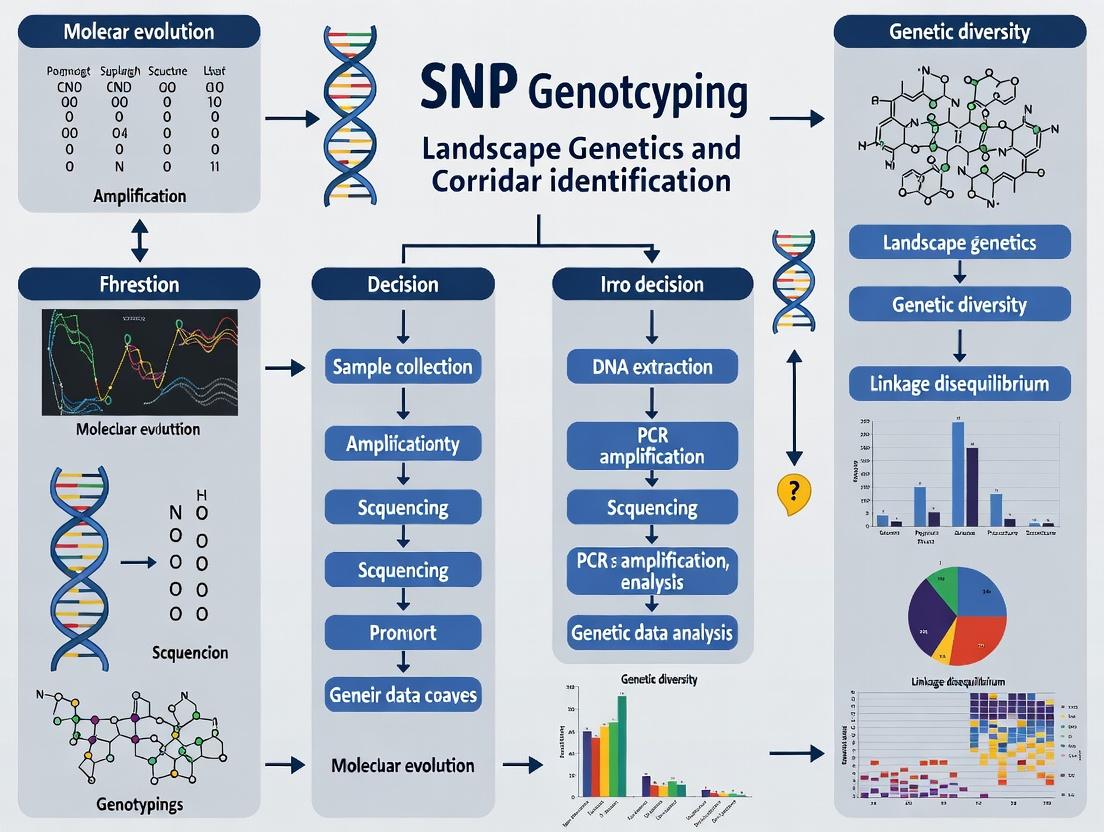
This article provides a comprehensive overview of Single Nucleotide Polymorphism (SNP) genotyping applications in landscape genetics for biomedical researchers and drug development professionals.
Mapping Nature's Highways: How SNP Genotyping is Revolutionizing Landscape Genetics and Corridor Identification
Abstract
This article provides a comprehensive overview of Single Nucleotide Polymorphism (SNP) genotyping applications in landscape genetics for biomedical researchers and drug development professionals. It explores the foundational principles linking genetic variation to landscape features, details current methodological approaches from high-throughput sequencing to bioinformatic analysis, and addresses common challenges in study design and data interpretation. We compare and validate SNP-based approaches against traditional methods, concluding with implications for identifying genetic corridors that inform conservation genetics with potential translational value for understanding population-specific disease risks and therapeutic responses.
The Genetic Blueprint of Landscapes: Core Principles of SNP-Based Population Structure Analysis
Application Notes
Landscape genetics is an interdisciplinary field that quantifies the effects of landscape composition, configuration, and matrix quality on microevolutionary processes. It integrates population genetics, landscape ecology, and spatial statistics to understand how landscape features influence gene flow, genetic drift, and selection. This synthesis is critical for predicting species’ responses to anthropogenic landscape change, identifying functional corridors, and managing genetic biodiversity.
The integration of SNP (Single Nucleotide Polymorphism) genotyping has revolutionized the field by providing high-resolution, genome-wide data suitable for fine-scale landscape analyses. The primary applications within the thesis context of corridor identification include:
- Quantifying Functional Connectivity: Measuring real gene flow, rather than just potential movement, to validate habitat corridor models.
- Identifying Barriers: Detecting subtle anthropogenic (roads, agriculture) or natural (rivers, mountains) features that impede genetic exchange.
- Assessing Landscape Resistance: Modeling how different land cover types differentially reduce gene flow.
- Source-Sink Dynamics: Pinpointing populations that are net contributors (sources) or recipients (sinks) of genetic diversity.
- Climate Adaptation Genomics: Correlating adaptive SNP loci with environmental gradients to forecast adaptive potential.
Key Quantitative Findings in Contemporary Landscape Genetics
Table 1: Summary of Key Statistical Methods in Landscape Genetics
| Method Category | Specific Test/Tool | Primary Function | Typical Software/Package |
|---|---|---|---|
| Genetic Structure | FST / GST, AMOVA, PCA, DAPC | Quantifies population subdivision and clusters genetic units. | GenAlEx, adegenet (R) |
| Spatial Autocorrelation | Mantel Test, Moran's I | Tests for correlation between genetic and geographic distance matrices. | vegan (R), PASSaGE |
| Barrier Detection | Monmonier's Algorithm, BARRIER | Identifies genetic boundaries across a landscape. | GenAlEx, Barriers |
| Landscape Resistance Modeling | Circuitscape, ResistanceGA | Models gene flow as a function of landscape resistance surfaces. | Circuitscape, ResistanceGA (R) |
| Individual-Based Analysis | MEMGENE, Redundancy Analysis (RDA) | Models genetic variation as a function of environmental variables. | memgene (R), vegan (R) |
| Bayesian Clustering | STRUCTURE, fastSTRUCTURE | Infers population groups and assigns individuals probabilistically. | STRUCTURE |
Table 2: Typical SNP Panel Specifications for Landscape Genetic Studies
| Parameter | Range/Standard | Rationale |
|---|---|---|
| Number of Loci | 1,000 - 100,000 SNPs | Balances power for individual assignment & IBD tests with cost. |
| Neutral vs. Adaptive | Mix of neutral and putatively adaptive SNPs preferred. | Neutral SNPs infer demography/gene flow; adaptive SNPs link to local selection. |
| Missing Data Threshold | < 10% per individual, < 5% per locus. | Ensures data quality for downstream analyses. |
| Minor Allele Frequency (MAF) | Typically > 0.01 - 0.05. | Filters out rare alleles that add noise to population-level analyses. |
| Genotyping Platform | RAD-seq, ddRAD, SNP arrays. | Choice depends on budget, prior genomic resources, and sample size. |
Experimental Protocols
Protocol 1: SNP Data Generation via Double-Digest RAD Sequencing (ddRAD-seq)
Purpose: To generate genome-wide SNP data for non-model organisms without a reference genome. Materials: High-quality genomic DNA, restriction enzymes (e.g., SbfI and MseI), ligation reagents, size-selection beads, PCR reagents, Illumina sequencing primers. Procedure:
- Digestion: Digest 100-500ng of genomic DNA with two restriction enzymes (a rare- and a frequent-cutter) for 1 hour.
- Ligation: Ligate uniquely barcoded P1 adapters and a common P2 adapter to the digested fragments. Pool samples after this step.
- Size Selection: Perform precise size selection (e.g., 300-400bp target) on the pooled library using a Pippin Prep or bead-based methods to reduce locus number.
- PCR Amplification: Amplify the size-selected library with primers containing Illumina flowcell-binding sequences and index sequences for multiplexing.
- QC & Sequencing: Quantify library concentration via qPCR, check fragment size on a Bioanalyzer, and sequence on an Illumina platform (e.g., NovaSeq, 150bp PE).
- Bioinformatics: Process reads using a pipeline (e.g.,
ipyrad,STACKS) for demultiplexing, clustering homologous loci de novo, and calling SNPs with filtering for quality, depth, and MAF.
Protocol 2: Landscape Genetic Analysis for Corridor Identification
Purpose: To identify landscape features facilitating or resisting gene flow and map potential corridors. Materials: SNP genotype data (VCF file), spatial coordinates for all samples, GIS layers (land cover, elevation, etc.). Procedure:
- Data Preparation:
- Convert SNP data to appropriate formats (e.g.,
genindfor R). - Generate a genetic distance matrix (e.g., proportion of shared alleles).
- Create hypothesized landscape resistance surfaces in GIS (e.g., assign low resistance to forest, high resistance to urban areas).
- Convert SNP data to appropriate formats (e.g.,
- Initial Correlation: Perform a Mantel or related test to confirm Isolation-by-Distance (IBD) pattern.
- Resistance Surface Optimization: Use a tool like ResistanceGA to iteratively test and optimize resistance surface parameters against the genetic distance matrix using maximum likelihood population effects (MLPE) models.
- Circuit Theory Modeling: Input the optimized resistance surface into Circuitscape to model all possible movement pathways across the landscape, calculating cumulative current flow. Areas of high current represent predicted corridors.
- Validation: Test the correlation between genetic distance and effective distance calculated through the optimized resistance surface/corridor model. Compare the fit to a simple IBD model.
Protocol 3: Detection of Outlier Loci and Environmental Association Analysis
Purpose: To identify SNPs under putative selection for adaptation to local environmental conditions. Materials: SNP genotype data, environmental raster data (e.g., bioclimatic variables). Procedure:
- Outlier Detection: Use genome-scan methods (e.g.,
pcadaptorBayeScan) to detect SNPs with FST values significantly higher than the neutral background. These are candidate adaptive loci. - Redundancy Analysis (RDA): Perform a constrained ordination using the R package
vegan. Use SNP data as the response matrix and environmental variables (e.g., temperature, precipitation) as explanatory variables. - Identification of Adaptive SNPs: Extract SNPs that load strongly on RDA axes significantly associated with environmental predictors. These SNPs are linked to adaptive variation.
- Functional Annotation (if possible): Blast flanking sequences of outlier SNPs against genomic databases to infer potential gene functions.
Visualizations
Title: Landscape Genetics SNP Analysis Workflow
Title: Resistance Surface Optimization and Corridor Modeling Logic
The Scientist's Toolkit: Key Research Reagent Solutions
Table 3: Essential Reagents and Materials for SNP-based Landscape Genetics
| Item | Function & Relevance |
|---|---|
| DNeasy Blood & Tissue Kit (Qiagen) | Standardized, high-yield genomic DNA extraction from diverse sample types (tissue, hair, scat) critical for downstream sequencing. |
| Restriction Enzymes (e.g., SbfI-HF, MseI) | High-fidelity enzymes for reproducible ddRAD-seq library preparation, defining the subset of the genome sequenced. |
| Qubit dsDNA HS Assay Kit | Accurate fluorometric quantification of low-concentration DNA libraries prior to sequencing, essential for proper cluster density. |
| Illumina DNA PCR-Free Prep | For whole-genome sequencing approaches to discover novel SNPs in non-model organisms, minimizing PCR bias. |
| KAPA HiFi HotStart ReadyMix | High-fidelity polymerase for library amplification, minimizing errors in final sequencing constructs. |
| SPRIselect Beads (Beckman Coulter) | For precise size selection and clean-up of sequencing libraries, controlling the number and size range of loci. |
| TruSeq DNA UD Indexes | Unique dual indexes for multiplexing hundreds of samples in a single sequencing run, reducing per-sample cost. |
| BioAnalyzer High Sensitivity DNA Kit | Precise assessment of library fragment size distribution and quality before sequencing. |
Why SNPs? Advantages of Biallelic Markers for High-Resolution Population Studies
Single Nucleotide Polymorphisms (SNPs) have become the marker of choice for high-resolution population genetic studies, including landscape genetics and corridor identification. Their abundance, stability, and suitability for high-throughput automated genotyping offer distinct advantages over traditional markers like microsatellites for deciphering fine-scale population structure, gene flow patterns, and connectivity corridors.
Within the broader thesis on SNP genotyping for landscape genetics, the selection of an appropriate molecular marker is foundational. This application note details why biallelic SNPs are uniquely suited for resolving contemporary population processes at fine spatial scales, which is critical for accurate wildlife corridor identification and understanding how landscape features facilitate or impede gene flow.
Table 1: Comparative Analysis of Molecular Markers for Population Studies
| Feature | Microsatellites (SSRs) | SNPs | Advantage for High-Resolution Studies |
|---|---|---|---|
| Abundance in Genome | ~10^4 - 10^5 loci | ~10^6 - 10^7 loci | Higher marker density for finer mapping. |
| Mutation Rate | High (~10^-3 - 10^-4) | Low (~10^-8) | SNPs reflect demographic history, not confounding high mutation. |
| Allelic State | Multiallelic | Biallelic | Simplified data analysis, easier standardization across labs. |
| Genotyping Throughput | Low to Medium | Very High | Enables genome-wide association studies (GWAS) and large sample sizes. |
| Error Rate | Higher (stutter, null alleles) | Very Low (<0.1%) | Increased accuracy for estimating subtle differentiation (FST). |
| Data Portability | Low (platform-dependent) | High (absolute nucleotide position) | Facilitates meta-analysis and data integration from different studies. |
| Amenability to Automation | Moderate | Excellent | Reduces cost and time per data point for landscape-scale sampling. |
Table 2: Statistical Power in Landscape Genetics Context
| Analysis Goal | SNP Advantage | Typical Requirement |
|---|---|---|
| Detecting Fine-Scale Structure | Higher resolution due to dense genome coverage. | 100s - 1000s of SNPs. |
| Estimating Recent Gene Flow | Low mutation rate reduces noise, revealing contemporary patterns. | Panel of >100 outlier or neutral SNPs. |
| Corridor Identification | Precise individual assignment and kinship estimation. | High-density SNP array or whole-genome reduced representation (e.g., RADseq). |
| Population Size Estimation (Ne) | Lower variance in estimates using linkage disequilibrium method. | Thousands of genome-wide SNPs. |
Core Protocols for SNP-Based Landscape Genetics
Protocol 3.1: SNP Discovery and Panel Design using Reduced-Representation Sequencing (e.g., ddRADseq)
Objective: To discover and genotype thousands of genome-wide SNPs across many individuals for landscape-scale analysis.
Materials & Reagents:
- High-quality genomic DNA (≥ 50 ng/µL).
- Restriction enzymes (e.g., SbfI, MseI).
- T4 DNA Ligase, ATP, adapters with barcodes and common sequences.
- PCR reagents, primers with Illumina flowcell adapters.
- Size-selection beads (e.g., SPRI beads).
- Qubit Fluorometer, Bioanalyzer/TapeStation.
- Illumina sequencing platform.
Procedure:
- DNA Digestion: Digest 100-500 ng genomic DNA with two restriction enzymes (a rare- and a frequent-cutter) in a thermal cycler (37°C for 2 hours).
- Adapter Ligation: Ligate uniquely barcoded P1 adapters and a common P2 adapter to the digested fragments. Incubate at 22°C for 1 hour, then 65°C for 20 minutes to inactivate ligase.
- Pooling and Cleaning: Pool barcoded samples equivalently. Clean pooled sample using SPRI beads.
- Size Selection: Perform strict size selection (e.g., 300-400 bp target) on a Pippin Prep or via double-SPRI bead cleanup to homogenize fragment length.
- PCR Amplification: Amplify size-selected library using primers complementary to adapters with Illumina sequencing tags. Use limited PCR cycles (12-18).
- Library QC & Sequencing: Quantify final library, check fragment size distribution. Sequence on an Illumina HiSeq or NovaSeq platform (single-end or paired-end).
- Bioinformatic Processing: Use pipeline (e.g.,
STACKS,ipyrad). Demultiplex by barcode, align reads to a reference genome (or de novo), call SNPs with stringent filters (minimum depth, minor allele frequency, missing data).
Protocol 3.2: Genotyping of Custom SNP Panels for Large-Scale Monitoring
Objective: To genotype hundreds of individuals at a targeted set of previously identified SNPs (e.g., for corridor monitoring).
Materials & Reagents:
- DNA samples.
- TaqMan SNP Genotyping Assays or similar (Pre-designed probe/primers).
- TaqMan Genotyping Master Mix.
- Microfluidic platforms (e.g., Fluidigm Dynamic Arrays) or 384-well PCR plates.
- Real-Time PCR system or integrated genotyping system (e.g., Fluidigm EP1, QuantStudio).
- Genotyping analysis software.
Procedure:
- Assay Design: Submit SNP flanking sequences to design TaqMan Assays (FAM and VIC dyes).
- Sample Preparation: Normalize all DNA samples to 5-10 ng/µL.
- Loading Array/Panel: For Fluidigm arrays, load sample pre-mix (DNA + TaqMan Master Mix) and assay pre-mix (Assay + Loading Reagent) into respective inlets of a 192.24 Dynamic Array.
- PCR and Endpoint Reading: Run the array in the Fluidigm EP1 system. Thermal cycling: 95°C for 10 min, followed by 40 cycles of 95°C for 15 sec and 60°C for 1 min. The instrument performs endpoint fluorescence reading.
- Genotype Calling: Use Fluidigm SNP Genotyping Analysis software or similar. Manually review scatter plots (FAM vs. VIC signal) for cluster separation and assign genotypes (AA, AB, BB).
The Scientist's Toolkit: Research Reagent Solutions
Table 3: Essential Reagents and Kits for SNP Genotyping Workflows
| Item | Function | Example Product/Brand |
|---|---|---|
| DNA Preservation Matrix | Stabilizes tissue/DNA at room temperature for field collection. | Whatman FTA Cards, DNA/RNA Shield. |
| High-Throughput DNA Extraction Kit | Rapid, clean genomic DNA isolation from non-invasive or tissue samples. | Qiagen DNeasy 96 Blood & Tissue Kit, MagMAX DNA Multi-Sample Kit. |
| Restriction Enzymes for RADseq | Creates reproducible genomic fragments for sequencing-based SNP discovery. | New England Biolabs (NEB) enzymes (e.g., SbfI-HF, EcoRI-HF). |
| SPRI Size Selection Beads | For clean-up and precise size selection of sequencing libraries. | Beckman Coulter AMPure XP, KAPA Pure Beads. |
| TaqMan SNP Genotyping Assays | Fluorogenic probes for highly specific, singleplex SNP genotyping. | Thermo Fisher Scientific TaqMan Assays. |
| Microfluidic Genotyping Arrays | Enables ultra-high-throughput nanoliter-scale genotyping. | Fluidigm 192.24 Dynamic Array IFC for SNP Genotyping. |
| Whole-Genome Amplification Kit | Amplifies genomic DNA from low-quality/quantity samples (e.g., scat). | Qiagen REPLI-g Single Cell Kit. |
Visualizations
Title: Integrated SNP Discovery and Application Workflow for Landscape Genetics
Title: Logical Flow from SNP Properties to Landscape Genetics Applications
This protocol outlines the integrated application of key population genetic metrics—F-statistics, Genetic Distance, and Effective Migration Surfaces—within a research thesis focused on using SNP genotyping for landscape genetics and corridor identification. These metrics are critical for quantifying population structure, inferring historical and contemporary gene flow, and modeling how landscape features facilitate or impede connectivity for conservation or epidemiological studies.
Application Notes
- F-statistics (Fixation Indices): Used to describe the partitioning of genetic variance within and among subpopulations. In landscape genetics, elevated FST values between pairs of populations signal reduced gene flow, which can be correlated with landscape barriers (e.g., rivers, highways, urban areas).
- Genetic Distance: Measures such as Nei's D or the Cavalli-Sforza chord distance provide a quantitative estimate of divergence between populations. These distances form the basis for constructing phylogenetic trees or neighbor-joining networks to visualize population relationships inferred from SNP data.
- Effective Migration Surfaces (EEMS): A modeling framework that uses genetic dissimilarity (based on FST or genetic distance) to estimate an effective migration surface across a continuous landscape. It identifies regions where genetic similarity is lower (potential barriers) or higher (potential corridors) than expected under a simple isolation-by-distance model.
Table 1: Key Genetic Metrics, Their Calculations, and Interpretations in Landscape Genetics
| Metric | Formula (Conceptual) | Typical Range (SNPs) | Interpretation in Landscape Context |
|---|---|---|---|
| FST (Wright's Fixation Index) | FST = (HT - HS) / HT | 0 - 0.05: Low divergence0.05 - 0.15: Moderate>0.15: High divergence | Measures population differentiation. High FST between two sample sites suggests a landscape barrier. |
| FIS (Inbreeding Coefficient) | FIS = (HS - HI) / HS | ~0: Random mating>0: Inbreeding deficit<0: Excess heterozygotes | Detects local non-random mating within a sampled population, which can be caused by social structure or habitat fragmentation. |
| Nei's Genetic Distance (D) | D = -ln(Genetic Identity) | D ≥ 0~0: Very similar>1: Highly divergent | Provides a pairwise distance matrix for population clustering. Used as input for EEMS and corridor modeling. |
| EEMS Effective Migration (m) | m(x,y) (Inferred parameter) | Relative scale (log10) | A relative measure of gene flow rate per unit area. Low m indicates inferred barriers; high m indicates inferred corridors. |
Experimental Protocols
Protocol 3.1: Workflow for Integrated Landscape Genetic Analysis Using SNPs
Objective: To genotype populations, compute key genetic metrics, and model landscape connectivity.
Materials: Tissue/DNA samples, SNP genotyping platform (e.g., ddRAD-seq, SNP array), high-performance computing cluster, R/Python with packages (adegenet, poppr, EEMS).
Procedure:
- Sample & SNP Data Collection: Collect non-invasive or tissue samples from geographically referenced individuals. Perform SNP genotyping via chosen platform. Curate a final variant call format (VCF) file.
- Data Quality Control: Filter SNPs for minor allele frequency (MAF > 0.05), call rate (>95%), and Hardy-Weinberg equilibrium (p > 0.001). Thin SNPs to reduce linkage disequilibrium.
- Population Assignment: Use snmf (LEA package) or Admixture to assign individuals to K genetic clusters without priori spatial information.
- Compute Core Metrics:
- Using hierfstat or Arlequin, calculate pairwise FST and FIS for predefined populations or genetic clusters.
- Using poppr or adegenet, calculate Nei's genetic distance between all population pairs.
- Isolation-by-Distance (IBD) Test: Perform a Mantel test correlating a matrix of genetic distance (FST/(1-FST)) against a matrix of log-transformed geographical distance.
- Construct Effective Migration Surface:
- Prepare input files: a genetic dissimilarity matrix (from FST or D) and a sampling coordinates file.
- Run EEMS (via rEEMSplots) with Markov Chain Monte Carlo (MCMC) chains to estimate the posterior distribution of migration rates across the habitat grid.
- Visualize results: generate plots of the log10-effective migration surface and the effective diversity surface to identify barriers (orange/red) and corridors (blue).
Landscape Genetics Analysis Workflow
Protocol 3.2: Calculating Pairwise FST from SNP Data Using R
Objective: To generate a matrix of pairwise FST values between all sampled populations.
Procedure:
- Load the VCF file into R using
vcfRand convert to agenlightobject (adegenet). - Define populations based on prior knowledge or genetic clustering results from Protocol 3.1.
- Use the
pairwise.WCfst()function from thehierfstatpackage. Provide thegenlightobject converted to ahierfstatdata frame. - The function returns a matrix. Visualize using the
pheatmappackage.
Code Snippet:
The Scientist's Toolkit: Research Reagent Solutions
Table 2: Essential Materials & Tools for SNP-based Landscape Genetics
| Item | Function/Description |
|---|---|
| DNeasy Blood & Tissue Kit (Qiagen) | Standardized silica-membrane protocol for high-quality genomic DNA extraction from diverse sample types. |
| TWIST Bioscience Target Panels | Customizable, enrichment-based panels for sequencing-specific SNP loci relevant to the study species. |
| Illumina NovaSeq X Series | High-throughput sequencer for generating genome-wide SNP data from reduced-representation (ddRAD) or whole-genome libraries. |
| Global Positioning System (GPS) Unit | Critical for obtaining precise geographical coordinates for each sample to correlate genetic patterns with landscape features. |
| Digital Elevation Model (DEM) Raster | GIS layer providing continuous topographic data (elevation, slope) as a covariate in resistance surface modeling. |
R with adegenet, hierfstat, rEEMSplots |
Core open-source software environment for population genetic analysis, statistical computation, and visualization. |
| QGIS Geographic Information System | Open-source GIS platform for managing sampling coordinates, processing landscape rasters, and creating publication-quality maps. |
1.0 Introduction & Thesis Context Within landscape genetics research focused on Single Nucleotide Polymorphism (SNP) genotyping for corridor identification, understanding the spatial drivers of genetic differentiation is paramount. This protocol details the integration of key landscape variables—Terrain, Climate, and Habitat Fragmentation—to create resistance surfaces. These surfaces hypothesize how the landscape facilitates or impedes gene flow, forming the spatial foundation against which SNP-derived genetic distances are tested.
2.0 Core GIS Data Acquisition & Pre-processing Protocol
2.1 Data Source Table Table 1: Representative Open-Access GIS Data Sources for Landscape Variables
| Variable Category | Specific Data Layer | Example Source (Current) | Spatial Resolution | Key Utility in Landscape Genetics |
|---|---|---|---|---|
| Terrain | Digital Elevation Model (DEM) | NASA SRTM, USGS 3DEP | 30m, 10m | Derive slope, aspect, topographic complexity. |
| Climate | Bioclimatic Variables (19 layers) | WorldClim (v2.1) | 1km, 5km | Model climatic suitability & stability over time. |
| Climate | Annual Precipitation/Temperature | CHELSA (v2.0) | 1km | Higher accuracy for mountainous regions. |
| Land Cover | Habitat Classification | ESA WorldCover, MODIS Land Cover | 10m, 500m | Define habitat patches and matrix types. |
| Anthropogenic | Human Footprint Index | NASA SEDAC | 1km | Quantify indirect fragmentation pressure. |
| Anthropogenic | Road & River Networks | OSM, HydroSHEDS | Vector | Linear barrier identification. |
2.2 Standardized Pre-processing Workflow
- Projection: Re-project all raster layers to a common, appropriate projected coordinate system (e.g., UTM) using bilinear resampling for continuous data and nearest-neighbor for categorical.
- Resampling & Alignment: Resample all rasters to a consistent spatial resolution (e.g., 30m) and align pixel boundaries using GIS software (e.g., GDAL, ArcGIS Pro).
- Extent Masking: Clip all layers to a common study extent plus a 50km buffer to avoid edge effects in subsequent analyses.
- Variable Derivation:
- Terrain: From DEM, calculate Slope, Topographic Ruggedness Index (TRI).
- Fragmentation: From land cover, reclassify into habitat/non-habitat. Calculate Patch Density, Edge Density, and Percentage of Landscape using moving-window analysis (e.g., 1km radius).
Diagram Title: GIS Data Pre-processing Workflow for Landscape Genetics
3.0 Constructing Integrated Resistance Surfaces
3.1 Protocol: Multi-Model Resistance Hypothesis Testing Objective: To create multiple resistance surfaces representing competing hypotheses about landscape effects on gene flow.
Hypothesis Formulation & Variable Selection: Define -5 candidate models.
- H1 (Terrain): Resistance increases with slope and ruggedness.
- H2 (Climate): Resistance is inverse to climatic suitability (derived from Species Distribution Model).
- H3 (Fragmentation): Resistance is highest in non-habitat and increases with edge density.
- H4 (Anthropogenic): Resistance scales with Human Footprint Index and proximity to roads.
- H5 (Composite): Weighted combination of H1-H4.
Resistance Transformation: For each continuous variable, apply a linear or non-linear (e.g., negative exponential, monotonic) transformation to convert environmental values to resistance values (1 = low resistance). Use the
gdistancepackage in R orLinkage Mappertoolbox.Surface Integration: For composite models, use a weighted sum approach:
Composite Resistance = (w1 * Norm(Terrain)) + (w2 * Norm(Climate)) + (w3 * Norm(Fragmentation)). Normalize each layer to a 1-100 scale before weighting.
3.2 Data Integration Table Table 2: Example Resistance Surface Parameterization for a Forest Mammal
| Model Hypothesis | GIS Input Layers | Transformation Function | Theoretical Justification |
|---|---|---|---|
| Slope Resistance | Slope (degrees) | R = 1 + (Slope / 10) | Movement cost increases linearly with incline. |
| Climate Stability | Bio19 (Precip of Coldest Qtr) SD (50yrs) | R = 101 - (Suitability Score) | Higher resistance in climatically unstable areas. |
| Habitat Core | Distance to Habitat Edge | R = exp(-0.01 * distance) | Resistance increases exponentially into matrix. |
| Human Impact | Human Footprint Index (HFI) | R = HFI (1-50 scale) | Direct correlation with anthropogenic disturbance. |
Diagram Title: Linking Landscape Variables to SNP Data for Corridor ID
4.0 Validation with SNP Genotyping Data
4.1 Protocol: Landscape Genetic Statistical Testing
- Genetic Distance Matrix: From SNP data, calculate pairwise population ( F{ST}/(1-F{ST}) ) or individual-based genetic distances.
- Resistance Distance Matrix: For each resistance surface, calculate pairwise resistance distance using least-cost paths or circuit theory (e.g., with
Circuitscape). - Model Selection: Perform a Multiple Regression on Distance Matrices (MRM) test. Compare models using Akaike Information Criterion (AICc) or Mantel r values.
- R code snippet:
MRM(genetic_dist ~ resist_dist_H1 + resist_dist_H2, nperm=9999)
- R code snippet:
- Corridor Delineation: Feed the best-supported resistance surface into a corridor identification tool (e.g.,
Linkage Mapper,Circuitscape) to map pinch points, barriers, and potential corridors between sampled populations.
5.0 The Scientist's Toolkit: Key Research Reagents & Solutions
Table 3: Essential Tools for GIS-Landscape Genetics Integration
| Item / Solution | Provider / Software | Function in Protocol |
|---|---|---|
| SNP Genotyping Array | Illumina, Thermo Fisher | High-throughput generation of neutral genetic markers for population analysis. |
R Studio with adegenet |
Open Source | Statistical analysis of SNP data, calculation of genetic distances. |
R Package gdistance |
Open Source | Core engine for calculating least-cost paths and resistance distances in R. |
| Circuitscape | The University of Chicago | Implements circuit theory for modeling connectivity and calculating resistance distance. |
| Linkage Mapper Toolkit | The Nature Conservancy | GIS toolbox for modeling habitat corridors and core areas. |
| Google Earth Engine | Cloud Platform | For processing large-scale climate and satellite imagery datasets. |
| QGIS / ArcGIS Pro | Open Source / Esri | Primary platforms for spatial data management, preprocessing, and cartography. |
| ClimateNA | University of British Columbia | Downscales and interpolates climate data for specific North American locations. |
Landscape genetics utilizes spatial genetic data to quantify the influence of landscape and environmental features on gene flow and genetic structure. Two predominant frameworks model this spatial genetic variation: Isolation-by-Distance (IBD) and Isolation-by-Resistance (IBR). Within a thesis focused on SNP genotyping for corridor identification, understanding and differentiating these models is critical for inferring correct ecological processes and designing effective conservation corridors.
- Isolation-by-Distance (IBD): Posits that genetic differentiation increases with Euclidean geographic distance due to limited dispersal. It assumes a homogeneous landscape where distance alone dictates gene flow decay.
- Isolation-by-Resistance (IBR): Posits that genetic differentiation is influenced by the resistance of the landscape matrix to movement. Gene flow is easier through "conductive" habitats (e.g., forest cover) and inhibited by "resistive" features (e.g., highways, rivers, urban areas). IBR acknowledges landscape heterogeneity.
Quantitative Comparison of Frameworks
Table 1: Core Differences Between IBD and IBR Frameworks
| Aspect | Isolation-by-Distance (IBD) | Isolation-by-Resistance (IBR) |
|---|---|---|
| Primary Driver | Euclidean geographic distance | Landscape resistance to movement |
| Landscape Assumption | Homogeneous, isotropic | Heterogeneous, anisotropic |
| Key Analysis Method | Mantel test/Regression of genetic vs. geographic distance | Circuit theory or least-cost path analysis |
| Typical Input Data | Pairwise geographic distances (km) | Resistance surfaces (raster layers) |
| Output | Slope of genetic-distance relationship | Effective distances, current densities, isolation maps |
| Software Examples | vegan (R), PCoA |
Circuitscape, ResistanceGA, UNICOR |
| Strength | Simple, null model, requires only sample coordinates. | Ecologically realistic, can test specific hypotheses. |
| Limitation | Cannot identify corridors/barriers; may be misspecified. | Requires a priori resistance hypotheses; computationally intensive. |
Table 2: Statistical Performance Metrics in Model Comparison (Hypothetical SNP Data)
| Model Type | Mantel r (IBD) | Multiple Regression R² (IBR) | AICc Value | Delta AICc | Best for Corridor ID? |
|---|---|---|---|---|---|
| IBD (Null) | 0.45 | - | 102.3 | 15.6 | No |
| IBR (Land-Cover Only) | - | 0.60 | 92.1 | 5.4 | Partial |
| IBR (Composite: Land-Cover + Slope + Road Density) | - | 0.78 | 86.7 | 0.0 | Yes |
Application Notes for SNP-Based Landscape Genetics
SNP Data Suitability
- High Resolution: Thousands of loci provide power to detect subtle, contemporary patterns of gene flow relevant to corridor use.
- Neutral vs. Adaptive SNPs: For IBD/IBR modeling, use putatively neutral SNPs (e.g., from RADseq, whole-genome sequencing) to reflect demography. Adaptive SNPs under selection can confound patterns.
- Genetic Distance Metrics: For SNP data, use proportion of shared alleles (Dps) or Euclidean genetic distance. FST derivatives can be problematic for high-resolution, bi-allelic data.
Protocol: Integrated Workflow for Comparing IBD vs. IBR
A. Sample & Genotype Collection
- Tissue Sampling: Non-invasively (hair, scat) or invasively (blood, tissue) collect samples across the study landscape, georeferencing each precisely (GPS).
- SNP Genotyping: Use a high-throughput platform (e.g., Illumina NovaSeq, DNBSEQ) or targeted amplicon sequencing. Apply standard bioinformatic pipelines (Stacks, GATK) for variant calling. Filter for call rate (>95%), minor allele frequency (>0.01), and Hardy-Weinberg equilibrium.
B. Genetic Distance Matrix Calculation
- Using filtered SNP data in a
VCFfile, calculate a pairwise individual genetic distance matrix inRusing theadegenetandpopprpackages.
C. Isolation-by-Distance (IBD) Test
- Calculate a matrix of log-transformed Euclidean geographic distances between all sample pairs.
- Perform a Mantel test (9,999 permutations) correlating genetic and geographic distance matrices.
- Visualization: Create a scatterplot of genetic distance vs. geographic distance.
D. Isolation-by-Resistance (IBR) Analysis via Circuit Theory
- Hypothesize & Create Resistance Surfaces: In GIS software (QGIS, ArcGIS), create raster layers where cell values represent resistance to movement (1=low, 100=high). Test multiple hypotheses (e.g., land-use, elevation, NDVI).
- Optimize Resistance Surfaces (Advanced): Use
ResistanceGAin R to optimize surface resistance values against genetic distance using mixed-effects models. - Run Circuitscape: Use the
Circuitscapesoftware (Julia or standalone) in "pairwise" mode.- Input: Resistance raster, sample location file.
- Output: Cumulative current density maps (pinpoints corridors/barriers) and effective resistance distances between pairs.
- Statistical Model Comparison: Perform a multiple regression on distance matrices (MRM) or a maximum likelihood population effects (MLPE) model to compare the explanatory power of IBR (effective resistance) vs. IBD (geographic distance).
Title: Comparative Workflow for IBD and IBR Analysis
The Scientist's Toolkit: Key Research Reagent Solutions
Table 3: Essential Materials & Tools for SNP-based Landscape Genetics
| Item / Solution | Provider / Example | Function in IBD/IBR Research |
|---|---|---|
| High-Throughput Sequencer | Illumina NovaSeq, DNBSEQ-G400 | Generates millions of SNP loci from reduced-representation or whole-genome libraries. |
| DNA Extraction Kit (Tissue/Scat) | Qiagen DNeasy Blood & Tissue Kit, Zymo Research Fecal Kit | High-yield, high-purity genomic DNA extraction from diverse source materials. |
| RADseq or ddRAD Library Prep Kit | Daicel Arbor Biosciences myBaits, Custom Enzymes (SbfI, MseI) | Reproducible, cost-effective SNP discovery and genotyping across many individuals. |
| Bioinformatics Pipeline | Stacks, dDocent, GATK | Processes raw sequences: demultiplexing, alignment, variant calling, SNP filtering. |
| Spatial Analysis Software | QGIS, ArcGIS Pro | Creates and manipulates geographic data, resistance surfaces, and sample maps. |
| Landscape Genetics Software | Circuitscape (Julia), ResistanceGA (R), UNICOR | Core engines for calculating effective distances, current flow, and resistance optimization. |
| Statistical Programming Environment | R with adegenet, vegan, popr, ResistanceGA packages |
Performs genetic statistics, Mantel tests, MRM, and model selection (AICc). |
| High-Performance Computing (HPC) Cluster | Local University HPC, Cloud (AWS, Google Cloud) | Manages computationally intensive steps: sequence alignment, Circuitscape iterations. |
Title: Conceptual Relationship Between IBD and IBR
The field of landscape genetics has been fundamentally shaped by the evolution of molecular markers. Initial studies relied heavily on microsatellites (Short Tandem Repeats, STRs), valued for their high polymorphism and heterozygosity. The subsequent transition to Single Nucleotide Polymorphism (SNP) panels has provided greater scalability, reproducibility, and analytical power for assessing gene flow, genetic structure, and corridor identification—core objectives in conservation and ecological research. This protocol outlines the comparative applications and methodologies, contextualizing them within a thesis focused on SNP genotyping for landscape connectivity analysis.
Table 1: Core Characteristics of Microsatellite and SNP Markers in Landscape Genetics
| Characteristic | Microsatellites (STRs) | Modern SNP Panels |
|---|---|---|
| Molecular Basis | Repetition of 2-6 bp motifs | Single base pair substitution |
| Typical Polymorphism | High (Multiple alleles per locus) | Bi-allelic (Typically 2 alleles) |
| Mutation Rate | ~10⁻³ - 10⁻⁴ per generation | ~10⁻⁸ per generation |
| Genotyping Throughput | Low to Medium (10s of loci) | Very High (1000s to millions) |
| Development Cost | Low per locus, high for screening | High initial development, low per sample |
| Reproducibility | Moderate (Lab-dependent) | High (Standardized) |
| Primary Analysis Software | GENEPOP, STRUCTURE, Arlequin | PLINK, ADMIXTURE, GDIVE, ResistanceGA |
| Best Suited For | Fine-scale relatedness, recent bottlenecks | Population structure, genome-wide selection, historical demography |
Table 2: Application in Landscape Genetic Studies
| Research Objective | Microsatellite Approach | SNP Panel Approach |
|---|---|---|
| Population Structure | F-statistics (FST) from 10-20 loci; Bayesian clustering (STRUCTURE). | Principal Component Analysis (PCA); ADMIXTURE on 1K-10K SNPs. |
| Gene Flow Estimation | Indirect estimates from FST or private alleles. Direct parentage analysis. | Direct estimates using coalescent models (e.g., MIGRATE-N); SNP-based pedigree. |
| Corridor Identification | Least-cost path analysis based on genetic distances. | Circuit theory, landscape resistance optimization using maximum-likelihood. |
| Effective Population Size (Ne) | Temporal method or linkage disequilibrium method with cautious interpretation. | More robust linkage disequilibrium method; whole-genome sequencing data. |
Experimental Protocols
Protocol 3.1: Historical Microsatellite Genotyping for Population Screening
Objective: To genotype 10-20 microsatellite loci across multiple populations for preliminary assessment of genetic diversity and structure. Materials: Tissue samples, DNA extraction kit, PCR reagents, fluorescently labeled primers, capillary sequencer. Procedure:
- DNA Extraction: Use a silica-column or magnetic bead-based kit. Quantify using a fluorometer.
- PCR Amplification: Perform multiplex PCRs. Typical 10µL reaction: 20ng DNA, 1X PCR buffer, 2mM MgCl₂, 0.2mM each dNTP, 0.2µM each primer, 0.5U Taq polymerase.
- Fragment Analysis: Pool PCR products. Denature at 95°C for 5 min. Run on capillary sequencer (e.g., ABI 3730xl) with internal size standard (GS-500 LIZ).
- Genotyping: Use software (e.g., GeneMapper) to call allele sizes. Manually check all peaks.
- Data Quality Control: Remove samples with >20% missing data. Test for Hardy-Weinberg equilibrium and linkage disequilibrium per locus.
Protocol 3.2: Development of a Custom SNP Panel via Reduced-Representation Sequencing (ddRAD-Seq)
Objective: To discover and genotype thousands of genome-wide SNPs for high-resolution landscape genomics. Materials: High-quality genomic DNA, restriction enzymes (e.g., SbfI and MspI), T4 DNA ligase, PCR reagents, size-selection beads, Illumina sequencing platform. Procedure:
- Digestion-Ligation: Digest 100ng DNA with two restriction enzymes (one rare-cutter, one frequent-cutter) in a single reaction. Ligate unique barcode adapters to each sample.
- Pooling & Size Selection: Pool all ligated samples. Perform precise size selection (e.g., 300-400bp fragments) using automated gel electrophoresis or bead-based methods.
- PCR Amplification & Clean-up: Amplify the size-selected library with 12-18 PCR cycles. Clean with SPRI beads.
- Sequencing & Demultiplexing: Sequence on an Illumina HiSeq or NovaSeq (150bp paired-end). Demultiplex by sample-specific barcodes.
- Bioinformatic SNP Calling: Use pipeline (e.g., STACKS, ipyrad). Align reads to a reference genome. Call SNPs with parameters: minimum depth of coverage = 10, maximum missing data per SNP < 25%.
Protocol 3.3: Landscape Resistance Modeling Using SNP Data
Objective: To identify landscape features that facilitate or impede gene flow using genetic distances derived from SNP data. Materials: SNP genotype data (VCF format), GIS raster layers of environmental variables (e.g., land cover, elevation, slope). Procedure:
- Genetic Distance Matrix: Calculate pairwise genetic distances (e.g., PCA-based distances, FST/(1-FST)) using R package
adegenet. - Environmental Resistance Hypothesis: Create GIS cost surfaces representing hypothesized resistance of each landscape variable.
- Optimization: Use the R package
ResistanceGAto optimize resistance surfaces by comparing least-cost path or circuit theory-based resistance distances to the genetic distance matrix via maximum-likelihood population effects (MLPE) models. - Corridor Mapping: Input the optimized resistance surface into Circuitscape software to model all possible movement pathways and identify pinch-points and key corridors.
Visualization of Methodological Evolution and Workflows
Title: Evolution from Microsatellite to SNP Genotyping Workflows
Title: SNP-Based Landscape Resistance and Corridor Modeling Workflow
The Scientist's Toolkit: Essential Research Reagents & Solutions
Table 3: Key Research Reagents and Solutions for SNP-Based Landscape Genetics
| Item | Function/Application | Example Product/Kit |
|---|---|---|
| Magnetic Bead DNA Extraction Kit | High-throughput, high-quality genomic DNA isolation from non-invasive or degraded samples. | MagMAX Core Nucleic Acid Purification Kit |
| Restriction Enzymes for ddRAD | Creates reproducible, genome-wide fragments for reduced-representation sequencing. | SbfI-HF, MspI (NEB) |
| Dual-Indexed Adapters | Unique barcoding of individual samples for multiplexed sequencing. | IDT for Illumina UDI Adapters |
| SPRI Size Selection Beads | Precise selection of DNA fragment sizes to target specific genomic regions. | AMPure XP Beads |
| High-Fidelity PCR Master Mix | Accurate amplification of sequencing libraries with minimal error. | KAPA HiFi HotStart ReadyMix |
| Illumina Sequencing Reagents | High-throughput sequencing of SNP libraries. | Illumina NovaSeq 6000 S-Prime Reagent Kit |
| SNP Genotyping Array | Cost-effective, targeted genotyping of pre-defined SNP panels across thousands of samples. | Thermo Fisher Axiom MyDesign Genotyping Array |
| GIS Software | Processing environmental raster data and creating resistance surfaces. | ArcGIS Pro, QGIS |
| Bioinformatics Pipeline | Demultiplexing, alignment, variant calling, and quality filtering of raw sequence data. | STACKS, GATK, PLINK |
From Sample to Map: A Step-by-Step Workflow for SNP Genotyping in Corridor Modeling
In the context of a broader thesis on SNP genotyping for landscape genetics and corridor identification, selecting an appropriate genotyping platform is critical. This Application Note provides a detailed comparison of three key technologies—Microarrays, Restriction-site Associated DNA Sequencing (RAD-Seq), and Whole Genome Sequencing (WGS)—focusing on their application in population genomics for assessing connectivity, genetic structure, and identifying dispersal corridors across fragmented landscapes.
Platform Comparison Tables
Table 1: Core Technical Specifications & Cost Considerations
| Parameter | Microarrays | RAD-Seq | Whole Genome Sequencing |
|---|---|---|---|
| Genomic Coverage | Predefined SNPs (50K - 5M) | Reduced Representation (1-5% of genome) | Comprehensive (~100%) |
| Discovery vs. Genotyping | Genotyping only | Simultaneous discovery & genotyping | Simultaneous discovery & genotyping |
| Typical SNP Yield | Fixed panel size | 10,000 - 100,000 SNPs | 4 - 10 million SNPs (non-model organisms) |
| Sample Multiplexing | High (96-1000s/slide) | Medium to High (48-96/lane) | Low to Medium (1-96/lane) |
| Cost per Sample (USD) | $50 - $250 | $100 - $400 | $1,000 - $5,000+ |
| Data per Sample | Low (< 100 MB) | Medium (1-10 GB) | High (80-200 GB) |
| Optimal Sample Size | Large populations (100s-1000s) | Medium populations (10s-100s) | Smaller populations (<50) or key individuals |
Table 2: Performance in Landscape Genetics Applications
| Application | Microarrays | RAD-Seq | Whole Genome Sequencing |
|---|---|---|---|
| Population Structure | Excellent for known SNPs | Very Good, de novo possible | Excellent, highest resolution |
| Genetic Diversity | Good for known loci | Very Good, genome-wide estimate | Gold Standard |
| Gene Flow/Corridor ID | Good, limited by panel | Very Good, high marker density | Excellent for subtle patterns |
| Local Adaptation | Targeted candidate genes | Good for outlier detection | Best for genome-wide scans |
| Data Complexity | Low, standardized | Medium, bioinformatics heavy | Very High, significant expertise needed |
| Turnaround Time | Fast (days) | Medium (weeks) | Slow (months for analysis) |
Detailed Experimental Protocols
Protocol 1: SNP Genotyping Using a Custom Microarray for Population Screening
Objective: To genotype 200 individuals from 10 spatially distinct populations using a custom 50K SNP array to assess genetic differentiation and infer corridors.
- DNA Quality Control: Quantify DNA using fluorometry (e.g., Qubit). Ensure integrity via gel electrophoresis. Standardize concentration to 50 ng/µL.
- Whole Genome Amplification (if needed): Use REPLI-g kit for low-quantity samples.
- Fragmentation & Precipitation: Fragment 100 ng DNA with DNase I. Precipitate with isopropanol, resuspend in hybridization buffer.
- Hybridization: Denature sample at 95°C for 10 min, then load onto array chip. Hybridize in rotating oven at 45°C for 16-20 hours.
- Washing & Staining: Perform automated washing on a fluidics station using low and high stringency buffers. Stain array with streptavidin-phycoerythrin.
- Scanning & Analysis: Scan array using a laser scanner (e.g., GeneChip). Use manufacturer's software (e.g., Affymetrix Power Tools) for genotype calling. Export genotypes for downstream analysis in programs like adegenet or STRUCTURE.
Protocol 2: RAD-Seq Library Preparation forDe NovoSNP Discovery
Objective: Prepare dual-digest RAD (ddRAD) libraries for 96 samples to discover and genotype SNPs for landscape connectivity analysis.
- Restriction Digest: Digest 100 ng high-quality genomic DNA per sample with a frequent (e.g., SphI) and a rare (e.g., EcoRI) cutter in a 10 µL reaction at 37°C for 1 hour. Include sample-specific barcode adapters in the reaction.
- Adapter Ligation: Immediately ligate uniquely barcoded P1 and common P2 adapters to the digested fragments using T4 DNA ligase at 22°C for 30 min. Heat-inactivate at 65°C for 20 min.
- Pooling & Size Selection: Pool all ligated samples. Perform size selection (target ~300-500 bp) using a Pippin Prep or manual gel excision to reduce locus dropout.
- PCR Amplification: Amplify the size-selected pool for 12-18 cycles using primers complementary to the adapters. Clean up PCR product with SPRI beads.
- Sequencing: Quantify library by qPCR. Sequence on an Illumina HiSeq or NovaSeq platform (150 bp paired-end recommended).
- Bioinformatics: Process using Stacks or ipyrad pipeline: demultiplex, align reads, call SNPs, and export a VCF file for population genomic analysis.
Protocol 3: Whole Genome Re-Sequencing for Fine-Scale Corridor Detection
Objective: Sequence whole genomes of 20 individuals from putative corridor and non-corridor zones to identify genome-wide patterns of selection and gene flow.
- High-Molecular-Weight DNA Extraction: Use a phenol-chloroform or magnetic bead-based method (e.g., Qiagen MagAttract) to obtain >1 µg of DNA with average fragment size >20 kb.
- Library Preparation for Short-Read Sequencing: Shear DNA to 350 bp via sonication (e.g., Covaris). Perform end-repair, A-tailing, and ligation of Illumina-compatible adapters. Perform limited-cycle PCR for indexing. Validate library on a Bioanalyzer.
- Sequencing: Sequence on an Illumina NovaSeq X Plus to achieve >30x coverage per individual (minimum). Use PCR-free protocols if possible.
- Variant Calling Pipeline: Align reads to a reference genome using BWA-MEM. Process aligned BAM files with GATK: mark duplicates, perform base quality score recalibration (BQSR). Call SNPs and indels jointly across all samples using GATK HaplotypeCaller in GVCF mode.
- Landscape Genomics Analysis: Filter VCF (QUAL>30, DP>10). Use PCAdapt or BayeScan for outlier detection. Calculate genetic distances (e.g., Fst) in sliding windows. Use EEMS or Circuitscape to model landscape resistance and corridor probability from genetic distances.
Visualizations
Diagram 1: Technology Selection Workflow for Landscape Genetics
Diagram 2: Comparative Experimental Workflows
The Scientist's Toolkit: Research Reagent Solutions
| Item | Function in SNP Genotyping | Example Product/Brand |
|---|---|---|
| Fluorometric DNA Quantitation Kit | Accurately measures dsDNA concentration for library prep normalization, critical for even sequencing coverage. | Qubit dsDNA HS Assay Kit (Thermo Fisher) |
| Restriction Enzymes (Frequent & Rare Cutter) | Used in RAD-Seq to perform reproducible, genome-wide reduction. | SphI (NEB), EcoRI-HF (NEB) |
| SPRI (Solid Phase Reversible Immobilization) Beads | For DNA size selection and clean-up during library preparation; more consistent than gel extraction. | AMPure XP Beads (Beckman Coulter) |
| PCR-Free Library Prep Kit | Minimizes amplification bias and duplicates in WGS, crucial for accurate variant calling. | TruSeq DNA PCR-Free Kit (Illumina) |
| Multiplexed Sequencing Control (PhiX) | Spiked into sequencing runs to monitor cluster density, alignment, and base-calling accuracy. | PhiX Control v3 (Illumina) |
| Variant Call Format (VCF) Analysis Tool | Software suite for filtering, manipulating, and analyzing population-level SNP data. | VCFtools, BCFtools |
| Landscape Resistance Modeling Software | Uses genetic distances and environmental layers to infer corridors and barriers to gene flow. | Circuitscape, ResistanceGA |
Application Notes
Within the context of a thesis on SNP genotyping for landscape genetics and corridor identification, the strategic integration of non-invasive sampling (NIS) with spatial stratification forms the critical foundation for robust, scalable, and ethically viable research. This approach allows for the collection of genetic material without capturing or disturbing target organisms, which is essential for studying elusive, endangered, or wide-ranging species central to connectivity analyses. Spatial stratification ensures that sampling effort is allocated efficiently across environmental or geographic gradients, explicitly capturing the heterogeneity of the landscape that drives genetic structure. This design directly supports the thesis aim of identifying functional corridors by generating genotype data that is explicitly linked to spatially representative ecological contexts, minimizing bias and maximizing statistical power for landscape genomic models.
Key Advantages in Landscape Genetics
- Ethical & Logistical Feasibility: Enables long-term, repeated sampling of populations without inducing stress or altering behavior, crucial for monitoring corridor use over time.
- Landscape-Scale Representation: Stratification across barriers, corridors, and environmental clines ensures genetic data reflects true landscape processes rather than sampling artifacts.
- Cost-Effectiveness for SNP Panels: High-quality DNA from NIS (e.g., scat, hair) is now reliably compatible with high-throughput SNP genotyping protocols, allowing for large sample sizes necessary for population inference.
Protocols
Protocol 1: Spatially Stratified Non-Invasive Sample Collection for Terrestrial Mammals
Objective: To systematically collect non-invasive genetic samples (hair, scat) across pre-defined strata to ensure coverage of all hypothesized landscape features (e.g., habitat types, putative barriers, corridors).
Materials: See "Research Reagent Solutions" table.
Pre-Field Procedure:
- Define Stratification Scheme: Using GIS, stratify the study landscape into units based on relevant variables (e.g., land cover, elevation, human footprint index, resistance model outputs). Aim for a minimum of 20-30 sampling sites per stratum for statistical rigor.
- Random Site Selection: Within each stratum, randomly select GPS coordinates for sampling transects or station placement, ensuring a minimum distance of ≥2 expected home-range diameters to minimize relatedness.
- Permitting & Ethics: Secure all necessary collection and export permits. For controlled substances in hair snares, obtain specific licenses.
Field Collection Procedure:
- Hair Sample Collection (via Hair Snares):
- At each designated site, construct a barbed-wire corral or single-wire snare around a natural attractant (e.g., scent lure).
- Check snares every 7-10 days. Using sterilized forceps, collect hair samples from each barb, placing each unique sample into a separate paper envelope containing silica desiccant. Note date, location (GPS), and barb ID.
- Change gloves between handling samples from different barbs/sites.
- Scat Sample Collection:
- Systematically walk pre-defined transects within each stratum.
- Upon locating scat, photograph it in situ. Using a sterile stick, transfer a 1-2 cm section of the outer surface (rich in epithelial cells) into a 50ml tube prefilled with 20-30 ml of 95% ethanol or RNA/DNA stabilization buffer.
- Record species, location, date, and any relevant notes. Store tubes at ambient temperature away from direct sunlight.
Post-Collection Processing:
- Dry all paper envelopes containing hair at room temperature in a low-humidity environment.
- Log all samples into a database with stratum ID, geographic coordinates, and collection metadata.
- Ship samples to the genetics lab in a stable, dry condition.
Diagram 1: Spatially Stratified NIS Workflow
Protocol 2: Laboratory Protocol for DNA Extraction and QC from Non-Invasive Samples
Objective: To isolate high-quality genomic DNA from non-invasive samples suitable for downstream SNP genotyping (e.g., ddRAD, SNP chip).
Materials: See "Research Reagent Solutions" table.
Procedure:
- Surface Decontamination (Scat): In a dedicated pre-PCR UV hood, pour off ethanol. Add 10% bleach to cover the sample, incubate for 2 minutes, then rinse thoroughly with nuclease-free water.
- Subsampling: For hair, select 5-10 follicles with visible bulb. For scat, use a sterile scalpel to excise a ~50 mg inner subsample.
- Lysis:
- Place subsample in a 2.0 ml tube with 1.4 mm ceramic beads.
- Add 800 µl of commercial lysis buffer (e.g., from Qiagen DNeasy Blood & Tissue Kit) and 40 µl of Proteinase K (20 mg/ml).
- Homogenize in a bead mill for 3 minutes at 30 Hz.
- Incubate at 56°C with rotation (900 rpm) overnight.
- DNA Purification: Follow manufacturer’s protocol for silica-membrane column purification. Include recommended carrier RNA if using a stool-specific kit. Perform two washes with provided wash buffers.
- Elution: Elute DNA in 50-100 µl of 10 mM Tris-HCl (pH 8.5) pre-heated to 55°C. Let column sit for 5 minutes before centrifugation.
- Quality Control:
- Quantify DNA using a fluorometric assay (e.g., Qubit dsDNA HS Assay).
- Assess degradation via gel electrophoresis or Genomic DNA ScreenTape.
- Sample Inclusion Criteria: Proceed with samples yielding >500 ng total DNA with a measurable fragment size >500 bp.
Diagram 2: DNA Extraction & QC Pathway
Data Presentation
Table 1: Comparison of Non-Invasive Sample Types for Landscape Genetics SNP Studies
| Sample Type | Avg. DNA Yield (ng) | Avg. DNA Integrity | Contamination Risk | Cost per Sample (USD) | Optimal Spatial Stratification Method | Key Considerations for Thesis |
|---|---|---|---|---|---|---|
| Hair (with follicle) | 10 - 500 | High (intact nuclei) | Low (external) | $15 - $30 | Systematic grid of hair snares | Excellent for individual ID & relatedness; requires target species attraction. |
| Scat/Fecal | 100 - 2000 | Low-Moderate (degraded) | High (bacterial, diet) | $20 - $50 ($-extraction) | Stratified random transects | Captures diet & microbiome data; needs stringent decontamination protocols. |
| Feathers (calamus) | 50 - 300 | Moderate | Low | $10 - $25 | Nest/roost centered transects | Suitable for avian corridor studies; sample age critical. |
| Environmental DNA (water/soil) | V. Low (<10) | Very Low (fragmented) | Very High | $50 - $150 (filtering & extraction) | Systematic grid of collection points | No species attribution without careful assay design; best for community-level questions. |
Table 2: Recommended Spatial Stratification Schemes for Corridor Identification
| Stratification Basis | GIS Data Layers Used | Target Sampling Density per Stratum | Rationale for Landscape Genetics | Analysis Method Enabled |
|---|---|---|---|---|
| Environmental Heterogeneity | Climate (Bio-ORACLE), Soil, NDVI | 25-30 sites | Captures adaptive genetic variation driven by environment. | Redundancy Analysis (RDA), Latent Factor Mixed Models (LFMM) |
| Hypothesized Resistance | Land Use, Roads, Slope (resistance surface) | 20-25 sites | Directly tests corridor/barrier effects on gene flow. | Circuitscape, ResistanceGA, distance-based MEMG |
| Neutral Landscape | Regular Grid or Tessellation | 30+ sites | Provides null model of isolation-by-distance for comparison. | Spatial Principal Component Analysis (sPCA), classic IBD tests |
| Functional Connectivity | Least-Cost Path Corridors vs. Non-corridor areas | 15-20 sites (in corridor) | Empirically tests predicted corridor functionality. | Assignment tests, corridor-specific F-statistics |
The Scientist's Toolkit
Table 3: Research Reagent Solutions for Non-Invasive Sampling & Stratification
| Item/Category | Example Product/Brand | Function in Protocol | Critical Notes for Thesis Context |
|---|---|---|---|
| Sample Stabilization | RNA/DNA Shield (Zymo), 95% Ethanol, Silica Gel Desiccant | Preserves nucleic acids at ambient temperature, inhibits degradation & microbial growth. | Essential for multi-day field campaigns in remote areas; ensures DNA quality for complex SNP panels. |
| Surface Decontaminant | 10% Sodium Hypochlorite (Bleach) | Destroys exogenous environmental DNA on sample surface. | Critical for scat samples to avoid diet/commensal contamination in host genotype data. |
| High-Yield Lysis Kit | QIAamp PowerFecal Pro DNA Kit (Qiagen), NucleoSpin Soil Kit (Macherey-Nagel) | Efficiently lyses tough cell walls (plant, bacterial, host) & inhibitors common in NIS. | Maximizes yield from low-quality inputs, directly increasing final sample size (n) for statistical power. |
| Carrier for Low-DNA Samples | Glycogen, Linear Polyacrylamide | Co-precipitates with nucleic acids, increasing visible pellet and column-binding efficiency. | Improves recovery from hair samples with few follicles, reducing genotyping failure rates. |
| Fluorometric DNA Quant Assay | Qubit dsDNA HS Assay (Thermo Fisher) | Accurately quantifies double-stranded DNA without interference from RNA or degraded fragments. | Provides reliable DNA concentration for standardized SNP library prep, ensuring even sequencing coverage. |
| GIS & Spatial Analysis Software | R (raster, sf, SDMtoolbox), QGIS, Circuitscape |
Creates stratification schemes, analyzes spatial autocorrelation, models resistance surfaces. | Directly links sampling design to thesis hypotheses about landscape drivers of genetic structure. |
| Unique Identifier System | Pre-printed Barcoded Tubes & Labels (e.g., 2D barcodes) | Tracks samples from field to genotype data, preventing fatal ID errors. | Maintains integrity of the spatial metadata attached to each genotype, the core of landscape genetics. |
This protocol details the bioinformatic processing of next-generation sequencing (NGS) data for single nucleotide polymorphism (SNP) discovery and genotyping. Within the broader thesis on "SNP Genotyping for Landscape Genetics and Corridor Identification," this workflow is the computational foundation. It transforms raw sequencing reads into a reliable, high-density SNP dataset. This dataset is subsequently used in population genomic analyses (e.g., estimation of FST, genetic distance, and ancestry) to quantify population structure, gene flow, and genetic connectivity, ultimately informing models of landscape resistance and corridor identification for conservation planning.
The choice of pipeline is dictated by the organism and sequencing design. STACKS is optimized for restriction-site associated DNA (RAD-seq) or similar reduced-representation data from non-model organisms without a reference genome. GATK is the industry standard for variant calling from whole-genome or exome sequencing data in organisms with a high-quality reference genome.
Table 1: Pipeline Comparison for Landscape Genetics Studies
| Feature | STACKS (de novo) | GATK (reference-based) |
|---|---|---|
| Primary Use | SNP discovery & genotyping in non-model organisms (e.g., invertebrates, plants, wildlife). | Variant calling in model & non-model organisms with a reference genome. |
| Sequencing Data | Reduced-representation (RAD-seq, GBS, ddRAD). | Whole-genome sequencing (WGS), Exome-seq, or targeted panels. |
| Genome Requirement | Not required (de novo locus assembly). | High-quality, curated reference genome is critical. |
| Key Output | Catalog of genetic loci (stacks) and SNP genotypes per individual. | VCF file with SNPs and indels, with quality scores. |
| Thesis Applicability | Population genetics of non-model study species for landscape genetics. | High-resolution SNP data for organisms with reference genomes (e.g., mammals, birds, fish). |
| Typical SNP Yield | 10,000 - 100,000+ SNPs, depending on sequencing depth & species. | Millions of SNPs for WGS; 50,000 - 200,000 for Exome-seq. |
Detailed Experimental Protocols
Protocol 3.1: STACKS (v2.6+) Workflow for RAD-seq Data
Objective: Process paired-end RAD-seq reads to a filtered, population-wide SNP catalog.
Materials & Reagents:
- Raw FASTQ files (demultiplexed or with barcodes).
- High-performance computing cluster (Linux).
- STACKS suite, FastQC, Trimmomatic.
Procedure:
- Demultiplexing (
process_radtags):
De novo Locus Assembly (
ustacks,cstacks,sstacks):Population-Level Genotyping (
tsv2bam,gstacks):Population SNP Calling & Filtering (
populations):- Critical Parameters for Thesis:
-r 0.8(require SNP in 80% of individuals per pop),--min-maf 0.05(remove rare alleles),--max-obs-het 0.6(filter potential paralogs).
- Critical Parameters for Thesis:
Protocol 3.2: GATK (v4.4+) Best Practices Workflow for WGS
Objective: Call high-confidence SNP variants from whole-genome sequencing data aligned to a reference genome.
Materials & Reagents:
- Raw FASTQ files (WGS).
- High-quality reference genome (FASTA + pre-built index).
- GATK, BWA-MEM, Samtools, Picard.
Procedure:
- Read Mapping (
bwa-mem):
Mark Duplicates & Base Quality Score Recalibration (
GATK):Variant Calling (
GATK HaplotypeCaller):Variant Quality Score Recalibration & Hard Filtering (
GATK):- Thesis-Specific Filtering: Subsequent hard-filtering for bi-allelic SNPs, minor allele frequency (e.g.,
--min-allele-freq 0.05), call rate (e.g.,--max-missing 0.2), and removal of loci in linkage disequilibrium usingplink.
- Thesis-Specific Filtering: Subsequent hard-filtering for bi-allelic SNPs, minor allele frequency (e.g.,
Visualization of Workflows
STACKS de novo RAD-seq Analysis Pipeline
GATK Best Practices Variant Discovery Pipeline
The Scientist's Toolkit: Research Reagent Solutions
Table 2: Essential Reagents & Materials for SNP Genotyping Workflows
| Item | Function in Protocol | Example/Notes |
|---|---|---|
| Restriction Enzymes (for RAD-seq) | Creates reduced-representation genomic library. | SphI, MluCI, PstI, EcoRI. Choice affects number of loci. |
| NGS Library Prep Kit | Prepares sequencing-ready fragments from gDNA. | Illumina TruSeq DNA PCR-Free, NEBNext Ultra II FS. Critical for WGS. |
| High-Fidelity PCR Mix | Amplifies adapter-ligated fragments (for RAD-seq). | KAPA HiFi HotStart ReadyMix. Minimizes PCR errors in final data. |
| Size Selection Beads | Isolates DNA fragments within a target size range. | SPRIselect Beads (Beckman Coulter). Key for consistent locus coverage. |
| High-Quality gDNA Isolation Kit | Provides intact, high-molecular-weight genomic DNA. | DNeasy Blood & Tissue Kit (Qiagen), MagAttract HMW DNA Kit. |
| Indexed Adapters (Illumina) | Allows multiplexing of samples in one sequencing lane. | Illumina TruSeq DNA UD Indexes. Essential for cost-effective scaling. |
| Positive Control DNA | Validates entire wet-lab and bioinformatic pipeline. | Genomic DNA from Model Organism (e.g., human, D. melanogaster). |
| Ethanol (100%, 80%) | Used in bead cleaning and precipitation steps. | Molecular biology grade, nuclease-free. |
Within landscape genetics and corridor identification research, discerning between neutral and adaptive genetic variation is critical. Neutral Single Nucleotide Polymorphisms (SNPs), shaped primarily by demographic history and gene flow, are used to infer population structure and connectivity corridors. In contrast, adaptive SNPs, under natural selection from environmental pressures, reveal local adaptation and can inform conservation priorities. This application note details protocols for distinguishing these SNP classes via outlier detection and environmental association analysis, providing a methodological foundation for such thesis research.
Core Analytical Frameworks
Outlier Detection for Selection
Outlier detection identifies loci with excessively high genetic differentiation ((F_{ST})) compared to a neutral background distribution, suggesting diversifying selection, or low differentiation, suggesting balancing selection.
Key Statistics and Models:
- (F{ST})-based: The Weir & Cockerham weighted (F{ST}) is a standard metric. Loci are considered outliers if their (F_{ST}) value falls in the upper/lower percentiles (e.g., 99.5%) of a simulated neutral distribution.
- Bayesian Approaches: Methods like BayeScan use a logistic regression model to decompose (F{ST}) into a population-specific component ((\beta)) and a locus-specific component ((\alpha)). A positive, statistically significant (\alpha) indicates diversifying selection. The model is: [ \text{Logit}(F{ST}^{l,p}) = \alpha^l + \beta^p ] where (l) is locus and (p) is population.
- Principal Component Analysis (PCA)-based: PCAdapt identifies outliers by associating genetic variation with population structure captured by principal components, without requiring predefined populations.
Quantitative Comparison of Methods:
Table 1: Comparison of Outlier Detection Methods
| Method | Key Statistic/Model | Requires Population Designation? | Primary Output | Typical Threshold |
|---|---|---|---|---|
| (F_{ST}) Scan | Weir & Cockerham (F_{ST}) | Yes | Locus-specific (F_{ST}) | Empirical percentile (e.g., top 1%) |
| BayeScan | Logit((F_{ST})) = (\alpha^l + \beta^p) | Yes | Posterior probability for (\alpha) | False Discovery Rate (FDR) ≤ 0.05 |
| PCAdapt | Linear model: genotype ~ PCs | No | p-value for each SNP | Benjamini-Hochberg FDR ≤ 0.05 |
Environmental Association Analysis (EAA)
EAA tests for correlations between allele frequencies and environmental variables, controlling for population structure to reduce false positives.
Primary Models:
- General Linear Model (GLM):
Allele Frequency ~ Environmental Variable + Covariates - Mixed Model:
Allele Frequency ~ Environmental Variable + (1|Population Structure)where population structure is a random effect. - Redundancy Analysis (RDA): A multivariate method that identifies alleles whose variation is explained by environmental gradients.
Key Considerations:
- Correcting for Population Structure: Essential to avoid spurious associations. Use of principal components (PCs) or a genetic relationship matrix as covariates/random effects is standard.
- Environmental Data: Use high-resolution, biologically relevant raster layers (e.g., BIOClim, soil pH, land cover). Standardization of variables is recommended.
Detailed Experimental Protocols
Protocol 1: Genome-Wide Outlier Detection using BayeScan
Objective: To identify candidate adaptive SNPs under diversifying selection.
Inputs: Genotype data in GENEPOP or Bayescan format; population assignment file.
Procedure:
- Data Preparation: Convert VCF files to BayeScan format using
PGDSpider. Define populations based on prior genetic structure analysis. - Parameter Setting: Prepare a configuration file specifying:
- Input file name
- Number of pilot runs (
nbpilot=20) - Pilot run length (
pilottength=5000) - Number of output samples (
n=100,000) - Sample thinning interval (
thin=50) - False Discovery Rate (
fdr=0.05)
- Execution: Run BayeScan from the command line:
bayescan_2.1 input.txt -threads 4 -out output_prefix. - Interpretation: Load the
*_fst.txtoutput. SNPs with alog10(PO)> 0.5 (where PO is the posterior odds) are considered strong candidates. Visualize using a plot of (F_{ST}) vs.log10(PO).
Protocol 2: Environmental Association Analysis with Latent Factor Mixed Models (LFMM)
Objective: To identify SNPs whose allele frequencies correlate with environmental variation, correcting for population structure.
Inputs: Genotype data (VCF); environmental variable raster files (ASCII or GeoTIFF); population coordinates.
Procedure:
- Data Alignment: Extract environmental values at each sampling location using R package
raster. Create a genotype matrix (0,1,2) and an environmental matrix (scaled). - Run LFMM: Using the
LEAR package:
Compute p-values & Correct: Combine results from multiple runs and apply genomic control and FDR correction.
Identification: SNPs with
qvalue< 0.05 are considered significant associations.
Visualized Workflows
Title: SNP Analysis Workflow for Landscape Genetics Thesis
Title: Environmental Association Analysis Model
The Scientist's Toolkit: Research Reagent Solutions
Table 2: Essential Reagents and Materials for SNP Genotyping & Analysis
| Item / Solution | Function in Research | Example Vendor/Software |
|---|---|---|
| DNeasy Blood & Tissue Kit | High-quality genomic DNA extraction from non-model organism tissues. | Qiagen |
| Twist Custom NGS Panels | Target capture probes for sequencing adaptive candidate genes in many individuals cost-effectively. | Twist Bioscience |
| Illumina DNA PCR-Free Prep | Library preparation for whole-genome resequencing, minimizing GC bias. | Illumina |
| DArTseq Technology | Cost-effective, reduced-representation genome complexity for SNP discovery in non-model organisms. | Diversity Arrays Technology |
| QIAGEN CLC Genomics Workbench | Integrated platform for VCF file handling, population genetics, and basic statistical analysis. | Qiagen |
R package LEA |
Key for running Latent Factor Mixed Models (LFMM) for environmental association tests. | CRAN |
R package qvalue |
Corrects for multiple testing in genome-wide scans to control the False Discovery Rate. | Bioconductor |
| BayeScan Software | Executes Bayesian outlier detection to identify loci under selection. | Standalone Program |
| GDAL Geospatial Library | For processing and extracting values from environmental raster layers in scripts. | OSGeo |
This document provides integrated application notes and protocols for three critical spatial analysis tools—Circuitscape, ResistanceGA, and Bayesian Population Assignment—within a broader PhD thesis employing SNP genotyping data. The thesis aims to identify functional genetic connectivity corridors and quantify landscape resistance to gene flow for a non-model mammalian species. These tools translate genomic data (e.g., from ddRAD or WGS) into spatially explicit models of connectivity, essential for conservation planning and understanding evolutionary processes.
Circuitscape: Modeling Landscape Connectivity as an Electrical Circuit
Application Note: Circuitscape implements circuit theory, where landscapes are represented as conductive surfaces. It models gene flow probabilistically by calculating the effective resistance between locations, identifying pinch points, barriers, and diffuse corridors. It is most powerful when used with an empirically derived resistance surface, which can be optimized using ResistanceGA.
Protocol 1.1: Running Circuitscape with a SNP-based Resistance Surface
Objective: To model cumulative current flow (a proxy for connectivity probability) across a study landscape using an optimized resistance map.
Inputs:
- A resistance surface raster (e.g.,
resistance.tif), where cell values represent resistance to movement (high values = high resistance). This surface is often derived from landscape variables (e.g., land cover, slope) and optimized against genetic distance using ResistanceGA. - Node location file (
nodes.txt) containing coordinates of genetic sample points or habitat patches.
Methodology:
- Prepare Data: Format node file as a CSV with columns:
ID,X,Y,Mode. For paired analysis between sampled individuals, setModeto "Node". - Set Parameters in Julia/Circuitscape GUI: Use the
Circuitscape.jllibrary in Julia for current implementations.
- Execute & Interpret: The primary output,
cumulative_current.map, visualizes areas of high predicted movement flow. Pinch points appear as narrow regions of high current between large "source" areas.
Data Presentation: Table 1: Key Outputs from Circuitscape Analysis for Thesis Chapter 4.
| Output File | Data Type | Interpretation in Thesis Context | Quantitative Metric Example |
|---|---|---|---|
cumulative_current.asc |
Raster Grid | Integrated current flow across all pairs. Highlights predicted corridors. | Max current value: 850.3 (unitless) |
effective_resistances.out |
Matrix | Pairwise effective resistance between all sample nodes. Used for validation. | Mean resistance among populations: 245.7 Ω |
voltages.asc (per pair) |
Raster Grid | Voltage drop across landscape for a specific pair. Shows unique pathways. | N/A |
ResistanceGA: Optimizing Landscape Resistance Surfaces with Genetic Data
Application Note: ResistanceGA is an R package that uses genetic algorithms (GAs) to find the optimal transformation of landscape variables (e.g., forest cover, elevation) into a resistance surface that best explains observed genetic distances (e.g., Fst/(1-Fst) derived from SNPs). It directly tests and ranks competing hypotheses of landscape resistance.
Protocol 2.1: Optimizing a Multi-Parameter Resistance Surface
Objective: To identify the combination of landscape layers and transformations that minimizes the resistance distance vs. genetic distance correlation.
Inputs:
- Genetic distance matrix (
gen_dist.csv) from SNP data (e.g., calculated usingPCAdaptorStAMPP). - Spatial layers as GeoTIFFs:
forest_cover.tif,urban_dist.tif,elevation.tif. - Sample coordinates (
coords.csv).
Methodology:
- Prepare Genetic Distance: Calculate a matrix of linearized genetic distances (e.g.,
-log(1-Fst)) from SNP genotypes using R. - Configure GA Parameters in R:
Run Optimization:
The GA tests monomolecular, reverse monomolecular, and other transformations for each layer.
- Model Selection: Use
AICcvalues fromresults$AICcto select the best-supported model. The top model's combined resistance surface is output as a raster.
Data Presentation: Table 2: ResistanceGA Model Selection Output for Thesis Chapter 3.
| Model Rank | Layers Included | Transformations | k | AICc | ∆AICc | R² (Mantel) |
|---|---|---|---|---|---|---|
| 1 | Forest, Elevation | Reverse Monomolecular, Monomolecular | 4 | -152.3 | 0.00 | 0.68 |
| 2 | Forest, Urban | Reverse Monomolecular, Linear | 4 | -145.1 | 7.20 | 0.62 |
| 3 | Forest only | Reverse Monomolecular | 3 | -138.5 | 13.80 | 0.55 |
Bayesian Population Assignment (e.g., with STRUCTURE orsnapclust)
Application Note: Bayesian clustering assigns individuals to genetic clusters (populations) based on multi-locus SNP genotypes, without prior spatial information. In the thesis, this identifies cryptic population structure, which defines the "nodes" for connectivity analysis and provides the q-matrix (individual ancestry) used as a genetic response variable in some ResistanceGA workflows.
Protocol 3.1: Population Structure Inference usingsnapclustin R
Objective: To determine the most likely number of genetic clusters (K) and assign individual ancestry proportions.
Inputs: SNP genotype data in genlight format (from adegenet), filtered for LD and missing data.
Methodology:
- Data Conversion:
Run snapclust (Fast EM Algorithm):
Output Analysis: Extract the
q-matrix (final_assign$proba) for individual ancestry proportions. Visualize withbarplot(final_assign$proba).
Data Presentation: Table 3: Model Selection for Bayesian Clustering (Thesis Chapter 2).
| K | AIC | BIC | Mean Assignment Probability | Inferred Biological Meaning |
|---|---|---|---|---|
| 2 | 125,450 | 128,995 | 0.98 | East-West divide |
| 3 | 122,100 | 126,850 | 0.96 | Central hybrid zone identified |
| 4 | 121,950 | 127,905 | 0.93 | Over-fitting; no geographic correlate |
Integrated Workflow Diagram
The Scientist's Toolkit: Key Research Reagent Solutions
Table 4: Essential Materials & Computational Tools for SNP-Based Landscape Genetics.
| Item / Reagent | Provider / Source | Function in Research Context |
|---|---|---|
| DNeasy Blood & Tissue Kit | Qiagen | High-quality genomic DNA extraction from non-invasive samples (e.g., hair, scat) or tissues for SNP library prep. |
| Twist Human Core Exome + | Twist Bioscience | For cross-species capture-based SNP discovery (sequence capture) in non-model organisms, leveraging conserved regions. |
| NovaSeq 6000 S4 Flow Cell | Illumina | High-throughput sequencing to generate millions of reads for population-level SNP discovery via ddRAD or WGS. |
| STACKS v2.xx | Catchen Lab (UIUC) | Primary bioinformatics pipeline for de novo or reference-aligned SNP calling from RAD-Seq data. Outputs VCFs. |
R package: adegenet |
CRAN | Essential for handling and analyzing SNP data in R; converts VCFs to genlight objects for population genetics. |
R package: ResistanceGA |
Peterman Lab (GitHub) | Core tool for optimizing resistance surfaces using genetic algorithms and landscape data. |
Julia package: Circuitscape.jl |
Circuitscape.org | Performs circuit theory-based connectivity modeling. The Julia implementation offers significant speed improvements. |
| Google Earth Engine | Cloud Platform | For accessing, processing, and deriving contemporary landscape raster variables (e.g., NDVI, land cover) at scale. |
| SLURM Workload Manager | Open Source | Enables management and execution of computationally intensive jobs (e.g., ResistanceGA, STRUCTURE) on HPC clusters. |
This document provides application notes and protocols for modeling landscape connectivity, framed within a doctoral thesis investigating Single Nucleotide Polymorphism (SNP) genotyping for landscape genetics and wildlife corridor identification. The integration of high-resolution genetic data with spatial connectivity models is critical for translating gene flow patterns into actionable conservation corridors, with potential applications in understanding pharmacogenetic variation across populations.
Table 1: Comparison of Connectivity Modeling Approaches
| Framework | Theoretical Basis | Key Output | Data Input Requirements | Software (Current 2024) |
|---|---|---|---|---|
| Least-Cost Path (LCP) | Cost-distance algorithm; identifies single optimal path. | Least-cost corridor, cumulative cost surface. | Resistance surface, source/target points. | ArcGIS Pro (Path Distance), Linkage Mapper, Circuitscape (in LCP mode), R (gdistance, leastcostpath). |
| Circuit Theory | Electrical circuit analogy; models flow as random walk. | Current density maps, pinch points, barriers. | Resistance surface, source/target nodes (or all pixels as nodes). | Circuitscape (v5.0), Omniscape, R (circuitscape, grainhabitatr). |
| Omnidirectional Connectivity | Computes connectivity from all directions without predefined sources/targets. | Normalized average conductivity, omnidirectional current flow. | Resistance surface only. | Omniscape.jl (Julia), UNICOR. |
Table 2: Quantitative Metrics from Model Outputs for Genetic Validation
| Metric | Description | Relevance to SNP-based Landscape Genetics |
|---|---|---|
| Cumulative Current Density | Average current flowing through each pixel (Circuit Theory). | Proxy for predicted gene flow; can be correlated with genetic distance (e.g., Fst). |
| Cost-Weighted Distance | Effective distance between sample sites (LCP). | Predictor for isolation-by-resistance (IBR) in statistical models (e.g., MEMGENE, ResistanceGA). |
| Normalized Conductivity | Relative connectivity from all directions (Omnidirectional). | Identifies landscape-wide conduits and barriers independent of sampled locations. |
| Pinch Point Ratio | Narrowness of connectivity corridors. | Highlights critical, fragile corridors for targeted SNP sampling to test for bottlenecks. |
Integrated Protocol: From SNP Data to Corridor Validation
Protocol 1: Generating Resistance Surfaces for Connectivity Modeling
Objective: To create landscape resistance surfaces informed by environmental variables and/or genetic data.
Materials & Reagents:
- Research Reagent Solutions & Essential Materials:
- High-Throughput SNP Genotyping Platform: (e.g., Illumina NovaSeq, Thermo Fisher QuantStudio). Function: Generates raw genotype data for hundreds to thousands of loci across all sampled individuals.
- GIS Software: (e.g., ArcGIS Pro, QGIS). Function: Spatial data management, raster processing, and visualization.
- R with
ResistanceGApackage: Function: Uses genetic distances (e.g., Bray-Curtis on SNP data) and machine learning to optimize resistance surface transformations. - Environmental Raster Layers: (e.g., land cover, elevation, human modification index). Function: Candidate variables hypothesized to influence movement and gene flow.
Methodology:
- SNP Data Processing: Perform quality control on raw genotypes. Calculate pairwise genetic distance matrices (e.g., Proportion of Shared Alleles, Fst/(1-Fst)) for all sampled individuals.
- Spatial Data Preparation: Project and align all environmental rasters to identical extent, resolution, and coordinate system.
- Optimized Resistance Surface Generation (using
ResistanceGAin R): a. Input the genetic distance matrix and spatial coordinates of samples. b. Input candidate resistance rasters. c. RunResistanceGAto iteratively test transformations (e.g., monotonic, anisotropic) of each surface, selecting the model that maximizes the correlation between effective distance (derived from the surface) and genetic distance. d. Output the single best-fit combined resistance raster for use in connectivity models.
Protocol 2: Multi-Framework Connectivity Modeling Workflow
Objective: To run LCP, Circuit Theory, and Omnidirectional models using the optimized resistance surface.
Methodology:
- Define Focal Nodes: For LCP and Circuit Theory, create raster or point layers representing source and target populations/patch centroids derived from genetic clustering analysis (e.g., STRUCTURE, DAPC results).
- Run Connectivity Models:
- Least-Cost Paths & Corridors: Use Linkage Mapper Toolkit in ArcGIS. Input resistance surface and focal nodes. Run "Linkage Pathways" tool to construct LCPs and cost-weighted corridors.
- Circuit Theory: Use Circuitscape (in Gardener mode). Input resistance surface and focal nodes. Run to calculate cumulative current density maps and pinpoint pinch points.
- Omnidirectional Connectivity: Use Omniscape.jl. Input only the resistance surface and a search radius. Run to compute normalized current flow from all directions.
- Synthesize Outputs: Use map algebra to identify areas of consensus among the three models, defining high-confidence priority corridors.
Title: Integrated Connectivity Modeling Workflow from SNPs
Protocol 3: Genetic Validation of Predicted Corridors
Objective: To test the predictive power of connectivity models using independently sampled individuals or loci.
Methodology:
- Field Sampling Design: Strategically collect non-invasive samples (e.g., scat, hair) from within predicted high-current corridors and adjacent isolated areas.
- Targeted SNP Genotyping: Use a customized, smaller SNP panel (e.g., Thermo Fisher TaqMan assays) for cost-effective screening of validation samples.
- Statistical Validation: a. Calculate genetic distances between validation individuals and core source populations. b. Use linear mixed models or Mantel tests to assess if individuals in predicted corridors show significantly lower genetic distance (higher gene flow) to sources than those outside corridors, after controlling for Euclidean distance. c. Employ a binomial test to see if alleles private to a source population are found more frequently in corridor individuals than in non-corridor individuals.
Title: Protocol for Genetic Validation of Corridors
The Scientist's Toolkit: Research Reagent Solutions
Table 3: Essential Materials for SNP-Based Connectivity Research
| Item / Reagent Solution | Function in Research Context |
|---|---|
| Illumina DNA/RNA UD Indexes | For multiplexing hundreds of tissue or non-invasive samples during NGS-based SNP discovery and genotyping. |
| Qiagen DNeasy Blood & Tissue Kits | Standardized DNA extraction from a variety of source materials (tissue, scat, hair) for consistent genotyping results. |
| Thermo Fisher TaqMan SNP Genotyping Assays | For targeted, low-throughput validation of specific SNP loci in corridor samples; high accuracy and reproducibility. |
| ResistanceGA R Package | Critical computational tool to directly integrate SNP-derived genetic distances with landscape variables to create biologically meaningful resistance surfaces. |
| Circuitscape 5.0 & Omniscape.jl | Core software for applying circuit theory and omnidirectional algorithms to resistance surfaces. |
| Linkage Mapper Python Toolkit | Essential for modeling least-cost paths and corridors within a GIS environment. |
| High-Resolution Land Cover Data (e.g., USGS NLCD, ESA CCI) | Forms the basis for creating candidate resistance surfaces; spatial resolution must match study scale. |
Navigating Pitfalls: Optimizing SNP Panel Design and Statistical Power in Connectivity Studies
Within landscape genetics and corridor identification research, high-quality Single Nucleotide Polymorphism (SNP) data is critical for inferring population structure, gene flow, and connectivity. This protocol addresses three pervasive data quality issues—missing data, ascertainment bias, and batch effects—that can compromise downstream analyses and ecological conclusions. Robust mitigation is essential for generating reliable, reproducible results for conservation planning.
Missing Data in SNP Genotyping
Missing data points arise from failed PCR amplification, low DNA quality, or algorithmic thresholds in genotype calling. In landscape genetics, systematic missingness across geographic regions can falsely suggest barriers to gene flow.
Protocol 1.1: Assessment and Filtering of Missing Data Objective: To quantify and mitigate missing data without introducing spatial bias.
- Quantification: Using
PLINKorvcftools, calculate the proportion of missing genotypes per individual (--missing-indv) and per SNP (--missing-site). - Visualization: Create a histogram of missingness per sample. Map sample locations colored by missingness rate to check for spatial correlation.
- Filtering Thresholds:
- Apply iterative filtering. First, remove SNPs with >10% missing data across all samples.
- Subsequently, remove individuals with >15% missing genotypes.
- Recalculate missingness post-filtering.
- Imputation (if required): For minor, random missingness, use population-aware imputation software (e.g.,
beagle). Specify a linkage disequilibrium (LD) reference panel from your population.
Table 1: Common Filtering Thresholds for Missing Data in Landscape Genetics
| Data Filtering Stage | Recommended Threshold | Rationale |
|---|---|---|
| Per-SNP Missingness | 10-20% | Removes poorly performing assays; lower threshold for fine-scale studies. |
| Per-Individual Missingness | 10-15% | Removes poor-quality samples; can be relaxed if samples are from key geographic areas. |
| Post-Imputation Accuracy | Imputation (R^2) > 0.8 | Ensures high-confidence genotype guesses. |
Diagram Title: Missing Data Assessment and Mitigation Workflow
Ascertainment Bias
Ascertainment bias occurs when SNPs are discovered in a subset of populations (e.g., from a specific geographic region) and then genotyped in all study populations. This biases estimates of genetic diversity and divergence, critically skewing inferences of connectivity and source-sink dynamics.
Protocol 2.1: Correcting for Ascertainment Bias in Diversity Estimates Objective: To calculate diversity statistics (( \pi ), ( HO ), ( HE )) corrected for biased SNP discovery.
- Document Ascertainment Panel: Record the population(s) used for SNP discovery. If unavailable, treat the population with highest diversity as putative ascertainment panel.
- Use Corrected Estimators:
- For nucleotide diversity (( \pi )), use the correction of Nielsen et al. (2004) as implemented in
ANGSD. - Command:
angsd -doThetas 1 -out output -doSaf 1 -anc reference.fa -gl 2 -sites snp_list.txt
- For nucleotide diversity (( \pi )), use the correction of Nielsen et al. (2004) as implemented in
- Simulation Validation:
- Simulate genetic data under a demographic model with and without the ascertainment process using
msprime. - Compare estimated statistics from biased vs. unbiased datasets to quantify bias magnitude.
- Simulate genetic data under a demographic model with and without the ascertainment process using
Table 2: Impact of Ascertainment Bias on Common Genetic Statistics
| Genetic Statistic | Direction of Bias (if SNP discovered in divergent population) | Suggested Correction Method |
|---|---|---|
| Nucleotide Diversity (( \pi )) | Underestimated in populations not in discovery panel | Use unbiased estimators in ANGSD or Arlequin. |
| Observed Heterozygosity ((H_O)) | Generally underestimated | Report in conjunction with Ascertainment Bias Index (ABI). |
| Genetic Divergence ((F_{ST})) | Overestimated between discovery and non-discovery groups | Use haplotype-based (F_{ST}) (e.g., hapFLK). |
Diagram Title: Ascertainment Bias Origin and Correction Path
Batch Effects
Batch effects are systematic technical variations introduced from processing samples in different sequencing runs, plates, or labs. They can create spurious genetic clusters that mimic population structure, leading to false inference of corridors or barriers.
Protocol 3.1: Detection and Correction of Batch Effects Objective: To identify and statistically remove batch effects while preserving true biological signal.
- Experimental Design: Randomize samples from all geographic regions across genotyping plates/library prep batches.
- Detection:
- Perform Principal Component Analysis (PCA) on the genotype matrix (
PLINK --pca). - Color PCA plots by batch (plate, run date). Clustering by color indicates a batch effect.
- Use a linear model (e.g.,
limmain R) to test association between genotype and batch.
- Perform Principal Component Analysis (PCA) on the genotype matrix (
- Correction:
- Apply a batch correction algorithm such as
ComBat(fromsvaR package) on genotype dosages. - Critical: Apply correction within populations, not across, to avoid removing true differentiation.
- Apply a batch correction algorithm such as
- Post-Correction Validation: Re-run PCA. True population structure (e.g., isolation-by-distance) should remain; batch clustering should dissipate.
Table 3: Diagnostic Signs of Batch Effects vs. True Population Structure
| Feature | Batch Effect | True Population Structure |
|---|---|---|
| PCA Cluster Driver | Correlates with processing date/plate | Correlates with geography/environment |
| Within-Population FST | High between batches from same region | Low |
| Missing Data Pattern | Differs significantly between batches | Random or geographically patterned |
| Mitigation | Statistical correction effective | Persists after batch correction |
Diagram Title: Batch Effect Detection and Correction Protocol
The Scientist's Toolkit: Research Reagent Solutions
| Item | Function in SNP Genotyping for Landscape Genetics |
|---|---|
| QIAGEN DNeasy Blood & Tissue Kit | High-quality DNA extraction from non-invasive samples (feathers, scat) crucial for diverse wildlife studies. |
| Illumina Infinium XT Assay | Medium- to high-density SNP array platform offering reproducible genotypes across thousands of loci. |
| Twist Bioscience Custom Panels | For targeted sequencing of SNPs in conserved regions, useful for cross-species amplification. |
| KAPA Biosystems Library Prep Kits | Robust library preparation for reduced-representation sequencing (ddRAD, GBS) on degraded samples. |
| Zymo Research DNA Clean & Concentrator | Post-PCR clean-up to remove inhibitors that cause missing data in genotyping assays. |
| IDT xGen Normalase Panels | Probe-based hybrid capture for SNP panels, enabling efficient sequencing of hundreds of samples. |
Within a thesis focused on SNP genotyping for landscape genetics and corridor identification, the selection of genotyping approach is foundational. This application note provides a framework for choosing between genome-wide and targeted SNP strategies. The goal is to optimize genetic resolution for estimating gene flow, genetic connectivity, and identifying dispersal corridors across fragmented landscapes, balancing statistical power with practical constraints.
Comparative Analysis: Genome-Wide vs. Targeted SNP Approaches
The choice between approaches hinges on project-specific questions, genomic resources for the study species, and budgetary constraints.
Table 1: Strategic Comparison of SNP Genotyping Approaches
| Parameter | Genome-Wide Approach (e.g., RAD-seq, WGS) | Targeted Approach (e.g., Amplicon Sequencing, Capture) |
|---|---|---|
| Primary Goal | Discovery of novel variants, neutral & non-neutral loci; population structure. | Genotyping known, pre-selected loci (e.g., adaptive, neutral panels). |
| Typical SNP Density | High (10,000s to millions). | Low to Moderate (10s to 1,000s). |
| Distribution Control | Limited; often biased towards certain genomic regions (e.g., restriction sites). | High; precise targeting of specific genomic regions (exons, candidate loci). |
| Best for Landscape Genetics | Non-model organisms, novel corridor hypothesis generation, genome scans for selection. | Model organisms, testing specific adaptive hypotheses, monitoring known loci over time. |
| Cost per Sample | Moderate to High. | Low to Moderate. |
| Bioinformatic Complexity | High (requires reference genome or de novo assembly). | Low (alignment to target regions). |
| Data Volume | Very High. | Manageable. |
Table 2: Quantitative Decision Matrix for a Hypothetical Corridor Study
| Study Scenario | Recommended Approach | Target SNP # | Rationale |
|---|---|---|---|
| Discovery: Unknown landscape drivers for a non-model mammal. | Genome-wide (RAD-seq) | 30,000 - 50,000 | Maximize chance of capturing neutral and adaptive variation linked to environmental gradients. |
| Validation: Testing specific candidate loci (e.g., 50 loci) for drought adaptation in plants along a corridor. | Targeted (Multiplex PCR) | 150 - 500 (incl. flanking SNPs) | High-throughput, cost-effective genotyping of specific genes of interest. |
| Monitoring: Long-term temporal sampling of genetic connectivity using a standardized panel. | Targeted (Genotyping Array) | 1,000 - 5,000 | Consistent, reproducible, and low-cost per sample over many years/batches. |
Detailed Protocols
Protocol 1: Double Digest RAD-seq (ddRAD) for Genome-Wide SNP Discovery
- Application: De novo SNP discovery and genotyping for landscape genomic studies in non-model organisms.
- Reagents: High-quality genomic DNA, two restriction enzymes (e.g., SbfI-HF and MseI), T4 DNA ligase, PCR reagents, size-selection beads, indexed adapters.
- Procedure:
- Digestion: Digest 100-500 ng genomic DNA with the two restriction enzymes.
- Ligation: Ligate uniquely barcoded P1 and common P2 adapters to digested fragments.
- Pooling: Pool equimolar amounts of individually barcoded samples.
- Size Selection: Perform stringent size selection (e.g., 300-400 bp) using agarose gel or automated system.
- PCR Amplification: Amplify the size-selected library with primers complementary to adapters.
- QC & Sequencing: Validate library on Bioanalyzer, sequence on Illumina platform (PE 150bp).
Protocol 2: Targeted SNP Genotyping via Multiplex PCR Amplicon Sequencing
- Application: High-throughput genotyping of a pre-defined panel of 50-500 SNPs for corridor monitoring.
- Reagents: Primer pools, high-fidelity PCR master mix, cleanup beads, indexing PCR kit.
- Procedure:
- Primer Design: Design multiplex PCR assays flanking each target SNP. Include sample barcode in forward primer tail.
- Multiplex PCR: Perform primary PCR with pooled primer sets.
- Cleanup: Purify PCR amplicons with magnetic beads.
- Indexing PCR: Add full Illumina adapters and sample-specific indices via a second, limited-cycle PCR.
- Library Normalization & Pooling: Normalize libraries and pool equimolarly.
- Sequencing: Sequence on MiSeq or similar (PE 300bp recommended for amplicon overlap).
Visualizations
Diagram Title: Decision Workflow for SNP Approach in Landscape Genetics
Diagram Title: ddRAD-seq Library Preparation Workflow
The Scientist's Toolkit: Research Reagent Solutions
Table 3: Essential Reagents and Materials
| Item | Function in Protocols |
|---|---|
| High-Fidelity Restriction Enzymes (e.g., NEB) | Ensure clean, complete digestion for reproducible ddRAD fragment generation. |
| Magnetic Size Selection Beads (e.g., SPRIselect) | For precise fragment size selection post-digestion/ligation, critical for library uniformity. |
| Unique Dual Indexes (UDI) Kits | Provide sample-specific barcodes for multiplexing hundreds of samples with minimal index hopping. |
| Multiplex PCR Assay Design Software (e.g., PrimerPlex) | Enables design of specific, non-interfering primer pools for targeted SNP panels. |
| High-Throughput DNA Extraction Kits (e.g., Mag-Bind) | Consistent yield and purity from non-invasive samples (hair, scat) common in landscape studies. |
| Commercial Genotyping Array Services | For standardized, high-density SNP typing in model organisms (e.g., Affymetrix Axiom). |
Within a thesis on SNP genotyping for landscape genetics and corridor identification, researchers often confront the critical challenge of limited sample sizes. This is particularly true when studying elusive, endangered, or spatially rare populations. Insufficient sampling can lead to biased estimates of genetic diversity, weak detection of population structure, and unreliable identification of dispersal corridors. This document provides application notes and detailed protocols for employing rarefaction and power analysis strategies to robustly design studies and interpret genetic data under sampling constraints.
Table 1: Comparative Overview of Strategies for Small Sample Sizes
| Strategy | Primary Purpose | Key Metric(s) | Typical Software/Tool | Advantages | Limitations |
|---|---|---|---|---|---|
| Rarefaction | To compare genetic diversity metrics across samples of unequal size. | Allelic Richness (Ar), Expected Heterozygosity (He) | HP-Rare, vegan (R), popgenreport | Standardizes comparison, minimizes bias from varying N. | Discards data, can reduce precision. |
| Power Analysis (A Priori) | To determine the minimum sample size required to detect an effect. | Power (1-β), Effect Size (FST), α | POWSIM, pwr (R), G*Power | Informs efficient study design, prevents under-powered studies. | Requires prior estimates of parameters (e.g., baseline FST). |
| Power Analysis (Post Hoc) | To compute the achieved power of a completed study given its sample size. | Achieved Power | POWSIM, POPGEN | Assesses reliability of negative/non-significant results. | Does not remedy an already low-powered study. |
| Resampling/Bootstrapping | To estimate confidence intervals for parameters. | Confidence Intervals for FST, He | adegenet (R), Hierfstat (R) | Non-parametric, makes fewer assumptions about data distribution. | Computationally intensive, may not resolve fundamental undersampling. |
Table 2: Example Rarefaction Output for Allelic Richness (Ar)
| Population | Raw Sample Size (N) | Raw Allele Count | Ar (rarefied to N=10) | Ar (rarefied to N=15) |
|---|---|---|---|---|
| Alpine-East | 28 | 45 | 32.1 | 36.8 |
| Alpine-West | 32 | 48 | 31.8 | 37.2 |
| Valley-Corridor | 9 | 22 | 22.0 (N=9) | N/A |
Experimental Protocols
Protocol 3.1: Rarefaction Analysis for Standardized Allelic Richness
Objective: To compute and compare allelic richness across populations sampled with unequal intensity.
Materials:
- Genotyped SNP dataset (e.g., in GENEPOP or STRUCTURE format).
- HP-Rare software (or R package vegan/hierfstat).
Procedure:
- Data Preparation: Format your genotype data for the target software. For HP-Rare, create an input file where each row is an individual, and columns are locus genotypes.
- Run Rarefaction: Execute the rarefaction algorithm.
- In HP-Rare: Use the
-rflag to specify the rarefaction size (the smallest number of genes sampled across all populations). The software will repeatedly subsample without replacement to estimate the expected number of alleles. - In R (
hierfstat): Use the functionallelic.richness()specifying the minimum sample size.
- In HP-Rare: Use the
- Output Interpretation: The primary output is the rarefied allelic richness (Ar) for each population at the standardized sample size. Compare these values instead of raw allele counts.
- Visualization: Create a bar plot with populations on the x-axis and rarefied Ar on the y-axis for fair comparison.
Protocol 3.2: Simulation-Based Power Analysis using POWSIM
Objective: To estimate the statistical power to detect a given level of population differentiation (FST) with your planned sample size and number of markers.
Materials:
- POWSIM software (or R package strataG).
- Estimates of: a) Planned sample size (Ni) per population, b) Number of loci, c) Assumed allele frequencies (can be derived from pilot data or literature), d) Target FST (the minimum level of differentiation you wish to detect).
Procedure:
- Parameter Setup: In POWSIM, define the number of populations, their sample sizes (Ni), and the number of independent loci.
- Define Evolutionary Model: Specify the effective population size (Ne) and the divergence time (in generations) that would generate your target FST value (e.g., FST = 0.05). Alternatively, directly input allele frequencies and define the divergence.
- Set Simulation Parameters: Specify the number of replicate simulations (e.g., 1000) and the statistical test (e.g., Chi-square, Fisher's exact).
- Run Simulations: Execute the program. It will simulate genetic data under the null (FST=0) and alternative (FST=target) hypotheses.
- Calculate Power: The output provides the proportion of replicate simulations where the statistical test correctly rejected the null hypothesis at your chosen α (e.g., 0.05). This proportion is the estimated power.
- Iterate: Repeat the analysis varying Ni, number of loci, or target FST to create power curves and inform sampling design.
Mandatory Visualizations
Title: Strategy Workflow for Limited Sample Sizes
Title: Simulation Power Analysis Logic Flow
The Scientist's Toolkit
Table 3: Essential Research Reagent Solutions & Materials
| Item Name | Category | Function in SNP Genotyping for Landscape Genetics |
|---|---|---|
| High-Fidelity DNA Polymerase | Wet-lab Reagent | Ensures accurate amplification of target genomic regions from low-quality or low-quantity DNA extracts common in non-invasive sampling (e.g., scat, hair). |
| SNP Genotyping Array | Platform | Allows simultaneous scoring of hundreds to thousands of pre-defined SNP loci across many samples, providing the high-density data required for individual-based analyses and weak population structure detection. |
| Whole Genome Sequencing (WGS) Kit | Platform | Provides discovery of novel SNPs and genome-wide data, enabling more powerful analyses from limited samples by maximizing informative content per individual. |
| Non-Invasive Sample Collection Kit | Field Material | Standardized kits for hair, scat, or feather collection that minimize contamination and preserve DNA integrity, crucial for maximizing success rates from rare individuals. |
| HP-Rare / ADZE Software | Bioinformatics Tool | Specialized software for performing rarefaction analysis on genetic data to calculate bias-corrected, sample-size-standardized estimates of allelic richness. |
POWSIM or R pwr Package |
Bioinformatics Tool | Simulation-based software/R tools to estimate statistical power or required sample size for population genetic tests (e.g., differentiation, bottleneck detection). |
| Reference Genome Assembly | Bioinformatics Resource | A high-quality reference genome for the study species is critical for accurate SNP calling, filtering, and annotation, especially when working with reduced-representation or WGS data from few samples. |
Within a broader thesis investigating SNP genotyping for landscape genetics and corridor identification, resistance surface modeling is a critical analytical step. This methodology translates landscape variables (e.g., land cover, elevation, slope) into a hypothesized cost to gene flow. A primary challenge is model overfitting, where a model describes random error or noise instead of the underlying biological relationship, leading to poor predictive performance on new data. These Application Notes detail protocols to combat overfitting through rigorous variable selection and cross-validation, ensuring robust, biologically interpretable models for conservation corridor planning.
Core Principles: Overfitting in Resistance Surfaces
Overfitting occurs when a model is excessively complex, characterized by:
- Inclusion of irrelevant or collinear landscape variables.
- Over-parameterization relative to the genetic sample size (e.g., using 20 layers for 30 sampled individuals).
- Failure to validate model performance on independent data.
Consequences include spurious corridor predictions, inflated estimates of variable importance, and reduced utility for conservation decision-making.
Table 1: Common Landscape Variables & Risk of Collinearity in Resistance Surface Modeling
| Variable Category | Example Variables | Typical Data Source | Collinearity Risk (with examples) | Suggested Pre-processing |
|---|---|---|---|---|
| Topographic | Elevation, Slope, Aspect, Roughness | Digital Elevation Model (DEM) | High (e.g., Elevation & Slope) | PCA derivation; select dominant axes. |
| Land Cover | % Forest, % Urban, NDVI, Crop Type | Satellite Imagery (Landsat, Sentinel-2) | Moderate-High (e.g., NDVI & % Forest) | Reclassify to functional classes; use indices. |
| Climatic | Precipitation, Temperature, Seasonality | WorldClim, PRISM | High (e.g., Temp variables are often correlated) | Use biologically relevant summaries; PCA. |
| Anthropogenic | Road Density, Night-Time Lights, Population | OpenStreetMap, VIIRS, GPW | Moderate | Buffer distances; log transformation. |
Table 2: Comparison of Variable Selection Methods
| Method | Description | Strengths | Weaknesses | Recommended Use |
|---|---|---|---|---|
| Expert-Based | A priori selection based on species ecology. | Biologically interpretable; simple. | Subjective; may miss key drivers. | Initial hypothesis formulation. |
| Univariate Screening | Test correlation of each variable with genetic distance separately. | Reduces initial pool; identifies strong signals. | Ignores multivariate interactions; fails on collinearity. | Pre-filtering step before multivariate analysis. |
| Multivariate Collinearity Reduction | Principal Component Analysis (PCA) on correlated variable groups. | Creates orthogonal predictors; reduces dimensions. | PCs can be hard to interpret; may dilute strong single variable effects. | For highly collinear variable sets (e.g., climate). |
| Algorithmic Selection | Use of LASSO, Stepwise AICc, or Random Forest variable importance. | Data-driven; can handle many predictors. | Prone to overfitting without care; complex. | With adequate sample size and cross-validation. |
Experimental Protocols
Protocol 1: Pre-modeling Variable Screening & Preparation
Objective: To reduce a large set of candidate landscape variables to a manageable, non-redundant set for resistance modeling.
Materials: GIS software (R with raster, usdm packages; ArcGIS), landscape rasters, genetic distance matrix.
- Initial Pool: Compile all candidate variables based on literature and ecological hypothesis.
- Resolution & Alignment: Re-project all rasters to identical resolution, extent, and coordinate system.
- Correlation Matrix: Calculate pairwise Pearson's r between all raster layers. Rule: For |r| > 0.7, retain only one variable from the pair based on ecological relevance.
- Variance Inflation Factor (VIF) Analysis:
- Extract values from all rasters at species occurrence/pseudo-absence points.
- Iteratively compute VIF. Remove the variable with the highest VIF > 10. Recalculate until all VIFs < 10.
- Output: A final, reduced set of uncorrelated raster layers for model fitting.
Protocol 2: k-Fold Cross-Validation for Resistance Surface Optimization
Objective: To objectively tune resistance surface parameters and select among competing models without using all data for training.
Materials: R with ResistanceGA, glmulti, or MLPE packages; processed genetic distance matrix (e.g., IBD-corrected).
- Genetic Data Partitioning: Divide pair-wise genetic distance data into k (e.g., 5 or 10) mutually exclusive folds of roughly equal size. Use stratified sampling by distance to ensure folds represent the full range of pairwise distances.
- Model Training & Testing Loop:
- For i in 1 to k:
- Training Set: Use all folds except fold i.
- Model Fitting: Optimize resistance surface parameters (e.g., transformation shape, layer weights) on the training set using maximum likelihood population effects (MLPE) regression or a similar framework.
- Validation: Apply the fitted model to the held-out fold (i). Predict genetic distances and calculate the correlation (Mantel r) or root mean square error (RMSE) between observed and predicted distances for this fold.
- For i in 1 to k:
- Performance Aggregation: After looping through all folds, average the validation metric (e.g., mean Mantel r) across all k folds. This is the cross-validated model performance.
- Model Selection: Repeat Protocol 2 for each candidate model (e.g., different variable combinations). The model with the best average cross-validated performance is selected as optimal.
Protocol 3: Leave-One-Out (LOO) Cross-Validation for Small Sample Sizes
Objective: To provide a nearly unbiased assessment of model prediction error when genetic sample size (N individuals) is small (< 30). Materials: As in Protocol 2.
- Define Folds: Create k = N folds, where each fold consists of all pairwise distances involving one individual.
- Iterative Validation:
- For each individual (j) held out, fit the model using genetic distances from the remaining N-1 individuals.
- Predict the genetic distances between the held-out individual and all others.
- Calculate the predictive accuracy metric for these N-1 predictions.
- Overall Assessment: Aggregate the predictive accuracy across all N held-out individuals. This LOO score provides a robust estimate of model generalizability for small datasets common in landscape genetics.
Mandatory Visualizations
Title: Resistance Surface Modeling Workflow with CV
Title: 5-Fold Cross-Validation Schematic for Model Tuning
The Scientist's Toolkit: Research Reagent Solutions
Table 3: Essential Computational Tools for Robust Resistance Surface Modeling
| Item / Software Package | Function in Analysis | Key Benefit for Addressing Overfitting |
|---|---|---|
| R Statistical Environment | Primary platform for data integration, analysis, and visualization. | Open-source, reproducible scripts, and comprehensive model validation packages. |
ResistanceGA (R Package) |
Optimizes resistance surface parameters using genetic algorithms and MLPE models. | Built-in cross-validation functions (`Resistance.Opt) to select best model. |
usdm (R Package) |
Provides tools for uncertainty analysis and variable selection (VIF, stepwise). | Automates collinearity detection and reduction prior to modeling. |
glmulti (R Package) |
Automated multi-model selection and averaging using information criteria (AICc). | Systematically compares many variable combinations to find the best set. |
gdistance (R Package) |
Calculates effective distances (least-cost paths, circuit theory) on resistance surfaces. | Enables the transformation of optimized resistance rasters into genetic predictors. |
| Circuitscape / Omniscape | Implements circuit theory-based landscape connectivity modeling. | Provides an alternative resistance model (current flow) for validation and comparison. |
| High-Performance Computing (HPC) Cluster | Parallelizes computationally intensive tasks (e.g., ResistanceGA optimization, CV loops). |
Makes rigorous cross-validation of multiple complex models computationally feasible. |
Application Notes: HPC-Centric Management of SNP Genotyping Data for Landscape Genetics
Within the broader thesis on SNP genotyping for landscape genetics and corridor identification, efficient HPC utilization is critical. The core challenge is transforming raw sequencing data into spatially-relevant allele frequency matrices across numerous populations or individuals sampled across a landscape.
Table 1: Quantitative Profile of a Typical Landscape Genomics Dataset on HPC
| Data Stage | Volume per 100 Individuals | Primary HPC Resource Demand | Common File Format |
|---|---|---|---|
| Raw Sequencer Output (FASTQ) | 3-5 TB | Storage I/O, Network | FASTQ |
| Aligned Sequences (BAM) | 1-2 TB | CPU, Memory, Parallel I/O | BAM/CRAM |
| Initial Variant Call (VCF) | 50-100 GB | CPU, Memory (High) | VCF |
| Filtered SNP Dataset | 5-10 GB | Memory, Single-node CPU | VCF, PLINK (.bed/.bim/.fam) |
| Spatial Genotype Matrix | 1-2 GB | Single-node CPU/Memory | Text CSV, EEMS/R input formats |
Protocol 1: Parallelized SNP Calling Pipeline on an HPC Slurm Cluster Objective: To generate a population-scale SNP dataset from raw reads for downstream landscape genetic analysis.
- Data Stage-in: Transfer FASTQ files from sequencer to high-performance parallel file system (e.g., Lustre, GPFS).
- Quality Control (Parallel Job Array):
- Launch a job array, one task per sample.
- Execute
fastporTrimmomaticwith sample-specific parameters. Output: cleaned FASTQ.
- Alignment (Parallel Job Array, High Memory):
- For each sample, request a node with 32+ GB RAM.
- Align reads to reference genome using
bwa memorBowtie2. Sort and convert to BAM usingsamtools.
- Multi-Sample SNP Calling (Single, Multi-node MPI Job):
- Use
bcftools mpileupwith--threadsflag orGATK HaplotypeCallerin genomic database mode. - Key HPC Consideration: This step is I/O and memory intensive. Use compute nodes with local SSD scratch space if possible.
- Use
- Variant Filtering (Single Node):
- Apply hard filters (e.g., QUAL > 30, DP > 10, GQ > 20) using
vcftoolsorbcftools. - Output: a final VCF for all populations.
- Apply hard filters (e.g., QUAL > 30, DP > 10, GQ > 20) using
Protocol 2: Preparing Spatial Genetic Inputs on HPC Compute Nodes Objective: Convert filtered VCF into formats suitable for landscape corridor analysis (e.g., EEMS, Circuitscape).
- Format Conversion: On a compute node, use
PLINK2to convert VCF to PLINK binary format (--vcf input.vcf --make-bed --out landscape_data). - Population Assignment: Create a population map file linking each sample to its geographic coordinate.
- Generate Input Matrices:
- Use
PLINKto calculate a genetic distance matrix (--distance square). - Alternatively, use
Ron an HPC interactive node withadegenetandpopgenpackages to convert genotypes into a pairwiseFSTmatrix or individual-based PCA coordinates.
- Use
- Spatial Analysis Integration: Feed the genetic distance matrix and coordinate file into landscape genetics software.
Visualization: Workflow Diagrams
Title: HPC Workflow for SNP Data Processing in Landscape Genetics
Title: Data Flow Between Researcher and HPC Resources
The Scientist's Toolkit: Research Reagent Solutions for HPC-Based SNP Analysis
| Tool / Resource | Category | Function in Analysis |
|---|---|---|
| Slurm / PBS Pro | Workload Manager | Manages job submission, queuing, and resource allocation on the HPC cluster. |
| Singularity / Apptainer | Containerization | Ensures software portability and reproducibility by encapsulating complex pipelines (e.g., GATK, bcftools). |
| Intel MPI / OpenMPI | Parallel Computing | Enables multi-node, parallel execution of compatible genomics software for scalable processing. |
| Lustre File System | Storage Solution | Provides high-throughput, parallel I/O essential for reading/writing massive BAM/FASTQ files. |
| RStudio Server | Analysis Interface | Allows interactive exploration of genetic matrices and statistical analysis via a web browser on the HPC. |
| GATK Best Practices | Bioinformatics Pipeline | A curated set of tools and methods for variant discovery, optimized for accuracy and reliability. |
| PLINK 2.0 | Genetics Toolset | Performs efficient manipulation and analysis of SNP genotype data (filtering, formatting, basic stats). |
| Conda/Bioconda | Package Management | Manages isolated software environments with thousands of bioinformatics packages. |
Best Practices for Replication and Avoiding Spurious Correlations
Abstract: Within landscape genetics and corridor identification, robust inference from SNP genotyping is paramount. Spurious correlations arising from population structure, sampling bias, or technical artifacts can invalidate conclusions about gene flow and landscape connectivity. This document details application notes and protocols for ensuring replicable, high-integrity analyses, framed as essential methodological safeguards for thesis research.
The primary non-causal associations confounding SNP-based landscape studies are summarized below.
Table 1: Common Sources of Spurious Correlation and Their Mitigation
| Source | Description | Impact on Corridor ID | Primary Mitigation Strategy |
|---|---|---|---|
| Population Structure | Shared ancestry due to historical processes (e.g., IBD). | Mimics isolation-by-distance or obscures true landscape barriers. | Correct with PCA, kinship matrices, or mixed models (e.g., EMMAX). |
| Sampling Design Bias | Non-random sampling across environmental gradients. | Creates false genotype-environment associations (GEAs). | Stratified random sampling; use of null environmental models. |
| Batch Effects | Technical variation from DNA extraction, array batch, or sequencing run. | Induces false genetic clustering unrelated to landscape. | Replicate samples across batches; include control samples; statistical batch correction. |
| Spatial Autocorrelation | Correlation of variables (genetic & environmental) in space simply due to proximity. | Inflates Type I error in spatial regression. | Mantel tests, spatial eigenvector mapping (SEVM), or conditional randomization. |
| Multiple Testing | In genome-wide scans, thousands of SNPs are tested against environmental variables. | High probability of false-positive GEAs. | Strict p-value adjustment (Bonferroni, FDR), and outlier validation via replication. |
Core Experimental Protocol: A Replicable SNP Genotyping Pipeline
This protocol ensures data integrity from sample collection to analysis.
Protocol Title: Integrated Workflow for Replicable Landscape Genetic SNP Data Generation and Validation.
2.1. Sample Collection & Preservation
- Objective: Minimize pre-analytical variation.
- Materials: Silica gel desiccant, ethanol (100%), labeled cryovials, GPS receiver.
- Procedure:
- Collect non-invasive (hair, scat) or tissue samples using sterile techniques.
- For tissue, preserve immediately in ≥95% ethanol or desiccate completely in silica gel.
- Record precise GPS coordinates (Universal Transverse Mercator, UTM).
- Document collection date, observer, and habitat type.
- Store duplicates in separate physical locations.
2.2. DNA Extraction & Genotyping
- Objective: Generate high-quality, batch-effect-controlled genotype data.
- Materials: DNeasy Blood & Tissue Kit (Qiagen), pre-validated SNP array (e.g., Thermo Fisher Axiom), spectrophotometer (e.g., NanoDrop), Qubit fluorometer.
- Procedure:
- Extract DNA using a standardized column-based kit. Include negative extraction controls.
- Quantify DNA using fluorometry (Qubit) for accuracy. Assess purity via A260/A280 ratio.
- Normalize all samples to a uniform concentration (e.g., 50 ng/µL).
- Batch Design: Distribute samples from all geographic regions and habitat types across genotyping plates/arrays to randomize potential batch effects.
- Submit samples for SNP array genotyping or targeted sequencing following core facility protocols.
2.3. Genotype Quality Control (QC) & Filtering
- Objective: Remove low-quality data points prior to analysis.
- Software: PLINK, R (adegenet, SNPRelate).
- Procedure:
- Individual QC: Remove samples with call rate <95%, extreme heterozygosity (outliers from mean), or mismatched sex information (if applicable).
- SNP QC: Remove SNPs with call rate <97%, minor allele frequency (MAF) <1%, or significant deviation from Hardy-Weinberg Equilibrium (HWE p < 1e-6) within presumed panmictic clusters.
- Identity Checks: Use genotype data to identify duplicate samples or unexpected close relatives.
2.4. Population Structure Assessment & Correction
- Objective: Quantify and correct for confounding ancestry.
- Software: EIGENSOFT (SMARTPCA), ADMIXTURE, TASSEL.
- Procedure:
- Perform Principal Component Analysis (PCA) on a linkage-disequilibrium-pruned SNP set.
- Use the top PCs as covariates in downstream association analyses (e.g., in a linear model: Genetic Distance ~ Landscape Variable + PC1 + PC2).
- Alternatively, use a mixed model that incorporates a genetic relationship matrix (GRM) as a random effect to account for relatedness.
2.5. Landscape Genetic Analysis with Replication
- Objective: Test for landscape effects on gene flow while controlling for spurious effects.
- Software: R (resistanceGA, MEMGENE), CDPOP.
- Procedure:
- Redundant Landscape Hypotheses: Develop multiple resistance surfaces for the same variable (e.g., multiple resistance values for forest cover).
- Mantel & Partial Mantel Tests: Test for correlation between genetic and landscape distance matrices while controlling for geographic distance (isolation-by-distance, IBD).
- Cross-Validation: Split data into discovery (e.g., 70%) and validation (30%) sets spatially. The best-fit model from the discovery set must perform significantly better than null in the validation set.
- Spatial Simulation: Use individual-based simulations (e.g., in CDPOP) to generate expected genetic patterns under a null model of isolation-by-distance, then compare observed outlier correlations against this null distribution.
Visualization of Workflows and Concepts
Diagram 1: SNP to Corridor Analysis Pipeline
Diagram 2: Mitigating Spurious Correlation Pathways
The Scientist's Toolkit: Key Research Reagent Solutions
Table 2: Essential Materials for Robust Landscape Genetics
| Item | Function & Rationale |
|---|---|
| Silica Gel Desiccant | Rapid, cost-effective preservation of tissue DNA without refrigeration, ideal for remote field work. |
| DNeasy Blood & Tissue Kit (Qiagen) | Standardized, high-yield DNA extraction with minimal inhibitors, ensuring compatibility with downstream SNP arrays. |
| Axiom Genotyping Solution (Thermo Fisher) | Highly replicable, species-specific SNP arrays offering excellent genome coverage and high call rates for population studies. |
| Qubit dsDNA HS Assay Kit | Fluorometric quantification specific to double-stranded DNA, critical for accurate normalization prior to genotyping. |
| Zymo Research DNA Clean & Concentrator Kits | For post-extraction purification to remove contaminants (humics, salts) that inhibit enzymatic reactions. |
| Tris-EDTA (TE) Buffer, pH 8.0 | Optimal medium for long-term storage of purified DNA, preventing acid hydrolysis. |
| Positive Control DNA (e.g., Coriell Institute standards) | Included in each genotyping batch to monitor technical performance and cross-batch consistency. |
Benchmarking Accuracy: Validating SNP-Derived Corridors Against Field Data and Alternative Methods
Within a thesis employing Single Nucleotide Polymorphism (SNP) genotyping for landscape genetics and corridor identification, validation of inferred functional connectivity is paramount. SNP analyses can predict dispersal routes and genetic bottlenecks, but these models require empirical validation through direct observation of animal movement. This document outlines three critical validation techniques—Telemetry, Capture-Mark-Recapture (CMR), and Direct Dispersal Observations—detailing their application notes and protocols to ground-truth genomic predictions.
Application Notes & Comparative Analysis
Telemetry (GPS/VHF) provides high-resolution, continuous movement data ideal for validating fine-scale corridor use predicted by resistance surfaces derived from SNP-environment associations. Capture-Mark-Recapture offers population-level estimates of dispersal rates and distances, validating gene flow estimates from genetic assignment tests. Direct Observations (e.g., camera traps, track surveys) supply non-invasive presence/absence data to confirm species use of hypothesized corridors.
Table 1: Comparative Summary of Validation Techniques
| Parameter | Telemetry (GPS) | Capture-Mark-Recapture | Direct Dispersal Observations |
|---|---|---|---|
| Primary Data | Continuous movement paths | Mark encounter histories | Presence/absence at points |
| Spatial Scale | Fine to medium (individual) | Population-level (landscape) | Point-specific |
| Temporal Resolution | High (minutes-hours) | Low (between sessions) | Variable (instantaneous) |
| Key Metric for Validation | Corridor transit frequency | Dispersal rate & distance | Corridor occupancy rate |
| Cost per Data Point | High | Medium | Low |
| Invasiveness | High (animal handling) | Medium (handling) | Low (non-invasive) |
| Validation Role for SNP Thesis | Tests individual movement vs. predicted least-cost paths | Tests genetic assignment vs. empirical dispersal | Confirms species presence in modeled corridors |
Table 2: Example Quantitative Validation Outcomes from Integrated Studies
| Study Species | SNP-Predicted Corridor | Telemetry Validation (% Use) | CMR Validation (Dispersal Events) | Direct Obs. Validation (Occupancy Ψ) |
|---|---|---|---|---|
| Lynx rufus (Bobcat) | Riparian woodland linkage | 87% of GPS fixes within 100m of corridor | 4 inter-population recaptures over 2 years | Ψ=0.72 (SE=0.08) via camera traps |
| Cervus elaphus (Elk) | High-elevation forest pass | 92% of migratory tracks used pass | Not applicable for herd | Track counts: 15.3/km/day (SD=4.2) |
| Rana luteiventris (Frog) | Stream network | N/A (device size limitation) | 12.5% recapture rate in adjacent wetland | Acoustic surveys: 89% detection in corridor streams |
Detailed Experimental Protocols
Protocol 3.1: GPS Telemetry for Corridor Validation
Aim: To validate a SNP-derived landscape resistance model and least-cost corridor. Materials: GPS collars (store-on-board or Iridium), drop-off mechanism, veterinary kit, antenna, base station software. Procedure:
- Animal Capture & Collaring: Safely capture target individuals (box trap, net gun) from source and destination populations identified by genetic structure analysis. Perform health assessment. Fit GPS collar programmed for fix schedule relevant to movement ecology (e.g., every 30 min). Release at site of capture.
- Data Retrieval & Cleaning: Download data via UHF/VHF link or satellite. Remove 2D fixes with HDOP > 10. Apply speed filter to eliminate implausible locations.
- Path Analysis: In GIS, overlay movement tracks on the SNP-derived resistance map and hypothesized corridor. Calculate:
- Percentage of locations within the predicted corridor.
- Correlation between observed movement costs (derived from actual path and resistance values) and predicted least-cost path costs.
- Step selection functions (SSFs) to test if animals select for the corridor habitat.
Protocol 3.2: Spatial Capture-Mark-Recapture for Dispersal Estimation
Aim: To estimate dispersal rates between populations for comparison with SNP-based migration rates (Nm). Materials: Live traps, PIT tags or ear tags, scanner, calipers, tissue sampling kit (for SNP validation). Procedure:
- Grid Design: Establish trapping grids in core habitat patches identified as genetic clusters. Include trap lines within the hypothesized corridor connecting patches.
- Session-based Trapping: Conduct marking sessions over 5 consecutive nights. All captured individuals are marked with a unique ID (PIT tag), measured, and a non-lethal tissue sample (buccal swab, fur) is taken for SNP genotyping.
- Recapture Cycles: Repeat trapping sessions seasonally for multiple years.
- Analysis: Use spatial capturerecapture (SCR) models in
secrornimbleSCRto estimate:- Dispersal Distance: The distance between an individual's capture locations in different sessions.
- Dispersal Rate: The proportion of individuals moving between genetically-defined population clusters.
Protocol 3.3: Camera Trap Array for Direct Corridor Occupancy
Aim: To directly confirm the use of a predicted corridor by the target species. Materials: Infrared camera traps, SD cards, batteries, security boxes, GPS unit. Procedure:
- Array Deployment: Systematically place camera traps at both ends and at 1km intervals within the predicted corridor. Place paired cameras on game trails or funnels. Set to take 3 rapid-fire photos per trigger with 1-minute quiet interval.
- Survey Maintenance: Service cameras every 8-12 weeks to download data and replace batteries/SD cards.
- Data Processing: Use AI-assisted software (e.g.,
Wildlife Insights,Camelot) to classify species. Create detection histories for each camera station per sampling occasion (e.g., 7-day periods). - Analysis: Fit multi-season or single-season occupancy models (
unmarkedin R) to estimate probability of corridor use (Ψ), while accounting for detection probability (p). Correlate Ψ with corridor attributes (width, habitat quality) from the landscape genetic model.
Visualizations
Diagram Title: Validation Workflow for Landscape Genetics Thesis
Diagram Title: Data Integration & Hypothesis Testing Logic
The Scientist's Toolkit
Table 3: Key Research Reagent Solutions & Essential Materials
| Item | Function in Validation | Example Product/Brand |
|---|---|---|
| High-Resolution GPS Collar | Provides continuous, accurate animal location data to map movement paths against predicted corridors. | Lotek LifeGPS, Vectronic Vertex Plus |
| Passive Integrated Transponder (PIT) Tag & Reader | Provides permanent, unique identification for individuals in CMR studies to track dispersal events. | Biomark HPT12, Destron Fearing |
| Infrared Camera Trap | Enables non-invasive, continuous monitoring for direct detection and occupancy estimation in corridors. | Browning SpecOps, Reconyx HyperFire 2 |
| Non-Lethal Tissue Sampling Kit | Collects genetic material (for SNP analysis) during marking, linking individual movements to genotype. | Whatman FTA Cards, buccal swabs, hair snares |
| Spatial Capture-Recapture Software | Analyzes CMR data to estimate dispersal parameters and density, integrating spatial information. | secr R package, SPACECAP |
| Step Selection Function (SSF) Tools | Statistical framework in R (amt package) to test if animals select for habitat features in predicted corridors. |
amt R package, glmmTMB |
| Occupancy Modeling Software | Analyzes detection/non-detection data to estimate probability of corridor use, correcting for imperfect detection. | unmarked R package, Presence |
Within the broader thesis on SNP genotyping for landscape genetics and corridor identification, selecting the appropriate molecular marker is critical. This analysis compares Single Nucleotide Polymorphisms (SNPs) and Microsatellites (Short Tandem Repeats, STRs) for inferring fine-scale population structure, connectivity, and demographic history—key to identifying dispersal corridors and barriers.
Quantitative Comparison of Marker Properties
Table 1: Core Characteristics of SNPs and Microsatellites
| Property | Microsatellites (STRs) | Single Nucleotide Polymorphisms (SNPs) |
|---|---|---|
| Nature of Polymorphism | Variation in number of tandem repeats (e.g., CAn) | Single base pair substitution (e.g., A/T) |
| Mutation Rate | High (~10-3 to 10-5 per locus/generation) | Low (~10-8 per site/generation) |
| Alleles per Locus | Multi-allelic (4-40+ alleles common) | Typically bi-allelic (max 4 alleles) |
| Genotyping Throughput | Low to medium (capillary electrophoresis) | Very high (array-based, NGS) |
| Information Content per Locus | High (high Heterozygosity) | Low (low Heterozygosity) |
| Loci Required for Comparable Power | 10-20 loci often sufficient | 100s to 10,000s required |
| Amenability to Archival/Degraded DNA | Moderate (requires longer, intact DNA) | High (works on short fragments) |
| Development Cost | High for novel species | Low with reference genome, moderate without |
| Per-Sample Genotyping Cost | Higher for large n | Very low at high throughput |
| Error Rate | Higher (stutter, null alleles) | Very low with high-quality protocols |
Table 2: Performance in Fine-Scale Population Genetics Metrics
| Analysis Goal | Microsatellite Suitability | SNP Suitability | Rationale for Landscape Genetics |
|---|---|---|---|
| Genetic Diversity (He) | Excellent per locus, but fewer loci | Requires many loci, precise estimate | SNPs provide more precise, comparable estimates across studies. |
| Recent Gene Flow & Individual Assignment | Very good due to high polymorphism | Excellent with high-density panels (~1K-10K SNPs) | High-density SNPs superior for detecting first-generation migrants and subtle structure. |
| Relatedness & Kinship | Good | Excellent with genome-wide SNPs | SNPs provide precise estimators (e.g., Wang, TRIO), crucial for pedigree in wild pops. |
| Effective Population Size (Ne) | Good for recent Ne (LD method) | Excellent for recent and historical Ne | SNPs offer superior precision for monitoring contemporary Ne in managed populations. |
| Detection of Selection (Outlier Loci) | Limited power | High power with genome scan | SNPs enable identification of loci under selection due to landscape features (e.g., temperature-associated loci). |
| Historical Demography (Bottlenecks) | Good (mode-shift, M-ratio) | Excellent (PSMC, SFS methods) | SNPs provide finer resolution on population history timing. |
Application Notes for Landscape Genetics & Corridor ID
- For Delineating Recent Barriers: High-density SNP panels (>10K) are superior for detecting very recent reductions in gene flow, pinpointing modern anthropogenic barriers like roads.
- For Modeling Historical Connectivity: Both markers can be effective, but SNPs allow for more robust testing of alternative landscape hypotheses using methods like Circuitscape and ResistanceGA.
- For Individual-Based Corridor Identification: SNPs are preferred for assignment tests and spatial genetic distance measures (e.g., MEMGENE) due to higher precision in estimating individual ancestry and relatedness.
- When Resources are Limited: For non-model organisms with no reference genome, a panel of 15-20 highly polymorphic microsatellites can provide robust initial insights into population structure.
Detailed Experimental Protocols
Protocol 1: Microsatellite Genotyping via Capillary Electrophoresis
Objective: To genotype individuals at 10-20 polymorphic microsatellite loci for population assignment and diversity analysis.
Materials: See "The Scientist's Toolkit" below. Procedure:
- DNA Extraction: Use silica-column or magnetic bead-based kits for high-purity genomic DNA. Quantify via fluorometry (Qubit).
- PCR Amplification:
- Perform multiplex PCRs using fluorescently labeled primer sets (e.g., 6-FAM, VIC, NED, PET dyes).
- Reaction Mix (10 µL): 1X PCR buffer, 2.5 mM MgCl2, 0.2 mM each dNTP, 0.2 µM each primer, 0.5 U DNA polymerase, 10-50 ng genomic DNA.
- Thermocycling: Initial denaturation at 95°C for 5 min; 35 cycles of 95°C for 30s, locus-specific Ta (55-60°C) for 30s, 72°C for 45s; final extension at 72°C for 10 min.
- Fragment Analysis:
- Pool PCR products based on dye/label size. Dilute 1:10-1:20 in Hi-Di formamide containing a size standard (e.g., GS-600 LIZ).
- Denature at 95°C for 5 min, then snap-cool on ice.
- Run samples on a capillary sequencer (e.g., ABI 3730xl). Instrument software (e.g., GeneMapper) will size fragments.
- Genotyping & Quality Control:
- Score alleles manually or with automated binning. Check for null alleles (excess homozygotes) and stutter artifacts using software like MicroChecker.
- Format data for population genetics software (e.g., GENEPOP, STRUCTURE).
Microsatellite Genotyping Workflow
Protocol 2: SNP Genotyping via Reduced-Representation Sequencing (ddRADseq)
Objective: To discover and genotype thousands of genome-wide SNP loci for fine-scale population inference and landscape association.
Materials: See "The Scientist's Toolkit" below. Procedure:
- Genomic DNA Quality Control: Digest 100-500 ng of high-molecular-weight DNA (QC'd on agarose gel) with two restriction enzymes (e.g., SbfI-HI and MspI).
- Library Preparation (ddRAD):
- Ligate unique dual-indexed P1 and P2 adapters to digested fragments.
- Pool equimolar amounts of individually ligated samples.
- Size-select fragments (e.g., 300-400 bp) using a Pippin Prep or gel excision.
- Perform PCR amplification (12-18 cycles) to enrich adapter-ligated fragments.
- Clean library with SPRI beads and quantify via qPCR.
- Sequencing: Sequence pooled library on an Illumina platform (NovaSeq 6000, PE 150bp) to a depth of ~1-5 million reads per sample.
- Bioinformatic Processing:
- Demultiplex using indices. Use pipeline STACKS or ipyrad.
- Key Steps: Trim reads, align to reference genome (or de novo assembly), call SNPs with a population-based model.
- Apply stringent filters: minimum coverage (e.g., 10x), minor allele frequency (e.g., MAF > 0.05), max missing data (e.g., <25% per locus).
- Downstream Analysis: Export VCF for analysis in ADMIXTURE, PCAngsd, BayeScan, or R packages (adegenet, LEA).
SNP Discovery via ddRADseq Workflow
The Scientist's Toolkit: Key Research Reagent Solutions
Table 3: Essential Materials for Microsatellite and SNP Genotyping
| Item | Function & Application | Example Product/Brand |
|---|---|---|
| Magnetic Bead DNA Extraction Kit | High-throughput, automated purification of PCR-ready genomic DNA from diverse tissue types. | MagMAX DNA Multi-Sample Kit (Thermo Fisher) |
| Fluorometric DNA Quantification Kit | Accurate dsDNA quantification essential for normalizing input for NGS and PCR. | Qubit dsDNA HS Assay Kit (Thermo Fisher) |
| Fluorescent dNTPs/Primers | Labeling PCR products for fragment analysis on capillary systems. | 6-FAM, VIC, NED, PET Dyes (Applied Biosystems) |
| Capillary Sequencer & Size Standard | High-resolution fragment analysis for microsatellite allele sizing. | ABI 3730xl, GeneScan 600 LIZ (Thermo Fisher) |
| Restriction Enzymes (HI & CIAP treated) | For reproducible genomic digestion in RADseq protocols. | SbfI-HI, MspI (NEB) |
| Double-Indexed Adapter Kits | Unique sample barcoding for multiplexed NGS library prep. | IDT for Illumina UD Indexes |
| Size Selection System | Precise gel-free isolation of target fragment range for sequencing libraries. | Pippin Prep (Sage Science) |
| High-Fidelity PCR Master Mix | Accurate, low-bias amplification for library enrichment. | KAPA HiFi HotStart ReadyMix (Roche) |
| SPRI Magnetic Beads | Cleanup and size selection of DNA fragments; core to NGS workflows. | AMPure XP Beads (Beckman Coulter) |
| Illumina Sequencing Reagents | Cluster generation and sequencing-by-synthesis for SNP calling. | NovaSeq 6000 Reagent Kits (Illumina) |
Application Notes
This protocol provides a framework for integrating single nucleotide polymorphism (SNP) genotypic data with non-genomic (environmental, spatial, ecological) variables to infer landscape connectivity and identify potential wildlife corridors. The multi-model inference approach quantifies the relative support for competing hypotheses about landscape effects on gene flow, moving beyond single-variable assessments.
Core Hypotheses & Model Variables:
- Isolation-by-Distance (IBD): Genetic differentiation increases with geographic distance.
- Isolation-by-Resistance (IBR): Genetic differentiation is shaped by landscape resistance (e.g., land cover, human impact, topography).
- Isolation-by-Environment (IBE): Genetic differentiation is driven by environmental adaptation (e.g., temperature, precipitation gradients).
Quantitative Outputs & Interpretation: The analysis yields metrics to compare model performance and infer key drivers.
Table 1: Key Metrics for Multi-Model Inference in Landscape Genetics
| Metric | Formula/Description | Interpretation | Optimal Value |
|---|---|---|---|
| Akaike Information Criterion (AIC) | AIC = 2k - 2ln(L) where k = parameters, L = max likelihood | Estimates model quality relative to others; penalizes complexity. | Lower is better. |
| ΔAIC | ΔAICi = AICi - min(AIC) | Difference from best model. Models with ΔAIC < 2 have substantial support. | Closer to 0 is better. |
| Akaike Weight (w_i) | wi = exp(-0.5 * ΔAICi) / Σ[exp(-0.5 * ΔAIC)] | Probability that model i is the best among the set. | Higher is better (0-1). |
| Model Likelihood | L(model|data) ∝ exp(-0.5 * ΔAIC) | Relative likelihood of the model given the data. | Higher is better. |
| Marginal R² / Conditional R² | Variance explained by fixed / fixed+random effects (in mixed models). | Explanatory power of landscape variables on genetic distance. | Higher is better (0-1). |
Table 2: Example Multi-Model Inference Output for Corridor Identification
| Model | Landscape Variables | AIC | ΔAIC | Akaike Weight (w_i) | Cumulative Weight | Key Inference |
|---|---|---|---|---|---|---|
| Model 3 (IBR) | Forest Cover, Rivers, Roads | 145.2 | 0.0 | 0.62 | 0.62 | Best-Supported Model. Forest cover lowers resistance, roads increase it. |
| Model 2 (IBE) | Annual Precipitation, Temp. | 147.8 | 2.6 | 0.17 | 0.79 | Substantial support; environment influences genetic structure. |
| Model 1 (IBD) | Euclidean Distance | 149.1 | 3.9 | 0.09 | 0.88 | Some support, but less than IBR/IBE. |
| Model 4 (IBR+IBE) | All above variables | 150.5 | 5.3 | 0.04 | 0.92 | Overparameterized; no gain from combining all. |
Protocols
Protocol 1: Integrated Data Matrix Construction
Objective: To create a unified dataset pairing genomic divergence with pairwise landscape variables for all sample populations/individuals.
Materials: SNP genotype data (VCF file), sample coordinates, GIS raster layers (e.g., land cover, elevation, climate).
Procedure:
- Genetic Distance Matrix Calculation:
- Input: Filtered, neutral SNP dataset in VCF format.
- Using R (
adegenet,poppr) or Python (scikit-allel), calculate a pairwise population genetic distance matrix (e.g., FST/(1-FST), Nei's D, or individual-based PCA distances). - Output: Symmetric matrix
Dgen[i,j].
Landscape Distance/Resistance Matrix Calculation:
- IBD: Calculate a matrix of pairwise least-cost geographic distances (
Dgeo) using sample coordinates. - IBR: For each landscape hypothesis (e.g., "forest facilitates movement"), create a resistance surface in GIS (e.g., ArcGIS, QGIS,
R{gdistance}). Assign resistance values (1=low, 100=high) to raster classes. - Use circuit theory (Circuitscape) or least-cost path algorithms in
R{gdistance}to calculate pairwise resistance distances (Dresist). - IBE: Extract environmental values at sample points. Calculate pairwise absolute difference or Euclidean distance for each variable (e.g.,
Dprecip,Dtemp).
- IBD: Calculate a matrix of pairwise least-cost geographic distances (
Data Integration:
- Compile all matrices into a single, flattened data frame where each row is a unique population/pair.
- Final dataframe columns:
Pop1,Pop2,Genetic_Dist,Geo_Dist,Resist_Dist_Forest,Resist_Dist_Road,Env_Dist_Precip, ... etc.
Protocol 2: Multi-Model Inference using Mixed-Effects Modeling
Objective: To statistically evaluate the support for IBD, IBR, and IBE hypotheses and identify primary drivers of genetic structure.
Materials: Integrated data frame from Protocol 1, R statistical software with lme4, MuMIn, AICcmodavg packages.
Procedure:
- Model Formulation: Define a set of candidate linear mixed-effects models (LMMs) or distance-based redundancy analysis (dbRDA) models. Example LMM structure in R:
Model Selection & Averaging:
- Compile all candidate models into a list.
- Use
model.sel()fromMuMInto rank models by AICc (corrected for small sample size). - Calculate ΔAICc and Akaike weights.
- If no single model has dominant weight (e.g., >0.9), perform model averaging on the top model set (ΔAICc < 2) using
model.avg()to generate robust parameter estimates.
Inference & Corridor Mapping:
- Identify the best-supported model(s) and their key variables (Table 2).
- Use the parameter estimates (e.g., resistance coefficients) to refine the resistance surface in GIS.
- Run connectivity modeling (Circuitscape, UNICOR) on the refined surface to delineate potential corridors and pinch points.
Visualizations
Title: Multi-Model Inference Workflow for Connectivity
Title: Competing Landscape Genetic Hypotheses
The Scientist's Toolkit
Table 3: Essential Research Reagent Solutions for Integrated Landscape Genomics
| Category | Item / Software | Function in Protocol |
|---|---|---|
| Genomic Data Generation | SNP Genotyping Array or ddRAD-seq Library Prep Kit | Provides the raw, genome-wide SNP genotype data for population genetic analysis. |
| GIS & Spatial Analysis | QGIS (Open Source) or ArcGIS Pro | Platform for managing spatial samples, creating/resampling resistance rasters, and final corridor mapping. |
| Landscape Resistance Modeling | Circuitscape 5 (via Julia or GUI) | Calculates resistance distances using circuit theory, crucial for IBR hypothesis testing. |
| Population Genetics Analysis | R adegenet, poppr, hierfstat packages | Calculates pairwise genetic distance matrices (FST, PCA distances) from VCF files. |
| Statistical Modeling | R lme4, MuMIn, AICcmodavg packages | Fits linear mixed-effects models, performs multi-model inference, and calculates AIC weights. |
| Connectivity Visualization | Linkage Mapper Toolkit (for ArcGIS) or UNICOR | Generates corridor networks and least-cost paths from final resistance surfaces. |
| Data Integration | R GDAL, raster, gdistance packages | Extracts environmental values, calculates least-cost paths, and integrates matrices in R. |
Within a thesis investigating Single Nucleotide Polymorphism (SNP) genotyping for landscape genetics, a primary objective is to identify regions of significant gene flow, which are hypothesized to be functional wildlife corridors. This case study details the critical validation phase, moving from in silico genetic predictions to in situ ecological confirmation. The workflow bridges molecular data (SNP-based resistance surfaces) with field observation (camera traps) to empirically test corridor functionality for a target species, thereby grounding landscape genetic models in observable reality.
Application Notes: From Genetic Prediction to Field Validation
Conceptual Workflow
The validation follows a sequential, hypothesis-driven approach where the corridor, identified via genetic connectivity analysis, becomes the focal area for confirming animal movement.
Diagram Title: Workflow for Validating a Genetic-Based Wildlife Corridor
Key Hypotheses for Validation
- Primary Hypothesis: The predicted corridor will have a statistically higher detection rate and movement frequency of the target species compared to adjacent control areas of similar habitat.
- Secondary Hypothesis: The corridor will be used by multiple individuals of both sexes, indicating its function for general dispersal.
Experimental Protocols
Protocol A: Camera Trap Array Design & Deployment
Objective: To deploy a systematic camera trap array within and surrounding the predicted corridor to quantify species presence and movement rates.
- Define Sampling Grid: Overlay a 500m x 500m grid over the predicted corridor (1-3 km wide) and flanking control areas (500m-1km outside corridor edges).
- Random Stratified Placement: Within each grid cell, randomly select a GPS point that meets placement criteria: near animal trails, game paths, or natural funnels (e.g., ridge lines, creek crossings). Minimum distance between cameras: 300m to ensure spatial independence.
- Camera Station Setup: Secure camera traps (e.g., Browning, Reconyx) to trees or posts at ~40-50 cm height. Set to capture 3 rapid-fire images per trigger, with a 1-minute quiet period. Use medium sensitivity. Ensure lens is clear of vegetation.
- Metadata Collection: Record GPS coordinates, habitat type, date, time, and camera settings. Take a site photograph.
- Maintenance: Visit stations every 4-6 weeks to replace batteries, memory cards, and perform cleaning. Standardize deployment period to a minimum of 60 contiguous days.
Protocol B: Image Data Processing & Management
Objective: To transform raw images into standardized, analyzable detection events.
- Image Organization: Download all images to a central server. Organize by Camera Station ID and date.
- Species Tagging: Use machine learning-assisted software (e.g., MegaDetector, Wildlife Insights) for initial sorting, followed by manual verification by trained personnel.
- Event Definition: Define an independent detection event as all images of the same species at the same station with less than 30 minutes between consecutive triggers.
- Data Entry: For each event, record: Species, Individual Count (if possible), Sex/Age (if discernible), Date, Time, and Temperature.
- Create Detection History: Construct a matrix where rows are camera stations, columns are sampling occasions (e.g., 7-day periods), and cells are binary (1=detection, 0=no detection) for the target species.
Protocol C: Statistical Analysis for Corridor Validation
Objective: To test if use is higher inside the predicted corridor versus control areas.
- Calculate Naïve Occupancy: ψ_naive = (Number of stations with ≥1 detection) / (Total stations) for Corridor and Control areas.
Single-Season Occupancy Modeling: Use package
unmarkedin R to model true occupancy (ψ) and detection probability (p), with 'Area Type' (Corridor vs. Control) as a covariate on ψ.Relative Abundance Index (RAI): RAI = (Number of detection events) / (Total camera trap nights) * 100. Compare between areas.
- Movement Rate: Calculate as the number of independent detections per camera station per week.
Table 1: Summary of Camera Trap Deployment and Raw Detections
| Area Type | No. of Camera Stations | Total Trap Nights | Target Species Detections (Events) | Unique Individuals* |
|---|---|---|---|---|
| Predicted Corridor | 24 | 1,440 | 47 | 9 |
| Control Area (North) | 12 | 720 | 6 | 2 |
| Control Area (South) | 12 | 720 | 5 | 3 |
| Total / Mean | 48 | 2,880 | 58 | 14 |
*Based on distinctive coat patterns/marks from images.
Table 2: Statistical Comparison of Habitat Use Metrics
| Metric | Predicted Corridor | Combined Control Areas | Statistical Test Result (p-value) |
|---|---|---|---|
| Naïve Occupancy (ψ_naive) | 0.75 (18/24) | 0.29 (7/24) | χ²=9.82, p=0.0017 |
| Modeled Occupancy (ψ) | 0.78 (SE ±0.09) | 0.31 (SE ±0.11) | β_Area=1.92, p=0.013 |
| Relative Abundance Index (RAI) | 3.26 | 0.76 | Not Applicable |
| Mean Movement Rate (events/station/week) | 1.36 | 0.34 | t=3.45, p=0.002 |
The Scientist's Toolkit: Research Reagent Solutions & Essential Materials
Table 3: Essential Materials for Corridor Validation Study
| Item / Solution | Function & Application | Example Brand/Type |
|---|---|---|
| SNP Genotyping Kit | Extracts and genotypes SNP markers from non-invasive (scat, hair) or tissue samples for initial landscape genetic analysis. | Thermo Fisher QuantStudio, Illumina NovaSeq, KAPA Biosystems library prep kits. |
| Camera Traps | Passive infrared motion sensors for documenting animal presence and movement without human disturbance. | Reconyx HyperFire 2, Browning Dark OPS, Cuddeback C-Series. |
| Spatial Analysis Software | Models resistance surfaces and predicts corridors from genetic data. | Circuitscape, Linkage Mapper, R packages (gdistance, resistanceGA). |
| Image Management Platform | Cloud-based platform for storing, processing, and analyzing camera trap images using AI. | Wildlife Insights, Camelot, Trapper. |
| Occupancy Modeling Software | Statistical software for analyzing detection/non-detection data while accounting for imperfect detection. | R with unmarked and Presence packages. |
| GPS Unit (High Accuracy) | Georeferencing camera trap stations and habitat features for precise spatial analysis. | Garmin GPSMAP 65s, Trimble R2. |
Diagram Title: Lines of Evidence for Corridor Validation
In landscape genetics, the identification of functional corridors and barriers to gene flow is critical for conservation biology and understanding population structure. Single Nucleotide Polymorphism (SNP) genotyping provides the high-resolution data required for this task. A central challenge is moving from correlative models to robust, predictive ones. This necessitates rigorous validation of model performance using tools like Receiver Operating Characteristic (ROC) curves and, critically, independent landscape tests. These methods assess how well a model derived from one landscape or dataset predicts patterns in an independent, spatially or temporally distinct landscape, moving beyond simple data-fitting to true predictive utility. This protocol is framed within a thesis focused on developing and validating predictive models for corridor identification using genome-wide SNP data.
Core Concepts & Data Presentation
Key Metrics for Predictive Performance Assessment
Table 1: Core Metrics Derived from Contingency Tables and ROC Analysis
| Metric | Formula/Description | Interpretation in Landscape Genetics Context |
|---|---|---|
| True Positive (TP) | Genetically connected pairs correctly predicted as connected. | Correct corridor identification. |
| False Positive (FP) | Genetically isolated pairs incorrectly predicted as connected. | Type I error; over-prediction of connectivity. |
| True Negative (TN) | Genetically isolated pairs correctly predicted as isolated. | Correct barrier identification. |
| False Negative (FN) | Genetically connected pairs incorrectly predicted as isolated. | Type II error; missed corridor. |
| Sensitivity (Recall) | TP / (TP + FN) | Ability to detect true corridors. |
| Specificity | TN / (TN + FP) | Ability to detect true barriers. |
| False Positive Rate | FP / (FP + TN) = 1 - Specificity | Probability of false corridor prediction. |
| Area Under the Curve (AUC) | Integral of the ROC curve (0 to 1). | Overall model discriminative ability. AUC > 0.7 = acceptable, > 0.8 = excellent, 0.5 = random. |
| True Skill Statistic (TSS) | Sensitivity + Specificity - 1. Ranges from -1 to +1. | Performance metric independent of prevalence. TSS > 0.5 = good. |
| Partial AUC (pAUC) | AUC over a specified, relevant FPR range (e.g., 0-0.1). | Performance where false positives are highly costly. |
Quantitative Data from a Hypothetical Validation Study
Table 2: Predictive Performance of Three Resistance Models on an Independent Test Landscape
| Resistance Model (based on land cover) | AUC (95% CI) | Optimal Threshold TSS | Sensitivity at Optimum | Specificity at Optimum | pAUC (FPR < 0.2) |
|---|---|---|---|---|---|
| Model A: Isolation-by-Distance | 0.55 (0.49-0.61) | 0.10 | 0.85 | 0.25 | 0.05 |
| Model B: Least-Cost Path (Forest cover) | 0.78 (0.73-0.83) | 0.65 | 0.72 | 0.93 | 0.14 |
| Model C: Circuitscape (Composite) | 0.86 (0.82-0.90) | 0.71 | 0.81 | 0.90 | 0.17 |
Experimental Protocols
Protocol: Generating and Interpreting ROC Curves for a Resistance Surface Model
Objective: To evaluate the discriminative ability of a landscape resistance model in predicting observed genetic connectivity.
Materials: Genetic distance matrix (e.g., FST/(1-FST)), pairwise resistance matrix, statistical software (R recommended).
Procedure:
- Data Preparation:
- Calculate a genetic distance matrix for all sample population pairs.
- Generate a pairwise resistance matrix for the same pairs using your candidate resistance surface(s) in GIS software (e.g.,
gdistancein R, Linkage Mapper, Circuitscape).
- Model Fitting:
- Use Mantel tests, multiple regression on distance matrices (MRM), or maximum likelihood population effects (MLPE) models to fit the relationship: Genetic Distance ~ Resistance Distance + (Optional Covariates).
- Extract the model-predicted genetic distances for all population pairs.
- Dichotomization:
- Define Genetic 'Connection': Classify each population pair as "connected" (1) or "isolated" (0) using a threshold on the observed genetic distance (e.g., below the median or a biologically justified value).
- Define Prediction Score: Use the model-predicted genetic distance (or its inverse, probability of connection) as the continuous prediction score. Lower predicted genetic distance = higher probability of connection.
- ROC Construction (using R
pROCpackage):
- Interpretation: An AUC significantly > 0.5 indicates the model discriminates better than chance. Compare AUCs and confidence intervals between models.
Protocol: Independent Landscape Test for Predictive Validation
Objective: To test the transferability and true predictive power of a resistance model calibrated in one landscape on a genetically and geographically independent landscape.
Materials: SNP datasets from two non-overlapping landscapes (Training & Test), environmental GIS data for both landscapes.
Procedure:
- Landscape Partitioning:
- Partition your full study region into two distinct landscapes (e.g., separated by a major, unsurpassable barrier) or use data from two independent studies.
- Designate one as the Training Landscape and the other as the Test Landscape. Ensure sample populations are genetically independent (no recent migrants).
- Model Calibration (on Training Landscape):
- Follow Protocol 3.1 steps 1-2 using only data from the Training Landscape.
- Determine the optimal transformation of environmental variables to resistance (e.g., optimize using
ResistanceGAin R). - Output: A final resistance surface raster and a statistical model linking resistance to genetic distance.
- Model Prediction (on Test Landscape):
- Apply the exact model (same resistance values, same coefficients) from Step 2 to the Test Landscape. Calculate the pairwise resistance distances for Test Landscape populations.
- Do not re-calibrate or refit the model using Test Landscape genetic data.
- Performance Assessment:
- Using the observed genetic distances from the Test Landscape and the predicted resistance distances from Step 3, construct an ROC curve as in Protocol 3.1, steps 3-4.
- Calculate AUC, TSS, etc., for this independent prediction.
- Analysis: Compare the AUC on the Test Landscape to the AUC from the Training Landscape. A modest drop is expected; a severe drop indicates overfitting and poor transferability. The Test Landscape AUC is the definitive metric of predictive performance.
Mandatory Visualization
ROC & Independent Test Workflow
ROC Curve Construction & Interpretation
The Scientist's Toolkit: Research Reagent Solutions
Table 3: Essential Materials & Tools for SNP-based Predictive Landscape Genetics
| Item/Reagent/Tool | Function in Research | Example/Provider |
|---|---|---|
| High-Fidelity SNP Genotyping Array | Provides genome-wide, reproducible markers for population statistics. | Illumina Infinium HD Assay, Thermo Fisher Axiom myDesign. |
| Reduced-Representation Sequencing Kit | Cost-effective discovery of thousands of novel SNPs across many individuals. | DArTseq, RADseq kits (e.g., from Floragenex). |
| GIS & Landscape Genetics Software | Processes spatial layers, calculates resistance distances, and runs models. | ArcGIS/QGIS (base GIS), Circuitscape (circuit theory), R packages (gdistance, ResistanceGA, popgraph, SDMtoolbox). |
| Statistical Computing Environment | For data integration, model fitting, and ROC analysis. | R with adegenet, vegan, pROC, MLPE packages; Python with scikit-learn, ggplot. |
| High-Performance Computing (HPC) Cluster Access | Essential for running computationally intensive simulations (e.g., Circuitscape, genetic simulations) and optimization routines. | Institutional HPC, Cloud computing (AWS, Google Cloud). |
| Reference Genome Assembly | Enables SNP positioning, functional annotation, and identification of adaptive loci. | Species-specific or closely-related genome from NCBI, Ensembl. |
| Positive Control DNA | Standardized sample to assess genotyping reproducibility and cross-platform compatibility. | Coriell Institute cell line DNA (e.g., NA12878 for human studies). |
| Environmental Covariate Rasters | The hypothesized landscape layers for resistance modeling (e.g., land cover, elevation, climate). | Global: NASA SRTM, MODIS, WorldClim. Local: LiDAR, classified satellite imagery. |
Within the broader thesis on SNP genotyping for landscape genetics and corridor identification, a new paradigm is emerging. The integration of Single Nucleotide Polymorphism (SNP) data with environmental DNA (eDNA) and remote sensing provides a powerful, multi-scale validation framework. This synthesis enables researchers to move from correlative models to mechanistic, validated understandings of gene flow, population connectivity, and the functional viability of identified corridors.
Core Application Notes:
- Validation of Corridor Efficacy: SNP data can identify putative corridors based on genetic similarity. eDNA sampling within these corridors can confirm species presence and relative abundance, while remote sensing (e.g., LiDAR, hyperspectral) validates habitat continuity and structural connectivity (e.g., canopy cover, understory density).
- Multi-Taxa Landscape Assessment: eDNA metabarcoding from soil or water samples provides a community-wide snapshot. Target species SNP data from the same samples can then be analyzed for population structure, linking community composition to genetic connectivity of focal species.
- Stressor Identification & Adaptation: Remote sensing can identify environmental stressors (drought, fire, pollution). SNP data from populations in these areas can reveal signatures of selection (outlier SNPs) associated with the stressor. eDNA confirms which species are persisting or declining under these conditions.
- Temporal Monitoring: Repeat remote sensing provides data on landscape change. Coupled with temporal eDNA and SNP sampling, this allows for direct assessment of how genetic diversity and population connectivity respond to fragmentation, restoration, or climate change.
Experimental Protocols
Protocol 2.1: Integrated Field Sampling for SNP & eDNA
Objective: To collect non-invasive genetic material (for SNP genotyping) and bulk environmental samples (for eDNA metabarcoding) from a predefined landscape transect or corridor.
Materials: See Scientist's Toolkit (Table 1).
Methodology:
- Site Selection: Based on remote sensing-derived habitat maps, select sampling points along an inferred wildlife corridor (e.g., riparian zone, forest patch corridor).
- Non-invasive SNP Sampling:
- At each point, systematically search for fecal samples (scat), hair snags, or feathers.
- Using sterile gloves, collect material into a 50mL tube containing 25mL of 95% ethanol or silica gel desiccant. Label tube with unique ID, GPS coordinates, and date.
- Store at room temperature (silica) or 4°C (ethanol) until DNA extraction.
- eDNA Sampling (Water):
- For aquatic corridors, collect 1-2L of surface water in sterile Nalgene bottles.
- Filter water on-site through a 0.45µm sterivex filter capsule using a peristaltic pump.
- Preserve filter capsule with 1.5mL of ATL buffer or Longmire’s buffer. Store at -20°C.
- eDNA Sampling (Soil/Sediment):
- Collect 10-15g of topsoil/sediment from 3-5 sub-points within a 5m radius using a sterile corer.
- Composite subsamples into a single sterile 50mL tube. Store at -20°C.
Protocol 2.2: Laboratory Workflow: From eDNA to SNP Genotyping
Objective: To process eDNA samples for community analysis and extract/sequence SNP data from both targeted non-invasive samples and eDNA-derived target species DNA.
Methodology:
- eDNA Extraction: Use a commercial soil/water DNA kit with negative extraction controls.
- Metabarcoding PCR: Amplify a standard barcode region (e.g., 12S for vertebrates, rbcl for plants) using tagged primers. Perform in triplicate. Pool replicates.
- Library Prep & Sequencing: Prepare amplicon libraries for high-throughput sequencing (Illumina MiSeq).
- Target Species SNP Genotyping from eDNA:
- For a focal species detected in eDNA, design species-specific primers to amplify ~300bp regions surrounding known SNP loci.
- Use a two-step PCR approach with overhang adapters for sequencing. Sequence on MiSeq or iSeq.
- Non-invasive Sample SNP Genotyping:
- Extract DNA using a stool or hair-optimized kit.
- Perform ddRAD-seq or use a pre-designed SNP capture array for the target species.
- Sequence on Illumina Novaseq or similar platform.
Protocol 2.3: Remote Sensing Data Acquisition & Processing for Validation
Objective: To acquire spatial data that validates habitat suitability and structural connectivity within identified genetic corridors.
Methodology:
- Data Acquisition:
- Satellite: Source multispectral (Sentinel-2, 10m/pixel) and/or synthetic aperture radar (Sentinel-1) imagery for the study area and time period.
- Airborne LiDAR: Acquire or request point cloud data for canopy height and terrain modeling.
- Processing Pipeline:
- Preprocessing: Perform atmospheric correction (satellite), noise filtering, and ground point classification (LiDAR).
- Variable Derivation:
- From Satellite: Calculate NDVI (vegetation health), NDWI (water content), land cover classification.
- From LiDAR: Generate Digital Terrain Model (DTM), Canopy Height Model (CHM), and estimate vegetation density metrics.
- Resistance Surface Modeling: Use derived variables (e.g., forest cover, canopy height, water proximity) as inputs in Circuitscape or least-cost path models to predict movement corridors.
Data Integration & Analysis Workflow
Title: Integrated SNP, eDNA & Remote Sensing Validation Workflow
Table 1: Comparison of Key Metrics from Integrated Technologies
| Metric | SNP Data Source | eDNA Data Source | Remote Sensing Source | Integrated Validation Output |
|---|---|---|---|---|
| Spatial Scale | Point (sample) | Point (sample) | Continuous (raster) | Continuous surface with ground-truth points |
| Temporal Resolution | Single collection | Single collection (snapshot) or time series | High (daily-weekly) | Multi-temporal genetic & habitat change |
| Primary Output | Fst, Genetic Distance, PCA clusters, sPCA axes | Species presence/absence, relative read abundance (RRA) | NDVI, Land Cover Class, Canopy Height, DTM | Correlation between genetic distance & environmental resistance; species occurrence in predicted corridors |
| Key Quantitative Variable | Allele Frequency, Heterozygosity, Effective Migration (me) | RRA, OTU richness | Pixel values, vegetation indices, structural metrics | Mantel r (Genetic vs. Environmental distance); AUC of species distribution model |
Table 2: Example Experimental Results from Integrated Study
| Sample Transect | SNP-based Fst between Start/End | eDNA Confirmation of Target Species (Y/N) | Remote Sensing Habitat Quality Score (0-1) | Inference on Corridor Function |
|---|---|---|---|---|
| Riparian Zone A | 0.02 (Low Divergence) | Y (High RRA) | 0.87 | Functional Corridor: Genetic connectivity high, species present, habitat intact. |
| Forest Patch B | 0.15 (Moderate Divergence) | Y (Low RRA) | 0.45 | Limited Connectivity: Some dispersal but habitat degradation likely impedes flow. |
| Urban Interface C | 0.33 (High Divergence) | N | 0.18 | Barrier: Genetic isolation, species absent, inhospitable habitat. |
The Scientist's Toolkit: Research Reagent Solutions
Table 3: Essential Materials for Integrated Workflow
| Item | Function & Application | Example Product/Kit |
|---|---|---|
| Silica Gel Desiccant | Preserves non-invasive DNA samples (scat, hair) by rapid dehydration, inhibiting bacterial degradation. | Sigma-Aldrick silica gel beads (6-12 mesh) |
| Sterivex Filter Capsule (0.45µm) | On-site filtration of eDNA from large water volumes, capturing DNA on a membrane within a closed system. | Millipore Sigma Sterivex-GP Pressure Driven Filter Unit |
| Soil DNA Isolation Kit | Maximizes yield of inhibitor-free DNA from complex eDNA samples (soil, sediment). | Qiagen DNeasy PowerSoil Pro Kit |
| Dual-Indexed PCR Primers | Allows multiplexing of hundreds of eDNA metabarcoding or targeted SNP amplicons in a single sequencing run. | Illumina Nextera XT Index Kit v2 |
| Reduced-Representation Library Prep Kit | Cost-effective SNP discovery and genotyping from non-invasive or low-quality DNA samples. | Daicel Arbor Biosciences myBaits Hybridization Capture for custom SNPs |
| GNSS Receiver | Provides precise geolocation (<1m accuracy) for all field samples, enabling exact alignment with remote sensing pixels. | Trimble R2 GNSS Receiver |
| Circuitscape Software | Models landscape connectivity and predicts corridors using resistance surfaces derived from remote sensing. | Circuitscape 5.0 (Julia) |
Conclusion
SNP genotyping has fundamentally transformed landscape genetics, providing unprecedented resolution for quantifying population structure, gene flow, and adaptive variation across complex terrains. The methodological progression from exploratory analysis to validated corridor identification offers a robust framework for conservation planning. For biomedical researchers, these techniques underscore the importance of landscape and population structure in shaping genetic variation, with direct parallels for understanding human population genomics, disease gene flow, and the geographic distribution of pharmacogenetic variants. Future directions point toward the integration of functional genomic data (e.g., eQTLs) with landscape models to predict adaptive potential under environmental change, a concept with profound implications for forecasting disease spread and population-specific health outcomes. The rigorous validation frameworks developed in landscape genetics serve as a model for ensuring the translational reliability of genetic findings in clinical and pharmacological contexts.