Microsatellites vs. SNPs: A Strategic Guide for Population Genetics in Biomedical Research
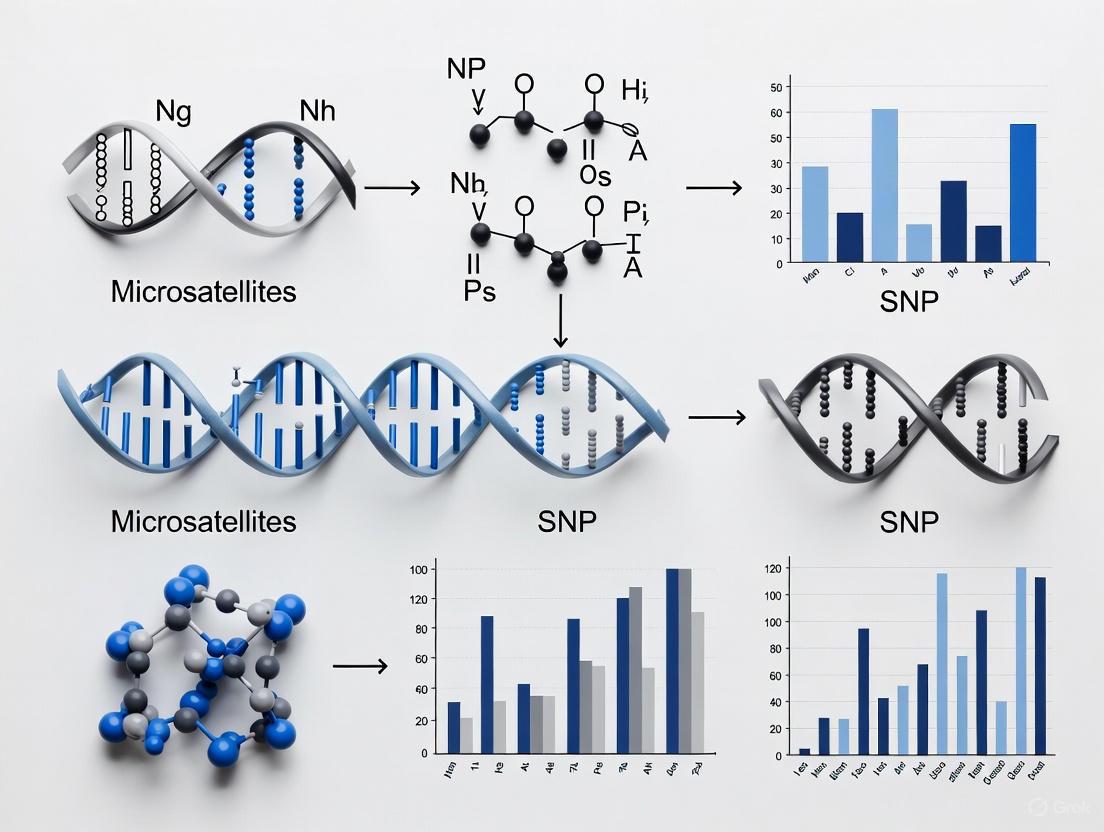
This article provides a comprehensive comparison of microsatellite and Single Nucleotide Polymorphism (SNP) markers for population genetic analysis, tailored for researchers and drug development professionals.
Microsatellites vs. SNPs: A Strategic Guide for Population Genetics in Biomedical Research
Abstract
This article provides a comprehensive comparison of microsatellite and Single Nucleotide Polymorphism (SNP) markers for population genetic analysis, tailored for researchers and drug development professionals. It explores the fundamental biology and historical context of both markers, details methodological applications from basic genotyping to advanced genomic studies, and offers troubleshooting for common technical challenges. A head-to-head validation compares their performance in measuring genetic diversity, population structure, and inferring individual ancestry, synthesizing empirical evidence to guide marker selection for biomedical and clinical research.
Understanding the Core Markers: A Primer on Microsatellites and SNPs
Microsatellites, also known as Short Tandem Repeats (STRs) or Simple Sequence Repeats (SSRs), are short, repetitive DNA sequences consisting of a 1-6 base pair motif repeated multiple times in tandem [1] [2]. These sequences are found in all living organisms and are scattered throughout genomes, primarily in non-coding regions [1]. Their exceptional polymorphism makes them invaluable genetic markers, with mutation rates reaching up to 10⁻³ mutations per locus per generation in some eukaryotes [3]. This high variability results primarily from DNA replication slippage, a unique mutational process that distinguishes microsatellites from other genetic markers like Single Nucleotide Polymorphisms (SNPs) [3] [1].
Microsatellites can be classified based on their sequence composition as: (i) perfect (composed entirely of repeats of a single motif), (ii) imperfect (containing a base pair not belonging to the motif between repeats), (iii) interrupted (with a sequence of a few base pairs inserted into the motif), or (iv) composite (formed by multiple, adjacent repetitive motifs) [1]. This structural diversity contributes to their varied applications in genetic research, though it also presents challenges for standardization across laboratories.
Structural Characteristics and Genomic Distribution
Basic Structure and Organization
The fundamental structure of a microsatellite consists of a core repeat unit (1-6 bp) repeated multiple times. Common examples include mononucleotide repeats (e.g., AAAAA), dinucleotide repeats (e.g., CACACACA), and trinucleotide repeats (e.g., CAGCAGCAG) [2]. These sequences are flanked by unique sequences that enable targeted amplification using polymerase chain reaction (PCR) with specific primers [2].
Evidence indicates that microsatellite distribution is highly non-random across genomes [1]. In plant species like rice and Arabidopsis, density varies significantly across genomic regions, with approximately 80% of GC-rich trinucleotides occurring in exons, while AT-rich trinucleotides distribute evenly throughout genomic components [1]. Tetranucleotide SSRs are predominantly situated in non-coding, mainly intergenic regions [1].
Genomic Distribution Patterns
Comparative analyses reveal distinct distribution patterns across genomic regions:
In coding regions, there is a predominance of SSRs with repeat motifs of the tri- and hexanucleotide type, reflecting selection pressure against mutations that alter the reading frame [1]. Studies in major cereals show that SSR density is highest in untranslated regions (UTRs), gradually decreasing in the promoter, intron, intergenic, and coding sequence regions [1]. Accumulation of specific motifs (e.g., CAA or TAA) has been observed in non-recombining regions of sex chromosomes in various species, indicating interconnection between heterochromatinization and repetitive sequence accumulation [1].
The DNA Slippage Mutation Mechanism
Molecular Basis of Slippage
DNA replication slippage (DNA slippage) is the primary mutational mechanism responsible for microsatellite polymorphism [3]. This process occurs during DNA synthesis when the nascent DNA strand dissociates from the template and realigns out of register [4]. When DNA synthesis continues, the repeat number at the microsatellite is altered in the nascent strand [4].
Two distinct modes of slippage have been identified:
- Length-dependent slippage: The mutation rate increases with microsatellite length, primarily affecting longer repeats [4]
- Length-independent slippage (indel slippage): Operates at repeats with few repetitions, contributing to the emergence of new microsatellites [3] [4]
Evidence for Slippage Without Minimal Threshold
The issue of a minimum threshold length for DNA slippage has been contentious in scientific literature [3]. Early model-fitting methods suggested slippage only occurs over a threshold length of about 8-10 nucleotides [3] [4]. However, comparative genomic analyses between human and chimpanzee genomes have detected no lower threshold length for slippage [3].
Studies reveal that the rates of tandem insertions and deletions at microsatellite loci follow an exponential increase with STR size while still occurring at the shortest measurable lengths [3]. Even sequences as short as one period plus one nucleotide show evidence of slippage mutations [3]. Additionally, the rate of tandem duplications at unrepeated sites is higher than expected from random insertions, providing evidence for genome-wide action of indel slippage as an alternative mechanism generating tandem repeats [3].
Analysis of mutation patterns in human genes revealed that over 70% of 2-4 bp insertions are duplications of adjacent sequences, and even short repeats like CCCC have a 10-15-fold increased susceptibility to insertions and deletions compared to nonrepetitive sequences [4].
Comparative Analysis: Microsatellites vs. SNPs
Key Characteristics and Performance Metrics
When comparing genetic markers for population studies, both microsatellites and SNPs present distinct advantages and limitations:
Table 1: Comparison of Microsatellites and SNPs for Population Genetic Studies
| Characteristic | Microsatellites | SNPs |
|---|---|---|
| Mutation Rate | High (10⁻² to 10⁻⁵) [1] | Low (10⁻⁸ to 10⁻⁹) [5] |
| Mutation Mechanism | DNA slippage [3] | Nucleotide substitution [5] |
| Allelic Diversity | High (multiallelic) [5] | Low (typically biallelic) [5] |
| Inheritance Pattern | Co-dominant [1] | Co-dominant [5] |
| Genome Distribution | Preferentially in non-coding regions [1] | Uniform [5] |
| Development Cost | High for development [2] | Low per locus [5] |
| Genotyping Throughput | Moderate [2] | High [5] |
| Information Content | High per locus [6] | Low per locus [6] |
| Homoplasy | Higher probability [5] | Lower probability [5] |
| Transferability | Moderate between species [1] | Low between species [5] |
Empirical Performance Comparison
Recent empirical studies directly comparing population genetic parameters obtained from both marker types reveal important patterns:
Table 2: Empirical Comparison of Genetic Parameters from Microsatellites vs. SNPs
| Genetic Parameter | Microsatellite Performance | SNP Performance | Study Reference |
|---|---|---|---|
| Expected Heterozygosity (HE) | Strong correlation with SNPs [5] | Strong correlation with microsatellites [5] | Gunnison sage-grouse [5] |
| Inbreeding Coefficient (FIS) | Strong correlation with SNPs [5] | Strong correlation with microsatellites [5] | Gunnison sage-grouse [5] |
| Genetic Differentiation (FST) | Lower precision [6] | Higher precision [6] | Red deer [6] |
| Population Structure Resolution | Limited for fine-scale structure [5] | Higher power to identify groups [5] | Gunnison sage-grouse [5] |
| Individual Heterozygosity Estimation | Lower accuracy [6] | Highly correlated with pedigree inbreeding [6] | Red deer [6] |
| Adaptive Divergence Detection | Limited to neutral processes [5] | Can identify locally adapted loci [5] | Gunnison sage-grouse [5] |
A study on Gunnison sage-grouse found high concordance between microsatellites and SNPs for HE, FIS, and differentiation estimates, though the magnitude of these metrics sometimes differed substantially [5]. Importantly, clustering analyses with SNP data revealed strong demographic independence among populations with some indication of evolutionary independence in specific populations—a finding not detected by microsatellite data alone [5].
Research on red deer populations in Spain demonstrated that while both markers showed correlations for genetic diversity and differentiation parameters, microsatellites had notably lower precision in measuring the distribution of genetic diversity among individuals [6]. The study concluded that SNPs provide greater precision for inferring genetic structure and multilocus heterozygosity [6].
Experimental Protocols and Methodologies
Standard Microsatellite Genotyping Workflow
The standard laboratory workflow for microsatellite analysis involves several key steps that have been optimized over decades of use:
Step 1: DNA Extraction - Isolation of genomic DNA from tissue, blood, or other biological samples using standardized kits [6].
Step 2: PCR Amplification - Amplification of specific microsatellite loci using fluorescently labeled primers designed for flanking regions [2]. Multiplex PCR approaches allow simultaneous amplification of multiple loci [6].
Step 3: Fragment Separation - Separation of PCR products by size using capillary electrophoresis or gel-based systems [2].
Step 4: Allele Sizing - Precise determination of fragment sizes using internal size standards and specialized software [6].
Step 5: Genotype Scoring - Manual or automated calling of alleles with quality control measures including null allele detection and stutter filtering [6].
Step 6: Data Analysis - Application of population genetic software for diversity estimates, structure analysis, and other parameters [6].
The Scientist's Toolkit: Essential Research Reagents
Table 3: Essential Research Reagents for Microsatellite Analysis
| Reagent/Resource | Function | Examples/Alternatives |
|---|---|---|
| DNA Extraction Kits | High-quality DNA isolation | Qiagen DNeasy, Promega Wizard [6] |
| PCR Master Mix | Amplification of target loci | Taq polymerase, dNTPs, buffer [6] |
| Fluorescent Primers | Locus-specific amplification | FAM, HEX, NED, ROX-labeled primers [6] |
| Size Standard | Fragment size determination | GS500, LIZ1200 [6] |
| Capillary Electrophoresis System | Fragment separation | ABI sequencers [6] |
| Genotyping Software | Allele calling | GeneMapper, Genemarker [6] |
| Microsatellite Databases | Marker discovery | MSDB, LegumeSSRdb, EuMicroSatdb [2] |
| Population Genetics Software | Data analysis | Genepop, Structure, Arlequin [6] |
Applications and Future Directions
Microsatellites remain powerful tools for numerous genetic applications despite the emergence of SNP technologies. In forensic science, STR analysis forms the backbone of DNA profiling in national databases like CODIS [2]. In conservation biology, they help assess genetic health of endangered species, as demonstrated in studies of European wildcats and Amur leopards [2]. Agricultural applications include marker-assisted selection for improved crop traits like drought tolerance in maize and rice [2].
The future of microsatellites in population genetics lies in complementary use with SNPs rather than complete replacement. While SNPs excel in genome-wide association studies and detecting fine-scale population structure, microsatellites provide higher individual identification power and remain cost-effective for parentage analysis and ecological studies [5] [6]. Emerging approaches include developing compound markers (SNPSTRs) that combine both marker types and utilizing next-generation sequencing to discover and genotype microsatellites simultaneously [2].
Microsatellites continue to offer unique insights into population processes due to their distinctive mutation mechanism and high variability, ensuring their relevance in the genomic era despite the ascendancy of SNP-based approaches.
In the field of genetics, molecular markers are indispensable tools for understanding population structure, genetic diversity, and evolutionary history. For decades, microsatellites (also known as Simple Sequence Repeats or SSRs) have been the dominant marker type in population genetic studies. These hypervariable loci consist of tandemly repeated DNA motifs (typically 1-6 base pairs) and are characterized by their high polymorphism, codominant nature, and relative abundance in genomes [5] [7]. However, microsatellites possess unique properties that distinguish them from the rest of the genome, including unusually high and variable mutation rates resulting from DNA polymerase slippage during replication [7]. This very characteristic that makes them informative also introduces challenges for interpretation, including homoplasy (where identical allele sizes arise from independent mutations rather than common descent) and difficulties in standardizing allele sizes across laboratories [5] [7].
In recent years, Single Nucleotide Polymorphisms (SNPs) have emerged as a powerful alternative, increasingly displacing microsatellites in many genetic applications. SNPs represent positions in the genome where a single nucleotide (A, T, C, or G) differs among individuals, occurring approximately once in every 100 to 300 base pairs in the human genome [8]. These markers boast a well-understood mutational mechanism with relatively constant mutation rates (approximately 7×10⁻⁹ substitutions per site per generation in Arabidopsis thaliana), which are several orders of magnitude lower and less variable than microsatellite mutation rates [7]. The abundance, stability, and potential for high-throughput automated genotyping make SNPs particularly attractive for contemporary genetic studies, though their typically biallelic nature means individual loci contain less information than highly polymorphic microsatellites [8] [7].
Comparative Analysis of Marker Properties
The fundamental differences in the biological nature of SNPs and microsatellites translate into distinct advantages and limitations for various research applications. Understanding these properties is essential for selecting the appropriate marker system for specific research questions in population genetics and beyond.
Table 1: Fundamental Properties of SNPs and Microsatellites
| Property | SNPs | Microsatellites |
|---|---|---|
| Molecular Nature | Single nucleotide substitutions | Tandem repeats of short DNA motifs (1-6 bp) |
| Typical Alleles per Locus | Primarily biallelic [5] | Multiallelic (highly polymorphic) [5] |
| Mutation Rate | Low (~10⁻⁹), relatively constant [7] | High (10⁻⁶ to 10⁻²), highly variable [7] |
| Mutation Mechanism | Nucleotide substitution | DNA polymerase slippage during replication [7] |
| Genomic Distribution | Highly abundant, widespread | Less abundant, often in non-coding regions [5] |
| Informativeness per Locus | Lower (due to biallelic nature) | Higher (due to multiple alleles) [8] |
| Homoplasy Incidence | Low | Higher (convergent allele sizes) [5] [7] |
The following diagram illustrates the fundamental molecular differences between these two marker types and their implications for genetic studies:
Empirical Performance Data
Numerous empirical studies have directly compared the performance of SNPs and microsatellites across various metrics of genetic analysis. The following table synthesizes key findings from recent research:
Table 2: Empirical Comparison of SNP and Microsatellite Performance in Genetic Studies
| Study Organism | Genetic Diversity (Hₑ) | Population Differentiation (Fₛₜ) | Population Structure Resolution | Key Findings |
|---|---|---|---|---|
| Gunnison Sage-Grouse [5] [9] | Correlated values between markers | Higher Fₛₜ with microsatellites | SNPs identified more distinct genetic clusters | SNPs provided more precise diversity estimates and better power to detect evolutionary independence |
| Wolverine [10] | Consistent estimates between markers | N/A | SNPs detected additional genetic clusters aligned with ecoregions | SNPs showed stronger evidence of isolation by distance (IBD) |
| Arabidopsis halleri [7] | Microsatellite Hₑ not correlated with SNP diversity | Microsatellite Fₛₜ significantly larger than SNP Fₛₜ | N/A | Allelic richness (Aᵣ) was a better proxy for SNP diversity than expected heterozygosity (Hₑ) |
| Human (COGA) [8] | N/A | N/A | SNPs performed better with most informative markers | For inference of population structure, a small number of highly informative SNPs outperformed microsatellites |
| Litopenaeus vannamei [11] | Different absolute values but similar population rankings | Similar differentiation patterns | SNPs provided clearer population discrimination in phylogenetic trees | SNP data revealed more low-frequency variants and detailed population history |
For population structure analysis, studies consistently demonstrate that SNPs provide superior resolution. In Gunnison sage-grouse, a species of conservation concern, microsatellite data (typically <20 loci) failed to reveal evolutionary independence among populations, whereas SNP data clearly identified two to three evolutionarily distinct units requiring separate conservation management [5] [9]. Similarly, in wolverines, microsatellite analysis suggested near-panmixia across large geographical areas, while SNP data uncovered subtle genetic structure corresponding to ecoregions and geographic features [10]. This enhanced resolution stems from the ability to genotype thousands of SNPs, providing a more comprehensive representation of genome-wide patterns.
The quantitative differences in genetic diversity and differentiation estimates between marker types highlight important considerations for data interpretation. Microsatellites typically yield higher Fₛₜ values than SNPs [7], which may reflect their higher mutation rates and greater sensitivity to recent demographic events. Additionally, expected heterozygosity (Hₑ) from microsatellites does not always correlate well with genome-wide SNP diversity [7], suggesting that allelic richness might be a more reliable microsatellite-based proxy for overall genetic diversity.
Experimental Protocols and Methodologies
The transition from microsatellite to SNP genotyping involves fundamentally different laboratory and bioinformatic approaches. The following diagram outlines a typical workflow for SNP discovery and validation using next-generation sequencing:
Detailed Methodological Approaches
Microsatellite Genotyping Protocol: Traditional microsatellite analysis involves several standardized steps. First, researchers select polymorphic loci from previously published literature or develop new markers by screening genomic libraries for repeat regions [7]. Primer pairs flanking the repeat regions are designed and optimized for PCR amplification. The resulting PCR products are separated by size using capillary electrophoresis, and allele sizes are determined by comparison with internal size standards [5]. Special attention must be paid to standardization across laboratories and detection of null alleles (which fail to amplify due to mutations in primer binding sites) and stutter bands (artifacts of polymerase slippage during amplification) that can complicate scoring [5] [7].
SNP Discovery and Genotyping Protocols: For SNP-based studies, several high-throughput approaches have become standard. Restriction-site Associated DNA sequencing (RADseq) and related reduced-representation methods efficiently discover and genotype thousands of SNPs without requiring a reference genome by sequencing regions flanking specific restriction enzyme cut sites [5] [10]. Whole-genome resequencing provides the most comprehensive SNP data by sequencing entire genomes, then mapping reads to a reference assembly to identify variants [7] [11]. For species with established genomic resources, SNP arrays provide a cost-effective solution for genotyping known polymorphisms across many individuals [8]. Bioinformatic processing typically includes quality control, read mapping, variant calling, and extensive filtering to remove spurious SNPs resulting from sequencing errors, paralogous sequences, or poor alignment [7].
Essential Research Reagents and Tools
Successful implementation of SNP-based population genetic studies requires specific laboratory and computational resources. The following table outlines key solutions and their applications:
Table 3: Research Reagent Solutions for SNP-Based Population Genetics
| Category | Specific Solutions | Application in Research |
|---|---|---|
| Library Prep Kits | RADseq kits (e.g., NEBNext Ultra II)Whole-genome sequencing kits | Prepare genomic DNA for high-throughput sequencing; reduce genome complexity for targeted SNP discovery [5] [10] |
| Sequencing Platforms | Illumina NovaSeq, HiSeq, MiSeqPacBio SequelOxford Nanopore | Generate raw sequence data; short-read platforms most common for SNP discovery while long-read useful for reference genomes [7] [11] |
| Bioinformatics Tools | STACKS (RADseq)GATK (variant calling)PLINK (dataset management)STRUCTURE (population structure) | Process raw sequence data, identify polymorphic sites, perform quality control, and conduct population genetic analyses [8] [7] |
| Population Genetics Software | ADMIXTUREArlequinGENEPOPR packages (adegenet, poppr) | Calculate diversity statistics, test for Hardy-Weinberg equilibrium, analyze population differentiation, and visualize genetic relationships [5] [7] |
Implications for Research and Conservation
The choice between SNPs and microsatellites has practical consequences for research outcomes and conservation decisions. In ex situ conservation, where biological material is preserved outside its natural habitat (e.g., in botanic gardens or seed banks), simulations reveal that minimum sample size estimates (MSSEs) to capture 95% of genetic diversity are twice as large when based on SNP data compared to microsatellites [12]. This discrepancy arises because SNPs more accurately reflect total genome-wide diversity, suggesting that traditional conservation targets based on microsatellite data may be insufficient.
For population monitoring and management, SNPs offer enhanced power to detect subtle genetic structure, as demonstrated in wolverines where microsatellites indicated near-panmixia but SNPs revealed distinct genetic clusters aligned with ecoregions [10]. This finer resolution enables more precise delineation of management units, which is particularly important for species subject to harvest regulations or protected status decisions. Additionally, the reproducibility of SNP data across laboratories addresses a significant limitation of microsatellites, where allele size standardization challenges can hinder data comparison between studies [5].
The genomic context provided by SNP data enables research questions beyond the scope of traditional microsatellite studies. With genome-wide SNP coverage, researchers can distinguish neutral from adaptive variation, identify genomic regions under selection, and investigate the genetic basis of local adaptation [5] [7]. This expanded capability is transforming conservation biology by moving beyond neutral genetic diversity to consider evolutionary potential and adaptive genetic variation.
SNPs represent the most abundant form of genetic variation in most genomes, offering distinct advantages for population genetic studies including abundance, genomic coverage, analytical reproducibility, and precise parameter estimation. While microsatellites remain valuable for certain applications requiring high individual discriminatory power or when historical data compatibility is essential, SNP markers provide superior resolution for characterizing population structure, estimating genetic diversity, and informing conservation decisions. The transition from microsatellites to SNPs represents more than a simple substitution of marker types—it reflects a fundamental shift in analytical scale and biological inference, enabling researchers to move from interpreting patterns at a handful of loci to understanding genome-wide processes. As genomic technologies continue to advance, SNP-based approaches will likely become increasingly accessible, further solidifying their role as the standard tool for population genetic analysis.
For decades, microsatellites, also known as Simple Sequence Repeats (SSRs) or Short Tandem Repeats (STRs), were the workhorse markers of population genetics. These short, repeating sequences of DNA (typically 1-6 base pairs in length) are highly polymorphic, scattered throughout the genome, and revolutionized genetic studies from the 1980s onwards [13] [14]. Their high mutation rate and abundance made them ideal for applications requiring individual identification, including forensic science, paternity testing, and genetic diversity studies in non-model organisms [14] [15]. The power of microsatellites stemmed from their high polymorphism, co-dominant inheritance, and the relative ease of analysis using polymerase chain reaction (PCR) techniques, making them accessible and cost-effective for many laboratories [6] [15].
However, the 2010s marked a significant turning point. The completion of various genome projects and the advent of next-generation sequencing (NGS) technologies facilitated a major shift toward single nucleotide polymorphisms (SNPs) [5] [16]. SNPs, representing a single base-pair change in the DNA sequence, are the most abundant genetic variant in genomes. While individually less informative than a multi-allelic microsatellite, SNPs are more stable and can be genotyped in massive, genome-wide sets [5] [17]. This comparative guide objectively examines the performance of these two marker types within population genetic studies, providing the experimental data and context needed for researchers to inform their genomic toolkit.
Fundamental Marker Characteristics: A Technical Comparison
The choice between microsatellites and SNPs is fundamentally guided by their differing biological properties and technical requirements. The table below summarizes the core characteristics that have defined their applications and limitations.
Table 1: Fundamental Characteristics of Microsatellites and SNPs
| Characteristic | Microsatellites (SSRs/STRs) | Single Nucleotide Polymorphisms (SNPs) |
|---|---|---|
| Molecular Nature | Short, tandemly repeated DNA sequences (1-6 bp units) [14] | Single nucleotide base change (A, T, C, or G) [14] |
| Typical Allelic Diversity | High (Multi-allelic) [5] [14] | Low (Typically bi-allelic) [5] |
| Mutation Rate | High (10⁻⁶ to 10⁻²), prone to slippage [13] | Low (~10⁻⁸), more stable [5] |
| Inheritance Mode | Co-dominant [14] | Co-dominant |
| Genotyping Method | PCR + Fragment size analysis (e.g., gel electrophoresis) [15] | Sequencing, microarrays, PCR-based assays [16] |
| Primary Advantage | High polymorphism per locus | Abundance, genome-wide distribution, genotyping automation [14] |
| Primary Disadvantage | Homoplasy, genotyping errors, challenging standardization [13] [5] | Lower information content per locus, discovery cost [18] |
A key challenge with microsatellites is their complex mutation mechanism, primarily strand slippage during DNA replication, which differs from the simpler nucleotide substitution of SNPs [13]. This mechanism leads to a high incidence of homoplasy, where alleles are identical in state (size) but not by descent, potentially obscuring true genetic relationships [13]. Furthermore, scoring microsatellite alleles by fragment size can be subjective and difficult to standardize across laboratories, as size determination methods can impact the inferred fragment length [5]. In contrast, SNP scoring is typically more absolute and reproducible, facilitating data sharing and collaboration, especially for wide-ranging species [18].
Comparative Analysis in Population Genetics
Empirical studies across diverse species provide direct, quantitative comparisons of the performance of microsatellites and SNPs in measuring genetic diversity and differentiation.
Case Study I: Genetic Diversity and Differentiation in Wildlife Conservation
A 2020 study on the Gunnison sage-grouse (Centrocercus minimus), a species of conservation concern, offers a robust empirical comparison [5]. Researchers genotyped the same set of samples using both microsatellites and SNPs derived from a reduced-representation sequencing method (RAD-Seq). They evaluated common metrics of genetic diversity and differentiation across six distinct populations.
Table 2: Comparison of Genetic Parameter Estimates from Gunnison Sage-Grouse Study [5]
| Genetic Parameter | Microsatellites | SNPs | Concordance |
|---|---|---|---|
| Observed Heterozygosity (HO) | Variable | Variable | Lower correlation |
| Expected Heterozygosity (HE) | Measured | Measured | High correlation |
| Inbreeding Coefficient (FIS) | Measured | Measured | High correlation |
| Allelic Richness (AR) | Measured | Measured | High correlation |
| Population Differentiation (FST) | Measured | Measured | High correlation, but magnitude often differed |
| Power for Clustering | Detected broad patterns | Identified distinct, demographically independent groups | Higher resolution with SNPs |
The study found that while metrics like expected heterozygosity (HE) and FST were strongly correlated between the two marker types, the magnitude of the differentiation metrics sometimes differed [5]. Crucially, the SNP data provided higher resolution, successfully clustering individuals into more distinct groups and suggesting strong demographic independence among populations—a finding that was not fully revealed by the microsatellite data alone [5]. This has direct implications for defining conservation units.
Case Study II: Population Structure and Individual Heterozygosity in Red Deer
A 2023 study on red deer (Cervus elaphus) in Spain further corroborates these findings. Researchers compared 11 microsatellites with over 30,000 SNPs for analyzing population genetic structure and individual multilocus heterozygosity [6].
Experimental Protocol [6]:
- Sample Collection: 210 red deer from six populations across Spain.
- Genotyping: Microsatellites were amplified via PCR and analyzed via fragment analysis. SNPs were identified and genotyped using high-throughput sequencing methods.
- Data Analysis: Population structure was inferred using clustering algorithms (e.g., STRUCTURE), and genetic diversity parameters (HO, HE, FIS) were calculated for both marker types.
The results showed correlations between parameters measured with both markers, but the microsatellites showed notably lower accuracy in representing the distribution of genetic diversity among individuals [6]. The study concluded that while microsatellites can monitor broad genetic patterns, the greater precision of SNPs in inferring genetic structure and multilocus heterozygosity makes them preferable when possible [6].
Case Study III: Spatial Assignment of Individuals
The superiority of SNPs for fine-scale spatial assignment was demonstrated in a 2016 study on American black bears (Ursus americanus) [18]. This research compared the accuracy of assigning individuals to their natal range using both microsatellite and SNP genotyping panels.
Experimental Protocol [18]:
- Datasets: Five datasets varying in marker type (15 microsatellites vs. 1000 SNPs), number of loci, and number of training samples.
- Assignment Methods: Two statistical methods were used: spatial smoothing of allele frequencies and principal components regression.
- Accuracy Measurement: The median difference (km) between the true and estimated geographic locations of samples.
The study found that the SNP dataset was both the most accurate and precise for natal inference. Even with fewer training samples, large SNP panels overcame limitations and provided more reliable assignments [18]. The research also highlighted that assignments were less accurate in continuous habitats compared to isolated populations, a limitation that was mitigated by using a large number of SNP markers [18].
The Modern Genomic Toolkit: Research Reagents and Solutions
The transition to SNP-based genomics has been facilitated by a suite of modern research reagents and bioinformatics tools.
Table 3: Essential Research Reagents and Solutions for Modern Population Genomics
| Tool / Solution | Function | Application Context |
|---|---|---|
| Next-Generation Sequencing (NGS) | High-throughput parallel sequencing of DNA fragments. | Enables genome-wide SNP discovery and genotyping without a reference genome (e.g., via RAD-Seq) [5] [15]. |
| Reference Genome | A sequenced and assembled genomic template for an organism. | Allows for precise alignment of sequence reads and identification of SNPs in a genomic context. |
| Reduced-Representation Libraries (RAD-Seq) | A method to sequence a consistent subset of the genome across many individuals. | A cost-effective solution for discovering and genotyping thousands of SNPs in non-model organisms [5]. |
| Bioinformatics Pipelines | Software for processing raw sequence data (e.g., STACKS, GATK). | Essential for variant calling, filtering, and generating genotype datasets from NGS data [15]. |
| Multiplex PCR Panels | A method to amplify multiple microsatellite loci in a single reaction. | Improves the efficiency and reduces the cost of microsatellite genotyping [19]. |
| Genotyping Microarrays | Pre-designed chips that genotype hundreds of thousands of known SNPs. | High-throughput, cost-effective SNP genotyping for species with established genomic resources. |
For microsatellite development, bioinformatics tools like MISA (MicroSAtellite identification tool) and QDD have become indispensable. These tools automate the detection of microsatellite repeats from sequencing data, significantly accelerating the marker development process [15]. The integration of NGS technologies has made the development of both microsatellite and SNP markers more cost-effective and accessible for non-model organisms [15] [19].
The historical journey from microsatellites to SNPs marks a paradigm shift in population genetics, driven by the pursuit of greater precision, resolution, and throughput. Evidence from empirical studies consistently shows that SNPs provide more precise estimates of population-level diversity, higher power to identify genetic groups, and more accurate measurements of individual inbreeding and heterozygosity [5] [6] [18].
While microsatellites remain a viable and sometimes necessary tool for studies with budgetary constraints or where highly variable loci are required for individual identification (e.g., parentage analysis), the advantages of SNPs are undeniable for most genome-level inquiries [19]. The future of population genetics lies in the continued development of more accessible genomic technologies, the integration of adaptive SNPs under selection, and the application of these powerful tools to inform conservation strategies, wildlife management, and our fundamental understanding of evolutionary processes.
In population genetics research, the choice of molecular marker is a fundamental decision that shapes the design, analysis, and interpretation of studies. For decades, scientists have relied on various genetic markers to unravel population structure, demographic history, and evolutionary processes. Among these, the distinction between multi-allelic and biallelic markers represents a critical dichotomy in molecular ecology, conservation genetics, and breeding programs. Multi-allelic markers, predominantly microsatellites (or Simple Sequence Repeats, SSRs), are characterized by the presence of multiple alleles at a single locus, while biallelic markers, primarily Single Nucleotide Polymorphisms (SNPs), typically exhibit only two possible alleles at a genomic site.
The broader thesis of comparing microsatellites versus SNPs for population predictions research extends beyond mere allele count to encompass fundamental differences in mutation processes, genomic distribution, and analytical implications. Microsatellites are composed of short, tandemly repeated DNA motifs (1-6 base pairs) that vary primarily in the number of repeats, creating length polymorphisms. Their high mutation rate, resulting from DNA polymerase slippage during replication, makes them exceptionally informative for studying recent evolutionary events and fine-scale population structure. In contrast, SNPs represent single base pair positions in the DNA sequence where two different nucleotides are observed among individuals, with a relatively low and stable mutation rate that provides insights into deeper evolutionary history and genome-wide patterns.
This guide provides an objective comparison of these marker systems, focusing on their core differences in allelic diversity, mutation characteristics, genomic distribution, and performance in population genetic studies, supported by experimental data and methodological protocols from recent scientific investigations.
Fundamental Genetic Characteristics
Allelic Variation and Polymorphism
The most fundamental distinction between multi-allelic and biallelic markers lies in their inherent capacity to capture genetic variation, which directly influences their information content and applications in population studies.
Table 1: Core Characteristics of Multi-allelic and Biallelic Markers
| Characteristic | Multi-allelic Markers (Microsatellites) | Biallelic Markers (SNPs) |
|---|---|---|
| Typical number of alleles per locus | 3 to 20+ (often many) | Exactly 2 (by definition) |
| Mutation rate | 10⁻² to 10⁻⁵ per generation [7] [20] | ~7×10⁻⁹ per site per generation (in Arabidopsis thaliana) [7] |
| Mutation mechanism | DNA polymerase slippage during replication [7] | Nucleotide substitution |
| Primary genomic location | Predominantly non-coding regions [7] [21] | Distributed throughout coding and non-coding regions |
| Information content per locus | High (multiple alleles) | Low (two alleles) |
| Typical genotyping method | PCR + fragment size analysis | Sequencing, microarrays |
A biallelic site is a specific locus in a genome that contains exactly two observed alleles. In practical terms, this represents a site where the reference allele and a single alternative allele are observed across samples [22]. In contrast, a multiallelic site contains three or more observed alleles, allowing for two or more variant alleles [22]. While most SNPs are biallelic by nature, true multiallelic SNPs do occur but are relatively infrequent unless very large sample sizes are examined. In extensive sequencing datasets of >10,000 samples, approximately 10% of variant sites are observed to be multi-allelic [23].
Mutation Rates and Mechanisms
The mutational processes underlying microsatellites and SNPs differ dramatically in both rate and mechanism, with profound implications for their application in population genetic studies.
Microsatellites exhibit mutation rates ranging between 10⁻² and 10⁻⁵ per locus per generation, varying approximately 10,000-fold across different loci [7]. This exceptionally high mutation rate stems from slippage events during DNA replication, where the DNA polymerase misaligns the template and nascent strands, leading to expansion or contraction of the repeat number. Mutation rates in microsatellites are influenced by multiple factors including repeat type, repeat copy number, marker location in the genome, and taxonomic group [7]. In humans, mutation events in the male germ line are five to six times more frequent than in the female germ line, and a positive exponential correlation exists between the number of uninterrupted repeats and the mutation rate [20].
In stark contrast, SNP mutation rates are considerably lower and less variable. In Arabidopsis thaliana, the mutation rate has been accurately estimated at 7×10⁻⁹ substitutions per site per generation [7], representing a difference of several orders of magnitude compared to microsatellites. The mutation rate for SNPs varies only about 100-fold across the genome [7], and their mutational mechanism involves straightforward nucleotide substitutions without the complex length-based dynamics of microsatellites.
Diagram 1: Mutation mechanisms and rates for microsatellites versus SNPs. Microsatellites undergo slippage during replication leading to high mutation rates, while SNPs involve base substitutions with low mutation rates.
Genomic Distribution and Functional Associations
The distribution patterns of microsatellites and SNPs across genomes reflect their different biological properties and mutational origins, with important consequences for their application in genetic studies.
Distribution Patterns Across Genomic Regions
Microsatellites demonstrate non-random distribution throughout genomes, with particular enrichment in non-coding regions. In the plateau zokor genome, mononucleotide and dinucleotide repeats are the most abundant types, with the largest number of microsatellites found in intergenic regions, while coding regions contain the smallest number [21]. This distribution pattern is consistent across many eukaryotic species and reflects the selective constraints against length mutations in functional coding sequences.
SNPs, in contrast, are distributed more uniformly throughout the genome, occurring in both coding and non-coding regions. Their prevalence in functional regions makes them particularly valuable for association studies linking genetic variation to phenotypic traits. The ability to detect SNPs in coding regions also facilitates the identification of functional variants that may directly influence gene expression or protein function.
Table 2: Genomic Distribution of Microsatellites in the Plateau Zokor Genome
| Genomic Region | Relative Abundance | Functional Implications |
|---|---|---|
| Intergenic regions | Highest density | Limited selective constraint; neutral evolution |
| Intronic regions | Intermediate density | Some regulatory potential; moderate constraint |
| Coding sequences (CDS) | Lowest density | High selective constraint; often deleterious |
| Exonic regions | Very low density | Strong purifying selection; rarely tolerated |
Functional and Pathway Associations
Microsatellites located within coding sequences can have significant functional consequences. In the plateau zokor, coding sequences containing microsatellites were annotated to 52 major functional genes and assigned 19,358 Gene Ontology entries [21]. Kyoto Encyclopedia of Genes and Genomes (KEGG) pathway analysis revealed the most significant enrichment in the signal transduction pathway, indicating potential roles in cellular communication and environmental response mechanisms [21].
The functional annotation of microsatellite-containing genes provides insights into the potential evolutionary significance of these markers beyond their role as neutral genetic tools. Their presence in genes involved in signal transduction suggests possible connections to adaptive processes and environmental interactions, though most population genetic studies treat microsatellites as presumed neutral markers.
Experimental Comparisons in Population Genetics
Methodological Protocols for Comparative Studies
Empirical comparisons of microsatellites and SNPs require carefully designed methodologies to ensure valid comparisons between marker systems. The following protocols represent standardized approaches used in recent comparative studies:
Population Sampling and DNA Extraction:
- Collect tissue samples (e.g., leaf, muscle) from multiple populations, maintaining sufficient distance between individuals to avoid sampling relatives [7]
- Preserve samples in silica gel or 95% ethanol [7] [21]
- Extract DNA using standardized protocols (e.g., DNeasy Plant Mini Kit or phenol-chloroform extraction) [7] [21]
- Quantify DNA concentration using fluorometry and assess quality via agarose gel electrophoresis [7]
Microsatellite Genotyping Protocol:
- Design primers flanking microsatellite regions using genome sequences or previously developed markers
- Amplify loci via PCR in reactions containing: 12.5 μL of 2× Taq PCR Master Mix, 1 μL each of upstream and downstream primers (10 μM), 1 μL of template DNA (20-50 ng/μL), and 9.5 μL of ddH₂O [21]
- Use thermal cycling conditions: initial denaturation at 94°C for 5 min; 35 cycles of 94°C for 30 s, primer-specific annealing temperature (e.g., 53.5°C) for 30 s, 72°C for 30 s; final extension at 72°C for 10 min [21]
- Separate PCR products by capillary electrophoresis and determine allele sizes using size standards [7]
SNP Genotyping Protocol:
- For reduced-representation approaches (e.g., RAD-Seq): digest genomic DNA with restriction enzymes, ligate adapters, and perform size selection [5] [9]
- Sequence libraries on high-throughput sequencing platforms
- Align sequences to reference genome or perform de novo assembly
- Call SNPs using standardized pipelines with quality filters (e.g., minimum depth, quality scores)
- For studies without reference genomes, use de novo clustering approaches to identify orthologous loci
Data Analysis Pipeline:
- Calculate standard population genetic parameters: observed heterozygosity (Hₒ), expected heterozygosity (Hₑ), inbreeding coefficient (Fᵢₛ), allelic richness (Aᵣ) [5] [7] [9]
- Estimate population differentiation using Fₛₜ, Gₛₜ, or Dⱼₒₛₜ [5] [7] [9]
- Perform population structure analysis using clustering algorithms (e.g., STRUCTURE, ADMIXTURE)
- Assess correlation between diversity estimates from different marker types
Diagram 2: Experimental workflow for comparative population genetic studies using microsatellites and SNPs.
Empirical Performance in Population Genetic Studies
Multiple empirical studies have directly compared the performance of microsatellites and SNPs for estimating population genetic parameters, revealing both consistencies and important differences between marker systems.
Table 3: Empirical Comparison of Diversity Estimates in Gunnison Sage-Grouse
| Genetic Metric | Microsatellites | SNPs | Concordance |
|---|---|---|---|
| Expected Heterozygosity (Hₑ) | Highly variable estimates with wide confidence intervals | More precise estimates with narrow confidence intervals | Strong correlation but different precision [9] |
| Inbreeding Coefficient (Fᵢₛ) | Large confidence intervals, limited detection power | Narrow confidence intervals, better detection power | Strong correlation but different precision [9] |
| Allelic Richness (Aᵣ) | Based on actual allele counts | Based on biallelic sites | Microsatellite Aᵣ better correlated with genome-wide SNP diversity [7] |
In Gunnison sage-grouse, a species of conservation concern, comparative analyses revealed that SNP data provided more precise estimates of population-level diversity, with 95% confidence intervals consistently narrower than those from microsatellites [9]. This precision advantage held true for Hₑ, Fᵢₛ, and Aᵣ, though the correlation between marker types was generally strong.
For population differentiation, microsatellite-based Fₛₜ estimates were significantly larger than those from SNPs in Arabidopsis halleri [7]. Despite this absolute difference, measures of genetic differentiation were generally correlated between marker types. In the Gunnison sage-grouse study, clustering analyses showed similar patterns with both marker types, though SNP data demonstrated higher power to identify distinct groups and suggested strong demographic independence among populations that was not revealed by microsatellite data alone [9].
Analytical Considerations for Different Marker Types
Statistical Approaches for Multi-allelic and Biallelic Data
The analytical treatment of multi-allelic versus biallelic markers requires different statistical approaches to properly account for their distinct genetic properties.
For multi-allelic markers like microsatellites, the stepwise mutation model (SMM) or two-phase model are often applied to account for the unique mutational process that generates length polymorphisms. These models recognize that microsatellite mutations typically involve the addition or loss of single repeat units, though more complex patterns do occur. The high mutation rate and potential for homoplasy (where identical allele sizes arise from independent mutational events) must be considered in population genetic inferences.
For biallelic SNP data, the infinite sites model is more appropriate, as it assumes that each mutation occurs at a previously monomorphic site. This model fits well with the low mutation rate and simple substitution process characteristic of SNPs. The biallelic nature of SNPs also simplifies genotype encoding in association analyses, where genotypes are typically coded as 0, 1, or 2 copies of the alternative allele.
The analysis of true multi-allelic SNPs (approximately 10% of variable sites in large sequencing datasets) requires special consideration. Joint modeling approaches that include genotypes for all alternative alleles in a single regression model allow for unbiased estimation of allele effects and facilitate meta-analysis across studies [23]. This approach is superior to single-allele analysis, which discards information and uses different sample subsets for each alternative allele.
Power and Precision in Genetic Studies
The relative performance of microsatellites versus SNPs depends on the specific research question and the number of loci employed. While individual microsatellites are typically more informative due to higher heterozygosity, the ability to genotype thousands of SNPs can compensate for the lower information content per locus.
In population structure inference, microsatellites were historically favored for their high polymorphism. However, empirical comparisons show that SNPs can provide equal or better resolution when sufficient numbers are used. A study of human populations found that although random microsatellites were 4-12 times more informative than random SNPs for population comparisons, SNPs constituted the majority among the most informative markers when large numbers were considered [8]. For inference of population structure, SNPs with the highest informativeness performed uniformly better than the same number of highly informative microsatellites, particularly when small numbers of markers were used [8].
In conservation applications, SNPs offer three main advantages over microsatellites: (1) more precise estimates of population-level diversity, (2) higher power to identify groups in clustering methods, and (3) the ability to consider local adaptation by separating neutral and adaptive variation [9]. This enhanced capability to detect evolutionarily significant units has important implications for wildlife management and conservation prioritization.
Research Reagent Solutions and Essential Materials
Successful implementation of population genetic studies requires specific reagents and materials optimized for each marker type. The following toolkit outlines essential resources for comparative studies of multi-allelic and biallelic markers.
Table 4: Essential Research Reagents for Genetic Marker Analysis
| Reagent/Material | Application | Function | Examples/Specifications |
|---|---|---|---|
| DNA Extraction Kits | Both marker types | High-quality DNA isolation | DNeasy Plant Mini Kit, phenol-chloroform protocol |
| Taq PCR Master Mix | Microsatellite analysis | PCR amplification of target loci | Contains Taq polymerase, dNTPs, Mg²⁺, reaction buffer |
| Fluorescently-labeled primers | Microsatellite analysis | Fragment detection with capillary electrophoresis | FAM, HEX, NED, ROX dye labels |
| Size Standard | Microsatellite analysis | Accurate allele sizing | GS500(-250), LIZ1200 with precise fragment sizes |
| Restriction Enzymes | RAD-Seq SNP discovery | Genome complexity reduction | EcoRI, MseI, SbfI with appropriate buffers |
| Library Preparation Kits | SNP genotyping | Sequencing library construction | Illumina TruSeq, NEBNext Ultra DNA Library Prep |
| Sequence Alignment Tools | SNP analysis | Mapping reads to reference genome | BWA, Bowtie2 with appropriate parameter settings |
| Variant Calling Software | SNP analysis | SNP identification and genotyping | GATK, SAMtools, Stacks for RAD-Seq data |
| Population Genetics Software | Both marker types | Data analysis and visualization | STRUCTURE, ADMIXTURE, Arlequin, GENEPOP |
The comparison between multi-allelic microsatellites and biallelic SNPs reveals a complex tradeoff between marker information content, mutational stability, and genomic coverage. Microsatellites provide high information content per locus through their multiple alleles and rapid mutation rate, making them particularly suitable for fine-scale population structure, kinship analysis, and recent demographic events. SNPs, while less informative individually, provide more precise population parameter estimates when used in large numbers, better reflect genome-wide diversity patterns, and enable the identification of adaptive variation.
The choice between these marker systems depends fundamentally on the research question, time scale of interest, and available resources. For studies of recent divergence and fine-scale genetic structure, microsatellites remain valuable tools, particularly in non-model organisms without reference genomes. For genome-wide scans, characterization of population history over deeper evolutionary timescales, and identification of adaptive loci, SNP datasets offer significant advantages. Rather than representing competing technologies, these marker types often provide complementary insights, and their integration can offer the most comprehensive understanding of population genetic processes.
As genomic technologies continue to advance, the distinction between these marker systems may blur with the development of hybrid approaches like SNPSTRs (combining SNPs and microsatellites) [24] and the ability to cost-effectively sequence entire genomes. Nevertheless, understanding the fundamental differences in allelic diversity, mutation processes, and genomic distribution between multi-allelic and biallelic markers remains essential for designing robust population genetic studies and accurately interpreting patterns of genetic variation in natural populations.
From Theory to Practice: Genotyping Methods and Research Applications
In the field of genetic research, the selection of an appropriate genotyping method is fundamental to the success of population and forensic studies. For decades, the analysis of microsatellites, also known as Short Tandem Repeats (STRs), via PCR and Capillary Electrophoresis (CE) has been the established gold standard [25]. However, emerging technologies for assessing Single Nucleotide Polymorphisms (SNPs) through high-throughput arrays and sequencing are increasingly providing compelling alternatives [25] [5]. This guide objectively compares these two methodological paradigms, framing the analysis within population genetics research. It details their respective workflows, presents comparative experimental data, and outlines key reagent solutions to inform researchers and scientists in their experimental design.
The following table summarizes the core characteristics of the two genotyping approaches.
Table 1: Core Characteristics of Microsatellite and SNP Genotyping Technologies
| Feature | Microsatellites (STRs) with PCR-CE | SNPs with High-Throughput Technologies |
|---|---|---|
| Marker Type | Length polymorphisms (1-6 bp repeats) [25] | Single base-pair substitutions [5] |
| Typical Platform | Capillary Electrophoresis [25] | Microarrays, NGS (e.g., GBS, WGS) [25] [26] |
| Multiplexing Capacity | Limited (e.g., 20-35 loci in commercial kits) [25] | Very High (thousands to millions of loci) [25] [26] |
| Informativeness | High per-locus heterozygosity [5] | Lower per-locus heterozygosity (usually bi-allelic) [7] |
| Best Application | Routine individual identification, standard paternity testing [25] | Complex kinship, population structure, FIGG, phenotypic prediction [25] [5] |
| Data Analysis | Fragment size analysis, relatively simple | Complex, requires advanced bioinformatics [25] |
Workflow and Experimental Protocols
Microsatellite Analysis via PCR and Capillary Electrophoresis
The workflow for microsatellite genotyping is a well-established, multi-step process.
Diagram 1: Microsatellite Analysis Workflow.
Sample Collection and DNA Extraction: The process begins with the collection of biological material (e.g., tissue, blood, saliva). High-quality, high-molecular-weight DNA is then extracted using standard methods like the CTAB protocol or commercial kits [7] [27]. Accurate quantification and integrity checks are critical; this can be done using fluorometry or capillary electrophoresis systems like the QIAxcel Advanced to detect degraded DNA, which is detrimental to STR analysis [25] [28].
PCR Amplification: Specific microsatellite loci are amplified using multiplex PCR reactions with fluorescently-labeled primers. Commercial kits (e.g., GlobalFiler, PowerPlex) contain pre-optimized primer mixes for core STR loci (e.g., CODIS, ESS) [25]. The PCR conditions are tailored to the kit, typically involving an initial denaturation, followed by multiple cycles of denaturation, primer annealing, and extension. The use of "mini-STR" primers that generate shorter amplicons can be employed for degraded DNA samples [25].
Capillary Electrophoresis (CE): The fluorescently-labeled PCR products are separated by size via capillary electrophoresis in a polymer matrix [25] [29]. An electric field is applied, causing the DNA fragments to migrate through the capillary at speeds inversely proportional to their size. A laser at the end of the capillary detects the fluorescent signal of each fragment as it passes. Techniques such as applying a gradient of electric field strength can enhance resolution and read length [29]. Instruments like the Beckman CEQ 2000 or Applied Biosystems sequencers are commonly used [29].
Data Analysis and Genotype Calling: The instrument's software translates the detected fluorescence into an electropherogram, which displays peaks corresponding to different alleles. The genotype is called based on the size (in base pairs) of the amplified fragments, which correlates with the number of repeats at each locus [25]. Specialized software is used to interpret profiles, especially for complex samples like mixtures [25].
SNP Analysis via High-Throughput Sequencing
Genotyping-by-Sequencing (GBS) is a common reduced-representation approach for SNP discovery and genotyping.
Diagram 2: SNP Genotyping-by-Sequencing Workflow.
Library Preparation (GBS Example): The process starts with high-quality DNA, which is digested with one or more restriction enzymes (e.g., ApeKI) [26]. The choice of enzyme dictates the number and distribution of genomic loci captured. Subsequently, barcoded adapters are ligated to the digested fragments, allowing multiple samples to be pooled (multiplexed) in a single sequencing lane. The pooled library is then cleaned and typically amplified via PCR before sequencing [26].
High-Throughput Sequencing: The pooled library is loaded onto a next-generation sequencing platform, such as an Illumina NovaSeq or HiSeq. These platforms perform massively parallel sequencing, generating millions of short reads simultaneously [26]. The output is digital, representing the nucleotide sequence at each captured site for every sample.
Bioinformatic Analysis: The raw sequencing data undergoes a multi-step bioinformatic pipeline. This includes demultiplexing (sorting reads by their barcodes), quality control and filtering, and alignment of reads to a reference genome. SNP calling is then performed using specialized software (e.g., TASSEL-GBS) to identify variable positions and assign genotypes for each sample [26]. For species without a reference genome, de novo SNP discovery can be performed, though it is more computationally challenging.
Performance and Experimental Data
Empirical comparisons reveal how the choice of marker and technology influences the interpretation of genetic diversity and population structure.
Table 2: Empirical Comparison of Diversity and Differentiation Estimates
| Study Organism | Genetic Diversity Metric | Microsatellite Estimate | SNP Estimate | Correlation & Notes |
|---|---|---|---|---|
| Gunnison Sage-Grouse [5] | Expected Heterozygosity (HE) | High correlation with SNPs | High correlation with Microsatellites | Estimates were highly correlated, but sometimes different in magnitude. |
| Genetic Differentiation (FST) | Significantly larger estimates | Smaller, more precise estimates | SNPs provided higher power to distinguish demographically independent groups. | |
| Arabidopsis halleri [7] | Expected Heterozygosity (HE) | Not correlated with SNP diversity | Not correlated with SSR diversity | Microsatellite Allelic Richness (Ar ) was a better proxy for genome-wide SNP diversity. |
| Genetic Differentiation (FST) | Larger estimates | Smaller estimates | FST estimates were correlated but microsatellites showed a upward bias. |
Key Findings from Comparative Studies
Power for Population Discrimination: In Gunnison sage-grouse, microsatellite and SNP data showed generally high concordance for diversity and differentiation metrics. However, SNP-based clustering analyses were able to identify strong demographic independence among populations, a finding that was not revealed by microsatellite data alone [5]. This demonstrates the higher resolution power of genome-wide SNP data.
Bias in Diversity Estimates: A study on Arabidopsis halleri found that expected heterozygosity from microsatellites (SSR-He) was a poor predictor of genome-wide SNP diversity. Instead, microsatellite allelic richness (Ar) was a more reliable proxy [7]. This highlights that the choice of diversity metric for microsatellites can significantly impact conclusions.
Advantages for Complex Analyses: SNPs obtained via NGS offer distinct advantages in scenarios that are challenging for CE-based STR analysis, including better performance with degraded DNA, improved deconvolution of complex mixtures from multiple contributors, and higher power for distinguishing distant kinship relationships (e.g., beyond second-degree) [25].
Essential Research Reagent Solutions
The following table catalogs key materials and reagents required for implementing these genotyping workflows.
Table 3: Key Reagents and Solutions for Genotyping Workflows
| Reagent / Kit | Function | Application Context |
|---|---|---|
| DNA Extraction Kits (e.g., DNeasy Plant Mini Kit, QIAamp Viral DNA/RNA Kit) [30] [7] | Purification of high-quality, high-molecular-weight DNA from biological samples. | Fundamental first step for both microsatellite and SNP genotyping. |
| Multiplex STR PCR Kits (e.g., GlobalFiler, PowerPlex Fusion 6C) [25] | Simultaneous amplification of multiple STR loci with fluorescent dye-labeled primers. | Core of the microsatellite PCR-CE workflow. |
| Restriction Enzymes (e.g., ApeKI, HindIII) [26] | Cuts genomic DNA at specific recognition sites to create a reduced-representation library. | Critical for Genotyping-by-Sequencing (GBS) and other RAD-seq methods. |
| Barcoded Adapters & Primers [26] | Ligated to digested DNA fragments; unique barcodes allow sample multiplexing in a sequencing lane. | Essential for cost-effective, high-throughput SNP sequencing. |
| KASP Assay Mix [27] | A competitive allele-specific PCR chemistry for uniplex SNP genotyping without probes. | Ideal for low- to medium-throughput SNP screening and marker-assisted selection. |
| Capillary Electrophoresis Kits (e.g., CEQ Dye Terminator Cycle Sequencing Kit) [29] | Provides reagents for the separation matrix and running buffer for fragment analysis. | Required for the final separation and detection step in STR genotyping. |
The choice between microsatellite/CE and SNP/high-throughput technologies is not a matter of one being universally superior, but rather of selecting the right tool for the research question and context. The established PCR-CE workflow for microsatellites remains a robust, cost-effective solution for applications requiring high per-locus discrimination in routine individual identification and simple kinship analysis. In contrast, high-throughput SNP technologies (microarrays, NGS) provide unparalleled resolution for studying complex population structures, evolutionary relationships, and for extracting additional information such as phenotypic traits from the same data set. The trend in population genetics is moving toward a hybrid or combined approach, leveraging the strengths of each technology to achieve comprehensive genetic insights [25].
Inference of population structure and identification of demographically independent groups are critical for understanding evolutionary processes, informing conservation strategies, and removing confounding factors in genome-wide association studies (GWAS) [31] [32]. Genetic markers serve as the foundational tool for these analyses. For decades, microsatellites (or Simple Sequence Repeats, SSRs) were the dominant marker due to their high polymorphism. However, the advent of high-throughput sequencing has made Single Nucleotide Polymorphisms (SNPs) increasingly prevalent [5] [33] [7]. This guide provides an objective comparison of these two marker types, focusing on their performance in inferring population structure and delineating demographically independent groups, supported by empirical data and detailed methodologies.
Marker Comparison: Microsatellites vs. SNPs at a Glance
The table below summarizes the core characteristics of microsatellites and SNPs, highlighting their inherent differences.
Table 1: Fundamental characteristics of microsatellites and SNPs.
| Feature | Microsatellites | Single Nucleotide Polymorphisms (SNPs) |
|---|---|---|
| Molecular Nature | Short, tandemly repeated DNA sequences (1-6 bp units) [7] | Variation at a single nucleotide position (A, T, C, or G) [5] |
| Typical Allelic Diversity | High (Multi-allelic) [33] | Low (Typically bi-allelic) [5] [7] |
| Mutation Rate | High (~10⁻⁶ to 10⁻²), highly variable [7] | Low (~7x10⁻⁹ in A. thaliana), more uniform [7] |
| Primary Mutation Mechanism | DNA polymerase slippage during replication [5] [7] | Nucleotide substitution [5] |
| Genome Distribution | Abundant, but often in non-coding regions [5] | Highly abundant and uniformly distributed genome-wide [5] |
| Common Genotyping Method | PCR and fragment size analysis [5] | High-throughput sequencing (e.g., RADseq, Whole Genome Sequencing) [5] [33] |
Performance Comparison in Population Genetics Studies
The choice of marker directly impacts key population genetic metrics. The following table synthesizes findings from empirical comparisons.
Table 2: Empirical comparison of population genetic parameter estimates from microsatellites and SNPs.
| Analysis Type | Comparative Performance | Key Supporting Evidence |
|---|---|---|
| Genetic Diversity | Correlation between markers is estimator-dependent. Microsatellite expected heterozygosity (SSR-Hₑ) is a poor proxy for genome-wide SNP diversity (SNP-Hₑ, θWatterson). Microsatellite allelic richness (Aᵣ) shows a stronger correlation with genome-wide SNP diversity [7]. | Study on Arabidopsis halleri (9 populations): SSR-Hₑ was not correlated with SNP-Hₑ or θWatterson, while Aᵣ was a better proxy [7]. |
| Genetic Differentiation (FST) | FST estimates are correlated but microsatellites yield significantly larger absolute values than SNPs [5] [7]. | In Gunnison sage-grouse, FST estimates were highly correlated but magnitude differed [5]. In A. halleri, microsatellite FST was significantly larger than SNP FST [7]. |
| Population Structure Resolution | SNPs generally provide higher resolution and power, especially with large numbers of loci, to detect finer-scale structure and distinct groups [8] [5] [33]. | In Gunnison sage-grouse, SNPs identified strong demographic independence among populations that was not revealed by microsatellites [5]. In pike, the full RADseq dataset detected finer-scale structure most clearly [33]. |
| Detection of Adaptive Variation | SNPs offer a distinct advantage. They can be located in coding regions, enabling identification of loci under selection and informing about local adaptation [5] [33]. | In pike, RADseq outlier analysis identified signs of selection associated with salinity and temperature [33]. In Gunnison sage-grouse, adaptive SNP loci could inform on evolutionary independence [5]. |
Detailed Experimental Protocols from Key Studies
Protocol: Population Structure Inference Using Model-Based Clustering (e.g., STRUCTURE)
This classic method infers population structure and individual admixture proportions using multilocus genotype data without prior population information [8] [32].
- Principle: The method uses a Bayesian approach to cluster individuals into K populations based on Hardy-Weinberg equilibrium and linkage equilibrium assumptions. It estimates two key parameters: P (ancestral population allele frequencies) and Q (individual admixture proportions) [32].
- Workflow:
- Genotype Data Input: Provide a matrix of genotypes for N individuals at M loci. For microsatellites, these are allele sizes; for SNPs, genotypes are typically coded as 0, 1, or 2 copies of a reference allele [32].
- Parameter Configuration: Set the number of assumed ancestral populations (K). Define a burn-in period (e.g., 10,000 iterations) to allow the Markov Chain to reach a stationary distribution, followed by a longer run (e.g., 10,000 iterations) for actual sampling [8].
- Model Selection: Choose the admixture model, which allows individuals to have mixed ancestry. The "F model" accounts for allele frequency correlations between populations [8].
- Iterative Sampling & Convergence: The algorithm runs multiple times for each K. Assess convergence between runs and use the mean of the posterior distribution as the parameter estimate [32].
- Data Interpretation: The primary output is the Q-matrix, which shows each individual's estimated membership proportion to each of the K clusters. Individuals are accurately assigned if their greatest ancestry proportion matches their pre-defined population [8].
Protocol: Inference Using a Network-Based Approach (NetStruct)
This model-free method uses network theory to infer population structure from genetic data, avoiding assumptions like Hardy-Weinberg equilibrium [31].
- Principle: A network is constructed where nodes represent individuals, and edges represent genetic similarity between pairs. Population structure is equated with the "community partition" of this network—subgraphs of nodes more densely connected internally than externally [31].
- Workflow:
- Genetic Similarity Matrix Calculation: Compute a pairwise genetic similarity matrix for all N individuals using an appropriate measure (e.g., a proportion-of-shared-alleles metric).
- Network Construction: Use the similarity matrix as the adjacency matrix to define a weighted, undirected network.
- Community Detection: Apply a community-detection algorithm (e.g., Girvan-Newman) to partition the network into K communities (subpopulations).
- Statistical Significance Testing: Evaluate the significance of the partition using permutation tests on the partition's modularity, a measure of community structure quality [31].
- Data Interpretation: The resulting partition assigns each individual to a subpopulation. The method also calculates a Strength of Association (SA) for each individual to its community, which can identify hybrids or gene flow patterns [31].
The Scientist's Toolkit: Essential Research Reagents and Materials
Successful population genetic studies require a suite of laboratory and computational tools. The table below details key solutions.
Table 3: Key research reagent solutions and software for population structure analysis.
| Item Name | Function / Application | Specific Examples / Notes |
|---|---|---|
| High-Quality DNA Extraction Kits | To obtain pure, high-molecular-weight DNA for reliable genotyping. | DNeasy Plant Mini Kit (Qiagen) used for Arabidopsis halleri [7]. Critical for RADseq, which requires high-quality DNA [33]. |
| PCR Reagents & Microsatellite Primers | For the targeted amplification of microsatellite loci. | Species-specific primers improve accuracy; cross-species markers can show bias [7]. |
| Restriction Enzymes & RADseq Kits | For preparing reduced-representation genomic libraries for SNP discovery. | Key components of protocols like ddRAD-seq [5] [33]. |
| High-Throughput Sequencer | For generating massive parallel sequencing data for SNP genotyping. | Illumina platforms are standard for RADseq and whole-genome resequencing [7] [34]. |
| STRUCTURE Software | The benchmark Bayesian model-based clustering program. | Infers population structure and admixture proportions [8] [32]. |
| ADMIXTURE Software | A faster, maximum-likelihood-based alternative to STRUCTURE. | Uses a block coordinate descent algorithm for efficient optimization [32] [35]. |
| NetStruct Software | Implements the model-free, network-based inference approach. | Uses community detection on genetic similarity networks [31]. |
| TASSEL Software | A bioinformatics pipeline for processing SNP data, especially from GBS. | Used for aligning sequence data, calling SNPs, and data filtering [35]. |
The choice between microsatellites and SNPs for inferring population structure involves a trade-off between historical data availability and modern genomic power. Microsatellites, with their high per-locus information content, remain useful for studies requiring sensitivity to very recent demographic events or where cost and DNA quality are limiting factors [33]. However, empirical evidence consistently shows that SNPs provide more precise and powerful inferences of population structure and demographic independence [5] [33] [7]. Their genome-wide distribution, lower homoplasy, and ability to directly assay adaptive variation make them the superior choice for most contemporary applications, particularly as sequencing costs continue to decline. For new studies aiming to define conservation units or understand complex evolutionary histories, SNP-based approaches are strongly recommended.
This guide provides an objective comparison of Microsatellites (Short Tandem Repeats, STRs) and Single Nucleotide Polymorphisms (SNPs) for assessing key population genetic parameters. Based on current empirical evidence, SNPs generally provide greater precision and power for estimating genetic diversity, inbreeding, and population structure, especially with large dataset sizes. However, microsatellites remain a cost-effective and established tool for broader monitoring and can outperform SNPs for specific applications like parentage analysis in low-diversity species. The choice of marker depends heavily on the specific research questions, available resources, and the genetic characteristics of the study species.
Performance Comparison: Quantitative Data
The following tables summarize key findings from direct comparative studies, quantifying the performance of each marker type across common genetic analyses.
Table 1: Comparison of Genetic Diversity and Inbreeding Estimates
| Genetic Parameter | Microsatellite Performance | SNP Performance | Comparative Evidence |
|---|---|---|---|
| Genetic Diversity (HO/HE) | Broader confidence intervals, lower precision [9]. Estimates are correlated with SNP-based values [36]. | narrower confidence intervals, higher precision for population-level estimates [9]. | Gunnison sage-grouse: SNP 95% confidence intervals were consistently narrower than those from microsatellites [9]. |
| Inbreeding Coefficient (FIS)/ Multilocus Heterozygosity | Weaker correlation with actual inbreeding and pedigree-based coefficients [36] [37]. Lower accuracy in representing the distribution of genetic diversity among individuals [36] [6]. | Higher correlation with pedigree inbreeding coefficients [36]. Multilocus heterozygosity at thousands of SNPs is highly correlated with the inbreeding coefficient [36]. | Red deer: Microsatellites showed "notably lower precision" for individual heterozygosity distribution [36]. Lidia cattle: Correlation between pedigree inbreeding and microsatellite metrics was low (0.25), while correlation with SNP-based FROH was higher (0.5) [37]. |
| Runs of Homozygosity (ROH) | Not applicable with standard panels. | Enables estimation of FROH, a precise measure of autozygosity. FROH correlates better with pedigree inbreeding (FP) than microsatellite metrics [37]. | Lidia cattle: FROH >16Mb showed the highest correlation (0.5) with FP [37]. |
Table 2: Comparison of Population and Individual Assignment Power
| Analysis Type | Microsatellite Performance | SNP Performance | Comparative Evidence |
|---|---|---|---|
| Population Differentiation (FST) | Able to detect broad-scale genetic structure and differentiation [36] [38]. | Higher resolution and power to detect finer-scale genetic structuring [36] [38] [9]. Can identify demographically independent groups not revealed by microsatellites [9]. | Gunnison sage-grouse: SNP data suggested strong demographic independence among populations, a finding not revealed by microsatellite data [9]. Pike & Red deer: Both markers detected structure, but full SNP datasets provided the clearest detection of finer-scale structuring [36] [38]. |
| Individual Assignment to Population | Lower accuracy and precision for spatial assignment to natal range [18]. | Higher accuracy and precision for natal assignment, even with fewer training samples [18]. | American black bear: A dataset using 1,000 SNP loci was the most accurate and precise for spatial assignment. SNPs outperformed microsatellites even when the microsatellite dataset had more training samples [18]. |
| Parentage & Identity Analysis | Can be unsuccessful in species with low genetic diversity due to low marker heterozygosity [39]. Highly polymorphic nature is advantageous for identity analysis in diverse species [40]. | A smaller panel of 50-90 high-heterozygosity SNPs can be sufficient for successful parentage analysis in low-diversity species [39]. May have insufficient heterozygosity for parentage reconstruction in some cases [40]. | European bison: Microsatellite-based parentage analysis was unsuccessful (HE ~0.3). Simulations showed 50-60 high-heterozygosity SNPs would be sufficient [39]. Black-capped vireo: SNPs could not reconstruct parentage relationships due to insufficient heterozygosity, whereas microsatellites could [40]. |
Experimental Protocols in Practice
Detailed methodologies from key comparative studies provide a blueprint for experimental design.
Protocol 1: Microsatellite and SNP Genotyping for Red Deer Population Genetics [36] [6]
- Sample Collection: Ear cartilage samples were collected from 210 red deer culled across six populations in Spain.
- DNA Extraction: Genomic DNA was isolated using the BioSprint 96 DNA Tissue Kit (Qiagen).
- Microsatellite Genotyping:
- Loci: 12 microsatellite markers (e.g., BM1818, CSSM19, ETH225).
- Methodology: PCR amplification followed by capillary electrophoresis.
- Quality Control: Use of positive and negative PCR controls. Tests for linkage disequilibrium (LD) and Hardy-Weinberg equilibrium (HWE) using Genepop. Check for null alleles, stuttering, and large allele dropout using Microchecker.
- SNP Genotyping:
- Platform: Cervine 50K Illumina Infinium iSelect HD Custom BeadChip (50,841 SNPs).
- Quality Control & Filtering: Using PLINK to remove SNPs with >10% missing data, high linkage disequilibrium, and minor allele frequency <1%, resulting in 31,712 high-quality SNPs.
- Data Analysis:
- Software: Genetix for microsatellite diversity; dartR package in R for SNP diversity.
- Parameters Calculated: Observed (HO) and expected (HE) heterozygosity, inbreeding coefficient (FIS), and genetic differentiation (FST).
Protocol 2: ddRADseq and Microsatellite Comparison in Black-Capped Vireo [40]
- Sample Collection: Toenail clips and/or pin feathers from 338 black-capped vireos across six sites.
- DNA Extraction: Qiagen QIAamp Micro DNA Kit.
- Microsatellite Genotyping: 12 species-specific loci.
- SNP Discovery and Genotyping (ddRADseq):
- Library Prep: ddRAD libraries prepared with restriction enzymes SpeI and NlaIII.
- Sequencing: Paired-end 150-bp sequencing on an Illumina HiSeq.
- Bioinformatics: De novo SNP discovery and genotyping from the resulting sequences.
- Data Analysis: Comparative analyses of genetic diversity, population differentiation, migrant detection, and parentage analysis conducted with both datasets.
Technical Workflow and Decision Framework
The following diagram illustrates the key technical processes for both marker types and their relationship to the resulting data quality.
Research Reagent Solutions
This table catalogs essential materials and their functions as cited in the comparative studies.
Table 3: Key Research Reagents and Tools
| Item Name | Function / Application | Example Use Case |
|---|---|---|
| BioSprint 96 DNA Tissue Kit (Qiagen) | High-throughput isolation of genomic DNA from tissue samples. | DNA extraction from red deer ear cartilage [36] [6] and European bison tissue [39]. |
| QIAamp Micro DNA Kit (Qiagen) | Isolation of genomic DNA from very small or limited samples. | DNA extraction from black-capped vireo toenail clips and pin feathers [40]. |
| Cervine 50K Illumina Infinium BeadChip | Species-specific SNP genotyping array for high-density, standardized SNP discovery. | Genotyping 50,841 SNPs in red deer [36] [6]. |
| BovineSNP50 Illumina BeadChip | Commercial SNP array for domestic cattle; applicable to closely related species. | Genotyping ~54,000 SNPs in European bison [39]. |
| PLINK | Whole-genome association analysis and data quality control (QC) filtering. | QC of red deer SNP data: filtering for missing data, LD, and MAF [36] [6]. |
| CERVUS | Software for parentage and identity analysis using codominant genotypes. | Paternity tests in European bison using microsatellites [39]. |
| Genepop | Software for testing linkage disequilibrium and Hardy-Weinberg Equilibrium. | Testing HWE and LD in red deer microsatellite data [36] [6]. |
| Microchecker | Software for detecting null alleles, stuttering, and large allele dropout in microsatellite data. | Identifying problematic microsatellite loci in red deer studies [36] [6]. |
| Restriction Enzymes (e.g., SpeI, NlaIII) | Enzymes used in reduced-representation library preparation (e.g., ddRADseq) for SNP discovery. | ddRADseq library preparation for black-capped vireo [40]. |
The choice of genetic marker is a fundamental decision in population genetics, directly impacting the resolution and accuracy of studies on kinship, parentage, and the genetic architecture of complex traits. For decades, microsatellites (short tandem repeats, STRs) have been the dominant marker due to their high polymorphism and codominant nature [41] [42]. However, the rise of high-throughput sequencing technologies has positioned single nucleotide polymorphisms (SNPs) as a powerful and increasingly accessible alternative [5] [7]. This guide provides an objective, data-driven comparison of these markers for advanced genetic applications, empowering researchers and drug development professionals to select the optimal tool for their specific research objectives.
Comparative Performance in Kinship and Parentage Analysis
Kinship and parentage analysis require markers that can reliably discriminate between closely related individuals. The following table summarizes the key characteristics of microsatellites and SNPs for this application.
Table 1: Marker Comparison for Kinship and Parentage Analysis
| Feature | Microsatellites | Single Nucleotide Polymorphisms (SNPs) |
|---|---|---|
| Inheritance Pattern | Codominant [41] | Codominant (inferred) |
| Polymorphism | High; Multiple alleles per locus [43] [42] | Low; Typically biallelic [5] |
| Mutation Rate | High (~10⁻⁶ to 10⁻² per generation) [7] | Low (~10⁻⁹ per generation) [7] |
| Power for Relatedness | High per locus, but limited by the total number of loci used [6] | Lower per locus, but compensated for by a very high number of loci [6] |
| Key Advantage | High individual locus heterozygosity [43] | High precision in estimating genome-wide heterozygosity and inbreeding coefficients [5] [6] |
Experimental Evidence and Data
Empirical studies directly comparing both markers reveal critical insights. A study on red deer (Cervus elaphus) found that while both marker types could detect population-level patterns, SNPs provided greater precision in estimating individual multilocus heterozygosity. The heterozygosity estimates from 11 microsatellites showed a weaker correlation with actual inbreeding compared to the estimates from over 30,000 SNPs [6]. This is because genome-wide SNP heterozygosity is more strongly correlated with inbreeding coefficients derived from pedigrees [6].
In parentage analysis, the high variability of microsatellites has traditionally made them the preferred choice. However, research indicates that a sufficient number of SNPs can achieve comparable or superior power. One analysis suggested that 2–3 SNPs per microsatellite locus can suffice to achieve comparable power for individual identification [6]. Furthermore, a study on Gunnison sage-grouse demonstrated that SNPs had higher power to identify distinct genetic groups in clustering analyses, revealing evolutionarily independent populations that were not detected with microsatellite data [5].
Comparative Performance in Quantitative Trait Loci (QTL) Mapping
QTL mapping aims to identify the genomic regions associated with variation in quantitative traits. The marker's ability to capture both the causal variants and the genetic background is crucial.
Table 2: Marker Comparison for QTL Mapping
| Feature | Microsatellites | Single Nucleotide Polymorphisms (SNPs) |
|---|---|---|
| Genomic Coverage | Sparse and uneven; often limited to non-coding regions [42] | Dense and uniform; can cover coding and non-coding regions [5] [44] |
| Linkage Disequilibrium (LD) | Lower resolution due to sparse spacing | High resolution due to dense spacing, enabling fine-mapping [45] |
| Functional Insight | Generally neutral; limited direct functional link [41] | Can be directly located within genes or regulatory regions, providing immediate functional hypotheses [46] [44] |
| Key Advantage | Effective for broad-scale initial mapping in traditional linkage studies | Superior for high-resolution mapping and for studying the architecture of epistasis [45] |
Experimental Evidence and Data
The utility of SNPs for dissecting complex traits is powerfully demonstrated in a QTL mapping study of yield components in rice [45]. Researchers used 1619 binned SNP markers to analyze an immortal F₂ population. By calculating multiple kinship matrices (additive, dominance, and various epistatic interactions), they could control for the complex polygenic background. This approach allowed them to partition the genetic variance and detect 39 QTL effects for yield and 15 for grain weight, illustrating the power of high-density SNP data for understanding the contributions of additive and epistatic effects to complex agronomic traits [45].
In conservation and evolutionary contexts, SNPs offer a unique advantage by allowing researchers to distinguish between neutral and adaptive variation. For instance, one can conduct genome-wide association studies (GWAS) using putatively neutral SNPs to infer demographic history, while simultaneously using candidate adaptive SNPs to identify loci under selection [5]. This dual capability is largely unavailable with microsatellites, as they are typically assumed to be neutral and their high mutation rate can confound signals of selection [7].
Detailed Experimental Protocols
To ensure reproducibility and provide a clear technical overview, below are summarized protocols for the key experiments cited in this guide.
This protocol involves using a mixed-model approach to map QTLs while controlling for complex polygenic backgrounds, including epistasis.
1. Population Development:
- Create an "Immortal F₂" (IMF2) population by crossing Recombinant Inbred Lines (RILs). This generates a population that mimics an F₂ but is reproducible over multiple trials.
- Key Reagent: Recombinant Inbred Lines (RILs).
2. High-Density Genotyping and Bin Map Construction:
- Sequence the RIL parents and progeny using high-throughput sequencing (e.g., population sequencing).
- Identify high-density SNPs (e.g., >270,000).
- Infer recombination breakpoints and group consecutive, co-segregating SNPs into "bins." Each bin is treated as a single, synthetic genetic marker, reducing complexity (e.g., from 270,000 SNPs to 1619 bins).
- Key Reagent: High-throughput sequencer (e.g., Illumina platform).
3. Phenotyping:
- Measure quantitative traits of interest (e.g., yield, tiller number) across multiple replications and environments.
- Adjust phenotypic values for non-genetic effects (e.g., year effects).
4. Variance Component Analysis and Kinship Estimation:
- Code the bin genotypes numerically (e.g., A=1, H=0, B=-1 for additive effects).
- Use genome-wide markers to calculate multiple kinship matrices representing different genetic models (additive, dominance, additive×additive, etc.).
- Estimate the proportion of total genetic variance explained by each variance component.
5. Mixed-Model QTL Scanning:
- Incorporate the estimated polygenic variance components as covariates in a mixed model to control the genetic background.
- Scan the genome for significant QTL effects, testing each bin marker while accounting for the polygenic background.
The following diagram illustrates the core workflow of this protocol:
This protocol outlines the steps for a direct, empirical comparison of the two marker types using the same set of biological samples.
1. Sample Collection and DNA Extraction:
- Collect tissue samples (e.g., ear cartilage, blood) from individuals across multiple populations.
- Extract genomic DNA using standard kits (e.g., BioSprint 96 DNA Tissue Kit).
- Key Reagent: DNeasy Plant Mini Kit / BioSprint 96 DNA Tissue Kit.
2. Parallel Genotyping:
- Microsatellite Genotyping:
- Amplify 10-20 microsatellite loci via PCR.
- Separate alleles by size using capillary electrophoresis or polyacrylamide gel electrophoresis.
- Score alleles manually or with automated fragment analysis software.
- Key Reagent: Fluorescently labeled PCR primers; Genetic Analyzer.
- SNP Genotyping:
- Use a reduced-representation method (e.g., RAD-Seq) or whole-genome sequencing on a high-throughput platform.
- Call SNPs using a bioinformatics pipeline (e.g., STACKS for RAD-Seq).
- Key Reagent: Restriction enzymes for RAD-Seq; High-throughput sequencer.
3. Data Analysis and Comparison:
- Calculate key population genetic parameters for both datasets independently:
- Genetic Diversity: Observed (Hₒ) and Expected (Hₑ) Heterozygosity, Allelic Richness (Aᵣ).
- Inbreeding: Inbreeding coefficient (Fᴵˢ).
- Population Differentiation: Fₛₜ, Gₛₜ, Dⱼₒₛₜ.
- Perform clustering analyses (e.g., using STRUCTURE or PCA) to infer population structure.
- Statistically compare the estimates and patterns derived from both marker types.
The workflow for this comparative analysis is as follows:
The Scientist's Toolkit: Key Research Reagent Solutions
The following table catalogs essential reagents and materials used in the featured experiments, along with their critical functions.
Table 3: Essential Research Reagents for Genetic Marker Analyses
| Research Reagent / Solution | Critical Function in the Protocol |
|---|---|
| Recombinant Inbred Lines (RILs) | Provides a stable, reproducible mapping population for QTL analysis, allowing for repeated phenotyping [45]. |
| High-Throughput Sequencer | Enables genome-wide discovery and genotyping of thousands to millions of SNP markers simultaneously [45] [6]. |
| BioSprint / DNeasy DNA Kits | Facilitates high-quality, high-throughput DNA extraction from various tissue types, which is fundamental for all downstream genetic analyses [6] [7]. |
| Restriction Enzymes (for RAD-Seq) | Used in reduced-representation library preparation to digest genomes into reproducible fragments for SNP discovery and genotyping [5]. |
| Fluorescently Labeled PCR Primers | Essential for amplifying microsatellite loci and detecting length polymorphisms via capillary electrophoresis [6]. |
| Genetic Analyzer | An automated system for precise sizing of microsatellite alleles and scoring of genotypes [6]. |
| Bin Map (Synthetic Markers) | A data processing tool that reduces the complexity of high-density SNP data by grouping co-segregating markers, simplifying genetic analysis [45]. |
The choice between microsatellites and SNPs is context-dependent, but a clear trend emerges from empirical data. Microsatellites remain a cost-effective and powerful tool for initial studies where high per-locus polymorphism is critical, and when research groups have established capillary electrophoresis infrastructure [43] [41]. However, for advanced applications requiring high resolution, precision, and functional insight, SNPs offer significant advantages. The ability to genotype thousands of loci uniformly across the genome provides more precise estimates of genetic diversity and individual inbreeding, superior power to discern population structure, and unparalleled capabilities in high-resolution QTL mapping and the dissection of complex genetic architectures, including epistasis [45] [5] [6]. As genomic technologies continue to become more accessible, SNP-based approaches are increasingly becoming the standard for robust and insightful population genetic predictions.
Navigating Technical Challenges and Selecting the Right Marker
In population genetics, accurate genotyping is paramount for reliable estimates of diversity, differentiation, and structure. Microsatellites, short tandem repeats of 1-6 base pairs found at thousands of genomic locations, have been workhorse markers for decades due to their high polymorphism and codominant nature [42]. However, their utility is fundamentally compromised by two inherent pitfalls: homoplasy and genotyping errors. Homoplasy occurs when identical allelic states arise through independent mutations rather than shared ancestry, creating the illusion of genetic similarity where none exists [9] [5]. Meanwhile, genotyping errors introduce inaccuracies during data collection. These issues collectively undermine data reliability, especially when compared to single nucleotide polymorphisms (SNPs), which offer superior precision for population-level analyses [9] [36] [7]. This guide objectively compares these marker systems, providing experimental data to inform marker selection for conservation genetics, pharmaceutical research, and population studies.
Understanding the Pitfalls: Mechanisms and Consequences
Homoplasy: The Illusion of Relatedness
Homoplasy in microsatellites primarily results from replication slippage, where DNA polymerase misaligns during synthesis, causing gains or losses of repeat units [47] [42]. Unlike point mutations affecting single nucleotides, microsatellite mutations alter entire repeat units, with rates 3-4 orders of magnitude higher than base substitution rates—reaching 0.00021-0.007 per locus per generation across studied species [42]. This high mutation rate generates variability but also enables independent lineages to arrive at identical fragment sizes through different mutational paths.
The probability of homoplasy increases with population divergence time and effective population size, as more opportunities accumulate for parallel mutations. The constrained allelic size range of microsatellites further exacerbates this problem, creating a " ceiling effect" where fragment sizes eventually stabilize despite ongoing mutations [9]. Consequently, homoplasy leads to systematic underestimation of genetic differentiation between populations (FST) and overestimation of gene flow, potentially obscuring true population structure and evolutionary relationships [9] [5].
Genotyping Errors: Technical Limitations and Impacts
Microsatellite genotyping suffers from multiple error sources throughout the workflow. Stutter bands from polymerase slippage during amplification create secondary peaks that complicate allele calling, particularly for dinucleotide repeats [42]. Null alleles, caused by primer-site mutations preventing amplification, lead to false homozygotes and systematically reduced observed heterozygosity [36]. Additional issues include large allele dropout from preferential amplification of shorter fragments and size-calling inconsistencies between laboratories due to subjective fragment size determination methods [9] [5].
These technical challenges reduce repeatability across studies and laboratories. Even with automated sizing software and standardized protocols, genotyping error rates typically range from 1-5%, significantly impacting downstream analyses like relatedness estimation and parentage assignment [9]. The lower throughput and higher per-laboratory requirements of microsatellites further limit data scalability compared to SNP-based approaches [9] [33].
Quantitative Comparison: Microsatellites Versus SNPs
Table 1: Direct comparison of key characteristics between microsatellites and SNPs based on empirical studies.
| Characteristic | Microsatellites | SNPs | Comparative Evidence |
|---|---|---|---|
| Mutation rate | High (∼10⁻⁴ per generation) [42] | Low (∼7×10⁻⁹ in A. thaliana) [7] | SNPs: 4-5 orders of magnitude more stable |
| Typical number of loci | 10-20 loci [7] | 1,000-50,000+ loci [9] [36] | SNPs provide 100x more data points |
| Homoplasy rate | High due to constrained size range and parallel mutations [9] [5] | Very low; single nucleotide changes less likely to repeat [9] | SNPs minimize convergent evolution artifacts |
| Genotyping error rate | 1-5% (stutter, null alleles, sizing inconsistencies) [9] [5] | <0.1% with standard NGS protocols [9] | SNPs offer 10-50x higher precision |
| Differentiation estimate precision | Lower FST confidence intervals; inflated values in some cases [9] [7] | Narrower confidence intervals; more accurate estimates [9] [36] | SNPs provide 30-50% tighter confidence intervals |
| Power to detect population structure | Moderate with standard sets; limited for subtle structure [9] [33] | High even with modest samples; detects finer-scale patterns [9] [36] [33] | SNPs identify 20-30% more genetic clusters |
| Information content per locus | High (multiallelic) | Low (typically biallelic) | Microsatellites superior for individual identification |
Table 2: Empirical comparisons of genetic diversity and differentiation estimates from recent studies.
| Study Organism | Marker Comparison | Key Findings | Citation |
|---|---|---|---|
| Gunnison sage-grouse (Centrocercus minimus) | 12 microsatellites vs. 17,471 SNPs | SNP data revealed strong demographic independence among populations not detected with microsatellites; 95% CIs for diversity estimates 2-3x narrower with SNPs | [9] [5] |
| Red deer (Cervus elaphus) | 11 microsatellites vs. 31,712 SNPs | High correlation for differentiation (FST) but microsatellites showed lower accuracy in representing distribution of genetic diversity among individuals | [36] |
| Arabidopsis halleri | 20 microsatellites vs. 2M SNPs (Pool-Seq) | Microsatellite FST estimates significantly larger than SNP-based; allelic richness better correlated with SNP diversity than heterozygosity | [7] |
| Pike (Esox lucius) | 16 microsatellites vs. 9,128 SNPs (RADseq) | Full SNP dataset detected finest-scale genetic structure; both markers performed similarly with reduced sample sizes (N=10/population) | [33] |
Experimental Evidence and Methodologies
Case Study: Gunnison Sage-grouse Conservation Genetics
Experimental Protocol: Researchers genotyped 180 Gunnison sage-grouse individuals from six populations using both microsatellites (12 loci) and RADseq-derived SNPs (17,471 loci) to compare population genetic parameters [9] [5]. The standardized methodology included:
- DNA Extraction: High-quality DNA extraction from tissue samples using silica gel drying and commercial extraction kits
- Microsatellite Genotyping: PCR amplification with fluorescently labeled primers, fragment analysis on capillary sequencer, manual size calling with internal standards
- SNP Genotyping: Double-digest RADseq library preparation, Illumina sequencing, bioinformatic processing with STACKS pipeline, stringent filtering for missing data and minor allele frequency
- Data Analysis: Parallel analyses of both datasets for genetic diversity (observed and expected heterozygosity, allelic richness), differentiation (FST, GST, DJost), and population structure (PCA, clustering algorithms)
Key Findings: While both marker types showed broadly correlated patterns for genetic diversity (HE, FIS, AR) and differentiation, SNP data provided substantially narrower confidence intervals (50-70% tighter) for all estimates [9]. Critically, clustering analyses with SNP data revealed strong demographic independence among populations with evidence of evolutionary independence in 2-3 populations—findings completely obscured by microsatellite data [9] [5]. This has direct conservation implications, as the Endangered Species Act protection decisions depend on accurately identifying distinct population segments.
Case Study: Arabidopsis Halleri Genome-Wide Diversity
Experimental Protocol: A rigorous comparison in A. halleri employed 20 microsatellites (8 species-specific, 12 cross-species) alongside whole-genome resequencing (Pool-Seq) of 180 individuals from 9 populations [7]. The methodology featured:
- Microsatellite Typing: Multiplex PCR protocols, capillary electrophoresis, strict null allele detection
- Pool-Seq Approach: Equimolar DNA pooling by population, Illumina whole-genome sequencing (~30x coverage), population genomic analysis of ~2 million SNPs
- Comparative Framework: Correlation analyses between microsatellite and SNP-based diversity estimates, down-sampling experiments to determine optimal SNP numbers
Key Findings: Expected heterozygosity from microsatellites (SSR-He) showed no significant correlation with genome-wide SNP diversity (SNP-He, θ Watterson), whereas microsatellite allelic richness (Ar) proved a better proxy [7]. Microsatellite-based FST estimates were significantly larger than SNP-based values, potentially due to homoplasy or ascertainment bias [7]. Down-sampling experiments revealed that just 2,000-3,000 random SNPs sufficed for accurate genome-wide diversity estimation, challenging the need for exhaustive microsatellite panels [7].
Visualizing Microsatellite Mutation Mechanisms
The following diagram illustrates the primary mutation mechanism underlying homoplasy in microsatellites:
Diagram 1: Replication Slippage Mechanism in Microsatellites. DNA polymerase transiently dissociates from repetitive sequences, causing misalignment upon reassociation and resulting in repeat expansion or contraction. This mechanism underlies both microsatellite variability and homoplasy, as identical fragment sizes can arise through different mutational paths [47] [42].
Essential Research Reagent Solutions
Table 3: Key reagents and materials for microsatellite and SNP genotyping workflows.
| Reagent/Material | Function | Microsatellite Applications | SNP Applications | |
|---|---|---|---|---|
| High-quality DNA extraction kits (e.g., DNeasy Plant Mini Kit) | Isolation of intact genomic DNA | Critical for reliable PCR amplification; degraded DNA increases null alleles | Essential for library prep; RADseq requires high molecular weight DNA | [7] |
| Fluorescently labeled primers | PCR product detection | Fragment analysis with capillary electrophoresis | Not typically required for NGS approaches | [9] |
| Capillary sequencer (e.g., ABI Prism) | Fragment size separation and detection | Essential for microsatellite allele sizing | Not used in standard SNP workflows | [9] [48] |
| Restriction enzymes (e.g., EcoRI, MspI) | Genome complexity reduction | Not typically used | Double-digest RADseq library preparation | [9] [33] |
| Illumina sequencing platforms | High-throughput DNA sequencing | Limited use for microsatellites | Standard for SNP discovery and genotyping | [9] [7] |
| Bioinformatic pipelines (e.g., STACKS, PLINK) | Data processing and analysis | Limited to basic population genetics | Essential for variant calling, filtering, and analysis | [36] [7] |
The empirical evidence overwhelmingly demonstrates that SNPs outperform microsatellites for population genetic inferences, particularly for conservation and pharmaceutical applications requiring high precision. SNPs provide narrower confidence intervals for diversity estimates, superior resolution of population structure, and reduced artifacts from homoplasy and genotyping errors [9] [36] [7].
Microsatellites retain utility for individual identification (parentage, forensics) where high per-locus polymorphism is advantageous, and when legacy data integration is necessary [42]. They also remain viable when low startup costs or degraded DNA preclude NGS approaches [33].
For new studies focused on population-level parameters, RADseq and related SNP genotyping methods offer superior precision and power. The recommendation to transition from microsatellites to SNPs is supported by multiple empirical comparisons across diverse taxa, revealing consistent advantages in accuracy, resolution, and biological interpretability for population genetic studies [9] [36] [33].
The selection of genetic markers is a foundational decision in population genetics, steering the accuracy and reliability of research outcomes. For decades, microsatellites were the dominant marker, but single-nucleotide polymorphisms (SNPs) have increasingly become the standard for many applications. This guide provides an objective comparison of these technologies, focusing on two critical challenges that can compromise data integrity: SNP ascertainment bias and low per-locus informativeness. We detail the experimental protocols used to quantify these pitfalls, present comparative data from key studies, and outline reagent solutions, providing researchers with the evidence needed to make informed methodological choices.
Understanding the Pitfalls: Definitions and Experimental Evidence
SNP Ascertainment Bias
Ascertainment bias is a systematic error that arises from the non-random selection of SNPs for genotyping platforms. This bias is introduced during the SNP discovery phase, which typically uses a small, non-representative set of individuals, and has profound effects on downstream population genetic analyses [49].
- Mechanism of Bias: The probability (P) that a variant with allele frequency p is detected in a discovery panel of n diploid genomes is given by: P(polymorphic | n, p) = 1 − p2n − (1 − p)2n This formula demonstrates that polymorphisms with intermediate frequencies (p ~ 0.5) are far more likely to be discovered and included on genotyping arrays than rare variants [49].
- Experimental Evidence: A comparison of whole-genome sequencing data from 15 African hunter-gatherers with data from an Illumina-1M Duo BeadChip array revealed the practical impact of this bias [49].
- Shifted Allele Frequency Spectrum: Array SNPs were skewed towards intermediate-frequency alleles, unlike the full spectrum captured by sequencing, which includes many rare variants [49].
- Overestimation of Diversity: The mean derived allele frequency was inflated by 27-41% in the array data, leading to potential overestimation of heterozygosity [49].
- Misrepresentation of Population History: Ascertained SNPs were estimated to be 13-18% older than those from sequencing. This can distort inferences of demographic history, such as effective population sizes and divergence times, making bottlenecked populations appear more diverse than they are [49].
Low Per-Locus Informativeness
While a single SNP is typically biallelic (only two alleles exist in the population), a single microsatellite is often multi-allelic. This fundamental difference means that, on a per-locus basis, a microsatellite is usually more informative.
- Experimental Evidence: A 2025 study on horse parentage testing provided a direct comparison of the information content of 71 SNP markers versus 15 microsatellite (STR) markers across five horse breeds [50].
- Quantitative Comparison:
Table 1: Comparison of Information Content between SNP and STR Markers in Horses [50]
| Population | Marker Type | Mean Expected Heterozygosity (He) | Mean Observed Heterozygosity (Ho) | Mean Polymorphic Information Content (PIC) |
|---|---|---|---|---|
| Thoroughbreds | SNP | 0.484 | 0.456 | 0.364 |
| STR | 0.695 | 0.735 | 0.635 | |
| Mongolian Horses | SNP | 0.491 | 0.487 | 0.364 |
| STR | 0.791 | 0.776 | 0.761 | |
| Jeju Horses | SNP | 0.491 | 0.442 | 0.363 |
| STR | 0.761 | 0.706 | 0.719 |
The data consistently shows that STR markers exhibit higher heterozygosity and significantly greater PIC, a measure of a marker's informativeness, across all tested breeds [50]. This lower per-locus power can lead to practical problems, such as in karyomapping for preimplantation genetic testing. One study found that 8.4% of couples could not use the technique due to an insufficient number of informative SNPs near the target gene, a failure rate that rose to 37% when a sibling was used as a reference compared to just 1.3% when a child was used [51].
Comparative Analysis: Performance in Linkage and Population Studies
The pitfalls of bias and low informativeness manifest differently across various applications.
- Information Content vs. Density: A genome linkage screen for prostate cancer-susceptibility loci compared 402 microsatellites with over 10,000 SNPs [52]. The key finding was that the average linkage information content was 61% for SNPs versus only 41% for microsatellites. This demonstrates that the lower per-locus informativeness of SNPs can be overcome by leveraging a much higher density of markers [52].
- Impact of Linkage Disequilibrium (LD): The same study also highlighted a weakness of dense SNP arrays. The presence of LD between nearby SNPs violated the assumption of independence required by traditional linkage analysis software, leading to artificially inflated LOD scores. After pruning SNPs in high LD, new, potentially valid linkage peaks emerged that were not detected by microsatellites [52].
- Population Differentiation (FST): Ascertainment bias significantly impacts measures of population structure. Comparisons of whole-genome sequencing and SNP array data revealed that ascertained SNPs yield systematically higher FST values, thereby overestimating the true level of population differentiation [49].
Methodologies: Key Experimental Protocols
Protocol for Quantifying Ascertainment Bias
The following methodology, adapted from [49], outlines how to quantify the effects of ascertainment bias by comparing SNP array data with whole-genome sequencing (WGS) data.
Diagram: Experimental workflow for quantifying ascertainment bias by comparing WGS and SNP array data [49].
Workflow Steps:
- Sample Collection & Genotyping: Collect biological samples (e.g., blood, tissue) from multiple populations. Split each sample, performing both high-coverage (>60x) WGS and genotyping on a commercial SNP array [49].
- Variant Calling: For WGS data, map reads to a reference genome and call SNPs using a standardized pipeline (e.g., GATK best practices). For array data, use the platform's proprietary software to generate genotype calls [49] [53].
- Data Analysis:
- Allele Frequency Spectra: Plot and compare the derived allele frequency (DAF) spectra for WGS-derived and array-derived SNPs. A bias is indicated if array data is depleted of rare alleles (low DAF) and enriched for intermediate-frequency alleles [49].
- Population Genetic Parameters: Calculate parameters like expected heterozygosity, mean DAF, and FST separately from both datasets. Systemic overestimation of these parameters in the array data indicates ascertainment bias [49].
Protocol for Comparing SNP and STR Informativeness
This protocol, based on [50], describes how to empirically compare the power of SNP and STR panels for applications like parentage testing.
Workflow Steps:
- Sample and Marker Selection: Collect samples from the target species/populations. Select a panel of STR markers (e.g., 15 markers commonly used in the species) and a comparable or larger panel of SNP markers (e.g., 71 SNPs) [50].
- Genotyping: Extract genomic DNA. For STRs, perform multiplex PCR followed by fragment analysis on a capillary electrophoresis platform (e.g., ABI 3500XL Genetic Analyzer). For SNPs, use a platform like the Axiom Equine 670K array or a targeted genotyping assay [50].
- Data Analysis:
- Calculate Key Metrics: For each marker and each population, calculate:
- Observed (Ho) and Expected (He) Heterozygosity.
- Polymorphic Information Content (PIC).
- Probability of Exclusion (PE)--the probability that a random individual would be excluded as a parent [50].
- Cumulative Power: Calculate the combined PE for the entire panel of SNPs and the entire panel of STRs to determine which provides sufficient power for the application (e.g., a combined PE > 0.9999 is often a benchmark for parentage testing) [50].
- Calculate Key Metrics: For each marker and each population, calculate:
The Scientist's Toolkit: Research Reagent Solutions
Selecting the appropriate reagents and platforms is critical for a successful study. The table below summarizes key solutions for different genetic analyses.
Table 2: Essential Research Reagents and Platforms for SNP and Microsatellite Analysis
| Item Name | Function/Application | Key Characteristics |
|---|---|---|
| Illumina Infinium Human Karyomap-12 BeadChip [51] | Genome-wide SNP analysis for preimplantation genetic testing (PGT-M). | Enables karyomapping through linkage analysis of ~300,000 SNPs for haplotyping without patient-specific assay design. |
| Axiom Equine 670K Array [50] | High-density SNP genotyping in horses. | Contains over 670,000 SNPs; used for parentage verification and genetic diversity studies. A curated panel of 71 SNPs can be highly informative. |
| Affymetrix Axiom 580K Genome-Wide Chicken Array [53] | Population genetics and diversity studies in chickens. | A standard array for avian genetics; known to have ascertainment bias towards commercial lines, requiring mitigation strategies like imputation. |
| Illumina CanineHD BeadChip [54] | Genotyping for wolves and dogs for conservation monitoring. | Contains ~173,000 SNPs. Used to develop cost-effective, custom SNP panels for wildlife monitoring despite bias towards dog variation. |
| Standard Biotools (Fluidigm) Microfluidic Arrays [54] | Targeted genotyping of custom SNP panels (e.g., 96 SNPs). | Ideal for low-quality, non-invasive samples (scat, hair). Workflow is comparable to microsatellite genotyping but with higher sensitivity and standardization. |
| ABI Prism Linkage Mapping Set (Microsatellites) [52] | Genome-wide linkage analysis. | A classic panel of ~400 microsatellite markers for genetic linkage studies in humans. |
Mitigating the Pitfalls: Recommended Strategies
For Ascertainment Bias:
- Whole-Genome Sequencing: The most effective solution is to use WGS data, which minimizes bias by assaying variants in the same individuals under study [49].
- Imputation: If WGS is not feasible for all samples, sequence a subset of individuals and use them as a reference panel to impute missing genotypes in a larger, array-genotyped cohort. This has been shown to effectively mitigate bias, though it requires a balanced reference panel to avoid introducing new biases [53].
- Custom Arrays: For non-model organisms or specific populations, develop custom SNP arrays using a discovery panel that is representative of the study populations, as demonstrated in the Finnish wolf monitoring panel [54].
For Low Per-Locus Informativeness:
- Increase Marker Density: Leverage the abundance of SNPs by using high-density arrays or sequencing to genotype thousands of markers, compensating for the low information per SNP with sheer numbers [52].
- Careful Panel Design: For targeted applications, carefully select SNPs for high minor allele frequency (MAF > 0.3) to maximize informativeness [54].
- Use Haplotypes: Instead of analyzing single SNPs, use the phased haplotype information from multiple adjacent SNPs. This creates multi-allelic markers that are more informative than any single SNP [55].
Diagram: Logical flow of strategies to mitigate SNP pitfalls.
The choice between SNPs and microsatellites involves a careful trade-off. Microsatellites offer high per-locus informativeness and a long history of use but can suffer from standardization issues. SNPs provide unparalleled density and precision but are vulnerable to ascertainment bias and low per-locus informativeness. The decision should be guided by the specific research question, resources, and biological system. By understanding these pitfalls, employing rigorous experimental protocols to quantify them, and implementing appropriate mitigation strategies, researchers can harness the power of SNPs to generate robust, reliable, and insightful population genetic data.
In population genetics research, the choice of molecular markers is a fundamental decision that balances information content, analytical throughput, and budgetary constraints. For decades, microsatellites (Simple Sequence Repeats, SSRs) and Single Nucleotide Polymorphisms (SNPs) have served as the primary tools for unraveling genetic diversity, population structure, and evolutionary history. This guide provides an objective comparison of these two marker systems, synthesizing experimental data to help researchers and drug development professionals select the most appropriate technology for their specific research context and resources.
Technical Specifications and Performance Comparison
Table 1: Core characteristics and performance metrics of microsatellites and SNPs
| Characteristic | Microsatellites | SNPs |
|---|---|---|
| Molecular Nature | Short, tandemly repeated DNA sequences (1-6 bp) [5] [14] | Single nucleotide change in the DNA sequence [14] |
| Typical Allelic Diversity | High (Multiallelic) [5] [14] | Low (Typically Biallelic) [5] [14] |
| Mutation Rate | High (~10⁻⁶ to 10⁻²) [7] | Low (~7x10⁻⁹ in A. thaliana) [7] |
| Genome Distribution | Unknown, often uneven [40] | Abundant and evenly distributed [14] |
| Information Content (IC) | Higher at lower densities (e.g., IC=0.895 at 7.5 cM) [56] | Requires higher density for comparable IC (e.g., IC=0.825 at 3 cM) [56] |
| Power for Population Differentiation | Good, but may underestimate subtle structure [5] | Higher, identifies more distinct genetic groups [5] |
| Power for Parentage/Kinship | Superior in low-diversity populations [40] | Can be insufficient for parentage due to low heterozygosity [40] |
Table 2: Practical considerations for research implementation
| Consideration | Microsatellites | SNPs |
|---|---|---|
| Development Cost & Effort | High for initial development [5] | High initial development, especially for arrays [54] [57] |
| Per-Sample Genotyping Cost | Can be higher for large volumes [54] | Cost-effective for large-scale studies once developed [54] [57] |
| Throughput & Scalability | Moderate; gel or capillary electrophoresis [58] | High; amenable to high-throughput automation [5] [14] |
| Data Reproducibility | Challenging between labs [5] [54] | High and standardized [5] [54] |
| DNA Quality Requirements | Works well with low-quality/invasive samples [54] | High-quality DNA often required for some methods [57] |
| Data Analysis Complexity | Moderate; issues with null alleles, stutter [5] [40] | Can be complex for NGS data, but scoring is straightforward [54] |
Experimental Protocols and Workflows
Microsatellite Genotyping Workflow
The following diagram outlines the standard protocol for microsatellite analysis, as applied in population genetic studies such as the one on Norway lobster [58] and Gunnison sage-grouse [5].
Key Steps:
- DNA Extraction: Isolate genomic DNA from samples (e.g., using Qiagen DNeasy kits) [40] [7].
- PCR Amplification: Amplify target microsatellite loci using species-specific primers. Multiplex PCR is often used to amplify several loci simultaneously [58].
- Fragment Separation: The amplified PCR products are separated by size using capillary electrophoresis on genetic analyzers [58].
- Allele Calling: Software determines the size (in base pairs) of each amplified allele for every individual and locus. This step can be complicated by stutter bands and null alleles [5].
- Data Analysis: The genotype data (allele sizes) is analyzed using population genetics software to estimate diversity (e.g., heterozygosity, allelic richness), differentiation (FST), and population structure [5] [40].
SNP Genotyping Workflow
The workflow for SNP genotyping can follow several paths. The diagram below synthesizes common protocols, including microarray-based panels used for wolf monitoring [54] and invasive comb jelly assessment [57], as well as sequencing-based approaches like ddRAD used for black-capped vireo [40] and Arabidopsis [7].
Key Steps:
- DNA Extraction & Quality Control: Requires high-quality DNA, especially for microarray protocols [54] [57].
- SNP Discovery & Panel Design (for targeted approaches): A subset of individuals undergoes whole-genome or reduced-representation sequencing (e.g., RAD-Seq). Bioinformatic pipelines (e.g., GATK) identify variable positions. A panel of informative SNPs is selected for specific goals (e.g., kinship, diagnostics) [54] [57].
- High-Throughput Genotyping:
- Array-based: Designed SNP panels are genotyped using microfluidic arrays (e.g., from Standard Biotools or Agena Bioscience), which are cost-effective for large sample sizes [54] [57].
- Sequencing-based: Methods like ddRAD-Seq are used to sequence a reproducible subset of the genome across many individuals, from which SNPs are called [40] [7].
- Variant Calling: Bioinformatics pipelines process the raw genotype or sequence data to produce a final set of SNP calls for each individual [57].
- Data Analysis: SNP datasets are analyzed with specialized software (e.g., ADMIXTURE, PopCluster) for ancestry, population structure, and diversity [59].
Essential Research Reagent Solutions
Table 3: Key materials and reagents for microsatellite and SNP genotyping
| Item | Function/Description | Application in Microsatellites | Application in SNPs |
|---|---|---|---|
| DNA Extraction Kit (e.g., Qiagen DNeasy) | Isolation of high-quality genomic DNA from various sample types. | Essential. Works well with non-invasive samples like scat [54]. | Essential. High DNA quality critical for some SNP methods [57]. |
| Species-Specific Primers | PCR amplification of target loci. | Core reagent. Requires prior development for each species [7]. | Not needed for WGS; required for targeted PCR-based SNP panels. |
| Thermostable DNA Polymerase | Enzyme for PCR amplification. | Core reagent for amplifying microsatellite loci. | Used in targeted SNP panels (e.g., for array genotyping) [54]. |
| Microsatellite Genotyping Kit (e.g., with size standards) | Contains reagents for fragment analysis and accurate allele sizing. | Core reagent for capillary electrophoresis. | Not applicable. |
| SNP Genotyping Array | Custom-designed panel of SNP assays on a platform like Standard Biotools. | Not applicable. | Core reagent for high-throughput, cost-effective screening [54] [57]. |
| Restriction Enzymes (e.g., SpeI, NlaIII) | Cut genomic DNA at specific sequences for reduced-representation libraries. | Not typically used. | Essential for ddRAD-Seq and similar methods [40]. |
| Variant Caller Software (e.g., GATK) | Identifies SNPs from next-generation sequencing data. | Not applicable. | Core bioinformatics tool for calling SNPs from NGS data [57]. |
Discussion and Research Applications
The experimental data demonstrates that the choice between microsatellites and SNPs is context-dependent. SNPs generally provide superior resolution for population structure due to their genome-wide distribution and higher statistical power when used in large numbers. For example, in Gunnison sage-grouse, SNPs identified strong demographic independence among populations that was not revealed by microsatellites [5]. Furthermore, SNP arrays offer a highly cost-effective solution for large-scale, long-term monitoring projects, as demonstrated in wolf [54] and invasive comb jelly [57] management.
However, microsatellites can be superior for specific applications like parentage analysis, especially in species with low genetic diversity. A study on the black-capped vireo found that SNPs could not reconstruct parentage relationships due to insufficient heterozygosity, whereas microsatellites were effective [40]. Microsatellites also remain an economical and informative choice for projects with limited scope, existing panels, or when working with low-quality DNA where their sensitivity is an advantage [54] [40].
For researchers, the decision framework should consider: the primary biological question (population structure vs. kinship), project scale and budget, existing genomic resources for the species, and available bioinformatics expertise. The trend is moving toward SNPs for large-scale genomic studies, but microsatellites retain a vital niche in the population genetics toolkit.
The choice of genetic markers is a foundational decision in population genetics, profoundly influencing the reliability and scope of research conclusions. For decades, microsatellites (Simple Sequence Repeats, SSRs) were the dominant marker system due to their high polymorphism and codominant nature. However, the rise of Single Nucleotide Polymorphisms (SNPs) has introduced a powerful alternative with distinct advantages and limitations. This guide provides an objective, data-driven framework for researchers navigating this critical choice, focusing specifically on applications in population predictions research. The decision between these markers is not merely technical but strategic, impacting everything from experimental design and budget allocation to the very biological questions that can be addressed.
Understanding the core properties of each marker type is essential. Microsatellites are tandem repeats of 1-6 base pair units distributed throughout the genome, with variability arising from slippage during DNA replication [5] [7]. They are typically highly polymorphic, with mutation rates ranging from 10⁻⁶ to 10⁻², several orders of magnitude higher than SNPs [7]. In contrast, SNPs represent single base pair changes in the DNA sequence with a much lower and more stable mutation rate, approximately 7 × 10⁻⁹ in model organisms like Arabidopsis thaliana [7]. This fundamental difference in mutational mechanism underlies many of the practical and analytical distinctions between the two marker systems, influencing their performance in estimating diversity, differentiation, and demographic history.
Comparative Performance: Quantitative Data Analysis
Empirical studies directly comparing microsatellites and SNPs provide critical insights for evidence-based marker selection. The table below summarizes key performance metrics from published research.
Table 1: Comparative Performance of Microsatellites and SNPs in Population Genetics
| Performance Metric | Microsatellites | SNPs | Comparative Findings | Source Study/Organism |
|---|---|---|---|---|
| Information Content | High per locus, but variable | Lower per locus, but consistent | Microsatellites (7.5 cM) showed slightly higher IC than SNPs (3 cM); high-density SNPs surpassed low-density microsatellites [56]. | Genetic Analysis Workshop 14 [56] |
| Power for Population Differentiation | Moderate with standard sets | High with thousands of loci | SNPs showed higher power to identify demographically independent groups in clustering analyses [5]. | Gunnison Sage-Grouse [5] |
| Estimate of Genetic Differentiation (FST) | Often inflated estimates | Generally lower, more accurate estimates | Microsatellite FST estimates were significantly larger than SNP-based estimates; the two were correlated but not identical [7]. | Arabidopsis halleri [7] |
| Correlation with Genome-wide Diversity | Variable; Allelic Richness (Ar) better correlate than Heterozygosity (He) | High correlation with genome-wide patterns | SSR-He was not significantly correlated with SNP-He or θWatterson; Allelic Richness (Ar) was a better proxy [7]. | Arabidopsis halleri [7] |
| Linkage Analysis Performance | Average information content: ~41% | Average information content: ~61% (after LD filtering) | SNPs provided a substantial gain in linkage information content; LD among SNPs can inflate LOD scores if not accounted for [52]. | Prostate Cancer Linkage Study [52] |
| Minimum Markers for Stable Results | ~11-12 loci for reliable diversity estimates [60] | A few thousand random SNPs sufficient [7] | Genotyping with fewer than 11 SSRs led to significant deviations in population genetic results [60]. | Rhododendron species [60] |
The data reveals a consistent trend: while microsatellites are highly informative on a per-locus basis, the scalability and uniformity of SNPs often provide more precise and accurate estimates of genome-wide parameters, especially when thousands of loci are used. The required number of microsatellites to achieve stable results typically ranges from 11-40 markers, whereas several thousand SNPs are recommended to accurately capture genome-wide diversity [7] [60].
Decision Framework: Selecting the Right Marker for Your Research Goal
The following diagram provides a strategic workflow for choosing between microsatellites and SNPs based on your primary research objective, available resources, and biological system.
Strategic Decision Framework for Marker Selection
Interpreting the Decision Workflow
The framework above guides researchers through a series of critical questions:
Define Your Primary Research Goal: The optimal marker depends heavily on the biological question.
- For fine-scale population structure or detecting recent demographic events, high-density SNPs (thousands of loci) are generally superior due to their higher information content and power in clustering analyses [5] [7].
- For genome-wide diversity estimates or selection scans, randomly selected SNPs are recommended as they provide unbiased estimates of genome-wide variation, unlike microsatellites which sample regions with unusually high mutation rates [7].
- For pedigree and parentage analysis, both markers are viable. Microsatellites have a long history of success, but medium-density SNP panels are equally effective and offer greater automation [5].
- For genetic mapping, SNPs have largely replaced microsatellites. They provide higher linkage information content, though linkage disequilibrium (LD) between SNPs must be filtered to avoid inflated LOD scores [52].
Evaluate Practical Constraints: After aligning with your research goal, practical considerations are decisive.
- Choose microsatellites if you have budget constraints, lack access to high-throughput sequencing, need to compare with extensive legacy data, or are working with degraded DNA where amplifying short fragments is necessary.
- Choose SNPs if your budget allows for next-generation sequencing, you require high-throughput genotyping, need to detect selection or local adaptation, or aim for the most precise estimates of population parameters [5] [7].
Experimental Protocols & Best Practices
Protocol for a Comparative Marker Study
To ensure robust and interpretable results, follow this detailed protocol when designing a study to compare population genetic parameters:
Marker Selection and Genotyping:
- Microsatellites: Select 20-40 polymorphic loci that are evenly distributed across the genome. Avoid selecting only the most polymorphic loci to minimize ascertainment bias. Genotype using capillary electrophoresis, and include size standards and negative controls in each run. Score alleles consistently, using binning algorithms where appropriate, and manually verify scoring [60] [13].
- SNPs: For genome-wide analysis, use a random sampling approach (e.g., RAD-Seq, whole-genome resequencing) to identify several thousand SNPs. This avoids the ascertainment bias common in pre-designed arrays. For targeted approaches, ensure primers are validated for specificity and efficiency. Sequence at an appropriate depth (e.g., >20x per individual for WGS) to ensure accurate genotype calling [7].
Data Quality Control and Filtering:
- Microsatellites: Test for and remove loci that significantly deviate from Hardy-Weinberg Equilibrium (HWE) across populations (p < 0.01 after multiple-test correction). Check for and exclude loci with high null allele frequencies, which can be estimated using software like MICRO-CHECKER or INEst [60] [13].
- SNPs: Apply standard bioinformatic filters. Remove loci with excessive missing data (e.g., >10%), low minor allele frequency (e.g., MAF < 0.01-0.05), and significant deviation from HWE. For linkage analysis, filter out SNPs in high linkage disequilibrium (LD) to prevent inflated LOD scores [7] [52].
Data Analysis and Cross-Validation:
- Calculate standard population genetic parameters (e.g., He, Ho, FIS, FST) separately for each marker set using software like FSTAT or Arlequin.
- Analyze population structure using Bayesian clustering algorithms (e.g., STRUCTURE, ADMIXTURE) and multivariate methods (e.g., DAPC). For microsatellites, explicitly model the mutation process (e.g., using the Stepwise Mutation Model) where possible, as assumptions of the Infinite Allele Model can be violated [13].
- Critically, perform a cross-validation analysis. For example, correlate estimates like allelic richness from microsatellites with heterozygosity estimates from SNPs to test for concordance [7]. Use down-sampling analyses to determine the minimum number of markers of each type required for stable results in your system [60].
The Scientist's Toolkit: Essential Research Reagents and Materials
Table 2: Key Reagents and Solutions for Marker-Based Studies
| Item | Function/Application | Considerations |
|---|---|---|
| DNeasy Plant Mini Kit (Qiagen) | High-quality DNA extraction from tissue samples. | Consistent yield and purity are critical for both microsatellite and SNP genotyping [7]. |
| ABI Prism Linkage Mapping Sets | Standardized microsatellite panels for linkage mapping. | Provides a uniform set of markers across studies but is being superseded by SNP arrays [52]. |
| Affymetrix/Early Access Mapping Arrays | Early SNP arrays for genome-wide genotyping. | Modern equivalents include Illumina SNP chips and Axiom arrays; beware of ascertainment bias [52]. |
| Taq Polymerase (Takara) | PCR amplification for microsatellite development and validation. | Essential for amplifying microsatellite loci; high fidelity is required to avoid polymerase slippage errors [60]. |
| GeneScan 500 ROX Size Standard (Applied Biosystems) | Fragment size determination in capillary electrophoresis. | Critical for accurate and consistent microsatellite allele calling across different runs and laboratories [60]. |
| ddPCR Supermix for Probes (Bio-Rad) | Absolute quantification of specific SNP alleles. | Highly sensitive for detecting low-frequency variants in applications like liquid biopsy [61]. |
The strategic choice between microsatellites and SNPs is context-dependent, with no single marker being universally superior. Microsatellites remain a powerful, cost-effective tool for studies focusing on kinship, parentage, and in systems with limited genomic resources. However, for questions requiring an unbiased view of genome-wide diversity, fine-scale population structure, or the detection of selection, SNPs are the unequivocal standard.
A emerging trend is the move toward hybrid approaches and new compound markers. The development of SNPSTRs—haplotypes combining a microsatellite with tightly-linked SNPs—exemplifies this, leveraging the high mutation rate of microsatellites for recent demographic inference while using the stable SNPs for deeper evolutionary insights [24]. Furthermore, as sequencing costs continue to fall, the barrier to generating genome-wide SNP data is lowering, making it increasingly accessible for non-model organisms. The future of marker-based research lies not in a rigid choice between marker types, but in the thoughtful integration of multiple data types to build a more comprehensive and resolved picture of population history, structure, and adaptation.
Head-to-Head Validation: Empirical Performance in Population Genetics
In the field of conservation and population genetics, accurate estimation of key parameters like genetic diversity and effective population size (Ne) is fundamental for understanding population health, evolutionary potential, and developing effective management strategies [62] [63]. The choice of genetic marker can significantly impact these estimates. For decades, microsatellites (STRs) have been the workhorse of population genetic studies. However, Single Nucleotide Polymorphisms (SNPs) are increasingly becoming the marker of choice due to advancements in sequencing technologies [50] [6]. This guide provides an objective comparison of these two marker types, evaluating their precision and power in estimating heterozygosity (observed Ho and expected He), inbreeding coefficients (FIS), and effective population size (Ne), framed within the broader thesis of their application in population predictions research.
Fundamental Concepts and Estimation Parameters
Key Genetic Diversity Metrics
Population genetics relies on specific metrics to quantify genetic variation:
- Expected Heterozygosity (He): The proportion of heterozygous individuals expected under Hardy-Weinberg equilibrium, representing genetic diversity [63] [50].
- Observed Heterozygosity (Ho): The actual proportion of heterozygous individuals observed in a sample [50].
- Inbreeding Coefficient (FIS): Measures deviations from Hardy-Weinberg equilibrium within a subpopulation; positive values indicate a heterozygote deficiency, while negative values suggest an excess [50] [6].
Effective Population Size (Ne)
The effective population size (Ne) is a central concept in population genetics, defined as the size of an idealized Wright-Fisher population that would experience the same amount of genetic drift as the population under study [62] [63] [64]. It is crucial because it determines the rate of genetic drift and inbreeding, influencing evolutionary potential and population viability. A key insight from the Diversity Partitioning Theorem is that both the census size (Nc) and Ne are required to fully understand evolutionary trajectories, as Nc represents the "richness" (number of potential breeders) while Ne is a "diversity" measure accounting for reproductive variance [62]. Estimating Ne is notoriously challenging, and the method and marker used can greatly influence the result [63] [65].
Comparative Analysis of Microsatellites and SNPs
Direct Comparison of Genetic Diversity Estimates
The table below summarizes a direct comparison of genetic diversity metrics obtained from microsatellites and SNPs in the same individuals.
Table 1: Direct comparison of genetic diversity metrics from microsatellites (STRs) and SNPs in the same individuals.
| Species | Marker Type | Mean He (Range) | Mean Ho (Range) | Mean FIS (Range) | Source |
|---|---|---|---|---|---|
| Red Deer [6] | 11 STRs | 0.695 - 0.791 (across pops) | 0.706 - 0.776 (across pops) | Not Specified | (Fernández et al., 2023) |
| (Cervus elaphus) | 31,712 SNPs | Not Specified | Not Specified | Not Specified | |
| Multiple Horse Breeds [50] | 15 STRs | 0.695 - 0.791 | 0.706 - 0.776 | -0.058 to 0.043 | (Lee et al., 2025) |
| 71 SNPs | 0.468 - 0.491 | 0.415 - 0.487 | -0.009 to 0.113 |
Based on empirical studies and theoretical foundations, the general strengths and weaknesses of each marker type for population genetic analyses are summarized below.
Table 2: Comparative strengths and weaknesses of microsatellites and SNPs for population genetic estimates.
| Characteristic | Microsatellites (STRs) | Single Nucleotide Polymorphisms (SNPs) |
|---|---|---|
| Typical He Values | Generally higher (e.g., ~0.7-0.8) [50] | Generally lower (e.g., ~0.47-0.49) [50] |
| Power for Population Structure | Good for broad-scale patterns [6] | Higher power for fine-scale structure due to vastly higher marker number [6] |
| Link to Inbreeding | Weak correlation with individual inbreeding [6] | High correlation with pedigree inbreeding [6] |
| Heterozygosity-Fitness Correlation (HFC) | Detected, potentially due to local effects [6] | More readily detects HFC due to inbreeding depression [6] |
| Precision of Individual Heterozygosity | Lower precision [6] | Higher precision in measuring distribution of genetic diversity among individuals [6] |
| Estimation of Contemporary Ne | Possible but can be biased by sampling and population structure [65] | Possible, with potentially higher accuracy, but still challenged by large, continuous populations [65] |
Experimental Protocols and Methodologies
Standard Workflow for Microsatellite Genotyping
The following protocol is compiled from empirical studies on sheep and deer [66] [6].
- Sample Collection: Collect tissue samples (e.g., blood, hair roots, ear cartilage). Preserve appropriately (e.g., blood in EDTA vacutainers).
- DNA Extraction: Use standardized protocols like phenol-chloroform extraction or commercial kits (e.g., BioSprint 96 DNA Tissue Kit) to isolate genomic DNA. Quantify DNA using spectrophotometry.
- PCR Amplification:
- Genotyping: Separate PCR products via capillary electrophoresis on an automated genetic analyzer (e.g., ABI-3100 or ABI 3500XL).
- Allele Sizing: Use size standards (e.g., LIZ 500) and genotyping software (e.g., GeneMapper) to call alleles precisely according to standards like those from the International Society for Animal Genetics (ISAG) [50].
- Data Quality Control: Check for null alleles, stuttering, and large allele dropout using software like Microchecker. Test for Hardy-Weinberg equilibrium and linkage disequilibrium [6].
Standard Workflow for SNP Genotyping
This protocol is based on studies using medium- to high-density SNP arrays in horses and deer [50] [6].
- Sample Collection and DNA Extraction: Identical to the microsatellite protocol, with stringent quality and quantity checks for DNA.
- SNP Genotyping:
- Hybridize DNA to a pre-designed SNP array (e.g., Axiom Equine 670K array, cervine 50K Illumina BeadChip).
- The process involves DNA amplification, fragmentation, precipitation, resuspension, and hybridization to the array [50].
- Perform staining, washing, and image scanning on a dedicated platform (e.g., GeneTitan MC Instrument).
- Genotype Calling: Use the platform's proprietary software to generate genotype calls (AA, AB, BB) for each SNP.
- Data Quality Control:
- Filter SNPs with high missing data rates (e.g., >10%).
- Remove SNPs with low minor allele frequency (e.g., <1%).
- Prune SNPs in high linkage disequilibrium (LD) to avoid biased estimates [6].
- The goal is a high-quality, genome-wide set of unlinked SNP markers.
Estimating Effective Population Size (Ne)
Multiple genetic methods can be applied to data from both marker types, though their performance may differ [63].
- Linkage Disequilibrium (LD) Method: A common approach for estimating contemporary Ne based on the extent of non-random association between alleles at different loci in a single population sample. The magnitude of LD is inversely related to Ne [63] [65]. This method can be sensitive to sampling scheme and population structure [65].
- Heterozygote Excess Method: Based on the principle that in a finite population with separate sexes, genetic drift in the parental generation causes a systematic excess of heterozygotes in the offspring compared to Hardy-Weinberg expectations. The magnitude of this excess is inversely related to the effective size of the parental population [63]. The estimator for a single sample is
, where
[63]. While relatively unbiased, this estimator often has low precision [63].
- Temporal Method: Estimates the variance effective size by measuring the change in allele frequencies over two or more temporal samples from the same population. The amount of allele frequency change between generations is inversely proportional to Ne [63].
Essential Research Reagent Solutions
The following table details key reagents and tools essential for conducting the experiments described in this guide.
Table 3: Essential research reagents and materials for microsatellite and SNP genotyping.
| Item Name | Function / Application | Example from Search Results |
|---|---|---|
| Fluorescently Labelled Primers | Required for PCR amplification and subsequent detection of microsatellite loci during capillary electrophoresis. | Primers for loci like BM0757, ASB2 [66] [50]. |
| Microsatellite PCR Kits | Optimized reagent mixes for robust multiplex amplification of multiple STR loci in a single reaction. | Use of Taq DNA polymerase, dNTPs in standardized PCR [66]. |
| Commercial SNP Genotyping Array | Pre-designed slide containing hundreds to millions of oligonucleotide probes for high-throughput SNP genotyping. | Axiom Equine 670K array [50]; cervine 50K Illumina BeadChip [6]. |
| Capillary Electrophoresis System | Instrumentation for separating PCR fragments by size, critical for microsatellite allele calling. | ABI-3100 or ABI 3500XL Genetic Analyzer [66] [50]. |
| Internal Lane Size Standard | Fluorescently labeled DNA fragments of known sizes, run with each sample, to accurately determine microsatellite allele sizes. | LIZ 500 [66]. |
| Genotyping Software | Software for automated allele calling (microsatellites) or genotype clustering (SNPs). | GeneMapper for STRs [66] [50]; proprietary software for SNP arrays. |
Both microsatellites and SNPs are powerful tools for estimating genetic diversity and effective population size, yet they offer different advantages. Microsatellites, with their high per-locus heterozygosity, remain a cost-effective option for detecting broad-scale population structure and diversity, particularly in studies with limited budgets [6]. However, SNPs provide greater precision and power for fine-scale population structure, estimating individual inbreeding, and detecting heterozygosity-fitness correlations due to the sheer number of markers that can be deployed across the genome [6]. The estimation of Ne is challenging with both marker types and can be influenced by factors like population structure and sampling scheme [65]. The choice between them should be guided by the specific research question, required precision, and available resources. For future-facing research, particularly where individual genomic inbreeding or subtle population structure is critical, SNPs are the superior and recommended tool.
Understanding population genetic structure is fundamental to evolutionary biology, conservation genetics, and ecological management. It provides crucial insights into patterns of biological diversity, gene flow, genetic drift, and local adaptation [38]. Two of the most widely used approaches for quantifying and visualizing population structure are fixation indices (FST) and clustering algorithms such as STRUCTURE. FST measures the proportion of genetic variance that can be explained by population subdivision, while clustering methods assign individuals to genetically distinct groups based on their multilocus genotypes [67] [68]. The resolution of these analyses is profoundly influenced by the choice of genetic marker, with single nucleotide polymorphisms (SNPs) increasingly replacing microsatellites in population genomic studies [10] [36] [9]. This guide provides an objective comparison of FST and clustering analysis for resolving genetic structure, with experimental data illustrating their performance when used with microsatellite versus SNP markers.
Methodological Foundations
F-Statistics and Fixation Index (FST)
FST is a measure of population differentiation due to genetic structure, developed as a special case of Wright's F-statistics [69]. Its values range from 0 to 1, where 0 indicates no differentiation (panmixia) and 1 indicates complete differentiation [69]. Two common definitions are based on the variance of allele frequencies among populations and the probability of identity by descent [69].
A frequently used estimator for sequence data is:
FST = (πBetween - πWithin)/πBetween
where πBetween and πWithin represent the average number of pairwise differences between and within populations, respectively [69]. FST can be estimated using method-of-moments approaches (e.g., Weir-Cockerham) or likelihood-based methods, with recent developments addressing biases in complex population structures [70].
Clustering Algorithms
Clustering methods identify genetically similar groups without prior population information. The most prominent approach is the model-based algorithm implemented in STRUCTURE, which uses a Bayesian framework to infer population structure and assign individuals to populations [71]. The method assumes a model of K populations (clusters), each characterized by a set of allele frequencies, and estimates the proportion of an individual's genome originating from each cluster [71].
Alternative clustering methods include:
- fastSTRUCTURE: A faster variational inference-based approximation of STRUCTURE [72]
- ADMIXTURE: A maximum likelihood estimation method for individual ancestry proportions [71]
- k-means clustering: A distance-based partitioning method [71]
Each algorithm has distinct strengths and performance characteristics under different scenarios, including mixed-ploidy populations [71].
Experimental Comparison: Microsatellites vs. SNPs
Comparative Study Designs
Recent empirical studies have directly compared the resolution of microsatellites and SNPs for population genetic analyses using matched samples. Key experimental designs include:
Wolverine (Gulo gulo) Study: Researchers genotyped 501 individuals with 12 microsatellite loci and a subset of 201 individuals with 4,222 SNPs identified via restriction-site associated DNA sequencing (RADseq) across Alaska and Yukon populations [10]. Population structure, genetic diversity, differentiation, and isolation by distance were compared between marker types [10].
Red Deer (Cervus elaphus) Study: Scientists genotyped 210 red deer from six Spanish populations with both 11 microsatellites and 31,712 SNPs from a 50K Illumina Infinium HD Custom BeadChip [36]. Parameters related to population structure and individual multilocus heterozygosity were compared between marker types [36].
Gunnison Sage-Grouse (Centrocercus minimus) Study: Researchers used both microsatellite (n=14) and RADseq-generated SNP (n=3,875) data from the same individuals to evaluate genetic diversity, differentiation, and clustering patterns [9].
Table 1: Comparison of Experimental Protocols Across Key Studies
| Study Organism | Microsatellite Protocol | SNP Protocol | Key Compared Metrics |
|---|---|---|---|
| Wolverine [10] | 12 loci, n=501 | 4,222 RADseq SNPs, n=201 | Genetic clusters, IBD, diversity, differentiation |
| Red Deer [36] | 11 loci, n=210 | 31,712 SNPs (50K array), n=210 | HO, HE, FIS, FST, genetic structure |
| Gunnison Sage-Grouse [9] | 14 loci | 3,875 RADseq SNPs | HO, HE, FIS, AR, FST, GST, DJost, clustering |
Quantitative Performance Comparison
Table 2: Comparison of Genetic Diversity and Differentiation Estimates Between Marker Types
| Genetic Parameter | Microsatellite Performance | SNP Performance | Comparative Findings |
|---|---|---|---|
| Genetic Diversity (HE, HO) | Moderate to high estimates, larger confidence intervals [9] | Similar magnitude estimates, significantly narrower confidence intervals [9] | High correlation between markers, but SNPs provide greater precision [36] [9] |
| Inbreeding Coefficient (FIS) | Variable estimates with higher uncertainty [36] | More precise estimates [36] | Generally consistent patterns between marker types [9] |
| Population Differentiation (FST) | Identifies broad-scale patterns [10] | Detects finer-scale structure, higher resolution [10] | SNPs reveal additional genetic clusters aligned with ecoregions [10] |
| Isolation by Distance | Weaker support [10] | Stronger, more significant patterns [10] | SNPs provide more power to detect spatial genetic patterns [10] |
| Allelic Richness (AR) | Comparable estimates to SNPs [9] | Comparable estimates to microsatellites [9] | Both markers show similar patterns, but with different precision [9] |
Relative Performance of FST vs. Clustering Analysis
Complementarity of Approaches
FST and clustering analysis provide complementary insights into population structure. Pairwise FST measures the current amount of genetic differentiation between predefined populations, while population-specific FST measures how much a population has deviated from the ancestral population, helping trace evolutionary history [67]. Clustering methods like STRUCTURE can identify genetic groups without prior population information and visualize admixed individuals [67] [71].
Integrating both approaches provides a more complete picture of population structure. A recommended workflow overlays population-specific FST estimates on clustering results from neighbor-joining trees or multidimensional scaling plots inferred from pairwise FST matrices [67]. This combined approach simultaneously reveals current genetic structure and evolutionary history.
Resolution with Different Marker Types
The ability of both FST and clustering analysis to resolve population structure depends heavily on the marker system employed:
Microsatellites with traditional clustering methods like STRUCTURE can detect broad-scale population structure but may lack resolution for subtle differentiation [10] [9]. For example, in wolverines, microsatellites detected distinctiveness of southeast Alaska and Kenai Peninsula populations but failed to resolve finer-scale ecoregional clustering revealed by SNPs [10].
SNP-based analyses consistently provide higher resolution for both FST estimation and clustering. In Gunnison sage-grouse, SNP data identified strong demographic independence among six populations with some indication of evolutionary independence in two or three populations—a finding not revealed by microsatellites [9]. Similarly, fastSTRUCTURE with SNP data sometimes identifies more clusters (K=5) than STRUCTURE with the same dataset (K=2), though differences may reflect algorithmic sensitivity rather than biological reality [72].
Analytical Performance of Clustering Methods
Simulation studies comparing clustering algorithms under mixed-ploidy scenarios found STRUCTURE was the most robust method when population differentiation was weak and with markers having limited genotypic information [71]. However, STRUCTURE is computationally intensive, making faster alternatives like fastSTRUCTURE reasonable for large datasets, though they may produce inconsistent results across runs [71] [72].
Table 3: Performance Characteristics of Clustering Algorithms
| Software | Methodological Approach | Strengths | Limitations |
|---|---|---|---|
| STRUCTURE [71] | Bayesian Markov Chain Monte Carlo | Most robust with weak differentiation and limited genotype information | Computationally intensive for large datasets |
| fastSTRUCTURE [72] | Variational inference approximation | Much faster execution | May produce inconsistent results across runs [72] |
| ADMIXTURE [71] | Maximum likelihood estimation | Faster than STRUCTURE | Less robust with unknown dosage or dominant markers |
| k-means [71] | Distance-based partitioning | Fast execution with known dosage | Unsuitable for markers with incomplete genotype information |
Technical Considerations and Best Practices
Research Reagent Solutions
Table 4: Essential Materials and Reagents for Genetic Structure Analysis
| Reagent/Resource | Function/Application | Considerations for Marker Choice |
|---|---|---|
| High-quality DNA Extraction Kits | Obtain purified DNA for genotyping | RADseq requires high molecular weight DNA; microsatellites work with degraded samples [38] |
| Microsatellite Panels | Amplify polymorphic STR loci | Species-specific panels often available; transferable across related species |
| RADseq Library Prep Kits | Reduced-representation sequencing for SNP discovery | Requires reference genome for optimal alignment; higher DNA quantity needed [38] |
| SNP Genotyping Arrays | High-throughput SNP genotyping | Cost-effective for large sample sizes; requires prior SNP discovery [36] |
| PCR Reagents | Amplify target loci | Needed for both microsatellites and RADseq-based SNPs [38] |
| Next-Generation Sequencers | Generate genotype data | Essential for SNP discovery; increasing accessibility and decreasing cost [38] |
Method Selection Guidelines
When to prefer microsatellites:
- Studies with degraded DNA or limited starting material [38]
- Budget-constrained projects with established microsatellite panels
- Detection of very recent demographic events due to high mutation rates [38]
- Species without reference genomes for RADseq optimization
When to prefer SNPs:
- High-resolution population structure analysis [10] [36] [9]
- Integration of neutral and adaptive variation [9] [38]
- Large-scale monitoring programs requiring standardized genotyping [36]
- Detection of fine-scale structure and subtle differentiation [10]
Experimental Workflow
The following diagram illustrates a standardized workflow for comparing population genetic structure using both marker types and analytical approaches:
Both FST and clustering analysis provide valuable insights into population genetic structure, with their resolution significantly enhanced by SNP markers compared to traditional microsatellites. FST offers quantifiable measures of genetic differentiation that can be related to evolutionary processes like migration and selection [68] [70]. Clustering methods like STRUCTURE visualize genetic relationships and identify admixed individuals without requiring a priori population definitions [71]. The integration of both approaches—such as overlaying population-specific FST on clustering results—provides the most comprehensive understanding of both current genetic structure and evolutionary history [67].
For most contemporary applications, SNP-based analyses offer superior resolution for detecting genetic structure due to the larger number of loci genotyped, reduced homoplasy, and clearer connection to genomic function [10] [36] [9]. However, microsatellites remain valuable for studies with limited budgets, degraded DNA, or focus on very recent demographic events. The optimal approach depends on specific research questions, sample characteristics, and available resources, though the trend is clearly toward SNP-based analyses as genomic technologies become more accessible and cost-effective.
Detecting Fine-Scale Differentiation and Evolutionary Independence
In population genetics, accurately identifying fine-scale differentiation and evolutionary independent units is fundamental for conservation biology, understanding evolutionary processes, and managing genetic resources. For decades, microsatellites, or Simple Sequence Repeats (SSRs), were the dominant marker due to their high polymorphism and informativeness [14]. However, the rapid advancement of genomic technologies has positioned Single Nucleotide Polymorphisms (SNPs) as a powerful alternative, promising greater precision and resolution [5] [33]. This guide provides an objective comparison of these two marker types, focusing on their performance in detecting subtle population structure and evolutionary independence. We synthesize empirical evidence and experimental data to help researchers select the most appropriate tool for their specific research objectives, whether related to wildlife conservation, human genetics, or drug development research.
The choice between microsatellites and SNPs is not merely a technical one; it directly impacts the biological inferences drawn from a study. Microsatellites are tandemly repeating units of 1-6 base pairs, scattered throughout the genome and characterized by a high mutation rate [13]. This high mutation rate, primarily due to strand slippage during DNA replication, makes them highly polymorphic. In contrast, SNPs represent a variation at a single nucleotide position in the DNA sequence. They are the most abundant type of genetic marker, distributed across the entire genome, and have a relatively low, stable mutation rate [5] [14]. These fundamental differences in mutational mechanisms underlie their distinct performances in various applications.
Performance Comparison: Microsatellites vs. SNPs
To objectively compare the performance of microsatellites and SNPs, we have summarized key quantitative findings from multiple empirical studies in the table below. These data highlight differences in metrics of genetic diversity, differentiation, and analytical power.
Table 1: Comparative Performance of Microsatellites and SNPs in Empirical Studies
| Study Organism | Marker Type (Number of Loci) | Key Finding on Diversity | Key Finding on Differentiation (FST) | Power to Detect Structure |
|---|---|---|---|---|
| Gunnison Sage-Grouse [5] [9] | Microsatellites (<20)SNPs (~30,000) | High correlation for H~E~, F~IS~, and A~R~ between markers. SNPs provided narrower confidence intervals. [9] | SNPs revealed strong demographic independence among six populations and evolutionary independence in 2-3 populations; a finding not revealed by microsatellites. [5] | SNP data showed higher power to identify distinct groups in clustering analyses. [5] |
| Red Deer [36] | Microsatellites (11)SNPs (31,712) | Correlations between H~O~ and H~E~ estimates from both markers. | Notably lower precision of microsatellites in measuring the distribution of genetic diversity among individuals. [36] | SNPs provided greater precision in inferring genetic structure and multilocus heterozygosity. [36] |
| Arabidopsis halleri [7] | Microsatellites (20)SNPs (2 million) | Microsatellite H~E~ did not correlate with genome-wide SNP diversity. Allelic richness (A~R~) was a better proxy. | Microsatellite-based F~ST~ estimates were significantly larger than those from SNPs. | A few thousand random SNPs are sufficient to reliably estimate genome-wide diversity and distinguish populations. [7] |
| Pike [33] | MicrosatellitesSNPs (RADseq) | Both markers could uncover genetic structuring. | The full RADseq dataset provided the clearest detection of finer-scaled genetic structuring. | Increasing the number of markers (easier with SNPs) increases power and resolution for detecting genetic structure. [33] |
| Simulated Data (GAW14) [56] | Microsatellites (7.5-cM spacing)SNPs (3-cM spacing) | Information content of microsatellites was slightly higher than that of SNPs at these densities. | N/A | High-density SNPs had higher information content compared to low-density microsatellites. [56] |
Interpretation of Comparative Data
The aggregated data reveal several key trends. First, while basic diversity metrics (e.g., expected heterozygosity, H~E~) are often correlated between the two marker types, SNPs consistently provide more precise estimates with smaller confidence intervals [9] [36]. This precision is a direct benefit of the much larger number of loci that can be practically genotyped using SNP platforms.
Second, a critical advantage of SNPs lies in their ability to detect finer-scale population structure and evolutionary independence. In the Gunnison sage-grouse study, only SNP data could provide evidence of evolutionary independence, which has profound implications for defining conservation units [5]. This enhanced power also makes SNPs generally more effective for estimating individual inbreeding coefficients and detecting heterozygosity-fitness correlations (HFCs) [36].
Third, estimates of genetic differentiation, such as F~ST~, can be systematically biased when using microsatellites. Due to their high and variable mutation rates, microsatellites can inflate F~ST~ estimates compared to the more stable SNP-based estimates, which are often considered a better reflection of genome-wide differentiation [7].
Experimental Protocols and Methodologies
The following section outlines the standard methodologies employed in the cited studies to generate the comparative data, providing a blueprint for researchers seeking to replicate such comparisons.
Typical Microsatellite Genotyping Workflow
- DNA Extraction: Genomic DNA is isolated from tissue samples using standard kits (e.g., DNeasy Plant Mini Kit, BioSprint 96 DNA Tissue Kit) [7] [36].
- Marker Selection: Fluorescently labeled primers for previously developed microsatellite loci are used. Studies typically use 10-20 loci, often selected for high polymorphism [5] [36].
- PCR Amplification: Polymerase chain reactions are performed in multiplex to amplify the target loci.
- Fragment Analysis: The PCR products are separated by capillary electrophoresis on a sequencer (e.g., ABI 3730 DNA Analyzer). The resulting data files are analyzed by software (e.g., PeakScanner) to determine the size (in base pairs) of the amplified alleles for each locus and individual [60].
- Data Curation: The raw genotype data is checked for errors. Software like Microchecker is used to detect null alleles, stuttering, and large allele dropout. Loci with significant issues are removed. Tests for Hardy-Weinberg equilibrium and linkage disequilibrium are also performed [36].
Typical SNP Genotyping Workflow (Using RADseq)
- DNA Quality Control: A critical first step is ensuring high molecular weight DNA, as RADseq is sensitive to degradation [33]. The required amount is typically 50-100 ng.
- Library Preparation (Double Digest RADseq):
- Digestion: Genomic DNA is digested with two restriction enzymes.
- Ligation: Adapters containing barcodes (for multiplexing individuals) and sequencing primers are ligated to the sticky ends of the restriction fragments.
- Size Selection: The resulting library is size-selected to target a specific fragment size range.
- PCR Amplification: The library is amplified by PCR and quantified before sequencing [5] [33].
- High-Throughput Sequencing: The pooled library is sequenced on a platform such as Illumina, generating millions of short reads.
- Bioinformatic Analysis:
- Demultiplexing: Sequences are sorted by individual based on their unique barcodes.
- Cluster Formation & SNP Calling: Reads are clustered based on sequence similarity into putative loci, and SNP variation within these loci is identified using software stacks or similar pipelines.
- Filtering: The raw SNP dataset is filtered using tools like PLINK to remove loci with high missing data, low minor allele frequency (e.g., < 1%), and those in linkage disequilibrium [5] [36].
Diagram 1: A comparative visualization of the fundamental genotyping workflows for microsatellites and SNPs (via RADseq), highlighting the transition from a lab-centric (microsatellites) to a bioinformatics-centric (SNPs) process.
Analysis Pathways for Population Differentiation
Once genotyping is complete, the data is analyzed to infer population structure and differentiation. The analytical pathways for the two marker types diverge due to their different properties.
Table 2: Key Analytical Considerations for Microsatellites and SNPs
| Analytical Aspect | Microsatellites | Single Nucleotide Polymorphisms (SNPs) |
|---|---|---|
| Mutation Model | Complex (SMM, IAM, TPM); misspecification can bias results. [13] | Simpler (infinite sites model); more straightforward for analysis. |
| Homoplasy | High risk: Alleles identical in state but not by descent due to size constraints and high mutation rate. [13] | Very low risk. |
| Data Format | Allele sizes (length). | Allele counts (nucleotide base). |
| Common Analysis Methods | Bayesian clustering (e.g., STRUCTURE), F-statistics, AMOVA. | Bayesian clustering (e.g., ADMIXTURE), PCA, F-statistics. |
| Outlier Detection | Limited power due to few loci and complex mutation models. | High power; readily integrated into pipelines (e.g., R package pcadapt, BayeScan). |
| Sample Size Requirement | Larger sample sizes per population may be needed for stable allele frequency estimates. [33] | Powerful analyses are possible with smaller sample sizes due to the vast number of loci. [33] |
Diagram 2: The analytical pathway for detecting fine-scale differentiation and evolutionary independence. The adaptive analysis pathway (blue) is significantly strengthened by the use of genome-wide SNP data, which can identify loci under selection and provide evidence for local adaptation—a key component of evolutionary independence.
The Scientist's Toolkit: Essential Research Reagents and Materials
Selecting the right laboratory and computational tools is critical for the successful implementation of either microsatellite or SNP-based population genetics studies.
Table 3: Key Research Reagent Solutions for Microsatellite and SNP Genotyping
| Category | Item | Function | Example Products/Tools |
|---|---|---|---|
| Wet Lab | DNA Extraction Kit | Isolate high-quality genomic DNA from tissue samples. | Qiagen DNeasy Kit, BioSprint 96 DNA Tissue Kit [7] [36] |
| Thermal Cycler | Amplify target DNA sequences via PCR. | Applied Biosystems Veriti, Bio-Rad C1000 | |
| Genetic Analyzer | Separate amplified fragments by size for microsatellites. | ABI 3730 DNA Analyzer (with GeneScan software) [60] [36] | |
| Microsatellite Primers | Sequence-specific primers to amplify polymorphic SSR loci. | Custom-designed or published primer sets [36] | |
| Restriction Enzymes | Cut genomic DNA at specific sites for RADseq library prep. | New England Biolabs (NEB) enzymes | |
| High-Throughput Sequencer | Generate millions of DNA sequences for SNP discovery. | Illumina NovaSeq, MiSeq [5] | |
| Bioinformatics | Genotyping Software | Analyze fragment data to call microsatellite alleles. | GeneMapper, PeakScanner [60] |
| SNP Calling Pipeline | Process raw sequencing reads to identify SNP variants. | STACKS, GATK, FreeBayes [5] | |
| Data Analysis Suite | Perform population genetic analyses (FST, PCA, clustering). | PLINK, ADMIXTURE, STRUCTURE, Arlequin, R packages [36] [33] |
The empirical data and comparisons presented in this guide demonstrate that both microsatellites and SNPs are viable for population genetic studies, but they have distinct strengths and weaknesses.
- Choose Microsatellites if: Your project has budget constraints, deals with partially degraded DNA, requires individual identification (e.g., parentage analysis), or aims to build upon a wealth of existing, comparable data. Their high polymorphism per locus can be powerful when the number of loci is sufficient (>15-20) [60] [14].
- Choose SNPs if: Your primary goal is to detect fine-scale population structure, infer evolutionary independence, or investigate local adaptation. The higher precision, genome-wide coverage, and ability to detect outlier loci make SNPs the superior choice for these applications, provided that high-quality DNA and bioinformatic resources are available [5] [7] [36].
In conclusion, while microsatellites remain a useful tool in specific contexts, the power, precision, and advanced analytical possibilities offered by SNPs are leading to their predominance in studies focused on detecting fine-scale differentiation and evolutionary independence. The trend in the literature shows a clear movement towards SNP-based genotyping, particularly with reduced-representation methods like RADseq, for new studies in population genomics [33]. Researchers should weigh their specific questions, resources, and sample quality against the performance characteristics outlined here to make an informed decision.
In the fields of conservation biology, evolutionary genetics, and complex disease research, accurately estimating an individual's inbreeding coefficient is crucial for understanding the genetic basis of fitness, disease susceptibility, and population viability. For decades, microsatellites have been the dominant genetic marker for estimating genome-wide heterozygosity and inferring inbreeding. However, the emergence of single nucleotide polymorphisms (SNPs) has sparked a fundamental reassessment of how we measure and interpret genetic variation. This review systematically compares the effectiveness of microsatellites and SNPs as proxies for true inbreeding, synthesizing empirical evidence to demonstrate that SNPs provide a more precise, accurate, and biologically informative measure of genome-wide heterozygosity, particularly when implemented in large numbers. The superiority of SNPs stems from their abundance, distribution throughout the genome, lower mutation rates, and compatibility with high-throughput genotyping technologies, which collectively enable more powerful detection of identity disequilibrium—the fundamental genetic signature of inbreeding [73].
Theoretical Foundations: Why Marker Number and Distribution Matter
The correlation between marker heterozygosity and genome-wide heterozygosity relies on the presence of identity disequilibrium (ID), a statistical correlation in heterozygosity across loci caused by inbreeding or population admixture. Without ID, heterozygosity-fitness correlations (HFCs) cannot be detected unless markers are directly linked to fitness loci [73]. The theoretical relationship between measured heterozygosity and true inbreeding level (f) can be described by:
[ \rho(H^{}, f) \approx \frac{1}{\sqrt{1 + \frac{2}{A \cdot g2 \cdot (hA/(1-h_A))^2}}} ]
Where (A) represents the number of markers, (g2) is the standardized covariance of heterozygosity, and (hA) is the average heterozygosity across markers [73]. This equation reveals a crucial insight: the correlation approaches unity as the number of markers increases, with the product of locus number and (g_2) being the primary determinant of precision. This theoretical framework explains why SNPs, despite having lower per-locus heterozygosity than microsatellites, can achieve superior performance when deployed in large numbers—a feat now feasible with modern genotyping technologies [73].
Diversity Statistics and Differentiation Power
Table 1: Comparative genetic diversity metrics between microsatellites and SNPs across multiple species
| Species | Marker Type | Mean He (Range) | Mean Ho (Range) | Polymorphic Information Content | FIS | Citation |
|---|---|---|---|---|---|---|
| Gunnison sage-grouse | 15 STRs | 0.695-0.791 | 0.706-0.776 | 0.635-0.761 | -0.058 to 0.043 | [9] |
| Gunnison sage-grouse | SNPs | - | - | - | - | [9] |
| Various horse breeds | 15 STRs | 0.695-0.791 | 0.706-0.776 | 0.635-0.761 | -0.058 to 0.043 | [50] |
| Various horse breeds | 71 SNPs | 0.468-0.491 | 0.415-0.487 | 0.349-0.364 | -0.009 to 0.113 | [50] |
| Human populations | 328 STRs | - | - | Informativeness 4-12× higher than random SNPs | - | [8] |
| Human populations | 15,840 SNPs | - | - | Lower per locus but greater collective power | - | [8] |
| Bovine (Angus) | 18 STRs | 0.640 | - | - | - | [74] |
| Bovine (Angus) | 116 SNPs | 0.417 | - | - | - | [74] |
Table 2: Exclusion probabilities and identification power for parentage testing
| Application | Marker Type | Number of Loci | Cumulative Exclusion Probability | Equivalent Loci Required | Citation |
|---|---|---|---|---|---|
| Horse parentage | STRs | 15 | 0.9988 (one parent known) | - | [50] |
| Horse parentage | SNPs | 71 | >0.9999 | - | [50] |
| Bovine identification | STRs | 12 (ISAG minimal) | ~10-11 (matching probability) | Baseline | [74] |
| Bovine identification | SNPs | 24 | ~10-11 (matching probability) | 2-3 SNPs per STR | [74] |
Correlation with Genome-wide Heterozygosity and Inference Accuracy
Empirical studies consistently demonstrate that the power to detect genome-wide heterozygosity and inbreeding increases with the number of markers, regardless of type. However, SNPs achieve comparable or superior precision with fewer limitations. Research on bighorn sheep populations with different demographic histories found that heterozygosity was significantly correlated across microsatellites and SNPs, with the correlation strengthening as more markers were used [73]. Notably, despite being biallelic, SNPs exhibited similar correlations to genome-wide heterozygosity as microsatellites in both native and translocated populations [73].
In population structure inference, SNPs outperform microsatellites despite lower per-locus informativeness. One study using 328 microsatellites and 15,840 SNPs found that although random microsatellites were 4-12 times more informative than random SNPs for population comparisons, SNPs constituted the majority among the most informative markers when considering the entire dataset [8]. STRUCTURE analysis revealed that the most informative SNPs performed uniformly better than the same number of the most informative microsatellites for population assignment, particularly when using smaller marker sets [8].
Diagram 1: Conceptual relationship between true inbreeding and measured heterozygosity. Identity disequilibrium forms the essential link, influenced by population history. The number of markers critically impacts the correlation strength.
Methodological Approaches for Inbreeding Assessment
Experimental Workflows for Heterozygosity Analysis
Table 3: Standardized protocols for genotyping and analysis
| Workflow Stage | Microsatellite Protocol | SNP Protocol |
|---|---|---|
| DNA Extraction | Standard phenol-chloroform or commercial kits (NucleoSpin) [74] | Same as STRs; quality critical for array performance |
| Genotyping | PCR with fluorescent primers, capillary electrophoresis on platforms like ABI 3500XL [50] [75] | High-throughput arrays (e.g., Axiom Equine 670K, Illumina BovineHD) [50] [74] |
| Allele Calling | Fragment analysis with GeneMapper, size standardization to international standards (ISAG) [50] | Automated cluster generation with proprietary software (Axiom Analysis Suite) [50] |
| Quality Control | Test for Hardy-Weinberg equilibrium, null alleles, stutter peaks [74] | Call rate thresholds (>85%), sample QC, batch effects [74] [50] |
| Data Analysis | Expected heterozygosity, FIS, relatedness estimators [75] | Runs of Homozygosity (ROH), kinship coefficients, principal components analysis [76] |
Analysis Techniques for Inbreeding Estimation
Two primary analytical approaches have emerged for estimating inbreeding from genetic markers:
Heterozygosity-Based Measures: Traditional methods calculate observed and expected heterozygosity across loci, with significant deviations indicating inbreeding. Standardized multilocus heterozygosity (H) accounts for varying locus diversity [73].
Runs of Homozygosity (ROH): SNP data enables identification of long stretches of homozygous genotypes, indicating recent inbreeding. ROH analysis provides a more direct measure of individual autozygosity than heterozygosity measures [76].
Diagram 2: Comparative experimental workflows for microsatellite and SNP-based inbreeding analysis. SNPs enable additional ROH analysis for more precise inbreeding estimates.
Table 4: Key research reagents and computational tools for inbreeding studies
| Category | Specific Tools/Reagents | Application and Utility |
|---|---|---|
| Microsatellite Genotyping | ABI 3500XL Genetic Analyzer, GeneMapper Software, ISAG Standardized Panels [50] | Fragment separation and allele sizing with standardized nomenclature for cross-study comparisons |
| SNP Genotyping | Axiom Arrays (Species-specific), Illumina BeadChips, ThermoFisher GeneTitan System [50] [74] | High-throughput, automated genotyping with minimal manual intervention |
| Quality Control | PLINK, SNRelate, Cervus, Genepop [76] [50] | Assessment of genotype quality, Hardy-Weinberg equilibrium, and relatedness |
| Inbreeding Analysis | STRUCTURE, ADMIXTURE, ROH analysis packages (PLINK) [8] [76] | Population structure inference, runs of homozygosity detection, FIS calculation |
| Statistical Analysis | R packages (adegenet, hierfstat), Arlequin, Parfex [74] [50] | Population genetic parameter estimation, visualization, and significance testing |
Discussion and Future Perspectives
The collective evidence demonstrates that SNPs provide a superior proxy for genome-wide heterozygosity and true inbreeding, particularly when implemented in large panels. While microsatellites maintain utility for certain applications requiring high individual discrimination with few markers (e.g., forensic identification, parentage testing in controlled breeding programs), SNPs offer distinct advantages for population-level inferences and inbreeding estimation [9] [50].
Three key factors underlie SNP superiority: First, their abundance enables genome-wide coverage that better represents the entire genome, reducing sampling error. Second, their low mutation rate and biallelic nature minimize homoplasy and provide a more stable signal of ancestry. Third, technical reproducibility across laboratories and platforms ensures consistent results [9] [14].
Future directions will likely focus on optimizing SNP panels for specific applications, developing standardized analysis pipelines for ROH detection, and integrating genomic data with pedigree information where available. As sequencing costs continue to decline, whole-genome sequencing may eventually replace both microsatellites and SNP arrays for comprehensive inbreeding assessment, particularly for detecting recent inbreeding through ROH analysis [76].
For researchers designing new studies, the evidence supports using SNP markers with several hundred to thousands of loci distributed across the genome. This approach provides the optimal balance between cost-effectiveness and analytical precision for correlating marker heterozygosity with true inbreeding coefficients, ultimately enabling more accurate assessments of inbreeding depression, genetic health, and evolutionary potential in natural and managed populations.
Conclusion
The comparison reveals that SNPs and microsatellites are complementary yet distinct tools. While microsatellites remain cost-effective for specific applications like kinship analysis, high-density SNPs provide superior precision, power to resolve subtle population structure, and a stronger correlation with true inbreeding, making them the preferred marker for most contemporary genomic studies. The future of population genetics in biomedicine lies in leveraging large SNP datasets for more accurate parameter estimation and integrating putatively adaptive loci to understand evolutionary potential. Researchers should prioritize SNPs for new studies requiring high resolution, while acknowledging the value of existing microsatellite data for longitudinal monitoring.
References
- 1. Microsatellite markers: what they mean and why they are so ... [https://pmc.ncbi.nlm.nih.gov/articles/PMC5004837/]
- 2. A Comprehensive Guide to Microsatellite Markers [https://www.cd-genomics.com/resource-comprehensive-guide-microsatellite-markers.html]
- 3. DNA Slippage Occurs at Microsatellite Loci without Minimal ... [https://pmc.ncbi.nlm.nih.gov/articles/PMC2997547/]
- 4. Two Distinct Modes of Microsatellite Mutation Processes [https://pmc.ncbi.nlm.nih.gov/articles/PMC403688/]
- 5. An empirical comparison of population genetic analyses ... [https://pmc.ncbi.nlm.nih.gov/articles/PMC7268520/]
- 6. Comparative Analysis of Microsatellite and SNP Markers ... [https://www.mdpi.com/2076-2615/13/21/3374]
- 7. an empirical comparison of microsatellite and SNP variation in ... [https://bmcgenomics.biomedcentral.com/articles/10.1186/s12864-016-3459-7]
- 8. Comparison of single-nucleotide polymorphisms and ... [https://pmc.ncbi.nlm.nih.gov/articles/PMC1866760/]
- 9. An empirical comparison of population genetic analyses using ... [https://bmcgenomics.biomedcentral.com/articles/10.1186/s12864-020-06783-9]
- 10. Comparing microsatellites and single nucleotide ... [https://pmc.ncbi.nlm.nih.gov/articles/PMC12159531/]
- 11. Genetic analysis of selective breeding population and ... [https://www.sciencedirect.com/science/article/abs/pii/S2452014425001244]
- 12. Genetic marker type impacts ex situ conservation minimum ... [https://link.springer.com/article/10.1007/s10592-025-01730-1]
- 13. Challenges in analysis and interpretation of microsatellite data ... [https://pmc.ncbi.nlm.nih.gov/articles/PMC4267876/]
- 14. Microsatellite Markers vs. Other Genetic Markers [https://www.cd-genomics.com/resource-microsatellite-markers-vs-other-genetic-markers.html]
- 15. Comprehensive Guide to Microsatellite Marker Development [https://www.cd-genomics.com/resource-guide-microsatellite-marker-development.html]
- 16. The Use of SNPs in Pharmacogenomics Studies - PMC [https://pmc.ncbi.nlm.nih.gov/articles/PMC3349395/]
- 17. Genome Analysis: Microsatellites or SNPs [https://www.genengnews.com/insights/genome-analysis-microsatellites-or-snps/]
- 18. Comparison of SNP and microsatellite genotyping panels ... [https://www.sciencedirect.com/science/article/abs/pii/S0006320715301683]
- 19. Development of Microsatellite Markers from Transcriptome ... [https://www.mdpi.com/2076-2615/14/22/3200]
- 20. Mutation Rate in Human Microsatellites: Influence of the ... [https://www.sciencedirect.com/science/article/pii/S0002929707627827]
- 21. Genomic microsatellite characterization and development ... [https://www.nature.com/articles/s41598-024-84631-6]
- 22. Biallelic vs Multiallelic sites - GATK - Broad Institute [https://gatk.broadinstitute.org/hc/en-us/articles/360035890771-Biallelic-vs-Multiallelic-sites]
- 23. Association Analysis and Meta-Analysis of Multi-Allelic ... [https://pmc.ncbi.nlm.nih.gov/articles/PMC7288273/]
- 24. a database of compound microsatellite-SNP markers [https://pmc.ncbi.nlm.nih.gov/articles/PMC1899107/]
- 25. Implementation of NGS and SNP microarrays in routine ... [https://pmc.ncbi.nlm.nih.gov/articles/PMC12117683/]
- 26. Genotyping By Sequencing: Principles, Workflow, and ... [https://www.cd-genomics.com/agri/resource-gbs-workflow-applications-challenges-limitations.html]
- 27. Developing and deploying an efficient genotyping workflow for ... [https://pmc.ncbi.nlm.nih.gov/articles/PMC10313903/]
- 28. Genotyping [https://www.qiagen.com/us/knowledge-and-support/knowledge-hub/technology-and-research/sample-quality-control/qc-in-workflows/genotyping]
- 29. Enhanced throughput for DNA sequencing by capillary ... [https://www.sciencedirect.com/science/article/abs/pii/S092809870000213X]
- 30. A Novel Capillary Electrophoresis-Based High-Throughput ... [https://pmc.ncbi.nlm.nih.gov/articles/PMC5485272/]
- 31. Inference and Analysis of Population Structure Using Genetic ... [https://pmc.ncbi.nlm.nih.gov/articles/PMC4905528/]
- 32. A fast least-squares algorithm for population inference [https://bmcbioinformatics.biomedcentral.com/articles/10.1186/1471-2105-14-28]
- 33. Comparing the Performance of Microsatellites and RADseq ... [https://www.frontiersin.org/journals/genetics/articles/10.3389/fgene.2020.00218/full]
- 34. Genomic insights into the population structure and adaptive ... [https://bmcecolevol.biomedcentral.com/articles/10.1186/s12862-025-02443-2]
- 35. A Deep Learning Approach to Population Structure ... [https://www.frontiersin.org/journals/genetics/articles/10.3389/fgene.2020.543459/full]
- 36. Comparative Analysis of Microsatellite and SNP Markers for ... [https://pmc.ncbi.nlm.nih.gov/articles/PMC10650148/]
- 37. Comparison of diversity parameters from SNP ... [https://www.sciencedirect.com/science/article/abs/pii/S1871141318306668]
- 38. Comparing the Performance of Microsatellites and RADseq in ... [https://pmc.ncbi.nlm.nih.gov/articles/PMC7082332/]
- 39. Effectiveness of microsatellite and SNP markers for ... [https://www.nature.com/articles/hdy200973]
- 40. Waste not, want not: Microsatellites remain an economical and ... [https://pmc.ncbi.nlm.nih.gov/articles/PMC8601879/]
- 41. Application of Microsatellite Markers in Conservation ... [https://pmc.ncbi.nlm.nih.gov/articles/PMC3997932/]
- 42. Microsatellite [https://en.wikipedia.org/wiki/Microsatellite]
- 43. Microsatellite Markers in Population Genetics [https://www.cd-genomics.com/resource-microsatellite-marker-population-genetics.html]
- 44. Using SNP Data to Examine Human Phenotypic Differences [http://www.nature.com/scitable/topicpage/using-snp-data-to-examine-human-phenotypic-706]
- 45. Mapping Quantitative Trait Loci by Controlling Polygenic ... [https://pmc.ncbi.nlm.nih.gov/articles/PMC3832267/]
- 46. What are single nucleotide polymorphisms (SNPs)? [https://medlineplus.gov/genetics/understanding/genomicresearch/snp/]
- 47. What Is a Microsatellite: A Computational and Experimental ... [https://pmc.ncbi.nlm.nih.gov/articles/PMC2940325/]
- 48. Comparison of Microsatellites Versus Single-Nucleotide ... [https://pmc.ncbi.nlm.nih.gov/articles/PMC1182157/]
- 49. SNP ascertainment bias in population genetic analyses [https://pmc.ncbi.nlm.nih.gov/articles/PMC3849385/]
- 50. Evaluation of the Effectiveness of Single-Nucleotide ... [https://pmc.ncbi.nlm.nih.gov/articles/PMC12474383/]
- 51. The Insufficient Number of Informative SNPs in a ... [https://pmc.ncbi.nlm.nih.gov/articles/PMC12300894/]
- 52. Comparison of Microsatellites Versus Single-Nucleotide ... [https://www.sciencedirect.com/science/article/pii/S0002929707600640]
- 53. How imputation can mitigate SNP ascertainment Bias [https://bmcgenomics.biomedcentral.com/articles/10.1186/s12864-021-07663-6]
- 54. Development of a cost-effective, multifunctional SNP panel ... [https://www.nature.com/articles/s41598-025-24502-w]
- 55. why choose to write the first SNP in a locus versus ... [https://groups.google.com/g/stacks-users/c/ym6EFolDcWw]
- 56. A comparison between microsatellite and single-nucleotide ... [https://pmc.ncbi.nlm.nih.gov/articles/PMC1866759/]
- 57. High throughput SNP chip as cost effective new monitoring ... [https://www.frontiersin.org/journals/marine-science/articles/10.3389/fmars.2022.1019001/full]
- 58. Microsatellites obtained using high throughput sequencing ... [https://www.sciencedirect.com/science/article/pii/S1385110121001453]
- 59. Fast and accurate population admixture inference from ... [https://www.nature.com/articles/s41437-022-00535-z]
- 60. Impact of different numbers of microsatellite markers on ... [https://www.nature.com/articles/s41598-021-87945-x]
- 61. Marker selection strategies for circulating tumor DNA ... [https://pmc.ncbi.nlm.nih.gov/articles/PMC10996527/]
- 62. Population Size in Evolutionary Biology Is More Than the ... [https://pmc.ncbi.nlm.nih.gov/articles/PMC11496246/]
- 63. Estimation of effective population sizes from data on ... [https://pmc.ncbi.nlm.nih.gov/articles/PMC1847562/]
- 64. All you ever wanted to know about Ne in one handy place [https://evolbiol.peercommunityin.org/articles/rec?id=651]
- 65. On the feasibility of estimating contemporary effective ... [https://www.sciencedirect.com/science/article/pii/S0006320722002579]
- 66. Genetic diversity estimates point to immediate efforts for ... [https://pmc.ncbi.nlm.nih.gov/articles/PMC4792857/]
- 67. population-specific FST and pairwise FST [https://pubmed.ncbi.nlm.nih.gov/34549777/]
- 68. Genetics in geographically structured populations: defining ... [https://www.nature.com/articles/nrg2611]
- 69. Fixation index [https://en.wikipedia.org/wiki/Fixation_index]
- 70. Estimating FST and kinship for arbitrary population structures [https://pmc.ncbi.nlm.nih.gov/articles/PMC7846127/]
- 71. Structure is more robust than other clustering methods in ... [https://www.nature.com/articles/s41437-019-0247-6]
- 72. fastSTRUCTURE vs STRUCTURE [https://groups.google.com/g/structure-software/c/N5Ppiz-Jj6M]
- 73. Estimating genome-wide heterozygosity: effects of ... [https://pmc.ncbi.nlm.nih.gov/articles/PMC3931164/]
- 74. Comparison of the effectiveness of microsatellites and SNP ... [https://pmc.ncbi.nlm.nih.gov/articles/PMC3715284/]
- 75. Microsatellite analyses reveal genetic diversity and ... [https://www.sciencedirect.com/science/article/pii/S2352513425000316]
- 76. SNP heterozygosity, relatedness and inbreeding of whole ... [https://bmcgenomics.biomedcentral.com/articles/10.1186/s12864-023-09763-x]