Navigating the Gap: A Comprehensive Guide to Handling Missing Data in Phylogenomic Introgression Analysis
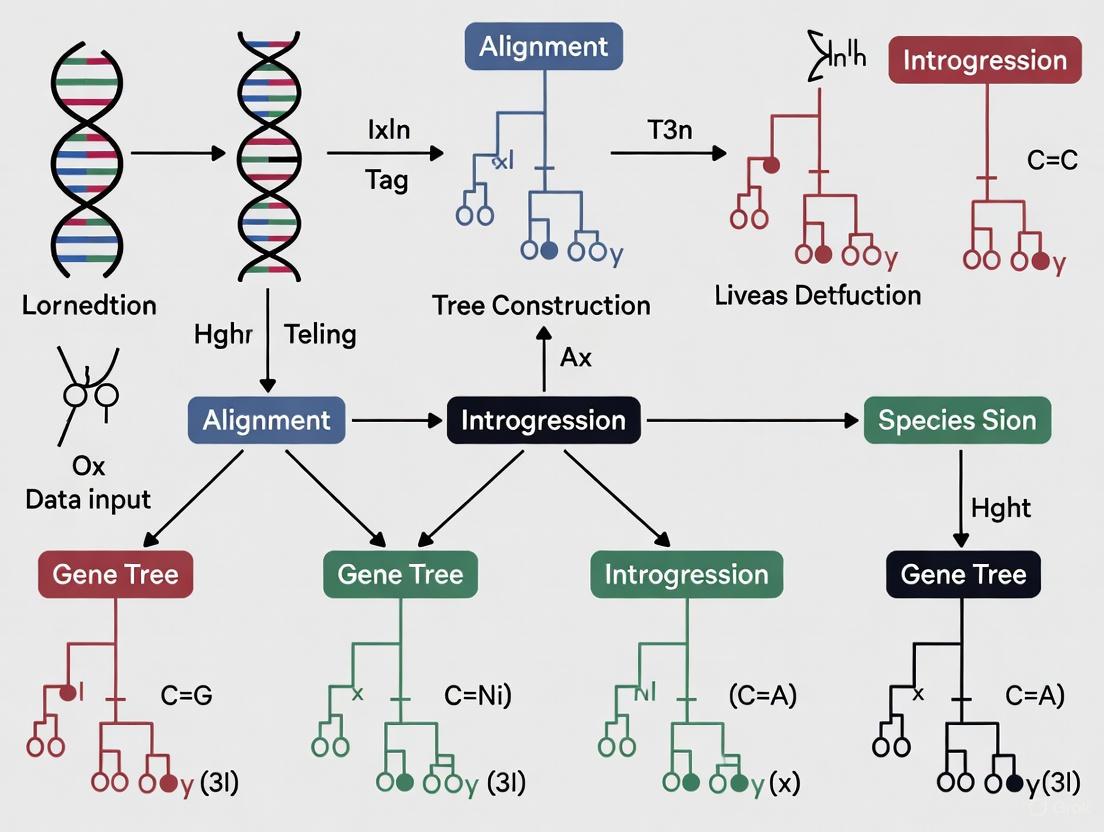
Phylogenomic introgression analysis is pivotal for understanding evolutionary histories, yet missing data remains a significant challenge that can bias species tree estimation and introgression detection.
Navigating the Gap: A Comprehensive Guide to Handling Missing Data in Phylogenomic Introgression Analysis
Abstract
Phylogenomic introgression analysis is pivotal for understanding evolutionary histories, yet missing data remains a significant challenge that can bias species tree estimation and introgression detection. This article provides a comprehensive framework for researchers and biomedical scientists to effectively manage and mitigate the effects of missing data. We explore the foundational sources and impacts of missing data, present a methodological overview of robust analytical tools like ASTRAL and PhyloNet-HMM, and offer practical strategies for data filtering and study design. Through comparative validation of approaches and real-world case studies from primates to plants, we deliver actionable troubleshooting and optimization protocols. This guide aims to empower professionals in generating more reliable phylogenomic inferences, which are crucial for accurate evolutionary analysis in biomedical and drug discovery research.
The Missing Data Problem: Sources, Impacts, and Fundamental Concepts in Phylogenomic Introgression
Frequently Asked Questions (FAQs)
FAQ 1: What are the primary sources of phylogenetic conflict in early-diverging lineages? In early-diverging eudicots, phylogenetic conflicts are often attributed to biological processes like Incomplete Lineage Sorting (ILS) and hybridization. Analyses of nuclear and plastid genomic data reveal widespread discordance across gene trees. ILS is prevalent when speciation events occur rapidly over short time spans, causing the stochastic sorting of ancestral polymorphisms. Hybridization, or introgression, between lineages can also lead to cytonuclear discordance, where nuclear and plastid phylogenies tell different stories [1].
FAQ 2: How can I distinguish between a technical artifact and a true biological signal of introgression? Distinguishing between the two requires a multi-faceted approach:
- Use Tree-Based Methods: Phylogenetic approaches that compare frequencies of tree topologies from across the genome can serve as a robust complement to SNP-based methods (like the ABBA-BABA test). These methods are less misled by assumptions such as identical substitution rates and absence of homoplasies, which can produce technical artifacts in simpler tests [2].
- Check for Concordance: Investigate conflicts between different data sources (e.g., nuclear vs. plastid genomes) or between different analytical methods (e.g., concatenated vs. coalescent-based species trees). Consistent signals across methods strengthen the case for a biological signal [1].
- Filter Your Data: Apply stringent filters to your genomic alignments to reduce technical noise. This includes filtering alignment blocks for a high proportion of missing data and a high frequency of recombination breakpoints, which can obscure true phylogenetic signals [2].
FAQ 3: What are the best practices for filtering genomic alignment blocks for phylogenomic analysis? Alignment blocks should be filtered to minimize missing data and reduce the probability of within-alignment recombination, which can distort phylogenetic inference. A common practice is to:
- Extract alignment blocks of a specific length (e.g., 1,000 bp as a compromise between information content and recombination probability).
- Quantify signals of recombination per alignment.
- Remove those alignments for which recombination signals are the strongest. This process helps identify the most suitable alignment blocks for generating reliable gene trees [2].
FAQ 4: My species tree shows short branches and low support for early-diverging lineages. What does this indicate? Short branches separating families or major lineages strongly indicate a rapid radiation event. This means the divergences happened in quick succession over a short evolutionary time span. Such a scenario is a perfect breeding ground for Incomplete Lineage Sorting (ILS), as the short time between speciation events did not allow for the complete sorting of ancestral genetic polymorphisms. This makes resolving the true species tree particularly challenging [1].
Troubleshooting Guides
Issue 1: Handling Incomplete Lineage Sorting (ILS) in Species Tree Estimation
Problem: Widespread gene tree discordance due to ILS is obscuring the true species phylogeny.
Solution: Employ coalescent-based species tree estimation methods that are specifically designed to account for ILS.
- Step 1: Generate a set of gene trees from multiple alignment blocks across the genome [2].
- Step 2: Use a tool like ASTRAL to estimate the species tree. ASTRAL is efficient and accurate for estimating species trees from gene trees while accounting for ILS [2].
- Step 3: Assess the support for the inferred species tree and quantify the degree of discordance among gene trees.
Issue 2: Detecting and Verifying Introgression
Problem: Suspected hybridization or introgression is causing phylogenetic inconsistencies.
Solution: Use a combination of SNP-based and tree-based methods to test for introgression.
- Step 1: D-statistic (ABBA-BABA) Test: Begin with this SNP-based test to get an initial signal of introgression [2].
- Step 2: Tree-Based Verification: Complement the SNP test with phylogenetic analyses to verify the signal.
- Step 3: Model Comparison: Compare the support for a pure bifurcating species tree model against a phylogenetic network model that includes introgression events.
Experimental Protocols
Protocol 1: Tree-Based Introgression Detection from a Whole-Genome Alignment
This protocol outlines a method for detecting past introgression events using phylogenies inferred from across the genome [2].
1. Software Requirements
- PAUP*: A general-utility program for phylogenetic inference.
- IQ-TREE: A modern tool for rapid phylogenetic inference under maximum likelihood.
- ASTRAL: A program for accurate estimation of species trees from gene trees.
- PhyloNet: A tool for the inference of species trees and networks.
- FigTree: A program for visualizing phylogenies.
2. Dataset Preparation
- Obtain a whole-genome alignment file (e.g., in MAF format). The example dataset consists of five species of the cichlid genus Neolamprologus and an outgroup, Nile tilapia, mapped to a single chromosome [2].
3. Generating Gene Trees
- Extract Alignment Blocks: Use a script to extract alignment blocks (e.g., 1,000 bp) from the whole-genome alignment.
- Filter Alignments: Filter the alignment blocks for completeness (low proportion of missing data) and a low frequency of recombination breakpoints [2].
- Infer Phylogenies: For each selected alignment block, infer a maximum likelihood phylogeny using IQ-TREE [2].
4. Species Tree Estimation and Introgression Analysis
- Infer Species Tree: Use ASTRAL to infer a species tree from the set of gene trees [2].
- Assess Topology Asymmetry: Analyze the set of phylogenies to determine asymmetry among alternative phylogenetic topologies for species trios. This asymmetry can indicate introgression, analogous to the D-statistic [2].
- Infer Phylogenetic Networks: Use PhyloNet to assess support for alternative models of diversification with and without introgression [2].
Protocol 2: Assessing Gene Tree Discordance and ILS
This protocol describes how to assess whether ILS is a major factor in your phylogenomic dataset [1].
1. Conduct Phylogenomic Analyses
- Perform phylogenetic analyses using both concatenated and coalescent approaches based on nuclear and plastid genomic data [1].
2. Analyze Gene Tree Discordance
- Quantify the widespread discordance observed across individual nuclear gene trees [1].
3. Perform ILS Assessment
- Use dedicated software to assess the level of incomplete lineage sorting across your lineages of interest [1].
4. Interpret Results
- If substantial ILS is detected and the lineages are separated by short branches, it is likely a primary source of the phylogenetic conflicts [1].
Data Presentation
Table 1: Key Concepts in Phylogenomic Missing Data and Artifacts
| Concept | Description | Common Causes | Impact on Phylogeny |
|---|---|---|---|
| Technical Gaps | Missing data in alignments due to sequencing or assembly issues. | Low sequencing depth, assembly fragmentation, mapping errors. | Can reduce phylogenetic resolution and introduce bias if not random. |
| Biological Absences | True evolutionary deletions of genomic regions. | Gene loss, large deletions, pseudogenization. | Provides genuine phylogenetic signal if homologous losses are shared. |
| Filtering Artifacts | Incorrect signals created by data processing steps. | Overly aggressive filtering, improper handling of recombination. | May remove true signal or create false phylogenetic relationships. |
| Incomplete Lineage Sorting (ILS) | The failure of ancestral gene lineages to coalesce in successive speciation events. | Rapid successive speciation, large ancestral population size. | Causes gene tree-species tree discordance; a primary source of phylogenetic conflict [1]. |
| Hybridization/Introgression | The transfer of genetic material between distinct lineages or species. | Interspecific hybridization, backcrossing. | Creates phylogenetic networks and can lead to cytonuclear discordance [1]. |
Table 2: Essential Software for Phylogenomic Introgression Analysis
| Software Tool | Primary Function | Use Case in Introgression Analysis |
|---|---|---|
| IQ-TREE | Maximum likelihood phylogenetic inference from molecular sequences. | Generating individual gene trees from genomic alignment blocks [2]. |
| ASTRAL | Coalescent-based species tree estimation from gene trees. | Inferring the primary species tree while accounting for ILS [2]. |
| PhyloNet | Inference of phylogenetic networks from gene trees. | Modeling and testing for hybridization/introgression events [2]. |
| PAUP* | A general-utility program for phylogenetic analysis. | Performing various phylogenetic analyses, including parsimony and likelihood [2]. |
Research Reagent Solutions
| Item | Function in Experiment |
|---|---|
| Whole-Genome Alignment | A genome-wide multiple sequence alignment used as the primary data source for extracting homologous blocks for analysis [2]. |
| Orthologous Markers | A set of single-copy genes conserved across the species of interest; an alternative data source if a whole-genome alignment is unavailable [2]. |
| Outgroup Sequence | A sequence from a species known to diverge before the lineage of interest; used to root phylogenetic trees and polarize character states [2]. |
Workflow Visualization
Diagram 1: Phylogenomic Introgression Analysis Workflow
Diagram 2: Sources of Phylogenetic Conflict
Frequently Asked Questions
FAQ: What are the primary biological causes of gene tree heterogeneity that mimic introgression? The two main biological processes causing gene tree heterogeneity are Incomplete Lineage Sorting (ILS) and introgression. ILS is the failure of gene lineages to coalesce in their immediate ancestral population, leading to discordant gene trees even in the absence of hybridization [3]. Introgression, the transfer of genetic material between species through hybridization, creates similar discordance patterns. Distinguishing between them is a central challenge, as both can produce the same genealogical patterns, making it essential to incorporate ILS into the null hypothesis for introgression tests [3] [4].
FAQ: How does missing data specifically bias tests for introgression like the D-statistic? Missing data can lead to biased and imprecise parameter estimates and reduce the statistical power of tests [5]. For methods like the D-statistic, which rely on site pattern frequencies across a quartet of species, missing data can cause systematic errors in calculating these frequencies. This may either obscure a true introgression signal or, more dangerously, create a false signal of introgression where none exists, especially if the missingness is correlated with evolutionary rate or other genomic features (Missing Not at Random) [5].
FAQ: What are the best practices for reporting missing data in phylogenomic studies? To ensure the validity and interpretability of your results, clearly report the extent of missing data. Frameworks like the CONSORT checklist for randomized trials and the STROBE checklist for observational studies mandate detailed reporting of missing data [5]. Best practices include:
- Reporting the percentage of missing data per sample and per locus.
- Describing the methods used to handle missing data (e.g., imputation, complete case analysis).
- Conducting and reporting sensitivity analyses to show how the handling of missing data affects key conclusions, such as the evidence for introgression [6].
Troubleshooting Guide: Missing Data in Phylogenomics
Problem: Inconsistent introgression signals across different genomic regions.
- Potential Cause: The distribution of missing data is not random and is correlated with genomic features like GC-content or recombination rate (Missing at Random or Missing Not at Random). This can skew the analysis of certain genomic windows [5].
- Solution:
- Diagnose the Mechanism: Investigate whether missing data is correlated with any measurable genomic variable.
- Use Model-Based Imputation: Employ multiple imputation methods that include covariates related to the missingness structure. These can provide less biased results than simple deletion or mean imputation [5].
- Validate with Robust Methods: Use methods less sensitive to missing data, such as maximum likelihood techniques that can utilize the full dataset, including observations with missing values, to obtain unbiased parameter estimates if the model is well-specified and data are MAR [5].
Problem: High levels of phylogenetic discordance are misinterpreted as evidence of rampant introgression.
- Potential Cause: Extensive Incomplete Lineage Sorting (ILS) following a rapid evolutionary radiation can create widespread discordance that is not due to recent gene flow [4]. Missing data can exacerbate this by making it harder to accurately estimate gene tree topologies and frequencies.
- Solution:
- Test for ILS: Use coalescent-based model selection tools to determine if the observed discordance is better explained by ILS alone or requires the inclusion of introgression [3] [4].
- Leverage Organellar Genomes: Compare nuclear phylogenies with those from chloroplast or mitochondrial genomes, which have different inheritance patterns. Discordance between these can help pinpoint the source of conflict [4].
- Check for Ancient Introgression: Be aware that your analyses may be detecting ancient introgression among ancestral lineages, followed by ILS, rather than recent post-speciation gene flow [4].
Problem: Reduced statistical power to detect introgression.
- Potential Cause: A high proportion of missing data leads to a significant reduction in the effective number of loci or sites analyzed, directly reducing the power of phylogenetic and population genetic inference [5].
- Solution:
- Minimize Data Loss: During data processing, use tools that are designed to handle missing data gracefully without resorting to excessive filtering.
- Power Analysis: Conduct a power analysis by down-sampling complete datasets to understand the impact of missing data on your specific analysis.
- Employ Multiple Methods: Combine evidence from different analytical approaches (e.g., summary statistics like D-statistics, phylogenetic network inference, and linkage-based methods) that may be differentially affected by missing data to build a more robust conclusion [7].
Quantitative Impact of Missing Data and Analysis Methods
Table 1: Common Methods for Handling Missing Data in Genomic Analysis
| Method | Brief Description | Appropriate Data Mechanism | Key Advantages | Key Disadvantages |
|---|---|---|---|---|
| Complete Case Analysis | Removes any locus or sample with missing data. | MCAR | Simple to implement. | Can introduce severe bias if data is not MCAR; reduces sample size and power [5]. |
| Pairwise Deletion | Uses all available data for each specific analysis. | MCAR | Retains more data than complete case analysis. | Can lead to ambiguous sample size and biased correlation matrices [5]. |
| Single Imputation | Replaces a missing value with a single plausible value (e.g., mean, predicted value from regression). | MAR | Retains full sample size; easy to use. | Treats imputed values as real, underestimating variance and standard errors, leading to overconfident results [5]. |
| Multiple Imputation | Creates multiple copies of the dataset, each with missing values imputed with a different plausible value. | MAR | Accounts for uncertainty in the imputation process; provides valid standard errors. | Computationally intensive; requires careful implementation [5]. |
| Maximum Likelihood | Uses all available data to find parameter values that maximize the likelihood function. | MAR, MCAR | Provides unbiased parameter estimates and standard errors if the model is correct. | Can be computationally complex and relies on correct model specification [5]. |
Table 2: Impact of Missing Data on Phylogenomic Inference
| Affected Area | Consequence of High Missing Data | Potential Outcome |
|---|---|---|
| Gene Tree Estimation | Increased error in inferring the correct topology and branch lengths. | Inflated levels of inferred phylogenetic discordance [3]. |
| Species Tree Estimation | Reduced accuracy and support for species relationships. | Incorrect species tree, which is critical for properly identifying introgression [4]. |
| D-Statistic (ABBA-BABA) | Biased counts of site patterns, leading to an inaccurate D-value. | False positive or false negative detection of introgression [3]. |
| Phylogenetic Network Inference | Incorrect estimation of introgression timing, direction, and magnitude. | Mischaracterization of evolutionary history [7]. |
Experimental Protocols for Robust Analysis
Protocol 1: Diagnosing the Mechanism of Missing Data
- Data Collection: Record the proportion of missing data per individual and per genomic locus.
- Correlation Analysis: Test for correlations between the pattern of missingness and genomic variables (e.g., GC-content, coverage depth, recombination rate) or phenotypic data (e.g., sample quality).
- Classification: Classify the missing data mechanism as MCAR, MAR, or MNAR based on the absence or presence of these correlations [5].
Protocol 2: A Multi-Method Approach to Introgression Detection
- Data Preparation: Generate whole-genome sequencing data for a rooted triplet or unrooted quartet of species, including an outgroup [3].
- Variant Calling: Map reads to a reference genome and call SNPs, applying consistent quality filters while tracking missing data rates.
- Initial Test with D-Statistic: Calculate the D-statistic to test for a significant excess of shared derived alleles between non-sister species [3].
- Model-Based Inference: Use a coalescent-based model (e.g., in a phylogenetic network package) to infer the species phylogeny and test for introgression, explicitly accounting for ILS [3] [7].
- Sensitivity Analysis: Re-run analyses under different missing data filters or imputation strategies to assess the robustness of the introgression signal [6].
The Scientist's Toolkit: Research Reagent Solutions
Table 3: Essential Computational Tools for Introgression Analysis
| Tool / Resource | Function | Application in Introgression Research |
|---|---|---|
| Whole-Genome Sequencing Data | Provides the raw genomic information from multiple individuals and species. | The fundamental data source for detecting introgressed loci and estimating gene tree heterogeneity [4]. |
| Reference Genome | A high-quality assembled genome for read mapping and variant calling. | Serves as a coordinate system for aligning sequences and identifying genetic variants; crucial for quantifying discordance [4]. |
| Coalescent Model Software | Software packages that implement the multi-species coalescent with introgression. | Used to infer phylogenetic networks and distinguish introgression from ILS (e.g., PhyloNet, BPP) [3]. |
| Summary Statistics Packages | Programs to calculate statistics like the D-statistic (e.g., Dsuite). | Provide a simple and powerful test for introgression based on site patterns [7]. |
| Multiple Imputation Software | Tools for creating multiple imputed datasets (e.g., in R or Python). | Handles missing data appropriately to prevent bias in downstream population genetic analyses [5]. |
Workflow and Relationship Diagrams
In phylogenomic research, a frequently encountered challenge is the incongruence between gene trees and the species tree. Two major biological processes responsible for this are Incomplete Lineage Sorting (ILS) and introgression. ILS is the failure of ancestral genetic polymorphisms to coalesce (reach a common ancestor) within the population divergence time, leading to the retention of ancestral genetic variation across speciating lineages [8] [9]. In contrast, introgression (or reticulate evolution) is the transfer of genetic material between species through hybridization, followed by backcrossing [10]. While ILS is a stochastic process dependent on population size and generation time, introgression involves actual gene flow between populations.
Distinguishing between these processes is crucial for accurately reconstructing evolutionary history but is often complicated by missing data. Uneven data coverage, common when combining modern and historical specimens, can skew phylogenetic relationships and obscure the true signal [11]. For instance, in a study of lories and lorikeets, topological differences between trees were driven by genomic sites where historical samples had 10.9 times more missing data than modern ones [11]. This technical guide provides targeted FAQs and protocols to help researchers navigate these complex analyses.
Frequently Asked Questions (FAQs) & Troubleshooting
Q1: My phylogenetic trees show widespread incongruence. How can I tell if missing data is the cause, rather than a biological process like ILS?
A: Incongruence due to missing data is often technically driven and non-randomly distributed.
- Symptom: You observe that relationships in your tree are correlated with data completeness (e.g., historical specimens with high missing data cluster together artificially) rather than with established taxonomy or geography [11].
- Diagnosis: Perform an outlier analysis of sites and loci. A small percentage of sites or loci (e.g., 0.15% of sites or 38% of loci, as found in one study) may be disproportionately driving the topological differences. These outlier regions will typically show a strong correlation between high missing data and the spurious signal [11].
- Solution: Apply data completeness filters. One study found that requiring at least 70% data completeness per site was necessary to avoid spurious relationships. You can create a series of alignments with varying completeness thresholds (e.g., 50%, 70%, 90%) to test the stability of your inferred relationships [11].
Q2: My genomic data suggests shared genetic variation between species. What analyses can help me determine if this is due to ILS or introgression?
A: You need to use a combination of population genetic and phylogenetic network methods.
- For Introgression: The D-statistic (ABBA-BABA test) is a powerful and widely used method to test for introgression between two closely related species using a third (outgroup) species. A significant D-statistic indicates an excess of shared derived alleles between two species, which is a signature of introgression [10] [9]. For deeper insights, Phylogenetic Network analyses (e.g., using tools like PhyloNet or SplitsTree) can visualize conflicting signals that may represent reticulate evolutionary events [10].
- For ILS: The Multi-Species Coalescent (MSC) model, implemented in software like ASTRAL, explicitly accounts for ILS when inferring the species tree from multiple gene trees [10]. Furthermore, QuIBL (Quantifying Introgression via Branch Lengths) can be used to distinguish ILS from introgression by examining the distribution of branch lengths in gene trees [10].
- Comparative Approach: If you have geographic data, compare parapatric (adjacent) and allopatric (geographically separated) populations. Higher admixture and lower interspecific differentiation in parapatry suggest secondary contact and introgression, whereas even sharing of polymorphisms across all populations is more consistent with ILS [8].
Q3: I am studying a recent, rapid radiation. Is ILS or introgression more likely to be a problem?
A: Incomplete Lineage Sorting is particularly pervasive in recent, rapid radiations. Short speciation intervals do not provide enough time for ancestral polymorphisms to sort out (coalesce) in the descendant lineages [9]. This leads to extensive gene tree discordance even in the absence of any gene flow. For example, research on Aspidistra plants in Taiwan revealed a well-supported species tree but also a high proportion of genes affected by ILS, a common feature of recent divergences [9]. In such cases, using MSC-based species tree methods is essential.
Essential Experimental Protocols
Protocol for a Basic Phylogenomic Analysis Pipeline Accounting for ILS and Missing Data
This protocol outlines a standard workflow for analyzing multi-locus data where ILS and missing data are concerns.
1. Dataset Assembly and Orthology Assessment:
- Assemble your genomic dataset (e.g., from UCEs, transcriptomes, or other NGS methods).
- Use rigorous orthology assessment tools (e.g., OrthoFinder, HybPiper) to identify orthologous genes or loci and avoid confounding signals from paralogous genes.
2. Alignment and Filtering:
- Align sequences for each locus using aligners like MUSCLE or MAFFT.
- Critically, filter for missing data. Generate multiple alignments with different data completeness thresholds (e.g., 50%, 70%, 90% site coverage) to test the robustness of your results [11].
3. Gene Tree and Species Tree Inference:
- Estimate individual maximum likelihood (ML) gene trees for each locus.
- Reconstruct the species tree using both concatenation (e.g., RAxML, IQ-TREE) and Multi-Species Coalescent methods (e.g., ASTRAL-III). A large discrepancy between concatenated and MSC trees can indicate high levels of ILS [10].
4. Quantifying Discordance and Testing for Introgression:
- Calculate gene tree discordance metrics like site concordance factors (sCF) to identify nodes in the tree with high conflict [10].
- Apply the D-statistic to test for introgression between specific taxon pairs [10] [9].
- Use phylogenetic network approaches to visualize potential reticulate evolution [10].
5. Outlier Analysis:
- If missing data is a suspected issue, perform site-wise and locus-wise likelihood outlier analyses to identify and remove data partitions that are disproportionately driving topological instability [11].
The following workflow diagram illustrates the key steps and decision points in this protocol.
Protocol for Distinguishing ILS from Introgression Using Population Genetic Data
This protocol is applied when you have population-level sampling for closely related species or populations.
1. Sampling Strategy:
- Sample multiple individuals from each species. If possible, include populations from both allopatric and potential parapatric (contact) zones [8].
2. Genetic Data Generation:
- Sequence multiple independent loci (e.g., introns, UCEs) across the genome to capture genome-wide variation.
3. Population Structure Analysis:
- Use programs like STRUCTURE or ADMIXTURE to visualize individual ancestry and identify admixed individuals. Higher admixture in parapatric populations suggests ongoing introgression [8].
4. Comparative Population Genetic Analysis:
- Calculate measures of genetic differentiation (e.g., FST) between species pairs in allopatry versus parapatry. Significantly lower FST in parapatry is a strong indicator of gene flow [8].
5. Demographic Modeling:
- Use Approximate Bayesian Computation (ABC) or similar model-based approaches (e.g., implemented in DIYABC or fastsimcoal2) to compare different demographic scenarios. Models compared typically include:
- Strict isolation (ILS only)
- Isolation-with-migration (continuous gene flow)
- Secondary contact (introgression after a period of isolation) [8]
- The best-supported model will indicate whether ILS alone is sufficient to explain the data or if introgression is required.
Research Reagent Solutions & Essential Materials
The table below summarizes key bioinformatic tools and analytical concepts used in distinguishing ILS and introgression.
Table 1: Key Research Reagents and Analytical Tools for Phylogenomic Conflict Analysis
| Tool / Concept | Type | Primary Function | Key Consideration |
|---|---|---|---|
| ASTRAL [10] | Software | Infers the species tree from multiple gene trees under the Multi-Species Coalescent (MSC) model, explicitly accounting for ILS. | Highly accurate under high levels of ILS; requires a set of pre-inferred gene trees. |
| D-statistic (ABBA-BABA) [12] [9] | Statistical Test | Detects genome-wide and locus-specific signals of introgression by testing for an excess of shared derived alleles between species. | Requires a specific four-taxon structure (P1, P2, P3, Outgroup); can be confounded by high levels of ILS. |
| PhyloNet [10] | Software | Infers and visualizes phylogenetic networks to represent evolutionary histories that include reticulation events (hybridization/introgression). | Computationally intensive for large datasets; excellent for visualizing complex relationships. |
| Approximate Bayesian Computation (ABC) [8] | Statistical Framework | Compares complex demographic models (e.g., isolation vs. secondary contact) to infer historical population sizes, split times, and migration rates. | Model choice and prior specification are critical; requires programming and statistical expertise. |
| Site Concordance Factor (sCF) [10] | Metric | Quantifies the percentage of decisive alignment sites supporting a given branch in a reference tree, helping to pinpoint nodes with high gene tree conflict. | Useful for identifying "weak" links in a phylogeny that may be influenced by ILS or introgression. |
The following table consolidates key quantitative findings from recent studies on ILS, introgression, and the impact of missing data.
Table 2: Summary of Quantitative Findings from Phylogenomic Studies
| Study System | Key Finding | Metric | Value | Implication |
|---|---|---|---|---|
| Lories & Lorikeets [11] | Impact of Missing Data | Increased missing data in historical vs. modern samples at outlier sites | 10.9x | Highlights how uneven data quality can skew phylogenetic inference. |
| Data Filtering Threshold | Minimum data completeness to avoid spurious relationships | 70% | Suggests a practical threshold for filtering genomic alignments. | |
| Aspidistra (Taiwan) [9] | Gene Tree Discordance | Proportion of genes not rejecting an alternative topology for non-monophyletic varieties | 20.8% | Illustrates the substantial role of ILS in recent plant radiations. |
| Lories & Lorikeets [11] | Outlier Influence | Proportion of total sites driving topological differences | 0.15% | A very small number of sites can greatly impact the tree. |
| Proportion of loci driving topological differences | 38% | A large fraction of loci can be involved in conflicting signals. | ||
| Pine Species (P. massoniana & P. hwangshanensis) [8] | Population Differentiation | Lower interspecific differentiation in parapatry vs. allopatry | (Lower) | Supports a model of secondary contact and introgression over pure ILS. |
Core Concepts: Data Completeness in Phylogenomics
FAQ: What is the impact of missing data on phylogenomic tree robustness?
Non-randomly distributed missing data is a significant source of error in phylogenomic inference. When missing data is unevenly distributed across taxa—particularly when comparing historical versus modern samples—it can create spurious phylogenetic relationships that do not reflect true evolutionary history. Studies on parrot phylogenomics demonstrated that trees estimated with low-coverage characters showed several clades where relationships appeared to be influenced by whether the sample came from historical or modern specimens, a bias that disappeared when more stringent filtering was applied [11].
FAQ: How do incomplete lineage sorting and introgression complicate phylogenetic inference?
Evolutionary processes like Incomplete Lineage Sorting (ILS) and introgression create legitimate gene tree discordance that can be mistaken for technical artifacts. ILS occurs when ancestral genetic polymorphisms persist through rapid speciation events, leading to gene trees that differ from the species tree. Phylogenomic analyses of primates have revealed high levels of genealogical discordance associated with multiple rapid radiations, requiring specialized methods to distinguish biological conflict from technical issues [13]. Similarly, studies of Fagaceae have demonstrated introgression at multiple evolutionary timescales, including ancient events predating genus-level diversity [14].
Troubleshooting Guides
Problem: Inconsistent Topologies with Varying Data Completeness Thresholds
Symptoms: Tree topology changes significantly when altering missing data thresholds; support values fluctuate dramatically; historical and modern samples cluster separately without biological justification.
Diagnosis and Solutions:
| Step | Procedure | Rationale | Expected Outcome |
|---|---|---|---|
| 1 | Identify outlier sites/loci driving topological differences using likelihood-based outlier tests (e.g., as implemented for lories and lorikeets) | A small subset of loci (0.15% of sites or 38% of loci in one study) may drive spurious relationships where historical samples had 10.9× more missing data than modern ones [11] | Identification of problematic alignment regions disproportionately affected by missing data |
| 2 | Apply a 70% data completeness threshold per site | This threshold was necessary to avoid spurious relationships in brush-tongued parrot phylogenomics [11] | Stabilization of tree topology across analyses |
| 3 | Implement multi-classification-based branch length reshaping (e.g., as in PhyloScape) | Resolves branch length heterogeneity by grouping branches into multiple classes using adaptive length intervals [15] | Improved interpretability of evolutionary relationships in trees with heterogeneous branch lengths |
| 4 | Compare trees from filtered and unfiltered datasets using tree distance metrics | Quantifies the impact of missing data on phylogenetic inference [11] | Objective measurement of topological stability |
Problem: Detecting Ancient Introgression Despite Missing Data
Symptoms: Conflicting signal between different genomic regions; asymmetric gene tree discordance around specific branches; difficulty distinguishing introgression from ILS.
Diagnosis and Solutions:
| Step | Procedure | Rationale | Expected Outcome |
|---|---|---|---|
| 1 | Use strongly asymmetric patterns of gene tree discordance around specific branches | Strongly asymmetric discordance can identify introgression between ancestral primate lineages [13] | Preliminary evidence for ancient introgression rather than ILS |
| 2 | Apply modified D-statistics and related methods for genome-scale data | These methods can detect introgression that occurred deeper in time, beyond recent hybridization events [13] | Identification of ancient introgression events |
| 3 | Analyze phylogenetic trees in context of fossil calibrations | Fossil evidence provides independent temporal framework for molecular dating analyses [13] [14] | More accurate estimation of divergence times and introgression events |
| 4 | Use concordance factors to quantify heterogeneity | Quantifies the proportion of gene trees supporting particular relationships [13] | Assessment of phylogenetic conflict across the genome |
Experimental Protocols for Robust Phylogenomics
Protocol: Assessing and Managing Missing Data in Phylogenomic Analyses
Purpose: To establish a standardized workflow for evaluating and mitigating the impacts of missing data on phylogenetic inference.
Materials:
- Genomic datasets (e.g., UCEs, whole genomes, transcriptomes)
- Multiple sequence alignments
- High-performance computing resources
Procedure:
Data Completeness Threshold Guidelines:
| Data Type | Minimum Completeness | Recommended Completeness | Special Considerations |
|---|---|---|---|
| UCEs from historical specimens | 50% | 70% | Below 70% risks spurious relationships [11] |
| Whole genome sequences | 60% | 80% | Higher thresholds possible with abundant data |
| RAD-seq data | 40% | 60% | Higher missingness often tolerated |
| Multi-species coalescent | 50% | 75% | Per-locus completeness crucial |
Protocol: Distinguishing Introgression from Incomplete Lineage Sorting
Purpose: To differentiate between two major biological sources of gene tree discordance.
Methodology:
- Gene Tree Estimation: Infer individual gene trees from genome-wide loci [13]
- Quantify Discordance: Calculate gene tree heterogeneity across the genome
- Test for Asymmetry: Identify strongly asymmetric patterns of gene tree discordance around specific branches [13]
- Apply Introgression Tests: Use D-statistics and related methods to test for directional gene flow
- Compare with Expectations: Contrast observed patterns with simulations of ILS versus introgression
Research Reagent Solutions
Essential Software and Tools for Phylogenomic Analysis
| Tool | Function | Application in Missing Data Context |
|---|---|---|
| PhyloScape | Interactive tree visualization with missing data optimization | Implements multi-classification branch length reshaping for heterogeneous data [15] |
| ASTRAL | Species tree estimation from gene trees | Robust to incomplete gene trees under multi-species coalescent [16] [17] |
| ggtree (R) | Phylogenetic tree visualization and annotation | Enables visualization of missing data patterns and tree annotation [18] |
| Phylemon 2.0 | Integrated phylogenetic analysis suite | Provides pipeline for alignment, trimming, and phylogenetic inference [19] |
| Treeio (R) | Integration of phylogenetic data from different sources | Addresses incompatible and inconsistent formats in phylogenetic trees and data [18] [17] |
| IQ-TREE | Maximum likelihood phylogenomic inference | Implements model testing and ultrafast bootstrapping [16] [17] |
| TrimAl | Automated alignment trimming | Removes spurious sequences or poorly aligned regions [19] |
Analytical Methods for Handling Missing Data
| Method | Principle | Implementation Considerations |
|---|---|---|
| Outlier Analysis | Identifies sites or loci disproportionately driving topological differences | In lories/lorikeets, 0.15% of sites or 38% of loci were driving differences [11] |
| Data Completion Thresholds | Applies minimum data completeness filters | 70% completeness threshold prevented spurious relationships [11] |
| Branch Length Reshaping | Normalizes heterogeneous branch lengths using multiple classification | Improves interpretability of trees with extreme branch length variation [15] |
| Concordance Factors | Quantifies gene tree support for specific relationships | Helps distinguish technical artifacts from biological conflict [13] |
Robust Methodologies: Tools and Techniques for Introgression Analysis with Incomplete Data
In the field of phylogenomics, accurately estimating the species tree—the evolutionary history of a set of species—is a fundamental goal. However, this process is often complicated by the pervasive issue of gene tree discordance, where evolutionary histories of individual genes differ from the overall species history. Two major biological processes cause this discordance: Incomplete Lineage Sorting (ILS) and introgression (or hybridization) [20]. The multi-species coalescent (MSC) model provides a mathematical framework to understand and account for ILS, leading to the development of powerful, statistically consistent species tree estimation methods [21] [22].
ASTRAL (Accurate Species TRee ALgorithm) is a leading coalescent-based method that estimates the species tree by finding the tree that shares the maximum number of induced quartet trees with a set of input gene trees [23] [24]. Its statistical consistency under the MSC model, computational efficiency, and robustness have made it a popular choice for genome-scale analyses. A common challenge in real-world phylogenomic studies is missing data—the absence of gene sequence data for some species in some loci. This guide addresses how researchers can effectively use ASTRAL to leverage gene trees despite missing loci, a critical consideration for robust phylogenomic analysis, particularly in studies investigating introgression.
FAQs on ASTRAL and Missing Data
1. How does ASTRAL maintain statistical consistency in the presence of missing data?
Statistical consistency means that as the number of genes increases, the probability of recovering the true species tree approaches one. ASTRAL belongs to a class of "tuple-based" methods, which operate by computing summary statistics for subsets of species (e.g., quartets) and then use these to estimate the species tree [21]. Research has shown that for a method to be statistically consistent under models of missing data (e.g., the Miid model, where each species is missing from each gene independently with probability p), the summary statistics it calculates must not be impacted by deleting species outside the subset of interest [21]. ASTRAL's quartet-based approach generally fulfills this criterion. However, it is crucial to note that NJst and ASTRID, two other coalescent-based methods, have been shown not to be statistically consistent under a random model of missing data, as the internode distance matrix they use can converge to a matrix that is additive for an incorrect species tree topology [25].
2. What is the practical impact of large amounts of missing data on ASTRAL's accuracy?
Simulation studies indicate that ASTRAL and other coalescent-based methods can remain highly accurate even with substantial missing data. One key study found that these methods "improved in accuracy as the number of genes increased and often produced highly accurate species trees even when the amount of missing data was large" [21]. The number of genes is often more critical for accuracy than complete data matrices. Therefore, researchers should prioritize sampling more loci over achieving a perfectly complete data matrix, as ASTRAL can effectively integrate information across many genes, even if each gene has incomplete taxon sampling.
3. Can ASTRAL handle multiple individuals (alleles) per species, and how does this relate to missing data?
Yes, a multi-allele version of ASTRAL has been developed to handle datasets where multiple individuals are sampled per species [24]. This is relevant for probing species boundaries or accounting for polymorphisms. When using this feature, the quartet optimization problem extends naturally. However, building the search space for the algorithm becomes more complex. The method employs heuristics, such as subsampling individuals, to build a constrained search space. Interestingly, empirical studies suggest that sampling more genes is generally more effective for accuracy than sampling more individuals per species, even under high ILS conditions [24]. This finding reinforces the strategy of maximizing locus coverage.
4. In the context of suspected introgression, can I trust a species tree estimated by ASTRAL with missing data?
ASTRAL is a species tree estimation method and does not explicitly model introgression. It assumes that gene tree discordance is solely due to ILS. If hybridization is present, the output of ASTRAL should be interpreted as a "species tree" that represents the dominant evolutionary history, while acknowledging that some discordance might be due to reticulate evolution [20] [26]. In such cases, the species tree estimated by ASTRAL serves as a critical backbone for subsequent network-based analyses that explicitly test for and quantify introgression [20]. The robustness of ASTRAL to missing data makes it a reliable tool for establishing this foundational phylogenetic hypothesis even with imperfect datasets.
Troubleshooting Common Experimental Issues
Problem 1: Inaccurate Species Tree Despite Many Genes
- Symptoms: The estimated species tree is inconsistent with well-established clades or has low support values.
- Potential Causes and Solutions:
- Cause: High gene tree estimation error (GTE). If the individual gene trees provided to ASTRAL are inaccurate, the summary will be biased.
- Solution: Increase the accuracy of input gene trees. For sequence data, use longer gene alignments or more sophisticated phylogenetic models. If genes are too short, consider alternative methods like SVDquartets that bypass gene tree estimation by using site patterns directly, though note that ASTRAL often outperforms SVDquartets except under conditions of very low ILS or extremely short sequences [22].
- Cause: Model violation due to strong introgression.
- Solution: Use the ASTRAL tree as a reference and perform additional tests for introgression (e.g., using PhyloNet or D-statistics) to determine if discordant genes are concentrated in specific branches, potentially indicating hybridization [20] [26].
Problem 2: Handling a Dataset with Highly Heterogeneous Missingness
- Symptoms: Data matrix where some genes are missing many taxa, and some taxa are missing from many genes.
- Potential Causes and Solutions:
- Solution: ASTRAL is inherently designed to handle this. No special action is needed beyond providing the full set of inferred gene trees. ASTRAL will automatically consider the available taxa for each quartet.
- Solution: Ensure your data does not systematically exclude specific taxa. Under the "full subset coverage" (Mfsc) model, every subset of k species should have a non-zero probability of being present in the data for a randomly selected gene. Biased taxon deletion can violate the assumptions for consistency [21].
Problem 3: Software and Input Formatting Issues
- Symptoms: ASTRAL fails to run or produces unexpected errors.
- Potential Causes and Solutions:
- Cause: Incorrect input format for multi-individual datasets.
- Solution: For standard (single-individual) analyses, gene trees must be singly-labeled with species names. For multi-individual analyses, gene trees can be multi-labeled with species names or labeled with individual names accompanied by a mapping file. Consult the official ASTRAL documentation for the precise syntax.
Performance Comparison of Coalescent Methods Under Challenging Conditions
The table below summarizes the performance of various species tree estimation methods based on simulation studies, highlighting their behavior in the presence of missing data and other challenging conditions.
Table 1: Performance Comparison of Species Tree Estimation Methods
| Method | Type | Handling of Missing Data | Key Strengths | Key Limitations / Cautions |
|---|---|---|---|---|
| ASTRAL | Summary Method (quartet-based) | Robust. Statistically consistent under some models of random taxon deletion [21]. | Fast, highly accurate, scalable to thousands of genes, robust to anomaly zone [23] [27]. | Accuracy depends on quality of input gene trees [22]. Does not model introgression. |
| ASTRID | Summary Method (distance-based) | Not consistent. Can be positively misleading under random taxon deletion [25]. | Very fast and accurate in the absence of missing data [21]. | Not statistically consistent under the MSC + Miid missing data model [25]. |
| NJst | Summary Method (distance-based) | Not consistent. Can be positively misleading under random taxon deletion [25]. | Scalable and can handle multi-individual datasets [24]. | Not statistically consistent under the MSC + Miid missing data model [25]. |
| SVDquartets | Single-site Method (quartet-based) | Likely robust as it uses site patterns directly. | Bypasses gene tree estimation error; good for very short loci [22]. | Generally less accurate than ASTRAL under higher ILS; can be computationally intensive for large taxa sets [22]. |
| Concatenation | Supermatrix | Robust to missing sequence data. | Often most accurate under very low ILS levels [22]. | Not statistically consistent under MSC; can be strongly misleading in anomaly zones or with high ILS [20] [22] [28]. |
| STELAR | Summary Method (triplet-based) | Information not available in search results, but likely similar to ASTRAL. | Statistically consistent under MSC; accuracy matches ASTRAL [27]. | Less established and widely used compared to ASTRAL. |
Experimental Protocol: Estimating a Species Tree with ASTRAL from Raw Sequence Data
This protocol outlines the key steps for a typical ASTRAL analysis, from raw sequence data to a finalized species tree, with special considerations for managing missing data.
Workflow Overview
The following diagram illustrates the complete workflow for species tree estimation using ASTRAL, from data collection to final tree assessment.
Step-by-Step Instructions
Data Collection and Alignment
- Assemble your multi-locus genomic dataset (e.g., UCEs, exons, genes).
- For each locus, create a multiple sequence alignment using tools like MAFFT or MUSCLE.
- Do not discard a locus simply because it is missing some taxa. ASTRAL can work with partially overlapping taxon sets.
Gene Tree Estimation
- Estimate an unrooted gene tree for each aligned locus using a maximum likelihood method like RAxML or IQ-TREE.
- It is good practice to also perform bootstrapping (e.g., 100 replicates) for each gene tree to assess their individual confidence. These bootstrap replicates can later be used by ASTRAL to compute measures of support for the species tree.
Prepare Input for ASTRAL
- Collect all the estimated best-scoring gene trees into a single, combined file. This is the primary input for ASTRAL.
- Ensure the taxon names are consistent across all gene trees.
Execute ASTRAL
- Run ASTRAL with the basic command:
java -jar astral.jar -i input_gene_trees.tre -o output_species_tree.tre - Key Options:
- To incorporate gene tree uncertainty, use the bootstrap replicates:
java -jar astral.jar -i input_gene_trees.tre -b genetrees_bootstraps.txt -o output_species_tree.tre - For multi-individual datasets, use the
-aflag with a mapping file that associates individuals with species.
- To incorporate gene tree uncertainty, use the bootstrap replicates:
- Run ASTRAL with the basic command:
Interpret the Output
- The main output is the estimated species tree in Newick format.
- Branch supports: ASTRAL provides local posterior probabilities for each branch. These values represent the confidence for each branch in the species tree given the input gene trees.
Research Reagent Solutions
This table lists key computational tools and resources essential for conducting a phylogenomic analysis with ASTRAL.
Table 2: Essential Research Reagents for Coalescent-Based Phylogenomics
| Reagent / Resource | Type | Function / Application | Key Feature |
|---|---|---|---|
| ASTRAL [23] | Software Package | Estimates the species tree from a set of unrooted gene trees. | Statistically consistent, quartet-based, robust to missing data. |
| RAxML/IQ-TREE | Software Package | Estimates maximum likelihood gene trees from individual sequence alignments. | Provides the primary gene tree inputs for ASTRAL. |
| PhyloNet [26] | Software Package | Infers phylogenetic networks and tests for hybridization/introgression. | Used to validate and interpret discordance not explained by ILS. |
| SimPhy | Software Package | Simulates species trees and gene trees under the MSC model. | Used in performance studies to benchmark methods [24]. |
| Unlinked SNP Data | Data Type | Input for methods like SVDquartets and SNAPP that bypass gene tree estimation. | Useful when recombination breaks loci into very short, unlinked SNPs [22]. |
| Multi-individual Mapping File | Data File | A text file mapping individual names to species names. | Required for ASTRAL to analyze multi-allele datasets [24]. |
PhyloNet is a comprehensive software package designed for the analysis and reconstruction of reticulate evolutionary relationships, or evolutionary networks. It represents these relationships as rooted, directed, acyclic graphs, with leaves labeled by a set of taxa. The toolkit provides utilities for network representation, characterization, comparison, and reconstruction, and is particularly useful for detecting processes like hybridization, horizontal gene transfer, and introgression that cannot be adequately represented by tree-like structures alone [29] [30].
SNaQ (Species Networks applying Quartets) implements a statistical method for inferring phylogenetic networks from multi-locus genetic data within a pseudolikelihood framework. This approach accounts for incomplete lineage sorting through the coalescent model and for horizontal gene inheritance through reticulation nodes in the network. A significant advantage of SNaQ is its computational efficiency, as it avoids the burdensome calculation of the full likelihood, which can become intractable with many species. The method operates by deriving the proportion of the genome that has each 4-taxon tree (quartet concordance factors) as expected under the coalescent model extended by hybridization events [31].
Table: Comparison of PhyloNet and SNaQ Core Features
| Feature | PhyloNet | SNaQ |
|---|---|---|
| Primary Method | Maximum parsimony, likelihood, pseudo-likelihood, Bayesian inference | Maximum pseudolikelihood under incomplete lineage sorting |
| Computational Approach | Full likelihood (can be computationally heavy) | Quartet-based pseudolikelihood (faster and more scalable) |
| Key Advantage | Array of utilities for different analysis types | Speed and scalability to many species and loci |
| Biological Processes Modeled | Incomplete lineage sorting (ILS) and introgression | ILS and horizontal inheritance through reticulation |
| Typical Use Case | Smaller scenarios (up to ~10 species, 4 hybridizations) with full likelihood | Larger datasets with many species and loci |
Installation and Setup Guide
System Requirements and Installation
PhyloNet Installation:
- Requires Java 1.8.0 or later
- Download the PhyloNet JAR file (typically named
PhyloNet_X.Y.Z.jar) - Execute using the command:
java -jar $PHYLONET_DIRECTORY/PhyloNet_X.Y.Z.jar script.nex[29]
SNaQ Installation (via PhyloNetworks in Julia):
- Configure the primary environment using Conda:
conda create -n phylo python=3.8 - Install necessary dependencies: RAxML, Julia, BUCKy, and other utilities
- In Julia, install the PhyloNetworks package and related dependencies:
Frequently Asked Questions (FAQs)
Q1: What types of reticulate evolutionary events can PhyloNet and SNaQ detect?
Both tools can model various biological processes causing gene flow, including hybridization (when individuals from two genetically distinct populations interbreed, resulting in a new separate population), introgression or introgressive hybridization (the integration of alleles from one population into another through hybridization and backcrossing), and horizontal gene transfer (when genes are acquired by a population through a process other than reproduction). Although these processes are biologically distinct, the network model does not always distinguish between them unless additional biological information is provided [31].
Q2: How do I choose between maximum pseudolikelihood (MPL) in PhyloNet and SNaQ?
The choice depends on your data size and research goals. SNaQ uses a pseudolikelihood approach based on quartet concordance factors, making it significantly faster and more scalable to many species and loci [31]. PhyloNet's MPL implementation is part of a broader toolkit that includes other inference methods (parsimony, full likelihood, Bayesian). For larger datasets or when beginning exploratory analyses, SNaQ is often preferable. PhyloNet offers more comprehensive model options for deeper analysis once key relationships are identified.
Q3: What are the key challenges in detecting ghost introgression, and how can these tools help?
Ghost introgression (gene flow from extinct or unsampled species) presents particular challenges because methods relying solely on gene tree topology information often cannot accurately distinguish between different gene flow scenarios. Research has shown that both heuristic methods (like HyDe and PhyloNet/MPL) and SNaQ may struggle to differentiate ghost introgression from non-sister species introgression. A recommended strategy is to first use fast gene flow detection methods (like D-statistic, PhyloNet-MPL, or PhyloNetwork-SNaQ) to identify the presence of gene flow and potentially involved species, then apply full-likelihood methods like BPP to specific three-species scenarios with multilocus sequence data to confirm the gene flow scenario and identify contributors (including ghost lineages) [32].
Q4: How can I visualize the networks generated by these tools?
PhyloNet generates phylogenetic networks in Rich Newick format, which can be visualized using Dendroscope or icytree. Note that you may need to remove inheritance probabilities (using the -di option) for compatibility with some visualization tools [29]. For SNaQ, the PhyloPlots package in Julia provides plotting capabilities, and you can use RCall to generate PDF or PNG outputs of your networks [33].
Troubleshooting Common Experimental Issues
Problem 1: Incomplete or Fragmentary Data Causing Unreliable Network Inference
Solution: When working with fragmentary data, consider these approaches:
- Use quartet-based methods like SNaQ that are more robust to missing data
- Implement a two-step strategy: first use fast detection methods (D-statistic, PhyloNet-MPL, SNaQ) to identify potential gene flow, then apply full-likelihood methods to critical subsets
- For PhyloNet, consider using the
InferNetwork_MPLorInferNetwork_MPcommands with the-fsoption to fix the start tree topology, which can stabilize inference with problematic data [29]
Problem 2: Computational Limitations with Large Datasets
Solution:
- For PhyloNet with large datasets, use the divide-and-conquer approach with NetMerger [29]
- For SNaQ, utilize parallel processing capabilities by adding multiple threads in Julia:
- With either tool, begin with a lower number of hybridizations (hmax) and gradually increase [33]
Problem 3: Inability to Distinguish Between Different Reticulate Scenarios
Solution: This is a common challenge, particularly with fragmentary data. Implement a multi-method approach:
- Use multiple inference methods (parsimony, likelihood, pseudolikelihood) and compare results
- Combine network inference with population genetic approaches when individual-level data is available
- Incorporate additional biological information about known hybridization barriers or historical biogeography
- For critical hypotheses, use Bayesian methods in PhyloNet (MCMCSEQ, MCMCGT, or MCMC_BiMarkers) when computationally feasible [29]
Table: Troubleshooting Guide for Common Errors
| Problem | Possible Causes | Solutions |
|---|---|---|
| Network inference fails to converge | Too many parameters for data, inappropriate hmax value, fragmentary data | Reduce hmax, fix starting topology, increase genetic loci |
| Methods confuse different gene flow scenarios | Insufficient phylogenetic signal, model misspecification | Use full-likelihood methods for critical subsets, combine multiple evidence sources |
| Excessive computation time | Too many taxa or hybridizations, inefficient search strategy | Use quartet-based methods, implement divide-and-conquer, utilize parallel processing |
| Visualization issues | Software incompatibility with network format | Simplify network output, use appropriate visualization tools |
Experimental Protocols and Workflows
Standard Protocol for Network Inference with SNaQ
Data Preparation: Convert sequence data to appropriate format (e.g., NEXUS) and ensure correct labeling [33]
Gene Tree Estimation: Estimate gene trees for each locus (using tools like RAxML or MrBayes)
Concordance Factor Calculation: Calculate quartet concordance factors using BUCKy or similar tools [33]
Network Inference: Run SNaQ analysis with progressively increasing hmax values:
Continue until the pseudolikelihood score shows diminishing returns [33]
Model Selection: Compare network scores across hmax values to identify the optimal hybridization number [33]
Visualization and Interpretation: Plot the networks and interpret biological implications
Comprehensive Analysis Workflow for Reticulate Evolution
Table: Key Software Tools for Reticulate Evolution Analysis
| Tool/Resource | Function | Application Context |
|---|---|---|
| PhyloNet | Comprehensive phylogenetic network analysis | Inference, comparison, and evaluation of reticulate evolutionary relationships |
| SNaQ | Species network inference via pseudolikelihood | Large-scale network inference under incomplete lineage sorting |
| BUCKy | Concordance factor calculation | Estimating quartet concordance factors from gene trees |
| RAxML | Gene tree estimation | Maximum likelihood estimation of individual gene trees |
| MrBayes | Bayesian gene tree estimation | Bayesian inference of gene trees with uncertainty quantification |
| Dendroscope | Network visualization | Visualizing and exploring phylogenetic networks |
| BPP | Full-likelihood species tree/network inference | Detailed analysis of specific gene flow scenarios, including ghost introgression |
Table: Statistical Approaches for Introgression Detection
| Method | Data Requirements | Key Advantages | Limitations |
|---|---|---|---|
| D-statistic (ABBA-BABA) | 4 taxa + outgroup, biallelic sites | Simple, fast, works with reduced representation data | Limited to 4 taxa, no direction information |
| f-statistics | 4 taxa + outgroup, allele frequencies | Can quantify introgression proportion | Limited to recent introgression |
| PhyloNet/MPL | Multi-locus sequence data, gene trees | Accounts for ILS, can handle complex scenarios | Computationally intensive for large datasets |
| SNaQ | Multi-locus sequence data, gene trees | Scalable to many species, accounts for ILS | May confuse different gene flow scenarios |
| QuIBL | Multi-locus sequence data with branch lengths | Uses branch length information | Requires accurate branch length estimation |
| BPP | Multi-locus sequence data | Full-likelihood, high accuracy | Computationally intensive, limited scalability |
Frequently Asked Questions (FAQs)
Q1: What are the D-statistic and f-branch, and what are they used for? The D-statistic (also known as the ABBA-BABA test) and the f-branch statistic are phylogenetic methods used to detect and quantify gene flow between populations or closely related species. The D-statistic tests for deviations from a strict bifurcating tree model by comparing the frequencies of two discordant site patterns ("ABBA" and "BABA"), where a significant difference indicates introgression. The f-branch statistic builds upon this to help assign evidence of gene flow to specific branches on a phylogeny, which is particularly useful when analyzing datasets with many populations or species [34] [35].
Q2: How does the D-statistic work with low-coverage or incomplete genomic data?
Traditional D-statistic implementations that sample a single base from reads can be ineffective with low-coverage data. Improved methods, such as those implemented in ANGSD's doAbbababa2, use all available reads from multiple individuals per population without requiring genotype calling. This approach provides greater power for detection, with performance comparable to perfectly called genotypes even at a sequencing depth of 2× [36].
Q3: What are the main factors that affect the sensitivity of the D-statistic? The primary determinant of D-statistic sensitivity is the relative population size (population size scaled by the number of generations since divergence). The test is robust across a wide range of genetic distances (divergence times) but becomes less reliable when population sizes are large relative to branch lengths in generations. The direction of gene flow, number of loci, and size of loci also influence sensitivity [37].
Q4: Which software packages can calculate D-statistics and related metrics? Several software packages are available, with varying capabilities. Dsuite is a comprehensive implementation that calculates D-statistics, f4-ratio, f-branch, and window-based statistics directly from VCF files. Other options include ADMIXTOOLS, ANGSD, HyDe, and PopGenome. Dsuite is noted for its computational efficiency with large datasets and implementation of some statistics not previously available in other packages [34] [38].
Q5: Can these methods distinguish introgression from other sources of gene tree discordance? Yes. The D-statistic and related methods are specifically designed to distinguish introgression from incomplete lineage sorting (ILS). Under ILS alone, the ABBA and BABA site patterns are expected to occur with equal frequency. A significant deviation from this equality indicates introgression. These methods use an explicit phylogenetic model that incorporates ILS as the null hypothesis [3].
Troubleshooting Guides
Issue 1: Non-Significant or Weak D-Statistic Results
Potential Causes and Solutions:
Insufficient Genomic Coverage: The power of the D-statistic is affected by the number of informative sites.
- Solution: Increase the number of loci analyzed. For low-coverage data, use software that incorporates all reads (e.g., ANGSD) rather than genotype calls [36].
High Levels of Incomplete Lineage Sorting: Large population sizes can increase ILS, diluting the signal of introgression.
- Solution: Be cautious when applying the D-statistic to taxa with large population sizes relative to their divergence times. Consider using supplementary methods to confirm results [37].
Incorrect Population Tree Specification: An erroneous tree will lead to misinterpretation of ABBA/BABA patterns.
- Solution: Verify the population tree using independent phylogenetic methods before running D-statistic analyses [34].
Issue 2: Interpreting Complex or Contradictory f-branch Results
Potential Causes and Solutions:
Multiple Introgression Events: Complex evolutionary histories with gene flow between multiple taxa can produce correlated signals.
- Solution: The f-branch metric is specifically designed to help disentangle such correlated results. Use it to formulate specific gene flow hypotheses for further testing [34].
Introgression from Unsamples or Extinct Lineages: "Ghost" introgression can produce patterns similar to ILS.
- Solution: Acknowledge this limitation. If possible, incorporate additional historical samples or use methods specifically designed to detect ghost introgression [7].
Issue 3: Handling Missing Data and Sequencing Errors
Potential Causes and Solutions:
Systematic Sequencing Errors: Errors like deamination in ancient DNA can mimic true signals.
- Solution: Apply type-specific error correction methods. Tools like ANGSD's
doAbbababa2can incorporate such corrections to reduce bias [36].
- Solution: Apply type-specific error correction methods. Tools like ANGSD's
High Proportion of Missing Genotypes: This can reduce the effective number of informative sites.
Issue 4: Estimating the Proportion of Introgressed Genome (f)
Potential Causes and Solutions:
Non-Linear Relationship with D: The relationship between the D-statistic and the actual fraction of gene flow (f) is not mathematically simple.
- Solution: Use dedicated f-estimators like \( \widehat{f}G \), \( \widehat{f}{hom} \), or \( \widehat{f}_d \) instead of relying on D alone. Be aware that these estimators can have high variance and may require knowledge of gene flow timing [37].
Variance Among Loci: Estimates of f can vary considerably across the genome.
Experimental Protocols & Data Handling
Protocol 1: Basic D-Statistic Analysis with Dsuite
1. Input Data Preparation:
- VCF File: Contains genotype data for all individuals. Can be compressed with gzip/bgzip.
- Population Map (
SETS.txt): A tab-separated file linking each individual to its population.
2. Command Line Execution:
3. Output Interpretation:
- Key output files include
_BBAA.txt(D-statistics, Z-scores, p-values) and_tree.txt(results arranged according to the input tree). Column Description Dstatistic Value of D, ranges from -1 to 1 Zscore Standard normal deviate; |Z|>3 suggests significance pvalue Unadjusted p-value for test of no introgression f4ratio Estimated fraction of admixture
Protocol 2: D-Statistic with Low-Coverage Data Using ANGSD
1. Method Selection Rationale:
- Uses all reads without genotype calling, improving power for low-depth data (1-10×).
- Incorporates type-specific error correction.
2. Implementation Steps:
- Follow
doAbbababa2implementation in ANGSD, which allows using multiple individuals per group and corrects for sequencing errors [36]. - The underlying theory proves the improved D-statistic is approximated by a standard normal distribution, enabling significance testing.
Data Processing Strategies for Incomplete Genomic Datasets
Table: Comparison of Data Handling Strategies
| Data Issue | Recommended Strategy | Software Options | Key Considerations |
|---|---|---|---|
| Low Sequencing Depth (<5×) | Use all reads without genotype calling | ANGSD doAbbababa2 [36] |
Maintains power at low depth; corrects for errors |
| Missing Individuals/Genotypes | Population allele frequency estimation | Dsuite, ADMIXTOOLS | Robust to missing data in single individuals when population data exists |
| High Proportion of Missing Data | Filtering & population-based approach | Dsuite [34] | Use of multiple individuals per population reduces impact of missingness |
| Ancient DNA Damage | Type-specific error correction | ANGSD [36] | Corrects for deamination and other common ancient DNA errors |
Visualization of Analysis Workflows
D-Statistic and f-branch Analysis Workflow
Four-Population Model for D-Statistic
Table: Key Software Tools for Introgression Analysis
| Tool Name | Primary Function | Input Data Format | Strengths for Incomplete Data |
|---|---|---|---|
| Dsuite [34] [38] | Comprehensive D, f4-ratio, f-branch analysis | VCF | Fast; handles many populations; implements f-branch |
ANGSD doAbbababa2 [36] |
D-statistic from low-coverage NGS data | BAM/CRAM | Uses all reads without genotype calling; error correction |
| ADMIXTOOLS [34] | D, f4-ratio, and other admixture tests | EIGENSTRAT, VCF | Established package; multiple statistics |
| PopGenome [34] | Population genomic analyses including D | VCF, FASTA | R package; sliding window analyses |
Table: Key Statistical Concepts and Their Interpretation
| Statistic | Formula/Principle | Interpretation | Considerations for Incomplete Data |
|---|---|---|---|
| D-statistic | D = (ABBA - BABA) / (ABBA + BABA) [35] | Significant deviation from 0 indicates gene flow | Power reduced with fewer informative sites; use all-reads methods for low coverage |
| f-branch (fb(C)) [34] | Summarizes f4-ratio evidence for branches | Assigns gene flow to specific phylogenetic branches | Correlated results when quartets share branches; requires correct tree |
| f4-ratio | Ratio of f4-statistics estimating admixture proportion [34] | Estimates fraction of genome from admixture | Requires correct phylogenetic model; sensitive to ancestral population structure |
Frequently Asked Questions (FAQs)
Q1: My dataset includes sequences from both modern and historical specimens, leading to a lot of missing data. Could this skew my introgression analysis?
Yes, uneven missing data can significantly skew phylogenomic relationships and subsequent introgression detection. When data from historical specimens (which often have more degraded DNA and thus higher missing data) is combined with modern samples, the non-random distribution of missing characters can create topological biases in the estimated trees. It is recommended to perform filtering to ensure a certain threshold of data completeness (e.g., 70% per site) to avoid spurious relationships that could be mistaken for introgression signals [11].
Q2: How do I choose between a tree-based method and a summary statistic like the D-statistic for detecting introgression?
The choice depends on your data and the evolutionary context.
- D-statistic (ABBA-BABA) tests are powerful for detecting an excess of shared derived alleles between taxa, which can indicate introgression. They are widely used but assume identical substitution rates and no homoplasy (independent mutations), which may not hold for more divergent species [2].
- Tree-based methods infer phylogenies from multiple genomic regions and look for incongruences between the predominant species tree and individual gene trees. These methods can be more robust when the assumptions of the D-statistic are violated, as they are based on full sequence alignments that can model more complex evolutionary processes. They serve as an excellent verification for SNP-based methods [2].
Q3: What is a key advantage of using a method like RNDmin over F_ST or d_XY for detecting introgression?
F_ST and d_XY are averages across all haplotypes in a population. While useful, they are not very sensitive to detecting recent introgression events that involve only a few individuals. RNDmin, which uses the minimum pairwise sequence distance between haplotypes from two species normalized by divergence to an outgroup, is specifically designed to detect these rare, recent introgressed lineages. It is also robust to variation in mutation rates across loci [12].
Q4: My research focuses on adaptive introgression. Are there specialized methods for this?
Yes, detecting adaptive introgression requires jointly modeling introgression and positive selection. Convolutional Neural Networks (CNNs) have been developed for this purpose. These machine learning models are trained on simulated genomic data to distinguish regions evolving under adaptive introgression from those evolving neutrally or under classic selective sweeps. They can achieve high accuracy even with unphased data [39].
Q5: How can phylogenetic information help me handle missing trait data in my analysis?
Phylogenetic information can significantly improve the imputation of missing functional trait values. Methods like missForest (a Random Forest algorithm) can be enhanced by including phylogenetic eigenvectors as predictor variables. This leverages the phylogenetic signal in traits—the tendency for closely related species to share similar traits—to provide more accurate estimates for missing entries, thereby reducing bias in downstream ecological and evolutionary analyses [40].
Troubleshooting Guides
Issue: Incongruence Between Mitochondrial and Nuclear Phylogenies
Problem A common issue in phylogenomics is strong conflict between a tree built from mitochondrial DNA and a tree built from nuclear data (e.g., from UCEs or RAD-seq). This can be due to either genuine biological processes like introgression or incomplete lineage sorting (ILS), or methodological artifacts [41].
Diagnosis and Solution Follow this logical workflow to diagnose the cause:
Step-by-Step Protocol:
- Test for Introgression with D-Statistics: Using your nuclear SNP data, perform an ABBA-BABA test. A significant result indicates an excess of shared derived alleles between species, which is a signature of introgression [41].
- Real-World Context: A study on Catostomus fishes used D-statistics to resolve conflict between mitochondrial and morphological trees, successfully identifying historical introgression across six species-pairs [41].
Test for Incomplete Lineage Sorting (ILS): If introgression is not significantly detected, use a multispecies coalescent model (e.g., ASTRAL) to infer the species tree. These methods explicitly account for ILS. If the incongruence is resolved, ILS is a likely cause [2].
Re-check Data Quality: If neither introgression nor ILS explains the conflict, re-examine your data. Filter alignment blocks for high data completeness and low recombination. As shown in [11], applying a filter of 70% data completeness can remove spurious relationships caused by uneven missing data.
Issue: Low Power to Detect Recent or Rare Introgression
Problem
Standard statistics like d_XY or F_ST may fail to detect introgression if the introgressed haplotype is present in only a small fraction of the sampled population [12].
Solution: Employ Site Pattern or Minimum Distance Methods Use methods designed to find exceptionally similar haplotypes between species.
- Recommended Method: Implement the
RNDminstatistic [12]. - Principle: It finds the smallest pairwise sequence distance between any two haplotypes in the two sister species and normalizes it by divergence to an outgroup. This makes it sensitive to recent, rare migration events and robust to mutation rate variation.
- Workflow:
- Input: Phased haplotypes from two sister species and an outgroup.
- Calculation: For a genomic window, calculate
d_min(the minimum divergence between any haplotype from species A and any haplotype from species B). Then calculated_XY(the average divergence between all haplotypes in A and B) and the average distance to the outgroup (d_out). - Statistic:
RNDmin = d_min / d_XYorRND = d_min / d_out. Exceptionally low values ofRNDminare candidates for introgression. - Significance: Assess significance by comparing the observed
RNDminto a null distribution generated from coalescent simulations without migration or from the genomic background [12].
Issue: Different Methods Give Conflicting Signals of Introgression
Problem When analyzing the same dataset, one method (e.g., D-statistic) might indicate introgression, while another (e.g., a tree-based method) does not, leading to uncertainty in interpretation.
Solution: A Multi-Faceted, Consensus Approach No single method is perfect. The most robust results come from a consensus of multiple approaches.
- Recommended Strategy:
- Start with Tree-Based Topology Frequency Analysis: Generate a set of gene trees from across the genome (e.g., using IQ-TREE). Use ASTRAL to infer the primary species tree. Then, examine the distribution of gene tree topologies. A strong asymmetry in the frequencies of alternative topologies for a given species trio can be a clear signal of introgression [2].
- Corroborate with Summary Statistics: Use D-statistics and
RNDminon the same data to see if they support the introgression signal identified by the tree-based method. Agreement between independent methods strengthens the conclusion [12] [2]. - Use a Coalescent-Based Network Model: If evidence for introgression is strong, use a tool like PhyloNet to infer a phylogenetic network. This method can simultaneously model both the species divergence history and specific introgression events, providing a more complete picture of a group's evolutionary history [26] [2].
The Scientist's Toolkit: Key Research Reagents & Solutions
The table below summarizes essential computational tools and concepts for a successful introgression detection pipeline.
Table 1: Essential Tools and Resources for Introgression Analysis
| Tool/Resource Name | Type/Function | Key Characteristic | Reference |
|---|---|---|---|
| IQ-TREE | Phylogenetic Inference | Fast and effective maximum likelihood tree inference for generating gene trees. | [2] |
| ASTRAL | Species Tree Inference | Estimates the species tree from a set of gene trees under the multispecies coalescent model, accounting for ILS. | [2] |
| D-Statistic (ABBA-BABA) | Summary Statistic | Tests for gene flow by measuring an excess of shared derived alleles between taxa. | [41] [2] |
| PhyloNet | Phylogenetic Network Inference | Infers species networks (rather than trees) that can explicitly model hybridization and introgression events. | [26] [2] |
RNDmin |
Summary Statistic | Detects recent, rare introgression by finding the minimum sequence distance between haplotypes in two species. | [12] |
| IntroMap | Bioinformatics Pipeline | Detects introgressed regions from NGS data using signal processing on alignment files, without requiring variant calling. | [42] |
genomatnn (CNN) |
Deep Learning Method | Uses Convolutional Neural Networks to detect regions of adaptive introgression from genotype matrices. | [39] |
| Convolutional Neural Networks (CNNs) | Method Concept | A branch of deep learning ideal for identifying complex spatial patterns in genomic data indicative of selection and introgression. | [39] |
| Global Xenoplasy Risk Factor (G-XRF) | Statistical Measure | Quantifies the risk that a shared trait pattern is due to inheritance through introgression (xenoplasy) rather than hemiplasy or homoplasy. | [26] |
Workflow Diagram: From Raw Data to Introgression Detection
The following diagram outlines a comprehensive pipeline, integrating the tools and troubleshooting advice outlined above.
Optimization and Troubleshooting: Strategic Filtering, Data Assembly, and Analytical Best Practices
FAQs on Missing Data in Phylogenomic Introgression Analysis
What are the different mechanisms of missing data and why is this classification critical? Understanding the mechanism behind missing data is the first step in choosing an appropriate handling strategy. The classifications are [43] [44]:
- Missing Completely at Random (MCAR): The probability of data being missing is unrelated to any observed or unobserved data. Analysis remains unbiased, though statistical power may be lost [43].
- Missing at Random (MAR): The probability of data being missing is related to other observed variables but not the missing value itself. While more realistic, it requires specialized methods to avoid bias [43] [44].
- Missing Not at Random (MNAR): The probability of data being missing is directly related to the unobserved missing value itself. This is the most problematic scenario and can lead to significant bias if not properly modeled [43] [44].
How can I determine the maximum acceptable level of missing data per taxon or gene in my phylogenomic dataset? There is no universal threshold, as the acceptable level depends on the missing data mechanism and the analysis method. However, empirical studies provide guidance. For instance, in phylogeny construction from incomplete distance matrices, advanced imputation methods like Matrix Factorization (MF) and Autoencoders (AE) can handle substantial missing data. The table below summarizes the performance of different methods under varying missing data conditions, which can inform filtering decisions [45].
Table 1: Performance of Distance Matrix Imputation Methods Under Different Missing Data Conditions [45]
| Method | Key Principle | Reported Tolerance | Typical Normalized RF Error (20% Missing Data) | Best Used When |
|---|---|---|---|---|
| Matrix Factorization (MF) | Factorizes the matrix into lower-dimensional matrices to predict missing entries [45]. | High (e.g., 20-30% missing entries) | ~0.15 | Handling large datasets with hundreds of taxa; high accuracy is required. |
| Autoencoder (AE) | Uses a neural network to compress and reconstruct the matrix, learning to impute missing values [45]. | High (e.g., 20-30% missing entries) | ~0.18 | A powerful, non-linear method is needed for complex data patterns. |
| Least Square (DAMBE) | Minimizes the global difference between observed and estimated distances [45]. | Moderate | ~0.30 | The molecular clock assumption is not strictly required. |
| LASSO | A heuristic method assuming a molecular clock and exploiting matrix redundancy [45]. | Low to Moderate | ~0.40 | Data roughly fits a molecular clock model; a simple, fast method is acceptable. |
What are the practical steps to minimize missing data during study design and data collection? Prevention is the best strategy. Key steps include [43]:
- Streamlined Design: Limit follow-ups and collect only essential data using user-friendly forms.
- Comprehensive Protocols: Develop a detailed manual of operations covering participant screening, training, communication, and data handling procedures.
- Personnel Training: Train all study personnel on protocols before participant enrollment begins.
- Pilot Studies: Conduct a small pilot study to identify and rectify potential problems.
- Real-time Monitoring: Set targets for unacceptable missing data levels and monitor data collection in near real-time.
- Engage High-Risk Participants: Identify and proactively engage participants at the greatest risk of being lost to follow-up.
When should I use imputation versus a method that tolerates missing data? The choice depends on your data and research question [46] [45]:
- Use Imputation: When you need a complete dataset for standard phylogenetic analysis tools (e.g., neighbor-joining, maximum likelihood) and can be confident that the missing data is MCAR or MAR. Methods like Multiple Imputation, MF, and AE are robust choices [47] [45].
- Use Missing-Tolerant Methods: When imputation may introduce bias (e.g., in MNAR situations) or when you want to avoid assumptions inherent to imputation. Methods like the Average Correlations as Features (ACF) classifier use pairwise calculations that inherently tolerate missing data without filling them in [46].
In introgression analysis, how does missing data impact the detection of introgressed loci? Missing data can obscure the phylogenetic signal necessary to detect introgression. For example, in a study of brown and American black bears, range-wide sampling and whole-genome sequencing were crucial for identifying spatially variable introgression. Insufficient data can lead to failure to detect introgression events or to inaccurate estimates of their timing. A rigorous missing data strategy ensures the phylogenetic resolution needed to distinguish true introgression from other evolutionary signals [48].
Troubleshooting Guides
Problem: Incomplete Distance Matrix for Phylogeny Construction
Symptoms: Standard distance-based tree inference software (e.g., NJ, UPGMA, BioNJ) fails to run or produces errors due to missing entries in the pairwise distance matrix [45].
Investigation & Resolution Pathway:
Resolution Steps:
- Diagnose: Determine the pattern (monotone or arbitrary) and the percentage of missing data in your matrix [44] [45].
- Select Method: Based on the investigation pathway, choose an imputation method. For high amounts of missing data or complex patterns, Machine Learning-based imputation (MF or AE) is recommended [45].
- Execute Imputation: Use available software (e.g., the
ImputeDistancespackage) to generate a complete distance matrix [45]. - Validate: Construct a phylogenetic tree from the imputed matrix using a method like FastME. Compare the resulting tree, using metrics like Normalized Robinson-Foulds distance, to a tree built from the complete data (if available) to assess accuracy [45].
Problem: High Dropout Rate in Single-Cell RNA-seq Data for Cell Type Classification
Symptoms: A high proportion of zero counts in the gene expression matrix, complicating downstream analyses like cell type classification and clustering [49] [46].
Investigation & Resolution Pathway:
Resolution Steps:
- Pre-process Data: Filter out genes expressed in fewer than 5 cells and cells with fewer than 200 expressed genes. Perform a log-transformation (log(x+1)) on the count data [49].
- Choose a Strategy:
- If accurate classification is the priority and you wish to avoid imputation bias, use the ACF classifier. This method computes the average correlation of each cell to all training cells per class and uses these averages as features for a machine learning model (e.g., Random Forest) [46].
- If recovering true biological expression values is the priority, use an imputation method like scGNGI. This method uses low-rank matrix completion to estimate missing values while considering cell heterogeneity, which helps preserve gene expression variability among cells [49].
- Perform Analysis: Conduct your downstream classification or clustering analysis on the processed data or the imputed matrix.
Problem: Unknown Phase and Missing Genotypes in Haplotype-Based Introgression Analysis
Symptoms: Uncertainty in haplotype reconstruction due to unphased genotypes and missing data, which can lead to incorrect inference of introgressed genomic segments [47].
Resolution Steps:
- Infer Haplotypes: Use software like ZAPLO to infer all possible haplotypic configurations and their probabilities for each individual [47].
- Handle Missingness:
- For low levels of missing data, you may select the most probable haplotype configuration for each individual, filtering out families with high haplotype uncertainty (e.g., posterior probability of best configuration <50%) [47].
- For higher levels of missing data (>15-20%), a Multiple Imputation procedure is strongly recommended. This involves running an algorithm that repeatedly samples complete datasets based on the posterior probabilities, resulting in multiple (e.g., 10) complete data files that account for the uncertainty [47].
- Conduct Phylogenetic Analysis: Use software like ALTree to perform phylogeny-based tests for identifying disease susceptibility or introgressed loci on the imputed datasets. If using Multiple Imputation, calculate the median of key statistics (e.g., co-evolution index Vi) across all imputed datasets for robust results [47].
The Scientist's Toolkit: Research Reagent Solutions
Table 2: Essential Computational Tools for Handling Missing Data in Phylogenomics
| Item Name | Function/Brief Explanation | Example Use Case |
|---|---|---|
| Multiple Imputation Algorithm | A statistical technique that creates multiple complete datasets by filling in missing values with plausible ones, capturing the uncertainty of imputation [47]. | Reconstructing haplotypes with missing genotypes prior to phylogeny-based introgression analysis [47]. |
| Matrix Factorization (MF) | A machine learning method that approximates a data matrix by the product of two lower-dimensional matrices, effectively estimating missing entries [45]. | Imputing missing values in a large phylogenetic distance matrix for hundreds of taxa [45]. |
| Autoencoder (AE) | A deep learning architecture that learns to compress and then reconstruct input data, effectively learning patterns to impute missing values [45]. | Estimating missing entries in complex, non-linear phylogenetic distance matrices [45]. |
| ACF Classifier | A classification method that uses average pairwise correlations as features, tolerating missing values without imputation [46]. | Classifying cell types from single-cell RNA-seq data with high dropout rates, avoiding potential biases from imputation [46]. |
| scGNGI | An imputation method for single-cell RNA-seq data that uses low-rank matrix completion via a Gauss-Newton approach [49]. | Recovering missing gene expression values in scRNA-seq data to improve the analysis of intra-tumor heterogeneity [49]. |
| PhylomeDB | A public database of complete catalogs of gene phylogenies (phylomes), allowing interactive tree exploration [50]. | Providing a curated resource of evolutionary histories for comparative analysis and hypothesis testing. |
Frequently Asked Questions
1. How does missing data actually lead to incorrect phylogenetic trees? Missing data, especially when it is non-randomly distributed across historical and modern samples, can create systematic biases that distort phylogenetic relationships [11]. In a study of brush-tongued parrots, researchers found that trees built with low-coverage data showed spurious relationships that were influenced by whether the sample was from a historical (degraded) or modern specimen [11]. These erroneous clades disappeared when more stringent data completeness filters were applied.
2. What is a safe threshold for data completeness per taxon to avoid these errors? Based on empirical testing, aiming for at least 70% data completeness per taxon is recommended to avoid spurious relationships [11]. The table below summarizes findings on how filtering for data completeness affects phylogenetic accuracy.
Table 1: Impact of Data Completeness on Phylogenetic Inference
| Data Completeness Level | Impact on Phylogenetic Inference | Recommendation |
|---|---|---|
| Low (<70%) | High risk of topological errors and inflated support values; relationships can be influenced by sample type (e.g., historical vs. modern) [11]. | Avoid; apply stringent filtering. |
| ~70% or higher | Necessary to avoid spurious relationships; significantly reduces bias introduced by non-random missing data [11]. | Recommended minimum target for robust analysis. |
3. Can I just sequence more loci to compensate for missing data? While generating more data is good practice, simply having more loci does not automatically solve the problem. The key is to maximize the number of overlapping loci across all your taxa. A large matrix with patchy coverage can be more misleading than a smaller, denser one. The quality and distribution of data are more critical than the raw number of loci [11].
4. What is the difference between the effects of Incomplete Lineage Sorting (ILS) and introgression, and how does missing data affect our ability to tell them apart? Both ILS and hybridization/introgression can cause gene tree discordance, but they are distinct biological processes.
- ILS is the failure of ancestral gene lineages to coalesce (merge) in a population ancestral to the species divergence, creating random discordance [41].
- Introgression is the transfer of genetic material between two differentiated species through hybridization, creating a signal of specific genetic exchange [51] [41].
Missing data can obscure the patterns that distinguish these processes. For example, in Catostomus fishes, a complex history of introgression was initially misinterpreted when only limited data was available. Dense genomic sampling was required to unravel these signals [41].
5. Are some types of genomic loci more prone to cause problems with missing data? Yes. Studies have shown that a small subset of "outlier" loci with unusual evolutionary histories (e.g., those involved in introgression or under selection) can disproportionately drive topological differences in trees [11] [51]. In the parrot study, 38% of loci were identified as driving differences between trees, and at these sites, historical samples had 10.9 times more missing data than modern ones [11]. Identifying and understanding these loci is crucial.
Troubleshooting Guides
Problem: Topological Instability in Phylogenetic Trees
Symptoms: Relationships between taxa change drastically when different filtering parameters (e.g., for missing data) are applied. Support values may be unexpectedly high or low for certain clades.
Investigation and Solutions:
Test for Data Completeness Bias:
- Action: Re-run your phylogenetic analysis on a series of datasets filtered for different levels of missing data (e.g., 50%, 60%, 70%, 80% completeness per locus/taxon).
- Diagnosis: If the tree topology stabilizes (stops changing) once a certain completeness threshold is reached, as was the case at 70% in the parrot study, your initial instability was likely due to missing data bias [11].
Perform an Outlier Analysis:
- Action: Use statistical methods to identify sites or loci that are driving the topological conflicts. Methods include site-wise and locus-wise likelihood comparisons or the Patterson's D-statistic for detecting introgression [11] [41].
- Example Protocol (Likelihood Outlier Analysis):
- Estimate gene trees for each locus.
- Calculate the site-wise or locus-wise log-likelihood for a focal topology (e.g., the species tree).
- Identify sites/loci with significantly lower likelihood scores, indicating they conflict with the focal topology.
- As demonstrated in the parrot study, check if these outlier loci have a non-random distribution of missing data [11].
- Solution: Remove the identified outlier loci and re-estimate the phylogeny to see if the topology stabilizes. This creates a more robust hypothesis [11].
Problem: Distinguishing Introgression from Incomplete Lineage Sorting (ILS)
Symptoms: Significant conflict between gene trees from different loci, and it is unclear whether the cause is ancient polymorphism (ILS) or hybridization.
Investigation and Solutions:
Apply Coalescent Simulations:
- Action: Simulate expected gene tree distributions under a model of pure ILS (without introgression).
- Diagnosis: If the observed level of gene tree discordance in your empirical data is significantly greater than the simulated expectation, it provides evidence that a process like introgression is at work [52].
Use Hybrid Detection Tests:
- Action: Implement tests like the Patterson's D-statistic (ABBA-BABA test) or software like HyDe.
- How it works: These tests look for an excess of shared derived alleles between non-sister taxa, which is a signature of introgression [41].
- Example Workflow:
- For a four-taxon test, define your populations as P1, P2, P3, and an outgroup O.
- The test scans for "ABBA" sites (where P2 and P3 share a derived allele not found in P1) and "BABA" sites (where P1 and P3 share a derived allele).
- A significant excess of one pattern over the other indicates introgression between the taxa that share the excess of derived alleles.
- Solution: A significant D-statistic result confirms introgression. Further analyses can then be used to estimate the timing and proportion of introgressed ancestry [41].
The following workflow integrates these troubleshooting steps into a coherent strategy for diagnosing sources of phylogenetic discord.
Problem: Low Phylogenetic Support Despite High Sequencing Effort
Symptoms: Key nodes in the phylogeny have low bootstrap support or posterior probabilities, even with a large number of loci.
Investigation and Solutions:
- Check for Non-random Missing Data:
- Action: Create a heatmap of your data matrix showing missing data per locus and per taxon.
- Diagnosis: Look for blocks of missing data that correlate with specific clades (e.g., all historical specimens missing the same set of loci). This asymmetric missingness can erase the true phylogenetic signal [11].
- Solution: Consider using methods like multiple imputation to handle missing data, which has been shown to outperform methods that use only the most likely haplotypic configuration, especially when missing data rates are high (e.g., >20%) [47].
The Scientist's Toolkit: Research Reagent Solutions
Table 2: Key Genomic Methodologies for Introgression Studies
| Method / Solution | Primary Function | Key Application in Introgression/Missing Data Research |
|---|---|---|
| Ultraconserved Elements (UCEs) | Sequence capture of conserved genomic regions with variable flanking sequences [11]. | Provides a large set of orthologous loci for phylogenomics; allows sequencing of degraded DNA from museum specimens, though shorter flanking regions in such samples can increase missing data [11]. |
| Restriction-site Associated DNA (RAD) Sequencing | Reduced-representation sequencing genotyping thousands of genomic loci [41]. | Cost-effective method for generating large SNP datasets for numerous individuals, ideal for detecting fine-scale introgression and performing D-statistic tests [41]. |
| Phylogenetic Hidden Markov Model (PhyloNet-HMM) | A hidden Markov model that identifies changes in the underlying genealogy along a genome [51]. | Used to characterize the genomic landscape of introgression by identifying specific genomic regions with introgressed ancestry, even from old hybridization events [51]. |
| Multiple Imputation Algorithms | Statistical technique for handling missing data by generating multiple plausible values for missing entries [47]. | Reconstructs missing phase and genotypes in haplotype data, significantly improving the power to identify traits like disease susceptibility loci compared to using only the most likely haplotypes [47]. |
| Patterson's D-statistic | A population genetic test that uses allele patterns to detect gene flow [41]. | A key method for testing for ancient introgression between taxa and resolving conflicts between gene trees and species trees [41]. |
Troubleshooting Guides
Problem: My inferred gene trees show high levels of conflict, and I cannot determine if this is due to biological processes or analytical error.
Solution: Follow this diagnostic workflow to disentangle different sources of discordance [53] [54]:
Step-by-Step Diagnostic Protocol:
Quantify Gene Tree Estimation Error (GTEE) [55] [54]
- Calculate normalized Robinson-Foulds (RF) distances between estimated and "true" gene trees where possible
- Use bootstrap analysis to assess branch support
- Compare results from multiple inference methods (e.g., ML vs. Bayesian)
Test for Incomplete Lineage Sorting (ILS) [53] [54]
- Apply coalescent-based species tree methods (e.g., ASTRAL, StarBEAST2)
- Calculate quartet scores for key nodes
- Estimate branch lengths in coalescent units
Detect Introgression [53] [56]
- Use phylogenetic network methods (e.g., PhyloNet)
- Apply site pattern tests (e.g., D-statistics, ABBA-BABA)
- Look for asymmetrical gene flow patterns
Evaluate Data Quality [11]
- Assess missing data patterns across taxa
- Identify potential reference mapping bias
- Check for sequence quality issues
Guide 2: Mitigating Missing Data Bias in Phylogenomic Analyses
Problem: My phylogenetic relationships appear to be influenced by uneven missing data distribution, particularly when combining modern and historical specimens.
Solution: Implement a comprehensive missing data assessment and filtering strategy [11]:
Experimental Protocol for Missing Data Assessment:
Data Partitioning
- Separate modern and historical specimens in initial analyses
- Create subsets based on data completeness thresholds
Outlier Analysis [11]
- Perform site-wise and locus-wise likelihood tests
- Identify sites/loci driving topological differences
- Calculate the proportion of missing data in outlier regions
Systematic Filtering
- Apply progressively stricter completeness thresholds (50%, 70%, 90%)
- Monitor topological stability across thresholds
- Critical threshold: Maintain at least 70% data completeness to avoid spurious relationships [11]
Topological Comparison
- Calculate RF distances between trees from different filtering schemes
- Track support values for key nodes
- Note relationships influenced by specimen type (historical vs. modern)
Frequently Asked Questions (FAQs)
Q1: What are the main sources of gene tree estimation error, and how can I minimize them? [55] [54]
A: Primary sources include:
- Limited phylogenetic signal in short sequences [55]
- Model misspecification in evolutionary models [53]
- Sequence alignment errors [53]
- Inadequate taxon sampling [11]
Minimization strategies:
- Use model testing and model selection procedures
- Apply multiple alignment methods and filtering
- Consider joint inference methods (e.g., StarBEAST2) instead of error correction heuristics [55]
- Increase sequence data where possible
Q2: How does missing data specifically affect gene tree estimation in introgression analyses? [11]
A: Missing data causes several critical issues:
- Non-random distribution: Historical specimens systematically have more missing data, creating biased signal [11]
- Reference mapping bias: Mapping to distant relatives exacerbates missing data [54]
- Spurious relationships: As little as 0.15% of sites can drive topological differences when missing data is uneven [11]
- Inflated support: Missing data can artificially increase bootstrap values for wrong relationships [11]
Q3: When should I use gene tree error correction methods, and what are their limitations? [55]
A: Use error correction methods cautiously with awareness of these limitations:
Table 1: Performance of Gene Tree Error Correction Methods Under Different Conditions [55]
| Condition | TRACTION Performance | TreeFix Performance | Recommendation |
|---|---|---|---|
| High ILS | Increases error | Variable | Avoid; use full Bayesian methods |
| Low mutation rate (θ=0.001) | 2.6-30.2% improvement | 92.7-99.8% closer to species tree | Use with caution |
| High mutation rate (θ=0.01) | 37.9-73.5% improvement | 85.5-99.2% closer to species tree | More reliable |
| Limited sites (<800) | Poor performance | Better performance | TreeFix preferred |
| Adequate sites (>2000) | Moderate improvement | Good improvement | Either method acceptable |
Key limitation: Both methods frequently "over-correct" gene trees to be more like the species tree even when true discordance exists due to ILS [55].
Q4: How can I distinguish between true biological introgression and artifacts caused by missing data? [54] [56]
A: Apply this multi-step verification protocol:
Q5: What analytical workflow provides the most robust results when dealing with both missing data and potential introgression? [53] [54] [11]
A: Implement this comprehensive workflow:
Integrated Phylogenomic Protocol:
Data Filtering & Quality Control
Initial Tree Estimation
- Infer gene trees using multiple methods (ML, Bayesian)
- Estimate species trees using coalescent methods
- Calculate concordance factors and quartet scores [54]
Incongruence Detection
Hypothesis Testing
Validation
Research Reagent Solutions
Table 2: Essential Tools for Addressing Gene Tree Error and Missing Data
| Tool/Category | Specific Examples | Function/Purpose | Key Considerations |
|---|---|---|---|
| Gene Tree Inference | IQ-TREE [55], MrBayes [55], StarBEAST2 [55] | Estimate gene trees from sequence data | StarBEAST2 jointly estimates species and gene trees but is computationally intensive [55] |
| Error Correction | TRACTION [55], TreeFix [55] | "Correct" gene trees to be closer to species tree | Risk of over-correction; perform better with adequate sites and higher mutation rates [55] |
| Species Tree Methods | ASTRAL, MP-EST | Infer species trees accounting for ILS | More accurate than concatenation under ILS [53] |
| Introgression Detection | PhyloNet [56], D-statistics [53] | Detect and quantify gene flow | PhyloNet provides accurate estimates when histories are correctly identified [56] |
| Missing Data Analysis | Custom scripts (Python/R), PAUP* | Assess missing data patterns and bias | Identify sites/loci with 10.9× more missing data in historical specimens [11] |
| Data Filtering | Gblocks [57], trimAl | Remove ambiguous alignment regions | Balance between data retention and quality improvement |
| Visualization | Archaeopteryx [57], PHATE [58] | Visualize trees and high-dimensional data | PHATE preserves both local and global structure better than t-SNE or PCA [58] |
Experimental Protocols for Key Analyses
Purpose: Decompose the relative contributions of GTEE, ILS, and gene flow to gene tree discordance.
Materials:
- Genomic data from multiple loci
- High-performance computing resources
- Software: IQ-TREE, ASTRAL, PhyloNet, custom scripts
Procedure:
- Gene Tree Estimation
- Estimate individual gene trees using IQ-TREE with model testing
- Perform 1000 bootstrap replicates for each gene
- Calculate bootstrap support for all nodes
Error Estimation
- Calculate normalized RF distances between bootstrap trees and best ML trees
- Quantify GTEE as average RF distance across genes [55]
ILS Estimation
- Infer species tree using ASTRAL
- Calculate proportion of gene trees discordant due to ILS
- Estimate gene tree heterogeneity not explained by ILS
Introgression Testing
Variance Partitioning
- Use linear models to partition variance among components
- Expected results: ~21% GTEE, ~10% ILS, ~8% gene flow, with remainder from other sources [54]
Purpose: Identify loci driving topological differences due to missing data patterns.
Materials:
- Sequence alignment data
- Phylogenetic analysis software
- Computing resources for likelihood calculations
Procedure:
- Data Set Preparation
- Create two alignments: with and without low-coverage characters
- Estimate trees from both alignments (T1, T2)
- Note topological differences between T1 and T2
Site-wise Likelihood Analysis
- Calculate site-wise log-likelihoods for both topologies
- Identify sites with significantly different likelihoods (ΔlnL > 10)
- Check missing data patterns at these sites
Locus-wise Analysis
- Calculate locus-wise log-likelihood differences
- Identify outlier loci with extreme ΔlnL values
- Expected result: ~38% of loci may be driving topological differences [11]
Data Filtering
- Remove identified outlier loci
- Re-estimate phylogeny with filtered data
- Compare topological stability and support values
Validation
- Verify that historical and modern specimens no longer form separate clusters
- Check that support values reflect true phylogenetic signal rather than missing data patterns
Frequently Asked Questions (FAQs)
Q1: What is PhyloNet-HMM, and what specific evolutionary processes does it address? PhyloNet-HMM is a comparative genomic framework that combines phylogenetic networks with hidden Markov models (HMMs) to detect introgression in eukaryotic genomes. It is specifically designed to tease apart true introgression from spurious signals caused by Incomplete Lineage Sorting (ILS) and to account for dependence across loci caused by recombination. This allows for accurate scanning of genomes to identify regions of introgressive origin while considering the complex interplay of these evolutionary processes [59].
Q2: What are the main advantages of using PhyloNet-HMM over other introgression detection methods? The primary advantage of PhyloNet-HMM is its integrated approach. Unlike methods that assume independence across loci or rely on pre-estimated gene trees, PhyloNet-HMM simultaneously models the reticulate evolutionary history (using phylogenetic networks) and the dependencies within genomes (using HMMs). This provides a more robust framework for distinguishing introgression from ILS directly from sequence data [59].
Q3: What are the key input data requirements for a PhyloNet-HMM analysis? PhyloNet-HMM requires multiple sequence alignments from the genomes of the studied species. The analysis involves scanning these aligned genomes. The method has been validated using both empirical data (e.g., chromosome 7 from Mus musculus domesticus) and synthetic data simulated under the coalescent model with recombination, isolation, and migration [59].
Q4: What is the typical output, and how is introgression quantified? The output identifies genomic regions with signatures of introgression. Results can be quantified as the proportion of sites of introgressive origin. For example, in an analysis of mouse chromosome 7, about 9% of sites were estimated to be of introgressive origin, covering approximately 13 Mbp and over 300 genes [59].
Q5: How does PhyloNet-HMM perform in terms of accuracy and validation? The method has been shown to accurately detect introgression. It successfully identified a known adaptive introgression event involving the Vkorc1 gene in mice and detected no false positives in a negative control dataset. Furthermore, it performed accurately on simulated data sets, correctly inferring introgression and other evolutionary processes [59].
Troubleshooting Common Experimental Issues
Issue 1: Analysis Fails or Produces Unexpected Errors
- Potential Cause: Incorrect input data format or parameter specification.
- Solution:
- Ensure your multiple sequence alignment file is in a format compatible with PhyloNet-HMM (check the software documentation).
- Verify that the parameters of the phylogenetic network model (e.g., the number of reticulations) are correctly specified for your biological scenario.
- Consult the provided README file in the software's downloadable tarball for detailed formatting rules [60].
Issue 2: The Model Fails to Converge or is Computationally Prohibitive
- Potential Cause: The analysis may be too complex, involving many taxa or a high number of reticulations.
- Solution:
- Start with a simpler network model (fewer reticulations) to see if the analysis completes.
- Be aware that probabilistic network inference methods, in general, can have high computational costs and may not scale well beyond a certain number of taxa. One study found that methods with the highest accuracy could become prohibitively slow for datasets with more than 25-30 taxa [61].
- Consider the computational resources required; full-likelihood methods are more accurate but much slower than pseudo-likelihood approximations [61] [62].
Issue 3: Results are Difficult to Interpret Biologically
- Potential Cause: A lack of clarity on how the HMM states correspond to different evolutionary histories.
- Solution:
- Re-familiarize yourself with the model's core principle: the HMM walks along the genome, and different hidden states correspond to different local genealogies (e.g., trees that reflect the primary species split, ILS, or introgression) [59].
- Use the
CallIntroRatecommand available in the broader PhyloNet toolkit (which includes PhyloNet-HMM) to quantify the introgression probability for each reticulation branch in your inferred phylogenetic network. This can provide a more direct biological interpretation of the results [63].
Experimental Protocols & Data Presentation
Protocol: Detecting Introgression with PhyloNet-HMM
The following workflow outlines the primary steps for conducting an introgression analysis using PhyloNet-HMM.
Detailed Steps:
- Data Preparation: Compile a multiple sequence alignment from the genomes of the species of interest. Ensure the data is of high quality and properly formatted for the software [59].
- Model Specification: Define the initial phylogenetic network that represents the hypothesized evolutionary relationships, including potential reticulation events (hybridization/introgression). This network should be based on prior biological knowledge [59].
- Software Execution: Run the PhyloNet-HMM software. The HMM will scan the genome alignment, calculating the probability of different local genealogies at each position, effectively integrating over possible gene trees [59] [62].
- Output Analysis: The software outputs the genomic regions identified as introgressed. The output can be used to calculate the total proportion of the genome with introgressive ancestry [59].
- Biological Interpretation: Annotate the introgressed regions to identify genes and functional elements. Use additional tools like
CallIntroRatein PhyloNet to quantify introgression probabilities for specific branches [63].
Protocol: Validating PhyloNet-HMM Results
It is critical to validate findings using control experiments and statistical support measures.
Validation Steps:
- Use a Negative Control: Always run the analysis on a dataset where no introgression is suspected (e.g., populations known to be genetically isolated). PhyloNet-HMM should detect no or minimal introgression in this case, as it did in the original study [59].
- Benchmark with Simulated Data: Simulate genomic data under a model that includes both ILS and a known introgression event. Applying PhyloNet-HMM to this data allows you to measure its accuracy in a controlled setting, as was done during the method's development [59].
- Compare to Established Biology: Check if the detected introgressed regions include genes with known functions or adaptive histories that are consistent with introgression (e.g., the previously reported Vkorc1 gene in mice) [59].
Performance and Scalability Data
The table below summarizes key quantitative findings from the application and evaluation of PhyloNet-HMM and related methods.
Table 1: Summary of Key Performance and Scalability Metrics
| Metric | Value/Outcome | Context / Conditions |
|---|---|---|
| Detected Introgression in Mouse Chr7 | ~9% of sites (~13 Mbp, >300 genes) | Empirical data analysis [59] |
| Negative Control Performance | No introgression detected | Analysis of a control dataset with no expected gene flow [59] |
| Scalability Limit of Probabilistic Methods | ~25-30 taxa | Point beyond which runtime/memory become prohibitive for full-likelihood methods [61] |
| Computational Advantage | Exponentially more time-efficient | SnappNet (a related full-likelihood method) vs. MCMC_BiMarkers on complex networks [62] |
The Scientist's Toolkit
This section details key software and data resources essential for conducting PhyloNet-HMM analyses.
Table 2: Essential Research Reagents and Computational Tools
| Item Name | Type | Function in Analysis | Source / Availability |
|---|---|---|---|
| PhyloNet-HMM | Software Package | The core tool for detecting introgression from genome alignments while accounting for ILS and locus dependence. | Downloadable as a JAR or Tarball from the PhyloNet-HMM website [60]. |
| PhyloNet Software Package | Broader Software Toolkit | Contains PhyloNet-HMM and many other commands (e.g., MCMC_BiMarkers, CallIntroRate) for comprehensive phylogenetic network analysis. |
Rice University research group website [63]. |
| Empirical Data Sets | Benchmarking Data | Example empirical data (e.g., mouse chromosome 7) to test analyses and compare results. | Provided as compressed tarballs on the PhyloNet-HMM site [60]. |
| Simulated Data Sets | Validation Data | Synthetic data generated under known evolutionary models, used for validating method performance. | Provided as compressed tarballs on the PhyloNet-HMM site [60]. |
Validation and Comparative Analysis: Assessing Method Performance and Real-World Applications
In phylogenomic analyses, the presence of missing data—whether from incomplete sequencing, inapplicable annotations, or filtering processes—is a rule rather than an exception. For researchers investigating evolutionary histories, particularly those involving introgression and hybridization, how computational tools handle these gaps is not merely a technical detail but a fundamental determinant of analytical accuracy and biological inference. Within the broader context of a thesis on handling missing data in phylogenomic introgression analysis, this guide provides a focused technical support resource. It addresses the specific challenges and solutions associated with three prominent tools: ASTRAL, Dsuite, and the SNaQ algorithm (within the PhyloNetworks package). The following sections offer troubleshooting guides, FAQs, and practical protocols to empower researchers to design robust analyses and correctly interpret their results in the face of incomplete data.
FAQ: Understanding Tool Capabilities and Data Handling
1. How does the ASTRAL species tree estimation method handle missing gene data?
ASTRAL is statistically consistent under the multi-species coalescent (MSC) model even when gene trees contain missing data, meaning it can converge to the correct species tree as the number of genes increases, even if some species are absent from some gene trees [64] [65]. Its algorithm maximizes quartet support, and a quartet is only considered if all four of its species are present in a given gene tree. Therefore, a species missing from a gene tree simply means that gene tree does not contribute quartets involving the missing species. It is generally not recommended to exclude genes with missing data, as this can be detrimental to the accuracy of the species tree estimate [65].
2. What are the best practices for preparing input data for Dsuite to handle missing data?
Dsuite calculates statistics like the D-statistic (ABBA-BABA) directly from a Variant Call Format (VCF) file. The software is designed for efficiency with large genomic datasets [34]. The handling of missing data (e.g., genotypes represented as ./. in the VCF) is intrinsic to its calculation. It is crucial to ensure that the outgroup (O) in the quartet has no missing data at the analyzed SNPs, as the outgroup is used to polarize alleles as ancestral (A) or derived (B). For the other populations (P1, P2, P3), Dsuite will typically process sites as long as the required allele information is available, but extensive missingness can reduce the number of informative sites and thus statistical power. Pre-filtering the VCF to remove sites with excessively high levels of missing data is often a necessary step.
3. Our analysis with SNaQ suggests extensive introgression. Could missing data be a confounding factor?
While SNaQ (Species Network inference in a Quartet-based framework) is designed to infer networks from gene trees, which can themselves be impacted by missing data, the primary biological processes it models are Incomplete Lineage Sorting (ILS) and introgression. High levels of missing data in the underlying gene tree set can lead to inaccurate gene tree topologies, which may in turn be misinterpreted by any summary method, including SNaQ, as evidence for reticulation [20]. Before concluding extensive introgression, it is critical to evaluate the quality and completeness of the input gene trees. Methods like TreeShrink can be used to identify and remove outlier long branches in gene trees caused by problematic sequences, thereby improving the input for SNaQ [65].
4. Are there general strategies for imputing missing data in phylogenomic datasets?
The strategy depends on whether the data is missing from the sequence alignments (the character data) or from the gene trees (the topological data). For sequence data, imputation is complex and often avoided in favor of using methods that can handle the gaps. For variant annotation data (e.g., features for pathogenicity prediction), a benchmarking study using the AMISS framework found that simpler imputation methods, specifically mean imputation, often performed best among 14 evaluated methods [66]. Another powerful technique is missingness indicator augmentation, where an additional binary feature is added to indicate whether a value was imputed, allowing the model to learn from the missingness pattern itself [66].
Troubleshooting Common Problems
| Problem | Possible Cause | Solution |
|---|---|---|
| ASTRAL run is computationally intensive or runs out of memory. | The constraint set (X) of allowed bipartitions is too large, often due to a very large number of input gene trees [64]. |
Use FASTRAL, a more scalable variant of ASTRAL that uses a different technique to define the constraint set, dramatically reducing runtime [64]. |
| Dsuite results show significant D-statistics but no clear introgression signal in the f-branch plot. | The significant D-statistics are correlated and scattered across many branches, making the specific introgression history difficult to interpret [34]. | Use the f-branch statistic implemented in Dsuite, which is designed to aggregate f4-ratio results and assign evidence of gene flow to specific internal branches of a provided species tree [34]. |
| SNaQ or other network inference methods infer a overly complex network with many reticulations. | Gene tree discordance caused by Incomplete Lineage Sorting (ILS) in a rapid radiation is being misinterpreted as introgression [20]. | Test for the presence of an "anomaly zone" and use simulations to determine if the level of ILS alone can explain the observed discordance before adding reticulations [20]. |
| Input gene trees for ASTRAL/SNaQ are inaccurate. | Underlying sequence alignments contain fragmentary data or sequences with long branches, leading to erroneous gene tree topologies [65]. | Prior to gene tree inference, remove fragmentary sequences from alignments. After inference, use TreeShrink to detect and remove outlier long branches from the set of gene trees [65]. |
Experimental Protocols for Benchmarking
Protocol 1: Assessing the Impact of Missing Data Using the AMISS Framework
This protocol is adapted from a study on handling missing genetic variant data and is highly relevant for benchmarking the impact of different imputation methods [66].
1. Objective: To evaluate the performance of different missing data handling methods (e.g., mean imputation, k-NN imputation, missingness indicator augmentation) on the accuracy of variant pathogenicity prediction. 2. Materials and Software: * The AMISS (Analysis of Missingness Handling Strategies) open-source framework, implemented in R [66]. * Annotated genetic variant dataset (e.g., from ClinGen/ClinVar). * Machine learning classifier (e.g., random forest, logistic regression). 3. Procedure: * Step 1 - Data Preprocessing: Load a complete dataset of genetic variants with numerical features and a known pathogenicity classification. Preprocess the data into a format usable by the ML classifier. * Step 2 - Introduce Missingness: Artificially generate additional missing values in the dataset under a Missing Completely at Random (MCAR) or Missing at Random (MAR) mechanism to simulate realistic sparsity. * Step 3 - Apply Imputation Methods: Apply each of the methods under evaluation (e.g., 14 different methods) to the dataset with introduced missingness. * Step 4 - Train and Evaluate: For each imputed dataset, train the chosen ML classifier and compute performance statistics (e.g., precision, recall, AUC). * Step 5 - Analyze Results: Compare the performance of the methods in terms of classification accuracy and computational cost. The AMISS framework automates tasks between these experiments [66].
Protocol 2: Quantifying Introgression in the Presence of Missing Genotypes with Dsuite
This protocol outlines a standard workflow for running Dsuite to detect introgression from a VCF file, which inherently handles missing genotypes.
1. Objective: To calculate Patterson's D (ABBA-BABA) and f4-ratio statistics across all combinations of populations in a dataset to test for evidence of gene flow.
2. Materials and Software:
* Dsuite software [34].
* A VCF file containing genomic SNP data for all your populations/species.
* A text file (sets.txt) defining the populations and their groupings.
* A species tree in Newick format (for use with Dsuite Trios and Fbranch).
3. Procedure:
* Step 1 - Data Preparation: Ensure your VCF is properly formatted and compressed. Create the sets.txt file where each line is a population name followed by the individuals belonging to it.
* Step 2 - Run Dsuite Trios: Execute the command Dsuite Dtrios -t <species_tree> -o <output_prefix> <input.vcf> <sets.txt>. This command will calculate D and f4-ratio statistics for all possible quadruplets (P1, P2, P3, Outgroup) defined by the species tree and population sets [34].
* Step 3 - Run Fbranch: Execute the command Dsuite Fbranch <species_tree> <output_prefix>_tree.txt > <fbranch_output.txt>. This will use the f4-ratio results to assign evidence of gene flow to specific branches on the species tree, aiding interpretation [34].
* Step 4 - Visualization: Plot the f-branch results to visualize which branches on the species tree show the strongest signals of introgression.
The following diagram illustrates the logical workflow and decision points in a comprehensive phylogenomic analysis dealing with introgression and missing data.
Research Reagent Solutions: Essential Materials and Tools
The following table lists key software and resources essential for conducting phylogenomic analyses that are robust to missing data.
| Item Name | Function/Benefit | Relevant Context |
|---|---|---|
| FASTRAL [64] | A highly scalable variant of ASTRAL for species tree estimation. Dramatically faster runtimes, especially with large numbers of genes and high ILS, while maintaining statistical consistency. | Replacing ASTRAL in analyses with hundreds or thousands of genes to overcome computational bottlenecks. |
| Dsuite [34] | A software package for efficient, genome-scale calculation of D and f4-ratio statistics from VCF files. Implements the f-branch method to interpret gene flow signals across a phylogeny. | Testing for introgression in large datasets with tens to hundreds of populations; provides a unified workflow. |
| TreeShrink [65] | A method for detecting and removing outlier long branches in collections of phylogenetic trees. Improves the quality of gene trees used by summary methods like ASTRAL and SNaQ. | Pre-processing gene trees to remove inaccuracies caused by sequencing errors or mis-assemblies before species tree or network inference. |
| AMISS Framework [66] | An open-source R framework to benchmark different methods for handling missing data in genetic variant datasets. | Systematically evaluating imputation methods (e.g., mean imputation, k-NN) for numerical features prior to machine learning classification. |
| Multiple Imputation [47] | A statistical technique for handling missing phase and missing genotype data by generating several plausible complete datasets. | Reconstructing haplotypes for phylogeny-based association studies; shown to be more powerful than using only the most likely haplotype when missing data rates are high (>15-20%). |
FAQs on Data Handling and Phylogenomic Analysis
FAQ 1: How can my phylogenomic study avoid the common pitfall of getting skewed by missing data? Missing data, especially when unevenly distributed across samples (e.g., between modern and historical specimens), can severely skew phylogenetic relationships [11]. To avoid this:
- Apply Stringent Filtering: For sequence capture data like UCEs, use coverage thresholds to filter out low-coverage characters. One study on parrots found that requiring at least 70% data completeness per site was necessary to avoid spurious relationships [11].
- Identify and Remove Outliers: Perform outlier analyses (e.g., site-wise and locus-wise likelihood tests) to identify and remove the small proportion of sites or loci that disproportionately drive topological errors. In one case, only 0.15% of total sites were responsible for the main topological differences [11].
- Validate with Data Reduction: Create a series of alignments with varying levels of data completeness (e.g., 50%, 70%, 90%) to assess the stability of your inferred relationships [11].
FAQ 2: My analysis shows conflicting signals between different genomic regions. What are the potential causes and how can I resolve them? Incongruence between gene trees and the species tree is common and can arise from both biological and methodological processes [41].
- Biological Causes:
- Incomplete Lineage Sorting (ILS): The random assortment of ancestral polymorphisms during rapid speciation events.
- Historical Introgression (Hybridization): Gene flow between species, leading to some genomic regions having a different history. This was a key factor in the evolutionary history of Gallus junglefowl and Catostomus fishes [67] [68] [41].
- Methodological Resolution:
- Use Large Genomic Datasets: Relying on a small number of loci increases the chance of random error and failing to resolve complex histories. Whole-genome or reduced-representation genome sequencing (e.g., ddRAD) with thousands of loci provides the necessary power [67] [41].
- Test for Introgression: Apply statistical methods like Patterson's D-statistic (ABBA-BABA test) to formally test for and quantify historical introgression [68] [41].
- Compare Multiple Methods: Use both concatenation and multispecies coalescent (MSC) model-based approaches. Concordant results between methods increase confidence in the inferred species tree [67] [41].
FAQ 3: My samples are from captive or museum specimens. What special considerations should I take? Non-model samples are invaluable but require careful handling.
- Captive Samples (e.g., Zoos): These may be admixed. In Gallus studies, grey junglefowl from parks showed roughly 10% admixture with domestic chicken. Always use wild-caught samples when possible, or rigorously screen for introgression and remove introgressed genomic regions [68].
- Historical/Museum Specimens: DNA is often degraded, resulting in shorter sequence lengths and higher missing data. This can create non-random biases. Apply the stringent filtering and outlier analysis methods described in FAQ 1 [11].
FAQ 4: How do I ensure my gene expression studies in non-model organisms are accurate? Accurate normalization is critical for techniques like RT-qPCR.
- Validate Reference Genes: Not all "housekeeping" genes are stable across different tissues, developmental stages, or stress conditions [69]. For Norway spruce, a comprehensive study identified ubiquitin-protein ligase (SP1) and conserved oligomeric Golgi complex (COG7) as the most stable reference genes across various conditions, while commonly used genes like heat shock protein 90 (HSP90) were unstable [69].
- Use Multiple Genes: The analysis in Norway spruce indicated that using two reference genes is sufficient for robust normalization across all tested conditions [69].
Troubleshooting Guides
Problem: Inconsistent or Weakly Supported Phylogenetic Topologies
- Potential Cause 1: Insufficient Data.
- Solution: Increase the number of loci. A study on Gallus found that previous conflicts were resolved by using whole genomes, which provided over 32 million base pairs of data, suggesting earlier studies used datasets that were too small [67].
- Actionable Protocol:
- Shift from a few markers (e.g., mtDNA) to genome-scale data (whole genomes, UCEs, ddRAD).
- For concatenated analyses, ensure each locus has enough informative sites to accurately resolve relationships [67].
- Potential Cause 2: Data Type Effects.
- Solution: Test for consistency across different genomic features.
- Actionable Protocol:
- Extract different data types from your assemblies (e.g., exons, introns, UCEs, conserved non-exonic elements).
- Reconstruct phylogenies for each data type separately using both maximum likelihood and multispecies coalescent analyses.
- Look for concordance. While one Gallus study found all data types yielded the same topology, they noted modest effects on branch support and lengths [67].
Problem: Suspected Gene Flow or Introgression Confusing the Phylogenetic Signal
- Potential Cause: Historical hybridization has created a mosaic genome.
- Actionable Protocol (using D-statistic):
- Define Lineages: Establish your hypothesized parental populations (P1, P2), the putative hybrid (P3), and an outgroup (O).
- Generate Genome-Wide Data: Use sequencing (e.g., ddRAD, whole genome) to generate thousands of loci or SNPs [41].
- Calculate D-Statistic: Use a bioinformatics pipeline (e.g.,
Dsuite) to compute the D-statistic, which tests for an excess of shared derived alleles between P3 and one of the parental lineages (P1 or P2), which is indicative of introgression. - Interpret Results: A significant D-statistic value (|D| > 0) provides evidence of introgression. The sign of D indicates the direction of gene flow [41].
Experimental Protocols
Protocol 1: Resolving Complex Phylogenies with Genome-Wide Data (ddRADseq)
This protocol is adapted from methods used to resolve the phylogeny of Catostomus fishes [41].
- DNA Extraction & Quantification: Extract high molecular weight DNA. Quantify and check quality on an agarose gel.
- Library Preparation (Double Digest):
- Digest 1 μg of genomic DNA with two restriction enzymes (e.g., PstI and MspI) for 20 hours at 37°C.
- Clean the digest and ligate barcoded Illumina adapters to the fragments.
- Pooling and Size Selection: Pool barcoded samples. Size-select the pooled library (e.g., 350-400 bp) using an automated fractionator.
- PCR Amplification: Amplify the size-selected library using Phusion polymerase for 10 cycles with indexed primers.
- Sequencing: Sequence on an Illumina platform (e.g., HiSeq 2000, 100bp single-end).
- Bioinformatic Processing:
- Use a pipeline like PyRAD to demultiplex samples, cluster reads into loci, call consensus sequences, and align homologs.
- Apply stringent filtering for missing data and minimum depth.
- Phylogenetic Analysis:
- Concatenation: Create a supermatrix of all loci and infer a phylogeny using Maximum Likelihood (e.g., RAxML).
- Multispecies Coalescent: Estimate a species tree from individual gene trees using software like ASTRAL or SVDquartets.
- Introgression Test: Use the D-statistic to test for gene flow between specific clades.
Protocol 2: Validating Reference Genes for RT-qPCR in Non-Model Organisms
This protocol is based on the Norway spruce study [69].
- Select Candidate Genes: Choose 10-15 candidate reference genes from literature or transcriptome data. Include genes with various cellular functions.
- Design Experiments: Collect samples across the conditions of interest (e.g., different tissues, stress treatments, developmental stages). Use multiple biological replicates.
- RNA Extraction & cDNA Synthesis: Extract total RNA and synthesize cDNA.
- Run qPCR: Perform qPCR for all candidate genes across all samples.
- Analyze Expression Stability: Analyze the Cycle threshold (Ct) values using multiple algorithms:
- geNorm: Calculates a stability measure (M); lower M means more stable.
- NormFinder: Evaluates intra- and inter-group variation.
- BestKeeper: Relies on Ct value correlations.
- RefFinder: Integrates results from the above methods.
- Determine Optimal Number of Genes: Use geNorm's pairwise variation (V) analysis to determine if one or two reference genes are sufficient.
- Validate: Normalize a target gene of interest (e.g., a stress-responsive gene) using the selected stable and unstable reference genes to confirm the impact on results.
Table 1: Impact of Data Completeness and Filtering on Phylogenomic Inference in Loriini Parrots
| Data Filtering Approach | Overall Accuracy / Outcome | Key Observation / Consequence |
|---|---|---|
| Low Coverage Characters Included | Erroneous relationships | Topologies were influenced by whether samples were modern or historical [11]. |
| Stringent Filtering Applied (>70% completeness) | Robust, stable phylogeny | Spurious relationships caused by asymmetric missing data were avoided [11]. |
| Outlier Sites Removed (0.15% of total) | Topology matched stringent filtering | Removal of a tiny fraction of problematic sites resolved major conflicts [11]. |
| Outlier Loci Removed (38% of total) | Topology matched stringent filtering | Removal of a large fraction of biased loci also resolved conflicts [11]. |
Table 2: Stable and Unstable Reference Genes Identified in Norway Spruce (Picea abies)
| Gene Symbol | Gene Name | Functional Role | Expression Stability (Across multiple conditions) |
|---|---|---|---|
| SP1 | Ubiquitin-protein ligase | Protein degradation | Most Stable [69] |
| COG7 | Conserved oligomeric Golgi complex | Golgi apparatus trafficking | Most Stable [69] |
| TULP6 | Tubby-like F-box protein | Signal transduction / Transcription | Most Stable [69] |
| SDH5 | Succinate dehydrogenase | Mitochondrial respiration | Least Stable [69] |
| HSP90 | Heat shock protein 90 | Stress response / Protein folding | Least Stable [69] |
Research Reagent Solutions
Table 3: Essential Materials for Phylogenomic and Gene Expression Studies
| Reagent / Resource | Function / Application | Example / Note |
|---|---|---|
| Restriction Enzymes (PstI, MspI) | Digest genomic DNA for reduced-representation library preparation (ddRADseq) [41]. | High-fidelity enzymes ensure complete digestion. |
| Illumina Adaptors & Barcodes | Ligate to digested fragments for multiplexed sequencing on Illumina platforms [41]. | Barcodes should differ by at least 2 bases to avoid mis-assignment. |
| Phusion High-Fidelity DNA Polymerase | PCR amplification of sequencing libraries with low error rate [41]. | Critical for maintaining sequence fidelity. |
| PyRAD / ipyrad | Software pipeline for processing ddRAD or similar data: demultiplexing, clustering, alignment [41]. | Handles SNP and locus calling from raw reads. |
| ASTRAL | Software for estimating the species tree from multiple gene trees under the multispecies coalescent model [67] [41]. | Accounts for incomplete lineage sorting. |
| Dsuite | Software package for calculating D-statistics and related metrics to test for introgression [41]. | Uses genome-wide SNP data. |
| geNorm / NormFinder | Algorithms to evaluate the stability of candidate reference genes from qPCR Ct values [69]. | Part of the RefFinder suite. |
Workflow and Conceptual Diagrams
Frequently Asked Questions (FAQs)
Q1: Why do my phylogenetic relationships appear skewed when I incorporate data from historical specimens?
In phylogenomic analyses, combining data from modern and historical specimens often leads to uneven data quality. Historical DNA is typically more degraded, resulting in shorter sequence lengths and higher rates of missing data [11]. When this missing data is non-randomly distributed—affecting historical specimens more than modern ones—it can create a spurious phylogenetic signal [11]. This may cause relationships to be influenced by the specimen's type (historical vs. modern) rather than true evolutionary history.
Q2: What is a key indicator that missing data is biasing my introgression analysis?
A key indicator is observing topological differences in your trees when you apply different data completeness filters [11]. If relationships between taxa change significantly as you filter out sites or loci with high missing data, it suggests that the initial signal was unstable and potentially biased. Furthermore, if an outlier analysis reveals that a small proportion of sites (e.g., <0.5%) or a large proportion of loci (e.g., 38%) are driving topological differences, and these sites are correlated with much higher missing data in historical samples, this is strong evidence of bias [11].
Q3: How can I test if my method's performance is accurate under controlled missing data conditions?
You should design a simulation study where you can systematically control the amount and pattern of missing data [11]. The following protocol provides a detailed methodology:
- Step 1: Start with a complete, high-quality reference dataset (a "truth" dataset).
- Step 2: Artificially introduce missing data under different controlled scenarios, such as random missingness versus non-random missingness that correlates with specific clades or sample types (e.g., mimicking historical degradation) [11].
- Step 3: Run your phylogenetic or introgression analysis on these manipulated datasets.
- Step 4: Compare the resulting trees or network inferences against the "truth" to quantify accuracy. Metrics can include topological distance (e.g., Robinson-Foulds distance) and branch support values.
Q4: What is the minimum data completeness threshold needed to avoid spurious relationships in phylogenomics?
Based on empirical studies with ultraconserved elements (UCEs), a data completeness threshold of at least 70% is necessary to avoid spurious phylogenetic relationships when mixing modern and historical samples [11]. Analyses using datasets with lower completeness than this threshold have been shown to produce clades influenced by whether the sample was historical or modern, which disappear with more stringent filtering.
Q5: What is the difference between hemiplasy and xenoplasy in trait evolution?
Understanding this distinction is critical when analyzing traits on a phylogeny that involves gene flow:
- Hemiplasy occurs when a trait pattern is incongruent with the species tree but congruent with a gene tree that differs from the species tree due to Incomplete Lineage Sorting (ILS)—the deep coalescence of gene lineages [26].
- Xenoplasy occurs when a trait is shared between species due to inheritance through hybridization or introgression (gene flow) [26]. It involves the transfer of genetic material across species boundaries via reticulate evolution.
Troubleshooting Guides
Problem: Inconsistent Topology Across Filtering Thresholds
Symptom: The phylogenetic relationships of your taxa change significantly when you re-analyze your data using different missing data filters.
| Diagnostic Step | Possible Cause | Solution |
|---|---|---|
| Compare missing data distribution between sample groups. | Non-random missing data, where one group (e.g., historical specimens) has significantly more missing data than another (e.g., modern specimens) [11]. | Perform an outlier analysis to identify sites or loci that disproportionately drive topological differences. Remove these biased loci and re-run the analysis [11]. |
| Check the proportion of missing data per taxon. | Overall data completeness is too low, allowing noise to overwhelm the true phylogenetic signal [11]. | Apply a data completeness filter, retaining only loci or sites that are present in a high percentage (e.g., ≥70%) of your taxa [11]. |
| Analyze the length and quality of sequences from different sample types. | Historical samples have shorter, more degraded loci, reducing the number of informative sites per locus [11]. | Consider using analysis methods that are explicitly designed to handle datasets with heterogeneous missing data or that model the uncertainty associated with it. |
Problem: Suspected Gene Flow Obscuring Trait Evolution
Symptom: The evolution of a binary trait does not fit the inferred species tree, and you suspect gene flow (introgression) may be a factor.
| Diagnostic Step | Possible Cause | Solution |
|---|---|---|
| Infer a phylogenetic network instead of a tree. | The evolutionary history is reticulate, not strictly tree-like, and a species tree model is incorrect [26]. | Use a network inference method based on the multispecies network coalescent to account for both ILS and introgression [26]. |
| Calculate the Global Xenoplasy Risk Factor (G-XRF). | The trait pattern is better explained by inheritance through hybridization (xenoplasy) than by convergence (homoplasy) or ILS (hemiplasy) [26]. | For a given binary trait and a species network, compute the G-XRF to quantify the risk that introgression has contributed to the observed trait pattern [26]. |
| Check for gene-tree vs. species-tree discordance in specific genomic regions. | Specific loci have a history of introgression, which a species tree analysis would average over or miss [26]. | Use methods like PhyloNet to infer networks and assess the role of introgression in the evolution of specific genomic regions [26]. |
Experimental Protocols
Protocol 1: Outlier Analysis to Identify Sites Biased by Missing Data
This methodology helps identify specific sites or loci in your alignment that may be driving skewed phylogenetic relationships due to uneven missing data [11].
- Generate Filtered Alignments: Create at least two multiple sequence alignments from your original data:
- A "permissive" alignment with low coverage thresholds, allowing more missing data.
- A "stringent" alignment with high coverage thresholds, minimizing missing data.
- Estimate Phylogenies: Infer phylogenetic trees from each alignment using your preferred method (e.g., Maximum Likelihood).
- Identify Conflicting Clades: Note the clades in the permissive tree that are not present in the stringent tree.
- Calculate Site-wise Likelihoods: For each site in the alignment, calculate its log-likelihood under the two alternative topologies (the permissive tree and the stringent tree).
- Detect Outliers: Identify sites with significantly different likelihood scores between the two topologies. These are your outlier sites.
- Correlate with Missing Data: Check if these outlier sites have a significantly higher amount of missing data in the historical samples compared to the modern ones.
Protocol 2: Data Reduction to Assess Topological Stability
This protocol tests the robustness of your phylogenetic inference to varying levels of data completeness [11].
- Create a Series of Alignments: From your original dataset, generate a series of alignments where you progressively filter sites or loci based on their completeness. For example, create alignments that only include data present in at least 50%, 60%, 70%, and 80% of the taxa.
- Reconstruct Phylogenies: Estimate a phylogenetic tree from each of the filtered alignments using identical inference parameters.
- Compare Topologies: Systematically compare the resulting trees to each other. Calculate a topological distance metric (like the Robinson-Foulds distance) between them.
- Identify the Stability Threshold: Determine the level of data completeness at which the tree topology stabilizes and no longer changes with increased filtering. This is your minimum recommended completeness threshold for your analysis.
Research Reagent Solutions
| Item | Function in Experiment |
|---|---|
| Ultraconserved Elements (UCEs) | A set of conserved genomic markers used in phylogenomics to obtain orthologous data across divergent taxa; particularly useful for historical DNA where the more variable flanking regions may be degraded [11]. |
| Sequence Capture Probes | Designed to hybridize and target UCEs (or other loci) in a genomic library, allowing for the enrichment of these specific regions before sequencing [11]. |
| Phylogenetic Network Software (e.g., PhyloNet) | Software package used to infer evolutionary networks and to analyze trait evolution in the presence of both incomplete lineage sorting and introgression [26]. |
| Global Xenoplasy Risk Factor (G-XRF) | A quantitative measure used to assess the risk that a given binary trait pattern is the result of inheritance through introgression (xenoplasy) rather than other evolutionary processes [26]. |
| Outlier Analysis Scripts | Custom scripts (e.g., in R or Python) used to calculate site-wise or locus-wise log-likelihood scores across alternative topologies to identify genomic regions driving phylogenetic conflict [11]. |
Experimental Workflow Diagrams
Simulation-Based Validation Workflow
Phylogenomic Analysis with Missing Data
Trait Evolution Analysis Pathways
In phylogenomic introgression analysis, data completeness is not about having every possible data field filled, but about having all necessary data elements present to reliably address your specific evolutionary question [70]. Incomplete data, such as missing sequences for specific taxa in an alignment block or entire omitted genomic regions, can lead to biased parameter estimates, incorrect tree topologies, and ultimately, flawed conclusions about introgression history [70]. This technical guide provides troubleshooting resources to help researchers diagnose and address data completeness issues when selecting analytical frameworks for detecting introgression.
Core Concepts: Data Completeness and Quality Dimensions
What is Data Completeness?
Data completeness refers to the extent to which all required data for a specific analysis is present in your dataset [70]. For phylogenomic introgression studies, this translates to:
- Taxon Completeness: Presence of sequence data for all critical taxa in your analysis
- Locus Completeness: Coverage across genomic regions without systematic gaps
- Character Completeness: Proportion of non-missing base pairs or amino acids within alignments
Incomplete data can manifest as missing values (e.g., gaps in sequence alignments) or missing tables (e.g., entire omitted genomic regions) [70]. Unlike data accuracy (which reflects whether data correctly represents real-world biological sequences), completeness focuses solely on whether the necessary data is present [70].
Data Quality Dimensions for Phylogenomics
Data completeness is one of six key dimensions of data quality [71]:
| Dimension | Definition | Phylogenomic Application |
|---|---|---|
| Completeness | Extent to which all required data is present | Percentage of missing data in sequence alignments |
| Accuracy | Degree to which data correctly represents biological reality | Correctness of base calls and sequence assemblies |
| Consistency | Uniformity of data across multiple instances | Concordance between different alignment methods |
| Validity | Conformance to required syntax and format | Proper FASTA/PHYLIP/NEXUS formatting |
| Uniqueness | Absence of duplicate records | Non-redundancy in sequence datasets |
| Timeliness | Availability when required | Contemporary nature of genomic references |
Analytical Framework Selection Based on Data Completeness
Framework Selection Guide
The table below summarizes how data completeness should guide your choice of introgression detection methods:
| Data Completeness Level | Recommended Framework | Technical Considerations | Limitations |
|---|---|---|---|
| High Completeness (>95% complete alignments) | Summary Statistics (D-statistics) [2] [7] | Robust with minimal missing data; assumes identical substitution rates | Problematic with divergent species due to homoplasy [2] |
| Moderate Completeness (80-95% complete alignments) | Tree-Based Methods [2] | Filter alignment blocks by completeness; quantify recombination signals | Requires careful filtering of alignment blocks [2] |
| Variable Completeness (mixed completeness across genome) | Probabilistic Modeling [7] | Explicitly models evolutionary processes; handles uncertainty | Computationally intensive; requires specification of evolutionary models [7] |
| Low Completeness (<80% complete alignments) | Supervised Learning [7] | Frames detection as semantic segmentation; robust to gaps | Requires extensive training data; black box interpretations [7] |
Decision Workflow for Method Selection
The following diagram illustrates the decision process for selecting an appropriate analytical framework based on your data's characteristics:
Troubleshooting Guides: Common Data Completeness Issues
FAQ 1: How do I handle missing data when building gene trees for introgression detection?
Problem: Alignment blocks have significant missing taxa or sequence gaps, leading to unreliable gene tree topologies.
Solution:
- Extract suitable alignment blocks from whole-genome alignment using filtering criteria [2]
- Filter alignment blocks by proportion of missing data and recombination breakpoints [2]
- Use maximum likelihood methods (IQ-TREE) that can handle missing data [2]
- Assess gene tree uncertainty with bootstrap resampling
Implementation:
FAQ 2: What thresholds should I use for filtering alignment blocks based on completeness?
Problem: Uncertainty about appropriate completeness thresholds for phylogenetic analysis.
Solution:
- Minimum taxon completeness: Retain blocks with at least 80% taxon representation
- Minimum character completeness: Filter blocks with >20% missing base pairs
- Recombination detection: Remove blocks with strong signals of within-alignment recombination [2]
Validation:
- Use ASTRAL to infer species trees from filtered gene trees [2]
- Compare topological frequencies across completeness thresholds
FAQ 3: How does data completeness affect D-statistics results?
Problem: ABBA-BABA test results may be misleading with incomplete data.
Solution:
- D-statistics assume identical substitution rates and absence of homoplasies [2]
- With incomplete data, these assumptions are more likely to be violated
- Complement D-statistics with tree-based methods for verification [2]
- Filter sites to those with complete data for all taxa in the test
FAQ 4: When should I consider imputation for missing genomic data?
Problem: Significant missing data potentially leading to biased introgression detection.
Solution:
- Consider imputation when missingness is <30% and appears random
- Use phylogenetic-aware imputation methods
- Validate with complete regions before applying genome-wide
- Compare results with and without imputation to assess robustness
Essential Research Reagents and Tools
The table below details key software solutions for handling data completeness in phylogenomic analyses:
| Tool Name | Function | Data Compleness Features |
|---|---|---|
| IQ-TREE | Maximum likelihood phylogenetic inference | Handles missing data; model selection [2] |
| ASTRAL | Species tree estimation from gene trees | Accounts for incomplete lineage sorting [2] |
| PAUP* | Phylogenetic analysis with parsimony | Comprehensive missing data handling [2] |
| PhyloNet | Inference of species networks | Models introgression with incomplete data [2] |
| hal2maf | Whole-genome alignment conversion | Extracts complete alignment blocks [2] |
Experimental Protocol: Assessing Data Completeness for Introgression Detection
Workflow for Data Completeness Assessment
The following diagram outlines the complete workflow for assessing data completeness and selecting appropriate analytical frameworks:
Step-by-Step Methodology
- Extract alignment blocks from whole-genome alignment (e.g., using HAL or MAF formats) [2]
- Calculate completeness metrics for each block:
- Taxon completeness: Percentage of taxa with sequence data
- Character completeness: Percentage of non-missing characters
- Filter blocks based on predetermined thresholds
- Detect recombination signals within alignment blocks [2]
- Remove blocks with strongest recombination signals
- Select analytical framework based on final completeness levels
- Perform introgression analysis with chosen method(s)
- Validate findings by comparing results across frameworks where possible
Advanced Troubleshooting: Complex Scenarios
FAQ 5: How do I handle datasets with heterogeneous completeness across loci?
Problem: Significant variation in completeness across genomic regions.
Solution:
- Stratify analysis by completeness categories
- Apply framework-specific filters: More stringent filtering for summary statistics than for tree-based methods
- Use model-based approaches that explicitly account for missing data mechanisms
FAQ 6: What validation approaches ensure robustness with incomplete data?
Problem: Uncertainty about result reliability with missing data.
Solution:
- Jackknife resampling: Systematically remove data subsets and reassess results
- Cross-validation: Compare results across completeness thresholds
- Methodological triangulation: Seek consistent signals across different analytical frameworks [7]
Conclusion
Effectively handling missing data is not merely a technical step but a fundamental requirement for robust phylogenomic introgression analysis. This synthesis demonstrates that a multi-faceted approach—combining coalescent-based species tree methods, phylogenetic networks, and careful data curation—is essential to mitigate bias and accurately detect introgression. The key takeaways include the superior performance of methods like ASTRAL and PhyloNet-HMM with large, genome-scale datasets even with partial missingness, the critical importance of understanding the sources of missing data, and the need for strategic study design and filtering. For biomedical and clinical research, these advances are crucial. Reliable phylogenomic trees underpin the correct identification of orthologous genes, the understanding of pathogen evolution, and the discovery of adaptively introgressed traits, such as disease resistance. Future directions should focus on developing more integrated models that explicitly account for patterns of missing data, enhancing computational efficiency for ever-larger datasets, and applying these robust frameworks to understand the role of introgression in the evolution of medically relevant traits and disease models.
References
- 1. Phylogenomic insights into incomplete lineage sorting and ... [https://www.sciencedirect.com/science/article/abs/pii/S1055790325001393]
- 2. Introgression detection - Evolution and Genomics [https://evomics.org/learning/population-and-speciation-genomics/2025-population-and-speciation-genomics/introgression-detection/]
- 3. Phylogenomic approaches to detecting and characterizing ... [https://pmc.ncbi.nlm.nih.gov/articles/PMC9208645/]
- 4. Extensive Genome-Wide Phylogenetic Discordance Is Due to ... [https://pmc.ncbi.nlm.nih.gov/articles/PMC8233498/]
- 5. Handling missing data in research - PMC [https://pmc.ncbi.nlm.nih.gov/articles/PMC11101000/]
- 6. What to do about missing data? [https://researchmethodscommunity.sagepub.com/blog/what-to-do-about-missing-data]
- 7. Review Decoding genomic landscapes of introgression [https://www.sciencedirect.com/science/article/pii/S0168952525001660]
- 8. Importance of incomplete lineage sorting and introgression ... [https://www.nature.com/articles/hdy201672]
- 9. Impact of incomplete lineage sorting and natural selection on ... [https://pmc.ncbi.nlm.nih.gov/articles/PMC12528535/]
- 10. Incomplete lineage sorting and introgression among genera ... [https://bmcbiol.biomedcentral.com/articles/10.1186/s12915-025-02204-z]
- 11. Uneven Missing Data Skew Phylogenomic Relationships ... [https://pmc.ncbi.nlm.nih.gov/articles/PMC7486955/]
- 12. Powerful methods for detecting introgressed regions from ... [https://pmc.ncbi.nlm.nih.gov/articles/PMC4899106/]
- 13. Primate phylogenomics uncovers multiple rapid radiations ... [https://pmc.ncbi.nlm.nih.gov/articles/PMC7738166/]
- 14. Phylogenomic analyses highlight innovation and ... [https://www.nature.com/articles/s41467-022-28917-1]
- 15. PhyloScape: interactive and scalable visualization platform for ... [https://bmcbioinformatics.biomedcentral.com/articles/10.1186/s12859-025-06203-3]
- 16. List of phylogenetics software [https://en.wikipedia.org/wiki/List_of_phylogenetics_software]
- 17. 91 Free Phylogenetics Tools - Software and Resources [https://bioinformaticshome.com/db/collection/phylogenetics]
- 18. Chapter 4 Phylogenetic Tree Visualization [https://yulab-smu.top/treedata-book/chapter4.html]
- 19. Phylemon 2.0: a suite of web-tools for molecular evolution ... [https://pmc.ncbi.nlm.nih.gov/articles/PMC3125789/]
- 20. Phylogenomic Discordance is Driven by Wide-Spread ... [https://pmc.ncbi.nlm.nih.gov/articles/PMC11906154/]
- 21. The performance of coalescent-based species tree estimation ... [https://bmcgenomics.biomedcentral.com/articles/10.1186/s12864-018-4619-8]
- 22. A comparative study of SVDquartets and other coalescent ... [https://pmc.ncbi.nlm.nih.gov/articles/PMC4602346/]
- 23. ASTRAL: genome-scale coalescent-based species tree ... [https://datadryad.org/dataset/doi:10.5061/dryad.ht76hdrp0]
- 24. Multi-allele species reconstruction using ASTRAL [https://www.sciencedirect.com/science/article/abs/pii/S1055790317308424]
- 25. The performance of coalescent-based species tree ... [https://pmc.ncbi.nlm.nih.gov/articles/PMC7008544/]
- 26. Phylogenomic assessment of the role of hybridization and ... [https://journals.plos.org/plosgenetics/article?id=10.1371/journal.pgen.1009701]
- 27. STELAR: a statistically consistent coalescent-based species ... [https://bmcgenomics.biomedcentral.com/articles/10.1186/s12864-020-6519-y]
- 28. Phylogenetic analysis at deep timescales: Unreliable gene ... [https://www.sciencedirect.com/science/article/abs/pii/S1055790314002802]
- 29. Tutorial (SSB 2020) - Phylonet - Rice University Campus Wiki Phylonet [https://wiki.rice.edu/confluence/pages/viewpage.action?pageId=39500205]
- 30. : a software package for analyzing and reconstructing... PhyloNet [https://pubmed.ncbi.nlm.nih.gov/18662388/]
- 31. Inferring Phylogenetic Networks with Maximum... | PLOS Genetics [https://journals.plos.org/plosgenetics/article?id=10.1371/journal.pgen.1005896]
- 32. [成果]北师大核桃研究团队在幽灵基因渐渗的研究中取得新进展 [https://news.bnu.edu.cn/zx/xzdt/1ba0c4df025f42a0878f1174680f3e6c.htm]
- 33. SNaQ进行系统发育网构建 - 阿宅的学习工作日记 [https://www.ivistang.tech/articles/507/]
- 34. Dsuite - fast D-statistics and related admixture evidence ... [https://pmc.ncbi.nlm.nih.gov/articles/PMC7116594/]
- 35. D-statistics for Dummies: A simple test for introgression [https://avianhybrids.wordpress.com/2019/11/09/d-statistics-for-dummies-a-simple-test-for-introgression/]
- 36. Powerful Inference with the D-Statistic on Low-Coverage ... [https://pmc.ncbi.nlm.nih.gov/articles/PMC5919751/]
- 37. Gene flow analysis method, the D-statistic, is robust in a wide ... [https://bmcbioinformatics.biomedcentral.com/articles/10.1186/s12859-017-2002-4]
- 38. millanek/Dsuite: Fast calculation of Patterson's D (ABBA- ... [https://github.com/millanek/Dsuite]
- 39. Detecting adaptive introgression in human evolution using ... [https://elifesciences.org/articles/64669]
- 40. Using phylogenetic information to impute missing ... [https://www.sciencedirect.com/science/article/abs/pii/S1574954121001060]
- 41. Unraveling historical introgression and resolving phylogenetic ... [https://bmcecolevol.biomedcentral.com/articles/10.1186/s12862-018-1197-y]
- 42. IntroMap: a signal analysis based method for the detection ... [https://pmc.ncbi.nlm.nih.gov/articles/PMC5716257/]
- 43. The prevention and handling of the missing data - PMC [https://pmc.ncbi.nlm.nih.gov/articles/PMC3668100/]
- 44. Missing Data and Multiple Imputation [https://www.publichealth.columbia.edu/research/population-health-methods/missing-data-and-multiple-imputation]
- 45. Machine learning based imputation techniques for estimating ... [https://bmcgenomics.biomedcentral.com/articles/10.1186/s12864-020-06892-5]
- 46. Robust classification using average correlations as features ... [https://bmcbioinformatics.biomedcentral.com/articles/10.1186/s12859-023-05224-0]
- 47. Dealing with missing phase and missing data in phylogeny ... [https://pmc.ncbi.nlm.nih.gov/articles/PMC2367603/]
- 48. Spatial and temporal analyses identify two introgression ... [https://pmc.ncbi.nlm.nih.gov/articles/PMC12137868/]
- 49. Missing Value Imputation With Low-Rank Matrix ... [https://pmc.ncbi.nlm.nih.gov/articles/PMC9329700/]
- 50. PhylomeDB [https://phylomedb.org/]
- 51. Selection Shapes the Genomic Landscape of Introgressed ... [https://pmc.ncbi.nlm.nih.gov/articles/PMC11212366/]
- 52. Phylogenomics provides new insight into the phylogeny ... [https://www.sciencedirect.com/science/article/pii/S1055790325000788]
- 53. Disentangling Sources of Gene Tree Discordance in ... [https://pmc.ncbi.nlm.nih.gov/articles/PMC7875436/]
- 54. Teasing apart the sources of phylogenetic tree discordance ... [https://bmcplantbiol.biomedcentral.com/articles/10.1186/s12870-025-06963-3]
- 55. “Correcting” Gene Trees to be More Like Species ... [https://pmc.ncbi.nlm.nih.gov/articles/PMC10263008/]
- 56. Hibbins | Distinguishing Between Histories of Speciation ... [https://ssbbulletin.org/article/id/4476/]
- 57. BIRCH Tutorial - Visualization of Phylogenetic Trees [https://home.cc.umanitoba.ca/~psgendb/doc/BIRCH/tutorials/bioLegato/phylogeny/trees/trees.html]
- 58. Visualizing Structure and Transitions in High-Dimensional ... [https://pmc.ncbi.nlm.nih.gov/articles/PMC7073148/]
- 59. An HMM-Based Comparative Genomic Framework for ... [https://journals.plos.org/ploscompbiol/article?id=10.1371/journal.pcbi.1003649]
- 60. PhyloNet-HMM [https://phylogenomics.rice.edu/html/phyloHMM.html]
- 61. A scalability study of phylogenetic network inference ... [https://pmc.ncbi.nlm.nih.gov/articles/PMC5064893/]
- 62. On the inference of complex phylogenetic networks by Markov ... [https://pmc.ncbi.nlm.nih.gov/articles/PMC8445492/]
- 63. Dr. Luay Nakhleh Research Group [https://phylogenomics.rice.edu/html/phylonetCommands.html]
- 64. FASTRAL: improving scalability of phylogenomic analysis [https://pmc.ncbi.nlm.nih.gov/articles/PMC8388037/]
- 65. smirarab/ASTRAL: Accurate Species TRee ALgorithm [https://github.com/smirarab/ASTRAL]
- 66. Comparison of missing data handling methods for variant ... [https://pmc.ncbi.nlm.nih.gov/articles/PMC12526054/]
- 67. Whole genome phylogeny of Gallus: introgression and data ... [https://avianres.biomedcentral.com/articles/10.1186/s40657-020-00194-w]
- 68. Unraveling the history of the genus Gallus through whole ... [https://www.sciencedirect.com/science/article/pii/S105579032030316X]
- 69. Robust reference gene selection in Norway spruce [https://www.frontiersin.org/journals/forests-and-global-change/articles/10.3389/ffgc.2024.1458554/full]
- 70. What Is Data Completeness? Definition, Examples, And KPIs [https://www.montecarlodata.com/blog-what-is-data-completeness/]
- 71. The 6 Data Quality Dimensions with Examples [https://www.collibra.com/blog/the-6-dimensions-of-data-quality]