Phylogenetically Informed Prediction: Advanced Comparative Methods for Biomedical Research and Drug Development
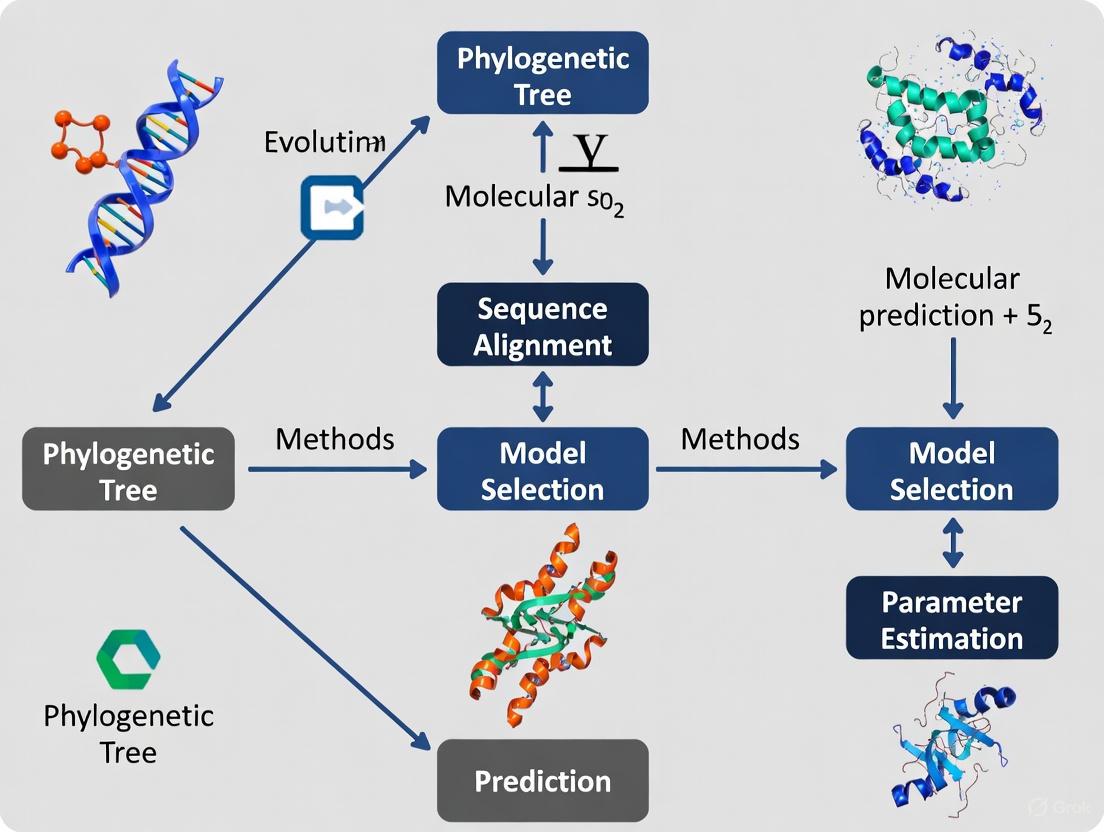
This article provides a comprehensive guide to Phylogenetic Comparative Methods (PCMs) for researchers, scientists, and drug development professionals.
Phylogenetically Informed Prediction: Advanced Comparative Methods for Biomedical Research and Drug Development
Abstract
This article provides a comprehensive guide to Phylogenetic Comparative Methods (PCMs) for researchers, scientists, and drug development professionals. It covers the foundational principles connecting microevolutionary processes to macroevolutionary patterns, details practical implementation of methods like phylogenetic generalized least squares (PGLS) and ancestral state reconstruction, and addresses troubleshooting for common challenges like weak phylogenetic signal and model misspecification. The guide highlights compelling evidence that phylogenetically informed predictions can outperform traditional predictive equations by two- to three-fold, even with weakly correlated traits. By integrating theoretical explanations with practical R code examples and biomedical application case studies, this resource empowers scientists to leverage evolutionary history for more accurate trait prediction, missing data imputation, and evolutionary retrodiction in biomedical research.
The Evolutionary Framework: Why Phylogeny Matters in Biomedical Prediction
Connecting Microevolutionary Processes to Macroevolutionary Patterns
Understanding the connection between microevolutionary processes and macroevolutionary patterns is a fundamental objective in evolutionary biology. Macroevolutionary modeling, which allows for the estimation of speciation and extinction rates from phylogenetic data, has revolutionized our understanding of large-scale biodiversity patterns [1]. However, these macroevolutionary patterns are ultimately generated by microevolutionary processes acting at the population level, particularly when speciation and extinction are considered as protracted processes rather than point events [1]. Disregarding this critical connection can limit our ability to discern the underlying mechanisms driving observed biodiversity patterns, such as the latitudinal diversity gradient (LDG) or hyper-diverse lineages [1]. This technical guide examines how population-level dynamics influence large-scale evolutionary patterns and explores methodological frameworks for integrating these perspectives in phylogenetic comparative methods, with particular relevance for prediction research in evolutionary biology and drug discovery.
Theoretical Framework: From Population Dynamics to Phylogenetic Patterns
The Protracted Speciation Framework
Traditional birth-death models in macroevolutionary studies often treat speciation as an instantaneous event, characterized by a single rate parameter (λ). The protracted speciation framework offers a more nuanced alternative by deconstructing speciation into distinct microevolutionary processes [1]. This framework identifies three fundamental population-level events that collectively shape macroevolutionary outcomes:
- Population Splitting: Initial divergence and reduction of gene flow between within-species lineages, often resulting from geographical isolation or ecological differentiation [1]
- Population Conversion: Formation of fully reproductively isolated "good" species from incipient lineages [1]
- Population Extirpation: Elimination of within-species lineages through either complete mortality or genetic merging back into the original gene pool [1]
This framework explicitly acknowledges that the process between initial population divergence and the formation of a full-fledged species is complex and influenced by numerous ecological mechanisms, all contributing to differential rates of lineage diversification [1].
Punctuational Theories of Evolution
Punctuational theories provide complementary perspectives on how microevolutionary processes scale to macroevolutionary patterns. These theories suggest that adaptive evolution proceeds predominantly during distinct periods of a species' existence, with different mechanisms proposed by various theoretical frameworks [2].
Table 1: Comparison of Punctuational Evolutionary Theories
| Theory and Author | Proposed Mechanism | Microevolutionary Plasticity | Macroevolutionary Implications |
|---|---|---|---|
| Shifting Balance Theory (Wright, 1932) | 1. Population fragmentation2. Drift in subpopulations3. Spread of new genotypes | Reduced in frozen state | Allows crossing adaptive valleys |
| Genetic Revolution (Mayr, 1954) | 1. Founder effect alters allele frequencies2. Selection for optimal alleles | Elastic in frozen state | Founder events crucial for speciation |
| Frozen Plasticity (Flegr, 1998) | 1. Frequency-dependent selection stabilizes gene pool2. Polymorphism accumulation resists change3. Small populations lose polymorphism | Elastic in frozen state | Decreasing evolutionary rate with clade age |
These punctuational models share the common principle that sexual species respond effectively to selection primarily during speciation events, with limited evolutionary responsiveness during most of their existence [2]. The frozen plasticity theory, for instance, proposes that species are evolutionarily plastic only when genetically uniform, typically shortly after emerging through peripatric speciation [2].
Methodological Approaches: Integrating Micro and Macro Perspectives
Phylogenetically Informed Prediction
Recent methodological advances have demonstrated the superiority of phylogenetically informed predictions over traditional predictive equations. Comprehensive simulations show two- to three-fold improvement in performance of phylogenetically informed predictions compared to both ordinary least squares (OLS) and phylogenetic generalized least squares (PGLS) predictive equations [3].
For ultrametric trees, phylogenetically informed predictions perform approximately 4-4.7 times better than calculations derived from OLS and PGLS predictive equations, with the variance in prediction error (σ²) being substantially smaller [3]. Notably, phylogenetically informed predictions using weakly correlated traits (r = 0.25) demonstrate roughly equivalent or better performance than predictive equations for strongly correlated traits (r = 0.75) [3]. In empirical tests, phylogenetically informed predictions were more accurate than PGLS predictive equations in 96.5-97.4% of ultrametric trees and more accurate than OLS predictive equations in 95.7-97.1% of trees [3].
Figure 1: Conceptual workflow for integrating microevolutionary data and phylogenetic relationships to generate macroevolutionary predictions through phylogenetically informed prediction methods, which substantially outperform traditional predictive equations.
Experimental Protocols for Parameter Estimation
Quantitative inference of microevolutionary parameters requires specialized methodological approaches. The following protocol outlines the process for estimating rates under the protracted speciation framework, based on simulations using the PBD package in R [1]:
Protocol 1: Estimating Protracted Speciation Parameters from Empirical Data
Data Collection: Gather phylogenetic and distributional data for the taxonomic group of interest, including sister species divergence times and species richness patterns across regions.
Rate Calculation:
- Calculate population conversion rate (χ) as 1/(2 × t), where t represents the average sister species divergence time
- Estimate population splitting rate (λ') as λ/χ, where λ is the empirical speciation rate from traditional birth-death models
- Compute population extirpation rate (μ') based on the principle that extirpations of all within-species populations result in species extinction
Simulation Parameters: Using the
pbd_simfunction in the PBD package, input the calculated rates with simulation time held constant (e.g., 6 million years)Phylogeny Pruning: For species with multiple population lineages at simulation end, randomly retain one population lineage per species and prune all others from the simulated phylogenetic tree
This approach enables researchers to test alternative hypotheses about latitudinal diversity gradients by simulating different combinations of population splitting, conversion, and extirpation rates [1].
Empirical Applications and Case Studies
Latitudinal Diversity Gradients in Birds
The protracted speciation framework provides novel insights into long-standing ecological patterns. Research on latitudinal diversity gradients in birds demonstrates how different microevolutionary scenarios can generate similar macroevolutionary patterns [1].
Table 2: Microevolutionary Parameters Generating Latitudinal Diversity Gradients in Birds
| Parameter | Temperate Region | Tropical Region | Alternative Temperate Scenario |
|---|---|---|---|
| Speciation Rate (λ) | 0.58 | 0.17 | 0.58 |
| Extinction Rate (μ) | 0.45 | 0.04 | 0.45 |
| Population Conversion Rate (χ) | 0.50 | 0.15 | 0.15 |
| Population Splitting Rate (λ') | 1.16 | 1.13 | 1.30 |
| Population Extirpation Rate (μ') | 0.60 | 0.30 | 0.60 |
Simulations based on these parameters reveal that the high species richness in tropics can be generated through multiple microevolutionary pathways. One scenario suggests higher population conversion rates in temperate regions, while an alternative scenario with equal conversion rates but higher population splitting rates can produce similar diversity patterns [1]. This demonstrates that current macroevolutionary models may not effectively distinguish between different underlying microevolutionary processes.
Implications for Predictions in Evolutionary Research
The connection between microevolutionary processes and macroevolutionary patterns has profound implications for prediction research:
Trait Evolution Prediction: Phylogenetically informed predictions that incorporate microevolutionary parameters provide substantially more accurate reconstructions of ancestral states and trait evolution [3]
Biodiversity Forecasting: Models integrating protracted speciation improve predictions of species richness patterns under different environmental scenarios [1]
Extinction Risk Assessment: Understanding population-level extirpation rates enhances predictions of species vulnerability to environmental change [1]
Figure 2: The protracted speciation process, showing transitions from ancestral populations through incipient species to full species formation or extinction, highlighting the multiple pathways influenced by microevolutionary parameters.
Research Reagent Solutions for Evolutionary Prediction Studies
Table 3: Essential Methodological Tools for Microevolution-Macroevolution Research
| Research Tool | Function | Application Context |
|---|---|---|
| PBD R Package | Simulates phylogenies under protracted speciation | Testing alternative diversification scenarios [1] |
| Phylogenetically Informed Prediction Algorithms | Predicts unknown trait values using evolutionary relationships | Ancestral state reconstruction, missing data imputation [3] |
| Bivariate Brownian Motion Models | Simulates trait evolution under Brownian motion | Testing evolutionary correlations, parameter estimation [3] |
| Birth-Death Model Variations | Estimates speciation and extinction rates | Traditional macroevolutionary rate analysis [1] |
Integrating microevolutionary processes into macroevolutionary studies is essential for advancing predictive research in evolution. The protracted speciation framework and phylogenetically informed prediction methods represent significant methodological advances that bridge these evolutionary scales. By explicitly accounting for population-level dynamics—including splitting, conversion, and extirpation—researchers can develop more accurate models of biodiversity patterns and evolutionary trajectories. Future research should focus on refining parameter estimation techniques and expanding the application of these integrated approaches across diverse taxonomic groups and ecological contexts.
Tree-thinking represents a fundamental paradigm in modern evolutionary biology, defined as the ability to visualize evolution in tree form and use tree diagrams to communicate and analyze evolutionary phenomena [4]. This conceptual framework provides an information-rich structure for understanding the hierarchical relationships among species, genes, and traits through the lens of common descent. The phylogenetic tree of life serves not merely as a descriptive illustration but as a powerful analytical framework that enables researchers to reconstruct evolutionary history, predict trait values, and understand the patterns and processes shaping biological diversity [5] [4].
The importance of tree thinking extends across diverse biological disciplines, from conservation biology and forensics to medicine and drug development [4]. In epidemiology, phylogenetic trees have been instrumental in tracking HIV transmission patterns and understanding the emergence and spread of viral pathogens like Ebola and Zika virus [6]. In drug development, tree-based approaches enable predictive evolution studies that anticipate pathogen resistance mechanisms [4]. The expanding applications of phylogenetic frameworks underscore their utility in transforming raw biological data into logically structured, actionable knowledge for research and public health decision-making [6].
Theoretical Foundations and Tree-Reading Competencies
Core Principles of Phylogenetic Interpretation
The theoretical foundation of tree thinking rests upon several core principles that govern the interpretation of phylogenetic trees. A phylogenetic tree (T, t) is mathematically parameterized by both its topology (T), representing the set of evolutionary relationships, and a vector (t) defining branch lengths proportional to evolutionary change [7]. Trees may be represented as either cladograms, which depict branching patterns without proportional branch lengths, or phylograms, where branch lengths are scaled to represent the amount of inferred evolutionary change [7]. Furthermore, trees may be either rooted, specifying a most common ancestral node, or unrooted, showing relationships without assumptions about ancestry [7].
The skill of tree-reading can be systematically decomposed into specific competencies that researchers must master. These include (A) reading traits from trees - the ability to deduce which characteristics a species possesses based on labeled evolutionary innovations (apomorphies) on the tree; (B) deducing ancestral traits - inferring the characteristics most likely present in the Most Recent Common Ancestor (MRCA) of a given set of species; and (C) understanding relationships - correctly interpreting relatedness based on branching patterns rather than superficial similarity [4]. Studies indicate that even after formal instruction, many students and researchers struggle with these competencies, with error rates ranging from 65% to 84% across these skill domains [4].
Tree Visualization Frameworks and Layout Algorithms
Effective tree thinking requires familiarity with diverse visualization approaches that optimize the representation of hierarchical biological data. The computational literature describes several sophisticated layout algorithms that enhance tree interpretation across different applications and data scales [7].
Table 1: Tree Visualization Layout Algorithms and Their Applications
| Layout Algorithm | Visual Characteristics | Data Scale | Primary Applications |
|---|---|---|---|
| Rectangular Phylogram | Nodes aligned on x/y axis; branch lengths proportional to evolutionary change | Small to medium | Detailed evolutionary inference; trait evolution studies |
| Circular Layout | Root at center; children in concentric rings with proportional space allocation | Large datasets | Phylogenomics; microbial phylogenies; metagenomic analyses |
| Radial Tree | Root at center; angle proportional to required node space; expandable branches | Large hierarchies | Gene ontology visualization; functional classification |
| Hyperbolic Space | Dynamic node enlargement/minimization based on coordinates and focus | Very large datasets | Navigation of large phylogenies; interactive exploration |
| Treemaps | Nested rectangles/circles with area proportional to data dimension | Comparative analysis | Pattern recognition; genomic feature comparison |
Advanced visualization tools increasingly incorporate interactive capabilities that allow researchers to navigate complex phylogenetic spaces intuitively. These include hyperbolic browsers that use focus+context techniques to display large hierarchies and treemaps that efficiently represent thousands of data points simultaneously through nested rectangles following algorithms such as BinaryTree, Ordered, Squarified, and Strip [7]. The ongoing challenge for visualization development lies in handling the information overload from increasingly large genomic datasets while maintaining interpretability for diverse research applications [7] [6].
Phylogenetically Informed Predictions: Methodological Framework and Quantitative Superiority
Theoretical Framework for Phylogenetic Prediction
Phylogenetically informed prediction represents a significant methodological advancement over traditional predictive approaches in comparative biology. These approaches explicitly incorporate shared evolutionary history among species through several statistical frameworks: (1) calculating independent contrasts that account for phylogenetic non-independence; (2) utilizing a phylogenetic variance-covariance matrix to weight data in phylogenetic generalized least squares (PGLS) regression; and (3) creating random effects in phylogenetic generalized linear mixed models (PGLMMs) [3]. Each method integrates phylogeny as a fundamental component of the statistical model, thereby addressing the non-independence of species data that arises from common descent [3].
The theoretical justification for phylogenetically informed predictions stems from the fundamental property of phylogenetic signal - the tendency for related species to resemble each other more than distant relatives due to shared ancestry [3] [8]. This phylogenetic non-independence violates the assumption of independent observations in conventional statistical models, potentially leading to biased parameter estimates and inflated Type I error rates [8]. By explicitly modeling this covariance structure, phylogenetic prediction methods transform the problem of non-independence into a source of predictive power.
Quantitative Performance Advantages
Recent comprehensive simulations have demonstrated the striking superiority of phylogenetically informed predictions compared to conventional approaches. These analyses utilized 1,000 ultrametric trees with varying degrees of balance (symmetry in subtree size/length) and simulated bivariate data with different correlation strengths (r = 0.25, 0.50, 0.75) under a Brownian motion model of evolution [3].
Table 2: Performance Comparison of Prediction Methods Across Correlation Strengths
| Prediction Method | Weak Correlation (r=0.25) | Moderate Correlation (r=0.50) | Strong Correlation (r=0.75) | Accuracy Advantage vs. PGLS |
|---|---|---|---|---|
| Phylogenetically Informed Prediction | σ² = 0.007 | σ² = 0.004 | σ² = 0.002 | 96.5-97.4% of trees |
| PGLS Predictive Equations | σ² = 0.033 | σ² = 0.018 | σ² = 0.015 | Baseline |
| OLS Predictive Equations | σ² = 0.030 | σ² = 0.017 | σ² = 0.014 | 95.7-97.1% of trees |
The results reveal that phylogenetically informed predictions perform approximately 4-4.7 times better than calculations derived from either ordinary least squares (OLS) or phylogenetic generalized least squares (PGLS) predictive equations, as measured by the variance in prediction error distributions [3]. Notably, phylogenetically informed predictions using weakly correlated traits (r = 0.25) demonstrated roughly equivalent or even better performance than predictive equations using strongly correlated traits (r = 0.75) [3]. Across thousands of simulations, phylogenetically informed predictions provided more accurate estimates than PGLS predictive equations in 96.5-97.4% of trees and outperformed OLS predictive equations in 95.7-97.1% of trees [3].
Experimental Protocol for Phylogenetically Informed Prediction
Implementing phylogenetically informed predictions requires a systematic methodological workflow. The following protocol outlines the key steps for generating phylogenetically informed predictions using a Bayesian framework that enables sampling of predictive distributions for subsequent analysis [3]:
Tree and Data Preparation:
- Obtain a time-calibrated phylogenetic tree for the taxa of interest
- Compile trait data for both predictor and response variables
- Identify taxa with missing values for the response variable
Evolutionary Model Selection:
- Evaluate alternative models of evolution (e.g., Brownian motion, Ornstein-Uhlenbeck)
- Select the best-fitting model using information criteria (AICc, BIC)
Phylogenetic Regression:
- Implement a phylogenetic regression model incorporating the variance-covariance structure derived from the phylogeny
- Estimate parameters describing the relationship between predictor and response variables
Prediction Generation:
- Calculate conditional predictions for missing values using the phylogenetic relationships
- Incorporate uncertainty in parameter estimates and phylogenetic structure
Prediction Interval Estimation:
- Generate prediction intervals that account for phylogenetic branch lengths
- Note that prediction intervals increase with increasing phylogenetic distance from reference taxa
This methodology has been successfully applied to diverse predictive challenges, including estimating genomic and cellular traits in extinct species [6], reconstructing feeding behaviors in hominins from dental morphology [3], and building comprehensive trait databases through phylogenetic imputation [3].
Advanced Analytical Framework: Variance Partitioning in Phylogenetic Models
Statistical Decomposition of Phylogenetic and Ecological Effects
A critical advancement in phylogenetic comparative methods involves quantitatively partitioning the relative contributions of phylogenetic history versus ecological predictors in explaining trait variation. The phylolm.hp R package extends the concept of "average shared variance" (ASV) to Phylogenetic Generalized Linear Models (PGLMs), enabling nuanced quantification of these contributions [8]. This approach calculates individual likelihood-based R² contributions for phylogeny and each predictor, accounting for both unique and shared explained variance [8].
The statistical framework decomposes the total variance in a PGLM containing phylogeny (phy) and predictors (X₁, X₂) into seven components: three unique variances ([a], [b], [c]), three pairwise shared variances ([d], [e], [f]), and one three-way shared variance ([g]) [8]. The individual R² values are then computed as follows:
R²phy = a + d/2 + f/2 + g/3 R²X₁ = b + d/2 + e/2 + g/3 R²_X₂ = c + e/2 + f/2 + g/3
This method ensures that the sum of individual R² values equals the total R² of the model, overcoming limitations of traditional partial R² methods that often fail to account for multicollinearity among predictors [8].
Research Reagent Solutions for Phylogenetic Prediction
Implementing phylogenetically informed analyses requires specialized analytical tools and software resources. The following table catalogues essential "research reagents" for conducting phylogenetic predictions and comparative analyses.
Table 3: Essential Analytical Tools for Phylogenetic Prediction Research
| Tool/Resource | Function | Application Context |
|---|---|---|
| phylolm.hp R package | Variance partitioning in PGLMs | Quantifying relative importance of phylogeny vs. ecological predictors |
| rr2 R package | Calculation of likelihood-based R² | Model fit evaluation in phylogenetic comparative analyses |
| Bayesian Evolutionary Analysis | Sampling of predictive distributions | Reconstruction of ancestral states and trait values in extinct species |
| Phylogenetic Covariance Matrix | Modeling evolutionary relationships | Accounting for non-independence in phylogenetic regression |
| Tree Visualization Software | Interactive exploration of large phylogenies | Pattern identification and hypothesis generation |
Visualization Workflows for Phylogenetic Information
The complexity of phylogenetic information necessitates sophisticated visualization approaches that enable researchers to extract meaningful patterns from increasingly large datasets. The following Graphviz diagrams illustrate standardized workflows for phylogenetic tree interpretation and analysis.
Tree-Reading and Interpretation Workflow
Phylogenetic Prediction Methodology
Applications in Research and Public Health
The practical implementation of tree thinking extends across numerous biological disciplines, with particularly impactful applications in epidemiology and pharmaceutical development. In viral epidemiology, phylogenetic trees have become indispensable tools for reconstructing transmission dynamics, identifying outbreak sources, and guiding public health interventions [6]. The integration of genomic sequencing with phylogenetic analysis has enabled researchers to track the spatial and temporal spread of pathogens like HIV-1, Ebola virus, and Zika virus in near real-time, transforming our approach to epidemic response [6].
In drug discovery and development, phylogenetic approaches enable predictive evolution studies that anticipate how pathogens may evolve resistance to therapeutic interventions [4]. By reconstructing the evolutionary history of resistance mechanisms and identifying conserved regions under functional constraint, researchers can design more robust antiviral treatments and vaccines [4]. Additionally, tree-based analyses facilitate the identification of novel drug targets by tracing the evolutionary origins of disease-related pathways and identifying lineage-specific adaptations that may be susceptible to targeted inhibition [4].
The expanding role of tree thinking in biomedical research underscores its value as an information-rich framework for transforming complex biological data into actionable insights. As genomic technologies continue to generate increasingly large datasets, the principles of phylogenetic interpretation and prediction will become ever more essential for extracting meaningful patterns from biological complexity.
The reconstruction of life's history represents a fundamental endeavor within the biological sciences, yet achieving an accurate evolutionary timescale has remained an elusive goal. This pursuit sits at the nexus of disparate disciplines, including palaeontology, molecular systematics, geochronology, and comparative genomics [9]. Historically, the fossil record constituted the gold standard for establishing evolutionary timescales; however, for over fifty years, this role has increasingly been filled by molecular clock approaches for groups with extant representatives [9]. This transition has created methodological schisms that have hindered collaborative research efforts across disciplines. The modern era of analytical and quantitative palaeobiology has only just begun, integrating methods such as morphological and molecular phylogenetics, divergence time estimation, and phenotypic and molecular rates of evolution [9]. This review examines the historical roots and current state of comparative methods that integrate genetic, paleontological, and phylogenetic data, framing this integration within the context of advancing prediction research in evolutionary biology.
The central challenge in evolutionary reconstruction stems from the inherent limitations of data sources when used in isolation. Phylogenies comprising only extant taxa lack sufficient information to fully calibrate the tree of life or reliably reconstruct macroevolutionary dynamics [9]. Conversely, the fossil record provides direct evidence of past life but is inherently incomplete. Only through the synthesis of living and extinct species—drawing from both genomic and anatomical evidence—can researchers achieve a comprehensive understanding of evolutionary patterns and processes [9]. This integrative phylogenetic approach provides novel opportunities for evolutionary biologists to establish robust evolutionary timescales and test core macroevolutionary hypotheses about the drivers of biological diversification across various organismal dimensions.
Historical Development of Comparative Methods
The Rise of Molecular Clock Methodologies
The development of molecular clock methodologies in the latter half of the 20th century represented a paradigm shift in evolutionary biology. These approaches accounted for variation in the rate of molecular evolution among lineages and accommodated the inaccuracies and imprecision inherent in using fossil evidence for calibration [9]. Initially, molecular clocks primarily used fossil taxa to calibrate divergences between living lineages (node dating). However, these early methods often marginalized morphological data, building evolutionary trees predominantly on genomic datasets alone [9]. This created a methodological divide between researchers working with molecular data from extant species and those studying morphological data from both living and fossil taxa.
The limitations of excluding morphological data became increasingly apparent. Fossil data provide the fundamental means of clock calibration yet were often used in ways far from satisfactory [9]. Moreover, phylogenies of fossil species used in molecular clock calibration needed to be compatible with phylogenies of living species that underpinned divergence time analyses. This recognition spurred methodological innovations that would eventually bridge the historical gap between fields.
The Total Evidence Framework
The philosophical foundation for integrative approaches was established by Kluge in what he termed "TOTAL EVIDENCE analysis" [9]. This idea was expanded by Nixon and Carpenter in their "simultaneous analysis" [9]. The core principle was straightforward: multiple lines of evidence should be analyzed together to test scientific hypotheses. However, practical implementation required computational and methodological advances that would take decades to realize.
The critical insight was that morphological data constitute a crucial component of phylogenetic inference, as they are typically the only information available to integrate both living and extinct members of an evolutionary tree [9]. This recognition has revitalized morphological phylogenetics through recent methodological developments, particularly in Bayesian inference, allowing researchers to implement variations in clock models, data partitioning, taxon sampling strategies, and tree models using morphological data [9].
Methodological Bridge-Building: Tip Dating and the Morphological Clock
A significant advancement came with developing methods that allowed fossil species to be included alongside their living relatives (tip dating). In total evidence dating, the absence of molecular sequence data for fossil taxa is remedied by supplementing sequence alignments for living taxa with phenotype character matrices for both living and fossil taxa [9]. This approach enables more direct implementation of temporal constraints on lineage divergence provided by fossil species.
Building total-evidence time-calibrated phylogenies is critical for increasing the accuracy of inferences regarding macroevolutionary processes [9]. The morphological clock—applied to fossils and/or living morphological datasets alone—represents another significant innovation [9]. These methodological bridges have enabled palaeontologists to achieve more accurate modeling of the diversification process across geological time, a crucial aspect of phylogenies with taxonomic sampling extending into deep time.
Table 1: Historical Evolution of Key Phylogenetic Comparative Methods
| Time Period | Dominant Methodological Approach | Key Limitations | Major Innovations |
|---|---|---|---|
| Pre-1990s | Fossil-based stratigraphy | Incomplete fossil record; qualitative assessments | Principle of stratigraphic superposition; relative dating |
| 1990s-2000s | Molecular clock with node calibration | Division between molecular and morphological data; incomplete taxon sampling | Molecular clock models; Bayesian inference; total evidence framework |
| 2000s-2010s | Combined evidence approaches | Computational limitations; model simplicity | Partitioned models; tip dating; relaxed molecular clocks |
| 2010s-Present | Integrated phylogenetic frameworks | Data integration challenges; model complexity | Morphological clocks; fossilized birth-death models; phylogenetically informed prediction |
Contemporary Advances in Phylogenetically Informed Prediction
The Prediction Revolution in Comparative Methods
Prediction sits at the very heart of scientific inquiry, flowing directly from hypotheses and theories as the arbiter of evidence [3]. In evolutionary biology specifically, and historical sciences more generally, researchers are often interested in retrodictions—predictions about past events [3]. Phylogenetic comparative methods have revolutionized our understanding of evolutionary biology, offering profound insights into the patterns and processes shaping biodiversity [3]. These methods also provide a principled approach to predicting unknown values, acknowledging that data drawn from closely related organisms are more similar than data drawn from distant relatives owing to common descent [3].
Among phylogenetic comparative methods, phylogenetically informed prediction using regression techniques has emerged as an essential tool for predicting unknown values given information on shared ancestry and an underlying evolutionary relationship between traits [3]. For example, phylogenetically informed prediction has been used to predict feeding time in extinct hominins using the relationship between feeding time and molar size in living species combined with fossil measurements [3]. These methods explicitly address the non-independence of species data by calculating independent contrasts, using a phylogenetic variance-covariance matrix to weight data in phylogenetic generalized least squares, or creating a random effect in a phylogenetic generalized linear mixed model [3].
The Superior Performance of Phylogenetically Informed Predictions
Despite 25 years having passed since the introduction of phylogenetically informed prediction models, it remains common practice to use predictive equations derived from phylogenetic generalized least squares or ordinary least squares regression models to calculate unknown values [3]. This persistence occurs despite the recognized pervasiveness of phylogenetic signal in continuous datasets [3].
Recent research has unequivocally demonstrated the superior performance of phylogenetically informed predictions compared to predictive equations derived from both ordinary least squares and phylogenetic generalized least squares regression models [3]. Through comprehensive simulations using ultrametric trees (where all species terminate simultaneously) and non-ultrametric trees (where tips vary in time), researchers have documented a two- to three-fold improvement in the performance of phylogenetically informed predictions [3]. Surprisingly, phylogenetically informed prediction using the relationship between two weakly correlated (r = 0.25) traits was roughly equivalent to—or even better than—predictive equations for strongly correlated traits (r = 0.75) [3].
Table 2: Performance Comparison of Prediction Methods Across Simulation Studies
| Prediction Method | Tree Type | Trait Correlation | Performance (Error Variance) | Accuracy Advantage |
|---|---|---|---|---|
| Phylogenetically Informed Prediction | Ultrametric | r = 0.25 | σ² = 0.007 | Reference |
| PGLS Predictive Equations | Ultrametric | r = 0.25 | σ² = 0.033 | 4.7x worse |
| OLS Predictive Equations | Ultrametric | r = 0.25 | σ² = 0.030 | 4.3x worse |
| Phylogenetically Informed Prediction | Ultrametric | r = 0.75 | σ² = 0.002 | Reference |
| PGLS Predictive Equations | Ultrametric | r = 0.75 | σ² = 0.005 | 2.5x worse |
| OLS Predictive Equations | Ultrametric | r = 0.75 | σ² = 0.004 | 2x worse |
Methodological Foundations of Phylogenetically Informed Prediction
The mathematical foundation for phylogenetically informed prediction builds upon established regression frameworks but incorporates phylogenetic relationships directly into the prediction model. In ordinary least squares regression, the relationship between the dependent variable (Y) and independent variables (X) is modeled as Y = β₀ + β₁X₁ + β₂X₂ + … + βₙXₙ + ε, where β₀ is the intercept and β₁, β₂, …, βₙ are the coefficients for the independent variables [10]. Phylogenetic generalized least squares regression extends this framework by incorporating the phylogenetic variance-covariance matrix into the error term to account for the non-independence of observations [10].
Critically, phylogenetically informed prediction explicitly incorporates the phylogenetic position of the unknown species relative to those used to inform the regression model [10]. Predictions for a species h are made using Yₕ = β̂₀ + β̂₁X₁ + β̂₂X₂ + … + β̂ₙXₙ + εᵤ, where εᵤ represents the phylogenetic prediction residual calculated from the phylogenetic covariance structure [10]. This method effectively pulls estimates away from calculations made by simple predictive equations and closer to those of phylogenetically neighboring taxa, resulting in more accurate predictions [10].
Practical Implementation: Protocols and Workflows
Experimental Protocol for Phylogenetically Informed Prediction
Implementing phylogenetically informed prediction requires a systematic approach to data collection, phylogenetic reconstruction, and predictive modeling. The following protocol outlines key steps for conducting phylogenetically informed predictions:
Taxon Sampling and Character Coding: Comprehensive taxon sampling is crucial, including both extant and fossil species where possible. For morphological datasets, characters should be selected and coded according to established phylogenetic principles, including discrete and continuous characters where appropriate [9]. Continuous traits reduce the subjective bias of discrete characters and represent the full range of interspecific variation, making them valuable for phylogenetic reconstructions [9].
Phylogenetic Tree Reconstruction: Reconstruct a phylogenetic tree using combined evidence approaches where possible. For tip-dating analyses, implement the fossilized birth-death model to account for the probability of sampling fossil ancestors [9]. Utilize Bayesian inference to accommodate variations in clock models and data partitioning schemes.
Trait Data Compilation: Compile trait data for both predictor and response variables across the sampled taxa. Address missing data explicitly through phylogenetic imputation methods rather than complete-case analysis, which can introduce biases [3].
Model Selection and Validation: Compare evolutionary models for trait data, including Brownian motion, Ornstein-Uhlenbeck, and early-burst models. Use model selection techniques such as AIC or BIC to identify the most appropriate model for your data [3].
Phylogenetically Informed Prediction Implementation: Implement phylogenetically informed prediction using available software packages that can incorporate the phylogenetic variance-covariance structure directly into predictions [3] [10]. Generate prediction intervals that account for phylogenetic uncertainty and evolutionary branch lengths.
Validation and Sensitivity Analysis: Conduct sensitivity analyses to assess the impact of phylogenetic uncertainty, model selection, and character coding on predictions. Where possible, use cross-validation approaches to assess predictive accuracy [3].
Table 3: Essential Computational Tools and Analytical Resources for Phylogenetically Informed Prediction
| Tool/Resource Category | Specific Examples | Function/Application | Key Considerations |
|---|---|---|---|
| Phylogenetic Reconstruction Software | BEAST2, RevBayes, MrBayes | Bayesian phylogenetic inference with tip-dating | Support for fossilized birth-death models; morphological clock models |
| Comparative Methods Packages | caper (R), phytools (R), geiger (R) | Implementation of PGLS and phylogenetic prediction | Integration with phylogenetic trees; visualization capabilities |
| Morphometric Analysis Tools | Geomorph (R), MorphoJ | Analysis of continuous morphological characters | 3D geometric morphometrics; integration with phylogenetic frameworks |
| Data Integration Platforms | MorphoBank, Paleobiology Database | Collaborative character coding; fossil data compilation | Taxonomic standardization; temporal calibration |
| Visualization Software | FigTree, ggtree (R) | Visualization of time-calibrated trees with trait data | Annotation of phylogenetic trees with predictive intervals |
Visualization of Methodological Relationships and Workflows
Phylogenetic Prediction Method Comparison
Phylogenetically Informed Prediction Workflow
Applications Across Biological Disciplines
Paleontological Applications
Integrative phylogenetic approaches have transformed paleontology by providing quantitative frameworks for incorporating fossil data into evolutionary hypotheses. Taxonomic studies in paleontology are crucial for tackling biochronological, paleobiogeographical, and macroevolutionary questions [9]. The discovery and description of new species generate raw data for further analysis by providing information on character states (and therefore phylogenetic inference), biogeographical locations, and temporal calibrations foundational to dating and reconstructing the evolutionary history of life [9].
For example, studying Neogene micromammals from Lebanon has provided relevant data concerning new species situated at pivotal phylogenetic positions, allowing researchers to infer the expected dental morphology of the ancestors of important rodent lineages [9]. These data have also proven relevant for inferring the age of sites and the timing and nature of migration events that took place between Eurasia and Africa via the Arabian plate [9].
Biomedical and Drug Development Applications
Phylogenetically informed prediction methods show significant promise for biomedical research and drug development. These approaches can predict biological properties across species, model the evolution of drug resistance, and inform target selection based on evolutionary conservation. The demonstrated superiority of phylogenetically informed predictions for trait imputation suggests potential applications in predicting protein structures, metabolic pathways, and drug response profiles across species.
The ability of phylogenetically informed prediction to yield accurate estimates even with weakly correlated traits is particularly valuable in biomedical contexts, where multiple weakly predictive factors often influence traits of interest [3]. Additionally, the emphasis on prediction intervals that increase with phylogenetic branch length provides valuable measures of uncertainty for decision-making in drug development pipelines.
The historical development of comparative methods reveals a clear trajectory toward greater integration of genetic, paleontological, and phylogenetic data. The emerging consensus strongly supports phylogenetically informed prediction as a superior approach for estimating unknown trait values compared to traditional predictive equations [3]. However, significant challenges remain, including a shortage of expertise in taxonomy and comparative anatomy required for compiling anatomical datasets [9]. Similarly, knowledge of the comparative anatomy of living species remains incomplete, presenting obstacles to comprehensive phylogenetic integration [9].
Future methodological developments will likely focus on improving models of morphological evolution, integrating high-dimensional genomic data with morphological datasets, and developing more efficient computational approaches for handling large phylogenies with both living and extinct taxa. The increased demand for an integrative phylogenetic approach to reconstruct the tree of life and evolutionary patterns and processes will hopefully encourage researchers to overcome these challenges with the aim of elucidating the complexities behind organismal evolution across broad taxonomic and time scales [9].
For researchers in ecology, epidemiology, evolution, oncology, and paleontology, adopting phylogenetically informed prediction approaches offers a pathway to more accurate and evolutionarily grounded inferences. As these methods continue to mature and become more accessible through specialized software implementations, they promise to transform our understanding of evolutionary processes and improve our ability to predict biological properties across the tree of life.
Phylogenetic signal is an evolutionary and ecological term that describes the tendency for related biological species to resemble each other more than any other species randomly picked from the same phylogenetic tree [11]. This fundamental pattern in evolutionary biology arises because closely related species inherit similar characteristics from their common ancestors [12]. When phylogenetic signal is high, closely related species exhibit similar trait values, and this biological similarity decreases as evolutionary distance between species increases [11] [12]. Conversely, traits showing lower phylogenetic signal may appear more similar in distantly related taxa than in close relatives due to convergent evolution [11].
The concept is statistically defined as the dependence among species' trait values resulting from their phylogenetic relationships [11]. The measurement of phylogenetic signal has become increasingly important in comparative biology, enabling researchers to test evolutionary hypotheses and account for phylogenetic non-independence in statistical analyses [12]. Understanding phylogenetic signal provides crucial insights into how traits evolve, the processes driving community assembly, and the degree to which niches are conserved across phylogenies [11].
Quantifying Phylogenetic Signal
Measurement Approaches and Statistical Frameworks
Several statistical methods have been developed to quantify phylogenetic signal, falling into two primary categories: autocorrelation methods and model-based approaches [11] [12]. These methods allow researchers to determine exactly how studied traits are correlated with phylogenetic relationships between species [11].
Table 1: Common Methods for Measuring Phylogenetic Signal [11]
| Method | Type | Based on Model? | Statistical Framework | Data Type |
|---|---|---|---|---|
| Abouheif's Cmean | Autocorrelation | No | Permutation | Continuous |
| Blomberg's K | Evolutionary | Yes | Permutation | Continuous |
| D statistic | Evolutionary | Yes | Permutation | Categorical |
| Moran's I | Autocorrelation | No | Permutation | Continuous |
| Pagel's λ | Evolutionary | Yes | Maximum Likelihood | Continuous |
| δ statistic | Evolutionary | Yes | Bayesian | Categorical |
Key Metrics and Their Interpretation
Blomberg's K measures phylogenetic signal by quantifying the amount of observed trait variance relative to the trait variance expected under a Brownian motion model of evolution [12]. K varies continuously from zero to infinity, where K = 0 indicates no phylogenetic signal, K = 1 indicates that the trait has evolved exactly according to the Brownian motion model, and K > 1 indicates that close relatives are more similar than expected under Brownian motion [12]. The statistical significance of K is typically tested by randomizing trait data across the phylogeny and calculating how often randomized data produces higher K values than observed [12].
Pagel's λ is another widely used metric that varies from 0 to 1, where λ = 0 indicates no phylogenetic signal and λ = 1 indicates strong phylogenetic signal consistent with Brownian motion evolution [11] [12]. Intermediate values suggest that although phylogenetic signal exists, the trait has evolved according to a process other than pure Brownian motion [12]. Pagel's λ is estimated using maximum likelihood, and its significance can be tested using likelihood ratio tests comparing models with different fixed values of λ [12].
The Brownian motion model serves as a fundamental null model for trait evolution, representing a random walk process where trait changes are independent of current trait values with an expected mean change of zero [12]. This model may approximate evolutionary processes like genetic drift or natural selection with fluctuating pressures over long time periods [12].
Methodological Protocols for Analysis
Standard Experimental Workflow
The following Graphviz diagram illustrates the core workflow for conducting phylogenetic signal analysis:
Workflow for Phylogenetic Signal Analysis
Table 2: Essential Research Reagents and Computational Tools for Phylogenetic Signal Analysis [13]
| Tool/Resource | Type | Primary Function | Application Context |
|---|---|---|---|
| PAUP | Software | Phylogenetic Analysis Using Parsimony | Tree reconstruction, comparative analysis |
| MEGA | Software | Molecular Evolutionary Genetics Analysis | User-friendly phylogenetic analysis, sequence alignment |
| MrBayes | Software | Bayesian Inference | Bayesian phylogenetic analysis, uncertainty estimation |
| PHYLIP | Software | PHYLogeny Inference Package | Comprehensive phylogenetic analysis package |
| RAxML | Software | Randomized Axelerated Maximum Likelihood | Maximum likelihood tree inference for large datasets |
| IQ-TREE | Software | Efficient Phylogenetic Inference | Model selection, maximum likelihood analysis |
| Mesquite | Software | Modular Evolutionary Analysis | Ancestral state reconstruction, character evolution |
| Geneious Prime | Software | Integrated Molecular Analysis | Sequence alignment, tree building, visualization |
| Multiple Sequence Alignment | Method | Sequence Alignment | Aligning DNA/protein sequences for phylogenetic analysis |
| Model Testing | Method | Evolutionary Model Selection | Identifying best-fitting models of trait evolution |
Applications in Predictive Research
Phylogenetically Informed Predictions
Recent advances have demonstrated the superior performance of phylogenetically informed predictions compared to traditional predictive equations. A comprehensive 2025 study published in Nature Communications revealed that phylogenetically informed predictions provide a two- to three-fold improvement in performance compared to both ordinary least squares (OLS) and phylogenetic generalized least squares (PGLS) predictive equations [3]. This approach explicitly incorporates shared ancestry among species with both known and unknown trait values, yielding more accurate reconstructions [3].
Remarkably, phylogenetically informed prediction using the relationship between two weakly correlated traits (r = 0.25) was found to be roughly equivalent to or even better than predictive equations for strongly correlated traits (r = 0.75) [3]. This demonstrates the power of incorporating phylogenetic relationships when predicting unknown trait values, whether for imputing missing data, reconstructing ancestral states, or understanding evolutionary processes [3].
Comparative Performance of Prediction Methods
Table 3: Performance Comparison of Prediction Methods Based on Simulation Studies [3]
| Method | Correlation Strength | Error Variance (σ²) | Accuracy Advantage | Key Characteristics |
|---|---|---|---|---|
| Phylogenetically Informed Prediction | r = 0.25 | 0.007 | Reference method | Incorporates phylogenetic relationships explicitly |
| Phylogenetically Informed Prediction | r = 0.50 | ~0.004 | 2× better than equations | Uses phylogenetic variance-covariance matrix |
| Phylogenetically Informed Prediction | r = 0.75 | ~0.002 | 4-4.7× better than equations | Enables prediction from phylogeny alone |
| PGLS Predictive Equations | r = 0.25 | 0.033 | Less accurate in 96.5-97.4% of cases | Uses only regression coefficients, ignores phylogenetic position |
| OLS Predictive Equations | r = 0.25 | 0.030 | Less accurate in 95.7-97.1% of cases | Ignores phylogenetic non-independence |
The following Graphviz diagram illustrates the relationship between prediction methods and their performance:
Prediction Methods Performance Comparison
Empirical Patterns Across Biological Traits
Research has revealed substantial variation in phylogenetic signal across different types of biological traits. Studies in primates have demonstrated that morphological traits like body mass and brain size typically show the highest phylogenetic signal, while behavioral and ecological traits exhibit more variable patterns [12]. For example, brain size and body mass display the highest values of phylogenetic signal, moderate values are found in traits like the degree of territoriality and canine size dimorphism, while low values are displayed by most remaining behavioral and ecological variables [12].
This variation has important implications for understanding the evolution of behavior and ecology in primates and other vertebrates. Traits with strong phylogenetic signal suggest constraints on evolutionary change or consistent selective pressures across lineages, while traits with weak phylogenetic signal indicate greater evolutionary lability or convergent evolution [12]. These patterns inform predictions about how species might respond to environmental changes and which traits are most conserved over evolutionary time.
Best Practices and Research Recommendations
To ensure reliable and meaningful phylogenetic analyses, researchers should adhere to several best practices [13]:
Data Quality Control: Verify the accuracy and integrity of sequences used in analysis, perform rigorous quality control measures, and remove potential contamination or artifacts.
Model Selection: Choose appropriate models of sequence evolution that accurately represent substitution patterns in the dataset using model selection tools like ModelFinder or jModelTest.
Support Estimation: Assess statistical support for inferred phylogenetic relationships using bootstrap resampling or Bayesian posterior probabilities to gauge robustness of tree topology.
Sensitivity Analysis: Evaluate the impact of different parameters and methods on phylogenetic results by varying alignment methods, substitution models, or tree-building algorithms.
Multiple Sequence Alignment: Ensure accurate alignment of sequences using reliable algorithms such as ClustalW, MAFFT, or Muscle, with manual inspection for quality.
Data Sampling: Consider potential biases from uneven sampling or incomplete taxonomic representation, aiming for representative organism sampling to avoid distorting phylogenetic relationships.
The integration of phylogenomics, which combines genomic and phylogenetic analyses, continues to provide deeper understanding of evolutionary relationships, though challenges such as incomplete lineage sorting, horizontal gene transfer, and long-branch attraction remain areas of active research [13].
Phylogenetic comparative methods are foundational for understanding trait evolution across species, allowing researchers to infer evolutionary processes from contemporary observational data. These statistical techniques account for the non-independence of species due to their shared evolutionary history, as represented by phylogenetic trees. At the core of these methods lie mathematical models that describe how traits change over evolutionary time. Stochastic process models provide the mathematical framework for quantifying evolutionary patterns and testing hypotheses about underlying mechanisms. The two most fundamental continuous-trait models are Brownian motion (BM) and the Ornstein-Uhlenbeck (OU) process, which serve as cornerstones for modern comparative analysis. These models enable researchers to move beyond mere description of patterns to statistically rigorous inference about evolutionary processes, including neutral evolution, adaptive radiation, stabilizing selection, and phylogenetic niche conservatism. The appropriate application and interpretation of these models is therefore critical for research aimed at predicting evolutionary trajectories, including applications in drug development where understanding pathogen or host evolution may be paramount.
Brownian Motion: The Neutral Benchmark
Historical Foundations and Mathematical Definition
Brownian motion describes the random motion of particles suspended in a fluid resulting from their bombardment by surrounding molecules. The phenomenon was first described by Robert Brown in 1827, who observed the erratic movement of pollen grains in water under a microscope [14]. The mathematical formulation now called Brownian motion or the Wiener process was subsequently developed by Louis Bachelier in 1900 for modeling stock price fluctuations and later rigorously defined by Norbert Wiener [14]. Albert Einstein provided a pivotal explanation of Brownian motion in terms of atoms and molecules in 1905, relating it to the diffusion equation and enabling the determination of molecular sizes [14].
In evolutionary biology, Brownian motion serves as a simple null model of trait evolution where traits undergo random wandering over time without directional trends or constraints. The process is mathematically defined by the property that the change in trait value over any time interval is drawn from a normal distribution with mean zero and variance proportional to the length of the time interval [15]. Formally, the trait value ( X(t) ) at time ( t ) follows:
[ X(t) \sim N\left(X(0), \sigma^2 t\right) ]
where ( X(0) ) is the initial trait value and ( \sigma^2 ) is the evolutionary rate parameter describing how fast traits wander through trait space [15].
Properties and Biological Interpretation
Brownian motion has three key statistical properties that make it analytically tractable for phylogenetic comparative methods. First, the expected value of the trait at any time remains equal to its initial value: ( E[X(t)] = X(0) ), indicating no directional trend. Second, the process has independent increments, meaning changes over non-overlapping time intervals are statistically independent. Third, the trait values follow a multivariate normal distribution across species, with covariance between species proportional to their shared evolutionary history [15].
In biological terms, Brownian motion can arise through multiple evolutionary processes. The classic interpretation is neutral evolution, where trait changes occur through random genetic drift without natural selection [15]. Alternatively, it can result from random and frequent shifts in selective pressures, such as when species experience unpredictable environmental changes that randomly alter fitness optima [16]. Under this "selection-in-a-changing-environment" interpretation, the net effect of many small random adaptive shifts approximates a Brownian process. The model predicts that phenotypic divergence among species increases linearly with time since divergence, and that closely related species resemble each other more than distantly related species due to their shared evolutionary history [16].
Table 1: Key Parameters of the Brownian Motion Model
| Parameter | Symbol | Interpretation | Biological Meaning |
|---|---|---|---|
| Initial trait value | ( X(0) ) | Ancestral state | Trait value at root of phylogeny |
| Evolutionary rate | ( \sigma^2 ) | Rate of dispersion | Speed of trait evolution (units: variance/time) |
Practical Implementation and Limitations
In phylogenetic comparative methods, Brownian motion provides the underlying evolutionary model for foundational analyses including ancestral state reconstruction, phylogenetic regression (PGLS), and evolutionary rate estimation. The model generates a variance-covariance matrix for species traits expected under neutral evolution, with covariances proportional to the shared branch lengths between species on a phylogenetic tree [16].
The primary limitation of Brownian motion is that it assumes unbounded trait variation over evolutionary time, which is biologically unrealistic for many traits constrained by physiological, developmental, or ecological limits. Additionally, the model cannot accommodate stabilizing selection toward optimal trait values or adaptation to different selective regimes across clades. These limitations motivated the development of more complex models like the Ornstein-Uhlenbeck process.
Ornstein-Uhlenbeck Process: Modeling Constrained Evolution
Mathematical Foundation and Mean-Reversion Property
The Ornstein-Uhlenbeck process extends Brownian motion by incorporating a mean-reverting force that pulls the trait toward a central value or optimum. Originally developed to model the velocity of a particle under friction [17], the OU process was introduced to evolutionary biology by Hansen to model trait evolution under stabilizing selection [18]. The process is defined by the stochastic differential equation:
[ dX(t) = -\alpha(X(t) - \theta)dt + \sigma dW(t) ]
where ( \alpha ) represents the strength of selection pulling the trait toward the optimum ( \theta ), and ( \sigma dW(t) ) is the Brownian motion term representing stochastic perturbations [17] [19]. The parameter ( \alpha ) (sometimes denoted ( \kappa ) or ( \lambda ) in different formulations) determines how rapidly the trait reverts to the optimum, with larger values indicating stronger restraining forces.
Unlike Brownian motion, the OU process reaches a stationary distribution as ( t \to \infty ), with trait values normally distributed around the optimum ( \theta ) with stationary variance ( \sigma^2/(2\alpha) ) [17] [20]. This stationary distribution represents an equilibrium between the random perturbations and the restoring force, making the model more biologically realistic for many traits.
Biological Interpretations and Applications
The OU process has several important biological interpretations in evolutionary biology. The primary interpretation is stabilizing selection, where ( \theta ) represents a fitness optimum and ( \alpha ) measures the strength of selection pulling traits toward this optimum [18]. However, it is crucial to distinguish this from within-population stabilizing selection; in comparative phylogenetics, the OU process models macroevolutionary patterns of trait evolution across species, not microevolutionary processes within populations.
The OU process can also model adaptation to different ecological regimes through multiple optimum models, where distinct lineages evolve toward different optimal values (( \theta )) depending on their ecology or environment [18]. These models can test hypotheses about adaptive radiation, convergent evolution, and phylogenetic niche conservatism. More recently, OU models have been extended to incorporate species interactions and migration, recognizing that evolutionary processes often involve interdependent dynamics among lineages [21].
Table 2: Key Parameters of the Ornstein-Uhlenbeck Model
| Parameter | Symbol | Interpretation | Biological Meaning |
|---|---|---|---|
| Selection strength | ( \alpha ) | Rate of mean reversion | Strength of stabilizing selection |
| Optimal value | ( \theta ) | Long-term mean | Trait optimum or adaptive peak |
| Random fluctuation | ( \sigma ) | Volatility | Rate of stochastic evolution |
| Stationary variance | ( \sigma^2/(2\alpha) ) | Equilibrium variance | Trait variance at evolutionary equilibrium |
Methodological Considerations and Limitations
While powerful, OU models present several methodological challenges. Estimation of OU parameters, particularly ( \alpha ), can be statistically difficult with limited phylogenetic information [18]. Studies show that likelihood ratio tests often incorrectly favor OU over simpler Brownian motion models, especially with small datasets [18]. Additionally, measurement error and intraspecific variation can profoundly affect parameter estimates, potentially leading to spurious inferences of stabilizing selection [18].
The biological interpretation of OU parameters requires caution. An estimated ( \alpha > 0 ) does not necessarily demonstrate stabilizing selection, as similar patterns can arise from other processes including bounded evolution, genetic constraints, or species interactions [21] [18]. Furthermore, the phylogenetic OU model differs fundamentally from Lande's model of stabilizing selection within populations, despite conceptual similarities [18].
Comparative Analysis: Brownian Motion vs. Ornstein-Uhlenbeck
Mathematical and Conceptual Comparisons
Brownian motion and Ornstein-Uhlenbeck processes represent fundamentally different evolutionary dynamics. Brownian motion describes unbounded random wandering, while the OU process describes bounded fluctuations around an optimum. This conceptual difference manifests in their long-term behavior: Brownian motion variance increases indefinitely over time, while OU variance approaches a stable equilibrium [17] [15] [20].
Mathematically, Brownian motion is a special case of the OU process when ( \alpha = 0 ). The addition of the mean-reversion term ( -\alpha(X(t) - \theta) ) in the OU equation fundamentally changes the behavior of the process, making it stationary and mean-reverting. The following diagram illustrates the key relationships and applications of these models in phylogenetic comparative methods:
Statistical Implementation and Model Selection
Implementing these models in phylogenetic comparative analysis typically involves maximum likelihood estimation of parameters and model selection procedures to determine which evolutionary model best fits the empirical data. The following workflow outlines a standard approach for comparing Brownian motion and OU models:
Statistical comparison between BM and OU models typically uses likelihood ratio tests or information criteria (AIC, BIC). However, simulation studies show that these tests frequently have inflated Type I error rates, incorrectly favoring the more complex OU model when the true process is Brownian motion [18]. This problem is particularly acute with small phylogenies (<100 species) and when measurement error is present. Parametric bootstrapping and posterior predictive simulation provide more robust approaches for model comparison and validation [18].
Table 3: Model Selection Guidelines for BM vs. OU Processes
| Scenario | Preferred Model | Considerations |
|---|---|---|
| Small phylogeny (<50 taxa) | Brownian motion | Limited power to detect mean-reversion |
| Evidence of bounded trait evolution | OU process | Traits with physiological/ecological limits |
| Testing adaptive hypotheses | Multi-optima OU | Different selective regimes per clade |
| Measurement error present | Account for error variance | Error inflates estimates of α |
| Phylogenetic regression | BM or OU-transformed correlation structure | Improved Type I error control |
Experimental Protocols and Research Applications
Standard Implementation Workflow
Implementing Brownian motion and OU models in phylogenetic comparative studies follows a systematic workflow. First, researchers compile species-level trait data and a time-calibrated phylogeny. The data should be carefully checked for measurement quality and phylogenetic coverage. Next, researchers specify candidate evolutionary models reflecting biological hypotheses—for example, a single-optimum OU model for stabilizing selection versus a multi-optimum OU model for adaptive differentiation among clades [18].
Parameter estimation typically employs maximum likelihood methods implemented in software packages like geiger, ouch, or OUwie in R [18]. For Brownian motion, the key parameter ( \sigma^2 ) (evolutionary rate) has a closed-form solution, but OU parameters require numerical optimization. Model comparison uses information criteria (AIC, BIC) or likelihood ratio tests, though the latter require correction when testing ( \alpha = 0 ) since the null hypothesis lies on the parameter boundary [18].
Critical validation steps include examining model residuals for phylogenetic signal, conducting parametric bootstrap simulations to assess statistical power, and comparing parameter estimates across model structures. Researchers should explicitly report measurement error estimates and incorporate them when possible, as even small errors can substantially bias OU parameter estimates [18].
Advanced Extensions and Recent Developments
Recent methodological advances have expanded the basic BM and OU framework in several important directions. Multi-optima OU models allow different lineages to evolve toward distinct adaptive optima based on ecological characteristics or selective regimes [18]. OU models with species interactions incorporate migration or ecological competition effects, recognizing that evolutionary processes often involve interdependence among lineages [21]. Multivariate extensions model the correlated evolution of multiple traits, potentially revealing evolutionary constraints or trade-offs.
These advanced models enable more nuanced tests of evolutionary hypotheses but require careful implementation due to increased parameter complexity. As with basic OU models, validation through simulation is essential to ensure reliable inference [18]. The field continues to develop more realistic models that incorporate additional biological complexity while maintaining statistical tractability.
Research Reagent Solutions: Computational Tools for Evolutionary Modeling
Table 4: Essential Computational Tools for Evolutionary Model Implementation
| Tool/Resource | Application | Key Features | Implementation Considerations |
|---|---|---|---|
| R Statistical Environment | Primary platform for comparative methods | Extensive package ecosystem, reproducibility | Steep learning curve; programming skills required |
geiger R package |
General comparative methods | Fits BM, OU, and other models; phylogenetic signal tests | User-friendly; good for introductory implementation |
ouch R package |
Ornstein-Uhlenbeck models | Multi-optima OU models; Hansen's method | More specialized; requires specific data formatting |
OUwie R package |
Complex OU modeling | Multiple selective regimes; branch-specific models | Advanced features; steeper learning curve |
phytools R package |
Phylogenetic visualizations | Ancestral state reconstruction; model visualization | Excellent for visualizing fitted models |
PCMFit/PCMBase |
Advanced model fitting | High-performance computing; complex models | For large datasets; requires technical expertise |
bayou R package |
Bayesian OU modeling | Bayesian implementation of multi-optima OU models | Computational intensive; provides uncertainty estimates |
Brownian motion and Ornstein-Uhlenbeck processes provide the fundamental mathematical framework for modeling continuous trait evolution in phylogenetic comparative methods. While Brownian motion serves as a valuable null model of neutral evolution, the Ornstein-Uhlenbeck process extends this framework to incorporate constrained evolution toward optimal values. The appropriate application of these models requires careful consideration of their mathematical assumptions, statistical properties, and biological interpretations. As the field advances, researchers are developing increasingly sophisticated models that incorporate greater biological realism while maintaining statistical tractability. For all applications—from basic evolutionary inquiry to applied drug development research—proper model validation through simulation and sensitivity analysis remains essential for robust inference about evolutionary processes from comparative data.
Practical Implementation: Statistical Methods and R Workflow for Phylogenetic Prediction
In the field of evolutionary biology, predicting unknown trait values is a ubiquitous task, whether for reconstructing ancestral states, imputing missing data for further analysis, or understanding evolutionary processes [3]. For decades, researchers have employed two primary approaches for such predictions: phylogenetically informed prediction and predictive equations derived from regression models. The fundamental distinction between these approaches lies in how they incorporate evolutionary relationships. Phylogenetically informed prediction explicitly uses shared ancestry among species with both known and unknown trait values, thereby directly accounting for the phylogenetic non-independence of species data [3] [22]. In contrast, predictive equations typically calculate unknown values using only the coefficients from ordinary least squares (OLS) or phylogenetic generalized least squares (PGLS) regression models, without fully incorporating the phylogenetic position of the predicted taxon [3].
Despite being introduced over 25 years ago, phylogenetically informed prediction remains underutilized compared to the still-dominant use of predictive equations [3]. This persistence occurs even though phylogenetic comparative methods (PCMs) have revolutionized evolutionary biology and phylogenetic signal is recognized as pervasive in continuous datasets [3] [23]. This technical guide examines both approaches in detail, providing researchers with a comprehensive framework for selecting and implementing the most appropriate method for their predictive challenges in evolution, ecology, and drug discovery.
Theoretical Foundations and Performance Comparison
Key Concepts and Definitions
Phylogenetically informed prediction represents a class of methods that explicitly incorporate phylogenetic relationships when predicting unknown trait values. These approaches use the phylogenetic variance-covariance matrix to weight data in phylogenetic generalized least squares (PGLS), calculate phylogenetic independent contrasts, or create random effects in phylogenetic generalized linear mixed models (PGLMMs) [3]. Crucially, these methods can predict unknown values from a single trait by leveraging the shared evolutionary history among known taxa, even without correlation with other traits [3].
Predictive equations, conversely, typically refer to calculations derived solely from regression coefficients of OLS or PGLS models. While PGLS-based equations incorporate phylogeny when estimating regression parameters, they subsequently disregard the phylogenetic position of the predicted taxon when calculating unknown values [3]. This represents a critical limitation, as the parameters of phylogenetic regression models are explicitly interpretable only in combination with the underlying phylogeny.
Quantitative Performance Comparison
Recent large-scale simulation studies provide compelling evidence for the superior performance of phylogenetically informed prediction. In comprehensive analyses using ultrametric trees with varying degrees of balance and 100 taxa, phylogenetically informed predictions demonstrated substantially better performance compared to both OLS and PGLS predictive equations [3].
Table 1: Performance Comparison of Predictive Approaches on Ultrametric Trees
| Predictive Approach | Trait Correlation (r=0.25) | Trait Correlation (r=0.50) | Trait Correlation (r=0.75) |
|---|---|---|---|
| Phylogenetically Informed Prediction | σ² = 0.007 | σ² = 0.004 | σ² = 0.002 |
| OLS Predictive Equations | σ² = 0.030 | σ² = 0.014 | σ² = 0.006 |
| PGLS Predictive Equations | σ² = 0.033 | σ² = 0.015 | σ² = 0.005 |
The variance (σ²) of prediction error distributions serves as the performance metric, with smaller values indicating greater accuracy and consistency. Phylogenetically informed prediction demonstrated 4-4.7× better performance than calculations from OLS and PGLS predictive equations across all correlation strengths [3]. Remarkably, phylogenetically informed prediction using weakly correlated traits (r = 0.25) performed roughly equivalently to—or even better than—predictive equations using strongly correlated traits (r = 0.75) [3] [24].
In accuracy comparisons, phylogenetically informed predictions were closer to actual values than PGLS predictive equations in 96.5-97.4% of simulated trees and more accurate than OLS predictive equations in 95.7-97.1% of trees [3]. The differences in median prediction error between traditional predictive equations and phylogenetically informed predictions were statistically significant across all scenarios (p-values < 0.0001) [3].
Methodological Workflows
The fundamental difference between these approaches is visually represented in their methodological workflows:
Diagram 1: Workflow comparison between phylogenetically informed prediction and predictive equations approaches
Experimental Protocols and Implementation
Protocol for Phylogenetically Informed Prediction
Step 1: Phylogenetic Tree Construction Begin by assembling a robust phylogenetic tree for all taxa of interest, including those with missing trait data. Common construction methods include:
- Maximum Likelihood (ML): Uses evolutionary models to find the tree with the highest probability given the sequence data [25] [26].
- Bayesian Inference (BI): Produces a posterior distribution of trees using Markov chain Monte Carlo (MCMC) algorithms [25] [26].
- Neighbor-Joining (NJ): A distance-based method that uses clustering algorithms to infer relationships [25].
Step 2: Evolutionary Model Selection Select an appropriate model of trait evolution. The Brownian motion model is commonly used, assuming trait variance increases proportionally with time [3] [22]. Alternative models like Ornstein-Uhlenbeck may be considered for traits under stabilizing selection.
Step 3: Phylogenetic Covariance Matrix Calculation Compute the phylogenetic variance-covariance matrix (C) based on the tree topology and branch lengths. This matrix quantifies the expected covariance between species due to shared evolutionary history [3] [22].
Step 4: Parameter Estimation Estimate regression parameters using phylogenetic generalized least squares (PGLS), which incorporates the phylogenetic covariance matrix to account for non-independence among species [3] [22].
Step 5: Prediction Implementation For a taxon with unknown trait value Yₖ, compute the prediction using its phylogenetic relationships to all other taxa rather than simply applying regression coefficients. This involves calculating the conditional expectation of Yₖ given the known trait values and the phylogenetic model [3].
Step 6: Prediction Interval Calculation Generate prediction intervals that account for phylogenetic uncertainty and evolutionary distance. Intervals naturally widen with increasing phylogenetic branch length to the predicted taxon [3].
Protocol for Traditional Predictive Equations
Step 1: Regression Model Fitting Fit either an OLS or PGLS regression model using species with complete data for both predictor and response variables [3].
Step 2: Coefficient Extraction Extract the regression coefficients (intercept and slopes) from the fitted model.
Step 3: Prediction Calculation For a taxon with unknown trait value, substitute its predictor values into the equation: Ŷ = β₀ + β₁X₁ + ... + βₚXₚ This approach does not incorporate the phylogenetic position of the predicted taxon [3].
The Scientist's Toolkit
Table 2: Essential Research Reagents for Phylogenetic Prediction
| Tool/Category | Specific Examples | Function and Application |
|---|---|---|
| Tree Construction Software | RAxML, MrBayes, IQ-TREE | Reconstruct phylogenetic trees from molecular data using ML, BI, or distance methods [25] [26]. |
| Comparative Analysis Platforms | MEGA, R packages (ape, phytools, nlme) | Implement phylogenetic comparative methods, including PGLS and phylogenetically informed prediction [25] [26]. |
| Sequence Alignment Tools | Clustal Omega, MAFFT, Muscle | Align DNA or protein sequences for accurate phylogenetic inference [26]. |
| Model Selection Software | jModelTest, ProtTest | Select best-fit models of sequence evolution for tree construction [26]. |
| Tree Visualization Tools | FigTree, iTOL | Visualize, annotate, and edit phylogenetic trees [26]. |
Advanced Considerations and Applications
Handling Tree Misspecification
A significant challenge in phylogenetic prediction involves tree misspecification, where the assumed phylogeny does not accurately reflect the true evolutionary history of the traits. Recent research demonstrates that regression outcomes are highly sensitive to the assumed tree, sometimes yielding alarmingly high false positive rates as the number of traits and species increases [23].
Robust regression techniques show promise in mitigating the effects of tree misspecification. Studies indicate that robust phylogenetic regression consistently yields lower false positive rates than conventional approaches when trees are misspecified [23]. The greatest improvements occur when assuming random trees, followed by gene tree-species tree mismatches.
Integration with Machine Learning
Emerging approaches combine phylogenetic methods with machine learning to enhance predictive performance. For instance, in predicting antibiotic resistance in Mycobacterium tuberculosis, researchers introduced a phylogeny-related parallelism score (PRPS) that measures whether features correlate with population structure [27].
This integration addresses a key limitation of standard machine learning approaches, which often ignore evolutionary relationships among bacterial strains. By incorporating phylogenetic signals into feature selection, models achieve better performance and identify more biologically relevant resistance markers [27].
Applications in Drug Discovery and Medicine
Phylogenetically informed approaches have significant applications in drug discovery, particularly in identifying potential medicinal plants and understanding pathogen evolution:
Medicinal Plant Discovery Phylogenetic studies of traditional Chinese medicine plants identified 3,392 "hot node" species with single therapeutic effects across 507 genera and 89 families [28]. This approach leverages the phylogenetic clustering of therapeutic properties, as closely related plants often share similar biosynthetic pathways and secondary metabolites [28].
Pathogen Evolution and Antibiotic Resistance Phylogenetic analysis helps track the evolution of pathogens and identify mutations conferring drug resistance. For rapidly evolving viruses like HIV and influenza, phylogenetic trees inform vaccine development by identifying prevalent subtypes and antigenic drift [29] [27].
Diagram 2: Drug discovery and medical applications of phylogenetic prediction
The empirical evidence overwhelmingly supports the superiority of phylogenetically informed prediction over traditional predictive equations. With demonstrated 2-3 fold improvements in performance, the incorporation of phylogenetic relationships represents a critical advancement in comparative biology [3] [24].
Future developments in this field will likely focus on several key areas:
- Integration with machine learning: Combining phylogenetic approaches with advanced ML algorithms to enhance predictive accuracy and feature selection [29] [27].
- Improved handling of phylogenetic uncertainty: Developing methods that better account for uncertainty in tree topology and evolutionary models [23].
- Expanded applications in drug discovery: Leveraging phylogenetic predictions to identify novel drug targets and understand pathogen evolution [29] [28].
- Development of more accessible software tools: Creating user-friendly implementations that make phylogenetically informed prediction accessible to broader research communities [25] [26].
As phylogenetic comparative methods continue to evolve, the explicit incorporation of evolutionary relationships will become increasingly standard practice across biological disciplines, ultimately leading to more accurate predictions and deeper insights into evolutionary processes.
Implementing Phylogenetic Generalized Least Squares (PGLS) in R
Phylogenetic Generalized Least Squares (PGLS) represents a cornerstone method in modern phylogenetic comparative biology, enabling researchers to test evolutionary hypotheses while accounting for the non-independence of species due to shared ancestry [30]. This statistical approach extends the generalized least squares framework by incorporating phylogenetic relatedness into the error structure of the model, thus providing unbiased parameter estimates and appropriate hypothesis tests for trait evolution [30] [31]. The method has become increasingly essential across biological disciplines, from evolutionary ecology to functional genomics, particularly as large phylogenetic trees and corresponding trait datasets have become more widely available [31].
Within predictive research contexts, PGLS offers a powerful tool for modeling trait correlations, testing adaptive hypotheses, and reconstructing evolutionary relationships between phenotypic and environmental variables. Unlike traditional regression methods that assume statistical independence of data points, PGLS explicitly models the covariance structure among species, thereby controlling for phylogenetic signal - the tendency of closely related species to resemble each other more than distant relatives [32]. This technical guide provides a comprehensive implementation framework for PGLS in R, with specific emphasis on practical application for researchers in evolutionary biology and comparative genomics.
Theoretical Foundations
The PGLS Model Framework
The PGLS approach operates under the general linear model framework:
Y = Xβ + ε
where Y represents the response variable, X the design matrix of predictor variables, β the parameter estimates, and ε the residual errors [31]. The key innovation of PGLS lies in the structured variance-covariance matrix for the residuals:
ε ~ N(0, σ²V)
where V is a n × n matrix (n being the number of species) describing the expected covariance between species given their phylogenetic relationships and an assumed model of evolution [30] [31]. This structure replaces the identity matrix used in ordinary least squares regression, thereby incorporating phylogenetic non-independence directly into the model estimation process.
The matrix V is derived from the phylogenetic tree and typically has elements vᵢⱼ representing the shared evolutionary path length between species i and j, with diagonal elements corresponding to the total path length from each tip to the root [30]. Under a Brownian Motion model of evolution, which assumes a constant rate of trait divergence over time, the covariance between two species is proportional to their shared evolutionary history [30] [31].
Evolutionary Models in PGLS
Different evolutionary models can be implemented in PGLS by transforming the phylogenetic variance-covariance matrix. The most commonly employed models include:
- Brownian Motion (BM): Serves as the default model where traits evolve randomly through time with constant rate [33] [30]
- Pagel's λ: A scaling parameter that multiplies the internal branches of the phylogeny, effectively measuring the phylogenetic signal in the residuals [32]
- Ornstein-Uhlenbeck (OU): Models stabilizing selection around an optimal trait value [33] [31]
Each model implies different evolutionary processes and can significantly impact parameter estimates and hypothesis tests. Model selection should be guided by biological reasoning and statistical criteria such as AIC values [33].
Practical Implementation
Data Preparation and Phylogenetic Alignment
Table 1: Essential R Packages for PGLS Analysis
| Package | Primary Functions | Application in PGLS |
|---|---|---|
ape |
pic(), read.tree(), drop.tip() |
Phylogeny input, manipulation, and PIC calculations |
nlme |
gls() |
Core PGLS implementation with correlation structures |
caper |
pgls(), comparative.data() |
User-friendly PGLS interface and data management |
geiger |
name.check() |
Data-tree validation and compatibility checks |
phytools |
phylosig(), corPagel() |
Phylogenetic signal estimation and tree transformations |
Proper data preparation is critical for successful PGLS implementation. The initial steps involve:
Loading and checking the phylogenetic tree: The tree must be loaded as a
phyloobject, typically usingread.tree()orread.nexus()functions [33] [34].Importing trait data: Species trait data should be organized as a data frame with species as rows and traits as columns, with species identifiers as row names [33] [32].
Matching trees and data: The
name.check()function from thegeigerpackage identifies mismatches between tree tips and data species [33] [34]. Species present in the tree but not in the data (or vice versa) must be addressed, typically by pruning the tree usingdrop.tip()[34].
Basic PGLS Implementation
The core PGLS analysis can be implemented using two primary approaches in R:
Approach 1: Using gls() from the nlme package
This method provides flexibility in specifying correlation structures corresponding to different evolutionary models [33] [35]:
Approach 2: Using pgls() from the caper package
This implementation simplifies the process by automatically handling comparative data objects and providing maximum likelihood estimation of phylogenetic parameters [32] [35]:
Table 2: Comparison of PGLS Implementation Methods in R
| Feature | gls() approach |
pgls() approach |
|---|---|---|
| Syntax complexity | More explicit | More streamlined |
| Evolutionary models | Various correlation structures | Limited to lambda, kappa, delta |
| Data handling | Manual tree-data matching | Automated via comparative.data object |
| Parameter estimation | ML or REML | ML only |
| Output details | Standard gls output | Comparative method-specific summary |
Workflow Visualization
The following diagram illustrates the complete PGLS analysis workflow from data preparation to model interpretation:
Advanced Applications
Phylogenetic Signal Estimation
Quantifying phylogenetic signal is a critical preliminary step in PGLS analysis. The most common metric is Pagel's λ, which ranges from 0 (no phylogenetic signal) to 1 (signal consistent with Brownian motion) [32]. Estimation can be performed using the pgls() function with a null model:
The output provides the maximum likelihood estimate of λ along with significance tests against the boundaries of 0 and 1, indicating whether the trait exhibits significant phylogenetic signal and whether it conforms to Brownian motion evolution [32].
Complex Model Structures
PGLS can be extended to accommodate more complex analytical scenarios:
Multiple regression with several continuous predictors follows the same syntax as basic models but includes additional terms in the formula [33].
Discrete predictors such as ecological categories or experimental treatments can be incorporated as factors:
Interaction terms between continuous and discrete predictors can test for differences in evolutionary relationships across groups:
Methodological Considerations
Model Diagnostics and Comparison
After fitting PGLS models, researchers should:
- Compare models with different evolutionary structures using AIC values [33]
- Check residuals for homoscedasticity and normality [36]
- Validate phylogenetic transformations through likelihood ratio tests or confidence intervals for parameters like λ [32]
For multivariate data, special considerations are needed when estimating phylogenetic signal, as standard implementations may only use the first variable [37]. Optimization approaches that minimize residual sums of squares across multiple traits are recommended in these cases [37].
Statistical Performance and Limitations
Simulation studies have demonstrated that PGLS generally has good statistical power but can exhibit inflated Type I error rates when the evolutionary model is misspecified, particularly under heterogeneous rates of evolution across the phylogeny [31]. This issue becomes increasingly problematic with larger phylogenetic trees where rate heterogeneity is more likely [31].
Solutions to this limitation include:
- Exploring heterogeneous evolutionary models that allow different rates across clades [31]
- Transforming the variance-covariance matrix to account for model heterogeneity [31]
- Using simulation-based approaches to validate results when model uncertainty is high [31]
Phylogenetic Generalized Least Squares represents a powerful and flexible framework for testing evolutionary hypotheses while accounting for phylogenetic non-independence. Implementation in R has been streamlined through several packages, with nlme and caper providing complementary approaches suitable for different analytical needs. Proper application requires careful attention to data preparation, model selection, and diagnostic checking, particularly as phylogenetic comparative methods continue to evolve in sophistication. As large phylogenetic trees become increasingly available, PGLS will remain an essential tool for understanding trait evolution and predicting biological patterns across the tree of life.
Ancestral State Reconstruction for Trait Prediction and Missing Data Imputation
Ancestral state reconstruction (ASR) provides a powerful methodological framework for studying evolutionary trajectories of quantitative characters across phylogenies. As a core component of phylogenetic comparative methods (PCMs), ASR enables researchers to infer historical evolutionary patterns and make predictive inferences about unobserved traits. PCMs fundamentally allow scientists to study phenotypic evolution across species while accounting for statistical nonindependence due to common evolutionary descent [38]. Within this methodological context, ASR specifically addresses the challenge of understanding how characteristics of organisms evolved through time and what factors influenced speciation and extinction [38].
The predictive capacity of ASR extends beyond historical inference to practical applications including phylogenetic imputation of missing data and trait prediction for incompletely sampled taxa. By leveraging evolutionary relationships and models, ASR can contextualize observed patterns such as correlated shifts between phenotypic and environmental variables [39]. This functionality makes ASR particularly valuable for drug development professionals who increasingly utilize evolutionary frameworks to understand pathogen traits, host adaptation mechanisms, and the evolutionary history of molecular targets.
Theoretical Foundations and Mathematical Framework
Statistical Approaches to Ancestral State Reconstruction
Multiple statistical frameworks exist for ancestral state reconstruction, with maximum likelihood (ML) estimation representing a mathematically rigorous and computationally efficient approach. ML reconstruction operates under explicit models of trait evolution, most commonly the Brownian motion model which approximates evolutionary change as a continuous random walk process [39]. Alternative approaches include parsimony-based methods, which identify ancestral states that minimize the total amount of evolutionary change required, and Bayesian methods, which incorporate prior distributions and yield posterior probability distributions for ancestral states [39]. Each approach carries distinct advantages: ML provides statistically efficient estimators under correct model specification, Bayesian methods naturally quantify uncertainty, and parsimony offers intuitive appeal with minimal model assumptions.
The mathematical foundation for ML-based ASR centers on calculating the joint probability of observing the tip data under a specified evolutionary model and phylogenetic tree. For continuous traits under a Brownian motion process, trait evolution is modeled as a multivariate normal distribution with a covariance structure determined by shared evolutionary history [39]. The phylogenetic covariance matrix C encodes these relationships, with diagonal elements representing species-specific evolutionary variances and off-diagonal elements reflecting shared evolutionary history between species.
The Two-Pass Algorithm for Efficient Reconstruction
Modern implementations of ASR utilize computationally efficient algorithms to overcome the historical limitation of excessive computation time for large phylogenies. The state-of-the-art approach employs a two-pass (postorder-preorder) recursive algorithm that achieves linear computational complexity relative to the number of species [39]. This algorithm dramatically outperforms traditional rerooting methods, enabling ancestral state reconstruction on phylogenies with up to 1,000,000 species in fewer than 2 seconds using standard computing hardware, whereas previous R implementations would require several days for similar analyses [39].
Table 1: Computational Performance Comparison of ASR Algorithms
| Implementation Method | Computational Complexity | Time for 1,000,000 Species | Key Limitations |
|---|---|---|---|
| Traditional Rerooting | O(n²) to O(n³) | Several days | Redundant calculations for each node |
| High-Dimensional Numerical Optimization | O(n²) to O(n³) | Days | Poor scaling with tree size |
| Large Covariance Matrix Manipulation | O(n²) to O(n³) | Hours to days | Memory limitations for large n |
| Two-Pass Linear Algorithm | O(n) | <2 seconds | Implementation complexity |
The algorithm operates through specific initialization, postorder, and preorder phases. Initialization sets values for terminal taxa, the postorder recursion (tips to root) computes locally parsimonious values, and the preorder recursion (root to tips) computes global estimates using root quantities as anchors [39]. This approach is mathematically equivalent to rerooting strategies but avoids redundant operations through careful tracking of intermediate quantities.
Methodological Implementation and Protocols
Experimental Workflow for ASR Analysis
The following Graphviz diagram illustrates the complete workflow for ancestral state reconstruction analysis, from data preparation through biological interpretation:
Computational Protocol for Maximum Likelihood ASR
Protocol 1: Two-Pass Algorithm Implementation
This protocol implements the computationally efficient maximum likelihood ancestral state reconstruction for continuous traits under a Brownian motion model [39].
Initialization Phase: For each terminal edge e of length t(e) leading to a tip with trait value y(e):
- Set local values:
μ~(e) = y(e)p~(e) = 1/t(e)log|C~(e)| = log(t(e))
- Set local values:
Postorder Recursion (tips to root traversal): For each internal edge e of length t(e) with descendants d:
- Compute ancestral values:
pA(e) = Σp~(d)μ~(e) = [Σμ~(d)p~(d)] / pA(e)p~(e) = pA(e) / [1 + t(e)pA(e)]
- Continue recursion until reaching the root
- Compute ancestral values:
Root Assignment: At the root edge r:
- Set global root values equal to local computed values:
μ^(r) = μ~(r)p(r) = p~(r)
- Set global root values equal to local computed values:
Preorder Recursion (root to tips traversal): For each edge e descending from ancestral edge a:
- Compute global ancestral states for each internal node using previously computed root quantities and recursive formulas
- Propagate estimates throughout the tree
Protocol 2: Missing Data Imputation Protocol
- Pattern Identification: Identify missingness patterns in trait dataset
- Initial Guess: Initialize missing values using phylogenetic mean or nearest-neighbor phylogenetic imputation
- Iterative Refinement: Employ Expectation-Maximization algorithm:
- E-step: Reconstruct ancestral states conditional on current imputations
- M-step: Re-impute missing values conditional on ancestral reconstructions
- Convergence Check: Iterate until imputations stabilize (Δ < 1e-6 between iterations)
Model Extension Protocol for Complex Evolutionary Scenarios
Protocol 3: Multivariate Trait Reconstruction
The two-pass algorithm generalizes to multivariate trait evolution through modification of the key computational quantities [39]:
- Matrix Formulation: Replace scalar values with matrices and vectors
- Covariance Structure: Incorporate between-trait covariances in evolutionary model
- Multivariate Initialization: For terminal edge e with multivariate trait vector Y(e):
- Set
μ~(e) = Y(e)(vector) P~(e) = Σ^(-1)(matrix), where Σ is the evolutionary rate matrix
- Set
Protocol 4: Non-Brownian Model Implementation
- Model Selection: Test alternative evolutionary models (OU, EB, etc.) using information criteria
- Branch Length Transformation: Apply appropriate transformation to phylogenetic branch lengths based on selected model
- Algorithm Application: Execute standard two-pass algorithm on transformed tree
Computational Implementation Solutions
Table 2: Essential Software Tools for ASR Implementation
| Software Tool | Implementation Language | Key Features | Application Context |
|---|---|---|---|
| Rphylopars | R | Fast ML ancestral state reconstruction, missing data imputation | General continuous trait evolution |
| PCMBase | R | Likelihood calculation for multi-trait Gaussian phylogenetic models | Complex multivariate evolutionary scenarios |
| SPLITT | C++ | Parallel traversal of phylogenetic trees | High-performance computing with large trees |
| anc.recon | R (within Rphylopars) | Implementation of two-pass linear algorithm | Standard univariate Brownian motion ASR |
| phylopars | R (within Rphylopars) | Phylogenetic imputation of missing data | Incomplete trait datasets |
Data Requirements and Preparation Specifications
Phylogenetic Tree Requirements:
- Ultrametric or non-ultrametric trees supported
- Resolution: Polytomies handled through appropriate algorithmic extensions
- Size: Algorithms efficient for trees with 10^2 to 10^6 tips
- Branch Lengths: Proportional to expected variance of trait evolution
Trait Data Specifications:
- Data Types: Continuous quantitative traits
- Missing Data: Maximum likelihood estimation with missingness completely at random (MCAR) or at random (MAR)
- Within-Species Variation: Measurement error and intraspecific variation incorporable through model extensions
Advanced Applications and Specialized Extensions
High-Performance Computing Considerations
For large-scale analyses, particularly with big phylogenies approaching 10,000+ tips, computational efficiency becomes critical. The two-pass algorithm achieves O(n) time complexity, providing several orders of magnitude improvement over naive implementations [39]. Parallel tree traversal implementations through libraries like SPLITT enable further acceleration on multi-core systems and computing clusters [40]. Memory optimization strategies include sparse matrix representation for the phylogenetic covariance structure and careful management of intermediate values during recursive tree traversals.
Table 3: Computational Requirements by Phylogeny Size
| Tree Size (Species) | Memory Requirement | Computation Time | Recommended Hardware |
|---|---|---|---|
| <100 | <1 GB | <1 second | Standard laptop |
| 100-1,000 | 1-4 GB | 1-10 seconds | Standard laptop |
| 1,000-10,000 | 4-16 GB | 10-60 seconds | Workstation with 16+ GB RAM |
| 10,000-100,000 | 16-64 GB | 1-10 minutes | Server with 64+ GB RAM |
| 100,000-1,000,000 | 64-256 GB | 10 minutes-2 hours | High-performance computing node |
Specialized Applications in Biomedical Research
ASR methodologies find particular utility in biomedical contexts through several specialized applications:
Pathogen Evolution Studies: Reconstruction of ancestral phenotypes for pathogens, including traits like viral load set-point, drug resistance markers, and antigenic properties. Studies of HIV evolution utilizing ASR have resolved discrepancies in heritability estimates for set-point viral load by properly accounting for within-host evolutionary processes [40].
Drug Target Evolution: Tracing evolutionary history of molecular drug targets to identify conserved versus rapidly evolving domains, informing therapeutic design strategies against evolutionarily stable targets.
Comparative Pharmacology: Reconstruction of ancestral metabolic phenotypes and drug processing capabilities across species, facilitating cross-species translation of pharmacological findings.
Validation Framework and Diagnostic Protocols
Statistical Uncertainty Quantification
Protocol 5: Bootstrap Validation of Reconstructions
- Parametric Bootstrap: Simulate trait data on phylogeny under fitted evolutionary model
- Repeated Reconstruction: Perform ASR on each simulated dataset
- Confidence Interval Construction: Calculate empirical quantiles of reconstructed values across bootstrap replicates
- Coverage Assessment: Validate interval coverage properties using simulation studies
Protocol 6: Sensitivity Analysis Protocol
- Model Uncertainty: Compare reconstructions across alternative evolutionary models
- Topological Uncertainty: Repeat analyses across posterior tree distribution from phylogenetic inference
- Branch Length Transformation: Assess robustness to different branch length scaling approaches
Diagnostic Metrics for Reconstruction Quality
The following Graphviz diagram illustrates the diagnostic framework for evaluating ancestral state reconstruction results:
Ancestral state reconstruction represents a mature but actively developing methodology within the phylogenetic comparative methods toolkit. The recent development of computationally efficient algorithms has dramatically expanded the scale of questions addressable through ASR, enabling applications to phylogenies of entire clades with thousands of species. These technical advances, coupled with the inherent predictive capacity of evolutionary models, position ASR as a valuable approach for trait prediction and missing data imputation across biological research contexts.
Future methodological developments will likely focus on several key areas: (1) integration of more complex and biologically realistic evolutionary models, particularly for heterogeneous processes across different tree regions; (2) improved uncertainty quantification that simultaneously accounts for phylogenetic, model, and estimation uncertainty; and (3) expanded applications to non-traditional data types including molecular phenotypes, gene expression patterns, and complex behavioral traits. As phylogenetic trees continue to increase in both size and accuracy, and as computational methods become increasingly efficient, ancestral state reconstruction will remain an essential component of the evolutionary biologist's toolkit for both historical inference and predictive applications.
Handling Discrete and Continuous Traits with Appropriate Evolutionary Models
Understanding how traits evolve across species is a fundamental pursuit in evolutionary biology, with significant implications for diverse fields including ecology, conservation, and biomedical research. Phylogenetic comparative methods (PCMs) provide the essential statistical framework for studying trait evolution while accounting for shared evolutionary history among species. The non-independence of species data—arising from common descent—means that closely related organisms often share similar traits through inheritance rather than independent evolution. When analyzing trait data, researchers encounter two primary types: continuous traits (measurable quantities like body size or metabolic rate) and discrete traits (categorical characteristics like presence/absence of a feature or different morphological states). Each trait type requires specific modeling approaches to accurately capture its evolutionary dynamics.
The fundamental challenge in phylogenetic comparative analysis lies in disentangling the effects of shared ancestry from those of other ecological or evolutionary predictors. Models that fail to account for phylogenetic non-independence risk producing biased parameter estimates, inflated Type I error rates, and spurious conclusions about evolutionary relationships. Recent methodological advances have significantly expanded the toolkit available to researchers studying both continuous and discrete trait evolution, enabling more nuanced and powerful analyses of evolutionary processes. These developments include new models that bridge the gap between continuous and discrete traits, improved simulation capabilities, and enhanced methods for quantifying the relative importance of phylogenetic history versus other predictors in shaping trait variation.
Model Foundations and Theoretical Framework
Continuous Trait Evolution Models
Continuous traits are typically modeled using frameworks that extend Brownian motion to phylogenetic trees. Under the Brownian motion model, trait evolution follows a random walk where the variance between species increases proportionally with their evolutionary divergence time. This model serves as the foundation for more complex evolutionary processes including Ornstein-Uhlenbeck (OU) processes, which incorporate stabilizing selection toward an optimal value, and early-burst models that describe accelerating or decelerating rates of evolution over time.
The standard phylogenetic generalized least squares (PGLS) approach incorporates phylogenetic relationships through a variance-covariance matrix that captures the expected similarity among species due to shared ancestry. For continuous traits, the general PGLS model can be represented as:
Y = Xβ + ε
where Y is the vector of trait values, X is the design matrix of predictors, β represents the regression coefficients, and ε is the error term with covariance structure σ²Σ, where Σ is the phylogenetic variance-covariance matrix derived from the tree. This framework allows researchers to test hypotheses about the relationships between traits while accounting for phylogenetic non-independence.
Discrete Trait Evolution Models
Discrete traits, including binary, ordinal, and nominal categories, require different modeling approaches because their evolutionary dynamics involve transitions between distinct states rather than continuous change. Traditional methods for discrete traits include Markov models that describe transition rates between states, with variations such as the equal-rates, all-rates-different, and symmetric models. However, these approaches have limitations, particularly when dealing with multistate characters where states have natural ordering (ordinal) or lack inherent order (nominal).
The phylogenetic generalized linear mixed model (PGLMM) framework provides a flexible approach for discrete traits by incorporating phylogenetic random effects into generalized linear models. For binary traits, a phylogenetic logistic regression can be implemented where the probability of a trait being present follows a logistic function with phylogenetically structured errors. For multistate traits, the ordered and unordered multinomial PGLMMs enable analysis without distorting the original data structure through unnecessary recategorization [41]. These models maintain the informational content of the original trait classifications while properly accounting for phylogenetic relationships.
Threshold and Semi-Threshold Models
The threshold model represents an important conceptual bridge between continuous and discrete trait evolution. In this framework, observed discrete traits are understood as manifestations of an unobserved continuous "liability" variable. When this underlying liability crosses a specific threshold value, the observed discrete character changes state. The recently developed semi-threshold model extends this concept by allowing liability to be observable as a quantitative trait in some ranges but unobservable in others [42].
A practical example of the semi-threshold model involves horn length in animals, where the trait can be measured when present but becomes unmeasurable when absent. However, the underlying liability (the potential to produce horns) continues to evolve even when the horn itself is absent. This approach provides a more biologically realistic representation for traits that can be lost but potentially regained over evolutionary time. The implementation in phytools uses a discretized diffusion approximation method to compute likelihoods for this model, enabling parameter estimation and hypothesis testing [42].
Table 1: Key Evolutionary Models for Different Trait Types
| Trait Type | Primary Models | Key Features | Typical Applications |
|---|---|---|---|
| Continuous | Brownian Motion, Ornstein-Uhlenbeck, PGLS | Models gradual change; incorporates phylogenetic covariance matrix | Body size evolution, physiological traits, molecular evolution |
| Binary Discrete | Markov Models, Phylogenetic Logistic Regression | Models state transitions; uses generalized linear model framework | Presence/absence traits, binary morphological characters |
| Multistate Discrete | Multinomial PGLMM (ordered/unordered) | Maintains original data structure; avoids information loss | Complex morphological classifications, behavioral categories |
| Mixed/Threshold | Threshold, Semi-threshold | Bridges continuous and discrete; models underlying liability | Traits with loss potential (e.g., horns), polymorphic characters |
Methodological Advances and Implementation
Phylogenetically Informed Prediction
A significant advancement in phylogenetic comparative methods involves the shift from traditional predictive equations to phylogenetically informed predictions. While predictive equations derived from ordinary least squares (OLS) or phylogenetic generalized least squares (PGLS) regression have been widely used, they ignore the phylogenetic position of the predicted taxon. Recent research demonstrates that phylogenetically informed predictions, which explicitly incorporate shared ancestry among species with known and unknown trait values, outperform predictive equations by approximately two- to three-fold in accuracy [3].
Notably, phylogenetically informed prediction using the relationship between two weakly correlated traits (r = 0.25) provides roughly equivalent or even better performance than predictive equations for strongly correlated traits (r = 0.75) [3]. This approach enables prediction of unknown trait values using information from both trait correlations and phylogenetic relationships, with applications ranging from imputing missing values in trait databases to reconstructing traits in extinct species. The method has been successfully applied to diverse questions including predicting neonatal brain size in primates, body mass in birds, calling frequency in bush-crickets, and neuron numbers in non-avian dinosaurs [3].
Variance Partitioning in Phylogenetic Models
Understanding the relative contributions of phylogeny versus other predictors to trait variation represents a central challenge in comparative biology. The recently developed phylolm.hp R package addresses this challenge by extending the concept of "average shared variance" (ASV) to phylogenetic generalized linear models (PGLMs) [8]. This approach quantifies the individual contributions of phylogeny and each predictor by calculating likelihood-based R² values that account for both unique and shared explained variance.
The method partitions the total variance explained by the model (R²) into components attributable to each predictor, including phylogeny. For a model with phylogeny (phy) and two predictors (X1 and X2), the individual R² values are calculated as:
- R²_phy = a + d/2 + f/2 + g/3
- R²_X1 = b + d/2 + e/2 + g/3
- R²_X2 = c + f/2 + e/2 + g/3
where a, b, c represent the unique variances for phy, X1, and X2; d, e, f represent the pairwise shared variances; and g represents the variance shared among all three predictors [8]. This approach overcomes limitations of traditional partial R² methods, which often fail to sum to the total R² due to multicollinearity among predictors.
Simulation Frameworks for Method Validation
Large-scale simulation represents a crucial tool for validating evolutionary models and understanding their behavior under different conditions. The TraitTrainR software package provides an efficient framework for simulating trait evolution under complex models, enabling researchers to generate thousands-to-millions of evolutionary replicates [43] [44] [45]. This capability facilitates comprehensive model testing, power analyses, and exploration of evolutionary scenarios that would be difficult to study with empirical data alone.
TraitTrainR supports multiple evolutionary models, accommodates multi-trait evolution, allows for measurement error incorporation, and provides various output formats for different analytical needs. The package implementation enables researchers to ask questions such as: "Given a set of parameters, what do we expect that trait to look like, and how different are our expectations from real data sampled from nature?" [43] This approach bridges the gap between theoretical models and empirical observations, enhancing our understanding of evolutionary processes.
Experimental Protocols and Applications
Protocol 1: Fitting Semi-Threshold Models
The semi-threshold model implementation in phytools provides a framework for analyzing traits that transition between measurable and non-measurable states. The following protocol outlines the key steps for applying this approach:
Data Preparation: Format trait data as a vector where absent traits are coded as zeros and present traits show their measured values. Prepare the phylogenetic tree in ultrametric format with branch lengths proportional to time.
Model Specification: Use the
fitSemiThreshfunction in phytools, which employs a discretized diffusion approximation to compute likelihoods for the semi-threshold model [42]. This approach does not rely on closed-form solutions for the probability density, making it flexible for complex evolutionary scenarios.Parameter Estimation: The function estimates key parameters including the evolutionary rate (σ²), the optimal value for the liability trait (θ), and the threshold value that separates observable from unobservable trait values. The implementation uses maximum likelihood estimation with numerical optimization.
Model Validation: Compare the semi-threshold model against alternative models using information criteria (AIC, BIC) or likelihood ratio tests. Simulate data under the fitted model to assess adequacy in capturing observed patterns.
Visualization: Create comparative plots showing the evolution of liability, the threshold position, and the distribution of trait values. The visualization should differentiate between branches where the trait is present (and measurable) versus absent (where only liability evolves) [42].
This approach is particularly valuable for traits like horn length in animals, where the physical structure may be lost but the underlying potential for development continues to evolve, potentially affecting the likelihood of re-evolution.
Protocol 2: Implementing Phylogenetically Informed Prediction
Phylogenetically informed prediction provides superior accuracy compared to traditional predictive equations. The following protocol details its implementation:
Data Requirements: Gather data for at least one continuous trait across a set of species with known phylogenetic relationships. For bivariate prediction, include data for both predictor and response traits, with some missing values in the response trait that will be predicted.
Model Fitting: Implement a phylogenetic regression model using PGLS or a phylogenetic mixed model. These approaches incorporate the phylogenetic variance-covariance matrix to account for evolutionary relationships [3].
Prediction Generation: For species with missing trait values, calculate predictions using the phylogenetic relationships and trait correlations. Unlike traditional predictive equations, this approach uses the full phylogenetic information and the covariance structure among species.
Uncertainty Quantification: Generate prediction intervals that account for phylogenetic uncertainty and evolutionary distance. These intervals typically widen with increasing phylogenetic branch length to the nearest relatives with known trait values [3].
Validation: When possible, use cross-validation approaches that hold out known data points to assess prediction accuracy. Compare performance against traditional OLS and PGLS predictive equations to demonstrate improved accuracy.
This method has shown particular value in paleontological applications where trait values for extinct species are predicted based on phylogenetic relationships with living relatives, and in comparative analyses where missing data need imputation for complete-species analyses.
Protocol 3: Variance Partitioning with phylolm.hp
The phylolm.hp package enables nuanced decomposition of variance components in phylogenetic comparative analyses:
Model Fitting: Begin by fitting a phylogenetic linear model (for continuous traits) or phylogenetic logistic model (for binary traits) using the phylolm or phyloglm functions in R. The model should include all relevant predictors, including phylogeny.
Variance Decomposition: Apply the phylolm.hp() function for continuous traits or phyloglm.hp() for binary traits to the fitted model. Specify the predictors for which variance partitioning is desired [8].
Result Interpretation: Examine the individual R² values for each predictor, including phylogeny. These values represent the proportion of variance uniquely attributable to each predictor plus its equitable share of variance overlapping with other predictors.
Visualization: Use the built-in plotting function to create bar charts displaying the individual R² values. This visualization helps communicate the relative importance of phylogenetic history versus ecological or other predictors in shaping trait variation.
Sensitivity Analysis: Conduct additional analyses to assess the robustness of results to different phylogenetic tree topologies or branch length transformations, as these can affect variance partitioning outcomes.
This approach has been applied successfully to diverse questions, including understanding the determinants of maximum tree height in Californian species and factors influencing invasiveness in North American forest species [8].
Table 2: Essential Software Packages for Phylogenetic Trait Evolution Analysis
| Software Package | Primary Function | Trait Type Compatibility | Key Features |
|---|---|---|---|
| phytools | Diverse PCMs implementation | Continuous, Discrete, Threshold | Semi-threshold models, visualizations, model fitting |
| TraitTrainR | Large-scale simulation | Continuous | Flexible evolutionary scenarios, efficient replicates |
| phylolm.hp | Variance partitioning | Continuous, Binary | Individual R² calculation, ASV framework |
| PGLMM | Generalized linear mixed models | Binary, Ordinal, Nominal | Multinomial responses, phylogenetic random effects |
Workflow Diagram for Model Selection
The following diagram illustrates the decision process for selecting appropriate evolutionary models based on trait characteristics and research questions:
The appropriate handling of discrete and continuous traits with phylogenetic comparative methods requires careful consideration of trait characteristics, evolutionary processes, and research objectives. Recent methodological advances have significantly expanded the analytical toolkit available to researchers, with important developments in semi-threshold models that bridge continuous and discrete trait frameworks, phylogenetically informed prediction that outperforms traditional predictive equations, and variance partitioning approaches that quantify the relative importance of phylogeny versus other predictors.
These methodological improvements have enhanced our ability to address complex evolutionary questions across diverse biological domains. The integration of sophisticated simulation frameworks like TraitTrainR enables more rigorous model testing and validation, while specialized software packages make advanced analytical approaches accessible to broader research communities. As comparative datasets continue to grow in scale and scope, these tools will play an increasingly important role in extracting meaningful evolutionary insights from trait data.
Future developments in phylogenetic comparative methods will likely focus on integrating additional sources of information, including genomic data, environmental variables, and fossil evidence. Similarly, approaches that combine multiple trait types in unified analytical frameworks will provide more comprehensive understanding of evolutionary processes. As these methods continue to evolve, they will further enhance our ability to reconstruct evolutionary history, predict trait values in poorly known species, and understand the processes that have generated the remarkable diversity of life on Earth.
The challenge of predicting individual responses to drug treatments represents a significant hurdle in modern medicine, particularly in complex diseases like cancer. The advent of large-scale pharmacogenomic databases has enabled the development of machine learning (ML) models that can predict drug sensitivity based on genomic profiles [46]. This case study explores the computational frameworks for predicting drug response traits, with a specific focus on how these approaches can be adapted within a phylogenetic comparative context to enable predictions across related species. The integration of phylogenetic comparative methods with drug response prediction (DRP) models holds particular promise for translating findings from model organisms to human clinical applications and for understanding the evolutionary constraints on drug sensitivity traits.
The fundamental challenge in DRP stems from the high dimensionality of genomic data compared to the limited number of samples available for training [47]. This "curse of dimensionality" is further compounded in cross-species prediction, where additional variability in genomic architecture, gene regulation, and cellular context must be accounted for systematically. This case study examines current methodological approaches, their limitations, and potential extensions for phylogenetic applications.
Key Pharmacogenomic Databases
Large-scale drug screening efforts in human cancer models provide the foundational data for training DRP models. These databases systematically associate molecular profiles of cell lines with their phenotypic responses to chemical compounds [46].
Table 1: Major Pharmacogenomic Databases for Drug Response Prediction
| Database Name | Primary Content | Key Measurements | Relevance to Phylogenetic Studies |
|---|---|---|---|
| GDSC (Genomics of Drug Sensitivity in Cancer) | Drug sensitivity for ~970 cancer cell lines and ~300 compounds [48] | IC50 values (half-maximal inhibitory concentration) [48] | Provides baseline human cellular response data for cross-species comparison |
| CCLE (Cancer Cell Line Encyclopedia) | Genomic profiles and drug responses for cancer cell lines [47] | Gene expression, mutation data, drug response [49] | Molecular profiling resource for feature engineering |
| PRISM | Drug screening across cancer and non-cancer cell lines [47] | Area under the dose-response curve (AUC) [47] | Broader compound screening including non-cancer models |
| NCI-60 | Screening of thousands of compounds across 59 cell lines [46] [47] | Drug sensitivity profiles [46] | Historical dataset enabling methodological comparisons |
Experimental Protocols for Drug Response Quantification
Standardized experimental protocols are critical for generating consistent drug response data across different laboratories and model systems. The following methodologies represent current best practices:
2.2.1 Cell Viability Assays
- Purpose: Quantify the sensitivity of cell lines to compound treatment
- Procedure: Plate cells in multi-well plates, treat with compound across a concentration gradient (typically 6-8 concentrations), incubate for 72-144 hours, measure cell viability using colorimetric (MTT, CellTiter-Glo) or fluorometric assays [46]
- Output: Dose-response curves from which IC50 values (half-maximal inhibitory concentration) or AUC (area under the curve) are calculated [46] [49]
2.2.2 Molecular Profiling
- RNA Sequencing: Extract total RNA, prepare sequencing libraries, perform sequencing, quantify gene expression levels (TPM or FPKM values) [50]
- Mutation Profiling: Perform whole-exome or targeted sequencing, identify somatic variants relative to reference genome [49]
- Protocol Notes: All molecular profiling should be performed on untreated baseline samples to capture inherent cellular characteristics rather than drug-induced changes [46]
Computational Methodologies for Drug Response Prediction
Feature Reduction Strategies
The high dimensionality of genomic data (typically >20,000 genes) relative to sample size (typically hundreds to thousands of cell lines) necessitates feature reduction to prevent overfitting [47]. Two broad classes of approaches exist: feature selection and feature transformation.
Table 2: Feature Reduction Methods for Drug Response Prediction
| Method Type | Specific Approach | Mechanism | Advantages for Phylogenetic Application |
|---|---|---|---|
| Knowledge-Based Feature Selection | Landmark Genes (L1000) | Uses ~1,000 informative genes that capture transcriptome-wide patterns [47] [48] | Potentially conserved genes across species facilitate cross-species prediction |
| Drug Pathway Genes | Selects genes within known biological pathways containing drug targets [47] | Pathway conservation higher than individual gene conservation | |
| OncoKB Genes | Curated set of clinically actionable cancer genes [47] | Clinically relevant feature set | |
| Data-Driven Feature Selection | Highly Correlated Genes | Identifies genes with expression correlated with drug response in training data [47] | Data-adaptive but may not transfer well across species |
| LASSO/Random Forest | Algorithmic selection of predictive features [47] | Automatically identifies predictive features | |
| Knowledge-Based Feature Transformation | Pathway Activities | Quantifies activity levels of biological pathways from member gene expressions [47] [51] | High cross-species applicability due to pathway conservation |
| Transcription Factor (TF) Activities | Infers TF activity from expression of known target genes [47] [51] | Regulatory network information potentially conserved | |
| Data-Driven Feature Transformation | Principal Components (PC) | Linear transformation capturing maximum variance [47] | Captures major axes of variation |
| Autoencoder Embedding | Non-linear dimensionality reduction using neural networks [50] [47] | Can capture complex patterns but requires more data |
Machine Learning Algorithms
Multiple machine learning approaches have been applied to DRP, with varying complexities and interpretability:
3.2.1 Traditional Machine Learning Models
- Ridge Regression: L2-regularized linear model that prevents overfitting by penalizing large coefficients [49]
- LASSO Regression: L1-regularized linear model that performs feature selection by driving some coefficients to zero [47]
- Elastic Net: Combines L1 and L2 regularization for balanced feature selection and coefficient shrinkage [47]
- Support Vector Regression (SVR): Finds a hyperplane that maximizes margin while tolerating small deviations; can use linear or nonlinear kernels [48] [49]
- Random Forest (RF): Ensemble method combining multiple decision trees; captures nonlinear relationships [47] [49]
3.2.2 Deep Learning Approaches
- Multilayer Perceptron (MLP): Feedforward neural network with multiple hidden layers; can model complex nonlinear relationships [47]
- Convolutional Neural Networks (CNN): Applied to genomic data using 1D convolutions; can capture local genomic patterns [49]
- Graph Neural Networks (GNN): Models biological networks (e.g., protein-protein interactions) as graphs [50]
- Specialized Architectures: Frameworks like DIPK integrate multiple data types (gene interactions, expression, molecular topology) using autoencoders and attention mechanisms [50]
Performance Comparison of Methodologies
Comparative studies have evaluated the performance of different algorithmic approaches:
Table 3: Performance Comparison of Drug Response Prediction Methods
| Study | Best Performing Methods | Key Findings | Evaluation Metric |
|---|---|---|---|
| Koras et al. (2024) [47] | Transcription Factor Activities + Ridge Regression | TF activities outperformed other feature reduction methods | Pearson Correlation Coefficient (PCC) |
| Kim et al. (2025) [48] | SVR with L1000 Features | Support Vector Regression with LINCS L1000 genes showed best accuracy and execution time | Mean Absolute Error (MAE) |
| Choi et al. (2023) [49] | Ridge Regression | No significant difference between DL and ML models; ridge performed best for specific drugs (e.g., panobinostat) | R² and RMSE |
| Costello et al. (DREAM Challenge) [46] | Bayesian Multitask MKL | Importance of modeling nonlinear relationships and incorporating prior biological knowledge | Multiple metrics |
Figure 1: Computational workflow for cross-species drug response prediction integrating phylogenetic comparative methods.
Integration with Phylogenetic Comparative Methods
Conceptual Framework for Cross-Species Prediction
The application of DRP models across species requires careful consideration of evolutionary relationships and conservation of drug response mechanisms. Phylogenetic comparative methods provide statistical frameworks that account for shared evolutionary history when analyzing trait data across species.
4.1.1 Phylogenetic Signal in Drug Response
- Hypothesis: Closely related species exhibit more similar drug response profiles due to shared evolutionary history
- Testing Methods: Phylogenetic generalized least squares (PGLS), phylogenetic independent contrasts (PIC)
- Application: Model the covariance structure of drug response traits based on phylogenetic distance
4.1.2 Phylogenetic Feature Alignment
- Orthology Mapping: Identify orthologous genes across species for feature alignment
- Conserved Pathways: Focus on evolutionarily conserved pathways and regulatory networks
- Evolutionary Rate Considerations: Weight features by evolutionary conservation rather than treating all features equally
Implementation Considerations
4.2.1 Data Requirements
- Multiple Species: Genomic and drug response data for multiple species with known phylogenetic relationships
- Balanced Representation: Multiple cell lines or individuals per species to estimate within-species variation
- Outgroup Species: Inclusion of distantly related species to improve model generalizability
4.2.2 Model Extensions
- Phylogenetic Regularization: Incorporate phylogenetic distance as a regularization term in machine learning models
- Multi-task Learning: Frame prediction for each species as a separate but related task, with relationship defined by phylogeny
- Transfer Learning: Pre-train models on data-rich species (e.g., human) and fine-tune for data-poor species using phylogenetic distance to guide transfer
Figure 2: Key biological factors influencing cross-species drug response through evolutionary history.
The Scientist's Toolkit: Essential Research Reagents
Table 4: Key Research Reagents and Computational Tools for Cross-Species Drug Response Prediction
| Category | Specific Tool/Reagent | Function | Considerations for Phylogenetic Studies |
|---|---|---|---|
| Cell Line Resources | CCLE (Cancer Cell Line Encyclopedia) | Provides genomic profiles and drug response data for human cancer models [47] | Baseline for human-specific predictions |
| GDSC (Genomics of Drug Sensitivity in Cancer) | Drug sensitivity data for cancer cell lines [48] | Larger drug panel than CCLE | |
| Feature Selection Tools | LINCS L1000 Landmark Genes | Predefined set of 978 informative genes for transcriptomic profiling [47] [48] | Conservation of these genes across species should be verified |
| OncoKB | Curated database of clinically actionable cancer genes [47] | Human-specific but can identify conserved counterparts | |
| Pathway Databases | Reactome | Database of biological pathways for functional interpretation [47] | Well-annotated with cross-species pathway conservation |
| MSigDB | Molecular signatures database for gene set enrichment analysis [46] | Contains evolutionarily conserved gene sets | |
| Machine Learning Libraries | Scikit-learn | Python library implementing traditional ML algorithms [48] | Accessible for researchers with limited computational background |
| PyTorch/TensorFlow | Deep learning frameworks for building neural networks [50] | Required for implementing complex architectures like DIPK | |
| Phylogenetic Analysis Tools | Phytools | R package for phylogenetic comparative methods | Essential for incorporating evolutionary relationships |
| Revell | R packages for phylogenetic biology | Implements PGLS and other comparative methods |
This case study has outlined the current state of computational drug response prediction and its potential integration with phylogenetic comparative methods. The field has matured from simple linear models to sophisticated deep learning architectures that integrate multiple data modalities. Knowledge-based feature reduction methods, particularly those leveraging pathway and transcription factor activities, show promise for cross-species application due to the higher conservation of biological pathways compared to individual gene expression patterns.
Future research should focus on several key areas:
- Development of phylogenetically informed regularization techniques that explicitly incorporate evolutionary distance into model training
- Creation of benchmark datasets containing drug response measurements across multiple species with known phylogenetic relationships
- Extension of single-cell RNA sequencing approaches to multiple species to understand cellular-level conservation of drug response mechanisms [50]
- Integration of protein structure prediction with drug response models to account for structural conservation of drug targets
The integration of phylogenetic comparative methods with drug response prediction represents a promising frontier for both basic evolutionary biology and translational medicine, potentially enabling better translation of findings from model organisms to human clinical applications.
Phylogenetic comparative methods (PCMs) constitute a cornerstone of modern evolutionary biology, ecology, and increasingly, other fields such as epidemiology and drug development. These methods explicitly account for the shared evolutionary history among species, which creates statistical non-independence in comparative data. The foundational principle underpinning PCMs is that species cannot be treated as independent data points due to their phylogenetic relationships—a concept formalized by Felsenstein's independent contrasts method over four decades ago. Recent research demonstrates that phylogenetically informed predictions significantly outperform traditional predictive equations, with simulations showing a two- to three-fold improvement in performance [3]. This technical guide provides an in-depth examination of three essential R packages—phytools, ape, and phylolm—that enable researchers to implement these powerful predictive approaches.
The importance of phylogenetic prediction extends beyond traditional evolutionary questions. In drug development, for instance, understanding how traits evolve across related pathogens or species can inform target selection and predict compound effects. Phylogenetically structured data requires specialized analytical tools, and the R ecosystem has become the primary platform for implementing these methods. This whitepaper details the core functions, experimental protocols, and integrative workflows of these packages within the context of prediction research, providing scientists with the technical foundation to leverage phylogenetic information for more accurate predictions.
The ape Package: Foundation for Phylogenetic Analysis
Core Architecture and Data Structures
The ape package (Analyses of Phylogenetics and Evolution) provides the fundamental data structures and utilities upon which most other phylogenetic packages in R are built. Its central innovation is the phylo object, a standardized structure for representing phylogenetic trees that has become the lingua franca for phylogenetic analysis in R. Understanding this structure is essential for effectively using not only ape but also all dependent packages [52] [53].
A phylo object is implemented as a list with several critical components:
edge: A two-column matrix specifying the connections between nodes (parent-offspring relationships)edge.length: A vector containing the lengths of each branch in the treetip.label: A vector of species or taxon names at the tipsNnode: An integer specifying the number of internal nodesnode.label: An optional vector containing labels for internal nodes
This standardized structure enables seamless interoperability between ape and dozens of specialized phylogenetic packages, creating a cohesive analytical ecosystem [53].
Essential Functions for Tree Manipulation and Analysis
ape provides comprehensive functionality for reading, writing, manipulating, and visualizing phylogenetic trees. These operations form the essential preprocessing steps for any phylogenetic comparative analysis.
Tree Input/Output Operations:
ape supports standard phylogenetic file formats, allowing integration with external software. The read.tree() and read.nexus() functions import Newick and Nexus format trees respectively, while write.tree() and write.nexus() export trees to these standardized formats. This interoperability is crucial for workflows that combine specialized phylogenetic software with R's analytical capabilities [53].
Tree Manipulation Functions:
drop.tip(): Removes specified tips from a tree, essential for pruning trees to match available trait datagetMRCA(): Identifies the most recent common ancestor of a set of tips, useful for locating cladesnode.depth.edgelength(): Calculates node depths from the root or tips, important for temporal analyses
Basic Visualization:
The plot() function provides multiple visualization types, including phylograms, cladograms, and radial plots, with extensive customization options for branch colors, tip labels, and other graphical parameters [53].
Table: Core ape Functions for Phylogenetic Data Management
| Function Category | Function Name | Key Parameters | Primary Application |
|---|---|---|---|
| Tree I/O | read.tree(), write.tree() |
file |
Import/export Newick format trees |
| Tree I/O | read.nexus(), write.nexus() |
file |
Import/export Nexus format trees |
| Tree Manipulation | drop.tip() |
phy, tip |
Prune unmatched taxa from tree |
| Tree Analysis | getMRCA() |
phy, tip |
Find common ancestor of specified tips |
| Tree Analysis | node.depth.edgelength() |
phy |
Calculate node depths for dating |
phytools: Advanced Phylogenetic Visualizations and Comparative Methods
Core Visualization Methodologies
The phytools package extends R's phylogenetic visualization capabilities, providing sophisticated methods for plotting trees with associated continuous and discrete trait data. These visualization techniques enable researchers to identify evolutionary patterns, communicate results effectively, and generate hypotheses about evolutionary processes [54].
Continuous Character Visualization:
phytools offers multiple approaches for visualizing continuous trait data on phylogenies. The contMap() function reconstructs continuous character evolution along branches using a color gradient, creating a powerful visual representation of trait evolution. This function generates a "contMap" object that can be manipulated and replotted with different parameters (e.g., inverted color schemes, different tree orientations). The phenogram() function projects the phylogeny into phenotype space, creating traitgrams that show both evolutionary relationships and trait variation simultaneously. For multivariate data, phylo.heatmap() creates a phylogenetic heatmap that displays multiple continuous traits alongside the tree structure [54].
Discrete Character Visualization:
For discrete traits, phytools provides robust implementations of stochastic character mapping. The make.simmap() function generates stochastic character maps of discrete trait evolution, which can be summarized to estimate the posterior probability of ancestral states. These visualizations can be plotted using plotSimmap(), which colors branches according to their reconstructed character state [54].
Specialized Plotting Functions and Their Applications
phytools contains numerous specialized functions for specific evolutionary visualization tasks:
dotTree(): Creates a dot plot of trait values at tree tipsplotTree.barplot(): Displays a phylogenetic tree with associated bar plots of trait valuesphylomorphospace(): Projects a phylogeny into a two-dimensional morphospace, visualizing evolutionary trajectories in trait spacefancyTree(): Provides several advanced visualizations, including "phenogram95" (which adds confidence intervals to traitgrams) and "scattergram" (which creates a phylogenetic scatterplot matrix for multiple traits) [54]
Table: Key phytools Visualization Functions for Comparative Data
| Function Name | Data Type | Key Parameters | Visualization Output |
|---|---|---|---|
contMap() |
Continuous | tree, x |
Tree with branches colored by trait value |
phenogram() |
Continuous | tree, x, spread.labels |
Traitgram showing trait evolution over time |
dotTree() |
Continuous | tree, x, standardize |
Tree with dots at tips sized by trait value |
plotTree.barplot() |
Continuous | tree, x, args.barplot |
Tree with associated bar plots |
phylo.heatmap() |
Continuous (multivariate) | tree, X, standardize |
Heatmap of multiple traits alongside tree |
make.simmap() + plotSimmap() |
Discrete | tree, x, model |
Tree with branches colored by discrete state |
phylolm and phylolm.hp: Phylogenetic Regression for Prediction
Model Framework and Algorithmic Efficiency
The phylolm package implements phylogenetic linear models and phylogenetic generalized linear models using computationally efficient algorithms that scale linearly with the number of tips in the tree. This computational efficiency makes it practical to analyze very large phylogenies containing thousands of taxa. The package supports numerous evolutionary models for the error structure, allowing researchers to select the most appropriate model for their data [55] [56].
Supported Evolutionary Models:
phylolm accommodates a comprehensive range of evolutionary models:
- Brownian Motion (BM): The standard model of neutral evolution
- Ornstein-Uhlenbeck (OU): Models constrained evolution with stabilizing selection
- Pagel's λ, κ, and δ: Transformations of the phylogenetic tree to test different evolutionary hypotheses
- Early Burst (EB): Models adaptive radiations with rapidly decreasing rates of evolution
- Trend: Brownian motion with a directional trend [56]
A key advantage of phylolm is its support for measurement error models, which account for intraspecific variation and sampling error by incorporating an additional variance component (σ²_error) into the model structure [56].
Advanced Functionality and Model Selection
The phylolm.hp extension provides additional functionality for hierarchical partitioning and model selection, enabling researchers to identify the most influential predictors in phylogenetic regression models. The package implements stepwise model selection algorithms specifically designed for phylogenetic models, helping to build parsimonious predictive models while accounting for phylogenetic structure [57].
Key Features for Predictive Modeling:
- Bootstrap Confidence Intervals: Provides robust interval estimates for parameters in phylogenetic regression
- Goodness-of-fit Tests: Evaluates the adequacy of the population tree using coalescent theory
- OU Shift Detection: Identifies locations in the tree where the rate or mode of evolution has changed
- Measurement Error Incorporation: Explicitly models sampling error and intraspecific variation [57]
Recent research demonstrates that phylogenetically informed predictions using these methods significantly outperform predictions from traditional ordinary least squares (OLS) or phylogenetic generalized least squares (PGLS) predictive equations. For weakly correlated traits (r = 0.25), phylogenetically informed prediction performs roughly equivalent to predictive equations for strongly correlated traits (r = 0.75), highlighting the power of incorporating phylogenetic information [3].
Integrated Experimental Protocols for Phylogenetic Prediction
Protocol 1: Continuous Trait Evolution and Visualization
Objective: Reconstruct and visualize the evolution of continuous traits using phylogenetic comparative methods.
Materials and Software:
- R statistical environment
- Packages: ape, phytools
- Phylogenetic tree (Newick or Nexus format)
- Trait data (CSV format with species as row names)
Methodology:
- Data Preparation: Import the phylogenetic tree using
ape::read.tree()and trait data usingread.csv(). Ensure trait data are properly matched to tree tips. - Trait Reconstruction: Reconstruct ancestral states using
contMap()withplot=FALSEto create a continuous mapping object without immediate plotting. - Visualization Customization: Adjust color schemes using
setMap()to invert or change the color gradient. Set appropriate plotting parameters including branch width (lwd), font size (fsize), and legend position. - Plot Generation: Create the final visualization using
plot.contMap()with customized parameters. For publication-quality figures, consider usingtype="fan"for radial plots or adjustingxlimandlegendparameters as needed. - Uncertainty Visualization: Add confidence intervals to trait reconstructions using
errorbar.contMap()or create phenograms with confidence bands usingfancyTree()withtype="phenogram95"[54].
Protocol 2: Phylogenetic Regression and Prediction
Objective: Implement phylogenetic regression models and generate phylogenetically informed predictions.
Materials and Software:
- R statistical environment
- Packages: ape, phylolm
- Phylogenetic tree (ultrametric for some models)
- Trait data for multiple variables
Methodology:
- Model Specification: Select an appropriate evolutionary model (BM, OU, λ, etc.) based on biological knowledge and model comparison criteria.
- Model Fitting: Use
phylolm()to fit the phylogenetic regression model, specifying the formula, phylogenetic tree, and model type. - Model Validation: Check model diagnostics including phylogenetic half-life (for OU models), Pagel's λ, or other model-specific parameters.
- Prediction Generation: Generate phylogenetically informed predictions using the fitted model. For missing data imputation, use the phylogenetic relationships to predict values for taxa with missing data.
- Bootstrap Validation: Implement bootstrap resampling using the
futurepackage for parallel processing to generate confidence intervals for predictions [55] [56] [57].
Research Reagent Solutions for Phylogenetic Prediction:
| Reagent/Resource | Function | Implementation Example |
|---|---|---|
| Ultrametric Phylogenetic Tree | Provides evolutionary timescale for analyses | ape::rcoal() for simulated trees; read.tree() for empirical data |
| Trait Data Matrix | Contains continuous or discrete trait measurements | read.csv() with row names matching tree tip labels |
| - Measurement Error Estimates: Quantifies intraspecific variation for models | phylolm(..., measurement_error=TRUE) |
|
| - Model Selection Algorithm: Identifies best-fitting evolutionary model | Stepwise selection in phylolm.hp |
|
| - Bootstrap Resampling Framework: Assesses prediction uncertainty | future::plan() with phylolm bootstrap |
Workflow Integration and Comparative Analysis
Integrated Phylogenetic Prediction Pipeline
The true power of these packages emerges when they are integrated into a cohesive analytical workflow. A robust phylogenetic prediction pipeline combines data management (ape), statistical modeling (phylolm), and visualization (phytools) to generate and communicate evolutionarily informed predictions.
Diagram: Integrated workflow for phylogenetic prediction analysis
Performance Comparison of Prediction Methods
Recent comprehensive simulations demonstrate the superior performance of phylogenetically informed predictions compared to traditional predictive equations. The analysis of 1,000 ultrametric trees with varying trait correlations revealed consistent advantages for phylogenetic methods across diverse evolutionary scenarios [3].
Table: Performance Comparison of Prediction Methods on Ultrametric Trees
| Method | Weak Correlation (r=0.25) | Medium Correlation (r=0.5) | Strong Correlation (r=0.75) | Accuracy Advantage |
|---|---|---|---|---|
| Phylogenetically Informed Prediction | σ² = 0.007 | σ² = 0.003 | σ² = 0.001 | Reference (96.5-97.4% more accurate) |
| PGLS Predictive Equations | σ² = 0.033 | σ² = 0.015 | σ² = 0.005 | 4-4.7× worse performance |
| OLS Predictive Equations | σ² = 0.030 | σ² = 0.014 | σ² = 0.004 | 4-4.7× worse performance |
The variance (σ²) of prediction error distributions provides a quantitative measure of performance, with smaller values indicating greater accuracy and consistency. Phylogenetically informed predictions demonstrated approximately 4-4.7 times better performance than calculations derived from OLS or PGLS predictive equations across all correlation strengths. Notably, phylogenetically informed predictions using weakly correlated traits (r = 0.25) achieved roughly equivalent or even better performance than predictive equations using strongly correlated traits (r = 0.75) [3].
Advanced Applications and Future Directions
Emerging Applications in Drug Development and Biomedical Research
Phylogenetic comparative methods are finding increasing application beyond evolutionary biology, particularly in drug development and biomedical research. In infectious disease research, phylogenetic trees of pathogens can inform predictions about drug resistance evolution and transmission dynamics. In cancer biology, phylogenetic trees of tumor cell evolution can help predict metastasis patterns and treatment response. The phytools visualization capabilities enable researchers to visualize trait evolution across these biomedical phylogenies, while phylolm provides statistical frameworks for predicting evolutionary outcomes.
The ability to incorporate measurement error in phylolm is particularly valuable in biomedical contexts where technical variability or intraspecific heterogeneity is substantial. Similarly, the OU models implemented in phylolm can capture stabilizing selection pressures that might mirror drug selection pressures in clinical settings.
Methodological Extensions and Computational Innovations
Future developments in these packages will likely focus on several key areas:
- Integration with Machine Learning: Combining phylogenetic comparative methods with machine learning algorithms for high-dimensional prediction tasks
- Expanded Model Selection: Enhanced algorithms for identifying complex evolutionary models in large phylogenies
- Improved Visualization of Uncertainty: Advanced graphical representations of phylogenetic prediction uncertainty, particularly for discrete traits
- High-Performance Computing: Further optimization for extremely large phylogenetic trees (10,000+ tips)
The demonstrated superiority of phylogenetically informed predictions for both ultrametric and non-ultrametric trees suggests that these methods will become increasingly central to comparative biology and related fields. As the biological data available continue to grow in both scale and complexity, the integrative use of ape, phytools, and phylolm will provide researchers with a powerful toolkit for generating accurate evolutionary predictions [3].
Diagram: Package integration with evolutionary models in phylogenetic prediction
The integration of these packages creates a comprehensive environment for phylogenetic prediction that respects the hierarchical evolutionary structure of biological data while providing state-of-the-art statistical and visualization capabilities. As comparative methods continue to evolve, this integrated toolkit will enable researchers across biological disciplines—from basic evolution to applied drug development—to generate more accurate predictions that explicitly incorporate the evolutionary history of species.
Overcoming Challenges: Model Selection, Signal Detection, and Variance Partitioning
Detecting and Addressing Weak Phylogenetic Signal with Pagel's λ
Phylogenetic signal, defined as "a tendency for related species to resemble each other more than they resemble species drawn at random from a tree" [16], is a fundamental concept in evolutionary biology and comparative studies. Understanding the strength of this signal is crucial for researchers employing phylogenetic comparative methods (PCMs), particularly in prediction research where evolutionary relationships may inform trait extrapolation across species. In pharmaceutical and medical research, accurately quantifying phylogenetic signal enables scientists to make informed decisions about model organism selection and the evolutionary conservation of drug targets across taxa.
Among the various metrics developed to quantify phylogenetic signal, Pagel's λ has emerged as one of the most robust and widely used measures. Pagel's λ is a scaling parameter for the correlations between species, relative to the correlation expected under Brownian motion evolution [58]. Unlike simpler metrics, λ operates on a natural scale from 0 to 1, where λ = 0 indicates no phylogenetic correlation (trait evolution independent of phylogeny) and λ = 1 indicates evolution consistent with Brownian motion [58] [59]. Intermediate values represent partial phylogenetic influence, making λ particularly useful for detecting and quantifying weak phylogenetic signals that might otherwise be overlooked.
Theoretical Foundation of Pagel's λ
Mathematical and Conceptual Basis
Pagel's λ operates by transforming the phylogenetic variance-covariance (VCV) matrix that describes the expected covariances among species based on their shared evolutionary history [59]. Unlike explicit evolutionary models that directly define parameters for evolutionary processes, Pagel's framework applies transformations to the branch lengths of the phylogenetic tree, thereby adjusting the elements of the VCV matrix itself [59]. This approach allows researchers to measure the departure of observed trait data from the pattern expected under a Brownian motion model of evolution.
The Brownian motion model serves as the null hypothesis for many phylogenetic comparative methods, describing trait evolution as a random walk process where phenotypic divergence among species increases linearly with time [16] [59]. When Pagel's λ equals 1, the trait data conform to this Brownian expectation. Values significantly less than 1 indicate weaker phylogenetic signal than expected under Brownian motion, suggesting that close relatives may not resemble each other as much as the phylogenetic relationships would predict.
Comparative Performance with Other Metrics
Pagel's λ is one of several metrics available for quantifying phylogenetic signal, with Blomberg's K being another prominent model-based approach. While both assume Brownian motion as a reference model, they quantify phylogenetic signal in fundamentally different ways. Blomberg's K is a scaled ratio of the variance among species over the contrasts variance, with an expected value of 1.0 under Brownian evolution [58]. However, research has demonstrated important differences in their performance characteristics, particularly when dealing with imperfect phylogenetic information.
Table 1: Comparison of Pagel's λ and Blomberg's K for Phylogenetic Signal Detection
| Characteristic | Pagel's λ | Blomberg's K |
|---|---|---|
| Theoretical basis | Scaling parameter for correlations between species | Scaled ratio of variance among species to contrasts variance |
| Natural scale | 0 to 1 (though values >1 theoretically possible) | 0 to >>1 (expected value of 1 under Brownian motion) |
| Interpretation of 0 | No phylogenetic correlation | No phylogenetic signal |
| Interpretation of 1 | Perfect Brownian motion evolution | Expected under Brownian motion |
| Robustness to polytomies | Strongly robust [60] | Inflated estimates with polytomies [60] |
| Robustness to poor branch lengths | Strongly robust [60] | High rates of Type I error [60] |
| Statistical test | Likelihood ratio test against λ=0 and/or λ=1 | Comparison to permutation-based null distribution |
Simulation studies have demonstrated that Pagel's λ maintains strong robustness to both incompletely resolved phylogenies (polytomies) and suboptimal branch-length information, whereas Blomberg's K shows susceptibility to these common phylogenetic imperfections [60]. When using pseudo-chronograms (trees with approximate branch lengths calibrated using algorithms like BLADJ), Blomberg's K exhibits high rates of Type I errors (falsely rejecting the null hypothesis of no phylogenetic signal), while Pagel's λ remains reliable [60]. This robustness makes Pagel's λ particularly valuable for real-world research contexts where perfectly resolved phylogenies with accurate branch lengths are often unavailable.
Detecting Weak Phylogenetic Signal
Statistical Framework and Hypothesis Testing
Detecting weak phylogenetic signal with Pagel's λ involves a formal statistical framework centered on likelihood ratio tests. The approach tests two distinct null hypotheses: (1) that λ = 0 (no phylogenetic signal), and (2) that λ = 1 (Brownian motion evolution) [61]. This dual testing approach is crucial because it allows researchers to distinguish between statistically significant but weak phylogenetic signal (λ significantly greater than 0 but substantially less than 1) and strong phylogenetic signal consistent with Brownian evolution.
The testing procedure involves comparing the log-likelihood of models with estimated λ against models with constrained values:
Test against λ = 0: Compare the likelihood of a model with freely estimated λ to one with λ fixed at 0 using a likelihood ratio test. A significant result indicates detectable phylogenetic signal.
Test against λ = 1: Compare the likelihood of a model with freely estimated λ to one with λ fixed at 1. A non-significant result suggests the trait evolves according to Brownian motion.
The following diagram illustrates this decision-making workflow:
Diagram 1: Statistical Workflow for Detecting Weak Phylogenetic Signal with Pagel's λ
Interpretation of Weak Signal
A weak but significant phylogenetic signal (λ significantly greater than 0 but significantly less than 1) has important biological interpretations. This pattern suggests that while evolutionary history has influenced trait variation, the relationship is not as strong as expected under a pure Brownian motion model. Several evolutionary processes can generate weak phylogenetic signals, including:
- Adaptive evolution: Recent selective pressures causing divergence among closely related species
- Convergent evolution: Similar traits evolving independently in distantly related lineages
- Rapid environmental changes: Species responses to novel conditions that override phylogenetic constraints
- Measurement error: Noisy trait data that obscures underlying phylogenetic patterns
In practical terms, weak phylogenetic signal indicates that phylogenetic relationships provide some predictive power for trait values across species, but this power is limited. For researchers in drug development, this might translate to cautious use of phylogenetic information when extrapolating findings from model organisms to target species.
Experimental Protocols and Implementation
Computational Implementation in R
Multiple R packages provide implementations for estimating Pagel's λ, each with different computational efficiencies and methodological approaches. The following table summarizes the key functions available:
Table 2: Implementation of Pagel's λ in R Packages
| Package | Function | Key Features | Computation Time (200 taxa) | Citation |
|---|---|---|---|---|
| phytools | phylosig() |
Uses univariate optimization with analytical solutions for σ² and root value | ~2.79 seconds | [62] |
| geiger | fitContinuous() |
General function for fitting continuous trait models | ~138.90 seconds | [62] |
| nlme | gls() with corPagel() |
Uses generalized least squares framework | ~53.86 seconds | [62] |
| caper | pgls() |
Phylogenetic generalized least squares implementation | ~38.25 seconds | [62] |
The phylosig() function in the phytools package typically offers the fastest computation time because it uses univariate optimization with analytical solutions for other parameters, conditional on λ [62]. Despite differences in computation time, all implementations produce numerically equivalent estimates of λ and log-likelihood values when applied to the same data [62].
Step-by-Step Protocol
The following detailed protocol outlines the process for detecting and addressing weak phylogenetic signal using Pagel's λ in a phylogenetic comparative analysis:
Data Preparation
- Format trait data as a vector or data frame with species as rows
- Ensure the phylogenetic tree is ultrametric (for time-calibrated analyses)
- Match species names between trait data and tree tips exactly
Model Fitting
- Fit the initial Pagel's λ model using maximum likelihood estimation
- Record the log-likelihood and estimated λ value
- For complex analyses, consider multiple starting values to ensure convergence
Hypothesis Testing
- Fit constrained models with λ fixed at 0 and λ fixed at 1
- Perform likelihood ratio tests between the estimated model and constrained models
- Calculate and compare AIC/BIC values for model selection
Interpretation and Decision-Making
- If λ ≈ 0: Proceed with non-phylogenetic statistical methods
- If λ ≈ 1: Use phylogenetic methods assuming Brownian motion
- If 0 < λ < 1: Consider intermediate approaches or investigate alternative evolutionary models
Sensitivity Analysis
- Test robustness to phylogenetic uncertainty (e.g., using multiple tree topologies)
- Assess potential impacts of branch length inaccuracies
- Evaluate model fit with diagnostic plots and residual analyses
Essential Research Reagent Solutions
Table 3: Essential Computational Tools for Pagel's λ Analysis
| Tool/Resource | Function | Application Context |
|---|---|---|
| R Statistical Environment | Platform for phylogenetic comparative analysis | Primary computational environment for all analyses |
| phytools R Package | Implements phylosig() function for efficient λ estimation |
Primary tool for Pagel's λ estimation and significance testing |
| ape R Package | Provides base phylogenetic tree handling and corPagel() function |
Tree manipulation, phylogenetic correlation structures |
| geiger R Package | Offers fitContinuous() for model fitting |
Alternative implementation for λ and other evolutionary models |
| caper R Package | Provides pgls() for phylogenetic regression |
Phylogenetic generalized least squares analyses incorporating λ |
| Ultrametric Phylogenetic Tree | Time-calibrated tree with branch lengths proportional to time | Essential input data for accurate λ estimation |
Addressing Weak Signal in Research Design
Analytical Strategies
When weak phylogenetic signal is detected (λ significantly greater than 0 but less than 1), researchers can employ several analytical strategies to appropriately account for this pattern in their predictive models:
Use Pagel's λ directly in phylogenetic generalized least squares (PGLS): Incorporate the estimated λ value as a scaling parameter in PGLS analyses, which appropriately downweights the phylogenetic correlation structure according to the strength of the signal [61].
Consider alternative evolutionary models: Explore whether other evolutionary processes, such as Ornstein-Uhlenbeck (OU) processes with weak attraction to optima, might better explain the observed trait pattern [16] [59].
Model selection approaches: Compare the fit of multiple evolutionary models (Brownian motion, OU, trend, etc.) using information criteria (AIC, BIC) to identify the most appropriate model for prediction [61].
Bayesian approaches: Implement Bayesian methods that incorporate uncertainty in both the phylogenetic signal strength and other model parameters.
The following diagram illustrates the analytical decision process when weak phylogenetic signal is detected:
Diagram 2: Analytical Approaches When Weak Phylogenetic Signal is Detected
Implications for Predictive Research
In prediction research, particularly in pharmaceutical and medical contexts, accurately accounting for weak phylogenetic signal has important implications:
Model organism selection: When phylogenetic signal is weak, predictions from model organisms to target species (including humans) become less reliable, potentially necessitating broader taxonomic sampling in preliminary studies.
Conservation of drug targets: Weak phylogenetic signal in traits related to drug metabolism or target structures suggests these characteristics may vary even among closely related species, requiring direct validation in target species.
Cross-species extrapolation: The strength of phylogenetic signal should inform confidence intervals around predictions made across species, with weaker signal leading to wider prediction intervals.
Study design optimization: Understanding phylogenetic signal patterns can guide resource allocation in screening programs, focusing on distantly related species when signal is weak versus closely related species when signal is strong.
Pagel's λ provides a robust, statistically rigorous framework for detecting and quantifying weak phylogenetic signal in comparative data. Its superiority over alternative metrics like Blomberg's K in handling imperfect phylogenetic information makes it particularly valuable for real-world research applications where fully resolved phylogenies with accurate branch lengths are often unavailable. The dual hypothesis testing framework (against both λ=0 and λ=1) enables nuanced interpretation of phylogenetic signal strength, allowing researchers to make informed decisions about appropriate analytical approaches.
For prediction research in pharmaceutical and biomedical contexts, properly accounting for weak phylogenetic signal prevents both the overapplication of phylogenetic corrections when unnecessary and the failure to account for phylogenetic relationships when warranted. As comparative methods continue to integrate into evolutionary medicine and drug discovery, Pagel's λ will remain an essential tool for ensuring predictions account appropriately for evolutionary relationships among species.
In phylogenetic comparative methods (PCMs), the selection of an appropriate model of trait evolution is not merely a statistical exercise but a fundamental step in generating reliable biological predictions. These models provide the mathematical framework for testing evolutionary hypotheses while accounting for shared ancestry among species. The growing application of PCMs in diverse fields—from gene expression analysis [63] to pharmacological trait evolution [64]—has heightened the need for clear guidance on model selection. Brownian Motion (BM) serves as a foundational null model representing neutral evolution, while the Ornstein-Uhlenbeck (OU) process incorporates stabilizing selection, and Early Burst (EB) models capture adaptive radiations [65]. This technical guide provides researchers and drug development professionals with a structured framework for selecting, implementing, and validating these core evolutionary models within predictive research contexts, emphasizing practical application and interpretation.
Core Evolutionary Models: Theoretical Foundations and Biological Interpretations
Mathematical Frameworks and Biological Phenomena
Evolutionary models in phylogenetic comparative studies are typically formulated within a stochastic process framework, often described by stochastic differential equations (SDEs) [65]. The general form of these SDEs is:
dY(t) = μ(Y(t), t; Θ₁)dt + σ(Y(t), t; Θ₂)dW(t)
where Y(t) represents the trait value at time t, μ is the drift term defining the deterministic trend, σ is the diffusion term capturing stochastic variability, and W(t) is a Wiener process (standard Brownian motion) [65]. The specific parameterization of the drift and diffusion terms distinguishes the different models and their biological interpretations.
Table 1: Core Evolutionary Models, Their Mathematical Formulations, and Biological Interpretations
| Model | Mathematical Formulation | Key Parameters | Biological Interpretation | Best For Predicting |
|---|---|---|---|---|
| Brownian Motion (BM) | dY(t) = σdW(t) |
σ² (evolutionary rate), z₀ (root value) |
Neutral evolution; random drift; traits evolve via random walk without directional tendency [66] [65]. | Long-term diversification patterns; neutral trait evolution. |
| Ornstein-Uhlenbeck (OU) | dY(t) = α[θ - Y(t)]dt + σdW(t) |
α (selection strength), θ (optimal trait value), σ² (stochastic rate) |
Stabilizing selection; trait pulled toward an optimum θ with strength α [66] [65]. |
Adaptation to stable environments; constrained trait evolution. |
| Early Burst (EB) | dY(t) = σ(t)dW(t) where σ²(t) = σ₀² * e^{rt} |
r (rate change parameter), σ₀² (initial rate) |
Adaptive radiation; rapid trait divergence early in clade history, slowing over time [65]. | Phenotypic divergence patterns after key innovations or ecological opportunities. |
The Brownian Motion (BM) model operates as a default neutral hypothesis, analogous to genetic drift, where variance increases linearly with time [66] [63]. The Ornstein-Uhlenbeck (OU) model introduces a centralizing force that pulls traits toward an optimal value, modeling stabilizing selection where traits are constrained around adaptive optima [66] [65]. The Early Burst (EB) model, also known as the ACDC model, describes exponential decay in evolutionary rates, characteristic of adaptive radiations where morphological disparity accumulates rapidly after clade origination [65].
Model Visualization and Evolutionary Trajectories
The following diagram illustrates the conceptual relationships between the core evolutionary models and their typical trajectories on a phylogenetic tree, highlighting how each model implies different evolutionary processes and phenotypic distributions.
Methodological Framework: Experimental Protocols for Model Selection
Model Fitting and Comparison Workflow
Implementing a robust model selection protocol requires systematic workflow encompassing data preparation, model fitting, comparison, and validation. The following diagram outlines this critical pathway from raw data to model-based prediction.
Detailed Experimental Protocol
Phase 1: Data Preparation and Curation
- Phylogenetic Tree Processing: Import and validate phylogenetic tree using
apeandphytoolspackages in R. Ensure ultrametric properties for time-calibrated analyses [66]. - Trait Data Matching: Align trait data with tree tips using
treedata()function fromgeigerpackage, ensuring exact name matching and handling missing data appropriately [66]. - Data Transformation: Apply necessary transformations (log, sqrt) to meet model assumptions of continuous, normally distributed traits [63].
Phase 2: Model Fitting Procedure
- Specify Model Structures: Define BM, OU, and EB models using
fitContinuous()function ingeigerpackage with appropriate parameter bounds [66]. - Parameter Estimation: Use maximum likelihood estimation with optimization iterations (typically 100+) to ensure convergence [66].
- Output Extraction: Record key parameters (σ², α, θ, r), log-likelihood values, and sample-size corrected AIC (AICc) for each fitted model [66] [63].
Phase 3: Model Comparison and Selection
- Information-Theoretic Approach: Calculate ΔAIC and AIC weights to quantify relative support for each model. Models with ΔAIC < 2 receive substantial support, while ΔAIC > 10 indicate essentially no support [63].
- Likelihood Ratio Testing: For nested models (e.g., BM vs. OU), perform LRTs with chi-square distribution to assess significant improvement in fit [66].
- Model Averaging: When multiple models receive substantial support, implement model averaging for parameter estimates and predictions [63].
Phase 4: Performance Assessment and Validation
- Absolute Performance Testing: Use parametric bootstrapping approaches implemented in
Arbutuspackage to assess whether the best-fitting model adequately describes the data structure [63]. - Diagnostic Checks: Evaluate model residuals for phylogenetic structure and heteroscedasticity [63].
- Sensitivity Analysis: Assess robustness of conclusions to phylogenetic uncertainty and trait measurement error [65].
Practical Implementation: Research Reagents and Computational Tools
Essential Research Reagent Solutions
Table 2: Essential Computational Tools for Evolutionary Model Selection
| Tool/Package | Primary Function | Application Context | Key Features |
|---|---|---|---|
| geiger | Fitting evolutionary models | Comparative analysis of trait evolution | fitContinuous() function for BM, OU, EB models; model comparison via AIC [66]. |
| phytools | Phylogenetic visualization & analysis | Mapping trait evolution on phylogenies | contMap() for trait visualization; ancestral state reconstruction [66]. |
| OUwie | Complex OU model implementations | Fitting multi-optima OU models | Multiple selective regime support; detailed OU model variants [66]. |
| Arbutus | Model adequacy assessment | Absolute model performance testing | Parametric bootstrapping; diagnosis of model fit deficiencies [63]. |
| ape | Phylogenetic tree manipulation | Core phylogenetic data handling | Tree reading, manipulation; foundational for comparative methods [66]. |
R Code Implementation Template
The following code template demonstrates the core implementation of model fitting and comparison:
Advanced Considerations in Model Selection
Model Performance and Adequacy Assessment
While relative model comparison (e.g., AIC) identifies the best model from a candidate set, it does not guarantee that the selected model adequately describes the data. Recent research emphasizes the importance of absolute model performance assessment through parametric bootstrapping [63]. Studies of gene expression evolution found that while OU models were preferred for 66% of gene-tissue combinations, the best-fitting model performed poorly for approximately 39% of these combinations, frequently due to unaccounted rate heterogeneity [63]. This highlights the critical need for adequacy testing beyond relative model comparison, particularly when models inform biological predictions.
Multivariate Extensions and Complex Scenarios
For complex evolutionary scenarios involving multiple correlated traits, multivariate extensions of standard models provide enhanced predictive capability. The multivariate OU process is described by the SDE:
dY⃗(t) = -A[Y⃗(t) - Θ⃗(t)]dt + ΣdW⃗(t)
where Y⃗(t) is the vector of trait values, A is the selection matrix, Θ⃗(t) represents optimal trait values, and Σ is the diffusion matrix [65]. These multivariate approaches enable researchers to model evolutionary constraints and correlations among traits, providing more realistic predictions for complex phenotypes.
Selecting appropriate evolutionary models requires balancing biological realism, statistical fit, and predictive utility. Brownian Motion provides a valuable null model, OU processes capture constrained evolution, and EB models explain adaptive radiation patterns. The strategic framework presented here—encompassing rigorous model comparison, performance assessment, and careful interpretation—enables researchers to make informed decisions that enhance predictive accuracy in evolutionary studies. As phylogenetic comparative methods expand into new domains like gene expression analysis [63] and drug development [64], robust model selection practices will remain fundamental to generating reliable biological predictions and advancing our understanding of evolutionary processes.
Phylogenetic comparative methods represent a cornerstone of evolutionary biology, enabling researchers to test hypotheses while accounting for shared evolutionary history among species. A persistent challenge, however, lies in disentangling the relative influences of shared ancestry (phylogeny) from those of contemporary ecological predictors on species traits. This technical guide introduces phylolm.hp, a novel R package that addresses this critical issue by extending the "averaged shared variance" (ASV) concept to Phylogenetic Generalized Linear Models (PGLMs). By providing a robust framework for partitioning the explained variance in species traits among correlated predictors, including phylogeny itself, this package allows researchers to quantify the unique and shared contributions of phylogenetic history and ecological drivers. Framed within a broader thesis on advancing predictive research in comparative biology, this guide provides a comprehensive overview of the package's methodology, complete with experimental protocols, visualization workflows, and practical applications, offering an essential toolkit for researchers across ecology, evolution, and related fields.
The Challenge of Disentangling Effects in Comparative Biology
In ecological and evolutionary sciences, trait similarities among species can arise from two primary sources: shared ecological conditions and common ancestry. Traditional comparative analyses often struggle to separate these confounding influences, potentially leading to spurious conclusions regarding adaptive evolution. Phylogenetic Generalized Linear Models (PGLMs) incorporate phylogenetic relationships by embedding a phylogenetic covariance matrix within the model's error structure, enabling the analysis of continuous or binary response variables while accounting for evolutionary relatedness among taxa. Despite their utility, a significant limitation has persisted: the inability to accurately partition the explained variance among correlated predictors, including phylogeny.
The standard partial R² framework often fails in this context because the sum of partial R² values for all predictors frequently does not equal the total R² of the model. This discrepancy stems from the non-additive nature of explained variance when predictors are correlated, a well-known issue in regression analysis that becomes particularly problematic when phylogeny is itself a predictor that may covary with ecological variables [67] [68].
The Evolution of Phylogenetic Prediction in Comparative Methods
The field of phylogenetic comparative methods has been revolutionized by approaches that explicitly incorporate shared ancestry. Recent research demonstrates that phylogenetically informed predictions, which fully integrate phylogenetic relationships, outperform predictive equations derived from ordinary least squares (OLS) or phylogenetic generalized least squares (PGLS) by a factor of two- to three-fold. Remarkably, phylogenetically informed prediction using the relationship between two weakly correlated traits (r = 0.25) can achieve accuracy equivalent to, or even surpassing, predictive equations for strongly correlated traits (r = 0.75) [3].
This advancement highlights the critical importance of properly accounting for phylogenetic structure not only in hypothesis testing but particularly in predictive applications, whether for imputing missing data, reconstructing ancestral states, or predicting traits in unobserved species. The development of phylolm.hp represents the next logical step in this progression, enabling researchers to quantify how much phylogenetic history versus contemporary ecological factors contributes to trait variation.
The phylolm.hp Package: Core Methodology and Implementation
Conceptual Framework and Algorithmic Approach
The phylolm.hp package implements a sophisticated solution based on the "averaged shared variance" (ASV) concept, which it extends to the PGLM framework. This method overcomes multicollinearity effects by fairly distributing overlapping explained variance among correlated predictors, achieving more transparent quantification of each variable's contribution. Specifically, the package calculates likelihood-based individual R² contributions for phylogeny and each predictor while considering both unique and shared explained variance [67] [68].
The mathematical foundation of phylolm.hp builds upon a series of related statistical tools developed by the same research team, including the widely adopted rdacca.hp (cited over 800 times), glmm.hp (more than 300 citations), and gam.hp (approximately 30 citations as of June 2025). This pedigree ensures that the package benefits from extensively validated methodological approaches [68].
The core functionality can be visualized through the following workflow diagram:
Key Advantages Over Traditional Methods
The ASV approach implemented in phylolm.hp provides several distinct advantages over traditional partial R² methods:
Comprehensive Variance Accounting: Unlike partial R² methods, which often fail to sum to the total R² due to multicollinearity, the ASV approach ensures that all explained variance is appropriately allocated among predictors.
Fair Distribution of Shared Variance: The method recognizes that correlated predictors (including phylogeny and ecological variables) jointly explain some portion of variance and distributes this shared component in a statistically principled manner.
Flexibility for Different Data Types: The package accommodates both continuous and binary response variables, making it applicable to a wide range of research questions in comparative biology [67].
Explicit Quantification of Phylogenetic Influence: By treating phylogeny as a distinct component in the variance partitioning, researchers can directly quantify how much evolutionary history versus contemporary ecological factors explains trait variation.
Quantitative Performance Assessment
Simulation Studies and Performance Metrics
To validate the performance of phylogenetic prediction methods, extensive simulations have been conducted using ultrametric trees with varying degrees of balance, reflecting real datasets. These simulations typically involve generating continuous bivariate data with different correlation strengths (e.g., r = 0.25, 0.5, and 0.75) using a bivariate Brownian motion model, then comparing prediction accuracy across methods [3].
Table 1: Performance Comparison of Prediction Methods Across Correlation Strengths (Ultrametric Trees, n=100 Taxa)
| Method | Correlation Strength | Variance of Prediction Errors (σ²) | Relative Performance vs. PIP |
|---|---|---|---|
| OLS Predictive Equations | r = 0.25 | 0.030 | 4.3x worse |
| PGLS Predictive Equations | r = 0.25 | 0.033 | 4.7x worse |
| Phylogenetically Informed Prediction (PIP) | r = 0.25 | 0.007 | Baseline |
| OLS Predictive Equations | r = 0.50 | 0.020 | 3.3x worse |
| PGLS Predictive Equations | r = 0.50 | 0.022 | 3.7x worse |
| Phylogenetically Informed Prediction (PIP) | r = 0.50 | 0.006 | Baseline |
| OLS Predictive Equations | r = 0.75 | 0.014 | 2.0x worse |
| PGLS Predictive Equations | r = 0.75 | 0.015 | 2.1x worse |
| Phylogenetically Informed Prediction (PIP) | r = 0.75 | 0.007 | Baseline |
The data reveal that phylogenetically informed predictions consistently outperform traditional predictive equations across all correlation strengths, with particularly dramatic improvements for weakly correlated traits. In direct accuracy comparisons, phylogenetically informed predictions provide more accurate estimates than PGLS predictive equations in 96.5-97.4% of simulations and more accurate estimates than OLS predictive equations in 95.7-97.1% of simulations [3].
Influence of Tree Size and Structure
The performance of variance partitioning methods also depends on phylogenetic tree size and structure. The following table summarizes how these factors influence methodological performance:
Table 2: Method Performance Across Tree Sizes and Structures
| Tree Characteristic | Effect on Phylogenetically Informed Prediction | Effect on Predictive Equations |
|---|---|---|
| Increasing Tree Size (50 to 500 taxa) | Moderate improvement in accuracy and precision | Minimal improvement |
| Balanced vs. Unbalanced Trees | Consistent performance across tree structures | Variable performance depending on specific topology |
| Ultrametric vs. Non-ultrametric Trees | Robust performance with appropriate models | Increased bias in non-ultrametric contexts |
| Increasing Phylogenetic Signal (λ) | Enhanced performance as phylogenetic inertia increases | Deteriorating performance due to violated independence assumptions |
Experimental Protocols and Case Studies
Detailed Methodology for Implementing phylolm.hp
The implementation of phylolm.hp follows a systematic protocol that ensures robust and reproducible results:
Data Preparation and Phylogenetic Alignment
- Compile trait dataset with complete cases for known taxa
- Ensure phylogenetic tree is properly calibrated and includes all taxa in the dataset
- Verify that trait data and phylogenetic tree use consistent taxonomic nomenclature
- For binary traits, confirm adequate representation of both states across the phylogeny
Model Specification and Fitting
- Select appropriate PGLM family (Gaussian for continuous traits, binomial for binary traits)
- Specify the phylogenetic covariance structure based on evolutionary assumptions
- Include all ecological predictors of interest, checking for collinearity
- Fit the full model containing both phylogenetic and ecological predictors
Variance Partitioning Execution
- Run the hierarchical partitioning algorithm using the
phylolm.hpfunction - Specify the number of randomizations for robust estimation (typically ≥1000)
- Extract variance components for phylogeny and each predictor
- Calculate confidence intervals for variance estimates through bootstrapping
- Run the hierarchical partitioning algorithm using the
Results Interpretation and Validation
- Compare relative contributions of phylogeny versus ecological predictors
- Assess statistical significance of individual variance components
- Validate model assumptions through residual diagnostics
- Conduct sensitivity analyses with alternative phylogenetic hypotheses
Case Study Applications
The phylolm.hp package has been validated through multiple case studies demonstrating its practical utility:
Continuous Trait Analysis: Maximum Tree Height in Californian Species
- This study examined the determinants of maximum tree height across California's flora
- The analysis partitioned variance among phylogeny and environmental predictors including precipitation, temperature, and soil characteristics
- Results revealed a complex interplay between evolutionary history and environmental filtering in shaping height strategies
Binary Trait Analysis: Species Invasiveness in North American Forests
- This application focused on predicting invasiveness based on life history traits and phylogenetic position
- The method successfully quantified how much of invasiveness could be attributed to phylogenetic conservatism versus specific functional traits
- Findings provided insights for management by identifying lineages with elevated invasion potential [67]
The conceptual relationships in a phylogenetic variance partitioning analysis can be visualized as:
The Scientist's Toolkit: Essential Research Reagents
Successful implementation of phylogenetic variance partitioning requires specific analytical tools and resources. The following table details essential components of the methodological toolkit:
Table 3: Essential Research Reagents for Phylogenetic Variance Partitioning
| Tool/Resource | Function | Implementation in phylolm.hp |
|---|---|---|
| Phylogenetic Tree | Represents evolutionary relationships among taxa | Input as phylogenetic covariance matrix |
| Trait Dataset | Contains continuous or binary traits for analysis | Response variable in PGLM |
| Environmental Predictors | Ecological variables potentially influencing traits | Fixed effects in model specification |
| R Statistical Environment | Platform for statistical analysis and visualization | Required computational environment |
| phylolm Package | Fits phylogenetic generalized linear models | Dependency for core model fitting |
| ape Package | Handles phylogenetic data structures | Used for tree manipulation and diagnostics |
| Comparative Dataset | Validated trait and phylogenetic data for testing | Case studies: tree height and invasiveness |
Discussion and Future Directions
Interpretation Guidelines for Variance Partitioning Results
When interpreting results from phylolm.hp, several considerations are essential:
- High Phylogenetic Variance Component: Indicates strong phylogenetic signal or conservatism, suggesting traits evolve relatively slowly or under constraints
- High Environmental Variance Component: Suggests important role of contemporary ecological filtering or adaptive responses to environmental conditions
- * Substantial Shared Variance*: Signals that phylogenetically structured environmental variation (niche conservatism) may be important
- Minimal Unique Phylogenetic Variance: May indicate that phylogenetic correlations primarily reflect conserved environmental niches rather than intrinsic evolutionary constraints
Integration with Predictive Research Frameworks
The variance partitioning approach provided by phylolm.hp directly informs predictive research in comparative biology. By quantifying the relative importance of phylogenetic history versus ecological drivers, researchers can:
- Develop more accurate predictive models for imputing missing trait data
- Identify lineages where traits are likely to be particularly responsive to environmental change
- Prioritize species for conservation based on understanding of evolutionary constraints
- Generate hypotheses about adaptive evolution by identifying traits with relatively weak phylogenetic signal
Future methodological developments will likely focus on expanding the approach to more complex models including phylogenetic structural equation models, integrating with machine learning approaches, and developing more efficient computational algorithms for large phylogenies.
The phylolm.hp R package represents a significant advancement in the toolkit for phylogenetic comparative analysis, directly addressing the long-standing challenge of disentangling phylogenetic effects from ecological drivers. By implementing a robust hierarchical partitioning approach that fairly allocates explained variance among correlated predictors, including phylogeny itself, the method provides researchers with nuanced insights into the evolutionary and ecological processes shaping trait variation. As phylogenetic comparative methods continue to evolve toward more predictive applications, tools like phylolm.hp will play an increasingly vital role in extracting meaningful biological insights from comparative datasets. Its application across diverse fields—from ecology to epidemiology to functional trait evolution—promises to enhance our understanding of how evolutionary history and contemporary processes jointly shape biodiversity patterns.
Addressing Zero Branch Lengths and Other Technical Implementation Issues
Phylogenetic comparative methods are fundamental for prediction research in evolutionary biology, genomic epidemiology, and drug development. These methods rely on accurate phylogenetic tree structures to model evolutionary relationships and processes. However, technical implementation issues, particularly those involving zero-length branches, can compromise analytical outcomes and lead to erroneous biological interpretations. Within the context of a broader thesis on understanding phylogenetic comparative methods for prediction research, this technical guide examines the mathematical foundations of these problems, provides validated experimental protocols for their detection and resolution, and offers practical solutions for researchers working with phylogenetic data.
The Zero-Length Branch Problem: Mathematical Foundations
Computational Consequences in Phylogenetic Inference
Zero-length branches in phylogenetic trees present significant computational challenges that directly impact downstream analyses. When internal branches of zero length are present in a tree, the among-taxa variance-covariance matrix (C) calculated by vcvPhylo() becomes singular [69]. A singular matrix cannot be inverted, which prevents the computation of essential matrices required for ancestral state reconstruction methods such as anc.Bayes, anc.ML, anc.trend, and ancThresh in the phytools package [69].
The critical distinction between polytomies and zero-length branches lies in their mathematical treatment. While both represent unresolved relationships, properly specified polytomies do not necessarily produce singular matrices, whereas trees with internal branches of zero length consistently do [69]. This distinction explains why functions like pic in ape may handle zero-length branches without issue, while phytools functions require true polytomies.
Impact on Ancestral State Reconstruction and Phylogenetic Predictions
For prediction research, the inability to compute stable ancestral state reconstructions fundamentally undermines the reliability of evolutionary inferences. Comparative methods that depend on these reconstructions—including trait evolution modeling, divergence time estimation, and phylogenetic regression—will produce unstable or mathematically undefined results when applied to trees containing zero-length branches [69].
Table 1: Computational Impact of Zero-Length Branches on Phylogenetic Functions
| Phylogenetic Function | Impact of Zero-Length Branches | Mathematical Consequence |
|---|---|---|
vcvPhylo() |
Produces singular variance-covariance matrix | Determinant equals zero |
anc.ML, anc.Bayes |
Failure in ancestral state estimation | Matrix inversion impossible |
| Phylogenetic regression | Unstable parameter estimates | Irreproducible results |
| Model selection tests | Biased likelihood calculations | Inaccurate model comparisons |
Detection and Diagnostic Protocols
Experimental Workflow for Identifying Problematic Branches
A systematic approach to detecting and addressing zero-length branches ensures analytical robustness in phylogenetic prediction research. The following workflow provides a comprehensive diagnostic protocol:
Implementation in R
The diagnostic protocol can be implemented in R using the following code framework:
This diagnostic framework allows researchers to systematically identify and address zero-length branch issues before proceeding with comparative analyses.
Resolution Methodologies
Technical Protocols for Branch Length Issues
Polytomy Conversion Method
The most reliable approach for addressing internal zero-length branches is conversion to polytomies using di2multi(), which collapses zero-length branches into explicit polytomies [69]. This method preserves the tree's topological information while resolving the mathematical singularity issue.
Experimental Protocol:
- Import tree file into R using
read.tree()or similar function - Identify zero-length branches with
which(tree$edge.length == 0) - Apply
di2multi()to collapse zero-length branches - Verify conversion with
summary(tree_corrected) - Confirm matrix invertibility with
solve(vcvPhylo(tree_corrected))
Validation Metrics:
- Successful inversion of variance-covariance matrix
- Preservation of taxonomic information
- Maintained topological relationships among non-zero branches
Minimum Branch Length Constraint
For analyses requiring fully bifurcating trees, applying minimum branch length constraints during tree inference provides an alternative approach:
Implementation Framework:
- RAxML: Use
-boption with minimum branch length parameter - MrBayes: Set minimum branch length priors
- BEAST2: Implement branch length rate multipliers with minimum thresholds
Advanced Computational Solutions
Subtree Pruning and Regrafting for Tree Assessment
Novel approaches like Subtree Pruning and Regrafting-based Tree Assessment (SPRTA) address phylogenetic confidence at pandemic scales, offering efficient alternatives to traditional bootstrapping methods [70]. SPRTA shifts the paradigm from evaluating clade confidence to assessing evolutionary histories and phylogenetic placement, which is particularly valuable in genomic epidemiology.
Table 2: Comparison of Branch Support Assessment Methods
| Method | Computational Demand | Primary Focus | Scalability | Rogue Taxa Robustness |
|---|---|---|---|---|
| Felsenstein's Bootstrap | Very High | Topological (clades) | Limited (~hundreds) | Low |
| Ultrafast Bootstrap Approximation | High | Topological (clades) | Moderate (~thousands) | Medium |
| Local Bootstrap Probability | Medium | Topological (clades) | Moderate (~thousands) | Medium |
| SPRTA | Low | Mutational (placement) | High (millions+) | High |
SPRTA reduces runtime and memory demands by at least two orders of magnitude compared to existing methods, with the performance difference increasing with dataset size [70]. This makes it particularly suitable for large-scale phylogenetic analyses in drug development and genomic epidemiology.
Visualization and Annotation Solutions
Modern visualization tools facilitate the interpretation of complex phylogenetic relationships and branch length issues:
ggtree Protocol:
iTOL Features:
- Branch support value visualization [71]
- Customizable branch colors and widths [71]
- Large tree support (50,000+ leaves) [71]
Research Reagent Solutions
Table 3: Essential Computational Tools for Addressing Branch Length Issues
| Tool/Software | Primary Function | Implementation Use Case | Access Method |
|---|---|---|---|
| phytools R package | Ancestral state reconstruction | Detection of matrix singularity issues [69] | CRAN repository |
| ape R package | Phylogenetic analysis | Basic tree manipulation and diagnostics [72] | CRAN repository |
| ggtree R package | Tree visualization | Visual diagnostics of branch length issues [72] | Bioconductor |
| iTOL | Interactive tree visualization | Annotation and exploration of large trees [71] | Web platform |
| FigTree | Tree visualization | Production of publication-ready figures [73] | Desktop application |
| MAPLE | Maximum likelihood estimation | Efficient likelihood calculations for large trees [70] | Command line |
| SPRTA method | Branch support assessment | Scalable phylogenetic confidence estimation [70] | Custom implementation |
Implications for Predictive Research
Impact on Drug Development and Genomic Epidemiology
In genomic epidemiology, uncertain phylogenetic placements can significantly impact inferred transmission histories and mutation rates [70]. For SARS-CoV-2 phylogenies relating more than two million genomes, branch placement uncertainty affects inferences about the evolutionary origins of variants and the reliability of lineage classification systems [70].
For drug development, accurate ancestral sequence reconstruction enables protein resurrection studies that investigate historical evolutionary transitions [74]. These approaches pair ancestral sequence reconstruction with molecular laboratory techniques to study proposed ancient proteins, providing insights into protein function evolution that can inform drug target identification [74].
Integration with Evolutionary Prediction Models
The proper handling of branch length issues enables more reliable predictions in several key areas:
Viral Evolution Forecasting:
- Improved models of antigenic drift
- Accurate estimation of mutation rates
- Reliable identification of emerging variants
Protein Engineering:
- Robust ancestral sequence reconstruction
- Accurate evolutionary trace analyses
- Reliable phylogenetic foot printing
Best Practices Framework
Standardized Experimental Workflow
Quality Control Metrics
Pre-Analysis Validation Checklist:
- Variance-covariance matrix invertibility confirmed
- Internal zero-length branches identified and addressed
- Branch support assessment completed
- Visualization confirms expected tree properties
Reporting Standards:
- Explicit documentation of zero-length branch handling methods
- Justification for polytomy conversion vs. other approaches
- Branch support method description and parameters
- Software versions and computational environment details
This comprehensive framework for addressing zero-length branches and related technical issues establishes robust foundations for phylogenetic comparative methods in prediction research, ensuring mathematical validity while maintaining biological relevance across diverse applications from drug development to genomic epidemiology.
Optimizing Predictions When Traits Are Weakly Correlated But Phylogenetically Structured
Phylogenetic comparative methods have revolutionized evolutionary biology, yet a significant performance gap persists between modern phylogenetically informed prediction techniques and traditional predictive equations. This guide demonstrates that phylogenetically informed predictions achieve superior accuracy—typically by a factor of 2 to 3—even when trait correlations are weak, by effectively leveraging phylogenetic structure inherent in the data [3]. We provide a comprehensive technical framework for implementing these methods, supported by quantitative simulations and experimental protocols, enabling researchers in ecology, evolution, and drug development to substantially improve prediction accuracy in their research.
The fundamental challenge in phylogenetic prediction stems from the non-independence of species data due to shared evolutionary history. Traditional predictive equations, derived from ordinary least squares (OLS) or phylogenetic generalized least squares (PGLS) regression models, persist as common practice despite systematically ignoring crucial phylogenetic information about the predicted taxon [3]. This methodological gap becomes particularly critical when analyzing weakly correlated traits (e.g., r = 0.25), where phylogenetic signal can compensate for limited correlational strength.
Phylogenetically informed prediction explicitly incorporates shared ancestry among species with both known and unknown trait values, using phylogenetic relationships as a fundamental component of the statistical model [3]. This approach stands in stark contrast to conventional methods that merely apply regression coefficients calculated without consideration of the phylogenetic position of the predicted taxon. The performance advantage of phylogenetically informed methods becomes most apparent in real-world research scenarios involving missing data imputation, evolutionary reconstruction, and retrodiction of ancestral states.
Quantitative Evidence: Performance Advantages
Simulation Studies and Performance Metrics
Simulation studies utilizing ultrametric trees with n = 100 taxa have quantified the substantial performance advantages of phylogenetically informed prediction. Researchers simulated continuous bivariate data with varying correlation strengths (r = 0.25, 0.5, and 0.75) using a bivariate Brownian motion model, then compared prediction errors across methods [3].
Table 1: Performance Comparison of Prediction Methods on Ultrametric Trees
| Method | Correlation Strength | Error Variance (σ²) | Performance Ratio | Accuracy Advantage |
|---|---|---|---|---|
| Phylogenetically Informed Prediction | r = 0.25 | 0.007 | 4.0-4.7× | 95.7-97.4% of trees |
| OLS Predictive Equations | r = 0.25 | 0.03 | Reference | 2.1-4.3% of trees |
| PGLS Predictive Equations | r = 0.25 | 0.033 | Reference | 2.6-4.5% of trees |
| Phylogenetically Informed Prediction | r = 0.75 | 0.002 | 7.5× | >99% of trees |
| OLS Predictive Equations | r = 0.75 | 0.015 | Reference | <1% of trees |
| PGLS Predictive Equations | r = 0.75 | 0.014 | Reference | <1% of trees |
The data reveal that phylogenetically informed predictions from weakly correlated datasets (r = 0.25, σ² = 0.007) demonstrate approximately 2× greater performance compared to predictive equations from strongly correlated datasets (r = 0.75, σ² = 0.015 and 0.014 for PGLS and OLS, respectively) [3]. This remarkable finding underscores how phylogenetic structure can effectively compensate for weak trait correlations in predictive accuracy.
Statistical Significance of Performance Differences
The superiority of phylogenetically informed prediction is statistically robust across simulation conditions. Analysis of error differences (absolute predictive equation error minus absolute phylogenetically informed prediction error) reveals positive values in 95.7-97.4% of ultrametric trees, confirming significantly greater accuracy compared to both OLS and PGLS predictive equations [3]. Intercept-only linear models on median error differences show statistically significant advantages (p-values < 0.0001) across all correlation strengths, with error differences decreasing as correlation strength increases [3].
Methodological Implementation
Core Algorithmic Framework
Phylogenetically informed prediction operates within several statistical frameworks, all incorporating phylogenetic relationships directly into the prediction model:
- Phylogenetic Independent Contrasts: Calculates evolutionary differences between related species to account for shared ancestry [3]
- Phylogenetic Generalized Least Squares (PGLS): Uses a phylogenetic variance-covariance matrix to weight data according to evolutionary relationships [3]
- Phylogenetic Generalized Linear Mixed Models (PGLMM): Incorporates phylogeny as a random effect within a mixed modeling framework [3]
- Bayesian Phylogenetic Prediction: Enables sampling from predictive distributions for further analysis, particularly valuable for extinct species reconstruction [3]
These approaches yield statistically equivalent results when properly implemented, as all explicitly address the non-independence of species data through incorporation of phylogenetic structure [3].
Experimental Protocol for Phylogenetically Informed Prediction
Protocol 1: Baseline Phylogenetic Prediction Workflow
Step 1: Data Preparation and Phylogenetic Alignment
- Compile trait data matrix with missing values coded appropriately
- Ensure phylogenetic tree is ultrametric (for time-calibrated predictions) or appropriately scaled
- Verify matching taxon names between trait data and phylogeny
- For non-ultrametric trees (tips varying in time), adjust model specifications accordingly
Step 2: Evolutionary Model Selection
- Evaluate alternative evolutionary models (Brownian Motion, Ornstein-Uhlenbeck, Early Burst)
- Assess phylogenetic signal using Pagel's λ, Blomberg's K, or related metrics
- Select optimal model using AICc, BIC, or likelihood ratio tests
- Validate model assumptions through residual diagnostics
Step 3: Implementation of Phylogenetically Informed Prediction
- Specify phylogenetic variance-covariance matrix based on selected evolutionary model
- Compute phylogenetically informed predictions for taxa with missing data
- Generate prediction intervals that account for phylogenetic uncertainty
- For Bayesian implementations, run MCMC chains with appropriate convergence diagnostics
Step 4: Validation and Assessment
- Perform phylogenetic cross-validation by iteratively removing known values
- Quantify prediction error using mean absolute error or root mean square error
- Compare performance against traditional predictive equations
- Assess robustness to phylogenetic uncertainty using posterior tree distributions
Advanced Protocol: Difficulty Prediction with Pythia
For challenging datasets, the Pythia framework predicts analysis difficulty prior to computationally intensive tree inferences:
Implementation Details:
- Pythia achieves high prediction accuracy with mean absolute error of 0.09 (MAPE: 2.9%) [75]
- Computation of prediction features is approximately 5× faster than a single ML tree inference [75]
- Difficulty scores guide resource allocation: easy datasets (score < 0.3) require fewer tree searches, while difficult datasets (score > 0.7) need extensive searches [75]
Table 2: Research Reagent Solutions for Phylogenetic Prediction
| Tool/Software | Application Context | Key Functionality | Implementation |
|---|---|---|---|
| Pythia Random Forest Regressor | Dataset difficulty assessment | Predicts ML tree inference difficulty from MSA attributes [75] | Python/C library |
| Phylogenetic Generalized Least Squares (PGLS) | Phylogenetic regression | Accounts for phylogenetic non-independence in trait correlations [3] | R: phylolm, caper |
| Bayesian Phylogenetic Prediction | Uncertainty quantification | Samples predictive distributions for missing data and ancestral states [3] | RevBayes, BEAST2 |
| Phylogenetic Cross-Validation | Model performance validation | Assesses prediction accuracy through iterative missing data imputation [3] | Custom R/Python |
| ACT Accessibility Framework | Visualization standards | Ensures color contrast in phylogenetic visualizations [76] | Web compliance tools |
Technical Considerations and Best Practices
Prediction Intervals and Phylogenetic Distance
A critical aspect of phylogenetically informed prediction involves the appropriate calculation of prediction intervals, which systematically increase with phylogenetic branch length between predicted taxa and reference data [3]. This relationship reflects the fundamental evolutionary principle that more distantly related taxa exhibit greater trait divergence, resulting in increased predictive uncertainty. Researchers should explicitly report and visualize these prediction intervals to communicate analytical uncertainty accurately.
Tree Balance and Performance
Simulation studies indicate that phylogenetically informed prediction maintains performance advantages across trees with varying degrees of balance, though the magnitude of improvement may vary with tree symmetry [3]. The method demonstrates robust performance across tree sizes (50-500 taxa), with optimal performance in larger trees where phylogenetic non-independence presents greater analytical challenges [3].
Case Study Applications
Real-world applications demonstrate the practical utility of phylogenetically informed prediction across diverse biological domains:
- Primate Neonatal Brain Size: Reconstruction of missing trait values across primate phylogeny
- Avian Body Mass: Imputation of body size data for poorly studied bird species
- Bush-Cricket Calling Frequency: Prediction of acoustic signaling traits from morphological proxies
- Non-Avian Dinosaur Neuron Number: Retrodiction of neuroanatomical traits in extinct species [3]
These applications highlight the method's versatility for both extant and extinct taxa, particularly when direct measurement of traits is impossible or impractical.
Phylogenetically informed prediction represents a methodological paradigm shift that substantially outperforms traditional predictive equations, particularly when traits are weakly correlated but phylogenetically structured. The 2-3× performance improvement demonstrated in simulations, combined with the ability to achieve accurate predictions from weakly correlated traits, offers researchers powerful analytical capabilities for evolutionary inference, data imputation, and ancestral state reconstruction.
Future methodological development should focus on extending these approaches to complex multivariate traits, integrating genomic data with phenotypic predictions, and developing more computationally efficient implementations for large-scale phylogenies. As phylogenetic comparative methods continue to evolve, the integration of phylogenetically informed prediction into standard analytical workflows will enhance inference across biological disciplines including ecology, epidemiology, evolution, oncology, and paleontology.
Handling Horizontal Gene Transfer and Other Deviations from Standard Models
In the realm of phylogenetic comparative methods, the standard model of vertical descent is frequently complicated by evolutionary events that introduce non-tree-like signals into genomic data. Horizontal gene transfer (HGT), the movement of genetic material between organisms that are not in a parent-offspring relationship, represents one of the most significant such deviations. HGT can lead to the rapid acquisition of novel functional traits in recipient species, leaving distinctive genomic patterns that confound traditional phylogenetic analysis [77]. For researchers in drug development, understanding HGT is particularly crucial as it can catalyze rapid evolution and adaptation in pathogens, including the acquisition of antibiotic resistance genes and virulence factors.
The accurate detection and handling of HGT and other deviations is thus essential for constructing reliable phylogenetic trees used in prediction research. These analyses form the foundation for understanding evolutionary relationships, predicting gene function, identifying therapeutic targets, and tracing the origins of emerging infectious diseases [78] [77]. This guide provides an in-depth technical framework for identifying, analyzing, and visualizing HGT within phylogenetic comparative studies, with specific emphasis on methodologies relevant to biomedical research.
Computational Detection of HGT: Methodologies and Tools
Computational methods for HGT detection generally fall into two primary categories: parametric methods and phylogenetic methods [77]. Each category leverages different genomic signatures left behind by transfer events and offers distinct advantages and limitations.
Parametric methods analyze genomic sequences to identify regions that deviate from species-specific expectations in characteristics such as GC content, codon usage, amino acid usage, k-mer frequencies, or other sequence composition features [77]. These methods are typically fast and efficient for screening whole genomes but are generally limited to recent transfer events where the transferred DNA has not yet ameliorated (accumulated mutations) to match the compositional patterns of the recipient genome. They can also be biased by gene length and may lead to over-prediction due to natural genome heterogeneity.
Phylogenetic methods detect HGT by identifying incongruities between the evolutionary history of a gene and the species tree [77]. These methods can be further subdivided into:
- Phylogenetic implicit methods: These infer HGT from sequence similarity metrics, often using BLAST results to calculate indices such as the Alien Index (AI) or Lineage Probability Index (LPI) without explicitly reconstructing phylogenetic trees.
- Phylogenetic explicit methods: These involve reconstructing gene trees and comparing them to the species tree to detect topological discrepancies that suggest HGT events. These methods can detect both recent and ancient transfers but are computationally intensive.
Table 1: Representative Computational Tools for HGT Detection
| Tool Name | Category | Taxonomic Scope | Event Scope | Summary |
|---|---|---|---|---|
| Alienness | Phylogenetic Implicit | All | Kingdom | Measures alien index and HGT score from BLASTp results on a web server [77]. |
| HGTector | Phylogenetic Implicit | All | Sub-kingdom | Measures likelihood of HGT using BLAST against defined taxonomic groups (self, close, distal) [77]. |
| RANGER-DTL | Phylogenetic Explicit | All | All | Rapidly reconciles gene and species trees to detect Duplications, Transfers, and Losses [77]. |
| SigHunt | Parametric | Eukaryotes | Composition | Uses a sliding window of 4-mer frequencies to identify horizontally acquired regions [77]. |
| IslandViewer4 | Parametric & Implicit | Bacteria & Archaea | Composition | Integrates multiple approaches (IslandPick, IslandPath-DIMOB, SIGI-HMM) to predict genomic islands [77]. |
| ShadowCaster | Parametric & Explicit | Bacteria & Archaea | Composition | Uses an SVM on compositional features, then filters via phylogenetic analysis [77]. |
| preHGT | Integrated Pipeline | All | Multiple | A flexible, rapid screening pipeline that uses multiple existing methods to find putative HGT events [77]. |
Integrated Workflow for HGT Screening and Analysis
For researchers conducting large-scale phylogenetic analyses, an integrated workflow is often necessary to leverage the complementary strengths of multiple detection methods. The following section outlines a generalized, detailed protocol for such a workflow, adaptable to various genomic scales.
Experimental Protocol: A Multi-Tool HGT Screening Pipeline
This protocol is inspired by scalable workflows like preHGT, designed for screening within and between kingdoms [77].
Step 1: Input Data Preparation and Quality Control
- Genome Assembly and Annotation: Begin with high-quality, assembled genome sequences for the target organisms (eukaryotic, bacterial, or archaeal). Annotate the genomes to identify protein-coding genes using tools like Prokka (for prokaryotes) or BRAKER (for eukaryotes).
- Reference Species Tree Construction: Reconstruct a robust species tree using core, single-copy orthologous genes. Tools such as OrthoFinder can identify orthologs, and maximum-likelihood tools like IQ-TREE or RAxML can infer the tree. This tree serves as the reference for detecting incongruences.
Step 2: Initial Candidate Screening with Parametric and Implicit Methods
- Compositional Analysis: Run one or more parametric tools (e.g., SigHunt for eukaryotes or IslandPath-DIMOB for bacteria) to identify genomic regions with aberrant sequence composition. This will generate a list of candidate genes or regions potentially acquired via recent HGT.
- Similarity-Based Screening: Subject the entire predicted proteome to BLASTp analysis against a comprehensive non-redundant database (e.g., NCBI nr). Use the results as input for phylogenetic implicit tools like HGTector or DarkHorse. HGTector, for instance, requires defining taxonomic groups (a "self" group, a "close" group, and a "distal" group) and will calculate HGT likelihood based on the distribution of BLAST hits.
Step 3: Phylogenetic Validation with Explicit Methods
- Gene Tree Reconciliation: For the candidate genes identified in Step 2, perform detailed phylogenetic analysis. This involves:
- Homolog Collection: Retrieving homologous sequences from public databases or the donor lineages suggested by implicit methods.
- Multiple Sequence Alignment: Aligning sequences using tools like MAFFT or Clustal Omega.
- Gene Tree Inference: Reconstructing a phylogenetic tree for each candidate gene family.
- Incongruence Detection: Comparing the gene tree to the reference species tree using a reconciliation tool like RANGER-DTL or T-REX to statistically confirm HGT and distinguish it from other processes like incomplete lineage sorting.
Step 4: Filtering and Downstream Analysis
- Elimination of False Positives: Filter out candidates that may arise from genome contamination or convergent evolution [77].
- Functional Annotation: Annotate validated HGT genes to infer potential functional novelty (e.g., using KEGG, GO, or InterProScan). In drug development, this can reveal transferred virulence factors or resistance genes.
- Visualization and Reporting: Visualize the results within the phylogenetic context, as detailed in Section 4.
The following diagram illustrates the logical flow and decision points within this multi-stage protocol.
Visualization and Interpretation of HGT within Phylogenies
Effectively communicating the results of HGT analysis requires visualization that integrates the phylogenetic tree with associated metadata. The standard graphical model representation in phylogenetics can be extended to include HGT events using components like "tree plates" to capture the changing structure of the subgraph corresponding to a phylogenetic tree [79]. For publication-quality figures, several specialized tools are available.
GraPhlAn (Graphical Phylogenetic Analysis) is a command-driven tool that produces compact, circular phylogenetic trees annotated with rich metadata [80]. It is particularly effective for displaying the distribution of functional traits (e.g., presence/absence of KEGG modules or antibiotic resistance genes) across a tree, making it immediately apparent when traits have a patchy distribution suggestive of HGT. For instance, GraPhlAn can visualize the mutual exclusivity of F-type and V/A-type ATPases across the tree of life, highlighting clades where potential HGT may have occurred [80].
ggtree, an R package based on ggplot2, provides a programmable platform for visualizing phylogenetic trees with associated data [72]. It supports various layouts (rectangular, circular, slanted, etc.) and allows the integration of diverse data types (e.g., evolutionary rates, ancestral sequences, sample metadata) through layered annotations. This is invaluable for creating highly customized views that juxtapose the tree with HGT prediction scores, functional annotations, or other relevant data.
PhyloScape is a more recent web-based application for interactive and scalable visualization [78]. It supports a flexible metadata annotation system and a plug-in ecosystem, including heatmaps for displaying metrics like Average Amino Acid Identity (AAI), which can be correlated with HGT events. Its interactivity allows users to select clades and automatically update linked visualizations, facilitating exploratory data analysis.
Table 2: Essential Research Reagent Solutions for HGT Analysis
| Category / Reagent | Specific Tool / Database | Function in HGT Analysis |
|---|---|---|
| Genome Annotation | Prokka, BRAKER | Automates the identification and annotation of protein-coding genes in genome sequences, providing the fundamental units (genes) for analysis [77]. |
| Orthology Inference | OrthoFinder | Identifies sets of core single-copy orthologs across multiple genomes, which are essential for constructing a reliable reference species tree [77]. |
| Sequence Alignment | MAFFT, Clustal Omega | Generates multiple sequence alignments from homologous protein or nucleotide sequences, a prerequisite for phylogenetic tree inference [77]. |
| Tree Inference | IQ-TREE, RAxML | Implements maximum-likelihood algorithms to reconstruct phylogenetic trees (both species trees and gene trees) from sequence alignments [77]. |
| Functional Database | KEGG, Gene Ontology | Provides standardized functional annotations for genes, enabling the interpretation of the potential adaptive value of a horizontally transferred gene [80]. |
| Visualization | GraPhlAn, ggtree | Creates publication-quality visualizations of phylogenetic trees integrated with HGT metadata and analysis results [80] [72]. |
The following diagram maps the relationship between the key analytical steps, the software tools used, and the final visual integration of results.
Incorporating robust methods for detecting and visualizing horizontal gene transfer is no longer an optional refinement but a necessity for accurate phylogenetic prediction research. The integration of parametric, phylogenetic implicit, and phylogenetic explicit methods within a scalable workflow provides a powerful strategy for identifying HGT events with high confidence. For researchers in drug development, this integrated approach is critical for tracking the movement of clinically relevant genes, understanding pathogen evolution, and ultimately informing the development of new therapeutic strategies. By leveraging the tools and frameworks outlined in this guide—from initial screening with preHGT to final visualization with GraPhlAn and ggtree—scientists can more effectively handle the complexities introduced by HGT and other deviations from standard phylogenetic models.
Evidence-Based Validation: Quantifying Predictive Performance Across Methods
Phylogenetic comparative methods (PCMs) have revolutionized evolutionary biology by providing principled approaches to account for shared ancestry when analyzing species traits. Within this methodological framework, phylogenetically informed prediction has emerged as a powerful technique for inferring unknown trait values, whether for reconstructing ancestral states, imputing missing data, or predicting traits in understudied species. Despite the introduction of these methods over two decades ago, many researchers continue to rely on standard predictive equations derived from ordinary least squares (OLS) or phylogenetic generalized least squares (PGLS) regressions, which do not fully incorporate phylogenetic relationships when generating predictions for specific taxa [3].
This technical guide synthesizes recent simulation evidence demonstrating the substantial superiority of phylogenetically informed predictions. We present a comprehensive analysis of performance benchmarks, detailed methodological protocols for implementation, and practical tools to empower researchers to adopt these advanced predictive approaches across diverse biological fields including ecology, paleontology, epidemiology, and drug discovery research.
Core Findings: Quantitative Performance Advantages
Simulation Evidence and Performance Metrics
Recent large-scale simulation studies provide compelling evidence for the superior performance of phylogenetically informed predictions. Using comprehensive sets of simulations across ultrametric and non-ultrametric trees with varying degrees of balance, researchers have quantified the predictive accuracy of three approaches: phylogenetically informed prediction, OLS predictive equations, and PGLS predictive equations [3].
Table 1: Performance Comparison of Prediction Methods on Ultrametric Trees
| Method | Weak Correlation (r=0.25) | Moderate Correlation (r=0.50) | Strong Correlation (r=0.75) |
|---|---|---|---|
| Phylogenetically Informed Prediction | σ² = 0.007 | σ² = 0.004 | σ² = 0.002 |
| OLS Predictive Equations | σ² = 0.030 | σ² = 0.016 | σ² = 0.014 |
| PGLS Predictive Equations | σ² = 0.033 | σ² = 0.017 | σ² = 0.015 |
| Performance Improvement Factor | 4.3-4.7× | 4.0-4.3× | 7.0-7.5× |
The variance (σ²) of prediction error distributions serves as the key performance metric, with smaller values indicating greater precision and reliability. Across all correlation strengths, phylogenetically informed predictions demonstrate 4-7.5× better performance (smaller error variance) compared to predictive equation approaches [3].
Relative Accuracy Across Phylogenies
Beyond overall performance metrics, the relative accuracy of phylogenetically informed predictions remains consistently superior across diverse phylogenetic contexts:
Accuracy Advantage: Phylogenetically informed predictions provide more accurate estimates than PGLS predictive equations in 96.5-97.4% of simulated ultrametric trees and more accurate estimates than OLS predictive equations in 95.7-97.1% of trees [3].
Correlation Efficiency: Phylogenetically informed prediction using weakly correlated traits (r = 0.25) achieves roughly equivalent or better performance than predictive equations using strongly correlated traits (r = 0.75). This demonstrates that proper phylogenetic modeling can compensate for weak trait correlations in predictive accuracy [3].
Tree Size Invariance: The performance advantage persists across trees of varying sizes (50, 250, and 500 taxa), indicating the robustness of the method to phylogenetic scale [3].
Methodological Protocols: Implementation Framework
Core Algorithmic Workflow
The implementation of phylogenetically informed predictions follows a structured workflow that integrates phylogenetic relationships directly into the predictive model. The following Graphviz diagram illustrates this conceptual and computational framework:
Simulation Design and Validation
The evidence supporting phylogenetically informed predictions derives from rigorously designed simulation studies:
Tree Generation:
- 1000 ultrametric trees with n = 100 taxa
- Varying degrees of balance to reflect real phylogenetic structures
- Additional trees with 50, 250, and 500 taxa to test scale effects
Trait Data Simulation:
- Bivariate Brownian motion model with three correlation strengths (r = 0.25, 0.50, 0.75)
- 3000 total simulated datasets
- 10 randomly selected taxa with unknown values per simulation
Prediction Implementation:
- Phylogenetically informed prediction using full phylogenetic covariance structure
- PGLS predictive equations using regression coefficients only
- OLS predictive equations ignoring phylogenetic structure
Validation Metrics:
- Calculation of prediction errors (predicted - actual values)
- Variance of error distributions across all simulations
- Comparison of absolute prediction errors across methods
- Statistical testing via intercept-only linear models on median error differences
Statistical Formulation
The mathematical foundation for phylogenetically informed prediction incorporates the phylogenetic variance-covariance matrix directly into the predictive model:
For a phylogenetic tree with n species, the expected trait values follow a multivariate normal distribution:
Y ~ MVN(μ, σ²C)
Where:
- Y = vector of trait values for all species
- μ = evolutionary model mean
- σ² = evolutionary rate parameter
- C = n×n phylogenetic variance-covariance matrix derived from the tree
For prediction of unknown traits, the conditional distribution of missing values (Y₂) given known values (Y₁) is:
Y₂|Y₁ ~ MVN(μ₂ + Σ₂₁Σ₁₁⁻¹(Y₁ - μ₁), Σ₂₂ - Σ₂₁Σ₁₁⁻¹Σ₁₂)
Where the Σ partitions correspond to subdivisions of the phylogenetic variance-covariance matrix between species with known (1) and unknown (2) trait values [3].
Comparative Workflow: Methodological Differences
The fundamental distinction between phylogenetically informed prediction and predictive equation approaches lies in how phylogenetic information gets incorporated during the prediction phase. The following diagram illustrates these key methodological differences:
Research Implementation Toolkit
Successful implementation of phylogenetically informed predictions requires specific analytical tools and computational resources. The following table details essential components of the research toolkit:
Table 2: Essential Research Tools for Phylogenetically Informed Prediction
| Tool Category | Specific Implementation | Function & Purpose |
|---|---|---|
| Phylogenetic Modeling | phylolm.hp R package | Calculates individual R² contributions of phylogeny and predictors in phylogenetic models [8] |
| Variance Partitioning | ASV (Average Shared Variance) framework | Partitions explained variance among phylogeny and ecological predictors [8] |
| Tree Construction | uDance algorithm | Enables scalable, accurate phylogeny construction with incremental updating capability [81] |
| Genetic Data Processing | PsiPartition tool | Improves phylogenetic accuracy by partitioning genomic data by evolutionary rates [82] |
| Trait Evolution Simulation | Bivariate Brownian motion | Models trait correlation and evolution under specified phylogenetic structure [3] |
Specialized Analytical Packages
The phylolm.hp package represents a significant advancement for quantifying the relative importance of phylogenetic history versus other predictors. It extends the Average Shared Variance (ASV) framework to phylogenetic models, enabling researchers to calculate:
- Individual R² values for phylogeny and each predictor
- Unique and shared variance components among correlated predictors
- Likelihood-based R² metrics that account for phylogenetic non-independence
This approach overcomes limitations of traditional partial R² methods, which often fail to sum to total R² due to multicollinearity among predictors, including phylogeny [8].
Biological Applications and Validation
Empirical Case Studies
The simulation findings have been validated through critical analysis of four published predictive analyses:
- Primate Neonatal Brain Size: Reconstruction of developmental traits across primate lineages
- Avian Body Mass: Prediction of mass values for species with missing data
- Bush-Cricket Calling Frequency: Imputation of behavioral and communication traits
- Non-Avian Dinosaur Neuron Number: Reconstruction of neuroanatomical traits in extinct species [3]
These real-world applications demonstrate the practical utility of phylogenetically informed predictions for addressing diverse biological questions while highlighting the importance of appropriate prediction intervals, which naturally increase with phylogenetic distance from reference taxa.
Interpretation Guidelines
Effective application of phylogenetically informed predictions requires careful attention to several key principles:
- Prediction Intervals: Always report and interpret prediction intervals, which appropriately expand with increasing phylogenetic branch length between predicted taxa and reference species
- Phylogenetic Signal: Assess and report the strength of phylogenetic signal in your traits, as this influences prediction accuracy
- Model Selection: Choose evolutionary models (Brownian motion, Ornstein-Uhlenbeck, etc.) appropriate to your biological question and trait evolutionary dynamics
- Missing Data Patterns: Consider whether missing data occurs randomly or exhibits phylogenetic structure, as this may affect results
The substantial performance advantage of phylogenetically informed predictions—demonstrating 2-3 fold improvement over traditional predictive equations—establishes this approach as the gold standard for trait prediction in comparative biology. By fully incorporating phylogenetic relationships into both model fitting and prediction phases, researchers achieve significantly greater accuracy across diverse phylogenetic contexts and trait correlation strengths.
The methodological framework and implementation tools outlined in this technical guide provide researchers across biological disciplines with a robust foundation for deploying these advanced predictive approaches. As phylogenetic comparative methods continue to evolve, embracing phylogenetically informed predictions will enhance the reliability of biological inferences from paleontological reconstruction to pharmaceutical development.
Prediction is a cornerstone of the scientific method, serving as a critical arbiter for evaluating hypotheses and theories [10] [3]. In biological sciences, researchers frequently need to infer unknown trait values—for reconstructing ancestral states, imputing missing data for subsequent analyses, or understanding evolutionary processes [10]. Phylogenetic comparative methods (PCMs) have revolutionized evolutionary biology by providing frameworks that account for the non-independence of species data resulting from shared evolutionary history [10] [83]. Among these methods, phylogenetically informed prediction (PIP) has emerged as a powerful approach for predicting unknown trait values by explicitly incorporating phylogenetic relationships [3].
Despite the introduction of phylogenetically informed methods over 25 years ago, many researchers continue to rely on predictive equations derived from ordinary least squares (OLS) or phylogenetic generalized least squares (PGLS) regression models [10] [3]. These conventional approaches calculate unknown values using only regression coefficients without fully incorporating the phylogenetic position of the predicted taxon. This practice persists despite theoretical understanding that phylogenetic structure creates non-independence in species data, potentially leading to pseudo-replication, misleading error rates, and spurious results [10].
This technical guide provides a comprehensive performance comparison between phylogenetically informed predictions and traditional predictive equations, framed within the broader context of phylogenetic comparative methods for prediction research. We synthesize evidence from simulations and empirical case studies to demonstrate the superior performance of PIP approaches and provide practical guidance for researchers across ecology, paleontology, epidemiology, and oncology.
Theoretical Foundation
The Problem of Phylogenetic Non-Independence
Species trait data are inherently non-independent due to shared evolutionary history—closely related organisms typically display more similar characteristics than distantly related ones because of their common ancestry [10] [83]. This phylogenetic signal violates the fundamental statistical assumption of independent observations in traditional regression approaches [83] [8]. The extreme case of this problem was illustrated in Felsenstein's seminal 1985 paper, which showed that a relatively shallow relationship between two traits could be obscured when an early phylogenetic split resulted in species in one clade having overall higher values in both traits than species in another clade [83].
Methodological Frameworks
Ordinary Least Squares (OLS) Predictive Equations
In standard OLS regression, the relationship between dependent (Y) and independent (X) variables is modeled as: Y = β₀ + β₁X₁ + β₂X₂ + ... + βₙXₙ + ε [10]
where β₀ represents the intercept, β₁...βₙ are coefficients for independent variables, and ε denotes the error term. Predictive equations derived from OLS use these estimated coefficients to calculate unknown values (Ŷ = β̂₀ + β̂₁X₁ + β̂₂X₂ + ... + β̂ₙXₙ) but completely ignore phylogenetic relationships among taxa [10].
Phylogenetic Generalized Least Squares (PGLS) Predictive Equations
PGLS extends the OLS framework by incorporating a phylogenetic variance-covariance matrix into the error term to account for evolutionary relationships [10]. While PGLS models the phylogenetic structure to estimate coefficients more accurately, predictive equations derived from PGLS still use only the resulting coefficients without incorporating the phylogenetic position of the predicted taxon [10] [3].
Phylogenetically Informed Prediction (PIP)
In contrast to both OLS and PGLS-based predictive equations, PIP explicitly incorporates the phylogenetic position of the unknown species relative to those with known trait values [10]. Predictions for a species h are made using: Ŷₕ = β̂₀ + β̂₁X₁ + β̂₂X₂ + ... + β̂ₙXₙ + εᵤ [10]
where εᵤ = VᵢₕᵀV⁻¹(Y - Ŷ) incorporates a vector of phylogenetic covariances between the unknown species and all known species i [10]. This approach adjusts predictions away from the regression line based on phylogenetic relatedness, pulling estimates closer to those of closely related taxa [10].
The diagram below illustrates the logical relationships and workflow between these different prediction approaches:
Quantitative Performance Comparison
Simulation Study Design
Recent research employed comprehensive simulations to evaluate the performance of PIP against OLS and PGLS predictive equations under various evolutionary scenarios [10] [3]. The simulation design incorporated:
- Phylogenetic Trees: 1,000 ultrametric trees with 100 taxa each, with varying degrees of balance to reflect real datasets [3]
- Trait Evolution: Continuous bivariate data simulated under a Brownian motion model with three different correlation strengths (r = 0.25, 0.50, and 0.75) [3]
- Prediction Tasks: For each dataset, the dependent trait value was predicted for 10 randomly selected taxa using all three approaches [10]
- Performance Metrics: Prediction errors calculated by subtracting predicted values from actual simulated values, with analysis of error distributions and variances [3]
Performance Results from Simulations
The table below summarizes the key quantitative findings from the simulation studies comparing prediction methods across different trait correlation strengths:
Table 1: Performance Comparison of Prediction Methods Based on Simulation Studies
| Performance Metric | Trait Correlation | Phylogenetically Informed Prediction | PGLS Predictive Equations | OLS Predictive Equations |
|---|---|---|---|---|
| Error Variance (σ²) | r = 0.25 | 0.007 | 0.033 | 0.030 |
| r = 0.50 | 0.004 | 0.016 | 0.014 | |
| r = 0.75 | 0.002 | 0.008 | 0.007 | |
| Relative Performance | All scenarios | 4-4.7× better than PGLS/OLS | Reference | Reference |
| Accuracy Advantage | r = 0.25 | 95.7-97.4% of trees more accurate | 2.6-4.3% of trees more accurate | 2.9-4.3% of trees more accurate |
| Weak vs. Strong Correlation | PIP (r = 0.25) vs. Equations (r = 0.75) | ≈ 2× better performance even with weaker correlation | Reference | Reference |
The simulations demonstrated that phylogenetically informed predictions outperform traditional predictive equations by approximately 4 to 4.7 times across all correlation strengths, as measured by variance in prediction errors [3]. Remarkably, PIP using weakly correlated traits (r = 0.25) showed roughly equivalent or even better performance than predictive equations using strongly correlated traits (r = 0.75) [3].
Statistical comparisons using intercept-only linear models on median error differences revealed that PIP predictions were significantly more accurate than both OLS and PGLS predictive equations (p-values < 0.0001) across the 1,000 simulated trees [3]. The performance advantage of PIP was consistent across trees of varying sizes (50, 250, and 500 taxa) and for both ultrametric and non-ultrametric trees [10] [3].
Experimental Protocols and Methodologies
Implementation of Phylogenetically Informed Prediction
The superior performance of PIP stems from its explicit incorporation of phylogenetic covariance when generating predictions. The methodological workflow involves:
Phylogenetic Variance-Covariance Matrix Calculation: Construct matrix V from the phylogenetic tree, where diagonal elements represent root-to-tip distances and off-diagonal elements represent shared evolutionary history between taxa [83]
Regression Coefficient Estimation: Estimate parameters using phylogenetic regression techniques that account for the phylogenetic structure [10]
Phylogenetic Residual Calculation: Compute εᵤ = VᵢₕᵀV⁻¹(Y - Ŷ) which represents the phylogenetic adjustment based on covariances between known and unknown taxa [10]
Prediction Generation: Combine the regression prediction with the phylogenetic residual to produce the final estimate: Ŷₕ = β̂₀ + β̂₁X₁ + β̂₂X₂ + ... + β̂ₙXₙ + εᵤ [10]
This approach can be implemented using various computational frameworks, including independent contrasts, phylogenetic generalized least squares with explicit prediction, or phylogenetic mixed models [10].
Case Study Applications
The performance advantage of PIP has been demonstrated across diverse biological systems:
- Primate Neonatal Brain Size: PIP provided more accurate reconstructions of ancestral brain sizes compared to equation-based approaches [10] [3]
- Avian Body Mass: Predictions of body mass in birds showed significantly lower errors when using PIP [3]
- Bush-Cricket Calling Frequency: Acoustic trait predictions improved substantially with phylogenetic informed methods [3]
- Non-Avian Dinosaur Neuron Number: PIP enabled more reliable inference of neuroanatomical traits in extinct species [3]
The Scientist's Toolkit
Researchers implementing phylogenetic prediction methods should be familiar with the following key analytical tools and resources:
Table 2: Essential Resources for Phylogenetic Prediction Research
| Resource Category | Specific Tools/Functions | Purpose and Application | Key References |
|---|---|---|---|
| R Packages | phylolm (phylolm.hp) |
Phylogenetic linear models for continuous and binary traits with variance partitioning | [8] |
rr2 |
Calculation of likelihood-based R² values for phylogenetic models | [8] | |
geiger |
Phylogenetic data handling and trait evolution simulations | [83] | |
ape |
Basic phylogenetic analysis and tree manipulation | [83] | |
| Statistical Frameworks | Phylogenetic Independent Contrasts (PIC) | Accounting for phylogenetic non-independence in trait comparisons | [83] |
| Phylogenetic Generalized Least Squares (PGLS) | Regression analysis incorporating phylogenetic covariance structure | [10] [84] | |
| Phylogenetic Mixed Models (PGLMM) | Mixed effects modeling with phylogenetic random effects | [10] | |
| Methodological Approaches | Permulations | Combined permutations and phylogenetic simulations for empirical null distributions | [84] |
| Average Shared Variance (ASV) | Variance partitioning among phylogenetic and ecological predictors | [8] |
Discussion and Future Directions
Interpretation of Performance Advantages
The substantial performance advantage of phylogenetically informed predictions stems from their ability to leverage both the functional relationship between traits (through regression coefficients) and the phylogenetic structure among taxa (through the covariance adjustment) [10] [3]. While PGLS incorporates phylogeny when estimating regression parameters, predictive equations derived from PGLS discard this phylogenetic information when calculating unknown values [10]. This explains why PGLS-based predictive equations perform similarly to OLS-based equations despite the more appropriate parameter estimation in PGLS [3].
The finding that PIP with weakly correlated traits can outperform traditional equations with strongly correlated traits has profound implications for research design [3]. It suggests that researchers may achieve better predictions by combining weakly predictive traits with appropriate phylogenetic modeling rather than seeking perfect trait correlations without phylogenetic context.
Practical Recommendations for Researchers
Based on the performance comparisons and methodological considerations, we recommend:
Default to PIP Methods: For predicting unknown trait values in comparative studies, phylogenetically informed predictions should be preferred over equation-based approaches [10] [3]
Report Prediction Intervals: PIP generates appropriate prediction intervals that account for phylogenetic uncertainty, which increases with phylogenetic branch length to the unknown taxon [3]
Use Appropriate Variance Partitioning: Tools like
phylolm.hpcan quantify the relative contributions of phylogenetic history versus ecological predictors in explaining trait variation [8]Validate with Multiple Approaches: Where feasible, compare predictions from PIP with other methods and assess sensitivity to phylogenetic uncertainty [83]
Future Methodological Developments
Current research continues to refine phylogenetic prediction methods, with emerging areas including:
- Integration of phylogenetic predictions with machine learning approaches
- Improved handling of fossil taxa with phylogenetic and temporal uncertainty
- Development of more efficient computational implementations for large phylogenies
- Extension to complex trait models including adaptive regimes and evolutionary constraints
This performance comparison demonstrates that phylogenetically informed predictions substantially outperform traditional predictive equations derived from both OLS and PGLS regression models. The 4 to 4.7-fold improvement in prediction accuracy, combined with the ability to achieve better results with weakly correlated traits than equations achieve with strongly correlated traits, presents a compelling case for adopting PIP approaches across biological disciplines.
As phylogenetic comparative methods continue to evolve, the integration of explicit phylogenetic information into prediction frameworks represents a fundamental advancement over traditional equation-based approaches. Researchers in ecology, paleontology, evolution, and related fields should prioritize implementation of phylogenetically informed predictions to achieve more accurate and biologically realistic trait estimates for both extant and extinct taxa.
Phylogenetic comparative methods (PCMs) constitute a suite of statistical tools that account for shared evolutionary history among species to investigate patterns and processes of trait evolution. These methods have revolutionized evolutionary biology by providing a principled way to predict unknown trait values, reconstruct ancestral states, and test evolutionary hypotheses. The fundamental principle underpinning PCMs is that due to common descent, closely related species are more similar to each other than to distantly related species, creating statistical non-independence in comparative data [85]. Ignoring this phylogenetic structure can lead to pseudo-replication, misleading error rates, and spurious results [85].
For prediction research, PCMs offer powerful approaches for inferring unknown trait values—whether for reconstructing past traits in extinct species, imputing missing data in large-scale comparative analyses, or understanding evolutionary trajectories. Despite the demonstrated superiority of phylogenetically informed predictions, many researchers continue to use predictive equations derived from ordinary least squares (OLS) or phylogenetic generalized least squares (PGLS) regression models that do not fully incorporate phylogenetic information about the target species [3]. This technical guide examines the real-world validation of PCMs through case studies from primate brain evolution and dinosaur trait reconstruction, providing researchers with experimental protocols, quantitative frameworks, and practical toolkits for implementing these methods in evolutionary and biomedical research.
Theoretical Foundations: Phylogenetically Informed Prediction
The Statistical Superiority of Phylogenetically Informed Predictions
Recent comprehensive simulations have demonstrated the superior performance of phylogenetically informed predictions compared to traditional predictive equations. These methods explicitly incorporate shared ancestry among species with both known and unknown trait values, using either a phylogenetic variance-covariance matrix to weight data in PGLS or creating random effects in phylogenetic generalized linear mixed models [3].
Performance Comparison of Prediction Methods: Simulations analyzing 1,000 ultrametric trees with varying degrees of balance reveal striking performance differences:
| Method | Variance in Prediction Error (r=0.25) | Variance in Prediction Error (r=0.75) | Accuracy Advantage |
|---|---|---|---|
| Phylogenetically Informed Prediction | 0.007 | 0.002 | Reference |
| PGLS Predictive Equations | 0.033 | 0.015 | 4-4.7× worse performance |
| OLS Predictive Equations | 0.030 | 0.014 | 4-4.7× worse performance |
Table 1: Comparative performance of prediction methods across different trait correlation strengths based on simulation studies [3].
Remarkably, phylogenetically informed predictions using weakly correlated traits (r = 0.25) outperform predictive equations from strongly correlated traits (r = 0.75) by approximately two-fold [3]. Across 1000 simulated trees, phylogenetically informed predictions were more accurate than PGLS and OLS predictive equations in 96.5-97.4% and 95.7-97.1% of cases, respectively [3].
Methodological Workflow for Phylogenetically Informed Prediction
The following diagram illustrates the comprehensive workflow for implementing phylogenetically informed predictions in evolutionary research:
Figure 1: Workflow for phylogenetically informed prediction research, showing key methodological stages and alternative approaches.
Case Study 1: Primate Brain Evolution
Experimental Protocols for Primate Brain Imaging and Analysis
Neuroimaging Data Acquisition: Comparative neuroimaging using magnetic resonance imaging (MRI) has emerged as a powerful approach for studying brain evolution across primate species. The standard protocol involves:
- Multi-modal MRI Scanning: Acquisition of T1-weighted and T2-weighted scans to visualize different brain tissues, separating grey matter and white matter [86].
- Diffusion-Weighted Imaging (DWI): Implementation of DWI sequences to estimate microstructural properties within white matter and visualize trajectory of white matter pathways [86].
- Myelination Mapping: Application of specialized sequences (e.g., Glasser and Van Essen, 2011; Prasloski et al., 2012) to assess myelination patterns across brain regions [86].
- Functional Imaging: For in-vivo recordings, measurement of task-related blood oxygen level-dependent (BOLD) signals or modeling of brain functional dynamics at rest [86].
Landmark-Based Geometric Morphometrics: For evolutionary shape analysis, researchers employ detailed protocols for 3D brain endocast analysis:
- Landmark Placement: Registration of 208 landmark and semilandmark points on each endocast specimen [87].
- Relative Warp Analysis: Application of principal component analysis (PCA) of landmark coordinates to identify major axes of shape variation [87].
- Evolutionary Rate Mapping: Implementation of the
rate.mapmethod to chart evolutionary rates of shape change directly on 3D meshes or MRI reproductions of the brain [87]. - Phylogenetic Ridge Regression: Calculation of regression slopes with magnitude and sign to interpret direction and amount of evolutionary shape change across specific brain areas [87].
Quantitative Findings in Primate Brain Evolution
Evolutionary Patterns of Cortical Expansion: Analysis of the largest-ever collection of 3D mammalian brain endocasts (465 individuals, 311 species, 34 extinct) reveals distinct patterns of cortical expansion:
| Primate Group | Fast-Expanding Cortical Areas | Percentage of Endocast Covered | Statistical Significance |
|---|---|---|---|
| All Primates | Prefrontal cortex | 26.2% | p << 0.001 |
| Anthropoids | Prefrontal + Posterior Parietal Cortex (PPC) | 36.0% | p << 0.001 |
| Catarrhini | Prefrontal + Posterior Parietal Cortex | 35.7% | p << 0.001 |
| Homo | Prefrontal, PPC, Lateral Parietal, Medial Temporal Lobe | 40.7% | p << 0.001 |
Table 2: Patterns of cortical expansion across primate groups based on landmark-based geometric morphometrics [87].
Brain-Body Scaling Shifts: Bayesian phylogenetic comparative analyses of extant and fossil species identify distinct evolutionary shifts:
- Hominin Divergence: A distinct shift in brain-body scaling occurred as hominins diverged from other primates [88].
- Human-Neanderthal Divergence: A second shift occurred as humans and Neanderthals diverged from other hominins [88].
- Directional Acceleration: Within hominins, a pattern of directional and accelerating evolution toward larger brains consistent with a positive feedback process [88].
Contrary to widespread assumptions, the human neocortex is not exceptionally large relative to other brain structures. Analyses reveal a single increase in relative neocortex volume at the origin of haplorrhines, and an increase in relative cerebellar volume in apes [88].
Phylogenetic Comparative Analyses of Brain Size Drivers
Dietary vs. Social Drivers: Phylogenetic comparative analyses testing evolutionary drivers of primate brain size reveal:
- Diet Quality Primacy: Species with higher-quality diets (fruit and/or animal protein) have larger brains than those with low-quality diets (mostly leaves), controlling for phylogeny and body size [89].
- Social Complexity: Neither mating/social systems nor group size explain brain size variation in phylogenetic analyses of larger species samples [89].
- Frugivore Advantage: Fruit-eating requires greater cognitive complexity and flexibility due to spatiotemporal distribution and extraction requirements, while also providing higher-quality resources to overcome energetic constraints of large brains [89].
Case Study 2: Dinosaur Trait Reconstruction
Methodological Protocols for Fossil Trait Prediction
Sampling Standardization Methods: Analysis of dinosaur diversity and traits requires specialized methods to address historical sampling biases:
- Shareholder Quorum Subsampling: Implementation of occurrence-based subsampling methods that are sensitive to changes in the shape of taxonomic abundance distributions [90].
- Raw Diversity Estimates: Calculation of uncorrected taxonomic counts as baseline comparison [90].
- Sampling Evenness Improvement: Procedures to reduce the relative proportion of singleton occurrences as sampling increases through time [90].
Phylogenetic Imputation Methods: For predicting unknown dinosaur traits:
- Phylogenetic Signal Assessment: Evaluation of trait evolution models (Brownian motion, Ornstein-Uhlenbeck, early burst) prior to prediction [3] [85].
- Bayesian Prediction Implementation: Application of Bayesian methods to sample predictive distributions for further analysis, particularly for extinct species [3].
- Prediction Interval Calculation: Determination of intervals that increase with increasing phylogenetic branch length, properly quantifying uncertainty [3].
Quantitative Assessments of Dinosaur Diversity Patterns
Historical Volatility in Diversity Estimates: Analysis of publication history between 1991-2015 reveals substantial volatility in dinosaur diversity estimates:
| Geographic Region | Time Period | Volatility Level | Primary Causes |
|---|---|---|---|
| Europe | Latest Jurassic | High | Historical sampling heterogeneity |
| North America | Mid-Cretaceous | High | Variable rock availability |
| South America | Late Cretaceous | High | Geopolitical factors affecting discovery rates |
Table 3: Regional and temporal volatility in dinosaur diversity estimates based on publication history analysis [90].
The number of occurrences and newly identified dinosaurs continues to increase rapidly through time, suggesting that current understanding of dinosaur diversity is likely to change substantially within coming decades [90].
Validation of Phylogenetic Prediction Methods in Dinosaur Research
Phylogenetically informed predictions have been successfully applied to reconstruct various dinosaur traits:
- Genomic and Cellular Traits: Reconstruction of genomic and cellular traits for dinosaurs using phylogenetic comparative methods [3].
- Neuron Number Estimation: Application of phylogenetic prediction to estimate neuron numbers in non-avian dinosaurs [3].
- Behavioral Traits: Inference of behaviors and ecological characteristics through phylogenetic imputation [3].
These applications demonstrate the power of phylogenetically informed predictions over traditional comparative approaches, particularly for extinct species where direct measurement is impossible.
The Scientist's Toolkit: Essential Research Reagents and Materials
| Tool/Reagent | Function | Application Context |
|---|---|---|
| Magnetic Resonance Imaging (MRI) Scanner | Multi-modal brain imaging | Primate neuroanatomy [86] |
| Phylogenetic Variance-Covariance Matrix | Accounting for evolutionary relationships | All phylogenetic comparative analyses [3] |
| Geometric Morphometrics Software | 3D shape analysis and visualization | Endocast analysis [87] |
| Paleobiology Database | Fossil occurrence data compilation | Dinosaur diversity studies [90] |
| Bayesian Markov Chain Monte Carlo Samplers | Parameter estimation and uncertainty quantification | Complex evolutionary models [3] |
| Diffusion-Weighted Imaging Sequences | White matter pathway reconstruction | Primate connectomics [86] |
Table 4: Essential research tools and resources for phylogenetic comparative studies in evolution.
Integrated Discussion: Methodological Implications and Best Practices
Methodological Validation Across Case Studies
The case studies from primate brain evolution and dinosaur trait reconstruction provide robust validation of phylogenetic comparative methods for prediction research. Several convergent findings emerge:
First, methods that explicitly incorporate phylogenetic information consistently outperform those that do not. In primate brain evolution, phylogenetic comparative analyses revealed that humans are a more extreme phylogenetic outlier than suggested by non-phylogenetic methods [88]. Similarly, in dinosaur research, phylogenetically informed predictions provided more reliable estimates of trait values than traditional approaches [3].
Second, proper accounting for phylogenetic uncertainty and model selection is crucial. Methods that test multiple evolutionary models (Brownian motion, Ornstein-Uhlenbeck, early burst) provide more reliable inferences than approaches that assume a single evolutionary process [88]. This is particularly important given that OU models are frequently incorrectly favored over simpler models, especially with small datasets [85].
Third, quantitative assessment of evolutionary rates and patterns provides insights beyond simple trait reconstruction. The identification of accelerated brain evolution in hominins [88] and the mapping of fast-expanding cortical areas in primates [87] demonstrate how phylogenetic comparative methods can reveal fundamental evolutionary processes.
Best Practice Recommendations
Based on the evidence from these case studies, we recommend the following best practices for phylogenetic prediction research:
- Implement Phylogenetically Informed Predictions: Use methods that explicitly incorporate phylogenetic information rather than predictive equations from OLS or PGLS models [3].
- Assess Model Fit and Assumptions: Conduct diagnostic tests for phylogenetic methods, including checks for adequate phylogenetic signal, appropriate branch lengths, and evolutionary model adequacy [85].
- Incorporate Fossil Data When Possible: Include fossil species in comparative analyses to improve inferences about evolutionary patterns and processes [87] [88].
- Quantify and Report Uncertainty: Provide prediction intervals that account for phylogenetic distance and other sources of uncertainty [3].
- Use Multiple Evolutionary Models: Compare the fit of different evolutionary models rather than relying on a single model [88].
Phylogenetic comparative methods provide powerful approaches for predicting trait values in evolutionary and biomedical research. The case studies from primate brain evolution and dinosaur trait reconstruction demonstrate the superior performance of phylogenetically informed predictions compared to traditional methods. By implementing the experimental protocols, analytical frameworks, and best practices outlined in this technical guide, researchers can leverage these methods to address diverse prediction challenges in evolutionary biology, paleontology, and beyond. As phylogenetic methods continue to develop and datasets expand, these approaches will play an increasingly important role in understanding evolutionary patterns and processes.
Prediction is a cornerstone of the scientific method, serving as the primary arbiter of evidence for hypotheses and theories. In evolutionary biology, the need to predict unknown trait values is ubiquitous, whether for reconstructing ancestral states, imputing missing data for subsequent analyses, or understanding evolutionary processes [10]. Phylogenetic comparative methods (PCMs) have fundamentally transformed evolutionary biology by providing principled approaches to account for the shared evolutionary history among species. A critical yet often underappreciated component of these methods is the proper accounting of phylogenetic uncertainty through prediction intervals. Unlike simple point estimates, prediction intervals provide a probabilistic range that quantifies the uncertainty surrounding phylogenetic predictions, offering a more statistically honest and informative result for evolutionary inference [91].
This technical guide explores the theoretical foundation, computational implementation, and practical application of prediction intervals within phylogenetic comparative methods. Framed within the broader context of understanding PCMs for prediction research, we demonstrate how properly constructed prediction intervals account for phylogenetic uncertainty, branch length variation, and evolutionary model parameters to provide researchers with calibrated measures of predictive confidence essential for robust scientific inference.
Theoretical Foundation: Why Phylogeny Matters for Prediction
The fundamental challenge in phylogenetic prediction stems from the non-independence of species data due to shared evolutionary history. Conventional statistical approaches that assume independent observations produce inflated confidence in estimates and potentially spurious results. Phylogenetically informed predictions explicitly incorporate this covariance structure through the phylogenetic variance-covariance matrix, which encodes the shared branch lengths among taxa [10].
The statistical framework for phylogenetically informed prediction was established by Garland and Ives (2000), who demonstrated that both independent contrasts and generalized least squares models can generate confidence intervals for regression equations and prediction intervals for new observations [91]. These intervals can be placed back onto the original data space, making them interpretable in the same units as the measured traits.
The key insight is that predictions for unmeasured species (including extinct forms) become increasingly accurate and precise as their phylogenetic placement becomes more specific. This phylogenetic precision directly influences the width of prediction intervals, with more uncertain phylogenetic placements resulting in appropriately wider intervals [91].
Quantitative Evidence: The Superior Performance of Phylogenetically Informed Prediction
Recent simulation studies provide compelling quantitative evidence for the superiority of phylogenetically informed approaches. A comprehensive analysis from 2025 demonstrated that phylogenetically informed predictions show a two- to three-fold improvement in performance compared to both ordinary least squares (OLS) and phylogenetic generalized least squares (PGLS) predictive equations [10].
Table 1: Performance Comparison of Prediction Methods Across Trait Correlations
| Prediction Method | Weak Correlation (r=0.25) | Moderate Correlation (r=0.50) | Strong Correlation (r=0.75) |
|---|---|---|---|
| Phylogenetically Informed | High Accuracy | High Accuracy | Highest Accuracy |
| PGLS Predictive Equations | Moderate Accuracy | Moderate Accuracy | High Accuracy |
| OLS Predictive Equations | Low Accuracy | Low Accuracy | Moderate Accuracy |
Remarkably, phylogenetically informed prediction using the relationship between two weakly correlated traits (r = 0.25) was found to be roughly equivalent to—or sometimes even better than—predictive equations for strongly correlated traits (r = 0.75) that did not incorporate phylogenetic information [10]. This underscores the critical importance of phylogenetic relationships themselves as a source of predictive information.
The width of phylogenetic prediction intervals is directly influenced by phylogenetic branch length, with intervals increasing as evolutionary distance increases. This relationship properly accounts for the increased uncertainty when predicting traits for species that are phylogenetically distant from the reference taxa used to parameterize the model [10].
Methodological Protocols: Implementing Phylogenetic Prediction
Core Algorithm for Phylogenetically Informed Prediction
For a species h with unknown trait values, phylogenetically informed predictions incorporate both the estimated regression relationship and the phylogenetic covariance structure:
Where εu = VihᵀV⁻¹(Y - Ŷ) represents the phylogenetic correction term, with Vihᵀ being a n × 1 vector of phylogenetic covariances between species h and all other species i, and V being the phylogenetic variance-covariance matrix for all species except h [10].
This approach adjusts the prediction from the regression line by εu—a prediction residual weighted by phylogenetic relatedness—thereby pulling estimates closer to those of closely related taxa.
Experimental Workflow for Phylogenetic Prediction
The following diagram outlines the comprehensive workflow for implementing phylogenetically informed predictions with proper uncertainty quantification:
Assessing Phylogenetic Confidence at Scale
Traditional methods for assessing phylogenetic confidence, such as Felsenstein's bootstrap, face significant computational challenges with large datasets. Recent advances introduce subtree pruning and regrafting-based tree assessment (SPRTA), which provides an efficient and interpretable approach to assess confidence in phylogenetic trees [70].
SPRTA shifts the paradigm from evaluating confidence in clades to assessing evolutionary histories and phylogenetic placement. The method calculates branch support scores as:
Where T_i^b represents alternative topologies obtained by performing single subtree pruning and regrafting moves [70]. This approach reduces runtime and memory demands by at least two orders of magnitude compared to traditional bootstrap methods, making it feasible for pandemic-scale phylogenetic analyses involving millions of genomes [70].
Table 2: Research Reagent Solutions for Phylogenetic Prediction Studies
| Resource Category | Specific Tools/Methods | Function/Purpose |
|---|---|---|
| Phylogenetic Inference | Maximum Likelihood, Bayesian Methods, MAPLE, RaxML | Estimate phylogenetic trees from sequence data |
| Comparative Methods | Phylogenetic GLS, Independent Contrasts, PGLMM | Implement regression models accounting for phylogeny |
| Uncertainty Assessment | SPRTA, Felsenstein's Bootstrap, aBayes | Quantify phylogenetic confidence and uncertainty |
| Prediction Implementation | Custom R/Python scripts, phytools, caper |
Generate predictions and prediction intervals |
| Data Sources | Public databases (GenBank, TreeBase), Custom datasets | Provide phylogenetic and trait data for analysis |
Practical Applications and Case Studies
The power of phylogenetic prediction intervals has been demonstrated across diverse biological fields:
- Palaeontology: Prediction of genomic and cellular traits in dinosaurs, demonstrating the feasibility of inferring molecular phenotypes in extinct species [10]
- Ecology: Construction of trait databases spanning tens of thousands of tetrapod species using phylogenetic imputation, enabling large-scale macroevolutionary analyses [10]
- Epidemiology: Assessment of SARS-CoV-2 evolutionary origins and variant classification, highlighting the importance of phylogenetic uncertainty in understanding pathogen spread [70]
- Functional Biology: Mapping of global geographical distributions of tree functional diversity using predicted trait values [10]
In each application, proper accounting of phylogenetic uncertainty through prediction intervals has been essential for drawing robust biological inferences and avoiding overconfidence in predictions.
Phylogenetically informed prediction with proper uncertainty quantification represents a significant advancement over traditional predictive equations. The integration of phylogenetic relationships directly into the prediction process provides more accurate estimates and appropriately calibrated prediction intervals that reflect evolutionary uncertainty. As comparative datasets continue to grow in size and complexity, methods that efficiently account for phylogenetic uncertainty—such as SPRTA for tree assessment and phylogenetic GLS for trait prediction—will become increasingly essential for evolutionary inference. By adopting these approaches, researchers across biological disciplines can generate predictions that properly account for the evolutionary history of species, leading to more robust and interpretable scientific conclusions.
Phylogenetic comparative methods (PCMs) are foundational tools that enable researchers to investigate evolutionary patterns and processes by accounting for the shared ancestry of species. However, these methods possess a "dark side"—a suite of assumptions and biases that, when violated, can lead to severely misinterpreted results [85]. These failures are particularly pronounced in scenarios characterized by strong phylogenetic signal, where trait similarity is tightly linked to evolutionary relatedness. Under such conditions, which are ubiquitous in evolutionary biology, ecology, and comparative medicine, traditional analytical approaches can generate dangerously misleading conclusions.
The risks inherent in these methods have been well-established within the methodological community, yet this knowledge often fails to reach end-users, who may apply sophisticated PCMs without adequately testing their underlying assumptions [85]. This guide synthesizes current evidence to delineate specific failure scenarios, quantify their impacts through simulation studies, and provide robust methodological alternatives for researchers conducting prediction-based studies across diverse fields including drug development and functional trait prediction.
Key Failure Scenarios and Quantitative Evidence
Consequences of Tree Misspecification
Phylogenetic regression, a workhorse of comparative analysis, demonstrates extreme sensitivity to incorrect tree selection. Simulation studies reveal that false positive rates soar dramatically when the assumed tree does not match the actual evolutionary history of the trait.
Table 1: Impact of Tree Misspecification on False Positive Rates in Phylogenetic Regression [92]
| Trait Evolution | Assumed Tree | Analysis Type | False Positive Rate | Conditions |
|---|---|---|---|---|
| Gene Tree | Species Tree | Conventional | 56-80% | Large trees, multiple traits |
| Gene Tree | Species Tree | Robust | 7-18% | Large trees, multiple traits |
| Species Tree | Gene Tree | Conventional | High (>5%) | Increasing with traits/species |
| Species Tree | Random Tree | Conventional | ~100% | High speciation, many traits |
| Species Tree | No Tree | Conventional | High (>5%) | Increasing with dataset size |
Counterintuitively, adding more data exacerbates rather than mitigates this problem. As the number of traits and species increases simultaneously—a common scenario in modern high-throughput studies—false positive rates can approach 100% when using conventional phylogenetic regression with misspecified trees [92].
Figure 1: Logical relationships showing how tree misspecification leads to analytical failures. Red arrows indicate problematic pathways, while blue indicates mitigation strategies.
Inaccurate Phylogenetic Signal Estimation
The measurement of phylogenetic signal—the degree to which related species resemble each other—is fundamental to comparative analysis. However, the choice of metric and phylogenetic quality dramatically affects accuracy.
Table 2: Performance of Phylogenetic Signal Indices Under Suboptimal Conditions [60]
| Index | Condition | Effect on Estimate | Type I Error | Type II Error | Recommendation |
|---|---|---|---|---|---|
| Blomberg's K | Polytomic chronograms | Inflated | Moderate bias | Moderate bias | Avoid with polytomies |
| Blomberg's K | Pseudo-chronograms (BLADJ) | Strong overestimation | High rates | - | Avoid with estimated branch lengths |
| Pagel's λ | Polytomic chronograms | Minimal change | No substantial bias | No substantial bias | Robust choice |
| Pagel's λ | Pseudo-chronograms (BLADJ) | Minimal change | No substantial bias | No substantial bias | Robust choice |
Blomberg's K demonstrates particular vulnerability to poor branch length information, with pseudo-chronograms (trees calibrated using algorithms like BLADJ) leading to strong overestimation of phylogenetic signal and high rates of Type I errors [60]. In contrast, Pagel's λ shows remarkable robustness to both incomplete phylogenies and suboptimal branch-length information.
Superiority of Phylogenetically Informed Prediction
For trait prediction—whether for imputing missing data, reconstructing ancestral states, or estimating traits in extinct species—phylogenetically informed approaches dramatically outperform traditional predictive equations.
Table 3: Performance Comparison of Prediction Methods on Ultrametric Trees [3]
| Method | Trait Correlation | Error Variance (σ²) | Relative Performance | Accuracy Advantage |
|---|---|---|---|---|
| Phylogenetically Informed Prediction | r = 0.25 | 0.007 | 4-4.7× better | 95.7-97.4% of trees |
| OLS Predictive Equations | r = 0.25 | 0.03 | Baseline | - |
| PGLS Predictive Equations | r = 0.25 | 0.033 | Worse than OLS | - |
| Phylogenetically Informed Prediction (r=0.25) | Weak correlation | 0.007 | 2× better than equations with r=0.75 | - |
Strikingly, phylogenetically informed predictions using weakly correlated traits (r = 0.25) can outperform predictive equations from both OLS and PGLS models even with strongly correlated traits (r = 0.75) [3]. This demonstrates that phylogenetic position provides powerful information that can substantially compensate for weak trait correlations.
Experimental Protocols for Robust Analysis
Protocol: Phylogenetic Signal Assessment Under Uncertainty
Purpose: To accurately estimate phylogenetic signal in traits when facing phylogenetic uncertainty (polytomies, estimated branch lengths).
Materials: Species trait dataset, phylogenetic tree(s), R statistical environment.
Steps:
- Calculate both Blomberg's K and Pagel's λ using the same trait and tree data [60]
- Compare estimates across metrics—divergent results indicate potential sensitivity to tree quality
- Assess phylogenetic quality:
- Quantify resolution (proportion of polytomies)
- Document branch length source (molecular dating vs. algorithmic estimation)
- Interpret conservatively: When K and λ diverge, prioritize λ-based interpretations
- Report metrics comprehensively: Include both indices with significance tests
Interpretation: Significantly elevated K values relative to λ suggest the signal may be artifactual, resulting from poor branch length information rather than biological reality [60].
Protocol: Robust Phylogenetic Regression for Large Trait Sets
Purpose: To mitigate false positives in phylogenetic regression when analyzing multiple traits with uncertain evolutionary histories.
Materials: Multivariate trait dataset, candidate phylogenetic trees, R with robust regression implementation.
Steps:
- Fit conventional phylogenetic regression using assumed species tree
- Apply robust sandwich estimator to same model and tree [92]
- Compare coefficient estimates and p-values between methods
- Conduct sensitivity analysis across plausible tree hypotheses:
- Species tree
- Gene trees (when available)
- Topologically perturbed trees
- Prioritize consistent results across methods and tree assumptions
Interpretation: Robust regression coefficients that remain stable across tree assumptions provide more reliable inference than conventional estimates that vary dramatically with tree choice [92].
Figure 2: Experimental workflow for robust phylogenetic analysis under uncertainty.
The Scientist's Toolkit: Essential Research Reagents
Table 4: Key Analytical Tools for Phylogenetic Comparative Analysis
| Tool/Resource | Function | Application Context | Key Consideration |
|---|---|---|---|
| Pagel's λ | Phylogenetic signal estimation | Tree uncertainty, polytomies | Robust to branch length issues [60] |
| Robust sandwich estimators | Phylogenetic regression | Multi-trait studies, tree mismatch | Reduces false positives [92] |
| phylolm.hp R package | Variance partitioning | Disentangling phylogeny vs. ecology | Quantifies unique vs. shared effects [8] |
| Phylogenetically informed prediction | Trait imputation/prediction | Missing data, fossil taxa | 4-4.7× lower error than equations [3] |
| BLADJ algorithm | Branch length estimation | Supertree construction | Can inflate Type I error with Blomberg's K [60] |
Strong phylogenetic structure creates particularly challenging scenarios where traditional methods fail most dramatically. Tree misspecification generates catastrophic false positive rates in conventional phylogenetic regression, while poor branch length information artificially inflates phylogenetic signal estimates when using Blomberg's K. Perhaps most strikingly, predictive equations derived from both OLS and PGLS models perform substantially worse than fully phylogenetically informed approaches for trait prediction.
The solutions to these failures require both methodological care and appropriate tools. Robust regression estimators can rescue analyses from tree misspecification, while Pagel's λ provides more reliable signal estimation under phylogenetic uncertainty. Most importantly, researchers must move beyond predictive equations to fully phylogenetically informed prediction when imputing missing data or reconstructing ancestral states. By recognizing these failure scenarios and implementing robust alternatives, researchers can dramatically improve the reliability of evolutionary inferences across biological disciplines.
Phylogenetic comparative methods represent a cornerstone of evolutionary biology, enabling researchers to test hypotheses and make inferences about evolutionary processes. A pivotal application of these methods is trait prediction, where unknown characteristics of species are estimated based on known data from related species and established trait relationships. For decades, the predominant approach for such predictions has relied on predictive equations derived from regression models, particularly those incorporating phylogenetic correction (Phylogenetic Generalized Least Squares, or PGLS). These traditional methods typically require strong trait correlations (e.g., r ≥ 0.75) to achieve acceptable prediction accuracy.
However, a paradigm shift is underway with the emergence of Phylogenetically Informed Prediction (PIP). This methodology fully integrates the phylogenetic relationships between species into the prediction mechanism itself, rather than merely using the phylogeny to correct the regression model from which a predictive equation is derived. Recent benchmark simulations reveal a remarkable finding: PIPs built on weakly correlated traits (r = 0.25) can achieve prediction accuracy that is equivalent or superior to traditional predictive equations—even those based on strongly correlated traits (r = 0.75) [3]. This technical guide explores the evidence for this performance inversion, details the experimental protocols for benchmarking these methods, and provides a practical toolkit for their implementation in evolutionary and biomedical research.
Core Concepts and Performance Inversion
Defining the Methods
- Phylogenetically Informed Prediction (PIP): A comprehensive framework that explicitly uses the phylogenetic tree and variance-covariance structure to predict missing trait values. It calculates independent contrasts or uses the phylogeny as a random effect in a mixed model, thereby directly incorporating the expected non-independence of species due to shared ancestry in the imputation process [3].
- Traditional Predictive Equations (PGLS-based): An approach where a phylogenetic regression model (like PGLS) is first fitted to species with complete data. The resulting slope and intercept coefficients are then used in a simple equation to predict values for species with missing data. While the model fitting accounts for phylogeny, the final prediction step itself does not [3].
The Performance Paradox
The intuitive assumption that stronger trait correlations universally lead to better predictions is challenged by recent simulation studies. The key differentiator is how each method handles phylogenetic signal—the tendency for closely related species to resemble each other more than distant relatives.
Table 1: Summary of Benchmarking Performance from Simulation Studies [3]
| Performance Metric | PIP (r=0.25) | PGLS Predictive Equation (r=0.75) | OLS Predictive Equation (r=0.75) |
|---|---|---|---|
| Error Variance (σ²) | 0.007 | 0.015 | 0.014 |
| Relative Performance | 2x better | Baseline | Baseline |
| Accuracy Advantage | 95.7% - 97.4% of simulations | 2.6% - 4.3% of simulations | 2.9% - 4.3% of simulations |
This performance inversion occurs because PIPs leverage the phylogenetic tree as a direct source of information. When traits exhibit phylogenetic signal, the evolutionary relationships provide a powerful scaffold for prediction, effectively compensating for a weaker direct correlation between the specific traits being studied.
Experimental Protocols for Benchmarking
To rigorously benchmark PIPs against traditional methods, researchers employ a structured simulation workflow. The following protocol, based on current best practices, allows for controlled evaluation across diverse evolutionary scenarios.
Step 1: Phylogenetic Tree Simulation
- Objective: Generate a set of phylogenetic trees that represent a range of evolutionary histories.
- Protocol:
- Simulate a large number (e.g., N=1000) of ultrametric trees with a fixed number of taxa (e.g., n=100). Varying tree sizes (e.g., 50, 250, 500 taxa) is recommended to test for scale effects.
- Trees should vary in their balance (the symmetry of sub-clades) to reflect the diversity of real phylogenetic structures [3].
- Use tree simulation algorithms available in R packages such as
ape,geiger, orTreeSim.
Step 2: Trait Data Simulation
- Objective: Generate correlated trait data under an explicit evolutionary model.
- Protocol:
- For each simulated tree, simulate bivariate continuous trait data using a Brownian motion model of evolution. This model assumes traits evolve randomly along the branches of the tree.
- The simulation must control the strength of the correlation between the two traits. Standard practice is to test weak, medium, and strong correlations (e.g., r = 0.25, 0.50, and 0.75) [3].
- Designate one trait as the independent variable (predictor) and the other as the dependent variable (target for prediction).
Step 3: Prediction and Validation
- Objective: Test the prediction methods on data where the "true" value is known.
- Protocol:
- Randomly select a subset of taxa (e.g., 10%) and mask the values of their dependent trait, treating them as "unknown."
- Apply the PIP, PGLS predictive equation, and OLS predictive equation methods to predict the missing values.
- Calculate the prediction error for each method and each taxon as:
Predicted Value - Simulated (True) Value. - Analysis: Calculate the variance of the prediction errors (({\sigma }^{2})) for each method across all simulations. A smaller variance indicates greater precision and reliability. Compute the percentage of simulations where the absolute error of one method was smaller than the other [3].
Essential Analytical Toolkit
Implementing these benchmarking studies requires a specific set of statistical tools and software packages. The following table details the key reagents and computational solutions for this field.
Table 2: Research Reagent Solutions for Phylogenetic Prediction Benchmarking
| Tool / Resource | Type | Primary Function | Relevance to Benchmarking |
|---|---|---|---|
| R Statistical Language | Software Environment | Data analysis and statistical modeling. | The primary platform for implementing phylogenetic comparative methods. |
ape & geiger R packages |
Software Library | Phylogenetic tree manipulation and data simulation. | Simulating phylogenetic trees (Step 1) and trait data under Brownian motion (Step 2). |
nlme & phylolm R packages |
Software Library | Performing linear mixed models and phylogenetic regression. | Fitting PGLS models for traditional predictive equations and implementing core PIP algorithms. |
phylolm.hp R package |
Software Library | Hierarchical partitioning of variance in phylogenetic models. | Quantifying the relative importance of phylogeny vs. traits in predictions, aiding interpretation of results [67]. |
| Compact Bijective Ladderized Vectors (CBLV) | Data Encoding Method | Transforming phylogenetic trees into numerical vectors. | Enables the application of advanced machine learning models (e.g., Convolutional Neural Networks) to phylogenetic data by providing a suitable input format [93]. |
| Simulated Datasets | Data | Benchmarking and method validation. | Provides a ground-truth standard for evaluating prediction accuracy, as detailed in the experimental protocol. |
Advanced Frontiers: Integrating Deep Learning
The field is rapidly evolving with the integration of deep learning (DL). The primary challenge has been representing tree structures for neural networks. New encoding methods like CBLV are solving this problem [93]. DL architectures like Phyloformer (based on transformers) show promise in matching traditional methods in accuracy while vastly exceeding them in speed, especially for large datasets [93]. These tools are poised to become part of the next generation of PIP frameworks.
Benchmarking evidence firmly establishes that Phylogenetically Informed Predictions (PIPs) represent a superior methodology for trait imputation in evolutionary biology. The counter-intuitive finding that weakly correlated PIPs can outperform strongly correlated traditional methods underscores a fundamental principle: phylogenetic relatedness is itself a powerful source of predictive information. By directly incorporating the phylogenetic variance-covariance structure, PIPs fully utilize this signal, leading to dramatic improvements in prediction accuracy and reliability.
For researchers in evolutionary biology, epidemiology, and comparative drug development, the implication is clear: adopting the PIP framework can yield more accurate reconstructions of ancestral states, more robust imputations of missing data in large-scale comparative analyses, and ultimately, more reliable inferences about evolutionary processes and trajectories. Future developments, particularly the integration of deep learning architectures, promise to further enhance the scale and efficiency of these powerful phylogenetic prediction tools.
Conclusion
Phylogenetic Comparative Methods provide a powerful, statistically robust framework for trait prediction that dramatically outperforms traditional equations by properly accounting for evolutionary relationships. The integration of phylogeny with trait data enables more accurate predictions even with weakly correlated traits, revolutionizing approaches to missing data imputation, evolutionary retrodiction, and cross-species trait estimation in biomedical research. As these methods continue evolving with new Bayesian approaches, enhanced model testing, and expanded software capabilities, they offer tremendous potential for drug development—particularly in predicting therapeutic responses across species, understanding disease evolution, and identifying conserved biological pathways. Researchers who adopt these phylogenetically informed approaches will gain a significant advantage in making evolutionarily-aware predictions with quantifiable confidence intervals, ultimately leading to more biologically realistic models in translational medicine.
References
- 1. Microevolutionary processes impact macroevolutionary patterns [https://bmcecolevol.biomedcentral.com/articles/10.1186/s12862-018-1236-8]
- 2. Microevolutionary, macroevolutionary, ecological and ... [https://pmc.ncbi.nlm.nih.gov/articles/PMC3564765/]
- 3. Phylogenetically informed predictions outperform ... [https://www.nature.com/articles/s41467-025-61036-1]
- 4. Understanding the tree of life: an overview of tree-reading skill ... [https://evolution-outreach.biomedcentral.com/articles/10.1186/s12052-019-0104-3]
- 5. Tree Thinking: An Introduction to Phylogenetic Biology [https://www.macmillanlearning.com/college/us/product/Tree-Thinking-An-Introduction-to-Phylogenetic-Biology/p/1936221160]
- 6. Advances in Visualization Tools for Phylogenomic and ... [https://pmc.ncbi.nlm.nih.gov/articles/PMC6688121/]
- 7. A reference guide for tree analysis and visualization - PMC [https://pmc.ncbi.nlm.nih.gov/articles/PMC2844399/]
- 8. Evaluating the relative importance of phylogeny and ... [https://pmc.ncbi.nlm.nih.gov/articles/PMC12496542/]
- 9. Integrative Phylogenetics: Tools for Palaeontologists to ... [https://pmc.ncbi.nlm.nih.gov/articles/PMC9405010/]
- 10. Phylogenetically informed predictions outperform ... [https://pmc.ncbi.nlm.nih.gov/articles/PMC12229690/]
- 11. Phylogenetic signal [https://en.wikipedia.org/wiki/Phylogenetic_signal]
- 12. Phylogenetic signal in primate behaviour, ecology and life ... [https://pmc.ncbi.nlm.nih.gov/articles/PMC3638444/]
- 13. Phylogenetic Analysis in Bioinformatics: Best Practices ... [https://clinilaunchresearch.in/phylogenetic-analysis-bioinformatics-tools/]
- 14. Brownian motion [https://en.wikipedia.org/wiki/Brownian_motion]
- 15. Brownian motion · Phylogenetic Comparative Methods [https://lukejharmon.github.io/pcm/chapter3_bmintro/]
- 16. A comparison of metrics for estimating phylogenetic signal ... [https://pmc.ncbi.nlm.nih.gov/articles/PMC3459419/]
- 17. Ornstein–Uhlenbeck process [https://en.wikipedia.org/wiki/Ornstein%E2%80%93Uhlenbeck_process]
- 18. A cautionary note on the use of Ornstein Uhlenbeck models in ... [https://pmc.ncbi.nlm.nih.gov/articles/PMC4949538/]
- 19. Ornstein-Uhlenbeck process [https://planetmath.org/ornsteinuhlenbeckprocess]
- 20. Ornstein-Uhlenbeck Process - an overview [https://www.sciencedirect.com/topics/engineering/ornstein-uhlenbeck-process]
- 21. Using the Ornstein–Uhlenbeck process to model ... [https://www.sciencedirect.com/science/article/abs/pii/S0022519317302801]
- 22. Using the Past to Predict the Present: Confidence Intervals ... [https://www.semanticscholar.org/paper/Using-the-Past-to-Predict-the-Present%3A-Confidence-Theodore-Garland-Ives/d0bf4a8e1c7a6192bf9f0b295c8ea4b814c9b6b1]
- 23. Robust regression rescues poor phylogenetic decisions [https://bmcecolevol.biomedcentral.com/articles/10.1186/s12862-025-02451-2]
- 24. Phylogenetically informed predictions outperform ... [https://pubmed.ncbi.nlm.nih.gov/40610418/]
- 25. Common Methods for Phylogenetic Tree Construction and ... [https://pmc.ncbi.nlm.nih.gov/articles/PMC11117635/]
- 26. phylogenetic analysis: methods, tools, and careers [https://ibri.org.in/blog/phylogenetic-analysis]
- 27. Machine learning and phylogenetic analysis allow for ... [https://bmcmicrobiol.biomedcentral.com/articles/10.1186/s12866-023-03147-7]
- 28. Predicting potential medicinal plants with phylogenetic ... [https://www.sciencedirect.com/science/article/abs/pii/S0378874121007443]
- 29. What are the applications of phylogeny analysis in drug ... [https://synapse.patsnap.com/article/what-are-the-applications-of-phylogeny-analysis-in-drug-discovery]
- 30. Phylogenetic comparative methods [https://en.wikipedia.org/wiki/Phylogenetic_comparative_methods]
- 31. Improving phylogenetic regression under complex ... [https://pmc.ncbi.nlm.nih.gov/articles/PMC5486445/]
- 32. ChrisMitchell42/LivUniRstats: inst/tutorials/PGLS/PGLS.Rmd [https://rdrr.io/github/ChrisMitchell42/LivUniRstats/f/inst/tutorials/PGLS/PGLS.Rmd]
- 33. Phylogenetic Generalized Least Squares (PGLS) [https://lukejharmon.github.io/ilhabela/instruction/2015/07/03/PGLS/]
- 34. Phylogenetic generalized least squares regression and ... [http://www.phytools.org/Cordoba2017/ex/4/PGLS.html]
- 35. Very Brief Intro to Phylogenetic Comparative Methods in R [http://www.simonqueenborough.info/R/specialist/phylogenetic]
- 36. pgls Phylogenetic generalized linear models [https://www.rdocumentation.org/packages/caper/versions/1.0.4/topics/pgls]
- 37. Understanding procD.pgls outputs [https://groups.google.com/g/geomorph-r-package/c/K5a_JB_Vqg4]
- 38. Primer Phylogenetic comparative methods [https://www.sciencedirect.com/science/article/pii/S0960982217303482]
- 39. Rapid maximum likelihood ancestral state reconstruction of ... [https://pmc.ncbi.nlm.nih.gov/articles/PMC5395464/]
- 40. Phylogenetic Comparative Methods in the Era of Big Data [https://venelin.github.io/publications/theses/mitov-phd-thesis/]
- 41. Promoting the use of phylogenetic multinomial generalised ... [https://pubmed.ncbi.nlm.nih.gov/41055411/]
- 42. A new semi-threshold trait evolution model for phytools [https://blog.phytools.org/2025/04/a-new-semi-threshold-trait-evolution.html]
- 43. New software package drives deeper understanding of trait ... [https://www.uaex.uada.edu/media-resources/news/2025/january/01-21-2025-TraitTrainR.aspx]
- 44. TraitTrainR: accelerating large-scale simulation under ... [https://pubmed.ncbi.nlm.nih.gov/39758830/]
- 45. New Software Package Drives Deeper Understanding of Trait ... [https://news.uark.edu/articles/75466/new-software-package-drives-deeper-understanding-of-trait-evolution]
- 46. Machine learning approaches to drug response prediction [https://www.nature.com/articles/s41698-020-0122-1]
- 47. Comparative evaluation of feature reduction methods for ... [https://pmc.ncbi.nlm.nih.gov/articles/PMC11680677/]
- 48. Comparative analysis of regression algorithms for drug ... [https://bmcresnotes.biomedcentral.com/articles/10.1186/s13104-024-07026-w]
- 49. A performance evaluation of drug response prediction ... [https://www.nature.com/articles/s41598-023-39179-2]
- 50. Improving drug response prediction via integrating gene ... [https://pmc.ncbi.nlm.nih.gov/articles/PMC11006795/]
- 51. Comparative evaluation of feature reduction methods for ... [https://www.nature.com/articles/s41598-024-81866-1]
- 52. ape-package Analyses of Phylogenetics and Evolution [https://www.rdocumentation.org/packages/ape/versions/5.8-1/topics/ape-package]
- 53. Practical: Introduction to Phylogenetics in R [https://eeob-macroevolution.github.io/Practicals/Intro_to_Phylo/intro_to_phylo.html]
- 54. Plotting methods for phylogenies & comparative data in R [http://www.phytools.org/Cordoba2017/ex/15/Plotting-methods.html]
- 55. Package phylolm - Phylogenetic Linear Regression - CRAN [https://cran.r-project.org/package=phylolm]
- 56. phylolm function - Phylogenetic Linear Model [https://www.rdocumentation.org/packages/phylolm/versions/2.6.5/topics/phylolm]
- 57. lamho86/phylolm [https://github.com/lamho86/phylolm]
- 58. Phylogenetic signal with K and λ [https://blog.phytools.org/2012/03/phylogenetic-signal-with-k-and.html]
- 59. Leveraging Comparative Phylogenetics for Evolutionary ... [https://pmc.ncbi.nlm.nih.gov/articles/PMC11844554/]
- 60. Revisiting phylogenetic signal; strong or negligible impacts of ... [https://bmcecolevol.biomedcentral.com/articles/10.1186/s12862-017-0898-y]
- 61. Controlling for phylogenetic signal - what is statistically ... [https://biology.stackexchange.com/questions/93673/controlling-for-phylogenetic-signal-what-is-statistically-appropriate]
- 62. Fitting Pagel's λ for a single trait using multiple methods [https://blog.phytools.org/2012/01/fitting-pagels-for-single-trait-using.html]
- 63. Evaluating the Performance of Widely Used Phylogenetic ... [https://pmc.ncbi.nlm.nih.gov/articles/PMC10461906/]
- 64. Advancing drug development with “Fit-for-Purpose” modeling ... [https://pmc.ncbi.nlm.nih.gov/articles/PMC12436579/]
- 65. A Literature Review of Stochastic Modeling for ... [https://www.mdpi.com/2227-7390/13/3/361]
- 66. Fitting and Comparing Evolutionary Models: Continuous Data [https://eeob-macroevolution.github.io/Practicals/Fitting_Evol_Models/Fit_Evol_Models_Tutorial.html]
- 67. Evaluating the relative importance of phylogeny and ... [https://www.sciencedirect.com/science/article/pii/S2468265925001027]
- 68. Disentangling the influence of evolution and environment ... [https://www.keaipublishing.com/en/news/disentangling-the-influence-of-evolution-and-environment-on-plant-traits/]
- 69. Note on polytomies and internal branches of zero length in ... [https://blog.phytools.org/2013/01/note-on-polytomies-and-internal.html]
- 70. Assessing phylogenetic confidence at pandemic scales [https://www.nature.com/articles/s41586-025-09567-x]
- 71. iTOL: Interactive Tree Of Life [https://itol.embl.de/]
- 72. Chapter 4 Phylogenetic Tree Visualization [https://yulab-smu.top/treedata-book/chapter4.html]
- 73. FigTree [https://tree.bio.ed.ac.uk/software/figtree/]
- 74. Emerging Frontiers in the Study of Molecular Evolution - PMC [https://pmc.ncbi.nlm.nih.gov/articles/PMC7386396/]
- 75. From Easy to Hopeless—Predicting the Difficulty of ... [https://pmc.ncbi.nlm.nih.gov/articles/PMC9728795/]
- 76. Text has enhanced contrast | ACT Rule | WAI [https://www.w3.org/WAI/standards-guidelines/act/rules/09o5cg/]
- 77. PreHGT: A scalable workflow that screens for horizontal ... [https://research.arcadiascience.com/pub/resource-prehgt/release/5/]
- 78. PhyloScape: interactive and scalable visualization platform for ... [https://bmcbioinformatics.biomedcentral.com/articles/10.1186/s12859-025-06203-3]
- 79. Probabilistic Graphical Model Representation in Phylogenetics [https://pmc.ncbi.nlm.nih.gov/articles/PMC4184382/]
- 80. Compact graphical representation of phylogenetic data and ... [https://pmc.ncbi.nlm.nih.gov/articles/PMC4476132/]
- 81. Efficiently Evolving Phylogenetic Trees: Introducing a Scalable ... [https://cmi.ucsd.edu/2023/07/27/efficiently-evolving-phylogenetic-trees-introducing-a-scalable-approach-to-constructing-and-updating-phylogenies/]
- 82. Streamlining genetic analysis for phylogenetic studies [https://www.sciencedaily.com/releases/2025/01/250123110231.htm]
- 83. Phylogenetic Comparative Methods for Paleobiology [https://dwbapst.github.io/PaleoSoc_phylo_short_course_2019/articles/module_09_worked_PCM_example/module_08.html]
- 84. Phylogenetic Permulations: A Statistically Rigorous ... [https://pmc.ncbi.nlm.nih.gov/articles/PMC8233500/]
- 85. Shedding light on the 'dark side' of phylogenetic ... [https://pmc.ncbi.nlm.nih.gov/articles/PMC4957270/]
- 86. Imaging evolution of the primate brain: the next frontier? - PMC [https://pmc.ncbi.nlm.nih.gov/articles/PMC7116589/]
- 87. Cortical areas associated to higher cognition drove primate ... [https://www.nature.com/articles/s42003-025-07505-1]
- 88. Quantitative uniqueness of human brain evolution revealed ... [https://elifesciences.org/articles/41250]
- 89. Investigating the evolutionary drivers of primate brain size [https://communities.springernature.com/posts/investigating-the-evolutionary-drivers-of-primate-brain-size]
- 90. How has our knowledge of dinosaur diversity through ... [https://pmc.ncbi.nlm.nih.gov/articles/PMC5822849/]
- 91. Using the Past to Predict the Present: Confidence Intervals ... [https://pubmed.ncbi.nlm.nih.gov/10718731/]
- 92. Robust regression rescues poor phylogenetic decisions [https://pmc.ncbi.nlm.nih.gov/articles/PMC12532477/]
- 93. Phylogenetic Methods Meet Deep Learning - PMC [https://pmc.ncbi.nlm.nih.gov/articles/PMC12514720/]