Population Bottlenecks and Viral Diversity: Evolutionary Impacts and Clinical Implications for Drug Development
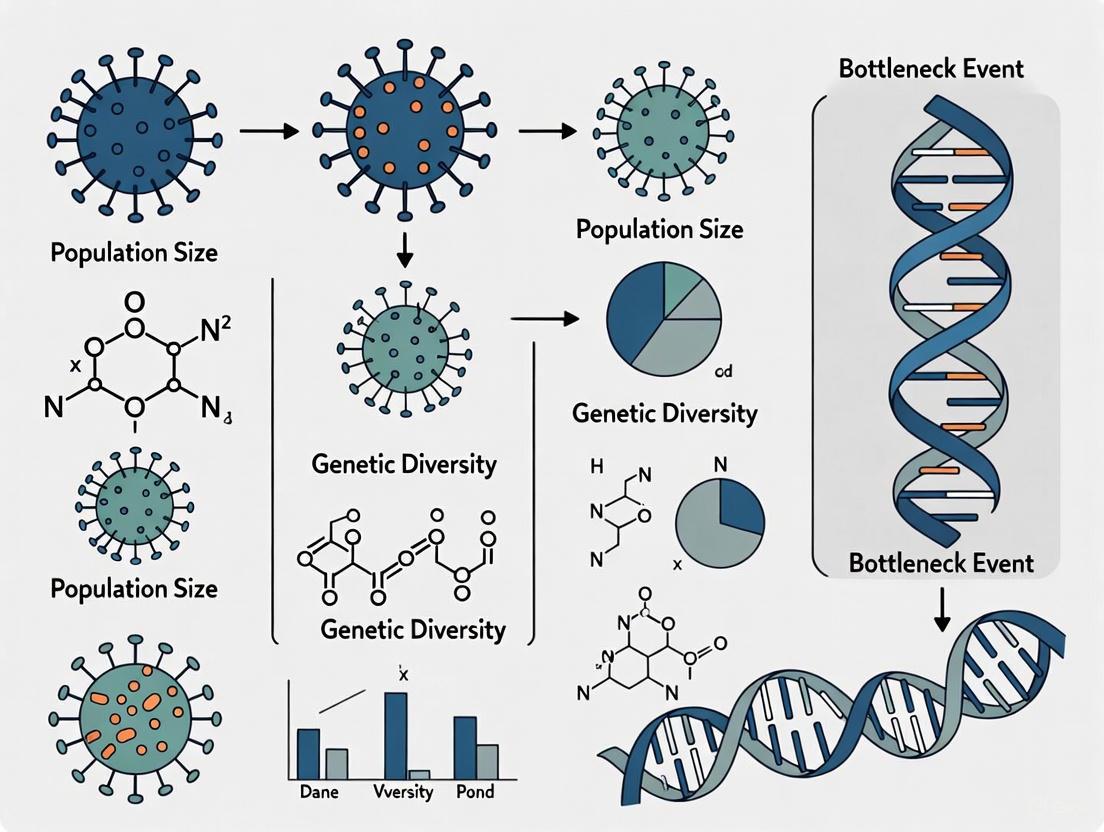
Population bottlenecks are critical evolutionary events that sharply reduce genetic diversity in viral populations, profoundly impacting their adaptability, pathogenesis, and response to therapeutic interventions.
Population Bottlenecks and Viral Diversity: Evolutionary Impacts and Clinical Implications for Drug Development
Abstract
Population bottlenecks are critical evolutionary events that sharply reduce genetic diversity in viral populations, profoundly impacting their adaptability, pathogenesis, and response to therapeutic interventions. This article synthesizes current research on how transmission and within-host bottlenecks constrain viral evolution across diverse systems, from plant viruses to human pathogens like SARS-CoV-2. We explore foundational mechanisms, advanced methodological approaches for bottleneck quantification, troubleshooting challenges in bottleneck estimation, and comparative analyses across viral systems. For researchers and drug development professionals, understanding these dynamics is essential for predicting viral evolution, designing effective treatments, and developing strategies to combat antibiotic and antiviral resistance.
Defining Viral Population Bottlenecks: Mechanisms and Evolutionary Consequences
Sharp Reductions in Genetic Diversity
A population bottleneck is a sharp, rapid reduction in the size of a population due to environmental events or human activities. These events can include famines, earthquakes, floods, fires, disease, droughts, genocide, widespread violence, or intentional culling [1]. The critical consequence of such a demographic collapse is a significant loss of genetic diversity; the smaller population that remains possesses only a fraction of the genetic variation present in the original gene pool [1]. This reduced genetic diversity subsequently passes to future generations, limiting the population's adaptability and increasing its vulnerability to future environmental changes, such as climate shifts or new diseases [1].
The genetic drift that accompanies a population bottleneck can alter the proportional distribution of alleles and even lead to their complete loss. This often results in increased rates of inbreeding and genetic homogeneity, which can cause inbreeding depression—a reduction in fitness and survival of offspring. Furthermore, smaller population sizes can lead to the accumulation of deleterious mutations [1]. In the specific context of virology, population bottlenecks are of paramount importance as they can drastically alter the genetic structure of viral quasispecies, impacting their evolution, adaptive potential, and the efficacy of therapeutic interventions.
Mechanisms and Genetic Consequences
The fundamental mechanism of a bottleneck involves a stochastic reduction in population size, where the surviving individuals constitute a small, often non-representative sample of the original population's gene pool [2]. This process has several direct genetic consequences:
- Loss of Allelic Diversity: The small founder population inevitably contains fewer unique alleles than the original, more diverse population. This loss can be permanent, severely limiting the genetic raw material available for future adaptation [2].
- Increased Genetic Drift: In small populations, random chance plays a larger role in determining which alleles are passed on. This genetic drift causes allele frequencies to fluctuate more widely from one generation to the next, potentially leading to the fixation of deleterious alleles or the loss of beneficial ones purely by chance, rather than through natural selection [1] [2].
- Inbreeding and Homozygosity: The reduced population size often forces related individuals to breed, leading to increased homozygosity. This can unmask deleterious recessive alleles, resulting in inbreeding depression, which further reduces the population's fitness and viability [1] [2].
For viruses, which exist as complex, dynamic quasispecies, bottlenecks are a regular feature of their life cycle. Events such as host-to-host transmission and systemic spread within a host can impose severe bottlenecks, stochastically reducing genetic variation and shaping the evolutionary trajectory of the viral population [3] [4].
Table 1: Documented Population Bottlenecks Across Species
| Species/Group | Bottleneck Severity | Documented Consequences |
|---|---|---|
| European Bison (Wisent) | Descended from ~12 individuals [1] | Extremely low genetic variation, potentially affecting reproductive ability of bulls [1]. |
| Northern Elephant Seal | Population fell to ~30 in 1890s [1] | Despite population recovery, limited genetic diversity persists due to dominant males fathering most offspring [1]. |
| New Zealand Black Robin | All current birds descended from a single female (Old Blue) [1] | Population still recovering from a low of 5 individuals in 1980 [1]. |
| Domestic Dog | Constricting breed-specific bottlenecks [1] | Dogs carry 2-3% more genetic load than gray wolves, leading to prevalent diseases [1]. |
| SARS-CoV-2 Variants | Transmission bottleneck of 1-2 viral genomes [5] | Limits spread of new mutations and reduces efficiency of selection during transmission [5]. |
Quantitative Analysis of Bottleneck Sizes
Quantifying the size of a population bottleneck is crucial for understanding its potential impact on genetic diversity and evolutionary outcomes. Research across different pathogens has revealed consistently tight bottlenecks.
A 2023 study on SARS-CoV-2 transmission within households used a beta-binomial model to estimate bottleneck sizes. The research found that for the Alpha, Delta, and Omicron variants, the per clade bottleneck was 1 (95% CI 1–1), while for non-VOC lineages, it was 2 (95% CI 2–2) [5]. This remarkably tight bottleneck indicates that often, a single viral genome founding a new infection is sufficient to transmit the virus. This tight constraint limits the spread of novel mutations that arise within a host and reduces the efficiency of natural selection along a transmission chain [5].
Similarly, experimental evolution work with Pseudomonas aeruginosa has demonstrated how bottleneck size, in combination with antibiotic selection pressure, can guide evolutionary paths. Studies have employed precisely controlled bottleneck sizes (e.g., 50,000 vs. 5,000,000 cells) to show that the severity of the bottleneck reproducibly impacts which resistance mutations become fixed in a population [6].
Table 2: Experimentally Controlled Bottleneck Sizes and Outcomes in P. aeruginosa
| Bottleneck Size | Antibiotic Selection Level | Key Evolutionary Outcome |
|---|---|---|
| Strong Bottleneck (50,000 cells) | Low (IC20) | Favoured evolution of high resistance; slower increase in variant frequencies; divergence in favoured genes [6]. |
| Strong Bottleneck (50,000 cells) | High (IC80) | Lower final resistance levels; only one population survived in the case of ciprofloxacin [6]. |
| Weak Bottleneck (5,000,000 cells) | Low (IC20) | High bacterial yields but lower resistance levels; variants in fewer genes (e.g., ptsP) [6]. |
| Weak Bottleneck (5,000,000 cells) | High (IC80) | Highest resistance levels; high-frequency variants in few genes (e.g., ptsP and pmrB); competitive dynamics [6]. |
Experimental Protocols for Studying Viral Bottlenecks
A foundational experimental approach for demonstrating and quantifying bottlenecks in plant viruses was detailed in a 2004 study on Cucumber mosaic virus (CMV) [3]. The following protocol provides a framework for similar investigations.
Construction of an Artificial Viral Population
The first step involves creating a defined, genetically diverse viral population to track [3]:
- Site-Directed Mutagenesis: Use a cDNA clone of the viral genome (e.g., CMV RNA 3) to introduce silent, neutral mutations. These mutations create unique restriction enzyme marker sites in various regions of the genome, such as the coat protein coding region or non-translated regions.
- Virus Recovery: Generate infectious transcripts from each mutated cDNA clone. Inoculate plants with these transcripts alongside necessary helper viral RNAs (e.g., wild-type CMV RNAs 1 and 2) to recover infectious, marker-bearing mutant viruses.
- Population Mixing: Combine equal amounts of viral RNA or sap from plants infected with each individual mutant to create an artificial population with known, quantifiable genetic diversity.
Inoculation and Systemic Passage
- Plant Inoculation: Inoculate isogenic host plants (e.g., Nicotiana tabacum at the five-leaf stage) with the constructed artificial population.
- Sampling: Collect tissue samples at strategic time points post-inoculation (e.g., 2, 10, and 15 days). Sample both the locally inoculated leaves and distal, systemically infected leaves.
- RNA Extraction and RT-PCR: Extract total RNA from sampled tissues. Use reverse transcription-PCR (RT-PCR) with virus-specific primers to amplify the target genomic region containing the marker sites.
Population Analysis
- Restriction Enzyme Digestion: Digest the purified RT-PCR products with the set of restriction enzymes specific to the introduced marker sites.
- Variant Quantification: Analyze the digestion products (e.g., via gel electrophoresis) to determine the presence or absence of each marker variant in the different tissue samples. The loss of specific markers between the inoculum and the systemic leaves provides direct evidence of a bottleneck.
Diagram 1: Viral Bottleneck Experimental Workflow.
The Interplay of Bottlenecks, Selection, and Evolutionary Paths
Bottlenecks do not act in isolation; their evolutionary impact is profoundly shaped by the prevailing strength of selection. Research on Pseudomonas aeruginosa evolution under antibiotic treatment has shown that bottleneck size and selection level jointly determine the evolutionary path to resistance [6].
- Strong Selection, Weak Bottlenecks: Under high antibiotic concentration (IC80) and weak bottlenecks, populations evolve high levels of resistance. Multiple beneficial mutations can arise and compete (clonal interference), leading to parallel evolution and the fixation of the fittest variants in different populations [6].
- Strong Selection, Strong Bottlenecks: Under high antibiotic concentration and severe bottlenecks, evolution is more stochastic. Genetic drift dominates, leading to divergent evolutionary outcomes across replicate populations and a lower likelihood of parallel evolution. The first beneficial mutation that arises by chance is likely to fix, even if it is not globally optimal [6].
- Weak Selection, Strong Bottlenecks: A key, and somewhat counterintuitive, finding is that strong bottlenecks in combination with low antibiotic selection (IC20) can also consistently favour the evolution of resistance. The explanation is that under weak selection, the probability of losing a favourable resistance variant through genetic drift is reduced when the population size is small [6].
This interaction can be conceptualized as a landscape where demography controls the accessibility of evolutionary paths. The initial wild-type population size and the final population size after growth act as deterministic controls, influencing the supply of new mutants during growth and the stochastic loss of them at the bottleneck [7]. By tuning these demographic parameters, specific evolutionary scenarios can be preferentially promoted or forced to occur.
Diagram 2: Bottleneck and Selection Interaction Logic.
The Scientist's Toolkit: Key Research Reagents
The following reagents are essential for designing and executing experiments on viral population bottlenecks, as derived from the cited methodologies [3] [6] [5].
Table 3: Essential Research Reagents for Bottleneck Studies
| Reagent/Solution | Function in Experimental Design |
|---|---|
| Infectious cDNA Clone | Provides a genetically defined backbone for introducing specific, trackable mutations and generating consistent viral stocks [3]. |
| Restriction Enzyme Markers | Silent mutations that create or abolish a restriction site; serve as neutral genetic markers to track variant frequency without altering fitness [3]. |
| High-Fidelity Reverse Transcriptase | Critical for accurate amplification of viral RNA for downstream sequence analysis, minimizing introduced errors during cDNA synthesis [3] [5]. |
| Controlled Bottleneck Apparatus | In bacterial systems, serial dilution protocols that precisely control the number of cells transferred to achieve a defined bottleneck size [6]. |
| Next-Generation Sequencing (NGS) | Allows for deep, quantitative sequencing of viral populations to identify single nucleotide variants (iSNVs) and quantify genetic diversity directly from host samples [5]. |
| Beta-Binomial Model | A statistical model used to quantitatively estimate the size of the transmission bottleneck based on the frequencies of shared and private iSNVs in donor-recipient pairs [5]. |
Implications for Viral Research and Drug Development
Understanding population bottlenecks is critical for viral research and the strategic development of antiviral drugs and therapies.
- Constraining Variant of Concern (VOC) Evolution: The tight transmission bottlenecks observed in SARS-CoV-2 (including highly transmissible VOCs like Omicron) suggest that the development of highly mutated variants is limited within simple transmission chains [5]. This indicates that prolonged infections within a single host, where the virus can accumulate multiple mutations without facing repeated bottlenecks, are a more likely breeding ground for new VOCs than person-to-person transmission.
- Informing Antiviral Strategies: The fact that bottlenecks stochastically reduce genetic diversity can be a double-edged sword. While it may purge deleterious mutations, it can also allow deleterious mutations to hitchhike with beneficial ones. Therapeutic strategies that exploit this fragility, such as mutagenic agents that push viral error thresholds, could be more effective when followed by an induced bottleneck event.
- Vaccine and Diagnostic Design: Knowledge of bottleneck sizes informs surveillance efforts. Tight bottlenecks mean that minor variants in a donor host are unlikely to be transmitted. Therefore, surveillance sequencing that focuses on consensus-level changes is effectively tracking what is being transmitted between hosts. Understanding bottlenecks during within-host spread can also inform the design of vaccines that aim to generate immunity at key portal-of-entry tissues to impose a severe bottleneck on establishing an infection.
Systemic infection bottlenecks are stochastic events that sharply reduce the number of founding pathogens during host colonization, profoundly influencing viral population genetics and evolution [8]. In plant viruses, these bottlenecks occur when viruses move from initially infected cells to distant organs through the plant's vascular system, constricting genetic diversity and increasing the influence of genetic drift relative to natural selection [3] [9]. Understanding these population constraints is essential for modeling viral evolution, predicting emergence of novel variants, and developing effective disease management strategies.
Plant viruses face unique challenges during systemic spread, primarily due to the plant cell wall that acts as a physical barrier restricting direct access to the plasma membrane [10]. Unlike animal viruses, plant viruses do not rely on plasma membrane receptors for cell entry but instead exploit mechanical damage or vector organisms to bypass this barrier [10]. The subsequent movement through plasmodesmata and vascular tissues creates multiple points where population bottlenecks can occur, making plant-virus systems particularly valuable for studying infection bottlenecks [10] [4].
This review synthesizes current evidence on systemic infection bottlenecks in plant virus models, detailing quantitative estimates, methodological approaches for bottleneck measurement, and implications for viral evolution and disease management. By framing this analysis within the broader context of population genetics, we highlight how plant viruses serve as powerful experimental systems for understanding fundamental processes in pathogen evolution.
Quantitative Evidence of Bottlenecks in Plant Viruses
Experimental studies using genetically marked virus populations have revealed that systemic infection bottlenecks are often severe, though their stringency varies significantly across different virus-plant systems. These bottlenecks limit genetic variation and can result in founding populations that are orders of magnitude smaller than the census population size in the inoculum [3] [9].
Table 1: Estimated Bottleneck Sizes During Systemic Plant Infection
| Virus Species | Host Plant | Bottleneck Size (Founders) | Experimental Approach | Reference |
|---|---|---|---|---|
| Tobacco mosaic virus (TMV) | Tobacco (Nicotiana tabacum) | 2-20 | Co-inoculation of 3 genotypes, quantification in systemic leaves | [9] |
| Cucumber mosaic virus (CMV) | Tobacco (Nicotiana tabacum) | Significant stochastic reduction | 12 restriction marker mutants, population tracking | [3] |
| Cauliflower mosaic virus (CaMV) | Turnip (Brassica rapa) | Several hundreds | Co-inoculation of 6 variants, frequency monitoring | [11] |
| Wheat streak mosaic virus (WSMV) | Wheat | ~4 | Spatial analysis of genetic diversity | [11] |
The variation in bottleneck size across different plant-virus systems suggests that viral traits and host factors interact to determine the severity of population constrictions. For Tobacco mosaic virus (TMV), estimates indicate that only 2-20 viral genomes found the population in systemically infected tobacco leaves [9]. Similarly, Cucumber mosaic virus (CMV) experiences significant stochastic reductions in genetic variation during systemic movement in tobacco [3]. In contrast, Cauliflower mosaic virus (CaMV) exhibits a much larger bottleneck size of several hundred genomes during leaf colonization in turnip plants [11]. This approximately 100-fold difference compared to other plant viruses suggests that the putative barriers generating severe bottlenecks for some viruses might not exist or can be surmounted by others [11].
The extreme demographic fluctuations observed in most plant viruses have important evolutionary implications. When effective population sizes become small, genetic drift can override selection, potentially reducing mean fitness through the accumulation of deleterious mutations [11]. This dynamic explains why repeated experimental bottlenecks dramatically reduce viral fitness in passage experiments [11]. The variation in bottleneck size across systems indicates that the balance between selection and drift differs among plant-virus interactions, with important consequences for viral adaptation and evolution.
Methodological Approaches for Measuring Bottlenecks
Experimental Designs for Bottleneck Quantification
The fundamental approach for measuring infection bottlenecks involves tracking genetically distinct viral variants through the infection process. Early methods utilized restriction enzyme site markers or coat protein mutants to distinguish viral genotypes [3] [9]. These approaches typically involved co-inoculating hosts with known proportions of distinct variants, then quantifying changes in their relative frequencies in systemic tissues.
More recent methodologies employ barcoded viral populations containing numerous unique, neutral genetic tags. This approach provides higher resolution by monitoring the diversity of a barcoded population during host colonization [12]. The number of unique barcodes recovered after a bottleneck event indicates the size of the founding population, with greater tag diversity enabling more precise estimates [8] [12].
Table 2: Molecular Markers for Bottleneck Measurement
| Marker Type | Resolution | Key Features | Applications |
|---|---|---|---|
| Restriction site markers | Low | Introduced via site-directed mutagenesis, detected by digestion | CMV bottleneck studies [3] |
| Coat protein mutants | Low | Amino acid substitutions, antibody detection | TMV bottleneck studies [9] |
| Engineered sequence tags | Medium | Short inserted sequences, PCR detection | CaMV studies [11] |
| Barcoded libraries | High | Thousands of unique tags, high-throughput sequencing | Modern bottleneck analyses [12] |
Analytical methods for estimating bottleneck size from these data include probabilistic approaches that analyze stochastic loss of marked strains, mathematical modeling of pathogen dynamics, and population genetic methods that compare allele frequencies before and after bottlenecks [8]. Methods based on presence/absence of individual markers are most common but have limited resolving power, while approaches using allele frequency data from barcoded populations provide more accurate estimates [8].
Key Experimental Workflow
The following diagram illustrates the generalized experimental workflow for quantifying systemic infection bottlenecks using barcoded virus populations:
This workflow begins with creating a diverse viral population containing neutral genetic markers, followed by inoculation of host plants and sampling of systemic tissues at various time points. Viral genomes are then extracted and analyzed to quantify changes in population diversity, enabling calculation of the bottleneck size.
Biological Mechanisms of Plant Virus Bottlenecks
Cellular and Systemic Barriers
Systemic infection bottlenecks in plants result from multiple physical and physiological barriers that viruses must overcome during movement from initial infection sites to distant tissues. The first major constraint occurs during cell-to-cell movement through plasmodesmata, the cytoplasmic channels connecting adjacent plant cells [10]. These structures have a size exclusion limit (SEL) that restricts the passage of large macromolecules and viral complexes.
To overcome this barrier, viruses encode movement proteins (MPs) that modify plasmodesmal SEL by interacting with host components such as β-glucanases and pectin methylesterases [10]. These interactions dilate the pores to allow viral transport, but the process remains inefficient, creating a population filter. Additionally, structural regulators like multiple C2-domain transmembrane proteins and synaptotagmins can stabilize plasmodesmata and potentially facilitate viral trafficking [10].
The second major bottleneck occurs during long-distance movement through the phloem vasculature. Viruses must enter the phloem from mesophyll cells, move systemically through sieve elements, and exit the phloem to establish infection in new leaves [10] [11]. Each transition represents a potential population constraint. Some viruses, such as those in the Totiviridae and Partitiviridae families, bypass conventional plasmodesmal transport by replicating in meristematic cells [10].
The following diagram illustrates key barriers during systemic movement:
Host Factors Influencing Bottleneck Size
Host factors significantly impact the severity of systemic infection bottlenecks. Callose deposition at plasmodesmata acts as a physical barrier that modulates viral spread, with increased callose accumulation correlating with tighter bottlenecks [10]. Host-mediated RNA silencing defenses also create population constraints by targeting viral genomes, preferentially eliminating certain variants [10].
Meristematic tissues present particularly strong barriers to viral movement, as they contain narrow plasmodesmal SELs that restrict viral access [10]. This protection of meristems has important implications for seed transmission and viral evolution. Additionally, the host microbiota can compete with viruses for resources or induce defense responses that further constrain population size [12].
The combination of these host factors creates a complex network of barriers that shape viral population structure during systemic infection. Understanding these interactions is crucial for developing strategies to manipulate bottleneck size for disease control.
Research Toolkit: Essential Reagents and Methods
Table 3: Research Reagent Solutions for Bottleneck Studies
| Reagent/Method | Function | Example Application |
|---|---|---|
| Infectious cDNA clones | Generate defined viral genotypes | Construction of marked virus variants [3] [9] |
| Site-directed mutagenesis | Introduce specific genetic markers | Creating restriction site markers [3] |
| Barcoded virus libraries | High-resolution population tracking | Quantifying founder numbers [12] |
| Quantitative RT-PCR | Viral load measurement | Assessing accumulation in different tissues [9] |
| Hybridization probes | Genotype-specific detection | Differentiating viral variants in mixed infections [9] |
| High-throughput sequencing | Comprehensive diversity assessment | Barcode variant frequency analysis [8] [12] |
| Model host plants | Standardized infection systems | Tobacco, Arabidopsis, Nicotiana benthamiana [10] [3] |
These research tools enable precise quantification of viral population dynamics during systemic infection. The choice of markers and detection methods depends on the specific research questions, with barcoded libraries offering the highest resolution for bottleneck size estimation [8] [12]. Plant model systems with well-characterized vascular architecture and defense responses provide standardized backgrounds for comparing bottleneck dynamics across virus species.
Implications for Viral Evolution and Disease Management
Systemic infection bottlenecks have profound implications for viral evolution and disease management strategies. When bottlenecks are severe, genetic drift dominates over selection, potentially limiting viral adaptation [11]. This effect may explain why some plant viruses exhibit lower than expected genetic diversity despite high mutation rates [3].
The bottleneck size varies significantly among different virus-plant systems, suggesting that viruses have evolved distinct strategies to overcome population constraints. For example, Cauliflower mosaic virus achieves large bottleneck sizes potentially through efficient movement functions that allow massive systemic colonization [11]. Understanding these strategies could reveal novel targets for interfering with viral spread.
From a disease management perspective, knowledge of infection bottlenecks informs strategies for deploying resistance genes and antiviral treatments. Tight bottlenecks reduce the probability that resistant mutants will establish systemic infection, potentially extending the durability of resistance genes [13]. Similarly, treatments that constrict population size could synergize with host defenses to clear infections.
The conceptual framework developed from plant virus studies also applies to animal and human viruses, which face similar population constraints during host colonization [8] [13]. For instance, SARS-CoV-2 experiences tight transmission bottlenecks despite its high transmissibility [13], mirroring patterns observed in plant systems. This cross-kingdom conservation highlights the fundamental nature of infection bottlenecks in pathogen evolution.
Systemic infection bottlenecks represent a critical population genetic process shaping viral evolution across host organisms. Plant virus models have provided fundamental insights into the mechanisms, measurement approaches, and evolutionary consequences of these bottlenecks. The variation in bottleneck size across different virus-plant systems reveals a complex interplay between viral movement strategies and host defense mechanisms.
Future research should focus on elucidating the molecular determinants of bottleneck size and developing interventions that exploit these population constraints for disease control. Integrating plant virus studies with animal and human virus research will provide a unified conceptual framework for understanding how population bottlenecks influence pathogen evolution across biological systems. This knowledge is essential for predicting viral emergence, managing resistance durability, and developing novel strategies for combating viral diseases in agriculture and medicine.
Viral transmission bottlenecks are evolutionary events that occur when only a small, genetically restricted subset of a pathogen population from an infected host successfully establishes a new infection in a susceptible individual. These bottlenecks drastically reduce the effective population size and genetic diversity of the viral population, creating a foundational population that can lead to genetic drift. For rapidly evolving pathogens such as RNA viruses, transmission bottlenecks represent critical determinants of evolutionary trajectories, constraining adaptive potential and influencing virulence evolution [14] [4].
The study of transmission bottlenecks sits at the intersection of virology, evolutionary biology, and epidemiology. Understanding where in the transmission process these diversity restrictions occur—whether within the donor host, during environmental transfer, or during early expansion in the recipient host—reveals the relative opportunities for selection versus drift to operate. This knowledge is particularly relevant for drug development professionals seeking to anticipate viral escape mutations and design robust therapeutic interventions. Recent research employing advanced sequencing technologies and barcoded viral libraries has provided unprecedented insight into the dynamics of these population constrictions across multiple viral systems [5] [15].
Quantitative Landscape of Viral Bottlenecks
Comparative Bottleneck Sizes Across Viral Pathogens
Extensive research across multiple viral families has revealed that tight transmission bottlenecks are a common feature of many important human pathogens. The table below summarizes quantitative bottleneck estimates for several significant viruses:
Table 1: Experimentally Determined Transmission Bottleneck Sizes for Selected Viruses
| Virus | Bottleneck Size (Genomes) | Experimental System | Key Reference |
|---|---|---|---|
| SARS-CoV-2 (Non-VOC) | 2 (95% CI 2-2) | Household transmission pairs | [5] |
| SARS-CoV-2 (Alpha, Delta, Omicron) | 1 (95% CI 1-1) | Household transmission pairs | [5] [13] |
| Influenza A Virus | 1-2 | Human natural infections, guinea pig model | [15] |
| HIV | Small fraction of source diversity | Human transmission pairs | [14] |
| Cucumber Mosaic Virus | Significant stochastic reduction | Artificial population in tobacco plants | [3] |
SARS-CoV-2 Variant-Specific Bottleneck Dynamics
The COVID-19 pandemic enabled unprecedented real-time assessment of transmission bottlenecks as new variants of concern (VOCs) emerged. A comprehensive household study comparing pre-VOC lineages with Alpha, Delta, and Omicron VOCs revealed remarkably consistent bottleneck sizes despite substantial increases in transmissibility. The bottleneck was calculated using a beta binomial model based on shared intrahost single nucleotide variants (iSNVs) between transmission pairs [5] [13].
Table 2: SARS-CoV-2 Variant Bottleneck Estimates from Household Transmission Studies
| Variant | Bottleneck Size | 95% Confidence Interval | Number of Transmission Pairs Analyzed |
|---|---|---|---|
| Non-VOC | 2 | 2-2 | 15 |
| Alpha | 1 | 1-1 | 19 |
| Delta | 1 | 1-1 | 12 |
| Omicron | 1 | 1-1 | 17 |
| Gamma | 1 | 1-7 | 1 |
This surprising consistency in bottleneck size across variants with markedly different transmission characteristics suggests that tight bottlenecks may be a fundamental constraint on SARS-CoV-2 evolution during transmission chains. The limited diversity observed in donor hosts at the time of peak viral shedding likely drives these narrow bottlenecks, which may be even more pronounced in rapidly transmissible variants [5].
Methodological Approaches for Bottleneck Analysis
High-Depth Sequencing of Transmission Pairs
Protocol: Household Transmission Study Design
Cohort Enrollment: Identify households with index cases and enroll within 24-48 hours of symptom onset. Monitor all household contacts for infection development.
Sample Collection: Collect serial nasopharyngeal specimens from all infected individuals. Time collection to coincide with peak viral shedding (typically 2-6.5 days post-symptom onset) to capture diversity at transmission risk periods.
Sequencing Methodology:
- Extract viral RNA using standardized protocols
- Perform reverse transcription and whole-genome amplification
- Conduct high-depth next-generation sequencing (recommended depth >1000x coverage)
- Include technical replicates to control for variant calling artifacts
Variant Calling:
- Apply stringent thresholds for intrahost single nucleotide variants (iSNVs)
- Require presence in both technical replicates to minimize false positives
- Use frequency threshold of ≥2% for iSNV identification
- Perform consensus sequence analysis to verify transmission linkages
Bottleneck Calculation:
This approach revealed that 51% of SARS-CoV-2 specimens had no iSNVs, 42% had 1-2 iSNVs, and only 7% had ≥3 iSNVs, illustrating the naturally low diversity that contributes to tight transmission bottlenecks [5].
Barcoded Viral Library Systems
Protocol: Construction and Application of Barcoded Influenza A Virus
Barcode Design:
- Select 12 nucleotide sites within a 50-nucleotide region of the NA segment
- Implement bi-allelic system (2^12 = 4,096 possible barcodes)
- Use synonymous mutations to avoid fitness effects
- Base polymorphisms on naturally occurring variants in circulating strains
Library Generation:
- Generate plasmid library containing all barcode variants
- Produce recombinant influenza A/Panama/2007/99 (H3N2) virus
- Amplify library through limited passages to maintain diversity
- Sequence plasmid and passage 1 stocks to verify barcode diversity
Animal Infection and Transmission:
- Inoculate donor guinea pigs with barcoded library
- Expose contact animals via aerosol or direct contact routes
- Collect serial nasal wash samples throughout infection course
- Monitor viral titers by plaque assay
Barcode Quantification:
- Extract viral RNA from specimens
- Amplify barcode region via RT-PCR
- Perform high-throughput sequencing of barcode regions
- Analyze barcode frequencies and diversity indices over time [15]
This sophisticated approach demonstrated that while numerous viral barcodes (representing distinct viral lineages) successfully transfer to exposed animals, a severe bottleneck occurs 1-2 days after infection initiation, during the population expansion phase in the new host [15].
Figure 1: Sequential Stages of Viral Transmission Bottleneck. The process begins with a diverse population in the donor host, undergoes physical transfer, and experiences the most severe diversity loss during early expansion in the new host.
Table 3: Key Research Reagents for Transmission Bottleneck Studies
| Reagent/Resource | Function/Application | Example Implementation |
|---|---|---|
| Barcoded Viral Library | Tracking individual viral lineages through transmission events | 4,096-variant barcoded influenza A virus with synonymous mutations in NA segment [15] |
| High-Throughput Sequencing Platform | Deep sequencing to detect low-frequency variants | Illumina sequencing at >1000x coverage for iSNV detection [5] |
| Beta Binomial Model | Quantitative estimation of bottleneck size | Calculation of transmission bottleneck size from shared iSNV frequencies in donor-recipient pairs [5] |
| Animal Transmission Models | Controlled study of transmission dynamics | Guinea pig model for influenza A virus transmission via aerosol and direct contact [15] |
| Household Cohort Studies | Natural transmission observation | Prospective surveillance cohorts with rapid enrollment following index case identification [13] |
| Technical Replication Strategy | Control for sequencing artifacts | Requiring iSNV presence in both technical replicates for variant calling [5] |
Mechanistic Insights into Bottleneck Formation
Temporal Dynamics of Diversity Loss
For influenza A virus, barcoding experiments have revealed that the point of maximum diversity loss occurs not during physical transfer between hosts, but during the early expansion phase within the newly infected host. In both aerosol-exposed and direct contact animals, numerous viral barcodes are detected at the earliest time points positive for infectious virus, indicating robust transfer of diversity. However, this diversity sharply declines 1-2 days after infection initiation [15].
This temporal pattern suggests that host factors, such as innate immune effectors or tissue-specific barriers, may have greater opportunity to impose selection during transmission than previously recognized. The expansion phase thus represents a critical window where stochastic and selective processes collaboratively shape the founding viral population [15].
Implications for Viral Evolution and Therapeutic Design
The constraining effect of transmission bottlenecks on viral evolution has profound implications for therapeutic development and public health strategies:
Figure 2: Evolutionary Consequences of Tight Transmission Bottlenecks. Tight bottlenecks limit variant spread and selection efficiency, constraining viral evolution during transmission and highlighting the importance of prolonged infections in variant of concern (VOC) emergence.
Tight transmission bottlenecks reduce the efficiency of selection along transmission chains, making it less likely that beneficial mutations will reach fixation in the viral population. This phenomenon adds to the evidence that selection during prolonged infections in immunocompromised individuals, rather than sequential acquisition of mutations through transmission chains, may be the primary driver of highly mutated variant of concern (VOC) emergence [5] [13].
For drug development professionals, this understanding suggests that targeting conserved viral regions or functions remains a robust strategy, as the constraining effect of bottlenecks limits the ability of viral populations to rapidly evolve resistance during community spread. Additionally, therapeutic approaches that further restrict population diversity (bottleneck-enhancing interventions) could potentially constrain viral adaptation and evolution [14].
Transmission bottlenecks represent fundamental constraints on viral population genetics that shape pathogen evolution and influence epidemic dynamics. Technical advances in deep sequencing and barcoded viral libraries have revealed that these bottlenecks are consistently tight across multiple viral systems, including emerging SARS-CoV-2 variants of concern. Rather than occurring primarily during physical transfer between hosts, the most severe restrictions to diversity often happen during early expansion within newly infected hosts.
For the research community, these insights highlight the importance of focusing on within-host evolutionary processes, particularly in prolonged infections, as key drivers of viral adaptation. The methodological frameworks and reagents described herein provide powerful tools for continued investigation into how population constrictions at transmission influence viral evolution, with significant implications for predicting variant emergence, designing therapeutic interventions, and developing public health strategies to constrain viral adaptation.
Within the broader study of how population bottlenecks shape viral diversity, the Multiplicity of Infection (MOI) is a fundamental cellular-level parameter that dictates the severity of these bottlenecks and the subsequent evolutionary trajectory of viral populations. An MOI is formally defined as the ratio of infectious viral particles to target cells in a given infection system [16]. This parameter is not merely a quantitative measure but a central governor of within-host virus population dynamics, primarily influencing two critical processes: the intensity of population bottlenecks and the nature of genotypic interactions within infected cells [17]. During the colonization of a multicellular host, viruses face repeated demographic fluctuations, and the MOI at which cells are infected dramatically influences how viral populations navigate these constraints [4] [18].
The MOI is a dynamic parameter that can change considerably during host invasion, varying across different organs, tissue types, and infection stages [17]. This variability means that population bottlenecks can be severe and sequential, with each bottleneck event potentially restricting genetic diversity and shaping the overall viral population structure. Understanding MOI is therefore essential for deciphering the complex interplay between viral genetics, evolutionary pressures, and the control of virulence thresholds that determine disease outcomes [18].
Theoretical Frameworks: Linking MOI, Bottlenecks, and Viral Evolution
Quantitative Foundations of MOI
The concept of MOI is rooted in probabilistic models of infection. When a viral population infects a cell culture or host tissue, the infection process is fundamentally stochastic. The MOI represents the average number of viral genomes infecting a single cell, but the actual distribution of viral genomes per cell follows a Poisson distribution [16]. The probability that a cell is infected by y virus particles at a given MOI value x is expressed as:
P(y) = (x^y * e^{-x}) / y!
This statistical framework explains why at an MOI of 1, approximately 37% of cells receive exactly one viral particle, while 18% receive two particles, and 6% receive three [16]. This distribution has profound implications for population bottlenecks, as even at relatively high MOI values, some cells may receive few or no viral particles, while others receive many, creating heterogeneous subpopulations.
MOI and Evolutionary Control of Viral Fragility
The relationship between MOI and population bottlenecks provides insight into a paradoxical aspect of viral evolution: why RNA viral genomes are exceptionally fragile, with most mutations being strongly deleterious or lethal [19]. Theoretical models suggest that this genetic fragility may be an evolutionary adaptation to the repeated population bottlenecks viruses experience.
When viral populations undergo bottleneck events, as occurs during transmission between hosts or when moving between tissues within a host, genetic fragility can be advantageous. Through Muller's ratchet—the irreversible accumulation of deleterious mutations in small populations—fragile genomes (with high deleterious effects, s_d) experience fewer clicks of the ratchet compared to robust genomes (with low s_d), as strongly deleterious mutations are more efficiently purged by selection [19]. This means that despite the high cost of individual mutations, fragile viral populations are more likely to survive multiple bottlenecks (Table 1).
Table 1: Survival Probability Through Sequential Bottlenecks Based on Genetic Fragility
| Number of Bottlenecks | Robust Genomes (Low s_d) | Fragile Genomes (High s_d) |
|---|---|---|
| 1 | 0.85 | 0.72 |
| 2 | 0.74 | 0.65 |
| 3 | 0.63 | 0.61 |
| 4 | 0.52 | 0.58 |
| 5 | 0.41 | 0.56 |
Note: Adapted from branching process models of viral populations experiencing repeated bottlenecks [19]. Values represent survival probabilities through multiple bottlenecks of size B=5.
MOI-Dependent Interactions Among Viral Genotypes
The MOI determines the probability that different viral genotypes will co-infect the same cell, which in turn governs several key evolutionary processes:
- Genetic Exchange: High MOI facilitates recombination and reassortment in viruses with segmented genomes, increasing genetic diversity [18].
- Complementation: Defective viral genomes can be rescued by functional genes from co-infecting viruses in high MOI conditions, maintaining potentially deleterious variants in the population [18] [19].
- Collective Action: Some viral functions may operate more efficiently when multiple genomes cooperate within infected cells [17].
These interactions create a complex fitness landscape where the evolutionary success of viral variants depends not only on their intrinsic properties but also on the MOI-dependent cellular environment.
Experimental Evidence: Dynamic MOI During Host Colonization
Methodological Approaches for MOI Quantification
Research on Turnip Mosaic Virus (TuMV) in plant hosts provides a detailed methodology for quantifying MOI dynamics during systemic infection. The experimental protocol involves:
Viral Clone Construction: Generating infectious clones of TuMV expressing fluorescent reporter proteins (mGFP5 or mRFP1) tagged with a nuclear localization signal (NLS) to concentrate fluorescence in nuclei and prevent intercellular diffusion [17].
Plant Infection: Turnip plants (Brassica rapa) at the third-leaf stage are inoculated with a 1:1 mixture of GFP- and RFP-labeled TuMV clones, either through mechanical inoculation with virion suspensions or agroinoculation [17].
Spatial and Temporal Sampling: Leaves are sampled at precise developmental stages, with six leaf discs (0.8-cm diameter) distributed evenly across the leaf surface for RNA extraction [17].
RT-qPCR Analysis: Quantitative reverse transcription PCR is used to determine the relative frequency of each viral genotype in individual cells and tissues, allowing calculation of MOI values [17].
This approach enables researchers to track the expansion of viral populations from initial infection sites through systemic spread, quantifying how MOI changes at different stages of colonization.
MOI Variability Across Infection Stages
The TuMV study revealed striking spatial and temporal dynamics in MOI during host colonization (Table 2). The MOI was found to be very low (approximately 1 genome per cell) during primary infection from viruses circulating in the vasculature, resulting in infection foci founded predominantly by single genomes [17]. However, as the infection progressed, the MOI sharply increased to several tens of genomes per cell during cell-to-cell movement through the mesophyll tissue [17].
Table 2: MOI Dynamics During Systemic Plant Infection by Turnip Mosaic Virus
| Infection Stage | Route of Infection | Average MOI | Genetic Diversity |
|---|---|---|---|
| Primary Infection | Vascular circulation | ~1 | Clonal lineages |
| Secondary Spread | Cell-to-cell movement | 10-50 | Mixed kin genomes |
| Late Infection | Focus merging | Limited | Spatial segregation |
Despite this elevated MOI during cellular spread, coinfection of cells by lineages originating from different primary foci was severely limited by the rapid onset of a superinfection exclusion mechanism [17]. This results in a complex colonization pattern where individual viral genomes initiate distinct lineages within a leaf, kin genomes massively coinfect cells during local spread, but coinfection by distantly related lineages is strictly limited.
Implications for Bottleneck Severity
The dynamic nature of MOI during host colonization means that viral populations experience bottlenecks of varying severity at different stages of infection:
- Severe Bottlenecks: Occur during initial infection from the vasculature, where MOI is low, and only a limited number of variants successfully establish infection foci [17].
- Moderate Bottlenecks: Occur during tissue colonization, where higher MOI allows more variants to coexist, but superinfection exclusion still restricts genetic mixing between lineages [17].
- Transmission Bottlenecks: Occur during host-to-host transmission, where often only a small number of viral particles establish infection in new hosts [19].
This sequential bottlenecking has profound effects on viral population genetics, potentially leading to the accumulation of deleterious mutations through Muller's ratchet and influencing the overall evolutionary trajectory of viral lineages [19].
Research Toolkit: Essential Reagents and Methods
Table 3: Key Research Reagents and Methods for MOI and Bottleneck Studies
| Reagent/Method | Function/Application | Example Use |
|---|---|---|
| Fluorescent Viral Tags (e.g., GFP, RFP) | Labeling distinct viral genotypes to track coinfection and spatial distribution | Differential labeling of TuMV clones for MOI quantification [17] |
| Nuclear Localization Signals (NLS) | Concentrating fluorescent signals in cell nuclei to improve infection detection accuracy | Enhancing cellular resolution in TuMV infection studies [17] |
| Reverse Transcription-quantitative PCR (RT-qPCR) | Quantifying the relative abundance of different viral genotypes in infected tissues | Determining genotype frequencies in mixed infections [17] |
| Cell Lines with Enhanced Susceptibility | Engineering cells to overexpress viral receptors for improved in vitro transduction efficiency | Developing AAVR-overexpressing lines for AAV transduction studies [20] |
| CRISPR Activation (CRISPRa) | Driving transgene expression from viral promoters to enhance detection sensitivity | Targeting AAV2 inverted terminal repeats for enhanced expression [20] |
| High-Content Imaging Systems | Automated quantification of cellular infection events and phenotypic responses | Profiling breast cancer cell morphological responses to infection [21] |
Conceptual Framework: Visualizing MOI and Bottleneck Relationships
MOI Role in Viral Bottlenecks
The multiplicity of infection serves as a critical cellular-level parameter that mediates how viral populations navigate the sequential bottlenecks encountered during host colonization and transmission. The dynamic nature of MOI—varying across tissues, cell types, and infection stages—creates a complex landscape of evolutionary constraints and opportunities for viral populations. Experimental evidence demonstrates that far from being a constant parameter, MOI can shift dramatically during infection, from very low values during initial establishment to much higher values during local spread [17].
This understanding of MOI dynamics provides crucial insights for viral research and therapeutic development. The relationship between MOI, bottleneck severity, and the evolution of genetic fragility helps explain fundamental aspects of viral biology and suggests potential intervention strategies [19]. Furthermore, recognizing how MOI-dependent processes like complementation and genetic exchange influence viral diversity has implications for predicting treatment outcomes and resistance evolution.
Future research integrating precise MOI measurements with advanced sequencing technologies and mathematical modeling will further illuminate how cellular-level infection parameters shape the population genetics and evolutionary trajectories of viral pathogens. This integrated approach promises to enhance our ability to predict viral emergence, understand pathogenesis, and develop effective control strategies.
Population bottlenecks, events that sharply reduce the size and genetic diversity of a population, are a fundamental force in viral evolution. Within the context of a broader thesis on the effect of population bottlenecks on viral diversity research, this guide examines the consequent evolutionary impacts: the enhanced role of genetic drift, the specific patterns of mutation accumulation, and the constraints imposed on adaptive processes. For viruses, which possess high mutation rates and large population sizes, bottlenecks act as a critical evolutionary filter. They occur during key phases of the viral life cycle, notably during host-to-host transmission and within-host dissemination, stochastically reducing genetic variation and altering the balance between random genetic drift and natural selection [22] [4]. Understanding these dynamics is not merely an academic exercise; it is crucial for predicting viral emergence, understanding antigenic escape, and developing effective countermeasures, such as vaccines and antivirals. This paper synthesizes recent findings on how bottlenecks shape viral evolution, with a particular focus on the constraints they impose on the generation and maintenance of adaptive mutations.
Quantitative Data on Viral Population Bottlenecks
The size of a population bottleneck, defined as the number of viral particles that successfully found a new infection, is a key parameter determining its evolutionary impact. The following tables summarize empirical estimates of bottleneck sizes across different viruses and experimental systems, along with the associated changes in genetic diversity.
Table 1: Estimated Transmission Bottleneck Sizes in Respiratory Viruses
| Virus | Bottleneck Size (Estimated Number of Transmitted Genomes) | Key Supporting Evidence | Study Context |
|---|---|---|---|
| SARS-CoV-2 (non-VOC) | 2 (95% CI 2-2) [13] | Deep sequencing of household transmission pairs; majority of iSNVs not shared. | Natural human households |
| SARS-CoV-2 (Alpha, Delta, Omicron) | 1 (95% CI 1-1) [13] | Low within-host diversity at transmission; tight bottlenecks even for highly transmissible variants. | Natural human households |
| Influenza A Virus | 1-2 [15] | Barcoded virus library in guinea pig model; few lineages sustained after population expansion in recipient. | Guinea pig model (aerosol/contact) |
| Influenza A Virus (Intracellular) | Majority of genomic segments from 1-2 infecting virions, even at high MOI [23] | Stochastic modeling of intracellular replication; early RNA degradation creates a bottleneck. | In silico stochastic model |
Table 2: Diversity Metrics Before and After Bottleneck Events
| Organism / System | Type of Bottleneck | Diversity Metric | Pre-Bottleneck Diversity | Post-Bottleneck Diversity | Citation |
|---|---|---|---|---|---|
| Influenza A Virus | Host-to-host transmission | Shannon Diversity (Barcode) | Maintained high in inoculated hosts | Sharp decline 1-2 days post-infection in contacts | [15] |
| Cryphonectria hypovirus 1 (CHV1) | Vertical transmission (into conidia) | Nucleotide Diversity (π) | Higher in parental fungal isolate | Significantly declined in conidial progeny | [24] |
| Sophora moorcroftiana | Historical demographic | Genetic Diversity (Pi) | Varies by subpopulation | P1 subpopulation: 1.1 x 10⁻⁴ (lowest) | [25] |
Key Experimental Models and Protocols
Cutting-edge research in this field relies on a combination of innovative experimental models and sophisticated computational tools to quantify bottlenecks and track the fate of genetic variants.
Barcoded Virus Library Transmission Experiment
This approach allows for the high-resolution tracking of thousands of viral lineages through transmission events.
- Objective: To decipher where in the transmission process (donor, environment, or recipient) viral populations lose diversity [15].
- Protocol:
- Library Generation: A genetically barcoded influenza A virus (A/Panama/2007/99 (H3N2)) is engineered. The barcode consists of 12 synonymous, bi-allelic nucleotide sites within the native sequence of the NA segment, allowing for 4,096 (212) unique barcodes. This design maximizes diversity while minimizing fitness costs [15].
- Animal Infection: Guinea pigs are inoculated with the diverse barcoded virus library.
- Transmission: Inoculated animals are co-housed with naive animals to facilitate transmission via aerosol or direct contact.
- Sampling: Viral populations are sampled from the inoculated animals throughout infection and from exposed animals at the earliest time points positive for infectious virus and sequentially thereafter.
- Sequencing and Analysis: Deep sequencing is used to quantify the frequency of each barcode in each sample. The number of unique barcodes detected and indices like the Shannon Diversity Index are calculated to measure diversity loss [15].
- Key Finding: A high level of diversity is initially transferred to recipient animals, but a severe bottleneck occurs during the initial expansion of infection in the new host, not during the transfer itself [15].
Stochastic Modeling of Intracellular Replication
This computational method simulates molecular events during viral infection to understand bottlenecks at the cellular level.
- Objective: To investigate the role of intracellular replication processes in the generation of genetic diversity and the imposition of population bottlenecks [23].
- Protocol:
- Model Framework: A stochastic mathematical model (e.g., Gillespie algorithm) is used to simulate the infection of a single cell by one or more IAV strains. The model includes key molecular steps: virion entry, genome replication, protein production, and virion assembly/release [23].
- Model Expansion: The base model is expanded to track the frequency of each genetic segment originating from different infecting virions throughout the infection cycle. It also tracks the replication history of each segment and the introduction of new mutations [23].
- Parameterization: The model is parameterized using experimentally determined rates for processes like virion degradation, RNA synthesis, and protein binding [23].
- Simulation and Analysis: Thousands of independent cellular infections are simulated. The output analyzes the distribution of genomes from the initial virions in the progeny, the rate of reassortment, and the number of new mutations generated [23].
- Key Finding: Strong bottlenecks occur at the intracellular level. Most genomic segments packaged into new virions originate from one, or very few, of the originally infecting virions, primarily due to stochastic virion degradation and rapid viral RNA degradation early in the infection [23].
Estimating Bottlenecks from Deep Sequencing Data
For viruses where engineered barcodes are not available, bottleneck sizes can be estimated from naturally occurring genetic variation.
- Objective: To estimate the transmission bottleneck size from deep-sequencing data of donor-recipient pairs [22].
- Protocol (as implemented in the
ViralBottleneckR package):- Variant Calling: Deep sequencing is performed on viral populations from identified transmission pairs. Intra-host single nucleotide variants (iSNVs) are called using a defined frequency threshold (e.g., 2%) to filter sequencing errors [13].
- Data Preparation: Create a transmission object containing variant frequencies for each donor and recipient sample. The input includes the position of the variant, the frequency of each base, and whether the variant is synonymous or non-synonymous [22].
- Method Selection: Choose an appropriate statistical method for estimation. The
ViralBottleneckpackage implements six established methods:- Presence-Absence: Tracks only whether a variant is present or absent in the recipient.
- Beta-Binomial Model: Uses the changes in variant frequencies between donor and recipient to estimate the bottleneck size, accounting for stochasticity in replication post-transmission [22] [13].
- Wright-Fisher Model: Adapts population genetic models for viral transmission.
- Kullback-Leibler (KL) Divergence: Measures the information lost when the recipient population is derived from the donor.
- Binomial Method: A simpler frequency-based model [22].
- Estimation and Interpretation: Run the selected method(s) to obtain a quantitative estimate of the bottleneck size (Nb) and its confidence interval. A tight bottleneck is indicated when most iSNVs in a donor are either fixed or completely absent in the recipient [13].
Visualizing Bottleneck Mechanisms and Impacts
The following diagrams illustrate the core concepts and experimental workflows related to population bottlenecks.
Intracellular Bottleneck in Influenza A Virus
This diagram visualizes the stochastic molecular processes during a single cell infection that lead to a population bottleneck, as revealed by the stochastic model [23].
Post-Transfer Bottleneck in Viral Transmission
This diagram outlines the key finding from the barcoded virus experiment, showing that the major diversity loss occurs during expansion in the recipient, not during environmental transfer [15].
The Scientist's Toolkit: Research Reagent Solutions
Table 3: Essential Research Tools for Studying Viral Bottlenecks
| Reagent / Tool | Function in Bottleneck Research | Example Application |
|---|---|---|
| Barcoded Viral Library | Enables high-resolution tracking of thousands of viral lineages through transmission events and within-host dynamics. | Guinea pig transmission studies for Influenza A Virus [15]. |
| Stochastic Mathematical Models (e.g., Gillespie Algorithm) | Simulates intracellular molecular processes to quantify the strength of bottlenecks and identify their drivers. | Modeling IAV intracellular replication to reveal bottlenecks from RNA degradation [23]. |
| ViralBottleneck R Package | Integrates multiple statistical methods (beta-binomial, presence-absence, etc.) to estimate bottleneck size from deep-sequencing data. | Estimating SARS-CoV-2 household transmission bottlenecks from iSNV data [22] [13]. |
| PacBio HiFi Long-Read Sequencing | Provides highly accurate long-read sequencing to directly examine and reconstruct diverse intra-host viral variants without assembly. | Characterizing variant diversity in mycovirus CHV1 populations after transmission [24]. |
Synthesis and Evolutionary Consequences
The data and models presented lead to several interconnected conclusions about the evolutionary impacts of population bottlenecks on viruses.
First, bottlenecks potentiate genetic drift. By drastically reducing the effective population size (Ne), bottlenecks increase the random sampling effect on variant frequencies. This enhances the power of genetic drift, allowing neutral or even slightly deleterious variants to fix by chance and causing the random loss of beneficial mutations [23] [26]. This stochasticity can alter evolutionary trajectories and slow down adaptation.
Second, the accumulation of new mutations is the only mechanism to restore genetic diversity after a severe bottleneck in an isolated population. However, this process is exceedingly slow. Research across the tree of life shows that the recovery rate of genetic diversity is determined by Ne and occurs over hundreds to thousands of generations, far too slow for conservation or clinical timeframes [26]. While viral generation times are short, tight repeated bottlenecks during transmission can still create a significant constraint.
Third, these forces impose severe adaptive constraints. Tight transmission bottlenecks, as seen in SARS-CoV-2 and Influenza, limit the number of adaptive mutations that can be co-transmitted, disrupting combinations of alleles that might confer a fitness advantage [22] [13]. This makes the emergence of highly mutated variants through sequential transmission chains less likely. Instead, the findings suggest that prolonged infections within a single host, where population sizes can be larger and selection has more time to act, are a more probable cradle for the evolution of complex variants of concern [23] [13]. Therefore, the interplay between bottleneck-driven drift within and between hosts and selection during sustained within-host infections fundamentally shapes viral evolutionary outcomes.
Quantifying Bottlenecks: Advanced Tools and Computational Approaches for Researchers
High-Throughput Sequencing (HTS) has revolutionized the analysis of viral populations by enabling comprehensive characterization of genetic diversity within infected hosts. Unlike traditional Sanger sequencing that produces consensus sequences, HTS captures the complex mutant spectra—or quasispecies—that define RNA virus populations [27]. This technological advancement is particularly crucial for understanding how population bottlenecks shape viral evolution by constraining genetic diversity during within-host progression and host-to-host transmission [4].
The application of HTS in virology has revealed that viral populations, despite reaching immense sizes within hosts, undergo repeated severe bottlenecks that drastically reduce population size and genetic diversity [4]. These bottleneck events occur both during within-host spread between tissues and organs, and during transmission to new hosts, creating evolutionary filters that influence which viral variants survive and propagate. Understanding these dynamics requires precise tools for quantifying diversity and bottleneck sizes, which has led to the development of specialized computational methods and experimental approaches that leverage the deep sequencing capabilities of HTS technologies [22].
Technical Foundations of HTS for Viral Populations
HTS Platforms and Methodological Considerations
Multiple HTS platforms are available for viral population sequencing, each with distinct error profiles and applications. Illumina platforms currently dominate viral genomics research due to their relatively low error rates (approximately 0.1%), while Oxford Nanopore Technologies (ONT) MinION offers advantages for rapid sequencing despite higher error rates (up to 12.7%) [27]. The selection of appropriate sequencing technology depends on the research objectives, with considerations for accuracy requirements, throughput needs, and resource constraints.
For viral diversity studies, two primary sequencing approaches are employed:
- Whole-genome sequencing provides comprehensive coverage of all viral genomic regions
- High-throughput amplicon sequencing (HTAS) targets specific genomic regions through multiplexed PCR amplification, enabling deeper variant detection at lower cost [28]
HTAS is particularly valuable for studying viral population dynamics because it allows for ultra-deep sequencing of specific genomic regions, facilitating identification of low-frequency variants that constitute the viral quasispecies spectrum. This approach can genotype numerous samples through ad hoc multiplexing techniques while maintaining manageable computational requirements [28].
Experimental Workflow for Viral HTS
The standard workflow for HTS analysis of viral populations involves multiple critical steps to ensure accurate variant detection and diversity quantification. The following diagram illustrates the core process from sample collection to data interpretation:
Wet-lab procedures begin with sample collection, typically clinical specimens such as blood, nasal swabs, or tissue biopsies containing the viral population. Nucleic acid extraction follows, with careful attention to maintain population representation. For RNA viruses, reverse transcription to cDNA is required before library preparation. Library construction incorporates platform-specific adapters and may include ribosomal RNA depletion or viral enrichment steps to improve target sequence recovery [29]. Sequencing is then performed on the appropriate HTS platform, generating millions to billions of short reads that represent fragments of the viral population.
Bioinformatic processing starts with quality control and filtering of raw sequencing reads to remove low-quality sequences and technical artifacts. Filtered reads are then either assembled de novo or mapped to a reference genome. Variant calling identifies single nucleotide variants (SNVs) and other polymorphisms, with stringent thresholds applied to distinguish true biological variants from sequencing errors [27]. This typically requires variants to be present in multiple independent reads and across technical replicates to ensure reliability.
Quantifying Within-Host Viral Diversity
Diversity Metrics and Analytical Approaches
HTS enables quantification of viral diversity using various population genetics metrics that capture different aspects of population structure. The most commonly applied measures include:
- Nucleotide diversity (π): The average number of nucleotide differences per site between two sequences randomly selected from the population
- Shannon entropy: A measure that considers both the number of variants and their frequency distribution, calculated as H = -Σ(pi × ln(pi)), where pi is the frequency of each variant [30]
- Mutation frequency spectra: The distribution of variant frequencies across the genome
These diversity metrics can be applied genome-wide or to specific genomic regions. Studies have consistently shown that diversity is not uniformly distributed across viral genomes. For HIV-1, for example, the env gene typically displays the highest intrahost genetic diversity due to immune selection pressure [30].
The relationship between diversity and infection duration follows characteristic patterns. In HIV infections lasting more than 24 months, mean Shannon entropy shows significant positive association with viral load, explaining approximately 13% of variance in viral load compared to only 2% explained by consensus sequence variation [30]. This highlights the biological relevance of minority variants in disease progression.
Diversity Patterns Across Viral Systems
Table 1: Representative Viral Diversity Measurements from HTS Studies
| Virus | Diversity Metric | Typical Values | Key Influencing Factors | Citation |
|---|---|---|---|---|
| HIV-1 | Shannon Entropy (env gene) | Variable by position | Infection duration, viral load, immune pressure | [30] |
| SARS-CoV-2 | iSNV per genome | 0-5 iSNV above 2% frequency | Timing relative to symptom onset, variant | [13] |
| Rotavirus A | Nucleotide diversity | Increased under bottleneck | Bottleneck size, passage history | [31] |
| Apple Viruses | Sequence variants | Multiple variants in single host | Co-infection, recombination events | [29] |
Diversity patterns vary substantially across different viral systems. SARS-CoV-2 typically exhibits low within-host diversity, with most infected individuals harboring 0-5 iSNV at frequencies above 2% [13]. This constrained diversity reflects both the proofreading activity of the viral polymerase and the action of transmission bottlenecks. In contrast, HIV-1 shows extensive diversity, particularly in envelope proteins targeted by host immune responses [30].
Experimental studies with rhesus rotavirus (RRV) have demonstrated that bottleneck size directly influences diversity outcomes. Serial passage under strong bottlenecks (MOI=0.001) resulted in increased nucleotide diversity and specific growth rates compared to passages under weaker bottlenecks (MOI=0.1) [31]. This counterintuitive finding suggests that bottlenecks can create space for previously minor variants to expand, thereby increasing overall population diversity under certain conditions.
Population Bottlenecks in Viral Evolution
Bottleneck Concepts and Measurement
Population bottlenecks represent dramatic reductions in effective population size that restrict genetic diversity through genetic drift. In viral infections, bottlenecks occur at multiple biological scales:
- Host-to-host transmission: Only a subset of the donor's viral population establishes infection in the recipient
- Within-host dissemination: Viral populations experience sequential bottlenecks when spreading between tissues and cell populations
- Cellular infection: The multiplicity of infection (MOI) determines how many viral genomes infect individual cells [4]
The transmission bottleneck size is formally defined as the number of viral particles from a donor that successfully establish infection in a recipient host [22]. Estimating this parameter requires comparing variant frequencies between donor and recipient pairs using specialized statistical methods.
Table 2: Methods for Estimating Viral Transmission Bottleneck Size
| Method | Key Principle | Variant Frequency Data | Models Post-Bottleneck Growth | Sequencing Error Modeling |
|---|---|---|---|---|
| Presence-Absence | Tracks variant detection | Not required | No | No |
| Binomial Model | Models variant transmission probability | Required | No | Yes |
| Beta-Binomial | Accounts for stochastic transmission | Required | Yes (approximate/exact) | Yes |
| Kullback-Leibler Divergence | Measures frequency distribution differences | Required | No | No |
| Wright-Fisher | Population genetics framework | Required | No | No |
The ViralBottleneck R package integrates six established estimation methods, enabling researchers to compare approaches and select the most appropriate for their experimental system [22]. Application of these methods to SARS-CoV-2 household transmission pairs revealed consistently tight bottlenecks, with most estimates indicating 1-2 transmitted virions, even for highly transmissible variants like Delta and Omicron [13].
Biological Implications of Bottlenecks
Bottlenecks have profound implications for viral evolution and disease dynamics. Tight transmission bottlenecks limit variant co-transmission, potentially disrupting epistatically interacting mutations and slowing adaptive evolution [22]. This constraint on diversity transmission creates evolutionary trade-offs—while bottlenecks may purge deleterious mutations and restore population fitness, they also reduce the efficiency of natural selection and limit the spread of beneficial mutations [4].
The relationship between bottleneck size and evolutionary outcomes varies across viral systems. For SARS-CoV-2, tight bottlenecks observed during household transmission (1-2 viral particles) suggest that within-host selection during prolonged infections, rather than transmission chain evolution, likely drives the emergence of highly mutated variants of concern [13]. This contrasts with findings in rotavirus, where stronger bottlenecks unexpectedly increased genetic diversity and specific growth rates [31], indicating that bottleneck effects are context-dependent.
Table 3: Essential Research Tools for Viral Diversity Studies
| Tool/Reagent | Function | Application Notes | Citation |
|---|---|---|---|
| Illumina DNA Prep Kit | Library preparation | Standardized workflow for Illumina platforms | [29] |
| NEBNext Ultra II Directional RNA Library Prep | RNA library preparation | Maintains strand orientation for transcriptome | [29] |
| QIAseq FastSelect rRNA Depletion | Removes ribosomal RNA | Improves viral sequence recovery | [29] |
| ViralBottleneck R Package | Bottleneck size estimation | Implements 6 statistical methods | [22] |
| MoWPP (Model of Within-host Pathogen Population) | Simulation of within-host diversity | Generates demo-genetic dynamics | [28] |
| RDP4 Software | Recombination detection | Identifies recombination events | [29] |
| DADA2 R Package | Amplicon sequence variant inference | Processes HTAS data with error correction | [28] |
Successful implementation of HTS for viral diversity studies requires both wet-lab and computational resources. Wet-lab reagents must be selected based on sample type (RNA/DNA viruses) and sequencing approach (whole-genome vs. amplicon). For RNA viruses, reverse transcription efficiency and RNA integrity are critical factors influencing population representation.
Computational tools address specific analytical challenges in viral diversity research. The MoWPP model provides a framework for simulating within-host pathogen population dynamics under various demo-genetic scenarios, enabling researchers to generate expected diversity patterns for method validation [28]. For experimental data analysis, DADA2 offers specialized processing for high-throughput amplicon sequencing data with sophisticated error correction [28], while RDP4 facilitates detection of recombination events that contribute to viral diversity [29].
Research Applications and Case Studies
Protocol for Bottleneck Estimation in Transmission Pairs
A standardized protocol for estimating transmission bottlenecks using HTS data involves these key steps:
- Sample Collection: Collect paired samples from donor and recipient hosts as close to transmission time as possible
- Deep Sequencing: Sequence viral populations with sufficient depth (>250x coverage recommended) and include technical replicates
- Variant Calling: Identify iSNV using stringent criteria (e.g., presence in both replicates, frequency >2%)
- Data Preparation: Create a transmission object containing variant frequencies for all transmission pairs
- Method Selection: Choose appropriate bottleneck estimation method(s) based on data characteristics
- Analysis Execution: Apply selected methods using standardized software (e.g., ViralBottleneck package)
- Interpretation: Consider biological context when interpreting estimates, as different methods may yield varying results [22]
Application of this protocol to SARS-CoV-2 outbreaks revealed consistently narrow bottlenecks regardless of variant, with most estimates indicating transmission of just 1-2 viral particles, even during superspreading events on a fishing boat where the vast majority of crew members were infected [32].
Protocol for Longitudinal Diversity Analysis
Tracking viral population dynamics within hosts requires longitudinal sampling and analytical approaches that account for temporal changes:
- Serial Sampling: Collect multiple samples from the same host across infection timecourse
- Library Normalization: Process samples simultaneously using standardized library prep to minimize technical variation
- Consensus Generation: Create consensus sequences for each time point
- Diversity Calculation: Compute diversity metrics (Shannon entropy, nucleotide diversity) for each sample
- Trajectory Analysis: Model diversity changes over time in relation to clinical parameters
- Variant Tracking: Monitor frequency dynamics of specific mutations across time points
Implementation of this approach in HIV research has revealed significant associations between intrahost diversity and viral load, particularly for infections lasting more than 24 months [30]. The relationship between diversity and disease progression markers underscores the clinical relevance of these quantitative measures.
High-Throughput Sequencing has fundamentally transformed our ability to characterize within-host viral diversity and quantify population bottlenecks that shape viral evolution. The technical frameworks and analytical approaches described here provide researchers with powerful tools to investigate how genetic drift and natural selection interact to determine viral population structures across different biological scales.
Future methodological advances will likely focus on improving accuracy of variant calling, particularly for low-frequency mutations, and integrating multi-modal data to connect genetic diversity with phenotypic outcomes. As HTS technologies continue to evolve, their implementation in clinical virology promises to enhance outbreak response, vaccine design, and therapeutic development through deeper understanding of the population dynamics that govern viral adaptation and transmission.
Population bottlenecks are fundamental events in viral evolution, starkly reducing the size and genetic diversity of a viral population as it passes within a host or transmits between hosts [4]. The bottleneck size is specifically defined as the number of viral particles from a donor that successfully establish a persistent infection in a recipient [22]. These bottlenecks act as powerful evolutionary filters, limiting the variety of genetic variants that are passed on. This, in turn, can slow the fixation of beneficial mutations, disrupt the co-transmission of interacting variants, and ultimately shape the rate of viral adaptation and the trajectory of disease emergence [22]. For rapidly evolving pathogens like influenza and SARS-CoV-2, understanding the stringency of these bottlenecks is crucial for predicting the pace of antigenic drift and the potential for immune escape [13].
The ViralBottleneck R package, introduced in 2025, represents a significant methodological advancement for researchers studying these dynamics. It provides a standardized, integrated toolkit for estimating transmission bottleneck sizes from deep-sequencing data, consolidating six previously disparate statistical methods into a single, accessible resource [33] [22]. This package is particularly valuable for scientists and drug development professionals aiming to quantify how transmission filters viral genetic diversity, which has direct implications for designing intervention strategies and anticipating variant evolution. By facilitating robust and comparable bottleneck estimates, ViralBottleneck enables deeper investigation into how epidemiological factors—such as transmission route or donor infection severity—influence the number of virions founding a new infection [34].
The ViralBottleneck package is designed to estimate the number of viral particles that found a new infection using deep-sequencing data from transmission pairs (a donor and a recipient) [22]. The core of its functionality rests on the implementation of six distinct statistical methods, allowing researchers to choose the approach most suitable for their data or compare estimates across multiple methods. The package workflow begins with the CreateTransmissionObject function, which loads and validates sequencing data from transmission pairs before any analysis is performed [22].
A critical preparatory step involves variant calling, where true viral variants are distinguished from sequencing noise. The package is designed to work with user-defined variant calling thresholds, which are minimum frequency cutoffs (often between 0.5% and 3% for Illumina platforms) below which variants are considered unreliable and filtered out [34] [22]. The input data for the package is a comma-separated value (.csv) file containing, for each variant site, the position, segment/genome number, the frequency of each nucleotide base in the sequencing data, and an annotation of whether the variant is synonymous or non-synonymous [22]. This allows users to subset analyses to specific types of variants, for instance, to explore the effect of selection by using only synonymous sites, as all methods in the package assume neutral evolution [22].
Table 1: Summary of the Six Statistical Methods Implemented in the ViralBottleneck Package
| Method | Uses Variant Frequency in Recipient? | Models Post-Bottleneck Growth? | Models Sequencing Depth? | Key Assumptions and Notes |
|---|---|---|---|---|
| Presence-Absence [22] | No | No | No | Simple; uses only whether a donor variant is present or absent in the recipient. Robust to non-neutral sites. |
| Kullback-Leibler (KL) Divergence [22] | Yes | No | No | Measures the information loss when donor frequencies are used to approximate recipient frequencies. |
| Binomial [22] | Yes | No | Yes | Accounts for sequencing depth and error. Assumes recipient frequencies derive directly from the founding population. |
| Beta-Binomial Approximate [22] | Yes | Yes | No | Accounts for stochastic viral replication dynamics in the recipient after the bottleneck. |
| Beta-Binomial Exact [22] | Yes | Yes | Yes | The most comprehensive model; accounts for post-bottleneck growth, sequencing depth, and error. |
| Wright-Fisher [22] | Yes | No | No | Applies a single-generation population genetic model. Cannot be used on single transmission pairs. |
Core Statistical Methodologies for Bottleneck Estimation
Foundational Concepts and the Presence-Absence Method
The underlying principle for most bottleneck estimation methods is to model the transmission process as a random sampling of virions from the donor's diverse viral population, which then establishes the infection in the recipient [34]. The simplest of these is the Presence-Absence method. This method ignores the specific frequencies of variants in the recipient and instead focuses on a binary outcome: which variants present in the donor are detected or absent in the recipient [22] [35]. A key limitation is that it does not account for the possibility that a transmitted variant might be present in the recipient but below the variant calling threshold, potentially leading to an overestimation of bottleneck stringency [34].
Frequency-Based Methods: Binomial and Beta-Binomial Models
More advanced methods leverage the full power of deep sequencing by incorporating variant frequencies. The Binomial method models the recipient's variant frequency as a direct consequence of sampling a set number of virions (Nb) from the donor's population, subject to sequencing noise [22]. While it improves on the presence-absence approach, a major limitation is its assumption that the variant frequency measured in the recipient at the time of sampling is identical to the frequency in the founding population. This ignores the potential for genetic drift during early, rapid viral replication in the new host [34].
The Beta-Binomial method was developed explicitly to address this limitation. It introduces a model that allows for stochastic changes in variant frequencies between the initial transmission event and the time of sampling [34] [35]. This is achieved by modeling the recipient's founding population as undergoing a single generation of exponential growth, which can reshape variant frequencies. This method provides a more biologically realistic estimate, particularly when there is a significant time lag between transmission and sample collection. The "exact" version of this method also incorporates finite sequencing depth, making it one of the most robust options available in the package [34] [22].
Population Genetics and Divergence Methods
The Wright-Fisher method applies a classic population genetics model to the transmission process, treating it as a single generation of a Wright-Fisher population [22]. It uses the divergence between donor and recipient variant frequencies to estimate the effective population size of the founding bottleneck.
The Kullback-Leibler (KL) Divergence method takes an information-theoretic approach. It estimates the bottleneck size by quantifying the information loss when the donor's variant frequency distribution is used to represent the recipient's distribution [22] [35]. A wider bottleneck results in less information loss (lower KL divergence), as the recipient's population is a more faithful sample of the donor's diversity.
Experimental Workflow and Protocol for Bottleneck Analysis
Accurate bottleneck estimation requires a carefully designed experimental and computational workflow, from sample collection to statistical inference. The following diagram outlines the key stages of this process.
Diagram Title: Experimental and Computational Workflow for Viral Bottleneck Analysis.
Sample Collection and Sequencing
The foundational step involves collecting viral samples from transmission pairs—an infected donor and the recipient they infected [13]. For RNA viruses like influenza or SARS-CoV-2, RNA is extracted from clinical specimens (e.g., nasopharyngeal swabs). High-quality, deep-sequencing is then performed, often with technical replicates to assess reproducibility and reduce false-positive variant calls [13]. The goal is to achieve high coverage to confidently detect low-frequency variants.
Variant Calling and Data Preparation
The sequencing reads are processed through a bioinformatic pipeline to identify intra-host single nucleotide variants (iSNVs). A critical and user-defined parameter in this step is the variant calling threshold (typically 0.5-3%), which filters out variants likely caused by sequencing errors [34] [22]. The final data for each sample is compiled into a structured .csv file containing, for each variable site, the genomic position, segment number, counts of each nucleotide, and an annotation of whether the mutation is synonymous or non-synonymous [22].
Data Analysis with the ViralBottleneck Package
- Input and Validation: The
CreateTransmissionObjectfunction reads the transmission pair information and the corresponding .csv data files. The package includes acheckfunction that validates the input, looking for errors like missing values, duplicated pairs, or duplicated variant sites [22]. - Method Selection and Execution: The researcher selects one or more of the six statistical methods for analysis. The choice involves trade-offs; for example, the beta-binomial exact method is more comprehensive but computationally heavier, while the presence-absence method is simple but less informative [22].
- Interpretation of Results: The package outputs a bottleneck size estimate for each transmission pair analyzed. It is highly recommended to run multiple methods and compare the results, as estimates can vary considerably based on the underlying assumptions of each model [33]. The final step is to interpret these estimates in their biological context, such as correlating bottleneck size with epidemiological data like donor infection severity or transmission route [34].
Essential Research Reagents and Computational Tools
The following table details key materials and computational resources essential for conducting viral transmission bottleneck studies.
Table 2: Key Research Reagent Solutions for Bottleneck Studies
| Item/Tool Name | Function in Bottleneck Analysis | Technical Specification / Example |
|---|---|---|
| High-Throughput Sequencer | Generates deep-sequence data to identify low-frequency viral variants within hosts. | Illumina platforms (e.g., MiSeq, NovaSeq) are commonly used, with variant calling thresholds of 0.5-3% [34]. |
| ViralBottleneck R Package | Integrates six statistical models to estimate the number of transmitted virions from sequencing data. | Available at https://github.com/BowenArchaman/ViralBottleneck. Includes a full tutorial [33] [22]. |
| Transmission Pair Samples | Provides the donor and recipient viral population data required for bottleneck inference. | Requires well-annotated cohorts (e.g., household studies) with confirmed transmission links [13]. |
| Variant Calling Pipeline | Distinguishes true biological variants from sequencing artifacts in deep-sequencing data. | Involves read alignment, pileup, and application of a frequency threshold. Replicates are used to validate iSNVs [13]. |
| Artificially Constructed Viral Population | (For experimental validation) Allows bottleneck studies with a known, defined diversity. | e.g., a mixture of 12 Cucumber mosaic virus mutants with restriction enzyme markers [3]. |
Key Research Findings and Applications
The application of these methods to real-world pathogens has yielded critical insights into viral evolution. A landmark study on influenza A virus (IAV) using the beta-binomial method revealed a "loose but highly variable" transmission bottleneck, with a mean size of about 196 virions. Furthermore, this study found a positive association between the bottleneck size and the severity of the donor's infection (as measured by fever), linking an epidemiological factor to the population genetics of transmission [34] [35].
In contrast, research on SARS-CoV-2, including variants of concern like Alpha, Delta, and Omicron, has consistently pointed to very tight transmission bottlenecks. A 2023 household study estimated a bottleneck size of just 1-2 founding virions for most transmission events [13]. This tight bottleneck, coupled with the observed low within-host diversity at the time of peak shedding, constrains the evolution of highly mutated variants along transmission chains. This finding strongly suggests that prolonged infections within a single individual, rather than sequential transmission, are the more likely incubators for major new variants of concern [13].
These case studies highlight how bottleneck size estimation directly informs our understanding of viral adaptation. Tight bottlenecks, as seen in SARS-CoV-2, purge diversity and can slow down adaptive evolution by preventing the transmission of newly arisen beneficial mutations. Conversely, looser bottlenecks, as observed in some influenza transmissions, allow more genetic diversity to pass between hosts, potentially accelerating evolution and the spread of immune escape mutants [22] [13].
Viral transmission bottlenecks are stochastic events that drastically reduce the size and genetic diversity of a viral population as it passes from a donor to a recipient host [4]. These bottlenecks occur during host-to-host transmission and within-host progression, fundamentally shaping viral evolution by limiting the spread of novel mutations and reducing the efficiency of selection along transmission chains [13]. The term "transmission bottleneck size" specifically refers to the number of viral particles from an infected donor that successfully establish infection in a newly infected recipient [22].
The study of these bottlenecks is crucial for understanding viral evolution, predicting disease dynamics, and developing effective control strategies. Bottlenecks influence which viral lineages persist and propagate, affecting the rate of viral adaptation and the types of mutations that become fixed or lost [22]. For highly transmissible viruses like SARS-CoV-2, tight bottlenecks have been observed, suggesting that within-host selection rather than inter-host transmission dynamics may be the primary force driving viral evolution [22] [13].
Theoretical Foundations of the Beta-Binomial Model
Statistical Framework
The beta-binomial model provides a powerful statistical framework for estimating transmission bottleneck sizes from viral deep-sequencing data. This model arises naturally from a Bayesian perspective where the binomial distribution models the sampling process of viral variants, while the beta distribution serves as a conjugate prior for the binomial probability parameter.
In this framework, the likelihood of observing a particular variant frequency follows a binomial distribution. If the transmission bottleneck is severe, the sampling process becomes highly stochastic, leading to over-dispersed variant frequencies that a simple binomial model cannot capture. The beta-binomial model accounts for this overdispersion by introducing additional parameters that model the extra-binomial variance [36].
The probability mass function of the beta-binomial distribution is given by:
where B(α,β) is the beta function, n is the number of trials, and α and β are shape parameters of the underlying beta distribution [36]. The mean and variance are:
Application to Bottleneck Estimation
When applied to bottleneck estimation, the model uses allele frequency data from donor and recipient hosts. For a locus i with allele frequencies in the donor (qiB) and recipient (qiA), the variance of q_iA is given by:
where N is the effective population size or bottleneck size [37]. To estimate the transmission bottleneck size (N_T), the approach maximizes the log-likelihood across all allele frequencies:
An exact version of this method uses a beta-binomial sampling approach that incorporates sequencing depth information [37]:
where niA is the total number of reads at locus i, and xiA is the number of variant reads [37].
Table 1: Key Parameters in Beta-Binomial Bottleneck Models
| Parameter | Symbol | Description | Role in Bottleneck Estimation |
|---|---|---|---|
| Bottleneck size | NT | Number of founding viral particles | Primary parameter being estimated |
| Donor variant frequency | qiB | Frequency of variant in donor population | Provides source distribution |
| Recipient variant frequency | qiA | Frequency of variant in recipient population | Observed outcome of bottleneck |
| Sequencing depth | niA | Total reads at position i | Controls precision of frequency estimates |
| Variant reads | xiA | Reads supporting variant at position i | Used to compute recipient frequency |
Comparative Methodologies for Bottleneck Estimation
While the beta-binomial approach provides a powerful method for bottleneck estimation, several other statistical methods have been developed, each with different assumptions and data requirements. The ViralBottleneck R package integrates six established methods, enabling researchers to compare approaches and select the most appropriate for their dataset [22].
Table 2: Comparison of Bottleneck Estimation Methods
| Method | Uses Variant Frequency in Recipient | Models Post-Bottleneck Growth | Models Sequencing Depth | Models Sequencing Error | Allows Multi-allelic Sites |
|---|---|---|---|---|---|
| Presence-absence | No | No | No | No | No |
| Kullback-Leibler (KL) | Yes | No | No | No | Yes |
| Binomial | Yes | No | Yes | Yes | No |
| Beta-binomial approximate | Yes | Yes | No | Yes | No |
| Beta-binomial exact | Yes | Yes | Yes | Yes | No |
| Wright-Fisher | Yes | No | No | No | Yes |
Performance Considerations
The choice of estimation method significantly impacts bottleneck size estimates. Studies using simulated datasets have revealed considerable variation in estimates across methods, highlighting the importance of methodological selection [22]. Key factors affecting estimation include:
- Sequencing depth: Higher coverage provides more precise variant frequency estimates
- Time since transmission: More generations post-bottleneck allow for population expansion
- Variant calling thresholds: Stringency affects detection of low-frequency variants
- Selection pressure: Most methods assume neutral evolution
The beta-binomial methods generally outperform simpler approaches because they account for the over-dispersed nature of variant frequencies following a population bottleneck [22] [37].
Experimental Protocols and Implementation
Data Generation and Preprocessing
Implementing beta-binomial models for bottleneck estimation requires carefully generated and processed viral sequencing data:
Variant Calling Protocol:
- Perform high-depth sequencing of viral populations from transmission pairs
- Use technical replicates to control for sequencing errors [13]
- Apply stringent variant calling criteria (e.g., iSNVs must be present in both replicates)
- Establish frequency thresholds (typically 2%) to filter sequencing errors [13]
- Annotate variants as synonymous or non-synonymous to assess selection effects
Data Structure Requirements: The input for bottleneck analysis typically follows a specific format, as implemented in the ViralBottleneck package [22]:
- Transmission pair table: Donor and recipient sample names
- Variant frequency tables: Position, segment, base frequencies (A,T,C,G), and annotation (Syn/Non-Syn)
- Metadata: Sequencing depth, collection timing, and clinical information
Beta-Binomial Implementation Workflow
The following diagram illustrates the complete analytical workflow for beta-binomial bottleneck estimation:
Step-by-Step Protocol:
Sequence viral populations from epidemiological linked donor-recipient pairs with high coverage (typically >1000x) [13]
Call intra-host single nucleotide variants (iSNVs) using stringent criteria:
- Require variants to be present in technical replicates
- Apply frequency threshold (e.g., 2%) to filter sequencing errors
- Annotate variant consequences (synonymous/non-synonymous)
Prepare input data in the required format:
- Create transmission pair table with donor and recipient identifiers
- Generate variant frequency tables for each sample
- Include sequencing depth information
Configure beta-binomial model parameters:
- Select appropriate variant frequency threshold
- Choose whether to use all variants or only synonymous variants
- Set confidence interval parameters
Execute bottleneck estimation using the beta-binomial method:
- Calculate likelihood profiles for different bottleneck sizes
- Identify maximum likelihood estimate
- Compute confidence intervals
Validate and interpret results:
- Compare estimates across different methods
- Assess confidence interval quality
- Correlate with epidemiological data
Research Toolkit and Reagent Solutions
Table 3: Essential Research Tools for Bottleneck Studies
| Tool/Reagent | Function/Purpose | Implementation Example |
|---|---|---|
| ViralBottleneck R Package | Implements 6 bottleneck estimation methods | Unified analysis framework [22] |
| High-Throughput Sequencing | Generates deep sequence data for iSNV detection | Illumina platforms [22] |
| Barcoded Virus Libraries | Tracks viral lineages through transmission | Influenza A virus with 4,096 barcodes [15] |
| SANTA-Sim Simulator | Generates simulated datasets with known bottlenecks | Method validation [22] |
| Beta-Binomial Model | Estimates bottleneck size from frequency data | Exact method incorporating sequencing depth [22] [37] |
Applications and Key Findings in Viral Research
Empirical Bottleneck Size Estimates
Beta-binomial models have been applied to estimate transmission bottlenecks across multiple viral systems:
Table 4: Bottleneck Size Estimates Across Viruses
| Virus | Bottleneck Size Estimate | Method | Study Context |
|---|---|---|---|
| SARS-CoV-2 (Non-VOC) | 2 (95% CI 2-2) | Beta-binomial | Household transmission [13] |
| SARS-CoV-2 (Alpha, Delta, Omicron) | 1 (95% CI 1-1) | Beta-binomial | Household transmission [13] |
| Influenza A virus | 1-2 viral genomes | Beta-binomial/Barcoded virus | Human transmission [15] |
| Cucumber mosaic virus | Significant stochastic reduction | Experimental markers | Plant systemic infection [3] |
Biological Insights from Bottleneck Studies
Application of beta-binomial models has revealed several fundamental principles in viral evolution:
Tight bottlenecks are common across diverse viral systems, with many transmissions founded by just 1-3 viral particles [13] [15]
Increased transmissibility doesn't necessarily widen bottlenecks - SARS-CoV-2 variants with enhanced transmissibility (Alpha, Delta, Omicron) maintained similarly tight bottlenecks as earlier lineages [13]
Bottlenecks occur during early infection expansion - Studies with barcoded influenza viruses show that diversity loss happens primarily during population expansion in the recipient host, not during physical transfer [15]
Bottlenecks constrain variant emergence - Tight transmission bottlenecks limit the spread of newly arising mutations along transmission chains, potentially slowing adaptive evolution [13]
Technical Validation and Limitations
Method Validation Approaches
Robust validation of bottleneck estimates requires multiple approaches:
Experimental Validation:
- Barcoded virus libraries: Known diversity allows direct bottleneck assessment [15]
- Marker-based systems: Track specific variants through transmission events [3]
- Technical replicates: Control for sequencing artifacts and false positives [13]
Computational Validation:
- Simulation studies: Test method performance with known bottleneck sizes [22]
- Method comparison: Consistent estimates across different approaches increase confidence [22]
- Sensitivity analysis: Assess impact of parameter choices on estimates
Limitations and Considerations
Beta-binomial models for bottleneck estimation have several important limitations:
Assumption of neutrality: Most methods assume variants evolve neutrally, though selection may operate during transmission [22]
Sensitivity to variant calling: Stringent thresholds may underestimate diversity, while lenient thresholds increase false positives [13]
Timing of sampling: Estimates are influenced by the number of generations since the transmission event [22]
Model selection: Different methods can produce varying estimates from the same dataset [22]
Future methodological improvements may incorporate selection parameters, better model post-bottleneck population growth, and integrate multiple data types for more robust estimation.
The study of viral evolution is fundamentally linked to understanding population bottlenecks—events where a dramatic reduction in population size creates a small founding group for subsequent populations. These bottlenecks profoundly reshape viral genetic diversity, influencing a pathogen's ability to adapt, evolve drug resistance, and cause disease. Two powerful methodological approaches for analyzing genetic data in this context are Presence-Absence methods, which track the simple occurrence of variants, and Wright-Fisher methods, which model the complex dynamics of allele frequency changes. This technical guide provides an in-depth comparison of these approaches, focusing on their application in viral diversity research, particularly for studying population bottlenecks. We frame this discussion within a broader thesis on how bottlenecks affect viral diversity, detailing core principles, methodological workflows, and practical applications for researchers, scientists, and drug development professionals.
Theoretical Foundations
The Population Bottleneck Context
Population bottlenecks are sudden, severe reductions in population size that disproportionately reduce genetic diversity and alter allele frequencies. In viral populations, bottlenecks occur during transmission between hosts, compartmentalization within hosts, and selective sweeps from immune or drug pressure [38]. These events are not merely demographic curiosities; they determine the raw material—genetic variation—available for subsequent evolution. The intensity of a bottleneck is quantified by its size (Nb), defined as the number of virions founding a new population [34]. Research indicates that more than half of human populations have experienced historical bottlenecks, underscoring their evolutionary importance [39]. For viruses, bottlenecks can reduce genetic diversity, increasing the influence of genetic drift and potentially slowing adaptation, though they may also increase the frequency of deleterious mutations [38].
Core Methodological Frameworks
Presence-Absence Methods
Presence-Absence methods analyze data where genetic variants are recorded simply as present or absent in a sample, without precise frequency measurements. This approach is particularly valuable when working with low-frequency variants or data from high-throughput sequencing where variant calling thresholds can create false negatives [34]. The fundamental unit of analysis is binary (presence/absence), making these methods robust to certain types of measurement error that affect frequency estimation.
Wright-Fisher Methods
The Wright-Fisher model provides a mathematical framework for understanding how allele frequencies change over time due to evolutionary forces including random genetic drift, mutation, migration, and selection [40]. This model assumes a randomly mating population of finite size reproducing in discrete, non-overlapping generations. A crucial quantity for inference is the Distribution of Allele Frequencies (DAF), though its calculation is challenging and requires approximation methods [40]. The model can be extended to incorporate population bottlenecks by modeling the sharp reduction in effective population size.
Table 1: Key Characteristics of Presence-Absence and Wright-Fisher Methods
| Characteristic | Presence-Absence Methods | Wright-Fisher Methods |
|---|---|---|
| Data Type | Binary (variant present/absent) | Continuous allele frequencies |
| Primary Applications | Bottleneck size estimation, variant sharing patterns | Estimating effective population size, selection coefficients, demographic history |
| Key Strengths | Robust to frequency estimation errors, works with low-frequency variants | Models full evolutionary process, incorporates multiple forces |
| Key Limitations | Loses frequency information, less power for subtle effects | Computationally intensive, requires frequency estimates |
| Bottleneck Analysis | Directly estimates transmission bottleneck size (Nb) | Infers historical bottlenecks through genetic diversity patterns |
Methodological Implementation
Presence-Absence Approaches for Bottleneck Estimation
The beta-binomial sampling method represents a sophisticated Presence-Absence approach for estimating viral transmission bottleneck sizes. This method addresses limitations of previous approaches by accounting for variant calling thresholds and stochastic viral replication dynamics within recipient hosts [34]. The core likelihood function for estimating bottleneck size (Nb) given variant frequency data at site i is:
L(Nb)i = ∑k=0^Nb^ pbeta(νR,i|k, Nb-k) pbin(k|Nb, νD,i)
Where:
- νR,i = variant frequency at site i in the recipient
- νD,i = variant frequency at site i in the donor
- p_beta = probability density function of the Beta distribution
- p_bin = probability mass function of the Binomial distribution [34]
This framework models the founding event (bottleneck) as binomial sampling from the donor population, followed by stochastic dynamics in the recipient described by a beta distribution.
Wright-Fisher Modeling with Selection and Drift
For Wright-Fisher approaches, researchers have developed methods to jointly estimate selection coefficients and effective population sizes from time-sampled data, even in the absence of neutral markers [41]. This is particularly valuable for viruses with small, constrained genomes where truly neutral sites may be scarce. The approach combines maximum likelihood and approximate Bayesian computation (ABC) methods to fit a multi-allelic Wright-Fisher model with selection to observed variant frequency trajectories [41]. Parameters include selection coefficients for each variant and effective population sizes at different time points, enabling reconstruction of how both selection and genetic drift shape viral populations through bottlenecks.
Experimental Protocols
Protocol 1: Estimating Viral Transmission Bottleneck Using Beta-Binomial Method
Application: Quantifying the number of virions founding a new infection in donor-recipient pairs. Sample Requirements: Deep sequencing data from donor and recipient hosts, ideally with high coverage (>1000x) to detect low-frequency variants.
- Variant Identification: Call variants in donor and recipient populations using a consistent variant calling threshold (typically 0.5-3% for Illumina platforms) [34].
- Data Filtering: Filter for high-quality variants present above the threshold in the donor population.
- Variant Alignment: Create a matrix of variants shared between donor and recipient, noting presence/absence based on the calling threshold.
- Likelihood Calculation: For each candidate bottleneck size (Nb from 1 to, for example, 1000), calculate the likelihood using the beta-binomial formula across all variant sites.
- Parameter Estimation: Find the value of Nb that maximizes the combined likelihood across all sites.
- Validation: Compare with alternative methods (e.g., presence/absence only or binomial sampling) to assess robustness.
This protocol was applied to influenza A virus transmission pairs, revealing highly variable bottleneck sizes across pairs with a mean of approximately 196 virions, and a positive association between bottleneck size and donor infection severity [34].
Protocol 2: Joint Estimation of Selection and Drift in Experimental Evolution
Application: Quantifying the relative roles of selection and genetic drift in shaping viral diversity after a bottleneck. Sample Requirements: Time-series data of variant frequencies from multiple independent infection lines [41].
- Experimental Design: Inoculate multiple hosts or lines with the same founding viral population (creating identical starting bottlenecks).
- Longitudinal Sampling: Collect viral population samples at multiple time points post-inoculation.
- Variant Frequency Estimation: Use high-throughput sequencing to estimate frequencies of target variants at each time point.
- Model Fitting: Implement a Wright-Fisher model with selection to estimate:
- Selection coefficients (s) for each variant
- Effective population size (Ne) trajectories over time
- Hypothesis Testing: Compare models with different selection coefficients to identify variants under significant selection.
- Cross-Validation: Validate parameter estimates across independent host lines or populations.
This approach revealed that Potato virus Y (PVY) experiences considerable diversity in selection and genetic drift regimes across different pepper host genotypes, with genetic drift being a heritable plant trait [41].
Comparative Analysis and Visualization
Workflow Integration Diagram
The following diagram illustrates the relationship between Presence-Absence and Wright-Fisher methods in studying viral population bottlenecks:
Workflow for Integrating Presence-Absence and Wright-Fisher Methods in Viral Bottleneck Analysis
Method Selection Guide
Table 2: Method Selection Guide Based on Research Questions and Data Types
| Research Question | Recommended Method | Key Parameters | Data Requirements |
|---|---|---|---|
| Transmission bottleneck size | Beta-binomial Presence-Absence | Nb (bottleneck size) | Donor-recipient variant sharing |
| Strength of selection post-bottleneck | Wright-Fisher with selection | s (selection coefficient) | Time-series frequency data |
| Effective population size dynamics | Wright-Fisher moment-based or likelihood | Ne (effective size) | Multiple time points or populations |
| Variant sharing patterns | Presence-Absence network analysis | Jaccard similarity, β-diversity | Presence-absence across hosts |
| Joint effects of drift and selection | Integrated Wright-Fisher ABC | Ne, s, migration rates | Genome-wide time-series data |
The Scientist's Toolkit: Essential Research Reagents and Materials
Table 3: Essential Research Reagents and Computational Tools for Viral Population Genetics
| Reagent/Tool | Function/Application | Technical Notes |
|---|---|---|
| High-throughput sequencer (Illumina) | Viral genome variant detection | Requires 0.5-3% variant calling threshold [34] |
| Beta-binomial sampling method | Bottleneck size estimation from donor-recipient pairs | Accounts for variant calling thresholds and stochastic dynamics [34] |
| ASCEND (Allele Sharing Correlation) | Inference of historical bottlenecks from genomic data | Works with partial genome sequences, ancient DNA [39] |
| Multi-allelic Wright-Fisher with selection | Joint estimation of selection and genetic drift | Applicable without neutral markers [41] |
| Ψ-coalescent models | Modeling skewed offspring distributions | Alternative to Kingman coalescent for viral populations [38] |
| Viral Orthologous Groups (ViPhOGs) | Taxonomic classification of viral sequences | Enables analysis of viral dark matter [42] |
Advanced Considerations in Viral Population Genetics
Challenges in Wright-Fisher Applications to Viruses
Standard Wright-Fisher assumptions are frequently violated in viral populations, potentially leading to misinference. Key challenges include:
Skewed offspring distributions: Viral replication can produce highly variable numbers of progeny from infected cells, violating the assumption of small variance in offspring number [38]. This can be addressed with Multiple-Merger Coalescent (MMC) models that allow more than two lineages to coalesce simultaneously.
Background selection: The high mutational load in viruses, particularly RNA viruses, means purifying selection constantly removes deleterious mutations, affecting linked neutral variation [38]. This process, called background selection, reduces effective population size and must be accounted for in inference.
Multiple bottleneck events: Viruses experience bottlenecks at transmission, within-host compartmentalization, and during selective sweeps, creating complex demographic histories that simple models may not capture [38].
Methodological Innovations
Recent advances address these challenges through:
Ψ-coalescent models: Differentiate between standard reproduction events and sweepstake events where an individual replaces a substantial fraction of the population [38]. For Pacific oysters, mutation rate estimates under Ψ-coalescent were two orders of magnitude smaller than under Kingman coalescent.
Time-sampled methods: Leverage serial sampling of viral populations to directly observe evolutionary processes, enabling more accurate estimation of selection coefficients and effective population sizes [41].
Hybrid approaches: Combine elements of Presence-Absence and frequency-based methods to maximize information while maintaining robustness to measurement error.
Presence-Absence and Wright-Fisher methods offer complementary approaches for studying how population bottlenecks shape viral diversity. Presence-Absence methods excel at directly estimating transmission bottleneck sizes and analyzing variant sharing patterns, while Wright-Fisher approaches model the full evolutionary process, quantifying how selection, mutation, and drift interact post-bottleneck. For viral populations, both methods must be applied with awareness of distinctive viral features—including skewed offspring distributions, high mutational loads, and complex demographic histories—to avoid misinference. The integration of these approaches, along with development of specialized methods like the beta-binomial sampling framework and Ψ-coalescent models, provides a powerful toolkit for understanding how bottlenecks constrain or direct viral evolution, with critical applications in outbreak investigation, drug development, and vaccine design.
This technical guide examines SARS-CoV-2 household transmission as a critical model for understanding the impact of population bottlenecks on viral diversity and evolution. Household settings represent high-transmission environments where tight genetic bottlenecks consistently constrain viral genetic diversity during between-host transmission. Through analysis of multisite household transmission studies and high-resolution sequencing data, we demonstrate that most transmission events involve a founder population of 1-2 viral genomes, significantly limiting the propagation of newly arising mutations. These findings provide a mechanistic explanation for how transmission dynamics shape viral evolution and inform public health strategies for interrupting transmission chains.
Households represent the primary setting for SARS-CoV-2 transmission, with secondary attack rates (SAR) substantially higher than other environments due to prolonged close contact among household members [43] [44]. Understanding transmission dynamics in these confined settings provides crucial insights into both epidemiological factors influencing spread and evolutionary constraints on viral populations. The confined nature of household transmission creates ideal conditions for studying how population bottlenecks impact viral diversity at both within-host and between-host levels.
Recent multicenter studies indicate household secondary attack rates ranging from 12.6% to 56.3%, influenced by factors including variant transmissibility, host immunity, and infection control practices [43] [44] [45]. The high transmission risk in households provides a natural laboratory for examining how viral genetic diversity is shaped through successive transmission events and how bottleneck events during transmission influence the genetic makeup of viral populations as they spread through human populations.
Quantitative Analysis of Household Transmission Rates
Secondary Attack Rates Across Studies
Table 1: Secondary Attack Rates (SAR) in Household Settings
| Study Location | Sample Size | SAR (%) | Key Influencing Factors | Citation |
|---|---|---|---|---|
| Multicenter US Study | 905 households | ~60% | Prior immunity, variant transmissibility | [43] |
| Morocco (First Wave) | 300 household contacts | 56.3% | Symptomatic index case, comorbidities | [44] |
| Japan Household Contacts | 1,144 participants | 12.6% | Age of index case, infection control | [46] |
| Healthcare Worker Study | 272 participants | Variable | Recent infection (<6 months), isolation | [45] |
The quantitative analysis reveals substantial variability in household secondary attack rates, influenced by multiple epidemiological and host factors. Studies conducted during different pandemic phases and geographic locations show SAR values ranging from 12.6% to 60%, with higher rates generally observed in studies conducted prior to widespread vaccination or natural immunity [43] [44]. The highest attack rates (56.3-60%) were observed in studies conducted early in the pandemic when population immunity was minimal, while lower rates (12.6-27.5%) were associated with later stages where hybrid immunity was more common [43] [46].
Factors Influencing Transmission Risk
Table 2: Factors Modifying Household Transmission Risk
| Factor | Effect on Transmission Risk | Magnitude of Effect | Citation |
|---|---|---|---|
| Hybrid Immunity | Significant reduction | aRR: 0.81 (95% CI: 0.70-0.93) | [43] |
| Recent Infection (<6 months) | Strongest protective factor | aOR: 0.07 (95% CI: 0.01-0.61) | [45] |
| Symptomatic Index Case | Increased transmission | aOR: 3.33 (95% CI: 1.95-5.69) | [44] |
| Index Case Female Gender | Reduced transmission | aOR: 0.28 (95% CI: 0.16-0.49) | [44] |
| Dormitory vs Household | Increased transmission in group settings | RR: 2.18 (95% CI: 1.57-3.03) | [46] |
Immune status demonstrates the most significant impact on transmission dynamics. Household contacts with hybrid immunity (prior infection and vaccination) showed an 81% reduced risk of SARS-CoV-2 infection compared to those without prior immunity [43]. The protective effect was most pronounced when the last immunizing event occurred within 6 months before household exposure (aRR: 0.69; 95% CI: 0.57-0.83) [43]. A recent SARS-CoV-2 infection within the past 6 months emerged as the most protective factor against secondary household transmission in case-control studies (adjusted odds ratio = 0.07) [45].
Methodologies for Household Transmission Studies
Study Design and Participant Enrollment
Household transmission studies typically employ case-ascertained designs where households are enrolled based on identification of an index case with recent confirmed SARS-CoV-2 infection [43] [44]. The standard protocol involves:
Index Case Identification: Recruitment of the first household member testing positive for SARS-CoV-2 via RT-PCR, with illness onset typically within ≤6 days prior to enrollment [43].
Household Contact Enrollment: All consenting household members living in the same residence are enrolled regardless of symptom status.
Longitudinal Monitoring: Daily self-collected nasal swabs tested by reverse-transcriptase polymerase chain reaction (RT-PCR) for SARS-CoV-2 over a defined follow-up period (typically 10-14 days) [43].
Data Collection: Comprehensive demographic, clinical, and immune history data collected through medical record review and standardized interviews [44].
The Moroccan study exemplified this approach, enrolling 104 index cases and 300 household contacts retrospectively identified from medical records of hospitalized patients during the first pandemic wave, with data supplemented by standardized telephone interviews [44].
Laboratory Methods for Viral Characterization
High-resolution sequencing approaches are critical for assessing viral genetic diversity and transmission bottlenecks:
Figure 1: Viral Sequencing and Bottleneck Analysis Workflow
Advanced sequencing protocols involve:
High Depth of Coverage Sequencing: Whole genome sequencing at sufficient depth (>1000x coverage) to reliably identify intra-single nucleotide variants (iSNVs) present at low frequencies [13].
Technical Replication: Sequencing replicates to distinguish true iSNVs from sequencing artifacts, with stringent variant calling requiring iSNVs to be present in both replicates [13].
Variant Frequency Analysis: Quantification of iSNV frequencies within hosts to characterize viral population diversity before and after transmission events.
The critical innovation in bottleneck studies involves comparing donor and recipient viral populations across identified transmission pairs to quantify the number of viral genomes successfully establishing infection in recipients [13].
Bottleneck Size Estimation Methods
Transmission bottleneck size is quantitatively estimated using beta binomial models that compare the frequencies of shared iSNVs in donor and recipient pairs [13]. The model estimates the number of transmitted viral particles (bottleneck size, N) that minimizes the difference between expected and observed iSNV frequencies in recipients:
Model Framework: Uses beta-binomial sampling probabilities to estimate the likelihood of observing iSNV frequencies in recipients given donor frequencies and bottleneck size N.
Confidence Intervals: Derived through likelihood profiles or Bayesian methods to quantify uncertainty in bottleneck size estimates.
Stringent Criteria: Bottleneck size can only be calculated when iSNVs are present in the transmission donor, requiring adequate within-host diversity for estimation [13].
Population Bottlenecks in Viral Transmission
Bottleneck Size Estimates Across Variants
Table 3: Transmission Bottleneck Sizes Across SARS-CoV-2 Variants
| Variant | Bottleneck Size (N) | 95% Confidence Interval | Within-Host Diversity (iSNV Range) | Citation |
|---|---|---|---|---|
| Non-VOC Lineages | 2 | 2-2 | 0-5 iSNVs per host | [13] |
| Alpha (B.1.1.7) | 1 | 1-1 | 0-1 iSNVs per host | [13] |
| Delta | 1 | 1-1 | 0-1 iSNVs per host | [13] |
| Omicron (BA.1) | 1 | 1-1 | 0-1 iSNVs per host | [13] |
Household transmission studies reveal consistently tight genetic bottlenecks across all SARS-CoV-2 variants, with most transmission events involving 1-2 successfully transmitted viral genomes [13]. Despite increased transmissibility of later variants (Alpha, Delta, Omicron), bottleneck sizes remained remarkably constrained, with point estimates of 1 transmitted genome for these variants compared to 2 for earlier non-VOC lineages [13].
The tight bottleneck sizes reflect the limited viral diversity present in donor hosts at the time of transmission. Studies demonstrate that most infected individuals harbor viral populations with 0-2 iSNVs (51% with no iSNVs, 42% with 1-2 iSNVs, 7% with ≥3 iSNVs) [13]. This low within-host diversity at transmission is consistent with rapid transmission dynamics observed in households, with median serial intervals of 2-3.5 days across variants [13].
Implications for Viral Evolution
Figure 2: Viral Bottleneck and Diversity Dynamics
The repeated tight bottlenecks during household transmission impose significant constraints on viral evolution:
Mutation Loss: Most mutations arising within a host are not propagated between hosts, with only select variants surviving stochastic sampling during transmission [13].
Reduced Effective Population Size: Tight bottlenecks dramatically reduce the virus's effective population size, limiting the efficiency of natural selection along transmission chains [13].
Constraint on Adaptive Evolution: The inability to propagate newly arising mutations through transmission chains constrains the development of highly mutated variants through sequential transmission, suggesting that prolonged infections rather than transmission chains drive the evolution of variants of concern [13].
These findings align with broader observations of genetic bottlenecks in RNA viruses, where stochastic reductions in genetic variation during systemic infection and transmission limit quasispecies variation despite high mutation rates [3] [4].
Research Reagent Solutions
Table 4: Essential Research Reagents for Household Transmission Studies
| Reagent/Category | Specific Examples | Application/Function | Technical Notes |
|---|---|---|---|
| Sample Collection | Nasopharyngeal swabs, Viral transport media | Specimen collection and preservation | Maintain cold chain for RNA stability |
| RNA Extraction | TRI reagent, Commercial RNA extraction kits | Nucleic acid isolation from clinical samples | Include controls for extraction efficiency |
| Amplification | Reverse transcriptase, SARS-CoV-2 specific primers | cDNA synthesis and target amplification | Use multiplex approaches for genome coverage |
| Sequencing | High-throughput sequencing platforms, Library prep kits | Whole genome sequencing of viral populations | Aim for >1000x coverage for iSNV detection |
| Variant Calling | iSNV calling pipelines (LoFreq, VarScan) | Identification of low-frequency variants | Require technical replicates for validation |
| Data Analysis | Beta binomial models, Phylogenetic software | Bottleneck size estimation, Transmission mapping | Custom scripts for frequency analysis |
The essential methodological requirements for household transmission bottleneck studies emphasize technical rigor and validation. High-quality sequencing with technical replicates is crucial for distinguishing true iSNVs from sequencing artifacts, as false positives can artificially inflate bottleneck estimates [13]. The beta binomial model for bottleneck estimation requires precise iSNV frequency data from transmission pairs with adequate within-host diversity in donors [13].
Discussion and Research Implications
The consistent observation of tight transmission bottlenecks across SARS-CoV-2 variants in household settings has profound implications for understanding viral evolution and informing public health strategies. The limited founding populations during transmission events (1-2 viral genomes) creates repeated population bottlenecks that stochastically sample viral diversity, potentially limiting adaptive evolution during inter-host transmission [13].
These findings help explain the evolutionary dynamics of SARS-CoV-2, suggesting that the emergence of highly mutated variants of concern likely occurs during prolonged infections in immunocompromised hosts rather than through accumulation of beneficial mutations across transmission chains [13]. This understanding redirects attention to specific infection scenarios as potential sources of significant viral innovation rather than generalized community transmission.
From a public health perspective, the demonstration that hybrid immunity and recent infections substantially reduce transmission risk provides scientific rationale for vaccination strategies aimed at reducing community transmission rather than solely preventing severe disease in individuals [43] [45]. Similarly, the effectiveness of home isolation measures in reducing secondary attack rates supports their implementation as a key control strategy [45].
Future research directions should focus on understanding the mechanistic basis of tight transmission bottlenecks, including potential roles of host innate immune responses and viral fitness constraints during establishment of infection. Additionally, investigating how vaccination influences bottleneck sizes and selective pressures during transmission could inform next-generation vaccine design strategies aimed at further constraining viral evolution.
Challenges in Bottleneck Research: Technical Limitations and Analytical Solutions
In viral evolution research, genetic bottlenecks sharply reduce population diversity during transmission by limiting the number of viral particles that establish infection in a new host [22] [15]. This constrains adaptive potential and shapes viral evolution. Studying these bottlenecks relies on next-generation sequencing (NGS) to detect intra-host single nucleotide variants (iSNVs) and quantify population diversity [22]. However, distinguishing true biological variants from technical artifacts remains a primary challenge. Technical errors introduced during sequencing, such as polymerase incorporation errors, amplification biases, and mapping inaccuracies, can mimic genuine low-frequency variants, directly obscuring the signals left by population bottlenecks [47] [22]. This technical noise complicates the accurate estimation of bottleneck size—a key parameter for understanding viral transmission dynamics, forecasting variant emergence, and designing effective interventions [22] [15]. This guide details methodologies and best practices for mitigating sequencing biases to enhance the fidelity of viral variant detection in bottleneck research.
Methodological Frameworks for Error Control
A robust strategy to distinguish true variants from errors involves a multi-layered approach, combining experimental design, bioinformatic filtering, and advanced computational models. The core challenge lies in the fact that technical artifacts can exhibit features similar to true, low-frequency variants resulting from a tight transmission bottleneck.
Experimental Design and Wet-Lab Mitigation
The foundation for accurate variant calling is laid during experimental preparation. Incorporating unique molecular identifiers (UMIs) during library preparation is a critical step. UMIs are short, random nucleotide sequences that tag individual RNA molecules before amplification, allowing bioinformatic tools to distinguish true original molecules from errors introduced during PCR [47]. Automation of library preparation using liquid handling workstations can also significantly improve reproducibility and minimize manual errors [47].
For research specifically investigating transmission bottlenecks, one powerful experimental method is the use of barcoded viral libraries. In this approach, a viral population is engineered to contain a diverse set of neutral genetic barcodes. By tracking the fate of these barcodes during transmission in animal models, researchers can precisely determine the number of founding viral lineages without relying solely on the error-prone sequencing of natural variants [15]. This was effectively demonstrated in an influenza A virus study, which showed that a sharp decline in barcode diversity post-transmission is a primary driver of the genetic bottleneck [15].
Bioinformatic Filtering and Machine Learning
Following sequencing, raw data must be processed with pipelines designed to suppress errors. A common first step is the application of a variant calling threshold to filter out low-frequency noise [22]. The specific threshold must be calibrated based on sequencing depth and error rates inherent to the technology.
Machine learning (ML) models have become indispensable for classifying variants. These models are trained on known true and false variants and learn to recognize complex patterns associated with artifacts. For example:
- VarRNA: An XGBoost-based tool specifically designed for RNA-Seq data from cancer samples, which classifies variants as germline, somatic, or artifact [48].
- DeepVariant: Employs a deep neural network to analyze sequencing reads and call variants, outperforming traditional heuristic-based methods by learning what real variants look like [47].
- RVBoost: Uses a machine learning model to prioritize true RNA variant calls over false positives [48].
These tools help overcome biases such as mapping errors around splice sites in RNA-Seq data and systematic sequencing errors [48].
Table 1: Key Bioinformatics Tools for Error Suppression and Variant Calling
| Tool Name | Primary Function | Underlying Technology | Key Application |
|---|---|---|---|
| DeepVariant [47] | Germline variant calling | Deep Neural Network (CNN) | NGS (DNA/RNA) data; distinguishes true variants from sequencing errors. |
| VarRNA [48] | Somatic/germline variant classification from tumor RNA | XGBoost Machine Learning | Classifies variants in cancer transcriptomes as artifact, germline, or somatic. |
| ViralBottleneck [22] | Transmission bottleneck size estimation | R package integrating six statistical methods | Estimates viral bottleneck size from iSNV data across multiple models. |
| NOISYmputer [49] | Genotype imputation | Maximum-likelihood estimation | Corrects and imputes genotypes from noisy, low-coverage NGS data. |
| GATK [48] | Variant discovery | Best-practice workflows | Standardized pipeline for RNA-Seq short variant discovery (SNPs/Indels). |
Bottleneck Size Estimation Methods
For viral transmission studies, several statistical methods have been developed to estimate bottleneck size using deep sequencing data. The ViralBottleneck R package integrates six established approaches, each with different assumptions and data requirements [22]. Understanding these methods is crucial for accurately interpreting iSNV data in the context of bottlenecks.
Table 2: Methods for Estimating Viral Transmission Bottleneck Size
| Method | Uses Variant Frequency | Models Post-Bottleneck Growth | Models Sequencing Depth/Error | Key Assumption/Note |
|---|---|---|---|---|
| Presence-Absence [22] | No | No | No | Conservative; only uses whether a variant is present or absent in the recipient. |
| Kullback-Leibler (KL) [22] | Yes | No | No | Measures divergence in variant frequency distributions between donor and recipient. |
| Binomial [22] | Yes | No | Yes | Accounts for sampling noise due to finite sequencing depth. |
| Beta-Binomial [22] | Yes | Yes | Yes (Approximate or Exact) | Accounts for both sampling noise and stochasticity in viral replication post-transmission. |
| Wright-Fisher [22] | Yes | No | No | Models genetic drift; requires multiple transmission pairs, not single pairs. |
Experimental Protocol: Barcoded Virus Transmission Study
The following protocol, adapted from Holmes et al. (2025), provides a detailed methodology for investigating viral transmission bottlenecks using a barcoded virus library, which effectively controls for sequencing artifacts [15].
Step-by-Step Workflow
Barcoded Library Generation
- Design: Synthesize a viral gene segment (e.g., Neuraminidase for influenza) with 12 or more synonymous nucleotide polymorphisms across a 50-nucleotide region, creating a library with high theoretical diversity (e.g., 4,096 unique barcodes).
- Validation: Sequence the plasmid preparation and the Passage 1 virus stock to confirm barcode diversity and ensure the absence of pre-existing fitness biases. Calculate a diversity index (e.g., Shannon Diversity Index) for the stock.
In Vivo Infection and Sampling
- Inoculation: Infect donor animal models (e.g., guinea pigs) with the barcoded virus library.
- Sampling: Collect respiratory samples from inoculated animals at multiple time points post-infection to monitor within-host barcode diversity.
- Transmission: Expose naive recipient animals via aerosol or direct contact with infected donors.
- Sampling: Collect samples from recipients at the earliest time points of detectable infection and sequentially thereafter.
Library Preparation and Sequencing
- Nucleic Acid Extraction: Extract viral RNA from all collected samples.
- Amplification: Use reverse transcription-PCR to amplify the barcoded region. While UMIs are less critical here as the barcode itself acts as a clonal tag, they can be added for ultra-sensitive quantification.
- Sequencing: Perform high-throughput sequencing (e.g., Illumina) on the amplicons, ensuring high coverage (>1000x) to detect even low-frequency barcodes.
Bioinformatic Analysis
- Demultiplexing: Assign sequences to individual samples.
- Barcode Calling: Align sequences to the reference and extract the barcode sequence for each read. Filter out low-quality reads and reads with indels in the barcode region.
- Diversity Quantification: For each sample, count the number of unique barcodes detected and calculate diversity metrics. The transmission bottleneck size is inferred from the number of unique barcodes that establish and persist in the recipient host.
The following workflow diagram illustrates the key experimental and computational steps in this protocol:
The Scientist's Toolkit: Essential Research Reagents and Materials
The following table details key reagents and computational resources essential for conducting high-quality viral sequencing studies focused on bottleneck analysis.
Table 3: Key Research Reagent Solutions for Viral Bottleneck Sequencing Studies
| Item Name | Function/Application | Specific Example / Note |
|---|---|---|
| Barcoded Viral Library [15] | Tracing viral lineages during transmission; directly measures founding population size. | Influenza A/Panama/2007/99 (H3N2) with 12-nt barcode in NA segment [15]. |
| Automated Liquid Handling System [47] | Automates library prep (PCR, NGS); improves reproducibility, reduces manual error. | Tecan Fluent systems for NGS library prep and CRISPR workflows [47]. |
| Strand Bias Filter [50] | Bioinformatic filter to flag false-positive variant calls in difficult-to-sequence regions. | Used in OTA-pipeline validation to distinguish true variants from artifacts [50]. |
| ViralBottleneck R Package [22] [33] | Integrated statistical analysis; estimates bottleneck size from iSNV data using 6 methods. | Enables method comparison on same dataset; includes presence-absence, beta-binomial, etc. [22]. |
| High-Fidelity Polymerase | Reduces PCR errors during amplicon generation for variant studies. | Critical for all amplification steps to minimize introduction of in vitro errors. |
| Unique Molecular Identifiers (UMIs) [47] | Tags individual RNA molecules to correct for PCR amplification biases and errors. | Integrated into modern NGS library prep kits for ultrasensitive variant detection. |
Accurately distinguishing true viral variants from technical noise is not merely a bioinformatic exercise but a prerequisite for generating reliable insights into viral transmission dynamics. The implications are significant: an overestimation of diversity due to technical errors can lead to a misinterpretation of a relaxed transmission bottleneck, falsely suggesting a greater potential for the transmission of adaptive variants [22] [15]. Conversely, missing true low-frequency variants can overestimate bottleneck tightness.
For researchers implementing these methods, a phased approach is recommended:
- Pilot Phase: Use synthetic controls or barcoded viruses to characterize the baseline error rate of your specific wet-lab and sequencing pipeline [15].
- Tool Selection: Choose a bioinformatics pipeline that combines ML-based variant callers (e.g., DeepVariant, VarRNA) with robust strand bias and quality filters [47] [48] [50].
- Bottleneck Analysis: Apply multiple statistical methods available in packages like
ViralBottleneckto your iSNV data, and report the range of estimates, acknowledging that the methodological choice influences the result [22].
By integrating careful experimental design, robust bioinformatics, and sophisticated statistical modeling, researchers can effectively control for sequencing biases, thereby revealing the authentic impact of population bottlenecks on viral diversity and evolution.
Population bottlenecks are stochastic events that dramatically reduce genetic variation in a population, resulting in founding populations that lead to genetic drift [3]. In virology, these bottlenecks occur frequently during the natural life cycles of RNA viruses, particularly during transmission events and systemic infections [3] [4]. Despite the potential for high variability due to error-prone replication, viral populations often exhibit surprisingly low genetic diversity, much of which can be attributed to repeated severe bottleneck events [3] [13]. These bottlenecks limit the spread of novel mutations and reduce the efficiency of selection along transmission chains, fundamentally constraining viral evolution and presenting significant challenges for researchers attempting to detect meaningful signals in these constrained populations [13]. This technical guide examines the effects of population bottlenecks on viral diversity research, providing methodologies and analytical frameworks for working with these genetically restricted populations.
Quantitative Analysis of Viral Population Bottlenecks
Empirical Measurements of Bottleneck Sizes
Table 1: Experimentally Determined Transmission Bottleneck Sizes Across Virus Systems
| Virus System | Experimental Context | Estimated Bottleneck Size | Key Measurement Method |
|---|---|---|---|
| SARS-CoV-2 (Non-VOC) | Household transmission pairs [13] | 2 (95% CI 2-2) | Beta binomial model of shared iSNV |
| SARS-CoV-2 (Alpha, Delta, Omicron) | Household transmission pairs [13] | 1 (95% CI 1-1) | Beta binomial model of shared iSNV |
| Cucumber mosaic virus | Systemic infection in tobacco plants [3] | Significant stochastic reduction | Restriction enzyme marker tracking |
| HIV | Host-to-host transmission [13] | 1-3 distinct genomes | Population sequencing analysis |
| Influenza A virus | Host-to-host transmission [13] | 1-3 distinct genomes | Population sequencing analysis |
Within-Host Diversity Metrics
Table 2: Genetic Diversity Metrics in Constrained Viral Populations
| Diversity Metric | SARS-CoV-2 Observations | CMV Artificial Population Data | Analysis Implications |
|---|---|---|---|
| iSNV Frequency | 52% of iSNV present at <10% frequency [13] | Distributed randomly across genome [3] | Low-frequency variants require deep sequencing |
| iSNV Count per Host | 51% had 0 iSNV; 42% had 1-2 iSNV; 7% had ≥3 iSNV [13] | 12 marker mutants tracked simultaneously [3] | Most populations have limited detectable diversity |
| Temporal Diversity Patterns | Limited diversity at time of peak transmission [13] | Variation reduced during systemic infection [3] | Sampling timing critical for diversity assessment |
Experimental Protocols for Bottleneck Analysis
Artificial Population Construction and Tracking
The following Dot language script diagrams the core experimental workflow for constructing and tracking artificial viral populations to quantify bottleneck sizes:
Figure 1: Experimental workflow for artificial population construction and bottleneck assessment. This protocol enables direct tracking of viral subpopulations through putative bottleneck events.
Protocol Details: Artificial Population System
The artificial population approach enables precise bottleneck quantification by tracking known variants through infection processes [3]:
Marker Design: For the Cucumber mosaic virus model, sites with variable nucleotides in the 3' nontranslated region were selected for mutation. In the coat protein (CP) coding region, silent mutations were introduced at the third nucleotide in the codon to avoid functional impacts [3].
Population Construction: Site-directed mutagenesis was performed using a standard PCR mutagenesis protocol. Transcripts of each mutated RNA 3 were generated in vitro and inoculated together with wild-type Fny CMV RNAs 1 and 2 [3].
Stability Validation: The stability of mutant viruses was tested by digesting RT-PCR products from infected plants with enzymes specific for the marker-bearing viruses and conducting sequence analysis of RT-PCR products at 7 or 14 dpi [3].
Transmission Bottleneck Estimation in Natural Infections
Household Cohort Study Design
For human viruses like SARS-CoV-2, bottleneck sizes can be estimated from naturally occurring transmission pairs [13]:
- Cohort Establishment: Prospectively surveil households with recent index cases, enrolling individuals within 14 days of infection.
- Serial Interval Documentation: Record symptom onset dates for all household cases to establish transmission timing.
- Comprehensive Sampling: Collect specimens near peak viral shedding (as indicated by RT-qPCR Ct values) to capture diversity at transmission.
- Technical Replication: Sequence all specimens with technical replicates to distinguish true iSNV from sequencing artifacts.
Bioinformatics and Statistical Analysis
Variant Calling and Filtration:
- Apply stringent variant calling criteria requiring iSNV presence in both sequencing replicates.
- Use frequency threshold (typically 2%) to filter low-frequency variants.
- Consensus sequence analysis to confirm epidemiological linkages.
Bottleneck Size Estimation:
- Apply beta binomial model to obtain quantitative estimates of transmission bottleneck size.
- Calculate based on shared iSNV between transmission pairs.
- Generate confidence intervals through statistical bootstrapping.
The Scientist's Toolkit: Essential Research Reagents
Table 3: Key Research Reagents for Bottleneck Studies
| Reagent/Category | Specific Example | Function in Bottleneck Research |
|---|---|---|
| Artificial Population Markers | Restriction enzyme site markers [3] | Enable tracking of specific variants through bottlenecks |
| Reverse Transcription Primers | Primer 6450: GGCTGCAGTGGTCTCCTT [3] | Specific amplification of target viral sequences |
| Sequence Verification Systems | ABI 3100 automated sequencing [3] | Confirm introduced mutations and population composition |
| Variant Calling Pipelines | Replicate-based iSNV calling [13] | Distinguish true biological variants from artifacts |
| Statistical Models | Beta binomial bottleneck model [13] | Quantify bottleneck sizes from shared variant data |
Analytical Approaches for Low Diversity Populations
Overcoming Sampling Limitations
The inherently low diversity in bottlenecked populations creates significant challenges for statistical analysis. With most SARS-CoV-2 populations containing 0-2 iSNV [13], researchers must:
- Increase Sample Size: Given the low probability of detecting shared iSNV in any single transmission pair, studies require numerous households (45+ households with 100+ individuals) to achieve sufficient statistical power [13].
- Maximize Sequencing Depth: High depth of coverage sequencing (typically >1000x) is essential for detecting low-frequency variants that may inform bottleneck size estimates.
- Technical Replication: Sequence all specimens with technical replicates to control for false positive iSNV calls that could artificially inflate diversity estimates and bottleneck sizes [13].
Machine Learning Applications
Supervised machine learning approaches can help identify constrained regions despite limited diversity [51]:
- Feature Selection: Use allele frequency spectra, polymorphism density, and haplotype structure as input features.
- Training Data: Utilize known functional and nonfunctional genomic regions to train classification algorithms.
- Constraint Prediction: Apply trained models to identify regions under purifying selection despite low overall diversity.
Implications for Viral Evolution and Intervention Strategies
The consistent observation of tight transmission bottlenecks across viral systems has profound implications for understanding viral evolution and developing intervention strategies. Tight bottlenecks (1-2 transmitted genomes) limit the spread of novel mutations and reduce the efficiency of selection along transmission chains [13]. This constraint mechanism may explain why highly mutated variants of concern like SARS-CoV-2 Omicron likely emerge during prolonged infections rather than through accumulation of mutations along transmission chains [13]. For therapeutic development, these findings suggest that targeting processes that widen bottlenecks may constrain viral adaptation, while understanding bottleneck size could inform the strategic deployment of interventions to maximize evolutionary constraints on viral populations.
In viral diversity research, accurately identifying and characterizing population bottlenecks is critical to understanding viral evolution, immune evasion, and transmission dynamics. Population bottlenecks are stochastic events that dramatically reduce genetic variation, constraining the adaptive potential of viral populations and fundamentally altering evolutionary trajectories [3]. The timing and strategy of sampling during experimental and observational studies directly determines the sensitivity and accuracy of bottleneck detection. This technical guide examines the core principles of temporal sampling design, providing a framework for optimizing bottleneck detection sensitivity in viral population studies.
The Impact of Bottlenecks on Viral Diversity
Genetic bottlenecks occur when only a subset of the genetic diversity in a founding population successfully establishes subsequent infections or populations. These events limit genetic variation stochastically, resulting in founding populations that lead to genetic drift [3]. In viral systems, bottlenecks can occur at multiple points in the life cycle, including during transmission events and systemic infection processes.
Experimental evidence from defined populations of Cucumber mosaic virus demonstrates that genetic variation is "significantly, stochastically, and reproducibly reduced during the systemic infection process" [3]. This reduction provides clear evidence of a genetic bottleneck operating during viral spread within hosts. The implications are profound: even viruses with inherently high mutation rates, such as RNA viruses, can maintain lower-than-expected quasispecies variation due to repeated bottleneck events during their natural life cycles [3].
Table 1: Effects of Population Bottlenecks on Viral Genetic Diversity
| Aspect of Diversity | Impact of Bottleneck | Experimental Evidence |
|---|---|---|
| Allelic Richness | Significant reduction | CMV population showed stochastic reduction of 12-marker mutants during systemic infection [3] |
| Quasispecies Complexity | Decreased heterogeneity | RNA virus populations show lower variation than predicted by mutation rates alone [3] |
| Adaptive Potential | Constrained evolutionary trajectories | Limited diversity reduces capacity for adaptive evolution [3] |
| Population Structure | Increased genetic drift | Founder effects dominate post-bottleneck population dynamics [3] |
Temporal Sampling Strategies
The timing of sample collection critically influences the detection and characterization of population bottlenecks. Genomic methods for quantifying recent declines (beginning <120 generations ago) can be evaluated using forward-time simulations coupled with coalescent simulations under various demographic scenarios [52]. Multiple sampling schemes offer distinct advantages for bottleneck detection:
Contemporary-Only Sampling
Sampling only contemporary populations provides reliable inferences about contemporary size and size change using either site frequency or linkage-based methods, particularly when large sample sizes or whole genomes are available [52]. This approach can detect severe declines with >80% power when using methods like GONE and momi2 with sufficient sample sizes [52].
Two-Timepoint Sampling
Sampling populations at two distinct time points enables direct measurement of diversity changes and can accurately reconstruct shifts in population size [52]. This approach is valuable for detecting bottlenecks occurring between the sampled intervals.
Serial Sampling
Serial sampling schemes provide the highest resolution for reconstructing changes in population size over time [52]. This approach is particularly valuable when genotyping errors or minor allele frequency cutoffs distort the site frequency spectrum, or under model mis-specification [52]. The additional temporal points enhance the statistical power to pinpoint the timing and severity of bottleneck events.
Table 2: Comparison of Temporal Sampling Schemes for Bottleneck Detection
| Sampling Scheme | Optimal Use Cases | Detection Sensitivity | Methodological Requirements |
|---|---|---|---|
| Contemporary-Only | Initial assessment of recent declines; large sample sizes available | >80% power for severe declines with large n [52] | GONE, momi2, Stairway Plot [52] |
| Two-Timepoint | Documenting changes across known events; moderate sampling effort | Accurate reconstruction of population size changes [52] | Temporal NeEstimator, momi2 [52] |
| Serial Sampling | High-resolution timing of bottlenecks; complex demographic histories | Highest accuracy under model mis-specification [52] | Requires multiple sampling events; momi2 [52] |
Detection Methods and Data Considerations
Genomic Inference Methods
Both site frequency spectrum (SFS)-based methods and approaches utilizing linkage disequilibrium information provide complementary insights for bottleneck detection:
SFS-based methods (e.g., momi2, Stairway Plot) leverage the distribution of allele frequencies in a population, where bottlenecks manifest as a reduction in rare alleles [52]. These methods assume that loci used to construct the SFS are independent and unlinked [52].
Linkage disequilibrium methods (e.g., NeEstimator, GONE) utilize non-random associations between loci, which are shaped by demographic history [52]. For physically unlinked loci, linkage disequilibrium should be close to zero in an infinite population, and the amount of "excess" linkage disequilibrium can estimate Ne at specific time points [52].
Data Type Considerations
The type of genomic data significantly impacts detection sensitivity:
Reduced-representation data (e.g., RADseq) provide information on the site frequency spectrum but are generally anonymous regarding linkage information without a reference genome [52].
Whole-genome sequencing greatly increases the scope and precision of inference possible, particularly when combined with chromosome-level assemblies that provide linkage information [52].
Figure 1: Workflow for temporal sampling study design and bottleneck detection method selection
Experimental Protocols for Viral Bottleneck Detection
Defined Population Construction
The experimental approach using Cucumber mosaic virus provides a template for rigorous bottleneck detection [3]:
Marker Development: Create an artificial population consisting of restriction enzyme marker-bearing mutants. For CMV, 12-14 specific marker mutants were developed using site-directed mutagenesis with standard PCR mutagenesis protocols [3].
Population Validation: Individually confirm the stability of mutant viruses by sequencing RT-PCR products from infected plants at multiple time points (e.g., 7 or 14 days post-inoculation) [3].
Population Mixing: Construct defined experimental populations by mixing equal amounts of viral RNA from progeny of each individually infected mutant [3].
Temporal Sampling Protocol
For longitudinal assessment of bottleneck strength [3]:
Inoculation: Inoculate isogenic host plants (e.g., tobacco at the five-leaf stage) with the mixed mutant population.
Systematic Sampling: Collect tissue samples from both inoculated leaves and systemic leaves at multiple predetermined time points (e.g., 2, 10, and 15 days post-inoculation).
RNA Extraction: Extract total RNA using standard methods (e.g., Tri reagent solution according to manufacturer's protocol).
Variant Detection: Use reverse transcription-PCR (RT-PCR) with specific primers followed by restriction enzyme digestion or sequencing to identify which marker mutants are present at each sampling point and tissue type.
Population Analysis
Quantify bottleneck strength by comparing the diversity of mutants present in inoculated versus systemic leaves across time points [3]. The significant, stochastic reduction in mutant diversity observed during systemic infection provides direct evidence of bottleneck events.
Figure 2: Experimental protocol for viral population bottleneck detection
The Scientist's Toolkit: Research Reagent Solutions
Table 3: Essential Research Reagents for Viral Bottleneck Studies
| Reagent/Resource | Function | Application Example |
|---|---|---|
| Defined Viral Mutants | Marker-bearing variants for population tracking | 12 restriction enzyme marker mutants in CMV study [3] |
| Site-Directed Mutagenesis Kit | Introduction of specific nucleotide changes | Creation of silent mutations in coding regions [3] |
| RNA Extraction Reagents | Isolation of high-quality viral RNA | Tri reagent solution for total RNA extraction [3] |
| Reverse Transcription-PCR System | cDNA synthesis and amplification | Superscript reverse transcriptase with specific primers [3] |
| Restriction Enzymes | Detection of marker mutations | BamHI, EcoRI, SacI, etc., for variant identification [3] |
| High-Fidelity Polymerase | Accurate amplification for sequencing | ABI sequencing systems for mutation confirmation [3] |
| Reference Genomes | Linkage information for LD methods | Chromosome-level assemblies for recombination maps [52] |
Temporal sampling design profoundly affects the sensitivity and accuracy of population bottleneck detection in viral diversity studies. The selection of appropriate sampling schemes—contemporary-only, two-timepoint, or serial sampling—must align with research goals, considering trade-offs between sampling effort and detection power. Similarly, method selection (SFS-based vs. linkage disequilibrium approaches) and data type choices (reduced-representation vs. whole-genome sequencing) significantly impact inference quality. By implementing optimized temporal sampling strategies with appropriate methodological approaches, researchers can significantly enhance the detection and characterization of population bottlenecks, advancing our understanding of viral evolution and informing therapeutic interventions.
Selecting appropriate research methods is fundamental to advancing scientific understanding of how population bottlenecks affect viral diversity and evolution. Population bottlenecks, events where a population's size is drastically reduced, profoundly impact viral genetic diversity by increasing the role of genetic drift and restricting adaptive potential [53] [13]. In virology, transmission bottlenecks occur when few viral particles found a new infection, sharply reducing genetic diversity in recipient hosts compared to donor populations [13] [15]. Understanding these dynamics requires methodological approaches precisely matched to specific research questions about bottleneck size, timing, and evolutionary consequences.
This guide provides a structured framework for selecting methodological approaches to investigate viral population bottlenecks, with particular emphasis on quantitative techniques for measuring diversity losses and evolutionary constraints. The principles outlined are essential for researchers studying viral evolution, transmission dynamics, and the emergence of variants of concern, with direct implications for vaccine and therapeutic development.
Methodological Framework: Matching Questions to Approaches
Different research questions demand specific methodological approaches. The table below outlines common research questions in viral bottleneck studies and matches them with appropriate methodological frameworks.
Table 1: Method Selection Framework for Viral Bottleneck Research
| Research Question Category | Specific Research Questions | Recommended Methods | Key Considerations |
|---|---|---|---|
| Bottleneck Size Estimation | How many viral genomes initiate new infections? What factors influence bottleneck stringency? | Beta binomial modelling of donor-recipient variant sharing [13], Barcode diversity tracking [15], Consensus sequencing with iSNV analysis | Requires deep sequencing to detect low-frequency variants; Technical replicates essential to exclude false positives |
| Diversity Dynamics | When in transmission is diversity lost? How does diversity change throughout infection? | Longitudinal sampling with deep sequencing [13], Barcoded virus libraries [53] [15], Time-series analyses of variant frequencies | Sampling timing critical; Early time points after infection reveal bottleneck dynamics |
| Evolutionary Consequences | How do bottlenecks affect adaptive potential? Do bottlenecks constrain antigenic evolution? | Experimental evolution with controlled bottlenecks [53], Fitness competition assays, Phylogenetic analysis of transmission chains | Bottleneck size manipulation reveals effects on genetic drift vs. selection |
| Molecular Mechanisms | What host/viral factors drive bottleneck stringency? Where does diversity loss occur? | Animal models with controlled transmission [15], Environmental viral load quantification, Cell culture infection systems | Distinguishing between stochastic vs. selective bottlenecks requires controlled experiments |
The selection of appropriate methods depends heavily on whether the research aims to explore, describe, or explain viral bottleneck phenomena. Quantitative methodologies are particularly effective when convincing science-focused audiences is a priority, as they allow for precise documentation of impact, larger participant pools, and both broad group insights and subgroup analyses [54] [55]. The essential challenge of quantitative approaches lies in operationalizing concepts into measurable units—for bottleneck research, this means precisely defining and measuring diversity loss, bottleneck size, and their evolutionary consequences [54].
Quantitative Data Presentation for Bottleneck Research
Effective presentation of quantitative data is crucial for interpreting and communicating findings in viral bottleneck research. The table below summarizes key data types and appropriate visualization methods.
Table 2: Quantitative Data Presentation Methods for Viral Diversity Studies
| Data Type | Primary Presentation Method | Alternative Methods | Application Examples |
|---|---|---|---|
| Frequency Distribution | Histogram [56] | Frequency polygon, Frequency curve | Within-host iSNV frequency distribution [13] |
| Time Trends | Line diagram [56] | Overlapping area chart | Viral diversity changes throughout infection [15] |
| Category Comparison | Bar chart [57] [54] | Doughnut chart (limited categories) | Bottleneck size across viral variants [13] |
| Relationship Between Variables | Scatter diagram [56] | Correlation analysis | Association between viral load and diversity |
| Population Composition | Pie chart [57] | Stacked bar chart | Proportional representation of viral variants |
For frequency distributions of quantitative viral diversity data, histograms provide ideal visualization as they consist of contiguous rectangular blocks where the area of each column represents frequency, with class intervals on the horizontal axis and frequency on the vertical axis [56]. When comparing diversity metrics across multiple viral variants or experimental conditions, bar charts offer the simplest and most effective visualization method [57]. Time trends in diversity metrics are best visualized using line diagrams, which effectively display trends and fluctuations for making future predictions [57] [56].
Experimental Protocols for Key Bottleneck Methodologies
Barcoded Virus Library Construction and Implementation
Protocol Objective: Create a genetically barcoded virus population to track viral lineage fate through transmission events.
Materials and Reagents:
- Influenza A/Panama/2007/99 (H3N2) virus (or virus of interest)
- Plasmid system for reverse genetics
- Cell line appropriate for virus propagation (e.g., MDCK cells)
- Guinea pig model (or appropriate animal model)
- High-throughput sequencing capabilities
Experimental Workflow:
- Barcode Design: Incorporate 12 nucleotide sites within a 50-nucleotide region of a viral gene segment (e.g., NA segment), creating 4,096 (2^12) potential unique barcodes [15].
- Library Generation: Use reverse genetics to generate the barcoded virus population, incorporating synonymous mutations based on naturally occurring variants to minimize fitness effects [15].
- Diversity Validation: Sequence the virus stock to verify barcode diversity using metrics like Shannon Diversity Index [15].
- Inoculation: Infect donor animals (e.g., guinea pigs) with the barcoded virus library.
- Transmission Setup: Expose recipient animals via aerosol or direct contact transmission at peak infection in donors.
- Longitudinal Sampling: Collect samples from both donors and recipients at multiple time points.
- Sequencing and Analysis: Extract viral RNA, amplify barcode region, and perform high-throughput sequencing to track barcode frequencies across individuals and time points.
Key Measurements: Barcode detection at earliest infection time points, diversity metrics across time, number of transmitted barcodes.
Barcoded Virus Experimental Workflow
Household Transmission Cohort Bottleneck Estimation
Protocol Objective: Estimate transmission bottleneck sizes for SARS-CoV-2 variants of concern using natural household transmission pairs.
Materials and Reagents:
- Household cohorts with active surveillance
- RT-qPCR reagents for SARS-CoV-2 detection
- RNA extraction kits
- High-throughput sequencing platform
- Variant calling pipelines
Experimental Workflow:
- Cohort Enrollment: Identify households with index cases and household contacts through prospective surveillance or case-ascertained studies [13].
- Sample Collection: Collect specimens from all household members soon after symptom onset, ideally near peak viral shedding.
- Viral Load Assessment: Perform RT-qPCR to determine Ct values and quantify viral load.
- Whole Genome Sequencing: Generate high-quality, whole genome sequences with technical replicates to ensure variant calling accuracy.
- Variant Identification: Identify intrahost single nucleotide variants (iSNV) present at >2% frequency in both technical replicates [13].
- Transmission Pair Analysis: Compare iSNV frequencies in possible donor-recipient pairs within households.
- Bottleneck Calculation: Apply beta binomial model to estimate bottleneck size based on shared iSNV patterns [13].
Key Measurements: Number of iSNV per host, shared iSNV across transmission pairs, bottleneck size estimates with confidence intervals.
Research Reagent Solutions for Viral Bottleneck Studies
Table 3: Essential Research Reagents for Viral Bottleneck Experiments
| Reagent/Category | Specific Examples | Function/Application | Key Considerations |
|---|---|---|---|
| Barcoded Virus Systems | Influenza A virus with NA segment barcodes [15] | Tracking viral lineage fate through transmission events | Synonymous mutations minimize fitness effects; Natural variants enhance relevance |
| Sequencing Platforms | Illumina systems for high-depth coverage | Detection of low-frequency variants (iSNV) | Technical replicates essential to exclude false positives [13] |
| Animal Models | Guinea pig transmission model [15] | Controlled study of transmission dynamics | Suitable for both aerosol and contact transmission studies |
| Variant Calling Pipelines | Custom bioinformatic protocols [13] | Accurate identification of intrahost variants | Stringent criteria reduce false positives and bottleneck overestimation |
| Cell Lines | MDCK cells for influenza propagation [15] | Virus amplification and titration | Ensure appropriate host cell compatibility for virus studied |
| Household Cohort Samples | Natural transmission pairs [13] | Studying bottleneck size in human populations | Rapid sampling after symptom onset captures diversity at transmission |
Analytical Approaches for Bottleneck Quantification
Beta Binomial Model for Bottleneck Size Estimation
The beta binomial model provides a quantitative framework for estimating transmission bottleneck size based on shared iSNV patterns between donor and recipient hosts [13]. This approach models the probability of variant transmission given its frequency in the donor population, allowing estimation of the number of transmitted viral genomes.
Application Example: In SARS-CoV-2 household transmission studies, this model revealed bottleneck sizes of 1-2 viral genomes for variants of concern, indicating tight bottlenecks that limit variant transmission regardless of increased transmissibility [13].
Diversity Metrics for Population Dynamics
Shannon Diversity Index provides a robust metric for quantifying barcode diversity in viral populations, calculated as H = -Σ(pi * ln(pi)), where p_i represents the frequency of each barcode variant [15]. This metric captures both richness (number of variants) and evenness (distribution of frequencies), offering a comprehensive view of population diversity.
Application Example: In barcoded influenza virus studies, Shannon Diversity Index tracking revealed that diversity remains high in inoculated hosts but drops sharply 1-2 days after transmission to new hosts, pinpointing the timing of diversity loss [15].
Appropriate method selection is paramount for elucidating the complex dynamics of viral population bottlenecks and their evolutionary consequences. The experimental and analytical approaches outlined in this guide provide a framework for investigating how transmission bottlenecks reduce viral diversity, constrain adaptation, and shape viral evolution at epidemiological scales. As research in this field advances, methodological innovations—particularly in tracking viral lineages and quantifying diversity losses—will continue to reveal fundamental insights with direct implications for predicting and controlling viral evolution.
The accurate identification of genetic variants through next-generation sequencing (NGS) is fundamental to viral diversity research, particularly in studying population bottlenecks that dramatically reduce genetic variation. This technical guide examines the critical balance between sensitivity and specificity in variant calling, providing evidence-based frameworks for optimizing detection thresholds. Within viral evolution research, precisely calibrated variant calling enables scientists to quantify bottleneck sizes and track founder effects that shape viral population dynamics. We present comprehensive experimental protocols, performance benchmarks, and analytical workflows specifically tailored for viral genomics applications, empowering researchers to generate reliable data for understanding how population bottlenecks constrain viral adaptation and influence therapeutic development.
Variant calling serves as the cornerstone of viral genomics, enabling researchers to detect single nucleotide variants (SNVs), insertions, and deletions (indels) that constitute the raw material for evolution. In the context of population bottlenecks—stochastic events that drastically reduce population size and genetic diversity—accurate variant detection becomes particularly critical. Genetic bottlenecks are common in viral life cycles during processes like transmission between hosts or systemic infection within a host, and they profoundly impact viral evolution by promoting genetic drift and constraining adaptive pathways [3] [58].
The transition from Sanger sequencing to NGS technologies has transformed viral genomics by enabling comprehensive characterization of viral populations. However, this transition introduces analytical challenges in variant calling, where the criteria for distinguishing true biological variants from sequencing artifacts significantly impact specificity and sensitivity [59]. The standardization of variant calling procedures remains challenging due to rapid technological evolution, diverse viral systems, and heterogeneous analysis pipelines. This guide addresses these challenges by providing a structured framework for optimizing variant calling parameters specifically for viral diversity studies, with emphasis on research investigating population bottlenecks.
Theoretical Framework: Sensitivity-Specificity Trade-offs
Defining Performance Metrics in Variant Detection
In variant calling, sensitivity (recall) represents the proportion of true variants correctly identified, while specificity reflects the proportion of non-variant positions correctly rejected. These metrics exist in a fundamental tension: stringent thresholds minimize false positives but increase false negatives, whereas lenient thresholds have the opposite effect [59]. The F-score (harmonic mean of precision and sensitivity) provides a composite metric for overall performance evaluation [60].
The impact of this balance extends throughout viral genomics research. For transmission bottleneck studies, insufficient sensitivity fails to detect low-frequency variants transmitted between hosts, leading to overestimation of bottleneck tightness. Conversely, poor specificity introduces false variants that erroneously suggest higher diversity, potentially obscuring the genetic drift effects that bottlenecks produce [61] [13].
Bottleneck Effects on Viral Population Genetics
Population bottlenecks dramatically alter viral population structure through random sampling effects. During transmission events, only a subset of viral particles establishes infection in the new host, creating a founder effect that stochastically reduces genetic diversity [3]. Experimental studies with Cucumber mosaic virus demonstrated that systemic infection processes significantly reduce population variation, providing clear evidence of genetic bottlenecks during within-host spread [3].
Tight transmission bottlenecks, estimated at just 1-3 viral particles for many plant and human viruses including SARS-CoV-2 and influenza, profoundly constrain viral evolution by limiting the genetic material available for natural selection in subsequent generations [61] [13]. This restriction has practical implications for variant calling: bottlenecked populations exhibit lower genetic diversity, requiring enhanced sensitivity to detect the limited variants present, while maintaining stringent specificity to distinguish real variants from artifacts in typically lower-coverage datasets.
Table 1: Key Performance Metrics for Variant Calling Evaluation
| Metric | Calculation | Interpretation | Impact of Bottlenecks |
|---|---|---|---|
| Sensitivity | TP/(TP + FN) | Ability to detect true variants | Critical for detecting limited diversity after bottlenecks |
| Specificity | TN/(TN + FP) | Ability to reject false variants | Essential to avoid artifactual diversity inflation |
| Precision | TP/(TP + FP) | Proportion of called variants that are real | Higher precision needed when diversity is naturally low |
| F1 Score | 2 × (Precision × Sensitivity)/(Precision + Sensitivity) | Balanced performance measure | Optimal balance crucial for bottleneck studies |
| False Discovery Rate | FP/(TP + FP) | Proportion of false positives among calls | Must be minimized when studying bottleneck effects |
Experimental Design and Methodologies
Benchmarking Frameworks for Variant Caller Evaluation
Robust evaluation of variant calling performance requires standardized benchmarking frameworks that employ known variant sets. The Genome in a Bottle (GIAB) consortium and Platinum Genomes provide benchmark variant sets for human genomics that can inform viral studies [62] [63]. For bacterial and viral genomics, innovative approaches like creating "pseudo-real" benchmarks by projecting validated variants from closely related strains onto reference genomes have proven effective [60].
The Genome Comparison and Analytic Testing (GCAT) platform enables systematic comparison of variant callers using standardized metrics and datasets, facilitating objective performance assessment [63]. When designing benchmarking studies, researchers should incorporate known variant sets that mirror the expected genetic diversity in their target viral populations, with particular attention to low-frequency variants that might survive tight bottlenecks.
Orthogonal Validation with Sanger Sequencing
Sanger sequencing provides a gold standard for validating NGS-derived variants. A comprehensive study examining 1,048 exome-sequencing variants followed by Sanger confirmation established that 81.9% of NGS-derived variants represented true positives, with false positives concentrated in low-stringency calls [59]. This study further developed a prediction algorithm incorporating variant-specific features that classified 91.7% of variants with 100% specificity and 99.75% sensitivity [59].
For viral bottleneck research, orthogonal validation is particularly important when novel variant patterns emerge. The recommended protocol includes:
- Selecting candidate variants for confirmation based on quality metrics
- Designing PCR primers flanking the variant position
- Amplifying target regions from original samples
- Performing bidirectional Sanger sequencing
- Comparing chromatograms to reference sequences
This validation strategy ensures that variant calls representing critical evidence of transmission chains or bottleneck events are technically reliable.
Workflow for Variant Calling Optimization
The following diagram illustrates the comprehensive workflow for optimizing variant calling parameters, incorporating multiple validation strategies:
Diagram 1: Comprehensive workflow for variant calling optimization and bottleneck analysis illustrating the sequence from raw data processing through evolutionary inference, with feedback loops for parameter refinement.
Parameter Optimization Strategies
Critical Variant Calling Thresholds
Variant calling algorithms rely on multiple thresholds to distinguish true variants from artifacts. Based on empirical studies, the most influential parameters include:
- Coverage depth: Minimum number of reads covering a position (typically 10-30× for viral studies)
- Variant frequency: Minimum fraction of reads supporting the variant (commonly 10-35%)
- Quality scores: Phred-scaled quality metrics for variant confidence (often Q20-Q30)
Research demonstrates that applying nonstringent criteria initially (e.g., ≥7.5% frequency, ≥2 supporting reads, Q≥20) followed by stratified filtering maintains sensitivity while controlling false positives [59]. This approach is particularly valuable for bottleneck studies where rare transmitted variants might exist at frequencies below conventional thresholds.
Table 2: Optimized Threshold Ranges for Viral Variant Calling
| Parameter | Typical Range | Bottleneck-Specific Considerations | Impact on Sensitivity | Impact on Specificity |
|---|---|---|---|---|
| Coverage Depth | 10-100× | Higher coverage needed for low-diversity populations | Increases with higher minimum coverage | Generally increases with higher thresholds |
| Variant Frequency | 5-35% | Lower thresholds help detect transmitted variants in bottlenecks | Increases with lower thresholds | Decreases with lower thresholds |
| Quality Score | Q20-Q50 | Balance needed for accurate low-frequency variant detection | Decreases with higher thresholds | Increases with higher thresholds |
| Mapping Quality | Q20-Q60 | Critical in repetitive regions common in viral genomes | Minimal impact if set appropriately | Increases with higher thresholds |
| Variant Reads | 2-10 | Lower values increase sensitivity for bottlenecked populations | Increases with lower values | Decreases with lower values |
Ensemble Approaches for Enhanced Accuracy
Combining multiple variant callers through ensemble approaches significantly improves accuracy compared to individual tools. For SNV detection, accepting variants called by n-1 callers (where n is the total number of combined callers) optimizes the F1 score by maintaining sensitivity while improving precision [64]. For example, combining seven SNV callers with an n-1 consensus rule achieved superior performance to any single caller in whole-genome benchmarking [64].
For indel detection, more conservative approaches are warranted, with optimal performance typically achieved by requiring consensus between two specialized indel callers rather than implementing majority rules [64]. This strategy acknowledges the greater technical challenges in accurate indel detection, which are compounded when studying bottlenecked viral populations with limited diversity.
Implementation of ensemble calling requires:
- Selecting variant callers with complementary approaches
- Running callers with appropriate default parameters
- Merging results using tools like BCFtools
- Applying consensus filters based on validation data
- Maintaining variant annotations from constituent callers for troubleshooting
Bottleneck Size Estimation from Variant Data
Analytical Frameworks for Bottleneck Quantification
Estimating transmission bottleneck sizes requires specialized analytical approaches that leverage variant frequency data between transmission pairs. Traditional methods examine shared genetic variation by analyzing sites polymorphic in donor individuals, but these approaches may substantially underestimate true bottleneck sizes [61].
A novel statistical approach estimates bottleneck sizes using de novo genetic variation observed in recipients, specifically analyzing sites monomorphic in both donor and recipient but carrying different alleles [61]. This method circumvents limitations of traditional approaches, particularly when donor sampling timing doesn't align precisely with transmission events.
The beta binomial sampling model incorporates demographic noise during early exponential growth in recipients, providing a more realistic framework for bottleneck estimation [13]. Applications to SARS-CoV-2 and influenza A virus transmission pairs consistently reveal extremely tight bottlenecks of approximately 1-3 viral particles, explaining the limited genetic diversity often observed in viral populations [61] [13].
Impact of Bottlenecks on Viral Diversity Measurements
Population bottlenecks immediately reduce genetic diversity by stochastically sampling subsets of variants from donor populations. Experimental evolution studies with E. coli demonstrate that smaller bottleneck sizes significantly reduce standing genetic variation, directly impacting the material available for subsequent adaptation [58].
In viral systems, tight transmission bottlenecks constrain the evolution of highly transmissible variants by limiting the spread of novel mutations along transmission chains [13]. This restriction has profound implications for variant calling parameter optimization—researchers must balance sensitivity to detect the limited variants that survive bottlenecks against specificity to avoid artifactual inflation of diversity estimates.
The following diagram illustrates the relationship between bottleneck size, variant calling parameters, and resulting diversity assessments:
Diagram 2: Relationship between transmission bottlenecks, variant calling parameters, and diversity assessment showing how parameter selection interacts with bottleneck size to influence evolutionary inferences.
Table 3: Key Research Reagents and Computational Tools for Viral Variant Studies
| Category | Specific Tools/Reagents | Function | Application in Bottleneck Research |
|---|---|---|---|
| Sequencing Technologies | Illumina, Oxford Nanopore, Ion Torrent | Generate raw sequence data | Platform choice affects error profiles and variant detection |
| Alignment Tools | BWA-MEM, Minimap2, Novoalign | Map reads to reference genomes | Impact variant calling accuracy, especially around indels |
| Variant Callers | GATK HaplotypeCaller, Clair3, DeepVariant, LoFreq | Identify genetic variants | Deep learning tools (Clair3) show superior accuracy in benchmarks |
| Benchmarking Resources | Genome in a Bottle, Synthetic diploid (Syndip) | Provide gold standard variants | Enable objective performance assessment |
| Bottleneck Estimation | Beta binomial model, Presence/absence method | Quantify transmission bottleneck size | Specialized methods for viral transmission pairs |
| Workflow Management | Nextflow, Snakemake | Automate analysis pipelines | Ensure reproducibility in complex variant calling workflows |
| Visualization Tools | IGV, VCFtools, R/Bioconductor | Inspect and validate variant calls | Critical for manual verification of putative variants |
Optimizing variant calling thresholds represents both a technical challenge and scientific imperative in viral diversity research, particularly for studies investigating population bottlenecks. The strategic balance between sensitivity and specificity must be informed by the biological context—especially the expected genetic diversity following bottleneck events. As sequencing technologies evolve and viral genomics advances, emerging approaches like deep learning-based variant callers show promising improvements in both SNP and indel detection [60].
Future methodological developments should focus on integrated frameworks that simultaneously call variants and estimate population genetic parameters like bottleneck sizes. Such approaches would more explicitly model the relationship between data generation processes and evolutionary inferences, ultimately strengthening conclusions about how population bottlenecks shape viral diversity and adaptation. For researchers studying viral evolution and developing antiviral strategies, implementing rigorously optimized variant calling pipelines provides the foundation for reliable insights into the fundamental processes governing viral populations.
Cross-System Validation: Comparative Bottleneck Dynamics from RNA Viruses to Bacteria
Despite exhibiting substantially increased transmissibility, SARS-CoV-2 Variants of Concern (VOCs), including Alpha, Delta, and Omicron, are subject to remarkably tight transmission bottlenecks, restricting the number of viral particles that establish infection in new hosts. This analysis synthesizes recent household transmission study data, revealing a per clade bottleneck of 1 (95% CI 1–1) for major VOCs compared to 2 (95% CI 2–2) for non-VOC lineages. These tight bottlenecks limit the transfer of intra-host genetic diversity and constrain the potential for adaptive evolution during inter-host transmission. The findings underscore that the evolution of highly mutated VOCs is likely driven by selection within prolonged infections rather than through sequential transmission chains.
Viral population bottlenecks are stochastic events that drastically reduce population size and genetic diversity, acting as critical determinants of evolutionary dynamics [3] [4]. For SARS-CoV-2, understanding these bottlenecks is paramount for deciphering the mechanisms underlying the emergence of VOCs characterized by enhanced transmissibility, immune evasion, and virulence. While increased transmissibility might intuitively suggest wider bottlenecks due to higher viral shedding or improved receptor binding, empirical evidence now demonstrates that tight transmission bottlenecks persist across VOCs. This paradox highlights the complex interplay between viral genetics, host factors, and transmission dynamics, with implications for predicting variant emergence and designing intervention strategies. This review integrates recent genomic surveillance data and bottleneck estimation methodologies to elucidate the constraints on SARS-CoV-2 evolution imposed by transmission bottlenecks.
Quantitative Bottleneck Estimates Across VOCs
Data from a large household transmission study involving 168 individuals across 65 households provided precise bottleneck estimates through deep sequencing of donor and recipient viral populations [13]. The analysis of 64 transmission pairs with detectable intra-host single nucleotide variants (iSNVs) revealed consistently tight bottlenecks.
Table 1: Estimated Transmission Bottleneck Sizes for SARS-CoV-2 Clades
| Viral Clade | Estimated Bottleneck Size | 95% Confidence Interval | Number of Transmission Pairs Analyzed |
|---|---|---|---|
| Non-VOC | 2 | 2 - 2 | Not Specified |
| Alpha (B.1.1.7) | 1 | 1 - 1 | 64 total across all clades |
| Delta | 1 | 1 - 1 | 64 total across all clades |
| Omicron (BA.1) | 1 | 1 - 1 | 64 total across all clades |
| Gamma | 1 | 1 - 7 | 64 total across all clades |
The exceptionally tight bottlenecks, particularly for VOCs, reflect the low genetic diversity observed in donor hosts at the time of transmission [13]. Most viral populations (51%) contained zero iSNVs above the 2% frequency threshold, while 42% contained only 1-2 iSNVs. The dominance of fixed (frequency = 1) or absent (frequency = 0) iSNVs in transmission pairs strongly supports a model where infection is typically established by very few viral particles, despite the enhanced transmissibility characteristics of VOCs.
Methodologies for Bottleneck Estimation
Experimental Workflow for Household Transmission Studies
The foundational data on VOC bottlenecks derive from meticulously designed household cohort studies. The following diagram outlines the core experimental workflow:
Key Statistical Methods for Bottleneck Size Estimation
Several computational approaches have been developed to estimate transmission bottleneck sizes from deep sequencing data of donor-recipient pairs [22]. The ViralBottleneck R package integrates six established methods, each with distinct assumptions and applications.
Table 2: Methods for Viral Transmission Bottleneck Estimation
| Method | Key Principle | Uses Variant Frequency | Models Post-Bottleneck Growth | Optimal Use Case |
|---|---|---|---|---|
| Presence-Absence | Tracks variant transmission yes/no | No | No | Initial diversity assessment |
| Beta-Binomial (Exact) | Models stochastic variant transmission | Yes | Yes | Gold standard for paired data |
| Kullback-Leibler (KL) | Measures divergence in variant frequencies | Yes | No | Population-level comparisons |
| Binomial | Simplified transmission probability | Yes | No | Preliminary estimates |
| Wright-Fisher | Incorporates neutral evolution | Yes | No | Longitudinal sampling |
For SARS-CoV-2 VOC studies, the beta-binomial method has been particularly valuable as it accounts for both the stochasticity of variant transmission and potential post-bottleneck population growth, providing the most biologically realistic estimates [13] [22].
Table 3: Key Research Reagents and Computational Tools for Bottleneck Studies
| Reagent/Tool | Function/Application | Specifications/Requirements |
|---|---|---|
| High-Fidelity PCR Kits | Amplification of viral genomic regions | Low error rate for accurate variant representation |
| Whole Genome Sequencing Platforms | Comprehensive genome coverage | High depth of coverage (e.g., >1000x) for iSNV detection |
| ViralBottleneck R Package | Statistical bottleneck estimation | Implements 6 methods for comparative analysis [22] |
| Beta-Binomial Model | Quantitative bottleneck size calculation | Requires paired donor-recipient iSNV frequency data [13] |
| Technical Replication | Control for sequencing artifacts | Independent library preparations from same sample [13] |
| iSNV Calling Pipeline | Identification of true intra-host variants | Frequency threshold (e.g., 2%) and replication confirmation [13] |
Conceptual Framework of Transmission Bottlenecks
The following diagram illustrates how transmission bottlenecks constrain viral diversity during host-to-host transmission, even for highly transmissible VOCs:
Discussion and Implications
Resolving the Transmissibility-Bottleneck Paradox
The observation that highly transmissible VOCs experience tight transmission bottlenecks presents an apparent paradox. Increased transmissibility could theoretically arise from mechanisms that widen bottlenecks, such as enhanced viral shedding or improved cell entry [13]. However, the empirical data demonstrate that Alpha, Delta, and Omicron all exhibit bottlenecks of approximately 1 transmitted particle, despite their 25-100% increased transmissibility over earlier lineages [13] [65].
This paradox may be resolved by several non-mutually exclusive mechanisms. First, increased transmissibility may stem from improved fitness of the consensus sequence rather than from population diversity, allowing even single particles to establish robust infections. Second, the timing of transmission relative to within-host diversity dynamics is crucial – transmission primarily occurs when within-host diversity is still low, shortly after symptom onset [13]. Finally, enhanced binding affinity to ACE2 receptors or immune evasion capabilities [65] may increase the probability that any single particle successfully establishes infection, reducing the need for larger founding populations.
Consequences for Viral Evolution and Public Health
Tight transmission bottlenecks have profound implications for SARS-CoV-2 evolution and control strategies. By limiting the transfer of minority variants between hosts, these bottlenecks:
- Constrain Adaptive Evolution During Transmission: Beneficial mutations that arise within a host are less likely to be transmitted, unless they reach high frequency or fix in the donor population [13] [4].
- Promote Genetic Drift: Stochastic sampling effects dominate during transmission, potentially leading to the loss of beneficial variants and fixation of deleterious ones through founder effects [3].
- Shift Evolutionary Focus to Chronic Infections: The limited potential for adaptive evolution during acute transmission highlights the disproportionate role prolonged infections may play in VOC emergence, where diverse variants can accumulate and compete over time [13].
- Impact Intervention Strategies: Tight bottlenecks may reduce the probability of transmitting drug-resistant variants present at low frequencies, potentially enhancing the durability of antiviral therapies.
Empirical evidence from household transmission studies demonstrates that SARS-CoV-2 VOCs experience surprisingly tight transmission bottlenecks despite their enhanced transmissibility. This pattern, consistent across Alpha, Delta, and Omicron lineages, indicates that increased transmissibility does not necessitate wider bottlenecks. The methodological framework for quantifying these bottlenecks – combining deep sequencing, rigorous iSNV calling, and beta-binomial modeling – provides robust tools for future surveillance. These findings fundamentally reshape our understanding of SARS-CoV-2 evolution, suggesting that the emergence of highly mutated variants occurs primarily through within-host selection during prolonged infections rather than through sequential adaptation across transmission chains. Future research should focus on characterizing bottlenecks in different transmission contexts and elucidating the precise mechanisms that enable highly transmissible variants to succeed despite such severe genetic constraints.
The study of population bottlenecks represents a cornerstone of evolutionary biology, providing critical insights into how stochastic forces shape pathogen populations. While the foundational concepts of genetic bottlenecks have been extensively documented in virus population dynamics [3] [4], their implications extend profoundly into the realm of bacterial pathogenesis, particularly in the evolution of antibiotic persistence. Population bottlenecks are stochastic events that dramatically reduce genetic variation in a population, creating founding populations that lead to genetic drift [3]. In viral systems, bottlenecks occur during systemic infection processes and host-to-host transmission, significantly limiting genetic diversity [3] [4]. Similarly, in bacterial pathogens, bottlenecking events are frequently encountered during host-to-host transmission and antibiotic treatment, fundamentally affecting evolutionary dynamics [53]. This whitepaper synthesizes current research demonstrating how population bottlenecks, a concept deeply rooted in virology, serve as crucial determinants in the evolution of bacterial antibiotic persistence, with far-reaching implications for therapeutic development and clinical management of persistent infections.
The Bottleneck Effect: From Viral Principles to Bacterial Persistence
Foundational Concepts from Virology
Research on viral populations has established that bottlenecks significantly and reproducibly reduce genetic variation during systemic infection processes. In a seminal study using Cucumber mosaic virus, populations consisting of 12 restriction enzyme marker-bearing mutants showed significant stochastic reduction in genetic variation during systemic infection in tobacco plants, providing clear evidence of a genetic bottleneck [3]. Similarly, SARS-CoV-2 variants exhibit tight transmission bottlenecks, with most virus populations having 0-1 single nucleotide variants (iSNV) between transmission pairs [13]. These viral bottlenecks limit the spread of novel mutations and reduce the efficiency of selection along transmission chains, constraining adaptive evolution [13].
Bacterial Persistence: A Clinical Conundrum
Bacterial persisters are non-growing or slow-growing cells that survive antibiotic exposure and other stress conditions despite genetic susceptibility, contributing significantly to chronic and recurrent infections [66]. Unlike resistant bacteria that possess specific genetic mechanisms to counteract antibiotics, persisters exhibit phenotypic tolerance through metabolic dormancy or reduced growth, enabling survival during treatment cycles [66] [67]. This persistence underlies treatment failures in infections caused by various pathogens, including Mycobacterium tuberculosis, Staphylococcus aureus, and Escherichia coli [66]. The clinical burden of persistence extends beyond recurrent infections, as evidence suggests it may accelerate the emergence of genetic resistance [53].
Quantitative Evidence: Bottleneck Size Dictates Evolutionary Outcomes
Bottleneck Size Affects Persistence Evolution
Groundbreaking research has quantitatively demonstrated that bottleneck size significantly impacts the evolutionary dynamics of antibiotic persistence. In experimental evolution with E. coli, populations subjected to smaller bottlenecks exhibited slower evolution of persistence and more limited increases in persister fractions compared to those experiencing larger bottlenecks [53]. The relationship between bottleneck size and persistence development shows a clear correlation, with smaller bottlenecks resulting in more heterogeneous evolutionary outcomes across parallel populations [53] [68].
Table 1: Impact of Bottleneck Size on Persistence Evolution in E. coli
| Bottleneck Size | Evolution Rate | Final Persister Fraction | Between-Population Heterogeneity |
|---|---|---|---|
| Large (1:10 dilution) | Rapid increase | High (up to 1000-fold increase) | Lower variation |
| Small (1:500 dilution) | Slower evolution | More limited increase | Significantly higher variation |
Bottlenecks and Resistance Evolution in Pseudomonas aeruginosa
Research with Pseudomonas aeruginosa further elucidates how bottleneck size interacts with antibiotic selection levels to shape evolutionary trajectories. Experiments conducted with gentamicin (aminoglycoside) and ciprofloxacin (fluoroquinolone) revealed that bottleneck size and antibiotic concentration jointly determine resistance development [6]. Surprisingly, resistance was favored not only under high antibiotic selection with weak bottlenecks but also under low antibiotic selection with severe bottlenecks [6].
Table 2: Bottleneck and Selection Effects on P. aeruginosa Resistance
| Condition | Bottleneck Size | Selection Level | Resistance Outcome | Key Genetic Targets |
|---|---|---|---|---|
| IC20-M5 | Weak (5×10^6 cells) | Low (IC20) | Lower resistance | Primarily ptsP |
| IC80-M5 | Weak (5×10^6 cells) | High (IC80) | Highest resistance | ptsP and pmrB |
| IC20-k50 | Strong (5×10^4 cells) | Low (IC20) | High resistance | Multiple genes |
| IC80-k50 | Strong (5×10^4 cells) | High (IC80) | Lower resistance | Varied, population-dependent |
Experimental Protocols: Methodologies for Bottleneck Research
Bacterial Evolution Under Controlled Bottlenecks
The following protocol, adapted from Windels et al. (2021) and Sebastian et al. (2021), details the experimental approach for investigating bottleneck effects on persistence evolution [53] [6]:
A. Culture Conditions and Evolution Setup
- Grow stationary phase populations of E. coli or P. aeruginosa in appropriate liquid media (e.g., LB, MHB)
- Scale down culture volumes to increase throughput while maintaining experimental control
- Implement daily, high-dose antibiotic treatments (e.g., amikacin for E. coli, gentamicin/ciprofloxacin for P. aeruginosa) interspersed with growth periods
- For E. coli: Use antibiotic concentrations significantly above MIC (e.g., 10-100×MIC) for 5-hour treatments
- For P. aeruginosa: Apply defined inhibitory concentrations (IC20, IC80) based on pre-determined dose-response curves
B. Bottleneck Control and Serial Transfer
- Enforce population bottlenecks through high-dose antibiotic treatments and serial transfer procedures
- Vary dilution factors from 1:10 to 1:500 to achieve different bottleneck sizes
- For 1:10 dilution: Approximately 3,000 viable cells transferred to next cycle
- For 1:500 dilution: Approximately 60 viable cells transferred to next cycle
- Propagate multiple parallel populations per condition (e.g., 40 populations per bottleneck size)
- Continue evolution experiment for extended duration (e.g., 18 days for E. coli, ~100 generations for P. aeruginosa)
C. Monitoring and Analysis
- Track population extinction events across conditions
- Measure persister fractions at regular intervals using CFU counts before and after antibiotic exposure
- Assess minimum inhibitory concentrations (MIC) using standard broth microdilution methods
- Perform time-kill curves to confirm biphasic patterns characteristic of persistence
- Determine relative fitness through competition assays against ancestral strains
Genomic Analysis of Evolved Populations
A. Whole Genome Sequencing
- Extract genomic DNA from evolved populations and individual clones
- Prepare sequencing libraries using standardized kits (e.g., Illumina Nextera)
- Sequence on appropriate platforms (Illumina HiSeq/MiSeq) to achieve sufficient coverage (>50×)
- Align sequences to reference genome using tools like BWA or Bowtie2
B. Variant Identification and Frequency Analysis
- Identify single nucleotide variants (SNVs) and insertions/deletions using variant callers (GATK, SAMtools)
- Determine variant frequencies across populations and time points
- Focus on non-synonymous mutations in genes previously associated with persistence
- For E. coli: Analyze genes involved in toxin-antitoxin systems, stress response, and metabolic regulation
- For P. aeruginosa: Target two-component systems (PmrAB, ParRS, PhoPQ), efflux pumps (mexZ, nfxB), and metabolic genes (ptsP)
C. Population Genetics Metrics
- Calculate FST values to measure population differentiation
- Track changes in variant frequencies over time to infer evolutionary dynamics
- Identify parallel evolution signatures across replicate populations
Visualization of Concepts and Workflows
Conceptual Framework: Bottlenecks in Pathogen Evolution
Diagram 1: Conceptual links between viral and bacterial bottleneck research
Experimental Workflow for Bottleneck Studies
Diagram 2: Experimental workflow for bottleneck evolution studies
The Scientist's Toolkit: Essential Research Reagents
Table 3: Key Research Reagents for Bottleneck-Persistence Studies
| Reagent/Resource | Function/Application | Specific Examples |
|---|---|---|
| Bacterial Strains | Evolution experiments | E. coli K-12, P. aeruginosa PA14, clinical isolates |
| Antibiotics | Selection pressure | Amikacin, gentamicin, ciprofloxacin at various concentrations |
| Growth Media | Culture maintenance | LB broth, Mueller-Hinton broth, defined minimal media |
| Molecular Kits | Nucleic acid extraction | Tri reagent solution, commercial DNA/RNA extraction kits |
| Sequencing Platforms | Genomic analysis | Illumina HiSeq/MiSeq for whole genome sequencing |
| Variant Callers | Bioinformatics analysis | GATK, SAMtools for identifying genetic variants |
| Microfluidic Devices | Single-cell analysis | High-throughput persister isolation and characterization |
| Reporter Systems | Gene expression tracking | Fluorescent proteins (GFP, RFP) under persistence promoters |
Discussion: Implications and Future Directions
The experimental evidence unequivocally demonstrates that population bottlenecks, a phenomenon well-characterized in viral systems, profoundly influence the evolution of antibiotic persistence in bacterial pathogens. The rugged fitness landscape of persistence, revealed through bottleneck experiments, suggests multiple genetic paths to increased persistence, with small bottlenecks enabling access to distinct evolutionary trajectories [53]. This mechanistic understanding provides a framework for interpreting clinical observations of chronic and relapsing infections, where repeated antibiotic treatments and transmission events may create sequential bottlenecks that drive persistence evolution.
The intersection of bottleneck dynamics with other bacterial persistence mechanisms—including toxin-antitoxin systems, stringent response, and metabolic regulation—presents a complex but fertile ground for therapeutic innovation [66] [67]. Future research should focus on quantifying bottleneck sizes in clinical settings, identifying genetic signatures of bottleneck-driven persistence, and developing evolution-based treatment strategies that account for population size fluctuations. By leveraging the foundational principles established in viral bottleneck research, the scientific community can accelerate progress against the formidable challenge of bacterial persistence, ultimately improving outcomes for patients suffering from persistent infections.
Population bottlenecks are fundamental events in infectious disease dynamics, defined as a severe reduction in the size of a pathogen population that initiates a new infection. These events stochastically reduce the genetic diversity of the pathogen population transferred from a donor to a recipient host, directly impacting the rate of viral adaptation, the reconstruction of transmission chains, and the efficacy of natural selection [34] [4]. The size of the transmission bottleneck, often denoted as Nb, governs the number of virions that successfully establish lineages persisting to the sampling time point [34]. Accurate quantification of bottleneck sizes is therefore critical for understanding the evolutionary ecology of rapidly evolving pathogens, from influenza and SARS-CoV-2 to plant viruses.
This review synthesizes current findings on transmission bottleneck sizes across a range of pathogens and transmission routes, framing this analysis within the broader thesis that population bottlenecks are a key constraint on viral diversity and evolution. We provide a comparative analysis of quantitative estimates, detail the experimental and computational methodologies used for their estimation, and present a physical model explaining why tight bottlenecks prevail in respiratory virus transmission.
Quantitative Comparison of Transmission Bottleneck Sizes
The estimated size of transmission bottlenecks varies significantly across pathogens, transmission routes, and specific circumstances. The table below summarizes key findings from recent studies, highlighting the range of reported values.
Table 1: Estimated Transmission Bottleneck Sizes Across Pathogens and Studies
| Pathogen | Transmission Context | Estimated Bottleneck Size (Nb) | Key Influencing Factors | Source/Study |
|---|---|---|---|---|
| Influenza A Virus (IAV) | Human-to-human, natural | Mean: ~196 virions; Highly variable | Donor infection severity (positive correlation with fever) | Sobel Leonard et al. 2017 [34] [69] |
| SARS-CoV-2 (non-VOC lineages) | Household transmission | 2 (95% CI: 2-2) | Low within-host diversity at time of transmission | Braun et al. 2021; Ma et al. 2023 [13] [70] |
| SARS-CoV-2 (Alpha, Delta, Omicron VOC) | Household transmission | 1 (95% CI: 1-1) | Rapid transmission, limited donor diversity | Ma et al. 2023 [71] [13] |
| Cucumber Mosaic Virus (CMV) | Systemic infection in plants | Significant, stochastic reduction | Systemic spread within a host | Li et al. 2004 [3] |
| Various (Influenza, HIV) | Literature synthesis | Often 1-3 distinct viral genomes | Host species, mode of transmission | McCrone et al. 2020 [72] |
A central finding across multiple studies is that bottleneck sizes can be highly variable, even for the same pathogen. For instance, while the mean bottleneck for influenza A virus was estimated to be around 196 virions, this value represents a wide distribution across individual transmission pairs [34]. In contrast, studies on SARS-CoV-2, including its variants of concern (VOC), consistently report very tight bottlenecks, often founded by a single infectious virion [71] [13] [70]. This tight bottleneck is largely attributed to the extremely low genetic diversity observed in donor hosts at the time of transmission, a phenomenon that may be even more pronounced in rapidly transmissible variants [13].
Methodologies for Estimating Bottleneck Sizes
Experimental Approaches and Workflow
A cornerstone of bottleneck research involves controlled experiments with artificially constructed viral populations. The seminal study on Cucumber Mosaic Virus (CMV) exemplifies this approach [3].
- Research Reagent Solutions and Experimental Materials:
- Artificial Viral Population: A defined mixture of 12 CMV mutants, each bearing a unique, silent restriction enzyme site marker in its RNA 3 segment [3].
- Host Organism: Isogenic young tobacco plants (Nicotiana tabacum cv. Xanthi nc) to control for host genetic variability [3].
- Infectious Clones: cDNA clones of the Fny strain of CMV capable of producing infectious transcripts for inoculation [3].
- Detection Method: RT-PCR followed by restriction enzyme digestion of the amplified products to determine the presence or absence of each marker virus in the population [3].
The following diagram illustrates the key steps in this experimental design.
Figure 1: Experimental Workflow for CMV Bottleneck Study
Statistical Inference from Genomic Data
For natural infections where engineered viruses are not feasible, bottleneck sizes are inferred statistically from pathogen deep-sequencing data. A critical advancement in this area is the beta-binomial sampling method, which addresses limitations of earlier approaches [34].
- Core Principle: This method models the transmission process by considering both the sampling of virions from the donor population and the subsequent stochastic dynamics of the founding population in the recipient host before sampling.
- Key Innovations:
- Accounts for False Negatives: Incorporates a variant calling threshold (e.g., 0.5-3%), which helps mitigate the bias introduced when low-frequency variants in the recipient are not detected [34].
- Models Within-Host Dynamics: Allows for changes in variant frequencies between the time of transmission and the time of sampling in the recipient, using a beta distribution to model this noise [34].
- Likelihood Function: The likelihood of a bottleneck size Nb for a given variant site i is derived as:
L(Nb)i = Σ [p_beta(νR,i | k, Nb-k) * p_bin(k | Nb, νD,i)] for k = 0 to Nb
where νD,i and νR,i are the variant frequencies in the donor and recipient, respectively,
p_binis the binomial probability of sampling k variant virions from the donor, andp_betais the beta probability density representing stochastic dynamics in the recipient [34].
This method has been shown to accurately recover true bottleneck sizes in simulations, unlike simpler presence/absence or binomial methods, which tend to underestimate Nb [34]. This framework has been successfully applied to studies of both influenza virus and SARS-CoV-2 [34] [13] [70].
The Physical Basis of Tight Transmission Bottlenecks
The consistently narrow bottlenecks observed for respiratory viruses like influenza and SARS-CoV-2 can be explained by a physical model of airborne transmission [73]. This model moves beyond genomic inference to describe the emission, environmental transport, and inhalation of virus-laden particles.
- Process Overview: The model incorporates key physical and biological parameters:
- Emission: Infected individuals emit a distribution of particle sizes (e.g., via coughing, speaking) [73].
- Particle Fate: Emitted particles undergo evaporation, diffusion, and are removed via ventilation or sedimentation [73].
- Viral Decay: Viruses within particles lose viability over time [73].
- Exposure and Dose: A susceptible host inhales air containing these particles, and the number of viable viruses inhaled constitutes the exposure dose [73].
The following diagram illustrates this integrated process and its relationship to the bottleneck.
Figure 2: Physical Model of Airborne Transmission Bottleneck
This model robustly predicts that the vast majority of transmission events involve few viral particles. Even in extreme superspreading scenarios like the Skagit choir outbreak, it is estimated that over 99% of infections were initiated by fewer than 10 viruses, with a majority initiated by a single virion [73]. Wider bottlenecks are predicted only under exceptional circumstances involving a combination of extremely high effective viral load and a massive volume of emitted material, conditions considered rare in natural infection [73].
The Scientist's Toolkit: Key Research Reagents and Materials
Advancing research in this field relies on a suite of specialized reagents and methodologies. The table below details essential tools derived from the cited studies.
Table 2: Essential Research Reagents and Methodologies for Bottleneck Studies
| Reagent/Methodology | Function/Description | Example Application |
|---|---|---|
| Barcoded Viral Libraries | Genetically engineered viruses with unique, neutral markers to physically track founding populations. | Quantifying bottleneck sizes in animal models (e.g., influenza) [73]. |
| Artificial Marker Populations | Defined mixtures of viral mutants with distinct genetic markers (e.g., restriction sites). | Studying stochastic bottlenecks during systemic infection (e.g., CMV in plants) [3]. |
| High-Coverage Deep Sequencing | Provides the read depth and accuracy needed to identify low-frequency intrahost single nucleotide variants (iSNVs). | Fundamental for all genomic inference methods (e.g., IAV, SARS-CoV-2 studies) [34] [13] [70]. |
| Variant Calling Pipelines | Bioinformatic protocols with controlled thresholds (e.g., 2%) to distinguish true iSNVs from sequencing error. | Critical for accurate estimation of within-host diversity and bottleneck size; requires technical replicates [71] [13] [70]. |
| Beta-Binomial Sampling Model | A statistical framework that accounts for variant calling thresholds and post-transmission stochastic dynamics. | Inferring bottleneck sizes from deep-sequencing data of donor-recipient pairs [34]. |
| Animal Transmission Models | Controlled models (e.g., ferrets, guinea pigs) to study the impact of viral and host factors on transmission. | Investigating the effect of route, temperature, and humidity on influenza transmission bottlenecks [72]. |
The collective evidence from experimental, genomic, and physical modeling studies demonstrates that tight transmission bottlenecks are a common feature of viral life cycles, particularly for airborne respiratory pathogens. These bottlenecks act as a key constraint on viral diversity by stochastically stripping away the genetic variation generated within a host during transmission to a new host. While bottleneck sizes can be variable and influenced by factors such as donor severity and transmission route, the prevailing physical principles of airborne transmission dictate that most infections are founded by a limited number of virions. This fundamental limitation has profound implications for viral evolution, as it reduces the efficiency of natural selection and limits the immediate propagation of novel adaptive mutations that arise within a host. Understanding the size and drivers of these population bottlenecks is therefore essential for predicting the pace and trajectory of viral evolution, with direct relevance for public health surveillance and the development of intervention strategies.
Population bottlenecks are evolutionary events where a significant reduction in population size leads to a corresponding loss of genetic diversity. In virology, these bottlenecks occur during critical transitions: as viruses migrate within hosts, transmit between hosts, or adapt to new selective pressures. The empirical validation of bottleneck size and effect is therefore fundamental to understanding viral evolution, predicting variant emergence, and designing effective interventions. This technical guide synthesizes methodologies and findings from household transmission studies and experimental models, providing researchers with a framework for quantifying how bottlenecks constrain viral diversity across biological scales.
Household Transmission Studies as Natural Experiments
Household settings function as confined natural experiments for studying person-to-person transmission bottlenecks. The close, repeated contacts among household members provide a clear framework for mapping transmission chains and calculating key epidemiological metrics.
Key Metrics and Methodological Framework
The core metric derived from these studies is the Secondary Attack Rate (SAR), defined as the proportion of exposed contacts infected by the primary case. A study from the Fez-Meknes region of Morocco during the first COVID-19 wave (March-May 2020) documented a high SAR of 56.3% among 300 household contacts of 104 index cases [44]. This indicates that despite nationwide lockdowns, household transmission remained a potent driver of the pandemic.
Statistical analysis often employs Generalized Estimating Equations to account for household clustering and identify factors that significantly modulate transmission risk [74]. Data collection typically combines medical record extraction with standardized interviews to gather demographic, clinical, and behavioral data.
Comparative Analysis of Transmission Risk Factors
Table 1: Factors Influencing Household Transmission Risk from Empirical Studies
| Factor | Effect on Transmission Risk | Study Findings | Citation |
|---|---|---|---|
| Index Case Symptom Status | Increased | Symptomatic index cases associated with 3.33x higher odds of transmission (aOR: 3.33, 95% CI: 1.95–5.69) compared to asymptomatic. | [44] |
| Index Case Sex | Decreased (Female) | Female index cases associated with 72% lower odds of transmission (aOR: 0.28, 95% CI: 0.16–0.49) compared to males. | [44] |
| Variant Type | Variable | Overall risk similar between Delta (AR: 48.0%) and Omicron (AR: 47.0%), though differing vaccine effectiveness patterns were observed. | [74] |
| Contact Comorbidities | Increased | Presence of comorbidities in household contacts was significantly associated with infection (p=0.015). | [44] |
| Infection Control Compliance | Not Significant | No significant link was found between the index case's compliance with measures (inside or outside home) and secondary attack rate. | [44] |
Workflow of a Household Transmission Investigation
The following diagram illustrates the standard workflow for conducting a household transmission study, from case identification to data analysis.
Experimental Models for Quantifying Bottlenecks
Experimental models allow for precise control over variables to directly measure the size of transmission and within-host bottlenecks, which are often too stochastic to quantify precisely in observational studies.
Core Measurement Principles
Bottleneck size is measured by its effect on viral genetic diversity. The core principle involves comparing the genetic composition of a pathogen population before and after a restrictive event [8]. A tight bottleneck results in a significant loss of diversity, while a loose bottleneck preserves more of the ancestral population's variation.
Methodological Approaches
Table 2: Methodologies for Quantifying Bottleneck Size in Experimental Models
| Method | Core Principle | Key Tools/Reagents | Typical Application |
|---|---|---|---|
| Neutral Genetic Markers | Inoculation with a defined, diverse pool of genetically barcoded pathogens. | Isogenic tagged strains (WITS), fluorescent proteins, antibiotic resistance genes. | Measuring transmission bottleneck size in influenza, cucumber mosaic virus. |
| Population Genetics (Coalescent Theory) | Modeling current population diversity backward in time to infer founding population size. | Deep sequencing data, evolutionary rate estimates, infection timing. | Estimating founding population in HIV, HCV. |
| Variant Frequency Modeling | Using mathematical models to estimate bottleneck size from allele frequency changes. | Beta-binomial models, high-depth sequencing of donor-recipient pairs. | SARS-CoV-2 household transmission pairs. |
A critical innovation is the use of wild-type isogenic tagged strains (WITS), where a pathogen population is engineered to contain numerous neutral, distinguishable genetic tags [8]. The number and proportion of tags that survive a bottleneck provide a direct estimate of the founding population size. For pathogens with high natural diversity, population genetic models can be applied to sequence data from transmission pairs to infer the bottleneck [75].
Experimental Workflow for Barcoded Pathogen Studies
The diagram below outlines the standard protocol for a WITS-based bottleneck experiment.
Integrated Findings from SARS-CoV-2 Research
Recent studies on SARS-CoV-2 provide a compelling case for integrating household and genetic data. A Nature Communications study sequenced viruses from 168 individuals in 65 households and applied a beta-binomial model to 64 transmission pairs. It revealed consistently tight transmission bottlenecks, with most pairs showing a bottleneck of a single infectious unit (95% CI: 1-1) for Alpha, Delta, and Omicron variants [13]. This was likely driven by the low within-host genetic diversity observed at the time of transmission; over 50% of specimens had no intra-single nucleotide variants (iSNVs), and 93% had two or fewer [13].
This tight bottleneck persisted despite Omicron's increased transmissibility, suggesting that factors like shorter serial intervals (median 2-3.5 days) and rapid peak viral shedding may constrain diversity more than mechanisms like increased receptor binding or immune evasion widen it [13]. These findings underscore that rapid transmission dynamics can enforce tight bottlenecks, limiting the export of novel mutations from one host to another.
The Scientist's Toolkit: Essential Reagents & Materials
Table 3: Key Research Reagent Solutions for Bottleneck Studies
| Reagent/Material | Function in Experimental Protocol | Example Application |
|---|---|---|
| Isogenic Tagged Strains (WITS) | Neutral genetic barcodes to quantitatively track population dynamics. | Quantifying the number of founding virions in a new host. [8] |
| High-Fidelity RT-PCR Kits | Accurate amplification of viral RNA for sequencing, minimizing introduced errors. | SARS-CoV-2 whole genome sequencing from patient swabs. [13] |
| Next-Generation Sequencing Platforms | Deep sequencing to detect low-frequency variants (iSNVs) and quantify tag abundance. | Characterizing within-host diversity and identifying shared iSNVs in transmission pairs. [13] |
| Animal Transmission Models | Controlled systems to study transmission routes and dose dependence. | Ferret and guinea pig models for influenza aerosol vs. contact transmission. [75] |
| Beta-Binomial Statistical Models | Analytical framework to estimate bottleneck size from variant frequency data. | Estimating a per-clade bottleneck from household transmission pairs. [13] |
Household transmission studies and controlled experimental models provide convergent, empirical evidence that viral populations undergo severe restriction at key junctures. The consistently tight bottlenecks identified through these methods, even for highly transmissible variants like SARS-CoV-2 Omicron, demonstrate a powerful constraint on viral evolution. This empirical framework is indispensable for connecting within-host dynamics to broader evolutionary trends and informing the development of drugs and public health strategies aimed at interrupting viral spread and managing the emergence of new variants.
Population bottlenecks, stochastic events that drastically reduce the size of a population, are a fundamental force in viral evolution. These events act as a dual-edged sword: they purge genetic variation by allowing only a subset of the population to establish new infections, while simultaneously constraining evolutionary pathways by reducing the efficacy of selection and promoting genetic drift [3] [76]. For viruses, bottlenecks occur at multiple scales, from within-host systemic spread to between-host transmission, and profoundly shape their genetic architecture and adaptive potential [13] [76]. Understanding these dynamics is critical for public health, as they influence the emergence of new variants, the efficiency of selection for traits like drug resistance, and the overall evolutionary trajectory of viral pathogens. This whitepaper synthesizes recent findings on the evolutionary trade-offs imposed by population bottlenecks, framing them within the context of viral diversity research.
Quantitative Synthesis of Bottleneck Sizes Across Viral Systems
The stringency of a transmission bottleneck is a key determinant of its evolutionary impact. The table below summarizes empirical estimates of bottleneck sizes across different viruses and transmission contexts, highlighting the pervasive nature of tight bottlenecks.
Table 1: Empirical Estimates of Viral Transmission Bottlenecks
| Virus | Bottleneck Size (Estimated Number of Genomes) | Transmission Context | Key Implications |
|---|---|---|---|
| SARS-CoV-2 (Alpha, Delta, Omicron) | 1 (95% CI: 1-1) [13] | Between-host (household) | Limits spread of new mutations during transmission; constrains variant emergence. |
| SARS-CoV-2 (non-VOC lineages) | 2 (95% CI: 2-2) [13] | Between-host (household) | Slightly more permissive than VOCs, but still severely restricts diversity. |
| Cucumber Mosaic Virus (CMV) | 1-2 [76] | Between-host (aphid vector) | Stochastic reduction in genetic variation during systemic infection. |
| Tomato Yellow Leaf Curl Virus (TYLCV) | 1-2 [76] | Between-host (whitefly vector) | Narrow bottlenecks limit the spread of deleterious mutations. |
| Faba Bean Necrotic Stunt Virus (FBNSV) | 3-7 segment copies [76] | Between-host (aphid vector) | Multipartite genome; bottlenecks can cause "genome-formula drift." |
| Potato Virus Y (PVY) | 0.5 - 3.2 [76] | Between-host (aphid vector) | Consistently narrow bottlenecks across non-circulative plant viruses. |
These data reveal that tight bottlenecks, often involving fewer than 10 viral genomes, are a common feature of viral life cycles. This has direct consequences for genetic diversity: a study of SARS-CoV-2 in households found that 51% of infected individuals had no intra-host single nucleotide variants (iSNVs) above a 2% frequency threshold, and 42% had only 1-2 iSNVs, indicating limited within-host diversity available for transmission [13].
Methodologies for Bottleneck Analysis in Viral Research
Experimental Model Systems and Marker-Based Approaches
A foundational method for quantifying bottlenecks uses defined artificial populations of viruses.
- Population Construction: An artificial population of Cucumber Mosaic Virus (CMV) was created by introducing 12 silent restriction enzyme site markers into the viral genome [3]. These markers do not alter the encoded protein, allowing for neutral tracking.
- Infection and Sampling: This defined mutant pool is inoculated onto host plants (e.g., tobacco). Viral populations are then sampled from the inoculated leaf and from systemic leaves at various time points post-inoculation [3].
- Analysis: Reverse transcription-polymerase chain reaction (RT-PCR) is performed on samples, followed by restriction enzyme digestion of the products. The presence or absence of each marker in the source and systemic populations is quantified. A significant, stochastic reduction in the number of detectable markers in systemic leaves provides direct evidence of a population bottleneck [3].
Sequencing-Based Inference from Natural Infections
For human viruses, bottleneck sizes are inferred from detailed sequencing of transmission pairs.
- Sample Collection: High-quality, deep-sequencing data is obtained from infected donor-recipient pairs, such as individuals in the same household [13]. Sampling donors near peak viral shedding is critical to capture the diversity present at transmission.
- Variant Calling: Intra-host single nucleotide variants (iSNVs) are identified in each sample using stringent criteria (e.g., requiring detection in technical replicates to minimize false positives) [13].
- Bottleneck Estimation: The transmission bottleneck size is estimated by comparing the frequencies of iSNVs in the donor and recipient. The presence of shared iSNVs at intermediate frequencies suggests a wider bottleneck, while a pattern where iSNVs are either completely absent or fixed in the recipient indicates a very narrow bottleneck. Quantitative estimates are derived using statistical models like the beta-binomial model [13].
Table 2: Key Research Reagents and Solutions for Bottleneck Studies
| Reagent/Solution | Function in Experimental Protocol |
|---|---|
| Defined Viral Population (e.g., CMV markers) | Serves as a neutral, traceable population to stochastically quantify bottleneck size during infection [3]. |
| High-Fidelity Reverse Transcriptase | Generally complementary DNA (cDNA) from viral RNA with minimal errors for accurate downstream variant analysis [13]. |
| Next-Generation Sequencing Platform | Provides high-depth sequencing of viral populations from infected hosts to identify low-frequency iSNVs [13]. |
| Beta-Binomial Model | A statistical model used to calculate a quantitative estimate of the transmission bottleneck size from iSNV frequency data [13]. |
| Vero E6 Cells | A mammalian cell line used to isolate and propagate SARS-CoV-2 viruses from patient samples for functional studies [77]. |
Conceptual Framework and Evolutionary Consequences
The empirical data on bottleneck sizes reveals a core evolutionary tension: bottlenecks can simultaneously purge deleterious mutations and constrain adaptive evolution.
Bottlenecks as a Purge Mechanism
By stochastically sampling a small number of individuals from a population, bottlenecks can increase the efficiency of selection by reducing the frequency of deleterious mutations through genetic drift. In multipartite viruses, this "genome-formula drift" can randomly alter the frequency of genomic segments [76]. Furthermore, narrow bottlenecks can limit the spread of deleterious genetic elements, as demonstrated with the CMV N-satRNA satellite, whose spread was constrained by small bottleneck sizes [76].
Bottlenecks as a Constraint Mechanism
Conversely, tight bottlenecks severely limit the potential for adaptation.
- They restrict the spread of newly arising beneficial mutations, as most are lost by chance during transmission [13].
- They reduce the effective population size, making selection less efficient and allowing deleterious mutations to accumulate via Muller's ratchet [76].
- They create evolutionary conflicts, where mutations advantageous for within-host proliferation (e.g., spike M1237I, which boosts viral assembly) may be detrimental for between-host transmission (e.g., the same mutation reduces in vitro transmission) [77]. Such pleiotropic mutations are often maintained at higher frequencies than expected under neutrality but are prevented from clonal expansion by transmission bottlenecks, accounting for a significant portion (up to 37%) of standing genetic diversity [77].
The diagram below illustrates the eco-evolutionary dynamics of a virus navigating within-host and between-host selection pressures.
Viral Evolution Through Bottlenecks - This diagram depicts the cyclical process of viral evolution, where population bottlenecks between hosts act as a filter on the genetic diversity generated by within-host replication.
Integrated Workflow for Bottleneck Research
Combining experimental and computational approaches is essential for a comprehensive understanding of bottleneck dynamics. The following workflow outlines the key steps in a full investigation, from data generation to evolutionary insight.
Bottleneck Research Workflow - This diagram outlines an integrated research pipeline, from genomic sequencing and statistical estimation of bottleneck size to functional assays and final evolutionary interpretation.
Population bottlenecks represent a fundamental evolutionary trade-off in viral dynamics. While they can purge deleterious mutations and potentially enhance adaptation by reducing genetic load and favoring traits that act in trans [76], their primary and most consistent effect is to act as a stringent constraint. By stochastically limiting genetic diversity and reducing the efficiency of selection, tight bottlenecks shape the genetic architecture of viral populations, influence the maintenance of pleiotropic variants [77], and ultimately govern the pace and direction of viral evolution. A deep understanding of these dual mechanisms is paramount for predicting the emergence of new variants of concern and for developing robust public health strategies to mitigate viral threats. Future research should focus on integrating bottleneck dynamics into multi-scale models of viral evolution to better anticipate endemic transitions and adaptive outcomes.
Conclusion
Population bottlenecks represent a fundamental evolutionary force consistently constraining viral diversity across systems, from Cucumber mosaic virus in plants to SARS-CoV-2 in humans. Despite increased transmissibility of variants like Alpha, Delta, and Omicron, tight transmission bottlenecks persist, limiting viral adaptation during transmission and suggesting that prolonged infections drive variant evolution. The development of sophisticated computational tools like the ViralBottleneck R package now enables precise quantification, while cross-system comparisons reveal universal principles with specific manifestations. For biomedical research, these insights are crucial: bottlenecks affect viral escape from immunity, therapeutic resistance development, and vaccine efficacy. Future directions should focus on leveraging bottleneck constraints for novel therapeutic strategies, integrating bottleneck dynamics into epidemiological models, and exploring how manipulation of bottleneck sizes might control viral evolution in clinical and public health contexts.
References
- 1. Population bottleneck [https://en.wikipedia.org/wiki/Population_bottleneck]
- 2. Genetic Diversity and Bottlenecks – Molecular Ecology & ... [https://openpress.wheatoncollege.edu/molecularecologyv1/chapter/genetic-diversity-and-bottlenecks/]
- 3. Genetic Bottlenecks Reduce Population Variation in an ... [https://pmc.ncbi.nlm.nih.gov/articles/PMC516416/]
- 4. Virus population bottlenecks during within-host ... [https://www.sciencedirect.com/science/article/pii/S187962571200123X]
- 5. Rapid transmission and tight bottlenecks constrain the ... [https://pmc.ncbi.nlm.nih.gov/articles/PMC9844183/]
- 6. Bottleneck size and selection level reproducibly impact ... [https://pmc.ncbi.nlm.nih.gov/articles/PMC8390372/]
- 7. Bottlenecks can constrain and channel evolutionary paths [https://pmc.ncbi.nlm.nih.gov/articles/PMC10213489/]
- 8. Analysis of Bottlenecks in Experimental Models of Infection [https://pmc.ncbi.nlm.nih.gov/articles/PMC4465827/]
- 9. Estimation of Population Bottlenecks during Systemic ... [https://pmc.ncbi.nlm.nih.gov/articles/PMC224588/]
- 10. Viral tropism in plants, reproductive tissues, and seeds - PMC [https://pmc.ncbi.nlm.nih.gov/articles/PMC12098505/]
- 11. Large Bottleneck Size in Cauliflower Mosaic Virus Populations ... [https://journals.plos.org/plospathogens/article?id=10.1371/journal.ppat.1000174]
- 12. Quantitative dose-response analysis untangles host ... [https://www.nature.com/articles/s41467-023-36162-3]
- 13. Rapid transmission and tight bottlenecks constrain the ... [https://www.nature.com/articles/s41467-023-36001-5]
- 14. Transmission bottlenecks as determinants of virulence in ... [https://pmc.ncbi.nlm.nih.gov/articles/PMC21822/]
- 15. Viral expansion after transfer is a primary driver of influenza A ... [https://journals.plos.org/plosbiology/article?id=10.1371/journal.pbio.3003352]
- 16. Multiplicity of Infection - an overview [https://www.sciencedirect.com/topics/immunology-and-microbiology/multiplicity-of-infection]
- 17. The Multiplicity of Cellular Infection Changes Depending ... [https://pmc.ncbi.nlm.nih.gov/articles/PMC4542342/]
- 18. Viral Population Dynamics and Virulence Thresholds - PMC [https://pmc.ncbi.nlm.nih.gov/articles/PMC3424342/]
- 19. Why are viral genomes so fragile? The bottleneck hypothesis [https://pmc.ncbi.nlm.nih.gov/articles/PMC8291636/]
- 20. Development of cell lines with increased susceptibility to ... [https://www.sciencedirect.com/science/article/pii/S2329050125000117]
- 21. Visualizing cellular imaging data using PhenoPlot [https://www.nature.com/articles/ncomms6825]
- 22. ViralBottleneck: an R package for estimating viral ... [https://pmc.ncbi.nlm.nih.gov/articles/PMC12516950/]
- 23. Intracellular replication dynamics of influenza A virus ... [https://pmc.ncbi.nlm.nih.gov/articles/PMC12338728/]
- 24. Changes in intra-host mycovirus population diversity after ... [https://pmc.ncbi.nlm.nih.gov/articles/PMC12611243/]
- 25. Population genomics provides new insights into the genetic ... [https://bmcplantbiol.biomedcentral.com/articles/10.1186/s12870-025-06885-0]
- 26. Genomic data confirms that mutation cannot restore ... [https://ecoevorxiv.org/repository/view/9404/]
- 27. High-throughput sequencing (HTS) for the analysis of viral ... [https://www.sciencedirect.com/science/article/abs/pii/S156713482030040X]
- 28. Frontiers | Characterizing viral within-host diversity in fast and non-equilibrium demo-genetic dynamics [https://www.frontiersin.org/journals/microbiology/articles/10.3389/fmicb.2022.983938/full]
- 29. High-Throughput Sequencing Reveals Apple Virome ... [https://www.mdpi.com/1999-4915/17/5/650]
- 30. Deep-sequencing of viral genomes from a large and diverse ... [https://journals.plos.org/ploscompbiol/article?id=10.1371/journal.pcbi.1010756]
- 31. Bottleneck Size-Dependent Changes in the Genetic ... [https://pmc.ncbi.nlm.nih.gov/articles/PMC7199400/]
- 32. Narrow transmission bottlenecks and limited within-host viral diversity during a SARS-CoV-2 outbreak on a fishing boat - PubMed [https://pubmed.ncbi.nlm.nih.gov/35169803/]
- 33. an R package for estimating viral transmission bottlenecks ... [https://pubmed.ncbi.nlm.nih.gov/41089325/]
- 34. Transmission Bottleneck Size Estimation from Pathogen ... [https://pmc.ncbi.nlm.nih.gov/articles/PMC5487570/]
- 35. [PDF] Transmission Bottleneck Size Estimation from Pathogen ... [https://www.semanticscholar.org/paper/821ff5ae28d3e49b326065164ba35a05661f83ab]
- 36. Beta-binomial distribution [https://en.wikipedia.org/wiki/Beta-binomial_distribution]
- 37. Allele-frequency models of bottleneck inference. [https://bio-protocol.org/exchange/minidetail?id=7004986&type=30]
- 38. On the importance of skewed offspring distributions and ... [https://www.nature.com/articles/hdy201658]
- 39. Bottlenecks that reduced genetic diversity were common ... [https://news.berkeley.edu/2022/06/23/bottlenecks-that-reduced-genetic-diversity-were-common-throughout-human-history/]
- 40. Statistical Inference in the Wright–Fisher Model Using Allele ... [https://pmc.ncbi.nlm.nih.gov/articles/PMC5837693/]
- 41. Estimating virus effective population size and selection ... [https://pmc.ncbi.nlm.nih.gov/articles/PMC5720836/]
- 42. Informative Regions In Viral Genomes - PMC [https://pmc.ncbi.nlm.nih.gov/articles/PMC8234400/]
- 43. Reduced risk of SARS-CoV-2 infection among household ... [https://pubmed.ncbi.nlm.nih.gov/39218430/]
- 44. Household transmission of SARS-CoV-2 during the first ... [https://pmc.ncbi.nlm.nih.gov/articles/PMC12355784/]
- 45. Secondary household transmission of SARS-CoV-2 [https://www.sciencedirect.com/science/article/pii/S1201971223007336]
- 46. COVID-19 transmission in group living environments and ... [https://www.nature.com/articles/s41598-021-91220-4]
- 47. Integrating Artificial Intelligence in Next-Generation Sequencing [https://pmc.ncbi.nlm.nih.gov/articles/PMC12191491/]
- 48. Variant calling from RNA-Seq data reveals allele-specific ... [https://www.nature.com/articles/s43856-025-00901-y]
- 49. Fast and accurate imputation of genotypes from noisy low- ... [https://pubmed.ncbi.nlm.nih.gov/39883620/]
- 50. Validation of a Customized Bioinformatics Pipeline for a ... [https://www.sciencedirect.com/science/article/pii/S1525157817303355]
- 51. Inferring Selective Constraint from Population Genomic Data ... [https://pmc.ncbi.nlm.nih.gov/articles/PMC4700959/]
- 52. Simulation-Based Evaluation of Methods, Data Types, and ... [https://pmc.ncbi.nlm.nih.gov/articles/PMC9801984/]
- 53. Population Bottlenecks Strongly Affect the Evolutionary ... [https://pmc.ncbi.nlm.nih.gov/articles/PMC8321523/]
- 54. 3.2.1: Matching Questions to Quantitative Methodology [https://libparlor.com/topics/3-2-1-matching-questions-to-quantitative-methodology/]
- 55. Research Methods: The Ultimate Guide for Academic and ... [https://www.litmaps.com/articles/types-of-research-methods]
- 56. Presentation of Quantitative Data [https://ihatepsm.com/blog/presentation-quantitative-data]
- 57. 7 Best Comparison Charts for Effective Data Visualization [https://ninjatables.com/types-of-comparison-charts/?srsltid=AfmBOoq_FcMixcaTMWWb7f1rajfYkz62lzzIzR3RGuFBL3gOQdr6jV1N]
- 58. The Effect of Population Bottleneck Size and Selective ... [https://pmc.ncbi.nlm.nih.gov/articles/PMC7145630/]
- 59. Development of an evidence-based algorithm that optimizes ... [https://pmc.ncbi.nlm.nih.gov/articles/PMC6752300/]
- 60. Benchmarking reveals superiority of deep learning variant ... [https://elifesciences.org/reviewed-preprints/98300]
- 61. Transmission Bottleneck Size Estimation from De Novo ... [https://pmc.ncbi.nlm.nih.gov/articles/PMC10798134/]
- 62. Best practices for variant calling in clinical sequencing [https://genomemedicine.biomedcentral.com/articles/10.1186/s13073-020-00791-w]
- 63. An analytical framework for optimizing variant discovery ... [https://www.nature.com/articles/ncomms7275]
- 64. Simple combination of multiple somatic variant callers to ... [https://www.nature.com/articles/s41598-023-34925-y]
- 65. Emerging Variants of SARS-CoV-2 and Novel Therapeutics ... [https://www.ncbi.nlm.nih.gov/books/NBK570580/]
- 66. Bacterial persisters: molecular mechanisms and ... [https://www.nature.com/articles/s41392-024-01866-5]
- 67. Molecular Mechanisms Underlying Bacterial Persisters [https://www.sciencedirect.com/science/article/pii/S0092867414002979]
- 68. Population Bottlenecks Strongly Affect the Evolutionary ... [https://pubmed.ncbi.nlm.nih.gov/33871643/]
- 69. Transmission Bottleneck Size Estimation From Pathogen ... [https://pubmed.ncbi.nlm.nih.gov/28468874/]
- 70. Acute SARS-CoV-2 infections harbor limited within-host ... [https://journals.plos.org/plospathogens/article?id=10.1371/journal.ppat.1009849]
- 71. Rapid transmission and tight bottlenecks constrain the ... [https://pmc.ncbi.nlm.nih.gov/articles/PMC9580385/]
- 72. Quantifying between-Host Transmission in Influenza Virus ... [https://pmc.ncbi.nlm.nih.gov/articles/PMC7397841/]
- 73. The airborne transmission of viruses causes tight ... [https://www.nature.com/articles/s41467-024-47923-z]
- 74. Household transmission of SARS-CoV-2 in five US jurisdictions [https://journals.plos.org/plosone/article?id=10.1371/journal.pone.0313680]
- 75. Genetic bottlenecks in intraspecies virus transmission - PMC [https://pmc.ncbi.nlm.nih.gov/articles/PMC5835166/]
- 76. Bottleneck Population - an overview [https://www.sciencedirect.com/topics/immunology-and-microbiology/bottleneck-population]
- 77. Tradeoffs between proliferation and transmission in virus ... [https://virologyj.biomedcentral.com/articles/10.1186/s12985-025-02727-5]