Random Mutagenesis vs. Semi-Rational Design: A Comparative Analysis for Modern Protein Engineering and Drug Discovery
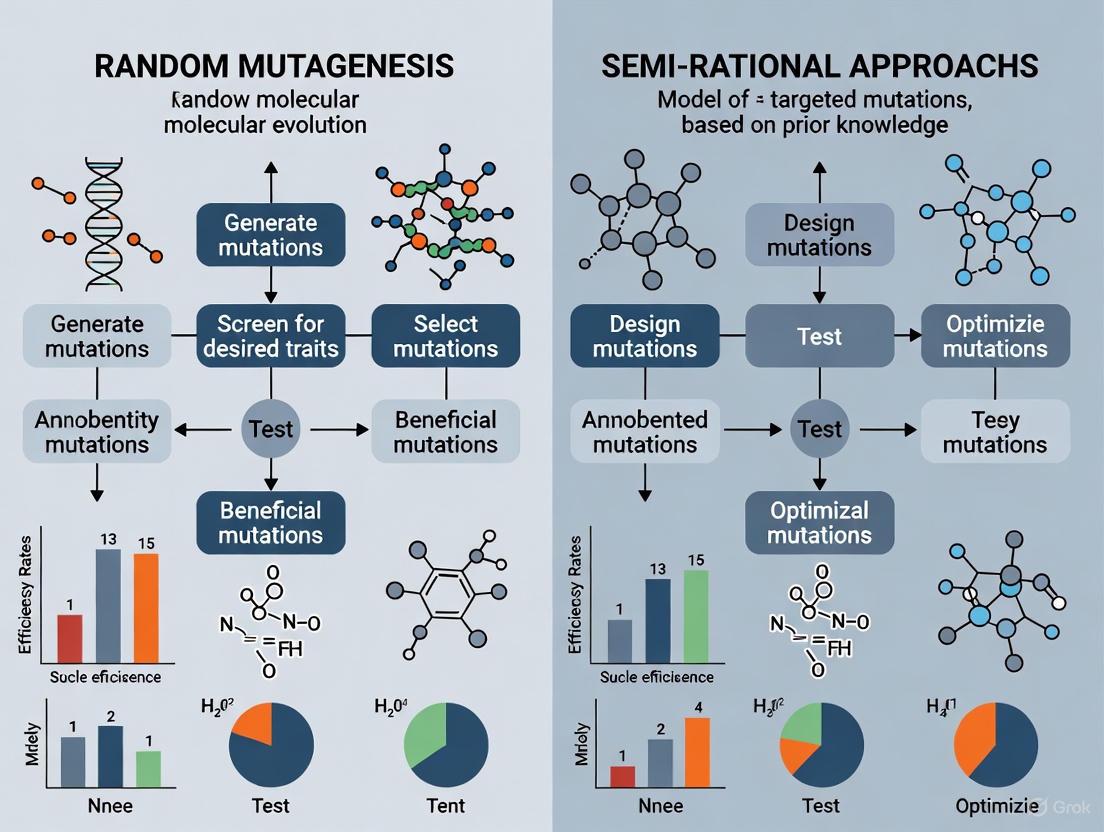
This article provides a comprehensive comparative analysis of random mutagenesis and semi-rational design strategies for protein engineering.
Random Mutagenesis vs. Semi-Rational Design: A Comparative Analysis for Modern Protein Engineering and Drug Discovery
Abstract
This article provides a comprehensive comparative analysis of random mutagenesis and semi-rational design strategies for protein engineering. Tailored for researchers, scientists, and drug development professionals, it explores the foundational principles of both approaches, from the exploratory power of error-prone PCR to the targeted efficiency of site-saturation mutagenesis. It delves into advanced methodologies and real-world applications across industrial enzymes, DNA polymerases, and therapeutic protein engineering. The content further addresses critical troubleshooting and optimization challenges, including managing library size and leveraging machine learning. Finally, it synthesizes validation strategies and comparative performance metrics, offering a decisive guide for selecting the optimal protein engineering strategy to accelerate biocatalyst and therapeutic development.
The Evolutionary Engine vs. The Rational Blueprint: Core Principles of Mutagenesis
Protein engineering, the biotechnological process of creating new or improved enzymes and proteins, heavily relies on Darwinian principles of mutation and selection [1]. Directed evolution stands as a primary method, deliberately mimicking natural evolution in laboratory settings to tailor biocatalysts for specific industrial and therapeutic applications [2] [1]. This approach iteratively generates molecular diversity and identifies improved variants through high-throughput screening or selection. Traditional directed evolution often depends on random mutagenesis methods, such as error-prone PCR (EP-PCR), to create vast libraries of protein variants [1]. However, this method samples only a tiny fraction of the possible sequence space, and its efficiency can be limited by library size and screening capacity [2].
Over the last two decades, advances in understanding protein structure and function have empowered scientists to develop more efficient strategies [2]. This has led to the emergence of semi-rational design, a hybrid approach that combines the exploratory power of directed evolution with predictive, knowledge-based methods [3] [1]. By utilizing information on protein sequence, structure, and function, semi-rational design creates smaller, functionally rich "smart" libraries that are more likely to yield positive results, significantly streamlining the engineering process [2] [3]. This guide provides a comparative analysis of these methodologies, focusing on their protocols, performance, and applications in modern drug and enzyme development.
Experimental Protocols and Workflows
Directed Evolution and Random Mutagenesis
The classical directed evolution workflow is an iterative cycle of two main steps: diversity generation and screening [2].
- Diversity Generation via Random Mutagenesis: The process typically begins with the creation of a large library of gene variants. Error-Prone PCR (EP-PCR) is a commonly used technique, which uses conditions that reduce the fidelity of the DNA polymerase, introducing random mutations throughout the gene sequence [1]. Alternative methods include DNA shuffling, which involves fragmenting and reassembling homologous genes to create chimeric proteins [2].
- Screening and Selection: The resulting library of mutant genes is expressed, and the corresponding protein variants are subjected to high-throughput screening or selection for the desired property (e.g., enzymatic activity, thermostability, binding affinity). Techniques such as Fluorescence-Activated Cell Sorting (FACS) and phage display are often employed to efficiently examine large libraries [1].
- Iteration: The best-performing variants from one round are used as templates for the next round of mutagenesis and screening, gradually accumulating beneficial mutations [1].
This method requires no prior structural knowledge but relies on the ability to screen or select for improved function from a vast number of candidates [1].
Semi-Rational Design
Semi-rational approaches reduce reliance on massive libraries by incorporating prior knowledge to target mutations to specific regions [2] [3]. The key steps include:
- Target Identification: Computational and bioinformatic tools are used to identify "hot spots"—specific amino acid residues that are likely to influence the protein's function. Common analytical methods include:
- Multiple Sequence Alignments (MSAs) and phylogenetic analysis to identify evolutionarily variable and conserved positions [2].
- Structure-based analysis using molecular modeling and dynamics (MD) simulations to identify residues critical for substrate access, stability, or catalysis [2].
- Specialized software like the HotSpot Wizard and 3DM database, which integrate sequence and structure data to create mutability maps for a target protein [2].
- Focused Library Construction: Instead of mutating the entire gene, techniques like site-saturation mutagenesis are applied to the pre-selected target positions. This allows all possible amino acids to be tested at a specific site, but because only a few sites are targeted, the resulting library remains small (often fewer than 1,000 variants) [2].
- Evaluation: The small, focused library is then screened. The high functional content of these libraries often means that a higher proportion of variants show improvements, and the smaller scale can enable the use of more informative, lower-throughput assays [2].
Emerging Machine Learning-Guided Approaches
Recent advances integrate deep learning to further accelerate protein evolution. The DeepDE algorithm exemplifies this trend [4].
- Library Construction and Training: A compact initial library of approximately 1,000 protein mutants is experimentally created and characterized.
- Iterative Learning and Design: A deep learning model is trained on this data to predict protein function from sequence. The model then designs a new set of protein sequences, often using triple mutants as building blocks to explore a broader sequence space efficiently.
- Experimental Feedback: The top-predicted variants are synthesized and tested, and their experimental performance data is fed back into the model to refine subsequent design rounds. This closed-loop system achieved a 74.3-fold increase in GFP activity over just four rounds, dramatically outperforming traditional directed evolution for this application [4].
Diagram Title: Comparative Experimental Workflows
Comparative Performance Analysis
Quantitative Comparison of Engineering Approaches
The table below summarizes key characteristics and experimental outcomes of different protein engineering strategies, highlighting differences in library size, efficiency, and typical applications.
Table 1: Performance and Characteristics of Protein Engineering Methods
| Engineering Method | Typical Library Size | Key Mutagenesis Techniques | Screening Requirement | Primary Knowledge Requirement | Reported Experimental Outcome |
|---|---|---|---|---|---|
| Directed Evolution / Random Mutagenesis | Very Large (millions) | Error-prone PCR, DNA shuffling [2] [1] | High-throughput screening/selection [1] | None essential | Iterative improvements over multiple rounds; success depends on screening capacity [1]. |
| Semi-Rational Design | Small (often < 1,000 variants) [2] | Site-saturation mutagenesis at targeted positions [2] | Lower-throughput evaluation possible [2] | Protein sequence, structure, and/or mechanism [2] [3] | 200-fold activity and 20-fold enantioselectivity improvement in Pseudomonas fluorescens esterase [2]. 32-fold activity improvement in Rhodococcus rhodochrous haloalkane dehalogenase [2]. |
| Machine Learning-Guided | Compact (~1,000 for training) [4] | In silico design of triple mutants [4] | Limited screening of selected variants [4] | Large, high-quality training data | 74.3-fold activity increase in GFP in four rounds [4]. |
Analysis of Comparative Advantages
- Functional Efficiency: Semi-rational design consistently demonstrates that smaller, knowledge-driven libraries can yield significant functional gains. For instance, targeting just four specific amino acid positions in Pseudomonas fluorescens esterase based on 3DM superfamily analysis led to variants with a 200-fold improvement in activity and a 20-fold enhancement in enantioselectivity [2]. This highlights the high "functional content" of smart libraries.
- Exploration of Sequence Space: A key limitation of traditional directed evolution is the sparse sampling of possible protein sequences. Machine learning-guided methods like DeepDE address this by using triple mutants as building blocks, enabling more efficient exploration of sequence space with a limited experimental budget [4].
- Iterative Performance: In a direct application for enhancing GFP activity, the DeepDE algorithm achieved a 74.3-fold increase over just four rounds, far surpassing the benchmark superfolder GFP. This demonstrates the power of combining iterative deep learning with affordable experimental screening to mitigate data sparsity problems [4].
The Scientist's Toolkit: Key Research Reagents & Solutions
Successful implementation of these engineering strategies relies on a suite of specialized reagents and computational tools.
Table 2: Essential Research Reagents and Tools for Protein Engineering
| Reagent / Solution / Tool | Function / Description | Relevance to Method |
|---|---|---|
| Error-Prone PCR Kits | Commercial kits designed to introduce random mutations during gene amplification by reducing polymerase fidelity [1]. | Directed Evolution |
| Site-Directed/Site-Saturation Mutagenesis Kits | Kits enabling precise codon changes at specific positions in a gene sequence (e.g., to test all 20 amino acids at a hotspot) [2]. | Semi-Rational Design |
| HotSpot Wizard | An internet-based computational tool that creates a mutability map for a target protein by combining data from sequence and structure databases [2]. | Semi-Rational Design |
| 3DM Database System | A commercial database that integrates protein superfamily sequence and structure data, allowing searches for evolutionary features like correlated mutations [2]. | Semi-Rational Design |
| Fluorescence-Activated Cell Sorter (FACS) | A high-throughput technology used to screen vast libraries of cell-surface displayed proteins or enzymes based on fluorescent signals [1]. | Directed Evolution |
| Robotic Liquid Handling Systems | Automation systems that enable the setup and screening of large numbers of assays with high precision and speed. | Directed Evolution |
| Molecular Dynamics (MD) Simulation Software | Computational tools for simulating physical movements of atoms and molecules, used to study tunnel dynamics and allosteric effects [2]. | Semi-Rational Design |
The field of protein engineering has progressively moved from discovery-based random exploration towards more hypothesis-driven, knowledge-rich strategies. While directed evolution with random mutagenesis remains a powerful and general-purpose tool, its requirement for large-scale screening poses a significant bottleneck [2] [1]. The comparative analysis confirms that semi-rational design effectively addresses this by leveraging computational tools and bioinformatic insights to create small, high-quality libraries, leading to efficient identification of superior biocatalysts without the need for massive screening efforts [2] [3].
The emerging integration of machine learning and deep learning represents a further evolution of these Darwinian principles. By using data from compact but well-designed experimental libraries to train predictive models, these approaches enable a more intelligent and rapid navigation of the fitness landscape, as evidenced by dramatic performance improvements achieved in a few iterative rounds [4]. The future of harnessing Darwinian principles for protein engineering lies in increasingly sophisticated cycles of computational prediction and experimental validation, streamlining the path from concept to optimized enzyme or therapeutic.
In the pursuit of engineering superior biocatalysts and biomolecules, directed evolution has emerged as a transformative technology, harnessing the principles of Darwinian evolution in a laboratory setting to tailor proteins for specific applications [5]. At the heart of any directed evolution campaign lies a critical first step: the generation of genetic diversity. Among the most powerful and widely used methods for creating this diversity are Error-Prone PCR (epPCR) and DNA Shuffling [5] [6]. These techniques represent a "mechanism of chance," exploring vast sequence landscapes through random mutagenesis and recombination. While semi-rational design approaches, which rely on structural and computational data, are gaining traction, random mutagenesis remains indispensable for exploring novel sequence solutions that defy intuitive prediction [7] [6]. This guide provides a comparative analysis of epPCR and DNA Shuffling, detailing their mechanisms, protocols, and applications to inform strategic decisions in research and drug development.
Core Principles and Comparative Mechanics
Error-Prone PCR and DNA Shuffling operate on distinct principles, leading to different types and distributions of genetic diversity.
Error-Prone PCR (epPCR)
epPCR is a modified polymerase chain reaction designed to introduce point mutations randomly throughout the amplified gene [8] [5]. This is achieved by creating reaction conditions that reduce the fidelity of the DNA polymerase. Key strategies include:
- Using Low-Fidelity Polymerases: Employing polymerases like Taq polymerase that lack 3' to 5' proofreading exonuclease activity [5].
- Altering dNTP Concentrations: Creating an imbalance in the concentrations of the four deoxynucleotide triphosphates (dNTPs) [5].
- Adding Manganese Ions: The inclusion of Mn²⁺ is a critical factor in destabilizing polymerase fidelity and increasing the error rate [8] [5].
A significant limitation of epPCR is its inherent mutational bias. DNA polymerases favor transition mutations (purine-to-purine or pyrimidine-to-pyrimidine) over transversion mutations (purine-to-pyrimidine or vice versa) [5]. Due to the degeneracy of the genetic code, this means that at any given amino acid position, epPCR can only access an average of 5–6 of the 19 possible alternative amino acids, thus constraining the explorable sequence space [5].
DNA Shuffling
DNA Shuffling, also known as "sexual PCR," is a recombination-based method that mimics natural homologous recombination [5] [9]. Instead of introducing solely new point mutations, its primary power lies in recombining existing beneficial mutations from multiple parent genes. The process involves:
- Random Fragmentation: The starting gene or a pool of related genes is randomly fragmented using an enzyme like DNase I [5] [9].
- Reassembly: The small fragments are reassembled in a primerless PCR reaction. During the annealing step, homologous fragments from different templates can overlap and prime each other, resulting in template switching and crossovers [5]. This creates a library of chimeric genes containing novel combinations of sequences from the parent pool.
- Introduction of New Mutations: The reassembly process itself can introduce additional point mutations, typically at a rate of about 0.7% [9].
A powerful extension is Family Shuffling, which recombines homologous genes from different species, providing access to a broader and more functionally relevant region of sequence space than mutating a single gene [5]. A key requirement for efficient DNA shuffling is that the parental genes must share sufficient sequence homology (typically >70-75%) for correct reassembly [5].
Comparative Analysis: epPCR vs. DNA Shuffling
The table below summarizes the fundamental differences between these two techniques.
Table 1: Fundamental Comparison of Error-Prone PCR and DNA Shuffling
| Feature | Error-Prone PCR (epPCR) | DNA Shuffling |
|---|---|---|
| Core Principle | Random point mutagenesis via low-fidelity amplification [5] | Recombination of homologous gene fragments [5] [9] |
| Primary Outcome | Library of point mutants | Library of chimeric genes |
| Mutation Rate | Tunable, typically 1-5 base mutations/kb [5] | Point mutation rate ~0.7%; recombines existing variation [9] |
| Key Advantage | Simple, requires no prior sequence information [6] | Rapidly combines beneficial mutations; can access large functional leaps [5] |
| Inherent Bias | Biased toward transition mutations and limited amino acid substitutions [5] | Requires sequence homology; crossovers favored in regions of high identity [5] |
| Ideal Use Case | Initial exploration of sequence space from a single parent gene | Optimizing and recombining mutations from multiple leads or homologous genes [5] |
Experimental Protocols and Workflows
The practical application of these techniques involves standardized, yet optimizable, laboratory protocols.
Error-Prone PCR Protocol
The following protocol, adapted from standard methodologies, outlines the key steps for performing epPCR [8] [5].
- Reaction Assembly: On ice, combine the following in a PCR tube:
- 100 ng template DNA.
- 10 µL of 10× Polymerase buffer.
- 10 µL of 2 mM dNTP Mix.
- 1 µL of 100 µM Forward primer.
- 1 µL of 100 µM Reverse primer.
- 1 µL of 5 U/µL Polymerase (e.g., non-proofreading Taq polymerase).
- Nuclease-free H₂O to a final volume of 100 µL [8].
- Initial Amplification: Run 10 cycles of a standard PCR program (e.g., 94°C for 30 s, 55-65°C for 30 s, 72°C for 30 s/kb) to generate a large pool of template DNA [8].
- Mutagenic Amplification: Add 1 µL of 500 mM MnCl₂ to the reaction, mix well, and run an additional 30 cycles using the same PCR program. The addition of manganese is crucial for reducing fidelity and introducing errors [8].
- Cloning and Screening: The resulting PCR product is purified, subcloned into an appropriate expression vector, and transformed into a host organism (e.g., E. coli). Individual colonies are then screened for the desired functional improvements [8].
DNA Shuffling Protocol
This protocol, based on established kits and literature, describes the process for single-gene shuffling [9].
- DNase I Fragmentation: In a total volume of 50 µL, combine 0.5-2 µg of the starting DNA(s) with 5 µL of 10× Digestion Buffer and 0.1 units of DNase I per µg of DNA. Incubate at 37°C for a short period (e.g., 1-8 minutes) to generate random fragments of the desired size (e.g., 70-280 bp). The reaction is stopped with a Stop Solution and heat-inactivated [9].
- Fragment Purification: The digested DNA fragments are separated by agarose gel electrophoresis, and fragments of the target size range are excised and purified from the gel.
- Primerless Reassembly PCR: In a 50 µL reaction, combine the purified fragments (10-20 ng/µL) with 5 µL of 10× Shuffling Buffer, 1 µL of dNTP mix, and 2.5 units of Taq Polymerase. Run 30-45 cycles of PCR (e.g., 94°C for 90 s, 55°C for 30 s, 72°C for 30 s). In this step, the fragments prime each other, leading to recombination as the polymerase extends overlapping regions [9].
- Full-Length Gene Amplification: Use 2 µL of the reassembly PCR product as the template in a standard PCR reaction containing gene-specific primers. This amplifies the full-length, reassembled genes. The final product is then cloned and screened [9].
Workflow Visualization
The diagram below illustrates the logical workflow and key differences between the two techniques.
Performance and Experimental Data in Practice
The true test of any protein engineering method lies in its practical outcomes. Both epPCR and DNA shuffling have proven highly effective in enhancing key enzyme properties such as product specificity, thermostability, and activity across a broad pH range.
Enhancing Product Specificity and pH Range
A landmark study on a γ-cyclodextrin glucanotransferase (CGTase) from Bacillus sp. provides a direct comparison of the two techniques, used in a stepwise manner [10]. Researchers performed two rounds of low-frequency epPCR followed by DNA shuffling to evolve variants with higher product specificity for γ-cyclodextrin (CD8) and a broader pH activity profile.
Table 2: Experimental Outcomes from Directed Evolution of CGTase [10]
| Variant | Technique(s) Used | Key Amino Acid Substitutions | Improved Property | Performance Data |
|---|---|---|---|---|
| S54 | epPCR + DNA Shuffling | N187D, A248V, V252E, H352L, D465G, E560V, E687G | Product Specificity | 1.2-fold increase in CD8-synthesizing activity; product ratio (CD7:CD8) shifted to 1:7 from wild-type's 1:3. |
| S35 | epPCR + DNA Shuffling | E39K, T66S, L71P, I101L, S461G, E472G, V605A, N606K, R684H | pH Activity Range | Active in pH 4.0–10.0 (vs. wild-type inactive below pH 6.0); retained 70% activity at pH 4.0. |
| S80 | epPCR + DNA Shuffling | S184G, Y662F, N670D | pH Activity Range | Active between pH 4.0 and 9.5; retained 14% activity at pH 4.0. |
This study highlights a critical strategic insight: while epPCR can identify beneficial point mutations, DNA shuffling is exceptionally effective at combining these mutations from different lineages to achieve synergistic effects and novel properties not present in any single parent [10].
Industrial Application of DNA Shuffling
The power of DNA shuffling is further demonstrated in industrial-scale metabolic engineering. The gene aveC, which modulates the production ratio of the anthelmintic drug doramectin to a less desirable analog (CHC-B2), was subjected to iterative rounds of "semi-synthetic" DNA shuffling [11]. The best-evolved aveC variant, containing 10 amino acid mutations, conferred a final CHC-B2:doramectin ratio of 0.07:1, a 23-fold improvement over the wild-type gene [11]. This engineered strain was integrated into a high-titer production host, resulting in a commercially viable process that reduces by-product formation and provides significant cost savings [11].
Essential Research Reagent Solutions
Successful implementation of these techniques relies on a core set of reagents and kits.
Table 3: Key Reagents for Random Mutagenesis Experiments
| Reagent / Kit | Function | Specific Example / Note |
|---|---|---|
| Non-Proofreading DNA Polymerase | Catalyzes DNA amplification with reduced fidelity in epPCR. | Taq polymerase is commonly used [5]. |
| Manganese Chloride (MnCl₂) | Critical additive to reduce polymerase fidelity and increase mutation rate in epPCR [8] [5]. | Concentration is optimized to tune mutation frequency. |
| Unbalanced dNTP Mix | Creates nucleotide pool imbalance, contributing to polymerase errors in epPCR [5]. | |
| DNase I | Enzyme used to randomly fragment DNA for the shuffling process [9]. | Digestion time is carefully controlled to achieve desired fragment size. |
| DNA Shuffling Kit | Provides optimized, ready-to-use reagents for the entire shuffling workflow. | JBS DNA-Shuffling Kit includes DNase I, dedicated buffers, stop solution, and polymerase [9]. |
Error-Prone PCR and DNA Shuffling are foundational tools in the directed evolution arsenal. epPCR excels in the initial exploration of the sequence space surrounding a single parent gene, while DNA Shuffling is unparalleled in its ability to recombine beneficial mutations to achieve synergistic improvements and access large functional leaps [10] [5].
The most successful protein engineering campaigns often employ these methods not in isolation, but as complementary, sequential steps [5] [6]. A common strategy involves using an initial round of epPCR to identify "hotspots" for improvement, followed by DNA shuffling to recombine the best mutations from different variants. This combined approach can effectively navigate the fitness landscape of a protein, mitigating the individual limitations of each method and accelerating the path to a high-performance enzyme. For researchers embarking on optimizing proteins for drug development or industrial biocatalysis, a strategic integration of these "mechanisms of chance" remains a powerfully effective route to discovery.
For decades, directed evolution—iterative rounds of random mutagenesis and screening—served as the cornerstone of protein engineering, enabling the tailoring of enzymes for industrial and synthetic applications without requiring intricate structural knowledge [12] [2]. However, this approach faces significant limitations, primarily the necessity to screen excessively large libraries, often encompassing millions of variants, to identify beneficial mutations [12] [2]. The burgeoning availability of protein structural information and powerful computational tools has catalyzed a paradigm shift toward more informed design strategies. This guide objectively compares these methodologies, focusing on the rising implementation of semi-rational design, which synergistically combines the exploratory power of random mutagenesis with the predictive precision of structure-based reasoning [12] [13]. By targeting diversity to specific, functionally rich regions, semi-rational approaches create "smart" libraries that drastically reduce screening burdens and increase the likelihood of success, offering a powerful alternative to traditional methods [12] [2].
Methodology Comparison: Core Principles and Workflows
Traditional Directed Evolution (Random Mutagenesis)
- Core Principle: This method introduces random mutations throughout the entire gene of interest, mimicking natural evolution in an accelerated time frame. It does not require prior structural knowledge of the protein [12] [2].
- Typical Workflow: The process involves iterative cycles of (1) creating a diverse library of gene variants via random mutagenesis techniques (e.g., error-prone PCR), (2) expressing these variants, and (3) screening or selecting for improved phenotypes using high-throughput methods [2].
- Key Limitation: Its primary bottleneck is the enormous screening burden, as the vast majority of random mutations are neutral or deleterious. This necessitates robust high-throughput screening assays capable of evaluating millions of clones [12].
Semi-Rational and Rational Design
- Core Principle: These approaches utilize prior knowledge of protein sequence, structure, and function to make informed decisions about which residues to mutate [2] [13].
- Semi-Rational Design: Identifies "hotspot" residues based on evolutionary analysis (e.g., using 3DM, HotSpot Wizard) or structural inspection. These targeted positions are then randomized to create focused libraries [2] [13].
- Rational Design: Relies on detailed mechanistic and structural understanding to predict specific amino acid substitutions that will confer a desired function. This often involves computational docking and molecular dynamics simulations [13].
- Typical Workflow: The process is more targeted: (1) Analyze the protein using sequence alignment and structural data to identify key residues, (2) Create a focused library via saturation mutagenesis of these hotspots, and (3) Screen the resulting, smaller library for improved variants [2] [14].
The diagram below illustrates the typical workflow for a semi-rational design campaign, from target analysis to final variant validation.
Performance Data: A Quantitative Comparison
The following tables summarize experimental data that directly compares the performance and efficiency of random mutagenesis versus semi-rational design.
Table 1: Comparative Engineering of Cytochrome P450 BM3 [15]
| Engineering Approach | Library Size | Fraction of Functional Variants | Key Outcome |
|---|---|---|---|
| Random Mutagenesis | Not Specified | Lower | Baseline for comparison |
| Semi-Rational (CSSM) | 343-1028 | Higher | Propane-hydroxylating variants identified; >75% of library folded |
| Semi-Rational (CRAM) | 343-1028 | Highest | 16,800 propane turnovers; highest number of active variants |
Table 2: General Workflow and Resource Comparison
| Parameter | Random Mutagenesis | Semi-Rational Design |
|---|---|---|
| Required Prior Knowledge | Low | High (Structure/Sequence data) |
| Typical Library Size | Very Large (10^6 - 10^9) | Focused (10^2 - 10^4) [2] |
| Screening Throughput | Must be very high | Can be medium-to-low |
| Iterations to Success | Often many | Fewer [2] |
| Capital Investment | High (for automation) | Shifted to computational resources |
Experimental Protocols in Practice
Protocol for Semi-Rational Library Construction
This protocol outlines the creation of a diversified gene or promoter library using overlap extension PCR, a common semi-rational technique [14].
- Step 1: Library Design and Oligo Synthesis. Identify target codons for randomization based on sequence or structural data. Design forward and reverse primers containing degenerate codons (e.g., NNK, where N=A/T/C/G and K=G/T) for the target sites, flanked by 15-20 base pairs of homologous sequence.
- Step 2: Primary PCR - Fragment Generation. Perform the first PCR to generate DNA fragments. The reaction mix includes: template DNA (e.g., 100 ng), forward and reverse degenerate primers (0.5 µM each), dNTPs (200 µM), high-fidelity polymerase, and corresponding buffer. Use the following cycling conditions: initial denaturation at 98°C for 30 sec; 25 cycles of [98°C for 10 sec, 55-65°C for 15 sec, 72°C for 15 sec/kb]; final extension at 72°C for 5 min.
- Step 3: Secondary PCR - Fragment Assembly. Purify the PCR fragments from Step 2. Use these fragments as overlapping megaprimers in a second PCR assembly reaction with minimal additional cycles (e.g., 10-15 cycles) to build the full-length, diversified gene.
- Step 4: Library Transformation. Purify the assembled DNA product and transform it into a suitable expression host (e.g., E. coli) via electroporation to create the library. The resulting library diversity can range from 10^4 to 10^7 variants [14].
Protocol for Screening via Fluorescence-Activated Cell Sorting (FACS)
For phenotypes that can be linked to a fluorescent reporter, FACS provides an ultra-high-throughput screening method [14].
- Step 1: Reporter System Construction. Engineer a host cell where the activity of the engineered protein or promoter directly regulates the expression of a fluorescent protein (e.g., GFP).
- Step 2: Cell Preparation and Sorting. Grow the library of transformed cells under inducing conditions. Harvest cells during mid-log phase and resuspend in a suitable buffer for FACS analysis. Use a FACS instrument to sort the cell population based on fluorescence intensity, gating for cells displaying the desired signal (e.g., high fluorescence for gain-of-function mutants).
- Step 3: Iteration and Validation. Typically, 3-5 rounds of positive and negative sorting are performed to enrich for the best variants. After the final sort, spread cells on agar plates to isolate single clones. Pick these colonies for sequencing and subsequent validation assays to confirm the improved phenotype [14].
The Scientist's Toolkit: Essential Research Reagents & Solutions
Table 3: Key Reagents for Semi-Rational Design and Screening
| Reagent / Solution | Function | Example Use Case |
|---|---|---|
| Degenerate Primers | Introduces controlled diversity at specific codons during PCR. | Saturation mutagenesis of active site residues [14]. |
| High-Fidelity PCR Mix | Amplifies DNA fragments with minimal error rates. | Constructing large, high-quality gene libraries [14]. |
| Fluorescent Reporter Plasmid | Serves as a biosensor for the target activity. | FACS-based screening of promoter or enzyme libraries [14]. |
| 3DM / HotSpot Wizard | Bioinformatics platforms for evolutionary analysis. | Identifying mutable "hotspot" residues from protein superfamilies [2]. |
| CAVER Software | Analyzes tunnels and channels in protein structures. | Engineering substrate access tunnels in enzymes like haloalkane dehalogenase [2] [13]. |
| Rosetta Software Suite | Models protein structures and designs sequences. | De novo enzyme design and optimizing active sites [13]. |
Recent Advances and Future Perspectives
The field of semi-rational design is being profoundly transformed by the integration of artificial intelligence (AI) and more sophisticated computational models. Generative AI models, including variational autoencoders (VAEs) and diffusion models, are now being used to navigate chemical and proteomic spaces, proposing novel protein sequences and bioactive small molecules with predefined properties [16] [17]. These tools can predict how mutations affect folding and function, further reducing the experimental burden [17].
Furthermore, the convergence of advanced experimental techniques like NMR-driven structure-based drug discovery (NMR-SBDD) is helping to overcome limitations of traditional methods like X-ray crystallography. NMR can provide dynamic structural information in solution and reveal critical details about hydrogen bonding and protein-ligand dynamics, offering richer data for the rational design process [18]. The future of protein engineering lies in the tight integration of these powerful computational and experimental methodologies, creating closed-loop systems that accelerate the design-build-test cycle for developing next-generation biocatalysts and therapeutics [16] [17].
Protein engineering relies on mutagenesis techniques to alter gene sequences, thereby creating novel proteins with improved or entirely new functions. Within this field, site-saturation mutagenesis (SSM) and combinatorial mutagenesis represent two powerful, yet distinct, strategies. SSM is a focused approach that systematically randomizes a single codon or a defined set of codons to generate all possible amino acid substitutions at a specific position [19] [20]. In contrast, combinatorial mutagenesis randomizes multiple positions simultaneously, creating vast libraries of variants that explore the functional potential of interactions between distant sites in a protein structure [21]. These methodologies occupy different points on the spectrum of protein engineering, with SSM often being a tool for semi-rational design based on structural or evolutionary data, and combinatorial mutagenesis enabling a broader, more exploratory search of sequence space. This guide provides a comparative analysis of these two key methods, framing them within the broader context of random versus semi-rational mutagenesis approaches.
Principles and Methodologies
Site-Saturation Mutagenesis (SSM)
Core Principle: SSM is designed to answer a specific question: which amino acid is optimal at a single, pre-determined position in a protein? It involves the substitution of a specific codon with a degenerate codon, which is a mixture of nucleotides that encodes for all or most of the 20 standard amino acids [19] [20]. This method is ideal for probing the functional role of a particular residue, such as one in an active site, or for creating a limited, "saturated" library around a known beneficial region.
Key Methodological Details: The most critical aspect of SSM is the choice of the degenerate codon. A fully random 'NNN' codon (where N represents an equimolar mixture of A, T, G, and C) generates 64 possible codons, covering all 20 amino acids but also including three stop codons. To improve efficiency, alternative codon schemes are preferred [19].
Table 1: Common Degenerate Codons Used in SSM
| Degenerate Codon | No. of Codons | No. of Amino Acids | No. of Stops | Key Amino Acids Encoded |
|---|---|---|---|---|
| NNN | 64 | 20 | 3 | All 20 amino acids |
| NNK / NNS | 32 | 20 | 1 | All 20 amino acids |
| NDT | 12 | 12 | 0 | R,N,D,C,G,H,I,L,F,S,Y,V |
| DBK | 18 | 12 | 0 | A,R,C,G,I,L,M,F,S,T,W,V |
As shown in Table 1, codons like NNK (where K is G or T) or NNS (where S is G or C) reduce the codon set to 32, encoding all 20 amino acids with only one stop codon [19]. For even more focused libraries, codons like NDT or DBK can be used to create a restricted set of 12 amino acids that cover a range of biophysical properties (e.g., charged, hydrophobic, polar) while completely eliminating stop codons [19].
Experimentally, SSM is commonly performed using PCR-based methods. A prominent one-step technique uses partially overlapping primers containing the degenerate codon for site-directed mutagenesis [22]. For "difficult-to-randomize" genes—those with high GC-content, secondary structures, or contained in large plasmids—a two-step megaprimer PCR method has proven superior. This method first amplifies a short gene fragment using one mutagenic and one non-mutagenic primer. The purified fragment is then used as a megaprimer in a second PCR to amplify the entire plasmid, leading to higher-quality libraries with less parental template contamination [22].
Combinatorial Mutagenesis
Core Principle: Combinatorial mutagenesis aims to explore the synergistic effects of mutations across multiple amino acid positions. Instead of focusing on one site, it creates libraries where multiple residues are randomized at the same time, either fully randomly or from a defined set of possibilities at each position [21]. The size of such a library grows exponentially with the number of randomized positions (e.g., 20n for n positions with all 20 amino acids), making comprehensive experimental screening often impossible [19] [21].
Key Methodological Details: The traditional approach involves designing primers with degenerate codons at multiple target sites. However, the immense size of the resulting sequence space is a major bottleneck. For example, a library targeting just 8 positions would contain 20⁸ (over 25 billion) theoretical variants, far beyond the screening capacity of most laboratories [21].
To overcome this, machine learning (ML)-coupled combinatorial mutagenesis has emerged as a powerful strategy. In this approach:
- A focused combinatorial library is designed, typically based on structural information, targeting several key residues.
- A relatively small, but diverse, subset of this library (e.g., thousands of variants) is experimentally screened for the desired activity [21].
- The resulting data is used to train a machine learning model (e.g., random forests, neural networks) to predict the fitness of all other variants in the virtual library.
- The model prioritizes the top-performing predicted variants for further experimental validation, dramatically reducing the screening burden [21].
This ML-coupled approach has been shown to reduce experimental screening by as much as 95% while enriching for top-performing variants by approximately 7.5-fold compared to random screening [21].
Direct Comparison of SSM and Combinatorial Mutagenesis
The choice between SSM and combinatorial mutagenesis is dictated by the research goal, available structural information, and screening capacity. The following table outlines their core distinctions.
Table 2: Comparative Analysis of SSM and Combinatorial Mutagenesis
| Feature | Site-Saturation Mutagenesis (SSM) | Combinatorial Mutagenesis |
|---|---|---|
| Philosophy | Semi-rational, focused exploration | Broad, exploratory search of sequence space |
| Sequence Space | Limited and linear (scales with number of sites done iteratively) | Vast and exponential (20n for n sites) |
| Key Application | Identify key residues, study active sites, fine-tune specific properties | Engineer complex traits involving long-range interactions, multi-domain optimization |
| Structural Input | Requires prior knowledge (e.g., from structure, evolution) to pick sites | Can be applied with or without high-resolution structural data |
| Screening Burden | Manageable (hundreds to thousands of clones) | Extremely high without computational aid; manageable with ML-coupling |
| Best For | "Hot-spot" identification, mechanistic studies, initial functional mapping | Global optimization, discovering unpredictable epistatic interactions |
Workflow and Context: The decision path for employing these tools often depends on the initial state of knowledge. SSM is frequently employed in an Iterative Saturation Mutagenesis (ISM) strategy, where beneficial "hot spots" are identified in initial rounds of SSM and then combined or further optimized in subsequent rounds [19] [13]. Combinatorial mutagenesis, especially when coupled with machine learning, is leveraged when the functional landscape is too complex to navigate with iterative single-site changes, such as optimizing the DNA-binding affinity and specificity of CRISPR-Cas9, which involves residues across multiple domains [21].
The following diagram illustrates the typical workflows for both SSM and ML-enhanced combinatorial mutagenesis, highlighting their key differences in process and scale.
Key Research Reagent Solutions
Successful execution of SSM and combinatorial mutagenesis experiments relies on a suite of specialized reagents and tools. The following table catalogues essential solutions for constructing high-quality mutagenesis libraries.
Table 3: Essential Research Reagents and Tools for Mutagenesis
| Reagent / Tool | Function / Description | Example Use Case |
|---|---|---|
| KOD Hot Start Polymerase | High-fidelity DNA polymerase used in PCR for SSM library construction, minimizes spurious mutations [22]. | Two-step megaprimer PCR for difficult templates like P450-BM3 [22]. |
| Degenerate Oligonucleotides | Primers containing NNK, NNS, or other degenerate codons; serve as the mutagenic primers in SSM [19] [22]. | Saturation of a single active site residue to determine optimal amino acid [20]. |
| DpnI Restriction Enzyme | Digests the methylated parental DNA template post-PCR, enriching for newly synthesized mutated plasmids [22]. | Standard step in QuikChange and related mutagenesis protocols to reduce background. |
| Machine Learning Software | Algorithms (e.g., Random Forests, Neural Networks) for predicting variant fitness from limited data [21]. | Predicting high-activity Cas9 variants from a screened subset of a combinatorial library [21]. |
| CRISPR-Cas9 System | Enables genome-wide screening and targeted integration of variants in a cellular context [23] [24]. | Creating knock-out cell lines as a platform for functional assays of variants [23]. |
| Next-Generation Sequencing (NGS) | High-throughput sequencing for analyzing library diversity and enrichment in functional screens [21] [23]. | Quantifying variant abundance in sorted cell populations from a deep mutational scan. |
Performance and Experimental Data
Efficiency and Effectiveness of SSM
The performance of SSM is highly dependent on the experimental protocol. A comparative study on the challenging cytochrome P450-BM3 gene demonstrated that a two-step PCR megaprimer method significantly outperformed the traditional one-step, partially overlapping primer method. Evaluation through massive sequencing revealed that the two-step method consistently produced higher-quality libraries with more comprehensive coverage of the desired mutations and a lower percentage of undigested parental template, making it the preferred method for recalcitrant genes [22].
Performance of ML-Coupled Combinatorial Mutagenesis
The integration of machine learning with combinatorial mutagenesis dramatically enhances its efficiency. Research on engineering CRISPR-Cas9 activities provides robust quantitative data on this improvement [21]. In this study, using only 5-20% of the empirical combinatorial library data to train the ML model was sufficient to generate accurate predictions. The model's performance was measured using metrics like the Normalized Discounted Cumulative Gain (NDCG) and enrichment score, which reflect its ability to identify the top-performing variants from the vast sequence space [21]. This approach led to a 95% reduction in the experimental screening burden and a ~7.5-fold enrichment for high-performing variants compared to a null model, demonstrating a profound acceleration of the protein engineering cycle [21].
Site-saturation mutagenesis and combinatorial mutagenesis are complementary pillars of modern protein engineering. SSM is a precise, semi-rational tool ideal for deep functional analysis of specific residues and is most powerful when used iteratively or with prior structural knowledge. Its efficiency is heavily influenced by the choice of degenerate codon and the molecular biology protocol, with newer two-step methods offering superior performance for difficult genes. Combinatorial mutagenesis, particularly when augmented with machine learning, is a powerful strategy for tackling complex engineering goals that involve interactions between multiple amino acids. The data-driven ML approach effectively navigates the intractably large sequence space, making it possible to discover highly optimized variants with minimal experimental effort. The choice between these tools is not mutually exclusive; a robust protein engineering campaign will often leverage the targeted power of SSM to identify hot spots before using combinatorial approaches and machine learning to achieve a globally optimized final variant.
In the field of protein engineering, the creation of improved or novel enzymes and biocatalysts is primarily driven by two powerful methodologies: random mutagenesis and semi-rational design. Random mutagenesis relies on the introduction of untargeted genetic changes across the protein sequence, leveraging high-throughput screening to identify beneficial variants through an iterative, exploratory process. In contrast, semi-rational design utilizes available information on protein structure, function, and evolutionary history to make informed decisions about which residues to mutate, creating smaller, more focused libraries. This guide provides an objective comparison of these strategies, examining their performance characteristics, optimal applications, and practical implementation to inform selection for specific research and development goals in drug development and biotechnology.
Core Principles and Methodologies
Random Mutagenesis: Unleashing Exploratory Power
Random mutagenesis mimics natural evolution in a laboratory setting by introducing random mutations throughout the gene of interest without requiring prior structural knowledge. The most common technique is Error-Prone PCR (epPCR), a modified polymerase chain reaction that reduces replication fidelity through factors such as manganese ions and unbalanced nucleotide concentrations to achieve a typical mutation rate of 1-5 base changes per kilobase [5]. This approach generates highly diverse libraries, allowing researchers to explore a vast sequence space and discover non-intuitive, beneficial mutations that might not be predicted by rational design. However, epPCR is not truly random; it exhibits biases toward transition mutations and can only access approximately 5-6 of the 19 possible alternative amino acids at any given position due to genetic code degeneracy [5]. DNA Shuffling represents another random method, which involves fragmenting homologous genes and reassembling them to create chimeric proteins, effectively recombining beneficial mutations from multiple parents [25] [5].
Semi-Rational Design: The Path to Targeted Efficiency
Semi-rational design employs computational and bioinformatic tools to target specific protein regions for mutagenesis, creating smaller, smarter libraries with a higher probability of containing improved variants. Key techniques include:
- Site-Saturation Mutagenesis (SSM): Systematically replaces a single amino acid position with all 19 other natural amino acids, enabling comprehensive exploration of a residue's functional role [25] [5].
- Combinatorial Site-Saturation Mutagenesis: Extends SSM by simultaneously targeting multiple pre-identified residues, often with a reduced amino acid alphabet to maintain manageable library sizes [15].
- Structure-Guided Design: Utilizes protein structural data and computational algorithms (e.g., molecular dynamics, docking) to identify mutational hotspots affecting substrate binding, catalytic efficiency, or stability [2] [26].
- Evolutionary-Guided Design: Leverages multiple sequence alignments and phylogenetic analysis of homologous proteins to identify conserved or functionally important residues amenable to mutagenesis [2].
Direct Performance Comparison: Experimental Data
Library Characteristics and Functional Output
Comparative studies reveal distinct differences in library size, functional content, and screening efficiency between the two approaches, as summarized in Table 1.
Table 1: Comparative Library Characteristics and Functional Output
| Parameter | Random Mutagenesis | Semi-Rational Design |
|---|---|---|
| Typical Library Size | Very Large (10⁴-10⁸ variants) [25] | Small to Medium (10²-10⁴ variants) [15] [2] |
| Amino Acid Diversity | Broad but biased (avg. 1-2 substitutions/variant) [5] | Focused and comprehensive at target sites (2-7 substitutions/variant) [15] |
| Fraction of Functional Variants | Low (<1% common) [15] | High (≥75% properly folded in optimized libraries) [15] |
| Screening Throughput Requirement | Very High | Moderate to Low |
| Key Advantage | Explores vast, unexpected sequence space; requires no prior knowledge | High efficiency; reduced screening burden; provides mechanistic insights |
A direct comparative study on engineering cytochrome P450 BM3 demonstrated the efficiency advantages of semi-rational libraries. While random mutagenesis libraries contained mostly non-functional variants, semi-rational approaches—including Combinatorial Site-Saturation Mutagenesis (CSSM), C(orbit), and CRAM libraries—achieved ≥75% properly folded variants despite higher average amino acid substitution levels (2.6-7.5 substitutions per variant) [15]. These libraries were "enriched with respect to the fraction functional and maximal activities," yielding propane- and ethane-hydroxylating variants with as few as two amino acid substitutions [15].
Catalytic Efficiency and Engineering Outcomes
The ultimate success of protein engineering campaigns can be measured by catalytic improvements and the number of iterations required to achieve them, with both approaches demonstrating distinct strengths.
Table 2: Representative Engineering Outcomes Across Protein Classes
| Protein Engineered | Approach | Key Mutations | Catalytic Improvement | Reference |
|---|---|---|---|---|
| Cytochrome P450 BM3 | Semi-rational (CRAM) | Not Specified | 16,800 propane turnovers (36% coupling) | [15] |
| KOD DNA Polymerase | Semi-rational | D141A, E143A, L408I, Y409A, A485E + 6 others | >20-fold improvement in modified nucleotide incorporation | [26] |
| α-L-Rhamnosidase (MlRha4) | Combined (Random + Semi-rational) | K89R, K70R, E475D | 70.6% increase in enzyme activity; enhanced alkalinity tolerance | [27] |
| Pseudomonas fluorescens Esterase | Semi-rational (3DM analysis) | 4 active site positions | 200-fold improved activity; 20-fold improved enantioselectivity | [2] |
Semi-rational design often produces significant catalytic improvements in fewer rounds of screening. For example, engineering of a KOD DNA polymerase through semi-rational approaches yielded an 11-mutation variant with over 20-fold improvement in enzymatic activity for incorporating modified nucleotides [26]. Similarly, semi-rational design of Pseudomonas fluorescens esterase using 3DM database analysis generated variants with 200-fold improved activity and significantly enhanced enantioselectivity from a library of approximately 500 variants [2].
Random mutagenesis, while more laborious, can identify beneficial mutations distant from the active site that would be difficult to predict. However, its true strength emerges when combined with semi-rational approaches. In the engineering of α-L-rhamnosidase, an initial round of random mutagenesis identified beneficial regions, followed by semi-rational design to refine these hits, culminating in a triple mutant with 70.6% increased activity and improved tolerance to alkaline conditions [27].
Experimental Protocols and Workflows
Random Mutagenesis Workflow
Random Mutagenesis Workflow
Step 1: Library Generation via Error-Prone PCR
- Set up PCR reactions with: Template DNA (10-100 ng), Taq polymerase (lacks proofreading), unbalanced dNTP concentrations (e.g., 0.2 mM dATP/dGTP, 1 mM dCTP/dTTP), 0.5 mM Mn₂⁺, primers targeting gene of interest [5].
- Run thermocycling with standard parameters (25-30 cycles).
- Clone expressed variants into expression vector and transform into host cells (e.g., E. coli) to create variant library.
Step 2: High-Throughput Screening
- Plate transformed cells on agar plates for colony formation or culture in 96/384-well microtiter plates [5].
- Assay for desired activity using colorimetric, fluorometric, or survival-based selection. For thermostability engineering, heat pre-treatment followed by activity measurement identifies stabilized variants [5].
- Isolate top-performing variants (typically 0.1-1% of library) for characterization.
Step 3: Iterative Improvement
- Use best variants as templates for subsequent epPCR rounds.
- Accumulate beneficial mutations over 3-10 generations until desired performance achieved.
Semi-Rational Design Workflow
Semi-Rational Design Workflow
Step 1: Target Identification
- Perform multiple sequence alignment of homologous proteins to identify conserved or variable positions (using tools like 3DM or HotSpot Wizard) [2].
- Analyze protein structure (experimental or homology model) to identify active site residues, substrate access tunnels, or flexible regions.
- Select 3-10 target residues for mutagenesis based on evolutionary conservation, structural location, and functional importance.
Step 2: Focused Library Construction
- For Site-Saturation Mutagenesis: Design degenerate primers (e.g., NNK codons) targeting selected residues, where N represents any nucleotide and K represents G or T, covering all 20 amino acids with 32 codons [25].
- Perform PCR with high-fidelity polymerase to minimize background mutations.
- For combinatorial libraries, use overlap extension PCR or gene synthesis for multiple simultaneous mutations.
Step 3: Screening and Validation
- Screen smaller libraries (typically 100-5,000 variants) using moderate-throughput methods (96/384-well plates).
- Characterize best hits with detailed kinetic analysis (KM, kcat), stability assays (Tm), and substrate specificity profiling.
- Use computational validation (molecular dynamics, docking) to rationalize improvements and guide further optimization.
The Scientist's Toolkit: Essential Research Reagents
Table 3: Key Reagents and Resources for Implementation
| Reagent/Resource | Function | Application Notes |
|---|---|---|
| Taq Polymerase | Low-fidelity PCR amplification | Essential for error-prone PCR; lacks 3'→5' proofreading [5] |
| Mn²⁺ Ions | Reduces polymerase fidelity | Critical component in epPCR buffers to increase mutation rate [5] |
| NNK Primers | Codon saturation | Encodes all 20 amino acids + stop codon; minimal redundancy [25] |
| 3DM Database | Protein superfamily analysis | Identifies evolutionarily allowed substitutions; guides library design [2] |
| Rosetta Software | Protein design calculations | Predicts stabilizing mutations and enzyme specificity changes [2] |
| HotSpot Wizard | Mutability mapping | Identifies functional hotspots from sequence/structure data [2] |
| Microtiter Plates | High-throughput screening | 96-well or 384-well format for colony screening and assays [5] |
Strategic Application Guidelines
When to Prefer Random Mutagenesis
- Limited Structural/Mechanistic Information: When high-resolution structures or detailed mechanistic understanding is unavailable [5].
- Exploratory Function Discovery: When seeking entirely new functions or non-intuitive solutions (e.g., altering substrate specificity without active site knowledge) [25].
- High-Throughput Capacity: When access to ultra-high-throughput screening (FACS, microfluidics) enables screening of >10⁶ variants [25].
- Stability Engineering: When targeting global protein properties like thermostability that can be improved by mutations throughout the structure.
When to Prefer Semi-Rational Design
- Focused Functional Changes: When engineering specific properties like substrate specificity, enantioselectivity, or cofactor preference [2].
- Limited Screening Resources: When practical constraints limit screening to 10²-10⁴ variants [15] [2].
- Structural Information Available: When crystal structures or reliable homology models enable target identification [26].
- Iterative Refinement: When initial random approaches have identified "hotspots" requiring comprehensive exploration [27].
Hybrid Approaches for Maximum Impact
The most successful protein engineering campaigns often combine both strategies sequentially: using random mutagenesis for broad exploration followed by semi-rational design for focused optimization [27]. This hybrid approach leverages the exploratory breadth of random methods with the targeted efficiency of rational design, accelerating the engineering process while mitigating the limitations of each individual method.
From Theory to Bench: Practical Applications in Enzyme and Therapeutic Engineering
Enzymes, as biological catalysts, are pivotal in industrial processes, from pharmaceutical manufacturing to food and beverage production. Their catalytic efficiency, specificity, and ability to function under mild conditions make them superior to traditional chemical catalysts. However, natural enzymes often lack the desired properties for industrial application, necessitating optimization. The field of enzyme engineering has evolved significantly, primarily driven by two philosophies: random mutagenesis (directed evolution) and semi-rational design. This guide provides a comparative analysis of these approaches through detailed case studies on two industrially relevant enzymes: α-L-Rhamnosidase and Cytochrome P450 BM3 (CYP102A1). We will dissect the experimental protocols, quantify improvements, and present the data for direct comparison, providing a framework for selecting an optimal engineering strategy.
The core distinction between these methods lies in the source of genetic diversity and the prior knowledge required.
Random Mutagenesis, or directed evolution, mimics natural evolution in a laboratory setting. It involves creating a large library of enzyme variants through random changes to the gene sequence using methods like error-prone PCR. This library is then subjected to high-throughput screening to identify variants with improved properties. The major advantage is that it requires no prior structural knowledge of the enzyme. However, its primary limitation is the immense screening burden, as beneficial mutations are rare within a vast sequence space [15] [12].
Semi-Rational Design bridges the gap between purely random methods and fully rational design. It utilizes available structural and functional information—such as crystal structures, sequence alignments, or computational predictions—to target specific residues for mutagenesis. Techniques include Combinatorial Site-Saturation Mutagenesis (CSSM), where a reduced set of amino acids is tested at targeted positions, and computational design using algorithms like C(orbit) and CRAM. This approach creates "smarter," smaller libraries that are enriched with functional variants, drastically reducing the number of clones that need to be screened [15] [12].
The following workflow illustrates how these strategies can be integrated into a modern enzyme optimization pipeline.
Case Study 1: Optimization of α-L-Rhamnosidases
α-L-Rhamnosidase (EC 3.2.1.40) is a glycoside hydrolase that cleaves terminal α-linked L-rhamnose sugars from natural compounds. It has significant applications in the food industry for debittering citrus juices and in the pharmaceutical industry for producing high-value compounds like icariin, which has anti-osteoporosis and neuroprotective effects [28] [29].
Optimization Objectives and Challenges
The primary industrial challenge is that the native enzyme often has low catalytic efficiency, insufficient thermostability, or narrow substrate specificity for the desired application. For instance, in the bioconversion of epimedin C to the more valuable icariin, a highly specific and efficient α-L-rhamnosidase is required to hydrolyze the α-1,2 glycosidic bond [28]. Furthermore, natural enzyme production from fungi like Aspergillus niger can be inefficient and costly [29].
The table below summarizes key experimental data from optimization studies on α-L-Rhamnosidase.
Table 1: Comparative Performance of Engineered α-L-Rhamnosidases
| Enzyme / Variant | Engineering Approach | Key Mutations / Features | Catalytic Efficiency (kcat/Km) | Specific Activity | Key Improvement |
|---|---|---|---|---|---|
| Papiliotrema laurentii ZJU-L07 [28] | Random Mutagenesis (Strain improvement via γ-rays & nitrosoguanidine) | Not specified (Whole-cell mutagenesis) | Km: 1.38 mM (pNPR); 3.28 mM (epimedin C) | 29.89 U·mg⁻¹ (purified enzyme) | Icariin yield from epimedin C increased from 61% to >83% |
| N12-Rha (from Aspergillus niger) [29] | Semi-Rational (Codon optimization & engineered strain) | Codon-optimized gene for P. pastor | Not explicitly stated | 7,240 U/mL (hesperidin); 945 U/mL (naringin) | 10.63x higher activity than native enzyme; stable at pH 3–6 & 40–60°C |
| AK-rRha (from A. kawachii) [30] | Native (Comparative study) | Native sequence (92% identity to AT-Rha) | kcat: 0.67 s⁻¹ (on naringin) | 0.816 U/mg (on naringin) | Baseline for comparison |
| AT-rRha (from A. tubingensis) [30] | Native (Comparative study) | Native sequence (naturally evolved) | kcat: 4.89 x 10⁴ s⁻¹ (on naringin) | 125.142 U/mg (on naringin) | 73,000x higher kcat than AK-rRha, illustrating impact of subtle sequence differences |
Experimental Protocols for α-L-Rhamnosidase
1. Strain Improvement via Random Mutagenesis [28]:
- Mutagenesis: The wild-type yeast Papiliotrema laurentii was treated with gamma rays (²⁰Coγ, 250-1000 Gy) and the chemical mutagen nitrosoguanidine (0.5-2 M).
- Screening: Mutagenized cells were first plated on LB medium containing p-nitrophenyl-α-L-rhamnopyranoside (pNPR), a chromogenic substrate. Active clones (forming yellow halos due to p-nitrophenol release) were selected for secondary screening in a medium containing epimedin C.
- Analysis: The conversion of epimedin C to icariin was quantified using High-Performance Liquid Chromatography (HPLC).
2. Semi-Rational Gene Optimization and Expression [29]:
- Gene Synthesis: The native α-L-rhamnosidase gene from Aspergillus niger JMU-TS528 was optimized for codon usage in Pichia pastoris and chemically synthesized.
- Expression: The synthesized gene was cloned into the pPIC9K vector and transformed into P. pastoris GS115.
- Fermentation & Screening: Engineered strains were cultured in buffered glycerol-complex medium (BMGY), then induced with methanol. High-expression clones (like N12) were selected based on activity assays using rutin as a substrate.
- Purification: The enzyme was purified from the culture supernatant using ammonium sulfate precipitation and nickel-affinity chromatography (due to a His-tag).
Case Study 2: Optimization of Cytochrome P450 BM3
Cytochrome P450 BM3 (CYP102A1) from Bacillus megaterium is a self-sufficient monooxygenase that catalyzes the oxidation of unactivated C-H bonds, a valuable reaction for synthesizing pharmaceuticals and fine chemicals. Its fused nature (heme and reductase domains in one polypeptide) and high native activity make it an attractive engineering target [31] [32].
Optimization Objectives and Challenges
Key challenges for industrial use include limited substrate scope (native enzyme prefers long-chain fatty acids), low operational stability, and a dependency on the expensive cofactor NADPH. Engineering goals often focus on expanding substrate range, improving thermostability and solvent tolerance, and enhancing activity with the cheaper cofactor NADH [31] [32].
The table below consolidates quantitative data from various P450 BM3 engineering studies.
Table 2: Comparative Performance of Engineered Cytochrome P450 BM3 Variants
| Enzyme / Variant | Engineering Approach | Key Mutations / Features | Cofactor Used | Total Turnover Number (TON) / Activity | Key Improvement |
|---|---|---|---|---|---|
| Wild-Type (WT) BM3 [32] | Baseline | Native sequence | NADPH | 4,918 (pNP/CYP, 10-pNCA substrate) | Baseline |
| NADH | 1,313 (pNP/CYP, 10-pNCA substrate) | Baseline | |||
| DE Variant [32] | Experimental Evolution (Oleic acid adaptation) | 34 mutations (5 in heme, 5 in linker, 24 in reductase domain) | NADPH | 6,060 (pNP/CYP) | 1.23x TON vs. WT |
| NADH | 2,316 (pNP/CYP) | 1.76x TON vs. WT; Increased cosolvent tolerance | |||
| E32 Variant [15] | Semi-Rational (CRAM algorithm library) | Targeted 10 active site residues to reduce pocket size | Not specified | 16,800 turnovers (propane) | Rivals activity from 10-12 rounds of directed evolution |
| NTD5/6 Variants [31] | Consensus-Guided Evolution | A769S, S847G, S850R, E852P, V978L (on reductase domain) | NBAH | 5.24x total product output vs. parent (R966D/W1046S) | Enhanced use of inexpensive cofactors NADH/NBAH |
| NADH | 2.3x total product output vs. parent (R966D/W1046S) | ||||
| Ginkgo Bioworks AI Engineered [33] | AI/Machine Learning (Owl model) | Mutations predicted by AI across 4 iterative rounds | Not specified | 10x improvement in kcat/KM (catalytic efficiency) | Met customer's economic target |
Experimental Protocols for Cytochrome P450 BM3
1. Experimental Evolution [32]:
- Evolution Pressure: Bacillus megaterium was cultured in progressively higher concentrations of oleic acid (from 2.5 µM to 300 µM), which is toxic and induces BM3 expression.
- Selection: Bacterial growth under these conditions selected for mutants with enhanced BM3 activity capable of detoxifying oleic acid.
- Variant Isolation: The BM3 gene from the evolved strain was sequenced, revealing the DE variant with 34 mutations.
2. Semi-Rational Designed Libraries [15]:
- Library Design: Three semi-rational libraries were constructed:
- CSSM: Combinatorial site-saturation mutagenesis of active site residues with a reduced amino acid set.
- C(orbit) & CRAM: Computational algorithms used to design focused libraries targeting up to 10 active site residues to re-specialize the enzyme for small alkanes.
- Screening: These small libraries (343–1,028 variants) were screened for demethylation of dimethyl ether and hydroxylation of propane and ethane. The CRAM library, designed to reduce the active site size, was most effective.
3. Consensus-Guided Evolution [31]:
- Sequence Analysis: The reductase domain of BM3 was aligned with homologous domains from other enzymes to identify conserved amino acid positions.
- Mutagenesis: Residues in the reductase domain were mutated to match the consensus sequence, aiming to improve stability and cofactor usage.
- Assay: Product output was measured using the substrate 10-pNCA, with NADH and N-benzyl-1,4-dihydronicotinamide (NBAH) as cofactors.
The Scientist's Toolkit: Essential Research Reagents
This table lists key reagents and materials used in the cited enzyme engineering studies, which are fundamental for designing similar experiments.
Table 3: Key Research Reagents and Their Applications in Enzyme Engineering
| Reagent / Material | Function / Application | Example Use in Case Studies |
|---|---|---|
| pNPR (p-nitrophenyl-α-L-rhamnopyranoside) | Chromogenic substrate for high-throughput screening of α-L-rhamnosidase activity. | Used in initial screening of mutagenized P. laurentii [28]. |
| Epimedin C / Icariin | Natural substrate and product for assessing therapeutic enzyme performance. | Used as the target reaction for bioconversion by P. laurentii α-L-rhamnosidase [28]. |
| Rutin, Naringin, Hesperidin | Natural flavonoid glycosides; substrates for enzyme specificity and activity assays. | Used to characterize the substrate range and kinetic parameters of α-L-rhamnosidases [29] [30]. |
| 10-pNCA (p-nitrophenoxydecanoic acid) | Model chromogenic substrate for assaying P450 BM3 hydroxylation activity. | Used to measure the total product output and TON of BM3 variants [31] [32]. |
| NADPH / NADH / NBAH | Cofactors for redox enzymes; engineering target for cost reduction. | Used to assay and engineer improved cofactor usage in P450 BM3 variants [31] [32]. |
| Oleic Acid | Fatty acid inducer of BM3 expression and agent for experimental evolution. | Applied as a selective pressure to evolve more robust P450 BM3 in B. megaterium [32]. |
| Pichia pastoris GS115 & pPIC9K | Eukaryotic expression system for high-yield recombinant enzyme production. | Host and vector for expressing recombinant α-L-rhamnosidases [28] [29]. |
Integrated Engineering Workflow: From Data to Design
Modern enzyme engineering, as demonstrated by companies like Ginkgo Bioworks, increasingly relies on an iterative cycle that integrates massive data generation with machine learning. This approach leverages the strengths of both random and semi-rational methods.
In this workflow, initial small-scale experiments (using either semi-rational or random methods) generate the first set of data. This data is used to train a machine learning model (e.g., Ginkgo's "Owl"), which then predicts which mutations or combinations are most likely to be beneficial. These predictions guide the design of the next library, creating a powerful feedback loop. For example, Ginkgo used this method to achieve a 10-fold improvement in the catalytic efficiency of a central carbon metabolism enzyme in just four generations, a feat that surpassed decades of traditional research [33].
The case studies of α-L-Rhamnosidase and Cytochrome P450 BM3 demonstrate that both random mutagenesis and semi-rational design are powerful strategies for industrial enzyme optimization.
- Semi-rational design excels when structural or sequence data is available, allowing researchers to make "large jumps in sequence space" with high efficiency and reduced screening burden [15] [12]. The success of consensus-guided evolution [31] and computationally designed libraries [15] underscores this advantage.
- Random mutagenesis and experimental evolution remain highly valuable, particularly when structural information is lacking or when seeking complex, multi-factorial traits like overall fitness and solvent tolerance, as seen in the P450 BM3 DE variant [32].
The future of enzyme engineering lies in the synergistic integration of these approaches, supercharged by machine learning. By generating high-quality data from intelligent initial libraries—whether random or targeted—researchers can build predictive models that dramatically accelerate the optimization process. Choosing a strategy depends on the specific enzyme, the desired property, and the available resources. However, as these case studies show, a hybrid approach that leverages data-driven insights is consistently the most effective path to achieving industrial biocatalysis goals.
DNA polymerases are fundamental tools in biotechnology, enabling DNA replication, sequencing, and amplification. However, natural DNA polymerases often inefficiently incorporate modified nucleotides, which are crucial for advancing synthetic biology, DNA sequencing, and therapeutic aptamer development. To overcome this limitation, protein engineers have employed both random mutagenesis and semi-rational design to create DNA polymerases with enhanced capabilities. This guide provides a comparative analysis of these engineering approaches, focusing on their success in generating polymerases that incorporate non-canonical nucleotides, with supporting experimental data and methodologies to inform researchers and drug development professionals.
Engineering Approaches: A Comparative Analysis
Engineering DNA polymerases for new functions borrows techniques from general enzyme engineering, primarily falling into two categories: random mutagenesis and semi-rational design. A comparative study on engineering cytochrome P450 BM3 provides quantitative data that can be analogously applied to understanding polymerase engineering strategies [15].
Table 1: Comparison of Polymerase Engineering Approaches
| Engineering Approach | Methodology Description | Typical Library Size | Key Advantages | Key Limitations |
|---|---|---|---|---|
| Random Mutagenesis | Introduction of mutations randomly throughout the gene, often via error-prone PCR. | Very Large (10,000+ variants) | Requires no prior structural knowledge; can discover unexpected beneficial mutations. | Vast sequence space to screen; high proportion of non-functional variants. |
| Semi-Rational Design | Mutagenesis targeted to specific residues chosen based on structural or phylogenetic data. | Small to Medium (343 - 1,028 variants) [15] | Higher probability of success; more efficient screening; fewer non-functional variants [15]. | Requires high-quality structural and/or functional data. |
| Combinatorial Site-Saturation Mutagenesis (CSSM) | A semi-rational method where targeted residues are mutated to a reduced set of amino acids [15]. | Small (e.g., 343 variants) [15] | Enriches for functional folds; balances diversity with library practicality [15]. | Depends on accurate residue selection. |
The selection of an engineering strategy often depends on the depth of existing knowledge about the polymerase's structure-function relationship. For polymerases with well-characterized active sites, semi-rational designs—such as Combinatorial Site-Saturation Mutagenesis (CSSM)—have proven highly effective. One study demonstrated that semi-rational libraries were significantly enriched with functional variants compared to a random mutagenesis library, with at least 75% of library members being properly folded despite multiple amino acid substitutions [15].
Engineered DNA Polymerases and Their Applications
Successful engineering efforts, using both random and semi-rational strategies, have yielded several notable DNA polymerases with tailored properties for biotechnology.
Therminator DNA Polymerase: A Case Study in Semi-Rational Design
Therminator DNA Polymerase is a premier example of successful protein engineering. It is derived from the family B DNA polymerase of Thermococcus sp. 9°N and was created through a semi-rational approach [34]. The wild-type enzyme was modified with three key mutations: D141A/E143A (to inactivate 3′-5′ exonuclease proofreading activity) and A485L (the key mutation in the polymerase active site that enhances modified nucleotide incorporation) [34]. The A485L mutation is located on the O-helix finger domain. While it does not directly contact the incoming nucleotide, it is hypothesized to indirectly enhance incorporation by reducing steric barriers or altering the equilibrium between the open and closed states during the polymerization conformational change [34]. This single mutation enables the polymerase to incorporate a wide range of modified substrates.
Table 2: Engineered DNA Polymerases and Their Applications in Biotechnology
| Engineered Polymerase | Key Mutation(s)/Design | Application in Biotechnology | Performance Data / Key Feature |
|---|---|---|---|
| Therminator (9°N mutant) | D141A, E143A, A485L [34] | Incorporation of dye-labeled dNTPs, ribonucleotides (rNTPs), and other modified nucleotides [34]. | Incorporates up to 20 consecutive ribonucleotides; incorporates rhodamine-dye nucleotides more efficiently than Cyanine dyes [34]. |
| Tgo exo- mutant | Y409G, A485L, E665K [34] | Synthesis of long RNA products. | Enables synthesis of A-form RNA:DNA up to 1.7 kb in length [34]. |
| KlenTaq | Not Specified (Point Mutations) [35] | "Hot-start" PCR; forensic and ancient DNA amplification [35]. | Reduced mispriming at non-specific sites at ambient temperature. |
| A485L-equivalent in Vent Pol | A488L [34] | Mechanism study for rNTP incorporation. | Increased rCTP incorporation efficiency: KD=360 µM, kpol=0.7 s⁻¹ (vs. WT: KD=1100 µM, kpol=0.160 s⁻¹) [34]. |
Advanced Engineering Methods
Beyond single point mutations, advanced engineering methods have been developed to evolve polymerases with novel functions:
- Compartmentalized Self-Replication (CSR): This method involves isolating single polymerase clones in water-in-oil emulsions, where each clone amplifies its own encoding gene. The resulting PCR products are then used for the next round of evolution, effectively selecting for polymerases with improved PCR performance [35]. CSR has been used to engineer polymerases for robust activity in CSR itself and for amplifying ancient DNA samples [35].
- Droplet-based Optical Polymerase Sorting (DrOPS): A more recent high-throughput technique where single cells carrying polymerase variants are encapsulated in droplets along with activity assay reagents. This method allows for the screening of extremely large libraries with minimal quantities of precious substrates, such as synthetic dNTPs [35].
Experimental Protocols and Validation
To ensure reliable and reproducible results when working with engineered polymerases, rigorous experimental protocols and validation are essential.
Key Experimental Methodology: Evaluating Polymerase Performance in qPCR
A study highlighting the critical role of the polymerase enzyme demonstrates a robust protocol for comparing polymerase performance, using a well-characterized Listeria monocytogenes prfA qPCR assay [36].
Protocol:
- Assay Setup: A calibration curve is prepared using DNA standards covering a wide concentration range (e.g., from 1.58 × 10¹ to 1.58 × 10⁶ copies per reaction).
- qPCR Execution: The assay is run under standard conditions optimized for a reference polymerase (e.g., Platinum Taq).
- Performance Analysis: The results are analyzed based on:
- Analytical Sensitivity (LOD): The lowest DNA concentration reliably detected.
- Amplification Efficiency: Ideally 90-105%.
- Linearity (R²): Ideally >0.98.
- Cq (Quantification Cycle) Values: The cycle at which the fluorescence signal crosses the threshold.
- Troubleshooting and Optimization: If a new polymerase fails or performs poorly under standard conditions, key parameters to optimize include:
- MgCl₂ concentration.
- Thermal cycling profile (denaturation, annealing/extension times and temperatures).
Critical Finding: Simply substituting the polymerase in a published assay without re-optimization can lead to a dramatic (up to 10⁶-fold) loss in sensitivity, underscoring the necessity of thorough validation [36].
Validation with Digital PCR (ddPCR) and Poisson Analysis
For absolute quantification without a standard curve, digital PCR (ddPCR) is used. This method relies on Poisson distribution to determine the initial target molecule number (ITMN). PCR-Stop analysis can also be employed to determine the maximum detectable ITMN for a given assay-polymerase combination, identifying potential limits of the system [36]. Not all polymerases may perform optimally in all assays, even after optimization, highlighting the need for this level of rigorous validation [36].
The Scientist's Toolkit: Essential Research Reagents
Table 3: Key Research Reagents for Polymerase Engineering and Application
| Reagent / Material | Function / Application |
|---|---|
| Therminator DNA Polymerase | A engineered polymerase used for incorporating a wide variety of modified nucleotides, including dye-labeled dNTPs and ribonucleotides [34]. |
| Platinum Taq DNA Polymerase | A commonly used "gold standard" hot-start polymerase for qPCR, complexed with an inhibitory antibody to prevent activity at room temperature [36]. |
| Modified Nucleotides (dNTPs) | Includes dye-labeled dNTPs (e.g., Rhodamine, Cyanine), ribonucleotides (rNTPs), and amino-functionalized nucleotides; substrates for engineered polymerases [34]. |
| Compartmentalized Self-Replication (CSR) | An emulsion-based directed evolution method for selecting polymerases with improved or novel functions [35]. |
Targeted random mutagenesis represents a pivotal technological advancement in genetic engineering, enabling precise diversification of specific genomic loci for applications ranging from directed evolution of proteins to functional gene studies. Unlike traditional global mutagenesis methods, which randomly alter the entire genome and often lead to high background noise and challenges like error catastrophe and evolutionary escape, targeted approaches introduce mutations within a defined window, offering greater control and efficiency [37]. This guide provides a comparative analysis of modern targeted random mutagenesis technologies, with a focus on the innovative OMEGA-R system. We objectively evaluate its performance against other key alternatives, supported by experimental data and detailed methodologies, to inform researchers and drug development professionals in their strategic decisions.
The field has evolved significantly from early in vitro techniques, such as error-prone PCR, to sophisticated in vivo systems capable of continuous evolution [37] [5]. This progression reflects a growing demand for tools that are not only efficient and specific but also compatible with high-throughput screening (HTS) technologies. Our analysis is framed within a broader thesis on comparative analysis of random mutagenesis versus semi-rational approaches, highlighting how systems like OMEGA-R exemplify the power of fully random, yet targeted, diversity generation for exploring sequence-function relationships without prerequisite structural knowledge.
Technology Comparison: Performance and Characteristics
This section compares the core features and performance metrics of OMEGA-R with other established targeted random mutagenesis systems.
Table 1: Key Characteristics of Targeted Random Mutagenesis Systems
| Technology | Core Mechanism | Mutagenesis Rate (per bp per generation) | Typical Window Length | Key Advantages | Reported Applications |
|---|---|---|---|---|---|
| OMEGA-R [38] [39] | enIscB nickase + error-prone PolI3M-TBD | 1.4 × 10⁻⁵ | Extended and tunable | Compact system size, high efficiency, extended window, HTS compatible. | Protein engineering (sfGFP), ribozyme evolution, promoter optimization. |
| EvolvR [38] | enCas9 nickase + error-prone PolI3M-TBD | Information Missing | Shorter than OMEGA-R | Established, nearly site-unrestricted targeting. | n/a |
| Orthogonal DNA Replication [37] | Error-prone DNA polymerases on specific replicons | Information Missing | Defined by replicon | Orthogonal to host replication machinery. | n/a |
| Error-Prone PCR (epPCR) [37] [5] | Low-fidelity PCR amplification | ~7.0 × 10⁻³ (per bp per reaction) [37] | Defined by amplicon | Well-established, easy to implement, in vitro. | Enzyme engineering (specificity, stability), ribozyme evolution. |
| MAGE [37] | ssDNA oligonucleotide recombineering | Information Missing | Defined by oligo | High efficiency, multiplexed genomic editing. | Genomic recoding, metabolic engineering. |
| ENU Mutagenesis [40] | Alkylating agent causing base substitutions | ~1 in 10⁶ to 2.7×10⁶ (in vivo, per bp) [40] | Genome-wide | Can create a spectrum of allelic variants (null, hypomorphic, hypermorphic). | Genome-wide phenotype-driven screens in model organisms. |
Table 2: Quantitative Performance Data for OMEGA-R and epPCR
| Performance Metric | OMEGA-R | Error-Prone PCR (epPCR) |
|---|---|---|
| Mutation Rate | 1.4 × 10⁻⁵ bpg [38] | ~7.0 × 10⁻³ per bp per reaction [37] |
| Mutation Continuity | Continuous within a tunable window [38] | Limited to the amplified DNA fragment |
| Background (Off-Target) | Minimal off-target effects reported [38] | Not applicable (in vitro method) |
| Primary Application Context | In vivo continuous evolution (e.g., PACE, FADS) [38] | In vitro directed evolution followed by transformation [5] |
Experimental Protocols and Workflows
Understanding the experimental workflows is crucial for selecting and implementing the appropriate mutagenesis technology.
The OMEGA-R Workflow
The OMEGA-R system was engineered to overcome limitations of previous technologies, such as the large size and rigid connectivity of the EvolvR fusion protein [38]. Its protocol can be summarized as follows:
- System Design: The OMEGA-R system comprises two separate components: the engineered nickase enIscB fused to SpyCatcher (SpyCatcher-enIscB) and the error-prone DNA polymerase PolI3M-TBD fused to SpyTag (PolI3M-TBD-SpyTag). These components self-assemble in vivo via the SpyCatcher/SpyTag interaction [38].
- Targeting: A guide RNA (ωRNA) directs the SpyCatcher-enIscB complex to a specific genomic locus, where it introduces a single-strand nick.
- Mutagenic Repair: The tethered PolI3M-TBD-SpyTag performs error-prone nick translation, introducing random mutations during the repair process. The low-fidelity polymerase is key to the random mutagenesis, with its activity leading to a mutation rate of 1.4 × 10⁻⁵ base pairs per generation [38].
- Screening and Selection: The mutated cells or phages are subjected to high-throughput screening technologies, such as Fluorescence-Activated Droplet Sorting (FADS) or Phage-Assisted Continuous Evolution (PACE), to identify variants with desired traits [38].
The following diagram visualizes the core mechanism and workflow of the OMEGA-R system.
Established Alternative Protocols
Error-Prone PCR (epPCR) is a foundational in vitro method. The standard protocol involves:
- Reaction Setup: A PCR is set up under mutagenic conditions. This typically includes using a non-proofreading DNA polymerase (e.g., Taq polymerase), an imbalance in the concentrations of the four dNTPs, and the addition of manganese ions (Mn²⁺) to reduce polymerase fidelity [37] [5].
- Amplification: The target gene is amplified, during which the polymerase incorporates errors, leading to a mutation rate that can be tuned to approximately 1-5 amino acid substitutions per kilobase [5].
- Cloning and Expression: The resulting mutagenic PCR product is cloned into an expression vector and transformed into a host organism to generate a library of variants for screening [5].
SSPER/rrPCR are modern in vitro methods for site-directed mutagenesis of plasmids. The key steps for the Single Primer Extension Reaction (SSPER), which achieves up to 100% efficiency, are [41]:
- Primer Design: A single mutagenic primer containing the desired base change is designed.
- Primer Extension: The primer is annealed to a plasmid template and extended by a DNA polymerase, generating a mutated single-stranded DNA.
- Template Removal: The original (non-mutated) plasmid template is digested with the DpnI enzyme, which is specific for methylated DNA.
- Ligation and Transformation: The product is ligated and transformed into a host, yielding the mutated plasmid.
The Scientist's Toolkit: Essential Research Reagents
Successful implementation of these technologies relies on a suite of specialized reagents and tools.
Table 3: Key Research Reagent Solutions for Targeted Mutagenesis
| Reagent / Tool | Function | Example Use Case |
|---|---|---|
| SpyCatcher-enIscB & PolI3M-TBD-SpyTag [38] | Core OMEGA-R enzyme components for targeted nicking and error-prone synthesis. | Enabling in vivo targeted random mutagenesis in bacterial systems. |
| Error-Prone DNA Polymerase (e.g., Taq for epPCR) [5] | Low-fidelity polymerase for introducing random mutations during DNA amplification. | Generating diverse mutant libraries in vitro via error-prone PCR. |
| DpnI Restriction Enzyme [41] | Digests the methylated parental DNA template, enriching for newly synthesized mutated DNA. | Critical for high-efficiency site-directed mutagenesis methods like SSPER. |
| High-Throughput Screening Platforms (FADS, PACE) [38] | Enables rapid sorting and selection of functional mutants from large libraries. | Identifying high-performance GFP or ribozyme mutants from an OMEGA-R-generated library. |
| Orthogonal DNA/RNA Polymerase-Plasmid Pairs [37] | Replicates specific plasmids independently of the host genome with inherent mutagenesis. | Targeted evolution of a gene encoded on a separate replicon. |
| N-ethyl-N-nitrosourea (ENU) [40] | Potent alkylating agent that induces random point mutations in the genome of whole organisms. | Genome-wide phenotype-driven forward genetic screens in mice. |
Discussion and Comparative Analysis
The experimental data and protocols highlight distinct niches for each technology. OMEGA-R demonstrates a significant leap for in vivo targeted random mutagenesis. Its compact size, derived from the use of the enIscB nickase, overcomes a key limitation of the larger EvolvR system, leading to superior mutagenesis efficiency and an extended editing window [38]. Its high compatibility with HTS platforms like PACE makes it particularly powerful for continuous evolution campaigns where generating diversity and selecting for improved function occur simultaneously over multiple generations.
In contrast, Error-Prone PCR remains a versatile and accessible workhorse for in vitro library generation. While its mutational spectrum can be biased and it requires manual cycles of mutation and screening, its simplicity and the direct control it offers over the mutated DNA segment ensure its continued relevance, especially for optimizing single genes or enzymes [37] [5].
SSPER and rrPCR are not random mutagenesis methods but are included here as they represent the pinnacle of efficiency for a related task: site-directed mutagenesis. Their 100% efficiency and streamlined protocol make them ideal for testing hypotheses about specific residues, an approach that aligns with semi-rational design strategies [41].
Finally, chemical mutagens like ENU occupy a different, but complementary, space. As a global mutagen, ENU is not targeted, but its use in phenotype-driven screens in model organisms like mice is unparalleled for discovering novel gene functions without prior assumptions, a classic "forward genetic" approach [40].
In conclusion, the choice of mutagenesis technology is dictated by the research goal. OMEGA-R excels in sophisticated, continuous in vivo evolution projects. Error-prone PCR offers a straightforward method for in vitro diversification. Methods like SSPER provide precision for site-specific testing, and ENU mutagenesis enables unbiased discovery in complex organisms. Together, these tools form a powerful arsenal for advancing biotechnology, drug development, and fundamental biological research.
The Role of High-Throughput Screening (HTS) in Evaluating Large Variant Libraries
In the fields of protein engineering and drug discovery, the generation of vast genetic diversity is futile without robust methods to sift through it. High-Throughput Screening (HTS) has emerged as a foundational technology that enables researchers to efficiently evaluate large libraries of variants, thereby accelerating scientific discovery. This guide provides a comparative analysis of how HTS is applied in the context of two primary protein engineering strategies—random mutagenesis and semi-rational design—objectively examining their performance, experimental protocols, and the key reagents that make such large-scale analysis possible.
What is High-Throughput Screening (HTS)?
High-Throughput Screening (HTS) is an automated method for conducting millions of biological, chemical, or pharmacological tests in a short period [42]. It is a cornerstone of modern drug discovery and protein engineering, allowing researchers to rapidly identify "hits"—active compounds, antibodies, or genetic variants that modulate a specific biomolecular pathway [42] [43].
The process relies on robotics, sensitive detectors, liquid handling devices, and data processing software to automate assays, typically performed in microtiter plates ranging from 96 to 3,456 wells [44] [42]. A typical HTS system can process tens of thousands of compounds per day, with Ultra-High-Throughput Screening (uHTS) pushing this capacity to over 100,000 assays per day [44] [42]. The key to HTS is miniaturization and automation, which reduces reagent use, cuts costs, and dramatically speeds up the data collection process [43].
HTS in Action: Contrasting Mutagenesis Approaches
The following table summarizes the core characteristics of how HTS is applied to random mutagenesis and semi-rational design.
| Feature | Random Mutagenesis | Semi-Rational Design |
|---|---|---|
| Core Principle | Introduction of random mutations throughout the gene, mimicking natural evolution without requiring prior structural knowledge [1] [12]. | Targeting of specific, pre-selected residues for mutagenesis based on structural or functional information [27] [12]. |
| Typical HTS Library Size | Very large (can exceed >10,000 variants) [1]. | Focused and smaller (a few hundred to a few thousand variants) [27] [12]. |
| Information Requirement | None required; a "blind" approach [1]. | Requires a 3D protein structure (X-ray or homology model) and/or mechanistic knowledge [45] [12]. |
| HTS Screening Burden | High; requires screening of very large libraries [12]. | Lower; libraries are "smarter" and enriched for positive mutants [27] [12]. |
| Key Advantage | Potential to discover unexpected beneficial mutations anywhere in the protein [1]. | Efficient use of screening resources; higher probability of success by focusing on key areas [12]. |
Experimental Protocols and Data
The different demands these approaches place on HTS are best illustrated with specific experimental data.
1. HTS Following Random Mutagenesis
A classic protocol involves using error-prone PCR (EP-PCR) to create a random mutant library.
- Methodology: The gene of interest is amplified under conditions that reduce the fidelity of the DNA polymerase, introducing random point mutations [1]. For example, in the engineering of the α-L-rhamnosidase MlRha4, researchers used EP-PCR to generate a library of 350 mutant enzymes [27].
- HTS and Outcome: These 350 mutants were screened using quantitative thin-layer chromatography (TLC) and HPLC to identify variants with improved activity. This primary screen identified 4 positive mutants with significantly improved conversion rates, with the best showing a 13.8% increase in activity [27]. This demonstrates a ~1.1% hit rate from a randomly generated library.
2. HTS Following Semi-Rational Design
This approach uses structural knowledge to create focused libraries.
- Methodology: Based on a homology model and comparison with related proteins, specific residues (e.g., D222 and E486 in MlRha4) are identified as being part of the active site [27]. Saturation mutagenesis is then performed at these "hotspot" positions to test a subset of the 20 canonical amino acids.
- HTS and Outcome: By creating a smaller, smarter library, researchers can efficiently identify synergistic mutations. In the MlRha4 study, combinatorial mutagenesis of three identified sites (K89R, K70R, E475D) yielded the top-performing mutant R-28. This variant showed a 70.6% increase in enzyme activity and an improved tolerance to high substrate concentrations, a dramatic improvement over the best hit from the random library [27].
The workflow below illustrates the key steps involved in using HTS to evaluate variant libraries generated via these two methods.
The Scientist's Toolkit: Essential Research Reagent Solutions
The execution of HTS campaigns relies on a suite of specialized reagents and tools. The following table details key solutions for building variant libraries and screening them.
| Research Reagent Solution | Function in HTS of Variant Libraries |
|---|---|
| Microtiter Plates (96 to 3456 wells) | The fundamental labware for HTS; enables miniaturization of assays by containing nanoliter to microliter reaction volumes in an array of wells [44] [42] [43]. |
| Error-Prone PCR Kits | Reagent kits designed to introduce random mutations during gene amplification, essential for constructing random mutagenesis libraries [1]. |
| Saturation Mutagenesis Kits | Kits (e.g., using NNK codons) to substitute all 20 amino acids at a specific residue, crucial for creating focused libraries in semi-rational design [45] [12]. |
| Liquid Handling Robots & Automated Pipetting Stations | Automate the transfer of samples, compounds, and reagents between stock plates and assay plates, ensuring speed and accuracy while handling thousands of wells [42] [43]. |
| Plate Readers (Detectors) | Instruments that read assay results (e.g., via fluorescence, luminescence, or absorbance) from every well of a microplate, generating the primary quantitative data for HTS [43]. |
| HTS Data Analysis Software | Specialized software packages for processing, normalizing, and analyzing the massive datasets generated by HTS; used for quality control and hit selection [42] [43]. |
Both random mutagenesis and semi-rational design are powerful strategies for generating protein diversity, and HTS is the indispensable engine that powers the evaluation of the libraries they produce. The choice between them involves a direct trade-off: random mutagenesis offers discovery potential without the need for prior knowledge but at the cost of a high HTS burden. In contrast, semi-rational design uses structural insights to create focused, higher-quality libraries, leading to a more efficient use of HTS resources and a greater likelihood of identifying dramatically improved variants. The experimental data from enzyme engineering studies clearly demonstrates that a semi-rational approach can yield significantly better results (e.g., a 70.6% activity increase) compared to a purely random approach (e.g., a 13.8% increase). For researchers, the decision hinges on the availability of structural data and the desired balance between resource investment and the potential for exploratory discovery.
The escalating costs and high failure rates in drug development have intensified the need for more efficient discovery methodologies [46] [47]. A core challenge in biotherapeutic development lies in optimizing protein function, traditionally approached through random mutagenesis. However, this method explores sequence space inefficiently. This guide compares two advanced computational frameworks that represent a paradigm shift: Computational Random-Access Memory (CRAM) for hardware acceleration and C(orbit) algorithm-based libraries for semi-rational protein design. Positioned within a broader thesis on comparative analysis, this article objectively evaluates their performance against traditional random mutagenesis and provides detailed experimental protocols for their application.
Computational Random-Access Memory (CRAM)
CRAM is a true in-memory computing paradigm that addresses the Von Neumann bottleneck—a major performance and energy drain in conventional computing where data moves constantly between separate logic and memory modules [48]. CRAM performs logic operations directly within the memory array itself, eliminating the need for data to leave memory for processing [48]. This is implemented using non-volatile memory devices like Magnetic Tunnel Junctions (MTJs) or Spin-Orbit Torque (SOT) devices [49] [48].
A typical CRAM cell is based on a 1-transistor/1-MTJ (1T1M) structure, enhanced with a second transistor and additional logic lines to enable computational functions [48]. The fundamental logic operations, such as AND, OR, NAND, NOR, and MAJ (majority), are executed using a principle called voltage-controlled logic (VCL), which leverages the resistance states of the MTJs and their threshold switching behavior [48].
C(orbit) Algorithm-Based Libraries & Semi-Rational Design
While the search results do not explicitly detail a "C(orbit)" algorithm, the principles of semi-rational protein design and computational library generation are well-established. These approaches use structural and evolutionary information to create focused, "smart" libraries, standing in direct contrast to the vast, untargeted sequence space explored by random mutagenesis [13].
Semi-rational methods leverage various computational tools to identify "hot spot" residues for mutagenesis. Key software includes:
- CAVER: Analyzes protein tunnels and channels to identify residues that influence substrate access and specificity [13].
- YASARA: Provides a graphic interface for homology modeling, hotspot detection, and molecular docking, useful even when high-resolution structures are unavailable [13].
- RosettaMatch & RosettaDesign: Used for de novo enzyme design and the optimization of active site pockets by searching for protein scaffolds that can host specific catalytic geometries (theozymes) and then designing the surrounding residues [13].
Performance Comparison
The following tables summarize the key differences in performance and characteristics between the reviewed computational platforms and traditional methods.
Table 1: Comparative Analysis of Computational Platforms for Drug Discovery
| Feature | CRAM-based Accelerators | Traditional CPU/GPU Computing | C(orbit)-style Semi-Rational Libraries | Random Mutagenesis |
|---|---|---|---|---|
| Primary Function | Hardware acceleration for data-intensive computing tasks [48] | General-purpose computing for molecular simulations and docking [50] | Focused library design for protein engineering [13] | Untargeted exploration of sequence space [13] |
| Key Advantage | Eliminates data transfer energy; massive parallelism [48] | Flexibility; well-established software ecosystem [50] | Drastically reduced library size; higher frequency of improved variants [13] | Requires no prior structural or mechanistic knowledge [13] |
| Throughput/ Efficiency | High (Potential for order-of-magnitude gains in performance/Watt for target applications) [48] | Lower (Limited by data movement and sequential processing) [48] | Highly efficient in exploring relevant sequence space [13] | Low (Vast majority of library is non-functional or deleterious) [13] |
| Experimental Validation | Experimentally demonstrated for logic operations & full adder [48] | Widely validated for virtual screening and lead discovery [50] | Successfully applied to engineer activity, stereoselectivity, and stability [13] | Historically successful for evolving various protein properties [13] |
Table 2: Quantitative Benchmarks for CRAM and Protein Engineering Methods
| Metric | CRAM (MTJ-based) | Semi-Rational Design | Random Mutagenesis |
|---|---|---|---|
| Energy Consumption | Comparable to memory write operation per logic function [48] | Computational cost of MD/FEP simulations is high, but wet-lab screening is minimal [13] | N/A (Primarily wet-lab screening cost, which is very high) |
| Noise Margin | Up to ~100 mV for SHE-CRAM logic gates [49] | N/A | N/A |
| Library Size | N/A | ~( 10^2 ) to ( 10^3 ) variants [13] | ~( 10^6 ) to ( 10^9 ) variants [13] |
| Hit Rate | N/A | High (Can approach >10% for stability designs) [13] | Very low (Often <0.1%) [13] |
| Information Required | N/A | Protein structure (experimental or homology), mechanism [13] | No structural information needed [13] |
Experimental Protocols
Protocol: Executing a Logic Operation in a CRAM Array
This protocol is based on the experimental demonstration of MTJ-based CRAM [48].
- Objective: Perform a logic operation (e.g., AND, OR) using memory cells as inputs and outputs within a single CRAM row.
- Materials:
- Fabricated CRAM array chip (1T2M cell design with MTJs).
- Precision voltage pulse generators.
- Source measurement units (SMUs).
- Control and data acquisition system.
- Procedure: a. Data Allocation: Initialize the states of the input and output MTJs in the target row via standard memory write operations. The output MTJ is typically set to a known state (e.g., '0'). b. Line Activation: Apply control signals to the Word Lines (WLs), Bit Select Lines (BSLs), and Logic Bit Lines (LBLs) to electrically connect the input and output MTJs to a shared Logic Line (LL). c. Voltage Application: * Leave the shared Logic Line (LL) floating. * Apply a voltage pulse (( V_{PULSE} )) to the LBLs of the selected input MTJs. * Ground the LBL of the designated output MTJ. d. Logic Execution: The total current flowing from the input MTJs, which is determined by their collective resistance states (high or low), passes through the output MTJ. This current, due to the Spin-Transfer Torque (STT) effect, may switch the state of the output MTJ if it exceeds its switching threshold. e. Result Readout: Deactivate the logic configuration. Perform a standard memory read operation on the output MTJ to determine its final state, which is the result of the logic operation.
- Validation: The functionality is validated by testing all possible input combinations and verifying the output state against truth tables for basic logic gates [48].
Protocol: A Semi-Rational Workflow for Engineering Substrate Specificity
This protocol outlines a standard methodology for using computational tools to design focused libraries, as described in reviews on rational protein design [13].
- Objective: Create a focused mutant library to alter the substrate specificity or enantioselectivity of an enzyme.
- Materials:
- High-resolution 3D structure of the target enzyme (from X-ray crystallography, cryo-EM, or a high-quality homology model).
- Software: Molecular visualization tool (e.g., PyMOL), docking software (e.g., integrated in YASARA), tunnel analysis tool (CAVER).
- Laboratory equipment for site-directed mutagenesis and high-throughput activity screening.
- Procedure: a. Structural Analysis: Load the enzyme structure into a visualization program. Identify the active site and substrate-binding pocket. b. Tunnel & Cavity Analysis: Use CAVER (as a PyMOL plugin) to identify and analyze the major access tunnels and cavities leading to the active site. Residues lining these tunnels are prime candidates for mutagenesis to control substrate access [13]. c. Substrate Docking: Dock the desired target substrate(s) and any relevant non-substrates into the active site using a docking program. Analyze the binding poses to identify residues that make key contacts with the desired substrate or that sterically hinder its binding. d. Hot Spot Selection: Compile a list of 5-15 "hot spot" residues from steps b and c. These are positions where mutation is predicted to most significantly impact substrate binding and catalysis. e. Library Design: Instead of randomizing all positions, perform Iterative Saturation Mutagenesis (ISM). This involves performing site-saturation mutagenesis (creating a library where one hot spot is mutated to all 20 amino acids) at each chosen position iteratively. Screen each small library (~100-300 clones) and use the best hit as the template for the next round of mutagenesis [13]. f. Expression & Screening: Express the mutant library in a suitable host and screen for the desired activity or selectivity profile.
- Validation: The success of the protocol is determined by a significant increase in the frequency of improved variants compared to libraries generated by random mutagenesis.
Architecture and Workflow Visualization
Diagram 1: Execution of a logic operation within a single row of a CRAM array. Input and output cells are connected via a shared Logic Line (LL). The collective resistance of the input MTJs controls the current that flows to the output MTJ, potentially switching its state to store the logic result [48].
Diagram 2: A semi-rational design workflow for protein engineering. Computational analysis of the protein structure guides the selection of a small number of "hot spot" residues, enabling the construction of highly focused and effective mutant libraries [13].
The Scientist's Toolkit
Table 3: Essential Research Reagents and Tools
| Item Name | Function / Description | Relevance to Field |
|---|---|---|
| Magnetic Tunnel Junction (MTJ) | A bi-stable spintronic device that serves as the core storage and computational element in a CRAM cell. Its resistance represents a binary state [48]. | Fundamental building block of CRAM; enables in-memory computation. |
| Spin-Orbit Torque (SOT) Device | A three-terminal memory device that can offer greater energy efficiency and reliability for CRAM implementations compared to two-terminal MTJs [49]. | An emerging alternative for next-generation CRAM. |
| CAVER Software | A computational tool (often a PyMOL plugin) that identifies and analyzes tunnels and channels in protein structures to find functional "hot spots" [13]. | Critical for semi-rational design to engineer substrate specificity and access. |
| YASARA | A software suite with a graphical interface for molecular visualization, homology modeling, molecular dynamics, and docking simulations [13]. | Accessible platform for structural analysis and in silico mutagenesis. |
| Rosetta Software Suite | A comprehensive platform for de novo protein design and structure prediction, including tools like RosettaMatch and RosettaDesign [13]. | Used for advanced computational design of novel enzyme activities and optimizations. |
| Focused Mutant Library | A collection of protein variants where only a small, computationally selected set of residues is randomized, drastically increasing the frequency of improved clones [13]. | The tangible output of a semi-rational design process, bridging computation and experiment. |
This guide has provided a detailed comparison of two transformative computational approaches. CRAM represents a hardware-level solution to a fundamental computing bottleneck, with the potential to dramatically accelerate data-intensive tasks in bioinformatics and machine learning that underpin modern drug discovery [48]. On the algorithmic front, semi-rational design, exemplified by C(orbit)-style methodologies, directly addresses the inefficiencies of random mutagenesis by leveraging structural insights to create smart libraries [13]. The experimental data and protocols presented demonstrate that these technologies are not merely theoretical but are experimentally validated and provide concrete advantages in performance, efficiency, and success rates. Their integration into the drug development pipeline signifies a move toward a more predictive, knowledge-driven, and efficient future for protein engineering and therapeutic discovery.
Navigating Challenges and Enhancing Efficiency in Library Design and Screening
In enzyme engineering, the conflict between exploring vast sequence diversity and maintaining a practically screenable number of variants is a central challenge. This guide provides a comparative analysis of how random mutagenesis and semi-rational design manage this library size dilemma, supporting a broader thesis on their respective merits in research and drug development.
Core Strategic Comparison: Random Mutagenesis vs. Semi-Rational Design
The choice between random and semi-rational approaches fundamentally dictates the size, diversity, and screening workload of an enzyme engineering project. The table below summarizes the key operational differences.
Table 1: Strategic Comparison of Enzyme Engineering Approaches
| Aspect | Random Mutagenesis | Semi-Rational Design |
|---|---|---|
| Basis | Mimics natural evolution; no prior structural knowledge needed [51]. | Combines structural insights with targeted randomness [51]. |
| Mutagenesis Method | Random mutagenesis (e.g., error-prone PCR, DNA shuffling) across the entire gene [51]. | Targeted mutagenesis (e.g., saturation mutagenesis) at specific, pre-identified sites [51]. |
| Typical Library Size | Large (thousands to millions of variants) [51]. | Moderate (hundreds to thousands of variants) [51]. |
| Screening Effort | High; requires robust high-throughput screening [51]. | Moderate; focused library reduces screening burden [51]. |
| Knowledge Requirement | Low [51]. | Moderate; requires partial knowledge of structure-function relationships [51]. |
| Key Advantage | Explores vast sequence space; can yield unexpected improvements [51]. | Balances efficiency and discovery; optimizes the exploration of sequence space [51]. |
| Key Limitation | Resource-intensive; vast majority of library may be non-functional [15] [51]. | May miss beneficial mutations outside targeted regions [51]. |
Quantitative Performance: A Data-Driven Comparison
Experimental data consistently shows that semi-rational designs create libraries with a higher probability of success. The following table compiles key performance metrics from published studies.
Table 2: Experimental Data from Enzyme Engineering Studies
| Engineering Approach | Library Size | Fraction Functional/Properly Folded | Key Experimental Findings | Source |
|---|---|---|---|---|
| Semi-Rational (CSSM, C(orbit), CRAM) | 343 - 1,028 variants | >75% (despite 2.6-7.5 avg. mutations) | Libraries enriched in functional variants; identified propane/ethane hydroxylators with as few as 2 substitutions [15]. | [15] |
| Random Mutagenesis | Not Specified (Implied large) | Lower than semi-rational libraries | A less enriched source of functional variants compared to focused semi-rational libraries [15]. | [15] |
| Combined Random & Semi-Rational | 11 positive mutants | Successful positive mutants | Resulted in mutant R-28 with a 70.6% increase in enzyme activity and improved reaction conditions [52]. | [52] |
Detailed Experimental Protocols
Protocol 1: Establishing a Random Mutagenesis Library via Error-Prone PCR
This protocol is used to introduce random genetic diversity across an entire gene of interest [52].
- Gene Selection: Begin with the gene encoding the enzyme of interest as a DNA template [51].
- Mutagenesis: Perform error-prone PCR. This method utilizes reaction conditions that reduce the fidelity of the DNA polymerase (e.g., by adding manganese ions or using unbalanced dNTP concentrations), leading to random base substitutions during amplification [51].
- Library Generation: Clone the mutated PCR products into an appropriate expression vector.
- Expression: Transform the vector library into a host system (e.g., bacteria, yeast) to produce the variant enzymes [51].
- Screening/Selection: Employ high-throughput assays (e.g., colorimetric or fluorescence-based) to test individual variants for the desired property. Alternatively, use selection methods that link enzyme function to host survival [51].
- Iteration: Take the best-performing variant(s) and use it as the template for subsequent rounds of mutagenesis and screening to accumulate beneficial mutations [51].
Protocol 2: A Semi-Rational Design Workflow Using Targeted Saturation
This workflow uses prior knowledge to focus mutations on specific residues, creating a smaller, more intelligent library [15] [13].
- Define Objective: Identify the target enzyme and the specific property to be improved (e.g., substrate specificity, thermostability) [51].
- Analyze Structure: Obtain the enzyme's 3D structure from databases like the Protein Data Bank (PDB). If unavailable, use homology modeling to create a computational structural model based on a related enzyme [51] [13].
- Identify Hotspots: Use computational tools to pinpoint key residues. This can involve:
- Visual Inspection & Docking: Using software like YASARA or PyMOL to visualize the active site and dock substrates, identifying residues that influence substrate binding or stereoselectivity [13].
- Tunnel Analysis: Using tools like CAVER (a PyMOL plugin) to find residues lining access tunnels to the active site, which can influence substrate selectivity [13].
- Create Focused Library: Perform site-saturation mutagenesis or combinatorial site-saturation mutagenesis (CSSM) on the identified hotspot residues, potentially using a reduced amino acid set to limit library size [15] [51].
- Express and Screen: Express the focused library and screen for improved variants. The smaller library size makes medium-throughput screening feasible [15] [51].
- Characterize Hits: Purify the best-performing variants and analyze their kinetic parameters (e.g., Km, kcat), stability, and other biochemical properties to confirm improvement [51].
Decision Workflow for Enzyme Engineering Strategies
The following diagram maps the logical process for choosing between random mutagenesis and semi-rational design, helping researchers align their strategy with project constraints and goals.
Research Reagent Solutions for Enzyme Engineering
Successful implementation of these strategies relies on specific reagents and tools. The following table details essential materials and their functions.
Table 3: Key Research Reagents and Tools for Enzyme Engineering
| Reagent / Tool | Type | Primary Function in Experimentation |
|---|---|---|
| Error-Prone PCR Kit | Wet-lab Reagent | Introduces random mutations across the gene sequence during amplification to create diverse libraries [52]. |
| Site-Directed Mutagenesis Kit | Wet-lab Reagent | Enables precise, targeted introduction of specific mutations into a gene sequence for rational/semi-rational design [51]. |
| Homology Modeling Software (e.g., YASARA) | Computational Tool | Predicts the 3D structure of an enzyme when an experimental structure is unavailable, providing a model for analysis [13]. |
| Molecular Docking Software (e.g., AutoDock) | Computational Tool | Predicts how a substrate binds to an enzyme's active site, helping to identify residues for mutagenesis [51] [13]. |
| CAVER Software | Computational Tool | Analyzes protein structures to identify tunnels and channels, pinpointing residues that control substrate access [13]. |
| Rosetta Software Suite | Computational Tool | A comprehensive platform for de novo enzyme design and optimizing enantioselectivity by designing active sites [13]. |
The dilemma between library diversity and screenable numbers is strategically managed by choosing the appropriate engineering path. Random mutagenesis offers boundless exploration at the cost of high screening overhead, making it a powerful tool for discovery when resources permit. In contrast, semi-rational design uses structural intelligence to create focused, high-quality libraries where a greater fraction of variants are functional and properly folded [15], offering a more efficient route to optimization. The most successful engineering campaigns often integrate both approaches, using random evolution for broad leaps and semi-rational methods for precise refinement, to navigate the vast sequence space of proteins effectively.
Error-prone PCR (epPCR) is a foundational technique in directed evolution, used to create diverse protein libraries by introducing random mutations throughout a gene of interest. However, the method is hampered by significant mutational biases that restrict the diversity of amino acid substitutions it can produce. These biases originate from the inherent properties of the low-fidelity DNA polymerases used in the process. Different polymerases favor specific nucleotide substitutions; for instance, some predominantly cause A-T → G-C transitions, while others favor the reverse, thereby limiting the spectrum of amino acid changes accessible to the library [53]. This skewed representation means that large regions of sequence space, which might contain beneficial mutations, remain unexplored.
These limitations have practical consequences for protein engineering. The constrained diversity reduces the "functional richness" of epPCR libraries, meaning a lower proportion of variants exhibit improved or novel functions. Furthermore, the technique's tendency to generate multiple simultaneous mutations often necessitates labor-intensive screening of very large libraries to identify the rare beneficial combinations, making the process less efficient [54] [2]. Recognizing these shortcomings has driven the development of alternative strategies, notably semi-rational design, which aims to create smaller, smarter libraries with a higher probability of success.
Quantitative Comparison: epPCR vs. Semi-Rational Approaches
The performance differences between conventional epPCR and semi-rational methods can be quantified across several key metrics, as summarized in the table below.
Table 1: Performance Comparison of epPCR and Semi-Rational Protein Engineering Methods
| Performance Metric | epPCR/Directed Evolution | Semi-Rational Approaches | Experimental Context |
|---|---|---|---|
| Library Size | Very large (10³ - 10⁶ variants) [2] | Small (343 - 1028 variants) [15] | Engineering cytochrome P450 BM3 [15] |
| Fraction of Functional Variants | Lower | Enriched; at least 75% properly folded [15] | Combinatorial site-saturation mutagenesis (CSSM) libraries [15] |
| Maximal Catalytic Turnovers | Lower after 1 round | Up to 16,800 propane turnovers [15] | Cytochrome P450 BM3 variant for propane hydroxylation [15] |
| Amino Acid Substitution Bias | High (spectrum depends on polymerase) [53] | Reduced; focused on pre-selected positions | Combined Taq and Mutazyme II polymerases [53] |
| Number of Amino Acid Changes | Can be high and uncontrolled | As few as two [15] | Identification of active propane-hydroxylating variants [15] |
The data demonstrates that semi-rational libraries, while much smaller, are significantly more efficient. They are enriched with functional, properly folded variants and can yield individuals with rival levels of activity compared to those found through extensive directed evolution campaigns [15]. This efficiency stems from a fundamental shift in strategy: from exploring a vast, random sequence space to intelligently targeting diversity to regions most likely to yield improvements.
Detailed Experimental Protocols
Protocol 1: Standard Error-Prone PCR (epPCR)
This standard protocol introduces random mutations throughout a gene and is often used for initial diversification in directed evolution.
- Step 1 - Reaction Setup: Prepare a PCR mixture containing the gene of interest (e.g., 100 ng of plasmid DNA template), standard primers, and a biased nucleotide pool. This bias is achieved by adding unequal concentrations of dNTPs (e.g., 0.2 mM dATP, 0.2 mM dGTP, 1 mM dCTP, 1 mM dTTP) to promote misincorporation by the polymerase [53].
- Step 2 - Amplification: Perform PCR using a low-fidelity DNA polymerase such as Taq polymerase. The reaction conditions are further skewed by adding manganese ions (Mn²⁺), which reduce the fidelity of the polymerase by destabilizing base-pairing [53].
- Step 3 - Product Analysis: Purify the amplified PCR product and clone it into an appropriate expression vector to create the mutant library. The mutation frequency can be assessed by sequencing a random subset of clones.
Protocol 2: Bias-Reduced Random Mutagenesis
To counter the specific biases of individual polymerases, a combination approach can be employed.
- Step 1 - Parallel epPCR: Perform two separate epPCR reactions on the same gene template. One reaction uses Taq DNA polymerase, which has a known mutational spectrum, and the other uses Mutazyme II, a polymerase with a complementary, and often opposite, mutational bias [53].
- Step 2 - Recombination: Mix the resulting PCR products from both reactions and use them as templates in a Staggered Extension Process (StEP)
recombination protocol. StEP involves repeated very short cycles of denaturation and annealing/extension, which forces the polymerase to frequently switch templates, thereby recombining the different mutations [55] [53].
- Step 3 - Library Creation: The final StEP product is cloned to generate a mutant library that exhibits an intermediate number of both AT and GC substitutions, resulting in a more balanced and less biased mutational spectrum compared to a library generated with a single polymerase [53].
Protocol 3: Semi-Rational Combinatorial Site-Saturation Mutagenesis
This protocol targets diversity to specific residues, creating a "smart" library.
- Step 1 - Target Selection: Use computational or bioinformatic tools to identify key residues for mutagenesis. This can be based on evolutionary analysis (e.g., using the 3DM database to find variable positions in a protein superfamily) [2], or structural analysis to pinpoint active site residues or functional hotspots [15] [12].
- Step 2 - Library Design: Design a set of primers to perform site-saturation mutagenesis at the selected target residues. To keep the library size manageable, a "reduced amino acid set" is often used instead of targeting all 20 amino acids [15].
- Step 3 - Library Construction: Generate the mutant library using a method such as combinatorial PCR-based site-directed mutagenesis or gene synthesis. The resulting library is typically small (e.g., hundreds to a few thousand variants) but highly focused on the regions of greatest interest [15] [2].
The Scientist's Toolkit: Essential Research Reagents
Successful execution of these protein engineering strategies relies on a suite of specialized reagents and tools.
Table 2: Key Research Reagents for Protein Engineering
| Reagent / Tool | Function | Example Use Case |
|---|---|---|
| Taq DNA Polymerase | Low-fidelity polymerase for epPCR; introduces a characteristic spectrum of mutations. | Standard random mutagenesis via epPCR [53]. |
| Mutazyme II Polymerase | Low-fidelity polymerase with a mutational spectrum complementary to Taq. | Used in combination with Taq to reduce overall mutational bias [53]. |
| 3DM Database | Bioinformatics platform that integrates evolutionary sequence and structural data. | Identifying evolutionarily allowed amino acid substitutions for focused library design [2]. |
| HotSpot Wizard | Computational server that identifies mutable residues based on sequence & structure data. | Guiding semi-rational design, e.g., in engineering haloalkane dehalogenase tunnels [2]. |
| Nucleotide Analogues | Modified dNTPs that can be used to further increase mutation rates in epPCR. | Achieving higher mutagenesis frequencies when a very diverse library is desired. |
The limitations of epPCR, particularly its amino acid accessibility biases, present a significant bottleneck in random mutagenesis experiments. While methods like polymerase blending can mitigate these biases to some degree, the shift towards semi-rational design represents a more fundamental and efficient solution. By leveraging computational and evolutionary data to create focused libraries, researchers can bypass the need for screening excessively large libraries and directly explore sequence space with a higher likelihood of success. This comparative analysis underscores that the future of protein engineering lies not in generating sheer quantity, but in using intelligent design to produce quality and diversity where it matters most.
The field of protein engineering has long been characterized by two distinct philosophical approaches: random mutagenesis and rational design. Random mutagenesis, primarily through directed evolution, harnesses the power of Darwinian selection without requiring detailed structural knowledge, but often necessitates screening immense libraries. Rational design employs computational and structural insights to make precise mutations but is limited by our incomplete understanding of protein structure-function relationships. The emergence of strategic hybrid approaches represents a paradigm shift that combines the breadth of exploration offered by random methods with the focus and efficiency of rational techniques [12] [13].
These hybrid methodologies have demonstrated remarkable success across diverse applications, from engineering novel enzymatic activities to developing therapeutic agents. By creating "smarter" libraries that concentrate diversity where it is most likely to yield functional improvements, researchers can achieve significant optimization with reduced screening burden [12] [3]. This comparative analysis examines the performance, experimental protocols, and practical implementation of these integrated approaches, providing researchers with a framework for selecting and applying these methods in protein engineering campaigns.
Comparative Analysis of Engineering Methodologies
Table 1: Comparison of Protein Engineering Approaches
| Methodology | Key Principles | Library Size | Structural Knowledge Required | Primary Applications |
|---|---|---|---|---|
| Random Mutagenesis | Whole-gene diversification using epPCR or DNA shuffling; selection based on desired function | Very Large (10⁶-10¹²) | Minimal | Enzyme stability, initial activity improvement, altering substrate specificity [5] |
| Rational Design | Computational design or visual inspection to make specific mutations; precise but limited by structural knowledge | Small (10¹-10²) | Extensive (high-resolution structure essential) | Active site engineering, altering cofactor specificity, mechanistic studies [13] |
| Semi-Rational/Hybrid Approaches | Focused diversification of regions (active site, binding interface); combines exploration with exploitation | Moderate (10³-10⁶) | Moderate (structure or homology model beneficial) | Substrate specificity, enantioselectivity, thermostability, incorporating non-natural substrates [12] [26] [13] |
Table 2: Performance Comparison Based on Experimental Data
| Engineering Parameter | Random Mutagenesis | Rational Design | Hybrid Approaches |
|---|---|---|---|
| Catalytic Efficiency (kcat/KM) | Moderate improvement (2-10 fold) through accumulation of beneficial mutations | Variable; can be dramatic if mechanism is well-understood, but often fails | Significant improvements (20-fold+); combines beneficial mutations synergistically [26] |
| Thermostability (Tm increase) | Incremental improvements (2-5°C) over multiple rounds | Can be dramatic if key stabilizing interactions identified | Robust improvements by targeting flexible regions identified by MD simulations [13] |
| Enantioselectivity | Moderate improvements possible but requires sophisticated screening | Can be excellent if stereochemical constraints are known | Remarkable success in creating highly enantioselective catalysts [13] |
| Development Timeline | Months to years (library screening is bottleneck) | Weeks to months (limited by design accuracy) | Accelerated (weeks to months) with reduced screening burden [12] [26] |
Experimental Protocols and Workflows
Semi-Rational Engineering of DNA Polymerase for Modified Nucleotide Incorporation
A landmark study demonstrating the hybrid approach engineered a B-family DNA polymerase from Thermococcus kodakarensis (KOD pol) for improved incorporation of 3′-O-azidomethyl-dATP, a modified nucleotide used in sequencing technologies [26]. The experimental workflow provides a template for implementing hybrid methodologies:
Phase 1: Active Site Saturation Mutagenesis
- Residue Selection: Based on structural analysis of the KOD pol active site, researchers identified residues potentially involved in nucleotide binding and recognition.
- Library Construction: Performed site-saturation mutagenesis at selected positions to create a combinatorial library where all 20 amino acids were tested at each target residue.
- High-Throughput Screening: Employed a FRET-based microwell screening method to identify variants with improved incorporation efficiency for the modified nucleotide.
- Variant Identification: Isolated variant Mut_C2 containing five mutations (D141A, E143A, L408I, Y409A, A485E) that demonstrated significantly improved catalytic efficiency compared to wild-type polymerase [26].
Phase 2: Computational Simulation and Optimization
- Molecular Dynamics Simulations: Conducted computational simulations of the DNA binding region to predict mutations that would enhance catalytic activity.
- Stepwise Combinatorial Mutagenesis: Introduced additional mutations into the Mut_C2 background, systematically testing combinations.
- Final Variant Characterization: Obtained variant MutE11 with six additional mutations (S383T, Y384F, V389I, V589H, T676K, V680M) that demonstrated over 20-fold improvement in enzymatic activity compared to MutC2 [26].
Performance Validation: The engineered polymerase showed satisfactory performance in two different sequencing platforms (BGISEQ-500 and MGISEQ-2000), confirming its potential for commercialization and real-world application [26].
Hybrid Molecule Development for Anti-Cancer Therapeutics
Another application of hybrid approaches in drug development combined computational design with experimental validation to create novel anti-cancer compounds:
Rational Design Phase
- Molecular Hybridization: Designed hybrid conjugates (7a-l) combining a curcumin-mimic scaffold (3,5-diarylidene-4-piperidinone), ibuprofen, and amino acid linkers using a molecular hybridization approach [56].
- Computational Modeling: Employed Quantitative Structure-Activity Relationship (QSAR) modeling and molecular docking analyses to identify critical structural descriptors influencing bioactivity.
Experimental Validation Phase
- Synthesis and Characterization: Synthesized twelve hybrid conjugates and characterized their physicochemical properties.
- Biological Evaluation: Assessed antiproliferative activity against diverse cancer cell lines (A431, HCT116, and MCF7), identifying compound 7b as the most effective candidate.
- Mechanistic Studies: Conducted flow cytometry to demonstrate G1-phase cell cycle arrest and apoptosis induction.
- In Vivo Validation: Evaluated efficacy in melanoma models, showing superior performance compared to cisplatin with significantly reduced tumor growth and improved survival rates [56].
Visualization of Methodological Workflows
Diagram 1: Hybrid Engineering Workflow illustrating the integration of rational design and experimental evolution components to generate improved protein variants.
Table 3: Essential Research Reagents and Computational Tools
| Category | Specific Tools/Reagents | Function/Application | Key Features |
|---|---|---|---|
| Library Construction | Error-Prone PCR (epPCR) reagents | Introduces random mutations across gene | Tunable mutation rates (1-5 mutations/kb) [5] |
| Site-saturation mutagenesis kits | Systematically replaces specific residues | Tests all 20 amino acids at targeted positions [13] | |
| DNA shuffling reagents | Recombines beneficial mutations | Mimics natural homologous recombination [5] | |
| Screening Platforms | FRET-based assays | Detects enzymatic activity in high-throughput | Enables screening of >10⁴ variants [26] |
| Microtiter plate readers | Measures absorbance/fluorescence in cell lysates | Medium-throughput (96-384 well format) [5] | |
| Colony-based screening | Identifies active clones on solid media | Visual detection of activity (e.g., halo assays) [5] | |
| Computational Tools | Rosetta Design Suite | Designs and optimizes protein sequences and structures | Powerful scoring functions for in silico evaluation [13] |
| CAVER software | Analyzes tunnels and channels in protein structures | Identifies substrate access pathways [13] | |
| YASARA | Molecular modeling, dynamics, and docking | User-friendly interface with comprehensive toolset [13] | |
| Molecular dynamics (MD) simulations | Models protein flexibility and conformational dynamics | Provides ensemble conformations beyond static structures [13] |
The comparative analysis demonstrates that strategic hybrid approaches offer significant advantages over purely random or purely rational methods alone. By leveraging structural knowledge to create focused libraries, researchers can achieve dramatic improvements in protein function while substantially reducing the screening burden. The experimental data from DNA polymerase engineering and anti-cancer drug development showcases the transformative potential of these methodologies [56] [26].
For research and development leaders allocating resources, hybrid approaches represent an optimal balance between exploration and exploitation in the protein sequence space. The key success factors include: (1) availability of at least moderate structural information (crystal structure or reliable homology model), (2) development of robust high-throughput screening methods, and (3) iterative application of rational design and experimental evolution. As computational tools continue to advance and become more accessible, these hybrid methodologies are poised to become the standard approach for enzyme engineering and therapeutic development, democratizing the ability to create novel biocatalysts and targeted therapies with enhanced efficiency and success rates.
Leveraging Machine Learning and AI for Predictive Modeling and Library Design
The engineering of proteins with enhanced or novel functions is a cornerstone of modern biotechnology, with profound implications for therapeutic development, industrial biocatalysis, and synthetic biology. For decades, this field has been dominated by two distinct philosophies: random mutagenesis, which explores sequence space without prior structural knowledge, and rational design, which relies on precise, computationally-driven modifications based on detailed structural understanding [5]. A powerful synthesis of these approaches has emerged: semi-rational design, which leverages machine learning (ML) and artificial intelligence (AI) to target diversity to promising regions of the protein structure, thereby accelerating the engineering cycle [13] [57].
This paradigm shift is driven by the integration of sophisticated computational tools—including molecular dynamics simulations, homology modeling, and virtual screening—with high-throughput experimental methodologies [57]. The resulting hybrid framework efficiently navigates the vast combinatorial space of protein sequences, a task intractable through purely experimental means. This guide provides a comparative analysis of random mutagenesis versus semi-rational approaches, focusing on their application in predictive modeling and library design. It objectively evaluates the performance of these strategies, supported by experimental data and detailed methodologies, to inform researchers, scientists, and drug development professionals in their selection of protein engineering tactics.
Core Methodologies and Comparative Workflow Analysis
The fundamental distinction between random and semi-rational strategies lies in the approach to creating genetic diversity and selecting improved variants.
Random Mutagenesis and Directed Evolution
Random mutagenesis employs techniques like Error-Prone PCR (epPCR) to introduce mutations randomly across the entire gene. This method utilizes low-fidelity polymerase enzymes and biased reaction conditions to achieve a typical mutation rate of 1–5 base substitutions per kilobase [5]. Another random method, DNA Shuffling, involves fragmenting homologous genes and randomly reassembling them to create chimeric proteins, facilitating the recombination of beneficial mutations [5]. The primary advantage of random approaches is their independence from structural data, making them universally applicable. However, they are inherently inefficient, as they explore an immense sequence space where beneficial mutations are exceedingly rare, creating a significant screening bottleneck [5].
Semi-Rational and Computational Design
Semi-rational design uses structural and computational insights to focus mutagenesis on specific, functionally relevant regions [13]. Key techniques include:
- Site-Saturation Mutagenesis (SSM): A targeted method that creates a library of variants at a specific amino acid position, encompassing all 19 possible alternative amino acids [5]. This allows for a deep, unbiased interrogation of a residue's role.
- Computational Design and Prediction: Tools such as RosettaDesign and FRESCO use energy-based scoring functions to predict stabilizing mutations in silico [13]. Molecular Dynamics (MD) simulations analyze protein flexibility and conformational changes to identify residues critical for function or stability [13] [57].
- Machine Learning-Guided Landscaping: ML algorithms analyze data from previous evolution rounds to predict mutation effects, prioritizing the most promising variants for experimental testing and dramatically reducing library size [57].
The following workflow diagram illustrates the logical relationship and key decision points in these parallel strategies.
Performance Comparison: Quantitative Experimental Data
The theoretical advantages of semi-rational design are borne out in practical, head-to-head experimental comparisons. The following tables summarize quantitative performance data from key studies, highlighting differences in library size, efficiency, and functional improvements.
Table 1: Comparative Library and Screening Efficiency
| Engineering Metric | Random Mutagenesis (epPCR) | Semi-Rational Design | Reported Experimental Context |
|---|---|---|---|
| Typical Library Size | 10^4 - 10^6 variants [5] | 10^2 - 10^3 variants [26] | Directed evolution of enzymes [5] |
| Mutation Coverage | ~5-6 amino acids per position (biased) [5] | All 19 amino acids per position (unbiased) [5] | Site-saturation mutagenesis libraries [5] |
| Screening Throughput | 10^3 - 10^4 variants (moderate) [5] | 10^2 - 10^3 variants (high) [26] | Microplate-based screening [26] [5] |
| Primary Advantage | Requires no prior structural knowledge | Highly efficient use of screening effort | General principle [5] |
| Key Limitation | Vast majority of mutations are neutral or deleterious | Requires reliable structural/modeling data | General principle [13] |
Table 2: Experimental Outcomes in Protein Engineering Studies
| Protein / Study | Engineering Goal | Approach | Key Mutations | Experimental Outcome |
|---|---|---|---|---|
| KOD DNA Polymerase [26] | Improved incorporation of 3’-O-azidomethyl-dATP | Semi-Rational: Active site scanning & computational simulation | MutC2: D141A, E143A, L408I, Y409A, A485EMutE10: +S383T, Y384F, V389I, V589H, T676K, V680M | MutE10 showed >20-fold improvement in enzymatic activity over intermediate variant MutC2 and performed successfully in sequencing platforms. |
| B-Family DNA Polymerases [13] | Alter substrate specificity, enantioselectivity, & thermostability | Semi-Rational: Computational tools (CAVER, Rosetta) & SSM | Varies by design goal (e.g., tunnel residues for specificity) | Successfully created highly enantioselective catalysts and optimized enzyme performance for non-natural reactions. |
| Theoretical epPCR Baseline [5] | General stability/activity enhancement | Random: epPCR | Random, scattered mutations | Statistically low chance of finding optimal mutations; improvements typically require multiple iterative rounds. |
Detailed Experimental Protocol: A Semi-Rational Design Case Study
The following protocol is synthesized from the successful engineering of KOD DNA polymerase, detailing the key steps for a semi-rational design campaign [26].
Phase 1: Library Design and Construction
- Target Identification: Begin by analyzing the protein's three-dimensional structure (from X-ray crystallography or a high-quality homology model). Identify residues within the active site pocket and substrate-binding region that are likely to interact with the substrate or influence catalytic efficiency. Tools like CAVER (for tunnel analysis) and Pymol (for visualization) are used for this initial analysis [13].
- Initial Saturation Mutagenesis: Select a subset of the identified target residues for the first round of diversification. Perform site-saturation mutagenesis at each position to create individual libraries covering all 19 possible amino acid substitutions.
- High-Throughput Screening: Use a microwell-based screening platform to assay the variant libraries for the desired activity. For polymerase engineering, a common method involves a FRET-based assay where incorporation of a fluorescently-labeled nucleotide generates a quantifiable signal [26].
- Hit Identification and Combination: Isolate the top-performing variants from the initial screens. Sequence them to identify beneficial mutations. Use combinatorial mutagenesis to create a second-generation library that combines these beneficial mutations into a single variant (e.g., the Mut_C2 variant in the KOD study) [26].
Phase 2: Computational Simulation and Validation
- Molecular Dynamics (MD) Simulations: Using the wild-type and improved variant (e.g., Mut_C2) structures, run all-atom MD simulations to understand the structural basis for the improvement and to predict further beneficial mutations. Simulations analyze factors like substrate-binding pose, conformational flexibility, and residue interaction networks [13] [57] [26].
- In Silico Prediction of New Mutations: Based on the MD simulation results, identify new residues in the DNA-binding or active site regions that could be mutated to further enhance performance (e.g., to improve shape-complementarity with the transition state or to stabilize a productive conformation) [26].
- Stepwise Combinatorial Mutagenesis: Experimentally test the computationally predicted mutations. Introduce them stepwise into the best existing variant (e.g., MutC2) to create a third-generation library. This iterative process of prediction and validation led to the final MutE10 variant containing 11 mutations [26].
- Functional Characterization: Purify the final lead variant(s) and perform detailed enzyme kinetics (e.g., measuring ( Km ) and ( k{cat} )) to quantify the improvement in catalytic efficiency relative to the wild-type and intermediate variants [26].
The Scientist's Toolkit: Essential Research Reagents and Solutions
Successful implementation of these engineering strategies requires a suite of specialized reagents and computational tools.
Table 3: Essential Research Reagents and Computational Tools
| Item Name | Function / Application | Specification Notes |
|---|---|---|
| KOD DNA Polymerase (Wild-Type) | Model scaffold for engineering B-family polymerases; exhibits high thermostability and fidelity. | From Thermococcus kodakarensis; often the starting point for engineering polymerases for sequencing [26]. |
| Error-Prone PCR (epPCR) Kit | Introduces random mutations throughout the gene during amplification. | Typically uses non-proofreading polymerase (e.g., Taq) with Mn2+ and unbalanced dNTPs to reduce fidelity [5]. |
| Site-Saturation Mutagenesis Kit | Creates a library of variants at a single codon, covering all 19 possible amino acid substitutions. | Utilizes degenerate primers (e.g., NNK codon) to randomize the target site [5]. |
| Fluorescent Nucleotide Reversible Terminators | Substrates for high-throughput screening of polymerase activity and specificity. | e.g., 3’-O-azidomethyl-dATP labeled with Cy3 dye; incorporation is measured via fluorescence [26]. |
| CAVER Software | Computationally identifies and analyzes tunnels and channels in protein structures. | Used as a plugin in Pymol to find "hot spot" residues for mutagenesis to alter specificity [13]. |
| Rosetta Software Suite | A comprehensive platform for computational protein design and structure prediction. | RosettaMatch places catalytic residues (theozymes) into scaffolds; RosettaDesign optimizes the surrounding pocket [13]. |
| YASARA/ PyMol | Molecular visualization and modeling suites for structure analysis and simulation setup. | YASARA provides a user-friendly interface for homology modeling, docking, and MD simulations [13]. |
The comparative analysis confirms that semi-rational design, powered by machine learning and AI, represents a superior paradigm for most targeted protein engineering tasks. While random mutagenesis remains a valuable tool for exploring completely unknown sequence-function relationships, its inefficiency and high screening burden are major drawbacks [5]. In contrast, semi-rational design achieves >20-fold improvements in enzymatic activity with orders-of-magnitude smaller library sizes, as demonstrated in the engineering of KOD DNA polymerase [26].
The key advantage of the semi-rational approach is its intelligent use of computational tools—from molecular dynamics to machine learning—to focus experimental efforts on the most promising regions of sequence space [13] [57]. This synergy between computation and experimentation accelerates the design-test-learn cycle, enabling researchers to solve complex problems in enzyme stability, substrate specificity, and novel activity creation more rapidly and predictably. For research and development leaders in drug development and industrial biotechnology, investing in the computational infrastructure and expertise required for semi-rational design is a strategic imperative for maintaining a competitive edge in the creation of next-generation biological products.
In the field of protein and metabolic engineering, achieving cumulative improvements in complex traits such as enzyme activity, thermostability, and substrate specificity represents a significant challenge. The strategic evolution from purely random mutagenesis to sophisticated semi-rational and computational approaches has transformed our capacity to navigate vast sequence spaces efficiently. Stepwise combinatorial mutagenesis embodies this progression, enabling researchers to systematically accumulate beneficial mutations while managing the complex epistatic interactions that often undermine conventional engineering efforts. This case study objectively compares the performance of random, semi-rational, and AI-coupled combinatorial mutagenesis through experimental data and protocol details, providing a framework for selecting optimal strategies based on project goals and constraints.
Within the broader thesis of comparative analysis between random and semi-rational approaches, this examination reveals a critical paradigm shift: while random mutagenesis casts a wide net, semi-rational strategies achieve remarkable efficiency by focusing on functionally relevant sequence regions. However, the emerging integration of machine learning with combinatorial library design is now pushing the boundaries of what's achievable, reducing experimental screening burdens by up to 95% while enriching top-performing variants by approximately 7.5-fold compared to null models [21]. The following sections provide a detailed comparative analysis of these methodologies, supported by quantitative data and experimental protocols.
Comparative Performance Analysis of Mutagenesis Strategies
Quantitative Comparison of Engineering Outcomes
Table 1: Performance Metrics Across Mutagenesis Strategies
| Mutagenesis Approach | Typical Library Size | Functional Variant Rate | Screening Burden Reduction | Key Improvements Demonstrated | Notable Limitations |
|---|---|---|---|---|---|
| Random Mutagenesis | Very Large (>10⁴) | Low (Varies widely) | Baseline | 12-fold antifungal activity improvement [58] | Low efficiency; high screening burden; many neutral/deleterious mutations |
| Semi-Rational Design (CSSM) | 343-1028 variants | Enriched functional fraction [15] | Moderate | 16,800 propane turnovers in P450 BM3 [15] | Requires structural knowledge; limited to known functional regions |
| Semi-Rational Design (CRAM) | 343-1028 variants | High (>75% properly folded) [15] | Moderate | Higher number of active variants with more catalytic turnovers [15] | Computational resource requirements |
| AI-Guided Combinatorial Design | Dramatically reduced | 100% success rate for thermostability [59] | 95% reduction [21] | 655-fold half-life increase; 10.19°C Tm increase [59] | Requires substantial training data; computational complexity |
Experimental Data from Comparative Studies
Table 2: Experimental Outcomes from Protein Engineering Studies
| Study System | Engineering Goal | Best Mutant Identified | Key Performance Metrics | Mutations Combined | Experimental Screening Scale |
|---|---|---|---|---|---|
| Cytochrome P450 BM3 [15] | Hydroxylation of small alkanes | Variant E32 | 16,800 propane turnovers at 36% coupling [15] | As few as 2 amino acid substitutions [15] | Small libraries (343-1028 variants) |
| Creatinase Thermostability [59] | Enhanced thermal stability | Mutant 13M4 | 10.19°C ΔTm; 655-fold half-life increase at 58°C [59] | 13 mutation sites [59] | 50 combinatorial mutants validated |
| KKH-SaCas9 Activity [21] | Increased genome editing activity | N888R/A889Q | Increased editing on PAM-relaxed variant [21] | 2 mutations in WED domain [21] | ML-guided library with 80% screening reduction |
| Flp Recombinase Specificity [60] | Altered DNA target specificity | Evolved Flp variants | Recombination of mutant FRT sites [60] | Multiple DNA-contacting residues [60] | Three distinct variant groups evolved |
Experimental Protocols for Combinatorial Mutagenesis
Semi-Rational Library Construction
The combinatorial site-saturation mutagenesis (CSSM) approach employed for cytochrome P450 BM3 engineering exemplifies a robust semi-rational protocol [15]:
Target Residue Selection: Based on crystallographic data and evolutionary conservation, select 10 active site residues involved in substrate binding or catalysis.
Reduced Amino Acid Set Design: Implement saturation mutagenesis using rationally reduced amino acid sets that conserve chemical properties while exploring functional diversity.
Library Construction:
Quality Control:
- Sequence library pools (Sanger or NGS) to verify mutation rates and diversity.
- Assess protein expression and folding via SDS-PAGE; libraries should maintain >75% properly folded variants [15].
AI-Guided Machine Learning Workflow
The machine learning-coupled directed evolution (MLDE) approach demonstrated for Cas9 optimization provides a protocol for resource-efficient engineering [21]:
Initial Library Design:
- Create a focused combinatorial library targeting 5-8 key functional residues.
- Restrict mutations to 2-3 amino acid options per position to maintain manageable sequence space.
Training Data Generation:
- Screen 5-20% of the total library variants for target activity.
- For Cas9 engineering, this involved measuring editing efficiency at multiple target sites in human cells [21].
Model Training and Validation:
- Apply MLDE package with Georgiev or Bepler embedding algorithms.
- Use ensemble models (random forests, SVM) for activity prediction.
- Validate model performance using withheld test datasets (20% of total data).
Prediction and Validation:
- Predict top-performing variants from unscreened library space.
- Experimentally validate top 50-100 predicted variants.
- Iterate model with new data for further optimization rounds.
Stepwise Specificity Manipulation
The Flp recombinase engineering study provides a protocol for progressive adaptation to novel target sites [60]:
Initial Generation of Variants:
- Apply random mutagenesis (error-prone PCR) and DNA shuffling to create diverse variant libraries.
- Use in vivo dual-reporter assays in E. coli to screen for activity on mutant target sites.
Progressive Adaptation:
- Isolate variants with activity on single-mutant target sites (mFRT11 or mFRT71).
- Combine mutations from active variants through additional rounds of DNA shuffling.
- Screen resulting libraries for activity on more challenging combinatorial mutant sites (mFRT11-71).
Specificity Modulation:
- Identify key DNA-contacting residues through structural analysis.
- Characterize how non-DNA-contacting residues modulate specificity and discrimination.
Visualization of Methodologies and Workflows
Comparative Strategic Approaches
Figure 1: Strategic Approaches to Combinatorial Mutagenesis. This diagram compares the fundamental workflows, efficiency considerations, and key differentiators between three primary mutagenesis strategies.
Stepwise Engineering Workflow
Figure 2: Stepwise Combinatorial Engineering Workflow. This diagram illustrates the iterative process of protein optimization through designed libraries, screening, and combinatorial mutation analysis.
The Scientist's Toolkit: Essential Research Reagents and Technologies
Table 3: Key Research Reagents and Technologies for Combinatorial Mutagenesis
| Category | Specific Tool/Reagent | Function in Combinatorial Mutagenesis | Example Applications |
|---|---|---|---|
| Library Construction | Overlap Extension PCR | Assembly of mutagenic DNA fragments with overlapping ends | SpyTag/SpyCatcher library generation [61] |
| Golden Gate Assembly | Modular cloning of combinatorial libraries into expression vectors | SpyTag/SpyCatcher system [61] | |
| MAX Randomization | Controlled mutagenesis with defined amino acid sets | SpyTag peptide library diversification [61] | |
| Screening Technologies | Mass Photometry | Label-free detection of molecular interactions and complex formation | SpyTag-SpyCatcher binding analysis [61] |
| Dual-Reporter Assays | In vivo assessment of recombination activity | Flp recombinase specificity screening [60] | |
| Next-Generation Sequencing | Deep mutational scanning and variant identification | Cas9 variant activity profiling [21] | |
| Computational Tools | MLDE Package | Machine learning-guided prediction of variant performance | Cas9 optimization [21] |
| Pro-PRIME | Protein language model for stability prediction | Creatinase thermostability engineering [59] | |
| C(orbit) & CRAM Algorithms | Semi-rational library design for binding pocket engineering | Cytochrome P450 BM3 optimization [15] | |
| Continuous Evolution Systems | EvolvR | Nickase-guided targeted mutagenesis within defined windows | Genome engineering [62] |
| MutaT7 | Deaminase-coupled RNA polymerase for continuous mutagenesis | Genome-wide optimization [62] | |
| CREATE | CRISPR-enabled trackable genome engineering | Multiplexed genome editing [62] |
This comparative analysis demonstrates that stepwise combinatorial mutagenesis represents a powerful paradigm for achieving cumulative improvements in protein function. The experimental data reveal a clear efficiency gradient from random to semi-rational to AI-guided approaches, with each strategy offering distinct advantages for specific research contexts. Random mutagenesis remains valuable for exploring completely unknown sequence-function relationships, while semi-rational approaches provide excellent balance between design effort and experimental yield for systems with some structural or functional knowledge. The emerging AI-guided frameworks offer unprecedented efficiency for well-characterized systems but require substantial initial data investment.
The critical factor unifying all successful implementations is the strategic management of epistasis—the non-additive interactions between mutations that can either enhance or undermine engineering efforts. The stepwise methodology, whether applied to Flp recombinase specificity [60], Cas9 activity [21], or creatinase thermostability [59], demonstrates that progressively building mutational combinations while assessing their cooperative effects is essential for navigating complex fitness landscapes. As protein language models and machine learning algorithms continue to advance, their integration with experimental screening promises to further compress the sequence space exploration process, enabling more ambitious engineering goals across basic research and therapeutic development.
Measuring Success: Validation Metrics and a Decisive Performance Comparison
Protein engineering is a cornerstone of modern biotechnology, enabling the creation of enzymes and proteins with tailored properties for applications in therapeutics, industrial biocatalysis, and basic research. The two dominant strategies for engineering proteins are random mutagenesis and semi-rational design. Random mutagenesis, a core component of directed evolution, introduces mutations across the entire gene without requiring prior structural knowledge, harnessing the power of high-throughput screening to identify improved variants [5]. In contrast, semi-rational design combines computational tools and structural biology insights to create "smarter," focused libraries by targeting specific residues for mutation, thereby increasing the odds of discovering beneficial changes while reducing screening efforts [12]. This guide provides a comparative analysis of these approaches, focusing on key performance indicators (KPIs) such as catalytic activity, thermostability, and proper protein folding, to inform researchers on selecting the optimal strategy for their projects.
KPI Comparison of Engineering Approaches
The choice between random and semi-rational approaches significantly impacts the efficiency and outcome of a protein engineering campaign. The following table summarizes core performance metrics based on experimental data.
Table 1: Key Performance Indicators of Random vs. Semi-Rational Approaches
| Key Performance Indicator (KPI) | Random Mutagenesis | Semi-Rational Design |
|---|---|---|
| Library Size | Very large (10^4 - 10^8 variants) [5] | Smaller, focused libraries (343 - 1028 variants) [15] |
| Fraction of Functional Variants | Low, as mutations are scattered randomly [15] | High; one study reported >75% of library members properly folded [15] |
| Average Amino Acid Substitutions per Variant | Typically 1-2 for epPCR [5] | Can be precisely controlled; libraries with 2.6 to 7.5 average substitutions show high functionality [15] |
| Required Prior Structural Knowledge | None [5] | Required (e.g., from X-ray crystallography, homology modeling, or AI-based predictions) [12] [13] |
| Improvement in Catalytic Turnovers | Achieved through iterative rounds [5] | Can achieve large jumps in single steps; e.g., a variant with 16,800 propane turnovers was found in one library [15] |
| Throughput & Screening Burden | High-throughput screening is a major bottleneck [5] | Reduced screening burden due to enriched functional diversity [12] |
The data demonstrates that semi-rational design creates libraries with a much higher density of functional and improved variants. For instance, in engineering cytochrome P450 BM3 for alkane hydroxylation, semi-rational libraries (CSSM, C(orbit), and CRAM) with 343-1028 variants were all enriched in functional variants and maximal activities compared to a random mutagenesis library [15]. This efficiency allows researchers to "make large jumps in sequence space" and discover highly active variants with far fewer clones to screen [15].
Experimental Protocols & Data Analysis
To illustrate how these KPIs are measured in practice, this section details specific experimental protocols and the data they generate for assessing activity, stability, and folding.
Protocol for Engineering a DNA Polymerase via Semi-Rational Design
A study engineering a B-family DNA polymerase (KOD pol) for improved incorporation of modified nucleotides provides a clear semi-rational workflow [26].
1. Initial Active Site Saturation Mutagenesis:
- Objective: Identify beneficial mutations in the enzyme's active pocket.
- Method: Residues in the active site were targeted for site-saturation mutagenesis, where each position is mutated to all other 19 amino acids. Beneficial mutations were combined into a single variant, Mut_C2 (D141A, E143A, L408I, Y409A, A485E).
- Screening: A high-throughput microwell-based screening method using FRET (Förster Resonance Energy Transfer) was employed to identify variants with enhanced catalytic efficiency for incorporating 3’-O-azidomethyl-dATP [26].
2. Computational Simulation for Secondary Mutations:
- Objective: Predict additional mutations outside the active site to further enhance performance.
- Method: Computational simulations of the DNA binding region were conducted to forecast mutations that would improve activity. These predictions were experimentally verified.
- Result: A stepwise combinatorial approach led to an eleven-mutation variant, MutE10. This variant demonstrated a over 20-fold improvement in enzymatic activity compared to the parent variant MutC2 and performed satisfactorily in sequencing platforms [26].
Protocol for Comparing Semi-Rational and Random Libraries
A comparative study on cytochrome P450 BM3 provides a direct, quantitative contrast of library quality and outcomes [15].
1. Library Construction:
- Semi-Rational Libraries: Three libraries were designed using:
- Combinatorial Site-Saturation Mutagenesis (CSSM) with a reduced amino acid set.
- Computational algorithms (C(orbit) and CRAM) targeting 10 active site residues.
- Random Mutagenesis Library: Constructed via standard methods for comparison.
2. Screening and KPI Measurement:
- Functional Fraction: The percentage of properly folded and functional variants in each library was determined. The semi-rational libraries exhibited >75% properly folded members despite high average mutation levels (2.6-7.5 substitutions) [15].
- Catalytic Activity: Libraries were screened for propane and ethane hydroxylation activity. The maximal activity was measured by the number of catalytic turnovers (TON). The most active semi-rational variant, from the CRAM library, supported 16,800 propane turnovers [15].
- Key Finding: All three semi-rational libraries were enriched in functional variants and maximal activities compared to the random mutagenesis library, demonstrating a superior success rate [15].
Experimental Workflow Diagram
The following diagram illustrates the generalized experimental workflows for both random and semi-rational protein engineering, highlighting their distinct decision points.
Diagram 1: Experimental workflows for random and semi-rational protein engineering.
The Scientist's Toolkit: Essential Research Reagents & Solutions
Successful protein engineering relies on a suite of computational and experimental tools. The following table lists key resources for implementing semi-rational and random approaches.
Table 2: Essential Research Reagents and Solutions for Protein Engineering
| Tool Category | Example | Primary Function in Protein Engineering |
|---|---|---|
| AI Structure Prediction | AlphaFold2, RoseTTAFold, ESMFold [63] [64] | Predicts 3D protein structures from amino acid sequences, providing a model for identifying mutagenesis targets. |
| Structure Analysis & Visualization | PyMOL, YASARA [13] | Visualizes protein structures and active sites; used for manual identification of "hot spot" residues for mutation. |
| Tunnel & Channel Analysis | CAVER [13] | Identifies and analyzes tunnels and channels in protein structures, which can be engineered to alter substrate specificity. |
| Molecular Docking | AutoDock, YASARA Docking [13] | Predicts how a substrate or ligand binds to a protein, guiding mutations to alter substrate scope or enantioselectivity. |
| Molecular Dynamics (MD) | GROMACS, NAMD [13] | Simulates protein motion and flexibility over time, helping to understand conformational dynamics and identify key residues. |
| Library Design & Energy Scoring | RosettaDesign, FRESCO [13] | Computationally designs and scores millions of variants in silico to predict stability and function before experimental testing. |
| Ancestral Sequence Reconstruction | FireProtASR, PhyloBot [64] | Infers ancestral protein sequences, which often exhibit enhanced stability and serve as excellent starting points for engineering. |
| High-Throughput Screening | Microplate Readers, Microfluidics [26] [5] | Enables rapid functional assay of thousands of protein variants for activity, stability, or specificity. |
The comparative data clearly shows that both random and semi-rational engineering approaches are powerful but serve different strategic purposes. Random mutagenesis remains a valuable tool when structural information is lacking or when exploring global sequence space for unpredictable improvements. However, its major drawbacks are the immense screening burden and the low frequency of improved variants. Semi-rational design excels in efficiency, using structural and computational insights to create focused libraries with a high probability of success, dramatically reducing the experimental workload [15] [12]. The choice between them hinges on the project's specific constraints and goals: where resources for high-throughput screening are available and structural knowledge is limited, random mutagenesis is applicable. Where the goal is to efficiently optimize a specific function like activity or stability with minimal screening, semi-rational design, powered by modern computational tools, is the superior approach.
In the field of protein engineering and functional genomics, researchers increasingly rely on two distinct but complementary analytical approaches: functional enrichment analysis for interpreting large-scale biological data and maximal activity screening for evaluating protein library performance. Within protein engineering, this translates to a fundamental methodological divide between random mutagenesis, which introduces mutations indiscriminately, and semi-rational design, which targets specific residues based on structural or evolutionary knowledge. This guide provides an objective comparison of these approaches through experimental data, methodological protocols, and visualization tools to inform researchers and drug development professionals in their experimental design decisions.
The comparative analysis bridges two typically separate research domains: computational functional analysis, which identifies biologically relevant patterns in high-throughput data, and empirical protein engineering, which directly measures functional improvements in engineered variants. By examining both approaches through a unified framework, this guide aims to provide researchers with comprehensive insights for selecting appropriate methodologies based on their specific research objectives, whether computational or experimental in nature.
Theoretical Foundations and Definitions
Functional Enrichment Analysis Methods
Functional enrichment analysis comprises computational methods that identify statistically over-represented biological functions, pathways, or processes within gene or protein sets. These methods fall into three primary categories, each with distinct statistical approaches and applications [65]:
- Over-Representation Analysis (ORA): Statistically evaluates whether the fraction of genes in a particular pathway found among a set of genes of interest (e.g., significantly differentially expressed genes) is greater than expected by chance. ORA employs hypergeometric, chi-square, or binomial distribution tests and requires pre-selection of genes using arbitrary thresholds [66] [65].
- Functional Class Scoring (FCS): Includes gene set enrichment analysis (GSEA), which computes differential expression scores for all measured genes, then calculates gene set scores by aggregating member gene scores. FCS methods avoid arbitrary thresholding by considering the entire gene expression distribution [66] [65].
- Pathway Topology (PT): Extends beyond gene set membership to incorporate structural information about pathway architecture, including gene product interactions, positional relationships, and molecular roles. PT methods address the information loss inherent in ORA and FCS approaches [65].
Protein Engineering Approaches
In parallel, protein engineering methodologies employ distinct strategies for generating improved enzyme variants:
- Random Mutagenesis: Introduces mutations throughout the gene sequence without structural guidance, typically using error-prone PCR. This approach explores a broad sequence space but requires high-throughput screening to identify rare beneficial mutations [15] [27].
- Semi-Rational Design: Utilizes partial knowledge of protein structure, catalytic mechanism, or evolutionary conservation to target specific residues for mutagenesis. This approach creates smaller, more focused libraries with higher probabilities of functional improvements [15] [27].
Methodological Protocols
Functional Enrichment Analysis Workflow
The standard protocol for functional enrichment analysis involves sequential steps from data preparation through interpretation [67] [65]:
Step 1: Input Data Preparation
- For ORA: Prepare a list of gene identifiers (e.g., NCBI gene symbols, Ensembl IDs) for significantly altered genes. Filter criteria typically include adjusted p-value (padj < 0.05) and fold-change thresholds (e.g., log2 fold change > 1 or < -1) [65].
- For GSEA: Generate a ranked list of all genes based on a signed metric, typically using sign(log2 fold change) * -log10(p-value) or similar composite metrics that incorporate both statistical significance and magnitude of change [67].
Step 2: Tool Selection and Configuration
- Select appropriate enrichment tools (e.g., Enrichr, WebGestalt, clusterProfiler) based on analysis type and organism [67].
- Choose relevant gene set libraries (e.g., Gene Ontology, KEGG, Reactome, WikiPathways) appropriate for the biological context [67] [65].
- Set appropriate background gene lists specific to the detection platform rather than using whole genome lists to avoid bias [66].
Step 3: Statistical Analysis and Multiple Testing Correction
- Execute enrichment tests using appropriate statistical methods (Fisher's exact test for ORA, permutation tests for GSEA).
- Apply false discovery rate (FDR) correction (e.g., Benjamini-Hochberg) to account for multiple hypothesis testing across thousands of gene sets [66].
Step 4: Results Interpretation and Visualization
- Interpret significantly enriched terms (FDR < 0.05) in biological context.
- Visualize results using bar charts, dot plots, enrichment maps, or pathway diagrams [67] [65].
- Address redundancy in results using semantic similarity measures or clustering algorithms [68].
Library Construction and Screening Protocol
The experimental workflow for comparing random mutagenesis and semi-rational design involves parallel library construction and evaluation [15] [27]:
Step 1: Library Design
- Random mutagenesis: Perform error-prone PCR under conditions yielding 1-5 amino acid substitutions per gene on average [27].
- Semi-rational design: Identify target residues through sequence alignment, structural analysis, or computational predictions. Apply site-saturation mutagenesis or combinatorial mutagenesis to selected positions [15] [27].
Step 2: Library Construction
- Clone mutant libraries into appropriate expression vectors.
- Transform into host expression systems (typically E. coli) to create variant libraries of 500-5000 clones [27].
Step 3: Primary Screening
- Screen for proper protein folding using thermal shift assays or protease sensitivity tests [27].
- Assess basic functionality using plate-based assays with colorimetric or fluorogenic substrates.
Step 4: Secondary Screening for Maximal Activities
- Express and purify selected variants showing improved properties in primary screening.
- Determine kinetic parameters (kcat, KM, kcat/KM) under standardized conditions.
- Measure maximal turnover numbers (TON) and coupling efficiency for multi-step reactions [15].
- Assess substrate tolerance under high concentration conditions relevant to industrial applications [27].
Step 5: Characterization of Lead Variants
- Evaluate biochemical properties of top performers (thermal stability, pH optimum, solvent tolerance).
- Perform structural analysis (X-ray crystallography, molecular dynamics simulations) to understand mechanistic basis for improvements [27].
Table 1: Key Reagent Solutions for Library Construction and Screening
| Research Reagent | Function in Experimental Workflow | Application Context |
|---|---|---|
| Error-prone PCR kit | Introduces random mutations throughout gene sequence | Random mutagenesis library construction |
| Site-directed mutagenesis kit | Targets specific residues for substitution | Semi-rational library construction |
| Expression vector (e.g., pET-28a) | Protein expression in host systems | Library variant expression |
| E. coli expression host (e.g., BL21-DE3) | Heterologous protein production | High-throughput protein production |
| Chromogenic/fluorogenic substrates | Enzyme activity detection | Primary screening assays |
| Affinity chromatography resins | Protein purification | Enzyme purification for kinetic characterization |
| Molecular dynamics software | Structural analysis of variants | Understanding structure-function relationships |
Comparative Performance Analysis
Quantitative Comparison of Library Performance
Direct comparison of random mutagenesis and semi-rational design approaches reveals distinct performance characteristics across multiple metrics. The following table synthesizes experimental data from cytochrome P450 BM3 engineering for alkane hydroxylation and α-L-rhamnosidase engineering for improved activity and stability [15] [27].
Table 2: Direct Performance Comparison of Mutagenesis Approaches
| Performance Metric | Random Mutagenesis | Semi-Rational Design | Experimental Context |
|---|---|---|---|
| Library Size | 500-5000 variants | 100-1000 variants | Typical range for comprehensive coverage |
| Amino Acid Substitutions/Variant | 2.6 (average) | 2-10 targeted substitutions | Cytochrome P450 BM3 engineering [15] |
| Properly Folded Variants | 60-80% | 75-95% | Percentage of library members [15] |
| Functional Hit Rate | 2-5% | 15-75% | Percentage with improved activity [15] [27] |
| Maximal Turnover Number (TON) | 16,800 (propane) | Comparable or superior to random | Propane hydroxylation by P450 BM3 [15] |
| Catalytic Coupling Efficiency | 36% | Up to 93% after optimization | Electron coupling in P450 BM3 [15] |
| Activity Improvement | 13.8% (single step) | 70.6% (combinatorial) | α-L-rhamnosidase enzyme activity [27] |
| Substrate Tolerance | Moderate improvement | 300 g/L rutin concentration | Industrial application context [27] |
| Thermal Stability | Variable changes | 5°C optimal temperature increase | α-L-rhamnosidase Thermostability [27] |
| pH Optimum Shift | Minimal | pH 7.5 to 8.0 | Alkaline tolerance improvement [27] |
Functional Enrichment Method Performance
Benchmarking studies of functional enrichment methods reveal significant differences in sensitivity, specificity, and robustness across approaches [69] [66]. The following table summarizes performance characteristics based on the Disease Pathway Network benchmark encompassing 82 curated gene expression datasets across 26 diseases [69].
Table 3: Performance Comparison of Functional Enrichment Methods
| Analysis Method | Sensitivity | Specificity | Null Hypothesis Bias | Computational Demand |
|---|---|---|---|---|
| Over-representation Analysis (ORA) | Moderate | High | Severe skew in p-values | Low |
| Gene Set Enrichment Analysis (GSEA) | High | Moderate | Moderate bias | Moderate to High |
| Network Enrichment Analysis (NEA) | Highest | High | Minimal bias | High |
| Pathway Topology Methods | High | Highest | Varies by implementation | Highest |
| PIGNON (PPI-guided) | High | High | Minimal bias | High |
Case Study: α-L-Rhamnosidase Engineering
A direct comparison of random mutagenesis and semi-rational design was performed in the engineering of α-L-rhamnosidase from Metabacillus litoralis C44 for improved industrial production of isoquercitrin from rutin [27]. This case study provides empirical data comparing both approaches within a single experimental framework.
Experimental Design and Results
The comparative study implemented both methodologies in parallel:
Random Mutagenesis Approach:
- Constructed a library of 350 mutants using error-prone PCR
- Identified 4 positive mutants with significantly improved conversion rates (maximum 13.8% increase)
- Discovered 20 completely inactive mutants, indicating the random nature of mutations
- Required screening of approximately 90 clones per beneficial variant discovered [27]
Semi-Rational Design Approach:
- Analyzed inactive random mutants to identify critical residues
- Performed reverse mutations at inactivating sites (D482R, T334R)
- Engineered combinatorial mutant R-28 (K89R-K70R-E475D) through targeted mutagenesis
- Achieved 70.6% increase in enzyme activity with significantly higher hit rate [27]
Performance Improvements in Lead Variant R-28:
- Optimal reaction temperature increased by 5°C
- pH optimum shifted from 7.5 to 8.0, enhancing compatibility with rutin solubility
- Conversion rate of 10 g/L rutin reached 100% within 24 hours
- Maximum substrate tolerance increased to 300 g/L rutin
- Improved structural stability confirmed through molecular dynamics simulations [27]
Integrated Data Analysis and Interpretation
Methodological Synergies and Complementarity
The comparative analysis reveals that functional enrichment methods and maximal activity screening provide complementary insights when applied to protein engineering datasets:
Functional Enrichment of Engineering Results:
- Applying ORA to genes containing beneficial mutations can identify biological processes enriched among improving mutations
- GSEA applied to entire sequence-activity relationship data can reveal structural or functional themes among improving variants
- Network-based methods like PIGNON can identify clustered mutational effects in protein interaction contexts [70]
Cross-Method Validation:
- Semi-rational design targeting evolutionarily conserved residues aligns with functional enrichment in conserved domain databases
- Random mutagenesis hotspots identified through deep sequencing can be mapped to functional domains through enrichment analysis
- Structural stability improvements correlate with enrichment in protein folding and stability terms [27]
Practical Recommendations for Researchers
Based on the comparative performance data, researchers should consider the following evidence-based recommendations:
For Functional Enrichment Analysis:
- Select methods based on experimental design: ORA for threshold-based gene lists, GSEA for full expression distributions
- Use network-based methods (NEA, PIGNON) when protein interactions are biologically relevant
- Always apply appropriate background gene lists and multiple testing corrections [66]
- Address redundancy in results using semantic similarity measures or clustering tools like GOREA [68]
For Protein Engineering:
- Employ semi-rational design when structural or evolutionary information is available
- Use random mutagenesis for exploring novel sequence spaces or when structural information is lacking
- Implement combinatorial approaches: random mutagenesis for broad exploration followed by semi-rational optimization
- Consider library size, screening capacity, and desired properties when selecting methodology [15] [27]
This direct performance comparison demonstrates that both functional enrichment analysis methods and maximal activity screening in library approaches provide distinct but complementary insights for biological discovery and protein engineering. Functional enrichment methods vary significantly in sensitivity, specificity, and biological interpretability, with network-based approaches generally outperforming traditional ORA methods. Similarly, semi-rational design approaches demonstrate superior efficiency and success rates compared to random mutagenesis, though both have appropriate applications in the protein engineering workflow.
The integration of these methodologies—using functional enrichment to guide targeted engineering and employing engineering results to validate computational predictions—represents a powerful synergistic approach for future research. As both computational and experimental methods continue to advance, this integrated framework will enable more efficient exploration of sequence-function relationships and accelerate the development of improved enzymes for therapeutic and industrial applications.
In the competitive field of protein engineering, the selection of an efficient mutagenesis strategy—random or semi-rational—is pivotal for success. A critical, yet often resource-intensive, step in this process is the experimental validation of engineered protein variants for enhanced stability and function. This guide examines how Molecular Dynamics (MD) simulations serve as a powerful computational tool to predict and validate protein stability, providing a comparative analysis of their application within random mutagenesis and semi-rational engineering workflows. By offering a data-driven framework, we aim to assist researchers in selecting the most effective validation strategy for their projects.
Experimental Performance Comparison
The following table summarizes the typical outcomes of studies that have employed MD simulations for stability validation, comparing the efficiency and results of random mutagenesis versus semi-rational approaches.
Table 1: Comparative Analysis of Mutagenesis Approaches Validated by MD Simulations
| Study Focus | Mutagenesis Approach | Library Size & Characteristics | Key MD-Validated Stability Findings | Experimental Outcome |
|---|---|---|---|---|
| α-L-rhamnosidase Tolerance [52] | Random Mutagenesis (error-prone PCR) & subsequent Semi-rational Design | Not explicitly sized; involved 11 positive mutants from random library, leading to final combinatorial mutant R-28. | MD revealed mutant R-28 had a more stable structure than wild-type. Free energy analysis showed higher affinity for substrate (rutin), consistent with improved Km. [52] | 70.6% increase in enzyme activity, higher optimal temperature, and 100% substrate conversion. [52] |
| DNA Polymerase Efficiency [26] | Semi-rational Evolution (site-saturation & combinatorial mutagenesis) | Initial library: site-saturation mutagenesis scanning the active pocket. Final variant (Mut_E10) had 11 mutations. | Computational simulations predicted mutations with enhanced catalytic activity, which were later confirmed experimentally. [26] | >20-fold improvement in enzymatic activity over an intermediate mutant; performed satisfactorily in sequencing platforms. [26] |
| Cytochrome P450 BM3 Hydroxylation [15] | Semi-rational Design (CSSM, C(orbit), CRAM algorithms) | Small libraries (343–1028 variants). Highly enriched in functional variants compared to random mutagenesis. | While not explicitly detailing MD, the study highlights that computational design libraries had ≥75% of members properly folded despite high substitution levels. [15] | Identified highly active variants with far fewer variants screened than traditional directed evolution; one variant supported 16,800 catalytic turnovers. [15] |
Detailed Experimental Protocols
Protocol for MD-Based Stability Analysis in Enzyme Engineering
This protocol outlines the methodology used to validate the stability of engineered α-L-rhamnosidase, demonstrating the direct application of MD in a random/semi-rational pipeline [52].
- Objective: To computationally validate that the beneficial mutations in the final combinatorial mutant (R-28) confer a more stable structure and higher substrate affinity.
- Software & Force Field: Simulations are performed using software suites like GROMACS [71] or AMBER [71]. The choice of force field (e.g., GROMOS 54a7 for small molecules [72]) is critical for accurate physics.
- System Setup:
- The 3D structures of the wild-type enzyme and the mutant R-28 are prepared.
- Each structure is solvated in a cubic box of water molecules (e.g., using SPC/E water model), and ions are added to neutralize the system's charge [72].
- Simulation Run:
- The system is energy-minimized to remove steric clashes.
- It is then equilibrated under defined temperature and pressure conditions (NPT ensemble) to stabilize density [72].
- A production MD run is executed, typically for tens to hundreds of nanoseconds, to simulate the natural motion of the proteins.
- Data Analysis:
- Root Mean Square Deviation (RMSD): Calculated to assess the backbone stability and conformational drift of the protein over time. A lower or more stable RMSD often indicates a more rigid, stable structure [72].
- Free Energy Calculations: Methods like Molecular Mechanics/Poisson-Boltzmann Surface Area (MM/PBSA) are used to calculate the binding free energy of the enzyme-substrate complex. A more negative free energy value correlates with higher affinity, explaining improved kinetic parameters (Km) [52].
- Solvent Accessible Surface Area (SASA): Analyzed to understand changes in protein solvation and hydrophobic core packing [72].
Protocol for Semi-Rational Design with Computational Pre-screening
This protocol, derived from DNA polymerase engineering, uses simulations earlier in the process to guide mutagenesis [26].
- Objective: To identify specific mutations in the DNA-binding region that enhance catalytic efficiency for modified nucleotides.
- Initial Variant Generation: Start with a parent variant (e.g., Mut_C2) that already contains beneficial mutations in the active site, identified via high-throughput screening.
- Computational Simulation:
- The DNA binding region of the polymerase is modeled.
- Computational simulations (e.g., docking, MD) are run to predict how specific point mutations might favorably alter interaction networks with the DNA backbone or modified nucleotide.
- In Silico Screening: Simulated mutations are ranked based on predicted improvements in catalytic activity or substrate binding affinity.
- Experimental Verification: The top-predicted mutations are synthesized in the lab, typically via combinatorial mutagenesis, and their enzymatic activity is measured experimentally to confirm the simulation predictions [26].
Workflow Visualization
The following diagram illustrates the logical workflow and key decision points for integrating MD simulations into random and semi-rational protein engineering approaches.
The Scientist's Toolkit: Essential Research Reagents and Solutions
This table details key computational and experimental resources used in the featured studies for MD-guided stability prediction.
Table 2: Key Research Reagents and Solutions for MD-Guided Stability Validation
| Tool / Resource | Type | Primary Function in Workflow | Example Use Case |
|---|---|---|---|
| GROMACS [72] [71] | Software Suite | An open-source, high-performance MD simulation package used for simulating biomolecular dynamics. | Setting up, running, and analyzing MD simulations to calculate properties like RMSD and SASA. [72] |
| AMBER [73] [71] | Software Suite | A suite of biomolecular simulation programs incorporating force fields for proteins and nucleic acids. | Refining RNA models and simulating protein conformational dynamics. [73] [71] |
| GROMOS Force Field [72] | Force Field | A set of parameters defining bonded and non-bonded interactions for MD simulations. | Modeling the neutral conformation of drug molecules in solubility studies. [72] |
| BioEmu [74] | AI Generator | A generative AI system using diffusion models to emulate protein equilibrium ensembles with high speed. | Rapidly predicting conformational changes and cryptic pockets for drug targeting. [74] |
| Error-prone PCR [52] | Laboratory Technique | A method to introduce random mutations throughout a gene sequence. | Creating an initial diverse library of α-L-rhamnosidase mutants. [52] |
| Site-saturation Mutagenesis [26] | Laboratory Technique | A method to mutate a specific amino acid to all other 19 possibilities. | Systematically exploring the function of individual residues in an enzyme's active pocket. [26] |
Molecular Dynamics simulations have established themselves as a cornerstone for computational validation in protein engineering. While both random and semi-rational approaches benefit from MD-based stability analysis, the integration of computational pre-screening in semi-rational strategies demonstrates a superior trajectory. It enables researchers to make "large jumps in sequence space" with higher precision [15], efficiently leading to stable and highly functional variants like the 11-mutation DNA polymerase [26]. As AI-powered tools like BioEmu mature, the line between simulation and design will further blur, promising even faster and more accurate computational validation in the future of drug and enzyme development.
Protein engineering aims to tailor enzymes and biological catalysts for specific industrial, therapeutic, and research applications, a process that often requires optimizing properties such as catalytic activity, substrate specificity, enantioselectivity, and thermostability [12] [13]. For decades, scientists have debated the most effective strategy to navigate the vast sequence space of possible protein variants. Two primary philosophies have emerged: random mutagenesis, which mimics natural evolution through untargeted diversity, and semi-rational design, which uses structural and evolutionary knowledge to guide library creation [2] [25]. The choice between these strategies is not trivial, as it profoundly impacts research timelines, resource allocation, and the probability of success. This guide provides an objective comparison of random and semi-rational approaches, synthesizing quantitative experimental data and detailed methodologies to inform researchers and drug development professionals on selecting the optimal path for their specific engineering goals. The evolution of the field shows a clear trend towards hybrid models that leverage the strengths of both methods, moving from discovery-based towards more hypothesis-driven protein engineering [2].
Defining the Approaches and Their Underlying Principles
Random Mutagenesis
Overview and Principle: Random mutagenesis is a fundamental directed evolution technique that mimics natural evolution by introducing untargeted mutations throughout the gene of interest without requiring prior structural or mechanistic knowledge [25]. The process relies on generating genetic diversity through methods like error-prone PCR, which uses imperfect PCR conditions to introduce random point mutations, or mutator strains, which exploit bacterial hosts with deficient DNA repair mechanisms for in vivo mutagenesis [25]. Subsequent high-throughput screening or selection identifies variants with improved properties, and the process iterates through multiple generations to accumulate beneficial mutations [2].
Key Characteristics:
- Library Size: Typically very large (often >10,000 variants)
- Information Requirement: Minimal; no structural data needed
- Screening Burden: High, requiring robust high-throughput methods
- Primary Advantage: Potential to discover unexpected beneficial mutations anywhere in the protein
- Primary Limitation: Vast search space with low frequency of improved variants [2] [25]
Semi-Rational Design
Overview and Principle: Semi-rational approaches represent a paradigm shift that combines elements of rational design with combinatorial library generation. These methods utilize prior knowledge of protein sequence, structure, or function to create "smart" libraries focused on specific residues likely to influence the target property [12] [2]. By concentrating diversity at key positions—such as active site residues, substrate access tunnels, or regions identified through evolutionary conservation—semi-rational design dramatically reduces library size while increasing the probability of identifying improved variants [12].
Key Characteristics:
- Library Size: Significantly smaller (typically 100-5,000 variants)
- Information Requirement: Moderate to high (structure, mechanism, or evolutionary data)
- Screening Burden: Substantially reduced, enabling lower-throughput assays
- Primary Advantage: Efficient exploration of sequence space with higher functional content
- Primary Limitation: Dependent on quality and accuracy of prior knowledge [12] [2]
Direct Performance Comparison: Quantitative Experimental Evidence
Comparative Study on Cytochrome P450 BM3 Engineering
A seminal comparative study on engineering cytochrome P450 BM3 for hydroxylation of small alkanes provides robust quantitative data comparing semi-rational and random approaches [15]. Researchers evaluated three semi-rational methods—Combinatorial Site-Saturation Mutagenesis (CSSM), C(orbit), and CRAM—against traditional random mutagenesis, with results demonstrating clear advantages for semi-rational strategies.
Table 1: Performance Comparison of Mutagenesis Strategies for P450 BM3 Engineering
| Method | Library Size | Amino Acid Substitution Level | Properly Folded Variants | Key Outcome |
|---|---|---|---|---|
| Random Mutagenesis | Large (unspecified) | Not specified | Lower percentage | Baseline for comparison |
| CSSM Library | 343-1028 variants | 2.6 | >75% | Enriched functional fraction and activity |
| C(orbit) Library | 343-1028 variants | 5.0 | >75% | Enriched functional fraction and activity |
| CRAM Library | 343-1028 variants | 7.5 | >75% | Highest number of active variants and catalytic turnovers (16,800 propane turnovers) |
The study concluded that all three semi-rational libraries were "enriched with respect to the fraction functional and maximal activities compared with a random mutagenesis library," despite having high average amino acid substitution levels that would typically be detrimental in random approaches [15]. The CRAM algorithm, which specifically aimed to reduce the size of the binding pocket, proved particularly successful, generating variants that supported a high number of catalytic turnovers and rivaling activities obtained after 10-12 rounds of traditional directed evolution [15].
Advantages in Functional Library Content
Semi-rational approaches consistently demonstrate superior functional content in engineered libraries. In the P450 BM3 study, all three semi-rational libraries maintained at least 75% properly folded variants despite significant amino acid substitutions (2.6-7.5 average substitutions per variant) [15]. This preservation of protein fold integrity while introducing substantial diversity highlights a key advantage of targeting mutations to carefully selected positions.
The efficiency of semi-rational design is further evidenced by its ability to achieve significant functional improvements with minimal screening. One engineering study noted that focused mutagenesis of evolutionarily informed positions yielded "variants with higher frequency and superior catalytic performance" compared to libraries containing random or evolutionarily disallowed substitutions [2]. This efficient exploration of sequence space enables researchers to identify dramatically improved variants—including those with altered substrate specificity, enhanced enantioselectivity, and improved thermostability—while screening only hundreds to thousands of clones rather than the tens or hundreds of thousands required for random approaches [2].
Methodologies and Experimental Protocols
Semi-Rational Workflow and Key Techniques
Semi-rational engineering follows a systematic workflow that integrates computational analysis with experimental validation. The process begins with identifying target residues using structural visualization, evolutionary analysis, or computational prediction, then generates focused libraries through saturation mutagenesis at these positions [13] [2].
Key Experimental Protocols:
Target Identification:
- Structural Analysis: Visually inspect crystal structures or homology models to identify active site residues, substrate access tunnels, or regions influencing protein dynamics using tools like PyMOL or YASARA [13].
- Evolutionary Analysis: Use multiple sequence alignments and databases (3DM, HotSpot Wizard) to identify evolutionarily variable positions and correlated mutations [2].
- Computational Prediction: Employ molecular dynamics simulations to identify residues controlling substrate access or flexibility; use docking programs to predict substrate binding poses [13].
Library Generation:
- Site-Saturation Mutagenesis: Use degenerate codons (NNK or NNS) to introduce all possible amino acids at targeted positions [2].
- Combinatorial Approaches: Simultaneously mutate multiple target residues to capture synergistic effects [12].
- Iterative Saturation Mutagenesis (ISM): Systemically combine beneficial mutations from individual sites in successive rounds [13].
Screening and Selection:
Random Mutagenesis Protocols
Traditional directed evolution relies on generating molecular diversity through random mutagenesis followed by high-throughput screening [2].
Key Experimental Protocols:
Diversity Generation:
- Error-Prone PCR: Optimize MgCl₂ concentration, add Mn²⁺, use unbalanced dNTP concentrations to increase mutation rate [25].
- Mutator Strains: Use E. coli strains with DNA repair deficiencies (XL1-Red, Mutazyme) for in vivo mutagenesis [25].
- Recombination Methods: Employ DNA shuffling or StEP PCR to recombine beneficial mutations from different variants [25].
Library Screening:
Decision Framework: Strategy Selection Guidelines
When to Prefer Semi-Rational Approaches
Semi-rational design is particularly advantageous in these scenarios:
- Structural Knowledge Available: When high-resolution structures (X-ray crystallography, NMR) or reliable homology models exist, enabling identification of key residues [13].
- Mechanistic Understanding: When the catalytic mechanism, substrate binding mode, or structure-function relationships are well-characterized [12].
- Limited Screening Capacity: When high-throughput screening is impractical due to assay complexity, cost, or time constraints [2].
- Specific Property Targets: When engineering precise properties like enantioselectivity or substrate specificity that are often controlled by a limited number of active site residues [13].
- Evolutionary Data Access: When comprehensive multiple sequence alignments or phylogenetic analysis can inform mutational hotspots [2].
The comparative engineering study demonstrated that semi-rational approaches enable "large jumps in sequence space to variants with the desired functions," achieving in a single round what might require 10-12 rounds of random mutagenesis and screening [15].
When Random Mutagenesis Remains Valuable
Random approaches maintain importance in specific contexts:
- Limited Prior Knowledge: When structural or mechanistic information is unavailable or unreliable [25].
- Complex Phenotypes: When targeting properties influenced by distributed or unpredictable mutations throughout the protein [2].
- Discovery-Based Engineering: When seeking fundamentally new functions or unexpected solutions [25].
- Advanced Screening Capacity: When robust ultra-high-throughput screening systems are available [25].
- Initial Engineering Rounds: When beginning engineering campaigns on uncharacterized proteins to gather initial functional data [2].
Emerging Hybrid Strategies
The most successful modern protein engineering increasingly combines both approaches in iterative strategies:
- Random First, Rational Second: Use random mutagenesis for initial improvements, then semi-rational design for fine-tuning specific properties [2].
- Rational Hotspot Identification: Use computational tools to identify target regions, then employ random methods within those regions [13].
- Machine Learning-Guided Evolution: Combine large-scale random mutagenesis data with machine learning to predict beneficial mutations for subsequent semi-rational libraries [75].
Table 2: Key Research Reagent Solutions for Mutagenesis Studies
| Tool/Resource | Type | Primary Function | Application Context |
|---|---|---|---|
| Error-Prone PCR Kits | Commercial Kit | Introduce random mutations throughout gene | Random mutagenesis library generation |
| Site-Directed Mutagenesis Kits | Commercial Kit | Make specific amino acid changes | Semi-rational targeted mutagenesis |
| Degenerate Codon Primers | Custom Oligos | Saturate positions with all amino acids | Site-saturation mutagenesis |
| PyMOL with CAVER Plugin | Software | Visualize structures and identify substrate tunnels | Target identification for semi-rational design |
| YASARA | Software | Molecular modeling, docking, and dynamics | Computational analysis and target prediction |
| 3DM Database | Web Server | Analyze evolutionary patterns in protein families | Informed library design based on natural variation |
| HotSpot Wizard | Web Server | Identify mutable positions based on sequence/structure | Target selection for mutagenesis |
| Rosetta Software Suite | Software Suite | De novo enzyme design and stability calculations | Advanced computational protein design |
| Phage Display Systems | Experimental System | Display protein variants for binding selection | Library screening without individual clone handling |
The comparative analysis of random and semi-rational mutagenesis strategies reveals a nuanced landscape where the optimal approach depends critically on available resources, prior knowledge, and specific engineering goals. Quantitative evidence demonstrates that semi-rational methods consistently deliver higher functional library content and enable more efficient exploration of sequence space, particularly when structural or evolutionary data guides library design [15] [12]. However, random approaches maintain value for discovery-based engineering and when prior knowledge is limited [25].
The most successful modern protein engineering campaigns increasingly adopt hybrid strategies that leverage the exploratory power of random mutagenesis with the focused efficiency of semi-rational design [2]. As computational tools advance and structural databases expand, the precision and effectiveness of knowledge-guided engineering will continue to improve, further shifting the balance toward informed library design strategies. Nevertheless, the element of evolutionary surprise that random mutagenesis provides ensures both approaches will remain essential in the protein engineer's toolkit for the foreseeable future.
In the field of enzyme engineering, turnover number (kcat) and coupling efficiency serve as pivotal quantitative metrics for evaluating the success of protein engineering campaigns. The turnover number, defined as the maximum number of substrate molecules converted to product per enzyme active site per unit time, provides a direct measure of catalytic proficiency [76]. Coupling efficiency, particularly relevant for multi-step enzymatic systems such as cytochrome P450s, measures the percentage of consumed co-substrate (e.g., NADPH or reduced photosensitizer) that is channeled toward the intended product formation versus unproductive side reactions [77]. Accurate quantification of these parameters enables researchers to objectively compare different enzyme engineering strategies, from traditional random mutagenesis to increasingly sophisticated semi-rational and computational design approaches.
The evolution from purely random methods toward data-driven engineering represents a paradigm shift in the field. As this comparative analysis demonstrates, semi-rational libraries consistently achieve functional enrichment and catalytic improvements with significantly reduced screening efforts compared to traditional random mutagenesis. By analyzing quantitative performance data across multiple enzyme systems and engineering strategies, this guide provides researchers with a framework for selecting optimal engineering approaches based on target metrics and experimental constraints.
Comparative Analysis of Engineering Approaches
Random Mutagenesis vs. Semi-Rational Design
A direct comparative study on engineering cytochrome P450 BM3 for hydroxylation of small alkanes revealed distinct performance patterns between random and semi-rational approaches. As summarized in Table 1, semi-rational libraries targeting 10 active site residues through three different computational algorithms (CSSM, C(orbit), and CRAM) demonstrated significant advantages in both library quality and catalytic performance [15].
Table 1: Performance Comparison of Random Mutagenesis vs. Semi-Rational Approaches for P450 BM3 Engineering
| Engineering Approach | Library Size Range | Properly Folded Variants | Functional Variants for Propane Hydroxylation | Key Findings |
|---|---|---|---|---|
| Random Mutagenesis | Not specified | Not specified | Baseline | Required 10-12 rounds of evolution |
| Combinatorial Site-Saturation Mutagenesis (CSSM) | 343-1028 variants | >75% | Identified with as few as 2 substitutions | Libraries enriched in functional and maximal activities |
| C(orbit) Computational Design | 343-1028 variants | >75% | Identified with as few as 2 substitutions | Large jumps in sequence space to desired function |
| CRAM Computational Design | 343-1028 variants | >75% | Highest number of active variants | 16,800 propane turnovers at 36% coupling (Variant E32) |
While the most active variant from this study (E32) achieved 16,800 total turnovers for propane hydroxylation with 36% coupling efficiency, this still fell short of variants obtained through extensive directed evolution campaigns that achieved 93% coupling efficiency after 10-12 rounds of mutagenesis and screening [15]. This demonstrates that although semi-rational approaches provide efficient starting points, achieving maximal performance may still require subsequent optimization.
Emerging Computational and Machine Learning Approaches
Recent advances have introduced machine learning models for predicting enzyme turnover numbers, offering potential alternatives to experimental determination. The TurNuP model, which uses differential reaction fingerprints and transformer network representations of protein sequences, successfully predicts kcat values for natural reactions of wild-type enzymes and generalizes well to enzymes with low sequence similarity to training data [78]. Such computational approaches are increasingly being integrated with protein-constrained genome-scale metabolic models (GEMs) to improve predictions of cellular physiology and proteome allocation [79] [80].
For evaluating computationally generated enzymes, recent research has established the COMPSS (Composite Metrics for Protein Sequence Selection) framework, which combines alignment-based, alignment-free, and structure-based metrics to improve the experimental success rate of neural network-generated enzymes by 50-150% [81]. This approach addresses the critical challenge of predicting whether in silico generated proteins will fold and function in biological systems.
Experimental Protocols for Key Measurements
Determining Coupling Efficiency in Light-Driven Hybrid Enzymes
For photobiocatalytic systems, coupling efficiency can be determined by quantifying both product formation and the oxidized form of sacrificial electron donors. A protocol established for light-driven P450 systems utilizes the following methodology [77]:
Reaction Setup: Prepare 200 μL reaction volume containing 1 μM hybrid enzyme in Tris buffer (25 mM, pH 8.2), 100 mM diethyldithiocarbamate (DTC) as sacrificial electron donor, and 375 μM substrate (e.g., 11-pNCA for CYP119), maintaining organic solvent concentration at 5% (v/v).
Photocatalytic Reaction: Irradiate the reaction mixture under constant illumination from a 96-well blue LED array for 2 hours with continuous shaking.
Product Quantification: Measure product formation by absorbance at 410 nm (for 11-pNCA hydrolysis product) using the molar extinction coefficient ε = 13,200 M⁻¹cm⁻¹.
Oxidized Donor Quantification: Add 100 μL methanol to terminate the reaction and precipitate proteins. Analyze supernatant by HPLC using a C18 column with methanol/water (1% NH₄OH) gradient. Quantify the oxidized DTC dimer (tetraethylthiuram disulfide) against a standard curve.
Efficiency Calculation: Calculate coupling efficiency as: (moles of product formed) / (total moles of oxidized DTC formed during reaction).
This method capitalizes on the dual role of DTC as both an efficient reductive quencher of excited photosensitizer states and a scavenger of reactive oxygen species formed during uncoupling reactions [77].
High-Throughput Determination of Apparent Turnover Numbers
For determining in vivo-like turnover numbers, a high-throughput method integrating proteomics and flux analysis has been developed [76]:
Cultivation: Grow cells under 31 different conditions to capture metabolic and proteomic variations.
Proteome Quantification: Extract proteins and quantify absolute enzyme abundances using mass spectrometry-based proteomics.
Flux Determination: Calculate metabolic reaction rates (vij) using either Flux Balance Analysis (FBA) or 13C Metabolic Flux Analysis (MFA) for improved accuracy.
kapp Calculation: For each enzyme (i) under each condition (j), calculate apparent turnover numbers using: kapp,ij = vij / Eij.
kapp,max Determination: Identify the maximum kapp value across all conditions for each enzyme, representing its potential catalytic rate under optimal in vivo conditions: kapp,maxi = max(kapp,ij across all j).
This approach yields kapp,max values that show strong correlation with in vitro kcat measurements (R² = 0.62 for E. coli), providing a high-throughput method to obtain physiological relevant turnover numbers [76].
Visualization of Enzyme Engineering Workflows and Electron Transfer
Experimental Workflow for Engineered Enzyme Analysis
The following diagram illustrates the integrated computational and experimental workflow for engineering and characterizing enzymes with improved turnover numbers and coupling efficiency:
Electron Transfer in Light-Driven Hybrid P450 Systems
The mechanism of light-driven hybrid enzymes illustrates the critical relationship between electron transfer efficiency and coupling efficiency:
The Scientist's Toolkit: Essential Research Reagents and Solutions
Table 2: Key Research Reagents for Enzyme Turnover and Coupling Efficiency Analysis
| Reagent/Solution | Function | Application Context |
|---|---|---|
| Diethyldithiocarbamate (DTC) | Sacrificial electron donor and ROS scavenger | Light-driven hybrid P450 systems; dual role in quenching and coupling efficiency determination [77] |
| 3‑terphthalic acid azoacetylacetone (BDC‑AA) | Visible light-responsive diketone photosensitizer | Photo-enzyme coupling systems for expanding substrate range of fungal laccase [82] |
| Liquid Permanent Red (LPR) | Chromogenic alkaline phosphatase substrate producing red precipitate | Immunoenzyme staining; spectral imaging-based quantification of enzyme localization [83] |
| Diaminobenzidine (DAB/DAB+) | Chromogenic peroxidase substrate producing brown precipitate | Immunoenzyme staining; creates high-contrast signal for spectral imaging [83] |
| 11-Nitrophenoxyundecanoic acid (11-pNCA) | Chromogenic P450 substrate releasing yellow nitrophenolate | High-throughput screening of P450 activity via absorbance at 410 nm [77] |
| Tetraethylthiuram Disulfide Standard | HPLC standard for oxidized DTC quantification | Coupling efficiency determination in light-driven P450 systems [77] |
The selection of appropriate research reagents is critical for accurate quantification of enzyme performance parameters. Chromogenic substrates like 11-pNCA enable high-throughput screening of P450 variants by generating quantifiable color signals correlated with catalytic activity [77]. Similarly, the DTC/(DTC)₂ system provides a direct method to quantify electron utilization efficiency in photobiocatalytic systems, directly measuring the partitioning between productive catalysis and unproductive side reactions [77]. For advanced imaging-based quantification of enzyme localization, the DAB+/LPR chromogen system enables precise spectral unmixing even when visual color contrast is limited [83].
Quantitative analysis of turnover numbers and coupling efficiencies reveals clear strategic advantages for semi-rational and computational design approaches over traditional random mutagenesis. The data demonstrate that focused libraries targeting 10 active site residues through computational algorithms achieve >75% properly folded variants and significant functional enrichment with library sizes of only 343-1028 variants [15]. This represents a substantial efficiency improvement over random mutagenesis, which typically requires 10-12 rounds of evolution to achieve similar catalytic performance.
For researchers designing enzyme engineering campaigns, the integration of machine learning predictions for turnover numbers [78] [80] with high-throughput experimental validation of coupling efficiencies [77] provides a powerful framework for accelerating enzyme optimization. The development of standardized protocols for determining key kinetic parameters ensures comparable data across studies and enables meaningful comparative analysis of engineering outcomes across different enzyme classes and engineering strategies.
As the field advances, the integration of computational generation with sophisticated experimental validation frameworks like COMPSS [81] promises to further accelerate the development of engineered enzymes with optimized turnover numbers and coupling efficiencies for industrial and therapeutic applications.
Conclusion
The comparative analysis reveals that random mutagenesis and semi-rational design are not mutually exclusive but are powerful, complementary strategies in the protein engineer's toolkit. Random mutagenesis excels in exploring vast, unknown sequence spaces without prerequisite structural knowledge, while semi-rational design offers a more efficient path to optimization by focusing resources on functionally relevant regions. The future of the field lies in the intelligent integration of both approaches, increasingly guided by AI and machine learning for predictive modeling and library design. This synergy will be crucial for tackling more complex engineering challenges, such as designing novel catalytic activities and engineering therapeutic proteins, ultimately accelerating innovation in biomedicine and industrial biotechnology.
References
- 1. Insights Into Protein Engineering: Methods and Applications [https://www.the-scientist.com/insights-into-protein-engineering-methods-and-applications-72286]
- 2. Beyond directed evolution - semi-rational protein ... [https://pmc.ncbi.nlm.nih.gov/articles/PMC2982887/]
- 3. Semi-rational approaches to engineering enzyme activity [https://pubmed.ncbi.nlm.nih.gov/15994074/]
- 4. An iterative deep learning-guided algorithm for directed ... [https://www.sciencedirect.com/science/article/pii/S2589004225015858]
- 5. A Technical Guide to Directed Evolution for Enhancing ... [https://www.ranomics.com/a-technical-guide-to-directed-evolution-for-enhancing-protein-stability-and-function]
- 6. Combing Directed Enzyme Evolution with Metabolic ... [https://pmc.ncbi.nlm.nih.gov/articles/PMC12400123/]
- 7. Recent advances in rational approaches for enzyme ... [https://pmc.ncbi.nlm.nih.gov/articles/PMC3962183/]
- 8. PCR-Based Random Mutagenesis [https://www.sciencedirect.com/science/article/abs/pii/B9780124186873000203]
- 9. JBS DNA-Shuffling Kit - Random Mutagenesis [https://www.jenabioscience.com/molecular-biology/cloning-and-mutagenesis/random-mutagenesis-kits/pp-103-jbs-dna-shuffling-kit]
- 10. Stepwise error-prone PCR and DNA shuffling changed ... [https://pmc.ncbi.nlm.nih.gov/articles/PMC4491590/]
- 11. Semi-synthetic DNA shuffling of aveC leads to improved ... [https://www.sciencedirect.com/science/article/abs/pii/S1096717604000825]
- 12. Semi-rational approaches to engineering enzyme activity [https://www.sciencedirect.com/science/article/abs/pii/S0958166905000959]
- 13. Rational and Semirational Protein Design - PMC [https://pmc.ncbi.nlm.nih.gov/articles/PMC5912912/]
- 14. Targeted mutagenesis and high-throughput screening of ... [https://www.frontiersin.org/journals/bioengineering-and-biotechnology/articles/10.3389/fbioe.2023.1202388/full]
- 15. Comparison of random mutagenesis and semi-rational ... [https://pubmed.ncbi.nlm.nih.gov/22334757/]
- 16. Generative AI for drug discovery and protein design [https://www.sciencedirect.com/science/article/pii/S2590098625000107]
- 17. Applications of Artificial Intelligence in Biotech Drug Discovery ... [https://pmc.ncbi.nlm.nih.gov/articles/PMC12308071/]
- 18. NMR-driven structure-based drug discovery by unveiling ... [https://www.nature.com/articles/s42004-025-01542-x]
- 19. Saturation mutagenesis [https://en.wikipedia.org/wiki/Saturation_mutagenesis]
- 20. Site saturation mutagenesis: Methods and applications in ... [https://www.sciencedirect.com/science/article/abs/pii/S1878818112000734]
- 21. Machine learning-coupled combinatorial mutagenesis ... [https://www.nature.com/articles/s41467-022-29874-5]
- 22. Boosting the efficiency of site-saturation mutagenesis for a ... [https://pmc.ncbi.nlm.nih.gov/articles/PMC6013526/]
- 23. Protocol to implement saturation mutagenesis-reinforced ... [https://pmc.ncbi.nlm.nih.gov/articles/PMC12221425/]
- 24. The application of CRISPR/Cas9–based genome-wide ... [https://www.sciencedirect.com/science/article/pii/S0890850824000562]
- 25. A primer to directed evolution: current methodologies and ... [https://pmc.ncbi.nlm.nih.gov/articles/PMC10074555/]
- 26. Semi-rational evolution of a recombinant DNA polymerase for ... [https://journals.plos.org/plosone/article?id=10.1371/journal.pone.0316531]
- 27. Random mutagenesis and semi-rational design enhance ... [https://www.sciencedirect.com/science/article/abs/pii/S0141813025035238]
- 28. Purification and Characterization of a Novel α-L- ... [https://pmc.ncbi.nlm.nih.gov/articles/PMC9225045/]
- 29. Insights into glycosidic bond specificity of an engineered ... [https://amb-express.springeropen.com/articles/10.1186/s13568-022-01489-5]
- 30. A comparative study of two α-L-rhamnosidases with high ... [https://www.sciencedirect.com/science/article/abs/pii/S0141813024049791]
- 31. of Optimisation Assisted by... Cytochrome P 450 BM 3 [https://pubmed.ncbi.nlm.nih.gov/33860879/]
- 32. Oleic acid based experimental evolution of Bacillus megaterium... [https://bmcbiotechnol.biomedcentral.com/articles/10.1186/s12896-022-00750-w]
- 33. Revolutionizing Enzyme Engineering: The Synergy of Big ... [https://biopharma.ginkgo.bio/resources/case-studies/revolutionizing-enzyme-engineering-the-synergy-of-big-data-and-ai-at-ginkgo-bioworks]
- 34. Therminator DNA Polymerase: Modified Nucleotides and ... [https://pmc.ncbi.nlm.nih.gov/articles/PMC6491775/]
- 35. Engineering polymerases for new functions - PMC [https://pmc.ncbi.nlm.nih.gov/articles/PMC6745271/]
- 36. Essential role of polymerases for assay performance [https://pmc.ncbi.nlm.nih.gov/articles/PMC6287537/]
- 37. Targeted mutagenesis: A sniper-like diversity generator in ... [https://pmc.ncbi.nlm.nih.gov/articles/PMC5636951/]
- 38. OMEGA-guided DNA polymerases enable random ... [https://www.sciencedirect.com/science/article/abs/pii/S0167779925000484]
- 39. OMEGA-guided DNA polymerases enable random ... [https://pubmed.ncbi.nlm.nih.gov/40074636/]
- 40. Random mutagenesis of the mouse genome: a strategy for ... [https://pmc.ncbi.nlm.nih.gov/articles/PMC3774088/]
- 41. Highly efficient and simple SSPER and rrPCR approaches ... [https://www.sciencedirect.com/science/article/pii/S1871678422000486]
- 42. High-throughput screening [https://en.wikipedia.org/wiki/High-throughput_screening]
- 43. An Overview of High Throughput Screening | The Scientist [https://www.the-scientist.com/an-overview-of-high-throughput-screening-71561]
- 44. Adaptation of High-Throughput Screening in Drug Discovery ... [https://pmc.ncbi.nlm.nih.gov/articles/PMC3269696/]
- 45. Making Enzymes Suitable for Organic Chemistry by ... [https://pmc.ncbi.nlm.nih.gov/articles/PMC9401064/]
- 46. Comparison Study of Computational Prediction Tools for ... [https://www.frontiersin.org/journals/chemistry/articles/10.3389/fchem.2019.00782/full]
- 47. Comparison Study of Computational Prediction Tools for ... [https://pmc.ncbi.nlm.nih.gov/articles/PMC6879652/]
- 48. Experimental demonstration of magnetic tunnel junction ... [https://www.nature.com/articles/s44335-024-00003-3]
- 49. Computational random access memory (cram) based on ... [https://patents.google.com/patent/US20200279597A1/en]
- 50. Computational approaches streamlining drug discovery [https://www.nature.com/articles/s41586-023-05905-z]
- 51. enzyme engineering methods slides .pptx [https://www.slideshare.net/slideshow/enzyme-engineering-methods-slides-pptx/281302180]
- 52. and Random - mutagenesis design enhance the... semi rational [https://pubmed.ncbi.nlm.nih.gov/40210072/]
- 53. Reducing mutational bias in random protein libraries [https://www.sciencedirect.com/science/article/abs/pii/S0003269704009364]
- 54. Computational method to reduce the search space for ... [https://pmc.ncbi.nlm.nih.gov/articles/PMC31129/]
- 55. Revealing biases inherent in recombination protocols - PMC [https://pmc.ncbi.nlm.nih.gov/articles/PMC2203992/]
- 56. a rational approach toward anti-cancer drug development [https://www.sciencedirect.com/science/article/pii/S0968089625003116]
- 57. Advances in the Directed Evolution of Computer-aided ... [https://pubmed.ncbi.nlm.nih.gov/40454510/]
- 58. Combinatorial effect of mutagenesis and medium ... [https://www.sciencedirect.com/science/article/pii/S0944501316305869]
- 59. Optimizing enzyme thermostability by combining multiple ... [https://pmc.ncbi.nlm.nih.gov/articles/PMC11685841/]
- 60. Stepwise Manipulation of DNA Specificity in Flp ... [https://www.sciencedirect.com/science/article/abs/pii/S0022283602013645]
- 61. Engineering Protein–Peptide Interfaces via Combinatorial ... [https://pmc.ncbi.nlm.nih.gov/articles/PMC12384687/]
- 62. Navigable Genome Engineering: Stepwise Correlation for ... [https://www.sciepublish.com/article/pii/458]
- 63. Unlocking the power of AI models: exploring protein folding ... [https://pmc.ncbi.nlm.nih.gov/articles/PMC11377126/]
- 64. Protein Engineering Advances Unlock Pathways to ... [https://www.newswise.com/articles/protein-engineering-advances-unlock-pathways-to-greener-industrial-biocatalysts]
- 65. Analysis with clusterProfiler - BTEP Coding... Functional Enrichment [https://bioinformatics.ccr.cancer.gov/docs/btep-coding-club/CC2023/FunctionalEnrich_clusterProfiler/]
- 66. Urgent need for consistent standards in functional analysis enrichment [https://journals.plos.org/ploscompbiol/article?id=10.1371/journal.pcbi.1009935]
- 67. Analysis Functional Enrichment [https://cytoscape.org/cytoscape-tutorials/protocols/functional-enrichment-analysis/]
- 68. GOREA: Unbiased Interpretation of Functional Enrichment [https://pubmed.ncbi.nlm.nih.gov/41005535/]
- 69. Benchmarking enrichment analysis methods with the ... [https://pubmed.ncbi.nlm.nih.gov/38436561/]
- 70. PIGNON: a protein–protein interaction-guided functional ... enrichment [https://bmcbioinformatics.biomedcentral.com/articles/10.1186/s12859-021-04042-6]
- 71. Beyond static structures: protein dynamic conformations ... [https://pmc.ncbi.nlm.nih.gov/articles/PMC12262120/]
- 72. Machine learning analysis of molecular dynamics ... [https://www.nature.com/articles/s41598-025-11392-1]
- 73. When Does Molecular Dynamics Improve RNA Models ... [https://www.sciencedirect.com/science/article/pii/S2001037025004040]
- 74. BioEmu: AI‐Powered Revolution in Scalable Protein ... [https://pmc.ncbi.nlm.nih.gov/articles/PMC12643044/]
- 75. Benchmarking machine learning methods for synthetic ... [https://www.nature.com/articles/s41467-024-52900-7]
- 76. High-throughput and reliable acquisition of in vivo turnover ... [https://pmc.ncbi.nlm.nih.gov/articles/PMC8749077/]
- 77. Coupling efficiency in light-driven hybrid P450BM3 and ... [https://pmc.ncbi.nlm.nih.gov/articles/PMC6745022/]
- 78. Turnover number predictions for kinetically ... [https://www.nature.com/articles/s41467-023-39840-4]
- 79. Data integration across conditions improves turnover number ... [https://pmc.ncbi.nlm.nih.gov/articles/PMC10023748/]
- 80. Machine learning applied to enzyme turnover numbers ... [https://www.nature.com/articles/s41467-018-07652-6]
- 81. Computational scoring and experimental evaluation of ... [https://www.nature.com/articles/s41587-024-02214-2]
- 82. Achieving efficient photo-enzyme coupling via a novel ... [https://www.sciencedirect.com/science/article/pii/S2666821125000298]
- 83. Multiple Immunoenzyme Staining: Methods and ... [https://pmc.ncbi.nlm.nih.gov/articles/PMC2326109/]