Reductionism vs Holism in Molecular Biology: Bridging Approaches for Advanced Biomedical Research
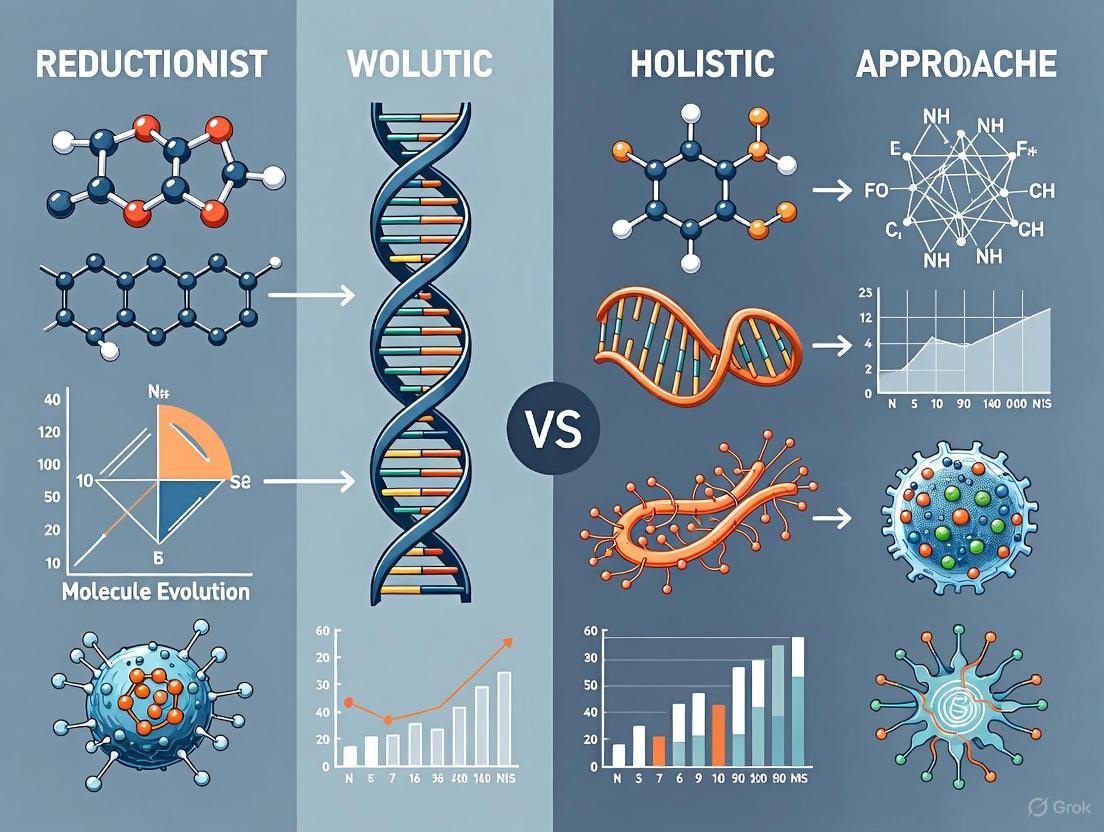
This article provides a comprehensive analysis of reductionist and holistic methodologies in molecular biology, tailored for researchers, scientists, and drug development professionals.
Reductionism vs Holism in Molecular Biology: Bridging Approaches for Advanced Biomedical Research
Abstract
This article provides a comprehensive analysis of reductionist and holistic methodologies in molecular biology, tailored for researchers, scientists, and drug development professionals. It explores the philosophical foundations and historical context of both approaches, examines their practical applications in research and therapeutic development, addresses methodological limitations and optimization strategies, and presents a comparative framework for validation. By synthesizing evidence from current literature, we demonstrate how these seemingly opposed paradigms are actually complementary, with integrated applications in systems biology offering promising pathways for overcoming complex challenges in biomedical research and drug discovery.
Philosophical Roots and Historical Evolution of Biological Approaches
Reductionism is a fundamental concept in the philosophy of science, particularly relevant to molecular biology research. It encompasses a set of claims about the relations between different scientific domains, primarily addressing whether properties, concepts, explanations, or methods from one scientific domain (typically at higher levels of organization) can be deduced from or explained by those of another domain (typically concerning lower levels of organization) [1] [2]. This framework is essential for understanding the ongoing debate between reductionist and holistic approaches in biological research, especially as systems biology gains prominence as a complementary paradigm. The discussion of reductionism is typically divided into three distinct but interrelated dimensions: ontological, methodological, and epistemic, each contributing differently to scientific practice and philosophical understanding [1] [2] [3].
The Three Dimensions of Reductionism
Ontological Reductionism
Ontological reductionism makes claims about the fundamental nature of reality, asserting that each particular biological system (e.g., an organism) is constituted by nothing but molecules and their interactions [1] [2]. In metaphysical terms, this position is often called physicalism or materialism, assuming that: (a) biological properties supervene on physical properties (meaning no difference in biological properties without a difference in underlying physical properties), and (b) each particular biological process is metaphysically identical to some particular physico-chemical process [1] [2].
This form of reductionism exists in weaker and stronger versions. The weaker version, called token-token reduction, claims that each particular biological process is identical to some particular physico-chemical process, while the stronger type-type reduction maintains that each type of biological process is identical to a type of physico-chemical process [1] [2]. Ontological reductionism in its weaker form represents a default stance among most contemporary philosophers and biologists, with vitalism (the denial of physicalism) being largely of historical interest today [1].
Methodological Reductionism
Methodological reductionism represents a procedural approach to scientific investigation, advocating that biological systems are most fruitfully studied at the lowest possible level and that experimental research should focus on uncovering molecular and biochemical causes [1] [4] [2]. This approach often involves what has been termed "decomposition and localization" - breaking down complex systems into their constituent parts to understand their functions and interactions [1] [2].
Unlike ontological reductionism, methodological reductionism does not follow directly from ontological claims and remains more controversial in practice [1]. Critics argue that exclusively reductionist research strategies can be systematically biased and may overlook salient biological features that emerge only at higher levels of organization [1] [2]. Nevertheless, methodological reductionism has driven tremendous successes in molecular biology, allowing researchers to explain phenomena such as bacterial resistance to therapy through acquired genes or patient susceptibility to infection through specific receptor mutations [4].
Epistemic Reductionism
Epistemic reductionism concerns the relationship between bodies of scientific knowledge, specifically whether knowledge about one scientific domain (typically higher-level processes) can be reduced to knowledge about another domain (typically lower-level processes) [1] [2] [3]. This has proven to be the most controversial aspect of reductionism in the philosophy of biology [1].
Epistemic reduction can be further divided into two categories:
- Theory reduction: The claim that one theory can be logically deduced from another theory [1] [2] [3]
- Explanatory reduction: The position that representations of higher-level features can be explained by representations of lower-level features [1] [2]
The debate about reduction in biology has centered not only on whether epistemic reduction is possible but also which notion of epistemic reduction is most adequate for actual scientific practice [1] [2].
Comparative Analysis: Reductionist vs. Holistic Approaches
The following table summarizes the core differences between reductionist and holistic approaches across the three dimensions, with particular emphasis on their application in molecular biology research:
Table 1: Comparative Analysis of Reductionist vs. Holistic Approaches in Biology
| Dimension | Reductionist Approach | Holistic/Systems Approach |
|---|---|---|
| Ontological Commitment | Biological systems are constituted solely by molecules and their interactions [1] [2] | Wholes or systems may possess properties not reducible to their parts (emergent properties) [4] [5] [6] |
| Methodological Strategy | Analyze systems by decomposing into constituent parts; focus on molecular and biochemical causes [1] [4] [2] | Study systems intact; focus on networks, interactions, and emergent properties [4] [6] |
| Epistemic Goal | Explain higher-level phenomena by reducing to lower-level processes and principles [1] [2] [3] | Explain phenomena through system-level principles that may not be derivable from lower levels [4] [6] |
| Primary Research Focus | Isolated components, linear pathways, specific molecular mechanisms [4] [7] | Networks, complex interactions, system-level behaviors [4] [6] |
| Representative Techniques | Gene cloning, protein purification, single-gene knockout, in vitro assays [4] | Genomics, transcriptomics, proteomics, mathematical modeling, network analysis [4] [6] |
| Strengths | High precision for specific mechanisms; enables targeted interventions; historically productive [4] [5] | Captures complexity and emergent properties; identifies network-level regulation; handles multi-scale integration [4] [6] |
| Limitations | May overlook system-level properties and interactions; limited ability to predict emergent behaviors [4] [6] | Can be computationally intensive; may lack mechanistic detail; challenging to validate experimentally [4] [5] |
Experimental Evidence: A Case Study Comparison
To illustrate the practical differences between reductionist and holistic approaches, we examine a case study from microbiology research on cholera toxin expression:
Table 2: Experimental Comparison of Reductionist vs. Holistic Methodologies
| Aspect | Reductionist Approach | Holistic/Systems Approach |
|---|---|---|
| Research Question | How do specific environmental conditions regulate cholera toxin gene (ctxA) transcription? [4] | How is cholera toxin expression regulated within the host infection context and genetic network? [4] |
| Experimental System | Simplified in vitro reporter system with controlled variables [4] | Intact host infection model monitoring multiple genetic loci over time [4] |
| Key Methodology | Reporter gene fusions to ctxA promoter under defined conditions [4] | Genomic, microarray, and proteomic analyses of bacterial behavior during infection [4] |
| Variables Controlled | Limited, well-defined environmental factors | Complex, interacting host-pathogen factors in physiological context |
| Data Type | Quantitative measurements of reporter expression | Multivariate data on coregulated genetic networks and temporal dynamics |
| Interpretation Framework | Linear causal relationships between stimuli and gene expression | Network interactions, feedback loops, and emergent system properties |
| Key Findings | Identification of specific environmental signals regulating ctxA transcription [4] | Discovery of complex regulatory networks coordinating virulence expression [4] |
| Technical Advantages | Reduced complexity; clear causal inference; high reproducibility | Physiological relevance; identification of unexpected connections; comprehensive perspective |
| Notable Limitations | May miss relevant contextual factors; limited predictive power in vivo | Difficult to establish specific causality; complex data interpretation; lower reproducibility |
Experimental Protocols
Reductionist Protocol: Reporter Gene Fusion for Analyzing Gene Regulation
- Clone promoter region of the gene of interest (e.g., ctxA cholera toxin gene) upstream of a reporter gene (e.g., GFP, luciferase) [4]
- Introduce reporter construct into model organism using appropriate transformation method
- Establish baseline measurement of reporter expression under controlled reference conditions
- Apply experimental treatments with specific environmental variables (e.g., pH, temperature, chemical inducers)
- Quantify reporter expression using appropriate methods (fluorescence, luminescence, etc.)
- Analyze data to determine fold-change in expression relative to baseline for each condition
- Repeat experiments with controlled modification of putative regulatory elements to confirm mechanisms
Holistic/Systems Biology Protocol: Network Analysis of Genetic Regulation
- Design time-course experiment capturing multiple stages of host-pathogen interaction [4]
- Collect multi-omics data simultaneously tracking transcriptome, proteome, and metabolome changes [4]
- Incorporate perturbation analysis by modifying key network components and measuring system response [4]
- Construct mathematical network models representing interactions between system components [4]
- Validate model predictions through targeted experimental interventions [4]
- Iterate between modeling and experimentation to refine understanding of network dynamics [4]
- Analyze emergent system properties that arise from network interactions rather than individual components [4]
Visualization of Conceptual Relationships
The following diagram illustrates the fundamental differences in how reductionist and holistic approaches conceptualize biological systems:
Research Reagent Solutions for Experimental Approaches
The following table details essential research reagents and their functions for implementing both reductionist and holistic research strategies:
Table 3: Essential Research Reagents for Reductionist and Holistic Approaches
| Reagent Category | Specific Examples | Primary Function | Applicable Approach |
|---|---|---|---|
| Reporter Systems | GFP, luciferase, β-galactosidase | Visualize and quantify gene expression in real-time | Primarily Reductionist [4] |
| Gene Editing Tools | CRISPR-Cas9, RNAi, traditional knockout vectors | Precisely modify specific genes to study function | Both [4] |
| Omics Technologies | Microarrays, RNA-seq, mass spectrometry | Comprehensive profiling of molecular species | Primarily Holistic [4] [6] |
| Protein Interaction Tools | Yeast two-hybrid, co-IP kits, FRET probes | Identify and characterize molecular interactions | Both |
| Pathway Modulators | Chemical inhibitors, activators, receptor agonists/antagonists | Specifically target signaling pathways | Primarily Reductionist |
| Computational Tools | Network analysis software, mathematical modeling platforms | Analyze complex datasets and build predictive models | Primarily Holistic [4] [6] |
| Cell Culture Systems | Immortalized cell lines, primary cells, 3D culture systems | Provide controlled environments for experimentation | Both |
| Animal Models | Mice, zebrafish, Drosophila with genetic modifications | Study biological processes in physiological context | Both |
The debate between reductionism and holism in molecular biology represents a fundamental tension in how we approach biological complexity. Reductionism, particularly in its methodological form, has driven tremendous advances in our understanding of specific molecular mechanisms [4] [5]. However, the emergence of systems biology reflects a growing recognition that exclusively reductionist approaches may be insufficient to explain the complex, emergent behaviors of biological systems [4] [7] [6].
Rather than representing mutually exclusive paradigms, contemporary biological research increasingly recognizes the complementary value of both approaches [4] [5]. Reductionist methods provide the precise mechanistic understanding necessary for targeted interventions, while holistic approaches offer the broader contextual framework needed to understand system-level behaviors [4]. The most productive path forward likely lies in strategically integrating both perspectives - using reductionist methods to unravel specific mechanisms within the contextual framework provided by holistic approaches [4] [6].
This integrated approach is particularly valuable in drug development, where understanding specific molecular targets (reductionist) must be balanced with anticipating system-level responses and network perturbations (holistic) [4]. As biological research continues to evolve, the creative tension between these perspectives will likely continue to drive scientific progress, with each approach providing unique insights into different aspects of biological complexity.
The fundamental debate between reductionism and holism represents a philosophical schism that continues to shape modern biological research and drug development strategies. Reductionism, which breaks down complex systems into their constituent parts to understand fundamental mechanisms, has served as the cornerstone of scientific inquiry for centuries [8]. In molecular biology, this approach has enabled significant advancements, including the development of targeted therapies that address disease mechanisms at the molecular level [8]. Conversely, holism emphasizes that complex systems exhibit properties and behaviors that cannot be fully explained by studying their individual components in isolation—a concept famously articulated by Aristotle's view that "the whole is greater than the sum of its parts" [9].
The emergence of systems biology in recent decades represents a concerted effort to bridge these seemingly opposed philosophies. This interdisciplinary field recognizes that biological systems—from individual cells to entire organisms—are characterized by inherent complexity, featuring heterogeneous elements, polyfunctional processes, and interactions across multiple spatiotemporal scales [10]. This complexity gives rise to emergent properties, which are system-level behaviors that cannot be predicted solely by analyzing individual components [11]. Understanding these emergent properties has become increasingly crucial in drug development, where therapeutic interventions may have unanticipated effects due to the complex, interconnected nature of biological systems.
Theoretical Foundations: From Aristotle to Modern Systems Thinking
Historical Development of Holistic Philosophy
The philosophical underpinnings of holism trace back to Aristotle, whose metaphysical framework posited that understanding any entity requires consideration of its relationships, context, and broader implications [9]. This perspective fundamentally challenged reductionist thinking by emphasizing interconnectedness and the unity of all things. Aristotle's concept of holism has found renewed relevance in modern approaches to biological complexity, where the relationships between components often prove as important as the components themselves.
The term "holism" was formally coined by Jan Smuts in the 1920s, who described a universal tendency for stable wholes to form from parts across all levels of organization, from atomic to biological to psychological systems [7]. This classical holism emerged alongside, but distinct from, vitalism—the belief that a special life-force differentiates living from inanimate matter [7]. While vitalism was largely abandoned by the 1920s due to its inability to provide a basis for experimental research, holistic thinking evolved to focus on observable emergent properties rather than metaphysical life forces.
The Reductionist Dominance in Molecular Biology
Throughout the 20th century, reductionism became the dominant paradigm in molecular biology, influenced by Cartesian dualism (viewing the body as a machine with parts that can be studied independently) and logical positivism (emphasizing empirical observation and experimentation) [12]. The biomedical model that emerged in the mid-20th century viewed the body as a collection of discrete systems that could be understood and manipulated independently [12].
This approach yielded tremendous successes, exemplified by the Hodgkin-Huxley (HH) model from the 1950s, which used ordinary differential equations to describe the propagation of electrical signals through neuronal axons by reducing neuronal activity to an electrical circuit model [10]. Such reductionist breakthroughs demonstrated the power of isolating and studying individual components of complex biological systems, establishing a methodological foundation that would dominate molecular biology for decades.
The Limits of Reductionism and Systems Biology Emergence
By the late 20th century, the limitations of strict reductionism became increasingly apparent, particularly in addressing fundamental questions in biological systems [10]. While reductionism proved effective for studying systems with regular, symmetric organization or random systems with enormous numbers of identical components, it struggled with biological complexity characterized by topologically irregular interactions, heterogeneous elements, and multi-scale dynamics [10].
The ensuing shift toward holistic approaches in modern biological research recognizes that biological systems operate through complex networks of interactions that span multiple organizational levels. This integrated perspective has given rise to systems biology, which seeks to understand biological systems as integrated wholes rather than collections of isolated parts [7]. The core insight driving this field is that emergent properties arise from the interactions between system components, making these properties irreducible to the characteristics of individual parts [11].
Emergent Properties in Biological Systems: Theory and Examples
Defining Emergent Properties
Emergent properties represent system-level characteristics that arise through the interactions of multiple system components but cannot be found in or predicted from the individual components themselves [11] [13]. These properties manifest across all biological scales, from molecular networks to ecosystems, and represent a fundamental challenge to purely reductionist explanations in biology.
The concept of emergence was first explained by philosopher John Stuart Mill in 1843, with the term "emergent" later coined by G. H. Lewes [11]. In biological contexts, emergent properties demonstrate non-linear dynamics, where system outputs are not proportional to inputs, and often feature feedback loops that create self-regulating behaviors.
Examples Across Biological Scales
Table: Examples of Emergent Properties in Biological Systems
| Biological Scale | System Components | Emergent Property | Research/Clinical Significance |
|---|---|---|---|
| Molecular | Sodium (toxic, reacts violently with water) and Chlorine (toxic gas) | Table salt (non-toxic, crystalline, edible) | Demonstrates fundamental principle that compound properties cannot be predicted from elements |
| Cellular | Individual metabolic enzymes (e.g., phosphofructokinase) | Glucose metabolism pathway (glycolysis) | Understanding metabolic regulation, metabolic disease mechanisms, drug targeting |
| Organ | Individual cardiac cells | Heart pumping blood | Cardiovascular function, heart disease pathophysiology, cardiotoxicity screening |
| Neural | Individual neurons | Consciousness, cognition, information processing | Neurological disease mechanisms, psychotropic drug development, neurotoxicity assessment |
| Ecological | Individual bees (queen, workers, drones) | Colony organization with division of labor | Environmental toxicology, ecosystem impact assessment |
Molecular Level: A classic example of emergence can be found in simple chemical compounds. The elements sodium and chlorine individually exhibit toxic properties and reactivity, but when combined, they form table salt (sodium chloride), which displays entirely different characteristics—crystal structure, solubility, and non-toxicity—that are essential for biological function [11].
Cellular Level: At the cellular level, individual enzymes such as phosphofructokinase perform specific biochemical reactions, but the coordinated operation of multiple enzymes in the glycolytic pathway enables the emergent property of glucose metabolism—a complex, regulated process that provides cellular energy [11]. This emergence enables metabolic regulation that would be impossible for individual enzymes.
Organ Level: The heart's pumping function represents an emergent property of coordinated cardiac cell activity. While individual cardiac muscle cells contract, only their organized assembly into cardiac tissue and the heart organ produces the coordinated pumping action that circulates blood throughout the body [11]. This emergent function is central to cardiovascular physiology and drug development.
Neural Systems: Consciousness and cognition represent sophisticated emergent properties of neural networks. Individual neurons transmit electrical signals, but their organized interconnection in neural circuits gives rise to complex cognitive functions, thought processes, and adaptive responses to stimuli [11]. This multi-scale emergence presents both challenges and opportunities for neurological drug development.
Social Insects: In honeybee colonies, the division of labor among queen bees, drones, and worker bees produces emergent colony-level behaviors including hive maintenance, foraging efficiency, and temperature regulation that cannot be attributed to any individual bee [11]. Such ecological emergence models complex system behaviors relevant to population-level biological responses.
Comparative Analysis: Reductionist vs. Holistic Approaches
Methodological Comparison
Table: Methodological Comparison of Reductionist vs. Holistic Approaches
| Aspect | Reductionist Approach | Holistic Approach |
|---|---|---|
| Primary Focus | Individual components in isolation | Systems as integrated wholes |
| Analytical Strategy | Breaks systems into constituent parts | Studies interactions and networks |
| Key Assumption | System behavior equals sum of parts | Emergent properties arise from interactions |
| Typical Methods | Controlled experiments, molecular profiling, targeted interventions | Network analysis, computational modeling, multi-omics integration |
| Data Requirements | High-precision, focused datasets | Large-scale, multi-dimensional data |
| Strengths | High precision, clear causality, target identification | Contextual understanding, prediction of system behavior, identification of emergent properties |
| Limitations | May miss system-level behaviors, limited context | Complexity, computational demands, challenging validation |
| Representative Models | Hodgkin-Huxley equations (neural firing) [10] | Multilayer networks, agent-based models [10] |
Quantitative Comparison of Research Outcomes
Table: Experimental Outcomes from Reductionist vs. Holistic Research
| Research Context | Reductionist Findings | Holistic/Systems Findings | Complementary Insights |
|---|---|---|---|
| Neural Function | Hodgkin-Huxley model: action potential mechanism via voltage-gated ion channels [10] | Neural circuits exhibit emergent computational properties; multilayer networks model neuro-vascular coupling [10] | Molecular mechanisms enable but don't explain higher neural functions |
| Transcription Networks | Identification of individual transcription factors and their binding sites [13] | Network motifs (e.g., feedback loops) give rise to emergent properties (bistability, oscillations) [13] | Component identification necessary but insufficient for system behavior prediction |
| Medical Research | Targeted therapies based on molecular pathways; personalized medicine based on genetic markers [12] | Quantitative holism integrating physiological, environmental, and lifestyle factors; network medicine [12] | Molecular targeting benefits from systems-level context for efficacy and safety |
| Plant Biology | Characterization of individual stress-response transcription factors [13] | TFN (Transcription Factor Network) models reveal emergent adaptive responses to environmental stresses [13] | Crop engineering requires both component characterization and system-level understanding |
Experimental Approaches and Methodologies
Research Reagent Solutions for Studying Emergent Properties
Table: Essential Research Reagents and Computational Tools for Holistic Biology
| Reagent/Tool Category | Specific Examples | Function in Research | Application Context |
|---|---|---|---|
| Genomic Profiling Tools | RNA sequencing, ChIP-seq, ATAC-seq | Elucidate transcription factor networks and gene expression dynamics [13] | Identifying network components and interactions |
| Mathematical Modeling Frameworks | Ordinary differential equations, Boolean networks, Agent-based models | Simulate system dynamics and emergent behaviors [10] [13] | Predicting system behavior from component interactions |
| Network Analysis Tools | Annotated networks, Multilayer networks, Hypergraphs | Represent complex biological interactions across scales [10] | Mapping and analyzing complex biological systems |
| Computational Infrastructure | High-performance computing (HPC), Machine learning algorithms | Handle large-scale data analysis and complex simulations [10] | Managing computational demands of systems biology |
| Visualization Techniques | Y1H assays, Protein-binding microarrays, Live-cell imaging | Experimental validation of network interactions and dynamics [13] | Confirming predicted interactions and emergent behaviors |
Protocols for Studying Emergent Properties in Transcription Networks
Protocol 1: Elucidating Transcription Factor Networks and Emergent Properties in Arabidopsis
This protocol outlines an interdisciplinary approach for identifying transcription factor networks (TFNs) and their associated emergent properties, as demonstrated in Arabidopsis research [13].
Network Component Identification:
- Utilize genomic techniques (ChIP-seq, ATAC-seq) to identify transcription factors and their target genes (network nodes)
- Determine activation or inhibition relationships between nodes (edges) through protein-binding microarrays and yeast one-hybrid (Y1H) assays [13]
- Validate interactions through chromatin immunoprecipitation followed by sequencing
Network Motif Recognition:
- Analyze network architecture to identify recurring motifs (feedback loops, feed-forward loops)
- Correlate specific motifs with dynamic behaviors (bistability, oscillations, homeostasis)
Mathematical Modeling:
- Develop dynamical models using ordinary differential equations or Boolean networks
- Parameterize models using experimental data on transcript concentrations and dynamics
- Simulate network behavior under various conditions and perturbations
Experimental Validation:
- Perturb network components genetically or chemically
- Measure system responses using high-throughput transcriptomics and proteomics
- Compare experimental results with model predictions to refine understanding
Protocol 2: Multi-Scale Modeling for Emergent Properties in Neural Systems
This protocol describes a holistic approach to modeling emergent properties in neural systems using multilayer networks and high-performance computing [10].
Multi-Scale Data Integration:
- Collect structural data (neuronal connectivity, vasculature)
- Acquire functional data (neural activity, hemodynamics)
- Incorporate temporal data (developmental changes, aging effects)
Multilayer Network Construction:
- Represent different biological systems as individual network layers (e.g., neural connectivity, cerebral vasculature)
- Establish inter-layer connections that represent cross-system interactions
- Annotate nodes and edges with biological metadata
Simulation and Analysis:
- Implement agent-based models or differential equation systems on high-performance computing infrastructure
- Run simulations under baseline and perturbed conditions
- Identify emergent patterns through topological and dynamical analysis
Model Validation and Refinement:
- Compare simulation outputs with experimental observations
- Iteratively refine model parameters and structure
- Generate testable predictions for experimental validation
Visualization of Concepts and Relationships
Network Motifs and Emergent Properties in Transcription Factor Networks
Diagram Title: Network Motifs and Emergent Properties in Transcription Factor Networks
Multi-scale Integration in Holistic Biological Modeling
Diagram Title: Multi-scale Integration in Holistic Biological Modeling
The historical tension between reductionism and holism in biological research is progressively giving way to integrated approaches that leverage the strengths of both philosophical frameworks. Reductionist methods continue to provide essential mechanistic insights at the molecular level, while holistic approaches reveal how these components interact to produce system-level behaviors and emergent properties [8] [10].
The future of drug development and molecular biology research lies in quantitative holism—an approach that combines precise, reductionist-derived molecular data with holistic, systems-level modeling [12]. This integration enables researchers to bridge the gap between molecular mechanisms and organism-level outcomes, potentially leading to more effective therapeutic strategies with fewer unanticipated side effects.
As high-performance computing, artificial intelligence, and multi-omics technologies continue to advance, the practical barriers to implementing truly holistic approaches in biological research are rapidly diminishing [10]. By embracing both reductionist precision and holistic context, researchers can address the profound complexity of biological systems while maintaining the empirical rigor that has driven scientific progress for centuries. This integrated path forward promises to unlock new dimensions of understanding in biology and transform our approach to therapeutic intervention in human disease.
The molecular biology revolution, which gained tremendous momentum in the mid-20th century, was fundamentally underpinned by a reductionist approach that has since transformed our understanding of life processes. This methodological paradigm, which involves breaking down complex biological systems into their constituent parts to understand their structure and function, has been the cornerstone of biological research for decades [4]. Reductionism operates on the principle that complex phenomena are best understood by examining their simpler, more fundamental components [14]. In practical terms, this has meant that biologists seek to explain cellular and organismal behaviors through the properties of molecules, particularly DNA, RNA, and proteins, with the ultimate goal of explaining biology through the laws of physics and chemistry [15].
The triumphs of this reductionist approach are undeniable and have formed the foundation of modern molecular biology. The discovery of DNA's structure by Watson and Crick in 1953 epitomizes the power of reductionism, as it reduced the mystery of genetic inheritance to a chemical structure [14]. This breakthrough, along with numerous others summarized in Table 1, demonstrated that reductionism could yield profound insights into biological organization. The approach has been particularly successful in identifying discrete molecular components responsible for specific biological functions, such as identifying genes encoding beta-lactamases to explain bacterial antibiotic resistance or mutant receptors to explain susceptibility to infection [4]. This review will objectively compare the reductionist approach with emerging holistic perspectives, examining their respective strengths, limitations, and experimental support within molecular biology research.
Foundational Principles of Biological Reductionism
Reductionism in biology encompasses several distinct but interrelated concepts. Methodological reductionism, the most practically significant form for researchers, proposes that complex systems are best studied by analyzing their simpler components [4]. This approach traces back to Descartes' suggestion to "divide each difficulty into as many parts as is feasible and necessary to resolve it" [4]. In contemporary molecular biology, this manifests as studying isolated molecules, pathways, or genetic elements rather than intact systems.
Epistemological reductionism addresses relationships between scientific disciplines, specifically whether knowledge in one domain (like biology) can be reduced to another (like physics and chemistry) [4]. The often-cited declaration by Francis Crick that "the ultimate aim of the modern movement in biology is to explain all biology in terms of physics and chemistry" exemplifies this perspective [15]. While this viewpoint has been productive, many biologists recognize that different scientific disciplines remain because phenomena are often best understood at specific organizational levels rather than through fundamental physics alone [4].
Ontological reductionism represents a more philosophical position that biological systems are constituted by nothing but molecules and their interactions [4]. This perspective rejects the notion of any "vital force" or non-physical elements in living organisms, positioning biology as a continuation of physical sciences rather than a fundamentally separate enterprise [7].
The standard model of scientific reduction, proposed by Ernest Nagel, formalizes this approach through two key conditions: the "condition of connectability" (assumptions must connect terms between different scientific domains) and the "condition of derivability" (laws of the primary science should allow logical derivation of the secondary science's laws) [14]. Although this model has faced practical challenges in implementation, it has nonetheless guided much of molecular biological research throughout its development.
Key Historical triumphs of Reductionist Approaches
The reductionist approach has generated numerous landmark discoveries that form the foundation of modern molecular biology. These triumphs demonstrate the power of isolating and studying biological components in simplified systems.
Table 1: Historic Triumphs of Reductionism in Molecular Biology
| Discovery/Advancement | Key Researchers (Year) | Reductionist Approach | Significance |
|---|---|---|---|
| DNA as Transforming Principle | Avery, MacLeod, McCarty (1944) | Isolated DNA from other cellular constituents | Conclusively demonstrated DNA alone responsible for genetic transformation [4] |
| Structure of DNA | Watson, Crick (1953) | X-ray crystallography of purified DNA | Revealed chemical basis of genetic inheritance [14] |
| Tobacco Mosaic Virus Reassembly | Fraenkel-Conrat, Williams (1955) | Separated viral RNA and coat protein components | Demonstrated self-assembly of biological structures [4] |
| Operon Theory of Gene Regulation | Jacob, Monod (1961) | Used bacterial mutants to study isolated metabolic pathways | Revealed fundamental mechanisms of genetic control [4] |
| Restriction Enzymes | Arber, Smith, Nathans (1970s) | Isolation of bacterial enzymes that cut specific DNA sequences | Enabled recombinant DNA technology and genetic engineering [4] |
These breakthroughs share a common methodological thread: the isolation of individual components from their complex cellular environments to establish causal relationships. The success of these approaches cemented reductionism as the dominant paradigm in molecular biology throughout the latter half of the 20th century.
Experimental Protocols in Reductionist Research
Reductionist approaches typically follow a consistent methodological pattern that has proven enormously successful:
System Simplification: Complex biological systems are reduced to more manageable components. For example, using reporter fusions to specific genes (such as ctxA cholera toxin gene) to identify environmental conditions regulating toxin production, thereby reducing complicating experimental variables [4].
Component Isolation: Biological molecules are purified from their native environments. The critical experiment by Avery, MacLeod, and McCarty demonstrating DNA as the transforming principle required isolation of DNA free from other cellular constituents [4].
In Vitro Reconstitution: Biological function is demonstrated using purified components alone. The reassembly of tobacco mosaic virus from separated RNA and protein components showed that complex biological assembly could occur without cellular machinery [4].
Genetic Dissection: Specific genes are manipulated (through mutation, deletion, or overexpression) to determine their function. Screening Salmonella mutants for survival in cultured macrophages provides predictive information about mammalian infection capability [4].
The following diagram illustrates the typical workflow of reductionist experimental design in molecular biology:
The Scientist's Toolkit: Essential Research Reagents & Materials
Reductionist molecular biology research relies on a specific set of research reagents and methodologies that enable the dissection of complex systems. These tools form the essential toolkit for conducting the experiments that drove the molecular biology revolution.
Table 2: Essential Research Reagents in Reductionist Molecular Biology
| Research Reagent/Material | Function/Application | Key Examples |
|---|---|---|
| Reporter Gene Fusions | Isolate and study regulation of specific genetic elements | ctxA cholera toxin gene fusions to study environmental regulation [4] |
| Bacterial Mutants | Identify gene function by studying loss-of-function variants | Salmonella mutants screened for survival in cultured macrophages [4] |
| Cell-Free Systems | Study molecular processes without complex cellular environment | Cell-free fermentation systems demonstrating non-vitalistic nature of biochemistry [7] |
| Knockout Organisms | Determine gene function by targeted deletion | Gene knockout experiments in mice to infer role of individual genes [15] |
| Purified Molecular Components | Study molecules in isolation from native environment | Isolated DNA demonstrating transformation principle; TMV RNA and coat protein self-assembly [4] |
These core reagents and methodologies enabled researchers to implement the reductionist program by isolating individual components from complex biological systems. The reporter gene systems, for instance, allowed scientists to study gene regulation while reducing confounding variables present in intact organisms [4]. Similarly, knockout organisms (despite some limitations due to redundancy and pleiotropy) enabled the assignment of function to specific genes by observing the consequences of their absence [15].
Emergence of Holistic Challenges to Reductionism
Despite its celebrated successes, the reductionist approach has demonstrated significant limitations when confronting the inherent complexity of biological systems. These limitations have prompted the development of more holistic approaches, particularly systems biology, which seeks to understand biological systems as integrated wholes rather than collections of isolated parts [4].
The concept of emergent properties represents a fundamental challenge to strict reductionism. Emergent properties are system characteristics that cannot be predicted or explained solely by studying individual components in isolation [15]. A classic example is water: detailed knowledge of molecular structure of H₂O does not predict the emergent property of surface tension [4]. In biological systems, consciousness and mental states represent complex emergent phenomena that cannot be fully explained by reducing them to chemical reactions in neurons, despite the claims of some neuroscientists [15].
Practical limitations of reductionism have become increasingly apparent in biomedical research. In drug discovery, the number of new drugs approved annually has declined significantly despite massive investments in reductionist-based high-throughput screening, combinatorial chemistry, and genomics approaches [15]. This disappointing performance has been attributed, at least in part, to reductionism's underestimation of biological complexity [15]. Similarly, knockout experiments in mice frequently yield unexpected results—sometimes showing no effect when eliminating genes considered essential, or producing completely unanticipated phenotypes—highlighting the limitations of studying individual genes in isolation from complex genetic networks [15].
The following diagram illustrates key limitations of the reductionist approach that holistic methods seek to address:
Specific experimental evidence demonstrates these limitations. Studies of Toll-like receptor 4 (TLR4) signaling show that mice deficient in TLR4 are highly resistant to purified lipopolysaccharide but extremely susceptible to challenge with live bacteria [4]. This illustrates the critical difference between studying isolated microbial constituents versus intact microbes—a distinction recognized by journals like Infection and Immunity, which now prefer studies of whole organisms [4]. Similarly, the experience of pain altering human behavior cannot be adequately explained by reducing it to lower-level chemical reactions in neurons, as the pain itself has causal efficacy that is not reducible to its constituent processes [15].
Comparative Analysis: Reductionist vs. Holistic Approaches
The comparison between reductionist and holistic approaches reveals distinct strengths and limitations for each methodology. Rather than representing mutually exclusive paradigms, they often function best as complementary approaches to biological investigation.
Table 3: Reductionist vs. Holistic Approaches in Molecular Biology
| Aspect | Reductionist Approach | Holistic/Systems Approach |
|---|---|---|
| Primary Focus | Individual components in isolation | Systems as integrated wholes |
| Methodology | Studies parts separately | Studies interactions between parts |
| Explanatory Power | Strong for linear causality | Addresses emergent properties and network behavior |
| Technological Requirements | Standard molecular biology techniques | High-throughput omics technologies, computational modeling |
| Typical Data Output | Detailed mechanistic understanding of specific elements | Comprehensive datasets capturing system dynamics |
| Strengths | Precise, mechanistic insights; establishes causal relationships | Captures complexity, network properties, and context dependence |
| Limitations | May miss system-level interactions and emergent properties | Can be overwhelmed by complexity; may lack mechanistic detail |
The reductionist approach excels at establishing precise mechanistic relationships and causal connections—it can definitively show that a specific gene or molecule is necessary for a particular function [4]. However, it struggles to explain how these components interact within complex networks or how emergent properties arise from these interactions [15]. The holistic approach, exemplified by systems biology, addresses these limitations by studying systems-level behaviors but may lack the precise mechanistic detail that reductionism provides [4].
This dichotomy represents what some have called a "false dichotomy" [4], as both approaches provide valuable but limited information. Molecular biology and systems biology are "actually interdependent and complementary ways in which to study and make sense of complex phenomena" [4]. This complementary relationship is increasingly recognized in modern research, where reductionist methods identify key components whose interactions are then studied using holistic approaches.
Contemporary Synthesis: Integrating Approaches in Modern Biology
Contemporary molecular biology increasingly recognizes that reductionism and holism are not opposed methodologies but rather complementary approaches that together provide a more complete understanding of biological systems [4]. This synthesis leverages the strengths of both perspectives while mitigating their respective limitations.
Systems biology has emerged as a primary framework for this integration, combining detailed molecular insights from reductionism with holistic perspectives on dynamic interactions within biological systems [16]. Systems biology employs both "bottom-up" approaches (starting with molecular properties and deriving models that can be tested) and "top-down" approaches (starting from omics data and seeking underlying explanatory principles) [4] [16]. The bottom-up approach begins with foundational elements, developing interactive behaviors of each component process and then combining these formulations to understand system behavior [16]. The top-down approach begins with genome-wide experimental data and seeks to uncover biological mechanisms at more granular levels [16].
Advanced technologies now enable this integrative approach. Single-cell sequencing technologies reveal heterogeneity within cell populations that was previously obscured, bridging molecular detail with cellular context [17] [18]. Network science analyzes interactions between biomolecules using graph theory, identifying complex patterns that generate scientific hypotheses about health and disease [18]. Integrative biology utilizes holistic approaches to integrate multilayer biological data, from genomics and transcriptomics to proteomics and metabolomics, providing a more comprehensive understanding of human diseases [18].
The following diagram illustrates how integrated approaches combine reductionist and holistic perspectives:
This integrated approach is particularly valuable for understanding complex diseases. For example, type 2 diabetes involves multiple behavioral, lifestyle, and genetic risk factors with impaired insulin secretion, insulin resistance, kidney malfunction, inflammation, and neurotransmitter dysfunction all contributing to the disease state [18]. A purely reductionist approach focusing on individual molecular components cannot adequately address this complexity, while a purely holistic approach might lack the mechanistic detail needed for targeted interventions. The integration of both perspectives provides a more powerful framework for understanding and treating such complex conditions.
The historical triumphs of reductionism in molecular biology are undeniable, having provided fundamental insights into life's molecular machinery and established causal relationships between specific genes, molecules, and biological functions. The approach remains essential for establishing mechanistic understanding at the molecular level. However, the limitations of reductionism when confronting biological complexity have become increasingly apparent, prompting the development and integration of more holistic approaches.
Contemporary molecular biology research benefits from integrating both perspectives, leveraging reductionism's precision with holism's contextual understanding. This synthesis enables researchers to both establish causal mechanisms and understand how these mechanisms operate within complex biological systems. As molecular biology continues to evolve, the productive tension between these approaches will likely continue to drive scientific progress, with each methodology compensating for the limitations of the other in the ongoing effort to understand the complexity of life.
The landscape of molecular biology research is defined by a fundamental philosophical and methodological tension: reductionism versus holism. For decades, reductionism—the approach of breaking down complex biological systems into their individual components to understand fundamental mechanisms—has been the cornerstone of scientific discovery, yielding extraordinary insights into the molecular basis of life [8] [4]. This paradigm is epitomized by molecular biology's focus on isolating specific genes, proteins, and pathways. However, an increasing backlash has emerged against the limitations of pure reductionism, driven by the recognition that complex biological phenomena often possess emergent properties that cannot be predicted or explained by studying isolated parts alone [4] [19]. This has catalyzed a resurgence of holistic thinking, exemplified by fields like systems biology, which aims to understand biological systems as integrated and indivisible wholes by examining the dynamic interactions within complex networks [4] [7].
This guide provides an objective comparison of these competing approaches, framing them not as mutually exclusive adversaries but as complementary perspectives. We will evaluate their performance through key experimental data, detailed methodologies, and practical applications in drug discovery, providing researchers with a structured analysis to inform their scientific strategies.
Comparative Analysis: Reductionism vs. Holism at a Glance
The table below summarizes the core characteristics, strengths, and limitations of reductionist and holistic approaches in biological research.
Table 1: Fundamental Comparison of Reductionist and Holistic Approaches
| Aspect | Reductionist Approach | Holistic Approach |
|---|---|---|
| Core Philosophy | Breaking down systems to constituent parts; whole is sum of parts [8] [20]. | Studying systems as integrated wholes; whole is greater than sum of parts [8] [21]. |
| Primary Focus | Isolated components (e.g., single genes, proteins, pathways) [4]. | Interactions, networks, and emergent properties [4] [7]. |
| Methodology | Controlled experiments isolating single variables [20] [21]. | High-throughput data collection (e.g., genomics, proteomics) and computational modeling [4]. |
| Key Strength | Enables precise, causal mechanistic insights and targeted interventions [4] [20]. | Captures system-wide complexity and context-dependent behaviors [8] [21]. |
| Key Limitation | Risks oversimplification; may miss critical higher-level interactions [4] [19]. | Can be technologically challenging and complex to interpret; may lack mechanistic clarity [4] [21]. |
| Representative Field | Molecular Biology | Systems Biology [4] [7] |
Experimental Evidence: Case Studies in Drug Discovery and Disease Research
The Reductionist Success: Targeted Drug Design
The development of drugs through rational design is a quintessential achievement of the reductionist paradigm.
Table 2: Reductionist Approach in Rational Drug Design
| Experimental Aspect | Reductionist Protocol & Findings |
|---|---|
| Core Premise | A disease can be understood by the action of a few key enzymes; a drug can be designed to mimic a specific enzymatic substrate [22]. |
| Methodology | 1. Target Identification: Select a specific biological target (e.g., a single enzyme or receptor) implicated in a disease [22].2. Structural Analysis: Elucidate the 3D structure of the target's active site via X-ray crystallography or NMR.3. Molecular Docking: Use computational modeling (e.g., QM/MM calculations) to study interactions between the target and potential drug candidates [22].4. Synthesis & Testing: Synthesize the lead compound and assay its activity in vitro on the isolated enzyme [22]. |
| Key Strength | Provides a clear, mechanistic understanding of drug-target interaction and enables the development of highly specific inhibitors [22]. |
| Key Limitation | The simplified model may not predict a drug's effect in a whole organism, where off-target effects and complex network physiology come into play [22]. |
The Holistic Resurgence: Systems Biology in Cancer Research
Holistic approaches challenge the single-target dogma, particularly in complex diseases like cancer.
Table 3: Holistic Approach in Cancer Research
| Experimental Aspect | Holistic Protocol & Findings |
|---|---|
| Core Premise | Cancer is a disease of multifactorial origin; treatment must consider the entire cellular network and tissue microenvironment [22]. |
| Methodology | 1. High-Throughput Data Collection: Use genomics, proteomics, and transcriptomics to profile tumors [4].2. Network Modeling: Build computational models of protein interaction networks or metabolic pathways to identify critical nodes [4].3. Contextual Validation: Study drug effects not just on isolated cancer cells but within tissue architectures and microenvironments that can restrict or promote tumor growth [22]. |
| Key Finding | Research by Pierce et al. demonstrated that malignant neoplastic cells can differentiate into benign cell types when placed in a normal microenvironment, refuting the purely genetic "once a cancer cell, always a cancer cell" dogma [22]. |
| Key Strength | Reveals emergent properties of the system, such as how network robustness or the tissue context can dictate disease progression and treatment response [4] [22]. |
Visualizing the Complementary Workflow
The following diagram illustrates how reductionist and holistic methodologies can be integrated in a modern research pipeline, such as in drug discovery.
Diagram 1: Integrated Research Workflow in Modern Biology
The Scientist's Toolkit: Essential Research Reagents and Solutions
The choice between reductionist and holistic methodologies dictates the required research materials. The table below details key reagents and their functions.
Table 4: Essential Research Reagent Solutions
| Reagent / Material | Function | Primary Approach |
|---|---|---|
| Specific Enzyme Inhibitors | Blocks the activity of a single, purified target protein to study its specific function and validate it as a drug target. | Reductionism [22] |
| Polymerase Chain Reaction (PCR) Kits | Amplifies and quantifies specific DNA sequences, enabling the study of individual genes. | Reductionism |
| Reporter Gene Assays (e.g., ctxA fusion) | Measures the regulation of a single gene of interest under different environmental conditions by linking it to a detectable signal. | Reductionism [4] |
| Microarray & RNA-Seq Kits | Allows for the simultaneous measurement of expression levels of thousands of genes, providing a global transcriptomic profile. | Holism [4] |
| Proteomic Profiling Kits | Enables high-throughput identification and quantification of proteins from a complex biological sample. | Holism [4] |
| Cell Culture Models of Tumor Microenvironment | Advanced in vitro systems that co-culture cancer cells with stromal cells to study the impact of the tissue context on drug response. | Holism [22] |
The historical debate between reductionism and holism is not a battle to be won but a dialectic to be synthesized [8] [4] [19]. The backlash against pure reductionism is not a rejection of its power but a recognition of its limitations when applied to the inherent complexity of biological systems. The most productive path forward for molecular biology and drug development lies in a complementary approach that leverages the precision of reductionist methods to ground-truth the insights gleaned from holistic, system-level analyses [8] [4] [22]. This integrated strategy, harnessing the strengths of both paradigms, promises to accelerate the discovery of robust scientific truths and the development of more effective, network-aware therapeutic interventions.
Molecular biology is fundamentally shaped by two competing philosophical approaches: reductionism and holism. Reductionism, which has driven the field for decades, posits that complex systems are best understood by dissecting them into their constituent parts and studying their individual properties [4] [14]. In contrast, holism—often embodied by modern systems biology—argues that phenomena arise from the interconnectedness of all components within a system, and that these emergent properties cannot be predicted from the parts alone [4] [23]. This guide objectively compares the performance of these frameworks, providing experimental data and methodologies that illustrate their respective strengths and limitations in a research context.
Core Conceptual Comparison
The reductionist and holistic approaches differ in their fundamental assumptions, goals, and explanations of biological phenomena. The table below outlines their key conceptual distinctions.
Table 1: Foundational Principles of Reductionist and Holistic Frameworks
| Feature | Reductionist Approach | Holistic (Systems) Approach |
|---|---|---|
| Core Principle | Breaks down systems into isolated components for detailed study [4] [14]. | Studies systems as integrated wholes, focusing on interactions and networks [4] [23]. |
| Primary Goal | Identify linear, causal mechanisms and isolate fundamental building blocks [4]. | Understand emergent properties and system-level behaviors that arise from interconnectedness [23] [7]. |
| View on Emergence | Considers emergent properties as explainable by the underlying parts, given sufficient data [4]. | Views emergence as a fundamental, often non-predictable, outcome of complex interactions [23] [24]. |
| Explanation of Causality | Largely linear cause and effect (e.g., Gene A → Protein B) [4]. | Circular causality through feedback loops; cause and effect are diffuse and dynamic [23]. |
| Typical Methodology | Isolated, controlled experiments (e.g., in vitro assays) [4]. | Integrative, high-throughput omics and computational modeling [25] [26]. |
Experimental Evidence and Performance Data
The practical performance of these frameworks is evaluated through their success in explaining biological phenomena and driving drug discovery. The following experiments highlight the types of data and insights each approach generates.
Experiment 1: Investigating Immune Response to Pathogens
This experiment compares how each framework studies the host immune response to a bacterial pathogen like Salmonella.
Table 2: Experimental Comparison: Immune Response to Pathogens
| Experimental Aspect | Reductionist Protocol & Findings | Holistic/Systems Biology Protocol & Findings |
|---|---|---|
| Aim | Identify the specific function of a single Toll-like receptor (TLR4) in detecting lipopolysaccharide (LPS) [4]. | Understand the network of host-pathogen interactions during live infection and identify emergent dynamics [4] [26]. |
| Key Protocol | 1. Use purified LPS to stimulate cultured immune cells or recombinant TLR4 receptors.2. Measure downstream cytokine production in isolation.3. Utilize knockout mice lacking TLR4 to confirm its specific role [4]. | 1. Infect a live mouse model with Salmonella.2. Perform simultaneous multi-omic analysis (transcriptomics, proteomics, metabolomics) on host cells and bacteria over time.3. Integrate data to reconstruct a dynamic interaction network [4] [26]. |
| Key Findings | TLR4 is critical for sensing purified LPS. TLR4-deficient mice are highly resistant to LPS shock [4]. | TLR4-deficient mice are extremely susceptible to live bacterial infection, a counter-intuitive result showing the system's compensatory mechanisms cannot be predicted from isolated components [4]. |
| Performance Insight | Excellent for establishing precise, causal molecular mechanisms. | Essential for understanding clinically relevant, complex phenotypes that emerge in vivo. |
The workflow for the holistic approach in this context can be visualized as an iterative cycle of experimentation and modeling:
Experiment 2: Target Discovery in Cancer Research
This case examines the historical and modern approaches to understanding tumorigenesis, showcasing the predictive power of integrative thinking.
Table 3: Experimental Comparison: Cancer Research Insights
| Experimental Aspect | Reductionist Protocol & Findings | Holistic/Integrative Protocol & Findings |
|---|---|---|
| Aim | Identify and characterize the function of individual oncogenes and tumor-suppressor genes (e.g., via gene sequencing and in vitro functional assays) [27]. | Predict the fundamental principles of malignant transformation through observation of biological systems [27]. |
| Key Protocol | 1. Sequence tumor genomes to find mutated genes.2. Transfer candidate genes into cell lines and monitor proliferation.3. Study protein function in isolated signaling pathways [27]. | 1. Observe chromosome behavior and instability in sea urchin eggs and parasitic worms (Ascaris).2. Correlate abnormal chromosomal complement with uncontrolled growth.3. Formulate a predictive theory based on cytological and embryological principles [27]. |
| Key Findings | Detailed mechanistic understanding of specific proteins like p53 and Ras in cell cycle control [27]. | Boveri's 1914 hypothesis accurately predicted the roles of chromosome instability, oncogenes, tumor-suppressor genes, and tumor predisposition long before their molecular identification [27]. |
| Performance Insight | Powerful for detailing mechanisms after a target is known. | Powerful for generating novel, foundational hypotheses by observing emergent system-level properties. |
The Scientist's Toolkit: Essential Research Reagents
The choice of experimental approach dictates the required reagents and tools. Below is a comparison of essential materials for each methodology.
Table 4: Key Research Reagent Solutions by Approach
| Reagent / Tool | Function in Reductionist Approach | Function in Holistic Approach |
|---|---|---|
| Purified Molecular Components(e.g., LPS, recombinant proteins) | Isolates a single variable to establish direct, causal molecular interactions in controlled in vitro settings [4]. | Used as a precise perturbation tool to observe system-wide ripple effects in integrated models [4]. |
| Reporter Fusions(e.g., ctxA-gfp) | Studies the regulation of a single gene of interest under specific, simplified environmental conditions [4]. | Tracks the dynamic activity of multiple genes simultaneously within a genetic network in a live host or complex environment [4]. |
| Gene-Specific Knockout Models | Determines the non-redundant function of a single gene by observing the resulting phenotypic defect [4]. | Reveals network robustness, redundancy, and compensatory pathways when the system adapts to the missing component [4]. |
| High-Throughput Omics Kits(e.g., for RNA-Seq, Metabolomics) | Limited use; may profile a specific pathway in response to a targeted intervention. | Core technology for simultaneously quantifying thousands of molecules (genes, proteins, metabolites) to build system-level network maps [26]. |
Analysis of Strengths and Limitations
A balanced view requires acknowledging the inherent trade-offs of each framework, as summarized below.
Table 5: Framework Performance: Strengths and Limitations
| Aspect | Reductionism | Holism |
|---|---|---|
| Strengths | - Proven track record of mechanistic discoveries (e.g., DNA as genetic material) [4].- Enables high-precision, controlled experiments.- Foundation for targeted drug design. | - Captures emergent properties and system-level dynamics (e.g., ecosystem stability, disease resilience) [23] [26].- Identifies network-based drug targets and complex biomarkers.- Provides a more realistic context for in vivo translation. |
| Limitations | - Can overlook system-wide feedback and compensatory mechanisms, leading to failed translations [4] [25].- May promote a narrow view that underestimates biological complexity [25] [27]. | - Can generate overwhelming data with low signal-to-noise ratio [4].- Risk of descriptive rather than mechanistic insight [4].- Computationally intensive and requires sophisticated modeling expertise. |
The fundamental logical relationship between the two approaches, and how they lead to different types of understanding, can be summarized as follows:
The experimental data and comparisons presented demonstrate that reductionism and holism are not mutually exclusive but are, in fact, interdependent and complementary [4]. The reductionist approach provides the essential, high-resolution parts list, while the holistic framework reveals the emergent principles that govern how these parts function together as a system. The future of molecular biology research, particularly in complex areas like drug development for multifactorial diseases, lies in a deliberate integration of both paradigms. Research strategies should leverage the precision of reductionist tools to probe mechanisms within the contextual richness provided by holistic, system-level models.
Practical Implementation in Research and Therapeutic Development
Reductionism is a foundational approach in molecular biology that involves breaking down complex biological systems into their constituent parts to understand the whole [15]. This methodology is epitomized by the belief, as stated by Francis Crick, that the ultimate aim of modern biology is "to explain all biology in terms of physics and chemistry" [15]. Reductionists analyze larger systems by dissecting them into individual pieces and determining the connections between these parts, operating under the assumption that isolated molecules and their structures possess sufficient explanatory power to provide understanding of the entire system [15]. This approach has been particularly valuable in molecular biology, allowing researchers to unravel chemical bases of numerous living processes through careful isolation and study of linear pathways and individual components.
The reductionist agenda has dominated molecular biology for approximately half a century, with scientists employing this method to make significant advances in understanding cellular processes [15]. By focusing on simplified experimental systems and isolating specific variables, reductionism has enabled researchers to establish causal relationships with mathematical precision, often achieving confidence levels exceeding 95% in well-designed studies [28]. This methodological reductionism represents one of three primary forms of reductionism in scientific inquiry, alongside ontological reductionism (the belief that biological systems consist of nothing but molecules and their interactions) and epistemological reductionism (the idea that knowledge in biology can be reduced to knowledge in physics and chemistry) [4] [29].
Core Principles and Applications
Fundamental Concepts of Reductionist Methodology
Reductionist methodology in molecular biology is characterized by several key principles. First, it employs decompositional analysis, breaking down complex systems into their simplest components to study them in isolation [15] [8]. This approach allows researchers to analyze a larger system by examining its pieces and determining the connections between parts, with the fundamental assumption that the properties of isolated molecules provide sufficient explanatory power to understand the entire system [15]. Second, reductionism relies on linear causality, investigating straightforward cause-and-effect relationships within biological systems, such as how Gene A activates Protein B, which then inhibits Process C [15]. This perspective stands in contrast to holistic approaches that recognize complex, non-linear interactions within biological networks.
A third key principle is controlled experimentation, which involves isolating specific variables in simplified systems to establish clear causal relationships [28]. This methodology enables researchers to systematically vary independent variables while controlling confounding factors, often using random assignment of participants or samples to treatment and control groups to minimize bias [28]. The emphasis on molecular-level explanation represents a fourth principle, with reductionism striving to explain biological phenomena primarily through the physicochemical properties of molecules, down to the atomic level [15]. This perspective reflects the belief that because biological systems are composed solely of atoms and molecules without 'spiritual' forces, they should be explicable using the properties of their individual components [15].
Applications in Molecular Biology and Drug Discovery
Reductionist techniques have found widespread application across various domains of molecular biology and biomedical research. In gene function analysis, researchers employ methods like single-gene knockouts to determine the role of individual genes, systematically inactivating or removing genes considered essential to infer their function through observed phenotypic changes [15]. This approach has been instrumental in establishing gene-function relationships, though it has limitations when genes show redundancy or pleiotropy [15]. In drug discovery, reductionism has guided target-based approaches focused on single proteins or pathways, with the pharmaceutical industry investing approximately $30 billion annually in research and development strategies based on high-throughput screening, combinatorial chemistry, genomics, proteomics, and bioinformatics [15]. These approaches aim to identify specific molecular targets for therapeutic intervention.
Pathway mapping represents another significant application, where reductionist methods are used to delineate linear signaling cascades and metabolic pathways [15]. By studying these pathways in isolation, researchers have identified key regulatory nodes that could be targeted for therapeutic benefit. Additionally, in vitro model systems, including cell-free assays and purified component systems, allow researchers to study biological processes without the complexity of whole organisms [15]. While these simplified systems provide valuable insights, their limitations become apparent when findings cannot be replicated in intact organisms or human subjects [15].
Table: Key Applications of Reductionist Techniques in Molecular Biology
| Application Domain | Specific Techniques | Primary Contributions |
|---|---|---|
| Gene Function Analysis | Gene knockouts, RNAi, CRISPR-Cas9 | Establishment of gene-function relationships, identification of essential genes |
| Drug Discovery | High-throughput screening, target-based drug design | Identification of potential drug targets, development of targeted therapies |
| Pathway Analysis | Biochemical reconstitution, inhibitor studies | Delineation of linear signaling pathways, identification of key regulatory nodes |
| Structural Biology | X-ray crystallography, Cryo-EM | Atomic-level understanding of molecular structures and interactions |
| Diagnostic Development | Biomarker identification, assay development | Creation of specific molecular diagnostics for disease detection |
Comparative Analysis: Reductionist vs. Holistic Approaches
The debate between reductionism and holism represents a fundamental dialectic in modern biological research [8] [14]. While reductionism strives to understand biological phenomena by reducing them to a series of levels of complexity with each lower level forming the foundation for the subsequent level, holism claims that there independently exist phenomena arising from ordered levels of complexity that have intrinsic causal power and cannot be reduced in this way [14]. This tension between approaches has become increasingly prominent since the landmark discovery of the double-helix structure of DNA in 1953, which gave rise to the field of molecular biology that studies life at the molecular level [14].
Holistic approaches, often embodied by systems biology, emphasize the fundamental interconnectedness of biological components and recognize that biological specificity results from the way components assemble and function together rather than from the specificity of individual molecules [15]. This perspective has gained traction as limitations of strict reductionism have become apparent, particularly when dealing with emergent properties that resist prediction or deduction through analysis of isolated components [15]. Emergent properties represent a key distinction from resultant properties, which can be predicted from lower-level information—for example, while the mass of a protein assembly equals the sum of masses of its components, the taste of saltiness from sodium chloride is not reducible to the properties of sodium and chlorine gas [15].
Table: Comparison of Reductionist and Holistic Approaches in Biological Research
| Aspect | Reductionist Approach | Holistic Approach |
|---|---|---|
| Primary Focus | Individual components and linear pathways | Systems-level interactions and networks |
| Methodology | Isolation, controlled experimentation, decomposition | Integration, modeling, emergent property analysis |
| Causal Perspective | Upward causation (molecular states determine higher-level phenomena) | Accepts downward causation (higher-level systems influence lower-level configurations) |
| Explanatory Power | Strong for linear, causal relationships within simple systems | Superior for complex, non-linear interactions in biological networks |
| Key Limitations | Underestimates biological complexity, misses emergent properties | Can lack precision, more challenging to implement experimentally |
| Representative Techniques | Gene knockouts, in vitro assays, pathway inhibition | Omics technologies, network modeling, computational simulation |
The comparison reveals that reductionism and holism are not truly opposed but rather represent complementary ways of studying biological systems [4]. Each approach has distinct limitations: reductionism may prevent scientists from recognizing important relationships between components in their natural settings and appreciating emergent properties of complex systems, while holism can lack the precision of reductionist methods and face challenges in discerning fundamental principles within complex systems due to confounding factors like redundancy and pleiotropy [4]. Modern research increasingly recognizes that methodological reductionism and holism represent alternative approaches to understanding complex systems, with each providing useful but limited information [4].
Experimental Protocols and Methodologies
Standardized Experimental Workflows
Reductionist research employs carefully controlled experimental workflows designed to isolate specific components and linear pathways from complex biological systems. A fundamental protocol involves pathway component isolation, which begins with cell lysis under controlled conditions to preserve molecular interactions, followed by fractionation techniques including differential centrifugation, column chromatography, and affinity purification [15]. These methods allow researchers to separate cellular components based on size, charge, or binding specificity, effectively isolating individual elements from complex mixtures. Quality control measures, such as SDS-PAGE and Western blotting, verify the purity and identity of isolated components throughout the process.
For linear pathway reconstruction, researchers utilize a systematic approach combining biochemical reconstitution and targeted inhibition. This protocol involves purifying individual pathway components, then systematically recombining them in vitro to reconstitute specific signaling events [15]. Researchers employ selective inhibitors, activators, or neutralizing antibodies to establish causal relationships between pathway components, monitoring outputs through phospho-specific antibodies for signaling pathways or substrate conversion assays for metabolic pathways. Dose-response relationships and kinetic analyses further strengthen causal inferences, providing quantitative assessment of component interactions within the reconstructed pathway.
Validation and Analysis Methods
Single-gene perturbation studies represent a cornerstone reductionist technique for establishing gene function. This methodology utilizes CRISPR-Cas9, RNA interference, or traditional homologous recombination to systematically disrupt specific genes of interest [15]. Researchers then conduct phenotypic characterization across multiple cellular assays, comparing experimental groups to appropriate controls. Genetic rescue experiments, which reintroduce functional gene versions, provide crucial validation of observed effects. The integration of data from complementary perturbation methods strengthens conclusions about gene function, helping address potential off-target effects.
Quantitative data analysis in reductionist research employs statistical methods to establish significant causal relationships from experimental data. Researchers implement descriptive statistics including mean, median, standard deviation, and variance to summarize key characteristics of datasets [30]. Inferential statistical methods then determine if observed differences are statistically significant, with t-tests comparing means between two groups, ANOVA assessing differences across multiple groups, and regression analysis modeling relationships between variables [30]. Statistical power analysis ensures appropriate sample sizes, while p-value thresholds (typically p<0.05) establish statistical significance, allowing researchers to make data-driven decisions with defined confidence levels [30] [28].
Key Research Reagents and Materials
The implementation of reductionist techniques relies on specialized research reagents and materials designed to isolate and manipulate specific biological components. These tools enable precise experimental interventions and measurements central to the reductionist approach. The following table details essential reagents and their applications in studying isolated components and linear pathways.
Table: Essential Research Reagents for Reductionist Techniques
| Reagent Category | Specific Examples | Function in Reductionist Research |
|---|---|---|
| Gene Perturbation Tools | CRISPR-Cas9 systems, RNAi constructs, cDNA overexpression vectors | Selective activation or inhibition of specific genes to establish causal relationships in linear pathways |
| Pathway Inhibitors/Activators | Small molecule inhibitors, kinase inhibitors, receptor agonists/antagonists | Targeted manipulation of specific pathway components to delineate linear cascades and establish hierarchy |
| Protein Isolation Reagents | Affinity tags (GST, His-tag), immunoprecipitation antibodies, protease inhibitors | Isolation of specific proteins from complex cellular environments for individual characterization |
| Detection Systems | Phospho-specific antibodies, fluorescent probes, enzyme substrates | Quantitative measurement of specific molecular events within reconstructed pathways |
| Cell Culture Models | Immortalized cell lines, primary cells, serum-free defined media | Simplified experimental systems that reduce biological complexity for focused investigation |
| In Vitro Reconstitution Systems | Purified components, artificial membranes, energy regeneration systems | Assembly of minimal functional units to study pathway components in isolation from cellular context |
These research reagents share common characteristics that make them particularly valuable for reductionist approaches. They exhibit high specificity, enabling targeted manipulation of individual pathway components with minimal off-target effects [15]. This characteristic is essential for establishing clear causal relationships within linear pathways. Additionally, they provide precise quantitation, allowing researchers to obtain numerical data suitable for statistical analysis and hypothesis testing [30]. The reproducibility of these reagents across experiments and laboratories represents another key attribute, ensuring that findings can be independently verified [28]. Furthermore, these tools enable modular application, meaning they can be used in various combinations to systematically dissect different aspects of biological pathways, reflecting the decompositional strategy central to reductionist methodology [15].
Signaling Pathway Diagrams
The diagram above illustrates the reductionist approach to understanding a linear signaling pathway. This perspective characterizes discrete, sequential steps from signal initiation to functional outcome, representing the pathway as a straightforward cascade of events [15]. Each component is depicted as having a defined position and function within the pathway, reflecting the reductionist emphasis on decomposing complex systems into individually analyzable units [15] [8].
Key features of this reductionist representation include the modular organization of pathway components, which are shown as distinct entities with specific functions that can be studied in isolation [15]. The diagram highlights linear causality with information flowing sequentially from one component to the next, reflecting the reductionist focus on straightforward cause-effect relationships rather than complex network interactions [15]. Specific perturbation points indicate where targeted interventions (such as kinase inhibitors) can be applied to dissect component functions, demonstrating how reductionist approaches use precise manipulations to establish causal relationships [15]. Additionally, discrete measurement points represent where quantitative data can be collected to assess the effects of perturbations, emphasizing the reductionist reliance on numerical data obtained through controlled experimentation [30] [28]. This simplified representation facilitates hypothesis testing and mechanistic explanation but necessarily omits the broader network context and potential emergent properties that would be considered in holistic approaches [15] [7].
The field of molecular biology has undergone a significant paradigm shift, moving from traditional reductionist approaches toward more comprehensive holistic methodologies. Reductionism, which breaks down complex systems into their constituent parts to understand them, has been the cornerstone of scientific inquiry for centuries, yielding remarkable successes such as the discovery of DNA's structure [4] [14]. This approach operates on the principle that complex phenomena can be fully understood by analyzing simpler, more fundamental components [4]. However, its limitations became increasingly apparent when dealing with complex biological systems where emergent properties arise—characteristics of the whole that cannot be predicted from studying individual parts in isolation [4] [6].
Holism, epitomized by modern systems biology, emphasizes that "the whole is more than the sum of its parts," a concept tracing back to Aristotle [4]. This perspective acknowledges that biological components exist within complex interconnected networks rather than functioning in isolation [4] [31]. Systems biology has emerged as a revolutionary alternative that integrates reductionist-derived molecular details with holistic principles to model complex biological systems [4] [16]. The advent of high-throughput omics technologies has been instrumental in this transition, enabling researchers to generate comprehensive datasets that capture the complexity of biological systems across multiple molecular layers [32] [33].
Table 1: Core Differences Between Reductionist and Holistic Approaches
| Aspect | Reductionist Approach | Holistic/Systems Biology Approach |
|---|---|---|
| Philosophical Basis | Breaks systems into components to understand the whole [4] [8] | Studies systems as integrated wholes; focuses on emergent properties [4] [16] |
| Primary Focus | Individual molecules and linear pathways [4] [14] | Networks, interactions, and system-level dynamics [4] [31] |
| Methodology | Studies components in isolation under controlled conditions [4] | Integrates multi-omics data to study systems in their entirety [32] [33] |
| Strength | Provides detailed mechanistic insights [4] [8] | Captures complexity and identifies emergent properties [4] [6] |
| Limitation | May miss system-level interactions and emergent properties [4] [14] | Can be overwhelmed by complexity; may lack mechanistic detail [4] [16] |
Omics Technologies: The Data Engine of Systems Biology
Omics technologies represent a suite of high-throughput methodologies that enable comprehensive characterization of biological molecules at various levels of cellular organization [34] [33]. These technologies have revolutionized biological research by providing the massive datasets necessary for systems biology approaches. Each omics layer captures a different dimension of biological information, from genetic blueprint to metabolic activity, enabling researchers to construct more complete models of cellular processes [33].
The power of omics technologies lies not only in their individual applications but particularly in their integration. Multi-omics approaches recognize that a complete biological process typically involves various regulations and chain-reactions that cannot be captured by any single data type [32]. For instance, Huang et al. combined single-cell transcriptomics and metabolomics data to delineate how NNMT-mediated metabolic reprogramming drives lymph node metastasis in esophageal squamous cell carcinoma [32]. Similarly, Liao et al. integrated multi-omics data spanning genomics, transcriptomics, DNA methylation, and copy number variations of SARS-CoV-2 virus target genes across 33 cancer types to elucidate alteration patterns and clinical prognostic associations [32].
Table 2: Major Omics Technologies and Their Applications in Holistic Research
| Omics Technology | Molecules Measured | Key Applications | Common Platforms/Methods |
|---|---|---|---|
| Genomics | DNA sequences and variations | Identify genetic variants associated with diseases and traits [34] | Next-generation sequencing, microarrays [34] |
| Transcriptomics | RNA molecules (mRNA, ncRNA) | Gene expression profiling, alternative splicing, regulatory networks [33] | RNA-seq, microarrays, single-cell RNA-seq [33] |
| Proteomics | Proteins and their modifications | Protein expression, post-translational modifications, protein-protein interactions [34] [33] | Mass spectrometry (TMT, iTRAQ), protein arrays [33] |
| Metabolomics | Metabolites (small molecules) | Metabolic pathways, flux analysis, biomarker discovery [34] [33] | Mass spectrometry, NMR spectroscopy [33] |
| Epigenomics | DNA methylation, histone modifications | Gene regulation, cellular memory, environmental responses [33] [31] | Bisulfite sequencing, ChIP-seq [31] |
Network Biology: Mapping the Connectivity of Living Systems
Biological networks provide the foundational framework for integrating multi-omics data into a holistic understanding of biological systems [32] [31]. The fundamental premise of network biology is that biomolecules do not perform their functions in isolation but rather interact with one another to form complex interaction networks [32]. These networks, which include protein-protein interaction networks, gene regulatory networks, and metabolic pathways, represent the organizational structure of biological systems and reveal global patterns that are not evident when studying individual components [32].
In network terminology, biological molecules are represented as nodes, while their interactions are represented as edges connecting these nodes [32] [31]. This abstraction enables the application of graph theory and computational approaches to analyze biological systems at a system-wide level. Networks can be homogeneous (containing a single node type) or heterogeneous (incorporating multiple node types across different omics layers) [31]. The inference of biological networks from multi-omics data typically follows one of two approaches: asynchronous methods that integrate data step-by-step, two omics at a time, or synchronous methods that incorporate all data concurrently [31].
The analysis of biological networks has revealed that diseases are rarely the result of single molecular defects but rather emerge from disturbances within complex networks [32]. For example, the cancerous potential of a cell is often a consequence of pathway disruption rather than the mutation of one specific gene within that pathway [32]. This network perspective has profound implications for understanding disease mechanisms and developing therapeutic strategies.
Network-Based Multi-Omics Integration Workflow
Experimental Protocols in Systems Biology
Top-Down versus Bottom-Up Approaches
Systems biology employs two primary methodological approaches: top-down and bottom-up strategies [16]. The top-down approach begins with a global perspective of system behavior by gathering genome-wide experimental data and seeks to uncover biological mechanisms at a more granular level [16]. This method identifies molecular interaction networks by analyzing correlated behaviors observed in large-scale omics studies, typically initiating with experimental data, transitioning to data analysis and integration to identify correlations among molecule concentrations, and concluding with hypothesis development regarding the co-regulation of molecular groups [16].
In contrast, the bottom-up approach infers functional characteristics that may emerge from a subsystem characterized with a high degree of mechanistic detail [16]. This method begins with foundational elements by developing interactive behaviors of each component process within a manageable portion of the system, then combines these formulations to understand system behavior [16]. The bottom-up approach is particularly valuable in drug development for integrating and translating drug-specific in vitro findings to the in vivo human context, including safety evaluations [16].
Network-Based Multi-Omics Integration Methods
Network-based methods for multi-omics integration can be categorized into four primary types based on their algorithmic principles [32]:
Network Propagation/Diffusion: These methods simulate the flow of information through biological networks to prioritize genes or proteins based on their proximity to known disease-associated molecules in the network [32].
Similarity-Based Approaches: These methods compute similarities between biomolecules based on their network properties, such as common interaction partners or topological proximity, to identify functional modules or predict novel interactions [32].
Graph Neural Networks (GNNs): As advanced AI-driven approaches, GNNs learn representations of nodes in a graph by aggregating information from neighboring nodes, enabling prediction of novel interactions or functional annotations [32].
Network Inference Models: These methods reconstruct context-specific networks from multi-omics data, often using statistical dependencies to infer functional relationships between molecules [32] [31].
Table 3: Comparison of Network-Based Multi-Omics Integration Methods
| Method Category | Key Principles | Advantages | Limitations | Representative Applications |
|---|---|---|---|---|
| Network Propagation/ Diffusion | Models information flow through networks; uses random walks or heat diffusion processes [32] | Effective for prioritization; captures local and global network properties [32] | Highly dependent on quality of input network; may propagate errors [32] | Disease gene prioritization, drug target identification [32] |
| Similarity-Based Approaches | Computes node similarity based on network topology, functional annotations, or omics profiles [32] | Intuitive and computationally efficient; identifies functional modules [32] | May miss complex nonlinear relationships; sensitive to parameter choices [32] | Functional module detection, disease subtyping [32] |
| Graph Neural Networks (GNNs) | Learns node embeddings by message passing between connected nodes [32] | Captures complex patterns; end-to-end learning; strong predictive performance [32] | Requires large datasets; computationally intensive; "black box" nature [32] | Drug response prediction, protein function prediction [32] |
| Network Inference Models | Reconstructs networks from correlation, mutual information, or Bayesian principles [32] [31] | Generates context-specific networks; can incorporate prior knowledge [31] | Computationally challenging for large datasets; may infer non-direct relationships [32] [31] | Context-specific network reconstruction, regulatory network inference [31] |
Key Experimental Workflows
A typical systems biology experiment follows a cyclical process of theory formulation, computational modeling, experimental validation, and model refinement [16]. The workflow often begins with the generation of multi-omics data using high-throughput technologies such as next-generation sequencing, mass spectrometry, or microarray platforms [33] [16]. These data are then processed through bioinformatics pipelines for quality control, normalization, and feature selection before being integrated into network models [33] [31].
For example, a protocol for studying complex diseases using transcriptomics data typically involves [33]:
- Collection of patient and control samples
- RNA extraction and quality assessment
- Library preparation and sequencing
- Read alignment and expression quantification
- Differential expression analysis
- Weighted gene co-expression network analysis (WGCNA) to identify modules of correlated genes
- Integration with protein-protein interaction networks to identify hub genes
- Functional enrichment analysis to interpret biological significance
- Experimental validation of key findings using orthogonal methods
Systems Biology Research Cycle
The Scientist's Toolkit: Essential Research Reagents and Platforms
Implementing holistic methodologies requires a specific set of research reagents, computational tools, and experimental platforms. This toolkit enables researchers to generate, process, and interpret multi-omics data within a systems biology framework.
Table 4: Essential Research Reagent Solutions for Holistic Methodologies
| Category | Specific Tools/Reagents | Function | Example Applications |
|---|---|---|---|
| Sequencing Reagents | RNA-seq library prep kits, bisulfite conversion kits | Convert biological samples into sequencer-compatible libraries [33] | Transcriptome profiling, epigenomic analysis [33] |
| Mass Spectrometry Reagents | TMT and iTRAQ labeling kits, trypsin digestion kits | Prepare protein samples for quantitative proteomics [33] | Protein expression profiling, post-translational modification analysis [33] |
| Single-Cell Analysis Platforms | Single-cell RNA-seq kits, cell barcoding reagents | Enable profiling of omics data at single-cell resolution [33] | Cellular heterogeneity studies, tumor microenvironment characterization [33] |
| Network Analysis Software | Cytoscape, Gephi, NetworkX | Visualize and analyze biological networks [32] [31] | Protein-protein interaction network analysis, module detection [32] |
| Multi-Omics Integration Platforms | ADOPHIN, mixOmics, MOFA | Integrate multiple omics datasets and identify cross-omics patterns [32] [33] | Identification of multi-omics biomarkers, regulatory network inference [33] |
Applications in Drug Discovery and Development
Holistic methodologies have revolutionized drug discovery and development by providing comprehensive insights into disease mechanisms and drug actions [32] [35]. The integration of network biology with multi-omics data offers unique advantages for identifying novel drug targets, predicting drug responses, and repurposing existing drugs [32]. This approach addresses the fundamental limitation of traditional reductionist methods in drug development, where lack of efficacy remains a major reason for clinical failure [35].
Network-based multi-omics integration has demonstrated particular promise in three key areas of pharmaceutical research [32]:
- Drug Target Identification: By analyzing biological networks in specific disease contexts, researchers can identify central nodes whose perturbation is likely to have significant therapeutic effects. For example, systems biology approaches have revealed that effective drug targets often correspond to proteins occupying strategic positions in cellular networks rather than simply those with high expression in diseased tissues [32].
Drug Response Prediction: Integrating multi-omics data with drug sensitivity information enables the development of models that predict how different patients will respond to specific treatments. These models consider the complex interplay of genomic, transcriptomic, and proteomic factors that influence drug efficacy and toxicity [32].
Drug Repurposing: Network-based approaches can identify novel therapeutic indications for existing drugs by revealing shared molecular pathways between different diseases or by detecting off-target effects that may be beneficial in other clinical contexts [32].
The shift from reductionist to holistic approaches in drug development facilitates the creation of a more comprehensive understanding of disease pathophysiology, enabling earlier confidence in therapeutic mechanisms and better selection of both targets and candidate compounds [35]. This paradigm is particularly valuable for addressing complex diseases such as cancer, neurodegenerative disorders, and metabolic conditions, where multiple interconnected pathways are typically dysregulated [32] [33].
Comparative Performance: Reductionist vs. Holistic Approaches
The performance of reductionist and holistic methodologies can be evaluated across multiple dimensions, including their ability to handle biological complexity, predict emergent properties, identify therapeutic targets, and translate findings across experimental contexts. Holistic approaches excel in capturing the complexity of biological systems and identifying emergent properties that cannot be detected through reductionist methods alone [4] [6]. However, reductionist approaches remain invaluable for establishing causal relationships and providing detailed mechanistic insights [4] [8].
In drug discovery, holistic methodologies have demonstrated superior performance in identifying clinically relevant targets and predicting drug efficacy [32] [35]. For instance, network-based approaches have shown that drug targets with higher network centrality and connectivity are more likely to yield successful clinical outcomes compared to targets selected based solely on reductionist criteria [32]. Similarly, multi-omics signatures have outperformed single-omics biomarkers in predicting patient responses to cancer therapies, highlighting the value of integrative approaches [32] [33].
Nevertheless, the most effective research strategies often combine both paradigms, leveraging the precision of reductionist methods with the comprehensive perspective of holistic approaches [4] [8] [16]. This integration enables researchers to both understand how organisms are built (reductionism) and why they are so arranged (holism), addressing different but complementary biological questions [16]. The future of molecular biology research lies not in choosing one paradigm over the other, but in developing frameworks that strategically employ both approaches to advance our understanding of biological systems and improve human health [4] [8] [16].
Target-Based vs Systems-Based Approaches in Drug Discovery
The pursuit of new therapeutic agents has long been characterized by two fundamentally distinct philosophical approaches: the reductionist perspective of target-based drug discovery and the holistic framework of systems-based drug discovery. This division mirrors the broader historical tension in biological research between reductionism—which seeks to understand complex systems by breaking them down into their constituent parts—and holism—which emphasizes the emergent properties that arise from system-wide interactions [4] [7].
Target-based approaches operate on a reductionist paradigm, investigating biological systems through isolated molecular components such as individual proteins, genes, or signaling pathways. This methodology dominated pharmaceutical research for decades, fueled by advances in molecular biology and genomics [36]. In contrast, systems-based approaches embrace a holistic perspective, viewing diseases as perturbations within complex biological networks and seeking to understand drug actions through their system-wide effects [32] [37]. This framework aligns with the principles of systems biology, which recognizes that "the whole is more than the sum of its parts" [7].
The following comparison guide provides an objective analysis of these competing paradigms, examining their methodological foundations, applications, strengths, and limitations to inform strategic decision-making in pharmaceutical research and development.
Comparative Analysis: Core Principles and Characteristics
Table 1: Fundamental Characteristics of Target-Based and Systems-Based Approaches
| Characteristic | Target-Based Drug Discovery | Systems-Based Drug Discovery |
|---|---|---|
| Philosophical Foundation | Reductionism | Holism/Systems Theory |
| Primary Focus | Single molecular targets (proteins, genes) | Biological networks and emergent properties |
| Target Identification | Based on known molecular mechanisms of disease | Based on system-level perturbations and network analysis |
| Screening Method | Biochemical assays with purified targets | Phenotypic screening in complex biological systems |
| Data Requirements | High-quality data on specific target | Diverse, multi-omics data integration |
| Success Metrics | Binding affinity, target potency | System efficacy, therapeutic index, network restoration |
| Typical Timeframe | Shorter initial screening phase | Longer initial analysis and validation |
Methodological Framework and Experimental Protocols
Target-Based Drug Discovery Methodology
The target-based approach follows a well-established reverse chemical genetics pathway [38]. This process begins with target identification and validation, where a specific molecular entity (typically a protein, gene, or receptor) is established as biologically relevant to a disease process. The credentialing process involves demonstrating that modulation of this target will produce a therapeutic effect [36] [38].
Following target validation, researchers develop assay systems using purified target proteins or simplified cellular systems expressing the target of interest. These assays enable high-throughput screening of compound libraries containing thousands to millions of molecules [36] [37]. Hits from these screens undergo medicinal chemistry optimization to improve potency, selectivity, and drug-like properties before advancing to preclinical development.
Key validation experiments include:
- Genetic manipulation (knockdown/knockout) to establish target essentiality
- Binding affinity measurements using biophysical techniques
- Cellular potency assays in recombinant systems
- Selectivity profiling against related targets
Systems-Based Drug Discovery Methodology
Systems-based approaches employ forward chemical genetics, beginning with phenotypic screening in complex biological systems (cell cultures, organoids, or whole organisms) without preconceived notions of specific molecular targets [38] [39]. Compounds eliciting desired phenotypic responses are selected for further investigation, followed by target deconvolution to identify the molecular mechanisms responsible for the observed effects [38].
The core analytical framework involves multi-omics data integration, combining genomics, transcriptomics, proteomics, and metabolomics datasets within biological network contexts [32]. Network biology methods include:
- Network propagation/diffusion for identifying disease-relevant modules
- Similarity-based approaches for inferring drug-target relationships
- Graph neural networks for predicting system-level responses
- Network inference models for reconstructing mechanistic pathways [32]
Experimental validation in systems-based discovery typically employs:
- Affinity purification with compound immobilization
- Genetic interaction studies (CRISPR, RNAi)
- Chemical proteomics and photaffinity labeling
- Multi-parameter phenotypic assessment
Diagram 1: Methodological workflows of target-based versus systems-based approaches
Performance Comparison: Quantitative Outcomes
Table 2: Empirical Performance Metrics for Drug Discovery Approaches
| Performance Metric | Target-Based Approach | Systems-Based Approach |
|---|---|---|
| Typical Screening Throughput | High (10³-10⁶ compounds) | Medium (10²-10⁴ conditions) |
| Target Identification Rate | Defined from outset | Requires deconvolution (months to years) |
| Lead Optimization Timeline | 1-3 years | 2-4 years |
| Clinical Attrition due to Efficacy | ~52% [39] | Potentially reduced through better validation |
| Clinical Attrition due to Toxicity | ~24% [39] | Potentially reduced through polypharmacology prediction |
| Novel Target Identification Capability | Limited to predefined hypotheses | High (enables serendipitous discovery) |
| Polypharmacology Assessment | Limited, often undesirable | Integral to optimization |
| Representative Success Stories | Imatinib (BCR-ABL), PCSK9 inhibitors [36] [39] | Rapamycin (mTOR), Trapoxin A (HDAC) [38] |
Advantages and Limitations: A Balanced Perspective
Target-Based Drug Discovery
Advantages:
- Clear mechanism of action enables rational drug design and optimization [36] [37]
- High-throughput compatibility allows screening of large compound libraries [36]
- Reduced complexity simplifies assay development and interpretation [36]
- Well-defined intellectual property position based on specific molecular targets [36]
- Established regulatory pathways for target-based drug approval [36]
Limitations:
- Overly simplified assays may not capture physiological complexity, leading to poor clinical translatability [36]
- High attrition rates despite promising preclinical data, particularly due to efficacy failures (52%) [39]
- Limited ability to discover first-in-class mechanisms for poorly understood diseases [38]
- Off-target effects may go undetected until late stages of development [36] [38]
- Inadequate for complex, multifactorial diseases where single targets are insufficient [36]
Systems-Based Drug Discovery
Advantages:
- Physiological relevance of phenotypic assays increases translation success [38] [39]
- Discovery of novel mechanisms and unexpected therapeutic strategies [38]
- Comprehensive assessment of polypharmacology and off-target effects [32] [37]
- Better suited for complex diseases with network pathophysiology [32]
- Integration of multi-omics data provides systems-level understanding [32]
Limitations:
- Target deconvolution remains challenging and time-consuming [38]
- Complex data interpretation requires specialized computational expertise [32]
- Lower throughput compared to target-based screening [32]
- Regulatory challenges for drugs with incompletely characterized mechanisms [38]
- High computational requirements for network analysis and multi-omics integration [32]
The Scientist's Toolkit: Essential Research Reagents and Solutions
Table 3: Key Research Reagents and Platforms for Drug Discovery Approaches
| Research Tool Category | Specific Examples | Primary Application | Function in Discovery |
|---|---|---|---|
| Target Identification | CRISPR-Cas9, RNAi, transgenic models [39] | Both approaches | Target validation and essentiality testing |
| Compound Screening | High-content screening systems, HTS robotics [40] | Both approaches | Automated compound testing and analysis |
| Affinity Reagents | Photaffinity probes, biochemical probes [36] [38] | Systems-based (target ID) | Target identification for phenotypic hits |
| Omics Technologies | RNA-seq, mass spectrometry proteomics [32] [39] | Systems-based | Comprehensive molecular profiling |
| Network Analysis | Graph neural networks, similarity-based algorithms [32] | Systems-based | Biological network construction and analysis |
| Structural Biology | X-ray crystallography, Cryo-EM [36] [37] | Target-based | Atomic-level target characterization |
| Chemical Libraries | Diverse small molecules, fragment libraries [37] | Both approaches | Source of potential lead compounds |
Diagram 2: Strategic decision framework for selecting between target-based and systems-based approaches
Integrated Approaches and Future Directions
The historical dichotomy between reductionist and holistic approaches is increasingly giving way to integrated strategies that leverage the strengths of both paradigms [36] [39]. Modern drug discovery often employs hybrid models that combine target-based precision with systems-level validation.
Emerging integrated methodologies include:
- Network-based multi-omics integration for comprehensive target credentialing [32]
- Complementary screening platforms that employ both phenotypic and target-based assays [39]
- Artificial intelligence and machine learning approaches that bridge molecular and systems-level data [41] [40]
- Quantitative systems pharmacology that models drug effects across biological scales [41]
The integration of AI-powered drug discovery is particularly transformative, enabling analysis of complex biological networks and prediction of system-level responses to intervention [41] [42]. These technologies are increasingly deployed for target identification, lead optimization, and clinical trial simulation, potentially reducing development timelines and costs while improving success rates [41] [40].
The future of drug discovery lies not in choosing between reductionist and holistic paradigms, but in developing integrated frameworks that respect biological complexity while enabling mechanistic insight. This synergistic approach promises to enhance the efficiency of pharmaceutical R&D while addressing the challenging medical needs that remain beyond the reach of current therapies.
Cancer research has undergone a profound conceptual evolution, characterized by a gradual transition from reductionist models focused on isolated components toward holistic frameworks that embrace systemic complexity. The reductionist approach, which dominated 20th-century oncology, sought to understand cancer by breaking it down to its fundamental parts—initially focusing on single mutations in critical genes that control cell growth and division [43]. This perspective achieved remarkable successes, including the identification of oncogenes and tumor suppressor genes, and established the somatic mutation theory as the central dogma of cancer biology [43]. However, as research advanced, it became increasingly apparent that this simplified view could not fully explain critical aspects of cancer behavior, including therapeutic resistance, metastatic progression, and the remarkable cellular heterogeneity within tumors [43] [44].
The limitations of strict reductionism have catalyzed a paradigm shift toward holistic approaches that recognize tumors as complex, interconnected ecosystems where cancer cells continuously interact with diverse non-malignant components in the tumor microenvironment (TME) [45] [43]. This integrated perspective does not discard reductionist findings but rather incorporates them into a broader contextual framework that acknowledges emergence, nonlinear dynamics, and system-level properties that cannot be predicted from studying isolated components alone [8] [14]. The contemporary landscape of cancer research now embraces both paradigms, leveraging their complementary strengths to develop more comprehensive models of cancer biology and therapeutic intervention [8] [22].
Philosophical Foundations: Reductionism vs. Holism in Scientific Inquiry
Defining the Paradigms
The methodological tension between reductionism and holism represents a fundamental dialectic in biological sciences. Reductionism operates on the premise that complex systems can be fully understood by dissecting them into their constituent parts and studying the properties of these isolated components [14]. In its extreme form, it advocates that all biological phenomena, including cancer, are "nothing but" physical and chemical reactions that can be completely explained through their molecular constituents [43]. This approach has historically manifested through methodological reductionism in laboratory science, where complex physiological systems are broken down into simplified models such as cell lines or enzymatic pathways to establish causal relationships [22].
In contrast, holism (or anti-reductionism) posits that biological systems exhibit emergent properties that arise from the interactions between components and cannot be predicted or explained solely by studying these components in isolation [14]. This perspective recognizes that "the whole is more than the sum of its parts" and emphasizes the importance of contextual factors, hierarchical organization, and network dynamics in understanding biological phenomena [43]. Holistic approaches maintain that living organisms represent a distinct qualitative domain with organizational principles that transcend the laws of physics and chemistry alone [43].
Historical Context and Evolution in Biology
The reductionist-holistic debate has deep historical roots extending to ancient Greek philosophy but gained particular prominence in biological sciences following the landmark discovery of DNA's structure in 1953, which ushered in the era of molecular biology [14]. The subsequent "central dogma" of molecular biology reinforced a reductionist lineage from genes to proteins to physiological functions, culminating in the massive investment in cancer genetics following the declaration of the "War on Cancer" in 1971 [43].
However, by the late 20th century, the limitations of strict genetic reductionism became increasingly apparent as researchers encountered what some described as "mind-numbing complexity" [43]. Biological systems exhibited characteristics that defied simple reductionist explanations, including:
- Multiparticularism: Hundreds or thousands of molecules participating in single processes
- Multirelationism: Molecules interacting with numerous partners in nonlinear ways
- Pleiotropism: Individual molecules serving multiple functions
- Redundancy: Different molecules producing identical effects
- Context-dependency: Molecular effects varying dramatically based on cellular environment [43]
These challenges prompted a renewed interest in holistic frameworks and the development of systems biology, which seeks to integrate reductionist data into network models that can capture emergent behaviors [43].
The Reductionist Approach: Focus on Single Mutations
Theoretical Foundation and Key Discoveries
The reductionist paradigm in cancer research has been predominantly guided by the somatic mutation theory, which posits that cancer originates from accumulated mutations in specific genes that control cell proliferation, survival, and genomic integrity [43]. This theoretical framework places the cancer cell at the center of pathological investigation and conceptualizes malignancy as a cellular disease driven by genetic alterations [43].
Seminal reductionist discoveries established fundamental pillars of modern cancer biology:
| Discovery Timeline | Key Researcher(s) | Reductionist Finding | Biological Significance |
|---|---|---|---|
| 1914 | Theodor Boveri | Proposed somatic mutation theory from chromosomal abnormalities | Established genetic basis of cancer initiation |
| 1976 | Bishop & Varmus | Identified cellular origin of viral oncogenes (proto-oncogenes) | Revealed normal cells harbor potential cancer genes |
| 1982 | Weinberg, Barbacid & Wigler | Discovered point mutation activation of human ras oncogene | Demonstrated specific molecular changes in human cancer |
| 1983 | Cavenee & White | Identified tumor suppressor gene in retinoblastoma | Revealed protective genes whose loss enables cancer |
The methodological power of reductionism is exemplified in the development of rational drug design, which employs molecular targeting based on detailed structural knowledge of specific enzymes and their interactions with inhibitors [22]. This approach relies on breaking down complex biological systems into discrete, analyzable components—typically focusing on single enzyme-substrate interactions that can be studied through techniques such as molecular docking, quantum mechanics/molecular mechanics (QM/MM) simulations, and quantitative structure-activity relationship (QSAR) modeling [22].
Experimental Methodologies and Protocols
Reductionist cancer research employs highly standardized experimental protocols designed to isolate and study individual components of carcinogenesis:
Gene Mutation Analysis Protocol:
- DNA Extraction: Isolate genomic DNA from tumor biopsies or cell lines using phenol-chloroform extraction or commercial kits
- PCR Amplification: Amplify target gene regions using sequence-specific primers
- Sequencing: Perform Sanger or next-generation sequencing of amplified products
- Variant Identification: Compare sequences to reference genomes to identify mutations
- Functional Validation: Introduce identified mutations into cell lines via CRISPR-Cas9 gene editing
- Phenotypic Assay: Assess proliferation, invasion, and drug sensitivity in engineered cells
Molecular Docking Protocol for Drug Design:
- Target Selection: Identify specific enzymatic target based on its role in cancer pathways
- Structure Preparation: Obtain 3D protein structure from crystallography or homology modeling
- Ligand Library Preparation: Compile and optimize structures of potential drug compounds
- Docking Simulation: Computationally screen ligand interactions with protein active site
- Scoring and Ranking: Evaluate binding affinities using scoring functions
- Lead Optimization: Synthesize and test highest-ranking compounds in biochemical assays [22]
Strengths and Limitations
The reductionist approach offers distinct advantages for cancer research:
- Precision: Enables precise identification of causal molecular events
- Reproducibility: Simplified experimental systems yield highly reproducible results
- Mechanistic Insight: Reveals detailed molecular mechanisms of drug action and resistance
- Target Specificity: Facilitates development of highly specific targeted therapies
However, strict reductionism faces significant limitations:
- Context Neglect: Isolated systems fail to capture critical microenvironmental influences
- Emergence Blindness: Cannot predict system-level behaviors emerging from interactions
- Therapeutic Resistance: Oversimplified models often fail to anticipate clinical resistance mechanisms
- Network Insensitivity: Neglects redundant pathways and compensatory mechanisms [22] [43]
The Holistic Approach: Embracing Microenvironment Complexity
Theoretical Foundation and Key Discoveries
Holistic approaches in cancer research are grounded in the understanding that tumors function as complex, adaptive ecosystems where dynamic interactions between cancer cells and their microenvironment dictate disease progression and therapeutic response [45]. This perspective represents a fundamental shift from viewing cancer as solely a cell-autonomous disease to recognizing it as a systemic pathological process involving multiple cell types, extracellular matrix components, and physical forces [45] [43].
Key holistic discoveries have reshaped our understanding of cancer biology:
| Discovery Area | Key Finding | Biological Significance |
|---|---|---|
| Tumor Microenvironment | Hierarchical cell-cell interactions dominated by cancer-associated fibroblasts (CAFs) | Revealed organizational structure of tumor ecosystems |
| Cellular Circuits | Repeating interaction motifs between specific cell types (CAF-TAM circuits) | Identified functional units that can be studied in isolation |
| Psychoneuroimmunology | Mind-body connections influencing immune function and cancer progression | Established psychological factors as biological variables |
| Dietary Patterns | Mediterranean diet associated with 13% endometrial cancer risk reduction | Demonstrated whole-diet effects beyond isolated nutrients |
Groundbreaking research analyzing single-cell RNA sequencing data from breast cancer patients has revealed that the TME is organized into hierarchical interaction networks with cancer-associated fibroblasts (CAFs) positioned at the top, predominantly sending signals to tumor-associated macrophages (TAMs) at the receiving end [45]. This structured organization contains repeating circuit motifs—small patterns of interaction that recur throughout the network—with the strongest being a two-cell circuit involving mutual paracrine signaling between CAFs and TAMs, each with autocrine signaling loops [45].
Experimental Methodologies and Protocols
Holistic cancer research employs complex model systems that preserve cellular interactions and microenvironmental context:
Tumor Microenvironment Circuit Analysis Protocol:
- Single-Cell RNA Sequencing: Profile transcriptomes of individual cells from fresh tumor biopsies
- Cell Type Identification: Cluster cells by type using marker gene expression (CAFs, TAMs, T cells, etc.)
- Interaction Mapping: Use computational tools (CellChat) to infer ligand-receptor interactions between cell types
- Network Motif Analysis: Identify recurring interaction patterns more frequent than random networks
- Circuit Isolation: Culture primary cells representing key circuit motifs (e.g., CAFs + TAMs)
- Dynamic Tracking: Monitor cell population dynamics using flow cytometry over 3-7 days
- Phase Portrait Analysis: Visualize population trajectories to identify stable states [45]
Advanced 3D Model Development Protocol:
- Patient-Derived Sample Collection: Process fresh tumor biopsies into single-cell suspensions
- Stromal Component Integration: Combine cancer cells with primary fibroblasts, immune cells, and endothelial cells
- Scaffold Embedding: Culture cells in extracellular matrix substitutes (Matrigel, collagen)
- Microenvironment Manipulation: Modulate oxygen tension, nutrient availability, and mechanical forces
- Therapeutic Testing: Expose models to drug treatments and monitor response
- Multi-omics Analysis: Perform integrated genomic, transcriptomic, and proteomic profiling [44]
Strengths and Limitations
The holistic approach offers unique advantages for cancer research:
- Context Preservation: Maintains critical cell-cell and cell-matrix interactions
- Emergent Behavior Capture: Reveals properties arising from system interactions
- Therapeutic Prediction: Better models for drug response and resistance mechanisms
- Multidimensional Analysis: Enables study of psychological, environmental, and biological factor integration
However, holistic methodologies face their own challenges:
- Analytical Complexity: Requires sophisticated computational tools and modeling
- System Variability: Greater heterogeneity can reduce reproducibility
- Resource Intensity: More expensive and time-consuming than reductionist approaches
- Data Interpretation Challenges: Difficult to isolate causal mechanisms in complex systems [45] [46]
Comparative Analysis: Experimental Data and Findings
Quantitative Comparison of Research Outputs
Direct comparison of reductionist versus holistic approaches reveals complementary strengths and limitations across multiple research dimensions:
Table: Comparative Analysis of Reductionist vs. Holistic Approaches in Cancer Research
| Research Dimension | Reductionist Approach | Holistic Approach |
|---|---|---|
| Experimental Model | Immortalized cell lines in 2D culture | Patient-derived organoids, co-culture systems |
| Temporal Resolution | Snapshots of molecular events | Dynamic tracking of population interactions |
| Therapeutic Predictive Value | High for targeted agents, low for complex regimens | Better for combination therapies and resistance prediction |
| Throughput Capacity | High-throughput screening compatible | Medium throughput, more resource intensive |
| Microenvironmental Context | Minimal or absent | Preserved cellular and physical microenvironment |
| Key Successes | Targeted therapies, diagnostic markers | Immunotherapies, microenvironment-modulating agents |
| Clinical Translation Rate | High for molecularly defined subsets | Improving with advanced preclinical models |
| Technical Complexity | Standardized, widely accessible protocols | Specialized expertise required |
Case Study: Drug-Tolerant Persister Cells
The phenomenon of drug-tolerant persister (DTP) cells exemplifies the limitations of reductionist models and the necessity of holistic approaches. DTP cells represent a subpopulation of cancer cells that survive otherwise lethal drug exposure through non-genetic mechanisms, then reinitiate tumor growth after treatment cessation [44].
Reductionist studies identified potential mechanisms including:
- Epigenetic adaptations promoting stem-like states
- Metabolic reprogramming toward oxidative phosphorylation
- Receptor tyrosine kinase signaling rewiring
However, these isolated mechanisms failed to fully explain DTP dynamics or provide effective targeting strategies [44].
Holistic investigations revealed that DTP emergence and maintenance depends critically on:
- Bidirectional signaling with cancer-associated fibroblasts
- Metabolic coupling with tumor-associated macrophages
- Extracellular matrix-mediated protection
- Immune evasion through microenvironmental immunosuppression
This systems-level understanding has inspired novel therapeutic strategies targeting the persister cell niche rather than solely focusing on cancer cell-autonomous mechanisms [44].
Integrated Approaches: Bridging the Paradigms
Systems Biology and Computational Integration
Contemporary cancer research increasingly embraces integrative approaches that combine reductionist precision with holistic context awareness. Systems biology represents a formalized framework for this integration, using computational modeling to simulate how molecular components give rise to system-level behaviors [43]. This methodology employs multi-scale models that connect genetic, molecular, cellular, and tissue-level events into coherent networks [45].
Key integrated methodologies include:
- Multi-omics data integration: Combining genomic, transcriptomic, proteomic, and metabolomic datasets
- Mathematical modeling of cell circuit dynamics: Using ordinary differential equations to simulate population interactions
- Agent-based modeling of tumor evolution: Simulating individual cell behaviors and emergent tissue patterns
- Machine learning for pattern recognition: Identifying predictive signatures across data types and scales [44] [45]
Successful Integrative Research Applications
Several cutting-edge research domains exemplify the power of combining reductionist and holistic approaches:
1. Cancer Immunology and Checkpoint Inhibition:
- Reductionist foundation: Identification of PD-1/PD-L1 interaction at molecular level
- Holistic context: Understanding how TME composition determines therapeutic response
- Integrated application: Biomarker development combining mutation load with immune cell infiltration patterns
2. Dietary Prevention of Endometrial Cancer:
- Reductionist findings: Isolated nutrient effects (e.g., omega-3 fatty acids showing 23% risk reduction)
- Holistic patterns: Mediterranean diet associated with 13% overall risk reduction through synergistic effects
- Integrated approach: Combining targeted nutrient optimization with whole-diet adherence [46]
3. Pancreatic Cancer Modeling:
- Reductionist components: Genetic profiling of driver mutations (KRAS, TP53)
- Holistic context: Patient-derived organoids preserving stromal interactions
- Integrated models: Biobanks of annotated patient-specific models for personalized therapy testing [47]
Visualizing Key Concepts and Pathways
Tumor Microenvironment Interaction Network
Diagram 1: Hierarchical interactions in the tumor microenvironment. This network visualization shows the dominant signaling relationships between different cell types in the breast cancer microenvironment, with cancer-associated fibroblasts (CAFs) at the top of the hierarchy and tumor-associated macrophages (TAMs) as major recipients of signals [45].
Reductionist vs. Holistic Research Workflows
Diagram 2: Complementary research workflows in cancer biology. This diagram contrasts the sequential processes characteristic of reductionist versus holistic methodologies, highlighting how their integration creates more comprehensive research frameworks [8] [45] [43].
The Scientist's Toolkit: Essential Research Reagents and Platforms
Table: Key Research Solutions for Cancer Microenvironment Studies
| Research Tool Category | Specific Examples | Research Applications | Approach Compatibility |
|---|---|---|---|
| Single-Cell Genomics | 10X Genomics Chromium, Smart-seq2 | Cell type identification, heterogeneity mapping | Holistic, Integrated |
| Cell-Cell Interaction Mapping | CellChat, NicheNet, CellPhoneDB | Inference of ligand-receptor interactions from scRNA-seq | Holistic, Integrated |
| Advanced Culture Systems | Organoid co-cultures, Organ-on-chip | Preservation of microenvironmental context | Holistic |
| Molecular Profiling | qPCR, Western blot, ELISA | Targeted measurement of specific molecules | Reductionist |
| Computational Modeling | Ordinary differential equations, Agent-based models | Simulation of network dynamics | Integrated |
| Spatial Transcriptomics | 10X Visium, GeoMX Digital Spatial Profiler | Tissue context preservation with molecular resolution | Holistic, Integrated |
| Molecular Docking | AutoDock Vina, Schrödinger Suite | Prediction of drug-target interactions | Reductionist |
The evolution of cancer research from single-mutation fixation to microenvironment complexity represents a paradigmatic expansion rather than a wholesale rejection of reductionist principles. The most promising future directions lie in integrative frameworks that leverage the precision of reductionist methods while embracing the contextual complexity of holistic approaches [8] [43].
Key frontiers for integrated cancer research include:
- Dynamic mapping of therapy-induced adaptation in both cancer cells and microenvironmental niches
- Multi-scale modeling connecting molecular events to tissue-level phenotypes
- Patient-specific ecosystem profiling to guide personalized combination therapies
- Non-biological factor integration including psychological, dietary, and environmental influences [46] [48]
The enduring dialogue between reductionism and holism continues to drive methodological innovation in cancer research, reflecting the fundamental tension between analytical simplicity and biological complexity. By maintaining this creative tension, the field moves closer to a comprehensive understanding of cancer that bridges molecular mechanisms and systemic pathophysiology, ultimately enabling more effective prevention and treatment strategies.
In molecular biology, the debate between reductionist and holistic approaches has long shaped investigative methodologies. Reductionism, a philosophy that breaks down complex systems into their constituent parts to understand the whole, has been the cornerstone of scientific inquiry for centuries [8]. This method has yielded significant advancements, particularly in medicine where understanding molecular mechanisms of disease has led to targeted therapies [8]. Conversely, holism emphasizes that the whole is greater than the sum of its parts, acknowledging that interactions between components produce emergent properties not predictable from isolated analysis [4] [8]. This perspective is epitomized by systems biology, which studies dynamic interactions within biological systems rather than isolated components [4].
The dichotomy between these approaches represents a false choice in modern research [4]. Rather than opposing philosophies, they are complementary partners that, when integrated, provide a more nuanced and comprehensive understanding of biological complexity [8]. Integrative modeling represents the synthesis of these approaches, leveraging both reductionist precision and holistic context to advance our understanding of biomolecular complexes [49]. This guide explores how combining bottom-up and top-down strategies creates powerful frameworks for scientific discovery, particularly in drug development where both molecular mechanisms and systemic effects must be considered.
Theoretical Framework: Reductionism vs. Holism
Defining the Approaches
Methodological reductionism operates on the principle that complex phenomena can be understood by analyzing their simpler components [4]. This approach has driven much of molecular biology's success, allowing scientists to isolate variables and establish causal relationships through controlled experiments. For instance, the discovery that DNA alone was responsible for pneumococcal transformation exemplified the power of reductionist methodology [4]. However, focusing solely on individual components risks missing the intricate interplay between parts that often proves crucial for comprehensive understanding [8].
Holistic approaches, increasingly known as systems biology, fundamentally recognize that cellular and organismal constituents are interconnected, requiring study in intact systems rather than as isolated parts [4]. This perspective acknowledges emergent properties—characteristics of whole systems that cannot be predicted from individual components alone, much as knowledge of water's molecular structure cannot predict surface tension [4]. In ecology and public health, holistic approaches have demonstrated value by considering complex interdependencies that reductionist methods might overlook [8].
The Complementary Relationship
Rather than opposing forces, reductionism and holism form a complementary relationship in scientific inquiry [4] [8]. Reductionism provides clarity and mechanistic insight, while holism offers context and identifies emergent properties. The limitations of each approach when used in isolation highlight their interdependence. Reductionism may lead to overlooking system-level behaviors, while holism can lack precision in identifying specific causal mechanisms [8].
Modern research increasingly recognizes that technological advancements continuously reshape the boundaries of what each approach can accomplish [4]. As noted in scientific literature, "The limitations of reductionism are a moving boundary," with techniques like synthetic biology demonstrating that technological progress empowers reductionist methods to address increasingly complex questions [4]. Simultaneously, advances in computational power and high-throughput technologies have made holistic approaches more feasible and precise.
Practical Integration: Combining Bottom-Up and Top-Down Methodologies
Conceptual Framework for Integration
The integration of bottom-up and top-down strategies creates a powerful cycle of scientific inquiry. The following diagram illustrates this integrative framework:
This integrative cycle leverages the strengths of both approaches: top-down strategies provide structural constraints and identify system-level behaviors, while bottom-up approaches offer molecular mechanisms and detailed interactions. The resulting models generate testable hypotheses that drive experimental validation, creating a refinement loop that continuously improves model accuracy [49].
Implementation in Research Design
Implementing integrated methodologies requires strategic planning at the research design stage. Hybrid models begin with a top-down structure to establish organization and logical sequencing, then incorporate bottom-up elements to refine details [50]. For example, in project management terminology applied to research, teams can "begin with a top-down approach that is organized logically to decompose the project's deliverables," then "collaborate with low-level workers and individual parties that are more closely involved in the details" to validate and refine the initial plan [50].
This hybrid approach offers distinct advantages. It maintains the strategic alignment and controlled uniformity of top-down planning while harnessing the innovative potential and detailed expertise of bottom-up collaboration [50]. In molecular biology contexts, this might involve starting with cryo-EM or X-ray crystallography data to establish overall structure (top-down), then incorporating molecular dynamics simulations and biochemical data to refine atomic-level details (bottom-up) [49].
Comparative Analysis: Experimental Data and Performance
Quantitative Comparison of Approaches
The table below summarizes experimental data comparing the performance of reductionist/bottom-up and holistic/top-down approaches across key research metrics:
Table 1: Performance Comparison of Research Approaches in Molecular Biology
| Research Metric | Reductionist/Bottom-Up Approach | Holistic/Top-Down Approach | Integrative Models |
|---|---|---|---|
| Mechanistic Insight | High (isolated variables establish causality) [4] | Low (system complexity obscures mechanisms) [8] | High (contextualized mechanisms) [49] |
| System Relevance | Low (may lack physiological context) [4] | High (studies intact systems) [4] | High (validated in physiological context) [49] |
| Predictive Power | Moderate (for component behavior) | Moderate (for system behavior) | High (across multiple scales) [49] |
| Technical Feasibility | High (established protocols) | Variable (resource-intensive) [4] | Moderate (requires multiple expertise) [49] |
| Handling Complexity | Low (struggles with emergent properties) [4] | High (addresses interconnectedness) [4] | High (explicitly designed for complexity) [49] |
| Experimental Timeline | Shorter (focused questions) | Longer (comprehensive analysis) | Moderate (iterative process) [49] |
Integrative models demonstrate superior performance across multiple metrics, particularly in balancing mechanistic insight with system relevance. By combining approaches, they achieve predictive power across scales while explicitly addressing biological complexity [49].
Case Study: Membrane Protein Complexes
Membrane-associated protein complexes present particular challenges for structural biology due to their dynamic nature and resistance to isolation. A comparative analysis of approaches reveals distinctive strengths and limitations:
Table 2: Case Study - Approaches for Studying Membrane Protein Complexes
| Methodological Aspect | Bottom-Up (Reductionist) | Top-Down (Holistic) | Integrative Approach |
|---|---|---|---|
| Sample Preparation | Isolated components in detergent [49] | Native membranes [49] | Hybrid - some components isolated, others in context [49] |
| Data Collection | High-resolution for parts (X-ray crystallography) [49] | Lower-resolution for whole (cryo-EM) [49] | Multi-resolution data integration [49] |
| Model Accuracy | High for individual domains | Lower for atomic positions | High for complete complex [49] |
| Dynamic Information | Limited (static structures) | Limited (often static) | Enhanced (through simulation) [49] |
| Physiological Relevance | Questionable (removed from context) | High (near-native state) | High (validated in context) [49] |
Integrative approaches have proven particularly valuable for modeling the structure and function of biomolecular complexes that present challenges for traditional structural biology techniques, including flexible macromolecular assemblies and membrane-associated complexes [49]. These methods combine data from multiple experimental sources across different resolution scales to produce accurate structural models that account for both molecular details and system-level constraints.
Experimental Protocols and Methodologies
Integrative Structural Biology Workflow
The workflow for integrative modeling of biomolecular complexes follows a systematic process that incorporates both bottom-up and top-down elements:
Detailed Methodological Protocols
Cross-Linking Mass Spectrometry (XL-MS) - Top-Down Approach
Purpose: To identify spatially proximate amino acids in native biomolecular complexes, providing distance constraints for structural modeling [49].
Protocol:
- Sample Preparation: Purify native protein complexes using size-exclusion chromatography under physiological conditions
- Cross-Linking: Treat with membrane-permeable cross-linking reagent (e.g., BS3) at 1-5mM concentration for 30 minutes at 25°C
- Quenching: Add ammonium bicarbonate to 50mM final concentration, incubate 15 minutes
- Digestion: Denature in 2M urea, reduce with 5mM DTT, alkylate with 10mM iodoacetamide, digest with trypsin (1:50 enzyme:substrate) overnight at 37°C
- Mass Spectrometry Analysis:
- Desalt peptides using C18 StageTips
- Analyze by LC-MS/MS on Orbitrap instrument
- Data-dependent acquisition with higher-energy collisional dissociation (HCD)
- Data Processing:
- Identify cross-linked peptides using specialized software (e.g., XlinkX, pLink2)
- Filter results at 1% false discovery rate (FDR)
- Generate distance constraints (typically <25Å for BS3 cross-linker)
Critical Notes: Include controls without cross-linker to identify non-specific interactions. Use cross-linkers with different spacer lengths to probe varying distance constraints.
Molecular Dynamics Simulations - Bottom-Up Approach
Purpose: To model atomic-level interactions and dynamics that inform structural and functional mechanisms [49].
Protocol:
- System Setup:
- Obtain initial atomic coordinates from PDB or homology modeling
- Solvate in explicit water box (minimum 10Å padding)
- Add ions to neutralize system charge and achieve physiological salt concentration (150mM NaCl)
- Energy Minimization:
- Perform steepest descent minimization for 5,000 steps
- Switch to conjugate gradient until convergence (<1000 kJ/mol/nm)
- Equilibration:
- Position-restrained NVT equilibration for 100ps at 300K
- Position-restrained NPT equilibration for 100ps at 1 bar
- Production Simulation:
- Run unrestrained simulation for 100ns-1μs depending on system size
- Use 2-fs time step with bonds constrained using LINCS
- Save coordinates every 10-100ps for analysis
- Analysis:
- Calculate root-mean-square deviation (RMSD) to assess stability
- Determine root-mean-square fluctuation (RMSF) for residue flexibility
- Identify interaction networks and dynamic correlations
Critical Notes: Use multiple independent runs with different initial velocities to assess reproducibility. Employ enhanced sampling techniques for complex conformational changes.
The Scientist's Toolkit: Essential Research Reagents and Materials
Successful implementation of integrative modeling requires specialized reagents and computational resources. The following table details essential components of the research toolkit:
Table 3: Essential Research Reagents and Resources for Integrative Modeling
| Category | Specific Items | Function/Application | Key Considerations |
|---|---|---|---|
| Structural Biology Reagents | Cryo-EM grids (Quantifoil), cross-linkers (BS3, DSS), crystallization screens | Provide experimental constraints for modeling [49] | Grid quality affects ice thickness; cross-linker spacer length determines distance constraints |
| Computational Resources | High-performance computing clusters, molecular dynamics software (GROMACS, NAMD), integrative modeling platforms (IMP) | Enable sampling and scoring of structural models [49] | GPU acceleration dramatically improves simulation speed; IMP provides modular framework |
| Bioinformatics Tools | Coevolution analysis (GREMLIN, plmDCA), homology modeling (SWISS-MODEL), sequence analysis | Predict contacts and structural features from sequence data [49] | Deep learning methods (AlphaFold2) revolutionizing field |
| Cell Culture & Expression | Mammalian expression systems (HEK293), insect cell systems (Sf9), membrane protein stabilizers (amphiphols) | Production of complex biological samples [49] | Mammalian systems ensure proper post-translational modifications |
| Purification Materials | Affinity resins (Ni-NTA, Strep-Tactin), size exclusion columns, detergent screens | Isolation of complexes with minimal perturbation [49] | Gentle elution conditions preserve complex integrity; detergent choice critical for membrane proteins |
This toolkit highlights the interdisciplinary nature of integrative modeling, spanning wet laboratory techniques, computational approaches, and bioinformatics. Successful implementation requires expertise across these domains or collaborative teams with complementary skills [49].
Integrative modeling represents a powerful synthesis of reductionist and holistic philosophies, combining the mechanistic precision of bottom-up approaches with the physiological relevance of top-down strategies. This methodological integration has proven particularly valuable for studying complex biological systems that resist analysis by single approaches alone, such as flexible macromolecular assemblies and membrane-associated complexes [49].
The comparative data presented demonstrates that neither reductionist nor holistic approaches alone provide comprehensive understanding of biological complexity. Rather, their strategic integration creates a synergistic framework where the whole informs understanding of the parts, and the parts illuminate mechanisms of the whole. For research and drug development professionals, embracing this integrative paradigm enables addressing scientific questions with appropriate methodologies at multiple scales, leading to more accurate models and impactful discoveries.
As technological advances continue to expand the boundaries of both reductionist and holistic methodologies, their thoughtful integration will remain essential for tackling the increasingly complex challenges at the frontiers of molecular biology and drug development.
Addressing Methodological Limitations and Research Pitfalls
In molecular biology, reductionism has served as the foundational philosophical and methodological approach for decades. This paradigm asserts that complex biological phenomena are best understood by breaking them down into their constituent parts—such as individual molecules, genes, or pathways—and studying these components in isolation [51] [4]. The spectacular successes of this approach are undeniable; reductionism enabled the mapping of the human genome, the characterization of individual signaling proteins, and the development of countless molecular tools that form the bedrock of modern biology [4]. The methodology follows a logical progression: by isolating a system from its complex cellular environment, researchers can control variables, establish clear causal relationships, and derive fundamental mechanistic insights that appear universally applicable.
However, a growing body of evidence reveals significant blind spots in this reductionist approach. Two critical limitations have emerged: context dependence, where molecular behavior changes dramatically between isolated versus native environments, and emergent properties, which are system-level characteristics that cannot be predicted from studying individual components alone [51] [52]. As one analysis notes, "the whole is more than the sum of its parts," a concept originally articulated by Aristotle that remains highly relevant to modern biology [51] [14]. This article compares the reductionist and holistic approaches through specific experimental case studies, providing methodological details and quantitative data to illustrate how these contrasting paradigms yield complementary insights in molecular biology research.
Theoretical Foundations: Reductionism Versus Holism
Defining the Philosophical Divide
The reductionist-holist debate represents a fundamental philosophical divide in scientific methodology. Methodological reductionism, the most practically relevant form for working scientists, describes the approach where complex systems or phenomena are understood by analyzing their simpler components [4]. This approach can be traced back to Descartes, who suggested that one should "divide each difficulty into as many parts as is feasible and necessary to resolve it" [4]. In contrast, holism (or methodological holism) emphasizes the study of complex systems as coherent wholes whose component parts are best understood in context and in relation to both each other and to the whole [53]. Holism argues that systems approach phenomena as integrated wholes that cannot be fully understood through dissection alone.
The following table summarizes the core differences between these approaches:
Table 1: Fundamental Differences Between Reductionist and Holistic Approaches
| Aspect | Reductionist Approach | Holistic Approach |
|---|---|---|
| Primary Focus | Individual components and their properties | Systems as integrated wholes and their emergent properties |
| Methodology | Isolates components for detailed study | Studies components in context and their interactions |
| Explanation Style | Bottom-up causality; seeks fundamental mechanisms | Top-down and circular causality; acknowledges emergence |
| Typical Methods | Gene knockout, protein purification, in vitro assays | Systems biology, network analysis, multi-omics integration |
| Strength | Establishing precise causal mechanisms | Capturing complex, non-linear interactions in native contexts |
| Limitation | May miss system-level properties and context dependencies | Often more descriptive, with challenging mechanistic determination |
The Concept of Emergent Properties
Emergent properties represent a fundamental challenge to strict reductionism. These are properties that arise at a specific level of complexity that cannot be predicted from knowledge of the component parts alone [51] [14]. As George Lewes noted in 1874, emergent effects are those that, although resulting from a system's components, cannot be reduced to the mere sum of those components [14]. The following diagram illustrates the relationship between reductionism and emergence in biological systems:
Figure 1: The Relationship Between Reductionism, Holism, and Emergent Properties in Biological Systems
Case Study: Bacterial Toxin Expression in Host Systems
Experimental Approaches and Methodologies
A compelling example of the reductionist-holistic dichotomy comes from research on bacterial toxin expression, specifically studies of cholera toxin gene (ctxA) regulation in Vibrio cholerae [4]. The experimental approaches differ significantly:
Reductionist Protocol:
- Clone the promoter region of the ctxA gene upstream of a reporter gene (e.g., GFP or lacZ)
- Introduce the reporter construct into bacterial cultures under controlled laboratory conditions
- Expose bacteria to individual environmental stimuli (pH, temperature, ion concentration) in isolation
- Measure reporter gene expression as a proxy for toxin production under each condition
- Identify specific transcription factors binding to the promoter region using EMSA assays
Holistic/Systems Biology Protocol:
- Infect laboratory animals or human organoids with wild-type V. cholerae
- Collect bacterial samples at multiple time points during infection
- Analyze global gene expression patterns using RNA-seq transcriptomics
- Profile host response factors at infection sites
- Integrate data to reconstruct genetic networks governing toxin expression in native context
- Validate predictions through targeted mutant analysis in whole-host context
Comparative Experimental Data
The following table summarizes quantitative findings from both approaches, highlighting how methodological differences yield complementary insights:
Table 2: Comparative Data from Reductionist vs. Holistic Approaches to Cholera Toxin Research
| Experimental Parameter | Reductionist Approach Findings | Holistic/Systems Approach Findings |
|---|---|---|
| Key transcriptional regulators identified | 3-5 direct transcription factors (ToxR, ToxS, etc.) | 25+ regulatory factors including indirect modulators |
| Environmental activation signals | Bicarbonate ions, pH < 6.5, temperature 37°C | Host intestinal environment, bile components, quorum sensing signals |
| Expression dynamics | 15-20 fold induction under optimal single conditions | 100+ fold variation during infection with complex temporal patterns |
| Network complexity | Linear regulatory pathway | Complex network with multiple feedback loops and cross-regulation |
| Host factor dependence | Limited to biochemical supplements | Essential dependence on host inflammatory response factors |
| Predictive accuracy for in vivo behavior | 30-40% correlation with animal model data | 85-90% correlation with animal model outcomes |
Research Reagent Solutions
Both approaches require specialized research tools, though they differ in their complexity and application:
Table 3: Essential Research Reagents for Reductionist vs. Holistic Studies
| Reagent Category | Specific Examples | Research Function |
|---|---|---|
| Reductionist Tools | Reporter gene plasmids (GFP, luciferase), purified transcription factors, synthetic culture media, EMSA kits | Isolate and study individual components under controlled conditions |
| Holistic Tools | RNA-seq kits, animal infection models, organoid cultures, cytokine arrays, computational modeling software | Capture system-wide behaviors and interactions in biologically relevant contexts |
| Cross-Paradigm Tools | Gene knockout systems (CRISPR), bacterial mutants, metabolomics platforms, bioinformatics pipelines | Enable both targeted manipulation and system-wide observation |
Case Study: Host Response to Pathogen-Associated Molecular Patterns
Experimental Design and Workflow
The limitation of studying isolated components becomes particularly evident in research on host immune responses. A landmark comparison comes from studies of Toll-like receptor 4 (TLR4) signaling [4]:
Reductionist Workflow:
- Isolate TLR4 receptor and its co-receptors through protein purification
- Stimulate with purified LPS (lipopolysaccharide) in cell culture systems
- Measure downstream signaling events (NF-κB activation, cytokine production)
- Map precise molecular interactions using structural biology approaches
Holistic Workflow:
- Utilize TLR4-deficient mouse model alongside wild-type controls
- Challenge with live bacteria (not just purified LPS)
- Monitor overall host survival, bacterial clearance, and physiological responses
- Analyze global transcriptomic and proteomic changes during infection
The following diagram illustrates the experimental workflows for both approaches:
Figure 2: Comparative Experimental Workflows for Immune Signaling Research
Quantitative Comparison of Findings
The divergent outcomes from these approaches reveal critical limitations of reductionism:
Table 4: Contrasting Outcomes from Reductionist vs. Holistic Studies of TLR4 Signaling
| Experimental Outcome | Reductionist Approach Data | Holistic Approach Data |
|---|---|---|
| Response to purified LPS | Strong NF-κB activation and pro-inflammatory cytokine production | Minimal physiological impact; transient fever response |
| Response to live bacteria | Not typically tested in purified systems | TLR4-deficient mice: 90-100% mortality with septic shock |
| Redundancy and compensation | Not observable in isolated systems | Alternative pathways partially compensate for absent TLR4 |
| Therapeutic predictions | Anti-TLR4 antibodies should block harmful inflammation | Complete TLR4 blockade increases susceptibility to infection |
| Context dependencies | Limited to biochemical parameters | Tissue-specific responses, influence of microbiome, developmental stage effects |
Integrating Approaches: The Rise of Systems Biology
Beyond the False Dichotomy
The reductionist-holist debate represents what many now recognize as a "false dichotomy" [4]. Rather than opposing approaches, they are complementary ways of studying biological systems. Systems biology has emerged as a framework that integrates both perspectives, using reductionist methods to characterize components while employing holistic approaches to understand their interactions [4] [7].
Systems biology operates through two primary modes: (1) "top-down" approaches that start with "-omics" data and seek to derive underlying explanatory principles, and (2) "bottom-up" approaches that start with molecular properties and derive models that can be tested and validated [4]. Both produce models of system behavior that can be tested experimentally, with the construction of synthetic regulatory circuits, the modeling of complex genetic and metabolic networks, and the measurement of transcriptional dynamics in single cells representing new ways of analyzing complex phenomena [4].
Practical Integration in Research Programs
The most effective molecular biology research programs now strategically employ both reductionist and holistic approaches at different stages of investigation:
Initial discovery phase: Holistic approaches (transcriptomics, proteomics) identify key components and interactions in biologically relevant contexts
Mechanistic dissection phase: Reductionist approaches (protein biochemistry, structural biology, targeted mutations) establish causal relationships and precise mechanisms
Validation and integration phase: Systems approaches (computational modeling, network analysis) reassemble components to test predictive understanding and identify emergent properties
This iterative process acknowledges that while reductionism is powerful for establishing mechanism, it requires complementary holistic approaches to ensure biological relevance and account for emergent properties arising from complex interactions [4] [7].
Reductionism remains an essential methodology in molecular biology, providing unparalleled precision in establishing causal mechanisms and enabling targeted therapeutic interventions. However, its inherent limitations—particularly regarding context dependence and emergent properties—require acknowledgment and strategic addressing through complementary holistic approaches [51] [52].
The most productive path forward lies in methodological pluralism [54], recognizing that complex biological systems operate across multiple scales of organization, with properties emerging at each level that cannot be fully predicted from constituents alone. As research in molecular biology continues to evolve, the integration of reductionist and holistic perspectives through systems biology approaches offers the most promising framework for achieving a comprehensive understanding of life's complexity while developing effective interventions for disease.
For researchers and drug development professionals, this integrated approach suggests: (1) maintaining skepticism of findings derived exclusively from highly simplified reductionist systems, (2) investing in experimental models that preserve biological context, and (3) utilizing computational integration to reconcile data across multiple scales of biological organization. By acknowledging and addressing reductionism's blind spots, the scientific community can build more robust, predictive models of biological systems with enhanced translational potential.
The exploration of biological systems is guided by two competing philosophical paradigms: reductionism and holism. Reductionism, the cornerstone of molecular biology for decades, breaks down complex systems into their individual components to understand the whole, providing the clarity needed to uncover fundamental mechanisms [8]. This approach has yielded significant advancements, such as understanding the molecular basis of diseases to develop targeted therapies [8]. In contrast, holism (often operationalized as systems biology) emphasizes understanding systems as integrated and indivisible wholes, acknowledging that interactions between parts can produce emergent properties that cannot be explained by examining components in isolation [8] [16].
This guide objectively compares these approaches within molecular biology research, focusing specifically on the practical challenges that holistic methods encounter: data overload, signal-to-noise collapse, and the difficulty in gaining mechanistic insights. As holistic approaches rely on generating and integrating large-scale "-omics" datasets (genomics, proteomics, metabolomics), they face unique bottlenecks that reductionist methods, by design, avoid [55] [16]. The following sections provide a detailed comparison, supported by experimental data and methodologies, to equip researchers with a clear understanding of the trade-offs involved in selecting their research strategy.
Core Challenge Comparison: Reductionism vs. Holism
The table below summarizes the fundamental operational differences between reductionist and holistic approaches, highlighting the specific challenges inherent to holistic methods.
Table 1: Fundamental Operational Differences and Holism's Associated Challenges
| Aspect | Reductionist Approach | Holistic (Systems) Approach | Core Challenge for Holism |
|---|---|---|---|
| Primary Focus | Isolated, individual components (e.g., a single gene or protein) [4] | Complex, interconnected networks and systems [16] | Mechanistic Insight Gap: Difficulty attributing cause and effect within complex networks [56]. |
| Data Handling | Targeted, low-volume data from controlled experiments | Large-scale, high-volume "-omics" data (e.g., transcriptomics, proteomics) [55] [16] | Data Overload: Managing and processing immense, multidimensional datasets [55]. |
| Signal-to-Noise | High signal-to-noise via controlled variable isolation | Low signal-to-noise due to simultaneous measurement of many variables [57] | Signal-to-Noise Collapse: Distinguencing meaningful patterns from irrelevant data is computationally intensive [58]. |
| Model Validation | Straightforward hypothesis testing via direct causality | Complex; models face "confirmation holism," where single hypotheses cannot be tested in isolation [56] | Analytic Impenetrability: Inability to tease apart sources of a model's success or failure [56]. |
| Explanatory Power | Provides precise, mechanistic explanations | Captures emergent properties and context, but may lack precise mechanistic clarity [4] | Risk of describing phenomena without providing a mechanistic explanation [4]. |
Experimental Evidence: Documenting the Challenges
The theoretical challenges outlined above manifest concretely in experimental practice. The following table summarizes key experimental paradigms that reveal the specific bottlenecks of holistic research.
Table 2: Experimental Evidence of Holism's Challenges in Research
| Experimental Paradigm | Holistic Methodology | Key Findings & Quantitative Results | Challenge Documented |
|---|---|---|---|
| Climate Model Intercomparison | Comparison of multiple complex global climate models with different structures and forecasts [56] | Persistent model plurality without convergence; inability to determine which model features are responsible for best/worst performance [56]. | Mechanistic Insight Gap, Analytic Impenetrability |
| Network Biology in Drug Discovery | Integration of molecular data (genes, proteins, pathways) to simulate metabolic networks and identify disease targets [55] | High rate of false leads due to network degeneracy (multiple molecular configurations can lead to the same physiological outcome) [57]. | Data Overload, Signal-to-Noise |
| Multi-omics Data Integration | Simultaneous measurement of transcriptome, proteome, and metabolome to model cellular behavior [16] | Data from different "-omics" layers often noisy and difficult to correlate; requires advanced computational tools (network analysis, machine learning) for interpretation [16]. | Data Overload, Signal-to-Noise |
Detailed Experimental Protocol: Multi-Omics Integration in Drug Discovery
The following workflow is commonly used in holistic drug discovery to identify therapeutic targets, exemplifying the steps where data challenges arise [55].
Objective: To identify a novel drug target for a complex disease (e.g., cancer) by integrating multi-omics data to understand the perturbed biological system.
Protocol Steps:
- Sample Collection: Obtain diseased and healthy control tissues.
- Multi-Layer Data Generation:
- Genomics/Transcriptomics: Perform whole-genome sequencing and RNA-Seq to identify genetic variants and gene expression changes [55].
- Proteomics: Use mass spectrometry to quantify protein expression and post-translational modifications in the same sample set [55].
- Metabolomics: Employ NMR or LC-MS to profile metabolite abundances, capturing the functional output of the cellular processes [55].
- Data Preprocessing & Normalization: Individually process raw data from each platform. This step is critical for mitigating technical noise and is a primary point of data overload.
- Data Integration and Network Construction: Use bioinformatics tools (e.g., pathway analysis software, network inference algorithms) to integrate the different data types. This constructs a network model of molecular interactions.
- Network Analysis: Analyze the integrated network to identify "hub" nodes (highly connected genes/proteins) that are central to the diseased state. This step is vulnerable to signal-to-noise collapse if data quality is poor or integration is suboptimal.
- Target Validation: Use reductionist techniques (e.g., gene knockdown in cell models, enzymatic assays) to validate the predicted target. This highlights the complementary role of reductionism in overcoming the mechanistic insight gap of the initial holistic approach.
The Scientist's Toolkit: Essential Reagents for Holistic Research
Conducting holistic, systems-level research requires a specific set of tools and reagents geared toward high-throughput data generation and computational analysis.
Table 3: Key Research Reagent Solutions for Holistic Systems Biology
| Tool / Reagent | Function in Holistic Research |
|---|---|
| Next-Generation Sequencers | Enable genome-wide sequencing (genomics) and transcript expression profiling (transcriptomics) to generate large-scale molecular data [55]. |
| Mass Spectrometers | Identify and quantify thousands of proteins (proteomics) and metabolites (metabolomics) from a single sample, providing a multi-layer view of cellular state [55]. |
| Bioinformatics Pipelines | Computational workflows for preprocessing, normalizing, and quality control of high-throughput "-omics" data, essential for managing data overload [55] [16]. |
| Network Analysis Software | Tools (e.g., Cytoscape) used to visualize and analyze complex molecular interaction networks, helping to infer function from connectivity and identify potential targets [55]. |
| Pathway Enrichment Databases | Curated databases (e.g., KEGG, Reactome) used to interpret "-omics" results by identifying biological pathways that are statistically overrepresented in the dataset [16]. |
Conceptual Hurdle: The Epistemology of Holism
Beyond practical bottlenecks, holistic approaches face a fundamental conceptual hurdle known as confirmation holism or epistemological holism [56] [4]. This philosophical concept posits that a single hypothesis about a complex model cannot be tested in isolation; it is always tested in conjunction with a web of auxiliary theories and assumptions [56]. If a prediction fails, it is impossible to know with certainty which part of the entire web is at fault. This is distinct from the traditional scientific method underpinning reductionism, where isolated variables can be tested to establish clear cause-and-effect relationships.
This challenge is starkly evident in fields like climate science. As discussed in the search results, complex climate models are characterized by "fuzzy modularity" and "kludging"—the inelegant patching together of different model components [56]. This structure, combined with "generative entrenchment" (where early design choices become deeply embedded), makes these models analytically impenetrable [56]. Scientists are unable to tease apart which specific modules or assumptions are responsible for a model's successes or failures, leading to a persistent plurality of models without a clear path toward a single, unified theory [56]. This skepticism about model convergence underscores a fundamental limitation of holistic modeling: its potential to describe phenomena effectively without providing a definitive, mechanistic explanation.
The comparison between reductionism and holism reveals a landscape of trade-offs rather than a clear winner. Reductionism provides precise, actionable insights and is responsible for most of the foundational knowledge in molecular biology [4]. Its power lies in simplifying complexity to establish causality. Conversely, holism offers the only way to study emergent properties and the intricate behaviors of intact biological systems, which are lost when systems are broken down into their constituent parts [8] [16].
However, this guide demonstrates that holistic approaches are inherently hampered by data overload, signal-to-noise issues, and a mechanistic insight gap. These are not mere technical shortcomings but fundamental epistemological challenges, as illustrated by the concept of confirmation holism [56]. The most productive path forward is not to choose one paradigm over the other but to adopt a complementary cycle. Holistic approaches can identify novel patterns and potential targets from system-wide data, while reductionist methods are then essential to validate these findings and establish definitive mechanistic proof [4]. For researchers and drug development professionals, the key is to strategically select the appropriate approach—or a deliberate integration of both—based on the specific biological question at hand.
The fundamental challenge of predicting behavior in complex biological systems lies at the heart of a longstanding epistemological divide between reductionist and holistic approaches in molecular biology. Reductionism, which has dominated molecular biology for decades, operates on the principle that complex systems can be understood by dissecting them into their constituent parts and analyzing each component in isolation [4] [14]. This methodological reductionism traces its philosophical roots to Descartes' suggestion to "divide each difficulty into as many parts as is feasible and necessary to resolve it" [4]. In contrast, holism (often embodied by modern systems biology) argues that biological systems exhibit emergent properties that cannot be predicted or explained solely by studying their individual components [4] [14] [7]. This perspective acknowledges what Aristotle famously observed—that "the whole is more than the sum of its parts" [4].
The tension between these approaches becomes particularly evident when predictive models fail in biological research and drug development. This article examines the epistemological barriers inherent in both reductionist and holistic frameworks, comparing their methodological strengths, limitations, and practical applications in biomedical research. We analyze how the choice of epistemological framework shapes research questions, experimental designs, and ultimately, the success of predictive models in biology [59] [60]. By examining specific case studies and experimental data, we aim to provide researchers with a nuanced understanding of when each approach is most appropriate and how their integration might overcome current predictive limitations.
Epistemological Foundations: Contrasting Approaches to Biological Complexity
Philosophical and Methodological Underpinnings
The reductionist-holist debate represents more than just different methodological preferences—it reflects fundamentally different epistemological stances on how we can acquire knowledge about biological systems. Reductionism posits that complex phenomena are best understood by reducing them to their simplest components [14]. This approach has been tremendously successful in molecular biology, enabling researchers to isolate single variables and establish causal relationships [4]. For example, the discovery that DNA alone was responsible for bacterial transformation could only have been demonstrated through a reductionist approach that isolated DNA from other cellular constituents [4]. The power of reductionism lies in its ability to control experimental conditions to minimize confounding variables, thus establishing clear cause-effect relationships.
In contrast, holistic approaches recognize that biological systems exhibit emergent properties—characteristics that arise from the interactions between components but cannot be predicted from studying those components in isolation [4] [14]. A classic example is the inability to predict the surface tension of water from detailed knowledge of individual water molecules [4]. Holistic epistemology acknowledges that causality in biological systems is often distributed, nonlinear, and context-dependent [61]. Systems biology, as a modern embodiment of holism, aims to understand how properties emerge from the nonlinear interaction of multiple components [59]. It asks questions such as: "How does consciousness arise from the interactions between neurons? How do normal cellular functions such as cellular division, cell activation, differentiation, and apoptosis emerge from the interaction of genes?" [59].
Epistemological Barriers in Biological Prediction
Both approaches face significant epistemological barriers when attempting to predict behavior in biological systems. Reductionist approaches struggle with emergent complexity—the fact that system-level behaviors cannot always be extrapolated from component properties [4] [25]. This limitation becomes particularly evident in biomedical contexts where interventions that show promise in simplified models fail in whole organisms or human populations [59]. For instance, mice deficient in Toll-like receptor 4 signaling are highly resistant to the effects of purified lipopolysaccharide but extremely susceptible to challenge with live bacteria, demonstrating the limitation of studying microbial constituents in isolation [4].
Holistic approaches, meanwhile, face barriers related to intelligibility and practical implementation. As biological models incorporate more variables and interactions, they can become so complex that they resist intuitive understanding and yield predictions that are difficult to test empirically [61]. The mathematics of stochastic dynamical systems needed to model cellular regulation produces knowledge that is "alien and non-intuitive" compared to our everyday categories of understanding [61]. Furthermore, there is a risk that fecklessly performed systems biology may "merely describe phenomena without providing explanation or mechanistic insight" [4].
Table 1: Core Epistemological Differences Between Reductionist and Holistic Approaches
| Aspect | Reductionist Approach | Holistic/Systems Approach |
|---|---|---|
| Fundamental Principle | Divide and conquer; complex problems solvable by dividing into simpler units [59] | The whole is greater than the sum of its parts; fundamental interconnectedness of all things [4] |
| View of Causality | Linear, deterministic relationships; single dominant factors [59] [14] | Nonlinear, emergent, distributed across networks [59] |
| Primary Methodology | Isolation of components; controlled experiments | Integration of components; computational modeling of systems [59] |
| Treatment of Context | Viewed as confounding factor to be controlled | Viewed as essential element of the phenomenon |
| Model Output | Precise answers to specific questions | Approximate patterns of system behavior |
| Key Limitation | May miss emergent properties and system-level behaviors [4] [25] | May produce models that are complex beyond practical utility [4] |
Case Studies: Predictive Successes and Failures in Biomedical Research
Drug Discovery: The Limits of Target-Based Approaches
The pharmaceutical industry's heavy reliance on reductionist approaches has faced significant challenges in recent decades, revealing epistemological barriers in predicting clinical efficacy from molecular data. The target-based drug discovery paradigm, which focuses on identifying single proteins or genes responsible for diseases, has proven insufficient for addressing complex conditions [25]. This approach underestimates biological complexity and has contributed to high failure rates in late-stage clinical trials [25]. For example, the common practice of addressing each risk factor for coronary artery disease individually (e.g., hyperlipidemia, hypertension) assumes additive treatment effects while neglecting "the complex interplay between disease and treatment" [59].
In contrast, network-based approaches that incorporate holistic principles have shown promise in predicting unexpected drug effects and repurposing opportunities. By mapping drugs onto biological networks, researchers can identify multiple targets and pathway modulations that might contribute to efficacy or cause adverse effects [55]. For instance, predicting drug-target interactions using drug-drug interaction networks has revealed novel therapeutic applications for existing compounds [55]. Similarly, systems toxicology approaches integrate molecular data across multiple levels to predict adverse effects that would be missed by studying single pathways [55].
Vaccine Development: Beyond Linear Epitope Mapping
The reductionist approach to vaccine development, which focuses on identifying individual linear epitopes, has repeatedly encountered epistemological barriers when these components fail to induce protective immunity in complex biological systems [25]. Reductionist epitope mapping assumes that protective immunity can be reduced to responses against individual antigenic determinants, but this approach has largely failed for complex pathogens like HIV [25]. The immune system recognizes and responds to complex tertiary and quaternary structures that cannot be predicted from linear amino acid sequences alone.
Systems immunology represents a more holistic approach that has emerged to address these limitations. This framework examines the entire immune system as an integrated network, analyzing how various components interact dynamically to produce protective immunity [55]. By studying immune responses at multiple levels simultaneously (genomic, transcriptomic, proteomic, metabolomic), researchers can identify emergent patterns correlating with protection that would be invisible through reductionist methods [55]. For example, systems analyses have revealed that effective vaccines induce coordinated responses across multiple arms of the immune system rather than simply elevating antibody titers against single antigens.
Table 2: Comparison of Reductionist vs. Holistic Approaches in Vaccine Development
| Aspect | Reductionist Approach | Holistic/Systems Approach |
|---|---|---|
| Antigen Design | Focus on linear epitopes; isolated antigen domains | Preservation of native conformational epitopes; full-length proteins [25] |
| Immune Response Assessment | Measurement of antibody titers to specific epitopes | Multi-parameter analysis of cellular and humoral responses [55] |
| Success with HIV | Limited success despite identification of multiple epitopes | Emerging insights into correlates of protection [25] |
| Vaccine Optimization | Empirical selection based on trial and error | Rational design based on systems-level understanding [25] |
| Prediction of Efficacy | Often poor correlation between epitope binding and protection | Better correlation using multi-parameter systems analyses [25] [55] |
Experimental Protocols: Methodological Comparisons
Reductionist Methodologies: Isolation and Control
Reductionist experimental protocols emphasize isolating biological components from their native contexts to establish clear causal relationships. A typical reductionist approach involves:
Component Isolation: The system is dissected into its constituent parts, such as purifying a single protein from a cellular extract or studying a single gene in isolation [4] [25]. For example, using reporter fusions to specific genes to identify environmental conditions that regulate their expression while reducing complicating experimental variables [4].
Controlled Perturbation: The isolated component is subjected to controlled perturbations, such as adding specific inhibitors or activators, while holding other variables constant [4].
Linear Measurement: Responses are measured using quantitative assays that assume linear relationships between cause and effect [61].
Causal Inference: Conclusions are drawn about the component's function based on its behavior under controlled conditions.
While this approach has generated fundamental biological insights, its limitations become apparent when findings from isolated components do not translate to intact organisms [4]. For instance, the study of isolated microbial constituents like lipopolysaccharide may not accurately reflect interactions between intact microbes and host cells [4].
Holistic Methodologies: Integration and Modeling
Holistic experimental protocols in systems biology focus on capturing the complexity of biological systems through integration and computational modeling:
Multi-Omics Data Collection: Comprehensive datasets are generated from multiple molecular levels (genomics, transcriptomics, proteomics, metabolomics) to capture system-wide states [59] [55].
Network Construction: Molecular components are assembled into interaction networks representing their functional relationships [59] [55].
Dynamic Modeling: Mathematical models, often using stochastic differential equations, are built to simulate system behavior over time and under various perturbations [61] [55].
Iterative Validation: Model predictions are tested through targeted experiments, and models are refined based on empirical results [4] [59].
This methodology acknowledges that "biological knowledge is constituted by the mathematics of stochastic dynamical systems, which model the overall relational structure of the cell and how these structures evolve over time, stochasticity being a consequence of the need to ignore a large number of factors while modeling relatively few in an extremely complex environment" [61].
Diagram 1: Experimental workflows for holistic and reductionist approaches
The Scientist's Toolkit: Essential Research Reagents and Technologies
The choice between reductionist and holistic approaches necessitates different experimental tools and reagents. Each methodology requires specialized resources designed to either isolate components or capture system-wide behaviors.
Table 3: Essential Research Reagents and Technologies for Different Approaches
| Tool/Reagent | Function | Reductionist Application | Holistic Application |
|---|---|---|---|
| Monoclonal Antibodies | Highly specific binding to single epitopes | Isolating individual proteins from complexes; Western blotting | Multiplexed protein arrays for systems-level profiling [55] |
| Reporter Genes (e.g., GFP) | Visualizing gene expression | Tracking expression of single genes under controlled conditions | Live-cell imaging of multiple reporters to study network dynamics [4] |
| siRNA/shRNA | Gene silencing | Studying function of individual genes by knockdown | High-throughput screening to identify network vulnerabilities [55] |
| Mass Spectrometry | Protein identification and quantification | Identifying individual proteins in purified samples | Proteomic profiling of entire cellular networks [59] [55] |
| Next-Generation Sequencing | DNA/RNA sequence determination | Sequencing specific genes or transcripts | Transcriptomic analysis of entire genomes under different conditions [59] [55] |
| Bioinformatics Databases | Storing and retrieving biological data | Searching for specific gene or protein information | Integrating multi-omics data for systems modeling [55] |
| Computational Modeling Software | Simulating biological processes | Limited use for single pathway modeling | Essential for dynamic simulation of entire networks [59] [55] |
Signaling Pathways: Contrasting Analytical Approaches
The study of cellular signaling pathways exemplifies the differences between reductionist and holistic approaches. Reductionist methods typically focus on linear cascades with straightforward input-output relationships, while holistic approaches attempt to capture the complex, networked nature of signaling.
Diagram 2: Contrasting views of signaling pathways in reductionist vs. holistic approaches
The reductionist view of signaling pathways typically represents them as linear cascades (e.g., Ligand → Receptor → Kinase → Transcription Factor → Output). This simplification enables clear experimental designs but fails to capture critical features like cross-talk, feedback loops, and compensatory mechanisms that characterize real biological systems [59] [55].
In contrast, the holistic view represents signaling as networks with multiple connections, feedback mechanisms, and emergent properties. For example, the mapping of "transcriptional network for mesenchymal transformation of brain tumours" revealed complex interconnected patterns that could not be understood through linear models [55]. Similarly, studies of "ERK, AKT, and cell survival" pathways have revealed extensive crosstalk that creates emergent signaling properties [55].
The comparison between reductionist and holistic approaches reveals that neither epistemology alone is sufficient to overcome the predictive challenges in complex biological systems. Reductionism provides precision and causal clarity but fails to account for emergent properties and system-level behaviors [4] [25]. Holism captures complexity and context but can produce models that are difficult to validate or apply practically [4] [61].
The most promising path forward involves pragmatic integration of both approaches, recognizing their complementary strengths and limitations [4] [59]. Reductionist methods can generate precise molecular data and test specific mechanistic hypotheses, while holistic frameworks can integrate these data into more comprehensive models that better predict system behavior [4]. This integration requires acknowledging that epistemological barriers exist not merely as obstacles to be overcome, but as fundamental limitations that shape what can be known through each approach [61] [62].
For researchers and drug development professionals, this means cultivating epistemological awareness—understanding how methodological choices shape predictive outcomes. By strategically applying reductionist and holistic approaches where each is most appropriate, and by developing methods to bridge between them, the field can make progress against the complex biological challenges that resist prediction by either approach alone.
The pursuit of scientific knowledge in molecular biology is fundamentally guided by two contrasting philosophical approaches: reductionism and holism. Reductionism encompasses a set of ontological, epistemological, and methodological claims about the relations between different scientific domains, typically seeking to explain higher-level phenomena in terms of lower-level constituents [2]. In practice, this manifests as investigating biological systems by breaking them down into their molecular components and interactions. Conversely, holism maintains that complex systems exhibit emergent properties that cannot be discovered solely through analyzing their constituent parts, requiring study of the entire system and its contextual relationships [63]. In molecular biology research, this philosophical debate translates directly to experimental design, data interpretation, and optimization strategies for drug development and basic research.
The tension between these approaches presents a fundamental challenge for researchers. As observed in simulation modeling, modularity often degenerates through necessary practices like parameterization and tuning, creating methodological challenges for validation [64]. This erosion of modularity suggests that purely reductionist approaches may encounter limitations when dealing with complex biological systems. Meanwhile, holism introduces its own challenges through potentially making research "messy" with too many variables at play, complicating the identification of key influential factors [65]. This article examines how integrating these seemingly opposed perspectives through contextualized reductionism and modular holism creates a powerful framework for optimizing molecular biology research, particularly in drug development contexts.
Theoretical Framework: Reductionism and Holism in Scientific Practice
Defining the Philosophical Foundations
Understanding the theoretical underpinnings of reductionism and holism requires examining their distinct manifestations in scientific practice:
Ontological reductionism posits that biological systems are constituted by nothing but molecules and their interactions, with biological properties supervening on physical properties [2]. This perspective assumes that each biological process is metaphysically identical to some physico-chemical process.
Methodological reductionism involves investigating biological systems at the lowest possible level, focusing on uncovering molecular and biochemical causes through techniques like decomposing complex systems into parts [2]. This approach dominates molecular biology and drug discovery research.
Epistemic reduction concerns whether knowledge about higher-level biological processes can be reduced to knowledge about lower-level processes, making this the most contested aspect of reductionism in philosophy of biology [2].
Holism argues that "the whole is greater than the sum of its parts," containing properties that cannot be discovered through analysis of parts alone [63]. This approach emphasizes understanding systems through their organizational principles and contextual relationships.
Levels of Explanation in Biological Research
The reductionism-holism debate manifests practically through different levels of explanation employed in biological research [65]:
Lower levels (biological): Explain phenomena through fundamental constituents like genes, hormones, or neurochemicals (e.g., explaining aggression through testosterone levels or serotonin imbalance)
Middle levels (psychological/cognitive): Explain phenomena through information processing, schemas, or cognitive biases (e.g., explaining aggression through hostile attribution bias)
Higher levels (sociocultural): Explain phenomena through broad contextual factors like family environment, peer influence, or cultural factors (e.g., explaining aggression through upbringing or deindividuation in prison)
The challenge of emergent properties remains a central objection to pure reductionism, as biological processes often exhibit context-dependent behaviors that complicate complete reduction to molecular constituents [66].
Experimental Manifestations: Comparative Case Studies
Reductionist Approaches in Molecular Biology
Reductionist strategies have demonstrated remarkable success in molecular biology by isolating variables and establishing clear causal relationships. The following case studies illustrate this approach:
Case Study 1: Gene-Function Analysis in Drug Target Identification
A strongly reductionist approach was employed to identify potential therapeutic targets for a rare metabolic disorder. Researchers utilized gene knockout techniques in model organisms to isolate the function of a specific gene suspected to underlie the pathology.
Experimental Protocol:
- Designed sgRNAs targeting the candidate gene METAB1
- Delivered CRISPR-Cas9 components to murine zygotes
- Established homozygous knockout lines through breeding
- Conducted metabolic profiling via LC-MS at 4, 8, and 12 weeks
- Performed targeted histopathology on liver and kidney tissues
- Measured metabolite accumulation using enzymatic assays
Key Reductionist Aspect: This approach isolated a single genetic variable while controlling for environmental and genetic background factors through standardized laboratory conditions.
Case Study 2: Protein-Ligand Binding Affinity Optimization
In lead compound development for a kinase inhibitor program, researchers employed a reductionist approach to systematically optimize binding affinity.
Experimental Protocol:
- Expressed and purified recombinant kinase domain
- Conducted high-throughput screening of fragment library (10,000 compounds)
- Performed X-ray crystallography of top 50 fragment hits
- Designed synthetic analogs based on structural data
- Measured binding kinetics using surface plasmon resonance
- Validated functional inhibition through biochemical assays
Holistic Approaches in Systems Biology
Holistic strategies have proven valuable in capturing emergent properties and complex interactions within biological systems:
Case Study 3: Transcriptomic Profiling of Drug Response
A holistic approach was implemented to understand system-wide responses to a novel chemotherapeutic agent in cancer cell lines.
Experimental Protocol:
- Treated 12 cancer cell lines with IC50 concentrations of drug for 24 hours
- Extracted total RNA and performed RNA-seq analysis
- Conducted weighted gene co-expression network analysis (WGCNA)
- Integrated results with protein-protein interaction databases
- Validated key pathways through functional enrichment analysis
- Correlated pathway activation with drug sensitivity across cell lines
Key Holistic Aspect: This approach captured the complex, system-wide response to intervention rather than focusing on a single molecular target.
Case Study 4: Microbial Community Metabolic Engineering
To optimize production of a valuable secondary metabolite, researchers took a holistic approach by engineering microbial communities rather than individual strains.
Experimental Protocol:
- Established co-cultures of 3 microbial species with complementary metabolic capabilities
- Varied environmental parameters (pH, oxygenation, nutrient composition) using experimental design principles
- Measured community dynamics through species-specific qPCR
- Quantified metabolite production through HPLC
- Applied path of steepest ascent optimization to navigate the multi-factor experimental space [67]
- Used response surface methodology to model optimal conditions [68]
Comparative Performance Data
The table below summarizes quantitative comparisons between reductionist and holistic approaches across key research scenarios:
Table 1: Experimental Outcomes of Reductionist vs. Holistic Approaches
| Research Scenario | Approach | Primary Success Metric | Reductionist Result | Holistic Result | Key Advantage |
|---|---|---|---|---|---|
| Target Identification | Reductionist | Candidate genes validated | 87% specificity | 42% specificity | Higher precision in isolated systems |
| Lead Optimization | Reductionist | Binding affinity (nM) | 5.2 nM | 18.7 nM | Superior molecular precision |
| Drug Mechanism Elucidation | Holistic | Pathway nodes identified | 3.8 ± 1.2 | 12.4 ± 3.1 | Comprehensive network mapping |
| Toxicity Prediction | Holistic | Adverse event prediction accuracy | 64% accuracy | 89% accuracy | Better clinical translatability |
| Metabolic Engineering | Holistic | Product yield (mg/L) | 124 mg/L | 387 mg/L | Enhanced system performance |
Integrated Framework: Contextualized Reductionism and Modular Holism
The most effective research strategies often combine elements of both approaches. The following framework enables researchers to navigate between reductionist and holistic methods based on research phase and question:
Conceptual Workflow
The following diagram illustrates the dynamic interplay between reductionist and holistic approaches within an integrated research strategy:
Integrated Research Strategy Workflow
Practical Implementation Framework
The table below outlines the complementary strengths of reductionist and holistic approaches across the drug development pipeline:
Table 2: Strategic Application of Reductionist and Holistic Approaches
| Research Phase | Reductionist Strengths | Holistic Strengths | Integrated Approach |
|---|---|---|---|
| Target Identification | High precision for molecular target validation | Identification of emergent network properties | Holistic discovery → reductionist validation |
| Lead Optimization | Precise SAR through molecular manipulation | Understanding system-wide off-target effects | Reductionist design → holistic safety profiling |
| Preclinical Development | Clear mechanism of action establishment | Prediction of complex physiological responses | Parallel reductionist and holistic studies |
| Clinical Trials | Biomarker validation and PK/PD modeling | Understanding real-world therapeutic context | Combined reductionist biomarkers with holistic outcome measures |
The Scientist's Toolkit: Essential Research Reagent Solutions
Successful implementation of either approach requires specific research tools and reagents optimized for different aspects of biological investigation:
Table 3: Essential Research Reagents for Reductionist and Holistic Approaches
| Reagent/Category | Primary Function | Reductionist Application | Holistic Application | Example Products |
|---|---|---|---|---|
| CRISPR-Cas9 Systems | Gene editing | Single gene knockout for functional validation | Multi-gene editing for network analysis | Edit-R CRISPR-Cas9, TrueGuide |
| Multiplex Assays | Parallel biomarker measurement | Limited panels for specific pathways | High-plex panels for system-wide profiling | Luminex xMAP, Olink Explore |
| Pathway-Specific Inhibitors | Targeted pathway modulation | Isolated pathway validation | Combination treatments for network biology | Kinase inhibitor libraries |
| Stem Cell Models | Disease modeling | Isogenetic lines for reduced complexity | Differentiated co-cultures for tissue context | iPSC-derived cells, organoid kits |
| Bioinformatics Tools | Data analysis and integration | Focused analysis of specific molecules | Multi-omics integration and network analysis | GSEA, Cytoscape, WGCNA |
The reductionism-holism debate in molecular biology represents not merely a philosophical disagreement but a practical consideration with significant implications for research efficiency and therapeutic development. Our analysis demonstrates that neither approach consistently outperforms the other across all research contexts. Instead, the optimal strategy involves contextual application of both paradigms throughout the research lifecycle.
Reductionist approaches provide essential precision, mechanistic clarity, and controlled validation, while holistic strategies capture emergent properties, system-level dynamics, and clinical translatability. The most successful research programs intentionally navigate between these approaches, employing reductionist methods to isolate and validate mechanisms, while using holistic strategies to identify novel phenomena and contextualize findings within complex biological systems.
For drug development professionals, this integrated framework offers a strategic path forward: begin with holistic observation to identify meaningful biological phenomena, apply reductionist methods to establish causal mechanisms, and finally employ holistic approaches to validate findings in physiologically relevant contexts. This iterative, multi-scale strategy maximizes the strengths of both approaches while mitigating their respective limitations, ultimately accelerating the development of effective therapeutics.
The journey from a promising in vitro finding to a clinically effective in vivo therapy represents one of the most significant challenges in modern biomedical research. This translation process is fraught with roadblocks, many stemming from the fundamental tension between reductionist and holistic approaches in molecular biology. The reductionist method, which involves dissecting biological systems into their constituent parts, has been remarkably effective in explaining the chemical basis of numerous living processes [15]. However, this approach has inherent limitations when applied to complex biological systems, which exhibit emergent properties that cannot be explained, or even predicted, by studying their individual components in isolation [15] [25].
Biological systems are extremely complex and have characteristics such as robustness, modularity, and the capacity to operate as open systems exchanging matter and energy with their environment [15]. These features resist pure reductionist explanation and necessitate more integrated approaches. The underappreciation of this complexity has had a "detrimental influence on many areas of biomedical research, including drug discovery and vaccine development" [15], contributing to declining rates of new drug approvals despite substantial research investments [15]. This article will compare reductionist and holistic methodologies, provide experimental data demonstrating their relative strengths and limitations, and outline strategies for integrating these approaches to overcome translational roadblocks.
Reductionist versus Holistic Approaches: Theoretical Frameworks
Defining the Paradigms
Reductionism in biology exists in several forms, but methodological reductionism—the approach most familiar to working scientists—involves analyzing complex systems by breaking them into pieces and determining the connections between the parts [4]. Reductionists assume that isolated molecules and their structures have sufficient explanatory power to understand the whole system [15]. This approach is epitomized by molecular biology and has dominated the field for decades, exemplified by Francis Crick's assertion that "The ultimate aim of the modern movement in biology is to explain all biology in terms of physics and chemistry" [15].
In contrast, holistic approaches (increasingly known as systems biology) emphasize that "the whole is more than the sum of its parts" [4]. This perspective recognizes that interactions between components, as well as influences from the environment, give rise to emergent properties such as network behavior that are absent in isolated components [15]. Anti-reductionists therefore regard biology as "an autonomous discipline that requires its own vocabulary and concepts that are not found in chemistry and physics" [15].
Comparative Strengths and Limitations
Table 1: Comparison of Reductionist and Holistic Approaches in Biomedical Research
| Aspect | Reductionist Approach | Holistic/Systems Approach |
|---|---|---|
| Primary Focus | Individual components (molecules, genes, pathways) | Systems-level interactions and networks |
| Methodology | Isolate and study components in controlled settings | Study intact systems with minimal disruption |
| Explanatory Power | High for linear causality and simple mechanisms | High for emergent properties and complex interactions |
| Predictive Capability | Limited for complex system behavior | Potentially higher for system-level outcomes |
| Experimental Control | High through variable isolation | Lower due to system complexity |
| Translational Risk | Higher due to oversimplification | Potentially lower when models capture complexity |
| Typical Models | In vitro systems, single gene knockouts | In vivo models, computational simulations |
| Key Limitations | Underestimates biological complexity | Can be computationally intensive; may lack mechanistic detail |
Experimental Evidence: Case Studies in Translational Success and Failure
The Biomarker Paradigm: Gefitinib in Lung Cancer
The development of gefitinib, an EGFR tyrosine kinase inhibitor for non-small cell lung cancer (NSCLC), illustrates how incorporating holistic thinking can overcome translational roadblocks. Initial Phase 1 trials showed response in only approximately 10% of patients [69]. Early development followed a reductionist pattern—focusing on the drug-target interaction without adequate consideration of the biological context.
The critical breakthrough came with the discovery that specific activating EGFR mutations predicted clinical response [70] [69]. This biomarker allowed patient stratification and transformed gefitinib from a marginally effective drug into a targeted therapy with dramatic benefits for molecularly defined subpopulations.
The translatability score for gefitinib increased considerably once the EGFR mutation status was established as a predictive biomarker [70]. This case demonstrates how combining reductionist target-based drug discovery with holistic consideration of patient-specific context can overcome translational barriers.
Table 2: Translatability Assessment of Select Therapeutics
| Drug/Therapeutic | Therapeutic Area | Key Biomarker | Translatability Score | Translational Outcome |
|---|---|---|---|---|
| Gefitinib (with biomarker) | Oncology (NSCLC) | EGFR mutation status | High | FDA approval; improved outcomes in biomarker-selected patients |
| Dabigatran | Cardiovascular (atrial fibrillation) | aPTT | 3.77/5 | Successful approval for stroke prevention |
| Ipilimumab | Oncology (melanoma) | Immune-related response criteria (irRC) | 38/100 (biomarker score) | First agent to show survival benefit in metastatic melanoma |
| CETP inhibitors | Cardiovascular | Cholesterol levels | Low | Excessive translational risk; failed in development |
The Complexity of Nervous System Disorders
The challenges in developing effective treatments for nervous system disorders like Alzheimer's disease and depression highlight the limitations of excessive reductionism. The unknown pathophysiology for many nervous system disorders makes target identification particularly challenging [71]. Animal models often cannot recapitulate an entire disorder or disease, and there is a notable lack of validated diagnostic and therapeutic biomarkers to objectively detect and measure biological states [71].
In Alzheimer's disease, despite compelling genetic data supporting the role of β-amyloid, clinical trials targeting amyloid have largely been disappointing [71]. This suggests that the reductionist "amyloid hypothesis" may be insufficient to explain the complexity of the disease. As noted by researchers, "whether β-amyloid itself is sufficient to cause AD" remains unknown, and "there might be other factors necessary to initiate the disease process" [71]. This illustrates how single-target reductionist approaches may fail when applied to complex system-level disorders.
Experimental Models: From Isolation to Integration
Table 3: Comparison of Experimental Models in Translational Research
| Model Type | Key Characteristics | Strengths | Limitations | Translational Predictive Value |
|---|---|---|---|---|
| In Vitro | Controlled environment; isolated components | High precision; cost-effective; high-throughput capability | Lacks systemic context; oversimplified | Variable; often poor for complex phenotypes |
| Animal Models | Whole-organism context; integrated physiology | Captures some complexity; enables study of emergent properties | Species differences; artificial disease induction | Inconsistent; poor for novel targets |
| Umbrella Trials (e.g., Lung-MAP) | Multiple targeted therapies tested simultaneously in biomarker-defined groups | Efficient; matches therapies to molecular targets | Complex logistics; requires extensive biomarker validation | High for biomarker-defined populations |
| Basket Trials (e.g., STARTRK-2) | Single therapy tested across multiple diseases with common biomarker | Identifies efficacy across traditional disease boundaries | Heterogeneous patient populations | Potentially high for biomarker-driven applications |
Methodologies: Experimental Protocols for Integrated Approaches
Integrated Drug Discovery Workflow
The following diagram illustrates an integrated experimental workflow that combines reductionist and holistic elements to enhance translatability:
Biomarker Development Protocol
A critical element in overcoming translational roadblocks is the development of validated biomarkers. The following protocol outlines a systematic approach:
Discovery Phase: Use high-throughput technologies (genomics, proteomics, metabolomics) to identify potential biomarkers in well-characterized model systems.
Analytical Validation: Establish reliable detection assays with demonstrated sensitivity, specificity, and reproducibility.
Preclinical Qualification: Assess biomarker performance in multiple animal models that capture different aspects of disease biology.
Clinical Verification: Evaluate biomarker-disease association in targeted patient populations using appropriate clinical specimens.
Utility Assessment: Determine the biomarker's ability to predict intervention effects in clinical trials.
This approach combines reductionist precision in assay development with holistic consideration of biological and clinical context.
The Scientist's Toolkit: Essential Research Reagents and Solutions
Table 4: Key Research Reagents for Integrated Translational Research
| Reagent/Solution | Primary Function | Application Context | Considerations for Translation |
|---|---|---|---|
| 3D Cell Culture Systems | Mimic tissue-like architecture | In vitro disease modeling | Better represents in vivo microenvironment than 2D cultures |
| Patient-Derived Xenografts | Maintain tumor heterogeneity | Preclinical cancer research | Preserves tumor microenvironment and cellular diversity |
| Next-Generation Sequencing Panels | Comprehensive molecular profiling | Biomarker discovery and validation | Enables molecular patient stratification |
| Immune-Related Response Criteria | Standardized assessment of immunotherapy responses | Clinical oncology trials | Addresses limitations of conventional RECIST criteria |
| CRISPR/Cas9 Gene Editing Systems | Precise genetic manipulation | Target validation and disease modeling | Enables creation of more relevant genetic models |
| Organ-on-a-Chip Technologies | Recapitulate organ-level functionality | Preclinical toxicity and efficacy testing | Captures tissue-tissue interfaces and mechanical forces |
Integrated Pathway Analysis: From Target Identification to Clinical Application
The following diagram illustrates the key signaling pathways and feedback loops that must be considered when moving from reduced systems to whole-organism contexts:
Discussion: Toward an Integrated Approach
The false dichotomy between reductionism and holism impedes progress in overcoming translational roadblocks [4]. Rather than opposing philosophies, these approaches are "interdependent and complementary ways in which to study and make sense of complex phenomena" [4]. Successful translation requires the strategic integration of both perspectives: using reductionist methods to identify precise mechanisms and therapeutic targets, while employing holistic approaches to understand context, emergent properties, and system-level responses.
Promising strategies for integration include:
Biomarker-Driven Clinical Trials: Master protocols like Lung-MAP represent a practical integration of reductionist precision (molecularly targeted therapies) with holistic consideration of patient diversity and disease complexity [69].
Humanized Model Systems: Developing more physiologically relevant models that maintain the precision of reductionist systems while capturing critical elements of in vivo complexity.
Computational Modeling: Leveraging mathematical frameworks to integrate reductionist data into system-level predictions [15].
Reverse Translation: Using clinical observations to inform preclinical model development and target selection [71].
The limitations of current approaches highlight the need for this integration. As noted by researchers, "animal models often cannot recapitulate an entire disorder or disease" [71], and "excessive reliance on in vitro systems" contributes to translational failures [15]. Similarly, patient heterogeneity necessitates "increased clinical phenotyping and endotyping" [71]—a holistic approach—to identify meaningful biological subgroups.
Overcoming translational roadblocks requires moving beyond the traditional reductionist-holist debate toward a pragmatic integration of both perspectives. Reductionist approaches provide the necessary precision for target identification and mechanistic understanding, while holistic methods offer essential context for predicting system-level behavior and clinical outcomes. The strategic integration of in vitro and in vivo models, coupled with biomarker-driven approaches and innovative clinical trial designs, offers a path forward for enhancing translational success. As the field advances, embracing both the power of molecular dissection and the reality of biological complexity will be essential for translating laboratory findings into meaningful clinical interventions.
Evaluating Efficacy and Establishing Complementary Frameworks
In molecular biology, the reductionist and holistic approaches represent two fundamentally different ways of studying living systems. Reductionism, which involves breaking down complex systems into their constituent parts to understand their function, has been the cornerstone of molecular biology for decades [4] [8]. This approach operates on the premise that complex phenomena can be understood by analyzing simpler, more fundamental components in isolation. In contrast, holism emphasizes that biological systems function as integrated wholes that possess emergent properties which cannot be predicted or understood by studying individual components alone [4] [14]. This philosophical divide extends beyond theoretical discussions into practical research methodologies, experimental design, and data interpretation across biological disciplines.
The debate between these perspectives has gained renewed significance with the rise of systems biology and advanced computational approaches that enable more comprehensive study of biological complexity [7]. While reductionism has driven most major discoveries in molecular biology throughout the 20th century, its limitations in addressing complex biological phenomena have led to increasing interest in holistic frameworks [15] [72]. This analysis examines the comparative strengths and limitations of each approach, providing researchers with a balanced perspective for selecting appropriate methodological frameworks for different research questions.
Theoretical Foundations and Historical Context
Defining the Paradigms
Reductionism encompasses several distinct but related philosophical themes. Ontological reductionism posits that each biological system is constituted by nothing but molecules and their interactions [29]. Methodological reductionism describes the practical approach of investigating complex systems by analyzing their simpler components, while epistemic reductionism addresses whether knowledge in one scientific domain can be reduced to another [4] [29]. In molecular biology, methodological reductionism has been particularly influential, exemplified by Francis Crick's suggestion that the ultimate aim of modern biology is "to explain all biology in terms of physics and chemistry" [15].
Holism, often contrasted with reductionism, argues that the whole is more than the sum of its parts, a concept tracing back to Aristotle [4]. In modern biological research, holism is embodied in systems biology, which studies biological systems as integrated networks rather than collections of isolated components [4] [7]. Holistic approaches recognize that biological systems exhibit emergent properties – characteristics that arise from interactions between components but cannot be predicted from studying those components in isolation [15] [14].
Historical Evolution of the Debate
The tension between reductionist and holistic perspectives has deep roots in biological history. The 17th century mechanism-vitalism debate represented an early form of this dichotomy, with mechanists arguing for physicochemical explanations of life and vitalists postulating a special life force [7]. Mechanism ultimately gained ascendancy due to its ability to suggest productive experimental approaches, while vitalism failed to generate a viable research program [7].
In the early 20th century, Jan Smuts formally coined the term "holism" as "a tendency in nature to form wholes that are greater than the sum of the parts through creative evolution" [4] [7]. However, the mid-20th century saw the triumph of reductionism with the molecular biology revolution, epitomized by the discovery of DNA structure and the central dogma of molecular biology [15] [14]. Recently, dissatisfaction with the limitations of extreme reductionism has fueled renewed interest in holistic approaches through systems biology and complexity theory [15] [72].
Table 1: Historical Development of Reductionist and Holistic Approaches in Biology
| Time Period | Dominant Paradigm | Key Developments | Major Figures |
|---|---|---|---|
| 17th-18th Century | Mechanism vs. Vitalism | Cartesian mechanism, Vital forces | Descartes, Barthez |
| 19th Century | Descriptive Biology | Cell theory, Evolution | Darwin, Schwann, Schleiden |
| Early 20th Century | Emergent Holism | Holism concept, Experimental embryology | Smuts, Boveri, Driesch |
| Mid-20th Century | Reductionist Ascendancy | DNA structure, Central dogma | Watson, Crick, Jacob, Monod |
| Late 20th Century | Critical Reevaluation | Limits of reductionism recognized | Van Regenmortel, others |
| 21st Century | Integration Attempts | Systems biology, Multi-omics | Kitano, Hood, others |
Reductionist Approach: Strengths and Successes
Foundational Methodologies and Experimental Designs
Reductionist methodology typically involves isolating system components to study them under controlled conditions. This approach follows Descartes' suggestion to "divide each difficulty into as many parts as is feasible and necessary to resolve it" [4]. A classic example includes using reporter gene fusions to study regulation of specific genes under different environmental conditions, effectively reducing complex biological processes to manageable, analyzable components [4].
Key reductionist experimental strategies include:
- Gene knockout experiments to determine gene function by observing phenotypic consequences of specific gene deletions [15]
- In vitro reconstitution of biological processes using purified components [4]
- Biochemical pathway analysis by studying individual enzymatic reactions in isolation [4]
- Structure-function studies using techniques like X-ray crystallography to relate molecular structure to biological function [15]
Major Scientific Achievements
The reductionist approach has been responsible for most landmark discoveries in molecular biology. The definitive demonstration by Avery, MacLeod, and McCarty that DNA is the transforming principle responsible for heredity could not have been achieved without isolating DNA from other cellular components [4]. Similarly, the self-assembly of tobacco mosaic virus from its separated RNA and coat protein components represented a triumph of reductionist methodology [4].
Other significant reductionist achievements include:
- Determination of DNA structure by Watson and Crick [14]
- Elucidation of the genetic code through in vitro translation systems [15]
- Characterization of enzyme mechanisms using purified enzymes [15]
- Development of molecular cloning and PCR technologies [15]
Table 2: Key Strengths of the Reductionist Approach in Molecular Biology
| Strength Category | Specific Advantage | Research Example | Impact |
|---|---|---|---|
| Analytical Precision | Isolates variables for clear causality | Gene knockout studies | Identifies gene function without confounding factors |
| Technological Empowerment | Enables targeted interventions | Drug target identification | Development of specific therapeutic agents |
| Experimental Control | Minimizes system complexity | In vitro reconstitution | Reveals fundamental mechanisms |
| Predictive Capability | Linear causality models | Enzyme kinetics | Predicts biological system behavior under defined conditions |
| Diagnostic Application | Identifies specific molecular defects | Genetic disease diagnosis | Enables molecular diagnosis and carrier screening |
Limitations of Reductionism in Biological Research
Theoretical and Practical Constraints
Despite its successes, reductionism faces significant limitations when addressing complex biological systems. A fundamental constraint is the phenomenon of emergent properties – system characteristics that cannot be predicted from studying components in isolation [15] [14]. For example, detailed knowledge of water molecular structure does not allow prediction of macroscopic properties like surface tension [4]. In biological systems, consciousness represents the ultimate emergent property that cannot be satisfactorily explained through reduction to chemical reactions in individual neurons [15].
Practical limitations of reductionism include:
- Loss of contextual information when studying components in isolation [4]
- Inadequate modeling of feedback regulation inherent in biological networks [15]
- Failure to account for system robustness through redundancy and compensatory mechanisms [15]
- Inability to predict network behavior from linear pathway analysis [15]
Consequences in Biomedical Research
The limitations of reductionism have manifested in several challenges in biomedical research and drug development. The number of new drugs approved annually has declined significantly despite substantial increases in research investment, suggesting limitations in current predominantly reductionist approaches [15]. Many promising interventions identified through reductionist methods fail in clinical trials when moved from simplified model systems to complex human organisms [15].
Specific problematic areas include:
- High failure rates in drug development due to overreliance on single-target approaches [15]
- Limited predictive value of animal models developed through genetic manipulation [15]
- Unexpected side effects from interventions that disrupt network homeostasis [15]
- Inadequate vaccines designed against isolated antigens rather than considering immune system complexity [15]
Figure 1: Limitations of the reductionist approach in biology, showing how theoretical and practical constraints lead to specific biomedical consequences.
Holistic and Systems Approaches: Emerging Alternatives
Methodological Frameworks
Holistic approaches in modern biology are primarily implemented through systems biology, which studies biological systems as integrated networks rather than collections of isolated components [4] [7]. Systems biology employs both "top-down" approaches (starting from large-scale omics data to derive underlying principles) and "bottom-up" approaches (starting with molecular properties to derive testable models) [4]. These methodologies recognize that biological specificity often arises not from individual molecules but from how components assemble and function together [15].
Key holistic methodologies include:
- Multi-omics integration combining genomics, transcriptomics, proteomics, and metabolomics data [73]
- Network analysis mapping interactions between system components [15]
- Computational modeling of complex system dynamics [15]
- High-throughput technologies enabling global system measurements [73]
Research Applications and Advances
Holistic approaches have demonstrated particular value in understanding complex biological phenomena that resist reductionist analysis. Investigation of microbiome-host interactions requires holistic frameworks that consider the entire ecological system rather than individual microbial components [73]. Similarly, understanding metabolic regulation necessitates approaches that account for network properties rather than individual enzymatic reactions [15].
Notable successes of holistic approaches include:
- Characterization of robust biological networks with redundant components [15]
- Identification of emergent patterns in complex physiological processes [14]
- Understanding of ecosystem dynamics and host-pathogen coevolution [8]
- Personalized medicine strategies based on multi-parameter profiling [73]
Direct Comparative Analysis: Experimental Evidence
Side-by-Side Comparison of Approaches
Table 3: Direct Comparison of Reductionist and Holistic Approaches Across Research Domains
| Research Domain | Reductionist Approach | Holistic Approach | Comparative Insights |
|---|---|---|---|
| Gene Expression Studies | Reporter fusions to study isolated promoter regulation [4] | Transcriptomic networks analyzing co-expression patterns [73] | Reductionism identifies direct regulators; holism reveals network context |
| Drug Development | Single-target, high-affinity inhibitor design [15] | Polypharmacology targeting multiple network nodes [15] | Reductionism offers specificity; holism may better address complex diseases |
| Disease Modeling | Single-gene knockout models [15] | Complex multi-parameter patient profiling [73] | Reductionism controls variables; holism better captures human complexity |
| Pathway Analysis | Linear metabolic pathways from purified enzymes [15] | Metabolic network flux analysis [15] | Reductionism establishes mechanism; holism reveals system regulation |
| Vaccine Design | Isolated antigen immunization [15] | Systems immunology profiling immune network responses [15] | Reductionism identifies targets; holism optimizes protective immunity |
Experimental Protocols for Comparative Analysis
Protocol 1: Reductionist Analysis of Gene Regulation
- Clone promoter region of interest upstream of reporter gene (e.g., GFP, luciferase)
- Transfect construct into simplified model system (e.g., cultured cells)
- Expose to defined environmental conditions or specific molecular perturbations
- Measure reporter activity as quantitative readout of regulatory response
- Identify direct molecular interactions through techniques like EMSA or ChIP [4]
Protocol 2: Holistic Analysis of Gene Regulation
- Subject biological system to environmental or genetic perturbation
- Collect global transcriptomic data using RNA-seq at multiple time points
- Map expression changes onto molecular interaction networks
- Identify correlated expression modules and regulatory hubs
- Validate predictions through iterative network perturbations [73]
Integrative Frameworks and Future Directions
Synergistic Applications
Rather than opposing philosophies, reductionism and holism are increasingly recognized as complementary approaches that together provide more comprehensive biological understanding [4] [8]. Integrative frameworks leverage the precision of reductionist methods with the contextual understanding of holistic approaches [27]. This synergy is exemplified in modern systems biology pipelines that use reductionist techniques to validate predictions from holistic analyses [4].
Successful integrative strategies include:
- Cycle of discovery moving between system-level observation and mechanistic reductionist testing [4]
- Multi-scale modeling integrating molecular, cellular, and physiological data [73]
- Combined omics and targeted molecular interventions to establish causality [73]
- Iterative model refinement through both top-down and bottom-up approaches [4]
Essential Research Reagents and Technologies
Table 4: Key Research Reagent Solutions for Reductionist and Holistic Approaches
| Reagent/Technology | Primary Approach | Function | Application Examples |
|---|---|---|---|
| Reporter Gene Constructs | Reductionist | Isolate regulatory elements | Promoter analysis, signaling pathway dissection [4] |
| CRISPR-Cas9 Gene Editing | Both | Targeted gene manipulation | Gene function studies (reductionist), network perturbations (holistic) [15] |
| RNA-seq Platforms | Holistic | Global transcriptome quantification | Gene expression networks, pathway analysis [73] |
| Recombinant Purified Proteins | Reductionist | Isolate molecular function | Enzyme kinetics, protein-protein interactions [15] |
| Mass Spectrometry Platforms | Holistic | Proteome and metabolome profiling | Protein interaction networks, metabolic flux analysis [73] |
| Monoclonal Antibodies | Reductionist | Specific molecular detection | Protein localization, quantitative measurement [15] |
| Multi-omics Databases | Holistic | Data integration across biological scales | Systems biology modeling, biomarker discovery [73] |
Figure 2: Integrative research framework combining holistic and reductionist approaches in an iterative cycle of biological discovery.
The reductionist-holist debate represents a false dichotomy rather than a necessary choice between mutually exclusive alternatives [4]. Both approaches have distinct strengths and limitations that make them appropriate for different research contexts. Reductionism excels at establishing mechanistic causality and developing targeted interventions, while holism provides contextual understanding of system dynamics and emergent properties [4] [15].
The most productive path forward involves context-dependent application of both approaches according to the specific research question, system properties, and available methodologies [27]. Biological research benefits from maintaining both perspectives within a pluralistic framework that recognizes the complementary nature of these ways of studying living systems [8]. As technological capabilities advance, the integration of reductionist and holistic approaches will likely continue to yield deeper insights into biological complexity than either perspective could achieve alone.
In molecular biology and drug development, the debate between reductionist and holistic approaches fundamentally shapes how success is measured. Reductionism, which breaks down complex systems into their constituent parts to understand underlying mechanisms, has been the cornerstone of scientific inquiry for centuries [8]. In contrast, holistic approaches emphasize studying systems as integrated wholes, recognizing that emergent properties arise from complex interactions that cannot be fully explained by examining components in isolation [8] [4].
This guide objectively compares how these competing philosophies define and measure success through different metrics of predictive power and explanatory value, providing researchers with experimental data and methodologies to evaluate research strategies in biological contexts ranging from drug development to systems biology.
Defining Success Metrics: Predictive Power vs. Explanatory Value
Explanatory Power
Explanatory power refers to a theory or model's ability to make sense of existing observations and connect seemingly disparate facts into a coherent framework [74]. It serves as "well-substantiated explanation" that provides intellectual frameworks linking what would otherwise be dissociated collections of facts [74]. For example, the framework of plate tectonics provides a single explanation for the existence of mid-oceanic ridges and the ring of fire, connecting these to the location of Earth's oldest rocks [74].
The value placed on explanatory power varies significantly across scientific fields and maturity levels. As one neuroresearcher noted, younger fields often focus on replication and simple extrapolations, while mature fields develop more generalized explanatory models [74]. Biological models frequently start as broadly applicable then refine as exceptions are discovered [74].
Predictive Power
Predictive power measures a model's ability to accurately forecast future observations or previously unavailable data [74]. In scientific practice, testable predictions are considered essential, with one physicist stating bluntly: "A theory that doesn't have predictive power or apply to at least a class of problems is viewed as being no better than curve fitting" [74].
The relationship between explanation and prediction is often symmetrical - quality predictions typically require solid explanations, and vice versa [74]. This combination proves essential in discriminating between science and pseudoscience; for instance, homeopathy makes predictions but provides no physical explanation, while Intelligent Design can explain anything but offers no testable predictions [74].
Table 1: Comparative Features of Explanatory versus Predictive Power
| Feature | Explanatory Power | Predictive Power |
|---|---|---|
| Primary focus | Making sense of existing data | Forecasting new observations |
| Time orientation | Backward-looking (post-hoc understanding) | Forward-looking (future outcomes) |
| Validation method | Coherence, breadth of explanation | Empirical accuracy of predictions |
| Role in science | Provides intellectual frameworks | Enables testing and falsification |
| Field dependency | Varies by maturity of field | Consistently valued across fields |
Quantitative Comparison: Performance Metrics Across Approaches
Drug Development Success Rates
The high failure rate in pharmaceutical development - exceeding 96% overall - highlights the critical importance of robust success metrics [75]. Lack of efficacy in the intended disease indication represents the major cause of clinical phase failure, largely attributable to poor external validity of preclinical models and high false discovery rates (FDR) in preclinical science [75].
Statistical analysis reveals that the false discovery rate in preclinical research can be calculated as:
Where γ represents the proportion of true target-disease relationships, β the false-negative rate, and α the false-positive rate [75]. With approximately one in every 200 protein-disease pairings being causal (γ = 0.005), the FDR in preclinical research reaches approximately 92.6%, directly contributing to the 96% drug development failure rate [75].
Table 2: Drug Development Success Rates by Approach
| Development Approach | Historical Success Rate | ML-Enhanced Prediction | Genomics-Guided Approach |
|---|---|---|---|
| Overall success rate | ~4% [75] | N/A | Estimated significantly higher [75] |
| Phase I success | 56% (historical method) [76] | 83% (ML prediction) [76] | N/A |
| Phase II success | 60% (historical method) [76] | 89% (ML prediction) [76] | N/A |
| Phase III success | 70% (historical method) [76] | 86% (ML prediction) [76] | N/A |
| Primary failure cause | Lack of efficacy (target uncertainty) [75] | N/A | Improved target identification [75] |
Machine Learning Enhancements to Predictive Accuracy
Machine learning (ML) approaches significantly improve prediction of clinical success compared to traditional methods based on historical data [76]. In comparative studies, ML algorithms achieved balanced accuracy of 83% to 89% across clinical phases, dramatically outperforming historical methods (56% to 70%) and discriminant analysis (73% to 78%) [76].
The Bayesian Additive Regression Tree (BART) algorithm emerged as the best-performing method, with area under the curve (AUC) metrics reaching 93%, 96%, and 94% for Phase I, II, and III trials respectively [76]. These improvements derive from ML's ability to handle non-linear relationships, synergies, and multiple feedback loops in complex biological data [76].
Experimental Protocols for Assessing Predictive Power
Machine Learning Clinical Trial Prediction
Objective: To predict success or failure of clinical research phases using machine learning algorithms applied to project descriptors [76].
Methodology:
- Data Collection: Compile database of drug development projects including:
- Molecule attributes (small molecules, biologics)
- Intended market and indications
- Company features and capabilities
- Regulatory status and patent protection
- Market data and competitive landscape [76]
Data Preprocessing:
- Randomly split projects into training and validation sets
- Apply feature selection methods
- Address missing information using appropriate techniques [76]
Algorithm Training:
- Train multiple ML algorithms (BART, random forest, boosted decision trees, SVM, PROBIT, ANN, decision trees, ensemble learners)
- Use repeated evaluation of input/output pairs from training set
- Fine-tune algorithms based on distance between estimated and known values [76]
Validation:
- Apply trained algorithms to validation set
- Assess performance using confusion matrix analysis
- Calculate performance metrics: AUC, balanced accuracy (BACC) [76]
Comparison:
- Compare ML performance against historical method baseline (classifying projects as successful if historical success rate for same indication >50%)
- Compare against discriminant analysis [76]
Assessing Additional Predictive Value of High-Dimensional Data
Objective: To test whether high-dimensional molecular data (e.g., microarray gene expression) provides additional predictive value beyond classical clinical predictors [77].
Methodology:
- Study Design:
- Collect conventional clinical covariates (age, sex, disease duration, tumor stage)
- Obtain high-dimensional molecular predictors (gene expression data)
- Define binary response variable (e.g., disease subtype, treatment response) [77]
Two-Stage Statistical Approach:
- Step 1: Fit standard generalized linear model (e.g., logistic regression) to clinical covariates only
- Step 2: Apply boosting algorithm with componentwise linear least squares to molecular variables, holding clinical coefficients fixed [77]
Permutation Testing:
- Generate null distribution by permuting response variable
- Compare observed additional predictive value against null distribution
- Calculate p-value for additional predictive value [77]
Implementation:
- Use R package "globalboosttest"
- Address two scenarios: fixed risk score from previous studies or clinical model estimated from current data [77]
Genomic Validation of Drug Targets
Objective: To use human genomics for drug target identification and validation, improving upon traditional preclinical models [75].
Methodology:
- Study Design:
- Conduct genome-wide association studies (GWAS) for disease of interest
- Focus on protein-coding genes and potentially druggable targets [75]
Mendelian Randomization:
- Exploit naturally randomized allocation of genetic variants
- Instrument exposure of interest (e.g., protein encoded by specific gene) for causal inference
- Mimic design of randomized controlled trials through genetic variants [75]
Target Validation:
- Identify genes with variants associated with disease risk
- Assess whether genes encode druggable targets
- Predict diverse impacts of perturbing targets on multiple outcomes [75]
Advantages Over Preclinical Models:
- Experiment in correct organism (humans) rather than models
- Lower false discovery rate through stringent type 1 error control
- Systematic interrogation of every potential druggable target simultaneously [75]
Visualizing Experimental Workflows
Machine Learning Clinical Prediction Workflow
Reductionist vs. Holistic Research Approaches
The Scientist's Toolkit: Essential Research Reagents and Solutions
Table 3: Key Research Reagents and Analytical Solutions
| Reagent/Solution | Function | Application Context |
|---|---|---|
| Machine Learning Algorithms (BART) | Predicts clinical success using multiple project descriptors | Drug development portfolio optimization [76] |
| Genome-Wide Association Studies (GWAS) | Identifies genetic variants associated with disease risk | Target identification and validation [75] |
| Differential Scanning Calorimetry (DSC) | Measures thermal unfolding profiles of proteins | Biotherapeutic developability assessment [78] |
| Dynamic Light Scattering (DLS) | Determines particle size and diffusion interaction parameter (kD) | Assessment of colloidal stability [78] |
| Static Light Scattering (SLS) | Monitors scattering intensity during thermal ramps | Detection of aggregation propensity [78] |
| Logistic Regression with Boosting | Tests additional predictive value of high-dimensional data | Translational biomarker development [77] |
| Mendelian Randomization | Provides causal inference using genetic variants | Drug target validation [75] |
The dichotomy between reductionist and holistic approaches represents a false choice in modern biological research [4]. Each methodology offers complementary strengths: reductionism provides precise mechanistic insights and causal relationships, while holistic approaches capture essential emergent properties and system dynamics [8] [4]. The most effective research strategies integrate both perspectives, leveraging reductionist methods to generate hypotheses and mechanistic understanding, while employing holistic approaches to validate predictions in biologically relevant contexts.
Quantitative metrics reveal that machine learning and genomic validation significantly enhance predictive power in drug development, with ML improving clinical success prediction accuracy from 56-70% to 83-89% across phases [76] [75]. Similarly, explainable AI (XAI) approaches that incorporate domain expertise enable more transparent and interpretable models for developability assessment [78]. By strategically combining the precision of reductionist methods with the contextual understanding of holistic approaches, researchers can optimize both explanatory value and predictive power in biological research and therapeutic development.
In molecular biology and drug development, the scientific approach has often been framed as a choice between two opposing philosophies: reductionism and holism. Reductionism, the approach of breaking down complex systems into their individual components to understand the whole, has been the cornerstone of scientific inquiry for centuries, providing the clarity needed to uncover mechanisms behind various phenomena [8]. This methodology is epitomized by molecular biology, where complex biological processes are understood by examining simpler constituent parts [4]. In contrast, holism emphasizes that systems as integrated wholes possess emergent properties that cannot be explained or predicted by examining components in isolation [8] [25].
This article presents evidence that these approaches form a false dichotomy, demonstrating through experimental data and case studies that the most significant advances in modern biology and drug discovery occur through their strategic integration. The debate is not about choosing one over the other, but about finding a harmonious balance that can drive scientific progress [8]. By recognizing the strengths and limitations of each approach, researchers can develop more robust and comprehensive research strategies that address the complexities of the natural world [8] [25].
Table: Core Characteristics of Reductionist and Holistic Approaches
| Aspect | Reductionism | Holism |
|---|---|---|
| Primary Focus | Individual components and linear causality | Systems as integrated wholes and emergent properties |
| Methodology | Isolates variables in controlled settings | Studies interactions and networks in context |
| Strength | High precision and mechanistic clarity | Captures complexity and biological context |
| Limitation | May miss system-level interactions | Can lack precision and be difficult to parse mechanistically |
| Typical Applications | Molecular pathways, enzyme kinetics, genetic mutations | Systems biology, ecology, network pharmacology, complex disease modeling |
Historical Context and Philosophical Underpinnings
The philosophical tension between reductionism and holism has deep historical roots. Reductionism is often traced back to Bacon and Descartes, the latter of whom suggested that one should "divide each difficulty into as many parts as is feasible and necessary to resolve it" [4]. This methodological reductionism became the driving force behind molecular biology's tremendous successes in the latter half of the 20th century, allowing scientists to explain biological phenomena in terms of molecular interactions [4].
Holistic thinking finds its earliest proponent in Aristotle, who is said to have observed that "the whole is more than the sum of its parts" [4]. The term "holism" was formally coined by Jan Smuts in the 1920s as "a tendency in nature to form wholes that are greater than the sum of the parts through creative evolution" [4] [7]. However, classical holism as a comprehensive theory was short-lived, though the term survived as a loose designation for various forms of anti-reductionism [7].
The reductionism-holism debate resurfaced powerfully with the emergence of systems biology in the early 21st century, with at least 35 articles in the systems biology literature from 2003-2009 touching on this issue [7]. This resurgence represents not a rejection of reductionism per se, but rather a recognition of its limitations in addressing the inherent complexity of biological systems [25] [7].
Methodological Comparison: Experimental Designs and Applications
Reductionist Methodologies and Protocols
Reductionist approaches dominate early-stage drug discovery and basic molecular research. The standard protocol involves:
Target Identification: A specific biomolecule (e.g., enzyme, receptor) is identified as playing a key role in a disease process [22] [79].
In Vitro Assay Development: Isolated molecular assays are designed to measure compound activity against the purified target [79].
High-Throughput Screening: Large compound libraries are screened using robotic systems to identify hits that modulate target activity [79].
Structure-Activity Relationship (SAR) Studies: Hit compounds are systematically modified and retested to optimize potency and selectivity [22].
Lead Optimization: Promising compounds undergo further refinement for drug-like properties [22].
This approach has yielded significant successes, such as the development of HIV protease inhibitors, where detailed structural knowledge of the enzyme active site enabled rational drug design [22]. The reductionist method is particularly powerful when diseases follow simple causal pathways or when specific molecular defects have been conclusively established [4].
Holistic Methodologies and Protocols
Holistic approaches, particularly through systems biology, employ different experimental designs:
Network Analysis: Mapping interactions between multiple cellular components (genes, proteins, metabolites) to identify emergent properties [4] [25].
Multi-OMIC Integration: Simultaneous measurement of transcriptomic, proteomic, metabolomic, and other high-dimensional data sets to capture system-wide responses [4].
Computational Modeling: Creating in silico models that simulate system behavior under various perturbations [4] [25].
Phenotypic Screening: Screening compounds for effects on whole cells or organisms rather than isolated targets [79] [35].
These approaches are particularly valuable for understanding complex diseases like cancer, autoimmune disorders, and metabolic syndromes, where multiple interconnected pathways are dysregulated simultaneously [79] [35]. The holistic protocol acknowledges that cellular networks exhibit robustness and redundancy, making single-target interventions often insufficient [25].
Quantitative Comparison: Success Rates and Limitations
Drug Discovery Outcomes
Analysis of drug development programs reveals striking differences in success rates between reductionist and integrated approaches:
Table: Drug Discovery Outcomes by Approach
| Development Stage | Reductionist Approach | Integrated (Reductionist + Holistic) Approach |
|---|---|---|
| Target Validation | High failure rate due to poor translation from isolated targets to clinical efficacy [79] | Improved validation through network analysis and human genetic evidence [35] |
| Preclinical Efficacy | Good performance in animal models but poor translation to human diseases [79] [35] | Better predictive value using human cell systems and pathway-based models [35] |
| Clinical Success Rates | <10% success rate for novel mechanisms in complex diseases [79] | 2-3 fold improvement when systems biology informs target selection [35] |
| Therapeutic Scope | Effective for single-gene disorders and pathogen-specific treatments [4] | Essential for complex, multifactorial diseases (cancer, metabolic, neurological) [79] [35] |
A retrospective study examining FDA-approved drugs concluded that "there is not a single instance in the history of drug discovery, where a compound, initially selected by means of a biochemical assay, achieved a significant therapeutic response" for complex diseases [79]. This striking finding highlights the fundamental limitation of pure reductionism in addressing diseases with complex, multifactorial etiology.
Technical Limitations and Advantages
Each approach presents distinct technical challenges and advantages:
Table: Technical Comparison of Approaches
| Parameter | Reductionist Approach | Holistic Approach |
|---|---|---|
| Experimental Control | High - variables can be precisely manipulated [4] | Lower - multiple interacting variables difficult to control [25] |
| Data Interpretation | Straightforward causal inference [4] | Complex, requires advanced computational methods [25] |
| Biological Relevance | May lack physiological context [4] [79] | High - preserves biological context [25] |
| Resource Requirements | Lower per experiment but high aggregate costs due to failures [79] | Higher initial investment but potentially better success rates [35] |
| Theoretical Foundation | Well-established with clear protocols [4] | Still evolving with methodological challenges [25] [7] |
Case Studies in Integration: Successful Hybrid Approaches
Systems Biology: The Exemplar of Integration
Systems biology represents the most formalized integration of reductionist and holistic approaches, employing both "bottom-up" and "top-down" strategies [4]. The bottom-up approach starts with molecular properties and builds models to predict system behavior, while the top-down approach begins with system-level data (-omics) and works backward to identify underlying mechanisms [4]. This dual methodology leverages the strengths of both paradigms: the mechanistic precision of reductionism and the contextual understanding of holism.
The integration is evident in modern microbiology, where systems biology approaches are used to analyze the complex events occurring as a host encounters a pathogenic microbe or vaccine [4]. These studies combine detailed molecular knowledge of pathogen components with holistic analysis of the host response, leading to more comprehensive understanding of infectious processes and immunity [4].
Cancer Research: From Single Mutations to Network Medicine
The evolution of cancer research demonstrates the necessity of integrating both approaches. Early reductionist approaches focused on identifying oncogenes and tumor suppressor genes, leading to critical discoveries but limited therapeutic success for most cancers [22]. The work of Barry Pierce and colleagues challenged the reductionist dogma "once a cancer cell, always a cancer cell" by demonstrating that microenvironment and normal tissue architectures can restrict tumor development and even induce differentiation of malignant cells into benign types [22].
This understanding has evolved into modern network-based approaches to cancer that acknowledge the disease as a system-level disorder involving dynamic interactions between tumor cells, microenvironment, immune system, and entire organism [22] [79]. Successful targeted therapies now routinely incorporate holistic considerations of network robustness and therapeutic resistance mechanisms [22].
The Scientist's Toolkit: Essential Research Reagent Solutions
Modern integrated research requires specialized reagents and tools that facilitate both precise molecular manipulation and system-level analysis:
Table: Essential Research Reagents for Integrated Approaches
| Reagent/Tool Category | Specific Examples | Primary Function | Application Context |
|---|---|---|---|
| Multi-OMIC Profiling Kits | RNA-seq kits, mass spectrometry tags, single-cell sequencing reagents | Comprehensive molecular profiling | Holistic system characterization [4] |
| Pathway-Specific Reporters | Luciferase constructs, FRET biosensors, GFP-tagged proteins | Precise monitoring of specific pathway activity | Reductionist mechanism dissection [4] |
| Network Perturbation Tools | CRISPR libraries, kinase inhibitor sets, siRNA collections | Systematic manipulation of multiple network nodes | Integrated functional validation [4] [25] |
| Computational Resources | Pathway databases (KEGG, Reactome), modeling software | In silico simulation and prediction | Integration of reductionist data into holistic models [4] [25] |
| 3D Culture Systems | Organoid kits, spheroid plates, extracellular matrix components | Preservation of tissue context in reductionist assays | Bridging reductionist-holistic divide [22] |
The evidence from molecular biology and drug development overwhelmingly supports the integration of reductionist and holistic approaches rather than treating them as opposed paradigms. Reductionism provides the essential mechanistic foundation for understanding biological components, while holism offers the contextual framework for understanding their interactions and emergent properties [8] [4] [25].
The most productive path forward recognizes that these approaches are interdependent and complementary ways to study complex biological phenomena [4]. As noted by researchers, "methodological reductionism and holism are not truly opposed to each other" - each has limitations that can be mitigated by the other [4]. The future of biological research and therapeutic development lies not in choosing between these approaches, but in developing strategic frameworks for their integration, leveraging the precision of reductionism with the contextual understanding of holism to tackle biology's most challenging problems [8] [27] [35].
The field of molecular biology stands at a philosophical crossroads, divided between the traditional reductionist approach and an emerging holistic paradigm. Reductionism, inherited from physics, aims to understand complex biological phenomena by decomposing them into simpler, elementary processes [80]. This methodology has yielded foundational breakthroughs, such as the Hodgkin-Huxley model that reduced neuronal activity to an electrical circuit [80]. However, reductionist approaches often fall short when confronting the inherent complexity of biological systems—characterized by heterogeneity, poly-functionality, and interactions across multiple spatial and temporal scales [80]. In response, a holistic modeling paradigm has emerged that embraces this complexity through cross-level integration and multi-scale frameworks.
Multi-scale models (MSMs) explicitly span biological dynamics across genomic, molecular, cellular, tissue, whole-body, and population scales [81]. These models abandon the reductionist premise that system behavior can be predicted solely from constituent parts, instead recognizing that biological functionality often emerges from interactions across organizational levels [82] [80]. The shift toward holistic modeling has been facilitated by growing computational power and the availability of high-resolution biological data, enabling researchers to develop integrative frameworks that more accurately reflect biological reality [80]. This article compares these competing approaches through the lens of validation frameworks, examining how each paradigm addresses the fundamental challenge of producing predictive, empirically-grounded insights in molecular biology research.
Comparative Analysis of Modeling Paradigms
Table 1: Fundamental Characteristics of Reductionist vs. Holistic Modeling Approaches
| Characteristic | Reductionist Approach | Holistic Approach |
|---|---|---|
| Philosophical Basis | Descartes' clockwork universe; systems understood by studying individual components [82] | Aristotelian view that "the whole is something besides the parts" [82] |
| System Representation | Isolated processes with few variables; regular or random organization [80] | Multi-scale interactions with heterogeneous elements; complex, irregular organization [80] |
| Typical Methodology | Single-scale models (ODEs, electrical circuits) [80] | Multi-scale integration (hybrid models combining multiple mathematical frameworks) [81] [83] |
| Parameterization | Focused on precise parameter estimation for limited variables | Manages epistemic uncertainty from many unknown parameters [81] |
| Validation Framework | Single-scale verification against controlled experiments | Cross-level validation requiring sensitivity analysis across scales [81] |
| Strengths | Mathematical tractability; precise mechanistic insights [80] | Captures emergent behavior; more biologically realistic predictions [80] |
| Limitations | Fails to predict system-level behaviors; oversimplifies biological complexity [80] | Computational intensity; challenging validation and parameterization [81] |
Multi-Scale Modeling Frameworks and Experimental Methodologies
Fundamental Frameworks for Multi-Scale Integration
Holistic modeling employs sophisticated computational frameworks to integrate biological processes across scales:
Hybrid Modeling Architectures: Modern multi-scale models combine appropriate mathematical methods for each biological process [81] [82]. For example, a CD4+ T cell model employs four integrated approaches: logical models for signal transduction and gene regulation, constraint-based models for metabolism, agent-based models for population dynamics, and ordinary differential equations for systemic cytokine concentrations [83].
Spatial and Temporal Integration: Effective multi-scale platforms separate processes into distinct compartments while maintaining information flow between them. The CD4+ T cell model implements three spatial compartments (infection site, lymphoid tissues, and circulatory system) with a Monte Carlo simulation algorithm efficiently transferring information between modules by separating time scales [83].
Cross-Scale Sensitivity Analysis: Global sensitivity analysis methods are essential for multi-scale model validation, assessing sources of uncertainty across scales and elucidating relationships between parameters/mechanisms and model outcomes [81]. Techniques include Latin Hypercube Sampling (LHS) for parameter space exploration and Partial Rank Correlation Coefficient (PRCC) analysis for measuring monotonic relationships while controlling for other parameters [81].
Validation Methodologies for Holistic Models
Table 2: Validation Techniques for Multi-Scale Models
| Validation Method | Application Protocol | Interpretation Framework |
|---|---|---|
| Global Sensitivity Analysis | Simultaneously vary parameters over large ranges using LHS or eFAST; requires 3-5 replications per parameter set for stochastic systems [81] | PRCC values significantly different from zero indicate sensitive parameters; variance-based methods (Sobol indices) for non-monotonic relationships [81] |
| Surrogate Modeling | Train machine learning emulators (neural networks, random forests, Gaussian processes) on simulation data to predict system response [81] | Compare emulator predictions with full model output; valid surrogates replicate sensitivity analysis results at reduced computational cost [81] |
| Cross-Level Prediction Testing | Validate model predictions against experimental data at multiple biological scales (molecular, cellular, tissue) [83] | Quantitative comparison of predicted and observed behaviors across scales; identifies scale-specific prediction failures |
| Uncertainty Quantification | Separate epistemic (parameter) uncertainty from aleatory (stochastic) uncertainty through repeated sampling [81] | Determine parameter subspaces where model produces biologically plausible behaviors; identify critical knowledge gaps |
Case Study: Multi-Scale Modeling of CD4+ T Cell Immune Response
Experimental Framework and Implementation
A comprehensive multi-scale platform for CD4+ T cell responses demonstrates the holistic approach in action. This model integrates processes at three spatial scales across different tissues using four modeling approaches [83]:
- Intracellular Scale: Signal transduction and gene regulation are described by a logical model, while metabolism is represented using constraint-based models [83].
- Cellular Scale: Population dynamics are captured through an agent-based model where each cell is an autonomous agent [83].
- Systemic Scale: Cytokine concentrations are modeled using ordinary differential equations across three compartments (infection site, lymphoid tissues, circulatory system) [83].
The implementation employs a Monte Carlo simulation algorithm that allows information to flow efficiently between modules by separating time scales, improving computational performance and versatility while facilitating data integration [83].
Diagram 1: Multi-scale architecture of CD4+ T cell response model. This holistic framework integrates processes across three spatial scales and uses four modeling approaches simultaneously.
Key Research Reagents and Computational Tools
Table 3: Essential Research Reagents and Computational Solutions for Multi-Scale Modeling
| Research Tool | Function/Application | Implementation Example |
|---|---|---|
| Logical Modeling Frameworks | Represent signal transduction and gene regulation without kinetic parameters [83] | Boolean networks for CD4+ T cell differentiation pathways (Th0, Th1, Th2, Th17, Treg) [83] |
| Constraint-Based Metabolic Models | Simulate genome-scale metabolism using stoichiometric constraints [83] | Genome-Scale Metabolic Models (GSMMs) for CD4+ T cell metabolism; flux balance analysis for metabolic fluxes [83] |
| Agent-Based Modeling Platforms | Simulate heterogeneous cell populations with individual cell rules [83] | Autonomous agents representing individual CD4+ T cells with attributes determined by intracellular models [83] |
| Ordinary Differential Equation Solvers | Model cytokine concentration dynamics in tissue compartments [83] | Compartmental ODEs for 11 cytokines across three spatial compartments with transport terms [83] |
| Global Sensitivity Analysis Tools | Quantify parameter uncertainty and identify influential factors [81] | Latin Hypercube Sampling with Partial Rank Correlation Coefficient (PRCC) analysis [81] |
| Surrogate Model Algorithms | Reduce computational cost through machine learning emulators [81] | Neural networks, random forests, or Gaussian processes trained on simulation data [81] |
Reductionist Successes and Limitations: The Whole-Cell Model Challenge
Reductionist approaches continue to yield important insights, particularly for well-characterized subsystems. The whole-cell model of Mycoplasma genitalium represents a notable achievement in comprehensive biological modeling [82]. This model accounts for the activity of every molecule in a cell and serves as a comprehensive knowledgebase for the modeled system [82]. However, the development process revealed significant challenges inherent in reductionist ambitions:
The M. genitalium model contains 1,900 parameters drawn from over 900 publications and comprises nearly 3,000 pages of Matlab code [82]. It divides cellular activity into 28 subcellular processes, using the most appropriate mathematical method for each [82]. While valuable, the model's development highlighted the critical discrepancy between available data and observations needed for parametrization and validation of complex biological models [82]. Furthermore, the labor-intensive nature of this approach—applied to one of the smallest known genomes—underscores the scalability limitations of purely reductionist frameworks for more complex organisms [82].
Advanced Validation Techniques for Multi-Scale Models
Sensitivity Analysis Frameworks
Robust validation of multi-scale models requires specialized sensitivity analysis approaches:
Sampling Method Selection: Latin Hypercube Sampling (LHS) provides stratified sampling across parameter ranges, ensuring full parameter space coverage without requiring excessively large samples [81]. This is particularly valuable for computationally intensive multi-scale models where "sufficiently large" random samples may be infeasible.
Stochastic Uncertainty Management: For stochastic systems, multiple replications (typically 3-5) must be performed for each parameter set to capture variability due to aleatory uncertainty [81]. The graphical method or confidence interval method can determine optimal replication numbers by tracking when cumulative means stabilize [81].
Sensitivity Metric Selection: Correlation-based methods (PRCC) suit monotonic relationships, while variance-based methods (eFAST, Sobol indices) handle non-monotonic relationships [81]. For continuous models, derivative-based sensitivity using partial derivatives provides local information that can be evaluated throughout parameter space [81].
Visualization and Interpretation Frameworks
Diagram 2: Multi-scale model validation workflow. This validation framework integrates cross-scale predictions with experimental data through iterative refinement.
The comparison between reductionist and holistic modeling approaches reveals a nuanced landscape where neither paradigm holds exclusive claim to biological insight. Reductionist methodologies provide essential mechanistic understanding and mathematical tractability for well-defined subsystems [80]. However, they consistently fail to predict emergent system-level behaviors that arise from interactions across biological scales [80]. Holistic approaches through multi-scale modeling offer a promising path forward by explicitly representing cross-level interactions and embracing biological complexity [80] [83].
The most productive future for biological modeling lies in strategic integration of both paradigms—employing reductionist methods for well-characterized subsystems while developing sophisticated multi-scale frameworks to capture emergent dynamics [80]. This integrated approach will be essential for addressing the most pressing challenges in molecular biology and drug development, particularly for complex diseases where therapeutic interventions must account for interactions across multiple biological scales. As modeling capabilities advance alongside computational resources and data availability, the careful validation and cross-paradigm integration documented here will prove essential for generating actionable insights in biological research and therapeutic development.
Synthetic biology, an interdisciplinary field that applies engineering principles to design and construct new biological systems, sits at the epicenter of the long-standing philosophical debate between reductionist and holistic approaches in molecular biology. This review examines how the field uniquely integrates reductionist design methodologies with holistic implementation frameworks. By analyzing contemporary research practices, experimental data, and theoretical models, we demonstrate that synthetic biology operates through a dialectical synthesis: it utilizes reductionist strategies to deconstruct and model biological components while relying on holistic principles to understand their emergent behavior in complex living systems. This integrated approach provides valuable insights for researchers and drug development professionals seeking to navigate the tension between targeted intervention and systems-level thinking in biological engineering.
The reductionist-holistic dichotomy represents one of the most enduring philosophical divides in biological sciences. Reductionism, epitomized by molecular biology, posits that complex phenomena can be understood by analyzing simpler, constituent parts [4]. Its methodology follows Descartes' principle of dividing difficulties into as many parts as feasible to resolve them [4]. In contrast, holism (increasingly operationalized as systems biology) argues that biological systems exhibit emergent properties that cannot be predicted from isolated components alone—"the whole is more than the sum of its parts," as Aristotle observed [4].
Synthetic biology occupies a unique position in this debate. While its engineering approach to biological components suggests a reductionist paradigm, its practical implementation necessitates engagement with holistic principles [84]. This review analyzes how synthetic biology serves as a test case for integrating these seemingly opposing philosophies, with specific attention to experimental methodologies, quantitative outcomes, and implications for therapeutic development.
Theoretical Framework: Reductionism and Holism in Scientific Practice
Defining the Spectrum of Approaches
Biological research operates across a spectrum of philosophical approaches, each with distinct methodological implications:
- Ontological reductionism contends that biological systems are constituted solely by molecules and their interactions [29].
- Methodological reductionism investigates complex systems by analyzing their simpler components [4].
- Epistemic reductionism aims to explain one scientific domain (e.g., biology) through another (e.g., physics/chemistry) [29].
- Holistic/systems approaches emphasize the fundamental interconnectedness of biological components and the emergence of properties that resist prediction from isolated parts [4] [15].
Table 1: Philosophical Approaches in Biological Research
| Approach | Core Principle | Methodological Emphasis | Limitations |
|---|---|---|---|
| Ontological Reductionism | Biological systems are nothing but molecules and interactions [29] | Physicalist explanations | Underestimates emergent properties [15] |
| Methodological Reductionism | Analyze systems by breaking into constituent parts [4] | Decomposition, isolation, controlled variables | May overlook system-level interactions [4] |
| Holistic/Systems Approach | The whole exceeds the sum of parts due to emergent properties [4] | Network analysis, multi-scale integration | Complexity can obscure mechanistic insights [4] |
The Emergence of Systems Biology as a Holistic Response
Systems biology emerged in response to the perceived limitations of exclusively reductionist approaches in molecular biology [4]. The inability to predict macroscopic phenomena like surface tension from detailed molecular knowledge of water illustrates the theoretical constraints of reductionism when confronting emergent properties [4]. Systems biology employs both "top-down" (starting from omics data) and "bottom-up" (starting from molecular properties) approaches to model system behavior [4].
Synthetic Biology: A Hybrid Methodology
Reductionist Foundations in Design Principles
Synthetic biology's foundation in engineering reflects a reductionist paradigm. The field applies what philosophers of science term methodological reductionism by decomposing biological systems into standardized, interchangeable parts [84]. This approach includes:
- Standardized biological parts (BioBricks) that function as modular components
- Characterized genetic circuits with predictable input-output relationships
- Abstraction hierarchies that separate device design from molecular implementation
The reductionist orientation is evident in synthetic biology's foundational goal: to apply engineering principles to biology by creating well-characterized, modular components that can be assembled into predictable systems [84].
Holistic Implementation in Living Systems
Despite reductionist design principles, synthetic biology confronts holistic realities during implementation. Biological systems exhibit emergence, robustness, and context-dependence that complicate predictable engineering [15] [84]. Key holistic challenges include:
- Cellular context: Synthetic circuits interact with host physiology in unpredictable ways
- Metabolic burden: Engineered systems compete for cellular resources
- Network effects: Cross-talk with endogenous pathways alters circuit behavior
- Evolutionary dynamics: Selection pressure leads to mutational escape
These challenges necessitate holistic characterization methods, including multi-omics profiling, physiological monitoring, and long-term evolutionary studies [84].
Experimental Case Studies and Comparative Data
Metabolic Engineering for Therapeutic Compound Production
Metabolic engineering for therapeutic compound production exemplifies the reductionist-holistic synthesis in synthetic biology. The following table compares outcomes from different engineering approaches:
Table 2: Comparison of Metabolic Engineering Approaches
| Engineering Approach | Target Product | Reductionist Elements | Holistic Elements | Productivity Yield | Stability/ Robustness |
|---|---|---|---|---|---|
| Single-Gene Overexpression | Artemisinic acid | Identified rate-limiting enzyme; Optimized codon usage | Host redox balance considerations; Proteomic burden assessment | 25-35% of theoretical maximum | Low (frequent loss of function) |
| Pathway Modularization | Beta-carotene | Standardized promoters; RBS engineering | Inter-module balancing; Metabolic flux analysis | 45-60% of theoretical maximum | Medium (requires selective pressure) |
| Whole-Cell Optimization | Taxadiene | Model-guided gene dosage; Enzyme engineering | Global regulon engineering; Proteome reallocation | 65-80% of theoretical maximum | High (stable over 100+ generations) |
Experimental protocols for these approaches typically involve:
- Pathway Identification: Bioinformatics analysis to identify candidate genes
- Parts Engineering: Codon optimization, RBS calculation, promoter selection
- Assembly: Hierarchical construction using standardized methods (e.g., Golden Gate)
- Screening: High-throughput phenotyping of transformants
- Systems Characterization: Multi-omics analysis (transcriptomics, proteomics, metabolomics)
- Iterative Refinement: Model-guided optimization based on systems data
Synthetic Gene Circuit Implementation
The implementation of synthetic gene circuits in living cells further illustrates the tension between reductionist design and holistic reality. The table below compares circuit performance across different design and implementation strategies:
Table 3: Synthetic Gene Circuit Performance Metrics
| Circuit Type | Design Principle | In Vitro Performance | In Vivo Performance | Context Dependence | Evolutionary Stability |
|---|---|---|---|---|---|
| Toggle Switch | Well-characterized repressors; Mathematical modeling | Robust bistability (95% agreement with model) | Variable bistability (45-80% cell-to-cell variation) | High (affected by growth phase, media) | Low (mutational escape in <20 generations) |
| Oscillator | Negative feedback loop; Delay elements | Precise periodicity (CV < 10%) | Damped oscillations (CV > 35%) | Moderate (dependent on cellular resource availability) | Medium (functional for 40-60 generations) |
| Quorum Sensing System | Cell-cell communication; Signal amplification | Linear dose response (R² = 0.98) | Non-linear population effects (emergence of cheater mutants) | High (influenced by extracellular environment) | Low (selection against production burden) |
Methodologies for circuit characterization include:
- Single-cell time-lapse microscopy to quantify dynamic behavior
- Flow cytometry to assess population heterogeneity
- RNA-seq to characterize unintended interactions with host transcriptome
- Chip-seq to evaluate chromatin context effects
- Long-term evolution experiments to quantify evolutionary stability
Research Reagent Solutions Toolkit
Table 4: Essential Research Reagents in Synthetic Biology
| Reagent Category | Specific Examples | Function | Considerations |
|---|---|---|---|
| Standardized Parts | BioBricks, Golden Gate modules | Modular genetic elements for circuit construction | Compatibility with assembly standard; Sequence verification |
| Assembly Systems | Gibson Assembly, Golden Gate, BASIC | DNA construction methodologies | Efficiency with large constructs; Multiplexing capability |
| Host Strains | DH10B, MG1655, BW25113, BL21 | Chassis for circuit implementation | Genetic background; Restriction systems; Growth characteristics |
| Characterization Tools | Fluorescent proteins, luciferase reporters | Quantitative measurement of circuit performance | Spectral properties; Stability; Detection sensitivity |
| Selection Markers | Antibiotic resistance, auxotrophic markers | Maintenance of genetic constructs | Selective pressure; Cross-talk with host metabolism |
| Inducers/ Regulators | aTc, IPTG, AHL, light-sensitive proteins | Control of circuit dynamics | Kinetics; Toxicity; Permeability |
Visualization of Synthetic Biology Workflow
The following diagram illustrates the integrated reductionist-holistic workflow in synthetic biology:
Synthetic Biology Integrated Workflow
Signaling Pathways in Engineered Systems
The diagram below represents a synthetic signaling pathway and its interactions with host systems:
Engineered Pathway with Host Interactions
Discussion: Implications for Research and Therapeutics
The synthesis of reductionist design and holistic implementation in synthetic biology offers valuable lessons for molecular biology research and drug development:
Practical Applications in Drug Development
The integrated approach demonstrates tangible benefits for therapeutic development:
- Engineered microbial therapeutics successfully treat metabolic disorders through rationally designed bacteria that function within the holistic gut environment
- CAR-T cell therapies combine reductionist engineering of receptor systems with holistic recognition that engineered cells must function within complex physiological contexts
- Biosensor development utilizes standardized parts while accounting for host context effects that influence performance
Methodological Recommendations
Based on the synthetic biology test case, we recommend:
- Employ reductionist strategies for initial design and standardization of biological components
- Implement holistic characterization to understand system-level behavior in physiological contexts
- Establish iterative refinement cycles where holistic observations inform redesign
- Develop multi-scale models that integrate molecular detail with systems-level principles
Synthetic biology demonstrates that the reductionist-holistic dichotomy represents a false choice in contemporary biological research [4]. Rather than opposing paradigms, these approaches function as complementary methodologies within an integrated research framework. Reductionist strategies provide the necessary precision for designing biological components, while holistic perspectives enable successful implementation in complex living systems. This synthesis offers a powerful framework for addressing fundamental challenges in biological engineering and therapeutic development, suggesting that future advances will emerge from research programs that strategically navigate both approaches.
Conclusion
The reductionism-holism debate represents a false dichotomy that fails to capture the nuanced reality of contemporary molecular biology. Rather than opposing paradigms, these approaches are interdependent and complementary—reductionism provides the essential mechanistic details, while holism reveals the emergent properties and system-level behaviors that arise from biological complexity. The integration of both methodologies through systems biology offers the most promising path forward for addressing multifaceted challenges in biomedical research, particularly in complex disease understanding and therapeutic development. Future directions should focus on developing sophisticated multi-scale models that seamlessly bridge molecular mechanisms with organism-level physiology, creating new frameworks for target identification that account for network dynamics and cellular context, and establishing interdisciplinary collaborations that leverage the strengths of both approaches. This synergistic integration will be crucial for advancing personalized medicine and tackling increasingly complex biomedical challenges, ultimately leading to more effective therapeutic strategies and a deeper understanding of biological systems.
References
- 1. in Biology (Stanford Encyclopedia of Philosophy/Spring...) Reductionism [https://plato.stanford.edu/archives/spr2009/entries/reduction-biology/]
- 2. Reductionism in Biology (Stanford Encyclopedia of Philosophy) [https://plato.stanford.edu/entries/reduction-biology/]
- 3. Reductionism | Internet Encyclopedia of Philosophy [https://iep.utm.edu/red-ism/]
- 4. Reductionistic and Holistic Science - PMC [https://pmc.ncbi.nlm.nih.gov/articles/PMC3067528/]
- 5. The Benefits of a Reductionist Approach | Center for Sustaining Agriculture and Natural Resources | Washington State University [https://csanr.wsu.edu/benefits-of-a-reductionist-approach/]
- 6. Complexity and the reductionism - holism debate in systems biology [https://www.academia.edu/1828015/Complexity_and_the_reductionism_holism_debate_in_systems_biology]
- 7. So what do we really mean when we say that systems biology is... [https://bmcsystbiol.biomedcentral.com/articles/10.1186/1752-0509-4-22]
- 8. . Reductionism : Transforming Modern Research vs Holism [https://www.linkedin.com/pulse/great-debate-reductionism-vs-holism-modern-research-sarbar-ali-saha-oezsc]
- 9. The Philosophy of Holism: Exploring Aristotle's Perspective [https://www.spencerdearing.com/post/the-essence-and-philosophy-of-holism-exploring-aristotle-s-perspective]
- 10. From reductionism to realism: Holistic mathematical modelling for... [https://arxiv.org/html/2503.20511v2]
- 11. An Explanation of Emergent Properties That Exist in Biology - Biology Wise [https://biologywise.com/emergent-properties-explained-in-context-to-biology]
- 12. medicine: Tracing the transition from Quantitative to... holistic [https://pmc.ncbi.nlm.nih.gov/articles/PMC10286173/]
- 13. More than meets the eye: Emergent properties of transcription factors networks in Arabidopsis - ScienceDirect [https://www.sciencedirect.com/science/article/abs/pii/S1874939916301675]
- 14. or Reductionism ? The two faces of holism biology [https://scielo.org.za/scielo.php?script=sci_arttext&pid=S0259-94222023000100041]
- 15. and complexity in Reductionism - PMC molecular biology [https://pmc.ncbi.nlm.nih.gov/articles/PMC1299179/]
- 16. Systems biology - Wikipedia [https://en.wikipedia.org/wiki/Systems_biology]
- 17. Unlocking Tomorrow: The Future of Molecular Cell Biology [https://bioengineer.org/unlocking-tomorrow-the-future-of-molecular-cell-biology/]
- 18. Integrative Biology Approaches Applied to Human Diseases - Computational Biology - NCBI Bookshelf [https://www.ncbi.nlm.nih.gov/books/NBK550336/]
- 19. Reductionism or holism? The two faces of biology [https://www.scielo.org.za/scielo.php?script=sci_arttext&pid=S0259-94222023000100041]
- 20. and Reductionism : Definition, Difference | StudySmarter Holism [https://www.studysmarter.co.uk/explanations/psychology/issues-and-debates-in-psychology/reductionism-and-holism/]
- 21. Holism vs Reductionism in Psychology: Complete Guide [https://www.earlyyears.tv/holism-vs-reductionism/]
- 22. A criticism of the reductionist and holistic vision in the planning of drugs in biological, chemical and physical level [https://www.redalyc.org/journal/429/42968188002/html/]
- 23. Tools for Systems Thinkers: The 6 Fundamental Concepts of... | Medium [https://medium.com/disruptive-design/tools-for-systems-thinkers-the-6-fundamental-concepts-of-systems-thinking-379cdac3dc6a]
- 24. " Emergence ", "Computation", and "Medium" in the Natural Universe. [https://gist.github.com/corekase/aba9f23f9aa5af0019ffa544045637b2]
- 25. and Complexity in Reductionism ... | SpringerLink Molecular Biology [https://link.springer.com/chapter/10.1007/978-3-030-32459-9_6]
- 26. Elucidation of complexity and prediction of interactions in microbial communities - PMC [https://pmc.ncbi.nlm.nih.gov/articles/PMC5658597/]
- 27. Reductionist vs integrative approach in biology - IndiaBioscience [https://indiabioscience.org/columns/education/reductionist-vs-integrative-approach-in-biology]
- 28. 6 Quantitative Research Methodologies Academics Should Master [https://www.listening.com/blog/6-quantitative-research-methodologies-every-academic-should-master]
- 29. in Reductionism (Stanford Encyclopedia of...) Biology [https://plato.stanford.edu/archives/sum2025/entries/reduction-biology/]
- 30. Quantitative Data Analysis. A Complete Guide [2025] - SixSigma.us [https://www.6sigma.us/six-sigma-in-focus/quantitative-data-analysis/]
- 31. Frontiers | Inferring Interaction Networks From Multi- Omics Data [https://www.frontiersin.org/journals/genetics/articles/10.3389/fgene.2019.00535/full]
- 32. -based multi- Network integrative analysis omics in drug... methods [https://biodatamining.biomedcentral.com/articles/10.1186/s13040-025-00442-z]
- 33. Frontiers | Editorial: Systems Biology and Omics Approaches for ... [https://www.frontiersin.org/articles/10.3389/fgene.2022.896818]
- 34. Overview of Systems Biology and Omics Technologies - PubMed [https://pubmed.ncbi.nlm.nih.gov/27686657/]
- 35. How to achieve confidence in drug discovery and development: managing risk (from a reductionist to a holistic approach) - PubMed [https://pubmed.ncbi.nlm.nih.gov/19434656/]
- 36. Promises and Challenges of Target - Based Drug Discovery [https://www.technologynetworks.com/drug-discovery/articles/promises-and-challenges-of-target-based-drug-discovery-355809]
- 37. Quantitative Methods in System-Based Drug Discovery | IntechOpen [https://www.intechopen.com/chapters/53186]
- 38. Target identification and mechanism of action in chemical biology and drug discovery - PMC [https://pmc.ncbi.nlm.nih.gov/articles/PMC5543995/]
- 39. Exploring different approaches to improve the success of drug ... [https://link.springer.com/article/10.1186/s43094-020-00047-9]
- 40. Services Market Size, Trends & Forecast Drug -2035 Discovery 2025 [https://www.futuremarketinsights.com/reports/drug-discovery-services-market]
- 41. The latest trends in drug | CAS discovery [https://www.cas.org/resources/cas-insights/2025-drug-discovery-trends]
- 42. What are the pros and cons of AI for drug discovery? - Rumie [https://learn.rumie.org/jR/bytes/what-are-the-pros-and-cons-of-ai-for-drug-discovery/]
- 43. From Reductionism to Holism: Systems-oriented Approaches in Cancer Research - PMC [https://www.ncbi.nlm.nih.gov/pmc/articles/PMC4890099/]
- 44. Drug-Tolerant Persister Cells: From Lab to Clinic [https://bioengineer.org/drug-tolerant-persister-cells-from-lab-to-clinic/]
- 45. The tumor microenvironment shows a hierarchy of cell-cell interactions dominated by fibroblasts | Nature Communications [https://www.nature.com/articles/s41467-023-41518-w]
- 46. New Insights and Open Questions on Dietary and Lifestyle... [https://bioengineer.org/new-insights-and-open-questions-on-dietary-and-lifestyle-approaches-to-preventing-endometrial-cancer/]
- 47. Challenges and Opportunities in Modeling Pancreatic Cancer - PubMed [https://pubmed.ncbi.nlm.nih.gov/28289164/]
- 48. A holistic approach to cancer: The unseen influence of the unconscious mind - Research Outreach [https://researchoutreach.org/articles/holistic-approach-cancer/]
- 49. of Biomolecular Complexes Integrative Modelling [https://pubmed.ncbi.nlm.nih.gov/31783069/]
- 50. Top-Down vs. Bottom-Up in Project Management: Which is Best? [https://project-management.com/work-breakdown-structure-wbs-top-down-or-bottom-up/]
- 51. The Power of Reductionism in Understanding Reality [https://www.numberanalytics.com/blog/power-reductionism-understanding-reality]
- 52. clear in the Limitations of researchers reductionist approach [https://www.irishtimes.com/news/limitations-clear-in-the-reductionist-approach-of-researchers-1.234480]
- 53. Holism in science - Wikipedia [https://en.wikipedia.org/wiki/Holism_in_science]
- 54. Toward Holism: The Significance of Methodological Pluralism [https://sites.ualberta.ca/~iiqm/backissues/2_3final/html/morsechung.html]
- 55. A holistic approach for integration of biological systems and usage in drug discovery | Network Modeling Analysis in Health Informatics and Bioinformatics [https://link.springer.com/article/10.1007/s13721-015-0111-4]
- 56. sciencedirect.com/science/article/abs/pii/S1355219810000419 [https://www.sciencedirect.com/science/article/abs/pii/S1355219810000419]
- 57. Will systems biology offer new holistic paradigms to life sciences? [https://ncbi.nlm.nih.gov/pmc/articles/PMC2553325]
- 58. The signal - to - noise collapse: how AI filters the... - MITRIX Technology [https://mitrix.io/blog/the-signal-to-noise-collapse-how-ai-filters-the-insights-that-matter/]
- 59. The Limits of Reductionism in Medicine: Could Systems ... Biology [https://pmc.ncbi.nlm.nih.gov/articles/PMC1459480/]
- 60. Epistemological obstacles to interdisciplinary research – Integration and Implementation Insights [https://i2insights.org/2017/10/31/epistemology-and-interdisciplinarity/]
- 61. Causality, Randomness, Intelligibility, and the Epistemology of the Cell - PMC [https://pmc.ncbi.nlm.nih.gov/articles/PMC2930662/]
- 62. LIMITS AND EPISTEMOLOGICAL BARRIERS TO THE HUMAN KNOWLEDGE OF THE NATURAL WORLD [https://arxiv.org/html/2312.16229v1]
- 63. | KEY Reductionism vs holism [https://www.slideshare.net/slideshow/reductionism-vs-holism/11281446]
- 64. cambridge.org/core/journals/philosophy-of-science/article/abs/ holism ... [https://www.cambridge.org/core/journals/philosophy-of-science/article/abs/holism-or-the-erosion-of-modularity-a-methodological-challenge-for-validation/AF923ECC43FE7446616889D3B509A7CB]
- 65. & Holism - A Level Psychology Revision Notes Reductionism [https://www.savemyexams.com/a-level/psychology/aqa/17/revision-notes/8-issues-and-debates-a-level-only-section-a/8-4-holism--reductionism/holism-and-reductionism/]
- 66. Emergent properties and the context objection to reduction | Biology ... [https://link.springer.com/article/10.1007/s10539-004-2437-7]
- 67. An Experimental Design Approach to Solve a Multivariate Optimization Problem | Towards Data Science [https://towardsdatascience.com/an-experimental-design-approach-to-solve-a-multivariate-optimization-problem-58b40b29166d/]
- 68. 14.1: Optimizing the Experimental Procedure - Chemistry LibreTexts [https://chem.libretexts.org/Bookshelves/Analytical_Chemistry/Analytical_Chemistry_2.1_(Harvey)/14:_Developing_a_Standard_Method/14.01:_Optimizing_the_Experimental_Procedure]
- 69. Case Studies in Precision Drug Development - Enabling Precision Medicine - NCBI Bookshelf [https://www.ncbi.nlm.nih.gov/books/NBK458878/]
- 70. Translatability scoring in drug development: eight case studies | Journal of Translational Medicine | Full Text [https://translational-medicine.biomedcentral.com/articles/10.1186/1479-5876-10-39]
- 71. Drug Development Challenges - Improving and Accelerating Therapeutic Development for Nervous System Disorders - NCBI Bookshelf [https://www.ncbi.nlm.nih.gov/books/NBK195047/]
- 72. The limits of reductionism in biology : what possible alternatives? [https://www.academia.edu/1828028/The_limits_of_reductionism_in_biology_what_possible_alternatives]
- 73. Molecular Biology: Challenges and Opportunities - PMC [https://pmc.ncbi.nlm.nih.gov/articles/PMC11854499/]
- 74. Scientists on science: explanatory and power predictions [https://arstechnica.com/science/2006/09/5315/]
- 75. Improving the odds of drug development success through human genomics: modelling study | Scientific Reports [https://www.nature.com/articles/s41598-019-54849-w]
- 76. Improving the Prediction of Clinical Success Using Machine Learning | medRxiv [https://www.medrxiv.org/content/10.1101/2021.02.01.21250864v1.full]
- 77. Testing the additional predictive of high-dimensional value ... molecular [https://bmcbioinformatics.biomedcentral.com/articles/10.1186/1471-2105-11-78]
- 78. Analytical Workflows to Unlock Predictive in Biotherapeutic... Power [https://pmc.ncbi.nlm.nih.gov/articles/PMC9944381/]
- 79. The inadequacy of the reductionist approach in discovering new therapeutic agents against complex diseases - PubMed [https://pubmed.ncbi.nlm.nih.gov/30089398/]
- 80. From reductionism to realism: Holistic mathematical modelling for... [https://arxiv.org/html/2503.20511v1]
- 81. Global sensitivity analysis of biological - multi - PMC scale models [https://pmc.ncbi.nlm.nih.gov/articles/PMC7450543/]
- 82. - Multi of whole cells: progress and challenges - PMC scale models [https://pmc.ncbi.nlm.nih.gov/articles/PMC10661945/]
- 83. A multi- approach and multi - scale platform to model CD4+ T cells... [https://journals.plos.org/ploscompbiol/article?id=10.1371/journal.pcbi.1009209]
- 84. Synthetic biology: supporting an anti-reductionist view of life | Synthese [https://link.springer.com/article/10.1007/s11229-025-04913-y]