Viral Molecular Clocks: From Theoretical Foundations to Applications in Outbreak Tracking and Drug Development
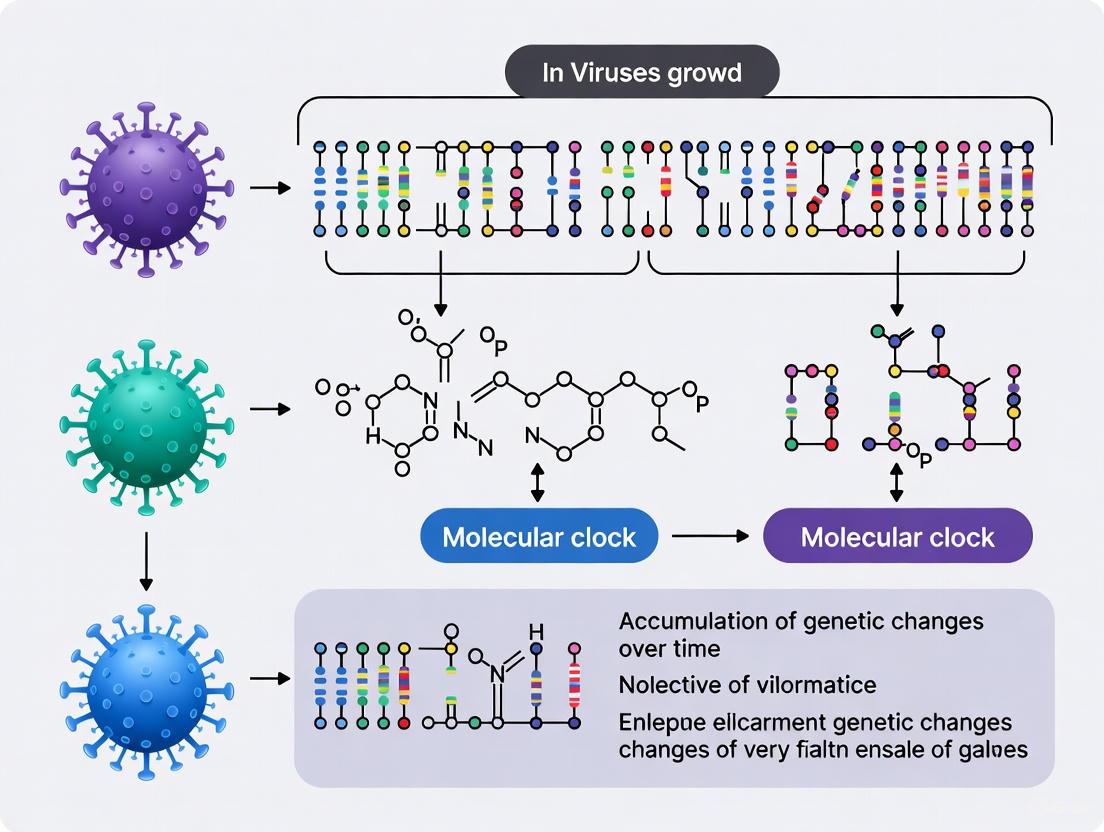
This article provides a comprehensive examination of the molecular clock hypothesis as applied to viral evolution, addressing the needs of researchers and drug development professionals.
Viral Molecular Clocks: From Theoretical Foundations to Applications in Outbreak Tracking and Drug Development
Abstract
This article provides a comprehensive examination of the molecular clock hypothesis as applied to viral evolution, addressing the needs of researchers and drug development professionals. It explores the foundational principles, from the strict molecular clock to modern relaxed models, and delves into methodological approaches for calibrating rates and applying them to trace outbreak origins and estimate divergence times. The content addresses common challenges such as rate variation and insufficient temporal signal, offering optimization strategies. Furthermore, it presents a comparative analysis of clock-like behavior across diverse viruses, including SARS-CoV-2 and Rabies, and validates these models against empirical genomic data. The synthesis provides a critical framework for employing molecular clocks in genomic surveillance, therapeutic design, and preparing for future viral threats.
The Core Hypothesis: Understanding Molecular Clock Theory and Viral Rate Variation
The molecular clock hypothesis, first proposed in the early 1960s, represents a cornerstone of molecular evolution, providing a framework for estimating evolutionary timelines from genetic sequences. This technical guide delineates the foundational work of Zuckerkandl and Pauling, its profound connection to the neutral theory of molecular evolution, and the development of sophisticated, rate-relaxed computational methods that address early model limitations. Particular emphasis is placed on the application and challenges of these principles in viral research, using the illustrative case of rabies virus, which underscores the critical importance of selecting appropriate epidemiological models for accurate evolutionary inference.
The molecular clock is a figurative term for a technique that uses the mutation rate of biomolecules to deduce the time in prehistory when two or more life forms diverged [1]. The revolutionary concept was first attributed to Émile Zuckerkandl and Linus Pauling who, in 1962, observed that the number of amino acid differences in hemoglobin between different lineages changes roughly linearly with time, as estimated from fossil evidence [1] [2]. They generalized this observation into a hypothesis: the rate of evolutionary change of any specified protein was approximately constant over time and across different lineages [1].
Concurrently, the genetic equidistance phenomenon noted by Emanuel Margoliash in 1963 provided further compelling evidence. Margoliash observed that the number of residue differences between cytochrome c of any two species appeared to be conditioned primarily by the time elapsed since their evolutionary lines diverged [1]. This work, together with that of Zuckerkandl and Pauling, led to the formal postulation of the molecular clock hypothesis in the early 1960s, offering a new method for dating evolutionary events independent of the fossil record [1] [3].
The Neutral Theory: A Theoretical Foundation for the Clock
The initial observation of a clock-like rate of molecular change was phenomenological, lacking a robust theoretical explanation. This was provided by Motoo Kimura's neutral theory of molecular evolution in 1968-69 [1] [2]. The neutral theory posits that the vast majority of evolutionary changes at the molecular level are caused by the random fixation of selectively neutral mutations, which have no appreciable effect on an organism's fitness [2].
The theory provides a mathematical and mechanistic basis for the molecular clock. In a population of (N) haploid individuals, if neutral mutations occur at a rate (u) per individual per generation, the total number of new mutations in a generation is (N \times u). The probability that any single new neutral mutation will eventually become fixed in the population is (1/N). Therefore, the rate of molecular evolution ((k))—the rate at which neutral substitutions accumulate—is the product of the total number of mutations and their fixation probability: [ k = N \times u \times (1/N) = u ] This elegant result shows that the rate of neutral molecular evolution is equal to the neutral mutation rate [2]. Consequently, if the neutral mutation rate remains constant over time, it predicts a clock-like accumulation of substitutions, precisely as initially observed [1] [4].
Key Tests and Challenges to Neutrality
The neutral theory's prediction spurred efforts to test the clock's regularity. The relative rate test, developed by Sarich and Wilson in 1967 (and formalized in 1973), provided a means to compare evolutionary rates between two lineages without absolute divergence times [1] [2]. This test uses an outgroup species to determine if two lineages have accumulated mutations at equal speeds since their divergence.
Empirical tests, however, revealed that the molecular clock is not perfectly constant. The "generation-time effect" is a major source of rate variation, particularly in vertebrates [2]. The theory posits that most mutations arise as replication errors; therefore, species with shorter generation times undergo more DNA replication cycles per unit of absolute time, leading to a higher mutation rate per year [2] [5]. This effect explains why rodents appear to evolve faster than primates when time is measured in years [2]. Other factors confounding the simple molecular clock include variations in population size, metabolic rate, the efficiency of DNA repair, and changes in the functional constraints on a molecule [1] [3].
Modern Molecular Clock Methodologies
Recognizing the imperfections of a strict molecular clock, researchers have developed sophisticated statistical models that relax the assumption of rate constancy. These "relaxed molecular clocks" allow evolutionary rates to vary across lineages according to specific probabilistic models [1] [6]. Bayesian methods have become indispensable for implementing these models, as they can incorporate multiple sources of uncertainty and integrate over large datasets, such as those from phylogenomics [1].
Calibration Techniques
To translate genetic differences into absolute time, molecular clocks must be calibrated using independent temporal information [1]. The choice of calibration strategy significantly impacts the accuracy of divergence time estimates.
Table 1: Key Molecular Clock Calibration Methods
| Method | Description | Key Features and Considerations |
|---|---|---|
| Node Calibration | Using fossil evidence to constrain the minimum (and sometimes maximum) age of a specific node (common ancestor) in the phylogeny [1]. | Relies on the oldest fossil of a clade; requires careful consideration of the uncertainty in the fossil record. Often uses probability densities to represent this uncertainty [1]. |
| Tip Calibration | Treating fossils as taxa placed on the tips of the tree by analyzing combined molecular (for extant taxa) and morphological (for all taxa) datasets [1]. | Places fossils and reconstructs topology simultaneously; avoids relying solely on the oldest fossil; used in Total Evidence Dating [1]. |
| Expansion Calibration | Using known, dated historical population expansions to calibrate the rate of molecular evolution within a species [1]. | Useful for intraspecific studies at shorter timescales; can reveal rate inflation over very recent timescales [1]. |
Performance of Relaxed-Clock Methods
Simulation studies have systematically evaluated the performance of relaxed-clock software packages like BEAST (which implements random rate models) and MultiDivTime (which implements autocorrelated rate models) [6]. Key findings include:
- Estimated divergence times are, on average, close to the true times only if the assumed model of lineage rate change matches the actual model used in the simulation [6].
- When the underlying rate model is violated, the 95% credibility intervals (CrIs) contain the true time less frequently (around 83% of the time versus ≥95% with a correct model) [6].
- A recommended strategy to improve robustness is to build composite credibility intervals from the results of multiple methods (e.g., both BEAST and MultiDivTime), which was shown to contain the true time in ≥97% of simulated data sets [6].
Table 2: Essential Research Reagents and Software for Molecular Clock Analysis
| Item / Resource | Function / Purpose |
|---|---|
| Orthologous Gene/Protein Sequences | The fundamental data for divergence estimation; sequences from multiple species sharing a common ancestor [1]. |
| Fossil Calibration Points | Provides absolute time constraints for nodes in the phylogeny; critical for translating substitutions to time [1] [7]. |
| Outgroup Sequence | Essential for performing relative rate tests and for rooting phylogenetic trees [1] [2]. |
| BEAST (Software) | A Bayesian statistical framework for phylogenetic analysis that incorporates relaxed molecular clock models, tree prior models, and fossil calibrations [1] [6]. |
| PAML (Software Package) | Contains tools for maximum likelihood analysis of phylogenetic trees, including estimation of parameters like the shape of the gamma distribution of rates among sites [6]. |
| r8s (Software) | A program for estimating phylogenies and divergence times from sequence data using relaxed clock methods [1]. |
The Molecular Clock in Virus Research: The Case of Rabies
The molecular clock is a powerful tool in viral phylogenetics and epidemiology, used to trace the origins and spread of outbreaks. However, viruses like rabies present a unique challenge to the standard molecular clock hypothesis [8].
A Challenge to the Time-Based Clock
The standard molecular clock assumes mutations accumulate in a time-dependent manner. For rabies, this assumption is violated due to its highly variable incubation period—the time between infection and the onset of symptoms—which can range from less than a month to several years [8]. During this extended incubation, the virus resides primarily in muscle and peripheral nerve tissue, where it replicates very slowly, leading to a correspondingly slow rate of mutation accumulation per unit of absolute time [8]. Consequently, a time-calibrated molecular clock would significantly underestimate the age of viral lineages with long incubation periods.
A Generational Model for Rabies
To overcome this, researchers have proposed a generation-based molecular clock for rabies, where a "generation" is defined by the infection of a new host [8]. In this model, the mutation rate is measured per transmission event, not per year. A study of a Tanzanian rabies strain used genetic data and computer simulations of outbreak dynamics to calculate this generational rate. The analysis yielded a rate of approximately 0.17 single mutations per viral generation, an extremely low value compared to viruses like SARS-CoV-2 [8]. This approach provides a more accurate framework for tracking rabies transmission chains and understanding its evolution during epidemics, highlighting that the appropriate choice of clock model is paramount.
The diagram below illustrates the conceptual and practical workflow for applying molecular clock principles to virus research, integrating both traditional and generational models.
The molecular clock has evolved substantially from its initial formulation by Zuckerkandl and Pauling. Grounded in the neutral theory of Kimura, it has matured into a sophisticated statistical framework that accommodates rate variation across the tree of life. In viral research, it remains an indispensable tool for reconstructing epidemic history. However, as the rabies example demonstrates, its application must be guided by a deep understanding of the biological and epidemiological context. The future of the molecular clock lies in the continued refinement of models that integrate diverse genomic, structural, and ecological data to achieve ever more accurate reconstructions of life's history.
The strict molecular clock hypothesis, which assumes a constant rate of genetic change across lineages, is frequently violated in viral evolution. Evidence from diverse virus families, including HIV-1, influenza A, and SARS-CoV-2, demonstrates that evolutionary rates can vary significantly due to host-switching events, differences in subtype dynamics, and changes in population size. This whitepaper synthesizes current findings on the patterns and causes of rate variation and outlines advanced computational models, such as mixed effects and sigmoidal-rate clocks, which provide a more accurate framework for dating viral evolutionary histories. Accurately modeling this heterogeneity is crucial for reconstructing reliable timescales of emergence, informing public health interventions, and understanding viral adaptation.
The molecular clock, a technique for deducing divergence times from genetic mutations, is a cornerstone of evolutionary virology [1]. Its initial formulation proposed a constant rate of change, an assumption often embedded in early phylogenetic studies. However, the paradigm of a "strict clock" is increasingly challenged by empirical data from viruses, which show profound rate variation across lineages [9] [10]. For researchers and drug development professionals, an inaccurate molecular clock can lead to significant errors in estimating the time to the most recent common ancestor (tMRCA), thereby misinforming models of viral spread, the timing of zoonotic events, and the assessment of intervention strategies.
This technical guide explores the evidence for rate variation and the sophisticated models developed to account for it. Framed within the broader thesis that viral evolution is characterized by heterogeneous and dynamic rates, we detail the experimental and computational protocols that are moving the field beyond the strict clock assumption.
Quantitative Evidence of Rate Variation
Data from multiple virus families consistently reveal that evolutionary rates are not constant. The following table summarizes key examples from recent research:
Table 1: Documented Cases of Rate Variation in Viral Lineages
| Virus | Evidence of Rate Variation | Quantitative Impact | Proposed Major Cause |
|---|---|---|---|
| HIV-1 Group M | Significant substitution rate variation among different subtypes (clades) [9]. | Inadequate modeling by uncorrelated clocks leads to bias in tMRCA estimation [9]. | Clade-specific effects and lineage-specific heterotachy [9]. |
| Influenza A Virus | Host-specific lineages (e.g., avian vs. human) exhibit independent rates of evolution [9]. | Necessary to allow for independent rates to reliably estimate both divergence times and tree topologies [9]. | Host-switching and adaptation to new host environments [9]. |
| SARS-CoV-2 | Rate increase in late February 2020, mainly contributed by the D614G lineage [10]. | A sigmoidal-rate model fitted the early genome data significantly better than a constant-rate model [10]. | Changing host environment, population dynamics, and APOBEC3-mediated hypermutation [10]. |
| Mpox | APOBEC3-mediated hypermutation after zoonotic switch to humans [10]. | Mutation rate approximately 20 times higher than the background rate after host-switch [10]. | APOBEC3 protein expression in response to infection [10]. |
| Primate Lineages | Differences in the rate of protein evolution between ape and Old World monkey lineages [2]. | The molecular clock runs more slowly in species with longer generation times (generation-time effect) [2]. | Fewer germline DNA replication events per absolute time unit [2]. |
Advanced Molecular Clock Models for Handling Rate Variation
To address the limitations of strict and simple relaxed clocks, several more powerful models have been developed.
The Mixed Effects (ME) Clock Model
The ME molecular clock model combines fixed and random effects to accommodate complex rate variation, such as clade-specific shifts combined with branch-specific stochasticity [9]. The model formulates the substitution rate ( ri ) on branch ( i ) as: [ \log ri = \beta0 + \sum{j=1}^{p} X{ij} \betaj + \epsilon_i ] where:
- ( \beta_0 ): is the grand mean or background substitution rate.
- ( \beta_j ): is the estimated effect size for the ( j^{th} ) covariate (e.g., a particular viral subtype).
- ( X_{ij} ): is the covariate value (e.g., 1 if branch ( i ) belongs to the subtype, 0 otherwise).
- ( \epsilon_i ): is a random effect, independently and normally distributed with mean 0 and estimable variance, capturing uncorrelated branch-specific rate variation [9].
This model has been shown to outperform uncorrelated relaxed clocks in scenarios with mixed sources of rate variation, including in HIV-1 group M, where it estimated a tMRCA of 1920 (1915–1925) [9].
The Sigmoidal-Rate Model for Host-Switching
For viruses undergoing host-switching, the evolutionary rate ( r(T) ) may change over time ( T ) in a sigmoidal manner. This is modeled using a generalized logistic function: [ r(T) = \alpha + \frac{\beta}{1 + e^{-\rho(T - T_m)}} ] where:
- ( \alpha ): is the initial evolutionary rate in the original host (H1).
- ( \alpha + \beta ): is the final evolutionary rate in the new host (H2).
- ( \rho ): is the rate of change between the two rate plateaus (positive for an increase, negative for a decrease).
- ( T_m ): is the midpoint time of the rate transition [10].
This model is particularly useful for rooting and dating viral trees during zoonotic events, as demonstrated with early SARS-CoV-2 genomes, where it provided a significantly better fit than a constant-rate model [10].
Experimental Protocols for Investigating Rate Variation
Bayesian Divergence Time Estimation with an ME Clock
This protocol outlines the steps for implementing an ME clock model in a Bayesian statistical framework, as applied to HIV-1 group M [9].
- Sequence Alignment and Data Preparation: Compile a multiple sequence alignment of viral genomes (e.g., complete HIV-1 group M genomes).
- Model Specification in BEAST: Set up the analysis in a software package like BEAST, specifying:
- The nucleotide substitution model (e.g., GTR + Γ).
- The tree prior (e.g., coalescent Bayesian skyline).
- The molecular clock model as
Mixed Effects. - Define covariates (( X_{ij} )) in the ME clock. For subtype analysis, create binary indicators (0/1) for branches belonging to each major clade or subtype.
- Set prior distributions: e.g., Normal(-6, 3) for ( \beta0 ), Normal(0, 1) for ( \betaj ), and a prior for the random effects variance.
- Markov Chain Monte Carlo (MCMC) Simulation: Run a sufficiently long MCMC chain to ensure convergence and adequate sampling of the posterior distribution, using tools like BEAGLE for computational efficiency.
- Posterior Analysis and Diagnostics: Use Tracer to analyze the MCMC logs, check effective sample sizes (ESS > 200), and summarize parameter estimates. Annotate the posterior tree distribution into a Maximum Clade Credibility (MCC) tree using TreeAnnotator.
- Model Comparison: Compare the ME model to alternatives (e.g., strict, uncorrelated relaxed) using marginal likelihood estimates (e.g., path sampling/stepping-stone sampling) to determine the best-fitting model.
Codon-Based Substitution Rate Estimation
This methodology estimates absolute nonsynonymous (( rN )) and synonymous (( rS )) substitution rates to understand selective pressures, which can be a source of rate variation.
- Fixed Topology: Set the tree topology to a previously inferred MCC tree from a nucleotide-level analysis.
- Codon Model Specification: Implement a codon substitution model (e.g., MG94) in BEAST, modeling rate variation among sites with a discrete gamma distribution (4 categories).
- Rate Calculation: The Bayesian inference standardizes the codon substitution process to expected rate changes per time unit, yielding absolute ( rN ) and ( rS ) rates.
- Selection Pressure Summary: Approximate the nonsynonymous/synonymous rate ratio as ( (rN) / (3 \times rS) ), which can be compared to maximum likelihood dN/dS estimates from tools like HyPhy [9].
Visualizing Molecular Clock Models and Workflows
Mixed Effects Clock Model Structure
The following diagram illustrates the logical structure and mathematical components of the Mixed Effects Clock Model.
Sigmoidal Rate Model in Host-Switching
This diagram depicts the sigmoidal-rate model for viral evolution during a host-switching event.
The Scientist's Toolkit: Essential Research Reagents and Solutions
Table 2: Key Reagents and Software for Molecular Clock Analysis
| Item / Resource | Function / Application | Implementation Example |
|---|---|---|
| BEAST Software Package | A cross-platform program for Bayesian evolutionary analysis sampling trees; implements strict, relaxed, mixed effects, and other molecular clock models. | Used for coalescent-based phylodynamic inference and divergence time estimation with tip-dating [9]. |
| BEAGLE Library | A high-performance library that accelerates and parallelizes phylogenetic calculations, making Bayesian MCMC analyses in BEAST computationally feasible for large datasets. | Integrated into BEAST to improve performance of likelihood computations [9]. |
| TRAD Program | A software tool designed for rooting and dating viral phylogenies, now implementing the sigmoidal-rate model for analyzing host-switching events. | Applied to phylogenies of early SARS-CoV-2 genomes to model rate changes [10]. |
| Tracer Tool | A program for analyzing and visualizing the output of MCMC runs, used to assess convergence (ESS values), summarize parameter estimates, and compare models. | Used to diagnose MCMC stationarity and mixing in BEAST analyses [9]. |
| Codon Substitution Models (e.g., MG94) | A class of evolutionary models that describe the process of substitution at the codon level, allowing estimation of absolute nonsynonymous (rN) and synonymous (rS) rates. | Implemented in BEAST with a discrete gamma model to estimate rN and rS for selection analysis [9]. |
| Direct Library Preparation (DLP+) Protocol | A single-cell whole-genome sequencing (scWGS) protocol for analyzing genomic instability and heterogeneity, including whole-genome doubling events in cancer. | Used for single-cell WGS of ovarian cancer samples to study ongoing whole-genome doubling [11]. |
The molecular clock hypothesis, which proposes a constant rate of molecular evolution, has long been a foundational concept for dating evolutionary events. However, virology research consistently demonstrates that this assumption is biologically unrealistic for viruses, which exhibit substantial rate variation across lineages and timescales. Relaxed clock models have emerged as essential statistical frameworks that accommodate this heterogeneity by allowing evolutionary rates to vary across branches of phylogenetic trees. This technical guide explores the theoretical foundations, methodological implementations, and practical applications of relaxed molecular clocks in viral evolutionary research. By synthesizing current evidence and providing detailed protocols, we aim to equip researchers with the tools necessary to apply these models to outstanding questions in viral origins, emergence dynamics, and evolutionary trajectories.
The hypothesis of a molecular evolutionary clock revolutionized evolutionary biology by providing a framework for estimating divergence times from genetic data. Initially proposed as a strict clock with constant substitution rates across lineages, this model offered an elegant solution for temporal inference [12]. However, viral evolution presents fundamental challenges to the strict clock assumption. Different viral groups exhibit substitution rates varying by several orders of magnitude, from approximately 10⁻² to 10⁻⁸ substitutions per site per year [13] [14]. Furthermore, rate variation occurs not only between viral taxa but also within individual viral lineages over time, creating a time-dependent rate phenomenon (TDRP) where rate estimates systematically decrease as the measurement timescale increases [15] [14].
The theoretical foundation for relaxed clocks in virology stems from observations that strict models often produce implausibly recent origins for viral groups with ancient evolutionary histories. For instance, while strict clock calculations suggested primate lentiviruses originated mere centuries ago, phylogenetic evidence consistent with virus-host codivergence points to origins millions of years back [15] [13]. This paradox highlighted the need for more flexible molecular dating approaches that accommodate the complex evolutionary dynamics characteristic of viruses.
Theoretical Foundations: Why Viruses Violate the Strict Clock
Biological Determinants of Rate Variation
Multiple biological factors contribute to evolutionary rate variation in viruses:
- Replication machinery and fidelity: RNA viruses, with error-prone RNA-dependent RNA polymerases that lack proofreading, typically exhibit higher substitution rates (10⁻³ to 10⁻⁴ substitutions/site/year) than DNA viruses with replication fidelity mechanisms [15].
- Generation time and replication rate: Viruses with shorter replication cycles accumulate mutations more rapidly, creating substantial rate differences between viral families [12].
- Selective pressures: Changing immune pressures, host switches, and adaptations to new cellular environments can dramatically alter evolutionary rates [13].
- Host cell type: The turnover rate of infected cells positively associates with viral evolutionary rate, creating additional variation within viral lineages [15].
The Time-Dependent Rate Phenomenon (TDRP)
A fundamental challenge in viral molecular dating is the inverse relationship between estimated evolutionary rates and the timescale of measurement. Analysis of 396 rate estimates across viral groups reveals that short-term rate estimates (from serial sampling) are consistently higher than long-term estimates (from phylogenetic comparisons with host divergence dates) [14].
The mechanistic basis for TDRP involves two primary factors:
- Purifying selection: Over short timescales, slightly deleterious mutations persist in populations, inflating rate estimates. Over evolutionary timescales, purifying selection removes these mutations, leaving only fixed neutral or advantageous substitutions [15].
- Substitution saturation: Multiple substitutions at single sites over long periods become increasingly likely, leading to underestimation of true divergence without appropriate correction [15].
Table 1: Evolutionary Rate Variation Across Virus Types and Timescales
| Virus Type | Short-Term Rate (subs/site/year) | Long-Term Rate (subs/site/year) | Timescale Disparity |
|---|---|---|---|
| RNA viruses | 10⁻² to 10⁻⁵ | 10⁻⁷ to 10⁻⁸ | 3-6 orders of magnitude |
| dsDNA viruses | 10⁻³ to 10⁻⁶ | 10⁻⁷ to 10⁻⁹ | 2-5 orders of magnitude |
| Retroviruses | 10⁻³ to 10⁻⁴ | 10⁻⁶ to 10⁻⁸ | 2-5 orders of magnitude |
| ssDNA viruses | 10⁻³ to 10⁻⁶ | ~10⁻⁸ | 3-5 orders of magnitude |
Methodological Framework: Implementing Relaxed Clocks
Model Variants and Statistical Foundations
Relaxed clock models exist on a continuum between strict clocks and fully free-rate models, with two primary classes dominating viral phylogenetics:
- Uncorrelated relaxed clocks: These models assume branch-specific substitution rates are drawn independently from an underlying probability distribution (e.g., log-normal, exponential, gamma). This approach does not assume an a priori relationship between rates on adjacent branches [16] [17].
- Autocorrelated (correlated) relaxed clocks: These models incorporate the assumption that closely related lineages have similar evolutionary rates, with rates evolving gradually along the tree according to specific stochastic processes [12].
The posterior probability distribution for relaxed clock models in a Bayesian framework can be represented as:
P(T,θ,μ,σ|D) ∝ P(D|T,μ) × P(μ|σ,T) × P(T|θ) × P(θ) × P(σ)
Where T is the time tree, θ represents tree prior parameters, μ represents evolutionary rates, σ represents clock model parameters, and D is the sequence data [17].
Rate Parameterization Strategies
The parameterization of branch-specific rates significantly impacts Markov Chain Monte Carlo (MCMC) efficiency. Three primary parameterization approaches include:
- Real rates parameterization: The most natural representation where rates are directly estimated as real numbers [17].
- Categorical rates parameterization: Rates are binned into discrete categories, potentially improving MCMC mixing for some datasets [17].
- Quantile parameterization: Rates are represented as quantiles of a prior distribution, often providing superior MCMC performance [17].
Table 2: Software Implementations for Relaxed Clock Phylogenetics
| Software | Key Features | Virus-Specific Applications | Computational Considerations |
|---|---|---|---|
| BEAST/BEAST X | Bayesian uncorrelated relaxed clocks, tip-dating, phylogeography | Pathogen emergence, molecular epidemiology, evolutionary history | Memory-intensive for large datasets; BEAST X introduces Hamiltonian Monte Carlo for improved efficiency [18] [12] |
| BEAST 2 ORC Package | Optimized relaxed clock model with adaptive operators | Large-scale viral phylogenomics | Up to 65× more efficient parameter exploration; adaptive proposal weighting [17] |
| RelTime | Non-Bayesian relaxed clock method | Divergence time estimation without prior specifications | Computational efficiency for large datasets; combines with bootstrapping for confidence intervals [19] |
| MrBayes | Bayesian phylogenetic inference with relaxed clocks | General viral evolutionary studies | Computationally intensive for phylogenomic datasets [19] |
Experimental Protocols and Workflows
Bayesian Relaxed Clock Analysis with BEAST
Protocol 1: Standard Implementation for Viral Sequence Data
Sequence Data Preparation:
- Compile sequence dataset with sampling dates for tip calibration
- Perform multiple sequence alignment using MAFFT or MUSCLE
- Assess alignment quality and trim poorly aligned regions
- Test for temporal signal using root-to-tip regression
Model Selection and Configuration:
- Select appropriate nucleotide substitution model using ModelTest-NG or bModelTest
- Specify uncorrelated log-normal relaxed clock model
- Choose coalescent tree prior (e.g., Bayesian Skyline for population history)
- Set calibration priors based on fossil evidence or historical samples
MCMC Execution:
- Run 2-4 independent MCMC chains for ≥100 million generations
- Assess convergence using Tracer (ESS values >200 for all parameters)
- Combine runs with LogCombiner, discarding appropriate burn-in
- Generate maximum clade credibility tree with TreeAnnotator
Posterior Validation:
- Perform posterior predictive simulations to assess model adequacy
- Conduct path sampling to compare clock models
- Test for clock-like behavior using Bayes factors
Diagram 1: Bayesian Relaxed Clock Workflow
Accounting for Phylogenetic Uncertainty
Traditional sequential analysis (inferring phylogeny first, then dating) ignores the impact of phylogenetic uncertainty on divergence time estimates. Joint inference of phylogeny and divergence times incorporates this uncertainty, producing more accurate credibility intervals [19].
Protocol 2: Joint Inference Using RelTime with Little Bootstraps
For large viral datasets where Bayesian methods become computationally prohibitive:
- Generate little bootstrap replicates by subsampling site patterns from the original alignment
- Infer maximum likelihood phylogenies for each bootstrap replicate
- Apply RelTime dating to each replicate phylogeny
- Summarize node ages and confidence intervals across all dated replicates
- Generate a consensus timetree incorporating phylogenetic uncertainty [19]
Research Reagent Solutions
Table 3: Essential Computational Tools for Viral Relaxed Clock Analyses
| Tool/Resource | Function | Application Context |
|---|---|---|
| BEAST/BEAST X Package | Bayesian evolutionary analysis | Primary platform for relaxed clock inference; essential for pathogen phylodynamics [18] [12] |
| BEAGLE Library | High-performance likelihood computation | Accelerates BEAST analyses; necessary for large datasets [18] |
| Tracer | MCMC diagnostic analysis | Assessing convergence, effective sample sizes, parameter estimates [20] |
| BEAUti | Bayesian evolutionary analysis utility | Graphical interface for configuring BEAST XML files [12] |
| TreeAnnotator | Tree summarization | Generating maximum clade credibility trees from posterior distributions [16] |
| ModelTest-NG | Substitution model selection | Identifying best-fit nucleotide substitution model [17] |
| TempEst | Temporal signal analysis | Root-to-tip regression to assess clock-likeness [14] |
Applications in Virology Research
Case Study: Primate Lentivirus Evolution
The evolutionary history of primate lentiviruses (including HIV and SIV) exemplifies the critical importance of relaxed clock approaches. Early strict clock calculations yielded origin estimates of approximately 150 years before present, conflicting with phylogenetic evidence suggesting codivergence with primate hosts over millions of years [15] [13]. Application of relaxed clocks that account for TDRP has subsequently established that extant lentiviruses are millions of years old, reconciling molecular analyses with paleovirological evidence [14].
Emerging Pathogen Phylodynamics
Relaxed clock models have become indispensable for investigating outbreaks of emerging viruses. During the SARS-CoV-2 pandemic, these approaches enabled:
- Reconstruction of transmission dynamics with uncorrelated log-normal relaxed clocks
- Integration of epidemiological data with sequence evolution
- Estimation of evolutionary rates accommodating changing selective pressures [18]
Diagram 2: Relaxed Clock Logic in Viral Evolution
Future Directions and Computational Innovations
Recent advances in relaxed clock methodology focus on addressing computational bottlenecks and enhancing model flexibility:
- Hamiltonian Monte Carlo (HMC) sampling: BEAST X implements HMC transition kernels that dramatically improve sampling efficiency for high-dimensional parameters, enabling analysis of larger datasets [18].
- Time-dependent rate models: New clock models that explicitly accommodate rate variation through time, uncovering changes over orders of magnitude in viral evolutionary histories [18].
- Integrated phylodynamic frameworks: Combining relaxed clock models with epidemiological trajectories to jointly infer evolutionary and population dynamics [18].
- Machine learning approaches: Emerging artificial intelligence techniques promise to accelerate computation and guide model selection [12].
Relaxed clock models represent an essential statistical framework for accommodating the evolutionary realities of viral molecular evolution. By explicitly modeling rate variation across lineages and timescales, these approaches have resolved longstanding paradoxes in viral evolutionary timescales and provided powerful tools for investigating viral emergence and spread. Continued methodological innovations, particularly in computational efficiency and model integration, will further enhance our ability to reconstruct viral evolutionary histories and anticipate future evolutionary trajectories.
Viral evolution is a dynamic process driven by the interplay of mutation, selection, and genetic drift. Understanding the determinants of substitution rates—the fixed mutations in a viral population—is crucial for predicting viral emergence, designing effective countermeasures, and applying molecular clock principles to viral phylogenetics. This review synthesizes current evidence demonstrating that viral substitution rates are not solely a product of polymerase fidelity but are shaped by a complex nexus of factors including genomic architecture, replication machinery, and host-driven selection pressures. We examine how these determinants create distinct evolutionary landscapes for different virus types and discuss the implications for molecular clock modeling in viral research.
The molecular clock hypothesis, which posits that mutations accumulate at a relatively constant rate over time, provides a foundation for estimating evolutionary timelines. However, its application to virology is fraught with challenges. Viral evolution is characterized by markedly high rates of nucleotide substitution, especially in RNA viruses, but also in some DNA viruses [21]. These rates are not constant across all viruses or all circumstances; they are shaped by a hierarchy of determinants.
The process begins with the raw generation of genetic diversity through mutation. The rate at which these mutations are produced is influenced by the virus's replication machinery and the biochemical environment of the host cell. However, the mutation rate is not synonymous with the substitution rate. The latter represents the mutations that successfully fix in a population, filtered through the dual sieves of natural selection and genetic drift. Selection pressures are multifaceted, originating from the host's immune system, the necessity to use host cellular resources, and the constraints of the virus's own functional proteins [22]. The resulting substitution rate is therefore a signature of the virus's biology and its ecological interaction with the host. This complex interplay often renders simple, time-based molecular clocks inaccurate, prompting the need for generation-based models or more sophisticated phylogenetic tools that account for the unique evolutionary dynamics of viruses [8].
Core Determinants of Viral Substitution Rates
Genomic Architecture and Nucleic Acid Type
The fundamental division in the viral world is based on genome composition and structure, which is a primary determinant of replication strategy and, consequently, evolutionary rate.
Table 1: Substitution Rate Characteristics by Genome Type
| Genome Type | Exemplary Families | General Substitution Rate | Key Influencing Factors |
|---|---|---|---|
| ssRNA | Potyviridae, Picornaviridae | Very High | Low-fidelity RdRp, absence of proofreading, often high mutational load [22]. |
| dsRNA | Reoviridae | Moderate to High | Strand-specific substitution biases; biochemical protection of dsRNA can moderate observed rates [23]. |
| ssDNA | Geminiviridae | High (can rival RNA viruses) | Susceptibility to host ssDNA-specific mutagenic processes and DNA deaminases [21] [23]. |
| dsDNA | Herpesviridae, Poxviridae | Low to Moderate | Access to host DNA repair machinery, proofreading polymerases; rates can be high in large viruses [24] [21]. |
A critical insight from recent studies is that the high rate of nucleotide substitution, once considered a hallmark of RNA viruses, is matched by some DNA viruses [21]. This indicates that diverse aspects of viral biology beyond polymerase fidelity, such as genomic architecture and replication speed, are key explanatory factors. Furthermore, the structure of the genome itself is subject to selection. Segmented genomes, common in plant viruses, have been linked to higher mutation rates and increased capacity for genetic exchange through reassortment, suggesting an evolutionary benefit to this architecture [22].
Replication Machinery and Polymerase Fidelity
The enzyme responsible for genome replication is a primary source of mutation and a key determinant of substitution rates.
- RNA-Dependent RNA Polymerase (RdRp): RNA viruses utilize RdRp, which typically lacks proofreading activity. This results in high intrinsic error rates, creating a cloud of genetic variants, or quasispecies, upon which selection can act [22].
- DNA Polymerase: DNA viruses often use DNA polymerases that possess proofreading capability. For large DNA viruses like poxviruses, this results in lower substitution rates. However, some DNA viruses may employ error-prone polymerases or be highly susceptible to host-encoded mutagenic factors [21].
- Reverse Transcriptase: Retroviruses use reverse transcriptase to convert their RNA genome into DNA. This enzyme is error-prone and contributes to the high genetic diversity of retroviruses.
The replication process itself can introduce systematic biases. For instance, in single-stranded viruses, the two complementary strands are not subject to the same mutational processes for equal amounts of time. The virion strand is often more exposed, leading to strand-specific substitution biases that are best described by non-reversible evolutionary models in phylogenetic analyses [23].
Host and Environmental Selection Pressures
A virus's genome is shaped by the selective landscape of its host. While viruses are obligate intracellular parasites, they do not always evolve to mirror their host's genomic characteristics.
- Host Immune and Defense Mechanisms: Hosts deploy a range of defenses that directly alter viral genomes. The APOBEC3 family of enzymes induces C-to-U hypermutation in retroviral and single-stranded DNA genomes, while ADAR enzymes cause A-to-G hypermutation in RNA viruses [25]. These host-driven mutagenic processes are a powerful selective force.
- Adaptation to Host Cellular Machinery: A virus must adapt to use host resources, such as the translation machinery. While prokaryotic viruses (bacteriophages) often mimic their host's codon usage, viruses infecting eukaryotic hosts frequently display markedly different codon usage patterns [25]. This suggests that the selective pressure for efficient translation may be balanced by other constraints, such as the need to maintain a specific genomic signature or to avoid detection by host defenses.
- Genomic Signature Conservation: Research across 2,768 eukaryotic viral species reveals that most viruses possess highly specific genomic signatures—conserved patterns in oligonucleotide frequencies. These signatures are often distinct from those of their hosts and are preserved by evolutionary selection pressures acting upon the viral genomes themselves [24]. This conservation indicates that viral genomes are under selection to maintain internal structural and compositional integrity, which in turn constrains the fixation of mutations.
Diagram: Determinants of Viral Substitution Rate
Advanced Methodologies for Investigating Substitution Rates
Mutation Accumulation Experiments
Objective: To empirically measure the mutation rate by allowing mutations to accumulate in the absence of natural selection over multiple generations.
Detailed Protocol (as applied to E. coli mutator strains) [26]:
Strain Construction:
- Start with a wild-type (WT) bacterial strain (e.g., E. coli MDS42).
- Use genetic engineering (e.g., knockout mutations) to create a panel of isogenic mutator strains with defects in DNA repair or replication fidelity genes (e.g., mutS, mutL, mutT, dnaQ). This generates strains with a spectrum of elevated mutation rates.
Experimental Evolution:
- For each strain (WT and all mutators), establish multiple independent lineages.
- Passage each lineage repeatedly through a severe population bottleneck (e.g., by selecting a single colony) in a non-selective medium. This bottleneck minimizes the action of natural selection by ensuring most mutations, even deleterious ones, are fixed through genetic drift.
Whole-Genome Sequencing (WGS):
- After a predetermined number of generations, extract genomic DNA from the endpoint population of each lineage.
- Perform WGS and map reads to a reference genome.
Variant Calling and Analysis:
- Identify all accumulated base-pair substitutions (BPS) and short insertions/deletions (indels) relative to the ancestral genome.
- Calculate the mutation rate per generation per genome based on the number of mutations and the total number of generations elapsed.
Application to Viruses: This protocol can be adapted for viruses by performing serial plaque-to-plaque transfers under conditions that minimize selective pressure, followed by whole-viral-genome sequencing.
Structural Phylogenetics
Objective: To resolve deeper evolutionary relationships when sequence-based phylogenies are confounded by high substitution rates and signal saturation.
Detailed Protocol (The FoldTree Approach) [27]:
Dataset Curation:
- Compile a set of homologous protein sequences from diverse viral taxa.
Structure Prediction and Alignment:
- Use AI-based protein structure prediction tools (e.g., AlphaFold2) to generate accurate 3D models for each sequence.
- Align the structures using a structural alphabet (e.g., with Foldseek), which converts 3D structural similarities into a string of discrete characters (a 3Di sequence). This creates a multiple sequence alignment based on structural homology.
Phylogenetic Tree Inference:
- Calculate a pairwise distance matrix from the structurally-informed alignment using a statistically corrected distance metric (Fident).
- Reconstruct a phylogenetic tree using a distance-based method such as Neighbor-Joining.
Benchmarking:
- Assess the accuracy of the resulting tree by its congruence with known taxonomy (Taxonomic Congruence Score) and its adherence to a molecular clock. This approach has been shown to outperform sequence-only methods for highly divergent protein families.
Analysis of Strand-Specific Substitution Biases
Objective: To test for and model non-reversible patterns of nucleotide substitution that violate the assumptions of standard molecular clocks.
Detailed Protocol [23]:
Dataset Assembly:
- Curate multiple sequence alignments of viral genomes, categorizing them by genome type (ssRNA, dsRNA, ssDNA, dsDNA).
Model Selection Test:
- Use a phylogenetic software package (e.g., IQ-TREE) to infer trees under different nucleotide substitution models:
- GTR: The general time-reversible model (standard).
- NREV6: A non-reversible model with 6 rate parameters, assuming complementary substitutions are equal (suited for ds genomes with symmetrical exposure).
- NREV12: A non-reversible model with 12 rate parameters, allowing all substitution types to differ (suited for ss genomes and ds genomes with asymmetrical strand exposure).
- Compare the fit of these models to the data using likelihood ratio tests or the Akaike Information Criterion (AIC).
- Use a phylogenetic software package (e.g., IQ-TREE) to infer trees under different nucleotide substitution models:
Interpretation:
- If NREV12 provides a significantly better fit, it indicates pervasive strand-specific substitution bias. This finding necessitates the use of non-reversible models for accurate phylogenetic inference and molecular dating, as it reflects the underlying biochemical asymmetry of viral genome replication and exposure.
The Scientist's Toolkit: Essential Research Reagents and Solutions
Table 2: Key Reagents for Viral Evolution Studies
| Reagent / Material | Function in Research | Specific Example / Application |
|---|---|---|
| Mutator Strain Panel | Provides a range of defined mutation rates to quantify the relationship between mutation rate and adaptive evolution. | E. coli strains with knockout mutations in mutS, mutT, dnaQ, etc. [26]. |
| AI-Based Structure Prediction Tools | Generates high-accuracy protein structure models from sequence data for structural phylogenetics. | AlphaFold2, ESMFold [27]. |
| Structural Alignment Software | Aligns protein structures to identify deep evolutionary relationships beyond sequence similarity. | Foldseek [27]. |
| Non-Reversible Substitution Models | Models strand-specific nucleotide substitution biases for more accurate phylogenetic tree inference. | NREV6 and NREV12 models in IQ-TREE [23]. |
| Antiviral Defense Enzymes | Used in vitro or in cellulo to study their mutagenic effect on viral genomes and the resulting selective pressures. | Recombinant APOBEC3G, ADAR1 [25]. |
The determinants of viral substitution rates extend far beyond a simple binary of RNA versus DNA genomes. The emerging picture is one of complexity, where the virus's genomic architecture, the fidelity and bias of its replication machinery, and the multifaceted selective pressures from the host interact to shape a unique evolutionary trajectory. The conservation of specific genomic signatures in viruses [24] and the pervasive evidence of strand-specific substitution biases [23] underscore that viral genomes are subject to a complex set of constraints that maintain their identity while allowing for adaptation.
For the field of viral molecular clock research, these findings have profound implications. The standard assumption of time-reversible, constant-rate evolution is frequently violated. Future research must increasingly leverage generation-based models [8], non-reversible substitution models [23], and structural phylogenetics [27] to build more accurate evolutionary timelines. As we deepen our understanding of these fundamental determinants, we improve our ability to forecast viral emergence, design durable vaccines and therapeutics, and reconstruct the evolutionary history of viruses with greater precision.
Calibration and Application: Timing Viral Evolution in Outbreak Science and Drug Design
The molecular clock hypothesis proposes that DNA and protein sequences evolve at a rate that is relatively constant over time and among different organisms, implying that the genetic difference between any two species is proportional to the time since they last shared a common ancestor [28]. This hypothesis serves as an extremely useful method for estimating evolutionary timescales, particularly for organisms like viruses that have left few traces in the fossil record [28]. For viral researchers and drug development professionals, accurately calibrating this clock is paramount to reconstructing the origins and transmission dynamics of pathogens, which in turn informs vaccine design and therapeutic strategies.
However, the application of the molecular clock to viruses presents a unique puzzle. While it seems reasonable to assume RNA viruses have a long evolutionary history, potentially appearing with or before the first cellular life-forms, comparisons of gene sequences suggest a different story. Using best estimates for rates of evolutionary change, it can be inferred that the families of RNA viruses circulating today may have appeared recently, probably not more than about 50,000 years ago [13]. This apparent paradox highlights the critical importance of robust calibration methods. This guide provides a detailed technical framework for calibrating the molecular clock, focusing on the integration of fossil data and known divergence events to build accurate viral evolutionary timelines.
Fundamental Principles and the Calibration Imperative
The Substitution Rate and the Clock Mechanism
The core of the molecular clock lies in the rate of nucleotide substitution. For RNA viruses, most analyses suggest an average rate of ∼10−3 substitutions per site per year, with an approximately fivefold range around this value [13]. This rapid rate is largely attributed to the error-prone nature of RNA polymerase, which lacks repair activity and is estimated to produce about one mutation per genome replication [13]. The constant "ticking" of this clock is driven by the neutral theory of molecular evolution, which posits that a large fraction of new mutations are neutral regarding evolutionary fitness and thus become fixed in a population at a rate equivalent to the underlying mutation rate [28].
- Synonymous vs. Nonsynonymous Sites: Viral genomes comprise synonymous sites (where mutations do not change the encoded amino acid) and nonsynonymous sites (where mutations alter amino acids). Nonsynonymous sites typically evolve more slowly due to functional constraints and the influence of natural selection. The substitution rate at nonsynonymous sites is roughly 100-fold less than at synonymous sites, at ∼10−5 substitutions/site/year [13].
- Calculating Divergence Time: If two RNA viruses have an evolutionary distance of <1.0 at nonsynonymous sites, a common scenario for viruses within the same family or genus, they are unlikely to have diverged more than ∼50,000 years ago based on standard substitution rates [13].
The Critical Need for Calibration
Without calibration, the molecular clock can measure genetic distance but not absolute time. Determining whether a 5% genetic difference corresponds to a divergence one million or five million years ago is impossible without an external temporal reference [28]. This is analogous to determining a car's average speed using only its odometer reading without knowing the travel time. Calibration provides this essential temporal anchor, transforming relative genetic distances into an absolute evolutionary timeline.
Table 1: Key Molecular Clock Rate Terminology
| Term | Definition | Typical Value in RNA Viruses |
|---|---|---|
| Substitution Rate | The rate at which nucleotide mutations become fixed in a population. | ∼10⁻³ substitutions/site/year [13] |
| Synonymous Rate (dS) | The substitution rate at sites where mutations do not change the amino acid. | Can saturate quickly; e.g., ∼20 substitutions/site in deep Flavivirus comparisons [13] |
| Nonsynonymous Rate (dN) | The substitution rate at sites where mutations alter the amino acid sequence. | ∼10⁻⁵ substitutions/site/year; ~100x slower than synonymous rate [13] |
Calibration Methodologies: Fossil Records and Geological Events
Using the Fossil Record
Fossils provide the most direct method of calibration, offering a physical record of a species' first appearance. For viruses, however, a conventional fossil record is virtually non-existent. Therefore, viral researchers often rely on indirect fossil evidence, such as:
- Host Fossil Evidence: Using the fossil record of the host organism to calibrate the virus's clock. For example, if a virus is known to co-speciate with its host, the well-dated fossil of a host species divergence can serve as a calibration point for the virus's phylogenetic tree.
- Historical Specimens: Archived tissue samples or ancient DNA from historically collected host specimens can provide sequenced viral material from a known point in time, offering a powerful and direct calibration point.
Using Known Divergence Events
When fossils are unavailable, known geological or biogeographical events can serve as robust calibration points. This method correlates evolutionary divergence with a geological event of known antiquity that caused a species' geographic range to split, initiating speciation [28]. The opening and closing of the Bering Strait is a prime example of a complex geological event used for calibration [29].
A refined approach to using such events moves beyond simplistic, one-time assumptions. For instance, the Bering Strait has opened and closed cyclically due to glacial and interglacial periods. A sophisticated calibration accounts for this complexity:
- Identify Sister Species Pairs: First, measure the genetic divergence of sister species pairs presumed to have been separated by the geological event [29].
- Assign a Reference Divergence: Assign the most divergent species pair to one of the oldest possible time points for the geological event (e.g., the initial opening of the strait 5.5 million years ago) [29].
- Iterative Validation: Set the ages of the remaining species pairs relative to this reference point and check if the estimated divergence times align with the geological timeline. If a species appears to have diverged when the strait was closed, the calibration is refined by choosing a different reference point until all divergence ages agree with the available evidence [29].
This method yielded an estimate that the majority of Northern sea star species diverged 0.2 to 5 million years ago, with the most divergent pair splitting 5 to 4.7 million years ago, consistent with the strait's initial opening [29].
Table 2: Types of Calibration Points for Molecular Dating
| Calibration Type | Description | Example in Viral Research | Key Considerations |
|---|---|---|---|
| Fossil Record | Using the dated first appearance of a species or its ancestor in the fossil record. | Using a primate host fossil to date a cospeciating lentivirus. | Often indirect for viruses; requires well-preserved and accurately dated specimens. |
| Geological Event | Using a dated geological event that caused vicariance (geographic separation). | Using the formation of a land bridge or the isolation of an island. | The event must be well-dated and have a clear biogeographical impact. |
| Historical Sample | Using genetic material from a known point in the past (e.g., archived samples). | Using an archived HIV sample from the 1980s. | Provides a direct and precise calibration point; availability may be limited. |
Advanced Clock Models and Protocol for Viral Divergence Dating
Beyond the Strict Clock: Relaxed and Mixed Effects Models
The assumption of a strictly constant molecular clock is often too simplistic, as rates of molecular evolution can vary significantly among organisms and lineages [28]. This has led to the development of "relaxed" molecular clocks. Two major types are:
- Uncorrelated Clocks: These models assume that evolutionary rates vary among lineages independently from one another, often drawn from an underlying distribution like a lognormal [9]. This is a common but sometimes inadequate model for viruses.
- Autocorrelated Clocks: These models, such as the Brownian motion model, assume that the substitution rate in a lineage is correlated with the rate in its ancestor [9].
For viruses like HIV-1, which exhibit considerable rate variation among subtypes (heterotachy), an Uncorrelated Relaxed (UC) Clock may be insufficient [9]. A more powerful approach is the Mixed Effects (ME) Molecular Clock Model, which combines both fixed and random effects. In this model, the substitution rate ( ri ) on branch ( i ) is defined as: [ \log ri = \beta0 + \sum{j=1}^{p} X{ij} \betaj + \epsiloni ] where ( \beta0 ) is the background substitution rate, ( \betaj ) is the effect size of the ( j^{th} ) covariate (e.g., a specific viral subtype), ( X{ij} ) is an indicator variable, and ( \epsilon_i ) represents independent, normally distributed random error [9]. This model accommodates both clade-specific fixed effects and uncorrelated random rate variation among branches.
Detailed Experimental Protocol for Bayesian Divergence Time Estimation
This protocol outlines the steps for estimating divergence times using a Bayesian framework with a Mixed Effects clock model, as applied in HIV-1 research [9].
Objective: To estimate the time to the most recent common ancestor (tMRCA) of a virus (e.g., HIV-1 group M) using a genome dataset and a calibrated molecular clock model.
Materials and Reagents:
- Sequence Data: Aligned viral genome sequences (e.g., complete HIV-1 group M genomes) in FASTA format.
- Sequence Alignment Software: e.g., MAFFT, ClustalW.
- Bayesian Evolutionary Analysis Software: BEAST 2 or BEAST 1.10.x [9].
- High-Performance Computing Likelihood Calculator: BEAGLE library to accelerate computation [9].
- Markov Chain Monte Carlo (MCMC) Diagnostic Tool: Tracer [9].
- Tree Visualization and Summarization Software: FigTree for visualizing Maximum Clade Credibility (MCC) trees [9].
Procedure:
- Sequence Alignment and Data Preparation:
- Compile a comprehensive set of viral sequences with known sampling dates.
- Perform a multiple sequence alignment. For codon-based analysis, ensure the alignment is in-frame.
Specifying the Evolutionary Model:
- Substitution Model: Select an appropriate nucleotide substitution model (e.g., HKY, GTR) or a codon substitution model (e.g., MG94) if estimating nonsynonymous (( rN )) and synonymous (( rS )) rates [9].
- Site Heterogeneity Model: Model rate variation among sites using a discrete γ distribution (e.g., with 4 categories) [9].
- Molecular Clock Model: Select the Mixed Effects clock model. Define the fixed effects covariates (( X_{ij} )) based on a priori knowledge of rate variation, such as assigning different subtypes to have distinct rate effects [9].
- Tree Prior: Select a tree-generative process prior appropriate for the data, such as a coalescent (e.g., Bayesian Skyline) or birth-death model [9].
Setting Calibration Points and Priors:
- Calibration Points: Integrate at least one external calibration point. This could be the sampling date of historical sequences (tip-dating) or a known divergence time from the literature.
- Parameter Priors: Specify prior distributions for model parameters. For the ME clock, this includes a normal prior for the grand mean rate (( \beta0 )) and the fixed effects (( \betaj )) [9].
Running the MCMC Analysis:
- Execute the analysis in BEAST, leveraging BEAGLE for performance. Run the MCMC chain for a sufficient number of steps (often tens to hundreds of millions) to ensure effective sample sizes (ESS) for all parameters exceed 200, indicating good mixing and stationarity [9].
Post-Processing and Diagnostics:
- Use Tracer to analyze the log file from the MCMC run, checking for convergence and adequate ESS for all parameters.
- Summarize the posterior distribution of trees into a single Maximum Clade Credibility (MCC) tree using TreeAnnotator [9].
- Visualize the MCC tree in FigTree, displaying the mean divergence times and 95% highest posterior density (HPD) intervals on the nodes.
The application of this protocol to HIV-1 group M complete genome data using an ME clock model, which accounted for subtype rate variation, estimated the tMRCA to be 1920 (1915–25) [9]. This demonstrates the impact of both the clock model and the use of complete genome data, which can reduce credible intervals by 50% compared to estimates from short gene sequences [9].
Diagram 1: Workflow for Bayesian Molecular Clock Calibration.
The Scientist's Toolkit: Essential Research Reagents and Materials
Table 3: Key Research Reagent Solutions for Molecular Clock Calibration
| Item / Reagent | Function / Application | Example Use Case |
|---|---|---|
| BEAST Software Package | A cross-platform program for Bayesian evolutionary analysis of molecular sequences; implements multiple clock models and tree priors. | Core software for performing Bayesian MCMC analysis to estimate divergence times and evolutionary rates [9]. |
| BEAGLE Library | A high-performance library that accelerates likelihood calculations for phylogenetic inference; integrated with BEAST. | Dramatically reduces computation time for large genomic datasets or complex models like the Mixed Effects clock [9]. |
| Barcode of Life Data System (BOLD) | A massive repository of DNA barcodes (standardized genetic markers) used to identify specimens to species. | Source of genetic data for calculating divergence between sister species pairs for geological calibration [29]. |
| Tracer Tool | A software application for analyzing the trace files generated by Bayesian MCMC runs. | Used to assess MCMC convergence (via ESS) and summarize parameter estimates from BEAST analyses [9]. |
| Codon Substitution Model (e.g., MG94) | A phylogenetic model that describes the process of nucleotide substitutions within a codon framework. | Used to estimate absolute nonsynonymous (rN) and synonymous (rS) substitution rates for selection analysis [9]. |
| FigTree | A graphical viewer of phylogenetic trees. | Used to visualize and export the final time-scaled maximum clade credibility (MCC) tree [9]. |
Accurately calibrating the molecular clock is a critical but complex endeavor, especially in the context of rapidly evolving viruses where standard substitution rates can suggest surprisingly recent origins that conflict with phylogenetic evidence of long-term virus-host cospeciation [13]. Resolving this paradox requires a multifaceted approach that combines robust external calibration from fossils and geological events with sophisticated, flexible clock models like the Mixed Effects model. By adhering to detailed methodological protocols and leveraging the powerful computational tools available in the Scientist's Toolkit, researchers can generate more reliable estimates of viral divergence times. These timelines are not mere academic exercises; they are fundamental to understanding the deep history of viral emergence, predicting future epidemic trajectories, and ultimately informing the development of vaccines and antiviral drugs.
The molecular clock hypothesis is a foundational concept in evolutionary biology, proposing that DNA and protein sequences accumulate mutations at a relatively constant rate over time [28] [7]. This principle serves as an extremely useful method for estimating evolutionary timescales, particularly for organisms like viruses that leave few traces in the fossil record [28]. In viral research, the molecular clock provides a powerful tool to calculate the timing of evolutionary events, tracing how viruses evolve and determining when different viral strains diverged on an evolutionary timeline [7]. The clock's "ticks" are random mutations that accumulate in gene sequences, and unlike a conventional wristwatch that measures time through regular changes, the molecular clock measures time through these stochastic genetic changes [7].
The application of molecular clocks in virology has revolutionized our understanding of viral origins, spread, and adaptation. However, researchers face a fundamental choice in how they model and measure this evolutionary tempo: using a per-unit-time approach (typically substitutions per site per year) or a per-generation approach. The per-unit-time model, the more traditional framework, assumes mutations accumulate consistently with calendar time [30]. In contrast, the per-generation model posits that mutations accumulate primarily during replication events, making evolutionary change more dependent on the number of transmission cycles than on simple passage of time [30]. This technical guide examines both methodological frameworks, their theoretical foundations, appropriate applications, and practical implementations within viral research, providing scientists with the tools to select and apply the most appropriate model for their specific research questions.
Theoretical Foundations of Substitution Rate Models
The Molecular Clock Hypothesis
The molecular clock hypothesis originated in 1962 with Linus Pauling and Emile Zuckerkandl, who observed that genetic mutations, although random, occur at a relatively constant rate [7]. This discovery led to the key insight that the number of differences between gene sequences increases over time, providing a means to measure evolutionary divergence [7]. The hypothesis received theoretical underpinning when Motoo Kimura developed the neutral theory of molecular evolution in 1968, suggesting that a large fraction of new mutations are neutral—having no effect on evolutionary fitness—and thus their fixation in a population occurs through genetic drift at a rate equivalent to the mutation rate [28].
Initially, the molecular clock was proposed as a strict molecular clock, assuming a constant rate across all lineages [28]. However, subsequent research revealed that rates of molecular evolution can vary significantly among organisms, leading to the development of relaxed molecular clocks that accommodate rate variation across lineages [28]. These relaxed models represent a crucial advancement, allowing the evolutionary rate to vary among lineages, either fluctuating around an average value or "evolving" over time in correlation with other biological characteristics like metabolic rate [28].
Calibration Principles
Calibration is essential for transforming genetic differences into meaningful evolutionary timescales. Without calibration, researchers face what is known as the "distance-time ambiguity"—a certain genetic distance could represent slow evolution over a long period or rapid evolution over a short period [28]. Calibration requires known divergence events with absolute ages, typically obtained from the fossil record or geological events that initiated speciation [28] [7]. As Blair Hedges of Penn State University explains, setting a molecular clock "begins with a known, like the fossil record," after which "calculating the time of divergence of that species becomes relatively easy" [7].
Table: Calibration Sources for Molecular Clocks
| Calibration Type | Description | Applications | Strengths | Limitations |
|---|---|---|---|---|
| Fossil Evidence | Using dated fossils to establish divergence points | Vertebrates, plants with good fossil records | Direct evidence of past life forms | Sparse for many taxa, especially microorganisms |
| Geological Events | Using mountain formations, land bridges, or island formations | Species separated by known geological events | Provides clear divergence timing | Requires precise dating of geological events |
| Historical Outbreaks | Using documented outbreak start dates | Viral pathogen evolution | Well-documented in recent history | Limited to contemporary outbreaks |
Per-Site-Per-Year Model: Framework and Applications
Model Definition and Calculation
The per-site-per-year model represents the traditional approach to measuring molecular evolution, expressing substitution rates as the number of nucleotide changes per site per year. This model typically yields values in the range of 10⁻³ to 10⁻⁵ substitutions per site per year for various viruses [13]. The calculation requires comparing genetic sequences from different time points, measuring the number of accumulated differences, normalizing by the sequence length and time elapsed.
The mathematical formulation is:
Where:
- D = Number of observed substitutions between sequences
- L = Length of sequence (number of sites)
- T = Time since divergence (in years)
For example, if two sequences separated by 5 years show 25 substitutions across a 10,000 nucleotide sequence, the substitution rate would be calculated as (25/10,000)/5 = 5 × 10⁻⁴ substitutions per site per year.
Applications in Viral Research
The per-site-per-year model has been widely applied across virology, providing critical insights into viral evolution and spread. Recent research on SARS-CoV-2 illustrates its utility. One comprehensive study analyzing thousands of SARS-CoV-2 genomes estimated an overall rate of molecular evolution of approximately 10⁻³ substitutions per site per year, though with significant variation among genomic regions and over time [31]. The spike (S) gene and ORF6 gene showed notably increased substitution rates in the Omicron variant, demonstrating how specific genomic regions can experience accelerated evolution [31].
Another study from Pakistan examining SARS-CoV-2 evolution throughout the pandemic found fluctuating substitution rates corresponding to different variants: 5.25 × 10⁻⁴ during the initial wildtype period, increasing to 9.74 × 10⁻⁴ during the Delta variant period, and decreasing to 5.02 × 10⁻⁴ during the Omicron period [32]. These fluctuations highlight how evolutionary pressures can shift throughout a pandemic, affecting substitution rates.
Beyond SARS-CoV-2, this model has been applied to diverse viruses. For Japanese encephalitis virus (JEV), researchers recently estimated a mean substitution rate of 2.41 × 10⁻⁴ substitutions per site per year with rigorous temporal signal testing [33]. This rate varies among JEV genotypes, with GI evolving at 4.13 × 10⁻⁴ and GIII at a much slower 6.17 × 10⁻⁵ substitutions per site per year [33].
Table: Substitution Rates Across Viruses (Per-Site-Per-Year Model)
| Virus | Substitution Rate (subs/site/year) | Genomic Region | Research Context |
|---|---|---|---|
| SARS-CoV-2 | ~10⁻³ [31] | Whole genome | Long-term evolution across variants |
| SARS-CoV-2 | 5.25 × 10⁻⁴ to 9.74 × 10⁻⁴ [32] | Whole genome | Pakistan-specific evolution 2020-2022 |
| Japanese Encephalitis Virus | 2.41 × 10⁻⁴ [33] | ORF | GI-GV clade analysis |
| Rabies Virus | 1 × 10⁻⁴ to 5 × 10⁻⁴ [30] | Whole genome | Historical estimates |
| RNA Viruses (Average) | ~10⁻³ [13] | Various | Broad comparative studies |
Per-Generation Model: Framework and Applications
Model Definition and Rationale
The per-generation model represents an alternative framework that measures evolutionary change relative to transmission events or replication cycles rather than calendar time. This approach is particularly relevant for pathogens where replication rates may vary significantly across infections or where extended incubation periods might decouple calendar time from evolutionary change. The model expresses substitution rates as the number of substitutions per genome per generation, focusing on the mutational load accumulated during each infection cycle.
The mathematical formulation is:
Where:
- S = Number of substitutions per genome
- G = Number of generations (transmission events)
The theoretical foundation for this approach recognizes that viral mutation is intrinsically linked to replication, as RNA polymerases lack proofreading activity, introducing mutations during genome copying [30]. If replication rates vary significantly between infections—such as during extended incubation periods—the per-generation model may more accurately represent evolutionary dynamics than time-based models.
Applications in Viral Research
The per-generation model offers particular insights for viruses with variable incubation periods or transmission dynamics. Rabies virus (RABV) serves as a compelling case study. Researchers have hypothesized that RABV's highly variable incubation period—ranging from days to over a year—might make its evolution better represented by a per-generation model than a strict molecular clock [30]. During extended incubation periods, RABV may exhibit reduced replication in muscle cells and peripheral nervous system tissue compared to massive replication in central nervous system cells, potentially altering the relationship between time and accumulated mutations [30].
A recent study simulating RABV evolution under both models calculated a mean substitution rate of 0.17 substitutions per genome per generation for Tanzanian RABV datasets [30]. At this relatively low substitution rate, the study found minimal practical differences between per-generation and per-time models for analyzing contemporary outbreaks, as extreme incubation periods average out over multiple generations [30]. However, the per-generation framework remains valuable for inferring transmission trees and predicting lineage emergence.
The per-generation model also highlights the enormous evolutionary potential of RNA viruses. One classical perspective notes that with an average substitution rate of ~10⁻³ substitutions per site per year, every nucleotide position would fixed one substitution after approximately 1,000 years of evolution [13]. This rapid evolution explains why molecular clock analyses often suggest surprisingly recent origins for many RNA virus families, creating apparent paradoxes with phylogenetic evidence suggesting longer evolutionary histories [13].
Comparative Analysis: Model Selection Criteria
Biological and Epidemiological Considerations
Selecting between per-site-per-year and per-generation models requires careful consideration of biological and epidemiological factors. Viral replication dynamics serve as a primary consideration. For viruses with consistent replication rates across infections and minimal incubation period variation, the per-site-per-year model typically provides accurate evolutionary estimates. However, for viruses like rabies with highly variable incubation periods and potentially different replication rates in various tissues, the per-generation model may better represent underlying evolutionary processes [30].
Transmission patterns also significantly influence model selection. The per-generation model naturally aligns with transmission chain analyses, as it directly links evolutionary change to transmission events. This makes it particularly valuable for outbreak investigation and transmission network reconstruction. In contrast, the per-site-per-year model often proves more suitable for long-term evolutionary studies and phylogenetic dating, where calibration against known historical events is essential [28].
The research objectives further guide model selection. For understanding broad evolutionary timescales and dating divergence events, the per-site-per-year model remains the standard approach. As demonstrated with Japanese encephalitis virus, this model can estimate that "the mean root height of JEV is 1234 years" with confidence intervals [33]. Conversely, for investigating fine-scale transmission dynamics or predicting near-term variant emergence, the per-generation model may offer more relevant insights.
Technical and Methodological Considerations
Methodological aspects also inform model selection. The per-site-per-year model requires temporal calibration with sampling dates for sequences, while the per-generation model requires transmission chain data or epidemiological parameters like generation intervals. From a practical perspective, the per-site-per-year model benefits from well-established computational tools and analytical frameworks in phylogenetic software packages, whereas per-generation analyses often require custom simulations or specialized implementations [30].
Statistical considerations include evaluating the temporal signal in datasets—the measurable accumulation of genetic differences over time. Tools like TempEst facilitate this evaluation for per-site-per-year analyses [30]. For per-generation models, assessing the relationship between genetic divergence and transmission generations presents additional challenges, particularly when transmission chains are incompletely observed.
Model Selection Decision Pathway
Experimental Protocols and Methodologies
Bayesian Evolutionary Analysis
Bayesian evolutionary analysis using tools like BEAST (Bayesian Evolutionary Analysis by Sampling Trees) represents the gold standard for molecular clock dating [33] [34]. This methodology enables researchers to estimate substitution rates, divergence times, and phylogenetic relationships while accounting for uncertainty in evolutionary models and parameters.
A recent study on mpox virus (MPXV) clade Ib demonstrates this protocol. Researchers performed Bayesian evolutionary analysis to understand introduction routes and spread timing during the 2024 outbreak in Burundi [34]. The methodology included:
- Model Selection: Employing generalized stepping-stone sampling (GSS) to identify the best-fitting molecular clock model and demographic prior [34]
- Comparison of Models: Testing both strict and uncorrelated relaxed molecular clock models with constant size and exponential growth priors [34]
- Analysis Parameters: Running analyses with 200,000,000 iterations and checking convergence using Effective Sample Size (ESS) values >200 [34]
- Tree Annotation: Using tree annotator software with 10% burn-in and keeping target height options [34]
For the MPXV analysis, model selection indicated that "the strict molecular clock with constant size prior was the best-fit model for the data set" [34]. This rigorous approach to model selection strengthens confidence in the resulting evolutionary estimates, including substitution rates and divergence times.
Temporal Signal Assessment
Formal assessment of temporal signal represents a critical step in molecular clock analyses, ensuring that genetic data contain sufficient time-dependent information for reliable dating [33]. Without adequate temporal signal, evolutionary rate estimates and divergence times may be unreliable.
The protocol for temporal signal assessment typically includes:
- Root-to-Tip Regression: Using tools like TempEst to visualize the relationship between sampling dates and genetic divergence from an assumed root [30]
- Date Randomization Testing: Randomizing sampling dates across sequences and reanalyzing to confirm that true dates provide significantly better model fit than randomized dates
- Bayesian Evaluation: Implementing formal tests like Bayesian Evaluation of Temporal Signal (BETS) to statistically assess temporal signal [30]
A study on Japanese encephalitis virus emphasized the importance of this step, noting that previous rate estimate discrepancies likely stemmed from insufficient temporal signal evaluation [33]. Their analysis, supported by formal temporal signal testing, provided reliable estimates of JEV evolutionary rates and divergence times [33].
Genome Sequencing and Processing
High-quality genome sequencing forms the foundation for molecular clock analyses. The protocol for MPXV clade Ib research illustrates current standards:
- Sample Selection: Choosing samples with low cycle threshold (Ct) values (<30) and sufficient remaining sample volume [34]
- DNA Extraction: Using commercial kits like QIAamp DNA Mini Kit [34]
- Library Preparation: Employing targeted amplicon approaches with kits like Native Barcoding Kit [34]
- Sequencing: Utilizing platforms like Oxford Nanopore MinION with R10.4.1 flowcells and high-accuracy basecalling [34]
- Variant Calling and Consensus Generation: Implementing quality control with fastp, primer trimming, mapping with minimap2, and consensus generation with Virconsens using minimum coverage cut-offs (e.g., 30x) [34]
This comprehensive approach ensures high-quality genomic data for downstream evolutionary analyses, with the MPXV study achieving "horizontal genome coverage between 53% and 95% with an average of 84%" across samples [34].
Molecular Clock Analysis Workflow
Research Reagent Solutions and Computational Tools
Table: Essential Research Reagents and Computational Tools
| Item | Function | Application Example | Specifications |
|---|---|---|---|
| QIAamp DNA Mini Kit | Nucleic acid extraction from clinical samples | MPXV genome sequencing from vesicular lesions [34] | Commercial extraction kit |
| Native Barcoding Kit 24 v14 | Library preparation for multiplexed sequencing | MPXV whole-genome amplicon sequencing [34] | Oxford Nanopore Technologies |
| MinION Mk1C | Portable sequencing device | Field sequencing during MPXV outbreak [34] | Oxford Nanopore R10.4.1 flowcells |
| Dorado Basecall Server | Basecalling from raw sequencing signals | High-accuracy basecalling for MPXV genomes [34] | v7.4.13 or newer |
| BEAST2 | Bayesian evolutionary analysis | Molecular clock dating of JEV and MPXV [33] [34] | Version 2.5 or newer |
| IQ-TREE | Phylogenetic inference | Maximum-likelihood trees for MPXV [34] | Version 2.3 or newer |
| TempEst | Temporal signal evaluation | Assessing root-to-tip divergence [30] | Visualizes temporal signal |
The choice between substitutions per site per year and per-generation models represents more than a methodological preference—it reflects fundamental assumptions about the drivers of viral evolution. The per-site-per-year model, with its grounding in chronological time, provides invaluable insights for long-term evolutionary studies, phylogenetic dating, and comparative analyses across diverse timescales. The per-generation model, focusing on replication events and transmission cycles, offers unique advantages for understanding outbreak dynamics, transmission networks, and pathogens with variable replication rates.
Current research demonstrates that these models are not mutually exclusive but complementary. For many applications, particularly with rapidly evolving RNA viruses, both models converge on similar predictions when applied over sufficient timescales [30]. As viral genomics continues to transform infectious disease research, the appropriate selection and application of these evolutionary models will remain crucial for unlocking the temporal information embedded in viral genomes, ultimately enhancing our ability to track, understand, and mitigate viral threats to public health.
The future of molecular clock research lies in developing increasingly sophisticated models that incorporate both temporal and generational aspects of viral evolution, along with other biological realities like selection pressures, population dynamics, and host factors. Such integrated approaches will further refine our understanding of viral evolution and strengthen the foundation for evidence-based public health interventions.
The molecular clock hypothesis postulates that genetic differences between sequences are proportional to the time elapsed since their divergence, enabling estimation of evolutionary events' timing [35]. For rapidly evolving pathogens like viruses, calibration of this clock with independent temporal information converts relative divergence times into absolute timescales, forming the bedrock of genomic epidemiology [36]. In serially sampled datasets, including those for viruses like SARS-CoV-2 and Ebola, trees are calibrated using genetic sequences' sampling times, allowing researchers to reconstruct emergence timelines and spread dynamics [35]. This approach has proven vital for outbreak response to pathogens including Ebola, Zika, COVID-19, and mpox [36].
However, viral evolutionary rates exhibit time-dependent properties, where short-term rates appear faster than long-term rates due to substitution saturation at deep timescales [36]. This phenomenon presents particular challenges for dating viral origins and early diversification events, necessitating specialized models and methods that can account for these complexities while estimating timescales for emergence and spread [36].
Core Principles of the Molecular Clock
Theoretical Foundation
The foundational principle of molecular dating stems from the strict molecular clock concept first proposed by Zuckerkandl and Pauling in 1962, which states that sequence differences accumulate in direct proportion to chronological time [35]. For tip-calibrated phylogenies of rapidly evolving pathogens, a prerequisite for analysis is that the population is "measurably evolving" – meaning detectable levels of genetic variation have accumulated over the available sampling interval [35]. The accuracy of estimated evolutionary rates substantially influences the reliability of inferred timescales, necessitating careful method selection and validation [35].
Molecular Clock Models
Different molecular clock models have been developed to accommodate various evolutionary scenarios:
- Strict Clock Model: Assumes a constant evolutionary rate across all lineages, appropriate for closely related sequences with similar evolutionary constraints [35].
- Uncorrelated Relaxed Clock: Allows evolutionary rates to vary independently across branches, drawn from an underlying distribution (e.g., lognormal or exponential) [35].
- Additive Relaxed Clock: Specifically models the additive nature of molecular data, particularly relevant for pathogen phylogenies with numerous short branches from intensive sampling [35].
- Time-Dependent Rate (TDR) Models: Account for the apparent decline in evolutionary rate over deep timescales, addressing the phenomenon of substitution saturation [36].
Temporal Signal Assessment
Determining the strength of the temporal signal in heterochronously sampled data is essential before estimating evolutionary rates [35]. Common assessment methods include:
- Root-to-Tip (RTT) Regression: Plots sampling dates against genetic distances from an inferred root, with a positive correlation indicating sufficient temporal signal [35].
- Date-Randomization Test (DRT): Randomizes sampling dates to test whether the true data provides significantly better model fit than randomized versions [35].
- Bayesian Evaluation of Temporal Signal (BETS): Evaluates marginal likelihood differences between models with true versus randomized dates [35].
Methodological Approaches for Phylogenetic Dating
Distance-Based Methods
Distance-based methods estimate evolutionary rates by maximizing the likelihood of a rooted phylogeny while accounting for shared ancestry:
- Root-to-Tip Regression: The simplest approach fits linear regression between sampling dates and corresponding RTT genetic distances, though it assumes statistical independence and rate homogeneity [35].
- Least-Squares Dating (LSD): Estimates evolutionary rates using least-squares optimization on the rooted phylogeny, demonstrating some robustness to rate heterogeneity [35].
- TreeDater: Explicitly accounts for branch-specific evolutionary rates while accounting for shared ancestry [35].
Probabilistic Models
Probabilistic models implemented in Bayesian frameworks enable joint estimation of phylogenetic tree topology and evolutionary rates:
- BEAST2: A widely-used Bayesian evolutionary analysis software that accommodates tree uncertainty, complex demographic models, and uncorrelated relaxed clock models [35].
- RevBayes: Provides a modular platform for Bayesian phylogenetic inference with customizable models [35].
- Bayesian TDR Models: Model rate variation through time using relationships between rate and time throughout evolutionary history, incorporating different calibration sources [36].
Structural Phylogenetics
Recent advances in artificial intelligence-based protein structure modeling have enabled phylogenetic approaches that leverage structural information:
- FoldTree Approach: Uses structural alphabet-based sequence alignments with statistically corrected distances, outperforming sequence-only methods for divergent datasets [27].
- Local Distance Difference Test (LDDT): Employs local superposition-free comparison metrics for structural comparison [27].
- Rigid-Body Alignment: Utilizes Template Modeling (TM) score for structural alignment [27].
Because protein structure evolves 3-10 times more slowly than amino acid sequences, structural phylogenetics enables evolutionary inference at deeper timescales where sequence signal has eroded [36]. This approach is particularly valuable for resolving deep viral evolutionary history when sequence identity is extremely low [36].
Advanced Frameworks for Deep Evolutionary Timescales
Time-Dependent Evolutionary Rates
The apparent decline in evolutionary rate over deep timescales is well-established in viruses [36]. The "Prisoner of War" (PoW) model explains this decay as a dynamic process of substitution saturation across sites evolving at different rates, inspired by the concept that viral sequence space is relatively small and restrictive [36]. In this model, sites begin to saturate after decades or centuries, eventually converging with host evolutionary rates [36]. Phenomenological correction through molecular clock models has been proposed, motivating formal TDR models that allow for rate variation through time in Bayesian frameworks [36].
Structural Phylogenetics Implementation
Structural phylogenetics implementation involves specific workflows and benchmarks:
- Structural Alignment: Using tools like Foldseek for rigid-body alignment, local superposition-free alignment, or structural alphabet-based sequence alignments [27].
- Tree Building: Applying neighbor-joining or maximum likelihood approaches to structural distance matrices [27].
- Accuracy Assessment: Employing Taxonomic Congruence Score (TCS) or ASTRAL to evaluate congruence with known taxonomy [27].
Table 1: Evolutionary Rate Estimates from Viral Studies
| Virus | Evolutionary Rate (subst/site/year) | Timescale | Method | Reference |
|---|---|---|---|---|
| Ebola Virus | 1.0 × 10⁻³ to 2.0 × 10⁻³ | 2025 outbreak | Bayesian inference with fixed rates | [37] |
| SARS-CoV-2 (global lineages) | ~1.1 × 10⁻³ to ~2.9 × 10⁻³ | Pandemic period | Bayesian evolutionary analysis | [35] |
| SARS-CoV-2 (intrahost) | Up to 2-fold higher than global | Chronic infections | Root-to-tip regression | [35] |
| Measles Virus (initial estimate) | - | ~1,000 years | Standard molecular clock | [36] |
| Measles Virus (revised estimate) | - | ~2,600 years (6th century BCE) | Models with purifying selection | [36] |
| Foamy Viruses | ~4-5 orders magnitude lower than short-term | >100 million years | Time-dependent rate models | [36] |
Experimental Protocols for Molecular Dating
Temporal Signal Assessment Protocol
Purpose: To evaluate whether sufficient genetic variation has accumulated over the sampling interval to support molecular dating.
Procedure:
- Dataset Preparation: Compile sequence data with accurate sampling dates and remove recombinant sequences.
- Preliminary Phylogeny: Infer an initial maximum likelihood tree using IQ-TREE or RAxML.
- Root-to-Tip Regression: Use TempEst to regress sampling dates against root-to-tip distances.
- Correlation Assessment: Calculate correlation coefficient and examine residual dispersion.
- Date Randomization Testing: Perform 10-20 date randomizations, repeating phylogenetic analysis for each.
- Statistical Testing: Compare rate and clock-likelihood estimates between true and randomized datasets using Bayes factor comparison or likelihood ratio tests.
Interpretation: A significant difference (e.g., Bayes factor > 10) indicates sufficient temporal signal for reliable molecular dating.
Bayesian Evolutionary Analysis Protocol
Purpose: To co-estimate phylogenetic relationships, evolutionary rates, and divergence times using Bayesian inference.
Procedure:
- Model Selection: Use ModelTest-NG or bModelTest to determine appropriate substitution model.
- Clock Model Selection: Compare strict, relaxed, and time-dependent clock models using marginal likelihood estimation.
- Prior Specification: Set appropriate priors for tree prior (e.g., coalescent, birth-death), clock model, and evolutionary rate.
- MCMC Configuration: Run 2-4 independent Markov Chain Monte Carlo chains for sufficient generations (assess convergence via ESS > 200).
- Convergence Assessment: Monitor convergence using Tracer, examining ESS values and trace plots.
- Posterior Analysis: Combine posterior distributions after discarding burn-in (10-25%) and summarize maximum clade credibility tree.
Application: This protocol is implemented in BEAST2 or RevBayes for joint inference of evolutionary parameters.
Structural Phylogenetics Protocol
Purpose: To infer phylogenetic relationships from protein structural information when sequence similarity is low.
Procedure:
- Structure Acquisition: Obtain experimental structures from PDB or predicted structures from AlphaFold2 or ESMFold.
- Structural Alignment: Perform all-versus-all structural comparisons using Foldseek with 3Di alphabet mode.
- Distance Matrix Calculation: Compute pairwise distances using Fident (statistically corrected structural similarity).
- Tree Inference: Apply neighbor-joining or minimum evolution algorithms to the structural distance matrix.
- Topology Evaluation: Assess topological congruence with known taxonomy using Taxonomic Congruence Score.
- Integration with Sequence Data: Optionally combine structural and sequence data in partitioned analysis.
Benchmarking: The FoldTree approach has demonstrated superior performance for highly divergent protein families [27].
Structural Phylogenetics Workflow
Research Reagent Solutions and Computational Tools
Table 2: Essential Research Reagents and Computational Tools for Phylogenetic Dating
| Category | Item/Software | Function/Application | Key Features |
|---|---|---|---|
| Sequencing Technologies | ARTIC Amplicon Sequencing | Genome amplification and sequencing of pathogens | Modular primer scheme for complete genome coverage [37] |
| Phylogenetic Software | BEAST2 | Bayesian evolutionary analysis | Bayesian MCMC framework for molecular dating [35] |
| IQ-TREE2 | Maximum likelihood phylogeny inference | Model finding and ultrafast bootstrap approximation [37] | |
| RevBayes | Bayesian phylogenetic inference | Modular approach with customizable models [35] | |
| Structural Analysis | Foldseek | Fast structural comparison and alignment | 3Di structural alphabet for efficient searching [27] |
| AlphaFold2 | Protein structure prediction | AI-based high-accuracy structure prediction [27] | |
| Temporal Analysis | TempEst | Root-to-tip regression and temporal signal | Visualization of temporal signal [35] |
| Sequence Alignment | MAFFT-DASH | Multiple sequence alignment with structural constraints | Incorporates tertiary structural information [36] |
| Model Testing | ModelTest-NG | DNA substitution model selection | Maximum likelihood and Bayesian information criteria [36] |
| Convergence Assessment | Tracer | MCMC trace analysis | Effective sample size calculation and parameter assessment [37] |
Method Selection Guide
Case Studies in Viral Phylogenetic Dating
SARS-CoV-2 Intrahost Evolution
Studies of SARS-CoV-2 evolution in immunocompromised individuals with persistent infections have reported up to two-fold higher molecular rates compared to global lineages [35]. However, methodological reassessment suggests that limited genetic changes accumulating during long-term infections may challenge robust inference of within-host evolutionary rates, particularly with small datasets or consensus sequences [35]. When methodological limitations like insufficient temporal signal assessment are overlooked, evolutionary rates can be significantly overestimated [35].
Ebola Virus Outbreak Investigation
In the September 2025 Kasai Ebola outbreak declaration, phylogenetic analysis of four initial genomes enabled estimation of the outbreak's timescale [37]. Using fixed evolutionary rates between 1.0 × 10⁻³ and 2.0 × 10⁻³ substitutions/site/year under constant size and exponential growth coalescent models, researchers estimated the time to most recent common ancestor (tMRCA) ranging from July to August 2025 [37]. The analysis identified putative ADAR mutations in one genome, which were masked for temporal analysis to avoid distortion of phylogenetic signal [37].
Deep Evolutionary History of Viruses
For deep evolutionary questions, such as foamy virus origins, structural phylogenetics and TDR models have revealed co-divergence with primate hosts over hundred-million-year timescales, with evolutionary rates 4-5 orders of magnitude lower than short-term observations [36]. The dramatic rate decay reflects challenges in recovering evolutionary divergence over deep timescales rather than actual changes in substitution rates [36].
Table 3: Methodological Considerations for Different Evolutionary Timescales
| Timescale | Appropriate Methods | Key Considerations | Potential Pitfalls |
|---|---|---|---|
| Outbreak (Days-Years) | Root-to-tip regression, LSD, BEAST2 with strict clock | Assess temporal signal; account for shared ancestry | Phylogenetic non-independence in RTT regression; model misspecification |
| Epidemic (Years-Decades) | BEAST2 with relaxed clock, TreeDater | Accommodate rate variation among lineages; sufficient sampling density | Inadequate demographic model; poor mixing in MCMC |
| Evolutionary (Centuries-Millennia) | Time-dependent rate models, structural phylogenetics | Address substitution saturation; incorporate structural constraints | Signal erosion; alignment ambiguity; limited calibration points |
| Deep Time (Million+ Years) | Structural phylogenetics, Poisson correction, Bayesian TDR | Leverage structural conservation; model long-term rate decay | Limited taxonomic sampling; conformational variation in structures |
The field of phylogenetic dating continues to evolve with methodological innovations addressing fundamental challenges in viral evolutionary timescale estimation. The integration of structural information with temporal models represents a promising frontier, particularly for deep evolutionary questions where sequence similarity is eroded [27] [36]. The availability of AI-predicted protein structures is likely to drive additional statistical and software developments in this area [36].
Future methodological developments may converge PoW-style parameterization within Bayesian phylogenetic frameworks that can accommodate multiple sources of evolutionary rate variation while using different molecular clock calibrations [36]. Answering fundamental questions of virus origins and early diversification, long-term host associations, and the timescale of viral diseases will likely require unifying sequence and structural information into temporally aware evolutionary inference frameworks [36].
For researchers applying phylogenetic dating methods, rigorous temporal signal assessment, careful method selection appropriate to the evolutionary timescale, and cautious interpretation of estimates remain essential principles. As demonstrated in recent viral outbreaks and deep evolutionary studies, molecular dating provides powerful insights into emergence and spread timelines when applied with appropriate methodological rigor and awareness of limitations.
This technical guide explores the application of molecular clock principles in viral evolution research, focusing on two key pathogens: SARS-CoV-2 and Rabies virus (RABV). While both are RNA viruses, they exhibit distinct evolutionary dynamics that present unique challenges and opportunities for tracking transmission chains and variant emergence. SARS-CoV-2 demonstrates relatively rapid evolution with heterogenous rates across its genome, enabling real-time tracking of variants of concern [31] [38]. In contrast, RABV exhibits slower evolutionary rates complicated by variable incubation periods, requiring specialized approaches for reconstructing transmission chains [30] [39]. This review provides a comprehensive analysis of molecular methodologies, quantitative evolutionary parameters, and experimental protocols essential for researchers and drug development professionals working in viral genomics and molecular epidemiology.
The molecular clock hypothesis posits that mutations accumulate in genomes at a constant rate over time, serving as a foundational principle for dating evolutionary events in viruses. In practice, this principle must accommodate significant deviations from strict clock-like behavior, particularly in RNA viruses where evolutionary rates vary substantially between pathogens and even among genomic regions [30] [38]. The distinction between mutation rates (biochemical errors per replication cycle) and substitution rates (mutations fixed in populations over time) is particularly crucial for understanding viral evolution [38].
SARS-CoV-2 and RABV represent contrasting case studies in molecular clock applications. SARS-CoV-2 evolution is characterized by its rapid accumulation of mutations, driven by both replication errors and host-mediated editing mechanisms, with an estimated mutation rate of 1×10⁻⁶–2×10⁻⁶ mutations per nucleotide per replication cycle [38]. Conversely, RABV exhibits a slower substitution rate of approximately 1×10⁻⁴–5×10⁻⁴ substitutions per site per year, complicated by its unusual capacity for extended incubation periods where replication may be minimal [30]. These fundamental differences necessitate tailored approaches for phylogenetic tracking and molecular dating of transmission events, which this review examines through comparative analysis of methodologies, quantitative parameters, and practical applications.
Molecular Evolution of SARS-CoV-2: Tracking Emerging Variants
Evolutionary Mechanisms and Rates
SARS-CoV-2 evolution is driven by multiple mechanisms that generate genetic diversity. While the virus's RNA-dependent RNA polymerase has moderate fidelity, host-mediated genome editing by APOBEC and ADAR enzymes creates a distinct mutational signature characterized by C→U transitions [38]. This results in an overall ratio of non-synonymous to synonymous mutations (dN/dS) of approximately 0.7-0.8, indicating generally purifying selection with localized diversifying selection [31] [38]. The estimated substitution rate for SARS-CoV-2 is approximately 2×10⁻⁶ per site per day, equating to nearly two evolutionary changes per month in early pandemic phases [38].
Recent genomic surveillance reveals significant heterogeneity in evolutionary rates across different SARS-CoV-2 genes and over time. Comprehensive analysis of thousands of genomes indicates an overall rate of molecular evolution of approximately 10⁻³ substitutions per site per year, with notable acceleration in the Omicron variant, particularly in the spike (S) and ORF6 genes [31]. Most genomic regions do not follow a strict molecular clock, complicating evolutionary predictions [31]. Selective pressure analyses indicate that protein-coding regions generally exhibit evidence of purifying selection, with local diversifying selection associated with virus transmission and replication [31].
Table 1: Evolutionary Parameters of SARS-CoV-2 Genes
| Genomic Region | Evolutionary Rate (subs/site/year) | Selection Pressure | Notes |
|---|---|---|---|
| Spike (S) protein | ~10⁻³ | Diversifying selection | Significant acceleration in Omicron variant |
| ORF6 | ~10⁻³ | Diversifying selection | Notable increase in Omicron |
| Nucleocapsid (N) | ~10⁻³ | Purifying selection | Discrepancies among studies |
| ORF1ab (nsp regions) | ~10⁻³ | Purifying selection | Generally conserved |
| Envelope (E) | ~10⁻³ | Purifying selection | Highly conserved |
| Membrane (M) | ~10⁻³ | Purifying selection | Highly conserved |
Methodology for Tracking Variant Emergence
Genomic Surveillance Protocol:
- Sample Collection: Collect respiratory specimens (nasopharyngeal/oropharyngeal swabs) from confirmed COVID-19 cases using standardized collection kits. Preserve at -80°C until processing.
- RNA Extraction: Use magnetic bead-based nucleic acid extraction systems (e.g., QIAamp Viral RNA Mini Kit) to isolate high-quality RNA. Include positive and negative controls.
- Library Preparation and Sequencing: Employ amplicon-based approaches (e.g., ARTIC Network protocol) for tiling multiplex PCR amplification of the complete SARS-CoV-2 genome. Prepare sequencing libraries using Illumina or Oxford Nanopore technologies.
- Genome Assembly: Process raw sequencing data through bioinformatic pipelines (e.g., Nextstrain) for quality control, variant calling, and consensus sequence generation [40].
- Phylogenetic Analysis: Perform multiple sequence alignment (MAFFT), then construct time-scaled phylogenetic trees using Bayesian methods (BEAST2) with appropriate clock models (relaxed log-normal clock) and demographic models (Skygrid) [31].
- Variant Classification: Assign lineages using Pango nomenclature and identify variants of concern through comparison with reference sequences (Wuhan-Hu-1) [31].
Selective Pressure Analysis:
- Calculate dN/dS ratios using algorithms (e.g., FEL, FUBAR) in HyPhy software package to identify sites under diversifying or purifying selection [31].
- Perform structural mapping of mutations to assess potential functional impacts on protein structure, immune evasion, and transmissibility.
Rabies Virus Evolution: Tracing Transmission Chains
Unique Evolutionary Characteristics
Rabies virus presents distinctive challenges for molecular clock analysis due to its epidemiological and biological characteristics. With a genome of approximately 12 kilobases, RABV has a substitution rate at the lower end for single-stranded RNA viruses (1×10⁻⁴–5×10⁻⁴ substitutions per site per year) [30]. This relatively slow evolution may result from strong purifying selection or peculiarities of RABV replication, including potentially reduced replication in muscle cells and peripheral nervous system compared to central nervous system [30].
A critical consideration for RABV molecular clock analysis is the virus's variable incubation period, which ranges from days to over a year, with a median generation interval of 17.3-45.0 days in domestic dogs [30]. During extended incubation periods, viral replication may be minimal, suggesting that a per-generation substitution model might more accurately represent RABV evolution than a strict time-based molecular clock [30]. Research indicates that at RABV's characteristic low substitution rate (mean of 0.17 substitutions per genome per generation), distinguishing between per-generation and per-time models becomes challenging, as extreme incubation periods average out over multiple generations [30].
Table 2: Evolutionary and Epidemiological Parameters of Rabies Virus
| Parameter | Value | Significance |
|---|---|---|
| Substitution rate | 1×10⁻⁴–5×10⁻⁴ subs/site/year | Lower than most RNA viruses |
| Per-generation substitution rate | 0.17 subs/genome/generation | Useful for transmission tree inference |
| Median generation interval | 17.3-45.0 days | Varies by population and geography |
| Incubation period | Days to >1 year | Affects molecular clock applicability |
| dN/dS ratio | <1 (purifying selection) | Strong evolutionary constraints |
Methodology for Tracing Transmission Chains
Outbreak Investigation Protocol:
- Case Identification and Sample Collection: Identify suspected rabid animals and human cases through surveillance systems. Collect post-mortem brain tissue (animals) or ante-mortem saliva, skin, and cerebrospinal fluid (humans) using appropriate biosafety protocols.
- Laboratory Confirmation: Perform direct fluorescent antibody (DFA) test as gold standard. Confirm using RT-PCR targeting N gene or full genome sequencing.
- Genome Sequencing: Extract RNA, convert to cDNA, and perform whole genome amplification using overlapping PCR fragments. Sequence using Illumina or Nanopore platforms.
- Phylogenetic Reconstruction: Align sequences with reference strains (MAFFT), build maximum likelihood phylogenies (IQ-TREE), and estimate time-scaled trees using Bayesian methods (BEAST2) with relaxed clock models to accommodate rate variation [30] [39].
- Transmission Chain Inference: Integrate epidemiological data (location, time, exposure history) with genetic distances to reconstruct transmission networks. Use tools like TransPhylo or outbreaker2.
- Source Attribution: Identify likely geographical origins and inter-regional transmission events through phylogenetic comparison with global sequences [39].
Molecular Clock Adjustment for Incubation Period:
- For fine-scale transmission analysis, consider per-generation substitution models rather than strict time-based models when examining contemporary outbreaks [30].
- Calculate the probability of transmission pairs using genetic distances and known per-generation substitution rates.
Comparative Analysis: Methodological Considerations
Molecular Clock Models and Their Applications
The application of molecular clock models differs significantly between SARS-CoV-2 and RABV due to their distinct evolutionary dynamics. For SARS-CoV-2, relaxed molecular clock models that accommodate rate variation among lineages are typically employed, as most genomic regions do not follow a strict molecular clock [31] [38]. These models successfully capture the heterogeneous evolution across the genome and over time, enabling reasonably accurate dating of emergence events for variants of concern.
For RABV, the situation is more complex due to the potential disconnect between calendar time and evolutionary time caused by variable incubation periods. While conventional relaxed clock models are still applicable for longer-term evolutionary studies, per-generation substitution models may be more appropriate for fine-scale transmission analysis during contemporary outbreaks [30]. Research demonstrates that at RABV's characteristic low substitution rate, both models produce similar patterns of genetic divergence over multiple generations, as extreme incubation periods average out in larger datasets [30].
Table 3: Recommended Molecular Clock Approaches for SARS-CoV-2 and RABV
| Application Scenario | SARS-CoV-2 Approach | RABV Approach |
|---|---|---|
| Variant emergence dating | Relaxed log-normal clock | Relaxed log-normal clock |
| Contemporary outbreak analysis | Strict or relaxed clock | Per-generation substitution model |
| Long-term evolution | Skygrid demographic model | Constant population size model |
| Selective pressure analysis | Site-specific dN/dS models | Branch-specific dN/dS models |
| Transmission chain resolution | Within-host variant sharing | Genetic distance + epidemiological data |
Research Reagent Solutions
Table 4: Essential Research Reagents for Viral Evolutionary Studies
| Reagent/Category | Specific Examples | Application and Function |
|---|---|---|
| Sample Collection | Nasopharyngeal swabs, Viral transport media, Brain tissue preservation solutions | Maintain viral integrity for sequencing |
| RNA Extraction | QIAamp Viral RNA Mini Kit, MagMAX Viral/Pathogen Nucleic Acid Isolation Kit | High-quality RNA extraction for sequencing |
| Amplification | ARTIC Network primer pools, Random hexamer priming, Target-specific PCR assays | Whole genome amplification from low viral loads |
| Sequencing | Illumina Nextera XT, Oxford Nanopore ligation sequencing kits | Library preparation for various platforms |
| Phylogenetic Software | Nextstrain [40], BEAST2 [30], IQ-TREE, HyPhy | Molecular clock analysis, tree building, selection analysis |
| Rabies-Specific Tools | Recombinant RVΔG variants [41], Fluorescent protein reporters (mNeonGreen, tdTomato) [41], Monosynaptic tracing systems | Neural circuit mapping, viral pathogenesis studies |
Public Health Implications and Future Directions
The application of molecular clock principles to SARS-CoV-2 and RABV surveillance has demonstrated significant public health utility. For SARS-CoV-2, real-time genomic surveillance coupled with molecular dating has enabled proactive monitoring of variant emergence and spread, informing vaccine updates and non-pharmaceutical interventions [40] [38]. The heterogeneous evolution across SARS-CoV-2's genome underscores the importance of continuing comprehensive surveillance to anticipate future evolutionary trajectories [31].
For rabies, molecular clock analyses have revealed patterns of inter-island and cross-border transmission that inform targeted control programs [39] [42]. Recent outbreaks in previously rabies-free areas like Timor-Leste highlight how genetic sequencing can identify transmission sources and patterns, guiding dog vaccination campaigns and movement controls [39] [42]. The development of new recombinant rabies viral tools expressing improved fluorescent proteins and subcellular targeting sequences further enhances our ability to study viral pathogenesis and neural circuit mapping [41].
Future methodological developments should focus on integrating heterogeneous genomic data into unified phylogenetic frameworks, improving molecular clock models to better account for site-specific and time-dependent rate variation, and developing more sophisticated approaches to incorporate epidemiological data into evolutionary reconstructions. As demonstrated by both SARS-CoV-2 and RABV, understanding viral evolution requires not just advanced molecular techniques but also careful consideration of each pathogen's unique biological characteristics and ecological context.
The rapid evolution of viruses, particularly influenza, presents a significant challenge to global public health. Antigenic drift, the process of accumulated mutations in viral surface proteins, allows pathogens to escape pre-existing host immunity, rendering previously effective vaccines and therapeutics less potent over time [43]. Understanding and predicting this evolution is therefore paramount for informing drug and vaccine development. The molecular clock hypothesis provides a critical theoretical framework for this endeavor, positing that DNA and protein sequences evolve at a rate that is relatively constant over time and among different organisms [28]. For viruses, this concept is instrumental in estimating the timing of evolutionary events, such as the emergence of new variants, by measuring the accumulation of genetic changes.
The application of the molecular clock to viruses, however, is nuanced. Research indicates that while the mutation rates of RNA viruses are generally high due to error-prone polymerases lacking proofreading activity, these rates are not always strictly constant [13]. Factors such as host species, tropism, and immune selection pressure can influence the rate of evolution. For instance, the nonsynonymous substitution rate (changes that alter the amino acid) is significantly lower for avian influenza viruses compared to human strains, suggesting a rate acceleration following species jumps [13]. This "relaxed" molecular clock paradigm is essential for creating more accurate models of viral evolution, which in turn underpin efforts to forecast antigenic drift and select optimal vaccine strains [28].
Computational Prediction of Antigenic Drift
Traditional methods for characterizing antigenic variants, such as hemagglutination inhibition (HI) assays, are labor-intensive and time-consuming, hindering large-scale application [44] [45]. Consequently, sequence-based computational approaches have emerged as high-throughput and cost-effective complements for antigenicity assessment.
Advanced Deep Learning Frameworks
Recent advances leverage sophisticated deep learning models to mine antigenicity-relevant features from viral sequence data.
FluAttn for Influenza A/H3N2: This attention-based feature mining framework automatically identifies and integrates critical features from various amino acid property datasets [44]. Its key innovation is the customizable feature scale and the simultaneous quantification of the differential contributions of these features during the mining process. This facilitates synergistic feature integration, enabling high-precision prediction of antigenic distances between A/H3N2 viruses. Evaluation on datasets from 1963–2003 and 2003–2025 demonstrates that FluAttn significantly outperforms existing methods in both accuracy and robustness [44].
PREDAC-FluB for Influenza B Viruses: This hybrid deep learning framework is designed to predict antigenic clusters of seasonal influenza B viruses, which have a lower mutation rate and more subtle antigenic drift patterns than influenza A viruses [45]. PREDAC-FluB integrates several advanced components:
- Spatial feature extraction via Convolutional Neural Networks (CNN) to model interactions in HA1 sequences.
- Multimodal sequence representation that combines ESM-2 (Evolutionary Scale Modeling version 2) embeddings with six physicochemical descriptors, capturing both global evolutionary patterns and local biophysical properties.
- UMAP-guided clustering for accurate antigenic cluster identification [45]. The model has successfully classified the B/Victoria lineage into nine antigenic clusters and the B/Yamagata lineage into three, providing a robust tool for vaccine strain recommendation [45].
The following table summarizes the quantitative performance of these models:
Table 1: Performance Metrics of Advanced Antigenicity Prediction Models
| Model | Virus Target | Key Features | Performance (AUROC) | Data Period |
|---|---|---|---|---|
| FluAttn [44] | Influenza A/H3N2 | Attention-based feature mining, customizable feature scales | Significantly outperforms existing methods (specific metric not provided) | 1963–2003, 2003–2025 |
| PREDAC-FluB [45] | B/Victoria-lineage | ESM-2 embeddings, CNN, physicochemical features, UMAP clustering | 0.9961 (validation), 0.9856 (independent test) | 2001–2023 |
| PREDAC-FluB [45] | B/Yamagata-lineage | ESM-2 embeddings, CNN, physicochemical features, UMAP clustering | Successfully identified 3 major antigenic clusters | 1994–2020 |
Experimental Protocol for Antigenicity Prediction
The development of a computational prediction model like PREDAC-FluB involves a multi-step process [45]:
Data Curation and Preprocessing:
- HI Data Collection: HI measurements are collected from authoritative sources like the Worldwide Influenza Centre reports to the WHO.
- Sequence Data Collection: Corresponding Hemagglutinin (HA) sequences are retrieved from databases such as the Global Initiative on Sharing All Influenza Data (GISAID).
- Data Filtering: Redundant HA1 sequences are removed using a 100% sequence identity threshold. Strain pairs exceeding 15 amino acid substitutions in HA1 are excluded to maintain data quality.
Definition of Antigenic Relationship:
- The antigenic distance between two strains is calculated as the log2 difference of their HI titers: ( D{ab} = \log2(H{bb}) - \log2(H{ba}) ), where ( H{ba} ) is the HI titer of strain a necessary to inhibit agglutination by strain b [45].
- A distance threshold (e.g., ≥4) is used to classify strain pairs as either "antigenically distinct" or "antigenically similar" [45].
Feature Engineering and Model Training:
- Sequence Alignment: Use tools like MAFFT for multiple sequence alignment.
- Feature Extraction: Generate multimodal representations, such as ESM-2 embeddings fused with six physicochemical descriptors (e.g., hydrophobicity, charge, polarity).
- Model Architecture: Implement a CNN-based framework to capture spatial and hierarchical features within the HA1 sequence.
- Training & Validation: Train the model using the curated dataset and validate its performance through rigorous methods like five-fold cross-validation on an independent test set.
Antigenic Cluster Inference:
- Apply dimensionality reduction techniques like UMAP on the model's learned features.
- Perform clustering (e.g., K-means) on the low-dimensional embeddings to identify distinct antigenic clusters.
The Scientist's Toolkit: Research Reagent Solutions
Table 2: Essential Research Reagents for Antigenic Drift Studies
| Research Reagent / Tool | Function / Application | Technical Notes |
|---|---|---|
| Hemagglutination Inhibition (HI) Assay [45] | Gold standard for experimental antigenic characterization; measures antibody-mediated inhibition of hemagglutination. | Labor-intensive; used for ground-truth data to train and validate computational models. |
| Amino Acid Property Datasets [44] | Provide physicochemical features (e.g., hydrophobicity, charge) for attention-based feature mining in models like FluAttn. | Enables models to quantify differential contributions of various amino acid properties. |
| ESM-2 (Evolutionary Scale Modeling) [45] | A pre-trained protein language model that generates embeddings capturing global sequence patterns and evolutionary information. | Superior to physicochemical features alone for capturing long-range co-evolutionary patterns. |
| HA1 Subunit Sequences [45] | The primary sequence data for computational analysis; contains the major antigenic sites of the influenza hemagglutinin protein. | Sourced from GISAID; requires alignment and filtering (e.g., 100% identity threshold). |
| UMAP (Uniform Manifold Approximation and Projection) [45] | A dimensionality reduction technique for visualizing and clustering high-dimensional data, such as model-derived features. | Provides more accurate and interpretable antigenic clustering than traditional methods like K-means. |
Broader Implications for Therapeutics and Immunity
The principles of predicting antigenic drift extend beyond influenza vaccine design. Insights into host-pathogen co-evolution and immune sensing mechanisms open new avenues for therapeutic intervention.
Harnessing Endogenous Immune Mechanisms: Recent research has uncovered that the immune sensor protein ZBP1 detects a distress signal—unusual Z-RNA—produced by the host cell itself during viral infection, not just from the virus [46]. This self-made RNA triggers programmed cell death (necroptosis) to control viral spread. Crucially, these Z-RNAs originate from endogenous retroelements, once considered "junk" DNA. This discovery reveals a hidden immune defense mechanism that can be co-opted for cancer therapy. By chemically reawakening these retroelements, tumors can be made to "look infected," tricking the immune system into attacking them, a strategy that is now being explored for cancers unresponsive to conventional immunotherapy [46].
Vaccine Adjuvants for Broadened Protection: Adjuvants are critical components of modern vaccines that enhance and direct the immune system's response. They are particularly valuable for influenza vaccines, as they can broaden the spectrum of protection and reduce the amount of antigen required [47]. Recent advances in adjuvant design have demonstrated promising improvements in both the overall potency and durability of immune responses. This is a key strategy in the pursuit of a universal flu vaccine intended to provide extensive and lasting protection against multiple strains, mitigating the challenges posed by antigenic drift [47].
The integration of sophisticated computational models, grounded in the principles of the molecular clock, with a deeper understanding of innate immune sensing, is revolutionizing our approach to managing viral evolution. Frameworks like FluAttn and PREDAC-FluB provide powerful, data-driven tools for high-precision antigenicity prediction and vaccine strain selection. Simultaneously, decoding the molecular mechanisms of immune evasion and activation, such as the role of host-derived Z-RNA, unveils novel therapeutic targets for both infectious diseases and cancer. As these fields continue to converge, they promise a future with more resilient public health defenses against evolving viral threats.
Overcoming Challenges: Addressing Insufficient Temporal Signal and Model Selection
The molecular clock hypothesis, a foundational principle in evolutionary biology, proposes that mutations accumulate in genomes at a relatively constant rate over time. For viruses, this concept is a powerful tool for reconstructing outbreak timelines, tracing transmission pathways, and dating the emergence of new pathogens. The temporal signal refers to the measurable relationship between genetic divergence and sampling time within a dataset. A strong temporal signal is essential for accurate phylogenetic dating, as it indicates that the genetic data contains a reliable record of evolutionary time, enabling researchers to calibrate the molecular clock and estimate divergence dates.
However, this signal can be insufficient or compromised in various scenarios common to viral research. Factors such as saturation of mutations (where multiple mutations occur at the same site, obscuring the true divergence), extensive rate variation among lineages (violating the clock-like assumption), or a dataset that spans too short an evolutionary period can all lead to an inadequate temporal signal. Identifying this insufficiency is a critical first step before any molecular clock analysis, as proceeding with dating under these conditions can produce severely biased and misleading estimates of evolutionary timescales. This guide details the core principles and methodologies, primarily Root-to-Tip Regression and Date-Randomization Tests, used by researchers to diagnose an insufficient temporal signal within viral genomic datasets.
Theoretical Foundations and Challenges in Virology
The application of the molecular clock to viruses is not without its significant challenges. Viral evolutionary rates are not universally constant and can be influenced by a multitude of factors.
- Host Environment Shifts: When a virus switches hosts (e.g., from animals to humans, a zoonotic event), its evolutionary rate can change dramatically. The new host presents a different immune environment, cell receptor types, and replication machinery. As highlighted in a study of SARS-CoV-2, the rate of evolution can be modeled by a sigmoidal function during the host-switching process, increasing significantly as the virus adapts to the new host [10]. This challenges the simple constant-rate model.
- Viral Generation Time vs. Calendar Time: For some viruses, like Rabies, the incubation period is highly variable, ranging from weeks to years. Consequently, the mutation rate per calendar year is inconsistent. Research has shown that measuring the mutation rate per viral generation (i.e., per transmission event) provides a more reliable molecular clock than one based on calendar time for such pathogens [8].
- Calibration and Clock Model Misspecification: The accuracy of molecular date estimates is heavily dependent on the correct specification of the clock model (strict vs. relaxed clocks) and the placement of calibration points. Simulation studies have demonstrated that clock model misspecification is a major source of estimation error. Furthermore, calibrations placed at deeper nodes in the phylogeny near the root generally yield more reliable timescale estimates than those at shallow tips [48].
The table below summarizes key challenges and their impacts on temporal signal analysis.
Table 1: Key Challenges in Applying the Molecular Clock to Viruses
| Challenge | Description | Impact on Temporal Signal |
|---|---|---|
| Host-Switching | Change in host species can alter evolutionary rate [10]. | Can introduce rate variation, breaking the constant clock assumption and leading to biased date estimates if unmodeled. |
| Variable Incubation | Incubation period (e.g., in Rabies) is not constant [8]. | Weakens correlation between genetic divergence and calendar time, complicating rate estimation. |
| Clock Model Misspecification | Using an incorrect model (e.g., strict clock when rates are variable) [48]. | A major source of error; can lead to significant over- or under-estimation of divergence times. |
| Insufficient Genetic Divergence | Dataset covers too short a time span for sufficient mutations to accumulate. | Results in a weak root-to-tip regression relationship, making the temporal signal statistically unresolvable. |
| Recombination/Reassortment | Exchange of genetic material between viral strains (e.g., in OROV [49]). | Creates conflicting phylogenetic signals, which can distort the perceived evolutionary timeline. |
Core Methodologies for Assessing Temporal Signal
Root-to-Tip Regression
Conceptual Basis and Workflow
Root-to-Tip regression is a widely used, distance-based method to visually and statistically assess the presence of a temporal signal in a dataset. The core premise is simple: in a phylogeny with a strong temporal signal, the genetic distance from the root of the tree to each tip (external node) should be positively correlated with the sampling date of that sequence.
The experimental workflow involves several key stages, from data preparation to interpretation, which can be visualized in the following diagram.
Diagram 1: Root-to-Tip Regression Workflow
Detailed Experimental Protocol
Input Data Preparation:
- Sequence Alignment: Compile a high-quality multiple sequence alignment (MSA) of viral genomes. Ensure the alignment is curated to remove regions of uncertainty.
- Sampling Dates: Attach precise sampling dates (e.g., year-month-day) to each sequence in the alignment. These are the independent variable in the regression.
Phylogeny Inference:
- Use a phylogenetic inference method such as Maximum Likelihood (e.g., with IQ-TREE or RAxML) or Bayesian inference (e.g., with BEAST2) to reconstruct a time-unrooted phylogenetic tree from the MSA. The model of nucleotide substitution should be selected based on model testing tools.
Tree Rooting:
- The method requires a rooted tree. If a reliable outgroup sequence (from a closely related but distinct virus) is available, use it to root the tree. In the absence of an outgroup, mid-point rooting (which assumes a constant evolutionary rate) is commonly used, though it can be circular when testing that very assumption.
Distance Calculation and Regression:
- For each tip in the rooted tree, calculate the sum of the branch lengths from the root to that tip. This is the genetic distance.
- Perform a linear regression with the root-to-tip genetic distances as the dependent variable (y-axis) and the sampling dates as the independent variable (x-axis). The residuals from this regression are used to calculate the coefficient of determination (R²).
Interpretation of Results:
- A statistically significant regression (p-value < 0.05) with a high R² value (e.g., > 0.8-0.9) indicates a strong temporal signal. The slope of the regression line provides an estimate of the evolutionary rate (in substitutions per site per year).
- A non-significant p-value and a low R² suggest an insufficient temporal signal. A scatter plot of the data will show no clear upward trend.
Date-Randomization Test
Conceptual Basis and Workflow
The Date-Randomization Test (DRT) is a randomization test used to validate whether the temporal signal detected in a dataset is genuine and not a spurious artifact of the tree structure or underlying evolutionary model. It is considered a gold-standard test in tip-dating phylogenetic analyses.
The core logic is to disrupt the true temporal structure of the data by randomizing the sampling dates among the tips and then re-estimating the evolutionary rate. If the rate estimated from the real data is distinct from the distribution of rates estimated from the randomized data, the temporal signal is considered genuine.
The following diagram illustrates the iterative process of the Date-Randomization Test.
Diagram 2: Date-Randomization Test Logic
Detailed Experimental Protocol
Baseline Analysis:
- Using the original sequence alignment and the correct sampling dates, perform a Bayesian phylogenetic dating analysis (e.g., using BEAST2). Under an appropriate clock model (e.g., Relaxed Clock Log-Normal), estimate the mean evolutionary rate (r_true). Record the 95% Highest Posterior Density (HPD) interval for this rate.
Randomization Replicates:
- Generate a large number (typically 20-100) of randomized datasets. For each replicate, randomly shuffle the sampling dates among the viral sequences in the alignment. This breaks any true link between genetic divergence and time while preserving the overall distribution of dates.
Analysis of Randomized Datasets:
- For each randomized dataset, run an identical Bayesian phylogenetic dating analysis as performed on the real data. For each run, estimate and record the mean evolutionary rate (r_rand).
Hypothesis Testing:
- Construct a distribution of the rates (r_rand) obtained from all the randomized analyses.
- Compare the true rate estimate (r_true) from step 1 against this null distribution.
- If rtrue falls outside the 95% confidence interval (e.g., the 2.5th to 97.5th percentiles) of the rrand distribution, the null hypothesis (that the temporal signal is spurious) is rejected. This validates the temporal signal in the original data.
- If rtrue falls within the 95% confidence interval of the rrand distribution, the analysis fails to reject the null hypothesis, indicating that the temporal signal in the original data is insufficient for reliable dating.
The Scientist's Toolkit: Essential Research Reagents and Tools
Table 2: Key Software and Analytical Tools for Temporal Signal Analysis
| Tool Name | Type | Primary Function in Analysis |
|---|---|---|
| BEAST2 | Software Package | Bayesian evolutionary analysis by sampling trees; primary platform for performing relaxed molecular clock dating and Date-Randomization Tests. |
| TREESPACE / TempEst | Software Tool | Specifically designed for visualizing and analyzing root-to-tip regression; provides a user-friendly interface for assessing temporal signal. |
| IQ-TREE | Software Package | Fast and effective software for inferring maximum likelihood phylogenies from sequence alignments, often used as input for TempEst. |
| R (ape, phangorn packages) | Programming Environment | Statistical computing and graphics; used for performing custom linear regression for root-to-tip analysis and plotting results. |
| TRAD | Software Program | A user-friendly program that implements rooting and dating methods, including models with sigmoidal rate changes as described for host-switching viruses [10]. |
Case Study: Temporal Signal Analysis in Virus Research
The principles of temporal signal analysis are vividly illustrated in studies of emerging viruses. Research on SARS-CoV-2 provides a compelling case. Early phylogenetic dating of SARS-CoV-2 genomes initially relied on constant rate models. However, subsequent research that applied more complex models found a significantly better fit for a sigmoidal-rate model, indicating that the evolutionary rate increased during the initial phase of the pandemic, likely driven by host adaptation and the emergence of lineages like D614G [10]. This underscores the importance of testing clock assumptions, as a simple constant-rate model would have been misspecified.
Similarly, analysis of the Rabies virus demonstrates a scenario where the standard molecular clock fails. Due to its highly variable incubation period, the correlation between genetic divergence and calendar time is weak. Researchers addressing a Tanzanian outbreak had to abandon the calendar-time clock and instead calculate a mutation rate per viral generation (approximately 0.17 single mutations per generation), which provided a more reliable framework for tracking outbreaks [8]. This represents a fundamental assessment that the temporal signal was insufficient for a conventional approach, leading to an alternative methodological solution.
Advanced Considerations and Best Practices
- Combining Tools for Robust Inference: The most robust assessments use Root-to-Tip Regression and Date-Randomization Tests in tandem. A significant root-to-tip relationship should be validated with a DRT to ensure the signal is not artifactual.
- Interpreting Ambiguous Results: It is common to encounter intermediate scenarios, such as a moderate R² value in root-to-tip regression or a true rate that is at the boundary of the null distribution in a DRT. In these cases, conclusions should be stated cautiously. Increasing sequence length or the temporal range of the dataset may help.
- Impact of Model Selection: The choice of molecular clock model (strict vs. relaxed) and the tree prior can influence the outcome of these tests. It is good practice to test for a temporal signal under the same model that will be used for the final dating analysis [48].
- Reporting Standards: When publishing, clearly report the results of temporal signal assessment, including the R² and p-value from root-to-tip regression, and the details and outcome of any Date-Randomization Tests performed. This allows readers to evaluate the robustness of the molecular clock estimates presented.
The molecular clock hypothesis, a cornerstone of evolutionary analysis, posits that mutations accumulate in genomes at a constant rate over time. While this principle has been instrumental in dating evolutionary events and tracking outbreaks, its fundamental assumption is violated in viruses exhibiting significant variations in replication dynamics. This whitepaper examines the per-generation mutation model as a functional alternative for viruses like Rabies virus (RABV), where extended and variable incubation periods decouple mutation accumulation from chronological time. We detail the theoretical underpinnings, provide validated experimental protocols, and present quantitative frameworks for implementing this approach, arguing that for specific viral systems, tracking infection cycles offers a more biologically accurate representation of evolutionary processes than traditional time-scaled models.
The molecular clock hypothesis assumes that neutral mutations accumulate in a genome at a constant rate over time, enabling researchers to estimate divergence dates and reconstruct the temporal history of evolving lineages [8]. Its application to viruses, particularly with the advent of time-stamped genomic data, has revolutionized our understanding of epidemic spread and emergence [30]. However, this "strict" molecular clock often requires relaxation to accommodate real-world rate variations between lineages.
The Rabies virus (RABV) presents a particular challenge to this paradigm. RABV is a negative-sense RNA virus with a genome of approximately 12 kilobases and a substitution rate estimated between 1 x 10⁻⁴ and 5 x 10⁻⁴ substitutions per site per year, which places it at the lower end for single-stranded RNA viruses [30]. A more unusual feature is its highly variable incubation period, which can range from days to over a year, influenced by factors such as the exposure route (e.g., bites to the head and neck versus extremities) [30] [8].
Critically, viral replication—and thus mutation—is intrinsically linked to the process of cellular infection. Evidence suggests RABV replication in muscle cells and peripheral sensory neurons may be 10- to 100-fold lower than in central nervous system neurons [30]. Consequently, an infection with a long incubation period, spent largely in a state of reduced replication, may not accumulate substantially more mutations than an infection with a short incubation period. This decoupling of time from mutational opportunity suggests that evolution may be better modeled on a per-infection-generation basis rather than a per-unit-time basis [30] [8].
Theoretical Foundation: Per-Time vs. Per-Generation Models
The core distinction between the two models lies in what they define as the primary driver of mutation accumulation.
The Conventional Per-Unit-Time Model
This model is governed by a rate parameter measured in substitutions per site per year. It assumes that the probability of a mutation occurring in a given time interval is constant, regardless of the number of replication cycles that have occurred within that period.
The Per-Generation Mutation Model
This model posits that mutations are primarily introduced during genome replication. Therefore, the rate parameter is measured in substitutions per genome per infection generation, where a "generation" is defined as the cycle from one host infection to the next. The key insight is that the number of generations, not time, is the critical factor for genetic divergence.
Table 1: Core Differences Between Mutation Models
| Feature | Per-Unit-Time Model | Per-Generation Model |
|---|---|---|
| Rate Parameter | Substitutions/site/year | Substitutions/genome/generation |
| Primary Driver | Chronological time | Number of infection cycles |
| Handling of Incubation | Assumes constant rate | Accounts for reduced replication during extended incubation |
| Ideal Application | Viruses with consistent replication rates | Viruses with highly variable replication phases (e.g., RABV) |
Simulation studies comparing these models have revealed that their divergence patterns become difficult to distinguish at low substitution rates (<1 substitution per genome per generation). However, above this threshold, differences become apparent. For RABV, the calculated mean substitution rate is ~0.17 substitutions per genome per generation, meaning most generations result in no mutations [30]. At this low rate, over many generations, the effects of extreme incubation periods average out, making the models nearly equivalent for analyzing contemporary outbreaks. Nevertheless, the per-generation framework holds significant potential for inferring fine-scale transmission trees and predicting lineage emergence [30].
Quantitative Analysis of Rabies Virus Evolution
Empirical data and modeling efforts have been crucial in quantifying RABV evolution under the per-generation framework. Analysis of a Tanzanian RABV dataset established a baseline per-generation substitution rate.
Table 2: Key Quantitative Parameters for Rabies Virus (RABV) Evolution
| Parameter | Value | Context and Significance |
|---|---|---|
| Genome Size | ~12 kilobases | [30] |
| Per-Site Substitution Rate | 1 x 10⁻⁴ - 5 x 10⁻⁴ subs/site/year | Lower than most ssRNA viruses, likely due to strong purifying selection [30] |
| Mean Generation Interval | 17.3 - 45.0 days | In domestic dogs; time between infection and subsequent transmission [30] |
| Per-Genome Substitution Rate | ~0.17 subs/genome/generation | Calculated from Tanzanian dataset; implies a low probability of mutation per generation [30] |
| Probability of New Variant per Generation | ~0.0014% | Derived from per-generation rate; explains lower genetic diversity compared to viruses like SARS-CoV-2 [8] |
This low per-generation rate starkly contrasts with viruses like SARS-CoV-2, which accumulates an estimated two mutations per generation [8]. This quantitative difference underscores why RABV is less variable and adaptable but also highlights the utility of the per-generation model for understanding its specific evolutionary dynamics.
Experimental Protocols and Methodologies
Implementing a per-generation analysis requires specific methodological approaches, from outbreak simulation to phylogenetic inference.
Protocol: Simulating a Rabies Outbreak for Per-Generation Analysis
This protocol generates synthetic genomic data based on a per-generation mutation model for comparison with empirical data [30].
1. Research Reagent Solutions & Essential Materials Table 3: Research Toolkit for Simulation and Genomic Analysis
| Item | Function/Description |
|---|---|
| Spatially Explicit Population Model | A computational grid representing the host population (e.g., dog population in Mara Region, Tanzania). Provides the landscape for transmission. |
| Branching Process Algorithm | Simulates the chain of transmission events. Each case generates offspring cases based on epidemiological parameters (e.g., R₀, dispersion). |
| Generation Interval Distribution | A lognormal distribution (e.g., meanlog=2.96, sdlog=0.82) to assign the time between infection and onward transmission for each new case. |
| Movement Kernel | A Weibull distribution (e.g., shape=0.41, scale=0.13) to model the movement of infected hosts between transmission events. |
| Substitution Model (Per-Generation) | A model that applies a fixed number of mutations (e.g., Poisson-distributed with mean=0.17) to the viral genome at each transmission event. |
| Phylogenetic Inference Software | Tools like BEAST or MrBayes to reconstruct evolutionary relationships from the resulting synthetic sequences. |
2. Procedure
- Step 1: Initialize Outbreak. Seed the simulation with initial cases in the population model.
- Step 2: Simulate Transmission. For each infected host:
- Draw a number of offspring from a negative binomial distribution (e.g., mean R₀ = 1.05).
- For each offspring, assign a generation interval from the specified lognormal distribution and a transmission location based on the movement kernel.
- If a susceptible host exists at the target location, a new infection is generated.
- Step 3: Accumulate Mutations. For each new infection in the transmission tree, introduce mutations to the inherited viral genome based on the per-generation substitution rate.
- Step 4: Sample Sequences. "Sequence" viruses from hosts at various time points, mirroring real-world surveillance.
- Step 5: Analyze Output. Calculate root-to-tip divergence and perform regression analysis to assess the temporal (or generational) signal.
The following workflow diagram illustrates this simulation process:
Protocol: Estimating the Per-Generation Substitution Rate from Empirical Data
This methodology details how to calculate the key parameter for the per-generation model from a set of time-stamped viral genomes [30].
1. Research Reagent Solutions & Essential Materials
- Time-Stamped RABV Whole Genome Sequences: A collection of viral genomes from an outbreak, each with a known collection date.
- Epidemiological Data: Estimates of the mean generation interval (e.g., 27 days) for the host population, derived from contact tracing.
- Computational Tool: A script or statistical software (e.g., R) to perform the calculation.
2. Procedure
- Step 1: Calculate Per-Time Substitution Rate. Use phylogenetic software (e.g., BEAST) on the time-stamped sequences to estimate the conventional evolutionary rate in substitutions per site per year.
- Step 2: Convert to Substitutions per Genome per Year.
- Multiply the per-site rate by the genome length (e.g., ~12,000 bases).
- Result:
R_year = (subs/site/year) * (genome_length)
- Step 3: Calculate Generations per Year.
- Divide the number of days in a year by the mean generation interval in days.
- Result:
G_year = 365 / (mean_generation_interval)
- Step 4: Calculate Per-Generation Substitution Rate.
- Divide the substitutions per genome per year by the number of generations per year.
- Result:
R_gen = R_year / G_year
The logical relationship of this calculation is shown below:
Applications and Implications for Research and Drug Development
Adopting a per-generation perspective offers practical advantages in several key areas:
- Enhanced Transmission Tree Inference: By linking genetic divergence directly to the number of transmission events, the per-generation model can provide more accurate reconstructions of who-infected-whom during an outbreak, which is crucial for effective intervention [30].
- Prediction of Lineage Emergence: Understanding that new variants arise per generation, not per calendar time, allows for better modeling of when novel lineages with public health significance (e.g., vaccine-escape mutants) might emerge. Deep mutational scanning of the rabies glycoprotein has already begun mapping functional and antigenic constraints, identifying potential escape mutations [50].
- Informing Monoclonal Antibody (mAb) Therapy: The development of mAb cocktails as post-exposure prophylaxis requires targeting conserved, essential epitopes of the viral glycoprotein. The per-generation model helps identify regions of the genome with the lowest substitution rate, indicating strong functional constraint. These regions are ideal targets for clinical mAbs, as they are less likely to tolerate escape mutations [50].
- Host-Shift Event (HSE) Risk Assessment: Recent models predict HSEs using logistic regression that incorporates host ecological and biological traits. A per-generation view refines this by clarifying the mutational opportunity available during sustained transmission in a new host, improving risk assessment for events that can reshape disease ecology [51].
The molecular clock remains a powerful tool in viral phylogenetics, but its application must be tailored to the biology of the pathogen in question. For the Rabies virus, and potentially other viruses with complex replication dynamics or variable incubation periods, the per-generation model provides a biologically realistic alternative to the traditional time-scaled molecular clock. While both models may yield similar results over many generations in contemporary outbreaks, the per-generation framework fundamentally aligns evolutionary measurement with the core replicative process of the virus. Its adoption enhances fine-scale epidemiological inference, informs the development of resilient biological therapeutics, and deepens our understanding of viral evolution. As computational methods and genomic surveillance continue to advance, integrating this model into analytical frameworks will be essential for a nuanced understanding of viral emergence and adaptation.
In the field of viral evolutionary research, molecular clock models serve as indispensable tools for estimating divergence times and evolutionary rates, providing critical insights into the origins and transmission dynamics of pathogens. The severe acute respiratory syndrome coronavirus 2 (SARS-CoV-2) pandemic has highlighted the crucial importance of accurately modeling viral evolution for public health response. Molecular dating enables researchers to reconstruct the past spread of viruses, identify the emergence of variants of concern (VOCs), and forecast future evolutionary trajectories. These analyses fundamentally rely on selecting appropriate clock models that balance biological realism with statistical power, a decision that significantly impacts the accuracy and precision of divergence time estimates [31] [52].
The molecular clock hypothesis initially proposed that amino acid or nucleotide substitutions accumulate in genomes at an approximately constant rate over time, providing a "clock" for measuring evolutionary time. In practice, however, viral evolution frequently deviates from this ideal due to factors including generation time, mutation rates, replication mechanisms, and selective pressures. The challenge for researchers lies in selecting a clock model that adequately captures the rate variation present in their specific dataset without overparameterization, which can lead to unnecessarily wide credibility intervals and reduced statistical power [53] [54]. This technical guide examines the theoretical foundations, practical applications, and selection criteria for strict, relaxed, and uncorrelated clock models within the context of viral genomics research.
Molecular Clock Models: Theoretical Foundations and Practical Implementations
Classification of Molecular Clock Models
Molecular clock models used in Bayesian evolutionary analysis can be categorized into three primary classes based on their treatment of rate variation across phylogenetic branches:
Strict Clock Models: The strict clock model assumes a constant rate of evolution across all branches of the phylogenetic tree. This model is parameterized by a single evolutionary rate that applies universally to all lineages, making it the most statistically powerful option when its assumptions are met. The strict clock model performs well on data with low levels of rate variation (σ ≤ 0.1), where 95% of rates fall within a relatively narrow range of 0.0082-0.0121 substitutions/site/million years when the mean rate is 0.01 [53].
Relaxed Clock Models: Relaxed clock models accommodate rate variation across branches through different mathematical frameworks. The independent rates model (also called uncorrelated relaxed clock) assigns each branch a rate drawn independently from an underlying distribution, typically lognormal or exponential. The correlated rates model assumes that evolutionary rates are autocorrelated along branches, with daughter rates depending on ancestral rates [53].
Uncorrelated Relaxed Clock Models: Modern implementations include more sophisticated uncorrelated models, such as the time-dependent evolutionary rate model that accommodates rate variations through time across all lineages simultaneously, and mixed-effects relaxed clock models that incorporate both fixed and random effects to capture different sources of rate heterogeneity [18].
Performance Characteristics Under Different Evolutionary Scenarios
Simulation studies have revealed crucial performance patterns for clock models under varying levels of rate heterogeneity. Strict clock analyses successfully recover all internal node ages in the majority of analyses when sequences evolve with low rate variation (σ ≤ 0.1), but performance deteriorates significantly when σ > 0.1 [53]. The independent rates relaxed clock model maintains high coverage probabilities across all levels of rate variation, though it produces posterior intervals on times that are significantly wider than those from the strict clock, particularly when rate heterogeneity is high [53].
The correlated rates relaxed clock model demonstrates performance similar to the strict clock in some scenarios but shows reduced node age recovery under high rate variation (σ > 0.2) [53]. This model may be more appropriate for datasets where evolutionary rates are expected to change gradually along lineages, such as in viruses with strong host-dependent evolution or when metabolic and life history traits influencing mutation rates are conserved across related lineages.
Table 1: Performance Characteristics of Clock Models Under Varying Rate Heterogeneity
| Clock Model | Optimal σ Range | Node Age Recovery | Posterior Interval Width | Computational Demand |
|---|---|---|---|---|
| Strict Clock | σ ≤ 0.1 | High within range, poor outside | Narrowest | Lowest |
| Independent Rates Relaxed Clock | All σ values | High across all levels | Significantly wider, especially at high σ | High |
| Correlated Rates Relaxed Clock | Low to moderate σ | Moderate at high σ | Intermediate | Moderate to High |
Model Selection Framework for Viral Datasets
Assessment of Rate Variation and Clock-Like Behavior
Selecting an appropriate clock model requires careful assessment of the empirical data and research objectives. The following framework provides a structured approach for model selection:
Dataset Characteristics Favoring Strict Clock:
- Shallow phylogenies with recent divergence times (e.g., intra-pandemic SARS-CoV-2 evolution)
- Low expected rate variation between lineages (σ ≤ 0.1)
- Limited statistical power due to short sequence length or few independent loci
- Analyses where precise estimates are prioritized over modeling complexity
Dataset Characteristics Favoring Relaxed Clock Models:
- Deep evolutionary timescales with potential for rate variation
- Evidence of significant rate heterogeneity between lineages (σ > 0.1)
- Lineages with diverse life history traits, host species, or selection pressures
- Analyses where accurate quantification of rate uncertainty is essential
The likelihood ratio test (LRT) of the clock has traditionally been used to assess clock-like evolution, but it has limitations. The LRT shows low power for σ = 0.01-0.1 but high power for σ = 0.5-2.0 [53]. Examination of posterior distributions of σ² provides a more nuanced approach to assessing rate variation in empirical datasets [53].
Empirical Evidence from SARS-CoV-2 Evolution
Analysis of thousands of SARS-CoV-2 genomes reveals heterogeneous evolution among genes, providing a real-world example of clock model considerations. The overall rate of molecular evolution is approximately 10⁻³ substitutions per site per year, but this varies significantly among genomic regions and over time [31]. During the initial pandemic spread, the genome generally exhibited a moderate rate of evolution, but the emergence of the Omicron variant brought a notable increase in evolutionary rate, particularly in the S and ORF6 genes [31].
Most SARS-CoV-2 genomic regions do not follow a strict molecular clock, with fluctuations in evolutionary rates over time and among genomic regions [31]. This empirical pattern supports the use of relaxed clock models for comprehensive analyses of SARS-CoV-2 evolution, though strict clocks may be appropriate for specific, short-term questions within consistent viral populations.
Table 2: Guidelines for Clock Model Selection Based on Dataset Properties
| Dataset Property | Strict Clock | Relaxed Clock (Uncorrelated) | Relaxed Clock (Correlated) |
|---|---|---|---|
| Timescale | Shallow (≤ 1-2 years for SARS-CoV-2) | Medium to deep | Medium to deep |
| Taxon Sampling | Closely related lineages | Diverse lineages with different traits | Gradually diverging lineages |
| Rate Variation (σ) | < 0.1 | > 0.1 | 0.05 - 0.5 |
| Sequence Length | Short to long | Medium to long | Medium to long |
| Research Question | Emergence timing, transmission dynamics | Long-term evolution, host jumps | Phylogeography, conserved trait evolution |
Advanced Modeling Approaches and Computational Tools
Next-Generation Molecular Clock Models in BEAST X
Recent advances in Bayesian evolutionary analysis software have expanded the repertoire of clock models available to researchers. BEAST X introduces several novel approaches to address limitations of traditional models:
Time-Dependent Evolutionary Rate Model: This extension accommodates evolutionary rate variations through time across all lineages simultaneously, using a discretized time interval structure. This model has uncovered time-dependent effects spanning four orders of magnitude in foamy virus co-speciation and lentivirus evolutionary histories [18].
Shrinkage-Based Local Clock Model: This approach enhances the previously computationally challenging random local clock model with a tractable and interpretable framework that identifies locations in the tree where rate changes occur [18].
Mixed-Effects Relaxed Clock Model: This newly developed model incorporates both fixed and random effects to capture various sources of rate heterogeneity, providing a more flexible framework for modeling complex evolutionary patterns [18].
Mechanistic Models for Time-Dependent Rate Phenomena
For deep evolutionary timescales, standard substitution models fail to correctly estimate divergence times once the most rapidly evolving sites saturate. A mechanistic evolutionary model explains the time-dependent pattern of substitution rates in viruses, characterized by a power-law rate decay with a slope of -0.65 [52]. This model successfully recreates the observed pattern of rate decay and explains the evolutionary processes behind the time-dependent rate phenomenon (TDRP), providing more accurate estimates for deep divergences [52].
Application of this mechanistic model to sarbecoviruses dates the most recent common ancestor to 21,000 years before present, nearly thirty times older than previous estimates, dramatically altering perspectives on the evolutionary timescale of these viruses [52].
Experimental Protocols for Molecular Clock Analysis
Standard Protocol for Bayesian Molecular Dating
Data Collection and Alignment:
- Collect genome sequences with accurate sampling dates
- Perform multiple sequence alignment using appropriate methods (e.g., MAFFT, MUSCLE)
- For large datasets, consider alignment filtering methods to reduce impact of errors [54]
Substitution Model Selection:
- Perform model selection using Bayesian Information Criterion (BIC) or Akaike Information Criterion (AIC)
- Consider mixture models (e.g., GTR+Γ+I) for complex datasets
- For heterogeneous datasets, consider Markov-modulated models that allow substitution processes to change across branches and sites [18]
Clock Model Testing:
- Conduct likelihood ratio test to compare clock-constrained and unconstrained models
- Assess posterior estimates of rate variation (σ²) in preliminary relaxed clock analyses
- Compare marginal likelihoods using stepping-stone sampling or path sampling for Bayesian model selection
MCMC Implementation:
- Run multiple independent Markov Chain Monte Carlo (MCMC) chains to ensure convergence
- Assess effective sample sizes (ESS) for all parameters (target > 200)
- Use appropriate tree priors (e.g., coalescent for populations, birth-death for species)
Posterior Analysis:
- Check trace plots and posterior distributions for biological plausibility
- Compare results across different clock models to assess robustness
- Perform posterior predictive checks to evaluate model adequacy
Research Reagent Solutions for Molecular Clock Analysis
Table 3: Essential Computational Tools for Molecular Clock Analysis
| Tool/Resource | Function | Application Context |
|---|---|---|
| BEAST X | Bayesian evolutionary analysis | Primary platform for phylogenetic reconstruction, divergence dating, and phylodynamics [18] |
| MCMCTREE | Bayesian molecular dating | Divergence time estimation under strict and relaxed clock models [53] |
| PAML Package | Phylogenetic analysis | Suite of programs including baseml and codeml for maximum likelihood dating |
| TreeAnnotator | Tree summarization | Production of maximum clade credibility trees from posterior distributions |
| Tracer | MCMC diagnostics | Assessment of convergence and effective sample sizes for parameters |
Visualization of Clock Model Selection Framework
The following diagram illustrates the decision process for selecting appropriate clock models based on dataset characteristics and research objectives:
Selecting appropriate molecular clock models requires careful consideration of dataset properties, research questions, and evolutionary context. Strict clock models provide maximum precision when their assumptions are met, making them suitable for shallow phylogenies with low rate variation. Relaxed clock models offer greater flexibility for capturing heterogeneous evolutionary rates across lineages, at the cost of wider credibility intervals and increased computational demands. The uncorrelated relaxed clock model generally performs well across diverse conditions, while correlated models may be preferable when rates demonstrate phylogenetic conservatism.
Future developments in molecular clock methodology will likely focus on integrating additional biological complexities, such as spatial structure, host dynamics, and selection pressures. Advances in computational statistics, including Hamiltonian Monte Carlo sampling and gradient-based approaches, are already enabling the analysis of larger datasets under more realistic models [18]. For viral research, particularly in the context of pandemic preparedness, developing accurate molecular dating approaches remains essential for understanding emergence risks and informing public health interventions.
As the field progresses, researchers should continue to validate molecular clock estimates against independent evidence and remain mindful of the fundamental assumptions underlying their chosen models. The ongoing challenge lies in balancing model complexity with biological interpretability, ensuring that molecular clock analyses continue to provide meaningful insights into viral evolutionary history.
Accounting for Purifying and Diversifying Selection in Rate Estimates
The molecular clock hypothesis, a foundational concept in evolutionary biology, proposes that mutations accumulate in genomes at a relatively constant rate over time, providing a powerful tool for dating evolutionary events. However, this clocklike regularity is significantly influenced by natural selection, which acts to either remove deleterious mutations (purifying selection) or favor advantageous ones (diversifying selection). In virus research, accounting for these selective pressures is not merely an academic exercise but a practical necessity for accurate phylogenetic dating, outbreak reconstruction, and drug target identification. The failure to correct for selection can lead to substantial inaccuracies in rate estimates, resulting in misleading evolutionary timelines and ineffective public health interventions.
This technical guide provides a comprehensive framework for identifying, quantifying, and correcting for purifying and diversifying selection in molecular clock models, with a specific focus on viral pathogens. We present quantitative data on selection patterns in relevant viruses, detailed protocols for selection-aware rate estimation, and visualization of the analytical workflows essential for robust evolutionary inference in a research context.
Quantitative Patterns of Selection in Viral Evolution
Different viral pathogens exhibit distinct patterns of molecular evolution and selection, influenced by their replication mechanisms, host adaptation pressures, and genomic architecture. The following table summarizes key evolutionary parameters for several viruses based on recent genomic studies, highlighting the heterogeneity in evolutionary rates and the action of selection.
Table 1: Evolutionary Rates and Selection Patterns in Viral Pathogens
| Virus | Substitution Rate (subs/site/year) | Purifying Selection Evidence | Diversifying Selection Evidence | Primary Genomic Targets of Selection |
|---|---|---|---|---|
| SARS-CoV-2 [31] | ~10⁻³ (overall, but varies by region) | Widespread purifying selection across most protein-coding regions | Local diversifying selection associated with transmission and replication; notable in S and ORF6 genes during Omicron | Spike (S) glycoprotein, ORF6 accessory protein |
| Mycobacterium tuberculosis [55] | ~0.63 SNPs/genome/year (clinical strains) | Strong purifying selection maintaining evolutionary stability in clinical settings | Limited evidence of diversifying selection in core genome | Drug resistance loci under antibiotic selective pressure |
| Human Mitochondrial DNA [56] | Time-dependent, requires correction for selection | Modest but significant effect of purifying selection on coding region | Not typically a focus in mtDNA evolutionary studies | Protein-coding genes, particularly under pathogen pressure |
The data reveal several critical patterns. First, evolutionary rates can vary dramatically not only between viruses but also within a single viral genome. The SARS-CoV-2 genome, for instance, does not follow a strict molecular clock across all regions, with certain genes like the spike protein experiencing accelerated evolution during the emergence of new variants of concern [31]. Second, purifying selection appears to be the dominant evolutionary force constraining diversity in essential viral functions, while diversifying selection acts locally on specific genes involved in host interaction and immune evasion.
Table 2: Selection Metrics and Interpretation for Evolutionary Analysis
| Metric | Calculation | Interpretation | Threshold Values |
|---|---|---|---|
| dN/dS Ratio (ω) | Ratio of nonsynonymous to synonymous substitution rates | ω < 1: Purifying selectionω = 1: Neutral evolutionω > 1: Diversifying selection | Significant deviation from 1 determined by likelihood ratio tests |
| McDonald-Kreitman Test | Ratio of nonsynonymous to synonymous polymorphisms vs. divergence | Significant deviation from neutrality indicates selection | p < 0.05 for significant results |
| Site-Specific Selection | Bayes Empirical Bayes analysis of ω across codons | Identifies specific amino acid positions under selection | Posterior probability > 0.95 for significant sites |
Methodological Framework: Accounting for Selection in Rate Estimation
Experimental and Bioinformatic Protocols
Accurate estimation of evolutionary rates requires integrated workflows combining genomic data collection, quality control, and sophisticated phylogenetic analysis. The following protocols outline the essential steps for selection-aware molecular clock dating.
Protocol 1: Genome-Wide Selection Analysis
This protocol describes the comprehensive workflow for detecting and quantifying selection across viral genomes, essential for correcting rate estimates.
- Data Collection and Curation: Compile thousands of whole-genome sequences with precise collection dates, as demonstrated in SARS-CoV-2 studies analyzing 4,500 genomes [31]. Ensure broad temporal and geographical sampling to capture representative diversity.
- Multiple Sequence Alignment: Use codon-aware alignment algorithms (e.g., MAFFT, MUSCLE) to maintain reading frame integrity while aligning coding sequences.
- Phylogenetic Reconstruction: Infer maximum likelihood or Bayesian phylogenetic trees using appropriate substitution models selected through model testing (e.g., ModelTest, bModelTest).
- Selection Detection:
- Calculate dN/dS ratios using codeML (PAML suite) or similar software, testing site-specific, branch-specific, and branch-site evolutionary models.
- For robust identification of selection, apply complementary methods including FEL, FUBAR, and MEME (available through Datamonkey webserver).
- For closely related sequences, perform McDonald-Kreitman tests to distinguish neutral from selected variation.
- Rate Estimation with Selection Correction:
- Implement Bayesian molecular clock dating (e.g., BEAST2) using codon models that explicitly account for heterogeneous selection pressures across sites.
- Compare strict and relaxed clock models, assessing model adequacy through marginal likelihood estimation.
- Validate rate estimates using external calibration points from known epidemiological events when available.
Protocol 2: Site-Specific Selection Mapping for Functional Annotation
This protocol focuses on identifying specific codons under selection, which is crucial for understanding phenotypic evolution and identifying potential drug targets.
- Codon-Based Alignment: Ensure high-quality alignment of coding sequences, verifying conserved functional domains and reading frames.
- Evolutionary Model Selection: Identify optimal codon substitution models (e.g., M0, M1a, M2a, M7, M8) using likelihood ratio tests or Bayesian information criterion.
- Bayes Empirical Bayes Analysis: Calculate posterior probabilities for site-specific dN/dS values under models allowing for diversifying selection (e.g., M8).
- Structural Mapping: Project identified positively selected sites onto available protein structures (e.g., spike protein trimer for SARS-CoV-2) to interpret functional significance.
- Experimental Validation: For high-priority sites, perform site-directed mutagenesis followed by functional assays to confirm phenotypic effects of identified mutations.
Visualizing Analytical Workflows
The following diagram illustrates the integrated bioinformatic pipeline for selection-aware molecular clock analysis, showing the logical relationships between key analytical steps.
Figure 1: Bioinformatic workflow for selection-aware molecular clock analysis, showing the sequence of analytical steps from raw data to final rate estimates.
Table 3: Essential Research Reagents and Computational Tools for Selection Analysis
| Category | Item/Software | Specific Function | Application Notes |
|---|---|---|---|
| Wet Lab reagents | PEG precipitation solution [57] | Viral RNA concentration from wastewater or clinical samples | Enables wastewater-based epidemiology for population-level surveillance |
| Magnetic silica-based nucleic acid extraction kits [57] | Automated RNA extraction with high purity and throughput | Reduces PCR inhibitors critical for downstream applications | |
| Digital PCR systems (e.g., QIAcuity) [57] | Absolute quantification of viral load without standard curves | Essential for accurate viral load quantification in surveillance studies | |
| Bioinformatic Tools | PAML (Phylogenetic Analysis by Maximum Likelihood) | Codon-based dN/dS analysis using maximum likelihood | Gold standard for detecting site-specific selection |
| Datamonkey webserver | Suite of selection detection methods (FEL, FUBAR, MEME) | User-friendly interface for rapid selection screening | |
| BEAST2 (Bayesian Evolutionary Analysis Sampling Trees) | Bayesian molecular clock dating with selection models | Incorporates phylogenetic uncertainty in rate estimation | |
| IQ-TREE | Maximum likelihood phylogeny with model selection | Efficient for large genomic datasets | |
| Reference Data | Curated genome databases (NCBI, GISAID) | Essential for comparative genomics and evolutionary analysis | Requires careful data cleaning and subsetting by date/location |
Case Studies in Viral Selection Analysis
SARS-CoV-2: Heterogeneous Evolution Across the Genome
Recent analysis of thousands of SARS-CoV-2 genomes reveals a complex landscape of selective pressures acting differentially across the viral genome. While most genomic regions show evidence of purifying selection constraining diversity, specific genes experience episodic diversifying selection, particularly during the emergence of new variants of concern. The Omicron variant, for instance, showed a notable increase in genetic diversity, especially in the S gene responsible for cell entry and ORF6, an interferon antagonist [31].
This heterogenous evolution presents challenges for molecular clock dating, as assuming a uniform evolutionary rate across the genome can introduce substantial bias. The overall rate of molecular evolution for SARS-CoV-2 is approximately 10⁻³ substitutions per site per year, but this varies significantly among genomic regions and over time [31]. Research indicates that applying selection-aware models that allow for heterogeneous dN/dS ratios across branches and sites provides more accurate estimates of evolutionary rates and divergence times.
Mycobacterium tuberculosis: Evolutionary Stability in Clinical Settings
Unlike rapidly evolving RNA viruses, Mycobacterium tuberculosis exhibits remarkable evolutionary stability, with a pooled mutation rate of just 0.63 SNPs per genome per year for clinical strains [55]. This slow evolution is maintained by strong purifying selection that removes deleterious mutations, particularly in essential metabolic genes. Interestingly, model strains show a significantly higher mutation rate (1.14 SNPs/genome/year) than clinical isolates, highlighting how in vitro conditions can alter evolutionary dynamics [55].
The consistently low evolutionary rate in clinical M. tuberculosis isolates has important implications for molecular clock calibrations in outbreak investigations. The narrow range of mutation rates supports the application of relatively strict molecular clocks for recent transmission events, though the modest but significant heterogeneity (I² = 92.7%) suggests incorporating appropriate uncertainty in dating analyses [55].
Advanced Modeling Approaches
Correcting for Time-Dependency and Purifying Selection
The relationship between evolutionary rate and time scale represents a significant challenge in molecular clock dating, particularly for pathogens. As demonstrated in human mitochondrial DNA studies, failure to account for purifying selection can lead to systematic underestimation of deeper divergence times [56]. This occurs because mildly deleterious mutations appear as polymorphisms over short time scales but are removed by selection over longer periods, creating a time-dependent rate phenomenon.
Advanced approaches for correcting this bias include:
- Implementing synonymous clocks that focus on putatively neutral sites unaffected by selection
- Developing time-aware models that explicitly incorporate rate decay parameters
- Using multi-timescale calibrations that combine recent epidemiological data with deeper fossil evidence
- Applying population-genetic aware models that estimate the distribution of fitness effects alongside evolutionary rates
The following diagram illustrates the relationship between observed evolutionary rates and the timescale of analysis, highlighting how purifying selection affects this relationship.
Figure 2: Relationship between observed evolutionary rates and analysis timescale, showing how purifying selection creates time-dependent rate decay that must be corrected in molecular dating.
Accounting for purifying and diversifying selection is not an optional refinement but an essential component of accurate molecular clock analysis in viral pathogens. The case studies presented demonstrate that selection acts heterogeneously across viral genomes and evolutionary timescales, requiring sophisticated modeling approaches to avoid substantial bias in rate estimation and divergence dating.
Future methodological developments should focus on:
- Integrating protein structural constraints into selection models
- Developing deep learning approaches for predicting fitness effects of mutations
- Creating multi-locus models that account for varying selective pressures across genomic regions
- Implementing population-aware molecular clocks that incorporate changing effective population sizes
As genomic surveillance expands through techniques like wastewater monitoring [57] and large-scale clinical sequencing, selection-aware molecular clocks will become increasingly crucial for translating raw genetic data into accurate evolutionary timelines to guide public health interventions and drug development strategies.
This technical guide outlines established best practices for genomic data collection in viral molecular clock research. Molecular clock models are indispensable tools for estimating evolutionary rates and timescales from nucleotide sequences, enabling the reconstruction of viral transmission dynamics and evolutionary history [58]. The reliability of these phylogenetic inferences is fundamentally dependent on the quality of the underlying genomic data and the appropriateness of the sampling strategy. This whitepaper synthesizes current methodologies and standards for viral genome sequencing, focusing on critical parameters such as sequence length, sampling timeframe, and quality control measures. Framed within the broader principles of molecular clock analysis in virology, this guide provides researchers, scientists, and drug development professionals with a framework for generating robust data capable of yielding accurate evolutionary insights.
Molecular clock models describe the pattern of evolutionary rate change among lineages and are routinely used to estimate divergence times and evolutionary rates of viruses [58]. The accuracy of these models hinges on the adequacy of the sequence data upon which they are built. Inadequate data can lead to biased estimates of branch lengths, which in turn misrepresent evolutionary timescales [58]. Therefore, a well-designed data collection strategy is not merely a preliminary step but a foundational component of reliable molecular clock inference.
Key considerations include achieving sufficient genome coverage to accurately call mutations, implementing a temporal sampling strategy that captures evolutionary change over time, and employing rigorous quality control metrics to ensure data integrity. The following sections detail these best practices, drawing on recent examples from mpox and other viral surveillance studies.
Best Practices for Sequence Length and Genome Coverage
The goal of genome sequencing for phylogenetic studies is to generate high-quality consensus sequences that cover a substantial portion of the viral genome. This allows for robust multiple sequence alignment and accurate identification of phylogenetic relationships.
Technical Standards and Metrics
Recent genomic studies of mpox virus (MPXV) outbreaks provide concrete benchmarks for sequencing success. In a study of MPXV clade Ib in Burundi, researchers generated 98 genome sequences with horizontal genome coverage ranging from 53% to 95%, with an average of 84% [59]. This level of coverage was deemed sufficient for phylogenetic analysis and mutation calling.
For molecular clock analysis, a minimal coverage cut-off should be established. The aforementioned MPXV study used a threshold of 30x for generating consensus sequences [59]. This ensures that each position in the consensus is called with high confidence.
Table 1: Key Sequencing Metrics from Recent Viral Genomic Studies
| Metric | Reported Value | Context / Virus | Source |
|---|---|---|---|
| Horizontal Genome Coverage | 53% - 95% (Avg. 84%) | MPXV clade Ib | [59] |
| Minimum Read Coverage | 30x | Consensus sequence generation for MPXV | [59] |
| Cycle Threshold (Ct) Value | Below 30 | Sample selection for MPXV WGS | [59] |
| Sequencing Success Rate | 14.1% (98/665 cases) | MPXV clade Ib outbreak | [59] |
Experimental Protocol: Whole-Genome Amplicon Sequencing
The following protocol for whole-genome amplicon sequencing of MPXV, adapted from Nzoyikorera et al., illustrates a standardized workflow for generating full-length viral sequences [59]:
- Sample Collection: Collect swabs from vesicular lesions.
- Nucleic Acid Extraction: Extract genomic DNA using a commercial kit (e.g., QIAamp DNA Mini Kit, Qiagen).
- Amplicon Generation: Generate MPXV amplicons using a multiplex PCR approach with primers tiling the entire viral genome.
- Library Preparation: Prepare sequencing libraries using a barcoded kit (e.g., Native Barcoding Kit, Oxford Nanopore Technologies) to enable multiplexing.
- Sequencing: Sequence the libraries on a platform such as the MinION Mk1C (Oxford Nanopore Technologies) using R10.4.1 flow cells.
- Basecalling: Perform high-accuracy basecalling of the raw reads using software such as Dorado Basecaller.
Optimizing Sampling Timeframe and Spatial Distribution
Temporal and spatial sampling strategies are critical for capturing the evolutionary dynamics of a virus and for providing the necessary data for calibrating molecular clock models.
Temporal Sampling for Molecular Clock Calibration
A densely-sampled temporal framework allows the molecular clock to be calibrated, as the genetic divergence between sequences can be correlated with their sampling dates. The analysis of the MPXV clade Ib outbreak in Burundi was based on samples collected over a three-month period, which allowed researchers to estimate the time to the most recent common ancestor (tMRCA) and the rate of viral spread [59]. Similarly, for the Sierra Leone MPXV G.1 lineage, the tMRCA was estimated to be mid-November 2024, indicating approximately 1-2 months of cryptic circulation before detection in January 2025 [60]. This highlights the importance of retrospective sampling to uncover the initial timing of an outbreak.
Spatial and Demographic Sampling
To avoid biased evolutionary inferences, sampling should encompass the geographic and demographic diversity of the outbreak. The Burundi study sequenced samples from multiple health districts, revealing that the virus was introduced several times from the neighboring Democratic Republic of the Congo (DRC) rather than from a single source [59]. A lack of geographic structuring in the phylogeny, as observed in the Sierra Leone outbreak, can indicate extensive and rapid mixing of cases within a country [60]. This necessitates broad sampling to adequately capture transmission links.
Table 2: Sampling Strategy Considerations for Outbreak Sequencing
| Aspect | Consideration | Impact on Analysis |
|---|---|---|
| Temporal Density | Frequent sampling over the outbreak timeline. | Enables accurate estimation of evolutionary rates and tMRCA. |
| Spatial Coverage | Sampling across affected geographic regions. | Reveals routes of introduction and spread; prevents source bias. |
| Demographic Representation | Inclusion of cases from different demographics (age, sex). | Helps identify transmission networks and risk factors. |
| Sample Selection | Prioritizing samples with high viral load (low Ct value). | Increases sequencing success rate and genome coverage. |
The principles of spatial and temporal optimization also extend to other viruses. A study on apple mosaic viruses (ApMV and ApNMV) systematically evaluated the optimal tissue and season for virus detection, finding that detection was successful in leaves during spring and autumn, but only in seeds and fruits during summer [61]. This underscores the need to understand virus-specific tropism and titer variation when designing a sampling strategy.
Quality Control and Validation Procedures
Rigorous quality control (QC) is essential at every stage, from sample collection to final sequence generation, to ensure the analytical validity of the data for molecular clock inference.
Pre-sequencing Quality Control
- Sample Quality Assessment: The primary QC metric for sample selection is the cycle threshold (Ct) value from diagnostic PCR. The MPXV study selected samples with a Ct value below 30 to ensure sufficient viral genetic material for successful sequencing [59].
- Contextual Data Collection: A critical, yet often overlooked, aspect of QC is the collection of robust metadata. A scoping review on airborne virus assessment highlighted a common "lack of important data related to the exposure conditions (contextual information)" [62]. Standardized metadata should include detailed sample information (collection date, location, specimen type) and patient demographic/clinical data.
Post-sequencing Quality Control
- Bioinformatic QC: Raw sequencing reads must undergo quality filtering. A standard pipeline includes:
- Consensus Generation and Mutation Calling: Quality-controlled reads are mapped to a reference genome (e.g.,
minimap2). Consensus sequences are then generated (e.g., usingVirconsens), applying a minimum coverage cut-off [59]. Mutation calling should be performed using tools likeNextcladeto identify single nucleotide polymorphisms (SNPs) and exclude sequences with potential sequencing errors [59]. - Alignment and Masking: For phylogenetic and molecular clock analysis, sequences must be aligned. It is considered best practice to mask low-complexity and repetitive regions in the genome, as performed in the MPXV study using the
squirreltool with a clade-specific masking option [59].
Assessing Molecular Clock Model Adequacy
After generating high-quality sequence data, it is crucial to evaluate whether the chosen molecular clock model is an adequate description of the evolutionary process. Traditional model selection methods only compare the relative fit of candidate models but cannot determine if all models are inadequate [58]. A method using posterior predictive simulations can be employed to assess clock model adequacy [58]:
- Conduct a Bayesian molecular clock analysis of the empirical data.
- Use simulations to generate new data sets using parameters sampled from the posterior distribution.
- Estimate phylograms from the simulated and empirical data using a clock-free method.
- Compare the branch lengths; if the empirical branch lengths fall outside the distribution of the simulated branch lengths, the clock model is considered inadequate [58].
This process helps to validate that the evolutionary estimates are reliable and not biased by a poor model fit.
The Scientist's Toolkit: Key Research Reagent Solutions
The following table catalogues essential reagents and tools used in the genomic surveillance workflows cited in this guide.
Table 3: Essential Reagents and Tools for Viral Genomic Sequencing
| Item | Function / Application | Example Product / Tool |
|---|---|---|
| Nucleic Acid Extraction Kit | Isolation of viral DNA/RNA from clinical specimens. | QIAamp DNA Mini Kit [59] |
| Reverse Transcriptase (for RNA viruses) | Synthesis of cDNA from RNA templates. | RevertAid First Strand cDNA Synthesis Kit [61] |
| Polymerase Chain Reaction (PCR) Kit | Target amplification for amplicon sequencing or diagnostic detection. | Taq polymerase (HIMEDIA) [61] |
| Library Preparation Kit | Preparing ampliconed DNA for sequencing; adding barcodes. | Native Barcoding Kit (Oxford Nanopore Technologies) [59] |
| Sequencing Platform | High-throughput generation of sequence data. | MinION Mk1C (Oxford Nanopore Technologies) [59] |
| Bioinformatic Tools | Quality control, consensus generation, phylogenetic analysis. | fastp, cutadapt, minimap2, Virconsens, IQ-TREE, BEAST [59] [58] [60] |
Adherence to rigorous data collection standards is the bedrock of reliable molecular clock analysis in viral research. As demonstrated by contemporary genomic surveillance of mpox and other pathogens, this entails generating sequences with high genome coverage, implementing a strategic spatiotemporal sampling framework, and enforcing stringent quality control measures from the wet lab to the bioinformatic pipeline. Furthermore, assessing the adequacy of the molecular clock model itself is a critical, though often neglected, validation step [58]. By integrating these best practices, researchers can produce robust genomic datasets that yield accurate estimates of evolutionary rates and timescales, thereby illuminating the dynamics of viral emergence and spread to inform public health responses and therapeutic development.
Model Validation and Comparative Virology: Case Studies from SARS-CoV-2 to Rabies
The molecular evolution of SARS-CoV-2 is characterized by significant heterogeneity in evolutionary rates among its genomic regions and substantial deviations from a strict molecular clock. Comprehensive genomic analyses reveal that the virus evolves at an overall rate of approximately 10⁻³ substitutions per site per year, though this varies considerably across different genes and fluctuates over time. Most protein-coding regions show evidence of pervasive purifying selection with sporadic diversifying selection associated with key viral functions. The Omicron variant marked a significant increase in genetic diversity, particularly in the spike and ORF6 genes. These findings underscore the complex evolutionary dynamics of SARS-CoV-2 and highlight the challenges in predicting its evolutionary trajectory, with direct implications for therapeutic development and public health monitoring.
The concept of a molecular clock, which posits that mutations accumulate in genomes at a relatively constant rate over time, has been a fundamental principle in viral evolution research. This model provides a valuable framework for estimating evolutionary timelines and reconstructing phylogenetic relationships. However, the unprecedented genomic surveillance of SARS-CoV-2 during the COVID-19 pandemic has provided researchers with an opportunity to critically examine this principle in real-time. The virus exhibits heterogeneous evolution across its genome, with different genes accumulating mutations at different rates, and these rates fluctuate over time rather than remaining constant [31] [63]. This deviation from a strict molecular clock presents both challenges and opportunities for understanding viral adaptation, forecasting emerging variants, and designing effective countermeasures. This whitepaper examines the evidence for heterogeneous evolution among SARS-CoV-2 genes, explores the factors driving deviations from clock-like evolution, and discusses the implications for antiviral drug development.
Heterogeneous Evolutionary Rates Across the SARS-CoV-2 Genome
SARS-CoV-2 exhibits an overall rate of molecular evolution estimated at approximately 10⁻³ substitutions per site per year [31]. However, this average rate masks significant variation across the viral genome. Research analyzing thousands of SARS-CoV-2 genomes has demonstrated that the rate of evolution varies substantially among different genomic regions [31]. This heterogeneity reflects differing functional constraints and selective pressures acting on various viral proteins.
Table 1: Evolutionary Rate Variation Across SARS-CoV-2 Genomic Regions
| Genomic Region | Evolutionary Characteristics | Selective Pressures | Functional Implications |
|---|---|---|---|
| Spike (S) Gene | Elevated evolutionary rate, especially in Omicron; numerous mutations in receptor-binding domain | Strong diversifying selection for immune evasion and receptor binding | Impacts transmissibility, immune escape, and vaccine efficacy |
| ORF6 Gene | Notable increase in diversity in Omicron variant | Potential diversifying selection | Involved in host immune evasion |
| Nucleocapsid (N) Gene | Discrepant evolutionary patterns among studies | Conflicting evidence (purifying vs. diversifying selection) | Critical for viral assembly and RNA packaging |
| ORF1ab Region | Generally constrained evolution | Predominant purifying selection | Encodes essential non-structural proteins for replication |
| Structural Genes (E, M) | Generally lower evolutionary rates | Strong purifying selection | Structural constraints maintain viral integrity |
Fluctuations in Evolutionary Rate Over Time
The evolutionary rate of SARS-CoV-2 has not remained constant throughout the pandemic. Analyses of temporal data sets reveal continuous fluctuations in evolutionary rates over time [31] [63]. The emergence of Variants of Concern (VOCs), particularly Omicron, represented significant accelerations in viral evolution, with this variant exhibiting a notable increase in genetic diversity compared to earlier variants [31]. This punctuated evolution pattern demonstrates that viral evolution occurs through both gradual accumulation of mutations and periodic bursts of rapid change associated with lineage branching events [64].
Quantitative Evidence for Molecular Clock Deviation
Statistical Rejection of the Strict Molecular Clock
Comprehensive phylogenetic analyses provide quantitative evidence against a uniform molecular clock in SARS-CoV-2 evolution. A key finding is that most genomic regions did not follow the strict molecular clock model [31]. The deviation from clock-like evolution is not uniform across the viral phylogeny, with certain lineages exhibiting accelerated evolution relative to others.
Table 2: Evidence for Deviation from Strict Molecular Clock in SARS-CoV-2 Evolution
| Type of Evidence | Description | Research Support |
|---|---|---|
| Rate Variation Among Lineages | Differential mutation rates across SARS-CoV-2 lineages | Phylogenetic analyses demonstrating significant rate heterogeneity [64] |
| Punctuated Evolution | Association between molecular divergence and lineage-branching events | ~13% of genomic divergence attributable to branching events [64] |
| Temporal Rate Fluctuations | Non-constant accumulation of mutations over time | Continuous fluctuations in evolutionary rates across the pandemic [31] [63] |
| Gene-Specific Rate Variation | Different genes evolving at different rates | Heterogeneous evolutionary rates among SARS-CoV-2 genes [31] |
| Omicron Acceleration | Significant rate increase in Omicron variant | Notable diversity increase in S and ORF6 genes [31] |
Mechanisms Driving Non-Clocklike Evolution
Several biological mechanisms underlie the observed deviations from strict molecular clock behavior in SARS-CoV-2:
- Host-mediated genome editing: Cellular defense mechanisms, particularly APOBEC and ADAR enzymes, introduce directed mutations (especially C→U transitions) into viral genomes, creating mutation hotspots and accelerating evolutionary rate in specific genomic contexts [38].
- Recombination events: Genetic recombination between different SARS-CoV-2 lineages can rapidly generate novel combinations of mutations, contributing to the emergence of new variants with distinct phenotypic properties [38].
- Selection pressures: Changing selective environments, including rising population immunity from vaccination and prior infection, drive adaptive evolution through positive selection, particularly in antigenically relevant regions like the spike protein [63].
- Transmission bottlenecks: The narrow genetic bottleneck during inter-host transmission (typically established by 1-2 virions) stochastically alters mutation frequencies across the viral population, contributing to rate variation among lineages [38].
Research Methodologies for Studying Viral Evolution
Genomic Sequencing and Phylogenetic Analysis
The foundation for understanding SARS-CoV-2 evolution lies in comprehensive genomic sequencing and phylogenetic reconstruction:
Experimental Workflow for SARS-CoV-2 Evolutionary Analysis
Data Collection and Quality Control
Research on SARS-CoV-2 evolution typically employs two complementary sampling strategies: VOC-focused data (comparing specific variants like Alpha, Beta, Gamma, Delta, and Omicron) and temporal data (sampling across different time periods regardless of variant classification) [31]. High-quality genome sequences free of ambiguity symbols are essential for robust evolutionary analysis, requiring filtering of sequences with excessive missing data or sequencing artifacts [65].
Phylogenetic Reconstruction
Maximum likelihood phylogenetic trees are reconstructed using software such as IQ-TREE with appropriate nucleotide substitution models (e.g., GTR+I+G) [65] [64]. Trees are typically rooted using the Wuhan-Hu-1 reference genome (MN908947) or closely related early sequences. Time-scaled phylogenies are then generated using methods like least-squares dating (LSD2) to enable evolutionary rate estimation [65].
Molecular Clock Testing and Evolutionary Rate Estimation
To formally test the molecular clock hypothesis, researchers employ several statistical approaches:
- Phylogenetic generalized least squares (PGLS): Regression of root-to-tip genetic divergence against sampling time, with significant residuals indicating molecular clock violation [64].
- Bayesian evolutionary analysis: Using software like BEAST2 to compare strict clock versus relaxed clock models, with the latter allowing evolutionary rates to vary across branches [66].
- Phylogenetic ridge regression: Employing methods like the
search.trendfunction in the RRphylo R package to detect evolutionary trends while accounting for phylogenetic structure [65].
Selection Pressure Analysis
Detection of selective pressures employs codon-based maximum likelihood methods implemented in software such as HYPHY:
- dN/dS ratio estimation: Comparing rates of non-synonymous (dN) to synonymous (dS) substitutions to identify sites under positive selection (dN/dS > 1) or purifying selection (dN/dS < 1) [63].
- Branch-site models: Testing for episodic positive selection affecting specific sites on particular lineages [63].
- SLAC, FEL, and MEME methods: Various algorithmic approaches to detect selection with different statistical power and assumptions [63].
Table 3: Key Research Reagents and Computational Tools for SARS-CoV-2 Evolutionary Studies
| Category | Specific Tools/Reagents | Application/Function |
|---|---|---|
| Sequencing Platforms | Illumina, Oxford Nanopore, PacBio | Whole genome sequencing of viral isolates |
| Alignment Tools | MAFFT, MUSCLE | Multiple sequence alignment of viral genomes |
| Phylogenetic Software | IQ-TREE, BEAST2, RAxML | Phylogenetic tree inference and evolutionary rate estimation |
| Selection Analysis | HYPHY, PAML, Datamonkey | Detection of positive and purifying selection |
| Recombination Detection | RDP5, Bacter, Gubbins | Identification of recombinant sequences and breakpoints |
| Lineage Designation | Pangolin, Nextclade | Classification of sequences into phylogenetic lineages |
| Data Repositories | GISAID, NCBI Virus, COG-UK | Centralized databases for SARS-CoV-2 genome sequences |
| Visualization Tools | Auspice, Microreact, ITOL | Visualization of phylogenetic trees and temporal trends |
Implications for Therapeutic Development and Public Health
The heterogeneous evolution of SARS-CoV-2 and its deviation from a strict molecular clock have profound implications for drug and vaccine development:
- Therapeutic target selection: Highly conserved regions under purifying selection (e.g., RNA-dependent RNA polymerase, main protease) represent more durable drug targets than rapidly evolving regions like the spike protein [67].
- Antibody therapy challenges: The rapid evolution of the spike protein, particularly in the receptor-binding domain, necessitates the development of antibody cocktails targeting multiple epitopes to preempt resistance [68].
- Vaccine design strategies: The observed antigenic evolution highlights the need for next-generation vaccines that elicit broad protection against diverse variants, potentially focusing on conserved regions [69].
- Antiviral drug development: The proofreading capability of SARS-CoV-2 (mediated by nsp14-ExoN) reduces mutation rate but necessitates drugs that maintain efficacy across variants [67].
SARS-CoV-2 exhibits substantial heterogeneity in evolutionary rates among its genes and significant deviations from a strict molecular clock. These patterns result from complex interactions between viral biology, host immune responses, and transmission dynamics. The heterogeneous evolution underscores the challenge of predicting the virus's future evolutionary trajectory and emphasizes the importance of sustained genomic surveillance. For the research community, these findings highlight the limitations of simple molecular clock models and necessitate the development of more sophisticated evolutionary frameworks that incorporate rate variation among genes and over time. Future therapeutic strategies should prioritize targeting evolutionarily constrained regions of the viral genome to maximize durability against emerging variants.
The molecular clock hypothesis, a cornerstone of viral evolutionary studies, posits that mutations accumulate at a constant rate over time. This review examines how the rabies virus (RABV) challenges this paradigm due to its extremely variable incubation periods, which can range from days to over a year. We explore the emerging model that RABV evolution may be better represented by a per-generation mutation rate rather than a strict time-based molecular clock. Supported by computational simulations and empirical data from Tanzanian outbreaks, the per-generation rate for RABV is approximately 0.17 substitutions per genome per generation—significantly lower than many other RNA viruses. This framework offers novel insights for transmission tree inference, outbreak management, and therapeutic development, providing a refined understanding of viral evolution under unique physiological constraints.
The molecular clock hypothesis represents a fundamental principle in evolutionary biology, assuming that mutations accumulate in an organism's genome at a relatively constant rate over time [30]. This concept has revolutionized viral phylogenetics and outbreak investigation, enabling scientists to estimate divergence times and trace transmission chains for rapidly evolving pathogens [30]. For most viruses, this time-based mutation rate provides a reliable framework for evolutionary analysis. However, the rabies virus presents a significant challenge to this model due to its unique pathogenesis and exceptionally variable incubation periods.
Rabies virus, a negative-strand RNA virus of the Rhabdoviridae family with a genome of approximately 12 kilobases, typically exhibits substitution rates between 1×10⁻⁴ and 5×10⁻⁴ substitutions per site per year—placing it at the lower end of the spectrum for single-stranded RNA viruses [30] [70]. This comparatively slow evolution has been attributed to strong purifying selection and possible peculiarities in its replication cycle [30]. More notably, RABV infections demonstrate incubation periods with extraordinary variability, ranging from less than a week to several years, with documented cases exceeding 20 years [71] [72]. During most of this incubation period, the virus resides in muscle tissue or peripheral nerves with potentially reduced replication rates compared to the explosive replication that occurs in central nervous system tissues [30] [8].
This review examines the compelling hypothesis that RABV evolution follows a per-generation model rather than a strict time-based molecular clock, explores methodologies for investigating this paradigm shift, and discusses the implications for rabies research and control. By synthesizing recent findings from molecular epidemiology, computational modeling, and virology, we aim to establish RABV as a paradigm for understanding viral evolution under unique physiological constraints.
The Rabies Virus Incubation Period: A Critical Variable
Clinical Spectrum and Duration
The incubation period of rabies—the interval between exposure and symptom onset—displays remarkable variability that distinguishes RABV from most other viral pathogens. While the majority of cases (54%) manifest within 31-90 days, approximately 15% exhibit incubation periods exceeding 90 days, and about 1% extend beyond one year [71]. Documented extreme cases include a 25-year incubation period in a 48-year-old male from Goa, India, who had a history of a dog bite a quarter-century prior to symptom onset [71]. Similarly, a case report from Australia described a Vietnamese immigrant who developed rabies more than 6.5 years after potential exposure [71]. These extreme durations challenge conventional assumptions about viral replication and evolution timelines.
Pathophysiological Basis for Variable Incubation
The variability in incubation periods stems from RABV's unique neurotropic pathogenesis. After introduction through a bite, the virus typically replicates slowly in muscle tissue near the exposure site rather than immediately entering neural pathways [30] [8]. Research indicates that RABV replication in muscle cells and peripheral sensory neurons may be 10- to 100-fold lower than replication rates in central nervous system neurons [30]. The virus remains sequestered at the inoculation site for variable durations before invading motor neurons and ascending through the nervous system to the brain [30] [72]. The distance the virus must travel from the exposure site to the central nervous system significantly influences incubation length, with bites on the head and neck typically resulting in shorter incubation periods than bites on extremities [30] [72].
Table 1: Documented Range of Rabies Incubation Periods in Humans
| Duration Category | Percentage of Cases | Typical Clinical Context |
|---|---|---|
| <30 days | 30% | Severe exposures (multiple bites, head/neck locations) |
| 31-90 days | 54% | Standard canine rabies cases |
| >90 days | 15% | Distal extremity exposures |
| >1 year | 1% | Extreme cases with possible viral sequestration |
Limitations of the Molecular Clock for Rabies Virus
Theoretical Challenges
The conventional molecular clock model assumes relatively constant replication rates over time, but this assumption becomes problematic for RABV due to the dramatically different replication rates during various infection phases. During extended incubation periods, reduced viral replication in peripheral tissues likely corresponds to significantly slower mutation accumulation compared to the rapid mutation during the brief, intense replication phase in the central nervous system [30] [8]. This fundamental disconnect between calendar time and viral generation time creates substantial noise in molecular clock calculations, potentially leading to inaccurate evolutionary reconstructions and divergence time estimates.
Empirical Evidence from Phylogenetic Studies
Practical challenges in RABV phylogenetic analysis further demonstrate the limitations of strict molecular clock models. Multiple studies report difficulties in applying molecular clock analyses to rabies datasets due to "insufficient temporal signal"—typically manifested as no relationship or a negative relationship between genetic divergence and sampling time, or this relationship showing high variance with very low R² values [30]. RABV consistently shows greater-than-expected variation in substitution rates between lineages, which may be partially driven by differences in incubation periods across infections [30]. This variability often necessitates the use of relaxed molecular clock models that allow rate variation among branches, but even these may not fully capture the underlying biological reality of per-generation mutation accumulation.
The Per-Generation Mutation Model: Theory and Evidence
Conceptual Framework
The per-generation mutation model proposes that mutations accumulate primarily during transmission events and associated replication cycles rather than at a constant rate over time. In this framework, a "generation" represents the passage from one host to the next, with mutations occurring during the replication and establishment of infection in the new host [30] [8]. This model potentially better reflects RABV biology, as the virus may experience limited replication and mutation during extended incubation periods, with substantial evolution occurring during transmission and establishment in new hosts.
Quantitative Evidence from Outbreak Simulations
Computational studies simulating RABV outbreaks using branching process models have provided compelling evidence for the per-generation model. Research incorporating data from Tanzanian outbreaks calculated a mean substitution rate of approximately 0.17 substitutions per genome per generation [30] [8]. This extremely low rate indicates that most transmission events result in no changes to the viral genome, with new variants emerging only occasionally. Comparative analysis revealed that at low substitution rates (<1 substitution per genome per generation), divergence patterns between per-time and per-generation models are difficult to distinguish, but differences become apparent at higher rates [30].
Table 2: Comparison of Mutation Rates Across Selected Viruses
| Virus | Mutation Rate (per generation) | Molecular Clock Rate | Implications for Evolution |
|---|---|---|---|
| Rabies Virus | 0.17 substitutions/genome/generation | 1-5×10⁻⁴ substitutions/site/year | Slow evolution, limited genetic diversity in outbreaks |
| SARS-CoV-2 | ~2 mutations/genome/generation | ~1×10⁻³ substitutions/site/year | Rapid evolution, numerous variants |
| Influenza Virus | ~1-2 mutations/genome/generation | ~2×10⁻³ substitutions/site/year | Continuous antigenic drift |
Impact of Incubation Periods on Evolutionary Rates
The per-generation model helps explain how RABV maintains genetic stability despite extreme variations in incubation periods. During long incubation periods, when viral replication is potentially reduced, the per-generation model predicts minimal additional mutation accumulation since the virus is not undergoing transmission events [30]. This contrasts with the time-based model, which would predict progressively more mutations with longer incubation periods. Empirical data suggests that over sufficient numbers of generations, extreme incubation periods average out, making the per-generation and time-based models nearly equivalent for analyzing contemporary outbreaks [30]. However, the per-generation framework provides more accurate insights for specific applications such as inferring transmission trees and predicting lineage emergence.
Experimental Approaches and Methodologies
Computational Simulation of Rabies Outbreaks
Protocol 1: Branching Process Simulation for Outbreak Modeling
To investigate per-generation versus per-time mutation models, researchers have developed sophisticated computational frameworks combining branching process simulations with mutation accumulation models [30]:
- Outbreak Simulation: Initialize with spatially explicit representations of host populations, seeding with documented case numbers from historical outbreaks (e.g., 273 initial cases in Mara Region, Tanzania simulations).
- Transmission Dynamics: Assign offspring cases using negative binomial distributions with parameters derived from contact tracing data (mean R₀ = 1.05, dispersion parameter = 1.33).
- Generation Intervals: Draw generation intervals (time between infection and transmission) from lognormal distributions (meanlog = 2.96, sdlog = 0.82) based on empirical data.
- Spatial Movement: Model host movement using random walks with step lengths from Weibull distributions (shape = 0.41, scale = 0.13), incorporating occasional long-distance transport (2% of cases).
- Mutation Accumulation: Simulate mutations either (a) per-unit-time based on conventional molecular clock rates, or (b) per-generation based on transmission events.
- Analysis: Compare root-to-tip divergence patterns and calculate variance explained (R²) from linear regressions for both models.
Estimating Per-Generation Substitution Rates
Protocol 2: Bayesian Estimation of Substitution Rates
For empirical estimation of per-generation substitution rates from viral sequence data:
- Data Collection: Collect time-stamped whole-genome RABV sequences from outbreak surveillance, ideally with detailed epidemiological metadata.
- Generation Time Estimation: Calculate mean generation intervals from contact tracing data (e.g., 17.3-45.0 days for dog rabies variants) [30].
- Phylogenetic Reconstruction: Build time-scaled phylogenetic trees using Bayesian methods (BEAST, MrBayes) with appropriate clock models.
- Rate Calculation: Convert time-based substitution rates to per-generation rates using the formula: [ \mug = \mut \times \bar{g} ] where (\mug) is the per-generation rate, (\mut) is the time-based rate, and (\bar{g}) is the mean generation interval.
- Validation: Compare model fit using Bayes factors or AIC to assess whether per-generation models provide better explanation of observed genetic diversity.
Molecular Epidemiology and Transmission Chain Analysis
Protocol 3: Tracking Mutation Accumulation in Transmission Chains
To directly observe mutation patterns across transmission generations:
- Outbreak Investigation: Conduct intensive contact tracing during RABV outbreaks, documenting transmission chains with epidemiological links.
- Viral Sequencing: Perform whole-genome sequencing of isolates from each case in transmission chains.
- Variant Identification: Identify single-nucleotide variants between infector-infectee pairs.
- Mutation Rate Calculation: Calculate mutations per transmission event by normalizing the number of variants by genome length.
- Statistical Analysis: Compare observed mutations per transmission to expected values under different evolutionary models.
Research Reagents and Computational Tools
Table 3: Essential Research Reagents and Tools for Rabies Evolution Studies
| Reagent/Tool | Function/Application | Specifications/Alternatives |
|---|---|---|
| RABV Whole Genome Sequencing | Genetic diversity analysis | Target enrichment, amplicon sequencing, or metagenomic approaches |
| TempEst | Root-to-tip regression analysis | Assess temporal signal in sequence data [30] |
| BEAST/BEAST2 | Bayesian evolutionary analysis | Implements relaxed clock models, tree estimation [30] |
| SPBNGA Vector | Reverse genetics system | Based on SAD B19 strain for mutagenesis studies [73] |
| Neuroblastoma Cell Lines | In vitro replication studies | NA (A/J mouse origin) and N2A cells [73] |
| Glycoprotein Mutants | Pathogenicity studies | Site-directed mutagenesis at positions 194, 333 [73] |
| Molecular Docking Tools | Antiviral candidate screening | CB-Dock2, PLIP for protein-ligand interactions [74] |
Implications for Rabies Research and Control
Outbreak Investigation and Transmission Tracing
The per-generation mutation model has practical implications for rabies surveillance and control. The low mutation rate (0.17 substitutions per genome per generation) enhances the utility of genetic sequencing for tracing transmission chains during outbreaks, as closely related isolates with few genetic differences likely represent recent transmission events [30] [8]. This approach can help identify superspreading events, characterize transmission dynamics, and target control measures more effectively. Public health agencies can incorporate these principles into routine outbreak investigation protocols to improve rabies control programs in endemic regions.
Therapeutic Design and Vaccine Development
Understanding RABV evolutionary constraints informs vaccine design and antiviral development. The slow evolution suggests that epitope-based vaccines targeting conserved regions may remain effective longer than for rapidly evolving viruses [74]. Computational approaches using molecular docking and dynamics simulations have identified promising therapeutic candidates with strong binding affinities to essential viral proteins like nucleoprotein (N), glycoprotein (G), and RNA-dependent RNA polymerase (L) [74]. FDA-approved drugs including emtricitabine and micafungin, along with phytochemicals like (+)‑catechin, have shown potential in silico and warrant further investigation [74].
Future Research Directions
Several key questions remain unanswered and represent promising research avenues:
- Molecular Mechanisms: What specific viral and host factors determine mutation rates during different infection phases?
- Host-Specific Evolution: How do per-generation rates differ across reservoir hosts (dogs, bats, wildlife)?
- Within-Host Dynamics: How does mutation accumulation vary between acute and prolonged infections?
- Lyssavirus Comparisons: Do related lyssaviruses with different pathogenesis follow similar evolutionary patterns?
Addressing these questions will require integrated approaches combining experimental virology, phylogenomics, and computational modeling, with the per-generation framework providing a conceptual foundation for study design and interpretation.
Rabies virus presents a compelling challenge to the conventional molecular clock paradigm, with its extremely variable incubation periods suggesting that evolutionary rates may be better measured per generation rather than per unit time. The calculated rate of approximately 0.17 substitutions per genome per generation reflects the unique biology of RABV, with extended periods of limited replication punctuated by transmission events. This framework not only provides more accurate models for understanding RABV evolution but also offers practical tools for outbreak investigation and control. As computational methods advance and genomic surveillance expands, incorporating per-generation perspectives will enhance our ability to predict, manage, and ultimately eliminate this ancient yet persistent threat to global health.
The concept of a molecular clock posits that mutations accumulate in genomes at a roughly constant rate over time, providing a powerful framework for estimating evolutionary timelines. For viruses, understanding this clock is not merely an academic exercise but a practical necessity for public health preparedness, drug development, and vaccine design. Viral evolution, driven by the interplay of mutation rates, selection pressures, and ecological factors, dictates the emergence of drug resistance, immune evasion, and changes in virulence. This whitepaper examines the fundamental principles governing nucleotide substitution rates across diverse virus families, contrasting the high-rate and low-rate evolutionary strategies within the context of molecular clock research. By synthesizing current data on mutation rates, substitution patterns, and their determinants, this guide provides researchers with the methodological frameworks and conceptual tools needed to investigate viral evolutionary dynamics.
The molecular clock in viruses does not tick at a uniform pace; rather, its rate is influenced by a complex constellation of factors including polymerase fidelity, replication speed, genomic architecture, and host environment. RNA viruses, with their error-prone RNA-dependent RNA polymerases (RdRps), typically dominate the fast-evolving end of the spectrum, while DNA viruses generally exhibit more conservative evolutionary rates. However, as recent research reveals, this simple dichotomy is complicated by the discovery that substitution rates vary over three orders of magnitude even within RNA viruses, influenced more strongly by ecological factors like cell tropism than by polymerase fidelity alone [75]. This guide explores these nuances, providing a technical foundation for researchers investigating viral molecular clocks.
Quantitative Landscape of Viral Mutation and Substitution Rates
Fundamental Definitions and Units of Measurement
Accurately comparing viral evolutionary rates requires careful attention to units of measurement. The mutation rate represents the probability of a mutation occurring during a specific replication event, with two primary units used: substitutions per nucleotide per cell infection (s/n/c) and substitutions per nucleotide per strand copying (s/n/r) [76]. These units are equivalent under "stamping machine" replication where progeny strands do not become templates within the same cell infection cycle. However, under "binary replication" with geometric amplification, multiple strand copying cycles occur per cell infection, making the per strand copying rate lower than the per cell infection rate. This distinction is critical for cross-study comparisons and molecular clock calculations.
Beyond mutation rates, substitution rates represent mutations that have become fixed in a population, typically measured in nucleotide substitutions per site per year (ns/s/y). This rate reflects the combined effects of mutation rate, natural selection, and genetic drift. Long-term evolutionary studies calculate substitution rates from phylogenetic analyses of sequenced isolates collected over time, while experimental studies measure mutation rates through controlled passage experiments with methods like CirSeq that minimize selection biases [77].
Comprehensive Rate Comparison Across Virus Families
Table 1: Comparative Mutation and Substitution Rates Across Major Virus Groups
| Virus Type | Representative Viruses | Mutation Rate (s/n/c) | Substitution Rate (ns/s/y) | Primary Determinants |
|---|---|---|---|---|
| RNA Viruses | Poliovirus, Influenza, SARS-CoV-2 | 10⁻⁶ to 10⁻⁴ [76] | 10⁻⁵ to 10⁻² [75] | Error-prone RdRp, rapid replication, cell tropism |
| Retroviruses | HIV-1 | Similar to other RNA viruses [76] | ~10⁻³ [78] | Reverse transcriptase errors, high replication volume |
| DNA Viruses | Herpesviruses, Poxviruses | 10⁻⁸ to 10⁻⁶ [76] | 10⁻⁸ to 10⁻⁶ | High-fidelity DNA polymerases, proofreading mechanisms |
| SARS-CoV-2 Variants | Delta, Omicron | ~1.5×10⁻⁶ per passage [77] | (0.6–1.6)×10⁻³ [78] | RdRp fidelity, RNA editing mechanisms, selective sweeps |
The data reveal striking patterns across virus classifications. RNA viruses universally exhibit higher mutation rates than DNA viruses, spanning a range that is 100 to 10,000 times higher than their DNA counterparts. This disparity stems fundamentally from their replication machinery: RNA-dependent RNA polymerases lack the proofreading capabilities of many DNA polymerases. However, contrary to previous suggestions, retroviruses do not have significantly lower mutation rates than other RNA viruses despite using a different replication strategy involving reverse transcription [76].
Within RNA viruses, substantial variation exists. SARS-CoV-2 exhibits a mutation rate of approximately 1.5×10⁻⁶ mutations per nucleotide per viral passage as measured by CirSeq, with the spectrum dominated by C→U transitions [77]. The long-term substitution rate of SARS-CoV-2 is estimated at (0.6–1.6)×10⁻³ substitutions per site per year, with its Spike protein evolving even faster at (5–6)×10⁻³ substitutions per site per year—second only to HIV's envelope protein among human pathogens [78]. This demonstrates how different genomic regions can evolve at distinct rates within the same virus due to varying selective constraints.
Factors Governing Substitution Rate Variation
Genomic and Molecular Determinants
At the molecular level, the polymerase fidelity represents the primary determinant of mutation rates. RNA viruses replicate with error-prone RNA-dependent RNA polymerases that lack proofreading capability, though some large RNA viruses have evolved primitive correction mechanisms [79]. However, evidence suggests that RNA virus mutation rates may be partially a byproduct of selection for rapid replication rather than optimized for evolvability. In poliovirus, mutations that increase replication speed incidentally increase error rates, as faster polymerases make more mistakes [79]. This creates an evolutionary trade-off where speed is prioritized over accuracy.
Genome size correlates negatively with mutation rate across viruses—a relationship particularly evident among RNA viruses, which are constrained to smaller genomes by the high per-nucleotide mutation rate [76]. The "error threshold" hypothesis suggests that RNA viruses operate near the maximum mutation rate that still allows genetic information to be maintained, limiting their genomic complexity. Additionally, genomic architecture influences substitution patterns, as demonstrated in SARS-CoV-2 where RNA secondary structures reduce local mutation rates and mutations disrupting these structures are strongly selected against [77].
Ecological and Host-Dependent Factors
Virus ecology profoundly impacts substitution rates, sometimes overwhelming molecular determinants. Cell tropism emerges as a powerful predictor of evolutionary rates, with viruses infecting different cell types exhibiting characteristic substitution rates [75]. Viruses targeting epithelial cells—which have high turnover rates—evolve significantly faster than neurotropic viruses that infect long-lived neurons with limited replication opportunities. This pattern reflects differences in effective generation time, with more replication cycles per unit time in rapidly dividing cells.
Table 2: Impact of Ecological Factors on Viral Substitution Rates
| Ecological Factor | Impact on Substitution Rate | Representative Viruses | Proposed Mechanism |
|---|---|---|---|
| Cell Tropism | Epithelial > Neurotropic [75] | Influenza, RSV vs. Rabies, HSV | Host cell division rate and replication opportunities |
| Infection Type | Acute > Persistent [75] | Influenza vs. HIV | Selective pressure for rapid transmission |
| Transmission Route | Respiratory > Vector-borne [75] | SARS-CoV-2 vs. Alphaviruses | Population bottlenecks and selective environments |
| Host Range | Generalist > Specialist [75] | Influenza A vs. Measles | Adaptation to multiple selective environments |
Transmission dynamics and population bottlenecks further modulate substitution rates. Viruses causing acute infections with rapid transmission between hosts (e.g., influenza, SARS-CoV-2) experience strong selection for optimized within-host growth, leading to higher substitution rates. In contrast, persistent infections with limited transmission opportunities (e.g., some herpesviruses) accumulate substitutions more slowly. The mode of transmission also influences evolutionary rates; respiratory viruses typically evolve faster than those with complex transmission cycles involving arthropod vectors, which experience severe population bottlenecks that limit genetic diversity [75].
Experimental Methodologies for Rate Determination
Mutation Rate Measurement Techniques
Accurately measuring viral mutation rates requires sophisticated approaches that distinguish genuine mutations from artifacts while accounting for selective biases. The Luria-Delbrück fluctuation test represents a classical approach where multiple parallel cultures are established from a small inoculum and grown to a standard titer. The distribution of mutants across cultures allows calculation of the mutation rate per replication cycle, assuming mutations occur randomly during exponential growth [76]. This method works particularly well for scoring mutations to specific phenotypes (e.g., drug resistance).
Modern approaches employ deep sequencing strategies with error correction. Among these, Circular RNA Consensus Sequencing (CirSeq) has emerged as a powerful tool for characterizing viral mutational landscapes with exceptional accuracy [77]. In this method:
- RNA Fragmentation and Circularization: Viral RNA is fragmented into short pieces and circularized.
- Rolling-Circle Reverse Transcription: Circular templates undergo rolling-circle reverse transcription to produce concatemeric cDNA with tandem repeats of the original sequence.
- High-Throughput Sequencing and Consensus Building: The repeated sequences are aligned to generate a consensus sequence for each original RNA molecule, eliminating sequencing errors and providing single-molecule resolution.
CirSeq has been successfully applied to determine mutation rates for poliovirus, Ebola virus, Dengue virus, Zika virus, and SARS-CoV-2, typically yielding rates between 10⁻⁶ and 10⁻⁴ mutations per nucleotide per replication [77]. This approach is particularly valuable for identifying lethal or highly deleterious mutations that cannot be carried between passages but must arise anew each generation, providing a direct window into the intrinsic mutation rate.
Diagram: CirSeq Experimental Workflow
Substitution Rate Estimation from Phylogenetic Data
Estimating long-term substitution rates typically involves Bayesian phylogenetic analysis of time-stamped sequence data. This approach:
- Sequence Collection and Alignment: Gathers viral sequences with known collection dates from databases like GISAID.
- Molecular Clock Model Selection: Tests whether sequences evolve in a clock-like manner using models like strict clock, relaxed clock, or local clocks.
- Tree Estimation and Rate Calculation: Infers phylogenetic relationships and calculates the substitution rate in nucleotide substitutions per site per year.
For SARS-CoV-2, this method has revealed how substitution rates vary across variants, with the Delta strain displaying a higher mutation rate than earlier variants in experimental settings [77]. The Bayesian framework also allows incorporation of epidemiological data and testing of hypotheses about selection pressures and evolutionary drivers.
The Scientist's Toolkit: Essential Research Reagents and Methods
Table 3: Essential Research Reagents and Methods for Viral Evolution Studies
| Reagent/Method | Function/Application | Key Characteristics | Example Use Cases |
|---|---|---|---|
| CirSeq (Circular RNA Consensus Sequencing) | Ultra-sensitive mutation rate measurement | Eliminates sequencing errors via circular consensus; detects mutations <1×10⁻⁵ [77] | SARS-CoV-2 mutational spectrum [77] |
| VeroE6 Cells | Permissive cell culture system for viral evolution | African green monkey kidney cells; high susceptibility to infection; supports viral genetic diversity [77] | SARS-CoV-2 serial passage experiments [77] |
| Calu-3 Cells | Human-relevant cell model for viral evolution | Human lung adenocarcinoma cell line; models human respiratory infection more accurately [77] | Tissue-specific mutation patterns [77] |
| Primary Human Nasal Epithelial Cells (HNEC) | Physiologically relevant model system | Grown at air-liquid interface (ALI); mimics human upper respiratory environment [77] | Host-specific adaptation studies [77] |
| Bayesian Evolutionary Analysis | Substitution rate estimation from natural isolates | Uses sequence sampling dates; models evolutionary rates over time [75] | Estimating SARS-CoV-2 substitution rate [78] |
| Luria-Delbrück Fluctuation Test | Mutation rate calculation to specific phenotypes | Quantifies distribution of mutants across parallel cultures [76] | Drug resistance mutation rates [76] |
Evolutionary Mechanisms and Case Studies
Fitness Landscapes and Compensatory Evolution
Viral evolution often proceeds through complex trajectories involving fitness valleys—transient reductions in fitness that must be crossed to access higher-fitness genotypes. This pattern is particularly evident in the emergence of Variants of Concern (VOCs) in SARS-CoV-2, where a primary mutation conferring advantage (e.g., immune escape) may be followed by compensatory mutations that restore fitness costs [78]. For example, Spike protein mutations K417N and E484K in SARS-CoV-2 enhance immune evasion but remove salt bridges with the ACE2 receptor, potentially reducing binding affinity. The subsequent N501Y mutation may compensate by increasing ACE2 affinity, illustrating how mutation cascades can traverse fitness valleys [78].
This evolutionary pattern mirrors observations in other viruses. HIV-1 develops resistance to protease inhibitors through initial mutations that reduce drug binding but impair enzymatic function, followed by compensatory mutations that restore replication capacity [78]. Similarly, immune escape mutations in HIV that reduce viral fitness are often followed by secondary mutations that compensate for this cost [78]. These observations suggest that the molecular clock may tick at variable rates during adaptive evolution, with periods of rapid change interspersed with evolutionary stasis.
Structural Phylogenetics for Deeper Evolutionary Insights
Recent advances in artificial-intelligence-based protein structure prediction have enabled new approaches to viral evolution. Structural phylogenetics uses protein structural similarities rather than sequence alignments to infer evolutionary relationships, potentially uncovering deeper evolutionary relationships than sequence-based methods [27]. This approach is particularly valuable for fast-evolving viruses where sequence signal saturates quickly.
The FoldTree pipeline exemplifies this approach, using a structural alphabet to align proteins and infer phylogenetic relationships [27]. This method has proven particularly effective for analyzing the evolution of fast-evolving protein families like the RRNPPA quorum-sensing receptors found in bacteria and their viruses, revealing evolutionary relationships obscured at the sequence level [27]. For virologists, structural phylogenetics offers a powerful tool to resolve deep evolutionary relationships between virus families and understand the conservation of functional domains despite sequence divergence.
Diagram: Structural Phylogenetics Workflow
Understanding the factors that govern viral substitution rates provides crucial insights for public health planning and therapeutic development. The contrasting evolutionary strategies of high-rate and low-rate viruses demand distinct approaches to disease management. For rapidly evolving RNA viruses like influenza and SARS-CoV-2, the high substitution rate necessitates continuous surveillance and regular vaccine updates to track antigenic drift [80]. The recent classification of the 2024-2025 influenza season as high-severity—the first since 2017-2018—underscores the challenges in predicting the evolution of fast-evolving respiratory viruses [80].
For drug development, the high mutation rates of RNA viruses create both challenges and opportunities. The propensity for mutation facilitates rapid emergence of drug resistance, suggesting that combination therapies targeting multiple viral proteins may be necessary, as demonstrated with HIV [76]. Conversely, the high mutation rate represents an Achilles' heel that can be exploited through lethal mutagenesis—using nucleoside analogues to increase mutation rates beyond the error threshold, driving viral populations to extinction [76] [79]. This approach has shown promise against various RNA viruses in experimental models.
Future research directions should focus on integrating evolutionary predictors into pandemic preparedness. The demonstrated relationship between cell tropism and substitution rates suggests that viruses targeting epithelial cells in respiratory and gastrointestinal tracts pose particular challenges for control due to their evolutionary potential [75]. Developing frameworks that incorporate mutation rate data, structural constraints, and ecological factors will enhance our ability to forecast viral evolution and design more durable interventions. As structural phylogenetics and deep sequencing methods continue to advance, our understanding of the viral molecular clock will progressively refine, offering new opportunities to anticipate and manage the eternal dance between viruses and their hosts.
Validating Predictions Against Known Outbreak Histories and Epidemiological Data
The molecular clock hypothesis, which proposes that genetic mutations accumulate in genomes at a relatively constant rate over time, serves as a foundational principle for reconstructing the evolutionary timelines of viruses. This methodology allows researchers to calibrate evolutionary rates using viral sequences with known sampling dates, thereby enabling the estimation of divergence dates for key epidemiological events, such as the emergence of variants of concern (VOCs) and the origin of outbreaks. However, the reliability of these molecular dating inferences is not absolute and must be rigorously tested against independent, known outbreak histories and epidemiological data. Such validation is crucial for transforming phylogenetic estimates from theoretical reconstructions into trustworthy tools for public health decision-making. This guide details the formal frameworks and experimental protocols for validating molecular clock predictions, providing a critical toolkit for researchers, scientists, and drug development professionals working within the broader thesis of viral molecular clock research.
Theoretical Foundation for Validation
Principles of Molecular Clock Calibration
The molecular clock must first be calibrated using sequences with known sampling dates. The fundamental relationship is expressed as:
Genetic Distance (d) = Evolutionary Rate (μ) × Time (t)
Validation occurs when the time estimates for internal nodes on a phylogenetic tree (e.g., the time of the most recent common ancestor, tMRCA) align with known epidemiological timescales. The episodic nature of viral evolution presents a significant challenge. For instance, SARS-CoV-2 VOCs are hypothesized to have emerged through periods of accelerated evolution, with estimates suggesting an ~6-fold increase in evolutionary rate along the ancestral branches leading to VOCs compared to the background rate [81]. This phenomenon necessitates the use of more complex, relaxed molecular clock models that can account for such rate variation across a phylogeny.
Key Metrics for Validation
When comparing phylogenetic predictions to known data, researchers should quantify the following metrics:
- Temporal Accuracy: The difference between the estimated tMRCA and the earliest known clinical sample of a lineage.
- Topological Consistency: Whether the inferred phylogenetic relationships (e.g., Lineage A is ancestral to Lineage B) match the observed pattern of outbreak spread.
- Spatial Congruence: For phylogeographic analyses, whether the inferred location of lineage origin matches the documented epicenter of an outbreak.
Validation Methodologies and Protocols
Framework for Phylogenetic-Epidemiological Concordance
A robust validation framework integrates multiple data types and analytical steps, as outlined in the workflow below.
Core Validation Protocols
Protocol 1: Temporal Validation of Variant Emergence
This protocol tests whether the estimated origin of a variant predates its detection in broader surveillance.
- Objective: To validate the estimated emergence time of a SARS-CoV-2 Variant of Concern (e.g., Alpha, Delta) against the known date of its first detection via genomic surveillance.
- Experimental Workflow:
- Data Curation: Assemble a global dataset of viral genomes for the target VOC from GISAID [82] [83], ensuring representation from the suspected region of origin and the earliest known cases.
- Molecular Clock Analysis: In BEAST, use an uncorrelated log-normal relaxed clock model and a flexible demographic model (e.g., Gaussian Markov random field). Calibrate the analysis using the precise sampling dates of each sequence.
- Prediction: Estimate the tMRCA (with 95% highest posterior density, HPD, intervals) for the VOC clade.
- Validation: Compare the tMRCA estimate to the timestamp of the first officially identified case of that VOC. A validated prediction is one where the tMRCA posterior distribution fully contains the known first case date, and the median estimate is logically prior to it.
- Example: A study on the Alpha and Delta variants in Cambodia successfully used this protocol, with phylodynamic analysis pinpointing the emergence of these variants before their associated case waves [83].
Protocol 2: Phylogeographic Validation of Outbreak Origin
This protocol tests the spatial accuracy of phylogenetic predictions.
- Objective: To determine if the phylogenetically inferred root location of an outbreak matches its documented geographical origin.
- Experimental Workflow:
- Data Curation: Assemble a spatiotemporally representative genome dataset, annotated with reliable location metadata (e.g., province, country).
- Phylogeographic Analysis: Employ discrete phylogeographic models in software like BEAST to reconstruct the ancestral history of geographic character states at the root of the tree.
- Prediction: Identify the state (location) with the highest posterior probability at the root node.
- Validation: Compare this root state prediction against the documented index case(s) or the recognized outbreak epicenter from public health reports. High posterior support (>90%) for the correct location indicates strong validation.
- Example: The application of this protocol to the 2021 COVID-19 outbreaks in Cambodia revealed distinct introduction patterns: the Alpha variant was introduced via the south-central region, while the Delta variant entered through northern border provinces, findings that were consistent with epidemiological observations [83].
Protocol 3: Validation of Population Dynamics against Case Data
This protocol tests whether inferred viral population expansions and contractions match the documented epidemiology of an outbreak.
- Objective: To validate that changes in the effective population size through time (e.g., from a Bayesian Skyline Plot) correlate with independent case and intervention data.
- Experimental Workflow:
- Data Curation: Use a representative, time-stratified sample of genomes from a single epidemic wave.
- Coalescent Analysis: Perform a molecular clock analysis under a non-parametric coalescent model (e.g., Bayesian Skyline) to reconstruct the history of the effective number of infections.
- Prediction: Identify the timing of significant growth and decline phases in the viral population.
- Validation: Overlay the effective population size plot with the empirical epidemic curve (daily/weekly cases) and key public health intervention dates (e.g., lockdowns, vaccination campaigns). A validated analysis will show coincident peaks and declines following interventions [82] [83].
- Example: An analysis of Omicron in Pakistan used a Bayesian skyline plot to reveal a significant population expansion at the end of 2021, a finding that was consistent with the global surge in cases driven by the Omicron variant [82].
Case Studies in Validation
SARS-CoV-2 Variants of Concern (VOCs)
The emergence of SARS-CoV-2 VOCs provided a critical test for molecular clock models. Genomic epidemiology revealed that the stem lineages of VOCs accumulated mutations at an accelerated rate, estimated to be ~4-6 times faster than the background global rate [81]. This episodic evolution was a key factor that, if unaccounted for, led to significant underestimation of the TMRCAs for variants like Alpha, Beta, and Omicron. Validation against known travel-associated case histories confirmed that models incorporating relaxed clocks provided more accurate estimates of variant emergence than models assuming a strict, constant rate.
Mpox Virus (MPXV) Global Outbreak
The multi-country outbreak of Mpox virus (MPXV) beginning in 2022 presented a unique validation scenario. The observed mutation rate for the emerging clade IIb was remarkably high for a double-stranded DNA virus, estimated at ~38.6 mutations per genome per year [84]. Phylogenetic validation against case-tracking data confirmed that this accelerated evolution was real and likely driven by host-virus interactions, specifically APOBEC3-mediated editing. The molecular clock estimate for the origin of the international transmission chain was consistent with the timing of the earliest confirmed cases in non-endemic countries, demonstrating the predictive power of these methods even in the face of unexpected evolutionary dynamics.
Validation Failures and Their Interpretation
Instances where molecular clock predictions diverge from known history are not failures but opportunities for discovery. Discrepancies can arise from:
- Biased Sampling: Over-representation of sequences from certain regions or time periods can severely distort date and location estimates.
- Model Misspecification: Applying an overly simplistic clock model (e.g., strict clock) to a virus exhibiting strong rate variation.
- Undetected Community Transmission: A prediction of an earlier tMRCA than the first known case can signal the presence of undetected spread, potentially leading to a re-evaluation of outbreak origins.
Table 1: Summary of Validation Case Studies from Recent Literature
| Pathogen | Validation Target | Key Phylogenetic Prediction | Known Epidemiological Data | Congruence Outcome | Citation |
|---|---|---|---|---|---|
| SARS-CoV-2 (Omicron, Pakistan) | Timing of population expansion | Significant population expansion in late 2021 | Global Omicron wave began Nov-Dec 2021 | High - Phylodynamic expansion matched case surge timing | [82] |
| SARS-CoV-2 (Alpha/Delta, Cambodia) | Route of variant introduction | Alpha from south-central region; Delta from northern provinces | Documented cross-border travel and initial case clusters | High - Inferred origins matched initial case reports | [83] |
| MPXV (Clade IIb) | Evolutionary rate & TMRCA | Accelerated mutation rate (~38/genome/year); TMRCA pre-2022 | Case retrospective analysis confirmed pre-2022 cryptic spread | High - Unusually high rate explained rapid global diversification | [84] |
| SARS-CoV-2 VOCs | Episodic rate acceleration | ~6-fold rate increase on VOC stem lineages | Known period between potential origin and global detection | High - Accelerated evolution parsed from pandemic background rate | [81] |
Table 2: Key Research Reagent Solutions for Molecular Clock Validation
| Item/Category | Specification / Example | Function in Validation Workflow | |
|---|---|---|---|
| Sequence Database | GISAID EpiCoV, GenBank | Primary sources for curated, timestamped viral genomic sequences, essential for calibration and spatiotemporal analysis. | [82] [83] |
| Molecular Clock Software | BEAST 1.10/2.0, TreeTime | Performs Bayesian phylogenetic analysis to estimate evolutionary rates, TMRCAs, and ancestral states. | [83] [63] |
| Phylogeographic Model | Discrete Trait Analysis in BEAST | Reconstructs the spatial movement and root location of viral lineages, to be validated against outbreak records. | [83] |
| Population Dynamics Model | Bayesian Skyline Plot, Gaussian Markov Random Field (GMRF) | Infers changes in effective population size over time for comparison with case curve data. | [82] |
| Sequence Alignment Tool | MAFFT, MUSCLE | Generates accurate multiple sequence alignments, the foundation for all downstream phylogenetic inference. | [82] [63] |
| Lineage Assignment Tool | Pangolin, Nextclade | Rapidly classifies sequences into lineages/clades, crucial for dataset assembly and hypothesis framing. | [83] [63] |
| Epidemiological Data Source | WHO reports, CDC data, Our World in Data | Provides independent, non-genomic case, death, and hospitalization data for validation. | [85] [86] |
The relationships and workflow between these key tools are visualized below.
The rigorous validation of molecular clock predictions against known outbreak histories is not merely a final step in analysis but a fundamental practice that separates hypothetical reconstructions from reliable evolutionary timelines. The protocols and case studies outlined herein provide a roadmap for this critical process. As the field advances, the integration of more complex models accounting for episodic evolution, structural phylogenetics [27], and heterogeneous selective pressures will further enhance predictive accuracy. For the scientific and public health communities, this rigorous validation framework is indispensable for transforming viral genomic data into actionable insights for outbreak response, vaccine design, and pandemic preparedness.
Strengths and Limitations of Molecular Clock Inferences in Public Health Decision-Making
Molecular clock methodologies have revolutionized evolutionary analysis in virology, providing a powerful framework for inferring the timing of viral emergence and spread. This technical guide examines the integral role of these inferences in public health decision-making, detailing the experimental protocols that underpin them and evaluating their capacity to track pathogens and forecast outbreaks. While these tools offer significant strengths for reconstructing transmission timelines and identifying epidemic origins, their application is tempered by limitations stemming from underlying biological assumptions and data quality requirements. Within the context of viral research principles, this review synthesizes current methodologies, visualizes key workflows, and provides a critical assessment of how molecular clocks inform public health strategies, from pandemic preparedness to therapeutic target identification.
The molecular clock hypothesis, proposing that biomolecules evolve at a relatively constant rate, serves as a foundational principle for reconstructing the evolutionary history of viruses. This hypothesis enables researchers to calibrate evolutionary change against time, transforming genetic sequences into historical narratives of viral spread. In public health, this temporal calibration is paramount for responding to rapidly evolving pathogens, as it moves beyond mere phylogenetic relationships to deliver quantifiable timelines for outbreak investigations. The application of molecular clocks has become increasingly sophisticated, integrating diverse biological models and multi-omics data to refine the temporal resolution of viral evolutionary studies.
Recent advancements are pushing the boundaries of traditional sequence-based phylogenetics. Structural phylogenetics, for instance, uses protein structural conservation, which evolves more slowly than amino acid sequences, to resolve evolutionary relationships over deeper timescales that are often obscured in sequence-only analyses [27]. This is particularly powerful for studying fast-evolving viruses or resolving distant evolutionary relationships, as protein folds are constrained by function and thus retain evolutionary signal long after sequence information has saturated. Furthermore, the concept of the clock has expanded beyond genetic sequences to include epigenetic clocks based on DNA methylation patterns and other omics-based predictors, which track biological aging and cellular changes, offering another dimension for understanding host-pathogen interactions and the chronic health impacts of viral infections [87] [88].
Theoretical Foundations and Types of Molecular Clocks
Molecular clocks in virology are not monolithic; they encompass a variety of models and data types tailored to different evolutionary questions and public health challenges.
Sequence-Based and Structural Clocks
The primary dichotomy lies in the source of evolutionary signal. Sequence-based clocks infer time from nucleotide or amino acid substitutions, but their resolution can be limited over long timescales due to multiple hits at the same site. Structural phylogenetics addresses this by using protein structure, which is more conserved than sequence, to uncover deeper evolutionary relationships. A benchmarked approach known as FoldTree uses a structural alphabet to align sequences and calculate evolutionary distances, outperforming sequence-only methods for highly divergent protein families and enabling more parsimonious evolutionary histories of critical protein families, such as those used by bacteria and their viruses for communication [27].
Epigenetic Clocks and Multi-Omic Aging Clocks
Beyond tracking pathogen evolution, molecular clocks are used to measure the impact of infections on host biology. Epigenetic clocks, predominantly based on DNA methylation, serve as biomarkers of biological aging [88]. The initial theory posited that aging was driven by a predictable, programmed accumulation of epigenetic changes. However, a groundbreaking 2025 study revealed that these epigenetic changes may be a downstream consequence of more fundamental stochastic processes, specifically the accumulation of somatic genetic mutations [87]. This finding suggests that the epigenetic clock may be tracking the effect of these underlying mutations, potentially redefining its value from a causal driver to a sensitive biomarker of aging-related damage. This has profound implications for public health, as it may shift interventional strategies from reversing epigenetic changes to targeting their fundamental causes.
These clocks are now part of a broader suite of multi-omic predictors that include proteomic, metabolomic, and clinical-biochemistry clocks, which can be integrated into comprehensive health assessments [88].
Table 1: Types of Molecular Clocks and Their Public Health Applications
| Clock Type | Molecular Basis | Primary Public Health Application | Key Strength | Inherent Limitation |
|---|---|---|---|---|
| Sequence-Based Phylogenetic Clock | Nucleotide/amino acid substitution rate | Outbreak source attribution, emergence dating | Directly uses readily available genomic data | Signal saturation over long timescales |
| Structural Phylogenetic Clock | Protein structural conservation (e.g., FoldTree) | Deep evolutionary history of viral pathogens | Resolves relationships where sequence data fails | Requires high-quality structural models |
| Epigenetic Clock | DNA methylation patterns (e.g., 5mC) | Assessing biological age & healthspan post-infection | Highly accurate biomarker of biological age | May reflect effect rather than cause of aging [87] |
| Multi-Omic Composite Clocks | Proteomic, metabolomic, clinical biomarkers | Personalized risk stratification for age-related disease | Integrates multiple physiological layers | Complex data integration and interpretation |
Strengths in Public Health Decision-Making
Molecular clock inferences provide public health officials with quantitatively robust tools for transforming viral genetic data into actionable intelligence.
High-Resolution Outbreak Tracking
The ability to accurately timestamp the emergence and spread of a virus is a cornerstone of epidemiological investigation. Molecular clocks allow for the reconstruction of transmission chains with a temporal resolution that is often unattainable through traditional surveillance alone. During an outbreak, analyzing the genetic sequences of pathogen samples from different patients and locations against a calibrated molecular clock can pinpoint when a common ancestor existed, identify whether cases are linked from a single source or represent independent introductions, and reveal the direction and rate of spread. This enables precise targeting of interventions, such as quarantine measures, travel restrictions, and public health messaging.
Identification of Evolutionary Origins and Zoonotic Events
Understanding the evolutionary origin of a novel pathogen is critical for preventing future spillover events. Molecular clocks are instrumental in dating zoonotic transfers—the moment a pathogen jumps from an animal reservoir to humans. By incorporating genetic sequences from animal viruses into a phylogenetic model, researchers can estimate when the human-infecting lineage diverged from its closest known animal relative. This can identify the geographic and temporal context of the spillover, guiding wildlife surveillance and informing policies aimed at reducing human-animal contact in high-risk interfaces. The structural phylogenetics approach is particularly valuable here, as it can uncover evolutionary connections between distant viral lineages that sequence-based methods might miss [27].
Forecasting Future Evolution and Informing Countermeasures
A forward-looking application of molecular clocks is in forecasting viral evolution, particularly for viruses with high mutation rates like influenza and SARS-CoV-2. By analyzing past evolutionary rates and patterns of selection, researchers can model potential future evolutionary trajectories. This predictive power is directly channeled into public health decision-making for the selection of annual influenza vaccine strains and the assessment of emerging variants of concern. This allows for a more proactive rather than reactive public health stance.
Limitations and Critical Considerations
Despite their power, molecular clock inferences are subject to significant limitations that must be acknowledged to prevent misinterpretation and guide appropriate use.
Dependence on Model Assumptions and Calibration
The most significant limitation is the sensitivity to model assumptions. The core assumption of a constant evolutionary rate is often violated; rates can vary across lineages and over time due to changes in population size, replication machinery, or selective pressures. Calibration uncertainty is another major concern. Molecular clocks require external data points (e.g., a known sample date from an ancient virus or a historically documented divergence event) to translate genetic distances into time. Inaccurate calibration points will lead to systematically biased estimates of divergence times, potentially misguiding public health conclusions about an outbreak's origin.
Data Quality and Availability Constraints
The accuracy of any molecular clock analysis is intrinsically linked to the quality and representativeness of the input data. Incomplete or geographically biased sampling can severely distort phylogenetic trees and subsequent time estimates. If sequences are only available from the later stages of an outbreak or from a specific region, the inferred evolutionary history will be incomplete and potentially misleading. Furthermore, technical limitations persist. For structural clocks, the dependency on high-confidence predicted or experimentally determined structures can be a bottleneck [27]. For epigenetic clocks, the fundamental question of whether they measure cause or effect in the aging process complicates their use for interventional target identification [87].
Biological Complexity and Interpretation Challenges
Biological reality is complex, and molecular clocks can only provide a simplified model. Epigenetic age acceleration, a difference between biological and chronological age, is a robust biomarker of health risk, but its interpretation is not always straightforward. It can be influenced by a wide range of factors including genetics, chronic disease, and lifestyle, making it difficult to attribute changes solely to a past infection without careful longitudinal study [88]. Public health officials must therefore interpret molecular clock results not as infallible truths, but as powerful hypotheses that should be integrated with other epidemiological and clinical data.
Experimental Protocols and Methodologies
Implementing molecular clock analyses requires a rigorous, multi-step process to ensure robust and reliable results for public health applications.
Workflow for Phylogenetic Molecular Dating
A standard protocol for estimating viral divergence times involves a sequenced workflow from data curation to final validation.
Protocol for Structural Phylogenetics
For deeply divergent viruses where sequence signal is weak, a structural approach is preferred.
- Data Collection: Gather amino acid sequences for the protein family of interest.
- Structure Prediction/Acquisition: Obtain 3D protein structures through experimental methods (e.g., crystallography) or AI-based prediction tools (e.g., AlphaFold2). Filter based on prediction confidence (pLDDT) [27].
- Structural Alignment: Use a tool like Foldseek to perform an all-versus-all structural comparison. This employs a structural alphabet (3Di) to create a structural alignment [27].
- Distance Matrix Calculation: Compute a pairwise distance matrix between all sequences using the structurally informed alignment. The Fident distance, a statistically corrected sequence similarity metric derived from the structural alignment, has been shown to be effective [27].
- Tree Building: Infer a phylogenetic tree using a distance-based method like Neighbor-Joining (the FoldTree pipeline) or other suitable algorithms [27].
Protocol for Epigenetic Clock Analysis in Cohort Studies
To assess the impact of viral infections on host biological aging:
- Sample Collection: Collect host DNA samples (e.g., from blood) at baseline and follow-up time points in a longitudinal cohort study [88].
- DNA Methylation Profiling: Process samples using a genome-wide methylation array (e.g., Illumina EPIC array) to measure methylation levels at CpG sites.
- Biological Age Calculation: Input the methylation data into a pre-trained epigenetic clock algorithm (e.g., Horvath's clock, PhenoAge, GrimAge) to estimate the Biological Age (BA) for each sample [88].
- Calculate Age Acceleration: Derive Age Acceleration Residuals (AAR) by regressing BA on Chronological Age (CA) and extracting the residuals. A positive AAR indicates faster biological aging.
- Statistical Analysis: Associate AAR with history of infection, severity of infection, and other covariates to determine the impact of the viral disease on host aging.
The Scientist's Toolkit: Research Reagent Solutions
Table 2: Essential Research Reagents for Molecular Clock Studies
| Reagent / Tool | Function in Analysis | Example Use-Case |
|---|---|---|
| AlphaFold2/3 | AI-based protein structure prediction | Generating 3D structural models for structural phylogenetics when experimental structures are unavailable [27]. |
| Foldseek | Fast structural alignment and comparison | Aligning protein structures using a structural alphabet to create input for the FoldTree pipeline [27]. |
| Viral Transport Media (VTM) | Preservation of viral RNA/DNA in clinical samples | Maintaining integrity of pathogen genetic material from swab samples for subsequent sequencing. |
| Illumina DNA Methylation Assays (e.g., EPIC) | Genome-wide profiling of DNA methylation | Measuring methylation levels at CpG sites for host epigenetic clock analysis [88]. |
| BEAST2 (Bayesian Evolutionary Analysis) | Bayesian phylogenetic analysis with molecular clock models | Integrating sequence data, tree priors, and clock models to estimate divergence times and evolutionary rates. |
| pAAV-CaMKIIa-EGFP (Addgene #50469) | Control viral vector for neuronal expression | Used in circadian clock studies, e.g., validating targeting of the medial prefrontal cortex in mouse models [89]. |
| SR10067 (REV-ERB agonist) | Pharmacological modulator of the circadian clock | Used to probe the functional role of the molecular clock in behavioral and synaptic responses to sleep deprivation [89]. |
Molecular clock inferences provide an indispensable, yet imperfect, toolkit for public health decision-making. Their strengths in delivering high-resolution timelines for outbreak investigation, identifying the origins of emerging viruses, and forecasting future evolutionary trends are undeniable. The ongoing innovation in this field, from structural phylogenetics to multi-omic aging clocks, continuously expands the potential applications. However, the limitations rooted in model assumptions, calibration uncertainties, and data quality demands necessitate a cautious and critical approach. For researchers and public health professionals, the path forward lies in the rigorous application of detailed experimental protocols, the careful interpretation of results within their biological context, and the strategic integration of molecular clock insights with classical epidemiological data. By doing so, the public health community can continue to harness the power of these evolutionary stopwatches to better predict, prepare for, and respond to the enduring challenge of viral diseases.
Conclusion
The molecular clock remains an indispensable, albeit nuanced, tool for reconstructing viral evolutionary history. Its successful application hinges on moving beyond the simplistic strict clock to embrace relaxed models that reflect biological realities, such as the per-generation model for Rabies. For researchers and drug developers, accurate molecular dating is critical for forecasting variant emergence, designing durable therapeutics, and pinpointing outbreak origins. Future directions must leverage expanding genomic datasets to refine rate estimates, integrate multimodal data for robust calibration, and develop next-generation models that explicitly link viral life-history traits with evolutionary rates. Ultimately, a sophisticated understanding of viral molecular clocks is fundamental to proactive pandemic preparedness and the development of evolution-resistant medical countermeasures.
References
- 1. Molecular clock [https://en.wikipedia.org/wiki/Molecular_clock]
- 2. Neutrality and Molecular Clocks | Learn Science at Scitable [https://www.nature.com/scitable/knowledge/library/neutrality-and-molecular-clocks-100492542/]
- 3. Molecular clock hypothesis | Research Starters [https://www.ebsco.com/research-starters/health-and-medicine/molecular-clock-hypothesis]
- 4. Molecular evolutionary clock and the neutral theory [https://pubmed.ncbi.nlm.nih.gov/3125335/]
- 5. Molecular evolution and neutral theory [https://www.blackwellpublishing.com/ridley/tutorials/Molecular_evolution_and_neutral_theory25.asp]
- 6. Performance of Relaxed-Clock Methods in Estimating ... [https://pmc.ncbi.nlm.nih.gov/articles/PMC2877995/]
- 7. Probing Question: What is a molecular clock? [https://www.psu.edu/news/research/story/probing-question-what-molecular-clock]
- 8. Understanding the molecular clock | Meer [https://www.meer.com/en/100491-understanding-the-molecular-clock]
- 9. Divergence dating using mixed effects clock modelling [https://pmc.ncbi.nlm.nih.gov/articles/PMC6830409/]
- 10. On Rooting and Dating Viral Trees With a Changing ... [https://pmc.ncbi.nlm.nih.gov/articles/PMC12284395/]
- 11. Ongoing genome doubling shapes evolvability and ... [https://www.nature.com/articles/s41586-025-09240-3]
- 12. The dawn of relaxed phylogenetics | PLOS Biology [https://journals.plos.org/plosbiology/article?id=10.1371/journal.pbio.3001998]
- 13. Molecular Clocks and the Puzzle of RNA Virus Origins - PMC [https://pmc.ncbi.nlm.nih.gov/articles/PMC150674/]
- 14. Time-Dependent Rate Phenomenon in Viruses - PMC [https://pmc.ncbi.nlm.nih.gov/articles/PMC4984659/]
- 15. Analyses of evolutionary dynamics in viruses are hindered by ... [https://pmc.ncbi.nlm.nih.gov/articles/PMC4046420/]
- 16. Relaxing the Clock Brings Time Back into Phylogenetics [https://pmc.ncbi.nlm.nih.gov/articles/PMC1395352/]
- 17. Revisiting the phylogenetic relaxed clock model [https://journals.plos.org/ploscompbiol/article?id=10.1371/journal.pcbi.1008322]
- 18. BEAST X for Bayesian phylogenetic, phylogeographic and ... [https://www.nature.com/articles/s41592-025-02751-x]
- 19. Molecular timetrees using relaxed clocks and uncertain ... [https://www.frontiersin.org/journals/bioinformatics/articles/10.3389/fbinf.2023.1225807/full]
- 20. Relaxed Molecular Clocks, the Bias–Variance Trade-off, and ... [https://pmc.ncbi.nlm.nih.gov/articles/PMC2909785/]
- 21. Rates of evolutionary change in viruses: patterns and ... [https://pubmed.ncbi.nlm.nih.gov/18319742/]
- 22. Determinants of Virus Variation, Evolution, and Host ... [https://www.mdpi.com/2076-0817/11/9/1039]
- 23. Viral genome sequence datasets display pervasive ... [https://elifesciences.org/reviewed-preprints/87361v1]
- 24. Evolution shapes and conserves genomic signatures in ... [https://www.nature.com/articles/s42003-024-07098-1]
- 25. Viral codon usage and the virus-host interactions [https://www.frontiersin.org/journals/microbiology/articles/10.3389/fmicb.2025.1711603/full]
- 26. Quantitative analysis of relationship between mutation rate ... [https://pmc.ncbi.nlm.nih.gov/articles/PMC11975134/]
- 27. Structural phylogenetics unravels the evolutionary ... [https://www.nature.com/articles/s41594-025-01649-8]
- 28. The Molecular Clock and Estimating Species Divergence [https://www.nature.com/scitable/topicpage/the-molecular-clock-and-estimating-species-divergence-41971/]
- 29. Calibrating the “Molecular Clock” to Date a Species' ... [https://www.uoguelph.ca/cbs/news/2018/07/tick-tock-calibrating-%E2%80%9Cmolecular-clock%E2%80%9D-date-species%E2%80%99-evolutionary-history]
- 30. Examining the molecular clock hypothesis for the ... [https://pmc.ncbi.nlm.nih.gov/articles/PMC11627394/]
- 31. Heterogeneous Evolution Among SARS‐CoV‐2 Genes ... [https://pmc.ncbi.nlm.nih.gov/articles/PMC12431720/]
- 32. Substitution spectra of SARS-CoV-2 genome from Pakistan ... [https://www.nature.com/articles/s41598-023-48272-5]
- 33. Reliable estimates of Japanese encephalitis virus ... [https://pubmed.ncbi.nlm.nih.gov/41222823/]
- 34. Genomic monitoring and tracking of mpox virus clade Ib in ... [https://www.nature.com/articles/s43856-025-01199-6]
- 35. Phylogenetic meta-analysis of persistent SARS-CoV-2 ... [https://pmc.ncbi.nlm.nih.gov/articles/PMC12477587/]
- 36. Recent advances in the inference of deep viral ... [https://pmc.ncbi.nlm.nih.gov/articles/PMC12456133/]
- 37. Phylogenetic analysis of initial genomes from Kasai EBOV ... [https://virological.org/t/phylogenetic-analysis-of-initial-genomes-from-kasai-ebov-outbreak-8-september-2025/1004]
- 38. The evolution of SARS-CoV-2 | Nature Reviews Microbiology [https://www.nature.com/articles/s41579-023-00878-2]
- 39. Molecular and mathematical modeling analyses of inter- ... [https://www.sciencedirect.com/science/article/pii/S1567134815300666]
- 40. Nextstrain [https://nextstrain.org/]
- 41. New rabies viral resources for multi-scale neural circuit ... [https://www.nature.com/articles/s41380-024-02451-6]
- 42. Rabies - Timor-Leste [https://www.who.int/emergencies/disease-outbreak-news/item/2025-DON576]
- 43. How Flu Viruses Can Change: "Drift" and "Shift" [https://www.cdc.gov/flu/php/viruses/change.html]
- 44. FluAttn: Antigenicity Prediction of Influenza A/H3N2 ... [https://www.sciencedirect.com/science/article/pii/S2468042725001186]
- 45. PREDAC-FluB: predicting antigenic clusters of seasonal ... [https://pmc.ncbi.nlm.nih.gov/articles/PMC12264208/]
- 46. Study Reveals Hidden Immune Defense Mechanism That ... [https://www.foxchase.org/news/study-reveals-hidden-immune-defense-mechanism-could-be-used-fight-cancer]
- 47. Influenza Vaccines: Current Status, Adjuvant Strategies, and ... [https://pmc.ncbi.nlm.nih.gov/articles/PMC12474428/]
- 48. The impact of calibration and clock-model choice on ... [https://www.sciencedirect.com/science/article/abs/pii/S1055790314002085]
- 49. Phylogenomics and structural modelling feature ... [https://www.sciencedirect.com/science/article/pii/S1995820X2500135X]
- 50. Deep mutational scanning of rabies glycoprotein defines ... [https://www.sciencedirect.com/science/article/pii/S1931312825001519]
- 51. A logistic regression model to predict the next rabies virus ... [https://www.nature.com/articles/s41598-025-98986-x]
- 52. A mechanistic evolutionary model explains the time ... [https://www.sciencedirect.com/science/article/pii/S0960982221011246]
- 53. Rate variation and estimation of divergence times using strict ... [https://bmcecolevol.biomedcentral.com/articles/10.1186/1471-2148-11-271]
- 54. Factors influencing the accuracy and precision in dating ... [https://peercommunityjournal.org/articles/10.24072/pcjournal.556/]
- 55. Clinical Mycobacterium tuberculosis isolates exhibit a ... [https://www.frontiersin.org/journals/microbiology/articles/10.3389/fmicb.2025.1591792/full]
- 56. An Improved Human Mitochondrial Molecular Clock [https://www.bohrium.com/paper-details/correcting-for-purifying-selection-an-improved-human-mitochondrial-molecular-clock/811851395618570241-4934]
- 57. A Molecular Surveillance Study in Italy (2024–2025) [https://www.mdpi.com/2076-2607/13/10/2319]
- 58. Evaluating the Adequacy of Molecular Clock Models Using ... [https://pmc.ncbi.nlm.nih.gov/articles/PMC7107558/]
- 59. Genomic monitoring and tracking of mpox virus clade Ib in ... [https://pmc.ncbi.nlm.nih.gov/articles/PMC12639094/]
- 60. Genomic epidemiology of Mpox virus in Sierra Leone [https://virological.org/t/genomic-epidemiology-of-mpox-virus-in-sierra-leone/995]
- 61. Tissue and Time Optimization for Real-Time Detection of ... [https://pmc.ncbi.nlm.nih.gov/articles/PMC10059951/]
- 62. Scoping review regarding sampling methods, assays, and ... [https://www.sciencedirect.com/science/article/pii/S0048969724041640]
- 63. Molecular Evolution of SARS-CoV-2 during the COVID-19 ... [https://pmc.ncbi.nlm.nih.gov/articles/PMC9956206/]
- 64. Detecting punctuated evolution in SARS-CoV-2 over the ... [https://www.frontiersin.org/journals/virology/articles/10.3389/fviro.2023.1066147/full]
- 65. Strong evidence for the evolution of decreasing ... [https://www.nature.com/articles/s41598-025-95893-z]
- 66. Recombination-aware phylogenetic analysis sheds light on ... [https://www.nature.com/articles/s41598-023-50952-1]
- 67. Accelerating antiviral drug discovery: lessons from COVID-19 [https://www.nature.com/articles/s41573-023-00692-8]
- 68. COVID-19 Drug Development - PMC [https://pmc.ncbi.nlm.nih.gov/articles/PMC9628783/]
- 69. The Remarkable Evolutionary Plasticity of Coronaviruses ... [https://pmc.ncbi.nlm.nih.gov/articles/PMC8778387/]
- 70. The spread and evolution of rabies virus - PubMed Central - NIH [https://pmc.ncbi.nlm.nih.gov/articles/PMC6899062/]
- 71. Rabies viral encephalitis with proable 25 year incubation ... [https://pmc.ncbi.nlm.nih.gov/articles/PMC3424805/]
- 72. Rabies [https://en.wikipedia.org/wiki/Rabies]
- 73. A Single Amino Acid Change in Rabies Virus Glycoprotein ... [https://pmc.ncbi.nlm.nih.gov/articles/PMC1280225/]
- 74. Advances in in silico drug discovery for rabies virus [https://www.spandidos-publications.com/10.3892/wasj.2025.378]
- 75. Cell Tropism Predicts Long-term Nucleotide Substitution ... [https://journals.plos.org/plospathogens/article?id=10.1371/journal.ppat.1003838]
- 76. Viral Mutation Rates - PMC [https://pmc.ncbi.nlm.nih.gov/articles/PMC2937809/]
- 77. The mutational landscape of SARS-CoV-2 provides new ... [https://www.nature.com/articles/s41467-025-61555-x]
- 78. Evolutionary Mechanisms of the Emergence of the Variants of ... [https://pmc.ncbi.nlm.nih.gov/articles/PMC11861269/]
- 79. Why are RNA virus mutation rates so damn high? - PMC [https://pmc.ncbi.nlm.nih.gov/articles/PMC6107253/]
- 80. 2024-2025 Respiratory Disease Season Outlook Evaluation [https://www.cdc.gov/cfa-qualitative-assessments/php/data-research/24-25-outlook-evaluation.html]
- 81. The molecular clock of variants of concern - SARS-CoV-2 ... [https://virological.org/t/the-molecular-clock-of-variants-of-concern/736]
- 82. Genomic epidemiology and evolutionary dynamics of the ... [https://pmc.ncbi.nlm.nih.gov/articles/PMC11534695/]
- 83. Spatiotemporal evolution and transmission dynamics of ... [https://www.nature.com/articles/s43856-024-00685-7]
- 84. Global Transmission, Prevention, Control, and Treatment of ... [https://pmc.ncbi.nlm.nih.gov/articles/PMC12567600/]
- 85. Global Disease Outbreaks: A 2025 Snapshot and ... [https://www.kff.org/global-health-policy/global-disease-outbreaks-a-2025-snapshot-and-implications-for-the-u-s/]
- 86. COVID-19 epidemiological update – 14 March 2025 [https://www.who.int/publications/m/item/covid-19-epidemiological-update-edition-177]
- 87. Why our biological clock ticks: Research reconciles major ... [https://www.sciencedaily.com/releases/2025/01/250121125754.htm]
- 88. From ageing clocks to human digital twins in personalising ... [https://www.nature.com/articles/s41746-025-01911-9]
- 89. The mPFC molecular clock mediates the effects of sleep ... [https://www.nature.com/articles/s41380-025-03276-7]