Viral Quasispecies: Formation, Dynamics, and Clinical Implications for Antiviral Strategies
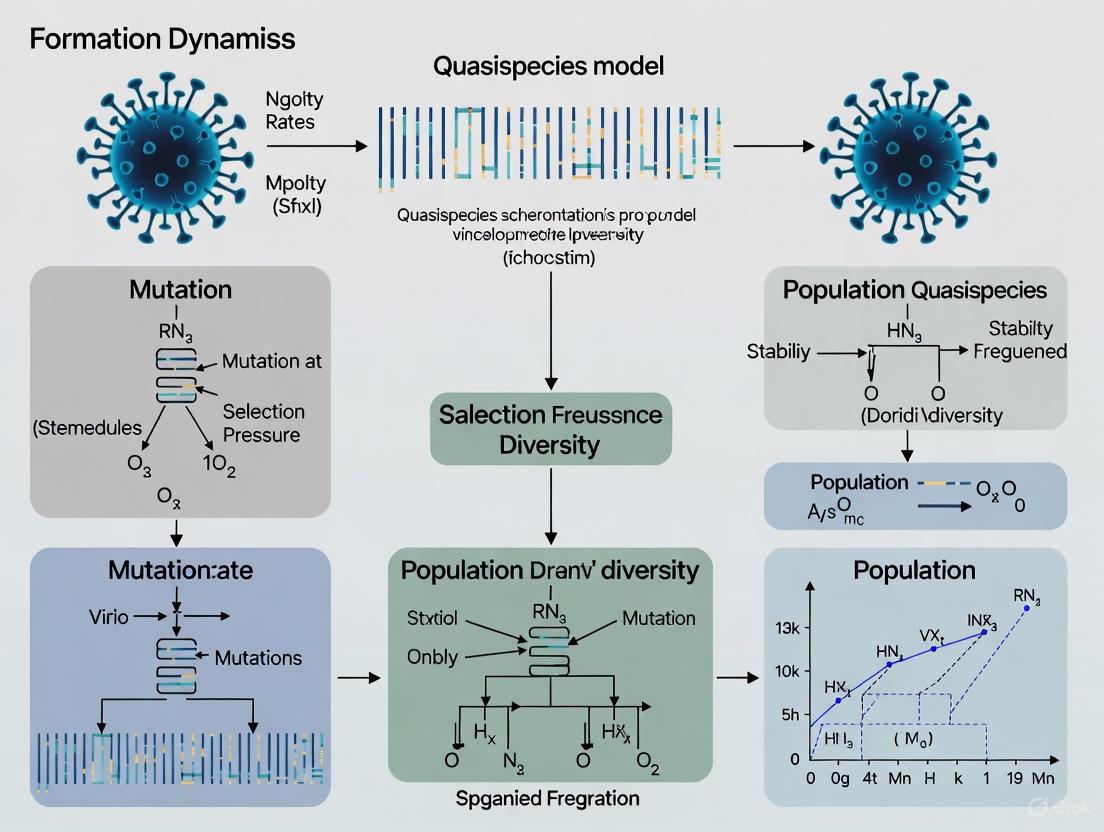
This article provides a comprehensive exploration of viral quasispecies, the complex and dynamic mutant distributions that define RNA virus populations.
Viral Quasispecies: Formation, Dynamics, and Clinical Implications for Antiviral Strategies
Abstract
This article provides a comprehensive exploration of viral quasispecies, the complex and dynamic mutant distributions that define RNA virus populations. Tailored for researchers, scientists, and drug development professionals, it synthesizes foundational theory, modern investigative methodologies, and pressing clinical challenges. The scope spans from the original conceptual framework established by Eigen and Schuster to the latest insights from SARS-CoV-2 research, detailing how high mutation rates and quasispecies dynamics fuel viral adaptation, pathogenesis, and drug resistance. Crucially, the article evaluates therapeutic and prophylactic strategies designed to counter the adaptive potential of quasispecies, including lethal mutagenesis and combination therapies, offering a vital resource for navigating the complexities of viral evolution in biomedical research.
The Genetic Bedrock: Unraveling the Theory and Molecular Basis of Viral Quasispecies
The quasispecies theory, conceived by physicist Manfred Eigen and Peter Schuster in the 1970s, represents a foundational framework that has bridged our understanding of prebiotic evolution and modern virology [1] [2]. Originally developed to explain the dynamics of biological information in early replicons subjected to high mutation rates, this theory has revolutionized how we perceive viral populations and their evolutionary potential [3]. At its core, quasispecies theory posits that replicating systems exist not as static entities with a single master genome, but rather as dynamic distributions of closely related mutant genomes—concepts that apply equally to primitive replicons on prebiotic Earth and to contemporary RNA viruses [2].
The theory's migration from prebiotic chemistry to virology emerged from a recognition that the same principles governing early replicators could explain the rapid adaptability of RNA viruses [1]. This conceptual transfer has profound implications for understanding viral pathogenesis, drug resistance, and the development of novel antiviral strategies [3]. This article traces the historical development of quasispecies theory, its mathematical foundations, and its experimental validation, while providing researchers with practical methodologies for studying viral quasispecies dynamics.
Historical Foundation: From Chemical Evolution to Biological Reality
Eigen's Original Formulation and the Error Threshold
Eigen's pioneering work in the 1970s provided the first quantitative treatment of error-prone replication, integrating concepts from information theory with Darwinian natural selection [1]. His model portrayed early replicon populations as organized mutant spectra dominated by a master sequence—the one endowed with the highest replicative capacity in the distribution [2]. This theoretical framework introduced two fundamental concepts:
- Mutant ensembles as units of selection, emphasizing the relevance of intra-population interactions
- The error threshold relationship, which defines the maximum mutation rate at which the master sequence can stabilize the mutant ensemble [1] [2]
The error threshold can be represented as μc = 1 - fm/f, where μc is the critical mutation rate, f is the fitness of the master sequence, and fm is the mean fitness of the mutant spectrum [3]. Violation of this threshold results in loss of information and population drift through sequence space—a phenomenon with crucial implications for both prebiotic evolution and antiviral strategies [2].
Table 1: Key Parameters in Quasispecies Theory
| Parameter | Definition | Biological Significance |
|---|---|---|
| Mutation Rate | Frequency of mutations per nucleotide copied [1] | Determines genetic diversity generation rate |
| Mutation Frequency | Proportion of mutations in a population of genomes [1] | Reflects actual population diversity |
| Error Threshold | Maximum mutation rate compatible with genetic stability [2] | Critical for information maintenance |
| Master Sequence | Dominant genome in quasispecies distribution [2] | Highest fitness genotype in the population |
| Mutant Spectrum | Ensemble of variant genomes in a population [1] | Reservoir of genetic and phenotypic variants |
Experimental Validation in Viral Systems
The existence of quasispecies was first experimentally evidenced through clonal analyses of RNA bacteriophage Qβ populations, where individual genomes differed from the consensus sequence by an average of one to two mutations per genome [2]. This cloud-like nature was understood as a consequence of high mutation rates (approximately 10⁻⁴ mutations per nucleotide copied) combined with tolerance to accept mutations despite fitness costs [2].
John Holland and colleagues later recognized that a rapidly evolving "RNA world" within a DNA-based biosphere had profound evolutionary and medical implications [2]. Early observations of viral phenotypic variations in the mid-20th century—including transitions in plaque morphology and high-frequency conversions between drug resistance and dependence—represented the precursors to our modern understanding of quasispecies complexity [2].
Mathematical Framework of Quasispecies Dynamics
Fundamental Equations
The original deterministic quasispecies model described by Eigen and Schuster is represented by a set of differential equations that capture the population dynamics of competing sequences [3]:
Where:
x_iis the concentration of sequence if_jis the replication rate of sequence jQ_jiis the probability that sequence j produces sequence i upon replicationφis the dilution factor that keeps the total population constant [3]
This mathematical formulation captures the essence of quasispecies dynamics, where each sequence reproduces itself with a certain fidelity while contributing to the production of mutant variants.
Sequence Space and Fitness Landscapes
Quasispecies theory introduced the crucial concepts of sequence space and fitness landscapes [3]. Sequence space is a multidimensional discrete space (hypercube) where each node corresponds to a genotype connected to neighboring genotypes by single-point mutations. For an RNA virus, this space is astronomically large—for a virus with genome length L, the sequence space has 4ᴸ possible genotypes [3].
The fitness landscape represents the mapping of each genotype to its reproductive fitness. Viral quasispecies occupy specific regions of this landscape, with the population distribution determined by mutation-selection balance [3]. The theory predicts that a quasispecies located at a low but evolutionarily neutral and highly connected region in the fitness landscape can outcompete a quasispecies at a higher but narrower fitness peak—a phenomenon termed "survival of the flattest" [2].
Figure 1: Conceptual representation of quasispecies in sequence space and fitness landscapes. The hypercube illustrates genotypes connected by point mutations, while the fitness landscape shows population distributions across fitness peaks.
Prebiotic Origins and the First Quasispecies
Cooperative Autocatalysis and the Emergence of Evolution
Recent research on prebiotic systems has revealed how Darwinian evolution could have emerged from prebiotic chemistry. Using evolutionary invasion analysis, scientists have developed a universal framework for describing origin stories for evolutionary dynamics [4]. This analysis reveals that cooperative autocatalysts—those whose per-unit reproductive rate increases with population size—possess the special property of being able to cross the barrier from degradation-dominated states to growth-dominated states with evolutionary dynamics [4].
The population dynamics of such early replicators can be described by:
Where A is the population, g₁ is the growth rate, D is the decay rate, and g₂ represents cooperative effects [4]. For prebiotic systems, case (c) in this framework—where g₂ > 0 and g₁ < D—requires a cooperative autocatalyst and creates a metastable system with a tipping point that enables the transition to persistent propagation [4].
The Foldcat Mechanism and Early Compartmentalization
The Foldcat Mechanism, where peptides fold and help catalyze each other's elongation, represents a concrete example of cooperative autocatalysis capable of emergent evolutionary dynamics [4]. Such systems likely required compartmentalization within membrane-like structures formed from amphiphilic molecules, creating suitable environments for chemical reactions to occur [5]. These primordial compartments would have allowed the maintenance of genetic information while permitting the cooperative interactions essential for overcoming the error threshold [6].
Experimental Methods for Quasispecies Analysis
Population Dissection Techniques
Modern quasispecies research employs multiple methodologies to dissect viral populations and characterize their genetic diversity:
Table 2: Key Experimental Methods in Quasispecies Research
| Method | Principle | Applications | Key Reagents |
|---|---|---|---|
| Molecular Cloning + Sanger Sequencing | Biological or molecular cloning followed by sequence determination of individual clones [1] | Historical standard; provides accurate long-read sequences | Restriction enzymes, ligases, bacterial transformation systems |
| Ultra-Deep Sequencing | Amplification and sequencing of short regions with high coverage (10⁵-10⁶ sequences per region) [1] [3] | Comprehensive mutant spectrum analysis; low-frequency variant detection | High-fidelity PCR enzymes, barcoded primers, next-generation sequencers |
| Partition Analysis of Quasispecies (PAQ) | Bioinformatic analysis of relationships among genome types [2] | Identify hierarchical mutation patterns | Specialized software for phylogenetic reconstruction |
| QUENTIN | Network-based transmission inference from sequence data [2] | Identify transmission clusters and pathways | Network analysis algorithms |
Experimental Workflow for Quasispecies Characterization
Figure 2: Standard experimental workflow for viral quasispecies characterization, from sample collection to biological interpretation.
The Scientist's Toolkit: Essential Research Reagents
Table 3: Key Research Reagents for Quasispecies Studies
| Reagent/Category | Specific Examples | Function/Application |
|---|---|---|
| High-Fidelity Polymerases | RNA-dependent RNA polymerases, Reverse transcriptases [2] | Maintain native mutation rates during amplification |
| Fidelity Variants | Genetically engineered polymerases with altered proofreading [2] | Probe mutation rate effects on quasispecies dynamics |
| Cell Culture Systems | Permissive cell lines (Huh7, MDCK, A549) [5] | Provide environment for viral replication and selection |
| Chemical Mutagens | Ribavirin, 5-fluorouracil [1] | Experimentally increase mutation rates |
| Selection Agents | Monoclonal antibodies, antiviral compounds [7] | Apply selective pressure to quasispecies |
| Computational Tools | PAQ, QUENTIN, custom scripts [2] | Analyze sequence data and population structure |
Applications in Antiviral Drug Development
Lethal Mutagenesis
The quasispecies concept of an error threshold has led to the development of lethal mutagenesis as an antiviral strategy [1] [2]. This approach aims to increase viral mutation rates beyond the error threshold, driving viral populations toward extinction through accumulation of deleterious mutations [1]. Several ribonucleoside analogs have been identified as mutagens that can push viral populations across this threshold [2].
Novel Antiviral Discovery Platforms
Innovative approaches inspired by prebiotic chemistry have emerged as promising antiviral discovery platforms. Researchers have developed methods using formamide-based prebiotic chemistry models "doped" with orotic acid derivatives to generate complex, non-natural chemical mixtures capable of disrupting viral replication [5]. These mixtures, such as "Mix 1c" identified in recent studies, demonstrate broad-spectrum antiviral activity against diverse viruses including West Nile virus, Dengue virus, and SARS-CoV-2 with minimal eukaryotic cell toxicity [5].
Table 4: Antiviral Strategies Targeting Quasispecies Dynamics
| Strategy | Mechanism | Examples | Challenges |
|---|---|---|---|
| Lethal Mutagenesis | Increase mutation rate beyond error threshold [1] [2] | Ribavirin, Favipiravir [7] | Host cell toxicity; narrow therapeutic window |
| Polymerase Inhibitors | Directly target viral replication machinery [7] | Remdesivir, Sofosbuvir [7] | Rapid emergence of resistance mutants |
| Combination Therapy | Multiple simultaneous selective pressures [7] | HIV HAART, HCV DAA combinations [7] | Complex pharmacokinetics; drug interactions |
| Prebiotic-Inspired Mixtures | Novel chemical space unexplored by evolution [5] | Formamide-based mixtures [5] | Complex composition; mechanism elucidation |
Future Directions and Research Challenges
The study of viral quasispecies continues to evolve with new theoretical and experimental developments. The recent introduction of the ultracube concept provides a more realistic multidimensional sequence space that accounts for genetic processes beyond point mutations, such as insertions, deletions, and recombination events that alter genome length [3]. This expanded framework better represents the true complexity of viral quasispecies in natural infections.
Key challenges in the field include:
- Integrating quasispecies dynamics with host immune responses and tissue-specific selection pressures
- Developing single-cell sequencing approaches to understand cell-to-cell variation in viral populations
- Creating more accurate multiscale models that connect intrahost evolution to interhost transmission
- Designing clinical strategies that effectively target quasispecies diversity rather than individual variants
As quasispecies theory continues to mature, its principles are being extended beyond virology to other evolving systems including cancer cells, bacterial populations, and stem cells [2]. The fundamental insights from Eigen's work on prebiotic evolution continue to illuminate the dynamic nature of evolving biological systems five decades after their initial formulation.
Genetic variation is an indispensable requirement for viral evolution, providing the raw material necessary for adaptation to changing environments, host immune responses, and therapeutic interventions [8]. Viral populations employ all known mechanisms of genetic variation—mutation, recombination, and genome segment reassortment—to maintain dynamic, evolving populations [8]. These processes are fundamentally rooted in the replicative machineries of viruses and the fundamental physical-chemical properties of nucleotides when acting as templates or substrates [8]. The balance between genetic stability and variability is crucial; while excessive mutations can lead to population collapse, insufficient diversity limits adaptive potential [3] [9].
The quasispecies theory, conceived by Eigen and Schuster, provides a foundational framework for understanding viral population dynamics [3]. This theory posits that viral populations exist not as static entities with a single genome sequence, but as dynamic, heterogeneous distributions of closely related mutant genomes termed "mutant swarms" or quasispecies [3]. This population structure, characterized by extensive genetic diversity and mutational coupling between variants, has profound implications for viral pathogenesis, transmission dynamics, and the emergence of drug resistance [3]. Within this context, error-prone replication and the general absence of proofreading mechanisms in RNA viruses serve as primary molecular drivers of diversity, facilitating rapid evolution and posing significant challenges for disease control [10].
Molecular Mechanisms of Error-Prone Replication
Fundamental Mechanisms of Mutation Generation
Viral mutations originate from multiple molecular mechanisms during genome replication. The primary source lies in the electronic structure of nucleotide bases that constitute DNA and RNA, which determines their hydrogen-bonding properties and base-pairing tendencies [8]. The inherent dynamic conformation of purine and pyrimidine bases, including tautomeric changes (keto-enol and amino-imino transitions) and transitions between syn and anti conformations, can alter hydrogen-bonding properties and lead to non-Watson-Crick base pairs, thereby inducing mutagenesis [8].
The major mechanisms generating mutations include:
- Template miscopying: Direct incorporation of an incorrect nucleotide during chain elongation [8] [10].
- Primer-template misalignments: Including miscoding followed by realignment, and polymerase "slippage" or "stuttering" at homopolymeric tracts or short repeated sequences [8].
- Activity of cellular enzymes: Such as deaminases that modify nucleotide bases [8].
- Chemical damage to viral nucleic acids: Including deamination, depurination, depyrimidination, reactions with oxygen radicals, and photochemical reactions [8].
These mechanistically unavoidable errors occur against a backdrop of adjacent base stacking, electronic interactions, and structural transitions in nucleic acids that further influence mutagenesis in specific template sequence contexts [8].
Polymerase Fidelity and the Absence of Proofreading
A critical distinction between different virus classes lies in the fidelity of their replication machinery and the presence of proofreading mechanisms. DNA-dependent DNA polymerases typically possess proofreading abilities through exonuclease activity that recognizes and excises mismatched base pairs, achieving error rates of approximately 10⁻⁷ to 10⁻⁹ errors per nucleotide polymerized [10].
In contrast, RNA-dependent RNA polymerases (RdRps) used by most RNA viruses generally lack proofreading capabilities, resulting in error rates of 10⁻³ to 10⁻⁵ errors per nucleotide polymerized—making them orders of magnitude more error-prone than their DNA counterparts [10]. This high error rate means that for a typical RNA virus genome of 10,000 bases, a mutation frequency of 1 in 10,000 corresponds to an average of one mutation in every replicated genome [10]. When a single cell infected with poliovirus produces 10,000 new virus particles, this error rate theoretically yields approximately 10,000 new viral mutants [10].
Coronaviruses represent a notable exception among RNA viruses, as they encode a 3'-to-5' exoribonuclease activity (ExoN) in nonstructural protein 14 (nsp14) that provides a unique RNA proofreading function [11] [9]. Genetic inactivation of ExoN in engineered SARS-CoV and murine hepatitis virus genomes results in viable mutants with 15- to 20-fold increases in mutation rates, demonstrating that nsp14-ExoN is essential for replication fidelity in these viruses [9].
Table 1: Comparison of Replication Fidelity Across Polymerase Types
| Polymerase Type | Example | Proofreading Activity | Error Rate (per nt) | Molecular Basis |
|---|---|---|---|---|
| DNA-dependent DNA polymerase | Host cell polymerases | Present (3'-5' exonuclease) | 10⁻⁷ to 10⁻⁹ | Recognizes and excises mismatched bases |
| RNA-dependent RNA polymerase (standard) | Poliovirus, HIV, Influenza | Generally absent | 10⁻³ to 10⁻⁵ | Lacks proofreading domain; errors remain uncorrected |
| RNA-dependent RNA polymerase (with ExoN) | Coronaviruses (SARS-CoV, MHV) | Present (nsp14-ExoN) | ~15-20x lower than standard RdRp | 3'-5' exoribonuclease activity corrects errors |
Quantitative Analysis of Mutation Rates and Types
Mutation Rates and Fidelity Measurements
Viral mutation rates can be quantified through various experimental approaches, including sequencing of viral populations after single replication cycles, chemical mutagenesis sensitivity assays, and direct competition experiments between wild-type and fidelity mutants. The mutation rates vary significantly among different virus families but generally cluster within characteristic ranges based on genome composition and replication machinery.
For RNA viruses, the high mutation rates are not merely a biochemical inevitability but also an evolutionary adaptation. The quasispecies diversity generated through error-prone replication allows viral populations to explore sequence space rapidly and adapt to new selective pressures, including host immune responses, antiviral therapies, and environmental changes [3] [12]. However, this diversity exists within constrained limits; studies with poliovirus and vesicular stomatitis virus indicate that even 2-4 fold alterations in mutation frequency can significantly impact viral fitness and pathogenesis [9].
The fundamental equation describing quasispecies dynamics in a simplified two-population model (wild-type and average mutant) illustrates the error threshold concept:
Where x₀ and x₁ represent the wild-type and mutant populations, f₀ and f₁ their respective fitness values, μ the mutation rate, and Ω the average population fitness [3]. The error threshold occurs when mutations exceed a critical value μc = 1 - f₁/f₀, beyond which the genetic information cannot be maintained [3].
Types and Distributions of Mutations
Mutations arising from error-prone replication can be categorized into several classes with distinct molecular causes and consequences:
- Transitions: Substitutions of a purine for another purine (AG) or pyrimidine for another pyrimidine (CT/U). These occur more frequently than transversions due to the structural similarity between the nucleotides [8].
- Transversions: Substitutions of a purine for a pyrimidine or vice versa, which are structurally more substantial changes [8].
- Insertions and deletions (indels): Particularly prevalent at homopolymeric tracts and short repeated sequences prone to misalignment mutagenesis [8].
The distribution of mutations along the viral genome is not uniform; specific regions may exhibit heightened mutability due to local sequence context, secondary structure elements, or functional constraints [13]. Recent evidence suggests that genome composition and structure can directly modulate viral polymerase fidelity, resulting in heterogeneous mutation distribution across the viral genome [13]. For instance, RNA secondary structures can influence polymerase processivity and error rates, while specific nucleotide motifs may serve as mutation hotspots [13].
Table 2: Classification and Properties of Major Mutation Types in Viral Genomes
| Mutation Type | Molecular Mechanism | Frequency | Preferred Genomic Context | Biological Consequences |
|---|---|---|---|---|
| Transitions | Template miscopying; tautomeric shifts | Higher | All contexts, but influenced by base composition | Often silent if third codon position; can cause amino acid changes |
| Transversions | Template miscopying; base ionization | Lower | All contexts | More likely to cause amino acid changes due to altered chemical class |
| Insertions/Deletions | Polymerase slippage | Variable | Homopolymeric tracts; short repeated sequences | Frameshifts in coding regions; disrupted regulatory elements |
| Recombination | Template switching | Varies by virus | Dependent on sequence similarity | Large genetic rearrangements; exploration of novel genetic combinations |
Experimental Analysis of Error-Prone Replication
Protocol 1: Quantifying Viral Mutation Rates Through Deep Sequencing
Objective: To precisely measure mutation rates and characterize quasispecies diversity in viral populations using next-generation sequencing (NGS).
Materials and Reagents:
- Viral RNA Extraction Kit (e.g., QIAamp UltraSens Virus Kit): For high-quality RNA extraction from serum or culture supernatants [14].
- Reverse Transcription and PCR Reagents: For cDNA synthesis and amplification of target viral regions [14].
- Sequence-Specific Primers: Designed to amplify overlapping fragments covering the entire viral genome or specific regions of interest [14].
- NGS Library Preparation Kit (e.g., Nextera DNA Sample Prep Kit): For preparing sequencing libraries from PCR products [14].
- Next-Generation Sequencer (e.g., Illumina MiSeq platform): For high-throughput sequencing with sufficient coverage to detect low-frequency variants [14].
- Quasispecies Analysis Software (e.g., Quasispecies Analysis Package - QAP): For processing raw NGS data, error correction, and viral haplotype reconstruction [14].
Methodology:
- Sample Preparation and RNA Extraction: Extract viral RNA from serum samples or cell culture supernatants using a viral RNA extraction kit, ensuring minimal degradation [14].
- Reverse Transcription and PCR Amplification: Convert RNA to cDNA and amplify target regions using sequence-specific primers. For whole-genome analysis, amplify multiple overlapping fragments to cover the entire genome [14].
- Library Preparation and Sequencing: Prepare sequencing libraries from purified PCR products using an NGS library preparation kit. Quantify libraries and sequence on an appropriate platform (e.g., Illumina MiSeq with 2×300 bp paired-end reads) [14].
- Bioinformatic Analysis:
- Quality filter raw sequencing reads to remove adaptors and low-quality/short reads [14].
- Map clean reads to reference viral genomes and assemble amplicon sequences based on mapping positions [14].
- Correct sequencing errors and reconstruct viral haplotypes using specialized quasispecies analysis software [14].
- Calculate mutation frequencies and characterize quasispecies diversity using operational taxonomic units (OTUs) or similar quantitative measures [14].
Applications: This protocol enables sensitive detection of variants present at frequencies as low as 1% in the quasispecies pool and has been successfully applied to correlate viral diversity with clinical outcomes in hepatitis B virus infection [14].
Protocol 2: Experimental Evolution with Augmented Diversity
Objective: To investigate how increased initial population diversity affects viral adaptation to specific selection pressures.
Materials and Reagents:
- Codon-Level Mutagenesis Kit: For introducing mutations across specific viral genomic regions [12].
- Infectious Clone System: For the virus under study (e.g., CVB3 infectious clone) [12].
- Cell Culture System: Permissive cells for viral propagation (e.g., HeLa-H1 cells for CVB3) [12].
- In Vitro Transcription Kit: For producing viral genomic RNA from mutagenized clones [12].
- Electroporation Apparatus: For introducing RNA transcripts into permissive cells [12].
- Thermal Incubation Equipment: For applying thermal stress as a selection pressure [12].
Methodology:
- Library Generation: Apply codon-level mutagenesis to the target viral region (e.g., capsid region) using PCR-based methods to generate viral genomes with increased diversity [12].
- Virus Recovery: Electroporate in vitro transcribed RNA from mutagenized libraries into permissive cells to recover high-diversity (HiDiv) viral populations. Include control populations from non-mutagenized libraries [12].
- Experimental Evolution: Subject HiDiv and control populations to serial passages under specific selection pressures (e.g., thermal inactivation at 43-45°C). At each passage, expose approximately 10⁶ PFU to the selective condition and use surviving viruses to inoculate fresh cells [12].
- Phenotypic Assessment: Compare the adaptive outcomes between HiDiv and control populations by quantifying phenotypic improvements (e.g., fraction of viruses surviving more stringent selective conditions) [12].
- Genotypic Analysis: Sequence evolved populations to identify mutations conferring adaptive advantages and analyze epistatic interactions between mutations [12].
Applications: This approach demonstrated that viral populations with experimentally augmented diversity achieved significantly greater thermal resistance (33-127 times more survivors at 45-47°C) compared to standard populations, highlighting the importance of initial diversity in adaptive outcomes [12].
Experimental Evolution Workflow for Studying Viral Adaptation
Table 3: Essential Research Reagents for Studying Viral Replication Diversity
| Research Tool | Specific Examples | Function/Application | Key Features |
|---|---|---|---|
| Next-Generation Sequencing Platforms | Illumina MiSeq | High-throughput sequencing of viral populations | Detects variants at frequencies as low as 1%; enables quasispecies resolution |
| Quasispecies Analysis Software | Quasispecies Analysis Package (QAP) | Processing NGS data for viral diversity | Quality filtering, error correction, haplotype reconstruction; specialized for viral quasispecies |
| Codon-Level Mutagenesis Systems | PCR-based mutagenesis protocols | Generating viral libraries with enhanced diversity | Introduces mutations across target regions; enables access to full range of amino acid substitutions |
| Infectious Clone Systems | CVB3 infectious clone; SARS-CoV infectious clone | Reverse genetics for viral recovery | Allows introduction of specific mutations; recovery of genetically defined viruses |
| Viral Polymerase Assays | Biochemical fidelity assays | Measuring polymerase error rates | Quantifies misincorporation kinetics; assesses proofreading activity |
| Error-Correcting Enzyme Inhibitors | ExoN inhibitors (research stage) | Modulating replication fidelity | Specifically targets viral proofreading (e.g., coronavirus ExoN); increases mutation rates |
| Chemical Mutagens | Ribavirin, 5-fluorouracil | Inducing lethal mutagenesis | Increases error rate beyond tolerable threshold; antiviral strategy |
Error-prone replication and the general absence of proofreading mechanisms in RNA viruses constitute fundamental molecular drivers of genetic diversity, enabling the formation of quasispecies populations that enhance adaptability and evolutionary potential. The high mutation rates of viral RNA-dependent RNA polymerases, typically ranging from 10⁻³ to 10⁻⁵ errors per nucleotide incorporated, generate heterogeneous mutant swarms that serve as reservoirs for adaptive variants [8] [10]. While coronaviruses represent an exception with their ExoN-mediated proofreading activity, most RNA viruses exist as quasispecies distributions that navigate sequence space through continuous generation and selection of variants [3] [9].
The experimental and theoretical frameworks surrounding viral replication fidelity have significant implications for antiviral drug development, vaccine design, and understanding emergence of viral diseases. Strategies that manipulate mutation rates—either through lethal mutagenesis to push viral populations beyond the error threshold or through fidelity enhancement to restrict adaptive potential—represent promising approaches that complement traditional antiviral mechanisms [12] [9]. Furthermore, recognizing viruses as dynamic quasispecies rather than static entities necessitates treatment regimens that account for pre-existing variant complexity and evolutionary trajectories [3].
Future research directions should focus on elucidating how template sequence properties influence local mutation rates, developing more sophisticated multi-scale models that integrate intracellular replication dynamics with population-level spread, and designing therapeutic approaches that specifically target the diversity-generating mechanisms of viral pathogens. The continued refinement of deep sequencing technologies and bioinformatic tools will further enhance our ability to monitor and predict viral evolution, ultimately improving our capacity to control existing and emerging viral threats.
This technical guide provides a comprehensive framework for quantifying mutagenesis and applying the error threshold concept within viral quasispecies research. We synthesize established methodologies with recent advances in error-corrected sequencing technologies and theoretical models to present standardized approaches for mutation rate determination, error threshold calculation, and experimental investigation of viral population dynamics. The protocols and analytical frameworks presented herein are designed to support research in antiviral therapeutic development, viral evolution prediction, and pathogen emergence preparedness.
Viral quasispecies represent complex, dynamic populations of closely related genetic variants that arise from error-prone replication, particularly in RNA viruses and some DNA viruses [3] [15]. This population structure, first described by Eigen and Schuster, fundamentally shapes viral pathogenesis, adaptation, and treatment outcomes. Quasispecies exist not as static entities but as distributions of mutant genomes—often called mutant swarms or clouds—that continuously evolve through processes of genetic variation, competition, and selection [15]. The high mutation rates of RNA viruses, ranging from 10⁻³ to 10⁻⁵ errors per base per replication cycle, approach the theoretical limits for maintaining genetic information [15] [16]. This creates a dynamic equilibrium where viral populations can rapidly adapt to environmental pressures, including immune responses and antiviral therapies.
The error threshold concept emerges directly from quasispecies theory as a critical limitation on the amount of genetic information that can be stably maintained given a specific mutation rate [17] [18]. When mutation rates exceed this threshold, viral populations experience "error catastrophe," losing essential genetic information through cumulative mutations that impair fitness and ultimately lead to population collapse [3] [17]. This guide details experimental and computational approaches for quantifying mutation rates, modeling error thresholds, and applying these concepts to manipulate viral populations for therapeutic benefit.
Theoretical Foundations: Quasispecies Theory and Error Thresholds
Mathematical Framework of Quasispecies Dynamics
The original quasispecies model described by Eigen and Schuster is represented by a system of differential equations that capture the population dynamics of mutant sequences:
Where:
- xᵢ = Fraction of the population of the i-th mutant sequence
- fⱼ = Replication rate of the j-th mutant
- Qⱼᵢ = Probability of mutation from sequence j to sequence i
- Ω(x) = Average fitness of the population (Σⱼfⱼxⱼ) [3]
This model describes how mutant frequencies change over time through the combined effects of replication fidelity, mutation, and selection pressure. The quasispecies occupies a region in sequence space—a multidimensional representation where each point corresponds to a specific genotype—with its distribution shaped by the underlying fitness landscape [3].
Error Threshold Calculation and Phase Transition Behavior
The error threshold can be demonstrated through a simplified two-population model comparing wild-type (x₀) and mutant (x₁) sequences:
Where μ is the mutation rate. The critical error threshold (μc) occurs at:
When μ > μc, the master sequence cannot maintain dominance in the population [3]. This transition exhibits characteristics of a second-order phase transition in statistical physics, even in the presence of lethal mutations [19]. In single-peak fitness landscapes, this collapse corresponds to a ferro-paramagnetic transition where the back-mutation rate functions similarly to an external magnetic field [19].
Table 1: Mutation Rates Across Biological Systems
| Biological System | Mutation Rate (per base per generation) | Genome Size | Implications |
|---|---|---|---|
| RNA Viruses | 10⁻³ to 10⁻⁵ [16] | 3-33 kb [15] | High adaptability, proximity to error threshold |
| DNA Viruses | 10⁻⁶ to 10⁻⁸ [16] | Varies widely | Greater genomic stability |
| Bacteria (E. coli) | ~10⁻⁹ [16] | ~4.6 Mb | DNA repair mechanisms |
| Human Genomic | ~1.1×10⁻⁸ [16] | ~3.2 Gb | Low baseline mutation rate |
| Human Mitochondrial | ~2.7×10⁻⁵ [16] | 16.6 kb | Elevated rate, maternal inheritance |
Sequence Space and Fitness Landscapes
The theoretical sequence space for even a small RNA virus is astronomically large. For example, a virus with 3569 nucleotides (like bacteriophage MS2) has a sequence space of 4³⁵⁶⁹ possible genotypes [3]. Each genotype occupies a node in this multidimensional hypercube, connected to neighboring genotypes by single-point mutations. The fitness landscape represents the mapping of these genotypes to their relative fitness values, which can range from smooth surfaces with single peaks to highly rugged landscapes with multiple adaptive peaks [3]. Recent theoretical work introduces the "ultracube" concept to better represent sequence spaces accommodating genetic processes like insertions and deletions that alter genome length [3].
Quantitative Measurement of Mutation Rates
Classical Methods: Fluctuation Analysis and Mutation Accumulation
The Luria-Delbrück fluctuation test and its subsequent refinement by Lea and Coulson provide the foundation for measuring spontaneous mutation rates [20]. This approach relies on the distribution of mutants among parallel cultures rather than simple mutant frequencies, recognizing that spontaneous mutations arise stochastically during population expansion.
Key Assumptions of the Lea-Coulson Model:
- Cells grow exponentially
- Constant mutation probability per cell lifetime
- Equal growth rates of mutants and non-mutants
- Negligible cell death and reverse mutations
- All mutants are detectable [20]
The mutation rate (μ) is calculated from the mean number of mutations per culture (m) divided by the final cell number (Nt): μ = m/Nt [20]. Various calculation methods exist for estimating m from mutant counts, including the p₀ method (using the proportion of cultures with no mutants) and the Drake equation [20].
Mutation accumulation lines represent an alternative approach where populations are maintained through repeated bottlenecks to fix mutations without selection, allowing direct sequencing to characterize mutation rates [16].
Advanced Approaches: Error-Corrected Next-Generation Sequencing
Error-corrected next-generation sequencing (ecNGS) technologies, particularly Duplex Sequencing (DS), have revolutionized mutation quantification by achieving unprecedented accuracy through consensus sequencing of both DNA strands [21] [22].
Duplex Sequencing Workflow:
- DNA Preparation - Genomic DNA isolation and fragmentation
- Adapter Ligation - Attachment of dual-stranded unique molecular identifiers (UMIs)
- Library Amplification - Creation of sequencing libraries
- High-throughput Sequencing - Parallel sequencing of both strands
- Consensus Building - Comparison of reads from both original DNA strands
- Variant Calling - Identification of true mutations versus technical errors [21]
DS achieves technical error rates of approximately 10⁻⁷ to 10⁻⁸, enabling detection of ultrarare mutations at frequencies as low as 1×10⁻⁷ to 1×10⁻⁸—several orders of magnitude more sensitive than conventional NGS [21] [22]. This sensitivity allows researchers to detect mutation induction within days of carcinogen exposure and identify exposure-specific mutation signatures [21].
Figure 1: Duplex Sequencing Workflow for Mutation Detection
Experimental Protocols for Error Threshold Investigation
Lethal Mutagenesis Assays
Lethal mutagenesis aims to drive viral populations past the error threshold using mutagenic agents. Standard protocols include:
Cell Culture-Based Mutagenesis:
- Viral Culture - Propagate target virus in permissive cell lines
- Mutagen Treatment - Apply calculated concentrations of mutagens (e.g., ribavirin, 5-fluorouracil)
- Passaging - Serial passage with maintained mutagen pressure
- Titration - Regular quantification of infectious titer (TCID₅₀ or plaque assay)
- Sequencing - Population and single-genome sequencing to quantify mutation accumulation [15] [18]
Key Parameters:
- Mutagen concentration titration to establish dose-response
- Parallel passage of untreated controls
- Monitoring of viral load and infectivity
- Calculation of mutation frequency and fitness [15]
High-Fidelity Mutant Characterization
Investigating error thresholds also involves studying viral variants with altered replication fidelity:
Protocol:
- Selection - Isolate high-fidelity mutants through resistance to mutagens
- Characterization - Measure mutation rates via fluctuation tests or direct sequencing
- Fitness Assessment - Compare replication capacity in permissive and restrictive environments
- Pathogenesis Evaluation - Assess virulence alterations in animal models [15]
Studies with high-fidelity poliovirus mutants demonstrated restricted mutant spectra and reduced neuroinvasion in mice, reversible through complementation with diverse mutant spectra [15].
Quasispecies Maturity Assessment
Recent advances enable quantitative assessment of quasispecies structure using multiple indicators:
Table 2: Quasispecies Structure Indicators for Maturity Assessment
| Indicator | Description | State A (Founding) | State Z (Mature) |
|---|---|---|---|
| TopN | Fraction of reads for top N haplotypes | 1.00 | ~0.00 |
| Master | Dominant haplotype frequency | 1.00 | ~0.00 |
| Rare1 | Fraction of reads for haplotypes ≤1% | 0.00 | 1.00 |
| Rare2 | Fraction of reads for haplotypes ≤0.1% | 0.00 | 1.00 |
| RLE1 | Relative logarithmic evenness at q=1 | 0.00 | 1.00 |
| Rk | Evenness among top k haplotypes | 0.00 | 1.00 [23] |
A global maturity score can be computed as the Euclidean distance from the founding state in this multidimensional indicator space [23].
Research Reagent Solutions
Table 3: Essential Research Reagents for Mutagenesis Studies
| Reagent/Category | Specific Examples | Function/Application |
|---|---|---|
| Mutagenic Compounds | Ribavirin, 5-fluorouracil, N-ethyl-N-nitrosourea (ENU) | Induce mutations to probe error thresholds [15] [22] |
| Error-Corrected Sequencing Kits | Duplex Sequencing kits | Ultra-accurate mutation detection [21] |
| Cell Culture Systems | Permissive cell lines, Big Blue mouse cells, TK6 human cells | Viral propagation and mutagenesis assessment [21] [20] |
| Molecular Biology Tools | High-fidelity polymerases, Unique Molecular Identifiers (UMIs) | Library preparation for mutation detection [21] |
| Bioinformatics Pipelines | Custom scripts for quasispecies analysis, Delta method implementation | Quantify quasispecies diversity and maturity [23] |
Applications in Antiviral Development and Viral Evolution Research
Therapeutic Strategies Based on Lethal Mutagenesis
The error threshold concept has inspired novel antiviral approaches aimed at deliberately accelerating viral mutation rates beyond sustainable levels. Ribavirin demonstrates this mechanism against several RNA viruses, including poliovirus, where it induces error catastrophe [15] [18]. Combination therapies using mutagens with conventional inhibitors show particular promise, with sequential (rather than simultaneous) administration potentially providing advantages by preventing selection of escape mutants during mutagen exposure [15].
Predicting Viral Evolution and Emergence
Understanding quasispecies dynamics enables better prediction of viral evolution pathways. The composition of mutant spectra influences viral adaptability, with more diverse populations having greater capacity to overcome selective barriers [15]. Monitoring quasispecies structure during outbreaks can identify maturation toward increased diversity and phenotypic flexibility, potentially serving as an early warning for adaptive evolution [23].
Figure 2: Error Threshold Transition in Lethal Mutagenesis
Quantitative analysis of mutation rates and error thresholds provides powerful insights into viral quasispecies behavior and evolution. The integration of classical population genetics with modern sequencing technologies and theoretical models creates a robust framework for investigating viral adaptability and developing novel antiviral strategies. As ecNGS methods become more accessible and analytical approaches more sophisticated, researchers can increasingly precisely manipulate and predict viral evolutionary trajectories through targeted application of mutagenic pressure and detailed monitoring of quasispecies dynamics.
The viral quasispecies is a population structure of viruses consisting of a large number of variant genomes, often referred to as mutant spectra, clouds, or swarms [2]. This concept represents a fundamental shift from viewing a viral infection as a single, defined "wild-type" genome to understanding it as a dynamic and complex distribution of closely related, but non-identical, genomic variants [24] [3]. The quasispecies theory, originally conceived by Manfred Eigen and Peter Schuster over fifty years ago, was developed to investigate the dynamics of biological information in replicators subjected to exceptionally high mutation rates [3]. For virologists, the term describes complex distributions of viral genomes subjected to genetic variation, competition, and selection, which act collectively as a unit of selection [24]. This population structure is most clearly manifested in RNA viruses and reverse-transcribing DNA viruses due to their high mutation rates, which continuously generate genetic diversity [2]. The theory provides a robust framework for understanding viral population dynamics, adaptive potential, and the mechanisms underlying viral pathogenesis, immune evasion, and drug resistance [24] [3].
Theoretical Foundations and Dynamics
Core Principles of Quasispecies Theory
The original quasispecies model is a deterministic mathematical formulation describing the time change of the fraction of a population constituted by a given mutant sequence. The model is defined by the differential equation [3]:
$$\frac{d{x}{i}}{{dt}}=\mathop{\sum}\limits{j=1}^{n}{x}{j}{f}{j}{Q}{{ji}}-\varOmega (x)\,{x}{i}$$
Here, (xi) represents the fraction of the population of the *i*th mutant sequence, (fj) is the replication rate of the jth mutant, (Q_{ji}) is the probability of a mutation from sequence j to sequence i, and (\varOmega (x)) denotes the average fitness of the population [3]. This model portrays replicon populations as organized mutant spectra dominated by a master sequence—the genome with the highest fitness in the distribution [2]. A critical corollary of this theory is the error threshold relationship, which defines the maximum mutation rate at which the master sequence can stabilize the mutant ensemble. Exceeding this threshold results in a loss of information and viral extinction, a transition termed error catastrophe or lethal mutagenesis [24] [2].
Sequence Space and Fitness Landscapes
Two related key concepts in quasispecies theory are sequence spaces and fitness landscapes [3]. The sequence space is a multidimensional discrete space, or hypercube, where each node corresponds to a specific genotype connected to neighboring genotypes by single-point mutations. For an RNA virus, the order of this hypercube is n^L, where n is 4 (for nucleotides) and L is the genome length [3]. The fitness landscape is a conceptual model where each point in the sequence space is associated with a fitness value. Rugged landscapes with multiple peaks and valleys indicate the presence of various adaptive solutions. The "survival of the flattest" phenomenon describes how a quasispecies located on a low, flat fitness peak can outcompete one on a higher, narrower peak because the surrounding mutants in the flatter region are more fit, ensuring population stability despite mutations [2]. Real viral fitness landscapes are increasingly viewed as highly rugged and dynamic [3].
Molecular Mechanisms Generating Diversity
Error-Prone Replication and Limited Proofreading
The primary molecular basis for quasispecies formation is the limited template-copying fidelity of viral RNA-dependent RNA polymerases (RdRps) and RNA-dependent DNA polymerases (reverse transcriptases, RTs) [2]. These enzymes typically lack a 3' to 5' proofreading exonuclease domain, which is present in most cellular DNA polymerases and is crucial for maintaining high replication fidelity [24] [2]. Furthermore, post-replicative repair pathways that correct genetic lesions in cellular DNA are largely ineffective for double-stranded RNA or RNA-DNA hybrids [2]. While some coronaviruses possess a proofreading-repair activity that increases copying accuracy approximately 15-fold, this does not prevent the formation of mutant spectra, though it may reduce their amplitude [2]. The resulting mutation rates for RNA viruses are remarkably high, in the range of 10⁻³ to 10⁻⁵ substitutions per nucleotide [24]. This means that during the replication of a typical 10 kb RNA virus genome, each progeny genomic molecule will contain an average of 0.1 to several mutations [24].
Error Threshold and Genomic Complexity
The error threshold relationship establishes a fundamental constraint: it defines the maximum complexity of genetic information that can be stably maintained by a replicon with a given copying accuracy [24]. This relationship explains why RNA viruses, with their high mutation rates, have limited genomic complexity, with genomes typically ranging from 3.0×10³ to 3.2×10⁴ nucleotides [24]. Theoretical calculations indicate that the mutation rates observed in simple RNA bacteriophages are compatible with the maximum complexity sustainable by their replication accuracy [24]. This limitation represents a key distinction between viruses and cells, with the latter achieving higher genomic complexity through enhanced copying accuracy and robust repair mechanisms [24].
Table 1: Key Parameters in Quasispecies Dynamics
| Parameter | Typical Range for RNA Viruses | Biological Significance |
|---|---|---|
| Mutation Rate | 10⁻³ to 10⁻⁵ substitutions per nucleotide [24] | Determines the rate of mutant generation and genetic diversity. |
| Genome Size | 3.0×10³ to 3.2×10⁴ nucleotides [24] | Limited by error threshold; constrains genetic complexity. |
| Average Mutations per Genome | 0.1 to several per replication cycle [24] | Directly impacts the genetic heterogeneity of the viral progeny. |
| Error Threshold (μₑ) | μₑ = 1 - fₘ/fₜ [3] | Maximum mutation rate for stable information inheritance; fₘ = mutant fitness, fₜ = master sequence fitness. |
Experimental Characterization of Mutant Spectra
Methodologies for Probing Quasispecies
Dissecting the composition of mutant spectra requires techniques capable of quantifying large genotypic and phenotypic diversity within viral populations. Early evidence came from clonal analyses of RNA bacteriophage Qβ populations, which revealed that individual genomes differed from the consensus sequence by an average of one to two mutations per genome [2]. Key methodologies include:
- Molecular or Biological Cloning and Sequencing: This traditional approach involves isolating individual viral genomes (via cloning) and determining their nucleotide sequences. It provided the first evidence that a viral population is essentially a pool of mutants [2].
- Ultra-Deep Sequencing (Next-Generation Sequencing): Introduced in the 2000s, this technology significantly advanced the understanding of genetic complexity by enabling high-throughput sequencing of thousands of individual genomes within a population, allowing for the detection of low-frequency variants [3].
- Bioinformatic Analysis: Specialized procedures like Partition Analysis of Quasispecies (PAQ) and QUasispecies Evolution, Network-based Transmission Inference (QUENTIN) have been developed to unravel relationships among different genome types, suggesting hierarchical orders of mutation acquisition or identifying transmission clusters [2].
Key Experimental Workflow
The following diagram outlines a generalized experimental workflow for characterizing a viral quasispecies, from sample collection to data interpretation.
Research Reagent Solutions Toolkit
Table 2: Essential Research Reagents and Materials for Quasispecies Analysis
| Reagent/Material | Function in Experimental Protocol |
|---|---|
| High-Fidelity Reverse Transcriptase | Converts viral RNA into complementary DNA (cDNA) with minimal introduction of errors during the first synthesis step. |
| High-Fidelity DNA Polymerase | Amplifies viral cDNA for sequencing with high accuracy to avoid artifacts during PCR. |
| Viral RNA/DNA Extraction Kit | Isulates high-quality, intact nucleic acids from viral particles in clinical or cell culture samples. |
| Next-Generation Sequencing Library Prep Kit | Prepares the amplified viral DNA fragments for sequencing by adding platform-specific adapters and barcodes. |
| Bioinformatics Software (e.g., for PAQ, QUENTIN) | Analyzes deep sequencing data to identify variants, reconstruct haplotypes, and infer evolutionary relationships within the mutant spectrum [2]. |
Biological and Clinical Implications
Adaptive Potential and Pathogenesis
The mutant spectrum acts as a phenotypic reservoir, conferring upon the viral population a significant adaptive pluripotency [2]. This diversity allows the virus to explore multiple evolutionary pathways simultaneously, facilitating rapid adaptation to changing environments. Key implications include:
- Immune Evasion: The continuous generation of variants provides a substrate for selection of mutants that can escape host neutralizing antibodies or cytotoxic T-cell responses [3].
- Drug Resistance: Antiviral therapies that target a single viral genotype exert selective pressure, often favoring the emergence of pre-existing or newly generated drug-resistant mutants within the quasispecies [3]. This is well-documented for HIV-1 and hepatitis C virus [2].
- Tissue Tropism and Pathogenesis: Different components of the mutant spectrum may exhibit varying capacities to infect different cell types or organs, influencing disease progression and outcomes [24] [25]. Complementation and interference among variants can also modulate the overall replicative capacity and disease potential of the population [24].
Lethal Mutagenesis as an Antiviral Strategy
The error threshold concept provides the theoretical foundation for a novel antiviral approach known as lethal mutagenesis [24] [2]. This strategy involves using mutagenic agents (e.g., ribavirin, favipiravir) to increase the viral mutation rate beyond the error threshold, triggering an error catastrophe that leads to the loss of genetic information and viral extinction [24]. This approach has a parallel in natural defense mechanisms, such as the APOBEC3 family of cytidine deaminases that induce hypermutation in retroviral DNA [24]. The enrichment of a mutant spectrum with interfering genomes through enhanced mutagenesis is considered a key event in this transition to extinction [24].
Emerging Research and Future Directions
The Ultracube Concept
Traditional sequence space (hypercube) models assume a fixed genome length. A more recent advancement is the ultracube concept, a multidimensional sequence space designed to more realistically investigate viral evolutionary dynamics by accounting for genetic processes that alter genome length, such as insertions and deletions [3]. This provides a more comprehensive framework for understanding the full complexity of quasispecies.
Integration with Artificial Intelligence
Artificial Intelligence (AI) and Machine Learning (ML) are emerging as powerful tools in antiviral drug discovery and quasispecies research [26] [27] [28]. For instance, deep reinforcement learning (RL) has been successfully used to design novel anti-influenza compounds with non-sialic acid-like structures, which have demonstrated efficacy in both in vitro assays and in vivo mouse models [26]. These AI methods can accelerate the identification of broad-spectrum antiviral agents and help predict viral evolution and the emergence of resistant variants [27] [28].
Table 3: Experimentally Validated AI-Designed Antiviral Compounds (Izmailyan et al., 2024)
| Compound | Target | In Vitro EC₅₀ (μM) | In Vivo Protection (Mice) |
|---|---|---|---|
| DS-22-inf-009 | Neuraminidase of IAV & IBV | 0.29 - 2.31 μM [26] | 65% (IAV), 65% (IBV) [26] |
| DS-22-inf-021 | Neuraminidase of IAV & IBV | 0.29 - 2.31 μM [26] | 85% (IAV), 100% (IBV) [26] |
| Oseltamivir (Control) | Neuraminidase | N/A | N/A |
Understanding viral populations as dynamic mutant spectra, rather than static consensus sequences, is fundamental to modern virology. The quasispecies concept provides a powerful explanatory framework for viral adaptability, pathogenesis, and persistence. The experimental and theoretical tools reviewed here—from deep sequencing and bioinformatics to fitness landscapes and the ultracube concept—enable researchers to probe the intricate composition and dynamics of these complex populations. This deeper understanding is crucial for developing novel therapeutic strategies, such as lethal mutagenesis and AI-driven drug design, that account for and ultimately counter the remarkable evolutionary resilience of viruses.
The study of viral evolution has been fundamentally transformed by the quasispecies theory, a conceptual framework that revolutionized our understanding of viral populations as dynamic ensembles of genetically diverse variants rather than static entities with a single genome [3]. Conceived by Manfred Eigen and Peter Schuster over fifty years ago, this theory provides a powerful lens through which to investigate virus-host interactions, including immune evasion, drug resistance, and viral emergence [3]. At its core, the theory posits that viral populations exist as dynamic distributions of closely related mutant genomes, often described as mutant swarms or quasispecies [3]. This population structure arises from exceptionally high mutation rates during replication, particularly in RNA viruses due to the limited template-copying fidelity of RNA-dependent RNA polymerases (RdRp) and RNA-dependent DNA polymerases (RdDp) [3] [29].
The quasispecies concept has profound implications for clinical and public health interventions. Viewing viral populations as dynamic ensembles underscores the challenges in eradicating viral infections through conventional interventions, as antiviral therapies targeting a single viral genotype may selectively favor drug-resistant mutants pre-existing within the mutant cloud [3]. This evolutionary resilience necessitates novel therapeutic strategies that account for the complex evolutionary dynamics of viral populations [3]. The molecular flexibility of viruses, coupled with global traffic of mutant clouds, represents key ingredients in viral disease emergence, as exemplified by the recent COVID-19 pandemic [29].
Theoretical Foundations: Sequence Space as a Hypercube
Defining the Genotypic Hypercube
In quasispecies theory, the sequence space represents a multidimensional discrete space, formally termed a hypercube, where each node corresponds to a unique genotype connected to neighboring genotypes by single-point mutations [3]. This conceptual framework allows for the mathematical representation of all possible genetic variants of a virus. For a viral genome of length L composed of nucleotides (a 4-letter alphabet), the order of the hypercube is 4^L, creating an immense space of possible genetic sequences [3]. For instance, even a virus with a relatively short genome, such as bacteriophage MS2 with 3,569 nucleotides, would inhabit a hypercube with 4^3,569 connected nodes—an astronomically large sequence space that can be explored through point mutations or recombination events [3].
The hypercube is not merely a theoretical construct but a fundamental representation of genetic potential. In geometrical terms, an n-dimensional hypercube is the generalization of a square (n=2) and a cube (n=3), with a tesseract (n=4) representing its four-dimensional form [30]. Each dimension in this space corresponds to a specific position in the viral genome, while the connections between nodes represent possible mutational pathways. The hypercube framework enables researchers to model viral evolution as navigation through this multidimensional space, with populations moving along edges via mutation and selection pressures guiding their trajectory [3].
The Ultracube: Expanding Beyond Fixed-Length Genomes
Traditional hypercube models assume fixed genome lengths, but viral evolution often involves deletions, insertions, and recombination events that alter genome size. To address this limitation, researchers have introduced the ultracube concept as a more realistic multidimensional sequence space that accommodates viral genomes of varying lengths [3]. This expanded framework better represents the true genetic complexity of quasispecies, which inhabit a more complex sequence space than traditional hypercubes can capture [3].
The ultracube acknowledges that real viral quasispecies explore genetic possibilities beyond single nucleotide polymorphisms, incorporating structural variations that significantly impact viral fitness and evolution. This advanced conceptualization provides a more comprehensive foundation for understanding how viruses navigate genetic space through diverse mutational mechanisms, including those that substantially alter genome architecture [3].
Fitness Landscapes: The Topography of Evolution
Conceptualizing Fitness Landscapes
A fitness landscape is a central concept in evolutionary biology that metaphorically represents how genetic variations translate to reproductive success [3]. In this model, each point in the multidimensional genotype space is associated with a quantitative fitness value, typically represented as elevation in the landscape [3]. Visual appealing two-dimensional representations show genotypes along the plane with fitness as elevation, creating "peaks" and "valleys" that correspond to high-fitness and low-fitness genotypes, respectively [3].
The topography of fitness landscapes varies considerably, ranging from smooth landscapes with a single peak representing the optimal genotype to rugged landscapes with multiple peaks and valleys, indicating the presence of various adaptive solutions or evolutionary pathways [3] [31]. The shape of the fitness landscape is influenced by several factors, including the genetic architecture of traits, environmental conditions, and interactions among different genotypes [3]. For real viruses, fitness landscapes are increasingly viewed as very rugged and dynamic, constantly shifting in response to changing host immune status, therapeutic interventions, and transmission patterns [3].
Empirical Insights into Viral Fitness Landscapes
Recent research has provided unprecedented insights into the structure of viral fitness landscapes, particularly for SARS-CoV-2. The CoVFit model, a protein language model adapted from ESM-2, demonstrates how machine learning approaches can predict variant fitness based solely on spike protein sequences [32]. By training on genotype-fitness data derived from viral genome surveillance and functional mutation assays related to immune evasion, CoVFit can rank the fitness of future variants harboring nearly 15 mutations with informative accuracy [32].
Empirical studies reveal that SARS-CoV-2 fitness landscapes are characterized by continuous fitness escalation, where later-emerging variants exhibit higher effective reproduction numbers (Re), resulting in successive replacement of circulating variants [32]. This pattern suggests that the average relative fitness of circulating variants increases over time, likely in response to rising levels of population immunity [32]. The spike protein serves as a critical determinant in these fitness landscapes, as mutations affecting its binding efficiency with ACE2 and ability to evade neutralizing antibodies tend to have strong impacts on viral fitness [32].
Table 1: Key Characteristics of Viral Fitness Landscapes
| Characteristic | Description | Implication for Viral Evolution |
|---|---|---|
| Ruggedness | Number and distribution of fitness peaks | Determines evolutionary pathways and accessibility of optimal genotypes |
| Slope | Rate of fitness change between genotypes | Influences speed of adaptation |
| Neutral Networks | Connected genotypes with similar fitness | Enables exploration without fitness cost |
| Epistasis | Interactions between mutations | Creates non-additive fitness effects |
| Dynamism | Changes over time in response to external factors | Requires continuous model updating |
Quantitative Models of Evolution on Landscapes
The Quasispecies Equations
The original Eigen-Schuster quasispecies model provides a mathematical foundation for understanding viral evolution on fitness landscapes. The model is described by the set of differential equations:
[\frac{d{x}{i}}{{dt}}=\mathop{\sum}\limits{j=1}^{n}{x}{j}{f}{j}{Q}{{ji}}-\varOmega (x)\,{x}{i}]
This equation describes the time change of the fraction of the population of the ith mutant sequence ({x}{i}) ((i=\,1,\,...,{n})), where (n) is very large [3]. In this model, ({{f}}{{j}}) represents the replication rate of the jth mutant, ({{Q}}{{ji}}) is the probability of having a mutation (j\to i), and (\varOmega (x)={\sum }{j=1}^{n}\,{f}{j}{x}{j}) denotes the average fitness of the population [3].
A simplified two-population model illustrates a fundamental consequence of quasispecies theory: the error catastrophe or error threshold. This model assumes a quasispecies embedded in a single-peak fitness landscape with a wild-type sequence (({x}{0})) with high fitness ({f}{0}), which produces deleterious mutants grouped into an average mutant sequence (({x}{1})) all with equal fitness ({f}{1}\,<\,{f}{0}) [3]. The error threshold occurs when mutations overcome the critical value ({\mu }{c}=1-{f{1}}/{f{0}}), beyond which the genetic information of the master sequence is irreversibly lost [3]. This principle underpins the mechanism of lethal mutagenesis, one of the antiviral strategies employed by several currently licensed antiviral agents [29].
The NK Model of Rugged Fitness Landscapes
The NK model, developed by Stuart Kauffman, provides a mathematical framework for generating "tunably rugged" fitness landscapes [31]. In this model, N represents the number of genes or loci, while K controls the degree of epistasis or how much other loci affect the fitness contribution of a given locus [31]. With K = 0, the fitness landscape is smooth with a single peak, making global optima easy to locate. As K increases, so does the ruggedness of the fitness landscape, creating multiple local optima that can trap evolving populations [31].
The NK model has found application in various fields, including the theoretical study of evolutionary biology, immunology, and complex systems [31]. For viral evolution, it offers insights into how epistatic interactions between mutations shape evolutionary trajectories and constrain or facilitate adaptation to new environments or selective pressures.
Table 2: Mathematical Models in Viral Evolution Research
| Model | Key Variables | Application in Virology |
|---|---|---|
| Quasispecies Equations | Mutation rate (μ), Fitness values (f), Quality matrix (Q) | Predicting mutant spectrum dynamics and error thresholds |
| NK Model | N (number of loci), K (epistatic interactions) | Simulating rugged fitness landscapes and evolutionary paths |
| Hypercube | L (genome length), n (alphabet size) | Mapping genetic diversity and mutational connectivity |
| Protein Language Models | Embedding vectors, Fitness predictions | Forecasting variant emergence based on sequence data |
Computational Framework for Evolutionary Movement
Connectivity and Evolutionary Accessibility
Research on movement across fitness landscapes has revealed that a critical parameter controlling evolutionary outcomes is landscape connectivity (k), defined as the fraction of all fitness levels accessible from a current value via a single mutation [33]. Computational simulations demonstrate that beyond a critical value of k, populations almost certainly reach the global fitness peak, while below this value, they typically become trapped in local optima [33]. This sharp transition in evolutionary potential represents an inherent property of the graph structure associated with fitness landscapes.
Studies of transcriptional networks between a single regulator (R) and target protein (T) have quantified this phenomenon, showing that when each parameter can access approximately 1% of all fitness levels through single mutations, there exists a Darwinian path to maximal fitness [33]. The time required to reach peak fitness also exhibits critical transitions, with qualitatively reduced evolution times occurring once connectivity exceeds threshold values [33].
Predictability in Evolutionary Trajectories
The predictability of evolutionary trajectories represents another key aspect of movement on fitness landscapes. Computational frameworks reveal substantial variance in evolutionary paths, particularly when populations can access both local and global optima from their starting position [33]. This inherent randomness in evolutionary trajectories underscores the challenge in forecasting viral evolution, even with precise knowledge of fitness landscapes.
Interestingly, the rate of fitness increase is not constant across evolutionary trajectories. Research shows that the maximum rate of fitness increase often occurs when starting from intermediate fitness values, possibly because initial mutations serve as "potentiating mutations" that do not dramatically increase fitness themselves but enable subsequent beneficial mutations [33]. This nonlinear progression through fitness landscapes has important implications for anticipating the pace of viral adaptation.
Experimental Methodologies and Research Tools
Key Experimental Protocols
Deep Mutational Scanning
Deep mutational scanning represents a powerful experimental approach for empirically mapping fitness landscapes. This methodology involves creating comprehensive mutant libraries and assessing their functional impacts through high-throughput selection experiments followed by sequencing [32]. For SARS-CoV-2, deep mutational scanning has been particularly valuable for quantifying how mutations affect neutralization by monoclonal antibodies, with one comprehensive study generating 173,384 mutation-antibody data points covering 2,096 types of mutations in the receptor binding domain and 1,548 monoclonal antibodies [32].
The experimental workflow typically involves:
- Library Construction: Generating viral variants with point mutations at targeted positions
- Selection Pressure: Applying selective constraints such as antibody neutralization
- High-Throughput Sequencing: Quantifying variant frequencies before and after selection
- Fitness Calculation: Determining relative fitness based on enrichment/depletion patterns
Genotype-Fitness Estimation from Surveillance Data
Another methodology leverages viral genome surveillance data to estimate genotype-fitness relationships [32]. This approach involves:
- Genotype Classification: Grouping viral sequences based on shared mutation patterns in relevant proteins (e.g., spike protein)
- Temporal Frequency Tracking: Monitoring detection frequencies of genotypes over time across different geographic regions
- Multinomial Logistic Modeling: Fitting models to temporal frequency data to estimate relative effective reproduction numbers between variants
- Country-Specific Fitness Estimation: Accounting for different immune landscapes and epidemiological contexts
This method has been used to assemble large genotype-fitness datasets, with one study compiling 21,281 genotype-fitness data points covering 12,817 genotypes across 17 countries [32].
Research Reagent Solutions
Table 3: Essential Research Reagents for Fitness Landscape Studies
| Reagent/Tool | Function | Application Example |
|---|---|---|
| ESM-2 Protein Language Model | Protein sequence embedding and representation | Base model for CoVFit fitness prediction [32] |
| Deep Mutational Scanning Libraries | Comprehensive mutation coverage for functional assays | Profiling antibody escape mutations [32] |
| Monoclonal Antibody Panels | Assessing immune evasion potential | Epitope-specific neutralization profiling [32] |
| RdRp Variants | Studying mutation rate evolution | Investigating fidelity mutants and error catastrophe [29] |
| Reverse Genetics Systems | Engineering specific mutations | Validating fitness predictions [29] |
Visualization of Concepts and Workflows
Hypercube Structure and Sequence Space
Figure 1: Dimensional Analogy from Point to Cube. This diagram illustrates the conceptual progression from a 0-dimensional point to a 3-dimensional cube, demonstrating how each dimension adds connectivity. The cube represents a simplified genotype space for a 3-nucleotide genome, with each vertex representing a unique genotype and edges representing single mutational steps.
Fitness Landscape Ruggedness Model
Figure 2: Smooth versus Rugged Fitness Landscapes. Smooth landscapes (K=0 in NK model) enable direct paths to global optima, while rugged landscapes (K=2) feature multiple local optima that can trap evolving populations. Ruggedness increases with epistatic interactions between mutations.
CoVFit Model Workflow
Figure 3: CoVFit Model Development Workflow. This diagram illustrates the protein language model pipeline for predicting viral fitness, showing the integration of foundation models, domain adaptation, and multi-task learning with surveillance and experimental data.
The framework of fitness landscapes and sequence space hypercubes provides powerful conceptual tools for understanding and anticipating viral evolution. Viewing viral populations as dynamic quasispecies navigating multidimensional genetic spaces offers profound insights for therapeutic development [3] [29]. This perspective underscores why monotherapy approaches often fail due to pre-existing resistant variants within mutant clouds and emphasizes the need for combination therapies that present multiple evolutionary hurdles simultaneously [3].
The error threshold concept suggests lethal mutagenesis as a promising antiviral strategy, already employed by several licensed antiviral agents [29]. By pushing viral replication beyond sustainable mutation rates, this approach leverages the fundamental principles of quasispecies dynamics to trigger viral population collapse [3] [29]. Advanced protein language models like CoVFit demonstrate the potential for predictive forecasting of viral evolution, potentially enabling proactive rather than reactive approaches to emerging variants [32].
As research continues to refine our understanding of fitness landscape topography and the rules governing evolutionary navigation through sequence space, we move closer to strategic interventions that can anticipate and counter viral adaptation pathways. This knowledge provides the foundation for next-generation antiviral strategies that remain effective in the face of rapid viral evolution.
From Theory to Bench: Analytical Methods and Quasispecies in Antiviral Discovery
The term viral quasispecies describes a fundamental population structure in virology, referring to dynamic distributions of closely related viral genomes generated by error-prone replication [2]. This concept revolutionized the traditional view of viruses as static entities with defined sequences, revealing them instead as complex mutant spectra or swarms where genetic variation is the norm rather than the exception [34]. The quasispecies theory originated from mathematical models developed by Manfred Eigen and Peter Schuster in the 1970s to explain self-organization of primitive replicons, while experimental validation emerged from studies of RNA bacteriophage Qβ, which demonstrated that viral populations inherently consist of complex spectra of mutants rather than a single dominant sequence [2] [34].
For RNA viruses, mutation rates range from 10⁻⁴ to 10⁻⁶ mutations per nucleotide per replication cycle, creating immense genetic diversity within infected hosts [35] [36]. This diversity provides the substrate for rapid viral adaptation to changing environments, including host immune responses, antiviral therapies, and species jumps [3] [37]. Understanding quasispecies dynamics has profound implications for combating viral disease, from predicting emergent variants to designing effective vaccines and therapeutics [38].
This review traces the methodological evolution of quasispecies analysis from early clonal approaches to contemporary ultra-deep sequencing technologies, examining how each technological advance has expanded our understanding of viral population dynamics and pathogenesis.
The Classical Era: Clonal Sequencing Approaches
Before the advent of high-throughput methods, viral quasispecies were characterized using clonal sequencing approaches that provided the first glimpses into viral population diversity. These methods included biological cloning (plaque isolation), molecular cloning (PCR amplicon subcloning into plasmids), and single-genome amplification [39].
Table 1: Classical Clonal Sequencing Methods for Quasispecies Analysis
| Method | Procedure | Resolution Limit | Key Applications |
|---|---|---|---|
| Biological Cloning | Isolation of individual viral particles via plaque purification | ~10-100 clones | Initial demonstration of population heterogeneity in Qβ phage [2] |
| Molecular Cloning | Subcloning of RT-PCR amplicons into plasmid vectors followed by Sanger sequencing | ~100-1000 clones | Characterization of mutant spectra in HIV-1 and HCV [39] |
| Single Genome Amplification | Limiting dilution PCR followed by direct sequencing of amplicons | ~10-100 genomes | Reduction of PCR-induced recombination artifacts in viral population studies [39] |
While these approaches confirmed the quasispecies nature of RNA viruses, they suffered from critical limitations. The limited sampling depth (typically <100 clones per population) failed to capture the full extent of viral diversity, as natural virus populations often contain 10⁵–10⁹ variants [39]. The procedures were time-intensive and laborious, requiring significant resources for limited data output. Additionally, PCR recombination and sampling biases potentially distorted the true representation of variant frequencies in the population [39].
Despite these constraints, clonal studies established fundamental principles of quasispecies behavior, including the error threshold concept – the maximum mutation rate compatible with maintenance of genetic information – and demonstrated that viral populations exist as mutant clouds rather than defined sequences [37] [2].
The Sequencing Revolution: Ultra-Deep Sequencing Technologies
The introduction of next-generation sequencing (NGS) platforms in the mid-2000s dramatically transformed quasispecies analysis by enabling comprehensive characterization of viral diversity at unprecedented resolution [40]. These techniques allow simultaneous sequencing of hundreds of thousands to millions of templates, providing a quantum leap in sensitivity for detecting low-frequency variants.
Key Technological Platforms
The application of NGS to viral quasispecies analysis began with Roche 454 pyrosequencing, which offered longer read lengths advantageous for haplotype reconstruction [40]. This was subsequently superseded by Illumina platforms (MiSeq, HiSeq) providing higher throughput and lower error rates, though with shorter initial read lengths [35] [40]. More recently, third-generation sequencing technologies like PacBio SMRT and Oxford Nanopore have enabled direct RNA sequencing and even longer read lengths, though with higher error rates that present challenges for accurate variant calling [40].
Table 2: Comparison of Sequencing Platforms for Quasispecies Analysis
| Platform | Technology | Read Length | Throughput | Error Rate | Quasispecies Applications |
|---|---|---|---|---|---|
| Roche 454 | Pyrosequencing | 400-700 bp | 0.5-1 Gb | ~1% | Early HIV and HCV diversity studies [40] |
| Illumina | Reversible terminator | 50-300 bp | 10 Gb-1 Tb | ~0.1% | High-resolution SNP detection in VHSV and other RNA viruses [35] [36] |
| Ion Torrent | Semiconductor | 200-400 bp | 1-10 Gb | ~1% | Viral haplotype reconstruction |
| PacBio | SMRT sequencing | 10-20 kb | 5-20 Gb | ~10-15% | Full-length viral genome sequencing |
| Oxford Nanopore | Nanopore sensing | 1 kb-2 Mb | 10-50 Gb | ~5-15% | Real-time viral evolution monitoring |
Experimental Workflow for Viral Quasispecies Characterization
A standardized workflow for ultra-deep sequencing of viral quasispecies has emerged, exemplified by studies such as the analysis of Viral Hemorrhagic Septicemia Virus (VHSV) isolates [35] [36].
Figure 1: Experimental workflow for viral quasispecies analysis using ultra-deep sequencing
Detailed Methodology
Virus Isolation and RNA Extraction: Viral isolates are propagated in permissive cell lines (e.g., BF-2 cells for VHSV) until complete cytopathic effect is observed [35] [36]. Viral particles are concentrated via ultracentrifugation (86,000×g for 2 hours), and total RNA is extracted using commercial kits (e.g., RNeasy Mini Kit, Qiagen) with final concentrations typically ranging from 16-40 ng/μL [35] [36].
Reverse Transcription and PCR Amplification: Full-length viral genome cDNA is synthesized using genome-specific primers and reverse transcriptase (e.g., SuperScript III System, Invitrogen) [35]. The genome is divided into overlapping amplicons (e.g., 2.8-3.7 kb fragments for VHSV) to ensure complete coverage, with primers designed to target conserved regions across genotypes [35] [36]. PCR amplification employs high-fidelity polymerases (e.g., Platinum Taq DNA Polymerase High Fidelity, Invitrogen) to minimize introduction of replication errors during amplification [35] [36].
Library Preparation and Sequencing: PCR products are processed using library preparation kits (e.g., Nextera DNA Sample Prep Kit for Illumina) with size selection to remove fragments <400 bp [14]. Libraries are quantified using real-time PCR and sequenced on platforms such as Illumina MiSeq or HiSeq with paired-end protocols (e.g., 2×300 bp) to achieve high coverage depths typically ranging from 0.5-1.9×10⁶ sequenced copies per isolate [35] [36] [14].
Bioinformatic Analysis Pipelines
The massive datasets generated by deep sequencing require specialized bioinformatic pipelines for accurate variant detection and interpretation. Tools such as ViVan (Viral Variance Analysis) have been developed specifically for this purpose, incorporating multiple error-correction strategies to distinguish true viral variants from sequencing artifacts [39].
Key analysis steps include:
- Quality filtering to remove low-quality reads and short sequences
- Reference-based mapping to align reads to consensus genomes
- Variant calling with statistical thresholds for allele frequency
- Haplotype reconstruction to identify linked mutations
- Diversity metrics calculation to quantify population complexity
Advanced approaches incorporate unique molecular identifiers (UMIs) to tag individual template molecules, enabling more accurate quantification of variant frequencies and reduction of PCR and sequencing errors [39].
Key Research Applications and Insights
Understanding Host Adaptation and Transmission Dynamics
Ultra-deep sequencing has revealed how quasispecies dynamics facilitate viral adaptation to new hosts. In VHSV, deep sequencing of isolates from rainbow trout and Atlantic herring revealed differential single nucleotide polymorphism (SNP) frequencies across the genome, with the G (glycoprotein) and L (polymerase) genes showing particularly high diversity compared to nearly fixed N, M, P, and Nv genes [35] [36]. This gene-specific variation pattern suggests selective pressures acting on specific genomic regions during host adaptation.
Similarly, studies of HIV-1 and hepatitis C virus (HCV) have demonstrated how quasispecies complexity enables immune evasion and tissue tropism through pre-existing or rapidly selected variants [40] [34]. Deep sequencing can identify minority variants carrying drug-resistance mutations before they dominate the population, providing clinical insights for treatment strategies [40].
Clinical Applications and Therapeutic Development
In clinical virology, quasispecies analysis has enabled more precise disease staging and treatment monitoring. For hepatitis B virus (HBV), machine learning algorithms applied to quasispecies data can distinguish immune-tolerant from immune-active phases with higher accuracy than conventional serological markers alone [14]. Specifically, random forest models using viral quasispecies features achieved AUC values of 0.92 compared to 0.76 for HBsAg titer-based models [14].
The concept of lethal mutagenesis – pushing viral populations beyond the error threshold through mutagenic agents – has emerged as a therapeutic strategy directly informed by quasispecies theory [3] [2]. Deep sequencing enables monitoring of mutation accumulation during experimental mutagenesis, providing insights into potential escape pathways and treatment efficacy [39].
Table 3: Research Reagent Solutions for Quasispecies Analysis
| Reagent/Category | Specific Examples | Function in Workflow |
|---|---|---|
| High-Fidelity Polymerases | Platinum Taq DNA Polymerase High Fidelity (Invitrogen) | PCR amplification with minimal introduced errors [35] [36] |
| RNA Extraction Kits | QIAamp UltraSens Virus Kit (Qiagen), RNeasy Mini Kit (Qiagen) | Viral nucleic acid purification from serum or cell culture [35] [14] |
| Reverse Transcription Systems | SuperScript III First-Strand Synthesis System (Invitrogen) | cDNA synthesis from viral RNA templates [35] [36] |
| Library Preparation Kits | Nextera DNA Sample Prep Kit (Illumina) | Sequencing library construction with adapter ligation [14] |
| Unique Molecular Identifiers | Custom UMI adapters | Template molecular tagging for error correction [39] |
| Bioinformatic Tools | ViVan, LoFreq, VPhaser2, QAP | Variant calling, error correction, and diversity analysis [39] [14] |
Current Challenges and Future Perspectives
Despite significant advances, quasispecies analysis still faces several challenges. Error rates of NGS platforms, though continually improving, remain a concern for accurate detection of low-frequency variants (<1%) [40] [39]. PCR recombination and amplification biases can distort true variant representations, necessitating careful experimental design and computational corrections [39]. The computational complexity of analyzing massive datasets requires specialized expertise and resources that may not be accessible to all research groups [39].
Future directions in the field include:
- Single-cell viral sequencing to understand cell-to-cell variation in infection
- Integration of multi-omics data (transcriptomics, proteomics) with quasispecies information
- Real-time outbreak monitoring using portable sequencing technologies
- Advanced machine learning applications for predicting evolutionary trajectories from quasispecies data
Figure 2: Evolution of quasispecies analysis methodologies
As sequencing technologies continue to advance and computational methods become more sophisticated, our ability to decipher the complex dynamics of viral quasispecies will deepen, offering new opportunities for understanding viral pathogenesis and developing innovative control strategies. The evolution from clonal sequencing to ultra-deep sequencing has transformed viral quasispecies from a theoretical concept to a measurable parameter with direct implications for basic virology and clinical practice.
The quasispecies model, originally developed by Manfred Eigen and Peter Schuster, describes the process of Darwinian evolution for self-replicating entities operating under high mutation rates [41] [3]. Unlike classical evolutionary models that treat species as collections of nearly identical genotypes, quasispecies theory conceptualizes viral populations as dynamic clouds of related genotypes that continuously mutate and evolve collectively [41]. This framework has revolutionized our understanding of RNA virus evolution by providing a mathematical foundation for studying populations where mutations are ubiquitous and the concept of a single "fittest" genotype becomes meaningless [41] [42].
The theory established a crucial link between Darwinian evolution and information theory, offering a deterministic approach to evolution that has proven particularly relevant for understanding RNA viruses due to their exceptionally high mutation rates [3] [42]. In virology, quasispecies theory provides critical insights into viral pathogenesis, drug resistance, and immune evasion mechanisms that cannot be adequately explained by classical population genetics alone [3] [43]. The theory has expanded beyond its original chemical definition to encompass biological systems where population heterogeneity determines evolutionary outcomes.
Core Mathematical Frameworks
Fundamental Equations and Models
The quasispecies model describes population dynamics through a system of differential equations that track the evolution of mutant sequences over time. The original Eigen-Schuster quasispecies model is defined by:
Where x_i represents the fraction of the population of the i-th mutant sequence, f_j is the replication rate of the j-th mutant, Q_ji is the probability of mutation from sequence j to sequence i, and Ω(x) = Σ_j f_j·x_j denotes the average fitness of the population [3]. This system of equations captures the interplay between mutation and selection that defines quasispecies dynamics.
Several interrelated mathematical formulations describe quasispecies evolution, including the Crow-Kimura model, discrete-time Eigen model, and continuous-time Eigen model [44]. These models can be mapped exactly to one another, providing multiple mathematical perspectives on the same biological phenomena. The population can be described by a value matrix W where each diagonal element W_k equals the number of non-erroneous copies from exact replication of sequence k, and each off-diagonal element W_kj equals the number of copies of sequence k resulting from erroneous replication of sequence j [45]. The stationary sequence distribution is called the quasispecies and consists of a master sequence along with a distribution of mutants [45].
Key Parameters in Quasispecies Models
Table 1: Key parameters in quasispecies mathematical models
| Parameter | Symbol | Biological Meaning | Impact on Dynamics |
|---|---|---|---|
| Mutation rate | μ or U | Probability of error per replication | Determines quasispecies diversity and error threshold |
| Replication rate | f_j | Fitness of sequence j | Selection pressure driving evolution |
| Quality factor | Q_ji | Probability of mutation j→i | Determines connectedness in sequence space |
| Average fitness | Ω(x) | Mean replication rate of population | Determines outflow term maintaining constant population |
| Hamming distance | d | Number of point mutations between sequences | Measures proximity in sequence space |
| Error threshold | μ_c | Critical mutation rate for information stability | Boundary between ordered and random replication |
Simplified Two-Population Model and Error Threshold
A highly informative simplification reduces the quasispecies to two populations: the wild-type sequence (x₀) with high fitness (f₀) and a pool of mutants (x₁) with equal, lower fitness (f₁) [3]. This model assumes a single-peak fitness landscape and negligible back-mutations:
This simplified system allows calculation of the error threshold (μ_c), a fundamental concept in quasispecies theory that occurs when mutations overcome the critical value:
When the mutation rate (μ) exceeds μ_c, the genetic information of the master sequence becomes irrecoverably lost in the mutant cloud, leading to error catastrophe [3]. This phenomenon has significant implications for antiviral strategies, as it suggests a theoretical basis for lethal mutagenesis as a therapeutic approach [42] [43].
Sequence Spaces and Fitness Landscapes
The Hypercube Concept
Quasispecies theory introduces the concept of sequence space - a multidimensional discrete space where each node corresponds to a specific genotype connected to neighboring genotypes by single-point mutations [3]. For an RNA virus with genome length L, the sequence space takes the form of an L-dimensional hypercube with 4^L nodes (due to the 4 nucleotide possibilities at each position) [3]. For example, bacteriophage MS2 with 3569 nucleotides would occupy a hypercube with 4^3569 connected nodes - an astronomically large space that viruses explore through mutation and recombination events [3].
The distribution of fitness values across this hypercube defines the fitness landscape - a conceptual model representing how well each genotype is adapted to its environment [3]. These landscapes range from smooth surfaces with single peaks representing optimal genotypes to highly rugged landscapes with multiple peaks and valleys, indicating diverse adaptive solutions and evolutionary pathways [3]. Real viral fitness landscapes are increasingly viewed as rugged and dynamic, changing with environmental conditions and host factors [3].
The Ultracube Extension
Traditional hypercube models assume constant genome length, but real viral evolution involves deletions, insertions, and recombination events that alter genome size [3]. To address this limitation, researchers have proposed the ultracube concept - a more complex sequence space that accommodates genomes of varying lengths [3]. This multidimensional space more accurately represents the true complexity of viral quasispecies and provides a more realistic framework for investigating viral evolutionary dynamics [3].
Visualization of sequence space concepts in quasispecies theory
Experimental Methodologies and Protocols
Key Experimental Systems
Experimental evolution provides controlled environments to test quasispecies dynamics by examining the effect of defined environmental variables on viral evolution [46]. Several established experimental designs have yielded fundamental insights:
- Cytolytic infections in cell culture: Serial passages of cytolytic viruses in fresh, uninfected cells at each passage, allowing only virus evolution without cell evolution [46]
- Persistent infections: Co-evolution of viruses and host cells through passage of persistently infected cells, enabling both viral and cellular evolution [46]
- Plaque-to-plaque transfers: Extreme passage regime where population size is reduced to a single infectious unit per transfer, revealing profound molecular alterations associated with fitness decrease in mutant spectra [46]
- Environmental heterogeneity designs: Alternating passages between different cell lines or between cell culture and host organisms to simulate natural selective pressures [46]
A critical consideration in所有这些 experimental approaches is that "to culture is to disturb" - the transfer of viral isolates into alternative hosts inevitably perturbs the representation of the parental quasispecies due to bottleneck effects and environmental changes [46].
Research Reagent Solutions
Table 2: Essential research reagents and materials for quasispecies studies
| Reagent/Material | Function/Application | Experimental Context |
|---|---|---|
| Cell culture systems (various cell lines) | Provide replication environment for viruses | In vitro evolution studies |
| Biological and molecular clones | Establish defined starting populations | Controlled evolution experiments |
| Ultra-deep sequencing technologies | Characterize mutant spectrum complexity | Population genetic analysis |
| Antiviral compounds | Selective pressure for resistance studies | Drug resistance investigations |
| Neutralizing antibodies | Immune pressure studies | Vaccine and immune evasion research |
| Plasmid-based reverse genetics systems | Generate defined viral genotypes | Fitness landscape mapping |
Experimental Workflow for Quasispecies Analysis
Generalized workflow for experimental analysis of viral quasispecies dynamics
Error Threshold and Error Catastrophe
The error threshold represents a critical concept in quasispecies theory, defining the maximum mutation rate beyond which genetic information cannot be stably maintained [41] [3]. When mutation rates exceed this threshold, the quasispecies breaks down and disperses across the available sequence space in a phenomenon termed error catastrophe [41]. This transition represents a phase change from ordered replication to genetic chaos.
Mathematical analysis reveals that the error threshold depends on both the mutation rate and the fitness landscape topology [45]. In the single-peak fitness landscape model, the error threshold occurs when:
Where μ is the mutation rate per genome and s is the selective advantage of the master sequence over the average mutant [45]. Beyond this threshold, the master sequence frequency becomes vanishingly small amid the vast number of possible mutants [45].
This theoretical framework has direct practical applications in antiviral therapy through lethal mutagenesis - a therapeutic approach that uses mutagenic agents to push viral populations beyond their error threshold, driving them toward extinction [42] [43]. Experimental evidence supporting this approach includes observations that the frequency of the master genome decreases as populations approach the error threshold, and that virus extinction can be induced through increased mutagenesis [42].
Applications to Virology and Therapeutic Development
Implications for Antiviral Strategies
Quasispecies theory has profound implications for clinical interventions and public health strategies [3] [43]. Viewing viral populations as dynamic ensembles rather than static entities underscores the challenges of eradicating viral infections through conventional approaches [3]. Two key applications include:
- Combination therapies: Using multiple antiviral agents simultaneously to overcome the rapid selection of drug-resistant mutants that occurs with monotherapies [43]
- Lethal mutagenesis: Utilizing mutagenic compounds to elevate viral mutation rates beyond the error threshold, driving populations to extinction [42] [43]
These approaches align with the general principle that "complexity cannot be combated with simplicity" - multivalent interventions are necessary to counter the adaptive potential of complex mutant spectra [43].
Vaccine Design Considerations
Vaccine development must account for quasispecies dynamics, particularly for highly variable viruses [43]. Key considerations include:
- Multiepitopic vaccines: Vaccines targeting multiple antigenic sites simultaneously to reduce the probability of immune escape mutants [43]
- Antigenic matching: Ensuring vaccine composition matches circulating viral strains, requiring periodic updates for rapidly evolving viruses like influenza and FMDV [43]
- Population-level monitoring: Tracking viral evolution at the epidemiological level to anticipate antigenic changes that might compromise vaccine efficacy [43]
The fundamental principle of vaccinology derived from quasispecies theory is that a vaccine should evoke an immune response similar to the response elicited by successful natural infection that confers lasting immunity [43].
Quantitative Data Analysis and Interpretation
Mathematical Analysis Techniques
Several sophisticated mathematical approaches have been developed to analyze quasispecies dynamics:
- Eigenvalue analysis: The stationary solution of the quasispecies equations is given by the eigenvector corresponding to the largest eigenvalue of the value matrix W [41]
- Hamilton-Jacobi methods: Exact mapping of evolution equations into Hamilton-Jacobi equations for smooth symmetric fitness landscapes [44]
- Quantum mechanical analogs: Application of quantum mechanical methods to solve dynamics of evolution models with single-peak fitness landscapes [44]
For practical applications, given the enormous dimensionality of sequence space (4^L for genome length L), exact solutions are impossible [45]. Approximations include assuming all sequences within an error class have identical fitness, or assuming no epistasis (independent fitness effects of mutations) [45]. With the no-epistasis assumption, the mean frequency of mutants carrying d mutations follows a Poisson distribution with parameter λ = U/s, where U is the genomic mutation rate and s is the selection coefficient [45].
Key Quantitative Relationships
Table 3: Key quantitative relationships in quasispecies dynamics
| Relationship | Mathematical Formula | Interpretation |
|---|---|---|
| Error threshold | μ_c = 1 - f₁/f₀ | Critical mutation rate for information maintenance |
| Mutant frequency distribution | qd/q0 = (1-μ)^{-L}·Bin(d|μ,L)·s^{-d} | Relative frequency of d-mutant genomes |
| Poisson approximation | q_d = (U/s)^d·e^{-U/s}/d! | Simplified distribution assuming large L and no epistasis |
| Average mutation number | ⟨d⟩ = U/s | Expected number of mutations per genome at equilibrium |
| Mean population fitness | ⟨f⟩ = e^{-U} | Relative fitness of population compared to master sequence |
Concluding Perspectives
Quantitative frameworks of quasispecies dynamics provide essential mathematical tools for understanding viral evolution and developing effective therapeutic interventions. The integration of mathematical modeling with experimental virology has yielded profound insights into the collective behavior of viral populations and their adaptive strategies. As technological advances in deep sequencing and computational power continue, these quantitative approaches will become increasingly sophisticated, potentially offering new avenues for predicting viral evolution and designing intervention strategies that account for the complex, dynamic nature of viral quasispecies.
The continued refinement of quasispecies theory, including the development of more realistic sequence space representations like the ultracube concept, promises to enhance our ability to model and combat rapidly evolving viral pathogens. For researchers and drug development professionals, these quantitative frameworks offer not just theoretical insights but practical tools for addressing one of the most significant challenges in infectious disease control - the remarkable adaptive capacity of viral quasispecies.
The conceptual framework of lethal mutagenesis is inextricably linked to the quasispecies theory of viral evolution. First described by Eigen and Schuster in the 1970s, quasispecies theory explains how viral populations exist not as static, identical genomes but as dynamic, complex distributions of closely related mutants termed "mutant swarms" or "mutant clouds" [37] [3] [2]. This population structure arises from the exceptionally high mutation rates characteristic of RNA viruses, primarily due to the limited template-copying fidelity of RNA-dependent RNA polymerases (RdRps) which lack effective proofreading capabilities in most RNA viruses [37] [2]. The theory posits that viral quasispecies behave as units of selection, with the entire mutant spectrum influencing evolutionary outcomes rather than individual genomes alone [2].
Within this conceptual framework, the error threshold represents a critical point—the maximum mutation rate beyond which the genetic information of the dominant or "master" sequence cannot be maintained, leading to loss of viability and eventual population extinction [3] [2] [47]. Lethal mutagenesis exploits this fundamental vulnerability by artificially elevating mutation rates using chemical mutagens, pushing viral populations beyond their error threshold and driving them to extinction [48] [49] [50]. This approach represents a paradigm shift in antiviral strategy, targeting a fundamental aspect of viral replication rather than specific viral proteins, thereby potentially reducing the emergence of resistant variants [48].
Theoretical Foundations: From Quasispecies to Error Catastrophe
Mathematical Basis of Quasispecies Dynamics
The original quasispecies model describes the population dynamics of replicators under high mutation rates through a set of differential equations that track the change in frequency of mutant sequences over time [3]:
Where:
- xᵢ = Fraction of the population of the i-th mutant sequence
- fⱼ = Replication rate of the j-th mutant
- Qⱼᵢ = Probability of mutation from sequence j to i
- Ω(x) = Average fitness of the population (Σj fj xj)
This mathematical formulation captures the dynamic equilibrium between the generation of new mutations during replication and the selection of fitter variants [3]. The model reveals that viral populations inhabit a multidimensional sequence space where each point represents a unique genotype, with viral fitness determined by the position in this landscape [3].
The Error Threshold Relationship
A simplified two-population model (wild-type and average mutant) illustrates the critical error threshold concept [3]:
Where the critical mutation rate is given by:
This relationship demonstrates that the error threshold depends on the relative fitness difference between the wild-type (f₀) and the average mutant (f₁) [3]. When the mutation rate (μ) exceeds μ_c, the population cannot maintain the master sequence and experiences "error catastrophe" [3] [47].
Error Threshold Transition: This diagram illustrates the population dynamics shift that occurs when mutation rates exceed the critical error threshold, leading to error catastrophe and potential population extinction.
Advanced Theoretical Developments
Recent theoretical work has extended these foundational models to incorporate more realistic biological scenarios. Newer approaches account for:
- Mutation rate variability within viral populations, moving beyond the assumption of uniform mutation rates [49]
- Time lags in RNA synthesis and periodic fluctuations in replication rates [47]
- Within-host epidemiological dynamics that couple evolutionary and demographic processes [48]
- Phenotypic landscape models that allow for continuous fitness variation among mutants, including compensatory mutations [48]
These refined models demonstrate that the relationship between mutation rate and viral load is often linear at equilibrium, with population extinction occurring when the mean Malthusian fitness becomes negative [48].
Quantitative Parameters in Lethal Mutagenesis Research
Table 1: Key Quantitative Parameters in Lethal Mutagenesis Studies
| Parameter | Typical Range/Value | Biological Significance | Measurement Approaches |
|---|---|---|---|
| Viral Mutation Rate | 10⁻⁴ to 10⁻⁶ mutations per nucleotide per replication cycle [37] [2] | Determines baseline genetic diversity and adaptability | Sequencing of viral clones, fluctuation tests |
| Error Threshold (μ_c) | Virus-dependent; often 2-10x baseline mutation rate [49] [51] | Critical mutation rate beyond which genetic information cannot be maintained | Mutagen titration experiments, fitness measurements |
| Deleterious Mutation Rate | 0.1-0.3 per genome per replication [49] | Proportion of mutations that reduce fitness | Comparison of mutant fitness distributions |
| Index of Dispersion | ~1.16 (Influenza A virus) [49] | Measure of mutation distribution pattern (variance/mean) | Single-cell sequencing, mutation accumulation experiments |
| Lethal Fraction | ~30% for Influenza H3N2 [49] | Proportion of random mutations that are lethal | Viability assays following mutagenesis |
Methodological Approaches: Experimental Protocols and Reagents
Mutation Accumulation Experiments
Protocol Objective: To quantify mutation rates and distributions following single-round viral replication [49].
Step-by-Step Methodology:
- Virus Propagation: Inoculate susceptible cell cultures with viral stock at low MOI to ensure single infection events
- Single-Round Replication: Harvest viral progeny after precisely one replication cycle (typically 8-24 hours depending on virus)
- Endpoint Dilution: Perform serial dilutions to isolate individual infectious viral particles in 96-well plates
- Plaque Isolation: Identify wells with single infection events based on Poisson distribution statistics
- Viral Amplification: Expand isolated clones in fresh cell cultures to obtain sufficient material for sequencing
- Genome Sequencing: Extract viral RNA, perform reverse transcription and amplification, followed by next-generation sequencing (minimum 1000x coverage)
- Variant Calling: Identify fixed mutations (>95% frequency in clone) compared to parental stock
Key Controls:
- Include untreated controls alongside mutagen-treated samples
- Sequence parental stock in parallel to distinguish pre-existing mutations
- Replicate experiments across multiple biological replicates (minimum n=3)
Lethal Mutagenesis Efficacy Testing
Protocol Objective: To determine the concentration-dependent effect of mutagens on viral population viability [50] [51].
Step-by-Step Methodology:
- Mutagen Titration: Prepare serial dilutions of mutagenic compound (e.g., ribavirin, favipiravir, molnupiravir) in cell culture medium
- Viral Infection: Infect cell cultures at standardized MOI (typically 0.01-0.1) in presence of mutagen concentrations
- Multiple Passage: Harvest virus supernatant at peak infection and passage to fresh mutagen-treated cells (3-10 passages)
- Viral Titer Quantification: Determine infectious virus titers by plaque assay or TCID₅₀ at each passage
- Mutation Load Assessment: Extract viral RNA from each passage for population sequencing
- Fitness Measurements: Compare replicative capacity of mutagen-treated populations versus untreated controls through competition assays
Analytical Measurements:
- Quantify mutation frequency spectrum (transitions vs transversions)
- Calculate Shannon entropy of viral population
- Determine non-infectious-to-infectious particle ratio
- Assess specific infectivity (RNA copies vs infectious units)
Research Reagent Solutions
Table 2: Essential Research Reagents for Lethal Mutagenesis Studies
| Reagent/Category | Specific Examples | Experimental Function | Technical Considerations |
|---|---|---|---|
| Mutagenic Compounds | Ribavirin, Favipiravir, Molnupiravir, 5-Fluorouracil [49] [50] [52] | Artificially increase viral mutation rates | Concentration optimization required; cell cytotoxicity must be monitored |
| Polymerase Fidelity Variants | High-fidelity RdRp mutants (e.g., G64S), Low-fidelity mutants [2] | Genetic control of mutation rates | Useful for mechanistic studies without chemical mutagens |
| Cell Culture Systems | Permissive cell lines (Vero, MDCK, Huh-7, primary cells) [49] [50] | Provide viral replication environment | Cell type affects mutation rates and antiviral responses |
| Sequencing Technologies | Illumina, PacBio, Oxford Nanopore [52] | Quantify mutation frequencies and diversity | Depth >1000x recommended for minority variants |
| Viability Assays | Plaque assay, TCID₅₀, focus-forming assays [49] [50] | Distinguish infectious from non-infectious particles | Critical for determining effective versus lethal mutagenesis |
| Fitness Assessment | Growth competition assays, replication kinetics [49] [2] | Measure replicative capacity impacts | Required to confirm lethal mutagenesis versus simple inhibition |
Current Challenges and Conceptual Advances
Mutation Rate Variability and Distribution Models
Traditional models of lethal mutagenesis assume mutations follow a Poisson distribution, where the mean and variance are equal and mutation rates are constant across individuals [49]. However, emerging evidence indicates this assumption may be fundamentally flawed for RNA viruses. Recent research with Influenza A virus demonstrates that mutations are actually overdispersed (variance > mean), with an index of dispersion of approximately 1.16 [49].
This overdispersion suggests mutation rates vary significantly within viral populations, potentially due to:
- Genetic heterogeneity in viral polymerase complexes
- Stochastic fluctuations in host cell components
- Environmental microheterogeneity within cell cultures
The implications of this finding are profound—lethal mutagenesis thresholds calculated using traditional Poisson models may systematically underestimate the mutation rates required for population extinction [49]. The gamma-Poisson mixture distribution provides a more accurate framework for modeling viral mutagenesis and predicting extinction thresholds [49].
Mutation Distribution Models: Comparison of traditional Poisson-based models versus updated approaches incorporating mutation rate variability through gamma-Poisson distributions.
Proofreading and Antimutator Mechanisms
Some virus families, particularly coronaviruses, encode exoribonuclease (ExoN) activity that provides proofreading capability and significantly reduces mutation rates [2] [51]. This biological adaptation presents a special challenge for lethal mutagenesis strategies, as these viruses have evolved mechanisms to maintain genome integrity despite high replication rates [51].
Mathematical models incorporating ExoN activity demonstrate distinctive dynamics:
- Higher mutagen thresholds required to achieve error catastrophe
- Dual targeting strategies that combine mutagenic compounds with ExoN inhibitors may be necessary
- Complex bifurcation behavior in population dynamics with multiple stable states [51]
Sublethal Mutagenesis Risks
Perhaps the most significant concern in therapeutic applications of lethal mutagenesis is the risk of sublethal mutagenesis—increasing mutation rates without achieving extinction [49] [50]. This scenario potentially:
- Accelerates viral evolution by increasing genetic diversity
- Promotes emergence of drug-resistant variants
- Facilitates host range expansion or increased virulence
- Generates persistent mutagenic signatures in viral populations, as observed with molnupiravir treatment in SARS-CoV-2 [49]
Clinical evidence confirms these concerns, highlighting the critical importance of achieving mutagen concentrations sufficient to reliably cross the extinction threshold in therapeutic applications [49] [52].
Lethal mutagenesis represents a promising antiviral strategy firmly grounded in quasispecies theory and error threshold concepts. However, translating this approach into effective clinical interventions requires addressing several key challenges:
Theoretical and Modeling Advances:
- Development of more realistic mathematical models incorporating mutation rate variability
- Integration of within-host spatial and temporal dynamics
- Better accounting for compensatory mutations and fitness landscape ruggedness
Experimental and Technical Improvements:
- High-resolution tracking of viral population dynamics during mutagenesis
- Standardized metrics for quasispecies maturation and diversity [52]
- Advanced sequencing methods to distinguish lethal from deleterious mutations
Therapeutic Applications:
- Strategic combinations of mutagens with conventional antivirals
- Development of broad-spectrum mutagenic agents
- Optimization of dosing regimens to ensure mutation rates consistently exceed extinction thresholds
As quasispecies research continues to evolve, leveraging these insights will be essential for designing effective mutagen-based antiviral strategies that can circumvent resistance and combat emerging viral threats. The integration of theoretical models, experimental validation, and clinical application will drive the next generation of antiviral therapies based on the fundamental principles of viral population genetics.
The design of robust vaccines against viral pathogens is fundamentally challenged by the phenomena of antigenic variation and viral quasispecies formation. Viral quasispecies refer to dynamic populations of genetically diverse viral variants that arise due to high mutation rates during replication, particularly in RNA viruses [3] [38]. This population structure exists not as a single dominant genome but as a mutant spectrum or "cloud" of closely related variants [38]. The quasispecies theory, originally conceived by Eigen and Schuster, provides a framework for understanding how these diverse populations evolve and adapt under selective pressures, including host immune responses [3].
Antigenic variation enables viral escape through mutations in epitopes—the specific regions recognized by host antibodies and T-cells [53] [54]. This variation manifests through antigenic drift (accumulation of point mutations) and antigenic shift (reassortment of genomic segments), allowing viruses to evade previously established immune protection [53]. The continuous generation of genetic diversity within quasispecies creates a reservoir of variants, some of which may possess mutations that facilitate escape from vaccine-induced immunity [3] [38]. Understanding these dynamics is crucial for developing next-generation vaccines that can overcome these evasion strategies and provide broad, durable protection against rapidly evolving viral pathogens.
Scientific Foundations: Antigenic Escape and Quasispecies Dynamics
Mechanisms of Antigenic Escape
Antigenic escape occurs when a pathogen evolves to avoid recognition by the host's immune system, rendering existing immunity ineffective. Multiple mechanisms facilitate this escape:
- Epitope Masking and Modification: Pathogens may mask or modify antigenic sites recognized by antibodies, preventing immune recognition. The African trypanosome, for instance, periodically switches its variant surface glycoprotein (VSG) coat, making previous antibody responses ineffective [54].
- Homologous Recombination: Pathogens like Helicobacter pylori undergo genetic recombination of outer membrane proteins, generating new antigenic variants that evade pre-existing immunity [54].
- Point Mutations in Critical Epitopes: Influenza viruses accumulate mutations in the globular head domain of the hemagglutinin (HA) protein, the primary target of neutralizing antibodies. These mutations alter antigenic sites sufficiently to reduce antibody binding while maintaining the protein's receptor-binding function [53].
For SARS-CoV-2, escape mutations have emerged in the spike protein's receptor-binding domain (RBD), reducing the effectiveness of monoclonal antibodies and first-generation vaccines [38]. Similarly, HIV exhibits exceptionally high mutation rates in envelope glycoprotein loops targeted by neutralizing antibodies, facilitating rapid immune escape [53].
Quasispecies Theory and Viral Fitness Landscapes
The quasispecies concept revolutionized our understanding of viral populations by framing them as dynamic ensembles of mutants rather than static entities [3]. This model is mathematically represented by the Eigen-Schuster equation:
$$\frac{d{x}{i}}{{dt}}=\mathop{\sum}\limits{j=1}^{n}{x}{j}{f}{j}{Q}{{ji}}-\varOmega (x)\,{x}{i}$$
This equation describes the population dynamics where (xi) represents the fraction of the (i)th mutant sequence, (fj) is the replication rate, (Q_{ji}) is the mutation probability from sequence (j) to (i), and (\varOmega(x)) is the average population fitness [3].
The error threshold represents a critical mutation rate beyond which genetic information cannot be maintained, potentially leading to viral extinction—a concept explored for therapeutic intervention [3]. Viral populations navigate through a multidimensional sequence space where each point represents a unique genotype with an associated fitness value [3]. This "fitness landscape" is often rugged, with multiple peaks and valleys representing different adaptive solutions [3].
Table: Key Concepts in Quasispecies Theory and Antigenic Variation
| Concept | Description | Implications for Vaccine Design |
|---|---|---|
| Mutant Spectrum | Cloud of genetically related viral variants within a host | Vaccine must target multiple variants simultaneously |
| Sequence Space | Multidimensional space of possible viral genotypes | Vaccine should induce responses against conserved regions |
| Fitness Landscape | Topography representing genotype fitness values | Identify regions where mutations reduce viral fitness |
| Error Threshold | Maximum mutation rate before genetic information loss | Mutagenic therapies as potential adjuvants |
| Quasispecies Maturation | Enrichment of genetic diversity enhancing resilience | Early vaccine intervention before diversity expansion |
Core Strategies for Robust Vaccine Design
Structure-Guided Antigen Engineering
Structure-guided antigen design represents a transformative approach to vaccine development, leveraging advanced structural biology techniques to engineer stabilized antigens that elicit more potent and broad-ranging immune responses.
- Prefusion Stabilization: For viruses utilizing class I fusion proteins (e.g., coronaviruses, RSV), stabilizing the prefusion conformation is critical for inducing potent neutralizing antibodies. Introduction of two proline substitutions (2P) at specific positions in the spike protein of coronaviruses has proven highly effective in maintaining the prefusion state, preventing conformational changes required for membrane fusion [55]. This strategy has resulted in significantly higher neutralizing antibody titers compared to wild-type antigens.
- Disulfide Bond Engineering: Strategic introduction of disulfide bonds can further stabilize protein conformations. For RSV F protein, structure-guided stabilization in the prefusion state has been essential for developing effective vaccines, as postfusion forms elicit poorly neutralizing responses [55].
- Conserved Epitope Targeting: Rather than targeting highly variable regions, structure-based approaches can focus immune responses on conserved functional sites. For influenza, engineering antigens that expose the conserved HA stem region has shown promise for developing universal vaccines [55].
The DS-Cav1 RSV vaccine candidate represents a successful application of these principles, being the first rationally engineered RSV antigen stabilized in prefusion conformation and demonstrating enhanced immunogenicity in clinical trials [55].
Harnessing Cellular Immunity
While humoral immunity (antibody production) has traditionally been the primary focus of vaccine evaluation, cellular immunity mediated by T lymphocytes plays a crucial role in clearing infected cells and providing long-term protection, particularly against viral variants.
- T-cell Epitope Targeting: CD8+ cytotoxic T lymphocytes (CTLs) recognize conserved internal viral proteins, such as the nucleoprotein (NP) and matrix (M1) proteins in influenza. These epitopes are less susceptible to mutation as they are constrained by structural functional requirements [56]. Vaccines designed to include these conserved T-cell targets can provide cross-strain protection.
- Tissue-Resident Memory (TRM) Cells: Localized TRM cells in respiratory tissues provide rapid frontline defense against respiratory viruses. For SARS-CoV-2, TRM cells specific to conserved regions of the S2 subunit and non-structural proteins maintain recognition even in the presence of variants like Omicron [56].
- Multivalent Epitope Inclusion: Comprehensive T-cell responses can be broadened by including multiple epitopes across various viral proteins. Studies show that SARS-CoV-2-specific T-cells recognize 30-40 epitopes across S, N, M, and Nsp proteins, creating redundancy that prevents complete immune escape through single mutations [56].
Table: Comparative Cellular Immunity Profiles of Vaccine Platforms
| Vaccine Platform | CD8+ T-cell Induction | CD4+ T-cell Profile | Tissue-Resident Memory | Epitope Breadth |
|---|---|---|---|---|
| mRNA Vaccines | Strong, multi-epitope | Balanced Th1/Th2 | Efficient TRM generation | 6-19 CD8+ epitopes, 5-25 CD4+ epitopes |
| Viral Vectors | Strong, endogenous presentation | Th1-skewed | Mucosal and systemic TRM | Varies by vector and insert |
| Protein Subunit | Weak, cross-presentation limited | Th2-biased | Limited TRM induction | Narrow, antigen-dependent |
| Inactivated Vaccines | Weak, no endogenous antigen | Primarily Th2 | Minimal TRM formation | Limited to surface proteins |
Novel Vaccine Platforms and Delivery Technologies
Advanced vaccine platforms and delivery systems are essential for presenting optimized antigens to the immune system in ways that elicit broad and durable protection.
- mRNA-LNP Platform: mRNA vaccines encapsulated in lipid nanoparticles (LNPs) enable endogenous production of correctly folded antigens, facilitating robust CD8+ T-cell responses and broad epitope presentation [55]. Current innovations include self-amplifying mRNA for dose-sparing and combination respiratory vaccines (e.g., mRNA-1083 targeting both RSV and SARS-CoV-2) [55].
- Nanoparticle Display: Antigens can be arrayed on nanoparticles to enhance B-cell activation through repetitive presentation. The SteMos1 influenza vaccine candidate uses nanoparticle display of the HA stem with ALFQ adjuvant to focus immune responses on conserved regions [55].
- Virus-Like Particles (VLPs): VLPs mimic viral structure without containing genetic material, providing highly immunogenic platforms for antigen presentation. The ABNCoV2 candidate displays SARS-CoV-2 RBD on capsid VLPs, enhancing B-cell activation [55].
- Mucosal Delivery Systems: Technologies such as Bacillus subtilis spore-based oral vaccines and gold nanoparticle floss-based delivery aim to establish robust mucosal immunity at the site of viral entry, potentially providing superior protection against infection and transmission [55].
Experimental Approaches and Methodologies
Quasispecies Monitoring and Diversity Assessment
Tracking quasispecies evolution is essential for predicting escape trajectories and evaluating vaccine efficacy. Next-generation sequencing (NGS) enables comprehensive analysis of viral diversity through several methodological approaches:
- High-Depth Sequencing: Ultra-deep sequencing (coverage >10,000x) allows detection of low-frequency variants within the mutant spectrum. This sensitivity is crucial for identifying emerging escape mutants before they dominate the population [52].
- Diversity Indices Calculation: Various metrics quantify quasispecies complexity:
- Shannon Entropy: Measures overall diversity considering both variant number and frequency distribution
- Hill Numbers: Diversity metrics weighted differently toward rare or abundant variants
- Rare Haplotype Fractions: Proportion of variants at very low frequencies (<1%) [52]
- Maturity Indicators: A set of structure indicators assesses the evolutionary state of quasispecies, including the dominance of master sequences, fraction of rare haplotypes, and genetic diversity scores. These can be combined into a global quasispecies maturity score representing the population's position between initial infection (State A, dominated by a master sequence) and highly diverse equilibrium (State Z) [52].
- Delta Method for Statistical Comparison: For comparing single quasispecies observations from different timepoints, the delta method provides analytical variances for diversity indices, enabling robust statistical comparison without replicates [52].
Quasispecies Evolution Pathway
Preclinical Vaccine Evaluation Models
Robust preclinical models are essential for evaluating candidate vaccines against antigenic variation:
- Animal Challenge Studies: Studies in susceptible animal models (mice, hamsters, ferrets) assess protection against matched and mismatched viral strains. For COVID-19, hamster models have been instrumental in evaluating neutralization breadth against variants [57].
- Neutralization Assays: Pseudovirus and live virus neutralization tests using animal and human sera determine cross-reactivity against historical and emerging variants. Antigenic cartography can visualize relationships between vaccine strains and variants [57].
- T-cell Response Characterization: ELISpot and intracellular cytokine staining assays quantify the magnitude and breadth of T-cell responses to vaccine antigens, identifying recognition of conserved epitopes [56].
- Mutant Spectrum Analysis In Vitro: Serial passaging of viruses under vaccine immune pressure in cell culture identifies escape mutations and evolutionary trajectories. For HCV, in vitro evolution experiments have revealed how quasispecies diversity affects treatment outcomes [52].
The Scientist's Toolkit: Research Reagent Solutions
Table: Essential Research Reagents for Antigenic Variation Studies
| Reagent/Category | Specific Examples | Research Application | Key Function |
|---|---|---|---|
| Structure Biology Tools | Cryo-EM, X-ray crystallography | Antigen design | Resolve atomic structures of viral proteins |
| Neutralization Assays | Pseudovirus systems, PRNT | Vaccine evaluation | Measure antibody-mediated neutralization breadth |
| T-cell Assays | ELISpot, ICS, MHC multimers | Cellular immunity | Quantify T-cell responses to specific epitopes |
| Sequencing Technologies | Illumina, PacBio, Nanopore | Quasispecies monitoring | Detect minority variants in viral populations |
| Animal Models | Syrian hamsters, ferrets, humanized mice | Preclinical testing | Evaluate vaccine efficacy in vivo |
| Adjuvant Systems | ALFQ, AS01, MF59 | Immune enhancement | Potentiate cross-reactive immune responses |
| Bioinformatics Tools | Antigenic cartography, phylogenetic analysis | Data interpretation | Visualize and interpret evolutionary relationships |
The continuing evolution of viral pathogens necessitates increasingly sophisticated vaccine strategies. Promising future directions include:
- Multivalent Antigen Cocktails: Combining multiple antigenic variants in a single formulation to broaden protection, as explored with influenza HA stem nanoparticles [55].
- Conserved Epitope Focus: Redirecting immune responses toward functionally constrained regions through structure-guided design, as demonstrated with SARS-CoV-2 RBD-only vaccines [55].
- Pan-Virus Vaccines: Targeting shared epitopes across related viral species, such as combined hMPV/PIV3 vaccines (mRNA-1653) [55].
- Cellular Immunity Optimization: Deliberate engineering of vaccines to enhance T-cell responses through epitope selection and delivery platforms [56].
- Mutagen-Mediated Attenuation: Exploring mutagens to push viral populations beyond error threshold, potentially as adjuncts to vaccination [52].
Integrated Vaccine Strategy
In conclusion, addressing antigenic variation requires an integrated approach combining structural biology, immunology, and viral evolution. By understanding quasispecies dynamics and employing structure-guided design, conserved epitope targeting, and advanced platforms, next-generation vaccines can overcome the challenge of viral escape. The strategies outlined provide a roadmap for developing broadly protective vaccines against rapidly evolving viral threats.
The evolutionary dynamics of viral populations, characterized by the continuous generation of genetically distinct variants known as quasispecies, present a fundamental challenge to antiviral therapy. This review examines the scientific foundation and clinical application of combination antiviral therapy, a strategic approach designed to suppress the emergence of drug-resistant mutants. By simultaneously targeting multiple stages of the viral life cycle, combination therapy raises the genetic barrier to resistance, transforming previously untreatable chronic viral infections into manageable conditions. We synthesize recent advances in the field, including mathematical modeling of viral dynamics, clinical trial data for novel regimens, and the conceptual framework of quasispecies theory that explains the propensity for treatment failure with monotherapeutic approaches. The evidence supports that rationally designed multi-target strategies are essential for addressing the persistent threat of antiviral resistance across diverse viral pathogens.
Viral quasispecies refer to the complex and dynamic mutant distributions (also termed mutant spectra, clouds, or swarms) that arise as a result of high error rates during viral genome replication, particularly in RNA viruses [38]. This population structure, first described theoretically by Eigen and Schuster, revolutionizes our understanding of viral populations as dynamic ensembles of genetically related variants rather than static entities with a single genome [3]. The continuous generation of genetic diversity provides the raw material for rapid viral evolution under selective pressures, including antiviral drugs.
The quasispecies concept has profound implications for clinical interventions. Antiviral therapies that target a single viral genotype inevitably exert selective pressure, favoring the emergence of pre-existing or newly generated drug-resistant mutants within the mutant swarm [3]. This evolutionary resilience necessitates therapeutic strategies that account for the complex population dynamics of viral infections. The mutant spectrum of individual RNA virus populations is continuously modified by generation of variant genomes, competition and interactions among them, environmental influences, bottleneck events, and bloc transmission of viral particles [38]. Understanding these dynamics provides a crucial perspective on how viruses adapt, evolve, and cause disease, illuminating strategies to combat them effectively.
Theoretical Foundation: Quasispecies Dynamics and the Evolutionary Basis for Resistance
Mathematical Framework of Quasispecies Theory
The original Eigen-Schuster quasispecies model is described by the set of differential equations:
This mathematical model describes the time change of the fraction of the population of the ith mutant sequence x_i (i = 1, ..., n), where n is very large [3]. Here, f_j is the replication rate of the jth mutant, Q_ji is the probability of having a mutation j → i, and Ω(x) = Σ(j=1 to n) f_j x_j denotes the average fitness of the population. A key aspect of quasispecies models is that the sequences inhabit a fitness landscape where each sequence has a given fitness value that determines its replication rate.
A fundamental consequence of quasispecies theory is the concept of the error threshold. In a simplified two-population model assuming a single-peak fitness landscape, the error threshold occurs when the mutation rate (μ) overcomes the critical value μc = 1 - f1/f0, where f0 is the fitness of the wild-type sequence and f_1 is the fitness of the average mutant [3]. Beyond this threshold, the genetic information of the master sequence is lost through accumulation of errors. This theoretical framework explains why antiviral therapies that increase the mutation rate (such as mutagenic agents) or that require multiple simultaneous mutations for resistance (as in combination therapy) can effectively suppress viral populations.
Sequence Space and Fitness Landscapes
Viral quasispecies exist in a multidimensional sequence space, also called a hypercube, where each node corresponds to a given genotype connected to neighboring genotypes by single-point mutations [3]. For an RNA virus with a genome of L nucleotides, the sequence space has 4^L connected nodes—an astronomically large space that can be explored by the virus through point mutations or recombination events. The distribution of fitness values across this hypercube defines the fitness landscape, which can range from smooth surfaces with a single peak to rugged landscapes with multiple adaptive solutions [3]. The shape of the fitness landscape significantly influences the evolutionary trajectories available to viral populations under drug selection pressure.
Table 1: Key Concepts in Quasispecies Theory and Their Therapeutic Implications
| Concept | Definition | Implication for Antiviral Therapy |
|---|---|---|
| Mutant Spectrum | Distribution of closely related genetic variants within a viral population | Provides reservoir for pre-existing drug-resistant mutants |
| Error Threshold | Mutation rate beyond which genetic information is lost | Theoretical basis for mutagenic agents and high genetic barrier strategies |
| Sequence Space | Multidimensional space of all possible genomic sequences | Determines potential evolutionary pathways to resistance |
| Fitness Landscape | Mapping of genotypic sequences to reproductive fitness | Influences which resistant variants will emerge and spread |
| Mutational Robustness | Ability of viral population to tolerate mutations | Affects likelihood of resistance development while maintaining replicative capacity |
Clinical Validation: Historical Successes of Combination Therapy
Evolution of HIV Treatment
The development of combination antiretroviral therapy (cART) for HIV represents the paradigmatic success story of combination antiviral therapy. The initial era of monotherapy with azidothymidine (a nucleoside reverse transcriptase inhibitor, NRTI) in 1987 showed early promise but was rapidly undermined by the emergence of drug-resistant HIV variants [58]. Between 1987 and 1995, standard practice evolved to mono or dual NRTI therapy, but these approaches remained largely ineffective against the rapidly evolving virus [58].
The standard of care changed dramatically with the introduction of protease inhibitors (PIs) to the treatment regimen. cART comprising two NRTIs and a PI resulted in significant reductions in HIV infection, progression to AIDS, secondary infections, and mortality rates, establishing the modern standard for treatment-naïve HIV infections [58]. Contemporary regimens have expanded to include two-drug combinations (e.g., Dovato and Juluca) and single-pill regimens that combine drugs from multiple classes, dramatically improving patient compliance and treatment adherence rates [58]. With cART, HIV has transformed from a uniformly fatal infection to a manageable chronic condition with life expectancies approaching those of the general population [58].
Table 2: Classes of Antiretroviral Drugs Used in Combination Therapy for HIV
| Drug Class | Mechanism of Action | Example Agents |
|---|---|---|
| Nucleoside Reverse Transcriptase Inhibitors (NRTIs) | Acts as chain terminators during reverse transcription | abacavir, emtricitabine, lamivudine, tenofovir |
| Non-Nucleoside Reverse Transcriptase Inhibitors (NNRTIs) | Allosterically inhibits reverse transcriptase | doravirine, efavirenz, etravirine, rilpivirine |
| Integrase Strand Transfer Inhibitors (INSTIs) | Blocks integration of viral DNA into host genome | bictegravir, dolutegravir, raltegravir |
| Protease Inhibitors (PIs) | Inhibits cleavage of viral polyproteins into functional components | atazanavir, darunavir, lopinavir |
| Entry Inhibitors | Blocks viral attachment or fusion with host cells | enfuvirtide, fostemsavir, ibalizumab-uiyk, maraviroc |
Advances in Hepatitis C Treatment
The treatment landscape for hepatitis C virus (HCV) has similarly been revolutionized by combination direct-acting antivirals (DAAs). Historically, HCV treatment relied on interferon-based regimens, which were associated with significant adverse events due to immunostimulant capabilities [59]. The introduction of DAAs in 2013 established a new standard of care for HCV and its complications, including mixed cryoglobulinemic vasculitis [59].
Recent developments continue to refine combination approaches for HCV. Atea Pharmaceuticals is developing a fixed-dose combination of bemnifosbuvir (a nucleotide analog polymerase inhibitor) and ruzasvir (an NS5A inhibitor) that demonstrates near-complete inhibition of both viral replication and assembly/secretion into the bloodstream [60]. Phase 2 study results showed that this combination regimen achieved sustained virologic response rates at 12 weeks post-treatment (SVR12) of 98% in the per-protocol treatment-adherent patient population after 8 weeks of treatment [60]. Resistance analysis demonstrated that SVR12 rates were not impacted by resistance-associated substitutions, supporting the regimen's high barrier to resistance—a key advantage of well-designed combination therapies [60].
Quantitative Analysis of Combination Therapy Efficacy
Mathematical Modeling of Antiviral Effects
Mathematical modeling of viral dynamics provides critical insights into the expected efficacy of antiviral treatments with different mechanisms of action. A comparative study of within-host SARS-CoV-2, MERS-CoV, and SARS-CoV dynamics revealed that the within-host reproduction number at symptom onset (R_S0) of SARS-CoV-2 was significantly larger than that of MERS-CoV and similar to SARS-CoV, while the time from symptom onset to viral load peak was shorter for SARS-CoV-2 (2.0 days) compared to MERS-CoV (12.2 days) and SARS-CoV (7.2 days) [61]. These parameters suggest that treating SARS-CoV-2 infection requires more potent therapies administered earlier in the infection course compared to other coronaviruses.
Table 3: Key Parameters from Mathematical Modeling of Coronavirus Dynamics
| Parameter | SARS-CoV-2 | MERS-CoV | SARS-CoV |
|---|---|---|---|
| Within-host reproduction number at symptom onset (R_S0) | 4.30 | 1.57 | 4.44 |
| Time from symptom onset to viral load peak (days) | 2.0 | 12.2 | 7.2 |
| Critical inhibition level (C*) | 0.77 | 0.38 | 0.75 |
| Maximum rate constant for viral replication (γ, day⁻¹) | 4 | 1.46 | 4.13 |
Simulations of anti-SARS-CoV-2 therapies using mathematical models indicate that the timing of treatment initiation relative to symptom onset critically depends on the drug's mechanism of action [61]. Therapies that block de novo infection or virus production are likely effective only if initiated before the viral load peak (approximately 2-3 days after symptom onset). In contrast, therapies that promote cytotoxicity of infected cells are likely to have effects with less sensitivity to the timing of treatment initiation [61]. Furthermore, combining a therapy that promotes cytotoxicity with one that blocks de novo infection or virus production synergistically reduces the viral load area under the curve (AUC) with early treatment.
Synergy in Influenza Combination Therapy
Research on influenza combination therapy has systematically investigated how different mechanisms of action pair in combination. Using a mathematical model of in vitro infection, investigators evaluated combination therapy with antivirals having different mechanisms of action, measuring peak viral load, infection duration, and synergy [62]. The study found that antivirals that lower the infection rate and antivirals that increase the duration of the eclipse phase generally performed poorly in combination with other antivirals [62]. This highlights the importance of considering mechanism of action when designing combination regimens, as not all combinations provide synergistic benefits.
Novel Therapeutic Approaches and Future Directions
Long-Acting Antiretroviral Formulations
Recent advances in long-acting antiretroviral formulations represent an innovative approach to combination therapy that addresses adherence challenges. The development of a once-weekly oral regimen combining lenacapavir (a capsid inhibitor) and islatravir (a nucleoside reverse transcriptase translocation inhibitor) demonstrates the ongoing evolution of combination strategies [63]. Phase II trial data showed that after 96 weeks, 88.5% of participants who switched from daily Biktarvy to weekly lenacapavir and islatravir maintained viral suppression, with no emergent viral resistance detected [63]. This approach could become the longest-acting antiretroviral regimen that doesn't involve injections, potentially addressing adherence challenges that contribute to resistance development.
Patient-reported outcomes from the same trial revealed that satisfaction scores in the lenacapavir plus islatravir group increased at four weeks and remained stable thereafter, while scores in the Biktarvy group were unchanged from baseline [63]. More people taking the weekly regimen reported that it fit conveniently into their lifestyle, and about two-thirds of those who switched said their prior daily regimen was more burdensome [63]. These findings highlight how novel combination approaches that reduce dosing frequency can simultaneously address adherence challenges and suppress resistance development.
Addressing Persistent Challenges in Viral Suppression
Despite advances in combination therapy, maintaining durable viral suppression remains challenging in certain populations. Real-world data from South African cohorts showed that viral suppression rates have steadily improved from a low of 86.4% in 2011 to the UNAIDS target of 95% by 2022, with dolutegravir-based therapy associated with decreased odds of virologic failure (adjusted odds ratio 0.45) [64]. However, analyses of care engagement status revealed significant challenges, with one study finding that 82.9% of people with viremia were not in care, and 77.9% of those had never initiated antiretroviral therapy [64]. These findings underscore that beyond drug development, effective implementation strategies are essential for maximizing the benefits of combination therapies.
Experimental Approaches and Research Methodologies
Mathematical Modeling Techniques
Mathematical models have become indispensable tools for predicting the efficacy of combination therapies and understanding viral dynamics. The basic model structure for within-host viral dynamics typically includes target cells (T), infected cells in eclipse phase (E), infected cells in productive phase (I), and free virus (V), described by a system of differential equations [62]:
In this model, virus infects healthy target cells at rate β, infected cells undergo an eclipse phase with average duration τE before becoming productively infectious, and infectious cells produce virus at rate p during an average infectious period τI before dying [62]. Both eclipse and infectious phases are modeled with multiple compartments (nE and nI, respectively) to represent Erlang distributions, which more faithfully reproduce all aspects of viral dynamics [62].
To model drug effects, the efficacy ε is typically incorporated as a parameter that reduces specific rate constants according to the drug's mechanism of action—for example, reducing β for entry inhibitors, reducing p for polymerase inhibitors, or increasing δ (death rate of infected cells) for therapies that enhance cytotoxic clearance [62]. These models can simulate hundreds of combination therapy regimens to identify promising candidates for experimental validation.
Quasispecies Analysis Methods
Advanced sequencing techniques are essential for characterizing viral quasispecies and detecting low-frequency variants that may contribute to resistance. The introduction of ultra-deep sequencing significantly advanced understanding of the genetic complexity of mutant swarms [3]. Analysis of quasispecies development in SARS-CoV-2 has revealed that several de novo mutations were detected in quasispecies before becoming lineage-defining in variants of concern [65]. These findings highlight the importance of monitoring minor viral populations, not just consensus sequences, for early detection of potential resistance mutations.
Diagram 1: Experimental workflow for analyzing viral quasispecies and informing combination therapy design. NGS: Next-Generation Sequencing.
Research Reagent Solutions for Combination Therapy Studies
Table 4: Essential Research Tools for Investigating Antiviral Combination Therapy
| Research Tool | Application | Key Features |
|---|---|---|
| Ultra-deep Sequencing Platforms | Characterization of viral quasispecies diversity | High coverage depth enables detection of low-frequency variants |
| Neutral Comet Assay | Quantification of double-strand breaks in host DNA | Measures genotoxic potential of antiviral combinations |
| TaqMan Probe Assays | Gene expression quantification of host factors | Monitors cellular response to antiviral treatment |
| In vitro Viral Culture Systems | Assessment of antiviral efficacy and synergy | Enables controlled evaluation of drug combinations |
| Mathematical Modeling Software | Simulation of viral dynamics and treatment outcomes | Predicts optimal dosing strategies and timing |
Combination antiviral therapy represents a strategic solution to the fundamental challenge posed by viral quasispecies dynamics. By simultaneously targeting multiple stages of the viral life cycle, these regimens raise the genetic barrier to resistance and suppress viral replication through complementary mechanisms. The theoretical framework of quasispecies theory explains why monotherapies inevitably select for resistant variants, while clinical experience with HIV, HCV, and other viral pathogens demonstrates the transformative efficacy of well-designed combination regimens.
Future advances in combination therapy will be driven by deeper understanding of viral dynamics at the within-host level, improved mathematical modeling to predict synergistic interactions, and novel drug formulations that enhance adherence and convenience. As viral evolution continues to pose challenges for disease control, multi-target therapeutic approaches will remain essential for addressing the persistent threat of antiviral resistance across diverse viral pathogens.
Overcoming Clinical Hurdles: Quasispecies-Driven Treatment Failures and Adaptive Solutions
Viral quasispecies, characterized by dynamic collections of genetically distinct variants, pose a significant challenge to antiviral therapy. This whitepaper examines the mechanisms by which these mutant spectra facilitate rapid viral escape from direct-acting antivirals (DAAs) and other therapeutic interventions. We synthesize current research on quasispecies dynamics, highlighting the roles of high mutation rates, pre-existing resistance variants, and intramutant interactions in treatment failure. The article provides detailed experimental methodologies for characterizing mutant spectra, quantitative data on resistance development across key human pathogens, and visualizations of critical concepts. Furthermore, we evaluate emerging strategies such as combination therapies and lethal mutagenesis designed to counter the adaptive potential of viral quasispecies, offering a resource for researchers and drug development professionals combating antiviral resistance.
Viral quasispecies refer to the population structure of viruses consisting of complex, dynamic distributions of related but nonidentical mutant genomes, often termed mutant spectra or mutant clouds [1] [2]. This concept originated from theoretical work by Manfred Eigen and Peter Schuster on early replicons and has fundamentally reshaped understanding of RNA virus behavior and evolution [3]. Quasispecies dynamics result from exceptionally high mutation rates during replication, particularly for RNA viruses and some DNA viruses like hepatitis B virus, with RNA virus mutation rates typically ranging from 10⁻³ to 10⁻⁵ substitutions per nucleotide copied [1] [24]. This error-prone replication generates immense genetic diversity within viral populations, creating reservoirs of phenotypic variants that enable rapid adaptation to selective pressures, including antiviral agents [1] [66].
The mutant spectrum within a quasispecies is not merely a collection of independent variants but constitutes a unit of selection where internal interactions such as complementation and interference can occur [1] [24]. This population structure has profound implications for antiviral therapy, as viruses effectively function as "moving targets" whose genomic composition changes continuously [66]. Even when antiviral treatments successfully suppress the dominant viral sequences, pre-existing or newly generated minority variants within the mutant spectrum can be selected and rapidly expand, leading to treatment failure [67] [66]. Understanding quasispecies dynamics is therefore essential for designing effective antiviral strategies that anticipate and counter viral escape pathways.
Theoretical Framework of Quasispecies Dynamics
Fundamental Principles and Error Threshold
Quasispecies theory describes a system of replicating entities characterized by high mutation rates, where the population is organized around master sequences surrounded by mutant clouds [3] [2]. The theory introduces two fundamental equations: one describing replication with production of error copies, and another defining the error threshold relationship [1] [2]. This error threshold represents the maximum mutation rate compatible with stable maintenance of genetic information for a given genome complexity [1] [24]. When mutation rates exceed this threshold, the viral population loses genetic information and enters error catastrophe, a transition that provides the theoretical basis for lethal mutagenesis as an antiviral strategy [1] [24] [3].
The original deterministic quasispecies model has been extended to incorporate stochastic elements and finite population sizes under non-equilibrium conditions, better reflecting real-world viral populations that experience dramatic environmental fluctuations and population bottlenecks [1] [3]. These developments have enhanced the applicability of quasispecies theory to actual viral pathogens, providing insights into their adaptive potential and limitations.
Sequence Space and Fitness Landscapes
Viral quasispecies inhabit vast multidimensional sequence spaces (hypercubes) where each node represents a unique genotype connected to neighboring genotypes by single-point mutations [3]. The size of this space is nᴸ, where n is the number of nucleotide bases (4) and L is the genome length. For a typical RNA virus, this creates an enormous potential sequence space that can be explored through mutation and recombination [3].
The distribution of fitness values across this sequence space constitutes the fitness landscape. Viral quasispecies tend to occupy regions where the ensemble exhibits robustness despite individual variants potentially having lower fitness—a phenomenon termed "survival of the flattest" [2]. This property enhances the adaptability of viral populations when faced with selective pressures such as antiviral therapy, as the quasispecies can rapidly shift toward regions of sequence space containing resistant variants without traversing deep fitness valleys [3] [2].
Figure 1: Quasispecies-Driven Antiviral Escape Pathways. This diagram illustrates how high mutation rates generate mutant spectra that serve as variant reservoirs, enabling rapid selection of resistant viruses under antiviral pressure through both pre-existing mutations and population-level selection.
Mechanisms of Resistance Emergence within Mutant Spectra
Pre-existing Resistance Variants
Mutant spectra act as dynamic reservoirs of genotypic and phenotypic variants, including those conferring resistance to antiviral agents [1] [2]. These resistance variants may pre-exist at low frequencies within the quasispecies before treatment initiation, poised for selection when antiviral pressure is applied. Ultra-deep sequencing studies have demonstrated that minority populations carrying resistance-associated mutations are frequently present in treatment-naïve patients infected with viruses such as HIV-1 and hepatitis C virus (HCV) [1] [68]. The probability of pre-existing resistance variants increases with viral population size and diversity, explaining why high viral loads often correlate with increased resistance risk [2].
For SARS-CoV-2, research has shown that mutant spectra in patient samples can contain low-frequency amino acids or deletions characteristic of different viral clades, effectively serving as "variant nurseries" [68]. These clade-discordant residues, sometimes appearing in combination within the same haplotype, provide a repertoire of standing variation that can be selected under appropriate conditions, potentially giving rise to variants of concern without requiring prolonged infection or immunocompromised hosts [68].
Mutation Rates and Genetic Barriers to Resistance
The genetic barrier to resistance refers to the number and type of mutations required for significant resistance to a specific antiviral [67]. This barrier varies considerably among antiviral agents and viral pathogens. Antivirals with low genetic barriers to resistance can be compromised by single amino acid substitutions, while those with high barriers require multiple coordinated mutations [67].
Table 1: Genetic Barriers to Resistance for Selected Antivirals
| Virus | Antiviral Class | Example | Genetic Barrier | Key Resistance Mutations |
|---|---|---|---|---|
| HIV-1 | Nucleoside RT Inhibitors | Lamivudine (3TC) | Low | M184V (300-600 fold resistance) [67] |
| HIV-1 | Integrase Inhibitors | Raltegravir | Low-medium | N155H, Q148R/H/K, Y143R/C (multiple pathways) [67] |
| HIV-1 | Capsid Inhibitors | Lenacapavir | Low | M66I, Q67H, N74D (>1000-fold resistance) [67] |
| HCV | NS5A Inhibitors | Elbasvir | Low-medium | Multiple single substitutions confer resistance [67] |
| Influenza | M2 Ion Channel | Amantadine | Low | S31N (widespread resistance) [67] |
| SARS-CoV-2 | Nucleoside Analogs | Remdesivir | Medium-high | Multiple mutations typically required [68] |
The rate at which resistance mutations emerge depends on several factors: (1) the mutation rate of the viral polymerase, (2) the fitness cost of resistance mutations in the absence of the drug, (3) the viral population size, and (4) the selective pressure exerted by the antiviral agent [67] [2]. Transition mutations (e.g., AG, CT) generally occur more frequently than transversion mutations, influencing the genetic barrier when specific nucleotide changes are required for resistance [67].
Intramutant Interactions and Compensatory Mutations
Beyond the independent action of individual resistant variants, interactions within mutant spectra can significantly influence resistance development. Complementation occurs when defective variants within the quasispecies are rescued by gene products from functional variants in the same population [24] [2]. This phenomenon can maintain potentially beneficial but temporarily deleterious mutations in the population until additional mutations restore fitness.
Compensatory mutations that restore the fitness of resistant variants play a crucial role in stabilizing resistance within viral populations [24]. For HIV-1, multidrug-resistant variants often accumulate compensatory mutations in the same genome that mitigate the fitness costs of primary resistance mutations [24]. Similarly, during hepatitis C virus treatment with direct-acting antivirals, resistant variants that initially exhibit reduced replication capacity may acquire secondary mutations that restore fitness while maintaining resistance [67] [66].
Experimental Methods for Characterizing Mutant Spectra
Population Genetics Approaches
Traditional methods for analyzing viral quasispecies involve biological or molecular cloning of individual genomes followed by Sanger sequencing of multiple clones (typically 10-100 sequences per sample) [1]. After sequence alignment, population complexity is quantified using parameters such as:
- Average genetic distance: The average number of mutations distinguishing any two genomic sequences in the population
- Mutation frequency: The number of different mutations divided by the total number of nucleotides sequenced
- Shannon entropy: A measure of the proportion of identical sequences in the population [1]
These methods provide quantitative assessments of quasispecies diversity but offer limited resolution for detecting low-frequency variants below approximately 10-20% of the population [1].
Ultra-Deep Sequencing Technologies
Ultra-deep sequencing (also known as next-generation or high-throughput sequencing) has revolutionized quasispecies analysis by enabling characterization of viral populations at unprecedented resolution [3] [68]. This approach involves amplification of specific genomic regions from viral populations followed by massive parallel sequencing, typically generating 10⁵ to 10⁶ sequences per genomic region [1]. The methodology allows detection of variants present at frequencies as low as 0.1%, providing exquisite sensitivity for identifying minority resistance variants [68].
Protocol: Ultra-Deep Sequencing of Viral Quasispecies
- RNA Extraction: Purify viral RNA from patient samples (e.g., nasopharyngeal swabs, serum) or cell culture supernatants using commercial kits (e.g., QIAamp Viral RNA Mini Kit) [68]
- Reverse Transcription: Generate cDNA using virus-specific or random primers
- Amplification: Perform PCR amplification of target genomic regions (e.g., spike protein coding region for SARS-CoV-2) using primers designed to cover the area of interest
- Library Preparation: Fragment amplicons and ligate with adapter sequences (e.g., using Illumina COVIDSeq protocol for SARS-CoV-2) [68]
- Indexing: Add sample-specific barcodes using indexing primers (e.g., IDT for Illumina PCR Indexes)
- Sequencing: Perform massive parallel sequencing on platforms such as Illumina MiSeq or NovaSeq
- Bioinformatic Analysis:
- Quality filtering and read trimming
- Alignment to reference sequences
- Variant calling with minimum frequency thresholds (typically 0.1%)
- Haplotype reconstruction and population diversity calculations [68]
This high-resolution approach has been instrumental in identifying clade-discordant residues in SARS-CoV-2 mutant spectra and detecting emerging resistance variants during antiviral therapy [68].
Figure 2: Experimental Workflow for Mutant Spectrum Analysis. This diagram outlines the key steps in characterizing viral quasispecies using ultra-deep sequencing approaches, from sample collection to bioinformatic reconstruction of population diversity.
Research Reagent Solutions
Table 2: Essential Research Reagents for Quasispecies Studies
| Reagent/Category | Specific Examples | Function/Application |
|---|---|---|
| RNA Extraction Kits | QIAamp Viral RNA Mini Kit (QIAGEN) | Purification of viral RNA from clinical samples or culture supernatants [68] |
| Reverse Transcription Kits | SuperScript IV Reverse Transcriptase (Thermo Fisher) | cDNA synthesis from viral RNA templates |
| PCR Amplification | COVIDSeq Primer Pools (Illumina) | Target-specific amplification of viral genomic regions [68] |
| Library Preparation | Illumina COVIDSeq Test | Fragmentation, adapter ligation, and indexing for NGS [68] |
| Sequencing Platforms | Illumina MiSeq, NovaSeq | Massive parallel sequencing for deep variant detection [68] |
| Cell Culture Systems | Vero E6 cells | In vitro infection models for studying antiviral resistance evolution [68] |
| Antiviral Compounds | Remdesivir, Ribavirin | Selective agents for resistance evolution studies [68] |
Quantitative Data on Antiviral Resistance Development
Resistance Timelines Across Viral Pathogens
The rate at which antiviral resistance develops varies significantly among viruses and drug classes, influenced by factors such as mutation rates, replication kinetics, and genetic barriers to resistance.
Table 3: Resistance Development Timelines for Key Antiviral Agents
| Virus | Antiviral | Resistance Development Timeline | Key Resistance Mutations | Clinical Impact |
|---|---|---|---|---|
| HIV-1 | Zidovudine (AZT) | 6-12 months of monotherapy [67] | Multiple TAMs | Treatment failure without combination therapy [67] |
| HIV-1 | Lamivudine (3TC) | As little as 4 weeks [67] | M184V | Rapid selection of high-level resistance [67] |
| HIV-1 | Lenacapavir | As few as 3 weeks [67] | N74D | Compromises first-in-class capsid inhibitor [67] |
| HCV | Telaprevir | Treatment-emergent resistance in non-responders [67] | R155K, A156T | Led to replacement with better agents [67] |
| HSV-1 | Acyclovir + Foscarnet | 20 days for dual resistance [67] | TK mutations, Pol mutations | Limited treatment options [67] |
| SARS-CoV-2 | Anti-spike mAbs | Model-predicted rapid escape [69] | Spike RBD mutations | Reduced efficacy of monoclonal antibodies [69] |
Mutation Rates and Quasispecies Parameters
Quantitative understanding of quasispecies dynamics requires precise measurement of key evolutionary parameters:
Table 4: Mutation Rates and Diversity Metrics for RNA Viruses
| Virus | Mutation Rate (subs/nucleotide/copy) | Mutation Frequency (subs/nucleotide) | Average Genetic Distance | Measurement Method |
|---|---|---|---|---|
| Bacteriophage Qβ | 10⁻⁴ [2] | Not specified | 1-2 mutations/genome [2] | Clonal sequencing [2] |
| HIV-1 | 3×10⁻⁵ [24] | Not specified | Highly variable intrahost | Multiple methods [24] |
| Poliovirus | 1×10⁻² [69] | Not specified | Not specified | Evolutionary rate [69] |
| SARS-CoV-2 | ~1×10⁻³ [69] | Varies by gene region | Clade-discordant haplotypes detected [68] | Ultra-deep sequencing [68] |
| General RNA Viruses | 10⁻³ to 10⁻⁵ [1] [24] | Dependent on multiple factors | Determined by population complexity calculations [1] | Clonal and deep sequencing [1] |
Therapeutic Implications and Resistance Management Strategies
Combination Antiviral Therapies
Combination therapy using multiple antivirals targeting different viral proteins or functions represents the most successful strategy for suppressing resistance development [67] [66]. The statistical principle underlying this approach is that the probability of a single genome simultaneously developing resistance to multiple drugs equals the product of the individual mutation frequencies, which is exceedingly low for genetically independent resistance pathways [66]. Highly Active Antiretroviral Therapy (HAART) for HIV-1, typically comprising three drugs from at least two classes, has dramatically reduced AIDS-related mortality by suppressing viral replication to levels that minimize resistance emergence [66].
For hepatitis C virus, combination therapies with direct-acting antivirals targeting NS3/4A protease, NS5A protein, and NS5B polymerase have achieved sustained virologic response rates exceeding 95%, even in treatment-experienced patients [67] [66]. The high genetic barrier to resistance of these regimens, particularly those containing NS5B nucleoside inhibitors, has made HCV elimination feasible in many patient populations [66].
Lethal Mutagenesis
Lethal mutagenesis is an antiviral approach based on quasispecies theory that aims to drive viral populations to extinction by increasing mutation rates beyond the error threshold [1] [24] [66]. This strategy utilizes mutagenic nucleotide analogs such as ribavirin and favipiravir that increase viral mutation frequencies during replication [66]. When mutation rates exceed the critical error threshold, genetic information cannot be maintained, and the population experiences error catastrophe [1] [24].
Experimental studies have demonstrated lethal mutagenesis for various viruses including foot-and-mouth disease virus, HIV-1, and SARS-CoV-2 [66] [68]. For SARS-CoV-2, combination treatments with remdesivir and ribavirin have shown synergistic effects in driving viral populations toward extinction in cell culture models [68]. The effectiveness of lethal mutagenesis depends on the initial mutation rate of the virus, the mutagenic potency of the compound, and the ability to achieve sufficient intracellular concentrations without excessive host toxicity [66].
Targeting Host Factors and Immune Modulation
Host-targeted antivirals (HTAs) directed against cellular proteins essential for viral replication offer an alternative strategy with potentially higher genetic barriers to resistance [67]. Since host proteins evolve much more slowly than viral proteins, development of resistance typically requires multiple coordinated mutations in viral genomes to bypass dependency on specific host factors [67]. Examples include HIV-1 coreceptor antagonists targeting CCR5 or CXCR4, and various compounds interfering with host pathways involved in viral entry, replication, or assembly.
Stimulation of innate immune responses represents another approach to counteracting quasispecies adaptability [66]. Enhancement of interferon responses or other antiviral defense mechanisms can suppress overall viral replication, reducing population sizes and consequently limiting the generation and selection of resistant variants [66]. Combination of immune stimulation with direct-acting antivirals may provide synergistic effects by simultaneously targeting the virus through multiple mechanisms.
Viral quasispecies, with their dynamic mutant spectra, present a fundamental challenge to antiviral therapy by serving as reservoirs for resistance variants. The high mutation rates and large population sizes characteristic of RNA viruses ensure that potentially resistant mutants are continually generated and can be rapidly selected under drug pressure. Understanding quasispecies dynamics has led to more effective antiviral strategies, particularly combination therapies that create multiple genetic barriers to resistance. Emerging approaches such as lethal mutagenesis and host-targeted agents offer promising avenues for overcoming the adaptive potential of viral populations. Future progress in combating antiviral resistance will require continued integration of evolutionary principles into drug development and treatment regimens, leveraging deep sequencing technologies to monitor quasispecies evolution and preempt resistance emergence.
The emergence of severe acute respiratory syndrome coronavirus 2 (SARS-CoV-2) variants capable of evading both vaccine-induced immunity and monoclonal antibody (mAb) therapies represents a critical challenge in pandemic control. This whitepaper examines the mechanistic basis of these immune escape phenomena through the lens of viral quasispecies dynamics, which underpin the rapid evolution of viral variants. We explore how error-prone replication generates diverse mutant spectra that serve as reservoirs for antibody-resistant mutations, particularly in immunocompromised hosts with prolonged infections. The analysis synthesizes findings from structural biology, viral genomics, and neutralization studies to provide a framework for developing next-generation countermeasures resilient to viral evolution. Key lessons highlight the limitations of monotherapeutic approaches and the urgent need for combination strategies targeting conserved viral epitopes.
SARS-CoV-2, as an RNA virus, exhibits a high mutation rate during replication, leading to the formation of viral quasispecies—complex distributions of closely related viral variants within infected hosts [1]. This population heterogeneity provides the raw material for rapid adaptation under selective pressures, including immune responses and therapeutic interventions. The quasispecies nature of SARS-CoV-2 has profound implications for its evolutionary trajectory, explaining the repeated emergence of variants capable of evading previously effective countermeasures.
The conceptual foundation of quasispecies theory describes viral populations as mutant spectra dominated by a master sequence but containing numerous minority variants that continuously arise through error-prone replication [1] [2]. These mutant spectra behave as units of selection, with internal interactions influencing overall population fitness and adaptability. The error threshold relationship, a key principle of quasispecies theory, defines the maximum mutation rate compatible with stable genetic information maintenance, beyond which viral populations risk lethal mutagenesis [1]. For SARS-CoV-2, while the proofreading activity of the nsp14 exoribonuclease provides higher fidelity than most RNA viruses, the replication process still generates sufficient diversity to fuel adaptation [2].
Table 1: Key Quasispecies Parameters and Their Implications for SARS-CoV-2
| Parameter | Definition | SARS-CoV-2 Implications |
|---|---|---|
| Mutation rate | Frequency of nucleotide misincorporation per replication cycle | Estimated ~10⁻⁶ per site per cycle (with proofreading) [1] |
| Mutation frequency | Proportion of mutations in a viral population | Varies by infection duration and host immune status [70] |
| Mutant spectrum complexity | Diversity of genomic variants within a population | Higher in immunocompromised hosts and chronic infections [71] |
| Error threshold | Maximum mutation rate compatible with genetic stability | Theoretical basis for lethal mutagenesis therapies [1] |
Mechanisms of Immune Evasion by SARS-CoV-2 Variants
Structural Basis of Antibody Recognition and Escape
The SARS-CoV-2 spike protein, particularly its receptor-binding domain (RBD), serves as the primary target for neutralizing antibodies induced by infection and vaccination. Comprehensive structural analyses of antibody-spike interactions have revealed that although antibodies recognize nearly every exposed region of the RBD, most utilize strikingly similar structural approaches to achieve neutralization [72]. This convergent recognition creates vulnerability to escape mutations, as single amino acid changes can simultaneously undermine multiple antibodies that share binding geometries.
The emergence of variants with mutations at critical spike positions (including K417N/T, E484K, N501Y, L452R, and F486P) has progressively eroded the efficacy of both therapeutic mAbs and vaccine-induced antibodies. These mutations mediate escape through three primary mechanisms: (1) steric hindrance that directly disrupts antibody-paratope interactions, (2) allosteric effects that alter RBD conformation, and (3) glycan shield modifications that create or eliminate N-linked glycosylation sites [73] [74]. For instance, the E484K mutation, present in Beta, Gamma, and Omicron subvariants, introduces a positively charged lysine that electrostatically repels antibodies while maintaining efficient ACE2 binding [74].
Quasispecies Dynamics in Variant Emergence
Longitudinal sequencing studies have demonstrated that minority variants within the quasispecies reservoir often precede the emergence of dominant escape variants. In immunocompromised patients with prolonged SARS-CoV-2 infections, the administration of mAb therapies creates strong selective pressure that enriches for pre-existing resistant mutants present in the quasispecies spectrum [71] [73]. Deep sequencing has identified resistant variants at frequencies as low as 1% that rapidly dominate the viral population following mAb treatment [70].
The independent replication of viral subpopulations across different anatomical sites further enhances the potential for divergent evolution. A study comparing upper and lower respiratory tract samples from the same patient revealed distinct viral quasispecies with minimal variant sharing, suggesting compartmentalized evolution that expands the total adaptive potential of the virus within a single host [70]. This spatial heterogeneity, combined with continuous viral replication, creates ideal conditions for selecting mutations that confer antibody resistance while maintaining viral fitness.
Experimental Evidence of Vaccine and mAb Failures
Quantifying Neutralization Escape
Systematic neutralization assays using authentic SARS-CoV-2 variants have provided critical quantitative data on the extent of immune escape. These studies typically employ focus reduction neutralization tests (FRNT) or plaque reduction neutralization tests (PRNT) to calculate the fold-change in inhibitory concentration (IC₅₀) between reference and variant strains.
Table 2: Neutralization Resistance of SARS-CoV-2 Variants to Therapeutic mAbs
| Variant | Key Spike Mutations | mAb Treatment | Fold Reduction in Neutralization | Reference |
|---|---|---|---|---|
| Beta (B.1.351) | K417N, E484K, N501Y | Casirivimab | 6-13x | [74] |
| Beta (B.1.351) | K417N, E484K, N501Y | Imdevimab | 3-5x | [74] |
| Omicron (BA.1) | G446S, E484A, N501Y | Sotrovimab | ~6x | [73] |
| Omicron (BA.2) | G446S, E484A, N501Y | Sotrovimab | ~7x | [73] |
| JN.1.1 | I332V, E484K, F486P | VYD222/Pemivibart | 3-15x (vs ancestral) | [75] |
| KP.3.3 | F456L, R346T, Q493E | AZD3152/Sipavibart | Complete loss of efficacy | [75] |
The degradation of mAb efficacy against emerging variants has been so substantial that by 2023, all previously authorized mAb therapies had been withdrawn from clinical use due to loss of efficacy against Omicron sublineages [71]. Even newer mAbs like AZD3152/Sipavibart, authorized in 2024, show complete loss of neutralizing activity against contemporary JN.1 sublineages such as KP.1.1, LB.1, and KP.3.3 [75].
Vaccine Serum Neutralization Patterns
Similarly, studies evaluating the neutralization capacity of sera from vaccinated individuals have demonstrated significant reductions against variants, particularly those harboring the E484K mutation. While vaccines generally maintain protection against severe disease, the neutralizing antibody titers against variants can be reduced by orders of magnitude, creating vulnerability to breakthrough infections [74]. The most substantial reductions have been observed with variants containing multiple RBD mutations, such as Beta (B.1.351) and Omicron (B.1.1.529), with some studies reporting up to 40-fold decreases in neutralization titers compared to the ancestral strain.
Methodologies for Studying Immune Escape
Neutralization Assay Protocols
The assessment of antibody evasion by SARS-CoV-2 variants relies on standardized neutralization assays that quantify the reduction in viral infectivity in the presence of sera or mAbs.
Focus Reduction Neutralization Test (FRNT)
- Virus-Antibody Incubation: Serially diluted mAbs or heat-inactivated sera are incubated with authentic SARS-CoV-2 variants (e.g., 100-1000 focus-forming units) for 1 hour at 37°C.
- Cell Culture Infection: Pre-titered virus-antibody mixtures are added to confluent Vero-hACE2-TMPRSS2 or Vero-TMPRSS2 cells in 96-well plates and incubated for 1 hour with gentle rocking.
- Overlay Application: Semisolid overlay (e.g., 1.25% carboxymethyl cellulose in maintenance medium) is added to prevent viral diffusion, enabling discrete focus formation.
- Immunostaining: After 18-24 hours, cells are fixed with 4% paraformaldehyde and permeabilized with 0.1% Triton X-100. Viral foci are stained with anti-nucleoprotein primary antibody followed by enzyme-conjugated secondary antibody.
- Focus Quantification: Foci are visualized with precipitating substrate and counted using an immunofluorescence spot analyzer. The percentage neutralization is calculated relative to virus-only controls [74].
Pseudovirus Neutralization Assay
- Pseudovirus Production: Replication-incompetent retroviral or vesicular stomatitis virus (VSV) particles are pseudotyped with SARS-CoV-2 spike proteins containing variant mutations.
- Neutralization Step: Pseudoviruses are incubated with serial antibody dilutions for 1 hour at 37°C before addition to 293T-ACE2 target cells.
- Endpoint Readout: After 48-72 hours, luciferase activity is measured, and IC₅₀ values are calculated from dose-response curves [73].
Structural Analysis of Antibody-Spike Interactions
Surface Plasmon Resonance (SPR) for Binding Affinity Measurements
- Immobilization: Recombinant SARS-CoV-2 RBD or spike proteins are immobilized on a CM5 sensor chip via amine coupling.
- Kinetic Analysis: mAbs at varying concentrations are flowed over the chip surface, and association/dissociation rates are monitored in real-time.
- Affinity Calculation: Binding kinetics (kₐ, kḍ) and equilibrium dissociation constants (K({}_{\text{D}})) are determined using global fitting of sensorgrams to a 1:1 binding model [73].
Cryo-Electron Microscopy for Epitope Mapping
- Complex Formation: mAbs are incubated with prefusion-stabilized spike trimers at molar ratios ensuring complete complex formation.
- Vitrification: Samples are applied to cryo-EM grids, blotted, and plunge-frozen in liquid ethane.
- Data Collection and Processing: High-resolution micrographs are collected, and 3D reconstructions are generated through single-particle analysis to visualize antibody-epitope interactions at near-atomic resolution [72].
Genomic Surveillance for Escape Mutation Detection
Large-scale sequencing initiatives have enabled the identification of emerging resistance mutations in treated patients. The UK COVID-19 Genomics Consortium established a protocol comparing amino acid frequencies in viral sequences from patients pre- and post-mAb treatment. Significant frequency changes (p < 0.001, Fisher's exact test) at specific spike positions indicate treatment-emergent selection [73]. This approach successfully identified mutations at positions E406, G446, Y453, and L455 in Delta variant cases treated with casirivimab+imdevimab and mutations at P337, E340, K356, and R493 in Omicron BA.1 cases treated with sotrovimab.
The Scientist's Toolkit: Essential Research Reagents and Methods
Table 3: Key Research Reagents for Studying SARS-CoV-2 Immune Escape
| Reagent/Method | Function/Application | Technical Specifications |
|---|---|---|
| Vero-hACE2-TMPRSS2 cells | Permissive cell line for authentic virus neutralization assays | Stably express human ACE2 and TMPRSS2; enable efficient SARS-CoV-2 entry via spike-mediated fusion [74] |
| S-Fuse reporter cells | Sensitive detection of syncytia formation for neutralization readout | U2OS-ACE2 cells with GFP complementation system; become GFP+ upon SARS-CoV-2 fusion [75] |
| Authentic SARS-CoV-2 variants | Direct assessment of neutralization potency against circulating strains | Low-passage isolates (p0-p2) propagated in validating cell lines; sequence-confirmed for variant signatures [74] [75] |
| Pseudovirus systems | Safe, high-throughput screening of antibody neutralization | VSV or lentiviral cores pseudotyped with variant spike proteins; luciferase reporter for entry quantification [73] |
| Recombinant spike/RBD proteins | Structural and binding studies | Mammalian-cell expressed, purified spike trimers or RBD for SPR, ELISA, and structural biology [72] |
| Human IgG1 expression vectors | Recombinant mAb production and engineering | Contain constant regions for proper effector function; enable rapid cloning of variable domains from B-cells [75] |
Implications for Therapeutic Design and Public Health
The recurrent emergence of antibody-resistant SARS-CoV-2 variants underscores the limitations of current mAb development paradigms and necessitates new approaches to therapeutic design. Rather than targeting immunodominant but variable epitopes, next-generation antibodies should focus on conserved cryptic sites with high fitness costs for mutation. The promising field of nanobodies offers particular potential, as their smaller size enables recognition of deeply buried epitopes that are less accessible to conventional antibodies [72].
Combination therapies utilizing three or more non-competing mAbs targeting distinct epitopes present a more resilient approach, as the virus must simultaneously acquire multiple escape mutations—a statistically improbable event within individual hosts. This strategy has proven successful for other rapidly evolving pathogens like HIV and Ebola virus [71]. Additionally, the use of polyclonal antibody preparations such as COVID-19 convalescent plasma (CCP) may provide broader protection against escape variants, as demonstrated by its efficacy in rescuing immunocompromised patients who developed mAb resistance [71].
From a public health perspective, the quasispecies dynamics of SARS-CoV-2 highlight the importance of genomic surveillance for early detection of emerging variants and the need for updated vaccine formulations that incorporate variant-specific sequences or target conserved regions. The documented transmission of mAb-resistant variants from immunocompromised patients to close contacts further emphasizes the interconnectedness of individual treatment decisions and population-level transmission dynamics [71] [73].
The ongoing confrontation between SARS-CoV-2 variants and antibody-based countermeasures exemplifies the fundamental principles of viral quasispecies evolution. The mutant spectra generated through error-prone replication provide the structural substrate for rapid adaptation under selective pressure from mAbs and vaccine-induced immunity. Moving forward, effective pandemic preparedness requires a paradigm shift from reactive countermeasures to proactive strategies that anticipate viral evolution. This will necessitate deeper investigation of conserved vulnerability sites, development of multi-specific antibody platforms, and real-time genomic surveillance integrated with clinical outcome data. By embracing the lessons from SARS-CoV-2 variants, the scientific community can build a more resilient defense against future viral threats.
Viral quasispecies refer to the dynamic and complex distributions of mutant genomes that arise due to high error rates during RNA virus replication [38] [3]. This population structure, characterized by continuous generation of genetic variants, competition, and selection, allows viruses to rapidly adapt to environmental pressures, including antiviral therapies [76] [77]. The quasispecies concept has profoundly influenced virology by revealing that viral populations exist as mutant clouds rather than static entities, making them formidable "moving targets" for therapeutic interventions [78]. This understanding has forced a reevaluation of traditional antiviral strategies, particularly concerning the timing and combination of therapeutic agents.
The error threshold concept from quasispecies theory predicts that increasing mutation rates beyond a critical level should trigger viral extinction by overwhelming genetic stability—a process termed lethal mutagenesis [79] [3]. This approach, often employing mutagenic nucleoside analogs like ribavirin, represents a promising antiviral strategy. However, the effective implementation of mutagenic agents alongside conventional inhibitors poses complex questions about optimal administration protocols. This review examines the emerging evidence that sequential administration of inhibitors followed by mutagenic agents may outperform traditional combination therapy, with profound implications for drug development against RNA viruses.
Theoretical Framework: Quasispecies Dynamics and Therapeutic Implications
Fundamental Principles of Viral Quasispecies
Quasispecies theory originated from mathematical models describing self-organization of primitive replicons under error-prone replication conditions [3] [77]. For RNA viruses, this translates to populations consisting of master sequences surrounded by complex mutant spectra that are mutationally coupled and act as units of selection [77]. Several key properties make quasispecies particularly challenging therapeutically:
- High mutation rates: RNA-dependent RNA polymerases lack proofreading, generating approximately 1 mutation per 10,000-100,000 nucleotides copied [3].
- Collective behavior: Components of mutant spectra can interact through complementation or interference, influencing population outcomes [76].
- Adaptive capacity: The pre-existing variation within mutant clouds provides substrates for rapid selection of drug-resistant variants [78].
The mathematical foundation of quasispecies theory describes population dynamics through differential equations that account for replication rates, mutation probabilities, and average population fitness [3]. A critical insight from this framework is the error threshold phenomenon, where increasing mutation rates beyond a critical point leads to loss of genetic information and viral extinction [79] [3].
Lethal Mutagenesis and Viral Extinction Mechanisms
Lethal mutagenesis exploits the error threshold concept by artificially elevating mutation rates using mutagenic agents. However, viral extinction involves more than simply exceeding theoretical error thresholds. Experimental evidence supports the "lethal defection" model, where mutagenesis increases the proportion of defective genomes that compete for resources and interfere with replication of functional viruses [79]. These defector genomes can dominantly suppress replication of fitter variants through competition for cellular factors or production of defective proteins [79].
The effectiveness of lethal mutagenesis depends on multiple interconnected parameters: mutation rate, viral load, and interference from defective genomes [79]. This interdependence suggests that reducing viral load with inhibitors before mutagenesis could enhance extinction probability by diminishing the population's adaptive capacity.
Sequential Versus Combination Therapy: Experimental Evidence
Paradigm-Shifting Findings with Foot-and-Mouth Disease Virus
A critical study evaluating lethal mutagenesis of foot-and-mouth disease virus (FMDV) demonstrated unexpectedly that sequential administration of the inhibitor guanidine (GU) followed by the mutagen ribavirin (R) was more effective than combination therapy [79]. This finding challenged the established preference for combination therapy in antiviral treatment.
Table 1: Efficacy Comparison of Treatment Modalities Against FMDV
| Treatment Protocol | Administration Sequence | Extinction Efficacy | Proposed Mechanism |
|---|---|---|---|
| GU then R sequential | GU 16-20 mM (1 passage) → R 5 mM (3 passages) | Highest | Limited inhibition of interfering mutant replication during GU phase; defector activity during R phase |
| GU + R combination | Simultaneous administration for 4 passages | Intermediate | Simultaneous inhibition and mutagenesis may suppress interfering mutant activity |
| GU monotherapy | GU alone for 4 passages | Low | Selection of GU-resistant mutants |
| R monotherapy | R alone for 4 passages | Low | Selection of R-resistant mutants |
This research demonstrated that the sequential protocol first decreased viral load with GU without generating significant mutagenesis, then applied ribavirin to a smaller population that contained pre-existing interfering mutants capable of enhancing the lethal mutagenesis effect [79].
Molecular Mechanisms Underlying Sequential Therapy Advantage
The superior efficacy of sequential treatment appears to derive from the differential impact of GU and R on interfering mutants. Guanidine strongly inhibits replication of both standard and defective FMDV genomes, while ribavirin permits replication of interfering mutants even while mutagenizing them [79]. Co-electroporation experiments confirmed that specific capsid and polymerase FMDV mutants exert complementation at early time points but interference at late time points when introduced with infectious FMDV RNA [79].
In the sequential protocol, GU administration first reduces viral population size without generating significant mutagenesis. When treatment switches to R, the smaller population contains pre-existing interfering mutants that can replicate and exert their suppressive effect in the absence of GU, thereby enhancing extinction probability [79]. In contrast, combination therapy simultaneously inhibits replication and increases mutagenesis, potentially suppressing the accumulation and activity of interfering mutants that contribute to extinction.
Experimental Protocols and Methodologies
Key Experimental Workflow for Sequential Therapy Evaluation
Detailed Methodological Approaches
Viral Culture and Drug Treatment Protocol:
- Cell culture systems are infected with FMDV pMT28 (virus rescued from infectious transcripts)
- Guanidine hydrochloride (GU) stock solutions prepared at 100-500 mM in appropriate buffers
- Ribavirin (R) prepared as 100 mM stock solution in sterile water
- For sequential treatment: viral populations subjected to one passage with GU (16, 18, or 20 mM) followed by three passages with R (5 mM)
- For combination treatment: four passages with both GU and R at identical concentrations
- Each passage involves infection of fresh cell monolayers at appropriate MOI with incubation for 24-48 hours before harvesting progeny virus [79]
Interference Assessment Methodology:
- Specific interfering FMDV mutants (capsid and polymerase mutants) generated via site-directed mutagenesis
- RNA transcripts prepared from mutant and wild-type templates
- Co-electroporation of mutant and wild-type RNA mixtures into susceptible cells
- Measurement of viral progeny production at early (4-8 hours) and late (16-24 hours) time points post-electroporation
- Quantification of interference through comparison of progeny yields from mixed versus single RNA electroporations [79]
Quantitative Extinction Assessment:
- Infectious virus titers determined by plaque assay or TCID50
- RNA quantification via RT-qPCR to determine specific infectivity (particle-to-PFU ratio)
- Statistical analysis of extinction rates across multiple independent replication series
- Determination of significant differences using appropriate statistical tests (e.g., Student's t-test, ANOVA) [79]
Research Reagents and Technical Solutions
Table 2: Essential Research Reagents for Quasispecies and Therapy Studies
| Reagent/Cell Line | Specifications | Research Application |
|---|---|---|
| Foot-and-Mouth Disease Virus (FMDV) pMT28 | Clone derived from infectious cDNA template | Model system for quasispecies dynamics and lethal mutagenesis studies |
| BHK-21 cells | Baby hamster kidney cell line (ATCC CCL-10) | Permissive cell line for FMDV propagation and plaque assays |
| Guanidine hydrochloride (GU) | 16-20 mM working concentration in cell culture media | Picornavirus replication inhibitor targeting 2C protein |
| Ribavirin (R) | 5 mM working concentration in cell culture media | Mutagenic nucleoside analog that increases viral mutation rate |
| 5-Fluorouracil | Concentration-dependent (varies by virus system) | Alternative mutagenic pyrimidine analog for comparative studies |
| Plasmid constructs for FMDV mutants | Capsid (e.g., VP1) and polymerase (3D) mutants | Generation of specific interfering mutants for co-electroporation studies |
| RNA electroporation apparatus | Gene pulser or similar system with optimized parameters | Introduction of specific RNA mixtures into cells for interference studies |
Quantitative Comparison of Therapeutic Outcomes
Table 3: Quantitative Analysis of Treatment Efficacy Across Studies
| Treatment Parameter | Sequential GU→R | Combination GU+R | R Monotherapy | GU Monotherapy |
|---|---|---|---|---|
| Extinction probability | Highest (significant increase) | Intermediate | Low | Low |
| Selection of escape mutants | Minimized | Moderate | High (R-resistant) | High (GU-resistant) |
| Interfering mutant activity | Preserved during R phase | Suppressed by simultaneous GU | Preserved but less effective | Suppressed |
| Viral load reduction kinetics | Rapid during GU phase, then accelerated extinction with R | Steady but slower decline | Slow with eventual resistance | Rapid initially then rebound |
| Mutation accumulation | Focused during R phase after population reduction | Continuous but potentially less effective | Continuous but selects resistance | Minimal |
Implications for Antiviral Drug Development
The demonstration that sequential inhibitor-mutagen therapy can outperform combination therapy has significant implications for antiviral drug development. This approach aligns with the concept of "independent drug action" observed in cancer therapy, where different patients benefit from different drugs in a combination, effectively providing multiple chances for treatment success [80]. In virology, sequential administration may provide temporal separation of drug actions that maximizes antiviral pressure while minimizing escape routes.
Furthermore, the sequential approach may allow lower doses of mutagenic agents, potentially reducing toxicity concerns [79] [76]. This is particularly relevant given that current antiviral treatments involving ribavirin are limited by side effects, including potential long-term mutagenic consequences in normal tissues as observed with some chemotherapeutic agents [81].
The development of sequential delivery systems, similar to those being engineered for cancer immunotherapy [82], could optimize the timing and spatial distribution of antiviral agents to match dynamic disease evolution. Such systems might employ biomaterial-based platforms that provide controlled release of inhibitors followed by mutagens according to predetermined kinetics.
The quasispecies nature of RNA viruses demands therapeutic strategies that address their evolutionary dynamics. While combination therapy remains valuable for delaying resistance, evidence now supports scenarios where sequential administration of inhibitors followed by mutagenic agents provides superior outcomes. This approach leverages insights from quasispecies theory, particularly the role of interfering mutants in driving viral extinction through lethal mutagenesis.
Future research should explore sequential therapy in diverse viral systems, optimize timing and dosing parameters, and develop delivery platforms that facilitate programmed drug administration. By aligning treatment strategies with evolutionary principles, we may overcome the moving target challenge posed by viral quasispecies and develop more effective, resistance-proof antiviral regimens.
Viral quasispecies refer to the dynamic and complex mutant distributions that constitute RNA virus populations, arising from high error rates during replication [38] [1]. This population structure, characterized by clouds of genetically related variants, represents a fundamental paradigm for understanding viral pathogenesis, transmission dynamics, and therapeutic challenges [3]. Within these diverse mutant spectra, population bottlenecks act as critical evolutionary constraints that stochastically reduce genetic variation, profoundly impacting viral adaptability and disease outcomes [83] [84].
Genetic bottlenecks are stochastic events that limit genetic variation in a population and result in founding populations that can lead to genetic drift [83]. These demographic fluctuations are of great importance in the evolution of viruses, as viral populations can be submitted repeatedly to drastic bottlenecks, both when progressing within a host and when transmitted from host to host [84]. The potential effect of bottlenecks has been theoretically and experimentally documented, with evidence of past genetic bottlenecks described in numerous biological systems from mammals to viruses [83]. For RNA viruses, which are characterized by their immense potential for diversity due to error-prone replication, bottlenecks represent a paradoxical force – constraining variation while simultaneously shaping evolutionary trajectories [1].
Understanding the interplay between quasispecies dynamics and population bottlenecks provides a critical framework for developing novel control strategies against viral outbreaks. This technical guide examines the mechanisms, assessment methodologies, and therapeutic implications of managing viral population diversity to combat emerging infectious threats.
Theoretical Foundations: Quasispecies Theory and Bottleneck Dynamics
The Quasispecies Concept
The quasispecies theory, originally conceived by Manfred Eigen and Peter Schuster, was developed to investigate the dynamics of biological information in replicators subjected to exceptionally high mutation rates [3]. This theoretical framework describes viral populations as dynamic distributions of closely related mutant genomes rather than static entities with a single genome sequence [38] [3]. At its core, the theory posits that a viral quasispecies is dominated by a master sequence that displays the highest replication rate among the components of the mutant spectrum, surrounded by a cloud of mutant variants [1].
The mathematical foundation of quasispecies theory is captured in the Eigen-Schuster equation:
$$\frac{d{x}{i}}{{dt}}=\mathop{\sum}\limits{j=1}^{n}{x}{j}{f}{j}{Q}{{ji}}-\varOmega (x)\,{x}{i}$$
This model describes the time change of the fraction of the population of the ith mutant sequence ${x}{i}$, where ${f}{j}$ is the replication rate of the jth mutant, ${Q}_{{ji}}$ is the mutation probability from sequence j to i, and $\varOmega (x)$ represents the average fitness of the population [3]. This theoretical framework provides the basis for understanding how bottleneck events can dramatically alter population structure by stochastically sampling from this mutant spectrum.
Error Threshold and Bottleneck Implications
A fundamental concept emerging from quasispecies theory is the error threshold, which represents the maximum mutation rate compatible with the stable maintenance of genetic information [1]. This threshold relationship can be illustrated in a simplified two-population model:
$$\frac{d{x}{0}}{{dt}}={{f}{0}}{x}{0}(1-\mu )-\varOmega ({x}{0},{x}{1})\,{x}{0}$$ $$\frac{d{x}{1}}{{dt}}=\mu\,{{f}{0}}{x}{0}+{f}{1}{x}{1}-\varOmega ({x}{0},{x}{1})\,{x}{1}$$
Where ${x}{0}$ is the wild-type sequence with fitness ${f}{0}$, ${x}{1}$ represents the average mutant with fitness ${f}{1}$, and $\mu$ is the mutation rate. The error threshold occurs at ${\mu }{c}=1-{f{1}}/{f_{0}}$, beyond which the genetic information of the master sequence is lost [3]. Population bottlenecks interact critically with this error threshold by reducing the complexity of the mutant spectrum, potentially making viral populations more vulnerable to extinction through lethal mutagenesis or other therapeutic strategies.
Table 1: Key Parameters in Quasispecies Theory and Bottleneck Dynamics
| Parameter | Definition | Biological Significance |
|---|---|---|
| Mutation rate | Frequency of nucleotide misincorporation per site per replication | Determines rate of variant generation; typically 10⁻³ to 10⁻⁵ for RNA viruses [1] |
| Mutation frequency | Proportion of mutations in a population of genomes | Reflects actual genetic diversity; influenced by selection and bottlenecks [1] |
| Complexity | Diversity of variants within a mutant spectrum | Determines adaptive potential; reduced by bottlenecks [83] |
| Error threshold | Maximum mutation rate compatible with genetic stability | Therapeutic target; influenced by bottleneck size [3] |
| Bottleneck size | Number of founders establishing new population | Critical determinant of genetic drift and adaptive potential [83] [84] |
Experimental Evidence: Documenting Bottleneck Events
Direct Experimental Demonstration
Seminal research has provided clear experimental evidence of population bottlenecks during viral infection processes. A landmark study using an artificial population of Cucumber mosaic virus (CMV) consisting of 12 restriction enzyme marker-bearing mutants demonstrated that genetic variation is significantly, stochastically, and reproducibly reduced during systemic infection [83]. This study represented the first description of an analysis of a defined population passing through a natural bottleneck, unequivocally demonstrating the role of bottlenecks in shaping viral population structure.
The experimental protocol involved:
- Population Construction: Creating an artificial viral population bearing specific restriction enzyme site markers through site-directed mutagenesis of the CMV RNA 3 segment [83]
- Plant Inoculation: Inoculating isogenic young tobacco plants at the five-leaf stage with the mutant mixture
- Systemic Analysis: Analyzing both inoculated leaves and systemic leaves (8th and 15th) at 2, 10, and 15 days post-inoculation for the presence of each marker mutant
- Population Assessment: Using reverse transcription-PCR (RT-PCR) followed by restriction enzyme digestion to quantify variant frequencies
This approach demonstrated that the systemic infection process induces a significant bottleneck in the CMV population, with stochastic reduction in genetic variation observed across multiple infection cycles [83]. The methodology provides a template for quantifying bottleneck strength and understanding the factors influencing bottleneck size during infection progression.
Bottlenecks in Transmission
Beyond within-host spread, population bottlenecks play a crucial role during inter-host transmission events. Studies have shown that despite rapidly growing to immense sizes, virus populations suffer repeated severe bottlenecks during host-to-host transmission [84]. The multiplicity of cellular infection (MOI) appears central to understanding these bottlenecks, as this trait influences the population dynamics and genetics of viruses at the cellular level [84].
The regulation of MOI and its impact on bottleneck size represents an important area of current investigation, as viruses may differentially regulate these parameters to balance the control of gene copy numbers with population genetic considerations [84]. Understanding how transmission bottlenecks are influenced by factors such as route of transmission, inoculum size, and host barriers is essential for predicting viral emergence and designing effective intervention strategies.
Quantitative Assessment: Mathematical Modeling Approaches
Epidemiological Models for Outbreak Prediction
Mathematical modeling provides indispensable tools for predicting disease outbreaks, assessing transmission dynamics, and evaluating intervention strategies [85]. Various modeling frameworks have been developed to capture the complex dynamics of viral transmission, with particular relevance to understanding how bottlenecks influence disease spread:
Compartmental Models form the foundation of epidemiological modeling, with the SEIR (Susceptible-Exposed-Infectious-Recovered) framework and its extensions being widely applied:
Where β is the transmission rate, σ is the infection rate, and γ is the recovery rate [86]. These models have been successfully adapted for various viral pathogens, including recent applications to Mpox transmission dynamics that incorporate stage-structured infectivity [87].
Advanced Modeling Approaches include stochastic models, agent-based models, and branching processes that are particularly useful for estimating outbreak risks when pathogens arrive in new populations [88]. These approaches can incorporate bottleneck effects by modeling founder events and estimating the probability of major outbreaks versus fadeout.
Table 2: Mathematical Models for Studying Transmission Bottlenecks
| Model Type | Key Features | Applications to Bottleneck Studies |
|---|---|---|
| Deterministic Compartmental (SEIR) | Divides population into epidemiological compartments; uses differential equations | Modeling population-level transmission dynamics; estimating R₀ [86] [87] |
| Stochastic Models | Incorporates random variation in transmission events | Estimating outbreak probability following introduction; quantifying bottleneck effects [88] |
| Branching Processes | Models individual reproduction numbers | Estimating major outbreak risk from limited introductions [88] |
| Agent-Based Models | Simulates individual agents with specific characteristics | Modeling heterogeneous transmission and bottleneck effects in structured populations [85] |
| Phylodynamic Models | Combines genetic sequence data with epidemiological models | Inferring past population bottlenecks from genetic data [84] |
Sensitivity Analysis and Intervention Modeling
Sophisticated modeling approaches enable the identification of critical parameters driving transmission and the evaluation of potential interventions. For example, in recent Mpox models, normalized sensitivity analysis has identified the transmission rate β as the dominant epidemic driver, with mortality rate μ and progression rate γ₁ as key modulators [87]. Such analyses help prioritize intervention targets most likely to impact disease spread.
Modeling reveals that even complex transmission systems with multiple routes (e.g., dengue virus transmission incorporating vector, vertical, and sexual pathways) can be rigorously analyzed to determine the relative contribution of each pathway [89]. For dengue, sensitivity analysis demonstrated that although human-to-human contact rate has high sensitivity, its actual contribution to the basic reproduction number is biologically negligible (<1%), confirming mosquito-borne transmission as the dominant route requiring intervention [89].
Essential Research Reagents and Methods
Table 3: Research Reagent Solutions for Bottleneck Studies
| Reagent/Method | Function | Application Example |
|---|---|---|
| Restriction Enzyme Markers | Silent mutations creating unique restriction sites; serve as genetic barcodes | Tracking variant frequencies in artificial populations [83] |
| Site-Directed Mutagenesis | Introduction of specific nucleotide changes into viral genomes | Creating marked variants for competition and bottleneck assays [83] |
| Reverse Transcription-PCR (RT-PCR) | Amplification and quantification of viral RNA | Assessing presence and frequency of viral variants in tissue samples [83] |
| Ultradeep Sequencing | High-throughput sequencing of viral populations | Comprehensive characterization of mutant spectrum complexity [1] [3] |
| Molecular Cloning | Isolation of individual viral genomes from population | Assessing genetic diversity and reconstructing phylogenetic relationships [1] |
| Infectious Clones | cDNA clones capable of producing infectious viral transcripts | Generating defined viral populations for experimental studies [83] |
Computational and Analytical Tools
Advanced computational methods are essential for analyzing bottleneck dynamics and their implications:
Sequence Space Analysis utilizes multidimensional discrete spaces (hypercubes) where each node corresponds to a genotype connected to neighboring genotypes by single-point mutations [3]. The complexity of real viral quasispecies has led to the development of the ultracube concept - a more realistic multidimensional sequence space that accommodates genetic processes beyond point mutations, such as deletions and insertions [3].
Fitness Landscape Mapping involves characterizing how fitness varies across genetic variants, with population bottlenecks potentially trapping viral populations in suboptimal fitness peaks or facilitating escape from fitness valleys through stochastic sampling [3].
Therapeutic Implications: Leveraging Bottlenecks for Disease Control
Antiviral Strategies Exploiting Population Bottlenecks
The understanding of viral quasispecies dynamics and population bottlenecks has led to novel antiviral approaches:
Lethal Mutagenesis aims to drive viral populations toward extinction by increasing mutation rates beyond the error threshold, exploiting the fact that bottlenecks reduce population complexity and may enhance susceptibility to mutational overload [1] [3]. This approach has shown promise against various RNA viruses and represents a paradigm shift from traditional direct-acting antivirals.
Bottleneck Enhancement strategies seek to artificially constrict viral population diversity during transmission or within-host spread, reducing adaptive potential and facilitating clearance by host immunity or therapeutics [83] [84]. Such approaches might include:
- Transmission-blocking interventions that reduce inoculum size
- Therapeutic agents that restrict viral spread between cellular compartments
- Combination therapies that target multiple viral variants simultaneously
Vaccination and Public Health Interventions
Mathematical modeling provides critical insights for optimizing vaccination strategies and public health interventions. For Mpox, intervention analysis reveals that a 22.7% outbreak reduction can be achieved through prodromal case isolation requiring 92% diagnostic accuracy, while transmission controls show a linear R₀ response (0.0398 reduction per 10% β decrease) [87]. Similarly, for dengue, models demonstrate the phenomenon of backward bifurcation, where the disease can persist even when R_d < 1, necessitating enhanced intervention strategies beyond simply reducing the basic reproduction number [89].
These findings highlight the importance of stage-specific interventions and the need to consider complex dynamics when designing control measures. The integration of modeling with real-time surveillance data, such as wastewater monitoring for early detection of transmission, represents a promising approach for future outbreak management [87].
The study of population bottlenecks in viral quasispecies dynamics provides fundamental insights into viral evolution, emergence, and control. Experimental evidence clearly demonstrates that bottleneck events occur frequently during within-host progression and host-to-host transmission, stochastically reducing genetic variation and shaping evolutionary trajectories [83] [84]. Mathematical modeling offers powerful tools for quantifying these processes and predicting outbreak risks, particularly when pathogens are introduced into new populations [88].
Future research directions should focus on:
- Quantifying Bottleneck Sizes in natural transmission settings across different viral systems and routes of transmission
- Integrating Multi-scale Models that connect within-host dynamics with between-host transmission
- Developing Therapeutic Protocols that specifically exploit bottleneck constraints to enhance efficacy
- Improving Surveillance Systems that incorporate bottleneck dynamics for early detection and intervention
The strategic management of viral population diversity through understanding and exploiting bottleneck events represents a promising frontier in the control of emerging infectious diseases. As quasispecies theory continues to evolve and integrate with empirical findings, it provides an increasingly robust framework for addressing the challenges posed by rapidly evolving viral pathogens.
Defective viral genomes (DVGs) are truncated and rearranged genomic variants generated during error-prone viral replication. As integral components of viral quasispecies, DVGs arise from diverse RNA viruses and significantly influence viral pathogenesis, immune modulation, and evolutionary dynamics. This technical guide examines the molecular mechanisms of DVG generation, their dual roles in disease progression and attenuation, and their emerging therapeutic applications. We synthesize current research on DVG detection methodologies, experimental models, and clinical implications to provide researchers and drug development professionals with a comprehensive framework for leveraging DVGs in novel antiviral strategies.
Viral populations exist not as static entities but as dynamic clouds of genetically related variants termed quasispecies. This population structure, fundamental to RNA virus biology, results from high mutation rates during replication mediated by viral RNA-dependent RNA polymerases (RdRps) and RNA-dependent DNA polymerases [1]. Within these quasispecies, defective viral genomes (DVGs) emerge as common byproducts of aberrant replication cycles. DVGs contain lethal mutations, drastic truncations, or genomic rearrangements that render them incapable of completing a full replication cycle independently [90]. Their propagation depends on co-infection with standard, replication-competent viruses that provide essential trans-acting factors.
The quasispecies concept provides a critical framework for understanding DVG dynamics. Viral quasispecies are defined as complex mutant distributions where variants continuously compete and interact within a multidimensional sequence space [3]. This population structure enhances viral adaptability and provides the reservoir from which DVGs arise. The error threshold principle of quasispecies theory establishes that for any given genomic complexity, there exists a maximum mutation rate beyond which genetic information cannot be stably maintained [1]. This concept has direct implications for DVG generation and for therapeutic strategies like lethal mutagenesis.
Table: Key Terminology in Viral Quasispecies and DVG Research
| Term | Definition | Research Implication |
|---|---|---|
| Quasispecies | Dynamic distributions of closely related mutant genomes | Population, not individual genomes, is the unit of selection |
| Mutation Rate | Frequency of nucleotide misincorporation per site per replication | Biochemical parameter influencing diversity generation |
| Mutation Frequency | Proportion of mutations in a population | Population measurement affected by selection |
| Error Threshold | Maximum mutation rate compatible with genetic information maintenance | Theoretical basis for lethal mutagenesis therapies |
| Defective Viral Genome (DVG) | Viral genome with lethal mutations or truncations | Can interfere with standard virus replication |
| Defective Interfering Particle (DIP) | DVG packaged into transmissible particle | Competes with standard virus for resources |
Molecular Mechanisms of DVG Generation
DVG formation occurs through distinct molecular pathways during viral genomic replication. The two predominant classes are deletion DVGs and copy-back DVGs, which arise through different mechanisms and exhibit distinct genomic architectures [90].
Deletion DVGs
Deletion DVGs, common in positive-sense RNA viruses and influenza viruses, feature large internal genomic truncations while retaining terminal promoter regions and cis-acting sequences essential for replication and packaging. They originate through copy-choice mechanisms wherein the viral polymerase dissociates from its template and reinitiates synthesis at an alternate location, either intramolecularly or intermolecularly [90]. This template switching results in the omission of internal genomic sequences. Evidence indicates this process is not random; analysis of SARS-CoV-2 and MERS-CoV deletion DVGs revealed preferential break and rejoin sites with 2-7 nucleotide overlaps, distinct from transcription regulatory sequences [90].
Copy-Back DVGs
Copy-back DVGs (cbDVGs) predominate in non-segmented negative-sense RNA viruses such as rhabdoviruses, paramyxoviruses, and filoviruses. These rearranged genomes feature reverse-complementary 5′ and 3′ ends that theoretically form panhandle structures [90]. Their generation occurs when the viral polymerase dissociates from the genomic template and reinitiates synthesis on the nascent strand, continuing elongation through the 5′ end [90]. Rejoin points frequently cluster within specific genomic "hotspots," such as the final 200 nucleotides of the genome in respiratory syncytial virus, Ebola virus, and parainfluenza virus [90].
Genomic and Structural Determinants
Both genomic sequences and RNA secondary structures significantly influence DVG generation. Sequence analysis reveals microhomologies and specific nucleotide compositions flanking DVG break and rejoin points. For influenza A virus, GAA and CAA sequences with 2-5 adenines cluster near DVG junction sites [90]. RNA secondary structures facilitate DVG formation through looping-out or template translocation models, bringing distant genomic regions into proximity to enable polymerase template switching [90]. In SARS-CoV-2, strong correlations exist between genomic secondary structures and DVG junction positions, particularly in regions encoding orf7, orf8, and N proteins [90].
Experimental Approaches for DVG Research
DVG Detection and Characterization Methods
Advanced sequencing technologies have revolutionized DVG identification and analysis. The following experimental workflow outlines a comprehensive approach for DVG profiling:
Serial Passaging and Sequencing: Experimental evolution at high multiplicity of infection (MOI) promotes DVG generation and enrichment. For Zika virus, this approach identified 6,303 and 6,184 distinct deletions in Vero and C6/36 cells, respectively [91]. Larger deletions predominated in high MOI conditions, indicating their dependence on complementation by standard virus.
Computational Identification: Specialized algorithms like the nested neighborhood algorithm triage DVG sequence space to identify deletions with increasing frequency over passages, indicating higher relative fitness [91]. This method identified three deletion neighborhoods in Zika virus (DVG-A, DVG-B, DVG-C), with DVG-A demonstrating increasing enrichment scores across serial passages in both mammalian and mosquito cells [91].
Fitness Landscape Mapping: DVG fitness is assessed through frequency dynamics during serial passage. High-fitness DVGs demonstrate consistent accumulation and transmission to subsequent passages, while low-fitness variants appear transiently [91].
Research Reagent Solutions
Table: Essential Research Reagents for DVG Investigation
| Reagent/Cell Line | Application | Key Features and Considerations |
|---|---|---|
| Vero Cells | Flavivirus DVG propagation (e.g., Zika virus) | Mammalian cell model supporting viral replication and DVG accumulation [91] |
| C6/36 Cells | Arbovirus DVG studies in mosquito cells | Invertebrate cell line for vector-side DVG analysis [91] |
| Reverse Genetics Systems | Functional validation of candidate DVGs | Enables engineering of specific deletions to assess replication and interference capacity [91] |
| Nanoluc Reporter Constructs | Quantification of DVG replication dynamics | Reporter systems for monitoring DVG replication independent of standard virus [91] |
| Deep Sequencing Platforms | Comprehensive DVG detection and quantification | Identifies diverse DVG species and quantifies frequency across passages [91] |
Biological Functions and Pathogenic Implications
Immunostimulatory Activities
DVGs serve as critical pathogen-associated molecular patterns (PAMPs) that activate innate immune responses. They exhibit heightened recognition by cytoplasmic RNA sensors including RIG-I, triggering robust interferon (IFN) production [90]. This immunostimulatory capacity underlies the dual roles of DVGs in either exacerbating or attenuating viral disease.
Interference with Standard Virus Replication
Defective interfering particles (DIPs), the transmissible form of DVGs, compete with standard viruses for essential replication resources including viral polymerases, cellular factors, and packaging machinery [90]. This competition can significantly reduce the production of infectious standard virus, potentially modulating disease severity and outcomes.
Role in Viral Persistence
Certain DVGs facilitate establishment and maintenance of persistent viral infections by modulating replication dynamics and evading host immune clearance mechanisms [90]. This persistence phenotype has important implications for chronic viral infections and virus-host coevolution.
Association with Disease Severity
Clinical evidence increasingly connects DVG dynamics with disease progression. DVGs have been detected in patient samples infected with respiratory syncytial virus, influenza A virus, SARS-CoV-2, and hepatitis C virus [90] [91]. The composition and abundance of DVG populations can serve as prognostic indicators, with specific DVG profiles correlating with either protective or pathogenic outcomes [90].
Table: DVG Associations with Disease Outcomes in Human Infections
| Virus | DVG Type | Clinical Correlation | Proposed Mechanism |
|---|---|---|---|
| Respiratory Syncytial Virus | Copy-back DVGs | Detected in patient samples; disease severity association | Immune activation and viral interference [90] |
| Influenza A Virus | Deletion DVGs | Identified in clinical specimens; potential disease modulation | Competition for viral resources [90] |
| SARS-CoV-2 | Deletion DVGs | Hotspots in orf7, orf8, N genes; possible pathogenesis role | Altered viral protein expression and immune recognition [90] |
| Hepatitis C Virus | Deletion DVGs | Presence in patient samples; persistence implications | Interference with standard replication [91] |
| Zika Virus | Deletion DVGs (DVG-A) | Conservation across flaviviruses; therapeutic potential | Open reading frame preservation and interference [91] |
Therapeutic Applications and Strategies
Therapeutic Interfering Particles (TIPs)
Engineered DVGs represent a promising class of antiviral therapeutics termed Therapeutic Interfering Particles (TIPs). The rational design of TIPs leverages naturally occurring, high-fitness DVG architectures optimized through experimental evolution. For flaviviruses including Zika, yellow fever, and West Nile viruses, the DVG-A neighborhood represents an optimal candidate for therapeutic development [91].
Key Design Principles: Successful TIPs conserve the open reading frame downstream of deletion sites, maintaining translation of non-structural proteins [91]. In flaviviruses, DVG-A deletions uniformly follow the capsid anchor directing polyprotein translocation and terminate at the N-terminus of NS1, preserving endoplasmic reticulum topology while eliminating essential NS1 domains [91].
Validation Studies: Engineered Zika virus DVG-A demonstrates no independent replication capacity but replicates robustly in WT virus-infected cells, confirming true defective interference functionality rather than replicon activity [91]. Frame-shifted controls show abolished activity, underscoring the importance of ORF conservation.
In Vivo Efficacy
TIPs demonstrate significant antiviral effects in both mammalian and invertebrate hosts. Zika virus DVG-A reduced transmission in mosquito vectors by up to 90%, highlighting particular promise for arbovirus control [91]. This dual-host efficacy is essential for interrupting arbovirus transmission cycles.
Lethal Mutagenesis
Quasispecies theory predicts that elevating mutation rates beyond the error threshold causes catastrophic loss of genetic information [1]. This principle underlies lethal mutagenesis strategies employing mutagenic nucleoside analogs to drive viral populations toward extinction. DVG dynamics significantly influence population vulnerability to such approaches.
Vaccine Adjuvants
The immunostimulatory properties of DVGs can be harnessed to enhance vaccine efficacy. DVG-mediated innate immune activation may potentiate adaptive responses, potentially serving as novel adjuvants in vaccine formulations [90].
Technical Protocols for Key Experiments
Serial Passaging for DVG Enrichment
Objective: Enrich high-fitness DVGs through experimental evolution.
Procedure:
- Initiate infection at high MOI (≥1) in permissive cell lines to promote co-infection and complementation
- Harvest viral supernatants at 48-72 hours post-infection
- Clarify supernatants by low-speed centrifugation (2,000 × g, 10 minutes)
- Quantitate infectious virus by plaque assay or TCID50
- Passage supernatant at consistent dilution or infectivity titer
- Maintain parallel passages under identical conditions (minimum 3 biological replicates)
- Continue passaging for 10-15 cycles or until interference phenomena observed
- Preserve aliquots at each passage for downstream analysis [91]
Critical Parameters: Maintain consistent cell passage state and infection timing; include low MOI passages as controls; monitor for cytopathic effects to assess interference.
DVG Identification by RNA Sequencing
Objective: Comprehensively identify and quantify DVG populations.
Procedure:
- Extract encapsidated RNA from purified virions using TRIzol-based methods
- Deplete ribosomal RNA using targeted removal kits
- Prepare sequencing libraries with random priming to capture DVG diversity
- Sequence on high-throughput platforms (Illumina recommended)
- Process raw reads: quality trimming, adapter removal
- Align processed reads to reference genome using splice-aware aligners
- Identify deletion junctions using specialized algorithms (DVGFinder, dVGDetector)
- Filter artifacts by requiring minimum junction-spanning read count (≥10) and presence in multiple replicates
- Quantify DVG frequency as proportion of total viral reads [91]
Bioinformatic Analysis: Apply nested neighborhood algorithm to identify deletion hotspots with statistically significant enrichment across passages; z-score > 2 indicates high-fitness DVG neighborhoods [91].
Functional Validation of Candidate DVGs
Objective: Confirm interference activity of candidate DVGs.
Procedure:
- Engineer candidate DVG sequences into replication-incompetent viral vectors using reverse genetics
- Include frame-shifted controls to assess ORF requirement
- Co-transfect DVG plasmids with WT virus genomic RNA into permissive cells
- Measure infectious virus production by plaque assay at 24, 48, and 72 hours
- Quantitate intracellular viral RNA by RT-qPCR with junction-spanning primers
- Assess DVG packaging efficiency by RT-qPCR on purified virions
- Determine interferon induction by ELISA or reporter assays [91]
Interpretation: True DVG interference demonstrates dose-dependent reduction in WT virus production without complementation for replication defects.
Defective viral genomes represent both critical modulators of viral pathogenesis and promising therapeutic agents. Their integration into the quasispecies concept provides a framework for understanding their generation, dynamics, and biological impacts. Future research directions should address several key challenges: optimizing delivery strategies for therapeutic interfering particles, defining DVG dynamics in heterogeneous host environments, and establishing standardized characterization protocols across virus families. As sequencing technologies advance and our understanding of virus-host interactions deepens, DVGs offer unprecedented opportunities for innovative antiviral strategies that harness viral evolutionary principles for therapeutic benefit.
Case Studies and Emerging Evidence: Validating Quasispecies Dynamics in Real-World Scenarios
The severe acute respiratory syndrome coronavirus 2 (SARS-CoV-2) pandemic has provided an unprecedented opportunity to study viral evolution in real-time, offering a model system for understanding viral quasispecies formation and dynamics. SARS-CoV-2 populations exist not as static entities with identical genomes but as dynamic distributions of closely related mutant genomes known as mutant swarms or quasispecies [3]. This quasispecies behavior results from the high mutation rates during viral replication, leading to intrahost genetic and functional heterogeneity while evolving at a high rate in the human population [92]. The term "quasispecies" describes a particular population structure that encompasses genome diversity within a virus isolate, its dynamical properties (including mutational coupling between genetic variants), and its consequences for virus evolution and pathogenesis [3]. Understanding these dynamics is essential for elucidating viral pathogenesis, transmission dynamics, and the emergence of drug resistance, making SARS-CoV-2 an ideal model system for probing the fundamental principles of viral quasispecies dynamics.
At its core, quasispecies theory conceptualizes viral populations as existing in multidimensional sequence spaces where each node corresponds to a genotype connected to neighboring genotypes by single-point mutations [3]. The distribution of fitnesses across this hypercube defines the fitness landscape that shapes evolutionary trajectories. The theory has profound implications for clinical and public health interventions, as viral populations' dynamic nature necessitates therapeutic strategies that account for their complex evolutionary dynamics beyond targeting single viral genotypes [3].
Fundamental Principles of Viral Quasispecies
Theoretical Framework and Mathematical Foundations
The original Eigen-Schuster quasispecies model describes viral population dynamics through a set of differential equations that quantify the time change of mutant sequence fractions within a population [3]. This mathematical framework captures how mutation rates, replication rates, and fitness landscapes interact to shape viral diversity. A fundamental consequence of quasispecies theory is the error threshold phenomenon, where exceeding a critical mutation rate leads to the loss of genetic information as the population cannot maintain the master sequence [3]. This threshold occurs when mutations overcome the critical value μc = 1 - f₁/f₀, where f₀ represents the fitness of the wild-type sequence and f₁ represents the fitness of the average mutant [3].
The theory has evolved to incorporate more realistic scenarios, including the ultracube concept that extends beyond point mutations to include other genetic processes such as deletions or insertions, resulting in viral genomes of varying lengths [3]. This more comprehensive sequence space better represents the true complexity of viral quasispecies and their evolutionary potential. Fitness landscapes for real viruses are increasingly understood as highly rugged and dynamic, with multiple peaks and valleys representing different adaptive solutions or evolutionary pathways [3].
SARS-CoV-2 Quasispecies Characteristics
SARS-CoV-2 exhibits distinct quasispecies dynamics characterized by viable genetically linked genomes with intra-host single nucleotide variations (iSNVs) [65]. These iSNVs represent subconsensus genetic diversity based on nucleotide composition at each genomic position [93]. The mutant spectrum complexity, referring to intrahost viral genome heterogeneity, has been shown to be an epidemiologically evolvable trait, with remarkable reduction observed in late COVID-19 waves compared to early waves [92]. This reduction in complexity was not due to increased replication accuracy but rather to other factors related to viral epidemiology or pathogenesis.
Table 1: Key Characteristics of SARS-CoV-2 Quasispecies
| Characteristic | Description | Research Significance |
|---|---|---|
| iSNV Frequency Range | Typically 3%-70% allele frequency | Distinguishes true variants from sequencing errors [94] |
| Mutant Spectrum Complexity | Intrahost viral genome heterogeneity | Evolvable trait affected by epidemiological factors [92] |
| Genetic Linkage | Co-occurring iSNVs forming patterns | Potential cooperative interactions in viral functions [94] |
| Tissue-Specific Diversity | Differentiation between respiratory and gastrointestinal populations | Driven by bottleneck events during intra-host migrations [95] |
The D614G substitution in the spike protein, which later became fixed in all major SARS-CoV-2 lineages, was initially detected as an iSNV before becoming recognized as a single nucleotide polymorphism (SNP) [94]. This pattern exemplifies how iSNVs serve as reservoirs for SNPs that may eventually become fixed in the viral population and contribute to the emergence of new variants with altered phenotypic properties.
Methodologies for Tracking Intra-host Variation
Sample Collection and Preparation
Comprehensive tracking of SARS-CoV-2 intra-host variation requires rigorous sample collection and processing protocols. Sample collection should include longitudinal sampling from patients with varying infection durations, as prolonged infections significantly enhance viral genomic diversity [93]. Sample types should encompass both respiratory tract (nasal swabs, throat swabs, sputum) and gastrointestinal tract (anal swabs, feces) specimens, as clear genetic differentiation exists between viral populations from different anatomic sites [95]. During March–May 2020, a study collected 198 nasopharyngeal swab samples from 20 adult hospitalized COVID-19 patients, with hospital stays varying from 3 to 40 days, enabling analysis of intrahost evolution over time [93].
Viral RNA extraction typically employs kits such as the QIAamp Viral RNA Mini Kit, followed by quality assessment through measures like the Qubit RNA HS Assay Kit [93] [95]. For metatranscriptomic sequencing, DNA-depleted and purified RNA is used to construct double-stranded cDNA libraries using reagent sets such as the MGIEasy RNA Library preparation kit with Unique Dual Indexing to increase sequencing specificity [95]. Inclusion of negative controls, such as human breast cell lines (MCF-7), during library construction helps track possible contamination [95].
Sequencing and iSNV Detection
Two primary sequencing approaches are employed for intra-host variation studies: metatranscriptomic sequencing and hybrid capture-based enrichment. Hybrid capture methods utilize panels like the 2019-nCoVirus DNA/RNA Capture Panel to enrich SARS-CoV-2 genomic content from cDNA libraries, followed by sequencing on platforms such as MGISEQ-2000 or Illumina NextSeq 2000/MiSeq to generate 100-bp paired-end reads [94] [95].
For iSNV detection, sequencing reads are mapped to reference genomes (typically Wuhan-Hu-1, NC_045512.2) using aligners like BWA-MEM or Burrow-Wheeler Aligner-Maximal Exact Match, followed by removal of PCR duplicates using tools like Picard MarkDuplicates [94] [93]. Rigorous quality control is essential, including:
- Trimming and filtering reads with minimum Phred score >30 [93]
- Requiring variants to have sequencing depth of 200-60,000 reads [93]
- Applying strand-filter parameters to remove variants detected predominantly on one strand [93]
- Retaining variants with frequencies of 3%-95% to exclude potentially fixed variants while maintaining sensitivity [94] [93]
Table 2: Experimental Workflow for SARS-CoV-2 Intra-host Variation Analysis
| Step | Protocol | Key Reagents/ Tools | Quality Control Measures |
|---|---|---|---|
| Sample Collection | Longitudinal nasopharyngeal swabs; RT and GIT samples | N/A | Multiple time points; Different anatomical sites |
| RNA Extraction | QIAamp Viral RNA Mini Kit | DNase I treatment | Qubit RNA HS Assay quantification |
| Library Preparation | Illumina RNA Prep Enrichment Kit; MGIEasy RNA Library prep | Unique Dual Indexing | Bioanalyzer quality check |
| Enrichment | 2019-nCoVirus DNA/RNA Capture Panel | Respiratory Virus Oligo Panel | Target enrichment efficiency assessment |
| Sequencing | Illumina MiSeq/NextSeq; DNBSEQ-T7 | 100-bp paired-end reads | Minimum 200x depth for iSNV calling |
| Variant Calling | BWA-MEM, VarScan, SAMtools | pysamstats | Minimum 10 supporting reads; 3%-70% allele frequency |
Figure 1: Experimental workflow for SARS-CoV-2 intra-host variation analysis, covering sample collection to quasispecies dynamics characterization.
Intra-host Evolutionary Dynamics and Variant Emergence
Quasispecies Development and Selection Pressures
SARS-CoV-2 quasispecies development is driven by multiple factors, including host immunity, antiviral therapies, and transmission bottlenecks. Prolonged infections in immunocompromised individuals provide particularly favorable conditions for enhanced viral genomic diversity, leading to the emergence of co-occurring variants that maintain high frequency (>20%) and can become dominant in virus populations [93]. Studies of chronic patients have demonstrated accelerated substitution rates and convergent evolution, with some hallmark VOC mutations appearing in immunocompromised individuals before becoming widespread [96].
Selection pressures from vaccination and monoclonal antibody therapy significantly contribute to SARS-CoV-2 quasispecies heterogeneity [65]. These interventions create selective environments that favor mutations conferring immune escape capabilities. The tradeoff between antibody escape and transmissibility has been observed in immunocompromised patients, illustrating the complex evolutionary conflicts that shape viral adaptation [96]. Additionally, recombination between co-circulating variants can result in novel lineages with altered clinical impact, representing another pathway for viral diversification [65].
From iSNVs to Variants of Concern
The transition from intra-host variations to globally significant variants occurs through several mechanisms. iSNVs can serve as reservoirs for SNPs, with branches in phylogenetic trees supporting the same variants as both iSNVs and SNPs [94]. This observation suggests that minor variants within hosts can eventually become fixed in the viral population. Several de novo mutations were detected in quasispecies before becoming lineage-defining in variants of concern (VOCs) [65].
The fitness valley hypothesis provides one explanation for how VOCs emerge through a cascade of compensatory mutations [96]. A primary mutation that provides benefits (such as immune escape) but reduces overall fitness may be followed by compensatory mutations that restore or enhance fitness. For SARS-CoV-2, mutations like K417N and E484K in the spike protein help avoid antibody recognition but remove salt-bridges with ACE2; the N501Y mutation appears to increase ACE2 affinity and might compensate for this loss [96]. This pattern of primary mutation followed by compensatory changes represents a fundamental evolutionary pathway for viral adaptation.
Table 3: Key SARS-CoV-2 Mutations Initially Observed as iSNVs
| Mutation | Variant Where Fixed | Functional Impact | Evidence as iSNV |
|---|---|---|---|
| D614G | Multiple early lineages | Enhanced infectivity and transmission | Detected as iSNV before becoming fixed SNP [94] [97] |
| N501Y | Alpha, Omicron | Increased ACE2 binding affinity | Compensatory mutation for antibody escape variants [96] |
| E484K | Beta, Gamma, Omicron | Antibody escape, reduced ACE2 binding | Observed in chronic patients before VOC emergence [96] |
| K417N | Beta, Omicron | Antibody escape, reduced ACE2 binding | Tradeoff between escape and transmissibility [96] |
Research Toolkit for SARS-CoV-2 Quasispecies Studies
Essential Research Reagents and Solutions
Comprehensive investigation of SARS-CoV-2 intra-host variation requires specialized research reagents and solutions. The following table summarizes key materials and their applications in quasispecies research:
Table 4: Research Reagent Solutions for SARS-CoV-2 Intra-host Variation Studies
| Reagent/Solution | Manufacturer/Provider | Function in Research | Application Notes |
|---|---|---|---|
| QIAamp Viral RNA Mini Kit | Qiagen | Viral RNA extraction from clinical samples | Standardized purification ensuring RNA integrity for sensitive detection [94] [95] |
| ULSEN 2019-nCoV Whole-Genome Capture Kit | MicroFuture Technology | cDNA synthesis and amplification | Target-specific amplification for enhanced viral sequencing [94] |
| 2019-nCoVirus DNA/RNA Capture Panel | BOKE | Hybrid capture enrichment | Increases viral content in sequencing libraries [95] |
| Illumina RNA Prep Enrichment Kit | Illumina | Library preparation for RNA sequencing | Compatible with Respiratory Virus Oligo Panel for target enrichment [93] |
| Respiratory Virus Oligo Panel | Illumina | Viral genome enrichment | Targeted capture of viral sequences from complex samples [93] |
| Nextera XT Library Prep Kit | Illumina | DNA library preparation | Used with Illumina sequencing platforms [94] |
| AMPure XP beads | Beckman Coulter | cDNA purification | Size selection and purification post-amplification [94] |
Computational Tools and Analytical Frameworks
Analysis of SARS-CoV-2 intra-host variation relies on a suite of computational tools for processing sequencing data and identifying viral variations. The BWA-MEM algorithm (version 0.7.17) is widely used for mapping sequencing reads to reference genomes, followed by duplicate removal with Picard MarkDuplicates [94]. Variant calling employs multiple approaches, including VarScan (version 2.3.4) with parameters requiring minimum depth ≥100×, ≥10 supporting reads, and allele frequencies between 3%-70% to distinguish true iSNVs from sequencing artifacts [94] [93]. For phylogenetic analysis and lineage assignment, tools such as Nextclade and Pangolin (version 4.3.1) are essential for contextualizing variations within the broader SARS-CoV-2 evolutionary landscape [94] [93].
Specialized analytical approaches include evaluating iSNV genomic distance distributions using statistical tests such as Kolmogorov-Smirnov to compare observed distributions with expected Poisson distributions, identifying potential co-mutation patterns through Pearson correlation coefficients of iSNV frequencies, and constructing networks of shared iSNVs using platforms like Cytoscape to visualize relationships among viral variants [94].
Figure 2: Logical pathway from intra-host viral diversity to variant of concern emergence, highlighting key evolutionary pressures.
Implications for Public Health and Therapeutic Development
The quasispecies nature of SARS-CoV-2 has profound implications for public health surveillance and therapeutic development. Understanding intra-host evolutionary dynamics is critical for early detection of emerging variants, as iSNV patterns can signal potential future fixation of mutations with functional significance [94]. Surveillance strategies must incorporate deep sequencing approaches to capture minority variants, as consensus sequencing alone often overlooks the diversity within viral populations that could influence disease outcomes [65]. Household transmission studies are particularly valuable for understanding the drivers and bottlenecks of quasispecies transmission, serving as a mirror for community transmission and evolution [65].
For therapeutic development, the quasispecies concept underscores the challenges of monotherapeutic approaches, which may exert selective pressure favoring drug-resistant mutants within the mutant spectrum [3]. Combination therapies targeting multiple viral proteins or functions present a more robust approach to suppressing resistance development. Similarly, vaccine design must account for viral diversity and evolution, with multivalent formulations potentially offering broader protection against diverse variants [97]. The remarkable antigenic shift observed in Omicron variants, with more than 15 spike receptor-binding domain mutations, highlights the virus's capacity for immune evasion through quasispecies dynamics [97].
Monitoring SARS-CoV-2 quasispecies dynamics will remain essential for pandemic preparedness and response. As population immunity evolves through both vaccination and natural infection, the selective pressures on the virus continue to change, influencing the trajectories of viral evolution. Integrating intra-host variation data with epidemiological monitoring provides a more comprehensive understanding of SARS-CoV-2 evolution, enabling more effective public health interventions and therapeutic strategies to mitigate the impact of COVID-19.
In the context of chronic viral infections, the terms "HIV-1" and "Hepatitis C Virus" are synonymous with persistent evolutionary arms races between pathogen and host. These viruses do not exist as single genomic entities but as dynamic clouds of genetically related variants termed quasispecies. This quasispecies nature constitutes a fundamental survival strategy, enabling rapid adaptation to environmental pressures including host immune responses and antiviral therapies [98] [99]. For researchers and drug development professionals, understanding the dynamics of these quasispecies "factories" is critical for overcoming the challenges they pose to vaccine design, treatment efficacy, and cure strategies.
The quasispecies concept originated from mathematical models of early life forms and has proven exceptionally relevant to RNA viruses like HIV-1 and HCV. These viruses exhibit astronomical replication rates and employ error-prone RNA-dependent RNA polymerases (in HCV) or reverse transcriptases (in HIV-1) that lack proofreading capability. The resulting high mutation rates, estimated at approximately 10⁻³ to 10⁻⁵ errors per base per replication cycle, continuously generate complex mutant swarms within a single infected host [98] [100]. This intrahost genetic diversity provides the raw material for selection and adaptation, making chronic infections true factories for viral diversity.
Quasispecies Dynamics in HIV-1
Formation and Maintenance of HIV-1 Quasispecies
HIV-1 quasispecies dynamics begin at the moment of transmission, where a genetic bottleneck often results in infection by a limited number of transmitted/founder (T/F) viruses. Deep sequencing studies of acute HIV-1 infection have revealed that approximately 20-60% of new infections are established by multiple T/F viruses, setting the stage for immediate intrahost competition [101]. Following establishment, the viral population expands and diversifies rapidly. One study tracking a heterosexual couple infected with HIV-1 CRF65_cpx demonstrated that the genetic distance between viral variants increased from 0.7% in the first month to over 5.4% by month 37 in the absence of antiretroviral therapy, illustrating remarkable evolutionary acceleration within a relatively short timeframe [99].
The cell-specific compartmentalization of HIV-1 further fuels quasispecies complexity. Recent research has revealed that monocytes, particularly CD16+ subsets, harbor distinct proviral quasispecies compared to CD4+ T cells. A 2025 study analyzing near-full-length HIV-1 proviral DNA quasispecies from monocytes of individuals with varying virological responses found significant differences in the architecture of these reservoirs. The study demonstrated that the virological failure (VF) group harbored a higher prevalence of intact proviruses (82.6%) compared to those with low-level viremia (LLV, 50.0%) or virological suppression (VS, 22.2%). Meanwhile, the LLV group exhibited significantly higher hypermutation rates (42.35% vs 8.78%) and greater median genetic distance, suggesting unique evolutionary dynamics under selective pressure [102].
Anatomical Reservoirs and Tissue-Specific Evolution
The concept of HIV-1 as a quasispecies factory extends beyond the blood compartment to diverse anatomical sanctuaries. A landmark 2025 study investigating HIV-1 integration sites across multiple tissues revealed that integration patterns differ significantly by anatomical location. In brain tissue, HIV-1 integrates less frequently into genes and more frequently into specific repetitive elements and accessible regions of DNA compared to integration patterns in gastrointestinal tissues or blood [103]. This tissue-specific integration site preference suggests that the local cellular environment shapes the evolutionary trajectory of viral quasispecies, creating geographically distinct sub-populations within a single host.
These tissue-specific quasispecies are not evolutionarily stagnant. Infected monocytes can migrate across the blood-brain barrier, carrying viral variants into the central nervous system where they can infect resident microglia and macrophages, potentially establishing compartmentalized viral populations with distinct selective pressures [102] [103]. This continuous exchange between compartments, coupled with localized evolution, creates a complex ecosystem of viral sub-populations that collectively contribute to the overall quasispecies complexity.
Table 1: HIV-1 Quasispecies Characteristics Across Clinical Status Groups
| Parameter | Virological Failure (VF) | Low-Level Viremia (LLV) | Virological Suppression (VS) |
|---|---|---|---|
| Intact Provirus Prevalence | 82.6% | 50.0% | 22.2% |
| Hypermutation Rate | 8.78% | 42.35% | Not reported |
| Median Genetic Distance | 0.0186 | 0.0446 | Not reported |
| Drug Resistance Mutation Profile | Divergent between monocytes and plasma | Divergent between monocytes and plasma | Not reported |
Impact of Antiretroviral Therapy on Quasispecies Dynamics
Antiretroviral therapy (ART) applies profound selective pressure on HIV-1 quasispecies, dramatically altering their population dynamics. During effective ART, plasma viral loads decrease to undetectable levels, but the proviral reservoir persists primarily as integrated DNA in resting CD4+ T cells and tissue reservoirs. Longitudinal studies of individuals on long-term ART have revealed that approximately 65% of HIV-1 mutations co-occur in both plasma HIV RNA and cellular DNA, indicating continuous exchange between these compartments [104].
The emergence of drug resistance mutations represents the most clinically significant manifestation of HIV-1 quasispecies dynamics under selective pressure. Ultra-deep sequencing studies have demonstrated that in cases of virological failure, drug-resistance-associated mutations accumulate to high levels, dramatically increasing the DRAM-to-total-mutation ratio. Linear regression analysis has revealed that emergent mutations accumulate faster in treatment failure patients compared with those maintaining virological suppression, at a rate of 0.02 mutations/day/kb [104]. This accelerated evolution underscores the therapeutic challenge posed by the pre-existence or rapid selection of resistant variants within the quasispecies swarm.
Quasispecies Dynamics in Hepatitis C Virus
Genetic Diversity and Genotypic Variation
Hepatitis C Virus exemplifies quasispecies dynamics perhaps even more dramatically than HIV-1, with an error-prone NS5B RNA-dependent RNA polymerase that generates extraordinary genetic diversity. HCV exists as seven major genotypes differing by 25-35% at the nucleotide level, which are further subdivided into 67 subtypes differing by 15-25% [98] [105]. This remarkable diversity stems from the error-prone replication machinery that introduces an estimated 10⁻³ errors per site, particularly favoring G:U/U:G mismatches [98].
The global distribution of HCV genotypes reflects both ancient viral evolution and more recent human migration patterns. Genotype 1 is the most prevalent worldwide (46% of infections), followed by genotype 3 (30%), with genotypes 2, 4, 5, and 6 accounting for the remainder. The geographical distribution is complex: genotype 1 predominates in most Western countries, genotype 3 is most common across South Asia, while genotype 4 reaches its highest prevalence in Central Africa and the Middle East [98]. This genotypic diversity has profound clinical implications, particularly for treatment response, as different genotypes exhibit varying susceptibility to interferon-based therapies and direct-acting antivirals.
Hypervariable Regions and Immune Evasion
HCV quasispecies dynamics are particularly evident in the envelope protein E2, which contains hypervariable region 1 (HVR-1) that serves as a principal target for neutralizing antibodies. HVR-1 exhibits extraordinary mutation rates, facilitating efficient escape from host humoral immune responses [98]. During acute infection, a higher rate of amino acid substitutions per site is observed compared to the chronic phase, reflecting intense immune pressure and subsequent adaptation [98]. This continuous mutation and selection process in HVR-1 and other variable regions enables HCV to maintain persistent infection in most infected individuals, establishing chronic quasispecies factories that operate for decades.
The clinical significance of HCV quasispecies extends beyond immune evasion to treatment response. Variations in the NS5A protein, particularly in the interferon-sensitivity-determining region (ISDR), have been associated with differential response to interferon-based therapies, although with geographical variation in this relationship [98]. In HCV genotype 1b infected patients, interferon therapy response is significantly influenced by mutations within the ISDR region, highlighting how quasispecies composition can directly affect therapeutic outcomes.
Cell-Specific Adaptation and Tissue Tropism
Similar to HIV-1, HCV quasispecies demonstrate remarkable capacity for cell-specific adaptation. A 2017 study investigating HCV genotype 2a (JFH1 strain) adaptation to different hepatic cell lines revealed that viruses serially passaged in Huh7.5.1 cells (HCVcc/Huh7) or Hep3B/miR-122 cells (HCVcc/Hep3B) developed distinct adaptive mutations that optimized their fitness in the respective cell lines [100]. When these adapted viruses were used to infect the heterologous cell line, a transient decrease in replication efficiency was observed, followed by rapid recovery through selection of new adaptive mutations, demonstrating the dynamic nature of quasispecies adaptation.
Deep sequencing analysis of these cell-specific adaptations revealed that multiple mutations emerged simultaneously during adaptation to new host cells, with their frequencies changing dynamically through the serial passages. Some mutations rapidly fixed in the population (reaching >90% frequency), while others coexisted with wild-type sequences or demonstrated fluctuating frequencies, suggesting complex epistatic interactions within the viral genome [100]. This experimental model demonstrates how HCV quasispecies continuously evolve to optimize fitness in specific cellular environments, contributing to the virus's ability to persist in diverse tissue compartments.
Table 2: HCV Quasispecies Characteristics and Clinical Implications
| Feature | Biological Significance | Clinical Impact |
|---|---|---|
| HVR-1 in E2 protein | Dominant neutralizing epitope; rapid mutation facilitates immune escape | Determines chronicity establishment; vaccine design challenge |
| Genotype diversity | 7 major genotypes with 25-35% nucleotide variation | Treatment selection; genotype 1 less responsive to interferon |
| NS5A ISDR mutations | Associated with interferon sensitivity | Predicts treatment response in genotype 1b (especially in Japan) |
| Cell-specific adaptations | Mutations enhancing fitness in specific cell types | May influence tissue tropism and pathogenesis |
Methodologies for Quasispecies Analysis
Advanced Sequencing Technologies
Revolutionary advances in sequencing technologies have dramatically enhanced our ability to characterize viral quasispecies with unprecedented depth and resolution. Next-generation sequencing platforms, particularly the Illumina MiSeq platform, have enabled deep sequencing of viral populations, revealing complex variant spectra that were undetectable with earlier methods [99] [101]. These approaches have demonstrated superior sensitivity for identifying minor variants present at frequencies below 1%, providing a more comprehensive view of quasispecies diversity.
The application of single-genome sequencing (SGS) has been particularly valuable for discriminating between infections established by single or multiple transmitted/founder viruses and for subsequent evolution of viral genomes without PCR-induced recombination artifacts [101]. For HIV-1, near-full-length genome amplification approaches using limiting dilution PCR have enabled characterization of intact versus defective proviruses in reservoir cells, revealing critical insights into reservoir persistence mechanisms [102]. These methodologies have revealed that minor T/F viral strains can contribute to rapid and varied profiles of HIV-1 quasispecies evolution during acute infection, with dramatic shifts in variant frequencies occurring over just 1-3 weeks [101].
Experimental Workflows for Quasispecies Characterization
The comprehensive analysis of viral quasispecies requires integrated experimental workflows that capture both spatial and temporal dynamics. For HIV-1 reservoir studies, this typically involves positive selection of CD14+ monocytes from peripheral blood mononuclear cells using magnetic beads, followed by genomic DNA extraction and limiting dilution nested PCR to amplify near-full-length HIV-1 genomes [102]. The resulting amplicons are then subjected to quadruplex qPCR to simultaneously detect four distinct HIV regions before sequencing and phylogenetic analysis.
For HCV, investigation of cell-specific adaptation employs serial passage experiments in different permissive cell lines, with viral supernatants collected at each passage for titer determination and sequencing. Reverse genetics systems then allow functional validation of identified adaptive mutations by introducing them into reference strains and evaluating their impact on replication kinetics and infectivity in different cell types [100]. These integrated approaches provide both observational and mechanistic insights into quasispecies dynamics.
Diagram 1: HCV Cell Adaptation Workflow. This flowchart illustrates the experimental approach for studying HCV quasispecies adaptation to different cell types.
Bioinformatics and Visualization Tools
The analysis of massive sequencing datasets generated from quasispecies studies requires sophisticated bioinformatics pipelines. Specialized tools have been developed for integration site analysis, such as the Barr Lab Integration Site Identification Pipeline (BLISIP) used for characterizing HIV-1 integration patterns across tissues [103]. These pipelines incorporate multiple computational tools including bedtools, bioawk, bowtie2, and custom utilities for processing sequencing data, identifying integration sites, and comparing them to genomic features.
For data visualization, researchers increasingly employ tools like VOSviewer, CiteSpace, and Tableau to create comprehensive visual representations of complex quasispecies relationships and evolutionary dynamics [106]. Custom Python programs such as BLISIP Heatmap (BLISIPHA) have also been developed to generate specialized visualizations like heatmaps showing fold enrichment of integration sites relative to random controls [103]. These visualization approaches are essential for interpreting the multidimensional data generated by quasispecies studies and for communicating findings to the scientific community.
The Scientist's Toolkit: Essential Research Reagents
Table 3: Essential Research Reagents for Quasispecies Studies
| Reagent/Technology | Application | Key Function |
|---|---|---|
| Magnetic bead cell separation | Isolation of specific cell populations | Enrichment of monocytes or CD4+ T cells for reservoir studies |
| Limiting dilution PCR | Amplification of near-full-length viral genomes | Avoids recombination artifacts; enables single genome sequencing |
| Next-generation sequencing | Deep sequencing of viral populations | Identifies low-frequency variants; comprehensive diversity assessment |
| Quadruplex qPCR | Screening of HIV-1 proviral completeness | Simultaneously detects multiple viral regions; assesses genome integrity |
| Reverse genetics systems | Functional validation of mutations | Tests impact of specific mutations on viral fitness and phenotype |
| Bioinformatics pipelines | Analysis of sequencing data | Identifies integration sites; quantifies diversity; constructs phylogenies |
Implications for Therapeutic Development
Antiviral Resistance and Treatment Strategies
The quasispecies nature of both HIV-1 and HCV presents formidable challenges for antiviral therapy, as pre-existing resistant variants can rapidly emerge under drug selection pressure. For HCV, despite the remarkable success of direct-acting antivirals (DAAs), the presence of resistance-associated substitutions (RASs) remains a concern, particularly for patients who have failed prior DAA regimens [105]. Ultra-deep sequencing studies have revealed that DAA-resistant mutants can exist naturally in treatment-naïve patients, with prevalence varying by HCV genotype and geographic region.
An emerging concept in antiviral resistance is fitness-associated resistance, where not only specific resistance mutations but also overall viral fitness influences treatment outcomes. Studies have demonstrated that high fitness HCV populations can overcome the inhibitory effects of antiviral agents through sheer replication capacity, presenting a new mechanism of antiviral resistance not based solely on RASs [105]. This complexity underscores the need for combination therapies that present multiple genetic barriers to resistance, a strategy successfully employed in both HIV-1 and HCV treatment.
Towards HIV-1 Cure Strategies
For HIV-1 cure research, the quasispecies perspective is essential for understanding reservoir persistence and developing targeted eradication strategies. The recent findings that monocytes harbor proviral quasispecies distinct from those in CD4+ T cells, with different proportions of intact versus defective viruses across virological response groups, suggests that reservoir composition and dynamics are more complex than previously appreciated [102]. Similarly, the discovery that HIV-1 integration site preferences differ across anatomical sites suggests that tissue-specific approaches may be needed to target all reservoir subsets [103].
The detection of low-level viremia during suppressive ART has gained clinical significance as a risk factor for virological failure, with quasispecies analysis revealing that monocytes harbor proviral DNA with drug resistance mutations divergent from those detected in plasma RNA [102]. This compartmentalization of resistance profiles has important implications for clinical management, as plasma monitoring may not fully reflect the resistance landscape in tissue reservoirs. Future cure strategies will need to account for this spatial heterogeneity of quasispecies across anatomical and cellular compartments.
Diagram 2: HIV-1 Reservoir Evolutionary Dynamics. This diagram outlines the progression from initial infection to the establishment of compartmentalized quasispecies under antiretroviral selective pressure.
Future Directions in Quasispecies Research
The ongoing evolution of single-cell technologies promises to revolutionize our understanding of viral quasispecies by enabling simultaneous analysis of viral sequences and host cell transcriptomes and epigenomes. Such approaches will illuminate the host factors that shape quasispecies evolution in different cellular environments. Additionally, the development of spatial transcriptomics methods will allow researchers to map quasispecies distribution within tissue architectures, revealing how microscopic anatomical niches influence viral evolution.
From a therapeutic perspective, the increasing appreciation of quasispecies dynamics supports the development of therapeutic vaccines and broadly neutralizing antibodies that target conserved viral epitopes, thereby circumventing quasispecies diversity. For both HIV-1 and HCV, such approaches aim to elicit immune responses that can recognize and control diverse viral variants. Similarly, novel antiviral strategies that target host dependency factors rather than viral proteins may present higher genetic barriers to resistance, as host-targeted approaches exert less direct selective pressure on viral genomes.
In conclusion, viewing HIV-1 and HCV infections as quasispecies factories provides critical insights into the mechanisms of viral persistence, treatment failure, and disease pathogenesis. The integrated application of advanced sequencing technologies, computational biology, and novel experimental models will continue to deepen our understanding of these dynamic viral populations, ultimately informing the development of more effective therapeutic and preventive interventions against these globally significant pathogens.
The study of fidelity mutants is fundamentally intertwined with the quasispecies theory, which describes viral populations not as static entities but as dynamic and complex distributions of closely related mutant genomes, often termed mutant swarms or clouds [3]. This population structure arises from the high error rates of viral RNA-dependent RNA polymerases (RdRps) and RNA-dependent DNA polymerases, which lack the proofreading mechanisms common in cellular DNA polymerases [107] [24]. The error threshold, a key concept in quasispecies theory, defines the maximum mutation rate above which genetic information is lost, leading to a collapse of viral infectivity—a transition known as error catastrophe [3] [24]. Viral replication fidelity is therefore a critical parameter that determines the size and complexity of the mutant spectrum, influencing viral adaptability, pathogenesis, and response to antiviral treatments [107] [38].
High-fidelity polymerase variants, or antimutators, are viruses with RdRp mutations that decrease the intrinsic error rate during genome replication [107]. The isolation and characterization of these mutants have provided powerful experimental tools to probe the biological implications of quasispecies dynamics. By restricting viral population diversity, these variants have demonstrated that the genetic heterogeneity of viral quasispecies is not a mere byproduct of replication but a crucial determinant for viral fitness, adaptability, and virulence [107] [108]. This guide details the experimental approaches for generating and validating these critical research tools.
Experimental Validation of High-Fidelity Variants
The experimental validation of high-fidelity mutants relies on a multi-faceted approach, combining selective pressure with biochemical, genetic, and phenotypic assays to confirm altered replication fidelity.
Selection and Isolation Strategies
The primary method for isolating high-fidelity RdRp variants involves serial passage in the presence of ribavirin or other RNA mutagens like 5-fluorouracil (5-FU) or 5-azacytidine (5-AZC) [107]. Prolonged replication under these conditions selects for viruses capable of resisting the mutagenic effects of these compounds. Resistance was first linked to increased fidelity through the isolation of the poliovirus G64S mutant in the RdRp, which was selected independently by two laboratories [107]. This strategy has since been successfully applied to other viruses, including Coxsackievirus B3 (A372V), chikungunya virus (C483Y), human enterovirus 71 (G64R, G64T, S264L), West Nile virus, and influenza A virus (PB1-V43I) [107].
Table 1: Experimentally Validated High-Fidelity Viral Polymerase Variants
| Virus | Polymerase Mutation(s) | Selection Method | Key Validation Assays |
|---|---|---|---|
| Poliovirus | G64S, G64A, G64T, G64V, G64L | Ribavirin passage | Biochemical fidelity, mutation frequency sequencing, resistance to other mutagens [107] |
| Coxsackievirus B3 | A372V | Ribavirin or 5-AZC passage | Biochemical assays, sequencing, cross-resistance to mutagens [107] |
| Human Enterovirus 71 | G64R, S264L, L123F | Ribavirin passage | Mutation frequency, resistance phenotype [107] |
| Foot-and-Mouth Disease Virus (FMDV) | R84H | 5-FU passage | Mutation frequency, cross-resistance to ribavirin and 5-AZC [107] |
| Chikungunya Virus | C483Y | Ribavirin and 5-FU passage | Mutagen resistance, restricted genetic diversity [107] |
| Influenza A Virus | PB1-V43I | Not specified | Increased fidelity [107] |
| West Nile Virus | Multiple in NS5 RdRp | Not specified | Mutagen resistance, fidelity increases [107] |
Key Methodologies for Fidelity Assessment
Once a candidate variant is isolated, a series of experiments are required to confirm its high-fidelity phenotype. The following protocols are considered standard in the field.
Protocol 2.2.1: Biochemical Fidelity Assays
Purpose: To directly measure the error rate of the purified viral polymerase in vitro, independent of viral replication or cellular factors. Procedure:
- Purify the wild-type and mutant RdRps from infected cells or via recombinant expression systems.
- Perform in vitro transcription assays using a defined RNA template and nucleotide substrates.
- Incorporate a biased nucleotide pool by including a mutagenic nucleotide analog (e.g., ribavirin triphosphate) or by unbalancing the normal dNTP ratios.
- Quantify the incorporation efficiency of incorrect versus correct nucleotides. A high-fidelity polymerase will exhibit a lower rate of misincorporation. For the poliovirus G64S variant, this assay demonstrated a fourfold lower rate of incorrect nucleotide incorporation compared to the wild-type enzyme [107].
Protocol 2.2.2: Mutation Frequency Assay by Sequencing
Purpose: To quantify the genetic diversity of viral populations produced by the candidate variant versus wild-type virus. Procedure:
- Generate clonal viral populations by infecting cells at a low multiplicity of infection (MOI) to ensure progeny viruses originate from a single genome.
- Extract viral RNA from the progeny population.
- Amplify specific genomic regions via reverse transcription-polymerase chain reaction (RT-PCR) using a high-fidelity DNA polymerase to avoid introducing amplification errors.
- Clone the PCR products into a sequencing vector and transform bacteria.
- Sequence a statistically significant number of clones (e.g., 50-100 clones per population) from both mutant and wild-type virus preparations.
- Calculate the mutation frequency by comparing individual sequences to the consensus or original inoculum sequence. The poliovirus G64S population showed a sixfold lower mutation frequency than wild-type [107]. Next-generation sequencing (NGS) methods, such as PacBio SMRT sequencing, are now preferred for their depth and accuracy, providing a robust measurement of population diversity [109].
Protocol 2.2.3: Cross-Resistance Profile to Multiple Mutagens
Purpose: To distinguish fidelity-based resistance from specific mutagen bypass mechanisms. Procedure:
- Treat cells with various RNA mutagens of different chemical structures and mutagenic mechanisms (e.g., ribavirin, 5-FU, 5-AZC).
- Infect treated cells with wild-type and candidate fidelity mutant viruses.
- Plaque assay to determine viral titer.
- Compare the replication efficiency of the mutant versus wild-type virus across different mutagens. A bona fide high-fidelity variant will demonstrate cross-resistance to multiple mutagens, as seen with poliovirus G64S and FMDV R84H [107]. In contrast, mutants that resist only a single mutagen may operate through alternative mechanisms, such as altered substrate specificity.
Diagram 1: Experimental workflow for isolating and validating high-fidelity polymerase variants.
The Scientist's Toolkit: Key Research Reagents and Solutions
Success in fidelity mutant research depends on a specific set of reagents and tools. The table below details essential items for these studies.
Table 2: Essential Research Reagents for Fidelity Mutant Studies
| Reagent / Solution | Function and Application | Specific Examples / Notes |
|---|---|---|
| RNA Mutagens | Selective pressure for isolating resistant/fidelity variants. | Ribavirin, 5-Fluorouracil (5-FU), 5-Azacytidine (5-AZC). Used at moderate concentrations over multiple passages [107]. |
| Reverse Genetics System | Engineering specific polymerase mutations into viral cDNA clones. | Essential for confirming that a single amino acid substitution is responsible for the fidelity phenotype [107] [108]. |
| High-Fidelity DNA Polymerases | Accurate amplification of viral sequences for cloning and sequencing. | Enzymes like Q5 (error rate ~5.3×10⁻⁷) prevent introduction of errors during PCR [109]. |
| Next-Generation Sequencing (NGS) | Quantifying mutation frequency and population diversity. | Ultra-deep sequencing (e.g., Illumina, PacBio SMRT) provides high-resolution data on mutant spectra [109] [52]. |
| Cell Culture Systems | Propagating virus, performing plaque assays, and mutagen sensitivity tests. | Permissive cell lines relevant to the virus under study (e.g., BHK-21 for FMDV, Vero for CHIKV). |
| Purified Polymerase Kits | In vitro biochemical fidelity assays. | Systems for expressing and purifying recombinant RdRp to measure misincorporation kinetics directly [107]. |
Implications of Altered Fidelity for Viral Pathogenesis and Therapeutics
The study of fidelity mutants has provided direct evidence that viral replication fidelity is a tunable property, evolutionarily optimized to balance genetic stability and adaptability [107]. A key finding is that both high- and low-fidelity mutants often exhibit attenuated virulence in vivo. For instance, several low-fidelity FMDV mutants generated via site-directed mutagenesis showed decreased fitness and attenuated virulence in animal models [108]. This attenuation is likely due to a disruption of the optimal quasispecies diversity required for robust adaptation within a host.
From a therapeutic perspective, high-fidelity variants are less able to adapt to dynamic environments, such as immune system pressure or antiviral drugs, making them more susceptible to extinction under strong selective pressures [107]. This principle underscores the potential of lethal mutagenesis, a therapeutic strategy that uses mutagens to push viral quasispecies beyond the error threshold, as a promising antiviral approach [3] [24]. The genetic stability of high-fidelity variants also makes them attractive candidates for live-attenuated vaccine development, as their restricted diversity may translate to a more stable, reversion-safe attenuated phenotype [107].
Diagram 2: Relationship between high-fidelity polymerase activity, quasispecies structure, and phenotypic outcomes.
Household transmission studies (HHTIs) represent a critical epidemiological tool for understanding the dynamics of infectious diseases within a defined, close-contact population. These studies function as a controlled microcosm, providing a foundational model for investigating viral spread, host-pathogen interactions, and the evolutionary pressures that shape viral quasispecies. By offering a structured environment with multiple susceptible hosts and repeated exposure events, households create ideal conditions for observing real-time viral adaptation and diversification. This whitepaper provides a comprehensive technical guide to the design, methodology, and analytical frameworks of HHTIs, with a specific focus on their application in viral quasispecies formation and dynamics research for scientists and drug development professionals.
Household transmission investigations are prospective, case-ascertained studies of all identified household contacts of a laboratory-confirmed index case [110] [111]. The household setting is uniquely valuable for studying viral evolution because it represents a confined environment with intense, repeated exposures, mimicking community transmission in a scaled-down, observable format. This controlled setting allows researchers to track the direct chains of infection and observe how viruses evolve as they move from one host to another.
The fundamental value of households for studying viral quasispecies lies in the population bottleneck that occurs during inter-host transmission. Each transmission event represents a selective filter, where only a subset of the viral population in the donor host establishes infection in the recipient. Studying these sequential bottlenecks across multiple households provides critical insights into the evolutionary forces that determine which viral variants succeed in founding new infections—a process central to understanding viral fitness, immune escape, and the emergence of novel variants.
Core Methodological Frameworks
Essential Study Design Components
Table 1: Core Components of Household Transmission Study Design
| Component | Description | Considerations for Quasispecies Research |
|---|---|---|
| Case Ascertainment | Identification of index cases via laboratory confirmation (e.g., RT-PCR) [112] [111] | Deep sequencing of index case specimen to establish baseline viral diversity |
| Household Contact Definition | Individuals residing with the index case during infectious period [113] [114] | Document duration and nature of contacts to correlate exposure intensity with variant transmission |
| Follow-up Duration | Typically 2-4 weeks to capture complete transmission chains [111] [115] | Multiple sampling timepoints to track intra-host evolution in index and secondary cases |
| Data Collection Methods | Symptom logs, serial biological sampling (respiratory, blood) [112] [113] | Include protocols for preserving genetic material for whole genome sequencing |
Protocol Standardization and Reporting
The WHO Household Transmission Investigation Protocol provides a standardized framework for HHTIs, emphasizing three primary objectives: (1) estimating household secondary infection rates, (2) characterizing the range of clinical presentation, and (3) understanding serologic response following infection [111]. Standardization is crucial for ensuring data comparability across studies, particularly for quasispecies research where minor methodological differences can significantly impact observations of viral diversity.
Recent reporting guidelines recommend addressing 12 key aspects of HHTIs to ensure methodological rigor, including source population characterization, case definition, timing of data collection, and accounting for community incidence [110]. For evolutionary studies, explicit documentation of sampling frequency and laboratory methods for genetic analysis is essential, as these directly affect the resolution at which viral population dynamics can be observed.
Quantitative Metrics and Data Analysis
Key Transmission Parameters
Table 2: Key Quantitative Metrics in Household Transmission Studies
| Metric | Calculation | Interpretation in Viral Dynamics |
|---|---|---|
| Secondary Attack Rate (SAR) | (Number of infected contacts / Total number of contacts) × 100 [112] [113] | Measures transmission efficiency; correlates with viral fitness |
| Household Transmission Probability (β) | Probability an infected member transmits to susceptible member per unit time [112] | Can be modeled against genetic features of transmitted variants |
| Community Acquisition Probability (α) | Probability of acquiring infection from community per unit time [112] | Helps distinguish household vs. external introductions of new variants |
| Serial Interval | Time between symptom onset in index case and secondary cases [110] | Provides temporal framework for estimating evolutionary rates between hosts |
Reported SAR values vary significantly by pathogen and study methodology. For endemic human coronaviruses, studies have reported weekly household transmission probabilities of 9% (95% CrI: 6-13%) [112]. For SARS-CoV-2, household SAR estimates range from 17% to 47% depending on methodology, with serological assessment typically identifying more infections than RT-PCR alone [113] [114] [115]. One study of asymptomatic SARS-CoV-2-infected children found clinical SAR among household contacts of 10.6% [115].
Analytical Approaches
The chain-binomial model within a Bayesian framework represents a sophisticated analytical approach for HHTIs. This model accounts for both community (α) and household (β) transmission probabilities while correcting for missing data from untested households [112]. For viral dynamics research, this framework can be extended to incorporate genetic distance between viral variants as a covariate affecting transmission probability.
Application to Viral Quasispecies Research
Study Design Considerations for Evolutionary Dynamics
Investigating viral quasispecies formation in households requires specific methodological adaptations. The sampling strategy must capture both the donor and recipient viral populations at timepoints proximal to the transmission event. Multi-day sampling around the estimated transmission time provides higher resolution for identifying the founding viral population in secondary cases.
Genomic methodologies should include deep sequencing approaches capable of detecting minor variants present at frequencies as low as 1-5%. This sensitivity is necessary for tracking specific variants through transmission chains and identifying which subpopulations successfully traverse inter-host bottlenecks. For RNA viruses, target enrichment approaches followed by high-throughput sequencing provide the necessary depth and coverage.
Environmental Sampling Integration
The integration of environmental sampling provides an additional dimension for understanding viral quasispecies dynamics. A comparative study of SARS-CoV-2 in schools versus households found dramatically different environmental contamination patterns: fomite contamination was identified in only 2-4% of school samples compared to 11-27% of household samples [113]. Similarly, air sampling detected SARS-CoV-2 RNA in just 2% of school air samples versus 25% of home air samples [113].
These findings suggest that households represent environments of intense viral shedding and exposure, creating conditions conducive to selective pressure on viral populations. The persistent presence of virus in the household environment may select for variants with enhanced environmental stability, while the diverse exposure routes (fomites, aerosols) may favor generalist variants capable of infection via multiple pathways.
The Scientist's Toolkit: Essential Research Reagents and Methodologies
Table 3: Essential Research Reagents and Methodologies for Household Transmission Studies
| Category | Specific Reagents/Assays | Application in Quasispecies Research |
|---|---|---|
| Viral Detection | RT-PCR assays (e.g., Genmark RVP panel) [112] | Initial screening; targeting conserved regions for broad detection |
| Genomic Characterization | Deep sequencing platforms; target enrichment probes | Quantifying variant frequencies; identifying transmission bottlenecks |
| Serological Assays | ELISA (RBD, spike IgG); microneutralization assays [114] | Determining prior immune status; correlating antibody responses with variant transmission |
| Environmental Sampling | Air samplers; surface swabs; viral transport media [113] | Linking environmental persistence to variant selection |
| Data Integration | REDCap electronic case report forms [114] | Harmonizing clinical, epidemiological and genetic data |
The selection of serological assays is particularly important for comprehensive attack rate estimation. Studies have demonstrated that serology identifies significantly more infected household members than RT-PCR alone (45% vs 38% in one study), providing a more complete picture of transmission networks [114]. This is crucial for quasispecies research, as incomplete case ascertainment can lead to erroneous conclusions about viral transmission patterns.
For sequencing-based investigations, the inclusion of synthetic control RNAs with known mutations allows for quantification of sequencing error rates and establishment of variant calling thresholds. This standardization is essential for distinguishing genuine low-frequency variants from sequencing artifacts when tracking viral subpopulations through transmission chains.
Household transmission studies provide an unparalleled opportunity to observe viral evolution in action, offering a natural laboratory for studying the fundamental processes that shape viral quasispecies. The structured environment of households, with their defined contact patterns and sequential transmission events, creates ideal conditions for investigating how selective pressures at the inter-host level influence viral population dynamics. As methodological approaches continue to advance—particularly through the integration of deep sequencing, environmental sampling, and sophisticated analytical models—HHTIs will remain an essential tool for understanding viral adaptation, with significant implications for predicting variant emergence and designing intervention strategies.
Viral quasispecies represent complex populations of closely related genetic variants generated during error-prone replication. This review provides a comparative analysis of quasispecies dynamics in RNA and DNA viruses, examining the fundamental mechanisms driving diversity and their implications for viral pathogenesis and therapeutic intervention. While quasispecies theory originally emerged from prebiotic evolution studies, it has found profound application in virology, particularly for understanding the adaptive dynamics of RNA viruses. We explore quantitative differences in mutation rates, evolutionary velocities, and population complexities between these viral classes, synthesizing data from next-generation sequencing studies and mathematical modeling. The analysis reveals that RNA viruses, with their higher mutation rates and faster replication cycles, typically form more complex and dynamic mutant spectra, which directly influences their adaptive potential, drug resistance development, and epidemic emergence. This comparative framework provides essential insights for developing broadly effective antiviral strategies that account for viral evolutionary dynamics.
The quasispecies theory, originally formulated by Manfred Eigen and Peter Schuster in the 1970s, provides a population-based framework for understanding the evolution of self-replicating molecules under high mutation rates [3] [37] [2]. This theoretical construct revolutionized virology by characterizing viral populations not as static collections of identical genomes but as dynamic mutant spectra or mutant clouds where genetic variants are continuously generated and selected collectively [116] [1]. The theory introduces two fundamental equations: one describing the concentration of mutant types as a function of replication time, and another defining the error threshold relationship, which represents the maximum mutation rate compatible with stable inheritance of genetic information [3] [37].
At its core, quasispecies theory posits that viral populations exist as organized ensembles of genetically distinct but closely related variants. These populations are dominated by a master sequence with the highest replication efficiency, surrounded by a spectrum of mutant derivatives [2] [1]. The theory emphasizes that the unit of selection is not an individual genome but the entire mutant distribution, with variants being mutationally coupled through continuous replication events [116]. This conceptual framework has proven particularly relevant for RNA viruses, which exhibit characteristically high mutation rates due to their error-prone replication machinery.
The mathematical foundation of quasispecies theory describes population dynamics through differential equations that account for replication rates, mutation probabilities, and fitness landscapes. The original Eigen-Schuster quasispecies model is represented by:
Where x_i is the fraction of the population of the i-th mutant sequence, f_j is the replication rate of the j-th mutant, Q_ji is the mutation probability from sequence j to i, and Ω(x) is the average fitness of the population [3]. This mathematical formulation captures the dynamic equilibrium between mutation generation and selective optimization that defines quasispecies behavior across viral systems.
Fundamental Mechanisms Driving Quasispecies Diversity
Molecular Basis of Mutation Rates
The generation of viral quasispecies stems from fundamental biochemical differences in replication fidelity between RNA and DNA viruses. RNA-dependent RNA polymerases (RdRps) and RNA-dependent DNA polymerases (reverse transcriptases) exhibit characteristically low template-copying fidelity, with intrinsic error rates of approximately 10⁻⁴ to 10⁻⁵ mutations per nucleotide copied [37] [116] [2]. This error-proneness results from structural limitations of these enzymes, which generally lack the 3' to 5' exonuclease proofreading domains present in many DNA-dependent DNA polymerases [2] [1]. Additionally, post-replicative repair pathways that correct genetic lesions in cellular DNA are largely ineffective for RNA genomes or RNA-DNA hybrids, further contributing to mutation accumulation.
In contrast, DNA viruses typically replicate with higher fidelity, though significant variation exists among families. Large DNA viruses like herpesviruses and poxviruses encode their own DNA polymerases with proofreading capabilities, achieving error rates comparable to cellular polymerases (10⁻⁸ to 10⁻¹¹ mutations per base per replication cycle) [1]. However, some DNA viruses exhibit intermediate mutation rates; for instance, hepatitis B virus (a DNA virus that replicates through an RNA intermediate) displays mutation rates similar to RNA viruses due to its reverse transcription step [2].
Beyond point mutations, viruses employ additional mechanisms to generate genetic diversity:
Recombination: The formation of new sequence combinations by shuffling genetic material between parental genomes during replication. This process occurs in both RNA and DNA viruses but follows distinct molecular mechanisms [37].
Reassortment: Exchange of entire genome segments in viruses with segmented genomes (e.g., influenza viruses). This "pseudo-recombination" can generate dramatic phenotypic changes, including host range alterations and antigenic shifts [37].
Host-induced mutagenesis: Host enzyme families like APOBEC (cytidine deaminases) and ADAR (adenosine deaminases) can edit viral genomes, sometimes inducing hypermutation [37]. ADAR-mediated hypermutation has been documented in measles virus, influenza virus, and Rift Valley fever virus [37].
The combination of these mechanisms ensures that viral populations maintain a diverse repertoire of variants, providing substrate for rapid adaptation to changing selective pressures.
Quantitative Comparison of Quasispecies Parameters
Table 1: Comparative Mutation Rates and Evolutionary Dynamics
| Parameter | RNA Viruses | DNA Viruses | Notable Exceptions |
|---|---|---|---|
| Mutation rate (per nucleotide per replication) | 10⁻³ to 10⁻⁵ [116] [2] | 10⁻⁶ to 10⁻¹¹ [1] | Hepatitis B virus (10⁻⁵ range) [2] |
| Mutation frequency (per nucleotide in population) | 10⁻⁴ to 10⁻⁶ [1] | 10⁻⁷ to 10⁻⁹ [1] | - |
| Rate of evolution (substitutions/site/year) | ~10⁻² [1] | ~10⁻⁷ to 10⁻⁹ [1] | - |
| Quasispecies complexity | High (multiple variants per position) [117] | Low to moderate [1] | - |
| Error threshold | Low (operating near threshold) [3] [116] | High (far from threshold) [1] | - |
Table 2: Experimental Characterization of Quasispecies Complexity
| Methodology | Application in RNA Viruses | Application in DNA Viruses | Technical Considerations |
|---|---|---|---|
| Ultra-deep sequencing | Routine for HIV, HCV, influenza [3] [118] | Limited application [1] | Coverage depth >10,000x recommended [117] |
| Molecular cloning + Sanger sequencing | Historical standard [2] | More commonly applied [1] | Limited to ~100 clones per sample [1] |
| Diversity indices (Shannon entropy, Gini-Simpson) | Well-established [117] | Rarely applied [1] | Multidimensional approach recommended [117] |
| Nucleotide diversity (average pairwise differences) | Commonly calculated [117] | Occasionally calculated [1] | Requires multiple aligned sequences [117] |
The experimental measurement of quasispecies complexity requires specialized approaches that capture population heterogeneity. Next-generation sequencing (NGS) platforms have revolutionized this field by enabling deep sampling of viral populations [117] [119]. Complexity metrics include:
- Mutation frequency: The proportion of mutations in a population of genomes [1]
- Shannon entropy: Measures both richness and evenness of variants in a population [117]
- Gini-Simpson index: Probability that two randomly chosen genomes are different [117]
- Nucleotide diversity: Average number of mutations distinguishing any two genomic sequences [117]
- Hill numbers: Diversity metrics that incorporate relative abundances [117]
These quantitative measures reveal that RNA viruses generally maintain more complex mutant spectra than DNA viruses, with direct implications for their adaptive capacity and evolutionary trajectories.
Experimental Protocols for Quasispecies Analysis
Sample Preparation and Sequencing
Comprehensive quasispecies analysis requires meticulous sample processing to minimize bottlenecks that distort population structure:
Viral RNA/DNA Extraction: Use high-fidelity extraction kits with minimal purification steps to preserve population diversity. For RNA viruses, include RNase inhibitors throughout processing [119].
Reverse Transcription (for RNA viruses): Employ high-temperature reverse transcription with random hexamers to reduce sequence-dependent amplification bias. Use polymerases with high processivity and fidelity [119].
PCR Amplification: Optimize amplification to minimize recombination artifacts and amplification bias:
- Use minimal PCR cycles (typically 25-35 cycles)
- Employ high-fidelity polymerases with proofreading capability
- Implement technical replicates to identify PCR-induced mutations [119]
Library Preparation: For NGS approaches, use barcoded adapters to enable multiplexing while maintaining sample identity. Select appropriate insert sizes based on genomic organization [119].
Sequencing Platform Selection:
- Illumina: Provides high accuracy (>99.9%) for population sequencing
- Oxford Nanopore: Enables real-time sequencing and longer read lengths, facilitating haplotype reconstruction [119]
Bioinformatics Analysis Pipeline
The computational workflow for quasispecies characterization involves multiple validation steps:
Quality Control and Preprocessing:
- Adapter trimming and quality filtering (e.g., Trimmomatic, Cutadapt)
- Remove low-complexity reads and duplicates
Variant Calling:
- Map reads to reference genome (BWA, Bowtie2)
- Identify variants with frequency >0.1% (LoFreq, VarScan)
- Filter artifacts using strand bias and positional quality metrics [119]
Population Genetics Analysis:
- Calculate diversity indices (Shannon entropy, nucleotide diversity)
- Perform haplotype reconstruction (PredictHaplo, QuasiRecomb)
- Implement network analysis to visualize mutational relationships [117]
Validation:
- Confirm high-frequency variants with alternative methods (digital PCR, clonal sequencing)
- Use control samples to establish technical baseline for error rates [119]
Experimental workflow for quasispecies analysis
Research Reagent Solutions for Quasispecies Studies
Table 3: Essential Research Reagents for Quasispecies Analysis
| Reagent Category | Specific Examples | Function | Considerations |
|---|---|---|---|
| High-fidelity polymerases | Q5 High-Fidelity, Phusion DNA Polymerase | Reduces PCR-introduced errors during amplification | Essential for accurate representation of low-frequency variants |
| Reverse transcriptases | SuperScript IV, LunaScript RT | Converts RNA to cDNA with high efficiency and fidelity | Temperature-resistant enzymes improve specificity |
| RNase inhibitors | Recombinant RNase inhibitor | Preserves RNA integrity during extraction and processing | Critical for maintaining population structure in RNA viruses |
| Ultra-deep sequencing kits | Illumina Nextera XT, Nanopore Ligation Sequencing Kit | Library preparation for high-throughput sequencing | Choice affects read length, error profile, and coverage |
| Variant calling software | LoFreq, VarScan2, QuasiRecomb | Identifies low-frequency variants in sequencing data | Algorithm selection affects sensitivity and specificity |
| Diversity analysis tools | DIVEIN, QuasiFit, ViVan | Calculates complexity metrics from population data | Enables comparative analysis of quasispecies structure |
The selection of appropriate research reagents is critical for accurate quasispecies characterization. High-fidelity enzymes minimize the introduction of technical artifacts during amplification, preserving the natural mutant spectrum [119]. For RNA virus studies, RNase-free conditions and efficient reverse transcription are essential to prevent degradation-induced biases. Sequencing platform selection involves trade-offs between read length, accuracy, and throughput; Illumina platforms typically provide higher accuracy for variant calling, while Oxford Nanopore technologies offer longer reads that facilitate haplotype phasing [119].
Bioinformatics tools represent a crucial component of the reagent landscape, as specialized software is required to distinguish genuine low-frequency variants from sequencing artifacts. Pipelines such as DIVEIN and QuasiFit incorporate error models specific to different sequencing technologies and provide standardized metrics for population complexity [117]. The integration of these computational tools with carefully optimized wet-lab protocols enables robust characterization of viral quasispecies across diverse experimental systems.
Biological and Clinical Implications
Adaptive Potential and Pathogenesis
The quantitative differences in quasispecies dynamics between RNA and DNA viruses directly impact their disease manifestations and evolutionary trajectories. RNA viruses, with their more complex mutant spectra, demonstrate remarkable adaptive plasticity, enabling rapid host switching, tissue tropism changes, and immune evasion [3] [116]. This enhanced adaptability is particularly evident in viruses such as HIV, hepatitis C virus, and influenza, where continuous antigenic variation facilitates persistence in immunocompetent hosts [118] [116].
The concept of "survival of the flattest" illustrates a key advantage of quasispecies complexity. This phenomenon describes how viral populations occupying flatter, more connected regions in fitness landscapes can outcompete those occupying higher but narrower fitness peaks, particularly at elevated mutation rates [116] [2]. Flatter populations demonstrate greater mutational robustness, maintaining fitness despite genetic variation, which enhances their resilience to environmental changes [116].
Quasispecies impact on viral pathogenesis
Therapeutic Implications and Antiviral Strategies
Quasispecies dynamics have profound implications for antiviral therapy development:
Drug resistance emergence: Complex mutant spectra pre-exist resistance variants, enabling rapid selection under drug pressure [3] [116]. This is particularly problematic for RNA viruses like HIV and HCV, where combination therapies targeting multiple viral proteins are necessary to suppress resistance [118].
Lethal mutagenesis: This innovative approach exploits the error threshold concept by using mutagens like ribavirin to increase viral mutation rates beyond sustainable levels, driving populations toward extinction [116] [1]. This strategy has demonstrated efficacy against several RNA viruses in experimental models [116].
Vaccine design: The quasispecies nature of rapidly evolving viruses complicates vaccine development, as vaccine-induced immunity must target conserved epitopes or multiple antigenic variants simultaneously [37] [116].
For DNA viruses, therapeutic strategies typically focus on direct inhibition of replication enzymes, as their lower evolutionary rates make resistance development less immediate than with RNA viruses. However, the exception of hepatitis B virus (with its reverse transcription step) requires RNA virus-like combination therapies to prevent resistance [2].
This comparative analysis demonstrates that quasispecies dynamics differ fundamentally between RNA and DNA viruses, with RNA viruses generally exhibiting higher mutation rates, greater population complexity, and enhanced adaptive potential. These differences stem from biochemical constraints of replication machinery and have profound implications for pathogenesis, epidemiology, and therapeutic interventions. The conceptual framework of quasispecies theory, particularly concepts like error threshold, mutational robustness, and survival of the flattest, provides powerful explanatory models for these observed differences.
Future research directions should include more comprehensive quantitative comparisons across diverse viral families, development of refined experimental methods for haplotype reconstruction, and integration of quasispecies dynamics into multi-scale models of within-host evolution and between-host transmission. Such advances will further illuminate the fundamental principles governing viral diversity and evolution, ultimately informing novel therapeutic approaches that effectively account for the complex population dynamics of these evolving pathogens.
Conclusion
The study of viral quasispecies provides an indispensable framework for understanding RNA virus behavior, moving beyond a static view of a 'master sequence' to a dynamic model of mutant collectives. The key takeaway is that this population-based structure is a central determinant of viral adaptability, pathogenesis, and treatment outcomes. The challenges of drug resistance and vaccine evasion are direct consequences of quasispecies dynamics. Future directions in biomedical research must therefore prioritize therapeutic strategies that account for this complexity, such as multifaceted combination therapies and vaccines designed to elicit broad immune responses. Furthermore, integrating advanced sequencing technologies with sophisticated computational models will be crucial for predicting viral evolutionary trajectories. Ultimately, effectively combating rapidly evolving viral threats hinges on our continued ability to decode and outmaneuver the collective intelligence of the viral quasispecies.
References
- 1. Viral Quasispecies Evolution - PMC - PubMed Central - NIH [https://pmc.ncbi.nlm.nih.gov/articles/PMC3372249/]
- 2. Viral quasispecies [https://en.wikipedia.org/wiki/Viral_quasispecies]
- 3. Quasispecies theory and emerging viruses: challenges ... [https://www.nature.com/articles/s44298-024-00066-w]
- 4. The prebiotic emergence of biological evolution - PMC [https://pmc.ncbi.nlm.nih.gov/articles/PMC11265915/]
- 5. Harnessing prebiotic formamide chemistry: a novel ... [https://www.nature.com/articles/s41598-025-14001-3]
- 6. On the Spectrum of Prebiotic Chemical Systems. An ... [https://ui.adsabs.harvard.edu/abs/2008OLEB...38..419W/abstract]
- 7. Advancements in Antiviral Drug Development [https://pmc.ncbi.nlm.nih.gov/articles/PMC11294656/]
- 8. Molecular basis of genetic variation of viruses - PubMed Central [https://pmc.ncbi.nlm.nih.gov/articles/PMC7153327/]
- 9. Coronaviruses: An RNA proofreading machine regulates ... [https://pmc.ncbi.nlm.nih.gov/articles/PMC3127101/]
- 10. The error-prone ways of RNA synthesis [https://virology.ws/2009/05/10/the-error-prone-ways-of-rna-synthesis/]
- 11. Mathematical model of replication-mutation dynamics in ... [https://pubmed.ncbi.nlm.nih.gov/40835088/]
- 12. Increased RNA virus population diversity improves ... [https://www.nature.com/articles/s41598-021-86375-z]
- 13. Influence of viral genome properties on polymerase fidelity [https://www.sciencedirect.com/science/article/pii/S0168952522002700]
- 14. Viral quasispecies quantitative analysis: a novel approach ... [https://pmc.ncbi.nlm.nih.gov/articles/PMC8812768/]
- 15. Viral quasispecies - PMC - PubMed Central - NIH [https://pmc.ncbi.nlm.nih.gov/articles/PMC4826558/]
- 16. - Wikipedia Mutation rate [https://en.wikipedia.org/wiki/Mutation_rate]
- 17. Error threshold (evolution) [https://en.wikipedia.org/wiki/Error_threshold_(evolution)]
- 18. The error threshold [https://www.sciencedirect.com/science/article/abs/pii/S0168170204003843]
- 19. Error Thresholds in Presence of Epistatic Interactions ... [https://archive.aps.org/smt/2025/mar-t73/11/]
- 20. Methods for Determining Spontaneous Mutation - PMC Rates [https://pmc.ncbi.nlm.nih.gov/articles/PMC2041832/]
- 21. Direct quantification of in vivo mutagenesis and ... [https://pmc.ncbi.nlm.nih.gov/articles/PMC7776782/]
- 22. Error-corrected duplex sequencing enables ... [https://www.sciencedirect.com/science/article/pii/S1383571823000670]
- 23. Viral Quasispecies Inference from Single Observations ... [https://pmc.ncbi.nlm.nih.gov/articles/PMC12472130/]
- 24. Viral Quasispecies: Dynamics, Interactions, and Pathogenesis [https://pmc.ncbi.nlm.nih.gov/articles/PMC7149507/]
- 25. A general and biomedical perspective of viral quasispecies [https://rnajournal.cshlp.org/content/31/3/429]
- 26. Discovery of new antiviral agents through artificial ... [https://www.sciencedirect.com/science/article/abs/pii/S0166354224000263]
- 27. Artificial intelligence for antiviral drug discovery in low ... [https://www.frontiersin.org/journals/drug-discovery/articles/10.3389/fddsv.2022.1013285/full]
- 28. Machine learning in antiviral drug design [https://pubmed.ncbi.nlm.nih.gov/41072100/?utm_source=FeedFetcher&utm_medium=rss&utm_campaign=None&utm_content=1BcJI_Rc2aE-3X8fxLtPAaT8lz_yIfjfFXx5_ZjTSIHq6iR5N&fc=None&ff=20251112104307&v=2.18.0.post22+67771e2]
- 29. A general and biomedical perspective of viral quasispecies [https://pmc.ncbi.nlm.nih.gov/articles/PMC11874995/]
- 30. Hypercube [https://en.wikipedia.org/wiki/Hypercube]
- 31. NK model [https://en.wikipedia.org/wiki/NK_model]
- 32. A protein language model for exploring viral fitness ... [https://www.nature.com/articles/s41467-025-59422-w]
- 33. Mathematical modeling of movement on fitness landscapes [https://bmcsystbiol.biomedcentral.com/articles/10.1186/s12918-019-0704-0]
- 34. Viral Quasispecies - an overview [https://www.sciencedirect.com/topics/immunology-and-microbiology/viral-quasispecies]
- 35. Ultra-deep sequencing of VHSV isolates contributes to ... [https://pmc.ncbi.nlm.nih.gov/articles/PMC4705744/]
- 36. Ultra-deep sequencing of VHSV isolates contributes to ... [https://veterinaryresearch.biomedcentral.com/articles/10.1186/s13567-015-0298-5]
- 37. Quasispecies Nature of RNA Viruses: Lessons from the Past [https://pmc.ncbi.nlm.nih.gov/articles/PMC9963406/]
- 38. A general and biomedical perspective of viral quasispecies [https://pubmed.ncbi.nlm.nih.gov/39689947/]
- 39. Deep sequencing analysis of viral infection and evolution ... [https://pmc.ncbi.nlm.nih.gov/articles/PMC4481840/]
- 40. Application of deep sequencing methods for inferring viral ... [https://www.sciencedirect.com/science/article/abs/pii/S0166093418304476]
- 41. Quasispecies model [https://en.wikipedia.org/wiki/Quasispecies_model]
- 42. Quasispecies Theory in Virology - PMC [https://pmc.ncbi.nlm.nih.gov/articles/PMC135734/]
- 43. Quasispecies dynamics in disease prevention and control - PMC [https://pmc.ncbi.nlm.nih.gov/articles/PMC7153035/]
- 44. Mathematical Models of Quasi-Species Theory and Exact ... [https://pubmed.ncbi.nlm.nih.gov/26342705/]
- 45. Quasispecies Model - an overview [https://www.sciencedirect.com/topics/immunology-and-microbiology/quasispecies-model]
- 46. Virus Population Dynamics Examined with Experimental ... [https://pmc.ncbi.nlm.nih.gov/articles/PMC7149502/]
- 47. Quasispecies dynamics with time lags and periodic ... [https://pubmed.ncbi.nlm.nih.gov/40560458/]
- 48. Lethal mutagenesis and evolutionary epidemiology - PMC [https://pmc.ncbi.nlm.nih.gov/articles/PMC2880112/]
- 49. Mutation rate variability in viral populations [https://pmc.ncbi.nlm.nih.gov/articles/PMC12139918/]
- 50. lethal mutagenesis and the antiviral drug ribavirin [https://www.sciencedirect.com/science/article/pii/S1286457902000084]
- 51. Mathematical model of replication-mutation dynamics in ... [https://www.sciencedirect.com/science/article/pii/S0025556425001440]
- 52. Viral Quasispecies Inference from Single Observations— ... [https://www.mdpi.com/2076-2607/13/9/2029]
- 53. Antigenic Variation and Immune Escape in the MTBC - PMC [https://pmc.ncbi.nlm.nih.gov/articles/PMC5718154/]
- 54. Antigenic escape [https://en.wikipedia.org/wiki/Antigenic_escape]
- 55. Novel Strategies for Developing Next-Generation Vaccines to ... [https://pmc.ncbi.nlm.nih.gov/articles/PMC12474351/]
- 56. Harnessing cellular immunity for next-generation vaccines ... [https://www.frontiersin.org/journals/immunology/articles/10.3389/fimmu.2025.1618406/full]
- 57. Statement on the antigen composition of COVID-19 vaccines [https://www.who.int/news/item/15-05-2025-statement-on-the-antigen-composition-of-covid-19-vaccines]
- 58. Drug combination therapy for emerging viral diseases - PMC [https://pmc.ncbi.nlm.nih.gov/articles/PMC8139175/]
- 59. A comparative study of different antiviral treatment ... [https://www.nature.com/articles/s41598-024-60490-z]
- 60. News Release - Investor Relations | Atea Pharmaceuticals, Inc. [https://ir.ateapharma.com/news-releases/news-release-details/atea-pharmaceuticals-presents-new-data-supporting-fixed-dose]
- 61. A quantitative model used to compare within-host SARS ... [https://pmc.ncbi.nlm.nih.gov/articles/PMC7984623/]
- 62. Investigating Different Mechanisms of Action in ... [https://www.frontiersin.org/journals/pharmacology/articles/10.3389/fphar.2018.01207/full]
- 63. EACS 2025: Weekly oral HIV treatment looks good at two ... [https://www.eatg.org/hiv-news/eacs-2025-weekly-oral-hiv-treatment-looks-good-at-two-years/]
- 64. CROI 2025: The Challenges of Sustaining Viral ... [https://pmc.ncbi.nlm.nih.gov/articles/PMC12324711/]
- 65. Drivers of quasispecies development in SARS-CoV-2 and ... [https://www.sciencedirect.com/science/article/pii/S0042682225001977]
- 66. Trends in antiviral strategies - PMC [https://pmc.ncbi.nlm.nih.gov/articles/PMC7153320/]
- 67. Strategies and efforts in circumventing the emergence of ... [https://www.nature.com/articles/s44259-025-00125-z]
- 68. Frontiers | SARS-CoV-2 mutant spectra as variant of concern nurseries: endless variation? [https://www.frontiersin.org/journals/microbiology/articles/10.3389/fmicb.2024.1358258/full]
- 69. Risk of rapid evolutionary escape from biomedical interventions targeting SARS-CoV-2 spike protein | PLOS One [https://journals.plos.org/plosone/article?id=10.1371/journal.pone.0250780]
- 70. Evolution of viral quasispecies during SARS-CoV-2 infection [https://pmc.ncbi.nlm.nih.gov/articles/PMC7378485/]
- 71. SARS-CoV-2 variants resistant to monoclonal antibodies in ... [https://pmc.ncbi.nlm.nih.gov/articles/PMC10014096/]
- 72. Scientists Uncover How COVID-19 Variants Outsmart ... [https://www.mountsinai.org/about/newsroom/2025/scientists-uncover-how-covid-19-variants-outsmart-the-immune-system]
- 73. Generation of SARS-CoV-2 escape mutations by ... [https://www.nature.com/articles/s41467-023-37826-w]
- 74. Resistance of SARS-CoV-2 variants to neutralization by ... [https://www.nature.com/articles/s41591-021-01294-w]
- 75. Escape of SARS-CoV-2 Variants KP.1.1, LB.1, and KP3.3 ... [https://pmc.ncbi.nlm.nih.gov/articles/PMC11464000/]
- 76. The impact of quasispecies dynamics on the use ... [https://www.sciencedirect.com/science/article/abs/pii/S0966842X12001552]
- 77. Quasispecies as a matter of fact: Viruses and beyond - PMC [https://pmc.ncbi.nlm.nih.gov/articles/PMC7172439/]
- 78. Trends in Antiviral Strategies - PMC - PubMed Central [https://pmc.ncbi.nlm.nih.gov/articles/PMC7149557/]
- 79. Potential Benefits of Sequential Inhibitor-Mutagen ... [https://pmc.ncbi.nlm.nih.gov/articles/PMC2771356/]
- 80. Independent Drug Action in Combination Therapy [https://pmc.ncbi.nlm.nih.gov/articles/PMC8904281/]
- 81. The long-term effects of chemotherapy on normal blood cells [https://www.nature.com/articles/s41588-025-02234-x]
- 82. Engineering strategies of sequential drug delivery systems ... [https://www.sciencedirect.com/science/article/pii/S2211383525003776]
- 83. Genetic Bottlenecks Reduce Population Variation in an ... [https://pmc.ncbi.nlm.nih.gov/articles/PMC516416/]
- 84. Virus population bottlenecks during within-host ... [https://www.sciencedirect.com/science/article/pii/S187962571200123X]
- 85. The Role of Mathematical Modelling in Predicting and ... [https://pmc.ncbi.nlm.nih.gov/articles/PMC12433244/]
- 86. Mathematical modeling and the transmission dynamics in ... [https://pmc.ncbi.nlm.nih.gov/articles/PMC7335626/]
- 87. Modeling the transmission dynamics of Mpox virus [https://www.nature.com/articles/s41598-025-16303-y]
- 88. A practical guide to mathematical methods for estimating ... [https://www.sciencedirect.com/science/article/pii/S0022519323000139]
- 89. Mathematical modeling of dengue virus transmission [https://bmcinfectdis.biomedcentral.com/articles/10.1186/s12879-025-11435-y]
- 90. Defective viral genomes: advances in understanding their ... [https://pmc.ncbi.nlm.nih.gov/articles/PMC11077978/]
- 91. Defective viral genomes as therapeutic interfering particles ... [https://www.nature.com/articles/s41467-021-22341-7]
- 92. SARS-CoV-2 mutant spectrum complexity is an ... [https://pubmed.ncbi.nlm.nih.gov/40991435/]
- 93. Rapid Emergence and Evolution of SARS-CoV-2 Intrahost ... [https://wwwnc.cdc.gov/eid/article/31/8/24-1419_article]
- 94. Intra-host variation and transmission dynamics of SARS ... [https://pmc.ncbi.nlm.nih.gov/articles/PMC12570505/]
- 95. Intra-host variation and evolutionary dynamics of SARS-CoV-2 ... [https://genomemedicine.biomedcentral.com/articles/10.1186/s13073-021-00847-5]
- 96. Evolutionary Mechanisms of the Emergence of the Variants of ... [https://pmc.ncbi.nlm.nih.gov/articles/PMC11861269/]
- 97. SARS-CoV-2 variant biology: immune escape, ... [https://www.nature.com/articles/s41579-022-00841-7]
- 98. Hepatitis C Virus: Viral Quasispecies and Genotypes - PMC [https://pmc.ncbi.nlm.nih.gov/articles/PMC5795974/]
- 99. The Transmission and Evolution of HIV-1 Quasispecies ... [https://www.nature.com/articles/s41598-018-19783-3]
- 100. Quasispecies of Hepatitis C Virus Participate in Cell- ... [https://www.nature.com/articles/srep45228]
- 101. Rare HIV-1 transmitted/founder lineages identified by deep ... [https://pmc.ncbi.nlm.nih.gov/articles/PMC5552316/]
- 102. Molecular characterization of HIV-1 near-full-length proviral ... [https://pmc.ncbi.nlm.nih.gov/articles/PMC12408515/]
- 103. Early pandemic HIV-1 integration site preferences differ ... [https://www.nature.com/articles/s43856-025-01146-5]
- 104. Dynamics of HIV-1 quasispecies diversity of participants on ... [https://www.sciencedirect.com/science/article/pii/S1201971221000254]
- 105. Therapeutics of hepatitis viruses Quasispecies dynamics ... [https://www.sciencedirect.com/science/article/abs/pii/S0924857918302978]
- 106. Global quantitative analysis and visualization of big data ... [https://www.sciencedirect.com/science/article/pii/S0957417424012648]
- 107. Fidelity Variants and RNA Quasispecies - PMC [https://pmc.ncbi.nlm.nih.gov/articles/PMC7121553/]
- 108. Foot-and-mouth disease virus low-fidelity polymerase mutants are attenuated - PubMed [https://pubmed.ncbi.nlm.nih.gov/24888311/]
- 109. Polymerase Fidelity: What is it, and what does it mean for your PCR? | NEB [https://www.neb.com/en-us/tools-and-resources/feature-articles/polymerase-fidelity-what-is-it-and-what-does-it-mean-for-your-pcr]
- 110. Household transmission investigation: Design, reporting ... [https://pmc.ncbi.nlm.nih.gov/articles/PMC10271595/]
- 111. Household transmission investigation protocol for 2019 ... [https://www.who.int/publications/i/item/household-transmission-investigation-protocol-for-2019-novel-coronavirus-(2019-ncov)-infection]
- 112. of Seasonal Human... Household Transmission Dynamics [https://pmc.ncbi.nlm.nih.gov/articles/PMC11584005/]
- 113. Transmission of SARS-CoV-2 by children to contacts in ... [https://pmc.ncbi.nlm.nih.gov/articles/PMC9401977/]
- 114. High attack rates of SARS-CoV-2 infection through ... [https://www.medrxiv.org/content/10.1101/2020.11.02.20224485v1.full-text]
- 115. of Asymptomatic... Household Transmission Dynamics [https://escholarship.org/uc/item/4473s1p0]
- 116. Quasispecies Theory and the Behavior of RNA Viruses [https://journals.plos.org/plospathogens/article?id=10.1371/journal.ppat.1001005]
- 117. Viral quasispecies complexity measures [https://www.sciencedirect.com/science/article/pii/S004268221630037X]
- 118. A quantitative quasispecies theory-based model of virus ... [https://pmc.ncbi.nlm.nih.gov/articles/PMC3420195/]
- 119. An Update on RNA Virus Discovery: Current Challenges ... [https://www.mdpi.com/1999-4915/17/7/983]